Gerbert
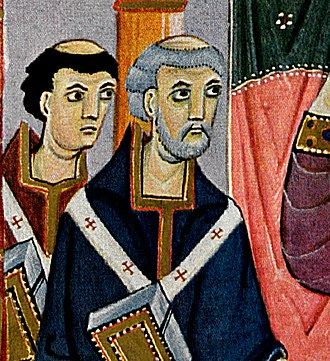
NAME: Gerbert of Aurillac
ACHIEVEMENT(S): 10th-century French scholar who became Pope Sylvester II
NICKNAME/ALIAS: Pope Sylvester II (999-1003)
DATE/PLACE OF BIRTH: c. 945, near Aurillac, France
DATE/PLACE/AGE AT DEATH: 12 May 1003, at Rome, Italy. Aged around 58
DISCIPLINE: Ecclesiastic
FIELD: Roman Catholic Church
EDUCATION: Convent of Saint Gerard, Aurillac, France; Abbey of Vich, Catalonia, Spain
MAJOR WORK: 'Mathematical Works of Gerbert', c. 972-99
LIFE AND TIMES:
In 972, Gerbert travelled to Rheims in France in order to study, and there archbishop Adalbero appointed him head of the cathedral school, and later ordained him. At the school, Gerbert instigated educational reforms which were to influence the curriculum of cathedral schools and universities for at least the following two centuries.
He instituted the full programme of all seven liberal arts, and introduced the study of dialectic and logic. As the first person known to have taught the syllabus of the 'logica vetus', (‘old logic’) the basis for the teaching of logic until mid-12th century (before the arrival of full Aristotelian texts via Arab translators), Gerbert established a highly original educational regime where students, in addition to studying these works, were required to engage in 'controversies' on set questions.
He is also regarded as the first to reintroduce the study of classical authors, including Virgil, Terence, Horace, Persius, Lucan, Seneca, and Quintilian.
Gerbert's reforms attracted many new pupils from across Europe to the Rheims school, and this success allowed him greatly to augment the library and to introduce the study of mathematics and astronomy to the curriculum.
In teaching astronomy, he used a spherical model to illustrate the movement of the planets and instructed his students in making astronomical observations. He constructed many models as educational aids, including globes, planetaria, viewing-tubes, organs, charts, and an abacus on which he used Hindu-Arabic numerals rather than Roman numerals. He also wrote a treatise on the abacus, which later became a standard work.
In 980, he accompanied Adalbero to Ravenna in Italy, where he greatly impressed Emperor Otto II during a public debate on the proper division of philosophy, the cause of the creation of the world, whether all causes can be expressed by the single word "good", the cause of a shadow, and whether 'mortal' or 'rational' is the wider concept.
As a result, within a year Otto II had appointed Gerbert abbot of Bobbio (60 km north-east of Genoa), another monastery noted for its extensive library.
However, after Otto II’s death in December 983, Gerbert was hounded out of Bobbio as a foreigner by the local nobles and ecclesiastics, and he returned to Adalbero at Rheims, where he resumed teaching in 984, including amongst his pupils Fulbert*, who a few years later would found the cathedral school at Chartres.
During this period Gerbert was working on his one still-surviving philosophical work, 'On That Which is Rational and Using Reason', c. 972-99, arguing that "using reason" can be predicated on "that which is rational".
Gerbert arrived at the Imperial court court in Magdeburg in April 997, and followed it through Germany to Italy, becoming a close friend and adviser of the emperor, for whom he constructed an 'oralogium' (either a sundial or an astrolabe) with which he took the altitude of the pole star.
In April 998 Otto III appointed Gerbert archbishop of Ravenna, and within a few months, on the sudden death of Gregory V in February 999, Otto III appointed Gerbert Pope, the first Frenchmen on the papal throne.
Gerbert chose the name Sylvester II, and as pope became an intransigent champion of the traditional rights of the papacy, acting with a high hand against abbots and bishops who incurred his disapproval. He was an active reformer, however, and denounced simony and nepotism, advocated strict celibacy, and insisted on the free election of abbots by monks.
Throughout his short reign as pope, Gerbert worked closely with Otto III, helping to shape the vision of a renewed Christian Roman Empire. In 1000 he organized the church in Poland, granting the country its first archbishopric (at Gniezno), but refused to sanction Duke Boleslav¹s elevation to kingship, and in 1001 sent the royal crown to Stephen I as first king of Hungary, establishing a new archbishopric (at Esztergom) and new bishoprics there.
However, in 1001 a revolt in Rome forced both pope and emperor to leave the city, and the great scheme ended with Otto III's premature death from malaria in 1002.
Gerbert's many letters about politics, episcopal administration, manuscripts, mathematics, and science create a vivid picture of his times and of his own intellectual versatility and brilliance, which dazzled his contemporaries. He died in Rome and was buried in the basilica of St. John Lateran.
Legacy
 Statue of Pope Sylvester II in Aurillac, France
Gerbert of Aurillac was a humanist long before the Renaissance. He read Virgil, Cicero and Boethius; he studied Latin translations of Porphyry and Aristotle. He had a very accurate classification of the different disciplines of philosophy. He was the first French pope.
Gerbert was said to be one of the most noted scientists of his time. Gerbert wrote a series of works dealing with matters of the quadrivium (arithmetic, geometry, astronomy, music), which he taught using the basis of the trivium (grammar, logic, and rhetoric). In Rheims, he constructed a hydraulic-powered organ with brass pipes that excelled all previously known instruments,[21] where the air had to be pumped manually. In a letter of 984, Gerbert asks Lupitus of Barcelona for a book on astrology and astronomy, two terms historian S. Jim Tester says Gerbert used synonymously.[22] Gerbert may have been the author of a description of the astrolabe that was edited by Hermannus Contractus some 50 years later. Besides these, as Sylvester II he wrote a dogmatic treatise, De corpore et sanguine Domini—On the Body and Blood of the Lord.
Legends
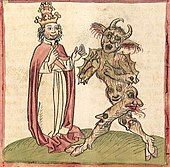
Pope Sylvester II and the Devil in an illustration of c. 1460
The legend of Gerbert grows from the work of the English monk William of Malmesbury in De Rebus Gestis Regum Anglorum and a polemical pamphlet, Gesta Romanae Ecclesiae contra Hildebrandum, by Cardinal Beno, a partisan of Emperor Henry IV who opposed Pope Gregory VII in the Investiture Controversy.[citation needed] According to the legend, Gerbert, while studying mathematics and astrology in the Muslim cities of Córdoba and Seville, was accused of having learned sorcery.[23] Gerbert was supposed to be in possession of a book of spells stolen from an Arab philosopher in Spain. Gerbert fled, pursued by the victim, who could trace the thief by the stars, but Gerbert was aware of the pursuit, and hid hanging from a wooden bridge, where, suspended between heaven and earth, he was invisible to the magician.[24]
Gerbert was supposed to have built a brazen head. This "robotic" head would answer his questions with "yes" or "no". He was also reputed to have had a pact with a female demon called Meridiana, who had appeared after he had been rejected by his earthly love, and with whose help he managed to ascend to the papal throne (another legend tells that he won the papacy playing dice with the Devil).[25]
According to the legend, Meridiana (or the bronze head) told Gerbert that if he should ever read a Mass in Jerusalem, the Devil would come for him. Gerbert then cancelled a pilgrimage to Jerusalem, but when he read Mass in the church Santa Croce in Gerusalemme ("Holy Cross of Jerusalem") in Rome, he became sick soon afterwards and, dying, he asked his cardinals to cut up his body and scatter it across the city. In another version, he was even attacked by the Devil while he was reading the Mass, and the Devil mutilated him and gave his gouged-out eyes to demons to play with in the Church. Repenting, Sylvester II then cut off his hand and his tongue.
The inscription on Gerbert's tomb reads in part Iste locus Silvestris membra sepulti venturo Domino conferet ad sonitum ("This place will yield to the sound [of the last trumpet] the limbs of buried Sylvester II, at the advent of the Lord", mis-read as "will make a sound") and has given rise to the curious legend that his bones will rattle in that tomb just before the death of a pope.[26]
The story of the crown and papal legate authority allegedly given to Stephen I of Hungary by Sylvester in the year 1000 (hence the title 'apostolic king') is noted by the 19th-century historian Lewis L. Kropf as a possible forgery of the 17th century.[27] Likewise, the 20th-century historian Zoltan J. Kosztolnyik states that "it seems more than unlikely that Rome would have acted in fulfilling Stephen's request for a crown without the support and approval of the emperor."[28]
Honours
Hungary issued a commemorative stamp honouring Pope Sylvester II on 1 January 1938,[29] and France honoured him in 1964 by issuing a postage stamp.[30]
ASSESSMENT: A brilliant and innovative medieval Pope.
EXTRA CONNECTIONS: Gerbert, Albert Magnus and Roger Bacon said to make speaking heads.
ONELINER: Gerbert of Aurillac, medieval scholar and Pope
BIBLIOGRAPHY:
DSB, EB
New Catholic Encyclopedia
Routledge Encyclopedia of Philosophy
Lattin, Harriet P, The Peasant Boy Who Became Pope, London: Abelard-Schuman, 1958.
LANGUAGE: Latin, French and Italian
PARENTS: Unknown
SIBLINGS: Unknown
SPOUSE: None
CHILDREN: None