Aristotle
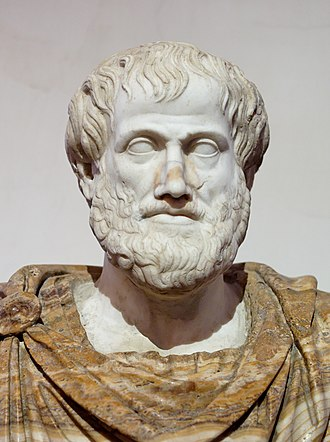
Achievements: Helped shape Western culture
Born: 384 BC; Stagira, Chalcidice, Greece
Died: 322 BC; Chalcis, Euboea, Greece (Aged 62)
Field & Discipline: Philosophy
Language: Ancient Greek
Father: Nichomachus
Mother: Phaestis
Siblings: Unknown
Spouse: Pythias (m. c. 346 BC)
Children: by Pythias: Pythias; by Herpyllis: Nicomachus
Education: Private tutors; Plato's Academy
Major Work:
“Metaphysics”
Life & Times: In 367 BC, Aristotle was sent to [studied] Plato's* Academy in Athens, which was being run by Eudoxus of Cnidos at the time. A success as a student, he graduated to become a teacher at the Academy.
During his twenty years there, his writings strongly supported the views of Plato, who had written his dialogues, “Sophist,” “Timaeus” and “Philebus,” during the same period. Aristotle left the Academy after Plato’s death in 348/347 BC and went to Assus in Asia Minor, where he became the leader of the small Academy and spent his time documenting observations in zoology and biology. During this time, he wrote “On Kingship,” in which he departed from Plato’s philosophy and developed his own.
He also distanced himself from Plato in his “On the Soul.” Plato believed the soul was only temporarily resident in the body, whereas Aristotle believed that the soul was essentially united with the body to form the individual.
In 344 BC, Aristotle left for the island of Lesbos and settled in the capital city, Mytilene, where he continued his pioneering biological investigations and philosophical writings and met his old Academy colleague, Theophrastus.
In his biological research, he focused on teleological causation, which dealt with the aim, or end, of nature. According to Aristotle, natural organisms have natural ends or goals and their structure and development can only be fully explained when these goals are understood.
Aristotle left Lesbos in 343 BC, for the Court of Macedonia at Pella, where he became tutor to Philip II's son, Alexander the Great. The treaty between Athens and Macedonia began to fall apart in 340 BC and Philip lost interest in supporting Aristotle, making Xenocrates of Chalcedon head of his Academy.
Aristotle went to his family home in Stagira before returning to Athens in 335 BC, to set up the Lyceum, a rival institute to the Academy. The difference between the new school and the Academy was that the scientific interests of the Platonists centred on mathematics, but the Lyceum preferred biology and history.
Aristotle’s work over this period includes his “Aristotelian Corpus,” representing an encyclopaedic output on virtually every field of knowledge. Other works include the study of biology and zoology, including “Generation and Corruption,” his explanation of natural organisms and their behaviour.
On the subject of logic, he produced the “Organon,” which contained the “Categories,” “On Interpretation,” “Prior Analytics,” “Posterior Analytics,” “Topics,” and the “Sophistical Refutations.”
“Metaphysics” was one of Aristotle's major works and included the character of living organisms and his examination of the ultimate principle of the cosmic order: divine substance.
In his works on ethics and politics, “Nicomachean Ethics,” “Eudemian
Ethics” and “Magna Moralia,” Aristotle believed that human happiness was made possible through living in conformity with nature. He also believed that mankind possessed the faculty of reason which allowed it to obtain knowledge.
The last of Aristotle's fundamental contributions was literary criticism and rhetorical theory, adiscussed in his major works “Poetics” and “Rhetoric.”
In 323, Alexander the Great died and an anti-Macedonian reaction took place in Athens. Aristotle, as a friend of Antipater, the Macedonian regent of Athens, was accused of impiety, so he left Athens for his mother's estates in Chalcis, on the island of Euboea, where he died, the following year, from a stomach illness.
Extra Connections:
His work influenced that of [influenced] Abelard*, [influenced] Hobbes* [influenced] Avicenna*, [influenced] Averroes*, [influenced] Aquinas*, [influenced] Bruno*, [influenced] Crescas*, [influenced] Albertus Magnus*, [influenced] Gassendi*, [influenced] Grosseteste*, [influenced] Maestlin*, [influenced] Ptolemy*, [influenced] ben Gershom*, [influenced] Maimonides*, [influenced] Von Freiburg*, [influenced] William of Ockham*, [influenced] Duns Scotus*, [influenced] Bessarion*, the [influenced] Accademia del Cimento*, [influenced] Gall & Spurzheim*, [influenced] Newton*, [influenced] Descartes*, [influenced] Copernicus*, [influenced] Cosimo de’ Medici The Elder*, [influenced] Benedetti*, [influenced] Osiander*, [influenced] F Bacon*, [influenced] R Bacon*, [influenced] Siger of Brabant*, [influenced] Abelard*, [influenced] Bernard of Chartres*, [influenced] Thierry of Chartres*, [influenced] Fulbert*, [influenced] Lanfranc*, [influenced] Corneille*, [influenced] Gerard of Cremona*,
He was an early user of the [used] camera obscura*
Assessment: Aristotle’s thinking had a major influence on Western intellect and was vital in shaping Western culture.
Oneliner: Aristotle, major philosopher
Bibliography:
Barnes, J., Aristotle, Oxford and New York: OUP, 1982.
Irwin, T.H., "Aristotle,” in Routledge Encyclopedia of Philosophy, CD-Rom Version 1.0, London and New York: Routledge, 1998.