Austen J
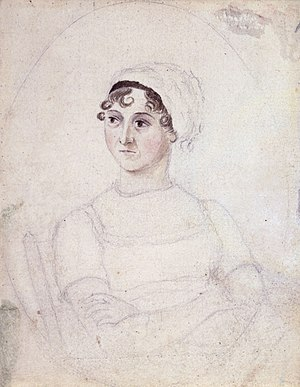
ACHIEVEMENT(S):
Great English novelist
NICKNAME/ALIAS:
None
DATE/PLACE OF BIRTH:
16 December 1775, at Steventon, Hampshire, England
DATE/PLACE/AGE AT DEATH:
18 July 1817, in Winchester, Hampshire, England. Aged 41.
DISCIPLINE: Novelist
FIELD: Literature
LANGUAGE: English
PARENTS:
Rev. George Austen and Cassandra Leigh, married 1764
SIBLINGS:
James (1765-1819), George (b. 1766), Edward (b. 1767), Henry
(1771-1850), Cassandra (1773-1845), Francis (1774-1865) and Charles
(1779-1852)
SPOUSE: None
CHILDREN: None
EDUCATION:
Private tutor at Oxford and Southampton, 1783; Abbey House
School, 1785-86
MAJOR WORK:
'Emma', 1816
LIFE AND TIMES:
As a child and young woman she read widely - enjoying in particular the works of Fanny Burney* andSir Walter Scott*, both of whom she met - and enjoyed occasional visits to Bath, London, Lyme, and her brothers' houses. By the age of 14 she was producing parodies of a variety of 18th-century literary forms, from sentimental novels to Oliver Goldsmith's* 'History of England'.
Her notebooks from this period (1787-94), contain plays, verses, short novels, and other prose, including 'Love and Friendship', a parody of 18th-century melodramatic fiction, and 'Lady Susan', a short novel-in-letters, written probably in 1793-94 and finally published in 1871.
There followed the first of her two periods of mature composition. During the first of these periods (1795-98), she wrote the novel-in-letters 'Elinor and Marianne' (1795-96) and then 'First Impressions' (1796-97), which became the first version of 'Pride and Prejudice', and which her father submitted to the London publisher Cadell but was refused.
In 1797-98 Austen then revised 'Elinor and Marianne' as an early version of 'Sense and Sensibility', and then produced the last of these early novels, 'Northanger Abbey' (written 1798-99), which successfully combines a satire on conventional novels of polite society with one on Gothic tales of terror. This was sold in 1803 (probably under the title 'Susan') to the publisher Richard Crosby for £10, but, although it was taken for immediate publication and was advertised, it never appeared.
In 1801 her father, then aged 70, retired to Bath with his wife and two daughters. For the following eight years, the family lived in a succession of temporary lodgings or visited relatives at Bath, London, Clifton (Warwickshire) and, finally - with the death of her father in 1805 - Southampton (1805-09). Finally, in 1809, with the help of her brother Edward, Austen and her mother and sister were able to return to Hampshire, to a cottage in Chawton, a village near Steventon.
Austen remained at Chawton for the last eight years of her life and entered her second great phase of almost non-stop creativity (1810-17). Returning to her early works, in
1809-10 she revised 'Sense and Sensibility' for publication, and then re-created 'First Impressions' as her first major work: 'Pride and Prejudice'. Two years later Thomas Egerton agreed to publish 'Sense and Sensibility', which came out anonymously in November 1811, and was generally well received.
These two novels - with the addition of the earlier 'Northanger Abbey' (eventually published posthumously in 1817) - form a distinct group in which a strong element of literary satire accompanies the comic portrayal of character and society. 'Sense and Sensibility' is Austen's first completely successful attempt at social satire, while in 'Pride and Prejudice' - Austen's first comic masterpiece, a satire on husband-hunting in a consumerist and class-conscious society - she produced her most engaging character, the intelligent and high-spirited Elizabeth Bennet.
In 1811 Austen began 'Mansfield Park', which in its tone and subject matter (religious duty and personal morality) is her most ambitious and serious novel. This was published in 1814, a year after 'Pride and Prejudice' (1813) was accepted, which she followed by 'Emma' (written January 1814-March 1815, published December 1815).
Generally regarded as her greatest achievement, 'Emma' is the work which most fully realized Austen's own criterion of "three or four families in a country village" as "the very thing to work on," and received a favourable review in March 1816 'Quarterly Review' from Sir Walter Scott, who hailed this "nameless author" as a masterful exponent of "the modern novel" in the new realist tradition.
In August 1815 Austen began work on her last complete novel, 'Persuasion', which she finished in August 1816, the year in which a second edition of 'Mansfield Park' was published (like 'Emma', by Byron's publisher, John Murray*). She then spent some time finally revising the manuscript of 'Northanger Abbey', and in January 1817 began a new novel, 'Sanditon', a satire on health resorts and invalidism, but this remained unfinished due to ill-health.
In April 1817 she made her will, and in the following month her sister Cassandra took her to Winchester for treatment from a surgeon at the County Hospital. However, once in Winchester her condition declined rapidly, and she died (probably from Addison's Disease, a tubercular disease of the kidneys) on 18 July (four days after the great French woman of letters, de Stael*, whom she had once refused to meet), and was buried in Westminster Cathedral six days later.
ASSESSMENT: Modern critics remain fascinated by the structure and organization of the novels, by the triumphs of technique that show tragedy and comedy in ordinary events and settings.
EXTRA CONNECTIONS:
Her work influenced that of Fenimore Cooper*.
ONELINER: Jane Austen, author of “Emma”
BIBLIOGRAPHY:
EB
Collier's Encyclopedia
Le Fay, Deidre, Jane Austen, The British Library: London, 1998