De Stael
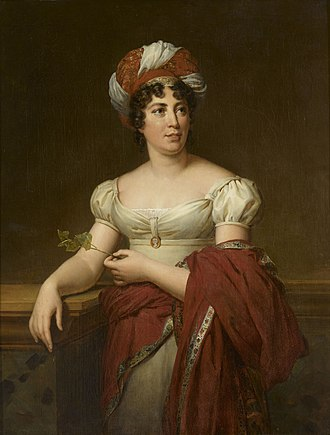
Nickname/Alias: Madame de Stael
Name: Anne-Louise-Germaine Necker, Baronne (Baroness) de Stael-Holstein
Achievements: First psychological novel
Born: April 22, 1766; Paris, France
Died: July 14, 1817; Paris, France (Aged 51)
Field & Discipline: Literature; Writer
Language: French
Father: Jacques Necker
Mother: Suzanne Curchod
Siblings: None
Spouse: Baron Erik Magnus de Stael-Holstein
Children: 1) By Baron Stael: Gustavine. 2) By Narbonne (??? who ???): Auguste; Albert. 3) By Benjamin Constant: Albertine
Education: Mainly by her mother
Major Work:
"Considerations sur les principaux evenements de la revolution francaise” (Reflections on the Chief Events of the French Revolution)
"De l'Allemagne” (On Germany)
Life & Times:
De Stael’s father was [father was] Jacques Necker*, French Minister of Finance. As a small child, de Stael attended her mother, [mother was] Mme Necker’s* famous salon, where she met statesmen and intellectuals like [met] Diderot*, [met] d'Alembert*, and the [met] Buffon*.
At 10, she was taken by her parents on a six-week visit to England, where she met [met] Horace Walpole*, [met] Gibbon*, and [met] Garrick*. When she was 12, her mother took her to see [met] Voltaire*.
All during her childhood, De Stael kept a diary and wrote plays and stories, and at 12, completed her first work, a comedy: "The Inconveniences of Paris Life".
In 1786 she married the Swedish ambassador to France, Baron Erik Magnus de Stael-Holstein. The same year, she wrote a romantic drama, "Sophie, ou les sentiments secrets” (Sophie, or Secret Feelings). But it was her "Lettres sur les ouvrages et le caractere de J-J. Rousseau” (Letters on the Works and the Character of J.-J. Rousseau) of 1788 that made her name as a writer.
During the late 1780’s, de Stael established her own salon, to which she invited influential people. In January, 1793, with France in upheaval after the Revolution, de Stael fled to England with other French emigres, including [had an affair with] Talleyrand*, with whom five years earlier she had had a brief affair. In England, she met Fanny [met] Burney* and her husband [met] D’Arblay*.
When the chaos eased in France, de Stael returned to Paris and reopened her popular salon. She published several political and literary essays, notably "Reflexions sur la paix interieure” (Reflections on Internal Peace)(1795), a pamphlet in support of the Republic, and "De l'influence des passions sur le bonheur des individus et des nations” (A Treatise on the Influence of the Passions upon the Happiness of Individuals and of Nations) (1796), which became one of the key documents of European Romanticism.
She began to study philosophical ideas taking hold in Europe, particularly in Germany, and read the works of philologist [influenced by] Wilhelm von Humboldt* (brother of naturalist [knew about] Alexander von Humboldt*) and the brothers [had affair with] August Wilhelm von Schlegel* and [influenced by] Friedrich von Schlegel*.
In 1795, de Stael was exiled for critical remarks about Napoleon, but in 1797, [love-hate relationship with] Napoleon* permitted her to return. In 1800, she published her famous "De la Litterature consideree dans ses rapports avec les institutions socials” (On Ancient and Modern Literature and its Relations with Social Institutions), followed in 1802 by her semi-autobiographical, novel "Delphine". In 1802, her husband died.
De Stael's salon became a focus of anti-Napoleon opinion and was frequented by Benjamin Constant, who fathered her child Albertine, and other disaffected men such as [a salon guest was] JBJ Bernadotte*. By 1803 Napoleon's patience with her had run out and he forbade her to come within 40 miles of Paris, which was about the distance of Coppet, where she set up a household.
She then left with her three children for Weimar, Germany where she dazzled the court and met [met] Schiller*, [met] Fichte* and [was disliked by] Goethe*. She next moved to Berlin, where she met [met] Schelling* and August Wilhelm von Schlegel, who became a frequent companion. In Vienna, in 1804, word came of her father's death. Deeply affected, she immediately returned to Coppet, where she wrote the touching eulogy "Du caractere de M. Necker" (On the Character of M. Necker)..
In 1805, de Stael visited Italy with Schlegel, returning in the summer to Coppet, where she spent the next seven years of her exile. She once again assembled a brilliant circle around her, and wrote her second novel "Corinne" in 1807. In late 1807, she again visited Germany, and began work on her most important and famous book, "De l'Allemagne" (On Germany), which introduced German literature and philosophy of the romantic era to France, and coined the word "Romanticism." It was published in France in 1810 and in England in 1813.
In 1811, de Stael married a young Swiss officer, John Rocca. A year later, she began to travel again, visiting Austria, Russia (where she was received by Tsar Alexander I), Finland, and Sweden (where she was welcomed by her old friend Bernadotte, now Crown Prince of Sweden, whom she persuaded to enter into the coalition against Napoleon), and finally arrived in England in June, 1813, soon after the publication of her "Reflections on Suicide".
In London, she was feted by the aristocracy, and met [feted by] Byron*, [feted by] Coleridge*, and [feted by] William Wilberforce*.
"Considerations sur les principaux evenements de la revolution francaise” (Reflections on the Chief Events of the French Revolution), published in 1818, is considered to be De Stael's most important work. It represents a return to her father's ideas which held up the English political system as a model for France.
After the Bourbon Restoration in 1814, King Louis XVIII welcomed de Stael back to Paris, and she collected the inheritance her father had left her. When Napoleon returned to Paris, Madame de Stael fled once again to Coppet, and in September, 1815 set out for Italy.
In 1816, she returned to spend the summer at Coppet, where she was joined by Byron, in flight from England and his unhappy marriage. Later that summer, she accompanied Byron to Geneva, where she met poet [met] Percy Bysshe Shelley* and his novelist wife [met] Mary Shelley*.
She returned to Paris that winter, where, despite declining health, she kept up her salon. In February, 1817, she suffered a stroke and died in July.
Extra Connections: In Weimar, she tried and failed to meet [nearly met] Herder*.
Met [met] Washington Irving.*
Assessment: De Stael's critical and historical work were seminal.
Oneliner: Madame de Stael, French writer who coined “Romanticism”
Bibliography:
- Collier’s Encyclopedia.
- Encyclopedia Britannica.
- Winegarten, Renee, Madame de Stael, Leamington Spa: Berg Publishers Ltd., 1985.