Barbed Wire
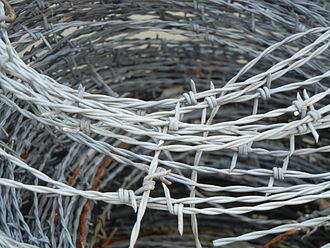
ALTERNATIVE NAME/S: “bob wire” or the “devil’s rope” later razor wire.
DETAILS:
Barbed wire was invented as a way of solving the enclosure problems of farmers in the mid-west during the nineteenth century. Farmers were compelled to enclose their land and up to the end of the Civil War in America there were several different kinds of fencing, none of which really met the need of farmers.
Timber, stone, sod, and hedging were all either too expensive, too time-consuming to maintain, or just ineffective.
In 1816 a firm in Philadelphia installed a smooth wire fence on a farm and by the 1840’s wire was being used on the prairies. There were difficulties keeping the wire taught between posts and although galvanized wire helped to combat rust, it still snapped in cold weather. The livestock were not hurt by contact with the wire and soon realized how to get through it. Farmers and mechanics experimented with adding some form of pricker or barb to the smooth wire but early patents proved impractical.
In 1873 Joseph Glidden*, a farmer, solved the problem of keeping the bars in place and developed a barbed wire fence that was effective. His type of fence became the basis for all the barbed wire produced in the country. The mass production of barbed wire followed and barbed wire became affordable and widely available. In the west it was known as “bob wire” or the “devil’s rope”.
The effectiveness of the protection given by barbed wire exacerbated the fencing wars in the west between cattlemen and settlers. Cattlemen – and rustlers – needed vast tracks of open land, unimpeded by settlements. Settlers wanted to fence off and contain their land and to travel safely and build roads on the land around them. Both sides used wire to try and enforce their claims.
In the end, the wire played a large part in establishing stable rural communities in the west and in encouraging further movement west. Many settlers who had been put off staying permanently in one area by the expense of fencing were willing to do so after the mass production of Glidden wire. Their successful and safely protected settlements in turn formed a take-off point for more adventurous settlers to go further west.
After Glidden’s 1874 patent was granted, around four hundred types of barbed wire were developed and there were patent battles. Only a few types provided the basis for the industry but the most important group were the two-point barbed wire types pioneered by Glidden and the four-point wire barb. After these, came the four-point sheet-metal barb.
The defensive attributes of barbed wire were first used in a military situation in the South African War of 1899-1902 where it was used around prison compounds by the Boer farmers who were familiar with it as fencing material. In the Russo-Japanese War of 1904-5, barbed wire entanglements were used in the defense of Manchuria. In the first world war (1914-1917) the American Steel and Wire Division of the United States Steel Corporation supplied barbed wire entanglements for the allies on the western front in Europe where trench warfare created a new defensive need. The use of barbed wire created the need for the tank and also gave rise to wire cutters, and protective gauntlets.
In World War II (1939-45), the Japanese sank barbed wire in the sea in an attempt to obstruct submarines. This gave rise to a new body of military personnel, the “frogmen” who were trained to clear a path for ships’ propellers and submarines.
For the American forces fighting in the Korean War of the 1950’s, wire concertinas were made of spring steel with a tensile strength of 200,000 p.s.i. Bales of the wire were made up of twenty-eight units of wire compressed into one unit. When a single clip was loosened, the bale of wire stretched out like a concertina, up to fifty-six feet in length and forty inches in height. It could be re-formed into a concertina after use. If an enemy tank did get through, the wire sprang back to close the gap behind it so that more tanks could not immediately follow.
Modern concertina wire for military use and prison compounds has vicious four-point barbs up to three-quarters of an inch long.
Present-day wire for domestic use is made with lighter steel for both the strand wire and the barbs. The barbs are made shorter and in a smaller gauge than Glidden’s but his specifications for the twist attaching them to the smooth wire is often still used. Modern inventions include variations on the twist, the use of corrugated wire for the strings, the use of aluminum and of plastic reinforced with concealed wires.
ONELINER: Barbed wire
OTHER CONNECTIONS: None
BIBLIOGRAPHY:
McCallum, Frances T and Henry D, The Wire that Fenced the West, University of Oklahoma Press, Norman, Oklahoma, 1966
Barbed wire, also known as barb wire, is a type of steel fencing wire constructed with sharp edges or points arranged at intervals along the strands. Its primary use is the construction of inexpensive fences, and it is also used as a security measure atop walls surrounding property. As a wire obstacle, it is a major feature of the fortifications in trench warfare.
A person or animal trying to pass through or over barbed wire will suffer discomfort and possibly injury. Barbed wire fencing requires only fence posts, wire, and fixing devices such as staples. It is simple to construct and quick to erect, even by an unskilled person.
The first patent in the United States for barbed wire[1] was issued in 1867 to Lucien B. Smith of Kent, Ohio, who is regarded as the inventor.[2][3] Joseph F. Glidden of DeKalb, Illinois, received a patent for the modern invention[4] in 1874 after he made his own modifications to previous versions.
Wire fences are cheaper and easier to erect than their alternatives (one such alternative is Osage orange, a thorny bush that is time-consuming to transplant and grow).[5] When wire fences became widely available in the United States in the late 19th century, it became more affordable to fence much larger areas than before, and intensive animal husbandry was made practical on a much larger scale.
An example of the costs of fencing with lumber immediately prior to the invention of barbed wire can be found with the first farmers in the Fresno, California, area, who spent nearly $4,000 (equivalent to $90,000 in 2021) to have wood for fencing delivered and erected to protect 2,500 acres (1,000 ha) of wheat crop from free-ranging livestock in 1872.[6]
- Design Design subsection
- History History subsection
- Installation Installation subsection
- Uses Uses subsection
- Safety and injuries
- See also
- Notes
- References and further reading
- External links