Tank
The Holt Tractor Company of Stockton, California made tractors with endless ‘caterpillar’ tracks around the wheels so that the tractor continuously laid and picked up its own pathway. Holt caterpillar tractors took off in the USA and were soon sold world-wide.
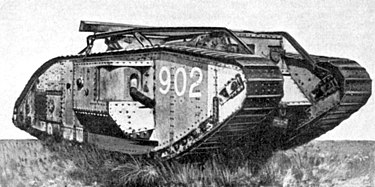
A British army officer, Lieutenant-Colonel ED Swinton*, received glowing reports from a South African friend about the use of a Holt tractor for moving heavy machinery across country. Swinton passed on this information to the War Office in 1914, and the Holt German representative badgered the German General Staff about the military use of caterpillar tracks.
Nobody was interested, mainly because any future war was seen as employing the tried and tested tactic of a heavy artillery bombardment followed up by infantry breaching the enemy lines through which the cavalry would charge at selected points.
However, in August 1914 the first world war and the belt-fed Maxim machine gun concentrated the minds of the military on the absolute necessity of destroying the enemy’s machine guns.
To do this, what was needed was a self-propelled armoured vehicle that could spread its weight to enable it to cross muddy ground without getting stuck, and also maneuvre through barbed wire and over trenches. It would afford protection to the crew inside who would fire tank guns which would take out the enemy’s machine guns. Swinton, battling against prejudice and indifference, continued to push for such a vehicle. He received support from Churchill at the Admiralty and, under the greatest secrecy, the British began to manufacture such a vehicle.
A prototype called Little Willie was constructed in 1915. The Holt caterpillar system was found to be unsuitable and the British designers devised and built a modified version - new, lightweight track-plate which incorporated the slope track of the Holt version that enabled the vehicle to climb over obstacles. Big Willie, a second prototype which became known as ‘Mother’, was tested in 1916.
Fifty vehicles were shipped to France that year in crates labelled “Tank” to put the Germans off the scent. In September of that year they were used for the first time in the battle of the Somme.
This provided valuable training experience for crews and in November 1917 the first really successful use of the tank occurred when four hundred tanks were employed to break through enemy lines at Cambrai.
The French developed independently around the same time a tank which consisted of metal boxes and guns on Holt caterpillar tractors; and in 1917 the US tank corps was created (they fought with British and French tanks). The Germans salvaged captured tanks and used them against the allies.
In the period between the two world wars, all major nations built and designed their own tanks. Improvements were made in armour, mobility and tank guns. During the second world war, hollow charge ammunition, based on the development of the Munroe* effect, was used for anti-tank weapons.
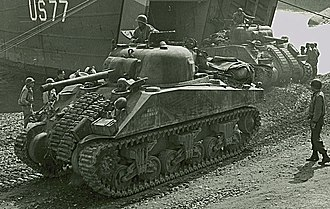
US Sherman
The use of tanks in the Second World War changed the conduct of desert war, and amphibious tanks were used by the US to spearhead ship to shore invasions in the Pacific. The Germans pioneered the use of massed tanks as in their Panzer divisions to devastating effect in their blitzkriegs. The largest tank battle in history was fought in Russia in 1943, involving almost 3,000 tanks.
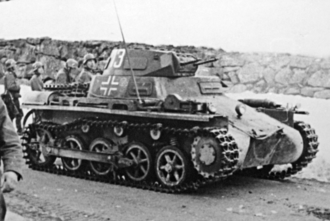
German Panzer
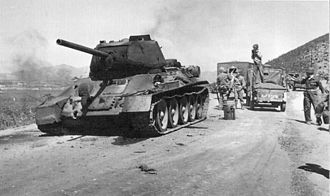
Russian T-34
ONELINER: The tank
OTHER CONNECTIONS:
In a memorandum of 1908, Antarctic explorer Robert Falcon Scott presented his view that man-hauling to the South Pole was impossible and that motor traction was needed}:.[30] Snow vehicles did not yet exist however, and so his engineer Reginald Skelton developed the idea of a caterpillar track for snow surfaces.[31]...
Scott died during the expedition in 1912, but expedition member and biographer Apsley Cherry-Garrard credited Scott's "motors" with the inspiration for the British World War I tanks, writing: "Scott never knew their true possibilities; for they were the direct ancestors of the 'tanks' in France."[33]
1968 Prague Spring crushed by Soviet tanks
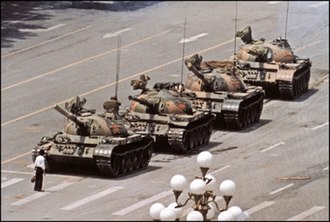
Tank Man is the nickname of an unidentified Chinese man who stood in front of a column of Type 59 tanks leaving Tiananmen Square in Beijing on June 5, 1989, the day after the Chinese government's violent crackdown on the Tiananmen protests. As the lead tank maneuvered to pass by the man, he repeatedly shifted his position in order to obstruct the tank's attempted path around him.
BIBLIOGRAPHY:
Hogg, Ian V., Armour in Conflict, The Design and Tactics of Armoured Fighting Vehicles,Jane’s Publishing Company, London and Sydney, 1980
Humble, Richard, Tanks, Weidenfeld & Nicolson, London, 1977.
Wright, Patrick,Tank, The Progress of a Monstrous War Machine, Faber and Faber, London, 2000.