Ferris Wheel
A Ferris wheel (also called a big wheel, giant wheel or an observation wheel) is an amusement ride consisting of a rotating upright wheel with multiple passenger-carrying components (commonly referred to as passenger cars, cabins, tubs, gondolas, capsules, or pods) attached to the rim in such a way that as the wheel turns, they are kept upright, usually by gravity. Some of the largest modern Ferris wheels have cars mounted on the outside of the rim, with electric motors to independently rotate each car to keep it upright.
The original Ferris Wheel was designed and constructed by George Washington Gale Ferris Jr. as a landmark for the 1893 World's Columbian Exposition in Chicago, although much smaller wooden wheels of a similar idea predate Ferris's wheel, dating perhaps to the 1500s. The generic term "Ferris wheel" is now used in American English for all such structures, which have become a very common type of amusement ride at amusement parks, state fairs, and other fairs or carnivals in the United States.[1]^
The tallest Ferris wheel is the 250-metre (820 ft) Ain Dubai in the United Arab Emirates, which opened in October 2021.
Terminology and design
The term Ferris wheel comes from the designer of the best known early example, George Washington Gale Ferris Jr., whose Ferris Wheel Company built a large amusement for the Chicago World's Columbian Exposition in 1893.
The Ferris Wheel Company was formed in 1892 for the [construction and operation of] "wheels of the Ferris or other types for the purpose of observation or amusement",[2]^ the source of the modern usage observation wheel for the type.[3][4]^
Design variations include single- (cantilevered) or twin-sided support for the wheel, and whether the cars or capsules are oriented upright by gravity or by electric motors. The most prevalent design uses twin-sided support and gravity-oriented capsules.
Early history
 |  |
|---|---|
| Early 17th-century pleasure wheels; to the left an engraving by Adam Olearius, to the right a modern depiction of a period Turkish design |

An early wheel in Bucharest, Romania (1857 lithograph)

Magic-City, Paris, France, 1913.
"Pleasure wheels", whose passengers rode in chairs suspended from large wooden rings turned by strong men, may have originated in 17th-century Bulgaria.[1][5]^
The Travels of Peter Mundy in Europe and Asia, 1608–1667[6]^ describes and illustrates "severall Sorts of Swinginge used in their Publique rejoyceings att their Feast of Biram" on 17 May 1620 at Philippopolis (now Plovdiv) in the Ottoman Balkans.[5]^ Among means "lesse dangerous and troublesome" was one:
like a Craine wheele att Customhowse Key and turned in that Manner, whereon Children sitt on little seats hunge round about in severall parts thereof, And though it turne right upp and downe, and that the Children are sometymes on the upper part of the wheele, and sometymes on the lower, yett they alwaies sitt upright.
Five years earlier, in 1615, Pietro Della Valle, a Roman traveller who sent letters from Constantinople, Persia, and India, attended a Ramadan festival in Constantinople. He describes the fireworks, floats, and great swings, then comments on riding the Great Wheel:[7]^
I was delighted to find myself swept upwards and downwards at such speed. But the wheel turned round so rapidly that a Greek who was sitting near me couldn't bear it any longer, and shouted out "soni! soni!" (enough! enough!)
Similar wheels also appeared in England in the 17th century, and subsequently elsewhere around the world, including India, Romania, and Siberia.[5]^
A Frenchman, Antonio Manguino, introduced the idea to the United States in 1848, when he constructed a wooden pleasure wheel to attract visitors to his start-up fair in Walton Spring, Georgia.
Somers' Roundabout

A 50 foot wooden wheel built by William Somers in Atlantic City, New Jersey, in 1891 was an immediate precursor to the original Ferris Wheel.
In 1891, William Somers installed a fifty-foot wooden wheel at Atlantic City, New Jersey, and later others at Asbury Park, New Jersey, and Coney Island, New York.[8]^ In 1893 he was granted the first U.S. patent for a "Roundabout".[9][10]^ George Washington Gale Ferris Jr. rode on Somers' wheel in Atlantic City before designing his wheel for the World's Columbian Exposition. In 1893, Somers filed a lawsuit against Ferris for patent infringement; however, Ferris and his lawyers successfully argued that the Ferris Wheel and its technology differed greatly from Somers' wheel, and the case was dismissed.[11]^
The original Ferris Wheel
Main article: Ferris Wheel (1893)

The original Chicago Ferris Wheel, built for the 1893 World's Columbian Exposition
The original Ferris wheel, sometimes referred to as the Chicago Wheel, was designed and constructed by Ferris Jr. and opened in 1893; however, an earlier wheel was created for the New York State fair in 1854, created by two Erie Canal workers.[12][2][13][14]^
With a height of 80.4 metres (264 ft), it was the tallest attraction at the World's Columbian Exposition in Chicago, Illinois, where it opened to the public on June 21, 1893.[12]^ It was intended to rival the 324-metre (1,063 ft) Eiffel Tower, the centerpiece of the 1889 Paris Exposition.
Ferris was a graduate of Rensselaer Polytechnic Institute and a bridge-builder in Pittsburgh, Pennsylvania. He began his career in the railroad industry and then pursued an interest in bridge building. Ferris understood the growing need for structural steel and founded G.W.G. Ferris & Co. in Pittsburgh, a firm that tested and inspected metals for railroads and bridge builders.
The wheel rotated on a 71-ton, 45.5-foot (13.9 m) axle comprising what was at that time the world's largest hollow forging, manufactured in Pittsburgh by the Bethlehem Iron Company and weighing 89,320 pounds (40,510 kg), together with two 16-foot-diameter (4.9 m) cast-iron spiders weighing 53,031 pounds (24,054 kg).[13]^
There were 36 cars, each fitted with 40 revolving chairs and able to accommodate up to 60 people, giving a total capacity of 2,160.[2]^ The cars were 24 feet long, 13 feet wide, and 10 feet high.[15]^ The wheel carried some 38,000 passengers daily.[1]^ It took 20 minutes to complete two revolutions: the first involved six stops for passenger exchange, and the second was a nine-minute non-stop rotation, for which the ticket holder paid 50 cents.
The Exposition ended in October 1893, and the wheel, which had closed in April 1894, was dismantled and stored until the following year. It was then rebuilt on Chicago's North Side, near the high-income enclave of Lincoln Park. William D. Boyce, then a resident, filed a Circuit Court action against the owners of the wheel to have it removed, but without success. It operated there from October 1895 until 1903, when it was again dismantled, then transported by rail to St. Louis for the 1904 World's Fair and finally destroyed by controlled demolition using dynamite on May 11, 1906.[16]^
Antique Ferris wheels
 |  |
|---|---|
| Wiener Riesenrad, Vienna, built in 1897, originally had 30 passenger cabins but was rebuilt with 15 cabins following a fire in 1944 |
The Wiener Riesenrad (German for "Viennese Giant Wheel") is a surviving example of 19th-century Ferris wheels. Erected in 1897 in the Wurstelprater section of Prater public park in the Leopoldstadt district of Vienna, Austria, to celebrate Emperor Franz Josef I's Golden Jubilee, it has a height of 64.75 metres (212 ft)[17]^ and originally had 30 passenger cars. A demolition permit for the Riesenrad was issued in 1916, but due to a lack of funds with which to carry out the destruction, it survived.[18]^
Following the demolition of the 96-metre (315 ft) Grande Roue de Paris in 1920,[2][19]^ the Riesenrad became the world's tallest extant Ferris wheel. In 1944 it burnt down, but was rebuilt the following year[18]^ with 15 passenger cars, and remained the world's tallest extant wheel until the 85-metre (279 ft) Technocosmos was constructed in 1984 for Expo '85, at Tsukuba, Ibaraki, Japan.
Still in operation today, it is one of Vienna's most popular tourist attractions, and over the years has featured in numerous films (including Madame Solange d`Atalide (1914),[18]^ Letter from an Unknown Woman (1948), The Third Man (1949), The Living Daylights (1987), Before Sunrise (1995) and novels.
World's tallest Ferris wheels
See also: List of Ferris wheels

The 94 m Great Wheel at Earls Court, London, world's tallest Ferris wheel 1895–1900

The 96 m Grande Roue de Paris, world's tallest Ferris wheel 1900–1920
Chronology of world's tallest wheels
....
-=-=
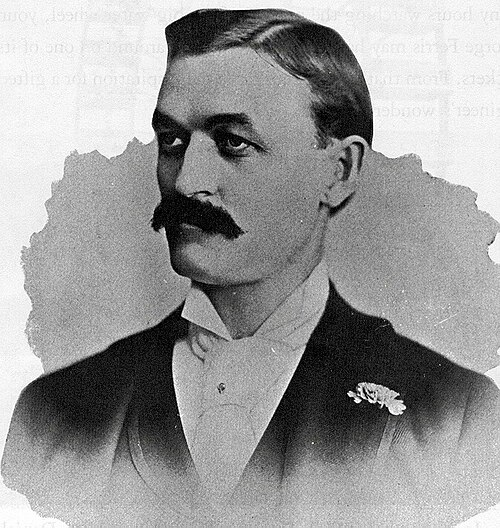
George Washington Gale Ferris Jr. (February 14, 1859 – November 22, 1896) was an American civil engineer. He is mostly known for creating the original Ferris Wheel for the 1893 Chicago World's Columbian Exposition.[1]^
Early life
Ferris was born on February 14, 1859, in Galesburg, Illinois, the town founded by his namesake, George Washington Gale. His parents were George Washington Gale Ferris Sr. and Martha Edgerton Hyde.[2]^ He had an older brother named Frederick Hyde, born in 1843.[3]^ In 1864 when Ferris was five years old, his family sold their dairy farm and moved to Nevada. For two years, they lived in Carson Valley.
From 1868 to 1890, his father, George Washington Gale Ferris Sr., owned the Sears–Ferris House at 311 W. Third, Carson City, Nevada. Originally built in about 1863 by Gregory A. Sears, a pioneer Carson City businessman,[4]^ the house was added to the National Register of Historic Places for Carson City on February 9, 1979.[5]^

Sears–Ferris House, Carson City.
Ferris Senior was an agriculturalist/horticulturalist, noteworthy in Carson City's development for much of the city's landscaping during the 1870s, and for importing a large number of the trees from the east that were planted throughout the city.[6]^
Ferris left Nevada in 1875 to attend the California Military Academy in Oakland, where he graduated in 1876. He graduated from Rensselaer Polytechnic Institute in Troy, New York, in the class of 1881 with a degree in Civil Engineering. At RPI he was a charter member of the local chapter of the Chi Phi student fraternity.[7]^ and a member of the Rensselaer Society of Engineers. He was made a member of the Rensselaer Polytechnic Institute Alumni Hall of Fame in 1998.[8]^

Ferris House, Pittsburgh
The original 1893 Chicago Ferris Wheel.
Ferris began his career in the railroad industry and was interested in bridge building.[8]^ He founded a company, G.W.G. Ferris & Co. in Pittsburgh, Pennsylvania, to test and inspect metals for railroads and bridge builders.[citation^ ^needed]^
Ferris House, his home at 1318 Arch Street, Central Northside, was added to the list of City of Pittsburgh Designated Historic Structures on June 28, 2001.[9]^
Ferris wheel
Main articles: Ferris Wheel (1893) and Ferris wheel
News of the World's Columbian Exposition to be held in 1893, in Chicago, Illinois, drew Ferris to the city. In 1891, the Exposition's directors issued a challenge to American engineers to conceive of a monument for the fair to surpass the Eiffel Tower, the great structure of the Paris International Exposition of 1889.[10]^ The planners wanted something "original, daring and unique". Ferris proposed a wheel from which visitors could view the entire exhibition, a wheel that would "out-Eiffel Eiffel".[11]^
Ferris returned in a few weeks with several respectable endorsements from established engineers, and the committee agreed to allow construction to begin. Most convincingly, he had recruited several local investors to cover the $400,000 cost of construction.
The Ferris Wheel had 36 cars, each fitted with 40 revolving chairs and able to accommodate up to 60 people, giving a total capacity of 2,160.[12]^ When the fair opened, it carried some 38,000 passengers daily, taking 20 minutes to complete two revolutions—the first involving six stops to allow passengers to enter and exit, and the second a nine-minute non-stop rotation, for which the ticket holder paid 50 cents. It carried 2.5 million passengers before it was finally demolished in 1906.[13]^
After the fair closed, Ferris claimed that the exhibition management had robbed him and his investors of their portion of the nearly $750,000 profit that his wheel brought in. He spent the next two years in litigation.[14]
Death
Ferris Sr. died in 1895, followed soon after by Ferris Jr. himself, on November 22, 1896, at Mercy Hospital in Pittsburgh, Pennsylvania, of typhoid fever.[1][15]^ His ashes remained at a Pittsburgh crematorium for over a year, waiting for someone to take possession of them.[16][17]^
See also

George Washington Gale Ferris Jr. - Wikipedia
Multimedia:
EXCELLENT DOCUMENTARY 2 HR
EXPO – Magic of the White City (Narrated by Gene Wilder) | Free Full Documentary
LARGEST PIECE OF STEEL EVER FORGED TO DATE; patent fights, Ferris died 3 yrs later
EXPO – Magic of the White City (Narrated by Gene Wilder) | Free Full Documentary
-=-=-=