Satellite
In the context of spaceflight, a satellite is an artificial object which has been intentionally placed into orbit. Such objects are sometimes called artificial satellites to distinguish them from natural satellites such as Earth's Moon.
The world's first artificial satellite, the Sputnik 1, was launched by the Soviet Union in 1957. Since then, thousands of satellites have been launched into orbit around the Earth. Some satellites, notably space stations, have been launched in parts and assembled in orbit. Artificial satellites originate from more than 40 countries and have used the satellite launching capabilities of ten nations. A few hundred satellites are currently operational, whereas thousands of unused satellites and satellite fragments orbit the Earth as space debris. A few space probes have been placed into orbit around other bodies and become artificial satellites to the Moon, Mercury, Venus, Mars, Jupiter, Saturn, Vesta, Eros, Ceres,[1] and the Sun.
Satellites are used for a large number of purposes. Common types include military and civilian Earth observation satellites,communications satellites, navigation satellites,weather satellites, and research satellites. Space stations and humanspacecraft in orbit are also satellites. Satellite orbits vary greatly, depending on the purpose of the satellite, and are classified in a number of ways. Well-known (overlapping) classes include low Earth orbit, polar orbit, and geostationary orbit.
About 6,600 satellites have been launched. The latest estimates are that 3,600 remain in orbit.[2] Of those, about 1,000 are operational;[3][4] the rest have lived out their useful lives and are part of the space debris. Approximately 500 operational satellites are in low-Earth orbit, 50 are in medium-Earth orbit (at 20,000 km), the rest are in geostationary orbit(at 36,000 km).[5]
Satellites are propelled by rockets to their orbits. Usually the launch vehicle itself is a rocket lifting off from a launch pad on land. In a minority of cases satellites are launched at sea (from a submarine or a mobile maritime platform) or aboard a plane (see air launch to orbit).
Satellites are usually semi-independent computer-controlled systems. Satellite subsystems attend many tasks, such as power generation, thermal control, telemetry, attitude control and orbit control.
Contents
- 1 History
- 2 Space Surveillance Network
- 3 Non-military satellite services
- 4 Types
- 5 Orbit types
- 6 Satellite subsystems
- 7 End of life
- 8 Launch-capable countries
- 9 First satellites of countries
- 10 Attacks on satellites
- 11 Satellite services
- 12 See also
- 13 References
- 14 External links
History
Early conceptions
"Newton's cannonball", presented as a "thought experiment" in A Treatise of the System of the World, by Isaac Newton was the first published mathematical study of the possibility of an artificial satellite.
The first fictional depiction of a satellite being launched into orbit is a short story by Edward Everett Hale, The Brick Moon. The story is serialized in The Atlantic Monthly, starting in 1869.[6][7] The idea surfaces again in Jules Verne's The Begum's Fortune (1879).
In 1928, Slovenian Herman Potočnik (1892–1929) published his sole book, The Problem of Space Travel — The Rocket Motor(German: Das Problem der Befahrung des Weltraums — der Raketen-Motor), a plan for a breakthrough into space and a permanent human presence there. He conceived of a space station in detail and calculated its geostationary orbit. He described the use of orbiting spacecraft for detailed peaceful and military observation of the ground and described how the special conditions of space could be useful for scientific experiments.
The book described geostationary satellites (first put forward by Tsiolkovsky) and discussed communication between them and the ground using radio, but fell short of the idea of using satellites for mass broadcasting and as telecommunications relays.In 1903, Konstantin Tsiolkovsky (1857–1935) published Exploring Space Using Jet Propulsion Devices (in Russian:Исследование мировых пространств реактивными приборами), which is the first academic treatise on the use of rocketry to launch spacecraft. He calculated the orbital speed required for a minimal orbit around the Earth at 8 km/s, and that a multi-stage rocket fuelled by liquid propellants could be used to achieve this. He proposed the use of liquid hydrogen and liquid oxygen, though other combinations can be used.
In a 1945 Wireless World article, the English science fiction writer Arthur C. Clarke (1917–2008) described in detail the possible use of communications satellites for mass communications.[8] Clarke examined the logistics of satellite launch, possible orbits and other aspects of the creation of a network of world-circling satellites, pointing to the benefits of high-speed global communications. He also suggested that three geostationary satellites would provide coverage over the entire planet.
The US military studied the idea of what was referred to as the earth satellite vehicle when Secretary of Defense James Forrestal made a public announcement on December 29, 1948, that his office was coordinating that project between the various services.[9]
Artificial satellites

Sputnik 1: The first artificial satellite to orbit Earth.
The first artificial satellite was Sputnik 1, launched by the Soviet Union on October 4, 1957, and initiating the Soviet Sputnik program, with Sergei Korolev as chief designer (there is a crater on the lunar far side which bears his name). This in turn triggered the Space Race between the Soviet Union and the United States....
Explorer 1 was the first satellite launched by the United States in 1958 and was part of the U.S. participation in the International Geophysical Year (IGY). The mission followed the first two satellites the previous year; the Soviet Union's Sputnik 1 and Sputnik 2, beginning the Cold War Space Race between the two nations.
Explorer 1 was launched on 1 February 1958 at 03:47:56 GMT (or 31 January 1958 at 22:47:56 Eastern Time) atop the first Juno booster from LC-26A at the Cape Canaveral Missile Test Center of the Atlantic Missile Range (AMR), in Florida. It was the first spacecraft to detect the Van Allen radiation belt,[2] returning data until its batteries were exhausted after nearly four months. It remained in orbit until 1970.
Background
The U.S. Earth satellite program began in 1954 as a joint U.S. Army and U.S. Navy proposal, called Project Orbiter, to put a scientific satellite into orbit during the International Geophysical Year. The proposal, using a military Redstone missile, was rejected in 1955 by the Eisenhower administration in favor of the Navy's Project Vanguard, using a booster advertised as more civilian in nature.[4][5] Following the launch of the Soviet satellite Sputnik 1 on 4 October 1957, the initial Project Orbiter program was revived as the Explorer program to catch up with the Soviet Union.[6]
Explorer 1 was designed and built by the Jet Propulsion Laboratory (JPL), while a Jupiter-C rocket was modified by the Army Ballistic Missile Agency (ABMA) to accommodate a satellite payload; the resulting rocket known as the Juno I. The Jupiter-C design used for the launch had already been flight-tested in nose cone reentry tests for the Jupiter intermediate-range ballistic missile (IRBM), and was modified into Juno I. Working closely together, ABMA and JPL completed the job of modifying the Jupiter-C and building Explorer 1 in 84 days. However, before work was completed, the Soviet Union launched a second satellite, Sputnik 2, on 3 November 1957. The U.S. Navy's attempt to put the first U.S. satellite into orbit failed with the launch of the Vanguard TV-3 on 6 December 1957.[7]
Spacecraft
 The satellite Explorer 1 is mated to its booster at LC-26.
Explorer 1 was designed and built by the California Institute of Technology's JPL under the direction of Dr. William H. Pickering. It was the second satellite to carry a mission payload (Sputnik 2 was the first).
The total mass of the satellite was 13.97 kg (30.8 lb), of which 8.3 kg (18 lb) were instrumentation. In comparison, the mass of the first Soviet satellite Sputnik 1 was 83.6 kg (184 lb). The instrument section at the front end of the satellite and the empty scaled-down fourth-stage rocket casing orbited as a single unit, spinning around its long axis at 750 revolutions per minute.
Data from the scientific instruments was transmitted to the ground by two antennas. A 60 milliwatt transmitter fed a dipole antenna consisting of two fiberglass slot antennas in the body of the satellite operating on 108.03 MHz, and four flexible whips forming a turnstile antenna were fed by a 10 milliwatt transmitter operating on 108.00 MHz.[8][9]
Because of the limited space available and the requirements for low weight, the payload instrumentation was designed and built with simplicity and high reliability in mind, using germanium and silicon transistors in its electronics.[10] A total of 20 transistors were used in Explorer 1, plus additional ones in the Army's micrometeorite amplifier. Electrical power was provided by mercury chemical batteries that made up approximately 40% of the payload weight.
The external skin of the instrument section was sandblasted stainless steel with white stripes. Several other color schemes had been tested, resulting in backup articles, models, and photographs showing different configurations, including alternate white and green striping and blue stripes alternating with copper. The final color scheme was determined by studies of shadow–sunlight intervals based on firing time, trajectory, orbit, and inclination.
[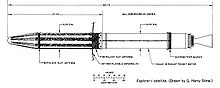 ]
Explorer 1 schematic
Science payload
Video: Duration: 2 minutes and 50 seconds.2:50Subtitles available.CCUniversal Newsreel about the satellite
The Explorer 1 payload consisted of the Iowa Cosmic Ray Instrument without a tape data recorder which was not modified in time to make it onto the spacecraft. The real-time data received on the ground was therefore very sparse and puzzling showing normal counting rates and no counts at all. The later Explorer 3 mission, which included a tape data recorder in the payload, provided the additional data for confirmation of the earlier Explorer 1 data.
The scientific instrumentation of Explorer 1 was designed and built under the direction of Dr. James Van Allen of the University of Iowa containing:[8]
- Anton 314 omnidirectional Geiger–Müller tube, designed by Dr. George Ludwig of Iowa's Cosmic Ray Laboratory, to detect cosmic rays. It could detect protons with E>30 MeV and electrons with E>3 MeV. Most of the time the instrument was saturated.[11]
- Five temperature sensors (one internal, three external and one on the nose cone);
- Acoustic detector (crystal transducer and solid-state amplifier) to detect micrometeorite (cosmic dust) impacts. It responded to micrometeorite impacts on the spacecraft skin in such a way that each impact would be a function of mass and velocity. Its effective area was 0.075 m2 and the average threshold sensitivity was 2.5×10⁻³ g cm/s;[12][13]
- Wire grid detector, also to detect micrometeorite impacts. It consisted of 12 parallel connected cards mounted in a fiberglass supporting ring. Each card was wound with two layers of enameled nickel alloy wire with a diameter of 17 µm (21 µm with the enamel insulation included) in such way that a total area of 1 × 1 cm (0.39 × 0.39 in) was completely covered. If a micrometeorite of about 10 µm impacted, it would fracture the wire, destroy the electrical connection, and thus record the event.[12][13]
Flight
 Explorer 1 launch control console on display at Huntsville Space and Rocket Center. The red arrow points to the manually turned launch key switch.
After a jet stream-related delay on 28 January 1958, at 03:47:56 GMT on 1 February 1958 [14] the Juno I rocket was launched, putting Explorer 1 into orbit with a perigee of 358 km (222 mi) and an apogee of 2,550 km (1,580 mi) having a period of 114.80 minutes, and an inclination of 33.24°.[1][15] Goldstone Tracking Station could not report after 90 minutes as planned whether the launch had succeeded because the orbit was larger than expected.[14] At about 06:30 GMT, after confirming that Explorer 1 was indeed in orbit, a news conference was held in the Great Hall at the National Academy of Sciences in Washington, D.C. to announce it to the world.[16]
 Hand drawn Explorer 1 mission plot.
The original expected lifetime of the satellite before orbital decay was three years.[14] Mercury batteries powered the high-power transmitter for 31 days and the low-power transmitter for 105 days. Explorer 1 stopped transmission of data on 23 May 1958,[17] when its batteries died, but remained in orbit for more than 12 years.[18] It reentered the atmosphere over the Pacific Ocean on 31 March 1970 after more than 58,400 orbits.
Results
Explorer 1 changed rotation axis after launch. The elongated body of the spacecraft had been designed to spin about its long (least-inertia) axis but refused to do so, and instead started precessing due to energy dissipation from flexible structural elements. Later it was understood that on general grounds, the body ends up in the spin state that minimizes the kinetic rotational energy for a fixed angular momentum (this being the maximal-inertia axis). This motivated the first further development of the Eulerian theory of rigid body dynamics after nearly 200 years – to address this kind of momentum-preserving energy dissipation.[19][20]
Sometimes the instrumentation reported the expected cosmic ray count (approximately 30 counts per second) but other times it would show a peculiar zero counts per second. The University of Iowa (under James Van Allen) observed that all of the zero counts per second reports were from an altitude of more than 2,000 km (1,200 mi) over South America, while passes at 500 km (310 mi) would show the expected level of cosmic rays. Later, after Explorer 3, it was concluded that the original Geiger counter had been overwhelmed ("saturated") by strong radiation coming from a belt of charged particles trapped in space by the Earth's magnetic field. This belt of charged particles is now known as the Van Allen radiation belt. The discovery was considered to be one of the outstanding discoveries of the International Geophysical Year.
The acoustic micrometeorite detector detected 145 impacts of cosmic dust in 78,750 seconds. This calculates to an average impact rate of 8.0−3 impacts per second per square meter, or 29 impacts per hour per square meter, over the twelve-day period.[21]
Legacy
Explorer 1 was the first of the long-running Explorers program. Four follow-up satellites of the Explorer series were launched by the Juno I launch vehicle in 1958, of these, Explorer 3 and 4 were successful, while Explorer 2 and 5 failed to reach orbit. The final flight of the Juno I booster, the satellite Beacon-1, also failed.[22] The Juno I vehicle was replaced by the Juno II launch vehicle in 1959.
The Juno I rocket was launched six times by ABMA in 1958, intending to place satellites in LEO.[4][5]
Following the successful launch of Explorer 1 on February 1, 1958, the first U.S. satellite, Juno I made five more launches before being retired in favor of Juno II.[4] Although Juno I's launch of the Explorer 1 satellite was a huge success for the U.S. space program, only two of its remaining five flights were successful, Explorer 3 and Explorer 4,[1] giving the Juno I vehicle a mission total success ratio of 50%.[4] The Juno I vehicle was replaced by the Juno II in 1959.
The American public was happy and relieved that America had finally managed to launch a satellite after the launch failures in the Vanguard and Viking series. With the relative success of the Juno I program, von Braun developed the Juno II, using a PGM-19 Jupiter first stage, rather than a Redstone.
A follow-up to the first mission, Explorer-1 [PRIME], was successfully launched aboard a Delta II launch vehicle in late October 2011. The PRIME was built using modern satellite construction techniques. The orbiting satellite was a backup, because the initial Explorer-1 PRIME, launched on 4 March 2011, did not reach orbit due to a launch vehicle failure.[23]
An identically constructed flight backup of Explorer 1 is on display in the Smithsonian Institution's National Air and Space Museum, Milestones of Flight Gallery in Washington, D.C. LC-26 was deactivated in 1963, and was designated for use as a museum in 1964, the Air Force Space and Missile Museum.[24] Here too, a full-scale Explorer 1 is on display, but this one is a mockup.[25]
Gallery...
See Sputnik
see Sandbox