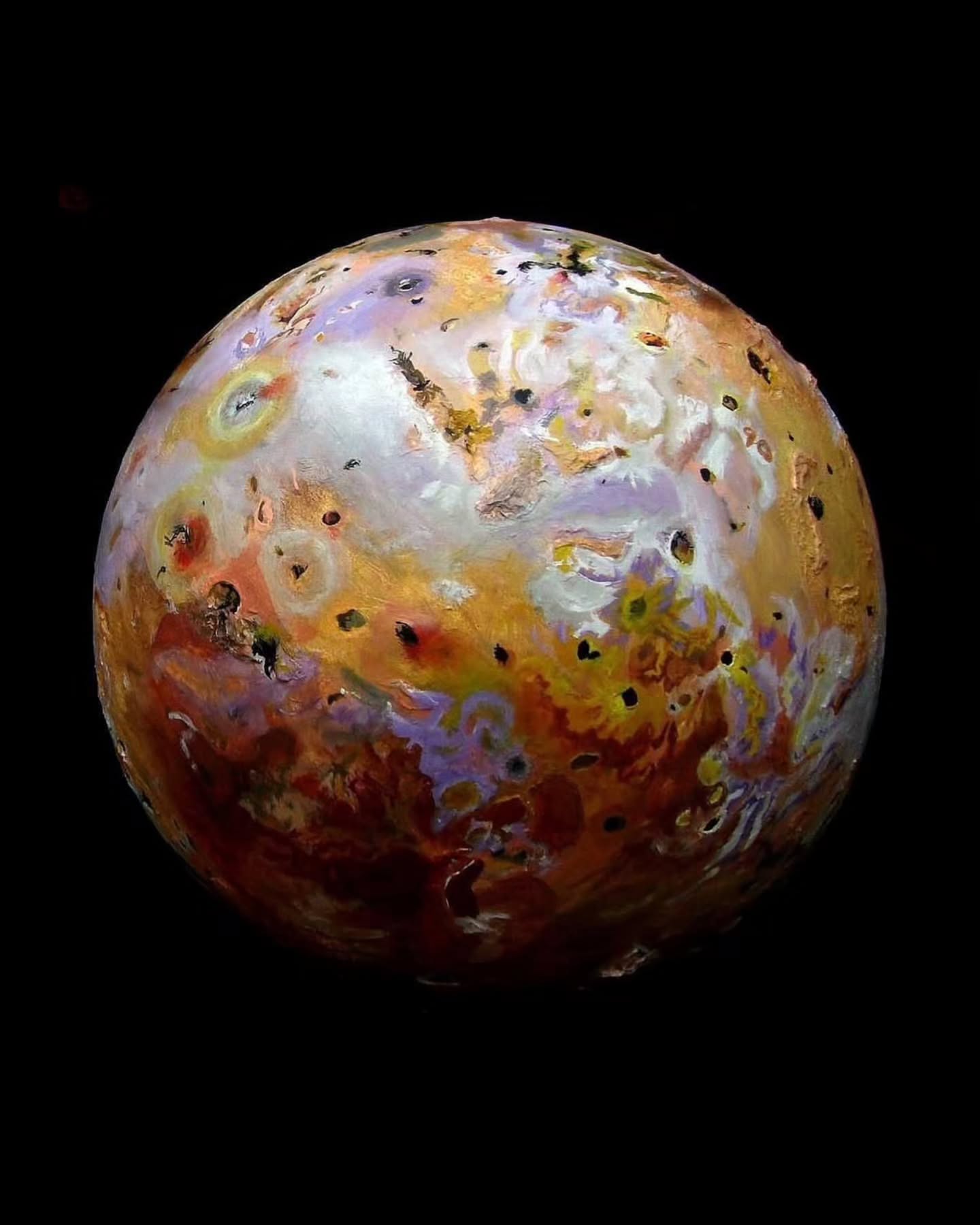
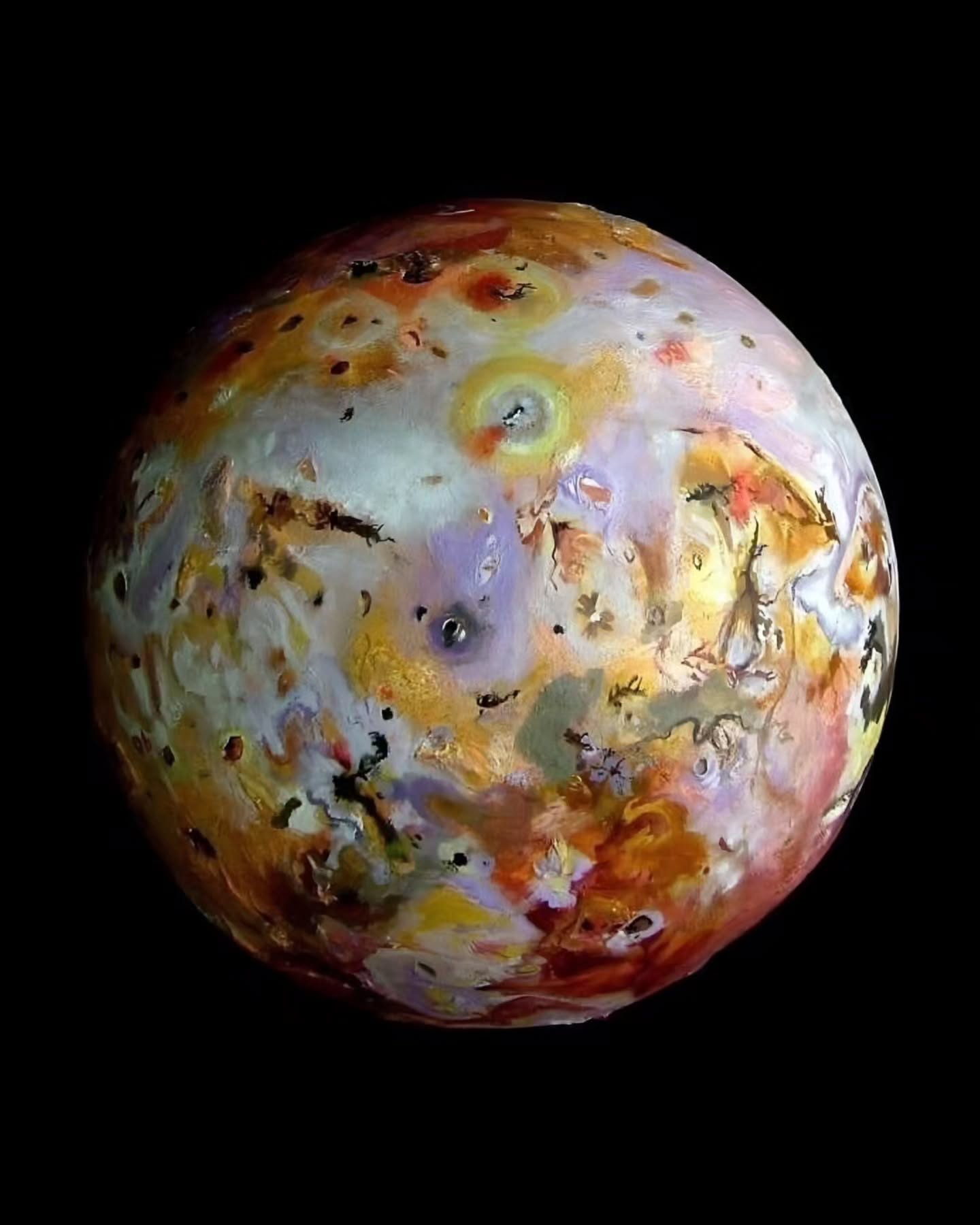
[001] IO
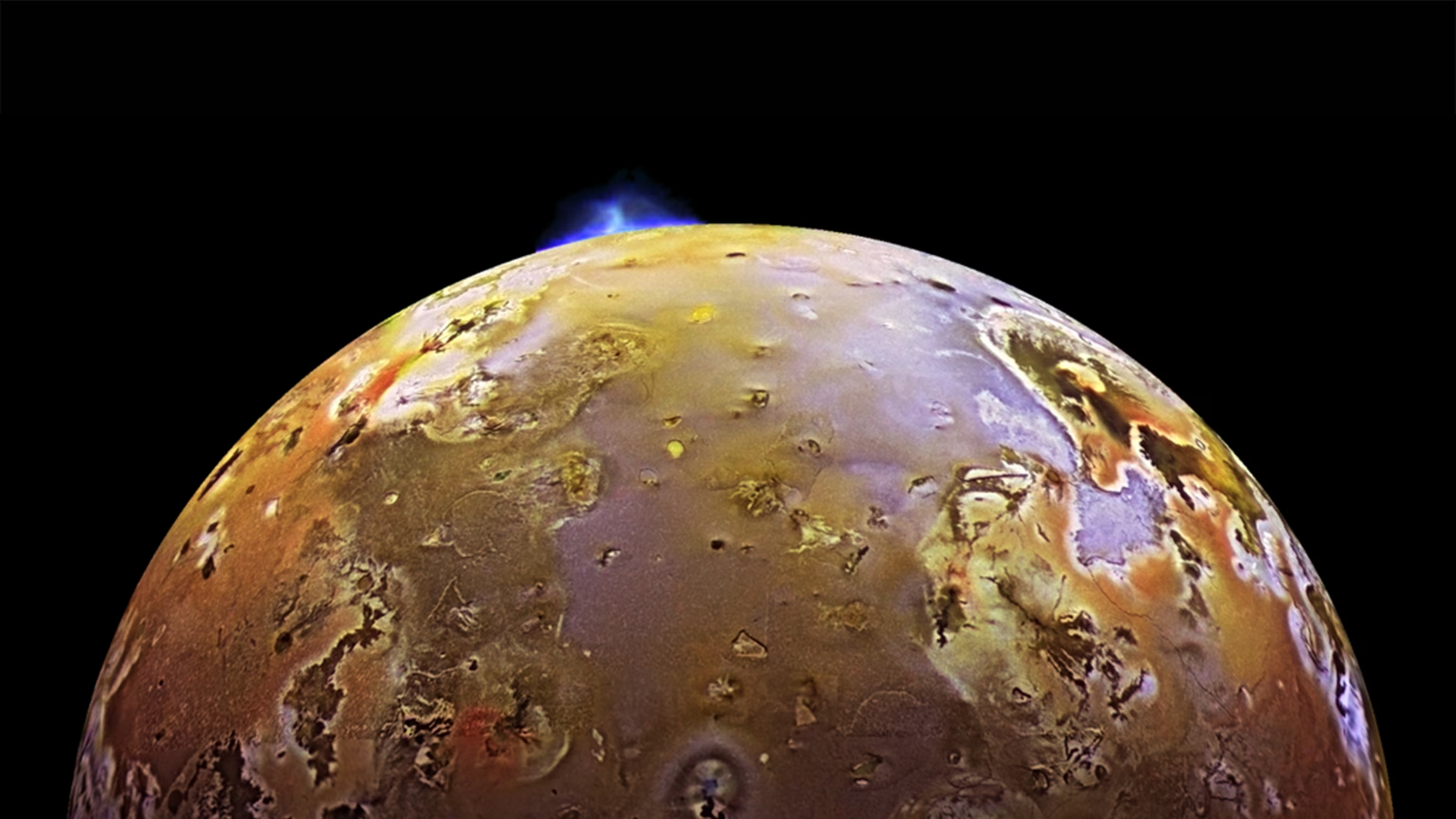

Wikipedia: Io (moon) - Wikipedia
Baseline: Io is almost always in HIGH radiation
Io orbits at about 5.9 Jupiter radii, inside Jupiter’s inner magnetosphere and embedded in the Io plasma torus. The usual quoted surface dose is about 3,600 rem/day, which is roughly 36 Sv/day for ionizing-radiation biological-dose comparison. That is about 1.5 Sv/hour, or 25 mSv/minute, before shielding and local geometry corrections. So the blunt answer: Io’s normal background state is already HIGH. The special cases below are when particular impact channels become locally or temporarily worse.
| Radiation / particle channel | When HIGH impacts occur at Io | Quantifier |
|---|---|---|
| Total ionizing radiation at surface | Basically continuously, because Io sits inside Jupiter’s radiation environment near the Io torus | ~3,600 rem/day ≈ 36 Sv/day ≈ 1.5 Sv/hour |
| Cold/warm torus plasma: electrons + S/O ions | Continuously, strongest where corotating torus plasma sweeps into Io, especially the plasma-facing/upstream/leading interaction region | Plasma density near Io typically 2,000–3,000 cm⁻³; relative flow 57–60 km/s |
| Ram flux of torus plasma onto Io | Whenever Io is inside the dense torus, which is most of the time; varies as Io moves above/below the torus core because Jupiter’s magnetic/torus geometry is tilted/warped | Approximate incident particle flux: 1.2–1.8 × 10¹⁰ particles cm⁻² s⁻¹, using n = 2,000–3,000 cm⁻³ and v = 57–60 km/s |
| Oxygen and sulfur ions | High when Io is in dense torus plasma; these are the dominant heavy ion species generated from Io’s own volcanic/atmospheric material | Major ions include O⁺, S⁺, S²⁺, with ion temperatures around 40–100 eV in the hot torus; recent torus estimates give temperature around 80 eV, with broad uncertainty |
| Energetic electrons / beta-like impacts | High in the Io Alfvén wing, flux-tube boundaries, polar-connected field lines, and downstream wake regions where electrons are field-aligned and energized | Juno measured electron beams from 0.032–32 keV with energy fluxes around 1–15 mW/m² in one Alfvén-wing crossing and 2–22 mW/m² downstream; Galileo also saw >15 keV bidirectional electron beams |
| Low-energy electron beams | Close to Io during Alfvén-wing / magnetic-field-aligned current events | Galileo measured beams of several hundred eV, with field-aligned current density around 0.05 nA/cm² |
| Energetic protons | High near Io where trapped protons encounter Io’s atmosphere/surface and electromagnetic wake; Galileo saw localized proton losses because Io was absorbing/charge-exchanging them | Observed proton energy range in Galileo analyses: 155 keV–1.25 MeV within roughly 2 Io radii of the moon |
| Soft X-rays from impacts | High enough to be detectable when energetic ions/electrons hit Io, Europa, or the torus; mainly secondary radiation from bombardment | Detected soft X-ray band: 0.25–2 keV; likely driven by >10 keV H, O, and S ions from the Io plasma torus |
| Solar UV / EUV | Chemically important, but not the main “HIGH hazard” compared with Jupiter particles. Highest on dayside, and during solar activity | At Jupiter distance, solar intensity is only about 1/27 Earth’s, but UV still helps ionize neutral material |
| Cosmic rays | Always present, but usually not the controlling hazard at Io compared with Jupiter’s trapped radiation | Background high-energy component; locally overwhelmed by Jupiter magnetospheric particles |
The key HIGH-impact conditions, in plain English
1. Default exposed surface: HIGH all the time
An unshielded object on Io’s surface is in a radiation field around 36 Sv/day. That is not a storm condition; that is the boring Tuesday condition. Io is not “occasionally dangerous.” It is a moon parked inside a particle accelerator designed by a gas giant with emotional problems.
2. Dense torus crossing / torus core: HIGH plasma impact
Io is embedded in the Io plasma torus, whose electron density near Io is commonly given around 2,000 cm⁻³, with some studies/models around 3,000 cm⁻³. The plasma corotates with Jupiter faster than Io orbits, so it overtakes Io at about 57–60 km/s. That gives a rough incoming plasma flux of:
n × v = 2,000–3,000 cm⁻³ × 5.7–6.0 × 10⁶ cm/s
≈ 1.2–1.8 × 10¹⁰ particles cm⁻² s⁻¹
That is the main “sandblaster” condition: not necessarily MeV radiation per particle, but an enormous continuous plasma ram flux.
3. Upstream/leading hemisphere: HIGH direct bombardment
Because the torus plasma overtakes Io, the upstream/leading plasma-facing side gets the most direct incoming flow. The torus is not gently sitting there; it is sweeping past Io. The relative velocity is the key number: 57–60 km/s. For pickup ions, a useful order-of-magnitude energy from that relative speed is:
| Ion | Approx kinetic energy at 57 km/s |
|---|---|
| H⁺ | ~17 eV |
| O⁺ | ~270 eV |
| S⁺ | ~540 eV |
That is “impact chemistry / sputtering / atmospheric erosion” territory, not the same as the MeV trapped-particle dose. The heavier ions hit harder simply because they carry more mass at the same speed.
4. Alfvén wing / Io flux tube: HIGH electron-beam impacts
The nastiest localized electron impacts happen where Io is magnetically connected to Jupiter through the Io Alfvén wing / Io flux tube. Juno confirmed persistent electron beams in Io’s Alfvén wing and downstream region; these beams run along Jupiter’s magnetic field and can hit Io’s atmosphere/surface when field lines connect to Io. Measured values:
| Electron event type | Quantifier |
|---|---|
| Juno Alfvén-wing electrons | 0.032–32 keV |
| Juno electron energy flux | 1–15 mW/m² in one wing crossing; 2–22 mW/m² downstream |
| Galileo energetic beams | >15 keV bidirectional field-aligned beams |
| Galileo low-energy beams | several hundred eV, current density about 0.05 nA/cm² |
So if you want a concrete HIGH condition: Io’s polar/field-connected Alfvén-wing regions and downstream wake can receive keV electron beams with energy fluxes up to ~22 mW/m² in the Juno observations.
5. Energetic proton impact zones: HIGH near atmosphere/wake/surface absorption
Galileo data show energetic proton interactions close to Io, especially within roughly 2 Io radii, where protons are lost through charge exchange with SO₂ atmosphere, surface absorption, and perturbed electromagnetic fields. The studied energy range was 155 keV to 1.25 MeV. So the condition is: high proton impact/loss occurs close to Io, especially where protons encounter the extended SO₂ atmosphere and wake-field distortions.
6. Heavy-ion bombardment: HIGH when S/O torus density is high
The high-energy ion population near Jupiter is strongly associated with oxygen and sulfur ions, sourced from Io’s volcanic material and atmospheric escape. Io supplies roughly one ton per second of material to the Jovian magnetosphere, and the torus is mostly sulfur/oxygen plasma rather than the proton-dominated plasma familiar from simpler space-radiation cartoons. The routine torus ions near Io are typically tens to hundreds of eV, but Jupiter’s radiation belts also contain much higher-energy ions; studies of Jupiter’s high-energy ions discuss >10 MeV oxygen and sulfur ions in the inner Jovian system, though not every such population should be read as a surface flux directly onto Io.
The “HIGH” hierarchy
For Io, the severity ranking is roughly: Highest biological/electronics hazard: trapped energetic electrons + protons + heavy ions contributing to ~36 Sv/day surface dose. Highest continuous particle flux: cold/warm torus plasma at ~10¹⁰ particles cm⁻² s⁻¹. Most Io-specific chemical/surface erosion: sulfur and oxygen ions at ~57–60 km/s relative flow. Most localized intense electron impacts: Alfvén-wing / flux-tube beams, 0.032–32 keV, up to ~22 mW/m² measured by Juno. Most diagnostic secondary radiation: soft X-rays, 0.25–2 keV, produced by particle bombardment.
So: Io is in HIGH radiation by default; “extra HIGH” happens when dense torus plasma, Alfvén-wing electron beams, wake/proton interactions, or torus-density enhancements line up with the local surface/atmosphere.
Chernobyl
So a firefighter’s catastrophic Chernobyl dose is, on Io, a short EVA mistake. Not even a “bad expedition.” More like: you lingered outside after lunch and physics filed a complaint. There is one important caveat: the immediate Chernobyl reactor ruins in 1986 had localized fields that could beat Io. Some published reconstructions and historical summaries put areas near exposed core material, fuel fragments, and debris at tens to hundreds of sieverts per hour. Those are hell-zones where Io’s 1.5 Sv/hour is actually lower. But those were highly localized, accident-specific, debris-field conditions—not the general Exclusion Zone and not the long-term environment. One historical radiation-level table gives examples such as ~300 Sv/hour near the reactor core and 150–200 Sv/hour near fuel fragments, though exact values from the first hours were difficult and sometimes instrument-limited. So the verdict: Modern Chernobyl Exclusion Zone: Io is thousands to millions of times worse. Chernobyl emergency-worker whole-body doses: Io delivers comparable doses in minutes to hours. Worst exposed reactor debris immediately after the accident: Chernobyl could locally exceed Io, but only in small, extreme zones. As an environment: Io wins the horror contest. Chernobyl is a contaminated landscape; Io is a moon bathing in Jupiter’s weaponized magnetosphere.