[004] Callisto
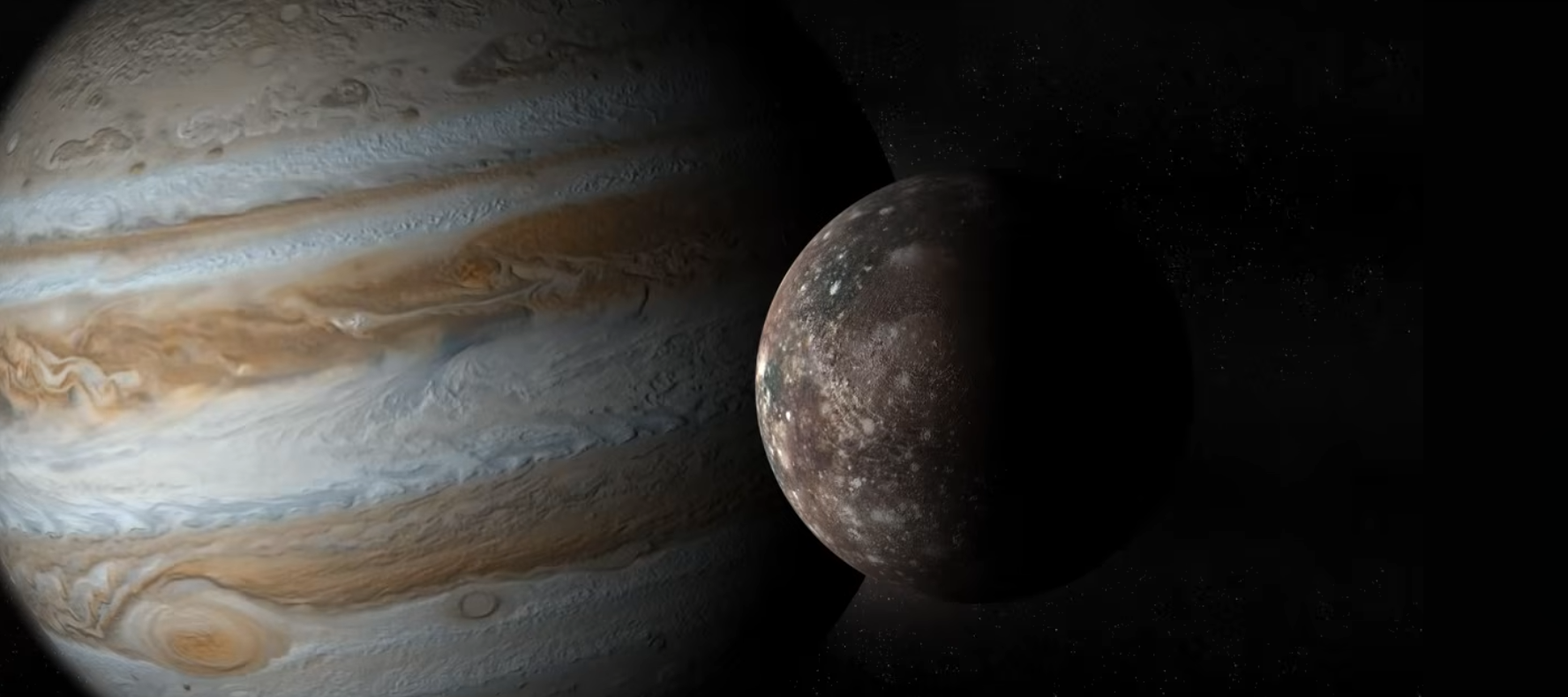
Callisto (/kəˈlɪstoʊ/ kə-LIST-oh) is the second-largest moon of Jupiter, after Ganymede. It is also the third-largest moon in the Solar System, following Ganymede and Saturn's moon Titan, and nearly as large as the planet Mercury. With a diameter of 4,821 km, Callisto is roughly a third larger than Earth's Moon and orbits Jupiter on average at a distance of 1.883 million km, which is about five times further out than the Moon orbiting Earth. It is the outermost of the four large Galilean moons of Jupiter, and is today visible from Earth with common binoculars.
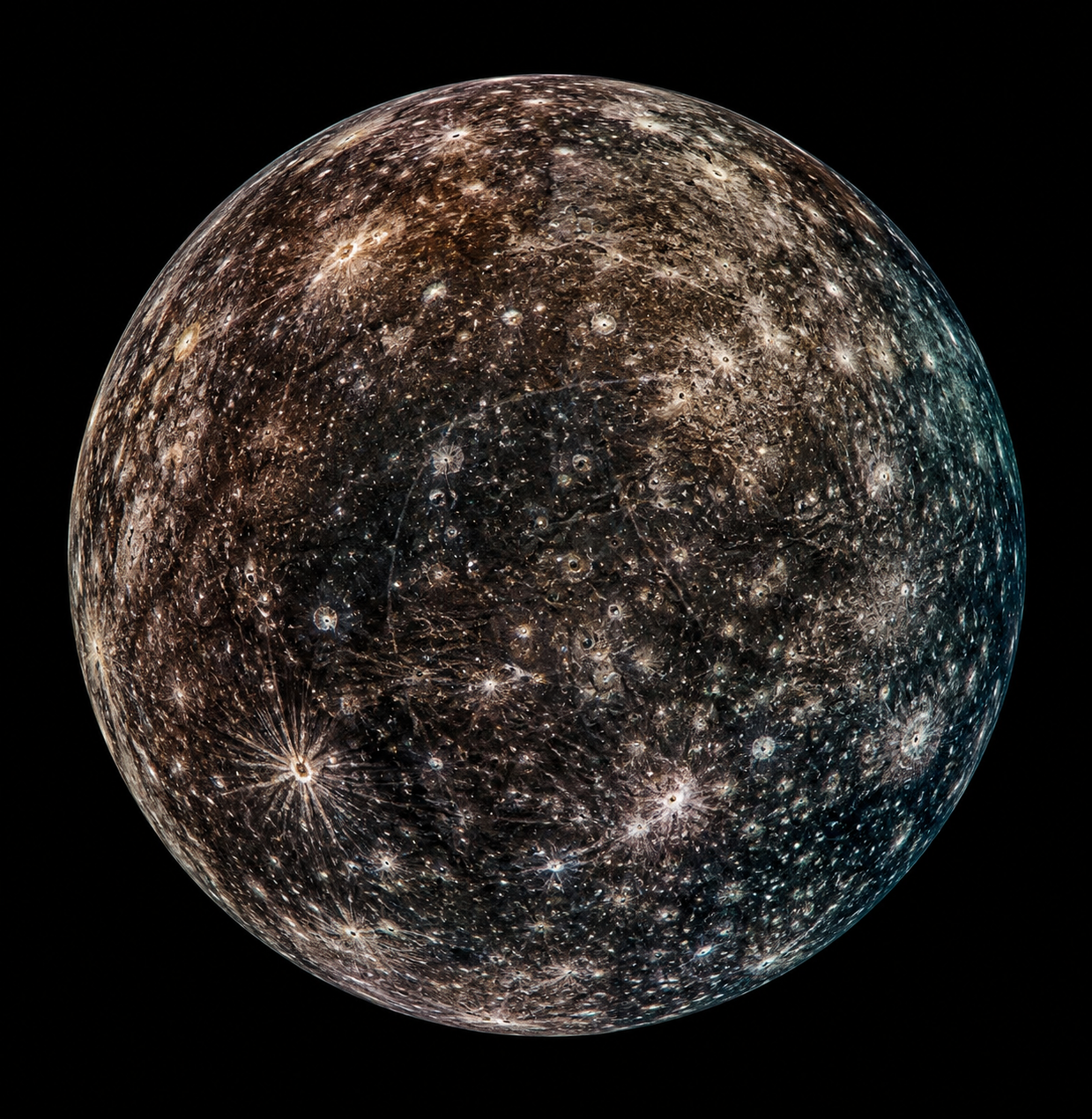
The surface of Callisto is the oldest and most heavily cratered in the Solar System, with the surface almost completely covered with impact craters. It does not show any signatures of subsurface processes such as plate tectonics or volcanism, and is thought to have evolved predominantly under the influence of impacts. Prominent surface features include multi-ring structures, variously shaped impact craters, and chains of craters called catenae and associated scarps, ridges and deposits. At a small scale, the surface is varied and made up of small, sparkly frost deposits at the tips of high spots, surrounded by a low-lying, smooth blanket of dark material. This is thought to result from the sublimation-driven degradation of small landforms, which is supported by the general deficit of small impact craters and the presence of numerous small knobs, considered to be their remnants. The absolute ages of the landforms are not known.
Callisto is composed of approximately equal amounts of rock and ice, with a density of about 1.83 g/cm3, the lowest density and surface gravity of Jupiter's major moons. Compounds detected spectroscopically on the surface include water ice,[15] carbon dioxide, silicates and organic compounds. Investigation by the Galileo spacecraft revealed that Callisto may have a small silicate core and possibly a subsurface ocean of liquid water[15] at depths greater than 100 km.[16][17]
It is not in an orbital resonance like the three other Galilean satellites—Io, Europa and Ganymede—and is thus not appreciably tidally heated.[18] Callisto's rotation is tidally locked to its orbit around Jupiter, so that it always faces the same direction, making Jupiter appear to hang directly overhead over its near-side. It is less affected by Jupiter's magnetosphere than the other inner satellites because of its more remote orbit located just outside Jupiter's main radiation belt.[19][20] Callisto is surrounded by an extremely thin atmosphere composed of carbon dioxide[9] and probably molecular oxygen,[10] as well as by a rather intense ionosphere.[21] Callisto is thought to have formed by slow accretion from the disk of the gas and dust that surrounded Jupiter after its formation.[22] Callisto's gradual accretion and the lack of tidal heating meant that not enough heat was available for rapid differentiation. The slow convection in the interior of Callisto, which commenced soon after formation, led to partial differentiation and possibly to the formation of a subsurface ocean at a depth of 100–150 km and a small, rocky core.[23]
The likely presence of an ocean within Callisto leaves open the possibility that it could harbor life. However, conditions are thought to be less favorable than those on nearby Europa.[24] Various space probes, including Pioneers 10 and 11, Galileo, and Cassini, have studied Callisto. Because of its low radiation levels, Callisto has long been considered the most suitable to base possible future crewed missions on to study the Jovian system.[25]
Temperature: -140 Celsius
Periapsis: 1.869.000 km
Apoapsis: 1.897.000 km
Orbit: 16 Days
Radius: 2410 Km
Escape Velocity: 2441 Km/2
COLONIZATION
Callisto’s peoples were shaped less by open surface opportunity than by withdrawal, enclosure, and the discipline of living under ice. Where Ganymede became expansive, scarred, and visibly despoiled, Callisto became inward. Its major societies formed around cavern rights, pressure districts, under-ice rail corridors, excavation guilds, sealed bioprocessing vaults, tanker ports, and the great cliff-mouth industries where the machines emerged only long enough to throw bulk material into space. Callistan identity was therefore less territorial in the old sense than stratigraphic. People did not merely come from a city. They came from a depth, a shaft lineage, a thermal district, a vault treaty, a crawler jurisdiction, a buried church, a legal cavern, or a company habitat that had long ago become ethnic by accident.
Two comparatively retained ethnic blocs remained prominent enough to be treated as “old peoples” of Callisto, though the term was ideological rather than biological. The first were the Sindhi-Callistan Vault Families, descended from Sindhi mercantile and engineering networks that entered the Jovian system through tanker finance, refrigeration logistics, and sealed habitat brokerage. They became associated with deep-cavern trade law, vault banking, intergenerational equipment trusts, and the unpleasantly delicate business of deciding who owned a tunnel after the original corporation had gone bankrupt, merged, been sanctioned, renamed, and quietly buried its directors in Europa orbit. Their culture preserved fragments of Sindhi language, Sufi devotional lineages, mercantile caste memory, partition trauma, shrine finance, and a ferocious belief that nothing exists until it has a document, a witness, and a grandmother who remembers the earlier document. Outsiders call them cold. They reply that cold is what keeps the archives alive.
The second were the Han-Tarim Excavation Lineages, descended from inland Chinese, Uyghur-adjacent, Hui, Kazakh, and broader Tarim Basin technical migrations, though official categories softened the internal history into something comfortably administrative. They became the great tunnel people of Callisto: shaft engineers, thermal planners, ice-stress readers, boring-machine dynasties, and municipal excavation schools whose graduates spoke of cliff collapse the way old farmers once spoke of weather. Their cultural memory drew on Ürümqi, Turpan, Dunhuang, Lanzhou, Baotou, old rail cities, desert basins, inland extraction, and the weary art of building where nobody glamorous wants to live but everyone needs the output. They preserved noodle cults, heat-management rituals, family exam regimes, Hui food law, caravan metaphors, mine songs, and a specific hatred of coastal people who used the word “remote” as though it were a diagnosis.
Beyond those retained blocs, Callisto’s more characteristic identities were remixed under ice.
The Berber-Bolivian Salt-Cavern People were one of the stranger and more successful Callistan composites: Amazigh-speaking North African lines, Bolivian and Andean mining families, Moroccan phosphate technicians, Tuareg-adjacent transport clans, and later Ceres-born brine workers who fused into a culture of salt, altitude memory, and enclosed mineral wealth. Their settlements were known for terraced cavern agriculture, blue-painted pressure doors, Andean funeral music distorted by tunnel acoustics, Amazigh geometric wall-marking, and engineering oaths sworn over salt. Their children learned both shaft mathematics and ancestral route poetry. Their elders made jokes about Timbuktu, Tamanrasset, Ouarzazate, Potosí, Uyuni, and El Alto that outsiders found decorative and insiders received as tiny historical landmines. Their civic motto was sometimes rendered as: “The surface lies; the salt remembers.” Nobody trusted them less for this. Quite the opposite.
The Bengali-Yemeni Refrigeration Compact emerged from disaster logistics, maritime labor, famine migration, and cheap cryogenic maintenance contracts. Descendants of Bangladeshi delta families, Chittagonian ship crews, Yemeni highland and Hadhrami diaspora lines, Somali-linked port labor, and Gulf service migrants were routed through Saturnian and Jovian cold-chain projects before becoming indispensable on Callisto. They specialized in refrigerated cavern atmospheres, food-preservation vaults, pre-organic storage, and the keeping of things alive that should have died and things dead that should not wake up again. Their cuisine was famous and politically dangerous: fish memories without fish, rice rituals grown from engineered starch, fenugreek ghosts, black tea strong enough to file a grievance, and pickled things classified in several jurisdictions as non-weaponized but emotionally aggressive. Their internal jokes about Chittagong shipbreaking, Hadhramaut genealogies, Sana’a water, and Cyclone Bhola made outsiders nervous because laughter and grief were often separated by less than a sentence.
The Igbo-Vietnamese Machine Parish formed in the great mid-depth industrial cities, where Nigerian technical migrants, Igbo commercial families, Vietnamese manufacturing diasporas, Catholic labor parishes, Cao Đài fragments, and old asteroid repair crews became tangled around maintenance guilds and debt churches. They were famous for making dead machines work, then arguing over whether the repair constituted resurrection, theft, or marriage. Their pressure districts were dense, musical, entrepreneurial, devotional, and impossible to govern cleanly. Parish halls doubled as contract courts. Machine shops doubled as kinship offices. Funerals included component inventories. Children were told stories about Biafra, Onitsha markets, Saigon electrical districts, Mekong floods, and the terrible moral difference between a clever repair and a cursed workaround. Other Callistans claimed the Machine Parish could fix anything except its own cousin politics. The Machine Parish considered this defamatory but not inaccurate.
The Pashtun-Javanese Cliff Oath Societies originated in security work around cliff-mouth exits, vertical launcher sites, and high-risk industrial borders. Their ancestry combined Pashtun diaspora contractors, Javanese and Madurese labor colonies, Indonesian mining populations, Afghan exile networks, and religious teachers who had never intended to found an ethnic identity but did so by continuing to solve disputes after the original companies left. Their culture revolved around hospitality law, shame arbitration, cliff access, guard rotations, ritual tea, shadow-puppet legal satire, Qur’anic schooling, and a low-gravity martial aesthetic that made even routine safety drills look like someone was about to found an empire. They referred to certain vertical launch towers as “minarets for cargo,” which everyone agreed was blasphemous, funny, or commercially accurate depending on who was paying. Their obscure references ran through Kandahar, Waziristan, Surakarta, Madura salt, wayang politics, and old transmigration programs. Offworlders saw a severe security caste. Callistans saw a family argument with weapons licenses.
The Quechua-Malagasy Under-Ice Gardeners controlled many of the older agricultural caverns and biological buffering systems. Their origins lay in Andean highland communities, Malagasy ancestor cultures, Peruvian and Bolivian agronomists, Indian Ocean labor routes, and later Callistan cave-farm cooperatives. They specialized in low-light agriculture, fungal substrate, root crops, microbial soil substitutes, water ritual, and the psychological art of making enclosed populations believe they still had seasons. Their festivals used artificial frost, projected mountain skies, ancestor cloth, rice symbolism, potato liturgies, and songs whose meanings had been partially lost but whose timing remained sacred. The elders spoke of ayllu, famadihana, Antananarivo, Cusco, Lake Titicaca, and the tragedy of children who knew terraces only as hydroponic shelf geometry. Their great social taboo was wasting food in a sealed habitat. Their second greatest taboo was saying the first taboo too sentimentally, because sentiment did not refill nutrient tanks.
The Punjabi-Nubian Launch Brotherhoods grew around Callisto’s brutal vertical export culture: tanker loading, mass-driver operations, orbital throw systems, and the deliberately coarse practice of launching bulk feedstock before anybody had time to beautify the infrastructure. They blended Punjabi farming and military diasporas, Sudanese and Nubian riverine families, Egyptian technical migrants, Sikh maintenance houses, Nile logistics workers, and later free-company launch crews. Their identity was loud by Callistan standards, which meant merely audible in public. They wore pressure turbans in ceremonial contexts, painted launch gantries with river motifs, blessed cargo cylinders, argued about water rights in places with no rivers, and maintained oral histories of Punjab canal colonies, Partition trains, Nubian displacement after the Aswan High Dam, Khartoum bureaucracy, and Dongola jokes so dry they required hydration warnings. Their enemies said they would launch anything if the manifest cleared. The Brotherhoods replied that civilization itself was a manifest-clearing problem.
Finally there were the Miskito-Tamil Darkwater Brokers, an intermediary identity born in the colder maritime analogues of the outer system: submarine crews, Europa-adjacent inspection teams, methane tanker families, Nicaraguan and Honduran coastal descendants, Tamil engineers from Sri Lankan and South Indian lines, and obscure oceanic labor sects whose original contracts had been written by men who did not expect their workers to become a people. On Callisto they became specialists in sealed-liquid transport, under-ice navigation, pressure acoustics, brine-law, and the negotiation of things moving unseen. Their culture preserved Miskito Coast autonomy memory, Tamil temple logistics, Jaffna and Chennai technical lineages, fishing metaphors transplanted into ice caverns, and an almost mystical respect for sonar. They were notorious for speaking softly, billing precisely, and knowing which pipe system led where long after the official map had become a decorative fraud.
What united these peoples was not harmony, nor even shared hardship. Callisto did not melt people together. It compressed them. Cavern living preserved difference by making proximity unavoidable and escape expensive. Every group learned the others’ emergency procedures before it learned their holidays. Every child knew which ethnic district had the best pressure welders, which had the worst marriage lawyers, which would feed you during a blackout, which would report you for stealing heat, and which would pretend not to know your grandfather had smuggled valve parts during the Tenth Excavation Strike.
Callistan identity was therefore layered, suspicious, competent, and darkly proud. They were not frontier romantics. They were under-ice people. They lived below a battered surface on a moon where the real cities were caverns, the cathedrals were excavation scars, the great machines came up through cliffs like iron animals, and culture itself had adapted to pressure. Other Jovians called them gloomy. Callistans considered this a surface-dweller word. Underground, gloom was just lighting with historical context.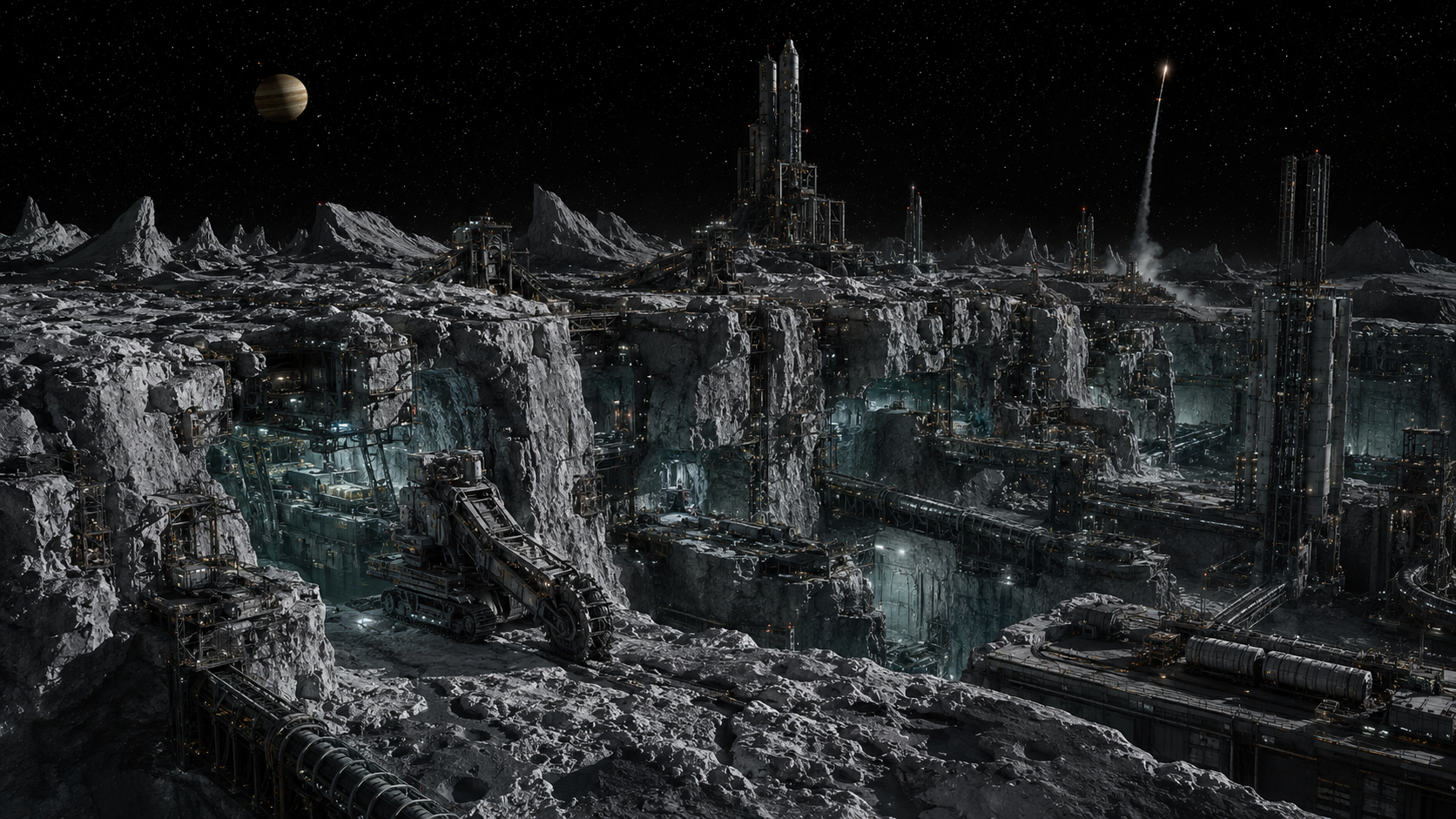
Radiation On Callisto’s Surface: Callisto’s surface radiation is about 0.01 rem/day, or 0.1 mSv/day — absurdly gentle by Jovian standards, roughly 54,000 times lower than Europa and 360,000 times lower than Io, which is why Callisto keeps showing up as the “human-survivable” Galilean moon; in practice this means the radiation is still above Earth background, but not the dominant horror of the place, so people can plausibly work on or near the surface with ordinary spaceflight-grade shielding and operational caution, while the real danger shifts from instant Jovian particle murder to cold, vacuum, dust, logistics, pressure discipline, industrial accidents, and the psychological fact that you are living under a dead cratered sky in a corporate ice mine with Tamil aunties judging your boots. Callisto’s low dose is widely attributed to its greater distance from Jupiter and lower exposure to the inner magnetospheric radiation environment.
Comparatively: People tend to confuse Callisto and Ganymede, probably because both are large, icy Jovian moons orbiting far enough from Jupiter to feel like the “outer, safer” members of the Galilean family. But the resemblance is superficial. Ganymede is the grand, differentiated one: the largest moon in the Solar System, bigger than Mercury, with a metallic core, a rock-and-ice mantle, a subsurface ocean, grooved terrain, and even its own intrinsic magnetic field. It is geologically complex, visibly scarred by internal evolution, as if it once tried very hard to become a small planet and almost succeeded.
Callisto, by contrast, is the ancient witness. It is only slightly smaller, but it appears far less internally processed: dark, heavily cratered, battered, and comparatively undifferentiated. Where Ganymede shows signs of tectonic resurfacing and internal structure, Callisto looks like a preserved record of early Solar System impacts, a cold archive of violence rather than a world that substantially remade itself. Ganymede is layered, magnetic, and geologically articulate; Callisto is quieter, older-looking, more primitive, and almost stubbornly unchanged. Confusing them is understandable at first glance, but scientifically they occupy very different emotional registers: Ganymede is the failed planet; Callisto is the fossil moon.