BEES and EMF
Bumblebees can in addition detect flowers' electromagnetic fields.[76]
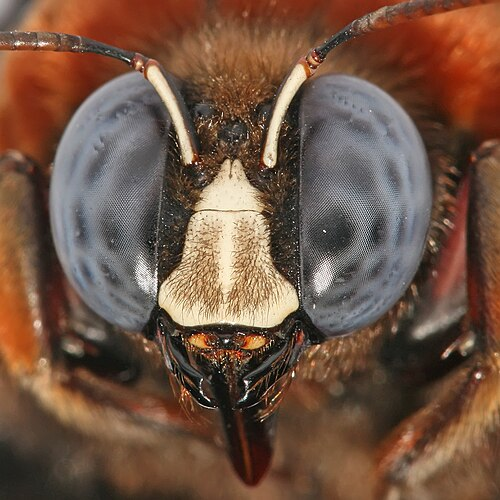
Head of a male carpenter bee, showing antennae, three ocelli, compound eyes, and mouthparts
76). Suttona, Gregory P.; Clarkea, Dominic; Morleya, Erica L.; Robert, Daniel (2016). "Mechanosensory hairs in bumblebees (Bombus terrestris) detect weak electric fields". PNAS. 113 (26): 7261–7265. Bibcode:2016PNAS..113.7261S. doi:10.1073/pnas.1601624113. PMC 4932954. PMID 27247399.
Bees are winged insects that form a monophyletic clade Anthophila within the superfamily Apoidea of the order Hymenoptera, with over 20,000 known species in seven recognized families.[1][2][3] Some species – including honey bees, bumblebees, and stingless bees – are social insects living in highly hierarchical colonies, while over 90% of bee species – including mason bees, carpenter bees, leafcutter bees, and sweat bees – are solitary. Members of the most well-known bee genus, Apis (i.e. honey bees), are known to construct hexagonally celled waxy nests called hives.
Unlike the closely related wasps and ants, who are carnivorous/omnivorous, bees are herbivores that specifically feed on nectar (nectarivory) and pollen (palynivory), the former primarily as a carbohydrate source for metabolic energy, and the latter primarily for protein and other nutrients for their larvae. They are found on every continent except Antarctica, and in every habitat on the planet that contains insect-pollinated flowering plants. The most common bees in the Northern Hemisphere are the Halictidae, or sweat bees, but they are small and often mistaken for wasps or flies. Bees range in size from tiny stingless bee species, whose workers are less than 2 millimeters (0.08 in) long,[4] to the leafcutter bee Megachile pluto, the largest species of bee, whose females can attain a length of 39 millimeters (1.54 in). Vertebrate predators of bees include primates and birds such as bee-eaters; insect predators include beewolves and dragonflies.
Bees are best known for their ecological roles as pollinators and, in the case of the best-known species, the western honey bee, for producing honey, a regurgitated and dehydrated viscous mixture of partially digested monosaccharides kept as food storage of the bee colony. Pollination management via bees is important both ecologically and agriculturally, and the decline in wild bee populations has increased the demand and value of domesticated pollination by commercially managed hives of honey bees. Human beekeeping or apiculture (meliponiculture for stingless bees) has been practiced as a discipline of animal husbandry for millennia, since at least the times of Ancient Egypt and Ancient Greece. Bees have appeared in mythology and folklore, through all phases of art and literature from ancient times to the present day, although primarily focused in the Northern Hemisphere where beekeeping is far more common. In Mesoamerica, the Maya have practiced large-scale intensive meliponiculture since pre-Columbian times.
Characteristics
Bees have the following characteristics:[5]
- A pair of large compound eyes which cover much of the surface of the head. Between and above these are three small simple eyes (ocelli) which provide information on light intensity.[5]
- The antennae usually have 13 segments in males and 12 in females, and are geniculate, having an elbow joint part way along. They house large numbers of sense organs that can detect touch (mechanoreceptors), smell and taste; and small, hairlike mechanoreceptors that can detect air movement so as to "hear" sounds.[5]
- The mouthparts are adapted for both chewing and sucking by having both a pair of mandibles and a long proboscis for sucking up nectar.[5]
- The thorax has three segments, each with a pair of robust legs, and a pair of membranous wings on the hind two segments. The front legs of corbiculate bees bear combs for cleaning the antennae. In many species the hind legs bear pollen baskets, flattened sections with incurving hairs to secure the collected pollen. The wings are synchronized in flight, and the somewhat smaller hind wings connect to the forewings by a row of hooks along their margin which connect to a groove in the forewing.[5]
- The abdomen has nine segments, the hindermost three being modified into the sting.[5]
- Many bees are brightly colored, displaying contrasting bands of yellow, orange, or red against black. These colors function as aposematic signals, warning potential predators that the insect may sting or otherwise defend itself,[6] although similar warning patterns are also seen in many harmless insects that mimic bees or wasps, a form of Batesian mimicry.[7]
The largest species of bee is thought to be Wallace's giant bee Megachile pluto, whose females can attain a length of 39 millimeters (1.54 in).[8] The smallest species may be dwarf stingless bees in the tribe Meliponini whose workers are less than 2 millimeters (0.08 in) in length.[9]
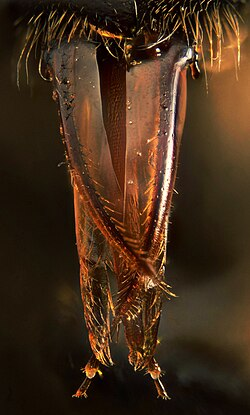
The lapping mouthparts of a honeybee, showing labium and maxillae
Differences from wasps
See also: Characteristics of common wasps and bees
Bees differ from closely related groups such as wasps by having branched or plume-like setae (hairs), combs on the forelimbs for cleaning their antennae, small anatomical differences in limb structure, and the venation of the hind wings. In females, the seventh dorsal abdominal plate is also divided into two half-plates.[10]
Differences between honeybees and other bees
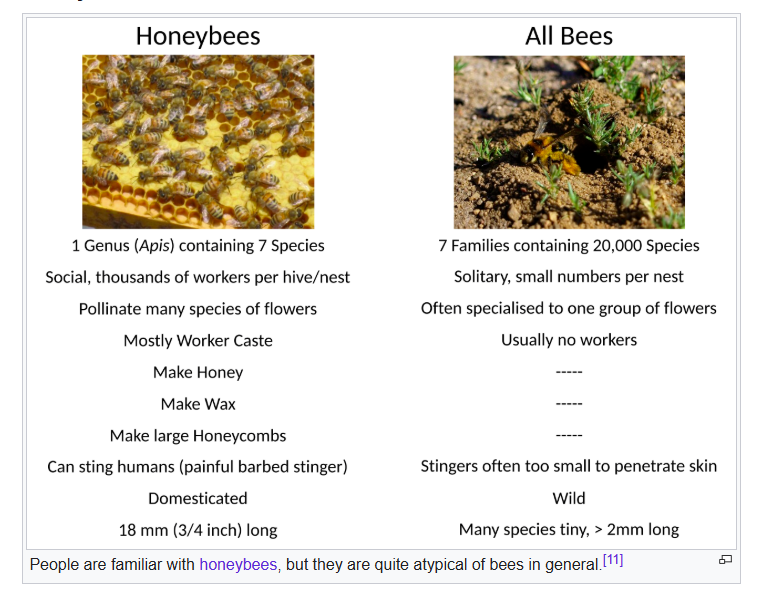
Honeybees are widely domesticated and are familiar to the public, but they are quite atypical of bees in general. Of the 20,000 species of bees, only 7 are honeybees. Most bees, other than bumblebees, are much smaller than honeybees, often under 2 mm long; they are mostly solitary rather than social, they do not make large nests, honey, or wax, and they rarely sting humans. Instead, many species pollinate just one group of flowers and are adapted to the habitat where those flowers grow.[11]
Evolution
The immediate ancestors of bees were stinging wasps in the family Ammoplanidae, which were predators of other insects.[12] The switch from insect prey to pollen may have resulted from the consumption of prey insects which were flower visitors and were partially covered with pollen when they were fed to the wasp larvae. This same evolutionary scenario may have occurred within the vespoid wasps, where the pollen wasps evolved from predatory ancestors.[13]
Based on phylogenetic analysis, bees are thought to have originated during the Early Cretaceous (about 124 million years ago) on the supercontinent of West Gondwana, just prior to its breakup into South America and Africa. The supercontinent is thought to have been a largely xeric environment at this time; modern bee diversity hotspots are also in xeric and seasonal temperate environments, suggesting strong niche conservatism among bees ever since their origins.[14]
Genomic analysis indicates that despite only appearing much later in the fossil record, all modern bee families had already diverged from one another by the end of the Cretaceous. The Melittidae, Apidae, and Megachilidae had already evolved on the supercontinent prior to its fragmentation. Further divergences were facilitated by West Gondwana's breakup around 100 million years ago, leading to a deep Africa-South America split within both the Apidae and Megachilidae, the isolation of the Melittidae in Africa, and the origins of the Colletidae, Andrenidae and Halictidae in South America. The rapid radiation of the South American bee families is thought to have followed the concurrent radiation of flowering plants within the same region. Later in the Cretaceous (80 million years ago), colletid bees colonized Australia from South America (with an offshoot lineage evolving into the Stenotritidae), and by the end of the Cretaceous, South American bees had also colonized North America.[14] The North American fossil taxon Cretotrigona belongs to a group that is no longer found in North America, suggesting that many bee lineages went extinct during the Cretaceous–Paleogene extinction event (the "K-Pg extinction").[14]
Following the K-Pg extinction, surviving bee lineages continued to spread into the Northern Hemisphere, colonizing Europe from Africa by the Paleocene, and then spreading east to Asia. This was facilitated by the warming climate around the same time, allowing bees to move to higher latitudes following the spread of tropical and subtropical habitats. By the Eocene (45 mya) there was already considerable diversity among eusocial bee lineages.[15][a] A second extinction event among bees is thought to have occurred due to rapid climatic cooling around the Eocene-Oligocene boundary, leading to the extinction of some bee lineages such as the tribe Melikertini. During the Paleogene and Neogene periods, bee lineages expanded worldwide. This came about as continental drift and changing climates created new barriers and habitats, isolating populations and driving the evolution of many new tribes.[14]
Fossils
The oldest non-compression bee fossil is Cretotrigona prisca, a corbiculate bee of Late Cretaceous age (70 mya) found in New Jersey amber.[13] A fossil from the early Cretaceous (100 mya), Melittosphex burmensis, was initially considered "an extinct lineage of pollen-collecting Apoidea sister to the modern bees",[18] but subsequent research has rejected the claim that Melittosphex is a bee, or even a member of the superfamily Apoidea to which bees belong, instead treating the lineage as incertae sedis within the Aculeata.[19]
The Allodapini (within the Apidae) appeared around 53 Mya.[20] The Colletidae appear as fossils only from the late Oligocene (25 Mya) to early Miocene.[21] The Melittidae are known from Palaeomacropis eocenicus in the Early Eocene.[22] The Megachilidae are known from trace fossils (characteristic leaf cuttings) from the Middle Eocene.[23] The Andrenidae are known from the Eocene-Oligocene boundary, around 34 Mya, of the Florissant shale.[24] The Halictidae first appear in the Early Eocene[25] with species[26][27] found in amber. The Stenotritidae are known from fossil brood cells of Pleistocene age.[28]
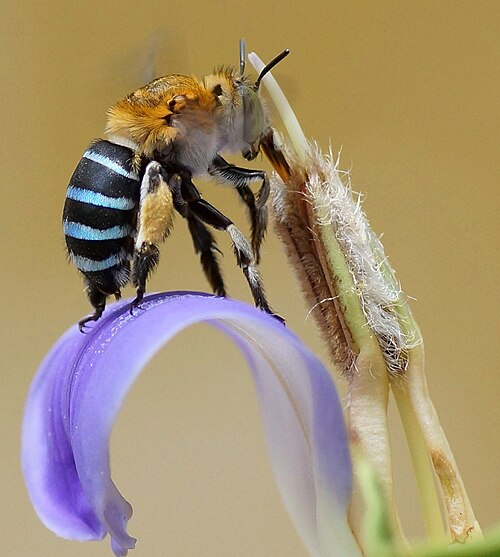
Long-tongued bees and long-tubed flowers coevolved, like this Amegillaspecies (Apidae) on Acanthus ilicifolius.
Navigation, communication, and finding food
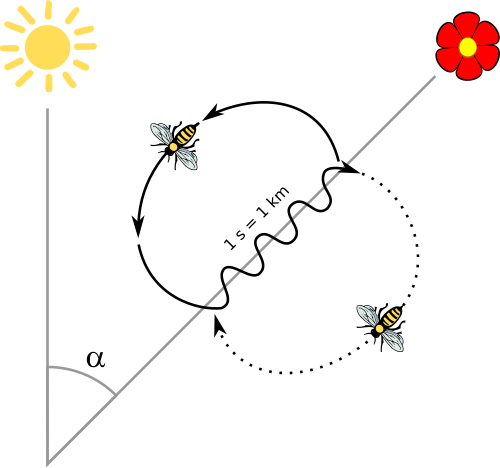
Karl von Frisch (1953) discovered that honey bee workers can navigate, indicating the range and direction to food to other workers with a waggle dance
Further information: Animal navigation and Waggle dance
The ethologist Karl von Frisch showed that honey bees communicate by the waggle dance, a pattern of movement that informs other workers about the direction and distance to food. He showed that honey bees use the sun as their main compass but can still locate its position on cloudy days by reading the polarization pattern of skylight.[66] They use spatial memory with a "rich, map-like organization".[67]
Ecology
Floral relationships
Most bees are generalists, collecting pollen from a range of flowering plants. Some are specialists, gathering pollen only from one or a few species or genera of closely related plants.[73] Some genera in Melittidae and Apidae are highly specialized for collecting plant oils as well as or instead of nectar; they mix the oils with pollen to feed their larvae.[74] Male orchid bees in some species gather aromatic compounds from orchids, which is one of the few cases where male bees are effective pollinators. All bees are able to detect desirable flowers by recognizing ultraviolet patterning on flowers, and by floral odors.[75] Bumblebees can in addition detect flowers' electromagnetic fields.[76] Once landed, a bee uses nectar quality[75] and pollen taste to determine whether to continue visiting similar flowers.[77]
In rare cases, a plant species may only be effectively pollinated by a single bee species; some plants are endangered in part because their pollinator is threatened. Such specialist bees are however strongly associated with common, widespread plants visited by multiple pollinator species. For example, in the arid southwestern United States, the creosote bush (Larrea tridentata) supports more than forty bee species that specialize in collecting its pollen.[78]
As mimics and models
Many bees are aposematically colored, typically orange and black, warning of their ability to defend themselves with a powerful sting. As such they are models for Batesian mimicry by non-stinging insects such as bee-flies, robber flies and hoverflies,[79] all of which gain a measure of protection by superficially looking and behaving like bees.[79]
Bees are themselves Müllerian mimics of other aposematic insects with the same color scheme, including wasps, lycid and other beetles, and many butterflies and moths (Lepidoptera) which are themselves distasteful, often through acquiring bitter and poisonous chemicals from their plant food. All the Müllerian mimics, including bees, benefit from the reduced risk of predation that results from their easily recognized warning coloration.[80]
Bees are mimicked by plants such as the bee orchid which imitates both the appearance and the scent of a female bee; male bees attempt to mate (pseudocopulation) with the furry lip of the flower, thus pollinating it.[81]
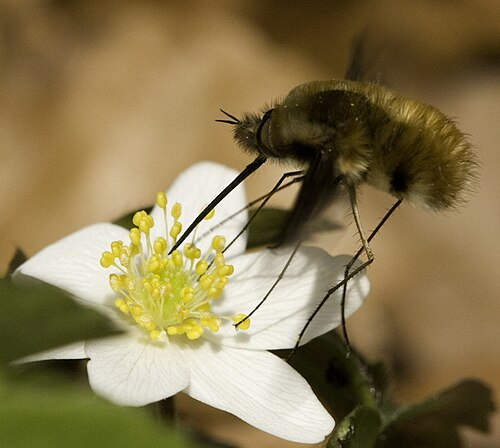
The bee-fly Bombylius major, a Batesian mimic of bees, taking nectar and pollinating a flower
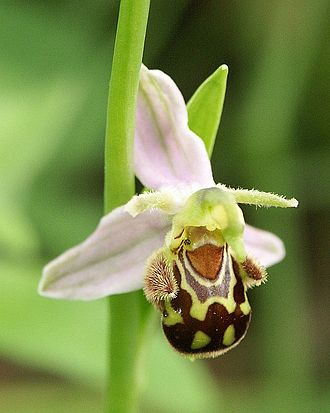
Bee orchid lures male bees to attempt to mate with the flower's lip, which resembles a bee perched on a pink flower.
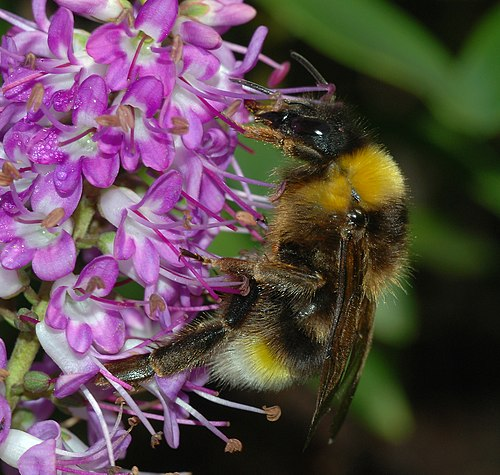
Bombus vestalis, a brood parasite of the bumblebee Bombus terrestris
Brood parasites occur in several bee families including the apid subfamily Nomadinae.[82] Females of these species lack pollen collecting structures (the scopa) and do not construct their own nests. They typically enter the nests of pollen collecting species, and lay their eggs in cells provisioned by the host bee. When the "cuckoo" bee larva hatches, it consumes the host larva's pollen ball, and often the host egg also.[83] In particular, the Arctic species of Bumblebee, Bombus hyperboreus, is an aggressive brood parasite that invades and enslaves colonies of other bumblebees within the same subgenus, Alpinobombus.[84] Unlike most socially parasitic bumblebees, which have lost the ability to collect pollen, B. hyperboreus retains functional pollen baskets and has been observed gathering pollen and nectar in the field.[85] This retention of foraging ability may be an adaptation to the severe Arctic climate, in which the short breeding season and limited availability of host colonies favor flexibility and a degree of metabolic self-reliance.[86]
In Southern Africa, hives of African honeybees (A. mellifera scutellata) are being destroyed by parasitic workers of the Cape honeybee, A. m. capensis. These lay diploid eggs ("thelytoky"), escaping normal worker policing, leading to the colony's destruction; the parasites can then move to other hives.[87]
The cuckoo bees in the Bombus subgenus Psithyrus are closely related to, and resemble, their hosts in looks and size. This common pattern gave rise to the ecological principle "Emery's rule". Others parasitize bees in different families, like Townsendiella, a nomadine apid, two species of which are cleptoparasites of the dasypodaid genus Hesperapis,[88] while the other species in the same genus attacks halictid bees.[89]
Nocturnal bees
Four bee families (Andrenidae, Colletidae, Halictidae, and Apidae) contain some species that are crepuscular. Most are tropical or subtropical, but some live in arid regions at higher latitudes. These bees have greatly enlarged ocelli, which are extremely sensitive to light and dark, though incapable of forming images. Some have refracting superposition compound eyes: these combine the output of many elements of their compound eyes to provide enough light for each retinal photoreceptor. Their ability to fly by night enables them to avoid many predators, and to exploit flowers that produce nectar only or also at night.[90]
Predators, parasites and pathogens
Further information: Diseases of the honey bee
Vertebrate predators of bees include bee-eaters, shrikes and flycatchers, which make short sallies to catch insects in flight.[91] Swifts and swallows[91] fly almost continually, catching insects as they go. The honey buzzard attacks bees' nests and eats the larvae.[92] The greater honeyguide interacts with humans by guiding them to the nests of wild bees. The humans break open the nests and take the honey and the bird feeds on the larvae and the wax.[93] Among mammals, predators such as the badger dig up bumblebee nests and eat both the larvae and any stored food.[94]
Specialist ambush predators of visitors to flowers include crab spiders, which wait on flowering plants for pollinating insects; predatory bugs, and praying mantises,[91] some of which (the flower mantises of the tropics) wait motionless, aggressive mimics camouflaged as flowers.[95] Beewolves are large wasps that habitually attack bees;[91] the ethologist Niko Tinbergen estimated that a single colony of the beewolf Philanthus triangulum might kill several thousand honeybees in a day: all the prey he observed were honeybees.[96] Other predatory insects that sometimes catch bees include robber flies and dragonflies.[91] Honey bees are affected by parasites including tracheal and Varroa mites.[97] However, some bees are believed to have a mutualistic relationship with mites.[32]
Some mites of the genus Tarsonemus are associated with bees. They live in bee nests and ride on adult bees for dispersal. They are presumed to feed on fungi, nest materials or pollen. However, the impact they have on bees remains uncertain.[98]
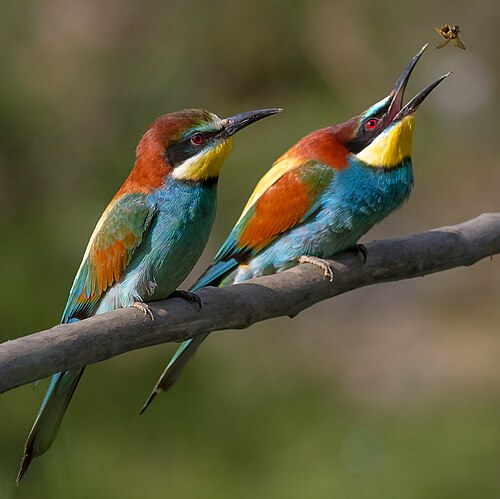
The bee-eater, Merops apiaster, specializes in feeding on bees; here a male catches a nuptial gift for his mate.
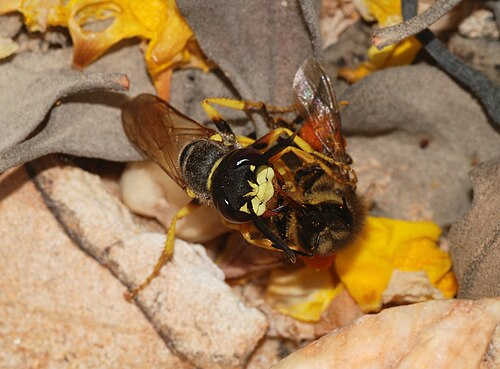
The beewolf Philanthus triangulum paralysing a bee with its sting
Exposure to chemical stressors
Bees are exposed to a wide range of chemical stressors, both natural and synthetic, though their relative impacts differ sharply. Comparative toxicological studies indicate that synthetic insecticides, such as neonicotinoids, are 1,000 to 10,000 times more acutely toxic to honeybees than commonly encountered natural alkaloids such as nicotine and caffeine, which are among the most thoroughly studied plant secondary metabolites.[99]
Insecticides remain the most damaging chemical stressor for bees. Neonicotinoids such as Imidacloprid, Clothianidin, and Thiamethoxam interfere with navigation, thermoregulation, and immune responses even at sub-lethal concentrations.[100] Long-term exposure reduces colony growth, foraging success, and queen survival in both laboratory and field conditions.[101][102] Following EFSA's 2018 risk assessment, outdoor agricultural uses of these active ingredients were banned throughout the European Union.[103][104][105] Other synthetic insecticides, including organophosphates and pyrethroids, as well as some fungicide mixtures, act synergistically with parasites and pathogens such as Varroa destructor, a parasitic mite of honeybees, and Nosema ceranae, compounding the physiological stress on colonies.[106][3] Industrial emissions and road traffic release traces of heavy metals such as cadmium, lead, and zinc, which can accumulate in hive products and bee tissues.[107] These metals induce oxidative stress, developmental abnormalities and altered foraging behaviour.[108] These substances are much less acutely toxic than insecticides, however their persistence and the fact that they are found everywhere results in chronic exposure that weakens immunity and increases disease susceptibility.[109][110]
A minority of flowering plants produce secondary metabolites that can become toxic to pollinators when concentrated. Alkaloids, saponins and glycosides in species such as Aesculus californica (California buckeye) and Rhododendron spp. (grayanotoxins) can deter feeding or kill bees.[111] However, some bees are resistant to Rhododendron toxins.[112]
Chemical stressors affecting pollinators are best characterized by their acute and sublethal toxicity as well as ecological impact. In this way, synthetic insecticides consistently present the greatest risk across meta-analyses, followed by fungicides and certain industrial pollutants.[113] Natural floral toxins (plant secondary metabolites) are typically sublethal. As well, they rarely drive population declines and are minor in impact compared to anthropogenic chemicals.[99]
Overall, synthetic agrochemicals (particularly insecticides and some fungicides) and industrial pollutants remain the dominant chemical drivers of pollinator decline,[113] whereas the majority of natural floral toxins have sublethal impacts that do not generally contribute to major population-level effects.[99][114]
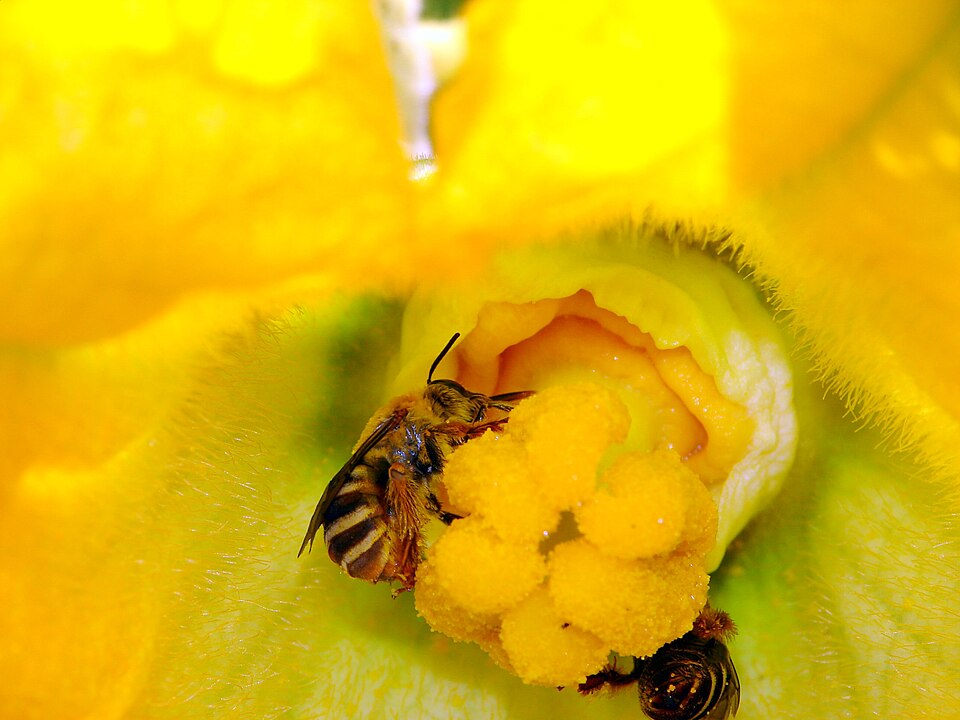
Squash bees (Apidae) are important pollinators of squashes and cucumbers.
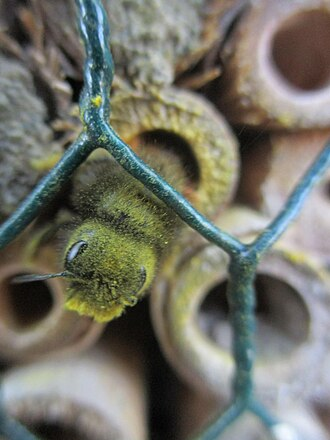
A mason bee (Osmia sp.) covered in pollen
As alternative medicine
Apitherapy is a branch of alternative medicine that uses honey bee products, including raw honey, royal jelly, pollen, propolis, beeswax and apitoxin (Bee venom).[161] The claim that apitherapy treats cancer, which some proponents of apitherapy make, remains unsupported by evidence-based medicine.[162][163]
Stings
The painful stings of bees are associated with the poison gland and the Dufour's gland which are abdominal exocrine glands containing various chemicals. In Lasioglossum leucozonium, the Dufour's Gland mostly contains octadecanolide as well as some eicosanolide. There is also evidence of n-triscosane, n-heptacosane,[164] and 22-docosanolide.[165]
See also
76). Suttona, Gregory P.; Clarkea, Dominic; Morleya, Erica L.; Robert, Daniel (2016). "Mechanosensory hairs in bumblebees (Bombus terrestris) detect weak electric fields". PNAS. 113 (26): 7261–7265. Bibcode:2016PNAS..113.7261S. doi:10.1073/pnas.1601624113. PMC 4932954. PMID 27247399.
FROM:
Monday, May 04, 2026 05:31PM
This article is about the group of flying insects. For other uses, see Bee (disambiguation).
SEE PDF for complete article. rk.
Notes
- Triassic nests in a petrified forest in Arizona, implying that bees evolved much earlier,[16] are now thought to be beetle borings.[17]