Honey bee
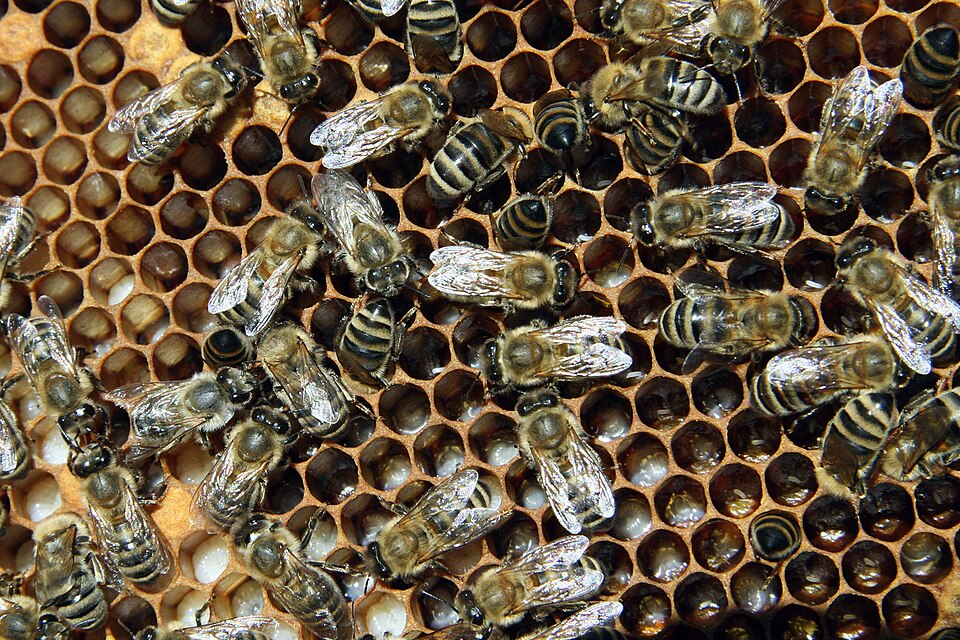
Honeybees on brood comb with eggs and larvae in cells
The life cycle of both solitary and social bees involves the laying of an egg, the development through several moults of a legless larva, a pupa in which the insect undergoes complete metamorphosis, and the emergence of a winged adult. Most solitary bees and bumble bees in temperate climates overwinter as adults or pupae and emerge in spring when increasing numbers of flowering plants come into bloom. The males usually emerge first and search for females with which to mate. Like the other members of Hymenoptera, bees are haplodiploid; the sex of a bee is determined by whether or not the egg is fertilized. After mating, a female stores the sperm, and determines which sex is required at the time each individual egg is laid, fertilized eggs producing female offspring and unfertilized eggs, males. Tropical bees may have several generations in a year and no resting diapause stage.[55][56][57][58]
The egg is generally oblong, slightly curved and tapering at one end. Solitary bees, lay each egg in a separate cell with a supply of mixed pollen and nectar next to it. This may be rolled into a pellet or placed in a pile and is known as mass provisioning. Social bee species provision progressively, that is, they feed the larva regularly while it grows. The nest varies from a hole in the ground or in wood, in solitary bees, to a substantial structure with wax combs in bumblebees and honey bees.[59]
In most species, bee larvae are whitish grubs, roughly oval and bluntly-pointed at both ends. They have 15 segments and spiracles in each segment for breathing. They have no legs but move within the cell, helped by tubercles on their sides. They have short horns on the head, jaws for chewing food and an appendage on either side of the mouth tipped with a bristle. There is a gland under the mouth that secretes a viscous liquid which solidifies into the silk they use to produce a cocoon. The cocoon is semi-transparent and the pupa can be seen through it. Over the course of a few days, the larva undergoes metamorphosis into a winged adult. When ready to emerge, the adult splits its skin dorsally and climbs out of the exuviae and breaks out of the cell.[59]
Monday, May 04, 2026 05:48PM