Kunkler kyle epa
---
rev door SWAMP THING
SEE EPA 6 ZELDIN DERG
SEE OCSPP CHEM SAFE
SEE DEREG 5
SEE SOYBEAN
SEE MAHA FAIL RFK2
SEE NANCY BECK
---
---
SEE MAHA
We Uncovered A Conspiracy To Poison Your Food
Fundraiser
More Perfect Union
3.31M subscribers
527,745 views Mar 20, 2026
Four former chemical lobbyists control America’s pesticide regulations, letting pesticide companies pump the country full of toxins. For every 1 meeting with an environmental group, the EPA met 25x with corporate interests. We revealed the corporate lobby poisoning America:
---
---
Tracing Bayer’s ties to power in Trump’s Washington
From lobby firms to top officials, a look at how Bayer built access and secured favors
Stacy Malkan | February 24, 2026
The White House invokes the Defense Production Act to guarantee supplies of elemental phosphorus and glyphosate-based herbicides. Regulators reapprove dicamba, a Bayer herbicide twice blocked by federal courts, and clear the way for new pesticides containing toxic, persistent PFAS “forever” chemicals.
And the U.S. Justice Department urges the U.S. Supreme Court to erase billions of dollars of Bayer’s liability for its glyphosate-based Roundup weed killer – placing the weight of the executive branch on the side of a foreign company against thousands of Americans who say Bayer’s products caused their cancers.
Over the past year, the administration under President Donald J. Trump has delivered a string of victories to Bayer, the German agrichemical and pharmaceutical giant that merged with Monsanto in 2018 to become the world’s leading manufacturer of genetically modified seeds and pesticides.
Pesticide industry influence in Washington is not new. The Biden administration also delivered wins to Bayer, including defending pesticide deregulatory measures. But Bayer’s big wins with the Trump administration come as the company seeks sweeping legal protections from cancer lawsuits – at a time when a growing body of scientific research links glyphosate to cancer and other chronic diseases, and cancer rates are rising among young people across the U.S. Corn Belt.
These favors to Bayer clash with Trump’s promise to “Make America Healthy Again,” which many supporters understood as a pledge to confront industries linked to chronic disease. They show how a foreign corporation can procure influence at the highest levels of the U.S. government and shape policies that impact health.
Our review of Bayer’s access in Washington found 16 key administration officials with ties to Bayer’s lobbying or legal network. Bayer and its lobbyists have access to people in power at the White House, U.S. Department of Agriculture, the Environmental Protection Agency and even those in high level positions closest to Trump.
Bayer also has a formidable lobbying force in Washington, with 45 people registered to lobby for Bayer under the Lobbying Disclosure Act, and at least 13 outside lobby firms – seven of which are now among the highest-paid firms in D.C. More than 30 senior officials at lobby firms retained by Bayer have direct ties to Trump, having worked in one or both of his administrations or political campaigns.
Taken together, these relationships describe a network of aligned actors positioned across the American institutions that write the rules for pesticides, enforce those rules, and defend them in court. The implications extend beyond one company or product line: Decisions shaped by Bayer’s access to the Trump administration are affecting pesticide regulation, how chemicals are assessed, our nation’s farm policy, and the ability of Americans to seek justice in court.
Bayer’s reach into to Trump’s inner circle
The most potent Bayer connections to the Trump administration involve a group of Florida lobbyists and former lobbyists who hold power in Trump’s Washington: Chief of Staff Susie Wiles, U.S. Attorney General Pam Bondi, and Brian Ballard, who employed both Bondi and Wiles as lobbyists for years before they joined the Trump administration.
Wiles, one of Trump’s most powerful advisors in Washington, worked for Ballard Partners as a lobbyist and then partner for a decade until 2022. From 2016 to 2022, she also worked as a senior advisor to Trump’s presidential campaigns.
Ballard raised more than $50 million for Trump’s 2024 campaign, and served on the 2024 inaugural and transition finance committees; he is widely seen as one of the most influential people in D.C. in who does not hold an official government title.
Ballard’s firm Ballard Partners became the highest-earning lobbying firm in D.C. in 2025, setting a record for the most lucrative year for any lobbying firm in U.S. history. The firm registered to lobby for Bayer in December 2024. The firm also now lobbies for the American Chemistry Council, a trade group that includes Bayer among its corporate members.
Both Ballard and his partner, Daniel McFaul, who served on Trump’s 2016-2017 presidential transition team, are registered to lobby for both Bayer and the American Chemistry Council. The two organizations have paid Ballard Partners a combined half million dollars since Trump was elected the second time, according to federal lobby disclosures.
One of the ACC’s priorities this year is revising the Toxics Substances Control Act, the nation’s main toxic chemicals law. A new Republican bill seeks to narrow the scientific evidence regulators can use to assess health risks and would give chemical companies a larger role in assessing how their products are evaluated.
As Attorney General, Bondi leads the Justice Department and wields broad power over federal legal strategy and the government’s positions in court. Like Wiles, Bondi moved back and forth between her lobbyist job at Ballard Partners and roles supporting Trump. Bondi joined Ballard Partners in January 2019 to launch and chair the firm’s corporate regulatory compliance practice. She left later that year to assist with Trump’s legal defense for his first impeachment inquiry, then rejoined Ballard Partners for five years from 2020 to 2025 before taking the top job in the Justice Department.
For more Ballard Partners executives with ties to Trump see our Bayer Lobby Tracker.
Another Bayer tie to Wiles is the lobbying and public relations firm Mercury Public Affairs.Trump’s chief of staff was co-chair of Mercury from 2022 to November 2024, immediately prior to joining the White House. The firm registered to lobby for Bayer in August 2025. While at Mercury, Wiles also served as co-chair of Trump’s presidential campaign in 2023 and 2024, according to financial disclosures.
Registered lobbyists for Bayer at Mercury Public Affairs include Bryan Lanza, who was deputy communications director for Trump’s 2016 campaign and communications director for Trump’s first presidential transition team. Lanza joined Mercury in 2017 and has been a frequent guest on cable news shows as a surrogate and for Trump.
*Bryan Lanza of Mercury Public Affairs appeared on CNN as a senior advisor to the Trump campaign. He is now a registered lobbyist for Bayer.
More Bayer ties to the White House
Another key White House aide with ties to Bayer’s legal network is Ryan Baasch, Trump’s deputy assistant to the President for economic policy. In this role, Baasch helps convert Trump’s economic agenda into coordinated federal policy. From 2016-2021, Baasch was an associate at Latham & Watkins, a law firm that represented Bayer on Roundup settlement issues and represented Monsanto in a case involving dicamba. The firm also represented Monsanto and CropLife America in a glyphosate warning case.
Another aide close to Trump in 2025, Trent Morse, was a senior associate at Ballard Partners from 2020 to 2022, then moved to Mercury Public Affairs as a senior vice president. As deputy assistant to the President and deputy director of presidential personnel for eight months, Morse was part of the team responsible for recruiting, vetting and recommending candidates for political appointments throughout the executive branch. He left the White House in August for a lobbying job.
USDA officials’ ties to Bayer
The U.S. Department of Agriculture oversees farm policy, crop systems, and biotechnology approvals, shaping the subsidies, research, and planting decisions that drive demand for Bayer’s seeds and chemicals. The agency has long faced criticism over its servility to the chemical industry, and the Trump administration is no exception. Current USDA officials with ties to Bayer and its chemical industry allies include:
- Stephen Vaden, deputy secretary of agriculture, is a former associate at Jones Day(2014–2017), a firm that represented Bayer on its acquisition of Monsanto, and Squire Patton Boggs (2011-2014), which represented Bayer and Monsanto in cases involving glyphosate and PCBs.
- Richard Fordyce,undersecretary for farm production and conservation, is the former agriculture business growth director for the public relations and marketing firm Osborn Barr Paramore (2021-2025), which was Bayer’s PR agency for years. A former director of the United Soybean Board, Fordyce was administrator of the Farm Service Agency in Trump’s first term.
- Scott Hutchins,undersecretary for research, education, economics & chief scientist, spent over 30 years at Dow AgroSciences (now Corteva), most recently as global R&D director. He served in this same USDA role in the first Trump administration.
- Pat Swanson,administrator of the Risk Management Agency, was a director for the lobby groups American Soybean Association and the Iowa Soybean Association, where she advocated for Bayer’s pesticides.
- Bill Beam,administrator of the Farm Service Agency, served for nine years on the United Soybean Board, which collaborates with Bayer on research initiatives. Beam previously served as the deputy administrator for farm programs at the FSA (2018–2021).
- Peter Laudeman, senior policy advisor for trade and foreign agricultural affairs, is a former political affairs manager of Corteva Agriscience (formerly DowDuPont) from 2020-2022, and legislative assistant for the National Corn Growers Association from 2018-2020.
Bayer’s pursuit of federal preemption
Bayer’s case before the Supreme Court has high stakes for public health protections and the legal right of individuals to hold companies accountable in court.
Federal preemption – the idea that federal law can override state law in some circumstances – has long been a priority for chemical and food companies that want a single, often weaker, national standard for regulation and liability, while consumer and health groups argue that states must retain the right to set higher health and safety standards.
The issue is central to Bayer’s case before the Supreme Court: the company argues that because the EPA approved glyphosate, cancer claims tied to Roundup should be barred under state failure-to-warn laws. The federal government’s position on whether pesticide approvals preempt state laws has shifted across administrations, underscoring how much the outcome depends on who holds power, and who influences it.
In May 2025, two appellate attorneys with deep experience at the U.S. Department of Justice, Jennifer Scheller Neumann and Amelia Yowell, joined Holland & Hart LLP,a firm that provides legal and lobbying services. A month earlier, the firm had registered to lobby for Bayer.
Neumann spent 20 years at the DOJ’s Environment and Natural Resources Division, most recently as chief of the appellate section overseeing all appellate litigation involving federal environmental laws. She was a signatory on the DOJ’s 2019 amicus brief in the Ninth Circuit Court of Appeals supporting Monsanto (now Bayer). The brief argues that EPA’s approval of glyphosate preempts state failure-to-warm laws.
The Biden administration reversed that position in 2022, urging the Supreme Court to reject Bayer’s case on the premise that federal pesticide law should not preempt state failure-to-warn laws.The Trump Justice Department reversed it again in 2025 – arguing the Biden-era position was wrong and that juries shouldn’t second-guess EPA science.
Oral arguments before the Supreme Court are scheduled for April 27. A win for Bayer could turn EPA pesticide approvals into a nationwide liability shield, elevating the agency’s slow and often industry-dominated chemical assessment process into a final word on pesticide safety, at a time when peer-reviewed research continues to emerge linking pesticide exposure to cancer, neurological harm, and other chronic illnesses.
As Nathan Donley of the Center for Biological Diversity warned, such a precedent would mean that “the only thing that matters legally in determining a pesticide’s safety is what EPA claims to be true, even if those claims completely ignore the best available science.”
Slashing capacity at EPA
Bayer allies also pervade the U.S. agency charged with protecting health and the environment – in positions where they influence what chemicals and pesticides are approved and how these products are regulated. Chemical industry lobbyists now occupy the top four jobs at the EPA’s Office of Chemical Safety and Pollution Prevention (OCSPP), the division in charge of regulating chemicals and pesticides. EPA officials loosened ethics standards to allow it.
Douglas Troutman, assistant administrator at OCSPP, is the former co-CEO and chief lobbyist for the American Cleaning Institute (ACI), which represents major chemical manufacturers. Troutman worked at the lobby group for 17 years before joining the Trump administration.
Nancy Beck, principal deputy assistant administrator at OCSPP, was a senior director at the American Chemistry Council – a lobby group representing Bayer, Dow Chemical, DuPont and other chemical manufacturers – from 2012 to 2017. In Trump’s first EPA, she held advisory roles within the White House at NEC and OMB. Between Trump administrations she worked at Hunton Andrews Kurth, a law firm that offers, among other services, glyphosate litigation defense to companies facing lawsuits from cancer claims.
Lynn Ann Dekleva OCSPP’s deputy assistant administrator for new chemicals, also held this role during the first Trump administration. In between, she was a senior director at the lobby group American Chemistry Council.She is a 30-year veteran of DuPont chemical company, where she workedas a program manager and engineer.
Kyle Kunkler, OCSPP deputy assistant administrator for pesticides, is a former pesticide industry lobbyist. He was director of government affairs, with a focus on biotech and pesticides, for the American Soybean Association from 2020-2025, and prior to that spent three years managing government affairs on food and agriculture for the Biotechnology Innovation Organization lobby group. CropLife America, the main lobby group for the pesticide industry, gave him a “Rising Star” award in 2020.
 *Bayer was a gold sponsor at CropLife America 2021 where Beck was a featured speaker alongside her colleague Matt Leopold, who was EPA’s top lawyer during the first Trump administration. Hunter Andrews Kurth is a leading firm for pesticide litigation.
---
More EPA officials with ties to Bayer include:
Steven Cook, deputy assistant administrator for the Office of Land and Emergency Management, oversees Superfund sites. Bayer is associated with several Superfund sites due to its pesticide and chemical manufacturing. Cook spent over 20 years as the in-house corporate counsel for LyondellBasell, one of the world’s largest plastics and chemical companies. LyondellBasell has a 50/50 joint venture with Bayer (a propylene oxide and styrene monomer plant). LyondellBasell CEO Peter Vanacker is board chair of the American Chemistry Council.
Aaron Szabo,assistant administrator for air and radiation (appointed in July 2025) was a partner and lobbyist at CGCN Group (2018–2023), which has been registered to lobby for the American Chemistry Council during the past decade. From 2023 to 2024, he was a senior director and attorney at Faegre Drinker Biddle & Reath, where he represented chemical interests, including the ACC, before returning to the EPA in January 2025.
Alex Dominguez,deputy assistant administrator for mobile sources, was a registered lobbyist with Massie Partners, where he represented the National Corn Growers Association, a group whose members are consumers of Bayer’s seeds and pesticides. He worked in that role from 2023 to January 2025.
More Trump officials tied to Bayer
As assistant secretary of legislation at the U.S. Department of Health and Human Services, Gary Andresis a primary liaison between HHS and Congress. He was previously the senior executive vice president of public affairs at the Biotechnology Innovation Organization, the main trade group for biotech companies including Bayer. At BIO, Andres directed the lobbying strategy for the entire biotech sector, which included defending the regulatory framework for GMOs and associated agrichemicals. He previously worked at lobbying firm Dutko Worldwide which has represented Bayer.
Secretary of Transportation Sean Duffy also has ties to a Bayer lobby firm; he was senior counsel and advisory board member of BGR Group from 2019 to 2023 and was a registered lobbyist for the firm in 2020, though there is no record of him lobbying for Bayer.
13 lobby firms working for Bayer in Washington
Bayer’s direct lobbying spending is significant, but its political influence expands considerably when viewed alongside allied trade and commodity groups that together form a well-financed and coordinated lobbying network. In 2025, Bayer retained at least 13 lobby firms and at least 49 registered lobbyists registered to lobby for the company (including Bayer’s six in-house lobbyists) as of the fourth quarter, federal disclosures show.
Bayer spent at least $9.19 million on federal lobbying last year. While it is not among the highest-spending single corporations lobbying in D.C., the agribusiness sector ranked ninth with $219.9 million in lobbying expenditures in 2025 – the highest year on record for the sector. We include the sector total because Bayer’s influence is amplified by an integrated industrial agribusiness system that acts in concert – from pesticide-dependent commodity crops to factory farms and ultra-processed food production – to shape policy in its favor.
Within the sector, groups directly lobbying for favorable pesticide policies include trade groups representing pesticide manufacturers – the American Chemistry CouncilandCropLife America – and commodity groups such as the National Corn Growers Association and American Soybean Association that rely on Bayer’s products.
These four groups spent a combined $22 million on federal lobbying in 2025, with 12 more outside lobby firms and 79 more registered lobbyists in the fourth quarter.
Bayer’s lobbying activity last year was its highest in recent years, but lower than the company’s peak in 2016, 2017 and 2018, just before the Bayer/Monsanto merger and following the 2015 WHO cancer agency finding that glyphosate is a probable human carcinogen.
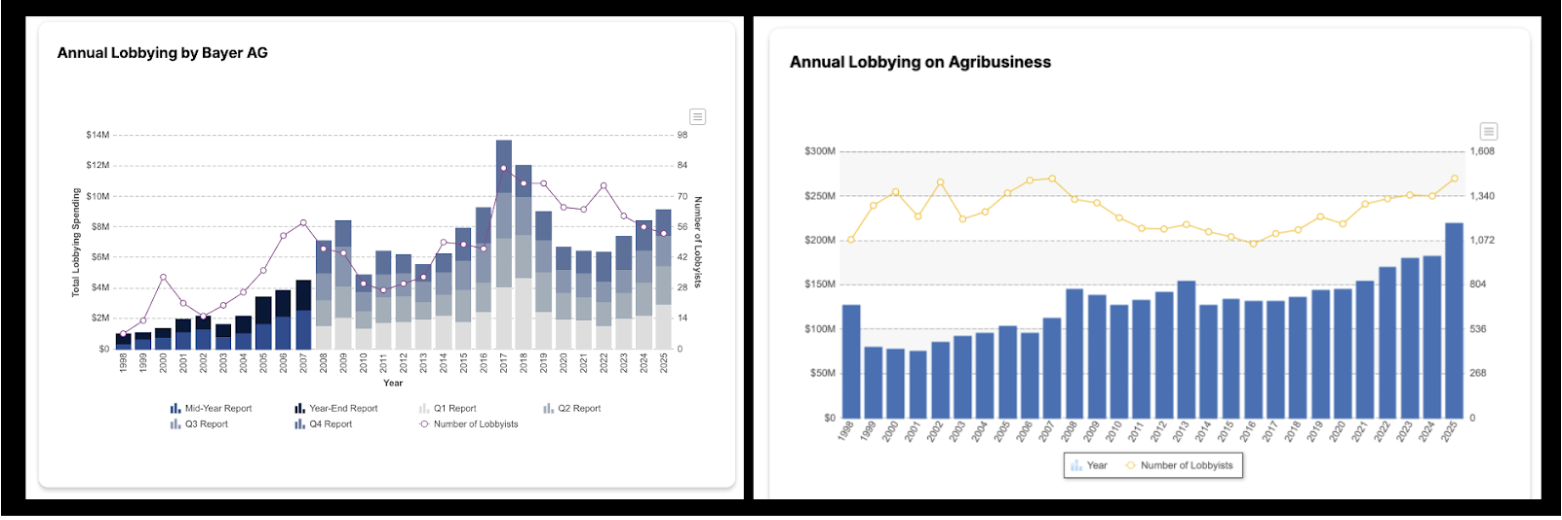 *Source: OpenSecrets
These numbers don’t reflect the whole picture of Bayer’s lobbying activities. The Lobbying Disclosure Act requires registration only after certain spending and activity thresholds are met, so public filings do not capture all of the paid influence work taking place in Washington.
They don’t reflect state-level activity, either. Pesticide related PAC spending surged in late 2024 as companies sought to limit damage awards in courts across the nation. In Iowa alone, Bayer spent a record amount last year trying to pass a state immunity bill critics called the Cancer Gag Act.
Read more about Bayer’s lobby force in our Bayer Lobby Tracker.
More lobbyists tied to Trump
Political scientists have long documented how lobbying shapes public policy by securing access to decision-makers, and helping corporations turn their priorities into laws and regulations. These dynamics help explain how companies like Bayer can translate access in Washington into concrete policy wins.
More than 30 people in leadership positions at lobby firms retained by Bayer have direct ties to Trump’s current or former administrations or presidential campaigns, our analysis shows. Many of these lobbyists are not personally registered to lobby for Bayer, but may be assisting in ways that do not trigger lobby registration, for example, advising the firm’s Bayer lobbyists.
As noted earlier, Ballard Partners – the firm that employed both Susie Wiles and Pam Bondi, and is run by one of Trump’s biggest political fundraisers – is a fundamental connection for Bayer o Trump’s orbit. In addition to Brian Ballard and Daniel McFaul, the two lobbyists at the firm who are registered to lobby for both Bayer and the American Chemistry Council, other partners at Ballard have connections to Trump:
Hunter Morgen, a D.C.-based partner in the firm, served over three years in senior positions during the first Trump administration – as special assistant to the President and senior advisor for policy and strategy in the White House working on trade and immigration issues with Peter Navarro and Stephen Miller. Prior to his White House role, Morgen was policy advisor for the State Department in the Office of Policy and Planning. He previously worked on Trump’s 2016 presidential campaign and transition team. In 2020, Trump appointed Morgen to the Presidential Council on Improving Federal Civil Architecture. Morgen – along with Brian Ballard, Daniel McFaul, Syl Lukas (a senior partner at Ballard) and Susie Wiles – were included among a list of donors invited to an October 2025 gala for Trump’s new $250 million East Wing ballroom.
*Trump has said the new ballroom is being “paid for 100 percent by me and some friends of mine, donors,” raising concerns about conflicts of interest.
Mike Rubino, another D.C. partner at Ballard, was among the first hires on Trump’s 2016 presidential campaign where he was a senior advisor directing operations in ten states and winning nine of them, according to his bio. He joined the first Trump administration as a senior official at HHS before leaving for the private sector where he worked alongside Corey Lewandowski, who is currently a key figure at the Department of Homeland Security.
Ballard D.C. Partner William Russell was the aide responsible for Trump’s daily travel and logistics for nearly four years of the first administration. Russell also worked on Trump’s 2016 and 2024 campaigns.
Brian Hughes, a partner at Mercury Public Affairs– the other lobby firm that previously employed Susie Wiles – was NASA chief of staff from May to December 2025. He joined Mercury in January 2026. Brian Hughes was Trump’s Florida campaign manager in 2024 and communications director for Trump’s transition team. Danielle Alvarez, another partner at Mercury, held communications and advisory roles in Trump’s 2020 and 2024 campaigns.
Other Bayer lobby firm ties to Trump’s White House include:
Amy Swonger, a principal at Invariant– a firm registered to lobby for Bayer – worked in the Executive Office of the President for most of Trump’s first term, as assistant to the president and as director and deputy director of legislative affairs.
Jordan Bonfitto,a director at Invariant, was a policy advisor at the National Economic Council in Trump’s first White House, focused on the agricultural and biotech portfolios. From February to October 2025, Bonfitto was the chief of staff for marketing and regulatory programs at the USDA under Secretary Brooke Rollins. He joined Invariant in November.
Other notable Bayer lobby firm ties to Trump:
Holland & Hart, a lobby firm Bayer retained in April 2025, employs former EPA Administrator Andrew Wheeler, who held the top job at EPA for part of Trump’s first term. Wheeler is a partner at the firm and head of federal affairs. Troy Lyons, a registered lobbyist for Bayer and senior director of federal affairs at Holland & Hart, held senior roles in Trump’s first EPA working under both Wheeler and Trump’s first EPA Administrator Scott Pruitt.
At BGR Government Affairs, several senior lobbyists have ties to Trump. Managing Director David Urban was a senior advisor on Trump’s 2016, 2020, and 2024 campaigns; Practice Head and Principal William Crozer left the firm during Trump’s first term to serve as special assistant to the president and deputy director of the White House Office of Intergovernmental Affairs; and PrincipalJoseph Lai was aspecial assistant to the President for legislative affairs (2017-2019), where he led the outreach and vote-counting efforts to confirm Justices Gorsuch and Kavanaugh, as well as other major appointees.
Akin Gump Strauss Hauer & Feld, longtime lobbyists for Bayer and Monsanto, also has notable advisors and partners with ties to Trump. Geoff Verhoff, senior advisor at the firm, served on the Trump-Pence victory finance leadership committee 2017-2021 and was the vice chair of the RNC Finance Committee in those years. Partner Kelly Ann Shaw, was deputy assistant to the President for international economic affairs and the U.S. lead negotiator (Sherpa) for the G7, G20, and APEC in 2018 and 2019. Senior Advisor Anna Abramdeputy commissioner for policy, legislation and international affairs at the FDA from 2017 to 2021.
For more ties between Bayer’s lobby firms, the Trump administration and other routes of influence see our lobby tracker:
This analysis of Bayer-Trump connections reflects only what is visible in public records. Additional financial, political, or personal ties – including undisclosed funding streams, if they exist – may remain hidden. This story is a work in progress. We will update it. You can help by sending us what you may know about ties between Bayer and the Trump administration, including the federal agencies. Contact Stacy Malkan via Signal or email stacy@usrtk.org.
Updates made February 26:
- Added another USDA official (Peter Laudeman) with ties to Bayer.
- Added total number of lobbyists and lobby firms retained by four trade and commodity groups that work closely with Bayer: American Chemistry Council, CropLife America, National Corn Growers Association and American Soybean Association.
Categories: Monsanto/Bayer, Pesticides Tags: Primary Article
===
---
For Immediate Release, August 15, 2025
MAHA Commission Succumbs to Pesticide Industry Pressure
*Draft Report Walks Back Administration’s Promises of Bold Action on Pesticides
WASHINGTON— A much-anticipated draft action plan from the Make America Healthy Again Commission eliminated any plans for action on pesticides. This report is the follow up to the commission’s May MAHA report, which included pesticides and specifically named both glyphosate and atrazine.
The threat of any new restrictions being placed on the use of dangerous pesticides spurred a massive and successful lobbying effort by the chemical industry and commodity growers’ groups, alongside their friends in Congress and the EPA, to force the commission to back off. Instead of action, the recommendations direct the EPA and Big Ag to work together to convince the public to have confidence in pesticide review processes, which are broadly criticized for scientific inadequacy and excessive industry influence. It also encourages research into new pesticide application technologies
“Despite the administration’s promises to MAHA and the reality that using a billion pounds of pesticides in the U.S. each year is a major threat to public health, pesticide interests again prevailed in protecting their profits,” said Lori Ann Burd, environmental health director at the Center for Biological Diversity. “Big Ag’s success in steamrolling the commission’s attempt to act on pesticides is a gut punch to everyone who genuinely believed we could finally make progress on protecting children’s health from these poisons.”
More than 300 million pounds of glyphosate and 70 million pounds of atrazine are used by U.S. farmers annually. Thousands of lawsuits have been filed by cancer victims who used Roundup, which contains glyphosate. Atrazine, a powerful endocrine disruptor that contaminates the drinking water of 40 million Americans, is so toxic it is banned in more than 60 countries.
The United States allows use of 85 pesticides that have been banned or are being phased out in the European Union, China or Brazil, according to a peer-reviewed study published by the academic journal Environmental Health. Over a quarter of all agricultural pesticide use in this country includes pesticides banned in the European Union.
“The MAHA Commission is insulting the intelligence of Americans. It’s outlandish to recommend solving our pesticide woes by having the EPA and Big Ag try to convince us that the deeply flawed pesticide regulatory process is working just fine,” said Burd. “While Big Ag won this battle, the powerful grassroots movement of millions of Americans who know that these chemicals are making us sick will continue fighting to protect their families from pesticides like glyphosate and atrazine.”
Some of the strongest resistance against action on pesticides appears to have come from the administration’s political appointees in the EPA’s chemical safety office. Widespread reporting has pointed a finger at Nancy Beck, a former executive with the American Chemistry Council who, after diligently serving pesticide interests in Trump’s first administration, has been brought back as principal deputy assistant administrator overseeing the EPA’s Office of Chemical Safety. Another American Chemistry Council veteran, Lynn Ann Dekleva, is also back at the EPA, serving as deputy assistant administrator for new chemicals.
More recently, the administration appointed well-known MAHA critic and American Soybean Association lobbyist Kyle Kunkler as deputy assistant administrator for pesticides at the EPA. Just one month after Kunkler’s arrival at the EPA, the agency proposed to reapprove over-the-top use of dicamba, a highly controversial pesticide that Kunkler lobbied for extensively in his former position.
Health and Human Services Secretary Robert F. Kennedy Jr. has repeatedly stated that many of the most-used pesticides in the United States are “extraordinarily toxic,” including and organophosphates. He has that pesticides — many of which have scientifically well-documented links to cancer, infertility, obesity and developmental disorders — are significant contributors to chronic health problems faced by people across the nation.
Following his reelection Trump expressed his own concerns that the United States continues spending “billions and billions of dollars on pesticides,” compared to the European Union and yet has far worse health outcomes. He pledged that his administration would “ensure that everybody will be protected from harmful chemicals, pollutants, [and] pesticides.”
As part of that pledge, he nominated Kennedy as secretary of the Department of Health and Human Services with a mandate to “go wild on the food.” Trump stated that Kennedy is “looking into [pesticides] very seriously because maybe it's not necessary to use all of that.”
The Center for Biological Diversity is a national, nonprofit conservation organization with more than 1.8 million members and online activists dedicated to the protection of endangered species and wild places.}:
---
---}:
omfg
:FOIA records reveal EPA leaders frequent meetings with industry lobbyists - The New Lede
https://www.thenewlede.org/2025/09/epa-industry-influence/#:~:text=EPA%20defends%20meetings,.%E2%80%9D%20%E2%80%93%20Carolyn%20Holran%2C%20EPA~)
Top regulatory officials met with agricultural and chemical industry representatives dozens of times in the first few months after President Donald Trump took office in January, government records show — meetings that were followed by a series of regulatory rollbacks and a downplaying of pesticide concerns by the administration’s “Make America Healthy Again” (MAHA) Commission.
From February to mid-May, Environmental Protection Agency (EPA) leaders accepted meetings with representatives from at least 50 industry associations and companies, including agricultural and chemical giants such as Bayer, Corteva, BASF, Dow and the agrichemical lobbying group CropLife America, as well as the American Soybean Association, the National Cotton Council and others.
The meetings also included energy giants like ExxonMobil, Phillips 66, and companies working in plastics or chemical production such as Occidental Chemical Corporation. Some scheduled meetings involved representatives from multiple companies and their legal counsel or lobbyists.
Notably, the industry meetings involved formerindustry insiders who now are in top positions at the EPA: Nancy Beck, formerly an executive at the American Chemistry Council who is now the EPA’s principal deputy assistant administrator in theOffice of Chemical Safety and Pollution Prevention, and Lynn Ann Dekleva, who previously worked at DuPont and as a lobbyist at the American Chemistry Council and is now the deputy assistant administrator of the same EPA office.
See the scheduled meetings here:
April (continued) and May Calendars
Beck worked in the first Trump administration’s EPA as well,leading efforts to remove or water down chemical regulations.
Beck’s meetings with agricultural interests included a March meeting regarding the pesticide dicamba with then-lobbyist Kyle Kunkler. In June, Kunkler joined the EPA to work alongside Dekleva and Beck.
The EPA records, obtained through a Freedom of Information Act request, show meetings with environmental and health groups were nearly absent from Beck and Dekleva’s calendars, other than meetings with the American Dental Association and the Physicians Committee for Responsible Medicine.
The records cover January through early May and only show invited attendees, not meeting minutes or issues discussed.
A MAHA makeover
Critics of the agrichemical industry said corporate influence in regulatory matters was underscored earlier this month when the Trump administration’s “Make America Healthy Again” (MAHA) Commission released its long-anticipatedreport on how to address chronic disease and clean up the food supply.
The final version was significantly more friendly to the agricultural industry thana May MAHA report that cited the health risks posed by the widely used farm chemicals glyphosate and atrazine. The September report took aim at synthetic dyes and junk food, among other things, but deleted references to glyphosate and atrazine and made no mention of pesticide exposure routes or risks.
Robert F. Kennedy Jr., Trump’s Secretary of Health and Human Services, has long railed against certain farm chemicals, calling them “poison,” but in a press conference discussing the September MAHA report,Kennedy evaded questions about the omission of pesticide dangers in the report.
Critics say the changes and omissions were seemingly in direct response to lobbying from major agricultural groups, as some sections in the report used policy languagesought by CropLife.
Additionally, the MayMAHA report blamed industry influence in the federal government for Americans’ high exposure to toxic chemicals, citing data that in 2023, about 60% of chemical-sector lobbyists had previously held federal posts.
However, the final report released this month eliminated language from the first report criticizing corporate influence over research, regulators and lawmakers as factors contributing to chronic health problems in the US.
The FOIA records show that on April 11, Beck was invited to attend weekly MAHA meetings, “to align on policy priorities and plans,” according to the meeting descriptions.
Agricultural organizationspraised the September report and the MAHA Commission’s “vision,” welcoming the report’s “strong emphasis on aligning agriculture, nutrition, and environmental sustainability to promote a healthier future for America’s children.”
But environmental health advocates had the opposite view.
“When Croplife praises the report, we know something’s wrong,” said Emily Marquez, senior scientist with the Pesticide Action & Agroecology Network (PAN).
EPA defends meetings
...Most companies did not respond to requests to comment about the meetings. A Bayer spokesman said in a statement that the company regularly meets with the EPA and other federal agencies as part of the regulatory process.
“Some of these meetings are required by law. Such interactions are not limited to registrant companies and many other groups including NGOs similarly interface with regulatory agencies,” Bayer said.
EPA spokeswoman Carolyn Holran said that questions about the number of meetings with industry groups and potential industry influence over policymaking were insulting to Beck and Dekleva.
“As EPA officials, Dr. Beck and Dr. Dekleva meet with a wide variety of stakeholders on issues within EPA’s Office of Chemical Safety and Pollution Prevention jurisdictions,” Holran said. “[They] remain committed to being led by the science and the law — unlike Biden EPA appointees with major ethical issues that were beholden to radical groups — as they work to Power the Great American Comeback.”
“As EPA officials, Dr. Beck and Dr. Dekleva meet with a wide variety of stakeholders on issues within EPA’s Office of Chemical Safety and Pollution Prevention jurisdictions.” – Carolyn Holran, EPA
The records show that on at least one occasion, Beck did skip a meeting with her former employer, the American Chemistry Council.
“I’m recused so will skip this one. Enjoy!” she wrote on March 14 to Travis Voyles, the EPA’s associate deputy administrator, who was meeting with Ryan Jackson, vice president of federal affairs with the council. That same day she had a meeting with the chemical company Balchem.
Tracey Woodruff, director of the Program on Reproductive Health and the Environment at the University of California, San Francisco, said she wasn’t surprised about Beck’s meeting schedule over the first few months. “We’re seeing unfettered industry access to all the decision-making around things like toxic chemicals and pesticides. It’s beyond anything we’ve already seen.”
In January, Woodruff and others affiliated with UCSF launched the Center to End Corporate Harm, to develop strategies to “counter the destructive influence of polluters and poisoners.”
While the calendars do not detail what was discussed in these meetings, since Trump took office, the EPA has rolled back multiple environmental regulations that industry has long railed against, includingdropping drinking water limits on four types of per- and polyfluoroalkyl (PFAS),walking back a proposal to limit water pollution from meat and poultry plants,delaying stricter emissions rules at steel and coke plants, planning toeliminate its science research arm,rescinding the basis for greenhouse gas regulations,easing regulations on farmers using insecticides, amongdozens of other planned rollbacks.
Author
Brian Bienkowski is the Managing Editor at The New Lede. He is a veteran reporter and editor, and has been awarded both local and national awards for his health and environmental reporting. He is a member of the Society of Environmental Journalists.
---
common dr
Despite U.S. President Donald Trump’s supposed goal to “Make America Healthy Again,” his administration is moving to reregister dicamba, a pesticide twice banned by federal courts, for use on genetically engineered cotton and soybeans.
In response to legal challenges from the Center for Biological Diversity, Center for Food Safety, National Family Farm Coalition, and the Pesticide Action Network, courts ruled against the herbicide’s registration in 2020 and again last year.
RECOMMENDED...

‘Absolute Joke’: Big Ag Lobby Wins Again as Trump Admin ‘Doubles Down’ on Atrazine
The Environmental Protection Agency announced its latest push to allow the use of dicamba on Wednesday, detailing proposed mitigation efforts—including temperature restrictions and the use of drift reduction agents—that EPA spokesperson Molly Vaseliou told The Washington Post would “minimize impact to certain species and the environment.”
The EPA’s proposed registration is now open for public comment until August 22, but supporters and critics are already weighing in. While the pesticide companies welcomed the agency’s attempt to allow dicamba products from BASF, Bayer, and Syngenta, the advocacy groups behind the court battles sharply called out the Trump administration.
“EPA has had seven long years of massive drift damage to learn that dicamba cannot be used safely with GE dicamba-resistant crops,” said Bill Freese, science director at the Center for Food Safety, in a statement.
“If we allow these proposed decisions to go through, farmers and residents throughout rural America will again see their crops, trees, and home gardens decimated by dicamba drift, and natural areas like wildlife refuges will also suffer,” he warned. “EPA must reverse course and withdraw its plans to reapprove this hazardous herbicide.”
Nathan Donley, environmental health science director at the Center for Biological Diversity, declared that “Trump’s EPA is hitting new heights of absurdity by planning to greenlight a pesticide that’s caused the most extensive drift damage in U.S. agricultural history and twice been thrown out by federal courts.”
“This is what happens when pesticide oversight is controlled by industry lobbyists,” he charged. “Corporate fat cats get their payday and everyone else suffers the consequences.”
The centers pointed out that “the decision to seek reapproval comes less than a month after Kyle Kunkler, a former lobbyist for the American Soybean Association, was installed as the deputy assistant administrator for pesticides in the EPA’s Office of Chemical Safety and Pollution Prevention. The ASA has been a vocal cheerleader for dicamba since its initial approval for use on soybeans in 2016, despite the fact that soybeans have been the most widely damaged crop.”
The Post asked the EPA whether Kunkler’s recent appointment influenced the dicamba decision. In response, Vaseliou said that the “EPA follows the federal Insecticide, Fungicide, and Rodenticide Act when registering pesticides” and any insinuation otherwise was “further ‘journalism’ malpractice by The Washington Post.”
After Kunkler’s new job was made public last month, the Environmental Working Group (EWG) also flagged his “years of advocating against restrictions on farm chemicals such as glyphosate and atrazine,” and stressed that “these are the very pesticides singled out in Department of Health and Human Services Secretary Robert F. Kennedy Jr.‘s ’Make America Healthy Again’ report for their potential links to chronic illness in children.”
“The appointment of Kyle Kunkler sends a loud, clear message: Industry influence is back in charge at the EPA,” said EWG president Ken Cook at the time. “It’s a stunning reversal of the campaign promises Trump and RFK Jr. made to their MAHA followers—that they’d stand up to chemical giants and protect children from dangerous pesticides.”
“To those who genuinely believed the MAHA movement would lead to meaningful change on toxic exposures: We understand the hope,” he said. “But hope doesn’t regulate pesticides. People with power do. And this pick all but guarantees the status quo will remain untouched.”
Cook—whose group has also sounded the alarm about dicamba—concluded that Kunkler’s EPA post “is but the latest example of the Trump administration’s sweeping betrayal of environmental protection and public health.”
---
nyt
no lnx
E.P.A. Proposes Allowing Use of Dicamba Weedkiller on Some Crops
Last year, a federal court banned some uses of the herbicide, which can drift into fields and damage crops.
By Claire Brown
July 23, 2025
The Environmental Protection Agency has proposed allowing the use of three products containing a controversial herbicide on genetically engineered cotton and soybeans.
Last year, a federal court made certain uses of dicamba illegal after farmers complained that it had a tendency to drift into neighboring fields, damaging their crops. The ban was scheduled to take full effect this year.
The E.P.A., which reviewed dicamba’s uses and found it poses no risk to human health, is now accepting public comment on its proposed decision. It will then decide whether to greenlight the products.
In a statement on Wednesday the E.P.A. said, “these new products would give farmers an additional tool to help manage crops and increase yields in order to provide a healthy and affordable food supply for our country." Agriculture groups applauded the decision.
Dicamba became one of the most widely-used herbicides on the market after agribusiness companies like Monsanto released genetically engineered seeds that could tolerate it in 2016. The idea was that farmers could spray their fields with dicamba and weeds would wilt while the crops would survive.
Dicamba-tolerant seeds were developed in response to growing weed tolerance to another widely used herbicide, glyphosate, the active ingredient in Roundup.
Starting in the 1990s, Monsanto marketed genetically engineered “Roundup Ready” crop seeds alongside the popular herbicide Roundup. This line of corn, cotton and soy seeds was bred to resist glyphosate, and by 2011 more than 90 percent of soybeans grown in the U.S. were genetically engineered.
The E.P.A.’s decision drew an immediate rebuke from the Center for Biological Diversity, an environmental advocacy group that has sued over the use of dicamba. In a statement, Nathan Donley, the group’s environmental health science director said, “this is what happens when pesticide oversight is controlled by industry lobbyists.”
Last month, Kyle Kunkler, a former soybean industry lobbyist who has been a vocal proponent of dicamba, joined the E.P.A.’s Office of Chemical Safety and Pollution Prevention as its deputy assistant administrator.
Claire Brown covers climate change for The Times and writes for the Climate Forward newsletter.
See more on: Environmental Protection Agency
Share full article
---
foe
2 cts banned in last 5 yrs vs 9th?
---
off bs
It’s the call no policy staffer ever wants to receive. But late on the evening of Wednesday, June 3, it came all the same. “That crop protection tool your growers use on over 50 million acres? Vacated! That’s right, at the peak of growing season. Oh, and it gets worse. These court decisions always take weeks to implement, right? This one? Immediate.” While there was certainly no need to explain the gravity of the situation, at the time I had no idea that call would thrust the American Soybean Association (ASA) into the legal and regulatory equivalent of a Wimbledon court littered with landmines. Rocketing volleys whizzing back and forth—and we cannot miss—and we’d prefer to not get blown up in the process.

Kyle Kunkler
Our response had to be immediate and decisive. Before the start of business June 4, ASA was on the phone with Environmental Protection Agency (EPA) staff discussing the dicamba ruling and any recourse that existed for the hundreds of thousands of affected growers. With misinformation swirling, ASA staff sent our membership a status update clarifying the ruling impacts and actions ASA was pursuing. In concert with other affected groups and concerned members of Congress, ASA got to work pressing EPA to allow for the use of existing stocks to responsibly—and legally—wind down use of the products. We needed EPA to act quickly: with warmer weather and state application deadlines approaching, every day growers went without federal guidance was another day closer to application windows closing.
It was not enough to push EPA, however. We had to think three steps ahead. ASA predicted if EPA offered the existing stocks guidance, the environmental groups that brought the original lawsuit would seek to strike it down. They got a major victory from the Court and did not want to lose that win. ASA began working behind the scenes to coordinate a coalition of grower groups equally disturbed by the Court’s willingness to invalidate crop protection registrations overnight. When EPA issued its existing stocks guidance June 8—promptly followed by the anticipated environmental group emergency motion to the U.S. Ninth Circuit Court of Appeals seeking to strike down the guidance—we were ready. ASA led a coalition of six grower groups to submit a brief to the Court explaining the critical and timely need for crop protection tools and why EPA’s guidance was justified.
We managed our expectations. Anyone who follows pesticide law knows the Ninth Circuit is not the friendliest court on these matters. We anticipated we might need to seek relief from the U.S. Supreme Court. Amazingly, that need never came. On June 19, we received a far more welcome call than that June 3 call. Without explanation, the Ninth Circuit dismissed the environmental group motion and allowed EPA’s existing stocks order through July 31. While overwhelmed by the victory, we knew the dispute was far from over. In the days to follow, ASA would again lead growers to support a rehearing of the Court’s decision. And, we have advised EPA on its new dicamba registration expected this fall.
The smoke on the tennis court has cleared a little for now, but we’ll continue to need skilled footwork ahead to make it to match point on this challenging issue. ASA knows just how vital it is for your operations to have choices in the crop protection tools available to you, and we will continue to advocate strategically and vigorously to defend your access to them.
---
[### FOIA records reveal EPA leaders frequent meetings with ...

Investigate Midwest
https://investigatemidwest.org › 2025/09/23 › foia-reco...](https://investigatemidwest.org/2025/09/23/foia-records-reveal-epa-leaders-frequent-meetings-with-industry-lobbyists/)
Sep 23, 2025 — Beck's meetings with agricultural interests included a March meeting regarding the pesticide dicamba with then-lobbyist Kyle Kunkler. In June, ...
Missing: kunkel | Show results with: kunkel
[### Trump EPA 'Hitting New Heights of Absurdity' With Plan to ...

Common Dreams
https://www.commondreams.org › dicamba-herbicide](https://www.commondreams.org/news/dicamba-herbicide)
Jul 23, 2025 — "The appointment of Kyle Kunkler sends a loud, clear message: Industry influence is back in charge at the EPA," said EWG president Ken Cook at ...
Missing: kunkel | Show results with: kunkel
[### US EPA moves to approve dicamba weedkiller use on ...

Reuters
https://www.reuters.com › sustainability › climate-energy](https://www.reuters.com/sustainability/climate-energy/us-epa-moves-approve-dicamba-weedkiller-use-cotton-soybeans-2025-07-23/)
Jul 23, 2025 — Dicamba use was halted in 2024 by federal court; EPA says chemical poses no significant human health or environmental risk; Dicamba can drift ...
Missing: lobby | Show results with: lobby
[### E.P.A. Proposes Allowing Use of Dicamba Weedkiller on ...

The New York Times
https://www.nytimes.com › 2025/07/23 › climate › dica...](https://www.nytimes.com/2025/07/23/climate/dicamba-weed-killer-epa.html)
Jul 23, 2025 — Last month, Kyle Kunkler, a former soybean industry lobbyist who has been a vocal proponent of dicamba, joined the E.P.A.'s Office of ...
Missing: lobby | Show results with: lobby
[### One of the top Trump administration appointees to the EPA ...

Facebook · Friends of the Earth U.S.
20+ reactions · 1 month ago](https://www.facebook.com/foe.us/posts/one-of-the-top-trump-administration-appointees-to-the-epa-kyle-kunkler-has-spent/1202774028560782/)
One of the top Trump administration appointees to the EPA, Kyle Kunkler, has spent his career siding with chemical corporations at the expense ...
Missing: lobby | Show results with: lobby
[### Discord on Dicamba: The Court Ruling that Sparked ...

American Soybean Association
https://soygrowers.com › discord-on-dicamba-the-court...](https://soygrowers.com/discord-on-dicamba-the-court-ruling-that-sparked-a-legal-regulatory-and-agronomical-firestorm/)
Nov 20, 2020 — By Kyle Kunkler, ASA Director of Government Affairs for ... And, we have advised EPA on its new dicamba registration expected this fall.
Missing: lobby chemical
[### Farm industry lobbyist, MAHA critic to head EPA pesticides ... POLITICO Pro
https://subscriber.politicopro.com › eenews › 2025/06/27](https://subscriber.politicopro.com/article/eenews/2025/06/27/farm-industry-lobbyist-maha-critic-to-head-epa-pesticides-office-00429732)
Jun 27, 2025 — Kyle Kunkler has been named deputy assistant administrator for pesticides at EPA's Office of Chemical Safety and Pollution Prevention.
Missing: lobby dicamba
[### EPA, Bayer, growers defend dicamba decisions in court

Agri-Pulse
https://www.agri-pulse.com › articles › 19561-epa-baye...](https://www.agri-pulse.com/articles/19561-epa-bayer-growers-defend-dicamba-decisions-in-court)
Jun 14, 2023 — EPA, farmers and Bayer are fighting in an Arizona federal court to keep the controversial herbicide dicamba on the market for over-the-top ...
Missing: lobby chemical
[### EPA Hires Farm and Pesticide Lobbyist to Oversee ...

focusongroup.com
https://drainage.focusongroup.com › fon_industryinsiders](https://drainage.focusongroup.com/fon_industryinsiders/epa-hires-farm-and-pesticide-lobbyist-to-oversee-pesticide-regulation/)
Kyle Kunkler starts today as the deputy assistant administrator for pesticides in the Office of Chemical Safety and Pollution Prevention. He will be working ...
Missing: lobby dicamba
People also ask
What is the EPA ruling on dicamba?
Are 2,4-D and dicamba the same thing?
What chemical has dicamba in it?
When not to spray dicamba?
Feedback
[### All FOIA Requests Pending as of October 31, 2017

U.S. Environmental Protection Agency (.gov)
https://www.epa.gov › default › files › documents](https://www.epa.gov/sites/default/files/2017-11/documents/all_pending_report_20171031.pdf)
Oct 31, 2017 — I am seeking all documents and records that the EPA and EPA Region 7 has associated with Woolsey Operating Company (and affiliate names) ...
125 pages
Missing: kunkel | Show results with: kunkel
---
kathy
Name: Kathy Kunkel E-mail: kkunkel@gpu.com Organization/Affiliation: FirstEnergy Mailing Address: 2800 Pottsville Pike City, State and Zip: Reading, PA 19612-6001 Phone: 610-921-6914 Fax: 610-939-8552 Preferred Format: E-mail
Kunkel* kkunkel@gpu.com.
[###
Ohio Surface Water Quality Standards (OAC-3745-1)

U.S. Environmental Protection Agency (.gov)
https://www.epa.gov › system › files › documents](https://www.epa.gov/system/files/documents/2022-11/AK-HHC-DEC-Correspondence-11-1-2022-Attachment_0.pdf)
Oct 20, 2020 — ... kkunkel@gpu.com. Yes. Michelle. Kolozsvary kolozsm@dtees.com. Yes. Karen. Walter krwl@lubrizol.com. Yes. Karen. Winters kwinters@ssd.com. Yes.
303 pages
[### 3745-300-05 AMENDMENT

Register of Ohio
https://www.registerofohio.state.oh.us › pdfs › 37...](https://www.registerofohio.state.oh.us/pdfs/3745/0/300/3745-300-05_PH_OF_A_RS_20050617_1019.pdf)
Jun 17, 2005 — E-mail: kkunkel@gpu.com. Organization/Affiliation: FirstEnergy. Mailing Address: 2800 Pottsville Pike. City, State and Zip: Reading, PA 19612 ...
[### Article IV Attachment F Public Hearing Notice Regulations.gov
https://downloads.regulations.gov › attachment_5](https://downloads.regulations.gov/EPA-R05-OAR-2008-0782-0003/attachment_5.pdf)
Jul 3, 2007 — kkunkel@gpu.com. Maurer, Katie kmaurer@bizjournals.com. 937-528-4427. Rios, Juan juan.rios@transcanada.com. Waddy, John jwaddy@ee.net. Young ...
[### 3745-42-05 NEW

Register of Ohio
https://www.registerofohio.state.oh.us › pdfs › 37...](https://www.registerofohio.state.oh.us/pdfs/3745/0/42/3745-42-05_PH_OF_N_RS_20060523_0821.pdf)
May 23, 2006 — kkunkel@gpu.com. E-Mail Address: kkunkel@gpu.com. Name: kleski@charter.net. E-Mail Address: kleski@charter.net. Name: KolozsM@dtees.com. E-Mail ...
[### 3QSFEB2U RH8:56

Independent Regulatory Review Commission
https://www.irrc.state.pa.us › COMMENTS_PUBLIC](https://www.irrc.state.pa.us/docs/2454/COMMENTS_PUBLIC/2454%2002-15-05%20BATCH%201.pdf)
Feb 22, 2005 — kkunkel@gpu.com; tdsmith@firstenergycorp.com; spreckerr@firstenergycorp.com; bankom@firstenergycorp.com; berardih@firstenergycorp.com.
---