EPA 6 t&z
---
THIS IS NOW CURRRENT TRUMP ZELDIN 2 25
SEE ESA 3
SEE COAL MERCURY PFAS
SEE NEUTER AGY
SEE DEREG 6
SEE MAHA PESTICIDE FAIL NANCY BECK GLYPHO ZELDIN MTG BAYER CEO pfas
his # 2 or 3 ex lobbyist? 3 26
see MEMORY HOLE WWW
SEE SCI SUPPRESS
one w no space
oops disambig}:
---
-=-=-
-=-=
9 26 DN
The Trump administration is moving to gut a key provision of the Endangered Species Act, according to an internal memo obtained by The New York Times. Under the memo’s reinterpretation, only intentionally harming an animal would break the law. Accidental killings or injuries due to economic activity would not. Andrew Mergen, a law professor at Harvard University, said: “What the administration is proposing to do is take all of the force out of what we have all understood the act to mean: Don’t kill endangered species. What they seem to be saying in this document is, it doesn’t matter if you killed an endangered species if you didn’t mean to.” Twenty-one attorneys general have filed a lawsuit seeking to block implementation of the new Endangered Species Act rules.
-=-=
-=-=
DK 9 26
 NPR
Trump's EPA repeals pollution limits on fossil fuel power plants
The Trump administration is repealing limits on greenhouse gas emissions emitted by the nation's fossil fuel-fired power plants. The head of the Environmental Protection Agency called it the largest deregulatory action of the U.S. power sector in history.
This action eliminates rules the EPA finalized during the Biden administration that required existing coal and new natural gas-fired power plants to significantly reduce their carbon dioxide pollution, starting in the 2030s. Carbon dioxide from human activity is the main driver of global warming.
Power plants are the second largest source of planet-heating carbon dioxide emissions in the U.S., behind transportation.
At a press conference on Monday, EPA Administrator Lee Zeldin said that the actions to curtail planet-heating pollution under the Biden and Obama administrations led to higher energy prices and prevented the country from reaching its full energy potential.
"The days of Biden and Obama working to destroy natural gas and coal are over," said the EPA administrator.
Large solar and wind projects, however, provide more cost-competitive energy than natural gas and coal projects, according to financial services firm Lazard.
Zeldin made his remarks in Houston, where the U.S. is hosting the G20 Energy Summit. The administrator said that the EPA was also proposing to rescind all remaining greenhouse gas emissions standards for power plants. "All of them," he said.
Environmental groups say the move to repeal power plant rules will increase pollutants that harm human health. "These rules are really important, not just for our climate, but also to protect public health from the dangers of local air pollution," says Gudrun Thompson, senior attorney at the Southern Environmental Law Center.
Trump has rejected the basic tenets of climate science and has called climate change a "con job." This is his latest effort to reverse former President Biden's climate agenda and make it more difficult for future administrations to limit the human-caused greenhouse gas pollution heating the planet. Environmental groups plan to challenge the decision in court.
Power plant regulations that never happened
The legal basis for rules to limit climate pollution from power plants started with the Supreme Court's 2007 Massachusetts v. EPA decision. It concluded that the EPA is required to regulate carbon dioxide and other greenhouse gas emissions under the Clean Air Act. That led to the EPA's 2009 endangerment finding that designated greenhouse gas pollution as a threat to human health.
In 2014, the Obama administration proposed the "Clean Power Plan" aimed at cutting carbon dioxide emissions from power plants by 32%, from 2005 levels, by 2030. That plan faced legal challenges and never went into effect. Still the country met that goal well before 2030, as coal-fired power plants were replaced by natural gas plants that emit less carbon dioxide and renewable energy projects began producing more electricity.
Five years later, Trump replaced the Obama-era Clean Power Plan with his Affordable Clean Energy rule, which allowed power plants to emit more climate pollution.
Then Biden came into office in 2021 with the most ambitious plan to address climate change of any major party candidate in U.S. history. The administration set a goal of eliminating climate pollution from the power sector by 2035.
In 2022, the U.S. Supreme Court weighed in again and restricted the EPA's options for regulating power plant emissions. Justices said that without a specific law, the agency cannot force the entire power generation industry to move away from fossil fuels toward less-polluting energy sources.
So, instead, the EPA created regulations governing individual power plants. The agency and environmental groups believed that would allow the rules to survive scrutiny from a court dominated by conservative justices. But now the Trump administration is eliminating the limits altogether.
Last month was the hottest ever recorded month globally, because of human-caused climate change and a developing El Niño climate pattern.
The EPA's decision to repeal emission regulations on power plants comes at a time when the world needs to be limiting planet-heating greenhouse gas emissions, not allowing more emissions, says Michael Gerrard, law professor at Columbia University and director of the Sabin Center for Climate Change Law.
" 2026 is shaping up to be the warmest year in recorded history," Gerrard says, "and we ain't seen nothing yet."
-=-=
Trump repeals emissions regulations of fossil-fuel power plants
- 2 days agoThe reversal of a Biden-era cap on emissions from the plants could have devastating effects in efforts to stop climate change
Oil & Gas Journal
---
an 7 26 grist
On a 200-acre farm and cattle ranch in Bandera, Texas, Mollie Engelhart grows organic produce, sells raw milk, and writes a daily column about the power of regenerative agriculture. She’s a farmer and a Make America Healthy Again mom who doesn’t like being called a MAHA mom. She prefers to think of herself as “MAHA-aligned.”
In May, Engelhart opened her ranch to a couple hundred pro-MAHA politicians, activists, and leaders for a two-day MAHA farming retreat. Department of Health and Human Services Secretary Robert F. Kennedy Jr., was there. Engelhart’s brother, Ryland, is one of the more well-known figureheads of the movement.
*This story was originally published by Grist. Sign up for Grist's weekly newsletter here.
Her biggest issue with the MAHA label is what she considers the “blue team or red team” politicization of it. Like many MAHA-aligned supporters, she voted for President Donald Trump in the last election largely because of RFK Jr.’s endorsement and their joint promise to clean up America’s chemical-laden food system. Back then, she had faith Trump would make good on that promise. But in the last year and half, that faith has frayed.
“I think that one hundred percent the MAHA movement is very disappointed and disenchanted, and I am not the only one,” said Engelhart. “MAHA voters are homeless.”
MAHA’s disenchantment with the Trump administration has much to do with its open support of Bayer, the manufacturer of the popular pesticide Roundup, which just won a Supreme Court case over the claim that the company failed to adequately warn users about the cancer risk of its weedkiller. First, the administration urged the Supreme Court to take up the case. Then, in February, the president signed an executive order that classified glyphosate-based herbicides like Roundup key to national security and called for increased domestic production of the chemical. In March, it was reported that top officials at the Environmental Protection Agency met with Bayer CEO to discuss “litigation” issues. The following month, the administration sent a lawyer to argue on behalf of the chemical company in a Supreme Court hearing.
Tens of thousands of plaintiffs had sued Bayer, alleging that the active ingredient in Roundup has caused cancer and other health issues and that the company failed to follow state laws when it did not include a warning about cancer risk on its label. But now, the court’s ruling means that states cannot mandate more information on the product’s label than required by federal law, and any such claims against Bayer will have limited pathways of legal recourse.
Just hours after the decision was released, Trump signed an executive order framed as boosting regenerative agriculture and American farm resilience. (Broadly speaking, the term “regenerative agriculture” refers to farming methodologies that boost soil health and its potential for carbon capture, though there is no federal standard or definition like there is for “organic,” leaving it open to interpretation — and, in some cases, greenwashing.) The contradictions between the two actions have sparked a new barrage of criticisms from MAHA voters. “It does seem a little schizophrenic,” said Engelhart. “None of us can be a one-issue voter anymore…I don’t think that anybody is just going to blindly go and vote for one party or another,” she added.
That sentiment is already showing up in the data, though the picture is far from clear-cut. Polling results from last October found that roughly 74 percent of MAHA-supporters identified as Republicans, with 59 percent also identifying as Make America Great Again supporters — the president’s most loyal base. Meanwhile, a POLITICO poll conducted this spring revealed that 47 percent of self-identified MAHA respondents who voted for Trump believe the administration has not done enough to “Make America Healthy Again.” And a Kaiser Family Foundation poll found that 28 percent of MAHA voters somewhat or strongly disapprove of the way the administration is handling food and vaccine policy, which may affect turnout in the midterm elections that could decide control of Congress. Limiting pesticide use, however, remains one of the movement’s defining causes, with 94 percent of MAHA adherents in favor of reducing exposure to harmful chemicals.
South Dakota farmer Jonathan Lundgren was at the White House on the day that the Supreme Court ruling was announced. Days earlier, he’d been invited to the Rose Garden for a dinner recognizing farmers and was asked to join Trump in the Oval Office for the signing of the regenerative agriculture executive order. Lundgren raises bees, sheep, and poultry, and grows flowers and apples on a 50-acre regenerative farm in Estelline, South Dakota. Like Engelhart, he shirks the political implication of identifying as MAHA, but considers himself aligned with the pro-regenerative agriculture and anti-pesticide faction of the movement.
“They needed some farmer faces to kind of give the whole thing a spin,” he said. Lundgren called the executive order “meaningful,” though it’s not lost on him that it doesn’t introduce new funding or regulations.
Experts say it doesn’t do much at all. “It may sound great, but fundamentally, there’s nothing really new or substantive or meaningful in the EO that I can see that actually changes the equation for how the administration treats regenerative agriculture,” said Mike Lavender, policy director at the National Sustainable Agriculture Coalition.
Inside the Oval Office meeting, Lundgren watched on as Kennedy’s team swiftly mobilized to try to soften the MAHA backlash to the Supreme Court ruling with the president’s executive order, which culminated in an explosive argument between a Department of Health and Human Services official and a top farming lobbyist who was concerned that the order would imply that there are safety issues in the U.S. food supply. Lundgren himself stopped using Roundup about eight years ago when he noticed that agrochemicals were “causing more problems than they were solving” on his farm. But he can’t escape the downwind effects of nearby farms that spray it. Right now, he’s watching scores of bees slow down before outright dying, and his orchard’s leaves cup from herbicide drift. Then there’s the human toll.
“We’re sick this time of year, and it’s a direct result of all of these pesticides being applied. My family is sick. That ain’t right,” Lundgren told Grist. His daughter is grappling with asthma and allergy flare-ups while his farm staff battles recurring headaches and fatigue. “It’s so intense that we call it in my community ‘The Spray Flu.’”
He says these dual actions by the administration, as well as the EPA’s recent approval of yet another batch of pesticides that contain PFAS, often called “forever chemicals,” have changed how he plans to vote in the midterms.
“We’re in a weird state right now that has never really happened before, where food safety and the health of our children is weighing very heavily on American politics,” said Lundgren. “This is far broader than the farming community. I think that this is consumers; I think this is parents; I think this is society at-large.”
Others argue that, despite the administration’s recent pro-regenerative ag messaging, Trump’s track record of anti-climate and pro-chemical policies has not helped the movement to clean up the food system, but hindered it.
Kelly Ryerson, a leading MAHA mom and co-founder of the farming organization American Regeneration, agrees that, when taken together, the ruling and the order reveal a disconnect. “It’s inconsistent, to say the least,” said Ryerson. “If Trump is going to be doing things like the Supreme Court situation, it’s certainly not what anyone voted for…it’ll be really hard to come back from this now.”
For Ryerson, a registered independent who voted for Trump, the two actions have shifted how she plans to approach the midterms. “I don’t care if they’re a Republican or Democrat, I’m going to support the candidate that wants to decrease toxic exposures,” she said.
This article originally appeared in Grist at https://grist.org/food-and-agriculture/trump-tried-to-appease-mahas-fury-over-roundup-it-backfired/.
Grist is a nonprofit, independent media organization dedicated to reporting on climate change.
ref 12/25
how-trumps-big-ag-bailout-is-alienating-his-maha-base
At a White House roundtable last Monday, president Donald Trump, alongside Agriculture Secretary Brooke Rollins and a handful of other leaders in the government, announced a $12 billion farm aid program intended to offset the economic blowback that U.S. farmers have faced this year as a result of the president’s volatile trade policies.
But there’s a catch: only major commodity farming operations — such as those that grow corn, cotton, peanuts, rice, wheat, and soybeans — will be eligible for more than 92 percent of the money, which is scheduled to begin flowing in February. Just $1 billion of the bailout has been set aside for farmers who produce other crops; when those payments will be made available has not yet been announced.
The move is par for the course from the administration, which has allocated a near-record total of $40 billion in farm subsidies this year, with at least two-thirds of those payments having gone to commodity farms. But Trump’s latest billion-dollar bailout does much more than funnel even more cash into Big Ag, which accounts for a significant share of the roughly 10 percent of total greenhouse gas emissions released by agricultural activities nationwide. The corporate handout is also adding kindling to a feud brewing within factions of the right wing in American politics.
During the president’s 2024 re-election campaign, Trump and Robert F. Kennedy, Jr. both repeatedly promised to reign in the widespread use of dangerous pesticides and industry influence within the federal government. This messaging struck a chord with everyone from mom influencers to chiropractors and vaccine skeptics — all eager for an administration that would do away with all the corporate-fueled toxicity in the air we breathe, water we drink, and food we eat. Voters rallied around the need to clean it all up, and quickly.
After taking office, the administration changed course. Its new Environmental Protection Agency administrator Lee Zeldin has initiated a series of actions that have softened regulations on the chemical industry, including on products that have agricultural applications. In March, Zeldin promoted Nancy Beck to help lead the agency’s chemicals office. Beck previously worked as a lobbyist for the chemical industry, and as an EPA official during the first Trump administration, she fought against rigorous chemical regulations and became known for championing industry interests.
Read Next

2025: The year the US gave up on climate, and the world gave up on us
Over the course of the year, the agency has sought to approve five pesticides containing PFAS, or “forever chemicals,” for farm use on commodity crops such as canola, corn, soybeans, and wheat. Using a very narrow definition of PFAS, which excludes chemicals with single fluorinated carbons, the agency contends that these five pesticides are not technically “forever chemicals” — even though under the international intergovernmental definition, they are.
The EPA is mandated to assess the cumulative risks of all chemicals that are classified as PFAS, which persist in the environment for incredibly long times and have been linked to a variety of harmful human health conditions. So the agency’s narrowed definition may have grave implications and has alarmed environmentalists and public health experts alike. A Grist review of the Office of Chemical Safety and Pollution Prevention proposed assessment documents confirmed that the agency plans to forgo the certain compound risk assessments, which measure how the substances interact with other pesticides, in its review process for all five of the proposed pesticides. Two of those five chemicals, cyclobutrifluram and isocycloseram, have already been green-lit for use in agricultural production — and neither were tested using the cumulative risk approach.
In response to Grist’s request for comment, an EPA spokesperson denied that forgoing the cumulative risk assessments in the agency’s evaluation process is cause for concern. The spokesperson noted that Zeldin “corrected the record on the fake news from Democrats and their media allies” and underscored that the registrations of the five newly proposed pesticides are all in “full compliance” with federal law.
“The administrator made clear that protecting American families remains the top priority — ensuring that EVERY approved pesticide undergoes thorough gold-standard scientific safety evaluations and poses no health risks when used as directed, with NO exceptions. Period,” the spokesperson wrote in an email. “The Trump EPA has not approved any pesticides containing PFAS. This is basic chemistry. And it’s not just us saying this — in fact, it was the Biden EPA that officially ruled single fluorinated compounds are NOT PFAS or ‘forever chemicals.’”
While the EPA’s actions adhere to federal review mandates, a former staffer in the office of pesticide programs, who asked to remain anonymous, said that there is still cause for concern about whether the agency’s newfound priorities increase the risks posed to long-term environmental and human health. According to the former employee, Zeldin’s agency is streamlining new approval applications at the expense of reevaluating older pesticides that have been recently found to be linked to health complications but are still being widely commercially distributed. And if the EPA doesn’t conduct cumulative risk assessments on the proposed pesticides, the former staffer warned that the agency will have a limited understanding of how the chemicals might interact with ones that are already in use.
Other major pesticide-related changes at EPA this year include changes to how companies report PFAS chemical use, the alteration of endangered species protections to enable the use of some pesticides in agricultural applications, and the proposed reinstatement of pesticides, such as dicamba, that were previously vacated by different federal courts. Though it’s been used as a common weed killer for over half a century in the U.S., the chemical has become more widespread on soybean and cotton farms in the last decade, and has been linked to some cancers and ecosystem degradation.
Read Next

Trump’s latest USDA cuts undermine his plan to ‘Make America Healthy Again’
While many industry farm groups have voiced their support for the EPA’s approach to pesticide regulation, another bloc of the nation’s conservative movement finds it in direct contradiction with their interests: the Make America Healthy Again coalition.
In May, to much fanfare, a team led by Kennedy released the first MAHA report. But to the dismay of MAHA supporters anticipating a crackdown on pesticides, the document fell short of the campaign’s strong language. The following month, Zeldin hired another former lobbyist to a lead regulatory position. Kyle Kunkler, a former American Soybean Board lobbyist who fought pesticide restrictions, was brought in to take charge of pesticide policy — one of four prominent industry insiders hired by the EPA under Zeldin’s stewardship.
Then, the highly anticipated follow-up to the report, intended to lay out a strategy on how to accomplish its goals, was released in September. That document didn’t mention pesticides at all — a “gift to Big Ag” that fed the MAHA movement’s growing discontent.
The MAHA discord over Big Ag’s influence on policy was further heightened when, in November, the EPA started rapidly finalizing the approval of several of the newly proposed PFAS pesticides, pushing tensions to their breaking point. Behind the scenes, an effort by some congressional Republicans to limit corporate lawsuits on pesticides came just before the Trump administration urged the Supreme Court, earlier this month, to take up a pesticide manufacturer’s appeal in a landmark case that would block thousands of lawsuits brought by cancer patients who allege the weed killer Roundup is to blame.
“Obviously the people at EPA are entrenched in this industrial agricultural system in the beginning, right? Like, that’s pretty clear with what happened with dicamba,” said J.W. Glass, an EPA policy analyst at the conservation nonprofit Center for Biological Diversity. “What’s dicamba used primarily on? Modified soy. What’s atrazine primarily used on? Corn and soy. The issue is, when you even call into question pesticides that industrial agriculture is so reliant on, it provokes such a vicious response … It is almost like a golden goose that cannot be touched.”
But that hasn’t dampened the mounting frustrations from a bloc of the MAHA movement. Nearly three weeks ago, a group of MAHA leaders and activists launched a campaign to publicly urge Trump to fire Zeldin. “Rather than supporting your initiative to ‘Make America Healthy Again,’ which millions of Republicans and independents alike embraced, Administrator Zeldin has prioritized the interests of chemical corporations over the well-being of American families and children,” the group stated in the petition that’s racked up more than 8,000 signatures. “These chemicals, now being released into our food and water supplies, pose serious threats to both present and future generations.”
“I think there’s been a large misconception in the Republican Party, thinking that the constituents don’t really care about these issues,” Kelly Ryerson, one of the organizers of the petition, told Grist. “A key part” of the MAHA agenda, Ryerson continued, “is removing corporate interests from our regulators.”
“If anything, the EPA is significantly worse off in this administration than it was during the Biden administration,” she added. “And that is something that really frustrates tons and tons of voters that came along with this promise.”
The coalition’s ire, however, seems to be only aimed at Zeldin (who recently teased his own forthcoming MAHA agenda). Ryerson has nothing but praise for other leaders in the administration — Kennedy, Rollins, and the president himself. Last Wednesday, Kennedy and Rollins announced a pilot program that will direct $700 million toward supporting regenerative agriculture, which Ryerson cited as one example of the administration’s commitment to cleaning up the nation’s food system.
All the while, the administration’s support for industrial farms, which are the major users of toxic pesticides, has far outweighed its support for farms that practice more planet-friendly methods. Ryerson freely admits this; she said that factory farming “has dominated agriculture, and we all know it’s a really inconvenient fact, but we all know that it’s killed our soil.” Still, she said, the problem lies with the EPA.
“The MAHA movement,” Ryerson continued, “we would love to see a complete overhaul of our ag system that is just spending this ridiculously obscene amount of money on subsidies for products that aren’t even really food for us at all.”
And yet, Trump shows no signs of abandoning his billion-dollar farm bailout playbook — propping up the very pesticide-sustaining system that MAHA is rallying against.
---
The EPA website got the basics of climate science right. Until last week. | Grist dec 2025
Story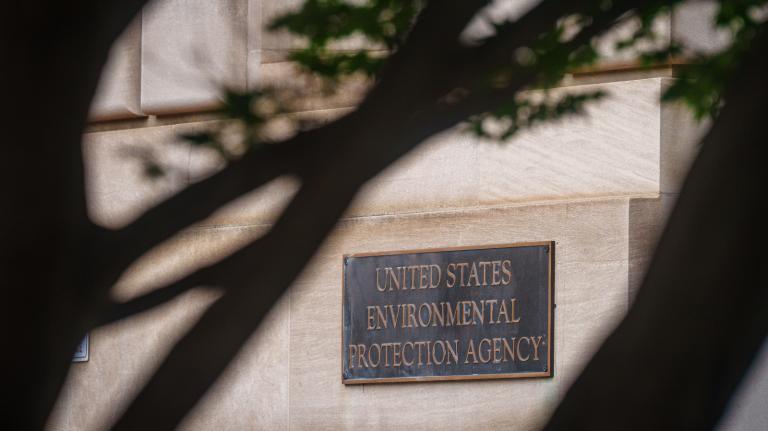 }:
The EPA website got the basics of climate science right. Until last week.
If you want to know what’s causing climate change and how it affects where you live, don’t turn to the Environmental Protection Agency for answers. The government agency purged basic facts about global warming from its website last week — including references to how human activity releases planet-heating carbon dioxide into the atmosphere.
The EPA’s page explaining the causes of climate change now focuses on how “natural processes,” like variations in Earth’s orbit and in solar activity, influence the climate.
“Human causes are not even on the list, which is simply misinformation. It’s false,” said Daniel Swain, a climate scientist at the University of California Agriculture and Natural Resources. “And moreover, it’s clearly deliberate, because a week ago, that page correctly reflected the scientific understanding of climate change.”
At least 80 pages related to climate change vanished from the EPA’s site in early December. It’s one of the most far-reaching removals of climate change information from government websites since President Donald Trump took office in January. “Up till now, we really had not seen hardly any changes on EPA pages,” said Gretchen Gehrke, who monitors federal websites with the Environmental Data and Governance Initiative.
While important resources have already disappeared from other government sites — including the National Climate Assessments, a series of congressionally mandated climate reports translated for public consumption — many of the previous changes were language swaps, replacing “climate change” with more innocuous phrases like “future conditions” or “extreme weather.” The EPA’s most recent overhaul represents a more radical rejection of mainstream science.
“Yes, there’s been climate information coming down, but so far it hasn’t actually necessarily been the nuts-and-bolts climate science information,” Swain said. “This is pretty fundamental physical science.” The resources on the EPA’s site were used by teachers, businesses, and local and tribal governments, as well as the public, since they translated the jargon-filled language of scientific reports into something more useful and accessible.
For example, the agency deleted a resource explaining the signals of a warming world — everything from rising temperatures and melting ice sheets to the damage toll on wildlife and human health — with more than 100 charts and maps. Also gone is a website quantifying the physical and economic risks. The effect is to isolate climate change from the issues that affect people’s lives, Gehrke said: “It’s specifically targeting the information about why we should care.”
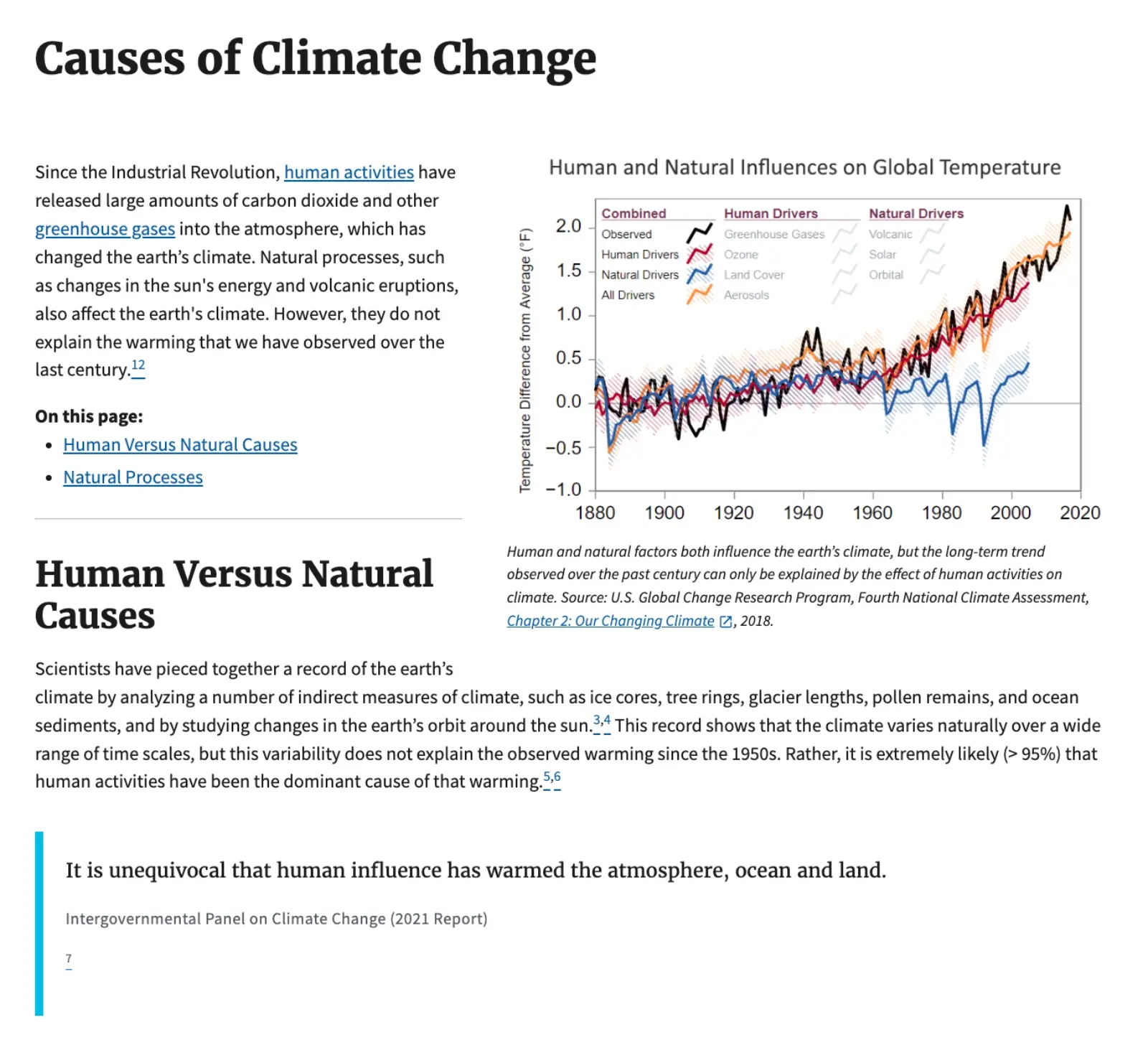
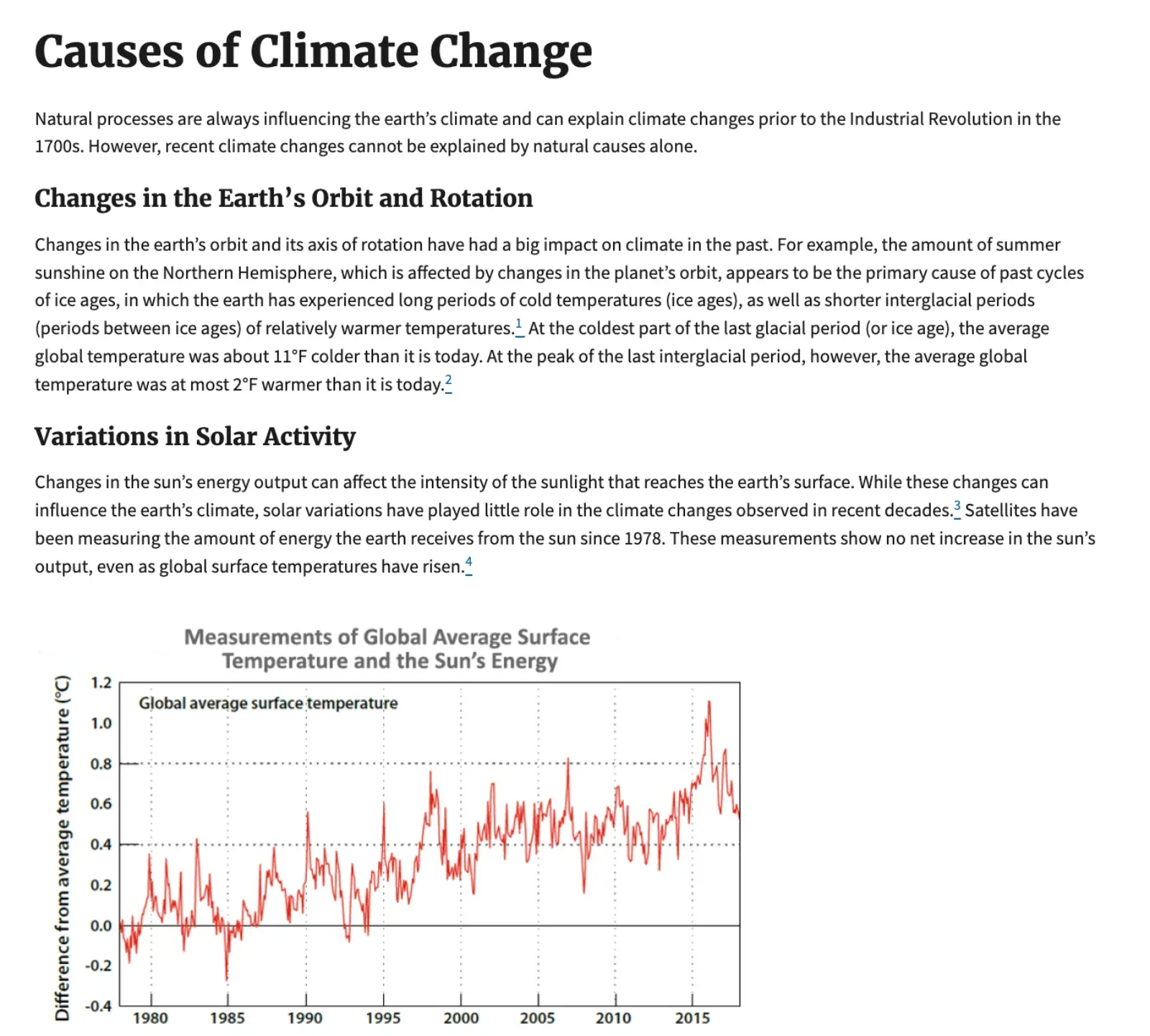
From left: An archive of an EPA webpage from October highlights how humans have contributed to climate change. By December, the EPA had updated its page on climate change to remove references to human activity. *Courtesy Internet Archive; courtesy epa.gov
In response to questions about why the EPA’s climate change resources were removed, the agency said it was upholding “gold-standard science.”
“Unlike the previous administration, the Trump EPA is focused on protecting human health and the environment while Powering the Great American Comeback, not left-wing political agendas,” an EPA spokesperson said in a statement. “As such, this agency no longer takes marching orders from the climate cult.”
Swain said the changes could be a way for the EPA to bring its public-facing information in line with the proposal to reverse the agency’s own “endangerment finding,” the scientific basis that allows the EPA to regulate carbon emissions. The agency is expected to finalize the repeal soon, in what EPA Administrator Lee Zeldin has promised to be “the largest deregulatory action in the history of the United States.”
Read Next

Why the federal government is making climate data disappear
The changes to the EPA’s site are reminiscent of a report the Department of Energy released this summer, written by a group of five climate contrarians, arguing that climate change wasn’t as bad as mainstream scientists say. It can give people the impression that there’s a “debate” that climate change is a serious problem, when in fact there’s not, Swain said. If anything, the last several years suggest that the consequences of the warming that’s already arrived are worse than many scientists expected.
Official government websites used to be a source of unbiased information, but as federal agencies have altered them to align with the Trump administration’s talking points, some are becoming unreliable. The Centers for Disease Control and Prevention recently changed its stance on the relationship between vaccines and autism, with a new page saying that a link between the two can’t be ruled out — horrifying current staffers, who said their employer was spreading misinformation. Most information on government sites remains trustworthy, though. The National Weather Service, for instance, is still putting out accurate weather reports.
“Until very recently, despite all of the damage that has been done to trust in government institutions over the last several years, I would say that the government websites, agency websites, still were among the most trusted sources,” Gehrke said. “And I do worry that that is really slipping away very quickly.”
The result is that the public is left to navigate a landscape where some government agencies are sharing credible facts, while others are generating misinformation. At the same time, quality, unbiased information just isn’t as easy to access as it used to be. Search results increasingly turn up AI-generated slop, while social media algorithms serve up posts targeted to individual preferences, giving people an off-kilter picture of reality.
“Siloed information is really tearing apart society,” Gehrke said. “People are making logical choices and logical analyses based on the information they have, but they are working with completely different sets of information. And that is a real problem.”
---
---}:
METHANE
...Lee Zeldin is a Chair of America First Policy Institute (AFPI), a policy group backed by Christian Nationalist oil baron Tim Dunn, a major Trump donor who has publicly stated he wants to end the classification of CO2 as a pollutant.
But Doug Burgum, who served as governor of the fracking powerhouse state of North Dakota and has deep ties to the fossil fuel industry, stands to be the major player directing Trump’s energy policy. As Interior Secretary, he’ll oversee hundreds of millions of acres of federal land that oil companies are itching to drill on. But even more, he’ll be coordinating the administration’s “energy dominance” agenda as Trump’s “energy czar,” heading up Trump’s National Energy Council and occupying a seat on the National Security Council.
All told, oil billionaires like Hamm stand to benefit greatly from a new Trump administration that promises to be a close ally of fossil fuel interests, even if this means intensifying the climate chaos that’s destabilizing the world and causing massive human dislocation and suffering.
*Potential Fractures in Billionaire Rule?
There are other billionaire and corporate blocs set to benefit from Trump’s rule, such as private prison and detention companies like CoreCivic and GEO (who Trump Attorney General nominee Pam Biondi lobbied for). And there are a slew of massive individual billionaire donors, from the railroad heir magnate Timothy Mellon to ultra-right shipping barrons Richard and Elizabeth Uihlein, who gave enormous sums to Trump and other Republicans.
While we face daunting challenges in a period of intensified direct billionaire rule, it’s also worth remembering that there is potential for fissures within the billionaire class. Trump’s cabinet contains blocs that are in tension with each other: neocons versus isolationists, austerity backers who also want vast government subsidies for corporate elites, and people who want to calm markets versus people who want to impose tariffs or just seek political revenge. Trump is notoriously capricious and volatile and is quick to turn on those who were once insiders.
And of course, there’s the fundamental conflict between Trump’s mere rhetoric of populism and his true agenda of billionaire rule that will further immiserate the working class. This will be a challenging period for progressive forces, but the left should seek to monitor and, to the extent possible, exploit divisions among billionaires.
Note: Maps in this post may be updated as new information comes along
This is the first in a new series of LittleSis posts mapping out billionaire power in current U.S. politics, including the new Trump administration. To see the latest posts in this LittleSis series, sign up for our newsletter and follow us on X, Bluesky, Facebook, and Instagram.
---
---
an 6 26
pp
My family’s morning routine is usually pretty ordinary. We wake up early, drink some coffee and get our 1-year-old ready for daycare. But one Wednesday morning last month, I found myself uttering to my wife a sentence that sounded frankly surreal to both of us: “Just to let you know, I’m about to call Trump.”
Then, hoping to avoid any urgent diaper events, I ducked into the next room and dialed up the president.
I’d been trying to reach President Donald Trump for a few days. Each time, my heart would start pounding. After nearly two decades as a journalist, I’m reasonably used to talking to powerful people. But cold-calling the president of the United States — on his personal cellphone — made me feel like a cub reporter all over again.
“Hello?” a voice said on the other end of the line. This time, the president had picked up.
I introduced myself and told Trump I’m a reporter with ProPublica.
“I’m writing a story about a big supporter of yours in the oil industry, Jeff Hildebrand,” I said. “Can I ask what you think about him?”
By this point I had spent months reporting on Hildebrand, a little-known billionaire — and major Trump donor — who owns an empire of low-producing oil and gas wells across the country. “Stripper wells” like these contribute relatively little to the U.S. energy supply but emit vast amounts of methane, a highly potent greenhouse gas.
By calling the president, I was hoping for some color on his relationship with Hildebrand. He had, after all, named Hildebrand’s wife ambassador to Costa Rica. My reporting so far had also revealed that the administration was gathering advice from oil industry groups backed by Hildebrand, and that it planned to weaken environmental regulations on stripper wells — potentially making Hildebrand even richer.
“I hear he does a good job,” Trump replied. “Don’t know him very well. OK?”
At first I thought the exchange undermined my story, making Hildebrand seem less central to the president’s energy policies than I’d suspected. But I realized that Trump’s comments illustrated something important about how this administration works. Trump appeared to have little clue about Hildebrand’s business, but when I mentioned that it was threatened by the “Biden methane rules,” the president was quick to respond, “Certainly we do the opposite of what Biden did.”
Trump, in other words, may be only vaguely aware of the people and groups helping to rewrite all manner of consequential policies. But what matters in Washington right now are not so much technical policy details but support for the president and an affinity with the broader ideological project: Deregulate everything.
Even if the president is only loosely familiar with Hildebrand, the oil tycoon is someone you should know about. As a climate reporter, I’m always looking for ways to make the seemingly abstract problem of global warming feel more concrete, approachable and even personal. With Hildebrand, I felt I had found a compelling character who is also the poster boy for a hugely consequential issue: Stripper wells collectively contribute just 6% of the nation’s oil and gas, but scientists have found they’re responsible for roughly half the sector’s methane pollution. That means they play an outsize role in climate change, which is amplifying heat waves, droughts and wildfires.
My previous reporting has shown that a former lobbyist for Hildebrand’s company — who now has a top post at the Environmental Protection Agency — has been rewriting methane regulations with advice from the oil industry. (An EPA spokesperson said the official “fulfilled all his ethical obligations to the letter.”)
The EPA’s press office declined to comment on the details of its plans but confirmed it is working on a proposal to “provide relief” to the oil industry, saying in a statement, “We heard consistently from American oil and natural gas producers (shocker that we meet with stakeholders) that the Biden-Harris Administration’s oil and gas methane regulations were unworkable and unnecessarily restricted American energy dominance.”
In the story we ultimately published, I took a deep dive into how Hildebrand made his fortune, racking up dozens of environmental violations across the country, and now stands to benefit from the rollback that his former lobbyist is carrying out.
I asked Hildebrand multiple times for an interview, even sending a letter to his home, but he didn’t respond. A spokesperson for his company, Hilcorp, said its operations complied with state and federal rules, adding that Hilcorp was “proud” of recent efforts to reduce its methane emissions.
As with many climate change stories, it can all sound pretty bleak. But in a world where global warming fixes can seem impossibly daunting, limiting methane pollution from stripper wells is the rare low-hanging fruit, Andrew Logan of Ceres, a climate advocacy group, told me. “If you could lose 6% of production and cut emissions in half, who wouldn’t make that trade?” Logan said.
Instead, the Trump administration is doubling down on the forms of energy that contribute most to global warming. In January, the president invited Hildebrand and two dozen other energy executives to the White House to discuss investing in Venezuela’s decrepit oil industry — which emits more methane, relative to production, than almost any other major oil producing country, according to the International Energy Agency.
Many of the executives couched their enthusiasm with caveats. ExxonMobil’s CEO called Venezuela “uninvestable” without changes to its legal system. The head of ConocoPhillips wanted U.S. government financing.
But Hildebrand had already seen how loyalty could be rewarded. Even though he had no notable operations outside the U.S., he hunched toward a microphone and said in a halting voice, “Hilcorp is fully committed and ready to go to rebuilding the infrastructure in Venezuela.”
“That’s good,” Trump said. “You’ll be very happy.”
---
ref apr 1 2026
EPA’s Aaron Szabo Once Helped Write Oil Industry Argument Against Methane Rules — ProPublica
The Trump administration official leading an effort to loosen rules on methane pollution was an unnamed author of key industry arguments against those same rules just four years ago when he was an oil and gas lobbyist.
Aaron Szabo, an assistant administrator at the Environmental Protection Agency, is listed in PDF metadata as the author of a January 2022 comment letter objecting to proposed controls on methane emissions in the oil and gas industry. The letter was submitted to the EPA by the American Exploration and Production Council, which represents some of the industry’s largest emitters of the planet-warming gas, including ConocoPhillips, Diversified Energy and Hilcorp. Szabo’s name does not appear in the document itself, but it can be found in information embedded by the software used to create the PDF file.
Szabo was registered as a lobbyist for one of the AXPC’s lesser-known members, Ovintiv, when he drafted the arguments against the restrictions, which were finalized later in the Biden administration. He has also lobbied for other clients in the oil and chemicals sectors. While he did not hide that work during his confirmation last year as head of the EPA’s Office of Air and Radiation, he described it in terms that avoided any mention of efforts to influence climate policy: “I learned how regulated entities comply with the federal government’s thousands of regulations and policies. I also saw firsthand that the people working in these companies want to ensure the environment is properly protected.”
In his current role overseeing federal climate rules at the EPA, Szabo has been soliciting input and even specific regulatory language from oil industry groups that stand to gain from watered-down methane rules, according to internal emails, calendar entries and records of closed-door conversations reviewed by ProPublica.
Sen. Sheldon Whitehouse, D-R.I., the ranking Democrat on the Senate’s Environment and Public Works Committee, pointed to Szabo’s previous lobbying as evidence that the EPA had effectively been captured by the oil and gas industry. “Now he can do Big Oil’s dirty work from inside the EPA,” Whitehouse told ProPublica in an email.
As part of its plan to “unleash American energy,” the Trump administration has waged an unprecedented campaign against regulations on fossil fuels, the main cause of global warming. One of its biggest moves was to repeal the “endangerment finding” that classified greenhouse gases as pollutants — the basis for the EPA’s authority to limit emissions at all. Rather than throw out the methane rules entirely, however, Szabo’s office is working to revise them, emails and documents show. It has already delayed many of the compliance deadlines until next year.
Methane, the main component of natural gas, is a climate superpollutant, responsible for one-third of the rise in global temperatures since preindustrial times, according to the United Nations Environment Programme. When it escapes into the atmosphere without being burned for energy, it can trap 80 times more heat than carbon dioxide, research shows. The oil and gas business is the largest industrial source of U.S. methane emissions, in part because of leaks from poorly maintained equipment. If it is uneconomical to collect the gas for sale, companies sometimes intentionally release it in a process known as venting.
To cut down on methane discharges, President Joe Biden’s EPA imposed much stricter controls on oil and gas operations, including requiring increased monitoring for leaks and equipment upgrades. According to agency estimates, the new rules would have lowered the industry’s methane emissions by nearly 80%. And, given that the gas breaks down relatively quickly, this would have been one of the fastest ways to reduce global warming.
Industry groups pushed back. In the January 2022 letter that Szabo helped to draft, the AXPC used the word “burdensome” 10 times to describe the new requirements and pushed for more “flexibility” to allow for less expensive leak-detection methods and less frequent monitoring, among other requests.
The group also cast doubt on the rules’ expected climate and health benefits, highlighting what it called “the importance of communicating the significant uncertainties within the estimates.” The AXPC’s chief executive, Anne Bradbury, added in a later statement that the rules risked “undercutting US production in the near and long-term — which will lead to increased energy costs and reduced energy security.”
Do you have any information we should know about Trump’s EPA, oil industry lobbying or methane pollution? Alex Cuadros can be reached by email at alex.cuadros@propublica.org and on Signal at alexcuadros.63.
The AXPC failed to persuade the Biden administration to change its approach. But it renewed its push after President Donald Trump returned to office and ordered federal agencies to “suspend, revise, or rescind” any “undue burden” on domestic energy production.
Szabo, after two years as a fellow at the Trump-aligned America First Policy Institute, joined the administration on Day 1 as an adviser to EPA chief Lee Zeldin. He immediately signaled that he planned to weaken the regulations he had argued against as a lobbyist. His staff met with AXPC representatives as early as Feb. 6, 2025, less than three weeks after Trump’s inauguration, to discuss its petition to “reconsider” the methane rules, according to emails and calendar entries obtained through public records requests and shared with ProPublica by Fieldnotes, a watchdog group that investigates the oil and gas industry. His staff went on to meet with them at least twice more, and Szabo himself was listed as a required attendee for a meeting with Bradbury last July.
The AXPC didn’t respond to emails from ProPublica seeking comment.
According to records of closed-door conversations reviewed by ProPublica, other oil industry representatives have described their meetings with Szabo and his staff as highly favorable to their interests. “Mr. Szabo assured us that the EPA is focused on these [methane] rules and doing everything that can be done to limit the damage they will cause,” the leadership of a major trade group wrote to its members last year in an internal newsletter.
Lee Fuller, of the Independent Petroleum Association of America, also spoke glowingly about his meeting with Szabo’s office on a conference call with industry representatives last year.
“It was one of the more fascinating meetings that we’ve ever had, just because they were suddenly willing to talk to us,” he said. “And they’re also suddenly willing to talk about things that we’ve been trying to get them to do for years, and they’ve never even let it kind of come onto the radar screen.”
The IPAA declined to answer specific questions from ProPublica but linked to a September 2025 letter in which the group publicly asked the EPA for exceptions to the methane rules.
Szabo’s office has even invited oil industry groups to offer specific wording for the revised rules. “We had a call several weeks back re. pneumatics on temporary equipment,” Mike O’Connor of the American Petroleum Institute wrote to an EPA official, referring to devices that are a major source of methane emissions. “EPA had informally requested input on this topic and any suggested reg. text language. We are providing the attached draft document as informal input to EPA’s inquiry.” The draft called for a number of exemptions.
The shift in priorities under Szabo can also be seen in communications from the EPA itself. In a June 2025 email reviewed by ProPublica, an agency official asked O’Connor to meet and discuss alternative leak-detection methods. Echoing the language in the AXPC comment that Szabo helped to draft, the official spoke of “the additional flexibility we would like to pursue.”
“I think their agenda was, from what I could tell, to do what industry wanted,” one former EPA official, who spoke on the condition of anonymity to describe confidential discussions, said of Szabo and other Trump appointees at the agency.
“Since when is it a bad thing for public officials to ask the public what they think?” the EPA said in an emailed statement, referring to Szabo’s interactions with oil industry representatives. Szabo “fulfilled all his ethical obligations to the letter. He met with EPA career ethics staff when he started at EPA to ensure he is aware of and complies with federal ethics requirements.”
Szabo’s affinities are hardly a secret. He is thanked by name in the EPA chapter of Project 2025, the deregulatory blueprint for the second Trump administration. As part of the nomination process for his appointment at the EPA, he also submitted ethics disclosures listing oil, natural gas and chemicals companies he had lobbied for.
Still, at his confirmation hearing on March 5 last year, he repeatedly declined to elaborate on his role in Project 2025, beyond saying he provided “general advice and thoughts” on the Clean Air Act.
- ### Alex Cuadros
I report on climate change and how people and institutions are responding to it.
Need to Get in Touch?
I welcome tips or documents about Trump administration climate policy or actions by private companies or institutions that may impact the climate.
---
---
AOC
XO LEGAL IMMUNITY FOR BAYER, MTG DISCUSS CT?
JULY 7 2025 VISITOR LOGS FEB 18 TRUMP XO
FOIA SR ADVISOR OF RURAL AGRIC AFFAIRS SCOTUS
UPDATE EPA WWW
RFK2 SAID ASK YOU
EPA WITHDRAW CA WARNING --> SCOTUS

---
GUK
EPA chief met with Bayer CEO over supreme court fight, agency records show
This article is more than 1 month old
Top US regulators met with Bill Anderson to discuss ‘supreme court action’ over glyphosate weed killer
[Carey Gillam]
Fri 13 Mar 2026
Top US regulators met with Bill Anderson, Bayer’s CEO, last year to discuss “litigation” issues – including “supreme court action” over its glyphosate weed killer – just months before the Trump administration took a series of steps to boost Bayer’s case at the high court, internal government records show.
The 17 June meeting, between officials at the Environmental Protection Agency (EPA), Anderson and two other top Bayer executives, came as the Germany-based company was working to quash costly US litigation brought by tens of thousands of people who allege they developed cancer from their use of the company’s glyphosate-based herbicides, such as Roundup.
At the core of those lawsuits are claims that the company failed to warn users of the risk of cancer, as shown in several research studies over many years.
One of Bayer’sstated key strategies to try to end the litigation, which has so far cost Bayerbillions of dollars in settlements and jury verdict awards, is getting the supreme court to agree with Bayer’s argument that if the EPA does not require a cancer warning on its glyphosate products, the company cannot be held liable for failing to warn of a cancer risk.
While one appellate court has sided with Bayer, multiple other courts have rejected that preemption argument, as did the US solicitor general under the Biden administration. In contrast, the Trump administration has acted to defend and promote Bayer’s position and its glyphosate herbicides.
In a statement Bayer said the meeting at the EPA was a “normal part of the regulatory process” and that the company has been “transparent about our position” regarding glyphosate litigation.
The show of administration support has largely come after that 17 June meeting, which government email communications and visitor logs confirm took place with Anderson and the other Bayer executives arriving at the EPA on the appointed day a little before 1pm.
According to a 13 June internal EPA email planning for the meeting, Bayer’s team was “going to bring up some legal/judicial issues”, and discussion topics were to include “supreme court action”.
The company would “give an update to the administrator on where they stand in litigation and labeling options”, the planning email states.
The meeting came less than two weeks ahead of a request from the Supreme Court for the Trump administration’ Justice Department to weigh in on whether or not the court should agree to hear Bayer’s case.
The EPA officials attending the meeting with Bayer were to include Lee Zeldin, the agency’s administrator, along with Nancy Beck, formerly senior director at the American Chemistry Council who is now the EPA’s principal deputy assistant administrator in the Office of Chemical Safety and Pollution Prevention.
Sean Donahue, who was confirmed last May as the EPA’s general counsel, and Turner Bridgforth, senior adviser for Office of Agriculture and Rural Affairs at the EPA, were also to attend.
“It’s becoming abundantly clear that the political appointees at the EPA are more invested in protecting pesticide company profits than the health of Americans,” said Nathan Donley, environmental health science director for the Center for Biological Diversity, which obtained the email communications in a Freedom of Information Act request and provided them to the Guardian.
“When the CEO of one of the largest companies in the world is meeting with political appointees in a US regulatory office, it shows just how much power and influence these corporations have on decisions that can have very real consequences for the health of all Americans,” he said.
“The Trump EPA seeks input from a broad range of stakeholders, including MAHA advocates, doctors, scientists, farmers, and ranchers to ensure our policies are grounded in transparent, gold-standard science, and advance the Make America Healthy Again agenda,” Brigit Hirsh, the EPA press secretary, said in a statement. The meeting with Bayer was “a standard introductory meeting” and was not a meeting to discuss pending litigation, Hirsh said. She did not explain why the planning email for the meeting specifically said litigation would be discussed.
Multiple moves supporting Bayer
Since the meeting, the Trump administration’s support for Bayer has taken many forms.
In a 1 December filing with the US supreme court, D John Sauer, the solicitor general appointed by the Trump administration in April 2025, told the court that it should take up the Bayer case, and the supreme court subsequently agreed to do so, setting a hearing for 27 April.
---
---
SEE MAHA
We Uncovered A Conspiracy To Poison Your Food
Fundraiser
More Perfect Union
3.31M subscribers
527,745 views Mar 20, 2026
Four former chemical lobbyists control America’s pesticide regulations, letting pesticide companies pump the country full of toxins. For every 1 meeting with an environmental group, the EPA met 25x with corporate interests. We revealed the corporate lobby poisoning America:
---
... LOBBYISTY STAFFERS REV DR
Top appointees include David Fotouhi, Mr. Zeldin’s second-in-command, a lawyer who recently challenged a ban on asbestos; Alex Dominguez, a former oil lobbyist who will work on automobile emissions; and Aaron Szabo, a lobbyist for both the oil and chemical industries who is expected to be the top air pollution regulator.
The division of E.P.A. that evaluates the safety of new chemicals now includes Nancy Beck, a longtime chemical-industry lobbyist, and Lynn Ann Dekleva, who has been working for the American Chemistry Council, a trade group. Both are veterans of the first Trump term.
---
Joe Rogan gave RFK Jr. a platform to defend the administration’s embrace of glyphosate, but some other MAHA personalities aren’t letting it go so easily
MAHA-friendly Rogan previously emphasized the harms of glyphosate in the herbicide Roundup. A new interview with Robert F. Kennedy Jr. saw Rogan take a far more passive approach.
Special ProgramsClimate & Energy
Written by Ilana Berger
Published 03/16/26
In a February 27 interview with Health and Human Services Secretary Robert F. Kennedy Jr., podcaster Joe Rogan did not press the secretary on President Donald Trump’s recent executive order boosting the domestic production of the Roundup ingredient glyphosate, nor did he mention that the move, as well as other significant actions, angered MAHA influencers.
The White House’s executive order, which was announced on February 18, calls glyphosate a “cornerstone of this Nation’s agricultural productivity and rural economy.” Using the Defense Production Act, Trump is prioritizing production of glyphosate “over performance of any other contracts or orders” because he argues it is “central to American economic and national security."
For years, Kennedy was a strong opponent of glyphosate, much like the social media figures he was able to add to his coalition during his presidential campaign by promising to “Make America Healthy Again.” Prior to his appointment in the Trump administration, he was part of a legal team that won a lawsuit against Monsanto after “arguing that its Roundup weedkiller contributed to his client’s cancer."
Before this episode, Rogan had also spoken extensively about the harms of glyphosate. He has also praised the MAHA movement and platformed its leaders, and he’s been described as a “walking incubator for supplements" much like other MAHA figures who benefit tremendously from the $1.5 trillion global wellness market.
The executive order — and Kennedy’s support of it — has revealed some fractures in the MAHA-Trump alliance.
In a recent episode of Ask Dr. Drew, conservative host Drew Pinsky interviewed Hands Off My Food! author Dr. Sina McCullough, who has been featured in the MAHA Report newsletter. McCullough said that while she applauds Kennedy’s work, she’s worried that “the corruption, the loopholes that will always be there, the backdoor deals — that's government."
Pinksy echoed her frustration, saying, “The back room deals immediately causes me to wonder, how did we get red food dye back, why is red food dye back? Why is glyphosate back? What happened there? What’s going on?"
Zen Honeycutt, who founded the advocacy group Moms Across America, later told Pinsky that Trump is “sending a message to our legislators that he wants to prioritize glyphosate accessibility in America. … He wants to sort of protect glyphosate and its availability to the farmers, and this is extremely concerning to us.” In the interview, Honeycutt called the executive order “a betrayal."
Meanwhile, on MAHA Media Hub, MAHA Action President Tony Lyons said the Trump administration's support of Bayer in the Roundup lawsuit is a “mistake.”
While these figures are speaking out, Rogan stopped short of demanding accountability.
On his podcast, Rogan gave Kennedy an enormous platform to defend the executive order as a supposedly necessary response to “national security vulnerability” and claim that “we have addicted our farmers to these pesticides” who don't like using it.
:{Video
Citation
From the February 27, 2026, episode of The Joe Rogan Experience
Toward the end of the episode, Rogan asked Kennedy, “What was the recent ruling on glyphosate?"
Kennedy said that it was “not something I was particularly happy with — let me put it that way mildly" and highlighted his work getting “an $11 billion settlement with Monsanto." But he went on to defend the executive order, saying, “I also understand the president's point of view. The president didn't create this system. He's dealing with a problem that was created long before over the past 60 years."
Kennedy also argued that glyphosate is key to national security, because “if you got rid of it or if somebody else cut off our supply, it would destroy the American food system.”
The question came after Rogan claimed earlier in the podcast that he was “watching liberals, the people that are always worried about food ingredients, just dismissing all of this talk about preservatives and glyphosate.”
Some groups that are typically viewed as left-leaning on key issues and receive funding from progressive donors and foundations, such as the Center for Biological Diversity, the Natural Resources Defense Council, the Environmental Working Group, and Food & Water Watch, have long been critical of the herbicide. Their advocacy against glyphosate largely predates the MAHA movement.
In the interview, Kennedy also attempted to smooth over the different stances his Make America Healthy Again movement and the agriculture industry take on Roundup. He said that “we’ve got to transition off of glyphosate" and that “the farmers hate it."
“We all understand that this is a huge problem," Kennedy added, before highlighting a “billion-dollar commitment” made by Trump to support farming.
In reality, according to a statement from Modern Ag Alliance, numerous major farming groups including the American Farm Bureau Federation, the American Soybean Association, and the National Corn Growers Association have thanked Trump for the executive order.
The whole conversation stood in stark contrast to a 2023 interview Rogan did with Kennedy prior to his role in the Trump administration, when he himself was running for president. The podcaster asked about glyphosate, and Kennedy discussed the “many, many diseases that are linked to glyphosate exposure” and even suggested that glyphosate exposure may be “one of the reasons we had the highest death rate during COVID." He said that such “chronic disease … is bankrupting us."
:{Video
Citation
From the June 15, 2023, edition of The Joe Rogan Experience
Fast-forward to 2026, and Kennedy is deferring to Trump’s argument about Bayer, which acquired Monsanto in 2018. During the interview, Kennedy said that we do ultimately need to “transition” away from such chemicals but noted that Trump has said “we can't allow the company to go bankrupt."
At no point during the February 2026 interview did Rogan bring up Kennedy’s past campaign promise to put additional limitations on the pre-harvest use of glyphosate.
Rogan also did not mention the response to the executive order, which, as MAHA influencer Vani Hari put it, sparked “a level of anger and frustration like I’ve never seen before.” Hari, who is also known as The Food Babe, and the group Moms Across America have praised Rogan for discussing MAHA-related issues in the past.
This wasn’t the administration’s first slight against MAHA. In January, the Supreme Court agreed toreview a case that could result in limits on Bayer’s liability for failing to warn consumers about Roundup’s cancer risks on labels, and Trump’s Department of Justice filed a brief in support of Bayer.
Recent reporting has also revealed that “less than two weeks ahead of a request" from the Supreme Court for the Trump administration’s Department of Justice to weigh in on whether the court should hear Bayer’s case, Environmental Protection Agency Secretary Lee Zeldin met with Bayer’s CEO “to discuss ‘litigation’ issues — including ‘supreme court action’ over its glyphosate weed killer."
Influencer Kelly Ryerson, also known as Glyphosate Girl, highlighted the reporting on her Instagram page. “Many concerning discussion topics, but perhaps the most concerning is that Bayer planned to thank the EPA for their help updating the glyphosate web page (wonder how) and for working with MAHA," she wrote.
---
For Immediate Release, August 15, 2025
MAHA Commission Succumbs to Pesticide Industry Pressure
*Draft Report Walks Back Administration’s Promises of Bold Action on Pesticides
WASHINGTON— A much-anticipated draft action plan from the Make America Healthy Again Commission eliminated any plans for action on pesticides. This report is the follow up to the commission’s May MAHA report, which included pesticides and specifically named both glyphosate and atrazine.
The threat of any new restrictions being placed on the use of dangerous pesticides spurred a massive and successful lobbying effort by the chemical industry and commodity growers’ groups, alongside their friends in Congress and the EPA, to force the commission to back off. Instead of action, the recommendations direct the EPA and Big Ag to work together to convince the public to have confidence in pesticide review processes, which are broadly criticized for scientific inadequacy and excessive industry influence. It also encourages research into new pesticide application technologies
“Despite the administration’s promises to MAHA and the reality that using a billion pounds of pesticides in the U.S. each year is a major threat to public health, pesticide interests again prevailed in protecting their profits,” said Lori Ann Burd, environmental health director at the Center for Biological Diversity. “Big Ag’s success in steamrolling the commission’s attempt to act on pesticides is a gut punch to everyone who genuinely believed we could finally make progress on protecting children’s health from these poisons.”
More than 300 million pounds of glyphosate and 70 million pounds of atrazine are used by U.S. farmers annually. Thousands of lawsuits have been filed by cancer victims who used Roundup, which contains glyphosate. Atrazine, a powerful endocrine disruptor that contaminates the drinking water of 40 million Americans, is so toxic it is banned in more than 60 countries.
The United States allows use of 85 pesticides that have been banned or are being phased out in the European Union, China or Brazil, according to a peer-reviewed study published by the academic journal Environmental Health. Over a quarter of all agricultural pesticide use in this country includes pesticides banned in the European Union.
“The MAHA Commission is insulting the intelligence of Americans. It’s outlandish to recommend solving our pesticide woes by having the EPA and Big Ag try to convince us that the deeply flawed pesticide regulatory process is working just fine,” said Burd. “While Big Ag won this battle, the powerful grassroots movement of millions of Americans who know that these chemicals are making us sick will continue fighting to protect their families from pesticides like glyphosate and atrazine.”
Some of the strongest resistance against action on pesticides appears to have come from the administration’s political appointees in the EPA’s chemical safety office. Widespread reporting has pointed a finger at Nancy Beck, a former executive with the American Chemistry Council who, after diligently serving pesticide interests in Trump’s first administration, has been brought back as principal deputy assistant administrator overseeing the EPA’s Office of Chemical Safety. Another American Chemistry Council veteran, Lynn Ann Dekleva, is also back at the EPA, serving as deputy assistant administrator for new chemicals.
More recently, the administration appointed well-known MAHA critic and American Soybean Association lobbyist Kyle Kunkler as deputy assistant administrator for pesticides at the EPA. Just one month after Kunkler’s arrival at the EPA, the agency proposed to reapprove over-the-top use of dicamba, a highly controversial pesticide that Kunkler lobbied for extensively in his former position.
Health and Human Services Secretary Robert F. Kennedy Jr. has repeatedly stated that many of the most-used pesticides in the United States are “extraordinarily toxic,” including and organophosphates. He has
that pesticides — many of which have scientifically well-documented links to cancer, infertility, obesity and developmental disorders — are significant contributors to chronic health problems faced by people across the nation.
Following his reelection Trump expressed his own concerns that the United States continues spending “billions and billions of dollars on pesticides,” compared to the European Union and yet has far worse health outcomes. He pledged that his administration would “ensure that everybody will be protected from harmful chemicals, pollutants, [and] pesticides.”
As part of that pledge, he nominated Kennedy as secretary of the Department of Health and Human Services with a mandate to “go wild on the food.” Trump stated that Kennedy is “looking into [pesticides] very seriously because maybe it's not necessary to use all of that.”
The Center for Biological Diversity is a national, nonprofit conservation organization with more than 1.8 million members and online activists dedicated to the protection of endangered species and wild places.}:
---
---
GRNWIRE
Trump appointees
By Ellie Borst, Robin Bravender | 01/18/2025 12:38 PM EST
Former Trump EPA officials and ex-staffers to Lee Zeldin are now listed in the agency’s staff directory as political appointees.
Former Trump administration officials and allies of President-elect Donald Trump’s nominee to lead EPA have popped up in that agency’s online staff directory as political appointees.
Those officials, a mix of senior EPA aides from Trump’s first term and staffers with ties to EPA nominee Lee Zeldin, are on the team of Trump appointees who have been dispatched to that agency, two people familiar with the transition told POLITICO’s E&E News.
The listings in EPA’s staff directory come as Trump prepares to take office Monday and fill out some 4,000 political appointments across the government. The incoming administration has been secretive about the personnel working on the transition and preparing to serve as Trump political appointees in the new administration.
EPA referred questions about political appointees to the Trump transition team. The Trump transition team did not respond to a request for comment.
But it appears as though some former Zeldin staffers and former Trump officials have officially signed up to work at the agency.
Among the names of Trump first-term appointees listed in the EPA staff directory is Nancy Beck, who served as principal deputy assistant administrator for EPA’s chemicals office during Trump’s first administration. Beck declined to comment for this story.
Justin Schwab, who served as EPA’s deputy general counsel during the Trump administration, is also listed in the agency’s staff directory as a political appointee.
Other former Trump officials listed in the EPA directory: Steven Cook, who served as deputy assistant administrator for EPA’s waste office, and Lynn Dekleva, who served as associate deputy assistant administrator for new chemicals.
The EPA political appointees also includeAlexander Dominguez, who served as an adviser for EPA’s air office in Trump’s first term; Catherine Paige Hanson, who was an EPA financial adviser under Trump; Jessica Kramer, who worked in the Trump-era EPA water office; Walter Scott Mason, who was the director for EPA’s American Indian Environmental Office under Trump; William Chad McIntosh, who led EPA’s Office of International and Tribal Affairs; and Victoria Tran, who served as a policy adviser in EPA’s enforcement and compliance office under Trump.
Travis Voyles — who served in Trump’s EPA before he became Virginia’s secretary of natural and historic resources under Gov. Glenn Youngkin (R) — is also among those now listed as an EPA appointee.
Aaron Szabo, who served as senior counsel for the White House Council on Environmental Quality and senior policy adviser at the Office of Management and Budget, is also listed on EPA’s directory.
As Zeldin awaits Senate confirmation to become EPA’s administrator, his staffers and allies also appear in the EPA staff directory as political appointees.
They include Eric Amidon, who worked for Zeldin in various positions over the past decade, including as Zeldin’s congressional chief of staff. Additional Zeldin allies listed in the staff directory include Thomas Corlett, who worked on Zeldin’s 2022 campaign for governor, and Zeldin communications aide Daniel Gall.
One person familiar with the transition confirmed that Amidon, Corlett and Gall were part of Trump’s incoming EPA team. A second person familiar with the transition said that Jaide Barja, who served as a legislative assistant in Zeldin’s congressional office and appears in the directory, is also on the Trump team.
---
---
11 25
MAHA Slams “Corporate Capture” While Trump Strips Regulations
between frenzied claims about Tylenol and disparaging remarks about autism, the voices of the “Make America Healthy Again” movement empowered by President Donald Trump have directed criticism at the country’s massive food, pharmaceutical, and chemical industries — still-too-rare targets for the leaders of either political party in the U.S.
When the White House unveiled its comprehensive report on how to “Make Our Children Healthy Again” in May, it slammed “corporate capture” of regulatory bodies and argued that companies responsible for making children less healthy wield undue influence in Washington. A subsequent strategy report, released last month, called to “protect public health from corporate influence.”
“It was one of the first times I saw the federal government actually call out corporate capture and how chemical companies influence regulation,” said Darya Minovi, a senior analyst for the Center for Science and Democracy.
But the Trump administration’s political marriage of unbridled crony capitalism and fringe health conspiracism is not without its contradictions.
While the “Make America Healthy Again,” or MAHA, movement preaches a healthy utopia for the nation’s children free of real and imagined toxins, public health experts say the Trump administration has pursued an aggressive deregulation campaign that has opened the floodgates for toxic chemicals in our food, water, and air — while also defunding vital medical research and spreading dangerous medical misinformation.
“There’s a lot of rhetoric about problems that they’re solving,” Minovi said. “But when I’m looking at the actual actions that the administration is taking, largely, these actions are not making any kids or families healthier.”
A glaring tension between the MAHA movement’s purported goals and the Trump administration’s aggressive deregulatory strategy is the issue of environmental toxins, particularly PFAS, also known as forever chemicals, found in many household items.
These chemicals, which can disrupt liver, kidney, and thyroid functioning, are especially harmful to children.
[
Related
Trump EPA’s Next Move: Making It Harder to Sue for Getting Cancer from Roundup
https://theintercept.com/2025/03/21/trump-epa-monsanto-roundup-bayer-cancer-chemicals/)
The strategy report, drafted by the Make America Healthy commission led by Health and Human Services Secretary Robert F. Kennedy Jr., laid out a series of recommendations to “end chronic childhood disease,” which included studying the cumulative effect of chemicals in the environment. But in May, the Environmental Protection Agency announced that it was rolling back restrictions on the acceptable levels of these forever chemicals within drinking water, which were put in place during the Biden administration. And in the spring, the agency ended a grant to research children’s exposure to chemicals from soil and dust, accordingto the KFF Health News.
“When it comes to actually taking action, we’re not really seeing policies that are getting ahead of corporate capture and holding the chemical industry responsible,” Minovi said.
Over the coming months, the EPA has announced it will take 31 separate deregulatory actions, including loosening restrictions on power plants that emit air pollution and eliminating safeguards put in place during the Biden administration for petrochemical accidents.
Most Read
[
YouTube Quietly Erased More Than 700 Videos Documenting Israeli Human Rights Violations
Nikita Mazurov, Jonah Valdez](https://theintercept.com/2025/11/04/youtube-google-israel-palestine-human-rights-censorship/)
[
A Journalist Asked Why Israel Isn’t Paying to Rebuild Gaza. It Cost Him His Job.
Arthur Neslen](https://theintercept.com/2025/11/04/journalist-israel-gaza-nova-gabriele-nunziati/)
[
Man Jailed for Facebook Meme Is Freed in Tennessee
Liliana Segura](https://theintercept.com/2025/10/30/larry-bushart-tennessee-free-speech-charlie-kirk-meme/)
Alongside pursuing a deregulatory strategy that experts predict will introduce more chemicals into the air, water, and food supply, the administration has also moved aggressively to cut research, including on childhood diseases.
For example,in August, the Trump administration announced it was cutting federal funding to a network researching pediatric brain cancer.
White House spokesperson Kush Desai denied cutting cancer research funding, saying HHS canceled grants supporting “DEI and other ideological pet projects,” and that the money was reallocated.
“President Trump made a pledge to Make America Healthy Again by restoring accountability, transparency, and Gold Standard Science in public health decision-making,” wrote Desai. “The President and White House maintain complete confidence in Secretary Kennedy and the rest of the HHS team to deliver on this pledge.”
The Department of Health and Human Services and the EPA did not respond to The Intercept’s request for comment.
Food assistance and educational programs have also come under fire during the Trump administration. Earlier this year, Republicans enacted the most significant cut to the Supplemental Nutrition Assistance Programin history. The program provided food assistance to roughly 1 in every 5 children in the United States, as well as nutrition education.
“A lot of this movement is designed to benefit privileged people who have the resources to access certain healthier foods or a community with clean air,” said Minovi, as opposed to “everyday people who might actually depend on public policies to ensure they have healthy food, clean air, clean water in their community.”
“A lot of this movement is designed to benefit privileged people who have the resources to access certain healthier foods or a community with clean air.”
The recommendations emerging from HHS and the MAHA movement about vaccines and autism are particularly troubling, said Jill Rosenthal, director of public health policy at the Center for American Progress. “It’s a matter of promoting a personal agenda that RFK has rather than following decades of good science,” she said.
Riddled throughout the MAHA strategy and separate report are concerns over vaccines and the vaccine schedule, which is used to determine the timing for childhood vaccinations.
Both RFK Jr. and Trump have peddled pseudoscientific conclusions connecting autism to vaccination, suggesting that the vaccine schedule needs to change. During the press conference last week, Trump advised against vaccinating children for Hepatitis B until they’re 12 years old, which runs at odds with medical guidelines.
“They’re making it more difficult for children to get routine childhood vaccinations. We know that vaccination has saved millions of lives, and so any efforts that make it harder for children to access vaccines are really, really jeopardizing kids’ health,” said Rosenthal. “Instead of following the science and believing what evidence we already have, we’re just creating a lot of distrust and making it harder for people to keep their kids healthy.”
The recent recommendations that pregnant women avoid Tylenol also carry risk for pregnant people and their future children.
“In the near term, I think that pregnant patients are going to be worried enough that they seek alternate forms of medication to treat their pain,” said Dr. Mariana Montes, a former pediatrician and obstetric anesthesiologist. “That’s extremely concerning, because there is nothing that’s been proven safe for pregnancy except for acetaminophen.”
Ibuprofen, the active ingredient in Advil, has been known to lower amniotic fluid — the liquid in utero that surrounds and protects the fetus — and can have negative effects on kidney and heart development, said Montes.
“Patients might choose to take ibuprofen without knowing the effects, and then unknowingly actually harm a healthy pregnancy because they’re so worried about taking Tylenol,” she said.
[
Related
RFK Jr. Talks About Public Health, but He’s Joining an Administration That’ll Make Us Sicker Than Ever
https://theintercept.com/2024/11/14/rfk-jr-health-human-services-water-air-project-2025/)
Left with fewer options they believe are safe, Rosenthal warns that pregnant people might forgo medication altogether, even when they have a fever. “If women avoid taking Tylenol, for instance, when they have a fever, it can increase the risk of birth defects,” she said. “So by scaring women away from taking needed medication, it can actually impact their health and the health of their developing babies.”
The stigma these types of pronouncements cause for people with autism is also a serious concern.
“It’s necessary to point out the ableist language in this whole autism debacle,” said Minovi. “Of course, it’s a condition that needs to be understood and studied, and obviously impacts families significantly, but the way in which the administration, particularly RFK, talks about it is dismissive and negative about people’s lived experiences.”
Republicans, who once denounced former First Lady Michelle Obama for attempting to make school lunches moderately healthier, now inhabit a coalition whose purported goals would have instantly launched “nanny state” accusations just a few years prior.
But the MAHA movement has been so successful despite its inherent contradictions, Rosenthal said, because there’s a “kernel of truth” to what it’s preaching.
“For instance, ultra-processed food is not the first choice for how we want to take care of our bodies,” Rosenthal said, “but at the same time, is that the best way to use limited resources and protect or promote child health? Not when we have kids who don’t have enough to eat, right?”
Minovi said it’s understandable that people are drawn to this movement — which only heightens culpability for people like RFK Jr. and Trump.
“These are families that are just trying to do right by their kids, and the concerns that folks are raising are valid,” said Minovi. “The behavior of the leaders in this movement is nothing short of predatory.”
---
MMA
Under the leadership of Bari Weiss, The Free Press’ climate change coverage mirrors that of right-wing media outlets like Fox News
As the editor-in-chief of CBS News, Weiss will oversee the broadcast news leader in climate coverage
Special ProgramsClimate & Energy
Written by Allison Fisher
Published 11/04/25
In early October, Paramount Skydance bought the The Free Press and hired its founder, Bari Weiss, as the editor-in-chief of CBS News, a newly created position which will shape how the newsroom covers major stories which could include the climate crisis.
Notably, among the national broadcast networks, CBS has led coverage of climate change for at least the past four years, airing the most coverage, the most climate scientist guest appearances, and the most segments that discussed climate solutions as compared to ABC and NBC. But its role as network leader is already under threat. Reported by HEATED, as part of a series of layoffs at the network, the “majority of the five person team supporting CBS News’s climate coverage” were fired. In the memo announcing the layoffs, the new chief executive David Ellison said “he was ‘phasing out roles that are no longer aligned with our evolving priorities.’”
And there are other changes that could compound this threat: On October 24, it was reported that Weiss was interested in poaching Fox News anchor Bret Baier, who has a troubling record on climate reporting to “potentially helm the *CBS Evening News.” Additional reporting suggests that she may also be interested in bringing on board another conservative voice, CNN contributor Scott Jennings. And on October 27, *CBS Evening News co-anchor John Dickerson announced he was leaving the network at the end of the year.
Though Weiss infrequently focused her contrarian opinions on climate-related issues in her pieces for The New York Times and on her podcast, under her leadership as founder and editor-in-chief, The Free Press has published a number of articles undermining climate science and promoting contrarian views that mirror commentary from right-wing media outlets like Fox News.
The Free Press has undermined climate science
On August 19, The Free Press reported on a widely criticized climate study from the Department of Energy through an interview with one of its authors, Steven Koonin, a climate contrarian who has appeared on several right-wing media programs including several appearances on Fox. The interview included questions such as “what about climate change is real?” and provided a platform for Koonin to misrepresent a report from the United Nations Intergovernmental Panel on Climate Change that affirmed the link between climate change and extreme weather events.
Koonin has made the same false claims on Fox, including on the August 10, 2021, edition of Special Report with Bret Baier, where he downplayed the findings of the IPCC’s sixth climate assessment. Koonin dismissed the connection between extreme weather and climate change, a key finding of the report, claiming that natural disasters are “on the face of it, weather. If they were climate, we would see trends over several decades in those phenomena, and we don't.”
In fact, climate scientists have been able to estimate how much climate change affects any given extreme weather event for years. Notably, researchers found that the heat wave that sent temperatures in the Pacific Northwest and Canada into triple digits just six weeks before the release of the 2021 report would have been “virtually impossible” without global warming.
In January of this year, The Free Press interviewed Koonin to downplay the role of climate change in intensifying the LA wildfires. Similar to right-wing media outlets like Fox, The Free Press misleadingly suggested that then-President Joe Biden and many climate scientists claimed climate change was the cause of the fires rather than a contributing factor to the intensity of the blazes.
In 2023, The Free Press published one of its signature contrarian pieces – titled “I Left Out the Full Truth to Get My Climate Change Paper Published” by Patrick T Brown. In the piece, the author, who works for Breakthrough Institute, which was founded by anti-renewable advocate Michael Shellenberger, claims to have purposely limited his research paper showing warming temperatures increased the likelihood of wildfire growth in California in order to prove that articles in scientific journals were “distorting the scientific process by focusing too narrowly on climate change.” As reported by The Washington Post, “The opinion piece quickly provoked backlash from scientists and the editor of Nature herself.”
The stunt by Brown reflects the decades-old right-wing media narrative that climate scientists are “cooking the books” or playing “fast and loose” with data in order to manufacture a climate crisis.
The Free Press elevates contrarian and conservative voices to disparage climate activism and action
In February of this year, The Free Press published a piece by Doomberg, an independent publication focused on energy, finance and geopolitics, titled “Everybody Freeze! It’s the Climate Police,” which used a proposed policy in the the city of Ottawa “limiting residents from using remote car starters to warm up their vehicles for more than one minute before driving” and reporting that a “Washington Democrat hopes to study the impact of medical anesthesia on climate change” as proof that efforts to address climate change have gone too far – and as a result caused a “global popular revolt” against climate action.
It is the kind of cherry-picked reporting Fox News does to paint the climate movement as out of touch and radical. And like with Fox’s coverage, it feels disingenuous in its failure to either acknowledge the severity of the climate crisis or present the mainstream efforts to decarbonize the economy through policies, like renewable energy deployment, that are both popular and effective.
:{In March, The Free Press published a story on the Environmental Protection Agency’s efforts to claw back $20 billion of congressionally appropriated climate funds titled “A $20 Billion Slush Fund—Paid by You to Progressive Nonprofits.” The piece largely represents the position of EPA Administrator Lee Zeldin that the funds were somehow fraudulent. It also pushes the Fox News narrative that the funding is a slush fund for the left, including Democratic politicians, that was rushed out the door before Biden’s term ended like “gold bars” tossed “off the Titanic.”
The “gold bars” which Fox News has repeatedly mentioned are a reference to a video from Project Veritas — an organization built on deceitful tactics — in which a purported EPA employee was filmed with a hidden camera saying the Biden administration tried to quickly spend federal money before Donald Trump resumed office. He said, “We’re just trying to get the money out as fast as possible before they come in and stop it all,” comparing the effort to “throwing gold bars off the Titanic.”}:
But, as Politico noted, the “EPA had already obligated the $20 billion in climate grants months before a conservative activist group shot that video.” In fact, the climate funds were not hastily approved as Biden left office – the funding was legally appropriated through the Inflation Reduction Act passed by Congress in 2022, and grants were awarded through established procedures, with public announcements made months before the election.
Additionally, as The New York Times reported, a lawyer for the EPA staffer who appeared in the video “has since said he was not referring to the $20 billion grant program.” The Washington Post also reported that the former employee “had ‘nothing to do with the evaluation and selection’ of the recipients, said a former EPA official briefed on the matter.” These facts were largely absent from the Free Press piece.
In 2024, The Free Press published a contrarian piece by a “retired sustainability influencer” who is also the social media editor for the outlet: “I Helped Make Standing Rock Go Viral. Now I Regret It.”
The author lamented that as an early social media influencer she presented the Native American-led protest against an oil pipeline as “black and white” or “good versus evil.” She claimed her opinion on the Dakota Access Pipeline and fossil fuels changed after she “began reading books and news sources that strayed from the progressive party line, titles like Unsettled by Steve Koonin, Apocalypse Never by Michael Shellenberger, and Fossil Future by Alex Epstein. I realized that the environmental causes I had so breathlessly championed were much more complicated than good versus evil.”
Notably, the titles that she cited and their authors – Koonin, Shellenberger and Epstein – frequently appear across right-wing media to downplay the climate crisis, disparage renewable energy, and/or promote fossil fuel use.
Similarly, in 2023, a former member of Extinction Rebellion UK penned a piece for The Free Press, “Climate Activism Has a Cult Problem,” in which the author argued that the climate action organization, known for controversial direct actions, is run by a cult leader.
The piece was published at a time when right-wing media hostility against climate activists was at a fever pitch and some right-wing media personalities were cheering on calls for violence against climate groups.
Conservative journalists like Bret Baier could undermine CBS’ leadership in climate coverage
For at least the last four years, CBS has led its broadcast counterparts in volume of climate coverage. In 2024, the network accounted for 50% of total broadcast TV news climate reporting – 381 minutes of 771 minutes across all three national broadcast networks. The network also led in the number of climate scientist guest appearances it aired and the number of segments it ran that discussed climate solutions.
Meanwhile, the climate denial that has for decades been a staple of Fox News opinion shows has also appeared on the so-called straight news program anchored by Bret Baier. Fox’s flagship Special Report has repeatedly softened or distorted the stakes of global warming and climate action. From 2009 through May 2021, more than 87%of its climate segments contained misinformation or misleading narratives.
More recently, Baier conducted a nearly 10-minute interview with Trump EPA Administrator Lee Zeldin in which Baier promised a “fair” and “balanced” conversation. Instead, he helped the administration justify repealing the endangerment finding — potentially the most consequential climate rollback in modern history.
While Americans may be changing how they consume the news, legacy media and broadcast journalism at networks like CBS still matter, as the entire media landscape still relies on traditional journalism as part of the beginning of the information food chain. This includes how anchors report on extreme weather events, climate action, and scientific reports and findings. If CBS under Weiss approaches this reporting like the outlet she founded or like the anchor she seeks to poach, the network will risk becoming another cog in the machinery of climate denial and delay.
//
:{11/03/25
:{10/24/25
10/24/2
---
SWAMP THING REV DOOR 1ST TERM
no lnx
Trump Stocks E.P.A. With Oil, Gas and Chemical Lobbyists
Top political appointees are already at the E.P.A. preparing to erase the agency’s climate rules and pollution controls. Many of them have tried it before.
/The New York Times
By Lisa FriedmanHiroko Tabuchi and Coral Davenport
Jan. 25, 2025
President Trump is stocking the Environmental Protection Agency with officials who have served as lawyers and lobbyists for the oil and chemical industries, many of whom worked in his first administration to weaken climate and pollution protections.
Lee Zeldin, Mr. Trump’s choice to lead the E.P.A., has little experience with environmental policy. He will be expected to hit the ground running, though, to fulfill Mr. Trump’s fire hose of orders directing the agency to cut regulations.
Mr. Zeldin’s Senate confirmation vote has not yet been scheduled but he has already marshaled more than a dozen deputies and senior advisers. The quick appointments are in contrast to Mr. Trump’s first term, when many Republicans hesitated to join the administration and internal squabbling delayed the selection of the deputy administrator as well as the chief air pollution regulator for nearly a year. Some appointees have already moved into their offices.
Top appointees include David Fotouhi, Mr. Zeldin’s second-in-command, a lawyer who recently challenged a ban on asbestos; Alex Dominguez, a former oil lobbyist who will work on automobile emissions; and Aaron Szabo, a lobbyist for both the oil and chemical industries who is expected to be the top air pollution regulator.
The division of E.P.A. that evaluates the safety of new chemicals now includes Nancy Beck, a longtime chemical-industry lobbyist, and Lynn Ann Dekleva, who has been working for the American Chemistry Council, a trade group. Both are veterans of the first Trump term.
“It’s alarming to see former industry lobbyists and attorneys who, until recently, were paid by their clients to weaken pollution standards, nominated to high-ranking positions at E.P.A. where they will have the power to undermine regulations meant to protect the public from these same industries,” said Jen Duggan, executive director of the Environmental Integrity Project, a watchdog group.
Image
An aerial view of the E.P.A. building in downtown Washington, D.C.
E.P.A.’s headquarters in Washington. Mr. Trump’s first E.P.A. had a reputation for being sloppy, leading to cases being overturned or thrown out of court.Credit...Eric Lee/The New York Times
Molly Vaseliou, an E.P.A. spokeswoman, said the agency was “putting together a leadership team composed of some of the brightest experts and legal minds” and all would “uphold E.P.A.’s mission to protect human health and the environment.”
“President Trump advanced conservation and environmental stewardship in his first term and the E.P.A. will continue this legacy in his second term,” she said.
To be deputy administrator, Mr. Fotouhi must be confirmed by the Senate. Most of the other political appointees that have been named so far, including Ms. Beck, are entering E.P.A. as advisers or other positions that do not require confirmation.
The speed in assembling the E.P.A. team isn’t the only difference between the first and second Trump terms. Regulatory attorneys say the new team has more experience. Mr. Trump’s first E.P.A. had a reputation for being sloppy, leading to dozens of cases being overturned or thrown out by the courts.
“This group is arriving with more expertise in deploying the machinery of the agency, including to unravel regulations from the prior administration,” said Kyle Danish, a partner at Van Ness Feldman, a Washington law firm that advises energy clients. “They all look like they graduated one level from what they did in the first Trump administration.”
Mr. Zeldin’s deputy, the Harvard-educated lawyer David Fotouhi, left corporate practice in 2017 to join the E.P.A. during the first Trump administration. He rose to acting general counsel and became a central figure in Mr. Trump’s efforts to weaken or delete dozens of regulations that were designed to protect air and water from pollution.
:
David Fotouhi, shown speaking during a Federalist Society event from 2022 posted on YouTube, will be Mr. Zeldin’s second-in-command.Credit...via YouTube
Mr. Fotouhi has a long record of representing polluters against the E.P.A. and other regulatory agencies. Last year, he challenged the E.P.A.’s ban of asbestos, arguing on behalf of automakers that the E.P.A. had failed to demonstrate that asbestos presented an unreasonable risk of injury. Under Mr. Biden, the United States joined 55 other countries that have banned asbestos, which is known to cause lung cancer, mesothelioma, ovarian cancer and laryngeal cancer.
Mr. Fotouhi has defended industrial plants accused by the E.P.A. of violating the Clean Air Act and toxic-chemicals rules, and helped corporations repel proposed regulations. He represented a major operator of coal-burning power plants challenging rules to prevent toxic coal ash from contaminating groundwater.
And in 2021, he represented a paper-mill company in a lawsuit brought by Maine landowners whose land was contaminated with “forever chemicals,” also known as per- and polyfluoroalkyl substances or PFAS, linked to cancer and other diseases.
“It was the typical corporate defense,” said Elizabeth Bailey, an environmental attorney who represented the plaintiffs. “Which is: You can’t prove that it’s us.”
Mr. Dominguez, the former oil lobbyist, is now a deputy assistant administrator who will serve as a point person for one of Mr. Trump’s highest priorities, canceling the largest climate regulation in history, designed by the Biden administration to cut the automobile pollution that is heating the planet. Under that rule, more than half the new passenger vehicles sold in the United States would have to be zero emissions by 2032.
Attempts during by the first Trump administration to weaken tailpipe pollution limits were mired in legal and logistical errors and delays. Mr. Dominguez, a veteran of that effort, is expected to be better prepared this time.
Between Trump administrations, Mr. Dominguez worked for the American Petroleum Institute, which represents the oil and gas industry. The group delivered a detailed wish list to Mr. Trump, topped by the rollback of the tailpipe pollution rules. Oil companies oppose the rules because the transition to electric vehicles would hurt demand for gasoline.
Abigale Tardif is returning to the E.P.A. air pollution office after serving there in the first Trump administration. She has worked as a policy analyst for Americans for Prosperity, part of the conservative network of groups founded by the billionaire industrialist Koch brothers. She has also lobbied for Marathon Petroleum Corporation and the American Fuel and Petrochemical Manufacturers, a major industry lobbying group.
Last summer, that group launched what it described as a “seven figure” campaign of advertising, phone calls and text messages against the tailpipe rule, which it falsely called “Biden’s E.P.A. car ban.”
Image
A woman with dark hair and glasses, dressed in a black blazer and black and white polka dot top sits at a table in a hearing room.
:
Nancy Beck led an effort against chemical regulations in the first Trump administration.Credit...Justin T. Gellerson for The New York Times
Dr. Beck, a former senior director with the American Chemistry Council, is now a senior E.P.A. adviser on chemical safety and pollution. She led a wide-ranging pushback against chemical regulations during the first Trump administration, as well as what a subsequent investigation described as political interference in agency science and policymaking.
Dr. Beck rewrote rules that made it harder to track the health consequences of a “forever chemical” linked to cancer, and therefore to regulate it. She also helped soften limits on asbestos and methylene chloride, a harmful chemical found in paint thinners.
Dr. Dekleva, also a former senior figure at the chemical industry trade group and another veteran of the first Trump term, is returning to the E.P.A. to regulate new chemicals. She worked for more than three decades at DuPont, the chemicals giant. Recent reports by the E.P.A.’s Office of Inspector General said that, under Dr. Dekleva, employees were pushed to approve new chemicals and were retaliated against if they raised concerns.
Dr. Beck and Dr. Dekleva did not respond to requests for comment.
Mr. AARON Szabo was named as a senior adviser to the administrator but he is expected to become the agency’s top air pollution regulator, according to three people with knowledge of the decision who spoke on the condition of anonymity because they were not authorized to discuss it publicly. He has lobbied on behalf of the American Chemistry Council, the American Fuel & Petrochemical Manufacturers association and the American Petroleum Institute, records show.
Mr. Szabo also is a government veteran, having worked in the White House Office of Management and Budget and as a senior counsel for the White House Council on Environmental Quality during Mr. Trump’s first term.
“They understand the policies well, they understand the agency well, which puts them far ahead of where they were eight years ago,” said Dimitri Karakitsos, a Republican energy and chemicals lobbyist.
Lisa Friedman is a Times reporter who writes about how governments are addressing climate change and the effects of those policies on communities.
Hiroko Tabuchi covers pollution and the environment for The Times. She has been a journalist for more than 20 years in Tokyo and New York.
Coral Davenport covers energy and environment policy, with a focus on climate change, for The Times.
A version of this article appears in print on Jan. 26, 2025, Section A, Page 22 of the New York edition with the headline: Trump Fills E.P.A. Posts With Energy Lobbyists. Order Reprints |
---
NO TBL ANNO SEE MERCURY
gmail 10 25
The Environmental Protection Agency’s work protecting clean air and water is grinding to a halt.
As the government shutdown enters its fourth week, thousands of EPA workers (https://substack.com/redirect/563558e5-6d97-4cee-8973-7a77a7d1470b?j=eyJ1IjoiMW42ZTYifQ.vyvZ_z0oLghKX6Zag1WJ71bIfqAlxqUD_SD6A_ZPsUM) are receiving notice they’ll be sent home. Furlough notices are “widespread” across the EPA, E&E News reported on Monday (https://substack.com/redirect/4b92c259-7aee-45fb-99b4-0e607c20f64b?j=eyJ1IjoiMW42ZTYifQ.vyvZ_z0oLghKX6Zag1WJ71bIfqAlxqUD_SD6A_ZPsUM), “including a large percentage of staffers in EPA’s air and water offices.”
The exact number of furloughed EPA employees is about 4,000 (https://substack.com/redirect/563558e5-6d97-4cee-8973-7a77a7d1470b?j=eyJ1IjoiMW42ZTYifQ.vyvZ_z0oLghKX6Zag1WJ71bIfqAlxqUD_SD6A_ZPsUM), or about 27 percent of the agency’s workforce, Politico reported. The agency would not confirm or deny that number. (Asked for details about which EPA employees have been sent home, the EPA’s press secretary refused (https://substack.com/redirect/200e8af3-688d-45c8-b514-7c34ecea0a2a?j=eyJ1IjoiMW42ZTYifQ.vyvZ_z0oLghKX6Zag1WJ71bIfqAlxqUD_SD6A_ZPsUM), telling Inside Climate News it was “a ridiculous question to ask.”)
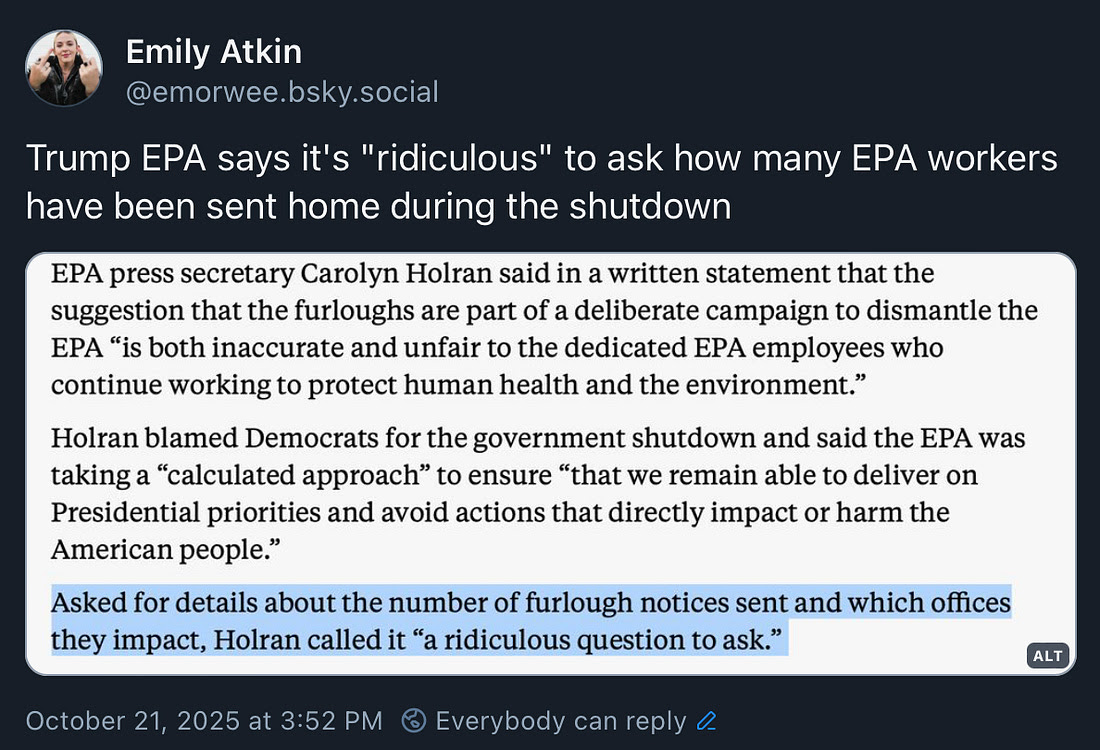 (https://substack.com/redirect/f71f61d9-ecd8-426d-9278-3870b439daa1?j=eyJ1IjoiMW42ZTYifQ.vyvZ_z0oLghKX6Zag1WJ71bIfqAlxqUD_SD6A_ZPsUM)
More employees are likely to be sent home as the shutdown continues. The Trump administration’s latest shutdown contingency plan considers nearly 90 percent of the EPA’s workforce (https://substack.com/redirect/3c94e865-e3d2-4401-a91a-9fad29052bc7?j=eyJ1IjoiMW42ZTYifQ.vyvZ_z0oLghKX6Zag1WJ71bIfqAlxqUD_SD6A_ZPsUM) to be “non-essential” or “partially essential,” and therefore eligible for furlough. “Many activities will halt, including research and the publication of research results, and the issuance of new grants, contracts and permits,” theLos Angeles Timesreported (https://substack.com/redirect/3c94e865-e3d2-4401-a91a-9fad29052bc7?j=eyJ1IjoiMW42ZTYifQ.vyvZ_z0oLghKX6Zag1WJ71bIfqAlxqUD_SD6A_ZPsUM). “Critically, civil enforcement inspections—on-site visits to facilities to check their compliance with environmental regulations—will also cease.”
Furloughs are also just the latest blow to the EPA’s workforce. Before the shutdown, 4,000 EPA employees had already been fired or had taken a buyout (https://substack.com/redirect/b92e7773-3533-4d74-85e4-02fcd4c8b4cc?j=eyJ1IjoiMW42ZTYifQ.vyvZ_z0oLghKX6Zag1WJ71bIfqAlxqUD_SD6A_ZPsUM). The agency’s climate offices and its scientific research arm (https://substack.com/redirect/ca431d5c-d714-4622-9205-7d2f9437a775?j=eyJ1IjoiMW42ZTYifQ.vyvZ_z0oLghKX6Zag1WJ71bIfqAlxqUD_SD6A_ZPsUM) are also in the process of being disbanded (https://substack.com/redirect/91db77d3-cd06-4e44-bc83-63b75b9cfeb2?j=eyJ1IjoiMW42ZTYifQ.vyvZ_z0oLghKX6Zag1WJ71bIfqAlxqUD_SD6A_ZPsUM). And the bleeding is expected to continue if and when the government reopens; The Trump administration has proposed a 55 percent cut to EPA funding in its 2026 budget request.
But there is at least one group of EPA employees who the Trump administration considers “essential,” and are still on the job: the people making it legal for coal plants to release more mercury into the environment.
Upgrade to paid (https://substack.com/redirect/2/eyJlIjoiaHR0cHM6Ly9oZWF0ZWQud29ybGQvc3Vic2NyaWJlP3V0bV9zb3VyY2U9cG9zdCZ1dG1fY2FtcGFpZ249ZW1haWwtY2hlY2tvdXQmbmV4dD1odHRwcyUzQSUyRiUyRmhlYXRlZC53b3JsZCUyRnAlMkZ3aGF0cy1lc3NlbnRpYWwtdG8tdHJ1bXBzLWVwYS1tb3JlJnI9MW42ZTYmdG9rZW49ZXlKMWMyVnlYMmxrSWpveU56WXdPVGt3TENKcFlYUWlPakUzTmpFeE5UUTVOVFVzSW1WNGNDSTZNVGMyTXpjME5qazFOU3dpYVhOeklqb2ljSFZpTFRJME56TWlMQ0p6ZFdJaU9pSmphR1ZqYTI5MWRDSjkuNDl2c3F1R0VDV09ZazJHYWNXOW5RcnV3c2dsMlo3SVZ1ZTNtRGJKWU1NcyIsInAiOjE3NjY3NDEzOSwicyI6MjQ3MywiZiI6dHJ1ZSwidSI6Mjc2MDk5MCwiaWF0IjoxNzYxMTU0OTU1LCJleHAiOjIwNzY3MzA5NTUsImlzcyI6InB1Yi0wIiwic3ViIjoibGluay1yZWRpcmVjdCJ9.gB95fkPWNpAJP1M2pG4CGlMezB2Nc6eX21PuG8EAj3E?&utm_medium=email&utm_source=subscribe-widget&utm_content=176674139)
The detail was first reported Friday by Lisa Friedman at theNew York Times (https://substack.com/redirect/5dc6868c-f1c8-4a3b-be7c-3092648549a5?j=eyJ1IjoiMW42ZTYifQ.vyvZ_z0oLghKX6Zag1WJ71bIfqAlxqUD_SD6A_ZPsUM).Despite the widespread stoppage of climate, environmental and public health work during the shutdown, she reported, “the workers responsible for carrying out the president’s plans for more fossil fuels and less wind and solar power are still hard at work.”
Specifically, at the EPA, Friedman reported that “employees are finalizing a plan to allow more mercury emissions from coal plants, according to two people familiar with the work underway.”
Friedman is referring to Trump’s plan torepeal the 2024 Mercury and Air Toxics Standards (MATS) (https://substack.com/redirect/32de8db6-f940-4222-bf09-cf587cf9d121?j=eyJ1IjoiMW42ZTYifQ.vyvZ_z0oLghKX6Zag1WJ71bIfqAlxqUD_SD6A_ZPsUM) rule. The 2024 MATS rule, implemented by the Biden administration, strengthened older pollution regulations (https://substack.com/redirect/3747b588-6910-4437-ba49-98a6cdecff0a?j=eyJ1IjoiMW42ZTYifQ.vyvZ_z0oLghKX6Zag1WJ71bIfqAlxqUD_SD6A_ZPsUM) on coal- and oil-fired power plants. In addition to placing stricter limits on mercury pollution, the 2024 rule required coal companies to install systems that continually monitor emissions. It also eliminated a loophole that allowed coal plants to exceed pollution limits when starting up.
In June, Trump’s EPA Administrator Lee Zeldin announced plans to repeal the strengthened mercury regulations (https://substack.com/redirect/e288410b-de38-4d57-ac3f-777ae35e4b28?j=eyJ1IjoiMW42ZTYifQ.vyvZ_z0oLghKX6Zag1WJ71bIfqAlxqUD_SD6A_ZPsUM), arguing they were created only to kill the coal industry. “The primary purpose of these Biden-Harris administration regulations was to destroy industries that didn’t align with their narrow-minded climate change zealotry,” Zeldin said in a statement (https://substack.com/redirect/135d9c80-6ae7-4d0d-b7e1-46845de4b224?j=eyJ1IjoiMW42ZTYifQ.vyvZ_z0oLghKX6Zag1WJ71bIfqAlxqUD_SD6A_ZPsUM).
In reality, the regulations were designed to protect kids from being poisoned. Mercury is a highly dangerous neurotoxin that causes developmental problems in infants and damages children’s brains. No amount of exposure is safe (https://substack.com/redirect/d05c0dbe-e743-4bb6-b0d4-4b0079373698?j=eyJ1IjoiMW42ZTYifQ.vyvZ_z0oLghKX6Zag1WJ71bIfqAlxqUD_SD6A_ZPsUM).
Once emitted by coal plants into the air, mercury then settles into waterways, contaminates fish, and lingers in ecosystems for decades. Mercury pollution from coal plants is the primary reason why tuna and swordfish are considered unsafe for pregnant and other vulnerable people to consume.
One recent study estimated (https://substack.com/redirect/afe55720-b29e-40d7-8e09-c15c58466243?j=eyJ1IjoiMW42ZTYifQ.vyvZ_z0oLghKX6Zag1WJ71bIfqAlxqUD_SD6A_ZPsUM) that emissions from coal are costing Americans $13 billion to $26 billion per year in additional ER visits, strokes and cardiac events, and a greater prevalence and severity of childhood asthma events. That’s why the EPA has spent decades reducing mercury pollution.
But now, even with the government closed, Trump and Zeldin are racing to let coal plants release more mercury into the air. And they’re doing it for one reason: Because the coal industry asked them to.
Trump loves to talk about how he’s bringing back “clean” coal. As he infamously said in his speech to the U.N. last month (https://substack.com/redirect/7568a703-4b40-4ea8-8722-d9ba7a65828c?j=eyJ1IjoiMW42ZTYifQ.vyvZ_z0oLghKX6Zag1WJ71bIfqAlxqUD_SD6A_ZPsUM), ”I have a little standing order in the White House: Never use the word coal. Only use the words: Clean, beautiful coal. Sounds much better, doesn’t it?”
But “clean” coal doesn’t exist (https://substack.com/redirect/c4d25665-48cc-4f08-a042-d3b91e62da0f?j=eyJ1IjoiMW42ZTYifQ.vyvZ_z0oLghKX6Zag1WJ71bIfqAlxqUD_SD6A_ZPsUM). And even if it did, it wouldn’t describe what Trump and Zeldin are bringing back.
For the last year, coal companies have been explicitly asking Trump to make coal dirtier—and Trump has been complying. Back in March, Trump’s EPA sent a blast notification to coal companies, telling them if they wanted to be exempted from pollution requirements like the mercury standard, all they had to do was ask (https://substack.com/redirect/bc2774fe-e266-4702-88d2-eb03505dd20e?j=eyJ1IjoiMW42ZTYifQ.vyvZ_z0oLghKX6Zag1WJ71bIfqAlxqUD_SD6A_ZPsUM).
The EPA even provided an email template that coal companies could use to make their request.
 (https://substack.com/redirect/541a8aec-c239-4cba-97c4-26c4e359cd8b?j=eyJ1IjoiMW42ZTYifQ.vyvZ_z0oLghKX6Zag1WJ71bIfqAlxqUD_SD6A_ZPsUM)
A New York Times article (https://substack.com/redirect/bc2774fe-e266-4702-88d2-eb03505dd20e?j=eyJ1IjoiMW42ZTYifQ.vyvZ_z0oLghKX6Zag1WJ71bIfqAlxqUD_SD6A_ZPsUM) describes the process by which the Trump administration is allowing coal companies to request exemptions from pollution regulations.
Since then, Trump has personally granted temporary exemptions from the 2024 Mercury Air Toxic Standards for 68 coal plants—representing more than a third of U.S. coal-fired capacity, according to Utility Dive (https://substack.com/redirect/1dda1a0f-a35d-4945-9494-b35bb585fb61?j=eyJ1IjoiMW42ZTYifQ.vyvZ_z0oLghKX6Zag1WJ71bIfqAlxqUD_SD6A_ZPsUM).
These temporary exemptions likely explain why the EPA is rushing to permanently repeal the 2024 mercury standards, even during a government shutdown. Because if those temporary exemptions are allowed to expire, coal companies will be forced to comply with strong pollution laws.
This is what it looks like when the fossil fuel industry doesn’t just lobby the government, but becomes the government. The agency designed to protect people from pollution gets turned into a customer service department for coal—even when the entire government is shut down. The shutdown itself has many moving parts, and it’s easy for stories like this to get lost in the shuffle. But the quiet dismantling of protections for children’s health is one that will leave a lasting mark.
Share (https://substack.com/app-link/post?publication_id=2473&post_id=176674139&utm_source=substack&utm_medium=email&utm_content=share&utm_campaign=email-share&action=share&triggerShare=true&isFreemail=true&r=1n6e6&token=eyJ1c2VyX2lkIjoyNzYwOTkwLCJwb3N0X2lkIjoxNzY2NzQxMzksImlhdCI6MTc2MTE1NDk1NSwiZXhwIjoxNzYzNzQ2OTU1LCJpc3MiOiJwdWItMjQ3MyIsInN1YiI6InBvc3QtcmVhY3Rpb24ifQ.S8GH3MgWEpPXIzINbbEDclNSIqIvoERI5fUIIgzTJh4)
*Have a news tip? Contact me securely via Signal at emorwee.06
REF SPOX NO LNX
TBL
The Trump administration moved Monday to slash federal jobs across two key environmental and conservation agencies, targeting employees who work on scientific research and the enforcement of anti-pollution laws.
At the Environmental Protection Agency, staff received a new round of furlough notices as funding dwindles amid the government shutdown. The Department of the Interior disclosed plans to permanently cut more than 2,000 positions, according to a court filing by its chief personnel officer.
The Interior Department layoffs, also known as a Reduction in Force, are at the center of ongoing litigation over President Donald Trump and his administration’s efforts to further gut the federal workforce.
Monday’s filing came in response to a judge’s order requiring the Interior Department to disclose its layoff plans for unionized employees. The administration said it intends to eliminate 2,050 Interior Department positions, a decision made before the government shutdown began.
That timing contradicts Trump’s recent claim that government layoffs stemmed from the shutdown.
Most of the planned cuts would hit the U.S. Geological Survey, the Bureau of Land Management, the National Park Service’s regional offices and Interior’s main headquarters, according to the filing.
The Interior Department manages national parks, wildlife refuges and other public lands. It oversees environmental and wildlife conservation, fulfills trust obligations to Alaska Natives and Native American tribes and conducts scientific research on endangered species, water resources and natural hazards like flooding and wildfires so officials can better respond to them.
Those research positions would be especially hard hit by the planned layoffs, including projects focused on the Great Lakes ecosystems and the USGS Columbia Environmental Research Center in Missouri, where scientists study toxic contaminants such as PFAS, a class of chemicals Trump’s health and human services secretary, Robert F. Kennedy Jr., has pledged to address.
Asked for comment, the White House referred questions to the Interior Department, which did not respond.
Environmental groups described the move as part of a broader campaign by Trump and his administration to eliminate research and data collection on environmental contamination after carrying out what EPA Administrator Lee Zeldin called the largest rollback of environmental protections in U.S. history.
“This plan would eviscerate the core science that every American depends on,” said Jennifer Rokala, executive director of the conservation group the Center for Western Priorities, in a statement about the new Interior Department cuts revealed Monday.
Rokala said the planned cuts “would devastate scientific research across the Rocky Mountains, Great Plains, and Great Lakes,” while harming workers who “make our parks and public lands the envy of the world.”
Rokala also said that Monday’s filing revealed only the planned layoffs for unionized employees: “We don’t know how many non-union offices and positions are also on the chopping block.”
At the EPA, the new furlough notices arrived as the agency’s funding dries up. Last week, Trump said the shutdown was an opportunity to dismantle “Democrat programs that we want to close up or we never wanted to happen.” He has repeatedly cast environmental protection, conservation and related public health issues as “woke” and left-wing.
Some of the country’s key environmental protections, and in fact the EPA itself, date back to the Republican Nixon administration.
“Only Trump’s EPA would lay off the people who protect our kids from breathing polluted air and drinking contaminated water but keep the pesticide office open to greenlight more poisons,” said J.W. Glass, EPA policy specialist at the conservation organization Center for Biological Diversity.
Glass, in a written statement, accused the administration of using the shutdown to dismantle the EPA, leaving “our communities paying the price.”
EPA press secretary Carolyn Holran said in a written statement that the suggestion that the furloughs are part of a deliberate campaign to dismantle the EPA “is both inaccurate and unfair to the dedicated EPA employees who continue working to protect human health and the environment.”
Holran blamed Democrats for the government shutdown and said the EPA was taking a “calculated approach” to ensure “that we remain able to deliver on Presidential priorities and avoid actions that directly impact or harm the American people.”
Asked for details about the number of furlough notices sent and which offices they impact, Holran called it “a ridiculous question to ask.”
In a written statement, Peter Murchie, senior director at the nonprofit Environmental Protection Network and a former EPA official, called on Congress to intervene and stop the “systematic dismantling.”
“The health harms facing American families—cancer, childhood asthma, infertility, organ failure—don’t pause for politics,” Murchie said. “When EPA’s expert staff are sent home, large parts of the agency’s work simply stop.” END INSERT
Further reading:
2 scientists call on RFK Jr. to stop coal mercury rule rollback (https://substack.com/redirect/ab804842-6401-44c0-afd0-b8641c14befe?j=eyJ1IjoiMW42ZTYifQ.vyvZ_z0oLghKX6Zag1WJ71bIfqAlxqUD_SD6A_ZPsUM). (E&E News, October 17).
RFK Jr., once poisoned by mercury, is silent as EPA weakens rules against it (https://substack.com/redirect/e02d2702-73c7-40b7-9c88-5885a93e7b94?j=eyJ1IjoiMW42ZTYifQ.vyvZ_z0oLghKX6Zag1WJ71bIfqAlxqUD_SD6A_ZPsUM). (E&E News, March 18).
Trump officials offer $625 million bailout to rescue coal (https://substack.com/redirect/a8e7cd51-3126-4f08-998e-2689de79adb9?j=eyJ1IjoiMW42ZTYifQ.vyvZ_z0oLghKX6Zag1WJ71bIfqAlxqUD_SD6A_ZPsUM). (New York Times, September 29).
These companies avoided clean air rules. It took a single email (https://substack.com/redirect/ba87e401-076e-4947-abfd-4a2ecc677c31?j=eyJ1IjoiMW42ZTYifQ.vyvZ_z0oLghKX6Zag1WJ71bIfqAlxqUD_SD6A_ZPsUM). (New York Times,July 29).
Other stories I’m following:
The government is shut down. But not for fossil fuels (https://substack.com/redirect/5dc6868c-f1c8-4a3b-be7c-3092648549a5?j=eyJ1IjoiMW42ZTYifQ.vyvZ_z0oLghKX6Zag1WJ71bIfqAlxqUD_SD6A_ZPsUM). (New York Times, October 17).
More than 700,000 federal employees have been sidelined and thousands more are at risk of being fired as the government shutdown (https://substack.com/redirect/276f2f4a-1f63-4e02-9711-5ab0b3152011?j=eyJ1IjoiMW42ZTYifQ.vyvZ_z0oLghKX6Zag1WJ71bIfqAlxqUD_SD6A_ZPsUM) drags on. But the workers responsible for carrying out the president’s plans for more fossil fuels and less wind and solar power are still hard at work. Some are approving permits for companies that want to extract metals, coal, oil and gas from public lands and federal waters. Others are rolling back limits on the greenhouse gas emissions that are driving climate change.
politico 9 25
Most Read
- How House Republicans plan to rewrite history of Jan. 6
- China weaponizes ag imports to target Trump and US farmers
- Energy Dept. adds ‘climate change’ and ‘emissions’ to banned words list
- ‘Laughter Can’t Be Put on Trial’: Why Donald Trump Is Afraid of Jimmy Kimmel
- Why Donald Trump is obsessed with Portland
---
7 25 ICN
Last week the Trump administration quietly took a hugely consequential action affecting environmental protections in America: beginning to shutter the EPA Office of Research and Development.
The decision follows a long pressure campaign from industry lobbyists to limit EPA’s ability to assess the health risks of chemicals like formaldehyde, ethylene oxide, arsenic and hexavalent chromium, and mitigate the harms they can cause.
Marianne takes us inside the office, explaining its critical role in protecting the public, the politics at play, and why shutting the office down is such a devastating loss to the country.
---
OMFG
AN 7 25
The U.S. Environmental Protection Agency's decision Friday to eliminate its scientific research arm drew horrified responses from public health experts and climate advocates, who warned that the Trump administration is targeting the foundation of the department's work to shield Americans from hazardous chemicals, toxic pollution, and drinking water contaminants.
"This is grim news," said Adam Gaffney, an ICU doctor at the Cambridge Health Alliance. "For decades, the EPA's Office of Research and Development has produced the science that underlies the regulations and technologies that protect us from innumerable hazards."
"You can't put a number on the lives that it has saved. Now Trump and Zeldin are killing it," Gaffney added, referring to the president's handpicked EPA administrator.
Since taking charge at the EPA, Lee Zeldin has moved aggressively to implement President Donald Trump's executive orders aimed at gutting the agency's staff and freeing oil and gas corporations from regulatory restraints.
The agency will soon have 12,448 employees, after starting the year with more than 16,000. Staffers at the targeted research office—which had more than 800 employees as of earlier this week—reportedly learned of what one public health expert called "the ultimate Friday night purge" through the EPA's public press release.
In the statement, Zeldin said the elimination of the Office of Research and Development would help "ensure the agency is better equipped than ever to deliver on our core mission of protecting human health and the environment."
But scientists said the closure of the research office would have the opposite impact, leaving the agency's ability to protect the environment and public health badly compromised.
Gretchen Goldman, president of the Union of Concerned Scientists, said that "it is absolutely devastating that Trump officials would shut down this office in its entirety."
"Science, data, and research underpin all of EPA's work, from protections from harmful chemicals to air quality standards to safe drinking water. It's hard to see how EPA can fulfill its mission without its scientific research arm," said Goldman. "The nation enjoys a cleaner environment thanks to the decades of high-quality research coming out of this office. Our nation cannot let this stand. Members of Congress must act."
In his public messaging, Zeldin has deemphasized the EPA's fundamental responsibility to protect the environment, instead casting the agency as a promoter of "energy dominance"—the slogan Trump administration officials have used to describe the president's commitment to boosting fossil fuel drilling.
Earlier this year, Zeldin boasted about launching "the biggest deregulatory action in U.S. history," targeting power plant rules, Mercury and Air Toxics Standards, and other regulations.
"Out in the open, Zeldin's EPA has been dismantling protections against precisely the sorts of dangers that right-wingers warn are coming from alleged deep-state conspiracies: toxic, cancer-causing chemicals that corporations have lobbied to freely inject into our air, water, food, and bodies," The New Republic's Kate Aronoff wrote in a recent column.
"Among the broader suite of regulations Zeldin's EPA has promised to roll back," Aronoff wrote, "is one that would require coal-fired power plant operators to upgrade wastewater treatment facilities, limiting their ability to freely discharge toxins like mercury, arsenic, selenium, lead, and bromide and to threaten local drinking water supplies."
NOW READ:'Like an open fire hose': Trump ripped as cracks show in MAGA media
---
---
an 7 25
Roughly 140 Environmental Protection Agency employees have been placed on administrative leave after signing a letter warning of political interference in the agency’s work—prompting critics to accuse the Trump administration of ignoring their First Amendment rights.
Calling the letter “a remarkable rebuke of the agency’s political leadership,” The New York Times reported on Monday that more than 270 EPA employees had signed the public letter “denouncing what they described as the Trump administration’s efforts to politicize, dismantle and sideline the main federal agency tasked with protecting the environment and public health.”
On Thursday, the Times reported that 144 workers had been suspended, other news outlets put the number at 139.
In that public letter, signatories said they are joining in “solidarity with employees across the federal government in opposing this administration’s policies,” and that they “stand together in dissent against the current administration’s focus on harmful deregulation, mischaracterization of previous EPA actions, and disregard for scientific expertise.”
READ MORE: ‘Stop Talking’: Johnson Suggests Jeffries Is Lying in Marathon Budget Speech
They detailed their five primary concerns, including, “Undermining public trust,” “Ignoring scientific consensus to benefit polluters,” “Reversing EPA’s progress in America’s most vulnerable communities,” “Dismantling the Office of Research and Development,” and “Promoting a culture of fear, forcing staff to choose between their livelihood and well-being.”
On Thursday, the 140 or so employees who allegedly had signed the letter with their official titles received emails saying they had been placed on leave for two weeks “pending an administrative investigation,” The New York Times reported.
“The Environmental Protection Agency has a zero-tolerance policy for career bureaucrats unlawfully undermining, sabotaging, and undercutting the administration’s agenda as voted for by the great people of this country last November,” Brigit Hirsch, an EPA spokesperson, said in a statement, according to Bloomberg Law News.
“The letter, addressed to EPA head Lee Zeldin, alleged the agency has used its communication platforms to ‘promote misinformation and overtly partisan rhetoric,'” Bloomberg added. “One example the signatories cited was a March statement laying out the administration’s deregulatory agenda, in which Zeldin referred to ‘the climate change religion.'”
READ MORE: Democratic Strategist Warns Trump Could Try to Impose Martial Law Before 2026 Midterms
Nicole Cantello, president of the American Federation of Government Employees (AFGE) Local 704, called the move “blatant retaliation,” The Hill reported.
“We don’t swear an oath to the Trump administration, we swear an oath to the Constitution and so we don’t feel like we violated that oath or that we did anything wrong by signing this letter,” she said.
Cantello, on social media, wrote that EPA workers “have the right to freedom of speech, just like every other American.”
Addressing EPA Administrator Zeldin directly, she said: “See you in court.”
Some denounced the administration’s move.
Attorney Mark Zaid, who handles national security and whistleblower cases, wrote: “Apparently retaliation has already begun. This is what defines this Administration.”He also offered to “provide pro bono consultation to examine current situation.”
The New York Times’ Trip Gabriel asked, “What First Amendment?”
READ MORE: Trump Appeared Unaware His Budget Bill Cuts $1T From Medicaid: Report
ONLY NOT JRL FAIL
TV news barely covered Trump's Big Oil “quid pro quo” last year. Now that it's come to fruition, networks should give the scandal the attention it deserves.
Big Oil lands $1 billion tax break in Trump’s “One Big Beautiful Bill” as EPA staff are to “pause” oil and gas enforcement
Special ProgramsClimate & Energy
Written by Allison Fisher
:{Published 06/20/25
Last May, The Washington Post published an exclusive story on a dinner at Mar-a-Lago in which Donald Trump promised to reverse then-President Joe Biden's actions on climate change as he asked Big Oil executives to fundraise $1 billion for his presidential campaign, assuring that they would be getting a “deal” due to the “taxation and regulation they would avoid thanks to him.” Reportedly, oil and gas executives did make “significant contributions to the Trump campaign.”
Over a four-day period, MSNBC was the only major TV network to cover the story, which All In host Chris Hayes described as “a political quid pro quo.”
Now, two new stories emerged this week that give more context to the promised “deal” the oil and gas industry is getting under Trump’s second term. National TV networks should inform their audience about how Big Oil is benefitting under Trump.
Bloomberg reported on June 17 that the Senate version of Trump’s “One Big Beautiful Bill” now includes a tax break for the oil and gas industry “estimated to be worth more than $1 billion.”
The provision would allow energy companies subject to a 15% corporate alternative minimum tax to deduct certain drilling costs when calculating their taxable income. Companies including ConocoPhillips, Ovintiv Inc. and Civitas Resources, Inc. lobbied in favor of it.
The change was included in the legislation released Monday by Republicans on the Senate tax writing committee, which would slash tax credits for wind, solar, electric vehicles and hydrogen.
…
Other supporters of the measure, which wasn’t included in the House version of the bill, include the Domestic Energy Producers Alliance, founded by oil billionaire and Trump donor Harold Hamm.
The same legislation would repeal tax credits for the clean power industry, which would threaten more than 800,000 jobs and raise energy prices for consumers.
In fact, clean energy technologies constituted93% of new power generation capacity added to the grid last year alone, and the climate provisions in the Inflation Reduction Actwhich Trump wants repealed, “have spurred the highest levels of factory construction in American history, with more than 400,000 new jobs announced across the country.”
Meanwhile, CNN reported on June 16 that “the Environmental Protection Agency has told staff overseeing the country’s industrialized Midwest — a region plagued by a legacy of pollution — to stop enforcing violations against fossil fuel companies.”
Four sources with knowledge of the situation at the EPA’s Region 5 office, which oversees six Midwestern states, told CNN that enforcement officials were informed that “there is a pause on oil and gas enforcement” at staff meetings.
“That is how our regional management is interpreting signals from the president,” the EPA enforcement staffer said.
Officers stopped being able to issue notices of violation or send information requests to fossil fuel companies suspected of polluting, the sources told CNN. A violation notice is a prerequisite for taking a company to court for alleged violations of environmental laws.
These instructions are on top of other administration efforts to radically reduce safeguards that protect Americans from fossil fuel-related pollution and open up more land for oil and gas drilling.
Earlier this month, for example, the EPA announced plans to eliminate Biden-era regulations limiting the amount of carbon emissions and other pollution released into the atmosphere by fossil fuel-fired power plants. CBS reported the rule the EPA seeks to revoke “is projected to reduce 1.38 billion metric tons of carbon dioxide from entering the atmosphere by 2047, as well as eliminate tens of thousands of tons of other harmful air pollutants that are dangerous to public health” — an amount of pollution “equivalent to driving more than 320 million gas-powered cars for a year, according to an EPA estimate.”
The new CNN report also notes:
An early snapshot of enforcement data from Trump’s start of his second term shows the overall number of EPA enforcement cases initiated or closed across sectors has dropped by 32% compared with the first three months of the Biden administration, according to publicly available EPA data analyzed for CNN by environmental watchdog Environmental Integrity Project. The same data shows nearly 60% fewer cases have been initiated or closed compared with the first three months of Trump’s first term.
Taken together, these reductions in taxes, regulations, and enforcement for the fossil fuel industry are essentially what Trump promised to deliver for Big Oil in exchange for backing his 2024 campaign.
At the time, The Atlantic’s David A. Graham described the proposition as “undeniably scandalous.” Now that these gifts to Big Oil are being delivered, TV networks should inform their audience about the dirty “deal” between Trump and Big Oil playing out at the expense of the booming clean energy industry, our health, and our climate.
//
05/14/24 5:01 PM EDT
05/17/24 2:58 PM EDT
06/23/25
---
===
Marc Morano
Weekly update ⋅ February 28, 2025
EPA: Scrap Conclusion That Greenhouse Gases Endanger Public - TT -
Transport Topics
“This is the holy grail of the climate agenda,” said Marc Morano, who runs the climate-skeptic website ClimateDepot.com. “If you want to ...
Trump’s top environmental regulator is recommending the U.S. government scrap its formal conclusion that greenhouse gases endanger the public, a move that would sweep away the legal foundation for regulations limiting planet-warming pollution from power plants, automobiles and oil wells.
In private recommendations to Trump, Environmental Protection Agency Administrator Lee Zeldin has urged a rewrite of the so-called endangerment finding, setting the stage for a potentially sweeping attack on federal climate regulations. The recommendations were described by people familiar with the matter who asked not to be identified because the assessment isn’t public.
The president has frequently criticized what he calls the “green new scam,” referring to government policies fighting climate change and promoting emission-free energy. Trump hasn’t formally endorsed the plan outlined by Zeldin, and it’s unclear if he will embrace it. But if he does, the effort would dovetail with priorities such as building more power plants and abolishing incentives for electric vehicle sales. And it would be consistent with recent Trump administration moves to retreat from work on climate change, including preventing a U.S. official from attending a scientific meeting on the issue in China.
“This is the holy grail of the climate agenda,” said Marc Morano, who runs the climate-skeptic website ClimateDepot.com. “If you want to permanently cripple the United States climate agenda you have to go at the heart of it. This is the heart of it: the endangerment finding.”
Image
Zeldin
Zeldin delivered his recommendations to Trump a month after the president tasked the EPA with determining the “legality and continuing applicability” of the endangerment finding as part of a Jan. 20 executive order.
The EPA said Feb. 26 in an emailed statement that it was “in compliance” with the president’s executive order mandate for the agency to submit recommendations on the legality and continuing applicability of the 2009 endangerment finding. The Washington Post earlier reported on Zeldin’s recommendations.
MORE ON EPA: EPA Takes First Step to Block CARB Clean Trucks Rule
Energy businesses and some Trump allies are divided over the wisdom of a frontal attack on the endangerment finding. Some are concerned the effort would siphon time and manpower from other regulatory priorities, including rewriting Biden-era rules governing power plant and automobile pollution. It could take years for the EPA to go through a required rulemaking process to unwind the endangerment finding, and even then, it might not survive inevitable legal challenges.
Energy companies also have warned that doing away with the endangerment finding, and the federal climate regulations it supports, could revive public nuisance lawsuits against oil producers and power plant operators. Under a 2010 Supreme Court decision, federal climate regulation under the Clean Air Act has effectively precluded those claims.
At issue is the EPA’s 2009 conclusion that carbon dioxide, methane and four other greenhouse gases threaten the public health and welfare of current and future generations. The EPA was effectively compelled to assess the matter after the Supreme Court in 2007 affirmed the agency’s authority to regulate greenhouse gases as air pollutants under the Clean Air Act. At that point, it was up to the EPA to determine whether greenhouse gases constituted a threat that should be regulated.
But critics argue Congress designed the Clean Air Act to regulate localized pollutants, not those with widespread, global effects, and some have been pushing for repeal of the endangerment finding ever since. A policy blueprint drafted by conservative groups and Trump loyalists known as Project 2025 recommended addressing the endangerment finding.
A reversal generally would require the EPA to gather fresh evidence to support an opposing conclusion: that greenhouse gases aren’t a threat at all. Environmentalists argue that would fly in the face of a growing scientific body of evidence that greenhouse gas emissions are the primary driver of climate change.
Want more news? Listen to today's daily briefing above or go here for more info
“There is a lot of shocking stuff happening now, but to completely deny climate change and any federal obligation to control the pollution that’s driving it would be shocking and irresponsible,” said David Doniger, senior attorney with the Natural Resources Defense Council.
Environmental advocates contend it also would be illegal.
“Climate pollution is air pollution, and it is fueling a crisis,” said Margie Alt, director of the Climate Action Campaign. “There is no scientific basis — none — to claim otherwise.”
More Content About:
ghg, Environmental Protection Agency
British Petroleum To Roll Back Their Green Energy Goals | News Radio 1200 WOAI - iHeart
News Radio 1200 WOAI - iHeart
Marc Morano with the Climate Depot says this move reflects a simple fact of the energy industry. Green energy just isn't a money maker. He said ...
Trump admin plans to 'permanently cripple' climate protections in single blow: report
Raw Story
"This is the holy grail of the climate agenda," prominent climate change denier Marc Morano told the outlet. "If you want to permanently cripple ...
Trump's Environmental Protection Agency administrator, Lee Zeldin, is reportedly pursuing plans that would wipe away most federal climate change rules with a single move.
According to Bloomberg, the EPA considered scrapping "its formal conclusion that greenhouse gases endanger the public, a move that would sweep away the legal foundation for regulations limiting planet-warming pollution from power plants, automobiles and oil wells."
The EPA would rewrite the so-called endangerment finding at the heart of most climate change rules if Zeldin has his way, sources told Bloomberg.
ALSO READ:'Gotta be kidding': Jim Jordan scrambles as he's confronted over Musk 'double standard'
Trump has frequently referred to the rules as the "green new scam," but it was unclear if he had signed on to the plan.
"This is the holy grail of the climate agenda," prominent climate change denier Marc Morano told the outlet. "If you want to permanently cripple the United States climate agenda you have to go at the heart of it. This is the heart of it: the endangerment finding."
From building new power plants to eliminating incentives for electric vehicles, most climate change initiatives could quickly be reprioritized if Zeldin has his way.
Reset or Purge? Trump EPA Dismisses Agency Science Advisers - Inside Climate News
Reset or Purge? Trump EPA Dismisses Agency Science Advisers
BY MARIANNE LAVELLE
Critics fear the unusual clean sweep of panels is meant to ease the planned rollback of climate and environmental policy.
All members of the Environmental Protection Agency’s boards of outside advisers on science and clean air were dismissed in a letter emailed late Tuesday, an unusual step the Trump administration said was aimed at depoliticizing the panels.
Panel members expressed disappointment and confusion at the assertion in the letter signed by James Payne, a career EPA attorney Trump installed as acting administrator. Critics charged the Trump administration with politicizing the process by eliminating the current independent advisers and clearing the way for them to be replaced with hand-picked appointees.
“This is not about good governance, this is about rigging the system for polluters; corruption at the expense of the American people,” said Sen. Sheldon Whitehouse of Rhode Island, the ranking Democrat on the Committee on Environment and Public Works.
Similar efforts to remake science advisory panels came during the first Trump administration, with EPA leaders changing the eligibility rules for serving on boards. The result was fewer university researchers on the panels and more industry consultants and scientists who were supportive of Trump’s deregulatory efforts, like University of Alabama in Huntsville atmospheric scientist John Christy, taking seats.
A number of the now-dismissed panel members had two to three years remaining in their terms. It was not immediately clear who would be appointed as replacements on the advisory panels, both of which are required under federal law. Trump’s choice to head up the Environmental Protection Agency, former New York Congressman Lee Zeldin, won Senate confirmation on Wednesday, the day after the dismissals.
An EPA spokesperson said the move was in line with the agency’s purpose.
“EPA is working to update the Science Advisory Board (SAB) and Clean Air Scientific Advisory Committee (CASAC) to ensure that the agency receives scientific advice consistent with its legal obligations to advance our core mission,” the spokesperson said in an email. “The decision to reset these federal advisory committees emphasizes the importance of SAB and CASAC to EPA’s mission of protecting human health and the environment and seeks to reverse the politicization of SAB and CASAC made by the previous Administration.”
The dismissed chairs of both of the boards disputed that characterization.
“I was not appointed as a political appointee, but as a scientist that studies air pollution and health,” said Jeremy Sarnat, a professor at Emory University’s Rollins School of Public Health who had only begun serving as chair of the CASAC in October. He said the Clean Air Act, passed on a bipartisan basis more than 50 years ago and implemented under administrations of both parties, had been “one of the most successful public policies that has ever been enacted globally,” in part because of procedures that require the agency to rely on the best science.
“I know that so many other facets of American life and society have been politicized, and I hope that the CASAC and the advisory boards can remain above that and that the new administrator will adhere to the principles and practices, which have really worked so well for decades,” Sarnat said.
Kimberly Jones, an engineering professor and associate provost at Howard University, who has served as chair of the Science Advisory Board since 2023, said she was disappointed in the administration’s decision.
“It does seem to signal a shift in the decades-old accepted facts about how science should occur,” Jones said. “We should not be writing or interpreting science to meet anybody’s objectives. We should be independent, doing our best job to evaluate the science as scientists. This seems to go counter to that understanding.”
Although EPA’s science advisers are not decision-makers, their advice becomes important when the agency’s policy decisions face legal challenges. EPA’s 2024 decision to strengthen the National Ambient Air Quality Standard for fine particulate matter, for example, was bolstered because it was in line with the advice the agency received from the CASAC. Conversely, weak ozone standards passed during the first Trump administration were successfully challenged in court in 2021, in part because the EPA had received contrary recommendations from outside advisers.
It is not the first time there has been a clean sweep of scientific advisers. Biden’s EPA chief, Michael Regan, installed a new slate at CASAC when he took office in 2021 based on the findings by the GAO and others that the selection process had become compromised.
H. Christopher Frey, an associate dean at North Carolina State University who served as head of EPA’s Office of Research and Development during the Biden administration, said the circumstances are entirely different now. “This is really just a flat-out purge of the current membership,” he said.
Frey said the Trump administration seemed to be following the conservative policy platform Project 2025, which called for “resetting science advisory boards” at EPA.
“The administration seems to be wanting to promote loyalty and compliance with its policy agenda, but that’s not the mission of a science advisory board,” Frey said. “So if that’s the goal, it’s an inappropriate interference in an external, independent expert advisory board, and it’s also just setting more precedent for this to happen every time.”
---
the Biden administration's Environmental Protection Agency on Monday announced a permanent ban on a pair of carcinogenic chemicals widely used in U.S. industries, including dry cleaning services and automative work.
According to the Washington Post:
The announcement includes the complete ban of trichloroethylene—also known as TCE—a substance found in common consumer and manufacturing products including degreasing agents, furniture care and auto repair products. In addition, the agency banned all consumer uses and many commercial uses of Perc—also known as tetrachloroethylene and PCE — an industrial solvent long used in applications such as dry cleaning and auto repair.
Jonathan Kalmuss-Katz, a senior attorney at Earthjustice, applauded the move but suggested to the Post that it should have come sooner.
"Both of these chemicals have caused too much harm for too long, despite the existence of safer alternatives," Kalmuss-Katz.
The EPA's decision, reports the New York Times, was "long sought by environmental and health advocates, even as they braced for what could be a wave of deregulation by the incoming Trump administration."
The Timesreports:
TCE is known to cause liver cancer, kidney cancer and non-Hodgkin’s lymphoma, and to damage the nervous and immune systems. It has been found in drinking water nationwide and was the subject of a 1995 book that became a movie, “A Civil Action,” starring John Travolta. The E.P.A. is banning all uses of the chemical under the Toxic Substances Control Act, which was overhauled in 2016 to give the agency greater authority to regulate harmful chemicals.
Though deemed "less harmful" than TCE, the Times notes how Perc has been shown to "cause liver, kidney, brain and testicular cancer," and can also damage the functioning of kidneys, the liver, and people's immune systems.
Environmentalists celebrated last year when Biden's EPA proposed the ban on TCE, as Common Dreamsreported.
Responding to the news at the time, Scott Faber, senior vice president for government affairs at the Environmental Working Group (EWG), said the EPA, by putting the ban on the table, was "once again putting the health of workers and consumers first."
While President-elect Donald Trump ran on a having an environmental agenda that would foster the "cleanest air" and the "cleanest water," the late approval of EPA's ban on TCE and Perc in Biden's term means the rule will be subject to the Congressional Review Act (CRA), meaning the Republican-control Senate could reverse the measure.
In his remarks to the Times, Kalmuss-Katz of Earthjustice said that if Trump and Senate Republicans try to roll back the ban, they will be certain to "encounter serious opposition from communities across the country that have been devastated by TCE, in both blue and red states."
what was big EPA case?
https://www.politico.com/news/2023/04/25/neil-gorsuch-colorado-property-sale-00093579
politico bad code box size]
no lnx
Supreme Court Justice Clarence Thomas has [lnx] to overturn the 2020 presidential election results. Now, according to Politico reporter Heidi Przybyla, another relationship involving a High Court justice could merit close scrutiny — and this time, the justice is Donald Trump nominee Neil Gorsuch.
Przybyla, in an on April 25, reports, "For nearly two years beginning in 2015, Supreme Court Justice Neil Gorsuch sought a buyer for a 40-acre tract of property he co-owned in rural Granby, Colorado. Nine days after he was confirmed by the Senate for a lifetime appointment on the Supreme Court, the then-circuit court judge got one: The chief executive of Greenberg Traurig, one of the nation’s biggest law firms with a robust practice before the High Court. Gorsuch owned the property with two other individuals."< according to Przybyla, Brian Duffy of Greenberg Traurig "put under contract the 3000-square-foot log home on the Colorado River and nestled in the mountains northwest of Denver, according to real estate records. >READ MORE:
"He and his wife closed on the house a month later, paying $1.825 million, according to a deed in the county’s record system," Przybyla reports. "Gorsuch, who held a 20 percent stake, reported making between $250,001 and $500,000 from the sale on his federal disclosure forms. Gorsuch did not disclose the identity of the purchaser. That box was left blank. Przybyla adds, "Since then, Greenberg Traurig has been involved in at least 22 cases before or presented to the Court, according to a Politico review of the Court's docket. They include cases in which Greenberg either filed amicus briefs or represented parties.
In the 12 cases where Gorsuch's opinion is recorded, he sided with Greenberg Traurig clients eight times and against them four times." zxz for nearly two years beginning in 2015, Supreme Court Justice Neil Gorsuch sought a buyer for a 40-acre tract of property he co-owned in rural Granby, Colo. Nine days after he was confirmed by the Senate for a lifetime appointment on the Supreme Court, the then-circuit court judge got one: The chief executive of Greenberg Traurig, one of the nation’s biggest law firms with a robust practice before the high court. Gorsuch owned the property with two other individuals.>
On April 16 of 2017, Greenberg’s Brian Duffy put under contract the 3,000-square foot log home on the Colorado River and nestled in the mountains northwest of Denver, according to real estate records....federal disclosure forms.<...Since then, Greenberg Traurig has been involved in at least 22 cases before or presented to the court, according to a POLITICO review of the court’s docket....one of the more highly publicized rulings in recent years, a multistate suit which reversed former President Barack Obama’s plan to fight climate change through the Clean Air Act.
Gorsuch joined the court’s other five conservative judges in agreeing with the plaintiffs — including Greenberg’s client — that the Environmental Protection Agency had overstepped its authority by regulating carbon emissions from power plants in the decision that makes it more difficult for the executive branch to regulate emissions without express authorization from Congress.
Duffy, who in addition to serving as CEO is chief of Greenberg’s entire 600-lawyer litigation department, said he has never personally argued cases before Gorsuch or met the justice socially.
“I’ve never spoken to him,” Duffy said. “I’ve never met him.”
Once he learned Gorsuch was among the owners, Duffy said, he cleared the sale with his firm’s ethics department.
Gorsuch did not respond to inquiries about the sale, his disclosures or whether he should have reported Duffy’s identity as the purchaser.
Supreme Court rules do not prevent justices from engaging in financial transactions with people with interest in court decisions, but Gorsuch’s dealings with Duffy expose the weakness of the court’s disclosure procedures. For instance, in reporting his Colorado income, Gorsuch listed as his source only the name that he and his two co-owners gave themselves, Walden Group, LLC. The report didn’t indicate that there had been a real estate sale or a purchaser.
Such a sale would raise ethical problems for officials serving in many other branches of government, but the Supreme Court sets its own rules. It has largely left justices to make their own decisions about when and how to report outside gifts and income.
Justice Clarence Thomas is currently under scrutiny for accepting lavish trips from GOP billionaire donor Harlan Crow, who also purchased three Georgia properties from the justice. Thomas did not report the property sales. Of the vacations, Thomas said he had been advised that “personal hospitality from close friends” need not be disclosed.
Senate Judiciary Chair Dick Durbin (D-Ill.), a frequent critic of Supreme Court ethics rules, sent a statement responding to POLITICO’s inquiry about Gorsuch’s sale of the Colorado property.
“We have seen a steady stream of revelations regarding Supreme Court Justices falling short of the ethical standards expected of other federal judges and of public servants,” said Durbin. “The need for Supreme Court ethics reform is clear, and if the Court does not take adequate action, Congress must. The Senate Judiciary Committee will be closely examining these matters in the coming weeks,” said Durbin, who has asked Chief Justice John Roberts to testify next month on the court’s ethics rules.
Kedric Payne, director of ethics at the nonpartisan Campaign Legal Center, said he believes “investments in LLCs require more details than the justice includes in his financial disclosures.“
“This transaction appears to also require naming the buyer. The public has a right to know that justices will fully comply with disclosure rules instead of providing only a tiny peek into their financial disclosures,” he said, noting more facts are needed to distinguish whether it’s a disclosure omission or violation. The center was founded by a Republican former chair of the Federal Election Commission.
Unlike Crow, who bought properties from Thomas, Duffy says he is neither a friend nor a confidant of Gorsuch. But he is one of the nation’s most powerful attorneys.
His Greenberg bio describes him as “A true ‘working CEO,’” and says he “focuses his practice on trial and appellate work in the class action, employment, energy, commercial contract, and product liability areas, serving as counsel in high-profile cases throughout the United States.”
At the time of the sale, Duffy had headed Greenberg Traurig for about a year. A search of his contributions to political candidates revealed that they went primarily to Democrats, including Sen. Kirsten Gillibrand, (D-N.Y.). He contributed the maximum amount allowable for individual donors to Democratic presidential nominee Hillary Clinton in the 2016 election, though he also made contributions in the past to Republicans such as former Sen. John McCain of Arizona and a GOP New York City mayoral candidate, Joe Lhota.
The Duffy family has long resided in Colorado. Duffy attended the University of Colorado Law School and, in 2019, he was the recipient of the “most admired CEO” award by the Denver Business Journal.
Duffy, who described himself as an avid fly fisher, said he’d been looking for the right property for his family for many years. Duffy said he did not know Gorsuch was one of the owners when he made his first offer.
“The fact that he was going to be a Supreme Court justice was absolutely irrelevant to the purchase of that property. It’s a wonderful piece of property and we’re so glad we bought it,” said Duffy.
Gorsuch and his associates purchased the property in 2005 through theirLLC, the Walden Group,which was dissolved after the 2017 sale. The home was originally listed, in July of 2015, for $2.495 million. The fact that the property had sat on the market for so long and that its price had been lowered a couple times suggests the partners were having trouble finding a buyer.
The real estate transaction is another example of how the lack of a firm code of ethics for the court stands in contrast to most other branches of the U.S. government, including the White House and Congress as well as lower court judges.
The code of conduct for lower court U.S. judges says judges should “avoid impropriety and the appearance of impropriety in all activities,” and “discourages frequent transactions or continuing business relationships with lawyers or other persons likely to come before the court” on which the judge serves. Unlike many of the country’s state and federal courts, the Supreme Court lacks a code of conduct.
“This is exactly the type of situation that an ethics code that included vetting of transactions and full disclosure would clear up,” said Kyle Herrig, president of Accountable.US, a progressive research organization. “Without decisive action, the conservatives on the Supreme Court will forever tarnish its reputation in our public life,” he said.
At the time of Gorsuch’s appointment, his ownership of the Colorado property drew attention only for the fact that his co-owners were major figures in the oil and gas industry. Gorsuch’s ties to the oil and gas industry run deep.
As a lawyer at a Washington law firm nearly 20 years ago, Gorsuch represented oil and gas billionaire Philip Anschutz on a variety of matters as outside counsel, and it was through this connection that Gorsuch befriended his future real estate partners.
Anschutz helped Gorsuch win an appointment to an open seat on a federal appeals court in Denver, including directly lobbying the George W. Bush White House....Gorsuch’s connections to Anschutz extend to .
The Walden Group included Kevin Conwick, who had advised Anschutz in deals to buy sports teams and other projects like the Staples Center in Los Angeles, and Cannon Harvey, who oversaw Anschutz’s venture capital investment division...
https://www.mediamatters.org/fox-news/fox-networks-fearmonger-over-biden-administrations-new-vehicle-tailpipe-emissions-proposal
on April 12, the Environmental Protection Agency introduced its strictest standards yet to curb planet-warming emissions from American cars and trucks. For automakers to be in compliance, over two-thirds of new vehicles sold in 2032 may have to be electric. Fox’s cable news networks, which for years have both bashed EVs and downplayed or outright denied the climate crisis, are of course not too keen on the proposal.
The EPA’s new standards apply to cars being manufactured in 2027 and beyond. Notably, they do not ban gas-powered vehicles; as NPR reported, the EPA is setting “a standard for emissions, on average, based on the size and type of vehicle being built.” These rules are stringent enough that auto companies will probably “need to produce 67% zero-emission vehicles to meet them.”
The EPA states that the standards would remove billions of tons of carbon emissions from the atmosphere in the coming decades, as well as improve the air quality for communities across the U.S. The standards still need to go through a public comment and review process before being finalized.
Throughout last week, programs on Fox News and Fox Business responded to the proposal by claiming EVs are prohibitively expensive, not popular among the U.S. public, and not environmentally friendly. They also complained about unnecessary federal regulations and blasted any efforts to transition to clean energy because, in their telling, it will only help China and weaken the U.S.
Fox is misleading about the cost and popularity of EVs
A common refrain from Fox is that electric vehicles are too expensive to compete with gas-powered cars, or that consumers in general just don’t want them.
While their upfront costs are currently more expensive than gas-powered cars, EVs are cheaper than gas-powered cars over their entire lifespan. Furthermore, the production costs of EVs continue to fall, and in the next decade EVs are projected to be cheaper to produce than gas cars.
In addition to long-term financial savings, EVs have numerous health benefits, as well. Reporting on the EPA proposal, The Detroit News noted that by 2055, the rules would reduce “fine particulate matter in the air that can have negative health effects and potentially saving up to $1.6 trillion.” Indeed, one recent study estimated that up to 20,000 people in the U.S. die each year due to vehicle pollution.
In terms of popularity, while EVs made up just 6% of total vehicle sales in the U.S. in 2022, this figure is double the amount from 2021 and likely only getting higher. By 2030, EV sales could make up nearly 40% of total passenger car sales in the U.S., according to analysis by S&P Global (without factoring in the proposed EPA standards). Research from Goldman Sachs estimates that EVs will constitute half of global car sales by 2035, and 60% of sales by 2040.
- Fox contributor and former Trump economic adviser Steve Moore: “Only 6% of the car sales are EVs, so they're basically telling the American consumers, ‘We're going to build the cars you don't want.’ I mean, how stupid is that?” Fox Business, :{The Bottom Line:(style="box-sizing:border-box"):}:, [4/10/23]
- Fox anchor Harris Faulkner: “Six percent of all new cars are EVs. That is a huge sign that people don't want this.” Frequent Fox guest Steve Forbes agreed that people don’t want EVs: “The fact they have to keep forcing people to do it shows that, again, people don't want it because they don't like the short distances, they don’t like having to charge an hour, hour and a half. People don't have garages to charge these things.” Fox News, :{The Faulkner Focus:(style="box-sizing:border-box"):}:, [4/12/23]
- Fox anchor Sandra Smith downplays the costs, popularity, and market share of EVs: “In these big American cities, people are scared to take public transportation because of rising crime rates coast-to-coast. … Why aren't we addressing that rather than pushing for these EVs that are not popular, they’re expensive, and the president’s own energy administration right now is forecasting they’ll only be a mere 10% of the American car market by the year 2050. So, if they were liked, if they were affordable, if they were efficient, wouldn't there just naturally be demand for these cars?” Fox News, :{America Reports:(style="box-sizing:border-box"):}:, [4/12/23]
- Fossil fuel shill and writer Robert Bryce: “This is very much a class issue. And it's not just about the affordability of the vehicles themselves, it’s about the upgrades to the grid that we’re all going to have to pay for through the rate base and through our taxes.” Fox News, :{The Ingraham Angle:(style="box-sizing:border-box"):}:, [4/12/23]
- President and CEO of Celebrity Motor Cars Tom Maoli suggests that car companies don’t even like EVs: “You know it’s interesting because while you’re saying that the car companies are trying to push EV, it's really the government that’s pushing it. The car companies don't want it. Nobody has figured out how to make money on this venture. … The consumer is not buying into it. They’re coming into the showrooms, they’re afraid of them.” Fox News, :{Fox & Friends:(style="box-sizing:border-box"):}:, [4/13/23]
Fox portends that it's strictly government regulations, and not market forces, that are pushing EVs on Americans
Whether Fox wants to admit it or not, major automakers including Ford, GM, Stellantis, Toyota, and Volkswagen already have aggressive goals for EV sales in the next decade. Additionally, climate-focused media outlet Heatmap reports that the EPA “expects that automakers are collectively on track for 44% of vehicle sales to be electric by 2030 without any changes to emissions rules.” Federal regulations will certainly prod automakers to manufacture more EVs, but to say that major automakers focused on the global market are moving to produce more EVs solely because of U.S. regulations is false. As part of this narrative, Fox figures are also claiming that this new rule is an affront to personal liberties. This is straight fearmongering, as the rule does not ban gas-powered cars or force people to give theirs up.
- Investment adviser Gary Kaltbaum: “We have a government now that’s coming out with some more dictates that are going to try to force you to maybe buy something you don't want to buy when there’s no demand there.” Fox News, *Your World*, [4/10/23]
- Fox Business host Sean Duffy denounces the Biden administration’s “attack on gas-powered cars.” “The Biden administration is back at it again using crazy regulations to push their radical green agenda,” Duffy claimed. “The EPA now reportedly getting ready to roll out some of the most aggressive climate regulations ever this coming Wednesday, continuing their attack on gas-powered cars.” Fox Business, *The Bottom Line*, [4/10/23]
- Fox News anchor Sandra Smith: “If you create the cars people want, they'll demand them. You don't have to mandate them.” Fox News, *America Reports*, [4/10/23]
- Fox Business anchor Larry Kudlow states that the EPA is “taking away our free choice.” Kudlow said, “You know the problem with EPA and radical climate change in general is? They are taking away our free choice. So, if you're fed up with a bunch of left-wing central planners jamming stuff down your throat, well, then vote no.” Fox Business, *Kudlow*, [4/11/23]
- Fox contributor Steve Moore suggests an ulterior motive to the emissions proposal: “So this isn't about cleaning up the atmosphere. This is about a radical climate change plan that is going to force people to buy cars they don't want to. I think the Biden people have really stepped in it on this one. Because, as I said, people don't want the government telling them what kind of car they can buy.” Fox News, *Fox & Friends*, [4/13/23]
- Fossil fuel shill Steve Milloy: “Electric cars are so popular government has to mandate them and subsidize them. Look, this whole rule is a failure.” Fox News, *Fox News @ Night*, [4/13/23]
- Fox contributor Phil Flynn says that Americans are “not ready” for the EV transition. “We are not ready for it and they are coming for your car, Sandra, you better lock your garage,” Flynn said, later adding “When the government starts meddling in the free markets and starts to try to pit winners and losers, there is always going to be a backlash that hurts the American people and that's what we’re seeing right now.” Fox News, *America Reports*, [4/13/23]
- Fox Business host Brian Brenberg suggests this is not about EVs but rather controlling peoples’ movement: “Americans are not going to have the choices they have now about what they drive and how they do that. The fact is, Sean, what the president's actually trying to do is not get people into EVs but get them out of cars. He wants to control this whole supply chain. And the point is, the government's going to control how you get around, not you. And that, look, that's the stock and trade of every totalitarian government is to control the means of movement.” Fox News, *Hannity*, [4/14/23]
Fox is insinuating that EVs are worse for the environment than gas cars, and that only China benefits from this proposal
An MIT article from October 2022 stated that “although electric cars' batteries make them more carbon-intensive to manufacture than gas cars, they more than make up for it by driving much cleaner under nearly any conditions.” EVs also don’t have the deadly tailpipe emissions associated with gas-powered cars.
Additionally, claims that only China benefits from this proposal are overstated. While China does control much of the supply chain for EV materials, the U.S. is taking steps to develop its own domestic supply chains (thanks in part to the Inflation Reduction Act) to reduce its reliance abroad. Automakers are also rethinking their supply chain strategies and investing in mines to secure the resources needed for scaling up electric vehicle production.
Finally, in addition to the numerous health benefits that come with reducing gas-powered car use, a transition to EVs would mean drivers would be less vulnerable to high gas prices and the whims of the global oil market. Reporting on the EPA proposal, MarketWatch notes that it “would strengthen American energy security by reducing reliance on 20 billion barrels of imported oil.”
- Fox host Will Cain suggests this plan only gives power to China: “In China, either through its own domestic geography or through its colonization of the world like Africa, has control of those raw materials as well. … If we move in this direction, we're giving that power, we're taking it from ourselves and giving it to China because of their dominance of those raw materials.” Fox News, *Fox & Friends Weekend*, [4/9/23]
- American Petroleum Institute President Mike Sommers states that we are “sacrificing American energy independence” to China.“Doing this the way that they're doing it, which is really just to focus on tailpipe emissions, rather than the emissions that actually exist when you create a vehicle from the very beginning, these electric vehicles, while great technology, most those key components continue to be made in China. We shouldn't just be looking at this from the perspective of emissions, but we should also look at it from a national security perspective. We should not be sacrificing American energy independence to a regime that is certainly hostile to American interests.” Fox Business, *Mornings with Maria*, [4/10/23]
- Fox co-host Brian Brenberg suggests this new proposal just gives China more power: “This is what I meaned, mixed up. We're talking about China's desire to dominate on the world stage, and we have a industrial policy by the Biden administration that wants to throw power to the Chinese by increasing emissions standards and, at the same time, handing all sorts of American taxpayer subsidies to Chinese companies in the U.S. for battery power and for battery production.” Fox Business, *The Big Money Show*, [4/10/23]
- Fox correspondent Jackie DeAngelis insinuates that only China will profit: “Basically with this EV push and the green push in general — our solar panels, a lot of them come from China, as well — you’re basically selling out this country so that China can profit from this. It’s absolutely insane to me.” Fox News, *Fox & Friends*, [4/11/23]
- Fox host Brian Kilmeade: “You can sleep well at night knowing that you're driving an electric car and other people’s lives are being ruined and countries are being destroyed, while China pays them and profits.” Fox News, *The Story*, [4/12/23]
- Fox anchor Dagen McDowell: “We, by this electric vehicle boondoggle, are handing power and our borrowed money to China.” McDowell said: “We have taken a hammer to one of our greatest resources, our energy economy, our fossil fuel economy. We have lowered our standard of living, and so we have ceded power and prosperity to nations that hate us, to Iran and Russia, by reducing our energy output, our oil and natural gas output here, and then in turn we — to Sean's point, we, by this electric vehicle boondoggle, are handing power and our borrowed money to China.” Fox News, *America Reports*, [4/12/23]
- Fox host Sean Hannity: The electric car push only helps China. “The push for electric cars also threatens national security,” Hannity claimed. “Experts warning now it will make us more dependent on China giving them more leverage over this country. Now, as-powered cars, they are just the latest thing that they want to ban.” Fox News, *Hannity*, [4/13/23]
Fox is using good old-fashioned climate bashing to advance their anti-EV agenda
As usual, Fox is downplaying the seriousness of climate change by suggesting that these rules won’t do anything to help fight climate change. However, The Washington Post noted that the proposal is “large enough to avert the equivalent of two full years of nationwide carbon emissions, according to EPA estimates.” This proposal would thus go a long way in helping the U.S. — which is the world’s largest historical carbon emitter — to advance its climate goals. Additionally, as climate change requires a global, collective response, the U.S. would also be following in the footsteps of the European Union, which recently proposed even more-stringent requirements for tailpipe emissions.
- Fox host Greg Gutfeld: “None of their predictions have come true. None of them.” Gutfeld continued, “They are forcing America to do this crap over one, less than a percent Celsius. Less than a percent Celsius. It has no effect. And in fact, as this climate gets warmer, people's lives improve. That's a fact. That's a fact. People die from cold weather more frequently than warm weather.” Fox News, :{The Five:(style="box-sizing:border-box"):}:, [4/12/23]
- Fox host Jesse Watters suggests that climate change is like a religion: “It’s not going to lower the Earth's temperature at all. All it does is make the donors happy because this is a religion to them, and it makes my guys in Detroit happy because they sell these things, and we pay for half of it. It’s the taxpayers subsidizing this ‘green revolution.’” Fox News, :{The Five:(style="box-sizing:border-box"):}:, [4/12/23]
- Fox contributor Jason Chaffetz argues the proposal is part of a climate denial conspiracy theory related to the 15-minute city idea: “And the only thing they want to ramp up is their goal of limiting your mobility. This is not a mistake. As Laura [Ingraham] discussed last night with famed U.K. professor Norman Fenton, these moves are essential in order to bring about the end game of climate fanaticism — so-called 15-minute cities.” Fox News, :{The Ingraham Angle:(style="box-sizing:border-box"):}:, [4/12/23]
- Fox’s Dagen McDowell: “There is no climate crisis. This is all about removing your choice and ending your ability as an American to decide what the hell kind of car you want to drive.” Fox Business, :{The Bottom Line:(style="box-sizing:border-box"):}:, [4/12/23]
https://theintercept.com/2022/08/01/epa-chemical-assessments-health-risks-cancer-whistleblowers/
sci can brk down]
https://www.alternet.org/2022/08/epa-forever-chemicals-hazardous-substances/