prosperity gospel
= // prophets?
see white,, cindy
- Sarah Beth Spraggins @ The Spectator: How Paula White-Cain guides Trump through evangelical America
[Paula] White-Cain has platinum blonde hair and a large, Spanish-style house in central Florida, where she spends the majority of her time. Her past two marriages ended but she is currently married to Jonathan Cain, who plays keyboard in the rock band Journey and co-wrote “Don’t Stop Believin’.” She is a televangelist, preacher, fundraiser and founder of Paula White Ministries, a global media and evangelical organization. Like the President, she is an outsider in the upper rooms of the Republican party.
06/16/2026
---
an 10 25
Does religion drive Americans to support or oppose economic inequality? That’s a question explored by a Ph.D. candidate at The Ohio State University who recently examined ten years of a megachurch’s sermons in a published paper: “‘I Thank God We’re Rich’: Justifying Economic Inequality in an Evangelical Congregation.”
“To investigate how evangelical leaders confront the conflict between inequality and egalitarian passages of the Bible, I conducted a sermon analysis study of New River, a Midwestern suburban megachurch,” wrote Dawson P. R. Vosburg.
“New River’s approach to inequality was one of clear justification of the status quo, centered on the justification of wealth accumulation and the minimization of inequality’s moral importance,” Vosburg added.
The church’s pastors, he found, “justified economic inequality in several ways: proclaiming that God did not condemn ownership of vast wealth; minimizing domestic inequality in comparison to global inequality; selectively spiritualizing economic passages of the Bible; and saying that God owns everything and thus the status quo distribution is justified.”
Hemant Mehta of The Friendly Atheist examined the paper. He writes that Vosburg found sermons “that discussed anything financial—by searching for terms like ‘rich,’ ‘tithe,’ ‘debt,’ ‘billionaire,’ etc.—and analyzed the results to see how this typical white evangelical megachurch minimized the wealth gap.” He also noted that Vosburg anonymized the name of the church.
Mehta looked at the four ways New River downplayed wealth inequality:
“They condemned ‘rich shaming’ anyone”
The pastor, Mehta found, “delivered an anecdote about a rich couple that left another church and came to his because they felt personally attacked when their previous pastor condemned wealth from the pulpit. (At their new home, of course, their tithes would go into New River’s coffers.)”
“They downplayed U.S. inequality by focusing on global inequality”
Essentially, pastors told congregants that compared to the world’s poor, they were doing quite well.
“They re-interpreted Bible verses about poverty—even the direct ones”
When it comes to preaching about the poor, Mehta wrote, the pastor was “not talking about financially poor people, he’s talking about spiritually impoverished people.”
Vosburg told Mehta that pastors stressed tithing “over 150 times across 16 separate sermons.”
“They said God owns everything, anyway”
Ultimately, Mehta explained, the pastor’s point was to not be mad “at people with private jets and yachts and multiple summer homes.”
“The takeaway from all this,” Mehta wrote, “is that conservative policies that benefit the ultra-wealthy at the expense of everyone else in society are going to be supported by congregations like this one that are being brainwashed into thinking God loves the rich and the poor deserve their lot in life.”
Mehta also blasted the New River pastor.
“Pastors like this one hollow out Christ’s teachings until all that’s left is a gilded throne for the wealthy. In their hands, Scripture is a weapon to shame the poor, a shield to protect billionaires, and a drug to keep their congregations quiet while the cancer of inequality grows around them.”
---
AN 10 25
'Biblical jabberwocky': How Trump’s 'prosperity gospel hucksterism' is robbing his followers blind
---}:
rww
09/23/2025
by
Donald Trump’s religious-right allies have not been shy about claiming that he was anointed by God to lead the United States. It’s been going on since Trump’s first presidential campaign and gained new intensity since Trump survived an assassination attempt last year. Trump has been happy to amplify his supporters’ claim that he was chosen—and saved—by God to carry out a divine mission as president.
Now Trump, a relentless fundraiser, has adopted a fundraising tactic employed by his spiritual and political adviser, White House aide Paula White. White is a proponent of the prosperity gospel, with a track record of promising supporters that they can obtain spiritual blessings by sending her money. Prosperity preachers call this “sowing a seed of faith,” and many Christians consider White and the prosperity gospel heretical.
But it seems to bring in the bucks, so it’s not entirely surprising that Trump has decided to borrow the rhetorical device. In an email sent to MAGA supporters today, Trump tells supporters, “I need you NOW” and urges them to send him money to defeat the “radical left” on which he has declared war:
And remember this – when you give, you are not just contributing to a political cause. You are sowing a SEED OF FAITH into the future of our Nation.
The Bible tells us faith as small as a mustard seed can move mountains. And together, our faith will move America back to GOD. Back to TRUTH. Back to GREATNESS.
Trump’s email opens with the kind of rhetoric employed by religious-right operatives who portray those who disagree with them as enemies of God:
Since the day I returned to the White House, I have felt the mighty hand of God guiding this movement. His Word reminds us: “If God is for us, who can be against us?”*
The enemies of freedom thought they could break us with lies, with courts, with endless persecution – but they were WRONG.
The virtual merger between the evangelical right and the MAGA movement was on display at last weekend’s gathering in honor of the murdered MAGA activist Charlie Kirk, which was partly an evangelical worship service, partly a MAGA rally, and partly a call to war against “the left,” the “forces of evil,” and the movement’s enemies. While Kirk’s widow and successor as head of TPUSA Erika Kirk said she forgave his killer and talked about the Christian imperative to love one’s enemies, she was followed to the microphone by Trump who, in addition to his typical litany of grievances, directly contradicted her when he said he does not love his opponents but hates them, thus giving the event’s massive audience permission to ignore her call to Christian conscience and embrace his call to war.
---
---
an 2 25
Trump appointed Pastor Paula White-Cain as head of his “Faith Office” last week, a controversial figure due to her belief that faith is transactional. She has had a long relationship with Trump, helping him appeal to the religious right throughout his political career. Daniel N. Gullotta outlines what her leadership looks like in a piece at the Bulwark published Wednesday.
“While I’m in the White House, we will protect Christians in our schools, in our military, in our government, in our workplaces, in our hospitals, and in our public squares,. “And we will bring our country back together as one nation under God, with liberty and justice for all.”
“White-Cain has long held that Trump was divinely chosen to lead the nation and that he is engaged in an ongoing battle against demonic forces,” Gullotta writes. In 2019, she said that Christians who voted against Trump would have to “stand accountable before God one day.” In 2020, she said "demonic confederacies" were trying to steal the election.
READ MORE:'Worse than I feared': Pastor unleashes plan to fight 'heretical Christian nationalism'
Gullotta is a Postdoctoral Research Associate at the Declaration of Independence Center for the Study of American Freedom at the University of Mississippi.
“She advocates a kind of “hard”prosperity gospel that makes the case for faith in explicitly transactional terms, with material rewards for personal fidelity sometimes quite clearly enumerated,” Gullotta writes. “Befitting her spiritual theme, her ministry fuses entertainment, self-help, and economic empowerment, making her a singular figure in the American religious landscape.
Like Trump, White-Cain -- who is married to Jonathan Cain of the band Journey -- believes that wealth is a measure of success.
Gullotta points out that the prosperity gospel is not popular among mainstream Christianity. “Most Christian traditionsreject andcondemn the prosperity gospel on theological, ethical, and biblical grounds; within mainstream evangelicalism, it is often labeled a heresy. Where is the room for essential Christian doctrines such as suffering, grace, and God’s sovereignty in a paradigm that puts success above all? The movement White-Cain represents has a reputation for corruption and the exploitation of the vulnerable, who are promised divine rewards in exchange for financial contributions.”
READ MORE:Trump’s new 'White House Faith Office' pick claimed 'demonic' forces stole 2020 election
Indeed, theologian Michael Horton wrote in the *Washington Post* last month that “Evangelicals should be deeply troubled by Donald Trump’s attempt to mainstream heresy,” naming White-Cain in the article.
Trump and White-Cain met in 2002 after Trump saw her on television. Soon, she was giving him guidance and helping him curry favor with the religious right. “When Trump announced his candidacy in 2015, White-Cain helped him navigate his relationship with religious voters, a bloc initially skeptical of the celebrity playboy,” Gullotta writes.
Mixed reactions to her appointment, Gullotta writes, show that Trump’s Christian base is not monolithic. “The reality is that Donald Trump’s Christian supporters are an uneasy alliance of factions that often disagree with one another and that each support him for different reasons and in pursuit of different goals,” he writes.
“It is maximally fitting for Paula White to be the chosen religious representative of a regime fueled by a naked pursuit of profit,” Malcolm Foley, a special adviser to the president of Baylor University and the author of The Anti-Greed Gospel, told the Bulwark.
READ MORE:Apocalypse Now: Extreme interpretation of Christian nationalism now guides Pentagon policy
:{“This is without question Trump's worst appointment. There's no defending this. Virtually any Protestant minister would be better,” podcaster and academic Anthony Stine, who is Catholic, posted on X.
---
===
rww
02/07/2025
by
- Montana state Rep. Lukas Schubert warns that "South Africa stands as a reminder of what’s to come in America if Democrats take over and implement their explicit anti-white discrimination policies."
- In 2023, white nationalist Nick Fuentes said he could no longer support Kanye West because of his repeated blasphemy and sacrilege. But after West's latest declaration that he's a Nazi who loves Hitler, he has regained Fuentes' full support.
- The fact that antisemitic Christian nationalist Andrew Torba brags that Vice President J.D. Vance is "influenceable" because "we have plenty of people in his orbit" sure does explain a lot.
- Ali Alexander is pretty sure that he "would’ve made a brilliant constitutional lawyer": "Likely the best."
* Finally, "prophet" Mark Taylor is not happy that Paula White has been tapped to run the White House Faith Office: "THE LORD GOD REBUKES YOU PAULA WHITE CAIN, THE ENTIRE SATANIC SPIRITUAL ADVISORY BOARD and ALL THE FALSE PROPHETS OF BAAL THIS DAY! REPENT! MR PRESIDENT DO NOT LET THESE FALSE PROPHETS LAY HANDS ON YOU SIR! THAT'S WHAT THEY WANT! IT'S A TRANSFER OF DEMONS AND DEMONIC INFLUENCE!"
===
https://www.rollingstone.com/politics/politics-features/trump-doral-reawaken-america-pastors-mermaids-1234735924/
rww --> rolling stone
no lnx
tRUMP PROPHESIES. “DEMONIC” Democrats. Totalitarian threats. And predictions of combat with mermaids(?!). The Trump Doral was a hive of far-right and religious extremism this past weekend. And whatever doesn’t weird you out, should freak you out.
Trump’s Miami property played host to a one-two punch of reunions for Pastors For Trump — the charismatic evangelical body hyping up the Trump ‘24 campaign as a gift from the Lord — and the Re-Awaken America tour, the traveling MAGA circus that platforms retired Gen. Mike Flynn and an unhinged band of shofar-bleaters, conspiracy theorists, and zealots who relate their visions of the spirit world.
Both of these groups have previously operated with tacit support from Donald Trump, but this was the first time that either group had staged their hijinks at a property owned by the former president, or appeared jointly. Trump himself called into the ReAwaken proceedings to laud Flynn and give his well wishes to the throngs of his admirers at Doral.
Pastors for Trump kicked off the proceedings in a Doral ballroom on Friday night. The group’s Tulsa-based leader, Jackson Lahmeyer, painted the nation’s politics in dark, biblical terms, asserting the devil has seized control of one-half our two-party system. “This is one of the worst points our nation has ever faced,” Lahmeyer said, condemning what he called “gender confusion” and “moral confusion.”
“Satan, right now has an entire political party in this nation doing his bidding — for free,” Lahmeyer told the crowd, referring to the Democratic party, whose president, in truth, is an observant Catholic. “The battle that we are in is one that is between good and evil,” Lahemeyer added before leading the assembly in a prayer. “Our nation knows a God who rescues his people, when we find ourselves in trouble. We lift up President Donald Trump, and we ask that You would give him divine wisdom.”
When pastor Craig Hagin, another Oklahoma preacher, took the podium, he felt he needed to “dispel a few rumors” that he blamed on the “mainstream media” in light of the group’s over-the-top devotion to the 45th president. “I want to go on the record that at Pastors for Trump, we do not worship Donald Trump,” he said. “We only worship Jesus Christ.”
:{
}:
Soon a “prophetic” voice took the stage. Stacy Whited is Christian nationalist media personality whose podcast is called “The Prophetic Report.” Whited delivered hope to the Trumpy insisting that 45 is fated to return to the White House: “President Trump will be back for a second term,” Whited insisted. She also told the audience to prepare to get rich — because there is a great “transference of wealth from the wicked to the righteous” coming.She added: “imagine when we partner with God, the Creator of the universe, what we’re going to do with this money.”
In his own remarks to the Pastors for Trump crowd, Flynn echoed Lahmeyer’s declarations about good and evil. But he added a totalitarian twist: “If you haven’t figured this out yet, the evil that we are facing will not give in until we take over,” he said.
The weekend ReAwaken America convention built seamlessly on the Friday-night zaniness of Pastors for Trump. (The two groups are, themselves, linked; Clay Clark — the organizer of the ReAwaken tour — is a member of the Tulsa church of Pastors for Trump leader Lahmeyer. Both men revere Flynn as “America’s general.”)
In his appearance on the main stage, Flynn took a call on his iPhone from Donald Trump, who directed him “to stay healthy because we’re bringing you back.” This seemed to be a pledge to give the disgraced general a place in any new Trump administration. (Rolling Stone reported last week that Trump has been privately planning to appoint Flynn to a top post if he’s reelected.)
The presidentially pardoned Flynn appeared anything but chastened from his first, criminal stint as a Trump adviser. Appearing on stage with fellow-former Trump aide Peter Navarro, and invoking the nation’s founding, Flynn declared of himself and Navarro: “We’re probably going to go to the firing squad someday.” (Flynn backpedaled only somewhat adding: “I say that a bit tongue-in-cheek, but that’s what we’re up against.”)
RELATED
A Top Evangelical Says He's Done With Trump
Trump Claims Credit for All Abortion Bans
The Village People Are Once Again Asking Donald Trump to Stop Using Their Music
Pastor Mark Burns, a Black preacher who is making a name for himself in MAGAworld, gave a strange speech in which he suggested that Christians should not turn the other cheek, when confronted by wicked forces, rather prepare to “smack them back two times harder.” Burns told the crowd of this nation: “The bible says we take it by force.” And he insisted that the “only man that God has annointed” in the 2024 race is “Donald! J! … ” (Burns left it to the crowed to holler out “Trump!”)
Julie Green, another leading MAGA “prophet,” renowned for falsely predicting that Prince Charles would murder his mother to seize the British Royal crown, told the ReAwaken crowd that God had revealed to her the imminent downfall of the current president. “The removal of The Biden is coming,” Green insisted. “That’s what the Lord is saying.” Picking up on the theme of violence, Green also described the nation as in the midst of another “Revolutionary War.”
In by far the strangest performance of the whacked out weekend at Doral, yet another prophet, Amanda Grace, suggested that the warfare will be both spiritual and physical — and that the enemy will be unfamiliar, involving strange, “seducing spirits.”
“I have never seen more images of more mermaids and water people in my life,” Grace told the crowd, elaborating that these aquatic forces are “a division in the kingdom of darkness.” Underscoring the danger, Grace insisted that that these mer-people are “highly technologically advanced.” WOKe-anda forever!]
Hundreds of Christian conservatives gathered in Nashville, Tennessee, last week for a two-day “FlashPoint Live” conference held at Cornerstone Church. FlashPoint is a program that airs on The Victory Channel, a television network founded by televangelist Kenneth Copeland, that has been dedicated to spreading disinformation, conspiracy theories, and Christian nationalist rhetoric since its creation in 2020.
Among those who spoke at the FlashPoint event in Nashville was televangelist Jesse Duplantis, a prosperity gospel preacher who is fond of bragging about how rich he is. Duplantis, like so many other Christian nationalist activists, is also quite fond of spreading historically and biblically baseless claims about the supposedly Christian founding of the United States.
Preaching on Thursday night, Duplantis kicked things off with a confusing and downright false recounting of the supposed manner in which God laid out his “vision of America” to George Washington, Alexander Hamilton, James Madison, and John Jay.
“God did something with the United States of America that he never did with any other nations because he created it with a Judeo-Christian ethic,” Duplantis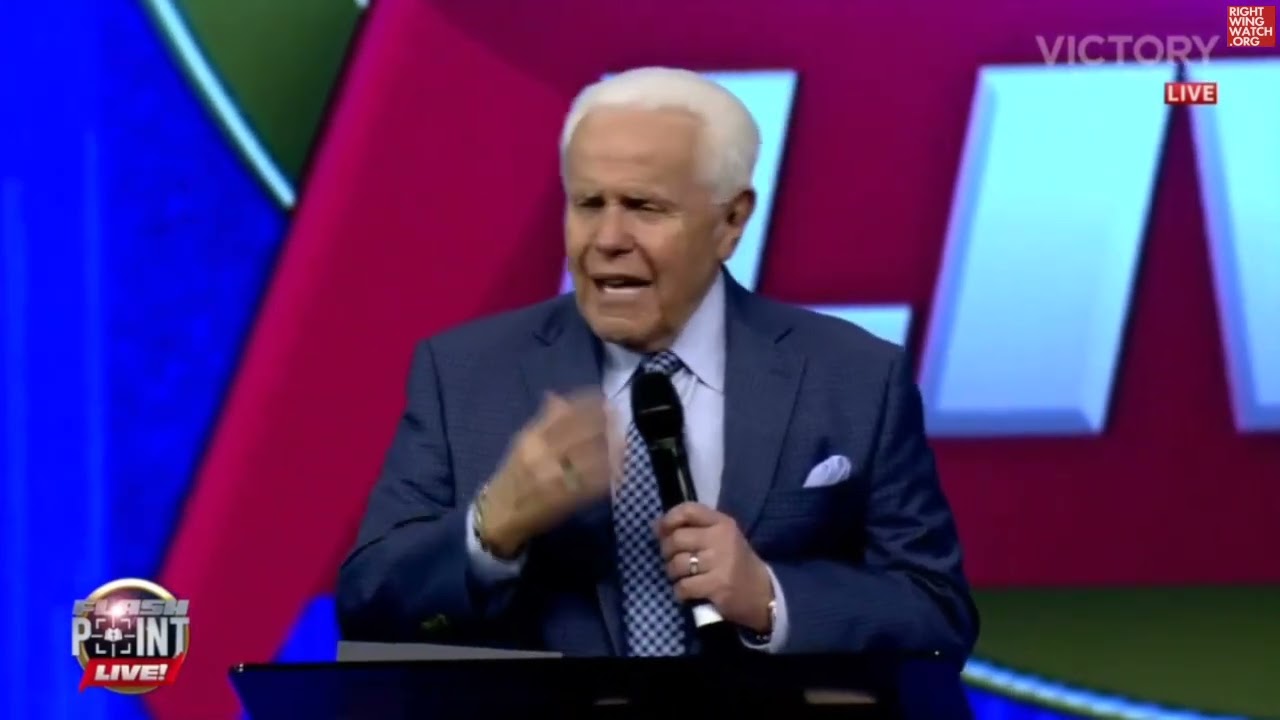 . “He gave a vision to four men way back when when this nation started off. One was George Washington, the first president of the United States. Number two was Alexander Hamilton, the first secretary treasurer of the United States. [Third was] the first chief justice of the Supreme Court, John Jay. And then the fourth president of the United States, James Madison. And through those four men, God gave the vision of America about what they should do.”
“God wanted this vision for this America that he would put his providence in,” Duplantis continued. “Now, the author of the Constitution of the United States is President James Madison, who was the fourth president of the United States. But he had this vision that God placed in him. You see, what they wanted was not a United States of America, they wanted free and independent states so each could do their own thing. Free and independent states.”
“James Madison, who’s called the author of the Constitution, he was supposed to say, ‘We the people of free and independent states.’ That’s the way it was supposed to happen, but God changed the word on the day that he spoke it there for the Constitution. He said, ‘We the people of the United States, in order to form a more perfect union,’ you know, the preamble. So, what happened is God united this United States together on that day under a document called the Constitution of the United States.[vid]
we don’t even know where to begin debunking Duplantis’ claims because nothing that he said makes much sense. First of all, while Washington, Madison, and Hamilton were all delegates to the Constitutional Convention in 1787, John Jay was not. Other than penning five of the 85 essays that came to be known as the Federalist Papers, Jay didn’t play any particularly central role in the Constitution’s construction or ratification.
Duplantis’ confusing assertion that God somehow “changed the words” that James Madison was supposed to speak when creating the preamble to the Constitution makes even less sense, given that the preamble was written by Gouverneur Morris, a delegate from Pennsylvania. The language about “free and independent states” appeared in the Declaration of Independence, and the idea that the delegates to the Constitutional Convention aimed to create a government in which every state “could do their own thing” is precisely the opposite of what was intended.
As Right Wing Watch has explained before:
The creation of a strong central government was precisely what was intended by those who crafted, signed, and ratified the Constitution. Having struggled through the American Revolution and the first years of independence with essentially no federal government under the Articles of Confederation, many Founding Fathers agreed that what was needed was a convention to “render the constitution of the Federal Government adequate to the exigencies of the Union.” The Constitution that arose out of the Constitutional Convention of 1787 was designed to remedy the weakness and diffusion of powers that hampered the federal government under the Articles of Confederation.
Duplantis, like so many other Christian nationalist activists, is willing to exploit the biblical and historical ignorance of his audience by making blatantly false claims and perpetuating the false narratives regarding the founding of this nation because doing so serves to promote the modern-day right-wing political agenda.
That is the reason why Right Wing Watch has repeatedly debunked these lies about the founding of our nation. Duplantis and others have an explicit political goal and seek to bolster their Christian nationalist agenda in order to undermine church-state separation and reverse progress toward equality by insisting that our laws and policies must coincide with their interpretation of the Bible.
Tags: Jesse Duplantis Christian Nationalism FlashPoint
https://kpfa.org/episode/letters-and-politics-april-6-2023/
04.06.23 - 10:00AM
The Century Long PR Campaign to Connect Capitalism to Democracy
Guest: Naomi Oreskes is professor of the history of science at Harvard University. Her books include, The Collapse of Western Civilization: A View from the Future, Merchants of Doubt: How a Handful of Scientists Obscured the Truth on Issues from Tobacco Smoke to Global Warming, and her latest with historian of science and technology Erik Conway, The Big Myth: How American Business Taught Us to Loathe Government and Love the Free Market.
child labor pew sunoco NAM dupont paid for von mises and hayek to come to US u chic; the free mkt pjt blueprint (rewrite road to serfdom, milton does it; lect series wm volker fdn)
little hse on prarie
xian econ, norm v peale; billy g; $ sign of god favor (recycled the gospel? of wealth); commies are godless, thus god likes capitalism
hollywood no more grapes of wrath motion pix assoc w ayn rand; wrote censorship codes not crit bank rich ppl; [sinclair EPIC? ]; CoC
RR: ike ltr to bro sec secure ~ sm# and stupid; GE NY (convicted rig elec mkt) , horatio alger, very pop pgm; RR sends the speech to nixon; libtard bk list ; RR unites social and fiscal conservatives? xian?
1929 ~ libtard
an 9 22
We can thank the late economic justice warrior for her groundbreaking contribution in showing that “positive thinking” is part of a whitewashing of economic inequality.
Although the late Barbara Ehrenreich was best known for her 2001 bestselling book Nickel and Dimed: On (Not) Getting By in America, which chronicled the real-life impacts of the 1996 Welfare Reform Act, she made an equally great contribution to economic justice with her subsequent book exposing the cult of positive thinking.
This article was produced by Economy for All, a project of the Independent Media Institute.
Ehrenreich, who passed away on September 1, 2022, at age 81, had started her professional life with a PhD in cell biology. She didn’t relegate her journalism to mere facts. She delved as deep as she could—to a microscopic level—to make sense of the world. We concluded from Nickel and Dimed that people were not making it in America. But we realized through her book Bright-Sided: How Positive Thinking Is Undermining America that the economy was proceeding unimpeded by this fact because we were putting a smiley face on inequality.
The Great Recession began in 2007. Two years later, in 2009, Ehrenreich published Bright-Sided. Two years after that, in 2011, the Occupy Wall Street (OWS) protests began in New York’s Zuccotti Park and spread throughout the country. OWS participants called damning attention to the stark economic split between the haves and the have-nots, in this case the wealthiest “1 percent” of Americans and the rest of us—the “99 percent.” There was no putting a smiley face on the economy in that moment.
It was during this period that I had the honor of interviewing Ehrenreich. She explained that “there is a whole industry in the United States that got an investment in this idea that if you just think positively, if you expect everything to turn out alright, if you’re optimistic and cheerful and upbeat, everything will be alright.”
Ehrenreich, who survived cancer, said she began her investigation into the ideology of positive thinking when she had breast cancer, roughly six years before Bright-Sided was published. That’s when she realized what a uniquely American phenomenon it was to put a positive spin on everything, even cancer.
When she looked for online support groups of other women struggling with cancer, what she found was, “constant exhortations to be positive about the disease, to be cheerful and optimistic.” Such an approach obscures the central question of, “why do we have an epidemic of breast cancer?” she said.
She applied that idea to how positive thinking was obscuring questions of economic inequality.And she found that there was an entire industry built up to assure financially struggling Americans that their poverty stemmed from their own negative thinking and that they could turn things around if they simply visualized wealth, embraced a can-do attitude about their bleak futures and willed money to flow into their lives. Central to this industry are “the coaches, the motivational speakers, the inspirational posters to put up on the office walls,” and more, said Ehrenreich.
She also connected the rise of the American megachurch to the rising cult of the positive-thinkers. “The megachurches are not about Christianity. The megachurches are about how you can prosper because God wants you to be rich,” she said.
Joel Osteen, the pastor of a Houston-based megachurch, is perhaps one of the best-known leaders of the so-called prosperity gospel. In one of his sermons—conveniently to reach a maximum audience—Osteen claims that according to “the scripture,” “the wealth of the ungodly is laid up for the righteous,” and that “it will be transferred into the hands of the righteous.” His congregants may be tempted to imagine bank transfers from wealthy atheists magically pouring into their accounts.
Osteen has been the beneficiary of serious wealth transfers from his own congregants into his pockets, so much so that he can afford to live in a $10 million mansion. There’s no conundrum here, for Osteen is living proof to his followers that the power of positive thinking works.
Ehrenreich pointed out that the whole point of these churches is to create a positive experience for their congregants and to project a notion of exciting possibilities. The megachurch phenomenon is centered on “the idea that the church should not be disturbing. You don’t want to have a negative message at church. So that’s why you won’t even find a cross on the wall.”
Perhaps this is because the image of a bloodied, half-naked Jesus Christ nailed by his hands and feet to a wooden cross is just too painful to bear and might detract from dreams of future Ferraris and private jets. “What a downer that would be!” exclaimed Ehrenreich.
Where did the cult of positive thinking originate? “American corporate culture is saturated with this positive thinking ideology,” especially in the 1990s and 2000s, said Ehrenreich. “It grew because corporations needed a way to manage downsizing, which really began in the 1980s.”
Businesses that laid off masses of employees had a message that Ehrenreich encapsulated as, “you’re getting eliminated… but it’s really an opportunity for you. It’s a great thing; you’ve got to look at this positively. Don’t complain, don’t be a whiner, you’re not a victim, etc.”
Such sentiments percolated into the mainstream. Americans internalized the idea that losing one’s job has got to be a sign that something better is coming along and that “everything happens for a reason.” The alternative is to blame one’s employer, or even the design of the U.S. economy. And that would be dangerous to Wall Street and corporate America.
Another purpose of fostering positive thinking among those who are laid off is, as per Ehrenreich, “to extract more work from those who survive layoffs.” Indeed, we have an ugly culture of overwork in the U.S., with corporate employees having normalized the idea that they need to work insanely late hours, work on the weekends, and take on exhaustive amounts of responsibilities. After all, those who remain employed, unlike their laid-off former colleagues, ought to feel lucky to have a job—more positive thinking.
There may be a breaking point now, one that Ehrenreich thankfully lived to see, as a newer set of phenomena began emerging since the COVID-19 pandemic began. They include the “great resignation,” a term for masses of Americans quitting thankless jobs. And, more recently, “quiet quitting,” which is a new name for an older union-led idea of “work to rule” as workers are starting to only put in the hours they are paid to work and no more. How novel!
We owe Ehrenreich a debt of gratitude for shining a light not only on the perversity of the U.S. economic system but also on the gauzy veil of positive thinking that obscures the obscenity. Ehrenreich may not have lived to see her ideas of economic justice be fully realized. But, as she once told the New Yorker, “The idea is not that we will win in our own lifetimes and that’s the measure of us but that we will die trying.”
Author Bio: Sonali Kolhatkar is the founder, host and executive producer of “Rising Up With Sonali,” a television and radio show that airs on Free Speech TV and Pacifica stations. She is a writing fellow for the Economy for All project at the Independent Media Institute.
https://www.alternet.org/2021/02/self-proclaimed-prophets/
Within evangelical Protestant Christianity, it isn't hard to find self-proclaimed "prophets" who are known for making political predictions. Journalist Ruth Graham takes a look at the growth of such "prophets" in an article published by the New York Times this week, stressing that some of them have turned out to be way off in their predictions.
"In recent years, self-described prophets have proliferated across the country, accelerating in stature over the course of the Trump era," Graham explains. "They are stars within what is now one of the fastest-growing corners of Christianity: a loose but fervent movement led by hundreds of people who believe they can channel supernatural powers — and have special spiritual insights into world events."
Such "prophets," according to Graham, are likely to promote political conspiracy theories.
"Many are independent evangelists who do not lead churches or other institutions," Graham observes. "They operate primarily online and through appearances at conferences or as guest speakers in churches, making money through book sales, donations and speaking fees. And they are part of therising appeal of conspiracies in Christian settings, echoed by the popularity of QAnon among many evangelicals and a resistance to mainstream sources of information."
Graham points to 33-year-old Jeremiah Johnson as one of the many "self-described prophets" who predicted that President Donald Trump would be reelected in 2020 — only to be embarrassed when Joe Biden, now president of the United States, defeated him. Other evangelical "prophets," according to Graham, predicted that the COVID-19 pandemic would be long gone by April 2020.
"So many prominent prophets had incorrectly predicted the reelection of Mr. Trump that the apologies and recriminations now constitute a crisis within the movement," Graham notes.
It is within evangelical Protestant Christianity specifically that the "prophet" phenomenon has caught on in such a big way. Evangelicals are distinct from Mainline Protestants, who range from Lutherans to Episcopalians to the African Methodist Episcopal Church. While evangelicals have strict fundamentalist views and believe that salvation can only come through Christianity, Mainline Protestants tend to be more accepting of non-Christian faiths and are more likely to engage in interfaith activities.
Trump is wildly popular in the far-right White evangelical movement, and Graham notes that Johnson received death threats after Biden won the election and he admitted to being wrong about Trump winning a second term.
After Biden was declared the winner, Johnson made an official statement and told his followers, "I was wrong. I am deeply sorry, and I ask for your forgiveness. I would like to repent for inaccurately prophesying that Donald Trump would win a second term as the President of the United States."
FROM YOUR SITE ARTICLES
- Stretching to Make Trump 'God's Guy': 25 Religious Right ... ›
- Trump's 'Christian Policy Adviser' Takes the Cake, Claims He's a ... ›
- How a growing Christian movement of self-proclaimed 'prophets ... ›
RELATED ARTICLES AROUND THE WEB
- The God-proclaimed and the Self-proclaimed | Adventist World ›
- How self-proclaimed 'prophets' from a growing Christian movement ... ›
- How self-proclaimed 'prophets' from a growing Christian movement ... ›
schmucks // losers? cohen
https://www.alternet.org/2020/09/trump-detests-christians-and-he-deceived-pastors-and-mocked-them-after-they-left-trump-tower-michael-cohens-disloyal/
Michael Cohen’s book about his years as Donald Trump’s fixer is a clarion call to Christians to wake up and recognize that the man many of them revere as a heavenly agent is a religious fraud who loathes them and mocks their faith.
In Disloyal, published today, Cohen shows how Trump is a master deceiver. He quotes Trump calling Christianity and its religious practices “bullshit,” soon after he masterfully posed as a fervent believer. In truth, Cohen writes, Trump’s religion is unbridled lust for money and power at any cost to others.
“Can you believe that people believe that bullshit,” Trump said after pastors prayed over him.
Cohen’s insider stories add significant depth to my own documenting of Trump’s repeated and public denouncements of Christians as “fools,” “idiots,” and “schmucks."
in extensive writing and speeches, Trump has declared that his life philosophy is “revenge.” That stance is aggressively anti-Christian. So are Trump’s often publicly expressed desires to violently attack others, mostly women, and his many remarks that he derives pleasure from ruining the lives of people over such minor matters as declining to do him a favor.
Cohen reinforces these facts with new anecdotes about Trump’s utter disregard for other people and his contempt for religious belief. Cohen’s words should shock the believers who were critical to his becoming president, provided they ever read them. By denouncing the book Trump has ensured that many of those he has tricked into believing he is a deeply religious man will never fulfill their Christian duty to be on the lookout for deceivers.
None of the evangelicals I have interviewed in the past five years knew that in writing Trump has denounced their beliefs and written of the communion host as “my little cracker.”
Trump Detests Christianity
Despite the irrefutable evidence that Trump detests Christianity and ridicules such core beliefs as the Golden Rule and turning the other cheek, America is filled with pastors who praise him to their flocks as a man of god. outside the White House to imply he was chosen by god.
Pastors who support Trump were scolded two years ago by Christianity Today, a magazine founded by Billy Graham, for not denouncing Trump as “profoundly immoral.” Many evangelical pastors then attacked the magazine rather than following the Biblical incantation to examine their own souls.
Cohen writes that as a young man who grew up encountering Mafioso and other crooks at a country club he fell into the “trace like spell” of Trump, whom he describes as an utterly immoral, patriarchal mob boss and con man. Cohen says he was “an active oparticipant” in everything from Trump getting “golden showers” in Las Vegas to corruopt deals with Russian officials.
Trump is “consumed by the worldly lust for wealth and rewards,” Cohen writes, which puts him at odds with the teaching of Jesus Christ about what constitutes a good life.
“Places of religious worship held absolutely no interest to him, and he possessed precisely zero personal piety in his life,” Cohen writes.
Prosperity Gospel Embraced
Cohen explains that the only version of Christianity that could possibly interest Trump is the “prosperity gospel.” That is a perverse belief that financial wealth is a sign of heavenly approval rooted in 19^th Century occult beliefs that is anathema to Christian scripture.
Many actual Christians regard the prosperity gospel as evil. The evangelical magazine founded by Billy Graham, Christianity Today, calls it “an aberrant theology” promoted by such disgraced televangelists including Jimmy Swaggart and Jim and Tammy Baker.
Early in Trump’s aborted 2012 presidential campaign, Cohen writes, he was ordered to reach out to faith communities. Soon Paula White, now the White House adviser on faith, proposed a meeting at Trump Tower with evangelical leaders. Cohen writes that Trump liked White because she was blonde and beautiful.
Cohen said that among those attending were Jerry Falwell Jr., who recently resigned in disgrace as head of Liberty University, and Creflo Dollar, who corporate jet and who was criminally charged that year with choking his daughter. Dollar said those charges were the work of the devil.
Once the evangelical leaders took their seats, Cohen writes, Trump quickly and slickly portrayed himself as a man of deep faith. Cohen writes that this was nonsense.
Laying on Hands...
==
**Kenneth Copeland, Prosperity Preacher and Dominionist, Dines With Trump at White House**
==
cf my latina student gen zero
see self-help cat
see prosperity gospel
goes back to ben franklin, parodied in gatsby?
american reinvention // exceptionalism? rules/ past do not apply, structural forces do not matter, can be overcome with hard work/ will aha
we do not need social safety net if we have amway, power of pos thinking, we are a winner
extractive of family/friends
==
no lnx
Evangelist Benny Hinn renounces the ‘prosperity gospel’ in a stunning reversal: ‘I’m done with it‘
Written by Raw Story September 6, 2019
Christian televangelist and faith healer Benny Hinn has long been known as one of the most vocal proponents of the “prosperity gospel.” But now, he’s publicly renouncing the teaching, the Christian Post reports.
During a live broadcast posted to his Facebook page this Monday, Hinn declared that the Gospel “is not for sale.”
“I’m sorry to say that prosperity has gone a little crazy and I’m correcting my own theology and you need to all know it,” Hinn said. “Because when I read the Bible now, I don’t see the Bible in the same eyes I saw 20 years ago.”
“I think it’s an offense to the Lord,” Hinn continued. “It’s an offense to say give $1,000. I think it’s an offense to the Holy Spirit to place a price on the Gospel. I’m done with it. I will never again ask you to give $1,000 or whatever amount, because I think the Holy Ghost is just fed up with it.”
To the roaring approval of the audience, Hinn went on to say that his former teaching “hurts the Gospel,” adding that he was “making this statement for the first time in my life and frankly, I don’t care what people think about me anymore.”
“When they invite me to telethons, I think they will not like me anymore. …If I hear one more time, break the back of debt with $1,000, I’m gonna rebuke them,” he said. “I think that’s buying the Gospel. That’s buying the blessing. … If you are not giving because you love Jesus, don’t bother giving. I think giving has become such a gimmick — it’s making me sick to my stomach.”
:{
}:
The “prosperity gospel” is usually understood as a series of teachings that say believers will be rewarded with health and wealth as long as they give monetary offerings to their churches and pastors.
:{
}:
The teaching of the prosperity gospel is the least of the famed evangelist’s controversies. Hinn is also known for his “faith healing” church services, where he puts on massive displays showing faithful (and arguably complicit) congregants being knocked over by the power of the Holy Spirit delivered from Hinn’s hands. It’s a spectacle that Hinn has continuously utilized over the years to help his ministry bring in an estimated $100 million annually, primarily from donations.
Watch an excerpt of Hinn’s words below:
AN 919
==
AN
...
Regarding the prosperity gospel, Fea cites the work of historian Kate Bowler, writing, “Prosperity preachers teach that faith in God combined with positive thinking and an optimistic attitude will ultimately lead to monetary wealth, good health, and victory over the difficult circumstances of life.” His broader background descriptions are adequate, but his focus on one figure, Paula White, who has a long history with Trump, is not fleshed out much.
:{
}:
Fea mentions but does not elaborate on Trump’s youthful experience hearing sermons from Norman Vincent Peale, author of “The Power of Positive Thinking,” and never delves into how Trump’s own business practices have reflected the influence of such figures, such as this 2011 New York magazine story about Trump’s multi-level vitamin marketing scheme. The prosperity gospel is the utmost in individualism, while at the same time relying on a powerful and persuasive social environment, which Fea’s analysis does not include.
....
https://www.alternet.org/heres-how-philosophers-selfishness-came-use-christianity-their-cover-story
a marcotte
Anyone who has worked in the restaurant business will be happy to tell you that waiters always fight each other to avoid working Sunday lunch shift. Not because they want to sleep in, but because it’s a widespread belief that the post-church crowd is loud, demanding and unwilling to tip appropriately. In the food service industry, “Christian” is synonymous with “selfish.”
Unfair stereotype? Probably. Big groups, regardless of affiliation, tend to tip poorly. More to the point, waiters probably remember the bad Christian tippers more because the hypocrisy is so stunning. The image of a man piously preening about what a good Christian he is in church only to turn around and refuse the basic act of decency that is paying someone what you owe them perfectly symbolizes a lurking suspicion in American culture that the harder someone thumps the Bible, the more selfish and downright sadistic a person he is. And that perception—that showy piety generally goes hand in hand with very un-Christ-like behavior—is not an urban myth at all. On the contrary, it’s the daily reality of American culture and politics.
Bill Maher recently had a rant on his show that went viral addressing this very issue, bad tippers who leave sermons or notes scolding waiters instead of paying them what they’re owed. His larger point is a much more important one: It’s absolutely disgusting how the politicians who make the biggest show of how much they love Jesus would be the first in line to bash him if he returned with a message of clothing the naked and feeding the poor. The Jesus of the Bible multiplied the loaves and fishes. His loudest followers these day gripe about feeding people, claiming it creates a “culture of dependency.” They may even comb through the Bible to take quotes out of context to justify their selfishness toward the poor, as Rep. Steven Fincher did when he claimed the Bible says, “The one who is unwilling to work shall not eat.” The fact that those jobs are unavailable didn’t give him a moment’s pause when suggesting this very un-Christ-like plan to his fellow Americans.
There are plenty of progressive Christians who genuinely try to live out Jesus’ command to love your neighbor as yourself, described in the Bible as the root of Jesus’ entire philosophy. That said, statistics bear out the sense that people who are more invested in being perceived as pious also embrace the most selfish policies. Self-identified conservatives and Republicans claim go to church regularly at twice the rate of self-identified liberals. People who go to church more than once a week are far more conservative than the rest of the population. Indeed, the research suggests how often you report being in the pews is the most reliable indicator of how you’re going to vote. (Though it may not be a reliable indicator of how often you actually go to church. In the grand tradition of showy piety, people who claim to be avid church-goers often lie about it to pollsters.)
The attempts to reconcile the correlation between displays of piety and support for selfish policies get complex on the right, with conservatives often arguing that hating your neighbor at the voting booth doesn’t count because church charities supposedly make up for it. (They don’t.) In reality, the relationship between Christian piety and support for selfish policies is fairly straightforward. It’s not that being Christian makes you conservative. It’s that being conservative makes being a loud and pious Christian extremely attractive.
Without Christianity, the underlying mean-spiritedness of conservative policies is simply easier to spot. Without religion, you’re stuck making libertarian-style arguments that sound like things cackling movie villains would say, like Ayn Rand saying civilization should reject “the morality of altruism.” Since Christianity teaches altruism and generosity, it provides excellent cover for people who want to be selfish, a sheep’s clothing made of Jesus to cover up the child-starving wolf beneath. Since Christians are “supposed” to be good people, people who really aren’t good are lining up to borrow that reputation to advance their agenda.
The fact that conservatism causes obnoxious Christian piety in American culture is most obvious when looking at some of the theological developments that have accrued since the philosophers of selfishness decided to use Christianity as their cover story. The “prosperity gospel” that has developed in recent years is a classic example.
The prosperity gospel teaches, to be blunt, that you can tell how much God favors you by how rich you are. While some on the Christian right reject this idea as a tad crude, it’s still wildly popular and its adherents, like Oral Roberts, are some of the major architects and organizers for the Christian right. It’s a perfect example of how conservative ideology leads to pious Christianity. People want to believe that the rich are better than everyone else and the poor don’t deserve squat, so they find a way to blame God for it rather than own their own greed and selfishness.
Pope Francis may be entirely sincere when he says he wants Catholic clergy to deemphasize the right-wing political pandering in favor of highlighting values that are more in line with liberalism, such as compassion and generosity to the poor, but the odds are slim of this message making inroads with church leaders in the United States. The church needs conservatives who need to believe they’re good and holy people despite their selfish beliefs. Without them, who will show up and tithe? Liberals? Most of them are sleeping in on Sundays, secure that their commitment to social justice makes them good people regardless of how visibly pious they are.
The fact of the matter is that the purposes religion serves in America are shrinking in number. Our cultural identity is increasingly shaped by pop culture, not faith or ethnic identity. Our holidays are more about shopping and having a chance to catch up with far-flung family these days, not showing devotion to a deity. Spiritual needs are often addressed through modern means like psychotherapy and self-help. People build communities through hobbies and interests more than through faith communities bound by geography, ethnicity and family.
Increasingly, the only thing religion has left to justify itself is that it provides cover for people who want to have bigoted, selfish beliefs but want to believe they are good people anyway. As these social trends continue, we can expect the alignment between public piety and grotesquely selfish political beliefs to get worse, not better.
AN the conversation? 10/18
2. Christian movements and their legacy
A question that could be asked is: What appeal does President Trump hold for an evangelical Christian base, given that, as Boston University’s Christopher Evans says, he “does not demonstrate any of the beliefs that have historically characterized evangelicalism.” Trump, for example, “does not speak about the centrality of the Bible or, like Ronald Reagan and George W. Bush, of being ‘a born again’ Christian.”
A 19th-century movement known as New Thought, argues Evans, might provide an answer. According to Evans, New Thought ideas about individual happiness and wealth were later brought together in a movement called the prosperity gospel. Theprosperity gospelspread the belief that religious faith can lead one to personal health and material wealth.
Norman Vincent Peale, who Trump cites as his “major religious influence,” further fused some of these beliefs. Peale believed that only in a free-market society could Christianity thrive. In this view of Christianity, Evans says, “personal weakness or failure,” is not an option. Peale also believed in a pro-Christian nationalism – all of which are also at the heart of Trump’s beliefs, Evans argues.
As Evans points out, Trump’s minister, Paula White, a prosperity gospel preacher, said in her invocation at the president’s inauguration, “We recognize that every good and every perfect gift comes from you and the United States of America is your gift, for which we proclaim gratitude.” These assertions, as Evans notes, are consistent with Trump’s faith.
==
AN
2. Christian movements and their legacy
A question that could be asked is: What appeal does President Trump hold for an evangelical Christian base, given that, as Boston University’s Christopher Evans says, he “does not demonstrate any of the beliefs that have historically characterized evangelicalism.” Trump, for example, “does not speak about the centrality of the Bible or, like Ronald Reagan and George W. Bush, of being ‘a born again’ Christian.”
A 19th-century movement known as New Thought, argues Evans, might provide an answer. According to Evans, New Thought ideas about individual happiness and wealth were later brought together in a movement called the prosperity gospel. Theprosperity gospelspread the belief that religious faith can lead one to personal health and material wealth.
Norman Vincent Peale, who Trump cites as his “major religious influence,” further fused some of these beliefs. Peale believed that only in a free-market society could Christianity thrive. In this view of Christianity, Evans says, “personal weakness or failure,” is not an option. Peale also believed in a pro-Christian nationalism – all of which are also at the heart of Trump’s beliefs, Evans argues.
As Evans points out, Trump’s minister, Paula White, a prosperity gospel preacher, said in her invocation at the president’s inauguration, “We recognize that every good and every perfect gift comes from you and the United States of America is your gift, for which we proclaim gratitude.” These assertions, as Evans notes, are consistent with Trump’s faith.
newsweek no lnx
HURRICANE HARVEY
JOEL OSTEEN
PRESIDENT DONALD TRUMP
THEOLOGY
CHRISTIANITY
Joel Osteen has faced a storm of criticism since Hurricane Harvey hit Texas.
The Houston televangelist came under fire after the hurricane dumped 27 trillion gallons of rain on Texas, leaving tens of thousands homeless. Commentators slammed Osteen for delaying the opening of his 16,800-seater megachurch to flood refugees until four days after the storm made landfall.
Much of the anger focused on Osteen’s own wealth, which has been estimated north of $40 million.
...
But Osteen was not fazed. The 54-year-old preacher said he had been a victim of a “misinformation” campaign and encouraged victims of Harvey to turn to their faith for solace.
As pastor of the United States’s biggest church—Lakewood reportedly has a weekly attendance of more than 40,000—Osteen is used to coming under scrutiny. And as one of the best-known proponents of a controversial brand of Christianity known as prosperity theology, or the prosperity gospel, Osteen is no stranger to receiving flak, both from inside and outside Christian circles.
Joel Osteen
Joel Osteen, the pastor of Lakewood Church in Houston, conducts a service as the city starts the process of rebuilding after severe flooding during Hurricane Harvey in Houston, Texas, on September 3.
JOE RAEDLE/GETTY
Prosperity theology has been characterized as the theological equivalent to the American Dream. The essence of the prosperity gospel is simple: Faith brings rewards, not only in the afterlife—as taught in all mainstream forms of Christianity—but also in the earthly life. These rewards can take the form of health, career success, and, most controversially, wealth.
Read more: “We’ve got the White House on speed dial.” How evangelicals are influencing Trump]
The movement grew out of 20th-century U.S. televangelism, among other influences. Preachers such as Oral Roberts and William Branham led major revivals across the country in the mid-1900s. The revivals would be spectacular events, including healings and promises of well being. John Osteen, the father of Joel, was part of this movement and founded Lakewood Church in 1959; Joel would succeed his father as pastor.
Osteen has previously denied being a prosperity preacher in the sense of wealth. “If prosperity means God wants us to be blessed and healthy and have good relationships, then yes, I’m a prosperity teacher. But if it’s about money, no, I never preach about money,” said Osteen in an interview with the Christian Broadcasting Network (CBN). Newsweek reached out to Lakewood and Joel Osteen Ministries for an interview with Osteen, but received no response.
Joel Osteen
?
@JoelOsteen
You don’t grow in the good times, you grow in the tough times. Watch this encouraging message from Joel: http://ow.ly/h5Mw30eV3TK
5:46 AM - Sep 5, 2017
6,517
But experts disagree. Kate Bowler, an expert on prosperity theology, tells Newsweek that Osteen falls into the category of “soft prosperity preachers,” who focus on positive thinking as a means to achieve one’s life ambitions, including wealth. But, according to Osteen’s theology, “life’s circumstances still depend on a believer’s use of faith,” says Bowler, a professor at Duke Divinity School in North Carolina and author of Blessed: A History of the American Prosperity Gospel.
Anthea Butler, associate professor of religious studies at the University of Pennsylvania, is more forthright. “At best he’s a motivational speaker. He’s in the line of Norman Vincent Pealeand others who tell you how to live your best life now, God’s going to bless you if you do certain things. He’s prosperity gospel through and through,” Butler tells Newsweek.
Perhaps Osteen should not be shy to admit his fondness for prosperity theology, since it appears to be popular with believers. While evangelical leaders have renounced it—a 2011 Pew Research Center report found that 90 percent of global evangelical leaders rejected the notion that God would grant health and wealth to those with enough faith—that does not appear to be the case among ordinary believers. A 2006 Pew survey found that 46 percent of U.S. Christians agreed that God grants believers material prosperity, while 56 percent thought believers would be rewarded with good health. Among Pentecostal Americans, the figures were even higher, at 66 percent for wealth and 68 percent for health.
Lakewood Church
Parishioners of Lakewood Church led by Pastor Joel Osteen pray together during a service in Houston, Texas on September 3. The bill, released today, would allow churches to endorse political candidates by curtailing the so-called Johnson Amendment.
JOE RAEDLE/GETTY
One person with whom the prosperity gospel appears to have found a home is President Trump. The Trump family attended Marble Collegiate Church in New York City, where the pastor was Norman Vincent Peale, author of The Power of Positive Thinking, a 1952 book that sold millions and was translated into more than a dozen languages. Trump has cited Peale as a mentor, telling the Iowa Family Leadership Summit in 2015 that he could listen to Peale “all day long. And when you left the church, you were disappointed it was over. He was the greatest guy.”
The presidential board of evangelical advisers, convened by Trump in 2016 to help him (successfully) court the religious right vote, also comprises of several high-profile prosperity preachers. Trump’s closest spiritual adviser, Paula White, the pastor of a Florida megachurch and popular Christian commentator, is one. White told an audience at a 2007 event: “Anyone who tells you to deny yourself is from Satan.”
Kenneth Copeland, another Texas televangelist, teaches that “financial prosperity is God’s will for you” and that believers should pray for financial provision from God. (Osteen is not on the board and never officially endorsed Trump’s presidential bid, though he did describe Trump as a “friend of our ministry” and “a good man.”)
Trump’s mantra of making America great again, which emphasizes American exceptionalism; his championing of his own personal wealth; and his connections to Pentecostal prosperity theology make him the “first American president whose only religious impulses arise from the American prosperity gospel,” said Bowler in a May lecture. “Trump is, in short, the prosperity gospel’s religious trifecta,” she said.
Trump day of prayer declaration
President Donald Trump, Vice President Mike Pence and faith leaders say a prayer September 1 during the signing of a proclamation to declare Sunday, September 3, as a National Day of Prayer for people affected by Hurricane Harvey.
In religious circles, prosperity theology has long been controversial for seeming to equate poverty with falling out of God’s favor and apparently contradicting outright many biblical verses. (The Beatitudes, a key segment of Jesus’s teaching, begins : “Blessed are you who are poor, for yours is the Kingdom of God.)
But according to some experts, the theology also has political ramifications. Paul Djupe, associate professor at Denison University specializing in religion and politics, says that the ideas behind the prosperity theology—that an individual is responsible for their socioeconomic status, and that financial well being is an indicator of goodness—have permeated Republican politics. “It can be found in the anemic support for welfare and the safety net, weak support for regulations on business, weak support for organized labor,and positive feelings toward the wealthy,” Djupe tells Newsweek via email.
Butler, who recently penned a New York Times editorial on Osteen’s reaction to Harvey, says that prosperity theology leaves little room for compassion for the marginalized. She cites Trump’s recent decision to scrap the Deferred Action for Childhood Arrivals (DACA) scheme—which protects some 800,000 undocumented immigrants born or raised in the United States—as an example. Trump previously said that he had a “big heart” for those protected by DACA and has tried to calm fears of those under the scheme since its rescinding was announced.
DACA protest
Immigrants and supporters march past the Metropolitan Detention Center in Los Angeles as undocumented people jailed inside tap on the windows in opposition to President Donald Trump's order to end DACA on September 5. Around 800,000 undocumented immigrants, known as DREAMers, benefit from immigration protections under DACA.
“You make a decision based on the fact that there’s 800,000 people here who have only known America as their own country. So he can’t have compassion for them and let them stay in?” says Butler. “That’s part of the problem with these [prosperity gospel] people: they’re rigid, they’re unbending, they believe that their success is based on the fact that they have followed this formula. As we all know, sometimes formulas don’t work.”
In the wake of Harvey, Osteen and Trump were perhaps the two public figures who came in for most scrutiny. (Trump was criticized for not visiting victims during an initial visit to Texas, which he rectified on a later second visit.) But given prosperity theology’s denunciation of negative thoughts and exaltation of the positive, the criticism is unlikely to have any lasting impact.
“Trump and Osteen are really two sides of the same coin,” says Butler. “They’re both selling the same thing. They’re selling their success, their wealth: ‘You can do it too if you just pay attention to me.’”
==
https://www.alternet.org/news-amp-politics/why-are-poor-whites-more-depressed-and-pessimistic-poor-african-americans
AN alex anderson
Carol Graham appeared on Charles Ellison’s “Reality Check” program on WURD AM/FM (a liberal/progressive African-American talk radio station in Philadelphia) and discussed theemotional differences between poor blacks and poor whites. It was a fascinating conservation: according to Graham’s research, poor African-Americans in the United States are, on the whole, more optimistic than poor whites—who Graham described to Ellison as being much more likely to fall into despair. As worried as the African-American community is by the Trump Administration and its horrible policies, Graham finds poor whites to be in a much worse state emotionally and are decidedly more pessimistic.
WURD callers, mostly African-Americans living in Philadelphia, offered different views on Graham’s findings. Some asserted that formerly middle-class whites who fell into poverty during the Great Recession were ill-equipped, emotionally, to handle the types of economic struggles African-Americans have been facing all these years. But another explanation for Graham’s findings is that poor whites—whether they became the neo-poor during the Great Recession or were poor long before that—are much more likely to have been thoroughly indoctrinated into right-wing Republican ideology, especially in Republican-dominated areas of the U.S. And as a result, they feel a certain self-hatred and blame themselves for their economic misfortunes in a way that poor African-Americans don’t. Poor whites (especially the ones based in rural areas or small towns) and poor African-Americans often live in very different worlds—and everything from the media outlets they embrace to the churches they attend to the music they listen to is likely to affect whether they view the poor as morally deficient or as people who have been seriously screwed over.
As much as right-wingers like to whine about the mainstream media having a liberal bias—which, for the most part, it doesn’t—the fact is that right-wing media is vast, from Fox News to white AM talk radio to Breitbart, Townhall, the Weekly Standard and countless other high-traffic wingnut websites. And theright-wing media has invested considerable time and energy in teaching that the poor are useless freeloaders living off the sweat, hard work and innovation of the rich (who Rush Limbaugh calls “the achievers”). Rural whites who have been bombarded with decades of poor-bashing from Fox News and white talk radio are bound to take that message to heart and view themselves as moral failures if they are not doing well financially. The overall message at an African-American talk radio station like WURD is totally different from what one hears on Limbaugh’s show. From the local programming that dominates the station to the Rev. Al Sharpton’s syndicated program, “Keeping It Real,” Donald Trump’s presidency and the Republican Party are painted in a consistently negative light on WURD—and the poor are not painted as parasites or leeches by any means, but as people who have been screwed over by crony capitalism and a rigged game. While WURD callers often sound angry and frustrated over the political climate in the Trump era, the anger doesn’t sound like self-hatred or self-blame. Sharpton and Ellison will encourage education, self-improvement and job training, but in a way that uplifts rather demonizes or belittles the poor.
Christianity comes in wildly different forms in the U.S., where white fundamentalist megachurches often have a very different view of economics than African Methodist Episcopal (AME) denominations. The Christian Right, white megachurches and fundamentalist Pentecostals typically embrace the so-called “prosperity gospel,” which teaches that the rich are blessed with affluence because of their moral superiority and that the poor are poor because of their immoral, sinful ways. But in black AME churches, one often hears that it is a Christian’s duty to feed the poor and help the homeless—and one is more likely to hear Jesus Christ quoted as saying, “It is easier for a camel to fit through the eye of a needle than for a rich person to enter the kingdom of heaven.”
In AME churches, the burden of proof is usually on the rich rather than the poor. So, if an African-American in an AME congregation graduated from the University of Pennsylvania’s medical school or law school and has a six-figure income, that’s all well and good—but they’re still encouraged to roll up their sleeves and do some volunteer work in a homeless shelter because that’s their duty as a Christian. The prosperity gospel is viewed as wrong-headed and unchristian in many black AME congregations.
Liberal AME pastors view Jesus Christ as an advocate for the poor and the downtrodden. To right-wing white megachurches, Jesus hates the poor and spits in their faces.
Musicis another way in which poor whites and poor blacks can receive radically different messages. The fact that Kanye West said some favorable things about President Trump earlier this year was controversial in the hip-hop community, where Immortal Technique, Public Enemy, Ice-T, KRS-1, Paris, N.W.A, Ice Cube and countless other rappers have been known for their left-of-center views. But modern country-rock is full of right-wing activists who think former Alaska Gov. Sarah Palin represents “the real America.” The Dixie Chicks became pariahs in the country music community after Natalie Maines criticized President George W. Bush and the Iraq War in 2003; Maines found out the hard way that being openly liberal can seriously damage one’s career in country music.
The message poor blacks are receiving is that poverty is the result of injustice and the failures of crony capitalism. The message many poor whites are receiving is that if you’re poor, you’re a loser and a parasite. Of course, Jay-Z, Chance the Rapper and other hip-hop stars attract racially diverse audiences and have plenty of white fans. And as many liberals and progressives as there have been in hip-hop, conservative rappers are not nonexistent. But on the whole, the poor receive a lot more emotional support in hip-hop than they do in modern country music. And even though hip-hop has plenty of imagery of bling and Benzes while modern country music likes to portray itself as music of the common man, hip-hop—at the end of the day—tends to view the poor in a much more compassionate and favorable light.
With so many poor whites being demonized whether they’re turning on Fox News, going to a megachurch or hearing their favorite country-rock stars urging them to vote Republican and support President Trump’s agenda, it’s no wonder that so many of them have fallen into despair, hopelessness and self-hatred.
==