Berezow
new 819 see acsh
pow
tag https://usrtk.org/tag/alex-berezow/
see entine chemophobia scam
Alex Berezow is the Vice President of Scientific Affairs of the American Council on Science and Health.[1]
EXTERNAL LINKS
Desmog Blog, page on American Council on Science and Health[2]
BMJ article on American Council on Science and Health[3]
US Right to Know, page on American Council on Science and Health[4]
SOURCES
- ↑ American Council on Science and Health, [1], organizational website, accessed March 2019.
- ↑ Desmog Blog, American Council on Science and Health, Accessed March 2019 https://www.desmogblog.com/american-council-science-and-health
- ↑ BMJ, Lobby Watch: American Council on Science and Health Accessed March 2019
- ↑ The American Council on Science and Health is a Corporate Front Group, Accessed March 2019 https://usrtk.org/hall-of-shame/why-you-cant-trust-the-american-council-on-science-and-health/
https://www.prwatch.org/news/2019/01/13440/corporate-front-group-american-council-science-and-health-smears-list-its-enemies
he industry front group American Council on Science and Health (ACSH) has created a clunky new website containing an intriguing list of its enemies.
You may find a few folks you know vilified there.
DeniersForHire.com was created in 2016, according to a proxy-cloaked WHOIS listing. The site was funded by ACSH and edited by Cameron English, who currently works for the Genetic Literacy Project (GLP). GLP is another industry front group, run by chemical company PR agent Jon Entine, who has long partnered with ACSH to defend the agrochemical industry. Entine blogs frequently on the ACSH site.
The "deniers" site hyperbolically states as its goal "to expose and neutralize anti-science activist threats to humanity" and features profiles of those who have been thorns in the side of the chemical industry and related groups: scientists, journalists, lawyers, policy experts, and non-profits. Among the "threats to humanity" is New York Times Pulitzer Prize-winning reporter Eric Lipton.
On the site, ACSH adopts language used by pro-science, consumer, and environmental groups to smear pro-science, consumer, and environmental groups. The term "deniers," for instance, invokes the phrase "climate change denier."
The website also calls the Center for Media and Democracy (CMD) a "dark money group"even though the group spends zero money in campaigns and elections. It calls the Organic Consumers Association -- which has long pushed for strict organic standards disavowing GMOs, radiation, and sludge -- an "industry front group."
Smeared by the site are scientists Tyrone Hayes, Stephanie Seneff, and Gilles-Éric Séralini;New York Times reporter Danny Hakim and columnist Mark Bittman; well-known food and science writer Michael Pollan; nutrition and food studies professor Marion Nestle; public interest groups like U.S. Right to Know, Greenpeace, Natural Resources Defense Council (NRDC), Sierra Club, the Environmental Working Group, and Union of Concerned Scientists; past and present CMD staff, and many other individuals ACSH does not like.
Greenpeace Research Specialist Connor Gibson says of the site: "Imitation is the most sincere form of flattery. I'll take it as a compliment to those of us who expose industry hacks posing as independent experts that industry shills are attempting to mimic good opposition research in an attempt to get the spotlight off of themselves."
"Deniers for Hire" Site Created by Industry Front Group
Where the "Deniers for Hire" site now says, at the bottom of each page, just "copyright 2018 | MH Newsdesk Lite by MH Themes,"it once stated more clearly, "funded by the non-profit pro-science consumer advocacy group American Council on Science and Health," as revealed by archives of the site on the WayBack Machine.
ACSH has long been notorious as an industry front group, funded by the seed and chemical giant Monsanto, among others. Ralph Nader was quoted in a 1991 book on corporate front groups as saying, "A consumer group is an organization which advocates the interests of unrepresented consumers and must either maintain its own intellectual independence or be directly accountable to its membership. In contrast, ACSH is a consumer front organization for its business backers. It has seized the language and style of the existing consumer organizations, but its real purpose, you might say, is to glove the hand that feeds it."
ACSH solicits funding from corporations and has defended a number of dubious products over the years, including DDT, asbestos, and Agent Orange. ACSH has been known to call environmentalists and consumer activists "terrorists."
Gary Ruskin, Co-Director of U.S. Right to Know said the website "seems typical of ACSH's work: attacks on those who question or criticize powerful corporations, brimming with hyperbole and errors of fact." He called it "wholly unsurprising," "standard corporate PR tactics" of an "increasingly desperate" agrochemical industry.
Ties to Jon Entine's GLP
Cameron English, whose biography calls him "the editor at Deniers for Hire, a project of the American Council on Science and Health," later went on to be "Senior Agricultural Genetics and Special Projects Editor" at GLP run by PR flack Jon Entine.
GLP is another industry front group, one which companies like Monsanto use "as platforms of support for industry spokespersons" in order to discredit such targets as the World Health Organization, according to a 2018 U.S. Congressional report.
Entine is a former producer with NBC and ABC News, whose books attacked the idea of socially responsible investing and the precautionary principle (Let Them Eat Precaution). He went on to join the American Enterprise Institute and has been "cultivated" by corporations like Syngenta(maker of pesticides, genetically engineered crop varieties, and more) as a trusted "third party" to accomplish items on their public relations wish lists.
The GLP website is owned by Entine's PR firm, ESG MediaMetrics, according to its WHOIS data. The website for ESG MediaMetrics has been removed, but archived versions of the firm's site show that its clients include Monsanto, the Vinyl Institute, and Merisant, a Monsanto spin-off that manufactured artificial sweeteners.

Both ACSH and GLP are listed as "industry partners" in internal Monsanto documents. And the targets of ACSH's "Deniers for Hire" "are also targets of the GLP," according to GMWatch (another target of the site).
U.S. Right to Know's Ruskin told CMD of being targeted by the site, "We laugh about it... It's just what happens these days when you try to stand up for consumers or public health."
Mary Bottari contributed to this article.
Glyphosate: A Slow But Steady Vindication
[pix of buccolic pastorals] Read moreThere's a long history of ridiculous fearmongering -- centering on BPA, MSG, Alar, DDT to name a few -- by environmental activists masquerading as health experts. Today, the whipping boy that takes the brunt of the unfounded chemophobic assault on science is the herbicide glyphosate.
9 2016
here has been a long history of ridiculous fearmongering by environmental activists masquerading as health experts. BPA, MSG, Alar, DDT, and food coloring are just a handful of chemicals that fell prey to overblown fears or outright fabrications. Today, the whipping boy that takes the brunt of the unfounded chemophobic assault on science is the herbicide glyphosate.
Glyphosate is demonized primarily for one reason: Monsanto. To many of its irrational detractors, who refer to the company as "Monsatan," anything the company touches is, by definition, evil. The seed giant genetically engineered some of its crops to be resistant to glyphosate so that farmers could spray it on their fields; the crops would survive while the weeds were destroyed. It's not a perfect solution. For instance, glyphosate resistance among weeds is becoming a larger problem.
While the threat of glyphosate-resistant weeds is a nuisance for farmers, it won't really scare anybody. So, in an effort to attack both Monsanto and GMO crops in general, anti-science food activists accused glyphosate of causing cancer. This is utter nonsense, but thankfully, regulators appear to be siding with the evidence.
There is neither biomedical nor epidemiological evidence to support the claim. That is why, in May of this year, the World Health Organization and the Food and Agriculture Organization (both agencies of the United Nations) stated that glyphosate is "unlikely to pose a carcinogenic risk to humans." Then, just two weeks ago, the U.S. Environmental Protection Agency made a similar declaration. As reported by our own Dr. Julianna LeMieux, the EPA gave glyphosate its safest possible classification.
Now, another victory for evidence-based science has been won, this time in Switzerland. According to Swissinfo, a news site based in Switzerland:
The House of Representatives has rejected a petition from various organisations such as Greenpeace and the Consumers’ Association for French-speaking Switzerland, which have been calling for a ban on the use of all synthetic chemical pesticides, such as the weed-killer ingredient glyphosate.
A majority of parliamentarians said on Friday there was insufficient scientific evidence to justify a ban on the general use of glyphosate, especially for farming.
Europe is notoriously averse to modern food technology. So when Europeans, who have gone so far as to enshrine the "precautionary principle" into EU law, are rejecting Greenpeace's fearmongering, it indicates that the jig is up. The political tide, boosted by evidence, is starting to turn in favor of glyphosate.
Of course, this will change few opinions among the true believers. Monsanto haters and GMOphobes are implacable. We can already hear their objections. "If glyphosate is so safe, why don't you drink a glass of it?" That's absurd. Organic farmers use manure to fertilize crops. Perhaps they should drink a glass of that.
tags
American Council on Science and Health Comment Policy
Comments are moderated. Constructive feedback is welcome. Pseudoscience, insults, or mischaracterizations are not.
related
cancer Drugs And Glyphosate: Another Example Reveals The Anti-GMO Movement's Growing Irrelevance
Appeals Court Overturns EPA Blockade On Enlist Duo
Who's Afraid of Roundup?
Dicamba Drift Dilemma: Who Carries More Blame, Farmers or Monsanto?
NY Times Publishes Solid GMO Story; Anti-Biotech Groups Blow a Gasket
popular Articles 11 21?
The Cost of GMO Bans: Higher Food Prices and Unnecessary Suffering
COVID Misinformation Blunder: Instagram Censors Widely Respected Cochrane Collaboration
How Do Statins Protect Us?
Vaping and Stroke Risk: New Study Hypes the Wrong Conclusion
The Great (Climate) Migration
'Pacific Standard' Has Low Science Standards
Read moreWhen ACSH's Alex Berezow was the editor of RealClearScience, he frequently linked to Pacific Standard's content. However, in recent months, he says the magazine as a whole has now become nearly unreadable. As its political cheerleading becomes more and more blatant, its standards for science journalism have fallen -- and that's no coincidence.
https://www.acsh.org/news/2016/09/02/pacific-standard-has-low-science-standards-9978
didn't slate do a deal with lomborg?
6/2016
i have been a long-time reader ofPacific Standard (once called Miller-McCune), a publication that tries to be the West Coast equivalent of The Atlantic.That is a fine mission because, as a Seattleite, I am keenly aware that there aren't many West Coast media outlets that capture the attention of the rest of the nation.
When I was still editor of RealClearScience(RCS), I frequently linked to Pacific Standard's content, particularly articles produced by Tom Jacobs, who was and continues to be a fine social science writer. However, in recent months, the magazine as a whole has become nearly unreadable. As its political cheerleading becomes more and more blatant, its standards for science journalism have fallen. I don't think that is a coincidence.
A few years ago, something similar happened at *Slate*. At one time, Slate was producing so much good science content that RCS would link to them several times per week. But when its science page became an extension of its political coverage (thanks largely to Phil Plait), RCS took them far less seriously. Despite the fact that we had a politically diverse editorial team, RCS was turned off by the one-sided politicization of science.
The latest exhibit on "how not to do science writing" comes once again from Pacific Standard, which covered a new paper from Science Advances on pesticide use among farmers who adopted GMOs. The article begins, "There is at least one potentially good thing about genetically modified crops."
Right off the bat, the author, Nathan Collins, is admitting his anti-GMO bias. If he believes that there is merely "one potentially good thing" about GMOs, then he has chosen to ignore the scientific consensus on GMOs, as well as the entire field of biotechnology -- which has done everything from creating specialized animal models for researchers and insulin for diabetics. But that journalistic tip-of-the-hand is forgivable; what he does next is not.
The gist of Mr. Collins' article is that pesticide use has increased and herbicide (glyphosate) resistance is spreading. The article's summary states, "In theory, Roundup Ready soybeans and the like should have reduced pesticide use. They haven't." But, that's highly misleading. Mr. Collins largely ignores other conclusions made by the researchers and uses the vague word pesticide when he should be making a crucial distinction between herbicides and insecticides.
As a general rule, herbicides and insecticides are much safer than they were in the past. Decreasing their application just for the sake of using fewer pesticides isn't necessarily a worthwhile goal. Still, it is worth differentiating between herbicides and insecticides, as each plays different roles in the ecosystem.
The authors of the paper indeed concluded that farmers who use glyphosate-resistant crops "used increasingly more herbicides relative to nonadopters" and that the spread of glyphosate-resistant weeds appears to be to blame. The upward trend in both glyphosate use and resistance is concerning and must be addressed. But they also clearly wrote in their abstract:
When pesticides are weighted by the environmental impact quotient, however, we find that (relative to nonadopters) GE [genetically engineered] adopters used about the same amount of soybean herbicides, 9.8% less of maize herbicides, and 10.4% less of maize insecticides.
In other words, when one factors in how damaging a particular pesticide is to the environment, GMOs have a pretty good record over the study period (1998-2011). That is because glyphosate is less toxic than many other herbicides and is even less toxic than caffeine. (To his credit, Mr. Collins acknowledges this.) Crucially, GMOs have caused a 10% drop in insecticide use.
However, Mr. Collins' article entirely ignores that. Instead, he focuses almost exclusively on the increasing trend of glyphosate use and resistance. Mr. Collins quotes the authors: "[T]he most striking trend has been an increase in the use of glyphosate." This is certainly true, especially for farmers who use genetically modified soybeans. These farmers have applied more herbicide than those who do not use genetically modified soybeans since 2003. But he left out the very previous sentence: "The rate of use of insecticides applied to maize fell from 0.2 kg/ha in 1998 to about 0.05 kg/ha in 2011, a 75% decrease."
That is a telling omission. It is difficult to come to any other conclusion than that it was purposeful.
In the Discussion, the authors once again clearly state:
Over the period 1998–2011, our results show that GE [genetically engineered] variety adoption reduced both herbicide and insecticide use in maize, while increasing herbicide use in soybeans. However, weighting pesticides by the EIQ lowers the difference in herbicide use by GT soybean adopters (such that the estimated average impact over the study period is statistically indistinguishable from zero). Adoption of Bt maize, on the other hand, is associated with a clearer decline in insecticide use.
And:
We find clear evidence of increasing herbicide use by GT [glyphosate-tolerant] variety adopters over time for both soybeans and maize, a finding that we attribute in part to the emergence of glyphosate weed resistance.
These conclusions add nothing substantive to the literature. While the authors' methods are new (and perhaps more accurate), there are no new takeaways. Both the overuse of glyphosate (and the subsequent resistance in weeds) and the drop in insecticide use have been documented before. Honestly, this isn't an article worthy of press attention... unless a writer is trying to politicize it.
There seems to be a greater lesson here for media outlets: Partisanship and science quality are inversely related.
bad code
Tags:
science journalismGMOPesticidesherbicidesinsecticidesgenetically modified crop
Study Impugning Pesticides Besieged With Bugs
A new study purports to link some pesticides with obesity. Really? This sloppy study, based on both dietary and pesticide exposure while utilizing statistical manipulations and ad-hoc, exposure-intensity criteria, should be relegated to the junkpile of anti-pesticide zealotry.
Maryland s psychotic herbicide laws
There must be something in the water in Montgomery County, Maryland. But what s in there is more likely to be LSD, rather than the chemicals that they are trying to ban. A series of disjointed regulations that are worthy of The Three Stooges is on the table. If the folks in charge there weren't serious, this would be nothing short of hilarious. Which it really is anyhow.
Atrazine back in the news, unfortunately, thanks to EU s precaution
Atrazine, one of the most effective and commonly used herbicides (weed-killers) in the world, is back in the news. Today s New York Times international business article discusses disparities in regulations that complicate Trans-Atlantic trade. Specifically
he knows his shit all right
Porphyromonas gingivalis, a well-characterized microorganism related to Bacteroides, atherosclerosis, cancer, and Alzheimer's disease
An inquiry into the structural regulation and immune potency of Bacteroides lipid A
Berezow, Alex B. University of Washington. ProQuest Dissertations Publishing, 2010. 3431543.
u wa 2010
off bs
Former Vice President of Scientific Communications
Dr. Alex Berezow is a PhD microbiologist, science writer, and public speaker who specializes in the debunking of junk science for the American Council on Science and Health. He is also a member of the :{USA Today:(style="box-sizing:border-box"):}: Board of Contributors and a featured speaker for The Insight Bureau. Formerly, he was the founding editor of RealClearScience and an Analyst at Geopolitical Futures.
Dr. Berezow joined the American Council on Science and Health as Senior Fellow of Biomedical Science in May 2016 and was promoted to Vice President of Scientific Communications in December 2018. He is a prolific science writer whose work has appeared in multiple outlets, including The Wall Street Journal, CNN, BBC News, The Economist, Forbes, and Scientific American. Additionally, he has authored or co-authored three books: The Next Plague and How Science Will Stop It (2018), Little Black Book of Junk Science (2017), and Science Left Behind (2012).
Dr. Berezow has spoken to a wide variety of audiences about science, from graduate school seminars and church congregations to national TV and radio programs. For more than two years, he was regularly featured on the Kirby Wilbur Show, a Seattle area radio program, in a segment called "Real Science with Dr. B."
March 16, 2021 – A Farewell to ACSH
March 10, 2021 – How to Fight a Disinformation Campaign
March 3, 2021 – Building Trust: How the Church Can Encourage COVID Vaccines
March 2, 2021 – Journalists Regurgitate 'The Monsanto Papers'
February 19, 2021 – No, COVID mRNA Vaccine Won't Cause Alzheimer's or Prion Disease
February 18, 2021 – Did Rush Limbaugh's Cigar Smoking Cause His Lung Cancer?
February 16, 2021 – Grist Publishes Lies from Conspiracy Theorist, Smear Merchant Paul Thacker
February 12, 2021 – Environmentalists Want Renewable Energy, But Not Power Lines
February 11, 2021 – Are Most Psoriasis Clinical Trials Unethical?
February 10, 2021 – How Quacks Become Millionaires: '5G-COVID' Doctor Will Sell Supplements
February 9, 2021 – CDC Estimates 83 Million U.S. COVID Infections. This Has Major Implications.
February 5, 2021 – Should COVID Vaccines Be Mandatory?
February 4, 2021 – COVID and Culture: Countries with Strict Social Norms Fare Better
February 3, 2021 – COVID Lockdown Policies Are Inflicting Pain on Separated Families
February 2, 2021 – Benford's Law: Which Countries Are Committing COVID Data Fraud?
January 29, 2021 – Drug Half-Life: Why Viagra Works for 4 Hours But Cialis Works for 24 Hours
January 28, 2021 – Why Isn't Anti-Vaxxer Robert F. Kennedy, Jr Banned from Social Media?
January 27, 2021 – Washington vs. Idaho: A COVID Tale of Two States
January 26, 2021 – Europe Sets Renewable Energy Record, But Consumers Pay Twice as Much
January 22, 2021 – COVID: Media Literally Makes Us Sick with Non-Stop Bad News
January 21, 2021 – Even Scientists Are Fooled by a Really Good Story
January 20, 2021 – First 100 Days: Science, Tech, Health Priorities for Biden Administration
January 15, 2021 – Deadly COVID Cases Linked to Antibodies that Attack the Lungs
January 14, 2021 – Hacking DNA Sequences: Biosecurity Meets Cybersecurity
January 12, 2021 – Common Cold May Help Prevent Severe COVID, Death
January 8, 2021 – Is the New, More Contagious COVID Strain a 'Ticking Time Bomb'?
January 7, 2021 – The Lancet's New Moral Crusade: Internet Gambling
January 5, 2021 –COVID Vaccines Put Anti-Science Activists to Shame
January 5, 2021 – A Solution to COVID Vaccine Refusal: Take the Jab or Lose Your Job
December 30, 2020 – Top 10 Junk Science and Bogus Health Claims ACSH Debunked in 2020
December 29, 2020 – Anti-Tech Terrorism: Was Nashville Bomber Anthony Warner Afraid of 5G?
December 27, 2020 – Fraud Doctor Andrew Wakefield Now Lying About COVID RNA Vaccine
December 17, 2020 – My Dad's Surgery for Sixth Nerve Palsy
December 16, 2020 – Tyranny of the Early Birds: Morning People Dictate Our Society
December 15, 2020 – Yes, You Should Get COVID Vaccine Even if You Were Infected
December 14, 2020 – COVID: Arbitrary Public Health Policies Help Destroy Seattle Restaurant Scene
December 11, 2020 – COVID: Why Do So Many Nasty Viruses Come from Bats?
December 7, 2020 – The Geopolitics of Vaccine Distribution
December 4, 2020 – 'Stay Home, Stay Safe': The Clarion Call of Head-in-the-Sand Hypocrites
December 2, 2020 – Why Did UK Regulators Beat the FDA to Approving Pfizer's COVID Vaccine?
December 2, 2020 – The Next COVID: Should We Fear the Global Spread of H5N8 Bird Flu?
November 30, 2020 – Are MMR Anti-Vaxxers Likelier to Get Severe COVID?
November 25, 2020 – MLS Soccer Shows Why Nate Silver's FiveThirtyEight Predictions Are Worthless
November 24, 2020 – COVID: Asymptomatic Cancer Patient Was a One-Woman Super-Spreader
November 23, 2020 – Comparing COVID Vaccines: Pfizer vs. Moderna vs. AstraZeneca/Oxford
November 19, 2020 – COVID: Nasty Cultural Stuff that (Hopefully) Will End Because of Coronavirus
November 18, 2020 – COVID Infection Fatality Rates by Sex and Age
November 17, 2020 – Will COVID End the Anti-GMO Movement?
November 17, 2020 – How **Washington Governor Jay Inslee** Stole Thanksgiving. Is Christmas Next?
November 12, 2020 – Why Kelsey Grammer Should Replace Alex Trebek on 'Jeopardy!'
many pages]
:{
}:
popular by Author
Coronavirus: COVID Deaths in U.S. by Age, Race
Coronavirus and the Fallacy of the False Dilemma
Why Dragonfly Wings Kill Bacteria
A Molecule in Bees' Royal Jelly Promotes Wound Healing
Ethanol: A Lethal Injection for Tumors
Top 10 Pro-Vaccine (or Anti Anti-Vaxxer) Memes on the Internet
Like Beef, Insects Are a Good Source of Iron
Infographic: The Best and Worst Science News Sites
COVID Infection Fatality Rates by Sex and Age
African-American Homicide Rate Nearly Quadruple the National Average
---
2017
a common question I hear again and again is, "How do I know if a news story is fake?" There is no easy answer1. It helps to be well informed, and it requires a conscious suspension of credulity combined with a gut instinct honed over years of experience.
If journalism as a whole is bad (and it is), science journalism is even worse. Not only is it susceptible to the same sorts of biases that afflict regular journalism, but it is uniquely vulnerable to outrageous sensationalism. Every week, it seems, an everyday food is either going to cure cancer or kill us all.
One thing experience has taught us is that some news outlets are better than others. Some journalists really do care about reporting the news as it is rather than the way they would like it to be. So, in an effort to promote good science news sources while castigating the bad, we teamed up with RealClearScience to create an infographic.
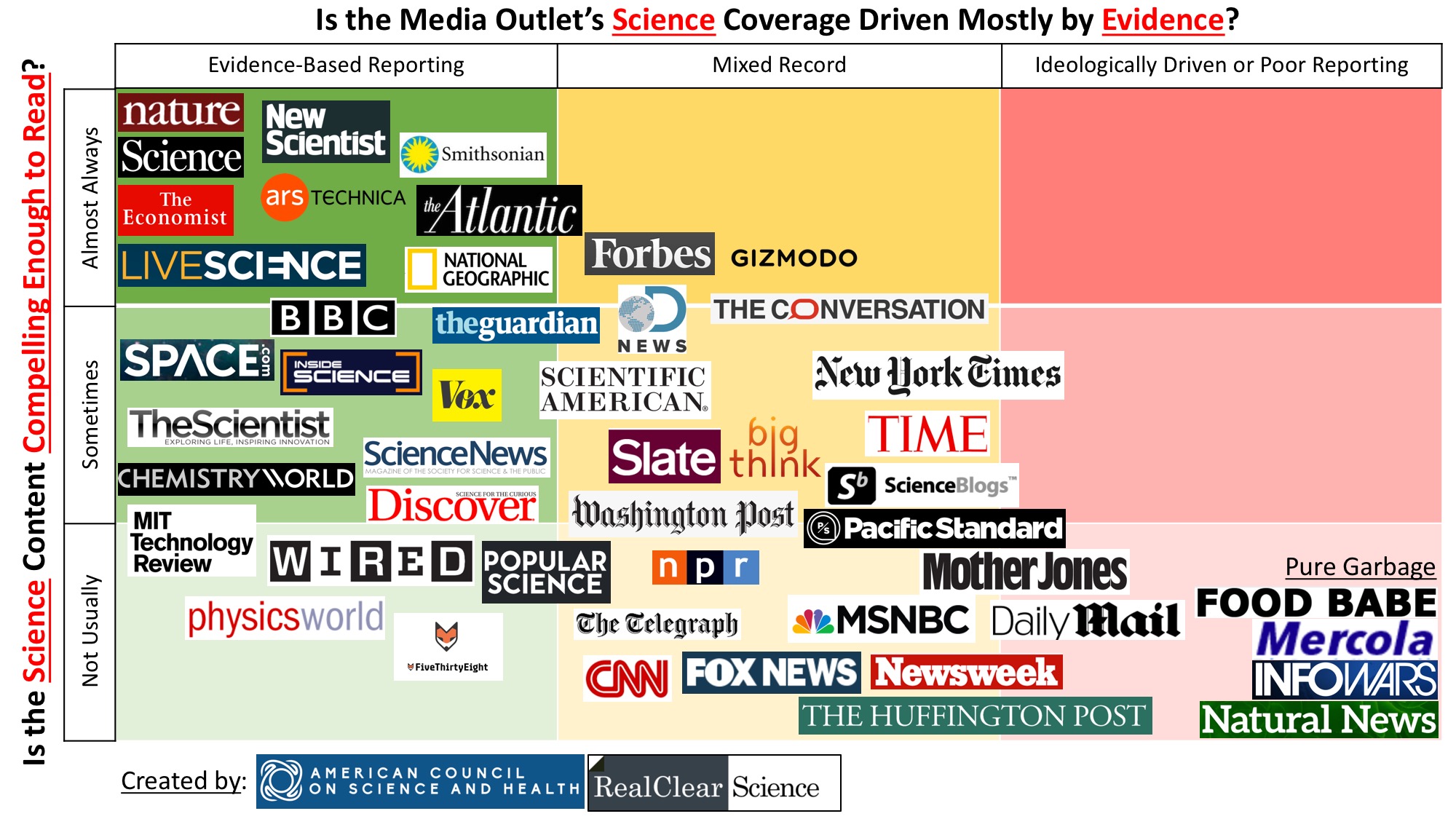
On the X-axis (from left to right), we rank sources by their fundamental trustworthiness. Media outlets in the green column produce scientific content that is based on evidence and is largely free of ideology. Sources in the red column, on the other hand, are driven by ideology and are characterized by lopsided reporting. Evidence plays little to no role for these outlets.
On the Y-axis (from top to bottom), we rank media outlets based on whether they are compelling sources of information. Outlets toward the top are of broad general interest and are well reported. Outlets toward the bottom are of limited interest or are poorly reported. (By "poorly reported," we mean either the topic selection is dull or the content is mostly fluff or sensationalism.)
(RealClearScience also has its own analysis of this infographic.)
Why Is THAT Source Listed There?
Some of our rankings may surprise you. Here are more detailed explanations for a few specific choices2:
The best of the best. By far, the two best sources of science news (besides ACSH and RealClearScience, of course!) are Nature and Science, both of which have news sections aimed at the general public. The Economist is excellent for people who are mostly interested in global news and politics but have a curiosity for science. NewScientist and Live Science are perfect for true science geeks.
No love for Popular Science and Wired? They're okay. While some of their content is good, our biggest problem with them is that they are prone to wide-eyed speculation and clickbait rather than serious science news analysis. Physics World has the opposite problem. It is very serious and well reported, but the topic selection is esoteric and of interest to few people.
What's wrong with Scientific American? For a long while, Scientific American became the headquarters for left-wing social justice warriors and others who felt bashing conservatives was more important than reporting good science. (Previously, that dubious distinction went to ScienceBlogs, but nobody reads that anymore.) SciAm's best content is generally stuff they reprint from other outlets.
The New York Times is a joke. The NYT -- America's alleged newspaper of record -- has itself quite a record of unscientific transgressions. The paper promotes dubious fad diets, cited the quack Joe Mercola on a story about the safety of wearable electronics, and gives voice to organic foodies. It also published a story on a fake disease called post-treatment Lyme disease syndrome. The NYT regularly reports false information on GMOs and agriculture, perhaps none so egregious as this utterly abominable article by Danny Hakim that compared pesticides to Nazi-made sarin gas. If it wasn't for the fact that some respectable writers like John Tierney and Carl Zimmer also publish there, the NYT's science coverage would be comparable to that of the Huffington Post.
Beware British tabloids. News sources like the Daily Mail and The Telegraph serve up a disproportionate amount of sensationalist garbage. Avoid.
Not a single cable news source is worth your time. While CNN, Fox News, and MSNBC might be useful for other things, they are mostly awful sources of science news. Any science news reported here should be verified for accuracy.
Pure garbage. The biggest purveyors of fake science news are Natural News, Mercola, The Food Babe, and InfoWars. If they ever report something truthful, it is almost certainly by accident. Even a broken clock is correct twice per day.
Notes
(1) Here is a list of ten tips to help you detect fake news.
(2) Full disclosure: ACSH and RCS have a reprinting agreement with LiveScience. This did not impact our rating, however, because we would not establish a reprinting agreement with an outlet we felt was not evidence-based.
Tags:
:{
}:
11 21 desmog
Meet the Climate Science Deniers Who Downplayed COVID-19 ...
DeSmog › 2020/03/16 › climate-science-deniers-downplayed-co...
January 30, 2020, the World Health Organization (WHO) declared that the outbreak of novel coronavirus 2019, which causes the disease COVID-19, was officially a “public health emergency of international concern.” At the time, there were cases confirmed in 19 countries and deaths in China had reached 170.
The very next day, the American Council on Science and Health (ACSH) published an article titled, “Coronavirus in the U.S.: How Bad Will It Be?”
“Is coronavirus worse than the flu?” it began. “No, not even close.”
“It already has spread from person-to-person in the U.S., but it probably won’t go far,” ACSH added. “And the American healthcare system is excellent at dealing with this sort of problem.”
ACSH is one of several organizations promoting climate science denial that are now spreading misinformation on the coronavirus, with potentially deadly consequences.
American Council on Science and Health?
The ACSH presents itself to the public as a proponent of “peer-reviewed mainstream science,” in the words of the organization’s mission. Their experts have frequently been quoted in mainstream newspapers and magazines, and they pen columns criticizing journalists who write critically about companies like Monsanto. The group has received funding from oil giants including ExxonMobil, as well as from the agribusiness, chemical and tobacco industries to name a few.
When it comes to climate change, ACSH has published a steady stream of articles downplaying climate science and criticizing efforts to slow carbon emissions — even in the face of a mountain of peer-reviewed research on the climate crisis.
ACSH slammed the medical journal The Lancet as “an ideologically driven outlet with a very clear political agenda where being sensationalist and culturally woke trumps evidence and reasonability” (after the Lancet published an article titled “The carbon footprint”).The purported “pro-science” advocacy group has labeled Greta Thunberg’s activism “doomsday prophesying.” It has (falsely) suggested that climate change is less of a concern because “more people die in winter than in summer” (they don’t).
And that’s all just in the past nine months. The ACSH’s stance against climate action dates back to at least 1997.
When it comes to coronavirus, now a global pandemic, ACSH’s authors rushed to judgment. They assured readers that there was little to worry about, and put some of the same faulty thinking that underlies their stance on climate change on display.
aCSH isn’t alone. Other organizations that have also engaged in climate science denial made similar missteps on COVID-19, including prominent organizations that fanned the flames of conspiracy theories or confidently promoted complacency when circumstances required rapid action.
To be clear: No one should be faulted for failing to foresee precisely how severe of a problem COVID-19 would prove to be. None of us has a crystal ball and few, if any, expected this situation to unfold in this particular way.
But these organizations published positions that not only wound up being laden with false reassurances, but they did so based on claims that they made confidently at the time that now appear to have been false o...the article defended Sen. Tom Cotton of Arkansas for his Fox News interview...The piece argues against action on COVID-19, without citing any evidence about the virus itself, but instead based on characterizations and generalizations. “I’ve seen several news reports essentially implying that, even if quarantining travelers or imposing travel bans to China are overreactions to the risk of the coronavirus, this is ok because it’s better to be safe than sorry,” he&...wrote. “Companies are so fearful of negative press that they seem to base much of their own rhetoric on what the media and liberal elites demand. While some of this is arguably harmless — note much of the hot air at Davos about climate change — when it becomes corporate policy and is echoed by government policy, it then has real consequences.”
“A contagion will happen at some point, and it’s important we recognize it and react,” he added.
“Unless the coronavirus mutates into something far more dangerous,” he concluded, “this isn’t it.”
To be sure, there was not a visible consensus on those views within AEI. That same day, another AEI fellow published an article calling the coronavirus a “big economic deal,” citing its impact on China’s economy. And a three-paragraph AEI post later labeled claims that COVID-19 is a bioweapon “fake news.”
Those other pieces, however, do not undo any impacts from AEI publishing claims that proved to be baseless.
Reading Comprehension
Other times, articles downplaying the risks from COVID-19, penned by organizations that have adopted climate-science denying stances, present arguments laced with logical fallacies.
In some cases, it’s not clear whether the authors understood the comments they were critiquing.
Take, for instance, the Cato Institute’s March 4, 2020 column on “COVID-19 Deaths and Incredible WHO Estimates.” That piece attacks a statement by the WHO’s director general, Dr. Tedros Adhanom Ghebreyesus, who was quoted in The New York Times as saying, “Globally, about 3.4 percent of reported :{COVID:(style="box-sizing:border-box"):}:‐19 cases have died.”
Cato’s column labeled that statistic “sensationalist nonsense.” The number doesn’t take into account the fact that mild cases are more likely to go unreported, Cato’s Alan Reynolds wrote.
Because most #CoronaVirus cases are mild and aren’t reported, the WHO’s alleged 3.4% #Covid19 mortality rate is nothing more than sensationalist nonsense. The actual death rate among infected people outside China may be as low as 0.5%. https://t.co/:{CQ:(style="box-sizing:border-box"):}:mNYEkXsE #CatoHealth pic.twitter.com/nnyUH0DqXe
— Cato Institute (@CatoInstitute) March 8, 2020
That, of course, is exactly why Dr. Adhanom included the word “reported” in his description of the statistic. There’s no ball being hidden here. And in case readers missed that word and its importance, The Times’ report included an explanation of that precise context. (“But the figure came loaded with caveats,” The Times wrote. “Experts, including those at the WHO, say that when more is known about the epidemic, the death rate will be considerably lower.”)
One day later, President Trump took a similar tack to Cato’s, calling the 3.4 precent statistic “really a false number.”
“Now, this is just a hunch, but based on a lot of conversations with a lot of people that do this,” Trump added.
It’s not clear where exactly Trump picked up his impression — but then of course, Trump has his own well-known stance on climate science.
‘Not Even Close’
The author of the ACSH piece claiming that coronavirus is “not even close” to as bad as the flu was Dr. Alex Berezow — a PhD in microbiology, according to his bio, not a medical doctor. Berezow has been interviewed about coronavirus precautions by the Wall Street Journal, New York magazine, Insider, and Yahoo News.
Berezow doubled down on his claim that the flu is a worse threat than coronavirus in a February 18 article. “Influenza is far deadlier than the Wuhan coronavirus, but few people worry about it,” that article begins, referring to the virus with the Chinese city initially at the center of the outbreak (a practice that’s since been viewed as stigmatizing and racist, amid a growing number of cases of stigma-motivated racial violence).
A few weeks later, Berezow changed his tune, offering readers assurances that even if COVID-19 was far more deadly than the flu, there was still little reason for alarm in an article calling media reports “unreliable” and “sensationalism.”
“Even though the Wuhan coronavirus is currently thought to have a case-fatality rate of 2 percent (which would make it 20 times deadlier [than influenza]),” he wrote, “it’s unlikely that it will rack up a similar annual death toll because — at least for the time being — it is not going to infect hundreds of millions of people.”
A week later, on February 27, Berezow admitted he had changed his mind, saying that the facts had changed and writing: “When COVID-19, aka the Wuhan coronavirus, first emerged, it seemed most likely that the virus would fizzle out. But as the disease continues to spread, that outcome now appears nearly impossible.”
But by mid-March, Berezow was back to arguing that, as he wrote on March 11, “[f]or now, influenza remains the far bigger global public health threat.”
In contrast, public health organizations like the WHO have sought to offer information in ways that are both careful and candid. The Centers for Disease Control’s (neglected) guidelines for public health communication call for messaging that’s consistent, accurate, and doesn’t withhold important information.
There’s an enormous amount of uncertainty about what the coming days will bring when it comes to this pandemic. But if we’re all going to make the best decisions possible today, we’d be well-served to pay close attention to medical science.
And when so much of the message that there’s nothing to worry about on climate change comes from think tanks like Cato, AEI, and ACSH that made unsupported and flawed calls on COVID-19, it’s worth taking a moment to pause and think about that as well.
Because as monumental as the impacts of this pandemic are now, the science tells us that if we fail to dramatically cut carbon and methane emissions, the impacts of climate change may be even more profound over the long run.
Mar 16, 2020 ... Berezow has been interviewed about coronavirus precautions by the Wall Street Journal, New York magazine, Insider, and Yahoo News. Berezow ...
Unequivocal: Today's Right is Overwhelmingly More Anti-Science ...
DeSmog › 2011/09/27 › unequivocal-today-s-right-overwhemin...
Thumbnail image
Sep 27, 2011 ... I accused the author, Alex Berezow, of constructing a false equivalence between right and left wing science abuse. The latter does occur ...
Koch & COVIDenial - DeSmog
DeSmog › koch-covidenial
Thumbnail image
May 4, 2020 ... Alex Berezow. “Coronavirus And The Fallacy Of The False Dilemma,” American Council on Science and Health, April 22.
Heartland Lists A B C D E F 1 Source Type First Name Last Name ...
www.desmog.com › wp-content › uploads › files
File Format: Microsoft Excel
13, https://www.documentcloud.org/documents/4116091-Heartland-Climate-Scientists-List-Merged-Redacted.html, "Scientist", Alex B. Berezow, Alex B. Berezow.
COVID Denier Conspiracy Theories - DeSmog
DeSmog › covid-denier-conspiracy-theories
Thumbnail image
Apr 22, 2020 ... Alex Berezow. “Best Evidence Yet That Coronavirus Came From Wuhan BSL-4 Lab,“ American Council on Science and Health, April 13.
COVID-19 Denial - DeSmog
DeSmog › covid-19-denial
Thumbnail image
Alex Berezow. “Coronavirus In The U.S.: How Bad Will It Be?“ American Council on Science and Health, January 31. Q: Is coronavirus worse than the flu?
https://www.climatedocket.com/2019/06/26/exxon-climate-denial-american-council-science-health/
exxonMobil is funding a little-known nonprofit that calls itself a “pro-science advocacy organization,” but whose scientific advisory board includes several renowned climate deniers and has worked for decades to sow doubt about the health impacts of climate change.
Records show the ExxonMobil Foundation provided grants of at least $60,000 in both 2017 and 2018 to the American Council on Science and Health (ACSH), a group that says its mission is to “publicly support evidence-based science and medicine.”
Members of the ACSH scientific advisory board, however, include a who’s who of climate deniers, includingPatrick J. Michaels, who has worked for more than 30 years on behalf of the fossil fuel industry;S. Fred Singer,who last year wrote an article for the Wall Street Journal falsely claiming that sea level rise is not caused by climate change; andWilliam Happer, a current member of President Trump’s National Security Council who as recently as 2016 argued that carbon dioxide is not a pollutant.
Documents recently revealed in an investigation by The Guardian guk show ExxonMobil’s current funding of the ACSH began prior to 1999, when Exxon and Mobil merged to become Exxon Mobil Corporation, one of the largest oil companies in the world.
“ACSH is a front group for libertarian billionaires, fossil fuel companies, and basically every other industry selling dangerous products,” said Geoffrey Supran, a Harvard University researcher who in 2017 published a study that showed how Exxon’s internal memos take the climate issue seriously while its public communications emphasize doubt about the science.
ACSH has also defended fracking as safe for the environment, denied the dangers of bisphenol-A (BPA) and opposed efforts to limit sugar in sodas, among other pro-industry stances.
Corporations fund nonprofits, think tanks and trade groups, many of which are “dark money” organizations that do not disclose their donors to the public, to further their interests without directly being tied to the groups’ work.
“This is just one more example of how these large corporations use third-party organizations to convey their message without being directly connected to them,” said Drexel University environmental sociologist Robert Brulle, who is now a visiting professor of environment and society at Brown University.
“It fits exactly with the kind of stuff ExxonMobil has done for years and years—this is exactly their strategy,” said Brulle, who has studied the funding patterns of organizations connected to climate denial. “The question is what is still going on and why does Exxon still have its connection to this group after all these years?”
In addition to its questionable science advisory board, the ACSH board of trustees includesFred L. Smith, founder of the conservative think tank Competitive Enterprise Institute (CEI) and current director of CEI’s Center for Advancing Capitalism.
In a bit of irony, Exxon said in 2006 it would stop funding CEI (which it had given nearly $2 million between 1998-2005) because of its work denying climate change, but it continued to fund ACSH at least through 2018, the last year for which data is available.
ExxonMobil’s current funding of ACSH is a continuation of a relationship that goes back decades.
Prior to merging in 1999, Exxon and Mobilboth funded the ACSH, according to internal Mobil Foundation documents, which include a list of potential grant recipients as well as Mobil’s justification for the funding decision. They reveal that the Mobil Foundation provided at least $125,000 in grants to the ACSH between 1981-93 and funding was expected to continue into 1994.
The Mobil Foundation recommended continuing to provide funding to the ACSH in part because “the Council has achieved high credibility and recognition in the media and scientific community, as evidenced by wide publication of their positions in the press and scientific journals.”
It’s unclear what the most recent ExxonMobil Foundation grants were used for, but Alex Berezow, vice president of scientific affairs for ACSH, said they weren’t designated for any specific research or project.
“Our policy for the past several years precludes us from doing specific research in exchange for corporate grants,” Berezow said.
Since its founding in 1978, the ACSH has worked to promotecorporatepositions on science, most often taking theposition that chemicals are not a threat to humans or the environment.
“It’s a quintessential anti-science astroturf in the fossil fuel industry’s web of denial and delay—this is an organization founded by money from libertarian ideologues like the Scaifes, Olins, and Kochs,” Supran said. “Unsurprisingly therefore, ACSH’s rhetoric on the climate crisis since the 1990’s has masterfully complemented the talking points of itsfossil fuel funders, including Exxon, Mobil, ExxonMobil, Chevron, Shell, and the American Petroleum Institute.”
Exxon, Mobil and “The Great Defender of Petrochemical Companies”
ACSH was founded in 1978 by Elizabeth Whelan, a public health scientist with postgraduate degrees from Yale and Harvard, who died in 2014. She wanted to counteract the work of environmental and consumer advocacy groups, which she said were not using sound science about the dangers of products to the environment and public health. “We help policymakers see past scaremongers and activist groups who have targeted GMOs, vaccines, conventional agriculture, nuclear power, natural gas, and ‘chemicals,’ while peddling health scares and fad diets,” the ACSH website says.
It’s unknown whether Exxon and Mobil’s funding was used for a specific project or research, but the ACSH grant was recommended by Mobil’s public relations department, which said Whelan’s work was a major benefit to the company.
Whelan’s description of the ACSH was much more candid. In a 1992 memo, she referred to the organization as “the great defender of petrochemical companies.”
In a 1998 article titled, *Global Warming Not Health Threat*, Whelan wrote that climate science is “is rife with uncertainty as are the allegations for the health effects” and climate change models are “far from perfect.”
“As for the hypothetical health effects that are based on the alleged global warming, these predictions are even more dubious,” wrote Whelan, adding that limiting greenhouse gas emissions could worsen human health in developing countries.
Supran said ACSH vociferously promoted Mobil’s position that addressing climate change would result in severe adverse economic impacts and increase poverty.
“ACSH was and is a talking head, amplifying the fossil fuel industry’s narrative while maintaining the false pretense of an “independent” voice,” Supran said. “Their rhetoric faithfully echoed Mobil’s key themes of doubt: that global warming is not real and human-caused, not serious, and not solvable.”
ExxonMobil did not respond to a request for comment.
Wanted: Studies to “Put Climate Change Health Hazards in Perspective”
It was at the urging of Mobil that the Global Climate Coalition (GCC), a fossil fuel industry-backed group that worked from 1989 to 2002 to strategically undermine international climate negotiations, looked to the ACSH for help downplaying the potential health effects of climate change.
By the mid-1990’s, the GCC and its fossil fuel members, including many ACSH funders, had become concerned about the growing body of research suggesting climate change could cause serious health impacts.
Exxon scientists Dennis Devlin and Barry Friedlander presented a summary of published literature on the health impacts of climate change during a September 1996 meeting of the Global Climate Coalition’s Science and Technology Assessment Committee. The presentation emphasized “key knowledge gaps” and “advocated critical evaluation of models and ongoing studies to put climate change health hazards in perspective.”
After the presentation, the GCC meeting attendees discussed the findings and brainstormed “ways of encouraging a more balanced scientific evaluation of this concern.”
To provide that “balance,” Lenny Bernstein of Mobil suggested Whelan and the ACSH.
Bernstein told the group that Whelan was considering an “independent assessment on the climate change and health issue.” He also noted that many of the Global Climate Coalition’s member companies financially support the ACSH and urged them to contact her to suggest she write an assessment.
“The health issue is increasing in importance with the climate change issue, as with other environmental issues,” wrote the Global Climate Coalition in meeting minutes from January 1997. “The GCC has got to be prepared to respond to the issue this year.”
Disregarding the growing body of research indicating otherwise, the GCC in early 1997 wrote in a position paper that “attempting to link global climate change and adverse health impacts requires a long and very tenuous stretch.” The group downplayed the work of a 1995 report by the Intergovernmental Panel on Climate Change (IPCC)—an intergovernmental body of the United Nations that includes the world’s leading climate scientists—writing “concerns that climate change might be the cause of various health problems rests on a number of unproved assumptions.”
The Global Climate Coalition also provided the ACSH with a two-part grant to study the health effects of climate change.
The study, however, would be anything but independent.
By early summer 1997, the GCC had reviewed a draft of the report and suggested edits. The ACSH then began working on a rewritten draft to be reviewed by GCC committee members.
It’s unclear if that report was ever published, but later that year the ACSH published “Global climate change and human health.”
As the GCC had hoped, the report downplayed the views of mainstream science and said “implementation of current proposals for mitigation measures—measures to stabilize the concentration of greenhouse gases in the atmosphere—would be both costly and ineffective.”
Brulle said corporations and industry groups like the GCC use organizations like the ACSH to add a “veneer of legitimacy.”
“This really fits directly into this whole strategy of third party spokespersons, taking your point, but not attributing it to you, it’s attributed to an ‘independent’ organization,” Brulle said.
The ACSH report did not disclose its funders, but concluded that “policymakers can safely take several decades to plan a response, and scientists will have enough time to develop cost-effective anti-climate-change strategies.”
When asked if the published report was funded by the Global Climate Coalition or if another report was published, Berezow said he did not know.
“Anyone who would know the answer to that question is either deceased or retired,” he said.
ACSH Benefits to ExxonMobil: Denial and Delay
After years of scrutiny, ExxonMobil has stopped funding some of the more vocal climate deniers and organizations. In addition to dropping CEI, the oil giant has ended its membership in the American Legislative Exchange Council and has said it no longer funds the Cato Institute, the Heartland Institute and the Institute for Energy Research, all organizations that are heavily industry-influenced and have worked for years to deny climate change and delay the regulation of greenhouse gas emissions.
But ExxonMobil continues to fund the ACSHdespite the organization’s position that “climate change is a slow-moving threat whose consequences are in the medium- to long-term future, not the near-term.”
“We typically only talk about climate change tangentially. For instance, we support Generation IV nuclear power because, among many other things, it helps reduce carbon emissions,” Berezow said, adding that the organization’s main focus is on biomedical science and public health.
Brulle said while using third-party spokespeople and groups like the ACSH isn’t new, ExxonMobil’s continued relationship is notable.
“I do find it a little surprising that ExxonMobil would be cozy enough to be directly connected to this group,” Brulle said.
Supran said ACSH continues to be an excellent investment for ExxonMobil.
“In a 2016 ACSH article promoting the authority of discredited and debunked climate deniers and delayers, for instance, ExxonMobil’s funding fingerprints are nowhere to be found,” Supran said, referring to Meet the Scientific Outcasts and Mavericks,which was authored by Berezow.
In *Are The ‘Green 20’ Suppressing Scientific Dissent?*, posted in 2017, then-ACSH presidentHank Campbell, critiqued the New York attorney general’s office for its investigation of ExxonMobil for possibly deceiving its investors on the risks of climate change.
In another, :{Al Gore: Still Demented After All These Years:(style="box-sizing:border-box"):}:, Berezow said in 2017 that the world’s biggest health problem is poverty, not climate change. “When it comes to human disease, climate change is mostly a distraction. Eliminating poverty will do far more to save people’s lives than lowering the temperature a notch,” Berezow said.
Nowhere on the ACSH website is ExxonMobil’s funding acknowledged.
“As it’s grown more publicly untenable for companies themselves to publicly deny basic science, front groups like ACSH help do their dirty work,” said Supran, adding that the ACSH is a prime example of how ExxonMobil’s denial and delay continue through increasingly veiled initiatives.
“ACSH’s faux-scientific calls for ’evidence-based science’ and its fixation on false dichotomies between meaningful climate action on the one hand, and poverty reduction and economic growth on the other, align with, extend, and amplify ExxonMobil’s own talking points,” he said. “The rhetoric has shifted an inch, but it’s just a rose by any other name—the goal is the same: inaction.”
2x
https://www.desmogblog.com/2020/03/16/climate-science-deniers-downplayed-covid-19-cato-acsh-aei
Meet the Climate Science Deniers Who Downplayed COVID-19 Risks
By Sharon Kelly • Monday, March 16, 2020 - 15:25
no lnx many
On January 30, 2020, the World Health Organization (WHO) declared that the outbreak of novel coronavirus 2019, which causes the disease COVID-19, was officially a “public health emergency of international concern.” At the time, there were cases confirmed in 19 countries and deaths in China had reached 170.
The very next day, the American Council on Science and Health (ACSH) published an article titled, “Coronavirus in the U.S.: How Bad Will It Be?”
“Is coronavirus worse than the flu?” it began. “No, not even close.”
“It already has spread from person-to-person in the U.S., but it probably won't go far,” ACSH added. “And the American healthcare system is excellent at dealing with this sort of problem.”
ACSH is one of several organizations promoting climate science denial that are now spreading misinformation on the coronavirus, with potentially deadly consequences.
American Council on Science and Health?
The ACSH presents itself to the public as a proponent of “peer-reviewed mainstream science,” in the words of the organization’s mission. Their experts have frequently been quoted in mainstream newspapers and magazines, and they pen columns criticizing journalists who write critically about companies like Monsanto. The group has received funding from oil giants including ExxonMobil, as well as from the agribusiness, chemical and tobacco industries to name a few.
When it comes to climate change, ACSH has published a steady stream of articles downplaying climate science and criticizing efforts to slow carbon emissions — even in the face of a mountain of peer-reviewed research on the climate crisis.
ACSH slammed the medical journal The Lancet as “an ideologically driven outlet with a very clear political agenda where being sensationalist and culturally woke trumps evidence and reasonability” (after the Lancet published an article titled “The carbon footprint”). The purported “pro-science” advocacy group has labeledGreta Thunberg’s activism “doomsday prophesying.” It has (falsely) suggested that climate change is less of a concern because “more people die in winter than in summer” (they don’t).
And that’s all just in the past nine months. The ACSH’s stance against climate action dates back to at least 1997.
When it comes to coronavirus, now a global pandemic, ACSH’s authors rushed to judgment. They assured readers that there was little to worry about, and put some of the same faulty thinking that underlies their stance on climate change on display.
ACSH isn’t alone. Other organizations that have also engaged in climate science denial made similar missteps on COVID-19, including prominent organizations that fanned the flames of conspiracy theories or confidently promoted complacency when circumstances required rapid action.
To be clear: No one should be faulted for failing to foresee precisely how severe of a problem COVID-19 would prove to be. None of us has a crystal ball and few, if any, expected this situation to unfold in this particular way.
But these organizations published positions that not only wound up being laden with false reassurances, but they did so based on claims that they made confidently at the time that now appear to have been false or misleading.
Defending Conspiracy Theorists
Take for example, the American Enterprise Institute’s (AEI) publications on COVID-19.
AEI fanned the flames of a conspiracy theory that claims COVID-19 was developed for biological warfare.
AEI resident scholar Michael Rubin published a piece titled, “Was coronavirus a bioweapon? We don’t know, but history shows we can’t trust China.”
The article defended Sen. Tom Cotton of Arkansas for his Fox News interview circulating the theory.
Roger Bate, an AEI visiting scholar, also penned a January 29 piece headlined, “The media is driving the overreaction to the coronavirus.”
The piece argues against action on COVID-19, without citing any evidence about the virus itself, but instead based on characterizations and generalizations. “I’ve seen several news reports essentially implying that, even if quarantining travelers or imposing travel bans to China are overreactions to the risk of the coronavirus, this is ok because it’s better to be safe than sorry,” he wrote. “Companies are so fearful of negative press that they seem to base much of their own rhetoric on what the media and liberal elites demand. While some of this is arguably harmless — note much of the hot air at Davos about climate change — when it becomes corporate policy and is echoed by government policy, it then has real consequences.”
“A contagion will happen at some point, and it’s important we recognize it and react,” he added.
“Unless the coronavirus mutates into something far more dangerous,” he concluded, “this isn’t it.”
To be sure, there was not a visible consensus on those views within AEI. That same day, another AEI fellow published an article calling the coronavirus a “big economic deal,” citing its impact on China’s economy. And a three-paragraph AEI post later labeled claims that COVID-19 is a bioweapon “fake news.”
Those other pieces, however, do not undo any impacts from AEI publishing claims that proved to be baseless.
Reading Comprehension
Other times, articles downplaying the risks from COVID-19, penned by organizations that have adopted climate-science denying stances, present arguments laced with logical fallacies.
In some cases, it’s not clear whether the authors understood the comments they were critiquing.
Take, for instance, the Cato Institute’s March 4, 2020 column on “COVID-19 Deaths and Incredible WHO Estimates.” That piece attacks a statement by the WHO’s director general, Dr. Tedros Adhanom Ghebreyesus, who was quoted in The New York Times as saying, “Globally, about 3.4 percent of reported COVID-?19 cases have died.”
Cato’s column labeled that statistic “sensationalist nonsense.” The number doesn’t take into account the fact that mild cases are more likely to go unreported, Cato’s Alan Reynolds wrote.
That, of course, is exactly why Dr. Adhanom included the word “reported” in his description of the statistic. There’s no ball being hidden here. And in case readers missed that word and its importance, The Times’ report included an explanation of that precise context. (“But the figure came loaded with caveats,” The Times wrote. “Experts, including those at the WHO, say that when more is known about the epidemic, the death rate will be considerably lower.”)
One day later, President Trump took a similar tack to Cato’s, calling the 3.4 precent statistic “really a false number.”
“Now, this is just a hunch, but based on a lot of conversations with a lot of people that do this,” Trump added.
It’s not clear where exactly Trump picked up his impression — but then of course, Trump has his own well-known stance on climate science.
'Not Even Close'
The author of the ACSH piece claiming that coronavirus is “not even close” to as bad as the flu was Dr. Alex Berezow — a PhD in microbiology, according to his bio, not a medical doctor. Berezow has been interviewed about coronavirus precautions by the Wall Street Journal, New York magazine, Insider, and Yahoo News.
Berezow doubled down on his claim that the flu is a worse threat than coronavirus in a February 18 article. “Influenza is far deadlier than the Wuhan coronavirus, but few people worry about it,” that article begins, referring to the virus with the Chinese city initially at the center of the outbreak (a practice that's since been viewed as stigmatizing and racist, amid a growing number of cases of stigma-motivated racial violence).
A few weeks later, Berezow changed his tune, offering readers assurances that even if COVID-19 was far more deadly than the flu, there was still little reason for alarm in an article calling media reports “unreliable” and “sensationalism.”
“Even though the Wuhan coronavirus is currently thought to have a case-fatality rate of 2 percent (which would make it 20 times deadlier [than influenza]),” he wrote, “it’s unlikely that it will rack up a similar annual death toll because — at least for the time being — it is not going to infect hundreds of millions of people.”
A week later, on February 27, Berezow admitted he had changed his mind, saying that the facts had changed and writing: “When COVID-19, aka the Wuhan coronavirus, first emerged, it seemed most likely that the virus would fizzle out. But as the disease continues to spread, that outcome now appears nearly impossible.”
But by mid-March, Berezow was back to arguing that, as he wrote on March 11, “[f]or now, influenza remains the far bigger global public health threat.”
In contrast, public health organizations like the WHO have sought to offer information in ways that are both careful and candid. The Centers for Disease Control’s (neglected) guidelines for public health communication call for messaging that’s consistent, accurate, and doesn’t withhold important information.
There’s an enormous amount of uncertainty about what the coming days will bring when it comes to this pandemic. But if we’re all going to make the best decisions possible today, we’d be well-served to pay close attention to medical science.
And when so much of the message that there’s nothing to worry about on climate change comes from think tanks like Cato, AEI, and ACSH that made unsupported and flawed calls on COVID-19, it’s worth taking a moment to pause and think about that as well.
Because as monumental as the impacts of this pandemic are now, the science tells us that if we fail to dramatically cut carbon and methane emissions, the impacts of climate change may be even more profound over the long run.
==
ref
http://ksjtracker.mit.edu/2011/09/22/chris-mooney-classic-false-equivalence-of-the-political-abuse-of-science/
404 no wayback
https://usrtk.org/tag/alex-berezow/
Posted on December 6, 2018 by Stacy Malkan
Update: As this article was about to publish, Hank Campbell was removed from the staff roster of the American Council on Science and Health, the organization he has led as president since July 2015, for unknown reasons. A few days later, he delinked his ring of science blogs (Science 2.0, Science Codex, ScienceBlogs) from ACSH.org.
Hank Campbell was until this week president of the American Council on Science and Health (ACSH), a group that claims to be a “pro-science consumer advocacy organization,” but according to leaked internal documents and emails released via litigation, ACSH offers its advocacy not to consumers but to chemical, tobacco and pharmaceutical corporate interests (and others) that provide financial backing. For more about ACSH’s work as a corporate front group, see our fact sheet.
Campbell took over the leadership of ACSH in July 2015 from acting president Gil Ross, MD, a convicted felon who was jailed for Medicaid fraud. Tax records show that Dr. Ross was still on the ACSH payroll as of 2017 with $111,618 in compensation as “former senior director of medicine and public health,” while Campbell received $224,358. Prior to leading ACSH, Campbell worked in software development, created what he calls the “world famous Science 2.0 movement,” and wrote a book about the “anti-science” left.
He runs a ring of questionable science websites, including one that posted anti-Semitic materials that Campbell tried to defend.
Campbell’s network of for-profit, non-profit science blogs
NYU Professor Charles Seife posted documents in November that shed light on Campbell’s network of science blogs that help promote the American Council on Science and Health. In a Twitter thread he called “Mapping a Monsanto-loving octopus,” Seife reported:
- Campbell’s corporation ION Publications LLC (founded in 2008) owns several science blogging websites, including **Science 2.0**,Science Codex and others. According to its most recent tax records, ACSH paid ION $60,000 as a “website development service that promotes ACSH.org and increases traffic to the website.”
- In 2018, Campbell converted Science 2.0 into a nonprofit and then acquired ScienceBlogs.com. The nonprofit’s officers are Campbell and David Zaruk, a former chemical industry lobbyist who once worked for the public relations firm Burson-Marsteller. The science blogging websites under these umbrellas cross-promote each other and the ACSH.org website.
Seife summed up his Twitter thread: “this is how a once-admired science blogging site, @scienceblogs, was acquired by a complex and, IMO, shady network of for-profits and non-profits helping Monsanto.”
Helping Monsanto
According to documents released via litigation, Monsanto paid the American Council on Science and Health in 2015 to defend glyphosate and help discredit the scientists of the World Health Organization’s cancer research panel for their report raising cancer concerns about the herbicide.
The documents indicate that Monsanto executives were uncomfortable about working with ACSH but did so anyway because “we don’t have a lot of supporters and can’t afford to lose the few we have,” Daniel Goldstein, Monsanto’s senior science lead, wrote in an email to colleagues. Goldstein provided links to two books, a pamphlet, a pesticide review and 53 articles on the ACSH.org website that he described as “EXTREMELY USEFUL” (emphasis Goldstein’s).
Anti-Semitic material on Science 2.0
Some former writers for ScienceBlogs.com refused to grant rights for their work to remain on the site due to its association with Campbell and Science 2.0, and other observers called on writers to do the same. At issue was Science 2.0’s publishing of anti-Semitic material, which Campbell tried to explain and defend.

In response to the criticism, Campbell removed some posts by the physicist Sascha Vongehr, including one titled, “One Thing Hitler Did Wrong.” The removal notice describes Vongehr’s work as “satire” that came off as offensive due to the “the author’s imperfect grasp of the English language.” Science 2.0 continues to display dozens of articles by Vongehr, including some that contain various anti-Semitic sentiments, such as a post in which Vongehr describes himself as “a Germanic racist” and another titled “Advanced Racism For Dr Duke And Prof Slattery: Why Hate Jews?”
Related:
Science 2.0 refuses to remove Nazi eugenics blog posts, by Keira Havens, Medium (7.9.2018)
Using USA Today as an outlet
In February 2017, two dozen health, environmental, labor and public interest groups wrote to the editors of USA Today with concerns that the paper regularly publishes science columns authored by ACSH staff, including Campbell, without disclosing ACSH’s funding from multiple corporate interests. ACSH Vice President of Scientific Affairs Alex Berezow, who co-authored Campbell’s 2012 book, remains on the USA Today Board of Contributors buthis biothere does not disclose his leadership staff position at ACSH.
Related:
- :{Newsweek and :{USA Today Need Standards for Opinion Writers:(style="background-color:#ffff66;"):}::(style="box-sizing:border-box;font-weight:700"):}::{,:(style="background-color:#ffff66;"):}: by Stacy Malkan, Fairness and Accuracy in Reporting (2.2.2018)
- :{Public Interest Groups to USA Today: Dump Corporate Front Group Science Columns:(style="box-sizing:border-box;font-weight:700"):}:, letter to editors (2.23.2017)
- :{USA Today Fail: Trump Science Article Written By Corporate Front Group:(style="box-sizing:border-box;font-weight:700"):}:, by Stacy Malkan, Alternet (6.1.2016)
- :{The :{American Council on Science and Health is a Corporate Front Group:(style="background-color:#ffff66;"):}::(style="box-sizing:border-box;font-weight:700"):}::{,:(style="background-color:#ffff66;"):}: USRTK fact sheet
GMOs, Our Investigations, Pesticides ACSH, Alex Berezow, American Council on Health and Science, Charles Seife, Daniel Goldstein, David Zaruk, Gil Ross, glyphosate, Hank Campbell, ION Publications LLC, Monsanto, Sascha Vongehr, Science 2.0, Science Codex, ScienceBlogs
==
~ mooney
:{
}:
:{
no lnx
The notion that Republicans are uniquely anti-science is an oft-repeated theme in American political discourse. Every election cycle, Democrats salivate over opportunities to indicate how scientifically illiterate they believe Republicans to be. And all too often, the news media happily play along without pausing to analyze whether it is actually true.
[USA TODAY OPINION
Columns
In addition to its own editorials, USA TODAY publishes a variety of opinions from outside writers. On political and policy matters, we publish opinions from across the political spectrum.
Roughly half of our columns come from our Board of Contributors,a group whose interests range from education to religion to sports to the economy. Their charge is to chronicle American culture by telling the stories, large and small, that collectively make us what we are.
We also publish weekly columns by Al Neuharth, USA TODAY's founder, and DeWayne Wickham, who writes primarily on matters of race but on other subjects as well. That leaves plenty of room for other views from across the nation by well-known and lesser-known names alike.
Contributors Board
How to submit a column]
Recently, a child asked Texas Gov. Rick Perry about the age of the Earth, a not-so-subtle inquiry into his belief about evolution. Perry responded that both creationism and evolution were taught in Texas. The mother replied, "Ask him why he doesn't believe in science." Setting aside the tackiness of feeding political questions to a child, does she have a point? Is Perry anti-science? And, more generally, is the Republican Party anti-science?
Yes. But so are the Democrats.
Either way, science loses
Sadly, when science battles politics, science usually loses. And that is true regardless of political party.
Each campaign season, the same three hot-button science issues are tossed around like political footballs: evolution, global warming and embryonic stem cells. On these three issues, criticism of Republicans is fair...
}:
The GOP should never cave to the conservatives within the party who deny evolution and global warming. There is simply no excuse for that. Expressing moral concerns over embryonic stem cell research is legitimate, but it is best to leave regulatory policy to stem cell biologists and bioethicists. Experts should be making those decisions, not politicians.
So Democrats might have a point if those three issues were all there was to science. Unfortunately for Democrats, their progressive political allies often hold blatantly anti-science beliefs themselves. And in some cases, progressives actively undermine technological progress.
The most extreme example is the anti-vaccination movement, which has gained new but incomplete attention in the controversy among Republican presidential candidates over the HPV vaccine. Empowered by those who believe the myth that only "natural things" are good for you, anti-vaccine activists routinely share common ground with organic food consumers. In fact, a public health official once noted that rates of vaccine non-compliance tend to be higher in places where Whole Foods is popular — and 89% of Whole Foods stores are located in counties that favored Barack Obama in 2008.
Federal health data suggest that anti-vaccine sentiment is more common in progressive areas. With the exception of Alaska, the states with the highest rates of vaccine refusal for kindergarteners are Washington, Vermont and Oregon — three of the most progressive states in the country.
Unlike denying evolution, refusing vaccinations can be deadly.
Progressives are also often against genetically modified food, despite its known benefits and widespread support among agricultural scientists and molecular biologists. Recently, eight U.S. senators — seven of whom were Democrats —wrote a letter to the Food and Drug Administration, threatening to halt approval of a genetically modified salmon. (Interestingly, most of the opponents are from the Pacific Northwest, while the company seeking FDA approval is based in Massachusetts.)
Nukes and PETA
We can also thank progressives for blocking the construction of nuclear power plants, even though nuclear power is supported by 70% of the scientific community. Ironically, they oppose this technology despite the fact it would help reduce carbon emissions and limit the impact of global warming.
Progressive organizations such as PETA are opposed to animal research, despite the fact that an overwhelming 93% of scientists support it. These progressives believe that the rights of animals should trump our desire to cure our loved ones affected by HIV, Alzheimer's or cancer.
In short, for every anti-science Republican that exists, there is at least one anti-science Democrat. Neither party has a monopoly on scientific illiteracy. Indeed, ignorance has reached epidemic proportions inside the Beltway.
Alex B. Berezow is the editor of RealClearScience. He holds a Ph.D. in microbiology.
https://www.desmog.com/2011/09/27/unequivocal-today-s-right-overwhemingly-more-anti-science-today-s-left/
mooney 2011

Last week, I took to task a really poor *USA Today*op-ed making the following claim:
“In short, for every anti-science Republican that exists, there is at least one anti-science Democrat. Neither party has a monopoly on scientific illiteracy. Indeed, ignorance has reached epidemic proportions inside the Beltway.”
I accused the author, Alex Berezow, of constructing a false equivalence between right and left wing science abuse. The latter does occur sometimes, and I’ve given many examples (ionizing radiation risks, vaccines, GMOs, etc). But it has relatively little mainstream influence today—and can hardly compare with the sweeping denial of huge bodies of knowledge (e.g., all climate science, all evolutionary science) that we see on the right.
Joe Romm also reposted my post and weighed in, further trashing Berezow’s weak argument, and particularly on the nuclear power front. Paul Raeburn also weighed in at the Knight Science Journalism Tracker, noting Berezow’s conservative media connections.
In the comments on my post (no longer available, as the blog has just moved to a new URL—please update!), and then in a subsequent post, another conservative—Kenneth Green of the American Enterprise Institute—weighed in. Who is Kenneth Green?
Related Profile(s) :
==
june 2019 eg
we must be doing something right. ACSH has received so much media attention in the past several days, that we can barely keep up! Here's where we've appeared:
1) Our founder, Beth Whelan, was cited by Terence Corcoran in theFinancial Post. He wrote a paragraph that is simply music to our ears:
FP Comment’s definition of junk science was adapted 21 years ago from the work of Elizabeth Whelan, founder of the American Council on Science and Health. Junk science occurs when scientific facts are distorted, risk is exaggerated and the science adapted and warped by politics and ideology to serve another agenda.
2) Dr. Alex Berezow, Vice President of Scientific Affairs, will be featured in the second season of Masterminds, a series of web videos by BrainBar. (See the trailer above.) The organization is based in Budapest and hosts a gigantic annual conference that focuses on the future. Dr. Berezow spoke at the conference in 2018, in which he debunked the myth that humans will have to leave Earth.
3) Dr. Berezow also penned an op-ed for USA Today. He argued that the Yucca Mountain facility in Nevada is the best place to store the nation's nuclear waste. However, instead of forcing the waste on Nevada, he said that we should pay "rent" to the citizens of the state.
4) An article by Erik Lief, Director of Communications, was cited by AccuWeather and UPI. The topic was the danger of heatstroke, particularly in pushing young athletes too far in hot weather. On average, since 2000, about two NCAA football athletes have died each year from heatstroke.
5) Dr. Berezow's article on the spread of a flesh-eating bacterium called Vibrio vulnificus was cited by the website for the Weather Channel. Some are concerned that this estuary-dwelling bacterium will spread as Earth's temperature rises, however, this is not likely to pose a significant problem. As Dr. Berezow wrote, "While climate change may slightly exacerbate the problem, the fact remains that V. vulnificus already inhabits much of the planet."
6) Dr. Josh Bloom's work on opioids was cited by the Waco Tribune-Herald. The author correctly concluded, "It would be tragic to restrict [opioid] use for those patients who genuinely need them." Unfortunately, our nation is doing just that. The article was also reprinted by the Salina Journal of Kansas....
==
==
begging for $, green death scam:
Big Fears Little Risks - Help Fund Our Documentary
"Big Fears Little Risks" is a documentary, but unlike most of what you see on places like Netflix, it is pro-science, and not scaremongering trace chemicals, food, or the modern world.
Instead, we note that humans are generally bad at evaluating risk while handing over much of our decision-making to "bubbles of eminence" in self-appointed groups who create guidelines; if the American Academy of Pediatrics says we are all bad parents by letting our children walk to school alone, many of us accept that. If organic food trade groups or their advocates say buying organic food will get your child into Harvard, some will do so - because the only cost is money.
But for many poor people, money is not a second order issue - a war on science and technology is a war on the poor, because they are impacted most by higher costs that derive from meaningless distinctions.
"Big Fears Little Risks" makes it safe to eat breakfast again,no matter how many trial lawyers in California want to sue over trace ingredients that have only ever harmed rats, and only at high doses.
usatoday links to wayback
rEAL CLEAR SCIENCE WEDNESDAY
Value of Pi Calculated to 10 Trillion Digits - Julian Ryall, Telegraph
Accusations Fly Over Radiation Research - Marcel Crok, Science Insider
Trial Vaccine Cuts Malaria Risk by 50% - Kerry Sheridan, Cosmos
New Tech Tracks, Prevents Food Outbreaks - Ariel Schwartz, Fast Co.
World May Be Running Out of Clean Water - Bryan Walsh, Time
Killer Whales Make Waves to Hunt Seals - BBC News
More Friends Linked to More Gray Matter - Makiko Kitamura, Bloomberg
Positive Memories Are More Accurate - Tom Jacobs, Miller-McCune
Yo-Yo Could Turn Building Into Energy Source - Chris Lee, Ars Technica
Report: Poor Safety Record in College Labs - Vergano & Korte, USA Today
Newton Blog:Dumb Things Grad Students Do in Lab
More RCSc: Facebook | Twitter | Mobile || Browse: Topic Index | Archive
The Latest Research
New Radar Tech Can See Through Walls - Mass. Institute of Technology
Common Brain Cell Labeling Technique Is Problematic - Nature News
Children, Not Chimps, Prefer Cooperation - Max-Planck-Gesellschaft
Amazing Diversity of Microscopic Soil Animals - Nat'l Science Foundation
Real Clear Science Tuesday
Morning Update
'Occupy Wall St.' Facing Sanitation Issues - Janelle Vaesa, Decoded Science
In Search of Virus Fossils - Michael Schirber, Astrobiology Magazine
Lethal Virus Found in Wild Pacific Salmon - Dean & Nuwer, Seattle Times
Can Too Much Spicy Food Kill You? - Katharine Gammon, LL Mysteries
Politics Heating Up Over Labeling GM Foods - April Fulton, NPR
BPA Ban Is Anti-Science, Political Grandstanding - Jon Entine, HuffPo
Shooting For the Stars: Long-Distance Space Travel - Kenneth Chang, NYT
Examining the Galaxies in Our Universe - Ethan Siegel, ScienceBlogs
Moon's Shadow Creates a Wake - Timothy Wogan, Physics World
'Faster Than Light' Claim: Einstein Wins, Again? - Rebecca Boyle, PopSci
Newton Blog:Does Plate Size Affect How Much Food We Eat?
Afternoon Update
'Spaceport America' Opens in New Mexico - Guardian
'Anonymous' Interested in Hacking US Infrastructure - Kim Zetter, Wired
Sorry Ray Kurzweil, Singularity Isn't Near - Allen & Greaves, MIT Tech.
EU Stem Cell Ruling Good for US Research - Richard Willoughby, Telegraph
To Protect Baby's Brain, Turn Off the TV - Brandon Keim, Ars Technica
Are There Different Kinds of Female Orgasm? - Rose Eveleth, Scienceline
Real Clear Science Monday
Morning Update
When Will the 7 Billionth Person Be Born? - Fred Pearce, NewScientist
DNA Sequenced of 115-Year-Old Woman - Helen Briggs, BBC News
Single-Sex School Ban: Science or Activism? - Christina Sommers, USAT
E. O. Wilson Shakes Up Evolutionary Biology - Howard French, Atlantic
Magicians Teach Neuroscientists New Tricks - Mo Costandi, Guardian
Looming Peanut Butter Riots on Halloween? - Hank Campbell, Science 2.0
How Do We Know How Many Galaxies Exist? - Ethan Siegel, ScienceBlogs
Fukushima 'Hot Spots' Raise Unfounded Fears - Geoff Brumfiel, Nature
Is the Secret to Happiness Found in Our Genes, Race? - The Economist
Coveting Thy Neighbor's Wife: Cost-Benefit Analysis - John Tierney, NYT
Newton Blog:Dancing Scientists Are on to Something
Afternoon Update
Green Energy Policies Hurt the Middle Class - Lisa Margonelli, Slate
The Worst Kind of Poverty: Energy Poverty - Bryan Walsh, Time
MRSA Superbug: The Next Epidemic? - Robin Lloyd, Scientific American
FBI's DNA Database Upgrade Plans Under Fire - Paul Rincon, BBC News
Laser Analysis Identifies 'Blood' Diamonds - Devin Powell, Science News
AI Solves Complex Biology Problem - Sebastian Anthony, ExtremeTech
May 25, 2016 by Stacy Malkan
By Stacy Malkan
USA Today fell to a new low in science and election coverage this week with a column speculating about presidential candidate Donald Trump’s science agenda, written by two members of a corporate front group that was not identified as a corporate front group.
The column, “Would President Trump Be a Science Guy?”, was authored by Hank Campbell and Alex Berezow of the American Council on Science and Health, a group that promotes various corporate agendas via its science commentaries while secretly receiving significant funding from corporations, according to leaked documents reported by Mother Jones.
ACSH has made many indefensible and incorrect statements about science over the years – for example, the group has claimed there is no scientific consensus on global warming, that “fracking doesn’t pollute water or air,” and that “there is no evidence” that BPA in consumer products is harmful to health.
A paper trail further suggests that ACSH works quid pro quo for its corporate funders. In one email from 2009, ACSH staff solicited a $100,000 donation from chemical giant Syngenta to produce a paper and “consumer friendly booklet” about pesticide exposures that would help defend Syngenta’s pesticide atrazine. The donation was to be “separate and distinct from general operating support that Syngenta has been so generously providing over the years,” according to the email.
In 2011, ACSH released a book written by Jon Entine, along with an abbreviated position paper, about the public’s “irrational fear of chemicals,” featuring atrazine as a primary focus.
[For more see: Why You Can’t Trust the American Council on Science and Health]
None of this context was apparent to readers of USA Today’s Trump Science column written by ACSH president Hank Campbell and ACSH senior fellow Alex Berezow.
The main point of the column seems to be to plug their pro-industry websites and promote themselves as thinkers of science. Without many facts to illuminate Trump’s science agenda, the authors are left to engage in naval-gazing speculation, and to “imagine Trump championing a moon colony” because of “his fondness for real estate.”
A second big problem with the column – besides the fact that it promotes the science ideas of a corporate front group that isn’t identified as such – is how it normalizes the notion that it’s no big deal to have a major party presidential candidate whose policy ideas are so opaque or hidden that media outlets are reduced to runaway speculation just to have a story on the topic.
Let’s see (belly gaze), will science get a “funding bonanza” from President Trump, or more of that unpleasant vaccine talk? We’ll just have to cross our fingers!
This type of speculation is not normal; it’s not acceptable. USA Today’s readers don’t need to hear theories from corporate front groups about how Trump might view science. They deserve to have these questions put to candidate Trump himself until he answers them.
They deserve to read not one more story about Trump that isn’t grounded in facts and serious journalism about his policy positions – and especially not a self-promotional exercise from a corporate front group disguised as a column in the nation’s most widely circulated newspaper.
Stacy Malkan is co-director of U.S. Right to Know, a food industry research group that voluntarily discloses its funding here. She is a former journalist and author of the award-winning book, “Not Just a Pretty Face: The Ugly Side of the Beauty Industry.”
lotta lil einsteins
819 grab NO HANK
- :{:(style="box-sizing:border-box"):}:Thom Golab - President
- :{Josh Bloom:(style="box-sizing:border-box"):}:, Ph.D. - Senior Vice President
- :{Alex Berezow:(style="box-sizing:border-box"):}:, Ph.D. - Vice President of Scientific Communications
- :{Cheryl E. Martin:(style="box-sizing:border-box"):}: - Director of Operations
- :{:{Chuck Dinerstein:(style="box-sizing:border-box"):}::(style="box-sizing:border-box"):}:, M.D. - Director of Medicine
- :{Christopher Gerry:(style="box-sizing:border-box"):}:, Ph.D.- Senior Fellow of Medicinal Chemistry
- Erik Lief - Director of Communications
Contact Info
- Office phone: 212-362-7044 ext. 234
- E-mail: liefe@acsh.org
Founders Circle
- Elizabeth M. Whelan, Sc.D., M.P.H., M.S. (1943 – 2014)
- :{:{Founder of the American Council on Science and Health}:
- Years of Service: 1978-2014
}:
- :{:{Fredrick J. Stare}:, Ph.D. (1910 – 2002)
- :{:{:{:{:{:{:{:{:{:{:{Founder, Harvard Department of Nutrition}:
- Years of Service: 1978 – 2002
}:}:}:}:}:}:}:}:}:}:
}:
- :{:{Norman E. Borlaug}:, Ph.D. (1914 – 2009)
- :{:{:{:{:{:{:{:{:{:{:{Father of the "Green Revolution", Nobel Laureate}:
- Years of Service: 1978 – 2009
}:}:}:}:}:}:}:}:}:}:
}:
Board of Trustees
- Chairman: Nigel Bark, M.D. Albert Einstein College of Medicine
- Vice Chairman: StevenModzelewski, Maple Engine LLC
- Trustees:
- :{:{Tanya Dorhout}:, Vice President, Bank Finance and Treasury, Goldman Sachs
- James E. Enstrom, Ph.D., M.P.H. University of California, Los Angeles
- Thom Golab, President, American Council on Science and Health
- Fred L. Smith Jr., Competitive Enterprise Institute
- Daniel T. Stein, M.D. Albert Einstein College of Medicine
- Thomas P. Stossel, M.D., American Cancer Society Prof. of Medicine, Emeritus, Harvard Medical School
- Stephen T. Whelan, Blank Rome LLP
}:
American Council on Science and Health Board of Scientific Advisors:
- :{Ernest L. Abel, Ph.D.
C.S. Mott Center}:
- :{Gary R. Acuff, Ph.D.
Texas A&M University}:
- :{Casimir C. Akoh, Ph.D.
University of Georgia}:
- :{Peter C. Albersen, M.D.
University of Connecticut}:
- :{Julie A. Albrecht, Ph.D.
University of Nebraska, Lincoln}:
- :{Philip Alcabes, Ph.D.
Hunter College, CUNY}:
- :{James E. Alcock, Ph.D.
Glendon College, York University (Canada)}:
- :{Thomas S. Allems, M.D., M.P.H.
San Francisco, CA}:
- :{Richard G. Allison, Ph.D.
Federation of American Societies for Experimental Biology}:
- :{John B. Allred, Ph.D.
Ohio State University}:
- :{Karl E. Anderson, M.D.
University of Texas, Medical Branch}:
- :{Jerome C. Arnett, Jr., M.D.
Helvetia, WV}:
- :{Dennis T. Avery
Hudson Institute}:
- :{Ronald Bachman, M.D.
Kaiser Permanente Medical Center}:
- :{David A. Baker, M.D.
Stony Brook University Medical School}:
- :{Robert S. Baratz, D.D.S., Ph.D., M.D.
International Medical Consultation Services}:
- :{Robert Bard, MD, DABR, FASLMS
Director, Bard Cancer Center}:
- :{Stephen Barrett, M.D.
Pittsboro, NC}:
- :{Thomas G. Baumgartner, Pharm.D., M.Ed.
Consultant Pharmacists of America}:
- :{W. Lawrence Beeson, Dr.P.H.
Loma Linda University}:
- :{Sir Colin Berry, D.Sc., Ph.D., M.D.
Pathological Institute, Royal London Hospital (United Kingdom)}:
- :{William S. Bickel, Ph.D.
University of Arizona}:
- :{Steven Black, M.D.
Cincinnati Children’s Health Medical Center}:
- :{Blaine L. Blad, Ph.D.
Kanosh, UT}:
- :{Ben Bolch, Ph.D.
Rhodes College}:
- :{Joseph F. Borzelleca, Ph.D.
Medical College of Virginia}:
- :{Michael K. Botts, Esq.
Alexandria, VA}:
- :{George A. Bray, M.D.
Pennington Biomedical Research Center}:
- :{Ronald W. Brecher, Ph.D., C.Chem., DABT, QPRA
MTE/GlobalTox (Canada)}:
- :{William M. Briggs, Ph.D, M.S.
Cornell University}:
- :{Kenneth G. Brown, Ph.D.
Kbinc}:
- :{Christine M. Bruhn, Ph.D.
University of California}:
- :{Gale A. Buchanan, Ph.D.
University of Georgia}:
- :{Edward E. Burns, Ph.D.
Texas A&M University}:
- :{Francis F. Busta, Ph.D.
University of Minnesota}:
- :{Elwood F. Caldwell, Ph.D., M.B.A.
University of Minnesota}:
- :{Zerle L. Carpenter, Ph.D.
Texas A&M University System}:
- :{Ercole L. Cavalieri, D.Sc.
University of Nebraska Medical Center}:
- :{Russell N. A. Cecil, M.D., Ph.D.
Albany Medical College}:
- :{Rino Cerio, M.D.
Barts and The London Hospital Institute of Pathology (United Kingdom)}:
- :{Sam K. C. Chang, Ph.D.
Mississippi State University}:
- :{Bruce M. Chassy, Ph.D.
University of Illinois, Urbana-Champaign}:
- :{David A. Christopher, Ph.D.
University of Hawaii at Mãnoa}:
- :{Emil William Chynn, M.D.
New York Eye and Ear Infirmary}:
- :{F. M. Clydesdale, Ph.D.
University of Massachusetts}:
- :{Donald G. Cochran, Ph.D.
Virginia Polytechnic Institute and State University}:
- :{W. Ronnie Coffman, Ph.D.
Cornell University}:
- :{Gerald F. Combs, Jr., Ph.D.
USDA Grand Forks Human Nutrition Center}:
- :{Gregory Conko, J.D.
Competitive Enterprise Institute}:
- :{Michael D. Corbett, Ph.D.
Omaha, NE}:
- :{Nancy Cotugna, Dr.Ph., R.D., C.D.N.
University of Delaware}:
- :{H. Russell Cross, Ph.D.
Texas A&M University}:
- :{William J. Crowley, Jr., M.D., M.B.A.
Spicewood, TX}:
- :{James W. Curran, M.D., M.P.H.
Rollins School of Public Health, Emory University}:
- :{Charles R. Curtis, Ph.D.
Ohio State University}:
- :{Jerry M. Cuttler, D.Sc., PEng
Cuttler & Associates Inc.}:
- :{Taiwo K. Danmola, C.P.A.
Ernst & Young}:
- :{Ilene R. Danse, M.D.
Bolinas, CA}:
- :{Sherrill Davison, V.M.D., M.D., M.B.A.
University of Pennsylvania}:
- :{Peter C. Dedon, M.D., Ph.D.
Massachusetts Institute of Technology}:
- :{Thomas R. DeGregori, Ph.D.
University of Houston}:
- :{Elvira G. de Mejia, Ph.D.
University of Illinois, Urbana-Champaign}:
- :{Merle L. Diamond, M.D.
Diamond Headache Clinic}:
- :{Seymour Diamond, M.D.
Diamond Headache Clinic}:
- :{Ralph Dittman, M.D., M.P.H.
Houston, TX}:
- :{John E. Dodes, D.D.S.
National Council Against Health Fraud}:
- :{Michael Dourson, Ph.D.
TERA.org}:
- :{Theron W. Downes, Ph.D.
Seneca, SC}:
- :{Michael P. Doyle, Ph.D.
University of Georgia}:
- :{Adam Drewnowski, Ph.D.
University of Washington}:
- :{Michael A. Dubick, Ph.D.
U.S. Army Institute of Surgical Research}:
- :{Greg Dubord, M.D., M.P.H.
Toronto Center for Cognitive Therapy (Canada)}:
- :{Edward R. Duffie, Jr., M.D.
Savannah, GA}:
- :{Leonard J. Duhl. M.D.
University of California, Berkeley}:
- :{James R. Dunn, Ph.D.
Averill Park, NY}:
- :{Herbert L. DuPont, M.D.
St. Luke’s Episcopal Hospital}:
- :{Robert L. DuPont, M.D.
Institute for Behavior and Health, Inc.}:
- :{Michael W. Easley, D.D.S., M.P.H.
International Health Management & Research Associates}:
- :{Michael P. Elston, M.D., M.S.
Rapid City, SD}:
- :{William N. Elwood, Ph.D.
NIH/Center for Scientific Review}:
- :{Edward A. Emken, Ph.D.
Midwest Research Consultants}:
- :{Nicki J. Engeseth, Ph.D.
University of Illinois}:
- :{Stephen K. Epstein, M.D., M.P.P., FACEP
Beth Israel Deaconess Medical Center}:
- :{Terry D. Etherton, Ph.D.
Pennsylvania State University}:
- :{R. Gregory Evans, Ph.D., M.P.H.
St. Louis University Center for the Study of Bioterrorism and Emerging Infections}:
- :{Daniel F. Farkas, Ph.D., M.S., P.E.
Oregon State University}:
- :{Richard S. Fawcett, Ph.D.
Huxley, IA}:
- :{Seymour Fein, M.D.
Managing Partner, CNF Pharma}:
- :{Frederick L. Ferris III, M.D.
National Eye Institute}:
- :{David N. Ferro, Ph.D.
University of Massachusetts}:
- :{Madelon L. Finkel, Ph.D.
Cornell University Medical College}:
- :{Harry Fisch, M.D.
Weill-Cornell Medical College / New York Presbyterian Hospital
}:
- :{Jack C. Fisher, M.D., F.A.C.S.
University of California, San Diego, Emeritus}:
- :{Leonard T. Flynn, Ph.D., M.B.A.
Morganville, NJ}:
- :{William H. Foege, M.D., M.P.H.
Seattle, WA}:
- :{Christopher H. Foreman, Jr., Ph.D.
University of Maryland}:
- :{Shawn N. Fraser, Ph.D.
Athabasca University (Canada)}:
- :{Glenn W. Froning, Ph.D.
University of Nebraska, Lincoln}:
- :{Robert S. Gable, Ed.D., Ph.D., J.D.
Claremont Graduate University}:
- :{Shayne C. Gad, Ph.D., D.A.B.T., A.T.S.
Gad Consulting Services}:
- :{William G. Gaines, Jr., M.D., M.P.H.
Scott & White Clinic}:
- :{K. H. Ginzel, M.D.
University of Arkansas for Medical Sciences}:
- :{Robert Glatter, M.D.
Lenox Hill Hospital / North Shore LIJ}:
- :{William Paul Glezen, M.D.
Baylor College of Medicine}:
- :{Jay A. Gold, M.D., J.D., M.P.H.
Medical College of Wisconsin}:
- :{Roger E. Gold, Ph.D.
Texas A&M University}:
- :{Reneé M. Goodrich, Ph.D.
University of Florida}:
- :{Frederick K. Goodwin, M.D.
The George Washington University Medical Center}:
- :{Timothy N. Gorski, M.D., F.A.C.O.G.
University of North Texas}:
- :{Ronald E. Gots, M.D., Ph.D.
International Center for Toxicology and Medicine}:
- :{Henry G. Grabowski, Ph.D.
Duke University}:
- :{James Ian Gray, Ph.D.
Michigan State University}:
- :{William W. Greaves, M.D., M.S.P.H.
Medical College of Wisconsin}:
- :{Laura C. Green, Ph.D., D.A.B.T.
Cambridge Environmental, Inc.}:
- :{Gordon W. Gribble, Ph.D.
Dartmouth College}:
- :{F. Peter Guengerich, Ph.D.
Vanderbilt University School of Medicine}:
- :{Caryl J. Guth, M.D.
Advance, NC}:
- :{Philip S. Guzelian, M.D.
University of Colorado}:
- :{David J. Hanson, Ph.D.
State University of New York, Potsdam}:
- :{William Happer, Ph.D
Princeton University}:
- :{Terryl J. Hartman, Ph.D., M.P.H., R.D.
Pennsylvania State University}:
- :{Clare Hasler-Lewis, Ph.D., M.B.A.
Davis, CA}:
- :{Virgil W. Hays, Ph.D.
University of Kentucky}:
- :{Clark W. Heath, Jr., M.D.
American Cancer Society}:
- :{Dwight B. Heath, Ph.D.
Brown University}:
- :{Robert Heimer, Ph.D.
Yale School of Public Health}:
- :{Robert B. Helms, Ph.D.
American Enterprise Institute}:
- :{Zane R. Helsel, Ph.D.
Rutgers University, Cook College}:
- :{James D. Herbert, Ph.D.
Drexel University}:
- :{Theodore R. Holford, Ph.D.
Yale University School of Medicine}:
- :{Robert M. Hollingworth, Ph.D.
Michigan State University}:
- :{Edward S. Horton, M.D.
Joslin Diabetes Center/Harvard Medical School}:
- :{Joseph H. Hotchkiss, Ph.D.
Cornell University}:
- :{Clifford A. Hudis, MD.
Memorial Sloan-Kettering Cancer Center}:
- :{Peter Barton Hutt, Esq.
Covington & Burling, LLP}:
- :{Susanne L. Huttner, Ph.D.
KE Squared}:
- :{Lucien R. Jacobs, M.D.
University of California, Los Angeles}:
- :{Alejandro R. Jadad, M.D., D.Phil., F.R.C.P.C.
University of Toronto (Canada)}:
- :{Rudolph J. Jaeger, Ph.D.
Environmental Medicine, Inc.}:
- :{Michele Jay-Russell, D.V.M., M.P.V.M., Ph.D.
University of California, Davis}:
- :{Elizabeth H. Jeffery, P.h.D.
University of Illinois, Urbana-Champaign}:
- :{Geoffrey C. Kabat, Ph.D.
Albert Einstein College of Medicine}:
- :{John B. Kaneene, Ph.D., M.P.H., D.V.M.
Michigan State University
}:
- :{P. Andrew Karam, Ph.D., CHP
MJW Corporation}:
- :{Mark A. Katchen, M.S., M.B.A., C.I.H.
The Phylmar Group}:
Emeritus Senior Nutrition Fellow, ACSH}:
- :{Kathryn E. Kelly, Dr.P.H.
Delta Toxicology}:
- :{Kenneth Offit, M.D., M.P.H.
Clinical Genetics Service – Memorial Sloan-Kettering Cancer Center}:
- :{George A. Keyworth II, Ph.D.
Carmel, CA}:
- :{Michael Kirsch, M.D.
Highland Heights, OH}:
- :{John C. Kirschman, Ph.D.
Allentown, PA}:
- :{William M. P. Klein, Ph.D.
University of Pittsburgh}:
- :{Ronald E. Kleinman, M.D.
Massachusetts General Hospital/Harvard Medical School}:
- :{Leslie M. Klevay, M.D., S.D. in Hyg.
University of North Dakota School of Medicine and Health Sciences}:
- :{David M. Klurfeld, Ph.D.
U.S. Department of Agriculture}:
- :{Kathryn M. Kolasa, Ph.D., R.D.
East Carolina University}:
- :{James S. Koopman, M.D, M.P.H.
University of Michigan School of Public Health}:
- :{Alan R. Kristal, Dr.P.H.
Fred Hutchinson Cancer Research Center}:
- :{Manfred Kroger, Ph.D.
Pennsylvania State University
}:
- :{Carolyn J. Lackey, Ph.D., R.D.
North Carolina State University}:
- :{J. Clayburn LaForce, Ph.D.
University of California, Los Angeles}:
- :{Robert G. Lahita, M.D., Ph.D.
Mount Sinai School of Medicine}:
- :{James C. Lamb, IV, Ph.D., J.D.
Exponent}:
- :{Lawrence E. Lamb, M.D.
San Antonio, TX}:
- :{William E. M. Lands, Ph.D.
College Park, MD}:
- :{Brian A. Larkins, Ph.D.
University of Arizona}:
- :{Larry Laudan, Ph.D.
University of Texas}:
- Red Lawhern, Ph.D.
- :{Jay H. Lehr, Ph.D.
Environmental Education Enterprises, Inc.}:
- :{Lindsey Leininger, Ph.D.
Senior Researcher Mathematica Policy Research}:
- :{Brian C. Lentle, M.D., FRCPC, DMRD
University of British Columbia (Canada)}:
- :{Scott O. Lilienfeld, Ph.D.
Emory University}:
- :{Floy Lilley, J.D.
Fernandina Beach, FL}:
- :{Fred W. Lipfert, Ph.D.
Independent Environmental Consultant}:
- :{William M. London, Ed.D., M.P.H.
California State University, Los Angeles}:
- :{Sam Lubner, M.D, FACP
University of Wisconsin School of Medicine and Public Health}:
- :{William M. Lunch, Ph.D.
Oregon State University}:
- :{John Lupien, M.Sc.
University of Massachusetts}:
- :{Janet E. Macheledt, M.D., M.S., M.P.H.
Houston, TX}:
- :{Karl Maramorosch, Ph.D.
Rutgers University, Cook College}:
- :{Judith A. Marlett, Ph.D., R.D.
University of Wisconsin, Madison}:
- :{Lawrence J., Marnett, Ph.D.
Vanderbilt University}:
- :{James R. Marshall, Ph.D.
Roswell Park Cancer Institute}:
- :{Roger O. McClellan, D.V.M., M.M.S., D.A.B.T., D.A.B.V.T., F.A.T.S.
Albuquerque, NM}:
- :{Leah McGrath, Corporate Retail Dietitian,
Former Army and Public Health Dietitian}:
- :{Mary H. McGrath, M.D., M.P.H.
University of California, San Francisco}:
- :{Alan G. McHughen, D.Phil.
University of California, Riverside}:
- :{James D. McKean, D.V.M., J.D.
Iowa State University}:
- :{Joseph P. McMenamin, M.D., J.D.
McGuireWoods, LLP}:
- :{Patrick J. Michaels, Ph.D.
Cato Institute}:
- :{Joseph M. Miller, M.D., M.P.H.
Durham, NH}:
- :{Richard A. Miller, M.D.
Principia Biopharma, Inc.}:
- :{Richard K. Miller, Ph.D.
University of Rochester}:
- :{William J. Miller, Ph.D.
University of Georgia}:
- :{A. Alan Moghissi, Ph.D.
Institute for Regulatory Science}:
- :{Grace P. Monaco, J.D.
Medical Care Ombudsman Program}:
- :{Brian E. Mondell, M.D.
Baltimore Headache Institute}:
- :{John W. Morgan, Dr.P.H.
California Cancer Registry}:
- :{Stephen J. Moss, D.D.S., M.S.
New York University College of Dentistry}:
- :{Brooke T. Mossman, Ph.D.
University of Vermont College of Medicine}:
- :{Peter W. Mullen, Ph.D., FCSFS
Kemic Bioresearch}:
- :{Allison A. Muller, Pharm.D.
Acri Muller Consulting}:
- :{Harris M. Nagler, M.D.
Beth Israel Medical Center/Albert Einstein College of Medicine}:
- :{Daniel J. Ncayiyana, M.D.
Benguela Health (South Africa)}:
- :{Philip E. Nelson, Ph.D.
Purdue University}:
- :{Joyce A. Nettleton, D.Sc., R.D.
Denver, CO}:
- :{John S. Neuberger, Dr.P.H.
University of Kansas School of Medicine}:
- :{Thomas Nicholson, Ph.D., M.P.H.
Western Kentucky University}:
- :{Theresa A. Nicklas, Dr.P.H.
Baylor College of Medicine}:
- :{Albert G. Nickel
LyonHeart (ret.)}:
- :{Robert J. Nicolosi, Ph.D.
University of Massachusetts, Lowell
}:
- :{James L. Oblinger, Ph.D.
North Carolina State University}:
- :{Kenneth Offit, M.D., M.P.H.
Memorial Sloan-Kettering Cancer Center}:
- :{John Patrick O’Grady, M.D.
Tufts University School of Medicine}:
- :{Stanley T. Omaye, Ph.D., F.A.T.S., F.ACN, C.N.S.
University of Nevada, Reno
}:
- :{Michael T. Osterholm, Ph.D., M.P.H.
University of Minnesota}:
- :{Michael W. Pariza, Ph.D.
University of Wisconsin, Madison}:
- :{Tim Pastoor, Ph.D.,DABT
Toxicologist, Pastoor Science Communications, LLC}:
- :{Stuart Patton, Ph.D.
Pennsylvania State University}:
- :{Mikko Paunio, Ph.D.
Ministry of Social Affairs and Health, Finland}:
- :{James Marc Perrin, M.D.
Mass General Hospital for Children}:
- :{Jay Phelan, M.D.
Wyle Integrated Science and Engineering Group}:
- :{Timothy Dukes Phillips, Ph.D.
Texas A&M University}:
- :{David R. Pike, Ph.D.
Champaign, IL}:
- :{Henry C. Pitot, M.D., Ph.D.
University of Wisconsin, Madison}:
- :{Thomas T. Poleman, Ph.D.
Cornell University}:
- :{Gary P. Posner, M.D.
Tampa, FL}:
- :{John J. Powers, Ph.D.
University of Georgia}:
- :{William D. Powrie, Ph.D.
University of British Columbia (Canada)}:
- :{C.S. Prakash, Ph.D.
Tuskegee University}:
- :{Marvin P. Pritts, Ph.D.
Cornell University}:
- :{David W. Ramey, D.V.M.
Ramey Equine Group}:
- :{R.T. Ravenholt, M.D., M.P.H.
Population Health Imperatives}:
- :{Russel J. Reiter, Ph.D.
University of Texas, San Antonio}:
- :{William Reville, Ph.D.
University College Cork (Ireland)}:
- :{Donald R. Roberts, Ph.D.
The Uniformed Services University of the Health Sciences}:
- :{Brad Rodu, D.D.S.
University of Louisville}:
- :{Bill D. Roebuck, Ph.D., D.A.B.T.
Dartmouth Medical School}:
- :{Donald R. Rogers, M.D.
Anchorage, AK}:
- :{David B. Roll, Ph.D.
Colleyville, TX}:
- :{Dale R. Romsos, Ph.D.
Michigan State University}:
- :{Joseph D. Rosen, Ph.D.
Cook College, Rutgers University}:
- :{Steven T. Rosen, M.D.
Northwestern University Medical School}:
Emeritus Senior Director of Medicine and Public Health, ACSH}:
- :{Stanley Rothman, Ph.D.
Smith College}:
- :{Stephen H. Safe, D.Phil.
Texas A&M University}:
- :{Mark “Jason” Sanders, M.D.
University of Texas Medical School}:
- :{Harold H. Sandstead, M.D.
University of Texas Medical Branch}:
- :{Charles R. Santerre, Ph.D.
Purdue University}:
- :{Lowell D. Satterlee, Ph.D.
Vergas, MN}:
- :{Mark V. Sauer, M.D.
Columbia University}:
- :{Jeffrey W. Savell, Ph.D.
Texas A&M University}:
- :{Marvin J. Schissel, D.D.S.
Roslyn Heights, NY}:
- :{Frank Schnell, PhD
Agency for Toxic Substances and Disease Registry (retired)}:
- :{David Schottenfeld, M.D., M.Sc.
University of Michigan}:
- :{Joel M. Schwartz, M.S.
Reason Public Policy Institute}:
- :{David E. Seidemann, Ph.D.
Brooklyn College/Yale University}:
- :{David Shlaes, M.D., Ph.D.
Anti-Infectives Consulting LLC}:
- :{David A. Shaywitz, M.D., Ph.D.
DNAnexus}:
- :{Patrick J. Shea, Ph.D.
University of Nebraska, Lincoln}:
- :{Michael B. Shermer, Ph.D.
Skeptic Magazine}:
- :{Robert L. Shewfelt, Ph.D.
Professor Emeritus, Food Science and Technology, University of Georgia}:
- :{Sarah Short, Ph.D., Ed.D., R.D.
Syracuse University}:
- :{Michael Siegel, M.D., M.P.H.
Boston University School of Pubic Health}:
- :{Lee M. Silver, Ph.D.
Princeton University}:
- :{Michael S. Simon, M.D., M.P.H.
Wayne State University}:
- :{S. Fred Singer, Ph.D.
Science & Environmental Policy Project}:
- :{Robert B. Sklaroff, M.D.
Philadelphia, PA}:
- :{Anne M. Smith, Ph.D., R.D., L.D.
Ohio State University}:
- :{Gary C. Smith, Ph.D.
Colorado State University}:
- :{John N. Sofos, Ph.D.
Colorado State University}:
- :{Laszlo P Somogyi, Ph.D.
SRI International (ret.)}:
- :{Roy F. Spalding, Ph.D.
University of Nebraska, Lincoln}:
- :{Leonard T. Sperry, M.D., Ph.D.
Florida Atlantic University}:
- :{Ronald T. Stanko, M.D.
University of Pittsburgh Medical Center}:
- :{Robert D. Steele, Ph.D.
Pennsylvania State University}:
- :{Judith S. Stern, Sc.D., R.D.
University of California, Davis}:
- :{Stephen S. Sternberg, M.D.
Memorial Sloan-Kettering Cancer Center}:
- :{Ronald D. Stewart, O.C., M.D., FRCPC
Dalhousie University (Canada)}:
- :{Martha Barnes Stone, Ph.D.
Colorado State University}:
- :{Jon A. Story, Ph.D.
Purdue University}:
- :{Sita R. Tatini, Ph.D.
University of Minnesota}:
- :{Dick Taverne
House of Lords, United Kingdom}:
- :{Steve L. Taylor, Ph.D.
University of Nebraska, Lincoln}:
- :{Lynn M. Tepper, Ed.D, Ph.D.
Columbia University}:
- :{Lorraine Thelian
Ketchum, Inc.}:
- :{Kimberly M. Thompson, Sc.D.
Harvard School of Public Health}:
- :{Andrea D. Tiglio, Ph.D., J.D.
Townsend and Townsend and Crew, LLP}:
- :{James E. Tillotson, Ph.D., M.B.A.
Tufts University}:
- :{Maria Trainer, Ph.D.,
Managing Director, Science and Regulatory Affairs, Chemistry, CropLife Canada
}:
- :{Dimitrios Trichopoulos, M.D.
Harvard School of Public Health}:
- :{Robert P. Upchurch, Ph.D.
University of Arizona}:
- :{Mark J. Utell, M.D.
University of Rochester Medical Center}:
- :{Shashi B. Verma, Ph.D.
University of Nebraska, Lincoln}:
- :{Willard J. Visek, M.D., Ph.D.
University of Illinois College of Medicine}:
- :{Lynn Waishwell, Ph.D., CHES
University of Medicine and Dentistry of New Jersey, School of Public Health}:
- :{Miles Weinberger, M.D.
University of Iowa Hospitals and Clinics}:
- :{John Weisburger, Ph.D.
New York Medical College}:
- :{Janet S. Weiss, M.D.
The ToxDoc}:
- :{Simon Wessely, M.D., FRCP
King’s College London and Institute of Psychiatry (United Kingdom)}:
- :{Steven D. Wexner, M.D.
Cleveland Clinic Florida}:
- :{Christine Whelan, Ph.D.
Clinical Professor, University of Wisconsin-Madison}:
- :{John S. White, Ph.D.
White Technical Research}:
- :{Kenneth L. White, Ph.D.
Utah State University}:
- :{Carol Whitlock, Ph.D., R.D.
Rochester Institute of Technology}:
- :{Mark L. Willenbring, M.D.
Saint Paul. MN}:
- :{James K. Womack, Jr., M.S., M.M.A.S.
Sanford, NC}:
- :{James J. Worman, Ph.D.
Rochester Institute of Technology}:
- :{Russell S. Worrall, O.D.
University of California, Berkeley}:
- :{S. Stanley Young, Ph.D.
National Institute of Statistical Science}:
- :{Steven H. Zeisel, M.D., Ph.D.
The University of North Carolina}:
- :{Michael B. Zemel, Ph.D.
Nutrition Institute, University of Tennessee}:
- :{Ekhard E. Ziegler, M.D.
University of Iowa}: