EVANG4
520 evang 3 txt capt
SEE FIVE
see magical think
MERRI OK
see apoc end times
aha yikes sci and voter suppression
merging w/ see xian nat'list?
---
is xian the reason trump and admin ppl can get away with covid will go away a MIRACLE?
---
---
an 9 24
Donald Trump has long attracted the evangelical Christian vote as the Republican nominee in 2020, and as the Republican nominee now.
Ahead of the presidential election, and of North Carolina's major gubernatorial election — in which the far-right, openly bigoted GOP candidate is backed by Donald Trump — Reverend Jay Augustine of Durham tells *Washington Post* columnist EJ Dionne Jr. that the critical swing state "is going to be ground zero for a faith war."
"The senior pastor of Durham's St. Joseph AME Church insists that "there is an ongoing struggle for the soul of American Christianity between brands of faith that embrace democratic inclusion and extreme forms — particularly white Christian nationalism — that promote exclusion." Dionne emphasizes, "It’s an argument that North Carolina might be called upon to settle for the nation."
READ MORE:'The last thing we need': Core part of Trump’s base threatens to walk away over key issue
Dionne notes that North Carolina "hosts a complex religious history: It’s home to a large evangelical right, but was also the site of Bishop William J. Barber II’s 'Moral Mondays' movement, a religiously inspired but deeply ecumenical focal point for social activism around civil rights, voting rights and economic equality."
Truth Tabernacle Ministries ' Senior Pastor Bishop Haywood Parker told Dionne, “There are White evangelicals who will utilize the gospel and twist it in a way that works to their advantage and gives them a way to support Trump. But there are lots of us who don’t feel that way. When I’m told that if I support Kamala Harris that somehow, I’m anti-church, anti-Biblical, that really bothers me."
The Post columnist writes:
*Religion has created a coalition management challenge for Democrats whose ranks include large majorities of Jewish and Muslim voters and an overwhelming share of voters — particularly among the young — who left organized religion altogether.
*But political scientist David Campbell, co-author of 'Secular Surge: A New Fault Line in American Politics,' argues that the party still has ample room for appeals to religious voters.
"We don’t see any evidence that [secular voters] are hostile to Democrats who use religious language," Campbell told Dionne. "It’s a myth that because they have a secular world view, they are hostile to religion. What they don’t like is the establishment of religion by government, government stepping over the line between church and state."
READ MORE:Evangelicals’ reason for backing Trump 'just collapsed': columnist
Pew Research Center's Gregory Smith told the columnist, "While most White Christian groups have trended in a Republican direction in recent years, significant minorities identify with or lean toward the Democratic Party, including 4 in 10 white nonevangelical Protestants and 37 percent of White Catholics."
Dionne notes, "The battle for Catholics will be important in the northern swing states of Pennsylvania, Michigan and Wisconsin, especially now that Joe Biden, only the second Catholic president in American history, is no longer on the ballot."
READ MORE:How Trump duped Christian nationalists: scholar
*Dionne's full column is available at this link (subscription required).
---
---
how a Los Angeles megachurch became a bastion of evangelical coronavirus denial: 'There is no pandemic'
August 17, 2021
Coronavirus denial is by no means universal in Christianity. A wide range of practicing Christians, from Catholics to Mainline Protestants such as Lutherans, Methodists and Episcopalians, have encouraged social...
---
---
an 821
the men's fellowship was told to bring guns. "They call it Shootin' with the Savior," my friend said. "I'm 70 years old! And I am not going to march into the woods with a Bible and a gun, and line up for target practice. It's pure nonsense is what it is."
I've stopped in the parking lot to chat with Bob. Bob belongs to one of the biggest churches in town. This last year, he has been attending services remotely on Facebook. Though he has been an active member for decades, he's unsure whether he will go back. His pastor, he said, never took the covid seriously. "Remember that church shooting they had down in Texas a few years back?" Bob said as we stepped aside for two women to pass. "It wasn't two weeks 'til we had the whole church strung up with security cameras and men carrying guns inside and outside Sunday service. But the virus? The one that could actually kill me and my wife? Our pastor hardly mentions it."
Bob is an anti-Trump conservative and I am an outspoken liberal, both political outcasts here in rural Anderson County, Kentucky, population 23,000, where the disgraced former president won more than 70 percent of the vote in 2016 and 2020.
It is normal for us to see men carrying guns of all sizes whether at Walmart or the State Capitol 15 miles up the road. It is normal to see armed Three Percenters guarding the confederate statue on the courthouse lawn or standing outside the Judge Executive's office before a public meeting, having a laugh with the locals. And it is normal to see and hear the constant, unwavering refusal, in person and online, of these men refusing to wear masks or take the vaccine. Is that a diaper on your face?! Don't be a sheep! Fauci is a phony!Whether it is the national obsession with guns or the refusal of a free, lifesaving vaccine, either way, performative masculinity is literally killing us.
My own brother remains unvaccinated. In one of his Facebook profile photos, he appears fully decked out in his National Guard gear with AR-15 style rifles stacked on the ground in a circle around him. Photo title: "Me and my bitches." When I asked our (vaccinated) dad why my brother is not vaccinated, he told me that in the beginning it was politics. Now it's just chest-thumping stubbornness.
"He can't get vaccinated now," he said, "because then you'll be right."
"If I'm right that makes him a pussy?" I said.
"Exactly."
United States Senator Tom Cotton of Arkansas—where the over-12 vaccination rate is 41.45 percent—recently spoke at the Third Annual Machine Gun Shoot in Hillsborough County, New Hampshire. Cotton can be seen on camera, smiling and chatting with a crowd of men at the range while shooting large, heavy, rapid-fire guns.
Does anyone believe these men are vaccinated? And why is a senator from Arkansas wasting his time on a shooting range in New Hampshire? Because it is no longer enough to prove your presidential manhood by riding a horse (Ronald Reagan) or clearing brush (George W. Bush). You have to be filmed firing the biggest, loudest firearm you can. That or getting on Fox primetime to rant about how masks and vaccine requirements, like proposed gun laws, infringe on American freedoms.
United States Senator Elizabeth Warren of Massachusetts wrote in her 2014 book, A Fighting Chance,that the country loses eight kids and teens to gun violence every day. "If a mysterious virus suddenly started killing eight of our children every day, America would mobilize teams of doctors and public health officials," the Democrat wrote. "We would move heaven and earth until we found a way to protect our children."
We did not move heaven and earth, nor will we.
We can't get 30 percent to take a free vaccine.
The population of Kentucky is about the same as the population of Los Angeles, yet we rank 15th in the nation in gun suicides. Our junior United States Senator Rand Paul touts gun rights anytime someone hands him a microphone. Mass, preventable death does not move him. So it was no surprise this past year, as Americans were dying daily by the thousands, when Paul made himself infamous for publicly berating Dr. Anthony Fauci and for being on the Senate floor sans-mask throughout the covid pandemic.
What does it matter if 610,000 Americans are dead from a virus. Is that a diaper on your face?! Don't be a sheep! Fauci is a phony!Like Tom Cotton on the shooting range, performative masculinity is the drug Rand Paul's voting base is jonesing for. And who has time to move heaven and earth when there are elections to think about?
Like Bob, I missed Shootin' with the Savior, but I did go to an outdoor range during the pandemic where, with the help of firearms experts, I learned to shoot nine guns ranging in size from the AR-15 to a pistol I can fit in my pocket. I hadn't shot a gun in 40 years and wanted to see what all the Proud Boy hoopla was about. What I learned is the AR-15 is easy to shoot. Too easy. I did not mug for a camera crew to prove it.
Our health director here in Anderson County tells me that he's booking around 40 vaccine appointments a week, of which 30 might show up. Because school starts next week, on Saturday, he held a special clinic. Only 37 people came. Today, I asked him, "What's it going to take to get people's attention? The death of someone's child?"
He did not answer, nor did I expect him to.
Men have been gunning down children at schools since Columbine. Their stories are a blip in the news cycle. School kids dying from the virus will be one more blip.
RELATED ARTICLES AROUND THE WEB
- How Performative Masculinity Leads Men to Soul-Death | by The ... ›
- Performative Masculinity: A New Theory on Masculinity Susan L. Pitt ... ›
- Why some American men won't wear masks - Vox ›
---
---
aha/yikes indist betw xian nat'l, evanG AND QANON?!
https://www.alternet.org/2021/08/christian-nationalists-believe-capitol-rioters-as-victims-report/
ME
christian nationalists are attempting to put a different spin on the Jan. 6 insurrection. While most Americans have witnessed some degree of the deadly series of events that have transpired, Christian nationalists believe the rioters who stormed the CApitol are actually the victims, according to Americans United.
"The assault by a pro-Trump crowd should have posed something of a dilemma for Christian nationalists, who often pose as "law and order" conservatives, given that police officers were assaulted by an out-of-control mob," the publication reports. "But the same Christian nationalists who had assailed Black Lives Matter over anti-police-brutality protests just months earlier couldn't bring themselves to condemn the violence at the Capitol."
As a result of their refusal to hold rioters accountable and accept what actually happened, more conspiracies have been birthed.
For example, Jeff Jansen, head of Global Fire Ministries, has repeatedly claimed Trump will rise to power again; a dangerous lie national security experts believe will only infuriate the Trump base more when it does not come to pass.
"The Trump administration is on its way in; the pedophilia Biden administration – the fake administration – Biden's administration is on its way out," Jansen said. "I don't care if you like it or not, it doesn't matter. We all know what took place, and God is going to do something amazing in this nation and through this nation. It's revival time. It's revolution time."
As a result of Christians like Jansen, there is a growing concern that the conspiracy-driven prophetic movement is becoming "one of the fastest-growing corners of Christianity," according to New York Times reporter Ruth Graham.
Offering her perspective of Christian prophets' actions, Graham previously wrote:
"Many are independent evangelists who do not lead churches or other institutions. They operate primarily online and through appearances at conferences or as guest speakers in churches, making money through book sales, donations and speaking fees. And they are part of the rising appeal of conspiracy theories in Christian settings, echoed by the popularity of QAnon among many evangelicals and a resistance to mainstream sources of information."
Although there have been efforts to launch a bipartisan committee to investigate the Capitol insurrection, Christian nationalists have joined Republican lawmakers' plight not to further investigate.
In the normal world, the pushback against the formation of a 1/6 commission also raises questions since Christian nationalists claim to believe rioters were actually victims.
However, Tony Perkins, president of the Family Research Council, has praised Republican lawmakers for blocking the effort by way of the filibuster as he described the commission as nothing more than "political theater." He also accused Democratic lawmakers of pushing to change the narrative although footage of the day makes it clear what transpired.
"This is about political theater, plain and simple," Perkins wrote in a column. "It's about creating a narrative, aided by the media, that all Republicans are dangerous extremists. At least GOP leaders are pushing back and insisting that they won't be a part of the Democratic charade."
Christian nationalists' disturbing perspective and continued efforts to support Capitol rioters suggests the movement will not wane anytime soon.
FROM YOUR SITE ARTICLES
- 'Vanilla ISIS': Terrorism expert breaks down the nightmarish ... ›
- This PA lawmaker is a Christian zealot, an academic fraud and an ... ›
- History of Christian nationalism played a dominant role in Capitol ... ›
RELATED ARTICLES AROUND THE WEB
- Evangelical Leaders Raise Alarms About Christian Nationalism In ... ›
- White Christian Nationalism: The Deep Story Behind the Capitol ... ›
- Opinion | 'The Capitol Insurrection Was as Christian Nationalist as...
---
---
https://www.alternet.org/2021/07/nationalists/
In April 2018, researcher Frederick Clarkson exposed the existence of Project Blitz, a secretive Christian nationalist "bill mill" operating below the radar to shape and enact legislation in dozens of states, using a network of state "prayer caucuses," many of which had unsuspecting Democratic members. Its plan was to start with innocent-seeming bills, such as requiring public schools to display the national motto, "In God We Trust," and to culminate with laying the foundations for a "Handmaid's Tale"-style theocracy, enshrining bigotry in law under the guise of "religious freedom."
Salon was the first to report and build on Clarkson's findings, as well as subsequent progressive organizing efforts which eventually drove Project Blitz back underground, following a high-profile {{USA Today}_}_{ exposé}{ (Salon follow-up }_{here}_.) Now, three years later, Clarkson, a senior research analyst at Political Research Associates, has unearthed the playbooks Project Blitz has used since going dark, and discussed their implications with Salon in an exclusive interview.
"The playbooks advise legislators to cloak their religious mission in the guise of more secular intentions and they've renamed several bills to make them sound more appealing," Clarkson reported at Religion Dispatches. But there's another, more hopeful message: These playbooks "also tell a story of the resilience of democratic institutions and leaders in the face of movements seeking to undermine or end them."
Clarkson told Salon, "While most people to the left of the Christian right view the Project Blitz playbook with revulsion, I see it as a gift to democracy. The playbook and their accompanying briefings and events laid bare their intentions and their game plan." Because of that, he continued, "We were handed a vital tool for the defense of democratic values and, arguably, the wider defense of democracy itself. The things that happened in response, I think, are underappreciated, even by some of those who should be taking great pride in their victories."
In particular, Clarkson said,"We were fortunate that Rachel Laser, the then-new president of Americans United for Separation of Church and State, recognized this right away and made taking on Project Blitz a signature campaign of her presidency." One highlight of Laser's work was "organizing dozens of national religious and civil rights organizations to issue a joint letter to state legislators opposing the anti-democratic, Christian nationalist intention" behind Project Blitz.
He also cited the webinars staged for various national groups by Alison Gill of American Atheists, Elizabeth Reiner Platt of Columbia University Law School and Clarkson himself, which "laid out the implications of the Project Blitz campaign," Clarkson said. (My reporting on that is here.) That in turn led to the formation of Blitz Watch, which focused attention on the continuing threat.
In Clarkson's article for Religion Dispatches, he writes, "In 2020, depending on how one counts, 92 bills were introduced, 8 of which passed. In 2021, so far, 74 bills have been introduced, 14 of which have passed, according to Blitz Watch." So Project Blitz is still in action, and still a threat. But it's not the massive and successful onslaught that its founders intended and hoped for — and the fact that it was forced into stealth mode shows how successful the pushback has been.
At the end of his story, Clarkson offers this summary:
The ongoing exposure and response to Project Blitz has taught us several things. First, that it's possible to stand up to and prevail against anti-democratic movements and measures, and that our democratic institutions are more resilient than they sometimes seem. Sen. John Marty showed that — when he spoke up for the integrity of his faith and stood down a national smear campaign led by Fox News, as noted earlier. Librarians and their allies showed that, even in the face of demagogic attacks on the competence and integrity of public libraries, state legislators could be made to see reason. Efforts since 2018 by scores of national organizations organized by Americans United for Separation of Church and State and Blitz Watch, have also shown that it's possible to defend democracy and its institutions against a secretive and formidable opponent of democratic values, and of democracy itself. What's more, journalism has once again shown that sunlight remains the best disinfectant.
Elaborating on this last point, Clarkson told Salon, "Scores of national media outlets covered either Project Blitz directly, or covered the patterns of bills introduced in legislatures across the country, especially the most common, In God We Trust bills…. Thus Project Blitz was exposed as part of wider problem of manipulation of state legislatures, and found itself compared to the tobacco and the pornography industries as corruptors of democratic institutions."
What's equally important is that these lessons can also provide tools and strategies to counter the right's latest culture war offensive — the racist backlash flying under the banner of fighting "critical race theory."Although the two campaigns are dissimilar in some respects, in both cases the right is defending a founding myth (America as a "Christian nation," or America as a flawless "beacon of liberty") and perverting or taking hostage a progressive value to claim it as their own (religious freedom or racial equality). In both cases, the reliance on blatant deception tells us that conservatives themselves understand that progressives hold the stronger hand. The right may be more mobilized now — just as it was before Project Blitz was first exposed — but it won't win if progressives can learn, and adapt, the lessons of their recent success.
As Clarkson first reported, Project Blitz originally divided its bills into three tiers. The first tier aimed at importing the Christian nationalist worldview into public schools and other aspects of the public sphere. A signature example is display of the motto, "In God We Trust," a Cold War replacement for "E pluribus unum" — out of many, one — which better reflects America's pragmatic, pluralist foundations.
The second tier, "Resolutions and Proclamations Recognizing the Importance of Religious History and Freedom," aimed at making government a partner in "Christianizing" America, largely by promoting bogus historical narratives. For example, Clarkson told me, the model "Civic Literacy Act and the Religion in History Acts," required the study or posting of "the founding documents" in the public schools, but with a twist:
"Curiously, the Mayflower Compact is included as a founding document," he said, "but there is no mention of the Virginia Statute for Religious Liberty [the law Thomas Jefferson wrote which served as the model for the First Amendment] ... because it throws a monkey wrench into the Christian nationalist narrative, which seeks to link Christianity and national identity from the British colonies at Jamestown and Plymouth to the present."
The third tier contained three types of proposed laws that "protect" religious beliefs and practices specifically intended to benefit bigotry. "Although category three is divided in three parts, you could also see it as having two main underlying intentions," Clarkson explained in a later story. "First to denigrate the LGBTQ community, and second to defend and advance the right to discriminate. This is one way that the agenda of theocratic dominionism is reframed as protecting the right of theocrats to discriminate against those deemed second-class, at best. As the late theocratic theologian R.J. Rushdoony said, 'Only the right have rights.'"
The basic structure of Project Blitz's agenda hasn't changed much, but its presentation has. "The 2020-2021 playbook offers slicker arguments than previous years," Clarkson notes. "For example, they deny that they seek a theocracy, try not to be overtly Christian, present secular arguments for their legislation and attempt to give the appearance that they respect religious pluralism. But they don't quite succeed."
The contradictions he notes are not surprising. Authors of these proposed laws insist, for example, that they're not out to "change our model of government into a theocracy" and that the bills don't "mimic or enact any particular religious code." But the inclusion of "The Ten Commandments Display Act" isn't very convincing on that score. They further insist that the model bills promote "religious tolerance" and "do not force any religion on anyone," yet the "National Motto Display Act" calls for the posting of the Christian religious slogan "In God We Trust" in public schools and buildings. Still they allege that "tolerance [is] sorely lacking in those who reject various aspects of religious teaching," an old talking point that frames rejection of imposed religion in public spaces as "intolerance."
That last point is another example of how the right attempts to usurp progressive values and turn them on their heads. It also represents an attempt to erase religious liberals, progressives and radicals from the public sphere, by pretending that only "secular humanists" can possibly oppose what they are doing.
The 2019-2020 playbook was more narrowly focused, dealing only with bills related to sexual orientation and gender identity. That made sense, since it was the rapid shift in public attitudes around LGBTQ rights that put the religious right into its current defensive posture, out of which it conceived its counter-offensive: recasting religious bigotry as a defining feature of faith, and claiming a right to discriminate as an essential aspect of "religious freedom." The fact that the other tiers were dropped from the 2019-2020 playbook is a tell of sorts — but of course the playbook's authors never expected it to become public.
The 2020-2021 playbook returned to the full three-tier format, under a new rubric of "categories," adding two additional ones. "Category 4 offers 'talking points to counter anti-religious freedom legislation,' which is simply a breakout of the talking points previously included in other sections," Clarkson notes, while "Category 5 provides four new model policies dealing with prayer in public settings — three for public school settings and one for municipal settings, such as city council meetings."
One important new ingredient
One new bill that Clarkson draws attention to would criminalize libraries and librarians, and became infamous even before Project Blitz adopted it:
The "Parental Oversight of Public Libraries Act," introduced by then-freshman Missouri State Rep. Ben Baker (R-Neosho), ignited a state and national controversy in January 2020 shortly after he took office. …
His bill sought to create "parental review boards" with the authority to "convene public hearings" and restrict access to anything they deemed "age-inappropriate sexual materials." Not only would their decisions be "final," but the bill also prescribed fines or jail for librarians who "willingly" violated board decrees regarding what is inappropriate, and included the potential state defunding of libraries accused of violating the statute.
This bill is deceptive in two key ways. First, as Clarkson notes, it "feigns a democratic method to achieve an anti-democratic result." These board members wouldn't be chosen in a general election, but by voters who show up in person at a scheduled public meeting where the issue is raised. "Thus the boards could be elected by small groups of zealots able to pack an otherwise routine evening meeting of a town council," Clarkson writes. These boards would then be given powers to overrule existing library boards, which are either democratically elected or appointed by democratically elected officials. In short, this is an attack on local democratic control, the very principle it pretends to embody.
The second deception is over the term "age-inappropriate sexual materials," since the impetus for the original bill wasn't about sexual content at all, but rather gender representation:
Baker said he was originally concerned about the popular-but-sometimes-controversial Drag Queen Story Hour in libraries and bookstores around the country.
Drag Queen Story Hour describes its events simply as "drag queens reading stories to children in libraries, schools, and bookstores … [where] kids are able to see people who defy rigid gender restrictions and imagine a world where people can present as they wish, where dress up is real."
Baker sees something more sinister at work. Any break in rigid gender stereotypes is inherently subversive to his snowflake sensibilities, as he explained to the New York Times: "What inspired this bill is becoming aware of what is taking place at our publicly funded libraries with events like Drag Queen Story Hour, and materials that have a clear agenda of grooming our children for the L.G.B.T.Q. community with adult themes and content that fit the description of a objectionable sexual nature."
In this worldview, any breakdown in rigid gender stereotypes is associated with "grooming our children" for the LGBTQ community," a trope used by the right dating back at least to the Eisenhower-era John Birch Society, when scientific knowledge about gender orientation and identity was virtually nonexistent. Not only does this lack any scientific credibility, it's also a hysterical overreaction, since no one is forced to attend Drag Queen Story Hour. If this law were passed, as an official with American Library Association warned, not just Drag Queen Story Hour could be censored, but also displays relating to Pride Month, Black History Month and other specific commemorations.
This attempted intrusion into local library politics is just one example of how Project Blitz overlaps with the new wave of white backlash under the banner of fighting "critical race theory." For several decades, he right has repeatedly mobilized to take over nonpartisan school boards, and occasionally library boards, as a way of building grassroots power and grooming candidates for higher office. Such elections usually have low turnout and relatively little campaign organization, which makes them attractive targets for extremists running scare-tactic campaigns. The parental oversight bill takes things one step further by empowering small activist groups who invadie local government meetings, but the organizing principle is the same: Use fear and stealth to seize power, and use simulated democratic legitimacy to advance a divisive, reactionary agenda.
These library-centered battles served to underscore a broader point that Clarkson made to Salon. "When people are invested in democratic institutions like public libraries, or any aspect of government, it is important not to 'other-ize' government, which in a democratic society is intended to be an expression and function of what we need and want to do together, and is necessarily an expression of democratic values," Clarkson said.
"That librarians and allies around the country rallied to the defense of the archives of democratic knowledge, culture and practice is a case example of how we need not be bullied by Christian right demagoguery. Screechy charges may make headlines and bring in ad revenue on right-wing talk radio, but most people, most of the time, do not want their schools and libraries messed with by authoritarian bigots and mobs of the easily led."
Reflecting on lessons learned
Exposure was the key to success, according to two important figures in this struggle, both mentioned above. Rachel Laser is president of Americans United For Separation of Church and State, and Alison Gill is vice president for legal and policy matters at American Atheists.
"To oppose Project Blitz effectively, we first had to raise awareness about this campaign," Gill said.
"Project Blitz's strategy was to start with seemingly less controversial legislation that organizers thought they could slip past the public," Laser said, "then build to even more harmful, more controversial bills. They had some success early on. But once we exposed that strategy and people became aware of Project Blitz and its agenda of codifying Christian nationalism, the initiative began to unravel, because people don't want to force religious beliefs on public schoolchildren and they don't want our laws to license discrimination in the name of religious freedom."
Gill focused more on exposing the secretive workings behind the Project Blitz operation. "At first, the campaign worked discreetly and without broadcasting their intentions to lure unsuspecting lawmakers into state prayer caucuses," she said. "These caucuses then provided a structure with which to pursue the Project Blitz legislation. By elevating the campaign to media and lawmakers, highlighting its connection to Christian nationalism and showing that these bills were not organically driven by in-state interest, we succeeded in neutralizing their advantage."
Gill cited two other lessons as well. "Our work to oppose Project Blitz reinforced the importance of cross-movement collaboration," she said. "Project Blitz is a campaign that targets civil rights in multiple fields — LGBTQ equality, access to reproductive services and religious equality — and so coordination with organizations across affected movements was required to effectively oppose it."
That took time and crucial information, Laser added: "It wasn't until we learned of the Project Blitz playbook and their organizing strategy that we were able to build a coalition of allies to fight this movement at its source, rather than only state by state and bill by bill."
Gill cites the pooling of resources as another important factor. "Project Blitz provided Christian nationalist lawmakers and activists with all the tools they needed in one place to pursue these bills and flood state legislatures with harmful legislation," she said. "However, the resources necessary to oppose these varied bills were scattered and less organized, so initially the opposition work was less cohesive. By bringing advocacy and messaging resources together at BlitzWatch.org, we helped ensure that lawmakers and advocates opposing Project Blitz had access to all of these tools."
More worrisome than Project Blitz itself, Gill said, are the forces behind it. "The same forces pushing forward Project Blitz have now seized upon new issues, and they are already flooding state legislatures with dangerous model bills," she said. "There were at least four major waves of harmful legislation propagated in 2021: anti-trans youth legislation, religious exemptions to COVID-related public health protections, broad denial-of-care bills, and bills that undermine abortion access."
Of those, she says the most dangerous element is a "renewed emphasis on Religious Freedom Restoration Act (RFRA) measures at the state level. RFRAs create a limited exemption from state laws whenever religious organizations say that their activities are burdened. RFRAs have been used to attack nondiscrimination protections, access to contraception and abortion, and even child labor laws."
Such laws were a major focus of conservative activism during Barack Obama's presidency, although "none were successfully passed after significant public setbacks in 2015 in states like Indiana," Gill noted. "In the wake of the pandemic and state-imposed public health restrictions," she said, "activists have rebranded these bills as necessary to protect churches from government overreach." Three states — Arkansas, Montana and South Dakota — passed RFRAs this year, and we should expect to see many more coming in 2022, she warns.
It's also important to consider how these lessons can be applied to the racist backlash formulated around the bogeyman term "critical race theory," which Fox News has repeated thousands of times without ever clearly defining it. This can be seen in the state legislative map as well. Chalkbeat has tracked efforts in 27 states to "restrict education on racism, bias, the contributions of specific racial or ethnic groups to U.S. history, or related topics," compared to efforts in 12 states to expand education. Brookings reports that seven states have passed such laws, though only one explicitly mentions "critical race theory." Brookings lists actions taken by state boards of education, other state actors and local school boards as well. So the scope of right-wing activism is clear, as is the need for an effective response.
For Laser, the parallels are clear. "White Christian nationalism is the belief that America is and must remain a Christian nation founded for its white Christian inhabitants, and that our laws and policies must reflect this premise," she said. "They completely reject church-state separation. White Christian nationalists oppose equality for people of color, women, LGBTQ people, religious minorities and the nonreligious.
"The same white Christian nationalist ideology that is behind Project Blitz is also driving the backlash against a deliberate caricature of critical race theory," she continued. "Therefore, a similar strategy to the one that has hamstrung Project Blitz — recapturing the narrative about our nation's ideals, exposing the real intent of the extremists, making clear how their agenda harms freedom and equality for all of us, and bringing together a diverse coalition of people and groups to speak out against this harmful movement — should be part of the strategy to combat opponents of racial justice."
Gill sees similarities, but differences as well. "Both campaigns are similar in that they focus on redefining and manipulating language for political advantage — 'religious freedom' and 'critical race theory,' respectively," she said. "However, there are also significant differences. The anti-CRT campaigns seem at once better funded and less organized than Project Blitz. Moreover, there is a degree of moral panic associated with the anti-CRT efforts that was not as present for Project Blitz."
Still, she offered three specific lessons learned from the resistance to Project Blitz:
- Raise awareness about the anti-CRT campaign and bring to light where it came from, who is funding it and for what purposes.
- Build collaboration between the various sectors that support diversity education in schools to push back against anti-CRT efforts. Successful coalitions must include educators, experts in diversity education, political leaders, civil rights leaders, parents and students.
- Ensure that tools and messaging to oppose anti-CRT efforts are effective and widely available.
If America's founding was really "as pristine as the religious myth requires it to be," Clarkson observed, "it cannot be marked by the racism and genocide that the facts of history reveal. History is thus an existential crisis for Christian nationalist beliefs. That's why history must be revised and the evils that mark so much of our history be erased, rather than acknowledged and addressed. The attack on the straw man of CRT is of a piece with what we might call the purification of American history in the name of God's history."
But history and politics tend to be messy, not pure. "The Christian right, supported in part by the Project Blitz playbooks, is using — and mastering — the tools and institutions of democracy in order to erode or end them," Clarkson said. "They know that well-organized factions can win elections, beginning with low-turnout party primaries, and that the Christian Right minority can gain the mantle of democratic legitimacy by out-organizing those of us who actually believe in it." So it's up to "everyone to the left of the Christian Right," as Clarkson puts it, to mobilize for democracy.
"This includes identifying some common approaches to history, as well as religious freedom, which will remain a battleground," he said, "as well as better approaches to electoral organization at all levels of government. This will mean jumping into electoral democracy with both feet, and learning the mechanics and calendar of electoral democracy." This may mean, he warns, avoiding the distractions of cable news, social media and other forms of entertainment in favor of real-world organizing. "To borrow from and with apologies to the late Gil Scott-Heron," Clarkson said, "the mobilization will not be televised."
FROM YOUR SITE ARTICLES
- White nationalists prep for 'physical' altercation with security at ... ›
- Tucker Carlson's sending a loud and clear message to white ... ›
- Right-wing student group Turning Point USA struggles to bar white ... ›
RELATED ARTICLES AROUND THE WEB
- Who are white nationalists and what do they want? | CNN ›
- Israeli nationalists march in East Jerusalem, raising tensions with ... ›
- After Charlottesville, White Nationalists Are Winning - The Atlantic ›
---
https://www.alternet.org/2021/07/in-god-we-trust/
City vehicles in Chesapeake, Virginia, will soon be getting religion.
At a meeting on July 13, 2021, city councilors unanimously voted in favor of a proposal that would see the official motto of the U.S., “In God We Trust," emblazoned on every city-owned car and truck, at an estimated cost to taxpayers of US$87,000.
Meanwhile, the state of Mississippi is preparing to defend in court its insistence that all citizens, unless they pay a fee for an alternative, must display the same four-word phrase on their license plates. Gov. Tate Reeves vowed last month to take the issue “all the way to the U.S. Supreme Court should we have to."
“In God We Trust" became the national motto 65 years ago this month. But over the past few years a string of bills and city ordinances has sought to expand its usage and presence. Such efforts include legislation requiring or encouraging the motto be displayed in government buildings and schools, on license plates and on police vehicles.
Mississippi license plates carry the motto.

The rise of bills across the country at this time is no coincidence. It fits with a concerted effort by Christian nationalists who view the motto as a tool to help legitimize an agenda of passing legislation that privileges conservative Christian values.
Christian nationalism is a political ideology that fuses conservative religious beliefs with a – usually white – American identity. Christian nationalists assume that the laws of the land should be based on Christian morals.
As a scholar of religious and political rhetoric, I have observed how Christian nationalists are using what I call “theistnormative" legislation – government-endorsed policies, rituals, laws and symbols that use vague religious references, such as “God" – to encourage people to view the United States as a theistic collective – that is to say, as a nation of believers in God.
From coins to national motto
Christian nationalists played a key role in getting “In God We Trust" put on coins during the Civil War and ever since have attempted to use the motto as “proof" that the United States is a Christian nation.
Early Christian nationalists criticized the Founding Fathers for failing to recognize the United States as an explicitly Christian nation in the Constitution. An early Christian nationalist organization, The National Reform Association, pushed for a “Christian Amendment" that would correct what they called the “original sin" of not recognizing Jesus Christ in the Constitution.
Their efforts failed. But Christian nationalists had better success in getting the more ambiguous motto “In God We Trust" put on coins in 1864. It followed a report to the U.S. Treasury by the director of the U.S. Mint, James Pollock, an active member of the National Reform Association, in which he asked: “We claim to be a Christian Nation – why should we not vindicate our character by honoring the God of Nations in the exercise of our political Sovereignty as a Nation?"
[pix]
Treasury Secretary Salmon Chase amends 'In God is our Trust' to 'In God We Trust' in an 1863 letter to James Pollock, director of the Philadelphia mint.
National Archives and Records Administration

Amid fears of “atheistic communism" during the Cold War a century later, Christian nationalists in the U.S. again tried and failed to pass a “Christian Amendment." But they again found success in advocating for legislation that used vague religious references, culminating in the adding of “under God" to the pledge of allegiance and making “In God We Trust" the national motto on July 30, 1956.
Since it became the national motto, conservative Christians have used “In God We Trust" to justify opposing abortion rights and same-sex marriage by suggesting that they violate the principles embedded in the motto.
Earlier this year, Mississippi state Sen. Cindy Hyde-Smith justified legislation that would ban voter registration on Sundays by holding up a dollar bill and saying, “This says, 'The United States of America, in God we trust.' … In God's word in Exodus 20:18, it says 'remember the Sabbath and keep it holy.'"
While most Christian nationalists claim to support religious freedom – which would seemingly apply to all faiths – most believe Christianity, specifically white conservative Christian values, should be privileged in the public sphere.
'Project Blitz'
Christian nationalists have increasingly turned to “In God We Trust" bills as a way to further legitimize their agenda. This is particularly evident in the “Project Blitz" initiative, led by the Congressional Prayer Caucus Foundation, which states its aim as “restoring Judeo-Christian principles to their rightful place."
Project Blitz started in 2015 with the purpose of “blitzing" the country with legislation advancing Christian nationalism. As David Barton, a leader in the initiative, explained in a 2018 conference call with state legislators: “It's kind of like whack-a-mole for the other side; it'll drive 'em crazy that they'll have to divide their resources out in opposing this."
One such success in Project Blitz was in Chesapeake, where the Congressional Prayer Caucus Foundation is based. The organization successfully pushed for the motto “In God We Trust" to be displayed at the City Hall.
After Project Blitz generated negative publicity in 2018, it was misleadingly rebranded as “Freedom for All." During a recorded strategy meeting that was later circulated by the social justice think tank Political Research Associates, Lea Carawan of the Congressional Prayer Caucus Foundation explained, “As soon as we understood that they knew they were on to us, we changed the name; shifted things around a little bit […] we've renamed and moved on but it's moving just as strong and just as powerfully."
Up to 2018, the initiative had helped more than 70 bills relating to their agenda get proposed. The group continues to have successes in getting legislation not only proposed, but also passed. According to BlitzWatch, a group tracking Project Blitz initiatives, this includes bills that su**pport Bible readings in schoolsand policies that allow adoption and foster agencies and health care providers to deny services based on religious grounds. But it is the “In God We Trust" bills that have seemingly been the most successful for Project Blitz.
Pushing America's 'Christian heritage'
According to the initiative's 2020-2021 playbook – which was obtained by the religion news website Religion Dispatches – “In God We Trust" bills aim to recognize “the place of Christian principles in our nation's history and heritage."
While those behind “Project Blitz" claim the bills are not about converting people to Christianity, they also argue that the U.S. should be a Christian nation whose laws and policies  ."
As such, “In God We Trust" bills set the foundation for more explicitly conservative Christian legislation.
The playbooks suggest “In God We Trust" bills can “shore up later support for other governmental entities to support religious displays" to help America accept its “Christian heritage." The Congressional Prayer Caucus Foundation also recommends legislators push for other types of bills including, as stated in their 2018-2019 playbook, a resolution to establish policy “favoring intimate sexual relations only between married, heterosexual couples."
The risk of opposing
What makes “In God We Trust" bills so successful is that they often receive bipartisan support. In Louisiana, for example, it was a Democratic governor who signed the 2019 bill requiring the motto be displayed in all schools. Politicians who do oppose “In God We Trust" bills run the risk of being labeled as “anti-faith."
Despite its being the national motto for only 65 years, Christian nationalists have framed “In God We Trust" as part of the U.S.'s founding tradition. Moreover, the motto has become an important rhetorical weapon for Christian nationalists – using it to advance their belief that governments and people are to “trust in God," and more specifically their perception of a conservative Christian God.
Kristina M. Lee, Ph.D. Candidate in Rhetoric, Colorado State University
This article is republished from The Conversation under a Creative Commons license. Read the original article.
FROM YOUR SITE ARTICLES
- ATMs in Churches Across the US? Why Cash Is Considered Sacred ... ›
- Atheists are 'not to be tolerated': 7 states still have bans on non ... ›
- This PA lawmaker is a Christian zealot, an academic fraud and an ... ›
RELATED ARTICLES AROUND THE WEB
- 'In God We Trust' Signs Go Up In South Dakota Public Schools, As ... ›
- The Legislation Placing “In God We Trust” on National Currency | US ... ›
- In God We Trust license ... - Wisconsin DMV Official Government Site ›
also surpise $ donor for his BD?
https://www.alternet.org/2021/06/peter-popoff/
Conning' their 'vulnerable' followers: Here's what Trump and a discredited televangelist have in common
When the Christian right invaded the Republican Party during the 1980s, Peter Popoff was among the televangelists who made millions of dollars. Popoff, a faith healer, was exposed as a major fraud — he wasn't really curing cancer patients as he claimed. Journalist Michael Siegel, in a lengthy article published by Ordinary Times on June 8, lays out the things that Popoff has in common with another con man: former President Donald Trump, explaining why their deluded followers have such a hard time accepting the truth.
Popoff and Trump are the same age: 74. Popoff was born on July 2, 1946, and Trump was born the previous month on June 14, 1946. Siegel's article is really about Trump more than Popoff, although he offers plenty of details about Popoff's embarrassing history — and Siegel stresses that when people have been conned, they are often in denial about it. Popoff still had his unwavering followers even after he was exposed as a fraud during the 1980s.
As anti-Trump and anti-Popoff as Siegel's piece is, he does more than slam them and makes a point of explaining their appeal.
Siegel observes, "One of the things that con men rely upon is a certain vulnerability…. Many are afraid of their nest eggs disappearing, which ironically, makes them vulnerable to the very people who want to rob their nests."
//CRISIS/ GHOST DANCE : According to Siegel, "Con men — whether they prey on the rich or the poor, the powerful or the powerless — look for those who are at a crossroads.Those who want a chance to get ahead. Those who fear falling further behind. Those who have lost their status and want it back. A person comfortable in their life and their finances will realize the Nigerian Prince is too good to be true. A person nervous about their finances or desperate to move up in life may think this is the chance they've been waiting for." [vid] Popoff exposed - Part 1 <br
Trump is much more dangerous than Popoff ever was, as Popoff never became president of the United States — although the Christian right movement that Popoff helped bring to the forefront of the GOP during the 1980s (along with the Moral Majority's Rev. Jerry Falwell, Sr., Jimmy Swaggart, Focus on the Family founder James Dobson and others) has been very damaging to the country. And Trump still has millions of devotees seven months after being voted out of office and four months into Joe Biden's presidency.
Many Trump devotees, according to polls, still believe the Big Lie: Trump's false claim that he was a victim of widespread voter fraud in the 2020 election. And Siegel explains why they are so "vulnerable," not unlike Popoff's followers.
"The Trump election fraud claim is something far more insidious than the standard-issue 'they stole our votes'cry of the defeated," Siegel warns. "It did, after all, culminate in an open attack on the Capitol to try to overturn the election. It is a claim that is not fading but being amplified by an increasing number of Republicans, becoming a litmus test in primaries. The Republicans just ousted their third most powerful Congress-critter because she had the temerity to say that Donald Trump was full of it."
Siegel continues, "I can certainly see why grifters like Rudy Giuliani and Sydney Powell are making this claim. There's money to be made by promoting these claims— the Trump campaign itself pulled in a quarter of a billion dollars with this scam. But why do rank-and-file Republicans believe this. Is it because they're stupid? They're no more stupid than anyone else. Is it because they're deluded by Fox News? Most of them don't watch it. No, I think it's something more basic, something that goes back to Peter Popoff and every other con artist that slithered down the pike. It's because they don't want to believe they were fooled."
Related Articles Around the Web
- Peter Popoff, the Born-Again Scoundrel | GQ ›
- Peter Popoff Ministries – Dream Bigger ›
- Peter Popoff - Wikipedia ›
---
---
Donie O'Sullivan is a reporter for CNN. His beat appears to be American conspiracy theories. He was on Anderson Cooper's show last night with reporting on a QAnon conference last weekend during which former Donald Trump adviser and pardoned traitor Michael Flynn said a Myanmar-style military coup "should happen" in America.
That some people in this country long for purifying violence to "reinstate" Donald Trump to his "rightful place" is not what got my attention, though. What did was Donie O'Sullivan's editorial remark at the end of his report. This is what he said:
I spend a lot of time reading these pro-Trump forums, reading these QAnon forums online, and speaking to Trump supporters, and I will say of all the conspiracy theories we hear, this talk from Americans about a coup, cheering a coup, and hoping for a coup, in the United States is one of the most chilling things I hear.
Before I go on, I should say O'Sullivan appears to be an immigrant. (I think he's Irish, given his accent.) As such, I don't expect him to be as attuned to American political culture as I'd expect a native-born American to be. Indeed, as a non-native, I'd expect him to be more attuned to the American civic religion than native-born Americans generally are, because fealty to the civic religion is so often demanded of immigrants.
This civic religion believes military coups and their consequent dictatorships cannot happen in the United States.Ordinary Americans do not want them, moreover, because it would be against their civic religion. You can't quite tell from the written version of his remark, but when you watch the clip, you can hear O'Sullivan put a little more stress on "American" when he says he's chilled to hear Americans, of all people on this earth, talking "about a coup, cheering a coup, and hoping for a coup, in the United States." Implicit point: this is what Trump has done to the globe's oldest democracy.
I suspect some of O'Sullivan's remark was showmanship. (He does work for CNN, after all.) But I think some of it, maybe most of it, reflects the conventional wisdom in Washington—that it's shocking to hear Americans talk this way. It's not shocking, though. It's familiar and quite normal when you know where to look.Fact is, lots of Americans believe they are God's chosen people. They believe the end of the world is coming, according to God's divine plan. They believe the US Constitution is a covenant with them only, and that a genocidal purge will preface Christ's return.
This is the End Times I'm talking about, a story about global events culminating ic that "reinstates" the King of Kings to his rightful place. It's a story millions of Americans tell themselves and their children. It's a story in which the messy and hard-to-understand world around us is no such thing.Instead, it is polarized as conflict between God's friends and God's enemies. The only difficulty is decoding the signs and symbols God lays out. Reality isn't real. Reality is a sinful illusion. What's real is the trail of secrets leading the chosen safely to The End. Argument, language, reasoning—they don't matter. Only they can know The Truth.
The conventional wisdom in Washington is that religion is off-limits. Therefore, the conventional wisdom in Washington does not see, because it will not see, that tens of millions of Americans already believe democracy is getting in the way of God's plan,that democracy is—and I mean this seriously—desecrating the sacredness of the US Constitution. As one critic put it, the Venn diagram showing the overlap of QAnon believers and white evangelical Protestants (and related groups) is actually a circle. When you stand with God against His enemies, you have God's permission to hate.
That's their religion. No, it's not a cult. It's more than that. It's deeper than that. The hate felt by the former president's supporters during four years' worth of political rallies is the same hate for America as it stands, not as they desire it to stand, that right-wing religious radicals have felt since post-Civil War America. That's when Charles Darwin's theories and what they determined about humanity's place in God's divine scheme first gained traction in the United States.Every single intellectual development—from evolution then to Critical Race Theory now—has been met with such hate. I don't understand why the conventional wisdom looks away from history.
Because it's easier, I guess. It's easier to maintain the myth of the civic religion; to be shocked by Americans talking about a military coup; to blame the former president for imperiling the world's oldest democracy. It's easier to respect religion without scrutinizing it too much, and risk discovering it's steeped in hate, which might force the conventional wisdom in Washington to take responsibility. On this one-year anniversary since Trump gassed Americans out of the way for a photo-op of him holding a Bible in front of a church, we need the truth. And that's never been easy.
FROM YOUR SITE ARTICLES
- Trump is like Colonel Kurtz in 'Apocalypse Now' -- and he keeps ... ›
- Trump Got Into Fight With Vietnam Veterans Over The Plot of ... ›
- Pence and the Apocalypse: Trump's VP and Mike Pompeo juggle ... ›
RELATED ARTICLES AROUND THE WEB
- Evangelicals Love Donald Trump for Many Reasons, But One of ... ›
- The apocalyptic myth that helps explain evangelical support for Trump ›
- The Trump Apocalypse - American Compass ›
---
---
https://www.alternet.org/2021/05/qanon-evangelicals/
---
iou read
right-wing media is fracturing — and Fox News could lose its grip on the religious right
by Ryan Burge, Eastern Illinois University
Fox News possesses an “outsized influence" on the American public, especially among religious viewers....
---
---
https://www.alternet.org/2021/05/fox-news-2653092281/?rs=182
no graf
Fox News possesses an “outsized influence" on the American public, especially among religious viewers.
That was the conclusion of the nonprofit Public Religion Research Institute in a report released just after the 2020 presidential election. It noted that 15% of Americans cited Fox News as the most trusted source – around the same as NBC, ABC and CBS combined, and four percentage points above rival network CNN. The survey of more than 2,500 American adults also suggested that Fox News viewers trend religious, especially among Republicans watching the show. Just 5% of Republican viewers of the channel identified as being “religiously unaffiliated" – compared to 15% of Republicans who do not watch Fox News and 25% of the wider American public.
To further explore the relationship between different faiths and the TV news they associate with as part of my research on religion data, I analyzed the result of another survey, the Cooperative Election Survey.
The annual survey, which was fielded just before the November 2020 election, with the results released in March, polled a total of 61,000 Americans over a number of topics. One question was on their news consumption habits. It asked what television news networks respondents had watched in the prior 24 hours.
Percentage of respondents who saw TV news in past 24 hours
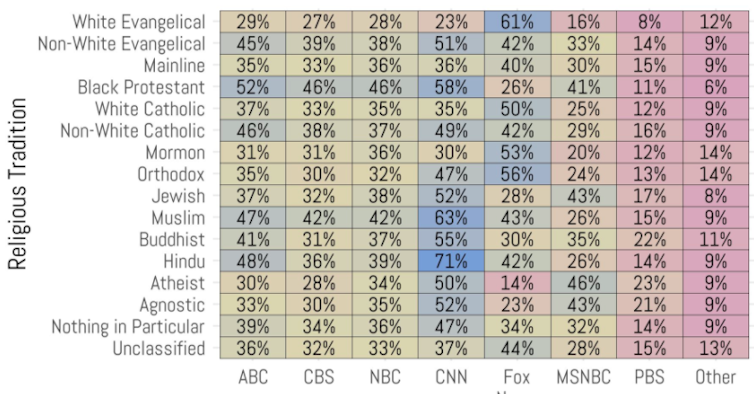
Some very interesting patterns emerged across religious traditions – and the nonreligious – and the type of media being consumed. For instance, of the the big three legacy news operations – ABC, CBS and NBC – there was no strong base of viewership in any tradition.
In most cases, about a third of people from each religious tradition said that they watched one of those legacy networks in the last 24 hours. PBS scored very low among every tradition. In most cases fewer than 15% of respondents reported watching PBS in the time frame.
graf]
however, the numbers for the three major cable news networks – CNN, Fox News and MSNBC – were much higher across the board. In eight of the 16 religious and nonreligious traditions categorized in the poll, CNN viewership was at least 50% of the sample. This was led by 71% of Hindus who watched CNN and 63% of Muslims.
The least likely group to watch CNN was clearly white evangelicals, at just 23%. In comparison, MSNBC scored lower nearly across the board. In fact, in none of the 16 classification groups was viewership of MSNBC greater than it was for CNN.
Fox News viewership was higher than that of MSNBC, but was not as widely dispersed as it is for CNN. It's no surprise, given its reputation as a conservative news outlet, that 61% of white evangelicals say that they watch Fox News – in the last election, around 80% of white evangelicals voted for Republican candidate Donald Trump. The other three traditions where viewership was at least 50% are white Catholics, Mormons and members of the Eastern Orthodox Church. It should come as no surprise, as those are three groups that consistently vote for the Republican Party. Just 14% of atheists watched Fox, which is just about in line with the share of white evangelicals who watch MSNBC.
Fracturing right-wing media
But with the fracturing of conservative media sources seeing more competitors vying for viewers among the right, Fox News could see a drop in viewership from the religious right.
In the wake of the 2020 presidential election, Fox News viewership plunged as many Trump supporters believed that the network was not being loyal to their standard-bearer of the GOP.
Given the vast number of news options that people of faith have and the increase in political polarization in the United States, the pressure for networks to deliver the news that people want to hear will only increase as time passes.
Ryan Burge, Assistant Professor of Political Science, Eastern Illinois University
This article is republished from The Conversation under a Creative Commons license. Read the original article.
FROM YOUR SITE ARTICLES
- Rep. Matt Gaetz is trying to take Fox News' Tucker Carlson down ... ›
- Jen Psaki torches Fox News' Peter Doocy: Trying to 'disprove a ... ›
- Watch: Joe Biden cracks up the room with his response to a Fox ... ›
---
---
pa gop army mastriano sp xian
https://www.alternet.org/2021/05/trump-coup/
---
---
see paula white and her begotten son
---
---
an
mississippi secretary of state calls for more Christians to be elected because 'the end times' are here
David Badash The New Civil Rights Movement
Mississippi Secretary of State Michael Watson is calling for more Christians to be elected to office "today more than ever before," because "the end times" are here.
---
---
https://www.alternet.org/2021/05/is-america-a-christian-nation/
---
https://www.alternet.org/2021/04/bachmann-michelle/?utm_source=&utm_medium=email&utm_campaign=7051&rs=182
ncrm
Televangelist Kenneth Copeland's The Victory Channel aired a special edition of its "Victory News" program Wednesday night to coincide with President Joe Biden's speech to a joint session of Congress.
Former congresswoman Michele Bachmann was among the commentators who appeared on the program, and she was predictably unimpressed by Biden's speech, calling it "cruel," labeling Biden a fake president, and saying that the entire thing smacked of "the invasion of the zombie apocalypse."
"This is a fake State of the Union speech," Bachmann said before Biden delivered his remarks. "What we're watching is a coup. It's my opinion that the election was irregular, we didn't have a true election result. We had a fake election. We've had a fake presidency. This is a fake State of the Union address."
"With all due respect, it was the invasion of the zombie apocalypse, as far as I'm concerned," Bachmann declared after Biden had completed his speech. "It was probably one of the most sad, depressing speeches I've ever heard."
"Quite honestly, the word that I have for his speech: It's cruel," she added. "What he's intending for the American people, the result is cruel. … I think one of the most cruel aspects of what he's proposing is snatching 3-and-4-year-olds out of their parents' arms, putting them in government-run preschools [where] they'll be learning critical race theory. I've observed this curriculum. I've seen this curriculum that they're planning to use with little 3-and-4-year-olds. It is the LGBTQ curriculum. It is the critical race theory. Our little children will be indoctrinated before they even get to kindergarten."
---
https://www.alternet.org/2019/12/scientists-establish-ink-between-religious-fundamentalism-and-brain-damage
...To investigate the cognitive and neural systems involved in religious fundamentalism, a team of researchers—led by Jordan Grafman of Northwestern University—conducted a study that utilized data from Vietnam War veterans that had been gathered previously. The vets were specifically chosen because a large number of them had damage to brain areas suspected of playing a critical role in functions related to religious fundamentalism. CT scans were analyzed comparing 119 vets with brain trauma to 30 healthy vets with no damage, and a survey that assessed religious fundamentalism was administered. While the majority of participants were Christians of some kind, 32.5% did not specify a particular religion.
Based on previous research, the experimenters predicted that the prefrontal cortex would play a role in religious fundamentalism, since this region is known to be associated with something called ‘cognitive flexibility’. This term refers to the brain’s ability to easily switch from thinking about one concept to another, and to think about multiple things simultaneously. Cognitive flexibility allows organisms to update beliefs in light of new evidence, and this trait likely emerged because of the obvious survival advantage such a skill provides. It is a crucial mental characteristic for adapting to new environments because it allows individuals to make more accurate predictions about the world under new and changing conditions....
---
don jr at cpac Tpac fail, PO'd at mccarthy
https://www.alternet.org/2021/02/trump-evangelicals/
---
---
https://www.alternet.org/2021/02/self-proclaimed-prophets/
Within evangelical Protestant Christianity, it isn't hard to find self-proclaimed "prophets" who are known for making political predictions. Journalist Ruth Graham takes a look at the growth of such "prophets" in an article published by the New York Times this week, stressing that some of them have turned out to be way off in their predictions.
"In recent years, self-described prophets have proliferated across the country, accelerating in stature over the course of the Trump era," Graham explains. "They are stars within what is now one of the fastest-growing corners of Christianity: a loose but fervent movement led by hundreds of people who believe they can channel supernatural powers — and have special spiritual insights into world events."
Such "prophets," according to Graham, are likely to promote political conspiracy theories.
"Many are independent evangelists who do not lead churches or other institutions," Graham observes. "They operate primarily online and through appearances at conferences or as guest speakers in churches, making money through book sales, donations and speaking fees. And they are part of therising appeal of conspiracies in Christian settings, echoed by the popularity of QAnon among many evangelicals and a resistance to mainstream sources of information."
Graham points to 33-year-old Jeremiah Johnson as one of the many "self-described prophets" who predicted that President Donald Trump would be reelected in 2020 — only to be embarrassed when Joe Biden, now president of the United States, defeated him. Other evangelical "prophets," according to Graham, predicted that the COVID-19 pandemic would be long gone by April 2020.
"So many prominent prophets had incorrectly predicted the reelection of Mr. Trump that the apologies and recriminations now constitute a crisis within the movement," Graham notes.
It is within evangelical Protestant Christianity specifically that the "prophet" phenomenon has caught on in such a big way. Evangelicals are distinct from Mainline Protestants, who range from Lutherans to Episcopalians to the African Methodist Episcopal Church. While evangelicals have strict fundamentalist views and believe that salvation can only come through Christianity, Mainline Protestants tend to be more accepting of non-Christian faiths and are more likely to engage in interfaith activities.
Trump is wildly popular in the far-right White evangelical movement, and Graham notes that Johnson received death threats after Biden won the election and he admitted to being wrong about Trump winning a second term.
After Biden was declared the winner, Johnson made an official statement and told his followers, "I was wrong. I am deeply sorry, and I ask for your forgiveness. I would like to repent for inaccurately prophesying that Donald Trump would win a second term as the President of the United States."
FROM YOUR SITE ARTICLES
- Stretching to Make Trump 'God's Guy': 25 Religious Right ... ›
- Trump's 'Christian Policy Adviser' Takes the Cake, Claims He's a ... ›
- How a growing Christian movement of self-proclaimed 'prophets ... ›
RELATED ARTICLES AROUND THE WEB
- The God-proclaimed and the Self-proclaimed | Adventist World ›
- How self-proclaimed 'prophets' from a growing Christian movement ... ›
- How self-proclaimed 'prophets' from a growing Christian movement ... ›
---
aha both trumpism and evang invitation to grift, both rely on obed to strict ft; holier than thou, trumpier than thou
edit bd
https://www.alternet.org/2021/02/leaving-qanon/
I don't believe Ashley Vanderbilt escaped QAnon. Yes, I know that's what she told CNN's Donie O'Sullivan, and that's what Donie O'Sullivan told the rest of us on Wednesday. But trust me when I say there's no way someone indoctrinated into believing up is down, left is right, and wrong is right snaps out of it in a matter of weeks. People like Vanderbilt are primed to believe anything, and will keep being primed to believe anything. O'Sullivan's reporting suggests the danger is fading. The danger is not, and O'Sullivan's reporting goes a way toward obscuring that reality.
Who is Ashley Vanderbilt? She's a married white 27-year-old mother of a young child living in South Carolina. She lost her job last April as a result of the covid pandemic. Though neither she nor O'Sullivan say what kind of Christian she is, the fact she does not say suggests she's with a nondenominational evangelical congregation, I'd guess a megachurch, which would put her squarely among Donald Trump's loyalest of loyal supporters, the people most likely to believe the former president was sent by God. As such, she's probably gotten very adept at envisioning her life not as one she has control over, but one she must suffer through as the price for entering the Kingdom of Heaven.
When she said, "I've always been someone that you just tell me what to do and I do it," I knew she and I come from similar religious backgrounds in which morality is obedience.
O'Sullivan said that after Joe Biden won the election, Vanderbilt "spent days on TikTok, Facebook, and YouTube becoming indoctrinated into the world of QAnon." (That's the conspiracy theory holding that the Democrats are in league with a global—read: Jewish—cabal of satanists who fornicate with children before eating them.) "By inauguration day," O'Sullivan said, Vanderbilt "was convinced that if then President-elect Joe Biden took office the United States would literally turn into a communist country. She was terrified that she would have to go into hiding with her daughter."
Vanderbilt said she was spending a lot of time by herself after losing her job. She was depressed. She was cranky. She too often snapped at her daughter. As a result, she said, she probably lost touch with reality. "I wasn't one hundred percent there like I should have been," she said. Folks, I'm here to tell you someone who believed that the "deep state" was having sex with children before eating them, that the former president would declare martial law, and that the military would round up his enemies before publicly executing them in cold blood is not someone who needs to lose her job, go into a depression or snap at her child to be not quite "one hundred percent there."
She was already there. How do I know? From experience. I've mentioned before I grew up on the margins of a closed protestant sect called the Christians Gathered Unto the Name of the Lord Jesus Christ. (They are better known as the Plymouth Brethren.) Strict obedience to authority, which is to say, strict obedience to the father of the family, which is to say strict obedience to God, was morality.When Vanderbilt said, "I've always been someone that you just tell me what to do and I do it," I knew she and I come from similar backgrounds. We were taught Hell is really real, and God really will send you there if you do not do what He tells you to. We were taught a God who threatens eternal pain and suffering is a lovingGod. We were taught to believe up is down, left is right, wrong is right, but especially don't think just do as you're told.
So I know she was already there. She didn't need TikTok to fall down "the QAnon rabbit hole." If it wasn't TikTok, Facebook or whatever, it would have been something else, most likely ordinary word of mouth. QAnon does not demand of believers any more than Vanderbilt's white evangelical church does. She seems to have sensed the connection between them. O'Sullivan said, "while she was deep in the conspiracy theory, she said Trump was becoming an almost messianic figure for her who could do no wrong. She recalls once asking herself, 'Am I putting even Trump above God?'" She doesn't read, she said, and she doesn't pay attention to the legitimate press. All she needs to do is what she's told to do, which is follow the leader don't ask questions.
Which is why her explanation of how she "escaped" doesn't hold up. "Some QAnon adherents concocted a new conspiracy theory in the hours after inauguration," O'Sullivan said. "Biden's inauguration itself was a key part of the plan, the new theory held, and Trump would return as President in the coming few weeks. Then, certainly, all the deep-state arrests would happen. That was a step too far for Vanderbilt."Wut!
She was convinced Joe Biden's inauguration would transform the country into a Communist state. She believed she'd have to go into hiding with her daughter. She believed the Democrats and the Jews and "the Globalists" are cannibals. And she was disappointedwhen the military did not publicly execute Der Führer's enemies in cold blood. But wait whoa—a conspiracy theory adapting to reality? That's a step too far!?
Look, I don't understand why Vanderbilt thinks she escaped QAnon. I do know, using my intuition, that she does not understand why either. In not understanding why, she's vulnerable to the influence of a CNN journalist reporting a national story about a QAnon believer who escaped. Vanderbilt, in being someone who always did what was asked of her, continued being someone who did what was asked of her, in this case, giving O'Sullivan a story he was asking for, however tacitly. And in the process of telling that story, he obscured a terrible conclusion about Vanderbilt. That she felt fooled into believing there would be blood does not change the fact she wanted blood.
FROM YOUR SITE ARTICLES
- The new American religion of QAnon is giving the right-wing an ... ›
- 'None of it has come true!' Disillusioned QAnon follower admits she's ... ›
- Moderates have given up on the Republican party, leaving it to the ... ›
RELATED ARTICLES AROUND THE WEB
- St. Clair Shores woman shares her story after leaving QAnon ... ›
- He went down the QAnon rabbit hole for two years. Here's how he ... ›
- How Ex-QAnon Followers Escaped The Cultish Conspiracy Theory ... ›
---
---
'God vote': US Christianity has been hijacked by selfish hypocrites. Can evangelicals be redeemed?
Nathaniel Manderson Salon
---
https://www.alternet.org/2021/02/marjorie-taylor-greene-2650333948/
Last night, nearly a dozen Republicans joined all the Democrats in the House to strip Marjorie Taylor Greene, a Donald Trump protégé from Georgia, of her committee appointments — in particular, her place on the powerful House Budget Committee. This was in response to her incendiary speech and fear-mongering before taking office. In effect, they neutralized her, as it were. If you don't have a seat at the table, especially the big government money table, you don't have much in the way of leverage or bargaining.
You could say, however, this was her second neutralizing. The first one she did herself. As Jonathan Bernstein noted this morning, it's not like Greene went to Washington to govern. Her role is demagogic. Leverage and bargaining, bills and laws—these are beside the point. The main point is creating conditions in which she can appear to be in a near-total state of persecution to speak for Americans who feel the same way.
Marjorie Taylor Greene did not go to Washington to represent the will of the people, because, to God's chosen people, representing the will of "the people" is an abomination.
Constituents from Georgia's most conservative corner didn't send her to the United States Congress to represent them, to fight for their interests or their share of the big government money, to "bring home the bacon." They sent her to Capitol Hill to die on that hill, like Jesus Christ on the Cross at Calvary, in order to reenact the suffering of God's chosen at the hands of His enemies. Her job is to manufacture crisis in the absence of one. "The whole point of evangelicalism is that you get to constantly be persecuted,"said Chrissy Stroop, "and you enjoy moral superiority from that."
A worldview in which you're always persecuted is a worldview in which you're never responsible, because being responsible would mean you're possibly to blame, which is impossible, because the persecuted are always blameless.Acting out some measure of contrition, when absolutely forced to, is an opportunity to show why you're always persecuted. Before the vote last night, Greene said she was being wrongfully accused, and because of that, the Democrats should be apologizing to her, not the other way around, which totally makes sense given they're the enemies of God's chosen people. [TURMP ALSO AGENT OF CHAOS, B/C GOV'T IS ALWAYS ALREADY BROKEN CORRUPT, PARALYSIS IS GOOD DEFENSE; ALSO // HE HAS 2 MODES, I AM A WINNER OR I AM THE VICTIM B/C THEY KEPT ME FROM WINNING FOR YOU [WHICH DOES NOT NEC MEAN ENACT BILL THAT WILL MAKE YOUR LIFE BETTER B/C SEE ABOVE, BUT BEAT UP OUR ENEMIES DEMS POC]
"I was allowed to believe things that weren't true,[HUH? PASSIVE, BY WHOM?] and I would ask questions about them and talk about them, and that is absolutely what I regret," Greene said. "Because if it weren't for the Facebook posts and comments that I liked in 2018, I wouldn't be standing here today, and you couldn't point a finger and accuse me of anything wrong." [SO SHE WAS THE BRAVE SEEKER OF TRUTH, BUT HER ERROR WAS WRITING IT DOWN SO SHE CAN'T DENY IT NOW? // CHENEY NOTE STRATEGY]
A worldview in which you're accountable to God only, rather than to people of equal worth and dignity with whom you share responsibility in human affairs, is a worldview inherently hostile to a free republic. It will not tolerate diverse interests, nor will it tolerate a republic's tendency to flatten hierarchies of power and privilege. But "demographic change," as the thinking goes, is not the only reason for this hostility.
Marjorie Taylor Greene did not go to Washington to represent the will of the people, because, to God's chosen, representing the will of "the people" is an abomination. Authority does not arise from below, from the consent of the governed. It comes from above, from God. It doesn't matter to Greene that she was removed from committees—that the tools of lawful democratic engagement with other human beings worthy of dignity and respect were taken away—because democracy is the problem. To engage democratically in a republic of equals is to make common cause with the enemy.
Jim Jordan, the House Republican, made a lot of noise the day before Thursday's vote. On Fox, he portrayed accountability for Greene as a "slippery slope." "Who's next?" he said. If the Democrats "keep attacking people, their First Amendment free speech rights, where does it end? … It won't stop with Republicans. It'll go to all of us. If we don't stop it now, every single American is at risk. And that's what concerns me."
Jordan, Greene and most of the rest of the Republicans do fear a slippery slope, but it's not a slippery slope into tyranny. It's a slippery slope into freedom—for all. What they aim to preserve is a social hierarchy that protects but does not bind the privileged few while it binds but does not protect the unprivileged many. What they want is a state in which the small in-group and the huge out-group are separate and unequal. What they fear is a slippery slope threatening to bring liberty and justice to everyone else.
FROM YOUR SITE ARTICLES
- Marjorie Taylor Greene tried to defend herself on the House floor ... ›
- Marjorie Taylor Greene gets a standing ovation in closed-door ... ›
- Destroying conservatism will be Marjorie Taylor Greene's only ... ›
RELATED ARTICLES AROUND THE WEB
- Marjorie Taylor Greene, a QAnon Supporter, Wins House Primary in ... ›
- Channel 3 crew threatened with arrest after asking Rep. Marjorie ... ›
- Marjorie Taylor Greene - Wikipedia ›
- Marjorie Taylor Greene: Most House Republicans silent over violent ... ›
---
---
2x?
https://www.alternet.org/2021/01/how-self-proclaimed-prophets-from-a-growing-christian-movement-provided-religious-motivation-for-the-jan-6-events-at-the-us-capitol-2650011116/
---
https://www.alternet.org/2021/02/christian-nationalism/
ME
The insurrection on the U.S. Capitol may have been influenced by former President Donald Trump's dangerous rhetoric but the history of Christian nationalism likely paved the way for the deadly unrest that erupted on Jan. 6, according to Talking Points Memo.
A new op-ed written by Jonathan Wilson-Hartgrove — a known spiritual writer, Duke Divinity School graduate, and evangelical Christian. —highlights the distinctive presence of Christian symbolism at the Trump rally.
From Pastor Paula White's opening prayer at the disgraced former president's "Save America" rally and rioters' victory prayer inside the Senate chamber after invading the Capitol, to the "Jesus 2020" banner that soared outside the U.S. Capitol, symbols of distorted Christianity were visible in Washington, D.C., although many were not televised.
Wilson-Hartgrove noted, "the presence of Christians and Christian symbolism at the Capitol riot was so pronounced that several pro-Trump pastors felt compelled to make public statements condemning the violence in the days that followed." However, the problem appears to be far deeper than one religious leaders can condemn.
In a recent report about the extensive planning leading up to the insurrection, the Federal Bureau of Investigations (FBI) also noted that many different extremist groups appeared to be organized and under the direction of many different leaders all gathered in the name of "saving America."
For decades now, right-wing conservatives have used Christianity to justify many facets of extremism, barbarism, and the many lies perpetrated to support the existence of Christian nationalism. Jan. 6 proved to be a pivotal example of how Christianity has influenced the rise of right-wing extremism:
"Nothing in recent history has exposed the lies of Christian nationalism more clearly than a riot at the U.S. Capitol, waged in the Christian God's name. We cannot pretend that what we witnessed on Jan. 6 was a strange departure from the normal practice of Christian nationalist organizations. It was a harvest of the narrative they have sown for the past four decades."
In order to move in a direction that would lead to a resolution for this widespread problem, Wilson-Hartgrove notes that "facing the truth of Christian nationalists' complicity" could be the first step in the right direction.
Wilson-Hartgrove concluded, "But facing the truth of Christian nationalists' complicity in the Capitol riot may help other Christians see what Rev. Barber taught me so many years ago: that there is a way for Christian people of faith to work with their secular and non-Christian neighbors to reclaim a moral narrative that can push the country toward a more perfect union."
FROM YOUR SITE ARTICLES
- Coalition of church leaders warn against 'Christian nationalism' and ... ›
- How the coronavirus has exposed the religious right's racism ... ›
- Here's how Christian nationalism in the US legislates evil and ... ›
RELATED ARTICLES AROUND THE WEB
- Christian nationalists like Hawley and Cruz are embedded in US ... ›
- It's time we evangelicals have a talk about Christian nationalism ›
- Christian nationalism's Covid vaccine doubt threatens America's ... ›
---
---
an no lnx 121
in addition to symbols of white supremacy, many of the rioters at the Capitol on Jan. 6 carried signs bearing religious messages, such as “Jesus Saves" and “In God We Trust" while others chanted “Jesus is my savior and Trump is my president." In a video interview, one of those who breached the Senate floor describes holding a prayer to “consecrate it to Jesus" soon after entering.
Many white evangelical leaders have provided religious justification and undying support for Trump's presidency, including his most racially incendiary rhetoric and policies. But as a scholar of religion, I argue that a particular segment of white evangelicalism that my colleague Richard Flory and I call Independent Network Charismatic, or INC, has played a unique role in providing a spiritual justification for the movement to overturn the election which resulted in the storming of the Capitol.
INC Christianity is a group of high-profile independent leaders who are detached from any formal denomination and cooperate with one another in loose networks.
Prayer marches
In the days and hours leading up to the storming of the U.S. Capitol on Jan. 6 the group Jericho March organized marches around the Capitol and Supreme Court building praying for God to defeat the “dark and corrupt" forces that they claimed, without evidence, had stolen the election from God's anointed president – Donald Trump.
Jericho March is a loose coalition of Christian nationalists formed after the 2020 presidential election with the goal of overturning its results. Leading up to and following the Capitol violence, their website stated: “We are proud of the American system of governance established by our Founding Fathers and we will not let globalists, socialists, and communists destroy our beautiful nation by sidestepping our laws and suppressing the will of the American people through their fraudulent and illegal activities in this election." This statement as well as others were removed some time after the Capitol riot.
Jericho March's main activity has been organizing prayer marches around Capitol buildings around the nation after the election, imitating the “battle of Jericho" in the Bible. In this biblical battle God commanded the army of his chosen people, the nation of Israel, to blow trumpets and then march around the city walls until God brought the walls down and allowed Israel to invade and conquer the city. According to the Bible, this was the first battle that the nation won in its conquest of Canaan, the “promised land" that it occupied afterward.
Jericho March's activities culminated in a large prayer rally on Dec. 12 in Washington, D.C., that included prayer marches and speeches on the mall by convicted and pardoned former National Security Advisor Michael Flynn, former U.S. Rep. Michele Bachmann, the Trump-supporting founder of MyPillow Mike Lindell and far-right Oathkeepers militia founder Stewart Rhodes.
Michael Flynn among other speakers at a Jericho March rally.
They also held prayer marches and vigils around the Supreme Court and Capitol surrounding the Jan. 6 election certification. Jericho March members believe that their prayer marches will help defeat the corrupt forces they claim, without the basis of any evidence, “stole" the election and that God will install Trump in his rightful place as president on Jan. 20.
Their strategy is peaceful prayer marches, however. After the Capitol violence they released this statement: “Jericho March denounces any and all acts of violence and destruction, including any that took place at the U.S. Capitol."
There is no evidence that anyone affiliated with the Jericho March organization took part in the Capitol breach. However, their leaders, I argue, are providing the religious motivation for the fight to overturn the election. Here's why.
'Prophets' and Charismatic Christianity
A key part of the Jericho March events has been a group of INC Christians who claim to be modern-day “prophets," including Lance Wallnau, Cindy Jacobs and Jonathan Cahn.
Charismatic Christianity, similar to Pentecostal Christianity, emphasizes the “gifts of the Holy Spirit," which include healing, exorcism, speaking in spiritual languages, and prophecy – defined as hearing direct words from God that reveal his plans for the future and directions for his people to follow.
Scholars use the term Charismatic to describe Christians in mainline or independent churches that emphasize the gifts of the spirit as opposed to Pentecostal Christians, who are affiliated with official Pentecostal denominations. Independent Charismatic Christians tend to be more unorthodox in their practices, as they are less tied to formal organizations.
In our research, we found that in most Charismatic churches, those who receive visions or direct words from God that make predictions that later correspond to events or have uncanny insights into people's lives are seen to have the “gift of prophecy." Some particularly gifted “prophets" are seen as being able to predict world events and get directions from God regarding entire nations.
While most Charismatic churches do not engage in this world-event predicting type of prophecy, some independent, high-profile leaders that do have become increasingly important in INC Christianity.
'Seven mountains of culture'
:{:{}:
}:
Before the 2016 election a group of INC “prophets" proclaimed Trump to be God's chosen candidate, similar to King Cyrus in the Bible, whom God used to restore the nation of Israel. After their prophesies of Trump's winning the election came true, these “prophets" became enormously popular in INC Christianity.
:{:{}:
}:
In our book, we showed that INC Christianity is significantly changing the religious landscape in America – and the nation's politics – by providing an unorthodox theology to promote conservative Christians rising to power in all realms of society. It is the fastest-growing Christian group in America.
Between 1970 to 2010, the number of regular attenders of U.S. Protestant churches as a whole shrank by an average of .05% per year. At the same time, independent Charismatic churches, a category in which INC groups reside, grew in attendance by an average of 3.24% per year. According to the World Christian Database there are over 36 million people attending U.S. independent Charismatic churches – that is, those not affiliated with denominations.
INC beliefs are different from those of most traditional Christian groups, including those affiliated with official Pentecostal denominations. INC promotes a form of Christian nationalism the primary goal of which is not to build congregations or to convert individuals, but to bring heaven or God's intended perfect society to Earth by placing “kingdom-minded people" in powerful positions at the top of all sectors of society, the so-called “seven mountains of culture" comprising government, business, family, religion, media, education and arts/entertainment.
One INC leader we interviewed in 2015 explained, “If Christians permeate each mountain and rise to the top of all seven mountains … society would have biblical morality, people would live in harmony, there would be peace and not war, there would be no poverty." They see Trump as fulfilling God's plan to place “kingdom-minded" leaders in top government positions, including Cabinet members and Supreme Court appointments.
Trump as God's chosen president
Many of those referred to as prophets in INC Christianity predicted another Trump victory in 2020. After his Nov. 3 loss, many we have studied have not recanted their prophecies, and have adopted Trump's conspiratorial rhetoric that the election was fraudulent. Many believe that the demonic forces that have stolen the election can still be defeated through prayer.
For INC Christianity's “prophets," Trump is God's chosen candidate to advance the kingdom of God in America, so any other candidate, no matter what the vote totals show, is illegitimate.T
Brad Christerson, Professor of Sociology, Biola University
This article is republished from The Conversation under a Creative Commons license. Read the original article.
FROM YOUR SITE ARTICLES
Evangelical 'prophets' predicted Trump would appoint 3 Supreme ... ›
RELATED ARTICLES AROUND THE WEB
For some Christians, the Capitol riot doesn't change the prophecy ... ›
#MAGA Church: The Doomsday Prophet Who Says the Bibl
---
Trump administration’s final push to make it easier for religious employers to discriminate
It was the hectic week before Thanksgiving, and Amrith Kaur — the legal director of an advocacy group called the Sikh Coalition — was not prepared for a surprise update from the Equal Employment Opportunity Commission that could have...
---
https://www.alternet.org/2020/12/jerry-falwell-jr-2649629904/
with the inauguration of President-elect Joe Biden less than a month away, the Christian right is in mourning. A major ally of far-right white evangelicals, President Donald Trump, is leaving the White House — and even though Biden is known for being a devout Catholic, he isn't nearly as friendly to the Christian Right's theocratic agenda. Journalist Maggie Severns, in an article published by Politico on December 22, discusses Trump's alliance with former Liberty University President Jerry Falwell Jr. — who, according to Severns, was free to spend millions of dollars on his political activity thanks to an executive order from Trump.
"Former Liberty University President Jerry Falwell Jr.'s decision to spend millions of university dollars on Republican political causes followed an executive order by President Donald Trump directing the Internal Revenue Service to avoid, whenever possible, investigating religious organizations veering into politics," Severns explains. "Trump issued the order in 2017. The following year, under Falwell's leadership, the university directed more than $3 million to conservative organizations."
Severns' December 22 article follows a December 14 article for Politico in which she discussed the millions of dollars that Falwell Jr. spent promoting Trump and his causes at Liberty University.
Falwell Jr. is the son of the late Jerry Falwell Sr., founder of Liberty University and co-founder of the Moral Majority. The elder Falwell, who died in 2007, was an outspoken segregationist during the 1950s and 1960s and vigorously defended Jim Crow laws from the pulpit — and during the 1980s, he played a major role in the prominence that far-right white evangelicals and the Christian right movement achieved in the Republican Party.
New: Trump discouraged the IRS from investigating religious organizations. Then Jerry Falwell Jr. and Liberty Unive… https://t.co/rO3MQbPucH
— Maggie Severns (@Maggie Severns)1608734488.0
Trump went out of his way to pander to the Christian right when he ran for president in 2016 — and it worked. Trump is wildly popular among Christian right evangelicals, and Falwell Jr. has been among his closest allies.
Severns, in her December 22 article, notes that Falwell, Jr.'s pro-Republican activities "appear to push the boundaries of the university's non-profit status, particularly given that the law explicitly bans nonprofits from assisting political candidates under a provision called the Johnson Amendment, named after former President Lyndon Johnson, who sponsored it in the Senate."
The Politico reporter notes that "under Falwell's leadership, the university directed more than $3 million to conservative organizations" in 2018 — and "in 2019, it created a think tank that purchased Facebook ads featuring Trump's image and the slogan 'Pray For Our President,' produced a podcast that amplified Trump's claims of a stolen election, and recently staged a strategy session for the 2021 elections that featured only Republican politicians."
According to Severns, "Trump's administration furthered the IRS' already hands-off approach to monitoring churches and other religious nonprofits to the point that enforcement now appears to be nearly nonexistent, giving Liberty and other groups new opportunity to test boundaries they couldn't have in the past."
Brendan Fisher, director of the Watchdog group the Campaign Legal Center, told Politico, "For someone like Falwell, who was eager to use tax-exempt resources to engage in politics, it may have given the green light. It's a correlation, but it certainly seems like you can draw a line between the executive order and Liberty ramping up its political activity in the years following it."
---
see stop the steal proud boys march
https://www.rightwingwatch.org/post/ecumenical-pro-trump-cult-of-personality-brings-extremism-to-national-mall/
[pix eric Metaxas emceed a pro-Trump "prayer rally" on the National Mall Dec. 12, 2020.]
:{:{}:
}:
Organizers of Saturday’s pro-Trump “Let the Church ROAR” rally on the National Mall—also referred to as the national “Jericho March”—were proud of the fact that the event’s organizers represented different strands of conservative Christianity.Jericho March, which has been encouraging activists to hold daily rallies at state capitols—was created by Rob Weaver, a Pentecostal Christian, and Arina Grossu, a Catholic. Both have worked for the Trump administration.
The Pentecostal wing of Trump’s movement, which includes the dominionist “apostles” and “prophets” associated with POTUS Shield and the New Apostolic Reformation, was represented by speakers like Lance Wallnau, Cindy Jacobs, and emcee Eric Metaxas. The Messianic Jewish wing, which overlaps others, was represented by speakers like Curt Landry and End-Times author Jonathan Cahn.
Right-wing Catholics were represented by Ed Martin, whose Phyllis Schlafly Eagles was an event sponsor, along with far-right Archbishop Carlo Maria Viganò,a priest specializing in exorcism and “deliverance,” and “traditionalist” Catholic author and podcaster Taylor Marshall, who figured prominently in Kathryn Joyce’s Vanity Fair article “Deep State, Deep Church: How QAnon and Trumpism Have Infected the Catholic Church.” Marshall’s book “Infiltration,” which purported to expose a decades-long plot by communists and Freemasons to take over the Catholic Church as a means to achieving world domination, was a bridge too far even for many conservative Catholics.
George Michalopulos, who blogs at Monomakhos and has promoted debunked conspiracy theories about how the election was “stolen” from Trump, represented the Trumpist corner of the Orthodox wing of Christianity. “I would rather die on my feet than live on my knees,” Michalopulos told the crowd. “On November 3, Donald J. Trump won the most resounding reelection victory in history and is in fact the duly elected president of the United States.” He called Biden a “usurper.”
Michalopulos recently admiringly reposted a comment from Roosh V’s blog calling on Trump to refuse to step down, use the military to “crush his enemies,” and “use his authority under the Insurrection Act to arrest and/or kill everyone who participated in this plot.” (Roosh is a former pick-up artist and alt-Right blogger who now runs an online “forum for Christian men.”)
“It really says it all, doesn’t it,” Michalopoulos wrote of the call for Trump to arrest leaders of the Democratic Party and Big Tech and “everyone of significance in the mainstream media.”
Michalopulos began promoting Jericho March and “Let the Church ROAR” in November, warning, “We have a Jericho within our midst … Behind its walls are people who are plotting to destroy this country and rebuild it into something of their own making, for they have no god. It grows like a cancer and it is evil. Their tentacles run deep and are stifling our very way of life in an effort to snuff it out completely.”
COVID ]“They have closed our churches and forced us into hiding,” he wrote, “Were it possible, they would burn this country to the ground and have said so many times. But God can be trusted. He has sent us a “commander of the army of the Lord to deliver Jericho into our hands and we are His army.”
“Let the Church ROAR” also represented another kind of ecumenism, the kind on which adoration of Trump has brought together elements of overlapping right-wing movements in the United States. Also speaking from the stage were conspiracy-theorist extraordinaire Alex Jones and anti-government extremist Stewart Rhodes, leader of Oath Keepers, who warned that if Trump didn’t use his powers as commander-in-chief to defeat his opponents, it would be up to right-wing militias to do so in a “more bloody war.”
Even some conservative Christians were appalled by the display on the National Mall.
“This is a grievous and dangerous time for American Christianity,” wrote conservative writer and Trump critic David French. “The frenzy and fury of the post-election period has laid bare the sheer idolatry and fanaticism of Christian Trumpism.” French warned that the kind of language used by Metaxas and others “embody a form of fanaticism that can lead to deadly violence.”
“We’re way, way past concerns for the church’s ‘public witness,” French wrote, adding, “A significant movement of American Christians—encouraged by the president himself—is now directly threatening the rule of law, the Constitution, and the peace and unity of the American republic.”
Writer and culture-warrior Rod Dreher, who frequently lambastes the left, was also appalled. He wrote about the rally and his reactions to it at The American Conservative:
I watched because I wanted to see how far the Christian Right — for the record, I am an Orthodox Christian, and a conservative — would go to conflate Trump politics and religion. Pretty far, as it turns out. Right over the cliff. You had to see it to believe it.
…
Yes, it is bonkers. All of it. But you would be wrong to make fun of it and blow it off. This phenomenon is going to matter. Divinizing MAGA and Stop The Steal is going to tear churches to bits, and drive people away from the Christian faith(or keep them from coming in the first place). Based on what I saw today, the Christians in this movement do not doubt that Trump is God’s chosen, that they, by following him, are walking in light, and whatever they do to serve Trump is also serving God. They have tightly wound apocalyptic religion to conservative politics and American nationalism.
Popular Baptist author and speaker Beth Moore denounced Trumpism on Sunday as seductive and dangerous, adding, “This Christian nationalism is not of God.” Moore’s comment drew plenty of blowback from Trump’s supporters, including one from pastor, White House guest, and online angry man Greg Locke, who responded to Moore by telling her she had “lost her mind.” and should “SIT DOWN.”
Jenna Ellis, the Trump attorney and Rudy Giuliani sidekick who was just the recipient of a glowing profile from Christian Broadcasting Network’s David Brody, responded with an “AMEN” and thanks to Locke. Trump “prophet” Lance Wallnau also slammed Moore, as did musician-politician Sean Feucht.
Tags: Alex Jones Arina Grossu Beth Moore Carlo Viganò Cindy Jacobs Curt Landry David French Ed Martin Eric Metaxas George Michalopulos Greg Locke Jenna Ellis Jonathan Cahn Lance Wallnau Rob Weaver Rod Dreher Sean Feucht Stewart Rhodes Taylor Marshall Christian Nation Civil War Disinformation Election 2020 End Times Jericho March Let the Church ROAR Spiritual Warfare Stop the Steal violent rhetoric Jericho March
---
1220 an
December 21, 2020
Pastor Jentezen Franklin, the senior pastor at Georgia megachurch Free Chapel, tested positive for COVID-19 after attending a White House Christmas party with his daughter earlier this month, the Charlotte Observer reports....
---
==
https://www.alternet.org/2020/12/trump-evangelicals-2649541067/
alexh
Christian Right is in mourning over President Donald Trump being voted out of office. Pat Robertson, the far-right evangelical who founded the Christian Broadcasting Network, has declared that the inauguration of President-elect Joe Biden on January 20, 2021 must be prevented, saying, "We will not give up this great country. And Satan, you cannot have it." But the irony is that the incoming president is much more religious than Trump, who has demonstrated how little he knows about Christianity and the Bible.
Although Trump was raised Presbyterian, religion was never a high priority in his life. But when he ran for president in 2016, Trump realized that the Christian Right was a prominent voting bloc in the GOP and went out of his way to pander to the far-right White evangelicals he had no connection to in the past. The Trump of the 1980s, 1990s and 2000s was more of a Blue Dog Democrat than a GOP culture warrior, and he spent a lot more time in casinos than in churches.
Journalist Ed Kilgore, in an article published by New York Magazine on December 17, notes Trump's history of butchering Biblical references during his speeches.
Kilgore explains, "Before Donald Trump became the very favorite politician of White conservative evangelicals, he was regularly a figure of sport for displaying exceptional ignorance in all matters religious. A particularly rich example of his clumsiness occurred when he was campaigning at evangelical stronghold Liberty University early in 2016 and tried to quote a Bible verse that was very familiar to the audience, since it's etched on several buildings there."
Kilgore adds that there were many other "religious gaffes Trump committed while stumping for votes" in 2016.
"On another occasion along the campaign trail," Kilgore recalls, "Trump was asked about his favorite line of scripture. He delivered a word salad for a while and finally tried to recall 'an eye for an eye,' not the sort of thing Christians of any variety consider normative for the faith of the Prince of Peace…... Just prior to the Iowa caucuses, Trump was in a Council Bluffs church when a plate came down the pews with communion bread on it. The billionaire misidentified it as a collection plate and put a couple of bills on it."
Kilgore also notes that in 2017, Trump met with two Presbyterian minsters and was surprised to learn that they didn't consider themselves evangelicals but rather, described themselves as "Mainline Protestants."
Of course, anyone with even a basic knowledge of Christianity realizes that Presbyterians aren't evangelicals any more than Episcopalians or Lutherans — two other examples of Mainline Protestants — are evangelicals. And there's no way that either Biden, a devout Catholic, or former President Barack Obama, a Mainline Protestant, would have made that mistake or confused a communion plate with a collection plate. Unlike Trump, Biden and Obama both have a long history of being churchgoing Christians and obviously have an extensive knowledge of the Bible.
[twt]
if Pat Robertson were to sit down with Biden or Obama, they could have an in-depth conversation about scripture. Yet Robertson, like much of the Christian Right, adores Trump while hating Biden and Obama — which underscores the deeply tribalist nature of the Christian Right.
The Christian Right has long been a hate movement, and it is as much about White nationalism and far-right identity politics as it is about Protestant fundamentalism. The late Rev. Jerry Falwell, Sr., founder of Liberty University and co-founder of the Moral Majority, was a notorious segregationist during the 1950s and 1960s, when he vigorously defended Jim Crow laws in the pulpit and argued that the Rev. Martin Luther King, Jr. was a not a true Christian because of his anti-segregation views. During the 1980s, Falwell defended the racist apartheid regime in South African and encouraged Christians to buy krugerrands to support it.
The late Republican Sen. Barry Goldwater, known for being an arch-conservative in his day, was vehemently critical of Falwell and the Christian Right during the 1980s — describing them as dangerous fanatics and warning that the GOP was making a huge mistake by allying itself with that movement. But many Republicans ignored Goldwater, much to the GOP's detriment.
To the Christian Right and far-right White evangelicals, the fact that Biden and Obama are more religious than Trump is irrelevant. Robertson, the Family Research Council's Tony Perkins, James Dobson (founder of Focus on the Family) and other evangelical Trump supporters are extreme tribalists, and they view Trump as part of their tribe — which is why Trump got a pass when, according to his former personal attorney Michael Cohen, he had extramarital affairs with a porn star (Stormy Daniels) and a Playboy model (Karen McDougal) and paid them hush money to keep quiet.
Trump repeatedly attacked Biden as anti-Christian during his 2020 presidential campaign. But in 2017, Trump didn't even know the difference between Presbyterians and evangelicals.
The Christian Right will miss Trump dearly when he leaves off on January 20, 2021. And no matter how much Biden goes to church or accurately quotes the Bible, it won't matter to the far-right evangelical extremists who value White identity politics above all else.
FROM YOUR SITE ARTICLES
- Why Do Evangelicals Worship Trump? The Answer Should Be ... ›
- 'increasingly desperate' evangelicals make in backing Trump ›
- Evangelical pastor explains why nobody understands Trump voters ... ›
- Evangelicals' stronghold on American politics may be over -- thanks ... ›
- A neuroscientist explains why Christian evangelicals are hardwired ... ›
RELATED ARTICLES AROUND THE WEB
- Trump's election support from evangelicals shows we're the biggest ... ›
- What's next for American evangelicals after Trump leaves office? ›
- Why White Evangelical Voters Love Donald Trump : Code Switch ... ›
---
an 1220
In his column for the Daily Beast, conservative commentator Matt Lewis expressed exasperation with evangelical leaders who are set to lead what has been dubbed the "Jericho March" in Washington D.C. on Saturday under the belief they can pray God into helping Donald Trump remain in the Oval Office for four more years.
Lewis, who wears his faith on his sleeve, has long condemned members of the Christian community who have attached them to the president who, by his actions and his deeds, has never exemplified any Christian values other than giving them occasional lip service.
As the Daily Beast columnist sees it, the group scheduled to appear are a motley crew who do not exemplify the best the evangelical community has to offer.
Writing that "some prominent members of the Christian church are undermining the church's witness," Lewis added, "For evidence, look no further than this Saturday, when former National Security Adviser Mike Flynn (who recently shared a message calling on Trump to declare 'limited martial law' and hold a new election) will give his first post-pardon speech at something called the Jericho March in Washington, D.C. Aside from Flynn, the roster includes other prominent MAGA names like Mike Lindell (the MyPillow guy), Eric Metaxas (a radio host who punched a protester and recently said, 'I'd be happy to die in this fight'), Ali Alexander (formerly Ali Akbar), and C.J. Pearson. Afterwards, the crowd will converge on the National Mall for the 'ROAR' prayer rally."
While conceding they have every right to voice their opinions of the state of the nation, Lewis suggested the message they are sending is damaging to people of faith.
"Christians have every right to be involved in politics, but this is not people of faith gathering to defend the right to life or to support civil rights but, rather, Christians gathering in support of overturning a free and fair election," he wrote. "I am thankful that they promise these marches will be done 'peacefully,' but consider the imagery and the implications. They are clearly saying that to be on the side of Trump is to be on the side of God. Likewise, they are saying that the political institutions that want to follow the Constitution and the rule of law are tantamount to the wicked city of Jericho—whose walls came tumbling down. (That part wasn't so peaceful.)"
Lewis added that Saturday's march is part of a "disturbing trend" that has damaged the reputation of Christians during the Trump years which is turning off possible converts to the religion -- particularly among the young.
"If a young person rejects conservatism because Trump has tainted what was once a serious and legitimate worldview, that's a shame, and it could have serious ramifications for our nation. But if a young person chooses to reject Christianity because its association with Trump has made it seem ridiculous—well, the stakes (if you believe as Christians do) are eternal," he warned.
You can read more here (subscription required).
FROM YOUR SITE ARTICLES
- Why Do Evangelicals Worship Trump? The Answer Should Be ... ›
- 'increasingly desperate' evangelicals make in backing Trump ›
- Evangelicals' stronghold on American politics may be over -- thanks ... ›
- A neuroscientist explains why Christian evangelicals are hardwired ... ›
- Evangelical pastor explains why nobody understands Trump voters ... ›
RELATED ARTICLES AROUND THE WEB
- Evangelicals Made a Bad Bargain With Trump ›
- Opinion | Evangelicals like Eric Metaxas are directing Trump's ... ›
- What's next for American evangelicals after Trump leaves office? ›
- Why White Evangelical Voters Love Donald Trump : Code Switch ... ›
---
apoc/ millenialist?
an
new 'Heaven's Gate' series looks to Christianity to explain the method to the cult's madness
Many people first became aware of the Heaven's Gate cult in 1997, when — after an anonymous tip was called into the San Diego Police Department — the bodies of 39 men and women...
---
---
1120 theconv
Somewhere in his journey to power in Hungary, Prime Minister Viktor Orbán had a radical religious conversion.
An atheist when he started in politics in the late 1980s, Orbán now calls himself a defender of Christianity. In an August speech commemorating the 1920 Treaty of Trianon – a traumatic event in which Hungary lost much of its territory – Orbán argued that Western Europe had given up on “a Christian Europe" and was choosing instead to experiment with “a godless cosmos, rainbow families, migration and open societies."
As experts in European politics and the religious right, we argue that Orbán's embrace of religion has served to consolidate his power, “other" his opponents and shield Hungary from EU criticism of its attacks on the rule of law.
It is also, we believe, a dangerous model for how religion can be used to fuel democratic backsliding.
Consolidating power
In 2014, during an address to the nation, Orbán spoke of building “an illiberal state, a non-liberal state," in Hungary. While an illiberal state is an ambiguous concept, Orbán praised it as better able to protect Hungary's national interests and preserve its cohesion. Four years later, his tone had shifted: Hungary was now a “Christian democracy."
Such a shift is emblematic of Orbán's career, with its many ideological twists and turns. He has changed his tune on many major issues, from being a firm supporter of European integration to becoming a strong defender of national sovereignty. He has befriended Russian President Vladimir Putin since his return to power in 2010, despite his past anti-Russian stance.
And he renounced his past atheism during the 1990s – a decision that went hand in hand with his courting of religious and conservative voters. According to European politics scholar Charles Gati, “no European leader since Napoleon may have changed his spots more."
Far from consistently adhering to clear principles, Orbán, according to The Economist, over the years has instead been “dedicated to the accumulation and maintenance of power."
That ruthlessness grew after Orbán was voted out as prime minister in 2002. Deeply shocked by this turn of events, he vowed not to lose power againif he ever returned to office.
During the 2010 election campaign, Orbán declared that “we need to win only once, but need to win big" – an apparent warning that he would use any large electoral victory to strengthen his position, so not to have to relinquish power. Cynically claiming the mantle of Christian Democracy, according to Princeton scholar Jan-Werner Mueller, became a key tool of his strategy in the following decade to consolidate his grip on Hungarian politics.
Wedge issues at home
Like much of Europe, Hungary is somewhat secular. In the 2011 census, 45% of the population did not list any religious affiliation. Hungary's communist regime had certainly scorned and discouraged religion for many decades. After the 1989 fall of the Iron Curtain dividing Europe between the communist Eastern bloc and free market West, people did not flock to churches.
...
---
https://www.alternet.org/2020/10/evangelicals-went-all-in-on-trump-and-he-played-them-like-suckers-ex-white-house-advisor
raw story
In a column for the Atlantic, a former adviser to Republican President George W. Bush made the charge that evangelical Christians sold their souls to support Donald Trump while he secretly held them in contempt and used them to advance his political ambitions.
Using an article from McKay Coppins who reported, "many of Trump's comments about religion are marked by cynicism and contempt, according to people who have worked for him. Former aides told me they've heard Trump ridicule conservative religious leaders, dismiss various faith groups with cartoonish stereotypes, and deride certain rites and doctrines held sacred by many of the Americans who constitute his base," Peter Wehner stated it's time for Christians who supported the president to reconsider their view of him before they cast their ballots.
"Let's start with the president," Wehner, who focuses on the role of religion in government, wrote. "A man whose lifestyle is more closely aligned with hedonism than with Christianity, Trump clearly sees white evangelicals as a means to an end, people to be used, suckers to be played. He had absolutely no interest in evangelicals before his entry into politics and he will have absolutely no interest in them after his exit."
Conceding that extremely conservative Christians have made some "transactional' gains under the president — in particular appointments of conservative-leaning judges — the former White House official suggested it may have not been worth it.
"Trump has reshaped the federal judiciary, particularly compared with what would have happened if Hillary Clinton had been president, and nothing else Trump has done—no moral line he has crossed, no offense he has committed—can take away from his achievements in this area," he wrote, "But if politically conservative evangelicals have things they can rightly claim to have won, what has been lost?"
According to Wehner, there is abject hypocrisy in the evangelical movement when it comes to Democrats who don't follow Christian ideals as they see them and Republican apostates who are forgiven with "verses like 'Judge not lest you be judged," with the columnist using, "If it's Bill Clinton in the dock, savage him; if it's Donald Trump, savage his critics," as an example.
"If evangelical supporters of Trump are honest, they should admit—at least to themselves, if not to the rest of the world—that something has gone terribly amiss and that the power they have achieved is coming at the expense of the faith they proclaim," he wrote.
"The Trump era is hardly the first or most egregious time that people who speak for Christianity have disfigured their faith. Furthermore, evangelicalism isn't the whole of Christianity in America, and Christianity in America isn't the vital center of Christianity in the world," he added before concluding, "What American evangelicals do certainly matters, though perhaps not quite as much as its champions and critics might think. And there are pockets of renewal within American evangelicalism, along with a deep desire among many Christians to close this unfortunate chapter in their history and write a far more enchanting and captivating one next."
You can read more here.
FROM YOUR SITE ARTICLES
---
blue collar , don't go to ctr //chris H: trumpism here to stay; pseudo-pop support anyone who SEEMS to care for them
https://www.alternet.org/2020/11/trump-evangelicals
---
https://www.alternet.org/2018/01/why-do-evangelicals-worship-trump-answer-should-be-obvious/
---
rww 1120
[pix: Right-wing activist Larry Klayman represents the source for a debunked claim about a supercomputer stealing the 2020 election from Trump.
As Right Wing Watch has been reporting, many of President Donald Trump’s religious-right backers are parroting and amplifying his unjustified clams that he won the presidential election and that Democrats are out to steal it from him. One of the most ardent pro-Trump media outlets, the Pentecostal-oriented Charisma, has now erased whatever blurry line might have existed between partisan propaganda, conspiracy theory, and outright misinformation.
In a Monday evening post, Charisma contributor Amir George quoted religious-right activist Franklin Graham saying the election isn’t over and calling on his followers not to give up or “stop asking for God’s help and mercy on this country.”
George’s post then went off the rails, talking about the “stunning news that a powerful supercomputer known as ‘The Hammer’ has been combined with a software system called ‘Scorecard’ to alter 3% of the votes when they are sent from local ballot offices to central counting systems.”
The Charisma post cites “government contractor Dennis Montgomery” as the sourcefor the claim, arguing that “it is imperative for citizens to stand up for the blatant attempt to overthrow an election dramatically won by President Trump.”
Reporter Will Sommer exposed the dubious source of the “Hammer” supercomputer hoax at The Daily Beast. “The head of the U.S. Cybersecurity and Infrastructure Security Agency has called the claim about supercomputer election fraud ‘nonsense,’ and urged Americans not to promote it,” Sommer reported.
Sommer noted that “Montgomery has a long history of making outlandish claims that fail to come true” and “was behind what’s been called ‘one of the most elaborate and dangerous hoaxes in American history,’ churning out allegedly fictitious data that one prompted the Bush administration to consider shooting down airplanes.”
The “Hammer” hoax has been debunked by Snopes and Lead Stories. It has been spread by former White House aide Steve Bannon, guests on Fox News, other right-wing media outlets—and now Charisma.
Montgomery’s credibility is not exactly enhanced by the fact thathis lawyer is right-wing crank and conspiracy theorist Larry Klayman, who once held a far-from-successful rally in Washington D.C. that he hoped would draw millions to “occupy” the nation’s capital and force then-President Barack Obama to leave office.
Tags: Amir George Donald Trump Franklin Graham conspiracy theories Election 2020 Stop the Steal Charisma
---
robertson said some wacko a few days ago?
---
European strongman's use and misuse of religion serves as a warning to Western democracies
am 1120
https://www.alternet.org/2020/11/how-evangelicals-gained-political-power/
---
---
November 6, 2020 4:59 pm
---
https://www.alternet.org/2020/11/trumps-spiritual-advisor-had-a-frantic-election-meltdown-the-internet-responded-with-these-hilarious-remixes/
President Donald Trump's "spiritual adviser" went off in an election-related meltdown that was supposed to resemble a sermon. In it, Paula White ranted that international people should come to the United States to somehow stop the votes from being tallied. That would technically mean a declaration of war.
She was generally ridiculed for the context and her demand for help from a different continent.
"Angels have been dispatched from Africa!" shouted White. It was something fact-checked by many on Twitter since Trump referred to those countries as "sh*thole nations."
Beyond the replies and fact-checks about an international overthrow of the United States, however, there a series of videos where White was remixed with hilarious outcomes.
You can see some of them below:
---
---
https://www.rightwingwatch.org/post/religious-right-pre-election-push-calls-democrats-demonic-warns-against-muslims-secularists/
religious-right groups are making a last-minute push to turn out conservative evangelical voters for Donald Trump by sharing a Virginia pastor’s sermon that denounces the Democratic Party as evil and demonic and warns evangelical Christians that if they don’t get more involved in politics, they will allow Muslims and secular humanists to shape the country.
In the sermon video, Pastor Gary Hamrick of Cornerstone Chapel in Leesburg, Virginia, calls the election a “spiritual war” and says politicians who are “advancing a godless agenda” are “pawns of darkness.” Hamrick was one of the religious-right leaders who attended President Donald Trump’s speech at the White House in August accepting the Republican nomination for president.
Hamrick’s sermon is being promoted by White House aide Paula White’s Once Voice Prayer Movement, a political outreach project of the Trump White House in the guise of an online prayer group. One Voice Prayer Movement promotes dominionist leaders and Christian nationalist rhetoric, and White, herself, has a habit of portraying Trump’s political opponents as demonic.
Unlike most OVPM “prayer alerts”—in effect press releases promoting Trump and his administration—the promotion of Hamrick’s sermon didn’t bother to couch it as a “prayer request” or “prayer need” by the White House. The video was simply sent with a note praising its “boldness and clarity” and urging people to share it.
Closely aligned with One Voice Prayer Movement is Intercessors for America, a group of pro-Trump “prayer warriors” whose leader Dave Kubal helps run OVPM. IFA, whose monthly prayer calls regularly feature right-wing politicians, is also actively promoting Hamrick’s sermon with a five-day “sharing campaign” that began Saturday. IFA is sending its intercessors daily emails encouraging them to share selected clips from Hamrick’s sermon along with a link to copy of the full sermon published on IFA’s YouTube channel.
Hamrick’s sermon began with a dramatic build-up to those sitting in the pews as he delivered it. He said that some people might become so angry that they would leave the church. And he claimed that local law enforcement and state troopers were “stationed throughout the congregation” to enforce Virginia law against disrupting a religious service.
He told congregants that he is not angry with them personally, adding:
But I am angry with the spiritual forces of evil that have hijacked the hearts and minds of people in an effort to try to capture the soul of America. And I’m angry with demonic principalities, and by extension demonic principles that have influenced millennials, Gen Xers, and Gen Zers with godless philosophies and the doctrines of men. I am angry with politicians who are either knowingly or unknowingly pawns of darkness, instead of agents of light, who are advancing a godless agenda that is destructive to our country. And thus, I cannot be silent, I will not be silent and neither should you. America needs to wake up, and it starts with the church of Jesus Christ.
We need to wake up, Christian. We, we need to wake up, Christian.This is a battle. This is a war. This is not a game. It’s a spiritual battle that we are facing for the heart and soul of America and for the heart and soul of the next generation.
Hamrick grounded his sermon in the biblical book of Jeremiah, a prophet who warned of God’s wrath on nations that reject his law. He said the U.S. is at a crossroads, adding that if the body of Christ would get its collective act together and honor God “in this election cycle,” then perhaps God will have mercy on the country.
Hamrick rejected the “pushback” against what he calls his Election Day sermons from people who think pastors should keep politics out of the pulpit. Channeling religious-right pseudo-historian David Barton,Hamrick offered a presentation on pastors “leading the charge” in the Revolutionary War and at other moments in history. And he had a question for his congregants:
Okay, so let me ask you a question. Don’t you think that Rep. Ilhan Omar integrates her faith and politics? Don’t you think that Rashida Tlaib integrates her faith and politics? You better believe it. In fact, for those of you who are not aware, Joe Biden has already publicly declared that he will be adding Muslims to his administration. Listen to him yourself.
Hamrick showed a video that included Joe Biden speaking to Muslims and clips from a civic participation campaign encouraging American Muslims to vote. Hamrick claimed he was not sharing the video to disparage Muslim Americans, who also have freedom to worship in the U.S. But, he added:
Well, what I am saying is that if as Christians, somehow you believe the lie that faith and politics don’t mix, that pastors should stay out of that—it’s just too divisive—then by your apathy and your reluctance, you are actually helping to advance the doctrine and dogma of other world religions and of secular humanism, to influence this nation, rather than the values and virtues of Christianity. That’s what’s happening. Wake up! They’re not asleep. They’re not asleep. Why are Christians asleep today when it comes to this? Now, the fact is that only in recent times, have pastors kowtowed to political correctness, and remained silent or indifferent about faith and politics.
Hamrick read from a prayer guide distributed by Intercessors for America that contrasts positions in the Republican and Democratic Party platforms. He highlighted the Democratic Party’s—and the Biden-Harris ticket’s—support for LGBTQ equality. He said the Democratic platform’s call for “shared prosperity” is “political speak” for socialism. He praised Trump as the “most pro-life” and “most pro-Israeli” president the U.S. has ever had. He played a short video clip from a Trump speech in which Trump said “you still need help from the boss”—meaning God—and joked that he’s not the most famous person in the world because Jesus Christ is.
Hamrick told the Democrats in his congregation that theirs is no longer the party of FDR, JFK, or even Bill Clinton.
Listen to me, I’m going to speak truth to you. If you are a lifelong Democrat, your party has left you. Your party has left you. That ship has sailed. It’s true. I used to believe that the two-party system in America was much like a husband and a wife in a marriage, just differences. Just, you know, different people with different approaches and different perspectives but who shared a common goal and vision in life. And so, therefore, you could learn from each other’s different perspective, and you would balance each other out. I don’t believe that anymore. I believe that there is a liberal progressive agenda influenced by spiritual forces of evil, that if allowed to progress will be the demise of America. I believe it with all my heart. And while people are sitting around, foolishly talking about how they don’t like Trump’s tweets and his unfiltered style and his checkered past, meanwhile, the enemy is roaming around like a roaring lion looking for a nation to devour.
I know Trump is not going to win Miss Congeniality. Get over it! It’s not about personality. It’s about guardians of what is true and what is right in our day. That’s what we need to be concerned about.
Donald Trump is not our savior. Joe Biden is not our savior. Jesus Christ is our savior, and because he is my Savior, as for me in my house, I cannot, I will not vote for a candidate whose party platform advocates the murder of unborn babies, embraces same-sex marriage, encourages transgender behavior, and ignores God and his word in our culture.
I cannot. I will not. Cannot. Will not. Amen.
Listen, if you in good conscience cannot vote for Donald Trump, then don’t. But I don’t know how in good conscience a Christian can vote for an agenda that is evil.
Hamrick called a church that is “silent about the moral issues of our day “complicit in the evil,” like Christians in Nazi Germany that did not resist the regime’s persecution of Jews.
Hamrick’s sermon was posted on YouTube Oct. 18. As of Monday morning Oct. 26, it had nearly 140,000 views; a copy of the video posted by Intercessors for America had another 25,000 views.
Tags: Dave Kubal Gary Hamrick Paula White Intercessors for America One Voice Prayer Movement
==
https://www.alternet.org/2020/10/evangelicals-went-all-in-on-trump-and-he-played-them-like-suckers-ex-white-house-advisor/
---
---
https://www.alternet.org/2020/10/evangelical-prophets-predicted-trump-would-appoint-3-supreme-court-justices-what-else-were-they-right-about/
salon
yea, verily. The prophecy seemeth nigh unto fulfillment. The one about Donald Trump appointing three Supreme Court justices. No, it's not in the Bible, but it's part of a body of predictions about Trump that have been delivered since 2011 by a collection of charismatic and Pentecostal Christian prophets. With the hearings for Amy Coney Barrett effectively concluded, the residents of evangelical Trumpland are finding joy in her seeming imminent confirmation, which has strengthened Trump's aura of charismatic legitimacy at a time of crisis for his presidency.
The prophecy in question was given in October 2015 by evangelical prophet Mark Taylor, who not only predicted that Trump would be elected, but that during his term, he would appoint three justices to the highest court: "The Supreme Court shall lose three, and my President shall pick new ones directly from MY TREE!"
Its dubious literary quality notwithstanding, Taylor's seeming bullseye hit has galvanized supporters well outside the narrow apostolic-charismatic niche. Followers of these prophets usually overlook their failed predictions: that Mitt Romney would be elected in 2012, or that Bill and Hillary Clinton would be prosecuted for "rape and prostitution." A hit is worth much more than a miss in this milieu. These believers, as pointed out by religion scholar James A. Beverley in his 2020 book "God's Man in the White House," do not expect infallibility. But they are currently basking in an aura of seeming divine favor.
As those who have been following the so-called Trump prophecies are aware, Taylor was not the only one who anticipated his rise. In 2007, when Trump was nothing more than a reality TV show host, Kim Clement declared that "Trump shall become a trumpet" for God's voice. By 2016, these prophecies formed one of the founding verities of the evangelical revival that swept Trump into office, a movement that includes thepresident's pastor, Paula White Cain, and appeals to a larger swath of alienated America.
Like many, I struggled at first to understand Trump's appeal. As an academic who studies charisma as well as a person who grew up in a religious group that was often labeled a cult (Prophet is my given surname), I have often thought about what might explain the unwavering loyalty of his followers,even in the face of his failure to deliver on most of his populist promises, such as bringing back their jobs.[ghost dance]Some explain such devotion with the pseudoscientific "brainwashing without bars" narrative, which relies on the popular cult construct. But these are blunt-force tools that obscure more than they reveal.
the study of charisma, on the contrary, offers insight into his continuing popularity as well as to its potential end. Trump's appeal eventually came into focus for me when I realized that he had fashioned himself as the savior he knew such people were seeking by capitalizing on thecharismatic potential of white Christian nationalism, which overlaps with evangelicalism. Although Trump and his inner circle view the prophets with some suspicion, there are clear resonances between the prophets and Trump's public image. His MAGA slogan ("Make America Great Again") echoes Taylor's 2011 prediction that God would use Trump "to bring honor, respect, and restoration to America."
Other prophets predicted that Trump would stand up to banking elites, and in 2015 Clement declared that the president elected in 2016 would be a "strong figure" who would "clean up the mess" in government. Like a canny charismatic leader, Trump sotto voce embraced the authority of these predictions, for example, by promising to "drain the swamp." The prophets have continued to support Trump through his presidency, even going so far as to predict a second term. They excuse his failings by portraying him as a morally weak and imperfect tool that is yet being used by God.
But charismatic authority is inherently unstable, and unforeseen events may expose a leader's weaknesses. The power of charisma ends when the leader's failures become so apparent that followers have no choice but to withdraw their identification. The events of spring 2020, including the pandemic, natural disasters and economic crisis, have whittled down his support, although the base remains energized. The mysterious "Q" at the heart of QAnon is using elements of the prophecies to shore up the president's charismatic authority.
Barrett's nomination to the Supreme Court would certainly strengthen the base's convictions. Over on Elijahlist.com, a website that amalgamates contemporary prophecies, Steve and Derene Shultz are trumpeting the June 2018 prediction by prophet Charlie Shamp that a female justice would be appointed, a new "Deborah," a warlike biblical prophetess. Could this prophecy have had anything to do with Trump's vow to appoint a woman after Justice Ruth Bader Ginsburg's death?
Whether Barrett is confirmed or not, how might the prophecies influence the endgame of the Trump presidency? Charismatic leaders who feel threatened, especially with loss of authority and even their freedom, may attempt to prolong their power by further inflaming tensions, including inciting violence. Although the contemporary prophets themselves advocate prayer rather than violence, the white nationalists threatening to challenge election results may ignore them.
The history of prophetic movements tells us that if Trump fails to secure a second term, a variety of reactions are possible. Some will blame him and begin to withdraw their identification. Others will fight the cognitive dissonance and blame dark powers. The prophets will develop a new timeline for the restoration. Some Christian nationalists may for a time refuse to "stand down," but eventually they will develop other perspectives. There is no one-size-fits-all method of de-conversion from a religious or ideological position. The best way to limit post-election violence would be to give his supporters a face-saving way to back down from their prophecy-inflated reality. It may not work all at once, but it's the first step in beginning to heal the schisms upon which Trump has so cannily capitalized.
---
https://www.alternet.org/2020/10/god-intended-it-as-a-disposable-planet-meet-the-us-pastor-preaching-climate-change-denial
no graf vid lnx
God intended it as a disposable planet’: This pastor pushes a dangerous Biblical assault on science
The Conversation October 13, 2020
by Paul Braterman, University of Glasgow
Every so often you come across a piece of writing so extraordinary that you cannot help but share it. One such piece is a sermon on global warming by American pastor John MacArthur. Full of beautifully constructed rhetorical flourishes, it is forcefully delivered by an experienced and impassioned preacher to a large and appreciative audience.
For me, as a man of science, it is the most complete compilation of unsound arguments, factual errors and misleading analogies as I have seen in discussions of this subject. But it's important because climate change is a big election issue this November in the US, where there is a growing movement of evangelical Christians who deny its existence, while Joe Biden promises a “clean air revolution".
The minister of the COVID-denying, law-defying Grace Community Church in Sun Valley, California – which has encouraged worshippers to congregate as normal despite state COVID-19 restrictions – MacArthur is an impressive figure whose Study Bible has sold almost 2 million copies.
He regards the infallibility of the Bible, from Genesis to Revelation, as essential to his faith, and his sermon about global warming can only be understood in that context. MacArthur's rejection of the science is shared by other major US ministries and organisations such as Answers in Genesis, Creation Ministries International and theDiscovery Institute.
:{:{}:
}:
In this sermon, MacArthur paraphrases “a scientist at Cal Tech" (except not a scientist at all, but the novelist Michael Crichton, best known for Jurassic Park), as saying in a lecture:
Consensus science is the first refuge of scoundrels … invoked only in situations where there is a political, social, financial agenda but no scientific support.
The reverend has the most serious reasons possible for rejecting the scientific consensus concerning the age of the Earth, the origins of humankind, the history and prehistory of the ancient near East and the peopling of continents: it is totally incompatible with the Genesis account of creation, Adam and Eve, the flood and the dispersion of peoples from the Tower of Babel.
Error, denial and misunderstanding
As for global warming itself, the reverend channels standard climate change denial, but all his arguments are unsound and have been convincingly refuted to the satisfaction of an overwhelming consensus of climate scientists (see in-depth discussion at Skeptical Science). He understates the amount of global warming, incorrectly describes the full record as dating back only 30 years, and cites the Little Ice Age as evidence that the changes currently taking place are natural. There's more:
Here's the key, friends, this is the real deal. Legitimate science recognises a close correlation between sunspots and climate change … The sun is the source of temperature changes because of its infrared variations. …There is absolutely no evidence that CO2 contributes to warming. On the contrary the opposite is true. Warming produces CO2 … It's the other way round.
Here we have a collection of half-truths and misunderstandings, typical of denialists claiming to represent “legitimate science". As the graph below shows, the 11-year sunspot cycle is a minor deviation, and the temperature increase since 1980 has occurred despite the fact that over that period the amount of solar energy falling on Earth has gone down slightly. Incidentally, this solar energy input is concentrated mainly in the visible, not the infrared, region of the spectrum, and it is the roughly balancing heat outflow from the Earth that is in the infrared.
[Graph showing global temperature change between 1980 and 2015
NASA, Author provided]
MacArthur offers a false dichotomy between saying that CO2 warms the oceans, and warmer oceans release more CO2.Unfortunately, both these statements are true.There is a positive feedback loop: human-released CO2 is the primary driver, but its effect is amplified by the fact that yet more CO2 is then released from non-human sources. Regarding CO2 itself, MacArthur seems to be even more confused:
By the way, plants produce CO2. What man produces is marginal … Industry doesn't affect CO2 in the environment or atmosphere.
Plants do produce CO2 but they absorb more than they emit. However, when it comes to humans, their activity may cause only a small imbalance each year between CO2 emission and natural uptake, but this imbalance is cumulative. CO2 levels are now 50% above pre-industrial, and subtle atomic differences clearly show that fossil fuel is the source.But according to MacArthur, “There is no scientific reason to believe that ice caps are melting".
Despite the Arctic Monitoring and Assement Programme's video on this subject, the reverend does not think that the evidence for ice-cap melting is scientific, and that other factors are at play:
This is all political [and] financial agendas,class warfare, class envy … By the way, US$100 billion has been spent to make a case for global warming … driven by the socialist mentality … even some of the feminist mentality that resents male success.
All is now clear. Talk of global warming is part of a politically motivated conspiracy. But US$100 billion? That's 600 years' worth of all federal climate research spending. Clearly, those pesky socialists and feminists are formidable fundraisers. However, none of this matters because environmentalism is fundamentally misplaced. As MacArthur puts it, citing Revelation and the integrity of scripture:
God intended us to use this planet, to fill this planet for the benefit of man. Never was it intended to be a permanent planet.It is a disposable planet. Christians ought to know that.
And that is a statement that would leave anybody who cares about this world speechless.The Conversation
Paul Braterman, Hon. Research Fellow; Professor Emeritus in Chemistry, University of Glasgow
This article is republished from The Conversation under a Creative Commons license. Read the original article.
---
---
OMG INTERLOCK STORY DOVETAIL
https://www.alternet.org/2020/10/mike-pence-is-a-reminder-that-destructive-leaders-are-symptoms-of-an-anti-democratic-status-quo/
norm s
If President Trump dies from the coronavirus that has killed more than 200,000 Americans largely due to his deliberate negligence, the man replacing him will be no less dangerous. While Mike Pence has eluded tough media scrutiny -- in part because he exhibits such a low-key style in contrast to Trump -- the pair has been a good fit for an administration that exemplifies the partnership of religious fundamentalism and corporate power.
The vice president, a former Indiana talk-show host who went on to become a six-term congressman and then governor, has described himself as "a Christian, a conservative, and a Republican, in that order." But he remains at cross-purposes with the biblical admonition (Matthew 6:24) that "you cannot serve both God and money." Whether Pence has truly served God is a subjective matter, but his massive service to money—big money—is incontrovertible.
Pence ranks high as a Christian soldier marching in lockstep with Trump on all major policy issues, a process that routinely puts business interests ahead of human lives. Whatever his personal piety might be, the results of Pence's fidelity to right-wing agendas have further consolidated a de facto coalition of those seeking ever-lower taxes on wealth and corporations; denial of LGBTQ rights; a ban on abortion and severe restrictions on other reproductive rights; voter suppression and barriers to voting by people of color; obstruction of healthcare for low-income people; and on and on.
Pence embodies the political alliance of very conservative evangelical forces with anti-regulatory forces of corporatism. In the arenas of elections and governance, that coalition is the present-day Republican Party, dedicated to imposing the edicts of religious dogma, rolling back democratic reforms and serving the rich at the expense of everyone else.
"As vice president, Mike Pence is doing everything in his power to control people's bodies," the Planned Parenthood Action Fund declares. Meanwhile, those who are inclined toward racism or outright believers in white supremacy are bolstered. And Wall Street has never had a better friend in Washington.
Pence's most consequential role during 44 months as vice president has been as chair of the White House Coronavirus Task Force. Since late February, he has functioned—in effect—as Trump's willing executioner, standing by and blowing smoke while Trump obfuscated and lied as the death toll kept mounting.
"The truth is that we've made great progress over the past four months," Pence proclaimed in a mid-June statement, "and it's a testament to the leadership of President Trump." Pence charged that "the media has taken to sounding the alarm bells over a 'second wave' of coronavirus infections"—but "such panic is overblown."
To underscore his full devotion to Lord Trump's downplaying of the virus, the vice president concluded with a blame-the-messenger flourish: "The truth is, whatever the media says, our whole-of-America approach has been a success. We've slowed the spread, we've cared for the most vulnerable, we've saved lives, and we've created a solid foundation for whatever challenges we may face in the future. That's a cause for celebration, not the media's fear mongering."
Pence's June 16 statement made its way into the Wall Street Journal as a prominent op-ed piece whistling past Covid graveyards. "It was so clearly wrong back then and has turned out to be so clearly wrong since that I hope there's some part of him that's embarrassed," Ashish Jha, the head of the Harvard Global Health Institute, said in late summer. "I had already been seeing data for a good week that things were really heading in the wrong direction." The Washington Post editorial board immediately responded with a denunciation under the headline "Mike Pence Is a Case Study in Irresponsibility."
No one with any discernment would associate Trump with religiosity because he held up a Bible at a photo op. But the other half of the ticket is a very different matter. Days after the November 2016 election, Jeremy Scahill wrote that Trump is "a Trojan horse for a cabal of vicious zealots who have long craved an extremist Christian theocracy, and Pence is one of its most prized warriors."
Scahill quoted an author of books on far-right fundamentalism, Jeff Sharlet, who said that "when they speak of business, they're speaking not of something separate from God, but they're speaking of what, in Mike Pence's circles, would be called biblical capitalism, the idea that this economic system is God-ordained."
What does all this mean for progressives? The case of Mike Pence should be an ongoing urgent reminder that—as toxic and truly evil as Donald Trump is—the current president is a product and poisonous symptom of an inherently unjust and anti-democratic status quo.
Instead of focusing our rage on the persona of one destructive leader, we should remember that corporate domination provides an endless supply of destructive leaders.While they come and go, the system of corporate power remains—and we must replace that system with genuine democracy.
---
---
// trump says all huckters? 9/20
https://www.rightwingwatch.org/post/trump-embraces-christian-nationalists-and-friends-gathered-in-dc-to-denounce-choice-lgbtq-equality-church-state-separation/
no vid
"The Return,” a Friday evening program and day-long rally Saturday near the Washington Monument in Washington, D.C., put the Christian nationalist vision of President Donald Trump’s religious-right supporters in clear focus.
Organizers hope that a second Trump term and a right-wing-dominated Supreme Court will help bring about a United States in which abortion is criminalized and treated as murder, LGBTQ people are denied legal equality and despised in culture as perverts, church-state separation has been dismantled and public school students recite officially sanctioned prayers, and law and policy reflect the Mayflower pilgrims’ covenant with God to build a society dedicated to advancing the Christian faith.
Speakers lavished praise on Trump and thanked God for his presidency; Trump returned the favor, sending a supportive “presidential message” that was read from the stage to cheers from the crowd, which covered most of a two-block stretch of the National Mall. Trump’s message quoted a phrase from George Washington, a favorite of religious-right leaders, in which the first president said that the “propitious smiles of Heaven can never be expected on a nation that disregards the eternal rules of order and right, which Heaven itself has ordained.” To that quote, Trump added, “As a country and a people, let us renew our commitment to these abiding and timeless principles.”
After Trump’s statement was read, “The Return” organizer Kevin Jessip used a Trump campaign slogan in his prayer. “Lord, you’ve raised him up for a time such as this,” Jessip prayed. “May he continue to lead this nation and make it great again, but more importantly, make it godly again.” Mixed in with the American flag-styled clothing and MAGA hats, some attendees wore “MAKE AMERICA GODLY AGAIN” caps.
“The Return” was called by End Times author Jonathan Cahn, who has sold millions of books claiming that U.S. history and current events are following a paradigm sent forth in the Bible.According to Cahn, the 9/11 attacks on the U.S. were a warning from God and by failing to respond with national repentance, Americans have earned God’s judgment. Cahn, who calls himself a Messianic rabbi, began the day by donning a Jewish prayer shawl and blowing on a shofar, which he said is how the Bible instructs that a “solemn assembly” should begin.
Cahn described the nation as “hanging in the balance” and said this year’s election has the potential to “seal the course of this nation toward judgment.”
Cahn began his keynote speech, billed as “a prophetic word to America,” with a joking warning that “if you came here for a politically correct message, you came to the wrong sacred assembly.” Cahn portrayed the U.S. as having violated covenants that pilgrims and Puritans made with God and that, like ancient Israel when it turned away from God, the U.S. is experiencing divine judgment for national sins, especially abortion and acceptance of LGBTQ people. “We war against the order and the nature of man and woman, of gender, of marriage, of life,” he said“And we now watch the smiles of Heaven are being removed from the land.”
Cahn said the use of the rainbow—which he said “belongs to God”—as an emblem of the LGBTQ equality movement was inviting God’s judgment. Putting himself in the role of the biblical prophet Jeremiah, he smashed a clay jar to the ground as a symbol of what will happen to the U.S. if it fails to repent and return to God.
[vid]
"the Return” included personal testimonies of redemption and encouragement to individual and collective repentance for racism as well as political themes. The dozens of speakers—those who appeared in person and those who delivered messages by video—represented the breadth of the current Christian right political movement. Included were movement elders like Pat Robertson and James Dobson, leaders of political advocacy groups like the Family Research Council, and representatives of the dominionist New Apostolic Reformation, a Pentecostal movement whose leaders believe God has ordained modern-day apostles and prophets to transform Christianity and bring nations into alignment with their biblical worldview. Many speakers focused on the failure of the church to more aggressively engage in culture war battles. Several denounced “compromise” as a moral failing.
Pierre Bynum, chaplain and national prayer director for the Family Research Council, said that the U.S. was once known as “a leading Christian nation” but has “fallen a long way.” Bynum’s theme was apathy, and he said the country would not be “imploding” if the church had been more outspoken. “We’ve watched as prayer has been taken out of our schools,” Bynum said. ”We’ve watched as Bible reading has been taken out of our schools. Where were we? What were we doing? What were we thinking? What did we do? They took the Ten Commandments off the walls. They legalized abortion. They legalized same-sex marriage, defying the living God. Where were we? What were we doing? God has called us to be anything but apathetic.”
Mark Gonzales, a POTUS Shield leader active in electoral politics, declared in the language of New Apostolic Reformation, “We’ve been anointed by God to transform society.” He called for an “awakening” in pulpits. “We want to walk in power and authority like never before,” he said.
Ché Ahn, a California pastor and New Apostolic Reformation leader, urged Christian leaders to repent for being spiritually lukewarm and called on them to be bold in their preaching:
I pray Lord God that we would see revival begin right here in the United States, the state you have given us as an apostolic nation, Lord, and leadership calling. I pray, Father, that you would raise up the next generation of leaders that would not bow their knees to any compromise, that would not be lukewarm. Lord, they would maintain that fervent first love relationship with you and love others.
…
Give courage to pastors in the pulpit. Lord, help us to speak the truth. Help us not to compromise, to define marriage between a man and a woman and not same-sex marriage. Forgive us not to speaking about the sins of homosexuality, abortion. Forgive us for hands that have shed innocent blood in our nation, God. Have mercy upon us, Lord.
Lord, I want to pray that you would overturn Roe v. Wade. Lord, I thank you with [Ruth Bader] Ginsburg being, uh, passed away, and Lord, I believe that [Amy Coney] Barrett will be the judge that will help us to overturn Roe v. Wade, that we will see a moral reformation, that we will see revival and transformation take place.
Anti-choice activist Janet Porter continued the focus on abortion, thanking God for the state legislatures that have passed her abortion-banning “heartbeat” legislation and asking him to speed enactment in other states considering similar laws. “And through your grace, we pledge and proclaim, ‘America will end abortion, and no longer merely regulate it,’” Porter declared.
Focus on the Family founder James Dobson, who appeared by video, denounced the “depravity” and “utter wickedness” of the “godless culture” in the U.S. He condemned “the murders of 62 million babies” through abortion and decried that marriage has been “redefined and perverted.” He recited a litany of the nation’s sins: “Sadly, she has prostituted herself with pornography, perversion, pedophilia, profanity, infidelity, greed, pride, sexual slavery, premarital sex, the LGBT ideology, illicit drugs, lawlessness, dishonesty, hatred, racism, wanton violence, family abandonment, public schools that are corrupting our young and apostasy.”
Ralph Drollinger, who teaches right-wing Bible studies to members of Congress and Trump administration officials, prayed, “May we be about aggressively fulfilling the Great Commission amongst the political leaders of our land today, that we might see more obedience of our public servants to your precepts, which … directly relates to the success or not of a nation.”
Conservatives’ favorite Hollywood couple, Kevin and Sam Sorbo, were on hand. Sam Sorbo portrayed the COVID-19 pandemic-related closure of schools as an opportunity for pastors to encourage parents to homeschool and avoid the “nefarious force” at work in “government schools”:
Nefarious forces in our government schools teach children disdain for their parents’ beliefs and disgust for our country, programming them to question their own biology, obey authority, and despise themselves—to believe that they are accidents of nature and that survival of the fittest is the law of the land. This is child abuse. Looting, rioting, and self-destruction are the natural byproducts of atheism, hedonism, and abortion—survival of the fittest. The ideological anti-God virus that now controls most of our public education institutions is a disease of the mind that no vaccine can ever cure. We declare the conflict of interest of a government that teaches its citizens to worship it instead of their God.
Anti-LGBTQ activist Jim Garlow repented over “national sins.” He included “destruction of the definition of marriage” in the same breath as the abuse of Native Americans, slavery, Jim Crow, and anti-Semitism. His wife Rosemary Schindler Garlow repented “as an American” and asked for forgiveness that “we have covenantal biblical governance” but “have not acknowledged you as the head of our nation.”
Cindy Jacobs, associated with the New Apostolic Reformation and POTUS Shield, thanked God for the nomination of Amy Coney Barrett, who some religious-right leaders believe has been anointed by God to end abortion in the U.S. Jacobs said God told her that he had heard the prayers offered during “The Return” and that in the days ahead he would demonstrate his plans to intercede in the election with visible signs in the sky such as triple rainbows and fireballs.
Former Trump campaign adviser Frank Amedia, who spent the week before “The Return” describing the death of Justice Ruth Bader Ginsburg as a “move of God” and warning that God is planning more “epic” actions as part of a pre-election “blast,” spoke Saturday evening. He once again warned people that this is not the time to stand in the way of God’s plans: “Beloved, I tell you, this is not a time to contend with God and his plan upon this nation and this Earth right now, for the fury of the Lord has gone out and shall accomplish that which he has said he shall do.”
Also participating were two Republican members of Congress from Texas, Rep. Michael Cloud—who began his remarks quoting a Bible verse, “Let God arise and his enemies be scattered!”—andRep. Louis Gohmert. The Trump administration was represented by U.S. Secretary of Housing and Urban Development Ben Carson and U.S. Ambassador-at-large for International Religious Freedom Sam Brownback.
On the same day as “The Return,” Franklin Graham, another Trump-promoting evangelical leader, drew thousands of people to the National Mall for a “prayer march” from the Lincoln Memorial to the U.S. Capitol, with some of “The Return” speakers participating.
---
projection yet true
https://www.alternet.org/2020/09/theyre-all-hustlers-trump-mocks-his-religious-supporters-behind-their-backs/
no lnx
They’re all hustlers’: Trump mocks his religious supporters behind their backs
AlterNet Staff September 29, 2020
President Donald Trump is at the center of controversy following the release of a report detailing his alleged remarks about evangelical Christian leaders and supporters of the faith.
A report published by The Atlantic alleges that although Trump appeals to right-wing evangelicals leaders, megachurch leaders, and their Christian supporters, he has mocked many of them behind closed doors.
The article began with an excerpt from his former personal attorney, Michael Cohen's memoir "Disloyal" where he recounted a 2015 meeting with Trump.
At the time, Trump had been reading a report about Atlanta megachurch pastor Creflo Dollar. The prominent pastor, whom Trump personally knew, had recently petitioned his congregation for a $60 million private jet. Trump allegedly described the Dollar's request as a "scam" and said the pastor was "full of s***."
"They're all hustlers," Trump surmised.
On multiple other occasions, Trump also alluded to the same conclusion. In fact, after one meeting with religious leaders who laid hands on him during a group prayer, Trump allegedly said, "Can you believe that bulls**t? Can you believe people believe that bulls**t?'"
Despite his alleged antics behind closed doors, evangelical Christians are seen as devout supporters of Trump and twice as likely to describe the president as a "religious man," according to Pew Research.
Trump has even presented himself as the president advocating in the best interest of faith-based leaders.
President Trump demands governors reopen churches, synagogues and mosques 'right now'
www.youtube.com
However, former members of the Trump Organization previously argued otherwise often alluding to instances similar to Cohen's recount.
"To those who have known and worked with Trump closely, the notion that he might have a secret spiritual side is laughable. 'I always assumed he was an atheist,' Barbara Res, a former executive at the Trump Organization, told me. 'He's not a religious guy,' A. J. Delgado, who worked on his 2016 campaign, told me. "Whenever I see a picture of him standing in a group of pastors, all of their hands on him, I see a thought bubble [with] the words 'What suckers,'" Mary Trump, the president's niece, told me."
Despite the criticism, the White House has responded in Trump's defense saying, "people of faith know that President Trump is a champion for religious liberty and the sanctity of life, and he has taken strong actions to support them and protect their freedom to worship. The president is also well known for joking and his terrific sense of humor, which he shares with people of all faiths."
Even if solid evidence were presented to evangelical Christians, Greg Thornbury, former president at the evangelical King University, who was pursued by Trump's campaign in 2016, insists they would not believe the allegations.
Thornbury said, "I don't think for a moment that they would believe he's cynical about them."
---
---
https://www.alternet.org/2020/09/heres-how-christian-nationalism-in-the-us-legislates-evil-and-punishes-the-poor/
On August 26th, during the Republican National Convention, Vice President Mike Pence closed out his acceptance speech with a biblical sleight of hand. Speaking before a crowd at the Fort McHenry National Monument in Baltimore, he exclaimed, "Let's fix our eyes on Old Glory and all she represents. Let's fix our eyes on this land of heroes and let their courage inspire." In doing so, he essentially rewrote a passage from the New Testament's Book of Hebrews: "Let us fix our eyes on Jesus, the author and perfecter of our faith, who for the joy set before Him endured the cross."
This article originally appeared on TomDispatch.
There's nothing new, of course, about an American politician melding religion and politics on the campaign trail. Still, Pence's decision to replace Jesus with the Stars and Stripes raised eyebrows across a range of religious and political persuasions. Indeed, the melding of Old Glory and Christ provided the latest evidence of the rising influence of Christian nationalism in the age of Trump.
It's no longer hard to find evidence of just how deeply Christian nationalism influences our politics and policymaking. During the pandemic, the Bible has repeatedly been used (and distorted) to justify Covid-19 denialism and government inaction, not to speak of outright repression. In late March, as cities were locking down and public health officials were recommending strict quarantine measures, one of Donald Trump's first acts was to gather his followers at the White House for what was billed as a "National Day of Prayer" to give Americans the strength to press on through death and difficulty.
Later in the spring, protests against pandemic shutdowns, funded with dark money from the likes of the Koch Brothers, demanded that states reopen for business and social distancing guidelines be loosened. (Forget about masking of any sort.) At them, printed protest signs said things like: "Even Pharaoh Freed Slaves in a Plague" and "Texas will not take the Mark of the Beast." And even as faith communities struggled admirably to adjust tozoom worship services, as well as remote pastoral care and memorials, President Trump continued to fan the flames of religious division, declaring in-person worship "essential," no matter that legal experts questioned his authority to do so.
And speaking of his version of Christian nationalism, no one should forget the June spectacle in Lafayette Square near the White House, when Trump had racial-justice protestors tear-gassed so he could stroll to nearby St. John's Church and pose proudly on its steps displaying a borrowed bible. Though he flashed it to the photographers, who can doubt how little time he's spent within its pages. (Selling those same pages is another matter entirely. After all, a Bible he signed in the wake of that Lafayette Square event is now on sale for nearly $40,000.)
The Battle for the Bible in American History
To understand how power is wielded in America by wealthy politicians and their coteries of extremists in 2020, you have to consider the role of religion in our national life. An epic battle for the Bible is now underway in a country that has been largely ceded to white evangelical Christian nationalists. Through a well-funded network of churches and nonprofits, universities, and think tanks, and with direct lines to the nation's highest political officials, they've had carte-blanche to set the terms of what passes for religious debate in this country and dictate what morality even means in our society.
Under Trump, such religious nationalism has reached a fever pitch as a reactionary movement that includes technocratic billionaires, televangelists, and armed militias has taken root with asimple enough message: God loves white Christian America, favors small government and big business, and rewards individualism and entrepreneurship. Meanwhile, the poor, people of color, and immigrants are blamed for society's problemseven as the rich get richer in what's still the wealthiest country in the history of the world.
The dangers posed by today's Christian nationalists are all too real, but the battle for the Bible itself is not new in America. In the 1700s and 1800s, slaveholders quoted the book of Philemon and lines from St. Paul's epistles to claim that slavery was ordained by God. They also ripped the pages of Exodus from bibles they gave to the enslaved. During the Gilded Age of the nineteenth century, churches and politicians alike preached a "prosperity gospel" that extolled the virtues of industrial capitalism.
Decades later, segregationists continued to use stray biblical verses to rubberstamp Jim Crow practices, while in the late 1970s the Moral Majority helped to mainstream a new generation of Christian extremists into national politics. In my own youth, I remember politicians quoting Thessalonians in the lead up to the passage of the 1996 Welfare Reform Act as proof that God believes in work-requirements for public assistance programs.
Students of religion and history know that, although such theological battles have often tipped disastrously toward the forces of violence, deprivation, and hate, Christian religious thinking has also been a key ingredient in positive social change in this country. Escaped slave Harriet "Moses" Tubman understood the Underground Railroad as a Christian project of liberation, while escaped slave Frederick Douglass fought for abolition through churches across the north in the pre-Civil War years. A century later, near the end of his life, Dr. Martin Luther King, Jr. explained how, to achieve his universal dream of justice, a beloved community of God would be built through a "freedom church of the poor."
After all, in every chapter of American history, abolitionists, workers, labor organizers, civil rights leaders, and other representatives of the oppressed have struggled for a better nation not just in streets and workplaces, but in the pulpit, too. In the wreckage of the present Trumpian moment, with a fascistic, white nationalism increasingly ascendant, people of conscience would do well to follow suit.
The "Psychological Bird" of Bad Religion
In my book Always with Us? What Jesus Really Said About the Poor, I focus on a reality that has long preoccupied me: how, in this country, the Bible has so often been manipulated to obscure its potentially emancipatory power; in particular, the way in which what theologian Jim Wallis has called themost famous biblical passage on the poor (from the Gospel of Matthew) -- "the poor will be always with us" -- has been misused.
Since I was a young girl, scarcely a week has passed in which I haven't heard someone quoting Matthew as an explanation for why poverty is eternal and its mitigation reserved at best for charity or philanthropy (but certainly not for government). The logic of such thinking runs through so many of our religious institutions including what's now known as "evangelical Christianity," but also our legislatures, courts, military, schools, and more. It hasn't just shaped the minds of young Christians but has helped to spiritualize (and cement in place) poverty, while implicitly oreven explicitly justifying ever greater inequality in this society.
Today, the idea that poverty is the result of bad behavior, laziness, or sin rather than decisions made by those with power is distinctly ascendant in Donald Trump's and Mitch McConnell's Washington. Biblical passages like that one in Matthew have become another ideological tool brandished by reactionaries and the wealthy to deflect attention from this country's systemic failures.
Consider, for example, the historic development of what's often known as the "Bible Belt" (or alternatively the "Poverty Belt"). It sweeps across the South, from North Carolina to Mississippi, Tennessee to Alabama, home to poor people of every race. It represents the deepest, most contiguous area of poverty in the United States made possible in part by heretical theology, biblical misinterpretation, and Christian nationalism.
The convergence of poverty and religion in the Bible Belt has a long history, stretching back to the earliest settler-colonists in the slave era. It echoed through the system of Jim Crow that had the region in its grip until the Civil Rights years and the modern political concept of "the solid South" (once Democratic, now Republican). Within its bounds lies a brutal legacy of divide and conquer that, to this day, politicizes the Bible by claiming that poverty results from sins against God and teaches poor white people in particular that, although they may themselves have little or nothing, they are at least "better" than people of color.
At the end of the bloody march from Selma to Montgomery, Alabama, in 1965, Martin Luther King explained the age-old politics of division in the region this way:
"If it may be said of the slavery era that the white man took the world and gave the Negro Jesus, then it may be said of the Reconstruction era that the southern aristocracy took the world and gave the poor white man Jim Crow... And when his wrinkled stomach cried out for the food that his empty pockets could not provide, he ate Jim Crow, a psychological bird that told him that no matter how bad off he was, at least he was a white man, better than the black man... And his children, too, learned to feed upon Jim Crow, their last outpost of psychological oblivion."
That "psychological bird" was seasoned and cooked in a volatile mix of racist pseudo-science, economic orthodoxy, and bad religion. In fact, it retained its enormous power in large part by using the Bible and a version of Christianity to validate plunder and human suffering on a staggering scale. De jure Jim Crow may no longer exist, but its history haunts America to this day, and the Bible continues to be weaponized to validate anti-poor, white racist political power.
As jobs and opportunity continue to vanish in twenty-first-century America and churches stand among the last truly functional institutions in many communities, the Bible, however interpreted, still influences daily life for millions. How it's understood and preached affects the political and moral direction of the country. Consider that those Bible Belt states -- where Christian nationalism (which regularly displays its own upside-down version of the Bible) now reigns supreme -- account for more than 193 electoral college votes and so will play a key role in determining the fate of Donald Trump and Mike Pence in November.
I had my own experience with that version of biblical and theological interpretation and its growing role in our national politics in June 2019 during a hearing of the Budget Committee of the House of Representatives. Its subject was poverty in America and the economic realities of struggling families.A racially and geographically diverse group of leaders of the Poor People's Campaign (of which I'm the co-chair) were invited to testify on those realities. Alongside us that day were two Black pastors invited by Republican congressmen to stand as examples of how faith and hard work is the only recipe for a good and stable life for the impoverished.
We had come to present what we've called the Poor People's Moral Budget, a study showing that the United States does have the money to end poverty, hunger, homelessness, and more, just not the political will to do so. In response, members of the committee turned to the same tired stereotypes about why so many of us in such a wealthy country are poor. Some cited thesupposed failure of the 1960s War on Poverty as evidence that programs of social uplift just don't work, while ignoring the dramatic way politicians had undercut those initiatives in the years that followed.Like those pastors, others replied with tales of their own success rising out of economic hardship via bootstrap individualism and they plugged Christian charity as the way to alleviate poverty. I listened to them all as they essentially promoted a heretical theology that claimed people suffer from poverty largely because they're estranged from God and lack a deep enough faith in Jesus.
That day, the walls of that House committee room rang with empty words twisting what the Bible actually says about the poor. One Republican representative typically remarked that,although he was familiar with the Bible, he had never found anyplace in it "where Jesus tells Caesar to care for the poor." Another all-too-typically suggested that Christian charity, not government-sponsored programs, is the key to alleviating poverty.
Someone less familiar with the arguments of such politicians might have been surprised to hear so many of them seeking theological cover. As a biblical scholar and a student of the history of social movements, I know well how religious texts actually instruct us to care for the poor and dispossessed. As a long-time organizer, I've learned that those in power now regularly, even desperately, seek to abuse and distort the liberating potential of our religious traditions.
Indeed, in response to that representative, Reverand William Barber, my Poor People's Campaign co-chair, and I pointed out how interesting it was that he identified himself with Caesar (not necessarily the most flattering comparison imaginable, especially as biblical Christianity polemicizes against Caesar and the Roman empire). Then I detailed for him many of the passages and commandments in the Bible that urge us to organize society around the needs of the poor, forgive debts, pay workers a living wage, rather than favoring either the rich or "Caesar." That, of course, is indeed the formula of the Trump era (where, in the last six pandemic months, the 643 wealthiest Americans raked in an extra $845 billion, raising their combined wealth by 29%). I also pointed out that the most effective poverty-reduction programs like Head Start are federally funded, neither philanthropic nor a matter of Christian charity.
Good News from the Poor
In the Poor People's Campaign, we often start our organizing meetings by showing a series of color-coded mapsof the country. The first has the states that have passed voter suppression laws since 2013; the next, those with the highest poverty rates; then, those that have not expanded Medicaid but have passed anti-LGBTQ laws. And so it goes. Our final map displays the states densest with self-identified evangelical Protestants.
I'm sure you won't be surprised to learn that those maps overlap almost perfectly, chiefly in the Bible Belt, but also in the Midwest, the Mid-Atlantic states, and even in parts of the Northeast and West. The point is to show how inextricably connected the battle for voting rights, healthcare, and other critical resources is to the battle for the Bible.The stakes are measured in the health of the entire nation, because the same politicians who manipulate the Bible and the right to vote to win elections then pass immoral budgets and policies.
When Vice President Pence altered that line from the Book of Hebrews, he was charging headfirst onto that very blood-soaked battlefield with a desecrated Bible in hand. The question is: why should he and other Christian nationalists have the power to define Christianity? If they are so intent on "fixing their eyes on Old Glory," shouldn't they also fix their eyes on what Jesus actually said?
The Greek word evangelia, out of which "evangelical" comes, means bringing good news to those made poor by systems of exploitation. The Bible's good news, also defined as gospel, talks again and again about captives being freed, slaves released, and all who are oppressed being taken care of. It's said that were you to cut out every one of its pages that mentions poverty, the Bible would fall apart. And when you actually read the words on those pages, you see that the gospel doesn't talk about the inevitability of poverty or the need for charity, but the responsibilities of the ruling authorities to all people and the possibility of abundance for all.
At a time when 43.5% of Americans are poor or one fire, storm, health-care crisis, pandemic, eviction, or job loss from poverty, it couldn't be more important for Americans to begin to reckon with this reality and our moral obligation to end it. Instead, politicians pass voter suppression laws, kick kids off food programs, and allow the poisoning of our water, air, and land, while Christian nationalist religious leaders bless such policies and cherry-pick biblical verses to justify them as all-American. Consider such a reality not simply a matter of a religious but a political, economic, and moral crisis that, in the midst of a pandemic, is pushing this country ever closer to the brink of spiritual death.
If America is still worth saving, this is no longer a battle anyone should sit out.
---
---
https://www.alternet.org/2020/09/scholar-explains-how-the-conservative-movement-transmits-sanitized-versions-of-white-supremacist-ideology/
paul r salon
As the longest sustained period of racial justice protests in American history segues into the heat of election season, dark shadows have appeared, from the vigilante killing of protesters in Kenosha, Wisconsin — and widespread conservative defenses of the teenage accused murderer — to ludicrous charges against protesters, including "terrorism," to the Trump administration's crackdown on federal antiracism training, calling it "anti-American," and Attorney General Bill Barr's call for protesters to be charged with sedition.
So much for the notions that Donald Trump has no ideology, or, for that matter, that getting rid of him will make America great again. In July of 2016, I wrote about why such views were myopic: "Trump advances core paleoconservative positions," researcher Bruce Wilson told me, including "rebuilding infrastructure, protective tariffs, securing borders and stopping immigration, neutralizing designated internal enemies and isolationism."
Trump's record as president has been surprisingly consistent for such an erratic figure, with his purely rhetorical support for infrastructure as the most notable exception. And therein lies a key to the current moment:With infrastructure removed from the equation — the most broadly popular position Trump's ever embraced — the remaining white nationalism stands out in stark relief, highlighted in the frenzied push toward violent confrontation around the election, and beyond.
Dr. James Scaminaci III has just published a report about the long historical genesis of this recent push for Political Research Associates, "Battle With Bullets: Advancing a Vision of Civil War." Scaminaci has a PhD in sociology from Stanford and has worked as a civilian intelligence analyst with expertise on the former Soviet Union, the former Yugoslavia, and organized crime. So the spread of social chaos, internecine violence and associated enabling ideologies is a subject he's familiar with.
Scaminaci traces the roots of culture-war and race-war narratives as far back as the Haitian revolution of the early 19th century. He observes that Steve Bannon nurtured those carefully at Breitbart News and they have played a key role in radicalizing Trump's base over the past five years, to the point where some of his supporters are visibly preparing themselves for violence. Some parts of this story have been relatively well covered, but Scaminaci provides a much more integrated and historically extensive account of how we reached our present state. I reached out to him recently for an interview by email to discuss some of his key insights and how they provide us with a much clearer picture of the forces pushing America toward civil war. The following has been lightly edited for clarity and length.
In your article, you write: "Over the last several years, a narrative around the threat of civil war — and more specifically, a racial civil war — has been growing on the Right." You observe that this comes in different versions and has deep historical roots, dating back to the colonial era. Before getting into the details, why is it important to recognize this history and learn about it?
I wanted to convey that what we are seeing now on the right wing has a long history, a history that is either overlooked or ignored. Jill Lepore and other scholars looking at the right have noted that modern day "patriots" cast themselves as lineal descendants of the founding fathers and the American Revolution — that they are revolutionaries against the existing "tyrannical" federal government. But that history is drenched in violence and blood against Black and indigenous peoples. That context cannot be omitted. And the idea that whites are under existential threat from Black folks also needs to be put into historical context.
Second, the right-wing idea that the federal government is "tyrannical" is largely the product of white supremacist politicians, both Republican and Democratic, and intellectuals like William F. Buckley. This was the idea that post-World War II federal support for civil rights was federal overreach, was unconstitutional, and that it upset allegedly harmonious race relations in the South and eventually in the North.
According to white supremacists, the existential threat to white people in the Jim Crow South came from Black folks, whether children or adults, even touching anything that could be shared with whites. A schoolbook touched by a Black child became a Black textbook. Blacks and whites could not share drinking fountains or sit in the same seats on a bus.
What I wanted to portray in "Battle With Bullets" is that whites have long viewed any expression of nonviolent Black agency as an existential threat to themselves that required whites to resort to a brutal, genocidal racial civil war. One can understand the palpable fear of a slave revolt before 1861. But white supremacists have claimed that registering to vote, voting, moving into a white neighborhood after a history of redlining, moving into managerial or foreman positions in the workplace, or being cast as heroes or superheroes are existential threats.
You write that "The most dangerous versions of that [civil war] narrative come from leaders with paramilitary forces, while other appeals seem intended to generate a heightened sense of crisis." Can you give an example of each and then help us understand how the two are related?
Roger Stone is a political operative who has graduated from ratfucking political operations into calling for a civil war or violence or martial law. He is an ideological chaos agent. He can help set the narrative mood for the right wing. As Chip Berlet has written, elites know how to write the score for scripted violence. Somehow, the gunmen always know who to kill. In a similar category are the numerous Christian right leaderswho broadcast the same civil war message to their Christian nationalist supporters and followers. I also quoted [Dallas megachurch pastor] Robert Jeffress in the article.
David Neiwert owns the beat on tracking the transmission of fringe ideas to the conservative mainstream. Even a decade before Trump, the ideological lines were blurring.
In 2008,Michael Savage, a right-wing radio host, said, "[T]he white person is being erased from America's future. ... There is a racial element to the immigration invasion." Then Fox News commentator Bill O'Reilly claimed, "So now, it's becoming a race war."The Center for American Progress went on to note that O'Reilly claimed that immigration reformers "hate America ... because it's run primarily by white, Christian men" and were seeking "to change the complexion...of America."
That is no different from Jean Raspail's theme in "The Camp of the Saints" or the narrative at The Social Contract, a white nationalist journal which published Raspail's novel. Or Glenn Beck on Fox News in February 2009, airing his racial civil war scenario within one month of the first Black president taking office. Or a variety of Christian Right leaders during the Obama years calling for or suggesting a racial civil war is coming, including Tony Perkins, Larry Klayman and Rick Joyner.
In 2006, the Southern Poverty Law Center noted the "symbiotic dance" between white supremacist groups and John Tanton's hardline anti-immigration movement, as well as the sharing of conspiracy narratives between white supremacists and the "patriot" militia movement.
The conservative movement, both the political and religious wings, transmit sanitized versions of white supremacist ideology. The latter is premised on preparing for, if not instigating, a racial civil war in America.
John Jackson, a scholar who covers "scientific" racism, in a recent article titled, "Going Full Nazi,"asked the question: "[W]hat is the point of drawing a line between the 'mainstream' and the 'alt' right? Perhaps there is no useful distinction to be made." The angry white guys with guns are dangerous because they have weapons of war. But the dividing line between them and the "Fourth Generation Warfare" chaos agents creating a crisis of legitimacy is increasingly blurred.
You write that this rhetoric is rooted in a narrative adapted from the1973 French novel you just mentioned, "The Camp of the Saints." Can you explain its basic narrative?
The novel has seven key ideas that its critics and proponents have noted. One, mass migration is an invasion. Two, immigrants and refugees are invaders. Three, the invaders will eventually destroy Western culture and replace Western populations. Four, the West's political elites do not have the moral strength to defend the West. Five, the invaders must be physically removed and/or violently repelled. Six, there is a difference between the "real country" and "real citizens" and the "legal country" and "legal citizens." Seven, multiracial, multiethnic or multi-confessional societies are not only unstable but undesirable, and lead to the "balkanization" of societies — a view also imported from Serbian genocidal propaganda into the American and global right.
The main variations within this "Camp of the Saints" worldview are whether the political elites lack moral strength to resist the invasions ("Great Replacement"), enact immoral policies which weaken Western societies to invasion ("demographic winter") or actively collaborate with the governments of the invading migrants to facilitate the invasion (as in John Tanton's network). The other variation distinguishes the neo-Nazis from all the other segments: whether or not the Jews are responsible for the destruction of their societies ("white genocide").
You note that for both France and the United States, the historical roots of this narrative go back to the Haitian Revolution of 1791-1804. In the U.S. this has produced the "white genocide theory" and in France the "great replacement" theory. What distinguishes them and what draws them together?
The "white genocide" theory is premised on the fear of a Black slave revolt against the white slave-owning society. The "great replacement" theory is based on the fear of massive nonwhite immigration coupled with lower white birth rates leading to a "replacement" of the white population with a nonwhite population, and the transformation of the culture.
White supremacists use the more palatable, more sanitized "great replacement" theory interchangeably and conflate them. But they have different causal mechanisms.
On the other hand, the neo-Nazis and other proponents of the "white genocide" narrative consider any action by Black people to improve themselves, to gain access to privileged white spheres of social action or to more equitably redistribute power and status as an existential threat. "Great replacement" proponents do not share this outlook. Nor do "great replacement" proponents, in general, blame Jews for what they consider to be massive immigration.
You write, "It would be a mistake to see these various 'White Replacement' narratives as isolated from mainstream conservative thought in Europe or America." How has their influence spread through terrorist acts?
In the right-wing information sphere, ideas swirl around, mix, recombine and mutate over time to fit changing circumstances. Raspail's "Camp of the Saints" is foundational to this narrative or worldview. Raspail directly influenced the emergence and popularity of the "great replacement" theory, which is the catchall theory cited by white terrorists.
But Bat Ye'or's conception of the problem — that European elites conspire with Arab elites to produce both subservience to Islam and the "great replacement" — directly influenced the Norwegian terrorist Anders Breivik, who was motivated to provoke a decades-long civil war to stop the formation of what Ye'or called "Eurabia." Breivik, as well as the "great replacement" narrative, have inspired numerous white terrorist acts around the globe.
Returning to the American context, How did Steve Bannon and Breitbart spread their influence?
Bannon's principal contribution was to use Breitbart News to mix white supremacist ideology into the Republican Party and the Christian Right, and to heavily promote Raspail's "Camp of the Saints." In 2015 and 2016, Breitbart was the largest driver of ideological influence on the right.
How has this spread through the Trump administration?
The "Camp of the Saints" worldview largely shapes Stephen Miller's approach to immigration issues. Raspail's bottom line was that "the barbarians had to be repelled" either by violence or cruelty or both. Trump's immigration policy has been cruel, and as Adam Serwer noted, "cruelty is the point."
You also call attention to the Christian right's specific variant called "demographic winter," and argue that this has played a central role in evangelical support for Trump and his wall. What should people know about that?
The term "demographic winter" appears to have come from Don Feder, communications director of the World Congress of Families [a far-right, anti-LGBT Christian group]. He is the most prominent WCF official linked to the Tanton anti-immigration network and was apparently influenced by Bat Ye'or's "Eurabia" ideas, which circulate widely in conservative and right-wing Jewish circles.
In November 2005, Feder's view of Muslims in France reflected the worldview of Raspail and other "Eurabia" writers. Feder blamed the French riots of that year on "demographic winter," "lax immigration policies" and "brain-dead multiculturalism." Where "demographic winter" differs from Raspail, the "great replacement" and the Eurabia narratives is that liberal elite support for women's reproductive freedom and gay marriage are the principal culprits, in addition to massive Muslim immigration.
What resonates with conservative Christians and Christian nationalists is the idea that Christian (Western) civilization is under threat from nonwhite immigration, Christians are being persecuted in the West and around the world, and only a strong, authoritarian leader building a wall can save them.
Survey data supports my contention that white evangelical Protestants have a "Camp of the Saints" worldview: Seventy-eight percent favor strict limits on "legal immigration," 76% favor "building a [border] wall," 69% support a "temporary" Muslim ban and, 54% favor "preventing refugees from coming into the United States," according to October 2019 PRRI data.
The last section of your article deals with the emergence of the "Boogaloo boys"during the pandemic and the Black Lives Matter protests. How can we better understand them in terms of the longer history you've laid out? What lessons need to be learned?
The first lesson to be learned is that Donald Trump and local elected Republican officials, especially the so-called "constitutional sheriffs," have a much closer relationship to the armed wing of the Christian right. Bruce Wilson and David Neiwert have been tracking that.
The second lesson is that Trump is openly orchestrating armed demonstrations of force against Democratic Party governors and mayors.
The third lesson is that it is very easy to take off your camouflage fatigues and put on a Hawaiian shirt and pretend you just got concerned — but not before you spent around $2,000 on a rifle, tactical gear and ammunition. Journalists should stop being so credulous.
The last lesson is that claims that the "patriot" militia support Black Lives Matter protests are preposterous. The BLM protests are not simply about wrongful deaths at the hands of law enforcement — something a majority of whites can see and empathize with.
BLM is calling for reckoning, a "Third Reconstruction" of America — politically, economically and culturally — in the context of a deliberate confrontation with that racist, violent history. Even at the intellectual level of the "Never Trumpers," those potentially most sympathetic to BLM, there is a blindness or an inability to confront that larger American history and the smaller Republican Party history regarding racism. To think that "angry white men with guns" have thought it through is absurd.
What's the most important question I haven't asked? And what's the answer?
I do not know the answer to the question: "Why do scholars and journalists not consider the religious basis of America's long-term crisis of legitimacy in terms of politics and science?" But I would suggest that scholars and journalists have glommed on to the least important of Richard Hofstadter's explanations, "The Paranoid Style in American Politics," and ignored his more trenchant analysis in "Anti-Intellectualism in American Life," which focuses on the epistemological disruption caused by fundamentalist Protestantism. They also ignore Marty Lipset's and Earl Raab's use of the concept of monism in describing the right wing in "The Politics of Unreason." Those old guys were on to something.
---
---
https://www.alternet.org/2020/09/the-u-s-is-a-mess-and-trumps-core-supporters-could-make-it-much-worse/
the United States is in a mess.
COVID-19 is raging out of control in many areas of the country. Black Lives Matter protests are disrupting cities, in some cases themselves disrupted by counter-protesters. Debates over gun control continue across the country, tornadoes, hurricanes and wildfires seem to increase in numbers and size each year.
Could matters get worse? Yes, they could, in large measure due to Donald Trump’s core supporters. who are these people and why is it possible, indeed likely, that they will make the situation worse?
The 20 per cent or soof Americans who follow Trump no matter what, as opposed to the other 20 plus per cent who vote for him as a Republican or because they believe he’ll cut their taxes, are largely the forgotten, the ignored, the disrespected.
In the early 20th century, those in the southern and western United States resented the federal government, largely controlled by politicians from the northeastern reaches of the country.
The West was underpopulated and felt ignored; the South was angry over the loss of the Civil War, the harsh terms of Reconstruction and the end of slavery, which had fuelled the southern economy.
The West, especially California and Texas, is now an economic powerhouse, and no longer feels ignored. In the South, however, there is still a degree of resentment that southern views are not reflected in national policies. Trump has been trying to amplify this resentment with his defence of statues of Confederate heroes and of keeping the names of Confederate officers on military bases.
Evangelical Christians
Trump’s followers are a diverse alliance. Southerners who feel ignored are just one faction within a broad alliance of citizens who feel that the national government does not serve them. One other easily identifiable group are evangelical Christians.
Non-Americans tend not to realize the scope of evangelical Christianity in the United States and are often puzzled by the many references to God in speeches by politicians, especially federal politicians.
These are references to the idea that Americans are God’s chosen people. This is, however, not a homogeneous group, despite media generalizations. Not all are anti-abortion and anti-gay, but many have a sense that America is sliding backwards morally.
That explains why a segment of the movement supports a president who is almost certainly a serial adulterer — his speeches and his actions correspond with their concerns.
Trump was the first president to attend the annual March for Life this past January, and supporters also welcomed his appointment of social conservatives to the Supreme Court, bringing it closer, they believe, to overturning Roe vs. Wade, which legalized abortion.
Xenophobes, the economically disadvantaged
Another segment of hard-core supporters feel strongly that America is under attack by foreigners, including Central Americans crossing the southern border. They also falsely believe the Chinese sent COVID-19 to kill Americans.
Sixty years ago, these supporters would have been in the “my country right or wrong” camp supporting American involvement in the Vietnam War. They believe they are supporting traditional American values, free enterprise, hard work and white society against destructive change.
For these supporters, Trump promised the wall along the southern border to keep out “rapists,” talks often about “the Chinese virus” and says kind things about counter-protesters, even excusing the actions of the young man, Kyle Rittenhouse, accused of killing two people at a Black Lives Matter demonstration in Wisconsin.
A sizeable segment of Trump supporters, and the ones who often get the most attention, are the economically abandoned. When Trump was elected, some in the media were quick to dismiss his supporters as lacking education, and therefore unable to grasp that Trump lied, embellished the truth and stoked bigotry.
That’s unfair on several levels.
For one, as corporations move their manufacturing offshore and the U.S. economy relies more on high-tech jobs, the less educated have lost their jobs, whether in the coal mines of West Virginia or the industrial areas of the Midwest.
Understandably, they’re attracted to a president who slapped tariffs on foreign countries, including China and Canada, in the hopes manufacturing jobs will return to America.
Not surprisingly, people who believe they’ve watched the American dream of “work hard and you will succeed” vanish have lost patience with politicians on Capitol Hill who seem only to care about power. And so they’ve turned to a populist, someone who seems to understand. A lot of them don’t care about Trump’s lies; they only care that he talks about their problems.
And not all of those suffering economically are manufacturing or industrial workers service with poor education. There are middle-income earners who have been hurt by the flight of industry, which resulted in regional downturns in the economy.
The news industry
Fifty years ago, a sizeable portion of the American population would tune in every evening to the nightly news on one of three networks and listen to a trusted anchor deliver the news. Now many choose either CNN or Fox, throwbacks in many ways to newspapers of the 19th century that supported one political party and framed the news to favour that party.
Not surprisingly, this approach reinforces existing views of what is going on in the United States. The traditional networks have lost the large audiences of earlier years and local news in most markets has become infotainment.
Many people, even those who didn’t bother watching news in past, now get a quick fix from the internet, the source of much of the “fake news” that Trump claims the mainstream media circulate, but really originates in the minds of internet fraudsters.
How many times, for example, have we heard that COVID-19 is a Chinese biological weapon, sent to destroy the American population?
Can we blame lack of education for Trump support when even well-educated individuals have their views of the world reinforced by what they see on the internet or on a cable news channel?
Throw in a number of militant supporters of small government and lower taxes, and you have the hard-core Trump supporters.
Violence a real possibility
Many who identify with these different groups may fall into more than one category; for instance, evangelical Christians who are angry about the de-industrialization of America.
Why are Trump supporters likely to make the situation worse this election?
The answer should be obvious. When a group feels that something critical has been denied them for a long time, its members will protest. If the protest still does not bring about change, some or all will resort to violence to try to force change.
Among the staunch Trump supporters are those who will merely vote for him, those who will demonstrate for him — something Trump encourages — and those who willuse violence in order to ensure the re-election of the man they see as their only potential saviour. Violence is a real possibility as the campaign progresses.
Should Trump lose to Joe Biden, the new president must quickly show sympathy towards the economic issues embodied in the pro-Trump movement and empathy towards the more contentious goals of Trump’s supporters, or it is almost certain the violence will escalate.
Ron Stagg, Professor of History, Ryerson University
---
---
conservative pastor in a lot of hot holy water after sending gross email to journalist
Walter Einenkel / Daily Kos September 17, 2020
A Michigan pastor has been hearing a whole lot from the public recently after sending an email to journalist Sarah Jeong—which was then posted by Jeong on her Twitter account. In the email, the…
==
https://theconversation.com/faith-and-politics-mix-to-drive-evangelical-christians-climate-change-denial-143145
US Christians, especially evangelical Christians, identify as environmentalists at very low rates compared to the general population. According to a Pew Research Center poll from May 2020, while 62% of religiously unaffiliated U.S. adults agree that the Earth is warming primarily due to human action, only 35% of U.S. Protestants do – including just 24% of white evangelical Protestants.
:{:{}:
}:
Politically powerful Christian interest groups publicly dispute the climate science consensus. A coalition of major evangelical groups, including Focus on the Family and the Family Research Council, launched a movement opposing what they describe as “the false worldview” of environmentalism, which supposedly is “striving to put America, and the world, under its destructive control.”
Studies show that belief in miracles and an afterlife is associated with lower estimates of the risks posed by climate change. This raises the question: Does religion itself predispose people against climate science?
Surveys of people around the world, as well as social science research on denial, suggest the answer to this question is more nuanced than a simple yes or no.
Where religion and science can’t be reconciled
An automatic resistance to science would seem to make sense for some religious believers.
There are several ways that core aspects of modern scientific knowledge tend to undermine literalist or fundamentalist readings of religious texts. In particular, evolution by natural selection, the central concept underlying the biological sciences, is utterly incompatible with most creationist faith traditions.
Religion offers the comforts of a measure of control and reassurance via an omnipotent deity that can be placated by ritual. In contrast, the scientist’s naturalistic universe offers neither an intrinsic moral order nor a final reward, which can be unsettling for the devout and in conflict with their faith.
Because of these mismatches, one might expect those with a strong religious affiliation to be reflexively suspicious of scientific findings. Indeed, in a large international survey, 64% of those who described religion as an “important part” of their life said they would side with their religious teachings in a disagreement between science and their religion. Other studies find that, for the faithful, religion and science are at odds as ultimate explanations for natural phenomena.
Climate science denial may stem more from politics than religion
Social scientist Dan Kahan rejects the idea of an automatic link between religiosity and any anti-science bias. He argues that religiosity only incidentally tracks science denial because some scientific findings have become “culturally antagonistic” to some identity groups.
According to Kahan’s data, identification as a political conservative, and as white, is much more predictive of rejecting the climate consensus than overall religiosity. He argues that anti-science bias has to do with threats to values that define one’s cultural identity. There are all kinds of topic areas wherein people judge expert qualifications based on whether the “expert” confirms or contradicts the subject’s cherished view.
Social scientist Donald Braman agrees that science denial is context dependent. He points out that while conservative white males are more likely to be skeptics on global warming, different demographic groups disagree with experts on other particular topics.
For example, where a conservative person invested in the social and economic status quo might feel threatened by evidence for global warming, liberal egalitarians might be threatened by evidence, say, that nuclear waste could be safely stored underground.
As I explain in my book, “The Truth About Denial”, there’s ample evidence for a universal human tendency toward motivated reasoning when faced with facts that threaten one’s ideological worldview. The motivated reasoner begins with a conclusion to which he or she is committed, and assesses evidence or expertise according to whether it supports that conclusion.
White American evangelicals trend very strongly toward political conservatism. They also exhibit the strongest correlation, among any faith group, between religiosity and either climate science denial or a general anti-science bias.
Meanwhile, African-American Protestants, who are theologically aligned with evangelical Protestants but politically aligned with progressives, show some of the highest levels of climate concern.
North America is the only high-income region where people who follow a religion are substantially more likely to say they favor their religious teachings over science when disagreements arise. This finding is driven mainly by politically conservative U.S. religious denominations – including conservative Catholics.
A major new study looking at data from 60 countries showed that, while religiosity in the U.S. is correlated with more negative attitudes about science, you don’t see this kind of association in many other countries. Elsewhere, religiosity is sometimes even correlated with disproportionately positive attitudes about science.
And the U.S. is generally an outlier in terms of attitudes toward human-caused global warming: Fewer Americans accept the climate science consensus than residents of most other countries.
All this would suggest that climate science resistance has more to do with cultural identity politics than religiosity.
Which comes first?
But the available evidence cuts both ways. A landmark study from the 1980s suggested that fundamentalist religious traditions are associated with a commitment to human dominion over nature, and that this attitude may explain anti-environmentalist positions.
Even after controlling for political ideology, those committed to an “end-times theology” – like U.S. evangelicals – still show a greater tendency to oppose the scientific consensus on environmental issues.
Perhaps some specific theologies bias the believer against the idea that human beings could be responsible for the end of humanity. This bias could show up as an automatic rejection of environmental science.
We are left with something of a “chicken and egg” problem: Do certain religious communities adopt politically conservative positions on climate change because of their religious tradition? Or do people adopt a religious tradition that stresses human dominion over nature because they were raised in a politically conservative community? The direction of causation here may be difficult to resolve.
It wouldn’t be surprising to find either religious dogmatism or political conservatism linked with anti-science attitudes – each tends to favor the status quo. Fundamentalist religious traditions are defined by their fixed doctrines. Political conservatives by definition favor the preservation of the traditional social and economic order.
Consider that perhaps the single essential aspect of the scientific method is that it has no respect for cultural traditions or received views. (Think of Galileo’s findings on the motion of the Earth, or Darwin on evolution.) Some would argue that scientific inquiry’s “constant onslaught on old orthodoxies” is the reason both conservatives and frequent churchgoers report a decreasing overall trust in science which continues to this day.
Even if politics and culture rather than religion itself may be driving climate science denial, religious communities – as some religious leaders, including the Roman Catholic Pope, have recognized – bear a responsibility to exercise some self-awareness and concern for well-being rather than blindly denying the overwhelming consensus on a civilization-ending threat like human-caused global warming.
==
https://www.alternet.org/2020/09/right-wing-christians-are-training-thousands-of-volunteers-to-help-interfere-in-the-election
religious right activists are inserting themselves into the election process by gearing up to challenge votes cast by mail and watch for suspected fraud at polling stations.
Right-wing Christians and conservatives are training thousands of volunteers to challenge the validity of some votes cast in key battlegrounds states such as Pennsylvania, Michigan and Wisconsin, reported The Guardian.
“I’m particularly concerned about mail-in voting fraud,” said Catherine Engelbrecht, co-founder of the Texas-based group True the Vote.
There’s no evidence that mail-in voting has caused widespread problems in U.S. elections, but Engelbrecht’s group has already trained about 10,000 volunteers to sniff out alleged fraud in targeted counties through handwriting analysis and other methods.
engelbrecht became especially concerned about the potential for fraud after some NBA teams offered their arenas for in-person voting to ensure Black Americans had access to the polls as the Trump administration imposed new limits on the U.S. Postal Service.
True the Vote, which has roots in the Tea Party movement, has offered training sessions with religious and conservative groups such as Intercessors for America, the Thomas More Law Center and Eagle Forum.
Engelbrecht and her allies described their work as a “spiritual battle” for “control of the world,” according to Right Wing Watch, and Intercessors president Dave Kubal says she’s been “anointed” by God to oversee the election.
But election law experts say True the Vote’s work usually involves efforts to limit minority voting through voter ID laws and voter-roll purges, and organized election observers have previously been charged with intimidation.
“True the Vote is a misnomer,” said Gerry Hebert, a voting-rights lawyer for 21 years at the Department of Justice. “They should be called Suppress the Vote.”
===
:{:{}:
}:
https://www.alternet.org/2020/09/california-gop-leader-defied-order-to-hold-massive-prayer-rally-and-didnt-even-wear-a-mask/
:{:{}:
}:
california GOP leader defied quarantine order to hold massive prayer rally — and didn’t even wear a mask
Alex Henderson September 9, 2020
Shannon Grove, minority leader of the California State Senate, has been under quarantine — or at least she was supposed to be — after coming in close contact with a…
no lnx pix
Written by Alex Henderson September 9, 2020
Shannon Grove, minority leader of the California State Senate, has been under quarantine — or at least she was supposed to be — after coming in close contact with a fellow Republican who tested positive for COVID-19: California State Sen. Brian Jones, who was diagnosed on August 26. But that didn’t prevent Grove from attending a crowded Christian music event and rally in Sacramento on Sunday, September 6 — and according to Washington Post reporter Tim Elfrink, she wasn’t wearing a protective face mask.
The event, billed as Let Us Worship, was supposed to allow up to 1000 attendees and enforce social distancing measures, but according to the California Highway Patrol, around 3000 people showed up. Videos of the event, Elfrink noted, “showed virtually no social distancing or masks in the crowd”— and California Gov. Gavin Newsom is warning that the concert could turn out to be a superspreader event.
“It does not help to have thousands and thousands of people not practicing physical distancing or social distancing not wearing masks,” Newsom warned.
Sean Feucht, the musician and Christian fundamentalist who organized the Let Us Worship event, has been highly critical of social distancing measures — and when he appeared on Fox News’ “Fox and Friends,” he claimed that city officials were discriminating against Christianity.What he didn’t tell Fox News is that he might have been responsible for a superspreader event.
Grove, according to Elfrink, “took the stage on Sunday and spoke at length to the crowd — while failing to wear a mask.” Elfrink also notes that California health officials are “urging anyone who attended the prayer event to self-quarantine and monitor for symptoms.”
According to Sacramento County Health Director Peter Beilenson, the Let Us Worship event violated the safety guidelines that California has had in response to the coronavirus pandemic. Beilenson, speaking to the Los Angeles Times, said of the event, “Everyone was piled up. That’s a problem. It’s not a matter of if there will be an outbreak from this, it’s how big.”
---
---
https://www.alternet.org/2020/09/evangelical-explains-how-the-movement-swooned-for-donald-trump-and-betrayed-its-own-ideal-of-masculinity/
Rea salon
Four years in, people are still struggling to understand the overwhelming support for Donald Trump that has come from what should have been its least likely source: American evangelicals. They belong to a socially conservative movement that embraces traditional Christian morality and family values. Their leaders have loudly insisted, especially during the Clinton years, that the moral character of our president deeply matters. They take as their highest infallible authority a Bible whose central themes include God’s love for the poor and the vulnerable, and a demand to love one’s neighbor — even one’s enemies — to the point of great personal sacrifice.
He, by contrast, is a man whose lifestyle displays little regard for Christian morality or family values. His dishonesty and infidelity have been almost daily news items since before he took office. His reputation for sexual predation, bullying, narcissism and a host of other sins and vices antithetical to Christianity has only continued to grow since he took office. His most notable advice for interacting with half the human population is “grab ’em by the pussy”. Who could have predicted such an alliance?
In 2003, philosopher Daniel Dennett wrote an op-ed inThe New York Times lamenting the discrimination faced by atheists in the United States, particularly in politics. Dennett’s lament could be echoed by members of a variety of religious minorities. But within evangelical circles Dennett’s lament seemed bizarrely disconnected from the truth.For the dominant narrative among evangelicals is just the opposite: Christians are persecuted; religious freedoms are being curtailed; discrimination against Christians and their faith is rampant; their values are under siege by hostile forces in American culture aiming to promote an anti-Christian agenda. (Dennett himself had said in print elsewhere that “safety demands that religions be put in cages … when absolutely necessary,” and he wrote as if theologically conservative Baptists, among others, were prime candidates for caging. This was just fuel for the fire.)
As an evangelical myself, for a long time I mostly embraced the narrative of embattlement. In 2016, however, shortly before the presidential election, I found myself crashing into it. I was president of the Society of Christian Philosophers, a professional organization formed in the late 1970s for the purpose of promoting fellowship among those who self-identify as both philosophers and Christians. There was an incident that fall in which a presenter at one of our conferences made some inflammatory remarks about members of the LGBTQ community. The remarks went beyond the sorts of moral objections that familiarly arise out of traditional Christian sexual morality, and seemed to arise out of sheer bigotry. They made their way onto social media and drew predictable (and justified) condemnation. As president, I felt compelled to respond.
i wrote a public post on Facebook in which I expressed “regret for the hurt that was caused” by the remarks, and emphasized the SCP’s commitment to diversity and inclusion. I can’t say exactly what I expected to come of this, but what I certainly did not expect was the flood of outright hate mail that I received rapidly in the wake of it from fellow Christians, some signed with phrases like “In the truth of Christ.” Several minor news outlets wrote about the incident. Conservative columnist Rod Dreher wrote anarticle condemning me. Evangelical leader Al Mohler condemned my remarks on his weekly podcast.
How could such a frankly anodyne expression of regret and concern for others provoke such anger, especially within a Christiancommunity? The answer, I learned in conversation with colleagues who had signed a petition demanding an apology from me, was that I had triggered the evangelical sense of embattlement. (That’s my gloss, not their words.) The fact that it was not perfectly OKto make the sorts of inflammatory statements about the LGBTQ community that this person had made left a lot of traditionally-minded Christian philosophers feeling persecuted. They felt unsafe in what they took to be a kind of refuge from an academic culture hostile to them and their views.
Never mind Jesus’ own declaration that we are blessed when persecuted for his name’s sake; the threat to unfettered freedom of expression that had been raised by my expression of concern for the LGBTQ people in our midst was, for many Christian philosophers, intolerable. This despite the fact that, demographically speaking, straight white males are overwhelmingly in the majority in the Society of Christian Philosophers, and traditional Christian beliefs are featured in and defended at just about every conference that it sponsors.
This sense of embattlement goes a long way toward explaining why evangelicals might want to cozy up to powerful political figures. But it still leaves us wondering: Why Trump? There is another, more important piece to the puzzle.
In her recent book, “Jesus and John Wayne: How White Evangelicals Corrupted a Faith and Fractured a Nation,” Calvin University historian Kristin Kobes Du Mez argues compellingly for the conclusion that evangelical infatuation with Trump stems in large part from the “cult of masculinity” that American evangelicalism has both cultivated and succumbed to over the past century. What evangelicals wanted, and found, in Trump was not just a (potentially) powerful ally, but a manof a certain sort — a political strongman whose brash and swaggering demeanor made it clear not only that, but howhe would wield power on their behalf.
He was a man who would “tell it like it is” — code for something like “confront people and issues aggressively, without concern for the usual normsof tact, diplomacy, respect, and concern for the feelings of others.” He would “turn over the tables” — code for something like “deliberately upset or circumvent the usual rules and protocols for getting things done in Washington in order to push his own agenda and the agenda of supporters.” In displaying this demeanor while at the same time embracing a socially conservative and superficially Christian-friendly political platform,he sent a clear message. He would deal with evangelicalism’s “oppressors” and cultural enemies in the manner of a political John Wayne, James Bond or Jack Bauer. He would be a hypermasculine tough guy, a modern day Goliath, who would fight on their side in the culture wars.
Here, too, my experience with the Society of Christian Philosophers controversy is instructive. Predictably, in the wake of my unimpressively mild expression of support for LGBTQ persons in our society, many called me a “liberal.” (I’m quite sure that the day beforeI posted that message, most of my academic friends would have described me as quite conservative). Some Christian philosophers puzzlingly called me a Nazi. But the slur that was most striking, and now seems most interesting, was this: some called me a “cuck.”
A cuck, I discovered by consulting the Urban Dictionary online, is a “weak, effeminate, inadequate man.” (It is apparently derived from “cuckold” which, of course, means something else entirely.) What was wanted by my critics, although I didn’t fully understand this at the time, was someone who would lead the Society of Christian Philosophers in a certain, decidedly masculine way — an intellectual John Wayne who would put the academic persecutors of the Christian faith in their place. A leader who instead sought to look out for the feelings of vulnerable minorities and to ensure that the Society of Christian Philosophers would be seen as a welcoming and hospitable space for allof its members, and not just the straight white male conservative majority, was not just manifesting the wrong set of values; he was effete, insufficiently masculine, an inadequate man.
In a 2012 address entitled “The Frank and Manly Mr. Ryle,” the influential evangelical pastor and writer John Piper commented that “God has given Christianity a masculine feel.” Piper drew this conclusion on the basis of the fact that the Bible tends to characterize God in terms usually reserved for males (masculine pronouns, stereotypically male gender roles and so on), and the leadership of the early Church was predominantly male. But, if we may mince words for a moment, none of this really implies that Christianity, at its origins or even for much of its history, has been given a masculinefeel in any of the contemporary senses of that term.
As Notre Dame sociologist Gail Bederman has pointed out, the term “masculinity” and its cognates only came into common use in the late 19th century as changes in the economic conditions of middle-class males, together with anxieties and challenges posed by the burgeoning women’s movement, were beginning to erode and call into question previous ideals of “manliness.” The American version of the “Muscular Christianity” movement played an important role in cultivating ideals of Christian masculinity; and, as Du Mez explains, the history and development of this movement is deeply intertwined with the history and growth of evangelicalism. The 20th-century conception of masculinity which evangelicals embrace is both patriarchal and racialized (hence Du Mez’s focus on whiteevangelicalism). There is a strong case to be made for the conclusion that it is not God who has given Christianity a “masculine feel” in this sense, but instead evangelicals themselves, and their 19th-century predecessors,have given American Christianitythat feel.
“Jesus and John Wayne” is a tour-de-force indictment of the white evangelical cult of masculinity. But the indictment comes not so much at the level of analysis as at the level of mere description. Although Du Mez has done a brilliant job of weaving a narrative that brings into high relief the relevant tendencies and trends within American evangelicalism, analytical commentary was not her book’s main task. Nevertheless, as has often been the case with evangelicalism’s president-hero Donald Trump, description is all it takes to indict. The picture that emerges is one according to which, time and again (and increasingly over the years), the culture and visible leadership within American evangelicalism has persistently valorized a John Wayne-style conception of masculinity, sought to empower and emulate leaders who exemplify this conception, and embraced a political agenda that supports it.
Under the banners of “biblical manhood and womanhood” and the promotion of “family values,” evangelical leaders like James Dobson, Mark Driscoll, John Piper and many others have decried or sought to prevent the “sissification” of American Christianity. They have advocated a conception of gender and gender roles that idealizes masculinity and links it with power, aggression, domination and strength in all spheres — not just in the home, but in business and military culture, in politics and in foreign policy. In doing so, they have sought shelter in the arms of powerful, paradigmatically masculine politicians even when (and to some extent because) the politicians have been known to behave in ways radically contrary to the Christian values they hope to promote. Indeed, time and again, even as they have denounced their cultural and political enemies for threatening Christian family values, male evangelical leaders themselves have behaved in ways that flagrantly disregard those same values. (The current scandalinvolving Jerry Falwell Jr. is only the most recent in this trend.) In their pursuit of power and the promotion of a patriarchal and heterocentric value system, they have worked to defend, protect and restore power to evangelical leaders guilty of a bewildering variety of misogynistic, predatory and abusive behaviors.
Many people, some evangelicals among them, have tried to explain evangelical support for Trump as a purely instrumental alliance: Although they can’t really support, much less admire, the man, they have (grudgingly?) allied with him for the sake of greater goods. They have compromised some of their values in doing so but, so the narrative goes, they have done so in fidelity to the most important Christian values. But Du Mez puts the lie to this narrative. Her book comes to a close by highlighting what, by the middle of the book, has already become entirely evident:
Evangelicals hadn’t betrayed their values [in electing Donald Trump]. Donald Trump was the culmination of their half-century-long pursuit of a militant Christian masculinity. … He was the latest and greatest high priest of the evangelical cult of masculinity. … Within their own churches and organizations, evangelicals had elevated and revered men who exhibited the same traits of rugged and even ruthless leadership that President Trump now paraded on the national stage. Too often, they had also turned a blind eye to abuses of power in the interest of propping up patriarchal authority.
I grew up in evangelicalism and to some extent still comfortably inhabit that world; but, in contrast to many of the friends with whom I grew up — friends, for example, like the one whose main critique of one of the more recent “Star Wars” films was that he “didn’t like all the female leadership” — I have largely abandoned the conceptions of gender and gender roles that are so often, and mistakenly, held up as thebiblical conceptions. I teach feminist philosophy, and my wife is a pastor. Far from having any concerns about the “sissification” of Christianity (a sexist term that I use here only to represent the language of people whose views I oppose), I think that the Church would benefit from losingwhatever distinctly “masculine” feel it has been given over the course of its history and especially in the last century. Ironically, I have arrived at such “non-evangelical” values by reflecting carefully on what follows from the commitments that my evangelical teachers taught me to hold most dear: love for others, love for Jesus, reverence for God’s Word.
But I can still speak the language of the value system into which much of evangelicalism has fallen, and I still know the mindset. The mindset is one that would see a book (by a woman, no less!) making the points that Du Mez makes as an attack most likely motivated by an “anti-Christian” agenda — feminism, perhaps, or support for LGBTQ rights. It is a mindset that would have a hard time responding to mere argument with the concession that something has gone badly awry with the evangelical masculinity movement, not because reason and argument are not valued but rather because of the entrenched idea that arguments can seductively lead one astray. It is a mindset that is a deeply wary of arguments reaching conclusions different from those reached by the “respected authorities.”
What then can be done? What critique could possibly be offered that might actually speakto people still at least partly in the grip of American evangelicalism’s cult of biblical manhood and womanhood? What is needed, it seems to me, is not so much reasoned argument as a new lens through which to view the authorities in that movement — again, folks like Dobson, Driscoll and Piper. To hold up the lens, in turn, it will help to speak the language.
So I give you “the bitch.”
As most of us know from film rather than actual prison experience, to make someone your bitchis to co-opt them as an ally and active supporter by way of a certain kind of oppression, usually sexual domination. The man who is made another man’s bitch is held in thrall by the bitch-maker, reduced by fear or felt weakness to a position of submission to and respector maybe even affection for the bitch-maker. Not just any victim of prison rape is the rapist’s bitch. Rather, the bitch is the one who respondsto the rape by sacrificing his values, integrity and autonomy in an effort to draw near and submit to the rapist. And not every bitch is a rape-victim. Doug Stamper in “House of Cards” was President Underwood’s bitch — not because Underwood raped him (he didn’t) but because, for reasons not entirely evident in the series, Stamper found himself deeply in thrall to Underwood’s power and ruthless, domineering leadership.
Within the evangelical cult of masculinity (and its counterparts in other ideological circles, both religious and secular), the bitch — as the very name implies, with all of its demeaningly misogynistic implications — is not masculine, but rather feminine. Whatever power the bitch himself might hold, he is ultimately the “beta” rather than the “alpha.” He is not to be admired for his own sake; his position is not to be aspired to. What one wants, ultimately, is to be the alpha.
Importantly, there is no particular value systemthat goes along with being an alpha; nor, indeed, is there even any particular demeanor or personality disposition that goes along with it. The heroes of masculinity — people and characters like John Wayne, James Bond, Jack Bauer and Jack Reacher, but also just about every chivalric knight in Arthurian legend and every male hero from “Lord of the Rings” — have a diverse range of personalities, demeanors and value systems. But what they most saliently have in common, at least in the popular imagination, is a commitment to their principles and values that cannot be shaken by threat, pain or oppression, as well as a commitment to pursue their mission come-what-may, but only within the boundaries set by their principles and values. This, too, is their most salient point of contrast with the bitch, the man who responds to threat or abuse by compromising himself in submission to a bitch-maker.
In 2016, evangelical leaders became Trump’s bitch. They have remained so to this day.
There is, of course, nothing objectionable in itself about finding a hero, looking up to a role model, or even seeking a powerful ally in effort to further one’s own legitimate aims or to liberate oneself from oppression. But a man, under the conception of manhood that evangelicals and their secular counterparts have embraced, will do these things only within bounds set by their most deeply held values and principles. To compromise those values and principles in submission to or defense of a strongman, whether out of fear or calculated, transactional pragmatics, is to become the strongman’s bitch.
As Du Mez points out, there are some values evangelical leaders did notcompromise in submitting to Trump; but the values that were not compromised were simply those wrapped up in their own cult of masculinity and power-worship. Their moral values — the very values they appealed to in condemning Bill Clinton’s affair with Monica Lewisnsky, and Hillary Rodham Clinton’s alleged corruption and deceitfulness, the very values they appeal to in condemning the sexual lives and practices of others (even as they themselves do the same and worse) — they didcompromise in submission to Trump. In doing so, they became Trump’s bitch.
So evangelical leaders, along with others who have abased themselves before Trump in fear of their cultural enemies, stand condemned by the very value systems they proclaim. By the lights of their own conception of masculinity, they are unmanly. By the lights of the value system that valorizes “biblical manhood,” they are not to be followed. They, rather than those who suffer persecution for taking a stand for LGBTQ rights or for the rights of women, they, rather than men who stay at home to care for children so as to support the careers of their wives or who pursue careers or hobbies culturally coded as feminine, they, rather than those who have more stereotypically feminine personality traits and dispositions (ironically, traits like love, peace, patience, gentleness and kindness, which the Bible labels “fruits of the Spirit”), represent the true “sissification” of Christianity.
Evangelicals should not be surprised that this has happened within their ranks. They have fallen prey to what they should recognize from their own scriptures as a common temptation for God’s people. In the time of the Judges, God ruled over Israel; but Israel, according to the familiar story, was ashamed to be unlike the other nations in lacking a king. Eventually, God gave them what they wanted, delivering to them as king the finest specimen of traditional manhood in all the land, namely, Saul. But the divine commentary on Saul reported to Samuel is telling: “Do not consider his appearance or his height,” God says to Samuel as he is about to anoint Saul king, “for I have rejected him. The LORD does not look at the things people look at. People look at the outward appearance, but the LORD looks at the heart.”
So too, we might say in light of the history traced by Du Mez’s book, contemporary evangelicalism has fallen into the trap of looking at appearances rather than the heart. Forsaking the steadfast commitment to Jesus and the principles that treat love for neighbor, concern for the oppressed and the obliteration of artificial hierarchies among human beings, evangelicalism has turned submissively to the desire for a strongman to preserve them in a place of privilege and power and to provide them with public recognition as partners in the deal-making that shapes the policies of our nation. This is a posture that many secular value systems will condemn; it is a posture that is certainly condemned by what I take to be an authentically Christian value system. but the point of the present essay is that it is also a posture that is condemned by the value system of “masculine” evangelical Christianity.
==
---
schmucks // losers? cohen
https://www.alternet.org/2020/09/trump-detests-christians-and-he-deceived-pastors-and-mocked-them-after-they-left-trump-tower-michael-cohens-disloyal/
Michael Cohen’s book about his years as Donald Trump’s fixer is a clarion call to Christians to wake up and recognize that the man many of them revere as a heavenly agent is a religious fraud who loathes them and mocks their faith.
In Disloyal, published today, Cohen shows how Trump is a master deceiver. He quotes Trump calling Christianity and its religious practices “bullshit,” soon after he masterfully posed as a fervent believer. In truth, Cohen writes, Trump’s religion is unbridled lust for money and power at any cost to others.
“Can you believe that people believe that bullshit,” Trump said after pastors prayed over him.
Cohen’s insider stories add significant depth to my own documenting of Trump’s repeated and public denouncements of Christians as “fools,” “idiots,” and “schmucks."
in extensive writing and speeches, Trump has declared that his life philosophy is “revenge.” That stance is aggressively anti-Christian. So are Trump’s often publicly expressed desires to violently attack others, mostly women, and his many remarks that he derives pleasure from ruining the lives of people over such minor matters as declining to do him a favor.
Cohen reinforces these facts with new anecdotes about Trump’s utter disregard for other people and his contempt for religious belief. Cohen’s words should shock the believers who were critical to his becoming president, provided they ever read them. By denouncing the book Trump has ensured that many of those he has tricked into believing he is a deeply religious man will never fulfill their Christian duty to be on the lookout for deceivers.
None of the evangelicals I have interviewed in the past five years knew that in writing Trump has denounced their beliefs and written of the communion host as “my little cracker.”
Trump Detests Christianity
Despite the irrefutable evidence that Trump detests Christianity and ridicules such core beliefs as the Golden Rule and turning the other cheek, America is filled with pastors who praise him to their flocks as a man of god. outside the White House to imply he was chosen by god.
Pastors who support Trump were scolded two years ago by Christianity Today, a magazine founded by Billy Graham, for not denouncing Trump as “profoundly immoral.” Many evangelical pastors then attacked the magazine rather than following the Biblical incantation to examine their own souls.
Cohen writes that as a young man who grew up encountering Mafioso and other crooks at a country club he fell into the “trace like spell” of Trump, whom he describes as an utterly immoral, patriarchal mob boss and con man. Cohen says he was “an active oparticipant” in everything from Trump getting “golden showers” in Las Vegas to corruopt deals with Russian officials.
Trump is “consumed by the worldly lust for wealth and rewards,” Cohen writes, which puts him at odds with the teaching of Jesus Christ about what constitutes a good life.
“Places of religious worship held absolutely no interest to him, and he possessed precisely zero personal piety in his life,” Cohen writes.
Prosperity Gospel Embraced
Cohen explains that the only version of Christianity that could possibly interest Trump is the “prosperity gospel.” That is a perverse belief that financial wealth is a sign of heavenly approval rooted in 19^th^ Century occult beliefs that is anathema to Christian scripture.
Many actual Christians regard the prosperity gospel as evil. The evangelical magazine founded by Billy Graham, Christianity Today, calls it “an aberrant theology” promoted by such disgraced televangelists including Jimmy Swaggart and Jim and Tammy Baker.
Early in Trump’s aborted 2012 presidential campaign, Cohen writes, he was ordered to reach out to faith communities. Soon Paula White, now the White House adviser on faith, proposed a meeting at Trump Tower with evangelical leaders. Cohen writes that Trump liked White because she was blonde and beautiful.
Cohen said that among those attending were Jerry Falwell Jr., who recently resigned in disgrace as head of Liberty University, and Creflo Dollar, who corporate jet and who was criminally charged that year with choking his daughter. Dollar said those charges were the work of the devil.
Once the evangelical leaders took their seats, Cohen writes, Trump quickly and slickly portrayed himself as a man of deep faith. Cohen writes that this was nonsense.
Laying on Hands
After soaking in Trump’s deceptions, the leaders proposed laying hands on Trump, a religious affirmation of divine approval. Cohen was astounded when Trump, a germaphobe, eagerly accepted.
“If you knew Trump as I did, the vulgarian salivating over beauty contestants or mocking Roger Stone’s” sexual proclivities “you would have a hard time keeping a straight face at the sight of him affecting the serious and pious mien of a man of faith. I knew I could hardly believe the performance or the fact that these folks were buying it,” Cohen writes.
“Watching Trump I could see that he knew exactly how to appeal to the evangelicals’ desires and vanities – who they wanted him to be, not who he really was. Everything he was telling them about himself was absolutely untrue.”
To deceive the evangelicals, Cohen writes, Trump would “say whatever they wanted to hear.”
A Perverse Epiphany
Trump’s ease at deception became for Cohen an epiphany, though a perverse one.
In that moment, Cohen writes, he realized the boss would someday become president because Trump “could lie directly to the faces of some of the most powerful religious leaders in the country and they believed him.”
Later that day, Cohen writes, he met up with Trump in his office.
“Can you believe that bullshit,” Trump said of the laying on of hands. “Can you believe that people believe that bullshit.”
Cohen also writes about Trump’s desire, expressed behind closed doors, to destroy those who offend him. Trump has said the same, though less vividly, in public.
“I love getting even,” Trump declared in his book Think Big, espousing his anti-Christian philosophy. “Go for the jugular. Attack them in spades!”
He reiterated that philosophy this year at the National Prayer Breakfast. Holding up two newspapers with banner headlines reporting his Senate acquittal on impeachment charges, Trump said, “I don’t like people who use their faith as justification for doing what they know is wrong. Nor do I like people who say, ‘I pray for you,’ when they know that that’s not so.”
Trump spoke after Arthur Brooks, a prominent conservative, told the breakfast meeting that “contempt is ripping our country apart.”
Mr. Brooks went on: “We’re like a couple on the rocks in this country…Ask God to take political contempt from your heart. And sometimes, when it’s too hard, ask God to help you fake it.”
Everyone in the room rose to applaud Brooks except Trump, though he finally stood up as the applause died down, rose.
Taking the microphone, Trump said, “Arthur, I don’t know if I agree with you… I don’t know if Arthur is going to like what I’m going to say.”
Trump then said he didn’t believe in forgiveness. That is just as Cohen wrote: “Trump is not a forgiving person.” Trump’s words at the prayer breakfast made clear that he rejects the teaching of Jesus at Luke 6:27: “Love your enemies, do good to those who hate you.”
The question pastors should raise in their Sunday sermons, the question Cohen’sbook lays before them, is how can any Christian support a man who mocks Christianity, embraces revenge as his only life philosophy, and rejects that most basic Biblical teaching– forgiveness.
==
---
https://www.alternet.org/2020/09/trumps-church-of-white-masculinity/
the week before last, we watched Americans respond to the altar call at the church of white masculinity. During the Republican National Convention, speakers humbly prostrated themselves at the foot of white masculinity, arguing that the rejection of a white male savior would be our ruin. The disciples of white masculinity preached that feminists were coming for the unborn, the LBGTQIA community was coming for our children and racial minorities were coming for the rest of us. Furthermore, the RNC paraded women and speakers of color to state that President Trump was not racist, he was right —and those who refused to convert were deviants seeking the destruction of the nation.
This altar call is not much different from Rudyard Kipling’s “The White Man’s Burden” or D.W. Griffith’s “Birth of a Nation,” which both portrayed white men as the saviors of civilization. Today it manifests itself in the sanctification of white men who embrace their privilege with religious zeal. In Rep. Ted Yoho’s flaccid apology for verbally abusing Rep. Alexandria Ocasio-Cortez, he cloaked his attack in holiness, stating, “I cannot apologize for my passion, or for loving my God, my family and my country.”
The disciples harken back to a perceived golden age of America, when the racial and gender power structure were correctly set, before the chaos caused by the recognition of the rights of racial minorities, women and the LBGTQIA community. This threat to white masculinity has intensified with the election of the nation’s first Black president, a female speaker of the House, a Latina on the Supreme Court, marriage equality, the MeToo movement, and the possibility of a female president. The alt-right and neo-Nazis embody these fears, arguing that white America is losing to immigrants and racial minorities and questioning the manhood of any white people who criticize them.
A 2016 PRRI/Atlantic survey finds a quarter of whites (24.9%) believe that diversity has come at their expense and that society has become too soft and feminine.Further, 93.1% of whites who agree with both of those statements reported voting for Trump. More than a third of white evangelicals (35.6%) agreed with both statements, followed by less than a quarter of white Catholics (23.7%) and mainline Protestants (23.1%).
when examined along gender lines, the data show white evangelical men (45.1%) are significantly more likely to agree with these statements than their female counterparts (24.5%). Among women, however, white evangelical women are significantly more likely to agree with these statements than white mainline Protestant women (19.8%) and white Catholic women (12.1%).
As Kristin Kobes Du Mez argues in her recent book, “Jesus and John Wayne,” white evangelical culture has focused on the declining sanctity of white manhood. This is why DonaldTrump captured 78% of the white evangelical vote in the face of numerous claims of sexual misconduct and racism. And, in the 2017 Alabama Senate race, former judge Roy Moore, who had also been accused of sexual misconduct, received 80% of the white evangelical vote.
As ordained bishop of the church of white masculinity, President Trump has attempted to impose his masculinity by questioning the masculinity of his male opponents and showing disgust for his female adversaries. In the face of a call for social justice, the president has sacrificed free speech at the altar by dispatching federal officers and troops to stop peaceful protesters in Lafayette Park for a photo-op in front of St. John’s Church. He proclaimed the sanctity of his white masculinity by rebuking the suggestions of scientists and downplaying the harm of the COVID-19 virus. He resisted wearing a mask to show the world his strength. In suit his followers have harassed protesters and questioned the masculinity of those who take precautions against the virus.
The actions of Trump and his worshippers, among most other Americans, are considered deplorable. At the church of white masculinity, these behaviors are saintly.
==
==
https://www.alternet.org/2020/08/historian-explains-the-huge-mistake-increasingly-desperate-evangelicals-made-in-backing-trump/
the latest Pew Research poll shows that 72% of white evangelical Protestants approved of Donald Trump’s work as president in June, and 59% strongly approved. That number was slightly lower than his approval earlier in the year.But about 82% of white evangelicals said they would vote for Trump, even higher than the proportion who voted for him in 2016.35% say that Trump has been a “great President” and 34% say he has been “good”. No other religious subgroup rates Trump positively.
His pronounced support for the evangelical political agenda has been obvious since he became a candidate. In January 2016, he told Iowa evangelicals at Dordt University, a Christian college in Sioux Center, in his typically egotistical phrasing, “We don’t exert the power that we should have. Christianity will have power. If I’m there, you’re going to have plenty of power, you don’t need anybody else.”
Why didn’t an irreligious and publicly immoral candidate present moral difficulties to a religious group which has traditionally emphasized the close connection of faith and character? Many skilled researchers and analysts have tried to understand how people who profess such devotion to Jesus and the Bible could see Trump as their prophet. I have no better explanation than anyone else.
Matthew Avery Sutton in the New Republic explained the Christian nationalism behind the evangelical political program, embodying “assumptions of nativism, white supremacy, patriarchy, and heteronormativity, along with divine sanction for authoritarian control and militarism.” Kristin Kobes Du Mez, a historian at Calvin University, minimizes any contradiction between evangelical Christianity and Trump.In her book Jesus and John Wayne she similarly argues that evangelicals embrace a militantly white patriarchy. Thus the revelations of Trump’s Access Hollywood tapes in 2016 made only a ripple among his evangelical supporters.
my own reading of many evangelical statements of support for Trump is that they universally deny his personal moral failings, by focusing, for example, on hoping that he would tweet less, rather than paying attention to his long-standing behavioral patterns and policy initiatives.
I believe that evangelicals have become increasingly desperate, as their more appropriate religious and political leaders failed to preserve the white Christian world they imagine is their birthright. Public opinion polls show that the evangelical agenda continues to lose popular support in America. One political scientist estimates that the “public mood” in 2018 was the most liberal since 1961. That measurement from two years ago does not reflect the further shift towards the left in 2020. On issues of race, gender, government regulation, and taxation, evangelicals have become an even smaller minority. That might explain why they are so eager to attach themselves to a leader with authoritarian tendencies who is systematically dismantling our traditional democratic processes and norms. Democracy has not been favorable to hatred of homosexuals, white supremacy, and traditional gender norms.
But let’s put side for the moment the conflict between the white evangelical political agenda and the
narrowness of the white evangelical understanding of how to be a good Christian and a good person. Even in their own self-interest, I see the white evangelical community’s political strategy as a major error. Their “victories” during Trump’s presidency and their continued adulation of Trump as their political savior come at great costs they have not reckoned with.
If this minority ever really believed in their own moral transcendence, they have given that argument away by hitching themselves to a remarkably amoral and immoral personality. Their defense of Trump reveals how many supposedly bedrock Christian principles they willingly sacrifice to achieve their political agenda. The self-proclaimed “Moral Majority” has become a frankly political minority, a partisan interest group shorn of the trappings of ethical righteousness.
I never accepted the Christian right’s claims to the moral superiority of their religious teachings. My family’s immersion in and escape from the Holocaust, my young life in a still Christian supremacist society, and my close study of the past thousand years of white Christian persecution of Jews, made me skeptical of Christian contentions that they practiced a unique path to grace. But that was a powerful internal argument for all believers, perhaps the fundamental argument for them.
If loving someone of your own sex is so sinful that the practice must be forbidden, what should one think of a man who loves and grabs and insults random members of the other sex? The concept of sin itself has been so politicized that it can only be transmitted to the next generation as dogma, despite Jesus and the Bible.
Separating white right-wing Christian political ideology from their theology will forever impair their incessant proselytizing, even among their own children. While 26% of Americans older than 65 were white evangelicals in 2017, that was true of only 14% of 30- to 49-year-olds, and 8% of 18- to 29-year olds.
Externally, this evangelical error threatens the very nature of American politics and society, in which such an ideological minority could flourish. White evangelicals have tolerated the undemocratic politics of the Republican Party for decades, but kept some distance from it. In these last weeks, Trump has escalated his open warfare on the traditional American political system, the system that evangelicals have so vociferously defended against the modern willingness to talk about white supremacy instead of American exceptionalism. All the basic lessons of middle school civics courses and high school history textbooks are being violated in public by the man of whom they so overwhelmingly approve. Proclaiming hypocrisy is beside my point: if their champion wins, the democratic structure they count on may be damaged beyond repair. Unless most evangelicals actually believe that our nation and our world are about to go up in smoke and that Jesus will smile on their part in destroying it, their short-term strategy of taking whatever Trump gives them may doom them in the long run.
I hope the white evangelical political program fails. I look forward to an America where race and gender are no longer political categories; where religion is a personal choice, not a national prescription; where particular interpretations of ancient texts do not damage the lives of people who do not accept them.
My understanding of American politics during my lifetime encourages that hope. The conventional thinking I grew up with about racial differences and gender norms based on centuries of Christian teaching is no longer dominant. I’m sad that so many Americans choose to hate homosexuals, shun people with different skin color, and condemn other kinds of believers to eternal damnation. My allegiance to personal and political freedom in our democracy is stronger, though. I would defend their right to believe as they wish.
The white evangelical subculture appears to me to be drifting into outer space, as QAnon spreads its nonsensical “discoveries.” It is possible that more evangelicals believe in QAnon than in mainstream media. They are not America at its best, yet America at its best protects their rights.
Trump is trying to destroy that America in his own interest. His allegiance to the evangelical cause is purely transactional. If white evangelicals do not recognize the difference between waving a Bible and believing in it, their long-term future will be just as dire as ours.
==
https://www.alternet.org/2020/08/how-the-religious-rights-purity-culture-enables-predatory-behavior/
---
has doing god's will earned him "magical authority? see below
https://www.alternet.org/2020/08/trump-and-white-evangelical-christians-are-bonded-by-sadism/
john s eb
there’s still too much confusion over the president’s bond with white evangelical Protestants (WEPs). I suppose there will always be as long as outsiders presume that Donald Trump’s strongest supporters believe in loving thy neighbor as thyself. Once you see that WEPs do not apply the Golden Rule universally and unconditionally, things become clearer. Once this Christian concept is removed from the discussion, “paradoxes” melt into the air. What’s left is a natural alignment of political interests.
How do I know WEPs don’t truly believe in the Golden Rule? From life experience. I know what I’m talking about. All you have to do is listen carefully, however, and know what to listen for. Elizabeth Dias wrote a big piece in the Times last week trying to clear up the “contradiction” of WEPs standing by Trump “when he shut out Muslim refugees. When he separated children from their parents at the border. When he issued brash insults over social media. When he uttered falsehoods as if they were true. When he was impeached.” A source explains helpfully that there’s no contradiction at all.
“The years of the Obama presidency were confusing to her,” Dias wrote of her source. “She said she heard talk of giving freedoms to gay people and members of minority groups. But to her it felt like her freedoms were being taken away. And that she was turning into the minority.” The source: “I do not love Trump. I think Trump is good for America as a country. I think Trump is going to restore our freedoms, where we spent eight years, if not more, with our freedoms slowly being taken away under the guise of giving freedoms to all. Caucasian-Americans are becoming a minority. Rapidly.”
This makes no sense to outsiders. Freedom for “gay people and members of minority groups” is not taking anything away from anybody. This makes no sense, because outsiders do not generally accept a worldview in which power is ordered. First God, then man, then woman, then child. White over nonwhite. Heterosexual over LGBTQ. Christian over non-Christian. When you believe with your whole being that power is ordered according to God’s will, “giving freedoms to gay people and members of minority groups” is not political equality, as outsiders would often see it. It’s knocking you out of the order of power. It’s taking something away. Equality is literally theft
when political equality is theft, you cannot apply the Golden Rule universally and unconditionally. If you did, you’d be complicit in a crime. The Golden Rule demands white people share power with nonwhite people. It demands husbands share power with their wives. Neither can ever be done.A wife, according to the same source in Dias’ reporting, must “submit” to her husband in accordance with God’s law. If she does not, she’s trying “to rule over him.” Same for whites and nonwhites. If white people are not at the top of the order, they are being ruled over. This is why Dias’ source says that, “Caucasian-Americans are becoming a minority. Rapidly.” The more for “them,” the less for “us.” They believe Trump prevents that from happening.
They believe Trump is “restoring their freedom.” Utter nonsense. What they are really saying is that the president will prevent people lower down the order of power from achieving more freedom and equality, “violating” their “freedom.” He must do that by any means, even if he confiscates kids from their mothers, bans a world religion, orcommits treason. None of that matters as much as maintaining the supremacy of a religious identity built on sand.And make no mistake: this is a religious identity. These are very real anti-democratic Christians hostile to critical thinking, modernity, pluralism, and all forms of equality. “It’s almost like it is a reverse intolerance,” a WEP source told Dias. “If you have somebody that’s maybe on the liberal side, they say that we are intolerant of them. But it is inverse intolerant if we can’t live out our faith.”[ // reverse discrimination]
If WEPs believed in the Golden Rule, they’d never tolerate other people’s pain. They do tolerate it, however. Indeed, they like it. It feels good to see the president “restoring their freedom.” When WEPs say they want to “live out our faith,” what they mean is sadism is and should be a natural consequence of the natural order of things in which God’s people are chosen to rule in God’s name. “Evangelicals did not support Mr. Trump in spite of who he is,” Dias wrote. “They supported him because of who he is, and because of who they are.” That’s correct, but take that to its logical conclusion. His enemies are their enemies. His pleasures, their pleasures. Their bond is far from a contradiction. It’s an alignment of political interests in which sadism is the point.
==
---
has doing god's will earned him "magical authority? ends justify the means? see above
mis-spoke? made up extreme exec priv or somesuch? invokes article II? or somesuch?that chosen onewas a goof/joke? tho rw in bolivia ~ evo m claims she is restoring xian thus doing god's will? reasserts hier over indig prez
https://www.alternet.org/2020/08/former-dhs-staff-trump-claimed-magical-authorities-to-break-the-law/
no lnx
no lnx twt text
Former DHS staff: Trump claimed ‘magical authorities’ to break the law
Written by Nancy LeTourneau / Washington Monthly August 19, 2020
Of all the Never Trump groups that have organized to defeat the president, the one that has impressed me the most is Republican Voters Against Trump (RVAT). They’ve asked lifelong Republicans to videotape themselves explaining why they refuse to support Trump.
Because I know quite a few conservatives, I’m aware that many of them are uncomfortable with this president—even though they won’t admit it openly. Hearing from Republicans about their refusal to support Trump can provide a permission structure that allows them to confront their partisan tribalism and begin to surface their distaste for having a narcissistic bully in the White House.
But the latest video from RVAT goes a step further and brings us a voice from inside the Trump administration about what’s really going on behind the scenes. It is as terrifying as we’ve all imagined.
The former chief of staff at the Department of Homeland Security says that the president wanted to exploit DHS “for his own political purposes and to fuel his own agenda.” For example, in the middle of the wildfires in California, Trump told FEMA to cut off funding for assistance to that state because the people who lived there didn’t support him. That lends credence to the story from Katherine Eban that Trump and Kushner were content to allow tens of thousands of Americans to die from COVID-19 as long as they were from Democratic states and counties.
But here’s the really terrifying part of that video: the president didn’t want to hear that his directives were illegal, saying he had “magical authorities.” What the hell does that mean?
On the same day that this video was released, an op-ed by Miles Taylor was published at the Washington Post in which he states:
Like many Americans, I had hoped that Donald Trump, once in office, would soberly accept the burdens of the presidency — foremost among them the duty to keep America safe. But he did not rise to the challenge. Instead, the president has governed by whim, political calculation and self-interest.
Frankly, there were other people in the room when Trump claimed “magical authorities” to break the law (I’m looking at you Kirstjen Nielsen). They now need to step up to the plate for their country to back up what Taylor is saying … That’s because the stakes are so high. At the end of the video above, Taylor says that people who are still serving in this administration have told him, “Just wait until the second term. It’ll be no holds barred, it’ll be shock and awe, we’ll do what we want.”
Taylor ends by saying that, despite having policy differences with Joe Biden, he will vote for the Democratic ticket in November. That’s because he understands the difference between what Adam Gopnik called “toxic enemies and honest opponents.”
What’s needed against Trump now is…not an ideologically narrow, politically focussed opposition but the widest possible coalition of people who genuinely value the tenets of democracy, meaning no more than the passionate desire to settle differences by debate and argument, rather than by power and cruelty and clan.
I’d say that, given their latest ad, the Lincoln Project knows the difference too. Above and beyond policy differences, it all comes down to character.
==
---
an 820
...That is particularly true as the president seems to have simultaneously launched an initiative to suggest that Biden is against the Bible and God. For example, during a “telerally” with Pennsylvania voters on Sunday, Trump said, “Joe Biden, the radical Democrats are against fracking, they’re against guns, and they’re against the Bible, essentially, they’re against God.”Here is what he said in Ohio on Thursday
==
---
https://www.alternet.org/2020/08/christian-nationalists-are-willing-to-toss-the-constitution-aside-because-trump-gave-them-exactly-what-they-want/
no lnx twt
Christian nationalists are willing to toss the Constitution aside because Trump gave them exactly what they want
Written by Nancy LeTourneau / Washington Monthly August 11, 2020
On Sunday, Trump’s trade advisor Peter Navarro attempted to justify the president’s memorandum on coronavirus relief by suggesting that God had something to do with creating executive orders.[twt]
The narrative is that congress is simply a “swamp” and so Trump took action via something that was created by God and our founding fathers to bypass the legislative body. Of course, that is the opposite of what was written into the Constitution when it describes three separate, but equal branches of government. In a sense, Navarro is claiming that our founding fathers created a mechanism for the president to act as king. He backs that up with the idea that God was involved with doing so.
None of that is going to be a concern for Trump’s base among Christian nationalists. Over the weekend, Elizabeth Dias published a piece in which she reminded us of that one time when Trump actually told the truth by saying that he could shoot someone on Fifth Avenue in broad daylight and his supporters wouldn’t abandon him. She noted that it was during that same speech at a Christian college in Iowa that Trump said this:
“I will tell you, Christianity is under tremendous siege, whether we want to talk about it or we don’t want to talk about it,” Mr. Trump said.
Christians make up the overwhelming majority of the country, he said. And then he slowed slightly to stress each next word: “And yet we don’t exert the power that we should have.”
If he were elected president, he promised, that would change. He raised a finger.
“Christianity will have power,” he said. “If I’m there, you’re going to have plenty of power, you don’t need anybody else.”
Over the last four years, we’ve heard endless attempts to explain why Christian nationalists have been so loyal to a man who has lived the opposite of everything they have claimed to value. But there you have your answer: he promised to give them power. That is precisely why Katherine Stewart titled her book about Christian nationalists, The Power Worshippers. She explains that we miss the mark if we assume that this movement is all about the so-called “culture wars.”
This is a political movement that wants power. I do think it is helpful, in understanding this movement, to distinguish between the leaders and the followers. The foot soldiers may believe that they’re fighting for things like traditional marriage and a ban on abortion. But over time, the movement’s leaders and strategists have consciously reframed these culture war issues in order to capture and control the votes of a large subsection of the American public. They understand if you can get people to vote on just one or two issues, you can control their vote. So they use these issues to solidify and maintain political power for themselves and their allies, to increase the flow of public and private money in their direction, and to enact economic policies that are favorable to their most well-resourced funders.
In commenting on the Christian right’s comparison of Trump to King Cyrus, Stewart wrote this:
Today’s Christian nationalists talk a good game about respecting the Constitution and America’s founders, but at bottom they sound as if they prefer autocrats to democrats…The great thing about kings like Cyrus, as far as today’s Christian nationalists are concerned, is that they don’t have to follow rules. They are the law. This makes them ideal leaders in paranoid times…
This isn’t the religious right we thought we knew. The Christian nationalist movement today is authoritarian, paranoid and patriarchal at its core. They aren’t fighting a culture war. They’re making a direct attack on democracy itself.
They want it all. And in Mr. Trump, they have found a man who does not merely serve their cause, but also satisfies their craving for a certain kind of political leadership.
This is why you’ll find no objections from Christian nationalists to the prospect of Trump upending Constitutional norms like the separation of powers among the three branches of government. They want the tyrannical power associated with an autocrat in order to enact their agenda.
---
==
https://www.alternet.org/2020/08/historian-details-how-anti-science-views-of-white-evangelicals-in-the-south-helped-fuel-the-2nd-wave-of-19/
alex h
when the coronavirus pandemic was killing thousands of New York City residents in the spring, many far-right Republicans in Texas and the Deep South argued that they shouldn’t be forced to practice social distancing or wear protective face masks because of a Northeastern Corridor problem. They failed to realize that pandemics, from the Black Death in Medieval times to the Spanish flu in 1918/1919, can rapidly spread from one place to another.Historian Laura Ellyn Smith, in a blistering op-ed for the Washington Post, discusses the fact that COVID-19 has been hitting the South so hard recently — and argues that the “anti-science” views of far-right white Christian fundamentalists are partly to blame.
“After initially striking the Northeast and Pacific Northwest,” Smith explains, “COVID-19 has spread throughout the country. And now, the states with the highest new cases per capita are those across the South and Southwest. The Bible Belt — which stretches from South Carolina through the Deep South, west across Texas and Arizona — has seen high numbers of cases. And although the United States has seen cases everywhere, these states’ early reopening plans and hands-off measures — most recently, a ban by Georgia Gov. Brian Kemp (R) on local mask requirements — reflect a cultural emphasis on prioritizing freedom from government dictate and an anti-science bias rooted in the history of the region.”
Smith, who graduated from the University of Mississippi and now teaches politics at Canterbury Christ Church University in Kent, England, notes how far-right southerners and supporters of President Donald Trump who “have resisted even simple measures, including social distancing and the now highly politicized wearing of masks.” And she points out that in Palm Beach County, Florida, extremists claimed that proponents of mandatory mask-wearing in public places “want to throw God’s wonderful breathing system out.”
To understand the origins of the “anti-science bias” in the Bible Belt, Smith notes, one needs to examine history.
"Where did this anti-science bias come from?” Smith writes. “It became rooted in southern culture and politics with the Scopes trial, popularly known as the Monkey Trial, in 1925 in Dayton, Tennessee. The trial stemmed from the modernism rising in the post-World War I era. Southern whites felt that these changes challenged their way of life, including seeing the teaching of evolution as an attack on traditional values. They moved aggressively to retain socio-cultural control in a time of transformative change by limiting modern influences.”
After the Scopes trial, Smith notes, “anti-intellectualism” in the South “drew strength from the gathering of religious fundamentalists whose mission to spread their beliefs became more public as southern whites responded to changes that occurred as the result of the civil rights movement.” During the 1960s, Smith recalls, “White southern evangelicals saw their longstanding regional dominance threatened by civil rights activism and federal legislation expanding black civil rights…. During the same period, Congress and the High Court shattered Jim Crow segregation and banned prayer in public schools.”
Smith adds that in the 1980s and 1990s, “southern white evangelicals, who increasingly became the base of the Republican Party, came to associate intellectualism and science with coastal elites who looked down upon them and scorned their values…. This political culture fueled ever-increasing anti-intellectualism that traced its origins back to the Scopes trial.”
Smith wraps up her op-ed by arguing that the type of “anti-intellectual” forces that raged in the Bible Belt in past are still alive and well — only now, their target is anti-coronavirus measures.
“COVID-19 is proving that an unwillingness to listen to doctors and scientists can do great harm,” Smith warns. “Religious freedom and public health aren’t actually incompatible, but countering the anti-science bias that has become a stalking horse for the culture wars is crucial to creating better policies and allowing citizens to make the best possible choices for themselves and for society.”
---
https://www.rightwingwatch.org/post/god-sent-me-claims-%e2%80%8bqanon-promoting-congressional-candidate-angela-stanton-king/
---
---
https://www.alternet.org/2020/07/what-trump-will-do-if-he-loses-is-the-wrong-question-what-matters-is-what-his-supporters-will-do/
hnn
It looks like Biden will beat Trump badly and the Republicans will suffer disastrous losses across the country in November.Although the polls have just been inching toward the Democrats, suddenly articles about what Trump might do if he loses are multiplying, here, here, and here.
Trump might declare the elections fake, go on FOX News to say he had really won, call out the National Guard, barricade himself in the Oval Office, order the Secret Service to shoot Biden on sight.
But what he will do is the wrong question. What matters is what his supporters will do when they lose.
Three groups of supporters are crucial to observe. The media will focus at first on Republican politicians.Will Senate losers in Montana, Arizona, Colorado, and other states jump on the fake news bandwagon? Would Mitch McConnell go quietly if Amy McGrath beats him in a very close race? Maybe Susan Collins will accept defeat in Maine, but what about QAnon promoter Jo Rae Perkins in Oregon? How about Lauren Boebert, QAnon enthusiast and House candidate in Colorado, and the other 7 Republican congressional candidates on the ballot who have expressed support for QAnon?
The whole Republican Senate delegation has already cast doubt on the results by allowing their leader to proclaim unchallenged that the election will be fraudulent. On June 22, Trump said the 2020 election “will be the most RIGGED Election in our nations history”. In 2018, the National Republican Senatorial Committee followed up a Trump tweet about “electoral corruption” in the Arizona Senate race by charging that the election they lost there was rigged. Stripped of power, perhaps for years, it’s not hard to imagine Senators Tom Cotton and Lindsey Graham, among others, casting doubt on the results.
Thus far the bravest Republicans in Washington, aside from Mitt Romney, are Pennsylvania Sen. Pat Toomey, who called Trump’s pardon of Roger Stone a “mistake”, and Maine Sen. Susan Collins, who said she won’t campaign against Joe Biden. The majority of Senate Republicans cowers in silence.
Will Trump’s toadies now running our intelligence services and justice system speak up and what will they say? Across the country, Republican state legislators who lose their gerrymandered majorities could join the chorus.
A second set of Trump supporters use their control of media to send waves of influence into every corner of America. Will FOX News report the official results or attack them? How about the other people to whom Republicans listen, even more partisan and less connected to reality, like Limbaugh, Breitbart, InfoWars, Drudge? Will powerful evangelical pastors Franklin Graham and Robert Jeffress proclaim that their God-given leader was cheated?
The third group is the most important and hardest to gauge – the MAGA-hat-wearing, Confederate-flag-waving white supremacists and conspiracy partisans who make up his legendary “base”. Will they see the end times coming as their messiah is defeated? Will the dozens of armed militia groups adopt 2nd Amendment remedies to the impending takeover of America by radical socialist pedophiles? What will Ammon Bundy, the boogaloo boys, the Oath Keepers, and the more than 500 other anti-government groups loosely allied in the so-called “patriot movement” identified by the Southern Poverty Law Center do? Will the NRA call out its members to fight the commies?
Trump could scream himself hoarse with no effect unless his supporters sing along. As full election results trickle in the days after November 3 and as the implications sink in with the approach of Inauguration Day on January 20, 2021, a coalition of supporters in Washington, state governments, media, and on the ground might throw our country into an existential, not merely Constitutional crisis.
It’s certain that Trump will do nothing brave himself, will commit himself to no action that he can’t back out of. But the radicals who drive their cars into Black Lives Matter protesters, who bring their assault rifles to the pizza palace, and who believe anything “Q” says are much more volatile, unhinged, and violent.
Whatever answers such questions might elicit now will change over the next few months, as Trump stokes more fear among his supporters, pushes them further away from the American center, and forces his Republican allies to come along.
Watch Reps. Jim Jordan (Ohio), Matt Gaetz (Florida) and Minority Leader Kevin McCarthy (California), Gov. Ron DeSantis (Florida), and Mark Meadows, White House Chief of Staff. Watch wily Mitch McConnell, who shares with Trump a powerful belief in the importance of his own survival.
And watch out for America.
==
==
https://www.alternet.org/2020/07/trumps-white-evangelical-supporters-sold-their-souls-to-a-corrupt-cruel-mendacious-charlatan-and-got-precious-little-for-it-conservative-activist/
---
superspreaders who beleive in small gov't take covis bailout $?!
https://www.rightwingwatch.org/post/trumps-religious-right-backers-get-millions-in-covid%e2%80%8b-19-relief/
Conservative evangelical churches and advocacy groups led by vocal boosters of President Donald Trump have received millions of dollars in coronavirus relief funds, marking a new milestone in the religious right’s long campaign to take a wrecking ball to the wall separating church and state.
The Paycheck Protection Program included in coronavirus relief legislation was designed to help small businesses and other organizations stay afloat and keep people working during the pandemic. Religious-right leaders worked with their allies in Congress and the Trump administration to make sure that churches would be able to receive direct government funding to support clergy salaries and other operational expenses. The program is administered by the Small Business Administration, which waived normal requirements that participants in its loan program abide by nondiscrimination standards.
On June 22, the SBA hosted a “Recovery & Resilience for Faith Based Communities tele-townhall” for leaders of churches and religious nonprofits to urge them to participate in the program by applying before the June 30 deadline—and to lavish praise on Trump for supporting the program. The call was promoted by the White House and religious-right figures like Gary Bauer.
Paula White, who oversees the Trump administration’s faith-based outreach from her perch at the White House, began the call by praying for the president. “Put a hedge and wall of fire around him that no weapon formed against him would be able to prosper,” White prayed.
White praised Trump and his administration’s extensively, saying, “it has always been his heart to make sure that houses of worship and people of faith have been protected.” She continued:
You heard that from way back, he was saying, ‘We’re going to put Merry back in Christmas,’ or talking about the Johnson Amendment. But he’s done so much to accomplish that. Things with religious freedom, like removing restrictions on grants. The PPP is one way that we begin to see this. There are so many others, but there are departments everywhere that have grants, and for years and decades, they’ve had restrictions that people of faith have had very, very difficult time. Well, our president made sure to remove those restrictions on grants, ensuring faith-based has equal access to capital, equal access to grant money.
White’s own City of Destiny church got between $150,000 and $350,000 in PPP funds, according to SBA records.
To overcome the skepticism some conservative Christian leaders might have about getting directly involved with the federal government, officials invited several prominent religious-right leaders to praise the program. While PPP funds could be a lifeline to smaller congregations and nonprofits, it turns out that staying afloat has not been a problem for some megachurches that had online worship and fundraising abilities. Instead, some of those megachurches have used money freed up by paycheck protection to expand their influence in their local communities.
Jentezen Franklin, a member of Trump’s Evangelical Advisory Board, is pastor of the multi-campus Free Chapel megachurch, based in Gainesville, Georgia. Franklin was effusive on the SBA call, marveling that his church received a “tremendous amount of money” within three weeks of applying for it. Data released by the SBA Monday make it clearer how “tremendous” that amount was—in the $1 million to $2 million range. With payroll covered by government funds and the ability to “catch up online,” Franklin said his church distributed $340,000 to small churches in his community.
Franklin has urged evangelicals to help reelect Trump or be prepared to face tragic consequences. Trump publicly announced that he was watching Franklin’s worship service on March 15, which Trump had declared a national day of prayer.
Samuel Rodriguez, a pastor who prayed at Trump’s inauguration and president of the National Hispanic Christian Leadership Conference, said PPP money was “like manna in the desert of this pandemic.” Rodiguez said the church was “made for this hour,” adding that “for this administration to recognize the church and the faith community as essential is a game changer.”
Rodriguez’s New Season Church in Sacramento, California, received between $150,000 and $350,000. He said the money has helped his own church not just survive but help other churches and expand community outreach. Rodriguez, who recently denounced the Democratic Party as “hostile to our Christian worldview,” called the program a “powerful resource” and a “blessing.”
“This is Uncle Sam helping us do the will of our heavenly father,” Rodriguez said. “So the PPP enabled us to cover payroll for our staff that is right now praying for interceding for the needs of our community, not just physical, spiritual, but in mental and emotional needs, literally saving lives.”
Also on the SBA call was another member of Trump’s evangelical advisory board, James Dobson, founder of Focus on the Family and longtime opponent of reproductive choice and LGBTQ equality. Dobson said that his organization, the James Dobson Family Institute, “has literally been kept solvent this spring and summer by the Paycheck Protection Plan.” Dobson said that thanks to the money his organization had received, adding, “We have not asked for a cent from anybody in six months.”
Other Trump-supporting leaders and organizations have done quite well. Here’s a sampling, drawn from our own research and other reporting on the SBA records:
- First Baptist Church of Dallas, Texas, led by Trump cheerleaderRobert Jeffress, was among the megachurches listed as having received between $2 million and $5 million. Another was Guillermo Maldonado’s King Jesus International Ministry, which hosted an Evangelicals for Trump campaign launch last year.
- The American Center for Law and Justice, part of the lucrative legal empire of Trump lawyer Jay Sekulow and his family, got between $1 million and $2 million.
- The anti-LGBTQ advocates at Liberty Counsel received between $350,000 and $1 million.
- End Times pastor Jim Bakker’s Morningside Church got between $350,000 and $1 million.
- Televangelist Rick Joyner’s Morningstar Church got between $350,000 and $1 million.
Initially, the idea of tax dollars directly supporting clergy and church operations was defended as an extraordinary response to the unique situation caused by the pandemic. But on a phone call organized by Paula White’s One Voice Prayer Movement in May,former Rep. Randy Forbes of Virginia, founder of the Congressional Prayer Caucus, celebrated that “precedents for religious freedom” that are being set during the pandemic—specifically the unprecedented use of federal tax dollars to directly fund clergy and churches—“are going to endure long after this coronavirus has gone.”
Marcus Harris, director of faith and community initiatives in the office of Entrepreneurial Development at the SBA, told people in the call, “One thing I’m able to say in my role as the faith-based leader here at SBA is that I know for many of you this is your first interaction with SBA, but we do not want this to be your last,” a sentiment that was repeated by SBA Administrator Jovita Carranza.
Tags: Donald TrumpJames DobsonJentezen FranklinJim BakkerPaula WhiteRick JoynerRobert JeffressSamuel RodriguezChurch-StateCoronavirusElection 2020Trump AdministrationAmerican Center for Law and JusticeFirst Baptist Church DallasLiberty CounselTrump Administration
==
bit neglected 720 see perkins etc rww
> Hank Kunneman Begs God to 'Burn Every Satanic Scheme' That Seeks to Defeat Trump in 2020
July 2, 2020 3:32 pm
==
anec?
high-risk Florida teen dies after conspiracy theorist mom takes her to church ‘COVID party’
720 an
==
omg see drollinger
PPP rww 720
Former Texas Gov. and U.S. Energy Secretary Rick Perry is partnering with a religious-right effort to “disciple” 500,000 local officials into a conservative Christian “worldview” and shape public policies in 40,000 U.S. localities. Perry’s undertaking was announced in a June letter to supporters of Capitol Ministries from the organization’s president Ralph Drollinger, whose weekly Bible studies teach members of Trump’s Cabinet and the U.S. Congress that the Bible instructs public officials to support right-wing social, economic, environmental, and criminal justice policies.
“I am passionate about Capitol Ministries’ efforts to reach today’s 500,000 elected local government leaders with the Gospel of Jesus Christ and disciple them with the Word of God, so they may form a Christian worldview in their hearts,” Perry is quoted in the Drollinger letter. “I see this effort as critically important. America’s ideological future hangs in the balance.”
Drollinger and Capitol Ministries have aggressive expansion plans in multiple directions. Drollinger has previously announced Capitol Ministries’ goal of establishing “discipleship” ministries in 200 nations, all 50 states, and all 40,000 localities in the U.S. With help from Vice President Mike Pence and Secretary of State Mike Pompeo, Capitol Ministries is expanding its presence among high-level officials in foreign capitals. Perry has become the group’s “spokesman for Local Government Ministries.”
As part of the partnership, Perry has begun emailing local officials offering to send them a weekly Bible study taken from Drollinger’s“Oaks in Office,” a guidebook for conservative Christian public officials.
“This is a critical time for our nation,” Perry declared in an invitation included with Drollinger’s letter. “Spreading secularism is threatening to smother the very values that our founding fathers based out country upon—values that you and I hold very dear.”
Perry wrote that Capitol Ministries’ Bible studies that he participated in as a cabinet member were “in-depth, theologically sound and they drilled deep in Scripture.” He added, “They helped us all understand more about God, biblical truths, and what God expects of us as leaders.”
Drollinger’s letter affirmed that the studies being sent to local officials who respond to Perry’s emails “examine crucial policy issues through the timeless lens of God’s Word”—meaning scripture as interpreted by Drollinger.
Drollinger is not humble about his approach to the Bible, dismissing those who interpret scripture and its demands differently than he does. He has demonstrated contempt for liberal Christians and the “social gospel,” and he has described the Catholic Church as “one of the primary false religions in the world.” He teaches that legislators who do not share his worldview cannot be counted on to do the right thing because, he has written, “the longer a person rejects Christ, the greater his depravity becomes.”
Drollinger’s Bible studies, which are available online, instruct public officials that the government’s job is to “quell evil” and punish sin; that “as a lawmaker it is incumbent on you to stand for the death penalty”; that entitlement programs lack “any basis of biblical authority”; that“radical environmentalism” is a “false religion.**:{” Drollinger recruits only men to run Capitol Ministries Bible studies, because he believes women are not permitted to teach men about the Bible.}:
In March, Drollinger complained about “evil pork” in coronavirus relief legislation, fretting that unemployment benefits in the bill might be an “impetus to slothfulness” and “antithetical to free-market capitalism.”
Drollinger, who insists that he is not a Christian nationalist, tells Christian public officials that they should refuse to participate in interfaith “syncretistic” prayer breakfasts; syncretism refers to the blending of belief systems. According to Drollinger, “God only hears the prayers of leaders and citizens who are upright, who live righteously through faith in Jesus Christ.”
When Perry was a member of Trump’s cabinet and participating in Drollinger’s weekly Bible studies, other cabinet members called Perry the “teacher’s pet,” Drollinger told Intercessors for America’s prayer warriors in 2018. Perry was among the featured speakers at Capitol Ministries’ global training session for ministry leaders that was held at the Museum of the Bible in Washington, D.C. in December.
Drollinger asked IFA’s intercessors to pray that cabinet officials would use their platforms to fulfill the “Great Commission”—the biblical command by Jesus to his followers to “make disciples of all nations.” U.S. Secretary of Agriculture Sonny Perdue and Trump-appointed NASA Administrator Jim Bridenstine have both raised money for Capitol Ministries.
Drollinger’s letter asks for financial contributions to support the “massive effort” which, he wrote, “will impact not only the eternal souls of local political leaders but the very future of the United States.”
Perry’s ill-fated bid for the 2012 Republican presidential nomination was unofficially launched with a prayer rally backed by religious-right leaders and many of the “apostles” and “prophets” who are now among Trump’s strongest supporters.
Tags: Ralph DrollingerRick PerryChristian NationChurch-StateCapitol Ministries
==
---
an 720 kos
Sing for dear leader; die for dear leader.
On Sunday, Politico posted a story speculating on whether or not Donald Trump, Mike Pence, and the rest of the White House team would have to “reassess” their demands that churches be allowed to hold unrestricted services during the COVID-19 pandemic despite numerous “super-spreader” events now demonstrating that it. Is. Not. Safe.
Politico needn’t have bothered. Only hours afterwards, Mike Pence was the guest of honor at a Dallas, Texas megachurch rally that featured a choir of 100 unmasked singers and a packed audience even as Texas reeled from skyrocketing new COVID-19 cases. There’s your answer, everyone who wasted their time wondering whether Trump and Pence would continue to risk the lives of their most fervent evangelical supporters in exchange for the visuals of crowds cheering them. They genuinely don’t care if evangelicals live or die as long as they can squeeze a bit of footage out of each event.
Politico cites what is now the most infamous superspreader event: an Oregon church responsible for 258 new COVID-19 cases after Memorial Day weekend services. We have been seeing—and experts have been warning—that some behaviors are more dangerous than others during the pandemic. Prolonged indoor contact is dangerous. Heavy breathing, as comes with exercise, is dangerous. Singing, as in a choir, and loud talking, as from speakers trying to make themselves heard throughout a building, are more dangerous than normal speech and breath. It makes perfect sense: Anything that forces more moisture, and therefore more virus, out from the lungs is going to be dangerous.
Unfortunately for churches, that makes religious services (and gyms, and bars, and crowded restaurants) places where it is far more likely that the coronavirus will spread. If anyone among the Republican crowd gave a flying damn about saving the lives of their own constituents, they would make this as clear as the experts do. Wear masks. Wear them. Even if you do nothing else, wear the damn masks and stop spit from spreading the virus as you sing and preach about how God Himself will protect you no matter how much contempt you have for your own safety.
i'm genuinely confused, however, as to how anyone could seriously think anyone in the Trump administration, and especially Trump and Pence themselves, would be even slightly interested in “reassessing” their policy encouraging religious services to be held without proper safety precautions just because worshippers were getting sick and dying. They do not care. They have given zero indication that they care. They insisted on reopening churches because they believed their evangelical base would reward them for it, and what happens to any member of that base is of absolutely no interest to Mike Pence, man of Jesus, or Donald Trump, man of Himself Alone.
What sort of delusional insanity could possibly convince anyone otherwise? What evidence?
Here is what will happen if evangelical Trump supporters begin to die in large numbers: Trump and Pence will blame immigrants. Or minorities. Or the press for reporting it. Or Democrats for no reason whatsoever. Or bears, or wild boars, or Crayola crayons, or anarchists, or the harvesting of fall crops. It does not matter, because they do not care. If public officials urge churches to take basic safety precautious even as the pandemic explodes in Arizona, Florida, and Texas, Trump and Pence will attack those public officials for suggesting it.
Donald Trump is incompetent, delusional, and sincerely does not care how many more Americans after the first 125,000 might die. Mike Pence is a cultish pseudo-Christian whose faith is microns deep; the rest of him is filled with glassy-eyed ambition. Stop thinking anything but the absolute worst about either of them: Not once, not even one time during the last four years, has either of them done anything but the absolute worst they could do.
Trump has made mask-wearing and other basic precautions deeply political, gambling with the lives of everyone in the nation on the one-in-a-million chance that the pandemic will simply vanish without intervention. He is a delusional and incompetent nut. There is no going back from that, and there will never be, at any point, remorse.
And every competent pundit in America already knows I am righ
---
==
https://www.alternet.org/2020/06/the-supreme-court-just-set-back-the-religious-rights-assault-on-america/
==
DOH! / aha: do nothing congress was an actual thing, commented on (repeatedly?) by Maddow in comparison on recent GOP led senate (recall mtg right after BO where (openly vs leaked?) declared we will pass nothing even if we favor it); so lack of any gov't action that could help ppl is blamed on dems; plus a MAN of action will get it done whatever it takes, HARD vs soft dems/fems
:{:{}:
}:
male is active, indep, fem is passive/dependent (thus must be obedient, submit to dominion of strict father, king of castle, breadwinner)
@realDonaldTrump
Interesting how ANTIFA and other Far Left militant groups can take over a city without barely a wimpier from soft Do Nothing Democrat leadership, yet thesesame weak leaders become RADICAL when it comes to shutting down a state or city and its hard working, tax paying citizens!
https://www.alternet.org/2020/06/fox-news-removes-unethical-digitally-altered-images-of-police-brutality-protests-in-seattle
ok he was there, but a week before?
no lnx pix twt
fox News removes ‘unethical’ digitally altered images of police brutality protests in Seattle
Royalty-free stock photo ID: 1288386304 Tallinn, Estonia - 01/18/2019: Fox News website homepage. Fox News channel logo visible through a magnifying glass.
Written by Roger Sollenberger / Salon June 16, 2020
Fox News over the weekend removed misleading images from stories about protests against police brutality in Seattle from its website after it was revealed they had been digitally altered in a manner which made the scene appear dangerous.
The Seattle Times published a report Friday calling out multiple images from Fox News coverage of the police-free “Capitol Hill Autonomous Zone” (CHAZ) in the city.
One photo illustration appearing on the Fox News homepage showed a masked man with an assault rifle and tactical vest standing in front of a sign reading, “You are now entering Free Cap Hill.” The outlet did not originally disclose that the photo of the scene and the photo of the armed man had been spliced together using two different photos, which were taken more than a week apart.
The original photo, from Getty Images, shows the armed man in front of a car.
He was digitally placed in front of the entrance sign.
The same image of the man appeared in at least one other image on Fox News’ website, in front of a smashed retail storefront. According to The Times, it was also a combination of multiple images.
“It is definitely Photoshopped,” freelance photographer David Ryder, who took the original photo and published it through Getty images, told the outlet. “To use a photo out of context in a journalistic setting like that seems unethical.”
Conservatives, including President Donald Trump, have attempted to sculpt the CHAZ storyline into a political flashpoint. Protesters converted the area into a street festival after police, who teargassed demonstrators, left the precinct in an effort to de-escalate tensions.
Trump tweeted Thursday that “Radical Left Governor [J]ay Inslee and the Mayor of Seattle are being taunted and played at a level that our great Country has never seen before. Take back your city NOW. If you don’t do it, I will. This is not a game. These ugly Anarchists must be stooped [sic] IMMEDIATELY. MOVE FAST!”
The mayor told the president, “Make us all safe. Go back to your bunker.”
Fox News on Friday used a photo of a man running through an urban inferno as a banner image for a group of stories about Seattle under the headline, “CRAZY TOWN || Seattle helpless as armed guards patrol anarchists’ autonomous zone, shake down businesses: cops.”
:{:{}:
}:
The photo was unaltered, but it was an AP photo taken May 30 in St. Paul, Minn. Fox News later removed it.
The articles did not notify readers that the photos were altered, and it remains unclear who was responsible for the decision to do so. A Fox News spokesperson did not immediately respond to Salon’s request for comment.
In an emailed statement, a Fox News spokeswoman told The Times: “We have replaced our photo illustration with the clearly delineated images of a gunman and a shattered storefront, both of which were taken this week in Seattle’s autonomous zone.”
However, that statement itself was inaccurate. While the gunman was photographed that week — June 10 — the smashed storefront images were first published by Getty on May 30.
Fox News fully apologized Saturday in an editor’s note accompanying its CHAZ coverage, acknowledging that it “did not clearly delineate” the photo illustrations, which it labeled a “collage.” The site also apologized for falsely attributing the shot of the Minneapolis fire. “Fox News regrets these errors,” the note said.
Talent at the conservative network have attempted to use the Seattle protests as a political wedge issue. For example, primetime host Tucker Carlson accused the people in the zone of advocating segregation.
:{:{}:
}:
The network also reported an anecdotal claim from Seattle Assistant Chief of Police Deanna Nollette.
:{:{}:
}:
“We’ve heard, anecdotally, reports of citizens and businesses being asked to pay a fee to operate within this area,” Nollette said. “This is the crime of extortion.”
:{:{}:
}:
Police Chief Carmen Best later corrected that statement.
:{:{}:
}:
“We haven’t had any formal reports of this occurring,” she said, indicating the reports had come from rumors spread on social media.
Though the Seattle protests have at times been home to contentious scenes of unrest — including a cop filmed forcibly removing his partner’s knee from someone’s neck and a man filmed driving into a crowd of protesters and shooting a black man — the CHAZ street scene has been almost entirely peaceful, featuring musical and visual artists, free street food, concerts and movies.
Best said she did not think the officers should have abandoned the precinct, a move which she claims has led to longer 911 response times.
Trump called demonstrators “domestic terrorists” over the weekend and threatened federal action unless local officials “take back” the area. He also falsely claimed that antifa forces had taken over the city.
Donald J. Trump
@realDonaldTrump
Interesting how ANTIFA and other Far Left militant groups can take over a city without barely a wimpier from soft Do Nothing Democrat leadership, yet thesesame weak leaders become RADICAL when it comes to shutting down a state or city and its hard working, tax paying citizens!
256K
1:47 PM - Jun 14, 2020
Twitter Ads info and privacy
121K people are talking about this
“City officials have not interacted with ‘armed antifa militants’ at this site,” a city spokesperson told CNN.
---
---
https://theconversation.com/trumps-use-of-religion-follows-playbook-of-authoritarian-leaning-leaders-the-world-over-140050
It was a striking moment: Donald Trump, Bible in hand, posing for photos in an apparent moment of political theater made possible by the dispersal of protesters through the use of tear gas.
:{:{}:
}:
The president’s visit to St. John’s Episcopal Church, known as “the Church of the Presidents,” came immediately after giving a Rose Garden speech framing himself as “your president of law and order” and threatening to send federal troops to “restore security and safety in America.” The next day, Trump made another high-profile visit to a place of worship, this time Washington’s St. John Paul II National Shrine.
Coming at a time of social turbulence, critics accused Trump of following authoritarian-leaning world leaders by sidling up to religion to reinforce an image as a strongman defending a particular brand of tradition. Bishop of the Episcopal Diocese of Washington Mariann Budde said as much, commenting that Trump used the Bible at St. John’s “as if it were a prop or an extension of his military and authoritarian position.”
As a scholar who has researched the interaction of politics and faith for decades, I know how potent religion can be as a political tool.
A powerful tool
Religion creates meaning in our lives by articulating values about how we relate to one another. But just as it can unite us, religion can also be a source of division – used to “other” people who are not of the faith and don’t share the same traditions and rituals.
When enough people perceive – or can be convinced – that traditional elements of the social fabric are at risk, religious signaling through the use of symbols and images can help would-be authoritarians cement their power. They present themselves as protectors of the faith and foes of any outsider who threatens tradition.
Russian President Vladimir Putin sunbathes with a cross on display over his bare chest. Alexey Nikolsky/AFP via Getty Images]
In Russia, this phenomenon is seen in President Vladimir Putin’s forging of a strategic alliance with the Russian Orthodox Church. For his part, Putin presents himself not just as a commanding leader, but also as a devoutly religious Russian. When he appears shirtless, for example, the large cross he wears around his neck is always visible. Meanwhile, the Church promotes traditional moral values and maintains a distance from the rest of the worldwide Orthodox Christian community, thereby separating the “truly Russian” from the outsider. In their most recent collaboration, Putin and the Church proposed amendments to the Russian constitution that would enshrine Russians’ faith in God, define marriage as the union of a man and a woman and, tellingly, proclaim “the great achievement of the [Russian] people in defense of the Fatherland.” These changes, all of which are intended to reinforce Putin’s base of support, would be jarringlynationalistic additions to the constitution.
Putin benefits from this insider-outsider dynamic in advancing his goal of restoring Russia to his vision of its past territorial glory. In justifying the Russian incursion into Crimea, Putin argued that the region had “sacral importance for Russia, like the Temple Mount in Jerusalem for the followers of Islam and Judaism.” Defending and expanding Russian territory is a much easier sell if it is framed as the defense of the holy.
Religious imagery
We see a similar dynamic in India, where Prime Minister Narendra Modi’s grip on power relies in large part on his embrace of a version of Hindu nationalism that elevates Hindus as “truly Indian” insiders and singles out Muslims as outsiders.
Like Putin, Modi wraps himself in religious imagery. He makes high-profile visits to remote Hindu temples while electioneering and never wears green because of its association with Islam.
Then-prime minister candidate Narendra Modi visits a shrine on horseback while electioneering in 2014. Strdel/AFP via Getty Images
Modi’s Hindu nationalism cements his popularity among devout Hindus and builds public support for anti-Muslim policies, such as stripping the only majority-Muslim state in India of its autonomy and enacting a controversial new law preventing Muslim migrants from attaining Indian citizenship.
Trump as savior
Trump has stumbled in attempts to portray himself as personally devout, declining to name a favorite passage from the Bible and stating that he has never sought forgiveness from God for his sins.
Nevertheless, public opinion polls have consistently shown that white Christians comprise the core of Trump’s base, although there are recent signs of a dip even among this key group.
And while it is important to note that many white Christians do not support Trump, 29% of evangelicals go so far as to say they believe he is anointed by God.
Where Trump succeeds is in presenting himself as a Christian nationalist, much as Putin and Modi style themselves as the stout defenders of their countries’ dominant religions.
One way Trump achieves this end is by making statements such as this one on the campaign trail earlier this year: “We’re going to win another monumental victory for faith and family, God and country, flag and freedom.”
In their new book “Taking America Back for God,” sociologists Andrew Whitehead and Samuel Perry contend that many of Trump’s white Christian supporters see him as their long-awaited savior – not just the protector of traditional religion, but also the defender of a bygone way of life.
In that imagined past, white men ruled the roost, families went to church every Sunday and outsiders knew their place.A deep-rooted desire for a return to that past may have been why Trump’s Make America Great Again slogan has proved so potent. As Yale scholar Philip Gorski has argued, that phrase can be interpreted to mean “making white Christianity culturally dominant again.”
As such, we should not be surprised that in the current moment of crisis Trump is attempting to use religion to reinforce differences between his supporters and his opponents. Like Putin, he is posing as the defender of a particular version of a glorious past. And echoing Modi, he is doing this by building support through the denigration of the outsider.
---
==
https://www.alternet.org/2020/06/qanon-loving-senate-candidate-wants-martial-law-declared-in-oregon-to-combat-antifa/
no lnx vid
qAnon-loving Senate candidate wants martial law declared in Oregon to combat ‘antifa’
Written by David Neiwert / Daily KosJune 7, 2020
The Oregon GOP nominee for the U.S. Senate, Jo Rae Perkins, decided to let her “Q light” shine on a Facebook livestream earlier this week—and it was a doozy.
Perkins, an unrepentant “QAnon” conspiracy cultist, told her audience that the state needs to be placed under martial law, with the National Guard being sent not just to Portland—where there have been violent protests over police brutality—but to rural places like Klamath Falls and Bend. Her reasoning:Busloads of nefarious antifa activists, financed by the evil George Soros, are fanning out to these towns to wreak destruction.
The only problem with Perkins’ scenario: They’re not. The only places “antifa” activists (as well as many others) have clashed with police—and the only protests in which damage has occurred—have been in Portland.
There have, however, been a string of far-right hoaxes that have found audiences with credulous residents and even law-enforcement officers in these rural areas—utterly spurious reports of buses loaded up with black-clad antifascists, coming to their towns to break windows and harass local businesses.In turn, large crowds of heavily armed men have turned out on the streets of those towns to fend off the invading antifa hordes.
Perkins happily promoted those hoaxes, as well as a panoply of associated conspiracy theories, including the notoriously false and anti-Semitic claim that financier George Soros is secretly funding “antifa.” She also offered a new twist, claiming that the antifa hordes are “the army that Obama put together a few years ago.”...[prays]
==
620 an raw story
Donald Trump is losing support from his evangelical base as he lurches from one crisis into another.
Numerous polls show that religious Americans, like most other Americans, disapprove of the president’s performance, and that could imperil his re-election chances, reported the New York Times.
Nearly 80 percent of white evangelicals — a group that’s already shrinking as a share of the electorate — approved of Trump’s performance in March, but his handling of the coronavirus pandemic has bled 15 points from their support, according to a new poll from Public Religion Research Institute.
“He had an opportunity in March when people were looking to him,” said Robert Jones, the institute’s chief executive, “and then within four weeks he squandered it.”
AD REMOVED FOR SUBSCRIBED USER
Those losses could be offset by efforts from activist group’s such as Ralph Reed’s Christian Coalition, which plans to spend tens of millions of dollars to identify and register new religious conservative voters and rallying right-wing Christians.
And another PRRI poll from last year found that 31 percent of white evangelical voters said there was almost nothing Trump could do to lose their support.
==
libertarian journalist explains the links between QAnon and fundamentalist Christianity
This week in Oregon, Republican primary voters picked a major extremist to run against incumbent Democratic Sen. Jeff Merkley in the general election: Jo Rae Perkins, who is an avowed…
==
an 520
How fundamentalist religion has made the policy response to COVID-19 so much worseJuan Cole / TomDispatch
==
David Badash / The New Civil Rights Movement
no lnx
David Badash / The New Civil Rights Movement May 24, 2020
President Donald Trump’s declaration that the federal government now deems churches “essential” and they must be allowed to re-open immediately was unexpected, and a stunning display of yet another presidential power grab.
Asked to respond to the President’s remarks moments after being announced, Rhode Island’s Democratic Governor Gina Raimondo replied, “It’s been a while since I’ve been in law school but I don’t know of any executive fiat that he would have to overrule a particular governor, so I’ll have to look into that.”
She was correct: Trump has zero authority to order governors to allow churches to re-open, and zero authority to personally allow them to re-open.
But his impromptu appearance at Friday’s White House press briefing, during which he made his declaration that appeared to be plucked out of thin air, served an important goal: getting his religious right base back.
Politico reports that internal and external “polls paint a bleak picture for Trump, who has counted on broadening his religious support by at least a few percentage points to compensate for weakened appeal with women and suburban populations.”
Declaring there is “alarm inside his campaign,” Politico cited a “person close to the campaign” who “described an April survey by the Public Religion Research Institute, which showed a double-digit decline in Trump’s favorability among white evangelicals (-11), white Catholics (-12) and white mainline protestants (-18) from the previous month, as ‘pretty concerning.’”
Double digit drops from the most dedicated members of Trump’s base must be alarming for the Trump re-election campaign and the President, and that led to his Friday demand to allow churches and other houses of worship to re-open.
It hasn’t gotten better.
Politico notes that the “Pew Research Center released new data last week that showed a 7-point increase from April to May in white Catholics who disapprove of Trump’s response to the Covid-19 crisis and a 6-point decline among white evangelicals who previously gave him positive marks.”
All these developments mean non-Trump supporters may be about to go through an even greater period of difficulty.
“Part of the strategy Trump allies have adopted to protect his relationship with conservative Christians is to frame the novel coronavirus — and church closures in response to social distancing restrictions — as a threat to religious freedom,” Politico notes. “The president’s religious supporters routinely cite religious liberty as one of their top priorities and an area in which they believe the Trump administration has been exceptionally receptive.”
---
---
evang3bak20
evang3bak20 520 no teads end Tel Aviv to Jerusalem
519 really evang 3 but i'm curious about megachurch as phenom (size matters?)
see magical thinking
broke format see bak 3 [teads 520]
see drollinger, bible study senate, house CABINET PENCE, ~ everything left
see theocracy
xian nat'lism...
1/20 new tag PPP pence, pompeo perry, ie high ranking trump dominionist/ paleo-catholic
---
==
an 520
David Badash / The New Civil Rights Movement
==
==
https://www.alternet.org/2020/05/why-religious-freedom-stokes-coronavirus-protests-in-the-u-s/
Pamela E. Klassen, University of Toronto
Religious freedom, cherished as an American ideal, has been frequently invoked in the United States during protests against COVID-19 public health measures.
In Canada, forms of protests — including by churches — are more likely to focus on the systemic underfunding of long-term care and homeless shelters or the lack of sufficient medical and water infrastructure in Indigenous communities.
Why the difference?
Across the U.S., conservative Christians flouted state and municipal social distancing orders as late as March 31, sometimes by overtly breaking the law, claiming that God, not the state, will protect the people.
During the Christian Holy Week, evangelical and Pentecostal church leaders, often backed by Republican politicians, brought lawsuits against state and municipal governments, arguing that curtailing religious gatherings for the sake of limiting the spread of COVID-19 was a breach of religious freedom.
With lightning speed, federal and state lawyers weighed in on the balance between public health measures and religious liberty.
By contrast, the story in Canada is largely one of religious organizations of all varieties co-operating with public health measures. To date, there is no equivalent in Canada of these high-profile COVID-19 legal battles in which churches reject both public health directives and state legislation.
Suspicion of science, government
Religiously based suspicion of scientific and government authority is not unique to conservative Christians; Hasidic Jewish communities share these suspicions and constitute a significant number of those infected with COVID-19 in New York state.
Even in the case of Hasidic Jews, however, the border might make a difference: Hasidic communities in Québec have been praised for their diligence in adhering to social distancing, in contrast to those in New York, where some rabbis have mocked public health recommendations.
The contrasting responses to COVID-19 in Canada and the United States are rooted in very different national attitudes about individual and collective responsibility for public health.
In the United States, Democratic front-runner Joe Biden may come to embrace Bernie Sander’s plan for “Medicare for All,” but even the devastating reality of being the country hardest hit so far by COVID-19 has not seemed to turn the tide of public opinion on the need for universal medicare.
In Canada, by contrast, leaders across the political spectrum are throwing their support behind public health care, with even some conservative politicians calling for more funding, especially for long-term care. While Donald Trump tweeted a call to anti-public health protesters to “liberate” their states, in Ontario, Conservative Premier Doug Ford dismissed a scattering of such protesters in Toronto as selfish “yahoos.”
Invoking religious freedom in an attempt to opt out of health-care legislation is much more common in the U.S. than Canada. Both countries protect religious freedom, dating back to 1791 in the United States with the First Amendment of the constitution guaranteeing the “free exercise” of religion, while in Canada, the Canadian Charter of Rights and Freedoms has protected the “freedom of conscience and religion” since 1982.
Religious freedom as a rallying cry
These parallel guarantees, however, stem from very different histories of using religious freedom as a rallying cry, including to resist public health care. I’ve discussed this in my research, especially in relation to women’s reproductive health.
In the wake of former U.S. president Barack Obama’s Affordable Care Act, for example, Catholics and evangelical groups used a religious freedom argument to contest the new mandate that their health insurance plans provide access to contraception for women employees.
In Canada, the less frequent citing of religious freedom rights in the courts to curtail health-care access may be related to a wider acceptance of health care as a public good and a basic human right.
In both Canada and the U.S., the struggle for publicly funded health care in the mid-20th century depended on coalitions of politicians, medical professionals and religious leaders. In Canada, a Baptist minister-turned-politician, Tommy Douglas, galvanized the country with a vision that public health care for all was a human right and, for some, also a religious obligation.
Similarly, in the U.S., when Dr. Montague Cobb, leader of the National Medical Association, successfully argued for Medicare before Congress in 1965, he concluded his testimony with a Christian hymn.
The Canadian version of public health care, however, now serves a much wider range of the population than Medicare does in the U.S., and has become a cornerstone of Canada’s national identity, with minimal overt connections to religion.
But in the United States, public health care remains a source of profound national and religious division. The current Republican administration regularly uses religious freedom legislation, including conscientious objection rules for health-care providers, to chip away at Medicare, limiting access to health care for women, LGBTQ, poor and rural people.
A time of reckoning is coming when public health measures and public and private health-care delivery will be assessed for their effectiveness during the COVID-19 pandemic. The role of religious communities and the ideals of religious freedom in supporting or impeding public health must be included in this reckoning, especially in the United States.
Pamela E. Klassen, Professor of the Study of Religion, University of Toronto
This article is republished from The Conversation under a Creative Commons license. Read the original article.
---
https://www.alternet.org/2020/05/the-most-horrifying-aspects-of-capitalism-to-the-ultra-rich-the-coronavirus-pandemic-is-a-trial-run-for-apocalypse/
coronavirus pandemic is a present-day dystopia. Unfortunately, it is not the stuff of a science fiction novel set in the near future or an alternate reality. If not stopped, this pandemic threatens to become a new type of normal, one where the pain and misery are chronic, and therefore gradually seen as acceptable. The damage is ongoing, and will only get worse with time.
This pandemic has already killed more than 70,000 people in the United States. A million or more are infected. The Trump administration — in what may well be an intentional undercount — now reportedly projects that by June 1 at least 3,000 people will die of COVID-19 every day.
The economic devastation has also been significant: At least 20 percent of Americans are out of work. Trillions of dollars in wealth and income have also been destroyed. The harm caused by this catastrophe will be intergenerational in ways not yet understood or imagined.
But for some people the coronavirus pandemic is a type of utopian dream. Many right-wing Christians see the combination of the pandemic and President Trump as good things. Why? Because in their mythology these events are harbingers of the apocalyptic “end times,” a titanic battle between good and evil during which true Christians who are “saved” will be raptured away to paradise. Writing at Rolling Stone, Bob Moser describes the power of this deranged fantasy over the Trump administration:
While the media typically just uses the euphemism “Christian” to describe such beliefs, these folks are Christian nationalists, who view the second coming of Christ as an event in which America will play a leading role, thanks to its founding as a “Christian” nation and its Judeo-Christian principles. They’re also known as Rapture Christians, thanks to their conviction that before things start to get really ugly on the earth, with God-sent wars and plagues far worse than COVID-19, they’ll be wafted up to heaven en masse, to live in eternal peace, bliss, and moral superiority while everyone else — including lesser Christians — suffers years’ worth of unspeakably gruesome torments prior to the final, earth-destroying battle between Warrior Jesus and Satan at Armageddon, and the Final Judgment in which Jews and others who refuse to convert are condemned to eternal torture in hell…. Now, their pagan king is leading us through an actual Biblical-sized plague — with the guidance of End-Time Christians.
As a class, the gangster capitalist plutocrats view the coronavirus pandemic as another opportunity to make money from human misery and expand their power over America and the world.
Many neo-fascists and other members of the Global Right are “accelerationists” who want to bring about the destruction of multiracial democracy in North America and Europe so that they can rebuild Western society as a white-only or white-dominated autocracy. Nonwhite people, Jews, Muslims and other “undesirables” will be killed, enslaved or exiled through an apocalyptic “race war.”
Mark O’Connell is the author of the new book “Notes From an Apocalypse: A Personal Journey to the End of the World and Back.” His essays and other writing have been featured in the New York Times Magazine and the Guardian.
In our conversation, O’Connell reflects on the strangeness of publishing a book about the end of the world just as the world is confronting the coronavirus pandemic. He explains how disasters are an opportunity for right-wing extremists, as well as plutocrats and oligarchs, to advance their antisocial agenda — and how such people plan to survive the apocalypse. O’Connell also argues that this pandemic may provide an opportunity for the best of humanity to assert itself, rather than devolving into barbarism as many doomsday preppers, survivalists, one-percenters and others have both predicted and, perhaps, hoped.
Given the coronavirus pandemic, your new book is either very well-timed or very horribly timed.
I suppose that it is both. But I can’t really decide. I was being interviewed recently and I was asked if “Notes From an Apocalypse” is prophetic. The book is actually the exact opposite. The timing is sheer coincidence. The prospect of a pandemic coinciding with the launch of my book seemed so far-fetched. Who could have predicted it? There is a great deal of dramatic irony around the timing for my book in a moment people are talking about nothing other than how apocalyptic everything feels.
Moreover, the prospect that the coronavirus pandemic could just become part of how children normally experience reality is quite sobering for me. I hope that these children, when they are adults, do not look back on this moment with the coronavirus as that singular event where everything went to hell. I hope they remember it as some type of weird, strange interlude that we all had to live through.
The apocalypse is never the end of the world. It is an idea that people reach for and use as a way to make sense of incomprehensible and challenging times. The apocalypse is a way to manage uncertainty and chaos and sudden change. Those are the times when the idea of the apocalypse rears its head, and I think this moment with the pandemic is definitely one of those moments.
In making sense of this moment, it’s very important to highlight how one person’s dystopia or apocalypse is another’s utopia and dream. Some people have been waiting for a disaster such as the coronavirus pandemic, in order to remake the world.
One of the things that has kept me going throughout this uniquely horrible experience is the idea that things are going to change in society because of this, and that those changes might be beneficial for a large number of people. The truths that are revealed by a global catastrophe cannot be easily ignored. The catastrophe shines a light on how societies are fundamentally structured. There will be those people who want to create positive change and there will be bad actors who are using the pandemic to advance a less hopeful and more negative vision of the future and society.
One of the scariest things about the coronavirus pandemic is that there are people, right now, for whom this disaster is an opportunity.
The coronavirus and its destruction strike me as a metaphor for Trumpism. You live in Britain. Is the coronavirus viewed as a metaphor for Brexit in the U.K. and Europe more broadly?
In terms of metaphor, for some time here in the United Kingdom and Europe everything seemed to present itself as a stand-in for Brexit. But I do not see the coronavirus as a metaphor for anything. Yes, there are ways in which it absolutely reveals so much about the way we live in the West and elsewhere at this moment in history. But how can the coronavirus pandemic be a metaphor for something else when it is the dominant subject of conversation — really the only thing that most people are talking about?
You are correct to say that the virus itself, in a U.S. context, is a huge society-wide problem. But the virus is not the central, fundamental core problem in your country. The problem is the radical inequalities in your society, the insane approach to health care, Trumpism and other issues which make the coronavirus’ impact much worse in your country than in most others.
In philosopher Fredric Jameson’s book “Archaeologies of the Future,” he argues that science fiction may focus on the future, but in fact all writing about the future is really an exploration of the present. How do you negotiate that tension?
In a way both of my books have been about “the future.” “To Be a Machine” is about people who are obsessed with a fantasy version of the future. “Notes From an Apocalypse” is also about some version of the future. But I am not interested in making predictions about what life will be like in the future, or thinking about various permutations of technology or politics, or how are we going to live in the year 2065 or what have you. That topic is not interesting to me.
I am interested in the present and the near past. For me the future is really a way to think through the complexities of the present. The ways that we imagine the future always have as much to do with the past as they do with anything else. The future is not a real thing. It is just an idea.
In terms of the way crises present a type of opportunity for some people, how are plutocrats and mega-rich individuals like Peter Thiel preparing for the apocalypse?
For me, Peter Thiel almost operates as a metaphor, a way for me to invest all of my anxieties and loathing about the extreme manifestations of capitalism. In that way, Peter Thiel is a kind of gift that just keeps on giving. A good portion of my first book, “To Be a Machine,” focuses on Peter Thiel’s quest for eternal life and the various companies he’s investing in as a way of accomplishing that goal.
In my new book, Thiel is a metaphor for the most horrifying aspects of capitalism, the moral void at the heart of the whole ideology and system. The way that he imagines surviving the collapse of civilization is extremely interesting insofar as it’s a way of thinking about how, in the present, with late-stage capitalism there is an increasing drift away from any kind of investment in democracy. What Thiel represents is the idea of the future as belonging to a very small number of extremely intelligent, far-sighted, radically self-interested individuals.
One of the responses to the coronavirus pandemic and economic collapse here in the United States has been the suggestion by Donald Trump and his followers that elderly and vulnerable people should be willing to die for “the economy.” It’s almost a form of human sacrifice.
Civilizations fall. And they fall quite suddenly. In fact, some of the most elaborate and sophisticated former civilizations practiced some type of human sacrifice as central to their culture. A classic example would be the Aztecs. They were convinced that human sacrifice was necessary for the continuation of their way of life. Such cultures genuinely believed that they had to kill to appease the gods and to ensure a good harvest or some other type of prosperity.
Now, it just so happens that they were wrong. Modern society has convinced its subjects that we have moved beyond such behavior. Human sacrifice seems too barbaric to us at present. But in reality, our own modern civilizations are based on human sacrifice in various forms.
The rich are building luxury bunkers to survive the “end of days” and to ensure their social and political power in the future. What does that reveal about Western society and culture?
Those bunkers are a classic, overblown, extreme metaphor for capitalism in the present, not in some imagined future. The rich are building luxury survival bunkers with private cinemas, DNA vaults, wine cellars and other lavish ways of surviving the end of the world. As the saying goes, “It is easier to imagine the end of the world than the end of capitalism.”
What do these luxury bunkers reveal about how the global one percent and other oligarchs imagine society? Do they simply reject the obligations and responsibilities that human beings should have to one another?Whether it is doomsday preppers who are stockpiling guns and freeze-drying food, or billionaires buying chunks of the South Island in New Zealand, the approach is to look after yourself first and survive at the cost of other people, or survive outside of the context of other people. In all these cases it is civilization as both an idea and structure that is considered a very fragile thing. From their point of view, society is a weak construct, a very thin layer of societal norms which hangs over an abyss of chaos and violence.
The preppers, as with the very rich who are building these luxury bunkers, have a sense that people are going to quickly revert to some type of animalistic savagery once a severe enough crisis comes along. This idea animates so many of these right-wing apocalyptic thinkers. It is capitalism to the extreme. The heavily fortified, luxurious bunker is just a logical conclusion of the gated community and of capitalism itself.
But such a conclusion is also wrong. During the pandemic, from what I have been seeing, people have mostly been pulling together. Community and society are much more resilient than we have been led to believe. That is something which is not accounted for in the worldview of the apocalyptic people, the preppers and so on. For them, this is not what is supposed to happen. They believed that the pandemic was supposed to create a state of mass civil unrest.
==
---
https://www.alternet.org/2020/04/an-amped-up-war-on-christmas-why-trumps-evangelical-fans-think-god-wants-them-to-defy-lockdowns/
rAW STORY
Many of President Donald Trump’s evangelical Christian supporters believe that it is their God-given duty to defy lockdown orders during the coronavirus pandemic, as they believe obeying restrictions will result in the establishment of an anti-Christian dictatorship.
Daily Beast columnist Eleanor Clift writes that pandemic restrictions have become yet another heated culture war for evangelicals who distrust scientists and who believe it’s part of a broader conspiracy to take away their religious freedom.
“This is an amped-up version of the War on Christmas theme that conservatives trot out every year,” Clift explains. “Trump gave voice to it recently when he said without any evidence that Muslims celebrating Ramadan, which which begins on Thursday, would not be facing the same restrictions that Christians did on Easter.”
In fact, notes Clift, Liberty Counsel Founder and Chairman Matt Staver this week compared Christians living under stay-at-home orders to Jews living in Nazi Germany.
“This happened before in history,” he said. “We’ve seen people being targeted with a particular symbol that you have to wear. And then you get targeted with your business, you get terminated from your job, and eventually you get ghettoized.”
Peter Montgomery, a senior fellow at People for the American Way, tells Clift that Trump-loving evangelicals see Trump’s potential loss this fall as an existential threat to their livelihoods, and they want to do everything in their power to deflect attention from his bungling of the crisis.
“They’re concerned about this crisis and his mismanagement of it and they’re going to do everything they can to support his efforts to deflect attention from his failings, to smear his critics and shift blame to governors and elsewhere — and re-elect the guy God put in charge for this moment,” he said.
---
==
VP refuse mask
==
https://www.alternet.org/2020/04/a-phantom-plague-evangelical-fundamentalists-who-openly-defied-social-distancing-guidelines-are-dying-of-coronavirus-in-frightening-numbers/
==
quite good, guy on nihilism --> attractor/bubble?
https://www.c-span.org/video/?471142-1/the-power-worshippers
APRIL 14, 2020
The Power Worshippers
Journalist Katherine Stewart argued that religious nationalists are waging political war on American democracy and institutions. This was a virtual author program.
==
https://www.rightwingwatch.org/post/tactics-from-the-right-wing-playbook-on-covid-19/
pfaw peter montgomery
During this extremely challenging time, when the spread of the coronavirus threatens people’s lives and the nation’s well-being, Americans should be able to count on their leaders for honest and accurate information. But Americans who trust right-wing media, political, and religious leaders have too often gotten the opposite.
President Donald Trump himself has been a steady source of dishonesty, disinformation, and wildly mixed signals about the coronavirus outbreak. And his supporters in right-wing media, the religious-right political movement, and Republican Party leadership have employed a range of messaging strategies and tactics designed to mask administration failures, smear its critics, and promote narratives that serve to distract and misinform Americans about the crisis and the public health measures being taken to address it.
Here, briefly, are some of the ways Americans are being ill-served by conservative leaders, activists, and media.
Dismissing and Downplaying the Threat
In the early days of the spread of the virus, Trump and members of his administration downplayed the seriousness of the threat the virus posed to Americans. Trump’s allies and right-wing media have decried what they described as a hoax, hype, and fearmongering designed to harm Trump’s reelection prospects. Even now, as new cases and deaths continue to spike, Trump and his supporters send mixed messages about the threat and the importance of social distancing.
Distracting Americans with Conspiracy Theories and Finger-Pointing
A wide range of conspiracy theories about the virus and its spread have been promoted not only by fringe activists in online spaces but also by members of Congress and religious leaders with large audiences. Many of the conspiracy theories are meant to deflect accountability from U.S. officials’ decision-making by diverting attention and blame elsewhere. COVID-19 has been portrayed as a weapon of war launched by the Chinese or North Korean governments and as a plot by Satan, the Democratic Party, globalists, big pharma, and other habitual enemies of the right-wing imagination. Others who promote the QAnon conspiracy theory popular in some corners of Trump’s base say the virus and social distancing measures are cover for Trump to make mass arrests of a deep-state pedophile ring. A new wave of hoax conspiracy-mongering is spreading on social media using hashtags like #coronavirustruth and #FilmYourHospital.
Pushing the Team Trump Line, Whatever It Is
The extent to which right-wing activists, leaders, and media have become public relations vehicles of the White House is evident in the ways that they have followed the Trump administration’s own dramatic shifts from dismissing fears of the virus as hype generated by the media to belatedly recognizing the seriousness of the situation and the need for strong public health measures. Trump’s supporters have learned from him not to bother acknowledging or explaining their abrupt shifts in position. One religious-right activist even defended Trump’s misinformation as a strategy for sowing confusion in the “enemy camp.”
Making the Most of It / Shameless Opportunism
Some right-wing leaders are taking advantage of the crisis to push preexisting agendas. Among them: promoting hostility to immigrants and immigration; shutting down access to abortion; promoting school vouchers; undermining environmental protections; fomenting nationalism and disparaging international institutions; disparaging federal aid to struggling individuals and promoting libertarian social darwinism; and weakening the separation of church and state. Others have used it to enrich themselves by selling bogus “cures.”
Playing God and Portraying Trump’s Actions as Part of a Divine Plan
Conservative evangelicals are Trump’s most loyal supporters. Many have followed his shifts, urging their followers to adopt the administration’s social distancing guidelines. But some have resisted restrictions on large gatherings, portraying them as attacks on religious liberty and telling supporters that believers have divine protection. Some have portrayed attending church as a test of their faith in God’s power to heal. Some have called the virus a sign of God’s punishment for abortion or homosexuality, and others have said it’s God’s way to focus attention on the church.
Some “prophetic” leaders have declared that God will bring swift and miraculous resolution to the crisis: one asserted that the tide was turning in mid-February; others decreed that the virus would leave Earth on March 23; and others have predicted divine intervention around Passover or Easter, when Trump himself has said he would like to see churches full. Some are depicting current events as evidence that we are living in the End Times and that believers should therefore expect “pestilence” and other events prophesied for the last days.
This post has been updated.
Tags: conspiracy theoriesCoronavirusdisinformationTrump Administration
==
https://www.alternet.org/2020/04/an-amped-up-war-on-christmas-why-trumps-evangelical-fans-think-god-wants-them-to-defy-lockdowns/
no lnx
‘An amped-up War on Christmas’: Why Trump’s evangelical fans think God wants them to defy lockdowns
Written by Brad Reed / Raw Story April 24, 2020
Many of President Donald Trump’s evangelical Christian supporters believe that it is their God-given duty to defy lockdown orders during the coronavirus pandemic, as they believe obeying restrictions will result in the establishment of an anti-Christian dictatorship.
Daily Beast columnist Eleanor Clift writes that pandemic restrictions have become yet another heated culture war for evangelicals who distrust scientists and who believe it’s part of a broader conspiracy to take away their religious freedom.
“This is an amped-up version of the War on Christmas theme that conservatives trot out every year,” Clift explains. “Trump gave voice to it recently when he said without any evidence that Muslims celebrating Ramadan, which which begins on Thursday, would not be facing the same restrictions that Christians did on Easter.”
In fact, notes Clift, Liberty Counsel Founder and Chairman Matt Staver this week compared Christians living under stay-at-home orders to Jews living in Nazi Germany.
“This happened before in history,” he said. “We’ve seen people being targeted with a particular symbol that you have to wear. And then you get targeted with your business, you get terminated from your job, and eventually you get ghettoized.”
Peter Montgomery, a senior fellow at People for the American Way, tells Clift that Trump-loving evangelicals see Trump’s potential loss this fall as an existential threat to their livelihoods, and they want to do everything in their power to deflect attention from his bungling of the crisis.
“They’re concerned about this crisis and his mismanagement of it and they’re going to do everything they can to support his efforts to deflect attention from his failings, to smear his critics and shift blame to governors and elsewhere — and re-elect the guy God put in charge for this moment,” he said.
==
https://www.alternet.org/2020/04/cnn-host-grills-louisiana-pastor-for-asking-poor-parishioners-to-hand-over-their-stimulus-money-in-fiery-interview/
spell blackwell tony
==
LA NO hard hit early covis, many poor POC
louisiana pastor who held packed services during pandemic arrested for allegedly threatening protester with church bus
Marissa Higgins / Daily Kos
Pastor Tony Spell has previously been arrested on misdemeanor charges for holding crowded church services in spite of Louisiana’s stay-at-home orders.
==
==
i am trying to aVOid anecdotal nut cases and scahdenfreude, but
LA NO hard hit early covis, many poor POC
louisiana pastor who held packed services during pandemic arrested for allegedly threatening protester with church bus
Marissa Higgins / Daily Kos
Pastor Tony Spell has previously been arrested on misdemeanor charges for holding crowded church services in spite of Louisiana’s stay-at-home orders.
==
---
420 an
ah, the hits
https://www.alternet.org/2020/04/pat-robertson-blames-coronavirus-pandemic-on-wicked-same-sex-marriage/
==
==
https://www.alternet.org/2020/04/heres-how-the-evangelical-tradition-offers-trump-a-firewall-of-protection-from-his-critics-cultural-historian
good review overview HNN
---
https://www.alternet.org/2020/04/the-gop-has-become-a-death-cult
no lnx
The GOP has become a death cult
March 4, 2017
// About 700 people gathered at the Minnesota capitol building to show support for Republican President Donald Trump. This was part of "March 4 Trump events around the country. Around 100 people were also there protesting against Donald Trump. // This man was yelling, "TRUMP! TRUMP! TRUMP! TRUMP! TRUMMMMMP!" // 2017-03-04 ]
Written by Mike Lofgren / Common Dreams April 17, 2020
A decade ago, in my first public writing since leaving Capitol Hill, I warned that the Republican Party, in its evolution towards an extremist conservative movement allied with extremist Christian fundamentalism, was becoming like “one of the intensely ideological authoritarian parties of 20th century Europe.” After Donald Trump’s enthronement as the decider of our fate, I analyzed the GOP’s descent into a nihilism that belied every one of its supposed “values.” They value only absolute power or ruin.
It is now long past time to cast off highfalutin’ Latinisms and simply call the Republicans and their religious and secular conservative allies what they are, and in unadorned English: a death cult. As the country reels from the coronavirus pandemic, our national government might just as well be run by the infamous People’s Temple of Jonestown.
By now we are benumbed by the all-pervasive arguments over relaxing workplace shutdowns and stay-at-home orders due to coronavirus. In any sane society, the issue would be how to institute the most efficient measures to defeat the pandemic in the shortest time and with the lowest loss of life. Instead, Trump and his merry band of lunatics have hijacked the national debate into a faux-serious discussion of when, oh, please, how soon, can we “reopen the economy?” Naturally, the media gamely continue to play along with this calculated bit of dezinformatsiya.
This has led to extreme callousness, like that shown by Texas lieutenant governor Dan Patrick, who opined that grams and gramps should be eager to shuffle off this mortal coil for the sake of their grandchildren.
There is abundant empirical evidence against this notion: voters in Florida, known as “God’s waiting room” for its geriatric population, are notoriously averse to paying one cent in state income tax to fund education or child health, let alone lay down their lives. In any case, the 69-year-old Patrick, who claims he’s willing to die for his proposition, did not relinquish the burdens of his office to volunteer as an emergency room orderly.
There’s also Congressman Trey Hollingsworth of Indiana, who put a patriotic gloss on his Malthusianism, decreeing that “it is always the American government’s position to say, in the choice between the loss of our way of life as Americans and the loss of life, of American lives, we have to always choose the latter.”
Then, striking the pose of the Serious Adult in the Room correcting mischievous children, he intoned: “It is policymakers’ decision to put on our big boy and big girl pants and say it is the lesser of these two evils.” This encapsulates the stereotype of the economic conservative: Dickens’s Thomas Gradgrind, the rigid, condescending, and heartless pedagogue.
But some pronouncements from the Trump coalition offer more ethereal rationalizations than the mere pursuit of lucre. The news is replete with stories about evangelical ministers packing their megachurches like sardine cans in defiance of state orders for social distancing, as well as contempt for common sense.
We all know about that harebrained medicine man in Louisiana, Tony Spell, already arrested for violating the state’s prohibition of large gatherings, who continues his antics nonstop. Spell, who sounds as socially responsible as a blood tick, is proclaiming his parishioners ought to choose death: “Like any revolutionary, or like any zealot, or like any pure religious person, death looks to them like a welcome friend. True Christians do not mind dying. They fear living in fear.”
So much for fundamentalists’ vaunted “culture of life,” a slogan which the prestige media never presume to critique.
For a more socially upscale version of this sentiment, let us turn to First Things, a pretentious journal of alleged theology that dresses up its non-stop shilling for the GOP with high-toned words like “numinous” and references to the philosopher Erasmus.
Last month, its editor, R.R. Reno, wrote a piece called, “Say No to Death’s Dominion.” It is an extraordinary performance. Contrary to the title, he actually argues that death should be embraced. He does this by weaving an imbecilic theology that includes falsifying the history of the 1918 flu epidemic to make his basic point:
“In our simple-minded picture of things, we imagine a powerful fear of death arises because of the brutal deeds of cruel dictators and bloodthirsty executioners. But in truth, Satan prefers sentimental humanists. We resent the hard boot of oppression on our necks, and given a chance, most will resist. How much better, therefore, to spread fear of death under moralistic pretexts.”
Oh, I get it! So Mother Teresa and Dorothy Day were more depraved than Josef Stalin! Reno ends with this:
“Fear of death and causing death is pervasive—stoked by a materialistic view of survival at any price and unchecked by Christian leaders who in all likelihood secretly accept the materialist assumptions of our age. “
This insane rant against materialism would seem to contradict the crassly materialistic assumptions underlying economic conservatives’ advocacy for letting a deadly virus “wash over” the population, as Trump would say. But these views, at first sight blatantly opposed, can be reconciled.
And who better to reconcile God and Mammon than a grifter like Jerry Falwell, Jr., ringmaster of Liberty University and testifier to Donald Trump’s status as an emissary of the Almighty? Not only has Falwell continued the school year, virtually alone among American universities, and despite pleading from students and parents to close, he has now been sued for failing to refund fees for student activities that have been suspended.
Fundamentalist preachers’ love of money is no secret: it is only by packing churches that the collection plate will yield a bounteous harvest so that their missionary work can continue – perhaps logistically aided by the purchase of a $65-million Gulfstream executive jet. And why not? It would upstage Pat Robertson, who had a mere Learjet, and a rental at that.
Political observers often wonder about the bizarre conservative coalition of plutocrats and theocrats, believing it to be unstable. But the intersection of the heartless pecuniary motives of religious and economic conservatives is no coincidence. And beneath the Ebenezer Scrooge façade of economic conservatives is the same kind of perverted idealism that we see in Tony Spell or R.R. Reno.
The most cost-efficient industrial process is one that wastes the fewest resource inputs. Likewise, internal combustion engines have evolved to get better mileage even as they pollute less. And electric motors are even more fuel efficient and less polluting.
So how do we explain conservatives’ perverse hatred of the environment, even when there are no profits at stake, as well as their tenacious denial of climate change in the face of irrefutable data? Is it not much the same as the Bible thumper who bitterly condemns stewardship of the environment as Gaia worship?
There are other similarities. Since the 1970s, oil shocks (and coincident with the rise of the New Right) an abiding feature on the American scene has been the survivalist, hoping for the national Götterdämmerung that will vindicate his having stockpiled 10,000 rounds of ammunition and a horde of Krugerrands. This dovetails with fundamentalists’ weird enthusiasm for the prospect of world annihilation that animates belief in the Rapture, the only difference being the technique by which the elect avoid the mass slaughter.
Firearms fetishism and a fascination with violence, war, and armed insurrection are also mainstays of right-wing ideology, hardly distinguishable from Jerry Falwell Sr.’s, proclamation that God is Pro-War. And how about the Ultimate Fighting Jesus? The NRA neatly intersects with “muscular Christianity,” revealing both ideological kinship and some very embarrassing gender insecurities that frequently irrupt in misogyny and homosexual panic.
There is no longer the slightest doubt in any sane person’s mind that not only are the GOP’s fundamentalist-extremist religious allies a death cult disguised as 501(c)3 tax-exempt charitable organizations. The whole extremely well-funded edifice of “economic conservatism” is equally a death cult, worshiping Mammon so fervently that it is eager to make human sacrifice upon its altar, just like the Mayans and Carthaginians.
“¡Viva la Muerte!”
“Long live death!” That was the defiant cry of José Millán-Astray y Terreros, a general in Francisco Franco’s fascist army during the Spanish civil war. It could just as well suit Trump’s foot soldiers.
Mike Lofgren is a former congressional staff member who served on both the House and Senate budget committees. His books include: “The Deep State: The Fall of the Constitution and the Rise of a Shadow Government” and “The Party is Over: How Republicans Went Crazy, Democrats Became Useless, and the Middle Class Got Shafted.”
---
==
some an covid stories neglected
---
trump’s evangelical supporters want him to punish Chinese authorities for the coronavirus pandemic — even though he once praised their ‘transparency’
Alex HendersonApril 8, 2020
In recent weeks, some far-right white evangelicals in the United States have been bombarded with criticism for defying social distancing measures and continuing to hold large gatherings. Moreover, they have…
==
so much for church-state separation: US government to pay pastors’ salaries with relief funding
Kerry Eleveld / Daily Kos
Well, here’s something we didn’t know was part of the $2 trillion federal relief package: a provision that makes it possible for some of that relief money to be directed…
==
an 420
louisiana pastor grilled by CNN for plan to pack 27 buses full of worshipers and haul them to church during coronavirus crisis
Tom Boggioni / Raw
==
https://www.alternet.org/2020/04/god-dont-like-stupid-louisiana-church-shamed-for-defying-pandemic-rules-with-tuesday-night-service/
va rev rip?
---
an 420
no lnx
Here’s why conservatives really oppose federal aid for the ‘undeserving’
Written by Daniel Schultz / Religion Dispatches March 31, 2020
There is a singular and profound question that tugs at the sleeve of even the most sober analyst pondering the federal response to coronavirus. To wit, what the hell is it with these people? Although he’s since backed off the proposal Michael Gerson couldn’t figure out why Trump would decide to re-open the nation on Easter:
To be sacrilegious requires some recognition of what is actually sacred — a type of knowledge Trump has never displayed. To him, choosing Easter must have been like selecting Independence Day or Arbor Day or Groundhog Day — a useful date on which to hang a ploy.
Likewise, Paul Waldman is baffled by Lindsey Graham’s attacks on nurses: “You know, the ones who right now are risking their lives to treat coronavirus patients, and are in some cases forced to wear trash bags because their hospitals have run out of protective gear.”
John Stoehr is equally befuddled by Graham, who was joined by Rick Scott, Tom Scott, and Ben Sasse in attacking the third coronavirus relief bill because it had the audacity to toss in a measly $600 extra in unemployment compensation. John has a theory about conservative ideology behind the senators’ performative opposition:
That interpretation is this: The rich can be trusted with public money, but not so everyone else. It’s OK to give Boeing tens of billions of dollars in relief aid. It’s OK to give corporations access to unlimited and cheap money from the Federal Reserve. But it’s not OK to give normal people an extra $600 a week, people who are at the same time being coaxed by billionaires into going back to work even at the risk of death.
It goes almost without saying that there’s more than a little connection between conservative economic ideology and conservative racial ideology. Part of the performance in modern conservatism is opposition to the undeserving receiving federal largesse, with “undeserving” being more or less explicitly defined by skin tone, depending on who’s talking at the moment.
It’s possible to read the senators’ rear-guard action as nothing more than an attempt to signal to the Trump-hoodooed base that their white bona fides were all in place, despite their inability to limit the bill’s direct relief to white working-class domestic automobile-driving Red Man chewers. You can’t win ’em all, sometimes you gotta help those big city folks too, you know.
As deep as the scar of racism runs in American society, though, there’s something even deeper at work here. Stoehr is right to point out the economic hierarchicalism that pervades this attitude. Somewhere along the way, Republicans went from Reagan’s belief that maybe the government should step off the necks of the wealthy a little, to Trump’s brag that he could shoot someone on Fifth Avenue and get away with it, to the more up-to-date proclamation that the economy should reopen to save the stock market, even if it meant potentially hundreds of thousands of deaths. Some of them really seem to believe that rich people are better than everybody else.
I suppose the “to be fair” part of this is to say that Congressional Republicans believe it’s important to fuel industries that employ thousands directly or provide the economic underpinnings of those who do, but this is a paper-thin rationalization. The trade-off for taking care of average working people was always going to be shoveling large stacks of cash at the rich. It doesn’t take much to work that out.
But where does the instinct for class warfare come from? I think Stoehr is right to frame his argument in religious terms: heavenly import, sacrilege, faith and ideology, which is faith’s steely cousin.
A number of years ago, I was chatting with the theologian Walter Brueggemann’s then-wife Mary on a Sunday morning. She told me she’d been bemoaning some bit of racial egregiousness or another to her husband, and asked him why he thought people had to be this way. “There are two kinds of people in the world,” he replied. “Those who don’t see an order to the universe, and those who really want to see one.”
That’s about the size of it. Some people just want to know the names of all those they’re better than, to paraphrase a singer. And some of them, like the current occupant of the Oval Office, see the world as a profoundly zero-sum game: either you’re on top, or you’re a loser. There are no alternatives.
This kind of domination play runs counter to the stated teachings of most of the religions Americans subscribe to, but let’s not kid ourselves. You can find elements of social and economic hierarchalism in all the major faiths, despite their loving concern for the neighbor. For as long as humans have pondered God or gods, there have been those who have been willing to invoke the sacred to justify their position at the top of the social heap.
In fact, as Brueggemann points out in his most famous book, faith in a god who doesn’t guarantee the social order is forever an anomaly. This is where religion turns the corner into ideology, just at the cusp of moving from gratitude for the blessings one has received to thinking the less fortunate deserve to be that way.
I’ll leave it to readers to decide if this is a necessary development of faith, or a form of idolatry. The truly interesting thing about it is how naked it is. Graham, the two Scotts, and Sasse have simply abandoned anything but the thinnest fig leaf of moral justification, and a mighty incoherent fig leaf at that. It’s as if the good Lord found them in the garden chomping away on an apple and without bothering to stop chewing they responded, “Buzz off, old man. We’re worried about our donor base.”
What is wrong with these people? God knows.
==
==
an has a few of these on base:
https://www.alternet.org/2020/03/some-trump-supporters-delight-in-defying-pandemic-protocols-to-own-the-liberals-report/
Pro-Trump evangelicals’ response to the coronavirus pandemic shows their ‘utter moral bankruptcy’: Former fundamentalist
---
https://www.alternet.org/2020/03/how-the-pro-life-movements-true-colors-were-exposed-in-the-face-of-the-coronavirus-pandemic/
no lnx
How the pro-life movement’s true colors were exposed in the face of the coronavirus pandemic
Written by Alex Henderson March 30, 2020
Appearing on MSNBC’s “AM Joy” on Sunday morning, former Christian Right evangelical Frank Schaeffer vehemently slammed the movement he was once a part of and its response to the deadly coronavirus pandemic — a response that, according to Schaeffer, underscores the movement’s “utter moral bankruptcy.” Schaeffer has had much to say about how those who stridently identify as “pro-life” generally show little or no regard for human life, and he isn’t the only person who has noted how irresponsible anti-abortion zealots have been during the pandemic. From evangelist Robert Jeffress to talk show host Glenn Beck, so-called “pro-lifers” have been the first to promote large gatherings, downplay the severity of coronavirus and encourage potentially deadly behavior.
Beck has a long history of railing against abortion on his show. But on Tuesday, March 24, Beck called for an end to social distancing in the United States — stressing that if that killed a lot of older Americans, so be it.
“I would rather have my children stay home and all of us who are over 50 go in and keep this economy going and working,” Beck told listeners. “Even if we all get sick, I would rather die than kill the country. Because it’s not the economy that’s dying, it’s the country.”
Jeffress (a major supporter of President Donald Trump) preaches at Dallas’ First Baptist Church, where on Sunday, March 15, he insisted on holding a large gathering even though countless health officials were warning against that type of thing. Jeffress, who has a long history of railing against abortion, has since discontinued large in-person gatherings at his megachurch, encouraging worshippers to watch his sermons online instead. But he refused to cancel his March 15 event and didn’t care if he put the lives of megachurch members at risk.
Texas Lt. Gov. Dan Patrick, an anti-abortion Republican who is popular with the Christian Right, has called for an end to social distancing — even if people in his state die as a result.
Patrick asserted, “My message is: let’s get back to work. Those of us who are 70-plus, we’ll take care of ourselves, but don’t sacrifice the country. Don’t do that. Don’t ruin this great American Dream.”
Andrew Lawrence
@ndrew_lawrence
Tx Lt Gov Dan Patrick says grandparents would be willing to die to save the economy for their grandchildren
Embedded video
After downplaying the severity of coronavirus back in January and February, Trump has changed his tone and now supports social distancing — although it remains to be seen for how long. Trump was calling for social distancing restrictions to be eased by Easter (April 12), although he is now saying the restrictions should remain until the end of April.
Christian Right blogger/author and anti-abortion extremist Lori Anderson has even celebrated the COVID-19 pandemic, arguing that it will promote family values by encouraging mothers not to work outside the home. On March 10, Alexander posted, “Many of the things going on in our culture — abortion, children being allowed to change genders, pornography, sex trafficking of children, and so on — are (much) more destructive to our culture than this virus or the stock market crashing. Maybe God will use this virus for good. Our culture needs a good wake-up call.”
College campuses all over the U.S. are shut down in response to the pandemic, but in Lynchburg, Virginia, Liberty University President Jerry Falwell, Jr. has made it clear that he has no intention of closing the campus — and on March 22, Falwell told the Richmond Times-Dispatch that perhaps more than 5000 students would be living in dorms on campus following spring break. Marybeth Davis Baggett, a member of Liberty University’s board of trustees, has been vehemently critical of Falwell’s actions.
Baggett, in a March 22 op-ed for the Religious News Service, wrote, “Many students, faculty and staff have health conditions that would make COVID-19 difficult to fight. And of course, Liberty is not a bubble where the virus would be contained. Instead, its population comes into regular contact with those in the Lynchburg community, putting their health and lives at risk as well.”
In Des Moines, Iowa, the Christian Right store Hobby Lobby remained open on March 27 despite Gov. Kim Reynolds’ social distancing guidelines.
By March 12, the World Health Organization (WHO) had declared COVID-19 to be a global pandemic. But that day, the New Life Christian Center in Austin, Indiana proudly declared that it had no intention of practicing social distancing and even encouraged touching at a gathering that was held the following day.
On Facebook, the New Life Christian Center declared, “Due to the recent outbreak of fear — and the resulting raw, unmitigated stupidity — regarding the perceived threat of the ‘corona virus,’ etc., tomorrow night, Friday, March 13th, 2020, we WILL be having a church service here at the New Life Christian Center in Austin, Indiana. Anyone who is sick, you are welcome to come to church. We will lay hands on the sick, and the sick shall recover.”
In Tampa, Florida, Rodney Howard-Browne (pastor at the River Tampa Bay Church) has vowed to continue holding services and insisted that God will protect worshippers from coronavirus.
Right Wing Watch
@RightWingWatch
Rodney Howard-Browne will continue to hold services because his church is the most sterile building in America, as it contains 13 machines that can instantaneously kill any virus: "If they sneeze, it shoots it down at like 100 mph. It'll neutralize it in split seconds."
Embedded video
Of course, a variety of Christians — from Catholics to Mainline Protestants — have encouraged social distancing and are worshipping online instead of in person. In a March 27 article for the website First Things, writer Matthew Schmitz noted, “Now, many churches have gone from conducting masses as if nothing were amiss to holding no masses at all. As people crowd supermarkets and big-box stores, churches are closed.”
But the New Life Christian Center, Glenn Beck and other so-called “pro-life” social conservatives have demonstrated that defying social distancing is a badge of honor with them — and if Americans die needlessly as a result, they are perfectly OK with that.
==
pastor who thought COVID-19 is just ‘mass hysteria’ among the first in Virginia to die from virus
Sky Palma / Raw Story
One of the first deaths in Virginia from coronavirus was a 66-year-old Christian “musical evangelist” who fell ill while on a trip to New Orleans with his wife. As the…
==
https://www.alternet.org/2020/03/the-christian-rights-perverse-hostility-to-science-is-definitely-going-to-get-people-killed/
no lnx
The Christian right’s perverse hostility to science is definitely going to get people killed
Written by Amanda Marcotte / Salon March 26, 2020
Scientists and health experts largely agree on the steps needed to fight COVID-19, the rapidly spreading new coronavirus: Widespread testing, if possible. Widespread and often stringent social distancing protocols in communities where it’s taken root, to slow the spread. Hygienic practices like frequent hand-washing and sterilizing commonly touched surfaces. Protective gear, like masks in medical settings, to keep health care professionals from catching it and spreading it.
But when it comes to conservative evangelical Christians, who are already hostile to science on many levels, advice from health experts is all too often being treated as something that can be dismissed out of hand, if it threatens the political or theological goals of their movement.
To be clear, Christian right leaders aren’t denying that coronavirus is a real problem (at least not anymore). If anything, the bevy of snake oil salesman who call themselves ministers sees the panic around the virus as a marketing opportunity to make money from selling dangerous supplements, to declare the virus can be beaten with the power of prayer and to declare that the pandemic is a divine punishment inflicted on sinners.
But Christian right leaders are also not about to let medical science supersede their authority, much less get in the way of their quest for power and cold, hard cash. Because of this, the Christian right has become a vector of bad advice, misinformation and dreadful business decisions that are directly threatening the health not just of their followers, but the public at large.
Jerry Falwell Jr., the shamelessly greedy president of Liberty University, has spent weeks downplaying the coronavirus threat, accusing the media of wildly exaggerating it to “destroy the American economy” and of course to damage Donald Trump. While nearly every university and college in the country has shut down their campuses and moved to online teaching to prevent the spread of COVID-19, Falwell seems determined to keep Liberty open.
Falwell is already allowing students back on campus, claiming it’s more imporant “to give [students] the ability to be with their friends, to continue their studies, enjoy the room and board they’ve already paid for and to not interrupt their college life.”
Roy Moore, the Christian right figurehead and twice-failed Senate candidate brought low by multiple accusations of sexual misconduct, is similarly defiant of the calls for social distancing that threaten to disrupt in-person church activities.
“I am writing a letter to pastors on the duty to continue church assemblies, even in the midst of these trying times,” Moore wrote in an open letter, adding on Twitter that “churches are closed by tyrants who pander fear in the place of faith in God.”
Moore invoked the example of Dr. Benjamin Rush, the Declaration of Independence signer who stayed in Philadelphia and caught yellow fever during an epidemic in the 1790s. Of course, Rush risked his life to save people with his medical expertise, an entirely different situation than a pastor insisting that people must come to church.
To be clear, most churches, especially mainline Protestant and Catholic churches, are prioritizing the health of members and closing their doors for the duration the crisis, often pointing believers to online services. But the pressure to keep the doors open, when it comes from someone like Moore, is no small thing. He may seem like an offensive joke to many liberals, but Moore has immense influence in the world of evangelical Christianity, which often favors megachurches that gather hundreds or even thousands of people at once, and whose pastors have been reluctant to close their doors. Reports suggest many of these churches are defiantly refusing to cancel services.
Along with pastors who want those collection plates to keep flowing, at least one wealthy and prominent Christian right family is determined to keep its business open to the public. David Green, the owner of Hobby Lobby, is keeping most of his stores open during the pandemic, except those actually forced to shut down by local governments.
His reason? His wife, Barbara Green, prayed about it and decided to focus instead on “profound words to remind us that He’s in control.” Those words were “Guide, Guard and Groom,” though the P-word, “profit,” may also play a role.
The Green family, let’s remember, was behind a recent lawsuit in which the Supreme Court granted privately held corporations the right to block their employees from using health insurance plans to pay for contraception. The case was presented by the Greens and their religious right allies as a relatively minor question of balancing reproductive rights against religious freedom. In reality, the case was about opening the door, both legally and culturally, to Christian right demands that arbitrary religious beliefs should trump human rights, public health, science and government authority.
The presumption undergirding the Hobby Lobby case — that Christian conservatives should be able to defy the laws that the rest of us are bound by — wasn’t taken seriously by many people in mainstream politics at the time, perhaps because the victims were low-income female employees who wanted access to contraception. But post-Hobby Lobby, the Christian conservative belief that they’re entitled to exempt themselves from any laws or public health regulations they disagree with is shaping the reaction to the coronavirus — and threatening the health of everyone in the country.
Ilyse Hogue of NARAL pointed this out on Twitter Wednesday night, writing that Republicans have been co-opted by “a radical right for whom fundamentalism [has] completely supplanted any rational thought or science and data-based policy approaches.”
“We’ve seen them use disinformation” to block access to contraception, suppress LGBT rights and close abortion clinics, she noted, adding that “now they’re doing it at a national scale during a global pandemic.”
Indeed, the power the religious right now wields through the White House only amplifies the dangerous impact of its anti-science views on the coronavirus response. Vice President Mike Pence — a Christian conservative with a long history of anti-science views, including both denying that condoms are safe and cigarettes are dangerous — is running the White House coronavirus task force, which is no doubt one of the big reasons the U.S. has one of the worst responses to the pandemic in the world. Pence is also wasting time on conference calls with religious right leaders who are more interested in exploiting this crisis to force women to give birth against their will than in preventing thousands or millions of people from dying.
Trump himself has surrounded himself with a phalanx of Christian right pastors who are eager to lie to their flocks about what a great leader he is and to amplify his relentless drumbeat of lies and misinformation. This includes Dave Kubal, the head of Intercessors for America, who told an audience on a prayer call last week that coronavirus “testing has limited value.” This is flat-out untrue — testing has been a critical element in every country that’s been able to get the virus under control — but it suits Trump’s approach to the disease, which has been to minimize testing access in hopes of keeping the official number of cases artificially low.
The Christian right has always been a threat to public health. They were a threat during the AIDS crisis, when they successfully exerted pressure on Republican leaders to minimize the disease, which conservative Christians saw as a punishment for sinful behavior. They have contributed to the spread of all manner of STIs, in fact, by convincing schools to replace sex education with programs meant to discourage the use of condoms. They’ve encouraged fear of vaccinations, especially the HPV vaccine that prevents cervical and other forms of cancer, for no other reason except that HPV is an STI and therefore viewed, sigh, as punishment for sinners. They’ve blocked access to contraception and abortion to punish women for having sex, even though unwanted childbirth is linked to poorer health outcomes for women and children.
But this renegade right-wing movement has been allowed to run rampant because their cruelty and hostility to science primarily affected marginalized people, especially low-income women and LGBTQ people. Now their attitudes are a threat to everyone, rich or poor, of every race or gender or faith (including no faith). But the sad truth is that as long as Christian right leaders keep on shilling for Republicans, the party will close its eyes and embrace them, no matter how many people have to die.
==
==
Moloch!
https://www.alternet.org/2020/03/restart-the-economy-is-a-prayer-to-a-conservative-god-who-demands-human-sacrifice/
no lnx
‘Restart the Economy’ is a prayer to a conservative God who demands human sacrifice
GDANSK, POLAND - APRIL 10, 2009: Anonymous actors play Mystery of the Passion of Jesus Christ. April 10, 2009. Gdansk, Poland.
Written by Stephen Young / Religion Dispatches March 25, 2020
According to classic interpretations of the Jewish and Christian Bibles, a Canaanite deity named Moloch demanded the sacrifice of children. There is a long history of writing about this bloodthirsty god spanning the ancient world to John Milton’s Paradise Lost to Allen Ginsberg’s “Howl” to modern social commentators. One recurring point is that the depravity of Moloch was reflected in his insatiable lust for innocent flesh.
How could anyone worship such a monster?
Readers have drawn further connections: human sacrifice marks not only Moloch as evil, but also the population who offers their children to him. This is the biblical justification given for why Israelites should exterminate Canaanites, the worship of their gods, and their customs from the Promised Land.
But although the prevalent understanding of Moloch as a rapacious child-consuming god falls short in the minds of many scholars,* some deep truth remains. We should absolutely judge a deity by the offerings and piety it demands! Furthermore, what people are willing to sacrifice for their god should likewise be a commentary on their deepest values.
Let us call this an ethics of religious responsibility: we are responsible for the deities we follow. Many people tacitly accept this point when they opine that folks who follow other gods, or at least not their God, deserve to burn in hell. So, if one’s deity demands things like human sacrifice, genocide, or partiality to rapists and autocrats, then this should give some pause.
In a society founded partly on the concept of religious liberty people can, in theory, choose to worship such deities. But in a society also founded on the concept of free speech, shouldn’t people who follow these gods at least have to answer uncomfortable questions about their sociopathic deities? Why should it be bad manners to question people who worship such gods instead of bad manners to promote those gods in the first place?
You can see where this is going. At the moment an influential contingent of conservative leaders and commentators are advocating that we put a stop to measures meant to suppress the spread of COVID-19. Most of these measures fall under the category of social distancing, which has deeply impacted corporations by restricting us from our usual purchasing and employment movements. Combined with broader uncertainties brought by the pandemic, the Stock Market has likewise been tanking.
The developing cry to end social distancing predictably centers on reversing these obstacles. “Restart the economy” is becoming a refrain. President Trump has already tweeted in this direction: “WE CANNOT LET THE CURE BE WORSE THAN THE PROBLEM ITSELF.”
WE CANNOT LET THE CURE BE WORSE THAN THE PROBLEM ITSELF. AT THE END OF THE 15 DAY PERIOD, WE WILL MAKE A DECISION AS TO WHICH WAY WE WANT TO GO!
— Donald J. Trump (@realDonaldTrump) March 23, 2020
His top economic advisor, Larry Kudlow, has spelled-out things further: “The economic cost to individuals is just too great … we’re going to have to make some difficult trade-offs.” And one conservative talk radio host went still further, declaring that “If given the choice between dying and plunging the country I love into a Great Depression, I’d happily die.” Better for a whole lot more people to suffer and die than for the free market to be stifled any further. It’s the economy, stupid!
Given the prevalence of religious voices among support for Trump, perhaps we could think about our situation with the ethics of religious responsibly as outlined above. A simple translation of “restart the economy” suggests itself: the economy or the free market is God. It rules over and defines reality. And this God demands human sacrifice to rescue us from Coronavirus.
Those who know our history will not be surprised. The God of the Economy has long subsisted on human sacrifice in ways that reveal his character. When the Cotton Gin was invented, enslavers needed to increase cotton picking output to feed the machines in order to realize their profits. As Edward Baptist has vividly documented, they didn’t hire more workers or even invest in the large scale acquisition of additional slaves. Instead they intensified their system of slavery into an even more brutal form that exponentially multiplied suffering as a technology to increase production. The God of the Economy got his fill of human flesh.
If the blood of human sacrifice was the seed of the free market, its god remains hungry as ever today. As historians such as Kim Phillips-Fein, Kevin Kruse, and Lawrence Glickman have shown, wealthy followers of this god have been successfully proclaiming their gospel as the exclusive path to freedom for generations.
Their message now seems obvious and their god feels like the only option. These disciples are sick of losing wealth to social distancing, even if it saves lives. They want their economy of the pre-Coronavirus status quo back. It’s the economy that made them rich.
The surprise is not that this god’s followers are eager to offer human sacrifices, but that anyone is still shocked they would offer the rest of us to him or try to sell us on this approach by warning against the “the false god of ‘saving lives.’”
We should, at the least, stop tiptoeing around this god’s followers as though it’s bad manners to identify him as evil or un-civil to make them own that he is the real Moloch. And if their economy is Moloch, why don’t we demand that our leaders serve a new god, or replace them with leaders who aren’t Moloch’s disciples? Surely there are gods to whom we can turn now whose values are health and human flourishing as opposed to bloodthirsty greed. It doesn’t take a biblical scholar to figure it out.
As biblical scholars such as Francesca Stavrakopoulou and Heath Dewrell have argued, there was no Moloch deity in ancient Canaan. The biblical passages traditionally thought to name him instead refer to a kind of sacrificial offering (mlk). Biblical writers delegitimized this offering—and the idea that their God had commanded it!—by rendering it foreign and evil. Ancient interpreters transformed the mlk offering into a depraved foreign deity, Moloch or Molech. And readers have been off to the races ever since.
==
covid lick floor? an 320
---
https://www.alternet.org/2020/03/far-right-evangelical-robert-jeffress-slammed-for-hold-large-gathering-on-march-15-despite-widespread-calls-for-social-distancing/
==
==
an 320
far-right Christian fundamentalist blogger applauds deadly coronavirus pandemic for encouraging women to stay home ‘with their children’
Alex Henderson
Despite it’s rising death toll, the deadly coronavirus pandemic has a positive side. According to evangelical fundamentalist Lori Alexander (author of the 2016 book “The Power of a Transformed Wife”),…
==
an 320
from licking floors to praying for an inept government: America’s churches react to the coronavirus
Daniel Schultz / Religion Dispatches
It’s particularly important for churches that continue to meet during the COVID-19 pandemic to follow the guidelines laid out by health experts given that worship services are among the largest regular gatherings in…
==
https://www.alternet.org/2020/03/how-the-coronavirus-has-exposed-the-religious-rights-racism/
---
https://www.alternet.org/2020/03/s-the-christian-right-now-in-charge-of-public-health-inside-the-trump-administration
no lnx
Inside Mike Pence’s secret Christian empire
Jim Domen, founder of Church United, and VP Mike Pence,
Written by Heather Digby Parton March 9, 2020
If you’ve been following the latest news on the coronavirus outbreak, you probably saw at least some snippets of President Trump’s visit to the CDC last Friday. It will stand as one of the most astonishing appearances by this or any other president — and that’s saying something. When asked if he regretted firing the entire staff of the Office of Pandemic Preparation, Trump said, “This is something that you can never really think is going to happen.” He said that everyone who wants to be tested for this virus can get tested, which is not even close to true. He called Gov. Jay Inslee of Washington state, who is on the front lines dealing with this epidemic, a “snake.”
He made it clear that he wants to cook the numbers so it doesn’t look as if the nation is in the midst of an epidemic. This has been obvious from the outset, but for the president to come out and say it is something else again:
Mostly, however, he patted himself on the back:
You know, my uncle was a great person. He was at MIT. He taught at MIT for, I think, like a record number of years. He was a great super genius. Dr. John Trump. I like this stuff. I really get it. People are surprised that I understand it. Every one of these doctors said, “How do you know so much about this?” Maybe I have a natural ability. Maybe I should have done that instead of running for President.
As Wired science reporter Adam Rogers wrote:
As a reporter, in general I’m not supposed to say something like this, but: The president’s statements to the press were terrifying. That press availability was a repudiation of good science and good crisis management from inside one of the world’s most respected scientific institutions.
Let’s put that another way: The CDC was considered one of the world’s most respected scientific institutions. It has not been covering itself in glory during this crisis.
The most unnerving aspect of the government response so far has not been Trump’s gibberish. He’s in over his head and it shows, as usual. And we know from his response to Hurricane Maria and other natural disasters that his only concern in a crisis is for his own political well-being. But I wouldn’t have expected to hear the director of the CDC, Robert Redfield, laud Trump like a Fox News pundit:
It’s a full-blown ritual at this point for members of the Trump cabinet and Republicans in Congress to genuflect to the president as if he were a 15th-century pope. And we know that public health experts have had to tread very softly in order not to upset him.
Still, it was surprising to hear such a slavering tribute from a scientist in the midst of a global health crisis. Likewise, it was strange to hear the highly esteemed U.S. global AIDS coordinator, Dr. Deborah Birx, make similar comments when she was introduced as part of the coronavirus task force back on March 2:
It is clear the early work of the president over travel restrictions and the ability quarantine has bought us the time and space to have this task force be very effective. I have never worked with such incredible scientists and thoughtful policy leaders…
It seemed just a bit over the top. But these two weren’t the only ones:
There’s something important happening under the surface here. It may not simply be that these health policy professionals are trying to keep the kooky president happy so they can do their work on behalf of the country. They may be Trump true believers.
U.S. Surgeon General Jerome Adams, for instance, is a Mike Pence crony who previously served as the Indiana state health commissioner. He was intimately involved in the horrific HIV outbreak in that state, where Pence refused to authorize a needle exchange program until a number of people had died unnecessarily. Naturally, Trump appointed him surgeon general.
Redfield and Birx are both evangelical Christians who have been associated with HIV research for many years, going back to the 1980s. Birx runs PEPFAR, George W. Bush’s global AIDS initiative, and both she and Redfield have been involved with Children’s AIDS Fund International, which lobbies for abstinence-only sex education around the world.
The Washington Post reported back in 2018 that they belong to a network run by an important power broker in the evangelical world:
Evangelical activist Shepherd Smith has spent more than three decades cultivating relationships with leading AIDS researchers and policymakers to promote abstinence-only sex education and other programs. Those connections now could influence government programs and funding within the Trump administration. Among the most prominent: Robert Redfield, director of the Centers for Disease Control and Prevention…
[His wife] Anita Smith is now a consultant within PEPFAR to Deborah Birx, a physician and ambassador at large who oversees the program’s estimated $5 billion annual budget. Birx is also a former board member of Children’s AIDS Fund International and served until she was hired by the CDC in 2005, a PEPFAR spokesman said.
Anita Smith was hired by Birx to “improve prevention programs aimed at preteen girls.” I’m pretty sure we know what she recommended.
Redfield and Birx both served in the military doing AIDS research in the mid-1980s. Redfield is well-known for recommending measures that were considered extreme even within the Reagan administration, including the forced quarantine of AIDS patients. He later had a financial interest in an HIV vaccine that didn’t work, but which he continued to push. Birx, on the other hand, has maintained a stellar reputation.
To be clear, none of this means that these people aren’t qualified for the jobs they hold. They both have medical degrees and relevant experience. But they seem to be part of a conservative subculture of evangelical Christians who have found a foothold in the Trump administration clustered around Mike Pence’s office. Along millions of other evangelicals, it appears they really believe in Donald Trump.
Setting ideology aside, however, what Trump wants these people to do — cover up his own ignorance and incompetence — is totally at odds with what they must know is best for the health of the American public. Is their worshipful admiration for this man blinding them to the need to communicate honestly with the American people about this crisis? Because that would explain a lot.
==
---
https://www.alternet.org/2020/02/how-the-religious-vote-in-2020-could-tip-6-swing-states/
no lnx
How the religious vote in 2020 could tip 6 swing states
Written by Daniel Schultz / Religion Dispatches February 29, 2020
Let’s look at the bad news from this Public Religion Research Institute (PRRI) tracking survey first: despite remarkably lousy-but-stable favorability numbers (41% approve, 55% disapprove), Pres. Trump has a strong chance of being re-elected in November, unless the situation changes significantly between now and then.
To understand why from a religious perspective, consider three factors: partisanship, race, and region. Republicans, whites, and residents of the South and Midwest are most likely to support Trump. White evangelicals tend to be conservative, giving the president a strong base in the South—this much is not surprising. Less obvious is that after Mormons, white Catholics and white mainline Protestants are Trump’s strongest supporters in the religious economy.
As it happens, there’s a lot of voters like this in Pennsylvania and the industrial Midwest. In short, southern white evangelicals and northern Catholics and mainliners made it possible for Trump to swing Wisconsin, Michigan, and Pennsylvania just enough to take the election in 2016.
Meanwhile, Trump falters in the Northeast and West, which are more secular, but also have more adherents of smaller religions: Jews, Hindus, Muslims, Buddhists. The first part of that equation—the secular part—is probably the most important, given just how small those smaller religions are. Race also plays a part, with coastal Catholics being generally more diverse, and white evangelicals playing a smaller role.
I would caution anyone who wants to take all of this as evidence of religious faith’s inherent conservatism. It’s difficult, if not impossible, to separate faith out from all of the other social strands included in this report. For example, men are more likely to support Trump no matter what the religious tradition, with the starkest divide in Mormon households, of all places, in which 64% of Mormon men hold a favorable view as opposed to 45% of Mormon women who do.
Mainline Protestants are often lampooned as half-communist barking moonbats by conservative Christians, but in fact, they offer fairly strong support for Pres. Trump (48%). But mainliners are also older and whiter than most Americans, and generally speaking, the lower their level of education, the more conservative they tend to be. By the same token, white Catholics in the Midwest are well-represented among rural residents and members of the white no-college working class, both of which are firmly in the Trump column. So which matters more, religion, race, or social location? The point is they all tend to go together.
That being said, it can’t be denied that religion plays some role in these outcomes. White evangelicals of any age or any location in the nation tend to be more conservative than their unaffiliated counterparts. In fact, so do Black evangelicals, even compared to other Black voters. So there must be something about hanging around in the pews that prompts some people to shift to the right.
Can Trump pull it off again in 2020? The short answer is yes, he’s got a pretty good shot of it. According to PRRI, he has decent numbers among the white suburbanites who will make up the swing vote of the election (to the extent that the “swing vote” is a meaningful category). That’s far from a guarantee, however, especially with a candidate this volatile. Democrats also have a realistic opening to deny Trump re-election.
Let’s play faith outreach director in the six states PRRI mentions as toss-ups, in reverse order of their support for Trump:
Michigan: with an overview approval of 42%, this is Trump’s most likely state to see shift back to the Democratic column. Urban residents hate him (30% approval), and so do the religiously unaffiliated (32%). On the flip side, 60% of white evangelicals are behind the president here. That leaves white mainline Protestants (48%) and white Catholics (46%) at the dividing line. I’ve often scoffed at the value of religious outreach in presidential campaigns, but not here. If I were working for a campaign, I’d make sure to find a way to get the candidate to a union rally and a mass, and not necessarily in that order.
Florida is the black hole of campaign strategies, so closely divided and so filled with natural potholes and man-made land mines that it’s almost impossible to predict what’s going to happen. Nonetheless, smart money’s on white evangelicals going for Trump, probably along with white mainliners (52%) and white Catholics (51%). A better bet would be to connect with Hispanic Catholics (35%) and the sizable religiously unaffiliated (34%). Spotlight the Catholic congregations assisting Puerto Rican refugees and highlight Mike Pence’s threat to reproductive rights and education.
Pennsylvania: With its highly religious—and highly conservative—central region balancing Pittsburgh and Philadelphia, Pennsylvania is a tough nut to crack. For a faith outreach director it would probably be best to do little more than the ordinary outreach to keep things close in the York-Lancaster-Harrisburg corridor, and try like hell to turn out the Philadelphia suburbs. Expect a lot of stops at mainline churches on the Main Line.
North Carolina: Second only to Florida on this list for social complexity, but one thing is for certain: at 73% approval for Trump, North Carolina’s white evangelicals aren’t going anywhere. Religiously, the most likely scenario for a Trump loss is an exceptional GOTV effort by William Barber’s Poor People’s Campaign—North Carolina being his old stomping ground, of course. In a secular sense, it will come down to whether Democrats could motivate the highly-educated voters of the Research Triangle. If they could keep the Baptists at home and turn out students on the numerous college campuses, Trump would be in trouble.
Arizona: Like Florida, Arizona has a high percentage of religiously unaffiliated citizens: nearly half say they belong to no faith, or are “nothing in particular.” Combined with a low approval among Catholics (36%), this leaves an opening for Democrats. If they’re smart, Democratic organizers will spend a lot of time organizing Latino Catholics and reminding the unaffiliated of Trump’s love for the authoritarian former Sheriff Joe Arpaio.
Wisconsin: You don’t know how much it pains me to report that of all the swing states, my own is the one with the highest support for the president (45%). Wisconsin has been balanced on a knife’s edge in recent years with the urban cores in Madison and Milwaukee falling into the Democratic column, and the conservative suburban WOW (Waukesha, Ozaukee, and Washington) counties going Red. Some of those heavily Catholic suburbs have been hesitant in their embrace of Trump, however. The trick here will be to drive Trump’s negatives up in those areas while keeping his opponent’s positives up in the cities. Best case scenario for Dems would be fore Bernie Sanders to win the nomination, thereby automatically scooping up the Prius vote in Madison, followed by a visit with the liberal Archbishop Cupich in Chicago. Trump would be infuriated and pick a fight with Cupich; Pope Francis would come to his defense, Waukesha voters would be disgusted, and that would be that.
That’s a silly scenario, of course, but the serious point is that none of these states is a sure thing for Trump; 45% approval is enough to win re-election, but it’s not great. For what it’s worth, my thoroughly unscientific prediction is that Democrats will take back Michigan and Pennsylvania, with a good shot at North Carolina and Arizona. Florida and Wisconsin? Maybe God knows. I sure don’t.
==
https://www.alternet.org/2020/02/white-christians-are-becoming-more-republican-how-worried-should-democrats-be/
==
https://www.alternet.org/2020/02/trump-spiritual-adviser-tells-followers-to-skip-paying-monthly-electric-bills-so-they-can-send-her-church-more-cash/
==
https://www.alternet.org/2020/02/authoritarian-paranoid-and-patriarchal-the-dark-roots-of-christian-nationalism-gave-us-trump/
no lnx
‘Authoritarian, paranoid, and patriarchal’: The dark roots of Christian nationalism gave us Trump
President Donald J. Trump joins members of his Cabinet in a prayer led by Secretary of Energy Rick Perry during a Cabinet Meeting Tuesday, Nov. 19, 2019, in the Cabinet Room of the White House. (Official White House Photo by Joyce N. Boghosian)
Written by Nancy LeTourneau / Washington Monthly February 17, 2020
Katherine Stewart is the writer who first introduced me to the term “Christian nationalists” almost a year ago. I had previously referred to the group that has shown unwavering support for Trump as “white evangelicals.” But that is a bit of a misnomer, primarily because, as we saw with the article in Christianity Today calling for the president’s removal from office, there are pockets of white evangelicals who aren’t part of the movement. There are also members of other religious groups that espouse the same beliefs. For example, Catholic leaders like Attorney General William Barr and Federalist Society President Leonard Leo are major players in the Christian nationalist movement.
Bringing some clarity to the make-up of the Christian nationalist movement is just one of the myths Stewart busts in her upcoming book titled: The Power Worshippers: Inside the Dangerous Rise of Religious Nationalism, set to be released on March 3rd. Equally important for us to understand is that this movement isn’t simply about culture wars.
It is not a social or cultural movement. It is a political movement, and its ultimate goal is power. It does not seek to add another voice to America’s pluralistic democracy but to replace our foundational democratic principles and institutions with a state grounded on a particular version of Christianity answering to what some adherents call a “biblical worldview” that also happens to serve the interests of its plutocratic funders and allied political leaders…This is not a “culture war.” It is a political war over the future of democracy.
When it comes to that “biblical worldview,” we often hear about the fact that Christian nationalists oppose abortion and LGBT rights. But as Stewart explains, the movement is actually based on the idea that “the Bible is very clear about the right answers to the political issues American voters face in the twenty-first century.” For example, they also believe that the Bible:
opposes public assistance to the poor as a matter of principle—unless the money passes through church coffers;
opposes environmentalism and, as a matter of theology, denies the science that human contributions to greenhouse gases causes global warning;
opposes gun regulation;
supports strong national borders;
favors the privatization of schools;
favors a gender hierarchy in both the home and church, with women being submissive to men;
favors the use of corporal punishment when discipling children;
favors government deregulation of business and minimal workers rights; and
favors capitalism and property rights.
To illustrate the Christian nationalist commitment to that biblical worldview, Stewart examined the writings and teachings of Ralph Drollinger, the founder of Capitol Ministries, who leads a weekly Bible study in the White House for cabinet secretaries and other officials. However, those views are also incorporated into churches by groups like the Family Research Council, which promotes “Cultural Impact Teams” and arms them with manuals that outline a biblical worldview.
Perhaps that helps explain why a host of uber-wealthy elites have signed on to the Christian nationalist movement and provide funding for the vast network of everything from non-profits to legal advocacy groups that promote their cause.
For me personally, the major myth about Christian nationalists that Stewart busted was to provide some history of where this movement came from. In this case, I have to disagree with my colleague Martin Longman. Trump hasn’t corrupted his Christian supporters, he is the apex of decades of work that led up to his election. Here are just a few of the men who laid the groundwork for where we are today.
Robert Lewis Dabney
Dabney was a Presbyterian minister and theologian who was born in 1820. He was an anti-abolitionist, who argued that opposing slavery was “tantamount to rejecting Christianity.” After the Civil War, Dabney, who referred to democracy as “mobocracy,” took up the cause of his “oppressed white brethren of Virginia and neighboring states to the south.”
Their oppression consisted in, among other things, having to pay taxes to support a “pretended education to the brats of black paupers.” These unjustly persecuted white people, as Dabney saw it, were also forced to contend with “the atheistic and infidel theories of physical science.”
As Stewart notes, “Christian nationalism came of age in the American slave republic” due to the proslavery theology of men like Dabney, who fused religion with a racialized form of nationalism.
Rousas Rushdoony
The importance of Dabeny can be seen from the fact that Rushdoony, whose writings provided the core of today’s Christian nationalism, considered him a role model.
The views of the theologian who lies at the center of so much influence are not hard to state simply and clearly: Rushdoony advocated a return to “biblical” law in America. The Bible, says Rushdoony, commands Christians to exercise absolute dominion over the earth and all of its inhabitants. Women are destined by God to be subordinate to men; men are destined to be ruled by a spiritual aristocracy of right-thinking, orthodox Christian clerics; and the federal government is an agent of evil. Public education, in Rushdoony’s reading of the Bible, is a threat to civilization, for it “basically trains women to be men,” and represents “primitivism,” “chaos,” and “a vast integration into the void.”
Two of the themes that are critical for today’s Christian nationalists emerged from Dabney and Rushdoony: (1) the fight against government (ie, public) schools, and (2) the disdain for democracy in favor of a hierarchy of authoritarianism. As Stewart wrote: “the new generation of leaders promoted a theological vision that emphasized the divine origins of the existing order, which invariably involved domination and subordination.”
Paul Weyrich
Weyrich wasn’t a particularly religious man. Instead, he was a Goldwater Republican who was passionate about “anticommunism, economic libertarianism, and a distrust of the civil rights movement.” It was Weyrich’s genius to meld those commitments with Christian nationalists in order to form a new radical right.
Initially, Weyrich joined with leaders like Jerry Falwell, Pat Robertson, and Bob Jones to rally around the cause of fighting against federal attempts to desegregate their schools. In that effort, we can see the groundwork that was laid by Dabney and Rushdoony.
But they had a problem. As Weyrich understood, building a new movement around the burning issue of defending the tax advantages of racist schools wasn’t going to be a viable strategy on the national stage. “Stop the tax on segregation” just wasn’t going to inspire the kind of broad-based conservative counterrevolution that Weyrich envisions. They needed an issue with a more acceptable appeal.
That is when, several years after the Supreme Court’s decision in Roe v Wade was actually embraced by most conservative Christians, they decided to focus on the issue of abortion. The rest, as they say, is history.
One of the most important moments of the so-called “Reagan revolution” was the fact that he launched his presidential campaign in Philadelphia, Mississippi with a dog-whistle shout-out to states rights. But equally important was the speech the not-so-religious presidential candidate gave at the Reunion Arena in Dallas, Texas to a crowd of 15,000 pastors and religious activists.
I know that you can’t endorse me,” he declared, but “I want you to know that I endorse you and what you are doing.” The pastors went wild. Reagan went on to air his personal doubts about the theory of evolution. Then he offered a homespun hypothetical: if he were to be trapped on an island with only one book, he said, he would take the Bible. “All of the complex questions facing us at home and abroad,” he said, “have their answer in that single book.”
With his speech in Mississippi, Reagan secured the support of southern white racists. But it was his speech in Dallas that married Christian nationalists to his candidacy and forged the bond with the Republican Party that lasts to this day. Weyrich’s vision came to fruition.
David Barton
In today’s political arena, the number of Christian nationalist influencers is too great to capture. But Stewart suggests that Barton is the “where’s Waldo” of the movement—showing up everywhere.
Barton got a bachelor’s degree in Christian education from Oral Roberts University and, until his early 30s, was a math teacher and principal at a Christian high school. Then he became convinced that the whole idea of the founder’s commitment to a wall of separation between church and state was a myth. Here is how Stewart describes Barton’s historiography.
American was once a single nation with a single God. It goes on to describe a fall and a cause for grievance as the righteous lose their hold, thanks to the actions of secular liberals. The story of the past thus leads inexorably to a political prescription for the future, which for the most part involves retaking the court system and the rest of government and turning it over to Bible believers.
Those are some of the historical highlights that led Stewart to this conclusion.
America’s conservative movement, having morphed into a religious nationalist movement, is on a collision course with the American constitutional system. Though conservatives have long claimed to be the true champions of the Constitution — remember all that chatter during previous Republican administrations about “originalism” and “judicial restraint” — the movement that now controls the Republican Party is committed to a suite of ideas that are fundamentally incompatible with the Constitution and the Republic that the founders created under its auspices.
Mr. Trump’s presidency was not the cause of this anti-democratic movement in American politics. It was the consequence. He is the chosen instrument, not of God, but of today’s Christian nationalists, their political allies and funders, and the movement’s legal apparatus.
To outsiders, the question often arises about why this religious movement would remain loyal to such an amoral president. But that fails to take into account the fact that Christian nationalism is “authoritarian, paranoid, and patriarchal to its core…In Mr. Trump, they have found a man who does not merely serve their cause, but also satisfies their craving for a certain kind of political leadership.”
Reading Stewart’s book is certainly enlightening, but it can also be depressing. She ends, however, on a note that harkens back to Barack Obama’s most important speech: the one he gave at the 50th anniversary of the Selma march where he talked about what it means to be an American. Stewart emphasized the same theme.
If we want to guard against demagogues and theocrats who wish to “redeem” America, we don’t need a new theory of American democracy. We just need to recover and restore the vision of a nation dedicated to the proposition that all men and women are created equal.
---
an 220
Decoding the Christian paradox: Evangelical historian explains how right-wingers ignore Jesus to support a corrupt and greedy president
Chauncey DeVega / Salon
Historian and author of “Believe Me” on his struggle to reach the embattled evangelicals who oppose Trump.
==
==
https://www.alternet.org/2020/02/trump-admin-grant-to-christian-supporters-ignites-twitter-firestorm-over-taxpayer-funded-religious-coercion/
hookers for j
---
https://www.alternet.org/2020/02/cnn-exposes-controversial-trump-associates-reportedly-buying-rally-attendance-and-votes-for-cash
no lnx
CNN exposes controversial Trump associates reportedly buying rally attendance and votes for cash
Written by Tom Boggioni / Raw Story February 16, 2020
On Sunday morning, CNN took a deep dive into reports that groups allied with President Donald Trump are funneling cash to potential voters in the hopes that they will turn out in November in what is expected to be a close presidential election.
The report centers on Darrell Scott, a pastor from Cleveland who is a prominent ally of the president and has been running a possibly illegal program designed to win over black voters for the president that literally involves handing them envelopes stuffed with cash at mini-rallies.
“At the center of the controversy is a new charity called the Urban Revitalization Coalition led by Ohio Pastor Darrell Scott,” the report states which has, “Raised red flags saying the cash events may violate tax laws that bar nonprofits from engaging in political campaign activities and could jeopardize the group’s tax-exempt status. In an interview, Scott said he’s careful to follow the law., but groups like the NAACP accuse him of trying to buy support for President Trump.”
CNN shared clips from the rallies where the envelopes were handed out and, in one, a rally organizer can be seen exhorting attendees to attend the next rally by saying, “Come back in February when we give you $50,000.”
You can watch the video below:
==
---
https://www.rightwingwatch.org/post/christian-nationalist-david-lane-seeks-22-million-to-win-2020-battleground-states-and-eradicate-secularism
Christian nationalist political operative David Lane is seeking $22 million for a campaign to boost conservative Christian turnout in 10 battleground states—Florida, Ohio, Pennsylvania, Missouri, North Carolina, Wisconsin, Michigan, Georgia, Arizona, and Iowa—this year. In a column published by Charisma, Lane claims that his American Renewal Project increased “Christian turnout” by 5 to 7 percent in half a dozen key states in 2016.
Lane has a much bigger vision than just helping put President Donald Trump back in the White House. Lane views politics as spiritual warfare necessary to defeat secularists and pagans and make America the Christian nation he says it was founded to be. He teaches that the U.S. has a national mandate to promote the Christian faith and calls the separation of church and state a lie.
In recent years, Lane has recruited conservative pastors to run for office and mobilize their congregations as election volunteers. In his new column in Charisma, he imagines hundreds of conservative evangelical pastors running for office in the next few election cycles, “triggering a third great awakening” and “bringing about a full-impact collision between the two rival religions in America of Christianity and secularism.”
“Since each worldview is expansive and evangelistic, there will be no reconciliation of opposites with God; one will ultimately end in the eradication of the other,” Lane adds.
As Right Wing Watch has noted repeatedly over the years, Lane’s divisive Christian nationalist extremism hasn’t prevented Republican officials at all levels from embracing him and supporting his work. They don’t seem to be bothered by his anti-LGBTQ extremism either; he once urged conservative Christians to prepare for martyrdom in their fight to “save the nation from the pagan onslaught” of marriage equality and legal abortion. As a presidential candidate in 2016, Donald Trump attended one of Lane’s organizing events in Florida.
Here’s some more background on Lane from Right Wing Watch reporting in 2018, when Lane teamed up with California-based dominionists to try to “turn California around”:...
---
christian activist plans to sue NFL for $867 trillion because Shakira and J-Lo performances endangered his eternal soul
Matthew Chapman / Raw Story
==
---
https://www.alternet.org/2020/02/heres-how-trumps-state-of-the-union-address-was-a-white-christian-nationalist-dog-whistle/
no lnx
Here’s how Trump’s State of the Union address was a white Christian nationalist dog whistle
Written by Andrew L. Seidel / Religion Dispatches February 8, 2020
Amid the ripping paper and misbegotten medals, Trump’s State of the Union address promised nationalism with a distinctly Christian bent.
Trump wants to steal $5 billion from public schools (which he decried as “failing government schools”) to give to private, i.e., Christian, schools. Trump wants to roll back reproductive rights and ban abortion. But more than anything, Trump wants to weaponize religious freedom. If he is successful there, it will be a win for his war against abortion and public schools too. He said:
My administration is also defending religious liberty, and that includes the constitutional right to pray in public schools. In America, we don’t punish prayer. We don’t tear down crosses. We don’t ban symbols of faith. We don’t muzzle preachers and pastors. In America, we celebrate faith, we cherish religion, we lift our voices in prayer, and we raise our sights to the Glory of God.
The Constitution already protects students’ right to pray in public schools. What Trump actually wants is to use the machinery of the state to impose religion on students.
The allusion to tearing down crosses is a nod to the Supreme Court’s recent decision to allow the 40-ft tall Bladensburg cross to remain on government land and be maintained at government expense. Justice Alito’s opinion was full of irreconcilable contradictions and it bought in to the idea that curing First Amendment violations would show “hostility toward religion.” Until last summer, that was a claim that the Supreme Court had repeatedly rejected going all the way back to its very first state-church decision.
The placement of this passage, with its Christian nationalist dog whistles, belies its true meaning. It came immediately after he touted the Federalist Society’s “pipeline” set up to get conservative lawyers—many patently unqualified—lifetime appointments as federal judges:
“Working with Mitch McConnell — thank you, Mitch — and his colleagues in the Senate, we have recommended 180 new judges to uphold our Constitution as written. This includes Neil Gorsuch and Brett Kavanaugh.”
Those aren’t Trump judges, they’re McConnell/Federalist judges. And they’re the ones who will make Trump’s religious freedom subtext a legal reality.
It’s also worth noting that immediately following this nod to Christian nationalism Trump claimed to be “defending national security and combating radical Islamic terrorism.”
And, in fact, the speech may have been edited to drop an even more blatant call to Christian Nationalism. Politico’s transcript includes the following line (emphases mine):
In reaffirming our heritage as a free nation, we must remember that America has always been a Christian nation.
Time magazine’s transcript, meanwhile, reflects what the president actually said:
In reaffirming our heritage as a free Nation, we must remember that America has always been a frontier nation.
It’s entirely possible that the speech wasn’t deliberately edited; that Trump, who’s famous for ad-libbing, simply misread or decided to deviate from the speech as written, but it’s meaningful that the speech appears to have been toned down.
Even so, the message is out in the open: These judges will make Christian nationalism the law. They will redefine the Constitution so that it creates two classes of people: conservative Christians and everyone else. That is and has been the goal of Christian nationalism—to codify Christian privilege and elevate Christians to a special, favored class. All others will be second-class citizens. As Chrissy Stroop noted in her Religion Dispatches piece on the SOTU, these ideas have been mainstreamed due to the influence of the radical Christian Reconstructionist movement.
Right now, Christian nationalists are raging against the dying of their privilege. Trump’s State of the Union encapsulated this rage. And, as America nears the tipping point at which conservative Christianity’s power and privilege are reduced to equality for all, the Christian nationalist myths will be spouted more often and more loudly. But the end is near for this movement. That is the true state of our union.
=
ref
Since late December, 2019, when retiring editor-in-chief of Christianity Today Mark Galli published his infamous “Trump Should Be Removed from Office” editorial, there’s been a great deal of buzz in the pundit class over whether Trump, after a highly publicized impeachment trial, needs to be concerned with possible defections in his white evangelical base. From an analytical standpoint, the buzz is mere noise, horse race politics nonsense from people who don’t understand that most white evangelicals have long since come to regard CT as “too liberal.” As John Stoehr observed on RD back in December, “It’s not going to change much.”
And, what many failed to notice or recall, is that the editorial itself was entirely milquetoast, attacking only Trump’s “gross immorality and ethical incompetence,” while agreeing with Trump-supporting evangelicals that “his Supreme Court nominees, his defense of religious liberty, and his stewardship of the economy” are among “the president’s positives.”
Although this editorial was never going to make a dent in the unflagging support Trump counts on from his white evangelical base, he seems to have been scared enough by the furor around it to start ramping up his evangelical outreach. It’s probably no coincidence that Trump recently became the first U.S. president to address the radical anti-choice “March for Life” event in person.
Given that the vast majority of white evangelicals, America’s single most right-wing demographic, are Christian nationalists, we should have expected a substantial presence of Christian nationalist rhetoric in yesterday’s State of the Union Address, along with coded nods to specific evangelical concerns about abortion, schooling, and “religious freedom.”
Indeed, all these elements were present in a speech packed chock-full of “lies, damned lies, and statistics,” along with reality-show gimmicks including a surprise reunion of Trump guest Amy Williams and her husband, Sgt. 1st Class Townshend Williams, and awarding the Presidential Medal of Freedom to right-wing radio charlatan Rush Limbaugh, whose advanced lung cancer diagnosis does nothing to erase his substantial contributions to the destruction of America’s information ecosystem.
Trump’s appreciation for post-truth bluster and militarism are certainly among the characteristics that endear him to the Christian Right. And while he remains most in his element with the jingoistic rhetoric of borders, “heroes,” economic protectionism, and “criminal” immigrants, over the last few years Trump has become visibly more comfortable using language that more directly appeals to the conservative, mostly white evangelicals and radical traditionalist Catholics who represent his base, and with whom he has surrounded himself.
To those with “eyes to see,” Trump’s first clear appeal to the Christian Right came in his use of the phrase “failing government schools” in the midst of his calling for the expansion of “school choice” voucher policies. As a few observers on Twitter pointed out, notably religious studies professor Julie Ingersoll, the pejorative term “government schools” is a hallmark of Christian Reconstructionism, a radical theocratic ideology whose exponents believe that public education should be abolished in favor of homeschooling and/or Christian schools.
As Ingersoll’s research demonstrates, such ideas have been mainstreamed in evangelicalism precisely through the spread of Christian schooling and the deregulation of homeschooling, thanks to Christian Reconstructionist influence on curricula....
==
https://www.alternet.org/2020/02/nihilism-on-meth-this-is-the-surprising-key-to-understanding-trump-and-his-christian-enablers/
np lnx
Nihilism-on-meth: This is the surprising key to understanding Trump and his Christian enablers
Written by Daniel Schultz / Religion Dispatches February 5, 2020
Last night President Trump gave his State of the Union address, the night before his expected acquittal in a sham impeachment trial in the U.S. Senate. To paraphrase Dylan, you gotta belong to somebody, and I at least would like it to be someone better than a walking avatar of nihilism.
I’m not kidding. Nihilism in its most common philosophical sense means that nothing really matters in the end, and certainly Trump has given us no reason to think that he thinks anything beyond his own whims and appetites have any kind of meaning or value. Burnt steak with ketchup, golf, getting even with enemies, self-enrichment, sexualizing his daughter and ignoring his wife—these are the things that make Trump’s world go around, not any sense of history, purpose, or calling.
Meanwhile, Trump’s Republican enablers practice a kind of Randian political nihilism, in which nothing matters more than the constant struggle of all-vs.-all for dominance and self-realization. Alex Pareene pointed to one form of this nihilism last year in the transactionalist politics perfected by Mitch McConnell, who would set your dog on fire or enact Medicare for All, depending on the highest bidder. But of course, McConnell has plenty of help in the Senate from people like Lisa Murkowski, who boldly proclaimed that she would vote against witnesses in Trump’s impeachment because she was convinced a fair trial couldn’t be held.
And as Mike Lofgren argued in 2018 (far better than I ever could), Trump is, as always, a symptom of the Republican party’s rot, not its cause. The GOP, Lofgren says, has slid through its own contradictions and overlapping consensus of hostility to the civic sphere, into the sort of nihilism Thomas Hobbes would recognize. Nothing really matters more to modern conservatism than the increase of the movement’s own power; or at the very least, of keeping the cold, dead grip of nostalgia for the “good old days” on the levers of social control, safely away from liberals, African Americans, women, and other undesirables.
Peter Wehner picks up the thread, if not the language, in considering an evangelical Trump defender. And what a defender Wayne Grudem is! The distinguished evangelical theologian pushes back on Christianity Today’s call for Trump’s removal from office:
I see nothing wrong with the president doing things that will bring him personal, political benefit. In fact, I expect that every president in the history of the United States has done things that bring him personal political benefit every day of his term. It is preposterous to claim that it is unconstitutional for the president to act in a way that is politically beneficial. In addition to that, when someone announces that he is running for political office, that does not mean he can no longer be investigated for prior wrongdoing. The opposite should be true.
I’ll let Wehner explain all the ways this is a deeply boneheaded argument. What stands out to me about it is the first sentence: “I see nothing wrong with the president doing things that will bring him personal, political benefit.” Really? If the president decided to eat a live puppy at his next rally, there would be nothing wrong with it? If there are no limits to a president’s self-seeking, then nothing can be more important than that self-seeking, and just like that, we have achieved nihilist reduction.
None of this exactly squares with the Christian faith Wayne Grudem and others proclaim. For one thing, to put a political leader beyond accountability introduces a sort of practical atheism into the conversation—not in the sense of belief or non-belief—but in that “God’s not watching, so who cares what we do?” Scripture has a thing or two to say about that.
Worse in some ways is what the nihilistic perspective does to a human sense of purpose. Mike Lofgren quotes Richard Hofstadter:
The paranoid spokesman sees the fate of conspiracy in apocalyptic terms—he traffics in the birth and death of whole worlds, whole political orders, whole systems of human values. He is always manning the barricades of civilization. He constantly lives at a turning point. Like religious millennialists he expresses the anxiety of those who are living through the last days and he is sometimes disposed to set a date for the apocalypse.
Peter Wehner agrees, citing “a deep sense of fear” among the president’s supporters, and “the belief that they are facing an existential threat and, therefore, can’t concede any ground, lest they strengthen those they consider to be their enemies.” But of course, Christianity teaches exactly the opposite: that there are worse things than dying (chief among them the hardening of one’s heart), and that life can only be properly lived by surrendering it compassionately to others. That’s what it means for Christians to belong to Jesus. It isn’t remotely radical to say that we believe that Christ gave up his life for God and for the community of people who followed him; Christians give up their lives for Christ, and for one another. (In theory, anyway. Practice is another thing.)
I don’t expect anyone reading this to agree with these theological assertions, of course. The point is that the nihilism-on-meth displayed in the Trump years doesn’t line up with the stated Christian beliefs of many of its practitioners. Not for the usual reasons given about liberal Jesus commanding us to be kind to the poor, the widow, and the orphan, but because Christian faith involves a sweep of purpose and meaning far beyond seeking power for no better end than to stay on top of the social heap.
According to the Heidleberg Catechism, our bodies and our souls, our births and our deaths, matter because they are caught up in the important work of reconciling the world to itself. Again, feel free to disagree or agree. I just hope we can all be of one mind on the idea that there has to be some reason to live our lives beyond what we can stuff in our pockets and shove down our throats. Otherwise, the nihilists have won.
Thanks for your support! This article was paid for by reader donations to Raw Story Investigates.
==
==
https://www.alternet.org/2020/01/the-christian-right-is-both-anti-semitic-and-stridently-pro-israel-heres-why/
no lnx
The Christian Right is both anti-Semitic and stridently pro-Israel — here’s why
President Donald J. Trump, joined by Vice President Mike Pence, welcomes Israeli Prime Minister Benjamin Netanyahu Monday, March 25, 2019, to the South Portico entrance of the White House. (Official White House Photo by Shealah Craighead)
Written by Alex Henderson January 31, 2020
One of the most bizarre characteristics of the Christian Right has been its ability be anti-Semitic and stridently pro-Israel at the same time. On the surface, it seems like a contradiction: how can far-right evangelical groups such as Focus on the Family, the Christian Coalition of America and the Family Research Council (FRC) be passionate supporters of Israel and anti-Semites at the same time? But when one delves into the End Times ideology that is so prominent among white evangelicals, it makes perfect sense to them.
Certainly, not all Christians are anti-Semitic; in fact, the vast majority of Catholics and Protestants are not. The Christian Right embraces a severe form of fundamentalist Protestant Christianity that is separate from what non-fundamentalist Christians believe — and in Christian Right ideology, Jews will be condemned to eternal hell unless they convert to fundamentalist Protestant Christianity. In contrast, numerous Catholics and Mainline Protestants (non-fundamentalist Protestants such as Lutherans, Episcopalians, Presbyterians and the African-Methodist Episcopal Church) are happy to join forces with synagogues for charitable events and agree to disagree about some elements of scripture. Catholics and Mainline Protestants, as a rule, aren’t interested in trying to turn Jews into Christians; their bottom line is that Jews, Christians and Muslims all believe in the Ten Commandments.
But to the Christian Right, Judaism is a one-way ticket to eternal hell — and that includes Jews they claim to consider allies, such as White House Senior Adviser Jared Kushner and Israeli Prime Minister Benjamin Netanyahu. Far-right white evangelicals will insist that they aren’t anti-Semitic yet claim that President Donald Trump’s daughter, Ivanka Trump (a convert to Judaism) is going to hell unless she returns to Christianity (the president was raised Presbyterian). So why does the Christian Right consider itself supportive of those it believes deserve eternal punishment? They view it as a marriage of convenience, and this marriage underscores their obsession with Armageddon and the End Times.
On January 23, Mother Jones published an excellent, highly informative article by journalist Stephanie Mencimer that described one of the Christian Right’s most disturbing reasons for being so fond of President Trump: they believe he will escalate a catastrophic war in the Middle East (which Israel will be a key part of), and that war will speed up Jesus Christ’s return to the Earth.
Among End Times evangelicals, one book that is considered essential reading is “Left Behind: A Novel of the Earth’s Last Days,” which was published in 1995 and written by Jerry B. Jenkins and the late Rev. Tim LaHaye (a highly influential Christian Right evangelist). According to Mencimer, that 25-year-old book addresses “the war of Gog and Magog, a biblical conflict prophesied in the Book of Ezekiel. In the Bible, Gog is the leader of Magog, a ‘place in the far north’ that many evangelicals believe is Russia. According to Ezekiel’s prophecy, Gog will join with Persia — now Iran — and other Arab nations to attack a peaceful Israel ‘like a cloud that covers the land.’ LaHaye, like many evangelicals, believed this battle would bring on the Rapture, the End Times event when God spirits away the good Christians to heaven before unleashing plagues, sickness and other horrors on the unbelievers remaining on Earth. Meanwhile, the Antichrist reigns supreme.”
The Christian Right views Netanyahu as a hell-bound sinner who deserves eternal punishment because he has refused to bathe himself in the blood of Jesus Christ, who Jews and Muslims don’t consider the Messiah. But if the Israeli prime minister can play a role in the End Times and the Rapture, they’re happy to ally themselves with him.
It’s important to understand that the anti-Semitism of the Christian Right is quite different from the anti-Semitism of white supremacists and neo-Nazis, who are bitterly anti-Israel. While groups like the Ku Klux Klan (KKK) and the Aryan Nations view Israel as an enemy of Aryans, the Christian Right view Israel as an ally that will play a crucial role in the End Times and the Rapture — even though Israeli Jews will go to hell when they are killed in the catastrophic Middle East war that End Times evangelicals long for.
To fully understand just how twisted the Christian Right is, one needs at least a basic understanding of how diverse Christianity is. There are plenty of non-fundamentalist Protestants who flatly reject the Christian Right’s extremist interpretation of Christianity, including the Rev. Al Sharpton (the liberal civil rights activist who hosts “Politics Nation” on MSNBC) and Democratic presidential hopeful Pete Buttigieg (an openly gay Episcopalian). And the decidedly left-of-center Chris Hedges, a graduate of Harvard Divinity School, has spent a lot of time explaining why he considers the Christian Right so dangerous. Hedges’ 2007 book “American Fascists: The Christian Right and the War on America,” pulls no punches and describes far-right white evangelicals as the extremist lunatic fringe of Christianity — a fringe that the Republican Party has been embracing for decades.
The Christian Right is not only anti-Semitic and anti-Muslim —
it is also contemptuous of non-fundamentalist Catholics and Mainline Protestants it considers insufficiently radical. But if a Presbyterian like President Trump can support their theocrat agenda, the Christian Right will embrace him. President Trump is wildly popular among far-right white evangelicals even though his daughter, Ivanka Trump, is a convert to a religion they don’t believe offers salvation.
For neo-Nazis, meanwhile, the Christian Right’s support for Israel is a deal breaker. The Christian Identity movement, which is separate from right-wing white evangelicals, believe that only WASPs — an Aryan Anglo Saxon race — are true Christians. The Christian Right will feature token blacks in its megachurches; neo-Nazis and white supremacists won’t even associate with either Jews or African-Americans.
Although End Times evangelicals are likely to hold racist views and applaud President Trump’s white nationalist rhetoric, they won’t be marching with the KKK or the Aryan Nations — as they see it, white supremacists’ contempt for Israel gets in the way of the Rapture. But rejecting the KKK, neo-Nazis and flat-out white supremacists doesn’t make the Christian Right any less anti-Semitic.
==
as impeach goes So for trump, big push to keep base
Trump expected to give anti-abortion extremists huge gift in an unprecedented move at the ‘March for Life’
David Badash / The New Civil Rights Movement
---
the Christian Right is both anti-Semitic and stridently pro-Israel — here’s why
Alex Henderson
One of the most bizarre characteristics of the Christian Right has been its ability be anti-Semitic and stridently pro-Israel at the same time. On the surface, it seems like a…
==
120 an
The ‘choice’ lie: The school voucher SCOTUS case isn’t about giving students options. It’s about coerced support for religion
Andrew L. Seidel / Religion Dispatches
==
==
https://www.alternet.org/2020/01/far-right-white-evangelicals-love-trump-for-many-reasons-including-their-terrifying-obsession-with-the-end-times-report
---
https://www.alternet.org/2020/01/religion-scholar-referring-to-the-cult-of-trump-isnt-helpful/
==
120 an c de v
...
Like other dictators, authoritarians, autocrats and political thugs, Donald Trump believes he is above the law. With the support of Attorney General William Barr, this appears increasingly true.
The obscenities continue.
Donald Trump has suggested he is “the chosen one” and God’s messenger on earth. White Christian evangelicals believe this to be true and have pledged themselves to his cult.
Writing at USA Today, historian John Fea described the first event of Trump’s “Evangelicals for Trump” campaign, which occurred in Florida two weeks ago:
His evangelical supporters loved every minute of it. That night, Christians who claim to be citizens of the Kingdom of God went to church, cheered the depraved words of a president and warmly embraced his offer of political power. Such a display by evangelicals is unprecedented in American history.
I usually get angry when members of my tribe worship at the feet of Trump. This time, I just felt sad.
Trump and his allies label Democrats, liberals, progressives and anyone else opposing him as traitors and enemies of the United States. The most recent example: at a rally last Thursday in Toledo, Trump said that Democrats were “vicious horrible people.”
==
120 an
religious historian: ‘Strongman’ Trump’s evangelical event proved ‘he’s incapable of expressing anything close to Christian humility’
==
https://www.alternet.org/2020/01/logic-versus-emotion-understanding-the-mass-psychology-of-the-christian-right/
==
religion scholar: Referring to the ‘cult of Trump’ isn’t helpful
The Conversation
The recent events in Iran have led many to rail against a supposed “Trump cult.” But suggestions that supporters of U.S. President Donald Trump are exhibiting cult-like behaviour isn’t helpful…
no lnx
Religion scholar: Referring to the ‘cult of Trump’ isn’t helpful
Written by The Conversation January 11, 2020
The recent events in Iran have led many to rail against a supposed “Trump cult.”
But suggestions that supporters of U.S. President Donald Trump are exhibiting cult-like behaviour isn’t helpful in an era of significant political polarization.
As those of us who study new religious movements often say, a cult is just a religion that you don’t like — and that pertains to political parties too.
Since Benjamin Zeller, an American scholar of new religious movements, published “The Cult of Trump? What ‘Cult Rhetoric’ Actually Reveals” last fall, allegations that Trump has spawned a cult are appearing more frequently in the media.
One journalist called upon his peers to “to realize that when political parties and leaders begin behaving like a cult, we should think about reporting on them as such.”
There’s a #TrumpCult hashtag on social media platforms.
And Steven Hassan, a former member of Sun Myung Moon’s Unification Church who is now a self-described cult deprogrammer, argues in a new book that Trump is a cult leader.
What does it accomplish to allege a Trump cult?
Generally, it substitutes a value judgment in place of a sorely needed argumentative analysis of how voters generate their own political feelings, fantasies and attachments. And this feeds the cycle of polarizing political identities and political institutions.
‘Brainwashed’
Examples from Twitter, the media and in Hassan’s The Cult of Trump highlight instructive differences in how the cult concept is being used — and its impact.
Hassan argues that Trump supporters have been “brainwashed” by a charismatic leader. He sees them as deluded zealots who need his help to “wake up from the Cult of Trump.”
Hassan’s approach ignores their agency as well as decades of public education from organizations like INFORM, an independent educational charity that provides information about minority religions and has done important work on discrediting concepts of “brainwashing,” “deprogramming” and “cults.”
It’s worth remembering that the suggestion that Republican leaders were “chosen by God,” as former energy secretary Rick Perry recently described Trump, is nothing new. It was all the rage under George W. Bush and other Republican politicians who have catered to evangelicals.
Read more:
Rick Perry’s belief that Trump was chosen by God is shared by many in a fast-growing Christian movement]
Without question, Trump’s insistence that “we have God on our side” in the upcoming 2020 presidential election poses a problem for journalists and for public life.
But to describe the entire party as a cult lead by Trump is problematic. If journalists are going to heed calls to refer to the party as a cult and its supporters as cultists, they must define what cult means. Otherwise, they are assuming that a cult is some obvious phenomenon and everyone knows what the word means.
The term cult is used frequently by Trump critics on social media. As he criticized former United Nations ambassador Nikki Haley’s defence of the Confederate flag, one commentator tweeted:
“Pretty telling that it’s a rite of passage into the Cult of Trump and the modern Republican Party that you have to publicly legitimize the Confederacy, a racist, treasonous, nightmarish dystopia founded on white supremacy and stark economic hierarchies.”
In this example, the cult comparison is incidental to the commentator’s argument about Republican ideology and partisanship. He isn’t arguing that Trumpism is a cult in any serious sense. Cult serves as shorthand for Trump’s base that simply adds a rhetorical flourish to a condemnation of Trump supporters on the grounds of their political beliefs.
Moral denunciation
But whether literal or figurative, cult discourse hurts critics’ ability to understand Trump’s appeal. The cult diagnosis isn’t a reasoned argument, or even an objective description: it’s moral denunciation.
There’s no question Trump policies that hurt people and endanger the world should be denounced. But the cult epithet doesn’t speak to those policies; it draws a line between Trump opponents and Trump supporters. And it oversimplifies the way people think and feel about their own beliefs and those on the other side of that line.
So why is it used so often?
It turns out that avoiding the temptation to make in-groups and out-groups — meaning dividing social groups into those who believe what we believe and those who don’t — is very difficult.
U.S. politics professor and author Lilliana Mason recently argued that it takes very little to activate a sense of group identity in people, and lead them to become hostile towards the out-group.
Indeed, the fact that we’re all susceptible to this kind of in-group/out-group thinking shows that politics is not just about reason, it is also about emotion. Political emotions are often layered with religion for Trump-supporting evangelicals who believe in a tough love that will lead to salvation for America.
Faith leaders pray with Trump during an ‘Evangelicals for Trump Coalition Launch’ in Miami on Jan. 3, 2020.
(AP Photo/ Evan Vucci)
To dismiss such people as being under the sway of a cult misses what Trumpism offers them. It therefore makes it harder to understand Trump’s power. It also makes it more difficult to understand the circumstances of Trump supporters’ lives. It makes other people’s feelings seem foreign, when they may be fundamentally common.
In conclusion, while there are many legitimate ways to critique Trump, demonizing his voters doesn’t help us understand why they are attracted to him, how their worldview has developed and how to do something about it.
[ Deep knowledge, daily. Sign up for The Conversation’s newsletter.]The Conversation
Sharday Mosurinjohn, Assistant Professor, Cultural and Religious Studies, Queen’s University, Ontario
==
An affront to God’s agenda’: Christian minister calls out the ‘distorted moral narrative’ of evangelicals who support Trump
Alex Hend
---
https://www.au.org/church-state/october-2018-church-state/cover-story/all-the-presidents-men-and-women-members-of
The Presidents' Men And Women: Members Of President Trump's Evangelical Advisory Board Are Hard At Work Changing Public Policy - But They'd Rather You Not Know About It
October 2018 Church & State | Cover Story
by Rob Boston
In late July 2017, President Donald Trump abruptly tweeted that under a new policy, transgender individuals would not be allowed to serve in the U.S. military.
The directive surprised a lot of people – including Pentagon officials and military advisers who were clearly taken aback. Trump had apparently not consulted with them first. So what sparked the new policy?
It turned out that just weeks before the tweet was issued, White House staffers had met with Trump’s Evangelical Advisory Board, a body composed chiefly of leaders of Religious Right organizations, TV preachers and conservative pastors. The issue of the transgender ban was discussed during the meeting.
Emily McFarland Miller and Jack Jenkins, reporters with Religion News Service (RNS), wrote that the Rev. Johnnie Moore, spokesman for the board, noted that while the issue of transgender troops wasn’t on the agenda of the July 10 meeting, it came up and was “briefly discussed.”
Board members decided to press the issue. Days later, they followed up with a letter asking Trump to reverse a policy put into place by President Barack Obama that ended discrimination against transgender people in the military. Trump apparently decided to bypass military leaders, most of whom don’t support the ban, and follow the advisory board’s advice.
The incident is a telling example of the reach and power of the Evangelical Advisory Board. And it’s far from the only one. It has also come to light that two board members, Moore and Paula White, helped shape a Trump executive order establishing the White House Faith and Opportunity Initiative.
Advisory board members crow about their influence in Washington, D.C. end no lnx]
"There is a long list of progress we have made with this administration because we took our seat at the table,” Moore told RNS. “We’ve provided consequential feedback on policy and personnel decisions particularly affecting religious liberty, judges, the right to life and foreign policy. We are also actively at work on issues like criminal justice reform, and when we’ve disagreed, we’ve had every opportunity to express our point of view.”
Moore has also boasted on C-SPAN that the board “pays regular visits to the White House, which can start with policy briefings from West Wing staff and agency officials and end with impromptu visits to the Oval Office.” The advisory board, Moore said, has a “pretty significant” hand in “directing or affecting” administration policy.
Administration officials agree that the board plays a significant role. In July 2017, Sarah Huckabee Sanders, then the White House deputy press secretary, said of the advisory board, “They meet from time to time to speak about issues that are important to that community.”
All of this indicates that the president’s Evangelical Advisory Board is not merely ceremonial; it has had substantial input on administration policies that have in turn affected all Americans. And that’s a problem because, according to a recent complaint filed by Americans United, the advisory board is not in compliance with federal law.
In an Aug. 30 letter to government officials, Americans United points out an inconvenient truth: Trump’s Evangelical Advisory Board is in violation of the Federal Advisory Committee Act (FACA), a 1972 law Congress enacted to “ensure that advice by the various advisory committees formed over the years is objective and accessible to the public.”
Under FACA, all meetings of a presidential advisory committee must be open to the public, and a timely notice of each meeting must be published in the Federal Register. In addition, interested parties must be permitted to attend meetings, appear before the committee and file statements with it. Detailed minutes of each committee meeting must be kept, and various records related to committee meetings must be made available to the public.
The Evangelical Advisory Board, Americans United notes, has not met any of these conditions – yet its members openly brag about the important work they’re doing with the president to formulate policies.
AU says that has to stop.
“President Trump’s Evangelical Advisory Board has significant influence over public policy, yet it is operating in the shadows,” said Rachel Laser, president and CEO of Americans United. “It’s time to throw open the curtains and shine some light on this subject.”
[President Trump’s Evangelical Advisory Board has significant influence over public policy, yet it is operating in the shadows. It’s time to throw open the curtains and shine some light on this subject.
~ Rachel Laser, president and CEO of Americans United
AU’s letter, written by Associate Legal Director Alex J. Luchenitser, was sent to Donald F. McGahn II, counsel to the president; Justin R. Clark, director of the Office of Public Liaison; the Federal Advisory Committee Management Secretariat of the General Services Administration; and Moore, the spokesman for the Evangelical Advisory Board.
“It is clear that the President’s Evangelical Advisory Board is doing substantive work with the Trump Administration behind closed doors – without any sunlight for the public to understand how and why decisions are being made,” reads the letter. “We respectfully request that the Board cease meeting and providing advice to the President unless and until it fully complies with FACA, and that you produce to us certain documents relating to the Board.”
Americans United also sent Freedom of Information Act (FOIA) requests to 10 federal agencies in an attempt to determine how much interaction they’ve had with the board. The departments are: Health and Human Services, Housing and Urban Development, Justice, Treasury, Education, Labor, Defense, State, Office of Personnel Management and Office of Management and Budget.
FOIA, a federal law passed in 1966, requires that government officials make certain documents available to the public. The law is designed to ensure transparency in government and prevent secrecy in matters of public interest.
Despite his frequent boasting about having access to Trump and input on public policy, Moore quickly shifted gears when asked about the advisory board by The Washington Post: He asserted that the board doesn’t really exist!
“The truth is, there actually isn’t a board,” Moore said. “This is slang language that has carried over from the campaign into the administration. There is no formal faith advisory board of any sort at the White House.”
But AU asserts that such a claim simply is not tenable. While it’s true that the Evangelical Advisory Board was an outgrowth of Trump’s campaign, it clearly still exists, meets regularly and offers advice to Trump, much of which he has translated into public policy.
Americans United has compiled a timeline of Trump assaults on church-state separation. (See “Trying Times,” page 12.) AU’s contention is that many of these attacks spring from Trump’s collaboration with the advisory board.
Advisory boards composed of faith leaders are nothing new in the White House. Obama had one. But as AU Legislative Director Maggie Garrett noted in a “Wall of Separation” blog post, the three Faith-based and Neighborhood Advisory Councils formed during the Obama years were nothing like Trump’s advisory board.
Most notably, Obama’s councils abided by FACA. After Joshua DuBois, Obama’s first director of the White House Office of Faith-based and Neighborhood Partnerships, had been made aware that the councils fell under FACA, he made sure their meetings were open to the public, and that the proper notices about them were published.
In addition, the reports the councils produced were made public.
Furthermore, Obama’s councils were broadly based and included representatives from a wide array of religious and non-religious groups, including people who didn’t necessarily agree with Obama’s approach to faith-based programs. Obama’s councils were also non-partisan. Trump’s advisory board, by contrast, is composed of sycophants who push his political agenda.
Trump’s advisory board also represents a very narrow slice of the Christian community. Its members tend to be far-right evangelicals or fundamentalists who hold extreme positions on “culture war” issues such as the meaning of religious freedom and the role of religion in public life.
None of this is surprising, given that the advisory board has roots in Trump’s campaign. While some Religious Right leaders were initially wary given Trump’s unconventional personal life and often coarse behavior, they began coming around after he vowed to do away with the Johnson Amendment, a federal law that protects the integrity of houses of worship and other non-profits by ensuring that they do not become entangled in partisan electoral politics.
Trump met with several right-wing evangelical figures during the campaign, winning endorsements from a few (most notably Jerry Falwell Jr.). Once in office, Trump moved to solidify conservative evangelical support in several ways. He shifted federal policy on access to contraceptives, implemented a number of executive orders designed to chip away at legal abortion and ordered the Justice Department and other federal agencies to review policies he claimed infringed on “religious freedom.”
Trump even began claiming, falsely, to have repealed the Johnson Amendment. He did issue an executive order against the amendment, but it was mostly verbiage. The Johnson Amendment, as a federal law, can’t be nullified by an executive order.
In speeches to Religious Right groups, Trump loves to kowtow. He often asserts that under his tenure more Americans are saying “Merry Christmas,” or implies that people were afraid to utter the phrase before he took office – even though there never was any kind of directive or policy from the government ordering people not to say it and Obama himself said it many times.
During an Aug. 27 White House dinner for Religious Right leaders, including several members of the Evangelical Advisory Board, Trump repeated many of these false claims as he celebrated his support from this community.
[pix paula white and djt]
“America is a nation of believers,” Trump told the crowd of about 100. “And tonight we’re joined by faith leaders from across the country who believe in the dignity of life, the glory of God and the power of prayer. Everybody agree with that?”
Later he said, “We’re here this evening to celebrate America’s heritage of faith, family and freedom. As you know, in recent years, the government tried to undermine religious freedom. But the attacks on communities of faith are over. We’ve ended it. We’ve ended it. Unlike some before us, we are protecting your religious liberty.”
Those were Trump’s official remarks. But some of his later comments that were caught on tape were clearly not meant for the public record. During these remarks, a recording of which was turned over to The New York Times, Trump made it clear that he expects advisory board members and others to deliver for his party in November and possibly break the law by advocating for candidates from the pulpit.
“This Nov. 6 election is very much a referendum on not only me, it’s a referendum on your religion, it’s a referendum on free speech and the First Amendment. It’s a referendum on so much,” Trump said.
He added, “It’s not a question of like or dislike, it’s a question that they will overturn everything that we’ve done and they will do it quickly and violently. And violently. There is violence. When you look at Antifa, these are violent people.
“You have tremendous power,” Trump continued. “You were saying, in this room, you have people who preach to almost 200 million people. Depending on which Sunday we’re talking about. You have to hopefully get out and get people to support us. If you don’t, that will be the beginning of ending everything that you’ve gotten. … I just ask you to go out and make sure all of your people vote. Because if they don’t … we’re going to have a miserable two years and we’re going to have, frankly, a very hard period of time. You’re one election away from losing everything that you’ve gotten.”
That last line is significant – it’s more proof that the advisory board, despite its claims to the contrary, has exercised significant influence over public policy.
Americans United’s exposure of the advisory board’s failure to abide by FACA made quite a splash. The Washington Post ran a story on AU’s letter, and follow-up pieces appeared in Religion News Service, the D.C. paper The Hill and Bustle, a popular news/lifestyle site aimed at women.
Right-wing media took notice as well. TV preacher Pat Robertson’s Christian Broadcasting Network and PJ Media, a site that puts a far-right spin on stories, ran items attacking Americans United. In addition, Tony Perkins, president of the Family Research Council and a member of Trump’s advisory board, derisively called Americans United “Americans Divided” and claimed there was nothing to the story.
Other observers disagreed.
“The White House is the people’s house,” said Melissa Rogers, who chaired one of Obama’s faith-based councils. “The public is right to expect visibility into a White House’s engagement with individuals and organizations, including its engagement with religious leaders and faith-based organizations. Citizens should be able to access information and make their own evaluations about whether their interests are being well served.”
---
https://www.alternet.org/2020/01/author-of-anti-trump-christianity-today-editorial-says-his-piece-revealed-hidden-group-of-evangelicals-opposed-to-the-president/
more patented AN wishful think cherrypick silver lining glass half full?
no lnx
Author of anti-Trump Christianity Today editorial says his piece revealed hidden group of evangelicals opposed to the president
Written by Cody Fenwick January 2, 2020
It’s become a cliché to say a piece of viral news “broke the internet,” but when Mark Galli published an editorial for the evangelical outlet “Christianity Today” calling for President Donald Trump’s removal from office, he really did break the magazine’s website.
“Not only did this crash the site almost immediately, but when it came back on, there were between 15 and 17,000 people on our site for hours,” Galli told the New York Times in a new interview about the Dec. 19 piece. “I’ve kind of gotten in trouble with my IT department because they said, ‘Why didn’t you give us a heads up?’ and I said, ‘I had no idea.’”
The piece indeed caused shockwaves, as we covered on AlterNet. When I wrote about the piece on the day it was published, I had trouble getting the site to load — a common sign of heavy web traffic.
But Galli said that the most surprising part of the overwhelming reaction was not just the criticism, which was to be expected, but the people within his community who reached out to express their appreciation.
“I suppose the thing that was most surprising, and which I’m still trying to wrap my head around, was the positive response,” he explained. “People wrote to me and said they had felt all alone and were waiting for someone in the evangelical leadership to say what the editorial said. I wish I could tell you that I had noticed that and wanted to respond to it, but I didn’t see that. There were a lot of people who were feeling alone and they’re not feeling that way now.”
Trump was among those who lashed out about the editorial:
Donald J. Trump
?
@realDonaldTrump
- Dec 20, 2019
A far left magazine, or very “progressive,” as some would call it, which has been doing poorly and hasn’t been involved with the Billy Graham family for many years, Christianity Today, knows nothing about reading a perfect transcript of a routine phone call and would rather.....
Donald J. Trump
?
@realDonaldTrump
....have a Radical Left nonbeliever, who wants to take your religion & your guns, than Donald Trump as your President. No President has done more for the Evangelical community, and it’s not even close. You’ll not get anything from those Dems on stage. I won’t be reading ET again!
66K
4:12 AM - Dec 20, 2019
Twitter Ads info and privacy
47.8K people are talking about this
Donald J. Trump
?
@realDonaldTrump
I guess the magazine, “Christianity Today,” is looking for Elizabeth Warren, Bernie Sanders, or those of the socialist/communist bent, to guard their religion. How about Sleepy Joe? The fact is, no President has ever done what I have done for Evangelicals, or religion itself!
117K
10:18 AM - Dec 20, 2019
Twitter Ads info and privacy
66.5K people are talking about this
(Trump didn’t seem to recognize that, if the Senate followed Galli’s advice, it would make Vice President Mike Pence the next president and, in all likelihood, the next GOP presidential nominee.)
Many have argued that Galli’s editorial will have no influence on Trump’s strong evangelical support. And indeed, white evangelicals have largely maintained their overwhelming backing of the president, which Galli attributes in part to “ethical naïveté” and “widespread ignorance.” But there has been some indication of a softening of support in the polls for this key group of backers, as Politico reported in October:
A much-discussed Fox News poll found that nearly three in 10 white evangelicals want the president impeached and removed from office — a figure that startled some officials on Trump’s 2020 campaign, according to an outside adviser. And in the NPR/Marist survey, which was taken after House Democrats began their impeachment inquiry, only 62 percent of white evangelicals said they definitely plan to vote for Trump next fall.
And Galli pointed out in the New York Times interview that Trump himself seems nervous.
“I was a little surprised that Donald Trump and then Franklin Graham thought it was worth commenting on,” he said, referring to the son of the late Rev. Billy Graham. “And it did strike me as a bit ironic that they both said that it wasn’t significant or going to make any difference. It makes you immediately think that they do think it’s significant, or they wouldn’t comment on it.”
==
https://www.alternet.org/2019/12/the-evangelical-meeting-that-convinced-trump-he-is-the-chosen-one-and-why-i-believe-it-to-be-true/
no lnx
The evangelical meeting that convinced Trump he is the Chosen One, and why I believe it to be true
Written by DemSem / Daily Kos December 31, 2019
No matter how hard the rightwing media is trying to spin the upcoming Evangelicals for Trump rally in Miami as a good thing, everyone outside the cult knows it’s a scream of panic. I can’t describe how desperate this all is: it would be like Hillary Clinton forced to hold a “Feminists for Hillary” rally. If you don’t have your base locked up by now, you are in real trouble. You can always sense Trump’s desperation by the quality and quantity of his tweets. (Lots of misspellings, strange capitalization, tons of retweets, and healthy doses of “!!!!!!!!!!!!!!!!!”)
The latest twitterstorm was brought to you by the good folks at Christianity Today, which helpfully pointed out to stupid people that Trump is 1) guilty and 2) the antithesis of Christianity. This was soon followed by an editor quitting the Christian Post over pro-Trump propaganda. Trump is mortified because he cannot afford to lose even a little bit of the evangelical vote for 2020 since they make up a core of his coalition. It’s the entire reason Trump picked the well-hated Mike Pence for his ticket.
Although there are several evangelicals who are, pardon me, starting to “see the light,” many of them can’t budge, no matter what. These are the ones we need to discuss. Partially, these lost souls can’t move because of the “Sunk Cost Fallacy” and are not capable of extracting themselves out of this very bad situation. Others, however, have deceived themselves that this obviously evil man is the Second Coming—which, by the way, Trump literally tweeted about himself.
It wasn’t all that long ago that self-professed Christians were horrified at having their flag-bearer be Trump. What changed? If you are looking to point fingers, it can be traced, according to Rolling Stone, to a meeting with Trump and several mega-Church/televangelist con artists near the end of September in 2016.
The meeting and other events like it, spread the word, sending radio talk-show hosts and pastors and educators out into the world to preach the gospel of Donald Trump.
They didn’t just promote Trump to their flocks, but they spread the false message that Trump was divinely chosen—“ordained” even. In return, Trump was to do their bidding in a way no president had before. Trump was to give them everything.
And do their bidding the puppet-god did: he fought and repealed discrimination laws, fought the contraception mandate, fought to take money from the public and put into private Christian schools, and argued that churches should get tax-exempt status even if they promote the GOP from the pulpit. Most important to them, however, is that he would reshape the judiciary in their image. Trump and Mitch McConnell would pick severely unqualified, rightwing judges to cement their power.
In return, Trump received, as Tony Perkins put it, a “mulligan” for his serious transgressions. He would be a god-king, and their flocks would be told to treat him as such. Sickeningly, they followed through on this. Jerry Falwell Jr. said it is “immoral” to oppose Trump. Franklin Graham said any opposition comes from “the Devil and his kingdom of darkness”. (So it’s the Devil who wants the migrant children freed from cages in disease-ridden conditions?)
James Dobson excused Trump’s behavior because he is a “baby Christian”. But the worst one is Paula White, who has an official role in the White House as an adviser to the president’s Faith and Opportunity Initiative in the White House’s Office of Public Liaison. Like many of these con artists, she preaches that the gospel is about attaining wealth and power in a twisted interpretation of Scripture known as the “Prosperity Gospel.”
White says the news media is “demonic” and those who oppose Trump “operate in sorcery and witchcraft”. Just like Trump, Paula is a grifter. She promised quid pro quo to her followers: if you give her two grand, you will get a vision from God. Cash or charge? She’s the worst of the worst.
Trump, who already suffers from malignant narcissism, now actually believes that he is a prophet. This is no longer just a role for him, and I can’t stress enough just how dangerous this is to have a leader who believes that everything he does is divinely inspired. It didn’t help at all that Trump surrounded himself with sycophants, like Rick Perry, that repeat to him that he is a prophet. But Donald Trump truly believes that he is, as he calls himself, the “Chosen One.”
The problem is that many weak-minded followers believe this to be true. There is literally nothing Trump can do to convince many evangelicals that he is evil. They openly call for him to be a dictator.
To some, he is even greater than Jesus:
“Let me tell you,” he continued. “If Jesus Christ gets down off the cross and told me Trump is with Russia, I would tell him, hold on a second, I need to check with the president if it is true. That is how confident I feel in the president.”
–Mark Lee, Trump supporter
No matter how many affairs or divorces he’s had, no matter his extensive history of scamming the poor and elderly, and no matter how many charities he’s stolen from, they believe that he’s divinely sent. Alleged sexual assault, adultery with porn stars, pornography, profanity, extreme greed, corruption, and worst of all, the sociopathic inability to ask for forgiveness—a core tenet of Christianity—are the qualities God apparently looks for in picking a prophet now. Trump is essentially David Koresh, and the duped evangelicals are the Branch Davidians. It’s so painfully obvious to everyone who’s not sucked into this cult.
I can’t argue logic with them, although it’s fun to try. When they tell me I shouldn’t ever question our “ruler,” I remind them that they never said that when Obama was president—and his victory was unquestionably legitimate. Using their stupid logic, you would have to also admit that the Founding Fathers were all sinners for revolting against King George. He was not just the ruler, but Great Britain decreed that all of their kings spoke for God.
No, the argument I use with them isn’t logic, but religion. When they tell me that they believe Trump is divinely inspired, or even “the Chosen One”—and they do—I agree with them. However, the Bible speaks of the Chosen One in two contexts. The first is the Messiah. But there is another, which is prophesized by several of the apostles in the New Testament.
There will be a “man of sin” who is such a “wicked liar” that he will deceive millions of followers that he is a prophet, and will declare himself sent by heaven. He will declare himself a “Chosen One,” but he will be the opposite of Christ.
==
---
https://www.alternet.org/2019/12/scientists-establish-ink-between-religious-fundamentalism-and-brain-damage/
no lnx
Scientists establish link between religious fundamentalism and brain damage
Written by Bobby Azarian / Raw Story December 30, 2019
A study published in the journal Neuropsychologia has shown that religious fundamentalism is, in part, the result of a functional impairment in a brain region known as the prefrontal cortex. The findings suggest that damage to particular areas of the prefrontal cortex indirectly promotes religious fundamentalism by diminishing cognitive flexibility and openness—a psychology term that describes a personality trait which involves dimensions like curiosity, creativity, and open-mindedness.
Religious beliefs can be thought of as socially transmitted mental representations that consist of supernatural events and entities assumed to be real. Religious beliefs differ from empirical beliefs, which are based on how the world appears to be and are updated as new evidence accumulates or when new theories with better predictive power emerge. On the other hand, religious beliefs are not usually updated in response to new evidence or scientific explanations, and are therefore strongly associated with conservatism. They are fixed and rigid, which helps promote predictability and coherence to the rules of society among individuals within the group.
Religious fundamentalism refers to an ideology that emphasizes traditional religious texts and rituals and discourages progressive thinking about religion and social issues. Fundamentalist groups generally oppose anything that questions or challenges their beliefs or way of life. For this reason, they are often aggressive towards anyone who does not share their specific set of supernatural beliefs, and towards science, as these things are seen as existential threats to their entire worldview.
Since religious beliefs play a massive role in driving and influencing human behavior throughout the world, it is important to understand the phenomenon of religious fundamentalism from a psychological and neurological perspective.
To investigate the cognitive and neural systems involved in religious fundamentalism, a team of researchers—led by Jordan Grafman of Northwestern University—conducted a study that utilized data from Vietnam War veterans that had been gathered previously. The vets were specifically chosen because a large number of them had damage to brain areas suspected of playing a critical role in functions related to religious fundamentalism. CT scans were analyzed comparing 119 vets with brain trauma to 30 healthy vets with no damage, and a survey that assessed religious fundamentalism was administered. While the majority of participants were Christians of some kind, 32.5% did not specify a particular religion.
Based on previous research, the experimenters predicted that the prefrontal cortex would play a role in religious fundamentalism, since this region is known to be associated with something called ‘cognitive flexibility’. This term refers to the brain’s ability to easily switch from thinking about one concept to another, and to think about multiple things simultaneously. Cognitive flexibility allows organisms to update beliefs in light of new evidence, and this trait likely emerged because of the obvious survival advantage such a skill provides. It is a crucial mental characteristic for adapting to new environments because it allows individuals to make more accurate predictions about the world under new and changing conditions.
Brain imaging research has shown that a major neural region associated with cognitive flexibility is the prefrontal cortex—specifically two areas known as the dorsolateral prefrontal cortex (dlPFC) and the ventromedial prefrontal cortex (vmPFC). Additionally, the vmPFC was of interest to the researchers because past studies have revealed its connection to fundamentalist-type beliefs. For example, one study showed individuals with vmPFC lesions rated radical political statements as more moderate than people with normal brains, while another showed a direct connection between vmPFC damage and religious fundamentalism. For these reasons, in the present study, researchers looked at patients with lesions in both the vmPFC and the dlPFC, and searched for correlations between damage in these areas and responses to religious fundamentalism questionnaires.
According to Dr. Grafman and his team, since religious fundamentalism involves a strict adherence to a rigid set of beliefs, cognitive flexibility and open-mindedness present a challenge for fundamentalists. As such, they predicted that participants with lesions to either the vmPFC or the dlPFC would score low on measures of cognitive flexibility and trait openness and high on measures of religious fundamentalism.
The results showed that, as expected, damage to the vmPFC and dlPFC was associated with religious fundamentalism. Further tests revealed that this increase in religious fundamentalism was caused by a reduction in cognitive flexibility and openness resulting from the prefrontal cortex impairment. Cognitive flexibility was assessed using a standard psychological card sorting test that involved categorizing cards with words and images according to rules. Openness was measured using a widely-used personality survey known as the NEO Personality Inventory. The data suggests that damage to the vmPFC indirectly promotes religious fundamentalism by suppressing both cognitive flexibility and openness.
These findings are important because they suggest that impaired functioning in the prefrontal cortex—whether from brain trauma, a psychological disorder, a drug or alcohol addiction, or simply a particular genetic profile—can make an individual susceptible to religious fundamentalism. And perhaps in other cases, extreme religious indoctrination harms the development or proper functioning of the prefrontal regions in a way that hinders cognitive flexibility and openness.
...
==
salon? via an 1219 see hope
Chrissy Stroop, co-editor of the new anthology, “Empty the Pews: Stories of Leaving the Church,” was perhaps the most pessimistic respondent. She was deeply disturbed by the rise of a budding theocracy under Trump, and how few in the media take it seriously as a threat to democracy.
“It feels like all of America is turning into the kinds of authoritarian Christian schools I attended as a child and graduated from,” Stroop said. She is “deeply disappointed in America’s pundit class, which, as a whole, has failed to understand why the support of white evangelicals and other mostly white, right-wing Christians for an authoritarian strongman like Donald Trump was entirely predictable. In my view, only if we can get the gatekeepers of our major news outlets to take seriously the theocratic threat to democracy and human rights do we have a shot at saving American democracy.”
Yet she bristles with ideas about how to be effective. “Individually, some evangelicals and Trump supporters are reachable,” Stroop said, “so of course we should all be talking to those we have pre-existing relationships with, if it’s possible and safe to do so.” But mass outreach to white evangelicals, she believes, is misguided.
“Democratic efforts at ‘faith outreach’ and other projects directed at peeling off some of these voters are for the most part a waste of resources that would be better spent on get-out-the-vote initiatives,” Stroop continued. “My public work is engaged not toward reaching authoritarian evangelicals, but rather toward exposing them.” Hence the rationale behind “Empty the Pews,” which Stoop called “an intervention aimed … at elevating the voices of those of us who know toxic Christianity from the inside and are now trying to sound the alarm.”
==
an 1219
here’s how Christian fundamentalism is turning people away from religion — and toward science
Sarah K. Burris / Raw Story
Christianity is on the way out, according to surveys Americans who identify as Christian have dropped by 12 percent in the last decade, and those who identify as having no religion have…
no lnx
Here’s how Christian fundamentalism is turning people away from religion — and toward science
Written by Sarah K. Burris / Raw Story December 29, 2019
Christianity is on the way out, according to surveys Americans who identify as Christian have dropped by 12 percent in the last decade, and those who identify as having no religion have increased 9 percent.
The Daily Beast cited multiple researchers who have examined the evolution of religion and the turn toward science. Christian fundamentalism is adding to the problem as some sects devolve back to the 1600s when science and religion were mutually exclusive.
“Those who have remained faithful are more fundamentalist than ever,” said the Beast. “Moderate Protestantism has declined, while conservative evangelical religion has increased as a percentage of America’s religious, with immediate political consequences: Donald Trump would not be president had conservative evangelicals and Catholics not rallied to his side, despite his many personal transgressions and evident lack of faith.”
Science, by contrast, has provided answers for those who hear “voices of the Devil” or who say they literally hear “the voice of God.” As neurology advances, doctors can pinpoint the source of delusion and use medication to aid in mental and emotional healing. Still, the well-known Bible stories persist in culture, which Pascal Boyer explained in his 1994 book is due to their simplicity.
“Religious stories, in another irony, have survived human history’s version of natural selection. They are the ones that have stuck around, and they’ve done so not because of their truth or value, but because they are the kinds of stories that human brains understand, and want to repeat,” The Beast paraphrased.
Robert McCauley argued in his 2011 book that religion is “cognitively natural” and reflects how humans think after millions of years of evolution. The brain processes things “fast, (mostly) unconscious, automatic, effortless, intuitive thought.” It makes sense for the early years of human life when those who couldn’t think fast were often killed by larger animals.
“Science, McCauley shows, is actually very unnatural and counterintuitive. For example, we ‘naturally’ look for agents who take actions in the world; we look for quasi-people, not impersonal forces. But science has shown that impersonal forces—the laws of physics and natural selection, for example— actually are responsible for most of the world around us,” explained The Beast.
Essentially, the big questions humans have always asked like, “where did we come from?” and “are we alone?” are also questions our brains want to find easy explanations to.
For fundamentalists, whose brains are not accustomed to thinking critically, rational arguments don’t make a dent with entrenched belief systems. McCauley explains, “people are rarely argued out of beliefs that they were not argued into in the first place.”
When confronted with evidence that conflicts their worldviews, fundamentalists blame the sciences.
The Beast went on to cite Antony Alumkal’s 2017 book, Paranoid Science: The Christian Right’s War on Reality, which explains how conservative Christians not only don’t trust science, they then create conspiracy theories about scientists to justify their beliefs.
“Alumkal’s examples are familiar: climate denial, intelligent design, ‘gay conversion therapy,’ and opposition to stem cell research. In each case, drawing on Richard Hofstadter’s classic The Paranoid Style in American Politics, Alumkal shows how rather than simply state that their faith disagrees with the scientific evidence, Christian Right figures have created a fake scientific discourse to compete with the real one, which they allege to be a conspiracy,” the report explained.
The example they used was the evangelical group, the “Cornwall Alliance,” which takes a large portion of its funds from oil companies and oil executives. Naturally, the group doesn’t believe that climate change is real. It’s akin to a corrupt politician taking funds from an industry lobbyist and voting to support that industry. The main difference, however, is that religion uses God to justify their corruption and emotionally manipulate followers to believe the same.
Cornwall has resorted to creating conspiracy theories about the 97 percent of climate scientists who believe in the science.
The Beast compared it to atheists, whose militantism isn’t exactly comparable to fundamentalist Christianity. Atheists don’t burn people at the stake for being a witch, put scientists under house arrest for believing the Earth is round or perform exercises to remove demons. There are atheist activists like Sam Harris, Richard Dawkins and the late Christopher Hitchens, The Beast recalled. they want to rid the world of religion, but most non-believers just want to be left alone. None are taking up a flaming sword to crusade against religious leaders.
According to Jerome Baggett’s 2019 book, The Varieties of Nonreligious Experience: Atheism in American Culture, Atheists have positive values based on the goodness of humanity. The value integrity, “open-mindedness, and the importance of progress.”
Read more about the conflicting beliefs and the ways right-wing fundamentalist Christianity is pushing people away from religion at The Daily Beast.
https://www.thedailybeast.com/the-scientific-explanation-for-the-enduring-appeal-of-religious-fundamentalist-beliefs
$
t here is no War on Christmas—it’s been more like a surrender.
Overall, Christianity is in steep decline. We are witnessing what Dr. Robert P. Jones has accurately described as “the end of white Christian America.” The percentage of Americans who identify as Christian has dropped 12 points in the last decade, while that of the “nones” (atheist, agnostic, spiritual-but-not-religious) has increased 9 points.
At the same time, those who have remained faithful are more fundamentalist than ever. Moderate Protestantism has declined, while conservative evangelical religion has increased as a percentage of America’s religious, with immediate political consequences: Donald Trump would not be president had conservative evangelicals and Catholics not rallied to his side, despite his many personal transgressions and evident lack of faith....
==
https://www.alternet.org/2019/12/christianity-today-just-the-tip-of-the-iceberg-american-christians-are-on-a-collision-course-thanks-to-trump/
no lnx
Christianity Today just the tip of the iceberg: American Christians are on a collision course thanks to Trump
Written by Tom Boggioni / Raw Story December 29, 2019
According to a report from Reuters, the editorial calling for Donald Trump’s ouster published in Christianity Today — which rocked the evangelical world and provoked a furious response from the president — exposed a growing rift within the evangelical movement that is forcing many followers to question their faith.
The editorial, written by chief editor Mark Galli and published by the venerable magazine founded by Bill Graham, stated: “Consider how your justification of Mr. Trump influences your witness to your Lord and Savior. Consider what an unbelieving world will say if you continue to brush off Mr. Trump’s immoral words and behavior in the cause of political expediency. If we don’t reverse course now, will anyone take anything we say about justice and righteousness with any seriousness for decades to come?”
Reuters reports those words, and the resulting furor, laid bare a movement at the crossroads.
“The Dec. 19 editorial sparked a Christmas holiday debate over religion in U.S. politics, and posed new questions about the close alignment between white evangelical voters and Trump, who has given their beliefs strong political support,” the report states, adding, “There has been a big drop-off in white evangelical church participation among adults under 40, and publications such as Christianity Today and religious leaders are struggling to engage ‘Gen Z,’ or those born after 1996.”
According to Greg Carey, a professor at Lancaster Theological Seminary in Pennsylvania, “One of the major factors is that the church is too tied up in right-wing politics.”
Napp Nazworth, who resigned as politics editor of the Christian Post, after agreeing with the op-ed, explained, “Having to go out and defend this guy day after day, as many of these Trump evangelicals are doing, they’re just destroying their credibility.”
“Evangelicalism, like all forms of Christianity in the United States, is struggling to attract younger members, amid an unprecedented surge in recent years of the number of people identifying as religiously unaffiliated,” the report states. “White evangelical protestants declined as a proportion of the U.S. population between 2006 and 2018, falling to 15% from 23%, according to analysis by the Public Religion Research Institute.”
“Younger evangelicals are put off by church leaders’ seemingly unconditional support for Trump despite his ‘cruel’ treatment of migrants and deregulation that could damage the environment, said Marlena Graves, a Christian author on faith, culture and justice, who signed the petition,” Reuters reports, with Graves explaining, “No political party embodies Jesus’s teaching closely. You can’t depend on government to do what Jesus says because, oftentimes, you have to go against the government.”
==
https://www.alternet.org/2019/12/trump-faces-evangelical-criticism-heres-how-hes-trying-to-control-the-damage/
no lnx
Trump faces evangelical criticism — here’s how he’s trying to control the damage
Written by Alex Henderson December 27, 2019
Although President Donald Trump was raised Presbyterian and has never been a Christian fundamentalist, far-right white evangelical Protestants have been a key part of his base. Trump obviously realizes that if the 2020 presidential race is close, he is going to need a heavy evangelical turnout — and journalist Rashaan Ayesh, in Axios, outlines the steps he is taking to keep his far-right evangelical supporters energized.
Trump was recently the target of a scathing op-ed by a white evangelical fundamentalist: Christianity Today Editor-In-Chief Mark Galli, who is retiring in January. Regardless, he is generally quite popular among white evangelicals, some of whom are furious with Galli for that op-ed. A group of almost 200 evangelicals signed a letter condemning the op-ed and voicing their support for Trump. And according to Ayesh, Trump is doing everything he can to keep it that way.
Donald J. Trump
@realDonaldTrump
A far left magazine, or very “progressive,” as some would call it, which has been doing poorly and hasn’t been involved with the Billy Graham family for many years, Christianity Today, knows nothing about reading a perfect transcript of a routine phone call and would rather.....
Donald J. Trump
@realDonaldTrump
....have a Radical Left nonbeliever, who wants to take your religion & your guns, than Donald Trump as your President. No President has done more for the Evangelical community, and it’s not even close. You’ll not get anything from those Dems on stage. I won’t be reading ET again!
66.1K
Last week, Ayesh notes, Trump’s 2020 presidential campaign announced that he will be present on Jan. 3 for an event in Miami celebrating the launch of the coalition Evangelicals for Trump. And on Christmas Eve, Trump and First Lady Melania Trump attended holiday services at a fundamentalist church in West Palm Beach, Florida — not the Episcopal church they were married in.
Ayesh cites some Pew Research Center data to illustrate Trump’s popularity among white evangelicals: according to Pew, about 81% of evangelicals in the U.S. voted for Trump in 2016. In contrast, Jews and Latino Catholics were, Pew reported, “strong” supporters of Democratic presidential nominee Hillary Clinton. It should also be noted that Mainline Protestants such as Presbyterians, Episcopalians and Lutherans represent a non-fundamentalist form of Protestant Christianity, and that Trump had a non-evangelical upbringing; so his decision to court evangelicals in 2016 was — like many things Trump does — motivated by self-interest. Trump may not embrace evangelicals’ view of the world, but he wants their votes.
---
==
1219 schism on djt?
https://www.alternet.org/2019/12/white-evangelicals-still-view-support-for-trump-as-spiritual-warfare-against-the-demonic-forces-pushing-for-his-impeachment
no lnx
White evangelicals still view support for Trump as ‘spiritual warfare’ against the ‘demonic forces’ pushing for his impeachment
Written by Alex Henderson December 23, 2019
Although President Donald Trump has plenty of critics in Christianity — some Catholics, some Mainline Protestants — he is still quite popular among far-right white evangelical fundamentalists. So when Mark Galli, the retiring editor-in-chief of the evangelical Christianity Today, wrote a scathing anti-Trump op-ed last week, many of Trump’s white evangelical supporters were furious — including Franklin Graham, son of the late Christianity Today founder Billy Graham. And journalist Ed Kilgore, in a December 23 article for New York Magazine, stresses that Trump’s critics shouldn’t think white evangelical support for him is softening — they still view Trump as their champion.
White evangelical support for Trump, Kilgore observes, goes beyond Trump putting so many far-right judges on the federal judiciary: as they see it, fighting Trump’s impeachment and getting him reelected in 2020 is a form of spiritual warfare.
“Many Christian Right leaders and members of their flocks view political battles involving Trump as spiritual warfare between holy and demonic forces, with the crude, self-idolizing and heathenish POTUS treated as unquestionably the champion of the Prince of Peace,” Kilgore explains.
Kilgore points to a December 19 article by Sarah Posner for Type Investigations as having some of the best reporting in recent days on the amount of unwavering support Trump still enjoys among far-right white evangelicals.
Posner reported, “Trump’s evangelical base is a sprawling, interconnected network of political advocacy groups, megachurches, White House advisers, televangelists and prayer warriors. It also includes a formidable, data-driven get-out-the-vote operation.”
Posner’s article cites some of the well-known Christian Right extremists who remain committed to helping Trump win a second term in 2020, and they range from the Faith and Freedom Coalition’s Ralph Reed to the Family Research Council’s Tony Perkins. Another is Jim Bakker.
According to Posner, “Inside this ecosystem, impeachment is, at best, a partisan sideshow concocted by Democrats to distract the public from Trump’s many important accomplishments. At worst, it is a satanic scheme to upend God’s plan for America — which was to install Trump in office in order to ensure the nation is governed by Christians who espouse ‘biblical’ values.”
One of Trump’s top allies in his Christian Right outreach, Kilgore observes, is Florida-based evangelist Paula White — who preaches an ideology called the Prosperity Gospel. In contrast to all the Catholics and Mainline Protestants who equate greed, materialism and avarice with sinfulness, the Prosperity Gospel associates a fat bank account with being a good Christian and poverty with moral failings. So when Republicans go out of their way to hurt the poor, proponents of the Prosperity Gospel see that as righteous Christian behavior.
Kilgore warns, “No, these people are not going to abandon Donald Trump. They are now so complicit in his presidency that to question him is to condemn themselves to a judgement too terrible to contemplate.”
==
Christian Post journalist quits over pro-Trump editorial attacking Christianity Today: ‘Everything has escalated’
A Christian Post journalist quit over the outlet’s editorial slamming…
==
ref 1 https://nymag.com/intelligencer/2019/12/christian-right-fighting-impeachment-as-spiritual-warfare.html
kilgore
When the conservative evangelical publication Christianity Today called for the president’s removal from office last week, it sent a familiar thrill through secular circles where there’s always a willingness to believe that the Christian Right is dying or divided. As my colleague Sarah Jones pointed out, however, CT is not all that influential these days in conservative politico-religious precincts, and in addition, the op-ed in question narrowly focused on Trump’s behavior in the Ukraine scandal and not on the immorality of his policies.
If you doubt white Evangelicals are still on Team Trump in a big way, I recommend you read a recent investigative piece from Sarah Posner that demonstrates how the abiding loyalty so many of them have to the president is not just a matter of him “keeping his promises” on judges, opposition to reproductive and LGBTQ rights, and support for “religious liberty” (interpreted as broad exemptions from anti-discrimination laws). Many Christian Right leaders and members of their flocks view political battles involving Trump as spiritual warfare between holy and demonic forces, with the crude, self-idolizing, and heathenish POTUS treated as unquestionably the champion of the Prince of Peace.
In mid-October, less than a month into the House Democrats’ formal impeachment inquiry into President Donald Trump, Jim Bakker, the televangelist and convicted fraudster, was in front of a studio audience at his Morningside Church complex in Blue Eye, Missouri, a remote village of less than 200 people in the Ozarks. As the crew prepared the semicircular desk where the 79-year-old conducts freewheeling interviews with evangelical celebrity guests, Bakker took a moment to deliver an important message to the hundred or so people who had come to watch the taping: “God’s sending judgment.”
God, Bakker continued, “anointed your president.” Anyone who crosses the divinely chosen leader, he implied, is risking God’s wrath.
That morning, news had broken of the unexpected death of Democratic Congressman and House Oversight and Reform Committee Chairman Elijah Cummings, who aggressively investigated Trump and who would have played a key role in impeachment proceedings. But there would be no prayers or condolences for the civil rights advocate from Bakker, who would only call Cummings “that man.” Instead, Bakker concluded with satisfaction, “one of the number-one enemies of our president fell dead last night. A man who insists on impeaching the president of the United States, he fell dead.”
This isn’t an unusual attitude, at all. As Trump has tweeted and raged and blustered his way through the impeachment crisis, conservative Evangelical leaders are mobilizing to support him, right through 2020, when they plan an even more impressive turnout on his behalf than the remarkable numbers they posted in 2016, Posner reports:
Trump’s evangelical base is a sprawling, interconnected network of political advocacy groups, megachurches, White House advisers, televangelists and prayer warriors. It also includes a formidable, data-driven get-out-the-vote operation. Top names in this circle include Tony Perkins of the Family Research Council and Ralph Reed of the Faith & Freedom Coalition. The two are part of a group of about two dozen Christian leaders who meet regularly at the White House and who blast out full-throated defenses of the president through their organizations’ mailing lists, radio shows, podcasts and television programs.
Inside this ecosystem, impeachment is, at best, a partisan sideshow concocted by Democrats to distract the public from Trump’s many important accomplishments. At worst, it is a satanic scheme to upend God’s plan for America, which was to install Trump in office in order to ensure the nation is governed by Christians who espouse “biblical” values.
At the apex of the army marching to Zion for Trump is his top Evangelical adviser, Florida televangelist and prosperity-gospel prophet Paula White, who is also his chief ambassador to the less conventional Evangelicals who are comfortable with bringing apocalyptic visions into daily political life. Posner describes White directly invoking divine power in a recent conference call designed to mobilize prayer warriors for Trump:
On the [One Voice Prayer Movement launch] call, White prayed for 10 minutes, during which she asked God to protect Trump and deliver him from his enemies. “Lord, we ask you to deliver our president from any snare, any trap, any setup of the enemy according to Ephesians 6:12,” a verse in the Bible that forms the core of the “spiritual warfare” that Trump’s prayer warriors say they are engaged in on his behalf. (“For we wrestle not against flesh and blood, but against principalities, against powers, against the rulers of the darkness of this world, against spiritual wickedness in high places.”)
… “Any persons, entities, that are aligned against the president,” she said on the [call,] “will be exposed and dealt with and overturned by the superior blood of Jesus.”
No, these people are not going to abandon Donald Trump. They are now so complicit in his presidency that to question him is to condemn themselves to a judgement too terrible to contemplate.
==
kilgore ref
https://www.typeinvestigations.org/investigation/2019/12/19/the-army-of-prayer-warriors-fighting-trumps-impeachment/
posner
no lnx
In mid-October, less than a month into the House Democrats’ formal impeachment inquiry into President Donald Trump, Jim Bakker, the televangelist and convicted fraudster, was in front of a studio audience at his Morningside Church complex in Blue Eye, Missouri, a remote village of less than 200 people in the Ozarks. As the crew prepared the semicircular desk where the 79-year-old conducts freewheeling interviews with evangelical celebrity guests, Bakker took a moment to deliver an important message to the hundred or so people who had come to watch the taping: “God’s sending judgment.”
God, Bakker continued, “anointed your president.” Anyone who crosses the divinely chosen leader, he implied, is risking God’s wrath.
That morning, news had broken of the unexpected death of Democratic Congressman and House Oversight and Reform Committee Chairman Elijah Cummings, who aggressively investigated Trump and who would have played a key role in impeachment proceedings. But there would be no prayers or condolences for the civil rights advocate from Bakker, who would only call Cummings “that man.” Instead, Bakker concluded with satisfaction, “one of the number-one enemies of our president fell dead last night. A man who insists on impeaching the president of the United States, he fell dead.”
KEY FINDINGS
As Trump faces impeachment challenges, white evangelicals have dug in as his most loyal defenders; two-thirds believe he did nothing wrong in Ukraine.
The president has secured the loyalty of the evangelical base by handing the movement control over personnel and policy at a level they’ve never seen before.
Evangelical leaders talk about Trump as divinely anointed, and call impeachment a satanic scheme to upend God’s plan to have Trump lead a Christian nation.
Evangelical leaders across the country are laying the groundwork for a historic effort to support Trump’s reelection campaign.
As Trump faces increasingly grim polling numbers over impeachment, white evangelicals have dug in as his most loyal defenders. According to a Washington Post/ABC News poll conducted in late October, about a month after House Speaker Nancy Pelosi announced the official launch of the impeachment probe, 80% of white evangelicals opposed impeaching Trump and removing him from office (compared to just 47% of the public at large). Two-thirds of white evangelicals believed Trump did nothing wrong in his dealings with Ukrainian President Volodymyr Zelensky. Among white evangelicals who identify as Republican, 99% of them opposed impeachment, according to an October analysis by the Public Religion Research Institute.
This unwavering support is consistent with white evangelical voters’ attitude toward Trump in general. In 2016, 81% of them voted for him, and over the course of his tumultuous presidency, polling has consistently shown white evangelicals to be unfazed by Trump’s scandals and corruption — from pussy grabbing to Stormy Daniels to family separations to Russian election interference. Moreover, white evangelicals approve of Trump’s job performance more than any other demographic does ? a rate 20 and 30 points higher than those of white mainline Protestants and white Catholics, respectively. These numbers have remained static even in the face of House Democrats’ probe into Trump’s efforts to shake down Zelensky for the public announcement of a corruption probe against Joe Biden and his son.
In early December, as the House Judiciary Committee held impeachment hearings, Mark Meadows, the Republican congressman from North Carolina, accepted an award at the Impact Luncheon, hosted by Ginni Thomas, a conservative activist and the wife of Supreme Court Justice Clarence Thomas. Speaking at the Trump International Hotel in Washington, Meadows drew enthusiastic applause for his shoutout to his “two buddies,” Jim Jordan of Ohio and Andy Biggs of Arizona, who were “fighting the impeachment fight as we speak.” With Thomas at his side, Meadows said he wanted to figure out how “to compete with mainstream media, when they’re out there each and every day trying to form a narrative that would suggest that this president should be impeached.” He then credited grassroots activists for retweeting his and Jordan’s tweets enough times that they received 163 million impressions, “which is more than the viewership of all the networks combined.”
As impeachment moves to the Senate, where a Republican majority will control the trial, GOP lawmakers are acutely aware of the clout wielded by the Christian right ? not only in the upcoming elections, but in the Trump White House. For them, crossing Trump does not just mean facing his wrath, but also, by extension, the wrath of his most devoted base in the voting booth.
An Evangelical Bubble
Trump’s evangelical base is a sprawling, interconnected network of political advocacy groups, megachurches, White House advisers, televangelists and prayer warriors. It also includes a formidable, data-driven get-out-the-vote operation. Top names in this circle include Tony Perkins of the Family Research Council and Ralph Reed of the Faith & Freedom Coalition. The two are part of a group of about two dozen Christian leaders who meet regularly at the White House and who blast out full-throated defenses of the president through their organizations’ mailing lists, radio shows, podcasts and television programs.
Inside this ecosystem, impeachment is, at best, a partisan sideshow concocted by Democrats to distract the public from Trump’s many important accomplishments. At worst, it is a satanic scheme to upend God’s plan for America, which was to install Trump in office in order to ensure the nation is governed by Christians who espouse “biblical” values.
Just before Thanksgiving, as the House Intelligence Committee completed its crucial round of public hearings, Reed made a plea for donations, promising that “while we fight to defend the President from the Democrats’ ongoing political assassination attempt, we’re also laying the groundwork for a historic effort that will secure his reelection next year.” In December, as the House Judiciary Committee began a new phase of the impeachment proceedings, Perkins warned followers that “the radical Left is rallied around a single goal: impeaching this president to stop his pro-life, pro-family values, pro-religious liberty agenda, so they can force their radical, anti-American agenda onto voters.”
This rear guard has been poised at every turn of the impeachment investigation to defend Trump. The Family Research Council’s marquee annual event, the Values Voter Summit, came this year in October, just days after FBI agents arrested Lev Parnas and Igor Fruman, associates of presidential attorney Rudy Giuliani, as they were attempting to leave the country. The two were charged in a scheme to violate election laws by funneling foreign money to Republicans including then-Texas Rep. Pete Sessions, who in turn pressed Secretary of State Mike Pompeo to recall the U.S. ambassador to Ukraine, Marie Yovanovitch. (Both men have pled not guilty.) As the Values Voter Summit got underway, Yovanovitch testified that she had been told by a top State Department official that she was recalled from her post prematurely due to “a concerted campaign against me, and that the Department had been under pressure from the President to remove me since the Summer of 2018.”
[TOM PENNINGTON/GETTY IMAGES
Pastor Robert Jeffress leads the Pledge of Allegiance before President Trump speaks during a "Keep America Great" Rally on October 17, 2019 in Dallas, Texas.]
To Values Voter Summit attendees, however, this tumble of calamitous news was only evidence of a partisan attack against a divinely anointed president. Carly Eli, an attendee from Atlanta, said in an interview that God has told her that Trump is “chosen” and “anointed,” and that she believes God has placed a “hedge of protection” around Trump. Eli claims to have received visions of God placing a crown on Trump’s head twice — something she interprets as a prophecy that Trump will serve two terms.
Another attendee, Jason Farris, came from Colorado, where he is a volunteer with the Truth & Liberty Coalition, a new political advocacy group that is based on 7 Mountains theology, which holds that Christians must take control of the seven major spheres of society — religion, family, education, government, media, arts and entertainment, and business. When Farris read the July 25 call summary, he said it was “easy for me to see he [Trump] didn’t do anything wrong.” Echoing an increasingly common GOP talking point, Farris claimed that the impeachment proceedings were instigated by Democrats who are disappointed that “the Mueller report didn’t give them what they wanted. ... Even since before the inauguration, the progressive left has wanted to undermine and remove him from office,” he said.
Another attendee, Eric Swanson, a graduate of Liberty University and host of a podcast called All-In America, called the impeachment probe “disgusting” and “the biggest witch hunt in American history.” Instead, he insisted, Joe Biden should be investigated for bribery, echoing a widespread conspiracy theory that Biden “confessed” to bribery in a 2018 appearance at the Council on Foreign Relations — a claim that has been repeatedly debunked.
In this evangelical bubble, the Republican lawmakers who disrupt the impeachment investigation and confuse the public about both the process and the facts of the case are heroes. On Oct. 23, Florida Rep. Matt Gaetz and other Republican lawmakers stormed the Sensitive Compartmented Information Facility where a closed-door deposition was about to take place. That same day, former Arkansas Gov. and onetime Republican presidential candidate Mike Huckabee was taping his flagship weekly television program for Trinity Broadcasting Network. In a segment Huckabee calls “Facts of the Matter,” during which he tries “to make sense of some of the certified Washington, D.C., insanity,” a viewer named Carlos asked whether Gaetz had accomplished anything with his stunt.
In response, Huckabee, who is the father of former Trump press secretary Sarah Huckabee Sanders, proceeded to spout disinformation about what had happened. House Intelligence Committee Chairman Adam Schiff, Huckabee claimed, “was so frightened by” the Republicans’ entry “that he shut the meeting down, got up and he walked out.” (In fact, the room had to be swept for security reasons after the Republican lawmakers broke security rules by bringing their cellphones inside.) Huckabee further misled his audience that “this was all happening behind closed doors, where only one side even got to call witnesses, one side got to hear the full testimony.” (This also was not true; Republicans could and did attend the depositions and ask questions.) To applause, Huckabee declared that such proceedings might take place “in North Korea, maybe in China, maybe in Iran, but not in America.”
Trump’s evangelical base is a sprawling, interconnected network of political advocacy groups, megachurches, White House advisers, televangelists and prayer warriors.
In the eyes of evangelical loyalists, Trump is a salvific figure who must be defended to save Christian America from a catastrophic downfall at the hands of overweening Democrats. After 25 evangelical advisers met with him at the White House in late October, participants, including the Christian public relations guru Johnnie Moore, whom Trump appointed to the U.S. Commission on International Religious Freedom, pushed out photographs of them praying with the president on social media. (Moore did not respond to interview requests for this article.) In an interview the day after the meeting, evangelical adviser Robert Jeffress, the Dallas megachurch pastor and Fox News personality, said that most evangelicals “believe this impeachment is an attempt to overthrow the 2016 election and therefore negate the votes of millions of evangelical Christians.” These voters, he went on, “see it as a war for the soul of our nation.” Jeffress predicted that evangelicals would react “very poorly” to Republican senators voting to convict Trump in an impeachment trial.
Trump’s evangelical boosters have also mobilized their foot soldiers into a spiritual army of prayer warriors who fervently believe their intercession will aid Trump against demonic enemies. This effort fans out far beyond leading Beltway players like Perkins or Reed, or popular television stars like Huckabee or Jeffress. In fact, Trump’s validation has meant greater celebrity for a proliferating network of “prophets” and televangelists, like Lance Wallnau, a speaker and author known for comparing Trump to the biblical King Cyrus, who restored Jerusalem. Wallnau claims to receive divine revelations about Trump, his power, and the attacks on him from a demonic left. Bakker’s Prophetic Encounter conference also featured the evangelist Jeremiah Johnson, who claims to have received many visions from God about Trump, and wrote a book called “Trump, 2019, & Beyond,” in which he claims, among other things, that God warned him about Hillary Clinton in 2012, telling him to “take careful notice of the secrecy that she operates in,” and warning, “The Church must resist her. She has plans to control, plans to influence. Beware!”
As the impeachment probe intensified and the House approved a resolution laying out its procedures, Trump actively sought to reward powerful evangelical figures for their support. In late October, for example, he elevated controversial Florida televangelist Paula White to an official White House post as the adviser to his Faith and Opportunities Initiative, a reinvention of George W. Bush’s Office of Faith-Based and Neighborhood Partnerships. White, Trump’s top spiritual adviser and friend, hails from the world of the prosperity gospel, where God is portrayed as blessing believers with finances and good health, and where prophecies from God — about Trump and otherwise — are commonplace. She has long been a key emissary between Trump and this world, elevating his profile in this community while he in turn has expanded theirs.
Rachel Laser, president of Americans United for Separation of Church and State, called White “unfit” for her new position, and denounced the appointment as “yet another example of President Trump pandering to his evangelical Christian supporters as he scrambles to secure his base amidst an impeachment investigation.”
Forming A Defense
The blueprint for the evangelical defense of Trump against impeachment was crafted during special counsel Robert Mueller’s investigation into Russian election interference and obstruction of justice by Trump and his associates. In early May, a few weeks after Mueller released his report, Trump assembled his closest evangelical supporters for a Rose Garden ceremony for the National Day of Prayer. There, White declared the White House “holy ground” and prayed that Trump would “fulfill all the will of the Lord and do the assignment God has carried him to do.” Later that month, Franklin Graham organized a group of more than 250 pastors to make June 2 a special day of prayer for the president because his “enemies continue to try everything to destroy him, his family, and the presidency.” (White did not respond to interview requests for this article.)
While the Christian right has, since Ronald Reagan’s presidential run in 1980, rallied around GOP nominees, the tenor and nature of the mobilization for Trump’s reelection is markedly new.
Evangelical leaders also freely weighed in on the substance of the Mueller report itself. “No collusion,” Jeffress told me in June during the Faith & Freedom Coalition Road to Majority Conference in Washington. “I’ve said to the president several times … unless Bob Mueller can produce a photograph of you holding the flashlight while the Russians were breaking into a voting machine — anything short of that he won’t need to worry about,” Jeffress said.
At the Faith & Freedom Coalition Road to Majority Conference in June, attended by a thousand grassroots activists from around the country, administration officials and evangelical activists portrayed Washington as a bubble disconnected from reality and obsessed by the “phony Russian collusion scandal.” Senate Majority Leader Mitch McConnell accused Democrats of having “Trump derangement syndrome.” Marsha Blackburn, the Republican senator from Tennessee, told the audience, “Fewer and fewer people believe what they hear on the evening news. They listen to it with skepticism and doubt.” But this conference will “shore you up and give you the information you need to talk to your friends and neighbors,” Blackburn said, because the “most important name in news is you and your circle of friends.”
Conference attendees also heard from John Solomon, the Fox contributor and former opinion writer for The Hill, who reportedly was at the center of spreading disinformation about Joe Biden and his son Hunter. His articles fomented the recall of Ambassador Yovanovitch based on a false claim by a Ukrainian prosecutor who later recanted it, and they promoted the conspiracy theory that Ukraine interfered in the 2016 election to help Hillary Clinton. At the Faith & Freedom conference, Solomon took aim at his mainstream media peers, lamenting that they had lost their neutrality in reporting the news. “If the media had been neutral, it would have taken a deep breath at the beginning of this Russia scandal and they would have had reason to pause, and say, some of this doesn’t add up, it’s too easy, it doesn’t make sense,” Solomon told the audience. “Instead they just went on this bandwagon and drove off. They eventually drove off a cliff, and they have a story that today is overtly wrong.”
David Brody, political correspondent for the Trump-cheerleading Christian Broadcasting Network, who was moderating the panel on which Solomon spoke, left that comment unchallenged — even though the intelligence community had concluded that Russia interfered in the election to help Trump. After Mueller gave a press conference about his report in late May, stating, “If we had had confidence that the president clearly did not commit a crime, we would have said so,” Brody’s network ran a story headlined, “Case Closed: Special Counsel Mueller Says Russia Investigation Is Over, Nothing More to Say.”
Unprecedented Power
Whether Trump’s evangelical boosters actually believe he is anointed by God or that the evidence really does exonerate him, they have one powerful motive for their unflagging support: Trump has given evangelicals unprecedented power. With him in the White House, Christian right ideologues have virtual carte blanche to run his administration, as he has handed them control over personnel and policy at a level they could have only dreamed of, even under admired presidents like George W. Bush and Ronald Reagan. Trump has handed them conservative judicial nominees, from the Supreme Court down to federal trial courts, and also has installed longtime evangelical allies at key Cabinet posts, including Mike Pompeo at the State Department, Bill Barr at the Department of Justice, Ben Carson at Housing and Urban Development, and Betsy DeVos at Education. Ralph Reed has told his followers, “There are more Christians serving” in the Trump administration “than all previous presidents combined.”
At the Faith & Freedom conference in June, Mercedes Schlapp, who at the time served in the White House but later moved over to the Trump reelection campaign, described her office as “the West Wing Chapel.” Derek Kan, a political appointee at the Office of Management and Budget, recounted how the books of Leviticus, Joshua and Genesis shape his views on regulation and taxes.
Health and Human Services has been ground zero for Trump administration efforts to scale back reproductive and LGBTQ rights, and eroding church-state separation and framing it as “religious freedom” for Christians. HHS Secretary Alex Azar then delivered a speech enumerating “many of the ways that under President Trump HHS has protected life, conscience and faith.” The department, he said, has “never fought more fiercely to protect life at all stages, from conception until natural death. That is thanks above all to the work, the leadership and the courage of President Trump, the most pro-life president in American history.” At the Values Voter Summit, two officials from HHS — Shannon Royce, the head of the department’s Office of Faith and Opportunity Initiatives, and Roger Severino, the head of the Office of Civil Rights, which in 2018 launched a Conscience and Religious Freedom Division — were given front-row seats and a shoutout from Tony Perkins.
In turn, evangelical organizations provide top Trump deputies a platform to tout their Christian credentials to the base ? and shield them from the glare of mounting scandals. The same day that Yovanovitch testified in her closed-door deposition, Pompeo delivered a speech, “Being a Christian Leader,” to the American Association of Christian Counselors, which is led by Tim Clinton, another top evangelical ally to Trump. (Clinton did not respond to a request for comment.) A week and a half later, Pompeo touted religious freedom initiatives carried out by the State Department to a Heritage Foundation President’s Club Meeting in Washington, D.C., joking that the gathering had provided him “shelter from the storm.”
Reelecting A ‘Christian’ President
While the Christian right has, since Ronald Reagan’s presidential run in 1980, rallied around GOP nominees, the tenor and nature of the mobilization for Trump’s reelection is markedly new. While many of the expressed fears — that a Democratic president would nominate pro-Roe v. Wade judges or take away Christians’ religious freedom — are familiar, the motivation now is not just to avert liberal judges and policies. It is much more deliberately an imperative to reelect a singularly “Christian” president. As Ralph Reed reportedly will argue in a book to be published this spring, evangelicals “have a moral obligation to enthusiastically back” Trump in 2020.
With Trump’s reelection once again hinging on slim margins in a few key states, a multifaceted get-out-the-vote operation is getting underway. Reed’s Faith & Freedom Coalition is aiming to raise $42.7 million for its 2020 Project, aimed at bolstering its “unparalleled values-voter database, supporting field offices, and coordinating volunteers and staff to get out the vote.” It will be, Reed promised supporters, the “largest Christian Get Out The Vote (GOTV) effort in history,” necessary because “the left is already turning the re-election of Donald Trump into a three-ring circus, aimed at impeaching our president and reversing all progress for voters of faith.”
Reed’s organization is not alone. United In Purpose, an organization that provides polling and voter data to Christian right organizations, helped organize a pivotal 2016 meeting between a thousand evangelical leaders and Trump, during which he sealed an alliance by promising to nominate judges who would overturn Roe v. Wade and eliminate the Johnson Amendment, which prohibits churches from using tax-exempt resources to endorse political candidates. Although his organization is “still in the planning stages” for the 2020 election cycle, UIP’s president, Bill Dallas, said in an interview that the conservative Christian get-out-the-vote operation ? as well as its opposition’s ? will exceed 2016 in terms of “the sophistication, not just the data mining, using every technique to get the votes out.”
Maximizing white evangelical turnout for Trump will be key in Michigan and Wisconsin, two states he won in 2016 by narrow margins. White evangelicals made up 27% and 28% of the electorate in those states, respectively, according to exit polling data. Other closely watched states with high percentages of white evangelical turnout in 2016 include North Carolina (38%), Iowa (34%) and Ohio (33%).
According to Dallas, the views driving Trump’s support among the Christian voters that United in Purpose targets have already begun to solidify. “The reason why Trump has such a strong support base is because he did what he said he would do,” said Dallas. “I don’t see that [impeachment] turning off Christian voters. What would turn off Christian voters is if he didn’t fulfill his promises and commitments that he said he would do if he was elected.”
For the 2020 cycle, My Faith Votes, an organization that boasts Huckabee as its honorary national chairman, has also been organizing voter registration drives. “As Christians,” Jason Yates, the group’s CEO claims, “we must always look to elect leaders who defend our values and believe that God is the ultimate authority in this nation.” (Yates did not respond to interview requests.) In an email to My Faith Votes supporters, Huckabee described the group’s efforts in more detail. Over the course of the year, he wrote, “TV and radio PSAs will be running around the country reaching millions; millennials and Generation Z will be reached on Christian campuses; hundreds of thousands of Christians will be mobilized using peer-to-peer texting and door-to-door outreach, all in an effort to motivate and equip Christians with everything they need to take action.”
In November, Yates announced a partnership with Intercessors for America, an organization based in Purcellville, Virginia, that hosts weekly prayer calls and enlists supporters to engage in prayer against supposed deep-state and George Soros-led schemes against Trump and his allies. In a webcast, Yates and Dave Kubal, Intercessors for America’s president, announced they were developing a phone app to identify Christian voters with a “low propensity” to vote. But apps and microtargeting of voters are not the only way to keep evangelical voters in the Trump camp. The next day, Kubal was on a conference call with Paula White, her chief of staff, Todd Lamphere, and the evangelists Jon and Jolene Hamill announcing the launch of the One Voice Prayer Movement, carrying out, according to Kubal, White’s “vision to see the church of Jesus Christ come together, and pray for this administration and pray for our country.” (Kubal did not respond to an interview request. The Hamills, who are hosting a “Revolution” conference on New Year’s Eve at the Trump International Hotel in Washington, also did not respond to interview requests.)
On the call, White prayed for 10 minutes, during which she asked God to protect Trump and deliver him from his enemies. “Lord, we ask you to deliver our president from any snare, any trap, any setup of the enemy according to Ephesians 6:12,” a verse in the Bible that forms the core of the “spiritual warfare” that Trump’s prayer warriors say they are engaged in on his behalf. (“For we wrestle not against flesh and blood, but against principalities, against powers, against the rulers of the darkness of this world, against spiritual wickedness in high places.”)
But White has a plan to protect Trump from those dark forces, vanquish his enemies, and to defend the “biblical” government that has elevated Christian right personnel and policy priorities. And she left no doubt that the multiple roles she plays — presidential personal pastor, White House employee and defender of Trump against his enemies — have merged into a single message of God’s wrath against anyone who dares criticize him. “Any persons, entities, that are aligned against the president,” she said on the One Voice Prayer Movement launch call, “will be exposed and dealt with and overturned by the superior blood of Jesus.”
Sarah Posner is a reporting fellow with Type Investigations.
ABOUT THE REPORTER
SARAH POSNER
Sarah Posner is a reporting fellow with Type Investigations and author of God's Profits: Faith, Fraud, and the Republican Crusade for Values Voters
==
Christianity Today editor defiant in face of angry Trump response: ‘He’s no longer fit to serve’
One day after his editorial in Christianity Today called for…
---
CNN’s Michael Smerconish explains why Christianity Today’s anti-Trump op-ed is unlikely to move the needle among evangelicals
Alex Henderson
On Thursday, Christianity Today — an evangelical Protestant fundamentalist publication founded by the late Rev. Billy Graham — published a blistering op-ed denouncing President Donald Trump.
---
Christian influencer couple asks for prayers from global church to resurrect young daughter who died
MARK FRAUENFELDER
boing
==
https://www.alternet.org/2019/12/conservative-evangelicals-arent-hypocrites-its-worse-than-that/
rorty
cruelty is the pt atlantic
==
DOH! ct pack not just scotus
https://www.rightwingwatch.org/post/paula-whites-one-voice-prayer-movement-praises-god-for-trump-judges-republican-courts/
---
==
https://www.alternet.org/2019/11/why-christian-nationalism-is-an-existential-threat-to-democracy/
no lnx
Why Christian nationalism is an existential threat to democracy
Written by Nancy LeTourneau / Washington Monthly November 26, 2019
It probably shouldn’t surprise us that, after hearing from witnesses who testified consistently that the president attempted to bribe a foreign head of state in order to get dirt on a political opponent, the needle hasn’t moved on those who oppose impeachment. We’ve been here before. On several occasions, hopes have been raised that this is the moment Trump’s enablers will finally abandon him. But it has never happened.
Given that the president’s base of support comes primarily from white evangelicals, it is important to understand Christian nationalism in order to explain their loyalty. One of the court evangelicals, Franklin Graham, recently gave us a window into that world.
During his November 21 interview with Graham, Metaxas, a Salem Radio Network talk-show host, asked the son of the late evangelist Billy Graham, “What do you think of what is happening now? I mean, it’s a very bizarre situation to be living in a country where some people seem to exist to undermine the president of the United States. It’s just a bizarre time for most Americans.”
Franklin Graham, president and CEO of the Billy Graham Evangelical Association, responded, “Well, I believe it’s almost a demonic power that is trying—”
At which point Metaxas interjected, “I would disagree. It’s not almost demonic. You know and I know, at the heart, it’s a spiritual battle.”
Graham agreed…
As Peter Wehner summarized, the message is that, in this “spiritual battle,” we all have to chose sides.
For Graham and Metaxas, it appears that agreeing with them equates to agreeing with God—and disagreeing with them, at least when it comes to Donald Trump, means doing the work of the evil one.
For these Christian nationalists, it’s not enough to say, “God is on our side.” If you don’t agree with them, you are engaged with a demonic power. There is no authoritarian tool more controlling than the one that wields the power to define the playing field like that. It is a pronouncement that leaves no room for debate or nuance. You’re either all in or all out. Anyone who buys into what they’re saying has no choice but to defend Trump. To do otherwise is a pathway to eternal doom with the devil.
To further the argument that God is on Trump’s side, Rick Perry recently opined about how the president is the “chosen one.”
Courtney Hagle
@CourtneyHagle
Fox & Friends preview an interview with Rick Perry, where he says that Trump is "the chosen one" and "sent by God to do great things"
Pete Hegseth: "God has used imperfect people forever," but what Trump "has withstood is unlike what really any other mortal could understand"
Embedded video
Apparently, Perry also said that Obama was chosen by God. It’s funny how we never heard that when Obama was actually president. But what Perry was articulating is a theological argument for the omnipotence of God, who has unlimited power to control everything. Leaving that one aside for the moment, it is worth examining the rhetoric Perry used.
“I actually gave the president a little one-pager on those Old Testament kings about a month ago, and I shared it with him,” he continued. “I said, ‘Mr. President, I know there are people that say you said you were the chosen one, and I said, ‘You were.’”
“I said, ‘If you’re a believing Christian, you understand God’s plan for the people who rule and judge over us on this planet in our government,’” he added.
He was comparing Trump to kings in the Old Testament and referred to God’s plan for those who rule over us. That goes to the heart of something Katherine Stewart wrote about Christian nationalists.
The great thing about kings like Cyrus, as far as today’s Christian nationalists are concerned, is that they don’t have to follow rules. They are the law. This makes them ideal leaders in paranoid times…
I have attended dozens of Christian nationalist conferences and events over the past two years. And while I have heard plenty of comments casting doubt on the more questionable aspects of Mr. Trump’s character, the gist of the proceedings almost always comes down to the belief that he is a miracle sent straight from heaven to bring the nation back to the Lord. I have also learned that resistance to Mr. Trump is tantamount to resistance to God.
This isn’t the religious right we thought we knew. The Christian nationalist movement today is authoritarian, paranoid and patriarchal at its core. They aren’t fighting a culture war. They’re making a direct attack on democracy itself.
As you can see, Graham wasn’t the first one to claim that “resistance to Trump is tantamount to resistance to God.” Stewart has been hearing that one for a few years.
We have to grapple with the fact that Christian nationalists are launching a “direct attack on democracy itself.” That is because real democracy poses a threat to the kind of authoritarianism they embrace. The roots of that were explained by William Barr during his speech to the law school at Notre Dame. He began by articulating his own view of human nature.
Men are subject to powerful passions and appetites, and, if unrestrained, are capable of ruthlessly riding roughshod over their neighbors and the community at large.
No society can exist without some means for restraining individual rapacity.
Barr goes on to suggest that, when the founders talked about self government, they didn’t mean what we think they did.
In the words of Madison, “We have staked our future on the ability of each of us to govern ourselves…”
This is really what was meant by “self-government.” It did not mean primarily the mechanics by which we select a representative legislative body. It referred to the capacity of each individual to restrain and govern themselves.
But if individual rapacity is the problem, what is the source of those restraints?
[T]o control willful human beings, with an infinite capacity to rationalize, those moral values must rest on authority independent of men’s will – they must flow from a transcendent Supreme Being.
In short, in the Framers’ view, free government was only suitable and sustainable for a religious people – a people who recognized that there was a transcendent moral order antecedent to both the state and man-made law and who had the discipline to control themselves according to those enduring principles.
When you combine that with the belief among Christian nationalists that the only true religion is Christianity, you have the antithesis of democratic pluralism. Instead, you have authoritarian theocracy. That loops us back to Franklin Graham and the rest of the court evangelicals, who take it upon themselves to define who is on God’s side and who is doing the work of the devil.
Years ago, Sara Robinson captured what it takes to leave that kind of authoritarian mindset.
We must never, ever underestimate what it costs these people to let go of the beliefs that have sustained them…Externally, it always means the loss of your community; and often the loss of jobs, homes, marriages, and blood relatives as well. Internally, it requires sifting through every assumption you’ve ever made about how the world works, and your place within it; and demands that you finally take the very emotional and intellectual risks that the entire edifice was designed to protect you from. You have to learn, maybe for the first time, to face down fear and live with ambiguity.
While the loss of community can be traumatic, the prospect of “sifting through every assumption you’ve ever made about how the world works” is overwhelming. As she points out, the entire edifice is designed to protect you from fear and the threat of ambiguity. For most people, scaling that one is too much to ask.
I’m not going to suggest that it is impossible for Trump’s supporters to change their minds. But when we watch them reject one rational case after another, it is important to understand the depths of what binds them, as well as the threat that poses to our democracy.
==
https://www.alternet.org/2019/11/far-right-white-evangelicals-despite-impeachment-and-the-ukraine-scandal-still-see-trump-as-the-chosen-one/
no lnx
Far-right white evangelicals — despite impeachment and the Ukraine scandal — still see Trump as ‘the Chosen One’
Written by Alex Henderson November 27, 2019
In the 1980s, the late Sen. Barry Goldwater — who was considered an arch-conservative in his day — famously asserted that the Republican Party was making a huge mistake by embracing the Christian Right, which he described as a “terrible damn problem” for the conservative movement. But President Donald Trump, on the other hand, enthusiastically welcomes the support of far-right white evangelicals — some of whom are declaring that the impeachment inquiry he is facing is against God’s will and that demonic forces are trying to remove the president from office.
On November 21, evangelist Franklin Graham (son of the late Rev. Billy Graham and a strident Trump supporter) discussed impeachment when he appeared on fellow wingnut Eric Metaxas’ radio show. Graham told Metaxas that it’s “almost a demonic power that is trying” to remove Trump from office — to which Metaxas responded, “I would disagree. It’s not almost demonic. You know and I know, at the heart, it’s a spiritual battle.”
When far-right evangelicals speak of a “spiritual battle,” they typically mean one between God and Satan — and clearly, Graham and Metaxas believe that Trump is working for God, while his political opponents are working for Satan.
Republican Rick Perry, secretary of energy in the Trump Administration and former governor of Texas, has also claimed that Trump is on a mission from God. Perry, during a recent appearance on Fox News, described Trump as “the chosen one” and claimed he has been “sent by God to do great things.”
Many of Trump’s critics have had a hard time understanding why he is so popular with the Christian Right, which wanted to see President Bill Clinton impeached in the late 1990s for having an extramarital affair with White House intern Monica Lewinsky. Trump, according to his former personal attorney, Michael Cohen, had extramarital affairs with a porn star (Stormy Daniels) and a Playboy model (Karen McDougal) and paid them hush money to keep quiet. But the Christian Right is extremist tribalist in its thinking; so, even though Trump has never been especially religious (he’s a non-practicing Presbyterian) and former President Barack Obama has a long history of going to church, far-right white evangelicals view Trump as an ally and Obama as an enemy.
Similarly, white Christian fundamentalists detest South Bend, Indiana Mayor Pete Buttigieg, a churchgoing Episcopalian and Democratic presidential candidate who often talks about his faith. Buttigieg is obviously more religious than Trump, but he is a non-fundamentalist Mainline Protestant — and the Christian Right doesn’t see him as part of their tribe. In fact, the Christian Right view Obama and Buttigieg as infidels, not unlike Islamic fundamentalists who view non-jihadist Muslims as infidels.
Journalist Chris Hedges, a non-fundamentalist Christian who has written a lot about the role that faith can play in left-wing politics, uses the term “Christian fascists” to describe the Christian Right. Hedges considers the Christian Right a dangerous authoritarian movement, often stressing that Trump appeals to the Christian Right’s authoritarian tendencies.
Such tendencies were evident in October after the death of Rep. Elijah E. Cummings, who chaired the House Oversight Committee. Cummings was quite religious: his association with the New Psalmist Baptist Church in Baltimore spanned at least 40 years, and the Maryland Democrat would sing the Christian hymn “This Little Light of Mine” at civil rights marches. Yet some far-right evangelicals celebrated his death, insisting that God struck him down for opposing Trump.
Christian fundamentalist Stacey Shiflett, for example, said of Cummings, “Everything that he’s done has been nothing but trying to take this president out. I believe that God had had enough, and God moved.”
Hanna Selinger, in a November 26 article for The Independent, delves into the Christian Right’s unwavering adoration of Trump and explains why white Christian fundamentalists hold him in such high regard despite his not-so-Christian behavior.
“For evangelicals,” Selinger explains, “Donald Trump offers deliverables. The conservatives who follow the letter of the law when it comes to the Bible count among their most important issues ‘family values’: abortion, gay marriage, and so on. On these issues, Trump has offered a far-right tack. Despite who he actually is as a person, he checks the boxes — enabling evangelicals to look the other way and toward a perceived ‘greater good.’”
Christian Right voters, Selinger observes, “are willing to separate morals in a president from morals in a country. These voters will pull the lever for a man who prevaricates daily, who has had multiple wives and even more affairs. That’s because they believe that those characteristics outweigh the things they want done in Washington.”
Selinger adds, “Rick Perry is no different. He too is willing to overlook gross misconduct, of which he was part, simply because he likes the president’s policies.”
If a Democratic president had asked Ukrainian President Volodymyr Zelensky to investigate a political revival and made that investigation a condition of military aid, far-right theocrats like Graham, Perry, Metaxas and Liberty University’s Jerry Falwell, Jr. would be demanding his impeachment. But because Trump become an honorary member of the Christian Right, he gets a pass.
The Christian Right, Selinger asserts, is unlikely to turn against Trump.
“This is the problem with Trump and his allies, and it begins with religion: what it means to follow God has been lost in a political game that places legislative wins over moral losses,” Selinger writes. “Will evangelicals ever see the light? As Rick Perry demonstrates in his ruthless sycophancy, the odds are slim.”
==
Trump’s base is a cult’: Rick Perry slammed after saying Donald Trump is ‘the Chosen One’ during Fox News interview
11/27 perry: trump sent by god, imperfect vessel, 1 pg cheat sheet of old test heroes; pompeo or someone //? line from The Family doc netflix?!
==
https://www.alternet.org/2019/11/evangelical-leaders-who-support-trump-are-only-speaking-for-flatlining-white-christians-and-their-worldview-is-dying-religious-scholar/
no lnx
Evangelical leaders who support Trump are only speaking for ‘flatlining’ white Christians — and their worldview is dying: religious scholar
Written by Tom Boggioni / Raw Story November 26, 2019
Addressing recent comments by supporters of Donald Trump who maintain that the three-time divorced, the non-church-going president is the “chosen one,” MSNBC contributor Eddie Glaude stated with some certainty the assertion is “nonsense,” and that Trump’s evangelical enablers are speaking for a dying faction of white rightwing Christianity.
Speaking with host Stephanie Ruhle, Glaude — who chairs the Department of African American Studies at Princeton — said, “This is dangerous in so far as when you try to yolk politics to God talk, you’re trying to sacralize politics. You’re trying to insulate that from criticism because you’re taking it out of human doing and you’re saying that God sanctioned what you’re doing. whether or not you’re Donald Trump or Martin Luther King Jr.”
After explaining that he’s a religious scholar, Glaude was asked about recent comments made by evangelist Franklin Graham that “the impeachment fight is a spiritual battle.”
“Yeah, to hear Franklin Graham or Paula White is to, in some ways hear the voices of a particular segment of white Christianity that I think has flatlined,” he explained. “It’s not growing in terms of its demographics. you look at the arguments within Liberty University itself. We see these folks desperately clinging to Donald Trump because I think the writing is on the wall’”
“Even young evangelicals,” host Ruhle suggested.
“We saw those debates at Liberty itself,” Glaude continued. “So part of what we have to kind of wrap our mind around, Stephanie, is this: white Christianity has always been in some ways the adjective overturning the noun. The church right next to the slave auction block. Preachers and ministers leading mobs to destroy communities in Wilmington and Tulsa.”
“There’s a way in which people have reconciled the gospel with evil, to justify their practices with the gospel,” he elaborated. “What we’re seeing from the mouths of folks like Franklin Graham and Paula White and others is the use of the gospel to justify their wanton and craven desire to walk the corridors of power.”
Watch below:
---
ref
https://www.rawstory.com/2019/11/trump-loving-franklin-graham-says-extorting-a-foreign-country-to-investigate-political-opponents-is-a-good-thing/
franklin Graham, a top and influential supporter of Donald Trump, is once again rushing to defend the embattled President, as usual by twisting morality into a pretzel. Graham, who uses his famous late father’s reputation to portray himself as an icon of morality, now is now suggesting that extortion is OK and sidelining diplomacy and acceptable law enforcement methods to manufacture dirt on a political opponent “is a good thing.”
If that’s weren’t enough, Graham, who ministers via Facebook, is comparing the House’s legal and constitutionally-based impeachment inquiry – one that has been validated by a federal chief judge – to an “inquisition.” Inquisition is certainly a hot-button word, especially when used by those who work in the business of religion, given its association with the Inquisition, a medieval Catholic Church torturous war on science and truth, or, as the Pope called those virtues, “heresy.”
Happy Holidays! As a special thanks for your support this year, you can get Raw ad-free for just $2 a week. Now until Dec. 31.
On Thursday, barely hours after the House voted to pass impeachment inquiry procedures, Graham declared it was “a sad day for America.”
“Our politics in this country has hit a new low,” he wrote. “Nancy Pelosi and her followers in Congress have weaponized the impeachment process,” said Graham, falsely, while disrespectfully ignoring Speaker Pelosi’s title and that she and every Member of Congress are duly-elected representatives of the people of the United States.
“In my opinion, asking another country to investigate corruption is a good thing—not a bad thing,” Graham claimed, contrary to law. “This is just another attempt to tarnish and embarrass the President before the next election. We have so many problems in this nation that need to be addressed. Instead the Democrats are fixated on only one thing—removing President Donald J. Trump from office.”
“Pray for President Trump today, for God to give him wisdom, protection, and guide each and every step he takes. I pray that he and Melania will sense the presence of the Lord through this unjust inquisition.”
“Unjust inquisition.”
Note, by the way, that Graham vigorously advocated for the impeachment of then-President Bill Clinton, writing a 1998 Wall Street Journal op-ed titled, “Clinton’s Sins Aren’t Private.”
==
https://www.alternet.org/2019/11/the-unbearable-wrongness-of-william-barr-professor-of-secular-studies-explains-why-secularism-doesnt-destroy-moral-order/
no lnx
The unbearable wrongness of William Barr: Professor of secular studies explains why secularism doesn’t destroy moral order
William Barr image by U.S. Department of Justice
Written by Phil Zuckerman / Salon November 10, 2019
Last month, in what Jeffrey Toobin called “the worst speech given by an Attorney General of the United States in modern history,” Attorney General William Barr offered a lecture at Notre Dame Law School in which he denounced secularism as a “social pathology” that destroys the “moral order.” After blaming secularists for a host of contemporary problems — including depression, drug overdosing, and violence — Barr explained that without belief in a “transcendent Supreme Being” and adherence to “God’s eternal law,” the “possibility of any healthy community life crumbles.” Unless we follow “God’s instruction manual,” he sermonized, there will be “real-world consequences for man and society” — consequences that are not pretty, but quite grim. For without religion, there can be no “moral culture” and society will inevitably fall prey to humanity’s “capacity for great evil.”
Such hackneyed assertions are not new. Pious people of power have been scapegoating the non-religious for centuries, characterizing non-believers as threats to the nation, and declaring that without religion, there can be no moral social order. And like those before him who have made such claims — from Newt Gingrich to the prophet Muhammed — William Barr is wrong.
When lots of people in a given society stop being religious of their own accord, such organic secularization does not result in the evaporation of morality in society, nor national decay. For instance, the most secular countries in the world today fare much better on nearly every measure of peace, prosperity, and societal well-being — including infant mortality, life expectancy, educational attainment, economic prosperity, freedom, levels of corruption, and so forth — than the most religious countries. In fact, those countries with the highest murder rates — such as Jamaica, Honduras, Guatemala, Colombia, and Brazil — are extremely religious, while those countries with the lowest murder rates — such as Iceland, Canada, Slovenia, Norway, and the Netherlands — are among the most secular nations in the world. Heck, Singapore and the Czech Republic are among the least religious nations on earth, while Brazil and the Philippines are among the most God-worshipping, yet the latter’s murder rates are over ten times higher than the former’s, and the crime rate of never-been-Christian, strongly secular Japan is 80 times lower than El Salvador’s, a Catholic nation neck-deep in worship of Barr’s “Supreme Transcendent Being.”
Similar correlations hold within our own country: on almost every measure of societal well-being — from poverty rates to STD rates to DUIs — the most secular states tend to fare the best, while the most religious tend to fare the worst. For example, among the states with the highest gun violence and murder rates, many are among the most religious — e.g., Louisiana, Alabama, Mississippi, Missouri, Oklahoma, West Virginia, and Arkansas — while among those with the lowest gun violence and murder rates, many are among the least religious states, such as New Hampshire, Vermont, Maine, New York, Washington, Massachusetts, and Minnesota.
Of course, such correlations don’t prove that secularism causes these more positive outcomes experienced by less religious societies. But they do knock the knees out of Barr’s thesis that secularism is a destructive force. For if secularism resulted in moral deterioration, then highly secular societies would be decaying bastions of crime and misery, while the strongly religious would be shining beacons of liberty and harmony. But we find just the opposite reality: the nations with the best overall quality of life are among the most secular countries in the world. And while numerous factors account for the differing degrees of societal well-being — factors that have nothing to do with religion or secularism — that’s exactly the point. Societies thrive or fail because of their social policies, laws, economic opportunities, civil institutions, and government regulations — not because of their faith in God, or lack thereof.
Historical analysis is also relevant. The so-called “rise of the nones” has occurred over the last five decades, with both God-belief declining and the percentage Americans claiming no religious affiliation skyrocketing, from less than 5% up to 26% today. And yet, over the course of those same decades, America’s poverty rate has precipitously declined, and the national violent crime rate has gone down by 51%! Clearly, secularism isn’t the hindrance to moral social progress Barr would have us believe.
At the individual level, while religiously-active people do volunteer and donate more money to charity than their secular peers — at least in the US, if not elsewhere — secular people are notably moral in other ways; they are, on average, less racist, less ethnocentric, less homophobic, less militaristic, less authoritarian, and less likely to hit their children than their religious peers; they are also more likely to support women’s equality, reproductive rights, sane gun control, death with dignity, animal welfare and efforts to fight climate change. Finally, atheists are significantly under-represented in prison.
But how can secular people be moral if they don’t believe in God? Easy. Contrary to Barr’s perspective, morality did not start with the Bible. Human communities began constructing ethical codes of conduct long before the world’s major religions arrived on the scene. And that’s because morality first developed during our long evolutionary past, when cooperation, honesty, and altruism increased group survival. Concomitantly, our brains long ago developed neurological pathways and peptides that enhanced our ability to be empathetic and compassionate — the two fundamental cornerstones of a moral orientation. We’ve also learned how to treat others through socialization and enculturation. And our innate ability to think, reflect, and reason has consistently led most of us to the basic, universal ethical principle that we ought to treat people the way we ourselves would like to be treated.
Although religion preaches many moral precepts, it by no means holds a monopoly on them. Ethical life abounds well beyond the confines of church, Bible, and belief in gods. Those who actively scapegoat the secular as pathologically immoral are purposefully spreading fear, and division — and in so doing, violate the very moral orientation they claim to champion.
==
==
https://www.alternet.org/2019/11/christian-leaders-lay-hands-on-and-pray-for-donald-trump-ahead-of-impeachment-vote/
n o lnx
Christian leaders lay hands on and pray for Donald Trump ahead of impeachment vote
Written by David Badash / The New Civil Rights Movement November 1, 2019
President Donald Trump’s evangelical Christian supporters laid hands on and prayed for the president this week in the Roosevelt Room of the White House, just days before the House of Representatives voted to pass impeachment inquiry procedures.
Among those in attendance, hate group head Tony Perkins of the Family Research Council; Former GOP Congresswoman and failed presidential candidate Michelle Bachmann; Fox News contributor, and anti-Muslim, anti-Catholic, and Judaism Dallas megachurch pastor Robert Jeffress; Focus On The Family and Family Research Council founder Dr. James Dobson; American Values President Gary Bauer; Prosperity Gospel pastor Paula White Cain; and others.
The Christian Post reports Dr. Jeffress “told CBN News that the main purpose of the Roosevelt Room gathering was for Trump to inform the religious leaders of ‘the continuing, remarkable accomplishments of this administration — especially in areas that are important to evangelicals.’”
Some of the participants posted these tweets:
Glad to visit with @realDonaldTrump to discuss how this administration is advancing conservative policies. It is clear to me the impeachment is less about the president and more about his pro-life, pro-family policies.
(Official White House Photo by Joyce Boghosian) pic.twitter.com/MQScq3GKgF
— Tony Perkins (@tperkins) October 31, 2019
A privilege to meet with & pray w/ @POTUS.
This week we discussed achievements like: criminal justice reform, defending religious freedom, reducing abortion, combatting the opioid crisis & trafficking, the end of ISIS & Baghdadi
(Official White House Photos by Joyce Boghosian) pic.twitter.com/m0VJnUS6jR
— Johnnie Moore ? (@JohnnieM) October 31, 2019
I just had the great privilege to join other faith leaders at the White House to pray with President Trump. No President has done more to defend religious liberty! He is a bulwark against socialist/left.#realDonaldTrump #PrayerWarriors #GodBlessAmerica #GodBlessPresidentTrump
— Gary L Bauer (@GaryLBauer) October 30, 2019
Enjoyed visiting with @VP Pence today who gave permission to share that the “untold story” about the Al-Baghdadi raid was extent of @POTUS’s involvement in planning and executing the mission. America is blessed to have such a strong leader in President @realDonaldTrump!
— Dr. Robert Jeffress (@robertjeffress) October 28, 2019
We had a great day @WhiteHouse with faith leaders. We talked & prayed with President @realDonaldTrump in the Roosevelt Room. I’m thankful that we are given the opportunity to discuss important policy issues and always the President ask us to lay hands on him and pray. pic.twitter.com/Jua6jouqgp
— Jentezen Franklin (@Jentezen) October 29, 2019
Honored to pray for @realDonaldTrump and our nation! Also discussed the many great accomplishments under the leadership of President Trump. He continues to work tirelessly on behalf of the American people
(Official White House Photo by Joyce Boghosian) #prayer #potus #nation pic.twitter.com/rJ6ExahYXN
— Paula White-Cain (@Paula_White) October 31, 2019
==
https://www.alternet.org/2019/10/american-evangelicals-rejected-a-reality-based-world-so-trump-was-able-to-reshape-them-in-his-own-image
hl. Mencken’s reputation has suffered in recent years as people have realized that his bigotry extended far beyond his famous contempt for Biblical literalists, but no one has revoked his reputation as a wordsmith. When he arrived in Dayton, Tennessee in 1925 to cover the Scopes “Monkey” Trial, he claimed to be pleasantly surprised by the inhabitants:
The town, I confess, greatly surprised me. I expected to find a squalid Southern village, with darkies snoozing on the horse blocks, pigs rooting under the houses and the inhabitants full of hookworm and malaria. What I found was a country town of charm and even beauty….
But this didn’t mean he had any respect for their point of view on the teaching of evolution. Remarking on the influence of prosecuting lawyer Michael Gerson, Trump’s influence is far more problematic. His most recent concern arose after he spent some time perusing the results in the Public Religion Research Institute’s 2019 American Values Survey and discovered some things that trouble him.
Republicans who are WEPs [white evangelical protestants] are the most likely group to say that immigrants are invading America and changing its culture. More than 90 percent of WEPs favor more restrictive immigration policies. They support the policy of family separation at the border more strongly than other religious groups and more strongly than Americans as a whole.
How have we come to the point that American evangelicals are significantly crueler in their attitude toward migrant children than the national norm? The answer is simple enough. Rather than shaping President Trump’s agenda in Christian ways, they have been reshaped into the image of Trump himself.
Here are some more findings that make Gerson uncomfortable:
---
omg
https://www.alternet.org/2019/10/mike-pompeos-state-department-homepage-advocates-being-a-christian-leader/
no lnx
Mike Pompeo’s State Department homepage advocates ‘being a Christian leader’
Written by David Badash / The New Civil Rights Movement October 14, 2019
The website of the U.S, Department of State currently features a photograph of Secretary of State Mike Pompeo and the words, “Being a Christian Leader.”
The link on the State Dept. homepage goes to a video and the text of Pompeo’s speech to the American Association of Christian Counselors in Nashville, Tennessee on October 11.
Is separation of church and state dead?
The website of the U.S, Department of State currently features a photograph of Secretary of State Mike Pompeo and the words, “Being a Christian Leader.”
The link on the State Dept. homepage goes to a video and the text of Pompeo’s speech to the American Association of Christian Counselors in Nashville, Tennessee on October 11.
Secretary Pompeo’s speech focuses on how he leads the Dept. of State as a devout Christian. He says he keeps a Bible open on his desk and refers to it during the day.
That in its self would not be exceptionally disturbing except that Pompeo, an evangelical Christian, has said the Bible “informs everything I do.”
He has said it’s “possible,” when asked if God made Trump president “to help save the Jewish people from the Iranian menace.”
And he has said the wars in the Middle East are a “never-ending struggle” until “the rapture.”
Here’s how The New York Times explained Pompeo’s biblical views just this past March:
Studies show that white evangelicals are much more likely than other Americans to believe that Israel fulfills a biblical prophecy. Known as Christian Zionists, they believe God promised the land to the Jews, and that the gathering of Jews in Israel is foretold in the prophecy of the rapture — the ascent of Christians into the kingdom of God.
Mr. Pompeo talks about the rapture. “We will continue to fight these battles,” he said at a “God and Country Rally” in 2015, because there is a “never-ending struggle” until “the rapture.”
An L.A. Times opinion piece, referring to those remarks, said Pompeo “has his eye on an End Times cleansing.”
The State Dept. advertised Pompeo’s speech and even broadcast it live on the State Dept.’s website:
On October 11, @SecPompeo addresses the 2019 American Association of Christian Counselors World Conference in Nashville. Watch live on https://t.co/58Uc9lIgDz or https://t.co/O2lYyHUIHa at 12:00 PM EDT/ 11:00 AM CDT. pic.twitter.com/Ns5e0TyBXa
— Department of State (@StateDept) October 11, 2019
A few responses via Twitter:
Why are Republicans such as William Barr “willing to destroy the norms of both justice &… democracy…? To this observer, it seems it is the overwhelming desire to impose…a theocratic cultural agenda coupled w/ a..brand of capitalism rapidly devolving into a new feudalism.” https://t.co/NwJQu8g92R
— Jennifer Cohn (@jennycohn1) October 14, 2019
Holy Hell. This is the home page of https://t.co/sfyrXv8tpo. pic.twitter.com/FsE3IJBPlf
— Derek DelGaudio (@derek_del) October 14, 2019
Once again, anybody want to dispute my suggestion of an “evangelical caliphate?”https://t.co/hcdYOIZoHq
— I.M Hydrogen (@ChuckGore2) October 14, 2019
separation of church and state uh what https://t.co/uJL0tHlEx5 pic.twitter.com/UIRjsGZzco
— James K. Yu (@jyu_pdx) October 14, 2019
The home page of the State Department right now. If you believe in the separation of church and state, make sure you leave them a comment. https://t.co/bgEKT4oI0a pic.twitter.com/jOCet0avnh
— Juliana Aldous (@jaldous) October 14, 2019
What fresh hell is this?? I do not want religion in my government and I do not want the government in my religion. Separation of church and state protects both. https://t.co/FQdXxdfURW
— Carly B (@carly__bird) October 14, 2019
---
---
catholic?
https://www.alternet.org/2019/10/god-help-us-nobel-laureate-paul-krugman-explains-how-trump-and-barr-are-using-religious-bigotry-to-distract-from-presidents-unsuitability-for-high-office/
no lnx
‘God help us’: Nobel Laureate Paul Krugman explains how Trump and Barr are using ‘religious bigotry’ to distract from president’s ‘unsuitability for high office’
Written by Alex Henderson October 16, 2019
Donald Trump’s presidency has brought one scandal after another, and this week, he is coping with a growing impeachment inquiry as well as widespread criticism over his decision to withdraw U.S. troops from northeastern Syria and abandon the United States’ Kurdish allies. But according to liberal economist and veteran New York Times columnist Paul Krugman, Trump has a way of coping with multiple scandals — resorting to “religious bigotry” — and he is doing it with the help of Attorney General William Barr.
Last week, Krugman notes, Barr gave a “fiery speech” at the Notre Dame University Law School in which he railed against “militant secularists” who are out to destroy the “traditional moral order” and are to blame for everything from violence to drug addiction in the United States. And according to Krugman, such speeches are meant to distract Americans from Trump’s corruption.
“Pardon my cynicism, but I seriously doubt that Barr, whose boss must be the least godly man ever to occupy the White House, has suddenly realized to his horror that America is becoming more secular,” Krugman asserts. “No, this outburst of God-talk is surely a response to the way the walls are closing in on Trump — the high likelihood that he will be impeached for high crimes and misdemeanors.”
Trump, Krugman writes, is “taking shelter behind bigotry — racial, of course, but now, religious as well.”
Krugman emphasizes:
Trump’s response to his predicament has been to ramp up the ugliness in an effort to rally his base. The racism has gotten even more explicit, the paranoia about the deep state more extreme. But who makes up Trump’s base? The usual answer is working-class whites, but a deeper dive into the data suggests that it’s more specific: it’s really evangelical working-class whites who are staying with Trump despite growing evidence of his malfeasance and unsuitability for high office.
Not only was Barr’s speech at Notre Dame a cynical effort to shelter Trump from all the terrible headlines that have come from the Ukraine scandal, Krugman writes — it was also horribly misleading in its critique of secular societies. The Times journalist explains, “Barr’s claim that secularism is responsible for violence happens to be empirically verifiable nonsense.”
No matter how much Trump and Barr play the Culture War card, Krugman stresses, the Ukraine scandal won’t be any less repulsive.
“The efforts of Trump’s henchmen to use the specter of secularism to distract people from their boss’ sins probably won’t work,” Krugman asserts. “But I could be wrong. And if I am wrong — if religious bigotry turns out to be a winning strategy — all I can say is, God help us.”
==
==
Trump’s support by far-right white evangelicals seemed unshakable — but that was before he turned his back on Kurdish allies
President Donald Trump has been wildly popular among far-right white…
==
'Losing the mandate of heaven’: How Trump betrayed the court evangelicals
Nancy LeTourneau / Washington Monthly
The people that have been most loyal to Donald Trump are the court evangelicals and their followers. While that support hasn’t completely ruptured, it has been strained by the president’s decision to…
==
https://www.alternet.org/2019/10/fundamentalism-turns-100-a-landmark-for-the-christian-right/
no lnx
Fundamentalism turns 100: A landmark for the Christian right
President Franklin Roosevelt’s New Deal, Wikipedia
Written by The Conversation October 8, 2019
These days, the term “fundamentalism” is often associated with a militant form of Islam.
But the original fundamentalist movement was actually Christian. And it was born in the United States a century ago this year.
Protestant fundamentalism is still very much alive. And, as Susan Trollinger and I discuss in our 2016 book, it has fueled today’s culture war over gender, sexual orientation, science and American religious identity.
Roots of Fundamentalism
Christian fundamentalism has roots in the 19th century, when Protestants were confronted by two challenges to traditional understandings of the Bible.
Throughout the century, scholars increasingly evaluated the Bible as a historical text. In the process they raised questions about its divine origins, given its seeming inconsistencies and errors.
In addition, Charles Darwin’s 1859 book “On the Origin of Species” – which laid out the theory of evolution by natural selection – raised profound questions about the Genesis account of creation.
Many American Protestants easily squared their Christian faith with these ideas. Others were horrified.
Conservative theologians responded by developing the doctrine of biblical inerrancy. Inerrancy asserts that the Bible is errorless and factually accurate in everything it says – including about science.
This doctrine became the theological touchstone of fundamentalism. Alongside inerrancy emerged a system of ideas, called apocalyptic or “dispensational premillennialism.”
Adherents of these ideas hold that reading the Bible literally – particularly the Book of Revelation – reveals that history will end soon with a ghastly apocalypse.
All those who are not true Christians will be slaughtered. In the wake of this violence, Christ will establish God’s millennial kingdom on Earth.
Setting the stage
A series of Bible and prophecy conferences spread these ideas to thousands of Protestants across the United States in the late 19th century.
But two early 20th-century publications were particularly key to their dissemination.
The first was author Cyrus Scofield’s 1909 Reference Bible. Scofield’s Bible included an overwhelming set of footnotes emphasizing that the errorless Bible predicts a violent end of history which only true Christians will survive.
The second was “The Fundamentals,” 12 volumes published between 1910 and 1915 which made the case for biblical inerrancy while simultaneously attacking socialism and affirming capitalism.
“The Fundamentals” provided the name of the future religious movement. But there was not yet a fundamentalist movement.
That came after World War I.
The birth of the Fundamentalist Movement
After Woodrow Wilson’s April 1917 declaration of war on Germany, the government mobilized a huge propaganda campaign designed to demonize the Germans as barbarous Huns who threatened Western civilization. Many conservative Protestants traced Germany’s devolution into depravity to its embrace of Darwinism and de-emphasis of the Bible’s divine origins.
Six months after the war’s end, William Bell Riley – pastor of Minneapolis’ First Baptist Church and a well-known speaker on the Bible’s prophecies regarding the end of history – organized and presided over the World’s Conference on Christian Fundamentals in Philadelphia.
This five-day May 1919 meeting attracted over 6,000 people and an all-star lineup of conservative Protestant speakers. It produced the World’s Christian Fundamentals Association, which birthed a movement that influences American political and social life today.
In summer and fall of 1919 Riley sent teams of speakers to spread the fundamentalist word across the U.S. In addition to promoting biblical inerrancy and apocalyptic premillennialism, they attacked socialism and Darwinism.
Soon, Riley and his newly minted fundamentalists began trying to capture control of major Protestant denominations and eliminate the teaching of Darwinian evolution from American public schools.
The anti-evolution crusade had some success in the South. Five states passed laws banning the theory of evolution from classrooms.
In March 1925 Tennessee made it illegal to teach “that man has descended from a lower order of animals.” Four months later a science teacher named John Scopes was tried and convicted of violating the statute.
Fundamentalism after Scopes
Though the Scopes Trial brought ridicule by the national media, fundamentalism did not wither away.
Instead, it continued to advance during the 20th century. And it remained remarkably consistent in its central commitments of biblical inerrancy, apocalyptic premillennialism, creationism and patriarchy – the idea that women are to submit to male authority in church and home.
Fundamentalists also embraced political conservatism. This commitment grew more intense as the 20th century progressed.
Fundamentalists despised President Franklin Roosevelt’s New Deal. They saw welfare to the poor and increased taxes on the rich as an indefensible expansion of government powers.
When the Cold War brought the United States into conflict with the Soviet Union, their concerns about the all-encompassing, anti-Christian state intensified.
Then came the 1960s and 1970s.
Fundamentalists bitterly opposed the civil rights and feminist movements, the Supreme Court’s rulings prohibiting school-sponsored prayer and affirming a woman’s right to an abortion, and President Lyndon Johnson’s programs that sought to eliminate poverty and racial injustice.
Fundamentalists go political
Understanding Christian America to be under deadly assault, in the late 1970s these politically conservative fundamentalists began to organize.
The emergent Christian Right attached itself to the Republican Party, which was more aligned with its members’ central commitments than the Democrats.
In the vanguard was Baptist preacher Jerry Falwell Sr. His “Moral Majority” sought to make America Christian again by electing “pro-family, pro-life, pro-Bible morality” candidates.
Since the 1980s, the movement has become increasingly sophisticated. Christian Right organizations like Focus on the Family and Concerned Women of America push for laws that reflect the fundamentalist views on everything from abortion to sexual orientation.
By the time Falwell died, in 2007, the Christian Right had become the most important constituency in the Republican Party. It played a crucial role in electing Donald Trump in 2016.
After one century, Protestant fundamentalism is still very much alive in America. William Bell Riley, I wager, would be pleased.
William Trollinger (with co-author Susan Trollinger) is the author of: Righting America at the Creation Museum.The Conversation
Johns Hopkins University Press provides funding as a member of The Conversation US.
William Trollinger, Professor of History, University of Dayton.
---
https://www.alternet.org/2019/10/these-right-wing-evangelicals-are-frantically-rushing-to-trumps-defense-as-impeachment-moves-along/
no lnx
These right-wing evangelicals are frantically rushing to Trump’s defense as impeachment moves along
Franklin Graham/Wikimedia Commons
Written by Alex Henderson October 4, 2019
To critics of President Donald Trump — whether they’re liberals and progressives like Rep. Alexandria Ocasio-Cortez and Sen. Elizabeth Warren or right-wing Never Trump conservatives such as MSNBC’s Joe Scarborough and GOP strategists Rick Wilson and Ana Navarro — an impeachment inquiry is an example of the United States’ checks and balances system at work. But to the Christian Right, an impeachment inquiry on the part of House Democrats amounts to an attempted coup d’etat. Trump, regardless of his blatant corruption, is still quite popular among far-right Christian fundamentalists — who have been rushing to his defense and sounding very melodramatic in the process. The fact that Trump, during a July 25 phone conversation, tried to pressure Ukrainian President Volodymyr Zelensky into investigating former Vice President Joe Biden and his son Hunter Biden is irrelevant to Trump’s Christian Right supporters. And no matter how much information comes out about Trump’s July 25 conversation with Zelensky, they are unwavering in that support.
Here are some far-right white evangelicals who have been warning that if Trump’s impeachment continues, there will be hell to pay.
ADVERTISING
- Robert Jeffress
Robert Jeffress, pastor of a Southern Baptist megachurch in Dallas and a prominent activist on the Christian Right, would no doubt have been crying out for vengeance if a Democratic president had asked a foreign president to dig up dirt on a political rival and offered military aid as the reward for doing so. But to fanatics like Jeffress, Trump was sent by God Himself to help the far-right white evangelical movement. And when Jeffress appeared on Fox News’ “Fox and Friends” on Sunday, September 29, he warned, “I do want to make this prediction this morning: if the Democrats are successful in removing the president from office, I’m afraid it will cause a Civil War-like fracture in this nation from which this country will never heal.”
Trump irresponsibly repeated Jeffress’ rhetoric on Twitter, and the well-armed militia group the Oath Keepers — responding to Trump’s tweet — posted, “We ARE on the verge of a HOT civil war. Like in 1859. That’s where we are. And the Right has ZERO trust or respect for anything the left is doing. We see THEM as illegitimate too.”
Donald J. Trump
?
@realDonaldTrump
- Sep 29, 2019
Replying to @realDonaldTrump
....Election, and negate the votes of millions of Evangelicals in the process. They know the only Impeachable offense that President Trump has committed was beating Hillary Clinton in 2016. That’s the unpardonable sin for which the Democrats will never forgive him.....
Donald J. Trump
?
@realDonaldTrump
....If the Democrats are successful in removing the President from office (which they will never be), it will cause a Civil War like fracture in this Nation from which our Country will never heal.” Pastor Robert Jeffress, @FoxNews
75K
6:11 PM - Sep 29, 2019
Twitter Ads info and privacy
65.4K people are talking about this
Oath Keepers
@Oathkeepers
Here’s the money quote from that thread. This is the truth. This is where we are. We ARE on the verge of a HOT civil war. Like in 1859. That’s where we are. And the Right has ZERO trust or respect for anything the left is doing. We see THEM as illegitimate too.@StewartRhodesOK https://twitter.com/realdonaldtrump/status/1178477539653771264 …
Donald J. Trump
?
@realDonaldTrump
Replying to @realDonaldTrump
....If the Democrats are successful in removing the President from office (which they will never be), it will cause a Civil War like fracture in this Nation from which our Country will never heal.” Pastor Robert Jeffress, @FoxNews
181
10:59 PM - Sep 29, 2019
Twitter Ads info and privacy
923 people are talking about this
- Franklin Graham
Franklin Graham, son of the late Billy Graham and an ardent Trump supporter, is insisting that House Democrats are pushing for impeachment because they refuse to accept the results of the 2016 presidential election — a tired GOP talking point. In an early October interview with the Religious News Service, Graham warned, “Our country could begin to unravel if an elected president is thrown out of office because of lies and the media. It could be a devastating thing.”
Graham has no problem with Trump offering a foreign leader military aid in exchange for dirt on Joe Biden and Hunter Biden — an action so egregious that House Speaker Nancy Pelosi, after months of being the Democratic Party’s most prominent impeachment opponent, finally changed her mind.
“This is nothing about nothing,” Graham insisted during the interview. “It’s just a huge distraction. The Democratic Party has refused to accept that (Trump) won the election. All the media and the polls showed he was going to lose, and he won. He should be treated fairly, and he hasn’t been.”
- Tony Perkins
Tony Perkins, president of the Family Research Council, was very pro-impeachment when Barack Obama was president and attacked a GOP-controlled House for not impeaching him. But Perkins, a staunch Trump supporter, is singing a very different tune now that a GOP president is facing an impeachment inquiry. Interviewed on the Family Research Council’s “Washington Watch” radio program recently, Perkins warned that impeachment against Trump “does damage to our system of government that, quite frankly, may never be fixed.”
On a recent blog post, Perkins wrote, “If you want to remove Donald Trump from office, do it the old-fashioned way: win an election.” But when Obama was president in 2014, Perkins criticized the GOP-controlled House for being “too fearful, too politically-minded to impeach this president.” So much for Perkins accepting the presidential election results of 2008 and 2012.
- Jack Graham
For decades, the Christian Right have been insisting that they have a mandate from God to govern the United States — and even though Trump, according to his former attorney and fixer Michael Cohen, allegedly had extramarital affairs with an adult film star (Stormy Daniels) and a Playboy model (Karen McDougal) and paid them hush money to keep quiet, they view Trump as a staunch ally. One of Trump’s buffoonish white evangelical defenders is Jack Graham, pastor of the Prestonwood Baptist Church in Plano, Texas and a member of Trump’s Religious Advisory Council.
Graham (who formerly served as president of the Southern Baptist Convention) appeared to be weighing in on impeachment and the Ukraine scandal when, on September 29, he tweeted, “When it’s all said and done in this current political attack from the leftists socialists,,,,,, God rules over the affairs of man and government. Who is on the Lord’s side?”
Jack Graham was drawing a line in the sand: good Christians oppose Trump’s impeachment, heathens and heretics support it.
Jack Graham
?
@jackngraham
When it’s all said and done in this current political attack from the leftists socialists,,,,,,God rules over the affairs of man and government. Who is on the Lord’s side?
==
Christian pastors praise Trump for speech on ‘religious persecution’ — and ditching UN Summit on ‘imaginary’ climate crisis
Two well-known Christian pastors appeared on “Fox & Friends” Monday morning to praise President Donald Trump’s decision to deliver a speech Monday at the United Nations on “religious persecution” – while snubbing a climate change summit to do so.
Hate ground head Tony Perkins was joined by Dr. Robert Jeffress, a Fox News contributor who had plenty of praise for the President. Both men are among America’s top anti-LGBTQ activists and both are closely tied to Trump and his administration.
Dr. Jeffress called climate change an “imaginary problem” while heralding Trump’s “guts” for ignoring today’s UN summit on the crisis.
“This is the first time any leader of a nation has addressed the UN on religious persecution,” Jeffress said excitedly. “A third of the world is living under religious persecution. 80 percent of it is against Christians,” Jeffress claimed. “It is a remarkable thing that this president would skip a UN climate change summit on an imaginary problem to address the very real problem of global persecution of believers.”
“I mean, think about it: what president in history would have the guts to do what President Trump is doing?” Jeffress asked, laughing because, he said, “it’s absolutely infuriating” Trump’s “enemies” while “energizing his base.”
=
==
mayor pete scolds evang, calls for leftist xian?
---
mirroring?
https://www.alternet.org/2019/09/prodding-the-irreligious-left-to-vote-if-atheists-and-agnostics-participated-more-strongly-in-elections-americas-moral-climate-would-improve/
no lnx
Prodding the irreligious left to vote: If atheists and agnostics participated more strongly in elections, America’s moral climate would improve
Written by Common Dreams September 9, 2019
Progressives hope for an America where healthcare is a human right for everyone—and women’s right to choose remains secure—and gays are safe from cruelty—and people of all sorts are welcome equally in a multicultural society—and college is affordable without crushing debt—and marijuana no longer brings jail terms—and safety measures curb gun massacres—and sensible steps to reduce global warming—and hidebound religion isn’t forced onto unwilling people—and extreme incarceration doesn’t outstrip the rest of the world—and science prevails over superstition—etc., etc.
The best way to attain these advances is to boost voting by the swelling ranks of young Americans who say their religion is “none.” More than any other population segment, “nones” tend to have liberal, tolerant, humanistic, modern views.
If they could be induced to participate more strongly in elections, America’s moral climate would improve. But there’s the rub: churchless Americans often don’t vote. They shun politics as much as they shun supernatural religion. So their potential power lags.
In contrast, white evangelicals—although fading—are intense voters who form the core of the Republican Party. These fundamentalists have shrunk to just 15 percent of the population (down from 20 in 2012), yet they’re so politically active they provided 26 percent of the 113 million votes cast in the 2018 election. Three-to-one, they supported GOP candidates.
But figures for the nonreligious are sad: They’ve climbed to one-fourth of the adult population, but they were just 17 percent of 2018 voters. Almost three-to-one, they backed Democratic candidates. It’s too bad their turnout was so poor.
American politics reveals a travesty among white evangelicals. Jesus actually was a liberal who taught followers to help the poor, heal the sick, clothe the naked, feed the hungry, uplift the underdog, etc. His “social gospel” matches the public safety net supported by left-leaning Democrats. But white evangelicals overwhelmingly back the GOP, which tries to slash the safety net. In effect, they oppose Jesus.
Even worse, those fundamentalists laud President Trump, a much-divorced vulgarian whose view of women was expressed in his notorious “grab ’em by the pussy” recording. It’s ludicrous for people calling themselves Christian to rally behind such a crass leader, and help his party hurt less-privileged families.
What can be done to persuade more “nones” to vote, to counter the overblown political power of white evangelicals? Could America’s widespread secular movement unite in a get-out-the-vote drive?
Some efforts alreay are afoot. The Secular Coalition for America operates Secular Values Voter, publicizing the rising power of the irreligious. Similarly, other groups support Secular America Votes, which declares:
Showing politicians that atheists, agnostics, freethinkers and other secular people are a powerful (and growing) voting bloc requires getting out the vote and demonstrating that we are a force to be reckoned with at election time.
But this isn’t enough, because the secular turnout remains weak. The ratio of “none” voters doubled from 8 percent in 2002, but they still fail to vote in full force.
Atheist Alliance International President Gail Miller wrote:
There are 1.2 billion religiously unaffiliated people in the world…. more than there are Hindus. The sad fact is that atheists punch well below their weight…. Atheists love to exchange memes and engage in online discussions, but precious few of us do more….
When religious folk have a cause, they mobilize. They have established leadership, they get organized and they get out and help and donate generously. But we are keyboard warriors. The hard truth is: religious folk are better at this than we are.
During the 2018 campaign, the fundamentalist Faith & Freedom Coalition of Ralph Reed spent $18 million “to micro-target 125 million social conservative voters across 19 different states through door-to-door interactions, digital ads, phone calls and mailers,” The Christian Post reported. The Family Research Council and Watchmen on the Wall mobilized thousands of born-again pastors to push their congregations for the GOP. The New York Times called this blitz “God’s Red Army.”
Obviously, secular groups can’t spend $18 million on electioneering. But they need to do more.
Could many freethought organizations team up to appoint a volunteer task force to plan low-cost get-out-the-vote tactics for 2020 and beyond? One tactic might consist of a rousing message to be e-mailed to hundreds of skeptic outfits, who could send it to their member lists—and the members could resend it to like-minded friends.
The Democratic Party itself should launch an effort to mobilize the churchless as a large potential progressive voting bloc. David Niose of the American Humanist Association helped the Massachusetts Democratic Party pass a resolution praising the irreligious, saying: “The ‘nones’ are a group that, as much as any other, advocates for rational public policy based on sound science and universal humanistic values.”
Why can’t the entire Democratic Party see the looming power of this growing cohort?
It isn’t easy to corral “nones,” because they aren’t gathered in well-marked congregations like white evangelicals. They’re free spirits, scattered almost invisible through society.
However, America’s future will be brighter if more of the churchless can be induced to wield the power of the ballot.
==
https://www.alternet.org/2019/09/what-megachurches-tell-us-about-evangelicals
no lnx
What megachurches tell us about evangelicals
Written by Ashlie D. Stevens / Salon September 2, 2019
“Brother pastors?” Kelvin Gemstone (Adam Devine) says as he smiles to a group of four men waiting in his church lobby. He leads them into the auditorium, a massive structure that looks more like an NBA arena, packed with navy blue folding chairs, flanked by two-story balconies.
“How many do you pack in here on Sundays?” asks one of the nameless pastors trailing Kelvin. He replies, “Honestly, I can’t even count.”
Finally, the group reaches the pulpit, but you wouldn’t really know it. There is no religious iconography: no crosses, no saints, no stained glass. The only hint that this is a church is the lectern — a sleek, glass number that glistens under the stage lights.
This auditorium, which is revealed about 15 minutes into the first episode of the new HBO comedy “The Righteous Gemstones,” is an obvious metaphor for the main point of contention in the series: the performative nature of the Gemstones’ gospel, preached by a dynastic family of televangelists (John Goodman and Danny McBride, alongside Devine) who are increasingly obsessed with glitz and excess.
The show doesn’t place the characters inside the church all that often — which, as I wrote about in my earlier review of the series, is a weak point — but the details of the physical space help tell the story: bland walls, back hallways that look like the corridors that maze through the basement of stadium venue, the lobby devoid of any depiction of Christ (though there is a coffee stand).
The Gemstone church is striking in its lifelessness, especially when compared to the houses of worship overseen by the small-town “Brother Pastors,” who all run churches in nearby Locust Grove. These men are concerned that the planned Gemstone satellite campus will cut into their attendance and kill their churches; the Gemstones don’t care, though they do visit the church of Johnny Seasons — a country church complete with wooden pews and a modest white steeple.
But the architectural design of the Gemstone Foundation Center is actually pretty common when surveying the Christian landscape today, especially considering how evangelical megachurches have grown — in volume as well as literal size — over the last 20 years.
In the mid-’90s, mainstream publications began taking notice. As the New York Times’ Paul Goldberger wrote in “The Gospel of Church Architecture, Revised,” “The Gothic cathedral was designed to inspire awe and thoughts of transcendence. Megachurches celebrate comfort, ease and the very idea of contemporary suburban life.”
He continued: “This is ‘I’m O.K., you’re O.K.’ architecture: friendly and accessible, determined to banish the sense of mystery and otherworldliness that has long been at the very heart of the architecture of Christianity. If megachurches, sprawling structures that often resemble arenas or community centers, evoke any sense of wonder, it is over the notion that they are churches at all.”
He goes on to describe Willow Creek Community Church; at the time, the church was a single sprawling 352,000 square-foot structure located on 141 acres in South Barrington, Ill. Today, it averages 24,000 attendees each weekend at seven locations. Goldberger pointed out that from the road, it could double as a corporate headquarters or a prosperous junior college.
Within the church, there was a gym, fast-food counters and a spacious seating area. According to Lee Strobel, one of Willow Creek’s founding pastors, he wanted the church to be more “user friendly” than buildings like London’s storied Sir Christopher Wren-designed St. Paul’s Cathedral.
“The lighting is bad, you can’t hear the guys up front, and it’s uncomfortable,” he said. “We wanted Willow Creek to be more functional.”
The idea being that non-denominational evangelicalism was not something that was separate from daily life, which is reflected in their architectural choices. This continues today, as captured by California-based photographer Lisa Anne Auerbach.
When Auerbach found out that of the 75% of Americans who identify as Christian, between 2 and 5 million regularly attend a megachurch, she was perplexed. To her knowledge, she had never seen a megachurch.
She was wrong.
“Most megachurches are located outside city centers, camouflaged into suburban sprawlscapes,” wrote Hyperallergic’s Carey Dunne in response to Auerbach’s photo collection. “Their architecture often mimics that of warehouses, shopping malls, or dome-shaped stadiums. Sometimes, the only thing distinguishing a megachurch from a defunct K-Mart is a spindly cross on its facade.”
Auerbach traveled across Florida, Arizona, Michigan, Illinois, North Carolina, and South Carolina collecting images, and when surveying her work, the similarities between these structures become apparent. The predominant colors are white, gray and beige. With names like Life Changers International, Pilgrim Rest and Love International Ministries, the churches look like big box stores.
To be fair, sometimes they are; as the Wall Street Journal reported in 2017, “for some struggling malls, churches offer second life.” At least 111 malls and open-air centers now have churches in them, according to an analysis of August 2017 data from the Directory of Major Malls, which tracks 8,200 retail centers in the U.S.
This potentially unsettling blend of capitalism and Christianity is on full display in “The Righteous Gemstones,” as well. The satellite campus that threatens the livelihoods of the Locust Grove pastors? It’s located in an abandoned Sears, pastored by Baby Billy Freeman ( played by Walton Goggins, with all the smarmy swagger of a Southern televangelist preacher). While people wander the mall with their Orange Julius and try on new sneakers, a flock of congregants sings “Amazing Grace” behind closed doors.
Through her work, Auerbach put her finger on a trend embodied in this particular flavor of religious architecture. “Notre Dame is a cathedral in the center of the city,” she told the Guardian. “Whereas these churches, although they’re very powerful, are hidden.” They’re camouflaged in the places you’d least expect to find them, much like the corruption and sin that the Gemstone family is frantically trying to conceal.
==
blast from the past/ roots?
Tom Delay: "biblical worldview" ( RFK 30) TDelay: DDT
as safe as aspirin", ~ESA; Columbine because schools teach evolution.
1/95 Delay?) invites 350 lobbyists to dismantle regs 30 learned from Watt
disaster PR, so plant tree foto op and used free mkt rhet to hide; Luntz
did PR (wrote Contract for Am[Armey?]) snuck riders on key bills, "supermandate"
regulatory reform, ~ unfunded mandates etc but PIRG etc caught them, 1
mil signatires, so moderate gop opposed; after gov't shutdown Newt lost public
support. TD: “we lost the debate on the environment" (how?)
---
https://www.alternet.org/2019/08/trumps-new-labor-rule-would-allow-massive-discrimination-by-for-profit-companies-broadest-protection-of-religious-exercise/
no lnx
Trump’s new labor rule would allow massive discrimination by for-profit companies: ‘Broadest protection of religious exercise’
Written by David Badash / The New Civil Rights Movement August 15, 2019
President Donald Trump’s Labor Department on Wednesday announced a new rule that not only would codify the “right” to discriminate into practice, but would help corporations do so. The new rule applies to federal contractors, who employ up to one quarter of all employees. As NCRM reported earlier, it would allow any company, corporation, or organization with a federal contract that claims it is either religious or faith-based or follows any sort of belief system – so-called “religion-exercising organizations” – to discriminate based on those beliefs.
The word “religion” appears 241 times in the 46-page draft document.
The draft rule says “religious employers can condition employment on acceptance of or adherence
to religious tenets,” and “should be construed to provide the broadest protection of religious exercise permitted by the Constitution and other laws.”
The ACLU calls it ” taxpayer-funded discrimination in the name of religion. Period.”
Buzzfeed calls it “Trump’s latest move to let religious people sidestep civil rights policies,” and says it allows federal contractors to “cite religious objections as a valid reason to discriminate against their workers on the basis of race, ethnicity, national origin, sex, LGBTQ status, and other characteristics.”
The new rule would not apply only to, say, churches, Catholic hospitals, or even a privately-held company like Hobby Lobby – if Hobby Lobby were a federal contractor. It would allow discrimination at literally any federal contractor that can show it has a “religious purpose,” but makes clear: “This need not be the contractor’s only purpose.”
The National Center for Transgender Equality says the new rule “would allow federal contractors to apply for broad exemptions to civil rights law after engaging in discriminatory behavior, including firing or refusing to hire someone because of their sexual orientation or gender identity. It could also lead to federal contractors refusing to hire women or unmarried workers who are pregnant or parents, or even discrimination on the basis of race.”
==
anec wishful think?
https://www.alternet.org/2019/08/evangelicals-revolt-against-trump-as-his-rallies-increasingly-spiral-into-profane-rants-i-might-just-stay-home-this-time/
---
https://www.alternet.org/2019/07/coalition-of-church-leaders-warn-against-christian-nationalism-and-its-connection-to-white-supremacy/
One need only spend some time listening to Sister Mary Scullion (a liberal/progressive Catholic nun and activist in Philadelphia), Democratic presidential candidate Pete Buttigieg or members of an African Methodist Episcopalian (AME) congregation to realize that not all Christians identify with the brand of far-right Christian fundamentalism that President Donald Trump has been pandering to. And a group of at least 17 church leaders, united under the name Christians Against Christian Nationalism, has issued a dire warning about the dangers of far-right “Christian nationalism.”
In an official statement, the church leaders took issue with the Christian Right’s incessant attacks on other faiths and efforts to bring about a Christian fundamentalist theocracy in the United States.
...
==
==
https://theconversation.com/understanding-christians-climate-views-can-lead-to-better-conversations-about-the-environment-115693
bloomfield
In their second round of debates, Democratic presidential candidates called for aggressive measures to slow climate change. As Washington Gov. Jay Inslee has said, “We are the first generation to feel the sting of climate change, and we are the last generation that can do something about it.”
Politicians realize that many voters care about this issue. A 2018 survey conducted by Yale and George Mason Universities categorizes 69% of Americans as at least “somewhat worried” about climate change, the highest level these programs had recorded since 2008.
But climate is still an uncomfortable subject for many people. I study environmental communication and the obstacles people encounter when discussing climate change. My new book, “Communication Strategies for Engaging Climate Skeptics: Religion and the Environment,” considers Christians and the variety of ways they incorporate the environment into their faith.
Studying Christianity provides important insights into how to talk productively about climate change with a variety of audiences. I interviewed Christians from many different denominations and found that they don’t all think alike when it comes to the environment. Some reject environmentalism, some embrace it, and others modify it to fit their beliefs.
Christianity and the environment
In 1967, historian Lynn White Jr. argued that Christian beliefs promoted the domination and exploitation of nature, and therefore were incompatible with environmentalism. Almost half a century later, polls showed that fewer than 50% of all U.S. Protestants and Catholics believe the Earth is warming as a result of human actions.
There are notable exceptions, such as Pope Francis, who called for action to slow climate change in his 2015 encyclical, “Laudato Si’.” Another prominent advocate for action is U.S. climate scientist and evangelical Christian Dr. Katharine Hayhoe. A growing number of Christians are joining the Creation Care movement, which combines Christianity and the environment. But as recently as early 2018, they were outnumbered by Christian climate skeptics.
Christians hold a diverse range of attitudes about the environment. I divide them into three categories – separators, bargainers, and harmonizers – based on my study of religious organizations (The Cornwall Alliance, The Acton Institute, and The Evangelical Environmental Network), and interviews I conducted. I chose these three groups because they exhibit primary characteristics of the three categories.
Separators believe that faith and the environment are at odds. They tend to think environmentalism threatens their faith. One separator who I interviewed argued that climate scientists use “good causes to further evil agendas.” This person thought environmentalism was an evil force.
Bargainers adopt some aspects of environmentalism, but reject or modify others. One bargainer I interviewed said, “The climate is changing. It’s been changing for millions of years and will continue to do so.” This person changed the definition of climate change to fit the belief that climate change is natural and nothing needs to be done to address it.
Harmonizers see environmentalism as an important part of being a good Christian. Although they are not climate skeptics, they may or may not actively engage in the environmental movement. One harmonizer I interviewed said that environmentalism “begins on an individual basis.” Another argued that you only “have control over your individual actions.”[libtard, recycle, buy green?]
Harmonizers sometimes limit their environmentalism to personal behaviors. Most of the harmonizers I interviewed did not call for political or public action to solve climate change.
Communication strategies
In my book I explain tailored ways to engage with Christians about climate, and offer the following three strategies as starting points for all climate conversations. I advocate that conversations with separators and bargainers should focus on changing environmental beliefs, while discussions with harmonizers should encourage them to take more environmental actions.
– Strategy 1: Treat conversations as dialogues
Since there is overwhelming evidence that climate change is real, it may be tempting to act confident and even arrogant when discussing it with skeptics. But our conversation partners will pick up on those nonverbal cues. Communication scholar Richard Johannesen asserts that audience members can tell whether a speaker sees them as equal, inferior, or superior. People who expect to receive trust, good will, and attention should offer those qualities themselves, even when they disagree with perspectives of others.
– Strategy 2: Locate common values
Research shows that connecting climate change to people’s values is an effective way to gain their attention. For example, there is evidence that using “broker categories” – topics that are distinct from but related to the environment, such as technology and the economy – fosters positive attitudes toward the environment.
For example, instead of arguing that people should support pro-environmental policies because they will protect natural resources, it may be more effective to argue that such policies create jobs.
– Strategy 3: Avoid relying on science
Scientific evidence can strengthen an argument, and some studies show that people largely change their views on climate change due to what the science says. But other studies have found that this is not always true.
In some cases, exposure to scientific facts causes people to double down on their previous held beliefs – a response also known as a boomerang effect. Accordingly, I encourage people not to rely solely on science in climate conversations.
The importance of engaging
Every Christian I spoke to for my research, even the separators, said that they valued the environment, even if they disagreed on specific policies. And for the most part, they were willing to speak with me about climate change even though it was a controversial topic.
While my book considers only Christians, I hope the strategies that I propose will help many people have better climate conversations. I argue that people who support climate change action should be ready to have difficult conversations. With the right tools, strategies and attitudes, people can feel ready to speak to each other about climate change and the Earth’s future.
---
https://www.alternet.org/2019/07/how-the-christian-rights-efforts-to-transform-society-extend-beyond-the-u-s-border/
no lnx
How the Christian right’s efforts to transform society extend beyond the US border
Written by The Conversation July 26, 2019
André Gagné, Concordia University
The battle now raging in several American states over women’s reproductive rights is a direct result of the Christian right’s efforts to impose its religious values on the family and in politics.
The polarization around abortion in the United States is at such a level that some of the leaders of these conservative religious groups are promoting the idea of an impending second American Civil War.
We should not assume that the debates generated by the Christian right in the United States will not have any impact in Canada. Indeed, the recent release of the film Unplanned shows that this politico-religious coalition seeks to change attitudes in Canada too.
That’s why it’s so important to be vigilant about the fight being waged by some anti-abortion lobby groups in this country. The Campaign Life Coalition, with its 200,000 members, and RightNow are tirelessly working to elect candidates who oppose abortion. They successfully supported the recently elected candidates of provincial Conservative parties in Ontario and Alberta.
These lobbies frame the abortion debate as a human rights issue. Like Sam Oosterhoff, a 21-year-old member of the Ontario legislature for Niagara West in Premier Doug Ford’s Conservative government, many want to make the very idea of having an abortion unthinkable in Canada in the next 30 years or so.
While criminalizing abortion in Canada could be a challenge, it is nevertheless possible for a provincial government to eliminate funding for institutions that offer women the choice to terminate unwanted pregnancies.
Evangelical support for Trump
The Christian right had an impact on the 2016 U.S. election, securing Donald Trump’s presidency.
Indeed, part of Trump’s success stemmed from the fact that 81 per cent of white evangelicals voted for him. According to Pew Research, Trump still receives his highest support from white Christians heading into the 2020 election, with 69 per cent of evangelicals poised to endorse him along with white Protestants at 48 per cent and white Catholics at 44 per cent.
Comparatively, Trump only garners the support of 12 per cent of black Protestants and 26 per cent of non-white Catholics, according to the Pew poll.
The U.S. president’s racist comments on Twitter recently have likely further contributed to the polarization of the religious electorate in the United States. But even if some evangelical leaders condemned the tone of Trump’s tweets, some have nonetheless denied the racist nature of his comments.
Such Christian right leaders will still vote for Trump against any Democratic candidate. One, Michael Brown, has even clearly stated why he will vote for Trump in 2020. It’s all about the agenda:
“In the same way, when it comes to the economy, if it’s Trump vs. a socialist, he has my vote. The same when it comes to religious liberties. Or standing with Israel. Or pushing back against radical LGBT activism. Trump gets my vote, and the liberal media won’t shame me out of it.”
Transforming society
What exactly is the Christian right?
It is a religious coalition with political aims that is mainly comprised of evangelicals and conservative Catholics and Protestants. It also sometimes attracts the support of politically conservative Mormons and Jewish groups.
The coalition unites around common causes such as anti-abortion activism, opposition to the rights of LGBTQ people and sex education classes. They also speak out in favour of the promotion of prayer in schools and the teaching of creationism (or intelligent design), the fight against euthanasia and the safeguarding of what they call religious freedom.
The agenda of the Christian right can be summed up essentially as promoting the idea of a Christian nationalism in which the establishment of Judeo-Christian “values” is the foundation of the country’s law.
To achieve its objectives, the Christian right has adopted what is called a “dominionist” strategy, where Christians are called to exercise power and dominate the world, according to their interpretation of a passage from the book of Genesis (1:26-28).
This idea is framed in terms of “social transformation” and presented as the Seven Mountains Mandate (also referred to as the seven moulders or spheres of culture).
According to their plan, a social “change of attitude” can be effected by influencing the seven “spheres” or “mountains” of culture: religion, education, economics, politics, arts and entertainment, media and the family.
But why the need for “social transformation?” The end goal is “dominion,” the establishment of God’s Kingdom on Earth. It is the fulfilment of Jesus’ prayer: “Your kingdom come, your will be done on Earth as it is in heaven.” (Matthew 6:10)
For many Christian leaders who embrace dominionist ideas, social transformation will not be achieved through massive religious conversions. In fact, one key proponent of the Seven Mountains Mandate believes that:
“The business of shifting culture or transforming nations does not require a majority of conversions… We need more disciples in the right places, the high places. Minorities of people can shape the agenda, if properly aligned and deployed… The world is a matrix of overlapping systems or spheres of influence. We are called to go into the entire matrix and invade every system with an influence that liberates that system’s fullest potential… The battle in each sphere is over the ideas that dominate that sphere and between the individuals who have the most power to advance those ideas.”
Support for Scheer
This all requires the mobilization of people belonging to groups rallied to the goals of the Christian right. For example, charismatic dominionist groups succeed in such mobilization by forming what they call “apostles in the workplace” — people who aim to penetrate the seven spheres of culture in order to effect the desired change.
As we approach the federal election in Canada, groups associated with the Christian right are also seeking to gradually insert themselves into the various “spheres of culture” and influence the political agenda.
Some Canadian evangelicals have formed coalitions aligned to Christian right ideas. One recent initiative is the West Coast Christian Accord, a group of evangelical leaders seeking to mobilize Christians across Canada to vote for candidates they believe will safeguard their religious values in the upcoming federal election.
Clearly, the current political climate influenced by white evangelicals in the United States has also emboldened similar religious groups ahead of the Canadian election.
Such groups will likely give their support to Conservative Leader Andrew Scheer, the candidate who best represents their own socio-conservative values.
Even if Scheer says he has no plans to reopen the abortion debate in Canada, is he speaking the truth? We may have the answer in the near future.
[ Deep knowledge, daily. Sign up for The Conversation’s newsletter. ]The Conversation
André Gagné, Associate Professor, Department of Theological Studies; Full Member of the Centre for the Study of Learning and Performance, Concordia University
This article is republished from The Conversation under a Creative Commons license. Read the original article.
==
pompeo hu rights
https://www.alternet.org/2019/08/not-a-straight-white-male-us-religious-conservatives-are-coming-for-you/
no lnx
Not a straight white male? US religious conservatives are coming for you
CPAC is hosted by the American Conservative Union. Image via Wikimedia Commons / Michael Vadon.
Written by OpenDemocracy.Net August 4, 2019
by Jessica Stern, Yifat Susskind
Any schoolchild in the United States knows that the US Declaration of Independenceguarantees individuals’ rights to “life, liberty and the pursuit of happiness”.
Now, imagine what these principles mean for right-wingers and religious fundamentalists: where “life” refers to fetuses; “liberty” includes the prerogative to discriminate against LGBTIQ people; and “the pursuit of happiness” is reserved for straight, white patriarchs.
For more nightmare fuel, look no further than the new government body that Secretary of State Mike Pompeo announced earlier this month: The Commission on Unalienable Rights. For the uninitiated: this project’s name might sound progressive, but it’s most definitely not.
Everything we’ve heard about this Commission is full of coded language that’s about as subtle as a brick through a window. This isn’t business as usual – even for the Trump administration. It represents an acceleration of a longstanding fundamentalist agenda.
According to its statement of intent, the Commission is needed as human rights “discourse has departed from our nation’s founding principles of natural law and natural rights”.
In case you’re wondering how to distinguish “natural” rights, they’re the ones bestowed by God (at least according to Pompeo’s commissioners). One of them, Peter Berkowitz, argues that Christianity is the source of all human rights. Another, Shaykh Hamza Yusuf Hanson, sees marriage equality for LGBTIQ people as a sign of the “End Times”.
In typical fundamentalist fashion, this project seeks to impose the same interpretation of law and rights used for generations to uphold slavery, genocide, categorical disenfranchisement, marital rape, domestic violence, and the criminalisation of LGBTIQ lives. Turning the clock back 200 years: this is how Pompeo proposes to make America great again.
In an op-ed published by the Wall Street Journal, the Secretary of State attacks “politicians and bureaucrats [who have created] new rights”, and thus “blur the distinction between unalienable rights and ad hoc rights granted by governments”. He also asserts that “rights claims are often aimed more at rewarding interest groups and dividing humanity into subgroups”.
But people whose rights are in danger because of their race, gender, sexual orientation, gender identity or any other real or perceived identity are not “interest groups”. We are the majority of the world. And we’ve fought for generations to ensure that human rights frameworks are truly inclusive of all people. Now, this Commission wants to undo our gains.
The Commission chair, former US Ambassador to the Holy See Mary Ann Glendon, says it will “work at the level of principle, not policy”. This should set off alarm bells. Policies, after all, can be reversed. But principles set the parameters of what kinds of policies are even possible. That’s their real aim: to circumscribe the range of acceptable ideas, scale back hard-won universal rights, and thus limit our possibilities.
We expect they’ll start with foreign policy, taking a page from a tried-and-true playbook. For decades, what American ultra-conservatives couldn’t get away with at home, they’ve exported abroad – through such heinous policies as the so-called Global Gag Rule, and the Helms Amendment, for instance, which have limited women’s access to safe abortion services around the world.
And once these right-wing policies are established – and legitimated – in foreign policy, they’re brought home to roost. Recently, a US court of appeals ruled that Trump’s Domestic Gag Rule can go into effect (further limiting abortion access here as well).
As the directors of international organisations for women and LGBTIQ people, OutRight Action International, and MADRE, we’re working to create a world of human rights and gender justice, where all people live free from violence and discrimination.
This work threatens the aims of ultra-conservatives, whose worldview depends on women being subservient within societies and LGBTIQ people disappearing altogether.
Their frontal assault is against abortion and the rights of LGBTIQ people, but that’s only their opening salvo. Unless you are part of the narrow demographic of rich, white men deemed to have rights in 1776, they’re coming for you too. In fact, their ideology threatens the vast majority of people – which is one reason it must be justified as “natural” and God-given.
The right’s concerted attack on reproductive rights and LGBTIQ people reflects the centrality of gender as a system for asserting the control and domination they seek. They target us because we’re upending that system. But allying feminist and LGBTIQ rights movements is more than a mutual defense pact: it’s a strategy to defeat the right.
Just last month, our organisations won a major victory after a year-long campaign around a pending international treaty on crimes against humanity. We ensured that this draft treaty dropped an outdated definition of gender, affirming the rights of all people.
In that campaign, we saw many of the same attacks that are now embedded in Pompeo’s new Commission – including claims that we were assaulting the ‘natural order’ and that our advocacy threatened traditional conceptions of rights.
One right-wing organisation C-FAM even claimed that our victory represented an attack by homosexual men on “our mothers and our sisters and our daughters”. That might seem a strange charge against an effort led jointly by LGBTIQ and women’s organisations, but they see the threat represented by our unified efforts and seek to drive a wedge between us.
One of the greatest successes of human rights advocates over generations is this: When our own governments and constitutions fail us, we can turn to international human rights to seek justice and reparation. We can share our testimonies about the abuses we’ve endured and, perhaps most importantly, change the global conversation. In doing so, we’ve influenced policies and practices at home and around the world.
Attacks on human rights, gender protections, and the multilateral system are a transparent attempt to close down that channel of progressive change-making. But by aligning our efforts as women’s and LGBTIQ rights organisations, and making common cause with other progressive movements, we can face down this latest assault.
Right-wingers are not coming after us because we’re weak. They’re coming after us because they’re afraid, we’re strong, and we know how to take them on.
==
https://www.alternet.org/2019/08/how-betsy-devoss-department-of-education-props-up-for-profit-educational-companies-and-help-financially-troubled-colleges-rip-off-veterans/
no lnx
How Betsy DeVos’s Department of Education helps financially troubled colleges rip off veterans
Written by Jillian Ambroz / DC Report August 2, 2019
Education Secretary Betsy DeVos’s move to reverse Obama-era restrictions on for-profit colleges and reinvigorate the shady industry has backfired spectacularly.
Since DeVos and team greenlighted the accreditation of one of the nation’s largest chains of for-profit colleges, Dream Center Education Holdings, and its purchase of schools, thousands of students have been affected by school closures and conversion to nonprofit status. One group of students that have been greatly affected are military veterans, who have racked up useless credits and massive debts that can become the burden of taxpayers and the federal government to the tune of hundreds of millions of dollars.
The deregulation efforts of the for-profit college sector began back in 2017, soon after Dream Center—a charity affiliated with a Los Angeles-based megachurch with no higher-education experience—acquired some colleges from a major for-profit player in bankruptcy. DeVos had made it a priority to bolster for-profit schools, according to an article by The New York Times. In addition to relaxing oversight on the sector, DeVos also allowed for-profit schools to convert to non-profit status by loosening the rules of that process.
School closures also cost taxpayers and our federal government hundreds of millions of dollars in financial losses in discharged federal student loans.
It’s also come to light that a DeVos aide, Diane Auer Jones, a former lobbyist and executive for for-profit colleges, was granting personal favors to help Dream Center, which controls more than 100 campuses with 50,000 students, to help the company gain accreditation. DeVos, before becoming Education secretary, had invested in companies with ties to for-profit schools.
Back in 2016, Dream Center had its eyes on the failing ITT Technical Institutes but the Obama administration astutely blocked that acquisition as part of its crackdown on the for-profit college sector. And ITT ultimately shuttered its doors. But Dream Center found a new deal that would be blessed and moved forward by DeVos and team to purchase three large for-profit chains, the Art Institutes, Argosy University and South University from the bankrupt Education Management Corp.
Fast forward to the present. Dozens of Dream Center’s campuses are out of money and set to close, more than a dozen more campuses have already been sold—some to a New York private equity firm in a deal arranged by DeVos and team—and more than 40 other schools are under the control of a court-appointed receiver. In total, some 26,000 students have been affected by the demise of Dream Center Education Holdings.
Thousands of those students left scrambling to salvage their education plans are Post-9/11 GI Bill recipients, who are hard targets of the predatory for-profit schools because they can use the GI Bill funds to collect up to 100% in federal aid. For-profit schools must pull in at least 10% of their funding from sources outside of federal aid, the so-called 90/10 rule. But Congress wrote a big loophole, excluding GI Bill funding from the 90% limit, and for-profit schools actively seek-out veterans as students.
“For-profit schools really aggressively target veteran students and spend a ton on marketing, but spend little on instruction,” Walter Ochinko, research director at Veterans Educations Services, told DCReport. “They have large marketing teams that do robocalls all the time and use lead generators to reach out to veterans.”
With the closures of ITT Technical Institutes schools and the failing of Corinthian Colleges Inc., another 12,000 GI Bill students were affected by the failings of the for-profits in the past few years.
“Deregulation efforts have created a situation where vets are being harmed, they don’t have much recourse,” Ochinko said. “When a school closes, there’s only a partial restoration of benefits for veterans. Essentially they are left out in the cold.”
When these schools close, students transferring from for-profit to public schools could lose an estimated 94% of their credits. And if they retain their credits, they often don’t apply toward fulfilling their degree requirements toward their majors, according to a report filed in June by the U.S. Government Accountability Office (GAO). For many veteran students, school closures and transfers can exhaust their GI Bill benefits.
School closures also can cost the federal government and taxpayers hundreds of millions of dollars in financial losses due to discharged federal student loans.
Lax Oversight
For GI Bill beneficiaries, the Department of Education works with the Veterans Business Affairs agency and State Approving Agencies (SAA), known as “the triad.” State Approving Agencies, state employees under contract with the VA, have the authority to shut down schools and remove GI Bill benefits, the VA does not. But DeVos’ deregulation efforts would undermine protections for GI Bill beneficiaries by making it more difficult for state approving agencies to hold schools accountable, according to a report by Veterans Education Success, which works with military service organizations to educate federal and state policymakers to ensure the success of the GI Bill and its beneficiaries.
The Office of the Inspector General of the Department of Veterans Affairs (VA) conducted an audit of the Veterans Business Affairs and state approving agencies oversight of all programs for military veterans from February 2015 through January 2016, and estimated 44 of the 51 state agencies “did not adequately oversee the education and training programs to ensure only eligible programs participated in the Post-9/11 GI Bill program.”
The report, published in December 2018, found that out of an estimated $585 million paid for these “improper payments,” a staggering 81% or $473.8 million went to for-profit schools. If the Veterans Business Affairs agency does not implement oversight and better recommendations to the SAAs about $2.5 billion in related improper payments will go to potentially ineligible programs over the next five years, “putting billions of dollars at risk for fraud and waste and hindering efforts to provide quality education to eligible students,” according to the audit.
Poor Performance
Then there’s the problem of performance at these schools. The for-profit colleges examined in the GAO report showed the lowest graduation percentage of any type of college, at 22% for a four-year program, compared with 73% for public schools and 66% at nonprofit schools. Retention rates for full-time students also lagged, at 56%, compared with 88% for public schools and 85% for nonprofit schools.
The Department of Education recently filed a regulation in June stating plans to loosen requirements and oversight of accreditation agencies, which will only create more incentives for the Dream Centers of the nation.
“Essentially, they are up a creek,” Ochinko said. He and his organization, Veterans Education Success, recommend that Congress restore full benefits to GI Bill students in these circumstances.
Rep. Donna Shalala (D-Fla.) recently introduced a bill to close the 90/10 loophole at for-profit colleges, a small step in the right direction.
==
==
https://www.alternet.org/2019/07/coalition-of-church-leaders-warn-against-christian-nationalism-and-its-connection-to-white-supremacy/
merge Am and xian ID
==
https://www.alternet.org/2019/07/columnist-reveals-why-trump-and-the-republicans-love-of-israel-is-actually-about-maintaining-white-christian-dominance
no lnx AH
The Christian Right, which has been an integral part of the Republican Party since President Ronald Reagan’s 1980 campaign, is known for its strident support of Israel as well as its belief that fundamentalist Christianity is the only way to escape eternal hellfire and damnation. It’s a bizarre contradiction: far-right white Protestant evangelicals believe that Jews will receive a one-way ticket to hell unless they become fundamentalist Christians, yet they profess to be unwavering supporters of Israel — even going so far as to denounce others as anti-Semitic for not being pro-Israel enough. Journalist Peter Beinart takes a close look at the Christian Right’s supposed love affair with Israel in a thought-provoking piece for The Forward, and he concludes that their obsession with Israel is not rooted in a love of Judaism, but in a white nationalist viewpoint.
Beinart opens his article by discussing President Donald Trump’s racist assertion that four congresswomen of color — Rep. Ilhan Omar of Minnesota, Rep. Rashida Tlaib of Michigan, Rep. Alexandria Ocasio-Cortez of New York City and Rep. Ayanna Pressley of Massachusetts — should leave the United States and return to “the places from which they came” (three of them were born and raised in the U.S., while Omar was born in Somalia but has been a U.S. citizen since 2000). A recurring theme among Republicans, Beinart notes, is that all of the congresswomen are anti-American because they “hate Israel.”
“Republicans no longer talk about Israel like it’s a foreign country,” Beinart asserts. “They conflate love of Israel with love of America because they see Israel as a model for what they want America to be: an ethnic democracy.”
Beinart adds, “Israel is a Jewish state. Trump and many of his allies want America to be a white Judeo-Christian state.”
The “Judeo” part is questionable: fundamentalist Christian Right groups like Focus on the Family and the Family Research Council believe that Christianity is the only true faith, and ultimately, they hope to convert Jews — including those living in Israel. And as Beinart notes, “Evangelical Christians, most of whom vote Republican, see Jewish control of the holy land as necessary to bring about the second coming of Jesus.”
Of course, there are plenty of card-carrying Democrats who are very pro-Israel. But they aren’t motivated by fundamentalist evangelical Christianity. And their religious belief system could be anything from Judaism to Catholicism to non-fundamentalist Mainline Protestantism to Hinduism to non-fundamentalist Islam. The Democratic Party is a very big tent when it comes to religion.
“Republican support for Israel…. isn’t driven by American Christians as a whole,” Beinart explains. “It’s driven by conservative white Christians, whose political identity sits at the intersection of religion and race. In the Trump era, conservative white Christians have grown increasingly obsessed with preserving America’s religious and racial character, and they see Israel as a country that’s doing just that.”
Beinart wraps up his piece by stressing that white fundamentalist Republican Christians are not really concerned about Judaism when they proclaim themselves to be pro-Israel — their motivation is making the U.S. as white as possible.
“Republican attacks on Omar and her colleagues as anti-Israel and anti-Semitic aren’t ultimately about Israel or Jews,” Beinart asserts. “They’re an effort to use Israel and Jews to further the central goal of the Trump-era right: maintaining white Christian dominance in the face of demographic change.”
==
https://www.alternet.org/2019/07/how-the-christian-rights-efforts-to-transform-society-extend-beyond-the-u-s-border/
no lnx
How the Christian right’s efforts to transform society extend beyond the U.S. border
Written by The Conversation July 26, 2019
André Gagné, Concordia University
The battle now raging in several American states over women’s reproductive rights is a direct result of the Christian right’s efforts to impose its religious values on the family and in politics.
The polarization around abortion in the United States is at such a level that some of the leaders of these conservative religious groups are promoting the idea of an impending second American Civil War.
We should not assume that the debates generated by the Christian right in the United States will not have any impact in Canada. Indeed, the recent release of the film Unplanned shows that this politico-religious coalition seeks to change attitudes in Canada too.
That’s why it’s so important to be vigilant about the fight being waged by some anti-abortion lobby groups in this country. The Campaign Life Coalition, with its 200,000 members, and RightNow are tirelessly working to elect candidates who oppose abortion. They successfully supported the recently elected candidates of provincial Conservative parties in Ontario and Alberta.
These lobbies frame the abortion debate as a human rights issue. Like Sam Oosterhoff, a 21-year-old member of the Ontario legislature for Niagara West in Premier Doug Ford’s Conservative government, many want to make the very idea of having an abortion unthinkable in Canada in the next 30 years or so.
While criminalizing abortion in Canada could be a challenge, it is nevertheless possible for a provincial government to eliminate funding for institutions that offer women the choice to terminate unwanted pregnancies.
Evangelical support for Trump
The Christian right had an impact on the 2016 U.S. election, securing Donald Trump’s presidency.
Indeed, part of Trump’s success stemmed from the fact that 81 per cent of white evangelicals voted for him. According to Pew Research, Trump still receives his highest support from white Christians heading into the 2020 election, with 69 per cent of evangelicals poised to endorse him along with white Protestants at 48 per cent and white Catholics at 44 per cent.
Comparatively, Trump only garners the support of 12 per cent of black Protestants and 26 per cent of non-white Catholics, according to the Pew poll.
The U.S. president’s racist comments on Twitter recently have likely further contributed to the polarization of the religious electorate in the United States. But even if some evangelical leaders condemned the tone of Trump’s tweets, some have nonetheless denied the racist nature of his comments.
Such Christian right leaders will still vote for Trump against any Democratic candidate. One, Michael Brown, has even clearly stated why he will vote for Trump in 2020. It’s all about the agenda:
“In the same way, when it comes to the economy, if it’s Trump vs. a socialist, he has my vote. The same when it comes to religious liberties. Or standing with Israel. Or pushing back against radical LGBT activism. Trump gets my vote, and the liberal media won’t shame me out of it.”
Transforming society
What exactly is the Christian right?
It is a religious coalition with political aims that is mainly comprised of evangelicals and conservative Catholics and Protestants. It also sometimes attracts the support of politically conservative Mormons and Jewish groups.
The coalition unites around common causes such as anti-abortion activism, opposition to the rights of LGBTQ people and sex education classes. They also speak out in favour of the promotion of prayer in schools and the teaching of creationism (or intelligent design), the fight against euthanasia and the safeguarding of what they call religious freedom.
The agenda of the Christian right can be summed up essentially as promoting the idea of a Christian nationalism in which the establishment of Judeo-Christian “values” is the foundation of the country’s law.
To achieve its objectives, the Christian right has adopted what is called a “dominionist” strategy, where Christians are called to exercise power and dominate the world, according to their interpretation of a passage from the book of Genesis (1:26-28).
This idea is framed in terms of “social transformation” and presented as the Seven Mountains Mandate (also referred to as the seven moulders or spheres of culture).
According to their plan, a social “change of attitude” can be effected by influencing the seven “spheres” or “mountains” of culture: religion, education, economics, politics, arts and entertainment, media and the family.
But why the need for “social transformation?” The end goal is “dominion,” the establishment of God’s Kingdom on Earth. It is the fulfilment of Jesus’ prayer: “Your kingdom come, your will be done on Earth as it is in heaven.” (Matthew 6:10)
For many Christian leaders who embrace dominionist ideas, social transformation will not be achieved through massive religious conversions. In fact, one key proponent of the Seven Mountains Mandate believes that:
“The business of shifting culture or transforming nations does not require a majority of conversions… We need more disciples in the right places, the high places. Minorities of people can shape the agenda, if properly aligned and deployed…[leverage, jiu jitsu also mean undemocratic] The world is a matrix of overlapping systems or spheres of influence. We are called to go into the entire matrix and invade every system with an influence that liberates that system’s fullest potential… The battle in each sphere is over the ideas that dominate that sphere and between the individuals who have the most power to advance those ideas.”
Support for Scheer
This all requires the mobilization of people belonging to groups rallied to the goals of the Christian right. For example, charismatic dominionist groups succeed in such mobilization by forming what they call “apostles in the workplace” — people who aim to penetrate the seven spheres of culture in order to effect the desired change.
As we approach the federal election in Canada, groups associated with the Christian right are also seeking to gradually insert themselves into the various “spheres of culture” and influence the political agenda.
Some Canadian evangelicals have formed coalitions aligned to Christian right ideas. One recent initiative is the West Coast Christian Accord, a group of evangelical leaders seeking to mobilize Christians across Canada to vote for candidates they believe will safeguard their religious values in the upcoming federal election.
Clearly, the current political climate influenced by white evangelicals in the United States has also emboldened similar religious groups ahead of the Canadian election.
Such groups will likely give their support to Conservative Leader Andrew Scheer, the candidate who best represents their own socio-conservative values.
Even if Scheer says he has no plans to reopen the abortion debate in Canada, is he speaking the truth? We may have the answer in the near future.
The Conversation
André Gagné, Associate Professor, Department of Theological Studies; Full Member of the Centre for the Study of Learning and Performance, Concordia University
This article is republished from The Conversation under a Creative Commons license. Read the original article.
==
no lnx many
https://www.alternet.org/2019/07/christian-nationalists-have-a-plan/
Christian nationalists have a plan
written by Paul Rosenberg / Salon July 7, 2019
There is a difference between exercising religious beliefs and imposing them on others. Our Constitution fiercely protects the former and expressly prohibits the latter.
— Rep. Joseph Kennedy III
It’s easy for significant stories to get lost in the sound and fury of Donald Trump’s frontal assault on American democracy, epitomized by his militarized co-opting of Washington’s Fourth of July celebration. As my interview with Angie Maxwell, co-author of “The Long Southern Strategy,” shows, Trump’s presidency was decades in the making, with racism, sexism. and fundamentalism all playing crucial roles. The forces that brought him to power are ultimately far more consequential than he is.
That’s why a cluster of recent developments involving questions of religious privilege deserve far more attention from the public and the media than they have received. These events reflect both the advancement of a theocratic, “dominionist” worldview that elevates the state-sanctified religious liberty of some at the obvious expense of others — and a rising tide of liberal, secular resistance.
On July 2, federal prosecutors announced they would retry humanitarian aid volunteer Scott Warren on two charges related to aiding migrants along the U.S.-Mexico border. Warren, whom Amnesty International has previously said “would be a prisoner of conscience” if convicted, was “detained for his volunteer activities motivated by humanitarian principles and his religious beliefs.”
Warren regards himself as a devout Christian, driven to follow the words of Jesus in the gospel of Matthew: “For I was hungry and you fed me, thirsty and you gave me to drink, an alien and you welcomed me, naked and you clothed me, sick and you ministered to me.” Warren’s religious freedom clearly plays no role in the Trump administration’s thinking. It’s the negative space that throws everything else into sharp relief.
The very next day, religious freedom was suddenly center stage again, as the VA announced new policies “to protect religious liberty” by trampling on the rights of religious minorities, in particular allowing religious displays in public lobbies, an issue I’ve written about before which is the subject of a recently-filed lawsuit by the Military Religious Freedom Foundation. MRFF president Mikey Weinstein denounced the policy move as “both tragic and predictable in this hyper-dangerous era.”
To add another layer of confusion, the VA justified itself, in part, by referencing a recent Supreme Court decision on the Bladensburg Peace Cross, a century-old monument whose destruction would be “quite different from erecting or adopting new ones,” according to Justice Samuel Alito’s decision. New displays, of course, are precisely what the VA is addressing. Details, details.
Throughout such disputes, there’s a profound asymmetry: conservatives retell a few simple mythic just-so stories about an ideal cherished past moment, and how we’ve lost our way. America’s purported founding as a “Christian nation” is the most striking example of this, but far from the only one. Progressives counter with a bewildering multitude of contradictory facts, ultimately amounting to a complex story of protracted struggles stretching far beyond the limits of the simplistic narratives conservatives tell.
This happened again at the June 25 congressional hearing on the “Do No Harm” Act to remedy abuses of the 1993 Religious Freedom Restoration Act, abuses that have ramped up significantly under the Trump administration. It happened earlier this year in Minnesota, with threatened drastic cuts to the State Historical Society budget, as reported by Frederick Clarkson at Religion Dispatches the same day as the “Do No Harm” hearing. And it’s happening again with the VA’s decision.
Clarkson’s reporting was his latest on Project Blitz — a Christian right stealth state legislative campaign first exposed by him early last year, and reported here at Salon. As I wrote then, its guiding vision is heavily influenced by pseudo-historian David Barton, who “has been discredited by every American historian I know,” according to evangelical historian John Fea. (See Fea’s latest on Barton here.) The myth of America’s founding as a Christian nation, and our supposed need to restore what’s been lost, are its guiding lights, with three proposed tiers of legislation.
First comes “Legislation Regarding Our Country’s Religious Heritage.” Second come “Resolutions and Proclamations Recognizing the Importance of Religious History and Freedom.” And the third and final chapter is, “Religious Liberty Protection Legislation.” That last has “two main underlying intentions,” according to Clarkson. “First to denigrate the LGBTQ community, and second to defend and advance the right to discriminate…. As the late theocratic theologian R.J. Rushdoony said, ‘Only the right have rights.'”
The “Do No Harm Act” hearing focused directly on the underlying intentions of the third tier, although at the federal level. (A recent USA Today joint investigation highlighted the state-level side.) We focus on it first because it reveals early signs of the bitter fruit Project Blitz holds in store for America. But Clarkson’s latest reporting shines a sharp light on how vigorously and deceptively — and even unconstitutionally — the first two tiers are being advanced at state level, in pursuit of the long campaign to remake American culture in a theocratic mold.
This “slippery slope of religious exemptions has gotten us into explicit religious discrimination in adoption and foster care,” Clarkson told me, pointing to two key areas highlighted in the congressional hearing. “Part of this is Project Blitz, part of it is Trump administration policy.”
But the idea that these “religious freedom” exemptions are “being used to justify discrimination” is, Clarkson says, far too limited. “This is about profound religious supremacism and religious bigotry that undergirds long-term theocratic political agendas.” The discrimination is vitally important, of course. But unless we respond much more vigorously, far worse could lie ahead.
The “Do No Harm” hearing took place before the House Committee on Education and Labor, whose Chair, Rep. Robert Scott, D-Va., is the bill’s coauthor, along with Rep. Joseph Kennedy III, D-Mass. (quoted above). Republicans began their issue-clouding efforts by questioning why the hearing was before them, a point that Scott made perfectly clear from the outset, noting that it was 78 years to the day since Franklin D. Roosevelt’s Executive Order 8802, banning employment discrimination by private defense-related contractors. Religiously-justified discrimination by government contractors was the overwhelming focus of the testimony and questioning that followed — at least on the Democratic side. Scott then turned to religion.
“Religion has played a vital role in our nation’s history. It has furthered social justice causes, such as the abolitionist movement, civil rights movement and movement to end child labor,” Scott said, “However, some have used religion as a pawn to justify slavery, Jim Crow, the slaughter of our native populations, and other horrific acts.” In fact, he noted that the landmark case striking down bans on interracial marriage, Loving v. Virginia, had reversed a lower court that had upheld the ban, explicitly relying on the circuit court judge’s religious views.
The Religious Freedom Restoration Act of 1993 “was meant to be a shield to protect,” Kennedy said in his statement. “However, over the years, RFRA has morphed from a shield of protection to a sword of infringement, allowing employers to undermine basic workplace protections, organizations to stonewall child labor investigations, and health providers to deny needed care for victims of sexual abuse.”
Rachel Laser, president of Americans United for Separation of Church and State, made a similar point in her testimony. “The Trump administration is ignoring the intent and constitutional limitations on RFRA,” she said. Rather, it is weaponizing the law “to undermine civil rights protections, deny people access to health care and government services, and even deny children loving homes.”
Later, during questioning, Laser went further. There was a broad bipartisan coalition to pass RFRA, she said, but soon afterward there were “indications that it was going to be misused in the ways that we’re seeing so much of today. For example, commercial landlords right away argued that RFRA gave them the right to impose their religious beliefs that people shouldn’t be cohabiting before marriage, and to ignore housing discrimination laws and refuse housing to unmarried couples.”
She went on to say that RFRA would never have been passed as a consensus bipartisan bill if it had been widely assumed to cover such cases. As Laser told me later, after a Supreme Court ruling in 1997 that RFRA could not apply to the states, Congress specifically refused to pass a new bill that would have applied the RFRA standard to the states, “because of concerns that it would be used to justify discrimination.”
Laser also cited specific cases, such that of Aimee Maddonna, a woman who was rejected as a foster mother by Miracle Hill Ministries — the largest taxpayer-funded foster care agency in South Carolina — because she was Catholic. Then there was Samantha Coyle in Alaska, “a transgender woman who showed up at a government-funded homeless shelter and was turned away and had to sleep in the woods.”
“Those who want to misuse RFRA in ways that would harm others are trying to explain away the discrimination faced by people like Aimee Maddonna and Samantha Coyle, but they can’t,” Laser told me. “They even resort to the dangerous idea that if there’s another option, it can’t be discrimination. But ‘You can just go somewhere else’ has never been an acceptable response when it comes to discrimination — not when African Americans were told to go to another restaurant or when Jews were told to go to another hotel. And it’s not an acceptable response now.”
Yet that was precisely the response that was offered by the committee’s Republicans, though rarely with the clarity expressed by Rep. William Timmons, R-S.C., whose district includes Miracle Hill. “Miracle Hill has never prevented … any individual from becoming a foster parent,” Timmons said, “That is because there are other private providers less than two miles away.”
At the same time, went out of his way to cite all the ways Miracle Hill didn’t discriminate, saying that the organization will “serve any child no matter the child’s race, faith, sexual orientation, gender identity, nationality, or any other differentiating factor,” he claimed.
The same perspective informed the GOP’s main witness, Matt Sharp, the senior counsel for Alliance Defending Freedom, though he was reluctant to say so explicitly. Rep. Mark Takano, D-Calif., spent the better part of his five minutes trying to get a straight answer from Sharp about whether contracting agencies should be allowed to discriminate, against LGBTQ people, for example.
“One of the beauties of RFRA is that it does not pick winners and losers, it’s that … that balancing process,” Sharp babbled, “And so when we talk about the specific context of adoption providers there are a lot of interests involved.” He said that birth mothers , “may have a conviction about having their child raised consistent with a particular religious faith or particular type of family,” and then discussed “the interest of the provider,” but never quite got around to the interests of Aimee Maddonna and other would-be adoptive parents turned away for whatever reason. Nor did he ever answer Takano’s repeated questions, so the congressman had to turn to Laser for an answer. Hers was crisp and straightforward.
“You can’t have it both ways,” Laser said. “If faith-based groups want to be eligible to receive government funding to perform government services, then they have to play by the same rules as everyone else.”
Sharp’s harping on the supposed importance of “balance” was a classic example of how conservatives can use simplistic narratives — often appropriating liberal or progressive concepts (like “religious freedom” itself) for purposes fundamentally at odds with their original meaning and purpose.
Both sides acknowledge the historical record: RFRA was enacted by a broad bipartisan coalition. But conservatives ignore both why that was necessary and how much they have eroded its foundations since then. As Laser noted, “RFRA was enacted in 1993 in response to the Supreme Court’s Employment Division v. Smith opinion.” That opinion by the late Justice Antonin Scalia substantially weakened religious protection in the existing balancing framework, known as the Sherbert Test, based on the 1963 decision, Sherbert v. Verner.
The story of the Smith case was exquisitely told by Garrett Epps in “To an Unknown God.” It began with Al Smith and Galen Black, two Native American men who were fired from their jobs over the ritual use of peyote and filed unemployment claims. But just as Scott Warren’s religious freedom gets overlooked, the same happened when RFRA was passed, and Native American use of peyote was actually not protected. It took separate legislation to accomplish that via the 1994 Amendments to the American Indian Religious Freedom Act. Throughout this whole story, disfavored religious views have been marginalized, as others have benefited by claiming special-snowflake victim status for themselves.
Then came the fateful Hobby Lobby Supreme Court decision of 2014. “The majority opinion in Hobby Lobby explicitly changes the meaning of the Religious Freedom Restoration Act,” Epps told me. “The court in Hobby Lobby said, ‘We think Congress intended to go much, much further than the Sherbert Test, and to entrust the court to develop a much broader law of religious freedom,” he said. “This is just made up out of whole cloth. It’s a classic Alito move.”
Epps sees a sort of runaway train in motion, noting “the increasing radicalism of certain Christian claims of so-called religious liberty,” which he wrote about in 2016 article for the Atlantic, “The Strange Career of Free Exercise.” At the time RFRA passed, “free exercise was about the objector, the individual who is being oppressed by a majoritarian structure. And it has now been turned around to be the rights of a majority to insist on its religious values in their interactions with minorities,” Epps said. “The shift from the term ‘free exercise’ to ‘religious liberty’ is real, it’s not accidental. The idea is that you want no government regulation of religious bodies. And that’s a real change in the free exercise.”
This dovetails with what Clarkson said about Project Blitz’s “religious liberty” project. “The agenda of theocratic dominionism,” he said, has been “reframed as protecting the right of theocrats to discriminate against those deemed second-class, at best,” Once again, he reminded me that this movement is guided by the theology of R.J. Rushdoony: “Only the right have rights.”
There are different schools of dominionism, and as Julie Ingersoll explained in “Building God’s Kingdom: Inside the World of Christian Reconstruction” (Salon interview here), their ideas have had enormous influence on the religious right, even among many Christians who overtly disavow them. Barton and many others involved with Project Blitz subscribe to what is called “Seven Mountains” dominionism, devoted to infiltrating and taking over the “seven mountains of culture”: government, education, media, arts and entertainment, religion, family and business. Coming out of the “New Apostolic Reformation,” styling themselves as “apostles” and “prophets,” those folks have an exalted opinion of themselves. Secretive, extremist means to a “holy” end often find favor with them.
Clarkson points to the case of state legislation in Minnesota, which he sees as “a harbinger of a more profoundly theocratic politics on the horizon.” Project Blitz works through a network of state-level legislative prayer caucuses, and in Minnesota, the state director, Rev. Dale Witherington, also runs an explicit Seven Mountains organization, RestoreMN, devoted to the “restoration of Biblical values in our nation” and “Biblical citizenship.”
This year provided a taste of what he has in mind. The story begins with an attempt to slash the budget of the Minnesota Historical Society by $4 million (possibly resulting in a 25% staff cuts) for failing to conform to Christian nationalist ideology.
When the cuts were first proposed by State Sen. Mary Kiffmeyer, a Republican, she refused to explain why, beyond saying it was because of an unspecified “controversy.” State Sen. John Marty, a Twin Cities Democrat, eventually got the scoop from another Republican member, who explained that it had to do with “what he called ‘revisionist history’ at the 200-year-old Historic Fort Snelling.”
This “revisionist history” involved the fort expanding its educational mission to include the Dakota name for the area, Bdote, and a 10,000-year history that included “Native peoples, trade, soldiers and veterans, enslaved people, immigrants, and the changing landscape.” That history happens to be true. But as Marty told me, religious conservatives “wanted the history that they were taught 4th grade, and think that that’s all there is to it. Anything else is ‘revisionist history.’”
Those proposed cuts restored by Democrats, who control the state House and the governor’s office. But the story doesn’t end there. In the May issue of Americans United’s Church and State magazine, historian Steven Greene blew the whistle on what’s probably the real story — a behind-the-scenes threat from the Minnesota Prayer Caucus, to slash the Historical Society funding in retaliation for scheduling two lectures based on his 2015 book, “Inventing a Christian America: The Myth of the Religious Founding.”
Greene’s book was published by Oxford University Press, arguably the world’s leading academic publisher, and was praised by evangelical historian John Fea, himself the author of “Was America Founded as a Christian Nation?: A Historical Introduction.” Fea called it “the most thorough critique of Christian nationalism available today,” and said, “Anyone interested in this subject must read this book.” (Fea and Greene both took part in a 2015 CNN forum on the subject here.)
But the Minnesota Prayer Caucus was not impressed, and accused the Historical Society of “promoting a narrative about our nation’s history and founding that is patently false.” (Mind you, its members had not seen the book, let alone read it. After an exchange of letters, the caucus eventually made a veiled threat, requesting “that our side of the story be presented with your support and promotion through the Minnesota Historical Society,” and saying that it should be scheduled and promoted by May 1 of this year, “when committees begin to meet to review appropriations to various organizations and groups.”
Three things need to be noted here. First, Greene’s lectures were privately funded. No state funding was involved. Second, Witherington, the driving force behind the defunding threat, was also a private citizen. “He is not a state employee, not a legislative employee,” Marty said. Third, as Greene explained, the threat to deny funds is what’s called an “unconstitutional condition”:
The unconstitutional-conditions doctrine is a cornerstone of First Amendment jurisprudence. It states that a governmental entity cannot condition the receipt of a benefit — usually a financial benefit — on a requirement that the beneficiary surrender a constitutionally protected right.
The First Amendment covers much more than religious freedom, to be sure. And dominionists are instinctively hostile to all of it.
Greene’s book is utterly devastating to Christian nationalism, which heavily relies on mountains of religiously-themed quotes, a practice known as “proof-texting.” In other words, “We let the text prove our proposition by virtue of our selection of what we want to prove,” as Greene told me.
But amassing quotes doesn’t prove anything. “What they want to do is this kind of missing the forest for the trees,” Greene said, “They’re still stuck at ‘Look at this tree!’ ‘Look at this tree!’ ‘Look at this tree!’ — without stepping back and looking at the larger context.”
Marty characterized his state’s prayer caucus more sarcastically, saying, “They’d quote ‘All men are created equal’ from the Declaration of Independence” to argue that Thomas Jefferson was clearly opposed to slavery. If one responded, “Well, he had slaves,” he said, they might answer, “Oh, well! Don’t confuse us with facts.”
Greene spoke to me about the larger context for the notion that America was a “Christian nation” from the beginning. “I came to the firm conclusion that this was a consciously constructed myth,” he said, largely created “with the second generation [after the founding] as a way of sanctifying the founding.” All nations have founding myths, most take shape over centuries. Ours was done much faster — but after the fact, and responding to a variety of forces, stimuli and needs.
During the Revolutionary War, the founders “wanted to show that God was on their side in this fantastic war that we were very unlikely to win,” Greene said. “They actually stole from the Brits the practice of identifying Britain as God’s new Israel,” repackaging it to say “No, Great Britain and the king, that’s Egypt and the pharaoh. We are the children of Israel crossing the Red Sea.”
Then, in the second generation, people “wanted to sanctify the United States, wanted to show why it was special,” Greene said. Specifically, “They wanted to show why the American form of republicanism was different from that really bad French form of republicanism, where it was killing people left and right.”
After George Washington’s death, Greene said, he became the focal point. “He was the American Moses, and anything that George Washington touched, since he was ordained by God, also had to be perfect and sanctified.”
That brings us to the last of our recent developments, the VA’s announcement of new policies “to protect religious liberty,” particularly allowing religious displays. A particular focus of concern has been the repeated inclusion of Bibles in POW/MIA “missing man” displays, a practice that the Military Religious Freedom Foundation has challenged repeatedly over the years with multiple successes.
The situation in Sioux Falls, North Dakota, I reported on in March was typical. MRFF was representing 21 clients, 14 of them Christians. None was willing to come forward publicly, whether for fear of retribution, social shunning or causing pain to loved ones. One decorated Vietnam veteran with two Purple Hearts, a Buddhist, spoke to me on condition of anonymity”
“When I went in I saw the missing man table which I thought was great, and I saw there that they have a Bible, which thought was disrespectful of all of us who weren’t Christians,” he told me. “I personally know a couple [of soldiers] who are listed as MIA, who were not Christian.”
Trying to get this changed is difficult, especially in a place like Sioux Falls. “It’s a beautiful place, but also very insular and very Christian,” he explained. “I’m fairly active in the veterans’ community here, and if it came out that I was doing this, my kids would be in trouble, I would be in trouble, probably drummed off of the veterans’ things that I do…. There would definitely be some retribution.”
In early May, MRFF filed suit against the Veterans Department over a medical display in Manchester, New Hampshire. There, too, most of the group’s 14 clients remained anonymous. But one, a former Air Force pilot and a devout Christian, agreed to be named in the suit.
Now the VA feels it has a new weapon to fight back with: the June 20 Supreme Court decision allowing the century-old Bladensburg peace cross to remain. At the time, MRFF denounced the decision, quoting from Justice Ruth Bader Ginsburg’s dissent. “Just as a Star of David is not suitable to honor Christians who died serving their country, so a cross is not suitable to honor those of other faiths who died defending their nation.”
When the new policies were announced, MRFF head Mikey Weinstein spoke out. “These brand-new VA policies — clearly based on the U.S. Supreme Court’s recent idiotic decision in the Bladensburg Cross case,” he said, “are nothing more than a transparent and repugnant attempt to further buttress and solidify fundamentalist Christianity as the insuperable official religion of choice for the VA, our Armed Forces and this country.”
There’s also a more nuanced view from MRFF senior researcher Chris Rodda (also a leading debunker of David Barton and religious right pseudo-history), who dissected the Court’s new standard as yet another example of conservative judicial activism:
Under the Lemon test from the 1971 case Lemon v Kurtzman, a religious display, to be constitutional, 1) had to have a secular purpose; 2) its primary effect could not either advance or inhibit religion; 3) it couldn’t result in an excessive government entanglement with religion. Under the new “history tests” it just has to be old.
Slavery was around for far longer than the Bladensburg Cross; women couldn’t vote for a very long time. Therefore, if this “history test” were applied to those things they would be perfectly constitutional, right?
A Bible was not part of the original POW/MIA table tradition, started in 1967 by a group of Vietnam combat pilots known as the “River Rats.” The untraditional practice of adding a Bible, and turning what was started as a tradition to honor all POWs and MIAs into a display honoring only Christians, didn’t emerge until over 30 years later, when the VFW Ladies Auxiliary published a script for the setting of the table and included the Bible among the items in the 1999 issue of their magazine.
So if history’s the guide, that’s just one more reason to reject the Bible in these displays. But of course that’s not really the issue. On every front, religious conservatives are always changing the rules midstream — always in the name of eternal principles, and always to evade all factual, legal or historical evidence that gets in the way.
==
https://www.alternet.org/2019/07/trump-is-causing-a-deepening-crisis-in-evangelical-christianity-and-it-will-only-get-worse-report/
no lnx aLE H
One of the supreme ironies of the Trump era is the fact that a president who has been through two divorces, has never been especially religious, allegedly had extramarital affairs with a major porn star (Stormy Daniels) and a Playboy model (Karen McDougal), and has seen some of his closest associates sent to federal prison on criminal charges (Paul Manafort and Michael Cohen) is wildly popular with the Christian Right. Trump’s poll numbers among Americans on the whole have been weak, yet among far-right white evangelicals, he enjoyed 70% approval during the second half of 2018 (according to Pew Research). And the Christian Right’s alliance with Trump, journalist Peter Wehner explains in a July 5 report for The Atlantic, has become a major “crisis in evangelical Christianity.”
Wehner reports that some of the Christian Right’s most prominent leaders, including Ralph Reed and Jerry Falwell, Jr., remain staunch allies of Trump. And among right-wing white evangelicals, he explains, Trump’s approval has been 25% higher than it is among Americans in general.
“The enthusiastic, uncritical embrace of President Trump by white evangelicals is among the most mind-blowing developments of the Trump era,” Wehner asserts. “How can a group that for decades — and especially during the Bill Clinton presidency — insisted that character counts and that personal integrity is an essential component of presidential leadership not only turn a blind eye to the ethical and moral transgressions of Donald Trump, but also, constantly defend him?”
Wehner goes on to explain why Trump, unlike Bill Clinton, gets a pass from the Christian Right when it comes to adultery: “Part of the answer is their belief that they are engaged in an existential struggle against a wicked enemy — not Russia, not North Korea, not Iran, but rather, American liberals and the left,” the Atlantic journalist observes.
Of course, there are plenty of liberals who go to church on a regular basis — especially in the African-American community, where it isn’t uncommon for Democrats to reach out to Lutheran and AME (African Methodist Episcopal) congregations. Listening to liberal/progressive African-American talk radio stations, it is obvious that there are plenty of churchgoing blacks who see supporting Sen. Kamala Harris or Sen. Elizabeth Warren as perfectly compatible with the teachings of Christianity. But those African-American voters are Mainline Protestants, which means non-fundamentalist Protestants in Christian terminology — and there is a huge difference between how Mainline Protestants view the world and how the Christian Right view the world. MSNBC’s Rev. Al Sharpton, a Christian minister who is also an outspoken liberal activist, is a Mainline Protestant, not a fundamentalist.
“Many white evangelical Christians,” Wehner observes, are “deeply fearful of what a Trump loss would mean for America, American culture and American Christianity. If a Democrat is elected president, they believe, it might all come crashing down around us.”
But Wehner also observes that the Christian Right’s embrace of Trump is a major turnoff to others, and the journalist concludes his article by stressing that it can only get worse as the Trump/evangelical alliance continues.
“Evangelical Christians should acknowledge the profound damage that’s being done to their movement by its braided political relationship — its love affair, to bring us back to the words of Ralph Reed — with a president who is an ethical and moral wreck,” Wehner asserts. “Until that is undone — until followers of Jesus are once again willing to speak truth to power rather than act like court pastors — the crisis in American Christianity will only deepen.”
==
https://www.alternet.org/2019/07/how-the-religious-right-commandeered-the-american-motto-as-it-sought-to-impose-the-oppressive-evangelical-worldview/
...We hold these truths to be self-evident, that all men are created equal, that they are endowed by their Creator with certain unalienable Rights, that among these are Life, Liberty and the pursuit of Happiness.
But in 1956, during the height of the McCarthy era and the Cold War, Congress officially made “In God We Trust” the national motto in order to differentiate this country from the so-called “godless communists.” That happened two years after “under God” was added to the Pledge of Allegiance. As Thomas Foster, chair of the History Department at DePaul University, acknowledged: “‘In God We Trust’ is a legacy of founders, but not the founders of the nation. As the official national motto, it is a legacy of the founders of modern American conservatism.”
In many ways, these different national mottos capture the divide that exists in this country right now. Back in 2010, President Obama referred to “E Pluribus Unum” as our national motto during a speech in Indonesia.
...
==
Former RNC head drops the hammer on Republicans who claim the Bible says they don’t have to help the poor
==
https://www.alternet.org/2019/06/how-the-white-evangelical-worldview-is-pulling-us-toward-authoritarianism/
==
https://theconversation.com/women-have-been-the-heart-of-the-christian-right-for-decades-118094
Alabama’s new abortion restrictions were signed into law by Gov. Kay Ivey. But more has been said recently about the fact that the bill was passed by 25 white men in the state Senate. Media reports have pointed to how this law will disproportionately affect black and poor women.
Only four women currently serve in Alabama’s state Senate. Three voted against the bill, while one abstained.
In response to the Alabama vote, Democratic State Sen. Linda Coleman-Madison compared men’s votes on abortion legislation to “a dentist making a decision about heart surgery.”
“That’s why we need more women in office,” Coleman-Madison said.
Across the country, women are underrepresented in legislatures. But the question is: Would voting more women into office necessarily shift the politics of abortion?
Conservative women’s activism
My book, “This Is Our Message,” examines the history of women’s leadership in the modern religious right. When this movement emerged in the late 1970s, women were at the forefront. They helped shape the rhetoric of “family values,” which has included opposition to abortion, feminism and same-sex marriage.
These women’s contributions, however, are often overlooked.
My research shows that in the 1980s, news reports almost always credited conservative men with leading the Christian right. Prominent voices included televangelist Pat Robertson and Jerry Falwell, who helped found the Moral Majority, a conservative Christian political lobbying group, in 1979.
But women also led the movement. Phyllis Schlafly is best known among these women for her fight against the Equal Rights Amendment, which would have outlawed gender discrimination in any law at the local, state or national level. In the early 1970s, the amendment passed through Congress with bipartisan support. Ratification by the states seemed all but certain.
Opponents of the Equal Rights Amendment, led by Phyllis Schlafly, center, white coat, march in front of the White House in Washington, D.C., Feb. 5, 1977. AP Photo/Charles Tasnadi
Then Schlafly mobilized hundreds of thousands of women against the amendment. They argued that it would make women subject to the military draft and that it would eliminate laws designed to protect women in the workplace and in divorce proceedings. They also raised the possibility of consequences that seemed alarming at the time but are familiar today, including same-sex marriage and gender-neutral public bathrooms.
These women lobbied their representatives, protested in state legislatures and wrote letters to the editors of local and national newspapers. In 1982, the amendment failed, lacking sufficient support from the states.
Schlafly was not the only female leader of the religious right in this era. In the late 1970s, pop singer Anita Bryant galvanized a sweeping backlash against the gay rights movement. When her local Miami-Dade County passed anti-discrimination protections for gay residents in 1977, Bryant led a successful repeal effort. She then lent her celebrity status and experience to similar fights nationwide.
Two years later, Beverly LaHaye founded Concerned Women for America, which is now the largest lobbying group in the country representing conservative women. Since its founding, the group has organized millions of women across the country to lobby for socially conservative legislation at the local, state and national levels.
Women have also formed the backbone of socially conservative activism at the grassroots level for over half a century. They have written newsletters from their homes and hosted coffee meetings to mobilize their neighbors. They have organized demonstrations and letter-writing campaigns on issues ranging from school curricula to LGBTQ rights to abortion.
Singer-turned-political-activist Anita Bryant. AP Photo
The abortion debate
Abortion has been a key issue for conservative women since the 1970s, just as it has been for women on the left. For activists on both sides, this is a core women’s issue.
But on each side of the debate, activists rely on fundamentally different assumptions about women and women’s interests.
For pro-life women, abortion is an atrocity that women are especially well suited to address. They argue that women’s maternal instincts make them naturally pro-life. For pro-choice women, abortion access is a basic right that all women must have. They argue that legal abortion is a matter of trusting women and respecting their bodily autonomy.
Many pro-life women believe that women’s voices are necessary to effectively counter the feminist position.
Support for Trump
The female governor of Alabama, Kay Ivey, who signed the abortion bill into law, is a conservative evangelical who has been vocal about her hope to limit abortion access in Alabama. She has also said that it is time for the Supreme Court to reconsider Roe v. Wade, the 1973 decision that decriminalized abortion in the United States.
Ivey is representative of a larger movement of conservative women who passionately oppose abortion. White evangelical women voted overwhelmingly for Donald Trump in 2016. The issue of abortion played a major role in their choice. At the time, an empty Supreme Court seat was at play, and Trump promised to appoint a pro-life justice.
Concerned Women for America and other conservative women’s groups actively supportedthe nomination of Neil Gorsuch and then Brett Kavanaugh as Supreme Court justices.
Yet, from my perspective, conservative women are being written out of the story again.
Responding to the passage of the Alabama abortion law, Democratic presidential hopeful Kirsten Gillibrand said: “Donald Trump has declared a war on America’s women. And if it’s a fight he wants to have, it’s a fight he’s going to have, and it’s a fight he’s going to lose.”
Gillibrand’s statement – which fails to acknowledge the role of conservative women in the abortion battle – echoes the rhetoric of the anti-Trump women’s movement. Yet it repeats a pattern of discounting conservative women.
==
==
Clash of civilizations: How progressives are fighting back against the Christian right’s grotesque ‘religious freedom’ power play
Last Tuesday, a coalition of advocacy organizations and health care…
==
evangelical right wants you to pray for Trump — and forget their shameful smearing of Obama
Franklin Graham and several so-called Christian (religious right) leaders want Sunday to…
---
https://www.alternet.org/2019/05/civil-rights-groups-sue-trump-administration-over-religious-conscience-rule
Civil rights groups sue Trump administration over religious conscience rule
Civil rights groups sue Trump administration over religious conscience rule Christian leaders praying over Donald Trump in the Oval Office (Photo: Screen capture)
written by Matthew Rozsa / Salon May 29, 2019]
A new rule allows providers to deny care to people whose medical needs raise an objection of religion or conscious.
President Donald Trump’s administration faces a lawsuit over a new rule allowing health care providers to deny care to women, the LGBTQ community and other marginalized groups whose medical needs raise an objection of religion or conscious.
Lambda Legal, Americans United for Separation of Church and State, the Center for Reproductive Rights and the Association of LGBTQ+ Psychiatrists are among the coalition of civil rights groups who are suing Trump’s Department of Health and Human Services over its new rule. In their complaint filed Tuesday, the coalition argued the new Health and Human Services rule violates the basic freedoms of individuals who could face discrimination from religious conservatives.
“Although purporting to implement long-standing healthcare statutes with specific provisions affording protections for the religious or moral beliefs of certain individuals and entities (‘religious objections’), the rule instead creates a wholly new regime that elevates religious objections over all other interests and values,” the complaint says. “The rule invites a much larger universe of healthcare workers to decline to serve patients based on religious objections, defines with unprecedented breadth the types of activities to which they may object and fails to reconcile objections with the needs and rights of patients — even though doing so is critical in any regulatory scheme administering these laws. And the rule does not include emergency exceptions.”
“Earlier this month, HHS issued what we have dubbed ‘the denial of care rule,'” Genevieve Scott, senior staff attorney at Center for Reproductive Rights, said during a conference call with reporters Tuesday.
“It extends not only to doctors and nurses, but even EMTs and administrative staff are encouraged to deny care. The rule is extremely broad and contains no limits on who is at risk of being denied treatment, even for those in need of emergency care,” Scott added. “Health care facilities, including hospitals and clinics, are threatened with a loss of federal funding if they do not comply. Many hospitals and clinics rely on government funding to stay open and could not survive this kind of loss.”
Scott also pointed out that “the rule is intentionally confusing and unworkable for health care facilities to implement. To avoid potentially violating the rule and losing the funding, many facilities may end up doing away with services that staff might object to — including reproductive health services, like abortion and contraception, and LGBT services. Other facilities may be forced to close.”
Lambda Legal, whose mission is to achieve the full civil rights of the LGBT community and individuals living with HIV, expressed similar thoughts.
“Our organizations are jointly representing premiere health care providers and community centers that are dedicated to serving the LGBT community, abortion providers, individual doctors and three national associations of health care professionals and medical students,” Jamie Gliksberg, a senior attorney at Lambda Legal’s Midwest regional office, said during the call. “These health care providers and community centers are really providers of last resort for their patients and of crucial importance to LGBT people, people living with HIV, patients in need of reproductive health care and public health, generally. The people who go to these organizations for care often have been turned away from other health care providers and have no place left to go.”
==
==
==
Edward Wong
March 30, 2019 JERUSALEM — When Secretary of State Mike Pompeo sat down for an interview with the Christian Broadcasting Network in a hotel in Jerusalem earlier this month, he made a remark that was perhaps the most revelatory of any in his nearly one year in office.
An evangelical Christian, Mr. Pompeo had just returned from tours of the Church of the Holy Sepulcher, built on the ground where Jesus is said to have been crucified and buried, and of tunnels beneath the Western Wall, by the holiest site in Judaism. The interviewer posed a question around a biblical tale about a queen who saved Jews from slaughter by a Persian official: Did Mr. Pompeo think President Trump had been “raised for such a time as this, just like Queen Esther, to help save the Jewish people from the Iranian menace?”
“As a Christian, I certainly believe that’s possible,” Mr. Pompeo said. “It was remarkable — so we were down in the tunnels where we could see 3,000 years ago, and 2,000 years ago, if I have the history just right — to see the remarkable history of the faith in this place, and the work that our administration’s done, to make sure that this democracy in the Middle East, that this Jewish state, remains. I am confident that the Lord is at work here.”
White evangelical Christians are a powerful force in the Republican Party. Vice President Mike Pence is a staunch believer and former President George W. Bush is an adherent, too. ...But no secretary of state in recent decades has been as open and fervent as Mr. Pompeo about discussing Christianity and foreign policy in the same breath. That has increasingly raised questions about the extent to which evangelical beliefs are influencing American diplomacy.
On Monday, in a speech at the annual conference of the American Israel Public Affairs Committee, the pro-Israel group, Mr. Pompeo told an anecdote about Tibor Baranski, a Christian who saved 3,000 Jews in Hungary during World War II. Then he said, “As secretary of state and as a Christian, I’m proud to lead American diplomacy to support Israel’s right to defend itself. ' The next day, Mr. Pompeo announced an expansion of Trump administration anti-abortion policies, saying the United States would stop funding foreign organizations that support other groups that perform abortions. It is a policy popular with conservatives, Catholics and evangelical Christians.
Though Mr. Trump is secular, white evangelicals are a big part of his voter base, and some of his major foreign policy moves, planned or supported by Mr. Pompeo, are intended to shore up political support.
“I am confident that the Lord is at work here,” Mr. Pompeo told a reporter in Jerusalem who asked whether President Trump was sent to protect Israel from Iran.
Credit
Jim Young/Reuters
Image
[pix “I am confident that the Lord is at work here,” Mr. Pompeo told a reporter in Jerusalem who asked whether President Trump was sent to protect Israel from Iran.
Credit
Jim Young/Reuters
The most notable examples involve Israel. When Mr. Trump moved the United States Embassy from Tel Aviv to Jerusalem, evangelicals applauded.
Studies show that white evangelicals are much more likely than other Americans to believe that Israel fulfills a biblical prophecy. Known as Christian Zionists, they believe God promised the land to the Jews, and that the gathering of Jews in Israel is foretold in the prophecy of the rapture — the ascent of Christians into the kingdom of God.
Mr. Pompeo talks about the rapture. “We will continue to fight these battles,” he said at a “God and Country Rally” in 2015, because there is a “never-ending struggle” until “the rapture.”
“Be part of it,” he said at the meeting, at the Summit church in Wichita, Kan. “Be in the fight.”
In November, Mr. Pompeo told a reporter for The New York Times Magazine that the Bible “informs everything I do.” The reporter noticed an open Bible in his office, with a Swiss Army knife marking his place at the end of the book of Queen Esther.
Mr. Pompeo, 55, became a devoted Christian at West Point, where he joined a Bible study group. After moving to Kansas, he joined the Eastminster Presbyterian Church in Wichita, which is affiliated with the Evangelical Presbyterian Church, a relatively conservative denomination.
The State Department did not respond to questions about the intersection of Mr. Pompeo’s Christian beliefs and policy.
American evangelicals who supported Mr. Trump’s embassy move might also approve if Israel annexes part or all of the West Bank. After Mr. Trump formally recognized Israel’s sovereignty over the Golan Heights in a meeting on Monday with Prime Minister Benjamin Netanyahu, many conservative Israelis said they are hopeful that annexing part of the West Bank will be next.
Then there is the question of what an Israeli-Palestinian peace plan, as drawn up by Jared Kushner, Mr. Trump’s adviser and son-in-law, will recommend for the disputed territories of Jerusalem and the West Bank.
Evangelical Christians supported Mr. Trump’s order to move the United States Embassy from Tel Aviv to Jerusalem.
Credit
Menahem Kahana/Agence France-Presse — Getty Images
Image
[happy pix]
Evangelical Christians supported Mr. Trump’s order to move the United States Embassy from Tel Aviv to Jerusalem.
Credit
Menahem Kahana/Agence France-Presse — Getty Images
Martin Indyk, a former assistant secretary of state for Near East affairs, noted the evangelical influence on the Trump administration in saying he doubted that the peace plan would propose ceding any Israeli-occupied territory in the West Bank to Palestinians. Nor was it likely to provide a route to Palestinian sovereignty, Mr. Indyk said.
“In the view of evangelicals, that is the land that God gave to the Jews,” he said. “They’re strongly opposed to any territorial concession there. If there is any of that in the plan, I think there will be strong evangelical opposition to it.”
Mr. Trump’s decision in December 2017 to move the American Embassy was intended to please evangelical voters in the United States, as well as some Jews. Mr. Netanyahu has embraced evangelical support for his right-wing policies, and sees evangelicals as more reliable American allies of Israel than liberal American Jews.
An evangelical pastor, Robert Jeffress of First Baptist Dallas, gave an opening prayer at the embassy building’s dedication ceremony in May. His presence made many Israelis uncomfortable; he has said Jews, Muslims and Mormons are bound for hell. In 2017, during a conference call of Mr. Trump’s top evangelical supporters, Mr. Jeffress led a prayer for the protection of Mr. Pompeo, then C.I.A. director, and thanked God for putting him in the job.
Mr. Pompeo has gotten rid of a diplomatic consulate in Jerusalem for Palestinians and merged its work into the new embassy.
Elsewhere in the Middle East, Mr. Pompeo also has broadcast his Christian beliefs. At the start of a January speech in Cairo, Mr. Pompeo said the trip was “especially meaningful” for him “as an evangelical Christian, coming so soon after the Coptic Church’s Christmas celebrations.”
He added, “In my office, I keep a Bible open on my desk to remind me of God and his word, and the truth.”
Observers found it remarkable that Mr. Pompeo would open a speech in a majority-Muslim country by highlighting his Christianity. And some critics have pointed out that Mr. Pompeo, before becoming secretary, made us-versus-them statements about Christians and Muslims while talking about terrorism and war.
Mr. Pompeo broadcast his beliefs in Cairo, where he said his trip to Egypt, a Muslim-majority country, was “especially meaningful” for him “as an evangelical Christian.”
Credit
Pool photo by Andrew Caballero-Reynolds
Image
At Mr. Pompeo’s confirmation hearing in April 2018, Senator Cory Booker, Democrat of New Jersey, asked him about his ties to prominent anti-Islam activists. Mr. Pompeo acknowledged the ties but said he had a strong record “with respect to tolerance and the equal treatment of people.”
When Mr. Pompeo traveled to Lebanon after his recent stop in Israel, he toured a church and a Crusader citadel and talked with a bishop about religious freedom, one of his favorite themes. He plans to host a second conference on religious freedom at the State Department in July.
Mr. Pompeo has made Iran a signature issue, blaming it for stirring unrest in the Middle East. He reliably calls the country by its full name — the Islamic Republic of Iran — to highlight its religious identity.
Last year, Mr. Pompeo and Mr. Pence led an extraordinary campaign to pressure President Recep Tayyip Erdogan of Turkey, a proponent of political Islam, to release an American evangelical pastor, Andrew Brunson, who was arrested in 2016.
But Mr. Pompeo, citing the mission of religious freedom, has also defended the rights of Muslims oppressed by some Asian nations.
He has criticized Myanmar for its ethnic cleansing of Rohingya, though he has declined to describe it as genocide. And Mr. Pompeo has denounced China for its detentions of one million or more Muslims.
Hours before leaving for Kuwait, Israel and Lebanon, Mr. Pompeo hosted an on-the-record conference call with just “faith-based media,”barring journalists who regularly cover the State Department.
Though widely criticized for the move, Mr. Pompeo and the State Department have refused to say who was on the call or release a transcript.
Representative Susan Wild, Democrat of Pennsylvania, told Mr. Pompeo during a House hearing on Wednesday that his action “raises concerns about First Amendment violations.”
Mr. Pompeo said it was “no different” than giving selective interviews. He added, “I am confident I will do so again.”
==
https://www.alternet.org/2019/05/decades-in-the-making-megachurch-pastor-gives-up-on-christianity-in-profanity-laced-resignation/
anecdote
Missouri megachurch pastor Dave Gass stepped down from his position after 40 years and renounced his Christian faith, reported the Christian Post.
“After 40 years of being a devout follower, 20 of those being an evangelical pastor, I am walking away from the faith. Even though this has been a massive bomb drop in my life, it has been decades in the making,” he tweeted.
---