starmer keir MP
---
PM BAILLED?
---
7/8/26 AN
President Donald Trump is at the NATO summit in Turkey where things grew contentious when he dropped a "diplomatic bombshell" on Canada.
According to a report from the Wall Street Journal, Justin Trudeau kept getting threatening phone calls from Trump before he was replaced by Mark Carney.
At one point in a call, Trump told Canada he would kill a 118-year-old agreement that set the border with the U.S. and its neighbor to the north on maps and on the ground.
The agreement came when Canada was still handled by the United Kingdom, and at the April 1908 Boundary Convention, it was the U.K. that signed the agreement, not Canada. But Trump didn't care, telling Trudeau, “I tear that up, and your whole country unravels.”
Trump seemed confused that the law established the border, but the reality is that a slew of other agreements and treaties set the border, including the Treaty of 1818 and the Oregon Treaty of 1846.
According to the Journal, "Over dinner at Mar-a-Lago, Trudeau’s envoys tried to dissuade Trump from absorbing their country. When one Trump aide pointed out Canada’s 41 million people would lean Democrat, the president came up with a neat solution: just split the northern neighbor into two states, one red, the other blue."
It's unclear how Trump would make that work, given that he has an approval rating in Canada of around 22 percent, according to a Pew Research Center survey.
When Carney took over, he asked for a review of Canada's dependency "on one particular country for its data storage, military hardware, payments processing and even food."
The report called it the first move for a country shifting the U.S. from an ally to a threat. It was a stark contrast to what NATO Secretary-General Mark Rutte did, which is to encourage members that they had to do whatever it would take to keep the alliance together.
"In effect, a push to make Canada America’s 51st state had lighted a fuse of unintended consequences that would play out far beyond North America, as overseas allies asked themselves whether the U.S.-led alliance could truly last," the report said.
Carney's first visit as prime minister was not to the U.S. but to France, where he and President Emmanuel Macron discussed ways to dial down its dependency on the U.S.
"Canada had the critical minerals needed by France, whose state-backed tech firms were taking early steps into the U.S.-dominated spheres of AI and quantum computing. French diplomats joked that since Canada and Denmark share a land border on an uninhabited Arctic island off Greenland, that could make the North American country a legitimate candidate to gain fast-track membership in the EU. Carney laughed," the report said.
When Carney went to the U.K. next, they discussed how "they might band together if the U.S. left 'Five Eyes,'" the U.S.-led intelligence-sharing alliance made up of the U.K., Canada, Australia, New Zealand and the U.S. While that idea never gained traction, it was discussed with MI6.
While in the U.K. his requested report about a world without America was finished and he was able to share it with Kir Starmer’s office.
Starmer wanted to be cautious, insisting that they had to find a way to salvage the relationship between the West and America.
“We don’t have a relationship to keep!” Carney replied, according to the report.
Informal advisor and Trump's son-in-law Jared Kushner was advising Canada to "produce a video that might persuade the president that they were serious about border security. Trudeau’s government hired a film crew to capture two Black Hawk helicopters and a sniffer dog on patrol. Instead of placating Trump, it seemed to fuel his interest in revisiting the placement of the border."
Carney's team, by contrast, began reading clinical and psychological studies on "impulsivity" to better learn how to deal with Trump. They believed that Trump's 51st state idea was really about "price discovery," when he throws out an absurd idea to see how the financial markets will react.
Other aides thought it was more about Trump trying to kick Trudeau while his poll numbers were down.
Either way, Carney has looked for new ideas to deal with the volatility of the American leader while slowly reducing reliance on the U.S.
---
AN 7 26
The laughter was hard to contain during a phone call between the British and the United States, a top British aidetoldthe BBC
Outgoing Prime Minister Keir Starmer's chief of staff Morgan McSweeney is speaking out about some of the strange things he witnessed in his two years working for the U.K. government, aDaily Beast report on Friday said. One of those things left Starmer fighting to keep a straight face.
It was among his first calls with world leaders and the first time he spoke with U.S. President Donald Trump. There were two major topics of conversation for him that were so absurd that all Starmer could do was laugh.
The first comments were about "fat foxes," but the more important ones involved Trump's oldest grudge.
“So the first call that Keir had with the president, he got into a conversation about windmills,” McSweeney said.
Since being in a fight with Scotland over an offshore wind farm, Trump has fought tooth and nail to eliminate windmills wherever he can.
“Then he started saying, ‘The windmills are killing your birds. The birds are falling around the windmills, and the foxes are eating those birds,’” McSweeney recalled Trump telling Starmer.
Trump then said that the foxes have become fat and lazy because the dead birds make it easier to hunt. The foxes have grown so fat that “people no longer knew what kind of creature they were because they were too fat.”
“At that point, the officials in the room were barely able to contain themselves because it was so funny,” McSweeney said. He added that those in the room tried so hard to be "professional," but it was a heavy lift.
"While wind turbines do result in some bird fatalities, studies consistently show they kill far fewer birds per unit of electricity generated than fossil fuel energy sources, which Trump has repeatedly recommended Britain should rely on instead," said the Daily Beast.
The highest killer of birds is cats.
The U.K has been unable to uncover any empirical evidence that foxes are growing fatter.
“We thought, ‘This is going to be so, so very, very different,’” said McSweeney about the U.K. relationship with Trump.
Trump broke the news about Starmer's resignation before it was announced publicly. Trump told The Washington Post that he never spoke to Starmer and that he just made an educated guess about the prime minister's next moves.
UK BASE HIT CYPRUS?
AN 3 26
Canada on Monday announced "landmark" new deals with India as it moves away from reliance on the U.S., per a report from The Daily Beast, as Donald Trump continued to alienate allies with his military strikes on Iran.
Per the report, Canadian Prime Minister Mark Carney and Indian Prime Minister Narendra Modi announced a major 10-year "strategic energy partnership as well as agreements on technology, critical minerals, space, defense and education." The partnership will also include a free trade deal by the end of the year as both countries, who are ostensibly key allies of the U.S., seek to avoid exposure to Trump's sweeping global tariffs. The deal is intended to generate as much as $50 billion in bilateral trade between Canada and India.
Spurred into action by the unprecedented political and economic hostility from the U.S. during Trump's second term, Canada has been seeking new partnerships with other nations. Carney is scheduled to visit with two other key U.S. allies, Australia and Japan, in the coming days. Speaking about the new deal with India, the Canadian prime minister touted just how much engagement with India has resulted from Trump's aggressive global trade moves, and celebrated the two nations "charting our own course for the future."
"There has been more engagement between the Canadian and Indian governments in the last year than there has been in more than two decades combined," Carney said. "This is not merely the renewal of a relationship, it is the expansion of a valued partnership, with new ambition, focus and foresight. A partnership between two confident countries, charting our own course for the future."
The announcement came three days into Trump's unpopular military operation against Iran, conducted in cooperation with Israel. Polls have recently found that more Americans were opposed to the idea of military action against the Middle Eastern nation than supported it, with allies close to Trump worried that he will turn off his own MAGA base by focusing on foreign conflicts that they have long opposed.
As Canada creates new partnerships overseas, allies have also begun to distance themselves from Trump's operation in Iran. U.K. Prime Minister Keir Starmer on Monday said that the country would not be aiding the U.S. in the campaign, stating that his government "does not believe in regime change from the skies." Spanish Foreign Minister Jose Manuel Albares said that the U.S. will not be allowed to use military bases in Spain to conduct operations in Iran, with the country's government condemning the strikes.
---
gmail 8 25
This Weekend, We Saw the UK Descend Into Censorship, Brutality, and Authoritarianism
Keir Starmer and Yvette Cooper's government arrested elderly protesters, a blind man using a wheelchair, and others – all in the name of providing diplomatic cover for a genocidal regime.
---
sir Keir Rodney Starmer[a] (born 2 September 1962) is a British politician and lawyer who has served as Prime Minister of the United Kingdom since 2024 and as Leader of the Labour Party since 2020. He previously served as Leader of the Opposition from 2020 to 2024. He has been Member of Parliament (MP) for Holborn and St Pancras since 2015, and was Director of Public Prosecutions from 2008 to 2013.
Born in Southwark and raised in Surrey, Starmer attended Reigate Grammar School. He was politically active as a teenager, and graduated with a Bachelor of Laws degree from the University of Leeds in 1985 and received a postgraduate Bachelor of Civil Law degree from the University of Oxford where he was a student at St Edmund Hall in 1986. After being called to the Bar, Starmer practised predominantly in criminal defence work, specialising in human rights. He served as a human rights adviser to the Northern Ireland Policing Board, taking silk as a Queen's Counsel in 2002. During his tenure as Director of Public Prosecutions and Head of the Crown Prosecution Service he dealt with a number of major cases, including the Stephen Lawrence murder case. In the 2014 New Year Honours, he was appointed a Knight Commander of the Order of the Bath (KCB) for "services to law and criminal justice".
Starmer's policing work in Northern Ireland influenced him to pursue a political career, and he was elected to the House of Commons at the 2015 general election. He supported the Remain campaign in the 2016 European Union membership referendum and advocated a proposed second referendum on Brexit. He served in Jeremy Corbyn's Shadow Cabinet as Shadow Brexit Secretary, and following Corbyn's resignation after Labour's defeat at the 2019 general election, Starmer succeeded him by winning the 2020 leadership election. As Leader of the Opposition he moved Labour towards the political centre and emphasised the elimination of antisemitism within the party, and his party made significant gains in the 2023 and 2024 local elections. Starmer oversaw a significant drop in Labour membership in the years leading up to the 2024 election.
Starmer led Labour to a landslide victory at the 2024 general election, ending fourteen years of Conservative government with the smallest vote share of any majority government since record-keeping began in 1830. Under Starmer's premiership, the government has announced changes to the planning system and to workers' and renters' rights, an increase in the minimum wage, and investment in a new nuclear power station at Sizewell C. It has restricted winter fuel payments to pensioners earning less than £35,000 a year, and settled a number of public sector strikes. Starmer announced a Border Security Command to replace the Rwanda asylum plan and a National Violent Disorder Programme in response to the 2024 riots. He has negotiated free trade deals with the EU, the US and India. In foreign policy, he has continued support for Ukraine in the Russia-Ukraine war and called for a ceasefire and the release of hostages in the Gaza war.
Early life and education
 Reigate Grammar School (pictured 2009), where Starmer was a pupil
Keir Rodney Starmer was born on 2 September 1962, at Southwark in south east London,[1][2][3] and grew up in the town of Oxted, Surrey.[4][5][6] He was the second of the four children of Josephine (née Baker), a nurse, and Rodney Starmer, a toolmaker.[6][7] His mother developed Still's disease.[8][2] His mother attended St John's Anglican Church in nearby Hurst Green, while his father was an atheist.[9] He was nominally "brought up Church of England".[10] His parents were both Labour Party supporters, and reputedly named him after the party's first parliamentary leader, Keir Hardie,[11][12] although Starmer did not confirm this when asked in 2015.[13]...
eader of the Opposition (2020–2024)
Main article: Keir Starmer as Leader of the Opposition
 Starmer speaking in the Commons during Prime Minister's Questions, 22 April 2020
Having become Leader of the Opposition during the COVID-19 pandemic, Starmer said in his acceptance speech that he would refrain from "scoring party political points" and would work with the Government "in the national interest".[66] He later became more critical of HM Government's response to the pandemic following the Partygate scandal.[67] In May 2022 Starmer said he would resign were he to receive a fixed penalty notice for breaching COVID-19 regulations while campaigning during the run-up to the Hartlepool by-election and local elections the previous year.[68] The controversy surrounding the event was dubbed "Beergate".[69] In July 2022 Durham Police cleared Starmer and said that he had "no case to answer".[70] In August 2022 the Parliamentary Commissioner for Standards, Kathryn Stone, found that Starmer had breached the MPs' code of conduct eight times by failing to register interests on eight occasions.[71][72]
Amidst the historic number of ministers resigning from Boris Johnson's government in July 2022, Starmer proposed a vote of no confidence in the Government, stating that Johnson should not be allowed to remain in office.[73][74] Starmer also criticised Johnson, as well as his successors Liz Truss and Rishi Sunak, for issues such as the Chris Pincher scandal and the subsequent government crisis,[75] the economic crisis resulting from the 2022 mini-budget and subsequent government crisis,[76][77][78] the cost of living crisis,[79] and the industrial disputes and strikes including National Health Service strikes.[80][81][82]
As Labour Leader Starmer focused on repositioning the Party away from the Left and the controversies that affected Corbyn's leadership, with promises of economic stability, tackling small-boat crossings, cutting NHS waiting times and "rebuilding the NHS", worker rights enrichment, energy independence and infrastructure development, tackling crime, improving education and training, reforming public services, renationalising the railway network, and recruiting 6,500 teachers.[83] Starmer also pledged to end antisemitism within the Labour Party.[22][84] In October 2020, following the release of the Equality and Human Rights Commission (EHRC)'s report into antisemitism in the Labour Party, Starmer accepted its findings in full and apologised to Jews on the Party's behalf.[85][86] In February 2023 Starmer's antisemitism reforms resulted in the Labour Party no longer being monitored by the EHRC.[87]
In September 2023, he reshuffled his shadow cabinet.[88] Starmer was ranked number two in the New Statesman’s Left Power List 2023, below his Shadow Chancellor, Rachel Reeves, but still described as "the overwhelming favourite to be the next Prime Minister".[89] The reshuffle was seen as a promotion of Blairites and demotion of those on the soft left.[90][91][92]
During the 2023 Hamas-Israel War, Starmer emphasised his support for Israel, stated he would favour military aid to the country, and called the actions of Hamas and other militants terrorism.[93][94] In an interview with LBC on 11 October 2023, Starmer was asked whether it would be appropriate for Israel to totally cut off power and water supplies to Gaza, with Starmer replying that "I think that Israel does have that right" and that "obviously everything should be done within international law".[95][96] On 20 October, Starmer clarified that he only meant that Israel had the right to defend itself.[97] Starmer had said that a ceasefire would only benefit Hamas for future attacks, instead calling for a humanitarian pause to allow aid to reach Gaza.[98]
On 15 November 2023, Starmer suffered his largest defeat as leader when 56 of his MPs (including ten frontbenchers) defied a three-line whip in voting for an SNP motion to support an immediate ceasefire in Gaza.[99][100] In December 2023, Keir Starmer followed Rishi Sunak in changing his stance by calling for a "sustainable ceasefire" in relation to the conflict in Gaza. This also came after the Foreign Secretary David Cameron's same change in position. Starmer stated his support for a "two-stage" "two-state solution".[101][102][103] During Starmer's tenure as leader, Labour saw a drop in party membership from a peak of 532,000 after the 2019 election to 370,450 in the runup to the 2024 election.[104] More than 20,000 members left the party within two months in 2024, with blame placed on the party's stance on the Gazan genocide and green investment.[105]
Shadow cabinet
Main article: Shadow Cabinet of Keir Starmer
Starmer's shadow cabinet initially comprised both the right and left of the Labour Party. Starmer reshuffled his shadow cabinet three times – firstly in May 2021, secondly in November 2021, and finally in September 2023.[106][107] Starmer's reshuffles reduced the representation of the left and soft left on the opposition frontbench, while increasing the representation of the party's right.[108][109][110][111] Notable changes included Rachel Reeves replacing Anneliese Dodds as Shadow Chancellor, the demotion of Lisa Nandy from Shadow Levelling-Up Secretary to Shadow Minister for International Development, and the replacement of Chief Whip Nick Brown with Alan Campbell. Resignations from Starmer's shadow cabinet included Andy McDonald and Rosena Allin-Khan.
Local election results
See also: 2021 United Kingdom local elections, 2022 United Kingdom local elections, 2023 United Kingdom local elections, and 2024 United Kingdom local elections
Starmer considered resigning after Labour's mixed results in the 2021 local elections, the first local elections of his leadership, but later felt "vindicated" by his decision to stay on, saying "I did [consider quitting] because I didn't feel that I should be bigger than the party and that if I couldn't bring about the change, perhaps there should be a change. But actually, in the end, I reflected on it, talked to very many people and doubled down and determined, no, it is the change in the Labour Party we need".[112]
During Starmer's tenure as Opposition Leader, his party suffered the loss of a previously safe Labour seat at the 2021 Hartlepool by-election, followed by holds at the 2021 Batley and Spen by-election, 2022 Birmingham Erdington by-election and 2022 City of Chester by-election, as well as a gain from the Conservatives at the 2022 Wakefield by-election. During the 2023 local elections, Labour gained more than 500 councillors and 22 councils, becoming the largest party in local government for the first time since 2002.[113] Labour made further gains at the 2024 local elections, gaining from the Conservatives at the Blackpool South by-election and narrowly winning the West Midlands mayoral election.[114]
2024 general election
Main article: 2024 United Kingdom general election
On 22 May 2024 Prime Minister Rishi Sunak announced that a general election would be held on 4 July 2024. Labour entered the general election with a large lead over the Conservatives in opinion polls (which had been the case since 2022), and the potential scale of the party's victory remained a topic of discussion throughout the campaign.[115][116]
In June 2024 Starmer released the Labour Party's 2024 manifesto, Change, which focused on economic growth, planning system reforms, infrastructure, what Starmer describes as "clean energy", healthcare, education, childcare, and strengthening workers' rights.[117][118] It pledged a new publicly owned energy company (Great British Energy), a "Green Prosperity Plan", reducing patient waiting times in the NHS, and renationalisation of the railway network (Great British Railways).[119] Promising wealth creation together with "pro-business and pro-worker" policies,[120] the manifesto also pledged giving 16-year-olds the vote, reforming the House of Lords, and to tax private schools, with money generated going into improving state education.[121][122] On taxes, the day after the manifesto was released, Starmer pledged that not only would income tax, National Insurance, and VAT not be increased, but that, per their manifesto, their plans were fully costed and funded and would not require tax increases.[123]
Starmer led Labour to a landslide victory at the general election, ending fourteen years of Conservative government with Labour becoming the largest party in the House of Commons.[124] Labour achieved a 174-seat simple majority and a total of 411 seats, the party's third-best result in terms of seat-share following the 1997 and 2001 general elections. The party became the largest in England for the first time since 2005, in Scotland for the first time since 2010 and retained its status as the largest party in Wales.[125] Despite this, Labour won 34 per cent of the vote – the lowest of any party forming a majority government in the post-war era,[126] leading to concerns about the proportionality of the election.[127][128]
In his victory speech Starmer thanked Labour Party workers for their work – including nearly five years of revamping and rebranding Labour in the face of Conservative dominance – and urged them to savour the moment, but warned them of challenges ahead and pledged his government would seek "national renewal":[129][130]
We did it! You campaigned for it, you fought for it, you voted for it and now it has arrived. Change begins now. And it feels good, I have to be honest. Four-and-a-half years of work changing the party. This is what it is for – a changed Labour Party ready to serve our country, ready to restore Britain to the service of working people. And across our country people will be waking up to the news, relieved that a weight has been lifted, a burden finally removed from the shoulders of this great nation. And now we can look forward. Walk into the morning, the sunlight of hope, pale at first but getting stronger through the day, shining once again, on a country with the opportunity after 14 years to get its future back. We said we would end the chaos and we will. We said we would turn the page and we have. Today we start the next chapter, begin the work of change, the mission of national renewal and start to rebuild our country.
— Keir Starmer on 5 July 2024, following his general election victory
Premiership (2024–present)
Further information: Premiership of Keir Starmer
Appointment
[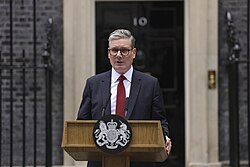 ](https://en.wikipedia.org/wiki/File:Prime_Minister_Sir_Keir_Starmer_arrives_at_Number_10_Downing_St_%2853836916571%29.jpg)Starmer as Prime Minister outside 10 Downing Street, 5 July 2024
As the leader of the majority party in the House of Commons, Starmer was appointed prime minister, First Lord of the Treasury and Minister for the Civil Service by King Charles III on 5 July 2024, becoming the first Labour prime minister since Gordon Brown in 2010 and the first one to win a general election since Tony Blair in 2005.[131][132][133] He and his wife, Victoria, were driven from Buckingham Palace to Downing Street. Starmer stopped the car on the way back from the palace to go on a walkabout in Downing Street to meet cheering crowds.[134]
In his first speech as prime minister, Starmer paid tribute to his predecessor, Rishi Sunak, saying "his achievement as the first British Asian prime minister of our country should not be underestimated by anyone" and he also recognised "the dedication and hard work he brought to his leadership", but added that the people of the UK had voted for change:[135]
You have given us a clear mandate, and we will use it to deliver change. To restore service and respect to politics, end the era of noisy performance, tread more lightly on your lives, and unite our country. Four nations, standing together again, facing down, as we have so often in our past, the challenges of an insecure world. Committed to a calm and patient rebuilding. So with respect and humility, I invite you all to join this government of service in the mission of national renewal. Our work is urgent and we begin it today.
Other world leaders, including Joe Biden and Justin Trudeau, as well as Blair and Brown, congratulated Starmer upon his appointment as prime minister.[136] One of his first acts was to declare the Rwanda asylum plan "dead": the Home Secretary, Yvette Cooper, would establish a Border Security Command to tackle smuggling gangs which facilitate illegal migrant crossings over the English Channel.[137][138] Starmer went on a tour of the four nations of the UK, meeting with leaders including John Swinney, Michelle O'Neill, and Vaughan Gething.[139] He also met the twelve regional mayors and announced the establishment of the Council of the Nations and Regions.[140][141] On 24 July 2024 he attended his first Prime Minister's Questions in the Commons.[142]
Cabinet
Main article: Starmer ministry
 Starmer convening his first Cabinet meeting on 6 July 2024
Starmer set about appointing a new Cabinet, which first met on 6 July, and he completed his ministerial appointments on 7 July.[134] Parliament was then recalled to meet on 9 July.[143] Among Starmer's ministerial appointments were the scientist Patrick Vallance as Minister of State for Science, the rehabilitation campaigner James Timpson as Minister of State for Prisons, Parole and Probation, and the international law expert Richard Hermer as Attorney General for England and Wales, who were created life peers to sit in the House of Lords.[144] The new government also contains a few ministers from the New Labour Blair/Brown governments, including Hilary Benn, Yvette Cooper, David Lammy, and Ed Miliband in Cabinet, and Jacqui Smith and Douglas Alexander as junior ministers.[145][146][147]
Domestic policy
Domestically, Starmer said that his primary concerns would be economic growth, reforming the planning system, infrastructure, energy, healthcare, education, childcare, and strengthening workers' rights, as set out in Labour's 2024 election manifesto. The 2024 State Opening of Parliament outlined 39 bills that Labour proposed to introduce in the months ahead, including ones to renationalise the railways, to bring local bus services under local public control, to strengthen the rights of workers, to tackle illegal immigration, to reform the House of Lords, and to undertake a programme to speed up the delivery of "high quality infrastructure" and housing. In addition, a number of bills proposed by the previous Conservative government were also included, notably the Tobacco and Vapes Bill, which featured in the 2023 King's Speech, but had been abandoned when the election was called.[148][149] Skills England, a body whose objective will be to reduce the need for overseas employees by improving skills training for people in England, was launched on 22 July.[150][151]
Economy
 Starmer with Reeves, 6 July 2024
The new Chancellor of the Exchequer, Rachel Reeves, accused the previous government of leaving a £21.9 billion "black hole", and announced on 29 July that certain winter fuel payments would be scrapped for around 10 million pensioners.[152][153] Following criticism of the plan, Starmer has defended the scrapping of these winter fuel payments, arguing that he had to make "tough decisions to stabilise the economy".[154][155] On 10 September the government benches defeated a Conservative Party motion in Parliament by a majority of 120 to block the measure.[156]
Starmer's Labour Government inherited a number of ongoing industrial disputes from the preceding Conservative Government and agreed pay deals with trade unions representing NHS and railway workers, ending strikes in the first few months of taking office.[157] In August 2024, Starmer's government agreed to increase public-sector worker pay by 5 to 7 per cent.[158]
On 10 October 2024, the Government introduced the Employment Rights Bill, expected to become an Act of Parliament in 2025. This includes an increase in minimum wages and a wide array of rights, such as immediate protection against unfair dismissal and the entitlement for employees to request flexible working arrangements, unless the employer can demonstrate that such arrangements are impractical.[159][160][161] Billions worth of investments in emerging growth sectors including AI and life sciences, and infrastructure were unveiled by businesses and ministers at the government's inaugural International Investment Summit on 14 October 2024. World-renowned CEOs and investors from around the world convened with ministers, First Ministers, and local leaders at the Guildhall in London.[162]
The October 2024 budget was presented to the House of Commons by Chancellor of the Exchequer Rachel Reeves on 30 October 2024. It covered Labour's fiscal plans, with a focus on investment, healthcare, education, childcare, sustainable energy, transport, and worker's rights enrichment. The National Minimum Wage is set to increase by 6.7 per cent (reaching £12.21 per hour) and a £22.6 billion increase in the day-to-day health budget was announced, with a £3.1 billion increase in the capital budget. That includes £1 billion for hospital repairs and rebuilding projects.[163] The government plans to allocate £5 billion for housing investment in the fiscal year 2025–26, with a focus on enhancing the availability of affordable housing. Education will receive £6.7 billion of capital investment, a 19 per cent real-terms increase. This includes £1.4 billion to rebuild more than 500 schools.[164]
The June 2025 Spending Review was presented to the House of Commons by the Chancellor, allocating day-to-day budgets for the years between 2025/26 and 2028/29 and capital budgets for the years between 2025/26 and 2029/30. It included £14.2 billion for a new nuclear power station at Sizewell C[165], £15 billion for transport projects outside London ^[166], and £39 billion over a decade for social and affordable housing.[167]
Immigration
One of Starmer's first acts was the cancellation of the controversial Rwanda asylum plan, describing it as "dead and buried".[137][168] Cooper established the Border Security Command to tackle smuggling gangs which facilitate illegal migrant crossings over the English Channel.[137][138]
In a May 2025 speech and associated white paper on the topic of immigration, Starmer said that the UK risked becoming an "island of strangers", and that high immigration had done "incalculable damage" to society.[169][170] The white paper outlined changes aimed at reducing immigration, including training for people in the UK.[171][172][173] His language was criticised by the left for its perceived echoes of Enoch Powell's Rivers of Blood speech.[174] In June, Starmer apologised for his "island of strangers" comment, saying that the phrase "wasn't right" and "I deeply regret using it". He said that he and his speechwriters had been unaware of the similarity with Powell's words.[174]
Healthcare
On 11 September 2024 Starmer pledged that there would be no more money for the NHS without reform. In response to the report from a nine-week review conducted by the peer and NHS surgeon Lord Darzi, which said that the NHS in England was in a critical condition, Starmer said the solution was reform, not money, and that there will be no more money without reform.[175]
In Government, Starmer reaffirmed the outgoing Conservative government's commitment of no new HIV cases in the United Kingdom by 2030. On 10 February 2025 Starmer, alongside the singer and HIV activist Beverley Knight and the Terrence Higgins Trust chief executive Richard Angell, recorded himself taking a rapid HIV home test. This made Starmer the first serving British prime minister and serving G7 leader to take a test on camera.[176][177] In March 2025 Starmer, along with Health Secretary Wes Streeting announced a two-year plan to abolish NHS England, saying it would to reduce bureaucracy and increase funding available for more effective purposes within the service.[178][179]
Welfare and pensions
Starmer has declined to abolish the two-child benefit cap introduced by the Cameron–Clegg coalition government in 2013, citing financial reasons.[180][181][182] On 23 July 2024 Labour withdrew the whip from seven of its MPs who had supported an amendment tabled by the Scottish National Party's Westminster parliamentary leader Stephen Flynn to scrap it, with Flynn saying that scrapping the cap would immediately raise 300,000 children out of poverty. MPs rejected the SNP amendment by 363 votes to 103.[183] The seven Labour MPs suspended for six months were John McDonnell, Richard Burgon, Ian Byrne, Apsana Begum, Imran Hussain, Zarah Sultana, and Rebecca Long-Bailey, all of whom sat as independents, they all had the whip restored except from Sultana, Begum and McDonnell.[184] Starmer launched a Child Poverty Taskforce, in which expert officials from across government would work together on how best to support more than four million children living in poverty.[185]
In July 2025, the government's Universal Credit Bill passed the House of Commons. It will increase the standard rate of Universal Credit.[186] The measures reduce the health-related aspect of universal credit for certain claimants, but they make sure that other parts of the benefit increase beyond inflation.[187]
Education
Starmer's government has imposed VAT on private school fees, expanded free school meals to 500,000 more children[188], and opened 750 free breakfast clubs in primary schools.[189] It also presided over an increase in tuition fees for higher education in England along with an increase in maintenance loans.[190]
Criminal justice
Shortly after taking office, Starmer said that there were "too many prisoners",[191] and described the previous government as having acted "almost beyond recklessness".[192] Saying it would help manage prison overcrowding, the newly appointed Justice Secretary, Shabana Mahmood, announced the implementation of an early release scheme which allowed for prisoners in England and Wales to be released after serving 40 per cent of their sentences rather than the 50 per cent previously introduced under the last government.[193] Over 1,700 prisoners were released in September, with further releases expected in the following year.[194] It then emerged that one prisoner released early under the scheme was charged with sexual assault relating to an alleged offence against a woman on the same day he was freed.[195] Starmer has defended the releasing of prisoners, and accused the previous government of having "broke[n] the prison system", with plans to build new prisons.[196][197]
2024 England and Northern Ireland riots
 Starmer receives senior British police officers at 10 Downing Street, 1 August 2024.
Following the 2024 Southport stabbing, in which three young girls were killed, Starmer described the incident as horrendous and shocking and thanked emergency services for their swift response.[198] He visited Southport and laid flowers at the scene, where he was heckled by some members of the public.[199] Starmer later wrote amidst the riots across England and Northern Ireland following the stabbing that those who had "hijacked the vigil for the victims" had "insulted the community as it grieves" and that rioters would feel the full force of the law.[200]
On 1 August, and following a meeting with senior police officers, Starmer announced the establishment of a National Violent Disorder Programme to facilitate greater cooperation between police forces when dealing with violent disorder.[201] On 4 August Starmer stated that rioters "will feel the full force of the law" and that "You will regret taking part in this, whether directly or those whipping up this action online and then running away themselves". He added "I won't shy away from calling it what it is – far-right thuggery".[202][203] Starmer later called an emergency response meeting of COBRA.[204] After the COBRA meeting, Starmer ordered a "standing army" to be set up to tackle the ongoing "far-right" riots. This was possible under the special emergency powers which were first used 40 years ago under the Ridley Plan, to tackle striking miners in 1984 and 1985.[205]
Starmer rejected calls from some MPs – including the Labour MP Diane Abbott, the Reform UK leader Nigel Farage and the Conservative MP Dame Priti Patel – to recall Parliament to Westminster.[206] After he said "large social media companies and those who run them" were contributing to the disorder, Elon Musk, the owner of the social media website X, criticised Starmer for not condemning all participants and only blaming the far-right.[207][208] Musk further said Starmer was not protecting all communities in the United Kingdom, which he said had a "two-tier" policing system.[209][210][211]
Acceptance of gifts
In September 2024, Starmer and fellow senior government ministers faced criticism for accepting gifts from Labour donors.[212] Starmer also faced accusations of breaking parliamentary rules by not declaring £5,000 worth of clothes bought for his wife by the Labour donor Lord Alli.[213][214] That same month, Sky News reported that Starmer had received £107,145 in gifts, benefits, and hospitality since December 2019, which was two-and-a-half times more than any other MP.[215]
Approval ratings
[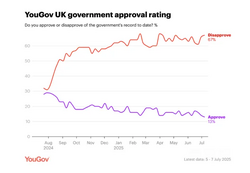 ](https://en.wikipedia.org/wiki/File:Keir_Starmer_Approval_Chart_-_YouGov_July_2025.webp)Keir Starmer Approval Chart - YouGov July 2025
Despite winning a record amount of seats within Parliament,[216] Starmer has suffered from low favourability among the British public during his tenure as Prime Minister.[217] A YouGov poll conducted in July 2025 showed that his government's approval rating was sitting at -54 (a disapproval rating of 63% and an approval rating of 13%).[218]
Some voters have objected to his attempted benefit reductions as part of Labour's Universal Credit Bill in July 2025[219] and sections of his white paper speech on immigration in May 2025, when he was accused of echoing the 1968 Rivers of Blood speech by Enoch Powell and feeding into far-right, anti-immigrant narratives by saying that uncontrolled immigration risked turning Britain into an “island of strangers”.[220][221]
Other critics have accused Starmer's government of two-tier policing, which has led to these critics labelling him with the moniker "Two-Tier Keir".[222][223] Right-wing critics who subscribe to this theory such as Elon Musk claim that the police use more heavy-handed tactics when dealing with right-wing protests when compared to left-wing protests.[224][225] Critics such as Jamie Driscoll believe that the police are more favourable to right-wing protests and more heavy-handed against left-wing protests and groups such as Palestine Action, which was proscribed by Starmer's government in 2025.[226][227][228]
Other allegations of two-tier policing were especially prevalent during the Southport riots in August 2024 and the subsequent arrest of rioters and some of their supporters, such as Lucy Connolly, along with the Epping protests in July 2025.[229][230] Starmer has also received disapproval from across the political spectrum for Britain's stagnant economy,[231] changes to farmer's inheritance taxes[232] and the erosion of free speech as a result of the Online Safety Act 2023, the provisions of which were implemented by his government.[233][234][235]
Foreign policy
Main article: List of international prime ministerial trips made by Keir Starmer
United States
 Starmer with US President Joe Biden in the Oval Office, 10 July 2024
 Starmer with US President Donald Trump in the Oval Office, 27 February 2025
In July 2024, following the 2024 general election, US President Joe Biden congratulated Starmer on "a hell of a victory".[236] Starmer and Biden discussed their shared commitment to the Special Relationship between the US and the UK, as well as their mutual support of Ukraine.
Following the attempted assassination of Donald Trump in July 2024, the former president of the United States at the time, Starmer posted on Twitter saying "Political violence in any form has no place in our societies" and extended his best wishes to Trump and his family.[237]
In September 2024, during a visit to New York City to address the UN General Assembly, Starmer met the American Republican Party presidential candidate, Trump, at Trump Tower. Following the meeting, Starmer said it was "good" to have met with Trump and that the meeting was an opportunity for both Trump and Starmer to establish a working relationship.[238] Following Trump's election victory in the 2024 United States presidential election, Starmer called Trump to formally congratulate him on 6 November and was assured that the "special relationship" between the United Kingdom and United States "would continue to thrive".[239]
In February 2025 Starmer met with President Trump at the White House to discuss continued support to Ukraine and a potential peace deal. They additionally discussed a potential trade deal. He also presented a hand written letter from King Charles III inviting the President to a historic second state visit to the UK.[240][241]
In June 2025 Starmer supported Israel's right to self-defence in the Iran–Israel war and United States strikes on Iranian nuclear sites, stating that "Iran can never be allowed to develop a nuclear weapon and the US has taken action to alleviate that threat".[242][243]
NATO
[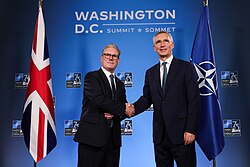 ](https://en.wikipedia.org/wiki/File:Prime_Minister_Keir_Starmer_attends_NATO_Summit_%2853848235486%29.jpg)Starmer and Secretary-General Jens Stoltenberg at the NATO summit in 2024.
The first overseas meeting Starmer attended as prime minister was the 2024 NATO summit held in Washington from 9 to 11 July 2024.[244][245] On the flight to the summit, Starmer laid out a "cast iron" commitment to increase defence spending to the NATO target of 2.5 per cent of GDP in line with the NATO target, following a "root and branch" review of British armed forces.[246][247]
Europe
Since he became prime minister Starmer has sought to "reset" UK relations with the European Union following Brexit, which he opposed. He met with a number of European leaders during his first few months in office.[248][249]
On 27 August 2024 Starmer and German Chancellor Olaf Scholz announced talks towards revising a Germany-UK co-operation agreement covering areas including defence, energy security, science and technology.[250]
Ukraine-Russia war
Further information: United Kingdom and the Russian invasion of Ukraine
[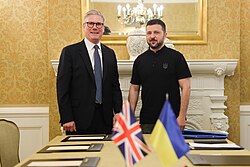 ](https://en.wikipedia.org/wiki/File:Prime_Minister_Keir_Starmer_meets_President_Zelenskyy_%2853848423375%29.jpg)Starmer with Ukrainian President Volodymyr Zelenskyy, 10 July 2024.
At the 2024 NATO summit, Starmer signalled that Ukraine could use British Storm Shadow missiles, sent by HMG by way of military aid, to strike military targets inside Russia, during the Russian invasion of Ukraine.[251] In a meeting with Ukrainian President Volodymyr Zelenskyy Starmer called for an "irreversible" membership strategy for Ukraine to join NATO.[252]
Following a heated meeting between US President Trump and President Zelenskyy at the White House, Starmer organised a summit of European leaders in London. Among the things discussed at the summit were continued support for Ukraine, security guarantees for the country and peace efforts.[253]
China
In November 2024 Starmer met Chinese President Xi Jinping at the G20 summit in Rio de Janeiro and told him he wanted to build a 'consistent, durable, respectful' relationship with China.[254]
[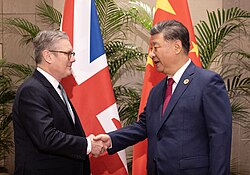 ](https://en.wikipedia.org/wiki/File:Prime_Minister_Keir_Starmer_attends_the_G20_Summit_in_Brazil_%2854147616322%29.jpg)Starmer meeting Xi Jinping
Gaza war
Further information: United Kingdom and the Gaza war
On the Gaza war, Starmer has supported Israel's right to self-defence and has not blocked all arms sales to Israel. He has also condemned some of Israel's actions, called for a ceasefire, committed humanitarian aid to Gaza, and supported a two-state solution.[255][256][257]
In October 2023, shortly after the Hamas attack on Israel, Starmer said Israel had the "right to defend" itself and suggested Israel had the right to cut off power and water from the Gaza Strip, but added "everything should be done within international law".[258] This sparked significant controversy within his party, and several Labour councillors resigned in protest. Starmer then said that he was referring to the right to self-defence, "I was not saying that Israel had the right to cut off water, food, fuel or medicines".[259]
When he became Prime Minister, Starmer told Israeli Prime Minister Benjamin Netanyahu of the "urgent need for a ceasefire, the return of hostages and an immediate increase in the volume of humanitarian aid". He also assured Netanyahu that the UK would continue its "vital cooperation to deter malign threats" with Israel.[260]
In November 2024 Starmer's government stated that Netanyahu would be arrested if he travels to the UK, after the International Criminal Court issued an international arrest warrant for him for alleged war crimes.[261]
In May 2025 Starmer issued a joint statement with Emmanuel Macron and Mark Carney condemning Israel's renewed offensive against Gaza. He called for Israel to immediately stop its military operations and to immediately allow humanitarian aid into Gaza. The statement condemned remarks by members of the Israeli government suggesting the destruction in Gaza would lead to relocation of its population as "abhorrent" and against international law. He said his government would take "concrete actions" if Israel continued its "egregious actions".[262] Netanyahu accused Starmer of siding with Hamas, saying "you're on the wrong side of justice, you're on the wrong side of humanity and you're on the wrong side of history".[263]
Under Starmer's premiership, the licences of some British arms sales to Israel were suspended in September 2024 because of a "clear risk" that the weapons could be used to violate international law. Foreign Secretary David Lammy announced the UK Government's suspension of 30 of 350 arms export licences to Israel, affecting equipment such as parts for fighter jets, helicopters and drones.[264]
Political positions
Main article: Political positions of Keir Starmer
....