ACTivist SUPPRESS 3
see bak
see 1st amend ppl lose
SEE TERROR BS 3 MILLER 3
==
format messed up, see links below
519
---
RWW
10/06/2025
by
- Josh Kovensky @ Talking Points Memo: The Trump Admin’s Mostly Unnoticed Move to Crack Down on the Opposition
Last month, the White House issued two executive orders that direct federal law enforcement to start cracking down on the political opposition. One of the two memos prompted some confusion and mockery for its attempt to designate “antifa” a terrorist organization. But the second has gone largely unnoticed in the mainstream press.
- Ann Marie Shambaugh @ The Roys Report: Son of Covenant Eyes Co-Founder Arrested after Planning Sexual Encounter with 14-Year-Old
Back in 2000, a Michigan entrepreneur named Ron DeHaas co-founded Covenant Eyes, an anti-porn internet accountability software program that has since grown to more than 2 million users. The idea, he said at the time, was to protect his teenage stepsons from sexual temptation online. Its effectiveness has been lauded by many, including Speaker of the House Rep. Mike Johnson. But this past Aug. 13, one of those stepsons was arrested at a meeting spot in Grand Rapids, Michigan, where he thought he would find a 14-year-old girl interested in having sex with him.
- Andrew Perez, Asawin Suebsaeng @ Rolling Stone: ‘They Need to Suffer’: Inside Trump’s War on Dissent
After Charlie Kirk’s murder, Trump expanded his war on free speech, the left, and ordinary Americans. It’s going to get worse.
- Jonathan Chait @ The Atlantic: Stephen Miller Is Going for Broke
The White House aide equates opposition to Trump’s agenda with terrorism—and pushes for the use of state power to suppress it.
- John Fea @ ARC: The Christian Nationalist Rewriting American History
Douglas Wilson’s rising influence shows how the past is at the center of today’s culture wars.
- Edith Olmstead @ The New Republic: Supreme Court Tells Laura Loomer to Shut Up Already
The Supreme Court refused to hear the far-right commentator’s censorship case.
---
---
intercept 3 25
Trump administration said Thursday that it canceled a federal grant to a climate nonprofit over the group’s protected First Amendment speech.
The Climate Justice Alliance, a nonprofit that organizes on climate issues in poor and Indigenous communities, was awarded a multimillion-dollar grant under former President Joe Biden’s climate infrastructure package. The Biden administration, however, later delayed that funding over the group’s support for Palestine, The Intercept reported.
Related
Biden Attack on Nonprofit Over Palestine Stance Made Trump’s Job Easier](https://theintercept.com/2025/01/22/biden-climate-justice-alliance-funding/)
Last month, the group received word that it would not receive the funding under President Donald Trump.
The Environmental Protection Agency, which issues the grant, previously said it was continuing to evaluate the funding. On Thursday, however, Trump’s appointee to lead the Environmental Protection Agency posted a tweet that seemed to confirm what the nonprofit has been saying all along: The government canceled its grant in retaliation over its public statements on Palestine.
“I just cancelled a $50 MILLION Biden-era environmental justice grant to the Climate Justice Alliance, which believes ‘climate justice travels through a Free Palestine,” EPA Administrator Lee Zeldin wrote in a tweet on Thursday. (The EPA did not immediately respond to a request for comment.)
A post shared by Climate Justice Alliance (CJA) (@cjaourpower)
CJA collaborates with close to 100 smaller groups, community networks, and other grassroots organizations that deal with climate issues in working-class rural and urban communities. Its direct work has little to do with Palestine, but it has connected its mission of climate justice to theeffects of war in Palestineas aglobal climate issue. CJA also put out a statement calling for a ceasefire shortly after the October 7 attacks in 2023.
In a post to Instagram on Thursday featuring a screenshot of Zeldin’s tweet, CJA wrote that the Biden administration had left its fate in the unwelcoming hands of Trump. (Asked for comment, CJA referred The Intercept to its social media statement.) The group said the grant would have helped create sustainable jobs, provide resources for projects to protect public health and safety, and benefited taxpayers and working-class families.
“The Administration continues its attacks on working class communities, rural and urban families with its announcement of the cancellation of the Climate Justice Alliance’s UNITE-EJ program grant,” CJA wrote, referring to the EPA grant.
“Unfortunately, the Biden administration failed to process these obligated funds intended to help communities facing disasters from climate change and left the decision in the hands of the Trump administration. Despite claims that this administration will protect clean water and clean air for the nation it has attacked basic protections for neglected communities from day one.”
Republican lawmakers and right-wing media have also targeted CJA, claiming it exhibited “anti-Republican sentiment” and wanted to “defund the police.” Republicans also slammed the group for supporting a Green New Deal.
Trump is increasingly using political attacks as a policy tool, starting with his support for a “nonprofit killer bill” passed in the House last year. The bill would allow the Treasury secretary to strip nonprofit status from groups it designates as a “terrorist supporting organization.”
---
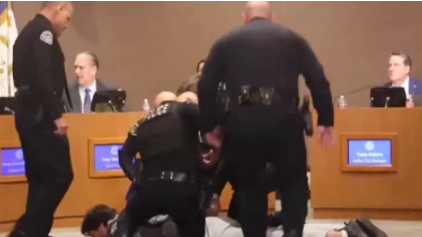
an 2 24
Former NFL player arrested after calling MAGA a 'Nazi movement' at city council meeting
===
exxonknews gmail 12 24
Who’s funding this ‘newspaper’ mailed to potential jurors in Greenpeace’s trial?
A dark money trail linked to pipeline company Energy Transfer could be behind a mysterious mailer targeting North Dakota residents in the lead-up to its major trial with Greenpeace.
The following piece was co-published by DeSmog and ExxonKnews.
In early September, fossil fuel executive and Donald Trump megadonor Kelcy Warren quietly made a large donation to a political action committee few people have ever heard of. Warren is CEO of Energy Transfer, the company behind the infamous Dakota Access Pipeline, which in 2016 faced thousands of protesters including members of the Standing Rock Sioux Tribe and other opponents.
The timing is potentially significant because Warren made his $5 million donation to the super PAC called Turnout for America while his company pushed forward with a lawsuit against the nonprofit Greenpeace related to the Standing Rock protests.
Two weeks after receiving Warren’s contribution, Turnout for America paid $250,000 to Northern CB Corp. — an Illinois publishing and printing company — for “media services.”
One of the listed directors for Northern CB Corp. is Brian Timpone, a conservative businessman who owns Chicago-based company Metric Media, a Koch-linked network that runs more than 1,100 partisan websites masquerading as local news.
In October, residents in Morton County, where the Greenpeace trial is scheduled to take place, received a mailed publication called “Central ND News,” which featured articles decrying the Dakota Access protests and praising Energy Transfer. Central ND News is produced by Metric Media.
While news of this “weird” paper was first reported by Floodlight and the North Dakota News Cooperative, additional details related to Warren’s Super PAC donation are now being debated in the lawsuit itself.
Greenpeace is urging a North Dakota court to allow further investigation into who paid to send the publication attacking Dakota Access protestors to Morton County residents — and whether there was an attempt to exert “improper influence” over potential jurors in Energy Transfer’s favor.
“Given the importance of securing a fair and impartial jury … knowing who was directing these actions, to whom they directed the information, and why they did so are important issues to the fair administration of justice,” a Greenpeace brief shared with ExxonKnews and DeSmog reads.
A closely watched lawsuit
Energy Transfer’s $300 million lawsuit accuses the environmental group Greenpeace of unlawfully orchestrating protests against the Dakota Access pipeline in 2016 and 2017, during which time hundreds of protestors were arrested near the Standing Rock Sioux Indian Reservation — including climate activists and Indigenous water protectors.
Energy Transfer, which worked with law enforcement agencies to curtail the protests and used an international security firm to surveil and shift public opinion about the company’s opponents, claims that Greenpeace waged an “unlawful, malicious, and coordinated attack” to damage and defame the pipeline and the company itself.
**According to Greenpeace USA, Energy Transfer is suing the group because it “dared to uplift the Indigenous-led opposition movement at Standing Rock.”
The lawsuit could have implications for whether the fossil fuel industry is able to silence protesters as it embarks on major expansions, including the buildout of new gas and carbon dioxide pipelines, Gulf Coast LNG facilities, and petrochemical infrastructure. Experts and advocates say the case has all the hallmarks of a SLAPP, or strategic lawsuit against public participation — a larger legal tactic fossil fuel companies have been using to suppress dissent and drain their opposition of resources and time.
As the February 2025 trial draws near in the closely watched case, Greenpeace is now asking a state district court to grant an emergency motion to reopen discovery in the case, which would allow the environmental group to get more information about who funded the mailer to North Dakota residents.
In its new court filing, Greenpeace alleges that “there may have been improper influence over potential Morton County jurors through direct mailers containing negative reporting about Standing Rock protests that took place eight years ago, and benefits which Energy Transfer conferred on the local community six years ago.”
Greenpeace cites new details indicating that Kelcy Warren’s donation came around the same time as a surge of coverage from Central ND News targeting the Dakota Access protests. Central ND News began running a series on its website in August, called “On This Date in 2016.” The series contained six articles in August, three of which accused protestors of “unlawful” activities in their headlines. Subsequent articles in the series appeared a few times each month up until this week. There is no record of the paper covering those protests before this year.
The same day Turnout for America paid the Illinois publishing company, Central ND News published a story praising a donation that Energy Transfer made to a university in North Dakota six years ago. That story, written by C.D. Marsden (a name that Floodlight first found yields no results in a Google search), was featured in the October newspaper delivered to Morton County residents’ homes, juxtaposed with stories about Dakota Access pipeline protestors.
The 12-page paper included those stories in a section called “This Month in History: October 2016,” featuring one article titled “Area schools locked down as authorities respond to pipeline protests.” Another recounts the details of a felony arrest warrant accusing a pipeline protestor of charging a police officer on horseback.
“The purpose of that publication is quite clearly to remind people about what was happening eight years ago,” a lawyer for Greenpeace, Everett Jack, told the court at a December 9 hearing requesting the reopening of discovery. “We should be entitled to find out who made that decision.”
pix
One of Greenpeace’s lawyers — Derrick Braaten, who resides in Mandan, a city in Morton County — received the Central ND News at his home in October. The paper doesn’t appear to have any physical presence in North Dakota — it directed readers to the outlet’s website, and didn’t include any local advertisements, according to Greenpeace.*
Jack told Southwest Judicial District Court Judge James Gion that reopening discovery would allow Greenpeace’s attorneys to question the Texas-based printing company that sent the newspaper, FMC Printing. The group would seek to subpoena FMC Printing to determine whether the mailer was targeted only to Morton County residents, who directed that the mailer be sent there, and why. Depending on the results of that investigation, Greenpeace would consider requesting a change in venue for the trial.
“We’re filing this motion and seeking this discovery because I think this court would agree there’s nothing more sacred in the legal system than the right to a fair, impartial jury, and every lawyer knows that direct efforts to influenc[e] the jury pool are not okay,” Jack said.
‘Playing both sides’
Greenpeace has been fighting varying iterations of Energy Transfer’s case — which was originally filed under state and federal racketeering charges — for eight years, with individual Indigenous protestors and journalists also brought into the mix. This week, the Minnesota Supreme Court heard an appeal from Energy Transfer in its attempts to subpoena journalists who reported on the protests at Standing Rock, seeking to force them to produce confidential, unpublished material.
The Dakota Access pipeline began operating through North Dakota in 2017 after an executive action from then-President Trump. The pipeline, which protestors warned would threaten water supplies, sacred sites, and the climate, leaked 5 times in its first year of operation alone.
This fall, the day before the October mailing was sent, the Standing Rock Sioux Tribe filed a new lawsuit against the U.S. Army Corps of Engineers arguing that the pipeline is operating illegally and should be shut down. Energy Transfer CEO Warren gave $5 million in campaign donations to Trump, who recently promised “fully expedited approvals and permits” to companies who invest $1 billion in the U.S.
:{Energy Transfer’s case, originally filed by the firm Kasowitz Benson Torres (long-time lawyers for Donald Trump), was taken over in 2023 by Gibson Dunn, a law firm with a record of “playing both sides” of the First Amendment on behalf of its corporate clients. }:{:Gibson Dunn}: lawyer Trey Cox represented Energy Transfer in its opposition to Greenpeace’s motion this week, arguing that juror questionnaires are the appropriate method to ensure a fair trial — and that whether or not Morton County residents received or read the newspaper was irrelevant.
ND Central News, he said, was a local newspaper that existed before the mailer was sent, and was simply covering matters involving a high-profile trial. Cox accused Greenpeace of trying to delay the trial date (which Greenpeace denied), and said its motion did not have “any basis in law or in fact.”
Energy Transfer, Metric Media, and Trey Cox did not respond to requests for comment.
“We don’t have any evidence that this newspaper in any way prejudiced potential jurors,” Cox told the court.
===
an 4 24
just normal gop macho strict fr bs?
tensions in the Middle East escalated during the April 13-14 weekend when Iran attacked Israel with drones and missiles, many of which were shot down by U.S. forces.
President Joe Biden has been critical of Israeli Prime Minister Benjamin Netanyahu's Gaza policy as the death toll in Gaza continues to soar. However, Biden has also made it clear that the U.S. remains a major ally of Israel.
Protests against Netanyahu's policies have been plentiful in the United States. And Sen. Tom Cotton (R-Arkansas) is drawing vehement criticism after promoting violence against protesters.
In an April 15 post on X, formerly Twitter, the GOP senator wrote, "I encourage people who get stuck behind the pro-Hamas mobs blocking traffic: take matters into your own hands. It's time to put an end to this nonsense."
Politico's Niall Stanage noted that Cotton edited his tweet, replacing "take matters into your own hands" with the longer "take matters into your own hands to get them out of the way."
New York Daily News columnist Brandon Friedman tweeted, "Cotton should be expelled from the Senate over this."
On X, journalist Brian Beutler commented, "Remember when people insisted that Cotton simply meant for troops to discern with perfect accuracy between protesters and rioters and intended no harm to the former?"
READ MORE:[The Big Picture: Donald J. Trump's attempted coup
In response to Cotton, Princeton University professor Eddie Glaude Jr. — a frequent guest on MSNBC — tweeted, "What is wrong with you?"
Former MSNBC host Keith Olbermann said of Cotton, "What? He wants to kill Americans. That makes him a Republican."
Activist Charlotte Clymer, a former press secretary for the Human Rights Campaign, told Cotton, "Why is violence your answer to every problem? Why are you so weak?"
Wade Lentz, co-host of "The Patriot Pastor's Podcast," tweeted, "It's sad that an Arkansas Senator asks that American citizens put their lives in danger when he has done not one thing to address this in DC. Do something besides posting about it, and then show us how you have addressed it in Washington."
https://www.alternet.org/2022/05/merrick-garland-2657324103/
gov va md no protest outside justice house (b/c privacy?]
https://www.alternet.org/2022/03/russia-ukraine/
thousands arrested
asked for ppe covid $?
https://theintercept.com/2021/08/27/enbridge-line-3-pipeline-police-training-intelligence/
a corp can substitute video for a live cop in trespass law?!
intercept 921 eileen brn?
POLICE RESPONSIBLE FOR public safety surrounding the construction of an oil pipeline in Minnesota have repeatedly denied having a close relationship with Enbridge, the company behind the controversial energy project. According to records obtained by The Intercept through public information requests, however, Enbridge has provided repeated trainings for officers designed to cultivate a coordinated response to protests.
By the time construction on Line 3, a tar sands oil pipeline, began last December, a working relationship had been established between Enbridge and police officers. A public safety official even invited the company’s Line 3 security chief to regular intelligence sharing meetings. In one case, the official passed along intelligence to Enbridge’s security chief for Line 3: a list of people who attended an anti-pipeline organizing meeting.
Line 3 opponents have long raised concerns about payments made to law enforcement by Enbridge to cover pipeline-related policing. A special account set up by the state of Minnesota has distributed $2.3 million in Enbridge funds to public safety agencies so far.The records shed new light on the level of close coordination between law enforcement agencies and the Canadian oil company to police the Indigenous-led movement to stop Line 3.
:{
“Local law enforcement has become the brutal arm of a Canadian corporation.”
}:
“Local law enforcement has become the brutal arm of a Canadian corporation,” said Mara Verheyden-Hilliard, director of the Partnership for Civil Justice Fund’s Center for Protest Law and Litigation and an attorney representing opponents of the pipeline. “It’s highly inappropriate for law enforcement to target people based on First Amendment activity, collect identity information and then deliver that information to their political opponents.”
The effort to halt the Line 3 pipeline is the latest flashpoint in the movement to end development of new fossil fuel infrastructure amid a growing climate crisis. In Minnesota, members of the Indigenous-led resistance, known as water protectors, have turned to tactics that directly disrupt construction, sometimes trespassing on private property, blocking roads, or locking down to pipeline company equipment.
"Community police and sheriff deputies are responsible for public safety,” Enbridge spokesperson Juli Kellner told The Intercept. “Our security call the police when a disturbance occurs. Officers decide when an individual is breaking the law — or putting themselves or others in danger.”
How law enforcement responds to the protest movement is a matter of training and discretion.The documents obtained by The Intercept suggest that Enbridge has stepped in to influence officers’ choices.
Water protectors point to the close working relationship between Enbridge and law enforcement to explain escalating police tactics, with rubber bullets and other “less-lethal” weapons deployed in recent weeks.
Plans to Coordinate
Emails between Enbridge and members of the Northern Lights Task Force — a group consisting of sheriffs and public safety officials coordinating plans for expected protests against Line 3 — describe several joint training exercises and other coordination meetings set up by the energy firm. The largest of the trainings was in Bemidji, Minnesota.
In October 2020, according to emails, Enbridge organized an all-day training at the company’s Bemidji Emergency Operations Center. According to an email sent a day before the event, dozens of Enbridge employees, public safety officials, including local sheriffs along the pipeline route, and an FBI agent were invited to attend. A primary goal for the event: “Coordination between Line 3 project team and L.P.” — an acronym that typically refers to “local police.”
Related
Indigenous Water Protectors Face Off With an Oil Company and Police Over a Minnesota Pipeline
The email sent out ahead of the training included a series of “Incident Briefing Maps” laying out scenarios where Enbridge and law enforcement might need to coordinate a response. The various scenarios had something in common: They all involved protests.
The list of scenarios — which were drawn up by the Response Group, a controversial crisis management firm that works for the energy industry — laid out four possible events: demonstrators blocking traffic, the breach of a construction site, “swarming” of a pipeline hub while streaming on social media, and project opponents locking themselves to the gate of an Enbridge office.
Training participants would be asked to come up with a plan to respond to each of the scenarios, as well as to develop an “Information and Communication Strategy” to keep government agencies, the public, and the media informed of what was happening, according to a list of exercise objectives. Enbridge planned to discuss providing local law enforcement with a project radio, according to an email describing the exercise.
It wasn’t the first conversation of its kind. Inadvance of a smaller version of the exercise, back in April, members of the Northern Lights Task Force filled out a questionnaire for Enbridge. The public safety officials noted that it was a “priority” for law enforcement to obtain access to Enbridge security camera feeds. It also referenced the possibility of placing an Enbridge liaison inside the two law enforcement emergency operations centers, as well as a law enforcement liaison in Enbridge’s emergency operations center.
The Northern Lights Task Force’s communications team did not answer a detailed list of questions. Aitkin County Sheriff Dan Guida, a member of the task force, said his office never received a project radio nor saw other agencies with one. Guida said that the scenarios served to show law enforcement how Enbridge runs its emergency operations center. “It was for Enbridge to learn. We didn’t get trained by Enbridge,” he said, adding that law enforcement might carry out a similar exercise with a bank. “We assisted them and told them this is how we do it, you do your own thing.”
It’s not clear how many officers attended the trainings offered by Enbridge. Clearwater County Sheriff Darin Halverson was copied on the invite and RSVP’d that he would attend an additional Enbridge security exercise as well as a “sensitive security information” meeting. He told The Intercept that he did not attend any of the gatherings.
Sharing Intelligence
By the time construction on Line 3 began, a comfortable working relationship appeared to have been established between Enbridge and some of the public safety agencies invited to the company’s meetings. Public officials repeatedly expressed interest in exchanging information on pipeline opposition with Enbridge.
In December 2020, a St. Louis County sheriff’s deputy distributed language to be used by officers issuing dispersal orders during protests against Line 3 and also sent a list of potential charges that could be applied to pipeline protesters. Another officer responded, noting that it would be legal to arrest water protectors even if they trespassed without a law enforcement officer present. “Hopefully Enbridge security would be videotaping when able,” the officer said. Other documents affirmed that Enbridge security would be wearing body cameras.
The Northern Lights Task Force, the group of public safety officials, occasionally suggested that Enbridge should be excluded from planning, the documents show. In November 2020, Guida, the Aitkin County sheriff, copied Enbridge public information officers on an email about the task force’s public messaging strategy. Another sheriff advised that the corporate representatives did not belong in the group: “It is not a good idea to have Enbridge employees in our group, but they would certainly be good contacts to have to know what info is being put out,” wrote Carlton County Sheriff Kelly Lake. (Guida told The Intercept he copied Enbridge on the email so that law enforcement and the company could avoid mixed or duplicate messages.)
In other cases, public safety officials actively sought out Enbridge security to assist with law enforcement officers’ efforts, inviting an Enbridge representative to share space and attend meetings. St. Louis County Emergency Management Coordinator Duane Johnson copied Enbridge’s security lead for the Line 3 project on an email inviting first responders to work out of the law enforcement emergency operations center as they monitored intelligence on a potential direct action the next day. “There is considerable intel on something brewing tomorrow. Let me know if you’d like to come over and work out of the EOC tomorrow just in case something pops,” the official wrote, referring to the emergency operations center.
In another email, Johnson requested that Enbridge’s Line 3 security lead attend regular intelligence meetings. “We have missed you on our 0900 intel meetings. Is there another time that would work better for you?” asked the emergency management coordinator in a January 2021 email. “It would be nice to have someone from your company on.”
The Enbridge security officer was kept in the loop. The next day, Johnson copied him on another email, forwarding a list of names of water protectors who had attended a “Line 3 Organizing Meeting” the night before.
“It was all I really got from last night,” Bruce Blacketter, emergency management director for the Fond du Lac Band of Lake Superior Chippewa, wrote to Johnson in the forwarded email. “Well, this and a slight ‘back of the head’ headache from the musical performances and guided breathing/stretching exercises.”
St. Louis County did not respond to a request for comment, and the Fond du Lac Band declined to comment.
drilled
fines boost $150,000 but 10x for orfanizing (not even on site) 1.5 mil$
treas state...front montana
witchita regional CoC = koch
BP, exxon, API, trade groups; koch reg to lobby ark and alabama
https://drillednews.com/another-line-3-battleground-free-speech/
We’ve covered the ongoing, fossil fuel-backed push to criminalize protest before. In 2017, Oklahoma passed the first of these bills, specifically citing the Standing Rock protest of the Dakota Access Pipeline in North Dakota.Then American Fuel and Petrochemicals Manufacturers (AFPM), the trade group for refineries and petrochemical facilities, crafted sample legislation based on the Oklahoma bill, and pushed the American Legal Exchange Council (ALEC) to adopt it. In 2020 , the Covid-19 pandemic slowed things down a bit, but in 2021 things are speeding up. In January, Ohio passed a bill that’s been debated for years, bringing the total number of states with so-called “critical infrastructure laws” in place to 14.
What’s defined as critical infrastructure varies a bit from state to state, but pipelines are always included; penalties range, too, but across the board these laws increase both the criminal and financial penalties of protest, potentially landing protestors in jail for years with fines up to $150,000. It’s worth noting that all of these states have trespassing and property damage laws already, it’s not as though those things have been going unpunished; the new laws merely make the consequences much tougher. They also add penalties for organizers and organizing entities. In Montana, for example, a proposed bill would fine organizations up to a million dollars for being involved in protest.
All of which comes into play in Minnesota, where the fight against Line 3 is underway. There are currently six bills under consideration in the state, packaged into four legislative packages.If any of them pass, not only could protestors be facing stiffer penalties but also the organizations involved, most of them led by Native women, could find themselves slapped with large fines too.
In this interview, researcher Connor Gibson walks us through the origin of these laws, why they’re picking up steam, and what to expect this year.
[audio]
Connor Gibson: There’s only one state this year that really has a high profile pipeline protest going on, that’s Minnesota.
PBS News Hour: 30 years ago this week, the line three pipeline in northern Minnesota ruptured, spilling one point seven million gallons of crude oil into a frozen river near Grand Rapids, Minnesota. If the river had not been frozen, the oil could have seeped into the Mississippi River and contaminated drinking water for millions. Downstream protests have been ongoing to stop construction, rerouting a section of the line three pipeline, which could impact indigenous communities and local waterways.
Amy Westervelt: Hello and welcome to Drilled, I’m Amy Westervelt. You might have heard recently about the Line 3 pipeline project in Minnesota. Some people are calling it the next Standing Rock because it’s been at the center of protests for years, particularly from indigenous tribes in the area. Activist and author Winona LaDuke has been involved in that fight for seven years. Here she is talking to PBS news about it earlier this month.
Winona LaDuke: I’m a grandmother, you know, and we’re standing out there. I have six charges against me for this pipeline. And there’s a bunch of us that are facing charges for, you know, trying to be a water protector.
PBS News Hour: LaDuke and others have been part of this seven year fight opposing the project throughout the state and federal review processes.
Winona LaDuke: It is the largest tar sands pipeline in the world. This pipeline is the equivalent of 50 new coal fired power plants. So, you know, if you’re trying to save the planet, this is not the way to do it.
Amy Westervelt: I couldn’t get to Minnesota myself. I’m not vaccinated yet, so I don’t want to impose myself on the community. Plus I have kids. But also this is one of those stories where I want to hear from local, and particularly Native journalists. I did want to see, though, whether the evolving Line 3 story dovetailed at all with something else I’ve been tracking: fossil fuel-backed anti-protest bills. I’ve written about this a few times. A bunch of other journalists have done some great reporting on it as well. There’s some good stuff in Huff Post and The Intercept. I’ll drop some links in the show notes for those of you who want to read more.
These bills have been passed in 14 states now and proposed in about half the states in the country. They differ a little bit from state to state, but in general they increase the fines and jail time associated with trespassing dramatically. They often bump trespassing up from a misdemeanor to a felony. And they seem to be specifically targeting organizers and the organizations they work with, with steep penalties for organizing or training activists who then trespass. So even if the organizer isn’t there at the protest, they can still be charged.
And it turns out there are six—six—anti-protest bills making their way through the Minnesota state legislature right now. Some of them are bundled together, so it amounts to four different legislative packages. But still, that’s a lot. And it’s important because on top of cracking down on pipeline protests, there’s growing concern that these bills will be used to quell other sorts of protests, too. And remember, Minnesota was ground zero for last summer’s Black Lives Matter protests in the days after police murdered George Floyd.
To talk about Minnesota’s proposals, where these laws came from in general and how they’re moving through the country right now, I asked researcher Connor Gibson to join me. He’s been keeping tabs on these bills really since they started to pick up steam in the wake of the Standing Rock protests. That conversation coming up right after this quick break.
Amy Westervelt: It seems like all of a sudden the pace has picked up again, but I don’t know if that’s just like a feeling or if that’s actually what happened. So I’m curious to see what you’ve seen on that front.
Connor Gibson: Yes, it is the case that the fossil fuel infrastructure, anti protest bills are currently gaining steam in the 2021 legislative sessions of many states. I think the main difference between this year and last year is last year the pandemic really just messed up the strategy. We still saw plenty of bills and laws passed in twenty twenty. But I think it’s it was reduced by the impact of the pandemic, the confusion and cancelations and delays that caused the state legislature. So I suspect what we’re seeing in twenty twenty one is a lot of what companies intended to do last year. They just weren’t able to do as much as quickly as they would have liked. But that said, bills still passed into law during the pandemic in West Virginia and Kentucky. And this year we’re seeing more states continue the trend, including some states that failed to pass bills last year, like Illinois, like Alabama. And there’s only one state this year that really has high profile pipeline protests going on, that’s Minnesota, with the Line 3 revamp being done by Enbridge and being hastened along by many other players in the oil industry, so that makes the situation a little bit more relevant and urgent in Minnesota than in other states. I can’t tell you why Arkansas cares so much; its big pipeline resistance kind of happened a couple of years ago with the Diamond Pipeline, right.
Amy Westervelt: Connor, did that come into play in Oklahoma, too? Is it the same pipeline, the Diamond pipeline?
Connor Gibson: I want to say yes.
Amy Westervelt: Yep, it was. I checked. So in early 2017, local newspapers in Arkansas and Oklahoma were reporting that tribes, mostly in Oklahoma, did not approve of the Diamond Pipeline and that several Indigenous activists plan to protest it. There was a lot of hand-wringing about whether this would be the “next Standing Rock.” I’m noticing a theme here. In February 2017,Oklahoma Representative Scott Biggs proposed the anti protest billthat the rest would be based on. Here’s a bit of tape from that session. The person you’ll hear pushing Biggs for answers is Representative Cory Williams.
Rep Scott Biggs: This issue has definitely risen to the level of concern here in Oklahoma, giving our state status as an oil producer, energy producer and what’s going on in other states. So we took what happened or what bill we passed last year with the critical infrastructure bill regarding flying drones over refineries or Cushing or places like that. And we’ve now expanded that to provide some greater protection for those those critical infrastructures that are necessary for the state to operate. So the proposed committee sub basically lines out. Trespassing helps defines what critical infrastructure is and provides for some enhanced penalties for damage caused by trespassing.
Rep Cory Williams: Thank you, Mr. Chairman. When I was looking through some of the definitions on this, and I am. A lot of them I can see, but a couple of them, I thought, well, that’s pretty open ended if we wanted to prosecute it just as railroad tracks. That’s that’s pretty open ended thing to consider to be critical infrastructure that would have this enhanced penalty along with it. I mean, I understand like a power generation facility and substations and things like that. I guess my question is twofold. Do you think that in a couple of these definitions might be a little bit open ended and allow some abusive prosecution? And then secondly, can you tell can you elaborate more on you said that this has risen to the level of a need. Can you describe the incident that there are incidents that have brought to the forefront?
Rep Scott Biggs: Answer your questions, number one. Absolutely not. I do not believe the prosecutors are abusive in their discretion and their role and their function to protect the state. I know you disagree with me on that. And we have for four years. But no, they’re not abusive in their discretion. No, I do not disagree, you know, agree with you that these definitions are open ended. I believe that if you have an issue with the rail industry, I’m pretty sure the rail industry could demonstrate how they’re vital to Oklahoma. You know, there in Cushing, just south of your district, is extremely vital. The oil gas industry for all the rail pumping in this crude oil, because the pipelines have been protesting, the pipelines have been built. So now they’re using rail to move that oil, to move those products into our state.
Amy Westervelt: The Oklahoma bill was pointed to as the one that all the other bills were modeled after, but not without some help from the fossil fuel industry. In fact, industry reps were there the day Oklahoma’s bill was introduced. Ready to answer questions
Rep Cory Williams: in your last response, I didn’t actually hear you elaborate on the incidents. It was it just the pipeline incident or I don’t think they did damage to property, but obviously There,
I’m pretty sure they did a whole lot of damage to property in North Dakota.
Is that.
Yes, please join if you want to learn more. We actually have a meeting here at four o’clock today with some individuals from North Dakota that are here to talk to us, talk to the industry about what they’re having to deal with, the aftermath of those protesters up there as four o’clock and McBryde as sponsoring that open meeting to the public. But, yes, that is the main reason behind this.
Amy Westervelt: So there’s a bit of background on the origins of these bills. Now back to my conversation with Connor for more.
Amy Westervelt: OK, so actually maybe I’ll have you back up a little bit and give folks a brief sort of history of these bills that, you know, they sort of started to appear with the Oklahoma bill shortly after Standing Rock, and very much were a reaction to that protest.
Connor Gibson: Sure thing. I’m actually going to take us way back in time toSeptember 11th, 2001, terrible day in world history when the World Trade Centers went down and the Pentagon was attacked and the country was in a state of fear and confusion and very much ready to accept some draconian government restrictions in the name of our national security and not having to live through anything like that. Again, there were some industries that were starting to have this kind of conversation and the first more coherent discussion that I saw about critical infrastructure. And upping penalties for people that are trespassing on it or near it or certainly damaging any of the equipment, those conversations, as far as I can tell, were starting to happen in two thousand three, two thousand four. There was a law that was passed in Louisiana, Act one fifty seven, that set in motion the idea that there would be heightened penalties for trespassing on critical infrastructure sites. I don’t think oil pipelines were included efforts in that Louisiana law. They added that in twenty fifteen.
But at that point, some companies, including oil companies, started talking about this. And there is a group that’s similar to ALEC, but not nearly as captured and partizan called the Council of State Governments. It is a bipartisan consortium of state legislators. They do produce some model legislation in a way that’s similar to ALEC. But in addition to working in ways that are much more broad than Alec does a bunch of different kinds of legislative trainings and working groups on various issues, the Council of State Governments produced a a report that was financed by BP and others that embellished upon some of this. And then I couldn’t really tell you what happens between twenty six 2006] and twenty fifteen. As far as my research went, there didn’t seem to be any major events, but twenty fifteen. And this is before standing rock and before the Dakota Access Pipeline was being hotly protested, Louisiana started updating that critical infrastructure law that it had passed in 2004.
Amy Westervelt: Interesting.
Connor Gibson: And. It wasn’t until 2017 the end of the year, December, that the American Legislative Exchange Council ended up creating a model bill, which is just to say that there were some states starting to field test different avenues with which to restrict oil and gas. Protesters specifically including Alabama, including Michigan, including Washington, they just hadn’t taken coherent shape in terms of this play that we’re seeing now where it’s felony level penalties for people who are committing nonviolent acts of trespass, coupled with compounded fines and jail sentences, often for organizations or individuals who are found to be affiliated with those protesters. They don’t have to have trespass themselves. They don’t have to have damaged anything themselves. If they’re affiliated with somebody that did they wind up being charged in the first state to pass both of those things in a pretty clear and coherent way with Oklahoma in 2017. And that’s usually where the story starts in terms of people that are following and talking about the issue.
But I do think it’s important to know that it didn’t just explode randomly or not so randomly, but in reaction to standing rock, there was activity happening in a lot of these states leading up to that point. And in twenty seventeen things really became codified into the strategy that we’ve seen. It was later that year the American Legislative Exchange Council passed its model bill internally within itself at a meeting in December of that year. And there’s really there was some excellent reporting that was done that actually has really helped inform and understand how this trend took off. There was a letter that was written to the legislators who participated in that specific ALEC meeting in December 2017.
They had not yet approved this critical infrastructure felony law template law yet. And the American Chemistry Council, which is chemical manufacturers, lobbyists, and the Edison Electric Institute, which is electric utility lobbyists and the American Fuel and Petrochemical Manufacturers, which is the refinery companies, in addition to Marathon Petroleum and the American Gas Association, which is gas utility companies, they all signed a letter to ALEC’s legislatorsand said, please make a model bill out of this, do it at this meeting, do it in the next few days. And they listed a bunch of reasons justifying why a law was needed. One of the examples used was the valve turners, a nonviolent protest that occurred in order to stop the development of the Keystone XL pipeline and and the the valve turners example was the only example that was used by these lobbyists to justify these laws that didn’t have to do actually with oil industry, ex employees or people suffering from serious incidents of mental illness, committing acts of sabotage against U.S. infrastructure. So much like we’re seeing with the Capitol riots, where George Floyd gets murdered by police, a bunch of time goes by. Republicans theorize about ways to punish the people who are reacting in outrage to the murder of black and brown people in this country by police officers. Then the Capitol riots happen. A bunch of white supremacists stormed the Capitol and now we’re going to be passing riot laws to go after Black people, essentially for the sins committed by white nationalists.
This trend in the oil and gas industry struck me as starkly similar there, justifying going after environmental protesters who are largely nonviolent, committing acts of civil disobedience in order to stop the fossil fuel buildout and blaming them with behavior that actually was had nothing to do with environmental activism.Some of the tribal groups in Montana who protested the bill that is currently making its way through that legislature a terrible, terrible bill, maximum sentence of 30 years in prison, max, fines of one point five million dollars. If you linked to somebody who was arrested under those offenses, it’s an individual protester in Montana would be subject to a max fine of one hundred and fifty thousand dollars, which is atrocious. That is way bigger than most of these states. The penalties in these states, which are draconian enough, tends to cap around like twenty or twenty five thousand dollars. Montana has upping it to one hundred and fifty thousand, but times ten if you are found to be a supporter of a protester arrested. And of course, Keystone XL cuts through at least one of the reservations in Montana. And I believe that’s the Flathead Tribal Reservation, the LAS. The bill was protested in committee by a lot of different indigenous peoples from different tribal nations and different native organizations, non-profits in Montana, and they were all concerned not only about the ongoing fight over Keystone XL, but just once the laws on the books, who knows what it will be used to punish people for in regard to any future infrastructure project that qualified for critical infrastructure.
Amy Westervelt: And it’s quite broad, right? The definition of critical infrastructure.
Connor Gibson: Yes. And I would have to look at Montana’s definitions again, because all of the states are a little bit different. But roughly following the trend that was set forth by the state of Oklahoma and by the American Legislative Exchange Council is model bill. It includes utility infrastructure, electric transmission lines. It includes pipelines of all kinds. That includes water infrastructure. Some of them include dams. The Louisiana levees was attempted to be added to the definitions last year, which failed gas compressor stations, refineries, export terminals. Pretty much everything you can think of that is dirty energy infrastructure qualifies as critical under this bill. Right.
Amy Westervelt: Right. I do wonder how much some of these laws could be used to tamp down on various other types of protests like the Black Lives Matter protests, some new research done, and I’m not sure if it’s out there yet or not around some groups that have been looking at what Gibson Dunn has done in response, both to indigenous tribes in Ecuador suing Chevron and to the standing rock protests against their client energy transfer partners and using RICO. I definitely hear echoes of in these in these anti protest laws, especially the recent ones where they’re going after the quote unquote organizers there.
Connor Gibson: It…the plot thickens, Amy, because in the bill that’s currently being considered in Kansas and it has already passed the Senate in Kansas, it actually has a hearing in the House tomorrow, which is March 17th. That bill includes a RICO provision and what I believe is the first overlap between corporations using racketeering, anti mafia laws to go after their critics or attorneys representing plaintiffs that inconvenience them or whatever it might be, an anti protest, the fossil fuel anti protest laws specifically, I believe RICO is also starting to creep into the broader trend of riot redefinition and protesting laws where you find the lowest common the common denominator way to accuse somebody of rioting and then you get to charge them with very, very serious felonies. And if some of these states succeed, potentially racketeering implication, as well as if civil disobedience is organized crime.
Amy Westervelt: In very simple terms, that is the attempt that’s underway: it’s to redefine civil disobedience as organized crime. And people should know that the RICO laws were created to to deal with the mob.
Connor Gibson: Yeah, I’m sorry. Just like the more extreme. And I don’t even want to use that word because there’s no explosions or violence or threats involved. But like an activist cutting a fence or throwing a carpet over the razor wire and trespassing or even shutting off a pipeline valve, I’m sorry. That’s not like walking into somebody’s store and breaking their kneecaps for not paying their dues that month or even nearly as threatening about that.
Amy Westervelt: Do you have a count of how many states have enacted these laws and then how many are sort of in play right now?
Connor Gibson: I do. OK, there are a total of 14 states that have so far passed the fossil fuel infrastructure, anti protest bills since twenty seventeen. The most recent one was in two thousand twenty one. But the the fight actually started years previous, and that’s Ohio. They just passed a law in January. That bill carried over from the previous year. After that, we’ve seen bills pop up in Minnesota for a grand total of six bills. I don’t know, they’re just really disorganized or what. Some of them are concurrent. So it’s really it’s basically four legislative packages in Minnesota in the form of six bills.
Amy Westervelt: That’s really interesting to me in the context of the Line 3 protests right now. Is there any sense that like the number of proposals or the movement on them recently is connected to some sort of reaction to that protest?
Connor Gibson: That’s a great question. I’m going to say my gut tells me yes, because in 2018 there was only one bill. In 2019 there were two bills. And I believe they were they might have been concurrent. And then 2020 there were also two bills. And then suddenly this year are six. There’s also there’s a little bit of difference between some of them. Some of the bills are more focused on the felonies for the individuals, including the loophole that you’re trespassing on a fossil fuel infrastructure facility with the intent to impede or inhibit or and another bill with the intent to disrupt the operation. I’m going to go ahead and say a aggressive prosecutor would slap me with a felony charge if I was sitting in front of a road because that would impede or inhibit the operation of the facility or disrupt the operation. So that’s like that’s where the loophole is. You’re right. They frame this as if it’s about property damage, as if it’s about violence. Guess what? All of that’s already illegal everywhere it has been. Right. All of this nation’s recent history and all of the state’s recent history. You can’t hurt people. You can’t blow stuff up. You can’t damage property, you can’t trespass. There are laws on the books to deal with those things. So what these bills really aimed to change, then the mills to the Minnesota bills illustrated well is that there is a loophole put in there that if you’re disrupting or interrupting the facility in some minor way, you’re on the hook for the same level felony offense that is normally reserved for somebody who is abusing or hurting another human being.
Amy Westervelt: Yeah, I think that’s a that’s a good way to put it. And an important thing for people to understand that it’s not like in the absence of these bills, there has just been a blanket permissiveness for trespassing and property rights.
Activists protesting you know, the people at Standing Rock in addition to getting blasted by the cops, water cannons and freezing cold temperatures and attacked by dogs and having their arms blown off by concussion grenades and stuff like that, like the people who are arrested, like trespassing in those situations. They do without having to get charged with things. And they do end up having to fight that out in court. And I know that for skeptics of like kind of protest culture and this like perhaps what’s seen as a really self-righteous liberalism to stand up for what’s right, that really irks some people. But I don’t think they think about how the people who engage in acts of civil disobedience really have a lot of shit to deal with after that happens. Or I’ll use myself as an example. Right. Like people are annoyed that somebody like me, this college educated white kid like goes and protest the Keystone XL pipeline in 2011 at the White House, which I did, there was a mass civil disobedience. We all got arrested. We went to jail.
We didn’t have to go to a cell. We just had to pay our hundred dollars and forfeit and we got to leave, you know, but in many of these situations, that is not what happens. You go to jail, you get held, you get out, you have to talk with lawyers. You have to show up for court hearings. Several months to several years of your life is potentially disrupted. Even if you don’t end up going to prison or paying thousands of dollars in fines, you would lose a lot of time and you lose a lot of money in order to take that principled stand. So it’s not just a bunch of spoiled kids that don’t have to deal with any consequence. And they’re really abusing, you know, major loopholes in our legal system. They are accepting those consequences. Right. Or the kind of higher calling and saying no more fossil fuel infrastructure is not OK. More oil spills are not OK, more disruption to the sovereignty of indigenous nations. Treaties we have violated over and over and over again is not OK.
Amy Westervelt: [00:27:22] OK, so you were saying there’s Minnesota, there’s four different legislative packages that are kind of in play in Minnesota.
Connor Gibson: Right. And they’re all aimed in differing ways that felonies for individual violators as well as going after people affiliated with them as well. So you don’t even necessarily have to commit the crimes. And this is so if you’re a Sierra Club or a Greenpeace or any other organization, maybe the American Civil Liberties Union and you’re you’ve been on email threads with these activists, it raises the question, are you liable for the crimes they commit? Like a fool I met could go do something like spray paint, a piece of equipment. And, you know, that just strikes me as exceptionally unfair that I can possibly held be held to account for that thing that I didn’t give permission to be affiliated with and I wouldn’t have recommended and yadda, yadda. So that’s a big problem with in Kansas. There is a similar bill, as I believe I said earlier, that is part. Out of one of the legislative chambers and it has a hearing tomorrow, there are some groups locally opposing it, Kansas Interfaith Action as testified against the bill, the Kansas Sierra Club has testified against the bill and showing up against them, of course, is the American fuel and petrochemical manufacturers, as well as the Wichita Regional Chamber. I’m going to go ahead and guess much means Koch Industries and Cessna. I don’t know who else in Wichita is a particularly large company. And I’m going to go ahead and guess that Cessna doesn’t care about this law. And the lobbyist did mention we’ve heard a lot from our members about this one. And I was like, yeah, I bet I can tell you which one.
Of the other bills, there’s one in Montana. That law is being supported again by trade associations that represent many of the usual suspects, TransCanada, Enbridge, Exxon Mobil. It’s the but it’s being done through groups that are not quite so, obviously. So in Montana, one of the groups that is supporting the anti protest law is called the Treasure State Resource Association of Montana State Resource Association, it turns out, represents oil and gas companies, among among others. I saw the American Chemistry Council is in there. Enbridge and Exxon Mobil are members in Montana Petroleum Association, also supporting the bill in Montana. And I believe it’s pretty much the same oil companies that are the members of the Montana Petroleum Association as well. The other states that are considering bills, Alabama and Arkansas. In Alabama, that bill has not yet moved. Arkansas’s bill has passed in the House and it’s working its way through the Senate. I could not tell you in either of those states who is advocating for it. If those states disclose that information, I haven’t been able to find it. They certainly don’t disclose it. And lobbying registrations, although I can’t say that Coke is registered to lobby in both of those states. I noticed.
And then the the kind of outlier, the state that I’m afraid will take a little too much interest for some of the wrong reasons is Illinois because a Democrat is sponsoring the bill in Illinois, and that has been the situation in Illinois since the beginning. So in Illinois as well as Wisconsin, there has been a. A different strategy than has been used in most other states, and that is the oil industry appeals to local trade unions, to the messaging in their hands. This is exactly what happened in Wisconsin. I’m not sure about Illinois. The American Petroleum Institute put messaging and talking points into the hands of the local trade unions who then lobbied Democrats in the legislature and championed the law that passed in Wisconsin and Illinois.
I suspect the trend is similar because just in the last 36 hours, in addition to Enbridge and the American Petroleum Institute and some Illinois based lobbying organizations, there are a lot of trade unions that have just signed on in support of the bill in Illinois. They’re supposed to be hearing today. And I heard that this bill was taken out of the calendar for discussion. I don’t I don’t know why I don’t have more details, but, yeah, it means I have no idea what direction the bill is heading towards. I don’t know if that indicates some sort of conflict or stall or if it’s just a there was some procedural reason why they delayed. But I would keep my eyes out for Illinois. They tried to pass a law in twenty nineteen. It went through one of the legislative chambers, but not the other. And and I’m sure they’re going to try and fight like hell again this year to get a law on the books, because this is a third year in the row that they’ve they’ve tried pushing bills in Illinois.
Amy Westervelt: Hmm. That’s interesting.
Okay thank you so much for spending spending this time with me.
===
===
note 3 together suppress
https://www.alternet.org/2021/05/customs-and-border-protection/ lawyer mex
pro pub
Taylor Levy couldn't understand why she'd been held for hours by Customs and Border Protection officials when crossing back into El Paso, Texas, after getting dinner with friends in Ciudad Juarez, Mexico, in January 2019. And she didn't know why she was being questioned by an agent who'd introduced himself as a counterterrorism specialist.
Levy was part of the legal team representing the father of a girl who'd died the previous month in the custody of the Border Patrol, which is part of CBP. “There was so much hate for immigration lawyers at that time," she recalled. “I thought that somebody had put in an anonymous tip that I was a terrorist."
The truth was more troubling. Newly released records show that Levy was swept up as part of a broader than previously known push by the administration of President Donald Trump to use the federal government's expansive powers at the border to stop and question journalists, lawyers and activists.
The records reveal that Levy and attorney Héctor Ruiz were interrogated by members of CBP's secretive Tactical Terrorism Response Team. The lawyers were suspected of “providing assistance" to the migrant caravan that was then the focus of significant attention by the administration and right-wing media. Officials speculated in later reports that immigration lawyers were seeking to profit by moving migrants through Mexico, and that “Antifa" may have been involved.
The records were provided to ProPublica by the Santa Fe Dreamers Project, a public interest law firm and advocacy group that received them after filing a Freedom of Information Act lawsuit about the stops of Levy and Ruiz at the border in El Paso.
===
prOSECUTORS AND LAWMAKERS in several states have responded to mass protests against police brutality by charging demonstrators with committing felonies, including terrorism charges. The trend of criminalizing protest has been on the uptick since the 2016 protests against the Dakota Access pipeline at Standing Rock, during and after which numerous states upped charges for protests “near critical infrastructure” as felonies.
*:{
}:*
Since 2016, 14 states have enacted new laws to restrict the right to peaceful assembly,**a**ccording to the International Center for Not-for-Profit Law, which tracks related state and federal legislation. But in the wake of the nationwide movement in support of Black lives, numerous states have increased the severity of criminal penalties for protesters along political lines and are prosecuting them more aggressively, as demonstrations continue with no sign of slowing down.
just last week, following more than 60 days of demonstrations outside the State Capitol, Tennessee Republican Gov. Bill Lee signed a law that made it a felony to participate in some types of protests, including camping out overnight on state property.Charges for the same activity were previously classified as a misdemeanor.In Tennessee, people convicted of felonies lose their voting rights — making the new law a tool for disenfranchisement.
Earlier this month, police in Muscatine, Iowa, apprehended two people they say were attempting to drive a vehicle into the city Public Safety Building and got stuck on a planter. They charged both men with numerous counts, including terrorism. That follows an Oklahoma district attorney’s pursuit ofterrorism chargesagainst five young people, including three teenagers and two people in their 20s. The fourth-term prosecutor also threw felony charges at numerous other people in relation to protests and damage to local and police property in late May.
The terrorism charges reveal a “false equivalency between people who kill, and people who commit acts of property damage,” said Kate Chatfield, policy director at the Justice Collaborative, a policy and media organization focused on mass criminalization and incarceration. “Maybe not a great thing.”
“To say that the power of the state will be wielded in this way against political enemies is incredibly frightening,” Chatfield said, drawing a parallel to the post-9/11 era, when many people who had never committed an act of violence were prosecuted for terrorism. “Let’s not ignore the fact that we have a history of this in this country. A very recent history. And a continuing history, unfortunately.”
The nationwide protests prompted by George Floyd’s killing have continued through the summer, though at a lower intensity over the last month — before picking back up this week. Streets across the country swelled with demonstrators after police in Kenosha, Wisconsin, shot 29-year-old Jacob Blake in the back seven times, in front of his children. Blake is paralyzed from the waist down, his father told the Chicago Sun-Times on Tuesday. Protesters burned down a state Department of Corrections building on Monday. The following night, armed white members of a militia group organized counterdemonstrations to protect local property. Video footage from Kenosha shows the militia members chatting with the police. Shortly after the video was captured, one member of the militia shot and killed two protesters, and left a third in serious condition. Police arrested 17-year-old Kyle Rittenhouse in Illinois on Wednesday and charged him with first-degree intentional homicide.
“When you hear our president talk about Black Lives Matter as a terrorist organization, or antifa as a terrorist organization, it is the kind of thing that — his statement holds no weight in law, but it sends a message to prosecutors like this that they’ll be supported,” said Thomas Harvey, justice project director at the Advancement Project, a non-profit civil rights group. “And even more frighteningly, I think it sends a message to people like the militia members we saw in Kenosha, and gives them the state and the latitude to commit even more violence than what we see on a daily basis in this country against black and brown folks.”
IN SOME STATES where police have charged protesters en masse with felonies, prosecutors have swiftly dropped them, calling into question the reasoning behind the original charges.
In Louisville, Kentucky, police arrested 87 protesters who had staged a sit-in on the lawn of a home belonging to state Attorney General Daniel Cameron last month — part of an ongoing call for accountability in the killing of Breonna Taylor, the 26-year-old EMT whom three Louisville police officers shot at least eight timesinside her home in March. (The officers were acting on a no-knock warrant in connection with a suspect who did not live at Taylor’s residence. The police department fired one of the three officers who were involved in June. Local activists including Louisville Black Lives Matter worked with Taylor’s family to develop a list of demands, including firing, charging, and convicting the three officers.) Three days later, Jefferson County Attorney Mike O’Connell dismissed the felony charges and said his office would consider misdemeanors and other violations for prosecution at a later date. On Tuesday, Louisville police arrested another 68 protesters and charged them with obstructing a highway and disorderly conduct, both misdemeanors.
Earlier this month in Washington, D.C., police arrested 41 protesters in the Adams Morgan neighborhood on charges of felony rioting and assaulting police officers. The Metropolitan Police Department said in a tweet on August 14 that it only arrested people “engaged in rioting behaviors.” Between May 30 and June 1, District police arrested more than 100 people on charges of burglary, destroying property, and violating curfew, including at least 40 charges of felony rioting.Prosecutorsdropped most of the charges in both sets of arrests.
In Salt Lake City on Friday, a judge droppedpossible life sentence charges facing protesters who poured paint, broke windows, and posted signs at the District Attorney’s Office building, reducing some charges to lower-class felonies and misdemeanors. In June, West Valley police and FBI agents arrested two men in Salt Lake who had allegedly threatened officers and were headed to protests armed with multiple weapons. Prosecutors later charged one man with terrorism.
Also in early June, police officers in Columbia, South Carolina, arrested more than 80 protesters and charged three men with instigating a riot, typically a low-level felony or misdemeanor.
Elected officials participating in the protest have also been caught in the crackdown.In Portsmouth, Virginia, on Monday, sheriff’s deputies delivered a summons charge to the vice mayor, after a resident pressed misdemeanor criminal charges against her for calling on the Portsmouth police chief to resign. Earlier this month, police brought felony charges against the Virginia State Senate pro tempore, a local school board member, local NAACP leaders, and public defenders for injury to a monument and conspiracy, in relation to the destruction of confederate statues in June.
Federal authorities have also carried out their own crackdown on demonstrations, arresting protesters in Portland, Oregon, and New York City in recent months. The FBI has opened some 300 domestic terrorism investigations since late May. Last year, according to the agency, most federal arrests for domestic terrorism involved white supremacy, though the FBI’s Domestic Terrorism Analysis Unit has also investigated a fictional “black identity extremists” movement. The FBI has also quietly investigated white supremacist infiltration of law enforcement in recent years, The Intercept reported.
AMONG THE MOST serious recent charges against protesters are those of terrorism in Oklahoma. There,Oklahoma County District Attorney David Prater charged three teenagers and two other people in their 20s with terrorism related to their alleged activity during protests in late May.
“We found it especially inappropriate — and unconstitutional — because it was made with the explicit purpose of silencing protesters who are standing up for Black lives,” American Civil Liberties Union of Oklahoma Staff Attorney Megan Lambert told The Intercept, regarding the recent terrorism charges. “We didn’t even see terrorism charges for the Murrah bombing,” she added, referring to the 1995 bombing of a federal building in Oklahoma City.
The terrorism charges, which were filed in June and July, stem from allegations that protesters set fire to a sheriff’s van and caused damage to a local bail bond business. Last month, Prater charged two other teenagers with terrorism in connection to demonstrations at the end of May, bringing the total to five. The DA also charged multiple people with rioting, assaulting officers, andat least five others for incitement to riot for painting murals in the city’s downtown area in June.
Oklahoma Democratic Party Chair Alicia Andrews, the ACLUof Oklahoma, and Oklahoma City Black Lives Matter founder and Executive Director Rev. T. Sheri Dickerson slammed Prater’s move, saying that the charges of terrorism were far too harsh. During a press conference early last month, Andrews said she didn’t condone vandalism or destruction of property but that Prater was using the charges to silence protesters. “‘Use your First Amendment right in a way that we don’t like, and we will ruin your future.’ These charges are an attempt to send a message, ‘We’re tired of hearing about Black lives,’” she said.
Prater took office in 2007 and is currently serving his fourth term as DA. His current term ends in 2023.He started his career in law enforcement at age 19 as a deputy sheriff, according to his bio. “These people are speaking out against violence that Prater himself has largely been complicit in,” Lambert said. “This is just another example in a pattern from David Prater’s office of upholding white supremacy.” Prater’s office did not respond to a request for comment.
Last May, Prater declined to charge officers who killed 17-year-old Isaiah Lewis, who was in the middle of a mental health crisis when police shot him in Edmond. Over the last few months, local activists have brought renewed attention to Lewis’s killing, which has been a focus of some demonstrations in the area. Other cases have gotten less attention, Dickerson pointed out. Derrick Scott, 42, died last May after being apprehended and restrained by Oklahoma City police. In video footage of the arrest released in June, Scott tells officers he can’t breathe and asks them repeatedly to give him his medicine. An officer replies, “I don’t care.”
“The Scott family is not receiving any justice,” Dickerson said, adding that Scott’s killing was eerily similar to Floyd’s. Earlier this month, police shot 32-year-old James Harmon in the head, saying that he had a weapon in his hand (Oklahoma is an open-carry state). Harmon is still in the hospital.
“Systemic racism, institutional racism, and white supremacy is so deep-rooted,” Dickerson said, agreeing with Lambert’s characterization of Prater’s office. “There’s really nothing more Oklahoman than that.”
“This was a state that was formed basically for them to literally lump Natives and Blacks here together,” she said. “And so it has always been very intentional and deliberate, for us to be victims of what I consider state-sanctioned violence and state-targeted violence.”
For the Oklahoma City teens and young adults facing terror charges, “what’s next is they fight for their lives,” Lambert said. The statute carries a maximum of life in prison. “Many of these charged protesters are young teenagers. … So they are facing spending their entire lives in prison simply for, in some cases, attending a protest to try and hold police accountable.” Criminal defense attorneys are still working to get those charges dropped or significantly reduced.
“Some of the young people were saying, ‘We should go to Kenosha and stand with the young people there,” Dickerson said. “And I was like, ‘How do you choose?’”
==
===
prOSECUTORS AND LAWMAKERS in several states have responded to mass protests against police brutality by charging demonstrators with committing felonies, including terrorism charges. The trend of criminalizing protest has been on the uptick since the 2016 protests against the Dakota Access pipeline at Standing Rock, during and after which numerous states upped charges for protests “near critical infrastructure” as felonies.
*:{
}:*
Since 2016, 14 states have enacted new laws to restrict the right to peaceful assembly,**a**ccording to the International Center for Not-for-Profit Law, which tracks related state and federal legislation. But in the wake of the nationwide movement in support of Black lives, numerous states have increased the severity of criminal penalties for protesters along political lines and are prosecuting them more aggressively, as demonstrations continue with no sign of slowing down.
just last week, following more than 60 days of demonstrations outside the State Capitol, Tennessee Republican Gov. Bill Lee signed a law that made it a felony to participate in some types of protests, including camping out overnight on state property.Charges for the same activity were previously classified as a misdemeanor. In Tennessee, people convicted of felonies lose their voting rights — making the new law a tool for disenfranchisement.
Earlier this month, police in Muscatine, Iowa, apprehended two people they say were attempting to drive a vehicle into the city Public Safety Building and got stuck on a planter. They charged both men with numerous counts, including terrorism. That follows an Oklahoma district attorney’s pursuit ofterrorism chargesagainst five young people, including three teenagers and two people in their 20s. The fourth-term prosecutor also threw felony charges at numerous other people in relation to protests and damage to local and police property in late May.
The terrorism charges reveal a “false equivalency between people who kill, and people who commit acts of property damage,” said Kate Chatfield, policy director at the Justice Collaborative, a policy and media organization focused on mass criminalization and incarceration. “Maybe not a great thing.”
“To say that the power of the state will be wielded in this way against political enemies is incredibly frightening,” Chatfield said, drawing a parallel to the post-9/11 era, when many people who had never committed an act of violence were prosecuted for terrorism. “Let’s not ignore the fact that we have a history of this in this country. A very recent history. And a continuing history, unfortunately.”
The nationwide protests prompted by George Floyd’s killing have continued through the summer, though at a lower intensity over the last month — before picking back up this week. Streets across the country swelled with demonstrators after police in Kenosha, Wisconsin, shot 29-year-old Jacob Blake in the back seven times, in front of his children. Blake is paralyzed from the waist down, his father told the Chicago Sun-Times on Tuesday. Protesters burned down a state Department of Corrections building on Monday. The following night, armed white members of a militia group organized counterdemonstrations to protect local property. Video footage from Kenosha shows the militia members chatting with the police. Shortly after the video was captured, one member of the militia shot and killed two protesters, and left a third in serious condition. Police arrested 17-year-old Kyle Rittenhouse in Illinois on Wednesday and charged him with first-degree intentional homicide.
“When you hear our president talk about Black Lives Matter as a terrorist organization, or antifa as a terrorist organization, it is the kind of thing that — his statement holds no weight in law, but it sends a message to prosecutors like this that they’ll be supported,” said Thomas Harvey, justice project director at the Advancement Project, a non-profit civil rights group. “And even more frighteningly, I think it sends a message to people like the militia members we saw in Kenosha, and gives them the state and the latitude to commit even more violence than what we see on a daily basis in this country against black and brown folks.”
IN SOME STATES where police have charged protesters en masse with felonies, prosecutors have swiftly dropped them, calling into question the reasoning behind the original charges.
In Louisville, Kentucky, police arrested 87 protesters who had staged a sit-in on the lawn of a home belonging to state Attorney General Daniel Cameron last month — part of an ongoing call for accountability in the killing of Breonna Taylor, the 26-year-old EMT whom three Louisville police officers shot at least eight timesinside her home in March. (The officers were acting on a no-knock warrant in connection with a suspect who did not live at Taylor’s residence. The police department fired one of the three officers who were involved in June. Local activists including Louisville Black Lives Matter worked with Taylor’s family to develop a list of demands, including firing, charging, and convicting the three officers.) Three days later, Jefferson County Attorney Mike O’Connell dismissed the felony charges and said his office would consider misdemeanors and other violations for prosecution at a later date. On Tuesday, Louisville police arrested another 68 protesters and charged them with obstructing a highway and disorderly conduct, both misdemeanors.
Earlier this month in Washington, D.C., police arrested 41 protesters in the Adams Morgan neighborhood on charges of felony rioting and assaulting police officers. The Metropolitan Police Department said in a tweet on August 14 that it only arrested people “engaged in rioting behaviors.” Between May 30 and June 1, District police arrested more than 100 people on charges of burglary, destroying property, and violating curfew, including at least 40 charges of felony rioting.Prosecutorsdropped most of the charges in both sets of arrests.
In Salt Lake City on Friday, a judge droppedpossible life sentence charges facing protesters who poured paint, broke windows, and posted signs at the District Attorney’s Office building, reducing some charges to lower-class felonies and misdemeanors. In June, West Valley police and FBI agents arrested two men in Salt Lake who had allegedly threatened officers and were headed to protests armed with multiple weapons. Prosecutors later charged one man with terrorism.
Also in early June, police officers in Columbia, South Carolina, arrested more than 80 protesters and charged three men with instigating a riot, typically a low-level felony or misdemeanor.
Elected officials participating in the protest have also been caught in the crackdown.In Portsmouth, Virginia, on Monday, sheriff’s deputies delivered a summons charge to the vice mayor, after a resident pressed misdemeanor criminal charges against her for calling on the Portsmouth police chief to resign. Earlier this month, police brought felony charges against the Virginia State Senate pro tempore, a local school board member, local NAACP leaders, and public defenders for injury to a monument and conspiracy, in relation to the destruction of confederate statues in June.
Federal authorities have also carried out their own crackdown on demonstrations, arresting protesters in Portland, Oregon, and New York City in recent months. The FBI has opened some 300 domestic terrorism investigations since late May. Last year, according to the agency, most federal arrests for domestic terrorism involved white supremacy, though the FBI’s Domestic Terrorism Analysis Unit has also investigated a fictional “black identity extremists” movement. The FBI has also quietly investigated white supremacist infiltration of law enforcement in recent years, The Intercept reported.
AMONG THE MOST serious recent charges against protesters are those of terrorism in Oklahoma. There,Oklahoma County District Attorney David Prater charged three teenagers and two other people in their 20s with terrorism related to their alleged activity during protests in late May.
“We found it especially inappropriate — and unconstitutional — because it was made with the explicit purpose of silencing protesters who are standing up for Black lives,” American Civil Liberties Union of Oklahoma Staff Attorney Megan Lambert told The Intercept, regarding the recent terrorism charges. “We didn’t even see terrorism charges for the Murrah bombing,” she added, referring to the 1995 bombing of a federal building in Oklahoma City.
The terrorism charges, which were filed in June and July, stem from allegations that protesters set fire to a sheriff’s van and caused damage to a local bail bond business. Last month, Prater charged two other teenagers with terrorism in connection to demonstrations at the end of May, bringing the total to five. The DA also charged multiple people with rioting, assaulting officers, andat least five others for incitement to riot for painting murals in the city’s downtown area in June.
Oklahoma Democratic Party Chair Alicia Andrews, the ACLUof Oklahoma, and Oklahoma City Black Lives Matter founder and Executive Director Rev. T. Sheri Dickerson slammed Prater’s move, saying that the charges of terrorism were far too harsh. During a press conference early last month, Andrews said she didn’t condone vandalism or destruction of property but that Prater was using the charges to silence protesters. “‘Use your First Amendment right in a way that we don’t like, and we will ruin your future.’ These charges are an attempt to send a message, ‘We’re tired of hearing about Black lives,’” she said.
Prater took office in 2007 and is currently serving his fourth term as DA. His current term ends in 2023.He started his career in law enforcement at age 19 as a deputy sheriff, according to his bio. “These people are speaking out against violence that Prater himself has largely been complicit in,” Lambert said. “This is just another example in a pattern from David Prater’s office of upholding white supremacy.” Prater’s office did not respond to a request for comment.
Last May, Prater declined to charge officers who killed 17-year-old Isaiah Lewis, who was in the middle of a mental health crisis when police shot him in Edmond. Over the last few months, local activists have brought renewed attention to Lewis’s killing, which has been a focus of some demonstrations in the area. Other cases have gotten less attention, Dickerson pointed out. Derrick Scott, 42, died last May after being apprehended and restrained by Oklahoma City police. In video footage of the arrest released in June, Scott tells officers he can’t breathe and asks them repeatedly to give him his medicine. An officer replies, “I don’t care.”
“The Scott family is not receiving any justice,” Dickerson said, adding that Scott’s killing was eerily similar to Floyd’s. Earlier this month, police shot 32-year-old James Harmon in the head, saying that he had a weapon in his hand (Oklahoma is an open-carry state). Harmon is still in the hospital.
“Systemic racism, institutional racism, and white supremacy is so deep-rooted,” Dickerson said, agreeing with Lambert’s characterization of Prater’s office. “There’s really nothing more Oklahoman than that.”
“This was a state that was formed basically for them to literally lump Natives and Blacks here together,” she said. “And so it has always been very intentional and deliberate, for us to be victims of what I consider state-sanctioned violence and state-targeted violence.”
For the Oklahoma City teens and young adults facing terror charges, “what’s next is they fight for their lives,” Lambert said. The statute carries a maximum of life in prison. “Many of these charged protesters are young teenagers. … So they are facing spending their entire lives in prison simply for, in some cases, attending a protest to try and hold police accountable.” Criminal defense attorneys are still working to get those charges dropped or significantly reduced.
“Some of the young people were saying, ‘We should go to Kenosha and stand with the young people there,” Dickerson said. “And I was like, ‘How do you choose?’”
==
===
pow
no lnx
How an Oklahoma prosecutor ‘launched malicious probes against criminal justice reformers’
Written by Filter October 28, 2019
by Rory Fleming
Oklahoma County District Attorney David Prater stands accused of firing his investigator for refusing to conduct a bogus criminal probe into supporters of decarceration efforts.
That is according to a Notice of Claim?—a legal document that must be submitted before suing Oklahoma’s state government?—filed on October 24 and reviewed by Filter.
Oklahoma County includes Oklahoma City and, with around 750,000 residents, is the most populated county in the state. DA Prater’s reported general behavior has echoes of McCarthyism and the Red Scare.
William Muller?—a former Oklahoma County DA office investigator, whose law enforcement career includes time on President George W. Bush’s security detail?—alleges that DA Prater demanded he obtain a Multi-County Grand Jury Subpoena for the financial records of Oklahomans Criminal Justice Reform, a nonprofit advocacy organization.
Kris Steele, the former speaker of the Oklahoma House of Representatives, is the executive director of this organization; a probe of Steele was separately ordered. Prater also started a retaliatory probe against the American Civil Liberties Union, focusing on its financial contributions to reform efforts.
Muller initially complied but later refused, saying there was no probable cause—the usual legal threshold for a criminal investigation. Prater also exhibited apathy toward the legal rules about the proper handling of evidence, the Notice claims.
When Muller told Prater that he couldn’t sniff anything out, Prater gave him the cold shoulder. Then, in late January 2019, Muller gave an internal presentation on an unfurling political corruption case. Seemingly out of nowhere, Prater “called two Oklahoma County Sheriff’s Deputies into the office where then [he] lost control of himself and began to yell and curse uncontrollably,” states the Notice.
Prater also personally seized Muller’s firearm, it is alleged, then had the deputies kick Muller out of the building. He then announced Muller’s firing to a law enforcement email list that spans the entire state.
In the context, none of this is even surprising.
A 2015 article from the Oklahoman recounts Prater’s reputation for “tackling crime,” or at least defendants he is prosecuting. He ignores the political decorum expected of prosecutors, having once endorsed Reverend Paul Blair, a hateful fundamentalist who spreads Islamophobic conspiracy theories, for state senate. He has been accused by fellow lawyers, most notably those working on Richard Glossip’s potential innocence case, of witness intimidation.
And he despises even the mildest positive changes to the criminal justice system, as exhibited by his war against his own voters. When Oklahomans, including his constituents, voted by ballot initiative in 2017 to make drug possession a misdemeanor (rather than a felony), Prater unsuccessfully labored alongside anti-reform allies like former Sen. Ralph Shortey (who shortly thereafter went to federal prison for child sex trafficking), to reverse the popular mandate.
Robert D. Gifford, II, the attorney representing William Muller, is a former Assistant US Attorney who has dedicated most of his career to getting justice for the most defenseless victims. One of his most notable cases was the prosecution of Matthew Durham, the young missionary who raped Kenyan orphans as young as six years old.
In a conversation with Filter, Gifford likened Prater to Richard Nixon and called him “the poster boy for prosecutorial misconduct.” He added that, “but for a whistleblower, Mr. Prater’s misuse and abuse of secret grand jury subpoenas would have never come to light.”
On top of being an example of how prosecutors can wreak havoc on their communities when given too much power, Prater’s alleged misconduct shows how it is crucial for district attorneys to have opponents when they come up for re-election.
Prater skated to re-election in 2018 without an opponent, despite a cornucopia of reasons for him to be booted out of office. Hopefully, 2022 won’t tell the same story. Or the Oklahoma State Bar wises up and disbars him, before he does anything worse.
This article was originally published by Filter, a magazine covering drug use, drug policy and human rights. Follow Filter on Facebook or Twitter.
==
=
https://insideclimatenews.org/news/24102019/south-dakota-anti-protest-law-riot-boosting-oil-pipeline-penalties-transcanada
7 states have
South Dakota officials have agreed to walk back parts of the state's new anti-protest laws that opponents say were meant to target Native American and environmental advocates who speak out against the proposed Keystone XL crude oil pipeline.
Gov. Kristi Noem and state Attorney General Jason Ravnsborg agreed in a settlement Thursday with Native American and environmental advocates that the state would never enforce portions of the recently passed laws that criminalize "riot boosting"—which it applied, not just to protesters, but to supporters who encourage but never take part in acts of "force or violence" themselves.
The settlement, which makes permanent a temporary ruling issued by a federal judge in September, has immediate implications for opponents of the Keystone pipeline in South Dakota and could challenge the validity of similar laws targeting pipeline and environmental protestors in other states....
==
=
https://insideclimatenews.org/news/16092019/oil-port-protesters-charged-texas-fossil-fuel-infrastructure-law-pipelines-greenpeace-houston
A group of activists who shut down one of the nation's largest oil ports by hanging off a bridge over the Houston Ship Channel have been charged under a new Texas law that imposes harsh penalties for disrupting the operations of fossil fuel infrastructure.
The charges could present the first test for a wave of similar state laws that have been enacted around the country over the past three years in response to high-profile protests against pipelines and other energy projects.
More than two-dozen Greenpeace activists were arrested in Harris County after a number of them dangled from a bridge on Sept. 12 holding banners with the aim of blocking oil and gas tankers from passing through a busy shipping channel below.
The Texas law they were charged under was based on a model bill promoted by the American Legislative Exchange Council, an industry-backed group.
Lawmakers in at least 16states have introduced versions of the bill over the past three years. Seven states have enacted them as law, according to the International Center for Not for Profit Law, and Iowa and South Dakota have enacted different bills with similar aims. The U.S. Department of Transportation earlier this year also proposed that Congress enact similar language into federal law.
The bills create harsh criminal penalties for people who trespass on pipelines or other "critical infrastructure" facilities, and several of them allow for steep fines of up to $1 million for organizations that support people who violate the laws.
The South Dakota law, passed in anticipation of protests against the Keystone XL pipeline, had a different twist. It created a way for the state or companies to seek damages from anyone who advises or encourages a person who engages in a "riot," defined as use of force or violence by three or more people acting together. Environmental groups sued, and on Sept. 18, a federal judge temporarily blocked the state from enforcing that part of the law. The judge wrote that the plaintiffs are likely to prevail on at least some of their claims.
Oil and gas industry groups have lobbied in favor of the bills, part of an effort to ratchet up pressure on protesters.
[map]
Environmental and civil liberties advocates have argued that the bills are an effort to stifle free speech and legitimate protest, noting that people who trespass can already be charged under existing laws.
"This is a bullying tactic that serves the interests of corporations at the expense of people exercising their right to free speech," said Tom Wetterer, general counsel of Greenpeace USA, in a statement.
In Texas, 26 people who were charged under the new law in connection with the bridge protest could face two years in prison and fines of up to $10,000, according to Travis Nichols, a Greenpeace spokesman. The organization itself could face a fine of up to $500,000 under the new state law, though Nichols said it has not been charged. Many of the protesters also face federal charges.
The Harris County District Attorney's Office did not immediately respond to questions for this article. Sean Teare, a Harris County prosecutor, told Reuters, "This action cost our community many, many millions of dollars in lost commerce."
[pix By hanging from a bridge over the Houston Ship Channel, Greenpeace protesters shut down traffic to the oil port ahead of a Democratic presidential primary debate in Houston on Sept. 12. Credit: Greenpeace
The charges appear to be the first under any of the new laws targeting fossil fuel infrastructure protesters.
The first "critical infrastructure" bill wasenacted in Oklahoma in 2017 as activists there were gearing up to fight plans for an oil pipeline. While more than a dozen people have been arrested under the law in Louisiana, as part of protests against an oil pipeline there, none has been charged yet. Several of the people arrested there have joined a constitutional challenge to Louisiana's law, which is pending in federal court, said Bill Quigley, a lawyer representing some of the activists.
The Texas protest was timed with the Democratic presidential debate in Houston. But it also came less than two weeks after the new law, signed by Gov. Greg Abbott in June, went into effect.
Nicole Debord, Greenpeace's legal counsel, said in an email that the group was waiting to see what evidence prosecutors provide, but that the law is "ripe for challenge."
PUBLISHED UNDER:
==
==
https://yyy.theguardian.com/us-news/2019/aug/08/fbi-oregon-anti-pipeline-jordan-cove-activists
no lnx
Law enforcement groups, including the FBI, have been monitoring opponents of a natural gas infrastructure project in Oregon and circulated intelligence to an email list that included a Republican-aligned anti-environmental PR operative, emails obtained by the Guardian show.
The South Western Oregon Joint Task Force (SWOJTF) and its members were monitoring opponents of the Jordan Cove energy project, a proposal by the Canadian energy company Pembina to build the first-ever liquefied natural gas export terminal on the US west coast, as well as a new 232-mile pipeline that would carry fracked natural gas to the port of Coos Bay.
The Trump administration has named Jordan Cove as one of its highest-priority infrastructure projects. Jordan Cove opponents have raised concerns about the project’s significant environmental impacts, impacts on public lands, indigenous rights and climate change.
The emails, obtained via open records requests, reflect the increased scrutiny and surveillance to which law enforcement agencies are often subjecting indigenous and environmental groups, activists say.
'Protesters as terrorists': growing number of states turn anti-pipeline activism into a crime
Read more
It also comes amid an uptick in civil disobedience and direct actions challenging fossil fuel infrastructure projects – particularly in the wake of the Native American-led struggle against the Dakota Access Pipeline in 2016 and 2017. They also reflect a nationwide tendency for rightwing partisans, law enforcement agencies and the fossil fuel industry to ally with one another in the suppression of such activities.
An email distribution list associated with the taskforce included addressees in the FBI, the Bureau of Land Management, the Department of Justice (DoJ), the National Forest Service (NFS), Oregon state police (OSP), and various Oregon municipal police and sheriffs departments. But some of its recipients are outside any government agency, most notably Mark Pfeifle, the CEO of the political consultancy Off The Record Strategies.
Pfeifle was previously a Bush administration PR adviser on national security. More recently, Pfeifle worked with law enforcement on a counter-information operation against the Dakota Access Pipeline protesters.
When contacted by telephone about the Jordan Cove project, Mr Pfeifle said “I just don’t have anything for you, I’m not up on it,” before ending the conversation.
Emails circulated on the SWOJTF email list include activists’ social media posts, emails and rally announcements.
Pfeifle appeared on the distribution list of a November 2018 email from the list’s apparent keeper, theCoos county deputy sheriff, Bryan Valencia, which described a recent protest action by Southern Oregon Rising Tide, a direct action climate justice group.
“These are thetactics that are currently being used to forcibly insert their narrative into the conversation,”Valencia wrote. He noted: “There has long been a call for a ‘Standing Rock’ action by the Klamath Tribe in Klamath county.”
Don Gentry, the chairman of the Klamath Tribes, said Valencia’s characterization is false – his tribe has never put out such a call. “We’re working through the readily available channels to get this project stopped,” Gentry said.
In January 2019, Valencia circulated information on Facebook event attendance to a smaller group of SWOJTF officers, related to an upcoming Oregon department of state lands hearing, to some members of the taskforce, despite stating there was a “lack of a criminal nexus”.
The Coos county sheriffs office (CCSO) public information officer, Gabriel Fabrizio, wrote in response to emailed questions that SWOJTF had been set up to “ensure a multi-agency approach to any and all contingencies”.
Fabrizio added: “As potential dangers to the safety of the citizens and businesses of the county are identified, we monitor groups as long as necessary to determine if they will become a danger to others. Once it’s determined a group has not or likely will not conduct criminal activity, we discontinue monitoring.”
He also wrote that “Mr Pfiefle has no relationship with the Coos county sheriff’s office or with the SWOJTF. He was involved with training that was presented by the National Sheriffs Association to emergency responders in Coos county.”
He also denied that SWOJTF had been engaged in surveillance. “Surveillance implies an active gathering of data and images, and any monitoring we have conducted has been passive, simply watching for information,” he said.
The records reveal the existence of other law enforcement intelligence activities related to monitoring the work of environmental groups.
In a November 2018 email to Valencia, a BLM law enforcement analyst noted her role in the “Forest Intelligence Group (FIG)” that is also tracking activists. “I appreciate anything you find, and I am glad to share likewise,” the analyst wrote.
Fabrizio said in an email response to questions that FIG “began its life as a timber investigators meeting in the mid eighties … It has been sharing information about activity including criminal activity in our regions forests since that time. The intent of the group is to identify activities that may require sharing of resources or have an impact across traditional jurisdictional lines.”
In a telephone interview, a spokesman for the US attorney in Oregon also confirmed the existence of another body mentioned in the emails: a “domestic terrorism working group”led by the assistant US attorney, Craig Gabriel, that meets “roughly quarterly” in Portland. He said that the group was mostly made up of federal agencies but included some local law enforcement.
“It’s really just to discuss any current issues in the domestic terrorism arena. This could be local issues, all the way up to international issues,” the spokesman said. He said protest movements would be “within the scope” of its discussions even if no criminal activity had occurred.
In another email exchange, an FBI agent, Michael Frost, offered “open source and social media training” to the Coos county sheriffs, writing to Valencia that “with the significant social media presence of the anti-pipeline individuals, I figured your office would be a good place to start”.
The flyer for the training promises law enforcement officers information on tracking individuals online while minimizing their “digital footprint”, and indicates that it would be hosted by yet another law enforcement “task force”: the FBI’s Joint Terrorism Task Force (JTTF) in Portland.
A spokesperson for the FBI’s Portland field office said in an email: “The FBI does not comment on what may or may not be an ongoing investigation. However, it is important to note that the FBI can never initiate an investigation based solely on first amendment-protected activity.”
On the training session, the spokesperson said: “The FBI’s Portland field office regularly provides training to local law enforcement agencies. This training covers a wide range of law enforcement topics, includingappropriate and legal use of open source material in investigations.”
Fabrizio said that the offer of training had not been taken up.
Although Coos Bay is located more than 200 miles away from Portland, the Portland police bureau (PPB) officer Andrew Hearst is also part of the SWOJTF email list. Hearst told Valencia in January 2019: “As always if we hear anything about our people heading down to your area we will alert asap.”
Jordan Cove opponents expressed alarm upon learning about the level of scrutiny they are receiving from so many different law enforcement entities.
“It is outrageous that our Oregon public agencies are actually working to plan how to stifle the very southern Oregonians whose drinking water, property and communities are threatened by this project,” said Sylvia Mangan, a retired public health nurse who lives on one of the proposed pipeline routes.
Asked why Pfeifle was included in the distribution of intelligence on protest groups, Fabrizio wrote: “Open source information is posted on public forums and not considered sensitive.”
He added: “Anyone who may be affected by potential actions are involved as an effort in community outreach and according to the tenets of community policing.”
Pfeifle previously described his work with law enforcement at Standing Rock during a 2017 presentation to oil, gas and banking executives during a pipeline conference in Houston. “A lot of things that we were doing were being done to put a marker down for the protesters. And, ‘OK, if you’re going to go protest somewhere? There’s going to be consequences from it.’”
In an email comment, the ACLU of Oregon questioned the legality of the activities revealed in the emails.
“Monitoring and compiling information about Oregonians’ political or social views, activities, or associations violates Oregon law,” said the spokeswoman Sarah Armstrong.
Lauren Regan, the executive director of the Oregon-based Civil Liberties Defense Center, says the SWOJTF’s activities reflect a nationwide trend. “Police and corporations are working together to suppress movements against fossil fuels,” she said.
Holly Mills of Southern Oregon Rising Tide, a group regularly subjected to scrutiny in the records obtained by the Guardian, said: “We know that the state, police and corporations have often tried to stop movements like this one by using fear as a tactic and repressing dissent. We have prepared ourselves with this in mind, and we communicate on social media and over email with the assumption that cops might be reading.”
==
==
guk no lnx
https://yyy.theguardian.com/environment/2019/jul/08/wave-of-new-laws-aim-to-stifle-anti-pipeline-protests-activists-say
nice 3 color map
'Protesters as terrorists': growing number of states turn anti-pipeline activism into a crime
Conservative lawmakers have put forward laws criminalizing protests in at least 18 states since 2017 that civil liberties advocates say are unconstitutional
Susie Cagle in San Francisco
Mon 8 Jul 2019 11.00 BST Last modified on Mon 8 Jul 2019 11.01 BST
Seven US states have passed laws that ratchet up the penalties for activists protesting.
Seven US states have passed laws that ratchet up the penalties for activists protesting. Photograph: Susie Cagle/The Guardian
From the Standing Rock camps in North Dakota to tree-sits in Texas, activists have attempted to stop pipeline construction with massive shows of civil disobedience. Now they could be forced to change those tactics, or face heavy penalties under a wave of new anti-protest laws that civil liberties advocates say violate the first amendment.
Conservative lawmakers have put forward laws criminalizing protests that disrupt the construction and operation of pipelines in at least 18 states since 2017.
Seven states have passed laws that ratchet up the penalties for activists protesting or even planning protests of oil and gas pipelines and other “critical infrastructure”
At least six more states are considering such laws
In each case, misdemeanors are elevated to felonies, and criminal and civil punishments are escalated drastically
The ACLU and the Center for Constitutional Rights have mounted challenges against such laws in Louisiana and South Dakota.
“This is a trend that shows no sign of slowing, let alone stopping,” said Elly Page, who has been tracking anti-protest legislation for more than two years as a legal adviser for the International Center for Non-Profit Law.
The laws purport to only criminalize violence and property damage in service of pipeline safety, but critics say their greater intent appears to be to deter nonviolent civil disobedience by framing it as potentially violent in itself.
The bills have mostly found fertile legislative ground in places where gas and oil companies already wield significant political and economic power and where anti-fossil fuel protests have been especially successful. But watchdogs say there’s every reason to believe more of these types of laws will be passed, and that they will chill activism otherwise protected by the first amendment.
“This is a miscasting of protesters as economic terrorists and saboteurs when in fact they’re going out and having their voices heard about why these pipelines are problematic for their communities and the environment,” said Vera Eidelman, a staff attorney with the American Civil Liberties Union. “Even if folks haven’t been charged, the fact that these laws are on the books can seriously chill people and make them fearful of getting their voices out,” she added.
Native Americans and activists gathered outside Cannon Ball, North Dakota, to try to halt the construction of the Dakota Access Pipeline in 2016.
Native Americans and activists gathered outside Cannon Ball, North Dakota, to try to halt the construction of the Dakota Access Pipeline in 2016. Photograph: Helen H. Richardson/Denver Post via Getty Images
A wave picking up speed
Oklahoma was the first to pass pipeline-protecting legislation in 2017, with a pair of bills that ostensibly protected critical infrastructure from trespass and damage. By the end of the year, the American Legislative Exchange Council, a non-profit coalition of conservative politicians and industry representatives, had developed model Critical Infrastructure Protection legislation based on Oklahoma’s laws. Energy industry groups immediately sent a letter to legislators urging them to adopt the bill in their states.
That effort has proven fruitful.
Louisiana passed a version into law in 2018, and the legislative wave picked up speed in 2019. Laws that would increase criminal and civil penalties for protesting against gas and oil pipelines specifically and “critical infrastructure” more broadly have passed this year in Tennessee, Indiana, North Dakota, South Dakota and Texas, and are currently pending in Idaho, Minnesota, Missouri, Illinois, Ohio and Kentucky. In each case, the laws provide for more extreme criminal charges and civil penalties for trespass and vandalism against pipelines.
Industry representatives insist these harsh penalties are necessary for pipeline security. “The intent of the critical infrastructure bill signed into law last year is to protect the safety of Louisiana’s people, environment and infrastructure,” the Louisiana Mid-Continent Oil and Gas Association president and general counsel, Tyler Gray, said in a statement in May. “It is straightforward in its scope and application and does not infringe on an individual’s constitutional rights.”
When the Texas law goes into effect on 1 September, it will make “impairing or interrupting” pipeline construction a felony, punishable by up to two years in jail and a $10,000 fine. If an activist is alleged to have “intent to damage or destroy” a pipeline facility, they could face a third-degree felony on par with attempted murder, and up to 10 years in prison. And any organization found to be similarly culpable could face a $500,000 fine.
“It’ll be more difficult to give underrepresented communities a voice now because of this,” said Frankie Orona, executive director of Society of Native Nations, which vigorously opposed the bill.
Similar measures seem to have support at the federal level. The Trump administration, stacked with former fossil fuel industry lobbyists, attorneys and executives, has come out with its own proposals to protect fossil fuel infrastructure.
A June proposal of the Department of Transportation for “Protecting our Infrastructure of Pipelines and Enhancing Safety Act” included a provision to expressly strengthen criminal penalties for “impeding, disrupting, or inhibiting the operation of a pipeline facility”. The head of the Department of Transportation’s Pipeline and Hazardous Materials Safety Administration was formerly a vice-president of one of the country’s largest coal transporters.
The department’s proposal used “some of the same language and ideas in terms of covering peaceful protest activity”, said Elly Page.
Shutting down activist resources
Although the anti-protest laws are highly specific in explicitly or implicitly targeting oil and gas infrastructure, they’re highly vague when it comes to defining what behaviour is prohibited. The laws define “critical infrastructure” as a range of private and public energy facilities, including those that are under construction, but what constitutes imposition, disruption, inhibition or conspiracy is left up to a court’s interpretation, as is what constitutes “intent” to damage property.
Yet if preserving infrastructure safety and fossil fuel company profits are the goal, there are already a variety of legal tools available to law enforcement. Trespassing and damaging private property are already crimes in every state. “States already criminalize most if not all of the conduct that’s covered by these laws,” said Page. “It seems to be part of a larger effort to stifle certain political speech and environmental groups.”
The laws appear designed not just to deter individuals from protesting, but also to cut off material support from organizations by levying steep fines on organizations alleged to conspire with activists. South Dakota’s governor, Kristi Noem, admitted as much about the law in her state in March and said that the law was intended in part to “shut down” activist resources – she named George Soros as the top “national offender”.
By a particularly cruel twist in South Dakota’s law, which flew through the state legislature in just one week, those fines could actually be used toward the construction of the pipelines activists protest against.
‘An industry-created issue’
When off-duty police working as private pipeline security pulled Cindy Spoon off her canoe in southern Louisiana last August and handcuffed her, she didn’t yet know she would be one of the first activists in the country charged with a felony under this new spate of legislation.
Spoon was working with the L’eau Est La Vie camp protesting against the construction of the 163-mile Bayou Bridge pipeline, which carries crude oil through the vast wetlands of the Atchafalaya Basin. She was boating in navigable, public waters – the equivalent of being in the public road. But she was charged with felony trespassing, a little over a week after Louisiana’s protest law went into effect.
If the district attorney pursues her case, Spoon could face up to five years in prison. Sixteen activists are currently facing felony charges under the Louisiana law for peaceful protest either in public waterways or on private land where they had the owner’s permission to be.
Spoon remains determined to continue her work. “The risk involved to me personally is far outweighed by inaction,” she said.
Spoon’s pro bono attorney Bill Quigley and the Center for Constitutional Rights have filed a federal suit challenging the law in Louisiana.
“This is not a problem that any private citizen has ever filed a complaint about. This is a total industry-created issue,” said Quigley, a law attorney at Loyola University New Orleans. “They are essentially passing these laws to give themselves enhanced protection.” When he attended the state senate comment session for the Louisiana law in 2018, Quigley said, he was joined by nearly two dozen fossil fuel industry representatives. “There were no private citizens.”
In South Dakota, the ACLU has filed a suit challenging the law in South Dakota.
Dallas Goldtooth, who is Dakota and Diné, is a named plaintiff in that lawsuit. Goldtooth, a campaign organizer with the Indigenous Environmental Network, has been protesting pipelines since 2013, and using his substantial social media following to boost activist efforts – speech that could now be considered “riot-boosting” in South Dakota.
Goldtooth is ready to take that chance. But he worries that even if communities on the frontlines whose lands are being carved up by pipeline construction are willing to take on the increased risk of protest, others won’t. “The fear is that our allies are going to be intimidated and too afraid to come out and stand in solidarity,” said Goldtooth. And in sparsely populated rural America, numbers are everything.
While some communities may successfully push pipeline construction to the next, less-fortunate community over, these projects are rarely if ever shelved. There are few places in America that remain untouched by an oil or gas route. Pipelines touch every state in the US except Hawaii.
“They’re just picking the low-hanging fruit right now, the places where oil and gas have outsized influence. But oil and gas pipelines are everywhere. It’s not just Louisiana and Oklahoma and South Dakota,” said Quigley.
“I guarantee a law like this is coming to your state.”
==
https://www.ecowatch.com/pipeline-protestors-20-years-prison-2638679696.html
by Jake Johnson
Building on efforts by multiple states to crack down on those fighting the construction of climate-destroying fossil fuel infrastructure, the Trump administration unveiled a proposal on Monday that would criminalize pipeline protests at the federal level and hit demonstrators with up to 20 years in prison.
The new proposal, released by Transportation Department's Pipeline and Hazardous Materials Safety Administration, was immediately denounced by environmentalists as a serious threat to the First Amendment.
"This dangerous proposal threatens to undermine Americans' right to peaceful assembly and free speech," Kelly Martin, director of the Sierra Club's Beyond Dirty Fossil Fuels campaign, said in a statement. "It is a blatant attempt to intimidate those who would exercise their First Amendment rights to speak out against pipeline projects that put our clean water, communities, and climate at risk."
"Rather than focusing on shielding corporate polluters from public protest," Martin said, "the administration should be working to ensure that communities are protected from dirty, dangerous fossil fuel projects."
As Politico reported Monday, the Transportation Department's proposal would "treat some pipeline protests as a federal crime, mirroring state legislative efforts that have spread in the wake of high-profile demonstrations around the country."
The Trump administration, according to Politico, is "calling for Congress to expand a law that threatens fines and up to 20 years' prison time for 'damaging or destroying' pipelines currently in operation. The expanded version would add 'vandalism, tampering with, or impeding, disrupting, or inhibiting the operation of' either existing pipelines or those 'under construction.'"
Elly Page, attorney for International Center for Not-For-Profit Law — an organization that has tracked anti-protest efforts by individual states — told Politico that the Trump administration's "proposed penalty is far and away more extreme than what we've seen at the state level." "When you combine provisions that vague to penalties that extreme," Page said, "that creates uncertainty about what is and isn't legal."
House Democrats signaled that they would oppose the measure, which comes just two weeks after the Texas state Senate passed a bill that would hit pipeline protesters with up to 10 years in prison.
A spokesperson for House Energy and Commerce chairman Frank Pallone (D-N.J.) told Politico that the congressman "has no intention of allowing a pipeline safety bill to be used as a vehicle for stifling legitimate dissent and protest." On Twitter, the Natural Resources Defense Council warned that as "we grapple with the mounting climate catastrophe, the fossil fuel industry is holding nothing back in its attempt to silence its critics and those who assemble to protest their destruction of our shared climate."
Reposted with permission from our media associate Common Dreams.
RELATED ARTICLES AROUND THE WEB
Trump pushes up to 20 years in prison for pipeline protesters ... ›
Trump administration seeks criminal crackdown on pipeline protests ... ›
pipelines activism trump administration energy
==
omfg
https://www.thedailybeast.com/national-guard-deploys-missile-launchers-to-dakota-access-pipeline-to-observe-protestors
---
daily b
North Dakota Army National Guard has deployed two surface-to-air missile-launchers near a critical work site for the controversial Dakota Access Pipeline, or DAPL.
Protestors spotted one of the Avenger missile systems on Jan. 16 and posted photos and videos on Facebook. “Anti-drone missile system confirmed on top of a hill guarding the DAPL drill pad,” Jon Ziegler, a self-described “citizen journalist,” wrote on Facebook.
North Dakota Guard spokesman William Prokopyk told The Daily Beast that the Avenger’s missile tubes aren’t loaded. “These systems have observation capabilities and are used strictly in the observation role to protect private property and public safety,” Prokopyk said.
“There’s no authority to arm them,” he stressed, adding that the two Avengers have been in Morton County—site of the drill pad—for more than a month without incident.
The drill pad the Avenger is “protecting” belongs to Dakota Access, LLC, the company building the nearly 1,200-mile-long pipeline meant to transport oil from North Dakota’s Bakken oil field to a storage facility in Illinois.
Dakota Access had hoped to extend the pipe underneath Lake Oahe, which lies on federal land in southern North Dakota. A protest movement originating with the Standing Rock Indian Reservation, which lies on Oahe’s western shore, successfully pressured the Obama administration to deny Dakota Access the easement it needed to drill underneath the lake.
But Dakota Access has vowed to complete the $4-billion pipeline, apparently via an alternate route. Work continues on private land. And it’s on this land that the Guard has stationed its missile launcher.
The Morton County Sheriff’s Department commented on the Avenger deployment on Facebook shortly after The Daily Beast began making inquiries. “MYTH: Law enforcement has [an] anti-drone missile system on the top of a hill to guard the DAPL drill pad and shoot down drones,” the department wrote.
“FACT: The N.D. National Guard does have an Avenger system employed in support of the Dakota Access Pipeline Protest,” the department continued. “These systems are used strictly for observation of ungoverned encampments to help protect private property and maintain public safety.”
Still, the presence of a missile launcher—even an unloaded one—will likely increase tensions between the Standing Rock protestors and authorities. Police in North Dakota have come under scrutiny for using violent, military-style tactics against peaceful, unarmed protestors.
The Avenger is foremost a weapon of war. It combines a Humvee truck chassis with a rotating turret that can be armed with eight Stinger missiles and a .50-caliber machine gun. The North Dakota Army National Guard’s 1st battalion, 188th Air Defense Regiment—which has companies in Bismark, Fargo and Grand Forks—operates Avengers.
When fully armed, the Avenger can engage airplanes, helicopters—and, yes, drones. On Oct. 23, 2016, the Morton County Sheriff’s Department announced it had shot down a protestor’s drone after it had approached a police helicopter “in a threatening manner.”
The drone’s operator denied endangering any aircraft. Nevertheless, the FAA subsequently established a no-fly-zone over the pipeline work site.
Prokopyk said the Guard sent the Avenger because it possesses night-vision equipment that many North Dakota Guard units lack, and because the Avenger has an enclosed, heated crew compartment. “With wind chill here, it’s been negative 45 degrees,” Prokopyk said. “I’m not kidding.”
Prokopyk declined to say whether the Avenger crew at the drill pad is using the vehicle’s night-vision equipment specifically to detect activists’ drones.
Around 200 “water-protectors” from the main Standing Rock protest camp reportedly cut through a fence and attempted to reach the drill pad on Jan. 16. Police and National Guardsmen stopped the protesters from reaching the pad. But the activists got close enough to spot an Avenger.
“Many water protectors made it further around the bend to the east closer to the drill site and were met with police and reports of mace used,” Ziegler wrote on Facebook. “We climbed up the hill on the west side right up next to the launcher.”
The Morton County Sheriff’s Office said three people were arrested during the Jan. 16 protest.
==
Pipeline Opponents Strike Back Against Anti-Protest Laws
Alleen Brown
Two lawsuits in Louisiana and South Dakota are the first signs of resistance to efforts by the fossil fuel industry to criminalize pipeline protests.
READ MORE ?
==
https://www.alternet.org/2019/05/texas-bill-would-make-protesting-pipelines-a-felony-on-par-with-attempted-murder/
A bill making its way through the Texas legislature would make protesting pipelines a third-degree felony, the same as attempted murder.
“It’s an anti-protest bill, favoring the fossil fuel industry, favoring corporations over people.” — Frankie Orona, executive director of the Society of Native Nations
H.B. 3557, which is under consideration in the state Senate after passing the state House earlier this month, ups penalties for interfering in energy infrastructure construction by making the protests a felony. Sentences would range from two to 10 years.
The legislation was authored by Republican state Rep. Chris Paddie. It passed the state House May 7 on a 99 to 45 vote, with two abstentions. The bill is being cosponsored in the state Senate by Republican state Sen. Pat Fallon.
In remarks on the state House floor during the bill’s passage, Paddie sought to assuage the fears of those who believe the legislation will target non-violent protest.
“This bill does not affect those who choose to peacefully protest for any reason,” said Paddie. “It attaches liability to those who potentially damage or destroy critical infrastructure facilities.”
But opponents of the measure don’t agree, pointing to the bill’s language.
“It’s an anti-protest bill, favoring the fossil fuel industry, favoring corporations over people,” Frankie Orona, executive director of the Society of Native Nations, told The Austin American-Statesman.
The legislation is “is criminalizing conscientious, caring people who are the canaries for their communities,” activist Lori Glover told The Texas Observer.
A hearing on the law in the state Senate Committee on Natural Resources and Economic Development on Wednesday drew opponents of the measure to speak out against the law, but it’s unclear if their testimony will make a difference.
The Texas bill is just the latest piece of legislation at the state level to target pipeline protests. In the wake of a spike in anti-pipeline actions over the past few years, Grist reported Tuesday, a number of states have come down on environmental activists.
The effort to punish pipeline protestors has spread across states with ample oil and gas reserves in the last two years and, in some cases, has garnered bipartisan support. Besides Louisiana, four other states — Oklahoma, North Dakota, South Dakota and Iowa — have enacted similar laws after protests against the Dakota Access Pipeline generated national attention and inspired a wave of civil disobedience.
The bill is drawing national attention as well.
“Texas aims to make pipeline protest a third-degree felony, same as attempted murder,” climate activist Bill McKibben tweeted on Friday.
In a tweet, the advocacy group Public Citizen described the legislation as “an oil and gas backed effort to squash environmental protest.”
“This needs to be a nation-wide story,” the group said.
===
===
act suppr 2 bakEdit
see main for older 2/17
==
related to privacy
===
new
https://slate.com/news-and-politics/2019/03/trump-government-tracked-targeted-database-american-citizen-journalists-activists-migrant-caravan.html
Days before the Nov. 2018 midterm elections, President Trump cooked up pre-election hysteria over the so-called “caravan” of migrants a thousand miles away in southern Mexico, who were slowly making their way on foot towards the U.S. border. The president’s anti-immigrant chauvinism couldn’t stop his party from losing the House in a blue wave of Democratic victories, and afterward Trump largely dropped the issue until it became politically useful again months later during the government shutdown. The American government, however, sharpened its focus after the furor died down, according to a chilling report from NBC 7, NBC News’ local affiliate in San Diego. Documents leaked to NBC 7 show that the Trump administration went about gathering names of journalists, activists, and attorneys who had covered or worked with the fleeing migrants, and created a database that included dossiers on 57 people, including 10 journalists.
Those swept up in the government database where then targets for surveillance and harassment with at least 21 individuals subsequently questioned or arrested by Customs and Border Protection. The U.S. government, in some cases, placed alerts on the targeted individuals’ passports who were listed in the database titled: “San Diego Sector Foreign Operations Branch: Migrant Caravan FY-2019, Suspected Organizers, Coordinators, Instigators and Media.” The documents dated Jan. 9, 2019 included files on some 39 American citizens, including seven who were tracked by the U.S. government. The documents are part of an interagency “SharePoint” application accessible to a myriad of agencies, including agents from Customs and Border Protection, Immigration and Customs Enforcement (ICE), the U.S.
Border Patrol, Homeland Security Investigations, and the San Diego office of the FBI.
Some of the individuals who were there for the ultimate caravan standoff with border patrol suspected they were being targeted in the aftermath and the leaked documents showed the extent to which they were being singled out, including journalists being harassed at the U.S.-Mexican border, taken into secondary screening on the grounds it was a national security matter, and in one case denied entry to Mexico altogether. Here’s more on what was compiled from NBC 7:
For each person, the documents show their photo, often from their passport but in some cases from their social media accounts, along with their personal information. That information includes the person’s date of birth, their “country of commencement,” and their alleged role tied to the migrant caravan. The information also includes whether officials placed an alert on the person’s passport.
One dossier, shared with NBC 7, was on Nicole Ramos, the Refugee Director and attorney for Al Otro Lado, a law center for migrants and refugees in Tijuana, Mexico. The dossier included personal details on Ramos, including specific details about the car she drives, her mother’s name, and her work and travel history.
Trump’s America.
===
lest we forget:
http://www.alternet.org/environment/environmental-and-land-activist-killings-hit-all-time-high
Last year was the deadliest on record for environmental activists, according to new figures released by the UK NGO Global Witness.
The organization’s latest report documents a “crisis” spreading globally as the number of countries in which killings were recorded countries shot up from 16 to 24. 60% of deaths occurred in Latin America, which means that the region remains the most dangerous one in the world in which to oppose environmental degradation.
Yet again, Brazil, which has witnessed particularly bloody land conflicts in recent months, ranks first with 49 murders. Nicaragua has the highest rate of killings per capita: 11. And in Colombia, figures hit an all-time high: 37.
“This report tells a very grim story. The battle to protect the planet is rapidly intensifying and the cost can be counted in human lives”, says Ben Leather, a campaigner at Global Witness.
In Asia, resistance to big mining projects in such countries as India and the Philippines has been met with state-sanctioned repression and violence. India has witnessed a three-fold increase in killings and the Philippines, where 28 activists were killed last year, stands out as the most lethal country in the region.
Logging and agriculture, including extensive cattle ranching, are two other main drivers of conflict, the report says.
Peace is dangerous for Colombia
Last year, as the Revolutionary Armed Forces of Colombia (FARC) gave up control of swathes of rural territory as part of a historic peace process, deforestation and environmental degradation increased.
Deforestation rose 44 percent in 2016, encompassing an area of 690 square miles, as criminal groups moved into areas vacated by the FARC and engaged in illegal logging and mining, according to figures released by the Colombian government’s Institute of Hydrology, Meteorology and Environmental Studies (IDEAM). The Amazonian regions of Putumayo, Caquetá, Meta and Guaviare, in the south, were the worst affected.
“They [the FARC] weren’t environmentalists, but they did regulate activity, and—since they had the guns—people complied”, activist Susana Muhamad recently told The Guardian. Under their watch, they limited deforestation by civilians to 2 hectares per year, so as to maintain forest cover which helped their protection from government forces.
Along with rising deforestation, killings of those defending land and the environment have also increased. “The peace process in Colombia has paradoxically fueled more violence against those who defend their land and the environment against destructive industries”, says Billy Kyte, leader of Global Witness’ land and environmental defenders campaign.
Kyte explains that communities returning to reclaim lands lost during the armed conflict are now facing paramilitary groups, large landowners and criminal gangs eager to profit from Colombia’s rich natural resources.
It is the Colombian government’s responsibility to promote the rule of law in rural Colombia and make areas safe for communities, Kyte adds, before promoting environmentally degrading development projects.
Earlier this year, at least one expert questioned Global Witness’ methodology in a special report profiling the situation in Honduras. He argued that it conflated killings of environmentalists and victims of agrarian conflict.
Methodology questioned
“Global Witness’ report doesn’t stand up to scientific scrutiny,” said José Herrero, vice-president of the conservation foundation FUCSA, arguing that the “confusion” of the categories of victims in the report inflated the figures.
Kyte, who was intimidated and threatened with arrest for promoting the report in Tegucigalpa, the Honduran capital, defends Global Witness’ data collection methods: “We compile data on land and environmental defenders – people who defend land or environmental rights. Our definition and criteria for inclusion is and always has been very clear – we don’t just record killings on environmentalists,” he says.
===
===
https://www.democracynow.org/2017/7/10/headlines/nyt_mexican_govt_surveilled_international_investigators_probing_ayotzinapa_case
The New York Times is reporting that the Mexican government used an Israeli-made spy software to surveil a team of international investigators who had been dispatched to Mexico to investigate the high-profile disappearance of 43 students at the Ayotzinapa teachers’ college in Guerrero in 2014. The international investigators included some of Latin America’s most prominent lawyers, who had been granted a form of diplomatic immunity to carry out their investigation. The Times has also reported the Mexican government also used the spying software called Pegasus to spy on Mexican human rights activists and journalists.
===
----
activist suppress
On June 19, Louisiana’s Democratic Governor John Bel Edwards signed a bill into law which will enter his state into the Emergency Management Assistance Compact (EMAC).
EMAC is the compact which last year gave out-of-state cops the legal authority to flood into North Dakota during the protests against the Dakota Access pipeline, owned byEnergy Transfer Partners. The Louisiana bill, SB 151, was signed as Energy Transfer Partners has another pipeline proposed to run through Louisiana, the Bayou Bridge pipeline. Bayou Bridge is an extension of Dakota Access, set to run from Nederland, Texas, to refinery markets and export terminals in Louisiana.
The compact, signed into existence by President Bill Clinton in 1996, was created in the aftermath of Hurricane Andrew with the intent of expediting and bolstering natural disaster response efforts. But the federal legislation creating the compact also has language allowing for a governor of a state to issue an emergency order in the case of the rise of an “insurgency or enemy attack.”
Read more
==
....
==
https://www.ecowatch.com/pipeline-protestors-20-years-prison-2638679696.html
by Jake Johnson
*:{
}:*
Building on efforts by multiple states to crack down on those fighting the construction of climate-destroying fossil fuel infrastructure, the Trump administration unveiled a proposal on Monday that would criminalize pipeline protests at the federal level and hit demonstrators with up to 20 years in prison.
The new proposal, released by Transportation Department's Pipeline and Hazardous Materials Safety Administration, was immediately denounced by environmentalists as a serious threat to the First Amendment.
"This dangerous proposal threatens to undermine Americans' right to peaceful assembly and free speech," Kelly Martin, director of theSierra Club's Beyond Dirty Fossil Fuels campaign, said in a statement. "It is a blatant attempt to intimidate those who would exercise their First Amendment rights to speak out against pipeline projects that put our clean water, communities, and climate at risk."
"Rather than focusing on shielding corporate polluters from public protest," Martin said, "the administration should be working to ensure that communities are protected from dirty, dangerous fossil fuel projects."
As Politico reported Monday, the Transportation Department's proposal would "treat some pipeline protests as a federal crime, mirroring state legislative efforts that have spread in the wake of high-profile demonstrations around the country."
The Trump administration, according to Politico, is "calling for Congress toexpand a law that threatens fines and up to 20 years' prison time for 'damaging or destroying' pipelines currently in operation. The expanded version would add 'vandalism, tampering with, or impeding, disrupting, or inhibiting the operation of' either existing pipelines or those 'under construction.'"
Elly Page, attorney for International Center for Not-For-Profit Law — an organization that has tracked anti-protest efforts by individual states — told Politico that the Trump administration's "proposed penalty is far and away more extreme than what we've seen at the state level." "When you combine provisions that vague to penalties that extreme," Page said, "that creates uncertainty about what is and isn't legal."
House Democrats signaled that they would oppose the measure, which comes just two weeks after the Texas state Senate passed a bill that would hit pipeline protesters with up to 10 years in prison.
A spokesperson for House Energy and Commerce chairman Frank Pallone (D-N.J.) told Politico that the congressman "has no intention of allowing a pipeline safety bill to be used as a vehicle for stifling legitimate dissent and protest." On Twitter, the Natural Resources Defense Council warned that as "we grapple with the mounting climate catastrophe, the fossil fuel industry is holding nothing back in its attempt to silence its critics and those who assemble to protest their destruction of our shared climate."
Reposted with permission from our media associate Common Dreams.
*:{
RELATED ARTICLES AROUND THE WEB
- Trump pushes up to 20 years in prison for pipeline protesters ... ›
- Trump administration seeks criminal crackdown on pipeline protests ... ›
}:*
pipelines activism trump administration energy
==
omfg
https://www.thedailybeast.com/national-guard-deploys-missile-launchers-to-dakota-access-pipeline-to-observe-protestors
---
daily b
North Dakota Army National Guard has deployed two surface-to-air missile-launchers near a critical work site for the controversial Dakota Access Pipeline, or DAPL.
Protestors spotted one of the Avenger missile systems on Jan. 16 and posted photos and videos on Facebook. “Anti-drone missile system confirmed on top of a hill guarding the DAPL drill pad,” Jon Ziegler, a self-described “citizen journalist,” wrote on Facebook.
North Dakota Guard spokesman William Prokopyk told The Daily Beast that the Avenger’s missile tubes aren’t loaded. “These systems have observation capabilities and are used strictly in the observation role to protect private property and public safety,” Prokopyk said.
“There’s no authority to arm them,” he stressed, adding that the two Avengers have been in Morton County—site of the drill pad—for more than a month without incident.
The drill pad the Avenger is “protecting” belongs to Dakota Access, LLC, the company building the nearly 1,200-mile-long pipeline meant to transport oil from North Dakota’s Bakken oil field to a storage facility in Illinois.
Dakota Access had hoped to extend the pipe underneath Lake Oahe, which lies on federal land in southern North Dakota. A protest movement originating with the Standing Rock Indian Reservation, which lies on Oahe’s western shore, successfully pressured the Obama administration to deny Dakota Access the easement it needed to drill underneath the lake.
But Dakota Access has vowed to complete the $4-billion pipeline, apparently via an alternate route. Work continues on private land. And it’s on this land that the Guard has stationed its missile launcher.
The Morton County Sheriff’s Department commented on the Avenger deployment on Facebook shortly after The Daily Beast began making inquiries. “MYTH: Law enforcement has [an] anti-drone missile system on the top of a hill to guard the DAPL drill pad and shoot down drones,” the department wrote.
“FACT: The N.D. National Guard does have an Avenger system employed in support of the Dakota Access Pipeline Protest,” the department continued. “These systems are used strictly for observation of ungoverned encampments to help protect private property and maintain public safety.”
Still, the presence of a missile launcher—even an unloaded one—will likely increase tensions between the Standing Rock protestors and authorities. Police in North Dakota have come under scrutiny for using violent, military-style tactics against peaceful, unarmed protestors.
The Avenger is foremost a weapon of war. It combines a Humvee truck chassis with a rotating turret that can be armed with eight Stinger missiles and a .50-caliber machine gun. The North Dakota Army National Guard’s 1st battalion, 188th Air Defense Regiment—which has companies in Bismark, Fargo and Grand Forks—operates Avengers.
When fully armed, the Avenger can engage airplanes, helicopters—and, yes, drones. On Oct. 23, 2016, the Morton County Sheriff’s Department announced it had shot down a protestor’s drone after it had approached a police helicopter “in a threatening manner.”
The drone’s operator denied endangering any aircraft. Nevertheless, the FAA subsequently established a no-fly-zone over the pipeline work site.
Prokopyk said the Guard sent the Avenger because it possesses night-vision equipment that many North Dakota Guard units lack, and because the Avenger has an enclosed, heated crew compartment. “With wind chill here, it’s been negative 45 degrees,” Prokopyk said. “I’m not kidding.”
Prokopyk declined to say whether the Avenger crew at the drill pad is using the vehicle’s night-vision equipment specifically to detect activists’ drones.
Around 200 “water-protectors” from the main Standing Rock protest camp reportedly cut through a fence and attempted to reach the drill pad on Jan. 16. Police and National Guardsmen stopped the protesters from reaching the pad. But the activists got close enough to spot an Avenger.
“Many water protectors made it further around the bend to the east closer to the drill site and were met with police and reports of mace used,” Ziegler wrote on Facebook. “We climbed up the hill on the west side right up next to the launcher.”
The Morton County Sheriff’s Office said three people were arrested during the Jan. 16 protest.
==
Pipeline Opponents Strike Back Against Anti-Protest Laws
*:{:{Alleen Brown}:
Two lawsuits in Louisiana and South Dakota are the first signs of resistance to efforts by the fossil fuel industry to criminalize pipeline protests.
==
https://www.alternet.org/2019/05/texas-bill-would-make-protesting-pipelines-a-felony-on-par-with-attempted-murder/
:{
}:
A bill making its way through the Texas legislature would make protesting pipelines a third-degree felony, the same as attempted murder.
“It’s an anti-protest bill, favoring the fossil fuel industry, favoring corporations over people.” — Frankie Orona, executive director of the Society of Native Nations
H.B. 3557, which is under consideration in the state Senate after passing the state House earlier this month, ups penalties for interfering in energy infrastructure construction by making the protests a felony. Sentences would range from two to 10 years.
The legislation was authored by Republican state Rep. Chris Paddie. It passed the state House May 7 on a 99 to 45 vote, with two abstentions. The bill is being cosponsored in the state Senate by Republican state Sen. Pat Fallon.
In remarks on the state House floor during the bill’s passage, Paddie sought to assuage the fears of those who believe the legislation will target non-violent protest.
“This bill does not affect those who choose to peacefully protest for any reason,” said Paddie. “It attaches liability to those who potentially damage or destroy critical infrastructure facilities.”
But opponents of the measure don’t agree, pointing to the bill’s language.
“It’s an anti-protest bill, favoring the fossil fuel industry, favoring corporations over people,” Frankie Orona, executive director of the Society of Native Nations, told The Austin American-Statesman.
A hearing on the law in the state Senate Committee on Natural Resources and Economic Development on Wednesday drew opponents of the measure to speak out against the law, but it’s unclear if their testimony will make a difference.
The Texas bill is just the latest piece of legislation at the state level to target pipeline protests. In the wake of a spike in anti-pipeline actions over the past few years, Grist reported Tuesday, a number of states have come down on environmental activists.
The effort to punish pipeline protestors has spread across states with ample oil and gas reserves in the last two years and, in some cases, has garnered bipartisan support. Besides Louisiana, four other states — Oklahoma, North Dakota, South Dakota and Iowa — have enacted similar laws after protests against the Dakota Access Pipeline generated national attention and inspired a wave of civil disobedience.
The bill is drawing national attention as well.
“Texas aims to make pipeline protest a third-degree felony, same as attempted murder,” climate activist Bill McKibben tweeted on Friday.
In a tweet, the advocacy group Public Citizen described the legislation as “an oil and gas backed effort to squash environmental protest.”
“This needs to be a nation-wide story,” the group said.
===
===
act suppr 2 bak
Edit
see main for older 2/17
==
related to privacy
===
new
:{
}:
https://slate.com/news-and-politics/2019/03/trump-government-tracked-targeted-database-american-citizen-journalists-activists-migrant-caravan.html
:{
}:
Days before the Nov. 2018 midterm elections, President Trump cooked up pre-election hysteria over the so-called “caravan” of migrantsa thousand miles away in southern Mexico, who were slowly making their way on foot towards the U.S. border. The president’s anti-immigrant chauvinism couldn’t stop his party from losing the House in a blue wave of Democratic victories, and afterward Trump largely dropped the issue until it became politically useful again months later during the government shutdown. The American government, however, sharpened its focus after the furor died down, according to a chilling report from NBC 7, NBC News’ local affiliate in San Diego. Documents leaked to NBC 7 show that the Trump administration went about gathering names of journalists, activists, and attorneys who had covered or worked with the fleeing migrants, and created a database that included dossiers on 57 people, including 10 journalists.
:{Those swept up in the government database where then targets for surveillance and harassment with at least 21 individuals subsequently questioned or arrested by Customs and Border Protection. The U.S. government, in some cases, placed alerts on the targeted individuals’ passports who were listed in thedatabase titled: “San Diego Sector Foreign Operations Branch: Migrant Caravan FY-2019, Suspected Organizers, Coordinators, Instigators and Media.” The documents dated Jan. 9, 2019 included files onsome 39 American citizens, including seven who were tracked by the U.S. government. The documents are part of an interagency “SharePoint” application accessible to a myriad of agencies, including agents from Customs and Border Protection, Immigration and Customs Enforcement (ICE), the U.S.
Border Patrol, Homeland Security Investigations, and the San Diego office of the FBI.}:
Some of the individuals who were there for the ultimate caravan standoff with border patrol suspected they were being targeted in the aftermath and the leaked documents showed the extent to which they were being singled out, including journalists being harassed at the U.S.-Mexican border, taken into secondary screening on the grounds it was a national security matter, and in one case denied entry to Mexico altogether. Here’s more on what was compiled from NBC 7:
For each person, the documents show their photo, often from their passport but in some cases from their social media accounts, along with their personal information. That information includes the person’s date of birth, their “country of commencement,” and their alleged role tied to the migrant caravan. The information also includes whether officials placed an alert on the person’s passport.
One dossier, shared with NBC 7, was on Nicole Ramos, the Refugee Director and attorney for Al Otro Lado, a law center for migrants and refugees in Tijuana, Mexico. The dossier included personal details on Ramos, including specific details about the car she drives, her mother’s name, and her work and travel history.
Trump’s America.
===
lest we forget:
http://www.alternet.org/environment/environmental-and-land-activist-killings-hit-all-time-high
Last year was the deadliest on record for environmental activists, according to new figures released by the UK NGO Global Witness.
The organization’s latest report documents a “crisis” spreading globally as the number of countries in which killings were recorded countries shot up from 16 to 24. 60% of deaths occurred in Latin America, which means that the region remains the most dangerous one in the world in which to oppose environmental degradation.
Yet again, Brazil, which has witnessed particularly bloody land conflicts in recent months, ranks first with 49 murders. Nicaragua has the highest rate of killings per capita: 11. And in Colombia, figures hit an all-time high: 37.
“This report tells a very grim story. The battle to protect the planet is rapidly intensifying and the cost can be counted in human lives”, says Ben Leather, a campaigner at Global Witness.
In Asia, resistance to big mining projects in such countries as India and the Philippines has been met with state-sanctioned repression and violence. India has witnessed a three-fold increase in killings and thePhilippines,where 28 activists were killed last year, stands out as the most lethal country in the region.
Logging and agriculture, including extensive cattle ranching, are two other main drivers of conflict, the report says.
Peace is dangerous for Colombia
Last year, as the Revolutionary Armed Forces of Colombia (FARC) gave up control of swathes of rural territory as part of a historic peace process, deforestation and environmental degradation increased.
Deforestation rose 44 percent in 2016, encompassing an area of 690 square miles, as criminal groups moved into areas vacated by the FARC and engaged in illegal logging and mining, according to figures released by the Colombian government’s Institute of Hydrology, Meteorology and Environmental Studies (IDEAM). The Amazonian regions of Putumayo, Caquetá, Meta and Guaviare, in the south, were the worst affected.
“They [the FARC] weren’t environmentalists, but they did regulate activity, and—since they had the guns—people complied”, activist Susana Muhamad recently told The Guardian. Under their watch, they limited deforestation by civilians to 2 hectares per year, so as to maintain forest cover which helped their protection from government forces.
Along with rising deforestation, killings of those defending land and the environment have also increased. “The peace process in Colombia has paradoxically fueled more violence against those who defend their land and the environment against destructive industries”, says Billy Kyte, leader of Global Witness’ land and environmental defenders campaign.
Kyte explains that communities returning to reclaim lands lost during the armed conflict are now facing paramilitary groups, large landowners and criminal gangs eager to profit from Colombia’s rich natural resources.
It is the Colombian government’s responsibility to promote the rule of law in rural Colombia and make areas safe for communities, Kyte adds, before promoting environmentally degrading development projects.
:{
Earlier this year, at least one expert questioned Global Witness’ methodology in a special report profiling the situation in Honduras. He argued that it conflated killings of environmentalists and victims of agrarian conflict.}:
Methodology questioned
“Global Witness’ report doesn’t stand up to scientific scrutiny,” José Herrero, vice-president of the conservation foundation FUCSA, arguing that the “confusion” of the categories of victims in the report inflated the figures.
Kyte, who was intimidated and threatened with arrest for promoting the report in Tegucigalpa, the Honduran capital, defends Global Witness’ data collection methods: “We compile data on land and environmental defenders – people who defend land or environmental rights. Our definition and criteria for inclusion is and always has been very clear – we don’t just record killings on environmentalists,” he says.
===
===
The New York Times is reporting that the Mexican government used an Israeli-made spy software to surveila team of international investigators who had been dispatched to Mexico to investigate the high-profile disappearance of 43 students at the Ayotzinapa teachers’ college in Guerrero in 2014. The international investigators included some of Latin America’s most prominent lawyers, who had been granted a form of diplomatic immunity to carry out their investigation. The Times has also reported the Mexican government also used the spying software called Pegasus to spy on Mexican human rights activists and journalists.
===
----
:{activist suppress
}:
On June 19, Louisiana’s Democratic Governor John Bel Edwards signed a bill into law which will enter his state into the Emergency Management Assistance Compact (EMAC).
:{
EMAC is the compact which last year gave out-of-state cops the legal authority to flood into North Dakota during the protests against the Dakota Access pipeline, owned byEnergy Transfer Partners. The Louisiana bill, SB 151, was signed as Energy Transfer Partners has another pipeline proposed to run through Louisiana, the Bayou Bridge pipeline. Bayou Bridge is an extension of Dakota Access, set to run from Nederland, Texas, to refinery markets and export terminals in Louisiana.
The compact, signed into existence by President Bill Clinton in 1996, was created in the aftermath of Hurricane Andrew with the intent of expediting and bolstering natural disaster response efforts. But the federal legislation creating the compact also has language allowing for a governor of a state to issue an emergency order in the case of the rise of an “insurgency or enemy attack.”
:{
}:
==
....
}:
}:*