military police EMAC
congrats primary 519 on avenger missiles, then geo floyd blm
4 horsemen include militarization and criminalization
see eco-terror
see fusion ctr
see FBI
---
QUAKERS
BDS SHORTLIST
The world's second-largest military company, formerly known as Raytheon Technologies. It makes missiles, bombs, components for fighter jets, and other weapon systems used by the Israeli military against Palestinian civilians. Its surveillance technology is also used to monitor the U.S.–Mexico border.
Weapons and Military Equipment
Raytheon Technologies Corp, headquartered in Arlington County, Virginia, designs, manufactures, and sells military weapons and equipment, including combat aircraft, avionics, missiles, bombs, battlefield fighting vehicles, and cybersecurity systems. It was formed in 2020 as a merger of Raytheon Company and United Technologies Corporation. The merger made it the world's second-largest military company, with $64.4 billion in revenue as of 2022, 96% of which derives from its defense sector. Among its notable subsidiaries are Collins Aerospace Systems and aircraft engine manufacturer Pratt & Whitney.
The company has long supplied U.S. and international militaries with weapon systems and equipment. Between 2008 and 2021, it signed contracts worth $52 billion with the Department of Defense (DOD). Additionally, the company was one of the top contractors of U.S. Customs and Border Protection (CBP) in the agency's efforts to erect a "smart/virtual" wall on the U.S.–Mexico border between 2005 and 2019 (see below for more details).
War Crimes Against Palestinian Civilians
Surveillance of the US–Mexico Border
Raytheon has been one of the main contractors of U.S. Customs and Border Protection (CBP). It was highlighted as one of 14 "giants in the border security business" in a 2019 report by the Transnational Institute and No más Muertes. Between 2005 and 2021, the company held contracts worth $67.9 million with CBP and Immigration and Customs Enforcement (ICE) for tracking and monitoring devices, satellites, ground sensors, surveillance and radar systems for maritime drones, and other technologies.
Two Raytheon systems are installed in CBP's Guardian Predator B, a maritime variation of General Atomics' MQ-9 Reaper drone. One of the systems, the MTS-B Multi-Spectral Targeting System, is the same technology that is used to guide munitions in killer drones. Although CBP has yet to arm its drones, it has previously considered adding "non-lethal" weapons to its Predator drones in order to "immobilize" people trying to cross the border. In 2013, CBP stated that it did not have plans to arm drones and was using Raytheon's technology only to perform "surveillance and reconnaissance."
The second Raytheon system installed in CBP's Guardian drones is the SeaVue marine search radar, which allows CBP agents to "spot small targets" at sea. The SeaVue system is also installed in CBP's fleet of Lockheed Martin P-3 Orion and Bombardier DHC-8 (Dash-8) planes. CBP acquired at least $33 million of SeaVue radars from Raytheon between 2010 and 2015. In 2023, CBP's budget will include a $10 million increase for its drone program and its continuity of "SeaVue usage."
In addition to patrolling U.S. borders, CBP's aircraft fleet has also been used to assist local law enforcement agencies, including in monitoring civilian protests. In 2020, the Department of Homeland Security deployed its helicopters, airplanes, and drones over at least 15 U.S. cities during protests following the murder of George Floyd. A CBP Predator drone was flown, for example, over Minneapolis. These aircraft logged at least 270 hours of surveillance. Out of 92,800 hours of flight logged by CBP's Air and Marine Operations in 2020, 8,000 hours were spent responding to requests for assistance from law enforcement agencies around the country.
Raytheon also had one major contract with ICE from 2011 to 2013. ICE awarded Raytheon a $45 million contract to develop its Investigative Case Management (ICM) system and allow the agency to collect data and share information across more than 100 databases with local law enforcement agencies in order to surveil, track, report, and detain undocumented people. ICE terminated the contract with Raytheon in 2013 due to delays and hired the software company Palantir to complete the ICM system, which has become the "engine" of the U.S. deportation and detention machine and is critical to ICE's functioning.
Pain/Heat Ray Less-Lethal Weapon
Raytheon's Active Denial System (ADS), nicknamed the "pain ray," was developed for the U.S. Department of Defense for use in Afghanistan and Iraq. A less-lethal directed energy weapon, the pain ray emits targeted radiation that penetrates under the skin and causes an intense burning sensation. According to Physicians for Human Rights, use of the weapon is "disproportionate by design" and introduces "very serious concerns about prolonged exposure, the risk of cellular damage and high degree burns, and the potential for abuse." Since 2010, Raytheon has marketed the ADS, as well as a smaller mobile version called the Silent Guardian, to non-military prison, police, and security authorities.
Raytheon first sold a Silent Guardian weapon, to the Los Angeles County Jail, in 2010. According to the ACLU, introducing this weapon created "a wholly unjustified risk that detainees [would] be needlessly subjected to excessive force -- indeed, a use of force tantamount to torture." In 2013, the company was sued by a man incarcerated at the Los Angeles County Jail who suffered from serious burns and long-term health complications after sheriff's deputies shot him with a Raytheon heat ray weapon.
While there is no evidence of current use of this weapon against civilians, law enforcement has still considered it to be a viable option for use in border policing and crowd-control. In 2018, CBP officials suggested deploying it to prevent asylum seekers from crossing the U.S.–Mexico border. In 2020, a lead military police officer attempted to secure the weapon to disperse protests in Washington, DC, following the police murder of George Floyd. In both cases, the weapon was not ultimately deployed.
Other Controversies
Economic Activism Highlights
Unless specified otherwise, the information in this page is valid as of
29 October 2022
---
https://www.alternet.org/2020/09/bill-barr-had-deep-links-to-the-origins-of-central-american-migration-crisis-long-before-trump/
...
JUAN GONZÁLEZ: Well, Roberto, you begin the book talking about a tour you were giving in 1992 in Los Angeles at the time you were working with the immigrant rights group CARECEN in Los Angeles. And you’re touring around a foundation program officer, one of these people who decides whether to give money to worthy organizations. And you had very mixed feelings taking him around the Pico-Union area of Los Angeles. There’s a sudden shootout at one point. Could you talk about that whole part of your work with CARECEN? Also, what lessons might be drawn for a lot of activists today, Black Lives Matter activists and prison reform activists, who are suddenly being courted by foundations who suddenly have discovered that they haven’t been properly funding antiracism programs around the country?
ROBERTO LOVATO: That’s a great question, Juan. Yeah, the opening, the introduction of the book, is 1992, right after the L.A. riots had hit. We had foundations and corporations come in, along with scholars, and it was just people interested in post-riot L.A. And we were in MacArthur Park touring, like we did. I felt like — and I say at one point I felt like, you know, I was getting tired of being like Virgil to these Dantes, you know, these aspiring Dantes wanting to see the underworld. And so, I’m showing this guy, Leland, MacArthur Park,when I’m approached by the first MS-13 member I ever met, this kid named José. And, you know, we were — and I could tell that Leland was scared out of his wits, like he was in a lion’s den or something, and he was looking to me for security.
And so, I open it that way because it shows kind of the way that the whole issue of youth and urban youth and gangs, even foundations and corporations will kind of shy away from, as do legislators, including legislators of color here in California, where the gangs were born, in fact, where MS-13 and 18th Street were born. And then, after they were born, they kind of adopted the structures of like the Mexican Mafia. And so, I’m there when this is starting to escalate and get more violent.
And then, Attorney General William Barr, again, and at the avatar, from the Bush administration, who’s now in the Trump administration, deployed all these FBI resources to L.A. and other cities to start the gang war, which, you know, we see the products as we speak, right? And so, then he also introduced the INS to then join the LAPD and law enforcement to deport the “problem,” the gang structures, to El Salvador.
...
AMY GOODMAN: Finally, William Barr, the current attorney general, the attorney general under George H.W. Bush — we just have a minute, but as you wrap up, Roberto, what is his connection to this story?
ROBERTO LOVATO: William Barr, as attorney general under the first Bush, redeployed FBI resources, in the greatest deployment of FBI resources up to that point, taking FBI agents who were fighting foreign — you know, looking at foreign “threats,” and started focusing them on gangs. And then he starts looking at MS-13 and other gangs right after the L.A. riots. You can see he was there in L.A., and he started us on the path to eventually, like, militarizing the police, that we have right now. And then, he then also had the INS deport the gang “problem” to El Salvador, and then he exported, after the war, U.S.-style policing. And then, I found out that military trainers from El Salvador actually came to train LAPD in counterinsurgency, and other police forces. It’s just when you start seeing the Robocopization of cop uniforms — right? — and that we have now. And William Barr had everything to do with — had not everything, but he had a lot to do with this. I had to sing his song, because he deserves all the credit he deserves for what he did to El Salvador and to L.A. and to our national situation long before Trump....
==
c de v
https://www.alternet.org/2020/09/expert-on-the-radical-right-warns-that-vigilantes-are-preparing-to-launch-a-coup
in the Age of Trump, Portland, Oregon, is no longer just another city. Now it is a symbol and almost a Rorschach test for the country’s deep and explosive political divides.
For Trumpists, Republicans and members of the far right, Portland is all that is wrong with “the Left” and “Liberals,” a chaotic nightmare zone where Black Lives Matter, antifa and other“enemies”are running amok while they attack “patriotism” and “real American values.”
To TrumpWorld, Portland and other Democratic-led big cities (which of course is virtually all of them) are hives of scum and villainy, overrun by criminals and “rioters,” which must be :{conquered by :(style="background-color:#ffff66;"):}::{Trump’s enforcers:(style="background-color:#ff9900;"):}:and armed vigilante supporters.
Trump’s “law and order” politics, and its inherent racism and violence, are believed by many to be his path back to the White House. In this view, Portland and other “Democrat cities” and communities are targets of opportunity for the Trump regime.
writing at Washington Monthly, David Atkins explains Trump’s mindset:
He sees the violence as politically beneficial, a useful cudgel against Democratic nominee Joe Biden — even though the violence is happening while Trump himself is president, not Biden.
Trump’s election theme is that Americans won’t be safe in a Biden presidency. The opposite is true. Americans won’t be safe as long as a white supremacist president is leading a movement of bigots to incite a civil war, and attempting to ensure that the majority of Americans with cosmopolitan, egalitarian values remain politically disenfranchised and under the thumb of those who fear and despise them.
Trump’s campaign of racial authoritarianism and stochastic terrorism, as well as overt threats of “law and order,” resulted in a group of his supporters driving into Portland last weekend, armed with mace and paintball guns, to seek out confrontations with Black Lives Matter and anti-fascist protesters. During one such encounter, a member of the right-wing militia group Patriot Prayer, Aaron Danielson,was shot and killed. On Thursday night, the apparent shooter,Michael Reinoehl, was himself shot and killed by U.S. marshals in Olympia, Washington.
Despite this lamentable violence — for which Trump and the right must bear ultimate responsibility — for progressives and other people of conscience Portland is a symbol of resistance and hope. As part of the nationwide people’s uprising sparked by the police killing of George Floyd in Minneapolis, protesters have been outside the Portland federal courthouse for more than 100 days.
The protests were largely peaceful until Trump and acting DHS Secretary Chad Wolf deployed federal police forces to the city in July. Their presence, as designed, escalated the tension and led to increasing levels of property damage and incidents of violence.
Previewing Trump’s plan for other parts of the nation, these federal shock troops made journalists and reporters a special focus of their violence. They also kidnapped protesters and other “enemies” of Donald Trump’s regime off the street as though they were operating in a banana republic.
Much of the mainstream American news media’s coverage of the recent events in Portland lacks meaningful context. Writing at Medium, a Portland press collective describes one such example of this “parachute journalism”:
One night last week, during one of the smaller demonstrations, a tall white man in a clean ballistic helmet and brand-new plate carrier emblazoned with “PRESS” strolled through the crowd in front of the Hatfield Federal Courthouse in Portland, Oregon. He stopped by a gaggle of other journalists, most out-of-towners. “I’ve only been around for the last week,” he said, “but the protests in Portland feel a lot more performative than the ones I’ve seen in other cities. Less genuine.” A local journalist mentioned having been present for over 50 nights of the protests, starting in early June. “Yeah, I can only speak for what I’ve seen this week,” said Clean Helmet. “I’m flying back to DC tomorrow.” … Clean Helmet was on the ground in Portland, by his own description, for less than a week. This means that he was present for approximately 1/10th of Portland’s BLM protests, thus far. I’m sure he got some great footage.
The Parachutes (as we have come to know them) come with money, and zero community connections. Their goal is the clip that can make the nightly news. They want a story that will dominate the news cycle. They do not know what is happening in Portland, and they do not care. They are coming to a city with a vibrant, scrappy community of street-level journalists. By and large, they do not want the context that those journalists can provide. And soon they will come to a city near you. When the Feds and the Parachutes come to your town, you’ll want everyone to understand the context there, too. And they are coming. Clean Helmet is already back in DC, and on to the next assignment.
The important context which “the Parachutes” usually omit includes the way Portland is depicted as a liberal oasis in America’s popular imagination. In reality, Portland is a very race and class-segregated city. As historian and activist Walidah Imarisha and others have richly documented, the Oregon territory passed laws in 1844 explicitly excluding Black people from the region under punishment of whippings and other violence. The state of Oregon formally included white supremacy in its constitution, explicitly banning nonwhites.
To this day, Oregon remains a redoubt of white supremacy, where white supremacists and other right-wing extremists have a large presence in the state and surrounding region. Portland itself has a long and ongoing history of right-wing violence.
Alexander Reid Ross is a doctoral fellow at the Center for Analysis of the Radical Right. His most recent book is “Against the Fascist Creep.” Ross has also completed new research which documents more than 500 incidents in which white vigilantes and other right-wing extremists have confronted Black Lives Matter protests. This includes hundreds of acts of intimidation and other threats as well as dozens of examples in which right-wing extremists have assaulted or attacked Black Lives Matter protesters.
In this conversation Ross shares his firsthand experiences with the recent George Floyd protests in Portland. He also provides some context for those events and the police and federal response. Ross also details the long history of right-wing paramilitaries and political street gangs in Portland and their relationship with local police and other law enforcement.
Reid warns that Portland, the right-wing vigilante killings in Kenosha, Wisconsin, and the hundreds of other attacks by right-wing extremists on Black Lives Matter protesters is just a preview of the massive violence that Donald Trump and his movement may unleash before and after Election Day — perhaps including the arrest or imprisonment of prominent Democrats, journalists, and others deemed to be enemies of the state.
Q: After almost four years of Trump and his regime’s authoritarian, neofascist behavior, some voices in the mainstream American news media now use that correct and appropriate language to describe the reality of the situation. Why was there so much fear and denial about the obvious? Even when they use the correct terminology, the coverage is largely superficial and avoids serious discussion of the dire implications.
You must also take into account that many so-called left-leaning voices have also been interfering with bringing that truth to light. There were writers at the Guardian, for example, who were trying to sound the alarm about the dangers of right-wing extremism and fascism in America, but they were derided by their peers across the political spectrum.
I also believe that publications such as the Washington Post and the New York Times saw themselves as being aloof from questions of the mob and political violence in America. There is a tendency among elite voices to want to say that, “We’re above political violence here in America and we resolve our differences through conversation. Therefore, let’s give everyone a hearing and let’s debate these issues, regardless of how extreme they may be. That is what a democratic country should act like.”
In a sense, they put their faith completely in some abstract idea of “democracy” instead of taking the temperature of what is really happening on the ground.
You live in Portland. How is your experience different from the narrative being offered by the mainstream American news media and other outside observers?
We in Portland have been dealing with right-wing extremists and police abuse for a long time. Portland has experience with the likes of right-wing extremist groups such as Patriot Prayer and the Proud Boys. This is not new to us.
I would go out to protests and see how the political violence is not a result of the breakdown in the monopoly of violence held by the police. The political violence was a result of the Proud Boys and the police effectively acting as two different elements of the same side. It wasn’t that the police had lost the monopoly of violence. It was the police were shooting us in order to allow the Proud Boys to march through the city without proper permits.
Most mainstream news media coverage of the protests which have taken place here in Portland, recently and before, totally fail to acknowledge or even fathom the police involvement in the rise of the far right in this community. That failure has cascaded to the point that we are now at a point where the press is painting the current crisis as some type of grudge match between the feds and the anarchists. In fact, the protest movement is a very diverse group of people — especially by Portland standards — who are coming out night after night and making extraordinarily clear demands and being absolutely brutalized in the streets every night.
What too many reporters in many cases are trying to do is figure out how to resolve the situation, rather than understanding it and properly explaining to the public what is really happening and the context for it. By doing so, too many reporters are creating false equivalencies regarding the various forces at play here in Portland.
What does Portland exemplify, in terms of the protests and the Trump’s regime’s reaction?
It is an example of Donald Trump attempting to rise to the level of a right-wing political strongman. Donald Trump is using classic authoritarian tactics that one does not often see in a healthy democracy. Donald Trump is deliberately undermining the Constitution by using federal law to circumvent local governments’ control over their police forces.
Trump and William Barr’s de facto secret police are literally disappearing people off the streets of Portland and in other parts of the country where the Democratic Party is in power. How do you explain what is happening to people who do not live in those communities? Who are not being targeted by Trump and his henchmen?
The specific federal forces involved are BORTAC — the Border Patrol Tactical Unit — and the U.S. Marshals Special Operations Group and others, under the coordination of the Department of Homeland Security. BORTAC have been in Portland shooting at people and launching tear gas. BORTAC is not trained for crowd or riot control. They are trained to engage in raids against migrants and to separate children from their mothers. That is what BORTAC does. They pride themselves on being the most militarized branch and group of the U.S. law enforcement community. BORTAC members are extreme Trump supporters. What is happening in Portland and other parts of the country is the border closing in on the citizens of the United States.
BORTAC is loyal to Donald Trump and that’s why he is using them. He’s not using them because they’re the most skilled and adept at riot and crowd control management. That also explains why there are so many incidents of people being shot in the face and otherwise abused here in Portland and other places where BORTAC and other such forces are being deployed by the Trump administration.They don’t know what they’re doing at all.
BORTAC is being used because Trump feels that they are his most loyal forces. That is fully in keeping with the tactics of authoritarian leaders who cultivate secret police whose main function is to serve as the government leader’s private force, one that operates outside of any restraints such as internal review.
The [former] Chilean dictatorship is explicitly supported by Trump’s own supporters, who wear T-shirts that say, “Right-wing death squad” and “Pinochet did nothing wrong.”The American mainstream news media is far too charitable with its narrative that “Trump is playing to his base.”
During the recent protests in Portland, were there moments where you feared that the federal forces were going to start shooting the crowd with lethal rounds?
The fear is very real and it’s constant. The federal forces have assault rifles. They are loaded with live rounds. There are protesters who were throwing fireworks and things of that sort at the courthouse. What if one of the feds has an itchy trigger finger? What if a firework explodes and they then open fire on an entire group of unarmed people?
Trump and their defenders and other apologists will just say, “Well, these poor agents have been overworked for 60 days and look at all the things that have been thrown at them” and so on and so forth. We know what the narrative will be. All a person can do when protesting is to act accordingly and stay focused.
You have been documenting what are now almost 500 attacks, acts of intimidation, vehicular assaults, shootings and other threats by Trump supporters and other members of the right against Black Lives Matter protests. What do we know?
I have never seen this amount of anti-left vigilantism from the right. During the first year of Barack Obama’s administration, the Tea Party was huge, and they mobilized with events all over the country. There were also armed protests in opposition to Obamacare. But those right-wing protesters were not coming out to confront and intimidate a much smaller group of anti-racists. Of course, those anti-Obama Tea Party and anti-health-care type protesters were extremely racist and a breath away from being fascists, but there was not that same energy and menace that we are seeing today.
The idea of these right-wing protesters and militia types being “anti-government” — again, a narrative circulated by the mainstream American news media — is very uncritical, a total misnomer. They are really pro-government. They are entirely in favor of the United States government as controlled by Donald Trump. Their claim to be “libertarians” is a joke.
Those right-wing militias and others sympathetic to them are arming in opposition to Democrats, liberals and progressives.
Right-wing extremists and other terrorists, including white supremacists and neo-Nazis, are also coordinating at times with the police.
They actually say that they are at the protests to “protect the police.” Think about that claim: They are “anti-government” vigilantes who promise that they are trying to protect the police. In essence, these right-wing militias and the like are American citizens who believe it is their role not to become police, but to guard the police. Such a claim is ludicrous. It is a paramilitary force. These right-wing forces are coordinating and positioning themselves to be able to launch a coup against American democracy and the Democratic Party, if the latter gains control of the presidency and government.
The closest parallel with what we are seeing with Trump’s movement would be the “massive resistance” by white people against racial integration in the South during the civil rights movement. I am of the opinion that the United States has not seen such a mobilization of violent, far-right forces to this extent since the 1960s.
Recently, a Trumpist and right-wing militia supporter traveled to Kenosha, Wisconsin and involved himself in the protests there. He apparently shot three people, killing two of them. He crossed state lines illegally with a weapon he was not allowed to own. He was only a teenager, and was radicalized online into right-wing extremism. He is now being valorized by the right-wing media machine. Trump has defended this young man as a hero who was fighting against “criminals” and “looters.” This apparent killer now has hundreds of thousands of dollars pledged to his defense.
Trump has defended Kyle Rittenhouse with the claim he was firing in “self-defense.” In essence, Donald Trump supports the right-wing vigilante movement, which represents the disintegration of the rule of law.
We are witnessing an erosion of democratic norms in this country by Republicans. They accept breaking the law as being viable if it supports “traditional values” — meaning racism. As a practical matter, Donald Trump is spearheading the movement of the Republican Party into a full-on violent racist organization that encourages vigilantism.
In terms of engaging in the worst type of “both-sides-ism” and false equivalencies that helped Trump win and now keep power, the American mainstream news media is now advancing a “mutual combat” narrative in its coverage of Trump’s supporters and the violence in Portland last weekend. How does that narrative contradict what really happened in Portland?
The “mutual combat” framing is inane, legally a non-starter, and obviously supportive of the aggressive party, which is typically the Trump supporters. Their strategy is to provoke fights and then call for “law and order” intervention from a corrupt president.
Patriot Prayer leader Joey Gibsonhas not been leading protests in Portland for a long time. He is a marginal figure, but the American news media has suddenly selected him and lifted him up for no apparent reason other than that he participated in an aggressive and bellicose Trump “caravan” last week during which right-wing vigilantes tried to run people over with their trucks, shot protesters and bystanders with paintball guns, and used pepper spray to attack people.
Should Black Lives Matter, antifascist and other human rights and social justice supporters stop protesting in order to deny Trump’s supporters and other right-wing hooligans a narrative that could hurt Joe Biden nd the the Democrats? In essence, should they make a tactical withdrawal to deny Trump a strategic victory, because of how events will likely be distorted by the media to his advantage?
I will not say what protesters should or shouldn’t do. I do not think what they choose to do or not do will matter much. What is significant is that the far right will deepen its insurgency against the left the more that Donald Trump falters and as he continues demanding “law and order.”
The left would be remiss to engage them on this level. The left is not in the streets to spark a civil war or escalate violent encounters to the point of breaking civil society into protracted sectarian warfare. The left is in the streets to make life better for ordinary people, and to present a version of the future that would be better and more prosperous for everyone. The more the left maintains its sanity against overwhelming odds, the more the right’s paranoia and hysteria will marginalize it in American society. This will create new spaces for progressive causes and movements.
What do you want to warn the American people about? What do you think happens next?
I am worried about crackdowns by Donald Trump and his forces against their direct enemies. This would involve dragging Democrats in front of kangaroo courts and starting to criminalize dissent such that the average American who has a bumper sticker or other affiliation with the Democratic Party or liberal or progressive causes becomes a target for Trump’s zealots. I worry that Trump will find some way to round up the leaders of the Democratic Party and put them in jail or execute them.
That is the future that right-wing conspiracists such as the QAnon people want. They are the crowd that Donald Trump is signaling to. I do not believe that there is much stopping Donald Trump from following through on his extreme impulses. At this point Donald Trump is desperate. If Trump wins again it will just be more fuel on the fire for his followers. The right wing will follow through on his cues and start attacking regular people, not just protesters, who they believe are Democrats.
==
https://theintercept.com/2020/08/24/fbi-fusion-center-environmental-wind/
fEDERAL AND STATE law enforcement officers gathered in the Midwest in February 2019 to practice their responses to a fictional threat: wind farm sabotage. They divided into four teams and pretended to be the bad guys, environmental saboteurs targeting the large grids of turbines that turn the wind into electric power. The Federal Bureau of Investigation’s Omaha, Nebraska, field office and the Iowa Division of Intelligence and Fusion Center had organized the “red hat” exercise, meant to provide insight into the minds of environmental activist adversaries that didn’t exist.
:{
}:
Each team developed an attack plan. One proposed ramming wind turbine infrastructure with a vehicle. Another sought to plant explosives on electrical transformers. And — although U.S. environmental saboteurs tend to not use guns — two of the teams suggested using firearms to attack electrical substations from a distance. The fact that cops themselves planned the attacks may have created a “bias toward the use of firearms,” the FBI later acknowledged in a pair of reports on the exercise obtained by The Intercept. However, the federal agents also concluded that “Environmental Extremists Likely Would Use Firearms To Circumvent Perceived Electrical Infrastructure Site Security Measures.”
The exercise was not conducted due to any imminent threat — a carefully noted fact included in the December 2019 and March 2020 reports. “Neither FBI Omaha nor the Iowa DOI/FC has intelligence suggesting environmental extremists intend to attack wind farms in Iowa,” both reports repeatedly state.
Why, then, spend public dollars on FBI role-playing?Because the energy industry wanted it. The exercise came “at the request of an USBUS private energy sector partner, following 14 environmental extremist attacks against transportation infrastructure in Iowa that services the energy sector, particularly oil pipelines,” said one of the documents about the exercise. Privately owned and operated companies and industry groups — none of which were named in the reports — were intimately involved in the exercise: An Iowa utility company and a wind energy lobbyist group provided information to help judge the fake attack plans and assess the fake “threat environment,” and an industry representative joined two of the teams, posing as an insider accomplice.
Though there was no indication an attack on wind power sites would occur, the report went on to say, if one hypothetically did, it could proliferate into many, with each set of attackers becoming more skilled in evading security and capture. “As attack methods become more sophisticated,” the report warned, “the chance for large-scale failure of the electrical grid becomes more likely.” Law enforcement ought to be on the lookout for activists undergoing gun training,activists in rural locations with large infrastructure, and activists casing wind power sites, the report advised. Neither the FBI, the Iowa Division of Intelligence and Fusion Center, nor the federal Department of Homeland Security, which helps coordinate regional fusion centers, responded to the Intercept’s questions about the documents.
The red hat exercise was the product of a national network of public-private law enforcement and security partnerships forged in the wake of 9/11. The Iowa fusion center is one of 79 intelligence hubs like it, designed to enhance coordination between federal and local police as well as select private sector players. Given their close collaboration with corporate partners, the centers serve as a vector for transmitting industry interests to law enforcement.
The reports on the joint wind power security exercise were obtained by The Intercept as part of BlueLeaks, a massive trove of law enforcement documents hacked from government web sites and published by the transparency collective Distributed Denial of Secrets. The documents provide a detailed picture of how state, federal, and local law enforcement agencies have used the label “environmental extremist”to guide their policing. More than a dozen documents collected and disseminated by law enforcement fusion centers and reviewed by The Intercept describe the wild speculation, threat inflation, and close collaboration with the private sectorinherent in law enforcement’s pursuit of eco-activists branded as extremists.
With industry encouragement and cooperation, the FBI, Department of Homeland Security, and local law enforcement agencies have long kept a wary eye on activists organizing against energy projects. Government officials have slapped the label of “environmental extremist” on individuals who have locked themselves inside oil and gas pipelines, turned off the valves controlling oil flow, or physically damaged construction equipment — as well as a range of people who have shared viewpoints or had contact with such activists. The moniker serves to place Indigenous and environmental defenders linked to relatively minor property damage or civil disobedience in a category alongside white supremacists conducting mass killings. Both are officially declared “domestic extremists” for the federal government’s purposes.
Information about such “environmental extremists” then gets shared, as it did in the wind power exercise, through the fusion centers, to both government officials and private sector partners. From the beginning, energy industry projects have received favored status and attention from the centers as “critical infrastructure.”
Brendan McQuade, a sociologist at the University of Southern Maine and the author of “Pacifying the Homeland: Intelligence Fusion and Mass Supervision,” said he had never seen anything like the Iowa fusion center documents. “It’s paranoid threat inflation and a totally indefensible depoliticization of what might be themost important political question of our time, which is, What are we going to do about climate change? This erases that question and views anyone who is seriously committed to it as criminal.”
“I’m worried about the way this will polarize the struggle and justify aggressive responses to direct action,” he said.
Mike German, a liberty and national security fellow with the Brennan Center, who formerly worked as an FBI agent, added that the collaboration with the private sector serves to misplace public resources. “There are many entities out there that are at possible risk of some kind of criminal act. And yet you don’t see community groups who are at a threat of white supremacy being invited by the FBI to talk about how they can protect themselves,” he said. “They’re spending security resources on hypothetical threats against favorite entities while ignoring real threats against other communities or private entities.”
The Elusive “Environmental Extremist”
“Environmental extremism” is among a handful of categories of so-called domestic extremism — including “racially motivated violent extremism,” “anti-government extremism,” “animal rights extremism,” and “abortion extremism” — that the FBI monitors closely.
Who exactly are these eco-extremists? Under a section titled “environmental rights extremism,” a November 2019reference guide to “violent extremism” published by the Colorado Information Analysis Center, a fusion center, and other state security agencies, which was released as part of BlueLeaks, lists a range of groups. Among others, they listed the animal liberation group Direct Action Everywhere, which has removed animals from factory farms in rescue actions, and the Earth Liberation Front, which had its heyday committing arsons in the ’90s. Also listed were East Boulder County United, a grassroots organization that promotes community consultation on oil and gas development; and 350 Colorado, the local chapter of a well-known national climate organization. Both groups have participated in and promoted nonviolent civil disobedience as a tactic to force public officials to appropriately address the climate crisis.
In a statement,Colorado Information Analysis Center spokesperson Micki Trost provided a justification for the labels, “We want to ensure that individuals have the opportunity to exercise their First Amendment rights in a safe and impactful manner,” Trost said. “We believe that information sharing on groups that have perpetrated crimes and disrupted peaceful protests helps local law enforcement better protect those that are lawfully exercising their First Amendment rights.”
According to an FBI and Department of Homeland Securitydocument, “environmental extremists” primarily target the “extraction, use, and transportation of fossil fuels.” BlueLeaks documents from various regional fusion and homeland security centers, as well as other federal agencies, point to an array of fossil fuel industry opponents, including the climate direct action group Extinction Rebellion; the Oglala Lakota opponent of the Dakota Access pipeline Red Fawn Fallis, who remains imprisoned after being accused of firing gunshots during a struggle with law enforcement at a Standing Rock protest; Arctic drilling protesters who chained themselves to a ship in Washington; and anti-oil industry activists, who shut off a pipeline by turning a valve.
the only recent U.S. incident listed in the documents that resulted in loss of life involved Rory Gunderman, who, according to the South Dakota Fusion Center and Wyoming Criminal Intelligence Center, wasassociated with the movement Deep Green Resistancebefore he allegedly attempted to carry out a plot in 2015 to shut down the power grid. After police attempted to apprehend Gunderman, he took his own life.
Indeed, in various documents law enforcement agencies underline something that many environmental activists have themselves pointed out: Unlike other types of extremism, “environmental extremism” is aimed at property, not people. One bulletin published by the FBI and DHS noted the threat that such activists pose has decreased over the years and is lower than other types of extremism. However, their “desire” to commit crime “has not waned.”
Nevertheless, authorities are keen to view “environmental extremists” as a major threat. An FBI memo urges partner law enforcement agencies to coordinate with the Bureau on any incident involving environmental extremism. Federal agents, the memo says, are interested in who is training “environmental extremists,” in addition to knowing which purported extremists are involved in domestic or international criminal organizations, where they have traveled, and how they communicate.
Protesters gather in front of San Francisco City Hall during a protest in solidarity with the Standing Rock Sioux Tribe against the construction of the Dakota Access pipeline on March 10, 2017.
Photo: Joel Angel Juarez/Anadolu Agency/Getty Images
And so law enforcement has continued to monitor activists’ activity, including through an online discussion forum, an environmental organization’s web site, and a bulletin that described how tactics utilized in the resistance to the Dakota Access pipeline could be repurposed against the Enbridge Line 3 tar sands oil pipeline in Minnesota, documents show.
To prepare law enforcement for encountering such alleged extremists, police attended trainings, including one offered in October 2019 by the Northern California Regional Intelligence Center. According to one of the documents, a flyer, the training would be led by Steven Stanley, a “certified anti-terrorism specialist” working for the Sigma Group who planned to cover a remarkable range of “domestic terrorism topics.” His focus would be on ideologically left-leaning viewpoints, including “Global Anarchist Activity, Social and Global Justice Groups, Anti-War Activists/Militants, Anti-Nuclear Activists/Militants, Anti-Pipeline Activists/Militants, Anti-Police Movement, AntifaMovement (Antifascists), Animal Liberation Activists/Militants, Eco-Terrorism, Radical Environmental Groups, Radical Unions, [and] Protests Protest Activity/Dynamics.” Stanley also promised to show attendees a “private collection consisting of 40 years of radical books, magazines, patches, stickers, clothing, pictures, videos, DVD’S and much more.” Fifty-eight people registered for the course.
German, the former FBI agent, said that the result of so much attention on environmental activists is visible in police’s response to protests. “We’ve had a variety of unruly protests by armed, far-right militia groups that the police react to in a very calm manner,” he said. “And yet when you see a group of environmentalists or people who might look similar to the way environmentalists at a protest look, you see a hyper-aggressive police response, even though the level of violence coming from those groups is significantly lower.”
Comparing Pipeline Activists to Al Qaeda
In most of the fusion center documents revealed by BlueLeaks, it’s the language of “extremism” that suggests that law enforcement officers perceive a common thread between environmental activists and violent militants. One document, though, explicitly applied the lens the U.S. military used on groups like Al Qaeda in Afghanistan and Iraq to community members opposing two natural gas pipelines in Virginia.
In September 2019, the Virginia Fusion Center issued a briefing titled “Criminal Environmental Groups Study and Adopt Militant Insurgent Strategiesto Advance Goals in Virginia.” The Atlantic Coast and Mountain Valley pipeline projects were in the midst of approval processes and under construction in the state at the time. A range of activists, environmental experts, and neighbors had organized to observe construction, file lawsuits, voice their dissent at public meetings, and hold protests — including a series of tree sits, where project opponents camped out in trees in the pathway of the pipeline.
The document concluded that “criminal environmental groups” organizing against pipeline construction would likely use the same four tactics as Al Qaeda: provocation, intimidation, protraction, and exhaustion.
Asked for comment, Virginia State Police Public Relations Director Corinne Geller explained to The Intercept: “This particular report was designed to provide regional law enforcement with an enhanced awareness of criminal activity that has been associated with various groups protesting environmental interests nationwide and worldwide. Sharing common tactics and strategies associated with criminal activity is invaluable to law enforcement agencies’ efforts to engage with and for the protection of local citizens/communities, as well as for the purpose of officer safety.”
Related
How a Movement That Never Killed Anyone Became the FBI’s No. 1 Domestic Terrorism Threat
Provocation was used by Al Qaeda, the fusion center report claimed, when militants destroyed the Al-Askari Mosque in Karbala, Iraq, in 2004 in an effort to set off a violent response in the majority Shia country toward the Sunni minority. (The mosque bombing actually took place in Samarra in 2006.) In turn, provocation, the document claimed, was also used by “criminal environmental groups” in 2016 in North Dakota, when private security contractors unleashed their dogs on Dakota Access pipeline opponents —the suggestion being that the Indigenous water protectors strategically incited the dog attacks to stir up conflict.
Insurgent groups use the tactic of intimidation, the document continued, by threatening violence against local community members who don’t submit to their cause. An individual associated with a “criminal environmental group” deployed a comparable tactic in Virginia, the document suggests, when they posted a comment on the Facebook page of a hotel that provided rooms to pipeline construction workers. “I hope that money lasts you for a lifetime because the people will be there every day making sure you never earn another dollar for the rest of your existence,” the comment said. The threat of protest was apparently comparable to a threat of physical violence.
The fusion center even quoted 9/11 mastermind Osama bin Laden describing his goal of exhausting the U.S. government by “bleeding America to the point of bankruptcy.” Then it went on to note that “criminal environmental groups” would likely try to exhaust law enforcement and private businesses’ resources by building camps and distributing “extremist propaganda” to residents impacted by construction. Although the document title suggested activists were studying these tactics, the fusion center provided no evidence that was so.
In small print at the bottom, the fusion center wrote, “This document is not designed to compare criminal environmental groups to al-Qa’ida and associated movements” — despite the fact that it did exactly that.
The report repeatedly cited the book “The Accidental Guerrilla,” by David Kilcullen, a senior counterinsurgency adviser to the U.S. during the wars in Iraq and Afghanistan, as a source. “Overall, in terms of content, the document doesn’t strike me as objectionable,” Kilcullen said when asked to comment on the document. “I am sure if they knew it was going to be leaked the authors might have framed the language differently, but it is an accurate reflection of how things work in these kinds of situations.”
In a recent article for theFoundation for the Defense of Democracies, a neoconservative Washington think tank where he is an adviser, Kilcullen argued that, in the wake of the murder of George Floyd, the U.S. might considered as being amid an “incipient insurgency.” He told the Intercept, “What’s perhaps a bit confronting is that people are now applying that logic to the United States — but the shocking thing is not that this is inaccurate, but rather that it’s now an increasingly accurate way of thinking about what’s happening on our streets and elsewhere.”
McQuade, the University of Southern Maine sociologist, said that, although this document was distinct from other fusion center documents he’s reviewed throughout his research, it shouldn’t be viewed as an aberration. “This is an insight into how security professionals view politics,” he said. “When your job is to defend the status quo at all costs, it isn’t a ridiculous overreach to apply a theory for defeating an armed movement in a developing country that has been in a civil war for decades against a protest movement in a country that isn’t at civil war.”
The danger, German said, was that law enforcement officers might unthinkingly take the document seriously. “I would put myself in the place of a brand-new police officer trying to protect his or her community, and not having a deep background in terrorism research, receiving this document,” German said. “Now anybody doing any activism in my community, I would automatically perceive as a threat — not just a threat of engaging in civil disobedience or vandalism but actually a terrorist threat.”
The fusion center claimed some individuals would be recruited into Virginia’s “criminal environmental groups” through what the unnamed author called “accidental guerrilla syndrome,” a process that leads someone who normally would not join an insurgent group to fight alongside one.
State and local law enforcement monitor an anti-pipeline protest site to make sure that no attempts are made to give protesters food or water. The pipeline opponents are occupying trees high above the ground outside Roanoke, Va., to protest the Mountain Valley Pipeline Project on April 2, 2018.
Photo: Michael S. Williamson/The Washington Post via Getty Images
The proliferation of tree sits were signs that “accidental guerrilla syndrome” was already in the “contagion phase,” the document says. The memo pointed to Giles County, where tree-sitters with Appalachians Against Pipelines had gained support from neighbors, and Montgomery County, where a tree sit called Yellow Finch has been in place for two years. “If tree sits like these continue to develop, it may become more difficult for pipeline construction to continue and support for it may decrease,” the fusion center document concluded.
“If they can compare us to Al Qaeda, they can do anything to us,” said Dustie Pinesap, commenting from atop the Yellow Finch tree sit. “Last I checked we never picked up a Kalashnikov. We tend to see property damage or denial of use of property or any sort of damage or impeding of property rights as violent.”
Indeed, the document makes crystal clear that the fusion center conflated support for the projects with security. “Collaborative relationships between law enforcement and businesses, working with contractors or the energy companies may help identify criminal actors before violence or property destruction takes place,” the fusion center document says. It points to a suite of “counter insurgency strategies,” drawn from a Kunar Province road-building project in Afghanistan, that police — as well as the pipeline companies — could deploy to build community support.
“Organizations involved in pipeline construction” should consider “contracting local restaurants to provide lunch to pipeline workers each day,” the fusion center advises, in order to “spread economic engagement across the community.” Similarly, implementing the Kunar road’s “10 kilometer rule,” hiring workers within a certain radius of the construction zone, could “provide local residents a sense of pride and connection to the project.”
The pipeline companies might even consider a “youth employment campaign,” the publicly funded fusion center suggested. “If such a project was implemented in local Virginia communities, families would not support outside groups, individuals, or local opposition groups that hinder their children’s economic and skill gaining opportunities, much like the Afghan communities that rejected the Taliban and al-Qa’ida in their attempts to delay and disrupt the Kunar Road project because it directly affected their livelihood.”
“The constituency is clearly the private sector,” said McQuade, highlighting that the document’s goal did note even seem to be to protect the broader community that may be ambivalent about pipeline construction. “Those people are just pawns whose support needs to be won.”
German sees the fusion centers as captured by corporate PR campaigns seeking to portray themselves as victims of extremist violence. “Many of these are multinational corporations —they’re not even necessarily U.S. corporations — yet law enforcement seems to favor protecting them over their own communities,” German pointed out. “How many fusion center reports have we seen that document environmental damage done by criminal actions or negligent actions of corporations? Those are also criminal — those are within the jurisdiction of these law enforcement agencies — and arguably cost a whole lot more in economic damage to these communities than somebody turning a valve on a pipeline. Yet that’s not where we see law enforcement resources being spent.”
Law Enforcement Goes Don Quixote
Despite the comparisons to Al Qaeda and the descriptions of widespread monitoring of activists, several fusion center documents acknowledge that environmental defenders pose little threat to people — or even property. But intelligence analysts still had plenty of guesses about what might spark “environmental extremists” to commit so-called violence, defined to include property damage.
“Media attention given to related issues, such as exotic game hunting, may compel some individuals who had not been associated with the extremist movements to make threats of violence or commit other crimes,” a 2016 FBI report suggests.
The arrests of high-profile activists could also push people over the edge. When Ruby Montoya and Jessica Reznicek were arrested last October for using a welding torch to poke holes in the Dakota Access Pipeline, the FBI and DHS assessed that “it is possible environmental extremists may commit criminal acts potentially destructive of critical infrastructure, such as property damage, to express solidarity with those arrested in the near term.” However, the document adds, there existed “no specific targeting or threat information” suggesting that this was actually true.
In the eyes of some intelligence analysts, even Covid-19 provided potential spark for environmental extremism. A daily intelligence briefing by the New York Metropolitan Transportation Authority’s Interagency Counterterrorism Task Force provided analysis about how “Europe’s terrorists” might take advantage of the pandemic. “The Covid-19 outbreak could also lead to a rise of violent actions by the hands of environmental extremists. Economic difficulties, a lack of public support, and more urgent needs might thwart advances in the global warming agenda and interrupt green investments by national governments,” the document states. “Moreover, having witnessed the immediate environmental benefits due to radical actions like a global lockdown and economic disruption, eco-activists could be triggered to resort to violence.”
German framed much of the speculation as noise. “One of the problems with the buildup of these intelligence reporting platforms and the information sharing environment that was built after 9/11 was that they hired all these analysts who aren’t given a very specific mandate on what to report,” he explained. “They’re measured by the number of reports. After you’ve written about one problem in the criminal justice system, you run out of things to write about.”
Ultimately, the wind energy exercise in Iowa was inconclusive. The attacks might happen, or they might not: “Based on the Red Hat exercise, FBI Omaha and the Iowa DOI/FC estimated that, as wind energy projects become more common, there is a roughly even chance that attacks against wind energy assets in Iowa by environmental extremists will occur.” Even in the face of that analysis, though, the FBI declined to back down from its hypothesis: “The FBI’s official assessment is environmental extremists possibly will increase their criminal activity against the industrial wind industry.”
If anything, Germain said, the FBI’s foray into attacking windmills was counterproductive. “It is just dangerous for the FBI to be brainstorming ways for groups to attack private companies, putting that on paper, and then putting it in systems where it can leak out,” he said. “They created a security situation. This is a blueprint for how to attack wind turbines, and it doesn’t come from any terrorist group, it comes from the FBI.”
Down the road, police learning to view environmentalists as saboteurs could become a self-fulfilling prophecy. “It’s creating a likelihood that when there are more confrontations over energy infrastructure,” McQuade said, “that the response will be extremely punitive and will escalate the struggle.”
==
==
https://www.alternet.org/2020/07/police-with-lots-of-military-gear-kill-civilians-more-often-than-less-militarized-officers/
==
https://www.rightwingwatch.org/post/the-federalist-publisher-calls-on-republicans-to-get-physically-involved-against-blm-protesters/
ben Domenech, publisher of the right-wing outlet The Federalist, called on Republican Party leaders to “physically take part” in defending the nation’s statues honoring Confederate leaders, slave-holding men, and brutal colonizers from protesters who are calling for the statues’ removal.
In a June 23 article titled “Where Are Conservative Leaders In This Moment?,” Domenech laments that Republican leadership has seemingly done little to defend the monuments from protesters across the nation, despite running campaigns with messages doused in American nostalgia. Domenech writes:
Wrapping themselves in the language of the Founding Fathers, filling their buildings with quotes, books, busts, statues, and artist’s renderings, conservatives have thrived by making themselves the defenders of American history against a verbally iconoclastic left. But in practice, they spent more time advocating for lower taxes, feel-good donor interests, and pro-business regulatory reforms than the cultural defense they used to make the money roll in.
For Domenech, Republicans’ lip service is not enough. Instead, he wants to see GOP leaders take to the front lines of opposition:
Now that the left has become not just verbally iconoclastic, not just changing the names of streets or buildings but physically assaulting the past, why have conservatives gone quiet? Why are they standing back instead of standing up to defend our history? Why is it that a bunch of South Philly Italian bros have more gumption about a statue of Columbus than the people who have spent decades invoking Washington, Jefferson, Lincoln, and more to raise money for their causes and win elections?
The “South Philly Italian bros” that Domenech contrasts with Republicans leaders were a roving assemblage of vigilante white men in Philadelphia’s Fishtown neighborhood who threatened and intimidated Black Lives Matter protesters with bats and makeshift weapons early in June, all with the tacit approval of the local police officers. Members of the group ended up assaulting a local news producer who was documenting the group’s ground presence, leaving him bloodied. Billy Pennreports that the men were alerted by police officers that “looting” could happen in their area, which the men interpreted it as a call-to-arms.
Last week, a similar crowd of vigilante white men assembled in front of a statue of Christopher Columbus again in Philadelphia on June 14. They were reportedly greeted with handshakes by police officers, who later allowed the group to assault people protesting at the statue.
Domenech called on Republican leaders to stand arm-in-arm with police officers and to fight protesters trying to remove statues.
What I want to see right now more than anything is elected officials and community leaders who are willing and ready to link arms with these cops and physically take part in cleaning up this mess and defying the mob.
Tags: Ben DomenechBlack Lives MatterGeorge Floydviolent rhetoricThe Federalist
wa mon tim scott, key note spkr
https://www.alternet.org/2020/06/what-republicans-really-mean-when-they-talk-about-law-and-order/
==
https://www.alternet.org/2020/06/dominate-the-streets-behind-trumps-failed-counterinsurgency-against-america
wa mon
Over the weekend, CBS News broke the story that during the height of the mass protests across the country in response to the police killing of George Floyd, President Trump had yet another meltdown. In a heated exchange with Attorney General William Barr, Secretary of Defense Mark Esper, and Chairman of the Joint Chiefs of Staff Mark Milley, he demanded 10,000 active-duty troops be deployed across the country to suppress protest activity. According to CBS, these officials rejected Trump’s demand, but tried to placate him by urging state Governors to request a military presence on the now infamous “dominate the streets” call with the President.
Now, before delving further, it’s worth pointing out that a cabinet official’s only proper response to a president demanding 10,000 active-duty servicemembers to crush protected speech should be to invoke the 25th Amendment and remove the President from office. But that would be expecting too much from Esper and Barr. In this instance, they chose to refuse the order but placate their unstable, intemperate and incompetent Commander-in-Chief. It was Esper, after all, who referred to “dominating the battlespace” when referencing crowd control measures at protests, and Barr who is still defending the assault on peaceful protesters in Lafayette Square to clear a path to deliver Trump a photo op at a church.
It’s clear that President Trump views himself as a wartime president waging a counterinsurgency against his own citizens. He does not view protesters as Americans who are exercising their constitutional right to free speech and to petition their government for redress of grievances. Instead, he views protesters as violent insurgents little different from the opponents of America’s occupation forces in Iraq, Afghanistan, and elsewhere.
For those in the profession of arms, this is a repulsive and dangerous attitude. Professional military education in the United States emphasizes not just the military’s constitutional acquiescence to civilian authority, but also the extremely limited and very unwanted circumstances in which the military can be ethically and legally deployed against, rather than on behalf of, its fellow Americans on United States soil. It is no surprise that Trump’s attitude has drawn condemnation from some of the country’s most respected military leaders, including Retired Generals James Mattis and Martin Dempsey.
but Trump’s desired counterinsurgency response isn’t just vicious, immoral and unconstitutional. It’s also completely incompetent and counterproductive. David Galula was a French military officer who participated in the brutal French colonial counterinsurgency campaigns in Algeria and Southeast Asia, and drew on these experiences to argue against the use of excessive force in counterinsurgency campaigns. He is widely credited with being one of the most influential figures in modern counterinsurgency theory, and his works form part of the core curriculum on counterinsurgency theory for American professional military education. In Counterinsurgency Warfare, Galula argued that insurgencies depend on just causes, and therefore,“depriving an insurgent of a good cause amounts to solving the country’s basic problems.”
Consequently, the barbaric use of massive force by the French in Algeria was countereffective, because use of force has to be applied extremely judiciously. Successful countcounterinsurgent force does not want to be seen as a country’s basic problem. As Galula wrote, “every military move has to be weighed with regard to its political effects.”
Mattis himself was heavily influenced by Galula, and applied these lessons to counterinsurgency in Iraq by trying to make his Marines as non-threatening as possible given the situation:
“Yes, when soldiers walk into a city, and they’re foreign soldiers, the first thing people are going to look at is all that gear and the weapons hanging off them. Generally the second place people look is into people’s eyes, to see if they can trust them. So Marines removed their sunglasses and we tried to build the trust one act at a time. They learned quickly to trust us; they would even protest against us at times. On the suggestion of my Catholic chaplain, the marines would take chilled drinking water in bottles and walk out amongst the protestors and hand it out. It is just hard to throw a rock at somebody who has given you a cold drink of water and it’s 120 degrees outside.”
Of course, when you have conquered a country by force on false pretenses and are killing its civilians on a near-daily basis, you will become a cause for protest and insurgency regardless of whether you’re handing out water bottles or not. Still, compare Mattis’ approach to the Trump Administration’s approach to the protests in the District of Columbia. Instead of trying to sympathize with the protesters, Attorney General Barr has deployed nameless, faceless, non-uniformed personnel in order to provide an unaccountable show of force, and in so doing has made himself and his forces a cause for further protest.
At a time when many citizens of America’s largest cities already see the police as a hostile and even illegitimate occupying force for myriad reasons, Trump’s instinct to double down on and reinforce that perception is not only evil but blindingly stupid.
To re-emphasize, it is extremely dangerous and disqualifying for a president to view himself as leading a counterinsurgency against his own people. But the Trump Administration has a unique ability to match its malevolence with an equal amount of incompetence. To echo Galula, police violence is one of this country’s basic problems. But instead of doing his part to address the unmet needs of the protesters, Trump has escalated the situation and made himself and his administration a further reason for massive protests in the nation’s capital, across the country, and around the world.
Short of actually accomplishing the massive bloodshed on the streets that Trump seemed so eager for, it is hard to imagine how he could have handled this situation any worse. The recent protest movement has fully exposed Trump as an a vicious and incompetent authoritarian who is overmatched by this moment in every single way and makes a daily case for his own immediate removal from office.
==
https://www.alternet.org/2020/05/ex-fbi-official-slams-bill-barr-for-ignoring-the-right-wing-boogaloo-bois-infiltrating-protests/
Ex-FBI official slams Bill Barr for ignoring the right-wing ‘Boogaloo Bois’ infiltrating protests
Written by Bob Brigham / Raw Story May 31, 2020
Attorney General Bill Barr was slammed by the former assistant director for counterintelligence at the Federal Bureau of Investigation on Saturday for misleading Americans about the source of violence at the protests over the killing of George Floyd while in police custody.
“There’s evidence developing, Brian, that the organization we’re seeing of the most violent protesters is coming from a couple of disturbing places,” both, by the way, there’s disparate in terms in being from the right or the left. here’s what those who monitor these groups and sites are seeing.
“We’re seeing a far-right group, one group for example known as the Boogaloo Bois, who on their private Facebook page and social media outlets are calling for violence, calling for people to show up,” Frank Figliuzzi told MSNBC’s Brian Williams.
“We’re seeing evidence in the protests that right-wing dangerous militia groups are there. We’ve seen flags and symbols that come from both Boogaloo Bois and dangerous militia groups,” he warned. “On the far-left, we’re seeing some evidence developing of global anarchists showing up.”
“So we’re seeing a strange alignment occurring by some groups who are anti-government on the right and therefore anti-police because they think the police are too oppressive to them, aligning themselves with people like Black Lives Matter and saying, ‘hey, we’re one because we both don’t like the police,’ but I’m here to tell you they are not one, their intention is to destroy government and the system of justice, as opposed to calling for justice within the system.”
“What do we do about it?” Williams asked.
“Well, ordinarily we’d rely on our system and mechanisms and rule of law, but here’s two things significant that happened today that caused me to be deeply troubled about the summer ahead. The attorney general, William Barr held a press conference where he chose selectively just the intelligence that indicates there’s far-left agitators within the protest groups,” Figliuzzi noted.
Acyn Torabi
@Acyn
AG Barr: it appears the violence is planned, organized, and driven by anarchic and left extremist groups, far left extremist groups using Antifa like tactics... it is a federal crime to cross state lines or to use interstate facilities to incite or participate in violent rioting
Embedded video
5,003 people are talking about this
“He politicized intelligence. We shouldn’t be surprised by it, but we should be disturbed that the whole truth is not getting out about all the groups that pose a threat because that goes toward whether or not law enforcement will take effective action against all groups that are violent and be allowed to take such action,” he explained.
“And then the second thing that should disturb us today is within the last hour, the president of the United States has tweeted he wants to use the unlimited power of the military with regard to these protests. Well, let me remind our viewers that we have laws in the United States that prevent the military from turning into law enforcement on the streets of America,” he reminded.
“Yet we see a direction of where this is headed: politicizing the intelligence so that only the far-left becomes the bad folks here, and then a president who seems inclined to use the military on our streets,” Figliuzzi warned.
“It’s scary stuff,” Williams said.
Watch:
no lnx twet pix
==
==
https://www.alternet.org/2020/06/senator-plans-amendment-to-end-transfer-of-military-equipment-to-local-police-as-militarization-of-cops-on-full-display
with the militarization of local police forces on full display as heavily armed cops and armored vehicles patrol the streets and crack down on protests over the killing of George Floyd, Sen. Brian Schatz on Sunday said he plans to introduce an amendment to end the federal program that permits the transfer of excess military equipment to police departments across the nation.
“Police departments have come to resemble military units, contributing to deadly violence disproportionately against black Americans.”
—Philip McHarris, Yale University
“I will be introducing an amendment to the National Defense Authorization Act to discontinue the program that transfers military weaponry to local police departments,” the Hawaii Democrat tweeted late Sunday.
Julián Castro, the former Housing Secretary, applauded Schatz’s proposal, warning that “as long as our police arm up like a combat force, they’ll act like it.”...
an 520
https://www.alternet.org/2020/05/here-are-the-top-6-reasons-why-police-are-cracking-down-on-black-protesters-while-treating-white-reopeners-with-kid-gloves/
==
https://www.alternet.org/2020/02/trumps-secret-police-things-are-heading-in-that-direction/
no lnx
Trump’s secret police? Things are heading in that direction
[President Donald J. Trump speaks with U.S. Customs and Border Protection officers coming in for their shift change, after President Trump attended a Roundtable on Immigration and Border Security Thursday, January 10, 2019, at the U.S. Border Patrol McAllen Station in McAllen, Texas. (Official White House Photo by Shealah Craighead)]
Written by John Stoehr, The Editorial Board February 18, 2020
I wrote this morning about the president’s new intimidation of sanctuary cities. He’s deploying 100 CBP agents, including BORTAC, which is a SWAT team for border security. The official goal is increasing deportations by 35 percent, but it’s pretty clear the aim is bullying local law enforcement into cooperating with federal authorities. I set the Times report in historical context, trying to explain, as I see it, how 9/11 sparked a chain reaction leading to what appears to be Donald Trump’s secret police force.
I end the piece by quoting Jenn Budd, a former Border Patrol agent turned civil rights activist, who reported a conversation she had with a former CBP official. She wrote:
Border Patrol does not believe they are a civilian law enforcement agency. They believe they are kin to the Marine Corps. They do not believe they are accountable to Congress, which is why they have no issues lying to them even while under oath.
They believe they are only accountable to … presidents like Trump. Border Patrol believes it is not required to answer to local police, FBI, CIA or any other law enforcement agency. They claim to be the “premiere” law enforcement agency, superior to all others. They say they will become a “national police force” to be used by a president to enforce laws even among citizens. (Italics are mine.)
Check out the whole thing here.
And while you’re there, please support my work by becoming a member!
Thanks. —John Stoehr
https://www.c-span.org/video/?461894-1/tyranny-home
7/19
Tyranny Comes Home
Christopher Coyne and Abigail Hall talk about the militarization of domestic law enforcement in the United States.
==
==
North Dakota Army National Guard has deployed two surface-to-air missile-launchers near a critical work site for the controversial Dakota Access Pipeline, or DAPL.
Protestors spotted one of the Avenger missile systems on Jan. 16 and posted photos and videos on Facebook. “Anti-drone missile system confirmed on top of a hill guarding the DAPL drill pad,” Jon Ziegler, a self-described “citizen journalist,” wrote on Facebook.
North Dakota Guard spokesman William Prokopyk told The Daily Beast that the Avenger’s missile tubes aren’t loaded. “These systems have observation capabilities and are used strictly in the observation role to protect private property and public safety,” Prokopyk said.
“There’s no authority to arm them,” he stressed, adding that the two Avengers have been in Morton County—site of the drill pad—for more than a month without incident.
The drill pad the Avenger is “protecting” belongs to Dakota Access, LLC, the company building the nearly 1,200-mile-long pipeline meant to transport oil from North Dakota’s Bakken oil field to a storage facility in Illinois.
Dakota Access had hoped to extend the pipe underneath Lake Oahe, which lies on federal land in southern North Dakota. A protest movement originating with the Standing Rock Indian Reservation, which lies on Oahe’s western shore, successfully pressured the Obama administration to deny Dakota Access the easement it needed to drill underneath the lake.
But Dakota Access has vowed to complete the $4-billion pipeline, apparently via an alternate route. Work continues on private land. And it’s on this land that the Guard has stationed its missile launcher.
The Morton County Sheriff’s Department commented on the Avenger deployment on Facebook shortly after The Daily Beast began making inquiries. “MYTH: Law enforcement has [an] anti-drone missile system on the top of a hill to guard the DAPL drill pad and shoot down drones,” the department wrote.
“FACT: The N.D. National Guard does have an Avenger system employed in support of the Dakota Access Pipeline Protest,” the department continued. “These systems are used strictly for observation of ungoverned encampments to help protect private property and maintain public safety.”
Still, the presence of a missile launcher—even an unloaded one—will likely increase tensions between the Standing Rock protestors and authorities. Police in North Dakota have come under scrutiny for using violent, military-style tactics against peaceful, unarmed protestors.
The Avenger is foremost a weapon of war. It combines a Humvee truck chassis with a rotating turret that can be armed with eight Stinger missiles and a .50-caliber machine gun. The North Dakota Army National Guard’s 1st battalion, 188th Air Defense Regiment—which has companies in Bismark, Fargo and Grand Forks—operates Avengers.
When fully armed, the Avenger can engage airplanes, helicopters—and, yes, drones. On Oct. 23, 2016, the Morton County Sheriff’s Department announced it had shot down a protestor’s drone after it had approached a police helicopter “in a threatening manner.”
The drone’s operator denied endangering any aircraft. Nevertheless, the FAA subsequently established a no-fly-zone over the pipeline work site.
Prokopyk said the Guard sent the Avenger because it possesses night-vision equipment that many North Dakota Guard units lack, and because the Avenger has an enclosed, heated crew compartment. “With wind chill here, it’s been negative 45 degrees,” Prokopyk said. “I’m not kidding.”
Prokopyk declined to say whether the Avenger crew at the drill pad is using the vehicle’s night-vision equipment specifically to detect activists’ drones.
Around 200 “water-protectors” from the main Standing Rock protest camp reportedly cut through a fence and attempted to reach the drill pad on Jan. 16. Police and National Guardsmen stopped the protesters from reaching the pad. But the activists got close enough to spot an Avenger.
“Many water protectors made it further around the bend to the east closer to the drill site and were met with police and reports of mace used,” Ziegler wrote on Facebook. “We climbed up the hill on the west side right up next to the launcher.”
The Morton County Sheriff’s Office said three people were arrested during the Jan. 16 protest.
may 2017
Ruth Hopkins, Indian Country Today Media Network
https://truthout.org/articles/footing-the-15-million-bill-for-the-dakota-access-pipeline-s-private-army/
Last fall, the eyes of the world were fixated on Standing Rock.
Among the images burned into the brains of so many abroad were those of Morton County sheriff’s department, joined by law enforcement officers from across the country, bedecked in military gear and armed to the teeth, brutalizing defenseless water protectors for expressing their first amendment rights and freedom of religion. Eyes were opened when mercs sicced vicious attack dogs on women and children guarding sacred burial grounds with their lives. Folks thousands of miles away watched in horror as they witnessed concussion grenades being thrown into crowds and elders being maced in the midst of sweat lodge raids. People will never forget live stream video picked up by mainstream media, showing hundreds of civilians being shot with water cannons in subzero temperatures by a corporate police state army.Some photos of injuries were judged too graphic to post by social media, as they revealed a young woman with a near severed limb and another who’d been blinded in one eye.
This was not Iraq or Afghanistan. There was no foreign enemy invading our shores. These events occurred in the middle of the United States, on Lakota treaty lands; and the only thing these innocent people had done was dare to stand in the way of the Dakota Access Pipeline, the same one Bismarck, North Dakota residents rejected due to fears it would contaminate their water supply. This war zone created by Dakota Access and Morton County was meant to subdue Standing Rock residents and water protectors and force them to accept an unwarranted risk to their fresh water and the desecration of ancestral graves, under the barrel of a gun.
Here in the states, hundreds of Native Nations and the American public sided with Standing Rock. Scores came to camp along the shores of the Mni Sosa (Missouri River). Others rallied in the local cities, signed petitions, and called the White House. Millions were outraged by the injustice.
Yet who is paying for the corporate police state brutality I just mentioned? You are.
Senator John Hoeven (R-ND), who accepted money from Energy Transfer Partners (the company behind the Dakota Access Pipeline) and has been vocal in his support of both the Dakota Access Pipeline as well as the Keystone XL pipeline, has announced that North Dakota will receive $15 million in federal funds to reimburse the state for costs incurred as a result of militarizing Barney Fife and company while they pushed the pipeline through for ETP and engaged in the violent, forced removal of water protectors. Hoeven slid said monies into the Department of Justice’s budget as part of Fiscal 2017 funding legislation.
By the way, Hoeven sits on the Senate Appropriations Committee and is now the chairman of the Senate Committee on Indian Affairs.Welcome to Custer’s wet dream.
The distinguished Senator from North Dakota would have us believe his state was alone in its mission to extinguish #NoDAPL. Nothing could be further from the truth.
When Morton County requested backup, law enforcement officials from across the nation came to North Dakota via the Emergency Management Assistance Compact (EMAC). The Sheriff’s Association also showed up in full force.
New York Daily News writer Shaun King obtained audio where Energy Transfer Partners freely admitted that they worked closely with the Sheriff’s Association, and wow, did they ever. They became one and the same.
Water protectors who lived at camp can attest to ETP and law enforcement’s collusion and fraternization, but the record speaks for itself.
The Sheriffs’ Association has a $3.46 million budget, according to tax forms. Some of this funding comes from corporate sources, like TigerSwan. TigerSwan maintains offices in Iraq and Afghanistan. TigerSwan’s CEO is a former adviser to the multinational private security firm, Blackwater. Blackwater was founded by Erik Prince, a Trump campaign donor and the brother of Betsy DeVos, the US Secretary of Education. Besides funding the Sheriff’s Association, TigerSwan is in charge of Dakota Access intelligence and supervising overall security for the company. Tigerswan works for Dakota Access, while funding and partnering with the Sheriffs’ Association.
The Sheriff’s Association purchased military gear from the US Department’s Defense Logistics Agency thanks to the Defense Department’s 1033 program.Think corporate welfare for the defense industry.
Wait, there’s more. Energy Transfer Partners CEO Kelcy Warren offered to reimburse North Dakota and Morton County for costs due to defending the Dakota Access Pipeline.
So why are US taxpayers forking over $15 million to North Dakota?
Despite the fossil fuel industry’s wishes, America is not an oil company with an army. We should not be bankrolling our own oppression.
Incidentally, the Dakota Access Pipeline is not even operational yet, and it’s already sprung a leak in South Dakota, just southwest of the Lake Traverse Reservation. End this foolishness.
==
==
AN 419
...“People often point to the London Metropolitan Police, who were formed in the 1820s by Sir Robert Peel,” Vitale said. “They are held up as this liberal ideal of a dispassionate, politically neutral police with the support of the citizenry. But this really misreads the history. Peel is sent to manage the British occupation of Ireland. He’s confronted with a dilemma. Historically, peasant uprisings, rural outrages were dealt with by either the local militia or the British military. In the wake of the Napoleonic Wars, in the need for soldiers in other parts of the British Empire, he is having more and more difficulty managing these disorders. In addition, when he does call out the militia, they often open fire on the crowd and kill lots of people, creating martyrs and inflaming further unrest. He said, ‘I need a force that can manage these outrages without inflaming passions further.’ He developed the Peace Preservation Force, which was the first attempt to create a hybrid military-civilian force that can try to win over the population by embedding itself in the local communities, taking on some crime control functions, but its primary purpose was always to manage the occupation. He then exports that model to London as the industrial working classes are flooding the city, dealing with poverty, cycles of boom and bust in the economy, and that becomes [its] primary mission.”
“The creation of the very first state police force in the United States was the Pennsylvania State Police in 1905,” Vitale said. “For the same reasons. It was modeled similarly onU.S. occupation forces in the Philippines. There was a back and forth with personnel and ideas. What happened was local police were unable to manage the coal strikes and iron strikes. … They needed a force that was more adherent to the interest of capital. … Interestingly, for these small-town police forces in a coal mining town there was sometimes sympathy. They wouldn’t open fire on the strikers. So, the state police force was created to be that strong arm for the law. Again, the direct connection between colonialism and the domestic management of workers. … It’s a two-way exchange. As we’re developing ideas throughout our own colonial undertakings, bringing those ideas home, and then refining them and shipping them back to our partners around the world who are often despotic regimes with close economic relationships to the United States. There’s a very sad history here of the U.S. exporting basically models of policing that morphs into death squads and horrible human rights abuses.”
...
==
How Tear Gas Became a Favorite Weapon of U.S. Border Patrol, Despite Being Banned In Warfare
DN
https://www.democracynow.org/2018/11/28/how_tear_gas_became_a_favorite
A the Trump administration continues to defend firing tear gas into crowds of asylum seekers, we look at the history of tear gas, which is banned in warfare but legal for federal authorities and police to turn on civilians. Border authorities’ use of tear gas has spiked under the Trump administration, with the agency’s own data revealing it has deployed tear gas over two dozen times this year alone. Customs and Border Protection told Newsweek Tuesday it began using tear gas under the Obama administration in 2010. The agency’s use of tear gas has now reached a seven-year record high. We speak with Stuart Schrader, lecturer in sociology at Johns Hopkins University. He has studied how tear gas went from a weapon of war used in Vietnam to being deployed by law enforcement at home. His forthcoming book is titled “Badges Without Borders: How Global Counterinsurgency Transformed American Policing.”
==
tear gas started as WWI weapon kpfa book 1848 commune? fr 1st to use in ww1.
https://kpfa.org/episode/letters-and-politics-november-26-2018/
anna feigenbaum bournemouth u UK
1920's mil org gav mfg to pals; combined systems inc; safari world?
arab spring?
dancing ballerina to reduce throw back; rapid deliver mult rounds, even by drone.
water cannon sprays gas
infographics at http://riotid.com/
black diamond outdoor gear, on bd of whitney 1%er
SIX MONTHS AFTER SIGNING ON AS PRESIDENT of Mountain Hardwear, John Walbrecht is making another big move to a company that has seenits share of struggles recently: Black Diamond.
Walbrecht, who announced his resignation yesterday, is known in the industry as a brand-builder, and a fixer. When he joined Mountain Hardwear in March, his goal was “to shake things up and bring the company back to its alpine roots,” he told SNEWS.
condor non-lethal brazil mfg
chinese sells to cty undersanction
french co to fmr colonies
==
https://truthout.org/articles/democracy-should-not-be-suppressed-by-tear-gas/
Tear Gas: From the Battlefields of World War I to the Streets of Today,Anna Feigenbaum traces the toxic history of how tear gas became a police weapon. Get the book with a contribution to Truthout.
The use of tear gas to disperse protests has become all too common an occurrence. Anna Feigenbaum explores the history of tear gas, which started out as a military weapon before migrating over to police use. The following is a Truthout interview with Feigenbaum about her research.
Mark Karlin: How did you come to focus on tear gas as the subject of a book?
Anna Feigenbaum: While I’ve been packing handkerchiefs and lemons in my backpack to go to protests for over two decades, the idea to write a book about the history of tear gas actually came from the archives. Back in 2012, I was looking for photographs to use in my first co-authored book on the history of protest camps.
I kept coming across smoke-filled images. A newspaper clipping from the 1932 eviction of the Bonus Army protest encampment in Washington D.C.struck me. While I knew tear gas was heavily used in the 1960s, I had never questioned how old it really was, or where it came from. That night I stayed up for hours Googling “tear gas.” By morning, I’d sent a book proposal out to a handful of publishers. I became determined to answer a seemingly simple question: How did it become normal to police people with poison gas?
Anna Feigenbaum.
As the name suggests, tear gas is most often associated with making people’s eyes stream with tears. But tear gas actually effects many parts of the body, and can cause vomiting, digestive problems, respiratory problems, skin irritation and burns. In severe cases it can contribute to asphyxiation and heart attacks. It has also been linked to miscarriages and higher rates of cancer.
I became determined to answer a seemingly simple question: How did it become normal to police people with poison gas?
In addition, a major cause of injuries from tear gas comes from ammunition canisters striking people, particularly on the head. Since the earliest “peacetime” uses of tear gas, there has been a steady stream of reports of lost eyes, cranial damage and deaths due to direct hits from tear-gas canisters. Another way that tear-gas canisters or grenades cause harm is through their pyrotechnic devices or flammable components. For the tear-gas chemical compound to heat and disperse, other substances must be present. The use of these incendiary forms of tear gas has caused damaging and sometimes lethal fires in homes, vehicles and agricultural fields.
Of course, as with all weapons, there are different scales of violence used in deployments of tear gas. If I toss a tear gas grenade on the ground in front of a crowd where there are clear exit points (as protocol suggests), it is less likely that someone will die than if I lob that same grenade into a car or a prison cell or a subway station. Likewise, if I shoot you in the foot you are less likely to die than if I shoot you in the head. However, this does not mean that the bullet shot into your foot is a “humanitarian agent” and one shot into your head is a violent weapon.
What has been the military use of tear gas?
The first use of tear gases in war was during World War I. Trench warfare had caused a stalemate and new tactics were needed to get people out of trenches so that other forms of gas or artillery fire could be used on them. During the Vietnam War, tear gas was used to ‘smoke’ people out of the bunkers they were hiding in, again in order either hit them with a stronger form of gas, artillery fire or a bomb.These kinds of military uses are the reasons why these weapons are banned from warfare under the Chemical Weapons Convention. And yet, this convention contains an exemption clause that allows riot control agents to be used against civilians by law enforcement officers.
How did tear gas come to be used to disperse protests?
While troops were still returning home from the frontlines of World War I, active and retired military officers began lobbying to keep chemical weapons development afloat during peacetime. General Amos Fries, Chief of the Chemical Warfare Services through much of the 1920s, enlisted fellow WWI veterans, now working as lawyers and businessmen, to reach out to the press and help create a commercial market for war gases. They used newspaper and magazine articles to promote the benefits of tear gas for “isolating the individual from the mob spirit.” Learning from wartime experiences, they knew that tear gas could both demoralize and disperse a crowd, without firing live ammunition. The ephemerality of tear gas, they advertised, would prove better for police-public relations. Rather than leaving traces of blood and bruises, tear gas could evaporate from the scene. Taking these messages on the road, early tear gas salesman targeted factory owners and colonial administrators, traveling around with demonstration suitcases containing tear gas canisters and promises of a quick solution to social unrest.
Who profits from the use of tear gas?
The United States is the largest supplier of the world’s less lethal weapons, home to Combined Systems Inc, Safariland Group, and Sabre Red pepper sprays, among other major distributors. But the transnational trade in tear gas spans six continents. Rio-based Condor Nonlethal Technologies is the largest company of its kind in Latin America, exporting through international sales offices around the world. Rheinmetall Denel, a venture between Germany and South Africa, uses its military insights to bridge law enforcement markets. In France, SAE Alsetex and Verney Carron profit from sales both domestically and abroad. Operating from South Korea, C.N.O. Tech is one of several South Korean companies that sells less lethal weapons including tear gas and foam rounds. And Norinco in China is also growing on the scene, recently making headlines for its sales to the repressive regime in Venezuela.
What are some strategies that can be employed to try and stop the use of tear gas to halt protests?
From making DIY gas masks and eyewash-remedy infographics to filing lawsuits against the city for excessive use of force, there are myriad ways to resist the abusive use of tear gas against people protesting. Campaign actions can be targeted at the international policy level or around a local police department’s policies or trainings. Citizens can call for their governments to halt or embargo shipments, putting pressure on politicians to intervene when weapons are being sent to repressive regimes. In addition, arms expos, SWAT trainings and tactical conferences are all sites for intervention. As are the corporate manufacturing plants of riot control weaponry and the wealthy elites that profit off of protest.
Right now we are launching a Dump the Diamond campaign that calls on climbers and climbing gyms to boycott Black Diamond products. The executive chairman of the company’s holding group also runs the Safariland Group — one of the largest police equipment suppliers in the world, whose products are frequently used against peaceful protesters and disenfranchised people.
We also run a project called Riot ID that helps people identify, monitor and record the use of riot control agents against civilians. Making accurate identifications of less lethals can help people medically respond to the effects of exposure and injury, monitor human rights violations, challenge use of force abuses, and identify the manufacturer and country of origin of these devices. The project is a collaboration between researchers from Bournemouth University, Birmingham University and Omega Research Foundation, with Minute Works graphic design. We now also have infographics on the specific harms of tear gases and impact munitions. And this summer we are working on a board game version of these materials as part of the United Nation’s Education 4 Justice program.
PROGRESSIVE PICK
Insightful books, DVDs, and other products hand-picked weekly by Truthout staff. By purchasing a Progressive Pick you are supporting Truthout's non-profit mission.
Tear Gas: From the Battlefields of WWI to the Streets of Today
Anna Feigenbaum traces the toxic history of how tear gas became a police weapon.
==
Safariland, LLC is a United-States-based major designer and manufacturer of equipment for sporting, military, law enforcement, investigation and public safety personnel, formerly a division of BAE Systems, Inc. a subsidiary of the United Kingdom-based defence and aerospace company BAE Systems PLC. In late 2016 the company was the target of various protests after its "less lethal" munitions products, sold under the Defense Technology brand, were used during the highly publicized resistance to the Dakota Access Pipeline in North Dakota.
History
The company was founded in Sierra Madre, California in 1964 by Neale Perkins, following his father's request for a custom holster. He named his new company after the African safaris he and his father took together.[1]
In 1996, American Body Armor and its shareholders joined forces to form Armor Holdings, a diversified holding company with three manufacturing sites. Over 11 years, Armor Holdings acquired various brands in the law enforcement industry, including Safariland.[2]
In July 2007, BAE Systems acquired Armor Holdings, forming the BAE Systems Products Group of which Safariland was a part. In August 2008, its products were launched under the name Safariland.[3]
In May 2012, BAE Systems announced that Safariland would be sold to an acquisition vehicle affiliated with Kanders & Co., Inc.; sale was finalized at the end of July 2012 for US$124 million.[4]
In December 2015, Safariland acquired Atlantic Tactical, the largest Law Enforcement equipment distributor in the northeastern United States. Safariland went on to make other acquisitions in the distribution channel starting in January 2016 with Lawmen's, headquartered in Raleigh, NC and followed in March 2016 with the purchase of United Uniforms in western New York.[5]
Products
Safariland manufacturers a wide array of products in the law enforcement space, but only markets a small number of them under the Safariland brand name. The majority of products are sold under other brand names that were acquired when the company became a part of Armor Holdings.
Products includes holsters, duty gear and restraints under the Safariland and Bianchi brands. Body armor is sold under the American Body Armor, Second Chance, SAVVY and PROTECH brands. Brands of firearms accessories and cleaning kits are B-Square, SpeedFeed, Kleen-Bore and BreakFree. Protective gear, such as riot helmets, shields and protective police gloves, and sold under the Hatch and Monadnock brands.[6]
Less lethal munitions and chemical OC, CN and CS sprays and foams are sold under the Defense Technology brand. A field narcotics testing line of products is produced under the NIK Public Safety and ODV brands, as well as consumable supplies for forensics and investigation personnel under the Forensics Source and Projectina brands.[7]
References
- Smith, K. (1966). "Safariland Holsters". American Rifleman. National Rifle Association: 101.
- Barnett, Cynthia (October 1, 2012). "Safariland". Florida Trend – via HighBeam Research (subscription required).
- "Warren Kanders to Buy Safariland from BAE Systems". Manufacturing Close Up – via HighBeam Research (subscription required). August 2, 2012.
- Clinton, Michael (July 30, 2012). "Safariland sale finalized for $124 million". Jacksonville Business Journal. Retrieved October 25, 2012.
- "Safariland makes major East Coast acquisition". Biz Journal. Retrieved 30 December 2015.
- Wagner, Scott W. (22 October 2009). Own the Night: Selection and Use of Tactical Lights and Laser Sights. Iola, Wisconsin: Gun Digest Books. p. 97. ISBN 1-4402-0371-7.
- Laska, Paul (April 1, 2008). "Shot Show 2008: a report for the forensic and technical investigator". Law Enforcement Technology – via HighBeam Research (subscription required).
External links
==
http://bigthink.com/paul-ratner/the-us-military-has-a-weapon-that-can-create-human-speech-miles-away
https://theintercept.com/2014/08/14/militarization-u-s-police-dragged-light-horrors-ferguson/
http://www.alternet.org/activism/st-louis-cops-taunt-demonstrators-chilling-chant-after-clearing-streets
Police officers in riot gear gathered alongside a St Louis boulevard late on Sunday night, chanting “whose street, our street”, a common refrain used by those protesting the acquittal of a white former officer in the death of a black man, after successfully clearing the street of demonstrators and onlookers.
Hundreds of officers had mobilized after another day of peaceful protests over the acquittal of Jason Stockley in the death of Anthony Lamar Smith. After nightfall there were reports of property damage and vandalism in the streets.
Authorities said police made more than 80 arrests, after people ignored orders to disperse after the peaceful protests. The St Louis Post-Dispatch reported that Mayor Lyda Krewson told reporters early on Monday “the days have been calm and the nights have been destructive”. Krewson said that was “unacceptable” and that “destruction cannot be tolerated”.
http://www.alternet.org/human-rights/why-are-us-universities-arming-themselves-grenade-launchers
Sending an ominous signal to student protest movements nationwide,universities across the US are once again able to equip their police forces with castoff military gear, tying them ever more intimately into the military-industrial complex.
In August, Attorney General Jeff Sessions announced at a Fraternal Order of Police convention that Program 1033 would resume providing ex-military equipment to police organizations, including university police departments.
Program 1033 has been running since the 1990s but was stopped two years ago by President Obama. Part of the program’s initial aim was for “use in drug enforcement by federal and state law enforcement.” As we well know, the “war on drugs” has been an abysmal failure.
As part of the program, already at least 117 colleges and universities received surplus-military gear. At least 117 places of higher education felt they needed military gear. At least 117 educational institutions are now armed and armored. This is the state of higher education in the US.
Jen Day Shaw, associate vice president and dean of students at the University of Florida, told The Chronicle of Higher Education, “For me, this is a cost savings for taxpayers.”
Meanwhile, Michael Qualls, an associate professor of criminal justice at Fort Valley State University, said, “If we continue on with the 1033 program, as those items become obsolete at the military level and if they become available, why not get ’em? It’s better to be prepared than not prepared.'” The flimsy — if paranoid — excuse for obtaining these items is boiled down to its purest essence: Why not?
What Universities Are Receiving
The list of items that are included in these transfers includes things as mundane as gauze — yes, gauze — and some standard pickup trucks. The University of Wisconsin-Milwaukee received mundane items, such as four adapter sockets, two key set socket heads and fours shelves for food service. No one, I would guess, has any problem with a university owning these items.
At the other end of the spectrum are armored vehicles. As part of the program, throughout the US, in total nine armored vehicles were exchanged — some being armored pickup trucks, and others being “Mine Resistant Vehicles.” MRAPS, as they’re known, were originally designed to withstand improvised explosive devices in Iraq and Afghanistan. The University of Florida was one of the recipients of an armored truck.
Across the country, numerous universities also received guns and ammunition. These include small arms (pistols) and rifles (M-14), as well as assault rifles (M-16). And two universities — Hinds Community College and University of Central Florida — obtained grenade launchers. For scale, the 2014 report states that 930 guns were provided in total to 87 different universities.
This supply of military gear is part of the process of universities throughout the US taking on various policing roles outside of their buildings. At many universities, these roles addressed issues that fell under the label “public safety” — often mostly about alcohol. In the past 20 or 30 years, universities have begun having increasingly active, working police forces dedicated solely to policing the life and boundaries of the university. It is these organizations that are receiving these weapons and vehicles.
Concerns about this supply of military gear is exacerbated by the reality that many campus police organizations are privatized, leading to less oversight and accountability in many cases. A 2014 Vice article laid out the difficulties faced regarding the University of Chicago Police force, which is privatized, and the fact that these private police forces often have “the legal status of a private police force and the powers of a public one.” How these privatized police forces are themselves policed is a critical question that is still, in many ways, unanswered.
Reinstituting Program 1033
The assertion that this is about fiscal responsibility seeks to waylay the reality that arming police on campuses has a dramatic impact on the campus community, and an even greater impact on the engagement with communities outside of the student body. The increased policing in all communities is worrying. When on campus, this increased policing acts as a deterrent to student resistance, and as an obstacle between dialogue within and outside of the university communities.All of this is crucial, as President Trump and Jeff Sessions, making good on a campaign promise, stated that they would be resuming the transfer of weapons to police departments across the country. Jeff Sessions said, “We will not put superficial concerns above public safety…. The executive order the president will sign today will ensure that you can get the lifesaving gear that you need to do your job and send a strong message that we will not allow criminal activity, violence and lawlessness to become the new normal. And we will save taxpayer money in the meantime.”
All of this is part of a broader pattern of police enforcement, and is simultaneously connected to unemployment. At this juncture in history, the system is producing not simply excess workers, as capitalism almost always has, but completely expendable workers to a degree that it never has before. And in the US, we are asking many of these expendable workers to pay tens of thousands of dollars to attend university. The average student who graduated in 2016 is left with $37,172 in student loan debt.
It should not be surprising that the majority of the military gear requisitions went to states with the highest poverty rate. High levels of poverty with increases in military-grade equipment is a recipe for disaster. These weapons are not only designed to keep students in line, they also perpetuate a racial and class divide between campus and community. This is especially true for urban campuses, where brand new multimillion-dollar buildings sit comfortably just inside the invisible walls of campus, while run-down houses and apartments sit precariously just outside. This invisible wall is where many of these police acquisitions will be utilized, as the wall is the most common route for squad cars on many campuses.
University Campuses as Police Zones
The US public should be outraged that colleges are undertaking a militarization of their campuses and that higher education administrators are actively supporting this process. Administrators are actively engaged in violently assaulting and bludgeoning our 17-22-year-olds, demonstrating to them the force of the state. Henry Giroux has written previously about these changes in higher education in his prescient book “University in Chains: Confronting the Military-industrial-academic Complex.” The continued supplying of weapons to universities now moves the connections between higher education and the military industrial complex even closer.
Academia is now becoming an even more direct part of the violent controlling arm of the neoliberal state apparatus by enmeshing itself in the military-industrial complex. Nowhere is this more clear than in the continuation of Program 1033, where “money savings” is used as a way of introducing the military to campus, and where administrators oversee the elaboration of a system whereby dissent is quelled by a show of direct force. For what else is an armored vehicle besides a show of force? Bringing the military to campus is providing students an education in living in a police state, and giving them a front-row seat in the classroom of neoliberal politics in the 21st century.
==
https://www.nationofchange.org/2017/06/23/louisiana-joins-compact-brought-state-cops-dakota-access-protests/
By Steve Horn and Curtis Waltman
On June 19, Louisiana’s Democratic Governor John Bel Edwards signed a bill into law which will enter his state into the Emergency Management Assistance Compact (EMAC).
EMAC is the compact which last year gave out-of-state cops the legal authority to flood into North Dakota during the protests against the Dakota Access pipeline, owned by Energy Transfer Partners. The Louisiana bill, SB 151, was signed as Energy Transfer Partners has another pipeline proposed to run through Louisiana, the Bayou Bridge pipeline. Bayou Bridge is an extension of Dakota Access, set to run from Nederland, Texas, to refinery markets and export terminals in Louisiana.
The compact, signed into existence by President Bill Clinton in 1996, was created in the aftermath of Hurricane Andrew with the intent of expediting and bolstering natural disaster response efforts. But the federal legislation creating the compact also has language allowing for a governor of a state to issue an emergency order in the case of the rise of an “insurgency or enemy attack.”
The Louisiana legislation, which got rid of its previous membership in the Interstate Emergency Preparedness and Disaster Compact, passed unanimously in both the House of Representatives and the Senate without debate.
NationofChange is a nonprofit organization, and this website is funded by readers like you. Please support our work. Donate or give monthly.
According to state campaign finance data, Governor Edwards received a $5,000 campaign contribution from Energy Transfer Partners during his successful 2015 run for governor, with the company serving as one of his biggest donors. In February, Edwards endorsedBayou Bridge.
“There is no way to move crude in significant quantities that doesn’t have some risk associated with it,” Edwards said of the pipeline. “But ultimately the pipeline is much safer than moving it on trains or on trucks.” As DeSmog has reported, this is a talking point often conveyed by Energy Transfer Partners, even thoughit owns an oil-by-rail terminal which connects to Dakota Access in Patoka, Illinois.
Governor Edwards’ brother, Daniel Edwards, serves as sheriff for Tangipahoa Parish in Louisiana, which is located about an hour drive north of Bayou Bridge’s end point in St. Charles Parish. Tangipahoa Parish is part of the senate district for Senator Mack “Bodi” White, a co-sponsor of the bill.
Officials from the office of Governor Edwards and Senator White did not respond to a request for comment.
DAPL model
Law enforcement officers involved in the Dakota Access response effort, which has come under fire for its militarized nature, have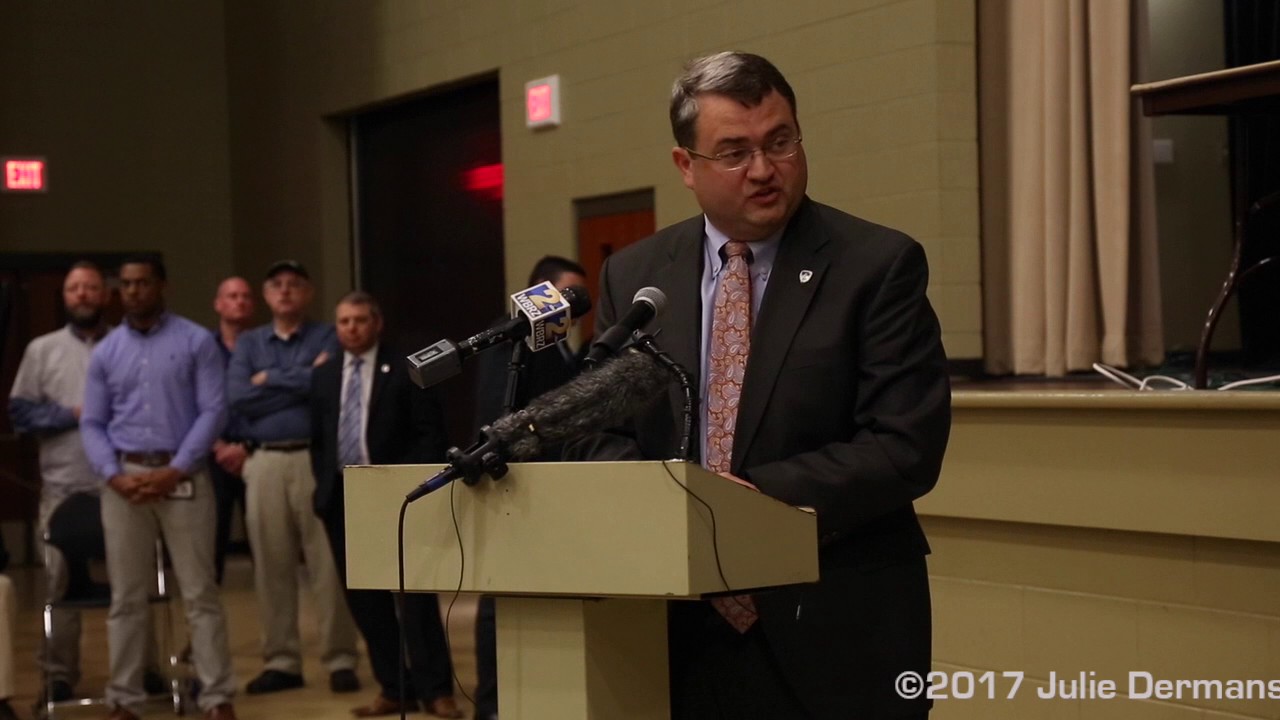 in recent months to speak about lessons from Dakota Access which could be applied to Bayou Bridge. The protests against Dakota Access, which took form as a months-long encampment near the Standing Rock Sioux Reservation in North Dakota, were the largest mobilization of Native American tribes in modern U.S. history.
As previously reported by DeSmog, the National Sheriffs’ Association served as the key vehicle for carrying out the emergency compact at Standing Rock. The association has lobbied Congress for more military gear for sheriffs’ departments under the auspices of the U.S. Department of Defense’s 1033 program, which enables police departments to buy surplus military gear from the department’s Defense Logistics Agency.
The current president of the Sheriffs’ Association, Sheriff Greg Champagne, oversees St. Charles Parish, the end of the line for Bayou Bridge. According to a Bayou Bridge corporate fact sheet, the Sheriffs’ Association has endorsed the pipeline.
In October 2016, Champagne visited Standing Rock and criticized the protesters, who call themselves “water protectors,” in a lengthy article posted both on the Sheriffs’ Association website and on his government Facebook page. St. Charles Parish also sent officers to Standing Rock.
“We are a nation of laws. Emotion and empathy cannot carry the day. It just seems that opposition to this pipeline is not reasonably based upon legitimate environmental concerns,” Champagne wrote. “Energy independence has been one of the major goals of this country for decades. In my home state of Louisiana, we are surrounded by gas and oil pipelines and safely so.”
According to his biography on the Sheriffs’ Association website, Champagne in the past has attended “two international counter-terrorism programs in both Israel and England, which focused on the detection and prevention of terrorism.” A member of the Houma tribe and the head of the group Bold Louisiana of Native American descent jointly responded to Champagne’s letter, saying that they too had visited Standing Rock, but had only seen peaceful and prayerful protest.
“If you are looking as to who has engaged in acts of war, sir, it might be best to see who came for one,” they wrote. “A simple Internet search will produce countless images of unarmed Water Protectors being confronted by military-grade weaponry pointed at them by law enforcement.”
EMAC abuse?
It has been debated whether or not the “insurgency or enemy attack” legislative language found within EMAC pertains to mass protest, but regardless, the gray area has created an opening for state-level law enforcement agencies. The Interstate Emergency Preparedness and Disaster Compact, signed into law in 1993 as a section of the Louisiana Homeland Security and Emergency Assistance and Disaster Act (Louisiana Disaster Act, for short),had no language found within the bill about an “insurgency or enemy attack.”
The first major instance of EMAC’s use for a protest movement came in Baltimore in April 2015 in response to demonstrations pertaining to the law enforcement killing of Freddie Grey. At that time, only a few agencies answered the EMAC call, including the New Jersey State Police and the Pennsylvania State Police, while the law enforcement crackdown was bolstered by mostly local and state officers in Maryland.
In 2016, the EMAC was again put to use to deal with those protesting at the Republican National Convention (RNC) in Cleveland, Ohio. According to an “after action report” published by EMAC,1,071 out-of-state police officers came from 18 different states to assist with law enforcement efforts at the RNC.

In Cleveland, Mayor Frank Jackson requested that Republican Governor John Kasich declare a state of emergency in February, some five months before the RNC. A month later, the City of Cleveland signed a state emergency memorandum of understanding with the Ohio Department of Public Safety, and the next month, Kasich signed the emergency order triggering EMAC. The after action report for the RNC spells out what law enforcement sees as the major advantage of having EMAC as a tool in the toolbox.
“One of the great advantages of EMAC is that troublesome and often complicated legal issues are resolved upfront within the EMAC law,” wrote EMAC in the report. “These issues include tort liability, workers’ compensation, reimbursement, and acceptance of licensure.”
For Standing Rock, nearly 40 law enforcement agencies from around the Midwest answered the call made by North Dakota Governor Jack Dalrymple. They responded by bringing assault rifles, thermal imaging cameras, and military vehicles. It was the first instance where the emergency compact was used to create what resembled a massive law enforcement militia to suppress a protest.
After EMAC was put into action, 23 Democratic members of the U.S. House of Representatives wrote a letter on November 14, 2016 to then-President Barack Obama expressing their concerns about the compact’s potential misuse.
The “use of the EMAC [for Dakota Access] raises questions when compared to the original legislative intent of Congress in 1996 to allow member states to provide emergency assistance after natural disasters overwhelm a state’s capacity to respond,” wrote the members of the House. “Its use for additional law enforcement personnel and equipment to respond to this peaceful demonstration is part of a recent trend away from historical precedent.”
As a recent case in point showing of the compact mixed uses, Republican Governor Scott Walker of Wisconsin received two EMAC requests in late October 2016: One from North Dakota to assist with Standing Rock and one from North Carolina when the state’s coast was battered by Hurricane Matthew. While Standing Rock protests did not result in any deaths, Hurricane Matthew claimed the lives of 26 people in North Carolina.
Emails obtained by MuckRock show that the Walker administration chose to aid North Dakota rather than North Carolina, which experienced $2.75 billion in damages from the hurricane. An email from Brian Satula, head of Wisconsin Emergency Management, sent to the Walker administration, explains that Wisconsin “has not been able to adequately fill those mission requests,” in reference to North Carolina.
No Bayou Bridge “direct tie”
Considering the Louisiana bill’s recent passage, though, it appears EMAC’s use beyond natural disaster zones could just be getting started. Mike Steele, communications director for the Governor’s Office of Homeland Security & Emergency Preparedness, said there is no connection between Bayou Bridge and Louisiana’s EMAC bill.
“I don’t believe there is a direct tie other than pipeline related emergency being one of many types [of] emergencies where we may need assistance from officials outside the state,” said Steele. “I believe this bill just addresses a few technical issues like liability.”
Yet a talking points sheet on the EMAC bill supplied to DeSmog by Steele actually lists Dakota Access as one of its prominent, recent uses.
Indeed, a relatedbill proposed in the Louisiana State Legislature would levy an insurance surcharge and give the revenue from that to the Emergency Management Assistance Trust Fund. This may indicate that Louisiana is trying to get ahead of the kind of financial woes currently facing North Dakota, which has footed a $22 million bill for all of the out-of-state assistance it received under EMAC to handle the Dakota Access protests.
For months, North Dakota had attempted to secure federal funding, but it will receive $15 million in repayments as part of the congressional spending bill passed in May. That, however, will still leave North Dakotans on the hook for about $7 million of the EMAC costs.
In the United States, Red Squads were police intelligence units that specialized in infiltrating, conducting counter-measures and gathering intelligence on political and social groups during the 20th century. Dating as far back as the Haymarket Riot in 1886, Red Squads became common in larger cities such as Chicago, New York, and Los Angeles during the First Red Scare of the 1920s. They were set up as specialized units of city police departments, as a weapon against labor unions, communists, anarchists, and other dissidents.
Contents
[hide]
- :{1:(style="display:table-cell;padding-left:0px;padding-right:0.5em"):}::{History:(style="display:table-cell"):}:
- :{2:(style="display:table-cell;padding-left:0px;padding-right:0.5em"):}::{Connections to Conspiracy Theories:(style="display:table-cell"):}:
- :{3:(style="display:table-cell;padding-left:0px;padding-right:0.5em"):}::{See also:(style="display:table-cell"):}:
- :{4:(style="display:table-cell;padding-left:0px;padding-right:0.5em"):}::{References:(style="display:table-cell"):}:
- :{5:(style="display:table-cell;padding-left:0px;padding-right:0.5em"):}::{External links:(style="display:table-cell"):}:
History
In New York, former City Police Commissioner Patrick Murphy traced their origin there to an "Italian Squad" formed in 1904 to monitor a group of Italian immigrants under suspicion.[1] However, it is their association with fighting communism which provides the basis for the name "Red Squad." They became more commonplace in the 1930s, often conceived of as a countermeasure to Communist organizers who were charged with executing a policy of dual unionism - namely, building a revolutionary movement in parallel with membership in above-ground labor organizations. Similar units were established in Canada in this period, although only the Toronto police under Chief Dennis Draper used the name.
In the late 1960s, as the protests against Vietnam and the general domestic upheaval intensified, the Red Squads augmented their focus, to include dissidents largely outside the labor movement, including therein not just war resisters, but protest movements of all political stripes, including Neo-Nazis, Native American movements, the women's movement, environmentalists, the civil rights movement, and others. The methods employed ranged from simple surveillance to isolated incidents of assassination.[citation needed] Anti-activist police operations were expanded under the Johnson and Nixon administrations, particularly in concert with, and within the cadre of the FBI's COINTELPRO surveillance program, but also including domestic spying by the CIA.[citation needed]
After the civil unrest during Johnson's administration, Watergate during Nixon's administration, and the public exposure of COINTELPRO by a dissident organization in 1971, widespread criticism of the Red Squads for illegal and undemocratic tactics emerged. In 1975, in the wake of both the Watergate scandal and the exposure of COINTELPRO, the Church Committee was formed to investigate overstepping on the part of federal law enforcement and intelligence gathering agencies. Following the recommendations of that committee, the U.S. Congress passed Foreign Intelligence Surveillance Act (FISA) in 1978, placing limits on the power of police and Federal agencies. This ended the official use of Red Squads.
Since 1978, the term Red Squad has resurfaced repeatedly to describe any action by police or Federal agencies that is deemed to be oppressive to a social or political group.
The term Red Squad has been used to describe New York City Police Department infiltration of liberal groups, first in preparation for the 2004 Republican National Convention and then continuing until today.[2][3]
Connections to Conspiracy Theories
It has been alleged by those who believe in the "Gang Stalking" conspiracies that Red Squad style social control activity has reemerged. Individuals who believe they are being targeted claim that members of Red Squads are harassing them or organizing the harassment. A former FBI agent Ted Gunderson, who believed in a wide range of conspiracy theories, submitted an affidavit supporting the theory two months before his death at age 82.[4]
See also
- COINTELPRO
- Church Committee
- Domestic Security Enhancement Act of 2003
- Haymarket Riot
- Patriot Act
- Red Scare
- Surveillance abuse
- Will v. Michigan Dept. of State Police, 491 U.S. 58 (1989)
==
http://www.alternet.org/trump-trauma/trump-wants-local-police-armed-weapons-war
rosenfeld
Trump is reversing the course set by his predecessor and renewing a Pentagon program to send weapons of war—from bayonets to grenade launchers to drones to armored trucks—to thousands of police departments across America.
The move, by executive order, rescinds a 2015 decree by President Obama in the wake of excessive military-style policing of protesters in Ferguson, Missouri, that limited the Pentagon’s ability to transfer some surplus arms and hardware to state and local police departments. Trump’s order also dismantles a federal interagency group that sought to oversee the transfer of the arms and gear, according to the American Civil Liberties Union.
“Today the president made good on his campaign promise to the Fraternal Order of Police to rescind Executive Order 13688 and put thousands of bayonets and hundreds of grenade launchers from the U.S. military back in the hands of police,” wrote Kanya Bennett, a legislative counsel in the ACLU’s Washington Office. “It also leaves law enforcement’s federally provided drones, explosives, and Mine Resistant Ambush Protected Vehicles without oversight. The result? Weapons of war will again be used to police our communities, no questions asked. Your town could be the next Ferguson or Fallujah.”
Progressive police organizations criticized the move, saying the weaponry belonged on the battlefield and not in community police arsenals.
“Military equipment should only be transferred to police if departments can prove appropriate use, training, and oversight, and that the equipment will only be used in specific and necessary circumstances, such as active shooter scenarios,” said Maj. Neill Franklin (Ret.), executive director of the Law Enforcement Action Partnership. “At tremendous risk to public safety, the 1033 Program doesn’t require these vital measures. We must stop reinforcing the mentality that police are warriors and civilians are the enemy - it endangers everyone.”
The White House press office issued Trump’s order, entitled, “Restoring state, tribal, and local law enforcement’s access to life-saving equipment and resources,” without any statement or briefing material.
The Obama administration’s oversight was problem-plagued, Bennett noted, citing a recent sting operation where theU.S. Government Accountability Office pretended to be a federal law enforcement agency and received surplus military arms. But now, it’s possible that police departments that have been investigated by the Department of Justice for misconduct (until the administration stopped those inquiries) could receive Department of Defense weapons, she said.
“Even with the interagency working group’s oversight since January 2015, we continue to see unwarranted police militarization post-Ferguson,” Bennett wrote. “Just look at law enforcement’s response at Standing Rock, where armored vehicles, automatic rifles, concussion grenades, sound cannons, and water cannons were used against peaceful protestors. Consider Baton Rouge, where those organizing around the fatal police shooting of Alton Sterling were met with militarization and excessive force. And we still have SWAT teams detonating flash-bang grenades near a 9-month-old when executing home searches for drugs. Do you remember Baby Bou Bou?”
Some combat veteransfrom the wars in Iraq and Afghanistan and Republicans in Congress have questioned the Pentagon’s so-called 1033 program.
Veterans told Vanity Fair in August 2014 that they saw better-armed local police in Ferguson than in some of the most dangerous areas of Afghanistan. “I couldn’t get past the fact that the police in Ferguson were wearing better battle-rattle and carrying more tricked-out weapons than my infantry platoon used in one of the most dangerous parts of Afghanistan,” wrote Matt Farwell. “Looking at the lines of cops facing off against angry protesters, I was alarmed at their war-like paramilitary posturing.”
Meanwhile, in Congress, Rep. Duncan Hunter, R-CA, and Sen. Rand Paul, R-KY, have called the redistribution of wares like trucks with gun turrets excessive and said it blurred lines between a “police response and military response.”
Still, it’s not clear what response, if any, will come from Capitol Hill. The ACLU’s Bennett said Congress should suspend the 1033 program. On a local level, she said communities “must call out the federal government for instigating police militarization” and “take control of the weapons of war coming to their towns.”
“We know that militarized policing is not “effective policing,” as it does not deescalate, reduce bias, or improve police-community relations,” Bennett said. “And we hope this administration does not think that treating neighborhoods like war zones is an effective way to create ‘more community engagement.’”
ref water cannon https://www.aclu.org/blog/racial-justice/american-indian-rights/police-standing-rock-are-using-life-threatening-crowd
404?
https://www.aclu.org/sites/default/files/field_document/water_cannons.pdf
ref
http://www.inclo.net/pdf/lethal-in-disguise.pdf
==
https://blackthen.com/%E2%80%8Bdecember-8-1969-lapd-attacks-the-black-panther-party/
pre-dawn raid by LAPD at the Black Panthers Party headquarters, turned into a 5 hour stand-off. This was just days after Chicago PD & the FBI assassinated Fred Hampton and Mark Clark.
Thousands of shots are exchanged during the ensuing five-hour gun battle. 3 officers and 6 Black Panthers are wounded. THIS time no one is killed.
The raid involved over 300 LAPD and SWAT officers. During the battle, the Panthers withstood the police attacks, including attacks from the roof of the building. Frustrated, the police arrested Elmer Geronimo Pratt, the Panther’s Deputy Minister of Defense, on a fabricated robbery and murder charge that was later dismissed.
In Chicago, they were able to shoot Hampton through a wall because they had a detailed map of the apartment provided by an FBI informant who had also made sure Hampton would be on the other side of that wall by drugging his food the night before.
http://witnessla.com/41st-and-central-1969-the-black-panther-shootout-the-birth-of-swat/
On December 9, 1969, a four-hour shootout took place at the Southern California Headquarters of the Black Panther Party. The massive exchange of gunfire was between a cluster of six Panther members who happened to be inside the headquarters and what would ultimately grown to be a force of 200 Los Angeles police officers, including a newly created LAPD team that would have its first real outing on that day.
The team was called the Special Weapons and Tactics unit—S.W.A.T.
WLA contributing reporter, Matthew Fleischer, became fascinated with this moment in LA history and, after doing a series of intensive interviews with a bunch of former Panthers, four of whom were there that day, plus a former SWAT officer who was also present at the standoff, he has written a compelling account that explores what exactly occurred early one winter morning at 41st and Central.
The story appears in the April issue of the Los Angeles Times Magazine.
Below you’ll find the story’s opening. But you’ll be missing out if you don’t read it all.
POLICING REVOLUTION
It was early—way too early as far as he was concerned—on December 8, 1969, when Wayne Pharr was abruptly awakened in the gunroom of the Black Panthers’ Los Angeles headquarters at 41st and Central. The shotgun was still in his hand from when he had fallen asleep while cleaning it. He had spent most of the night exploring the sewers—mapping the nearby tunnels they would use as an escape route in case something went down.
“They’re out there,” fellowPanther Melvin “Cotton” Smithtold him. “Get up.”
“Out where?” Pharr said in a daze. “It’s 5:30 in the f–king morning.”
Smith was borderline frantic, too busy grabbing weapons and ammo to argue. Pharr was skeptical but snatched up his newly cleaned shotgun and headed toward the front door.
Almost as soon as Pharr left the gunroom, the door of Panther headquarters flew open with no warning, and bodies clad in black began to stream into the building—automatic weapons readied. Only 19, Pharr was stunned, but he was young and quick, and before any shots were fired he dove into a sandbag bunker that flanked the door.
A split second later, Smith emerged with a Thompson submachine gun in hand—finger on the trigger. Bullets flew by the dozen, connecting with the chests of their targets—thud, thud, thud, thud. The force of the impact pinned the men in black in the doorway, creating a bottleneck—and giving Pharr time to recover.
Clad in military-style flak jackets, the men pushed forward into the teeth of Smith’s Thompson in their attempt to return fire. But this time Pharr was ready for them. Shotgun in hand, he opened up, blasting round after round from the side of the men, as Smith continued to hammer them from the front.
The intruders had no choice but to retreat, dragging their wounded with them across the street, out of the line of the Panthers’ fire. They would be back.
One of the biggest shootouts in American history had just begun, pitting the vanguard of domestic American radicalism against a newly constituted paramilitary police force: Special Weapons and Tactics, aka SWAT.
The year 1969 was a headline maker for the Southern California chapter of the Black Panthers, led by charismatic founder Bunchy Carter. The group emerged from the shadow of its more famous Oakland counterpart, into the forefront of the blackpower movement in Los Angeles—and arguably the nation. They organized community breakfast programs, trained locals in black history and self-defense and published the Black Panther Community News Service, which enjoyed a robust following.
:{
}:
But the Panthers’ meteoric rise drew enemies—lots of them. On January 17, 1969, Carter and fellow Panther John Huggins were shot to death in UCLA’s Campbell Hall by members of the rival black radical group Us. Agents, operating under the FBI’s infamous COINTEL (counterintelligence) program and masquerading as Panthers and anonymous Us members, crafted insulting missives and death threats and began sending them between the two groups.
:{
}:
“It is hoped this counterintelligence measure will result in an ‘Us’ and ‘BPP’ vendetta,” one internal FBI memo explained.
:{
}:
The plan worked. While the UCLA shootout was the most significant in a series of violent confrontations between the two groups, the danger of further violence was always present.
Surprisingly, it wasn’t until the middle of 1969 that the Panthers caught the attention of the LAPD. Two police officers cruising the area around the Panthers’ 41st and Central headquarters pulled over and questioned a small group of black men and women getting some air outside a Saturday-night Panther social. After a brief confrontation, police attempted to arrest several of them for loitering. The Panthers resisted, and police called for backup, but, “surrounded by 300 militant black men,” as one Panther put it, they eventually hesitated to escalate the incident.
No one was arrested that night, but from that point, police pressure was on. Known members of the Panther party, including Pharr and audacious leader Geronimo Pratt, were pulled over and questioned as a matter of routine.
On November 28, 1969, more than 250 police officers surrounded the Los Angeles headquarters during a community meeting, sealing the facility off in what Panthers now call the“test run.”
On December 4, Fred Hampton, deputy chairman of the Illinois chapter of the Black Panthers, was shot to death at point-blank range while he was sleeping, during a raid by the Chicago Police Department. The incident drew international outrage. Back in L.A., there wasn’t a Panther alive who didn’t think a similar raid by the LAPD was coming their way.
“SWAT was born from the ashes of the Watts Riots…Back then, SWAT was ragtag. A lot of the guys were over 40 and not in the kind of shape one would expect of an elite fighting unit.”
They were right. As it turns out, the night of the test run, police claimed to have seen three Panthers—Paul Redd, “Duck” Smith and Geronimo Pratt—in possession of illegal firearms. The LAPD secured an arrest warrant for the three, as well as a search warrant for the 41st and Central headquarters and two known Panther hideouts.
A massive, three-pronged raid was planned, involving more than 350 officers. It was decided that SWAT—a previously untested paramilitary unit of the LAPD Metro Squad, championed by then inspector and future LAPD chief Daryl Gates—would take the lead. It was to be the group’s very first operation….
Read the rest here.
http://www.nytimes.com/1997/07/20/us/los-angeles-confronts-a-bitter-racial-legacy-in-a-black-panther-case.html
...''The Geronimo Pratt case,'' said John Mack, president of the Los Angeles Urban League, ''is one of the most compelling and painful examples of a political assassination on an African-American activist.''
Mr. Pratt arrived in Los Angeles from his native Louisiana in 1968, a decorated veteran with two tours of duty in Vietnam, having left the Army as a sergeant.
It was a time when the Black Panther Party, which never had more than several thousand members nationwide, was at its height. The group mixed black nationalism and socialism, shotguns and free breakfast programs for children, medical clinics, free schools, law books and revolutionary rhetoric about power coming from the barrel of a gun. Members included ex-convicts, former gang members and college students.
The Panthers were also near the top of the long list of enemies meticulously maintained by the Director of the Federal Bureau of Investigation, J. Edgar Hoover. The Director said the group was a threat to national security.
By 1969, Mr. Pratt, admired for his charisma and warrior spirit, which earned him his nickname from party members, had become the leader of the Southern California chapter of the Black Panther Party. He had also become a major concern of the bureau's counterintelligence program, a campaign of domestic spying, psychological warfare and dirty tricks, known as Cointelpro.
From 1956 to 1971, the program dogged the lives a wide range of people, from revolutionaries to political advocates like the actress Jean Seberg and the Rev. Dr. Martin Luther King Jr.
In June 1970, the bureau sent a report on Mr. Pratt to F.B.I. offices in New York, New Haven, Atlanta, Chicago, Sacramento, Calif., San Diego and San Francisco, ''in view of the position held by captioned individual in the Black Panther Party.''
The report went on to say ''that constant consideration is given to the possibility of utilization of counterintelligence measures with efforts being directed toward neutralizing Pratt as an effective B.P.P. functionary.''
Mr. Pratt's lawyers assert that the bureau's interest in 'neutralizing' Mr. Pratt led to his being charged with the killing of the teacher, Caroline Olsen, in a robbery in Santa Monica, Calif.
Two examples of the conflict between law-enforcement authorities and the Black Panthers occurred in December 1969. In Chicago, the police raided an apartment and killed two Black Panther leaders, Fred Hampton and Mark Clark.
Four days later, in Los Angeles, several Black Panthers held off dozens of officers and the department's SWAT team in a four-hour shootout at the group's headquarters. Mr. Pratt, who was not in the building, had been responsible for fortifying it. Three officers and six Panthers were wounded.
Mr. Pratt had been in Los Angeles a couple of months when Mrs. Olsen and her husband, Kenneth, also a teacher, walked onto a tennis court in Santa Monica's Lincoln Park, next to Los Angeles. It was shortly after 8 P.M. on Dec. 18, 1968.
Mr. Olsen, 31, put some coins into a meter box to turn on the court lights. Then, he said, he noticed two young black men with guns striding toward him. The police said the men took the $18 in Mrs. Olsen's purse.
''This ain't enough,'' one said, according to the police, and ordered the couple to ''lie down and pray.''
Soon, the bullets started flying, hitting Mr. Olsen five times and his wife twice. A witness told the police that the two men had fled in a red-and-white convertible.
Mr. Olsen recovered from his wounds. Mrs. Olsen, 27, died 11 days later.
...
==
https://en.wikipedia.org/wiki/Militarization_of_police
Militarization of police refers to the use of military equipment and tactics by law enforcement officers. This includes the use of armored personnel carriers, assault rifles, submachine guns, flashbang grenades,[1][2] grenade launchers,[3] sniper rifles, and Special Weapons and Tactics (SWAT) teams.[4][5] The militarization of law enforcement is also associated with intelligence agency-style information gathering aimed at the public and political activists,[6][7] and a more aggressive style of law enforcement.[8][9] Criminal justice professor Peter Kraska has defined militarization of police as "the process whereby civilian police increasingly draw from, and pattern themselves around, the tenets of militarismand the military model."[10]
Observers have noted the militarizing of the policing of protests.[11][12] Since the 1970s, riot police have fired at protesters using guns with rubber bullets or plastic bullets.[13] Tear gas, which was developed for riot control in 1919, is widely used against protesters in the 2000s. The use of tear gas in warfare is prohibited by various international treaties[14]that most states have signed; however, its law enforcement or military use for domestic or non-combat situations is permitted.
Concerns about the militarization of police have been raised by both ends of the political spectrum in the United States, with both the right-of-center/libertarian Cato Institute and the American Civil Liberties Union voicing criticisms of the practice. The Fraternal Order of Police has spoken out in favor of equipping law enforcement officers with military equipment, on the grounds that it increases the officers' safety and enables them to protect unarmed people.[citation needed] However, a 2017 study showed that police forces which received military equipment were more likely to have violent encounters with the public, regardless of local crime rates.[15]
- :{1:(style="display:table-cell;padding-left:0px;padding-right:0.5em"):}::{Canada:(style="display:table-cell"):}:
- :{2:(style="display:table-cell;padding-left:0px;padding-right:0.5em"):}::{Brazil:(style="display:table-cell"):}:
- :{3:(style="display:table-cell;padding-left:0px;padding-right:0.5em"):}::{Colombia:(style="display:table-cell"):}:
- :{4:(style="display:table-cell;padding-left:0px;padding-right:0.5em"):}::{Germany:(style="display:table-cell"):}:
- :{5:(style="display:table-cell;padding-left:0px;padding-right:0.5em"):}::{Mexico:(style="display:table-cell"):}:
- :{6:(style="display:table-cell;padding-left:0px;padding-right:0.5em"):}::{Indonesia:(style="display:table-cell"):}:
- :{7:(style="display:table-cell;padding-left:0px;padding-right:0.5em"):}::{United States of America:(style="display:table-cell"):}:
- :{7.1:(style="display:table-cell;padding-left:0px;padding-right:0.5em"):}::{History:(style="display:table-cell"):}:
- :{7.1.1:(style="display:table-cell;padding-left:0px;padding-right:0.5em"):}::{1800s:(style="display:table-cell"):}:
- :{7.1.2:(style="display:table-cell;padding-left:0px;padding-right:0.5em"):}::{1900s:(style="display:table-cell"):}:
- :{7.1.3:(style="display:table-cell;padding-left:0px;padding-right:0.5em"):}::{2000s:(style="display:table-cell"):}:
- :{7.2:(style="display:table-cell;padding-left:0px;padding-right:0.5em"):}::{Notable incidents:(style="display:table-cell"):}:
- :{7.2.1:(style="display:table-cell;padding-left:0px;padding-right:0.5em"):}::{MOVE bombing:(style="display:table-cell"):}:
- :{7.2.2:(style="display:table-cell;padding-left:0px;padding-right:0.5em"):}::{Ruby Ridge:(style="display:table-cell"):}:
- :{7.2.3:(style="display:table-cell;padding-left:0px;padding-right:0.5em"):}::{Branch Davidian siege:(style="display:table-cell"):}:
- :{7.2.4:(style="display:table-cell;padding-left:0px;padding-right:0.5em"):}::{Other events:(style="display:table-cell"):}:
- :{7.3:(style="display:table-cell;padding-left:0px;padding-right:0.5em"):}::{Concerns and responses:(style="display:table-cell"):}:
- :{7.3.1:(style="display:table-cell;padding-left:0px;padding-right:0.5em"):}::{Community policing:(style="display:table-cell"):}:
- :{7.3.2:(style="display:table-cell;padding-left:0px;padding-right:0.5em"):}::{Use of force:(style="display:table-cell"):}:
- :{7.3.3:(style="display:table-cell;padding-left:0px;padding-right:0.5em"):}::{Viewpoints:(style="display:table-cell"):}:
- :{7.3.4:(style="display:table-cell;padding-left:0px;padding-right:0.5em"):}::{Intelligence-gathering and surveillance:(style="display:table-cell"):}:
- :{7.3.5:(style="display:table-cell;padding-left:0px;padding-right:0.5em"):}::{Civil liberties:(style="display:table-cell"):}:
- :{7.3.6:(style="display:table-cell;padding-left:0px;padding-right:0.5em"):}::{SWAT teams and military-style raid tactics:(style="display:table-cell"):}:
- :{7.3.7:(style="display:table-cell;padding-left:0px;padding-right:0.5em"):}::{Federal efforts to curb militarization:(style="display:table-cell"):}:
- :{7.1:(style="display:table-cell;padding-left:0px;padding-right:0.5em"):}::{History:(style="display:table-cell"):}:
- :{8:(style="display:table-cell;padding-left:0px;padding-right:0.5em"):}::{Types of teams and weapons:(style="display:table-cell"):}:
- :{8.1:(style="display:table-cell;padding-left:0px;padding-right:0.5em"):}::{SWAT teams:(style="display:table-cell"):}:
- :{8.2:(style="display:table-cell;padding-left:0px;padding-right:0.5em"):}::{Snipers:(style="display:table-cell"):}:
- :{8.3:(style="display:table-cell;padding-left:0px;padding-right:0.5em"):}::{Protest policing:(style="display:table-cell"):}:
- :{8.4:(style="display:table-cell;padding-left:0px;padding-right:0.5em"):}::{Military weapons:(style="display:table-cell"):}:
- :{9:(style="display:table-cell;padding-left:0px;padding-right:0.5em"):}::{Effects:(style="display:table-cell"):}:
- :{10:(style="display:table-cell;padding-left:0px;padding-right:0.5em"):}::{In popular culture:(style="display:table-cell"):}:
- :{11:(style="display:table-cell;padding-left:0px;padding-right:0.5em"):}::{See also:(style="display:table-cell"):}:
- :{12:(style="display:table-cell;padding-left:0px;padding-right:0.5em"):}::{Further reading:(style="display:table-cell"):}:
- :{13:(style="display:table-cell;padding-left:0px;padding-right:0.5em"):}::{References:(style="display:table-cell"):}:
...
United States of America
History
1800s
Following the Reconstruction Era (1865–1877) in the aftermath of the American Civil War (1861–1865), Congress passed the 1878 Posse Comitatus Act, in response to the allegation of civil liberties abuse under military occupation of the former Confederate States by members of the United States military during Reconstruction. Still in force, the law prohibits the United States Army and the United States Air Force (as amended in 1956) for being used as domestic law enforcement except when authorized by the President under certain circumstances; similar limitation also applies to the United States Marine Corps and the United States Navy by Department of the Navy policy.
The Act does not apply to the National Guard and state defense forces while under the authority of their respective state governors nor the United States Coast Guard, which is both an armed service and a maritime law enforcement agency and is not under authority of the United States Department of Defense (which was formed in 1947 out of the United States Department of War).[29][30][31] After the law was passed, it allowed state and local authorities to regain control of their affairs, with their police departments typically equipped with handguns, shotguns, and batons, which were suitable for law enforcement purposes.
1900s

The "Anti-Bandit Gun": a 1920s advertisement of theThompson M1921 for United States law enforcementforces
Throughout the 20th century, the United States has faced large and heavily armed criminal organizations, in which law enforcement officers were clearly outperformed. In the 1920s during the Prohibition Era and in the early 1930s during the Great Depression, criminal syndicates and individual bank robbers such as John Dillinger and Bonnie and Clyde were frequently armed with Thompson submachine guns and Browning Automatic Rifles.[32] The Federal Bureau of Investigation (FBI), as well as police departments in cities such as Kansas City, Missouri[33] and Kenosha, Wisconsin,[34] began deploying automatic weapons, including the Thompson submachine gun, and armored cars in the 1920s and 1930s.
An FBI officer firing aBrowning Automatic Rifle in 1936.
George Fletcher Chandler, a veteran of the Pancho Villa Expedition and the first Superintendent of the New York State Police, was an early advocate of law enforcement officers wearing their weapons exposed on the outside of their uniforms.[35]
During the late 1920s through the early 1930s, gunmen from criminal gangs in the United States began wearing bulletproof vests made from thick layers of cotton padding and cloth. These early vests could absorb the impact of handgun rounds such as .22 Long Rifle, .25 ACP, .32 S&W Long, .32 S&W, .380 ACP, .38 Special and .45 ACP traveling at speeds of up to 300 m/s (980 ft/s). To overcome these vests, law enforcement agents such as the FBI began using the newer and more powerful .38 Super, and later the .357 Magnum cartridge.
Experts believes that police militarization was escalated in the 1950s and 1960s, an era in which race riots were common in many U.S. cities. Some believe that the seeming success of officers armed with military-style weapons and deployed to curtail the 1965 Watts Riots, a six-day race riot sparked by conflicts with the Los Angeles Police Department (LAPD) that killed 34 people, gave way to the trend of arming and equipping law enforcement officers with battlefield weapons.[36]
Things have changed over the last 100 years and due to the rise of acts of terrorism and the easy access to high-powered weapons; special weapons and tactics teams have been implemented and are being utilized across the nation.[37] The 1960s to 1990s, encounters with the sophisticated weapons of narcotics trafficking groups such as the Medellín Cartel and street gangs such as the Gangster Disciples, with organized, violent left-wing protesters at such events as the 1968 Democratic National Convention in Chicago and the 1999 WTO Conference in Seattle,[38] with urban riots such as the 1965 Watts riots in Los Angeles and the 1967 Detroit Riot in Detroit led law enforcement to reconsider their standard side arms. As well, law enforcement experience with arsonists such as Earth Liberation Front (ELF),[39][40] with mass shootings and/or shootouts such as the 1984 McDonald's massacre in San Ysidro and the 1986 shootout between eight FBI agents and two serial bank robbers in Miami (in which the agents were out-gunned by the robbers) and with explosive devices used by the Weather Underground, Timothy McVeigh, and Ted Kaczynski (the "Unabomber"), highlighted the inadequacy of many law enforcement agencies' weapons and tactics.[citation needed]
Researchers David N. Falcone, Edward L. Wells, and Ralph A. Weisheit describe a historical separation of police models between small towns and larger cities, which tended to function differently with separate hierarchical systems supporting each.[41] The militarization of both rural and urban law enforcement has been attributed to the United States' involvement in wars during the 20th century, and to increasingly frequent encounters with violent protesters and criminals with automatic weapons, explosives, and body armor, although some attribute the militarization to the more recent campaigns known as the War on Drugs and the War on Terror.[42][43] Historian Charles A. Beard argues that cultural change during the Great Depression encouraged the militarization of law enforcement,[44] whereas Harwood argues that the creation of SWAT teams and tactical units within law enforcement during the 1960s began such trend.
[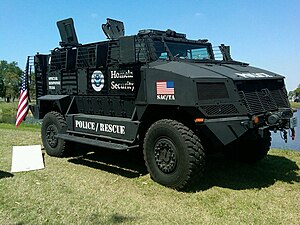 ](https://en.wikipedia.org/wiki/File:Special_response_vehicle_from_Homeland_Security_during_OSI_Det._340%27s_law_enforcement_day.jpg)
Homeland Security armored vehicle
The 1981 Military Cooperation with Civilian Law Enforcement Agencies Act allows the U.S. military to cooperate with law enforcement agencies. Operations in support of law enforcement include assistance in counter-drug operations, assistance for civil disturbances, special security operations, counter-terrorism, explosive ordnance disposal (EOD), and similar activities. Constitutional and statutory restrictions and corresponding directives and regulations limit the type of support provided in this area. This allows the U.S. military to give law enforcement agencies access to its military bases and its military equipment.[45] The legislation was promoted during the Presidency of Ronald Reagan in the context of the War on drugs, and is considered a part of a general trend towards the militarization of police.[45] The Act is cited in the 1992 essay The Origins of the American Military Coup of 2012 as having set a precedent that the author, a United States Air Force officer, considered dangerous.
The 1997 North Hollywood shootout had a profound effect on law enforcement agencies. Local patrol officers at the time were typically armed with their standard issue 9×19mm or .38 Special pistols, with some having a 12-gauge shotgun available in their cars. The North Hollywood bank robbers carried fully automatic AK-47-style weapons with high capacity drum magazines and ammunition capable of penetrating vehicles and police Kevlar vests.
With these weapons, two bank robbers fired approximately 1,100 rounds at officers and civilians before being killed. The robbers wore body armor which successfully protected them from bullets and shotgun pellets fired by the responding patrolmen. Police noted that the service pistols carried by the first responding officers had insufficient range and relatively poor accuracy, although a SWAT team eventually arrived with sufficient firepower.[citation needed] The ineffectiveness of the standard police patrol pistols and shotguns in penetrating the robbers' body armor led to a trend in the United States toward arming selected police officers, not just SWAT teams, with heavier firepower such as semi-automatic 5.56×45mm NATO AR-15 type rifles.[citation needed] SWAT teams, whose close quarters battle weaponry usually consisted of submachine guns that fired pistol cartridges such as the Heckler & Koch MP5, began supplementing them with AR-15 type rifles and carbines.[citation needed]
Riot police at 2009 G20 meeting in Pittsburgh
Seven months after the incident, the Department of Defense gave 600 surplusM16s to the LAPD, which were issued to each patrol sergeant;[46][47] LAPD patrol vehicles now carry AR-15s as standard issue, with bullet-resistant Kevlar plating in their doors as well.[48][full ^citation needed] As a result of this incident, the LAPD authorized its officers to carry .45 ACP caliber semiautomatic pistols as duty sidearms, specifically the Smith & Wesson Models 4506 and 4566. Prior to 1997, only LAPD SWAT officers were authorized to carry .45 ACP caliber pistols, specifically the Model 1911A1 .45 ACP semiautomatic pistol.[49]
A U.S. police officer armed with a holographic sight-equippedM4 carbine rifle during a training exercise
The 1033 program was created by the National Defense Authorization Act of Fiscal Year 1997 as part of the U.S. Government's Defense Logistics Agency Disposition Services (DLA) to transfer excess military equipment to law enforcement agencies.[50] As of 2014, 8,000 local law enforcement agencies participate in the reutilization program that has transferred $5.1 billion in military hardware from the United States Department of Defense to local American law enforcement agencies since 1997.[citation needed] Police departments have obtained surplus aircraft, bayonets, tactical armored vehicles, weapons, including grenade launchers, and watercraft.[citation needed]
2000s
Under the Fourth Amendment, law enforcement officers must receive written permission from a court of law, or otherwise qualified magistrate, to lawfully search and seize evidence while investigating criminal activity. Following the September 11 attacks, the 2001 Patriot Act gave law enforcement officers permission to search a home or business without the owner's or the occupant's consent or knowledge, amongst other provisions, if terrorist activities were suspected. The Act was criticized for its perceived violation of civil liberties and has generated a great deal of controversy since its enactment. In United States v. Antoine Jones, the court found that increased monitoring of suspects caused by the Patriot Act directly put the suspects' constitutional rights in jeopardy. For a time, the Act allowed for agents to undertake "sneak and peek" searches. Critics such as the ACLU strongly criticized the law for violating the Fourth Amendment.[51][52]
On May 18, 2015, President Barack Obama announced limits on the types of military equipment which can be transferred to police departments and the implementation of training programs to assure the appropriate use of other items. The military can no longer transfer some weapons, such as grenade launchers, weaponized vehicles, and bayonets to police.[53] Obama stated that "We’ve seen how militarized gear can sometimes give people a feeling like it’s an occupying force as opposed to a force that’s part of the community that’s protecting them and serving them,...So we’re going to prohibit equipment made for the battlefield that is not appropriate for local police departments."[54]
In response to Obama's announcement, the "nation’s largest police union is fighting back against a White House plan to restrict local police forces’ ability to acquire military-style gear, accusing ... Obama’s task force of politicizing officers’ safety."[54] The executive director of the Fraternal Order of Police, James Pasco, stated that his group "...will be at our most aggressive in asserting the need for officer safety and officer rights in any police changes that are to be effected"; "he objects to a measure that would require police departments to get permission from city governments to acquire certain equipment, including riot batons, helmets and shields, through federal programs."[54] Pasco stated "We need to only look back to Baltimore the location of the 2015 protests following the [death of Freddie Gray] to see what happens when officers are sent out ill-equipped in a disturbance situation...[;] Because you don’t like the optics [of militarization], you can’t send police officers out to be hurt or killed."[54]
In July 2016, the Obama Administration announced that it would revisit the 2015 ban on some types of military equipment for police forces, and begin a process of case-by-case review.[55]
"War on Police"
Some prominent Americans have argued that police militarization is required to respond to an alleged "war on police" that exists in the U.S.: Lt. Gov. Dan Patrick stated "There’s A War On Cops", New York Police Chief Bratton warned of a "war on cops" and similar statements have been made by Donald Trump, Ted Cruz, and Scott Walker.[56] Radley Balko calls these claims "fact-free fear mongering"; he states that "...2015 is on pace to see 35 felonious killings of police officers. If that pace holds, this year would end with the second lowest number of murdered cops in decades."[56]
Notable incidents
TheMount Carmel Center engulfed in flames during the siege of the Branch Davidian community in Waco, Texas on April 19, 1993
MOVE bombing
On Monday, May 13, 1985, Philadelphia police attempted to clear a building occupied by MOVE black liberation activists and execute arrest warrants.[57] This led to an armed standoff with police,[58] who lobbed tear gas canisters at the building. The police said that MOVE members fired at them; a gunfight with semi-automaticand automatic firearms ensued. Commissioner Sambor ordered that the compound be bombed.[59] From a Pennsylvania State Police helicopter, Philadelphia Police Lt. Frank Powell proceeded to drop two one-pound bombs (which the police referred to as "entry devices") made of FBI-supplied water gel explosive, a dynamite substitute, targeting a fortified, bunker-like cubicle on the roof of the house.[60]
The resulting explosions ignited a fire which spread and eventually destroyed approximately 65 nearby houses.[61] Eleven people (John Africa, five other adults, and five children aged 7 to 13) died in the resulting fire, and more than 250 people in the neighborhood were left homeless.[62] Ramona Africa, one of the two survivors, said that police fired at those trying to escape.[63]
Ruby Ridge
In 1992, there was a deadly confrontation and a 12-day siege at Ruby Ridge in northern Idaho between Randy Weaver, his family and his friend Kevin Harris, and agents of the United States Marshals Service (USMS) and Federal Bureau of Investigation (FBI). USMS and FBI agents were armed with M16s and sniper rifles, and they used an armored personnel carrier. It resulted in the deaths of two Weaver's son Sammy, his wife Vicki, and Deputy U.S. Marshal William Francis Degan. At the subsequent federal criminal trial of Weaver and Harris, Weaver's attorney Gerry Spence made accusations of "criminal wrongdoing" against every agency involved in the incident: the FBI, USMS, the Bureau of Alcohol, Tobacco, Firearms and Explosives (BATFE), and the United States Attorney's Office (USAO) for Idaho. At the completion of the trial, the Department of Justice's Office of Professional Responsibility formed a Ruby Ridge Task Force to investigate Spence's charges. The 1994 Task Force report was released in redacted form by Lexis Counsel Connect and raised questions about the conduct and policy of all the agencies. Public outcry over Ruby Ridge led to the Senate Subcommittee on Terrorism, Technology and Government Information holding 14 days of hearings and issuing a report calling for reforms in federal law enforcement to prevent a repeat of Ruby Ridge and to restore public confidence in federal law enforcement.
Branch Davidian siege
In 1993, FBI and BATFE agents used armored vehicles and tanks and attack helicopters during the siege of the Branch Davidian community in Waco, Texas.[64] The FBI's arms included .50 caliber (12.7 mm) rifles and M728 Combat Engineer Vehicles, which are based on an M60A1 Patton main battle tank chassis.[65] The FBI also launched 40-millimetre (1.6 in) CS grenade fire from M79 grenade launchers and fired two military M651 rounds at the Branch Davidian site. 40mm munitions recovered by the Texas Rangers at Waco included dozens of plastic Ferret Model SGA-400 Liquid CS rounds, two metal M651 military pyrotechnic tear gas rounds, two metal NICO Pyrotechnik Sound & Flash grenades, and parachute illumination flares.[66] The Army Tech Manual for the M651 warns that it can penetrate 3/4" plywood at 200 meters and the "projectile may explode upon target impact."
Other events
2005-2009
In 2005, the Maryland State Police (MSP) began entering the names and personal information of death penalty opponents and anti-war protesters into a database used to track terrorists.[67] In the aftermath of Hurricane Katrina in New Orleans in 2005, employees of the private security firm Blackwater patrolled the city with automatic weapons. "When asked what authority they were operating under," journalist Jeremy Scahill reported, "one guy said, 'We're on contract with the Department of Homeland Security.'" Local news station WDSU mentioned reports of police officers claiming to have summarily executed looters.[68] On August 25, 2008, the Denver Police Department (DPD) were accused of making mass, indiscriminate arrests of almost 100 protesters at the Democratic National Convention. In 2011, the city of Denver, Colorado agreed to pay a $200,000 settlement and to improve its crowd control training and policies.[69]
2010-2014
In February 2010, the Minneapolis Police Department (MPD) raided the apartment of Rickia Russell, breaching the door and throwing in a flashbang grenade, as part of a search for drugs. At the time, Russell was eating dinner with her boyfriend and the exploding grenade gave her burns to her head and calves. No drugs were found in Russell's apartment and the Minneapolis City Council agreed to pay $1 million in damages.[70] In January 2011, Rogelio Serrato in Greenfield, California, died of smoke inhalation after a flashbang grenade launched by the SWAT team of the Greenfield Police Department (GPD) ignited a fire in his home.[70] Referring to the 2011 Occupy Wall Street protests in New York City, Glen Greenwald wrote, "The police response was so excessive, and so clearly modeled after battlefield tactics, that there was no doubt that deterring domestic dissent is one of the primary aims of police militarization."[71]
The Oakland Police Department (OPD) used excessive force while breaking up Occupy Oakland demonstrations in 2011. Several protesters successfully sued the city of Oakland, California for their injuries; Scott Olsen was severely injured after being hit in the head with a police projectile and was awarded $4.5 million. The city paid $1.17 million to a group of protesters, and $645,000 to Kayvan Sabeghi, who was clubbed by police.[72]
A policesharpshooter with a sniper rifle provides overwatch at the Ferguson protest regarding the shooting of Michael Brown.
On May 28, 2014, a SWAT team looking for drugs in a Cornelia, Georgia home threw a flashbang grenade into the house. The grenade landed in the playpen of a 19-month-old baby boy, and the detonation severely burned and mutilated the baby's face.[73]
In late 2014, concerns about the militarization of police arose after the shooting of Michael Brown occurred on August 9, 2014, in Ferguson, Missouri, a suburb of St. Louis. The display of military gear by area police agencies dealing with the protests received significant criticism from the media and politicians. There were concerns over insensitivity, tactics and a militarized response.[74][75][76][77] In recent years, the use of military equipment and tactics for community policing and for public order policing has become more widespread.[78][79] Lawmakers have begun to discuss the topic.[80][81]
Concerns and responses
Community policing
http://www.laweekly.com/news/the-militarization-of-police-started-in-los-angeles-5010287
But the issue of the militarization of cops goes back to the first days of policing in 19th century England, when citizens were fearful of occupying forces and the government took a community policing stance, with cops largely unarmed, says John Buntin, author of L.A. Noir: The Struggle for the Soul of America's Most Seductive City.
The organization, strategy and tactics of the armed forces were a polar force on policing. And the concept was brought to American law enforcement largely by the Los Angeles Police Department:
The LAPD's first experience with military organization started in the late 1930s when Mayor Frank Shaw was deposed in a recall election, Buntin says. Shaw's police chief, James E. Davis, commanded cops who were widely believed to to be on the take and conducting surveillance of political enemies.
A turn toward uniform practices and a clear chain of command was, at the time, seen as a path toward improvement, the writer says. Thus was born the LAPD's elite Metropolitan Division, the future home of Special Weapons and Tactics, better known as SWAT. "Really the militarization of policing began as a reform," Buntin says.
Chief William Parker, the top cop at the LAPD from 1950 to 1966, found that military organization and tactics served the department well. The LAPD was tasked with patrolling a more than 400-square-mile city, but it was sorely understaffed.
"If you go back to William H. Parker, he was a military man wounded on D-Day," says Glynn Martin, executive director of the Los Angeles Police Museum. "For him, his method of running the department was similar to the military. It was understaffed and, for him, the military was the model of efficiency."
During Parker's reign, the first police helicopter in the U.S. went into service, in 1956. Martin says the goal was to "establish an expeditious flow of traffic on our newly established freeways."
See also: Why Is That LAPD Helicopter Circling Overhead?
:{
}:
The SWAT unit and its military tactics were born a year after Parker left, in 1967, as a reaction to the Watts riots of 1965. Today departments across the nation deploy their own paramilitary SWAT teams. The L.A. version was formalized under the Metropolitan Division in 1971.
It was a time of social upheaval and the Black Panther Party. "One of the big concerns was crowd control and restoring public order," Martin said.
The unit's creator, Sgt. John Nelson, was a former Marine. Future LAPD Chief Daryl Gates, a commander who had served in the Navy, helped to put the team together under Chief Parker.
Gates' military-style tactics would later be criticized after he took over as chief in 1978 and confronted a gang and crack epidemic in the 1980s with a heavy hand, including the use of the infamous the B-100 battering-ram armored vehicle used to force through the doors of suspected drug houses.
The Militarization of Police Started in Los Angeles
J R/Flickr
It sometimes busted down the doors of the innocent. Reviled in black L.A., the instrument was mythologized in the rap song, "Batterram." Martin says the battering ram came to L.A. courtesy of the U.S. Department of Energy.
"In the '80s and '90s, we were basically trained that in a lot of communities in South Central L.A., if one of the residents jaywalked or spit on the sidewalk, he was face down on the concrete," says Jody David Armour, the Roy P. Crocker Professor of Law at the USC.
:{
}:
By the early 1990s the LAPD was viewed by many in African Americans in South L.A. as the occupying army of a hostile government.
"The increasing militarization of law enforcement—in some ways L.A. has been at the forefront of that movement," Armour says. "The LAPD had the reputation of being one of the more paramilitary departments in the nation."
In 1992 South L.A. erupted when news of the acquittal of four cops accused of beating black motorist Rodney King hit the airwaves. A succession of African American police chiefs followed the downfall of Daryl Gates, accused of sitting on his hands during the first hours of rioting in 1992. But it was the Rampart Scandal of the late 1990s that really put an end to Gates' militaristic LAPD.
Although Chief William Bratton (2002 to 2009) was a "broken windows" acolyte bent on busting kids for, as the professor put it, spitting on the sidewalk, he also welcomed back community policing. Bratton has been largely credited with repairing wounds created by bad cops in South L.A.
The department also operated during much of that time under a federal consent decree that demanded better diversity hiring and cultural sensitivity on the street.
Chief Charlie Beck's father was LAPD brass and Daryl Gates was his godfather. Author Buntin believes his experience witnessing the bad times, including the 1992 riots and the Rampart Scandal, turned Beck into a Bratton-style reformer.
"I generally believe that Beck and his commanders did see firsthand the errors of Daryl Gates' approach and have tried to engage with L.A.'s minority communities," he say...
==
==
watts:
To Gates this outburst of violence was the early stages of guerilla warfare and a revolutionary rejection of police, and therefore government, authority. The riot and civil disorder trainings of the LAPD proved inadequate to Gates who wrote: “We did not know how to handle guerilla warfare.”
251
Their unpreparedness led to LAPD dependence on outside sources of manpower and weaponry, a root causal factor to the institutionalization of weaponry and tactics with SWAT forces
...
. LAPD became more “the pigs” than ever and the ‘us vs them’ ideology was further ingrained.
260
Following a shooting of police and the heavy handed police crushing of a 1967 14,000 person anti-Vietnam war protest in Century City Chief Thomas Reddin and Deputy Chief Edward Davis unleashed Daryl Gates to develop a semi-military squadron that could be mobilized to fight heavily armed criminals and protect against radical elements whom might seek to foster revolt and rebellion against the authority of Government.
261
The solutions to Watts as proposed by both the Commission reports were social and economic, education, health and job plans. They were the work of big politics and big government. These efforts would not be in the scope of the police department’s authority. Special Weapons And Tactics squads (SWAT) was the response of the LAPD, it was the result of the military institution that had always operated in the interest of the elite and held discriminatory notions of working class and racial minority groups and had often been mobilized against them. It was a response to the inability to maintain absolute authority in Los Angeles on August 13, 14 and 15
th
. It was the LAPD’s ‘never again’ attitude kind of response.
...
...When Gates was finished Metro had been turned into a paramilitary force that included an embryonic SWAT. Metro was turned from a fifty-five-officer labor repression force into a 220 officers, three platoon, paramilitary organization under the command of Daryl Gates.
271
In his own words Metro broke from “LAPD tradition” by creating a militaristic division in chain of command and tactics. Breaking from LAPD tradition, we formed sixteen military-type squads with a sergeant in charge of each ten-man squad, and then we meshed them into two platoons, each headed by a lieutenant. They were given missions for which they were responsible. They developed the approach and the tactics without direction from above . . . All the research showed that the most effective way to stop a sniper or apprehend a barricaded individual was with a small team of highly disciplined officers using specialized weapons and tactics. . . . Late in 1967 we were finally able to bring them [“sixty expert marksmen” ranked top 25% in physical condition] into Metro as the third platoon.
Daryl Gates in particular sounded the alarm of the threat posed by guerilla war waged by disenchanted minorities (Black people in this case) in the streets of Los Angeles. The political fervor of the day made Gates increasingly paranoid of a prospective urban uprising that the LAPD would not be prepared for, as evidenced in their inadequate handling of the Watts Upheaval. Gates was unnerved by media coverage of police repression of protest and the way in which radical political groups identified police as the ‘Pigs.’ After LAPD repression of the anti-Vietnam protest in Century City of Lyndon B. Johnson Gates thought the LAPD was unfairly treated in the media. Despite the fact that he called the protestors “miserable people: pot-smokers, college dropouts, wayward and lost human beings, [and] people who had . . . no interest in anyone’s rights but their own"
http://aworldwithoutpolice.org/wp-content/uploads/2016/08/jordan-t-camp-policing-the-planet-why-the-policing-crisis-led-to-black-lives-matter.pdf
270 pp
https://www.marxists.org/history/etol/document/icl-spartacists/black-question/09_LA_Explodes.pdf
newletter rodney king, geronimo pratt frame cointl pro LA swat?
==
https://www.commondreams.org/views/2010/04/18/im-not-shedding-any-tears-daryl-gates
I’m Not Shedding Any Tears for Daryl Gates
byDave Lindorff
The former Los Angeles police chief, Daryl Gates, who died last Friday of cancer at his home in California, is being widely credited in mostly laudatory newspaper obituaries as the man who developed the idea of Special Weapons And Tactics (SWAT)units--those paramilitary police teams so loved by Hollywood filmmakers--who bring the art and weaponry of modern warfare into communities, breaking into houses with faces covered in ski masks, and carrying assault weapons in order to make arrests for often minor offenses, or blowing away people--often innocent people--in what the modern military calls "force escalation incidents."
But Gates was more than just the Sultan of SWAT.
He was also a proponent of the police-state tactic of massive surveillance and spying. Not that he invented it. As a deputy chief under Chief Ed Davis, and later as chief of police, Gates inherited the LAPD's notorious "Red Squad," known as thePublic Disorder Intelligence Division(PDID), which had a sordid history going back into the 1920s, but he certainly expanded it dramatically.
I had my own experience with the PDID when I was an editor of the little alternative news weekly, the Los Angeles Vanguard, founded by myself and several other Los Angeles journalists in 1976, after the demise of the venerable Los Angeles Free Press. Our publication, which took on the issue of police brutality and especially the all-to-frequent shooting of unarmed citizens, very quickly became a special focus of the PDID. We learned, years after our publication had folded, that our volunteer staff had been infiltrated by a young PDID officer named Connie Milazzo, a woman just out of the Police Academy, who came to us posing as a journalist wannabe.
In a depositions taken by attorneys with the Southern California American Civil LIberties Union as part of a class action suit against the LAPD and the City of Los Angeles in the early 1980s, after Milazzo and other equally youngRed Squad spies had been discovered infiltrating over 200 peaceful organizations in Los Angeles ranging from our newspaper to the local chapters of NOW, the Peace & Freedom Party, and even the office of City Councillor Zev Yaroslavsky, we learned that the PDID was gathering dossiers on literally thousands of local political activists, infiltrating and spying on protected political activities like peace demonstrations, anti-nuclear demonstrations and even political campaigns, and also engaging in provocateur activities, trying to encourage peaceful groups to cross the line into criminal actions.
We learned too that our paper was actually sabotaged by the PDID, which operated under Gates' authority. We had, after about six months' operation, hired a person at a considerable cost to sell advertising space in the paper. We learned from this person, only much later after the paper had to shut down, that she had been told by her boss, an advertizing agency executive, to onlypretend to try and sell ads. It turns out that the executive had a son who had been busted by the LAPD for drugs, and the police had extorted the father, saying if he prevented our paper from getting advertising, they'd get the charges dropped against his son.
Gates is hailed too, for being the first police chief to add helicopters to the police department's arsenal. It was a logical move. The LAPD already was widely seen as essentially a military organization, so why not have an air force too? But in fact, the helicopters were mostly a huge waste of department money. They gave the department, and its chief, great bragging rights at tony Los Angeles parties and police conventions, but did little to reduce crime.
I remember how back then, when I lived on a hill across Alvarado Boulevard from Dodger Stadium in the Echo Park section of L.A., when I would come home from Vanguard Office, how often a police helicopter would be secretly following my car. When I'd park and start walking up the steps towards my house, I'd suddenly be bathed in a light as bright as day, as the helicopter would turn on its searchlight. It was a clear attempt at intimidation and harassment, as were the helicopters that, during the day, often came to buzz over our office in the Crenshaw District, just to let us know they were watching.
Connie tried to get our sources. Her technique was simple. She would volunteer to stay in the office and answer the phone while the three or four editors went out to lunch. I kept all my files in those pre-computer days in a metal recipe box on index cards. Fortunately I kept my best sources hidden by using false names and carefully rearranged phone numbers, so my inside sources in the LAPD and the Sheriff's Department were never uncovered by Millazzo. But it wasn't for lack of her trying, I'm sure.
The lawsuit brought against Gates and the PDID, settled out of court because the PDID didn't want to have to disclose any more of its nefarious activities, which it turns out included selling much of the collected data on local activists to a right-wing organization called Western Goals that had links to the John Birch Society, ultimately cost the City of Los Angeles $1.8 million, of which I received $2000.
...
==
==
lost some? slate? no see ferguson
at mo?
radley balko
https://www.amazon.com/Rise-Warrior-Cop-Militarization-Americas/dp/1610394577
see fergson
eg
Police in Ferguson: Military weapons threaten protesters.
www.slate.com/.../police_in_ferguson_military_weapons_threaten_protesters.html
2.
Ferguson: Some rip police tactics, military equipment - CNN - CNN.com
www.cnn.com/2014/08/14/us/missouri-ferguson-police-tactics/index.html
1.
Police Face Civilian Protesters–Dressed for Military Combat - The ...
https://www.theatlantic.com/.../08/ferguson...civil-rights-protest...military.../375962/
1.
https://en.wikipedia.org/wiki/Emergency_Management_Assistance_Compact
The Emergency Management Assistance Compact (EMAC) is a mutual aid agreement between states and territories of the United States. It enables states to share resources during natural and man-made disasters, including terrorism. EMAC has also been used by states to disrupt legal protests.
EMAC complements the national disaster response system. EMAC is used alongside federal assistance or when federal assistance is not warranted. EMAC facilitates the maximum use of all available resources within member states' inventories.[1]
- :{1:(style="display:table-cell;padding-left:0px;padding-right:0.5em"):}::{How it works:(style="display:table-cell"):}:
- :{2:(style="display:table-cell;padding-left:0px;padding-right:0.5em"):}::{History:(style="display:table-cell"):}:
- :{3:(style="display:table-cell;padding-left:0px;padding-right:0.5em"):}::{Benefits:(style="display:table-cell"):}:
- :{4:(style="display:table-cell;padding-left:0px;padding-right:0.5em"):}::{References:(style="display:table-cell"):}:
- :{5:(style="display:table-cell;padding-left:0px;padding-right:0.5em"):}::{External links:(style="display:table-cell"):}:
How it works
Under EMAC, requests and deployment of resources are made at the discretion of the affected state. At all times, affected states retain the choice of seeking resource support from states, the federal government, or both as may be determined by the size of the disaster event. The main contact for agencies, organizations, and the private sector to learn more about EMAC is the state emergency management agencies.[2]
EMAC works as follows: When a disaster occurs, the governor of the affected state or territory declares a state of emergency. The impacted state assesses its resource needs and identifies shortfalls for which assistance will be requested, and authorized representatives from the affected state then activate EMAC. These authorized representatives as well as EMAC Advance Team (A-Team) members then determine the state's needs for personnel and equipment and broadcasts an EMAC requisition to other states.
States with available resources negotiate costs with the affected state through the EMAC network, executing EMAC Form Req-A. Assisting states that commit to an agreement then mobilize and deploy the agreed-upon resources (personnel or equipment) to the affected state. Once the mission is completed, the resources are demobilized and redeployed to their home states. Deployed personnel provide receipts and records to their home state to develop a reimbursement package, which is then sent to the affected state, which then reimburses the assisting state.
EMAC is administered by the Federal Emergency Management Association (FEMA), which provides the day-to-day support and technical backbone for EMAC education and operations at its headquarters in Lexington, Kentucky.
History
EMAC was proposed by former Florida Governor Lawton Chiles after 1992's Hurricane Andrew. Following the passage of the compact by the 104th U.S. Congress in 1996 (PL-104-321), EMAC has grown to become a nationwide system for providing mutual aid. To be a member of EMAC, each state or territory legislature must have passed legislation which was signed into law, adopting the standard language of the Compact. Since at least 2003, all U.S. states, the District of Columbia, U.S. Virgin Islands, Puerto Rico, and Guam are members of EMAC.
In 2004, EMAC was utilized during the response to Hurricanes Charley, Frances, Ivan, and Jeanne. Through EMAC, more than 800 state and local personnel from 38 states (including California, which was not an EMAC member at that time[citation needed]) were deployed to Florida, Alabama, and West Virginia. The cost was approximately $15 million in personnel, equipment, and National Guard expenditures.
In 2005, EMAC was activated ten times in response to one wildfire, one flood, one tropical storm, two winter storms, and five hurricanes. Most striking, more than 65,000 personnel from 48 states, the District of Columbia, Puerto Rico, and the U.S. Virgin Islands were deployed under EMAC through the state emergency management agencies in response to Hurricanes Katrina and Rita. Total costs for the 2005 EMAC events are expected to exceed $840 million.[3]
Benefits
 | This section does not cite any sources. Please help improve this section by adding citations to reliable sources. Unsourced material may be challenged and removed. (August 2011) (Learn how and when to remove this template message) |
In addition to providing another avenue for states to receive assistance in times of disaster, EMAC offers the following benefits:
- Assistance may be more readily available. EMAC allows states to ask for whatever assistance they need for any type of emergency—from earthquakes to acts of terrorism. EMAC's simple procedures help states dispense with bureaucratic wrangling.
- Legislation solves the problems of liability and responsibilities of cost. Once the conditions for providing assistance to a requesting state have been set, the terms constitute a legally binding contractual agreement that makes affected states responsible for reimbursement. Responding states can rest assured that sending aid will not be a financial or legal burden, and personnel who are deployed are protected under workers compensation and liability provisions.
- Legislation allows for credentials to be honored across state lines.
References
- :{Jump up:(style="user-select:none;top:-99999px;clip:rect(1px 1px 1px 1px);overflow:hidden;position:absolute !important;padding:0px !important;border:0px !important;height:1px !important;width:1px !important"):}:^ GAO Report to the Committee on Homeland Security and Governmental Affairs, U.S. Senate: Emergency Management Assistance Compact: Enhancing EMAC's Collaborative and Administrative Capacity Should Improve National Disaster Response. June 2007.
- :{Jump up:(style="user-select:none;top:-99999px;clip:rect(1px 1px 1px 1px);overflow:hidden;position:absolute !important;padding:0px !important;border:0px !important;height:1px !important;width:1px !important"):}:^ "FEMA: State Offices and Agencies of Emergency Management". Federal Emergency Management Agency. 2011-06-15. Archived from the original on 2011-08-25. Retrieved 2011-08-27.
- :{Jump up:(style="user-select:none;top:-99999px;clip:rect(1px 1px 1px 1px);overflow:hidden;position:absolute !important;padding:0px !important;border:0px !important;height:1px !important;width:1px !important"):}:^ Emergency Management Assistance Compact: 2005 Hurricane Season Response After Action Report. Titan-L3. September 2006.
External links


- United States interstate compacts
- Emergency management in the United States
- Emergency services in the United States
- Emergency laws
- 1996 establishments in the United States
- State law in the United States
- District of Columbia law
- Guam law
- Government of the United States Virgin Islands
- Emergency management in Puerto Rico
- Emergency management
- Organizations based in Lexington, Kentucky
- 104th United States Congress
==
This Natural Disaster Assistance Law Is Why Other States Are Policing ...
www.huffingtonpost.com/steve-horn/this-natural-disaster-ass_b_12741708.html
1.
Almost exactly 20 years ago, President Bill Clinton signed into law abill creating an interstate agreement for emergency management. That inconspicuous law has opened the door for the current flood of out-of-state law enforcement agents present at the continuing protests against the Dakota Access Pipeline (DAPL) in North Dakota.
The Emergency Management Assistance Compact (EMAC) authorized states to enter into agreements with other states in order to share emergency management–related personnel during crisis situations. One of the only other times this compact was deployed outside of a natural disaster was for the Black Lives Matter protests in Baltimore after the death of Freddie Gray.
DeSmog reviews the use of this controversial authorization below. News is just breaking now that police are removing protesters at the site right now.
According to a history of EMAC published in September 2014, the compact centers around empowering states to respond to massive hurricanes, and in particular, Hurricane Andrew, which caused nearly $25 billion in damageswhen it hit Florida and Louisiana in 1992.
“Passage of EMAC in Congress was a relatively smooth process,” reads the history of EMAC. “It was mainly a matter of obtaining sponsors and getting EMAC on the congressional calendar. Introduction of the bill occurred soon enough after Hurricane Andrew that memories of the hurricane’s destruction still lingered.”
More recently, states used EMAC to work together during both Hurricane Sandy in 2012 and Hurricane Matthew in 2016.
All 50 states, plus the District of Columbia, Puerto Rico, Guam, and the U.S. Virgin Islands, participate in EMAC. With language mostly centering around natural disaster relief, the congressional joint resolution creating EMAC also notes it exists to help manage things like “community disorders, insurgency, or [an] enemy attack.”
State of Emergency
On August 19, North Dakota Republican Governor Jack Dalrymple declared a state of emergency surrounding the Dakota Access Pipeline protests, which triggered the ability of other states to offer help in North Dakota as part of EMAC.
“The State of North Dakota remains committed to protecting citizens’ rights to lawfully assemble and protest, but the unfortunate fact remains that unlawful acts associated with the protest near Cannon Ball have led to serious public safety concerns and property damage,” Dalrymple said in the press release announcing the emergency order.
“This emergency declaration simply allows us to bring greater resources to bear if needed to help local officials address any further public safety concerns.”
Six States
States which have recently deployed personnel to North Dakota include Wisconsin, Indiana, South Dakota, Minnesota, Wyoming, and Nebraska, according to an October 23 press release from the Morton County Sheriff’s Department.
Wisconsin Division of Emergency Management spokesperson Lori Getter told DeSmog that “under any EMAC request, agencies are asked if they are able to assist. In this case, the request came to the state of Wisconsin and we sent out a request to law enforcement to see who could support this mission. It is strictly voluntary by each department. Those departments responded and agreed to send officers.”
Getter said that officers from seven different law enforcement and public safety agencies throughout Wisconsin have gone to North Dakota. She said that a total of 57 law enforcement officers were deployed so far, while 13 officers still remain but plan to return to Wisconsin on October 30.
A public information officer for the Indiana Department of Homeland Security said that nine different agencies have sent officers to North Dakota. ABC news affiliate RTV6 in Indianapolis reported that 37 officers have been sent to North Dakota from the Hoosier State. According to the Omaha World-Herald, 11 state troopers from Nebraska have been sent to North Dakota.
Who Pays?
A common question is who is paying for these officers to police protests in another state?
During the April 2015 BLM protests in Baltimore, Pennsylvania sent in 300 state troopers and New Jersey sent in 150 more in an attempt to manage the volatile situation that erupted after a young black man’s death while in police custody. In that case, Maryland compensated the Pennsylvania officers for their time and effort, which according to Getter, is also the case with North Dakota.
A police officer from Indiana reiterated this in a story published by The Times of Northwest Indiana, noting that the reimbursement “includes all wages, overtime and cost of benefits to the officers, meals while the officers are on duty, a per diem while they are off duty, lodging for the officers during their time of stay and mileage reimbursement for the communities who sent vehicles.”
Backlash Grows
Authorized by EMAC, out-of-state officers have arrived in North Dakota at a time of increasing tension, arrests, and strip searches at the Standing Rock Camp, where the largely Native American protesters are based.
Meanwhile, the Federal Aviation Administration (FAA) announced a no-fly zone within a 4-mile radius of the Standing Rock Camp and 3,500 feet between the air and ground.
However, those flight restrictions do not apply to law enforcement, according to a FAA-designated spokesperson in North Dakota, which means protesters are no longer permitted to fly drones to monitor law enforcement behavior.
“Protesters continue to escalate unlawful tactics endangering officers and residents,” said the Morton County Sheriff’s Department in an October 23 Facebook posting, which served as a prelude to the no-fly zone announcement. “Sunday protesters attacked a helicopter with a drone, fired arrows at a helicopter,established an illegal road block on highway 1806 and illegally occupied private property moving in tents and teepee’s to a DAPL construction site.”
The National Lawyers Guild (NLG) and American Civil Liberties Union (ACLU) have submitted multiple open records requests in the attempt to lift the curtain on state- and federal-level law enforcement techniques used at Standing Rock.
“In an affront to First Amendment rights, Water Protectors and allies have been continuously surveilled by low-flying planes, helicopters, and drones, and have had local cell phone communications jammed and possibly recorded,” reads an NLG press release announcing the filing of the requests. “Dozens of local and out-of-state law enforcement have been called in, maintaining a heavily militarized presence at the site in an effort to intimidate activists and chill dissent.”
The Associated Press reports that law enforcement are attempting to remove protesters who have encamped in teepees and tents situated on Dakota Access LLC’s land.
Ironically, given the implementation of EMAC and out-of-state cops pouring into North Dakota, the Morton County Sheriff’s Department released a graphic pointing to arrests of those from out of state.
[fb post pulled?]
A congressional aide from an office critical of the pipeline said the office had never even heard of EMAC. Only one member of Congress, U.S. Sen. John Hoeven (R-North Dakota), has weighed in so far on this use of EMAC in North Dakota.
Hoeven did so only in passing in a recent press release, noting the agreement is in place for the Dakota Access pipeline. As revealed on DeSmog, Hoeven has investments in wells which do hydraulic fracturing (“fracking”)for oil in North Dakota’s Bakken shale basin and will likely feed into the Dakota Access pipeline.
“World is Watching”
The Standing Rock Sioux Tribe’s Chairman Dave Archambault II and over 121,000 signatories to a petition circulated by CREDO Mobile have called on the U.S. Department of Justice to investigate the on-the-ground tensions at the pipeline protest sites.
“The world is watching the violence of local police at the Camp at Standing Rock — and we are horrified,” Josh Nelson, Deputy Political Director at CREDO, said in a press release. “We demand that Attorney General Loretta Lynch and the Department of Justice launch an investigation into reported abuses by local North Dakota law enforcement. Clearly these law enforcement officers believe they are above the law — and we won’t see justice until the DOJ investigates.”
The EMAC office did not respond to requests for comment.
:{---:(style="word-wrap:break-word"):}:
How Did Police From All Over the Country End Up at Standing Rock ...
www.motherjones.com/.../standing-rock-police-militarized-emergency-management-a...
1.
Governor Uses Emergency Order to Bring Out-of-State Police to ...
https://www.ecowatch.com/dakota-access-pipeline-emergency-order-2063073522.html
1.
What Standing Rock Tells Us About Civil Disobedience by Melissa ...
www.yesmagazine.org/.../what-standing-rock-tells-us-about-civil-disobedience-20161...
1.
Reps. Huffman, Grijalva, 21 Members of Congress, Recommend Steps ...
https://huffman.house.gov/.../reps-huffman-grijalva-21-members-of-congress-recom...
1.
Stand With Standing Rock | American Civil Liberties Union
https://www.aclu.org/issues/free-speech/rights-protesters/stand-standing-rock
1.
Repression of Peaceful Protest | American Civil Liberties Union
https://www.aclu.org/issues/free-speech/rights-protesters/repression-peaceful-protest
2.
Nebraska State Patrol sends assistance to North Dakota for pipeline ...
journalstar.com/news/.../article_116944c0-236b-5ed9-a706-60cede69efff.html
1.
S.D. troopers spent thousands of hours at pipeline protests
www.argusleader.com/story/news/2017/02/17/sd-troopers...protests/97987638/
1.
===mojo...:{Governors have almost always employed EMAC in the wake of natural disasters, but the bill contains a stipulation that makes it applicable during other types of emergencies including “**community disorders,** insurgency, or enemy attack.” On :(style="background-color:#ffff66;"):}:August 19, when North Dakota Gov. Jack Dalrymple declared a state of emergency at Standing Rock, he relied on this language to issue an EMAC request.
Per DeSmog Blog, Standing Rock is one of the few times that EMAC has been called upon to respond to social activism. In April 2015, during Black Lives Matter protests in Baltimore in the wake of Freddie Gray’s death while in police custody, Maryland Gov. Larry Hogan declared a state of emergency and sent out an EMAC request. About 300 state troopers from Pennsylvania and another 150 from New Jersey responded. The city racked up an estimated $20 million in extra policing costs.
Since the state issuing the EMAC request is on the hook for the tab, North Dakota taxpayers will pay for the out-of-state officers at Standing Rock. This will include wages, overtime costs, meals, lodging, and mileage reimbursement. On November 2, North Dakota officials agreed to borrow $4 million to cover escalating policing costs and extend the state’s line of credit for emergency law enforcement to $10 million. (The state was already staring down a $1 billion revenue shortfall in 2016.) Gov. Jack Dalrymple said state officials have asked for contributions from the federal government, the pipeline company, “and any entity we can think of,” though the federal government has thus far declined to pitch in.
North Dakota Emergency Services spokesperson Cecily Fong told the Associated Press that total state law enforcement costs for the protests had reached $10.9 million as of November 22, while Morton County had spent an additional $8 million. Meanwhile, local courts and jails have struggled to process about 575 arrests.
Some of the police details that have arrived in Standing Rock are among the largest recipients of military transfers from the federal government, according to an In These Timesinvestigation. The South Dakota Highway Patrol has received $2 million worth of military equipment since 2006. The Lake County Sheriff’s Office in Northwest Indiana obtained $1.5 million worth of military equipment over the same time period. The Pennington County Sheriff’s office in South Dakota, the Anoka County Sheriff’s office in Minnesota, and the Griffith Indiana Police Department have all received assault rifles through military equipment transfer programs as well.The increased law enforcement presence at Standing Rock has coincided with mounting concerns over police brutality.
The deployment of military-grade equipment, including land-mine-resistant trucks and armored personnel carriers, as well as the use of pepper spray, rubber bullets, and alleged strip searches led Standing Rock Sioux tribal chairman Dave Archambault II to ask the Justice Department to investigate civil rights abuses. “Local and state law enforcement have increasingly taken steps to militarize their presence, to intimidate participants who are lawfully expressing their views, and to escalate tensions and promote fear,” Archambault wrote in his letter.
Police departments answer EMAC requests on a voluntary basis. Some forces, like Minnesota’s Hennepin County Sheriff’s Department, have been deployed to North Dakota amid objections from their local communities. Others are withdrawing from the action. A phone-banking and email-writing effort led Montana’s Gallatin County Sheriff Brian Gootkin to turn his detail around before they even arrived at Standing Rock. Gootkin told Yes Magazine that people who contacted his department expressed concern that EMAC was meant to address natural disasters and catastrophic events, not for protecting a corporation’s pipeline construction.
Sheriff Dave Mahoney from Wisconsin’s Dane County, who withdrew his force after one week, said he did so after talking with “a wide cross-section of the community who all share the opinion that our deputies should not be involved in this situation,” he said. “We have enough priorities here in our community to address.”
https://academic.oup.com/jah/article/102/1/152/686802/Objects-of-Police-History
Objects of Police History
Micol Seigel
Journal of American History, Volume 102, Issue 1, 1 June 2015, Pages 152–161,
https://doi.org/10.1093/jahist/jav280
Published: 01 June 2015
The local cop on the beat is the predominant image of U.S. police. In popular imagination, civilian officers patrol neighborhoods in their “black and whites” or on foot, equipped simply with revolvers and radios and outfitted in that pacific but authoritative shade of blue. Yet the depth and breadth of U.S. police practice far exceed this expression of limited jurisdiction, civilian status, and public function. U.S. police regularly leap territorial borders, blend civilian and military features, and serve private interests.
To illustrate these counterintuitive but constant crossings, this essay explores the life and afterlife of one federal agency, theOffice of Public Safety (OPS), operative from 1962 to 1974. During its dozen active years, amid the Cold War global and domestic uprisings of the 1960s and 1970s, OPS hired hundreds of municipal and state police officers, trained them in Washington, D.C., and sent them abroad to instruct foreign police in modern, professional methods and develop their counterinsurgency capacities. In the pursuit of counterinsurgency, OPS instructors steered policing across domestic-foreign, civilian-military, and private-public divides. Even after their agency closed, former OPS employees continued to blur these distinctions, extending the tactics, technologies, and discourses of counterinsurgency globally and into the domestic sphere. Within the United States, OPS officers and associates contributed to the intensification of U.S. policing, to corporate investments in new police technologies, and to the privatization of police employment, helping frame police practice as counterinsurgency at home.
Into the boom years of the carceral state, OPS employees and former employees testified, advised, and labored to furnish U.S. police forces with the capacities of counterinsurgency. In the opening decades of the twenty-first century, everyday U.S. police practice is, at best, nominally local, civilian, and public. Such conditions are both old and new. The ostensible borders of policing are fundamentally permeable, crossed constantly but variably over shifting formations of state power. This essay examines police employed by one federal office—OPS—to follow one era's instance of such transit: the tilting of U.S. policing toward counterinsurgency and the consequent militarizing, privatizing, and globalizing of U.S. police practice during the 1970s.
The Office of Public Safety was established in 1962 by President John F. Kennedy out of uncoordinated programs in occupied Japan and postwar hot spots including Korea, Greece, and Iran. Kennedy placed OPS under the auspices of his new Agency for International Development (USAID), created in 1961 to oversee foreign aid. Reports that OPS tolerated and even taught torture and that its policing was pointedly political began to surface, eventually leading Congress to prohibit foreign police training and terminate OPS in 1974. Before it closed, OPS had distributed $200 million in firearms and equipment to police forces in forty-seven countries, trained over 7,500 senior officers at its academy and at other U.S. schools, and sent nearly 1,500 advisers overseas to train over 1 million rank-and-file policemen. Its legacy is ambiguous, with champions touting accomplishments in the professionalization and modernization of corrupt and haphazard police, and detractors citing enhanced lethality and political partiality among the forces educated.1
Congressional termination was far from the end of the OPS story. OPS existed on the supposition that U.S. police were a crucial component of anticommunist foreign policy—a logic that outlasted the organization—so a large number of other programs became platforms for this work. ...
...The National Advisory Commission on Civil Disorders was charged with understanding the causes of the 1960s violence and preventing its recurrence. The commission reflected the prevailing wisdom about the relevance of military expertise for domestic purposes, soliciting testimony from authorities with overseas experience. Commission chair Otto Kerner and his colleagues heard from OPS specifically, hiring two formerOffice of Public Safety agents as consultants and featuring a presentation by OPS director Byron Engle. Engle explained that OPS's important “investigative capability” and its violence control required “a carefully integrated effort between the regular police including their paramilitary elements and military forces operating separately or in conjunction with each other. Obviously, anything we do in the organization field must be related to the prevailing political, social, economic, cultural, legal and other factors.” This sense of the integrated nature of security work suffused the commission's widely read final report, which incorporated all of Engle's proposals for intelligence, community relations, emergency units, and communications.
:{
}:
More importantly, the commission's deliberations revealed a consensus about the convergence of foreign and domestic spheres. “Mr. Engle,” commission chair Kerner explained before Engle said a word, “will talk about the lessons learned from civil disorders in both this country and abroad, and the fundamental basic principles which apply internationally.” The point is not only causation—OPS did not shape the commission's findings more than any other stream of influence—but wide intellectual accord. Engle's testimony was received by listeners who already possessed a robust faith in the applicability of counterinsurgency theory to U.S. conditions.16
This consensus was translated into law as the 1968 Omnibus Crime Control and Safe Streets Act, the source of the Law Enforcement Assistance Administration (LEAA), a twelve-year, 8-billion-dollar program that used block grants to the fifty states and private entities to develop public safety–related programs, with police departments receiving the lion's share of the funding. The LEAA guided U.S. police over the borders that OPS had crossed abroad—those of scale and territory as well as military-civilian and public-private.17
Through the LEAA, U.S. police entered an era of federal management, spurning the distinctions of scale that U.S. police supposedly respect via local corps and state jurisdiction over police power. The LEAA also funded crossings of territorial boundaries, such as the technical assistance they offered to foreign governments in the arenas of drugs, skyjacking, and terrorism. Many of the people who ended up implementing these programs were former OPSemployees, such as the director of criminal justice assistance for the New England area, a technical advisor in the Washington, D.C.–based training division, and the Denver regional administrator; many worked in LEAA-funded programs, such as a National Sheriff's Association project on courtroom security or a training film on California's Law Enforcement Mutual Aid System.18
The LEAA's most noticeable effect involved hardware, consequential for police forces that had worked primarily via pistols and patrol cars for decades. The agency facilitated transfers of technologies used by OPS or the military abroad, encouraging aerospace and electronics industries then energetically developing weapons for war to sell at home. New and experimental technologies funded by the LEAA flooded U.S. police departments in the late 1960s and 1970s: aircraft, complex communications systems, computer-assisted mapping and planning tools, sniper talent, and special forces such as SWAT (Special Weapons and Tactics) teams. Technology transfers were relatively easy to do, and the LEAA leaned into them so abundantly that critics complained of an overemphasis. More recent observers such as Radley Balko lament that these military tools, in particular SWAT teams, have made U.S. police vastly more lethal.19
In addition to providing materiel, the LEAA funded the U.S. police to intensify their activities in one of the central aspects ofcounterinsurgency strategy:intelligence gathering. Through a special statutory mandate to privilege detection and prevention of civil disorder, the LEAA “quickened” a police intelligence surge, Frank Donner details, producing a “movement for intelligence solutions to unrest” which rendered “an extraordinary proliferation of new police [intelligence] units and an equally extraordinary expansion of established ones.” No wonder the historian of militarization M. S. Sherry calls the period between 1966 and 1974—the last eight years of OPSoperations and the first six years of the LEAA—the “War Mentality in Triumph.”20
The LEAA also fed private policing and hybrid public-private ventures. Its grants buoyed all parts of the industry, including private and semiprivate think tanks, for-profit research-and-development and tech firms, and private universities. LEAA bequests funded a series of hortatory reports by the RAND Corporation exalting private policing, and follow-up studies by Hallcrest Systems “to advance the reform agenda RAND had initiated.” The LEAA developed regulatory statutes for private policing, acknowledging its nested location within circles of state authority. In the early 1980s the LEAA National Institute of Justice (NIJ) helped set up a Joint Council of Law Enforcement and Private Security Associations, an umbrella organization uniting the International Association of Chiefs of Police, theNational Sheriffs Association,and the American Society for Industrial Security, which had begun meeting jointly to facilitate their collaboration.21
In a 1991 follow-up to the Hallcrest Report, the NIJ addressed this paradoxical situation. It acknowledged the sheer size of private security, “now clearly the Nation's primary protective resource, outspending public law enforcement by 73 percent and employing 2½ times the workforce.” It also admitted what it called “the growing interdependence of the public and private sectors” given that state, local, and federal government spending on private security had grown to over $297 billion by 1988. Wrestling with the separation necessary to preserve the legitimacy of government in the public eye, the NIJ understood that it had to toe a certain line. Straining grammar in the throes of policing's public-private contradiction, it insisted that “Crime-related services provided by public law enforcement are rooted in constitutional responsibilities and perhaps should never be contracted away.”22
A similar strain vexes those who would defend the military-civilian divide. An OPS officer assured Congress that U.S. assistance had improved the Brazilian police's “image as a civil, as opposed to military, organization.” Anxious to dismiss any substantive mixings, he tripped over the contradiction: “The fact that military officers are assigned to head the various organizations is really aside from that.” The former OPS director Lauren Goin wrote a paean to the office's memory for a 2002 retrospective about the agency, placing “civil” before “police” eight times in seven paragraphs. Such excess reveals the tension in insisting on the sanctity of distinctions that are habitually collapsed in practice.23
During recent public controversy over a white police officer's fatal shooting of Michael Brown in Ferguson, Missouri, transfers of military technology to U.S. police have again risen to public view. President Barack Obama staved off criticism with a promise of review, agreeing with critics that “there is a big difference between our military and our local law enforcement and we don't want those lines blurred. That would be contrary to our traditions.” Militarized police may be contrary to the benevolent ideal of the devoted cop on the beat, but U.S. police practice has regularly blurred military-civilian lines just as it has crossed territorial borders, levels of scale, and public-private distinctions.24
This essay has followed policing across the borders assumed to confine it in the hopes of producing a fine-grained picture of the workings of state power.25 Police associated with the Office of Public Safety, it has argued, crossed military-civilian, public-private, scalar and territorial borders, building upon much older scaffolding to produce the vast, variegated policing apparatus of the carceral state.
==
https://www.unicornriot.ninja/2016/nebraska-supplied-state-troopers-surveillance-aircraft-north-dakota-emac/
no doc link, pix
Nebraska Supplied State Troopers, Surveillance Aircraft to North Dakota Under EMAC
DECEMBER 8, 2016
Morton County, ND – Documents acquired through a series of public records requests shine light on ongoing out-of-state law enforcement assistance to the Morton County Sheriff and the state of North Dakota in their militarized police operations to protect construction of the Dakota Access Pipeline.
As we have previously reported, the state of emergency declared by North Dakota Governor Jack Dalrymple in August enabled Governors of other states, such as Wisconsin, to voluntarily activate their state’s emergency management agencies under the Emergency Management Assistance Compact (EMAC) to recruit police and sheriffs in their state to be deployed against #NoDAPL water protectors in North Dakota.
Emails sent in early October show Nebraska state officials discussing sending officers and resources from the Nebraska State Patrol (NSP) to Morton County under EMAC. On the morning of October 12, Brent Curtis, an administrative assistant at the Nebraska Emergency Management Agency (NEMA) wrote in an email to his colleagues,
“Please see the EMAC request from North Dakota below. They are requesting 40 LEOs to assist with a pipeline protest (“civil unrest”). I just received a call from their POC, Geneva, asking if Nebraska would be able to at least partially fill this request for 40 LEOs.“
Attached to Curtis’ October 12 email is a form entitled “Resource Request #1102-RR-5265” which was originally by Geneva Anderson, an administrator at North Dakota’s Department of Emergency Services. The form requests “40 Sworn Law Enforcement Officers“. Much of the form is redacted, but some of it reads:
:{
}:
“Officers will be assisting in a situation involving civil unrest and criminal activities related to opposition of the Dakota Access Pipeline (DAPL) project, primarily in southern Morton County in North Dakota. Officers will be assigned to perform one of the following duties within the Quick Response Force (QRF).[REDACTED]“
Towards the end of the form, the field “Safety Concerns/Remarks” is filled in with “Civil disobedience situation“.
Another email, sent on October 17 by NEMA administrative assistant Terri Kattes, hints at an informal discussion between the North Dakota Highway Patrol and the Nebraska State Patrol (NSP) preceding NSP’s deployment to Morton County.
“Just received a call from Greg Wilz, North Dakota HLS Director. Would lIke to discuss the possibility of an EMAC request for some HP support to assist with protests. He understands there has been some discussions between the two HPs and there may be some interest but wants to discuss before formalizing any request.“
Greg Wilz, Homeland Security Division Director at the North Dakota Department of Emergency Services, appears to be one of the main North Dakota officials responsible for coordinating bringing out-of-state law enforcement to Morton County under EMAC.
North Dakota Homeland Security Division Director Greg Wilz
North Dakota Homeland Security Division Director Greg Wilz
Several EMAC documents we have reviewed for other upcoming stories bear Wilz’s signature.
More emails sent later that week show conversations between Nebraska Emergency Management administrators and Director Wilz, as well as Sgt. Shannon Henke of the North Dakota Highway Patrol, about requesting an aircraft and a pilot from Nebraska State Patrol. (Sgt. Henke is also the author of an affidavit used as grounds for a felony warrant issued against drone pilot Aaron Turgeon, aka Prolific the Rapper, in retaliation for video journalists using drones to record DAPL private security activities.)
A document included in the EMAC emails we received formally requests that Nebraska provide North Dakota with
“Nebraska State Patrol’s fixed wing aircraft to assist with the DAPL incident occurring in North Dakota. Cessna fixed-wing 206..and any other equipment they feel is necessary to assist in both day and night flight operations. Aircraft would be on a weekly rotating basis with other aviation resources…“
Further emails between emergency management officials in North Dakota and Nebraska show an agreement for Nebraska to lend a Cessna T206 aircraft as well as a Bell 407 helicopter, in rotating one-week shifts.
Doucments found on Muckrock by Melissa Hill show an EMAC request from North Dakota for Nebraska State Patrol aircraft for a “total of 14 days“.
The “Aviation Support” page on the Nebraska State Patrol website boasts of the surveillance capabilities of their aircraft, and specifically mentions the models which have been deployed in North Dakota.
Nebraska State Patrol aircraft. Image source: Nebraska State Patrol
Nebraska State Patrol aircraft. Image source: Nebraska State Patrol
NSP’s website clearly outlines the surveillance capabilities of their Bell 407 helicopter and Cessna T206 airplane which have been deployed to North Dakota:
“The Bell 407 helicopter is a turbine powered, seven place helicopter with excellent performance and lift capabilities. The Bell 407 you see below is outfitted with Forward Looking Infrared (FLIR) and a 30,000,000 candle power spotlight. The helicopter and the pilots operating it are also Night Vision Goggle (NVG) certified. The State Patrol’s Bell 407 has the capability of transmitting live video from its externally mounted thermal and day light video camera to mobile receivers on the ground. This exceptional capability provides incident commanders on the ground an aerial view to better manage any critical situation.” – Nebraska State Patrol website
flooding-018
img_2656
“The Cessna Turbo Stationair with the Garmin G1000 avionics panel is a fully IFR capable, technologically advanced aircraft with significant payload capability. Two of the three State Patrol Stationair aircraft are equipped with provisions to allow FLIR and video down-link capability. All are equipped with additional wing tip mounted fuel tanks to allow for extended endurance of up to 8 hours. That additional endurance is ideal during surveillance operations or assignments with extended transit times.” – Nebraska State Patrol website
:{
}:
A video featured on NSP’s page shows shots of the Bell 407 helicopter flying surveillance missions as a metal riff plays, interspersed with footage of militarized SWAT team activity including the use of attack dogs and armored vehicles.
So far, North Dakota has incurred $287,000 in expenses to be repaid to Nebraska,the Omaha World-Herald reported on November 30. On November 21st, Nebraska residents delivered a petition with over 29,000 signatures asking Governor Pete Ricketts to cease providing law enforcement to put down Dakota Access Pipeline protests. Several of the emails we received from open records request also showed messages of protest being registered against Nebraska assistance to North Dakota.
One EMAC request sent from North Dakota lists a “demobilization date” of January 22, 2017, but a Public Information Officer from the Nebraska State Patrol told us that all Nebraska law enforcement had been withdrawn from North Dakota “by Thanksgiving.”
The Nebraska EMAC emails we received included four different request forms with varying deployment dates. They are as follows:
40 Sworn Law Enforcement Officers – October 16-November 7 2016
Helicopter Aviation assets w/pilots and associated crew – October 23-November 21 2016 (1, 2)
URGENT – AVAILABILITY of Sworn Law Enforcement Officers over the next 60 days November 20 2016- January 22 2017
Read the emails below or download the PDF at this link.
You can also read the Nebraska EMAC documents found by Melissa Hill on the Muckrock request page.
Unicorn Riot will continue to regularly provide direct updates about resistance to the Dakota Access Pipeline. Follow our media on Twitter, Facebook, and our website for more information.
==
http://www.alternet.org/news-amp-politics/watch-fox-anchor-praises-trump-giving-cops-grenade-launchers-use-front-lines
==
https://www.desmogblog.com/2017/04/27/dakota-access-sheriffs-lobbying-military-gear
Steve Horn and Curtis Waltman
At the end of 2016, as a mix of sheriffs, police, and private security forces were clashing with those protesting the Dakota Access pipeline at the Standing Rock Sioux Reservation, the National Sheriffs' Association was lobbying Congress for surplus military gear and on undisclosed issues related to the now-operating oil pipeline. This information comes from federal lobbying disclosure forms reviewed by DeSmog.
The National Sheriffs' Association, a trade association representing sheriffs' departments nationwide, hired the firm Ervin Hill Strategy to lobby on its behalf during quarter four of 2016 and quarter one of 2017. Lobbyist and former congressional staffer John Blount was assigned to the cause. Blount did not respond to a request for comment for this story.
The multi-state policing response at Standing Rock came under sharp criticism due to its highly militarized nature against the Native American-led opposition. Spurred by the North Dakota governor's emergency declaration, law enforcement officials nationwide began pouring into North Dakota under the auspices of the Emergency Management Assistance Compact (EMAC).

Credit: U.S. House Office of the Clerk
The lobbying disclosure comes as sheriff departments in rural America now look to the Dakota Access response as a policing crisis model, with some already bracing for similar demonstrations against the recently approved Keystone XL and Diamond pipelines.
“Professional Protesters”
Under what is known as the Defense Department's 1033 program, state- and local-level law enforcement agencies have the ability to purchase unused military gear from the U.S. Department of Defense's Defense Logistics Agency. On its lobbying disclosure form, the Sheriffs' Association cited 1033, which goes by the motto “from warfighter to crimefighter.”
Throughout the duration of the Standing Rock encampment in North Dakota, the Sheriffs' Association served as a vocal critic of those participating, writing in an October 2016 letter to then-U.S. Attorney General Loretta Lynch that those protesting were “illegally preventing the completion of a project under the guise of environmental and cultural concerns — an obvious ruse.”
“They are threatening ranchers and farms and trespassing onto private property to intimidate and scare local citizens,” wrote the association in its letter. “It is nothing less than lawless behavior perpetrated by professional protesters with no vested interest in the Pipeline nor any ties to the communities they claim will be affected.”
TigerSwan Funding
Founded in 1940 and headquartered in Alexandria, Virginia, the Sheriffs' Association has a $3.46 million budget, according to its most recently filed tax forms.
Some of the organization's funding comes from corporate sources, according to its website, which includes the private security company TigerSwan. As DeSmog reported in October 2016, TigerSwan maintains offices in both Iraq and Afghanistan and is run by a special forces Army veteran. TigerSwan was put “in charge of Dakota Access intelligence and supervises the overall security,” according to an investigation conducted by Morton County in North Dakota.
James Reese, TigerSwan's founder and CEO, formerly served as an adviser to the multinational private security firm Blackwater. Dubbed “the world's most powerful mercenary army” by investigative journalist Jeremy Scahill, Blackwater was founded by Trump campaign donor and transition team member Erik Prince, the brother of U.S. Secretary of Education, Betsy Devos.
Post-Ferguson Lobbying
Beyond its lobbying efforts, the Sheriffs' Association has also made a public call for President Donald Trump to reverse the ban on sending military gear to local police agencies. President Barack Obama enacted this moratorium in the aftermath of the chaos and violence that followed the police shooting of unarmed black teenager Michael Brown in Ferguson, Missouri, in 2014.
“Sheriffs will work closely with President-Elect Donald J. Trump to repeal Obama’s Executive Order,” the organization stated in December. “We are hopeful the new administration is more supportive of law enforcement’s important work to protect people in harm’s way, instead of the previous administration’s repeated moves to cripple and prevent us from defending and helping citizens in need.”
President Trump spoke to and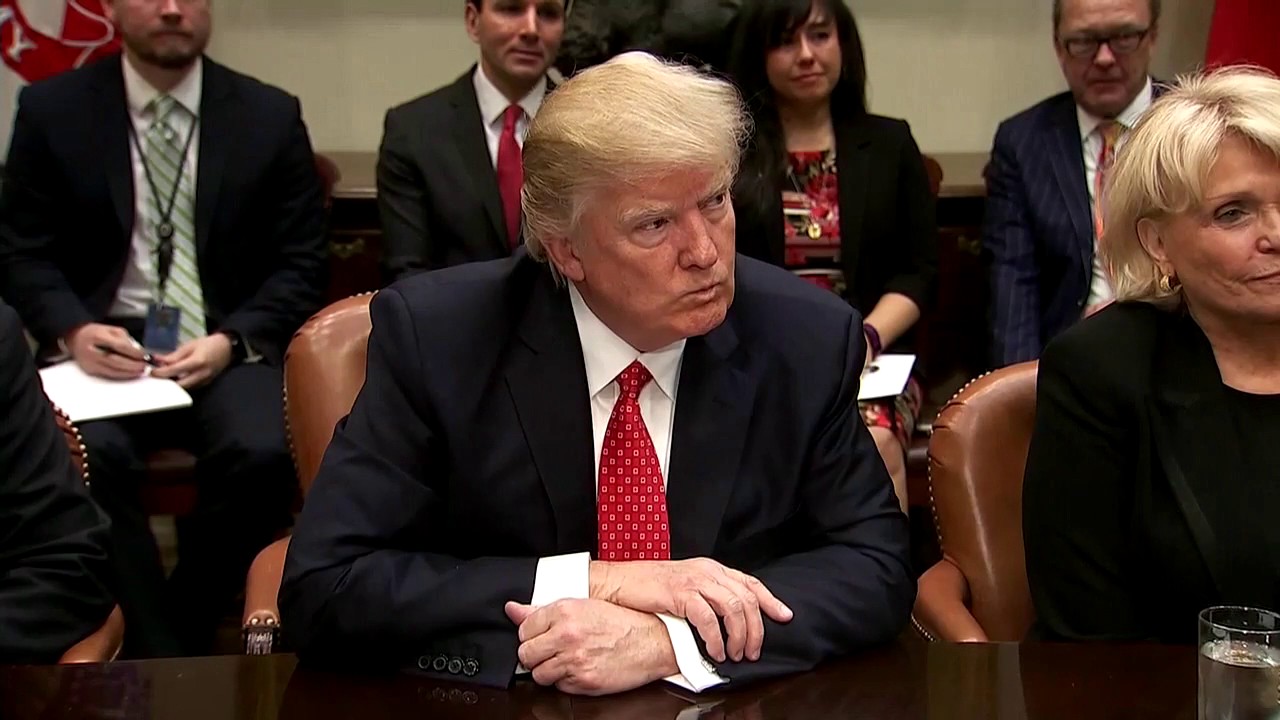 from the Sheriffs' Association in February. At the White House meeting, the association showed its appreciation to Trump for helping push its agenda by gifting him a “new sheriff in town” sculpture, which was reportedly its first time ever giving one to someone outside law enforcement.[vid]
“Let me tell you the difference of six months,” Sheriffs' Association executive director Jonathan Thompson said at the meeting, according to a White House transcript. “I sat in this room, in this chair, and I was pleading — I was begging for help. Today, you’ve invited us here to your home. You're offering help. You're delivering on that offer. And on behalf of our members across the country, thank you.”
As an organization, the Sheriffs' Association had remained dormant on federal-level lobbying activity until the aftermath of Ferguson, according to forms reviewed by DeSmog. Blount, the Ervin Hill Strategy lobbyist for the Sheriffs' Association, also currently serves other military contractor clients including General Dynamics, NorthrupGrumman, and Aerojet Rocketdyne.
Dakota Access Owner Coordinates with Sheriffs
As protests heated up at Standing Rock in October, the Morton County Sheriffs' Department requested support from the Sheriffs' Association, which coincided with out-of-state cops flooding the state in assistance.
In December, DeSmog reported on an audio recording first obtained and published by New York Daily News writer Shaun King, in which Energy Transfer Partners executive Matthew Ramsey said that the Sheriffs' Association worked in close coordination with his company, the pipeline's majority owner, against those opposing it at Standing Rock.
“We met with some of the officials in North Dakota [during a recent trip to the state],” said Ramsey in the recording. “We met with the National Sheriff's Association. People are tired of this. They're tired of seeing what's going on in the community and we think that the tide has turned and people are understanding what a great project this would be for the State of North Dakota.”
Indeed, the Sheriffs’ Association did send training staff and office personnel to Standing Rock. The group tasked Dane County, Wisconsin Sheriff Dave Mahoney with training North Dakota agencies, which had little experience policing protests.
“When the situation in North Dakota began over the pipeline, I had been asked by the National Sheriff’s Association and by the Department of Justice to travel to North Dakota to speak to the sheriffs who didn’t have much experience with large gatherings,” Mahoney said in an interview.
While adamant his police force handled the response in Standing Rock in the same peaceful way as in 2011, when the Dane County Sheriff's Office handled over 100,000 people protestingWisconsin's Republican Governor Scott Walker's Budget Repair Bill, the results in North Dakota tell a different story.
Greg Champagne, president of the National Sheriffs' Association and sheriff of St. Charles Parish in Louisiana, was also intimately involved in Standing Rock. In late October, Champagne traveled there for a publicity appearance, which was funded by the EMAC agreement. He was toured around the police lines and the construction sites, afterwards posting on Facebook a lengthy rebuttal to protesters and the media, which received 46,000 shares.
The St. Charles Parish Sheriff’s Office also sent two cameramen to video the cleanup after the eviction of demonstrators at one of the Standing Rock encampments. An open records request for that footage is still pending.
For its part, the Sheriffs’ Association told DeSmog, “What we were trying to do was help the local sheriffs, as a national organization, to coordinate the actions through the EMAC to get them people that would make themselves available.”
The association added that although the intent of its coordination was not to train law enforcement officials present at Standing Rock, that “per things like this, there is always training going on and coordinated tactics between North Dakota, Wyoming, Wisconsin or whoever else was there. We are also helpful with guidance and coordinating the knowledge as well by having people there like Dave [Mahoney, the Dane County Sheriff] who have better knowledge of large protest gatherings.”
Sheriffs Tackle Bayou Bridge
In the aftermath of Standing Rock, the Sheriffs' Association has remained active on pipelines owned by Energy Transfer Partners, including its proposed Bayou Bridge pipeline through Louisiana.
As DeSmog previously reported, Joseph Lopinto — an attorney with the Jefferson Parish Sheriff’s Office in Louisiana and former Republican state legislator — criticized the federal government's Standing Rock response while speaking on behalf of the National Sheriffs’ Association at a February public meeting related to the Bayou Bridge pipeline.
“The federal government failed to provide local law enforcement [in Standing Rock, North Dakota] with support to control hostile, often violent protesters that caused millions of dollars in property damage and shot at law enforcement officers,” he said at the convening. “The federal government failed to provide local law enforcement with the resources they need to deal with violent and unruly protests.”[vid]
Policing Protest
The intervention of the Sheriffs’ Association in social justice movements, such as the one at Standing Rock, is not unprecedented.
During the civil rights era, the Sheriffs' Association policed protests in Alameda County, California, which houses the City of Berkeley and the University of California. The association's California state representative, Alameda County Sheriff Frank Madigan, described these policing efforts during a 1970 congressional hearing about the Black Panther Party.
“Prior to World War II, I worked in the field as an investigator of subversives and now I am seeing the children back in the scene, what we call the Red-diaper babies getting into the act,” remarked Madigan. “Since Berkeley has become a Mecca we are getting dissidents from all over the country.”
“Red diaper baby” was a term applied to the child of socialists or communists (either self-described or as described by law enforcement officials), and was generally meant as a pejorative and to discredit. The Black Panther Party and campus-based antiwar movement, which were the subject of the 1970 hearing, were at the time the target of extensive surveillance and attempted disruption under the FBI's COINTELPRO (short for Counterintelligence Program). COINTELPRO eventually was scrutinized in a U.S. Senate probe known as the Church Committee investigation (named after then-U.S. Sen. Frank Church), and nominally came to an end.
Alex Vitale, a professor of criminology at Brooklyn College and author of the forthcoming book The End of Policing, told DeSmog that Standing Rock and the role of the Sheriffs' Association serves as a case study of broader policing trends seen during social movements.
“The 1033 program [lobbied for by the Sheriffs’ Association] should be understood in two ways,” said Vitale.
“First it is a cynical form of corporate welfare to the defense industry. It has opened up vast new federally subsidized markets by normalizing the idea that local police departments, no matter how small, need vast arsenals of military gear to defend themselves from the exaggerated threats of hidden terrorist cells and rampaging drug gangs. Second, it is part of an ideological worldview that the threats we face as a society are best dealt with by ever more police power.”
==