police cops bak
police820
primary 720 on blm
see frce tag
see student / academic suppression activist gaza genocide camps college
see infiltration for radicalization/militia
Corps hire off-duty police (see also private intel, that provide security)
see capitol for jan 6
see also activist suppress, fusion ctr?
SEE ICE DHS IHS
see emac for militarization of cops USMC LA ICE RAIDS
sheriffs
see blue live matter cops kia
bak 820 html valuable
===
NJ MAYOR REP MCIVER JUDGE SEN PADILLA ARRESTED CUFFED
---
AN 6 25
This Saturday, June 14, the No Kings movement will be holding large protests all over the United States — from Seattle to Chicago to Philadelphia — to express opposition to President Donald Trump's military parade. And Brevard County, Florida Sheriff Wayne Ivey, a far-right MAGA Republican, is drawing vehement condemnation for remarks that critics say are threatening nonviolent protesters with violence.
At a press conference on June 12, Ivey told reporters, "If you spit on us, you're going to the hospital and in jail. If you hit one of us, you're going to the hospital and jail. And most likely get bitten by one of our big, beautiful dogs that we have here. If you throw a brick, a firebomb or point of gun at one of our deputies, notifying your family where to collect your remains at. Because we will kill you, graveyard dead. We're not going to play."
Ivey's comments are drawing a lot of negative reactions on X, formerly Twitter.
READ MORE: 'Scams, corruption and cover-ups': Republicans just declared 'open season for wealthy tax cheats'
The Grio tweeted, "Florida Sheriff Wayne Ivey had quite the message for protesters expected to hit the streets ahead of an anti-Trump rally on Saturday: 'We will kill you.' The law enforcement official's rhetoric has been condemned and comes amid ongoing protests in LA."
X user MeloDramatical wrote, "White supremacy is the greatest threat we face as a nation."
Another X user, Auntie Smartassey posted, "No one should become violent, Sheriff Wayne Ivey. Explain why the president pardons cop beaters? What validates their violence in your eyes? People who fight for human rights should face prison or death? But violence in the name of Trump is okay?"
Florida resident Kirsty Johnson posted, "This is Sherrif Wayne Ivey from my home county, his being an a------ isn't new, but openly & unapologetically saying he will brutalize and even MURDER folks is f------ sick. Pathetic, pathetic men and 'officers.'"
READ MORE:Trump's reckoning is the final chapter of a horrifying old movie
Democrat Kim Brideau wrote, "F--- the fascist sheriff."
Douglas E., @DouglasE4True, a self-described Antifa supporter, posted, "When someone shows you who they are, believe them the first time. How many times must the cops show themselves as white supremacist thugs/goons to be believed?"
READ MORE:'I have to go through hell': Trump complains about 'No Kings' protests during his parade
---
an 5 24 pp
When news broke in January that the Trump Justice Department was freezing significant work on civil rights litigation, including police reform cases, attention immediately focused on two cities: Minneapolis and Louisville, Kentucky.
Both places were on the cusp of entering court-enforced agreements to overhaul their police forces after high-profile police killings there sparked a nationwide reckoning over race and policing.
But it’s now clear that the administration’s move will be felt well beyond those two cities. In fact, it throws into question police reform efforts in at least eight other communities across the country, according to a ProPublica review. The need for change in these places was documented in a flurry of investigations published by the Justice Department in the final year of Joe Biden’s presidency. All of the probes found a “pattern or practice” of unlawful behavior that was routine enough that the federal government recommended reforms.
From Phoenix to Trenton, New Jersey, federal officials investigating the eight agencies found unjustified killings, excessive force, debtors’ prisons, retaliation against police critics, racial discrimination, unlawful strip searches and officers having sexual contact with sex workers during undercover operations.
Such findings are typically the first step toward a department agreeing to federal oversight and court-ordered reform. Over the years, the DOJ has credited such agreements, known as consent decrees, for having helped departments reduce unnecessary use of force, cut crime rates and improve responses to people with behavioral health needs. President Donald Trump’s Justice Department, however, has ordered its civil rights attorneys to pause such work until further notice, effectively reinstating the limited approach it took during the president’s first term. Department officials did not respond to questions about the pause or how long it would remain in effect.
For now, that means any reform efforts will be up to local leadership — a dynamic that experts say could bode poorly for communities with long histories of police abuse.
Cliff Johnson, an attorney and director of the Mississippi office of the MacArthur Justice Center, a nonprofit legal organization, was not optimistic.
“While those DOJ reports sometimes can lead municipalities, police departments and other offenders to come to Jesus,” Johnson said, “what we’ve been seeing, from our perspective, is folks saying, ‘I don’t need Jesus. I got Trump.’”
Louisiana leaders, for example, have slammed the Justice Department’s report, which found a pattern of problems in the way the state police used force against civilians. Gov. Jeff Landry said the report was an attempt by the Biden administration to “diminish the service and exceptionality” of the state police. And state Attorney General Liz Murrill said the Justice Department was being used to “advance a political agenda.”
The report was partly spurred by the 2019 death of Ronald Greene, who was killed while in the custody of Louisiana State Police. Officers repeatedly shocked him with a Taser, dragged him by his ankle shackles and then left him face down in the road. Some officers deactivated or muted their body cameras during the incident. Louisiana troopers had claimed Greene died when his car crashed after a high-speed chase. The department was forced to change its story when The Associated Press obtained and published body-camera footage of the incident.
Federal investigators found the episode was not an outlier. According to their report, officers in the department used Tasers without warning and against people who were restrained or who did not pose a threat, didn’t give people the chance to comply before using force, used force against people who weren’t a threat, and used excessive force against people running from officers.
A spokesperson for the Louisiana State Police did not answer questions about the report’s findings but said the agency is working to improve its relationship with citizens and other stakeholders. Landry’s office did not respond to ProPublica’s questions about the report and the state’s response, and Murrill’s office declined to comment.
Across the state line in Lexington, Mississippi, the Justice Department’s shift away from police accountability could also be consequential. Department officials said residents there were so afraid of local police that they were hesitant to meet with investigators in public, fearful of retaliation.
They had good reason to be concerned. In 2023, officers arrested an attorney who was representing citizens in police abuse cases against the department. She had been filming a traffic stop at the time.
The police force — made up of about 10 officers, some of whom are part time — is the smallest the Justice Department has investigated in decades. Federal investigators ultimately found that its officers use excessive force, discriminate against Black people, conduct stops and searches without probable cause, and arrest people purely for not having the money to pay fines.
It’s unclear what steps, if any, the Lexington Police Department is taking in response to the report. Police Chief Charles Henderson declined to comment and directed questions to the city attorney, who did not return a call.
Reform advocates have put their hopes in upcoming elections in Lexington that could bring in new leadership that is more interested in making changes at the police department.
In Mount Vernon, New York, advocates say they’ve seen little movement since the Justice Department found police there use excessive force, conduct unlawful strip and body cavity searches of arrestees, and fail to properly train officers and supervisors. It also found police discriminated against Black people. One group is considering legal action to bring the city to the table.
“It seems like Mount Vernon has put lip service on addressing the findings,” said Daniel Lambright, an attorney with the New York Civil Liberties Union. “It remains unclear actually what they’re doing to address the findings.”
In their report, federal investigators expressed concern that the police department’s “overly aggressive tactics unnecessarily escalate encounters.” In one instance, they wrote, five Mount Vernon officers used force on a man they thought was selling drugs — without announcing their presence or attempting to arrest him peacefully. Instead, one of the officers approached the man from behind and attempted to put him in an “upper body hold,” which started an altercation, according to the report. Police then threw the man to the ground. One officer drove his Taser into the suspect five times while another repeatedly punched him in the head. The man suffered a broken nose.
“The reform efforts have to continue,” said the Rev. Stephen Pogue, a member of the United Black Clergy of Westchester, an organization that works on social justice matters in Mount Vernon and surrounding areas. “We’re not in one of those places where Trump is our god. In Mount Vernon, we still need Jesus.”
Pogue said he hopes the city will host a public meeting about the report before the summer.
Mayor Shawyn Patterson-Howard and a police spokesperson did not reply to interview requests. But in December, the mayor said in a statement that the city would work with the Justice Department to address its findings. “We wholeheartedly support our good officers and at the same time will not tolerate and will punish unconstitutional policing,” she said.
In Phoenix, city and police officials have sent conflicting signals about the federal investigation, which found the Police Department used excessive and deadly force, violated the rights of homeless people, and discriminated against Black, Latino, Native American people, as well as those who have behavioral disabilities. “Why the hell would anybody ever accept a consent decree?” said one City Council member months before the report was released. Afterward, the head of the police union said the investigation was a “farce” and part of an “unprofessional smear campaign.”
But Mayor Kate Gallego has said the city is taking the report seriously. In September, the City Council passed several police reform measures, including requiring all officers who deal with the public to use body-worn cameras, even the special units that have been at the center of controversial shootings.
“Regardless of the new federal administration, these reforms are moving forward, and the mayor’s commitment to improving the police department is unwavering,” a mayoral spokesperson told ProPublica.
Some of the other cities the Justice Department had targeted are taking small steps toward fixing problems the federal investigators identified, though it’s unclear whether the efforts will result in lasting change.
In Oklahoma City, where Justice found in January that police officers discriminate against people with behavioral health disabilities, the city recently began funding mobile mental health units that can respond to incidents instead of police, said Jessica Hawkins, chair of the city’s Crisis Intervention Advisory Group. She said the city is also working on a written response to the DOJ report but didn’t know when it would be completed.
Police Chief Ron Bacy declined ProPublica’s request for an interview and through a spokesperson said the department was “still reviewing the report.”
In Memphis, Tennessee, where federal investigators found that police use excessive force, conduct unlawful stops and discriminate against Black people, the mayor put together a reform task force, led by a retired federal judge. “The DOJ report, in our case, kick-started a conversation that had sort of gone cold,” said Josh Spickler, executive director of Just City, an organization that works on litigation and justice matters in Memphis.
And in Trenton, New Jersey, where the Justice Department found that local police have a pattern or practice of using excessive force and conducting unlawful pedestrian and vehicle stops, City Council member Jasi Edwards has been hosting community meetings to introduce the idea of a civilian complaint review board and build support for the measure. Edwards said she plans to formally put forth her proposal sometime in the fall.
It will likely run into resistance, though. Representatives of the Police Department and mayor told ProPublica that they didn’t believe a civilian review board was necessary because it would be costly and there are existing ways for citizens to complain about police conduct. The DOJ report, they said, highlighted some areas in need of improvement but mischaracterized a number of cases and gave an inaccurate depiction of the department’s culture.
In Worcester, Massachusetts, reforms are already moving forward in response to the Justice Department’s investigation.
Last month, the police chief released a 15-page report on proposed measures intended to remedy the problems identified by federal investigators. The changes, which are still awaiting legal review, include prohibiting police from releasing K-9 dogs into mass gatherings or riot scenes and requiring a supervisor to go to a scene if someone reports being injured by police.
The police chief, Paul Socier, has also proposed several changes to how officers approach prostitution. Investigators found the department engaged in “outrageous government conduct” with sex workers by having sexual contact during undercover operations.
“We are hopefully headed in the right direction,” said Audra Doody, co-executive director of Safe Exit Initiative, an organization in Worcester that provides services, housing and counseling to sex workers who want to leave the sex trade. “With a time of such uncertainty, I want to believe our people in the community are telling the truth and actually are going to do what they say they’re going to do, which they seem like they are, right now.”
ProPublica is reporting on how the Trump administration’s efforts to reshape the federal government will impact the Department of Justice and its work on civil rights. If you’re a former or current Justice Department employee and you want to send us a tip, please contact us. We’re especially interested in the department’s Civil Rights Division. Topher Sanders can be reached by phone or on Signal at 904-254-0393 or by email at topher.sanders@propublica.org.
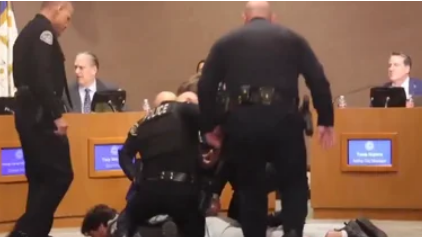
an 2 24 white guy
Former NFL player arrested after calling MAGA a 'Nazi movement' at city council meeting
===
fanone called out FOP 180? an 1 25
Major police unions that backed Trump 'deeply discouraged' by Jan. 6 pardons
an 1 25
The national Fraternal Order of Police (FOP), which endorsed President Donald Trump in the 2024 election, isn't interested in discussing the 47th president's mass pardons of insurrectionists who attacked the U.S. Capitol on January 6, 2021.
HuffPost White House correspondent S.V. Dáte reached out to the FOP after Trump announced he was pardoning roughly 1,500 people charged and convicted in relation to the deadly siege of the Capitol, in which roughly 140 police officers were injured while battling rioters. Those injured during the insurrection included both members of the U.S. Capitol Police Department along with Washington D.C. Metropolitan Police Department officers.
"We don't have a statement about that," the FOP told Dáte, who tweeted that he specifically asked the union its thoughts on Trump "releasing HUNDREDS of violent felons who assaulted cops."
READ MORE:**'The defendant you testified against is being released': Ex-Capitol cop shares DOJ alerts**
Trump's pardons included both those convicted of lower-level offenses like unlawful parading, and those convicted of seditious conspiracy (the most serious charge). The rioters who have been released from prison include high-profile defendants like Guy Reffitt, who brought a gun to the Capitol, and who was turned in by his own son.
Some of the officers who were attacked and testified publicly in the trials against insurrectionists received preemptive pardons from former President Joe Biden hours before Trump was sworn in. Sgt. Aquilino Gonell, who provided testimony to the House Select Committee on the January 6 Attack, was among those Biden pardoned. He recently shared a screenshot of his call log with former Capitol Police Officer Harry Dunn, which showed automated alerts from the Department of Justice letting him know that defendants he testified against have since been released from prison.
"The issuance of these pardons should not be mistaken as an acknowledgment that any individual engaged in any wrongdoing, nor should acceptance be misconstrued as an admission of guilt for any offense," Biden stated after issuing the pardons. "Our nation owes these public servants a debt of gratitude for their tireless commitment to our country."
Click here to read Dáte's tweet.
===
Violent arrest of Emory professor spotlights brutality of police crackdown on campus protests](https://www.alternet.org/violent-arrest-professor/)
Julia ConleyCommon Dreams 4 24
===
===
https://www.alternet.org/2022/08/former-virginia-police-officer-sentenced/
Although it remains to be seen whether or not former President Donald Trump will face any type of federal charges in connection with the January 6, 2021 insurrection, the U.S. Department of Justice (DOJ) has prosecuted many of the Trump supporters who attacked the U.S. Capitol Building that day. The DOJ certainly hasn’t had a one-size-fits-all approach when it comes to prosecuting Capitol rioters; the charges have ranged from severe to relatively mild. And one of the harsher sentences came on Thursday, August 11, whenformer Rocky Mount, Virginia police officer Thomas Robertson was sentenced to 87 months in federal prison for his role in the assault on the Capitol.
The Washington Post’s Rachel Weiner, in an article published on August 12, notes that a jury found Robertson guilty of “six crimes, including using a large wooden stick to block police outside the Capitol and destroying his phone when he got home.” And another former Rocky Mount police officer, Jacob Fracker, pled guilty to a conspiracy charge.
“At his sentencing, Robertson depicted his actions on January 6 as an aberration in the life of a respected member of a law-abiding and respectable community,” Weiner reports. “The government’s filings suggest he became radicalized under the influence of those around him, including the chief of a small neighboring police department and a retired FBI agent. Prosecutors took the unusual step of publishing two detailed FBI investigations into the claims Robertson made in his appeal for mercy.”
Part of the evidence against Robertson, according to Weiner, was a “text conversation from March 2021” in which Robertson told former Boones Mill, Virginia Police Chief Dennis M. Deacon, “I can kill every agent that they send for at least two weeks.” Robertson, Weiner reports, also told Deacon he was “prepared to die in battle.” And Deacon responded that Robertson needed to “be smart, pick battles, plan logistics, very carefully recruit and hope it’s not going to come down to it.”
The judge in the case, Christopher Cooper, said he found it especially disturbing that Robertson was still threatening violence in March 2021 even though police officers had been seriously injured during the Capitol attack two months earlier.
Fracker’s sentencing is scheduled for Tuesday, August 16.
Weiner reports, “In his letter to the court, Fracker said he had been labeled a ‘rat,’ a ‘snitch’ and a ‘back stabber’ by community members for testifying against Robertson. ‘It really is just heartbreaking,’ he said. Robertson was a mentor to him and a ‘once valued father figure,’ Fracker wrote.”
According to Weiner, “Robertson was released after his arrest in January 2021 but was jailed months later after going on what Cooper described as a ‘remarkable shopping spree for high-powered assault weapons’ while becoming ‘further radicalized.’ Robertson could be charged with illegal firearm possession, the judge noted.”
6 22
atlanta forest protest vs uniform cops paid by corps
schizo bk the blue vs kill cops
patriot front, proud boys 31? arrested pride
https://www.alternet.org/2022/06/idaho-cops-inundated-threats/
an 11 21
David Badash The New Civil Rights Movement
November 01, 2021
On Thursday the union representing 50,000 current and former New York City Police Dept. officers claimed Mayor de Blasio's vaccine mandate would force "10,000" officers off the streets. According to the...
https://www.alternet.org/2021/03/kentucky-senate-advances-bill-to-criminalize-insulting-police-as-critics-warn-it-could-cause-violent-response/
https://www.alternet.org/2021/01/right-wing-violence/
...We had seen this building over the past year, though. If you go back to January 2020, in Richmond, Virginia, 20,000 armed people showed up at the state House there. In the spring, there were protests that were armed in Michigan at the state House, including one in which people stormed the building and intimidated legislators with weapons, with AR-15 assault rifles. We saw the Idaho state House get stormed. We saw the Oregon state House get stormed. We saw, in Olympia, Washington, by the Capitol there, there were shootings in the street two weeks in a row. Two people were shot, one each week. And so, this had been building for a long time.
I personally was at an armed rally at the Virginia state House a couple months ago, where about 50 men with weapons showed up and basically dared the police to arrest them, because they were in violation of the law. So, this was something that had been coming for a long time. And if you looked at the rhetoric online and you looked at what had been said by members of these groups for a long time, it was all about revolution, it was all about death to tyrants, it was all about civil war, for a long time.
On the day of the event, we saw militia groups like the Three Percenters, the Oath Keepers, who were playing a big role. We saw the conspiracy theorists, like the QAnon people, who were there. We saw, I think, a significant role played by the Proud Boys, who you could call an ultranationalist street-fighting gang or group. And I think we saw a lot of military vets and some current military there. And there were also people who belong to straight-up white supremacist or white nationalist groups.
AMY GOODMAN: You mentioned Virginia. We reported earlier this week that two of the rioters were off-duty Virginia police. And this goes to the issue of police and military from all over the country. You know, people were saying, "Where were the police?" Well, they were part of the riot, the insurrection, a number of them. You have police from Seattle, apparently New York, Philadelphia transit officers, a number of them, two Virginia officers. Now, this is just people who were identified. Can you talk about the — a PSYOPS guy, a military psychological operations. Can you talk about the significance of this?
A.C. THOMPSON: You know, I think there is a big concern that what we've seen in recent years is a lot of members of police departments, or at least some members of police departments, being radicalized in this right-wing direction. And in part, I think, what that's been a product of is they've seen the rise of the racial justice movements and police accountability movements, and they say, "I feel under attack. The person who's sticking up for us is Donald Trump, who's super law and order, and so I'm going to get deep into the Donald Trump world." And I think that's part of what's happened.
What's happening now, though, is different. And what's happening now is, when I was in D.C. at "Stop the Steal" protests and other protests in recent months, you would see the right-wing protesters did not want to fight with the police. They would say, "We're the law-and-order people. We're the pro-police people. We're not going to fight with the police. We want to fight with the police, but we're going to back off." That has changed. That has pivoted. And now what you're seeing in the chatter amongst the right-wing groups is, "We are at war with the police. The police are in bed with the reds. The police are a tool of this socialist takeover, which we believe magically is happening, without any facts. We believe that the police are subverting democracy. And we are now going after the police." And that's what you saw at the Capitol.
AMY GOODMAN: So, let's talk about the lack of preparation at the Capitol. You see these police officers, the Capitol Police, some help by the Metropolitan Police, fending for themselves. And we got the reports this week of the level of threat assessment reports that would come before each Black Lives Matter protest. Nothing like that was issued now, and yet you have this coming together of all of these people from — and if you can explain what the terrorist watch list is? It's not a no-fly list. And for many progressives, they may be very concerned about who makes up this list, but the fact is, scores of people on the FBI's own list had gathered, and yet the FBI issued no reports, and there was so little preparation. We saw African American Capitol police essentially running for their lives, saying they didn't have the support from the top, and they were being chased by the mob.
...
cop training
https://www.alternet.org/2020/12/blm-terrorist/
oct 3 3, 2020
What you need to know about the “Google for spies”
If you know the name Palantir, you probably know that it’s associated with Peter Thiel, that it contracts with defense and law enforcement agencies, and that it works with data somehow, including data from surveillance systems. You might get that it’s named, creepily enough, after the magical “seeing-stones” in *Lord of the Rings*.
But what exactly it is that Palantir doeshas not always been clear from media coverage. That’s partly because the company has intentionally cultivated an air of secrecy and mystery around its work. But it’s also partly because the actual nature of its work is somewhat murky and hard to pin down, even once you know what it is.
On Thursday, Palantir went public in a direct listing, completing a transition from a shadowy Silicon Valley unicorn to one that must answer quarterly to investors and regulators. Its shares dipped just a bit from their initial price but left the company with a hefty valuation on the order of $20 billion, per the Wall Street Journal. That’s remarkable for a company that has just 125 customers.
Enterprise software companies tend to stay out of the spotlight; their products are not used, let alone beloved, by the masses, as are those of consumer software giants such as Google. But Palantir in particular is worth knowing about, because it embodies a vision of technology’s role in society that carries profound implications for all of us. And the Google comparison is more instructive than it might seem: Palantir is, in some ways, the yin to Google’s yang.
The Pattern
Palantir is a tech company built for our emerging dystopia.
- To understand what Palantir does, there’s no better starting point than :{this *New York*magazine profile:(style="font-weight:700"):}: by Sharon Weinberger, published on the day the company went public. Palantir’s promise, she notes, is “to ingest the mountains of data collected by soldiers and spies and police — fingerprints, signals intelligence, bank records, tips from confidential informants — and enable users to spot hidden relationships, uncover criminal and terrorist networks, and even anticipate future attacks.”
- In short, Palantir is “a sort of Google for spies,” although it now serves corporate and public health clients as well as soldiers and spooks. This is consistent with Palantir’s self-description, in its public filing, as a purveyor of software that “enables our customers to transform massive amounts of information into knowledge that reflects their world.”
- What makes Weinberger’s piece so valuable, however, is how it interrogates the margins between what Palantir promises and what it delivers. For Palantir to realize its vision at scale, it would have to largely automate the process of combining and converting vast, messy data sets into actionable insights about the world. That’s a very high bar for artificial intelligence, and Weinberger’s reporting suggests that Palantir isn’t particularly close to meeting it. Instead, like many of today’s ambitious automation tools, its platform requires what one intelligence-community source called “RFOP,” or “rooms full of people” working behind the curtain to clean, label, and interpret the data. Palantir also sends employees that it calls **“forward-deployed**engineers” to work permanently onsite with clients, helping them tailor the platform to their needs. (You can learn more about the quotidian mechanics of the work by reading Quora posts from current and former Palantir employees.)
- More than any crystal-ball wizardry, Palantir has won over big clients such as the U.S. Army through white-glove customer service and consulting, plus a user interface much slicker and friendlier than the often-outdated systems it seeks to replace. It has been helped along the way by clever sales tactics, Thiel’s relationship with the Trump administration, and a willingness to lose piles of money in pursuit of future growth. (Palantir has never turned a profit.)
- As a business, then, Palantir is very different from Google. One provides free, heavily automated tools to the masses in exchange for data to power targeted ads. The other provides expensive, labor-intensive data modeling tools and data consulting services on an exclusive basis to a limited number of huge organizations, whose data it promises to keep private. (Palantir has struggled to tap the local law enforcement market, with a few notable exceptions, because it’s simply too expensive.) Palantir’s rift with Silicon Valley is not merely abstract; it’s actually relocating to Denver from Palo Alto.
- Palantir CEO Alex Karp defines his company’s values in opposition to Google’s. In Palantir’s S-1 filing, he took an implicit shot at Google for walking away from its Project Maven military contract in response to employee backlash, while continuing to invade its own users’ privacy. “Our software is used to target terrorists and to keep soldiers safe,” Karp wrote. “We have chosen sides.” At Davos in January, he acknowledged that Palantir has helped ICE find and deport immigrants (as Motherboard had previously uncovered), and defended the company’s government contracts. “The core mission of our company always was tomake the West, especially America, the strongest in the world, the strongest it’s ever been, for the sake of global peace and prosperity,” he said in an interview there.
- That sort of muscular rhetoric, along with Thiel’s Trump ties and Palantir’s business model, would seem to belie Karp’s own claim to be politically progressive. (To the extent these men’s ideologies matter, by the way, it’s because Palantir’s governance structure as a public company :{keeps almost all the power in its founders’ hands:(style="font-weight:700"):}:.) In fact, Karp identified as neo-Marxist in his grad school days, when he earned a doctorate in “neoclassical social theory” at Germany’s Goethe University, home to the famous philosopher Jurgen Habermas.
- For a deeper dive into Karp’s philosophy, and an attempt to reconcile it with the politics of both Thiel and Palantir itself, you can read this fascinating critique of his dissertation by the historian and media theorist Moira Weigel, published in July in the journal boundary 2. (You could also try reading the dissertation itself, I suppose, provided you can read German and have a lot of time on your hands.) In Weigel’s reading, despite their ideological differences, both Karp and Thiel “regard the desire to commit violence as a constant, founding fact of human life.” And while Karp engages with critical theory, his account of aggression’s primary role in language, culture, and socialization is fundamentally analytical rather than normative. That is, he takes it as a given rather than a problem to be overcome.
- In a phone interview for this newsletter Friday, Weigel expanded on how Karp’s philosophy relates to his work with Palantir. “When you take up the tradition of what he calls neo-Marxism and take away the emancipatory impulse that animated it — that the point is to make society less violent— what you get is a very pessimistic view of modernity and society,” she said. That dark worldview helps to explain why Karp might regard the appropriate response as being to simply “choose a side,” as he put it in Palantir’s S-1 — and keep a vigilant watch on what the other side is up to.
- Here again, the contrasts with Google are striking. Google’s aesthetic is sunny and whimsical — think of its colorful logo, its doodles, its dessert-themed Android operating systems — and its products often reflect a worldview that is optimistic to a fault. Its tools promise to put the world’s information in everyone’s hands, for free; it speaks of information as empowering and democratizing, and implicitly assumes that people will use it for good. That’s a convenient assumption for Google’s business model, because a world in which information is unlikely to be abused is one in which people freely share their data, which can in turn be leveraged to show them relevant ads. If Palantir’s world is zero-sum, Google’s is win-win; Palantir runs on suspicion, Google on trust.
- Zoom out far enough, though, and Palantir and Google start to look like flipsides of the same coin. Ultimately, both promise to harness machine learning and computing power to bring together and organize disparate sources of information and make it searchable. The customers and revenue models are different, but the value proposition is the same — to allow people to quickly surface and synthesize information that would otherwise remain disjunct and obscure. (That’s one reason they so often compete for the same engineering talent; according to the New Yorkprofile, early Palantir employees wore t-shirts that said “Google is our backup job.”) And while each might point fingers at the other, surveillance is integral to both models. In one, the customers are doing the surveilling; in the other, the customers are the ones surveilled.
- Privacy theorists sometimes talk about “privacy through obscurity” — the idea that the average person’s everyday privacy resides not in a lack of available information about them, but in the difficulty of tracking it down. Your ISP might know what websites you visit; the DMV knows your license plate number; your next-door neighbor knows what time you leave the house each day; the local newspaper may have an old article about you somewhere in its archives. But as long as no single entity has ready access to all of that information, a semblance of privacy remains intact.
- To see how Palantir explodes that obscurity, consider its partnership with the Los Angeles Police Department. In a *BuzzFeed News*investigation this week, Caroline Haskins detailed how the company trained officers to use its tools to stitch together every piece of data they can get their hands on. “At great taxpayer expense, and without public oversight or regulation, Palantir helped the LAPD construct a vast database that indiscriminately lists the names, addresses, phone numbers, license plates, friendships, romances, jobs of Angelenos — the guilty, innocent, and those in between.”
- There are, of course, benefits and downsides to obscurity: It can empower activists to challenge governments, protect stalking victims from their stalkers — or enable criminals to evade detection. Google and Palantir think about those risks and tradeoffs very differently, with one insisting your data is safe in its hands, the other pledging to only track the bad guys on behalf of reputable clients. Yet by building tools to automate the integration of disparate data sources about people, both Google and Palantir are fundamentally anti-obscurity — and, by extension, anti-privacy. If neither has yet built anything quite like the all-seeing stone from Lord of the Rings, it isn’t for lack of trying.
- Google and Palantir aren’t the only companies automating the connection of informational dots, of course. The Softbank-backed startup Banjo AI — whose now-ousted founder was a former neo-Nazi — seeks to combine real-time data from various feeds, including surveillance video, to detect events such as emergencies as they happen. I wrote last week about how the surveillance tech built by Ring, Amazon’s home security subsidiary, empowers people to spy on each other. There’s a way of looking at today’s tech industry in which its business is essentially to eliminate society’s frictions: the obstacles to interaction, to information, to instantaneous fulfilment of desires. But the friction involved in tracking anyone you find suspicious, for any reason, is one we might be better off holding onto.
GUK
https://yyy.theguardian.com/world/2020/sep/23/oregon-portland-pro-trump-protests-violence-texts
no lnx
Revealed: pro-Trump activists plotted violence ahead of Portland rallies
Patriots Coalition members suggested political assassinations and said ‘laws will be broken, people will get hurt’, leaked chats show
[pix Far-right organizers clashed with counter-protesters at the Justice Center in Portland, Oregon, 22 August.
Jason Wilson and Robert Evans
@jason_a_w
Wed 23 Sep 2020
Leaked chat logs show Portland-area pro-Trump activists planning and training for violence, sourcing arms and ammunition and even suggesting political assassinations ahead of a series of contentious rallies in the Oregon city, including one scheduled for this weekend.
:{
}:
The chats on the GroupMe app, shared with the Guardian by the antifascist group Eugene Antifa, show conversations between Oregon members of the Patriots Coalition growing more extreme as they discuss armed confrontations with leftwing Portland activists, and consume a steady diet of online disinformation about protests and wildfires.
[Facebook removes Patriot Prayer pages in bid to halt 'violent social militias'
Read more]
At times, rightwing activists discuss acts of violence at recent, contentious protests, which in some cases they were recorded carrying out. At one point, David Willis, a felon currently being sued for his alleged role in an earlier episode of political violence, joins a discussion about the use of paintballs.
Where other members had previously suggested freezing the paintballs for maximum damage, Willis wrote: “They make glass breaker balls that are rubber coated metal. They also have pepper balls but they are about 3 dollars a ball. Don’t freeze paintballs it makes them wildly inaccurate” [sic.]
Willis did not immediately respond to voice and text messages sent to his listed cellphone number.
Another prolific poster is Mark Melchi, a 41-year-old Dallas, Oregon-based car restorer who claims to have served as a captain in the US army.
Melchi has been recorded leading an armed pro-Trump militia, “1776 2.0” into downtown confrontations in Portland, including on 22 August. At several points in the chat he proposes violence in advance of those confrontations, and appears to confess to prior acts committed in the company of his paramilitary group.
[Rightwing demonstrators chase a Black Lives Matter protester after a pro-Trump caravan rally at the Oregon state capitol on 7 September 2020 in Salem.]
In advance of the 22 August protest, Melchi wrote: “It’s going to be bloody and most likely shooting, they’re definitely armed… so let’s make sure we have an organized direction of movement and direction of clearing or other Patriots will be caught in the possible cross fire. When shit hits the fan.”
He advised other members to ignore weapons statutes, writing, “I saw someone say bats, mace, and stun guns are illegal downtown. If you’re going to play by the books tomorrow night, we already lost. We are here to make a change, laws will be broken, people will get hurt… It’s lawlessness downtown, and people need to be prepared for bad things.”
Following these comments, several rightwing demonstrators were recorded using gas and bats on 22 August, where Melchi and his militia were also present.
In other remarks ahead of the day, Melchi draws on what he claims is his group’s history of traveling to multiple states to engage in violence at protests.
“My Group 1776 2.0. Has been fighting Antifa in Seattle, Portland, for months”, Melchi writes, adding “this won’t be a simple fist fight. People will get shot, stabbed and beat.”
He also claims police cooperation in interstate violence, writing “Yes, going after them at night is the solution… Like we do in other states, tactical ambushes at night while backing up the police are key. You get the leaders and the violent ones and the police are happy to shut their mouths and cameras.”
:{
}:
Melchi nevertheless recommends that members disguise themselves to avoid the consequences of homicide.
:{
}:
“We must be ready to defend with lethal response… Suggest wearing mask and nothing to identify you on Camera…to prevent any future prosecution.”
[We are here to make a change, laws will be broken, people will get hurt
Mark Melchi]
In response to detailed questions about these contributions, Melchi responded with an email that falsely suggested his comments might have been photoshopped, and concluded with direct threats.
Melchi wrote: “I suggest you don’t threaten combat veterans sweetheart, might get a little uncomfortable for ya big guy!”
Melchi’s sentiments in the chat logs were in keeping with fantasies of, and plans for, violence, which are constantly discussed by group members.
Although some members are connected with extremist groups or militias, on the whole they describe themselves as “patriots”, and they express no clear ideology beyond a hatred of the left, and a preparedness to use violence. The shared allegiances expressed in the group are mostly to the police, the United States and Donald Trump, a person whom some say they are prepared to kill for.
Ahead of 22 August, a user “Paige” says “I’m waiting for the presidential go to start open firing”.
Melchi, the militia leader, responds, “Well Saturday may be that go lol”.
Alex Newhouse, the digital research lead at the Center for Terrorism, Extremism, and Counterterrorism at the Middlebury Institute, said of the group that “the main mechanism that makes these communities so dangerous is the incessant desensitization to the idea of political violence”.
Newhouse said that the ideas expressed in the group were entrenched in“extreme nationalism – that a few strong men with guns can together take out an evil that is at once imagined as an existential threat, and pathetically weak”. Newhouse added that the group’s discussions “fit within a broader trend of rightwing extremists becoming more accelerationist over time”.
[Rightwing and leftwing protesters battle with mace, paint balls and rocks near Justice Center in downtown Portland Saturday, 22 August 2020.]
The chatlogs became fractious at the peak of Oregon’s recent wildfire emergency. While some members said they had gone to rural areas to “hunt” imagined antifa arsonists,others became concerned about the dangers.
As early as 9 September, the baseless idea that the fires were a coordinated arson attack was treated as settled fact, with Melchi writing: “People have officially died from these Antifa Fires. I’d shoot them on site” [sic], and another user, Dub, responding: “Yes sir if I see them they are getting dropped where they stand.”
When adverse consequences of vigilantism became evident, leadership attempted to bring the group back under control. After a member of the group reported that an associate had been arrested in Lane county for “holding [someone] at gunpoint”, the group’s administrator, who used the user name Patriot Coalition, wrote “STOP HOLDING PEOPLE AT GUN POINT- STOP PULLING YOUR WEAPONS… VIDEO- TAKE PICTURES AND CALL 911.”
Mary McCord is the legal director of the Institute for Constitutional Advocacy and Protection at Georgetown Law School, which on Wednesday released a series of fact sheets on anti-paramilitary laws in all 50 states.
Given details of the content of the chats, McCord said that “this is the kind of thing that might allow authorities to take action”, and that members of the group may “already be in violation of Oregon’s anti-paramilitary laws”.
The group also talked about coordinating at the rally with the Proud Boys, an extreme rightwing group. One user, identified as Bravo91 and a part of the group’s leadership, spoke of phone calls with the Proud Boys.
Along with antifascist demonstrators, Democratic politicians are also the target of violent fantasies in the chats. In particular, Portland’s mayor, Ted Wheeler, is demonized and nominated as a possible target for assassination by the group.
:{
}:
On 24 August, a user identified as “Trent-Medford” writes, “Fuck wheeler… guess what soon as we are done with these punks. He’s next freakin coward !!!!!!”
:{
}:
User T Durden went further. In response to news that an alleged arsonist had been released on bail, and without encountering disagreement, they wrote: “Maybe we need to start taking care of the justice ourselves!”, adding, “Start with justice on our DA and then move on to the governor. Maybe by the time we get to the first judge, they will have changed their tunes.”
stand down" --> stand back and stand by --> new logo sir we're ready to deal w/ antifa b/c x won't? chris picolini says calls to arms/violence DN
https://www.alternet.org/2020/09/watch-fox-news-host-grills-trump-spokesman-on-his-proud-boys-remark-and-tells-her-theyre-celebrating-it/
https://www.alternet.org/2020/09/inside-qanons-toxic-spread-among-police-officers/
The problem with police officers being white supremacists is an obvious one: The public cannot have confidence that laws will be enforced equitably when even one such officer employed is racially bigoted or generally unhinged. The problem is somewhat less obvious when cops succumb to conspiracy theories, especially considering their spread into the mainstream in recent years—but it can be every bit as big a problem, especially when it involves an authoritarian political cult like QAnon.
And QAnon is indeed spreading among the ranks of American police officers, as Ali Breland recently explored at Mother Jones.Breland explains that this spread is particularly worrisome because of the peculiar nature of the QAnon theories themselves. "The logic of the conspiracy theory almost requires its adherents to carry out acts of violence: If you actually believe that elites are harboring scores of children in underground tunnels to rape and steal blood from, taking action to liberate them would be a moral imperative," he writes.QAnon seems to have taken root withinNew York City's police department in particular:
The head of the department's second-biggest union gave a televised interview with a QAnon coffee cup in full view on the shelf behind him, and offered no clarification or apology afterward. The Harlem NYPD precinct's social media account retweeted a number of QAnon-related posts (including one accusing the mail-order business Wayfair of "sex trafficking young girls"), along with a number of Donald Trump tweets that spread misinformation about the COVID-19 pandemic and mail-in voting.
However, the conspiracist cult has spread to police precincts all around the nation. By far the most public and prolific of the officers adopting the conspiracy theories is Jason Bandy, who was formerly employed by the New Haven, Connecticut, police department.
Bandy has produced nearly 30 episodes of a podcast devoted to QAnon conspiracy theories, where he holds forth at length about a variety of dubious claims, gullibly relaying them all to his audience.
"Theseelites are torturing these kids," Bandy said in a March 22 podcast. "Yes, there's sex involved. They're trafficking these children and all these other rituals that they do. They are Satanic worshipers. They are Illuminati. Deep state, all this."
Bandy believes the ultimate proof of QAnon's substance is the fact that Donald Trump—around whom the theories revolve as the chief heroic figure—has refused to disavow them:
But my thing is look, Donald Trump calls fake everything out. If this stuff is fake, he'd be the first one to say, "Hey, this is fake." That's not what he said. When they asked him, "Do you know what Q is?" he said, "I'm not gonna say, but I'm just gonna tell you I think you'd be really surprised."
Bandy retired from the New Haven department in September after Police Chief Otoniel Reyes said there would be an internal affairs investigation into his posts, which remains ongoing.
Police in Bellevue, Washington, also suspended an officer—Nico Roche, who only recently joined the city's police department—after his frequent QAnon-related social-media posts became known. (A spokesperson told Daily Kos that the internal investigation, announced in June, will be completed soon.) His chief, Steve Mylett, told KIRO-TV in Seattle that the investigation would try to balance the officer's rights with the public's.
"The employee has constitutional rights, as everybody else, officers do. He's got freedom of speech, freedom of expression. We carry a burden and our standard is very high because of the work that we do and what we represent," said Mylett.
Not all jurisdictions take it seriously. In Joliet, Illinois, two officers who wore "Q" vests while participating in an anti-COVID-19 rally in Springfield were defended by the city's mayor, Jeff Grove, who told the local newspaper that he intended to judge the officers solely on the basis of their daily work, adding that in his view, "what you do on your own time is your choice, and that's your right." If any issues arise, he said, "we'll definitely be addressing them."
The officers—Matthew Kunkel and Mark Manicki—were even more aggressive in defending their associations with the conspiracy cult. "I, like millions of other people on this planet, enjoy the challenge of attempting to decode the information contained within the Q drops. It's called 'Q Research' for a reason, it requires research to obtain the information encoded within the posts," Manicki explained to theTimes. "I'm merely someone who sits on my couch late at night with my dog on my lap, iPhone in hand, while seeking the truth. Last time I checked, there was nothing wrong with that!"
In reality, the FBI has previously identified the QAnon cult as one of the leading sectors for the kind of conspiracism that, as the agency put it in a bulletin that was issued to law enforcement officers, is "very likely motivate some domestic extremists, wholly or in part, to commit criminal and sometimes violent activity. The FBI further assesses in some cases these conspiracy theories very likely encourage the targeting of specific people, places, and organizations, thereby increasing the likelihood of violence against these targets."
And it warned that this is indeed a threat to public safety: "Anti-government, identity based, and fringe political conspiracy theories very likely will emerge, spread, and evolve in the modern information marketplace over the near term, fostering anti-government sentiment, promoting racial and religious prejudice, increasing political tensions, and occasionally driving both groups and individuals to commit criminal or violent acts," the bulletin read.
It lists several domestic terrorism cases as examples of conspiracy-fueled crimes, including a widely reported incident in July 2018 when a fervent believer in the pro-Trump QAnon conspiracy theories blocked traffic across Hoover Dam in Nevada, as well as a 2013 attack on security officers at Los Angeles International Airport.
The bulletin also mentions two incidents that had not been previously reported in the media:
- The December 2018 arrest of a California man found in possession of bomb-making materials, who allegedly "planned to travel to Springfield, Illinois andblow up a satanic temple monument at the Illinois Capitol rotunda in order to 'make Americans aware of 'Pizzagate' and the New World Order (NWO), who were dismantling society.' "
- The October 2016 arrests of two Georgia men, originally for drugs, who were discovered to be stockpiling guns, ammo, and tactical gear as preparation for an attack on a government radar-research station in Alaska they believe is manipulating the weather—a conspiracy theory long promoted by the Militia of Montana.
The memo is also remarkably astute in its assessment of the mechanics of conspiracist radicalization. Its definition of "conspiracy theory" may lack an esoteric component, but it is pragmatic and to the point: "an attempt to explain events or circumstances as the result of a group of actors working in secret to benefit themselves at the expense of others." It explains how they "typically allege wrongdoing by powerful others (for example, public officials, business executives, scientists) or societally marginalized groups (for example, Muslims, Jews), and are most prevalent among individuals with extreme political views."
It points directly to the aspect of conspiracism that gives it an unusual power to unhinge its believers: namely, the estrangement from factual reality.
Conspiracy theories typically "ignore stronger evidence that would refute their claims. Consequently, they are usually at odds with official or prevailing explanations of events."
"Relying on the premises that nothing happens by accident, nothing is as it seems, and everything is connected, conspiracy theorists tend to view every bad outcome as the result of an intentional decision by an evil actor, dismiss disconfirming evidence as 'fabricated' by the conspirators, and connect a wide range of seemingly unrelated occurrences to suggest a larger plot," the memo explains.
"The danger," QAnon Anonymous podcast host Jake Rockatansky told Mother Jones, "is that you've got law enforcement who have a tremendous amount of responsibility who are showing complete disconnect from reality. They carry weapons. What happens if a police officer thinks that they've uncovered a pedophile ring?
https://theintercept.com/2020/08/28/kyle-rittenhouse-violent-pro-trump-militias-police/
the VIDEOS that preceded Anthony Huber’s killing on the streets of Kenosha, Wisconsin, are jarring. Among the most chilling is one from the parking lot of an auto repair shop. Several shots ring out. In the distance, you see the gunman in jeans and a green T-shirt. A man rushes up behind him. The gunman turns. More shots ring out and the man collapses to the ground. The gunman circles a parked car, then comes back to the man laid out on the pavement. He looks down at him and pulls out his cellphone. “I just killed somebody,” the shooter says, before jogging off. The man on the ground twitches and stares up at the sky, gasping deeply as bystanders work desperately to put pressure on his wound. Some cry, others yell for someone to call the police.
In a second video, the gunman can be seen jogging down the center of a two-way street as bystanders yell that he just shot someone. He falls to the ground. A handful of men run toward him; Huber is one of them. The 26-year-old swings his skateboard at the shooter and reaches for his rifle. The shooter pulls the trigger. Huber staggers back, then collapses in the street. A second man, appearing to hold a handgun, takes a bullet in the arm. The gunman rises to his feet and jogs, then walks, toward a column of approaching emergency vehicles. Again, bystanders yell that he just shot people. The gunman, with his hands in the air, is seemingly ordered out of the way and the police move on. In a third video, shot before the killings took place, the same young gunman is seen interacting with law enforcement in an armored vehicle, accepting a bottle of water as thanks for the efforts he and others in a group of armed vigilantes were putting in. An officer in the vehicle says over a loudspeaker: “We appreciate you guys. We really do.
[twt pix huber]
hours after the videos were taken, 17-year-old Kyle Rittenhouse, the suspected shooter, was arrested on charges of first-degree intentional homicide. By that point, he was miles away, in Antioch, Illinois, despite the fact that he had approached police and several bystanders identified him as the gunman whose shots law enforcement were ostensibly responding to. Rittenhouse is accused of killing Huber and Joseph Rosenbaum, a 36-year-old father who leaves behind a fiancée and young daughter, and wounding Gaige Grosskreutz, a volunteer street medic[armed?]. The killings came on the third night of protests over the police shooting of Jacob Blake, an unarmed Black man who was left paralyzed after being shot in the back in front of his children. Like other moments around the country, the response to the police violence has featured large-scale peaceful demonstrations, vandalism, and property damage. Blake remains hospitalized and, according to his father, has been shackled to his bed despite being unable to move.
Heidi Beirich, the chief strategy officer at the Global Project Against Hate and Extremism, said she was unsurprised when she woke up to the news of violence in Kenosha Wednesday morning. The summer of 2020 has already seen the targeting of Black Lives Matter protesters with a bomb plot in Nevada, the targeted killing of a federal court security officer and the murder of a sheriff’s deputy by a suspected right-wing extremist in California, and a Ku Klux Klan leader driving his car into a crowd of police brutality protesters in Virginia.
“As we’re approaching the election and Trump is hyping fear over the protests and ginning these people on with all this of law order stuff, it’s going to get worse,” Beirich told The Intercept. “I don’t expect this, unfortunately, to be the end of it."
at a press conference Wednesday, Kenosha County Sheriff David Beth offered no explanation as to why Rittenhouse was permitted to leave the scene of the shootings; in addition to being identified as a shooter out after curfew, the 17-year-old was not old enough to legally carry the weapon he did. “I don’t have a clue,” the sheriff told reporters, later adding, “I don’t even know the man’s name.” When asked why law enforcement gave armed vigilantes bottles of water, the sheriff said it was common practice. “Our deputies would toss a water to anybody.”
Hours before the shootings took place, the Kenosha Guard, a local militia group, issued a “call to arms” on Facebook, amplified by the conspiracy theory website InfoWars, urging armed citizens to come out in defense of private property. At Wednesday’s press conference, Beth indicated that the group had sought to be deputized by his office — a request that the sheriff claims he rejected.
Violent Pro-Trump Militias
The events in Kenosha are the latest in a long line of cases in which self-styled vigilantes have gathered under the banner of the “thin blue line” — a flag and movement devoted to the defense of law enforcement and the president — and engaged in violence with counterprotesters while police stood back.
Days before the killings in a Wisconsin, a so-called Back the Blue rally in Gilbert, Arizona, saw armed pro-police demonstrators beating counterprotesters while law enforcement looked on. In the run up to the confrontation, which are now a weekly event, supporters of the rally posted violent fantasies online and death threats against their critics. Days later, police in Portland stood by as gun-toting men waving “thin blue line” flags brawled with leftist protesters in the city’s streets. The clash came just weeks after Portland authorities acknowledged that a former Navy SEAL who had boasted about infiltrating “ANTIFA” was under investigation in connection with the detonation of an explosive device near protesters. Pro-police protests New York have also devolved into violence.
Related
Armed Vigilantes Antagonizing Protesters Have Received a Warm Reception From Police
Mike German, a former FBI agent who went undercover in far-right groups in the 1990s and who is now at the Brennan Center for Justice, noted that law enforcement’s tendency to back off in the face armed right-wing protests was evident in altercations during Trump’s 2016 run for office, and has continued throughout his administration. “To see the police continuing to treat these far-right militants as friendlies is troubling,” he said. During the 1990s, German explained, law enforcement understood that the most violent members of right-wing groups, those with criminal records that exposed them to risk of arrest, did not show up at public protests. That’s no longer the case.
“There are people who have been engaged in protests in Portland for years now,” German said. “They’re well identified. I know them and I don’t live in Portland. Several of them are under court orders not to attend another protest because of the violence they’ve already perpetrated. And yet, they can engage with the police as if they’re auxiliaries. It’s really astonishing — people can point guns at people in broad daylight and not be arrested.”
[pix Alan Swinney, a member of the right-wing extremist group Proud Boys, fires sting-ball grenades as far-right demonstrators, many armed, clash violently with Black Lives Matter counterprotesters, in Portland, Ore., on Aug. 22, 2020.
Photo: John Rudoff/Anadolu Agency via Getty Images]
:{
}:
Data collected by the Center for Analysis of the Radical Right and shared with HuffPost Friday charted nearly 500 instances of right-wing extremists gathering in response to Black Lives Matter protests since the police killing of George Floyd in late May, leading to 64 cases of simple assault, 38 vehicle assaults, and nine cases of shots fired at demonstrators resulting in three deaths.
Among the myriad factors contributing to the political violence and unrest the country is now witnessing is an inversion of the relationship between some elements of the armed right and the federal government, Beirich argued. “The anti-government movement is no longer anti-government in the sense that the federal government is no longer its enemy,” she said. “Trump has changed that calculation — the militias, the larger anti-government world, is essentially a pro-Trump political formation.” German, who published a report this week on extremist infiltration of law enforcement agencies, described the increasingly public alignment of the far right, police on the ground, and the White House as “a widening of the umbrella” for extremist groups.
“The president has identified the Black Lives Matter protests and so-called antifa as the enemy and that sends a message to the police as to who to go after but also to these groups,” he said. “So these groups and the police seem to have aligned on a common enemy, but law enforcement is making a very big mistake if they think that because they are enemies of your enemies, they are your friends. They are not your friends, as they have demonstrated and as they will continue demonstrating as law enforcement tries to regulate their violence.”
A Surge of Far-Right Extremism
The election of Barack Obama was followed by a surge in right-wing extremist activity that then exploded under President Donald Trump, Beirich explained. “There’s been this slow drumbeat of one white supremacist attack or militia anti-government attack, and then another, and then another,” she said. “It just kept accelerating into the explosion that we’ve seen lately.”
In Obama’s second term, the surge in right-wing activity became intermingled with a visible pro-police movement that took hold in response to the Black Lives Matter movement. Rittenhouse came of age during this critical moment. On Wednesday, BuzzFeed News reported that the teenager had a front-row seat at a rally Trump held in January, and was part of a cadet program at a local police department that provided ride-alongs and firearms training. Speaking to Vice News on Thursday, former classmates described Rittenhouse as a “ride or die” Trump supporter who loved “triggering the libs.”
If the notice to appear drawn up by the Antioch Police Department is accurate, Rittenhouse was born on January 3, 2003, late in the 18-month window between the September 11 attacks and the invasion of Iraq. He came into the world just a few weeks before the Department of Homeland Security, and he was likely still in elementary school when the “thin blue line” flag that he included in the background of his Facebook profile became the symbol of a movement forged in reaction to Obama-era police brutality protests.
Posts Rittenhouse made on social media indicate that his worldview was drenched in a militarized culture that has animated large swaths of the country after nearly two decades of war and the emergence of law enforcement as a powerful cultural and political constituency. Embedded in that worldview is a “tactical” community with its own symbols and language, built around the idea of constant threat, good guys versus bad guys, and the sacred role of guns in maintaining social order. In a video taken before Tuesday’s killings, the teenaged Rittenhouse can be heard articulating his role at the protest in terms that echo the language of modern American police, which consistently strives to center police officers’ willingness to run toward danger.
“People are getting injured and our job is to protect this business, and a part of my job is to also help people,” Rittenhouse told a reporter from the right-wing website Daily Caller. “If there’s somebody hurt, I’m running into harm’s way. That’s why I have my rifle because I need to protect myself, obviously, but I also have my med kit.”
If Rittenhouse forged his political identity online in the past half decade, and it appears he did, he would have encountered a largely unchecked universe of blended pro-police and right-wing ideas, memes, and imagery, Beirich noted. “Just remember that none of the social media companies in this kid’s lifetime had really dealt with the issue of militias on their system,” she said. “He would have been exposed to every militant idea — the need for war, arming yourself — all that stuff would have been widespread where kids like this guy lived.”
Online support for Rittenhouse has exploded since his arrest, with fundraisers and “Free Kyle” memes spreading widely against the backdrop of a profoundly fraught political moment.
[pix Enrique Tarrio, chair of the Proud Boys, speaks with a police officer during the End Domestic Terrorism rally at Tom McCall Waterfront Park on Aug. 17, 2019, in Portland, Ore.
Photo: Karen Ducey/Getty Images]
From the beginning, Trump courted the hard-right edge of American law enforcement, gathering endorsements in his 2016 run for office from unions representing Border Patrol agents, ICE officers, and the Fraternal Order of Police. That courtship has continued into 2020, with the NYPD’s Police Benevolent Association, which represents 24,000 officers, throwing its support behind the president. In Philadelphia earlier this summer, a meeting between Vice President Mike Pence and the local police union also featured members of the Proud Boys, a right-wing street-fighting gang that often shows up at pro-police protests to brawl with leftists.
Related
Trump Supporters Rush to Defend One of Their Own Who Killed Protesters in Kenosha
The killings in Kenosha came one day after a couple from St. Louis, Missouri, who used guns to threaten a Black Lives Matter protest outside their mansion, appeared as speakers at the Republican National Convention. The couple’s message, and the message of the Republicans and the Trump administration as the president seeks reelection, is that the protests that have roiled the country are a threat and that Americans, when threatened, are entitled to defend themselves. “How shocked are we that 17-year-olds with rifles decided they had to maintain order when no one else would?” Fox News host Tucker Carlson told his millions of viewers Wednesday night. Referring to Rittenhouse on Twitter,Ann Coulter, the far-right commentator whose political views Donald Trump is known to consider as bellwether for his base, added: “I want him as my president.”
“That’s the message that’s going to be pounded every day until November 3,” Beirich said — and it should be deeply troubling. “When political figures and public figures take advantage of fraught situations in this way it always ends in violence.” Beirich added, “I can’t think of anything more irresponsible than what the RNC and Trump are doing. It’s unbelievable.”
The bullet that took Anthony Huber’s life pierced his heart, tearing through his aorta, his pulmonary artery, and his right lung. On Wednesday night, Huber’s partner, Hannah Gittings, put out a call to friends to meet at the local skatepark in Kenosha; a GoFundMe launched in his name soon raised thousands of dollars for the family he left behind. In addition to being a talented and known figure in the local skate scene,Huber’s friends remembered him as a “peaceful person” and a “defender” who “put his life on the line for others.” Gittings told a local CBS affiliate that he was the smartest, kindest, and most loving man she ever knew.
==
https://www.alternet.org/2020/08/new-report-details-how-far-right-militias-and-white-supremacists-infiltrate-us-police-departments
no lnx twt
As law enforcement agencies and lawmakers respond to nationwide outrage over countless police shootings of Black Americans with pledges to address racial profiling and “implicit bias,” the Brennan Center for Justice released a report Thursday on what it called “an especially harmful form of bias, which remains entrenched within law enforcement: explicit racism.”
The presence of virulent racism within police ranks across the country has grown over the past two decades, Brennan Center fellow and former FBI special agent Michael German wrote in the report, as white supremacist and far-right militant groups have infiltrated law enforcement agencies.
“While it is widely acknowledged that racist officers subsist within police departments around the country, federal, state, and local governments are doing far too little to proactively identify them, report their behavior to prosecutors who might unwittingly rely on their testimony in criminal cases, or protect the diverse communities they are sworn to serve,” wrote German. “Efforts to address systemic and implicit biases in law enforcement are unlikely to be effective in reducing the racial disparities in the criminal justice system as long as explicit racism in law enforcement continues to endure. There is ample evidence to demonstrate that it does.”
According to the report, titled “Hidden in Plain Sight,” police officers with alleged ties to white supremacist groups or violent far-right militias have been identified in states including Alabama, California, Connecticut, Florida, Illinois, Michigan, Oregon, Texas, Virginia, and Washington.
The report was called “wild and timely” by attorney and writer Madiba K. Dennie, as it was released two days after police in Kenosha, Wisconsin appeared to welcome the presence of armed militias at a protest over the police shooting of Jacob Blake, a black man who was left paralyzed.
As Common Dreams reported Thursday, cell phone video showed police telling armed white people that they “appreciated them being there” and handing them bottled water. One of the people in the video appeared to be a 17-year-old gunman who allegedly shot three people at the protest, killing two.
Kenosha Police Chief Daniel Miskinis blamed the victims for being at the protest after a city-wide curfew while defending the suspected gunman and other militia members for “exercising their constitutional rights.”
Footage of Kenosha Sheriff David Beth saying in 2018 that Black people who shoplift are “a cancer to our society” and “have to be warehoused” also surfaced on Wednesday, sparking alarm and outrage over the official’s open racism.
The ACLU on Thursday called for the immediate resignation of Beth and Miskinis.
[twt]
The conduct of police in Kenosha offers only the most recent evidence that law enforcement agencies in the U.S. have sympathy for if not direct ties to far-right militias and white supremacist groups, according to German’s report.
Police in states including California, Oregon, and Illinois are currently being investigated for their alleged connections to far-right groups that oppose the Black Lives Matter movement, with many law enforcement officers engaging “in overtly racist activities in public, on social media, or over law enforcement–only communication channels and internet chat rooms.”
Earlier this year, an officer in Salem, Oregon was caught on video asking “heavily armed white men dressed like militia to step inside a building or sit in their cars while the police arrested protesters.”
The officer said he made the request “so we don’t look like we’re playing favorites.”
Officials in Olympia, Washington opened an investigation into an officer who posed for a photograph with a heavily armed far-right militia group called Three Percent of Washington, allegedly after the officer thanked the group for guarding a shopping center.
The Brennan Center noted that few safeguards exist at the local and federal level to root out police officers who have ties to far-right militant groups or white supremacy.
The failure to respond to evidence of explicit racism among police officers “signals to white supremacists and far-right militants that their illegal acts enjoy government approval and authorization, making them all the more brazen and dangerous. Winning back public trust requires transparent and equal enforcement of the law, effective oversight, and public accountability that prioritizes targeted communities’ interests.”
In addition to working to end implicit bias in policing, German wrote, agencies must establish mitigation plans when overt racism is detected in their ranks.
“Mitigation plans could include referrals to internal affairs, local prosecutors, or the DOJ for investigation and prosecution; termination or other disciplinary action; limitations of assignments to reduce potentially problematic contact with the public; retraining; and intensified supervision and auditing,” German wrote.
The report also called on the FBI to determine whether its domestic terrorist investigations involving white supremacists uncover any connections to law enforcement, and whether police officers investigated for civil rights violations “have connections to violent white supremacist organizations or other far-right militant groups, have a record of discriminatory behavior, or have a history of posting explicitly racist commentary in public or on social media platforms.”
“The most effective way for law enforcement agencies to restore public trust and prevent racism from influencing law enforcement actions is to prohibit individuals who are members of white supremacist groups or who have a history of explicitly racist conduct from becoming law enforcement officers in the first place, or from remaining officers once bias is demonstrated,” German wrote.
==
DHS Takes to the Streets
Four days after Floyd's murder, amid street protests in Oakland, California, an officer for the Federal Protective Service was gunned down and killed outside the federal building he was guarding. Cuccinelli called the killing of the DHS agency officer "an act of domestic terrorism," and pledged that the department would take an active role in response to the violence.
"We will stand behind our law-enforcement officers here in the department and all over America," he said.
Six weeks later, when two men were captured and charged in the Oakland assault, federal prosecutors detailed evidence that the men were associated with a right-wing extremist group, the Boogaloo Boys, and that they had taken advantage of the chaos of the anti-racism protests to stage their assault. That fact was lost in the executive order Trump signed on June 26, expanding DHS authority to respond to "anarchists and left-wing extremists." Trump directed DHS to provide personnel to assist in the protection of "federal monuments, memorials, statues or property."
Within days, DHS officers were deployed to Portland, Oregon, where Black Lives Matter protests had continued into July, stoked by tensions that have raged for years between leftists and white extremists in the city. [pix]
The conflict escalated with the arrival of the federal officers, and while many protesters were peaceful, others in the crowd tossed fireworks at officers and pointed high-powered lasers at federal agents, temporarily blinding them. Agents clubbed protestors with batons, used tear gas to disperse the crowds, and forced protestors into unmarked vans to detain them for questioning. An unarmed 26-year-old protester who was holding a radio over his head suffered a fractured skull and brain injury when a DHS officer shot him in the forehead with a rubber bullet.
DHS compiled and distributed to law enforcement "intelligence reports" on journalists who were covering the clash in Portland, a practice Wolf halted after The Washington Post reported on it. Politico later reported that the intelligence-gathering on journalists occurred after Cuccinelli relaxed the civil liberties oversight process at the agency.
==
ref
https://www.justice.gov/opa/pr/two-defendants-charged-murder-and-aiding-and-abetting-slaying-federal-protective-service
FOR IMMEDIATE RELEASE
Tuesday, June 16, 2020
Two Defendants Charged with Murder and Aiding and Abetting in Slaying of Federal Protective Service Officer at Oakland Courthouse Building
Defendants Allegedly Opened Fire on Unsuspecting Officers Guarding Courthouse at Federal Building As Public Demonstrations Continued Only Blocks Away
At a press conference held this morning at the Ronald V. Dellums Federal Building and U.S. Courthouse in Oakland, the Department of Justice announced that murder and attempted murder charges have been filed against Steven Carrillo, the alleged gunman in the May 29, 2020, drive-by shooting that resulted in the death of Protective Security Officer David Patrick Underwood and injuries to a second security officer. The Department of Justice also announced aiding and abetting charges against Robert Alvin Justus Jr., the driver of the vehicle from which Carrillo is alleged to have attacked the guards.
...
The charges against Carrillo and Justus were brought in two criminal complaints, one filed against each defendant. According to the complaints, at approximately 9:27 p.m., on May 29, 2020, a white Ford Econoline-style van parked directly across the street from the federal building in Oakland on Jefferson Street. The van was parked facing the guard post where Officer Underwood and his partner that evening stood guard to protect the building. The van was on the southeast corner in the spot closest to the intersection with an unobstructed view of the guard post. Shortly after the van parked, a man emerged from the driver’s seat and walked around the area conducting reconnaissance for approximately ten minutes. Then, at approximately 9:43 p.m., the exterior lights of the van turned on and the van moved north on Jefferson Street toward the guard post. The passenger-side sliding door opened, and Carrillo allegedly fired multiple rounds from a firearm toward the guard post, killing Officer Underwood and injuring his partner.
The incident set off an eight-day manhunt that came to a crescendo after a witness reported an abandoned white Ford van in Ben Lomond, Calif. The van reportedly contained what appeared to be ammunition, firearms, and bomb-making equipment and an effort apparently was made to alter the van’s appearance with spray paint and a wheel covering to disguise a missing hubcap. Nevertheless, evidence from the van, led deputies from the Santa Cruz County Sheriff’s Office to Carrillo’s residence in Ben Lomond. There, Carrillo allegedly opened fire on the deputies when they arrived at his property, killing one deputy and injuring a second. During the attack there was also an explosion on the property.
The complaints describe a subsequent odyssey during which Carrillo was shot and fled the scene initially on foot, and then by carjacking a vehicle on a nearby highway. The chase came to an end when, still bleeding from his hip, Carrillo was taken into custody.
Additional evidence was recovered at Carrillo’s Ben Lomond residence included an AR-15-style short-barreled rifle fitted with a binary trigger that fired one round of 9mm ammunition at the pull of the trigger and another round at the release of the trigger. The rifle was fitted with a silencer that suppressed the sound of gunfire from the rifle. In addition, Carrillo appears to have used his own blood to write various phrases on the hood of the car that he carjacked. The phrases relate to an extremist ideology that promotes inciting a violent uprising through use of militias.
Cell phone records from Carrillo’s phone identified Justus as a person with whom Carrillo may have been communicating in the days leading up to the drive-by shooting attack in Oakland. On June 11, while the FBI had Justus under surveillance, travelled to the Federal Building in San Francisco, met with the FBI, and was thereafter arrested for his involvement in the shooting, including his role as the driver of the vehicle.
The charges contained in the criminal complaints are allegations only. Carrillo and Justus are presumed innocent until proven guilty beyond a reasonable doubt...
==
Here’s How Easy It Is for Cops to Get Your Facebook Data
Police can access everything from “pokes” to private Messenger data?—?and increasingly do
Ella Fassler
Jun 16
1 0
Microsoft, Amazon, and PayPal Executives All Have Seats on the Boards of Police Foundations
New research shows tech companies’ police involvement goes way beyond their products
Sarah Emerson
Jun 18
==
==
https://www.rightwingwatch.org/post/the-federalist-publisher-calls-on-republicans-to-get-physically-involved-against-blm-protesters/
ben Domenech, publisher of the right-wing outlet The Federalist, called on Republican Party leaders to “physically take part” in defending the nation’s ?statues honoring Confederate leaders, slave-holding men, and brutal colonizers from protesters who are calling for the statues’ removal.
In a June 23 article titled “Where Are Conservative Leaders In This Moment?,” Domenech laments that Republican leadership has seemingly done little to defend ?the monuments from protesters across the nation?, despite running campaigns with messages doused in American nostalgia. Domenech writes:
Wrapping themselves in the language of the Founding Fathers, filling their buildings with quotes, books, busts, statues, and artist’s renderings, conservatives have thrived by making themselves the defenders of American history against a verbally iconoclastic left. But in practice, they spent more time advocating for lower taxes, feel-good donor interests, and pro-business regulatory reforms than the cultural defense they used to make the money roll in.
For Domenech, Republicans’ lip service is not enough. Instead, he wants to see GOP leaders take to the front lines of opposition:
Now that the left has become not just verbally iconoclastic, not just changing the names of streets or buildings but physically assaulting the past, why have conservatives gone quiet? Why are they standing back instead of standing up to defend our history? Why is it that a bunch of South Philly Italian bros have more gumption about a statue of Columbus than the people who have spent decades invoking Washington, Jefferson, Lincoln, and more to raise money for their causes and win elections?
The “South Philly Italian bros” that Domenech contrasts with Republicans ?leaders were a roving assemblage of vigilante white men in Philadelphia’s Fishtown neighborhood who threatened and intimidated Black Lives Matter protesters with bats and makeshift weapons? early in June, all with the tacit approval of the local police officers. Members of the group ended up assaulting a local news producer who was documenting the group’s ground presence, leaving him bloodied. Billy Penn reports that the men were alerted by police officers that “looting” could happen in their area?, which the men? interpreted it as a call-to?-arms.
Last week, a similar crowd ?of vigilante white men assembled in front of a statue of Christopher Columbus? again in Philadelphia on June 14. They were reportedly greeted with handshakes by police officers, who later allowed the group to assault people protesting at the statue.
Domenech called on Republican leaders to stand arm-in-arm with police officers and to fight protesters trying to remove statues.
What I want to see right now more than anything is elected officials and community leaders who are willing and ready to link arms with these cops and physically take part in cleaning up this mess and defying the mob.
Tags: Ben DomenechBlack Lives MatterGeorge Floydviolent rhetoricThe Federalist
an 520
https://www.alternet.org/2020/05/here-are-the-top-6-reasons-why-police-are-cracking-down-on-black-protesters-while-treating-white-reopeners-with-kid-gloves/
Here are the top 6 reasons why police are cracking down on black protesters while treating white reopeners with kid gloves
==
https://www.alternet.org/2020/02/radical-right-wing-paramilitary-group-recruits-texas-cops-for-bloody-civil-war-report
no lnx
radical right-wing paramilitary group recruits Texas cops for ‘bloody civil war’: report
Charlottesville "Unite the Right" Rally. Far-right Oath Keepers patrol Emancipation Park. Credit: Anthony Crider https://creativecommons.org/licenses/by/2.0/
Written by Tom Boggioni / Raw Story February 29, 2020
According to a report from the Star-Telegram, a senior member of the rightwing paramilitary group Oath Keepers who moved to Texas in 2015 is actively recruiting local law enforcement employees while telling them a “bloody civil war” against the U.S. government is on the horizon.
The report states that John D. Shirley, the national director of the Las Vegas-based Oath Keepers finagled himself a job as a county constable in Hood County which provided him with access to other police officers and now he is using his position to recruit.
According to the Southern Poverty Law Center, the Oath Keepers organization is “one of the largest radical antigovernment groups in the U.S. today” with, reportedly, thousands of members made up of former law enforcement officials and military veterans.
The Star-Telegram reports that Shirley’s “Oath Keepers of Hood County” drive was scheduled at a local golf course earlier in the week before being canceled by the management because they felt the group had misrepresented itself when they booked the meeting place.
The report notes that Shirley has attempted to allay fears about the group’s intentions despite claims on their own website about a coming “New World order” and antisemitic rhetoric, that goes hand-in-hand with their unyielding defense of gun ownership.
According to Shirley, in column for the online publication Hood County Today, the Oath Keepers are not “anti-government” because, as he wrote, “I am a public servant OF the government,” before adding, “The U.S. Constitution, the document this organization holds as sacrosanct, is the foundational document of our GOVERNMENT.”
The report notes that local law officials say there is no policy that bans police from joining the group which has one local running for sheriff extremely concerned.
According to Vance Keyes of Fort Worth, “I am absolutely concerned about militia groups infiltrating law enforcement. Their presence in policing undermines our obligation and ability to provide impartial justice … free from the thinly veiled, and often outright, racial bias that exist in such organizations.”
He added, “They destroy sincere efforts to strengthen police/community relations in minority communities. Their anti-government rhetoric is also an affront to police professionals that take seriously their obligation to public service and the rule of law.”
You can read more here.
==
ref no lnx
no lnx many
Fort Worth Star Telegram
A paranoid militia infiltrating Texas police is bent on rebellion, ‘ready to rise up’
BY BUD KENNEDY
FEBRUARY 28, 2020 09:26 AM
BY
FORT WORTH
A revolution-minded, conspiracy-bent militia group named the Oath Keepers is recruiting law officers in Hood County to take up arms in what the founder predicts will be a “bloody civil war” against the U.S. government.
A national director of the Las Vegas-based Oath Keepers, John D. Shirley, moved to rural Hood County in 2015 and has been appointed by county commissioners as a constable, giving him both access to confidential information and a political platform to recruit more militia members.
A regional recruitment rally announced for Monday was canceled by Harbor Lakes Golf Club, citing misrepresentation. It was supposed to launch Shirley’s “Oath Keepers of Hood County” chapter.
The Oath Keepers’ current recruiting pitch focuses on gun rights and the Second Amendment. But unlike other gun libertarians, the Oath Keepers promote paranoid fears of a “New World Order” conspiracy and spread veiled anti-Semitism in distrusting “elites,” similar to discredited Austin showbiz personality Alex Jones.
Mainly, the group asks for money. Its website begs law officers and veterans to militarize and also pay $1,200 for a “lifetime membership” or $50-$120 for annual memberships.
“They view themselves as ready to rise up” to oppose the government, said Mark Pitcavage of the Anti-Defamation League, which watches militia hobbyists and so-called patriot-movement groups along with monitoring neo-Nazis and race or religious hate groups.
Officially, the Oath Keepers are nonpartisan and nondiscriminatory. The ADL labels the group as “anti-government extremist.”
But the group rose in 2009 along with the Tea Party months after the election of President Barack Obama.
Founder Stewart Rhodes had worked and campaigned for U.S. Rep. Ron Paul, a gun-libertarian Republican.
IMG_3398.jpg
Oath Keepers founder Stewart Rhodes at a 2013 rally in Coeur d’Alene, Idaho. Tyler Tjomsland AP/THE SPOKESMAN-REVIEW]
In a Jan. 22 speech posted on the Oath Keepers’ Facebook page, Rhodes claimed Americans have a legal right to the same weapons as the U.S. military.
“A weapon of war is what you want in your hands,” he said.
Accusing “pencil-neck lawyers” in government of conspiring against gun owners, Rhodes said “they know we will resist. And that’s precisely why they want your semiautomatic rifles. ... They are useful in resisting tyranny.”
The Oath Keepers’ mantra is a list of 10 “Orders We Will Not Obey” — say, turning cities into concentration camps, or forcing Americans into detention camps.
Neither seems likely in Hood County.
At the height of the recent debate over new stricter Virginia gun laws, Rhodes said in a speech: “We are being pushed towards a revolutionary war.”
He blamed presidential candidate Mike Bloomberg and Democratic campaign donor George Soros, both of Jewish descent, using the term “elites.”
“Texans beware — they’re coming for us,” he said.
[IMG-3405.JPG
Constable John D. Shirley of rural Hood County is on the national board of Las Vegas-based Oath Keepers. WWW.CO.HOOD.TX.US]
Shirley, a retired Houston police officer, has said he was one of Rhodes’ first allies in 2009 and spoke at a 2009 Tea Party rally, calling for law officers and veterans to organize. He has been described as the group’s law enforcement recruiter.
He operates a false Twitter account, “@HoodCoTxConst2,” that is labeled the public office’s official Twitter feed but actually contains personal political content.
It uses the official badge as artwork. Commenters or those sending direct messages may falsely believe they are sending information to a law enforcement agency and not to a political account.
[IMG-3406.JPG
A false Twitter account uses a county badge but promotes Constable John D. Shirley’s political views. TWITTER.COM/HOODCOTXCONST2]
The badge appears to be used illegally for a private political account.
In a guest column in the online publication Hood County Today, Shirley wrote that the Oath Keepers shouldn’t be called anti-government, because “I am a public servant OF the government.”
He went on: “The U.S. Constitution, the document this organization holds as sacrosanct, is the foundational document of our GOVERNMENT.”
His Oath Keepers plans were first reported in the Hood County News..
Hood County Judge Ron Massengill did not return a message asking about Oath Keeper infiltration of law enforcement.
Sheriff Roger Deeds left a message saying he is not a member of the Oath Keepers but “I have heard of it.”
One of Shirley’s two opponents Tuesday in the Republican Party primary, Keith Martin, responded to a message and said he is not a member but “I am aware of the organization.”
Shirley’s other opponent, James D. Edwards, did not return messages left on both his personal and campaign Facebook pages.
I asked a Tarrant County Sheriff’s Office spokesman whether our county has a policy against outside memberships in militias like the Oath Keepers.
Tarrant County has no policy. Sheriff Bill Waybourn of Dalworthington Gardens had no comment.
His Democratic opponent, Vance Keyes of Fort Worth, had plenty of comment.
Keyes wrote by email that the Oath Keepers have no place in law enforcement.
“I am absolutely concerned about militia groups infiltrating law enforcement,” Keyes wrote.
“Their presence in policing undermines our obligation and ability to provide impartial justice ... free from the thinly veiled, and often outright, racial bias that exist in such organizations.
“ They destroy sincere efforts to strengthen police/community relations in minority communities. Their anti-government rhetoric is also an affront to police professionals that take seriously their obligation to public service and the rule of law.”
The Oath Keepers are selling poison. And charging $1,200.
BUD KENNEDY
Columnist Bud Kennedy is a Fort Worth guy who covered high school football at 16 and has moved on to two Super Bowls, seven political conventions and 16 Texas Legislature sessions. First on the scene of a 1988 DFW Airport crash, he interviewed passengers running from the burning plane. He made his first appearance in the paper before he was born: He was sold for $600 in the adoption classifieds.
==
what Happens When Sheriffs Release Violent Offenders to Avoid Paying Their Medical Bills
Sheriffs regularly release sick and injured inmates to avoid paying their hospital bills. But in Alabama, some defendants charged with violent offenses like murder have been let out. And some have gone on to commit new crimes.
==
https://www.alternet.org/2019/12/how-some-alabama-county-sheriffs-force-their-inmates-into-medical-debt
no lnx
How some Alabama county sheriffs force their inmates into medical debt
Written by ProPublica December 26, 2019
This article was produced in partnership with AL.com, which is a member of the ProPublica Local Reporting Network.
In Alabama, the county in which you’re arrested could be the deciding factor in who will be financially responsible for your medical bills behind bars.
In Baldwin County, known for its white-sand Gulf Coast beaches and waterfront communities, the sheriff’s office ensures that inmates in the county jail do not have to pay anything more than a $15 copayment for medical care.
“Inmates are not billed for the full cost of any medical care either inside or outside” the jail, Sheriff Hoss Mack said in an email. “Alabama Code Title 14 assigns financial responsibility of inmates’ medical treatment to the department where they are being held.”
Just across the bay in Mobile County, home to one of the busiest ports in the U.S. and the eponymous city of nearly 200,000 people built around it, Sheriff Sam Cochran takes a different tack: Some of his inmates are personally on the hook for the full cost of medically necessary care they receive from outside doctors while incarcerated, even if they are awaiting trial.
The difference between the two sheriffs’ approaches demonstrates the unique power Alabama sheriffs have to set their own rules and answer only to voters.Legal experts and civil rights advocates say sheriffs like Cochran are likely violating both state law and the Eighth Amendment of the U.S. Constitution, which prohibits cruel and unusual punishment and excessive fines.
It’s not just happening in Mobile County. In multiple instances confirmed by AL.com and ProPublica, inmates have had medical bills sent to collections while they were still behind bars, damaging their credit and putting pressure on their family members to pay up to ensure the care continued.
Brandon DeLaFosse is among them. He was arrested on domestic violence, burglary and robbery charges and booked into the Mobile County Metro Jail in November 2018, three months after he underwent surgery on his inner ear. Since then, he has received bills totaling thousands of dollars for necessary follow-up appointments and tests, some of which have gone to collections while he remains behind bars.
“He keeps getting bills in the mail,” said Alicia DeLaFosse, Brandon’s mother, who has paid hundreds of dollars for care he has received while in custody. “It’s all money he owes from going back and forth to the doctor.”
Like many inmates, DeLaFosse doesn’t have significant income or access to public or private insurance in jail.
Alabama law is clear: If an “inmate develops a medical condition which requires immediate treatment at a medical-care facility outside the county jail, the department shall be financially responsible for the cost of the treatment of the inmate.”
But Cochran said when the jail’s doctors determine inmates need care that goes beyond what in-house medical staff and contracted outpatient providers can handle, they are often taken to private medical professionals who do not have contracts with the jail. And he allows those medical providers to bill at least some of those inmates directly.
“When that person is taken out to that private medical facility or something like that, then, yeah, they’re going to bill him for that treatment,” Cochran said during an interview in his office last month. “It’s a more than reasonable thing to do.”
Asked later about the details of Brandon DeLaFosse’s case and how the practice squares with state and federal law, Cochran provided an email written by Trey Oliver, warden of the Mobile County Metro Jail.
Oliver wrote that inmates are required to pay “when they have a follow-up procedure or visit from a surgery conducted prior to being booked.”
As for DeLaFosse, Oliver wrote, “There was a follow up visit or two and his mother agreed to pay it beforehand.”
Most jails and prisons across Alabama and the U.S. either have doctors and nurses on staff or contract with outside companies to provide medical care in their lockups. It’s not uncommon for inmates to be charged low copays — typically less than $20 — for medications and medical services.
But requiring inmates to foot the bill for their health care takes that practice to another level.
That’s “like charging them for their own food,” said John Lentine, a Birmingham criminal defense attorney and adjunct law professor at Samford University’s Cumberland School of Law and the Birmingham School of Law. “To me it’s a basic human rights kind of thing.”
Michele Deitch, a senior lecturer at the University of Texas at Austin’s School of Law and Lyndon B. Johnson School of Public Affairs, said the practice is “absolutely” unconstitutional.
“There is a constitutional obligation to provide health care that meets the serious medical needs of people who are incarcerated,” said Deitch, who co-wrote the American Bar Association’s Standards on Treatment of Prisoners. “That’s not negotiable.”
The tactic is another way in which sheriffs across Alabama are avoiding financial responsibility for inmate medical care. AL.com and ProPublica reported in September that many sheriffs in Alabama and across the country are finding ways to release inmates from jail just before they incur expensive hospital bills, a tactic known as “medical bond.”
In several recent cases, incarcerated people around the country have successfully challenged policies restricting their access to free medical care in prison.
Last year, a federal court ruled that transgender inmates in Missouri’s state prisons have a right to receive hormone therapy free of charge while incarcerated, regardless of whether they were already receiving the treatments when they were taken into custody. And this year, prisoners in Minnesota reached a settlement with the state’s Department of Corrections that requires the prison system to provide prisoners who have Hepatitis C with expensive drugs that often cure the infection.
AL.com and ProPublica attempted to contact the sheriffs of all 67 counties in Alabama via email or phone to ask whether they allow inmates to be billed for care they receive while incarcerated. Of those, 13 sheriffs and one chief deputy responded. The sheriff of Mobile County and chief deputy of Jackson County each said they allow providers to bill inmates for necessary care in certain situations. Ten sheriffs said they do not allow inmates to be billed. Two others declined to comment.
“I’m Still Getting Bills”
Days after Thanksgiving last year, Brandon DeLaFosse was arrested in Mississippi on outstanding warrants stemming from an incident earlier that month in Mobile County, Alabama.
The then-28-year-old was driven back to Mobile, where he stayed in the county jail until Feb. 28, when he was sentenced to three years in prison.
DeLaFosse’s health problems continued behind bars. Since his ear surgery last year, he has suffered from persistent ear infections and severe hearing loss.
And his bills are piling up.
In between Marlboro Lights and peanut butter-and-syrup sandwiches at her Irvington home last month, DeLaFosse’s mother, Alicia, said she spends many hours each week making calls, sending emails and conducting research to advocate on behalf of her son.
She said a steady stream of medical bills addressed to her son has arrived at her house since his arrest. Billing records show that she has spent more than $600 on his care since his arrest, and more than $1,000 in outstanding bills have gone to debt collection.
On Dec. 6, 2018, while he was in the Mobile County Metro Jail, Brandon DeLaFosse was taken to see an ear, nose and throat specialist at Providence Hospital in Mobile for a surgery follow-up visit recommended by the doctor. But first, his mother said, jail staff required her to make a payment to the doctor’s office. After the appointment, the hospital’s billing department sent a bill for $729 for tests he underwent that day to Alicia DeLaFosse’s house.
“The way the nurse at the jail explained it to me is because it was something that didn’t happen at the jail, it’s preexisting. … I had to go pay for it myself,” she said. “For the jail to allow him to go see the doctor, I had to go to the doctor’s office and pay $125 first.”
A registered nurse at the jail in Mobile noted in Brandon DeLaFosse’s medical record that his mother made a payment and that the nurse had scheduled a follow-up visit for later that month. In January 2019, a nurse practitioner at the jail wrote a note in his file stating she would request another follow-up appointment with his doctor “with the expectation that it is handled in the usual fashion with his mother arranging for payment.”
“I don’t think it’s fair. They’re responsible for my medical care, so why should it be coming out of my pockets or my family’s pockets?” Brandon DeLaFosse said in a jailhouse phone call.
Cochran, the Mobile County sheriff, said via email that he views the situation as a “legal dispute between [Brandon DeLaFosse], us and our contracted provider. I know of no complaint or claim made against us.”
“The mom agreed to pay [the] bill. Looks like she reneged,” Cochran wrote. “Otherwise if it would have been medically necessary our contracted folks would have handled.”
Alicia DeLaFosse said she “didn’t renege” and paid for all of the medical costs she knew about in advance.
Brandon DeLaFosse continued to be billed for outside medical care after he was moved to state prison. On July 23, nearly five months after his sentence began, he saw a doctor and underwent tests at Providence Hospital. He was sent a bill for $224.70 for outpatient diagnostics administered that day, plus $71.98 for the doctor visit.
That shouldn’t have happened, a spokeswoman for the Alabama Department of Corrections said in a statement.
“By ADOC’S policy, all inmates in the care, custody, and control of any ADOC correctional facility are not charged or responsible for community-based medical care or mental health services,” the spokeswoman, Samantha Banks, said.
Any state prisoners “incorrectly” billed for outpatient medical care should notify the provider that they were incarcerated at the time, the statement explained. “The medical provider should submit to the Department the appropriate paperwork and any outstanding inmate medical bills will be directed to the appropriate payer.”
State prisoners in Arizona have reported similar issues with providers billing them directly for medical care they received while incarcerated, as KJZZ radio reported this year. Like in Alabama, the Arizona Department of Corrections has said the bills were sent out in error and that the department or its medical contractor would pay the inmates’ bills.
But that’s a vastly different situation than the one facing inmates in some Alabama counties, where sheriff’s offices are not chalking up such bills to error and are in fact deliberately choosing to avoid paying medical bills for inmates in their charge.
Constitutional Question
Though the public often has little sympathy for inmates, incarcerated people do have clear rights, particularly when it comes to health care behind bars.
Alabama law states that “necessary clothing and bedding must be furnished by the sheriff or jailer, at the expense of the county, to those prisoners who are unable to provide them for themselves, and also necessary medicines and medical attention to those who are sick or injured, when they are unable to provide them for themselves.”
In another section of the state code, a definition of a county inmate includes an explicit reference to their health care being provided for: “any person being held in a public institution under the administrative control and responsibility of the county sheriff and for whom the county is responsible for the provision of medical care.”
Brandon Blankenship, an assistant professor of law and ethics at the University of Alabama at Birmingham, said that allowing inmates to be billed for care that they receive while incarcerated amounts to cruel and unusual punishment and that the bills are excessive fines.
“I don’t think it’s ever been challenged in court in Alabama, but from where I’m sitting, the answer to me is that, no, it’s certainly not constitutional under the Eighth Amendment.”
The tactics of some Alabama sheriffs stand in sharp contrast to what’s going on elsewhere in the country. This year, California and Illinois banned the practice of charging inmates copays, and a number of other states have taken, or are considering, steps to rein in the practice.
“They usually cannot afford even a $5 copay, so the idea that they could pay thousands of dollars for these services is laughable from a practical perspective and it’s downright evil on many different levels,” said Deitch, the University of Texas at Austin professor.
In 1983, the U.S. Supreme Court decided a seminal case, City of Revere v. Massachusetts General Hospital, involving a person who was hurt during an arrest and taken to a hospital. The court ruled that “as long as the governmental entity ensures that the medical care needed is in fact provided, the Constitution does not dictate how the cost of that care should be allocated as between the entity and the provider of the care. That is a matter of state law.”
But that ruling did not answer the question of whether inmates can be stuck with the bill.
“We don’t have any clear Supreme Court ruling,” said Fred Cohen, a professor emeritus at the University at Albany’s School of Criminal Justice who has decades of experience in corrections law and serves as executive editor of Correctional Law Reporter.
Cohen said he believes there is a good case to be made that the practice of allowing inmates to be billed for medical care violates their constitutional rights.
“I don’t think it’s an open policy question in that inmates should not be required to pay,” he said. “I think it could be held unconstitutional by the right court.”
Different Systems
ggg
https://theconversation.com/the-racist-roots-of-american-policing-from-slave-patrols-to-traffic-stops-112816
Outrage over racial profiling and the killing of African Americans by police officers and vigilantes in recent years helped give rise to the ...But tensions between the police and black communities are nothing new.
There are many precedents to the Ferguson, Missouri protests that ushered in the Black Lives Matter movement. Those protests erupted in 2014 after a police officer shot unarmed 18-year-old Michael Brown; the officer was subsequently not indicted.
The precedents include the Los Angeles riots that broke out after the 1992 acquittal of police officers for beating Rodney King. Those riots happened nearly three decades after the 1965 Watts riots, which began with Marquette Frye, an African American, being pulled over for suspected drunk driving and roughed up by the police for resisting arrest.
I’m a criminal justice researcher who often focuses on issues of race, class and crime. Through my research and from teaching a course on diversity in criminal justice, I have come to see how the roots of racism in American policing – first planted centuries ago – have not yet been fully purged.
Slave patrols
There are two historical narratives about the origins of American law enforcement.
Policing in southern slave-holding states had roots in slave patrols, squadrons made up of white volunteers empowered to use vigilante tactics to enforce laws related to slavery. They located and returned enslaved people who had escaped, crushed uprisings led by enslaved people and punished enslaved workers found or believed to have violated plantation rules.
The first slave patrols arose in South Carolina in the early 1700s. As University of Georgia social work professor Michael A. Robinson has written, by the time John Adams became the second U.S. president, every state that had not yet abolished slavery had them.
Members of slave patrols could forcefully enter anyone’s home, regardless of their race or ethnicity, based on suspicions that they were sheltering people who had escaped bondage.
The more commonly known precursors to modern law enforcement were centralized municipal police departments that began to form in the early 19th century, beginning in Boston and soon cropping up in New York City, Albany, Chicago, Philadelphia and elsewhere.
The first police forces were overwhelmingly white, male and more focused on responding to disorder than crime.
As Eastern Kentucky University criminologist Gary Potter explains, officers were expected to control a “dangerous underclass” that included African Americans, immigrants and the poor. Through the early 20th century, there were few standards for hiring or training officers.
Police corruption and violence – particularly against vulnerable people – were commonplace during the early 1900s. Additionally, the few African Americans who joined police forces were often assigned to black neighborhoods and faced discrimination on the job. In my opinion, these factors – controlling disorder, lack of adequate police training, lack of nonwhite officers and slave patrol origins – are among the forerunners of modern-day police brutality against African Americans.
Jim Crow laws
Slave patrols formally dissolved after the Civil War ended. But formerly enslaved people saw little relief from racist government policies as they promptly became subject to Black Codes.
For the next three years, these new laws specified how, when and where African Americans could work and how much they would be paid. They also restricted black voting rights, dictated how and where African Americans could travel and limited where they could live.
The ratification of the 14th Amendment in 1868 quickly made the Black Codes illegal by giving formerly enslaved blacks equal protection of laws through the Constitution. But within two decades, Jim Crow laws aimed at subjugating African Americans and denying their civil rights were enacted across southern and some northern states, replacing the Black Codes.
For about 80 years, Jim Crow laws mandated separate public spaces for blacks and whites, such as schools, libraries, water fountains and restaurants – and enforcing them was part of the police’s job. Blacks who broke laws or violated social norms often endured police brutality.
Meanwhile, the authorities didn’t punish the perpetrators when African Americans were lynched. Nor did the judicial system hold the police accountable for failing to intervene when black people were being murdered by mobs.
[twt]
Reverberating today
For the past five decades, the federal government has forbidden the use of racist regulations at the state and local level. Yet people of color are still more likely to be killed by the police than whites.
The Washington Post tracks the number of Americans killed by the police by race, gender and other characteristics. The newspaper’s database indicates that 229 out of 992 of those who died that way in 2018, 23% of the total, were black, even though only about 12% of the country is African American.
Policing’s institutional racism of decades and centuries ago still matters because policing culture has not changed as much as it could. For many African Americans, law enforcement represents a legacy of reinforced inequality in the justice system and resistance to advancement – even under pressure from the civil rights movement and its legacy.
In addition, the police disproportionately target black drivers.
When a Stanford University research team analyzed data collected between 2011 and 2017 from nearly 100 million traffic stops to look for evidence of systemic racial profiling, they found that black drivers were more likely to be pulled over and to have their cars searched than white drivers. They also found that the percentage of black drivers being stopped by police dropped after dark when a driver’s complexion is harder to see from outside the vehicle.
This persistent disparity in policing is disappointing because of progress in other regards.
There is greater understanding within the police that brutality, particularly lethal force, leads to public mistrust, and police forces are becoming more diverse.
What’s more, college students majoring in criminal justice who plan to become future law enforcement officers now frequently take “diversity in criminal justice” courses. This relatively new curriculum is designed to, among other things, make future police professionals more aware of their own biases and those of others. In my view, what these students learn in these classes will make them more attuned to the communities they serve once they enter the workforce.
In addition, law enforcement officers and leaders are being trained to recognize and minimize their own biases in New York City and other places where people of color are disproportionately stopped by the authorities and arrested.
But the persistence of racially biased policing means that unless American policing reckons with its racist roots, it is likely to keep repeating mistakes of the past. This will hinder police from fully protecting and serving the entire public.
==
OMFG
may 2017
Ruth Hopkins, Indian Country Today Media Network
https://truthout.org/articles/footing-the-15-million-bill-for-the-dakota-access-pipeline-s-private-army/
Last fall, the eyes of the world were fixated on Standing Rock.
Among the images burned into the brains of so many abroad were those of Morton County sheriff’s department, joined by law enforcement officers from across the country, bedecked in military gear and armed to the teeth, brutalizing defenseless water protectors for expressing their first amendment rights and freedom of religion. Eyes were opened when mercs sicced vicious attack dogs on women and children guarding sacred burial grounds with their lives. Folks thousands of miles away watched in horror as they witnessed concussion grenades being thrown into crowds and elders being maced in the midst of sweat lodge raids. People will never forget live stream video picked up by mainstream media, showing hundreds of civilians being shot with water cannons in subzero temperatures by a corporate police state army.Some photos of injuries were judged too graphic to post by social media, as they revealed a young woman with a near severed limb and another who’d been blinded in one eye.
This was not Iraq or Afghanistan. There was no foreign enemy invading our shores. These events occurred in the middle of the United States, on Lakota treaty lands; and the only thing these innocent people had done was dare to stand in the way of the Dakota Access Pipeline, the same one Bismarck, North Dakota residents rejected due to fears it would contaminate their water supply. This war zone created by Dakota Access and Morton County was meant to subdue Standing Rock residents and water protectors and force them to accept an unwarranted risk to their fresh water and the desecration of ancestral graves, under the barrel of a gun.
Here in the states, hundreds of Native Nations and the American public sided with Standing Rock. Scores came to camp along the shores of the Mni Sosa (Missouri River). Others rallied in the local cities, signed petitions, and called the White House. Millions were outraged by the injustice.
Yet who is paying for the corporate police state brutality I just mentioned? You are.
Senator John Hoeven (R-ND), who accepted money from Energy Transfer Partners (the company behind the Dakota Access Pipeline) and has been vocal in his support of both the Dakota Access Pipeline as well as the Keystone XL pipeline, has announced that North Dakota will receive $15 million in federal funds to reimburse the state for costs incurred as a result of militarizing Barney Fife and company while they pushed the pipeline through for ETP and engaged in the violent, forced removal of water protectors. Hoeven slid said monies into the Department of Justice’s budget as part of Fiscal 2017 funding legislation.
By the way, Hoeven sits on the Senate Appropriations Committee and is now the chairman of the Senate Committee on Indian Affairs. Welcome to Custer’s wet dream.
The distinguished Senator from North Dakota would have us believe his state was alone in its mission to extinguish #NoDAPL. Nothing could be further from the truth.
When Morton County requested backup, law enforcement officials from across the nation came to North Dakota via the Emergency Management Assistance Compact (EMAC). The Sheriff’s Association also showed up in full force.
New York Daily News writer Shaun King obtained audio where Energy Transfer Partners freely admitted that they worked closely with the Sheriff’s Association, and wow, did they ever. They became one and the same.
Water protectors who lived at camp can attest to ETP and law enforcement’s collusion and fraternization, but the record speaks for itself.
The Sheriffs’ Association has a $3.46 million budget, according to tax forms. Some of this funding comes from corporate sources, like TigerSwan. TigerSwan maintains offices in Iraq and Afghanistan. TigerSwan’s CEO is a former adviser to the multinational private security firm, Blackwater. Blackwater was founded by Erik Prince, a Trump campaign donor and the brother of Betsy DeVos, the US Secretary of Education. Besides funding the Sheriff’s Association, TigerSwan is in charge of Dakota Access intelligence and supervising overall security for the company. Tigerswan works for Dakota Access, while funding and partnering with the Sheriffs’ Association.
The Sheriff’s Association purchased military gear from the US Department’s Defense Logistics Agency thanks to the Defense Department’s 1033 program. Think corporate welfare for the defense industry.
Wait, there’s more. Energy Transfer Partners CEO Kelcy Warren offered to reimburse North Dakota and Morton County for costs due to defending the Dakota Access Pipeline.
So why are US taxpayers forking over $15 million to North Dakota?
Despite the fossil fuel industry’s wishes, America is not an oil company with an army. We should not be bankrolling our own oppression.
Incidentally, the Dakota Access Pipeline is not even operational yet, and it’s already sprung a leak in South Dakota, just southwest of the Lake Traverse Reservation. End this foolishness.
==
https://www.cnbc.com/2019/04/25/how-to-stop-google-from-storing-your-location-history.html
vs !
https://truthout.org/articles/googles-sensorvault-can-tell-police-where-youve-been/
Do
you know where you were five years ago? Did you have an Android phone at the time? It turns out Google might know—and it might be telling law enforcement.
In a new article, the New York Times details a little-known technique increasingly used by law enforcement to figure out everyone who might have been within certain geographic areas during specific time periods in the past. The technique relies on detailed location data collected by Google from most Android devices as well as iPhones and iPads that have Google Maps and other apps installed. This data resides in a Google-maintained database called “Sensorvault,” and because Google stores this data indefinitely, Sensorvault “includes detailed location records involving at least hundreds of millions of devices worldwide and dating back nearly a decade.”
The data Google is turning over to law enforcement is so precise that one deputy police chief said it “shows the whole pattern of life.” It’s collected even when people aren’t making calls or using apps, which means it can be even more detailed than data generated by cell towers....
==
https://www.alternet.org/2019/04/how-artificial-intelligence-systems-could-threaten-democracy/
U.S. technology giant Microsoft has teamed up with a Chinese military university to develop artificial intelligence systems that could potentially enhance government surveillance and censorship capabilities. Two U.S. senators publicly condemned the partnership, but what the National Defense Technology University of China wants from Microsoft isn’t the only concern.
As my research shows, the advent of digital repression is profoundly affecting the relationship between citizen and state. New technologies are arming governments with unprecedented capabilities to monitor, track and surveil individual people. Even governments in democracies with strong traditions of rule of law find themselves tempted to abuse these new abilities.
In states with unaccountable institutions and frequent human rights abuses, AI systems will most likely cause greater damage. China is a prominent example. Its leadership has enthusiastically embraced AI technologies, and has set up the world’s most sophisticated surveillance state in Xinjiang province, tracking citizens’ daily movements and smartphone use.
Its exploitation of these technologies presents a chilling model for fellow autocrats and poses a direct threat to open democratic societies. Although there’s no evidence that other governments have replicated this level of AI surveillance, Chinese companies are actively exporting the same underlying technologies across the world.
Increasing reliance on AI tools in the US
Artificial intelligence systems are everywhere in the modern world, helping run smartphones, internet search engines, digital voice assistants and Netflix movie queues. Many people fail to realize how quickly AI is expanding, thanks to ever-increasing amounts of data to be analyzed, improving algorithms and advanced computer chips.
Any time more information becomes available and analysis gets easier, governments are interested – and not just authoritarian ones. In the U.S., for instance, the 1970s saw revelations that government agencies – such as the FBI, CIA and NSA – had set up expansive domestic surveillance networks to monitor and harass civil rights protesters, political activists and Native American groups. These issues haven’t gone away: Digital technology today has deepened the ability of even more agencies to conduct even more intrusive surveillance.
For example, U.S. police have eagerly embraced AI technologies. They have begun using software that is meant to predict where crimes will happen to decide where to send officers on patrol. They’re also using facial recognition and DNA analysis in criminal investigations. But analyses of these systems show the data on which those systems are trained are often biased, leading to unfair outcomes, such as falsely determining that African Americans are more likely to commit crimes than other groups.
AI surveillance around the world
In authoritarian countries, AI systems can directly abet domestic control and surveillance, helping internal security forces process massive amounts of information – including social media posts, text messages, emails and phone calls – more quickly and efficiently. The police can identify social trends and specific people who might threaten the regime based on the information uncovered by these systems.
For instance, the Chinese government has used AI in wide-scale crackdowns in regions that are home to ethnic minorities within China. Surveillance systems in Xinjiang and Tibet have been described as “Orwellian.” These efforts have included mandatory DNA samples, Wi-Fi network monitoring and widespread facial recognition cameras, all connected to integrated data analysis platforms. With the aid of these systems, Chinese authorities have, according to the U.S. State Department, “arbitrarily detained” between 1 and 2 million people.
My research looks at 90 countries around the world with government types ranging from closed authoritarian to flawed democracies, including Thailand, Turkey, Bangladesh and Kenya. I have found that Chinese companies are exporting AI surveillance technology to at least 54 of these countries. Frequently, this technology is packaged as part of China’s flagship Belt and Road Initiative, which is funding an extensive network of roads, railways, energy pipelines and telecommunications networks serving 60% of the world’s population and economies that generate 40% of global GDP.
For instance, Chinese companies like Huawei and ZTE are constructing “smart cities” in Pakistan, the Philippines and Kenya, featuring extensive built-in surveillance technology. For example, Huawei has outfitted Bonifacio Global City in the Philippines with high-definition internet-connected cameras that provide “24/7 intelligent security surveillance with data analytics to detect crime and help manage traffic.”
Hikvision, Yitu and SenseTime are supplying state-of-the-art facial recognition cameras for use in places like Singapore – which announced the establishment of a surveillance program with 110,000 cameras mounted on lamp posts around the city-state. Zimbabwe is creating a national image database that can be used for facial recognition.
However, selling advanced equipment for profit is different than sharing technology with an express geopolitical purpose. These new capabilities may plant the seeds for global surveillance: As governments become increasingly dependent upon Chinese technology to manage their populations and maintain power, they will face greater pressure to align with China’s agenda. But for now it appears that China’s primary motive is to dominate the market for new technologies and make lots of money in the process.
AI and disinformation
In addition to providing surveillance capabilities that are both sweeping and fine-grained, AI can help repressive governments manipulate available information and spread disinformation. These campaigns can be automated or automation-assisted, and deploy hyper-personalized messages directed at – or against – specific people or groups.
AI also underpins the technology commonly called “deepfake,” in which algorithms create realistic video and audio forgeries. Muddying the waters between truth and fiction may become useful in a tight election, when one candidate could create fake videos showing an opponent doing and saying things that never actually happened.
In my view, policymakers in democracies should think carefully about the risks of AI systems to their own societies and to people living under authoritarian regimes around the world. A critical question is how many countries will adopt China’s model of digital surveillance. But it’s not just authoritarian countries feeling the pull. And it’s also not just Chinese companies spreading the technology: Many U.S. companies, Microsoft included, but IBM, Cisco and Thermo Fisher too, have provided sophisticated capabilities to nasty governments. The misuse of AI is not limited to autocratic states.
==
https://www.salon.com/2018/09/17/an-errant-screenshot-reveals-massachusetts-police-monitor-liberal-groups/
salon no lnx
A social media blunder by the Massachusetts State Police last week has raised questions around how and why the agency appeared to be monitoring liberal activist groups.
“It is indeed alarming,” Kade Crockford, director of the Technology for Liberty Program of the American Civil Liberties Union (ACLU) of Massachusetts, told Salon.
Last Thursday evening, Massachusetts State Police tweeted a screenshot in regard to a natural gas emergency that affected nearly 8,000 people around the state. The agency’s tweet was meant to display a map of responses to fires and explosions, but the uncropped screenshot showed that the police computer's browser had bookmarked a selectgroup of left-wing activists, including some police brutality watchdog groups. Facebook groups for Mass. Action Against Police Brutality (MAAPB), the Coalition to Organize and Mobilize Boston Against Trump (COMBAT); and the "Resistance Calendar," which shares upcoming anti-Trump protests across the country, were among the list of bookmarked tabs on the police computer browser.
Massachusetts State Police deleted the original tweet, and shared another one — a cropped version in which the browser bookmarks were not visible — an hour later, according to WBUR.
The agency released a statement stating they have a “responsibility to know about all large public gatherings of any type and by any group, regardless of their purpose and position, for public safety reasons.”
The statement, provided by David Procopio, Director of Media Communications, said the agency does not “collect information about -- nor, frankly, do we care about -- any group’s beliefs or opinions.”
“We, obviously, need to know if large numbers of people, for whatever reason, are going to be on public roadways or public spaces, so that we may ensure the safety and rights of those who have gathered as well as of the members of the public around them,” the statement concluded. “That is a common – and common-sense – function of any police department.”
Crockford of the American Civil Liberties Union of Massachusetts told Salon such an explanation “falls flat” for several reasons.
“Massachusetts State Police doesn’t have jurisdiction over the Commonwealth of Massachusetts,” Crockford told Salon. “Unless a protest is on a highway or at the airport or public location it is none of their business if someone is having a protest. In most areas Massachusetts State Police is not responsible for ensuring public safety, it is local police.”
“The other issue is I’d like to see a list of the groups Massachusetts State Police is monitoring for this purpose," Crockford added. "It seems strange to only monitor a few that only might have a protest someday.”
Massachusetts State Police has not responded to Salon’s repeated requests for additional details on all organizations being monitored by the agency, and whether they kept browser tabs on any right-wing activist groups.
A peculiar detail regarding the incident is that the screenshot, as mentioned by the state police’s account, was taken at the Commonwealth Fusion Center, an information-gathering center in Maynard, Massachusetts. The center, which was opened in 2005, “collects and analyzes information from all available sources to produce and disseminate actionable intelligence to stakeholders for strategic and tactical decision-making in order to disrupt domestic and international terrorism,” according to its mission statement.
“These fusion centers were created in wake of 9/11, and now there are 80 of them nationwide run by state and local law enforcement to fight terrorism, but instead they are focused on policing left-wing political organizations, and fighting the war on drugs,” Crockford added, explaining that police viewing left-wing groups as extremists likely dates back to the Red Scare.
One of the groups bookmarked, Coalition to Organize and Mobilize Boston Against Trump (COMBAT), released a statement regarding their inclusion on Facebook.
“Though COMBAT has not met in over a year and has become an inactive campaign, its social media pages remain online,” the statement said. “The fact that state police, who are funded by our tax dollars, are spending time monitoring groups on Facebook who oppose racist, sexist, homophobic and transphobic violence instead of those groups who perpetuate such violence is abhorrent and should be examined with scrutiny.”
Tom Arabia, A former member of COMBAT, who noted he is not speaking on behalf of the organization, told Salon there is no history between COMBAT and Massachusetts State Police, but he was not surprised to see COMBAT bookmarked.
“I think they have a practical and personal interest in left-wing organizations because we have their number, so to speak... organizations like COMBAT are being vigilant about their role in generalized oppression and brutality and literally some cases how they are literally getting away with murder,” Arabia said.
...
icn 818
...
Protesters Under Surveillance
As activists were fighting the Diamond Pipeline in Oklahoma, Energy Transfer Partners was planning another oil pipeline at the southern end of its network.
The Bayou Bridge pipeline is slated to run from Texas to St. James Parish, Louisiana, already home to many petrochemical facilities. Along the way, it crosses through the Atchafalaya Basin, the nation's largest river swamp and a center of the state's crawfish industry.
Environmentalists were alarmed by the risks the project posed to residents of St. James Parish and the swamp's fragile ecosystem. And they quickly felt as if law enforcement agencies were working against them. For one thing, some officials openly supported the project. Joseph Lopinto, now Jefferson Parish sheriff, spoke at a hearing last year on behalf of the National Sheriffs' Association and urged regulators to approve the pipeline.
Anne Rolfes, an organizer of the pipeline resistance and founder of the advocacy group Louisiana Bucket Brigade, said activists also suspected they were being watched.
During the protests at Standing Rock, a private security company hired by Energy Transfer Partners had compiled daily intelligence briefings and coordinated with local law enforcement, as detailed in reports by The Intercept.
Rolfes' group this year also obtained a handful of documents through a public records request that indicate state officials were tracking their efforts.
One state police report from November said the agency sent an investigator from its criminal intelligence unit to a hearing where activists had allegedly planned a protest, and that a local sheriff's office planned to send a plainclothes officer. Rolfes said no protest was planned; activists merely intended to speak at a public hearing.
In the following months, an intelligence officer with the Governor's Office of Homeland Security and Emergency Preparedness sent two emails to colleagues describing environmental groups' priorities, quoting Rolfes' newsletter and an article about the groups and adding a photograph of her.
Louisiana State Police declined to comment. Mike Steele, a spokesman for the state Homeland Security Department, rejected the notion that his agency spies on activists. He said this type of open-source tracking was similar to what they conduct ahead of football games or festivals. "We do that with any type of event, because safety is the number one concern," he said.
Energy Transfer Partners spokeswoman Alexis Daniel issued a statement saying, "any claims that our company or our security contractors have inappropriately monitored protestors in false." It's unclear what surveillance, if any, the company or its contractors have deployed in Louisiana. Energy Transfer Partners has also been accused of spying by a family in Pennsylvania.
pix
Rolfes said Louisiana officials are treating activists like criminals. "We're going to be followed while we participate in the democratic process?" she said.
The arrests in August of the three protesters on boats who were detained by off-duty officers only deepened the activists' feelings that the state and energy industry were working against them. While the arresting officers were working as contractors, they wore their state uniforms and badges and carried weapons.
Spees, with the Center for Constitutional Rights, said the incident represented a problematic melding of public and private authorities. After the industry-supported bill was enacted by the state, she said, state employees acted on behalf of an energy company to detain activists under the new law.
"It's as though they've become the hired hands for private oil companies and pipelines companies," she said.
Activists in Virginia, where two gas pipelines are drawing protests, have also been tracked by that state's Fusion Center—which shares information across agencies to combat terrorism and crime—according to a report by the Richmond Times-Dispatch.
In Washington state, a local sheriff's office has monitored activists opposed to a major pipeline project that connects with Canada's tar sands, sharing information with that state's Fusion Center, documents obtained by The Intercept show. Protest groups there already tried to block tanker traffic associated with the project, and local authorities have conducted trainings to prepare for mass protests.
The nation's intelligence community has a dark history of tracking political movements, including the FBI's COINTELPRO, which snooped on Martin Luther King, Jr., and others. Earlier this decade, FBI agents monitored opponents of the Keystone XL pipeline, according to The Guardian,yyy and the bureau had at least one informant at Standing Rock.
Even if local law enforcement agencies today are doing little more than collecting news articles and other open source information, covert surveillance risks equating political protest with criminal activity, said Keith Mako Woodhouse, a historian at Northwestern University who wrote a book about radical environmentalists.
"It gives a sense that law enforcement is, if not on the side of, at least more sympathetic to the industries and practices that are being protested," he said. "Presumably they're not surveilling the energy companies."
Pipeline companies have cultivated that relationship. They have reimbursed state law enforcement millions of dollars for providing security for their projects in North Dakota, Iowa and Massachusetts, for example. Most major pipeline companies also run charitable campaigns that have contributed millions of dollars to local emergency responders and other agencies and groups along their routes. The National Sheriff's Association, in turn, supported the Bayou Bridge and Dakota Access pipelines while it called protesters"terrorists."
A Worrying Trend
Over the past decade, the sense of urgency around climate change has intensified. Scientists say there is little time before the planet is committed to potentially devastating warming. The only practical way to avoid that is to largely eliminate fossil fuel use over the next several decades.
The government's response has been minimal, "so the next step is civil disobedience," said Woodhouse, the historian. "And if anything, it's surprising that it hasn't happened sooner and at a greater scale."
Woodhouse said efforts to suppress environmental protest trace back to the rise of radical environmental groups in the 1980s and `90s, when public officials slapped names like "eco-terrorism" and "ecological terrorism" on activists who vandalized equipment or animal testing facilities.
Now, Woodhouse said, environmentalists are threatening one of the country's most powerful industries. Some advocates say the new push against activists seems more widespread and unabashed.
"I think there is a very worrying trend—and the trend is on both sides of the political aisle to be perfectly frank and candid—a trend of trying to suppress political speech that you don't agree with," said David Snyder, executive director of the First Amendment Coalition.
"I think a lot of people feel a lot more threatened than they have in a long time," he said, "and I think that's true on all sides of the political spectrum. And when people feel threatened, they tend to lash out."
==
==
https://www.snopes.com/fact-check/the-origins-of-policing-in-the-united-states/
...Law enforcement has always existed in one form or another. The first constables (from the Roman comes stabuli, or “head of the stables”) with duties very similar to today’s sheriffs, were around at least since the 9th century, and traveled to the Americas from Europe to supplant the systems that existed there at the time in the 1600s. The Encyclopedia of Police Science delves into the history of constables in the colonies:
In the American colonies the constable was the first law enforcement officer. His duties varied from place to place according to the needs of the people he served. Usually, the constable sealed weights and measures, surveyed land, announced marriages, and executed all warrants. Additionally, he meted out physical punishments and kept the peace.
The informal and communal system known as “the Watch” worked (more or less efficiently) on a volunteer basis in the early colonies; there were also private policing systems for hire that functioned on a for-profit basis. As populations grew, so did demands for more functional system of policing towns and cities. Volunteers would often show up to their posts drunk or not at all, and the systems were disorganized or hopelessly corrupt.
According to Gary Potter, a crime historian at Eastern Kentucky University, a centralized, bureaucratic police system did not emerge until well into the 1800s, but was quickly adopted by cities around the country:
It was not until the 1830s that the idea of a centralized municipal police department first emerged in the United States. In 1838, the city of Boston established the first American police force, followed by New York City in 1845, Albany, NY and Chicago in 1851, New Orleans and Cincinnati in 1853, Philadelphia in 1855, and Newark, NJ and Baltimore in 1857 (Harring 1983, Lundman 1980; Lynch 1984). By the 1880s all major U.S. cities had municipal police forces in place.
These “modern police” organizations shared similar characteristics: (1) they were publicly supported and bureaucratic in form; (2) police officers were full-time employees, not community volunteers or case-by-case fee retainers; (3) departments had permanent and fixed rules and procedures, and employment as a police officers was continuous; (4) police departments were accountable to a central governmental authority (Lundman 1980).
More than a hundred years earlier, in 1704, the colony of Carolina developed the fledgling United States’ first slave patrol. The patrol consisted of roving bands of armed white citizens who would stop, question, and punish slaves caught without a permit to travel. They were civil organizations, controlled and maintained by county courts. The way the patrols were organized and maintained provided a later framework for preventive (rather than reactive) community policing, particularly in the South:
Policing had always been a reactive enterprise, occurring only in response to a specific criminal act. Centralized and bureaucratic police departments, focusing on the alleged crime-producing qualities of the “dangerous classes” began to emphasize preventative crime control. The presence of police, authorized to use force, could stop crime before it started by subjecting everyone to surveillance and observation. The concept of the police patrol as a preventative control mechanism routinized the insertion of police into the normal daily events of everyone’s life, a previously unknown and highly feared concept in both England and the United States (Parks 1976).
Patrols in the northern U.S. also became useful for breaking up labor strikes before they became too destructive (Marxist political historian Eric Hobsbawm referred to the mechanisms of violence and destruction of property to agitate for better working conditions as “collective bargaining by riot”) and these services became increasingly utilized as the country became more populated and conditions simultaneously grew more difficult for the United States’ restive economic underclasses....
In fact, police duties since the 1800s can be easily traced along the ebb and flow of political pressures as well as social issues:
In 1822, for example, Charleston, South Carolina, experienced a slave insurrection panic, caused by a supposed plot of slaves and free blacks to seize the city. In response, the State legislature passed the Negro Seamen’s Act, requiring free black seamen to remain on board their vessels while in Carolina harbors. If they dared to leave their ships, the police were instructed to arrest them and sell them into slavery unless they were redeemed by the ship’s master.
Similarly, patrols such as the Mounted Guards (forerunners to what eventually became the Border Patrol) were put in place to maintain minority quotas, among other things:
Mounted watchmen of the U.S. Immigration Service patrolled the border in an effort to prevent illegal crossings as early as 1904, but their efforts were irregular and undertaken only when resources permitted. The inspectors, usually called Mounted Guards, operated out of El Paso, Texas. Though they never totaled more than seventy-five, they patrolled as far west as California trying to restrict the flow of illegal Chinese immigration.
In March 1915, Congress authorized a separate group of Mounted Guards, often referred to as Mounted Inspectors. Most rode on horseback, but a few operated cars and even boats. Although these inspectors had broader arrest authority, they still largely pursued Chinese immigrants trying to avoid the Chinese exclusion laws.
Modern law enforcement evolved out of complex brew of a larger population, shifting sociopolitical class boundaries, and other external issues (such as the labor pressures that created an unhappy underclass) and a shift in the way policing was regarded by business owners and the population at large: proactive rather than reactive.
However, it is important to note that “the police” do not consist of a homogenous block of the American population, and while the early days of modern-day police forces are undeniable and under-covered facets of its history, the focus and perspective of policing is a complicated and fraught subject. It would be a mistake to assume that police in 2016 are the same as police in the 1870s, and to conclude that the profile of law enforcement in the United States — and around the world — has not changed throughout its existence. It would also be a mistake to assume that law enforcement cannot or will not be changed again in response to popular pressure, given that its focus has varied dramatically since its inception.
==
==
https://www.alternet.org/news-amp-politics/california-police-caught-helping-out-neo-nazis-continuing-longstanding-american
After violence erupted in 2016 between neo-Nazi groups and anti-racist activists in Sacramento, the head of the white supremacist Traditionalist Worker Party went on a well-known racist radio program to gloat about the number of attacks his group had carried out.
“They got one of ours, but we got six of them,” Matthew Heimbach proudly announced, according to the SPLC. “Six antifa on the way to the hospital.”
A year and a half after what is now grimly called the 2016 Sacramento riots, lawyers for anti-fascist activists involved in the protest say they’ve turned up documents proving investigating officers are working on behalf of the racist attackers. A report from the Guardian finds that court papers document “officers expressing sympathy with white supremacists and trying to protect a neo-Nazi organizer’s identity” while also seeking “the prosecution of activists with ‘anti-racist’ beliefs.” Three anti-fascist counter-protesters, Yvette Felarca, Mike Williams and Porfirio Paz, are looking to have felony charges dismissed, citing a “cover-up and collusion with the fascists” by prosecutors and law enforcement.
California Highway Patrol records show TWP member Derik Punneo was asked by officers to review audio and pictures of antifa activists in order to help identify them by name. Law enforcement investigators reassured Punneo that they are “pretty much going after [the anti-racist activists],” but that they would be treating him “as a victim.” As Heimbach alluded in his radio appearance, multiple people were stabbed during the Sacramento incident, and police records indicate Punneo was carrying a knife at the rally. The friendly police interview took place when Punneo was brought in for unrelated domestic violence charges.
While they attempted to identify antifa protesters, CHP officers helped Traditionalist Worker Party members avoid public identification. CHP officer Donovan Ayres told another TWP member, Doug McCormack, that he didn’t know the source of a public records request about the incident, but noted that, “If I did, I would tell you.” He also told McCormack he planned to “suggest that we...redact your name or something until this gets resolved.” McCormack, police files indicate, was also carrying a knife during the Sacramento melee.
In addition to McCormack and Punneo, police records show “three other TWP-affiliated men...were armed with knives.” None face charges.
In contrast with his handling of the neo-Nazis’ cases, Officer Ayers treated the anti-racist activists like seasoned criminals. The investigator’s report describes at length past activism by Felarca, whom the Los Angeles Times reports “sustained a bloody blow to the head” during the riot. Ayers went so far as to dig up Facebook photos of an African-American counter-protester giving a fist salute to justify claims that he had “intent and motivation to violate the civil rights” of the racists on hand that day. That protester left the rally in an ambulance, having suffered stab wounds to the hand, chest and stomach. (“The Nazis [went] after the black people,” a medical assistant on the scene told the Sacramento Bee.) Ayers “recommended the man be charged with 11 offenses, including disturbing the peace, conspiracy, assault, unlawful assembly and wearing a mask to evade police.” He has not been charged.
The Guardian’s revelations are a reminder of longstanding reports linking law enforcement with the Ku Klux Klan and other racist groups. In 2006, the FBI issued an intelligence paper [uk link?]titled “White Supremacist Infiltration of Law Enforcement,” which acknowledged that “white supremacist groups have historically engaged in strategic efforts to infiltrate and recruit from law enforcement communities.” Speaking to the Intercept writer Alice Speri last year, Chapman University sociologist Pete Simi helped historicize the ties that bind police and hate groups, pointing to U.S. policing’s roots in slave patrols, night watches and violent suppression of African-American communities.
“If you look at the history of law enforcement in the United States, it is a history of white supremacy, to put it bluntly,” Simi told Speri. “More recently, just going back 50 years, law enforcement, particularly in the South, was filled with Klan members.”
It’s impossible to cite hard and fast numbers on law enforcement membership overlapping with white supremacist groups, but that’s kind of the point of getting a foothold in both. The 2006 FBI report includes a reference to “ghost skins,” a term originally employed in white supremacist circles to denote movement affiliates who publicly downplay their racism in order to more stealthily spread their beliefs. Racists might trade in sheets for police uniforms, or alternately, khakis and boat shoes. Only a fraction of those covert operatives in police ranks are discovered, and even then, it’s likely the notorious blue wall prevents an unknowable percentage from ever being publicly revealed. Speri enumerates a handful of cases dating back to the 1990s in which white supremacist cops tipped their hands:
In Los Angeles, for example, a U.S. District Court judge found in 1991 that members of a local sheriff’s department had formed a neo-Nazi gang and habitually terrorized black and Latino residents. In Chicago, Jon Burge, a police detective and rumored KKK member, was fired, and eventually prosecuted in 2008, over charges relating to the torture of at least 120 black men during his decades long career. Burge notoriously referred to an electric shock device he used during interrogations as the “nigger box.” In Cleveland, officials found that a number of police officers had scrawled “racist or Nazi graffiti” throughout their department’s locker rooms. In Texas, two police officers were fired when it was discovered they were Klansmen. One of them said he had tried to boost the organization’s membership by giving an application to a fellow officer he thought shared his “white, Christian, heterosexual values."
More recently, as the Guardian notes, police invited an alt-right protester to aid them in arresting an anti-racist counter-protester at the same rally. There was also the well-publicized case of DeAndre Harris, an African-American man badly beaten by a mob of racist thugs in Charlottesville, who somehow ended up being charged with a felony. The charges, after sustained outcry, were dropped in December.
Donald Trump stepped on the national political stage just as the covert racism and implicit bias that often underlie police brutality were getting a national airing. The administration has helped reset progress, which had moved a few nanometers at best, on the issue. Since taking office, Trump has canceled funds earmarked to oppose violent white racist groups, despite studies proving white nationalists are a bigger threat to public safety than ISIL. Alt-right influenced attackers have killed and injured more than 100 people since 2014, according to the SPLC. Jeff Sessions’ Department of Justice has essentially restarted Cointelpro, creating out of thin air the designation “black identity extremists,” a vague category that seems to implicate any politically outspoken African American. Alongside all this, the president peddles the well-worn lie that fighting against neo-Nazis is as bad as being a Nazi, which is dumb but absolutely in keeping with his character.
Kali Holloway is a senior writer and the associate editor of media and culture at AlterNet.
The last two years have seen an easing of the longstanding social prohibitions around public displays of racism, and Trump plays no small part in that. (In fact, TWP claimed the Sacramento rally was “a statement about the precarious situation [the white] race is in” as evidenced by make-believe “brutal assaults” by protesters at Donald Trump rallies. Ironically, TWP head Heimbach participated in the actual 2016 physical assault of a young black woman protester at a Trump rally.) That has only worsened law enforcement’s already outsized racism problem. Prosecutors in the Sacramento case claim information in the motion to dismiss is “inaccurate or fabricated.” As the case’s outcome is weighed, we can expect these issues to become yet more familiar.
fang intercept
https://theintercept.com/2016/04/14/in-undisclosed-cia-investments-social-media-mining-looms-large/
Yet other In-Q-Tel-backed companies are now openly embracing the practice. Geofeedia, for instance, promotes its research into Greenpeace activists, student demonstrations, minimum wage advocates, and other political movements. Police departments in Oakland, Chicago, Detroit, and other major municipalities have contracted with Geofeedia, as well as private firms such as the Mall of America and McDonald’s.
==
==
activist suppress
On June 19, Louisiana’s Democratic Governor John Bel Edwards signed a bill into law which will enter his state into the Emergency Management Assistance Compact (EMAC).
EMAC is the compact which last year gave out-of-state cops the legal authority to flood into North Dakota during the protests against the Dakota Access pipeline, owned by Energy Transfer Partners. The Louisiana bill, SB 151, was signed as Energy Transfer Partners has another pipeline proposed to run through Louisiana, the Bayou Bridge pipeline. Bayou Bridge is an extension of Dakota Access, set to run from Nederland, Texas, to refinery markets and export terminals in Louisiana.
The compact, signed into existence by President Bill Clinton in 1996, was created in the aftermath of Hurricane Andrew with the intent of expediting and bolstering natural disaster response efforts. But the federal legislation creating the compact also has language allowing for a governor of a state to issue an emergency order in the case of the rise of an “insurgency or enemy attack.”
Read more
==
https://theintercept.com/2017/01/31/the-fbi-has-quietly-investigated-white-supremacist-infiltration-of-law-enforcement/
white SUPREMACISTS AND other domestic extremists maintain an active presence in U.S. police departments and other law enforcement agencies. A striking reference to that conclusion, notable for its confidence and the policy prescriptions that accompany it, appears in a classified FBI Counterterrorism Policy Guide from April 2015, obtained by The Intercept. The guide, which details the process by which the FBI enters individuals on a terrorism watchlist, the Known or Suspected Terrorist File, notes that “domestic terrorism investigations focused on militia extremists, white supremacist extremists, and sovereign citizen extremists often have identified active links to law enforcement officers,” and explains in some detail how bureau policies have been crafted to take this infiltration into account.
Although these right-wing extremists have posed a growing threat for years, federal investigators have been reluctant to publicly address that threat or to point out the movement’s longstanding strategy of infiltrating the law enforcement community.
No centralized recruitment process or set of national standards exists for the 18,000 law enforcement agencies in the United States, many of which have deep historical connections to racist ideologies. As a result, state and local police as well as sheriff’s departments present ample opportunities for white supremacists and other right-wing extremists looking to expand their power base.
In a heavily redacted version of an October 2006 FBI internal intelligence assessment, the agency raised the alarm over white supremacist groups’ “historical” interest in “infiltrating law enforcement communities or recruiting law enforcement personnel.” The effort, the memo noted, “can lead to investigative breaches and can jeopardize the safety of law enforcement sources or personnel.” The memo also states that law enforcement had recently become aware of the term “ghost skins,” used among white supremacists to describe “those who avoid overt displays of their beliefs to blend into society and covertly advance white supremacist causes.” In at least one case, the FBI learned of a skinhead group encouraging ghost skins to seek employment with law enforcement agencies in order to warn crews of any investigations.
That report appeared after a series of scandals involving local police and sheriff’s departments. In Los Angeles, for example, a U.S. District Court judge found in 1991 that members of a local sheriff’s department had formed a neo-Nazi gang and habitually terrorized black and Latino residents. In Chicago, Jon Burge, a police detective and rumored KKK member, was fired, and eventually prosecuted in 2008, over charges relating to the torture of at least 120 black men during his decadeslong career. Burge notoriously referred to an electric shock device he used during interrogations as the “nigger box.” In Cleveland, officials found that a number of police officers had scrawled “racist or Nazi graffiti” throughout their department’s locker rooms. In Texas, two police officers were fired when it was discovered they were Klansmen. One of them said he had tried to boost the organization’s membership by giving an application to a fellow officer he thought shared his “white, Christian, heterosexual values.”
Although the FBI has not publicly addressed the issue of white supremacist infiltration of law enforcement since that 2006 report, in a 2015 speech, FBI Director James Comey made an unprecedented acknowledgment of the role historically played by law enforcement in communities of color: “All of us in law enforcement must be honest enough to acknowledge that much of our history is not pretty.” Comey and the agency have been less forthcoming about that history’s continuation into the present.
IN 2009, SHORTLY after the election of Barack Obama, a Department of Homeland Security intelligence study, written in coordination with the FBI, warned of the “resurgence” of right-wing extremism. “Right-wing extremists have capitalized on the election of the first African-American president, and are focusing their efforts to recruit new members, mobilize existing supporters, and broaden their scope and appeal through propaganda,” the report noted, singling out “disgruntled military veterans” as likely targets of recruitment. “Right-wing extremists will attempt to recruit and radicalize returning veterans in order to exploit their skills and knowledge derived from military training and combat.”
The report concluded that “lone wolves and small terrorist cells embracing violent right-wing extremist ideology are the most dangerous domestic terrorism threat in the United States.” Released just ahead of nationwide Tea Party protests, the report caused an uproar among conservatives, who were particularly angered by the suggestion that veterans might be implicated, and by the broad brush with which the report seemed to paint a range of right-wing groups.
Faced with mounting criticism, DHS Secretary Janet Napolitano disavowed the document and apologized to veterans. The agency’s unit investigating right-wing extremism was largely dismantled and the report’s lead investigator was pushed out. “They stopped doing intel on that, and that was that,” Heidi Beirich, who leads the Southern Poverty Law Center’s tracking of extremist groups, told The Intercept. “The FBI in theory investigates right-wing terrorism and right-wing extremism, but they have limited resources. The loss of that unit was a loss for a lot of people who did this kind of work.”
“Federal law enforcement agencies in general — the FBI, the Marshals, the ATF — are aware that extremists have infiltrated state and local law enforcement agencies and that there are people in law enforcement agencies that may be sympathetic to these groups,” said Daryl Johnson, who was the lead researcher on the DHS report. Johnson, who now runs DT Analytics, a consulting firm that analyzes domestic extremism, says the problem has since gotten “a lot more troublesome.”
Johnson singled out the Oath Keepers and the Constitutional Sheriffs and Peace Officers Association for their anti-government attitudes and efforts to recruit active as well as retired law enforcement officers. “That’s the biggest issue and it’s greater now than it’s ever been, in my opinion.” Johnson added that Homeland Security has given up tracking right-wing domestic extremists. “It’s only the FBI now,” he said, adding that local police departments don’t seem to be doing anything to address the problem. “There’s not even any training now to make state and local police aware of these groups and how they could infiltrate their ranks.”
A spokesperson for DHS declined to comment on the 2009 report or on the agency’s specific concerns about white supremacist and right-wing groups.
Timothy McVeigh, a U.S. Army veteran, bombed the Alfred P. Murrah Federal Building in Oklahoma City on April 19, 1995, killing 168 people. Photo: Robert Daemmrich Photography Inc./Sygma/Getty Images
N 2014, THE Department of Justice re-established its Domestic Terrorism Task Force, a unit that was created following the Oklahoma City bombing. But for the most part, the government’s efforts to confront domestic terrorism threats over the last decade have focused on homegrown extremists radicalized by foreign groups.
Last year, a group of progressive members of Congress called on President Obama and DHS to update the controversial 2009 report. “The United States allocates significant resources towards combating Islamic violent extremism while failing to devote adequate resources to right-wing extremism,” they wrote. “This lack of political will comes at a heavy price.”
Critics fear that the backlash following the 2009 DHS report hindered further action against the growing white supremacist threat, and that it was largely ignored because the issue was so politically controversial. “I believe that because that report was so denounced by conservatives, it sort of closed the door on whatever the FBI may have been considering doing with respect to combating infiltration of law enforcement by white supremacists,” said Samuel Jones, a professor of law at the John Marshall Law School in Chicago who has written about white power ideology in law enforcement. “Because after the 2006 FBI report, we simply cannot find anything by local law enforcement or the federal government that addresses this issue.”
Pete Simi, a sociologist at Chapman University who spent decades studying the proliferation of white supremacists in the U.S. military, agreed. “The report underscores the problem of even discussing this issue. It underscores how difficult this issue is to get any traction on, because a lot of people don’t want to discuss this, let alone actually do something about it.” Simi said that the extremist strategy to infiltrate the military and law enforcement has existed “for decades.” In a study he conducted of individuals indicted for far-right terrorism-related activities, he found that at least 31 percent had military experience.
After a series of investigations uncovered substantial numbers of extremists in the military, the Department of Defense moved to impose stricter screenings, including monitoring recruits’ tattoos for white supremacist symbols and discharging those found to espouse racist views.
“The military has completely reformed its process on this front,” said the SPLC’s Beirich, who lobbied the DOD to adopt those reforms. “I don’t know why it wouldn’t be the same for police officers; we can’t have people with guns having crazy ideas or ideas that threaten certain populations.”
After a news conference on Aug. 6, 2012, community members in Oak Creek, Wisc., hold up a mug shot of Wade Michael Page, an Army veteran and the suspected shooter in a deadly attack on a Sikh temple.Photo: Darren Hauck/Getty Images
rEFORMING POLICE, AS it turns out, is a lot harder than reforming the military, because of the decentralized way in which the thousands of police departments across the country operate, the historical affinity of certain police departments with the same racial ideologies espoused by extremists, and an even broader reluctance to do much about it.
“If you look at the history of law enforcement in the United States, it is a history of white supremacy, to put it bluntly,” said Simi, citing the origin of U.S. policing in the slave patrols of the 18th and 19th centuries. “More recently, just going back 50 years, law enforcement, particularly in the South, was filled with Klan members.”
Norm Stamper, a former chief of the Seattle Police Department and vocal advocate for police reform, told The Intercept that white supremacy was not simply a matter of history. “There are police agencies throughout the South and beyond that come from that tradition,” he said. “To think that that kind of thinking has dissolved somehow is myopic at best.”
Stamper said he had fired officers who expressed racist views, but added, “It’s not likely to happen in most police departments, because many of those departments come from a tradition of saying the officer is entitled to his or her opinions.” Whether the First Amendment protects an officer’s right to express racist, white supremacist views — or even to associate with organizations that endorse those views — is something that remains a subject of debate, Stamper said. “You can fire someone. Whether the termination will stand up under review is the real question.”
“Local, state, federal agencies, all to some extent have their hands tied, because it’s not necessarily against the law to be a member of a domestic hate group” said Simi, noting the military as the one exception because of its unique legal status. For instance, the U.S. government considers the KKK a hate group — but membership in the group is not illegal. That’s the case for all domestic hate or extremist groups, though authorities can choose to target their members under conspiracy statutes, Simi said.
Most police departments don’t screen prospective officers for hate group affiliation. The SPLC has reported that the number of these groups peaked at more than 1,000 in 2011, from less than half that in the late 1990s, though experts like Simi note that many of these groups “come and go” and membership between them is often fluid.
Although officers have been fired for expressing hateful views — sometimes to be re-hired by other departments, as happens regularly with officers accused of misconduct — some officers have also challenged those dismissals in court. Robert Henderson, an 18-year veteran of the Nebraska State Patrol, was fired when his membership in the Klan was discovered. He sued on First Amendment grounds and appealed all the way to the U.S. Supreme Court, which declined to hear his case. Last year, 14 officers in the San Francisco Police Department were caught exchanging racist and homophobic texts that included several references to “white power” and messages such as “all niggers must fucking hang.” Most of those officers remain on the force after an attempt to fire several of them was blocked by a judge, who said the statute of limitation had expired.
“All agencies, if they want to, can curtail this problem — the problem is that many do not,” said Jones, who has been tracking similar incidents following the 2006 FBI report and believes many more get buried behind the code of silence that often dominates police departments. “When somebody holds a belief that indicates that they do not see all Americans are worthy of equal protection under the law, it compromises their ability to be a police officer.”
A member of the Georgia Security Forces, an extremist militia, participates in a military drill in Flovilla, Ga., on Nov. 12, 2016. Photo: Mohammed Elshamy/Anadolu Agency/Getty Images
aCCORDING TO THE Counterterrorism Policy Guide, the FBI has the option to mark a watchlisted police officer as a “silent hit,” thus preventing queries to the National Crime Information Center, a clearinghouse for crime data accessible to law enforcement agencies nationwide, from returning a record that identifies the officer as having been flagged as a known or suspected terrorist.
The document states that a “specific, narrowly defined, and legitimate operational justification” must be given in order to mark a Known or Suspected Terrorist (KST) entry as a silent hit. The suspect’s membership or affiliation with a law enforcement or military agency with access to the NCIC database is one of the specific justifications listed, implying that extremist infiltration is enough of a concern that the FBI has built-in protocols to prevent domestic terrorism investigations from being obstructed by members of law enforcement.
The FBI document also notes that in order to protect the safety of local law enforcement, suspects who are “violent or are known to be armed and dangerous” may not be marked as silent hits. It’s unclear how that standard applies to armed law enforcement personnel, especially since the FBI document singles out not only white supremacist groups for their ties to law enforcement, but also militia extremists and sovereign citizen extremists. While there is plenty of overlap between them, the last group, in particular, is characterized by deep anti-government ideology and the belief that “even though they physically reside in this country, they are separate or ‘sovereign’ from the United States,” the FBI notes on its website. “As a result, they believe they don’t have to answer to any government authority, including courts, taxing entities, motor vehicle departments, or law enforcement.”
In a 2011 article, the FBI’s counterterrorism analysis section called sovereign citizens “a growing domestic threat to law enforcement.” In one 2010 incident, two Arkansas police officers were killed when 16-year-old sovereign citizen Joseph Kane fired on them with an AK-47 assault rifle after he and his father were pulled over for a routine stop.
A 2014 survey found that sovereign citizen extremists were perceived by law enforcement agencies as a top threat, ahead of foreign-inspired extremists. And a 2015 DHS intelligence assessment, written in coordination with the FBI, warned about the continuing threat sovereign citizen extremists pose to police officers.
The counterterrorism guide does not specify the conditions under which the FBI will notify local law enforcement agencies whose members may be under surveillance as silent hits. Michael German, a former FBI agent who specialized in domestic terrorism investigations, told The Intercept that such alerts are likely handled on a “case-by-case basis.” “Typically, if someone in the police department is suspect, unless it’s an extreme case of leadership, professional courtesy requires some sort of notification,” he said.
The FBI did not respond to a detailed series of questions sent by The Intercept about its knowledge of extremists’ presence in law enforcement agencies, but a spokesperson for the agency did comment on the practice of placing silent hits on law enforcement officers. “While a silent hit would keep a subject who is a law enforcement employee from knowing they are under scrutiny, it would be standard practice to let someone at the agency know that one of their officers was under investigation,” the spokesperson said.
aLTHOUGH THE FBI’S counterterrorism guide prohibits watchlisting individuals in the Known or Suspected Terrorist File “based solely on activities protected by the First Amendment,” the document does not elaborate on what would constitute such activity. Nor does it state what specific actions on the part of officers would be serious enough to warrant inclusion in the watchlist. The document refers to the Terrorist Screening Center’s March 2013 Watchlisting Guidance, previously published by The Intercept, for additional details regarding the watchlisting standard. The FBI did not answer questions about what activities would warrant entry into the list.
Civil rights groups have denounced the Known or Suspected Terrorist database’s lack of transparency and the vague formulation of its standards. In a detailed analysis of the KST watchlist based on documents obtained through a Freedom of Information Act lawsuit, the ACLU observed that the goal of the list “is not law enforcement, but the surveillance and tracking of individuals for indefinite periods.” The April 2016 report characterized the watchlist as “essentially a black box — an opaque and expanding accumulation of names.”
A disproportionate number of Muslims have been included on the watchlist, and because the database is accessible to federal, state, and local law enforcement agencies nationwide, the ACLU said, they are exposed to “unwarranted scrutiny or investigation by police.” That level of scrutiny has hardly been applied to white supremacists, however, even though the country’s first anti-terrorism laws, in the 1870s, were aimed at protecting black citizens from groups like the KKK, and despite the ongoing threat posed by these extremists.
“This is a fundamental problem in this country: We simply do not take this flexible, and forgiving, and exceptionally understanding approach for combating any other form of terrorism,” said Jones. “Anybody who’s on social media advocating support for ISIS can be criminally charged with very little effort.”
“For some reason, we have stepped away from the threat of domestic terrorism and right-wing extremism,” Jones continued. “The only way we can reconcile this kind of behavior is if we accept the possibility that the ideology that permeates white nationalists and white supremacists is something that many in our federal and law enforcement communities understand and may be in sympathy with.”
That sympathy might just be reflected by the election of a president who was endorsed and celebrated by the KKK, and who has been reluctant to disassociate himself from individuals espousing white supremacist views.
“This election, for white supremacists, was a signal that ‘We’re on the right track,’” said Simi. “I have never seen anything like it among white supremacists, where they express this feeling of triumph and jubilee. They are just elated about the idea that they feel like they have somebody in the White House who gets it.”
==
AN
Donald Trump administration is off to a rocky start, with multiple damaging reports emerging from the White House alleging disorganization, incompetence and infighting—but that hasn’t stopped the new president from making good on his pledges to the country’s police officers. By branding himself the law-and-order candidate who would use his bully pulpit to take down criminals and fight crime, Trump earned himself the support of several police groups, most notably the Fraternal Order of Police, the country’s largest police union, which boasts more than 330,000 members.
Trump has already met with several law enforcement groups to make it clear where his priorities lie. Recently, while speaking to the Major Cities Chiefs Police Association (and after whining about a federal judge ruling that blocked his Muslim ban), Trump launched into a speech about what he believes cops in this country care about: crime in cities populated with black people, Mexican drug cartels, undocumented immigrants, and his desire to build a wall along the Mexican border. During the speech he claimed that undocumented immigrants in gangs cause the problems in Chicago and that building a wall along our southern border would stop drugs from “pouring” into our country.
Two weeks after signing two orders on immigration, President Trump signed three orders on crime and law enforcement, including one that targeted transnational drug cartels. Although immigration and drug enforcement have their own federal agencies, many cops seemed eager to jump into the fray, setting the stage to begin rolling back modest gains made in holding police accountable.
One of President Trump’s first executive orders on immigration revived a program dubbed Secure Communities and promised to defund jurisdictions known as sanctuary cities that choose not to enforce federal immigration laws. (Notably, law enforcement officials would be exempt from losing funds.) Under Secure Communities, local authorities—like jail officials—would share fingerprints of the individuals arrested in their cities and towns with the FBI, who would then send the information along to the Department of Homeland Security to check if that person is eligible for deportation using Immigration and Customs Enforcement’s database. If ICE determines that the individual is eligible, the local authorities are instructed to hold that person in jail until ICE can transfer him or her to a detention center.
The federal government stated that the intent of the program was to target the most serious offenders, but the program was disbanded in 2014 after it led to widespread racial profiling of Latinos, arrests of people who committed low-level offenses, and people without criminal records. During the course of Secure Communities, multiple cities chose to opt out.
But despite widespread criticism of the program, some police officers are applauding its revival and the crackdown on sanctuary cities. The Fraternal Order of Police praised the administration’s actions, including the revocation of federal funds, alleging that communities are safer when local authorities comply with federal immigration officials.
While police unions appear eager to partner up with federal immigration officials, their relationship with the federal agency that handles investigations into police departments is much rockier. Ramping up Department of Justice investigations into police departments that violate the civil rights of the citizens they have sworn to protect is perhaps Obama’s greatest police reform achievement. Investigations usually end with court-ordered agreements dedicated to reform, sometimes called consent decrees. While these investigations are not a cure-all, it was a welcome change for many activists. But just days after the election, police departments started making noise about DOJ-mandated reforms.
The Cleveland Police Department entered into an agreement with the Department of Justice in 2015 after the DOJ issued a damning report on the police department the previous year; the head of the city’s police union, Steve Loomis, was not part of the agreement, but that hasn’t stopped him from inferring that Trump will help make changes to the consent decree. Loomis said that the Trump administration is “cognizant of the false narrative that’s out there and [will] be hesitant to make major decisions based on false narratives.” Days before the report was released, a white officer shot and killed 12-year-old Tamir Rice, who was playing with a toy gun in a park. No one was charged for his death.
But now the DOJ will be led by Jeff Sessions, the former Alabama attorney general and U.S. senator, who was deemed too racist to be a federal judge in 1986. The new attorney general voiced concerns about consent decrees at his Senate hearing for the position. Sessions seemed to play into the “few bad apples” rhetoric despite reports from Ferguson, Chicago and Baltimore pointing to the opposite. “These lawsuits undermine the respect for police officers,” he said, “and create an impression that the entire department is not doing their work consistent with fidelity to law and fairness.”
Since the inauguration, Americans across the country have taken to the streets to protest Donald Trump’s actions. While some law enforcement leaders want to see the Trump administration tackle mass incarceration and enhance community policing, many more cops are embracing the Trump era. The National Sheriffs’ Association and Major County Sheriffs’ Association released a joint statement after President Trump signed the three executive orders related to law enforcement. “We thank the President and welcome the nation's re-awakening of support for law enforcement, the rule of law, and the need to protect our borders and enhance the nation's criminal justice system.”
Cheering moves that enable cops to crack down on undocumented immigrants and alleged gang members but balking at the federal agency designed to rein in unaccountability signals deeper trouble up ahead.
==
http://www.alternet.org/investigations/what-happens-when-oligarchs-and-vigilantes-take-over-public-safety-big-city
==
http://crooksandliars.com/2014/03/iraq-war-vet-whose-skull-was-fractured
After he was struck with a lead-filled bean bag fired by a police officer from 20 feet away on Oct. 25, 2011, Scott Olsen, who was 24 at the time, suffered a skull fracture and permanent brain damage.
An Iraq war veteran whose skull was fractured by a police bean bag during the Occupy Oakland protest has settled with the city for $4.5 million, his attorneys announced Friday, as part of a federal civil lawsuit.
After he was struck with a lead-filled bean bag fire by a police officer from 20 feet away on Oct. 25, 2011, Scott Olsen, who was 24 at the time, suffered a skull fracture and permanent brain damage.
Today, Olsen can speak and do basic tasks. But, according to a recent interview with the East Bay Express, his memory, concentration and speech are still impaired, and he still owes $200,000 in medical expenses.
According to his suit, Olsen is unable to work as he once did as a computer systems administrator at Opswat in San Francisco.
==
==
https://www.google.com/url?sa=t&rct=j&q=&esrc=s&source=web&cd=1&cad=rja&uact=8&ved=0CCoQFjAA&url=http%3A%2F%2Fvalleywag.gawker.com%2Ffacebook-just-bought-itself-a-police-officer-1537136075&ei=hTcnU6HPKoO92gXs_ICICw&usg=AFQjCNGLIhzheWBLEH1Noc-PInCEUdkoQg&sig2=mKQ_2n7Ln5BHI9ieT4-zbw&bvm=bv.62922401,d.b2I
http://valleywag.gawker.com/facebook-just-bought-itself-a-police-officer-1537136075
facebook hires cop
==
Use
of
police
officers.
To
conduct
D--lines
against
Greenpeace’s
Washington
offices,
BBI
hired
a
subcontractor,
James
Daron,
a
District
of
Columbia
police
officer.19
According
to
the
Greenpeace
complaint,
Daron
“was
expected
to
use
his
official
police
badge
to
gain
access
to
dumpsters
that
were
enclosed
by
==
What a Christmas little Bastrop had last year! It's a mystery how Santa Claus got it down the chimney, but Bastrop got a big honkin', steel-clad, war toy called MRAP. Cool!
But Bastrop is not a little boy, and MRAP is not a toy. Bastrop is a Texas county of some 75,000 people, and MRAP stands for "Mine-Resistant Ambush Protected."
It's an armored military vehicle--one of several versions of war machines that have become the hot, must-have playthings of police departments all across the country.
Are the good people of Bastrop facing some imminent terrorist threat? No, in fact, it's a very pleasant, laid-back place. The relatively few crimes in Bastrop today don't rise above the level of routine police work.
Even the Sheriff's department, which is the proud owner of the MRAP, says it doesn't have a particular use for it, but "It's here if we need it." Well, yeah, but that same rational would apply if the county decided to get an atomic bomb: You just never know when one might come in handy!
The Pentagon, which gave the MRAP to Bastrop, and our sprawling Department of Homeland Security are spreading war equipment and a war mentality to the people who are supposed to be our communities' peacekeepers and crime solvers.
With the technology and mind-set for military actions, local authorities will likely find excuses to substitute force for honest police work, turning citizens into suspects and enemies.
As a spokesman for the Bastrop sheriff's depart-ment said of the MRAP, "With today's society... there's no way the thing won't be used."
Feeling more secure now?
http://www.alternet.org/print/civil-liberties/police-brutality
Public Affairs Books [1] / By Radley Balko [2]
"They Throw Kids on the Ground, Put Guns to Their Heads" -- The Horrors Unleashed by Police Militarization
July 10, 2013 |
The following is an excerpt from RISE OF THE WARRIOR COP: The Militarization of America's Police Forces [3] by Radley Balko. Reprinted with permission from PublicAffairs Books.
Betty Taylor still remembers the night it all hit her.
As a child, Taylor had always been taught that police officers were the good guys. She learned to respect law enforcement, as she puts it, “all the time, all the way.” She went on to become a cop because she wanted to help people, and that’s what cops did. She wanted to fight sexual assault, particularly predators who take advantage of children. To go into law enforcement—to become one of the good guys—seemed like the best way to accomplish that. By the late 1990s, she’d risen to the rank of detective in the sheriff’s department of Lincoln County, Missouri—a sparsely populated farming community about an hour northwest of St. Louis. She eventually started a sex crimes unit within the department. But it was a small department with a tight budget. When she couldn’t get the money she needed, Taylor was forced to give speeches and write her own proposals to keep her program operating.
What troubled her was that while the sex crimes unit had to find funding on its own, the SWAT team was always flush with cash. “The SWAT team, the drug guys, they always had money,” Taylor says. “There were always state and federal grants for drug raids. There was always funding through asset forfeiture.” Taylor never quite understood that disparity. “When you think about the collateral effects of a sex crime, of how it can affect an entire family, an entire community, it just didn’t make sense. The drug users weren’t really harming anyone but themselves. Even the dealers, I found much of the time they were just people with little money, just trying to get by.”
http://www.alternet.org/print/teenager-commits-suicide-after-police-launch-social-media-campaign-against-him
kpfa 6/3/13 anarchist 7 am; cops sent infiltrators to disrupt with a script eg facilitator is racist : David Graber [spanish civil war; socialist wanted more $ and goods, anarchists wanted fewer hours)
Renting a Real Cop?
This brings us to the interesting arrangement between PPD, Kierland and ALEC.
A few days before the conference, ALEC Senior Director of Membership and Meetings Chas Cirame sent out an advisory to conference attendees stating that, due to planned protests at the event, ALEC would be hiring additional security personnel to protect conference attendees. Cirame advised attendees to wear their ALEC identification badges at all times at the resort.
I had been on the lookout for additional security to see what firm of private spooks ALEC would employ. I had no idea ALEC had actually rented themselves real cops.
As was explained by Black during my eviction: all of these PPD officers on the Westin’s grounds--uniformed and armed--were actually off-duty and being paid, as one cop put it, "really well," to help ALEC and Westin keep undesirables out of the hair of conference attendees.
These were true 'rent-a-cops'-- the best money could buy.
Badgering a Reporter about a Talk over Drinks?
o
While Sgt. Lowe, another cop and Black supervised me packing in my room, two other officers harangued Ward outside the bar, wearing PPD uniforms but not disclosing that their services were rented for the night.
"Do you know this man? Do you know this man," a rented cop demanded of Ward, referring to me.
"Do you know this man? Do you know this man???" he continued.
Channeling the persona of her British mother, Ward let loose a fusillade of indignation:
"What do you mean? How dare you ask me such a question?! Are you putting me up on some sort of morality charge?! I am a Canadian citizen. Are you telling me that in the Westin hotel, I am not allowed to sit with a man to whom I am not married?!? I have continually attended meetings [at the conference] where I have been told that this is the land of the free and that Arizona is one of the free-est states in the union. So, what is going on here? Why are you asking me these questions?!"
"So, you know this man?" said the cop.
The officers eventually abandoned this cutting-edge line of interrogation and told Ward was told she was "free to go."
LOG CABIN STAFF WRITER
At least 19 local law enforcement officers are making extra money by working off duty, in uniform as security guards, in part for ExxonMobil Corp., local officials said.
Those local police and deputies work as security for the governments and oil giant charged with cleaning up an oil spill that dumped about 5,000 barrels of oil crude oil into a Mayflower subdivision and nearby marsh areas.
Faulkner County sheriff deputies work four shifts at about four officers per shift for $35 an hour, Sheriff Andy Shock said. Three to four officers from the Mayflower Police Department do the same work, Police Chief Bob Satkowski said.
Conway police are not working as security guards, spokeswoman La Tresha Woodruff said in email.
Satkowski said Exxon required officers to wear their uniforms. Exxon spokeswoman Kim Jordan said in email that “our understanding is whether an officer wears the uniform is up to the individual.”
In email, Jordan said: “Deputies are required on site to secure homes in the area and ensure public safety.”
Officers are allowed to wear their uniforms, even when off duty and working for a private company, if their department OKs it, said Ronnie Baldwin, executive director of the Arkansas Sheriffs’ Association.
The only stated rule is officers can’t work a second job while on duty, Baldwin said. Shock said his deputies can wear their uniforms. He said his deputies provide security services, direct traffic and divert people.
Shock said people had been emailing him, concerned about his deputies working. Off-duty officers working second jobs remain law enforcement. “I read today that the sheriff’s department has been purchased by Exxon,” Jim Howerton wrote April 8 in email to Shock. “Is that actually true?”
The email didn’t say where Howerton is located, and many of the emails are from out-of-state residents.
County Judge Allen Dodson said Exxon is not “running the show.”
The state, federal and county government are working with Exxon to clean up the spill. Exxon is financially responsible, Dodson said.
Local law enforcement officials were chosen first because Mayflower is impacted by the oil spill, Dodson said. Deputies and policemen have an opportunity to work and help their own communities, he said. Local officers also have knowledge of the local people and places, Dodson said.
The fact that officers are wearing uniforms is not atypical from other events across the country, Dodson said.
“I feel like these officers have a real conflict of interest,” said Mickey H. Osterreicher, general counsel for the National Press Photographers Association. Police and deputies working off-duty shouldn’t just do everything Exxon says to do, he said.
Shock said officers are watching everyone’s property, not just Exxon’s.
“They are providing a valuable service, not only to Exxon, but to the citizens of Mayflower and Faulkner County by doing this,” Shock said.
(Staff writer Scarlet Sims can be reached by email at scarlet.sims@thecabin.net. To comment on this and other stories in the Log Cabin, log on to www.thecabin.net. Send us your news at www.thecabin.net/submit)