1st am press NYT v Sullivan
===
PRIMARY 7 25 NUNES FAIL MADDOW
see scotus 3
see 1st amend
see trump
see claremont
see press suppression
AN 7 26
President Donald Trump’s subpoenas of The New York Times has been widely criticized for potentially violating the First Amendment, to the point where the prosecutors trying to force out the publication’s sources on weaknesses with Trump’s Qatari-gifted jet have been threatened with losing their Bar license. Now a recent report reveals a judge presiding over that case has humiliated a prosecutor trying to win it.
“The Times swiftly moved to quash the subpoenas, arguing that they were issued in a bad faith effort to harass and intimidate the journalists,” reported Lawfare's Anna Bower on Tuesday. “What’s more, the newspaper contended that the government hadn't come close to meeting the standard set out in New York Times v. Gonzales, the Second Circuit precedent establishing that prosecutors seeking a reporter's confidential sources must show, among other things, that the information can't be obtained by other means.”
Bower added, “The Justice Department, in response, didn't ask the court to deny the motion outright. Instead, it asked the court to hold the subpoenas in abeyance for two weeks while it pursued additional investigative steps—steps that, the government suggested, might bear on the scope of the subpoenas and on whether the Gonzales factors could ultimately be satisfied.”
She then discussed Judge Arun Subramanian, who blasted the government for failing to rise to the Gonzales standards.
“Given that the government has asked to hold the subpoenas in abeyance while it pursues further investigative steps, is the government willing to just withdraw them?” Bowers asked U.S. Attorney for the Southern District of New York Sean Buckley.
But Buckley said the government believes the ‘appropriate measure’ is to hold the subpoenas in abeyance while it takes unspecified additional investigative steps. In other words: the government wants to put enforcement of the subpoenas on pause rather than withdraw them entirely.
Subramanian then reportedly interjected, “[Let me] stop you right there. So the answer to my question is 'no'?” After some back and forth with Buckley, the government conceded it could not rise to that standard.
Subramanian then quoted from the Justice Department’s own filing, that to overcome the qualified reporter’s privilege recognized in Gonzales, the government must show that the information it wants is not obtainable from other sources.
"You agree, right?" the judge asked aloud. But Buckley had to acknowledge that Subramanian was correct, adding that he believed the steps have now been achieved even though they had not when the subpoenas were first issued.
“It’s the kind of admission that tends to end an argument before it starts, and Subramanian treats it that way,” Bowers reported. “‘Seems like you've got two options,’ he says to Buckley. ‘Either we can quash the subpoenas or you could withdraw the subpoenas.’”
The judge was similarly dismissive of the rest of the government's position because of its failure on that key question.
“Asked if he has anything to add, Buckley allows himself one small act of defiance: the government disputes any suggestion of bad faith, he says.
And that's where Buckley left it, Bowers reported.
-=-=-
---
5 13? 26 good YT dn
[
19:33](https://www.youtube.com/watch?v=71ex9pAe248)
Support our work: https://democracynow.org/donate/sm-desc-yt The new book Murder the Truth: Fear, the First Amendment, and a Secret Campaign ...
YouTube · Democracy Now! · Mar 20, 2025
dn 5 26 press suppress
---
NOTE LEGACY MEDIA CNN NBC ~ OBAMA TRAITOR BS
As Trump struggles to deflect from reporting on his Epstein ties, MAGA media set their sights on the press
It’s getting really bad out there
Written by Matt Gertz
Published 07/23/25 MMA
Six months into Donald Trump’s second presidency, an unhinged MAGA media is infested with calls for the arrest of former President Barack Obama — and one prominent right-wing commentator is even floating legal consequences for journalists who debunk their twisted rationale.
On July 18, amid a Trump administration effort to stave off a MAGA revolt over its handling of disclosures related to convicted sex offender Jeffrey Epstein, Director of National Intelligence Tulsi Gabbard released documents she claimed proved the existence of “a treasonous conspiracy” by the Obama administration following the 2016 election against Trump, claiming she had asked the Justice Department to investigate further. The president piled on in remarks to the press on July 22, claiming that “we caught Barack Hussein Obama” and accusing him of “treason.”
This argument is based on either malice or stupidity. Gabbard is conflating the findings of a December 2016 document showing that the intelligence community did not assess that the Russian government had hacked election systems and changed vote totals to benefit Trump with those of a January 2017 assessment that the Russian government had sought to influence the campaign to benefit Trump by, among other things, hacking Democratic email servers and releasing the contents.
Based on that faulty premise, Gabbard accused Obama and his advisers of subverting the intelligence community for political aims. But the December 2016 assessment is consistent with what the Obama administration was saying publicly at the time, while the findings of the January 2017 assessment were reiterated in Trump administration reports by the Justice Department as well as a Senate committee helmed at the time by current Secretary of State Marco Rubio. Indeed, that committee reviewed the January 2017 intelligence community analysis and concluded it was an “impressive accomplishment” that “reflects proper analytic tradecraft” and “provides a proper representation of the intelligence” and that the analysts who produced it faced “no politically motivated pressure.”
Members of the right-wing media ecosystem, with few exceptions, do not care about these facts, and they are using incredibly demagogic language to rile up their audiences as they call for political retribution.
Benny Johnson is floating a “military tribunal” for Obama; Mike Davis says the former president should “lawyer up”; Charlie Kirk wants “perp walks”; Liz Wheeler is demanding that the charges be not “perjury” but “treason”; Jesse Watters is asking a U.S. senator whether Obama should “go to prison.” They have apparently learned nothing from overpromising on Epstein only for the Trump administration to under-deliver when the facts couldn’t match the MAGA narrative.
Indeed, according to Mollie Hemingway, editor-in-chief of The Federalist and a Fox contributor, even typing the preceding paragraphs casting doubt on the validity of Gabbard’s argument should expose me to legal exposure. In a July 22 thread, she described Gabbard’s “revelations” as “the biggest scandal in our history” and condemned media outlets for “ignoring” and “downplaying” it.
“Every time the Washington Post, CNN, the New York Times, Margaret Brennan, The Atlantic, etc., lie and say this story is not a big deal, they are perpetuating their seditious conspiracy,” she added. “Creative minds should think about what legal exposure they have for their role in this.”
Hemingway went on to describe those outlets and journalists as “co-conspirators” in the alleged plot. She did not identify the legal consequences she believes they should face. Nor is it clear what this legal argument would mean for conservatives like her Fox colleague Andrew McCarthy or Eli Lake, who criticized Gabbard’s conclusions, or the right-wing outlets which published their assessments, Rich Lowry’s National Review and Bari Weiss’ The Free Press.
It should go without saying that the idea of “creative minds” dreaming up ways to punish journalists for producing reporting which contradicts the views of the president, his administration, and its propagandists is an affront to the First Amendment and basic principles of free speech and a free press.
Unfortunately, right-wing dreams of frog-marching journalists may not be far-fetched
We warned in December, after Trump campaigned on threats to jail reporters and pull the licenses of critical news outlets and won, that a coalition of elite right-wing figures were “using wealth, lawfare, and government power to silence the press and carry out their political agenda unimpeded.” And the last six months have demonstrated the president’s determination to use his power to bend the press to his will.
Trump has sought to put financial pressure on news outlets in order to chill speech critical of him. He filed lawsuits that experts found frivolous over reporting he disliked from ABC News and CBS News, then successfully leveraged the threat or use of corrupt regulatory actions to secure eight-figure settlements. He is currently pursuing similar lawsuits against the Pulitzer Prize Board, The Des Moines Register, and the corporate parents of The Wall Street Journal. The president has threatened additional lawsuits against The New York Times and CNN and called for the firings of their reporters.
Corporate owners of media outlets appear to be buckling to this pressure. “Executives at major media outlets are reportedly instructing their newsrooms to temper their coverage of President Trump and his administration amid growing fears of political retribution,” Axios reported in May. Indeed, Trump has gloated to reporters about the effectiveness of his strategy.
Beyond personal lawsuits, Trump has floated federal criminal investigations into news outlets over their reporting. That is no idle threat given his pattern of launching Justice Department probes into his political enemies via executive order and given the reality that the top ranks of federal law enforcement are stocked with people who are comfortable functioning as an extension of his personal desires.
Indeed, federal law enforcement officials appear more than willing to participate in Trump’s assault on the free press. His attorney general terminated rules which restricted prosecutors from seeking records and testimony from journalists as part of leak investigations. Several noncitizens have faced detention by the Department of Homeland Security over their public writing. And a former lawyer for January 6 defendants is running a DOJ “Weaponization Working Group” whose purpose appears to be weaponizing the government against Trump’s foes.
Trump’s diverse right-wing coalition and the fractured media ecosystem he unified during his campaign may be breaking apart over his handling of the Epstein case. But he seems to recognize that one thing that brings them together is their shared hatred of Democrats like Obama and the free press, and he’s been acting accordingly. And that means that just an eighth of the way through his second presidency, we’re already in very dangerous territory.
//
Trump’s latest attempt to defuse the Epstein revolt: Point supporters at common enemies
07/21/25 2:38 PM EDT
12/23/24 9:59 AM EST
05/28/25
---
an 7 25
former Rep. Devin Nunes (R-California) hasn't been shy about filing defamation lawsuits that many legal experts considered frivolous according to the standards outlined in U.S. Supreme Court's landmark 1964 ruling in New York Times v. Sullivan. In April 2023, U.S. District Court Judge C.J. Williams threw out a Nunes lawsuit against Esquire. And in 2020, Judge John Marshall ruled that Nunes couldn't sue two parody accounts on X, formerly Twitter (one of which was named Devin Nunes' Cow and mocked him from the perspective of a fictional cow).
Nunes also sued NBC/Universal in response to comments from top-rated host Rachel Maddow. But on Friday, August 1, U.S. District Judge Kevin Castel dismissed that lawsuit, ruling that Nunes failed to show actual malice.
In New York Times v. Sullivan, the Warren Court ruled that libel has to involve actual malice — a ruling that, 61 years ago, countless journalists and legal experts hailed as a major victory for the First Amendment and freedom of the press.
READ MORE: Don't 'have any other choice': Outrage grows in the midwest as political crisis spirals
Castel's ruling is generating a lot of comments on X, formerly Twitter.
Reuters Jonathan Landay noted that Nunes' lawsuit involved "a comment by Rachel Maddow about his dealings with a suspected Russian agent."
X user EJW commented, "Perpetual Loser Nunes — loses again."
Another X user, Sadie NYC, wrote, "Sucks to be you dude. Trump Media CEO Nunes loses defamation lawsuit over Rachel Maddow show."
READ MORE:'Middle-aged Manson girls': Far-right 'bloodthirsty' MAGA women mocked in scathing take-down
Politico's Josh Gerstein observed, "BREAKING: Judge tosses fmr Rep. Nunes' libel suit re MSNBC report on handling of package from Russia-linked legislator. Maddow & producer said they relied on POLITICO report suggesting Nunes sat on package, didn't see later 1 saying he gave it to FBI."
X user Bill Thatcher wrote, "@DevinNunes Such an insecure little weenie. Did she hurt your little feelings?! Devin, the continuing poster boy for thin-skin, low IQ, politically deaf white boys."
---
an 7 25
Trump is again attacking the American press – this time not with fiery rally speeches or by calling the media “the enemy of the people,” but through the courts.
Since the heat of the November 2024 election, and continuing into July, Trump has filed defamation lawsuits against “60 Minutes” broadcaster CBS News and The Wall Street Journal. He has also sued the Des Moines Register for publishing a poll just before the 2024 election that Trump alleges exaggerated support for Democratic candidate Kamala Harris and thus constituted election interference and fraud.
These are in addition to other lawsuits Trump filed against the news media during his first term and during his years out of office between 2021 and 2025.
At the heart of Trump’s complaints is a familiar refrain: The media is not only biased, but dishonest, corrupt and dangerous.
The president isn’t just upset about reporting on him that he thinks is unfair. He wants to redefine what counts as libel and make it easier for public officials to sue for damages. A libel suit is a civil tort claim seeking damages when a person believes something false has been printed or broadcast about them and so harmed their reputation.
Redefining libel in this way would require overturning the Supreme Court’s 1964 ruling in New York Times Co. v. Sullivan, one of the most important First Amendment legal rulings in American constitutional history
Trump made overturning Sullivan a talking point during his first campaign for president; his lawsuits now put that threat into action. And they raise the question: What happened in Sullivan, and why does it still matter?
 President Donald Trump discusses U.S. libel laws on Jan. 10, 2018, calling them a ‘sham’ and a ‘disgrace’ during comments to reporters at the White House.
What Sullivan was about
As chair of a public policy institute devoted to strengthening deliberative democracy, I have written two books about the media and the presidency, and another about media ethics. My research traces how news institutions shape civic life and why healthy democracies rely on free expression.
In 1960, The New York Times published a full-page advertisement titled “Heed Their Rising Voices”. The ad, which included an appeal for readers to send money in support of Martin Luther King Jr. and the movement against Jim Crow, described brutal and unjust treatment of Black students and protesters in Montgomery, Alabama. It also emphasized episodes of police violence against peaceful demonstrations.
The ad was not entirely accurate in its description of the behavior of either protesters or the police.
It claimed, for instance, that activists had sung “My Country ’Tis of Thee” on the steps of the state capitol during a rally, when they actually had sung the national anthem. It said that “truckloads of police armed with shotguns and tear-gas” had “ringed” a college campus, when the police had only been deployed nearby. And it asserted that King had been arrested seven times in Alabama, when the real number was four.
Though the ad did not identify any individual public officials by name, it disparaged the behavior of Montgomery police.
That’s where L.B. Sullivan came in.
As Montgomery’s police commissioner, he oversaw the police department. Sullivan claimed that because the ad maligned the conduct of law enforcement, it had implicitly defamed him. In 1960 in Alabama, a primary defense against libel was truth. But since there were mistakes in the ad, a truth defense could not be raised. Sullivan sued for damages, and an Alabama jury awarded him US$500,000, equivalent to $5,450,000 in 2025.
The message to the press was clear: criticize Southern officials and risk being sued out of existence.
In fact, the Sullivan lawsuit was not an isolated incident, but part of a broader strategy. In addition to Sullivan, four other Montgomery officials filed suits against the Times.
In Birmingham, public officials filed seven libel lawsuits over Times reporter Harrison Salisbury’s trenchant reporting about racism in that city. The lawsuits helped push the Times to the edge of bankruptcy. Salisbury was even indicted for seditious libeland faced up to 21 years in prison.
Alabama officials also sued CBS, The Associated Press, the Saturday Evening Post and Ladies’ Home Journal – all for reporting on civil rights and the South’s brutal response.
The Supreme Court decision
The jury’s verdict in favor of Sullivan was unanimously overturned by the Supreme Court in 1964.
Writing for the court, Justice William Brennan held that public officials cannot prevail in defamation lawsuits merely by showing that statements are false. Instead, they must prove such statements are made with “actual malice”. Actual malice means a reporter or press outlet knew their story was false or else acted with reckless disregard for the truth.
The decision set a high bar.
Before the ruling, the First Amendment’s protections for speech and the press didn’t offer much help to the press in libel cases.
After it, public officials who wanted to sue the press would have to prove “actual malice” – real, purposeful untruths that caused harm. Honest mistakes weren’t enough to prevail in such lawsuits. The court held that errors are inevitable in public debate and that protecting those mistakes is essential to keeping debate open and free.
Nonviolent protest and the press
In essence, the court ruling blocked government officials from suing for libel with ulterior motives.
King and other civil rights leaders relied on a strategy of nonviolent protest to expose injustice through public, visible actions.
When protesters were arrested, beaten or hosed in the streets, their goal was not chaos – it was clarity. They wanted the nation to see what Southern oppression looked like. For that, they needed press coverage.
If Sullivan’s lawsuit had succeeded, it could have bullied the press away from covering civil rights altogether. The Supreme Court recognized this danger.
Public officials treated differently
Another key element of the court’s reasoning was its distinction between public officials and private citizens.
Elected leaders, the court said, can use mass media to defend themselves in ways ordinary people cannot.
“The public official certainly has equal if not greater access than most private citizens to media of communication,” Justice Brennan wrote in the Sullivan ruling.
Trump is a perfect example of this dynamic. He masterfully uses social media, rallies, televised interviews and impromptu remarks to push back. He doesn’t need the courts.
Giving public officials the power to sue over news stories they dislike could well create a chilling effect on the media that undermines government accountability and distorts public discourse.
“The theory of our Constitution is that every citizen may speak his mind and every newspaper express its view on matters of public concern and may not be barred from speaking or publishing because those in control of government think that what is said or written is unwise,” Brennan wrote.
“In a democratic society, one who assumes to act for the citizens in an executive, legislative, or judicial capacity must expect that his official acts will be commented upon and criticized.”
Why Sullivan still matters
The Sullivan ruling is more than a legal doctrine. It is a shared agreement about the kind of democracy Americans aspire to. It affirms a press duty to hold power to account, and a public right to hear facts and information that those in power want to suppress.
The ruling protects the right to criticize those in power and affirms that the press is not a nuisance, but an essential part of a functioning democracy. It ensures that political leaders cannot insulate themselves from scrutiny by silencing their critics through intimidation or litigation.
Trump’s lawsuits seek to undo these press protections. He presents himself as the victim of a dishonest press and hopes to use the legal system to punish those he perceives to be his detractors.
The decision in the Sullivan case reminds Americans that democracy doesn’t depend on leaders who feel comfortable. It depends on a public that is free to speak.
Stephanie A. (Sam) Martin, Frank and Bethine Church Endowed Chair of Public Affairs, Boise State University
This article is republished from The Conversation under a Creative Commons license. Read the original article.
---
AN 525
Whistleblowers and leakers, many constitutional scholars argue, play an important role in safeguarding democracy. When conservative Miles Taylor was serving as chief of staff to the U.S. Department of Homeland Security (DHS) in 2018, he wrote an anonymous op-ed for The New York Times that was famously headlined "I Am Part of the Resistance Inside the Trump Administration."
Now, President Donald Trump is calling for the U.S. Department of Justice (DOJ) and U.S. Attorney General Pam Bondi to investigate Taylor for potentially "treasonous" conduct. And his defenders are arguing that the ex-DHS official turned Never Trumper did the U.S. a huge favor by anonymously drawing attention to his national security concerns.
Trump and Bondi are also taking aim at journalists and media organizations that use whistleblowers and leakers in their reporting.
READ MORE: 'Blatantly illegal': Two officials push back against new Trump plan
In an article published by Salon on May 12, journalist/historian James Thornton Harris explains why he finds this so disturbing.
Bondi, Harris warns, is making a forceful, if underreported, "effort to suppress reporting by seeking to collect the phone records of reporters and trying to force their testimony in court, all in pursuit of government 'leakers.'"
:{:{"Attorney General Pam Bondi announced (a) new policy which replaces a Biden Administration rule restricting federal agencies from intimidating reporters in this manner,}:
" Harris explains. "In 2021, Biden's Department of Justice revealed that in 2017, the Trump Administration had secretly obtained the phone records of reporters from both the New York Times and Washington Post. It also tried unsuccessfully to obtain the reporters' e-mails. The (DOJ) said no legal action was taken against the reporters."}:
Harris adds, "Trump appears eager to pick up where he left off in his first term. Reporters Without Borders described Trump's current campaign as an attack on 'the credibility, independence, and sustainability of the news media.' Despite this disturbing all-out war on the press, which goes directly against First Amendment protections of freedom of speech, most Americans do not seem to care…. A recent poll by the Pew Research Center found that just 36 percent of Americans reported hearing 'a lot' about the Trump Administration's relationship with the news media."
READ MORE:This is the last thing MAGA wants you to do
Harris notes that according to the Committee to Protect Journalists, Trump's attack on freedom of the press is "happening rapidly, and, apparently, many Americans don't know, haven’t heard, or are choosing to look away."
"Free speech advocates are particularly concerned about Bondi's new policy," the journalist/historian warns. "Her directive states the new measures are needed to protect 'classified, privileged and other sensitive information.' By including the vague term 'sensitive information,' the new policy potentially covers a wide range of government information; it goes far beyond the federal criminal code, which focuses on protecting classified information…. Democratic President, John F. Kennedy, a former journalist, spoke out for press freedom and warned that 'without debate, without criticism, no administration and no country can succeed — and no republic can survive.'"
READ MORE:'Deeply offensive': MSNBC host rips 'gold-plated' Trump for trivializing 'financial hardship'
*James Thornton Harris' full article for Salon is available at this link.
---
---
NO LNX
A Quarter-Billion Dollars for Defamation: Inside Greenpeace’s Huge Loss
A pipeline company’s lawsuit against the environmental group could chill free speech, experts said. First Amendment issues are likely to figure prominently in an appeal.
:
:{Greenpeace representatives outside the courthouse in Mandan, N.D., where the jury ruled against the environmental organization this month.
By Karen Zraick
Karen Zraick covered the trial from the courtroom in Mandan, N.D.
March 31, 2025
When the environmental group Greenpeace lost a nearly $670 million verdict this month over its role in oil pipeline protests, a quarter-billion dollars of the damages were awarded not for the actual demonstrations, but for defaming the pipeline’s owner.
The costly verdict has raised alarm among activist organizations as well as some First Amendment experts, who said the lawsuit and damage awards could deter free speech far beyond the environmental movement.
The verdict “will send a chill down the spine of any nonprofit who wants to get involved in any political protest,” said David D. Cole, a professor at Georgetown Law and former national legal director of the American Civil Liberties Union. “If you’re the Sierra Club, or the N.A.A.C.P., or the N.R.A., or an anti-abortion group, you’re going to be very worried.”
The lawsuit, filed by Energy Transfer in 2019, accused Greenpeace of masterminding an “unlawful and violent scheme” to harm the company’s finances, employees and infrastructure and to block the construction of the Dakota Access Pipeline. Greenpeace countered that it had promoted peaceful protest and had played only a minor role in the demonstrations, which were led by the Standing Rock Sioux Tribe over concerns about its ancestral land and water supply.
A key part of Energy Transfer’s case relied on defamation claims. For example, the jury found that Greenpeace defamed the company by saying it had “damaged at least 380 sacred and cultural sites” during pipeline work, the first of nine statements found defamatory.
Greenpeace called Energy Transfer’s lawsuit an attempt to muzzle the company’s critics. “This case should alarm everyone, no matter their political inclinations,” said Sushma Raman, interim executive director of Greenpeace USA. “We should all be concerned about the future of the First Amendment.”
Greenpeace has said it will appeal to the Supreme Court in North Dakota, the state where the trial was held. Free-speech issues are widely expected to figure prominently in that filing.
But Greenpeace was not the only party invoking the First Amendment.
Upon leaving the courtroom, the lead lawyer for Energy Transfer, Trey Cox of Gibson, Dunn & Crutcher, called the verdict “a powerful affirmation” of the First Amendment. “Peaceful protest is an inherent American right,” he said. “However, violent and destructive protest is unlawful and unacceptable.”
Vicki Granado, a spokeswoman for Energy Transfer, described the verdict as “a win for all law-abiding Americans who understand the difference between the right to free speech and breaking the law.”
The clashing comments shine a light on a central tension in the debate: Where do you draw the line between peaceful protest and unlawful activity?
“If people are engaged in non-expressive conduct, like vandalism, like impeding roadways such that cars and passers-by can’t use those roadways, the First Amendment is not going to protect that,” said JT Morris, a senior supervising attorney at the Foundation for Individual Rights and Expression, a nonprofit that defends free speech across the ideological spectrum. “But peaceful protest, criticism of companies on matters of public concern, those are all protected.”
The verdict landed in the midst of a larger debate over the limits of free speech. President Trump has accused news outlets of defaming him, and he has been found liable for defamation himself. His administration has targeted law firms he perceives as enemies, as well as international students deemed too critical of Israel or of U.S. foreign policy. Conservatives have accused social media platforms of suppressing free speech and have vowed to stop what they call online censorship.
“There’s nothing in this particular political climate that’s shocking anymore,” said Jack Weinberg, who in the 1960s was a prominent free-speech activist and later worked for Greenpeace. (He’s also known for the phrase “Don’t trust anyone over 30,” although that’s not exactly how he said it.) “But it’s wrong,” he said of the verdict, “and it will have profound consequences.”
There has long been a high bar for defamation lawsuits in the United States.
The First Amendment protects free speech and the right to protest, and a landmark 1964 Supreme Court decision, New York Times v. Sullivan, strengthened those protections. To prevail in a defamation suit, a public figure must prove that the statement was false and was made with “actual malice,” meaning knowledge that the statement was false, or reckless disregard for its veracity.
Carl W. Tobias, a professor at the University of Richmond School of Law, said that ruling intentionally raised the bar to win a defamation suit. “It’s extreme,” he said. “It’s meant to be.”
Eugene Volokh, a senior fellow at the Hoover Institute at Stanford University, pointed to the history of that famous case. It concerned a 1960 ad in The Times that described police actions against civil rights demonstrators in Alabama as “an unprecedented wave of terror.”
A police official sued the paper and won. But the Supreme Court overturned the verdict. The court ruled that protecting such speech was necessary, even if it contained errors, in order to ensure robust public debate.
In a Greenpeace appeal, Mr. Volokh said, the evidence demonstrating whether Greenpeace’s statements were true or false would be crucial in evaluating the verdict, as would the question of whether Greenpeace’s statements were constitutionally protected expressions of opinion.
Other issues that loom: What was permitted to be entered into evidence in the first place, and whether the instructions to the jury were sufficient. Then, he said, if the statements are found to be clearly false, is there enough evidence to show that Greenpeace engaged in “reckless falsehood, acts of so-called actual malice?”
Any award for defamation chills free speech, Mr. Volokh added, whether against Greenpeace or against the Infowars host Alex Jones, who was found liable for more than $1 billion over his false statements about the murder of children at the Sandy Hook school shooting.
In the Greenpeace case, the nine statements found by the jury to be defamatory referred to Energy Transfer and its subsidiary Dakota Access. One statement said that Dakota Access personnel had “deliberately desecrated burial grounds.” Another said that protesters had been met with “extreme violence, such as the use of water cannons, pepper spray, concussion grenades, Tasers, LRADs (Long Range Acoustic Devices) and dogs, from local and national law enforcement, and Energy Transfer partners and their private security.”
Thumbnail of page 11
Read all nine statements found defamatory by a jury
They’re listed on page 11 of the verdict.
Read Document Page 11 of 33
Other statements were more general: “For months, the Standing Rock Sioux have been resisting the construction of a pipeline through their tribal land and waters that would carry oil from North Dakota’s fracking fields to Illinois.”
The protests unfolded over months, from mid-2016 to early 2017, attracting tens of thousands of people from around the world, and were widely documented by news crews and on social media.
Janet Alkire, chairwoman of the Standing Rock Sioux Tribe, argued that Greenpeace’s statements were true and not defamatory. “Energy Transfer’s false and self-serving narrative that Greenpeace manipulated Standing Rock into protesting DAPL is patronizing and disrespectful to our people,” she said in a statement, using an abbreviation for the Dakota Access Pipeline.
Image
Protesters against the Dakota Access Pipeline in 2016.Credit...Alyssa Schukar for The New York Times
She said that “scenes of guard dogs menacing tribal members” were publicly available “on the news and on the internet.”
Videos of the incidents in question weren’t shown at the trial. Everett Jack Jr. of the firm Davis, Wright Tremaine, the main lawyer for Greenpeace, declined to discuss why.
The 1,172-mile pipeline, priced at $3.7 billion when announced, has been operating since 2017. It carries crude oil from North Dakota to Illinois.
During the trial, some arguments hinged on whether the pipeline crossed Standing Rock’s land, or how to define tribal land. The pipeline is just outside the borders of the reservation but crosses what the tribe calls unceded land that it had never agreed to give up.
There was also debate about whether tribal burial grounds were harmed during construction. Experts working for the tribe found that was the case, but experts brought in by Energy Transfer did not.
Even if a statement was false, Mr. Cole said, a defendant cannot be held liable if they had a basis for believing it. He also predicted that the penalty would likely be reduced on appeal if not overturned.
Martin Garbus, a veteran First Amendment lawyer, led a delegation of lawyers to North Dakota to observe the trial. The lawyers have said that the jury was biased against the defendants and that the trial should have been moved to another county. He expressed concern that an appeal to the U.S. Supreme Court could be used to overturn Times v. Sullivan. He noted that Justice Clarence Thomas has called for the Supreme Court to reconsider that case.
But Mr. Cole, Mr. Tobias and other experts said they did not expect the court to reconsider Times v. Sullivan.
Greenpeace has said previously that the size of the damages could force the organization to shut down its U.S. operations.
The lawsuit named three Greenpeace entities, but it centered on the actions of Greenpeace Inc., based in Washington, which organizes campaigns and protests in the United States and was found liable for more than $400 million.
A second organization, Greenpeace Fund, a fund-raising arm, was found liable for about $130 million. A third group, Greenpeace International, based in Amsterdam, was found liable for the same amount. That group said its only involvement was signing a letter, along with several hundred other signatories, calling on banks to halt loans for the pipeline.
Earlier this year, Greenpeace International filed a countersuit in the Netherlands against Energy Transfer. That lawsuit was brought under a European Union directive designed to fight what are known as SLAPP suits, or strategic lawsuits against public participation — legal actions designed to stifle critics. (State law in North Dakota, where Energy Transfer brought its case against Greenpeace, doesn’t have anti-SLAPP provisions.)
The next hearing in the Netherlands case is in July.
Karen Zraick covers legal affairs for the Climate desk and the courtroom clashes playing out over climate and environmental policy. More about Karen Zraick
A version of this article appears in print on , Section A, Page 11 of the New York edition with the headline: Rising Fears for Free Speech After Greenpeace’s Defeat.
---
---
an 3 25
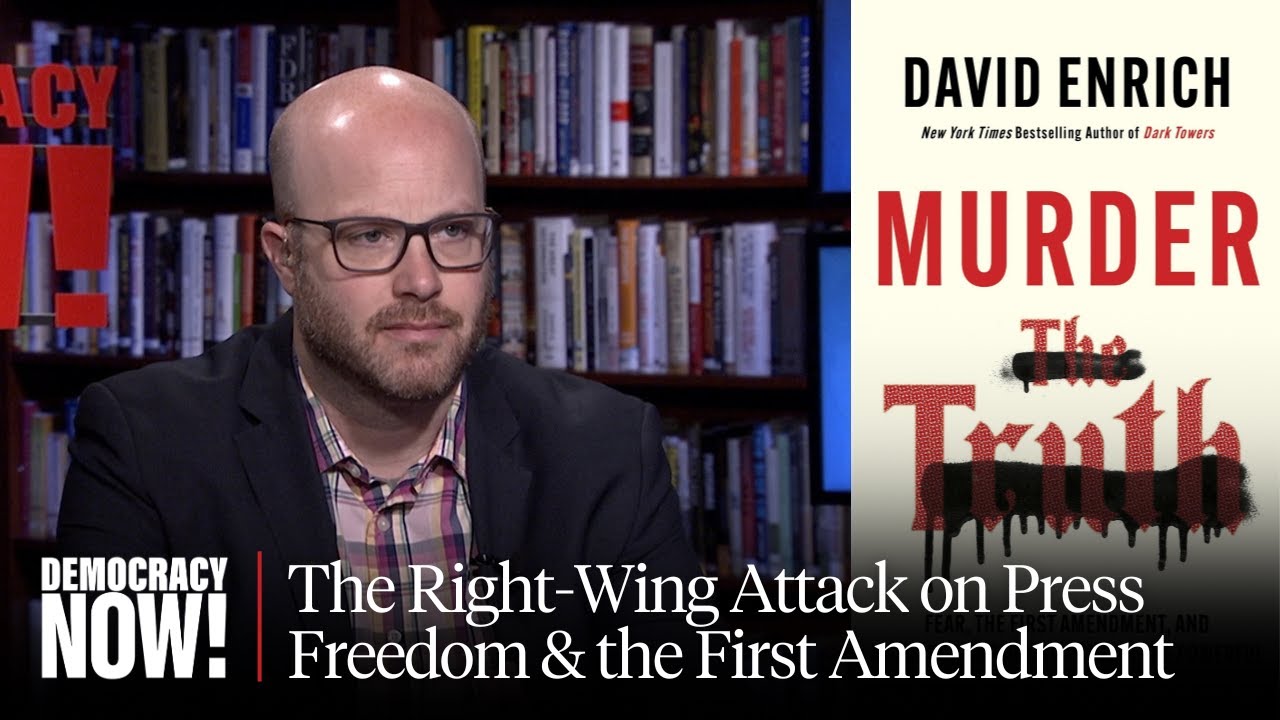
The new book Murder the Truth: Fear, the First Amendment, and a Secret Campaign to Protect the Powerful by The New York Times business investigations editor David Enrich chronicles an ongoing campaign by the wealthy and powerful to overturn the landmark Supreme Court decision New York Times Co. v. Sullivan, which in 1964 established bedrock protections against spurious defamation and libel cases in the U.S. legal system. By “subject[ing] people to this torturous, long-running and extremely expensive legal process,” those who can afford to pay for expensive and threatening defamation lawsuits can silence any public criticism and suppress others’ rights to free speech, says Enrich. “It has huge implications for our democracy and the ability of everyone to speak their mind.”
AMY GOODMAN: This is Democracy Now!, democracynow.org, The War and Peace Report. I’m Amy Goodman.
We turn now from attacks on the right to protest to attacks on press freedom. President Trump is escalating his criticism of the news media, claiming many outlets are engaged in illegal activity. This is part of what he said last week during a speech at the Great Hall of the Department of Justice.
PRESIDENT DONALD TRUMP: I believe that CNN and MSDNC, who literally write 97.6% bad about me, are political arms of the Democrat Party. And in my opinion, they’re really corrupt, and they’re illegal. What they do is illegal. … These networks and these newspapers are really no different than a highly paid political operative. And it has to stop. It has to be illegal. It’s influencing judges, and it’s entered — it’s really changing law, and it just cannot be legal. I don’t believe it’s legal.
AMY GOODMAN: President Trump’s comments come amidst a right-wing push to overturn protections for the press to investigate public figures, a right guaranteed by the landmark 1964 Supreme Court decision New York Times v. Sullivan.
We’re joined now by David Enrich. He’s New York Times’ business investigations editor. His new book is titled Murder the Truth: Fear, the First Amendment, and a Secret Campaign to Protect the Powerful.
If you can start off — it’s great to have you with us, David — by talking about what this Supreme Court decision, this landmark decision in the 1960s, Sullivan, was all about?
DAVID ENRICH: Well, it was brought on behalf of supporters of Martin Luther King, and it basically detailed this litany of abuses by Southern officials. The gist of it was completely true: Southern officials were trying to preserve white supremacy. Some of the facts were either wrong or exaggerated, and a powerful Southern official named L.B. Sullivan, sued The New York Times and won at trial. And the goal, basically, of Sullivan and his pals was that by filing lawsuits that seized on tiny little inaccuracies, you could punish the media for covering the civil rights movement.
And so, this went up to the Supreme Court, and the Supreme Court ruled, in a unanimous decision in 1964, that in order to preserve free speech and allow people to write and criticize and investigate powerful people and institutions, the media and the public needed breathing room so that if they got a fact wrong by mistake or made an honest error, they would not be sued into oblivion. And so, that Supreme Court ruling has really set the stage for decades of investigative journalism and for normal people, non-journalists, as well, to speak up and kind of reveal abuses and criticize people who hold positions of power, both at the national level or at a community level, as well.
AMY GOODMAN: And what does this mean for the First Amendment?
DAVID ENRICH: And it means that the First Amendment gives everyone the right to speak and to interrogate powerful people, and you do not need to worry about — there should not be a legal cloud hanging over your head when you criticize or investigate someone powerful, and you do not need to worry that an innocent mistake is going to bankrupt you because of litigation.
AMY GOODMAN: So, let’s go back to 2016, Donald Trump vowing to make it easier to sue news organizations.
DONALD TRUMP: I’m going to open up our libel laws, so when they write purposely negative and horrible and false articles, we can sue them and win lots of money. We’re going to open up those libel laws, so that when The New York Times writes a hit piece, which is a total disgrace, or when The Washington Post, which is there for other reasons, writes a hit piece, we can sue them and win money.
AMY GOODMAN: So, that was before Donald Trump became president the first time around. Talk about the significance of what he’s saying and the overall campaign, as in your subtitle, the Secret Campaign to Protect the Powerful.
DAVID ENRICH: Well, when Donald Trump made those remarks in 2016, it kind of acted as the firing of a starter’s pistol in a race, and it sent a signal to the entire kind of conservative movement, and, in particular, the conservative legal movement, that a race was on to try to dismantle some of the long-standing First Amendment protections for the media and for others. And you can trace very directly back to that speech that he gave in Fort Worth, Texas, in February of 2016 the arrival on the scene of this kind of small cottage industry of high-priced lawyers whose entire practices were devoted to suing and threatening news outlets.
And the more successes they piled up, the more the strategy caught on, so that by the time — and within a couple of years, there was a real grassroots movement, funded and fueled by the likes of the Federalist Society, the Heritage Foundation, the Claremont Institute, to really weaponize defamation laws to make it much, much scarier, really, especially for small and independent news outlets and journalists, to write about powerful people — not just the president of the United States, but across — but in their local communities, a big company, maybe a powerful real estate developer, things like that. And this strategy has now worked its way all the way up to the Supreme Court, where there is increasing support for either doing away with New York Times v. Sullivan altogether, or at least chipping away at it around the edges.
AMY GOODMAN: So, you’re the business investigations editor at The New York Times. What led you to write this book?
DAVID ENRICH: Well, we were getting, and still do get, inundated with legal threats basically every time that we start writing about or investigating someone powerful. And it occurred to me — you know, The New York Times is in a pretty good position to handle that kind of threat, but it occurred to me a few years ago that, you know, the experience might be very different if you worked at a smaller outlet or if you were an independent journalist. And, you know, there are so many independent journalists right now, which I think is a really good thing for the media and a good thing for our democracy. But it’s people with a Substack newsletter or a blog or a podcast who are uniquely vulnerable to these types of threats and these types of litigation, because they are enormously expensive to defend against.
And they’re not always meant to — these challenges are not always meant to win in court. They’re often meant to just subject people to this torturous, long-running and extremely expensive legal process. And a lot of people make the economically rational decision, which is that in the face of those threats and in the face of that litigation, they’re going to back down rather than fight, which is exactly what the people making those threats want you to do.
AMY GOODMAN: So, talk about how Hulk Hogan or, as you point out, much more relevantly, Peter Thiel fit into this story.
DAVID ENRICH: Yeah, so, Peter Thiel had a long-running grudge against —
AMY GOODMAN: And explain who he is.
DAVID ENRICH: Yeah, Peter Thiel is one of the most powerful people in Silicon Valley. He was an early supporter of Donald Trump, and he’s very closely aligned with people like Elon Musk. And he —
AMY GOODMAN: Co-founder of PayPal.
DAVID ENRICH: Co-founder of PayPal, yes, and one of the owners of Palantir, as well. And he had a long-running grudge against the website Gawker, because Gawker was really pioneering a form of journalism that was very skeptical of Silicon Valley elites and was kind of puncturing some of the bubble surrounding them. And so he set out in the early 2010s to destroy Gawker. And he went searching. He hired a bunch of people. He put a bunch of money into this. And he eventually settled on a case involving Hulk Hogan. Gawker had published a snippet of a sex tape involving Hulk Hogan.
And so, Peter Thiel secretly financed and organized a multifaceted legal campaign using Hulk Hogan as a vehicle for retribution against Gawker. He won — Hulk Hogan won. Peter Thiel won. Gawker was destroyed. And this became a real blueprint for other billionaires and other powerful people to really attack the media. They saw that they — a well-funded, well-orchestrated, secret legal campaign — had the ability to absolutely destroy a well-established media outlet.
AMY GOODMAN: So, Gawker was destroyed. Now talk about some of the Supreme Court justices’ views. Particularly begin with Clarence Thomas.
DAVID ENRICH: Well, Clarence Thomas, during his confirmation hearings in 1991, expressed real support for New York Times v. Sullivan. He then went through a period where he got some very negative media coverage, and his views seemed to shift. And so, by 2019, Clarence Thomas became the first sitting Supreme Court justice to openly call for the overturning of New York Times v. Sullivan.
His argument originally was grounded in the 45 words of the First Amendment, which do not mention libel or defamation, and therefore should not — he argued that should not be protected under the First Amendment. Really, though, this was a part of a campaign by Thomas and his allies to really erode the powers of the media and the protections for the media and normal people to speak up when they saw abuses and to criticize people like him.
And so, he, now joined by Neil Gorsuch, as well, have really embraced this call and are trying to recruit other justices, I think, and are calling for other people to file lawsuits that might make their way up to the Supreme Court that will challenge these long-standing precedents that protect, again, not just press freedoms, but the right of a person in a community to circulate a petition, for example, or make a comment on Facebook about their mayor, things like that. So this is not just about protecting journalists. It’s really about protecting anyone who wants to stand up and have their voice heard on matters of public importance.
AMY GOODMAN: Where does Neil Gorsuch stand?
DAVID ENRICH: Gorsuch has joined Thomas in wanting to have this overturned. And his views really — and he views Sullivan as protecting all sorts of online defamatory speech. The arguments that he has made — I mean, one of the things I do in this book is really deconstruct those arguments. And it turns out, a lot of them are premised on not just kind of faulty logic, but inaccurate data that he cited, that he got from a law review article that was filled with a lot of false assumptions and kind of misinterpreted data. And so, he has actually had to correct his opinion calling for the overturning of New York Times v. Sullivan, but it is still being cited to this day by the conservative legal movement as one of the real kind of sources of information and authority that should be used to overturn it.
AMY GOODMAN: You begin your book, the prologue, “A Panicked Phone Call.” You tell the story of Guy Larson [sic]. Tell us who he — Guy Lawson — is.
DAVID ENRICH: So, Lawson is an American journalist and author who wrote a book that became the basis for the movie War Dogs, with — starring Jonah Hill. And the book basically tells the story of how these three stoners from Miami Beach become international arms traffickers. It’s kind of a rollicking, really fascinating tale. Some of the action is set in Albania. And there’s a bit part in the book played by the son of Albania’s former prime minister, who is kind of an autocratic strongman. And the details in the book, as far as I’ve been able to determine, were completely accurate. But for argument’s sake, the son of the strongman claims that he was kind of smeared in the book and that some of the facts were wrong, so he filed a lawsuit against Lawson in U.S. court, and it’s worked its way — it’s been kind of years winding its way through the legal process. It got dismissed by multiple courts. But years later, it worked its way up to the Supreme Court, and it became one of the latest vehicles to try and challenge Sullivan.
:{And it was seized on by people who had been inspired by Clarence Thomas, who had basically issued an open invitation to lawyers and, you know, prospective litigants, begging them to bring him a case that he could used to overturn Sullivan. It made its way up to the Supreme Court. They did not get enough votes to actually overturn Sullivan, or even hear the case, but it became another vehicle for Clarence Thomas and Neil Gorsuch to really, you know, bring this issue much more to public light and to argue forcefully that Sullivan should be overturned.
And those calls, while unsuccessful — they did not get the Supreme Court to change the legal standard — they inspired hordes of lawyers, activists and other judges at lower levels across the country to really lean into this argument. And you can look at cases all over the country, and you can see that they are slowing down, they are taking longer, they’re not getting dismissed as quickly. And that creates all sorts of pain and difficulties for — especially for local and independent journalists, who now have much kind of higher odds of being dragged through expensive litigation.}:
AMY GOODMAN: So, you talk about — let’s look a some of the cases that President Trump is involved with right now. He sues ABC. He sues The Des Moines Register. He sues CBS. Is he trying to bring these cases to the Supreme Court? Now, of course, ABC, there was a settlement. Explain what these cases were about and what it means to settle.
DAVID ENRICH: Yeah, well, first of all, Trump is very much trying to get a case to the Supreme Court that will lead to the overturning of Sullivan. I don’t think any of those three cases you mentioned are the likely vehicles, but there are a bunch of others working their way through the federal appeals system that I think stand a much better chance.
These more recent lawsuits against ABC, CBS and The Des Moines Register are all pretty clearly efforts by Trump and his allies to weaponize the law to get — to kind of punish criticism and to deter others from speaking up and saying critical things. And they involve different legal theories. The ABC case was a straight-up defamation case. The Des Moines Register and the —
AMY GOODMAN: I mean, ABC case, where George Stephanopoulos had said President Trump —
DAVID ENRICH: Yeah.
AMY GOODMAN: — was found civilly liable for rape. Now, again —
DAVID ENRICH: Yeah.
AMY GOODMAN: — the judge in the case said, in common parlance, this case would be about rape.
DAVID ENRICH: Yeah, and even in the technical details, that he was actually found liable by the jury for sexual abuse, not rape. But so, even if you assume, for argument’s sake, that that’s an important difference and that Stephanopoulos got it wrong — and I think Stephanopoulos would say he didn’t get it wrong — but for argument’s sake, let’s say he did get it wrong. That is exactly the type of mistake that is supposed to be protected by New York Times v. Sullivan, because it is an honest, good-faith error, and you should not be held liable. ABC nonetheless decided that it was prudent to settle this case.
AMY GOODMAN: Or Disney did —
DAVID ENRICH: Well, right.
AMY GOODMAN: — which owns ABC.
DAVID ENRICH: Disney, as parent company, did. And, I mean, I think the rationale for that — and we’re seeing this play out in other settings, as well — is that these big multinational companies, that have varied interests, are trying to protect their corporate interests and do not feel like having outstanding litigation against the president of the United States is in their best interest, and so they are, pretty clearly, I think, taking the side of their profits in the long term over the First Amendment concerns that many of their journalists have. And you’re seeing a very similar dynamic playing out with CBS right now.
AMY GOODMAN: And CBS is the case of 60 Minutes.
DAVID ENRICH: Yeah.
AMY GOODMAN: And Trump is suing them for $20 billion, I think, at this point, for how they edited a Kamala Harris piece.
DAVID ENRICH: Yeah, and this is the very definition of what I think is a meritless lawsuit. And at the time the lawsuit was filed, there were some discrepancies in the way CBS kind of cut or aired parts of Kamala Harris’s interview with 60 Minutes. We now have the full, unedited transcript. We have the full, unedited recordings of those interviews. And it is plainly clear, objectively, that the interview, while edited, was not done so deceptively. There are not material differences between the different things that aired on different CBS shows. And so, the lawsuit, clearly, to me at least, and certainly all the legal observers I’ve spoken to, with the exception of people aligned with Trump, is not a strong legal argument. And yet, CBS’s parent company, which has a multibillion-dollar merger pending, that it needs —
AMY GOODMAN: Paramount.
DAVID ENRICH: Yeah — that it needs federal approval for, has started talking with the Trump side about possibly settling this. And the rationale, again, is quite clear: They are concerned, on the Paramount side, that if they do not settle this, that the Trump administration is going to essentially punish them by holding up this multibillion-dollar merger. And so, you have journalists and, I think, media executives at CBS who are apoplectic about the prospect of settling this, because, A, they are on very strong legal footing, and, B, it would set a terrible precedent that the companies are going to cave to this kind of legal extortion. But I think — we’ll see what happens.
AMY GOODMAN: How does protection of the press in the United States compare to other countries? And talk about libel tourism.
DAVID ENRICH: Yeah. So, the U.S. is — the First Amendment is a really special thing in the U.S. It’s one of the things that distinguishes America from many other democracies. So, if you look at countries like the U.K., for example, or Australia, which are, you know, very democratic — small-D democratic countries, it is much harder for journalists and others to write critical things or to investigate powerful people and institutions in those countries, because their libel laws make it much easier to sue, and that also allows you to much more easily and kind of potently threaten people.
And so, you have — in the U.K., for example, we’ve had this phenomenon, as you just said, called libel tourism, where people, rich people, like Russian oligarchs, and big companies file lawsuits against journalists from all over the world in the British court system. And that has created a real chilling effect even for American journalists, who sometimes find themselves getting sued in British courts just because you published something. It goes online. It’s accessible probably everywhere in the world. That can expose you to liability in the British court system.
Now, it’s getting a little bit harder to actually bring those suits right now, but, to me, it’s a really clear reminder of the importance of the protections we have in the U.S. It really does differentiate this country from many others. And it means we have a much more robust and aggressive media. And again, it also means that just normal people who want to circulate a petition online can do so without fear that if they get a fact wrong, they are not going to be bullied and intimidated and potentially sued because of just minor inaccuracies.
AMY GOODMAN: So, finally, after you wrote this book, Murder the Truth: Fear, the First Amendment, and a Secret Campaign to Protect the Powerful, were you more or less hopeful?
DAVID ENRICH: Oh my goodness, less hopeful. We have a real problem right now in this country. We have very strong legal protections, and yet people and companies and institutions are, on a daily basis, threatening journalists and threatening normal people, and they are getting their way a lot of the time, and that’s with our legal protections in place. And the assault on these protections is very much underway. It’s a very much alive threat, I think. And we’re seeing the White House engage in this almost on a daily basis, it seems. So I think the threat is growing, and it has huge implications for our democracy and the ability of everyone to speak their mind and criticize powerful people.
AMY GOODMAN: We’re going to talk about some of the particular cases you look at in the book after the show, and we’ll post it as a web exclusive at democracynow.org. David Enrich, New York Times business investigations editor. His new book, just out, Murder the Truth: Fear, the First Amendment, and a Secret Campaign to Protect the Powerful.
---
an 12 24
After Vice President Kamala Harris narrowly lost the United States' 2024 presidential election, MSNBC hosts Joe Scarborough and Mika Brzezinski drew a lot of criticism for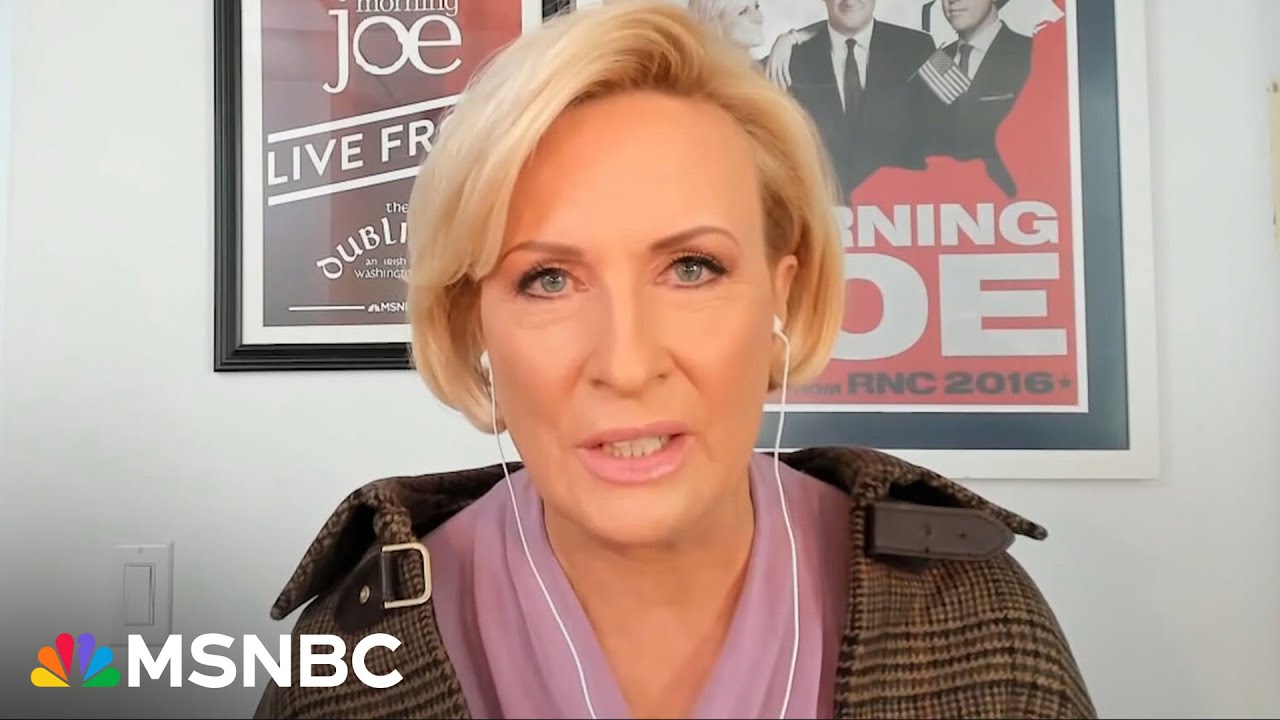 at Mar-a-Lago.
Although Scarborough and Brzezinski have been scathing critics of Trump, they said they went to Mar-a-Lago to reopen communications with him.
Some defenders of the "Morning Joe" hosts have said that their Mar-a-Lago visit was understandable in light of Trump and his followers' threats to retaliate against critics in the media — that they were trying to protect themselves.
READ MORE:**Why Kash Patel is Trump's 'scariest hire yet': report**
Far-right MAGA conspiracy theorist Kash Patel, Trump's pick for FBI director, has even called for criminal prosecutions of journalists who debunked the false claim that the 2020 election was stolen from Trump. Patel has falsely claimed, without evidence, that Trump defeated now-President Joe Biden in 2020.
In an article published by the New Yorker on November 30, journalist David Remnick warns that Trump is getting ready to ramp up his battle against critics in the media.
"Media lawyers now fear that Trump will ramp up the deployment of subpoenas, specious lawsuits, court orders, and search warrants to seize reporters' notes, devices, and source materials," Remnick explains. "They are gravely concerned that reporters and media institutions will be punished for leaking government secrets. The current Justice Department guidelines mandating extra procedural measures for subpoenas directed at journalists are just that: guidelines. They are likely to be shredded."
Remnick continues, "Nearly every state provides journalists with at least a qualified privilege to withhold the identity of confidential sources. But there is no federal privilege, and Trump has opposed a bipartisan congressional bill that would create one, the so-called PRESS Act…. Retribution is in the air."
READ MORE:['Quickly rot from within': Expert reveals 3 traits the US shares with declining empires
Remnick notes that Project 2025, the Heritage Foundation's blueprint for a second Trump Administration, "calls for ending federal funding to NPR and PBS." And he adds that "a longer-range worry is that the Supreme Court may weaken or even overturn the 1964 landmark decision New York Times v. Sullivan."
"Sullivan limits the ability of public officials to sue journalists for defamation, finding that the Constitution guarantees that, at a minimum, journalists can write freely and critically about public officials, as long as they don't publish statements that they know to be false, or probably so," Remnick explains. "(President Richard) Nixon regarded Sullivan as 'virtually a license to lie.' Trump shares the sentiment."
"All these threats and potential actions are hardly the stuff of legal arcana or the frenzied obsessions of self-involved Podsnapian journalists," Remnick argues. "They are the arsenal of a would-be autocrat who seeks to intimidate his critics, protect himself from scrutiny, and go on wearing away at the liberal democratic order."
READ MORE:[Bombshell report details 'dangerous' new allegations against Trump Cabinet nominee
*Read David Remnick's full article for The New Yorker at this link (subscription required).
mma 10 24 OMG
Project 2025 partner blog advocates for overturning New York Times Co. v. Sullivan
The Claremont Institute's American Mind: “President Trump should make the case for revisiting the Sullivan ruling a more prominent and recurring part of his public rhetoric”
Written by Madeline Peltz
:{Published 10/25/24
The American Mind, a project of Project 2025 partner The Claremont Institute, published a piece on October 23 advocating for a second Trump administration to seek the Supreme Court to overturn New York Times Co. v. Sullivan, a key decision protecting the First Amendment.
Legal scholars have described the Sullivan decision, which established the “actual malice” standard in libel law, as “one of the Supreme Court’s most significant First Amendment rulings.” As Oyez outlines: “When a statement concerns a public figure, the Court held, it is not enough to show that it is false for the press to be liable for libel. Instead, the target of the statement must show that it was made with knowledge of or reckless disregard for its falsity.”
The Claremont Institute’s Carson Holloway recently argued that “President Trump should seek the reversal of New York Times v. Sullivan,” casting his argument as a continuation of the Dobbs decision that reversed the constitutional right to abortion. Holloway celebrates Trump as singularly responsible for Dobbs, describing it as his “signature accomplishment” in his “already impressive legacy” of the “restoration of self-government.” Continued:
If Trump is elected to a second term, he should build on this legacy by seeking the reversal of another egregious instance of judicial activism that continues to distort the Constitution and our nation’s politics: New York Times v. Sullivan. In this 1964 ruling, the Warren Court imposed a new doctrine of libel and the First Amendment on the nation.
Holloway then lays out a three point plan for how to accomplish this.
First, he suggests, “President Trump should make the case for revisiting the Sullivan ruling a more prominent and recurring part of his public rhetoric.” He has good reason to believe this is viable. In 2016, Trump promised that if he won he would “open up our libel laws” to make it easier to sue the press, singling out The New York Times and The Washington Post. On the Supreme Court, Justices Thomas and Gorsuch have both signaled their openness to reconsidering Sullivan.
More recently, Trump has been ramping up his attacks on journalists, advocating for revoking broadcasting licenses and launching other legal attacks. Brendan Carr, a Trump-appointed member of the Federal Communications Commission that oversees broadcasting licenses, could be a key ally in this threat. Carr wrote the chapter on the FCC in Project 2025’s policy book, Mandate for Leadership: The Conservative Promise.
Holloway’s next suggestion on stripping the press of legal protections is a given: “President Trump should continue his first-term policy of appointing serious constitutionalists to the Supreme Court and, indeed, to all federal judicial vacancies.”
Finally, Holloway states: “President Trump should direct his Department of Justice to seek the reversal of the actual malice doctrine and restore judicial respect for the original meaning of the First Amendment. This policy should include the regular filing, in appropriate cases, of amicus curiae briefs by the Justice Department urging the courts to revisit this question.”
This argument harmonizes with the vision of a weaponized Department of Justice outlined in Mandate. As Gene Hamilton, vice president and general counsel of former Project 2025 partner America First Legal, wrote in his chapter on the Justice Department, DOJ policy “must always be consistent with the President’s policy agenda and the rule of law.” Project 2025 would gut the federal government’s system of checks and balances through a radical consolidation of executive power.
Project 2025’s emphasis on personnel would also bolster a second Trump administration’s attacks on free speech. Through the initiative, The Heritage Foundation has assembled a prevetted database of Trump loyalists, which it calls a “conservative LinkedIn,” of potential administration hires that have taken loyalty tests to prove they’d be willing to stretch or even violate the law in order to enact his agenda. Project 2025 also advocates for the implementation of a policy known as “Schedule F,” which would remove civil service protections for politically neutral career bureaucrats so they could be fired en masse and replaced with pro-MAGA sycophants. Remaking the federal workforce in this way would allow Trump to more easily exercise control over the Department of Justice and enact a retributional, anti-free speech agenda.
===
an ah 8 24
With its 6-3 GOP supermajority, the U.S. Supreme Court is now, critics say, dominated by hard-right ideologues. But in an article published on August 12, Vox's Ian Millhiser warns that the High Court could move even further to the right if former President Donald Trump defeats Vice President Kamala Harris in the 2024 presidential election. And if that happens, Millhiser argues, there is a good chance that the First Amendment will suffer.
"The good news for proponents of free speech is that, based on the Court's most recent First Amendment decisions, it does appear to have a 6-3 majority in favor of preserving the post-1960s understanding of that amendment," Millhiser writes. "The bad news is that there are three justices willing to drastically shrink the protections offered by that amendment. And those three could easily swell to five if former President Donald Trump gets to appoint more justices to the Court."
Millhiser adds, "Justice Sonia Sotomayor, one member of the Court's pro-free speech majority, is now 70. Chief Justice John Roberts, another member of that majority, will turn 70 shortly after the next president is inaugurated."
READ MORE:**Trump is losing it because he's afraid of losing**
The Vox journalist notes that Justices Clarence Thomas and Neil Gorsuch "have openly called for New York Times v. Sullivan (1964), the fount of press freedom in the United States, to be overruled" — and Trump agrees with them.
"More broadly, Sullivan stands for the proposition that state governments cannot use defamation law to maliciously target the press," Millhiser explains. "If a reporter makes a serious error, that reporter may still be liable for defamation. But governments that want to shut down a newspaper cannot simply wait until a reporter misremembers which song was sung at a rally, and then pounce with a multi-million-dollar lawsuit."
Millhiser points out that many times in U.S. history, the First Amendment has come under attack — from the Comstock Act to Sen. Joseph McCarthy (R-Wisconsin) "ramping up his witch hunts against suspected communists."
"In the American system, where justices serve until they retire or die, no one can be sure how much power each president will have to reshape the Constitution," the Vox journalist observes. "A vote for Trump is a vote to roll the dice on a drastically different vision of free speech in the United States — one that bears far more resemblance to the not-so-distant past than it does to anything most modern-day Americans have experienced."
READ MORE:[Inside the GOP plot to silence Texas voters
*Read the full Vox article at this link.
===
an 8 24
//
There is already a growing bloc on the right flank of the Supreme Court that wants to cripple key elements of the First Amendment, warned Ian Millhiser for Vox — and if former President Donald Trumpis given another term, he could possibly add enough justices to let that actually happen.
It comes down to a pair of key rulings from the 1960s: Brandenburg v. Ohio, which protected political agitators' right to speech, and New York Times v. Sullivan, which limited the government's right to sue the news media — a practice long used by segregationists to suppress the Civil Rights Movement.
Before that point, Millhiser wrote, free speech existed as an idea, but not a court-enforced reality: "Dissidents were commonly thrown in prison, often for many years, when the government disagreed with their views. Near the end of World War I, the great union leader Eugene Debs was sentenced to 10 years in prison for giving a speech opposing the draft, and his conviction was upheld by a unanimous Supreme Court. In 1951, as Sen. Joseph McCarthy was ramping up his witch hunts against suspected communists, the Supreme Court blessed his and similar efforts by upholding the convictions of several individuals who did nothing more than try to organize a (wildly unsuccessful) Communist Party in the United States."
Today, the First Amendment truly protects protesters and journalists — and for now, the Supreme Court has a majority upholding this. But some far-right Supreme Court justices want to turn back the clock.
"Justice Samuel Alito, in a pair of opinions joined by Thomas and Gorsuch, spent the last two years unsuccessfully fighting in favor of laws that seem designed to challenge the modern understanding of free speech," wrote Millhiser. "These two cases, known as *Netchoice v. Paxton* (2022) and *Moody v. Netchoice* (2024), concerned Texas and Florida laws that would essentially allow the Republican governments of those states to seize control of content moderation at major social media outlets like Facebook or YouTube." Ultimately, the court reined in these laws — but these three justices wanted them to stand.
And it's not hard to envision Trump would appoint more justices who agree with them. On the campaign trail, he has vowed to "open up our libel laws" to let reporters be sued over their stories, and he also suggested deporting the students who protested the Israel-Hamas War on college campuses earlier this year.
"If Trump wins, and if he gets to fill just two more seats on the Supreme Court, Americans could swiftly lose First Amendment rights that have been secure for nearly six decades," Millhiser wrote.
===