the conversation TC
hmmn, oops? this is main
see one word FOR DK SIDE EG BRKTHRU
merri ok
see empathy
---
-=-=
-=-=
an tc 9 26 bk rev
“A moment of reckoning has arrived for the West,” reads a recent recruitment ad for Palantir, a Silicon Valley firm that increasingly provides data-driven “intelligence” for intelligence, police and military agencies – as well as blue-chip corporations and non-profits. “On the factory floor, in the operating room, across the battlefield,” the ad intones, “we build to dominate.”
How do we make sense of this convergence between advanced technologies and unapologetic violence, between “rational” AI and a primordial view of the world that seems to revert to a language of blood and soil, friends and enemies, “us” and “them”? In op-eds, talk shows, and political analyses, a single word has risen to prominence: fascism.
As a term, “fascism” is highly provocative, but seemingly untimely. It conjures up powerful images of jackbooted throngs of followers repeating chants and salutes, visions of black-lettered and blood-red banners. Yet these images are typically associated with political orders from a century ago in interwar Europe, a dusty relic from a previous age where “evil” was identified and annihilated.
So what is fascism in the present? How can it help explain contemporary technological, social and political dynamics? Two recent books attempt to diagnose these conditions: End Times Fascism And the Fight for the Living World by writer Naomi Klein and filmmaker Astra Taylor, and The Nerd Reich: Silicon Valley Fascism and the War on Democracy by journalist Gil Durán.
End times fascism
For Klein and Taylor, what we see now is not a repetition but an evolution. Fascist ideologies have been injected into a broader apocalyptic vision.
“End times fascism is a fascism embedded in an understanding that something immense is ending, and it responds to this discomfiting truth with unabashed cruelty,” they write.
ALT RT IN EUR ACCEPTS AGW BUT SAYS THUS WE MUST BUNKER~ DARK HORDES?
In this vision, it is taken for granted that our economic, institutional and environmental systems are collapsing. Financial inequality is surging, with unaffordable houses and skyrocketing cost-of-living. Ecologies are crumbling, with earth systems hitting planetary limits. And that’s just a few of these stacked crises.
But an apocalyptic mindset, grounded in fundamentalist religion, stresses that crisis is not to be fixed, but fast tracked. Dysfunction and disorder are necessary to arrive at something more glorious, the labour pains to a great rebirth. Here, apocalyptic religion and political fascism agree: the current world is corrupt and cannot be saved; it must be burned to the ground and remade from scratch – or escaped altogether, for a greater paradise.
For its proponents, the end times are here — and only by embracing and accelerating this winner-takes-all transition will the chosen elite assure they can survive and even thrive.
Klein and Taylor follow this thread across three core sections.
Messianic Dreams traces the birth and rise of the Zionist dream, through to its present vision of genocidal reset in Gaza – where the glorious next stage of one society is built on the ashes of another. The authors explain these moves are not just about “righteous revenge” or “national security”, but have a distinct cosmological goal: to “move us all significantly closer to the prophesied end of times.”
Escape to the Cloud unpacks big tech’s fervent faith in AI superintelligence and the double-edged utopia or dystopia it would usher in. Here, claims of existential risk resulting from “the singularity” – where AI becomes sentient and human/machine norms break down – are essentially self-serving, directing investment and attention to tech development. They prop up the power of the already powerful.
(These claims of existential risk, which have been around for a long time, have been big news recently, with warnings from everyone from the UN High Commissioner for Human Rights to former AI staff and the “Godfather of AI”.)
And Prepper Nation steps through the push to bunker the United States against future threats and deport the alien others who are corrupting its purity. Here, elites ride out the apocalypse by establishing their own tech infrastructures, ethnostates, finance streams, and even their own (literal) bunkers.
For Klein and Taylor, fighting end times fascism starts with fighting its core premise that the world is doomed: a sinking ship beyond saving. They locate hope in embracing “hereness” and “staying”, rather than leaving. Their plea is to embrace our broken reality and engage in the slow, messy work of improving it – rather than abandoning it (and democracy) to a scorched earth authoritarian order.
Zohran Mamdani – the progressive mayor of New York City, who pulled off a remarkable grassroots campaign and embraces the city’s diverse foods, festivals and communities – is held up as a champion of this “here and now” mentality.
End Times Fascism is a thoughtful and engaging read that deftly weaves journalism into a cohesive premise about our current political condition.
The authors deserve particular praise for making careful distinctions between the distorted versions of Judeo–Christianity weaponised by fascist entrepreneurs – a blend of Holy war and culture war fought by the Chosen – and mainstream understandings of doctrine.
Indeed, as the book explains, it was longstanding Christian injunctions to love thy neighbour – including the migrant – that partially motivated Minnesota’s antifascist pushback to ICE deportations. Churches and faith organisations took part in protests, set up community kitchens and offered aid. Far-right fundamentalists, by contrast, cherry-pick the Bible passages they like, while ignoring core injunctions to “act justly, walk humbly, and love mercy” (Micah 6:8): to embrace the stranger, rather than expel them as Other.
Yet if the book represents the best of popular journalism, it also comes with its limitations. Klein and Taylor are resolutely focused on people, places and events, rather than attempting to unpack their ideologies in a more systemic way. The result is that end times fascism becomes linked to the actions of egotistical and powerful men, from politicians to tech titans. US President Donald Trump in particular is the common thread, appearing over and over again throughout.
So when Klein and Taylor suggest, at the end of the book, that end times fascism is not about Trump, and will continue when these men disappear, their claim runs against the book’s premise. Place powerful elites to one side, and end times fascism becomes difficult to envision. What does it look like when it moves off the front page and out of elite hands in everyday contexts?
Nerd Reich
In Nerd Reich, reporter Gil Durán, a longtime San Francisco resident, looks to Silicon Valley. He focuses on how “the world’s richest men are building a new political order.” Durán’s primary antagonist is Peter Thiel (who also appears in End Times Fascism), the billionaire co-founder of PayPal and Palantir: “a man fusing business, politics and religion into one terrifying bundle of power”.
For Durán and others, Thiel is the lynchpin for a new breed of Silicon Valley-driven fascism, whether concretely (through donations) or ideologically (through his books and speeches). Thiel has increasingly moved beyond the tech world to offer political diagnoses and future visions that find sympathetic ears in elite circles.
Where do these ideas come from? Durán suggests they can be traced back to the Sovereign Individual, a 1997 book of future predictions based on the transition to the information age, by former Times (UK) editor William Rees-Mogg and financial advisor James Dale Davidson. Strangely, Durán never really carries out a close reading of this book he regards as an ur-text. Instead, he chooses to highlight some key claims and its general reception.
Durán’s circle of rich fascists ranges from technologists to politicians. It includes well-known figures like Elon Musk, Vice President JD Vance and OpenAI CEO Sam Altman. But it also features lesser-known figures, like cryptocurrency entrepreneur Balaji Srinivasan, who wants Silicon Valley to carry out an “ultimate exit” from the US altogether, and venture capitalist Marc Andreessen, who elevates the acceleration of “techno-capital” and denigrates democracy.
Each of them, in their own way, has leveraged wealth from the finance and tech industry to grab political and social influence and push forward their vision of society and the state.
What exactly is fascist about these individuals and their ideas? For Durán, tech fascism “bundles powerful technologies” like AI, crypto and social media “towards authoritarian goals” that benefit a “small, interconnected group of oligarchs”. They wish to privatise what is public and “eliminate democracy”, he writes.
And yet the book lacks a deeper or more systemic unpacking of tech fascism. What are its core values? How do these technologies actually carry out authoritarian goals? And what might this mean beyond power games in a US bubble?
The closest we get to answers is two breezy paragraphs on page 240. They tell us tech fascism “updates this ideology for the AI age” by controlling “reality through algorithms” and launching the “next generation of killer robot drones”. And it’s all driven by a venture capital system that has “run out of unicorns and must now hunt Antichrists to meet its unquenchable thirst for acceleration”.
The strength and weakness of Nerd Reich, then, rests on its journalistic approach. Drawing on a decade of newsroom experience, Durán weaves in insider knowledge of Silicon Valley.
He provides a play-by-play of San Francisco City Council election manipulation, for instance, where a flood of Big Tech money aimed to flip local politics from progressive to conservative. And he serves it all up with visceral language — like “an image dripping in fascist cosplay” — that leaves no doubt as to how he views these men and their manoeuvrings.
The downside of this approach is that chapters fragment into dozens of “human interest” style vignettes, with only a gossamer-thin thread to connect them.
The reader wades through a whirlwind tour of names, dates and places. Garry Tan, CEO of venture capital incubator Y Combinator. Sam Bankman-Fried and his fraudulent FTX cryptocurrency exchange. Michelle Stephens and her Acts 17 organisation, which hosts events hoping to bridge technology and Christianity. Bryan Johnson, who believes he can live forever via products like his own bespoke “snake oil” elixir.
And Curtis Yarvin, the political blogger whose illiberal ideas have found traction in Washington.
In each case, we get titbits without a deeper throughline. How exactly does a long backstory on Yarvin — including his love life and use of psychedelics — shed light on his increasingly influential ideas about remaking the state as a startup? The reader must draw their own conclusions.
Technofascism and everyday people
In both these books, the lens could be described as the Big Man – the powerful politician, swaggering tech founder, or deep-pocketed venture capitalist who can leverage their immense resources to transform their visions into fascistic realities. This cast of strong antagonists lends itself to strong storytelling — concrete people who can be pointed to and called out.
But this focus on unsavoury elites leaves some key questions unanswered. Where did these fascist energies originate? How have they been updated? What are the grievances and desires at the heart of this ideology? And how are these values packaged, narrated and circulated in ways that make them compelling to everyday people?
Today, we are surrounded by platforms, models and algorithms that hold up a vision of reason and rationality. Yet politically, we see a return to myth, bigotry and barbarism. These twin forces are not a paradox but a program. Technofascism leverages advanced technology to bolster authoritarian ideals and regressive values that carve up the world along bloodlines, gender lines and borderlines.
But how do these twin forces prop each other up? What role does the “techno” in technofascism play? I see three core functions.
Technology augments, providing a practical outworking of fascist visions by operationalising difference and domination. Palantir’s data-driven deportation partnership with Immigration and Customs Enforcement (ICE) is a perfect recent example of transforming fascist ideals into a concrete program of platforms, software and servers that can be leased and run.
Secondly, technology alienates. It creates a vacuum of meaning that is filled by powerful mythologies that address grievances and reimpose order on the world. Meta-narratives like the Great Replacement Theory, suggesting non-white immigrants are replacing white populations, translate complex crises into tangible figures. Anti-immigration marches in Australia were a recent troubling example. They transformed a complex set of pressures — from rising costs of living to climate anxieties — into a powerful myth with a single scapegoat: the migrant.
Finally, technology manipulates. It creates environments that leverage desire while cultivating fascist ideologies over time. Manosphere influencers translate misogyny, insecurity and xenophobia into viral packages of content. Ex-radicals describe a pipeline effect where media played a key role in nudging them towards more right-wing stances. Eventually, they arrived at violent, dehumanising visions that can only be described as fascist.
Together, these books shed light on the fascistic energies that increasingly seem to permeate our present moment. This is not a problem for other places and times, but one that confronts us here and now.
As one scholar stressed after three decades of researching authoritarian personalities: “I study normal folks, not Nazis.” Grasping the core logic of this fascist phenomenon is the first step in combating and countering it.
Luke Munn, Research Fellow, Digital Cultures & Societies, The University of Queensland
This article is republished from The Conversation under a Creative Commons license. Read the original article.
-=-=
-=-=
[WICKED] SMART
AN TC 8 26
In April 2026, a federal grand jury returned indictments charging the Southern Poverty Law Center with wire fraud, bank fraud and conspiracy to commit money laundering.
The indictment alleges the SPLC, a nonprofit legal advocacy group, secretly funneled more than US$3 million in donated funds to people associated with violent extremist groups, including the Ku Klux Klan and Aryan Nations.
Prosecutors allege that the SPLC secretly paid members of those groups to act as confidential informants without telling donors. Eight informants received the money between 2014 and 2023, according to U.S. Attorney General Todd Blanche.
The SPLC has denied the charges and seeks their dismissal, with lawyers for the group adding that the charges constitute “vindictive prosecution.” The SPLC’s interim president, Bryan Fair, has stated that the informant program “saved lives” and reflected decades of dangerous civil rights work.
Critics of the prosecution at Lawfare, a media site focused on the U.S. legal system, argued that the indictment is among “the most cynical criminal cases ever brought by the Department of Justice.” They noted that the SPLC had no legal duty to disclose the confidential nature of its informant program to donors.
Within hours of the Justice Department’s indictment, I found that white supremacist influencers on Telegram, Gab and other social platforms were celebrating the arraignment. They portrayed the charges as proof that journalists and civil rights groups documenting extremist movements could no longer be trusted.
The indictment became a rallying point to discredit not only the SPLC but the wider body of research on hate groups and political extremism. I believe that these narratives will be used to help justify increasingly radical and, in some cases, violent responses.
Ideological ammunition
Some conservative advocacy groups and right-wing media outlets – including Moms for Liberty and the Daily Signal – immediately stripped the indictment of its legal context. In online posts, they recast it as established proof that the SPLC had been deliberately creating extremist activity rather than investigating it.
A Telegram search I conducted on May 6 identified 22 posts mentioning the SPLC across at least six white nationalist channels. Most appeared within 72 hours of the indictment. The posts did not engage in sustained discussion. They repeated a small set of claims.
The Super Sincere Alpha GOONMAXXING Aryan Sigma Patriot channel wrote: “The SPLC is a hate group.”
Other channels cited the indictment as proof that the SPLC had been paying sources to manufacture the very extremism it claimed to fight. In the White Lives Matter Official Telegram channel, users were urged to “become an activist for your race” while referencing the SPLC as an opposing force.
The similarity across channels and social media is notable. The same framing appeared repeatedly within a short time window. This suggests rapid circulation of a shared narrative across networks rather than independent commentary.
The neo-Nazi, neo-fascist layer
Comments on the Southern Poverty Law Center indictment by members of the Commander George Lincoln Rockwell channel – named for the founder of the American Nazi Party – demonstrate how antisemitic conspiracy theories work, not as explicit rhetoric but as a broader narrative.
Internet discussions portrayed the SPLC as a politically motivated or illegitimate actor. Posts in Patriot Front Updates, for example, circulated allegations of fraud and money laundering while criticizing the SPLC and its efforts to identify and challenge white nationalist activity.
I found that this criticism of the SPLC also became connected to a broader antisemitic conspiracy narrative – one that portrays the organization as operating on behalf of purported Jewish interests rather than simply as an advocacy organization with political and ideological commitments.
These narratives circulated alongside the “great replacement theory,” which falsely claims that shadowy elites are encouraging immigration and demographic change to replace the white population and diminish its political and cultural influence. It’s a conspiracy theory that the SPLC and others have documented as central to contemporary white nationalism.
In this logic, the indictment is not an isolated fraud case – it is evidence that a coordinated network of institutions has been systematically suppressing white identity.
Victimhood as recruitment
Scholars of white nationalism have long identified victimhood narratives as central to that movement’s appeal. By portraying white people as under attack or unfairly displaced, these narratives transform social change into a story of persecution and provide a powerful justification for political mobilization.
My research on white nationalism shows how contemporary extremist movements rely less on formal membership and more on decentralized digital spaces. It is there that narratives, grievances and identities are continuously reinforced.
In these environments, major news events like the SPLC indictment become opportunities.
Why this pattern repeats
Extremist movements have long used mainstream controversies as recruitment opportunities.
Participants often interpret external events through narratives of threat, injustice and persecution. In doing so, they transform moments of controversy into evidence that their worldview is correct.
In the 1990s, for instance, the deadly standoffs between federal officers and the Branch Davidians religious sect near Waco, Texas, and survivalist Randy Weaver in Ruby Ridge, Idaho, became foundational persecution narratives for militia and Christian Identity movements. These groups saw the sieges as proof that the federal government was hunting gun owners and religious dissenters.
In online extremist communities, these events can become powerful tools for reinforcing group identity and attracting individuals who are searching for explanations or belonging.
With a real-world legal event like the SPLC indictment, extremists can point to government action as evidence that their worldview is being validated. The result is a narrative that appears responsive to current events, even when the connection is shallow or distorted.
Redirected domestic terrorism policy
Legal scholars have noted that the Justice Department indictment fits within the Trump administration’s broader pattern of redirecting domestic terrorism policy away from white supremacist groups.
The Trump White House’s 2026 Counterterrorism Strategy does not mention violent far-right groups as a domestic terrorism threat at all.
That context matters for understanding how the SPLC case landed in extremist spaces: not as an isolated fraud allegation but as institutional permission. The indictment has become a symbol before the evidence has been weighed.
In today’s fragmented digital media environment, symbols travel faster than facts, especially when they confirm what a radicalized audience already wants to believe. I believe the real danger is not that white supremacists believe the SPLC is guilty. It is that the controversy, whatever its legal outcome, has already done its work.
Art Jipson, Associate Professor of Sociology, University of Dayton
This article is republished from The Conversation under a Creative Commons license. Read the original article.
-=-=
---
AN TC 7 26
The Trump administration announced on July 21, 2026, that it’s withholding US$867 million in federal healthcare funding for California and $200 million for Minnesota – a total of more than $1 billion.
Federal officials said the two states had failed to provide sufficient evidence that a number of disputed medical claims were legitimate. These include bills for in-home care and other services covered by the two states’ Medicaid programs for low-income residents.
Medicaid administrators say the funds can be recovered if the states supply the requested documentation.
But the action is highly unusual: Typically, Medicaid officials partner with states to conduct an audit when they suspect fraud, a careful process that often takes years.
It’s the second time in 2026 that the Trump administration has withheld or deferred federal Medicaid funds for several states, including California and Minnesota, because of alleged fraud and abuse. The Democratic governors of those states have called the decision a politically motivated attack on their constituents.
I’m a historian of social policy who led the first comprehensive historical overview of Medi-Cal, California’s statewide Medicaid system. I’ve found that U.S. leaders have long used the language of fraud and abuse to blur the line between correcting very real failures within Medicaid and – as I believe the Trump administration is currently doing – discrediting and defunding the program itself.
https://www.youtube.com/embed/12oT-Wk800k?wmode=transparent&start=0
Who pays when Medicaid is cut? It affects children’s health care, nursing home care, disability services and health insurance.
Slashing the safety net
The Medicaid restrictions are part of the Trump administration’s overall efforts to slash federal funding for the safety net.
The large tax-and-spending bill that Trump signed into law in July 2025 as the cornerstone of his second-term agenda pared eligibility for Medicaid by introducing work requirements for some adults. It is cutting close to $1 trillion in federal spending on the program over the next decade.
Researchers estimate that almost 12 million people, on top of the estimated 28 million without health insurance in 2025, could become uninsured by 2034 due to these changes. By mid-2026, more than 3 million people had already lost their insurance coverage due to Republican changes to the Affordable Care Act.
‘Padlocking’ the ‘cookie jar’
In February 2026, Vice President JD Vance, Health Secretary Robert F. Kennedy Jr. and Dr. Mehmet Oz, the administrator of the Centers for Medicare & Medicaid Services, or CMS, announced a new anti-fraud initiative called Comprehensive Regulations to Uncover Suspicious Healthcare.
Also known by its rather unsubtle acronym, CRUSH, this initiative is taking unprecedented steps to withhold and defer funds in response to suspected fraud. “CMS is done trying to catch fraudsters with their hands in the cookie jar,” Oz said in announcing CRUSH’s formation. “Instead, we’re padlocking the jar and letting them starve.”
To be sure, Medicaid fraud, waste and abuse – such as providers billing Medicaid for services that are unnecessary or never rendered – are very real problems that cost taxpayers billions of dollars annually. They do divert funds from the low-income and disabled Americans enrolled in the program.
But the Trump administration’s latest moves are part of a much broader history of weaponizing Medicaid fraud and abuse – both real and imagined. I see them as a politicized attempt to prove that Medicaid itself is wasteful, that state governments cannot be trusted to administer federal money, and that public benefits inevitably invite dishonesty.
 Secretary of Health and Human Services Robert F. Kennedy Jr. speaks about alleged Medicaid fraud and charges in Minneapolis in May 2026. Christopher Juhn/Anadolu via Getty Images
Providing little oversight at the start
Medicaid was established, along with Medicare for older adults, in 1965 as part of President Lyndon B. Johnson’s “Great Society” reforms. Despite providing millions of Americans with health insurance coverage for the first time, these programs had few centralized mechanisms for the kind of federal oversight that could prevent and catch fraud and abuse.
And the sheer scale and complexity of the Medicaid system – joint federal-state funding, varying eligibility requirements, millions of enrollees and thousands of providers – created opportunities for questionable billing practices among providers.
The 1970s saw a number of highly publicized Medicaid scandals involving nursing homes, laboratories, pharmacies and so-called “Medicaid mills” – healthcare providers that sought to bill the government for large numbers of Medicaid patients for shoddy and often fraudulent care.
A series of high-profile congressional investigations spurred demand for stronger Medicaid oversight and enforcement. That led to the Medicare-Medicaid Anti-Fraud and Abuse Amendments of 1977, which established the national Medicaid Fraud Control Units program.
The state-run Medicaid Fraud Control Units received generous federal matching funds to investigate and prosecute fraud.
The most serious Medicaid fraud was generally committed by healthcare providers and contractors, not patients. Medicaid Fraud Control Units were principally responsible for investigating providers, while also prosecuting the abuse and neglect of patients whose care was billed to Medicaid.
At the same time, however, Medicaid was becoming entangled in a broader political debate over social spending, whether many Americans were becoming too dependent on government benefits, and the alleged use of benefits by people who should not have received them. In the 1980s and 1990s, widely circulated stories about Medicaid exposed fraud and malfeasance by providers.
But disproportionately, they also highlighted the comparatively few instances of fraud by people enrolled in the program, such as cases where they submitted false receipts for covered medically related travel or sold drugs they obtained through Medicaid for free or at low cost.
Using Medicare fraud to justify spending cuts
The distinction between Medicaid and cash assistance programs, such as the Aid to Families with Dependent Children “welfare” program, frequently disappeared in political rhetoric. False or exaggerated stories that portrayed African American single mothers living extravagantly while fraudulently claiming welfare benefits became potent symbols of supposed government failure.
While campaigning as a presidential candidate, Ronald Reagan seized on this trope of the “welfare queen” in his attacks on social spending.
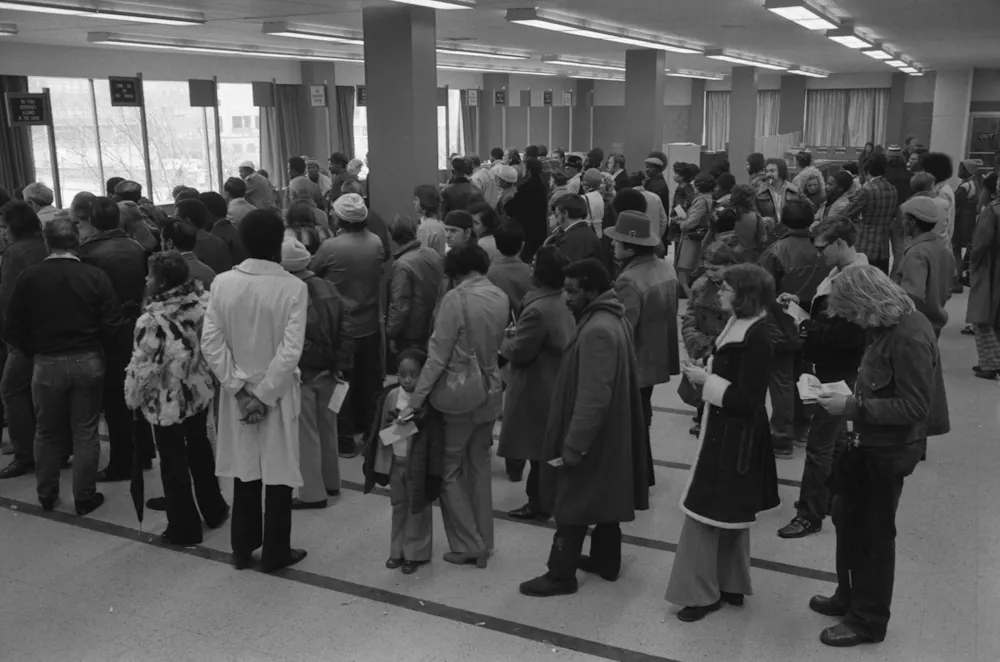 People line up at the Baltimore City Welfare Office in 1975, years before concerns about social spending led to big cuts to safety net programs. O'Halloran/Library of Congress via Getty Images
By the mid-1990s, opposition to welfare programs had become increasingly bipartisan. Politicians in both parties often used tales of Medicaid fraud on the part of providers and recipients to justify tighter eligibility rules and spending cuts.
Federal oversight expanded further with the Deficit Reduction Act of 2005, which created the Medicaid Integrity Program and strengthened federal oversight of state programs. The Affordable Care Act, the landmark healthcare legislation Congress passed in 2010, added new measures to screen providers and verify billing.
Concerns about Medicaid’s “integrity” became highly politicized in the debates surrounding the ACA. Critics of Medicaid expansion argued that increasing the number of people who could get health insurance through the program would increase fraud and improper enrollment. Supporters of expanding Medicaid to help more Americans gain health insurance maintained that anti-fraud rhetoric often disguised ideological opposition to the program’s expansion.
Blurring distinctions then and now
For the six decades that this program has helped millions of low-income Americans get healthcare, politicians have blurred the distinction between protecting Medicaid from abuse and using abuse to discredit Medicaid itself.
In my view, the Trump administration’s campaigns against California and Minnesota continue that pattern. It is using real weaknesses within Medicaid to advance much broader political arguments: that Democratic states cannot be trusted, that public benefits naturally invite abuse, and that withholding funds is itself a form of reform.
The result will no doubt be that fewer low-income Americans will be able to get the healthcare they need.
Ben Zdencanovic, Assistant Professor of U.S. History, University of Cambridge
This article is republished from The Conversation under a Creative Commons license. Read the original article.
-=-=-=
---
7 26 AN TC
t recently emerged that tech billionaire Peter Thiel is running a secret society that brings together fellow CEOs and billionaires with political leaders. Members reportedly include figures like Nato supreme commander Alexus Grynkewich and son-in-law of US President Donald Trump, Jared Kushner.
Thiel, a German-American entrepreneur and activist, was a co-founder of PayPal and software firm Palantir. Revelations about the society – known as “Dialog” – have attracted widespread attention. And Thiel himself gave a confidential lecture series in San Francisco this year, in which he framed issues of politics and technology in biblical terms.
Thiel has said he believes that humankind faces existential threats from nuclear war or runaway artificial intelligence (AI) that could lead to “Armageddon”. In such an end-times era, so the thinking goes, only the most ingenious – like those in the secret society – would survive.
Thiel is an extreme, but by no means isolated, case. Other powerful people in politics and technology are viewing today’s world through a lens of civilisational crisis and impending catastrophe.
Politics of the end times
Over the centuries, political leaders have often invoked fears of decline and collapse. In ancient times, Augustus, the first Roman emperor, championed the narrative that Rome faced moral collapse to justify concentrating power in his own hands. Yet the current moment of “end-times politics” is different on several fronts. Threats, both real and imagined, spread faster than ever, diffused through social media algorithms that favour hysteria and conspiracy.
In Silicon Valley, influential figures routinely discuss AI as either humanity’s salvation or an extinction event. Palantir CEO Alex Karp has described the AI race as “our Oppenheimer moment”, when the world’s rich nations must decide whether to halt the development of a dangerous technology or tip the balance of power in its favour.
Yet the phenomenon extends beyond eccentric tech circles. End-times narratives have made their way into the halls of power, as political figures seize the opportunity to propagate radical politics.
US military personnel have filed a large number of complaints, stating that their commanders have been using biblical end-times rhetoric to justify the US attacks on Iran. Their leadership reportedly made reference to the Armageddon, viewing the war in Iran as a necessary step in bringing about the return of Christ.
This occurs in a context where the Trump administration has been catering to the Christian right, particularly evangelicals, as a major constituency for its “spiritual warfare”. The US secretary of war, Pete Hegseth, in particular has been portraying himself as an instrument of god in an existential civilisational battle for Christianity.
Hegseth and other central figures have reportedly been stacking their departments with evangelicals and Christian Zionists. These instances can be viewed as elements of a larger shift, where political and corporate leaders mix their interpretation of Christianity with beliefs about US supremacy.
Radical minds, radical politics
Trump’s threats towards Iran, including his decree in April that “a whole civilisation will die tonight, never to be brought back again”, indicate the consequences of this myth-making. It paves the way for radical politics in the US, and also beyond.
The Trump administration has claimed that Europe is facing continental decline and “civilizational erasure” due to immigration and European integration. In the same vein, Nigel Farage, leader of Reform UK, has sounded the alarm about the UK facing “societal collapse”.
Research has shown that people are more willing to support extraordinary measures when they believe they face an existential threat. It has also been shown that political leaders’ psychological dispositions matter more in times of uncertainty. The unforeseeable effects of technological and environmental transformation create risks and anxiety – and the danger is that leaders treat opponents, social movements or minority groups as mythical foes.
End-times politics then becomes a struggle over the definition of the ultimate threat to humankind. We are in a time when humans face multiple risks. These worldviews eventually determine how national politics and geopolitics evolve.
There is another reason to pay attention. For much of the modern era, the most influential people were elected leaders and state officials. Today, a novel type of leader has emerged: technology executives with wealth and media influence. Their influence can extend deep into the state – symbolised by Elon Musk’s role in the US Department of Government Efficiency and the critical role of SpaceX in US global strategy.
For a long time, scholars explained global politics in terms of institutions and structural relations, and globalisation through business interests. Now, the future of both increasingly depends on the psychology of a small political and corporate elite.
End-times leaders will exaggerate certain threats while downplaying others. Often, technology executives will establish links between a prosperous future and the necessity of disruptive innovation. US venture capitalist Marc Andreessen has been a proponent of “technological accelerationism” – the idea that unregulated technological development is the only way to overcome the world’s existential problems.
The challenge is distinguishing between genuine threats and narratives that amplify fear while obscuring more pressing problems. At a time when the debate is saturated with predictions of collapse, it may be more important than ever to focus on the risks that are supported by evidence – the climate crisis and an erosion of democratic systems, for example.
On the question of whether technology can overcome climate change and bring world peace, it might be wise not to take the word of tech billionaires. After all, Thiel has recently been hedging his bets between a bunker in New Zealand and a refuge in Javier Milei’s Argentina.
Joscha Abels, Post-Doctoral Researcher, Institute of Political Science, University of Tübingen and Juliana Tappe Ortiz, Post-Doctoral Researcher, Institute of Political Science, University of Tübingen
This article is republished from The Conversation under a Creative Commons license. Read the original article.
---
AN 5 26
The Internet is full of conspiracy theorists who, knowing the stigma associated with the “conspiracy theorist” label, try to conceal their tendencies by seeming reasonable. Yet a new study reveals a simple tell that these conspiracy theorists have — and it may not be what you think.
“Exploratory linguistic analyses revealed that conspiracism was associated with greater use of conspiracy-related vocabulary (e.g., deception, government), a disproportionate use of sophisticated words, and increased syntactic complexity,” explained the authors of a recent article in the scientific journal PLOS One. “These results suggest that conspiracism may emerge more readily at the lexical level rather than through fully structured narratives. We discuss potential methodological and theoretical factors contributing to these unexpected results, including the roles of context, perceived relevance, motivation, and collective social dynamics. We also consider the possibility that conspiracism may not directly translate into conspiratorial narratives.”
In other words, conspiracy theorists like to gussy up their arguments with ornate language and seemingly-sophisticated forms of analysis, all of which serve to conceal from the public whether their ideas are provably connected to demonstrable facts.
“If so, we recommend comparative research on online vs offline conspiratorial writing to clarify whether conspiracy theories emerge spontaneously from genuine beliefs or are constructed strategically, detached from genuinely held beliefs,” PLOS One concluded.
To learn this, the study authors asked participants to watch an apocalyptic thriller, Leave the World Behind,which is notable for its ambiguous ending. When the nearly 400 study participants were asked to write essays interpreting the movie’s vague information, the scholars — using AI to break down the statistics — found that conspiracy theorists use complex language to make their ideas seem more credible. The use of this language, and the fact that it is consistently untethered to any kind of concrete evidence, is the tell.
“We were surprised that conspiratorial narratives did not emerge as we had predicted,” Alessandro Miani, a researcher in the Department of Psychology at the University of Fribourg in Switzerland and the study’s lead author, told PsyPost's Eric W. Dolan. “We preregistered the hypothesis that people higher in conspiracism would ‘fill the gaps’ of an ambiguous film with conspiratorial interpretations, and we ran two studies with two different conspiracy-belief scales. In both, the expected link between conspiracism and conspiratorial narrative content simply wasn’t there.”
This is not the first study to determine how cognitive processes influence people believing or not believing in conspiracy theories. In February 2024, The Conversation released a breakdown of numerous studies that traced individual thinking styles to one’s propensity to believe in conspiracy theories.
“Research shows that our thinking style can be predictive of susceptibility to conspiracy theories,” The Conversation explained. “The dual processing theory of cognitive style suggests that we have two routes which we can use to process information.”
The Conversation added, “One route is the fast, intuitive route which leans more on personal experiences and gut feelings. The other route is a slower, more analytical route which instead relies on elaborative and detailed processing of information.” Overall “what you tend to see is that people who are not necessarily smarter but who favour the more effortful, analytical thinking style are more resistant to conspiracy beliefs. For example, a British 2014 study found that those who scored highly for questions such as ‘I enjoy problems that require hard thinking’ were less likely to accept conspiracy beliefs.”
The article added, “It also found those who were less likely to engage in effortful thinking styles and more likely to use intuitive thinking showed a higher belief in conspiracy theories.”
---
---
AN 2 26 THE CONV
A new study published today in Nature has found that X’s algorithm – the hidden system or “recipe” that governs which posts appear in your feed and in which order – shifts users’ political opinions in a more conservative direction.
Led by Germain Gauthier from Bocconi University in Italy, it is a rare, real-world randomised experimental study on a major social media platform. And it builds on a growing body of research that shows how these platforms can shape people’s political attitudes.
Two different algorithms
The researchers randomly assigned 4,965 active US-based X users to one of two groups.
The first group used X’s default “For You” feed. This features an algorithm that selects and ranks posts it thinks users will be more likely to engage with, including posts from accounts that they don’t necessarily follow.
The second group used a chronological feed. This only shows posts from accounts users follow, displayed in the order they were posted. The experiment ran for seven weeks during 2023.
Users who switched from the chronological feed to the “For You” feed were 4.7 percentage points more likely to prioritise policy issues favoured by US Republicans (for example, crime, inflation and immigration). They were also more likely to view the criminal investigation into US President Donald Trump as unacceptable.
They also shifted in a more pro-Russia direction in regards to the war in Ukraine. For example, these users became 7.4 percentage points less likely to view Ukrainian President Volodymyr Zelenskyy positively, and scored slightly higher on a pro-Russian attitude index overall.
The researchers also examined how the algorithm produced these effects.
They found evidence that the algorithm increased the share of right-leaning content by 2.9 percentage points overall (and 2.5 points among political posts), compared with the chronological feed.
It also significantly demoted the share of posts from traditional news organisations’ accounts while promoting or boosting posts from political activists.
One of the most concerning findings of the study is the longer-term effects of X’s algorithmic feed. The study showed the algorithm nudged users towards following more right-leaning accounts, and that the new following patterns endured even after switching back to the chronological feed.
In other words, turning the algorithm off didn’t simply “reset” what people see. It had a longer-lasting impact beyond its day-to-day effects.
One piece of a much bigger picture
This new study supports findings of similar studies.
For example, a study in 2022, before Elon Musk had bought Twitter and rebranded it as X, found the platform’s algorithmic systems amplified content from the mainstream political right more than the left in six out of the seven countries.
An experimental study from 2025 re-ranked X feeds to reduce exposure to content that expresses antidemocratic attitudes and partisan animosity. They found this shifted feelings towards their political opponents by more than two points on a 0–100 “feeling thermometer”. This is a shift the authors argued would have normally taken about three years to occur organically in the general population.
My own research offers another piece of evidence to this picture of algorithmic bias on X. Along with my colleague Mark Andrejevic, I analysed engagement data (such as likes and reposts) from prominent political accounts during the final stages of the 2024 US election.
Our findings unearthed a sudden and unusual spike in engagement with Musk’s account after his endorsement of Trump on July 13 – the day of the assassination attempt on Trump. Views on Musk’s posts surged by 138%, retweets by 238%, and likes by 186%. This far outstripped increases on other accounts.
After July 13, right-leaning accounts on X gained significantly greater visibility than progressive ones. The “playing field” for attention and engagement on the platform was tilted thereafter towards right-leaning accounts – a trend that continued for the remainder of the time period we analysed in that study.
Not a niche product
This matters because we are not talking about a niche product.
X has more than 400 million users globally. It has become embedded as infrastructure – a key source of political and social communication. And once technical systems become infrastructure, they can become invisible – like background objects that we barely think about, but which shape society at its foundations and can be exploited under our noses.
Think of the overpass bridges Robert Moses designed in New York in the 1930s. These seemed like inert objects. But they were designed to be very low, to exclude people of colour from taking buses to recreation areas in Long Island.
Similar to this, the design and governance of social media platforms also has real consequences.
The point is that X’s algorithms are not neutral tools. They are an editorial force, shaping what people know, whom they pay attention to, who the outgroup is and what “we” should do about or to them – and, as this new study shows, what people come to believe.
The age of taking platform companies at their word about the design and effects of their own algorithms must come to an end. Governments around the world – including in Australia where the eSafety Commissioner has powers to drive “algorithmic transparency and accountability” and require that platforms report on how their algorithms contribute to or reduce harms – need to mandate genuine transparency over how these systems work.
When infrastructure become harmful or unsafe, nobody bats an eye when governments do something to protect us. The same needs to happen urgently for social media infrastructures.
Timothy Graham, Associate Professor in Digital Media, *Queensland University of Technology
This article is republished from The Conversation under a Creative Commons license. Read the original article.
---}:
an 1 26
Stewart Rhodes, the founder of the Oath Keepers, a far-right militia, that he will relaunch the group after it disbanded following his prison sentence in 2023.
Rhodes was sentenced to 18 years in prison for seditious conspiracy and other crimes committed during the U.S. Capitol riot on Jan. 6, 2021.
In January 2025, President Donald Trump granted clemency to the over 1,500 defendants convicted of crimes connected to the storming of the Capitol.
Trump did not pardon Rhodes – or some others found guilty of the most serious crimes on Jan. 6. He instead commuted Rhodes’ sentence to time served. Commutation only reduces the punishment for a crime, whereas a full pardon erases a conviction.
As a political anthropologist I study the Patriot movement, a collection of anti-government right-wing groups that include the Proud Boys, Oath Keepers and Moms for Liberty. I specialize in alt-right beliefs, and I have interviewed people active in groups that participated in the Capitol riot.
Rhodes’ plans to relaunch the Oath Keepers, largely composed of current and former military veterans and law enforcement officers, is important because it will serve as an outlet for those who have felt lost since his imprisonment. The group claimed it had over 40,000 dues-paying members at the height of its membership during Barack Obama’s presidency. I believe that many of these people will return to the group, empowered by the lack of any substantial punishment resulting from the pardons for crimes committed on Jan. 6.
In my interviews, I’ve found that military veterans are treated as privileged members of the Patriot movement. They are honored for their service and military training. And that’s why I believe many former Oath Keepers will rejoin the group – they are considered integral members.
Their oaths to serving the Constitution and the people of the United States are treated as sacred, binding members to an ideology that leads to action. This action includes supporting people in conflicts against federal agencies, organizing citizen-led disaster relief efforts, and protesting election results like on Jan. 6. The members’ strength results from their shared oath and the reverence they feel toward keeping it.
Who are the Oath Keepers?
Rhodes joined the Army after high school and served for three years before being honorably discharged after a parachuting accident in 1986. He then attended the University of Nevada and later graduated from Yale Law School in 2004. He founded the Oath Keepers in 2009.
Oath Keepers takes its name from the U.S military Oath of Enlistment, which states:
“I, , do solemnly swear (or affirm) that I will support and defend the Constitution of the United States against all enemies, foreign and domestic; that I will bear true faith and allegiance to the same; and that I will obey the orders of the President of the United States …”
 From left, Stewart Rhodes, leader of the Oath Keepers, and Enrique Tarrio, Joe Biggs and Zach Rehl, members of the far-right group the Proud Boys, rally outside the U.S. Capitol on Feb. 21, 2025. Chip Somodevilla/Getty Images
Informed by his law background, Rhodes places a particular emphasis on the part of the oath that states they will defend the Constitution against all enemies, foreign and domestic.
He developed a legal theory that justifies ignoring what he refers to as “unlawful orders” after witnessing the aftermath of Hurricane Katrina. Following the natural disaster, local law enforcement was assigned the task of confiscating guns, many of which officers say were stolen or found in abandoned homes.
Rhodes was alarmed, believing that the Second Amendment rights of citizens were being violated. Because of this, he argued that people who had military or law enforcement backgrounds had a legal duty to refuse what the group considers unlawful orders, including any that violated constitutionally protected rights, such as the right to bear arms.
In the Oath Keepers’ philosophy, anyone who violates these rights are domestic enemies to the Constitution. And if you follow the orders, you’ve violated your oath.
Explaining the origin of the group on the right-wing website  ” in November 2025, Rhodes said: “… we were attacked out of the gate, labeled anti-government, which is absurd because we’re defending the Constitution that established the federal government. We were labeled anti-government extremists, all kinds of nonsense because the elites want blind obedience in the police and military.”
Rebuilding and restructuring
In 2022, the nonprofit whistleblower site Distributed Denial of Secrets leaked more than 38,000 names on the Oath Keepers’ membership list.
The Anti-Defamation League estimated that nearly 400 of the names were active law enforcement officers, and that over 100 were serving in the military. Some of these members were investigated by their workplaces but never disciplined for their involvement with the group.
Some members who were not military or law enforcement did lose their jobs over their affiliation. But they held government-related positions, such as a Wisconsin alderman who resigned after he was identified as a member.
This breach of privacy, paired with the dissolution of the organization after Rhodes’ sentencing, will help shape the group going forward.
In his interview with  ,” where he announced the group’s relaunch, Rhodes said: “I want to make it clear, like I said, my goal would be to make it more cancel-proof than before. We’ll have resilient, redundant IT that makes it really difficult to take down. … And I want to make sure I get – put people in charge and leadership everywhere in the country so that, you know, down the road, if I’m taken out again, that it can still live on under good leadership without me being there.”
There was a similar shift in organizational structure with the Proud Boys in 2018. That’s when their founder, Gavin McInnes, stepped away from the organization. His departure came after a group of Proud Boys members were involved in a fight with anti-fascists in New York.
 Members of the Oath Keepers stand on the East Front of the U.S. Capitol on Jan. 6, 2021. AP Photo/Manuel Balce Ceneta, File
Prosecutors wanted to try the group as a gang. McInnes, therefore, distanced himself to support their defense that they weren’t in a gang or criminal organization. Ultimately, two of the members were sentenced to four years in prisonfor attempted gang assault charges.
Some Proud Boys members have told me they have since focused on creating local chapters, with in-person recruitment, that communicate on private messaging apps. They aim to protect themselves from legal classification as a gang. It also makes it harder for investigators or activist journalists to monitor them.
This is referred to as a cell style of organization, which is popular with insurgency groups. These groups are organized to rebel against authority and overthrow government structures. The cell organizational style does not have a robust hierarchy but instead produces smaller groups. They all adhere to the same ideology but may not be directly associated.
They may have a leader, but it’s often acknowledged that they are merely a figurehead, not someone giving direct orders. For the Proud Boys, this would be former leader Enrique Tarrio. Proud Boys members I’ve spoken to have referred to him as a “mascot” and not their leader.
Looking ahead
So what does the Rhodes interview indicate about the future of Oath Keepers?
Members will continue supporting Trump while also recruiting more retired military and law enforcement officers. They will create an organizational structure designed to outlive Rhodes. And based on my interactions with the far-right, I believe it’s likely they will create an organizational structure similar to that of the cell style for organizing.
Beyond that, they are going to try to own their IT, which includes hosting their websites and also using trusted online revenue generators.
This will likely provide added security, protecting their membership rolls while making it more difficult for law enforcement agencies to investigate them in the future.
Alexander Lowie, Postdoctoral associate in Classical and Civic Education, University of Florida
This article is republished from The Conversation under a Creative Commons license. Read the original article.
---
an tc 11 25
In recent weeks, Donald Trump’s supporters have begun to align around the idea that a Democrat-led “grand conspiracy” – potentially involving former president Barack Obama – has been plotting against the US president since 2016. The narrative is that the 2016 Russia investigation, which resulted in the Mueller inquiry was part of this deep-state opposition to Trump, as was the investigation into the January 6 riot at the US Capitol.
The focus of the fightback by Trump’s supporters is in Miami, where a Trump-appointed US attorney, Jason A. Reding Quiñones, has begun to issue subpoenas to a wide range of former officials.
This has included former CIA director John Brennan, former FBI counterintelligence official Peter Strzok, former FBI attorney Lisa Page and former director of national intelligence James Clapper, all of whom were involved in the federal investigation into alleged links between Russian intelligence and Trump’s 2016 presidential campaign.
The way the so-called conspiracy is unfolding will feel familiar to anyone who has watched US politics closely in the past decade. There’s been a constant stream of allegations and counter-allegations. But the narrative from the Trump camp is that the powerful “deep state” forces have been arrayed against the president. The “two-tier” justice system that has persecuted Trump can only be rebalanced by pursuing those who investigated him in 2017 and 2021.
The Grand Conspiracy contains similarities with other prominent conspiracy theories and how they spread. The QAnon movement, whose most famous claim is of a global paedophile ring run out of a Washington pizza parlour involving senior Democrats, is one where disparate claims are sporadically and partially evidenced. The political potency of these claims does not sit in the individual pieces of evidence but in the overarching story.
The story is that hidden government and proxy networks manipulate the truth and judicial outcomes and that only through pressure from “truthers” (what many people in the US who believe conspiracy theories call themselves) will wrongdoers be brought to account. Once these ideas are popularised, they take on a momentum and a direction that is difficult to control.
Campaign of ‘lawfare’
Soon after his inauguration, Trump set up a “weaponization working group” within the Department of Justice. Its director, Ed Martin, said in May that he would expose and discredit people he believes to be guilty, even if the evidence wasn’t sufficient to charge them: “If they can be charged, we’ll charge them. But if they can’t be charged, we will name them. And we will name them, and in a culture that respects shame, they should be people that are ashamed.”
In the US the norm has been to “charge crimes, not people”, so this modification fundamentally changes the focus of prosecutors.
Former FBI director James Comey responds to his indictment by grand jury in September.
The recent subpoenas in Florida show this principle at work, effectively making legal process into the punishment. Even without full court hearings on specific charges, being forced to provide testimony or documents creates suspicion around those who are targeted. Criticism from legal officials that this is a “indict first, investigate second” method suggests that this is a break from historical norms.
Lawfare, defined as “legal action undertaken as part of a hostile campaign”, doesn’t require a successful prosecution. It merely requires enough investigative activity to solidify a narrative of suspected guilt and enough costs and pressure to seriously inconvenience those affected by it. In the new era of digital media, it’s enough to degrade the standing of a political opponent.
In that way, political retaliation has become a prosecuting objective. This is clear from what the US president has indicated in his frequent posts on his social media platforms for his enemies, such as former FBI director James Comey, who investigated his alleged links to Russia, or Adam Schiff, the senator who led his impeachment in 2019.
Hardball politics or authoritarianism?
Political scientists argue that authoritarianism is something that happens little by little. Some of these steps involve using state power to target political opponents, degrading checks and balances and making loyalty a legal requirement.
There are reasons to believe that the US seems to be tracking this trajectory currently, certainly when it comes to using the Justice Department to harass the president’s political enemies and pushing back against court judgments while attacking the judges that have issued them.
Further slides towards authoritarianism are possible because of the political potency of contemporary conspiracy movements. The right-wing QAnon movement, for example, has been exceptionally agile. It has offered its followers identity, community spaces and a logic that encourages active participation, exhorting believers to “do your own research”, for example.
In the wake of the near daily addition of material from the investigations into the allegations that the late financier, Jeffrey Epstein, ran a sex trafficking ring, involving some influential US citizens, many American citizens have concluded as a general truth that their elites do hide things. This makes it far simpler for broader conspiracies to gain traction and more difficult for politicians and journalists to work out what is conspiracy and what is evidence. This is creating a problematic feedback loop – hints of wrongdoing fuel public suspicion, and public suspicion fuels the idea of a further need for investigation.
But to suggest that anyone has control over this would be wrong. These movements can just as easily consume those seen as supporters as they do those seen as enemies. Marjorie Taylor-Greene’s determination to release the full and unredacted Epstein files could well produce negative outcomes for some Maga supporters, including prominent ones.
So, the transformation of legal process into public spectacle in America is suggestive of a drift towards authoritarianism. America’s famous “constitutional guardrails” of separation of powers, independent courts, juries and counsels will be pivotal in preventing this. They will need to stand firm.
The grand conspiracy theory might be more about seeking to isolate, and financially and emotionally exhaust opponents, while at the same time destroying America’s system of checks and balances. It might work.
Robert Dover, Professor of Intelligence and National Security & Dean of Faculty, *University of Hull
This article is republished from The Conversation under a Creative Commons license. Read the original article.
---
---
:REALLY GOOD ANALYSIS
AN 10 25
A grim-faced President Donald J. Trump looks out at the reader, under the headline “LAW AND ORDER.” Graffiti pictured in the corner of the White House Facebook post reads “Death to ICE.” Beneath that, a photo of protesters, choking on tear gas. And underneath it all, a smaller headline: “President Trump Deploys 2,000 National Guard After ICE Agents Attacked, No Mercy for Lawless Riots and Looters.”
The official communication from the White House appeared on Facebook in June 2025, after Trump sent in troops to quell protests against Immigration and Customs Enforcement agents in Los Angeles. Visually, it is melodramatic, almost campy, resembling a TV promotion.
The post is not an outlier.
In the Trump administration, White House social media posts often blur the lines between politics and entertainment, and between reality and illusion.
The White House has released AI images of Trump as the Pope, as Superman and as a Star Wars Jedi, ready to do battle with “Radical Left Lunatics” who would bring “Murderers, Drug Lords … & well-known MS-13 Gang Members” into the country.
Most recently, on the weekend of the No Kings protests, both Trump and the White House released a video of the president wearing a crown and piloting a fighter jet, from which he dispenses feces onto a crowd of protesters below.
Underpinning it all is a calculated political strategy: an appeal to Trump’s political base – largely white, working-class, rural or small-town, evangelical and culturally conservative.
As scholars who study communication in politics and the media, we believe the White House’s rhetoric and style is part of a broader global change often found in countries experiencing increased polarization and democratic backsliding.
White House style
In the past, national leaders generally favored a professional tone, whether on social or traditional media. Their language was neutral and polished, laced with political jargon.
While populist political communication has become more common along with the proliferation of social media, the communication norms are further altered in Trump White House social media posts.
They are partisan, theatrical and exaggerated. Their tone is almost circuslike. The process of governing is portrayed as a reality TV show, in which political roles are performed with little regard for real-world consequences. Vivid color schemes and stylized imagery convert political messaging into visual spectacle. The language is colloquial, down-to-earth.
Just as other influencers in a variety of domains might create an emotional bond by tailoring social media messages, content, products and services to the needs and likes of individual customers, the White House tailors its content to the beliefs, language and worldview of Trump’s political base.
In doing so, the White House echoes a broad, growing trend in political communication, portraying Trump as “a champion of the people” and using direct and informal communication that appeals to fear and resentment.
Trump White House social media makes no effort to promote social unity or constructive dialogue, or reduce polarization – and often heightens it. Undocumented immigrants, for example, are often portrayed as inherently evil. White House social media amplifies dramatic, emotionally charged content.
In one video, Trump recites a poem about a kind woman who takes in a snake, a stand-in for an immigrant who in reality is a dangerous serpent. “Instead of saying thanks, that snake gave her a vicious bite,” Trump recites.
Talking to the base
While some scholars have called the White House social media style “amateurish,” that hasn’t resulted in change.
The lack of response to negative feedback is partially explained by the strategic goal of these communications: to appeal to the frustrations of Trump’s deeply disaffected political base, which seems to revel in the White House social media style.
Scholars identify a large number of these voters as “the precariat,” a group whose once-stable, union-protected jobs have been outsourced or replaced with low-wage, insecure service work. These workers, many former Democrats, can no longer count on a regular paycheck, benefits or work they can identify with.
As a result, they are more likely to support political candidates whom they believe will respond to their economic instability.
In addition, many of these voters blame a breakdown in what they perceive as the racial pecking order for a loss of social status, especially when compared with more highly educated workers. Many of these workers distrust the media and other elite institutions they feel have failed them. Research shows that they are highly receptive to messages that confirm their grievances and that many regard Trump as their champion.
Trump and the White House social media play to this audience.
On social media, the president is free to violate norms that anger his critics but have little effect on his supporters, who view the current political system as flawed. One example: A White House Valentine’s Day communication that said “Roses are red, violets are blue, come here illegally, and we’ll deport you.”
In addition, Trump and the White House social media use the president’s status as a celebrity, coupled with comedy and spectacle, to immunize the administration from fallout, even among some of its critics.
Trump’s exaggerated gestures, over-the-top language, his lampooning of opponents and his use of caricature to ridicule whole categories of people – including Democrats, the disabled, Muslims, Mexicans and women – is read by his political base as a playful and entertaining take down of political correctness. It may form a sturdy pillar of his support.
But prioritizing entertainment over facts has long-term significance.
Trump’s communication strategies are already setting a global precedent, encouraging other politicians to adopt similar theatrical and polarizing tactics that distort or deny facts.
These methods may energize some audiences but risk alienating others. Informed political engagement is reduced, and democratic backsliding is increasingly a reality.
Although the communication style of the White House is playful and irreverent, it has a serious goal: the diffusion of ideological messages whose intent is to create a sense of strength and righteousness among its supporters.
In simple terms, this is propaganda designed to persuade citizens that the government is strong, its enemies evil and that fellow citizens – “real Americans” – think the same way.
Scholars observe that the White House projection of the often comical images of authority echoes the visual style of authoritarian governments. Both seek to be seen as in control of the social and political order and thereby to discourage dissent.
The chief difference between the two is that in a deeply polarized democracy such as the U.S., citizens interpret these displays of authority in sharply different ways: They build opposition among Trump opponents but support among supporters.
The rising intolerance that results erodes social cohesion, undermines support for democratic norms and weakens trust in institutions. And that opens the door to democratic backsliding.
Andrew Rojecki, Professor of Communication, University of Illinois Chicago and Tanja Aitamurto, Associate Professor of Communication, *University of Illinois Chicago
This article is republished from The Conversation under a Creative Commons license. Read the original article.
---
---
AN TC 11 25
The headlines documenting President Donald Trump’s plan to send federal troops to San Francisco followed a familiar arc. “Trump claims ‘unquestioned power’ in vow to send troops to San Francisco,” The Guardian reported on Oct. 20, 2025. The next day, the San Francisco Chronicle blared: “S.F. threatens to sue if Trump brings in National Guard.” Then, on Oct. 23, “Trump reverses his decision to send troops to San Francisco,” as ABC News put it, after Trump posted that conversations with the city’s mayor and tech moguls had swayed him.
It was another example of how Trump’s shifting policy positions, racially inflammatory statements and threats frequently fuel a flurry of headlines, reflecting what some psychologists are calling “media saturation overload” or “Trump stress disorder.”
This barrage of information may seem like overcommunication from a hyperactive administration. But it is much more than that.
Scholars have found that the constant, often conflicting and at times false information coming out of the White House and shared via social media posts and the conventional news media causes members of the public to see truth and fact as relative and makes them more likely to dismiss those who disagree with them as untruthful. This leaves doubt about what’s real and what isn’t.
This citizen paralysis creates what philosopher Hannah Arendt described in “The Origins of Totalitarianism” as a general public “for whom the distinction between fact and fiction … no longer exist.” When lies are truth and truth is derided as lies, Arendt wrote, ordinary people lose their bearings and can be manipulated for totalitarian objectives.
Meanwhile, many journalists have openly acknowledged fatigue with the pace and nature of the Trump administrations’ news cycles, amid frequent newsroom layoffs, mergers and closures.
I am a longtime journalist and now scholar of journalism and race, trained to see the methods and aims behind political leaders’ press operations. And as I show in my forthcoming book, the Trump administration’s rhetorical strategies echo the playbooks of authoritarian and white supremacist organizations such as the Third Reich and some factions of the modern alt-right movement. They are intended to narrow the scope of who belongs as an American.
Headlines at ‘muzzle velocity’
The Trump administration’s rhetorical strategies include claiming victim status while often laying blame on immigrants or other scapegoats in ways that I believe betray racist intent. At the same time it has overwhelmed journalists and the public with breaking news.
This strategy was laid out by Steve Bannon, an influential Trump supporter and strategist in his first administration, during a 2019 PBS “Frontline” interview, when he described the media as “the opposition party.”
“They’re dumb and they’re lazy, they can only focus on one thing at a time,” he said. “All we have to do is flood the zone. … Bang, bang, bang. These guys will never – will never be able to recover. But we’ve got to start with muzzle velocity.”
Bannon has long been associated with the alt-right, a movement known for rhetorical tactics that minimize and obfuscate its true aims.
A strategy forged in Trump’s first term
As I detail in my book, “American Otherness in Journalism: News Media Representations of Identity and Belonging,” Trump and his key advisers have been developing, refining and ramping up their news media manipulation for a long time.
An early example of this is the way the administration used these tactics through Trump’s public responses to the fatal violence at the August 2017 Unite the Right protest in Charlottesville, Virginia.
The two-day rally was organized by a white nationalist blogger and attended by members of neo-Nazi, white supremacist and far-right militias protesting the removal of a statue of Confederate Gen. Robert E. Lee from a Charlottesville park. They marched with tiki torches, flew Confederate and Nazi flags and chanted antisemitic and racist slogans.
Amid violent clashes with counterprotesters on the second day, a neo-Nazi sympathizer drove into a crowd, killing a 32-year-old woman and injuring many others.
My study of television news coverage of Unite the Right found that the majority of news reports focused on the contradictory and inflammatory statements that Trump made about the antisemitic and racist protesters. Trump’s Aug. 15, 2017, press conference remark about blame on both sides after what happened garnered the most news media attention: “I think there is blame on both sides,” he said. “You had some very bad people in that group. You also had some very fine people on both sides.”
Exploiting chaos
The uncertainty surrounding what he meant created a cycle of news stories implying and denying that he sympathizes with white supremacists.
This is-he-or-isn’t-he intrigue spurred a surge of what fits the description of Bannon’s “muzzle-velocity” news headlines: “Trump declares ‘racism is evil’ amid pressure over Charlottesville” followed closely by “Trump defends White-nationalist protesters” and “Why Trump can’t get his story straight on Charlottesville.”
With the focus on Trump’s comments and what he might have really meant, the news media ultimately missed covering at the time the long-term threat posed by these white supremacist and other extremist groups.
Echoing a playbook from the past
Scholars have identified the fascist roots of these “post-truth” strategies: strongmen leaders uninterested in establishing leadership through honesty and transparency.
A recent scholarly analysis of Trump’s leadership concludes that the second-term president is overwhelming the public into “organized despair” by pitting races against each other while targeting minority groups as scapegoats, a tactic that hearkens back to 1930s Germany.
A 2019 analysis of Trump’s narrative style describes how he presents himself as a “strongman” fighting invisible forces of censorship and suppression. It also points out that this was part of the appeal of fascist leaders such as Mussolini and Hitler.
Researchers of Nazi propaganda identified key tactics in the German press such as name-calling and lumping together groups seen as opposition – communists, liberals and Jews – until public understanding of those groups blur into phrases like “enemies of Germany.” The messaging was constant and immersive, carried in local and national newspapers, radio, film and posters.
A key part of Trump’s rhetorical strategy is using race without directly referring to it. For example, Trump has described cities with large nonwhite populations such as Washington, D.C., and Chicago as “out of control” or “dirty,” contrary to actual crime statistics. He’s also questioned Kamala Harris’ racial identity, suggesting she “happened to turn Black.” And referring to Black football players who had been protesting systemic racism by kneeling during the national anthem, Trump said, “Get that son of a bitch off the field right now,” which many observers interpreted as racist because he was insulting people of color for the act of protesting racism.
This racial coding has been used by white supremacist groups to mask their true intent. They also use less overt labels such as “alt-right” or “pro-white” as a “rhetorical bridge” to the mainstream public.
In the case of the NFL protesters, the plausible deniability became an actual denial. Trump perfected this move when, during a 2020 debate with Joe Biden, he said, “Proud Boys – stand back and stand by,” referencing another group accused of thinly veiled racism.
Drowning in headlines
I believe that the endgame for this strategy is authoritarian power that greatly narrows the scope of who truly belongs and has rights in this country as an American.
This media saturation – drowning the public with a thousand Trump-generated headlines – allows his administration to keep dominating and controlling national attention.
But the media-consuming public can use the tools they have to encourage news outlets to better inform the public by identifying the media saturation strategy and reporting on why leaders are using it.
Otherwise, if news consumers let the headline overload do what it’s intended to do, and become overwhelmed and paralyzed, they become pawns in what I consider a ploy to make America less egalitarian and less democratic.
Angie Chuang, Associate Professor of Journalism, *University of Colorado Boulder
This article is republished from The Conversation under a Creative Commons license. Read the original article.
---
---
AN 9 25
History’s path is never linear. But its turns can be very sharp.
It is rare to be able to identify the moment when we can say “this is the point at which everything changed”.
So have we reached the point where we can say the United States is in a constitutional crisis? Has American democracy failed? Has the US descended into authoritarianism?
If the answers to those questions weren’t clear already, they are now.
Yes. It is happening. Right now.
Not because of one incident, but a series of moments and choices, events within familiar historical structures, that are pushing the US over the edge.
The assassination of Charlie Kirk, and the choices made by the administration in its aftermath, is one such moment. It was immediately clear the Trump administration would use Kirk’s murder as a pretext for accelerating its authoritarian project, weaponising it to destroy opponents, both real and imagined.
In a video address from the Oval Office, Trump blamed the “radical left” and promised a crackdown on “organizations” that “contributed” to the crime. His vice president, JD Vance,, effectively making it a tool of state-sponsored media. VID]
On that show, White House Deputy Chief of Staff Stephen Miller promised “we are going to use every resource we have at the Department of Justice, Homeland Security and throughout this government to identify, disrupt, dismantle and destroy these networks”.
In the MAGA-verse, terms such as “radical left”, “networks” and “organisations” are code for any form of opposition or dissent – including the Democratic Party and traditional media. It is worth noting here that “radical left” is now shifting to terms as broad as “left-leaning”, progressive or, even more subversive, liberal.
The Trump administration is promising to go after the fundraising architecture of its opposition, broadly defined. And it will. It is already using the agencies of the federal government – including the Federal Bureau of Investigation and the Internal Revenue Service – to threaten, punish and obliterate those who oppose it.
And the moments keep coming. On Wednesday, Chair of the Federal Communications Commission, Brendan Carr, appeared on another far-right podcast. Carr – a Project 2025 contributor – suggested that broadcasters running the Jimmy Kimmel Live! show were risking “the possibility of fines or licensed revocation from the FCC” due to Kimmel’s comments about Kirk’s death.
That night, ABC announced that Kimmel’s show would be suspended indefinitely.
Kimmel’s moment follows Stephen Colbert’s. It follows another moment earlier in the week, when Trump berated senior Australian Broadcasting Commission journalist John Lyons, aggressively telling him he was “hurting” Australia and that he would tell the Australian prime minster as much. The ABC has since been barred from Trump’s UK press conference, ostensibly for “logistical reasons”.
In the firehose of these moments, it can be difficult to see them in context. But they are all connected – part of a deliberate, carefully planned program to destroy anyone or anything that opposes or even questions Republican orthodoxy as defined by Trump.
The Kirk moment, the Kimmel moment, and all the rest, must be understood in that broader framework. This week, too, the Trump administration announced it was deploying the National Guard into Memphis, Tennessee. It will likely also send the National Guard into Chicago, as it has long been threatening. It has already despatched the National Guard into Los Angeles and Washington DC.
Trump and his cronies are openly musing about other “Democrat cities”. The point is to sow fear and suppress dissent. It is working.
This month, in the aftermath of a meeting with his Russian counterpart Vladimir Putin, Trump promised to end mail-in voting. The Trump-aligned Supreme Court is poised to gut a key provision of the Voting Rights Act intended to prevent racial discrimination. The mid-term elections are still over a year away.
Incredibly, we are only eight months into the second Trump administration. But the moments will keep coming, and the speed at which they arrive will likely accelerate.
Taken together, they paint a very grim picture for the future of US democracy, constrained though it already is. The widespread, coordinated suppression of dissent – and the extended chilling effect that suppression has – are ripping apart the fabric of American political life.
It is here. It is happening. History is being made before our eyes.
This is a monumental change. For the United States. For the world.
Emma Shortis, Adjunct Senior Fellow, School of Global, Urban and Social Studies, *RMIT University
This article is republished from The Conversation under a Creative Commons license. Read the original article.
---
big balls?
the conv an 8 25
When people use the term “Orwellian,” it’s not a good sign.
It usually characterizes an action, an individual or a society that is suppressing freedom, particularly the freedom of expression. It can also describe something perverted by tyrannical power.
It’s a term used primarily to describe the present, but whose implications inevitably connect to both the future and the past.
In his second term, President Donald Trump has revealed his ambitions to rewrite America’s official history to, in the words of the Organization of American Historians, “reflect a glorified narrative … while suppressing the voices of historically excluded groups.”
This ambition was manifested in efforts by the Department of Education to eradicate a “DEI agenda” from school curricula. It also included a high-profile assault on what detractors saw as “woke” universities, which culminated in Columbia University’s agreement to submit to a review of the faculty and curriculum of its Middle Eastern Studies department, with the aim of eradicating alleged pro-Palestinian bias.
Now, the administration has shifted its sights from formal educational institutions to one of the key sites of public history-making: the Smithsonian, a collection of 21 museums, the National Zoo and associated research centers, principally centered on the National Mall in Washington, D.C.
On Aug. 12, 2025, the Smithsonian’s director, Lonnie Bunch III, received a letter from the White House announcing its intent to carry out a systematic review of the institution’s holdings and exhibitions in the advance of the nation’s 250th anniversary in 2026.
The review’s stated aim is to ensure that museum content adequately reflects “Americanism” through a commitment to “celebrate American exceptionalism, [and] remove divisive or partisan narratives.”
On Aug. 19, 2025, Trump escalated his attack on the Smithsonian. “The Smithsonian is OUT OF CONTROL, where everything discussed is how horrible our Country is, how bad Slavery was…” he wrote in a Truth Social post. “Nothing about Success, nothing about Brightness, nothing about the Future. We are not going to allow this to happen.”
Such ambitions may sound benign, but they are deeply Orwellian. Here’s how.
Winners write the history
Author George Orwell believed in objective, historical truth. Writing in 1946, he attributed his youthful desire to become an author in part to a “historical impulse,” or “the desire to see things as they are, to find out true facts and store them up for the use of posterity.”
But while Orwell believed in the existence of an objective truth about history, he did not necessarily believe that truth would prevail.
Truth, Orwell recognized, was best served by free speech and dialogue. Yet absolute power, Orwell appreciated, allowed those who possessed it to silence or censor opposing narratives, quashing the possibility of productive dialogue about history that could ultimately allow truth to come out.
As Orwell wrote in “1984,” his final, dystopian novel, “Who controls the past controls the future. Who controls the present controls the past.”
Historian Malgorzata Rymsza-Pawlowska has written about America’s bicentennial celebrations that took place in 1976. Then, she says, “Americans across the nation helped contribute to a pluralistic and inclusive commemoration … using it as a moment to question who had been left out of the legacies of the American Revolution, to tell more inclusive stories about the history of the United States.”
This was an example of the kind of productive dialogue encouraged in a free society. “By contrast,” writes Rymsza-Pawlowska, “the 250th is shaping up to be a top-down affair that advances a relatively narrow and celebratory idea of Americanism.” The newly announced Smithsonian review aims to purge counternarratives that challenge that celebratory idea.
The Ministry of Truth
The desire to eradicate counternarratives drives Winston Smith’s job at the ironically named Ministry of Truth in “1984.”
The novel is set in Oceania, a geographical entity covering North America and the British Isles and which governs much of the Global South.
Oceania is an absolute tyranny governed by Big Brother, the leader of a political party whose only goal is the perpetuation of its own power. In this society, truth is what Big Brother and the party say it is.
The regime imposes near total censorship so that not only dissident speech but subversive private reflection, or “thought crime,” is viciously prosecuted. In this way, it controls the present.
But it also controls the past. As the party’s protean policy evolves, Smith and his colleagues are tasked with systematically destroying any historical records that conflict with the current version of history. Smith literally disposes of artifacts of inexpedient history by throwing them down “memory holes,” where they are “wiped … out of existence and out of memory.”
At a key point in the novel, Smith recalls briefly holding on to a newspaper clipping that proved that an enemy of the regime had not actually committed the crime he had been accused of. Smith recognizes the power over the regime that this clipping gives him, but he simultaneously fears that power will make him a target. In the end, fear of retaliation leads him to drop the slip of newsprint down a memory hole.
The contemporary U.S. is a far cry from Orwell’s Oceania. Yet the Trump administration is doing its best to exert control over the present and the past.
Down the memory hole
Even before the Trump administration announced its review of the Smithsonian, officials in departments across government had taken unprecedented steps to rewrite the nation’s official history, attempting to purge parts of the historical narrative down Orwellian memory holes.
Comically, those efforts included the temporary removal from government websites of information about the Enola Gay, the plane that dropped the atomic bomb over Hiroshima. The plane was unwittingly caught up in a mass purge of references to “gay” and LGBTQ+ content on government websites.
Other erasures have included the deletion of content on government sites related to the life ofHarriet Tubman, the Maryland woman who escaped slavery and then played a pioneering role as a conductor of the Underground Railroad, helping enslaved people escape to freedom.
Public outcry led to the restoration of most of the deleted content.
Over at the Smithsonian, which earlier in the year had been criticized by Trump for its “divisive, race-centered ideology,” staff removed a temporary placard with references to President Trump’s two impeachment trials from a display case on impeachment that formed part of the National Museum of American History exhibition on the American presidency. The references to Trump’s two impeachments were modified, with some details removed, in a newly installed placard in the updated display.
Responding to questions, the Smithsonian stated that the placard’s removal was not in response to political pressure: “The placard, which was meant to be a temporary addition to a 25-year-old exhibition, did not meet the museum’s standards in appearance, location, timeline, and overall presentation.”
Repressing thought
Orwell’s “1984” ends with an appendix on the history of “Newspeak,” Oceania’s official language, which, while it had not yet superseded “Oldspeak” or standard English, was rapidly gaining ground as both a written and spoken dialect.
According to the appendix, “The purpose of Newspeak was not only to provide a medium of expression for the worldview and mental habits proper to the devotees of [the Party], but to make all other modes of thought impossible.”
Orwell, as so often in his writing, makes the abstract theory concrete: “The word free still existed in Newspeak, but it could only be used in such statements as ‘This dog is free from lice’ or ‘This field is free from weeds.’ … political and intellectual freedom no longer existed even as concepts.”
The goal of this language streamlining was total control over past, present and future.
If it is illegal to even speak of systemic racism, for example, let alone discuss its causes and possible remedies, it constrains the potential for, even prohibits, social change.
It has become a cliché that those who do not understand history are bound to repeat it.
As George Orwell appreciated, the correlate is that social and historical progress require an awareness of, and receptivity to, both historical fact and competing historical narratives.
*This story is an updated version of an article originally published on June 9, 2025.
*The Smithsonian is a member of The Conversation U.S.
Laura Beers, Professor of History, American University
This article is republished from The Conversation under a Creative Commons license. Read the original article.
---
---
AN 5 25
Trump’s ratings continue to slide on most issues. Recent Economist/YouGov polling across the US, completed on May 9-12, shows 51% think the country is on the wrong track, while only 45% have a favourable impression of his job as president. On inflation and prices in the shops, only 35% approve of his handling of this policy.
Trump seems to be scoring particularly badly with young voters. Around 62% of young people (18 to 29s) have an unfavourable opinion of the president, compared with 53% of the over-65s.
Meanwhile, the Trump administration continues to pursue an agenda to close down, or shackle, much of the media it considers not on his side.
Funding for national public service radio NPR and television PBS, as well as the global news service Voice of America, is under threat. Some national news outlets are under investigation by the Federal Communications Commission (FCC) for their coverage.
In a speech in March, Trump said broadcasters CNN and MSNBC, and some newspapers he didn’t name “literally write 97.6% bad about me”. He added: “It has to stop. It has to be illegal.”
The Trump team clearly see the role of the media as important to establishing and retaining support, and have taken steps to shake up White House coverage – including by changing who can attend the White House press pool.
About seven in ten members of the American public say they are following the news for updates on the Trump administration. It is interesting, therefore, to consider the role of the media in influencing Trump’s popularity, and insights can be found in the massive US Cooperative Election Study, conducted during the presidential contest last year.
That survey showed 57% of Americans had watched TV news in the previous 24 hours. Around 81% had used social media during the same period, but only 20% had used it to comment on politics.
There is a lot of attention being paid to fake news on the internet, which is helping to cause polarisation in the US. But when it comes to news about politics, TV coverage is still very important for most Americans.
The survey asked respondents about the TV news channels they watched, and Fox News came out on top with 47% of the viewers. ABC came second with 37%, and CBS and CNN tied on 35%. Fox News is Trump’s favorite TV station, with its rightwing populist agenda and regular output of Trump-friendly news.
Relationship between Trump voters and Fox News’s audience in 2024 US presidential election:
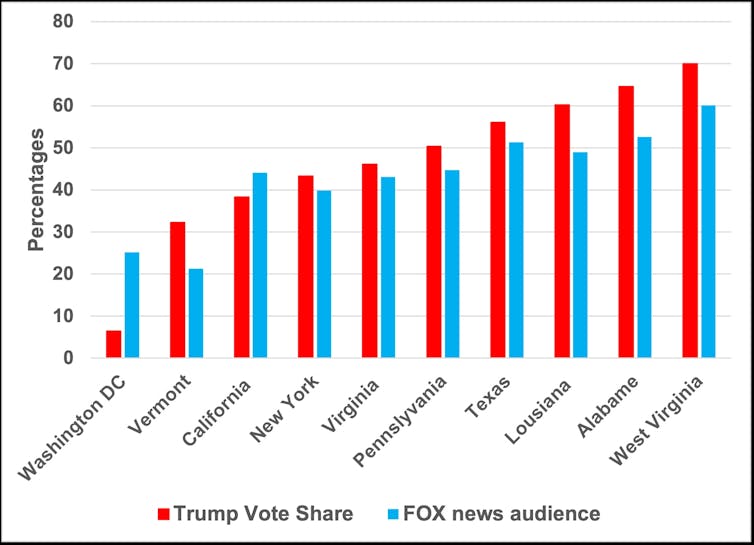
Source: Author graph based on Cooperative Election Study 2024, CC BY
The Cooperative Election Study had 60,000 respondents, which provides reasonably sized samples in each of the 50 states. The Trump vote varied quite a lot across states, with only 34% of voters in Maryland supporting him, compared with 72% in Wyoming. The electoral college formally decides the results of presidential elections, and this is based on states – so, looking at voting in this way can be quite revealing.
The connection between watching Fox News and Trump’s vote share can be seen in the chart above. It varies from 21% who watched the channel in Vermont to 60% in West Virginia.
Vermont is represented in Congress by Senator Bernie Sanders, a self-described socialist from a radical political tradition, and only 32% voted for Trump there. In contrast, West Virginia is part of the rust belt of impoverished states hit by deindustrialisation and the decline of the coal mining industry, and 71% voted for Trump there.
We can use a regression model (which looks at the relationship between variables) to predict support for Trump using key measures that drive the vote share for Trump in each state. The model uses three variables to predict the results with 95% accuracy, which means while not perfect, it gives a very accurate prediction of Trump’s vote.
Not surprisingly, partisanship – that is, the percentage of registered Republicans in each state – is one of the key metrics. In addition, ideology – the percentage of respondents who say they are conservatives – is another.
Perhaps more surprisingly, the third important predictor is viewership of Fox News. The relationship between watching the channel and voting for Trump is very strong at the state level. Also, the more time people spend watching the channel, the more likely they are to have voted for Trump.
Impact of key factors on Trump voting in 2024 US election:

Source: Author based on Cooperative Election Study , CC BY
This chart calculates the relationship between watching Fox News and other factors and the strength of a state’s support for Trump in 2024. If a variable is a perfect predictor of Trump voting, it would score 1.0 on the scale. If it is a perfect non-predictor, it would score 0.
So, the most important predictor of being a Trump voter was the presence of conservatives in a state, followed by the percentage of registered Republicans, and the third was watching Fox News. A high score on all three meant greater support for Trump.
To illustrate this, 45% of Texans considered themselves conservatives, 33% were registered Republicans, and 51% watched Fox News. Using these measures, the model predicts that 57% would vote for Trump. In fact, 56% voted for him in that state in 2024. So, while the prediction was not perfect, it was very close.
A similar predictive model can be used to forecast former Democratic presidential candidate Kamala Harris’s vote shares by state. In her case, we need four variables to predict the results with 95% accuracy – the percentage of registered Democrats, liberals and moderates in a state, and also Fox News viewership.
Not surprisingly in Harris’s case, the relationship between Fox News viewing and voting is strongly negative (correlation = -0.64). When viewership was high, the Harris vote was low.
Years ago, the “fairness doctrine” used to mandate US broadcasters to fairly reflect different viewpoints on controversial issues in their coverage. Candidates for public office were entitled to equal air time.
But this rule was removed by the FCC in 1987, and has led to an era of some broadcasters becoming far more partisan. The FCC decision followed a period of debate and challenges to the fairness doctrine. This led to its abolition under Ronald Reagan, the Republican president who inspired Project 2025 – the document that in turn appears to be inspiring the Trump government’s policy agenda.
When the Trump era is over, incumbent Democrats are going to have to repair US institutions that this administration has damaged. If they want to do something about the polarisation of US politics, they may also need to restore the fairness doctrine.
Had it not been removed in the first place, it is possible that Harris would have won the 2024 presidential election, since Fox News would not exist in its present form. Whatever happens next, the US media is likely to play an important role.
Paul Whiteley, Professor, Department of Government, *University of Essex
This article is republished from The Conversation under a Creative Commons license. Read the original article.
---
---
an 5 25
More than 100 days into his return to the White House, the conclusion is stark: Donald Trump is no longer the same president he was during his first term. His familiar nationalist and populist rhetoric is now openly paired with an authoritarian turn – one without precedent in US history. He has adopted a neo-imperial view of the economy, treating the global order as a zero-sum contest of winners and losers. In this worldview, cooperation gives way to domination: what matters is power and the accumulation of wealth.
Having withstood two impeachment procedures, numerous lawsuits and at least one assassination attempt, Trump now governs with what can appear to be unchecked authority. To his followers, he has become a hero, a martyr – almost a messianic figure. He no longer sees democracy as a framework to be honoured, but as a tool to legitimize his hold on power. His decisive electoral victory now serves as a mandate to cast aside institutional limits.
Three key features define his style of governance: a radical centralization of executive power grounded in the theory of the “unitary executive”; the politicization of the Department of Justice, used as a weapon against rivals; and the manipulation of federal authority to target cultural, media and educational institutions. His playbook is chaos: unsettle opponents, dominate the media narrative and blur the boundaries of democratic norms. Impulsive and reactionary, Trump often governs in response to Fox News segments or trending posts on Truth Social. Instability has become a strategic tool.
But Trump is not a historical anomaly. While his 2016 victory may have seemed unlikely, his re-election reflects a deeper, long-term transformation rooted in the post-Cold War era.
From an external to an internal enemy
The collapse of the USSR – a structuring external enemy – redirected political confrontation toward the designation of an internal enemy. The culture war has become the dominant ideological battleground, driven by two closely linked forces. On one side, a religious radicalization led by nationalist Christian movements – such as the New Apostolic Reformation – seeks to roll back social progress and promote the vision of an outright theocracy. On the other, growing racial anxiety is fueled by fears of white demographic decline and resistance to civil rights gains.
The commentator Pat Buchanan saw it coming as early as the 1990s. , he warned: “There is a cultural war going on for the soul of America… as critical as the Cold War itself.” Too radical for his time, Buchanan championed a white, Christian, conservative US hostile to cosmopolitan elites. Though marginalized then, his ideas laid the groundwork for what would become Trumpism.
Newt Gingrich, who served as Speaker of the House from 1995 to 1999, played a pivotal role in reshaping both the Republican party and US politics. A Republican group he chaired famously distributed a pamphlet to Republican candidates titled “Language: A Key Mechanism of Control”, advising them to use uplifting language to describe themselves, and inflammatory terms like “corrupt”, “immoral” and “traitor” to describe their opponents. This aggressive rhetoric redefined political rivals as enemies to be defeated – helping pave the way for a right-wing politics in which winning trumps democratic norms.
At the same time, the rise of a new conservative media ecosystem intensified polarization. The launch of Fox News in 1996, the growth of right-wing talk radio shows like Rush Limbaugh’s and the later explosion of social media gave the US right powerful tools to shape and radicalize public opinion. Today, algorithm-driven information bubbles trap citizens in alternate realities, where misinformation and outrage drown out reasoned debate. This has deepened polarization and fractured society as a whole.
Channeling anger
This ideological and media realignment has unfolded alongside a broader crisis: the unraveling of the post-Cold War neoliberal consensus. Promises of shared prosperity have been replaced by deindustrialization, deepening inequality and widespread resentment. Successive traumas – from 9/11 and the 2008 financial crash to the Covid-19 pandemic – and foreign wars without real victories have eroded public trust in the establishment.
Trump channels this anger. He offers a vision of a restored and idealized America, a rollback of recent social gains, and a reassertion of national identity grounded in religion and race. His populism is not a coherent ideology but an emotional response – born of perceived injustice, humiliation and loss.
Trump is more than a symptom of America’s democratic crisis: he is its most vivid manifestation. He embodies the legacy of the 1990s – a foundational decade of identity grievance, culture wars and media deregulation. Viewed as a political outsider, he has never been judged as a traditional politician, but rather embraced, by some, as the archetypal “self-made man” – a successful businessman and reality TV celebrity.
His rhetoric – transgressive, provocative and often cruel – gives voice to what had been repressed. The humiliation of opponents becomes part of the performance. For his supporters, it’s exhilarating. It breaks taboos, flouts political correctness and feeds the fantasy of reclaiming a lost America.
And he’s no longer alone. With the vocal support of economic and tech elites like Elon Musk – now a central figure in the radicalized right on X – Trumpism has entered a new phase. Together, they’ve outlined a new kind of authoritarian, cultural and digital power, where influence matters more than institutions.
The US re-elected not just a man, but a style, an era and a worldview built on dominance, disruption and disdain for rules. Still, history is unwritten: intoxicated by hubris and undermined by incompetence, Trumpism may yet crash into the wall of reality – with consequences far beyond America’s borders.
Jérôme Viala-Gaudefroy, Spécialiste de la politique américaine, Sciences Po
This article is republished from The Conversation under a Creative Commons license. Read the original article.
===
note lots logged 12 24 eg see nodes
The Tax Cuts and Jobs Act, a set of tax cuts Donald Trump signed into law during his first term as president, will expire on Dec. 31, 2024. As Trump and Republicans prepare to negotiate new tax cuts in 2025, it’s worth gleaning lessons from the president-elect’s first set of cuts.
The 2017 cuts were the most extensive revision to the Internal Revenue Code since the Ronald Reagan administration. The changes it imposed range from the tax that corporations pay on their foreign income to limits on the deductions individuals can take for their state and local tax payments.
Trump promised middle-class benefits at the time, but in practice more than 80% of the cuts went to corporations, tax partnerships and high-net-worth individuals. The cost to the U.S. deficit was huge − a total increase of US$1.9 trillion from 2018 to 2028, according to estimates from the Congressional Budget Office. The tax advantage to the middle class was small.
Advantages for Black Americans were smaller still. As a scholar of race and U.S. income taxation, I have analyzed the impact of Trump’s tax cuts. I found that the law has disadvantaged middle-income, low-income and Black taxpayers in several ways.
Cuts worsened disparities
These results are not new. They were present nearly 30 years ago when my colleague William Whitford and I used U.S. Census Bureau data to show that Black taxpayers paid more federal taxes than white taxpayers with the same income. In large part that’s because the legacy of slavery, Jim Crow and structural racism keeps Black people from owning homes.
The federal income tax is full of advantages for home ownership that many Black taxpayers are unable to reach. These benefits include the ability to deduct home mortgage interest and local property taxes, and the right to avoid taxes on up to $500,000 of profit on the sale of a home.
It’s harder for middle-class Black people to get a mortgage than it is for low-income white people. This is true even when Black Americans with high credit scores are compared with white Americans with low credit scores.
When Black people do get mortgages, they are charged higher rates than their white counterparts.
It’s harder for middle-class Black people to get a mortgage than it is for low-income white people. MoMo Productions/Getty Images
Trump did not create these problems. But instead of closing these income and race disparities, his 2017 tax cuts made them worse.
Black taxpayers paid higher taxes than white taxpayers who matched them in income, employment, marriage and other significant factors.
Broken promises, broken trust
Fairness is an article of faith in American tax policy. A fair tax structure means that those earning similar incomes should pay similar taxes and stipulates that taxes should not increase income or wealth disparities.
Trump’s tax cuts contradict both principles.
Proponents of Trump’s cuts argued the corporate rate cut would trickle down to all Americans. This is a foundational belief of “supply side” economics, a philosophy that President Ronald Reagan made popular in the 1980s.
From the Reagan administration on, every tax cut for the rich has skewed to the wealthy.
Just like prior “trickle down” plans, Trump’s corporate tax cuts did not produce higher wages or increased household income. Instead, corporations used their extra cash to pay dividends to their shareholders and bonuses to their executives.
Over that same period, the bottom 90% of wage earners saw no gains in their real wages. Meanwhile, the AFL-CIO, a labor group, estimates that 51% of the corporate tax cuts went to business owners and 10% went to the top five highest-paid senior executives in each company. Fully 38% went to the top 10% of wage earners.
In other words, the income gap between wealthy Americans and everyone else has gotten much wider under Trump’s tax regime.
Stock market inequality
Trump’s tax cuts also increased income and wealth disparities by race because those corporate tax savings have gone primarily to wealthy shareholders rather than spreading throughout the population.
The reasons are simple. In the U.S., shareholders are mostly corporations, pension funds and wealthy individuals. And wealthy people in the U.S. are almost invariably white.
Sixty-six percent of white families own stocks, while less than 40% of Black families and less than 30% of Hispanic families do. Even when comparing Black and white families with the same income, the race gap in stock ownership remains.
These disparities stem from the same historical disadvantages that result in lower Black homeownership rates. Until the Civil War, virtually no Black person could own property or enter into a contract. After the Civil War, Black codes – laws that specifically controlled and oppressed Black people – forced free Black Americans to work as farmers or servants.
State prohibitions on Black people owning property, and public and private theft of Black-owned land, kept Black Americans from accumulating wealth.

A woman protests outside Trump Tower over the Trump administration’s proposed tax cut on Nov. 30, 2017, in New York City. Spencer Platt/Getty Images
Health care hit
That said, the Trump tax cuts hurt low-income taxpayers of all races.
One way they did so was by abolishing the individual mandate requiring all Americans to have basic health insurance. The Affordable Care Act, passed under President Barack Obama, launched new, government-subsidized health plans and penalized people for not having health insurance.
Department of the Treasury data shows almost 50 million Americans were covered by the Affordable Care Act since 2014. After the individual mandate was revoked, between 3 million and 13 million fewer people purchased health insurance in 2020.
Ending the mandate triggered a large drop in health insurance coverage, and research shows it was primarily lower-income people who stopped buying subsidized insurance from the Obamacare exchanges. These are the same people who are the most vulnerable to financial disaster from unpaid medical bills.
Going without insurance hurt all low-income Americans. But studies suggest the drop in Black Americans’ coverage under Trump’s plan outpaced that of white Americans. The rate of uninsured Black Americans rose from 10.7% in 2016 to 11.5% in 2018, following the mandate’s repeal.
The consumer price index conundrum
The Trump tax cuts also altered how the Internal Revenue Service calculates inflation adjustments for over 60 different provisions. These include the earned income tax credit and the child tax credit – both of which provide cash to low-wage workers – and the wages that must pay Social Security taxes.
Previously, the IRS used the consumer price index for urban consumers, which tracks rising prices by comparing the cost of the same goods as they rise or fall, to calculate inflation. The government then used that inflation number to adjust Social Security payments and earned income tax credit eligibility. It used the same figure to set the amount of income that is taxed at a given rate.
The Trump tax cuts ordered the IRS to calculate inflation adjustments using the chained consumer price index for urban consumers instead.
The difference between these two indexes is that the second one assumes people substitute cheaper goods as prices rise. For example, the chained consumer price index assumes shoppers will buy pork instead of beef if beef prices go up, easing the impact of inflation on a family’s overall grocery prices.
The IRS makes smaller inflation adjustments based on that assumption. But low-income neighborhoods have less access to the kind of budget-friendly options envisioned by the chained consumer price index.
And since even middle-class Black people are more likely than poor white people to live in low-income neighborhoods, Black taxpayers have been hit harder by rising prices.
What cost $1 in 2018 now costs $1.26. That’s a painful hike that Black families are less able to avoid.
The imminent expiration of the Trump tax cuts gives the upcoming GOP-led Congress the opportunity to undertake a thorough reevaluation of their effects. By prioritizing policies that address the well-known disparities exacerbated by these recent tax changes, lawmakers can work toward a fairer tax system that helps all Americans.
Beverly Moran, Professor Emerita of Law, Vanderbilt University
---
AN 12 24
Throughout the 2024 election cycle, reproductive rights were an electoral vulnerability for Donald Trump. Though popular with the Republican base, his appointment of antiabortion judges gave serious pause to many key voting blocs, including undecided young men.
In pursuit of these voters, Trump’s strategy wasn’t demagoguery but comedy.
Trump’s October appearance on comedian Andrew Schulz’s podcast, “Flagrant,” demonstrated his approach to the touchy issue.
Schulz playfully invoked Trump’s youngest son, who’s a student at New York University – “Barron is 18. He’s unleashed in New York City. Are you sure you want to reverse Roe vs. Wade now?” After a beat, Trump laughed, Schulz laughed, and then, presumably, thousands of young male listeners joined in.
Trump continued with boilerplate answers about states rights, but this substance – as is so often the case – was divorced from the strategy. Schulz had helped Trump turn an unpopular position into a frat boy punchline, something to be discarded along with last night’s empties. Trump won that media cycle and, ultimately, a majority of the votes of young men on his way to a second White House win. Podcaster Andrew Schulz pokes fun at the touchy issue of abortion in an interview with Donald Trump on Oct. 9, 2024.
Vice President Kamala Harris, by contrast, appeared on mainstream comedy shows with aging, liberal audiences like “The Late Show with Stephen Colbert.” Pundits criticized her failure to engage young voters in online comedy platforms. They also urged liberals to develop a new crop of political comedians to match the influence of Schulz and podcaster Joe Rogan.
However, these criticisms of Harris’ strategy miss the failure of liberal comedians to evolve with media and political trends.
While Jimmy Kimmel cries and Jon Stewart rants, the right wing in the U.S. has successfully depicted itself as the new home for free speech and cutting edge comedy. We explored this development in our book, “That’s Not Funny: How the Right Makes Comedy Work for Them.”
The right has become a home for comedians not by making political arguments through jokes, but by positing that there are funnier things to do than to argue.
A formula goes stale
Liberal comedy and political satire have stuck to the same formula of Stewart’s “The Daily Show” for much of the 21st century.
It goes something like this: A sarcastic, eloquent host uses meticulously researched data to describe a pressing social issue, and then delivers a punchline directed at right-wing hypocrisy. The resultant pairing of righteous laughter and anger has been repeated by “The Colbert Report,” “Full Frontal with Samantha Bee” and “Patriot Act with Hasan Minhaj,” among other comedy programs.
These satirical shows filled the void left by an increasingly profit-driven news media. However, they have come to prioritize political preaching at the expense of laughs.
Perhaps Stewart’s most successful successor – and the best example of liberal satire’s patronizing tone – is HBO’s “Last Week Tonight with John Oliver.” Because the show appears on prestige cable, Oliver has a bigger budget to tackle controversial topics in depth.
Indeed, journalists and academics alike have celebrated the “John Oliver effect,” in which viewers mobilize behind a cause shortly after the host devotes an episode to it, whether it’s vaccines or internet regulation.
Oliver’s long-form lectures can be compelling. However, his appeal is not to young undecided voters who can’t afford HBO, but to college-educated liberals predisposed to support progressive reforms.
Twice in a recent , he reminded viewers of topics his show has covered in depth, like a professor chiding students for not remembering recent lessons. In one segment about Trump’s disingenuous economic message, Oliver pleaded that his show had already “explained inflation for 24 human minutes.”
While Oliver’s exasperation can be amusing, he’s clearly more upset at – even disdainful of – the American electorate, chastising them for failing the final exam of election night.
For liberals to reconnect with young voters – especially young men – we think they have to reinvent political comedy. Doing so will mean moving beyond the haranguing that has long been its primary delivery style. This will be a challenge, however, as the right fortifies the relationship between its own comedians and political power.
Comedians like John Oliver and Jon Stewart tend to appeal to college-educated liberals predisposed to support progressive reforms. Brad Barket/Getty Images for Comedy Central
Rise of the right-wing comedy complex
Trump’s success with comedy is a result of the new relationship between digital media and the business of joking. For decades, liberals were thought to hold a monopoly on comedy. Moreover, there was little money to be made in comedy acts devoted to right-wing politics.
Since 2016, however, a new crop of right-wing comedians has taken to digital platforms and algorithmically driven audience targeting in order to change this reality.
Libertarian podcasters like Rogan have long danced around the political spectrum, finding diverse positions that intrigue his primary target of young male listeners. He routinely platforms right-leaning cultural and comedic voices, features them as guests, and promotes their shows and products. In doing so, he has helped create a de facto right-wing comedy network.
Although each comedian or show in this network doesn’t have the audience and impact of, say, “The Daily Show” in its prime, their aggregate strength is precisely targeted at coveted young consumers and potential voters.
It is no coincidence that the most heralded stops on Trump’s October podcast tour were shows hosted by three regulars on “The Joe Rogan Experience”: Schulz, comedian Theo Von and libertarian scientist Lex Fridman. Trump also appeared on Rogan’s show for a three-hour episode.
Changing styles and platforms
Importantly, the type of political comedy featured on these programs is distinct from that of liberal satire of the past two decades.
“The Daily Show,” “Last Week” and their ilk dazzle viewers in 30-minute episodes using intricate arguments and sardonic punchlines.
Rogan and his affiliates hang out for hours, and audiences can listen as they go about their daily routines. In the process, podcast hosts shape their audience’s taste in culture, technology and recreation in what’s known as parasocial bonding.
Trump’s appearance on Von’s podcast “This Past Weekend,” for example, featured little in the way of biting jokes and rollicking laughter. Instead, Von and Trump held a meandering conversation full of interspersed with gestures to political topics.
Comedy styles are cyclical. In the 1950s, stand-up comedian Mort Sahl would read a newspaper on stage, peppering in sarcastic observations about the day’s headlines. The Smothers Brothers played with yo-yos before they introduced protest songs. The apolitical observational humor of Jerry Seinfeld reigned supreme in the 1980s and ’90s.
The 2000s liberal satire of Stewart and Oliver was driven by cable television industry mandates to court young men. The tastes and media habits of this audience have moved on, but liberal comedy has failed to follow them.
Nick Marx, Associate Professor of Film and Media Studies, Colorado State University and Matt Sienkiewicz, Associate Professor of Communication and International Studies, Boston College
This article is republished from The Conversation under a Creative Commons license. Read the original article.
---
Talia Lavin’s Wild Faith: How the Christian Right is Taking Over America is an angry response to the rise of American Christianity’s far-right fringe, which she depicts as a theocratic menace to secular government and liberal freedoms.
As Lavin shows in abundant detail, the US Christian Right adheres to a worldview based around supernatural struggle between good and evil, where “demons make war every day with the better angels of the human spirit”. This is the same mentality as motivated the Satanic Panic of the 1980s, with its hysterical tales of ritual child abuse in service of the Devil. It continues to influence America’s “politics, punditry, and policy”.
Lavin exposes the Christian Right’s political ambitions and social harms, amassing examples to illustrate the point. She cites case after case of apocalyptic fervour, domestic terrorism, patriarchal tyranny, systematic child abuse, anti-science kookiness, and connections with white supremacism.
Her central claim is that significant elements within American evangelicalism want to use state power to impose their version of a Christian social order grounded in ideas of faith, obedience and bodily purity. The Christian Right rejects any spirit of mutual tolerance between religious and secular worldviews, pursuing instead absolute political and cultural dominance.
This absolutism drives efforts to suppress ways of life viewed as rootless and degenerate, dismantle the separation of church and state, and reframe the United States as an inherently Christian nation requiring an explicitly Christian government.
Opposition options
The US is a religious outlier among Western liberal democracies. Australia and many other democratic nations are increasingly, though not entirely, post-Christian societies. Still, the US is militarily and culturally hegemonic. Events there never the leave the rest of us untouched. As its culture wars play out, we should all feel nervous about the outcomes. As Lavin warns, the Christian Right is on the march. So what is the best response?
Lavin calls for an impassioned “cacophony” of resistance to the Christian Right. “In response,” she exhorts, “we must take up a countermarch, thrill to its cacophonic strains, and rise to spurn a faith that has overrun its banks and spilled out into wild and untrammelled hate.”
This prompts a question: is such rhetoric, which has something of its own cacophonous and even fanatical sound, really the best response to America’s would-be theocrats?
Perspectives might vary. There is room for books stuffed with invective against powerful oppressors and with calls to mobilise against them. Responding to the oppressive religiosity of another time, Voltaire urged his readers to “écrasez l'infâme! – crush the infamy!
Such battle cries can fit the moment. Inevitably, however, they call to the already-converted. They have limited persuasive scope.
Pragmatically, it might be crucial to ensure the election of the Democratic Party to political office wherever possible. This would require the party to distance itself from illiberal and unpopular practices, such as identity ideology and cancel culture, which disaffect large portions of the electorate, undermine broad coalition-building, and ultimately weaken the party’s electoral prospects.
A more unifying approach on the American centre-left would prioritise traditional liberal freedoms, alongside a focus on the material welfare of everyday people: jobs, healthcare and economic security. Nothing in the text of Wild Faith suggests that Lavin understands such strategic issues or is able to imagine a more relatable brand of American liberalism.
Nor does she attempt to refute the doctrines of Christianity head-on. In that sense, Wild Faith is not a work of atheistic philosophy or a New Atheist tract. It doesn’t try to nudge along the decline of Christian religious adherence in the US in recent decades (which has possibly levelled off in the last few years).
Nor does Lavin spend much time disputing Christianity’s specific tenets: its doctrine of spiritual salvation through Christ and its stark portrayals of death, judgement, heaven and hell. These core Christian doctrines suggest that we are all in danger of eternal hellfire, but have a chance of eternal bliss. The word "eternal” here conveys the stakes for every soul. In the past, a sense of such huge consequences prompted inquisitors to burn books and heretics.
Lavin expects her readers to treat all such doctrines as absurd. She never explores Christianity’s deeper logic or opposes the religion itself. Instead, she frames members of the Christian Right as something of a rogue outgrowth.
Another obvious response to the Christian Right would be renewed defence of secularism: the once-revolutionary idea that religious authority and state power should be kept apart. Here, there is a rich tradition of thought to draw upon, much of it originating from Christian thinkers in the early centuries of European modernity during a time of religious wars. Indeed, the US as a political construct was shaped, in part, by theories of church and state separation.
On such accounts, the legitimate role of secular rulers is to protect life, liberty and property – and more generally our interests in things of this empirical world – rather than concern themselves with matters of spiritual salvation or enforce any religious moral system for its own sake. Indeed, this idea has inspired many American evangelicals. But in-principle defence of secular government is not within Lavin’s approach.
American Christians in the evangelical Protestant tradition belong to a broad spectrum of churches with varied beliefs and practices. Lavin focuses on a radical fringe, giving an impression that it is typical of the whole.
She details much horrendous conduct, including brutal forms of corporal punishment inspired by manuals such as Michael and Debi Pearl’s To Train Up a Child. She reveals survivors’ memories of “biblical discipline” to dramatic effect. Her samples are drawn from self-selecting ex-evangelicals, whose experiences may not be the norm, though even a small percentage of evangelical Protestants with vicious ideas about child-rearing could disfigure the lives of many helpless children.
Wild Faith could, however, bewilder more typical megachurch families in America’s suburbs, who are loving towards their children and do not recognise themselves in Lavin’s descriptions of torment and abuse. More broadly, the one-sidedness of Lavin’s narrative risks leaving us with a caricature of evangelicals. Even within strict evangelical communities, there is doubtless more at play than she recognises. Many individuals encounter genuine acts of kindness through their churches and find a sense of meaning and belonging.
All these people are exhibited in Wild Faith not as merely wrong, nor as merely dogmatic and hence beyond the reach of rational persuasion (which, indeed, some of them might be). They are shown as alien and monstrous. We needn’t adopt an attitude of what atheist Daniel Dennett called “belief in belief” – that is, rejecting religion for ourselves while commending its virtues to others – to sense that Lavin misses part of the human story.
Clash of dogmatisms
Stylistically, Wild Faith is repetitive and frequently marred by rhetorical excesses. Too often, it seems more like an apoplectic rant than a serious exposé. It’s one thing to denounce child abuse, theocracy, and other such evils. But Lavin goes much further.
For a start, she pervasively ridicules her opponents’ physical looks. Her worst flourishes along these lines – labelling former Donald Trump advisor Steve Bannon a “human yeast infection” or Kristi Noem (who has since been made Trump’s secretary of homeland security) as “South Dakota’s hard-right haircut of a governor” – veer into juvenile mockery. Again, this may appeal to the already-converted, but for anyone else a shorter, tighter, fairer book might have been more persuasive.
Lavin does not seem to recognise any of her own political commitments as being matters of genuine controversy, which gives the impression of an author who is something of an ideologue herself. It suggests that we are witnessing a clash of dogmatisms. There are numerous examples of this, but for the sake of brevity I will confine myself to issues related to abortion.
Lavin does not contemplate that some of her opponents might sincerely view abortion as murder. Yet abortion involves killing an entity that is biologically human. It does not follow automatically that embryos and fetuses are good candidates for our moral consideration – but if not, why not? This at least suggests a need for serious philosophical engagement with abortion’s critics and opponents.
Understandably enough, Lavin mourns the downfall of Roe v. Wade, the 1973 Supreme Court case that interpreted the US Constitution as granting extensive abortion rights. Roe v. Wade was followed by a line of cases that largely preserved its authority. It was eventually overturned by Dobbs v. Jackson Women’s Health Organization (2022), leaving individual state legislatures to decide what criminal restrictions, if any, they might wish to impose.
Disastrous as this was for many women and girls in America’s red states, it is also a reminder that rights built on shaky constitutional foundations might not last forever. Roe v. Wade was always vulnerable to potential challenges, because abortion rights have no direct textual support in the US Constitution, but were established by building inferences on inferences. Indeed, Roe v. Wade encountered criticism even in the 1970s, and even from many supporters of abortion rights.
Lavin does not acknowledge any of this. Finally, she faults Democrats for failing to codify Roe v. Wade in statutory form when they were in office, but she glosses over the formidable (perhaps insurmountable) constitutional and procedural obstacles to any such move.
The verdict
Lavin raises a legitimate alarm: a theocratic faction in the US wields disproportionate influence to the point of threatening liberal democracy itself. To bolster that point, she could have cited a wave of recent Supreme Court cases that demonstrate a weakening of constitutional barriers to state-endorsed religion.
Some of these cases might be individually defensible, given their particular facts, but as they accumulate they erode the separation of church and state. By now, little remains of freedom from religion in the US – perhaps no more than protection against the most explicit forms of coercion, such as state-mandated participation in particular religious observances. This leaves unchecked subtler encroachments by religion on secular life.
That situation has been a long time coming and other authors have traversed similar ground to Lavin’s book. One might, for example, compare Michelle Goldberg’s Kingdom Coming: The Rise of Christian Nationalism or Susan Jacoby’s The Age of American Unreason in a Culture of Lies.
Goldberg, to her credit, explicitly defends the liberal freedoms of the fundamentalists she exposes and critiques, recognising their rights even as she challenges their theocratic aims. Thus, she states that we can take “a much more vocal stand in defense of evangelical rights when they are unfairly curtailed” – a nuance absent in Lavin’s effort to fire-up supporters and vanquish enemies. Jacoby’s book, meanwhile, situates religious excesses and theocratic temptations within a broader decline of reason in American society.
Both works, though less current than Wild Faith, model a fairness that strengthens their arguments. Lavin’s book benefits from its timeliness, addressing a contemporary landscape of heightened evangelical influence, but it sacrifices objectivity and scholarly depth. It will resonate with Americans who are already frightened by the Christian Right, while alienating many conservatives, or even moderates, who might have been open to concerns about theocracy.
Russell Blackford, Conjoint Senior Lecturer in Philosophy, University of Newcastle
This article is republished from The Conversation under a Creative Commons license. Read the original article.
corp apology
===
9 24 the conv
===
an 10 24
Donald Trump has a particular formula he uses to convey messages to his supporters and opponents alike: He highlights others’ wrongdoings even though he has committed similar acts himself.
On Oct. 3, 2024, Trump accused the Biden administration of spending Federal Emergency Management Agency funds – money meant for disaster relief – on services for immigrants. Biden did no such thing, but Trump did during his time in the White House, including to pay for additional detention space.
This is not the first time he has accused someone of something he had done or would do in the future. In 2016, Trump criticized opponent Hillary Clinton’s use of an unsecured personal email server while secretary of state as “extreme carelessness with classified material.” But once he was elected, Trump continued to use his unsecured personal cellphone while in office. And he has been criminally charged with illegally keeping classified government documents after he left office and storing them in his bedroom, bathroom and other places at his Mar-a-Lago estate.
After complaining about how Hillary Clinton handled classified documents, Donald Trump stored national secrets in a bathroom. Justice Department via AP
More recently, the Secret Service arrested a man with a rifle who was allegedly planning to shoot Trump during a round of golf. In the wake of this event, Trump accused Democrats of using “inflammatory language” that stokes the fires of political violence. Meanwhile, Trump himself has a long history of making inflammatory remarks that could potentially incite violence.
As a scholar of both politics and psychology, I’m familiar with the psychological strategies candidates use to persuade the public to support them and to cast their rivals in a negative light. This strategy Trump has used repeatedly is called “projection.” It’s a tactic people use to lessen their own faults by calling out these faults in others.
Projection abounds
There are plenty of examples. During his Sept. 10, 2024, debate with Vice President Kamala Harris, Trump claimed that Democrats were responsible for the July 13 assassination attempt against him. “I probably took a bullet to the head because of the things that they say about me,” he declared.
Earlier in the debate he had falsely accused immigrants in Springfield, Ohio, of eating other people’s pets – a statement that sparked bomb threats and prompted the city’s mayor to declare a state of emergency.
Similarly, congressional investigators and federal prosecutors have found that Trump’s remarks called thousands of people to Washington, D.C., on Jan. 6, 2021, encouraging them to violently storm the Capitol in order to stop the counting of electoral votes.
Trump isn’t the only politician who uses projection. His running mate, JD Vance, claimed “the rejection of the American family is perhaps the most pernicious and the most evil thing the left has done in this country.” Critics quickly pointed out that his own family has a history of dysfunction and drug addiction.
Projection happens on both sides of the political aisle. In reference to Trump’s proposed 10% tariff on all imported goods, the Harris campaign launched social media efforts to condemn the so-called “Trump tequila tax.” While Harris frames this proposal as a sales tax that would devastate middle-class families, she deflects from the fact that inflation has made middle-class life more expensive since she and President Joe Biden took office.
How it works
Projection is one example of unconscious psychological processes called defense mechanisms. Some people find it hard to accept criticism or believe information that they wish were not true. So they seek – and then provide – another explanation for the difference between what’s happening in the world and what’s happening in their minds.
In general, this is called “motivated reasoning,” which is an umbrella phrase used to describe the array of mental gymnastics people use to reconcile their views with reality.
Some examples include seeking out information that confirms their beliefs, dismissing factual claims or creating alternate explanations. For example, a smoker might downplay or simply avoid information related to the link between smoking and lung cancer, or perhaps tell themselves that they don’t smoke as much as they actually do.
Motivated reasoning is not unique to politics. It can be a challenging concept to consider because people tend to think they are fully in control of their decision-making abilities and that they are capable of objectively processing political information. The evidence is clear, however, that there are unconscious thought processes at work, too.
Influencing the audience
Audiences are also susceptible to unconscious psychological dynamics. Research has found that over time, people’s minds subconsciously attach emotions to concepts, names or phrases. So someone might have a particular emotional reaction to the words “gun control,” “Ron DeSantis” or “tax relief.”
And people’s minds also unconsciously create defenses for those seemingly automatic emotions. When a person’s emotions and defenses are questioned, a phenomenon called the “backfire effect” can occur, in which the process of controlling, correcting or counteracting mistaken beliefs ends up reinforcing the person’s beliefs rather than changing them.
For instance, some people may find it hard to believe that the candidate they prefer – whom they believe to be the best person for the job – truly lost an election. So they seek another explanation and accept explanations that justify their beliefs. Perhaps they choose to believe, even in the absence of evidence, that the race was rigged or that many fraudulent votes were cast. And when evidence to the contrary is offered, they insist their views are correct.
Vice President Kamala Harris has campaigned with Liz Cheney, right, a prominent Republican who formerly served in Congress. AP Photo/Mark Schiefelbein
A way out
Fortunately, research shows specific ways to reduce people’s reliance on these automatic psychological processes, including reiterating and providing details of objective facts and – importantly – attempting to correct untruths via a trusted source from the same political party.
For instance, challenges to Democrats’ belief that the Trump-affiliated conservative agenda called Project 2025 is “dangerous” would be more effective coming from a Democrat than from a Republican.
Similarly, a counter to Trump’s claim that the international community is headed toward World War III with Democrats in the White House would be stronger coming from one of Trump’s fellow Republicans. And certainly, statements that Trump “can never be trusted with power again” carries more weight when it comes from the lips of former Republican Vice President Dick Cheney than from any member of the Democratic Party.
Critiques from within a candidate’s own party are not out of the question. But they are certainly improbable given the hotly charged climate that is election season 2024.
April Johnson, Associate Professor of Political Science, Kennesaw State University
This article is republished from The Conversation under a Creative Commons license. Read the original article.
===
1 24
Over the last two decades, and in particular over the last five years, there has been a growing scientific interest in conspiracy theories and people who believe in them. Although, some may think belief in such stories is linked to intelligence, research is beginning to show that how people think could be more important.
Scientists agree that having a measure of skepticism about official accounts of events is healthy and important, but conspiracy theorising can lead to dangerous consequences for the individual and for society.
Some conspiracy theories, for example the QAnon conspiracy, can be considered a minority belief, with a 2021 YouGov poll showing that 8% of those polled in the UK endorsed this conspiracy theory. However, some beliefs are more widespread. A 2018 survey of people from around Europe found 60% of British participants endorsed at least one conspiracy theory. So, who are the people who are more susceptible to conspiracy theorising?
There is a dramatically growing body of research endeavouring to understand this question. First, let’s re-examine those assumptions about who engages with conspiracy theories.
People with high education levels, such as doctors and nurses, have been reported to propagate conspiracy theories. So it’s not just about intelligence – education won’t necessarily make you immune.
Critical thinking
Research shows that our thinking style can be predictive of susceptibility to conspiracy theories. The dual processing theory of cognitive style suggests that we have two routes which we can use to process information.
One route is the fast, intuitive route which leans more on personal experiences and gut feelings. The other route is a slower, more analytical route which instead relies on elaborative and detailed processing of information.

Conspiracy theory belief seems to be linked to thinking style.
What you tend to see is that people who are not necessarily smarter but who favour the more effortful, analytical thinking style are more resistant to conspiracy beliefs. For example, a British 2014 study found that those who scored highly for questions such as “I enjoy problems that require hard thinking” were less likely to accept conspiracy beliefs. It also found those who were less likely to engage in effortful thinking styles and more likely to use intuitive thinking showed a higher belief in conspiracy theories.
Similarly, a 2022 study across 45 countries used a cognitive reflection test, which measured engagement in analytical thinking in three questions. It found that participants who engaged in the labour intensive thinking style were less likely to endorse COVID 19 conspiracy theories.
Critical thinking is a valuable skill, particularly within education, and has been shown to buffer susceptibility to conspiracy beliefs. This is probably because this more arduous thinking style allows people time to identify inconsistencies in theories and look to additional resources to verify information.
Thinking style is not the same as intelligence
A 2021 meta-analysis study indicates that an intuitive thinking style is unrelated to intelligence. So, even really smart people could be susceptible to conspiracy beliefs – if they are more inclined to revert to faster, intuitive thinking styles.
Research shows that belief in conspiracy theories is predicted by cognitive biases that come from a reliance on mental shortcuts when processing information. First, conspiracy beliefs seem to be predicted by the flawed belief that big events must have big consequences.
This is known in psychology as proportionality bias. It is difficult to accept that events which have such world-changing consequences (for example, the death of a president or the COVID-19 outbreak) can really be caused by comparably “small” causes (for example, a lone gunman or a virus). This is how thinking styles reliant on gut feelings and intuition can lead people to endorse conspiracy theories.
Another example of intuitive thinking styles influencing conspiracy beliefs is the conjunction fallacy. A conjunction fallacy is the erroneous belief that the likelihood of two independent events occurring together is higher than the probability of the events occurring alone. Have a try at the Linda Problem:
*Linda is 31 years old, single, outspoken, and very bright. She majored in philosophy. As a student, she was deeply concerned with issues of discrimination and social justice, and also participated in anti-nuclear demonstrations. Which is more probable?
a) Linda is a bank teller.
b) Linda is a bank teller and is active in the feminist movement.
The most probable is a) Linda is a bank teller as, statistically, the probably probability of one event occurring is always higher than the combination. However, research shows that higher conjunction fallacy errors are associated with stronger conspiracy beliefs. So people prone to conspiratorial thinking would be more likely to say b.
Exposure to conspiracy beliefs have also consistently been shown to increase people’s susceptibility to them, even if they don’t realise that they have had a change in belief.
It may sound concerning that anyone could be susceptible to conspiracy beliefs. However, these studies are helping researchers find interventions which can increase analytical and critical thinking styles and so buffer against susceptibility to such beliefs. A 2023 review of 25 different studies found these types of interventions were a promising tool to tackle the dangerous consequences of conspiracy beliefs.
The more we understand about the psychology behind conspiracy theories, the better equipped we are to tackle them.
Darel Cookson, Lecturer in Psychology, *Nottingham Trent University
This article is republished from The Conversation under a Creative Commons license. Read the original article.
ref
abstract
Conspiracy beliefs have become a topic of increasing interest among behavioural researchers. While holding conspiracy beliefs has been associated with several detrimental social, personal, and health consequences, little research has been dedicated to systematically reviewing the methods that could reduce conspiracy beliefs. We conducted a systematic review to identify and assess interventions that have sought to counter conspiracy beliefs.
Out of 25 studies (total N = 7179), we found that while the majority of interventions were ineffective in terms of changing conspiracy beliefs, several interventions were particularly effective. Interventions that fostered an analytical mindset or taught critical thinking skills were found to be the most effective in terms of changing conspiracy beliefs. Our findings are important as we develop future research to combat conspiracy beliefs.
...
implications for research / practice / design
This review identified a number of directions for future research. Firstly, we recommend that future studies on conspiracy belief interventions focus on using longitudinal designs. Understanding the effects of these interventions beyond their immediate changes is important in terms of identifying how effective they are at challenging conspiracy beliefs. Second, we recommend that future studies be conducted with non-western populations, with more of a focus on cross-cultural sampling. Conspiracy beliefs may often be specific to cultural context, as such we recommend that research be expanded beyond British and American samples.
In terms of practical implications for challenging conspiracy beliefs, we recommend that those with an interest in reducing the misinformation that conspiracy theories spread should do the following:
- Avoid appealing to emotions and affect: Interventions that manipulated the emotional state of participants, or appealed to feelings of empathy had small effects in terms of changing conspiracy beliefs.
2.Counterarguments are not effective: Counterarguments against specific conspiracy beliefs that are given after participants have been exposed to a conspiracy theory tend not to be particularly effective.}:
- Prevention is the best cure: Interventions that provided counterarguments for conspiracy theories were most effective when the counterargument came before the participants were exposed to the particular conspiracy theories that the study focused on. The findings suggest it is more difficult to challenge conspiracy beliefs once participants have started to believe in them. If participants have been taught why certain conspiracy theories are implausible before they have been exposed to conspiratorial media they are much more resistant to conspiracy beliefs.
- An analytical mindset and critical thinking skills are the most effective means of challenging conspiracy beliefs: Participants who were primed to have an analytical mindset were less likely to have conspiracy beliefs than controls. Furthermore, when interventions moved beyond putting participants in an analytical mindset, and actually explicitly taught them how to evaluate conspiracy beliefs using specific critical thinking skills, they were much less likely to have conspiracy beliefs.
Conclusion
In conclusion, this review sought to investigate how effective current interventions are at changing conspiracy beliefs. We found that overall, the majority of current conspiracy interventions are ineffective in terms of changing conspiracy beliefs. Despite this, we have identified several promising interventions that may be fruitful to pursue in future studies. We propose that a focus on inoculation-based and critical thinking interventions will bear more promising results for future research, though further efforts are needed to reduce participant burden and more easily implement these interventions in the real world.
---
an 1 24
kochava, the self-proclaimed industry leader in mobile app data analytics, is locked in a legal battle with the Federal Trade Commission in a case that could lead to big changes in the global data marketplace and in Congress’ approach to artificial intelligence and data privacy.
The stakes are high because Kochava’s secretive data acquisition and AI-aided analytics practices are commonplace in the global location data market. In addition to numerous lesser-known data brokers, the mobile data market includes larger players like Foursquare and data market exchanges like Amazon’s AWS Data Exchange. The FTC’s recently unsealed amended complaint against Kochava makes clear that there’s truth to what Kochava advertises: it can provide data for “Any Channel, Any Device, Any Audience,” and buyers can “Measure Everything with Kochava.”
Separately, the FTC is touting a settlement it just reached with data broker Outlogic, in what it calls the “first-ever ban on the use and sale of sensitive location data.” Outlogic has to destroy the location data it has and is barred from collecting or using such information to determine who comes and goes from sensitive locations, like health care centers, homeless and domestic abuse shelters, and religious places.
According to the FTC and proposed class-action lawsuits against Kochava on behalf of adults and children, the company secretly collects, without notice or consent, and otherwise obtains vast amounts of consumer location and personal data. It then analyzes that data using AI, which allows it to predict and influence consumer behavior in an impressively varied and alarmingly invasive number of ways, and serves it up for sale.
Kochava has denied the FTC’s allegations.
The FTC says Kochava sells a “360-degree perspective” on individuals and advertises it can “connect precise geolocation data with email, demographics, devices, households, and channels.” In other words, Kochava takes location data, aggregates it with other data and links it to consumer identities. The data it sells reveals precise information about a person, such as visits to hospitals, “reproductive health clinics, places of worship, homeless and domestic violence shelters, and addiction recovery facilities.” Moreover, by selling such detailed data about people, the FTC says “Kochava is enabling others to identify individuals and exposing them to threats of stigma, stalking, discrimination, job loss, and even physical violence.”
I’m a lawyer and law professor practicing, teaching and researching about AI, data privacy and evidence. These complaints underscore for me that U.S. law has not kept pace with regulation of commercially available data or governance of AI.
Most data privacy regulations in the U.S. were conceived in the pre-generative AI era, and there is no overarching federal law that addresses AI-driven data processing. There are Congressional efforts to regulate the use of AI in decision making, like hiring and sentencing. There are also efforts to provide public transparency around AI’s use. But Congress has yet to pass legislation.

The Federal Trade Commission’s suit against Kochava is set against a backdrop of minimal regulation of data brokers.
What litigation documents reveal
According to the FTC, Kochava secretly collects and then sells its “Kochava Collective” data, which includes precise geolocation data, comprehensive profiles of individual consumers, consumers’ mobile app use details and Kochava’s “audience segments.”
The FTC says Kochava’s audience segments can be based on “behaviors” and sensitive information such as gender identity, political and religious affiliation, race, visits to hospitals and abortion clinics, and people’s medical information, like menstruation and ovulation, and even cancer treatments. By selecting certain audience segments, Kochava customers can identify and target extremely specific groups. For example, this could include people who gender identify as “other,” or all the pregnant females who are African American and Muslim. The FTC says selected audience segments can be narrowed to a specific geographical area or, conceivably, even down to a specific building.
By identify, the FTC explains that Kochava customers are able to obtain the name, home address, email address, economic status and stability, and much more data about people within selected groups. This data is purchased by organizations like advertisers, insurers and political campaigns that seek to narrowly classify and target people. The FTC also says it can be purchased by people who want to harm others.
How Kochava acquires such sensitive data
The FTC says Kochava acquires consumer data in two ways: through Kochava’s software development kits that it provides to app developers, and directly from other data brokers. The FTC says those Kochava-supplied software development kits are installed in over 10,000 apps globally. Kochava’s kits, embedded with Kochava’s coding, collect hordes of data and send it back to Kochava without the consumer being told or consenting to the data collection.
Another lawsuit against Kochava in California alleges similar charges of surreptitious data collection and analysis, and that Kochava sells customized data feeds based on extremely sensitive and private information precisely tailored to its clients’ needs.
The data broker marketplace has been tracking you for years, thanks to mobile phones and web browser cookies.
AI pierces your privacy
The FTC’s complaint also illustrates how advancing AI tools are enabling a new phase in data analysis. Generative AI’s ability to process vast amounts of data is reshaping what can be done with and learned from mobile data in ways that invade privacy. This includes inferring and disclosing sensitive or otherwise legally protected information, like medical records and images.
AI provides the ability both to know and predict just about anything about individuals and groups, even very sensitive behavior. It also makes it possible to manipulate individual and group behavior, inducing decisions in favor of the specific users of the AI tool.
This type of “AI coordinated manipulation” can supplant your decision-making ability without your knowledge.
Privacy in the balance
The FTC enforces laws against unfair and deceptive business practices, and it informed Kochava in 2022 that the company was in violation. Both sides have had some wins and losses in the ongoing case. Senior U.S. District Judge B. Lynn Winmill, who is overseeing the case, dismissed the FTC’s first complaint and required more facts from the FTC. The commission filed an amended complaint that provided much more specific allegations.
Winmill has not yet ruled on another Kochava motion to dismiss the FTC’s case, but as of a Jan. 3, 2024 filing in the case, the parties are proceeding with discovery. A 2025 trial date is expected, but the date has not yet been set.
For now, companies, privacy advocates and policymakers are likely keeping an eye on this case. Its outcome, combined with proposed legislation and the FTC’s focus on generative AI, data and privacy, could spell big changes for how companies acquire data, the ways that AI tools can be used to analyze data, and what data can lawfully be used in machine- and human-based data analytics.
Anne Toomey McKenna, Visiting Professor of Law, University of Richmond
This article is republished from The Conversation under a Creative Commons license. Read the original article.
---
---
neo-lib fail covid
the conv
https://www.alternet.org/2021/11/capitalism/
==
---
https://theconversation.com/the-matrix-is-already-here-social-media-promised-to-connect-us-but-left-us-isolated-scared-and-tribal-148799
---
---
https://www.alternet.org/2020/10/god-intended-it-as-a-disposable-planet-meet-the-us-pastor-preaching-climate-change-denial
no graf vid lnx
God intended it as a disposable planet’: This pastor pushes a dangerous Biblical assault on science
The Conversation October 13, 2020
by Paul Braterman, University of Glasgow
Every so often you come across a piece of writing so extraordinary that you cannot help but share it. One such piece is a sermon on global warming by American pastor John MacArthur. Full of beautifully constructed rhetorical flourishes, it is forcefully delivered by an experienced and impassioned preacher to a large and appreciative audience.
For me, as a man of science, it is the most complete compilation of unsound arguments, factual errors and misleading analogies as I have seen in discussions of this subject. But it's important because climate change is a big election issue this November in the US, where there is a growing movement of evangelical Christians who deny its existence, while Joe Biden promises a “clean air revolution".
The minister of the COVID-denying, law-defying Grace Community Church in Sun Valley, California – which has encouraged worshippers to congregate as normal despite state COVID-19 restrictions – MacArthur is an impressive figure whose Study Bible has sold almost 2 million copies.
He regards the infallibility of the Bible, from Genesis to Revelation, as essential to his faith, and his sermon about global warming can only be understood in that context. MacArthur's rejection of the science is shared by other major US ministries and organisations such as Answers in Genesis, Creation Ministries International and theDiscovery Institute.
:{:{}:
}:
In this sermon, MacArthur paraphrases “a scientist at Cal Tech" (except not a scientist at all, but the novelist Michael Crichton, best known for Jurassic Park), as saying in a lecture:
Consensus science is the first refuge of scoundrels … invoked only in situations where there is a political, social, financial agenda but no scientific support.
The reverend has the most serious reasons possible for rejecting the scientific consensus concerning the age of the Earth, the origins of humankind, the history and prehistory of the ancient near East and the peopling of continents: it is totally incompatible with the Genesis account of creation, Adam and Eve, the flood and the dispersion of peoples from the Tower of Babel.
Error, denial and misunderstanding
As for global warming itself, the reverend channels standard climate change denial, but all his arguments are unsound and have been convincingly refuted to the satisfaction of an overwhelming consensus of climate scientists (see in-depth discussion at Skeptical Science). He understates the amount of global warming, incorrectly describes the full record as dating back only 30 years, and cites the Little Ice Age as evidence that the changes currently taking place are natural. There's more:
Here's the key, friends, this is the real deal. Legitimate science recognises a close correlation between sunspots and climate change … The sun is the source of temperature changes because of its infrared variations. …There is absolutely no evidence that CO2 contributes to warming. On the contrary the opposite is true. Warming produces CO2 … It's the other way round.
Here we have a collection of half-truths and misunderstandings, typical of denialists claiming to represent “legitimate science". As the graph below shows, the 11-year sunspot cycle is a minor deviation, and the temperature increase since 1980 has occurred despite the fact that over that period the amount of solar energy falling on Earth has gone down slightly. Incidentally, this solar energy input is concentrated mainly in the visible, not the infrared, region of the spectrum, and it is the roughly balancing heat outflow from the Earth that is in the infrared.
[Graph showing global temperature change between 1980 and 2015
NASA, Author provided]
MacArthur offers a false dichotomy between saying that CO2 warms the oceans, and warmer oceans release more CO2.Unfortunately, both these statements are true.There is a positive feedback loop: human-released CO2 is the primary driver, but its effect is amplified by the fact that yet more CO2 is then released from non-human sources. Regarding CO2 itself, MacArthur seems to be even more confused:
By the way, plants produce CO2. What man produces is marginal … Industry doesn't affect CO2 in the environment or atmosphere.
Plants do produce CO2 but they absorb more than they emit. However, when it comes to humans, their activity may cause only a small imbalance each year between CO2 emission and natural uptake, but this imbalance is cumulative. CO2 levels are now 50% above pre-industrial, and subtle atomic differences clearly show that fossil fuel is the source.But according to MacArthur, “There is no scientific reason to believe that ice caps are melting".
Despite the Arctic Monitoring and Assement Programme's video on this subject, the reverend does not think that the evidence for ice-cap melting is scientific, and that other factors are at play:
This is all political [and] financial agendas,class warfare, class envy … By the way, US$100 billion has been spent to make a case for global warming … driven by the socialist mentality … even some of the feminist mentality that resents male success.
All is now clear. Talk of global warming is part of a politically motivated conspiracy. But US$100 billion? That's 600 years' worth of all federal climate research spending. Clearly, those pesky socialists and feminists are formidable fundraisers. However, none of this matters because environmentalism is fundamentally misplaced. As MacArthur puts it, citing Revelation and the integrity of scripture:
God intended us to use this planet, to fill this planet for the benefit of man. Never was it intended to be a permanent planet.It is a disposable planet. Christians ought to know that.
And that is a statement that would leave anybody who cares about this world speechless.The Conversation
Paul Braterman, Hon. Research Fellow; Professor Emeritus in Chemistry, University of Glasgow
This article is republished from The Conversation under a Creative Commons license. Read the original article.
---