PFAW Ppl for Am Way
===
Jamie Lee Curtis 12 24 fundraiser
RESISTANCE
11 24
- Angela Alsobrooks is the first Black person elected to the U.S. Senate from Maryland.
- Joe Sheehan is a former school superintendent who flipped his Wisconsin State House seat to blue by 800 votes.
- Mo Green defeated an opponent backed by Moms for Liberty and flipped North Carolina’s superintendent seat blue.
- Kimberly Thomas expanded the Democrat’s majority on Michigan’s Supreme Court 5-2.
- Sean Teare is a progressive prosecutor who won a tight race for District Attorney in Harris County, Texas – the state’s most populous county.
---
ymail 11 24
At People For the American Way, we’re leading the charge for a better future. This is a pivotal moment, and it demands bold action. That’s why we’ve launched a nationwide campaign to Resist Project 2025, protect our progress, and empower communities to fight back.
**None of what we have planned will be possible without your support – please chip in today. >>**
Federal Resistance Efforts: Resist Project 2025
Resist Project 2025 will combat the threats posed by the Trump administration and his subservient House and Senate. The campaign lays the foundation for local, state and federal-level resistance and envisions an America where democracy thrives, every vote counts equally, and courts deliver justice for all – not just the wealthy and powerful.
Our work through Resist Project 2025 focuses on three critical areas:
- Judicial Integrity: We’re pushing for the confirmation of President Biden’s remaining judicial nominees while vetting Trump’s extreme nominees and fighting against their confirmations. We’re also advocating for crucial long-term reforms, including a binding code of ethics for the Supreme Court.
- Defending Democracy: We will continue to fight for fair elections and representation for all Americans, by supporting the Freedom to Vote Act, the John Lewis Voting Rights Advancement Act, and DC Statehood, while also seeking opportunities to advance pro-voter measures at the local and state level.
- Fighting Censorship and Defending Civil Rights: We will continue to stand against attempts to silence voices and erase history through book bans, restrictions on free speech, and attacks on inclusive education. By challenging these efforts, we’ll be ensuring that all communities can speak freely, learn authentically, and advocate for their rights.
This initiative is about more than just resisting – it’s about building a vision for a better future and empowering Americans to take action in the face of authoritarianism.
**Join us by supporting our Resist Project 2025 campaign! >>**
Advocating at the State and Local Levels
Resistance doesn’t just happen in Washington – it’s built in communities across the country. That’s why we’re expanding our focus to include advocacy and activism at the state and local levels, where so many decisions that affect our daily lives are made. With your support, we’ll:
- Combat Voter Suppression Laws: Work with local partners to challenge restrictive voting laws and ensure every voice is heard at the ballot box.
- Strengthen Local Movements: Provide training, resources, and support to grassroots supporters fighting for justice in their own communities.
- Advocate for Change in Statehouses: Push for progressive policies and reforms in state legislatures, from protecting reproductive rights to expanding access to the ballot box.
- Support Community Organizing: Amplify the voices of local activists and help connect their work to broader national efforts for change.
**Help us mobilize activists in your community! >>**
How We’re Taking Action
This is just the beginning. With your support, we’ll also:
- Mobilize Grassroots Action: Through innovative campaigns and targeted outreach, we’ll ensure Americans everywhere have the tools and knowledge to resist Trump’s Project 2025 agenda.
- Lead the Conversation: Through ongoing outreach to the media, we’ll expose the dangers of MAGA policies and shine a light on our resistance efforts.
- Build a United Front: We’re fostering partnerships with grassroots organizations, local leaders, and national allies to create a coordinated and powerful movement. Together, we’ll amplify our collective voice and ensure that no community faces these challenges alone.
Your Role in This Movement
This fight is urgent, and it requires all of us. **Your donation** powers the tools, training, and advocacy needed to stand up to Trump and his authoritarian allies.
With Your Help, We Can:
- Mobilize grassroots organizers in every state.
- Push for critical reforms in Congress and in statehouses.
- Create impactful campaigns that amplify our resistance.
---
ymail 5 24
Welcome to our weekly “Trumptastrophe” email series that serves to remind us of the destructive policies, decisions, and actions we encountered during the Trump presidency and the threats that he and others in the MAGA movement still pose – and to keep those moments clear in our memory as we fight to defeat Republican extremists during the upcoming elections.
This week’s Trumptastrophe focuses on former President Trump’s rocky relationship with social media. Indeed, although social media was one of the very tools responsible for his rise to prominence within the Republican Party, Trump and right-wing conservatives often attack social media companies when their content is removed or flagged for violating each platform’s policies regarding what they consider to be acceptable content. This stormy relationship has led to conservatives calling for the weaponization of the Federal Communications Commission if Trump were to be reelected so they can penalize companies unwilling to allow their lies and misinformation to be broadcast to their users:
On May 27, 2020, Trump threatened to “strongly regulate” social media companies or “close them down.” Trump was angry about Twitter putting fact-checking notes on two “potentially misleading” tweets in which he made unsubstantiated claims about mail-in ballots and voter fraud.
Just one day after his threat, Trump signed an executive order that Human Rights Watch called “a profound attack on online freedom of expression globally” by targeting “companies that displease government.” The order included typically Trumpian whining about his tweets having been flagged as inaccurate. At a press event announcing the order, he complained even more, calling fact-checks a form of “political activism.”
The day after Trump issued his executive order, he used his Twitter account to warn that he would deploy the military against people protesting George Floyd’s killing by a police officer, and threatening, “when the looting starts, the shooting starts.” Twitter labeled it with a notice saying it violated the platform’s rules against glorifying violence.
Four years later, Trump and his advisers are vowing that if he gets back into power, he will “come after” big tech companies and media outlets whose moderation policies and political coverage he doesn’t like.
Trump complained in 2020 that social media companies were silencing conservative voices, a frequent complaint from right-wing figures. There was never much substance to the claim, and it is particularly ridiculous now that X/Twitter under the leadership of Trump fan Elon Musk has proudly re-platformed the disinformation-spewing former president, along with far-right figures who promote white nationalism, antisemitism, and other forms of extremism.
Trump’s 2024 campaign team is in fact deploying a “troll army” to attack his enemies on social media. Right Wing Watch noted earlier this year that Trump’s trolls are led by an “overtly racist, unapologetically misogynistic, and gleefully amoral” online activist called Brenden Dilley.
Trump’s 2020 executive order charged the Commerce Secretary with asking the Federal Communications Commission to define standards for evaluating whether social media companies were applying “good faith” in moderating content, and threatened companies with legal action. It sought to ban federal agencies from advertising on platforms deemed to be biased against conservatives. In response, one FCC commissioner said Trump wanted to turn the commission into “the president’s speech police.”
The White House told reporters that some of the ideas in Trump’s order grew out of a “social media summit” Trump held the previous summer with a clown car of far-right online personalities. At that event, Trump gave what The New York Times called “his own unique interpretation of the First Amendment,” saying it’s “not free speech” if “you see something good and then you purposedly write bad.” Afterward, he told supporters that tech companies were, like “the FAKE NEWS media,” an “enemy of the people.”
You don’t have to be part of the MAGA movement to have concerns about the power wielded by huge tech firms and the influence of their platforms and algorithms. Protecting free speech and preventing harm and harassment are a complicated balancing act. Last year, the Supreme Court ruled that tech companies could not be sued by family members of a victim of an ISIS terror attack for having failed to keep ISIS content off their platforms. There have been bipartisan calls in Congress to revisit regulation of tech platforms.
In response to current congressional efforts to do away with provisions contained in Section 230 of the Communications Decency Act, which protect tech companies from liability for what others publish on their platforms and protect them against legal action for moderating content, the Center for Democracy and Technology wrote this month that “Section 230 is about free expression” and warned that repealing the section without a clear alternative in place would “threaten user’s free expression rights and exacerbate the very problems some in Congress seek to solve.” New America has suggested alternatives for addressing online harms.
Trump and his advisers don’t seem that interested in policy nuance. Trump adviser and far-right ideological warrior Steve Bannon has called the people who run tech companies “evil” and “sociopaths.” Attacking “big tech” and the media are reliable ways to get applause at MAGA gatherings.
Trump’s allies at Project 2025 vow that under a likeminded president, they will seize control of any sources of independence in the executive branch that might slow the imposition of the president’s will. Project 2025’s policy agenda says its top priority for the FCC will be “reining in Big Tech,” which they accuse of trying to “drive diverse political viewpoints from the town square.” And, in a show of Trumpian contempt for checks and balances, Project 2025 calls on the FCC to issue an order interpreting Section 230 differently than courts have.
As Bruce Maiman noted in a HuffPost column, “Control of all federal branches would mean control of the Federal Communications Commission, which makes and enforces rules for television, radio and internet companies. You can imagine an effort to neutralize the power of a media that routinely has exposed Trump’s well-documented lies and improprieties.” Indeed, it doesn’t take much imagination when you have Trump advisers threatening to “come after” the media, and Trump himself vowing to “come down hard” on MSNBC and “make them pay for their illegal political activity.”
===
AN 12 23
When the religious right became a prominent part of the Republican Party in the early 1980s, both liberals and conservatives sounded the alarm.
Television producer Norman Lear, who died on December 5 away at the age of 101, founded People for the American Way to combat the religious right. Conservative Sen. Barry Goldwater (R-Arizona) was a scathing critic of Jerry Falwell Sr., the Moral Majority and Pat Robertson and warned that no good could come of the GOP's alliance with far-right white evangelicals.
But the GOP's alliance with white Christian fundamentalists continues after more than 40 years — an alliance that journalist Tim Alberta is vehemently critical of in his new book "The Kingdom, the Power, and the Glory: American Evangelicals in an Age of Extremism."
Alberta discussed the book during an interview with Religion News' Karen Swallow Prior published in Q&A form on December 11.
"In the vast majority of cases — whether it's Ralph Reed or Robert Jeffress or even Greg Locke — I have walked away from long, searching interviews convinced they've made a decision, a business decision, to indulge a lot of foolishness," Alberta told Religion News. "Why? Because in their view, the ends justify the means: Trafficking in deception and hatred is a small price to pay for a seat at the table, for a culture war victory, for a reclamation of our nation's Christian heritage."
Alberta continued, "The problem is: scripture describes those ends as unimportant — while telling us, repeatedly, that the means are crucially important. In other words: How we play the game matters more than whether we win or lose. That's a message that rank-and-file evangelicals need to hear, but many of the people they look to for influence have real incentive to tell them otherwise."
Alberta, known for his work for The Atlantic, laments that right-wing media have "conditioned many evangelicals to be angry, fearful, antagonistic" and embrace "political extremism."
READ MORE:Christian nationalism is 'a political identity more than a religious one': expert
Alberta told Religion News, "The church's great weakness at an institutional level — and to be clear, this is common among all institutions — is an unwillingness, and perhaps more commonly an inability, to police itself. We have seen this time and again."
Read Religion News' full interview with Tim Albertaat this link.
December 6, 2023
- PFAW: People For the American Way Mourns the Death And Celebrates the Life of Founder Norman Lear.
People For the American Way is mourning the death of its founder Norman Lear, who remained an active board member until his death on Dec. 5, 2023. Lear died at home, surrounded by loved ones, at the age of 101.
- Josh Fiallo @ The Daily Beast: Mike Johnson’s Office Walks Back Reason For Blurring Insurrectionists’ Faces.
Just hours after House Speaker Mike Johnson (R-LA) declared Tuesday that rioters in the Jan. 6 insurrection would have their faces blurred in security footage so they’d avoid prosecution by the DOJ, a spokesperson walked back the Republican leader’s statement.
- Alex Griffing @ Mediaite: Kevin McCarthy Ends Career, Announces Will Retire At the End of The Month.
Former House Speaker Kevin McCarthy (R-CA) announced on Wednesday he will leave Congress at the end of December.
- Douglas Soule @ The Tallahassee Democrat: ‘That’s authoritarianism’: Florida argues school libraries are for government messaging.
Florida’s government is arguing that school districts have a First Amendment right to remove LGBTQ books. Or any book, for that matter.
- Mariana Alfaro @ The Washington Post: Trump says he wouldn’t be a dictator ‘except for Day One.’
Former president Donald Trump said Tuesday that he would not be a dictator upon returning to office “except for Day One,” as he largely deflected questions at a televised town hall event about whether he would abuse his powers to seek retribution against his political adversaries.
==
180 co spon House - 03/04/2021 Referred to the Subcommittee on the Constitution, Civil Rights, and Civil Liberties. (All Actions)
https://oversight.house.gov/subcommittees/civil-rights-and-civil-liberties-117th-congressjamie raskin chair, jimbo jordan
Introduced in House (01/04/2021)
This joint resolution proposes a constitutional amendment authorizing Congress and the states to set reasonable limits on the raising and spending of money by candidates and others to influence elections.
The amendment grants Congress and the states the power to implement and enforce this amendment by legislation. They are allowed to distinguish between natural persons and corporations or other artificial entities created by law, including by prohibiting such entities from spending money to influence elections.
===
pfaw
apr 2019
following the historic passage of the For the People Act (H.R. 1), the most extensive and powerful set of pro-democracy reforms to pass the House in decades, People For the American Way and our allies are working to build support for stand-alone reforms that are key to fixing our democracy and creating a political system that works for everyone.
One campaign finance reform that is particularly critical to addressing the influence of big money in politics is a constitutional amendment to overturn Citizens United and other related Supreme Court cases, which have allowed unlimited sums of money to be spent in our elections. The Democracy For All Amendment (H.J.Res. 2) has been introduced by Rep. Ted Deutch , D-Fla., and already has 101 cosponsors. This proposed amendment would allow Congress and the states to regulate and set limits on the raising and spending of money in our elections, as well as legally distinguish between the rights of people and corporations. It also provides the important clarification that nothing in the amendment should be construed to abridge the freedom of the press. Since the Citizens United decision in 2010, this amendment has emerged as a leading solution among reform-minded members of Congress,even getting afloor vote after a week of debate in the Senate, with 54 Senators voting in support during the 113thCongress in 2014.
Importantly, the Democracy For All Amendment also rejects the current Court’s misguided interpretation that the only basis for campaign finance regulation is to address corruption in the form of quid pro quo bribery. In fact, in addition to preventing corruption, there are multiple rationales that justify campaign finance regulation, including but not limited to: leveling the electoral playing field; advancing the fundamental principle of equality for all; and protecting the integrity of the governmental and electoral processes.
There is widespread support for an amendment to address the influence of big money in politics. Since the Citizens United ruling there have been 19 states that have gone on record in support of an amendment, in addition to nearly 800 localities. And earlier this year, through the passage of the For the People Act, the House of Representatives called for an amendment. Likewise, in the Senate, every Democrat has endorsed the H.R. 1 companion bill, which also calls for a constitutional amendment to overturn Citizens United.
Tags:
Citizens United v. FEC constitutional amendment Democracy For All Amendment Fighting Big Money in Politics For the People Act
===
===
an 1120
no lnx
His priority as pandemic rages on': McConnell readies blitz to pack courts with Trump's judicial appointees
Gage Skidmore.
Andrea Germanos and Common Dreams November 16, 2020
Senate Majority Leader Mitch McConnell is under renewed fire from progressives for refusing to act on a pandemic relief package for struggling Americans while moving to advance more of President Donald Trump's judicial nominees.
"Today marks six months since the House passed the HEROES Act, but guess what McConnell is focused on this week: judges," Vanita Gupta, president and CEO of The Leadership Conference on Civil and Human Rights, tweeted Sunday.
"He's lined up votes on SIX Trump judicial nominees (for lifetime seats) instead of passing meaningful Covid relief. That's his priority as the pandemic rages on," added Gupta.
Newsweek reported last week on the pending confirmations, noting that the president "could still appoint a dozen or more judges during his final months in office"—actions that would further the "steady stream of judicial confirmations [that] has flowed through the Senate Floor under Trump's presidency."
"Instead of focusing on helping Americans during this devastating public health crisis, Mitch McConnell (R-Ky.) and Senate Republicans only care about confirming more anti-choice, anti-healthcare Trump judges," tweeted NARAL Pro-Choice America on Saturday.
As Law360 put it, "Trump has reshaped the federal judiciary at a staggering rate." By the outlet's count, Trump has already seen 53 of his picks for circuit judges and 164 district judges confirmed. That tally is in addition to the confirmations of Trump's three right-wing Supreme Court justices, with Amy Coney Barrett being the latest addition. And with the judicial appointees being younger on average than the last several administrations and "because these are lifetime appointments, they're poised to serve for decades to come, shaping American law and politics long after Trump leaves office," reported ProPublica.
McConnell has made no effort to hide his intention to advance the reshaping of the judiciary, including through the final days of the Trump administration—in contrast to his obstruction during the Obama administration.
"We're going to run through the tape. We go through the end of the year, and so does the president," Mr. McConnell said last month. "We're going to clean the plate, clean all the district judges off as well," he said.
Just last week, the GOP-controlled Senate continued to green-light the nominees with the Thursday 56-21 confirmation of Aileen Mercedes Cannon to be a district judge in the Southern District of Florida.
With six more Trump judicial nominees heading for confirmation this week, advocacy group People For the American Way (PFAW) urged Senate Democrats to take a stand.
In a letter sent Friday, the group wrote (pdf), in part:
Instead of supporting the nominees that the Republican majority is attempting to ram through at this late date, Democratic senators should use this opportunity to talk about the vital role federal courts play in protecting the rights and the health of the American people. In this way, they can demonstrate a clean break with the Republican agenda, which has been to name judges who will put the interests of the powerful ahead of the rights of the rest of us in areas including corporate power, police violence, access to healthcare, racial justice, voting rights, and LGBTQ+ equality.
According to PFAW president Ben Jealous, Democratic inaction must simply not be an option.
"It is literally sickening to see Mitch McConnell continue to indulge his partisan obsession with confirming far-right judges, instead of taking action on the Covid pandemic that continues to spin out of control," he said in a statement Friday.
"It's time for [Democrats] to speak out, forcefully, clearly, and insistently, against the judicial nominees of this lame-duck president. Not only is the timing egregious," he added, "but this group of nominees expected to be processed next week includes some of the worst-qualified and inexperienced we've seen to date."
"Democrats need to step up and say so by voting against these nominees and making the full force of their objections absolutely clear," said Jealous.
===
320
earlier this month, our investigative team of Right Wing Watch reporters covered the annual Conservative Political Action Conference (CPAC) held just outside Washington, DC. Our RWW team actively reports on the activities of those in Far Right circles in order to expose the Right for the danger they pose to progressive values and the American Way.
Below is some of their great reporting from the coverage of the CPAC conference. For more similar content be sure to subscribe to receive our weekly "Best Of" newsletter, like them on Facebook, and follow them on Twitter.
==
https://publicintegrity.org/politics/study-most-americans-want-to-kill-citizens-united-with-constitutional-amendment
Federal Politics Reporter
This article was co-published by TIME, Public Radio International and the Buffalo News.
INTRODUCTION
Three-fourths of survey respondents — including 66 percent of Republicans and 85 percent of Democrats — back a constitutional amendment outlawing Citizens United.
The study also indicates that most Americans — 88 percent overall — want to reduce the influence large campaign donors wield over lawmakers at a time when a single congressional election may cost tens of millions of dollars.
That most Republican and Democratic voters want to amend the Constitution to limit big money’s role in politics is notable because it’s the “most drastic step that can be taken,” said Steven Kull, director of the University of Maryland School of Public Policy’s Program for Public Consultation, which conducted the study.
[graph?]
The 2010 Citizens Uniteddecision specifically allowed corporations, unions and certain nonprofits to raise and spend unlimited amounts of money to advocate for and against political candidates. It also gave rise to super PACs — lightly regulated political committees that have become major weapons in both state and federal politics.
Candidates and political parties, meanwhile, may by law only accept limited contributions.
Overturning Citizens United has been many liberals’ dream for years, although it’s highly unlikely to happen. The traditional route for amending the Constitution requires a vote of two-thirds of both the House and Senate, followed by ratification by three-fourths of state legislatures. The Constitution was last amended in 1992.
Most survey respondents also support congressional action on money in politics that fell short of a constitutional amendment, such as a bill that required corporations and unions to report campaign spending to shareholders, members and the public in addition to disclosures they file with the Federal Election Commission.
Some major corporations with household names indeed keep their political practices and spending quiet, such as Expedia, Garmin and Netflix, among others, according to a study by the nonpartisan Center for Political Accountability and the University of Pennsylvania.
A recent Center for Public Integrity analysis found that Congress has little appetite for passing laws addressing campaign cash: Of more than two dozen money in politics bills introduced early in the current congressional session, lawmakers have not conducted a single formal hearing or vote on any of them.
Less than half of those surveyed consider an anti-Citizens United amendment to be an attack on free speech. More than four out of five agree with the statement that “the rich should not have more influence just because they have more money.”
David Keating, president of the Institute for Free Speech, a conservative nonprofit, questioned the survey’s findings.
“If Americans knew that repealing Citizens United would allow Congress to censor critics and make it more difficult to defeat corrupt incumbents then they’d be less likely to support it going away,” Keating said. “It’s typical for academics to tout biased polls with questions that try to undermine support for free speech.
Although Democrats typically tout reducing big money and eliminating secret money in politics, they don’t always follow their own counsel.
For example, a Center for Public Integrity investigation revealed how a big-spending Democratic super PAC used a loophole in federal law to hide the identities of its donors until after Alabama’s special U.S. Senate election in December. Democratic presidential candidate Hillary Clinton also benefited from millions of dollars worth of so-called “dark money.”
One campaign finance reform that most survey respondents dismissed? Funding presidential campaigns with public money using a federal system that’s largely fallen out of favor since the Citizens Uniteddecision. Two-thirds of respondents would prefer the federal government nix the checkbox on their tax forms that provides $3 to campaigns and instead direct the funds to other areas, such as pediatric research or deficit reduction.
Campaign finance reform isn’t the only thing voters on both sides of the aisle agree on: the University of Maryland found in a study late last year that Americans on the whole thought lawmakers should wait longer periods of time before cashing in on K Street as lobbyists. Read more in Money and Democracy
---
6/6/19 People For the American Way PFAW Cheers New Hampshire for Becoming 20th State Urging an Amendment to Overturn Citizens United
http://united4thepeople.org/resources/
Resources
In the Courts | Follow the $ | Public Officials | Constitutional Amendments | State & Local Support | Multimedia | Polling | Toolkits | Frequently Asked Questions | Other | Adding Resources
In the Courts
- *McCutcheon v. FEC*, 572 U.S. (2014) | SCOTUSblog
- *Arizona Free Enterprise Club’s Freedom Club PAC v. Bennett*, 564 U.S. (2011) | SCOTUSblog
- *Speechnow.org v. FEC*, 599 F.3d 686 (2010) | SCOTUSblog
- *Citizens United v. FEC*, 588 U.S. 310 (2010) | SCOTUSblog
- *Davis v. FEC*, 554 U.S. 724 (2008) | SCOTUSblog
- *Wisconsin Right to Life v. FEC*, 551 U.S. 449 (2007)
- *Republican Nat’l Comm v. FEC*, 487 F. Supp. 280, 286 (S.D.N.Y. 1980)
- *Buckley v. Valeo*, 424 U.S. 1 (1976)
Return to Contents
Follow the $
- Federal Election Commission, Campaign finance data
- National Institute on Money in State Politics, FollowTheMoney.org
- OpenSecrets.org by the Center for Responsive Politics, Election Overview
- OpenSecrets.org by the Center for Responsive Politics, Outside Spending
- OpenSecrets.org by the Center for Responsive Politics, Politicians & Elections
- ProPublica, FEC Itemizer: Browse Federal Campaign Finance Filings
- The Center for Public Integrity, Buying of the President tracks the candidates, political committees, and nonprofits that made the 2016 presidential election the most expensive in history.
- May 2019 by Public Citizen: Alan Zibel shows how financial sector wealth fuels political ad spending
- November 2018 by Public Citizen: Just 56 Megadonors Funnel Nearly Half a Billion Dollars to Super PACs
- December 2016 by the Corporate Reform Coalition: Despite Unusual Election Season Outside Special Interests Still Dominated
- October 2015 by The Center for Public Integrity: Liz Essley Whyte and Ashley Balcerzak show how outside groups are playing a bigger role in 2015 state elections. 2015 state ad wars tracker.
- September 2015 by OpenSecrets.org, Center for Responsive Politics: Robert Maguire and Will Tucker show how Super PACs and dark money groups are spending far more than in ’12 cycle.
- September 2014 by The Center for Public Integrity: Rachel Baye, Reity O’Brien, Kytja Weir, and Ben Wieder show how non-candidate spending has increased in state elections.
- November 2012 by US PIRG and Demos: Blair Bowie and Adam Lioz show how big outside spenders have drowned out small contributions.
Return to Contents
Public Officials
- Members of Congress on the amendment strategy, with contact information
- In its “Across the Aisle” coverage, Free Speech for People takes a look at the growing transpartisan movement that is calling for a constitutional amendment to overturn Citizens United and reclaim democracy for “we the people.” Blog. Reports: 2013, 2014.
Return to Contents
Constitutional Amendments
- Money in politics constitutional amendments introduced in Congress, from today back to Citizens United and beyond
Return to Contents
State and Local Support
- List of actions showing state and local support for constitutional remedies
- Sample resolution language
- Map: *Citizens United* – Resolutions and Ballot Initiatives
- Map: Move to Amend
- November 2014 by Move to Amend: Americans Ready to Amend the Constitution.
Return to Contents
Multimedia
- 5/10/16 American Promise

- 11/22/14 The Huffington Post Activist Comics: Constitutional Amendment by John Wellington Ennis
- 10/8/13 Public Interest Pictures Supreme Court Rally: McCutcheon v. FEC by John Wellington Ennis
- 4/5/12 Democracy Now 11 Attorneys General Support Amendment to Overturn Citizens United
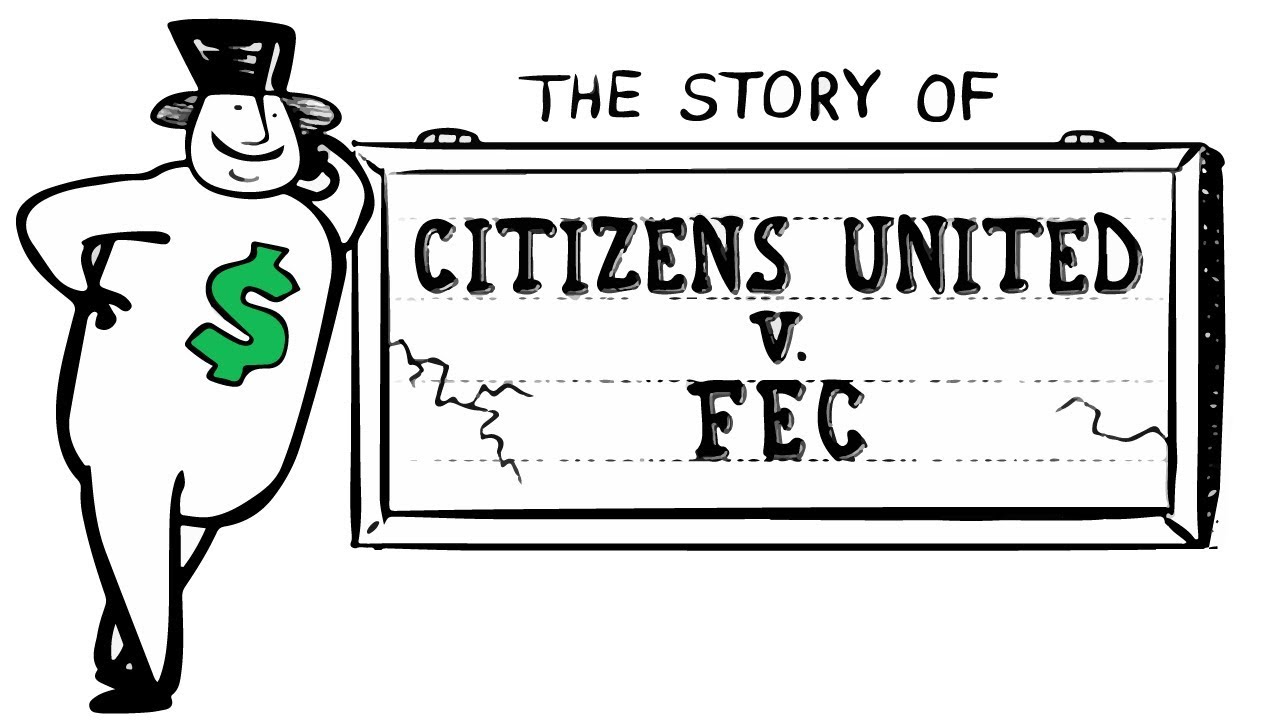
- 2/25/11 The Story of Stuff Project
Return to Contents
Polling
- May 2018 by Voice Of the People and the University of Maryland School of Public Policy’s Program for Public Consultation: “The most significant change—favored by 75% (Republicans 66%, Democrats 85%)—was a [c]onstitutional amendment that would allow Congress and the states to write campaign finance laws that regulate and set reasonable limits on the raising and spending of money to influence elections and to distinguish between people and corporations. This would effectively supersede the ‘Citizens United’ decision and allow legislators to restrict or prohibit corporations and other organizations from spending money to influence elections.” Article.
- September 2015 by Selzer & Company on behalf of Bloomberg Politics: “Unhappiness with the 2010 decision cuts across demographic and partisan and ideological lines. Although the ruling was fashioned by the court’s conservative majority, Republicans oppose Citizens United 80 percent to 18 percent, according to the poll. Democrats oppose 83 percent to 13 percent, and independents, 71 percent to 22 percent. Among self-described liberals, conservatives, and moderates, 80 percent say the decision should be overturned.” Article. Further: “Among other issues polled, campaign finance reform garnered some of the strongest support among Democrats and Republicans. Nearly nine in 10 Americans want campaign finance rules changed so that the wealthy don’t have more influence than those without money.” Article.
- June 2015 by The Wall Street Journal and NBC News: “Asked to rank their top concerns about the upcoming presidential election, one-third of Americans pointed to the sway that companies and wealthy individuals may have over the outcome, more than for any of five other issues tested.” Article.
- May 2015 by The New York Times and CBS News: “Americans of both parties fundamentally reject the regime of untrammeled money in elections made possible by the Supreme Court’s Citizens United ruling and other court decisions and now favor a sweeping overhaul of how political campaigns are financed.” Article. Poll.
- July 2014 by Democracy Corps on behalf of Every Voice: “One option we tested is a [c]onstitutional [a]mendment to overturn the Citizens United ruling. Voters support such an amendment by an overwhelming 73 to 24 percent margin, including majorities in even the reddest states . . . This is broad and deep support on a controversial issue, the kind that we rarely see in our hyper-partisan climate.” Findings also revealed that support for other reforms increases when paired with a constitutional amendment.
- November 2013 by MFour Market Research and Tulchin Research on behalf of Represent.Us: More than seven in ten voters believe that our election system is “biased in favor of the candidate with the most money,” and more than nine in ten think that “it is important that ‘our elected leaders reduce the influence of money in political elections.'”
- May/June 2013 by Hart Research Associates and American Viewpoint on behalf of the Committee for Economic Development: “87% [of business executives] say the campaign finance system needs major reforms or a complete overhaul.”
- April 2013 by the University of New Hampshire Survey Center on behalf of the New Hampshire Coalition for Open Democracy, Free Speech For People, People For the American Way, and Public Citizen: “More than two-thirds of New Hampshire adults . . . think there should be an amendment to the U.S. Constitution that would limit campaign contributions and spending.”
- April 2012 by Opinion Research Corporation on behalf of the Brennan Center for Justice at NYU School of Law: “[T]he 2012 election cycle has given rise to significant, bipartisan fears of corruption and heightened distrust in government.”
- January 2012 by The Pew Research Center For The People & The Press: “[A]mong those who have heard about [Citizens United], comparably wide majorities in each [party] say it is having a negative effect on the campaign this year.”
- December 2011/January 2012 by Lake Research Partners for the American Sustainable Business Council, Main Street Alliance, and Small Business Majority: “Small business owners view [Citizens United] as bad for small business.”
Return to Contents
Toolkits
- American Promise action site, including ways to get involved in restoring democracy with the 28th Amendment: from your computer, in your home, and in your community.
- Democracy For All Amendment – Activist Toolkit, including talking points and ways to get involved that are broadly applicable to the amendment movement
- Money Out, Voters In: A Guide to Democratic Reform, including constitutional amendment advocacy tools among a broad range of “money out, voters in” reforms
- Amending the Constitution for Government Of, By, and For The People
Return to Contents
Frequently Asked Questions
Question: Why have so many different constitutional amendments been proposed? Wouldn’t it be better if everyone were pressing for the same language?
Answer: Right now, as the movement builds for taking the “for sale” sign off of our democracy, one of the most important things we can do is to help educate and mobilize our friends and neighbors — and elected officials — to get involved and take a stand. There are a lot of really good ideas about the best way to amend the Constitution, and continued debate and dialogue on that and other important issues will only help build the momentum. So right now we believe it’s important to focus on our common agreement that America works best when our government is of, by and for the people and that to achieve that end we must amend the Constitution.
Question: What is the process for amending the Constitution?
Answer:An amendment has to be proposed either by a 2/3 vote of both houses of Congress, or else by a constitutional convention convened when the legislatures of 2/3 of the states so request. The amendment has to be ratified either by the legislatures of 3/4 of the states, or by conventions in 3/4 of the states, depending on which means of ratification Congress proposes. All of the amendments to the Constitution, of which there are now 27, were proposed by Congress, and all but one were ratified by state legislatures. The convention route has never been used for proposing an amendment, and was used only once for ratifying an amendment (the 21st, which eliminated Prohibition).
Return to Contents
Other
Here are some more materials from “money out, voters in” allies:
- 6/6/19 People For the American Way PFAW Cheers New Hampshire for Becoming 20th State Urging an Amendment to Overturn Citizens United
- 5/22/18 Open Democracy Action Speaker Ryan and Majority Leader McConnell: Republican Voters Want You to Fix The System
- 5/21/18 Democracy 21 25 Organizations Endorse Essential Democracy Reforms Announced Today by Congressional Leaders
- 12/4/17 American Promise American Promise Launches Project To Write And Vet The 28th Amendment
- 1/23/17 Public Citizen Reform Groups Applaud Reintroduction of the Democracy for All Constitutional Amendment
- 12/1/16 Center for American Progress Americans Demand Democracy at the Polls by Liz Kennedy and Danielle Root
- 2/8/16 People For the American Way PFAW and Allies Release Report on Money in Politics Reform Victories Since Citizens United
- 7/23/15 People For the American Way PFAW and Allies Release Money in Politics Reform Agenda for 2016 Candidates. Allies’ 10/7/15 Letter RE: Agenda in Debate.
- 6/11/15 Public Citizen Pro-Democracy Groups Celebrate Attorney General Approval of Ballot Initiative to Clean Up Elections
- 1/21/15 Democracy Initiative Democracy Initiative Organizations Release Statements on the 5th Anniversary of Citizens United Urging Reform
- 1/20/15 People For the American Way On Eve of Fifth Anniversary of Citizens United, Advocates Reach 5 Million Signatures Calling to Overturn Decision
- 1/20/15 People For the American Way PFAW Edit Memo: The Growing Movement to Defend Democracy Five Years After Citizens United by Marge Baker
- 1/15/15 Demos Top 5 Ways Citizens United Harms Democracy & Top 5 Ways We’re Fighting to Take Democracy Back by Liz Kennedy
- 1/15/15 Food & Water Watch Citizens United 101 by Briana Kerensky and Mitch Jones
- 1/6/15 The Hill Punching above his weight by Megan R. Wilson
- 12/30/14 Atlanta Progressive News APN Releases Atlanta Council Scorecard for 2014 Year-End by Matthew Charles Cardinale
- 12/11/14 Demos Stacked Deck: How the Bias in Our Big Money Political System Undermines Racial Equality by Adam Lioz
- 12/2/14 Common Cause Coalition letter on constitutional amendment to House of Representatives
- 9/16/14 People For the American Way Edit Memo: Constitutional Amendment to Overturn Decisions Like Citizens United Debated in U.S. Senate, 55 Senators in Support by Marge Baker
- 9/11/14 Democracy Initiative Democracy Initiative Partners and Allies Release Statements Following Senate Vote on Democracy for All Amendment
- 9/10/14 Media Matters for America NRO Misinforms On Money In Politics And Proposed Citizens United Amendment by Meagan Hatcher-Mays
- 9/9/14 Daily Kos Three million petition signatures to overturn Citizens United delivered to Congress by Carissa Lovelace
- 9/8/14 Democracy Initiative Democracy Initiative Organizations Release Statements in Support of Democracy for All Constitutional Amendment
- 9/3/14 People For the American Way Groups Ramp Up Pressure on Key Senators Ahead of Citizens United Vote
Return to Contents
===
http://www.rightwingwatch.org/post/richard-spencer-u-s-military-should-have-enslaved-haitians-after-hurricane-instead-of-providing-relief
==
http://www.pfaw.org/
:{
}:
RWW
:{
}:
wiki:
People For the American Way (People For) is a modern liberal progressive advocacy group in the United States.[1][2] Under U.S. tax code, People For the American Way is organized as a tax-exempt 501(c)(4) non-profit organization.
- 1 Purpose
- 2 History
- 3 Scope of activity
- 4 Leadership
- 5 Board Members, People For the American Way
- 6 Board Members, People For the American Way Foundation
- 7 Notable staff
- 8 Coalitions, partnerships, and joint ventures
- 9 Young People For
- 10 References
- 11 External links
Purpose
The "Our Mission and Vision" page on their website[3] states:
People For the American Way is dedicated to making the promise of America real for every American: Equality. Freedom of speech. Freedom of religion. The right to seek justice in a court of law. The right to cast a vote that counts. The American Way.Our vision is a vibrantly diverse democratic society in which everyone is treated equally under the law, given the freedom and opportunity to pursue their dreams, and encouraged to participate in our nation’s civic and political life. Our America respects diversity, nurtures creativity and combats hatred and bigotry.We believe a society that reflects these constitutional principles and progressive values is worth fighting for, and we take seriously our responsibility to cultivate new generations of leaders and activists who will sustain these values for the life of this nation.Our operational mission is to promote the American Way and defend it from attack, to build and nurture communities of support for our values, and to equip those communities to promote progressive policies, elect progressive candidates, and hold public officials accountable.
PFAW has been active in recent years in battles over judicial nominations and on issues including school class size, and actively support such proposals as the separation of church and state, civil rights, voting rights forWashington, DC in the U.S. Congress and equal rights for lesbian, gay, bisexual, and transgendered (LGBT) people and promotion of civic participation.[4]
History
PFAW was founded by television producer Norman Lear (All in the Family, Maude, The Jeffersons, etc.) in 1981 specifically in response to what he felt was the divisive rhetoric of such increasingly influentialtelevangelists as Pat Robertson and Jerry Falwell. Co-founders included Barbara Jordan, Andrew Heiskell, and other leaders from the political, religious, business, and entertainment communities.
Figures such as actress Kathleen Turner and the Rabbi David Saperstein sit on the board of People For the American Way's affiliate foundation, People For the American Way Foundation.
The former presidents of PFAW are Anthony Podesta (1981–1987), Arthur Kropp (1987–1995), Carole Shields (1996–2000), Ralph Neas (2000–2007), and Kathryn Kolbert (2008–2009). Michael B. Keegan is the organization's current president.
Soon after its founding, People For the American Way launched an affiliated 501(c)(3) organization, People for the American Way Foundation, for the purpose of conducting more extensive educational, research activities for left-wing causes.[5] Later, the People For the American Way Voter Alliance was launched as a political action committee, which, as opposed to its sister organizations, has the legal capacity to endorse candidates.
Scope of activity
Located in Washington, D.C., People For the American Way monitors what it characterizes as "right-wing" activities, conducting rapid response, political lobbying, and volunteer mobilization. In addition, the organization's affiliated foundation (People For the American Way Foundation) runs programs designed for voter education and politically progressive infrastructure building. PFAW Foundation programs include Young People For, which identifies, trains, and supports future progressive leaders; the Young Elected Officials Network, which identifies and supports progressive elected officials from around the country who are under the age of 35; and African American Religious Affairs, which mobilizes and supports progressive activism in African American congregations and communities.
Leadership
- Michael Keegan, President
- Nick Ucci, Chief Operating Officer
- David J. Perlman, Chief Financial Officer
- Marge Baker, Executive Vice President for Policy and Program Planning
Board Members, People For the American Way
- John Hall Buchanan, Jr., Baptist preacher and former Alabama Republican U.S. representative
- Howie Klein, Board Member
- Norman Lear, Board Member and Founder
- Carole Shields, Board Member (and former Executive Director)
Board Members, People For the American Way Foundation
- Alec Baldwin, Board Member
- Dolores Huerta, Board Member
- Rabbi David Saperstein, Board Member
- Kathleen Turner, Board Member
- Rev. Tim McDonald, Board Member
Notable staff
- Alisha Thomas Morgan, YEO Network Membership Services Manager and Georgia State Representative
- Andrew Gillum, YEO Network Founder and City Commissioner in Tallahassee, Florida
- Elliot Mincberg, (former staff) Counsel to House Judiciary Committee
Coalitions, partnerships, and joint ventures
PFAW is a member of a number of progressive coalitions surrounding various issues, and it sometimes conducts joint campaigns with other organizations. Some of these partners and projects include:
- Election Protection
- Leadership Conference on Civil Rights
- Fair Taxes for All
- Partners for Public Education
- Emergency Campaign for America's Priorities
- The DC Vote Coalition
- National Coalition Against Censorship
Young People For
Young People For (YP4) is a leadership development program for college students and provides organizational and financial support for social justice work.[6]
References
- :{Jump up:(style="top:-99999px;clip:rect(1px 1px 1px 1px);overflow:hidden;position:absolute !important;padding:0px !important;border:0px !important;height:1px !important;width:1px !important;-webkit-user-select:none"):}:^ OpenSecrets: People for the American Way.
- :{Jump up:(style="top:-99999px;clip:rect(1px 1px 1px 1px);overflow:hidden;position:absolute !important;padding:0px !important;border:0px !important;height:1px !important;width:1px !important;-webkit-user-select:none"):}:^ Encyclopedia of Educational Reform and Dissent, Thomas C. Hunt & James C. Carper & Thomas J. Lasley II & C. Daniel Raisch.(link) 2010, Sage Publications. ISBN 9781412956642
- :{Jump up:(style="top:-99999px;clip:rect(1px 1px 1px 1px);overflow:hidden;position:absolute !important;padding:0px !important;border:0px !important;height:1px !important;width:1px !important;-webkit-user-select:none"):}:^ Our Mission and Vision | People For the American Way
- :{Jump up:(style="top:-99999px;clip:rect(1px 1px 1px 1px);overflow:hidden;position:absolute !important;padding:0px !important;border:0px !important;height:1px !important;width:1px !important;-webkit-user-select:none"):}:^ "Rehnquist's death, and what comes next". Salon. September 4, 2005.
- :{Jump up:(style="top:-99999px;clip:rect(1px 1px 1px 1px);overflow:hidden;position:absolute !important;padding:0px !important;border:0px !important;height:1px !important;width:1px !important;-webkit-user-select:none"):}:^ Glanz, James (March 11, 2000). "Survey Finds Support Is Strong For Teaching 2 Origin Theories". The New York Times.
- :{Jump up:(style="top:-99999px;clip:rect(1px 1px 1px 1px);overflow:hidden;position:absolute !important;padding:0px !important;border:0px !important;height:1px !important;width:1px !important;-webkit-user-select:none"):}:^ "About YP4". Young People For. Retrieved April 5, 2011.
External links
- 501(c)(4) nonprofit organizations
- Church–state separation advocacy organizations
- Civil liberties advocacy groups in the United States
- Government watchdog groups in the United States
- Immigration political advocacy groups in the United States
- LGBT political advocacy groups in the United States
- Legal advocacy organizations in the United States
- Non-profit organizations based in Washington, D.C.
- Organizations established in 1981
- People For the American Way
- Political advocacy groups in the United States
===
http://www.pfaw.org/media-center/publications/william-pryor-unfit-to-judge
==
attacked by
Center for the Study of Popular Culture
:{4401 Wilshire Drive, 4th Floor
Los Angeles, California 90010
www.cspc.org and www.frontpagemag.org}:
:{President/Founder: David Horowitz
Established in: 1988 by David Horowitz and Peter Collier
Finances: $2.9 million (2002 budget)
Employees: 5 (listed on website)
Membership: claims 40,000 supporters
Publications: Front Page Magazine
Affiliated with: Front Page Magazine, Individual Rights Foundation}:
About CSPC:
- CSPC serves as the home for founder David Horowitz's various anti-Left, anti-Democrat Party enterprises, such as the controversial FrontPage Magazine and the legal group the Individual Rights Foundation.
- CSPC sells and distributes pamphlets and information on fighting the Left.
- CSPC also sells right-wing books and heavily promotes David Horowitz's own books. Horowitz titles include: Hating Whitey and Other Progressive Causes, The Hate America Left and The Politics of Bad Faith: The Radical Assault on America's Future.
- CSPC also hosts the "Wednesday Morning Club" which is a forum for right-wingers in the entertainment industry. Guest speakers for the club include: Governor George W. Bush (1999), then Secretary of Defense Dick Cheney, Newt Gingrich, Robert Bork, Representatives Tom DeLay and Henry Hyde, Senators Trent Lott, Bill Frist and Joseph Lieberman, editor of the Weekly Standard Fred Barnes, columnist George Will, and many other pundits and politicians.
- After controversial right-wing columnist Ann Coulter got fired from National Review Online for the radical, anti-Muslim comments she made after the September 11th attacks, David Horowitz's FrontPage Magazine picked up her regular column.
Right Wing Donors:
- CSPC gets regular, generous grants from top right-wing foundations.
- CSPC has received nearly $5 million dollars from the Bradley Foundation alone since 1989.
- CSPC has received donations from all of Richard Scaife's foundations, the Olin Foundation, and the Carthage Foundation.
Quotes from CSPC publications:
"Paradoxically, at the same time, the destructive Left sees in American democracy and the Constitution that created it, a powerful weapon it can use to destroy the system. Consequently — and again somewhat paradoxically — the anti-American Left has directed a significant part of its political energy towards attacks on the American court system and on the Constitution itself." — David Horowitz, "Out of Many, One" November 24, 2003
"Everybody knows — but no one wants to say — that the Democratic Party has become the party of special interest bigots and racial dividers. It runs the one-party state that controls public services in every major inner city, including the corrupt and failing school systems in which half the students — mainly African American and Hispanic — are denied a shot at the American dream. It is the party of race preferences which separate American citizens on the basis of skin color providing privileges to a handful of ethnic and racial groups in a nation of nearly a thousand. The Democratic Party has shown that it will go to the wall to preserve the racist laws which enforce these preferences, and to defend the racist school systems that destroy the lives of millions of children every year." –David Horowtiz, "Challenging the Racist Democrats in California," August 5, 2003
:{
"Most of the groups that adamantly oppose the USA PATRIOT Act are oriented toward worrying more about terrorists' civil liberties than their murderous intentions: The ACLU, People for the American Way, Human Rights Watch."— from "Anti-Patriot Feminists," Chris Weinkopf, Front Page Magazine, July 10, 2003}:
:{
Updated July 2004
}:
- See more at: http://www.rightwingwatch.org/content/center-study-popular-culture#sthash.QClR1mw7.dpuf
===
:{
}:
horowitz ctr attack
:{
}:
May 16, 2005
PFAW Way Out Of Mainstream:
The Associated Press,The New York Times,The Boston Globe, And The Washington Post, All Describe People For The American Way As “Liberal.”(Hilary Roxe, “Critics Say Frist Connecting With Religious Groups For Political Ends,” The Associated Press, 4/23/05; David D. Kirkpatrick and Sheryl Gay Stolberg, “Frist Is Drawing Criticism From Some Church Leaders,” The New York Times, 4/22/05; Charlie Savage, “Ad Wars Mount As Republicans Rea dy Ban On Senate Filibusters,” The Boston Globe, 4/21/05; Michael A. Fletcher, “Anti-’Activist’ Activism,” The Washington Post, 4/15/05)
PFAW Proudly Opposes Internet Porn Filters In Public Libraries. “Supported by the People for the American Way, several Loudoun County, Virginia residents and members are claiming the Loudoun County Library Board’s decision to require all Loudoun County public libraries to install Internet filtering software violates their rights under the First Amendment.” (“First Internet Censorship Case Raises Serious First Amendment Concerns,” Your School And The Law, 5/8/98)
President Of PFAW Ralph Neas: “‘Moral’ Claims Have Been Used To Try To Justify Nearly Every Form Of Discrimination Against Minority Groups ... The Court Has ... Upheld The [Boy] Scouts’ Blatantly Unfair And Unlawful Practice Of Excluding Gay Boys And Men On ‘Moral’ Grounds.” (People For the American Way, Press Release, 6/28/01)
In 2001 “PFAW Compiled And Released Creationism In 2001: A State-By-State Report, Documenting The Concerted Campaign By The Radical Right To Deny Science Teachers The Authority To Teach Their Classes The Most Authoritative Scientific Information About The Origins Of Life.” (People For The American Way Website, “People For the American Way And People For The American Way Foundation: A History,” http://www.pfaw.org, Accessed 7/17/04)
PFAW Called President Bush’s Tax Cuts “Reckless.” (People For The American Way Website, “People For the American Way And People For The American Way Foundation: A History,” http://www.pfaw.org, Accessed 7/17/04)
PFAW Founder Norman Lear And Way Out Of Mainstream:
“PFAW Founder Norman Lear, The Liberal Philanthropist And TV Producer …” (George Rush and Joanna Malloy, “Jacko-And-Chimp Tale,” [New York] Daily News, 3/3/05)
- Lear Has Given $529,655 To Democrats And Democrat-Aligned Groups Since 1989.(The Center For Responsive Politics Website, www.opensecrets.org, Accessed 4/5/05
Founder Of PFAW Norman Lear: School Prayer Is A “Joke.” “I grew up with prayer in schools. It was a joke. We also pledged allegiance to the flag. But when you are six or seven, you cannot do anything by rote without finding funny ways to change it. It grows less meaningful each time. Unless you’re living in an entirely different culture with somebody behind you banging a drum at you. But that’s not America. So prayer in school was a joke.” (Thomas M. Landy, “What’s Missing From This Picture? Television Producer Norman Lear; Interview,” Commonweal, 10/9/92)
PFAW Funds Go Almost Entirely To Democrats:
Between 1998 And 2004, People For The American Way Voters Alliance Gave $478,711 (99.3%) To Democrats And $3,500 (0.7%) To Republicans.
- 2004: $10,000 Total – $10,000 (100%) to Democrats $0 (0%) to Republicans.
- 2002: $154,700 Total – $154,700 (100%) to Democrats $0 (0%) to Republicans.
- 2000: $174,776 Total – $172,276 (99%) to Democrats $2,500 (1%) to Republicans.
- 1998: $139,235 Total – $138,235 (99%) to Democrats $1,000 (1%) to Republicans. (The Center For Responsive Politics Website, www.opensecrets.org, Accessed 7/17/04)
:{===
1/16
}:
Joint Statement by the Brennan Center, Center for Media and Democracy, Common Cause, CREW, Democracy 21, and People For the American Way
Efforts are being undertaken in state legislatures to pass resolutions calling for a constitutional convention to send various constitutional amendments to the states for ratification.
If these efforts are successful, it would result in the nation’s first constitutional convention since the 1787 convention that adopted the Constitution. It also would create the opportunity for a runaway convention that could rewrite any constitutional right or protection currently available to American citizens.
One such effort to establish a constitutional convention involves passing a constitutional amendment to require a federal balanced budget. Another effort involves making sweeping changes in the constitutional structure of our government. Another effort involves passing a constitutional amendment to overturn the Supreme Court’s Citizens United decision.
Our reform groups support various campaign finance reform measures to respond to the Citizens United decision. The groups include: the Brennan Center, Common Cause, Center for Media and Democracy, CREW, Democracy 21 and People For the American Way.
Some of our groups are working to have Congress approve a constitutional amendment to overturn Citizens United. Others are working to develop a new jurisprudence to serve as the basis for upholding campaign finance laws that could be adopted by a new Supreme Court majority.
All of our groups, however, are strongly opposed to a constitutional convention which would put at risk the constitutional rights and protections of all Americans.
The effort to call a constitutional convention to pass a balanced budget constitutional amendment is being led in part by the American Legislative Exchange Council(ALEC), an organization consisting of corporations and conservative state legislators. Advocates of such a balanced budget amendment claim that 27 states already have passed such calls. A major effort is underway in 2016 to obtain the seven more states they believe they need to reach two-thirds of the states, the number required by the constitution to call a constitutional convention.
The effort to call for a convention to overturn Citizens United has been approved in a handful of states. This effort, however, is providing support for the idea that a constitutional convention makes sense when the efforts to obtain a constitutional convention on the balanced budget amendment is within striking distance.
The Constitution provides that Congress “on the Application of the Legislatures of two thirds of the several states, shall call a Convention for proposing Amendments.”
Regardless of any limits that are being placed in the state calls for a constitutional convention, it is widely believed that once a convention is called there is no way to limit the constitutional amendments that the convention can consider and on which they can act.

A USA TODAY editorial (January 6, 2016) has observed that a constitutional “convention is an invitation to constitutional mayhem.”
Harvard Law Professor Laurence Tribe, a leading constitutional scholar, has stated that a constitutional convention could not be limited to a single issue if convention delegates decided to pursue other agenda items. According to Tribe, a constitutional convention would put “the whole Constitution up for grabs.”
Supreme Court Justice Antonin Scalia has said, “I certainly would not want a constitutional convention. Whoa! Who knows what would come out of it?”
Former Supreme Court Chief Justice Warren Burger stated, “[T]here is no way to effectively limit or muzzle the actions of a Constitutional Convention. The Convention could make its own rules and set its own agenda.”
This means that any existing constitutional right and protection could be up for consideration and revision by a convention. This includes constitutional protections for civil rights, civil liberties, voting rights, freedom of religion, freedom of speech and privacy, among others. The role of the courts in protecting the constitutional rights of individuals and minority interests would also be up for consideration and change.
Furthermore, there are no rules on what would happen if and when a convention is called: no rules on how delegates are chosen, how voting occurs at the convention, how money can be spent to choose and influence delegates, or how the convention would operate.
Supporters of a convention argue that any amendment adopted by the convention must be ratified by three-quarters of the states and that this will protect against a runaway convention. However, since 34 states already would have approved the creation of the constitutional convention, this would provide a strong base for obtaining the additional states necessary to reach the 38 states required to ratify any amendment approved by the convention.
Furthermore, if a duly constituted constitutional convention approves one or more constitutional amendments that take away basic constitutional rights or protections, even if the amendments are not ratified by 38 states, this would seriously undermine the legitimacy of these rights and protections.
A constitutional convention would put at risk the constitution our Founding Fathers created and the constitutional rights and protections that exist today. Our groups strongly urge state legislators to recognize the dangers that a constitutional convention poses for the constitutional rights of all citizens and to oppose a call for a constitutional convention.
:{==
}: