MCCONNOL 3 9%
719
SEE MAIN AND 2 FOR OLDER, ALSO TAG
see impeach
see filibuster
SEE CAMPAIGN FINANCE DARK MONEY PRO-CORP THUS GOOD FUNDRAISER
see obstructionist
SEE PACK STACK COURT, LEO SCOTUS SUPERMAJORITY GARLAND FUCKERY ROE CHEVRON DEFERENCE PREZ IMMUNITY
LIE PWR ANY MEANS
omg 9th flipped
official fail on covid then trump impeach, endorse 2024 vs oral hist
see new node mccconnell mafia 420 hub steven law [// manchin rev dr]
see ct judic cap stack/pack,[150 and counting?!] capture 9th circuit, might be in running for worst evil feck ever with gramms and gingrich
---
https://scorecard.lcv.org/moc/mitch-mcconnell
26* 9% life
---
Ailes body count: Nixon, Reagan, Bush 41, Bush 43 [hired cousin called Florida 2000], Phil Gramm (great Recession), Mitch McConnell packed courts, Trump SCOTUS supermajority [Merrick Garland fuckery?] Roe, Immunity, Citizens United /campaign finance reform, impeachment fail led to Trump second term, thus fascist Musk Doge coup; made Murdoch rich? Kingmaker in GOP?
---
still awol sign of life, congressman questioned? 9 14 26
-=-=
-=-=
AN 10 26
'Morally bankrupt': McConnell rips Trump for 'coddling' Russia deals
-=-=
-=-=
WHEELED HIM IN FOR FARM BILL?!
mma
MAHA advocates are rallying against GOP “traitors” who passed the farm bill
Moms Across America founder Zen Honeycutt: “If the Republicans lose the midterm elections … this will be one of the reasons why”
Written by Alyssa Tirrell
Published 09/17/26
This week, the Senate Agriculture Committee passed the farm bill, a policy package that has repeatedly faced opposition from the “Make America Healthy Again” movement.
While the farm bill was being considered, MAHA advocates urged their followers to contact senators to vote “no,” arguing that the bill's language would fail to hold pesticide manufacturers accountable. Following the bill’s passage, advocates expressed frustration with Republican senators, highlighting tensions between a key faction of President Donald Trump's base and the broader GOP prior to the midterms.
This week: MAHA vs. the farm bill
As the Senate Agriculture Committee reconsidered the farm bill, MAHA advocates asked their followers to call senators and urge them not to pass a package that would delay pesticide reviews and cut funding for regenerative agriculture, a pesticide-free farming method.
Several major MAHA accounts, including Moms Across America, Kelly Ryerson (known online as Glyphosate Girl) and Courtney Swan, joined in a September 14 post on Instagram urging their followers to contact five Republican senators — Alabama’s Tommy Tuberville, Iowa’s Joni Ernst, Kansas’ Roger Marshall, North Dakota’s John Hoeven, and West Virginia’s Jim Justice — and tell them to vote “no” on the farm bill.
MAHA activist Alexandra Munoz shared the post and commented, “This bill must be stopped! Don’t let them deregulate pesticides more!” The post was further shared in an Instagram story by MAHA podcaster Alex Clark, and the MAHA Mom Coalition included the call to action in a series of posts critical of the bill.
Zen Honeycutt, founder of Moms Across America, posted a video Tuesday morning encouraging her audience to call their senators to vote “no” on the bill. In an additional video posted the following day, Honeycutt elaborated, “We just want to let them know we will be watching their vote.”
She added, “If the Republicans lose the midterm elections and they are voting — doing things like this, like voting party lines instead of listening to their constituents — this will be one of the reasons why."
On Wednesday, the farm bill passed the Senate Agriculture Committee in a vote along party lines. The stalemate was broken by Sen. Mitch McConnell (R-KY), who has been privately dealing with health issues since at least June and reportedly returned to the Senate in part to break the deadlock.
MAHA advocates responded by expressing frustration, particularly with Republican senators.
Vani Hari (known online as the Food Babe), Munoz, Ryerson, and Swan shared a post condemning the passage of the farm bill. Hari wrote, “What happened with the Farm Bill today is absolutely insulting to the American people. Congress had an opportunity to demand MORE accountability for the chemicals being sprayed on our food.” The caption included a “Traitor list” naming a dozen Republican senators.
Ryerson also separately posted an image of McConnell returning to the Senate with the caption, “Ailing Sen McConnell dragged in from medical leave to VOTE TO DEFUND REGEN AG and POSTPONE GLYPHOSATE REVIEW.”
In a new video, Honeycutt said, “We're very disappointed. I’m going to read the Republicans who voted for the farm bill, which is not what their constituents want.” She also claimed that McConnell “did not have the wherewithal, he was not in mental or physical fitness to be able to do that vote, that should absolutely not be allowed.”
She then read a list of Republican senators who voted to pass the bill, adding, “Folks, the Republicans need to hear from you.”
Recap: MAHA vs. glyphosate
This spring, the herbicide ingredient glyphosate became a particular rallying point for MAHA advocates as the Supreme Court prepared to hear a case that would shield Bayer, the manufacturer of the glyphosate-based Roundup, from liability. As CNBC reported, “The Environmental Protection Agency does not classify glyphosate as a carcinogen and does not require labels to disclose cancer risk, but the World Health Organization’s International Agency for Research on Cancer in 2015 said the chemical is ‘probably carcinogenic to humans.’”
The issue was further charged in March after the Trump administration, which had signed an executive order promoting glyphosate production in February, wrote an amicus brief to the Supreme Court in support of Bayer.
In response, MAHA advocates organized “The People vs. Poison” rally in D.C. on April 27. The protest prompted the House of Representatives to remove language from the farm bill that MAHA figures said would also have shielded pesticide manufacturers from liability. The bill passed the House without the pesticide protections just a few days later, and MAHA celebrated the win.
The victory was short-lived, however. In late June, the Supreme Court decided in favor of Bayer, finding that “that the company can't be sued in state courts because federal regulations have found a cancer link unlikely and do not require a warning label.”
Then, in early August, Senate Republicans voted down a Democrat-led amendment to the farm bill that would have allowed injured parties to file suit against pesticide companies. The legislation then stalled in committee, according to The Hill, thanks primarily to Democratic members who oppose a “provision in the bill that would require states to help cover the cost of Supplemental Nutrition Assistance Program (SNAP) funding.”
//
MAHA moms are taking on data centers
06/10/26
MAHA and wellness advocates sound the alarm after the primary defeat of Rep. Thomas Massie
05/21/26
MAHA is outraged over Supreme Court ruling that shields Monsanto owner Bayer from cancer liability
06/26/26
-=-=
-=-=
VID] AN 26
President Donald Trump's authoritarian rampage over the U.S. in his second term has been enabled by numerous cowards in high places, but as author Jacob Weisberg told The Daily Beast, there are at least eight of the "very worst" cowards who have gone above and beyond in their capitulations.
Weisberg is a reporter and author who appeared as a guest on the latest episode of The Daily Beast Podcast on Sunday, promoting his new book, Profiles in Cowardice. As host Joanna Coles explained, the book explores the "Great Capitulation" across American society in 2025, as numerous powerful individuals and entities caved to Trump's new demands, falling in line and lining his pockets all at once. Weisberg explained that he sought to drill down past "the flacks and flunkies" around the president, finding eight of the worst cowards, including Sen. Mitch McConnell, Chief Justice John Roberts, former Fox host Megyn Kelly, lawyer Brad Karp, Blackstone CEO Stephen Schwarzman, former President George W. Bush, and Dartmouth president Sian Beilock.
Chief among these names, he explained, has been Amazon CEO and Washington Post owner Jeff Bezos.
"I think they all deserve shame, and they're all different stories and interesting stories," Weisberg explained. "But Bezos, in a way, is the paradigmatic example because he was so good in [Trump's first term] as owner of the Washington Post. Trump threatened him, bullied him, pressured him to have the Washington Post be less critical and less aggressive. And Bezos didn't yield an inch. Marty Barron, who was editor of The Washington Post in those years, really paid tribute to him and said, we couldn't have had a better owner... [In Trump's second term] it's a different person. He's on bended knee at Mar-a-Lago, paying $40 million for the Melania Trump documentary from Amazon Prime. You know, Amazon Prime is, like, known for being stingy. This is an absolutely ridiculous price. It's effectively a kind of bribe, a personal bribe, to the president and his wife."
Weisberg further suggested that Bezos's desire to gain government contracts for his space company, Blue Origin, and his ultimate goal of helping colonize space have been one of the main factors driving his capitulation to Trump.
In digging in against Roberts, meanwhile, Weisberg highlighted the 2020 ruling that gave Trump and other presidents sweeping immunities for "official acts" while in office, making it "essentially impossible" to prosecute them once they leave office. He also argued that, in many ways, Roberts probably dislikes Trump immensely, but has been willing to give him favorable rulings because of a deep and genuine belief in unrestricted executive power.
On McConnell, Weisberg argued that the former Senate Majority Leader was "afraid of losing his position inside the party" when he refused to back Trump's second impeachment, for which a conviction in the Senate would have barred him from ever hold office again.
"But if he had held firm to what he had said just after January 6th, he could have had Trump convicted," Weisberg said. "Trump was already out of office or would soon be out of office, and it would have been an easy matter to pass this subsequent vote that would have banned Trump from ever holding public office again, and we would have no second term. And that is on Mitch McConnell."
-=-=
---
he forgot cu
an 7 26
On Friday, a prominent Republican declared Senator Mitch McConnell (R-KY) “one of the greatest villains across America’s 250-year history.” His legacy, it was asserted, will be tied to his role in breaking the Senate’s ability to function.
This is according to Lincoln Project co-founder Steve Schmidt, a longtime GOP insider who has served as a political strategist for the likes of George W. Bush and John McCain. Amid rumors and speculation about the condition of McConnell’s health — who has reportedly been in the hospital for some weeks after being discovered unconscious and receiving CPR, with some saying he may be “brain dead” — Schmidt argues, “The American people are owed candor when one of the most powerful elected officials in the country suffers a grave medical emergency.”
According to Schmidt, Americans cannot trust “carefully curated assurances from political allies whose first instinct is to protect an institution, a party, or a reputation — particularly when those assurances come from people who have no credibility whatsoever. Scott Jennings doesn’t have credibility, and neither do Senate Majority Leader John Thune and his number two John Barrasso from Wyoming,” the three of whom claimed to have spoken with hospitalized McConnell for “20 minutes.”
As Schmidt explains, not only is it highly unlikely that McConnell was capable of having such a conversation, noting that “an 84-year-old who had CPR performed on him before being put in an ambulance has a roughly six percent chance of ever walking out of a hospital,” but Americans have no reason to believe leaders who are unwilling to give a straight answer to who won the 2020 election.
And in this context, writes Schmidt, “the historical verdict on Mitch McConnell’s career is already taking shape. The high court of history is convening. The judgement will be appropriately brutal for service so unpatriotic and selfish. He’s one of the greatest villains across America’s 250-year history. Mitch McConnell destroyed the functioning and integrity of the US Senate, which was once known as the world’s greatest deliberative body. Today, it’s a joke.”
According to Schmidt, “Mitch McConnell was precisely the type of man George Washington warned about in his farewell. He’s done incredible damage to the American republic. He lived his life as a partisan cancer, and here at the end, he’s earned his looming two-word obituary: good riddance. He leaves behind a Senate that’s become a battlefield where power eclipses principle, and procedural warfare has replaced persuasion.”
The turning point, writes Schmidt, came with McConnell’s “refusal to allow Merrick Garland’s nomination even to receive a hearing ... Four years later, his determination to confirm Amy Coney Barrett weeks before a presidential election established a second rule that directly contradicted the first. Many Americans concluded that there were no rules at all. Only power.”
And what’s more, argues Schmidt, “The damage extended beyond the Senate chamber. Public confidence in the Supreme Court suffered enormously as millions came to see the institution not as an independent branch of government, but as another arena for raw political combat. History will remember that, and so will history remember his relationship with Donald Trump. No Republican leader understood Trump’s character more clearly. Few warned more eloquently about it. Yet when confronted with the defining challenge of his political life, Mitch McConnell repeatedly chose accommodation over confrontation.”
“That cowardice will be his epithet, and when he meets the supreme judge of the universe the grace he will need is something he didn’t practice in this life,” Schmidt concludes. “McConnell leaves behind a Senate that is weaker than the one he inherited, a judiciary viewed by millions with deeper suspicion than before, and a political culture in which power too often became an end unto itself. He lived his life as a constitutional vandal who lifted a fascist he despised into a position to wreck the institutions McConnell professed to revere, but really didn’t.”
---
===
Fun fact about Judge Aileen Cannon: She was confirmed by the Senate on Nov. 12, 2020, after Donald Trump had lost the election. McConnell, then the majority leader, confirmed a series of judges in lame duck session, which hadn't happened for an outgoing president in generations.
===
---
AN 2 26
President Donald Trump is crossing “a dangerous line” by attacking the Supreme Court for overturning his controversial tariffs, according to America’s most distinguished organization of lawyers.
“The recent remarks by the president of the United States, leveling personal criticisms against members of the U.S. Supreme Court, are not acceptable and cross a dangerous line that threatens the safety of the judiciary and our judicial process,” declared American Bar Association (ABA) President Michelle A. Behnke in a statement.
“Vigorous debate over policy is a strength of our democracy, but attacks that demean the judiciary are not,” Behnke added. “Incendiary rhetoric has helped contribute to the alarming increase in attacks on and threats to our judges. It must stop.”
The ABA head is referring to Trump’s criticism of the six Supreme Court justices who ruled against his emergency tariff authority, including two jurists — Justices Neil Gorsuch and Amy Coney Barrett — that Trump himself appointed. Deriding them as “fools and lapdogs for the RINOs and the radical left Democrats,” Trump said Gorsuch and Barrett are “an embarrassment to their families. You want to know the truth, the two of them.” He also said the liberal justices were loyal to the Democrats, which he admired, but added that he believes they are a “disgrace to our nation.” The president also claimed those judges were motivated by foreign powers, although did not provide evidence for this assertion.
“Personal attacks against individual justices, particularly allegations that they are influenced by ‘foreign interests,’ are wholly inappropriate,” Behnke criticized Trump in that statement. “Such statements risk undermining the rule of law and the public’s faith in an impartial judiciary, foundational pillars of our democracy that have guided our nation since its founding.”
She added, “The men and women of the Supreme Court, regardless of who appointed them, deserve respect for exercising their duty to interpret the Constitution faithfully and independently. The health of our constitutional system depends on maintaining that independence, free from political intimidation or retribution.”
Perhaps anticipating Trump’s lashing out, Gorsuch explained in his opinion that the president’s seeming desire to bypass the legislature to more effectively achieve his policy goals is dangerous to the American system of government.
“Yes, legislating can be hard and take time,” Gorsuch said. “And yes, it can be tempting to bypass Congress when some pressing problem arises. But the deliberative nature of the legislative process was the whole point of its design. Through that process, the nation can tap the combined wisdom of the people’s elected representatives, not just that of one faction or man.”
In addition to the ABA, one of the most prominent Republicans currently holding elected office also criticized Trump for his words about the Supreme Court. Former Sen. Majority Leader Mitch McConnell (R-Kentucky), who told Trump in a statement that "Congress is not an inconvenience to avoid." The conservative publication The Wall Street Journal similarly argued that Trump’s language was “ugly,” adding that “this is the same Court that ruled Mr. Trump’s way on presidential immunity, which was more personally consequential for this President.”
---
an 2 26
Mitch McConnell's staff abandons him to support Trump - Alternet.org
---
an 10 25
Prominent conservatives are rebuking Kevin Roberts, the head of the Heritage Foundation — the organization behind Project 2025 and self-described “intellectual backbone” of the conservative movement — after he threw his support behind right-wing political commentator and podcaster Tucker Carlson, now under fire for platforming far-right extremist leader Nick Fuentes this week.
The editors of the right-wing National Review in a scathing editorial explained: “Tucker Carlson, knee-deep already, has taken another step into the muck with a friendly interview with Nick Fuentes.”
“The issue isn’t merely that Carlson ‘platformed’ a white-nationalist influencer,” they wrote. “The deeper problem is that Carlson didn’t actually challenge any of Fuentes’s noxious views that he has spelled out quite clearly over the years. Fuentes has engaged in Holocaust denial, called Adolf Hitler ‘really f– cool,’ and said that if his movement gained power, it would execute ‘perfidious Jews.'”
The editors continued: “In his appearance, Fuentes stated that the ‘big challenge’ to unifying the country against tribal interests was ‘organized Jewry in America,’ and he expressed admiration for Soviet butcher Joseph Stalin. He did not receive any pushback from Carlson.”
READ MORE: ‘Disturbing’: Johnson Scorched for Saying He’s Starving SNAP to ‘Pressure’ Democrats
In a video rushing to Carlson’s defense, Roberts declared, “The Heritage Foundation didn’t become the intellectual backbone of the conservative movement by canceling our own people or policing the consciences of Christians. And we won’t start doing that now.”
Instead, he framed the controversy surrounding Carlson and Fuentes as “the robust debate we invite, with our colleagues, our movement friends, our members, and the American public,” while vowing to “always defend truth.”
And Roberts insisted that “we will always defend our friends against the slander of bad actors who serve someone else’s agenda. That includes Tucker Carlson, who remains, and as I have said before, always will be a close friend of the Heritage Foundation.”
He vowed that the “attempt to cancel him will fail,” and said that “canceling” Fuentes is also “not the answer” — before denouncing “the vile ideas of the left.”
U.S. Senator Ted Cruz (R-TX) in remarks made at a Republican Jewish Coalition gathering, said:
“If you sit there and nod adoringly while someone tells you that Winston Churchill was the villain of World War II, if you sit there and nod while someone says, ‘Well, there’s a very good argument that America should have intervened on behalf of Nazi Germany in World War II.’ If you sit there with someone who says Adolf Hitler was very, very cool and that their mission is to combat and defeat global Jewry, and you say nothing, then you are a coward, and you are complicit in that evil.”
READ MORE: Americans Turn Against Trump’s Crime Crackdowns: Report
As Jewish Insider reported, Cruz “did not mention the Heritage Foundation, Roberts, Carlson or Fuentes by name, though he accused anyone who uncritically promotes Adolf Hitler of being ‘complicit’ in spreading virulent antisemitism.”
Jewish Insider also reported that the head of the Republican Jewish Coalition, Matt Brooks, told the news outlet, “I am appalled, offended and disgusted that [Roberts] and Heritage would stand with Tucker Carlson and Nick Fuentes as somehow being acceptable spokespeople within the conservative movement.”
Brooks added, “obviously there’s going to be a reassessment of our relationship with Heritage in light of this.”
U.S. Senator Mitch McConnell (R-KY), the former longtime Republican Leader, responded to Roberts’ video with biting condemnation: “The ‘intellectual backbone of the conservative movement’ is only as strong as the values it defends.”
“Last I checked, ‘conservatives should feel no obligation’ to carry water for antisemites and apologists for America-hating autocrats. But maybe I just don’t know what time it is…”
Right-wing commentator Erick Erickson, in a lengthy rebuke, blasted Roberts (and numerous other targets): “Kevin Roberts could have chosen to criticize Carlson as a friend. Kevin could have chosen silence. Instead, he picked the worst possible option of dismissing very legitimate criticism and did so in the most straw-man possible way.”
“I also know what Kevin Roberts, J.D. Vance, and others are doing as they dance around some of these guys, Erickson wrote. “They want to attract young zoomers to their side, many of them male, and they think the way to do that is to punch back hard at critics, refuse to fold to criticism, and show a high tolerance for inflammatory positions that rile up the left.”
===
an 8 25
'Sound familiar?' Mitch McConnell lobs parting shot at 'America First' Republicans - Alternet.org
AN 725
JUST SPITE AND EGO?
In the past, Sen. Mitch McConnell (R-Kentucky) was a major source of frustration to Democrats. The former Senate majority leader, after the death of U.S. Supreme Court Justice Antonin Scalia in 2016, blocked then-President Barack Obama's nominee Merrick Garland — only to ram through all three of President Donald Trump's nominees for the High Court: Brett Kavanaugh, Neil Gorsuch and Amy Coney Barrett.
Yet McConnell, who stepped down as GOP leader in the U.S. Senate in 2024, is neither a MAGA Republican nor a Never Trumper. Although there is a lot of bad blood between McConnell and Trump and the Kentucky Republican would have much preferred another GOP presidential nominee in 2024, McConnell gave Trump a lukewarm, unenthusiastic endorsement after former South Carolina Gov. Nikki Haley dropped out of the race.
In an article published on July 18, The Hill's Alexander Bolton stresses that McConnell "has emerged as one of the biggest wild cards in the Senate, keeping his Republican colleagues guessing about how he'll vote on elements of President Trump’s agenda."
READ MORE: This jaw-dropping truth about the Supreme Court will make you furious
"McConnell has been largely sidelined from important leadership-level discussions since he stepped down as Senate Republican leader at the end of 2024 after a record-setting 18 years in the post, say Senate colleagues," Bolton reports. " But the crafty veteran senator has used high-profile dissenting votes and carefully timed statements to make his influence felt throughout the Senate GOP conference and to signal when he thinks Trump — and by extension, Trump’s allies in Congress — are moving in the wrong direction. In doing so, he's using his leverage to preserve the values of the traditional GOP establishment in Washington."
At times, Bolton notes, the 83-year-old McConnell has joined GOP Sens. Lisa Murkowski and Susan Collins in voting "no" on bills that Trump favored.
A GOP senator, interviewed on condition of anonymity, told The Hill, "I think it's him being Mitch McConnell as the senior senator from Kentucky, as a leader in the Senate for decades who no longer has the burden of leadership and is just free to be a lawmaker. I think that's what you see in Mitch; I love it."
Tweeting his article on July 18, Bolton noted, "Republican colleagues are trying to decipher Mitch McConnell who has transitioned from longest-serving GOP leader to Senate wildcard. McConnell is throwing curveballs at his leadership and the Trump administration and some GOP senators 'love it.'"
READ MORE:'People are going to be shocked': Backlash predicted for GOP as disaster looms
"Senate Budget Committee Chair Lindsey Graham (R-SC) said he thought McConnell's votes breaking with the GOP leadership were 'more directed at Trump,'" Bolton notes in his article. "A second Republican senator, who requested anonymity to speak on the subject, said McConnell doesn't mind sticking Trump in the eye given their rocky relationship, which hit a low point after McConnell refused to endorse Trump’s claim that the 2020 election was stolen…. In addition to voting to unwind Trump’s tariff on Canada, McConnell voted against Pete Hegseth, Tulsi Gabbard and Robert F. Kennedy Jr., Trump's nominees to head the Department of Defense, serve as director of national intelligence, and lead the Department of Health and Human Services, respectively."
READ MORE:'Unconstrained executive power': George Will slams Trump as 'most statist' president in 'US history'
*Read Alexander Bolton's full article for The Hill at this link.
---
slate
no lnx
On Wednesday, Sen. Mitch McConnell announced that he will not seek another term as leader of the Senate Republicans, stepping down from the post (though not his seat) in January 2025. McConnell will leave a legacy of extreme obstruction, having pioneered new ways to paralyze the upper chamber in an effort to stymie Democratic legislation. He also regularly kowtowed to Donald Trump, even voting to acquit the former president following his impeachment trial over the Jan. 6 insurrection. But McConnell’s most indelible mark on history is likely to be his fixation on stacking the courts with far-right ideologues, thus fundamentally refashioning the federal judiciary in the image of the modern Republican Party.
On a new episode of Amicus, Dahlia Lithwick and Mark Joseph Stern discussed the wrecking ball that McConnell took to the independent federal judiciary and its enduring impact on American democracy and civil rights. Their conversation has been condensed and edited for clarity.
Dahlia Lithwick: Can we talk about Mitch McConnell for a minute? He announced that he’s stepping down as the leader of Senate Republicans in the near future.
Mark Joseph Stern: What was your first reaction when you heard the news?
My first reaction was that I hate this timeline so much. It’s the timeline where we have to miss Rep. Kevin McCarthy because the person who followed him was, as sure as night follows day, vastly crazier. That’s how I feel about McConnell. This is the person who singlehandedly did more to destroy Senate norms of comity and respect, to help Donald Trump evade accountability, and to steal and pack the Supreme Court with people who should not be sitting on the court. And still, in this moment, we’re going to have to thank him for respecting the vestigial norms that he did and not being an utter sociopath each and every day. Because the person who follows him will be worse.
I’ll add that, in my view, no one has done more to destroy the federal judiciary than Mitch McConnell. This is the guy who, under Obama, decided to block as many judicial nominations as possible, for no reason other than to leave the seats open so Trump could come in and fill them. This is the guy who violated every known norm to hold open Justice Antonin Scalia’s seat, ostensibly because it came open in an election year, only to fill Justice Ruth Bader Ginsburg’s seat when people were already voting in the 2020 election. I think he made a lot of Americans wake up and realize that this was all Calvinball, that he had no principles to begin with.
But even more than that, Mitch McConnell was the guy who realized you don’t need to win elections to enact Republican policy. You don’t need to change hearts and minds. You don’t need to push ballot initiatives or win over the views of the people. All you have to do is stack the courts. You only need 51 votes in the Senate to stack the courts with far-right partisan activists like Aileen Cannon and Matthew Kacsmaryk. And they will enact Republican policies under the guise of judicial review, policies that could never pass through the democratic process. And those policies will be bulletproof, because they will be called “law,” and Democrats will need at least a century to win back the courts.
Anyone who believes in an independent judiciary with any integrity should loathe McConnell to their bones.
I want to add that McConnell, for so many reasons, stands out as somebody who knew exactly who Donald Trump was, exactly what happened on Jan. 6, exactly what his responsibility was in that moment. And he didn’t do it. He normalized the idea that you can mumble stuff and do nothing. Then we all live with the consequences. He made it easier for whoever follows him to do even less. And now he’s being praised as some elder statesman? Really? He’s totally morally bankrupt. The only silver lining, Mark, is that whoever follows him will not be as good as him at this crap.
Related From Slate
Jim Newell
Why Mitch McConnell Is Really Stepping Down in November
Read More
I agree. Under Trump, McConnell built the most impressive and efficient judicial confirmation machine ever seen. He really helped to keep the broader Republican Party and conservative movement behind Trump by saying, “don’t worry, we’re still getting all the right judges!” He pushed them through at a record clip. Aileen Cannon, the judge thwarting Trump’s trial over the Mar-a-Lago documents, was confirmed after the 2020 election, when Trump had already lost! This went on right up until the end. And I don’t think his successor will match those heights, even if he or she isn’t quite as loony as we’re speculating. Think about how much Joe Biden and his team have struggled to match the number of confirmations that Trump and McConnell achieved. They can’t do it. We may have passed peak efficiency for judicial confirmations under any president.
But is that anything to celebrate? McConnell’s successor will still scrape and strive to get crazy people on the bench. And sure, they might get 20 percent fewer judges through, because they won’t have the same ruthless efficiency. But Republicans will take that deal, because it only takes one insane district court judge to thwart an entire presidency.
---
an 3 25
No one in the GOP has done more to push the U.S. Supreme Court to the far right than Sen. Mitch McConnell (R-Kentucky), who recently announced that he won't be seeking an eighth term in 2026. After blocking former President Barack Obama's High Court nominee, Merrick Garland, in 2016, the then-Senate majority leader aggressively pushed all three of President Donald Trump's SCOTUS picks: Brett Kavanaugh, Neil Gorsuch and Amy Coney Barrett.
In 2022, Justices Kavanaugh, Gorsuch and Barrett were part of the 5-4 majority ruling that overturned Roe v. Wade after 49 years in Dobbs v. Jackson Women's Health Center. Yet Trump deeply resents McConnell, and vice versa — even though McConnell gave Trump a lukewarm endorsement in the 2024 election.
In a biting opinion column published by The Hill on March 10, journalist Juan Williams argues that McConnell, now 83, has done a lot to bring the United States to the "perilous moment" it faces during Trump's second term — despite all the bad blood between him and Trump.
:{READ MORE:'Investors are starting to play defense' as business class fears 'growing chaos' from Trumponomics
"The bad news for McConnell is that despite his decades towering over Washington as a top GOP leader, he is now eclipsed by President Trump's takeover of his party," Williams says. "Trump has called McConnell 'a dour, sullen, and unsmiling political hack' and warned that Republicans would lose if they remained aligned with him. And Trump issued a racially pointed insult to McConnell's wife. McConnell didn’t fire back."
Williams continues, "The only public shot McConnell ever took at Trump came after the January 6, 2021 riot at the Capitol, saying he was 'morally responsible.' Yet, when it came time to act, he voted to acquit Trump. The weak explanation: 'We have a criminal justice system in this country.' According to the New York Times, at the same time, McConnell told advisers in private: 'The Democrats are going to take care of the son of a b**** for us."
Williams notes that McConnell "tried to regain some dignity by defying Trump with votes against Trump's nominations of Pete Hegseth for defense secretary, Tulsi Gabbard for director of national intelligence and Robert F. Kennedy Jr. for Health and Human Services secretary." But he considers such votes "too little too late."
"Despite a few good votes on bad nominees," Williams writes, "the history books will still highlight McConnell's power plays over the years to polarize the Senate with his hard-right ideological agenda. McConnell can't erase the procedural tricks to block President Obama's judicial appointments, thwarting voters who elected a Democratic president and a Democratic Senate majority to nominate and confirm judges."
:{:{READ MORE:Acting Trump official spread false rumors about 'low-IQ' Marco Rubio}:
According to Willliams, the fact that many Republicans "hate" McConnell "because Trump told them to" doesn't erase his history.
"For the history books," Williams writes, "he will be the main player paving the way for Trump…. McConnell will go down in history not as a statesman, but as the man who brought us to this perilous moment. That's not trashing you, senator. It's simply stating a fact."
---
why dingdog?
Weakened 'ruthless' Mitch McConnell wields minimal influence in 2025 https://www.alternet.org/mcconnell-trump-scotus/)
an 2 25
---
Mitch McConnell benefits from corporate cash. And corporations benefit from him.
Walker Davis and Linnaea Honl-Stuenkel
April 22, 2021
Perhaps more than any other politician, Senate Minority Leader Mitch McConnell has both vigorously defended and benefited from the windfall of large-dollar, often anonymous money flooding elections over the past decade. He has fought in the vanguard of the forces blocking bipartisan reform while helping to raise millions from corporate interests from CEOs, anonymous dark money groups and massive gifts to his allied political committees.
In public, McConnell claims that his advocacy for more money in politics is all about defending free speech, but behind closed doors, he reportedly told other Senators that it is actually about winning elections. Given the massive sums he has helped raise to power both his own campaigns and those of other senators, it is not surprising that he wants to keep the corporate cash flowing — and will use any excuse and any tool at his disposal to do so.
As a legislator, McConnell has championed some of the same industries that have helped him win elections. This mutual dependence means that McConnell needs America’s campaign finance system to stay broken in order for him to hang on to power.
McConnell has welcomed money in politics
Oct 14, 1999
McConnell vocally opposed — and later used the filibuster to block — the bipartisan McCain-Feingold campaign finance reforms which would have limited the ability of corporations to spend on politics.
Mar 27, 2002
A more limited version of their reforms known as the Bipartisan Campaign Reform Act (BCRA) is enacted. McConnell sued the Federal Election Commission to limit the power of the law. He lost in the Supreme Court, but it was only a matter of a few years before the Court, under new Chief Justice John Roberts, began striking down the very rules it had upheld in the McConnell case.
Jun 25, 2007
The Supreme Court ruled in FEC v Wisconsin Right to Life decision, which began rolling back BCRA regulations and opening the floodgates for dark money, which exploded from $6 million in the 2006 election cycle to nearly $103 million in 2008. McConnell submitted an amicus brief in support of WRTL.
Jan 21, 2010
McConnell applauded the Supreme Court’s Citizens United decision, which paved the way for corporations to spend massive sums on politics, saying, “For too long, some in this country have been deprived of full participation in the political process. With today’s monumental decision, the Supreme Court took an important step in the direction of restoring the First Amendment rights of these groups.”
Apr 07, 2021
McConnell spoke out against the For the People Act, which aims to cut down on corporate influence in politics and expand voting rights. He has also criticized it in meetings with Senate colleagues.
Multiple avenues for corporate cash
Corporations can’t legally give to candidates’ campaign committees, but their chief executives can, and McConnell is a top recipient of CEO cash. In the 2020 election cycle alone, he raised more than $250,000 from 37 different Fortune 500 CEOs, more than any other candidate in a competitive race.
Not only has McConnell raised a lot of money from corporate executives, but he may be particularly reliant on them because only a small fraction of his donations come from his constituents in Kentucky. In the 2020 cycle, less than eight percent of donations to his campaign came from his home state.
Super PACs and dark money groups are allowed to raise money in unlimited sums from corporations directly. They can raise unlimited amounts of money from corporations and spend the contributions on elections. McConnell is closely aligned with a super PAC called the Senate Leadership Fund that helps elect Republicans to the Senate.
Elected officials aren’t supposed to solicit large donations to super PACs, but there are ways around those rules. McConnell has reportedly helped raise money for the super PAC. Last year, the group’s president, who is a former McConnell aide named Steven Law, said, “There’s no way we would be where we are financially without Leader McConnell’s disciplined and tireless promotion of our efforts to hold the Senate.” McConnell called the group a “huge help.”
The Senate Leadership Fund relies heavily on corporations for its fundraising, taking in millions from corporate interests each cycle. In the 2020 cycle, it received $6.5 million from the National Association of Realtors, $5 million from the American Petroleum Institute, $4.4 million from Chevron, $2.6 million from Reynolds tobacco, $2 million from Koch Industries, and $1.25 million from Pilot gas stations. Chicken processing company Mountaire gave $500,000 last cycle, its first-ever contribution to the group.
The Senate Leadership Fund’s biggest donor of all last cycle was a sister dark money group, also run by Law, called One Nation. One Nation also spends to back Republican control of the Senate. While One Nation does not reveal its donors, CREW and others have identified five-figure, six-figure, and seven-figure contributions from insurance, health care, and oil interests, respectively. A recently-filed disclosure shows the pharmacy company CVS gave One Nation $1.75 million last year. CVS also gave a matching contribution to the group Majority Forward, an analog dark money group to One Nation that helps elect Senate Democrats.
How McConnell has helped big industries, and reaped campaign cash
From early on in the pandemic, McConnell took the position that Congress should give corporations legal protections when their employees got sick on the job. That was good news to the meat processing industry, whose employees were facing pressure to keep coming to work while sick, in spite of rising cases.
McConnell’s advocacy for liability protections coincided with a jump in the meat processing industry’s financial support. In addition to the $500,000 that Mountaire gave to the Senate Leadership Fund, McConnell’s campaign took in more in donations from the meat processing industry last cycle than any other member of Congress, according to the Center for Responsive Politics. He’d never topped that list before. The last time he was up for reelection, he wasn’t in the top twenty recipients of the industry’s cash, raising less than a third of the $37,000 they kicked in 2019 and 2020.
McConnell raising money from the meat processing industry while going to bat for them on policy is illustrative of the relationship he’s had as a “special friend” to corporate interests that have also included tobacco, coal, and pharmaceutical manufacturers. McConnell has used his position in the Senate to aggressively advocate for traditional corporate priorities like lower corporate taxes and limited regulations. In turn, he’s been a top beneficiary of corporate political spending.
This all shows that while Mitch McConnell defends money in politics with dubious claims of wanting to protect the First Amendment, his own dependence on corporate money is like nothing the founding fathers could have ever imagined.
But it doesn’t have to be this way. Politicians can be accountable to their constituents instead of corporations, and there’s already a bill with the Senate that would be a huge step in that direction. The For the People Act is a significant campaign finance and democracy reform that amplifies the voice of grassroots donors and drags anonymous money out of the dark. If we know anything about Mitch McConnell, it’s that he will try to block the bill using the filibuster, because his political operation depends on limited access to the vote and limitless corporate cash in elections. He can’t be allowed to succeed.
---
Timeline of Senator Mitch McConnell’s Hypocrisy on Corporate America’s Role in Politics
Apr 06, 2021
It’s no secret that Senator Mitch McConnell loves corporations. Whether it’s cutting corporate taxes at the expense of middle and working class families or holding COVID relief hostage because of the lack of corporate carve outs, McConnell has been corporate America’s biggest cheerleader. He’s made it his life work to grant corporations unfettered access and influence over our democracy in return for their financial support. But now, with some corporations opposing Republican efforts to erect barriers to voting, McConnell is having a sudden change of heart about their ability to speak out on public matters.
“After decades of advocating for corporate personhood and speech, Senator McConnell now wants corporations silenced if they’re critical of his party. He knows corporations are not people—that’s why he’s so quick to silence them,”said End Citizens United President Tiffany Muller. “He only considers them ‘people’ when cashing their checks and watching their dark money ads in support of his campaign of voter suppression and gridlock.”
Below is a timeline of McConnell’s comments on corporate speech over the last 25 years:
- “In fact, our country is a seething cauldron of special interests. It is entirely American. It is entirely appropriate. It is exactly what Americans should do, is to ban together to oppose those they don’t like, to support those they do. All of that, of course, should be disclosed and the public should make its own decision.” Roll Call campaign finance reform forum, 16:55, [1/9/97]
- “The terms of art bandied about in the reform debate – spending limits, PAC limits, independent expenditure limits, issue advocacy regulations, soft money – are all euphemisms for speech and participation. These are the means by which Americans participate in our democracy.” Campaign finance reform opposition press conference, 6:16, [3/14/97]
- “With private interests pushed to the sidelines, the only voices lawmakers could be expected to respond to would be the self-appointed tribunes of the public interest. Private interests would end up with minimal influence on the direction of public policy, and the odds of people running toward public sector solutions would increase dramatically.” Office of Sen. Mitch McConnell, [6/15/12]
- “All these efforts are for the purpose of limiting the ability of those engaged in private enterprises – or certain disfavored private groups or associations – to influence the direction of our country by participating in the electoral process. The goal is to hermetically seal off Congress from anyone engaged in the private economy or in certain kinds of advocacy, for that matter, outside the public sector.” Office of Sen. Mitch McConnell, [6/15/12]
- “Now, it’s important to remember that one of the things that makes effective the harassment and intimidation tactics I’ve described is their selectivity. There aren’t exactly a lot of folks running to the ramparts to defend oil company executives and hedge fund managers. But we all need to understand something: the minute we allow ourselves to be convinced that some people stand outside the protections of the First Amendment, we’re all in trouble.” Office of Sen. Mitch McConnell, [6/15/12]
- “But there’s another element to these efforts that’s less widely understood, but that I believe is essential to understanding why it is that liberals have been working so hard to regulate political speech over the past four decades. It involves the great assumption behind all of their campaign finance efforts: that the collision of private interests with politics is somehow inherently corrupting.” Office of Sen. Mitch McConnell, [6/15/12]
- “So all Citizens United did was to level the playing field for corporate speech…We now have, I think, the most free and open system we’ve had in modern times.” The Nation, [8/26/14]
huh? woke corps 2021
:{:{“Our private sector must stop taking cues from the Outrage-Industrial Complex. Americans do not need or want big business to amplify disinformation or react to every manufactured controversy with frantic left-wing signaling…From election law to environmentalism to radical social agendas to the Second Amendment, parts of the private sector keep dabbling in behaving like a woke parallel government. Corporations will invite serious consequences if they become a vehicle for far-left mobs to hijack our country from outside the constitutional order. Businesses must not use economic blackmail to spread disinformation and push bad ideas that citizens reject at the ballot box.” Office of Sen. Mitch McConnell, [04/05/21]}:
---
---
an 12 24
In March, about 100 gathered in Judge James Wynn Jr.’s hometown of Robersonville to throw him a surprise retirement party.
Nine months later, Wynn revealed his own surprise: he’s not giving up his seat on the Fourth Circuit Court of Appeals after all.
In a letter Wynn, 70, wrote to President Joe Biden Friday that was released the following afternoon by Sen. Thom Tillis (R-N.C.) — who rebuked the judge’s decision — he rescinded his January announcement that he would assume senior status, a form of semi-retirement where federal judges hear a reduced caseload and vacate their permanent seat on the court.
“I write to advise that, after careful consideration, I have decided to continue in regular active service as a United States Circuit Judge for the Fourth Circuit,” Wynn wrote. “I apologize for any inconvenience I may have caused.”
Wynn’s decision to remain in active service is the culmination of a monthslong drama over his seat on the bench. Biden named North Carolina Solicitor General Ryan Park as his choice to succeed Wynn, an Obama appointee, in July — and was immediately met with strident opposition from North Carolina Senators Tillis and Ted Budd.
“This nomination is a non-starter and the White House has already been informed they do not have the votes for confirmation,” the senators wrote in a joint statement at the time. “We still hope to work together to find a consensus nominee who can earn bipartisan support and be confirmed.”
The results in the Senate backed up that threat. In a deal to advance a slate of district court nominees, the Biden administration raised the white flag on his four remaining circuit court nominees, all of whom were said to lack the votes for confirmation. Park formally withdrew himself from consideration Thursday, and the following day, Wynn announced his reversal.
Tillis called Wynn’s decision “brazenly partisan” and a “slap in the face to the U.S. Senate” after the deal to hold the seat for Trump to fill. He urged the Senate Judiciary Committee — set to be controlled by Republicans beginning in January — to hold a hearing on the matter.
Carl Tobias, an expert on the federal judiciary who teaches at the University of Richmond, said he was not surprised by Wynn’s decision given the politicized process that prevented Park’s confirmation — Tobias had called Park an “extraordinary nominee” and a “consummate lawyer.”
“Judge Wynn certainly can retract his decision, and he’s done that, and I think partly due to what happened during the confirmation process for his successor,” Tobias said. “Article III judges are independent and they do whatever they need to do.”
The reversal denies Trump the opportunity to name what would have been his fourth appointee to the Fourth Circuit Court of Appeals in a second term where he looks set to reshape the federal courts that cover North Carolina. The court has a roster of 15 active status judges, plus three who are on senior status. Wynn is the second federal judge from the state to “unretire” in the wake of the 2024 election, after Judge Max Cogburn Jr. for the Western District of North Carolina did the same in November.
Since that decision, Cogburn has been the subject of ethics complaints calling into question his integrity and impartiality. The conservative Article III Project submitted a letter to the Fourth Circuit alleging that Cogburn’s decision violated Canons 2 and 5 of the Code of Conduct for United States Judges — which require upholding impartiality and avoiding political activity, respectively.
Such complaints are certain to follow for Wynn from judicial activists on the right. Senate Minority Leader Mitch McConnell said prior to his announcement that should any circuit judge go back on their decision to take senior status, that would warrant “significant ethics complaints.”
“Never before has a circuit judge unretired after a presidential election. It’s literally unprecedented,” McConnell said on the Senate floor. “As I have repeatedly warned the judiciary in other matters, if you play political games, expect political prizes.”
Xiao Wang, a professor at the University of Virginia School of Law who has studied retirements in the federal judiciary, said the precedent Wynn has set could pose challenges to future deals like the one to advance several Biden district court nominees. He said it may also encourage conservative judges to take senior status decisions that appear political, particularly as Trump takes office and seeks to fill as many vacancies as possible.
Wynn is not the first circuit judge to go back on a planned retirement. Judge Robert King, a Clinton appointee who serves with Wynn on the Fourth Circuit, also rescinded his plans to take senior status after Biden opted not to name his preferred successor. Judge Michael Kanne, a Reagan appointee who served on the Seventh Circuit, did the same for similar reasons.
With Wynn choosing to remain on the bench, judicial observers are turning their attention to Judge Jane Branstetter Stranch, 71, who serves on the Sixth Circuit and like Wynn, announced plans to take senior status only to see her planned successor, a former clerk of hers, fail to get a vote in the Senate.
Wang said the backlash to Wynn’s decision, including the ethics complaints he is expected to receive, could serve as a deterrent to other judges considering the same.
“The first one certainly makes it possible that there could be a second one,” Wang said. “Just depending on what the reaction is and if there are any consequences for this.”
---
===
an 11 24
Donald Trump reportedly got a potentially devastating message from Senate GOP leader Mitch McConnell, and political observers are speaking up.
Trump already announced he would be relying on recess appointments to get some of his cabinet nominees pushed through, but McConnellsaid on Sunday that such a thing wouldn't happen, according to a news report.
Trump's controversial nominees include former GOP lawmaker Matt Gaetz, who has been investigated for drug use and allegedly having sex with a minor.
ALSO READ:Why Trump voters should be held accountable for their choice
After McConnell reportedly said, "There will be no recess appointments," social media was overtaken by talk of the upcoming standoff.
Former federal prosecutor Harry Litman said, "Lines are drawn."
"It would be sad as well as disgraceful if the Senate caved on this," he added. "And the stakes go beyond the political, and even the constitutional. It’s an inordinate and unnecessary national security risk."
HuffPost reporter Yashar Ali said, "McConnell will not be Senate Republican Leader soon, but he may be saying this based on conversations with his colleagues."
"The idea that the U.S. Senate will give up its authority on this matter with the flip of a switch is foolish," Ali said. "They’re not going to stop using pro-forma."
Economic advisor Patrick Chovanec said, "McConnell understands this would be the end of the Senate as we know it. Whether he's in any position to stand up against the MAGAs is the real question."
Correspondent Molly Jong-Fast simply said, "Let us pray."
Legal analyst Allison Gill, better known as Mueller, She Wrote, said, "But McConnell won't be the leader. Here's hoping, though."
===
===
leadrship pac end run 11 24 retaliation?
---
an 10 24
Former President Donald Trump's ascendancy and potential election to a second term in the White House is partially due to the moral cowardice of American institutions, according to one columnist.
In a recent column for Bloomberg, journalist Francis Wilkinson wrote that Trump may not be in a position to retake the presidency were it not for people in positions of power failing to stand up to him. He opined that "for every Liz Cheney icily staring down the barrel of MAGA death threats, there seem to be a couple dozen JD Vances sliding belly-first on a stream of pusillanimity."
Wilkinson bemoaned the billionaire owners of newspapers like the Los Angeles Times and the Washington Post cancelling their publications' planned endorsements of Vice President Kamala Harris out of fear of reprisal should Trump prevail in next week's election. He also didn't spare CEOs like JPMorgan Chase's Jamie Dimon, who the New York Times reported was personally voting for Harris but held back from issuing a public endorsement.
READ MORE:Chris Wallace reveals the 'most troubling thing' about McConnell's anti-Trump comments
"Institutional cowardice has enabled and emboldened Trump’s authoritarian assault at every step," Wilkinson wrote. "But Trump still makes his political bones on personal weakness. He has been exploiting fear — scary Black man, no birth certificate — since long before he ran for office."
The Bloomberg columnist pointed out that Trump's 2024 candidacy is primarily defined by fear-mongering about racial and ethnic minorities. He pointed out that the former president's recent rally at Madison Square Garden was largely focused on ginning up fear of immigrants and making his predominantly white and male base feel victimized by the rise of a powerful, successful Black woman like Harris.
"His message is an endless cycle of Who’s More Frightening? Haitians starting a new life in Ohio? Or the trans kid at the local high school trying to make it through another day? Are Black women counting votes more terrifying than library books recounting history? It’s a close call in MAGA world, but the tie goes to the Black runner," he continued.
Wilkinson included a dig at Senate Minority Leader Mitch McConnell (R-Kentucky) for his own cowardice. The outgoing Senate Republican leader recently told a biographer that he viewed Trump as a "sleazeball" and a "narcissist" who had "done a lot of damage" to both the Republican Party and the country. Despite this, McConnell has still pledged to support Trump in the election, and has warned his fellow Republicans that Harris winning the White House would be the GOP's "worst nightmare."
READ MORE:'Done a lot of damage': McConnell unleashes on 'sleazeball' Trump and his supporters
CNN host Chris Wallace has also questioned McConnell's moral compass. He said that the Kentucky Republican's attacks on Trump feel hollow given his promise to still vote for him.
"I'm not at all surprised that McConnell feels that way. He was pretty clear and really for about two or three years after January 6, refused one to meet with Trump or even to say his name in public," Wallace said earlier this month. "What I find most troubling about this is he believes all that. He says all that on the record and some of that in private but he's going to vote for Donald Trump."
Wilkinson reminded readers that voters will have the choice between continuing America's experiment at building a lasting multiracial democracy, or surrendering to autocratic rule. He wrote that Tuesday's outcome boils down to "whether MAGA will be given the chance to vandalize an emerging world that it finds too frightening to join."
"Tuesday’s election is a referendum on national cowardice," Wilkinson wrote. "Weak men have forced the issue, and a strong woman has answered the challenge. Either the US will take a bold step into a multiracial, pluralistic, democratic, courageous future, or it will retreat into cowardly authoritarian chaos."
READ MORE:Mitch McConnell shares GOP's 'worst nightmare' scenario of a Harris-Walz White House
Click here to read Wilkinson's column in full (subscription required).
===
===
AN 10 24
After the January 6, 2021 attack on the U.S. Capitol Building, Sen. Mitch McConnell (R-Kentucky) was furious with then-President Donald Trump.
The Senate GOP leader blamed Trump for the attack. Yet he opposed a "guilty" vote in Trump's second impeachment trial.
McConnell believed that Trump was diminished as a politician. But according to author/journalist Michael Tackett, that turned out to be the "worst political miscalculation of McConnell's career."
READ MORE:[Threatening ‘the enemy within’ with force: Military ethicists explain the danger to important American traditions
In an excerpt from his book "The Price of Power: How Mitch McConnell Mastered the Senate, Changed America, And Lost His Party," Tackett explains, "After the Capitol riot was finally contained on January 6, 2021, Mitch McConnell spoke from the Senate floor in unambiguous terms. The Senate, said the then–majority leader, would do its duty 'by the book,' and not be deterred by the violent mob's attempt at intimidation. McConnell said that the rioters had failed in their attempt to disrupt American democracy."
The journalist/author continues, "The Senate affirmed Joe Biden's election, but the American catechism of a peaceful transfer of power had been sullied. This was a moment of moral clarity for McConnell about the threat of Donald Trump, but not a lasting one. Rather, it was merely a prelude to the kind of contradiction that has marked his time as one of the nation's most powerful leaders."
The claim that January 6, 2021 would end Trump's political career was way off base. Trump is now the 2024 GOP presidential nominee, and polls are showing a very close race between him and Democratic nominee Kamala Harris. McConnell has endorsed Trump, although unenthusiastically.
"McConnell's goal was to preserve a Senate majority," Tackett explains. "He wanted the energy of Trump's voters in Senate races, without the baggage of Trump. He gambled on his belief that Trump would fade from the political stage in the aftermath of the insurrection. Instead, Trump reemerged every bit as strong among core supporters. It was likely the worst political miscalculation of McConnell’s career."
READ MORE:[Leaked memo reveals plan for Trump to skip 'traditional background checks' if elected: NYT
*Read the full except from Michael Tackett's book at this link (subscription required).
Mitch McConnell’s PAC throws Kari Lake under the bus
AN 10 24
===
an 10 24
Senate Minority Leader Mitch McConnell (R-Kentucky) isn't holding back on how he feels about former President Donald Trump and his supporters in his forthcoming biography.
When Associated Press journalist Michael Tackett interviewed the outgoing Senate Republican leader for his book, "The Price of Power," McConnell made several jabs at the ex-president and the GOP at large. CNN reported that the Kentucky Republican called the MAGA movement "completely wrong," and said that two-term Republican President Ronald Reagan "wouldn't recognize" the modern GOP in the wake of Trump's ascendancy.
"I think Trump was the biggest factor in changing the Republican Party from what Ronald Reagan viewed and he wouldn’t recognize today," McConnell said, adding that Trump has "done a lot of damage to our party’s image and our ability to compete."
READ MORE:[Mitch McConnell shares GOP's 'worst nightmare' scenario of a Harris-Walz White House
"Trump is appealing to people who haven’t been as successful as other people and providing an excuse for that, that these more successful people have somehow been cheated, and you don’t deserve to think of yourself as less successful because things haven’t been fair," he continued.
Despite McConnell's attacks on the ex-president, he continues to support him in the November election. Earlier this summer, McConnell urged his fellow Republicans in Congress to unite behind Trump, warning that Vice President Kamala Harris winning the presidency would be Republicans' "worst nightmare." The Senate GOP leader has said that Harris' calls to eliminate the filibuster would signal that "it's over" for Republicans. He argued that if the obstructionist tool was no longer in place that Democrats could grant statehood to Puerto Rico and Washington, D.C., giving them four new Democratic senators "in perpetuity."
After the January 6, 2021 attack on the U.S. Capitol, McConnell condemned Trump from the Senate floor for his attempts to overturn the election. However, when the Democratic-controlled House of Representatives impeached him for the second time, McConnell held off on supporting his conviction in the Senate. His influence could have arguably swayed the result, as multiple Republicans voted with Democrats to convict — which would have permanently prevented Trump from seeking the presidency again.
Still, McConnell insisted to Tackett that he was "not at all conflicted" about Trump's actions on January 6 being "an impeachable offense." He went on to say that Trump "urging an insurrection and people attacking the Capitol as a direct result … is about as close to an impeachable offense as you can imagine, with the possible exception of maybe being an agent for another country."
READ MORE:[McConnell warns GOP 'it's over' for Republicans if Harris wins and kills Senate filibuster
"I don’t know whether you can make a conclusive argument that he’s directly responsible for them storming the Capitol, but I think it’s not in dispute that those folks would not have been here in the first place if he had not asked them to come and to disrupt the actual acceptance of the outcome of the election," he added.
CNN further reported that the outgoing minority leader called the former president a "sleazeball" and a "narcissist," as well as "stupid" and "ill-tempered." He went on to describe the 2024 GOP presidential nominee as "not very smart, irascible, nasty, just about every quality you would not want somebody to have."
Despite McConnell's critique, he was instrumental in confirming hundreds of Trump's nominees to the federal judiciary, including Supreme Court Justices Amy Coney Barrett, Neil Gorsuch and Brett Kavanaugh. And according to FiveThirtyEight, he voted in line with Trump's policies more than 91% of the time.
Click here to read CNN's report in full.
READ MORE:[Chris Wallace reveals the 'most troubling' thing about McConnell's anti-Trump comments
===
===
10 24 an
oral hist string of invective but then said lindsay and jdv said worse all on same team now
Chris Wallace reveals the 'most troubling' thing about McConnell’s anti-Trump comments
===
3 24 announce quit spkr but not seat?
---
an 9 24
McConnell warns GOP 'it’s over' for Republicans if Harris wins and kills Senate filibuster
'These people should read a book': GOP derided as 'absolute clowns' after booing McConnell at RNC an 7 24
===
an 6 24
Outgoing Senate Minority Leader Mitch McConnell (R-Kentucky) is not only losing his post as the leader of the Senate Republican Conference when the next Congress gavels in — he might also completely lose control of his prized fundraising operation.
According to the Hill, a growing number of Senate Republicans are going public in their opposition to McConnell's Senate Leadership Fund (SLF), which he has deployed for more than a decade to inject millions of dollars into Senate races across the country. Sen. Josh Hawley (R-Missouri), who is running for reelection this November, was particularly outspoken in his opposition to McConnell threatening to spend money against current members of the conference who supported Hawley's bill to rein in corporate campaign contributions to super PACs.
"I think the idea that a leader would use outside money, much of it dark money, to try and intimidate or threaten members of the caucus is frankly corrupt," Hawley told the Hill. "And I think it’s a corrupt practice that has gone on for far too long, and it needs to end."
READ MORE:McConnell says GOP shouldn't 'get too excited' about chances of winning Senate
Data from campaign finance database Opensecrets shows that the SLF is one of the heaviest hitters in Washington, with more than $724 million in outside spending on record since the 2000 election cycle. Much of that spending has come in recent cycles, with the SLF spending more than $246 million in the 2022 campaign cycle alone.
The Kentucky Republican recently reminded fellow GOP senators that the SLF — which is currently run by McConnell's former chief of staff Steven Law — has been instrumental in helping members win elections. In a recent meeting, McConnell reportedly read aloud the names of senators whose campaigns have directly benefited from the SLF's spending, like Sen. Eric Schmitt (R-Missouri), who has also backed Hawley's bill.
As Senate Republicans debate who will be their next leader, one major departure from McConnell's time as the caucus chair is the insistence of term limits. That has been a key component of Sen. Rick Scott's (R-Florida) campaign for GOP leader, who has pushed for members of the Senate Republican Conference's rank-and-file to have more say in legislative negotiations. McConnell pushed back strongly against that idea, warning Republicans that weakening the power of leadership could result in the same brand of chaos currently plaguing House Republicans.
Sen. Thom Tillis (R-North Carolina), who is considered one of McConnell's key allies in the Senate GOP conference, argued in a recent letter to his colleagues that it's "important that we consider proposals to strengthen not weaken the Republican Conference leader position when we fully engage in this discussion this fall," adding that Senate Majority Leader Chuck Schumer (D-New York) has been able to wield a significant amount of power and influence due to both the powers of leadership and the unity of his caucus.
READ MORE:Longest-running Senate majority leader delivers impassioned plea against term limits
One unnamed Senate GOP aide speaking anonymously to the Hill said Tillis' letter was "clearly was a McConnell-driven response."
"Tillis is seen as like, McConnell’s axe man in some ways," they said.
Aside from Scott, other candidates for Senate GOP leader include Sens. John Cornyn (R-Texas) — who served as Senate Majority Whip between 2015 and 2019, and current Senate Minority Whip John Thune (R-South Dakota). Republicans will decide on their next leader this November.
Click here to read the Hill's report in full.
READ MORE:'McConnell completely blew this': GOP leader hemorrhaging support after border bill fail
---
---
an 5 24 post verdict
as supporters of Donald Trump flood right-wing platforms with threats against the jurors and judge following guilty verdicts Thursday in his criminal case regarding hush money payments, fears are growing that the influence the Republican presumptive presidential nominee has over his supporters will soon lead to violence.
"Until and unless he accepts the process, the extremist reaction to his legal troubles will be militant," Jacob Ware, a research fellow at the Council on Foreign Relations, toldReuters.
The former president gave no sign of accepting the legal process Friday as he held a press conference at Trump Tower, repeating claims that the case had been "rigged."
Shortly after a New York jury announced its verdictin the case regarding documents that were falsified to cover up payments made to adult film star Stormy Daniel just before the 2016 election to keep her from publicizing an alleged sexual encounter she had with Trump, right-wing websites like Gateway Pundit, Truth Social, and Patriots.Win saw an uptick in violent posts from users.
READ:The GOP has chosen hell over America — and there should be no coming back from it
One commenter called for "someone in NY with nothing to lose" to "take care of" New York Supreme Court Justice Juan Merchan, while another on Gateway Pundit directed a threat at any and all opponents of Trump.
"Time to start capping some leftys," said the user. "This cannot be fixed by voting."
The reaction is a direct result, said Ware, of Trump's "insistence that he is being mistreated."
Trump responded to the verdict on Thursday by telling reporters he is "a very innocent man" and calling the trial—one of four criminal cases against him—"a disgrace." He is expected to appeal the verdict. On Friday morning, the Trump campaign announced a $35 million fundraising haul following the guilty verdict.
Some Trump supporters signaled they are waiting for instructions from the former president, who is the presumptive Republican nominee for president in the November general election and is set to be formally nominated days after his scheduled sentencing in July.
On Patiots.win, one commenter called for 1 million armed Trump supporters to "go to Washington and hang everyone," while another said the former president "should already know he has an army willing to fight and die for him if he says the words...I'll take up arms if he asks."
While Republican lawmakers have not explicitly endorsed a violent reaction to the verdict that found Trump guilty of 34 felony counts, many have joined Trump in making clear that they don't accept the trial's outcome.
Sen. Susan Collins (R-Maine), who has said she would not endorse Trump in the 2024 election, saidManhattan District Attorney charged Trump for politically motivated reasons and falsely claimed that he campaigned on prosecuting the former president.
Senate Minority Leader Mitch McConnell (R-Ky.) said the "charges never should have been brought in the first place," while House Speaker Mike Johnson accused the Biden administration of the "weaponization of our justice system."
Progressives agreed with Trump on one point Friday, after he pledgedthat the hush money case is "long from over" and said that "the real verdict is going to be November 5" when U.S. voters go to the polls in the general election.
While celebrating that a jury of "everyday people" held the former president accountable and proved that "despite his worst efforts, Trump is not above the law," People's Action executive director Sulma Arias saidDemocrats "must beat him at the ballot box" to keep him from further eroding U.S. democracy, climate action, and other progressive values.
===
an 3 24
Earlier this week, CNN reported that the Judicial Conference of the United States announced a new rule that would that would shut down "judge shopping" — a tactic conservative attorneys general and conservative litigants have used to file challenges against liberal policies and laws.
The new policy requires federal district courts to "randomly assign a judge to a lawsuit if the suit aims to block any federal or state law, executive order or regulation," the Hill reports.
"I’m really proud that we did this," 6th Circuit Chief Judge Jeffrey Sutton said in response to the announcement.
READ MORE:**Judiciary enforces new policy restricting GOP from using 'judge shopping' to block Dem policies**
However, according to the Associated Press, two days later, Senate Minority Leader Mitch McConnell (R-KY) condemned the move "on the Senate floor and joined with two other GOP senators to send letters to a dozen chief judges around the country suggesting they" ignore it.
In a Sunday, March 17 op-ed published by MSNBC, University of Texas School of Law professor Steve Vladeck points out the hypocrisy in not only McConnell's — but US Senator John Cornyn's (R-TX) and Thom Tillis' (R-NC) — opposition to the rule, too.
"So why are these three Republican senators so upset by the proposed reform?" Vladeck asks. "The answer is obvious: because it will make it harder to guarantee that specific judges will hear specific lawsuits — whether individual Republican appointees hearing challenges to Democratic policies, or vice versa."
Vladeck writes:
Plaintiffs have increasingly taken advantage of these 'single-judge' divisions to steer nationwide federal policy challenges to specific, ideologically sympathetic judges. For example, the nationwide challenge to the Food and Drug Administration’s approval of mifepristone (one of two drugs used in the most common and safest abortion procedure) was filed in Amarillo, Texas — not a courthouse with any specific connection to mifepristone, but one in which it had a 100% chance of being assigned to a certain Trump-appointed district judge, former anti-abortion advocate Matthew Kacsmaryk. Kacsmaryk remarkably, if predictably, ruled against the FDA’s approval of the drug — an approval that occurred 23 years ago.
READ MORE:**Study cited by Texas judge in abortion pill case retracted**
Another example the Just Security blog co-founder notes:
A nationwide challenge to Biden administration efforts to combat social media disinformation was filed in Monroe, Louisiana — where it had a 100% chance of being assigned to Trump-appointed U.S. District Judge Terry Doughty. And the state of Texas, which has filed 37 different lawsuits in Texas district courts challenging Biden administration policies*, has filed a majority of them in single-judge divisions — and none in Austin (where the Texas government is actually located) or Houston or Dallas or … you get the point.
Vladeck emphasizes, "The charge from McConnell, Cornyn and Tillis that the Judicial Conference is engaged in 'partisan' behavior rings more than a little hypocritical. The whole point of the proposal is to reduce the appearance of partisanship on the part of the federal courts."
READ MORE:[GOP represents 'most significant threat to basic constitutionalism since Civil War': historian
*Vladeck's full op-ed is available [at this link.]
Mitch McConnell destroyed by hometown newspaper for bowing down to Trump - Alternet.org
kindA FEEBLE LATELY, FROZE?
---
an 1 24
gop # get worse with time?!
46 GOP senators sign SCOTUS brief downplaying Trump’s role in January 6 insurrection
President Donald J. Trump, joined by Senate Majority Leader Mitch McConnell and Senator Roy Blunt, R-MO., speaks with reporters prior to attending a Senate Republican lunch Tuesday, March 26, 2019, at the U.S. Capitol in Washington, D.C. (Official White House Photo by Joyce N. Boghosian)
Carl Gibson
January 18, 2024
All but three members of the Senate Republican Caucus have signed an amicus brief to the Supreme Court of the United States (SCOTUS) urging the Court to strike down the Colorado Supreme Court's disqualification of former President Donald Trump from the state's GOP primary ballot.
The brief — which was also signed by 130 House Republicans — argued that Trump's disqualification "tramples the prerogatives of members of Congress," which they say include "the enforcement and (if necessary) removal of Section 3 [of the 14th Amendment]’s 'disability' on holding office."
"Congress—not any state court—plays a vital role in regard to [the insurrection clause]," the brief read. "It is Congress that must pass implementing legislation authorizing enforcement of Section 3."
"[T]his Court should conclude that Section 3 determinations fall within the 'political question' doctrine because they are so clearly committed by constitutional text to another political branch, i.e., Congress," the amicus brief continued. "Under current law, Congress has implemented Section 3 only in the narrow context of requiring a criminal conviction for 'rebellion or insurrection,' and provided that those found guilty 'shall be incapable of holding any office under the United States.'"
While the question of whether a presidential candidate can only be disqualified under Section 3 of the 14th Amendment will ultimately be decided by SCOTUS, the actual text of the insurrection clause doesn't explicitly say enforcement only comes after Congress votes. Rather, the clause — which prevents anyone who has "engaged in insurrection or rebellion" against the US or who has "given aid or comfort to the enemies thereof" from holding any "civilian or military" office — only states that disqualification can be reversed by a two-thirds vote from both the House and Senate. Even if all signees of the brief voted to exempt Trump from the insurrection clause, it would still fall well short of the two-thirds threshold laid out in the US Constitution.
Notably, the brief also minimizes the former president's role in the January 6, 2021 US Capitol riot, with the brief falsely asserting that Trump "quickly" asked for peace and encouraged "disbandment" of the riot even though he watched events unfold over the course of several hours before telling his supporters to go home. The brief even quoted George Orwell's dystopian novel 1984 to describe the actions of "enterprising state officials" trying to disqualify Trump as an example of the statement "peace means war."
The only GOP senators to not co-sign the brief were Sens. Bill Cassidy (R-Louisiana), Susan Collins (Maine) and Lisa Murkowski. Notably, Senate Minority Leader Mitch McConnell (R-Kentucky) co-signed the brief despite condemning Trump's actions on January 6.
===
11 23 an
Tuesday, December 5, Democratic and GOP senators attended a closed-door briefing in which President Joe Biden's request for military aid to Israel and Ukraine was discussed. But according to NBC News reporters Frank Thorp V, Kate Santaliz and Lori Rampani, the briefing did not go well.
The briefing's leaders included, among others, Defense Secretary Lloyd Austin and Secretary of State Alejandro Mayorkas as well as Gen. Charles Q. Brown Jr., chairman of the Joint Chiefs of Staff. Senators who attended were invited to ask questions about Biden's request.
But according to Thorp, Santaliz and Rampani, the "heated" briefing "fell apart" when "Republicans began asking about the" U.S./Mexico border.
"GOP members in both chambers have demanded serious changes to immigration policy to address rising migrant crossings in exchange for passing new aid for Ukraine," the NBC News reporters explain. "They didn't like what they heard."
Sen. Lindsey Graham (R-South Carolina) told NBC News there was "a lot of tension in the room." And Sen. Josh Hawley (R-Missouri) complained that Senate Majority Leader Chuck Schumer (D-New York) didn't want to "talk about the border."
Sen. Kevin Cramer (R-North Dakota) told reporters, "People got up and walked out, because this is a waste of time."
Schumer, however, complained that the briefing "was immediately hijacked by" Senate Minority Leader Mitch McConnell (R-Kentucky), who asked Sen. James Lankford (R-Oklahoma) to discuss the border.
READ MORE:[Mitch McConnell’s Ukraine policy puts him 'on a collision course' with House Speaker Johnson: report
Schumer said of McConnell, "The first question, instead of asking our panelists — he called on Lankford to give a five-minute talk about the negotiations on the border. And that wasn't the purpose of the meeting at all…. One of them started — it was disrespectful — started screaming at one of the generals and challenging him to why he didn't go to the border."
READ MORE:[Vivek Ramaswamy implies Hunter Biden is reason behind US aid to Ukraine: report
*Read NBC News' full report at this link.
an 10 22 comm dr
In addition to threatening cuts to Social Security and Medicare, congressional Republicans are reportedly plotting to use the debt ceiling and an end-of-year clash over government funding to target popular climate investments approved in August as part of the Inflation Reduction Act.
The Washington Post reported Tuesday that "while some Republicans do favor brinkmanship over Medicare and Social Security... some aides and analysts think the GOP may be more likely to demand changes to other Democratic priorities."
"GOP leaders have discussed using the debt limit and government shutdown fights to press for cuts to clean energy spending," the Post noted. "Republicans are also eyeing demands for the administration to slow or reverse its plans to ramp up Internal Revenue Service enforcement of the nation's tax laws, although the GOP planning is preliminary and expected to evolve."
Allying with the oil and gas lobby, Republicans in the House and Senate unanimously opposed the Inflation Reduction Act, which includes nearly $370 billion in climate investments aimed at helping the U.S. transition to renewable energy and meet its emission-reduction targets.
Senate Minority Leader Mitch McConnell (R-Ky.), who is hoping to take the majority gavel next year, derided the historic investments as "green boondoggles" while House Minority Leader Kevin McCarthy (R-Calif.) called them "socialist scams."
In recent weeks, Republicans have openly floated the idea of using a fight over the federal borrowing limit—which must be raised to prevent a disastrous default—as leverage to secure concessions from Democrats, including Social Security and Medicare cuts.
Another potential opportunity for Republicans could come in mid-December, when a recently passed government funding bill is set to expire.
Top Republicans, including McCarthy, have made clear that they intend to take advantage of those opportunities if they win control of the House or the Senate in the November 8 midterms.
"If Republicans take over Congress, they plan to hold the government hostage and ransom our future," warned Dave Willett, a spokesperson for League of Conservation Voters.
[twt]
it's not clear which specific green energy provisions of the Inflation Reduction Act the GOP intends to target. E&E News reported last month that "some are eyeing provisions... like the electric vehicle tax credit" and "mineral sourcing requirements."
Sen. Mike Crapo (R-Idaho), the top Republican on the Senate Finance Committee, told the outlet that he believes the GOP will "try to unwind a number of the bad policies that were enacted."
Democrats, meanwhile, are facing growing pressure to diffuse GOP threats by either raising or eliminating the debt ceiling, an arbitrary restriction on the amount of money the Treasury Department can borrow to meet its obligations. The federal government is projected to reach the current $31.4 trillion borrowing limit at some point next year.
A group of House Democrats led by Rep. Brendan Boyle (D-Pa.) is calling on the Democratic leadership to act during the upcoming lame-duck session to "permanently undo the threat posed by the debt limit."
The Post noted Tuesday that "some Democrats have advanced legislation to effectively eliminate the debt ceiling by raising it to an impossibly high number, such as googolplex."
"Using the budget process known as reconciliation would make that move possible with only Democratic votes, bypassing a GOP filibuster in the Senate, but Biden's opposition appears to at least for now have put an end to those efforts, which would likely face opposition from centrist Democrats," the newspaper added.
During a speech late last week, Biden warned that Republicans are "determined to hold the economy hostage" to secure Social Security and Medicare cuts.
While the president vowed to oppose any cuts to the key programs, he also rejected calls to support debt ceiling repeal—a proposal backed by Treasury Secretary Janet Yellen.
Sen. Bernie Sanders (I-Vt.), chair of the Senate Budget Committee, said in an interview Sunday that he too opposes repealing the debt limit entirely but stressed the importance of lifting the ceiling to avert economic disaster.
"You have to increase the debt ceiling," Sanders told CNN's Jake Tapper. "What Republicans are basically doing—and I hope everybody understands this—they are saying, 'Look, we are prepared to let the United States default on its debt, not raise the debt ceiling, unless you talk about making cuts.'"
"You know what they're talking about? Cuts in Social Security, Medicare, and Medicaid," Sanders added. "Is that irresponsible? It is absolutely irresponsible. You don't use the debt ceiling to do that."
an comm dr
Proponents of democracy responded with disgust Thursday after Senate Republicans filibustered the popular DISCLOSE Act, which seeks to expose the super-wealthy donors who are spending unlimited amounts of undisclosed money to ensure that the U.S. government advances their interests at the expense of the vast majority.
As Sen. Sheldon Whitehouse (D-R.I.), author of the defeated legislation, said in a Wednesday floor speech, the bill's goal is to prevent corporations and billionaires from using dark money loopholes to "spew bile and slime" into the nation's political system.
After all 49 of his GOP colleagues in attendance voted to prevent debate on the legislation endorsed by President Joe Biden, Whitehouse released a statement slamming right-wing lawmakers for fighting to preserve "dark money's poisonous influence over American democracy."
"Today, Senate Republicans stood in lockstep with their megadonors and secretive special interests to protect the most corrupting force in American politics—dark money," said Whitehouse, a senior member of the Senate Judiciary Committee. "The American people are fed up with dark money influence campaigns that rig their government against them and stymie their priorities."
Whitehouse was far from alone in condemning the GOP.
"Once again, Senate Republicans sided with special interests and dark money—and against honest and transparent political debate,"Sen. Patty Murray (D-Wash.) tweeted. "Instead of voting for the DISCLOSE Act and cracking down on the dark money in our democracy, Republicans blocked it. Shameful."
Michael Sozan, a senior fellow at the Center for American Progress, said in a statement that "at a time when the guardrails of our democracy are undergoing a severe stress test, it's lamentable that the Senate minority continues to give corporations, wealthy special interests, and foreign entities the ability to secretly spend vast amounts of money to influence election outcomes."
Trevor Potter, president of Campaign Legal Center, added that the failure "to advance, or even allow debate on, the Democracy Is Strengthened by Casting Light On Spending in Elections (DISCLOSE) Act... disappoints those of us who have been fighting against the influence of secret spending."
"More importantly," he continued, "it deprives voters of important information about who is attempting to influence their vote and allows corruption to prevail by permitting special interests to continue anonymously rigging the system in their favor."
"It is past time for Congress to enact legislation that bolsters transparency requirements and fulfills voters' right to know who is spending on election influence—a right that has repeatedly been upheld by the U.S. Supreme Court, even as the court has struck down other campaign finance and election-related laws," said Potter.
The ability of the nation's wealthiest individuals to translate their disproportionate economic power into political clout has increased exponentially since the Supreme Court's 2010 Citizens United decision eliminated effective limits on campaign contributions.
As Whitehouse's office noted, "Dark money in particular has skyrocketed despite the Supreme Court, by an 8 to 1 margin inCitizens United,upholding disclosure requirements as a means for citizens and shareholders to hold elected officials and corporate spenders accountable."
According to the Rhode Island Democrat, "Dark money political spending went from under $5 million in 2006 to more than $1 billion in 2020. Billionaire political spending increased by a factor of 70, from $17 million for the 2008 election to $1.2 billion for 2020."
Among other things, the DISCLOSE Act would require "organizations spending money in elections—including super PACs and 501(c)(4) dark money groups—to promptly disclose donors who have given $10,000 or more during an election cycle," his office explained. "In addition to election disclosure requirements, the bill requires groups that spend money on ads supporting or opposingjudicial nominees to disclose their donors."
[twt kickass]
"The DISCLOSE Act would shine a light on special interest spending to neutralize its toxic effect, giving Americans' voices a chance to be heard," said Whitehouse. "Republicans heeded the wishes of dark money donors today, but the fight to pass this bill isn't over."
Given the GOP's unified opposition to the legislation, passing it requires that Senate Democrats abolish the upper chamber's 60-vote filibuster rule—a move corporate Democrats like Joe Manchin of West Virginia and Kyrsten Sinema of Arizona have refused to support.
"Holding a vote on the DISCLOSE Act without pushing to end the filibuster highlights the fundamental flaw with Democrats in Washington: Their rhetoric and warnings about dark money have always been spot-on, but they have failed to take the actions necessary to actually stop the flow of secret cash distorting and corrupting American politics," The Lever reported earlier this week. "Meanwhile, the party has become increasingly reliant on these same dark pools of cash to help elect more Democratic lawmakers."
an me 9 22
A legal analyst recently explained why Americans should not expect much from judges currently on the 11th Circuit Court of Appeals that were appointed by former President Donald Trump.
On Saturday, September 17, attorney and legal analyst Elie Mystal appeared on MSNBC News' "The Cross Connection" where she weighed in on the U.S. Department of Justice's investigation into Trump and the documents confiscated from his Mar-a-Lago estate by the Federal Bureau of Investigations (FBI).
Since Florida Judge Aileen Cannon's appointment of a special master to review the confiscated documents, Myskal insists the possible outcome still appears to be a mystery due to six of the judges being appointed by the former president.
READ MORE: Political analysts explain why Trump may believe a 2024 presidential run could quell his legal woes
During the interview, Myskal spoke with MSNBC's Tiffany Cross, Trump may have the advantage of achieving favorable outcomes in each case being overseen by judges he appointed.
"The DOJ is no longer appealing fighting a special master and they are only asking for a small stay for part of the order. What do you think the DOJ's play is here? What is the reasoning behind that?," host Cross asked.
"They're realizing that the 11th circuit is also infected with Trump judges, right?" Mystal exclaimed. "Aileen Cannon, this district judge was making these horrible, biased corrupt decisions, she was appointed by Trump and confirmed nine days after he lost the election."
He went on to explain why the sitting judges are problematic. "The six judges on the 11th Circuit are Trump judges," he continued. "That is a huge problem. A third of the Supreme Court was appointed by Donald Trump. Every one of the 234 or so judges that Trump appointed is suspect."
According to Myskal, the judicial makeup Trump left behind serves as a threat to the United States' democracy.
"We have to start understanding that these are 234 land mines that Trump left behind in order to potentially blow up our democracy down the road," he explained. "These people serve for life. I have said on this program and many programs that one of the key reasons that Trump is not already in jail is that he keeps finding people who are willing to lie, cheat, and debase themselves for him."
"Aileen Cannon is just the latest person who is willing to debase herself, her profession,and her office in service of Donald Trump," Mystal insisted. "So he found another one. And he might find some more on the 11th Circuit. he might find some more on the Supreme Court."
"The DOJis trying to navigate that reality and all I'm trying to say is to get people to understand that reality; that is not new. People who now say the 11th Circuit may be more reasonable, again, you can't count on that. You have to treat every single Trump appointee as suspect until proven otherwise."
Watch the full discussion below or at this link.
https://www.alternet.org/2022/06/progressives-blueprint-unpack-mcconnells-court/
an edit bd 8 22
What would the American republic look like if, one day, the fascists just disappeared? What could we accomplish if the people most hostile to bargaining were not stabbing democracy in the back?
It would look like the Democratic Party.
The Democrats, as I have said before, represent the full spectrum of legitimate partisan politics. Along with a handful of Republicans, no Democrat would dare cross the line dividing patriotism and mutiny.
READ MORE: Democrats finally have a reason to celebrate. And they should | Opinion
The party itself contains a complete set of respectable ideologies, from Alexandria Cortez on the left, Joe Manchin on the right to the president (and a plurality of Democrats) somewhere in the middle.
As for accomplishments? Well, the Inflation Reduction Act.
And we have Mitch McConnell to thank.
Appalachian pragmatism
READ MORE: Progressives elated after Joe Biden signs 'landmark' Inflation Reduction Act into law
The president signed the legislation into law Tuesday. It is, as I said last month, a big fucking Big F*cking Deal (BFD). According to the Post, it includes $260 billion in clean-energy tax credits; $80 billion in new rebates for electric vehicles, green energy at home and more; $1.5 billion for cutting methane emissions; $27 billion “green bank”; support for fossil fuel projects; the power to lower drug prices.
It funds the IRS so it can go after very obscenely rich tax cheats. It establishes a revenue floor for Fortune 500 companies who get away with paying zero percent in income tax. It moreover imposes a 1 percent levy on every stock bought back to gin up share prices.
It’s not perfect, to be sure, but it’s still so good, according to the Editorial Board’s own Jason Sattler, “especially compared to the alternative we were seriously considering less than two months ago. Which was absolutely nothing. Failing to mark and briefly celebrate this monumental achievement … would be a moral failure.”
Overall, the Inflation Reduction Act does two big things bigly. One, it accelerates the country’s conversion from fossil-fuel energy to renewable energy. Researchers estimate that carbon emissions will drop by as much as 40 percent by the end of the current decade.
That’s never happened before.
In the process, the legislation creates whole markets as well as the jobs (9 million, according to the Congressional Budget Office) and profit-seeking opportunities that go along with new markets.
And it locates much of that activity in coal-loving West Virginia.
By investing billions in a white working-class state, the Democrats hope improved conditions might realign party loyalties such that voters across Appalachia reconsider siding with southern politics.
West Virginia, of course, is Joe Manchin’s home state. Nothing was going to happen without his support. Evidently, Senate Majority Leader Chuck Schumer, who does not get the credit he deserves, made the conservative Democrat an offer he couldn’t refuse.
The House progressives, who’ve not been shy about expressing serial disappointments in Manchin, quickly turned the bill around, knowing that it was imperfect but also knowing that it would do a lot of good.
So not only are the Democrats representative of all Americans.
They are pragmatic.
Like most Americans.
The moral of the story
We can thank the Republicans for making this experiment in democracy possible. Precisely, we can thank Mitch McConnell.
The Senate minority leader thought he had Schumer over a barrel. It turns out, however, that he just forgot that Manchin is a Democrat.
With his conference united behind him, McConnell had threatened to tank legislation that would support the semiconductor industry if the Democrats pursued the president’s climate change agenda.
After Manchin essentially vetoed that agenda, McConnell greenlit Republican support for the so-called Chips and Science Act.
But hours later, the Post’s Greg Sargent said, Schumer “announced a revived deal to spend hundreds of billions on climate change and health-care subsidies. Now Sen. Ted Cruz seethes that McConnell failed to ‘follow through’ on his threat to kill the chips bill. Other GOP senators ripped McConnell for getting rolled and caught napping.”
The lesson, Greg concluded, is that “procedural hardball” works.
True, but I think the larger moral of the story is that the Inflation Reduction Act is what can be accomplished in a free republic when the fascists are prevented from stabbing democracy in the back – from sabotaging good-faith efforts to solve the country’s problems.
“The real America”
I hope the moral of the story sticks.
Mitch McConnell’s power is proportional to the conventional belief in bipartisanship as the proper means of effecting enduring change. His power is also proportional to the Democrats’ inability to solve problems – a direct consequence of Republican sabotage.
The Inflation Reduction Act proves it doesn’t have to be this way. When it comes to budget-related bills, the GOP can pound sand.
It also proves that the Democrats represent, by themselves, the rich range of political ideas in circulation. As such, the Democrats, by themselves, represent “bipartisanship” in every way but in name.
Republican fascists believe they are indispensable, because they believe only they represent “the real America,” which is to say, a social order created, preserved and advanced by white power. They believe the Democrats, and their yen for multiracial democracy, are a kind of diseased perversion worthy only of contempt, even death.
That’s the other thing the Inflation Reduction Act proves.
Democracy, especially a multiracial democracy, doesn’t need the fascists. It can survive without them. It can flourish! It can provide for the needs of every American, even the Republican fascists who would sell their mortal souls to stop democracy from flourishing.
The fascists can’t live with democracy.
But they can’t live without it either.
All the more reason for the Democrats to go their own way.
READ MORE: Revealed: Joe Manchin's price for supporting climate bill
infra? famously the last stand of bi-partisan cooperation
an me 8 22
A new analysis is breaking down how Senate Minority Leader Mitch McConnell (R-Ky.) contributed to the slow and strategic erosion GUK of United States democracy.
In an op-ed published by The Guardian, Gary Gerstle began with a brief overview of Republicans' brazen actions which he described as a "deadly serious attempt to upend American democracy." But while they only attempted a coup to overturn the last presidential election, Gerstle explains how McConnell managed to carry out his attack on democracy.
"Another brazen GOP action, however, has succeeded — this one engineered by the Senate minority leader, Mitch McConnell, whose chess-like skills of political strategizing put to shame Trump’s powerful but limited game of bluster and bullying," Gerstle explained.
READ MORE: Mitch McConnell floats federal abortion ban if right-wing Supreme Court overturns Roe
He went on to recall what occurred ahead of the 2016 presidential election:
"The act to which I refer is McConnell’s theft of Barack Obama’s 2016 appointment to the supreme court, a radical deed that has dimmed somewhat in public consciousness even as it proved crucial to fashioning a rightwing supreme court willing to overturn Roe v Wade and to destabilize American politics and American democracy in the process."
He later added: "The tale of McConnell’s steal begins in February 2016, when Associate Justice Antonin Scalia, the lion of the judicial right, suddenly and unexpectedly died. Obama had just begun the last year of his presidency, and McConnell was entering his second year as Senate majority leader. McConnell immediately declared that he would hold no hearings on a new supreme court justice, regardless of whom Obama nominated. McConnell’s ostensible justification: it was inappropriate, he declared, for a president on his way out of office to exercise so profound an influence on America’s political future. Let the next president, to be elected in November 2016, decide who the nominee should be. That way forward would, McConnell argued, be a way of letting “the people”, through their choice of president, shape the supreme court’s future."
According to Gerstle, McConnell's actions are far more subtle and strategic as he took a route that differs from former President Donald Trump's public antics. "McConnell is widely considered to be a cynic about politics, more interested in maintaining and holding power than in advancing a particular agenda," Gerstle wrote.
"This is true up to a point," he acknowledged, adding, "But it is equally true that McConnell has believed, for decades, that the federal government had grown too large and too strong, that power had to be returned to private enterprise on the one hand and the individual states on the other, and that the legislative process in Washington could not be trusted to accomplish those aims."
He wrote, "Hence the critical role of the federal courts: the federal judiciary, if sufficiently populated by conservative jurists, could constrain and dismantle the power of the federal government in ways in which Congress never would."
https://www.alternet.org/2022/08/joe-biden-pledges-support-kentucky/
rand paul mcc not flood visit
https://www.alternet.org/2022/08/mitch-mcconnell/
i wd have thot this impossible/popular?! BBB --> IRA
no lnx twt
senate Republicans on Sunday successfully stripped a proposed $35 per month cap on out-of-pocket spending on insulin for patients enrolled in private insurance from the tax and climate bill making its way through the Senate.
The Senate parliamentarian had earlier ruled that the provision, sponsored by Georgia Democratic Senator Raphael Warnock, is not primarily related to the federal budget and thus not eligible for a reconciliation bill. The ruling gave Republicans a chance to kill the proposal.
Waiving the rules required 60 votes to succeed.Only seven Republicans sided with Democrats to keep the insulin cap in the bill with a 57-43 vote.
“Republicans have just gone on the record in favor of expensive insulin,” Senate Finance Committee Chair Ron Wyden said. “After years of tough talk about taking on insulin makers, Republicans have once against wilted in the face of heat from Big Pharma.Fortunately, the $35 insulin copay cap for insulin in Medicare remains in the bill, so seniors will get relief from high insulin costs. I will continue working to deliver lower insulin costs to all Americans.”
"Republicans just forced out of the reconciliation bill a $35/month out-of-pocket cap for insulin users with private health insurance. What the hell is wrong with them? Really, what the hell is wrong with them?" said Robert Weissman, President ofPublic Citizenin a tweet.
Congressman Bill Pascrell Jr., representing the 9th District of New Jersey, said in a tweet "Here are the McConnell republican senators who just killed capping insulin at $35. Republicans told millions of Americans who use insulin to go to hell. Remember their names."
“Diabetic Americans are being used as political props to play partisan politics while 1 in 4 of us must ration the insulin we need to survive [because] both parties in Congress refuse to regulate insulin’s price,” tweeted Laura Marston, an intellectual property attorney and a patient advocate for affordable insulin.
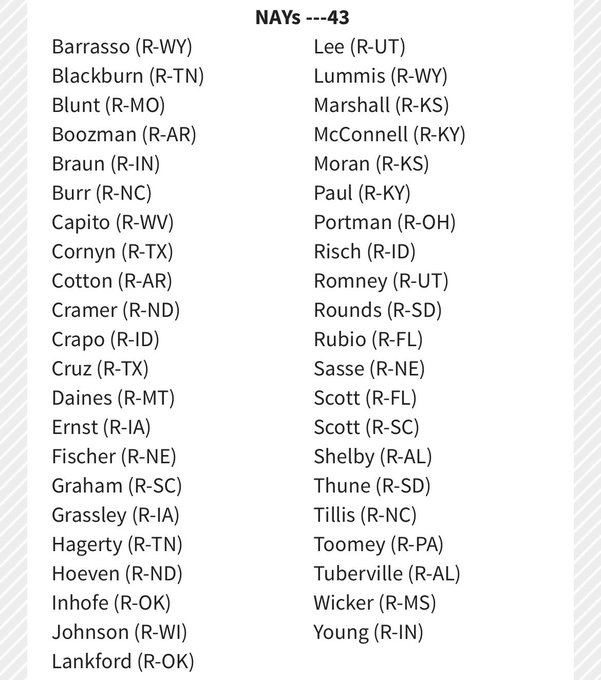
https://www.ecowatch.com/koch-brothers-paris-agreement-2430226599.html
Paris Exit Was 'Victory Paid and Carried Out' by Republican Party for the Koch Brothers
nolink
The 22 Republican senators who sent a letter to President Donald Trump last week urging the United States' withdrawal from the Paris climate agreement received more than $10 million dollars in campaign funds from fossil fuel interests.
The two-page letter was signed by a number of Republican heavyweights from coal/gas/oil-rich states, including Senate Majority Leader Mitch McConnell of Kentucky, Jim Inhofe of Oklahoma and Ted Cruz of Texas.
The Guardian calculated that the 22 senators received a total of $10,694,284 from oil, gas and coal money in just five years. (See the breakdown below.
However, that sum does not even come close to the amount of undisclosed funds coming from the deep pockets of Charles and David Koch's coal, oil and gas conglomerate, Koch Industries, and other outside groups.
As the Guardian explains:
"Visible donations to Republicans from those industries exceeded donations to Democrats in the 2016 election cycle by a ratio of 15-to-1, according to the Center for Responsive Politics. And that does not include so-called dark money passed from oil interests such as Koch industries to general slush funds to re-elect Republicans such as the Senate leadership fund.
"At least $90m in untraceable money has been funneled to Republican candidates from oil, gas and coal interests in the past three election cycles, according to Federal Election Commission disclosures analyzed by the Center for Responsive Politics."
Jeffrey Sachs, professor of economics and director of the Earth Institute at Columbia University, shared recently his views on Trump's climate walkout.In an interview with Bloomberg Surveillance, Sachs referenced the senators' letter and specifically cast blame on the billionaire oil barons for pulling the strings of Republican party leaders such as McConnell and House Speaker Paul Ryan, who both supported exiting the Paris accord.
"This is the victory paid and carried out for 20 years by two people, David and Charles Koch," Sachs said. "They have bought and purchased the top of the Republican party. Trump is a tool in this."
Notably, most of the Republican signatories of the letter do not support the belief that human activity contributes to climate change.
During an appearance on MSNBC, Democratic Sen. Edward J. Markey of Massachusetts explained why he thinks his Republican colleagues do not believe in the science of climate change.
"This Conservative party in the United States is funded by the Koch brothers [and] it's funded by the coal industry," Markey said. "[They] insist that Scott Pruitt—the Attorney General of Oklahoma that actually sued the EPA 19 times on clean air, clean water, soot, mercury issues—becomes the head of the EPA in our country."
The 22 Republican signatories' funding from Big Oil, Gas and Coal in the past three election cycles (2012, 2014 and 2016):
James Inhofe, Oklahoma
Oil & gas: $465,950 + Coal: $63,600 = $529,550
John Barrasso, Wyoming
Oil & gas: $458,466 + Coal: $127,356 = $585,822
Mitch McConnell, Kentucky
Oil & gas: $1,180,384 + Coal: $361,700 = $1,542,084
John Cornyn, Texas
Oil & gas: $1,101,456 + Coal: $33,050 = $1,134,506
Roy Blunt, Missouri
Oil & gas: $353,864 + Coal: $96,000 = $449,864
Roger Wicker, Mississippi
Oil & gas: $198,816 + Coal: $25,376 = $224,192
Michael Enzi, Wyoming
Oil & gas: $211,083 + Coal: $63,300 = $274,383
Mike Crapo, Idaho
Oil & gas: $110,250 + Coal: $26,756 = $137,006
Jim Risch, Idaho
Oil & gas: $123,850 + Coal: $25,680 = $149,530
Thad Cochran, Mississippi
Oil & gas: $276,905 + Coal: $15,000 = $291,905
Mike Rounds, South Dakota
Oil & gas: $201,900 + Coal: none = $201,900
Rand Paul, Kentucky
Oil & gas: $170,215 + Coal: $82,571 = $252,786
John Boozman, Arkansas
Oil & gas: $147,930 + Coal: $2,000 = $149,930
Richard Shelby, Alabama
Oil & gas: $60,150 + $2,500 = $62,650
Luther Strange, Alabama (Appointed in 2017, running in 2017 special election)
Total: NA
Orrin Hatch, Utah
Oil & gas: $446,250 + Coal: $25,000 = $471,250
Mike Lee, Utah
Oil & gas: $231,520 + Coal: $21,895 = $253,415
Ted Cruz, Texas
Oil & gas: $2,465,910 + Coal: $103,900 = $2,569,810
David Perdue, Georgia
Oil & gas: $184,250 + Coal: $0 = $184,250
Thom Tillis, North Carolina
Oil & gas: $263,400 + Coal: $0 = $263,400
Tim Scott, South Carolina
Oil & gas: $490,076 + Coal: $58,200 = $548,276
Pat Roberts, Kansas
Oil & gas: $388,950 + Coal: $28,825 = $417,775
an 622
no lnx
MAGA v. McConnell: Why Kimberly Guilfoyle is going after the GOP leader
Kimberly Guilfoyle speaking at the 2021 Student Action Summit, hosted by Turning Point USA at the Tampa Convention Center in Tampa, Florida, Gage Skidmore
Jon Skolnik June 19, 2022
Kimerly Guilfoyle, Donald Trump Jr.'s fiancé, on Thursday accused Senate Minority Leader Mitch McConnell, R-Ky., of waging a "smear campaign" against former Missouri governor Eric Greitens, who is running to represent the state in the U.S. Senate.
The attack came this week in an email blast by Guilfoyle, Greitens' campaign chair, who alleged that the Senate Minority Leader "made a backdoor deal to try and have [Greitens] REMOVED."
"[McConnell has] gone to unimaginable lengths to keep a MAGA warriorlike Eric from winning the 1 SEAT we need to take back the 50-50 Senate," she exclaimed. "He even launched a smear campaign targeting Eric's children. When the RINO establishment employs the exact same tactics as the radical Left, enough is enough!"
Guilfoyle's remarks are the latest in a broader response to claims that Greitens subjected his ex-wife, Sheena Greitens, and their kids to physical abuse during their time together. Those abuse allegations were first levelled back in April 2020, shortly after the couple divorced.
Eric Greitens, for his part, has adamantly denied his ex-wife's account, arguing that if he had been abusive, the two would not have arranged a divorce settlement granting him joint physical custody of the children. Greitens has also alleged that his ex-wife's allegations, which were outlined in a signed affidavit, are part of a coordinated smear campaign waged by McConnell and GOP operative Karl Rove.
"I want to tell you directly, Karl Rove and Mitch McConnell," Greitens tweeted back in March. "Hear me now. You are disgusting cowards. And we are coming for you. We are no longer going to allow you to attack me and attack my kids and to destroy this country."
To support that claim, Greitens has cited a report by right-wing news site Breitbart alleging that Rove had forehand knowledge of Sheena Greitens' abuse allegations. The article also reported that Sheena Greitens' sister is employed by McConnell at the three different political consulting firms. Neither of these details clearly suggest that both McConnell and Rove mounted a coordinated attack against Eric Greitens' Senate campaign.
Both Rove and Sheena Greitens have denied conspiring against the former Missouri governor. Still, Breitbart has continued to suggest such involvement, most recently reporting on claims by Missouri Republican Rep. Billy Long that McConnell meddled in the GOP Senate primary by pressuring Long to drop out of the race.
"McConnell's efforts to get Long to drop out of the race could be an attempt to take away votes from former Missouri Gov. Eric Greitens, the frontrunner in the race," the outlet suggested. "McConnell has a vested interest in stopping Greitens candidacy as the former Missouri governor has campaigned on voting against McConnell as Republican Senate leader."
Eric Greitens is currently coming out on top in the Senate primary, according to a recent poll by The Hill and Emerson College. The Senate candidate is the only one in the race to boast double-digit support.
For the most part, the former governor has attempted to align himself with MAGA values, even though he was reportedly reluctant to back Donald Trump in the 2016 election, according to Politico. Still, Eric Greitens has not yet received an official imprimatur from the former president.
https://www.alternet.org/2022/03/dear-joe-biden-we-don-t-want-unity-with-fascists-that-s-why-democrats-lose/
cdv salon an 3 22
I voted for Joe Biden in 2020. He was the best option available for defeating Donald Trump and buying time to organize a defense of American democracy against the neofascist assault. More than a year into Biden's first term in office, I have no regrets. I'd make that same decision again.
Despite tremendous obstruction from the Republican fascists (and their "centrist" allies embedded within the Democratic Party) — a group of sadists determined to cause maximum harm to the American people as a way of obtaining, keeping and expanding political power — Biden has accomplished a great deal as president.This includes slowing down the coronavirus plague, resuscitating the economy, taking long-overdue steps to fix the country's infrastructure and restoring America's leadership role in the world.
In a moment of great crisis when Vladimir Putin and Russia are waging war on Ukraine, to know that America has a leader who, unlike his predecessor, is intelligent, experienced and patriotic, as well as mentally and emotionally stable, brings no small amount of relief. Moreover, one does not have to ask the obvious questions that circled around Trump like flies around manure on a summer's day: "Is the president of the United States merely a useful idiot and stooge for Russia, or is he actually an agent and saboteur?" That too brings considerable peace of mind.
RELATED: Biden calls out the attack on democracy: But he didn't just mean Vladimir Putin
By all accounts Joe Biden is a humble, honorable and decent man who loves his family, has experienced great challenges and losses in life but has not succumbed to bitterness. That also signals to a type of wisdom demanded by the many crises facing the United States and the world.
To see Joe Biden, who overcame a significant speech impediment as a child, give the State of the Union address while millions of people around the world watched — and to watch him stammer occasionally while doing so — shows him to be a role model of perseverance, humanity, and vulnerability. He has been weathered by life, sometimes badly beaten down, and is still standing.
But there has always been a lingering doubt that gnaws at me as I watch Biden's presidency unfold in a time of plague and political crisis, and in a moment where America's present and future are nebulous and greatly in doubt. Unfortunately, his State of the Union address only served to reinforce my anxiety.
Joe Biden is a career politician who is now the leader of the free world and arguably the most powerful person on the planet. And like all politicians, he is a disappointment. Biden is far too quick to seek "compromise" with the Republican fascists— which mostly means outright capitulation. He represents the interests of big corporations at least as much as those of the American people. He is a professional centrist. He will in all likelihood never cancel student loan debt or make other efforts at great and lasting economic relief. Although driven by circumstance to embrace more progressive policies, Biden was one of the Clinton-era "New Democrats" who helped unleash neoliberalism and gangster capitalism on American society, greatly damaging the middle class he claims to care so much about.
My greatest worry about Biden is simple: America needs a fighting champion if its democracy is to be saved. To this point, as this week's State of the Union address made clear once again, he does not appear to be up to that challenge.
In total, Biden's speech was an attempt to claim credit for his administration's many successes and to soothe an anxious American public that is deeply worried about the war in Ukraine, the economy and the pandemic. On that account, public opinion polls show that the speech was successful.
At the Atlantic, Ronald Brownstein offers this generous summary, arguing that Biden's speech "portrayed him as a resolute champion of financially squeezed families at home and freedom abroad":
Repeatedly through the speech, Biden rejected stark political choices.Vigorous at points, meandering at others, the speech was neither a full-scale course correction, like Bill Clinton's 1996 declaration that "the era of big government is over," nor a stubborn reaffirmation of the strategies Biden employed during his trying first year in office. The president at times gave each faction in his party reasons to cheer, but did not align entirely with either liberals or centrists.
Instead, the address showed Biden and his advisers trying to define a distinctive political space centered on providing kitchen-table assistance to average families, encouraging greater national unity, and reasserting America's role as the leader of the small-d democratic world against challenges from aggressive autocracies symbolized by Russia's invasion of Ukraine.
The speech was the performance of a president who remains confident in his political compass, even as the steep and persistent decline in his job-approval ratings since last summer has caused many people in both parties to question it. Throughout, Biden underscored his determination to combine positions often considered incompatible…
Biden also, as Brownstein observes, reverted to his habit of seeking to placate Republicans and to distance himself from Democratic progressives:
Toward Republicans, Biden was alternately conciliatory (proposing "a unity agenda" and praising their involvement in the bipartisan infrastructure bill) and confrontational (denouncing Donald Trump's tax cuts and the surge of red-state laws rolling back civil rights and liberties). He pointedly renounced one of the most polarizing battle cries of his own party's liberal vanguard, calling to "fund the police" rather than "defund the police," while reasserting his commitment to criminal-justice reform and gun control, both enduring priorities for the left.
What was most notably absent from Biden's speech was any forceful and sustained discussion of the country's democracy crisis, the role of the Republicans in creating and amplifying it, and the fact that we now face a moment where the voting rights and civil rights — indeed, the fundamental human rights — of Black and brown people (along with members of other marginalized groups) are under existential threat from a new Jim Crow system.
Black Americans are among the Democratic Party's most important constituencies, and its most loyal voters. Without the support of Black people in both the Democratic primaries and the general election, and especially the support of Black women, Joe Biden would not be president today.
During Biden's victory speech in November 2020, he said: "Especially at those moments when this campaign was at its lowest ebb, the African American community stood up again for me. You've always had my back, and I'll have yours." Those are fine words, but in terms of protecting Black America's voting rights and civil rights, Biden and his administration have not lived up to them.
RELATED: Media messes up coverage of voting rights, blames Biden for GOP's racism
His State of the Union speech was one more example of that failure. In several key moments, Biden signaled that he is temperamentally unable to do what is necessary to stop the Republican fascists' attempt(s) to end multiracial democracy.
Biden repeatedly spoke of the need to "unify" Democrats and Republicans. That means seeking "unity" with those who actively tried to nullify the 2020 election and supported a violent coup to prevent him from becoming president. Moreover, the Republican fascists have in no way ended their campaign to end American democracy and terminate Biden's presidency.
Biden often speaks boldly about American democracy being in crisis, and draws eloquently upon the images and legacy of the civil rights movement and Black Freedom Struggle while doing so. But he does not act with the "urgency of now" in seeking to defend that democracy.
The reasons for Biden's behavior are not mysterious. He is the product of an American political regime that is dying, but whose leaders and principal figures have, for the most part, not realized that fact. Biden genuinely believes that as a leading member of the American political caste he can somehow save the country's obsolescent political order. He is a Washington insider, an older white man and a "moderate". Once upon a time that might have meant that Republican leaders would work with him in good faith to find solutions to the country's many problems.
But in believing that is still true, Biden has committed a grievous error: Today's Republican Party and "conservative" movement comprise a revolutionary force, which seeks to destroy American democracy and replace it with fascism or some other form of authoritarianism.
When Biden speaks of "unity" or "compromise" with the Republicans he is giving aid and comfort to the neofascist movement --if not surrendering to it altogether. In a recent essay for the New York Times, Charles Blow echoes these concerns as embodied by Joe Biden's description of Mitch McConnell as his friend:
So, how can Biden maintain that McConnell is an honest, honorable friend?
It seems that Biden suffers from the same blind spot as other white liberal leaders throughout history: looking past the oppressive impulses of other white men to see kinship and commonality. Where the oppressed see an existential threat, men like Biden only seem to see a disagreement among decent men on a political issue. They see them as simply on the "other side" rather than "other than."…
But this version of politics is an extension of the Looney Tunes cartoon of Ralph Wolf and Sam Sheepdog, where they are enemies on the clock but are friends off the clock, and is offensive to the people whose very lives are at stake. And yet Biden continues to proclaim his affections for those supporting oppression.
These bonds across bigotry smack of the insecurity of allies. They smack of a privilege of which only white men can boast, because the threat is almost always aimed away for them and at others.
When it comes to the issue of power and politics, the Bidens and McConnells of the world maintain their own affinity group.
In an essay for the Guardian, Thomas Zimmer expands on this:
Over the past few weeks, President Joe Biden has repeatedly emphasized his friendship with Senate minority leader Mitch McConnell. At the National Prayer Breakfast in early February, for instance, he praised McConnell as "a man of your word. And you're a man of honor. Thank you for being my friend."
Biden's publicly professed affinity is weirdly at odds with the political situation. Going back to the Obama era, McConnell has led the Republican Party in a strategy of near-total obstruction which he has pursued with ruthless cynicism. It is true that he has, at times, signaled distance to Donald Trump and condemned the January 6 insurrection. But McConnell is also sabotaging any effort to counter the Republican party's ongoing authoritarian assault on the political system.
The distinct asymmetry in the way the two sides treat each other extends well beyond Biden and McConnell.…
Republicans could not be clearer about the fact that they consider Democratic governance fundamentally illegitimate, yet some establishment Democrats act as if politics as usual is still an option and a return to "normalcy" imminent.
"I actually like Mitch McConnell," Biden said during a press conference a few weeks ago, providing a window into what he sees in Republicans: No matter what they do, underneath they're good guys, they'll snap out of it. Promise. It's the manifestation of a specific worldview that makes it nearly impossible to acknowledge the depths of Republican radicalization — a perspective that severely hampers the fight for the survival of American democracy….
Some weeks ago, a prominent Black comedian asked on Twitter if Joe Biden thought that, because he's a white man, it meant Republicans would work with him in ways they refused to with Barack Obama? The answer to that question appears to be yes.
RELATED: Mitch McConnell's moment of truth: For many whites, Black people aren't real "Americans"
Whiteness is almost never a liability in American society. But when it comes to the Republican fascists, Joe Biden's skin color may not be helping him much. The Republicans, their followers and their media sycophants view Biden as the white leader of a predominantly Black and brown political party. (That is of course false, but the truth is irrelevant to the Republican fascists and larger white right.) In their eyes, Biden is a "race traitor," even if they do not use that exact term. For the Republican fascists and larger white right, no compromise is possible: Their almost-explicit goal is to create a 21st-century Herrenvolk society in which Black and brown people, to quote the infamous words of Chief Justice Roger Taney, have no rights the white man is bound to respect.
Biden and too many other white liberals and moderates continue to believe that compromise with the Republicans is still possible, and that finding "common ground" can redeem this moment of democratic crisis. That kind of white racial innocence may well be America's undoing.
john s salon an 1/22
New Hampshire Gov. Chris Sununu, who recently bowed out of a much-anticipated U.S. Senate bid, revealed that he was "bothered" after conversations with dozens of Republican Senators, who apparently wanted him to be a "roadblock" until the GOP retakes the White House.Sununu told The Washington Examiner this month that he was initially "pretty close" to running, explaining: "I wasn't ready to make an announcement, but I was like, 'OK, this makes sense. I think I could be a voice nationally.'" But after chatting with "most" of the GOP Senate caucus, Sununu reportedly soured on the role once it became apparent that they wanted him to be a legislative mule.
"They were all, for the most part, content with the speed at which they weren't doing anything. It was very clear that we just have to hold the line for two years," he told the Examiner. "OK, so I'm just going to be a roadblock for two years. That's not what I do."
"It bothered me that they were OK with that," the governor added.
Sununu's comments come in the wake of an intense legislative standoff between Democrats and Republicans over voting rights, an issue which became the focus of President Biden's agenda after negotiations on the "Build Back Better Act" – the president's $2.2 trillion social safety net plan – fell apart.
On Wednesday, Senate Republicans successfully filibustered Biden's sweeping voting rights overhaul – known as the "Freedom to Vote: John R. Lewis Act" – which would standardize voting laws across all 50 states and clamp down on voter suppression. Not a single Republican backed the measure, even though the bill is supported by nearly 70% of Americans, according to a Navigator poll from November.
With Republicans having dashed Biden's hopes of passing the party's two signature pieces of legislation – the "Build Back Better Act" and the "Freedom to Vote: John R. Lewis Act" – Democrats now question whether their colleagues believe in anything other than mindless obstructionism.
During a press conference on Wednesday, Biden echoed the spirit of Sununu's remarks, asking reporters, "What are Republicans for? What are they for? Name me one thing they're for."
That same day, Senate Minority Leader Mitch McConnell, R-Ky., sidestepped questioning when asked to lay out GOP's official agenda. "That's a very good question," McConnell said. "And I'll let you know when we take it back."
According to a recent Axios report, the Kentucky Republican has privately told colleagues and donors that the Republicans have no legislative agenda and are more interested in picking apart Democrats'.
Meanwhile, the House GOP caucus appears to be adopting the opposite strategy, according to The Washington Post, with its leadership drumming up a "list of policy pledges" designed to buoy support for the party in 2022.
Among those helming this effort are House Speaker Kevin McCarthy, R-Calif., and House Whip Steve Scalise, R-La., both of whom ardently supported Donald Trump's election fraud conspiracy and voted to overturn the 2020 election.
Playing an advisory role to McCarthy is former Republican House SpeakerNewt Gingrich, who crafted the "Contract with America," a legislative platform widely linked to the GOP's successful campaign to flip both chambers in 1994.
Gingrich told the Post that McCarthy doesn't believe an anti-Biden agenda is sufficient for 2022, saying, "We need a positive message."
"I think that's clearly what McCarthy wants to do and I've offered to look at stuff and offer advice," Gingrich added. "There's lots of people in the House working on it. It will be a widespread commitment."
While the exact details of McCarthy's agenda remain hazy, the broad contours of the plan are clear.
So-called "parental rights" are expected to be front and center as Republican state officials continue to decry the alleged instruction of "critical race theory" – whose prevalence appears to be vastly overstated. For remedy, McCarthy has already released an informal "Parents Bill of Rights," which includes such provisions as the "right to be heard" and the "right to know what's being taught in schools and see reading material."
The House Speaker is also expected to assemble seven "issue-specific task forces" that will tackle a variety of other policy objectives, such as countering China's economic prowess, combating the recent crime wave, securing the nation's borders, regulating Big Tech,cutting corporate taxes, bulldozing environmental regulations, and curtailing inflation.
The soaring cost of consumer goods has proven an evergreen source of whataboutism for Republicans, even as the year-end jobs numbers indicate that Biden has steered the economy through an unprecedented economic recovery since he took office. Fox News called inflation a "top weapon" for the GOP to wield against Democrats in the upcoming midterms.
Throughout 2021, the consumer prices index rose 6.8% – the highest increase it has seen since 1982.
But when it comes to actually tackling inflation, lawmakers have historically had to walk a tightrope, said Brian Riedl, who served as an aide to Sen. Rob Portman, R-Ohio.
"There is nothing that messages well, significantly reduces inflation and is painless," Riedl told the Post. "It's easier to criticize inflation than to map out an actual solution going forward, and that's the box Republicans are currently in."
this is bi-part: Some of the Republican Party's top donors are not pleased with the number of Republicans, including Senate Minority Leader Mitch McConnell, backing President Joe Biden's infrastructure package.
Florida Gov. Rick Scott (R), who chairs the donor-funded National Republican Senatorial Committee, told Senate colleagues of donors' reactions to the vote during a closed door Senate luncheon on Tuesday, two sources told Axios.
According to Scott, the organization's donors are not pleased with the 19 Senate Republicans and 13 House Republicans who voted to pass the legislation.
Axios reports that given the scrutiny McConnell faced for supporting Biden's agenda, donors believe its essentially a form of political suicide to advance the opposing side's agenda.
READ: Evangelical warns Christians have 'erected a graven image' of Trump and let it corrupt the faith]
Scott, according to Axios, said "some donors had also been paying attention to Trump's statements, one of the sources said, which have included the former president calling the Republicans 'RINOs' who 'should be ashamed of themselves.'"
As a second source noted, most of the Republicans who attended the luncheon actually voted in favor of the infrastructure package. In fact, some even helped author the bill.
On Monday, just one day before the luncheon, eight of the Republican lawmakers— including Sens. Lisa Murkowski (R-Alaska), Shelley Moore Capito (R-W.Va.), Rob Portman (R-Ohio), Rep. Don Young (R-Alaska), Bill Cassidy (R-La.), Susan Collins (R-Maine) and Mitt Romney (R-Utah), as well as Rep. Tom Reed (R-N.Y.) — attended the White House signing ceremony.
===
note we do not know about endorse ducey; djt turned on mcc when ~ jan 6?
AN 122
NO LNX
Inside the secret 'endorsement operation' to get Trump's 'stamp of approval'
Meaghan Ellis January 15, 2022
Republican candidates, current lawmakers, and those seeking re-election have all adopted one disturbing common theme to get themselves across the campaign threshold: support former President Donald Trump and echo all of his claims of voter fraud in exchange for his endorsement which comes with overwhelming exposure and support from his relatively large base.
With the 2022 midterm elections fast approaching, NBC News' Jonathan Allen and Marc Caputo are now shedding light on Trump's "endorsement operation" and how it continues to give him the ability to exert power over the entire political party.
Republican candidates and lawmakers have certain requirements that must be followed in order for them to acquire the former president's endorsement but the work doesn't stop there.
"The most common theme of Trump's endorsements, particularly at the state level, is that he is backing candidates who have voiced support for his lie that the 2020 election was rigged against him," Allen and Caputo wrote. "Fifty-nine of the 91 have questioned the 2020 election results, according to an NBC News review, including those who voted against certifying President Joe Biden's victory in Congress."
On the other side of the spectrum, there is also a system in place for those who choose to challenge the former president's position. For those candidates and lawmakers, whom Trump refers to as "RINOs: Republicans in Name Only," there are countermeasures in place.
"He has also become enamored of the anti-endorsement, ripping into Republican incumbents who challenge him or his lie about the election," they wrote.
Arizona Gov. Doug Ducey (R), Senate Minority Leader Mitch McConnell (R-Ky.) and Sen. Mike Rounds (R-S.D.) are current targets for the former president due to their decision to speak freely in a manner that goes against Trump's wishes.
"Rumors are that Doug Ducey, the weak RINO Governor from Arizona, is being pushed by Old Crow Mitch McConnell to run for the U.S. Senate," he said in a Friday statement, ahead of his weekend rally in that state. "He will never have my endorsement or the support of MAGA Nation!"
"I will never endorse this jerk again," Trump said last Sunday after Rounds admitted that the 2020 presidential election was legitimate.
The writers also highlighted another common trend as they noted that "Trump is looking to find races where his endorsement can be tied directly to a hopeful's fate."
"He has stayed away from several competitive GOP Senate primaries where multiple candidates are running as acolytes, including in Missouri, Arizona, and Ohio," Allen and Caputo explained. "In Pennsylvania, Trump endorsed Sean Parnell — only to see Parnell suspend his campaign amid domestic abuse allegations. That served as a warning that he needed a better vetting process."....
https://www.alternet.org/2021/11/mitch-mcconnell/
'Disingenuous nonsense': McConnell mocked for 'plainly silly' case against voting rights bill
https://www.alternet.org/2021/10/gop-mitch-mcconnell/
corp tax hike?!
salon
After being closely aligned for decades, it appears that Republicans and top business lobbying groups are having a very public falling-out over conservative lawmakers' lack of support for a bipartisan infrastructure deal currently languishing in Congress.
According to digital politics site The Hill, every major business group in Washington, D.C. — including Business Roundtable and the National Association of Manufacturers, among others — has expressed some measure of support for the bill, which was crafted by a group of lawmakers in both parties alongside the White House.
Business groups have long been a key constituency for Republicans, who worked closely with K Street lobbyists to craft a 2017 tax cut that offered hefty benefits to both corporations and the wealthiest Americans. Yet no more than a small handful of Republican members of Congress have agreed to vote for the legislation favored by these groups this time around.
In a conference call with reporters last month Michael Johnson, CEO of the National Stone, Sand and Gravel Association, a longtime conservative-leaning lobby that stands to gain heavily if the bill passes, seemed flabbergasted by Republicans' refusal to vote for such a popular piece of popular piece of legislation, which polls well across most demographics, including conservatives.
"That's why it boggles the mind that the progressives in the House have decided to take a very popular hostage and Republican leadership has decided to not rescue that very popular hostage when they easily could," Johnson said.
So what's behind this right-wing change-of-heart?
Neil Bradley, the executive VP and chief policy officer for the U.S. Chamber of Commerce, blamed "misinformation" surrounding the bill during an interview with CQ Roll Call last month — adding that some House GOP members have privately told him that they'd like to vote for the infrastructure deal but feared angering Trump and the new constellation of ultra-conservative groups that were empowered during his tenure.
"I think there are some unfortunate things going on, and I'm being generous with the term unfortunate," Bradley said.
"If this vote today was occurring on the merits of the bill, the outcome wouldn't be in doubt and we'd have a supermajority," he added. "It's not the substance that people are disagreeing with here."
The U.S. Chamber of Commerce in particular has become a flashpoint of conservative ire after endorsing a small number of Democratic candidates in Congressional races last year. The group, along with a number of other influential pro-business organizations, also stopped PAC donations to hundreds of Republican lawmakers who voted to overturn the 2020 election results on the evening of Jan. 6.
Following that news, House Minority Leader Kevin McCarthy has taken to saying the U.S. Chamber "sold out" and that he no longer considers it an ally.
"I didn't even know the Chamber was around anymore," McCarthy told the political newsletter Punchbowl News.
The feud reached a head this week when Republican leaders kicked representatives for the U.S. Chamber off its conference calls.
Brett Horton, the chief of staff for House Minority Whip Steve Scalise, R-La., didn't hold back when asked about Republicans shunning the pro-business group.
"People care what their local Chambers of Commerce and business owners have to say, not the U.S. Chamber," Horton told The Hill. "If the U.S. Chamber sent me a meeting request right now, I wouldn't even staff that meeting out to an intern, and I don't see that changing."
In response to being iced out of the Republican inner circle, Axios reported this week, the group abruptly reversed its support for the bill. The Chamber disputed the report by arguing that it still supports the bill "as a stand-alone bill unlinked to the proposed tax and spend reconciliation bill" that it has been linked to from its inception — which makes its support for the infrastructure package merely theoretical.
In addition to the Republicans' beef with business groups over the pending infrastructure legislation, the two sides also clashed over their differing opinions on raising the U.S. debt ceiling this past week. Business groups saw the writing on the wall if Congress decided to default on the country's sizeable debts, and feared catastrophic consequences if the limit was not raised.
But most Republican lawmakers, especially Texas Sen. Ted Cruz, instead concluded that their responsibilities to their constitutents lay in obstructing the Democratic agenda — no matter what.
"Democrats have the full ability to raise the debt ceiling as a part of reconciliation," Cruz told POLITICO on Thursday. "They want political cover."
After a last-minute deal brokered by Senate Minority Leader Mitch McConnell, the debt ceiling was ultimately raised Thursday night — though only for a few months. McConnell said Saturday that he does not intend to make another deal come December, when the deal will likely expire — regardless of what business groups say.
McConnell's justification for the obstruction appeared to be rooted in a statement Sen. Chuck Schumer made after the Thursday vote, blasting Republican efforts to stymie any change to the debt ceiling.
"I am writing to make it clear that in light of Senator Schumer's hysterics and my grave concerns about the ways that another vast, reckless, partisan spending bill would hurt Americans and help China, I will not be a party to any future effort to mitigate the consequences of Democratic mismanagement," McConnell said in a statement.
sinema ducks biden call but not mcc
mcconn prays for re infra twin reconciliation
https://www.alternet.org/2021/09/manchin-sinema-2654865778/
note biden bills popular so gotta go wedge:
https://www.alternet.org/2021/06/mitch-mcconnell/?rs=182
no lnx pix vid
'Behind us': Mitch McConnell giggles as he shares his extremely whitewashed version of US history
Walter Einenkel and Daily Kos June 03, 2021
The New York Times' 1619 Project was created in order to refocus American history on its story of race and economics. The 1619 date is a reminder of the first enslaved Africans brought by ship to the early European settlements in North and South America. This is history that has long been available to people to discover, but has also been ignored and frequently hidden or suppressed in our country's official retellings of our collective story. Conservatives across the country, bereft of any ideas since feudalism, are recasting the 1619 Project and other critical race theory educational initiatives as an attack on our country. In their estimation, only white males like themselves are allowed to feel persecuted, and any discussion of race and the moral anchor that systemic racism has moored our country's progress forward is an assault on their monopoly on power. They are right about the latter.
On Wednesday, Sen. McConnell took time away from never passing any legislation that wasn't voter suppression-related or a tax break for the richest amongst us, to speak at a press conference in the Citizens Union Bank in Shelbyville, Kentucky. McConnell's fellow Kentuckian Republican Rep. Joseph Fischer recently filed Bill Request 60, for the upcoming 2022 state legislature session that would limit how race and the history of racism in our country is taught.Here's an elementary school level bit of math for you: Kentucky + Republican Rep. + bill about the teaching of race and racism = X* Here's another equation for you math nerds: Mitch McConnell + statement about race and education + microphone = X**
*Answer: Imaginably racist.
**Answer: Very imaginably racist.
On Wednesday,McConnell told the press that the fact the world participated in slavery and the slave trade during the 17th century means that in America historians marking the first enslaved Africans brought to the Americas isn't important history. That's what he argued.
"Behind us?"
Man, turtles live a long time.
McConnell's answer came out of a question from The Courier Journal concerning his support or opposition to the kinds of constraints his fellow Republicans are trying to put on public school teachers and educators. He went on to say that the federal government shouldn't tell schools what to teach, and he also didn't seem to knock the fact that Republicans across the country are the only political group telling schools what they should teach.
Mitch McConnell has previously described the focus on the 1619 date in American history as an "exotic notion." He has also categorized any push for education curriculums to include more comprehensive teaching on systemic racism, "activist indoctrination." McConnell's intellectually dishonest angle on the 1619 date is that by calling attention to our country's founding dependence on cheap labor and the evolution of our nation's racism, we "denigrate and downgrade" other, more positive and less uncomfortable, achievements that our country has made.
It's a garbage argument as pointing out our country's systemic racism, and very specifically highlighting 1619 as a date, is clearly an important part of our nation's story. Millions of Americans of all races, cultures, and creeds have been directly affected, and continue to be affected, by those decisions. The Civil War that McConnell says put this sin "behind us," is only fought because of that date, and to deny it and the existence of its reach is incongruous with even the words coming out of the Kentucky senator's disingenuous yap.
McConnell's attempt at speaking out of both sides of his mouth included this statement: "I think trying to completely denigrate and downgrade American historical moments like 1776, 1787,1965—critical moments—is a mistake." If you want to know what truly denigrates and downgrades our country's history, and specifically what those dates mark, all you need to see are McConnell's own actions in orchestrating a filibuster of a commission into the events of Jan. 6—something that had the bipartisan support of his own constituents. As for the Voting Rights Act of 1965, the Republican Party is in the middle of generating hundreds of voter suppression laws throughout the country.
Here's McConnell telling people that systemic racism and our country's use of slavery and racism as a controlling economic foundation is "exotic."
UofL VP of diversity and equity calls McConnell 1619 comments 'troubling'
The Senate Minority Leader said he disagreed with The New York Times' '1619 project.'
FROM YOUR SITE ARTICLES
'What's going on?' Mitch McConnell refuses to explain to voters why ... ›
Mitch McConnell slammed for repeatedly sabotaging stimulus ... ›
A Senate insider has a dark warning about Mitch McConnell ... ›
RELATED ARTICLES AROUND THE WEB
McConnell turns Senate Republicans against Jan. 6 commission ... ›
Mitch McConnell warns GOP off Electoral College brawl in Congress ›
Mitch McConnell Said to be Pleased About Trump Impeachment ... ›
mirror bs? lotta gall after trump cultivates division, recycled class war BS?
https://www.alternet.org/2021/04/mitch-mcconnell-2652824187/
521
McConnell slammed by his alma mater over his remarks about the 1619 Project
Jon Skolnik Salon May 07, 2021
Senate Minority Leader Mitch McConnell received a sharp rebuke from his alma mater on Thursday when a University of Louisville administrator clapped back at his recent comments about the legacy of slavery and its effects on American history.
McConnell's remarks came Monday during a speaking event at the university, where he was asked to opine on the New York Times' "1619 Project," according to WDRB. The project, which seeks to "reframe the country's history by placing the consequences of slavery and the contributions of black Americans at the very center of our national narrative," puts particular emphasis on the year 1619 — which was the first year that African slaves were brought to America.
During a question-and-answer session, McConnell criticized the project. "I think this is about American history and the most important dates in American history," he said. "And my view — and I think most Americans think — dates like 1776, the Declaration of Independence; 1787, the Constitution; 1861-1865, the Civil War, are sort of the basic tenets of American history."
The senator added: "There are a lot of exotic notions about what are the most important points in American history. I simply disagree with the notion that The New York Times laid out, that the year 1619 was one of those years."
McConnell's remarks drew widespread scorn, including from the project's founder, Nikole Hannah-Jones, who said on CNN, "This is not about the facts of history — it's about trying to prohibit the teaching of ideas they don't like."
On Thursday, McConnell even encountered some pushback from his own alma mater when V. Faye Jones, the interim senior associate vice president of diversity and equity at the University of Louisville, wrote in a campus-wide email: "To imply that slavery is not an important part of United States history not only fails to provide a true representation of the facts, but also denies the heritage, culture, resilience and survival of Black people in America."
She continued: "It also fails to give context to the history of systemic racial discrimination, the United States' 'original sin' as Sen. McConnell called it, which still plagues us today. ... What we know to be true is that slavery and the date the first enslaved Africans arrived and were sold on U.S. soil are more than an 'exotic notion.' If the Civil War is a significant part of history, should not the basis for it also be viewed as significant?"
Jones said that Louisville provost Lori Stewart Gonzalez, who was on stage during McConnell's appearance, shared her perspective.
It was a striking rebuke, given the senator's longstanding support for his alma mater. Last year, McConnell spearheaded the provision of a $4 million grant to the university from the Labor Department. In 1991, the senator himself made a multimillion-dollar donation to establish the university's McConnell Center, which sets out to "recruit and nurture Kentucky's next generation of great leaders."
McConnell's comments are just the latest in a pattern of revisionist history — in late March, the senator said that the Senate filibuster "has no racial history at all," claiming that "there's no dispute among historians about that." As Salon reported at the time, historians largely agree that the filibuster was systematically used by segregationists — mostly Southern Democrats in that era — to obstruct civil rights for Black Americans.
mult reconciliation means he loses power? rescue help on way (billboards), infrastructure (not for granny best ~?!) 65% pop w/ gop trms
2006 some corps helped surprised Lewis on re-up? see trms
andy young dtr grabbed Delta ceo after airport ceremeony got him on bd ~ GA voter supp, coke belated follow (after signed) but MLB -->Colo McConn threats corps tp stay out of politics
Unhinged': Texas Republican Dan Crenshaw mocked for calling companies opposing voter suppression 'fascism'
David Badash The New Civil Rights Movement
April 08, 2021
**Republican U.S. Congressman Dan Crenshaw** of Texas is getting roundly criticized and mocked after attacking the growing number of major corporations publicly opposing voter suppression laws, like Georgia's, and...
https://www.alternet.org/2021/03/billionaire-elections/
A newly surfaced recording shows a senior adviser to Senate minority leader Mitch McConnell conspiring with the Koch brothers' network and other conservative groups to torpedo sweeping voting rights legislation.
The Jan. 8 recording obtained by *The New Yorker* reveals leading conservative activists are alarmed by public support for House Resolution 1 and Senate Bill 1, commonly known as the For The People Act, and they privately admitted they had no effective way to counter the argument that billionaires should be able to buy elections.
"When presented with a very neutral description" of the bill, "people were generally supportive,"Kyle McKenzie, the research director for the Koch-run advocacy group Stand Together."The most worrisome part . . . is that conservatives were actually as supportive as the general public was when they read the neutral description."
"There's a large, very large, chunk of conservatives who are supportive of these types of efforts," he added.
The election reform bill, which would ban large, anonymous political donations, enjoys broad public support, and McKenzie told participants that Senate Republicans would need to use "under-the-dome" legislative tactics to stop the bill because generally everyone but them agreed billionaires should not be able to buy elections behind the scenes.
"Unfortunately, we've found that that is a winning message, for both the general public and also conservatives," McKenzie said.
The Koch-funded group had spent a lot of money to find persuasive arguments against the bill, but found that even claiming it would allow Rep. Alexandria Ocasio-Cortez (D-NY) to hold Trump administration officials accountable wasn't particularly effective.
"Sadly," he said, conservatives weren't even persuaded when the phrase "cancel culture" was tied to the bill.
"It really ranked at the bottom," McKenzie said. "That was definitely a little concerning for us."
FROM YOUR SITE ARTICLES
- Billionaires who bankrolled Trump donate $10 million to super PAC ... ›
- Netflix Billionaire Reed Hastings' Crusade to Replace Public School ... ›
- 'Like hitting the jackpot': Dallas billionaire natural gas producer ... ›
RELATED ARTICLES AROUND THE WEB
- Tech billionaire 2020 election donations: Final tally ›
- Can Billionaires Buy Elections? ›
- Billionaires Spent 41 Times More On 2016 Election Compared To ... ›
==
mofo
https://www.alternet.org/2021/02/how-many-teachers-have-died-of/
Republicans think they have their new plan to divide and conquer and distract the nation from extremists within their own party and the attack on the U.S. Capitol. They're going to attack teachers for not wanting to go into unsafe working conditions in a pandemic.
Well, they say they're attacking teachers unions, but make no mistake: Republicans are attacking teachers. Because the thing is, unions are made up of workers, and teachers are the workers in teachers unions (most of them, anyway), and in the cities where there have been contentious debates over in-person schooling, it is absolutely the teachers, not some abstract bureaucracy, fighting to stay out of poorly ventilated, crowded classrooms.
"Science is not the obstacle. Federal money is not the obstacle. The obstacle is a lack of willpower," Senate Minority Leader Mitch McConnell**s**aid Wednesday. "Not among students. Not among parents. Just among the rich, powerful unions that donate huge sums to Democrats and get a stranglehold over education in many communities."
What, we're to believe that the "rich, powerful unions" just decided to pick this specific fight for no good reason? Like, Randi Weingarten, president of the American Federation of Teachers, and Becky Pringle, president of the National Education Association, got together and decided that the best way to build power was to use a ton of political capital blocking in-person education? Oh, please. This is definitely a case where the teachers have pressured their leaders, and the reason for that is that teachers are scared.
What's more, teachers are scared because people keep telling them that going into the classroom is safe if a long list of precautions are observed, and they know that in many of their school systems, there is no chance of that.They have stories of being in crowded classrooms where the windows don't open to circulate fresh air in, and they're not allowed to prop doors open because that could put them in danger in case of a school shooting. They have stories of schools where the way students are kept from being within six feet of each other for 15 minutes is that every 12-14 minutes they're told to get up and walk around. They have photos showing creative interpretations of how far six feet really is.
What teachers are saying is that, contrary to McConnell's claim that "Federal money is not the obstacle," federal funding has been totally inadequate to the task of making schools safe, and local leaders haven't necessarily been any better. They're pointing out that studies of COVID-19 transmission in schools have been and continue to be all over the map when it comes to the role of schools in transmission, while the media lines up to highlight the most comforting data.
In Chicago, the teachers union is forcefully pointing out that parents, too, are voting with their feet. Just 19% of Chicago students went back to school in person this January even as the city did everything possible to force teachers into classrooms. The teachers union points to racial disparities in which students have gone back—white parents are far more likely to send their kids in person than are Black parents—and points out that the plans for simultaneous in-person and remote teaching will further disadvantage remote students. Students who are, again, disproportionately likely to be Black.
It's not just Chicago where Black families are opting out of in-person school during the pandemic. So, yes, basically everyone agrees that remote education is not great. But you don't get to cite in-person learning as a racial equity issue when the kids who will go back will be disproportionately white. You get to criticize a system that has for too long given Black families reason to be suspicious of how much it values their children's safety. You get to point out the inequities that are being exacerbated by a pandemic year in which some schools have the resources to open safely while others don't; in which some kids have private support for remote learning while others don't even have internet access; in which there have been chasms between the rates at which different racial groups have gotten sick, been hospitalized, died.
As all this is happening, as political leaders are saying that the schools are safe while generally refusing to do the things that would make the schools safe—the things that the studies they point to as showing schools to be safe stipulate are what makes schools safe—teachers are also in many states getting bumped down the vaccination priority list. This is not exactly the way to show that you really want to prioritize making schools safe, let's say.
And when it comes to reopening schools, the fears of teachers and the political power of their unions are not the only factors. Montgomery, Alabama, recently shifted to all-remote learning after the deaths of four teachers. It's safe to say that it's not the awesome power of teachers unions in Alabama that motivated that decision. In at least several other districts, schools have had to close or go all-remote because they simply couldn't keep up staffing levels given teachers who were sick or quarantining due to exposure. In Utah, some schools had to go remote so many times due to outbreaks that it added up to 40% of the fall semester.
Vaccinating teachers won't be a perfect silver bullet until we have better data on whether and how much COVID-19 transmission the vaccines block, or until the potentially vulnerable family members of teachers are also vaccinated. But it would be a huge step, and it's one that the same political leaders who are pressing for schools to reopen are not as committed to.
Now, will Republicans be successful at turning parents against teachers by squawking about teachers unions? Probably more than they should be, at least among the white suburbanites they're targeting with that message. It's also possible, though, that Republicans are underestimating just how many people know a teacher. Just a person they know who's a teacher, who may be scared herself.
Either way, this message deserves the utmost pushback. And anyone who doesn't think teachers should be moved up the vaccination priority lists can definitely pound sand. All the sand. All day long.
FROM YOUR SITE ARTICLES
- How Arizona blew it: Experts say Gov. Doug Ducey did nearly ... ›
- Trump health secretary says US healthcare workers 'don't get ... ›
- Los Angeles telling ambulance drivers 'not to transport' patients ... ›
RELATED ARTICLES AROUND THE WEB
- Educators We've Lost to the Coronavirus ›
- Empty desks: Coronavirus robs US classrooms of teachers - ABC ... ›
- Opinion: Teachers are more than Covid data points - CNN ›
https://www.alternet.org/2021/02/qanon-party/
rep. Marjorie Taylor Greene, the QAnon-loving construction heiress who recently won a deep-red congressional seat in Georgia, is getting quite a bit of attention for her nutty, violent, and racist views that she has long enjoyed sharing freely on social media. There is no doubt that she's a doozy, from her 2019 video demanding that her followers "flood the Capitol" and use violence "if we have to" to her 2018 Facebook post blaming wildfires on Jews with space lasers. Democrats in Congress have been making hay over Greene's committee assignments, using the presence of someone who stalked a school shooting survivor on the House Education and Labor Committee to embarrass House Minority Leader Kevin McCarthy and highlight the way that extremism has been mainstreamed in the GOP.
The whole situation is apparently too much for Senate Minority Leader Mitch McConnell, R-Ky., who started to insult Greene in public on Monday, in a belated bid to suggest that the QAnon faction is more fringe in the Republican Party than it actually is. "Loony lies and conspiracy theories are cancer for the Republican Party and our country," McConnell groused in a statement that did not name Greene explicitly. Sen. Todd C. Young of Indiana, a close colleague of McConnell's, picked up the baton on Tuesday, calling Greene "nutty" and "an embarrassment to our party."
It's tempting to be comforted by these words and to imagine that powerful Republicans are drawing a line in the sand when it comes to how far the party will go in catering to the extremist element. In reality, however, it's just a feint to make McConnell appear to be a reasonable person while he continues to empower and support the fascistic faction of the GOP. This is about looking good to the cable news pundits while not doing anything substantive that would actually curtail the power of the Trumpist right.
"[E]verything Greene has said, done and endorsed has been similarly said, done and endorsed by Donald Trump,"Josh Marshall of Talking Points Memo noted, arguing that Greene is a "scape goat some Republicans are trying to push off the cliff to expiate the sins of Donald Trump, who they can never cross."
As usual, this is a situation where it's more useful to look at what Republican leadership does, rather than what they say.
What Republicans are planning to do is let Trump off the hook for inciting a violent insurrection at the Capitol on January 6. Ninety percent of Senate Republicans voted against even holding a trial for Trump, using nonsense procedural objections, because they know full well that he's guilty and can't be defended on the merits.
There is no wiggle room here: Acquitting Trump is endorsing his insurrection. Trump himself made that clear by getting rid of a legal team that expressed queasiness about centering his lies about a "stolen" election. His new lawyers are more willing to make Trump's false claims about election fraud part of their defense.
Senate Republicans want to have it both ways. They want to encourage and benefit the kinds of conspiracy theorists that stormed the Capitol, because they think pandering to these people — and coddling their "god-emperor" Trump — is the way to win elections. But they also don't want to look like a bunch of loons and fascists, wanting to present themselves as eminent statesmen on the Sunday shows. That's why Senate Republicans are flipping out over the very idea that the House impeachment managers might bring forward actual evidence in Trump's impeachment trial next week. Sen. Lindsey Graham of South Carolina was so freaked out at the idea of hearing testimony from victims of the Capitol riot that he made a bunch of impotent and incoherent threats that he would retaliate by having "the FBI to come in" to talk about "the security footprint at the Capitol." (Not sure why this would bother Democrats, who have also criticized Capitol security and even forced the Capitol Police chief to resign.)
It's no mystery why Graham and other Republicans don't want Democrats airing live testimony from Capitol officers and congressional staff who were assaulted and terrorized by rabid Trump fans attempting to overturn an election. The severity of the injuries and the trauma will underscore how truly depraved it is of Senate Republicans to acquit Trump of his crime.
Greene makes an easy scapegoat for Republicans. For one thing, she's a woman, and it's always easier to make a spectacle of women in power than it is to do the same to men. Note that McConnell and his buddies aren't targeting Rep. Matt Gaetz of Florida, even though he was filmed cheering on the insurrectionists at the Capitol, or Rep. Madison Cawthorne of North Carolina, who keeps doing uncomfortably Nazi-friendly stuff.
For another thing, Greene relishes the attention, dramatically playing the victim of "career politicians" who "murdered babies with your tax dollars." Few, if any, people have ever been so excited and eager to step into the role of the bug-eyed lunatic here to make the rest of the caucus seem saner by comparison.
But it's all a charade.
Even if Republicans toss Greene on her duff, the larger problem — that the party is catering to a radical minority who supports the insurrection and has soured on democracy itself — remains in place. We know this because Republicans are doing everything they can to shield Trump from the consequences of inciting an insurrection. If Republicans really wanted to clean house, they'd start by convicting Trump and barring him from running for president again. Their unwillingness to do this shows that the GOP really is the party of QAnon now, regardless of what happens to their most obnoxious new congresswoman.
FROM YOUR SITE ARTICLES
- QAnon and evangelicals: Republicans baptized in crazy - Alternet.org ›
- The unhinged QAnon conspiracy cult has become a 'new ... ›
- GOP senator slams his party for 'winking at QAnon' — and sounds ... ›
RELATED ARTICLES AROUND THE WEB
- Column: Where QAnon goes, so goes the Republican Party - Los ... ›
- QAnon reshaped Trump's party and radicalized believers. The ... ›
- The QAnon Party? It's Not a Conspiracy Theory ›
https://www.alternet.org/2021/01/joe-biden-republican-party/
econ extortion lucy football
==
minority leader! filibuster kneecap; dems did not comm chairs till 2/21?!
https://www.alternet.org/2021/01/mcconnell-2650041062/
not sure of mcc on sedition, but his wife resign cab, but mebbe so not have to vote on 25th?
pence hang him, early rept he had spoken to some cab member about 25th, but then silent/absent, nancy 24 hr deadline
https://www.alternet.org/2021/01/trump-enablers-2649875205/
no lnx twt
With the inauguration of President-elect Joe Biden less than two weeks away, some of President Donald Trump's most aggressive loyalists and defenders now find themselves being attacked by extremists for their supposed lack of purity — including Vice President Mike Pence, Senate Majority Leader Mitch McConnell, Sen. Lindsey Graham and former Attorney General William Barr. And the fanatics that they enabled and encouraged are now accusing them of not doing enough in support of Dear Leader.
The most disturbing example is Pence. When a joint session of Congress met on January 6 to certify Biden's Electoral College victory, Trump demanded that Pence prevent that certification— which he didn't have the power to do. Regardless, some of the far-right extremists and White nationalists who showed up in Washington, D.C. that day believed that Pence was letting Trump down. Groups of them began chanting, "Hang Mike Pence! Hang Mike Pence" — and a hangman's noose hung from a tree near the U.S. Capitol Building, which was stormed by a violent mob of Trump supporters. The same extremists who were hoping to harm Democratic House Speaker Nancy Pelosi that day advocated murdering Pence as well.
Graham has repeatedly jumped through hoops in support of Trump, from the Russia investigation to the Ukraine scandal and the president's impeachment to Trump's Supreme Court nominees. But after the storming of the Capitol Building, a frustrated Graham finally distanced himself from Trump — saying, "Trump and I, we've had a hell of a journey…. All I can say is: count me out, enough is enough. I've tried to be helpful."
Later, when Graham was walking through Washington, D.C.'s Reagan National Airport last week, he was heckled by angry Trump supporters who believed he hadn't done enough to help Trump overturn the election results. Video posted by CNN shows a Trump supporter shouting, "Lindsey Graham, you are a traitor to the country…. You garbage human being."
Barr's critics often accused him of debasing himself by becoming "Trump's Roy Cohn" — an insulting reference to the unscrupulous attorney who supported Sen. Joseph McCarthy during the 1950s and represented a young Trump in the private sector during the 1970s. But after the 2020 presidential election, Barr was branded a traitor by MAGA diehards for acknowledging Biden as president-elect and telling the Associated Press, "To date, we have not seen fraud on a scale that could have effected a different outcome in the election."
Following the events of January 6, Barr described Trump's conduct as a "betrayal of his office and supporters" and told AP, that "orchestrating a mob to pressure Congress is inexcusable."
MAGA diehards are also furious with McConnell, who was a staunch Trump ally throughout his impeachment and aggressively supported all three of Trump's Supreme Court nominees: Justice Neil Gorsuch, Justice Brett Kavanaugh and most recently, Justice Amy Coney Barrett. On December 15, however, McConnell acknowledged Biden as president-elect and congratulated him on the Senate floor — inspiring wingnut radio host Mark Levin to post, on Parler, "Thanks for nothing, Mitch. Trump helped you secure your seat, as he did so many Senate and House seats, and you couldn't even wait until January 6th. You've been the GOP 'leader' in the Senate for far too long. It's time for some fresh thinking and new blood."
Mindy Robinson denounced McConnell as a "turncoat," and far-right pundit Dinesh D'Souza lambasted McConnell as well, tweeting:
History shows that those who support fanaticism can become a victim of it themselves. Communist Leon Trotsky supported totalitarianism in the Soviet Union, and was murdered by Joseph Stalin's henchmen in Mexico because of his supposed lack of purity. And now, in 2021, the MAGA mob is turning against some of the very people who enabled it.
FROM YOUR SITE ARTICLES
Dan Rather Hammers Trump and His Enablers in Facebook Screed ... ›
Mary Trump unloads on Ivanka as one of the president's biggest ... ›
Holding Trump's enablers accountable - Alternet.org ›
RELATED ARTICLES AROUND THE WEB
Opinion | Trump's enablers can't escape the consequences of their ... ›
Eric Alterman on Holding Trump Enablers Accountable – BillMoyers ... ›
Opinion: Trump enablers Pence and McConnell are far too late in ... ›
Trump Enablers Now Condemning the Violence Want You to Forget ... ›
https://www.alternet.org/2020/12/mcconnell-2649697141/
poison pill on 2k$ covid bill
i thot fail on hostage bill for tort reform/ corp immunity:
US companies no longer required to pay COVID-related sick leave for workers — thanks to Mitch McConnell
December 24, 2020
Companies in the United States will no longer be obligated to pay COVID-related sick leave for American workers due to Senate Majority Leader Mitch McConnell (R-KY) blocking a bill that would have extended the much-needed policy as the coronavirus continues to...
==
https://www.alternet.org/2020/12/mitch-mcconnell-re-election/
no lnx
many maps tables
Busted? Why the numbers behind Mitch McConnell's re-election don't add up
Mitch McConnell slammed for repeatedly sabotaging stimulus negotiation efforts
Meaghan Ellis
DC Report December 19, 2020
On a Thursday in August in Louisville, months before the 2020 election, a parade of cars filled with Kentucky Teamster representatives and labor groups, showed their fury at Mitch McConnell's constant blocking of critical COVID aid. They drove by McConnell's office raucously honking and bearing signs saying "Mitch better have my money."
In 2017, a Public Policy Polling Survey asked Kentuckians, "Do you approve or disapprove of Senator Mitch McConnell's job performance?" Only 18% approved. He clawed his rating back up to 39% on the eve of the election.
McConnell, leader of Senate Republicans, rarely holds town hall meetings with Kentucky voters—not since a heated exchange with an angry constituent went viral.
1 out of 5 voters appear to have filled out their ballots with votes for both the female Democratic Amy McGrath and the Republican pussy-grabber Donald Trump.
So, what exactly drove these angry Kentuckians to reelect Mitch McConnell with a 19-point advantage over opponent Amy McGrath—57.8% to 38.2%?
Even as Republicans across the country still insist that the election was rife with fraudulent Democratic votes, no one's asking how McConnell managed one of the most lopsided landslides of the Nov. 3 election. They should. An investigation of Kentucky voting results by DCReport raises significant questions about the vote tallies in McConnell's state.
McConnell racked up huge vote leads in traditionally Democratic strongholds, including counties that he had never before carried.
There were wide, unexplained discrepancies between the vote counts for presidential candidates and down-ballot candidates.
Significant anomalies exist in the state's voter records. Forty percent of the state's counties carry more voters on their rolls than voting-age citizens.
Kentucky and many other states using vote tabulation machines made by Election Systems & Software all reported down-ballot race results at significant odds with pre-election polls.
[caption id="attachment_21747" align="aligncenter" width="625"] The 2020 Kentucky U.S. Senate election results map[/caption]
DCReport focused on the results in three counties in eastern Kentucky's Appalachian Mountains, two of which Democrats usually always win, but similar patterns emerge in other counties across the state. Even in counties that voted overwhelmingly for Democrats as recently as the 2019 gubernatorial election, there were a staggering number of Democrats voting Republican in 2020.
In rural Breathitt County, for instance, there are 9,508 registered Democrats and just 1,599 registered Republicans. The county has a history of close contests, but Amy McGrath got only 1,652 votes versus 3,738 for McConnell, a 67% to 29% trouncing. McGrath's votes, if accurate, equaled only 17% of registered Democrats in Breathitt County.
Conventional political wisdom in McConnell-land holds that these days "ancestral Kentucky Democrats" vote Republican, and analysts shouldn't correlate party registration with voting patterns. But simply dismissing any anomalies based on anecdotal hearsay ignores the data and other possible explanations. McConnell won Breathitt County in 2020 with 1,308 more votes than he received in the county's much closer 2014 race, which he won by fewer than 400 votes. The 2019 governor's race was also a squeaker in Breathitt County, but Democrat Andy Beshear eked out a 69-vote victory. Beshear won the race statewide.
McConnell's results were even more out of whack in two other nearby Appalachian counties. In his six previous Senate elections, Elliott and Wolfe counties had never voted for McConnell. Even up to last year, Elliott County remained reliably Democratic in non-presidential races, voting for the party's entire Democratic slate in both the 2015 and 2019 statewide elections. Yet in 2020, McConnell won 64% of the votes in Wolfe County and 66% of the votes in Elliott County. McGrath only got 21% of registered Democrats in Wolfe and 20% in Elliott.
Next, take the premise that there would be some basic logic in the voting patterns of those who did vote Democratic. One might expect a registered Democrat, who's going to vote Democratic, would walk into the booth and cast their vote for both Joe Biden and Amy McGrath. But the data tell another story. In 119 of 120 counties, Amy McGrath got more votes than Joe Biden. In some counties, the votes were close. But in counties like Breathitt and Elliott, 1 out of 5 voters appear to have filled out their ballots with votes for both the female Democratic Amy McGrath and the Republican pussy-grabber Donald Trump.
Then there is the question of why a county like Breathitt has more registered voters than it has people of voting age? 2019 population data shows that Breathitt County had 12,630 people with approximately 23% below the voting age of 18. This means approximately 9,700 people are of voting age, yet there are 11,497 registered voters. Having 100% of the voting-age population registered would be astounding enough, but Breathitt County appears to have almost 120% more registered voters than age-eligible citizens. And looking further, it appears this is not limited to Breathitt.
In November 2017, Judicial Watch, a right-wing non-partisan foundation promoting transparency, sued Kentucky over its "Dirty Voter Rolls" and its failure to maintain accurate voter registration lists.The suit argued that 48 of the 120 Kentucky counties had more registered voters than citizens over the age of 18 and alleged that Kentucky was one of only three states with a statewide active registration rate greater than 100% of the age-eligible citizen population. Kentucky's inflated voter rolls, and lack of transparency, provide a perfect cover for malfeasant behavior regarding the election results.
Turning an 18% approval into a 58% win may seem like a "turning water into wine"-style miracle, but a "smoke & mirrors" parlor trick seems more likely. To better understand how the data could have been manipulated, look no further than Trump's own legal filings. In an incompetent post-election lawsuit, the Trump team may have intended to accuse Democrats of election fraud, but in describing a possible plot, they attributed the cheating to Trump himself.
In a Dec. 4 filing in Georgia, Trump's legal team referred to a "machine-controlled algorithm deliberately run" by a voting machine vendor, Dominion Voting Systems. They allege this algorithm "generally took more than 2.5% of the votes from Mr. Biden and flipped them to Mr. Trump." So Trump's own legal team, instead of providing evidence of fraud by Biden's side, may have inadvertently revealed fraud benefiting Trump. In describing a deliberate, vendor installed, machine-controlled algorithm automatically taking a percentage of Biden's votes and giving them to Trump, they certainly are outlining how fraud could have been executed.
Trump's team claims Dominion was the machine vendor embedding algorithms to "flip" votes but is Trump pointing to one machine vendor to distract from another?
In Kentucky, when looking at counties where the numbers leap out on behalf of Mitch McConnell, none used Dominion machines. Most used machines from Election Systems & Software (ES&S), a Dominion competitor. If you swap ES&S for Dominion in the alleged vote-flipping scheme, you may arrive at an alternate explanation for why Amy McGrath's numbers weren't lining up and correlating with Biden's.
To steal an election it may make sense to use different algorithms for each race on the ballot so results did not appear to be uniform. Knowing the McGrath-McConnell race faced more nationwide scrutiny, schemers might have had to miscount votes by different margins in the presidential and Senate races. Flipping more votes from Biden to Trump than McGrath votes to McConnell would explain her getting approximately 20% more votes than the Democratic presidential candidate.
Significantly, Trump and his post-election legal team have pointed at Dominion voting machines and implored courts to look into this automated vote-flipping premise—but only in states that he lost. So, let's test it in ES&S states like Kentucky where Trump won.
McConnell had his biggest percentage of registered Democrats voting Republican in counties using ES&S machines. But he wasn't the only senator to perform so well. Other Republican incumbents, whom polls indicated would have close races, had similar luck to their majority leader on election day.
Lindsey Graham's race in South Carolina was so tight that he infamously begged for money, yet he won with a comfortable 10% lead—tabulated on ES&S machines throughout the state. In Susan Collins's Maine, where she never had a lead in a poll after July 2, almost every ballot was fed through ES&S machines. Kentucky, South Carolina, Maine, Texas, Iowa and Florida are all states that use ES&S machines. Maybe the polls didn't actually get it wrong.
When Trump says "look over here" at Dominion voting machines, maybe we should look at ES&S machines instead. When Republicans spout unfounded claims that Democrats stole the election, maybe we should be looking at Republican vote totals instead. And when Trump calls this the most fraudulent election in our history, maybe he knows of what he speaks.
You can follow Alison Greene on Twitter @GrassrootsSpeak.
FROM YOUR SITE ARTICLES
John Oliver breaks down how Dems can bring the pain to Mitch ... ›
McConnell's re-election campaign slapped with FEC flag over ... ›
Mitch McConnell is leaving endangered Republican senators ... ›
McConnell advances another Trump judge as COVID relief bill remains unfinished: 'His top priority' - Alternet.org ›
'It isn't even really a stimulus': Economists lament paltry $600 checks to citizens - Alternet.org ›
RELATED ARTICLES AROUND THE WEB
Senator Mitch McConnell reelected to 7th term in Kentucky - CBS ... ›
Republican Mitch McConnell defeats Democrat Amy McGrath in ... ›
Mitch McConnell - Wikipedia ›
Why Amy McGrath could cost Republicans the U.S. Senate, even if ... ›
Mitch McConnell wins reelection in Kentucky, defeating Democrat ... ›
steven law gps georgia
no lnx
cnn
Pop-up super PACs flood Georgia runoff: 'It's about the big message'
By Kim Berryman and Kyung Lah, CNN
Updated 7:40 AM ET, Mon December 21, 2020
PAC money pours into Georgia Senate runoff races
Atlanta (CNN)The message on the two trucks with the blue electronic billboards was hardly subtle and impossible to miss as they rolled through the busy streets of Atlanta.
Drivers paused at lights, pulled out their cell phones to take pictures and watched the bright lights pass by. The backs and sides of each truck were outfitted with flashing LED lit political ads measuring roughly 10-feet wide by 6-feet tall. Their message, "Vote Democrat, Get $1200," was very big indeed.
"This story isn't so much about the big money, it's about the big message" said Jon Jones as he tailed his two electronic billboard trucks.
Why Georgia's Senate runoffs are too close to call
Why Georgia's Senate runoffs are too close to call
Jones is the man behind "Relation PAC" a new and relatively small super PAC, or political action committee, entering the fray ahead of Georgia's Senate runoff races on January 5. While personal donations to political campaigns are capped at $2,800, PACs can receive unlimited funding from individuals, corporations, unions and other groups. In other words, they're a good way to get lots of money without naming names.
With control of the US Senate at stake, Georgia's two senate races are seeing a deluge of money, both campaign and outside money, flood in. Republican Sens. David Perdue and Kelly Loeffler are defending their seats against their respective Democratic challengers, Jon Ossoff and Rev. Raphael Warnock.
More money, more PAC ads
Since November 10, super PACs have put upwards of $226 million into Peach state politics, mostly in the form of omnipresent advertising.
The Peachtree PAC, a committee affiliated with Senate Majority Leader Mitch McConnell is due to deliver $43 million in TV and radio marketing ahead of election day. Despite the name suggesting homegrown roots, Peachtree PAC is an arm of the Senate Leadership Fund, a super PAC affiliated with McConnell, a Kentucky Republican.
Obama appears in three digital campaign ads for Georgia's Raphael Warnock
Obama appears in three digital campaign ads for Georgia's Raphael Warnock
"The most concerning (PACs) are those that pop up, just before a hotly contested election, like the ones we're seeing in Georgia," explained Brendan Fischer, federal reform director at the Campaign Legal Center. Those PACs "create the appearance of having local roots, but in reality, are financed by or affiliated with national party interests."
Jones followed his rolling billboard campaign around Georgia from the seat of a rental car. He lives primarily in New York.
"I would prefer for the super PAC to not exist," he said of his own group. "Personally, I don't think PAC money should exist this way. I wish they would reform these campaign finance laws. It's kind of a shame that people can do this and that there can be so much money and dark money in our politics."
But, he added, "These are the rules that we were given. This is the playing field that we're on." So he kept following his large, flickering and fully financed advertisements.
As for who financed them?
"We'll be disclosing that at the end of the month like we're required to do," he said. "But honestly, if we wanted to hide who our donors were, we could. Just put a corporation in between your donor and the FEC and you can do that. It's a shame that that's possible to do. It's very easy. It's a couple of hours of paperwork from your lawyer, and you're good to go."
Breaking through to voters
Jones' Relation PAC opted for "guerilla marketing" by rolling hard-to-miss billboards through neighborhoods and congested traffic. The extra-large lettering reads "Don't let David Perdue Steal Your Check. Vote Democrat. Get $1200." The slogan refers to the Covid-19 stimulus checks that the Democratic candidates are pushing for.
Others, such as the Republican-backed Club for Growth Action Committee is using television ads to promote the unfounded belief that Democrats rigged the presidential election. "They can't steal this election if we all show up!" the PAC's television commercial chimes.
Fact check: Breaking down attack ads in the Perdue vs. Ossoff Georgia Senate race
Fact check: Breaking down attack ads in the Perdue vs. Ossoff Georgia Senate race
Humor is the chosen route for Democrat-backed Meidas Touch. Their television ads show Perdue and Loeffler with green faces and Grinch-like features. A nursery rhyme narration includes the verse, "Their stockings were stuffed from the stocks that were sold, when they heard Covid was coming, before we were told."
Attack ads from the right include the GOP group American Crossroads PAC,which produced a commercial falsely claiming that Warnock is "in bed with defund the police radicals."
False, inflammatory or funny, the idea is the same: the more ads, the more likely the victory.
"Money matters because the candidate with the most money usually wins," says Fischer. "Money matters because the wealthy donors who can afford to write six figure super PAC checks have their voices heard louder than anybody else."
Sick of it
"Enough is enough!" said Georgian Mark Giuliani (no relation to the President's lawyer), who recently spoke with CNN at a local sports bar filled with TVs. "I get tired of seeing people bashing people. We're supposed to be getting along and we just can't."
Giuliani felt similarly to many other Georgians and is sick of being inundated with political ads.
In a state with more than 10 million people, nearly $500 million has been spent in political advertising since early November. That's equivalent to around $50 per person statewide, and the money keeps coming.
"Part of the problem is our campaign finance rules and laws are a bit out of whack," Jones explained. "It's kind of a shame that you can have all this money come into a race like this and not even know where its coming from, just to push special interests. The truth is, most special interests aren't pushing for every day Americans. They're pushing for corporate interests and it shows."
trojan horse for long awaited tort reform?! never waste a crisis?!
Probably the most under-reported story of the year has been how Mitch McConnell is holding Americans hostage in exchange for letting big corporations kill Americans without any consequence.
Mitch took you and me hostage back in May, when the House of Representatives passed the HEROES act that would have funded state and local governments and provided unemployed workers with an ongoing weekly payment.
Mitch refused to even allow the Senate to discuss the HEROES Act until or unless the legislation also legalized corporations killing their workers and customers. To this day, he refuses to let it even be discussed in the Senate.
We've seen companies fire people for refusing to take their lives in their hands, executives organize betting pools on which employees are going to die first, and companies lying openly to their workers and customers about the dangers of Covid-19.
Mitch McConnell wants to protect them all. Even worse, his immunity can extend well beyond the pandemic and sets up a process that could put corporations above the law permanently, across every community in America, in ways that state and local governments can never defy.
While Republicans have fought against raising the minimum wage or letting workers unionize for over 100 years, what McConnell is doing now is giving corporations the ultimate right: the right to kill their employees and customers with impunity.
And McConnell's holding your local police and fire departments, public schools, and state healthcare programs hostage in exchange for his corporate immunity.
This is beyond immoral. This is ghastly, and should have been at the top of every news story in America for the past six months. But many of the corporations that are looking forward to complete supremacy over their workers include the giant corporations that own our media.
America has suffered for over 40 years under Reaganism's neoliberal mantra, picked up from Milton Friedman, that when corporations focus exclusively on profit an "invisible hand" will guide them to do what's best for people and communities. It's a lie.
This is an assault on workers' rights, but, even greater, it's a corporate assault on human rights. McConnell is saying that a corporation's right to kill its workers and customers is more important than the lives of human beings.
As unemployment benefits are running out, evictions loom, small businesses are dying left and right, millions of families have been thrown into crisis and more than 10 million Americans have lost their health insurance, McConnell continues to hold us all hostage.
It's time to fight back. If corporate media continues to refuse to discuss McConnell's blackmail, we must individually speak up among friends and communities, and also let our lawmakers know what we think. It's time to raise some hell.
FROM YOUR SITE ARTICLES
- Mitch McConnell finally recognizes Biden's win — leaving Trump ... ›
- In private call, Mitch McConnell tries to shut down GOP plan to ... ›
- Mitch McConnell slammed for repeatedly sabotaging stimulus ... ›
RELATED ARTICLES AROUND THE WEB
https://www.alternet.org/2020/12/mitch-mcconnell-2649519136/
12/19/20 i looked for booktv but found empty sen chamber w/ mcconn making a very pious speech on covid action, then went for judges
McConnell advances another Trump judge as COVID relief bill remains unfinished: 'His top priority'
This story has been updated with additional details on the ongoing coronavirus relief negotiations.
Having kept the Senate in session over the weekend to complete work on a nearly $1 trillion coronavirus relief pa...
omg
https://www.alternet.org/2020/11/mcconnell-judges/
raw
on Wednesday, The Daily Beast examined the "dangerous" record of 33-year-old Kathryn Kimball Mizelle, one of the final judicial nominees to be forced through by Mitch McConnell and Senate Republicans — and her complete lack of qualifications for the job, beyond her high-powered conservative connections.
"One of five judicial nominees waved through by the lame duck Senate in a final vote before lawmakers left town for Thanksgiving, Mizelle's confirmation is the most galling," wrote Eleanor Clift. "Mizelle is only eight years out of law school (University of Florida), and the ABA's standard for a lifetime seat is 12 years of legal experience. She has had four distinguished clerkships, including one for Supreme Court Justice Clarence Thomas, but her only trial experience is as an intern before she graduated from law school. She will take her seat on the Eleventh Circuit for the Middle District of Florida having never tried a case — civil or criminal — as a lead attorney or co-counsel."
Very few judges are ever confirmed to the federal bench in their early 30s, noted Clift. "Mizelle joins that exclusive club because she is a well-connected Washington lawyer with conservative cred who travels in the right circles. At Jones Day, President Trump's favorite law firm, where she has been an associate since last year, Mizelle's profile page highlighted her successful representation of the Chamber of Commerce in fending off a demand from the AFL-CIO for greater worker protections during the COVID crisis."
"She is married to Chad Mizelle, who faced similar questions about his youth and inexperience last year when his friend and ally at the White House, Stephen Miller, smoothed the way for him to become the acting general counsel at the Department of Homeland Security, leading DHS' legal office of 2,500 attorneys just six years after graduating from law school," wrote Clift. "Apart from her skimpy experience, concerns about Kathryn Mizelle's ideology are at the core of Democratic opposition, and they originate with her tenure at the Justice Department in 2017 and 2018 supervising litigation handled by the Civil Rights Division. It was a time when many voting rights and LGBT protections were being rolled back."
Moreover, concluded Clift, since 1896, only one judicial nominee was ever advanced during a lame duck session of a defeated president.
"In 1980, a lame duck Senate confirmed Stephen Breyer to the Court of Appeals," wrote Clift. "Nominated by President Jimmy Carter, who had just lost reelection, Democrat Ted Kennedy and Republican Strom Thurmond saw Breyer's confirmation as a fitting reward for the work he had done as chief counsel of the Judiciary Committee, which they had led. More than a decade later, President Clinton elevated Breyer to the Supreme Court. Kathryn Mizell, I'm tempted to say, is no Stephen Breyer."
FROM YOUR SITE ARTICLES
- 'His priority as pandemic rages on': McConnell readies blitz to pack ... ›
- McConnell quietly rams through more lifetime Trump judges while ... ›
- Mitch McConnell rushing to confirm more Trump judges after Biden's ... ›
RELATED ARTICLES AROUND THE WEB
- McConnell Has a Request for Veteran Federal Judges: Please Quit ... ›
- McConnell pushing to confirm more Trump judges as Senate returns ›
- No Stimulus Deal, Lots Of Judges: McConnell's Lame Duck Agenda ... ›
an 1120
no lnx
His priority as pandemic rages on': McConnell readies blitz to pack courts with Trump's judicial appointees
Gage Skidmore.
Andrea Germanos and Common Dreams November 16, 2020
Senate Majority Leader Mitch McConnell is under renewed fire from progressives for refusing to act on a pandemic relief package for struggling Americans while moving to advance more of President Donald Trump's judicial nominees.
"Today marks six months since the House passed the HEROES Act, but guess what McConnell is focused on this week: judges," Vanita Gupta, president and CEO of The Leadership Conference on Civil and Human Rights, tweeted Sunday.
"He's lined up votes on SIX Trump judicial nominees (for lifetime seats) instead of passing meaningful Covid relief. That's his priority as the pandemic rages on," added Gupta.
Newsweek reported last week on the pending confirmations, noting that the president "could still appoint a dozen or more judges during his final months in office"—actions that would further the "steady stream of judicial confirmations [that] has flowed through the Senate Floor under Trump's presidency."
"Instead of focusing on helping Americans during this devastating public health crisis, Mitch McConnell (R-Ky.) and Senate Republicans only care about confirming more anti-choice, anti-healthcare Trump judges," tweeted NARAL Pro-Choice America on Saturday.
As Law360 put it, "Trump has reshaped the federal judiciary at a staggering rate." By the outlet's count, Trump has already seen 53 of his picks for circuit judges and 164 district judges confirmed. That tally is in addition to the confirmations of Trump's three right-wing Supreme Court justices, with Amy Coney Barrett being the latest addition. And with the judicial appointees being younger on average than the last several administrations and "because these are lifetime appointments, they're poised to serve for decades to come, shaping American law and politics long after Trump leaves office," reported ProPublica.
McConnell has made no effort to hide his intention to advance the reshaping of the judiciary, including through the final days of the Trump administration—in contrast to his obstruction during the Obama administration.
"We're going to run through the tape. We go through the end of the year, and so does the president," Mr. McConnell said last month. "We're going to clean the plate, clean all the district judges off as well," he said.
Just last week, the GOP-controlled Senate continued to green-light the nominees with the Thursday 56-21 confirmation of Aileen Mercedes Cannon to be a district judge in the Southern District of Florida.
With six more Trump judicial nominees heading for confirmation this week, advocacy group People For the American Way (PFAW) urged Senate Democrats to take a stand.
In a letter sent Friday, the group wrote (pdf), in part:
Instead of supporting the nominees that the Republican majority is attempting to ram through at this late date, Democratic senators should use this opportunity to talk about the vital role federal courts play in protecting the rights and the health of the American people. In this way, they can demonstrate a clean break with the Republican agenda, which has been to name judges who will put the interests of the powerful ahead of the rights of the rest of us in areas including corporate power, police violence, access to healthcare, racial justice, voting rights, and LGBTQ+ equality.
According to PFAW president Ben Jealous, Democratic inaction must simply not be an option.
"It is literally sickening to see Mitch McConnell continue to indulge his partisan obsession with confirming far-right judges, instead of taking action on the Covid pandemic that continues to spin out of control," he said in a statement Friday.
"It's time for [Democrats] to speak out, forcefully, clearly, and insistently, against the judicial nominees of this lame-duck president. Not only is the timing egregious," he added, "but this group of nominees expected to be processed next week includes some of the worst-qualified and inexperienced we've seen to date."
"Democrats need to step up and say so by voting against these nominees and making the full force of their objections absolutely clear," said Jealous.
FROM YOUR SITE ARTICLES
Chief Justice Roberts in the hot seat over McConnell's court packing ... ›
GOP 'hijacking' of courts continues as Mitch McConnell rams ... ›
McConnell quietly rams through more lifetime Trump judges while ... ›
Mitch McConnell rushing to confirm more Trump judges after Biden's ... ›
RELATED ARTICLES AROUND THE WEB
McConnell reaches milestone on judges by filling final Circuit Court ... ›
McConnell's push to confirm judges may mean another tradition is ... ›
Senate obstructionism handed a raft of judicial vacancies to Trump ... ›
aha: scotus attack on unions is 2x whammy ~ moderation; he's amplifying polarization, whih will cripple self-correction of sys, increase instability --> crises/sys fail; moderation = DEMOC?!
an 1120
The core of the Republican Party strength is concentrated in the 27 Right to Work states.As discussed in a previous article, Right to Work laws are designed to weaken unions by cutting their revenue and membership. Unions represent just 7.5% of the workforce in right to work states but almost 16% in "fair share" states. The 27 "right to work" states account for 83% of the currently seated Republican Senators and 70% of their Representatives. In 2016, Trump carried 25 of the 27 these states.
JUDICIAL BRANCH – Anti-Union/Pro Business Judges Dominate the Supreme Court and Appellate Courts
The Republican Party has worked for a long time to ensure that the federal court system is dominated by conservative, pro-business/anti-union judges over the long term. Indeed, Republicans basically packed the court system when Senate Majority Leader McConnell refused to allow the Senate to vote on 105 judicial vacancies during the Obama administration which were later filled by Trump appointees.
Supreme Court. The Supreme Court now has 6 Republican appointed justices and 3 Democratic Justices. Each of the three Trump appointees had a proven anti-union/pro-corporate bias before being nominated.
Amy Coney Barrett. During her term on the 7th Circuit Court of Appeals, Barrett ruled in favor of corporate interest more than 75% of the time. She ruled that corporations are entitled to set job requirements that exclude older workers and that they may segregate workers at different locations by race. She has also expressed support for striking the entire Affordable Care Act which would deprive health insurance for 20 million people and end protections for 100 million people with pre-existing conditions.
Neil Gorsuch. During his term on the 10th Circuit Court of Appeals, Gorsuch repeatedly ruled against workers and in favor of corporations. For example, Gorsuch dissented from a majority ruling upholding a National Labor Relations Board decision that an employer must give full back pay to workers it illegally fired for union activity. Gorsuch dissented in cases in which the circuit court majority supported pro-worker NLRB decisions stating that the NLRB exceeded the scope of its authority. However, Gorsuch made no such dissent when the court ruled in favor of NLRB decisions that supported management.
Brett Kavanaugh. Kavanaugh served on the extremely important US District Court of Appeals for the District of Columbia Circuit. This court is second only to the Supreme Court in terms of prestige and power because it has jurisdiction over Congress and most federal regulations and agencies. The People for the American Way compiled a list of rulings showing that Kavanaugh consistently ruled against workers and for corporations during his 12½ years on the DC Circuit Court. Examples include Kavanaugh's opinions that would "entirely eviscerate collective bargaining;" his support for corporations seeking criminal citations for lawful union protests; and support for corporations that failed to protect workers health and safety.
Other Federal Courts. In almost 4 years Trump and the Republican Senate have appointed 24% of all active federal judges (194 of 792). There are 35 more nominations currently pending. Trump has appointed 30% of all active federal appeals court judges (54 of 179). This is more than any other president over the last 40 years. Overall, Republican appointees now account for 54% of all federal circuit court judges. The circuit courts are especially powerful because they function as final arbiter for the vast majority of cases since the Supreme Court accepts fewer than 2% of the 7-8,000 cases filed with it annually. These courts ultimately determine what the federal government can and cannot regulate – this is especially important to unions in relation to the right to organize and collectively bargain for wages, benefits and working conditions as well as the relative power of unions and corporations....
==
https://www.alternet.org/2020/11/mcconnell-treason/
Despite being polarized, Americans really do agree on the fundamentals. Is the president above the law? No. Does every citizen have a right to vote? Yes. Should powers be separated? Yes. Are checks and balances good? Yes. Should people be free to worship as they wish? Yes. Are the people the ultimate sovereign? Yes. And so on.
Theory isn't the same as practice, obviously, but even so, there's only one correct answer to fundamental political questions. If there were other correct answers—if these questions hinged on differences of opinion—we would not be members of a political community whose outlines were established long ago. We would be part of another kind of political community, one none of us would recognize as familiar, legitimate or good. Our nation would be something else. It would not be America.
These fundamentals and the outlines of our political community that were derived from them constitute a contract among and between citizens and noncitizens. We agree to them, consciously or subliminally, because if we did not, we wouldn't participate in the union we all actually participate in. We'd be in something else that does not exist.
In the run-up to Election Day, CNN's Jake Tapper urged counting of every vote. He was not violating the norms of journalism. He was not taking a position. With respect to voting, there's no position to take. Counting every vote is what we do. If we do not count every vote, we are not America. Very few things in this country are either-or, right or wrong, but fundamental questions are. They are, because they must be. They must be, because we want them to be. We want them to be, because we are America.
The president and the Republican leaders are failing the test of fundamentals. Should they recognize as legitimate the outcome of a lawful democratic process? The only answer is yes. That's the only correct answer, because either the American people are sovereign or they are not. If they are not, we do not live in a representative democracy. Anything less than yes indicates unwillingness to participate in the union as it stands. Anything less than an immediate yes indicates a certain softness of dedication to the US Constitution and the republic. Yet Donald Trump, and now Mitch McConnell and the rest of the Republican Party, are refusing to recognize Joe Biden's victory.
I'm told this is theater. I'm told this is about fundraising. Campaign debts must be paid, after all. I trust some of this is true. I also trust history, though. No president has ever denied the reality of his defeat. (Biden has now eclipsed Ronald Reagan's share of the popular vote, 50.8 percent to 50.7. It is the highest for a challenger since Franklin Roosevelt beat Herbert Hoover in 1932. And the counting continues.) No president has ever refused to concede in the face of a mathematical certainty. To my knowledge, no political party has ever gotten behind an incumbent's effort to steal an election.
That effort will fail. (I say "will" but honestly I'm as full of dread as you are.) The president's legal scheme has so far floundered. Every one of his suits has been thrown out, because there's no evidence of voter fraud on the scale he's alleging. On the off-chance of one of these lawsuits getting to the US Supreme Court, I'm guessing the conservative justices there will buy themselves legitimacy by dismissing the case outright. Accusations can work in politics, less in court. As GOP Sen. John Cornyn said: "In the end, they're going to have to come up with some facts and evidence."
But even in failure, the president and the Republicans will have accomplished something. (It will benefit the GOP, of course, not the president; Trump will face legal scrutiny the minute he's out of office.) They will have succeeded in three things. One, establishing doubt in Biden's legitimacy. Two, establishing the groundwork for obstructing his agenda. More important, though, is three. They will have deepened an assumption already at work in the background of Republican discourse. Democrats don't count. Anything they do, whether criticizing Republicans or beating them by a landslide in national elections, deserves any reaction up to and including murder.
In a very real sense, the Republicans are constituting a nation inside this nation, a confederacy of the mind and spirit to be made real so "real Americans" chosen by God can dominate the whole in God's name. They are constituting a separate and unequal system inside the one everyone else recognizes as legitimate, in which a small minority is privileged over a majority bound by law but not protected by it. They are, ultimately, on the path toward suicide. When parasites kill their hosts, they kill themselves, too.
The most extreme view among pundits is that the Republicans won't recognize Joe Biden's legitimacy. That's not extreme enough. They are creating a beachhead inside the United States from which to continue covert civil warfare against the United States. The Republicans are committing treason literally, yet they're being afforded respect, as if accepting the outcome of a lawful democratic process were a matter of opinion. Wrong. There's only one correct answer to that fundamental question. Anything less than fully accepting the people's will is desiring an America that will never exist.
FROM YOUR SITE ARTICLES
- McConnell's latest agenda is to make sure the GOP continues to ... ›
- Trump's highest crime: Why Democrats should impeach the ... ›
- Formal ethics complaint filed against Mitch McConnell over Trump ... ›
- MoscowMitchMcTreason trends after McConnell decries 'McCarthyism' ›
- 'Visibly livid' Mitch McConnell lashes out on the Senate floor over ... ›
- Trump plans to haunt Republicans indefinitely from his political grave - Alternet.org ›
RELATED ARTICLES AROUND THE WEB
- Talk of the County: McConnell is 'the biggest traitor this country has ... ›
- Mitch McConnell: The Man Who Sold America - Rolling Stone ›
- Try U.S,. Senator Mitch McConnell for treason | MoveOn
McConnell's latest agenda is to make sure the GOP continues to trample democracy even if they lose the Senate
October 31, 2020
Instead of focusing on a viable stimulus plan to help the American people and the country's flailing small businesses, Senate Majority Leader Mitch McConnell (R-Ky.) is focused on doing the one thing he and his Republican colleagues said Democrats would do: pack...
https://www.alternet.org/2020/10/this-democrat-is-beating-his-gop-opponent-so-the-right-wing-is-lying-about-him-dressing-up-as-hitler
Arizona senatorial candidate Mark Kelly is currentlybeating his Republican challenger Martha McSally by about 5 percentage points. So a right-wing media outlet decided to try and take Kelly down by posting a photo and lying about him dressing up as Nazi leader Adolf Hitler during his school days at the Merchant Marine Academy.
On Friday, the right-wing website the National File shared photographic "proof" that Kelley had dressed as Hitler, and the post quickly went viral. But Kelly's former classmates Jennifer Boykin, Peter Lindsey, Mark Baden and Ed McDonald have all said that the image isn't of Kelly.
Lindsey in particular said someone contacted him with the image via the professional social network LinkedIn asked "and asked if the person in the costume was Mark Kelly. I told them no, and want to say again, Mark is not in those photos. I have spoken to numerous classmates about this evening, and they concur that he is not in any of these pictures. The people spreading these lies should stop."
"The person who reached out to Lindsey was identified by the campaign as a paid consultant for a super political action committee aligned with Senate Majority Leader Mitch McConnell, R-K.Y., that is spending millions of dollars to help defeat Kelly," AZCentral.com reports.
https://www.alternet.org/2020/10/billionaire-wealth-has-surged-by-nearly-1-trillion-during-7-months-of-and-economic-collapse/
jake j
Over just the past seven months—as millions lost their jobs and health insurance, tens of thousands of small businesses shuttered permanently, and more than 200,000 Americans were killed by the coronavirus—U.S. billionaires saw their combined net worth surge by more than $930 billion, bringing the collective wealth of just 644 people to a staggering $3.88 trillion.
That's according to an analysis released Tuesday morning by Americans for Tax Fairness (ATF) and the Institute for Policy Studies (IPS), progressive organizations that have been tracking the explosion of billionaire wealth since the start of coronavirus lockdowns in mid-March. (See the groups' compilation of billionaire wealth data here.)
The new analysis shows that the collective wealth of America's billionaires grew by $931 billion—or nearly 33%—between March 18 and October 13, a period that also saw unprecedented job loss, a nationwide surge in hunger, and a sharp increase in housing insecurity.
The groups noted that the jump in billionaire wealth over the past seven months exceeds the size of both Senate Majority Leader Mitch McConnell's (R-Ky.) so-called "skinny" Covid-19 relief bill and the estimated two-year budget gaps of all state and local governments, which have been forced to lay off more than a million public-sector workers due to revenue shortfalls caused by the coronavirus crisis.
"Sadly, the Gilded Age is here again," ATF executive director Frank Clemente said in a statement. "We have extraordinary gains in wealth by a small sliver of the population while millions suffer, this time from the ravages of the pandemic, much of which could have been avoided."
"In the short-term we need a robust pandemic relief package that meets the urgency of the moment, not Senator McConnell's skinny bill that offers political cover," Clemente continued. "In the long-term we need major reform that taxes the extraordinary wealth of the billionaires and millionaires and uses that wealth to create an economy that works for all of us."
[twt
The total wealth of all U.S. billionaires today ($3.88 trillion) is nearly DOUBLE the $2.1 trillion in total wealth held by the bottom half of the population.
Billionaires' $931 billion gain far exceeds the $300 billion in new pandemic relief proposed by McConnell in September.
Americans For Tax Fairness
@4TaxFairness
How have working families fared?
??Nearly 8.2 million fell ill
??Nearly 62 million lost work
??98,000 businesses have permanently closed
??12 million lost employer-sponsored health insurance
??22 million reported not having enough food
??1/6 renters reported being behind on rent]
the new analysis shows that a handful of billionaires "have seen a particularly astonishing increase in wealth" over the past seven months:
- Jeff Bezos'wealth grew from $113 billion on March 18 to $203 billion on October 13, an increase of 80%. Adding in his ex-wife MacKenzie Scott's wealth of $65.7 billion on that day and the two had a combined wealth of more than aquarter of a trillion dollars thanks to their Amazon stock.
- MarkZuckerberg's wealth grew from $54.7 billion on March 18 to $101 billion on October 13, an increase of 85%, fueled by his Facebook stock.
- Elon Musk's wealth grew from $24.6 billion on March 18 to $92.8 billion on October 13, anincrease of 277%, boosted by his Tesla stock.
- Dan Gilbert, chairman of Quicken Loans, saw his wealth rocket by 656%, to $49.2 billion from $6.5 billion seven months earlier.
"With Mitch McConnell's Senate paralyzed with inaction, U.S. society is kicking into inequality overdrive, with wealth surging up to U.S. billionaires," said Chuck Collins, director of IPS' Program on Inequality. "The juxtaposition between surging billionaire wealth and the imploding livelihoods of ordinary Americans is grotesque and unseemly."
an 1020
https://www.alternet.org/2020/10/trump-mcconnell-face-backlash-from-kentucky-voters-for-their-failure-to-deliver-on-this-promise/
Kentucky paper busts Trump and McConnell's failed pledge to bring back coal: 'Inability to meet promises' made
==
how can he stall right before election? isn't his state hard-est hit?
Survey shows 60% of US families struggling to get by as McConnell dismisses new COVID-19 relief bill
October 01, 2020
On the Senate floor Wednesday, Majority Leader Mitch McConnell indicated once again that he has no intention of providing badly-needed aid to struggling families across the U.S. even as new research found that nearly two-thirds of households with children are
jig up wht pwr
https://www.alternet.org/2020/09/the-supreme-court-is-finished-republicans-have-killed-it/
...They've turned the courts into a kennel for right-wing puppies, willing to sit there with floppy ears and their tongues out, panting and waiting to decide cases in favor of the billionaires who put them there. That's why there is a cottage industry of right-wing legal groups like Judicial Watch, Alliance Defending Freedom, Claremont Institute and the Center for Individual Rights, all of them funded by tens of millions, if not hundreds of millions in right-wing money. They make no bones about the fact that their job is to go out looking for plaintiffs to sue on behalf of big business and right-wing political interests to overturn laws they don't like. They have been behind the challenges to the Affordable Care Act and every anti-abortion lawsuit ever filed, not to mention suits against immigrant rights, civil rights, LGBT rights — you name it. And waiting in federal courthouses all over the country are Trump and Mitch McConnell's judicial poodles....
https://insideclimatenews.org/news/03092020/kentucky-2020-senate-climate-change-election-mitch-mcconnell-amy-mcgrath
senate 2020: Mitch McConnell Now Admits Human-Caused Global Warming Exists. But He Doesn’t Have a Climate Plan
The Senate majority leader says he wants “common sense” solutions, His opponent, Amy McGrath, a Marine veteran, calls climate change a security threat.
mcConnell’s re-election campaign slapped with FEC flag over suspected accounting errors
AlterNet Staff September 24, 2020
Senate Majority Leader Mitch McConnell’s (R-KY) re-election campaign is facing scrutiny from the Federal Election Commission (FEC) and he is now being required to answer questions regarding suspected accounting errors. The…
https://www.alternet.org/2020/09/how-mitch-mcconnell-carried-out-his-sinister-plot-to-take-over-the-federal-courts/
amanda b rekonwith
ever since Donald Trump’s oversized suit-clad carcass first befouled the Oval Office, there’s been talk in the media about if and when he would cause a constitutional crisis. The assumption underlying this discourse is that a constitutional crisis would hit us like a thunderbolt and we would collectively realize, all at once, that the very fate of our democracy was on the line. Instead, there’s been a series of mini-constitutional crises, from Trump stomping all over our laws against foreign emoluments (an old-timey phrase for being bribed by foreign leaders), obstructing justice during Robert Mueller’s investigation into Trump’s role in Russian election interference, blackmailing the Ukrainian president to extract dishonest election assistance and about a dozen other instances it would be tedious to list.
The result has been a steady erosion of the political norms and laws that protect our democracy, culminating in Trump’s last big push to steal or corrupt the 2020 presidential election.
If Trump successfully does that, it could well be the killing blow for our tattered democracy. But it’s important to understand that the credit for orchestrating the demise of our once-great nation should largely go to Senate Majority Leader Mitch McConnell, a man possessed by the same lust for power and moral turpitude as Trump, but not hobbled by Trump’s stupidity or short-sightedness.
It was McConnell who recognized long ago that he could leverage the undemocratic power of the Senate as a weapon to invade and conquer the federal courts, and then use the latter to vacate any effort by the voters to exert real influence on how this country is governed. During Barack Obama’s presidency, McConnell deliberately slow-walked the confirmations of Obama’s nominations to the federal bench, leaving dozens of seats empty. When Trump was elected, McConnell hit the gas, packing the courts at record speed with an assembly line of nearly identical conserva-bots whose main attributes were youth and a willingness to forgo any intellectual rigor to rubber-stamp the right-wing agenda.
with the death of the Supreme Court’s liberal lion, Justice Ruth Bader Ginsburg, McConnell has a real opportunity to complete his mission of crushing democracy completely. Sure, there will still be elections and Democrats may win lots of them, especially this year with so many liberals fired up to throw Trump out of office.But with a possible 6-3 conservative majority on the court, McConnell knows that conservatives can nullify most efforts by those elected officials to pass progressive legislation. McConnell can even stop worrying about Chief Justice John Roberts, who occasionally has a bout of conscience and votes with the liberals to uphold precedent or follow constitutional law.
That commanding court majority won’t just serve as a firewall against new laws passed by a Democratic House and Senate. It will also give Republicans an opportunity to undo decades of progress in human rights. McConnell stole dozens of federal court appointments that legally belonged to Obama, but his crowning jewel, of course, was the theft of the seat left open when Justice Antonin Scalia died in early 2016. Using the laughably thin pretext that you shouldn’t seat a Supreme Court justice during an election year, McConnell refused even to hold hearings for Obama’s nominee, Merrick Garland.
“The American people should have a voice in the selection of their next Supreme Court Justice,” were McConnell’s exact words. “Therefore, this vacancy should not be filled until we have a new president.”
Right now, Democrats are understandably up in arms about McConnell inventing this “not during an election year” rule and then dropping it the second he had a chance to seat a judge during not just an election year, but right in the thick of a presidential campaign.
But in truth, McConnell’s blatant hypocrisy was visible long before that, when he first filled the seat that he stole with Trump’s nominee, Neil Gorsuch. The American people most certainly did not want Trump to fill that seat. The American people picked Barack Obama to fill that seat, when they elected him in 2012. They then chose Hillary Clinton, by a margin of nearly 3 million votes over Trump, to fill that seat.
Consider also that the American people picked Al Gore over George W. Bush in the 2000 election — by about 500,000 votes. If it were up to the American people, it’s arguable that seven of the nine current Supreme Court would be Democratic appointees.
We also know from polling that 62% of Americans believe that the person who fills Ginsburg’s seatshould be the person who wins the election.
Trump is a notorious, pathological liar, but we can’t let that get in the way of seeing that McConnell is just as rotten, and much craftier about being evil, to boot. McConnell loves to resort to high-minded rhetoric about democracy, but he’s clearly laughing up his sleeve the entire time. If Americans had a real democracy, McConnell wouldn’t even hold his leadership position: A majority of Americans have been voting for Democrats in Senate races for years, but Republicans control the upper chamber of Congress because the Constitution gives disproportionate power to rural states with small but overwhelmingly conservative populations.
Even this unfair stranglehold on power isn’t enough for McConnell, however, which is why he has lied, cheated and stolen his way to control the federal judiciary. He intends to use that same judiciary to steal even more power for Republicans at the ballot box, because conservative judges are only too happy to hand down rulings on voting rights and gerrymandering that allow Republicans to further eviscerate Americans’ ability to choose their own leaders.
The ugly, hard truth is that the constitutional crisis has been going on for years, and the architect of our demise isn’t Donald Trump. He’s just a loudmouth bully Republicans can hide behind to get what they’ve always wanted — to hold onto power without being accountable to the voters.
Sure, this presidential election is important, but getting rid of Trump isn’t enough to save us. If Democrats can pull off this election, we will need drastic reform — starting with packing the courts and major voting-rights legislation — simply to begin to undo all the damage done by McConnell and his crew. Not because that’s good for the Democrats, although that would be a likely side effect. But because our democracy is taking its last breaths, and without major intervention it will be lost to us for good.
McConnell rams through six Trump judges in 30 hours after blocking coronavirus aid for months
Igor Derysh / SalonSeptember 18, 2020
The Republican-led Senate confirmed six of President Donald Trump’s judicial nominees to lifetime appointments over two days this week, even though it has delayed crucial coronavirus relief since May. The Senate filled…
https://www.alternet.org/2020/09/mcconnell-quietly-rams-through-more-lifetime-trump-judges-while-blocking-19-relief-everyone-in-america-should-be-outraged/
no lnx twt ari berman jake j
as Covid-19 relief for jobless and hungry Americans, collapsing small businesses, and state and local governments languishes in the Senate GOP’s legislative graveyard, Majority Leader Mitch McConnell on Tuesday further advanced his years-long project of dragging U.S. federal courts to the right by ramming through three more of President Donald Trump’s lifetime judicial nominees and teed up votes on several others.
Vanita Gupta, president and CEO of the Leadership Conference on Civil and Human Rights, noted on Twitter that the latest confirmations came four months to the day after the Democrat-controlled House passed the Heroes Act, a $3 trillion coronavirus relief package that McConnell dismissed as an “unserious liberal wish list” and blocked from receiving a vote in the Senate.
“Everyone in America should be outraged that this is how Mitch McConnell is spending the Senate’s time amid a pandemic,” tweeted Gupta.
In a separate tweet Wednesday morning, Gupta urged the U.S. public to “pay attention” as McConnell and Trump’s court takeover proceeds apace amid the ongoing coronavirus crisis and resulting economic collapse—to which Senate Republicans have responded by putting forth legislation decried as piecemeal and wholly inadequate.
"As McConnell blocks the Heroes Act, the George Floyd Justice in Policing Act, election funding, and dozens of civil rights bills, his priority today (amid the pandemic) will be confirming three more Trump judges after confirming three yesterday,” said Gupta. “It’s an outrage.”
While Senate Democrats don’t have the numbers to block Trump’s judicial nominees, few even bothered to object Wednesday to the confirmations of John Holcomb, Stanley Blumenfeld, and Mark Scarsi to lifetime positions on the U.S. District Court for the Central District of California. Just 12 Democratic senators voted against Holcomb and Scarsi, and only four voted against Blumenfeld.
The confirmations came days after major court decisions laid bare the real-world consequences of Trump and McConnell’s takeover of the U.S. judiciary, which will impact key areas of American society—from climate policy to voting rights—for decades to come.
Last Friday, as Common Dreams reported, the powerful U.S. Court of Appeals for the 11th Circuit upheld a Florida requirement that state residents with past felony convictions pay off all court fines and fees before they are allowed to register to vote—a ruling made possible by Trump’s appointees.
:{
}:
“The only reason it was upheld was because Donald Trump flipped the 11th Circuit with five Trump judges,” Mother Jones journalist Ari Berman told Democracy Now! on Tuesday. “And this is why Mitch McConnell in the Republican Senate is so intent on confirming judges and doing nothing else. This week, McConnell is going to confirmeight more judges to the federal bench, but they’re not doing anything else to help the American people.”
Late Sunday, the U.S. Court of Appeals for the Ninth Circuit—which Trump also flipped with right-wing judges—upheld the White House’s push to end “temporary protected status” (TPS) for hundreds of thousands of immigrants from El Salvador, Haiti, Nicaragua, and Sudan.
“Without Congressional action, this will lead to devastating moral and economic consequences not just for TPS holders but for their families, communities, and for the entire country,” Peniel Ibe, policy engagement coordinator for the American Friends Service Committee, warned in response to the ruling.
==
Republicans’ ‘disgraceful’ relief bill fails — here’s why it was a sham
Julia Conley / Common Dreams September 11, 2020
After Republican Senate Majority Leader Mitch McConnell’s attempt to pass the so-called “skinny” coronavirus relief plan—prioritizing corporations over the health, safety, and livelihoods of working families—failed on Thursday, advocacy groups…
https://www.alternet.org/2020/09/donald-trump-says-ted-cruz-yes-that-ted-cruz-is-on-his-list-of-potential-second-term-supreme-court-picks
Patrick Svitek, The Texas Tribune
Sept. 9, 2020
“Donald Trump says Ted Cruz is on his list of potential second-term Supreme Court picks” was first published by The Texas Tribune, a nonprofit, nonpartisan media organization that informs Texans — and engages with them — about public policy, politics, government and statewide issues.
p Donald Trump on Wednesday named U.S. Sen. Ted Cruz, R-Texas, as a potential nominee to the U.S. Supreme Court.
Trump included Cruz among 20 possible picks for the high court if Trump wins a second term in November and a seat later becomes open. The 20 new names come in addition to a group of prospective justices that Trump named during the 2016 campaign — and has since drawn from to fill two vacancies on the court.
Cruz’s name has come up before as a potential Supreme Court appointee, and he has said he isn’t interested. In a statement released moments after Trump’s announcement, Cruz was noncommittal and seemed to suggest he was satisfied with serving in the Senate.
“It’s humbling and an immense honor to be considered for the Supreme Court,” Cruz said. “In the Senate, I have been blessed to lead the fight to preserve our constitutional liberties —every day, to defend the rights of 29 million Texans — and I look forward to continuing to do so for many years to come.”
Trump also added a second Texan, James Ho, to his list of potential Supreme Court picks. Ho is a judge on the 5th U.S. Circuit Court of Appeals and former Texas solicitor general.
Since Trump locked down the GOP nomination in 2016, Cruz has occasionally fielded questions about the possibility of serving on the Supreme Court, given his background in constitutional law. He usually denies interest and says he is more interested in shaping the court as a U.S. senator and politician.
Four years ago, Trump’s commitment to naming the justices he could appoint to the court was one of the reasons that Cruz endorsed him after their bitter primary battle.
Ho, who succeeded Cruz as Texas solicitor general, has earned a reputation as one of Trump’s most hard-line picks for the federal appellate courts.
Ho has been pivotal in inching the 5th Circuit, already one of the country’s most conservative federal appellate courts, further right. He wrote that the Second Amendment has been treated as a “‘second-class’ right.”
In his very first writing for the court, Ho panned campaign donation limits, writing, “if there is too much money in politics, it’s because there’s too much government.” He suggested a long-serving federal judge had shown bias in allowing a subpoena of a religious group in a lawsuit over the handling fetal remains, decrying “the moral tragedy of abortion.” In March 2019, he misgendered a transgender plaintiff.
Another 5th Circuit judge with Texas ties, Kyle Duncan, is also on the list. Duncan, who is from Louisiana, is a former assistant Texas solicitor general.
Emma Platoff contributed reporting.
This article originally appeared in The Texas Tribune at https://www.texastribune.org/2020/09/09/ted-cruz-supreme-court-donald-trump/.
==
https://www.alternet.org/2020/09/robert-reich-heres-how-big-money-corrupts-our-politics-and-how-to-fix-it/
corporate money is dominating our democracy.
It’s difficult to do anything—increase the minimum wage, reverse climate change, get Medicare for All, end police killings, fight systemic racism, shrink our bloated military—when big money controls our politics and dictates what policies are and aren’t enacted.
The pandemic has made that clearer than ever.The CARES Act, passed in late March as our pandemic response began, quietly provided huge benefits to wealthy Americans and big corporations. One provision doled out $135 billion in tax relief to people making at least half a million dollars, the richest 1% of American taxpayers.
This $135 billion is three times more than the measly $42 billion allocated in the CARES Act for safety-net programs like food and housing aid. It’s just shy of the $150 billion going to struggling state governments, and vastly more than the $100 billion being spent on overwhelmed hospitals and other crucial public health services.
as Americans are still suffering massive unemployment and the ravages of the pandemic, lobbyists are crawling all over Capitol Hill and the White House is seeking continued subsidies for the rich and for corporations—while demanding an end to supplemental assistance for average working people, the poor, and the unemployed.
It’s corruption in action, friends. And it’s undermining our democracy at every turn.
Ask yourself how, during a global pandemic, the total net worth of U.S. billionaires has climbed from $2.9 trillion to $3.5 trillion, when more than 45.5 million Americans filed for unemployment benefits.
Is it their skill? Their luck? Their insight? No. It’s their monopolies, enabled by their stranglehold on American democracy… monopolies like Amazon, Google, and Facebook, which have grown even larger during the pandemic.
It’s also their access to insider information so they can do well in the stock market, like Senator Richard Burr, chairman of the Senate intelligence committee, and Senator Kelly Loeffler, whose husband happens to be chairman of the New York Stock Exchange. Both were fully briefed on the likely effects of the coronavirus last February and promptly unloaded their shares of stock in companies that would be hit hardest.
And it’s the tax cuts and subsidies they’ve squeezed out of government.
You are paying for all of this—not just as taxpayers but as consumers.
When you follow the money, you can see clearly how every aspect of American life has been corrupted.
Take prescription drugs. We spend tens of billions of dollars on prescriptions every year, far more per person than citizens in any other developed country. Now that millions of Americans are unemployed and without insurance, they need affordable prescription drugs more than ever.
Yet even the prices of drugs needed by coronavirus patients are skyrocketing.
Big Pharma giant Gilead is charging a whopping $3,120 for its COVID drug, Remdesivir, even though the drug was developed with a $70,000,000 grant from the federal government paid for by American taxpayers.
Once again, Big Pharma is set to profit on the people’s dime. And they get away with it because our lawmakers depend on their campaign donations to remain in power.
As you watch this,Mitch McConnell is actively blocking a bill drafted by Senate Republicans to reduce drug prices—after taking more than $280,000 from pharmaceutical companies so far this election season.
Big Pharma is just one example. This vicious cycle is found in virtually every sector, and it’s why we continue to be met with politicians who don’t have our best interests at heart.
So how do we get big money out of our democracy?
A good starting point can be found in the sweeping reform package known asH.R. 1—the For the People Act. The bill closes loopholes that favor big corporations and the wealthy, makes it easier for all of us to vote, and strengthens the power of small donors through public financing of elections—a system which matches $6 of public funds for every $1 of small donations.
The For the People Act would also bar congresspeople from serving on corporate boards, require presidents to publicly disclose their tax returns, and make executive appointees recuse themselves in cases where there is a conflict of interest.
These are just a few examples of tangible solutions that already exist to rein in unprecedented corruption and stop America’s slide toward oligarchy—but there’s much more we can and should do.
The important thing to remember is that the big money takeover of our democracy prevents us from advancing all of the policies we need to overhaul our racist, oppressive system and create a society that works for the many, not the few
==
https://www.alternet.org/2020/09/postal-service-board-chairman-is-also-a-director-of-super-pacs-for-both-mcconnell-and-trump/
robert “Mike” Duncan, the Chairman of the Postal Service Board of Governors, has been a busy guy what with helping Donald Trump and Louis DeJoy destroy the Postal Service and, this is real, being a director of Mitch McConnell’s $130M super PAC, Senate Leadership Fund.He is also a director of American Crossroads Supreme PAC, which spent $1.9 million backing Trump this cycle. So that’s nice for all of them.
Duncan is a a “good friend” and “valued partner” of McConnell, in McConnell’s own words. McConnell in fact recommended Duncan for the USPS post, and introduced him at his 2018 confirmation hearing. “I’ve known Mike for a very long time. I’m glad that President Trump has nominated such an intelligent, able and experienced individual to once again serve our country,” McConnell then. “As a businessman, a public servant and a dedicated mentor to young people, Mike is an outstanding choice to help oversee the world’s largest postal organization.” Oversee, dismantle. Potato, pahtahto. McConnell, don’t forget, had engineered this position for Duncan by blocking President Barack Obama’s board of governor nominees.
McConnell and Duncan go way back in Kentucky, which has been helpful to both. Duncan served as general counsel and then chair of the Republican National Committee from 2002 to 2009. You might remember those years for the emergence of overt and creative voter suppression schemes under Bush and Cheney. Duncan is also Kentucky’s Republican national committeeman on the RNC. He and McConnell are such good friends, McConnell got Duncan’s kid, Robert Duncan Jr., a job U.S. attorney for the Eastern District of Kentucky.
McConnell has been blocking $25 billion in USPS emergency funding, passed by the House in their HEROES Act in May, for 106 days. Mitch McConnell does not want the Postal Service to function. He has helped Trump load the board of governors with Trump supporters and Republican operatives, where they are in a very good position to use the USPS for their own ends—suppressing Democratic votes.
the USPS has warned 46 states that their elections are in jeopardy because all the sabotage DeJoy and Duncan have wrought on the service means they might not be able to handle all the ballots in what will likely be a heavily-absentee vote because of pandemic. States are suing and House Democrats are exerting what pressure they have on DeJoy to restore the functions of the USPS.
All the bad press about missing prescriptions and lost Social Security checks and dead animals, combined with the lawsuits and the congressional hearings, has yet to make a dent in DeJoy, and presumably his overseers on Trump’s and McConnell’s board of governors.
==
an 820
Rusal, a Russian aluminum company, has invested heavily in a mill that the North American company Braidy Industries has planned for Eastern Kentucky — and according to a Senate Intelligence report on Russian interference in the 2016 presidential election, Rusal is a “proxy for the Kremlin.”
In 2019, journalist Morgan Watkins reports in the Louisville Courier Journal, Rusal agreed to invest $200 million in Braidy’s mill. And the bipartisan Senate Intelligence report, released on August 18, describes Russian oligarch and Rusal co-owner Oleg Deripaska’s ties to the Kremlin.
According to the report, “Deripaska’s companies, including Rusal, are proxies for the Kremlin, including for Russian government influence efforts, economic measures and diplomatic relations.”
Watkins notes that according to a Securities and Exchange Commission report that Braidy filed in June, Rusal had provided $75 million for the mill as of December 31, 2019 but had discontinued contributions until Braidy could secure another $300 million in funding.
the U.S. government has imposed sanctions on Rusal, but Kentucky’s two Republican senators — Sen. Rand Paul and Senate Majority Leader Mitch McConnell — have voted against keeping the sanctions in place. Watkins notes that on August 19, the Kentucky Democratic Party “questioned McConnell’s decision to support lifting the sanctions on Rusal in light of the Senate Intelligence Committee report’s identification of Rusal as a proxy for the Kremlin.”
cf DN attacks by kochs go back to 1971
==
==
is crashing the economy enough for him to lose seat?
https://www.alternet.org/2020/08/mcconnells-refusal-to-help-state-and-local-governments-could-cause-us-economy-to-contract-by-3-and-result-in-over-4-million-job-losses-report/
==
https://www.alternet.org/2020/08/kentucky-workers-and-businesses-are-furious-with-mitch-mcconnell-over-his-response-to-states-economic-crisis-report/
no lnx
GOP under fire for slipping $30 billion Pentagon gift into coronavirus relief bill
https://www.alternet.org/2020/08/gop-under-fire-for-slipping-30-billion-pentagon-gift-into-relief-bill/
Written by Common Dreams August 1, 2020
In a floor speech late Monday, Senate Majority Leader Mitch McConnell described the GOP’s newly released coronavirus stimulus package as a “carefully tailored” plan to provide financial relief to desperate Americans.
But a look at the legislative text (pdf) released by Senate Republicans shows the HEALS Act is replete with massive gifts to the Pentagon and defense contractors that would do nothing to aid the unemployed, provide nutrition assistance to hungry children, prevent an avalanche of evictions, or stop the spread of coronavirus.
“Last time I checked F-35s don’t help families pay their bills,”Rep. Chuy García (D-Ill.) tweeted in response to the GOP’s proposal of $686 million in spending on new fighter jets.
The legislation also includes hundreds of millions of dollars in funding for surveillance planes, Apache helicopters, and armored vehicles.
The HEALS Act proposes a total of $29.4 billion in new military spending just a week after the House and Senate approved a $740.5 billion Pentagon budget for fiscal year 2021.
Meanwhile, as Common Dreams reported earlier Tuesday, the Republican package includes no money for state and local governments, election assistance, or the U.S. Postal Service. The legislation would also slash the weekly federal unemployment insurance boost from $600 to $200.
Roll Call’s John Donnelly reported Monday that “Senate Republicans have laced their roughly $1 trillion coronavirus relief package with at least $7 billion for weapons, most of which are built by leading contractors that contribute heavily to congressional campaigns.”
According to Donnelly:
The draft appropriations portion, made public Monday evening, includes money for fighter jets, helicopters, radars, ships, and armored vehicles that the measure’s authors have deemed “emergency” spending that is not capped by the budget control law…
The top two defense contractors, Lockheed Martin Corp. and Boeing Co., would do especially well under the measure.
The list of weapons is topped by fully $1 billion for an unstated number of Boeing P-8 Poseidon maritime surveillance jets. Also on the list is $283 million for Boeing Apache helicopters for the Army.
Boeing’s Ground-Based Midcourse Defense anti-missile system, which is aimed at intercepting incoming ballistic missiles from sites in Alaska and California, would receive $200 million, and $243 million more would go to a missile defense radar program.
“People are dying, or worried about keeping a roof over their families’ heads, or cutting hours because their kids’ schools are closed,” said Anthony Weir, a lobbyist on nuclear disarmament and Pentagon spending at theFriends Committee on National Legislation. “And this is the time to jam some military procurement into this year that you didn’t get last year?”
==
https://www.alternet.org/2020/07/not-shocking-gops-covid-19-plan-puts-corporate-greed-before-human-need/
Not shocking: GOP’s COVID-19 plan puts corporate greed before human need
Written by Thom Hartmann / Common Dreams July 29, 2020
It should be called the HEELS Act, not the HEALS Act.
==
https://www.alternet.org/2020/07/trump-gets-a-lot-of-goodies-in-mcconnells-covid-19-relief-bill-and-the-american-people-get-shafted/
kos
While Republican senators were introducing their respective pieces of the new “coronavirus relief” billMitch McConnell has cooked up, called the HEALS Act(Health, Economic Assistance, Liability Protection, and Schools), Treasury Secretary Steven Mnuchin and White House chief of staff Mark Meadowswere meeting with House Speaker Nancy Pelosi and Senate Minority Leader Chuck Schumer “to begin formal negotiations,” which really shows where the power to pass the new bill lies. Because what McConnell offered up is beyond ridiculous and doesn’t even have the support of probably half of his conference.
It has the support of absolutely no Democrats. Sen. Bernie Sanders summed up just how dead on arrival it is in a tweet detailing what’s in it: $2 billion for F-35s, $1.75 billion for an FBI building, $1 billion for surveillance planes, $375 million for armored vehicles, $360 million for missile defense, $283 million for Apache helicopters, and $0 for millions facing eviction. That sounds like a whole bunch of sweeteners McConnell had to throw in to get Trump appeased for not getting his payroll tax cut. The stuff in it that’s actually related to the COVID-19 crisis is really, really inadequate. It does one good, modest thing—the $1,200 direct payment is back, and here’s where they did the one good thing, children over age 17 will now be eligible for the $500 dependent payment. That’s pretty much the whole of the good.
In addition to the larding up of a public health bill with armaments and Trump bribes, it excludes increases in food assistance, rental assistance, student loan help, pretty much anything that helps. It does include a cut to the weekly unemployment insurance (UI) boost from $600 to $200 temporarily while states set up a system to pay people 70% of their previous income, which the Republicans want them to do in the next two months. State unemployment officials have united in opposition to that idea as completely unworkable. How bad is it? The Republican labor commissioner in Georgia, Mark Butler, calls it “the dumbest idea ever.” He says “We’re not the IRS. We don’t have your taxes. We don’t know what you made last year. Our stuff is based on you getting laid off by a particular employer and them reporting to us about what the wages are.” So there’s that.
That’s the sum total of how they plan to help people. They also include at least $100 billion more for the problematic Paycheck Protection Program. (Disclosure: Kos Media received a Paycheck Protection Program loan.) There is no new money for state, local, tribal, and territorial governments, just some tweaking of the restrictions on the previous $150 billion that was provided in the CARES Act so states have more flexibility. The only new money directed to states is for schools, a large portion of it restricted to go only to schools that physically reopen. It also has McConnell’s obsession, five-years of liability protection for businesses, healthcare providers, and others who might expose people to coronavirus infection.
The stuff, beyond military toys to make Trump happy, include an increase in business tax deductions for meals and entertainment. Presumably at Trump properties. Because so many people are now thinking, “you know, if I could just deduct the full cost of a meal it would be worth going to a restaurant and exposing myself to a potentially fatal virus.” That, it turns out, is why there’s also that new FBI building money included this bill. For years, Trump has been obsessing over a new headquarters to be built in downtown D.C. The problem isn’t the new building, everyone agrees the crumbling J. Edgar Hoover Building needs replacing. The pre-Trump plan was a suburban campus, which was nixed by Trump. That decision is still being investigated by the Justice Department’s inspector general because what seems to be behind Trump’s move is the fear that the feds selling off the spot where the current building is to a developer that would build a hotel on the site, one block from Trump’s D.C. hotel. Because everything is always going to be about the Trump grift.
This is a bad bill. It is an unacceptable bill for Democrats, which is one point of agreement with half of McConnell’s Republicans. They’re just coming from different angles on how bad it is. Democrats are rejecting it because it does basically nothing to help people and Republicans because it spends some money on people. “There is significant resistance to yet another trillion dollars,” said Sen. Ted Cruz “The answer to these challenges will not simply be shoveling cash out of Washington; the answer to these challenges will be getting people back to work.”
Democrats are starting from their HEROES Act, which includes much higher UI benefits’ hundreds of billions in state and local aid; hazard pay for essential workers; billions for the Postal Service; a 15% boost to food stamps; and $100 billion for renters as well as a moratorium on all evictions for the remainder of this year. For a start. This Republican bill, which has taken McConnell two and a half months to cobble together, after critical assistance deadlines have already passed, has been a phenomenal waste of time. Now the real work begins
==
gop has no plan on 3rd covid bill? mnu and dems did last 2?
Kentucky voters reject every McConnell stance on COVID-19 relief
Joan McCarter / Daily KosJuly 22, 2020
The voters of Kentucky roundly support the key provisions of the HEROES coronavirus relief bill from House Democrats, and roundly oppose Sen. Mitch McConnell’s push to reopen schools in the…
https://www.alternet.org/2020/07/draft-of-mcconnells-dangerous-corporate-immunity-plan-sparks-alarm-this-is-an-anti-civil-rights-proposal/
Consumer and workers’ rights advocates are warning that new details of Senate Majority Leader Mitch McConnell’s plan to shield businesses from coronavirus-related lawsuits show just how far the Republican leader is willing to go to ensure corporations are not held accountable for endangering public health and safety.
“Congress must reject this dangerous proposal,” the National Employment Law Project said in response to a draft (pdf) of McConnell’s plan obtained by Politico and other outlets on Friday.
The draft, authored by McConnell and Sen. John Cornyn (R-Texas.), proposes relieving businesses, schools, churches, and other institutions of legal responsibility for workers, customers, and others who contract Covid-19 except in cases of “gross negligence and intentional misconduct”—a difficult standard to prove in court.
As theAssociated Press reported, the Republican plan “offers a broad shield by requiring heightened pleading standards, stiffening burden-of-proof standards, and capping damages on awards. Employers would also be shielded from investigations by federal agencies.”
AD REMOVED FOR SUBSCRIBED USER
Additionally, McConnell and Cornyn’s plan would empower companies to move coronavirus-related personal injury and medical liability cases to more business-friendly federal courts. “Defendants are liable,” the draft states, “only if they failed to make reasonable efforts to follow applicable public-health guidelines.”
...
620 geo f military st john
walk of shame for Republican senators who betrayed AmericanNancy LeTourneau / Washington Mo
==
an 520
economics columnist explains how the GOP’s new plan could ‘permanently hobble’ the federal governmentAlex Henderson
==
https://www.alternet.org/2020/05/mcconnell-vows-to-block-extension-of-boosted-unemployment-benefits-while-pushing-for-corporate-legal-immunity
McConnell vowed in a private call with House Republicans Wednesday that the enhanced unemployment benefits keeping millions of people afloat amid Great Depression-level joblessness will not be extended in the next coronavirus stimulus legislation, effectively endorsing a major income cut for a large swath of the U.S. population.
The boosted unemployment insurance—which provides an additional $600 per week on top of state benefits and is set to expire on July 31—”will not be in the next bill,” the Kentucky Republican reportedly told his GOP colleagues, calling the fact that some people are making slightly more money on unemployment than they did from their jobs “crazy.”
Progressives have said this is a reason to raise wages, not roll back benefits.
Ernie Tedeschi, a former Treasury Department economist, estimated that if enhanced unemployment benefits are not extended, “unemployed workers will effectively get a pay cut of 50-75% overnight."
in a series of tweets Wednesday evening, Rep. Don Beyer (D-Va.) pointed to a Brookings Institution analysis showing that boosted unemployment benefits offset around half of all lost wages and salaries in April. House Democrats passed legislation last week that would extend the boosted unemployment benefits through January of next year.
“Removing that support while eliminating access to food, shelter, and healthcare would inflict untold suffering and could cause widespread civic unrest,” Beyer warned. “Cutting back federal assistance at the height of the crisis would mean self-inflicted disaster, devastation, and additional deaths. That must not happen.”...
//
https://www.alternet.org/2020/05/small-business-owners-tell-mitch-mcconnell-stop-using-our-plight-to-push-for-covid-19-corporate-immunity/
https://www.alternet.org/2020/05/mitch-mcconnell-wants-to-get-rid-of-the-governing-process-and-right-wing-media-is-helping-him
no lnx
mitch McConnell wants to get rid of the governing process — and right-wing media is helping him
Written by Nancy LeTourneau / The Washington Monthly May 16, 2020
If Joe Biden wins the election in November, he will face the same thing every Democratic president has faced since Bill Clinton: a country broken by Republican policies (or the lack thereof). While it’s true that Biden isn’t likely to have to deal with two endless wars in the Middle East, we don’t yet know the lengths to which Trump will go to rescue his narcissistic ego from the prospect of being a “loser.” But we do know that he has decimated the entire federal bureaucracy and will leave the country in the worst economic shape since the Great Depression.
In light of that, our friend Ed Kilgore writes that Biden will need to avoid the mistakes of the Obama presidency.
But there’s a major problem with Biden winning the presidency and partying like it’s 2009: Obama’s record in dealing with that crisis was mixed at best, even though he had political assets that Biden will not enjoy (e.g., big majorities in both congressional chambers) and faced conditions that were bad but nothing like today’s…Does Joe Biden have the rhetorical chops to overwhelm Republican opposition in a way that Obama could not?
That last question is what caught my eye. The “rhetorical chops” Kilgore refers to are often captured by the term “bully pulpit.” The assumption is that if a president can use superior rhetoric to convince enough voters to support his agenda, Republican opposition will give way. The comparison is often made to FDR.
The New Republic’s Osita Nwanevu cites Biden’s expressed determination to reshape America like FDR did and sensibly notes that he “would have to unite an extraordinary proportion of the American public — not only in support of his agenda but in support of him, personally, as a political leader, just as Roosevelt did.”
But there are a couple of political dynamics that have changed since those days. First of all, Mitch McConnell has demonstrated that he doesn’t care what the majority of American voters think. He has not only promised to return to his mode of total obstruction if a Democrat is elected president, but Republicans have also developed a strategy to maintain their power—even as they slide into a minority.
The perfect example of how Republicans dismiss what voters want came in the aftermath of the Sandy Hook shooting when it became clear that over 90 percent of the public supported common-sense gun safety measures—including a majority of Republicans. But McConnell and his cohorts simply obstructed that legislation as well. They have no reason to care what voters think because they are never held accountable.
The other dynamic that has changed since Roosevelt was president is that Republicans are more than happy to lie with abandon, knowing that right-wing media—led by Fox News—will buttress those lies. That nullifies the use of the bully pulpit to unite Americans behind a president’s agenda.
We saw how that worked when, during negotiations over Obamacare, a provision that would have allowed Medicare to bill for end-of-life planning was turned into “death panels.” Given that their base has been convinced that they can only believe what right-wing media tells them and everything else is “fake news,” they buy into the lies.
That is not only the challenge Obama faced, it is also the one that will confront Democrats if Biden is elected. It is true that, as Kilgore suggests, it could be mitigated with the abolition of the filibuster in the Senate if Democrats win a majority in that body. At this point, the biggest obstacle to that happening isn’t that Biden opposes it. A majority of Senate Democrats do as well.
It is also possible that the effectiveness of total obstruction could be minimized if McConnell loses his bid for re-election in Kentucky. On the one hand, his successor is likely to maintain a strategy that has worked so well for their party in the past. But McConnell has been extremely successful at keeping his troops in line—primarily through the use of his coffers of campaign cash. It is possible that the next Republican leader could experience some defectors.
All of this is why it is so important for Democrats and mainstream media to focus on challenging the way that Mitch McConnell and right-wing media have been so successful in subverting the entire governing process. The first step in correcting the problem is to accurately name it.
https://www.alternet.org/2020/05/mitch-mcconnells-patriot-act-expansion-would-give-bill-barr-unprecedented-spy-powers/
no lnx
julia Conley / Common Dreams May 14, 2020
Sen. Ron Wyden was joined by privacy advocates Wednesday in forcefully condemning a new proposed amendment to the PATRIOT Act put forward by Senate Majority Leader Mitch McConnell that would greatly expand the U.S. attorney general’s surveillance powers under FISA.
McConnell’s amendment, which the Senate began debating Wednesday as lawmakers took up thereauthorization of the 2001 PATRIOT Act, would explicitly permit the FBI to collect records of Americans’ internet search and browsing histories without a warrant. It would also mandate that Attorney General William Barr, and his successors, conduct an annual review of the FBI’s submissions into the Foreign Intelligence Surveillance Act (FISA) Court.
Barr would be permitted to review for “accuracy and completeness” evidence presented to the FISA Court by the FBI regarding potential surveillance targets.
“Under the McConnell amendment, Barr gets to look through the web browsing history of any American—including journalists, politicians, and political rivals—without a warrant, just by saying it is relevant to an investigation,” Wyden told the Daily Beast this week, before speaking out against the amendment on the Senate floor.
Mitch McConnell is forcing a Senate vote on his amendment to give Bill Barr warrantless access to Americans’ browsing history. I’ve heard a lot of bad ideas in my lifetime, but this is one of the worst. Tune in as I explain why: https://t.co/r53nm2HxzA
— Ron Wyden (@RonWyden) May 13, 2020...
aha: abortion turned xian anti-gubmint; in 80's RR grifter televangelists had TV programs/stations; Rove courted (organized) for Bush 43; now drollinger cabinet and GOTV network (AI/digital tracking?); scary overlap with militias?! patriot prayer ~ stay at home order , boogaloo
putin cozied up to? thus US xians gave him pass on collusion, plus if true delegitimatizes trump, who delivers anti-abortion judge and SCOTUS w/ mcconnell
https://www.alternet.org/2020/05/why-religious-freedom-stokes-coronavirus-protests-in-the-u-s/
...
==
yikes
rbg
https://www.alternet.org/2020/05/mitch-mcconnell-accelerating-plan-to-place-at-least-one-more-justice-on-supreme-court-before-the-election-report/
barasso
==
https://www.alternet.org/2020/05/chief-justice-roberts-in-the-hot-seat-over-mcconnells-court-packing-scheme/
chief judge of the U.S. Court of Appeals for the District of Columbia Circuit, Judge Sri Srinivasan, has requested an inquiry into whether Senate Majority Leader Mitch McConnell and retired Judge Thomas B. Griffith engineered the latter’s retirement so McConnell could install a protégé. Srinivasan has asked Supreme Court Chief Justice John Roberts to assign the inquiry to another circuit.
This comes as advocacy group Demand Justice calls for a delay in the confirmation hearing of Judge Justin Walker, a former intern of McConnell’s and an extreme partisan who was a fixture on Fox News defending now-Supreme Court Justice Brett Kavanaugh during his show-hearings.“Justin Walker’s nomination was already controversial, but this emerging investigation means an even darker cloud is hanging over his appointment,” Demand Justice founder Brian Fallon said in a statement released following the announcement of the inquiry. Walker’s nomination is controversial because he is not just an extreme partisan but is so woefully inexperienced in conducting law that the American Bar Association deemed him unqualified for the job McConnell handed to him last fall, on the district court where he now serves.
“The hearing on Walker’s nomination should not go forward until we know the truth about what ethical lines Mitch McConnell crossed to get Walker this seat,” Fallon continued. “At the very least, McConnell should come clean about whether and when he contacted Judge Thomas Griffith prior to his sudden retirement.”
McConnell’s court packing efforts have made news before, including his campaign of leaning on Republican federal judges to get them to retire so he can install very young and extreme partisans in their seats. McConnell and Trump have already filled more than one-quarter of the appeals court seats, but McConnell won’t rest until he’s got the maximum possible, even if that means prying out Reagan, Bush I, and Bush II-appointed judges.
Griffith is a former Senate legal counsel nominated to the appeals court in 2004 by President George W. Bush. Neither he nor McConnell will say whether he is among the judges subject to the pressure campaign led by McConnell. The D.C. Court of Appeals is the second highest court in the nation. It’s the key court for deciding cases relating to the constitutionality of federal rules and regulations and thus the reach of government. It provides a stepping stone both to Supreme Court seats and for some of the most important cases to reach the Supreme Court. Stacking it is as critical to McConnell’s extremist government coup as is stacking the Supreme Court.
“The coordinated manner of Majority Leader McConnell’s involvement in the judges’ decision-making is quite unprecedented and raises significant ethical questions for the judges who heed his advice,” Demand Justice said in its letter requesting an investigation. A “thorough inquiry into the judge’s announcement and scheduled retirement, including when and how the decision to retire was made, and with whose input, is crucial.” Judge Srinivasan apparently is concerned enough to request the inquiry.
“The organization’s request for an inquiry concerns the decision of a judge of this court to retire from service and the resulting creation of a vacancy on this court, which would be filled by a future colleague on this court,” Srinivasan wrote. He added that he made this ruling ruling without “any inquiry by this court into the statements contained in the unverified correspondence or the questions posited by the organization in the correspondence about the possibility of judicial misconduct.” The judge said he was making the ruling public since he wanted to make sure it was clear the concerns about McConnell’s actions were not being ignored, because the questions brought up by Demand Progress “about the possibility of judicial misconduct have been reported in various major news outlets.”
Walker’s hearing is scheduled for Wednesday. It seems unlikely that Moscow Mitch or Leningrad Lindsey Graham, who chairs the Judiciary Committee, will decide to postpone the hearing out of concern about appearances of extreme partisanship. Because it’s McConnell and Graham we’re talking about. Once again, the ball in is Chief Justice John Roberts’ court.
==
https://www.alternet.org/2020/05/mitch-mcconnell-is-pouring-dark-money-into-maine-to-save-susan-collins-from-electoral-disaster
A dark-money group aligned with Senate Majority Leader _{Mitch McConnell}_, is dropping more than half a million dollars on an advertisement shielding Sen. Susan Collins of Maine, an embattled Republican incumbent, from criticism of her response to the coronavirus outbreak.
The group, One Nation, is a political nonprofit that doesn’t have to disclose its donors. It also _{shares offices and staff}_ with the Senate Leadership Fund, a McConnell super PAC. The 30-second will run across Maine on radio, TV and the web.
The ad responds to , called “Scrounging,” that criticizes Collins for neglecting to secure enough protective gear and other equipment for the state’s beleaguered frontline health care workers.
“Susan Collins defends the president,” the narrator of that ad says, over a graphic that quotes Collins claiming, “The president did a lot that was right in the beginning."
That ad was paid for by a competing Democratic dark-money organization, Majority Forward, linked to Senate Minority Leader Chuck Schumer’s Senate Majority super PAC, which sees Collins as particularly vulnerable in 2020.
The One Nation ad comes to Collins’ defense, claiming she has been “working to get that help, but dark money groups are spreading false information about those efforts.”
The 2020 race between Collins and Democrat Sara Gideon, current speaker of the Maine House of Representatives, is one of a handful of Senate races that will determine whether the GOP, which currently holds a 53-47 majority, will maintain control of the upper chamber, and keep McConnell in the majority leader’s office.
One Nation and the Senate Leadership Fund have raised a combined $190 million to protect the most vulnerable Republican seats: Those held by Martha McSally in Arizona, Cory Gardner in Colorado, Thom Tillis in North Carolina, Joni Ernst in Iowa and David Perdue in Georgia.
One Nation is also affiliated with Karl Rove, top political strategist to former President George W. Bush, and financially backs organizations that promote conservative positions on abortion and gun rights.
One Nation_{ dropped more than $58 million}_ on Republican Senate candidates in the 2018 midterms, and the group has already spent more than $1 million to boost Collins this year, including a $400,000 ad that ran in early _{January}_ and touted her work to knock down the cost of insulin.
Collins voted against the _{Affordable Care Act}_, as well as legislation to close the Medicare Part D coverage gap.
“Our investors understand the Senate is the ultimate firewall against socialism, and we are gearing up for a massive fight next year,” said Steven Law, a McConnell associate who chairs the group, in a 2019 statement.
“The Supreme Court, Green New Deal, Medicare for None — it’s all going to be on the line,” he added.
It was Collins’ pivotal vote to confirm Supreme Court Justice Brett Kavanaugh — combined with her ACA votes and her _{transparently cynical }_waffling on Trump — that earned her a challenge from Gideon, one of the state’s most prominent elected Democrats.
Last summer Collins _{drew sardonic criticism}_ when her campaign posted several minutes of B-roll of the senator meeting with Mainers in factories, a classroom, a kitchen and so on. The video was mocked as a transparent gift of content for outside groups to pull from.
FEC rules bar candidates from coordinating with outside groups. The B-roll trick, however, has proven to be a popular end-around.
Last September a Republican super PAC ran an ad that used a lengthy clip from that B-roll, leading the Maine Democratic Party to _{complain to the FEC}_ that it was an illegal in-kind contribution, “almost entirely comprised of footage that the campaign created.”
Though Maine’s politics can be peculiar (and Donald Trump won one of its four electoral votes in 2016) it has drifted toward Democrats in recent years. Collins, a nominally pro-choice, middle-of-the-road Republican was a good fit for Maine for decades, but now appears increasingly vulnerable. In January she nabbed the title of “most unpopular senator” — previously held, of course, by Mitch McConnell.
Watch the full ad from One Nation below via :
420 mma, doocy hannity back
prosperity/GNP = life; bankruptcy is social darwin fail with invis hand culling out the unfit (like wolves of caribou?]
the strict fr allows co's to go out of biz vs coddle profligate or even sinful:
| right-wing media cheer for states to file “bankruptcy” from coronavirus as a chance to cut public pensions |
As job losses and economic lockdowns have dried up state revenue streams during the coronavirus pandemic, right-wing media are trying to force state governments into insolvency and bankruptcy — just when people are most in need of government programs for help. Gutting worker pensions has long been a right-wing priority, complete with dire warnings of insolvency and disaster. But the reality is that most state plans are well-funded, and there is no systemic shortfall — the alleged problem really comes from accounting that measures only the current value of saved assets against all future liabilities. But with the immediate halt of so much revenue due to shutdowns to stop the spread of coronavirus, states are facing a crisis never before seen. Talking with NBC News contributor Hugh Hewitt, Senate majority leader Mitch McConnell (R-KY) suggested creating a law for states to declare bankruptcy. Fox hosts and right-wing media jumped on board immediately. During his coronavirus update press conference Thursday, Gov. Andrew Cuomo (D-NY) tore into McConnell’s pronouncements, pointing out that Kentucky relies on federal funding and that McConnell's plan would defund police, firefighters, and schools. The fact is that this crisis is so severe that no state could possibly have enough money in "rainy day" funds. Either the federal government helps the states, or the crisis will metastize into something far worse. And that's true no matter what right-wing media say. |
adfree several similar
https://www.alternet.org/2020/04/is-grim-reaper-mitch-mcconnell-finally-facing-his-day-of-reckoning/
Thursday’s White House coronavirus rally will go down in history as the day the president directed the scientists to investigate whether ultraviolet light can somehow be put inside COVID-19 patients to kill the virus, or whether disinfectant can be injected into their lungs to clean them. He was very proud of himself, obviously believing that he’d discovered some kind of breakthrough after hearing a briefing about how ordinary people can kill the virus in their homes. [twt vid]
:{
}:
One shudders to think what it must be like to be in meetings with this person. It brings to mind former Secretary of State Rex Tillerson’s famous quote after trying to teach him some basics about international relations: “He’s a fucking moron.”
Katherine Eban’s reporting for Vanity Fair about the White House hydroxychloroquine debacle reveals that Trump sent government health agencies into a tailspin trying to fulfill his desire for a miracle cure. So if anyone was thinking that these “directives” from Dr. Trump are ignored, we now know better. We can only imagine what kind of “trials” for internal UV light and Clorox cures they are scrambling to set up as we speak.
But that wasn’t the only disturbing thing Trump had to say. One might have thought he’d spend the entire rally patting himself on the back for Thursday’s passage of the CARE Act extension to help small business, but he seemed uninterested in that. When asked about the desperately needed help for state and local government, which he’d previously said he favored, this was the president’s response: [tet]
Senate Majority Leader Mitch McConnell is planning to use this crisis to break the backs of public employee pension funds in liberal states and punish people who vote for Democrats. On Wednesday, McConnell told right-wing radio personality Hugh Hewitt that state and local governments facing revenue shortfalls from this crisis, some of which are forced by law to balance their budgets, may have to go bankrupt because he has no plans to allow the federal government to help them out.
He said these states and cities can use this crisis to solve their “pension problem,” and that he’s saving he’s saving future generations from their fiscal irresponsibility. He later made clear just exactly which states he was talking about by putting out a memorandum in which he described the states requesting help as “Blue State Bailouts.”
Of course the man who blithely passed massive tax cuts for the rich and allowed military spending to grow to unprecedented levels over the past three years, without batting an eye, is now deeply concerned about budget deficits in Democratic states.
This announcement was met with a sharp retort from New York Gov. Andrew Cuomo, who will be faced with even more devastation if he’s forced to lay off first responders, firefighters, teachers and other state and municipal employees in the epicenter of the pandemic. Cuomo said:
It really is offensive. You talk about one issue where you think you can get past partisanship and pettiness, and now you talk about helping communities where people are dying, and you say they are blue states? If there was ever a time for humanity and decency … and a time to stop your obsessive political bias and anger, now is the time.
Rep. Peter King, a Republican from a suburban district on Long Island — where many of New York City’s police officers, firefighters and other public-sector workers live — was equally unamused:
McConnell’s dismissive remark that States devastated by Coronavirus should go bankrupt rather than get the federal assistance they need and deserve is shameful and indefensible. To say that it is “free money” to provide funds for cops, firefighters and healthcare workers makes McConnell the Marie Antoinette of the Senate.
It’s hard to see what Trump and the Republicans have to gain by this outrageous abdication of responsibility. After all, it isn’t only blue states that are affected by this virus. States that Trump needs to win the election — and that McConnell needs to hold the Senate — are also in dire need. Any hope of an economic upturn will be out of the question if half the country is in a state of financial ruin.
But this is McConnell’s style, and a reflection of his nihilistic worldview in general. He and his fellow travelers have decided that the coronavirus is mainly a problem for their political enemies, and they are going to seize the opportunity to kick them when they’re down. It’s hitting cities and black and brown people especially hard, and those people in those places don’t vote for Republicans. Cuomo said it plainly on Wednesday:
What he’s saying is the blue states are the states that have the coronavirus problem. They are Democrats — so why should he bail out the blue areas?
In fact, under current law state governments are unable to declare bankruptcy, and they can’t easily borrow money due to constitutional budgetary constraints. So the federal government is their only hope. If McConnell holds firm, vast numbers of public employees will lose their jobs since the states will simply be unable to pay them. Of course, for the likes of McConnell, that’s a feature not a bug. If services for vulnerable citizens have to be eliminated in the middle of a global catastrophe, that’s just fine too.
As for McConnell’s alleged worries about where the money will come from, as New York Times columnist Paul Krugman pointed out last week, this is the time for federal borrowing:
Right now, the economy is awash in excess savings with nowhere to go. The interest rate on inflation-protected federal bonds is minus 0.56 percent; in effect, investors are willing to pay our government to make use of their money. Financing economic relief just isn’t a problem.
Anyway, we know for sure that Mitch McConnell has no real concerns about deficits or borrowing. After all, he had no qualms about offering “bailouts” to big companies with virtually no oversight just two weeks ago when he insisted, “We have an obligation to the American people to deal with this emergency.”
It’s unclear exactly how McConnell hopes to thread the needle of only helping red states while leaving the blue states twisting in the wind. But he’ll have to find a way, because plenty of red states are going to need the same kind of help. Perhaps he thinks he can hold any further aid hostage until blue-state governors agree to eliminate public employee pensions, but that’s a tricky business when his own voters will be hostages as well. But McConnell doesn’t gleefully call himself “the Grim Reaper” for nothing. If anyone’s willing to risk his own constituents’ lives to score political points, it’s him.
This upcoming campaign should be one for the books. The incumbent president and his party have decided that their best bet to win over the country during an unprecedented crisis will be too give as much money as possible to big business, force states into bankruptcy and destroy the pensions of cops, firefighters and teachers as the pile of dead bodies gets higher and higher.
McConnell famously said back in 2009 that his job was to make Barack Obama a one-term president. He failed. It looks as though he may get the job done for Donald Trump instead — while destroying the country in the process.
==
https://www.alternet.org/2020/04/kentuckys-gravy-train-is-now-in-danger-thanks-to-mitch-mcconnells-heartless-greed/
no lnx
Kentucky’s gravy train is now in danger — thanks to Mitch McConnell’s heartless greed
Written by Daily Kos Staff April 26, 2020
As of 48 hours ago, few people knew that Kentucky was the nation’s leading recipient of federal largess, and certainly had no clue just how much the state received compared to the rest of the country. Then, Senate Majority Leader Mitch McConnell, Republican from Kentucky, started whining about “Blue state bailouts,” and the shit has hit the fan.
Andrew Cuomo
@NYGovCuomo
NY has given $116 billion more to the federal government than we received since 2015.
Kentucky *took* $148 billion more from the federal government than it gave.
Just give NY our money back, Senator McConnell.
Embedded video
Looks like it’s time to reexamine Kentucky’s privileged status.
Blue states have been happy to carry the burden of funding red states for … kinda forever. California, New York, New Jersey, and Connecticut, in particular, have pumped untold hundreds of billions over the last several decades into mostly rural red states.
That dynamic carries forth in states themselves, with large urban centers paying for rural regions, like the upstate-downstate divisions in Illinois and New York, or Philly-central Pennsylvania.
And that would be fine! Liberals are okay with helping out those that are less well off. Liberals have no problem with the federal government subsidizing telephone and mail service to rural areas—services that would not be justified by capitalistic math. We’re okay subsidizing rural health care. We’re okay subsidizing rural education, or opioid treatments, or transportation networks (e.g. roads).
The problem here isn’t our willingness as liberals to help our disproportionately rural Conservative brothers and sisters. The problem is twofold: 1) the bullshit pretense that these same people are “anti-government” and that urban liberals are somehow feeding off the government trough, and 2) the refusal of these same assholes to help when blue states get hit with catastrophe. Instead, Mitch McConnells and his asshole buddies suddenly discover the evils of the budget deficit—a deficit that wouldn’t be so large if Kentucky wasn’t bleeding the country dry.
Still, once upon a time, liberals and Blue states were like “whatever, we’ve got it good, we’re the United States of America. We’ll help.” But McConnell’s toxic brew of greed and cruelty has shattered that pretense.
Conservatives have pretended for far too long that it is they, the “heartland,” the “real America,” that supposedly makes this country great, and it is the cities, the Brown and Black people, the feminists, the liberals, who are dragging it down. Yet it is us paying for their infrastructure, for their health care, for their Medicare and Medicaid and food stamps and aircraft carriers and all the things that make their society functional.
They wouldn’t last a week without our assistance. Yet not only is there zero appreciation, but they act like they’re the ones being screwed over.
If Republicans want to finally acknowledge that we are all in this thing together, that we are a United States of America, then great, we can continue being generous.
But that’s not what’s happened. Quite the opposite. Their divisive up democratic talk, in fact, has sown the seeds for a national breakup.
And so now, Kentucky’s largess is firmly in the sights of Democratic lawmakers. No more flying under the radar. No more free ride. I’m going to embed this tweet one more time for effect:
No more red-state bailouts.
So every time Mitch McConnell mentions the deficit? Kentucky first.
Mitch McConnell doesn’t want state bailouts? Kentucky first. Return the $148 billion in extra money it received the last five years.
Mitch McConnell wants to rail against the evil federal government? Then by all means, Kentucky, return that evil tainted federal cash.
Mitch McConnell wants to rail against New York or California? Return the money paid by New York and California taxpayers.
The red-state anti-government scam is fully exposed. No more.
==
krugman freq critic (eg on state baNKRUPT COVID)
https://www.alternet.org/2020/04/stupid-on-multiple-levels-paul-krugman-rips-apart-mcconnells-attack-on-so-called-blue-state-bailouts/
==
https://www.alternet.org/2020/03/economist-paul-krugman-mitch-mcconnell-is-trying-to-create-a-corporate-slush-fund-and-democrats-should-just-say-no/
==
==
poster boy? the McConnell Mafia rides again on drug prices 420
bannon declares war on moore/strange
===---
https://theintercept.com/2020/04/14/one-nation-pfizer-lobbyist-drug-prices/
one NATION, ONE of the dark-money groups spending the most to back Republican candidates for Senate, added a former Pfizer lobbyist and U.S. Chamber of Commerce board member to its board of directors at the end of 2019. One Nation has spent $1.7 million already this year on ads praising the efforts of Republican senators, including the push for lower drug prices, a cause both Pfizer and the Chamber have lobbied against.
:{
}:
The group is part of the network of conservative fundraisers — under the “Crossroads” umbrella — launched by Karl Rove and Ed Gillespie after the Supreme Court’s 2010 decision in Citizens United. Former staffers for Crossroads GPS, the 501(c)(4) wing of Rove and Gillespie’s Super PAC, American Crossroads, started One Nation in 2015 after a yearslong fight with the Internal Revenue Service for tax-exempt status. Crossroads eventually received that status in 2016. Although the group has been relatively dormant since 2014, it maintains fundraising efforts and ended 2019 with $35.5 million cash on hand.
Ken W. Cole,who has long worked in government relations for companies like General Motors and Honeywell, as well as the pharmaceutical giant Pfizer, joined the board of One Nation last year. The group listed Cole as a director on its latest annual report, filed to the Virginia State Corporation Commission in March, but he’s not yet listed publicly on its website.
Cole lobbied on behalf of Pfizer as senior vice president of government relations from 2010 to February 2018, on issues including drug pricing and drug shortages. Pfizer has placed the blame for high drug prices on health care providers and insurers, while it has fought recent legislative efforts aimed at reducing drug prices. Since at least 2014, Cole has also served on the board for the Chamber of Commerce, which has similarly opposed legislative efforts to cut drug costs or allow the government to fine companies for inflating prices.
Pfizer and the Chamber of Commercehave collectively spent just under $1 billion on lobbying over the last decade, with Pfizer typically spending around $10 million each year, and the Chamber spending more than $60 million. In recent years, that included efforts to kill legislation aimed at lowering the cost of prescription drug prices, including a bipartisan prescription drug-pricing bill put forward last September by Iowa Republican Sen. Chuck Grassley and Oregon Democratic Sen. Ron Wyden. President Donald Trump has praised the bill and earlier this year called on Congress to pass legislation to address rising drug costs. The Senate bill, which Grassley has accused Senate Majority Leader Mitch McConnell of sabotaging, remains deadlocked, while a companion bill in the House, which Pfizer and the Chamber also lobbied against, passed last year. The Chamber, meanwhile, supported a separate drug-pricing bill from Idaho Republican Sen. Mike Crapo, saying that it “would help reduce drug prices without resorting to destructive price controls,” citing “inflation cap penalties” in the Grassley-Wyden bill and “government negotiation provisions” in the House bill.
Cole is currently the CEO and managing director of Cactus Consulting LLC, a firm registered in January 2019 in the District of Columbia, with principal offices based in Florida.
One Nation defended its board appointment of Cole, claiming that his work for Pfizer was not a conflict since he left the company early last year. “Ken has been a respected leader in a variety of different companies and industries. After he retired, we sought him out for his breadth of management experience and judgment,”One Nation President Steven Lawsaid in a statement to The Intercept. “Our boards provide guidance on macro issues like financial controls, budgets, compensation and management policies. They do not direct day-to-day activities.”
Law, the CEO of Crossroads GPS, American Crossroads, Senate Leadership Fund, and One Nation, is also a former chief of staff to McConnell and a former legal officer for the Chamber of Commerce.
AS A 501(C)(4) GROUP, One Nation is not required to disclose its donors, but voluntary disclosures from a number of interest groups shed light on its funds. The dark-money group received major contributions of $1 million in 2016 and 2017 from Andeavor, an oil company bought in 2018 by an Ohio petroleum conglomerate. In 2018, One Nation also received $50,000 from the American Petroleum Institute, and another $50,000 from the Real Estate Roundtable in 2017.
**One Nation**is the single largest group contributing to the Senate Leadership Fund, the McConnell-aligned Super PAC backing Republican Senate candidates. It’s the political action committee’s second-largest donor overall this cycle, after Blackstone CEO Stephen Schwarzman. It has also contributed to conservative groups working on policy issues like abortion and gun rights, like the National Rifle Association and the Susan B. Anthony List:{, an anti-abortion group. The group has spent more than$1 million already this year backing Maine Sen. Susan Collins, including } :{ in}:January:{, }:February:{, and }:March:{ highlighting “Collins’ effort to lower the price of insulin.” Democrats note that Collins — like almost every other Republican — }:voted repeatedly against:{ the }:Affordable Care Act:{ and closing the Medicare Part D coverage gap. Collins has taken }:$431,604:{ from the pharmaceutical industry throughout her career. }:
Collins, whose chances of securing a fifth term became less certain after her vote to confirm Supreme Court Justice Brett Kavanaugh in 2018 and increased criticism over her stance on abortion rights, is facing a challenge from Maine House Speaker Sara Gideon, backed by the Democratic Senatorial Campaign Committee, and Betsy Sweet, backed by Justice Democrats. In the wake of Collins’s vote to confirm Kavanaugh, activist Ady Barkan helped raise more than $4 million to support whoever wins the state’s Democratic primary in July.
In addition to Collins, One Nation is backing Iowa Sen. Joni Ernst:{and started running } :{ supporting her last year.}: On March 18, One Nation announced another $970,000:{ in television, radio, and digital ads praising Ernst as a champion for lower drug prices. Ernst said she supported, but did not sponsor, the Wyden-Grassley bill that Pfizer and the Chamber lobbied against, but voted against a 2017 }:bill:{ that would have allowed the U.S. to import cheaper drugs from Canada. }:
Ernst in 2018 co-sponsored a Republican-led bill as part of a party effort to assuage fears among its base after its successful repeal of parts of the Affordable Care Act. Republicans said the bill would protect people with preexisting conditions, but it would still have allowed insurers to discriminate against patients for other reasons, or sell policies that don’t cover other medical problems, HuffPost reported.
Critics say it’s unsettling, if not unsurprising, that a McConnell-aligned dark-money group would add a former pharmaceutical lobbyist to its board while running ads celebrating Republican senators for pushing lower drug prices, a cause McConnell himself has stymied in Congress.
“One Nation’s mission is to make sure that Republicans hold their majority in the Senate. They are going to craft their message around that,” said Robert Maguire, research director at Citizens for Responsibility and Ethics in Washington. “It does not mean that One Nation has staked out that policy. They think that voters in Maine want to hear that.”
an 420
https://www.alternet.org/2020/04/mcconnell-and-gop-frantically-try-to-save-the-senate-as-more-seats-come-into-play-report/
420
20,000 PFAW members have signed our petition urging the Senate to reject far right judicial nominee, Cory Wilson who has been nominated for a lifetime seat on the Fifth Circuit Court of Appeals.
Yet another judicial nominee who would jeopardize the health care of millions of across the country, it's egregious that Republicans are STILL trying to fill the courts with completely unqualified, partisan nominees who would rubberstamp their extreme agenda.
==
https://www.alternet.org/2020/04/mitch-mcconnell-is-still-refusing-to-rein-in-trump-and-americans-are-paying-the-price-new-yorker
no lnx
Mitch McConnell is still refusing to rein in Trump — and Americans are paying the price: New Yorker
Written by Sarah K. Burris / Raw Story April 13, 2020
New Yorker reporter Jane Mayer explained that Senate Majority Leader Mitch McConnell is enabling President Donald Trump’s bad behavior at a time that Americans need a leader the most.
“On Thursday, March 12th, Mitch McConnell, the Senate Majority Leader, could have insisted that he and his colleagues work through the weekend to hammer out an emergency aid package addressing the coronavirus pandemic,” she wrote. “Instead, he recessed the Senate for a long weekend and returned home to Louisville, Kentucky. McConnell, a seventy-eight-year-old Republican who is about to complete his sixth term as a senator, planned to attend a celebration for a protégé, Justin Walker, a federal judge who was once his Senate intern. McConnell has helped install nearly two hundred conservatives as judges; stocking the judiciary has been his legacy project.”
Democrats were working with the White House’s Steve Mnuchin, and McConnell was needed for the next step. He was cracking jokes at an event halfway across the country during the crisis. It took McConnell 11 days to come up with a bill.
“McConnell, who is known as one of the wiliest politicians in Washington, soon reframed the narrative as a personal success story,” The New Yorker said. “In Kentucky, where he is running for reëlection, he launched a campaign ad about the bill’s passage, boasting, ‘One leader brought our divided country together.’ At the same time, he attacked the Democrats, telling a radio host that the impeachment of Trump had ‘diverted the attention of the government’ when the epidemic was in its early stages. In fact, several senators—including Tom Cotton, a Republican from Arkansas, and Chris Murphy, a Democrat from Connecticut—had raised alarms about the virus nearly two months before the Administration acted, whereas Trump had told reporters around the same time that he was “not concerned at all.” And on February 27th, some three weeks after the impeachment trial ended, McConnell had defended the Administration’s response, accusing Democrats of ‘performative outrage’ when they demanded more emergency funding.”
The New Yorker explained that McConnell’s worship for Trump is really a kind of “cynical political genius.” He’s both protecting his caucus and covering himself in a deeply red state where Trump is more popular than even he is.
“When the pandemic took hold, the President’s standing initially rose in national polls, and McConnell and Trump will surely both take credit for the aid package in the coming months,” said the report. “Yet, as covid-19 decimates the economy and kills Americans across the nation, McConnell’s alliance with Trump is looking riskier. Indeed, some critics argue that McConnell bears a singular responsibility for the country’s predicament. They say that he knew from the start that Trump was unequipped to lead in a crisis, but because the President was beloved by the Republican base, McConnell protected him.”
The report recalled that McConnell even blocked witnesses at the impeachment trial, which basically guaranteed that Trump would remain in office.’
“There are a lot of people disappointed in him. He could have mobilized the Senate. But the Republican Party changed underneath him, and he wanted to remain in power,”said David Hawpe, the former editor of the Louisville Courier-Journal.
Columnist and journalism professor Al Cross called McConnell’s partnership with Trump “the most important political relationship in the country.”
According to The New Yorker, Cross “had hoped that McConnell would push back against Trump. After all, past Republicans have crossed party lines to defend democracy—from censuring Joe McCarthy to forcing the resignation of President Richard Nixon.”’
“But Trump and McConnell have come to understand each other,” Cross said. “The President needs him to govern. McConnell knows that if their relationship fell apart it would be a disaster for the Republican majority in the Senate. They’re very different in many ways, but fundamentally they’re about the same thing—winning.”
The extensive piece goes on to explain even more ways in which McConnell has sold his soul in further efforts to protect himself in what will likely be one of the most difficult elections of his career. Democrats are still fighting it out in a primary election, but the race has already seen more donations than any other in the country.As the coronavirus creeps into the southern states, McConnell could end up in a desperate situation explaining why he hasn’t done enough while his state is suffering.
TEA PARTY LEGACY CLIMATE ZOMBIES AND COVID PANDEMIC?
==
https://www.alternet.org/2020/04/how-tea-party-budget-battles-left-the-national-emergency-medical-stockpile-unprepared/
no lnx
How Tea Party budget battles left the National Emergency Medical Stockpile unprepared
Written by ProPublica April 4, 2020
Dire shortages of vital medical equipment in the Strategic National Stockpile that are now hampering the coronavirus response trace back to the budget wars of the Obama years, when congressional Republicans elected on the Tea Party wave forced the White House to accept sweeping cuts to federal spending.
Among the victims of those partisan fights was the effort to keep adequate supplies of masks, ventilators, pharmaceuticals and other medical equipment on hand to respond to a public health crisis. Lawmakers in both parties raised the specter of shortchanging future disaster response even as they voted to approve the cuts.
“There are always more needs for financial support from our hardworking taxpayers than we have the ability to pay,” said Denny Rehberg, a retired Republican congressman from Montana who chaired the appropriations subcommittee responsible for overseeing the stockpile in 2011. Rehberg said it would have been impossible to predict a public health crisis requiring a more robust stockpile, just as it would have been to predict the Sept. 11, 2001, terrorist attacks.
“It’s really easy to second-guess and suggest we didn’t do as much,” he said. “Why didn’t we have a protocol to protect the Twin Towers? Whoever thought that was going to happen? Whoever thought Hurricane Katrina was going to occur? You tell me what’s going to happen in 2030, and I will communicate that to congressmen and senators.”
There were, in fact, warnings at the time: [FOR ALL THE ABOVE ?!] A 2010 Centers for Disease Control and Prevention-funded report by the Association of State and Territorial Health Officials urged the federal government to treat public health preparedness “on par with federal and state funding for other national security response capabilities,” and said that its store of N95 masks should be “replenished for future events.”
But efforts to bulk up the stockpile fell apart in tense standoffs between the Obama White House and congressional Republicans, according to administration and congressional officials involved in the negotiations. Had Congress kept funding at the 2010 level through the end of the Obama administration, the stockpile would have benefited from $321 million more than it ended up getting, according to budget documents reviewed by ProPublica. During the Trump administration, Congress started giving the stockpile more than the White House requested.
By late February, the stockpile held just 12 million N95 respirator masks, a small fraction of what government officials say is needed for a severe pandemic. Now the emergency stash is running out of critical supplies and governors are struggling to understand the unclear procedures for how the administration is distributing the equipment.
The stockpile received a $17 billion influx in the first and third coronavirus stimulus bills that Congress passed in March. But there had not been a big boost in stockpile funding since 2009, in response to the H1N1 pandemic, commonly called swine flu.
After using up the swine flu emergency funds, the Obama administration tried to replenish the stockpile in 2011 by asking Congress to provide $655 million, up from the previous year’s budget of less than $600 million. Responding to swine flu, which the CDC estimated killed more than 12,000 people in the United States over the course of a year, had required the largest deployment in the stockpile’s history, including nearly 20 million pieces of personal protective equipment and more than 85 million N95 masks, according to a 2016 report published by the National Academies of Sciences, Engineering and Medicine.
“We recognized the need for replenishment of the stockpile and budgeted about a 10% increase,” said Dr. Nicole Lurie, who served as the assistant secretary for preparedness and response at the Department of Health and Human Services during the Obama administration. “That was rejected by the Republican House.”
Republicans took over the House of Representatives in the 2010 midterms on theTea Party wave of opposition to the landmark 2010 health care reform law,the Affordable Care Act, also known as Obamacare. The new House majority was intent on curbing government spending, especially at HHS, which administered Obamacare.
Congressional Republicans, led by Mitch McConnell in the Senate and House Speaker John Boehner,leveraged the debt ceiling — a limit on the government’s borrowing ability that had to be raised — to insist that the Obama administration accept federal spending curbs. The compromise, codified in the 2011 Budget Control Act, required a bipartisan “super committee” to find additional ways to reduce the deficit, or else it would trigger automatic across-the-board cuts known as “sequestration.”
Even in the aftermath of the swine flu pandemic, the stockpile wasn’t a priority then. Without a full committee markup, Rehberg introduced a bill that provided $522.5 million to the stockpile, about 12% less than the previous year and $132 million less than the administration wanted. “Nobody got everything they wanted,” Rehberg said.
The Senate version of the funding bill offered $561 million for stockpile funding. Senators said they regretted the cuts even as they voted for the bill.
“In this bill we’re now getting into the bone marrow,” Tom Harkin, a Democrat from Iowa who then chaired the Senate appropriations committee, said at the markup. “Some of these cuts will be painful and unpopular.”
In the bill’s final version, Congress allocated a compromise $534 million for the 2012 fiscal year, a 10% budget cut from the prior year and $121 million less than the Obama administration had requested.
The next year, the “super committee” failed to secure additional savings demanded by the Budget Control Act, triggering the automatic, across-the-board cuts. This “sequestration” was an outcome that the leaders of both parties disliked — and blamed one another for.
“Did either party ever indicate sequestration was welcome, positive or desirable?” Dave Schnittger, Boehner’s deputy chief of staff at the time, told ProPublica. “Sequestration was conceived — not by Republicans, but by a Democratic White House — as a crude mechanism to compel the super committee to do its job. Republicans consistently advocated for reductions in mandatory spending programs that would have prevented sequestration from ever happening.” (Mandatory spending refers to entitlement programs such as Social Security and Medicare.)
McConnell’s office did not respond to requests for comment.
Katie Hill, a spokeswoman for Obama, pointed to numerous statements he made in 2013 urging Republicans to compromise, warning that the sequester would weaken economic recovery, military readiness and basic public services.
Gene Sperling, then a top Obama economic adviser, said Republicans focused attacks on the HHS budget, along with the Departments of Labor and Education, which are grouped under the same appropriations subcommittee.
“The Labor/HHS budget is where a significant number of progressive priorities are, from Head Start to (the National Institutes of Health) to the Education Department,” Sperling said. “There’s just so much in there, so it is often the hot spot for where conservative budget hawks who don’t believe in public investment go hardest.”
Under sequestration, the CDC, which managed the stockpile at the time, faced a 5% budget cut. In its 2013 budget submission, HHS decreased its stockpile funding request from the previous year, asking for $486 million, a cut of nearly $48 million. “The SNS is a key resource in maintaining public health preparedness and response,” the administration said. “However, the current fiscal climate necessitates scaling back.”
The decrease caught Rehberg’s attention at a budget hearing to review the request.
“Disaster preparedness is something that has been very important to me,” he said at the hearing. “I just would like to have you explain how such a large reduction can possibly not impact the national preparedness posture.”
Then-HHS Secretary Kathleen Sebeliusanswered that the CDC would prioritize replacing expiring drugs such as smallpox vaccines and anthrax treatments.
The next year, the administration again proposed cutting the stockpile’s funding from the 2012 funding level, but it warned that reduced funding could result in “fewer people receiving treatment during an influenza pandemic.”
Congress did grant extra funding in response to emergencies, but even then, the stockpile was a small-ticket item. In 2014, the Obama administration asked for and received billions of dollars to respond to the Ebola outbreak, but only $165 million went to the CDC’s public health emergency preparedness programs, including the stockpile. And in 2016, Congress granted emergency funding to respond to the Zika virus, but it gave the CDC less than half of what the Obama administration requested.
“It’s clear that the administration prioritized the SNS in this (Zika) request and in the Ebola supplemental,” said Ned Price, who was a spokesman for the National Security Council in the Obama White House. “In the case of Zika, congressional Republicans sat on the request for the better part of a year.”
The stockpile’s mission has steadily expanded as it confronts new public health emergencies. With limited resources, officials in charge of the stockpile tend to focus on buying lifesaving drugs from small biotechnology firms that would, in the absence of a government buyer, have no other market for their products, experts said. Masks and other protective equipment are in normal times widely available and thus may not have been prioritized for purchase, they said.
“It just was never funded at the level that was needed to purchase new products, to replace expiring products and to invest in what we now know are the really necessary ancillary products,” said Dara Lieberman, director of government relations at the Trust for America’s Health, a nonpartisan public health advocacy and research group.
The sequestration and strict budget caps ended with budget deals in 2018 and 2019 — a bipartisan rebuke to the earlier restraints. “It’s a burden off our shoulders,” Senate Appropriations Chairman Richard Shelby, R-Ala., told reporters at the time. “In a troubled world, I think that was the wrong message.”
Yet non-defense spending still hasn’t fully recovered.
“One of the things that happened to public health preparedness was just the result of the general budget stringency we had,” said David Reich, a consultant working on federal appropriations issues for the Center on Budget and Policy Priorities. “We’re still seeing the results of that.”
During the Trump administration, the White House has consistently proposed cutting the CDC and the HHS Office of the Assistant Secretary for Preparedness and Response, which took over stockpile management from the CDC. Congress approved more stockpile funding than Trump’s budget requested in every year of his administration, for a combined $1.93 billion instead of $1.77 billion, according to budget documents.
The White House budget request for 2021, delivered in February as officials were already warning about the dangerous new coronavirus, proposed holding the stockpile’s funding flat at $705 million and cutting resources for the office that oversees it.
https://www.alternet.org/2020/04/how-the-war-against-voting-rights-became-a-pillar-of-the-conservative-agenda/
no lnx
How the war against voting rights became a pillar of the conservative agenda
Written by Nancy LeTourneau / Washington Monthly April 1, 2020
Included in the stimulus bill put together by Speaker Nancy Pelosi and House Democrats was a provision that established “a national requirement for both 15 days of early voting and no-excuse absentee vote-by-mail.” That one apparently got under Trump’s skin.
Trump openly admitting if we made voting easier in America, Republicans wouldn’t win elections
Trump: “The things they had in there were crazy. They had levels of voting, that if you ever agreed to it you’d never have a Republican elected in this country again.”pic.twitter.com/x5HmX6uogo
— Lis Power (@LisPower1) March 30, 2020
Trump basically admitted that if more people voted, “you’d never have a Republican elected in this country again.” A lot of people assume that he said the quiet parts out loud when it comes to Republican efforts to suppress the vote. But just as Trump represents the culmination of many of the foundational principles on which the modern-day GOP was founded, the party has demonstrated over time that they aren’t particularly fond of democracy.
As Katherine Stewart documented in her book, The Power Worshippers, Paul Weyrich is often credited as the founder of the modern-day conservative movement. Even though he was not a particularly religious man, he developed a coalition between Goldwater Republicans and the religious right, which became the base that has elected every Republican president from Ronald Reagan to Donald Trump.
Here is something Weyrich said at a gathering of religious leaders back in 1980.
Weyrich clearly stated that he didn’t want everyone to vote. He went on to say that, for Republicans, “our leverage in the elections, quite candidly, goes up as the voting populace goes down.” That was basically an admission that the majority of Americans don’t support Republican principles.
As far back as 1980, the whole idea of a so-called “moral majority” was a lie—and people like Weyrich knew it. Rather than attempt to reflect the will of voters, Republicans simply decided that, as Zachary Roth put it, “being outnumbered doesn’t have to mean losing.” Voter suppression was therefore embraced as a conservative principle.
More recently, Ari Berman documented the decades-long battle against the Voting Rights Act that was waged by our current Chief Justice of the Supreme Court—John Roberts.The seeds of that battle were planted while Roberts served as a clerk for Supreme Court Justice William Rehnquist, as well as his time in the Reagan Justice Department. It culminated in the Shelby vs Holder case when the Court overturned key elements of the Voting Rights Act, leading to a new wave of voter suppression efforts in the states.
Last year, when House Democrats passed a bill that included democratic reforms to campaign finance, ethics and voting rights, Majority Leader Mitch McConnell said the quiet parts out loud when he called them a “Democrat Politician Protection Act.” Once again, the inference is that, if more people vote, Democrats will be elected.
Those are just a few examples from the last forty years. But since our founding, rich white men have tried to limit the franchise to themselves. Here’s what Roth wrote about Alexander Hamilton’s only major speech at the Constitutional Convention in Philadelphia.
Hamilton said the system should allow the “rich and the well born” to maintain their supremacy, since they would oppose radical change pushed by “the many.” The goal, he said, was to “check the imprudence of democracy.”
It is only through the blood, sweat, and tears of various movements that voting rights have been expanded in this country as a foundational principle of democracy. Obviously, that battle still rages on.
===
https://www.alternet.org/2020/03/mitch-mcconnells-massive-weaknesses-have-been-exposed-in-crisis/
no lnx
Mitch McConnell’s massive weaknesses have been exposed in crisis
Mitch McConnell, MSNBC
Written by Martin Longman / Washington Monthly March 27, 2020
There have now been three pandemic-related spending bills passed by the U.S. Congress, and Mitch McConnell has had precious little influence over any of them. This ought to be embarrassing for someone who prides himself on his mastery of Senate procedure.
In the first case, McConnell punted from the outset by telling House Speaker Nancy Pelosi to work out a deal with the administration. The result was an $8.3 billion dollar package that passed without controversy. This was followed by a second bill that was harder for Senate Republicans to stomach:
McConnell faced more problems when Pelosi and Mnuchin negotiated a second, larger bill in mid-March. Many Republican senators weren’t happy with that deal, which expanded paid sick leave for workers and pumped billions of dollars to states for food programs and unemployment benefits.
Senate Republicans had to be cajoled into passing that bill, with the promise that they would lead on the next effort.
McConnell would later complain that he’d passed the second bill with “only marginal participation…because the country was desperate for results,” and “I literally told my own Republican colleagues to ‘gag and vote for it.’”
In reality, McConnell had to do more than simply tell his colleagues to gag on the bill.
Senate Republicans had to be cajoled into passing that bill, with the promise that they would lead on the next effort.
So, last week, when Congress began drafting a third bill, McConnell took a decisive lead; unveiling a $1-trillion proposal focused on key priorities supported by Republicans and the White House.
But this didn’t turn out any differently than the first two bills. McConnell tried to ram his bill down the Democrats’ throats, but he lost two procedural votes and was thereafter cut out of the deal-making by the White House.
A Pelosi spokesperson openly mocked McConnell, stating that she would never make the mistake of bringing up a bill if she didn’t have the votes. Senate Minority Leader Chuck Schumer was even more brutal:
Schumer’s response was cutting: He would update McConnell and the Senate when he and [Treasury Secretary Steve] Mnuchin reached an agreement.
“The negotiations continue no more than 30 feet away from the floor of the Senate in our offices where the real progress is taking place,” he said.
Once again, McConnell was little more than a spectator, and it was his caucus that had to gag on a bill out of fear of the repercussions of opposing it. It passed 96-0.
Pelosi later crowed, “we did jiu-jitsu on it, that it went from a corporate-first proposal that the Republicans put forth in the Senate to a Democratic workers-first legislation.” And she was right. The bill had only one proposed amendment, and it was an effort to limit payments to low-income Americans. Almost every Republican voted for it but it still failed 48-48 when it needed 60 votes to pass. The Republicans then sucked it up and unanimously supported the bill anyway.
McConnell is a genius at obstructing when he’s in the minority and he’s been very successful in remaking the federal judiciary into a group of mouth-breathing troglodytes, but he showed with his failed effort to repeal and replace Obamacare that he’s a crap legislator. His completely ineffectual leadership has been exposed again, first with his decision to let Pelosi take the lead on the pandemic response, and then with his inability to take the reins away from her even after he’d promised his caucus that he would.
The man is a menace, but he’s still overrated.
==
an 320
this is a trap’: Progressives sound alarm on Republicans’ Social Security sneak attack hidden in coronavirus billJake Johnson / Common D
covid
4 trillion? mnu
https://www.alternet.org/2020/03/economist-paul-krugman-mitch-mcconnell-is-trying-to-create-a-corporate-slush-fund-and-democrats-should-just-say-no/
==
https://www.alternet.org/2020/03/demands-for-workers-first-stimulus-grow-as-senate-gop-fails-to-ram-through-500-billion-corporate-slush-fund
no lnx
Demands for workers-first stimulus grow as senate GOP fails to ram through $500 billion corporate ‘slush fund’
MSNBC
Written by Common Dreams March 23, 2020
Senate Republicans late Sunday failed to force through a $1.8 trillion coronavirus stimulus package that Democratic lawmakers, union leaders, and progressive advocacy groups condemned as a massive bailout for corporate America that would have done little to address the urgent economic and medical needs of ordinary people.
A procedural motion to advance the Republican bill, formally known as the CARES Act, received just 47 votes Sunday, well short of the 60 needed for passage. Every Senate Democrat present voted no.
“Republicans can’t seriously expect us to tell people in our communities who are suffering that we shortchanged hospitals, students, workers, and small businesses but gave big corporations hundreds of billions of dollars in a secretive slush fund.”
—Sen. Patty Murray
Senate Majority Leader Mitch McConnell (R-Ky.) scheduled another procedural vote on the legislation for Monday morning at 9:45 am ET as talks over the bill continued through the evening Sunday.
One of the most contentious sticking points in rapidly moving negotiations over the Republican measure was its call for the creation of a $500 billion business relief program that would be controlled by the Trump Treasury Department, headed by former Goldman Sachs banker Steve Mnuchin. The fund would set aside around $58 billion for the airline industry and $17 billion for “sectors considered critical to national security,” Roll Call reported.
Democrats and progressive critics condemned the program as a corporate “slush fund” and demanded that any bailout money for businesses come with strict oversight and conditions, such as strong worker protections against layoffs and a permanent ban on stock buybacks.
“In the midst of an unprecedented national crisis, Republicans can’t seriously expect us to tell people in our communities who are suffering that we shortchanged hospitals, students, workers, and small businesses but gave big corporations hundreds of billions of dollars in a secretive slush fund,” Sen. Patty Murray (D-Wash.) said in a statement announcing her opposition to the GOP legislation.
Progressives like Sen. Bernie Sanders (I-Vt.) are also demanding $2,000 in monthly cash payments to every person in the United States instead of the means-tested, one-time payments proposed by the Republican legislation.
“The job of Congress right now is to do everything we possibly can to protect Americans’ lives and wellbeing—not hand out welfare checks to huge corporations,” Sanders tweeted.
During a press conference Sunday, President Donald Trump refused to vow that none of the bailout money in the Republican stimulus package would go to his own properties:
“This is a wake-up call,” Sen. Elizabeth Warren (D-Mass.) tweeted following Sunday’s vote. “Our government needs to take bold action on a grassroots stimulus for the health experts on the frontlines of this pandemic, and for workers and families who need help now. No more slush funds or no-strings-attached handouts. Real relief for the American people.”
...
==
==
320 called for recess walk back to 3 day weekend, nancy and mnu negit on covid bill
why Mitch McConnell is running scaredNancy LeTourneau / Washington Monthly
https://www.alternet.org/2020/03/how-the-coronavirus-crisis-revealed-the-danger-of-the-decades-long-conservative-movement/
no lnx
How the coronavirus crisis revealed the danger of the decades-long conservative movement
Written by Amanda Marcotte / Salon March 13, 2020
Senate Majority Leader Mitch McConnell smelled an evil liberal conspiracy on Thursday, one designed to steal away his decades of tireless work to kneecap the federal government. The Democratic-majority House had passed a large emergency bill, designed to combat the coronavirus pandemic, and McConnell was absolutely certain Democrats, led by House Speaker Nancy Pelosi, were trying to pull one over on him.
“Unfortunately, it appears at this hour that the speaker and House Democrats instead chose to produce an ideological wish list that was not tailored closely to the circumstances,” McConnell said. He accused Democrats of exploiting this situation, saying the bill addresses “various areas of policy that are barely related, if at all, to the issue before us.”
There’s a lot at stake here, but apparently the big sticking point for McConnell was a provision requiring employers to offer paid sick leave to employees, which McConnell claims would “put thousands of small businesses at risk.”
In reality, of course, this is just common sense. As the New York Times editorial board noted, companies that don’t offer paid sick leave “are endangering their workers and customers.” A lot of workers with public-facing jobs — such as food service workers and retail employees — come into close contact with dozens or hundreds of people a day. But they are the people least likely to be allowed to stay home without losing their jobs, or at least losing a paycheck.
McConnell is so poisoned by his right-wing ideology that he can’t see this, or chooses not to. Instead, he’s standing firm on the long-standing Republican tendency to view employers as feudal lords who should be allowed to treat employees however they wish — even, apparently, if that means allowing a deadly disease to rip through the population, potentially killing hundreds of thousands of people if it is not checked.
So far, most of the panic over the coronavirus outbreak has been driven by the undeniable incompetence of Donald Trump. At every turn, Trump has made this situation worse — even going so far as to try to discourage testing to bamboozle the public and, I suspect, tanking the markets by screwing up an Oval Office address because he’s too vain to wear glasses so he can see well enough to read a teleprompter.
That’s all true. But it’s also important to understand that the larger Republican Party, even without Trump, is also to blame for what looks to be a serious public health crisis. Right-wing ideology, often marketed as “rugged individualism” but perhaps better understood as an aversion to the very concept of a common good, is one major reason why the U.S. government, hamstrung for decades by Republican power, isn’t better equipped to handle a crisis.
This isn’t just a Trump problem. This is a widespread Republican problem. For decades, GOP strategy has been consistent: Whenever they get power, they slash regulations and gut spending, with the goal of making government less effective. This is a deliberate strategy to make the public broadly distrustful of government, and therefore increasingly open to shifting more and more power to the wealthy individuals who control the private sector.
This ideological commitment to an every-man-for-himself ideology, which is terrible in any circumstances, is exposed as particularly dreadful in the face of a pandemic. Disease is a reminder that humans are a herd species, wholly dependent on each other for survival, and that government must be a way to formally organize that joint survival pattern. It’s not some villain in a racism-inflected right-wing morality fable about the importance of “personal responsibility.”
Simply put, we need our government to be able to protect us from disease. Republicans have spent years tearing it down, and even in a crisis are incapable of accepting that “small government” is not always a good thing.
As Max Moran at Talking Points Memo argued, the fact that Vice President Mike Pence — deemed a “normal” Republican — is in charge of the coronavirus comforts some people, because they believe he is more adult and responsible than Trump. Pence’s track record suggests otherwise. As governor of Indiana, he oversaw an HIV outbreak that led to 10% of the population people in a single county becoming infected because Pence thought preaching the value of personal responsibility was better than following the recommendations of public health experts.
“[A] Pence-led response is dangerous, not in spite of, but precisely because he is a typical Republican,” Moran writes, because normal Republicans “apply their competence and considerable resources” to the task of “protection for the powerful, callousness for the afflicted, and a special disdain for the ‘other.'”
The right-wing idiocy that is going to get people killed is all over the Republican response to this situation. House Minority Leader Kevin McCarthy joined McConnell in denouncing the Democratic bill, even though everything in it — including expanding food-stamp spending — will either help slow the spread of the disease or stimulate the American economy to offset the inevitable slowdown caused by this epidemic.
Instead, McCarthy is resorting to racism instead of sensible public health measures, calling the coronavirus the “Chinese coronavirus” for no apparent purpose except to feed the assumptions of the Fox News base than their whiteness and their racist attitudes will somehow protect them. (This assumption, by the way, is leading many older Americans to take serious and completely unnecessary risks with their health.)
The right-wing ideology poisoning is so bad that the coronavirus bill was held up in part because Republicans wanted to inject some anti-abortion language into it. There is absolutely no reason to believe that helping people protect themselves against a viral epidemic will lead to more abortions, but that’s the modern GOP for you: They’re always worried that somehow or other the Democrats have a sneaky agenda to “let” women have sex. (Which women will undoubtedly do, whether the Democrats authorize it or not.)
Even the so-called Republican “moderates” are to blame for this situation. For instance, Politico reporter Michael Grunwald uncovered this little tidbit about Sen. Susan Collins of Maine from his book about the Obama era.
Michael Grunwald
@MikeGrunwald
I had forgotten my own reporting that @SenatorCollins stripped $870M for pandemic preparations out of the 2009 stimulus.
Zooming out, it’s easy to see how decades of damage to our government are likely to make this epidemic worse. Republicans have been stingy about health care spending and have blocked Democratic efforts to increase access, especially when it comes to the Medicaid expansion under the Obama administration. The result is that we have fewer doctors and hospitals ready to handle what we know is coming, and we will probably have a lot of infected people who won’t get tested, either because they can’t afford it or don’t even know where to go for testing and treatment.
By all means, blame Trump for the current crisis. His incompetence is especially central to the panicked reaction of the financial markets. Even a slightly steadier president, whatever his or her party or ideology, would bolster investor confidence a whole lot more.
But this isn’t just about Trump. Republicans have a profound hostility to good government, and whatever slapdash response they may grudgingly accept in an effort to save their skins at the ballot box this November will be hamstrung by the fact that they refused, for decades, to invest in the infrastructure necessary to weather the big shock that is hitting us right now. Viruses are the ultimate reminder that humans are interconnected and need each other, and that the ideal of “rugged individualism” is childish and often racist nonsense.
==
320 an
https://www.alternet.org/2020/03/under-a-democratic-president-mcconnell-vows-a-return-to-total-obstruction/
McConn has to own this shit: 1st trump captures the gop, then
https://www.alternet.org/2020/02/senate-republicans-are-implicated-in-trumps-authoritarian-organized-crime-outfit/
no lnx
Senate Republicans are implicated in Trump’s authoritarian organized crime outfit
President Donald J. Trump and First Lady Melania Trump disembark Air Force One Wednesday, Aug. 7, 2019, at El Paso International Airport greeted by Texas Governor Greg Abbott, Senators John Cornyn and Ted Cruz, and El Paso Mayor Dee Margo. (Official White House Photo by Shealah Craighead)
Written by Joe Conason / Creators Syndicate February 14, 2020
Authoritarian governments almost always operate in a style that resembles organized crime outfits. Despite their ostentatious populism, such regimes exist to enrich thuggish rulers and enable corruption in high places. The Trump administration is a perfect example.
But in order to maintain an aura of legitimacy, especially in a country with democratic norms and traditions, authoritarian bosses constantly proclaim their devotion to justice, their determination to right wrongs, and their adherence to law and order. So even as President Donald Trump and his attorney general, Bill Barr, pervert the legal system to cover up official crimes and protect presidential cronies, they are creating a narrative of justification for those acts.
From the very beginning of the Russia-collusion investigation, Trump has aimed to derail investigations of appointees and associates who might implicate him in criminal activity. He urged James Comey, then the FBI director, to bury the investigation of former national security adviser Michael Flynn’s unlawful conduct. Then he fired Comey, and later he repeatedly tried to get rid of special counsel Robert Mueller. The Mueller report describes in appalling detail a dozen attempts by Trump to kill the investigation.
At the same time, Trump and his lawyers sent clear messages to all the gang members caught up in the Russia investigation: Don’t talk. We’ll take care of you. They “dangled” pardons to buy silence, with Trump openly considering clemency for the potential witnesses he praised as “brave” and “strong.” His former campaign manager Paul Manafort signed and then violated a cooperation agreement with Mueller. So did Flynn. Longtime adviser and dirty tricks specialist Roger Stone never talked, although he knows everything.
While Trump’s efforts to stop the investigation continued behind the scenes, the public face of his propaganda apparatus declared incessantly that the Russia probe was “a hoax.” Not only was there no reason to investigate Russia; according to Trump, the real culprit in 2016 was Ukraine, which Trump also blamed for framing Manafort. (Discovering, or perhaps inventing, evidence that will “exonerate” Manafort is among the chief preoccupations of Trump lawyer Rudy Giuliani’s trips to Ukraine.)
Never mind the meticulously documented findings of nearly every U.S. intelligence agency and official including his own FBI director, the bipartisan Senate Intelligence Committee and the Mueller investigation. And never mind the multiple convictions of Flynn, Manafort, Stone and others in Trump’s orbit.
The logic of Trump’s ongoing campaign is plain: If the investigation was a fraud, then the prosecutions of Trump associates that emerged from that investigation were, by definition, unjust. But the president can rectify those “injustices” — by granting pardons to the men who could have testified against him.
It’s as if a mob boss had the authority to pardon any underlings who might implicate him (instead of having them whacked).
Emboldened by the Senate’s impeachment acquittal, despite his obvious guilt, Trump now feels free to fulfill the obstruction conspiracy. He is certain that the Senate Republicans — not to mention his wholly owned attorney general — will do nothing to oppose the brazen scheme. They are all implicated in his criminality now.
By uttering a few little squeaks of protest, they help him create a scrim of normality around his gangsterism. So various senators tut-tutted Trump’s latest intervention in the sentencing of Stone as “inappropriate.” And so, Barr himself complained publicly that Trump’s tweeting about the Stone prosecution makes his job “impossible,” which simply means that Barr and the Republicans prefer assaults on democratic norms to occur in the back room, without too much noise.
When lawful government is restored someday, Trump may have to answer for having misused the pardon power for obstruction of justice. There was firm precedent in the Justice Department’s investigation of former President Bill Clinton’s pardon of fugitive financier Marc Rich. Until then, the American system of justice and constitutional liberty will remain in the gravest jeopardy.
truscott
https://www.alternet.org/2020/02/were-slipping-further-into-fascism-as-trump-indulges-all-his-worst-instincts-with-the-help-of-his-toadies/
no lnx...
==
raLLY on impeachment
Rev. William Barber: Mitch McConnell Is Bringing Old Southern Justice to U.S. Senate
==
==
dirty tricks?
https://www.alternet.org/2020/01/mitch-mcconnell-mulling-kill-switch-that-will-allow-him-to-pull-plug-on-trump-impeachment-at-any-time-report/
==
https://www.alternet.org/2020/01/trumps-lawyers-gave-thousands-to-mitch-mcconnell-lindsey-graham-and-ted-cruz-before-the-impeachment-trial-began/
no lnx
Trump’s lawyers gave thousands to Mitch McConnell, Lindsey Graham and Ted Cruz before the impeachment trial began
Written by Igor Derysh / Salon January 29, 2020
President Trump’s legal team made numerous campaign contributions to Republican senators overseeing the impeachment trial.
Former independent counsels Ken Starr and Robert Ray, who both investigated former President Bill Clinton ahead of his impeachment, contributed thousands of dollars to Senate Majority Leader Mitch McConnell last year before they joined the president’s team, according to data from the Center for Responsive Politics (CFPR).
Starr, who lamented that “we are living in … the age of impeachment” during the trial on Monday and accused Democrats of waging a “domestic war,” gave $2,800 to McConnell in July 2019, according to CFPR.
Ray, who wanted to indict Clinton over the Monica Lewinsky affair but now claims Trump has been vindicated by the transcript of his July 25 phone call with Ukrainian President Volodymyr Zelensky, contributed the maximum $5,600 to McConnell in September 2019, according to the report.
The contributions came months before McConnell bragged to Fox News host Sean Hannity that he would be in “total coordination with the White House counsel’s office and the people who are representing the president in the well of the Senate.”
“Everything I do during this, I’m coordinating with the White House counsel,” he said. “There will be no difference between the president’s position and our position as to how to handle this.”
Starr also contributed $2,700 to Sen. Lindsey Graham, R-S.C., in 2017. Graham has been one of the most ardent Trump defenders in the Senate and previously pushed for Republicans to dismiss the impeachment charges against Trump without a trial.
Trump’s personal attorney Jay Sekulow has contributed to multiple Republican senators over the last two decades, according to CFPR, including Sen. Ted Cruz of Texas and Sen. John Thune of South Dakota. The right-wing Washington Times noted that “no Republican has been more active in defense of President Trump during the impeachment trial than Sen. Ted Cruz.” Thune has accused Democrats of presenting an “especially partisan” case and rejected calls for new witnesses, arguing the record is “pretty complete.”
Sekulow, White House counsel Pat Cipollone and deputy White House counsel Patrick Philbin all also gave thousands to Sen. Mitt Romney’s 2012 presidential campaign, according to CFPR. Ironically, Romney has been one of the most vocal Republicans pressing for former national security adviser John Bolton to testify after his leaked book manuscript blew up Trump’s trial defense. Romney’s comments drew criticism from fellow Republicans, like Sen. Kelly Loeffler, R-Ga., who accused him of trying to “appease the left” by “calling witnesses who will slander” Trump.
Trump himself came under fire after he launched a fundraising committee effort to raise money for vulnerable Republican senators ahead of his impeachment trial. Trump raised money for several vulnerable Republicans who expressed support for him ahead of the trial but snubbed others, including Sen. Susan Collins, R-Maine, who has said she may be open to witnesses.
Along with raising money for senators who will decide his fate, Trump has also been accused of threatening Republicans after a Trump confidant told CBS News that senators were warned: “vote against the president, and your head will be on a pike.”
Senators like Collins vehemently denied that any Republican was threatened by Trump but Rep. Mark Meadows, R-N.C., who is a member of Trump’s defense team, confirmed to CBS News on Monday that any senator who votes against Trump may “face political repercussions.”
“I mean listen, I don’t want to speak for my Senate colleagues. But there are always political repercussions for every vote you take,” Meadows said. “There is no vote that is higher profile than this.”
Igor Derysh is a staff writer at Salon. His work has also appeared in the Los Angeles Times, Chicago Tribune, Boston Herald and Baltimore Sun.
Chief Justice Roberts lets Senate Republicans show blatant disdain for impeachment proceedingsJoan McCarter / Daily Kos
an 1/20
minimum wage has momentum in the states and the House — but Republicans stand in the way
==
i wondered about another recent art'l that said he was doing right thing on black lung? nope, it was pensions
https://www.alternet.org/2019/12/how-mitch-mcconnell-gave-a-sweet-deal-to-the-kentucky-coal-industry/
no lnx
How Mitch McConnell gave a sweet deal to the Kentucky coal industry
Written by Maureen Nevin Duffy / DC Report December 30, 2019
Kentucky coal miners—along with the rest of us—will be paying the price to keep the government running next year. And we can thank Kentucky’s senior senator, Senate Majority Leader Mitch McConnell, for the sellout.
Buried in the giant $1.4 trillion government spending package that McConnell ushered through the Senate last week was a relatively modest $15 billion, 30-year payout to sustain the Black Lung Disability Trust Fund—a boon to the majority leader’s home state coal miners. As many as 1 in 5 of coal miners suffer from black lung.
But here’s the kicker: What McConnell had removed from the must-pass funding legislation. In order to keep the government running, McConnell threw out provisions that would have forced coal companies to commit to higher payments toward the health-care costs of their employees and retirees, nixing requirements to extend the commitment period and modestly increase the tax on coal mining companies that are supposed to support the trust fund.
In short, McConnell let the coal industry skip out and leave the $15 billion black lung tab for everyone else to pay.
The move was mind-boggling, considering McConnell is already under scrutiny and criticism for partnering with a previously sanctioned Russian businessman, Oleg Deripaska, who McConnell voted to de-sanction. Deripaska, who owns Rusal, a Russian-owned coal company, joined McConnell in a project that his home state of Kentucky voted in 2017 to invest $15M of taxpayer money.
‘A Handout’
“This is a handout. This is a giveaway,” Jim Waters of the Bluegrass Institute for Public Policy Solutions, told WaPo in August. Waters reasoned that judgment might have been clouded by the possible thousands of area jobs that could be added. “I think the excitement of that overrode some of the due diligence.”
McConnell’s strange allegiances to influences domestic and foreign have clearly reached the grassroots level. As Mikaela Curry, a community organizer and member of Kentuckians for the Commonwealth, wrote in an op-ed in the Courier-Journal, Feb. 22, entitled, “Mitch McConnell is silent on coal while Kentucky miners suffer and die”: “When McConnell speaks up for coal, it always seems to align with the people profiting in the fossil fuel industry and not the hard-working people he is supposed to represent.”
Disabled Miners
Most poignant are the call outs to McConnell from those suffering physically as well as financially from his unwillingness to make the coal companies own up to their responsibility to their current and retired workers and their families. Patty Amburgey, now secretary of the local black lung association in Letcher County, is the widow of a coal miner who died of Black Lung Disease after leaving mining, “blind, unable to feel his legs or arms, and constantly short of breath,” according to his obit.
“I’m asking [Mr. McConnell] to please remember that East Kentucky is a mining area,” his widow wrote in Kentuckians for the Commonwealth. “And we do have a lot of miners and the election is coming up. I want him to understand that.” Obviously, Mr. McConnell is betting his Appropriations Bill will heal these sores and smooth his way to re-election.
But that may not be so easy in practice. Instead of increasing the excise tax rate in effect in 2018, which sunset on Jan. 1, 2019, Congress failed to act, which allowed the tax for coal companies to reset to 1985 rates, lowering contributions by 55% (from $1.10 per ton of coal from subsurface mines to $.50 and from $0.55 per ton for coal from surface mines to just $0.25), which many in Congress had contested.
Companies Protected
After congressional wrangling, the 2020 tax rate will revert to 2018 rates of $1.10 and $0.55 per ton, respectively. But those prices will sunset again on Dec. 31, 2020, and if not renewed will revert to the 1978 rate of $0.50 and $0.25 per ton. The companies also are protected from market price rises by a ceiling cap on the tax of 4.4% of its coal selling price.
In June, the House Ways and Means Committee approved a 10-year extension as part of a broader package. Rep. Bobby Scott (D-Va.) proposed the rate be renewed at a higher rate through 2029. He and co-sponsors want to see the Trust Fund fully funded with no sunsets.
While Moscow Mitch steers millions toward business ventures with oligarchs, many in Appalachia want lawmakers to realize that a hike in the excise tax of $0.14 per ton for surface-mined coal and $0.28 per ton for underground-mined coal would eliminate the debt in the Fund completely by 2050, according to the General Accounting Office.
==
mcconnell refuse clinton impeach rules?
https://www.alternet.org/2019/12/the-naked-lie-that-republicans-are-the-party-of-fiscally-responsibility-has-been-completely-demolished/
no lnx graf
The naked lie that Republicans are the party of ‘fiscally responsibility’ has been completely demolished
Written by Nancy LeTourneau / Washington Monthly December 27, 2019
One of the ways that Republicans demonstrate that they are the “post-truth” party is that, when Democrats are in office, they prioritize federal deficit reduction, but when they’re in charge, the deficit soars. Right on cue, the Wall Street Journal reported back in October that the federal deficit was about to reach $1 trillion.
A strong economy typically leads to narrower deficits, as rising household income and corporate profits help boost tax collections, while spending on safety-net programs such as unemployment insurance tends to decline.
The U.S. economy has been growing for 10 years as of July, the longest economic expansion on record. Yet annual U.S. deficits are on track to exceed $1 trillion starting this year, due in part to the 2017 tax law, which constrained federal revenue collection last year, and a 2018 budget deal that busted spending caps enacted in 2011.
When even Rupert Murdoch’s paper credits the Republican tax cuts as a contributor, you can take that one to the bank. Steve Benen put together a helpful chart to demonstrate what has happened to the deficit over time.
[graf]
The blue bars during the Obama years were a result of the Great Recession when federal revenues plummeted, the demand for safety net programs like unemployment insurance rose, and one-time stimulus spending was required to kick-start the economy. But as the Wall Street Journal pointed out, we are now in the midst of the longest economic expansion on record, which means that the deficit should be shrinking. Instead, it is ballooning. In a world where truth mattered, that would mean the end of the Republican line about how tax cuts pay for themselves.
When Republicans were negotiating among themselves over their tax cut plan in 2017, they made it clear that their main goal was to reduce corporate tax rates. At the time, they complained that, at 39 percent, corporate tax rates in the U.S. were among the highest in the world. What they didn’t want you to know is that the effective corporate tax rate (what was actually paid after all of the loopholes were incorporated) was around around 29 percent, right in the middle of the pack for industrialized countries.
After a full year of implementation, the Institute on Taxation and Economic Policy documented the effects of the Republican tax cuts, which lowered the corporate tax rate to 21 percent. Here are theirkey findings.
* The 379 profitable corporations identified in this study paid an effective federal income tax rate of 11.3 percent on their 2018 income, slightly more than half the statutory 21 percent tax.
* 91 corporations did not pay federal income taxes on their 2018 U.S. income. These corporations include Amazon, Chevron, Halliburton and IBM…
* Another 56 companies paid effective tax rates between 0 percent and 5 percent on their 2018 income. Their average effective tax rate was 2.2 percent.
The richest corporations are now paying an effective tax rate of 11.3 percent, while most of the huge monopolies are paying nothing at all. Rather than trickling down, those reductions are causing the federal deficit to soar.
Meanwhile, Republican Majority Leader Mitch McConnell went on a spending spree—literally bragging about his efforts to buy off Kentucky voters with what Mitt Romney once referred to as “free stuff” (emphasis mine).
Senate Majority Leader Mitch McConnell (R-Ky.) is delivering more than $1 billion worth of federal spending and tax breaks to his Kentucky constituents, just in time for Christmas and ahead of a potentially tough reelection campaign…
McConnell’s wins in the spending legislation included coal miners’ pension benefits; $410 million for the construction of the new Robley Rex Veterans Affairs Medical Center in Louisville; $314 million for cleanup of Paducah Gaseous Diffusion Plant, a $40 million increase over last year’s funding level; a tax break for spirits distillers worth an estimated $426 million in 2020 alone; and $65 million for the construction of the Forage Animal Production Lab at the University of Kentucky.
“I was directly responsible — directly responsible — for these items,” McConnell declared at the press conference.
He also secured a tax break for Kentucky’s thoroughbred horse racing industry, $16.5 million for the Department of Agriculture to implement the pro-hemp provisions McConnell got into the 2018 farm bill and $61.3 million for new military construction projects at Fort Campbell.
We can have reasoned debates about federal deficits, taxes, and spending programs. But the naked lies from Republicans demonstrate that their approach has nothing to do with what is best for the American people. They have made it abundantly clear that their priorities are all about more money for the wealthy elite and an obvious power grab for those in office. It is beyond time to bust the myth that the GOP is the party of fiscal responsibility. They are nothing if not reckless and irresponsible.
==
https://www.ecowatch.com/electric-car-tax-credit-trump-2641647250.html
[pix trump tours the Shell Pennsylvania Petrochemicals Complex with Energy Secretary Rick Perry, Shell Oil company President Gretchen Watkins and Shell Pennsylvania Vice President Hilary Mercer in Monaca, Pennsylvania, on Aug. 13, 2019. NICHOLAS KAMM / AFP via Getty Images]
:{
}:
By Dana Drugmand
The oil industry, a staunch opponent of electric vehicles (EVs), received an early Christmas present from the White House as President Trump reportedly intervened to quash an EV tax credit expansion from inclusion in a government spending package.
The tax credit is meant to help offset the upfront cost of electric vehicles and boost the EV market. Consumers who purchase an EV can currently claim a credit up to $7,500, and the credit phases out once auto manufacturers sell 200,000 qualifying vehicles. Tesla and General Motors have both hit the 200,000-vehicle cap and had lobbied for an extension. A bipartisan proposal called for allowing a $7,000 credit for an additional 400,000 vehicles sold.
That proposal, introduced earlier this year as the Driving America Forward Act, was rolled into a broader package of incentives for renewable energy that proponents hoped to pass as part of an end-of-year spending deal. But groups tied to the Koch network and backed by oil industry funding worked hard to kill the clean energy incentives. These groups sent a letter to Senate Majority Leader Mitch McConnell last week urging the Senate to oppose any bill that includes an EV tax credit extension.
Ultimately the EV provision was dropped from the spending package. According to Forbes, "In last-minute negotiations over a massive package of spending bills designed to avert a government shutdown, the EV provision was lost in the shuffle and that was the outcome Republicans and President Trump wanted."
Trump specifically pushed for excluding the EV tax credit, as Bloomberg reported.
"There has been extreme resistance from the president. I don't know why the White House would want to stop jobs and the future of the auto industry," said Michigan Senator Debbie Stabenow, one of the original sponsors of the Driving America Forward Act.
==
https://www.alternet.org/2019/12/senate-republicans-have-sold-their-souls-to-corporations-and-the-1-percent-and-failed-the-american-people-in-the-process-united-steelworkers-union-president/
no lnx
Senate Republicans have sold their souls to corporations and the 1 percent — and failed the American people in the process: United Steelworkers Union president
Written by Tom Conway / Independent Media Institute December 20, 2019
Patients have punched Marketa Anderson. They’ve kicked and headbutted her. They’ve slammed her into walls.
One threw a shoe, hitting her. Then he threw a chair at her—and missed.
Health care workers like Anderson, president of United Steelworkers Local 9349 in Chisholm, Minnesota, are assaulted by patients all of the time. The Democratic-controlled House recognized the need for action and passed a bill requiring employers in the health care and social service fields to implement violence-prevention plans.
But the Republican-controlled Senate has ignored this bill, along with about 400 others the House passed this year. When these legislators refuse to legislate, they’re telling the American people that they couldn’t care less about urgent issues like workplace safety, failing pension plans or fair wages. They’ll gladly imperil workers and retirees.
That’s because Senate Republicans have sold their souls to corporations and the 1 percent. Working Americans aren’t their concern.
When the House passes bills, Senate Republicans—with Majority Leader Mitch McConnell of Kentucky at the helm—simply ignore them. They can’t be bothered to debate the legislation. They fail to hold hearings or votes.
They refuse to pick up the phone and try to work out a compromise with House leaders. They just let the bills languish. Doing nothing is their strategy for stymying House Democrats’ efforts to help working Americans.
House Democrats tried to shame Senate Republicans. They called the Senate a “legislative graveyard” and displayed fake tombstones representing important bills the Senate ignored to death.
But ensconced deep in the pockets of the wealthy, GOP senators feel no shame. McConnell proudly christened himself a “Grim Reaper” bent on killing House legislation.
While McConnell spent most of the year killing things, Rep. Joe Courtney, D-Conn., tried to make sure that health care workers come home in one piece.
He introduced the House bill requiring employers to implement violence-prevention plans. The House passed it by a wide margin. Thirty-two House Republicans voted for the bill, showing that it’s a prudent measure worthy of bipartisan support.
Health care and social service workers are five times more likely than those in other fields to experience on-the-job violence.
Some are assaulted by out-of-control patients affected by mental illness, dementia or substance abuse. Sometimes, they’re attacked by patients’ family members.
When workers look to their employers for protection, they’re often told that the risk of violence comes with the job.
Anderson, who works with people who have developmental disabilities, said she and her colleagues are regularly attacked.
One patient headbutted her because she wouldn’t give him something he wanted. But sometimes, she and her colleagues are just in the wrong place at the wrong time. That’s what happened the day the one man threw the shoe and chair at her.
“He was in his room, and I was just walking past,” she said.
After the House approved Courtney’s bill, Sen. Tammy Baldwin, D-Wis., called on her Senate colleagues to pass it quickly. Then nothing happened.
As medical doctors, Republican Sens. John Barrasso of Wyoming, Bill Cassidy of Louisiana and Rand Paul of Kentucky know the risks health care workers face. Yet they aren’t hounding McConnell to get the violence-prevention bill moving.
Hospital groups oppose the bill, and Republican senators care about employers, not workers. The bill is just one more bone in the Senate graveyard.
Although they’ve shirked their legislative duties, Republican senators continue to pocket generous taxpayer-funded paychecks.
They’re also earning taxpayer-funded pensions. In retirement, they’ll rely on those pensions. They’ll count on that money being there.
That makes their refusal to rescue workers’ pensions so shameful.
In July, the House passed the Butch Lewis Act. It would enable the federal government to float bonds and use the proceeds to make low-interest loans to failing multiemployer pension plans, saving the pensions of about 1.3 million hard-working Americans like truck drivers and steelworkers.
Nearly 30 House Republicans joined their Democratic colleagues in voting for the bill.
But there’s no bipartisanship in the Senate, where Republicans consider the Butch Lewis Act a “bailout” that workers and retirees don’t deserve.
Bailouts for banks—like Republicans provided during the 2008 recession—are okay. And Republicans love tax cuts for corporations and the rich—like they doled out in 2017. But Reaper Mitch can’t bear the thought of federal assistance for retiree pensions.
Instead of working with the House to implement the Butch Lewis Act, Republicans Chuck Grassley of Iowa and Lamar Alexander of Tennessee want to prop up troubled pension plans with higher taxes on retirees and higher costs on healthy retirement funds.
The Republican senators’ big solution is to punish retirees and set up more plans to fail.
When he took over the Senate in 2015, McConnell vowed to end the gridlock that afflicted previous Congresses. Now, he’s the chief architect of it.
McConnell is all talk and no action. His desire to beat back the House Democrats’ agenda trumps any interest he ever had in doing the job his constituents elected him to do.
Nothing showed how firmly he’s dug in his heels like his reaction to the minimum wage bill the House passed in July.
McConnell’s constituents in Kentucky would benefit from that bill, which would raise the federal minimum wage to $15 an hour by October 2025. Congress hasn’t raised the minimum wage, now $7.25, in a decade.
People who earn $7.25 an hour and work 40 hours a week make just $15,080 in a year, just over the poverty line for a one-person household.
Kentucky has the nation’s sixth-highest poverty rate, 16.9 percent. According to one estimate, a hike in the minimum wage would directly benefit 513,000 Kentuckians.
But after the House passed the minimum wage bill, Reaper Mitch immediately declared it dead on arrival in the Senate. He said he feared helping low-wage workers out of poverty would slow the economy. In other words, corporations told him it would hurt their bottom lines. So he chose to ignore the bill and disregard the needs of Kentuckians and low-wage workers everywhere.
Senate Republicans have passed a few bills renaming post offices. And they’ve confirmed a boatload of conservative judges who side with the rich against the working class.
Otherwise, they’ve wasted the entire year and ignored the pleas of millions of Americans who need help of one kind or another.
Anderson and other health care workers, for example, will suffer more injuries on the job. Right now, except for staying alert, there’s little they can do to prevent assaults or ward off their attackers.
“We’re allowed to block them, but we can’t touch them,” Anderson said.
Tom Conway is the international president of the United Steelworkers Union (USW).
This article was produced by the Independent Media Institute.
==
https://www.alternet.org/2019/12/trump-and-mcconnell-just-took-over-the-nations-most-liberal-court-report/
no lnx omfg
Trump and McConnell just took over the nation’s most liberal court: report
Written by Tom Boggioni / Raw Story December 22, 2019
Lost in all of the attention being paid to the impeachment of Donald Trump has been the packing the courts with conservative justices by the president with the full support of Senate Majority Leader Mitch McConnell (R-KY).
Worst of all, reports Politico, the Republican majority has taken over the traditionally liberal 9th Circuit, long a bastion of fending off conservative initiatives
The report states, “The Senate confirmation of Lawrence VanDyke and Patrick Bumatay to the 9th U.S. Circuit Court of Appeals this month brought to nine the number of appointments President Donald Trump has made to the 29-member bench that serves as the last stop for nearly all legal complaints lodged in nine Western states.Democratic-appointed judges now hold a three-seat majority, compared with 11 at the start of Trump’s presidency.”
According to Sen. Richard Blumenthal (D-CT), the transition to a conservative majority court could have devastating consequences for liberal initiatives — including health care reform.
“The 9th Circuit is a very important circuit, and the presence of more conservative judges puts in peril all of American health care reform,” the state attorney general explained.
“If the trend continues, it represents a major shift in the liberal wing of the judiciary, meaning lawsuits for progressive causes won’t find a friendly ear as easily as they have. The circuit has been the go-to venue for activist state attorneys eager to freeze Trump policies on health care, immigration and other social issues. It ruled against Trump’s weakening of Obamacare’s contraceptive mandate, as well as multiple versions of his travel ban,” Politico reports before adding, “Trump has called the 9th Circuit ‘a complete and total disaster’ and a ‘big thorn in our side,’ and some congressional Republicans still threaten to break up its jurisdiction. But its changing ideological makeup could wind up giving states like California less legal elbow room to challenge Trump policies and go their own way in areas like reproductive rights and LGBTQ issues.”
The report also notes, “The 9th Circuit isn’t the only court whose makeup has changed through Trump’s conservative nominees and McConnell’s singular focus on confirming judges. The 1st Circuit in Boston and 3rd Circuit in Philadelphia now have Republican-appointed majorities. But the 9th has outside importance as the biggest circuit in the country and a jurisdiction with more than 60 million people.”
You can read more here.
==
dn 1219 same day as house impeach
McConnell Pushes Through 11 Federal Judge Nominations
==
https://www.alternet.org/2019/12/ethics-watchdogs-sound-alarm-after-reporting-reveals-transportation-secretary-chao-delivered-major-federal-contract-to-husband-mitch-mcconnells-kentucky/
==
mcconn announce coord w/ WH lawyer on impeach
https://www.alternet.org/2019/12/republicans-dont-even-pretend-to-care-about-laws-now-what-they-unleash-after-impeachment-will-be-really-ugly/
no lnx
Republicans don’t even pretend to care about laws now. What they unleash after impeachment will be really ugly
Written by Heather Digby Parton / Salon December 16, 2019
In the past, despite their differences, our political leaders were in agreement that to at least preserve the ideals behind our democratic system it was important to pay lip service to the spirit of the law. For instance, during the Iraq war, the Bush administration committed war crimes. But officials didn’t come right out and say, “Yes, we torture people. What are you going to do about it?” There were consequences to openly defying the law, which they knew could get quite serious down the road. They understood that to openly endorse war crimes was to let an ugly, dangerous genie out of the bottle. So they claimed it wasn’t actually torture and pretended that they believed torture was wrong, insisting they would never do such a thing.
The old-fashioned trope that describes this is, “Hypocrisy is the tribute vice pays to virtue.” It’s certainly not an ideal way for leaders to behave. They should follow the law and the Constitution, and if they don’t they should be held accountable. But declaring war on virtue all together and embracing vice as your organizing principle is what mobsters and tyrants do. That’s what’s happening under President Trump.
During the 2016 campaign, he proudly declared that he meant to torture, kill civilians and “take the spoils” of war if he wanted to. Today, he’s pardoning war criminals and bringing them up on stage at political events. While he does lie profusely and conspires with his henchmen, much of his alleged criminal behavior in the White House has been done right out in the open. He admitted he fired former FBI Director James Comey because Comey was investigating him. He dangled pardons and intimidated witnesses in public statements. Most recently he released a transcript of a phone call in which he tried to coerce a foreign leader to smear his political rival, calling it “perfect.”
Now Republican leaders are following his lead. They don’t bother to pretend that they are following rules anymore, or make arguments based on a common understanding of what the Constitution requires. Senate Majority Leader Mitch McConnell has announced he has no plans to even feign seriousness with the Senate impeachment trial of Trump. He has said right out in the open that he planned to follow the president’s lead and do whatever Trump wants him to do.
But it’s Trump’s most ardent sycophant, Sen. Lindsey Graham of South Carolina, who is really letting it all hang out:
Graham was in Qatar this past weekend for that nation’s annual international forum, looking for every camera he could find to flagrantly defy the oath he will take before he sits as a juror in the Senate trial. He told CNN, “This thing will come to the Senate, and it will die quickly, and I will do everything I can to make it die quickly.” When asked if he thought that was an appropriate thing to say under the circumstances, he replied, “Well, I must think so because I’m doing it. I am trying to give a pretty clear signal I have made up my mind. I’m not trying to pretend to be a fair juror here. What I see coming, happening today, is just partisan nonsense.”
That’s not how it’s supposed to work. Graham, of all people, knows this. He is the chairman of the Senate Judiciary Committee and was a House manager during Bill Clinton’s impeachment. There are dozens of YouTube clips floating around that show Graham arguing for open-minded fairness in that trial. Let’s just say that if Graham’s a hypocrite, which he is, it’s not in service of any virtue. It’s in service to Donald Trump, the Republican Party and himself.
Graham does seem to have a strategy with all this loose talk. The argument between the White House and the senators who want to put this behind them as quickly as possible continues to rage over whether or not to hold a full trial with witnesses called by both sides or a pro forma process that takes the reports offered by the House Judiciary Committee and simply votes up or down on whether to convict. The president signaled on Friday that he was open to either approach but reports keep surfacing that he wants to put on a big show and leading Senate Republicans are having a hard time talking him out of it.
I suspect that Graham and McConnell have cooked up a deal with Trump for the perfunctory proceeding and a quick acquittal, with the promise that they will pursue the Ukraine charges against Joe Biden and the Democratic Party in the Senate after the trial is over. Graham has been promising investigations ever since he took the gavel in January, but hasn’t managed to get any of it done yet.
Trump may hold him to his latest promise. He might agree to a short trial, but he wants his pound of flesh. So does his lawyer Rudy Giuliani, the former hero of 9/11 who is now staring down the barrel of a federal indictment.
Giuliani just returned from Ukraine where he’s been “gathering evidence” on a couple of brand new scandals allegedly involving Adam Schiff, Barack Obama, Hillary Clinton and Joe Biden. He’s been tweeting about some of it and it all sounds absolutely bonkers.
Giuliani has met with the president to tell him all about this stuff and you can be sure that, acquittal or not, Trump will not let it go.
Graham told Margaret Brennan on “Face the Nation” on Sunday, “Rudy, if you want to come and tell us what you found, I’ll be glad to talk to you. We can look at what Rudy’s got on Joe Biden, Hunter Biden and anything else you want to look at after impeachment. But if Rudy wants to come to the Judiciary Committee and testify about what he found, he’s welcome to do so.”
After that we’ll have Bill Barr’s extravaganza starring his hand-picked special counsel, John Durham next summer., just in time for the conventions. And who knows what Trump’s foreign friends have on tap?
It’s clear that impeachment is just a bump in the road for Trump and the Republicans. Once it’s over, they plan to continue with the lies and smears and betrayals without even taking a breath. The main lesson they have learned from his leadership is that it’s a waste of time to even pretend to care about the rule of law or the Constitution unless it serves their partisan political needs. That ugly genie is out of the bottle now, and I don’t know what it will take to put it back in.
Heather Digby Parton, also known as “Digby,” is a contributing writer to Salon. She was the winner of the 2014 Hillman Prize for Opinion and Analysis Journalism.
https://www.alternet.org/2019/12/mitch-mcconnells-plethora-of-political-sins-revealed-in-distressing-profile
no lnx
Mitch McConnell’s plethora of political sins revealed in distressing profile
Written by Travis Gettys / Raw Story December 16, 2019
Mitch McConnell finally has the power he’s longed for since he was a 22-year-old intern for Sen. John Sherman, but his ruthless march to become Senate majority leader has seen him abandon almost all of his stated principles — and earned him a lot of enemies.
The Kentucky Republican has been unpopular in his home state for years, but last summer saw his approval rating plunge to 18 percent after MSNBC’s Joe Scarborough tarred and feathered him with the nickname “Moscow Mitch,” and he’s increasingly seen as “the man who sold America,” reported Rolling Stone.
“For so many years, McConnell has seemed maddeningly invincible,” wrote Bob Moser in a lengthy magazine profile. “But now, just a few years after achieving his lifelong goal of becoming Senate majority leader, it appears that every political sin the man has committed on his relentless march to power is coming back to haunt him at once.”
“He has welcomed infamy, and now it has arrived on its own terms, bringing with it a previously unthinkable possibility,” he added. “Could 40 years’ worth of devil’s bargains finally be catching up with Mitch McConnell?”
Moser catalogs the Senate majority leader’s political sins, dating back to his swiftly broken campaign promises to back abortion and collective bargaining rights in a 1977 race for Jefferson County judge executive, up to the shady deal earlier this year to lift sanctions on a Russian oligarch whose company Rusal announced a $200 million investment in Kentucky.
“For all the damage he’s inflicted on American democracy, for all the political corpses he’s left in his wake, Mitch McConnell has never betrayed an ounce of shame. To the contrary, like the president he now so faithfully serves, McConnell has always exuded a sense of pride in the lengths to which he’s gone to achieve his ambitions and infuriate his enemies.”
But those machinations seem to be wearing thin with voters, who don’t see how McConnell’s power has translated to any meaningful benefits for their state.
“When I was first able to vote, in 1996, I voted for Mitch,” said Jen Thompson, a 47-year-old artist and farmer from Paducah. “He was already getting powerful in Washington, and I bought into the idea that he could do a lot of good for us.”
“But eventually it dawned on me, like a lot of people, this guy really doesn’t give a crap about us,” she added. “He’s all about stockpiling his own squirrel-nut factory for his winter. Public records are public records, and you can see how his trajectory has gone toward wealth. Back home, I’m still making the same amount of money I was making! I think he’s got a real good chance of being booted this time.”
Thompson had come to the annual Fancy Farm picnic where Kentucky politicians hobnob with voters, lob insults at their opponents and brush back hecklers — who drowned out an ashen McConnell with jeers and insults.
“I’d say the crowd is pretty evenly divided the way Kentucky is,” said Bennie J. Smith, a civil-rights activist and jazz musician running a long-shot Democratic campaign against McConnell. “Some don’t like him, and some hate him.”
huh? hunter biden ted cruz
https://www.alternet.org/2019/12/full-of-unknowns-mitch-mcconnell-blocked-by-his-own-party-from-calling-impeachment-witnesses-trump-wants-for-senate-trial/
==
ref Moser S
...cConnell ran a relentless campaign and vanquished his well-liked opponent. And “having had my first taste of the responsibility and respect that came with holding elected office,” he wrote, “I was hooked.”
As an undergraduate at the University of Louisville, and a law student at the University of Kentucky, McConnell would further hone his skills in winning student-body presidencies. In the 1960s, he worked as an intern to Kentucky Rep. Gene Snyder, a hardcore segregationist. But McConnell’s brand of Republicanism — he’d chosen the party because his father fought under Dwight Eisenhower in World War II — was more moderate. Young Mitch was gung-ho for civil rights. In 1963, while an undergraduate, McConnell spoke at a university rally, urging students to join Martin Luther King Jr. in marching to the state capitol. That same year, he wrote an op-ed urging Republicans to eschew the “constitutional” arguments that Barry Goldwater and other conservatives cited as reasons to oppose the Civil Rights Act. “One must view the Constitution as a document adaptable to conditions of contemporary society,” McConnell wrote. Any “strict interpretation” of the founding document was “inherently evil” if it meant that “basic rights are denied to any group.”
In his first bid for office, in 1977, McConnell challenged the Democratic incumbent for Jefferson County judge executive — basically, the official in charge of Greater Louisville’s government. He courted women’s groups by supporting abortion rights, and promised unions that he’d press for collective-bargaining rights for public workers. But for the first time, he also showed how willing he would be to cast aside principles. “Forced busing” had recently been imposed by the courts to desegregate Louisville’s public schools, and McConnell ran in opposition to it; the former civil-rights champion was now pandering to white voters’ anxieties and resentments.
In that first race, he also gave a glimpse of the kinds of campaign tactics he’d use for the next 40 years. McConnell was never much good when it came to mixing with folks on the campaign trail, but he had no compunction about asking big donors for money. They were the popular kids he’d now be using for his own ends. Raising $355,000 for the race, well beyond any amount ever spent in Jefferson County, he hired a top ad maker and pollster. With their help, McConnell zeroed in on the vulnerabilities of his opponent, Todd Hollenbach. He blew up some minor ethical lapses into darkly ominous controversies. And because Hollenbach was going through a divorce, McConnell’s ads were full of smiling family images of the Republican newcomer, his wife, and his daughters. (McConnell’s first wife, who went on to become a noted feminist scholar, divorced him in 1980.) Decades later, Hollenbach was still fuming about McConnell’s tactics, bitterly telling The New York Times Magazine, “He’s whatever he needs to be for the occasion.”
But it worked. McConnell won by six percentage points, and then proceeded to forget about his pro-labor promises once in office. “He burned them and never looked back,” says Mike Broihier, a former newspaper editor who’s running a grassroots Democratic campaign to challenge McConnell in 2020. “That’s the guy.”
It was already becoming clear that, in the political world of Mitch McConnell, convictions and campaign pledges were fungible things, easily tossed aside. Throughout his career, as the Republican Party veered right, and then further right, McConnell moved with it. “It’s always been about power, the political game, and it’s never been about the core values that drive political life,” John Yarmuth, Kentucky’s lone Democratic congressman, told Alec MacGillis, author of the 2014 McConnell biography The Cynic. “There has never been anything that interested him other than winning elections.”
McConnell, as he himself likes to point out, isn’t blessed with the usual ingredients for a successful politician: wealth, eloquence, charm. Even the young McConnell was a stiffly formal, pokerfaced presence in public. “He does not have much personal appeal,” says Kentucky political reporter Al Cross, who’s covered all of McConnell’s Senate campaigns. “But he’s a natural political thinker. He understands the mechanics of politics. All those polls you see now where he has a low approval rating? That’s because he doesn’t have a warm-and-fuzzy personality. In those polls he’s running against himself. When you match him up against somebody, he’s pretty good at driving them down to his level.”
In 1984, when McConnell first ran for Senate, he learned the politics of destruction at the hands of a master. His challenge to Sen. Walter “Dee” Huddleston, a genial two-term Democrat, looked like a distant long shot. But McConnell, who’d been re-elected judge executive in 1981, used his position to build up a fat campaign war chest, and he devoted a good amount of it tohiring the most notorious political hit man in America: Roger Ailes.
The future founder and CEO of Fox News had already established his well-earned reputation for flaunting the truth and grabbing the opposition by the jugular while working for Nixon and Reagan. For McConnell, he cooked up an ad that would become a classic of the genre. Called “Hound Dog,” it featured a pack of bloodhounds trying to sniff out Huddleston, who was allegedly neglecting his Senate duties to make paid political speeches around the country. In fact, as Newsweek reported, Huddleston had made 94 percent of Senate votes. But the hound dogs caught Kentuckians’ imaginations and completely changed the race. “[McConnell] was 40 points behind,” Cross recalls, “but then they put up this ad and it made people laugh.” Most important, it was Huddleston they were snickering at.
McConnell squeaked into the Senate by the narrowest of victories — 5,000 votes statewide, a less-than-one-percent margin.He arrived in Washington as the only Republican to unseat a Democrat in the Senate that year. But he took no time to celebrate: He immediately set to work courting big donors for his re-election bid in 1990. “As I always say,” McConnell wrote in his book, “the three most important words in politics are ‘cash on hand.’ ”
McConnell cemented his reputation as a no-holds-barred campaigner in 1990, when he faced Democrat Harvey Sloane, a two-term Louisville mayor and Yale-educated doctor. McConnell rolled out a tactic he’d use again and again in future campaigns — making his opponent look like more of an outsider than the incumbent from Washington. McConnell had promised reporters he’d be running a purely positive campaign, but he broke that pledge with alacrity. At Fancy Farm in 1989, he lit into Sloane as the “wimp from the East” whose “mommy left him a million dollars” and who had “come down here to save us from ourselves.” (When reporters asked McConnell afterward why he’d already gone negative, he replied, “I just couldn’t help myself.”) Running with generous backing from the NRA, McConnell also painted Sloane as a gun-grabber. McConnell’s campaign sent endless mailers and ran streams of ads turning Sloane’s support for an assault-weapons ban into further evidence that he was an uppity liberal. McConnell, among his many pernicious contributions to American politics, became one of the first to successfully turn the Second Amendment into a cultural wedge issue. (Two decades later, when public outcry for gun-control measures swelled after 20 first-graders and six teachers were killed at Sandy Hook Elementary School, McConnell engineered a filibuster that prevented the Senate from even voting on a background-check requirement.)
With the election fast approaching, and McConnell’s lead too narrow for comfort, it was time for the coup de grâce. The senator’s campaign leaked to the press that Sloane, who hadn’t been practicing medicine for a few years, had renewed a prescription for his sleeping pills using his expired Drug Enforcement Administration credentials. Before long, Kentuckians’ airwaves were filled with ads featuring ominous images of vials and pills, with a deep-voiced narrator decrying Sloane’s habit of prescribing himself “mood-altering” “powerful depressants” at “double the safe dose without a legal permit.”
After throwing the kitchen sink at Sloane — whose political career never recovered — McConnell won narrowly, with just 52 percent of the vote. But with the GOP on the rise in Kentucky, and McConnell pulling the strings, he would never again come close to losing. Even so, he would always relish pummeling anyone who dared challenge him. As longtime Democratic operative Jim Cauley put it, “They take good people and make them bad.”
McConnell had become secure enough in Kentucky, and flush enough with big corporate donors, that he could focus more fully on his larger goal of elevating himself over his Republican colleagues in Washington. He would pursue Senate leadership the same way he’d approached winning elections from the start.He’d do whatever it took.
...[180 on civ rts?
Just as he’d originally run as a pro-choice, pro-labor, pro-civil-rights Republican, McConnell had a long history of calling for removing big money from politics. In 1973, not long after he was elected chairman of the Jefferson County Republican Party, he’d written an op-ed for the Courier-Journal calling for “truly effective campaign finance reform” — lowering contribution limits, mandating public disclosure of donors, even capping how much a candidate could spend in a race. He’d later laugh this off, claiming he’d been “playing for headlines” to distract folks from the Watergate scandal. But in 1987, midway through his first term, McConnell floated a constitutional amendment to end what he called the “millionaire’s loophole” — the ability for wealthy Americans to spend limitless money on their own campaigns.
The proposal went nowhere, and in his second term, McConnell made a 180-degree turn and set himself down a path to becoming the most outspoken and influential opponent of campaign-finance restrictions in American history. At the same time, he began to master the art of tactical obstructionism. Democratic Sens. David Boren and George Mitchell had proposed a bill that included both spending limits and public financing for campaigns. While some Republicans were hesitant to speak out against a measure designed to tamp down on corruption, McConnell took the lead, blocking the bill by reviving the use of the filibuster, which still carried unsavory associations with segregationist efforts to block civil-rights measures in the Sixties. “Filibustering is sometimes presented as an obstructionist tactic by its opponents,” McConnell would later say, “but in my view, if legislation as awful as this bill is brought up for consideration, there is a duty to obstruct its passage.”
By 1997, McConnell’s reputation for relentless fundraising — “It’s a joy to him,” marveled Sen. Alan Simpson — had won him his first leadership post, as chairman of the Republican National Senatorial Committee. That same year, when a bill was floated to ban “soft money” — contributions to political parties that could be funneled into particular campaigns, allowing donors to exceed legal limits on donations — McConnell steeled the nerves of his fellow Republicans in opposing it: “If we stop this thing,” he reportedly told his colleagues, “we can control this institution for the next 20 years.” The fact that McConnell had himself proposed a soft-money ban four years earlier mattered not at all.
Two years later, McConnell clinched his reputation by fighting tooth-and-nail against fellow Republican John McCain’s effort to rein in campaign money with the McCain-Feingold Act. As the Senate debated the measure in October 1999, McConnell confronted McCain on the floor, demanding that he name senators he considered to be corrupted by donors’ money. “For there to be corruption,” McConnell said, “someone must be corrupt. I just ask my friend from Arizona what he has in mind here?”
When McCain refused to say which senators he had in mind, McConnell kept needling him. Finally McCain shot back: “A certain senator stood up and said it was OK for you not to vote for the tobacco bill because the tobacco companies will run ads in our favor.” That “certain senator,” as everyone knew, was McConnell.
Some senators might have been embarrassed. But the same sorts of scorched-earth tactics McConnell had used to win elections back home were now turning him into a national conservative antihero. McCain and the others could talk loftily about saving democracy; McConnell invited and embraced their scorn, knowing he was also winning the silent gratitude of many of his fellow senators. In a sense, he made himself a human shield for other Republicans opposed to reform. But he also got a kick out of being vilified. When U.S. News & World Report ran a headline calling McConnell the “Darth Vader” of campaign finance reform, he had it framed and hung in his office.
Lord Vader wasn’t finished. When McCain-Feingold became law, McConnell immediately lent his name to a lawsuit to block the law’s enforcement. In 2003, his suit lost on appeal in a narrow 5-4 decision in the Supreme Court. Undaunted, he then co-founded the James Madison Center for Free Speech in D.C., with archconservative lawyer James Bopp,who would bring the Citizens United case that, come 2010, would not only strike down McCain-
Feingold but also legalize unlimited corporate contributions. By then, McConnell had been elected Republican leader — and was busy laying minefields in the legislative path of President Obama and the Democratic Congress.
Contrary to popular recollection, McConnell didn’t utter his infamous quote — “The single most important thing we want to achieve is for President Obama to be a one-term president” — until the eve of the 2010 midterms. In his book, McConnell insisted the reporter took the quote out of context, twisting it into something unpatriotic and cynical. But then, just a few paragraphs later, he wrote about the Tea Party revolution: “To my great delight, it seemed as if we were moving in the direction of holding Obama to one term.”...
McConnell wheedled and cajoled waffling senators to prevent a single Republican vote from being cast for Obama’s biggest legislative priority, the Affordable Care Act, ensuring that its passage would be seen, and debated in the future, as a strictly partisan affair. But the most enduring legacy of McConnell’s strategy would be his dramatic break with tradition on the president’s judicial nominees. While only 68 nominees had been denied confirmation over the previous 40 years, Republicans successfully filibustered 79 nominees during Obama’s first term alone.
McConnell was too much of a Washington operator to be considered a hero of the new right-wing insurrection inspired by the shock of a black man’s presidency. He privately fumed about the tea partyers who ousted establishment Republicans in primaries. But McConnell, the onetime moderate whose real ideology was now anybody’s guess, had become, in the words of The Atlantic’s James Fallows, “the most effective purely partisan figure” in modern times.
McConnell’s work finally paid off in 2014, when Republicans won the Senate and made him majority leader at last, but he could not control the broader consequences of the upheavals his quest for power had set in motion. His all-out war on Obama’s agenda, his transformation of the Senate into a hyperpartisan arena, and his devious obstructionism helped set the table for Trump — and, simultaneously, conceivably, for McConnell’s own downfall.
McConnell was hardly bowled over by the idea of Trump as president. “It’s pretty obvious he doesn’t know a lot about the issues,” McConnell dryly remarked during the 2016 campaign. After Trump won, Washington reporters rubbed their hands in glee, keeping watch for signs of high-level clashes between the spectacularly ill-matched Republican leaders. The closest they came to a satisfying public “feud,” though, was in the aftermath of the failure of Republicans’ alternative to Obamacare in the summer of 2017, when Trump blamed McConnell and vice versa. But after McConnell bit his lip and declined to join the chorus of condemnation over Trump’s appalling response to the neo-Nazi rally in Charlottesville, Virginia, then teamed with the administration to pass the president’s first budget bill over strong conservative objections, the two began singing from the same hymnal. By 2018, at a rally in Kentucky, they were praising each other to the skies. “Aren’t we proud of President Trump?” McConnell proclaimed. Trump called McConnell “one of the most powerful men in the world,” and lauded him as “Kentucky tough” — which would become the slogan for McConnell’s 2020 campaign.
Most of all, Trump came to appreciate the “big, beautiful present” McConnell had given him by leaving scores of judicial seats open for the new president to fill, delighting Trump’s evangelical base and giving him something to brag about during his rocky first year. McConnell never stopped giving the president gifts — passing tax cuts for wealthy Americans, declaring the “case closed” on collusion with Russia in the 2016 elections while the Intelligence Committee was still investigating, and refusing to bring election-security bills up for a vote. Almost single-handedly, McConnell, while reportedly continuing to “abhor” Trump’s ignorance and lack of discipline, gave the administration legitimacy, along with a record to run on in 2020. McConnell’s efforts have led some to liken him to Hindenburg, the German president who enabled Hitler’s rise. Asked about the comparison, McConnell scoffed, “To expect Republican elected officials not to try to achieve as much as they possibly can . . . out of pique over presidential behavior is nonsense.”
While McConnell’s role as Trump’s chief accomplice has made him the archvillain of Democrats nationally, he is detested back home for broader reasons. At Fancy Farm, one of the folks I meet is Jen Thompson, an artist and farmer from Paducah who’d come to holler at McConnell — but admits she’d once been a supporter. “I’m 47,” she says. “When I was first able to vote, in 1996, I voted for Mitch. He was already getting powerful in Washington, and I bought into the idea that he could do a lot of good for us. But eventually it dawned on me, like a lot of people, this guy really doesn’t give a crap about us. He’s all about stockpiling his own squirrel-nut factory for his winter. Public records are public records, and you can see how his trajectory has gone toward wealth. Back home, I’m still making the same amount of money I was making! I think he’s got a real good chance of being booted this time.”
==
pow
Republican bigotry and obedience to the NRA endanger renewal of the Violence Against Women Act
Joan McCarter / Daily KosDecember 6, 2019
The Violence Against Women Act expired in February. While the Democratic House has responded, passing an expanded reauthorization of it in April, Moscow Mitch McConnell has refused to take it up in…
an 1219
...The House of Representatives approved a bill over the summer that would provide $600 million for states to buy new voting machines that would not connect to the internet and would provide paper backups. The bill was blocked by Senate Majority Leader Mitch McConnell, who had also blocked multiple Senate election security bills before agreeing to back a bill that would provide $250 million — less than half the amount budgeted in the House version — to improve states’ election security.
Senate Minority Leader Chuck Schumer, D-N.Y., called McConnell’s announcement a “start” but added that the bill doesn’t provide “all the money we requested” and “doesn’t include a single solitary reform that virtually everyone knows we need.”
“If Americans don’t believe their elections are on the up-and-up,” he said, “woe is us as a country and as a democracy.”
...
10/19 more chao graft
https://www.alternet.org/2019/12/donald-trump-may-not-be-the-most-dangerous-politician-of-my-lifetime-heres-who-is-robert-reich/
no lnx
RR
...and then, when Trump became president, this is the man who got rid of the age-old Senate rule requiring 60 Senators to agree on a Supreme Court nomination so he could ram through not one but two Supreme Court justices, including one with a likely history of sexual assault.
This is the man who rushed through the Senate, without a single hearing, a $2 trillion tax cut for big corporations and wealthy Americans – a tax cut that raised the government debt by almost the same amount, generated no new investment, failed to raise wages, but gave the stock market a temporary sugar high because most corporations used the tax savings to buy back their own shares of stock.
McConnell refuses to support what’s needed for comprehensive election security – although both the U.S. intelligence community and Special Prosecutor Mueller say Moscow is continuing to hack into our voting machines and to weaponize disinformation through social media.
McConnell has earned the nickname “Moscow Mitch” because he’s doing exactly what Vladimir Putin and Donald Trump want him to do – leave America vulnerable to another Putin-supported victory for Trump.
McConnell is also blocking bipartisan background-check legislation for gun sales, even after the mass shootings in Dayton, Ohio, El Paso and Odessa, Texas.
So even if Trump is out of the White House, if McConnell remains Senate Majority Leader he will not allow a Democratic president to govern.
He won’t allow debate or votes on Medicare for All, universal pre-K, a wealth tax, student loan forgiveness, or the Green New Deal. He won’t allow confirmation votes on judges nominated by a Democratic president.
The good news is McConnell is the least popular senator in the country with his own constituents. He’s repeatedly sacrificed Kentucky to Trump’s agenda – for example, agreeing to Trump’s so-called emergency funding for a border wall, which would take $63 million away from projects like a new middle school on the border between Kentucky and Tennessee.
McConnell is even cut funding for black lung disease suffered by Kentucky coal miners. I know from my years as labor secretary that coal mining is one of the most dangerous jobs in the country, and the number of cases of incurable black lung disease has been on the rise. But when a group of miners took a 10-hour bus ride to Washington this past summer to ask McConnell to restore the funding, McConnell met with them for one minute and then refused to help them. No wonder Democrats are lining up in Kentucky to run against Moscow Mitch in 2020....
https://www.alternet.org/2019/11/how-mitch-mcconnells-legislative-graveyard-is-leaving-veterans-behind/
no lnx
How Mitch McConnell’s legislative graveyard is leaving veterans behind
Written by Joan McCarter / Daily Kos November 11, 2019
On this Veterans Day, here’s a reminder from House Speaker Nancy Pelosi about recognizing the service of the men and women in our military. “On Veterans Day, a grateful nation gives thanks for the heroism and indomitable spirit of the 22 million veterans who have fought for freedom around the world and strengthened our democracy here at home,” she writes.
In recognization of that service, House Committees have “held 32 hearings and passed 25 bipartisan bills on the Floor, and are now advancing robust legislation that provides equity for women veterans accessing VA,” she points out. “Democrats have worked across the aisle to secure historic funding levels for VA’s mental health and suicide prevention initiatives, passed fixes to end unjust and unfair taxes on military families and expanded benefits for Blue Water Navy Vietnam veterans exposed to Agent Orange.”
A total of 56 House bills have passed that have addressed veterans either as a focus or peripherally. But of the 25 Pelosi discusses, none have passed in the Senate, aka Moscow Mitch McConnell’s graveyard. Those include:
H.R. 95: Homeless Veteran Families Act, passed on October 15, with a 28% chance of being enacted;
H.R. 2045: To establish in the Department the Veterans Economic Opportunity and Transition Administration, passed on May 21, with a 2% chance of being enacted;
H.R. 1812, to furnish Vet Center readjustment counseling and related mental health services to certain individuals, passed on May 21, with a 2% chance of being enacted;
H.R. 2333: Support for Suicide Prevention Coordinators Act, passed on May 21, with a 2% chance of being enacted;
H.R. 2372: Veterans’ Care Quality Transparency Act, passed on May 21, with a 2% chance of being enacted.
Since the Senate hasn’t passed any of those bills, McConnell’s remarks marking this day are limited to the anodyne: “The Senate will not be in session on Monday, as we honor Veterans Day. But I know that each of our members will be remembering and giving thanks for all veterans, and for those brave men and women serving today,” he said on the floor last week.
From Moscow Mitch, there’s nothing but lip service to America’s veterans.
==
https://www.mediamatters.org/msnbc/media-are-ignoring-far-right-white-house-lawyer-steven-menashis-judicial-nomination
All major broadcast and cable TV news networks aside from MSNBC have failed to cover President Donald Trump’s far-right judicial nominee Steven Menashi since his confirmation hearing on September 11. Menashi, a special assistant and associate counsel to the president who previously worked as acting general counsel at the Department of Education under Betsy DeVos, has published inflammatory comments about women, LGBTQ people, and people of color. The Senate Judiciary Committee will vote on October 31 to determine whether his nomination for a lifetime appointment to the U.S. Court of Appeals for the 2nd Circuit will be considered by the full Senate.
During his September 11 confirmation hearing, Menashi “refused to answer most questions related to his work at the White House, specifically when asked if he had a role in the administration’s policy of separating migrant parents and children at the border and limiting the number of refugees allowed in the country.” Members on both sides of the aisle expressed frustration with his refusal to be forthcoming about his past work. Menashi and his backers in the White House have continued to stonewall in the wake of his hearing, notably against inquiries about whether he was involved in White House efforts to hide the explosive transcript of a phone call between Trump and Ukrainian President Volodymyr Zelensky that is at the center of the impeachment inquiry.
After Menashi’s hearing, broadcast news outlets CBS, ABC, and NBC did not have a single mention of him in their coverage. MSNBC was the only major cable network to cover him, reporting on the hearing for around 10 minutes and 30 seconds across three shows. But Fox News and CNN apparently did not find Menashi’s extreme views and stonewalling during his hearing notable enough to cover.
According to HuffPost’s Jennifer Bendery, who has written extensively about the nomination, the Trump-Pence White House and Senate Republicans are attempting to push through Menashi’s nomination at “an incredibly fast turn-around,” noting that “it’s no mistake that the Republican-led [Senate Judiciary] committee kept its agenda empty until the last minute” when scheduling his September 11 hearing.
Bendery noted that the expedited process “helped to stave off prolonged protests by progressive groups,” which may have also contributed to the scant media coverage prior to the nomination.
Major advocacy organizations have continued to oppose Menashi’s confirmation. On October 22, The NAACP sent a letter to the Senate Judiciary Committee noting that he “has a vile, offensive record of attacking communities of color and opposing civil rights protections.” Leading LGBTQ organizations have also asserted that he “has clearly and consistently expressed his animosity towards the LGBT people and people living with HIV through his personal writings.” He has made comments skeptical of open LGBTQ service in the military and criticized the Human Rights Campaign’s advocacy for hate crime legislation, among other positions. Additionally, CNN’s investigative journalism project KFILE reported on his other inflammatory writings regarding race and advocacy around sexual assault prevention:
Steven Menashi, a Stanford-trained lawyer who clerked for Supreme Court Justice Samuel Alito, wrote dozens of editorials and blog posts in the late 1990s and early 2000s for a number of college and professional publications decrying “leftist multiculturalism” and “PC orthodoxy.” He complained about “gynocentrists,” wrote that the Human Rights Campaign “incessantly exploited the slaying of Matthew Shepard for both financial and political benefit” and argued that a Dartmouth fraternity that held a “ghetto party” wasn't being racist.
He attacked academic multiculturalism as “thoroughly bankrupt” and, in 2002, defended then-Italian Prime Minister Silvio Berlusconi amid a worldwide controversy over comments asserting the superiority of Western civilization over Islamic culture -- for which Berlusconi himself ultimately apologized.
The Trump administration is dramatically reshaping the judiciary, installing “a historic number of federal appeals court judges for this point of a presidency,” and it has selected unusually partisan nominees. Those judges are predominantly white and male and include several who are tied to extreme anti-LGBTQ group Alliance Defending Freedom. Additionally, several nominees have been withdrawn for being unqualified or extreme.
The effects of the Trump administration judiciary will be felt long after the end of his presidency, so it’s time that media prioritized covering the extreme background of many of Trump’s nominees before they start their lifetime appointments.
Methodology
Media Matters searched Nexis and SnapStream transcripts for cable and broadcast TV coverage appearing in original programming on CNN, Fox News, MSNBC, ABC News, CBS News, and NBC between September 11 and noon on October 30 for mentions of the words “Menashi” or “Second Circuit.”
==
==
https://www.motherjones.com/environment/2019/10/kentuckys-leaders-are-siding-with-the-coal-industry-and-its-poorest-residents-are-paying-a-price/
no lnx
ENVIRONMENT
OCTOBER 28, 2019
Kentucky’s Leaders Are Siding With the Coal Industry, and Its Poorest Residents Are Paying a Price
“If we don’t do something really powerful and really meaningful soon, then the people who live in vulnerable areas … will suffer the most.”
RACHEL LEVEN
ZACH GOLDSTEIN
Joanna Eberts
This story was produced in partnership with the Center for Public Integrity.
Todd Bentley stepped onto his porch and saw the storm swelling the creek near his home. If this kept up all night, he feared, the creek could overflow its banks and wash out his neighborhood’s road. He headed out into the rain with his teenage son to secure his mother’s trailer across the street.
In minutes—before they could finish—they were up to their waists in floodwater. They had to clamber into the hills to escape. There they crouched for hours in their family cemetery, lightning striking around them, the water below them carrying cars, ripping up pavement and lifting homes off foundations.
“He started crying on me, it was happening so fast, and I, literally, I shook him,” Bentley recalled. “I said, ‘Son, listen. We’re fighting for our lives now—you’ve got to keep it together.’”
Nine years after they survived the flood, storms fill Bentley with dread. He watches the creek. He paces.
What if it happens again?
Flash floods have troubled Kentucky for decades. Now, extreme rainstorms are worsening with climate change, increasing the odds of more disasters like the one Bentley’s community endured. For Kentucky’s poorest residents, the people living in flood-prone hollows with surface mines nearby, that means an ever-present threat to both life and hard-won possessions.
But the state isn’t on the front lines of the fight against global warming. Its leaders, concerned about the impact on coal, have positioned themselves on the other side of that battle.
That’s created a dangerous and expensive disconnect—and not just in Kentucky, a Center for Public Integrity analysis shows.
Nine of the 10 states that emit the most heat-trapping carbon dioxide pollution per person helped block the Obama-era Clean Power Plan, which would have been the largest effort by the U.S. government to limit climate change. Four of those states, including Kentucky, were among those most often hit by disasters in the past 10 years—generally powerful storms, which science shows are worsening as the planet warms.
The Federal Emergency Management Agency said it sent nearly $2 billion in taxpayer aid to those four states over the same period to clean up and prepare for future hits. That accounts for two of FEMA’s major programs, just part of the disaster aid flowing to states.
Kentucky alone received more than $530 million from 2009 to 2018. Severe storms and floods accounted for most of its 16 federally declared major disasters. Half of those battered Pike County, home to a quarter of the state’s active coal mines in 2018 and to Bentley’s neighborhood.
The choices that state leaders make now will have life-changing consequences for generations, experts warn. Michael Hendryx, a public health professor at Indiana University Bloomington who studies environmental justice, said he wonders whether officials promoting inaction truly think global warming is not an emergency or are simply making a cynical bet that they won’t be harmed.
“They’ll be the people who have the money and power to defend themselves as climate change gets worse,” he said. “If we don’t do something really powerful and really meaningful soon, then the people who live in vulnerable areas … will suffer the most.”
In some parts of Kentucky, residents say they believe the state’s treatment of coal has increased the risk of disasters in yet another way. Consider the Harless Creek flood that threatened Bentley’s life. Water rushing down the hills from mines—including one the state had allowed to operate on an expired permit—intensified damage from the pounding rain, according to an engineering study prepared for a lawsuit. Afterward, the state cited two companies for violating laws intended to protect people living nearby.
The Kentucky governor’s office didn’t respond to multiple requests for comment. John Mura, a spokesman for the state’s mine regulator, the Kentucky Energy and Environment Cabinet, wrote in an email that the agency concluded the mines above Harless Creek did not contribute to flood damage. But both the agency and the companies settled lawsuits filed by people living along the creek.
The state now has a system in place to prevent companies from mining with expired permits, Mura wrote.
“The Kentucky Energy and Environment Cabinet has worked with mining companies to increase safety practices while it has been extremely diligent in holding permit holders accountable to their permit obligations,” he wrote.
Harless Creek was one of at least three cases in Kentucky in which engineering studies found that inappropriately operated or cleaned-up mines worsened flood damage, said Jack Spadaro, a former federal mine regulator who served as an expert witness for plaintiffs in lawsuits about those incidents. The floods collectively killed at least one person and destroyed the homes or belongings of more than 250 residents, according to news reports.
But the problem is far more widespread than just those three cases, Spadaro said. And the areas around mines tend to be poor, making recovery much harder for the people living there.
“When they lose their house,” he said, “they lose everything.”
‘Misguided reasons’
In September, Kentucky Gov. Matt Bevinstepped up to the lectern in a historic downtown Louisville hotel to deliver the keynote speech at an energy conference for leaders from southern states.
Days before, dozens of countries and businesses committed to swift action to stem the climate crisis by reducing greenhouse gas emissions. Demonstrators turned out in cities around the world, including Louisville, to demand that elected officials do better. But at the Louisville conference, sponsored by oil, gas, coal and electric-utility interests, speakers suggested that the causes of global warming are uncertain. Bevin called people pushing for climate action irrational. His message: Leave fossil fuels alone.
“We are prematurely abandoning our [fossil fuel] assets for what I feel—and I think it’s probably shared by others—may be misguided reasons,” said Bevin, a Republican whose state is the country’s fifth-largest coal producer.
In fact, the science is clear: What’s happening to the planet is different from the natural variability of past eras, when Earth gradually warmed and cooled as its orbit shifted. The world has never in recorded history been so warm, or warmed this fast, U.S. and international research shows. Most of that change occurred in the past 35 years, triggered by decades of heat-trapping, man-made emissions, the federal government says. Burning fossil fuels such as coal is the primary cause, according to decades of scientific studies.
Kentucky’s lung-damaging sulfate pollution, pumped out by sources such as coal power plants, used to partially shield the state from warming because the particles reflected sunlight into space. Those emissions have plummeted. For two decades now, temperatures in the state have risen.
Scientists say the consequences include more heavy downpours. Kentucky storms dumping at least 2 inches of rain over a 24-hour period—storms that pose a flood risk—have increased 20 percent since the early 20th century, said Kenneth Kunkel, lead scientist for technical support for the federal government’s National Climate Assessment.
“We see very strong evidence for extreme rainfall increases across the eastern U.S.,” he said.
Kentucky disasters often hurt poorer areas. For example, more than half the counties hit by federally declared major disasters from 2009 to 2018 had larger shares of households receiving federal food aid than the state overall.
That’s a common problem nationwide, one the federal disaster relief system doesn’t effectively address, said Craig Fugate, a former FEMA administrator. Congress didn’t set up FEMA to account for inequalities that precede disasters, such as homelessness and poverty, he said.
“The system was built for the middle income,” Fugate said. “If you’re poor, the system is not designed to make you whole.”
In Kentucky, Bevin’s administration is basing its preparations for disasters on climate science, even as he casts doubt on it. A 2018 state flood risk assessment, citing a 2017 federal study about climate effects in the region, warns that flooding events are likely to become more frequent and severe.
At the same time, the state continues to push for the status quo on U.S. greenhouse gas emissions. In September, Bevin intervened in court to support the Trump administration’s “pro-coal” replacement to Obama’s climate rule—a substitute that projections by the independent research group Resources for the Future suggest would reduce U.S. climate-warming emissions just one-tenth of a percent by 2050.
Bevin is up for re-election Nov. 5. His opponent, Democrat Andy Beshear,acknowledges climate change is happening but also pushed for the demise of the Clean Power Plan — a rule put in place by the Obama administration—and has supported its replacement.
Planning for climate-worsened disasters, as Kentucky is doing, can save money and lives. Flooding is already the state’s “most frequent and costly natural hazard,” killing 41 people over a recent 11-year period and causing an average of $40 million in annual losses, according to the Kentucky Division of Emergency Management.
But simply planning won’t be enough, experts caution.
It will be impossible to protect people and infrastructure from climate change in the long term without also reining in—what scientists call mitigating—heat-trapping emissions, said Lynne Carter, a Louisiana State University adjunct professor.
“Right now, we’re … incrementally coping. We’re not even coping very well,” said Carter, a co-author of the most recent National Climate Assessment, released by the Trump administration. “If we don’t do any mitigation, the problem is going to just keep getting bigger and bigger and bigger.”
Kentucky isn’t the only state preparing for the very climate disasters its policies help fuel.
West Virginia Gov. Jim Justice, a Democrat-turned-Republican, leads a state that emits more carbon dioxide per person than all but two others; he says he doubts the science that man-made fossil fuel emissions are warming the planet.
Meanwhile, his emergency managers are planning for a future of more rain and landslides triggered by climate change.
In Nebraska, the state with the ninth-highest carbon dioxide emissions per person, Republican Gov. Pete Ricketts’ administration has questioned whether climate science is settled while relying on a hazard mitigation plan calling climate change “an increasingly important factor” in local risks.
Like the Kentucky governor’s office, Bevin’s campaign spokespeople did not respond to multiple requests for comment. A spokesman for Beshear, Bevin’s challenger and Kentucky’s attorney general, wrote in an email that all energy sources are needed to address the planet’s warming—he did not say how that would lower greenhouse gases—and the right strategy would provide jobs for Kentuckians.
“Mining plays an important role supporting Eastern and Western Kentucky families,” Sam Newton, the Beshear campaign spokesman, wrote in an email. “Andy is on Team Kentucky, which means he’ll fight policies that hurt Kentucky families and work with anyone to help Kentucky families.”
The offices of the West Virginia and Nebraska governors didn’t respond to multiple requests for comment.
There’s a cost to ignoring climate science. U.S. taxpayers already have begun paying it.
Seven states—all of which opposed the climate-focused Clean Power Plan—account for more than a third of FEMA spending to help communities rebuild after and adapt for natural disasters in the past 10 years, according to figures from the agency. Those states, including Texas and Florida, received $21 billion between them.
‘Ticking time bombs’
Small and seemingly benign, Harless Creek meanders beside a road that shares its name. Homes sit nearby between two mountains—Todd Bentley’s among them.
On a sunny day in June, his family gathered at his mother’s hair salon, a white-paneled house with a wooden porch that overlooks the creek.
Around a coffee table cluttered with newspaper clippings and photos of the flood, they remembered Bentley’s grandmother escaping up the mountain that night in 2010 in her pajamas, a quilt over her head. His mother, Janie Caudill, racing back from Tennessee, stopping only to pick up rubber boots. Residents shining flashlights across the creek to signal that they were alive.
The next day, Caudill’s uncle, Bill Blackburn, stopped by on the way to his house. He lived in the hollow and also hadn’t been there during the storm.
“He said, ‘Well, I’ve got to go home … I’ve got the keys right here in my pocket,’” Caudill remembered. “We didn’t have the heart to tell him that he didn’t have a door there to unlock.”
Pike County has a history of flash floods. Officials here cut a mountain in two in the 1970s so they could reroute the Levisa Fork of the Big Sandy River to avoid flooding, a $78 million operation that was one of the largest land movements in the Western hemisphere. But Harless Creek took everyone aback.
Seven inches of rain fell between 4 p.m. July 17, 2010, and 1 a.m. the next day. By 8:40 p.m., Harless Creek was over its banks, transforming into a torrent. The floodwaters damaged, destroyed and in some cases carried off more than 100 people’s property: homes, vehicles, sheds. In a county where nearly 30 percent of residents live in poverty, it represented an especially heavy loss.
The amount of rain the storm dumped was brutal, but Bentley and other residents suspected that nearby coal mines played a significant role in the flood. They hired lawyer Ned Pillersdorf, who asked an engineering firm to investigate.
The firm’s findings: The operations of two companies’ mines in the mountains above the neighborhood increased the size and speed of the flood. That’s because unstable dirt and rock surfaces exposed through mining sent more water downhill instead of absorbing it, Spadaro said. Forty-four percent more water rushed into the area, the firm concluded, increasing the “destructive energy of the flood waters.”
On behalf of the people with property damage, Pillersdorf sued both mines’ owners, Cambrian Coal and AEP Kentucky Coal. The businesses’ failure to follow mining rules worsened the flood and residents’ losses from the incident, he alleged in the lawsuit. The companies settled over the next two years, the amounts confidential.
Then Pillersdorf went after the party Bentley’s family thinks ultimately is at fault: the state of Kentucky.
First he sued the Kentucky Energy and Environment Cabinet, alleging the agency didn’t properly enforce mining rules — endangering residents—and demanding the state do its job. In 2014, the agency agreed to a confidential settlement and brought in federal investigators to ensure the mines complied with the law.
He later filed another claim against the state. Harless Creek residents requested payment from Kentucky’s claims board, asserting that the energy cabinet’s negligence increased their flood losses, but the cabinet argued that these claims were filed too late. An appellate court recently agreed with the state. The Kentucky Supreme Court is considering whether to review the decision.
Sitting inside his first-floor office in Prestonsburg, west of Pike County, Pillersdorf said it doesn’t surprise locals that companies would ignore mining rules to save money.
“What they don’t understand is, why is the state so damn indifferent to how dangerous these ticking time-bombs are?” he said.
After the storm, the state issued citations to Cambrian Coal for violations that included mining without a permit, inappropriate cleanup and poorly designed and operated sediment ponds, which are intended to capture soil moved during operations. The penalty, after Cambrian Coal appealed, was eventually set at about $50,000. The state cited AEP Kentucky Coal for improper conditions that led to mudslides, fining the company $400.
U.S. taxpayers paid more than five times those combined penalties—almost $300,000—just to rebuild Harless Creek Road, according to federal data obtained by Public Integrity.
AEP Kentucky Coal maintains it didn’t contribute to the flood. The state mine regulator’s spokesman agreed. The residents’ engineering firm did not. While the company settled, it did not admit liability and only “participated in the settlement to promote a prompt conclusion to the case,” AEP spokeswoman Melissa McHenry wrote in an email.
Listen to a radio version of this story here:
Cambrian Coal didn’t respond to multiple requests for comment. Neither did Booth Energy, which previously owned the company.
Bentley’s family has far more complicated feelings about the mine owners than about the state’s handling of the situation.
Bentley’s son, Tyler, now 24, is a coal miner. So were Bentley’s father and grandfather, and Bentley himself, before an accident on the job in 2002 left him unable to work. Judi Casalino, his aunt, used to be a sales executive for a coal company.
“It’s hard for me,” she said. “I know that coal mining had a whole lot to do with what happened up here,” but she couldn’t help but also think of Cambrian Coal’s economic impact.
She pointed to Jim Booth, who’d long run the company: “That one man employs 500-something people right now in eastern Kentucky, so let’s give him credit where credit’s due. If he weren’t in the business, it’d be a whole lot of people would have no jobs.”
Just days before, though Casalino didn’t know it, Booth had resigned as a director and shareholder at the company. Shortly afterward, Cambrian Coal and related businesses filed for bankruptcy protection. As of early October, the company owed local governments and schools more than $1 million in unpaid taxes, the Lexington Herald-Leader reported.
Today, the mines that settled with neighbors over the flood have been cleaned up, according to the state. But people here remain shaken.
One neighbor sleeps in her clothes every night “because she’s afraid she might have to get out,” Caudill said, while Bentley, his stepfather and his son “get really paranoid” if there’s a storm brewing. Some people are gone: They couldn’t bear to live here after the flood.
And Blackburn, the uncle who didn’t have the door to lock? Two years afterward, he was dead.
“He grieved himself to death,” Caudill said. “He just couldn’t deal with what he’d lost.”
The powerful and the powerless
Five days after Cambrian Coal settled the lawsuit brought by Harless Creek residents, then-Senate Minority Leader Mitch McConnell, R-Ky., delivered a tribute on the Senate floor to a fellow Kentuckian — Cambrian’s then-owner, Booth.
Booth is a “treasured citizen,” “someone who has taken it upon himself to make an investment in the betterment of his community, county and state,” McConnell said. “Booth’s story is one of success in the free market, and a testimony to what can happen when a small business is given room to take root and grow.”
What prompted this 2012 outpouring by McConnell, one of the most powerful men in Washington, isn’t clear.
But Booth, named by the Kentucky Center for Investigative Reporting in 2014 as one of “Kentucky’s top 10 ‘power players,’” is a reliable political donor who has supported many of the state’s key officials, including McConnell, Bevin and Beshear, the attorney general.
Bevin tried to unseat McConnell in the 2014 Republican primary, and Beshear—a Democrat—is running against Bevin in the governor’s race this year. But when it comes to coal, they’re on the same page.
Beshear took over his predecessor’s legal fight to block the Clean Power Plan. McConnell marshaled states across the country to resist the rule, and this year — five weeks after acknowledging that human activities are changing the climate—declined to bring up for a vote a bill to keep the U.S. from pulling out of the international agreement to slow global warming. Bevin tapped a former coal executive to head the state’s Energy and Environment Cabinet and pressed an electric utility earlier this year not to close a coal plant.
Newton, the Beshear spokesman, wrote in an email that the attorney general bases his policy decisions on what he believes is best for Kentuckians.
McConnell, Bevin, and Booth didn’t respond to requests for comment. But as recently as this month, McConnell called the Clean Power Plan a “misguided,” “job-killing” and ineffective approach to addressing climate change. Bevin has argued that such rules would suffocate businesses and wouldn’t help anyone. And in a 2013 interview with the Lexington Herald-Leader, Booth said, “When we say there’s a war on coal, we’re sincere.”
The coal mining industry has sunk at least $2.2 million into state and federal Kentucky elections since 2012, according to data from the National Institute on Money in Politics. But these companies don’t need donations to get politicians on their side.
“In Kentucky, it’s more the perception,” said Erin Savage, a program manager for Appalachian Voices, an environmental group. “If you’re not a friend of coal, then you’re not going to get the votes.”
Despite the sector’s enduring political power, coal bankruptcies are mounting as competition from natural gas, solar and wind intensifies. That creates problems beyond job losses: Kentucky and states across the country haven’t required companies to set aside enough money to clean up mines when operations cease.
Mary Cromer, deputy director of the Appalachian Citizens’ Law Center, worries that the fallout from rising bankruptcies and idled mines could mean more sites that increase flood risks. Her team, which represents coal miners, their families and others in Central Appalachia pro bono, can’t keep up with the demand for help as it is, she said.
...
==
https://www.alternet.org/2019/10/conservative-columnist-mitch-mcconnell-might-be-the-key-to-removing-trump-from-office-heres-why/
meh speculative
why won't mcconn move on trainor tex ag confirm FEC? prefer no quorum, famous for ~ camp finance
any chance firtash for donor to am 1st superpac bite mcconn in ass on stall?
kurds?
https://www.alternet.org/2019/10/heres-the-dark-side-of-billionaire-philanthropy-and-the-threat-to-american-democracy/
no lnx
Here’s the dark side of billionaire philanthropy — and the threat to American democracy
Anthony Quintano https://creativecommons.org/licenses/by/2.0/
Written by Independent Media Institute October 15, 2019
by Tom Conway
Facebook CEO Mark Zuckerberg, America’s fourth-richest person, finally admitted that no one deserves to accumulate as much wealth as he has.
But hey, he says, at least he plans to give a lot of his $69.6 billion net worth to charity.
That’s nice. But it’s not enough considering the threat of concentrated wealth to the American ideal.
America’s very democracy is dying because billionaires like Zuckerberg amass ever more wealth—and thus ever more political power—while everyone else struggles with less—less money, but, just as importantly, less clout in government.
Philanthropy is fine. But to preserve a functioning democracy, everyone, including billionaires, must pay a fair share of taxes so that America has the money it desperately needs to address shared priorities, reinvigorate the middle class and repair the social fabric torn by income inequality. And we need real limits on campaign contributions to stop the nation’s slide from democracy, where many have a voice, to oligarchy, where only the rich are heard.
The rich don’t pay anything like their proportionate share of taxes right now. Not even close.
In fact, a new study shows that the super-rich pay a lower rate than working Americans thanks to the Republicans’ 2017 tax giveaway.
Last year, the nation’s 400 richest families paid an average effective tax rate of 23 percent, compared to the 24.2 percent paid by the bottom half of U.S. households. It turns out hotel queen Leona Helmsley was right all those years ago when she said only the little people pay taxes.
In 1960, the tax rate for America’s 400 richest families was 56 percent. By 1980, it had dropped to 47 percent. As the tax rate for those families fell between 1960 and last year, the middle class shrank, income inequality rose to a 50-year high and the rich consolidated political power through unchecked political contributions.
It’s a vicious cycle. Rich people use their money to hijack the political process and pass laws, such as the 2017 tax windfall for the rich, that give them still more money to push their agenda at the expense of middle-class priorities like stronger Social Security and Medicare.
The few are ruling the many. Make no mistake, American democracy is under attack from within.
During a company town hall meeting, a Facebook employee asked Zuckerberg about the morality of being a billionaire. Zuckerberg said no one “deserves” to accumulate the vast wealth that he has, but he quickly pointed out that he gives much of it away.
Better that rich people donate some of their money than blow it all on waterfront mansions, mega-yachts and sports cars for themselves. And philanthropy can fund important research and social service projects.
But it’s dangerous for a small group of rich people to decide which issues get attention and buckets of cash. This just enhances their status and power.
In a functioning democracy, everyone gets a voice in these kinds of decisions through proper representation and taxation. Taxes are an obligation for the common welfare. Everyone contributes a fair share so that the pool is big enough for the people—through their duly elected representatives—to address shared priorities, from national defense to public schools.
For example, with funds from equitable taxation of all people—rich and not rich—Americans might decide to overhaul their roads, bridges, tunnels, locks and dams. Their condition right now is a national disgrace. A major tax investment in infrastructure would generate family-sustaining jobs—something that would pump up the decimated middle class—and keep commerce flowing.
Some of the additional tax money also could be spent on programs to help Americans struggling to pay for college and health care. Or it might be used to provide food stamps for the poor.
Right now, to save $4.5 billion, the Trump administration wants to kick nearly 8,000 households off of food stamps and reduce benefits to thousands more. Yes, Trump intends to short-change the poorest of the poor after helping the super-rich dodge their tax obligations. But that’s what happens when the rich control the political process.
America’s political system, ideally, is based on a one person, one vote principle. That means each voter possesses the same political clout as every other.
But Americans don’t have an equal voice. And they will never get a just tax policy as long as the rich can buy whatever political policy they want with unchecked campaign contributions and loads of lobbyists. The U.S. Supreme Court gave the rich this gift—the power to spend unlimited amounts on campaign ads and use corporations to inject unlimited dark money into politics. The rich have used piles of money to muffle individuals, even large groups of individuals.
The relationship is transactional. The rich give Republican politicians the money they need to win elections. And then Republicans pass laws benefiting their benefactors and block laws for the 99 percent.
Just look at Senate Majority Leader Mitch McConnell’s opposition to a hike in the minimum wage.
The House this past summer passed a bill to increase the minimum wage to $15 an hour, up from the current poverty-level wage of $7.25 an hour. It would be the first increase since 2009. It’s urgently needed to help counter decades of general wage stagnation for American workers.
Kentucky, McConnell’s home state, had the nation’s sixth-highest poverty rate—16.9 percent—last year, and lots of Kentuckians would benefit from a minimum wage bump. But McConnell won’t bring the bill to the floor. Wealthy employers told him they don’t want it.
Similarly, the power of the 1 percent is the reason that far fewer workers will receive overtime pay than deserve it.The Obama administration proposed extending overtime eligibility to all workers making $47,476 a year or less. The cut-off had been $23,660. But wealthy business groups protested the Obama number, won a court decision that the Republican Trump administration declined to appeal, and now Trump’s Labor Department has reduced the overtime number to $35,568. That means 8 million fewer workers will benefit. Great for wealthy business owners who don’t have to pay. Not so great for those who do the work.
Zuckerberg knows lack of equal representation is a problem. Last year, he gave $200 million in Facebook stock to the Silicon Valley Community Foundation, which asserts: “A healthy democracy is dependent on all community members influencing public policy decisions that affect their lives and neighborhoods.”
Zuckerberg’s charity isn’t going to make that true nationwide, however. Americans must change the system corrupted by big money.
Tom Conway is the international president of the United Steelworkers Union (USW).
==
Trump has nominated Steven Menashi for a lifetime seat on the Second Circuit U.S. Court of Appeals.Despite already having a deeply troubling record, during Senate questioning Menashi refused to provide answers to basic questions regarding his involvement in helping to shape policy in the Trump administration.
Perhaps most troubling, Menashi is now also refusing to answer questions regarding any involvement he may have had in the events around Trump's attempts to pressure Ukraine (and other governments) into investigating his political opponents. pfaw
==
https://www.alternet.org/2019/10/mcconnell-protects-trump-over-gop-conference-raising-the-question-how-deep-in-the-crime-is-mitch/
==
https://www.alternet.org/2019/10/is-the-gop-really-willing-to-burn-our-republic-to-the-ground-in-order-to-maintain-its-hold-on-power
...
Gaslighting for Beginners
The standard GOP gaslighting on Ukrainegate is beautifully exemplified by the columnist Marc Thiessen, a regular contributor to the Washington Post and a living rebuttal to the canard that the media leans left. Thiessen writes: “There is absolutely nothing wrong with asking foreign heads of state or intelligence officials to cooperate with an official Justice Department investigation.”
True. If this were a legitimate investigation aimed at advancing US national interests, rather than an illegal personal crusade to benefit Donald J. Trump. The attempt to spin it as the former is at the heart of the Republican counter-strategy, but it doesn’t hold a thimbleful of water.
It’s hardly worth the figurative ink required to dismantle all the dishonesty in his statement, but just as an exercise:
The DOJ “investigation” that Bill Barr is heading—aimed at undermining the US Intelligence Community’s conclusion that Russian aided Trump in the 2016 election—is itself a partisan sham and abuse of power. Citing it as justification for Trump strongarming Kiev is a circular argument and master class in graft. Team Trump’s contention that its interest in Ukraine was and is an altruistic campaign against generic “corruption” is laughable, especially coming from the most corrupt presidency in modern US history. The only “corruption” Trump referred to in the Zelensky call was the fairy tale of Biden’s wrongdoing. (Even if one believes Hunter Biden was unethically trading on his father’s position, Joe Biden was in no way complicit in that…..and by the by, that is the entire stock-in-trade of the Trump children.) Only the willfully blind could fail to recognize Trump’s true motive as regards Ukraine—damaging a political rival, and using the full might of the US presidency to do so, which is the very epitome of the corruption in its own right.
Of course, it has grown tedious to point out that if Barack Obama had phoned a foreign leader and demanded an investigation of Tagg Romney while holding US military aid for ransom, he would already be the GOP poster child for a new version of “Strange Fruit,” covered by Kid Rock and Ted Nugent.
But Thiessen’s disgraceful apologia represents mainstream conservative thought in the age of Donald, where seldom is heard a discouraging word. Never, in fact.
To that end, I was admittedly shocked to see some Republicans, including those twin pillars of hypocrisy Mitch McConnell and Lindsey Graham (to the extent that a pillar can be spineless and flaccid) push back over Trump’s unconscionable betrayal of our Kurdish allies this week. Why the GOP is willing to risk incurring Trump’s wrath over that and not, say, over selling our country out to the highest bidder, remains a mystery. But no elected Republican, not even Mitt Romney, who is what passes for a GOP profile in courage these days (we’re grading on a sliding scale), has really stood up to the president in the way that his actions call for. And I am not confident that sufficient numbers will do so should it come down to an impeachment trial in the Senate.
(On the subject of Syria, and adding to the madness, at a time when Trump desperately needs the fealty of Senate Republicans, why did he choose this moment to piss off even Moscow Mitch and Leningrad Lindsey? More proof that he doesn’t think strategically at all, only impulsively, despite repeated efforts to credit him for such.)
But even this rare sighting of the elusive Republican vertebrate in the wild has a dark side, as noted by the New York Times’ Jamelle Bouie in what may have been the most incisive observation of the week. In addressing this question of why Republicans stick with Trump so submissively, the conventional wisdom is that it’s a Faustian bargain. But Bouie argues convincingly that it’s really something much simpler and uglier: they agree with him.
"Trump has taken an ax to domestic spending programs for the poor—his Agriculture Department just :{proposed:(style="box-sizing:border-box;outline:none;margin:0px;padding:0px"):}: new cuts to food stamps; he signed a tax cut that funnels trillions to the highest earners; and he stacked the federal judiciary with right-wing ideologues. It’s hard to imagine a better outcome for a conservative politician."
Bouie points to the pushback on Syria as evidence that this narrative that the GOP fears the wrath of Trump and his base is wrong. They will in fact stand up to him when they wish….and not only on foreign policy but on tariffs and economic issues as well. So perhaps we should take those Republicans at their word when they say they don’t think blackmailing foreign powers for personal gain with US tax dollars is a problem.
As long as it’s a Republican who does it.
...
==
https://insideclimatenews.org/news/24092019/mitch-mcconnell-coal-miners-pensions-fund-appalachia-senate-campaign
no lnx graf
InsideClimate News
McConnell’s Record on Coal Has Become a Hot Topic in His Senate Campaign
The Senate majority leader led the opposition to Barack Obama’s “war on coal,” but now some miners fault him for flagging support.
By James Bruggers
SEP 24, 2019
This story was also published in the Louisville Courier-Journal.
WHITESBURG, Kentucky — Mitch McConnell staked his last Senate campaign, five years ago, in large part on his support for the coal industry and coal miners.
But McConnell's unwillingness to shore up the fund that supports miners with black lung disease or their pension fund, even after dozens of his constituents traveled 10 hours by bus this summer to his Washington office, has allowed a well-funded opponent to seize on what should be McConnell's strength: coal.
"Coal miners risked their lives to fuel our country and our growth into a world power," Democrat Amy McGrath says in a recent attack ad. Borrowing a union battle cry that still echoes in the hills and hollows around here after more than 80 years, McGrath says: "The question for anyone in Congress is, which side are you on?"
In an indication that it struck a nerve, McConnell's campaign quickly hit back with his own ad, asserting that "Kentucky coal country knows that Mitch fights and wins for miners."
As the coal economy of eastern Kentucky has collapsed in recent years after decades of decline, there's a growing impatience expressed even by some local Republicans and community activists with McConnell's leadership on behalf of sick and out-of-work coal miners and their struggling towns in his home state.
McConnell has propped up a dying coal industry as the economic engine of the region, instead of going all in on supporting economic diversity that could provide a future for communities. He failed to support legislation that would reclaim mine land for economic development. He shied away from a bipartisan coalition in his state that is nurturing tech, medical and even solar jobs. He led the Republican effort to cut taxes on the coal companies — taxes that would help struggling miners. And he has not pushed to shore up a badly underfunded miners' pension fund.
McConnell and other Kentucky politicians "doubled down on coal at a time when they should have been shifting energy and resources to what was going to come after it," said Jason Bailey, who follows the state's economy as executive director of the liberal-leaning Kentucky Center for Economic Policy.
"That proved to be a tremendous mistake for the region."
Chart: Eastern Kentucky's Distressed Counties]
Beyond his home state, McConnell's role as the all-powerful Senate majority leader and President Donald Trump's most important ally on Capitol Hill amplifies their campaign for sweeping deregulation of the fossil fuel industry and jeopardizes the nation's ability to fight climate change.
In eastern Kentucky, mining jobs have slid 88 percent since 1984 — when McConnell was first elected to the Senate — from 29,801 to 3,449, as mechanization increased, companies embraced strip mining, which uses fewer employees, coal reserves shrunk and demand for coal faded.
Cheaper natural gas now outcompetes coal — and so do renewable forms of energy, like solar and wind. In April, for the first time ever, U.S. renewable energy hit a milestone, with the renewable sources producing more electricity than coal.
Coal mining is deeply embedded in Kentucky's economic and cultural history, the subject of bloody labor battles, deadly mining accidents and haunting folk music. Still, there are signs that coal is losing its almost mythological hold over political leaders in a state where it has long been at the core of the power structure.
So when McGrath, a former Marine fighter pilot who describes herself as a moderate Democrat, announced in July that she would challenge McConnell next year, it was no accident that she made reference to an ailing coal miner "who is looking for someone to offer more than words."
Chart: Coal Jobs' Decline in Eastern Kentucky]
McConnell spokesman Robert Steurer said in an email that McConnell "continues to advocate for pro-coal, pro-family policies to help ensure that coal miners and their families get the help they need to recover from the Obama Administration's war on coal, which devastated eastern Kentucky." McConnell declined an interview request.
Barry Johnson, a retired Kentucky coal miner and federal mining inspector who is a Republican, said most folks in eastern Kentucky are more practical than "die-hard political," wondering "who is going to take care of them, who is going to help along the way."
Whether people in coal country can count on McConnell, he said: "I can't say. I think a lot of people, now, are asking themselves that question."
McConnell Can Schedule Any Coal Bill He Wants To
In 1984, when McConnell was seven years into his tenure as judge executive of Jefferson County, Kentucky — sort of like a county mayor — he took on two-term incumbent Democrat Walter "Dee" Huddleston for his U.S. Senate seat. It was President Ronald Reagan's landslide re-election year, and McConnell came from far behind in the polls to win, portraying his opponent as an absentee politician who missed key votes. Coal was not a factor in the race.
Thirty-five years later, McConnell is now the longest serving senator in Kentucky's history. He's also the longest-serving Republican leader in the Senate, becoming minority leader in 2006 and majority leader in 2015, halfway through President Obama's second term. When the Obama administration adopted rules to curb pollution from coal plants and mines, McConnell accused the president of declaring "war on coal" and ratcheted up his rhetoric as a leading Obama obstructionist.
Today, McConnell has amassed enormous power and could, by virtue over his control of the Senate, undoubtedly get the miners and their communities what they are seeking, said Norman Ornstein, the veteran political scientist and expert on Congress and American elections at the conservative Competitive Enterprise Institute. He exerts absolute control over the Senate's calendar, able to schedule votes on — or block — any bill he chooses to, said Ornstein, who doubts Trump would deny McConnell, his most important ally, budget requests for Kentucky.
A War on Poverty Never Won
Whitesburg, in the far southeastern corner of Kentucky, has a compact downtown with narrow streets lined by brick and stone buildings housing small shops, lawyers, a newspaper, city offices and a library named after the late hometown author Harry M. Caudill.
Caudill's seminal 1963 book, "Night Comes to the Cumberlands: A Biography of a Depressed Area," laid bare the despoiling of the mountains of eastern Kentucky and the poverty of Appalachia and helped to move a nation to launch a war on poverty.
The region still suffers. A June report from the Appalachian Regional Commission, established by Congress in the mid-1960s to lift all of West Virginia and parts of 13 states out of poverty, including Kentucky, identified 80 counties across its region as economically distressed — meaning they rank among the worst 10 percent of counties in the nation. Nearly half of those are in eastern Kentucky, including Letcher County, home to Whitesburg.
And as the coal economy of eastern Kentucky declined, the pain has been felt in many ways — community budgets have been slashed as coal severance tax payments to them plummeted; the opioid epidemic has fueled despair, and people have moved away to find work.
"The county government budget is half of what it was when I went out of office," said Carroll Smith, a retired coal miner and school bus driver, who served 12 years as the Republican Letcher County judge executive, until 2006. "It's getting hard for them to pick up the garbage. The trucks stay broke down."
Fire departments are struggling to pay their bills. School funding has been slashed.
"In my county, all children receive free lunches because of the level of poverty here," said Angie Hatton, a lawyer, coal miner's daughter and Democratic state lawmaker, speaking in the wood-paneled lobby of her Whitesburg office. "When you think of a community that poor, that unhealthy, and opioid addicted, you would think they don't have good representation in Congress."
McConnell should feel an "overwhelming responsibility" to be the voice of eastern Kentucky, she said, while also adding he "does a lot of important things" nationally and internationally.
Smith's views of McConnell and coal are more nuanced.
"If I had to pick somebody to be hard on, it would be Obama," he said. "I don't think Mitch McConnell voted to do away with coal. Whether he sat back and allowed it to happen and didn't do anything about it, that's another thing. There certainly should have been some planning."
Few still cling to the idea as coal as a savior — not even the state's top energy official, Charles Snavely, a retired coal mining executive who works for Kentucky's Republican Gov. Matt Bevin. Snavely told a gathering of coal companies and representatives of southern governors in May that he saw a greatly diminished future for the industry.
Saving the Black Lung Fund
Black lung is caused by breathing in coal dust, which leads to inflammation, scarring, shortness of breath and respiratory failure. The complications can include chronic bronchitis; obstructive pulmonary disease, which keeps air out of the lungs; and lung cancer. It can take many years for the disease to develop, and there is no cure.
The federal Black Lung Disability Fund provides more than 25,000 miners or their dependents with cash assistance and medical benefits. The maximum cash assistance payments ranged from about $660 to $1,320 per month in 2018, depending on the beneficiary's number of dependents.
For more than 40 years, the disability fund was supported by taxes levied on each ton of mined coal.
But when the tax was rolled back by 55 percent on Jan. 1, as the mining industry had wanted, McConnell chose not to schedule a vote on legislation to stop the reduction. After the General Accounting Office reported in June that taxpayer obligations to the disability fund, already $4 billion in debt, could swell to $15 billion by 2050 without further action by Congress, McConnell remained noncommittal on bills to restore funding and cut red tape so that miners could obtain benefits more easily.
"What they have done is shift the cost to the taxpayers" from coal mining companies, said Phil Smith, spokesman for the United Mine Workers of America. "It's corporate welfare."
Steurer, McConnell's spokesman, provided a statement saying the black lung benefits have continued as they have been and that the "senator and his staff have been working closely with interested parties regarding future funding for the program, and will continue to ensure these important benefits continue."
Without further action by McConnell's Senate majority to restore the tax on coal, the disability fund could begin to run out of money as early as next year.
Only McConnell Can Fix the Pension Fund
The miners' pension fund, established under an executive order of President Harry Truman, today provides about 83,000 miners and their surviving spouses benefits that average $600 a month.
It is also in trouble and will run out of money in 2022 or 2023 without federal assistance.
The pension fund was paid for by payments from mining companies, but bankruptcies and mine closures have meant much of that money is no longer coming into the fund. Its fate is now tied to the Pension Benefit Guaranty Corporation, a federal backstop for failed companies that cannot meet their pension obligations. But the PBGC, also facing insolvency, often covers less than half of the pensions workers earned.
"Nobody else can fix this problem," Smith, the union spokesman, said of McConnell and all of the recent coal company bankruptcies. "There isn't enough coal industry left to fix this."
Remnants from the site of an underground coal mine. The state of Kentucky signed off on its reclamation in 1997. Credit: James Bruggers/InsideClimate News
Remnants from the site of an underground coal mine. The state of Kentucky signed off on its reclamation in 1997. Credit: James Bruggers/InsideClimate News
Sen. Joe Manchin, a West Virginia Democrat, has introduced legislation to use money from the federal government's Abandoned Mine Land fund, a $2.4 billion pot used to clean up abandoned mine sites, to bolster the pension fund. The program is funded by a fee assessed on each ton of coal produced. He said in late June that McConnell was solely responsible for the lack of action on a bill.
With the pension fund very much on his mind, Cecil Roberts, president of the United Mine Workers, sidestepped a question at the National Press Club in early September about whether his organization would throw its weight against McConnell's re-election.
"If you ask Mitch McConnell, we have rallied against him almost every election," Roberts said.
But, he added, "our main goal here is to save our pension plan. If Mitch McConnell wants to be part of saving our pension pan, I will publicly thank him and say I appreciate it very much, and that ought to be helpful to him and his reelection. If he does not, then we will have to reevaluate that."
Stuerer said McConnell has been looking for a broader solution that would involve other troubled pensions.
When Coal Is No Longer King
In 2013, when McConnell as Senate minority leader was sharply criticizing Obama's coal record, two leading Kentucky politicians chose a different road, with thousands of coal families hurting from layoffs. Steve Beshear, the state's Democratic governor from 2007 to 2015, and Republican Hal Rogers, who has represented the state's Appalachian coalfield since 1981, agreed to hold a summit around a regionally difficult-to-swallow fact: coal was no longer king — and it wasn't coming back.
The event in December 2013 drew 1,700 people. But not McConnell. He showed up in Pikeville a few days before the summit for a meeting of his own with hand-picked coal industry supporters to criticize the Obama administration's plan to curb carbon emissions from power plants.
The Beshear-Rogers summit launched the SOAR program, or Shaping Our Appalachian Region, a non-profit, non-partisan organization that has established a network of partners, including the Appalachian Regional Commission and the U.S. Department of Agriculture, to create jobs, expand broadband, promote public health and fight opioid addiction.
To date, the program has begun a digital job training program through a $3.5 million grant from the ARC, helped support the installation of 800 miles of new fiber optic cable, helped create a call center for families seeking drug treatment, and supported a new treatment voucher program.
The move to strip mining in the Appalachian Mountains meant fewer mining jobs. Credit: James Bruggers/InsideClimate News
The move to strip mining in the Appalachian Mountains meant fewer mining jobs. Credit: James Bruggers/InsideClimate News
Jared Arnett, SOAR's executive director, said McConnell, while never an overt SOAR participant, "has been supportive (of SOAR) behind the scenes" and has "sent his staff to some of the meetings."
McConnell found the use of strong pro-coal rhetoric advantageous to what has always been his singular goal of winning elections, said Al Cross, the director of the Center for Rural Journalism and Community Issues at the University of Kentucky. Cross has covered McConnell his entire Senate career.
Cross said a McConnell staffer once told him during an unguarded moment that fully embracing SOAR would be seen as "throwing coal under the bus."
In written responses, Steurer, McConnell's spokesman, did not directly answer a question about his boss' participation in SOAR. Instead, Steurer ticked off a list of other accomplishments. They include protecting the endowment of Kentucky's Berea College, which largely serves Appalachian students, from a new tax so that it could continue to offer free tuition, and securing hundreds of millions of dollars for various economic development efforts serving the wider Appalachian region, including Kentucky.
The Quest to RECLAIM Abandoned Mines
Kentucky stands to get more than $100 million over the next five years to reclaim abandoned mines and promote economic development under legislation introduced in April known as the RECLAIM Act. In all, communities in 20 mining states would divide $1 billion.
The bill, sponsored by Rep. Rogers and other House members representing coal country from both parties, calls for speeding up allocations from the Abandoned Mine Land fund, which has been growing since the late 1970s. Manchin has introduced a version of the RECLAIM Act in the Senate.
"We will need (McConnell) to champion this bill," said Dan Moseley, a Democrat, and the judge executive of Harlan County, one of more than 30 counties or cities across Appalachia that have backed RECLAIM. "We need some of these monies released."
So far, McConnell remains uncommitted to the legislation and has not scheduled Senate consideration. His spokesman, Steurer, said he will work to ensure funding to reclaim abandoned mine lands as well as for economic development efforts in Central Appalachia. "Our office continues to discuss the issue with constituents and colleagues," Steurer said.
Working with Rogers, McConnell did tap $425 million over four years from the U.S. treasury, beginning in 2016, for what they call an abandoned mine land pilot project, Rogers' spokeswoman, Danielle Smoot, said. Kentucky's share has been $105 million.
However that pilot project's scope is narrower, only six states, and its does not require any mining cleanup.
McConnell also released a letter in late August that he had written to the U.S. Labor Department on behalf of a group of laid-off miners in Harlan County who have since July been blocking a coal train to protest the fact that their final paychecks bounced after their company, Blackjewel, filed for bankruptcy. McConnell asked the department to do everything it could to help the miners. On Friday, the Labor Department announced it would continue funding employment and retraining services for eastern Kentucky coal miners including those who lost Blackjewel jobs with a $3.7 million grant; McConnell took credit for shaking that money loose.
Beyond the bankruptcies, coal companies in Kentucky and other coal mining states have left behind blasted mountaintops, streams that run traffic-cone orange with acid, underground fires, clogged streams and dangerous open mine portals.
"You can't live safely near many of these sites, much less launch a business or get a local economy going," Eric Dixon, senior policy coordinator for Appalachian Citizens Law Center in Letcher County, told a Congressional committee in April.
In his 2016 budget proposal, President Obama included a $1 billion effort for linking economic development to reclaiming abandoned mines, which he called the Power Plus Plan, by accelerating spending from that abandoned mine fund. It went nowhere with McConnell.
McConnell introduced his own version of the $1 billion RECLAIM legislation in 2017 as majority leader but never moved it to the Senate floor for consideration.
Talking Mitch McConnell
On a sweat-dripping early evening in Whitesburg, Shad Baker, a self-described conservative Republican, agreed to talk politics and Mitch McConnell as he sold fresh-picked blueberries grown on a reclaimed strip mine for $10 a quart at the weekly farmers market. Like many others here, he can tick off a list of family members who worked for mining companies — dad, mom, grandfather.
Musicians from the Cowan Creek Mountain Music School were warming up on their fiddles, dulcimers and guitars for a concert of bluegrass and old-time music on a stage next to the market, which featured an innovative program meant to tackle some of the community's serious health challenges like diabetes. Residents with "prescriptions" from their doctors picked up vouchers for at least $14 to cover locally grown fruits and vegetables.
Most local residents, Baker said, "perceive Mitch as being a champion of coal and Kentucky." McConnell's last election supports his point.
Shad Baker. Credit: James Bruggers/InsideClimate News
Shad Baker, who grows blueberries on reclaimed mine land, believes most people in Eastern Kentucky see McConnell as a champion of coal and Kentucky. Credit: James Bruggers/InsideClimate News
In 2014, Letcher County favored McConnell over his Democratic opponent, Kentucky Secretary of State Alison Lundergan Grimes, by a vote of 4,787 to 2,495, even though the county has more registered Democrats. McConnell won statewide by 15 points, even though registered Democrats also still outnumber Republicans across Kentucky.
Though a national tracking poll ranks McConnell the least popular senator among his constituents, the Cook Political Report shows him likely to win a seventh term.
Kentucky voters appreciate McConnell because he is willing to buck national opinion on liberal causes, Baker said.
"We don't send him there (to Washington, D.C.) to represent California or New York," Baker said. "We send him to represent Kentucky."
McConnell is a prolific fundraiser, raising tens of millions of dollars for his own campaign finance fund and a related political action committee he uses to help elect other Republicans. His top contributors in recent years have come from securities, investment and health sectors, according to the Center for Responsive Politics.
But fossil fuel interests have been steady backers — $3.1 million since 2009 from a sector that includes oil and gas, electric utilities and mining.
Owners, employees and family members of Alliance Resource Partners, headed up by the politically influential coal baron and Kentuckian Joe Craft III, have been reliable backers — more than $330,000 since 2009.
Craft, through a revocable trust, also gave $1 million last year to a super PAC with ties to McConnell's political allies that aims to keep the U.S. Senate in Republican hands. (The Senate recently confirmed Craft's wife, Kelly Craft, to be the United States ambassador to the United Nations, at the suggestion of McConnell, amid concerns about her waffling on climate science.)
"The coal industry has become part of the power structure, probably better than any other industry in the state," said Cross, the University of Kentucky professor. McConnell, Cross said, "has been dancing with those who brought him to the party."
McGrath, the Democrat and former Marine fighter pilot, lost a 2018 run for Congress during a national surge that gave control of the House of Representatives to the Democrats. She will have to survive a Democratic primary in order to challenge McConnell next year. But she's demonstrated an ability to raise a lot of money, including a record $2.5 million in the first 24 hours of her campaign and wasted no time zeroing in on the senator's record on coal.
After McGrath ran her attack ad featuring a miner who complained McConnell only spent "less than one minute" with the miners," McConnell answered with an ad of his own saying he "fights and wins" for them. Then two miners who had ridden the bus to see McConnell and were briefly shown in McGrath's ad released a "cease and desist" letter to McGrath in early September, saying they did not consent to appearing in her commercial.
The two, Randy Robbins and Albrow Hall, said they "deeply appreciated the warm receptions they received" on the trip, according to their well-connected Republican lawyer.
Johnson, the Republican retired miner and federal mining inspector, was also among the sick miners who rode the buses to Washington. At a Dairy Queen in Whitesburg, before the trip, he talked matter-of-factly of how he was resigned to his fate: "I am in a world of air, and I am going to smother to death." Still, he recalled with pride his time with coal, an industry he considers to be essential to the country.
Barry Johnson. Credit: James Bruggers/InsideClimate News
Barry Johnson was also among the sick miners who rode the buses to Washington to meet with Sen. Mitch McConnell. He said it seemed miners had become "just kind of lost in the shuffle, and kind of overshadowed by a focus on other issues." Credit: James Bruggers/InsideClimate News
"I loved it," he said. "It's a good, honest job. It supported me. It supported my family."
He said it seemed miners had become "just kind of lost in the shuffle, and kind of overshadowed by a focus on other issues."
When asked about McConnell, he said his choice will remain private, but added:
"I think those of us who are left behind have to reassess. Maybe we need to consider who looks out for our interest and how we address it."
==
https://www.alternet.org/2019/09/moscow-mitch-spares-no-expense-to-bolster-collins-campaign-wsj
... so cozy: Moscow Mitch McConnell making sure that Sen. Susan Collins knows just how much she owes him, and in The Wall Street Journal, no less. The Journal’s story literally says, “MITCH MCCONNELL SPARES NO EXPENSE to bolster the candidacy of Maine Sen. Susan Collins,” then goes on to explain just how committed he and his former staff are to getting her reelected.
:{
}:
That includes a breakfast fundraiser this week hosted by two of his former aides, now lobbyists with one of the big K Street firms. “One of the lobbyists, Brendan Dunn, was a top McConnell tax adviser and, like Collins, was crucial to the Republican tax law passing the Senate in 2017.” Ah, yes, that critical vote of hers on the tax law that’s put soooo much money into corporate America’s pockets. The vote she gave away when McConnell promised her he’d bring a bill to the floor to protect people with pre-existing health conditions. Which (checks notes) never happened.
But that’s not all. “McConnell himself will be the special guest at an Oct. 21 fundraiser for Collins, according to another invitation viewed by the Journal.” No word on what those tickets are going to cost. Beyond the shreds of Collins’ principles and independence, that is.
==
McConnell backs down — slightly — after weeks of being called ‘Moscow Mitch’
After weeks of being taunted as “Moscow Mitch” for his refusal to consider measures to strengthen election security, Senate Majority Leader Mitch McConnell has backed an amendment that would do just…
chao subpoena dad shipping records; he appears at official events trms 919
https://www.alternet.org/2019/09/the-man-who-sold-america-mcconnells-mountain-of-political-sins-catalogued-in-devastating-new-profile/
no lnx
‘The man who sold America’: McConnell’s mountain of political sins catalogued in devastating new profile
Written by Travis Gettys / Raw Story September 17, 2019
Mitch McConnell finally has the power he’s longed for since he was a 22-year-old intern for Sen. John Sherman, but his ruthless march to become Senate majority leader has seen him abandon almost all of his stated principles — and earned him a lot of enemies.
The Kentucky Republican has been unpopular in his home state for years, but this summer has seen his approval rating plunge to 18 percent after MSNBC’s Joe Scarborough tarred and feathered him with the nickname “Moscow Mitch,” and he’s increasingly seen as “the man who sold America,” reported Rolling Stone.
“For so many years, McConnell has seemed maddeningly invincible,” wrote Bob Moser in a lengthy magazine profile.“But now, just a few years after achieving his lifelong goal of becoming Senate majority leader, it appears that every political sin the man has committed on his relentless march to power is coming back to haunt him at once.”
“He has welcomed infamy, and now it has arrived on its own terms, bringing with it a previously unthinkable possibility,” he added. “Could 40 years’ worth of devil’s bargains finally be catching up with Mitch McConnell?”
Moser catalogs the Senate majority leader’s political sins, dating back to his swiftly broken campaign promises to back abortion and collective bargaining rights in a 1977 race for Jefferson County judge executive, up to the shady deal earlier this year to lift sanctions on a Russian oligarch whose company Rusal announced a $200 million investment in Kentucky.
“For all the damage he’s inflicted on American democracy, for all the political corpses he’s left in his wake, Mitch McConnell has never betrayed an ounce of shame. To the contrary, like the president he now so faithfully serves, McConnell has always exuded a sense of pride in the lengths to which he’s gone to achieve his ambitions and infuriate his enemies.”
But those machinations seem to be wearing thin with voters, who don’t see how McConnell’s power has translated to any meaningful benefits for their state.
“When I was first able to vote, in 1996, I voted for Mitch,” said Jen Thompson, a 47-year-old artist and farmer from Paducah. “He was already getting powerful in Washington, and I bought into the idea that he could do a lot of good for us.”
“But eventually it dawned on me, like a lot of people, this guy really doesn’t give a crap about us,” she added. “He’s all about stockpiling his own squirrel-nut factory for his winter. Public records are public records, and you can see how his trajectory has gone toward wealth. Back home, I’m still making the same amount of money I was making! I think he’s got a real good chance of being booted this time.”
Thompson had come to the annual Fancy Farm picnic where Kentucky politicians hobnob with voters, lob insults at their opponents and brush back hecklers — who drowned out an ashen McConnell with jeers and insults.
“I’d say the crowd is pretty evenly divided the way Kentucky is,” said Bennie J. Smith, a civil-rights activist and jazz musician running a long-shot Democratic campaign against McConnell. “Some don’t like him, and some hate him.”
krugman rap sheet win at all costs
gop authoritarian, so dump trump not enuf
https://www.alternet.org/2019/09/nobel-prize-winning-economist-republicans-show-a-total-contempt-for-democracy-and-constitutional-government/
==
https://www.alternet.org/2019/09/trump-administration-promotes-judge-who-once-threatened-to-turn-an-attack-dog-loose-on-a-2-year-old-guatemalan-boy/
==
https://www.alternet.org/2019/09/mitch-mcconnell-screwed-over-kentucky-miners-to-fund-russia-linked-aluminum-
no lnx
Here’s how Mitch McConnell screwed over Kentucky miners to fund Russia-linked aluminum plant: report
Written by Travis Gettys / Raw Story September 10, 2019
Senate Majority Leader Mitch McConnell blocked a measure that would have funded pensions and health care for coal miners in his home state of Kentucky, not long after steering almost the same Treasury Department funds to an aluminum plant linked to a Russian oligarch.
The Kentucky Republican doesn’t like the “Moscow Mitch” nickname that’s been stuck to him, but these latest revelations might make it difficult to shed, reported The Daily Beast.
McConell voted in January to lift sanctions on Rusal, a Russian aluminum company formerly headed by Putin ally Oleg Deripaska, and just days after the Treasury Department officially de-listed the company — it announced a $200 million investment in an aluminum plant in northeastern Kentucky.
Democrats have raised questions about how much McConnell knew about the investment before he voted to lift sanctions, but a Braidy Industries spokesperson told The Daily Beast the company never lobbied Congress about sanctions, and said no employee or director of the company ever spoke to McConell about Rusal, the only outside investor in the plant.
But, the website reported, McConnell’s connection to the Rusal-Braidy deal is deeper than previously understood.
While Rusal was lobbying the Trump administration to remove sanctions, the Kentucky Republican was pushing for federal funds to be used to help build the Braidy plant near Ashland, back in his home state.
The federal government has been giving Appalachian states millions of dollars since 2016 to help clean up abandoned coal mining land, and to assist in economic development there.
But McConnell and other Kentucky lawmakers, including Rep. Harold Rogers (R-KY), helped steer $4 million away from sewer and road repair in October 2018 to preparing for construction on the aluminum plant.
It’s not clear when Braidy Industries and Rusal began, but two sources with direct knowledge told The Daily Beast that McConnell was instrumental in helping them secure the federal funding that had been earmarked for community development in his state.
McConnell then blocked a bill sponsored by Sen. Joe Manchin (D-WV) that would have pumped $4 million federal money into miner pensions.
The Treasury Department collects fees from coal companies each year that are then distributed to the Department of the Interior to clean up abandoned mines and improve the communities they’ve left behind.
McConnell argued that he wanted a more permanent fix to the pensions when he blocked Manchin’s bill, but he seemingly raided $4 million the Treasury fund to help start construction on the aluminum plant.
The Senate majority leader’s office defended the move, saying pensions should be addressed through a broader bipartisan measure, but coal miners are furious.
“We’re not ever going to quit until they give us what we’ve earned. We’re not going to quit until we get it,” said Dwayne Thompson, a retired Peabody Energy coal miner from Kentucky. “I hope Senator McConnell gets that. If he supports us, we will support him.”
Some miners believe McConnell blocked the pension funding because some union members had supported his 2014 opponent, Alison Lundergan Grimes, and one union leader said Congress has been stalling on assistance to them for years.
“Coal miners understand something — when people tell us ‘we’re going to pass legislation’… we don’t believe it,” said Cecil Roberts, president of the UWMA. “Anyone who understands how Congress works knows that that’s a fight.”
bktv 9/8/19
https://www.c-span.org/video/?462768-1/american-carnage
JULY 18, 2019
American Carnage
Politico Magazine chief political correspondent Tim Alberta explored divisions in the Republican Party that led to the election of President Trump.
2016 debate newt losing by attacking other cands, so goes after media 2 nuke ["no" i don't want to address current scandal?], won NC primary when he was in single dig?
mcconn dangled scotus seat to hard rw and evang;
;pence team sure beat until comey re-open hillary emails
https://www.alternet.org/2019/09/the-cost-of-the-gops-degradation-could-be-the-death-of-the-party-itself/
no lnx
The cost of the GOP’s degradation could be the death of the party itself
Written by Nancy LeTourneau / Washington Monthly September 6, 2019
Pollster and author Stanley Greenberg has written a book about the death of the Republican Party titled, “R.I.P. G.O.P.” Stephanie Mencimer wrote a review of it in the latest edition of the Washington Monthly. Noting that the author focused a whole chapter on J. D. Vance’s best-selling memoir, Hillbilly Elegy—which suggests that the challenges faced by people from his community were the result of “poor life choices that bore little relationship to larger economic or political forces”—Mencimer summarizes Greenberg’s point with this.
What bothers Greenberg most about Hillbilly Elegy is that many of Vance’s Republican enthusiasts (though not Vance himself) have concluded from the book that nothing can be done about the social collapse. Their takeaway, he says, is that “government activism is ineffective and counterproductive.” That crabbed view of government, Greenberg notes, has restricted Republicans’ ability to do much for the very voters who helped put Donald Trump in the White House. Once they were in charge, he notes, Republicans’ most significant policy initiative aimed at the working class was to add work requirements for Medicaid and food stamps. “Is that really all they have to offer working people?” Greenberg asks. “What an insult.”
This meager gruel is what helped fuel the blue wave election in 2018, Greenberg says. Republicans lost dramatically all across the industrial Midwest and the Rust Belt because it turned out that the non-evangelical working class “wanted more from Republicans than this anti-government trope.”
“Republicans would do well to unlearn the lessons of Hillbilly Elegy,” he concludes, if they want to remain relevant.
Mencimer is right to suggest that Republicans don’t seem interested in remaining relevant when it comes to policy. She echoes what Zach Roth suggested when he wrote that, at some point, the GOP decided that “being outnumbered didn’t have to mean losing.” Instead, they zeroed in on things like obstruction, voter suppression, and gerrymandering. More recently, Senate Majority Leader Mitch McConnell has demonstrated that he is content with undermining Congress while stacking the courts with extremists in an attempt to bypass the majority of voters.
But both Greenberg and Mencimer fail to address what Zak Cheney-Rice captured in an article titled, “A Non-Racist Conservative Movement Would Kill the Republican Party.” He focused on pieces from Ross Douthat and Timothy P. Carney, which articulated the same theme: “American conservatism has a racism problem,and conservatives who care must build a movement that is unwelcoming to racists.” Cheney-Rice points out the issue both Mencimer and Greenberg missed.
[I]t’s been apparent since the Nixon administration that the Republican Party would collapse without support from racists….In any case, the GOP hasn’t been able to convince most voters that corporate welfare, reduced protections for marginalized people, and diminished health-care options for all but the most financially secure are good things on their own terms, without using racism to sweeten the deal.
It was during the Nixon administration that a massive political realignment began. The so-called “party of Lincoln” launched its Southern Strategy following the passage of civil rights laws. As Cheney-Rice noted, “The mid-century black exodus from the GOP was no fluke or paranoid manifestation. It was a response to sustained antagonism toward their rights by Republicans.”
A critical part of this movement for Republicans was to become what David Roberts called the “post-truth party.”
Republicans thus talk about “taxes” and “spending” and “regulation” in the abstract, since Americans oppose them in the abstract even as they support their specific manifestations. They talk about cutting the deficit even as they slash taxes on the rich and launch unfunded wars. They talk about free markets even as they subsidize fossil fuels. They talk about American exceptionalism even as they protect fossil-fuel incumbents and fight research and infrastructure investments.
In short, Republicans have mastered post-truth politics. They’ve realized that their rhetoric doesn’t have to bear any connection to their policy agenda.
As Cheney-Rice articulated, the success of their “post-truth politics” depended on “using racism to sweeten the deal.” Meanwhile, the Cold War provided cover for their military interventionism all around the globe.
All of that came to a screeching halt near the end of George W. Bush’s presidency. The “global war on terror” had become the substitute for the Cold War and resulted in the country being mired in two wars. Post-truth politics were destroyed by the Great Recession. The country responded by electing the country’s first African American president.
As I have often stated, that was the point at which the Republican Party faced a crucial question. Should they double-down on post-truth politics or re-evaluate their agenda? In many ways, they did neither. Instead, they launched their plan to obstruct anything Obama and the Democrats tried to do andbecame the “post-policy party.” Other than continue to support tax cuts for the wealthy, they pretty much abandoned the rest of the conservative agenda and zeroed in on simply being against anything Democrats supported. They didn’t, however, abandon racism as their cover.
In order to justify their total obstruction against Obama—even during the height of the Great Recession—narratives flourished about how the president was not really American, didn’t love his country, hated white people, and was probably a secret Muslim. Right-wing media carried the ball on most of those accusations, while Republican politicians simply looked the other way. That is what made John McCain’s moment of moral clarity stand out. On the other hand, it should come as no surprise that Donald Trump launched himself onto the national political stage by embracing birtherism. His eventual campaign was a hodgepodge of policy proposals, which he has mostly abandoned, while the racism remains.
As a result, the conservative agenda at this point was summarized pretty well by Cheney-Rice.
[T]he implementation of conservative policies means that migrant children are dying in cages, black voters are being purged from voter rolls by the thousands, Native lands are being plundered for oil infrastructure, and black mothers are losing their lives and babies because adequate health care is out of reach.
That is precisely why Mitch McConnell is happy to embrace the idea of being the “grim reaper.” He has no policy agenda, which is the ultimate conclusion for a party that has been built of the idea that “government isn’t the solution, it’s the problem.”
When it comes to the possible demise of the GOP, I don’t think that it is possible to predict what happens next because there are simply too many possibilities to consider. But it is nevertheless important to be clear about what brought us to this point. Heading towards the moment that white people become a minority in this country, the Republicans have positioned themselves such that, if they abandon racism, they have nothing.
==
no lnx
Trump was elected on promises to boost the coal industry and halt the transition to electric cars. It’s not working
Written by Carl Pope / Salon August 15, 2019
For two years the cabal of fossil fools surrounding Donald Trump have leveraged an impulsive president’s loathing of his predecessor, tapped their reactionary right-wing networks, mobilized coal and oil lobbies and political donations, and thrown themselves vigorously into two missions:
Bring back the coal industry and stop the “Stalinist” threat of wind and solar power.
Freeze the transition from oil-powered cars and trucks to electricity by reversing Obama-era plans to encourage cleaner, more efficient vehicle fleets.
In the last several weeks, the futility of both these efforts to strangle the future have become clear.
The latest blow to the Trump clean energy rollback was an announcement by California and four major automakers — including Volkswagen, the world’s largest — that even if the president can persuade the courts to allow him to roll back the Obama administration’s improved regulations on pollution and efficiency standards for cars and light trucks, these companies would guarantee that their U.S. fleets meet a set of slightly modified standards devised by California for the model years 2022-25.
While Ford was the only U.S. automaker to sign, it’s still a huge step. (And Ford is hardly a bit player.) General Motors appears to be seeking more credit for its significant investment in electrification, and Fiat Chrysler, having turned itself into a niche brand that proudly produced the world’s best 20th-century cars — Jeep SUVs and Ram Trucks — simply whined. (Chrysler still doesn’t know how it will comply with the much laxer 2020-21 rules.) Toyota may be watching to see what GM does.
The agreement made clear that the Trump administration’s refusal to negotiate with California was rooted in its own stubbornness, not California’s unwillingness to make a reasonable offer. It further made clear that the auto industry feels deeply threatened both by the prospect of a US auto market split into two segments — one following strong California innovation rules, the other locked into yesterday’s auto technology. It also highlighted the degree to which clear mandates in other markets — particularly Europe and China — are maintaining the pace of progress toward clean, electric vehicles, and a recognition that U.S. automakers must keep up regardless of whether federal standards require that.
As Rep. Debbie Dingell, D-Mich., often seen as the D.C. voice of the American auto industry, pointed out, “This industry is more fragile than many realize. If the United States is to be competitive, we have to stay at the forefront of innovation and technology, which will help us transition to the next generation of more fuel-efficient vehicles.”
And what of the other flank of the Trump assault on climate progress: His promise to bring back “beautiful” coal? The last month has seen a slew of announcements making utterly clear that the coal industry is on the way out as a source of electric energy. The Energy Department has conceded that coal’s share of U.S. electricity generation will continue to plummet – from more than 50% a few years ago, to 30% in 2017 and a forecast of only 24% this year. The largest coal power plant to fall thus far — American Electric Power’s behemoth Rockport, Indiana, facility — has announced it will shut down. An all-Republican body of utility regulators in Georgia required Georgia Power not only to shut down much of its coal facilities, but also to embrace renewables, rather than natural gas, as the replacement. One analyst called this “the worst month for coal power in decades.”
Coal’s bleak future didn’t just hit utility operators. Yet another set of coal mining operators headed for bankruptcy courts, with Blackhawk Mining unable to sustain its Appalachian operations. This followed four other bankruptcies in the previous four months: Blackjewel on July 1, Cambrian Holding on June 16, Cloud Peak Energy on May 10 and Trinity Coal on March 4.
Many of the bankruptcies came because mining companies wanted to shed their commitments to provide pensions and health care for retirees, as well as to clean up the environmental disaster left behind by many of their operations. And since Republicans in Congress had allowed the tax that provides funding for health care for coal miners suffering from black lung disease to expire, just as poorly regulated working conditions have triggered a major black lung epidemic, miners were forced to mobilize to try to make their alleged pal in the Oval Office, not to mention Senate Majority Leader Mitch McConnell, make good on at least some of their boasts about making life wonderful for coal again. When the miners arrived in Washington, McConnell gave them the brush-off in a perfunctory meeting after which they said he had treated them rudely.
None of this has stopped the coal industry’s barons from cozying up to Trump. Bob Murray, for whom a pledged bail-out was one of Trump’s undelivered promises, still came through with a major campaign fundraiser in Wheeling, West Virginia. But as the 2020 election season heats up, it appears that while coal mine owners might still love the president, his efforts to rescue coal-fired power and oil-fired transportation from history’s verdict had collapsed — making clear once again that it’s time to move beyond carbon.
==
https://www.alternet.org/2019/08/heres-the-staggering-reality-of-mcconnells-massively-successful-effort-to-stack-federal-courts-with-conservative-judges/
==
https://www.alternet.org/2019/08/ocasio-cortez-responds-to-photo-of-mcconnell-supporters-groping-cutout-is-this-just-standard-culture-of-team-mitch
...“Just wanted to clarify: are you paying for young men to practice groping and choking members of Congress with your payroll, or is this just the standard culture of #TeamMitch? Thanks.” Ocasio-Cortez tweeted Monday evening.
...
“Pictured: seven young white men in ‘Team Mitch’ t-shirts, gathered round a distressed looking cardboard AOC, groping and kissing her,” she wrote. “The caption, ‘break me off a piece of that.’ Future federal judges of America.”
McConnell’s spokesman said in a statement that the Kentucky Republican “in no way condones any aggressive, suggestive, or demeaning act toward life-sized cardboard cutouts of any gender” and said the young men are not officially affiliated with McConnell’s Senate campaign.
But as HuffPost reported, “Some of the same men also appeared in a photo on the official ‘Team Mitch’ Instagram account for the Fancy Farm picnic, holding aloft cutout faces of Supreme Court Justices Brett Kavanaugh and Neil Gorsuch.”
“The photo was the second controversial image to come out of Team Mitch’s participation at the Fancy Farm picnic,” according to HuffPost. “Another photo showed cardboard gravestones, including one with the name of the Kentucky senator’s Democratic challenger in 2020, Amy McGrath. The campaign tweeted the image under the headline: ‘The Grim Reaper of Socialism.'” [posted hours after mass shooting]
...
==
imperial prez need ctr-bal by congress and increasingly courts?
see Courts 2 on saving our asses, and trump almost always losing eg Muslim ban, also on environment?
But Rove went after state level courts hard, staring in Texas, and recently big fights/losses in state scotus, eg WI, that affect gerry and voting.
Now McConnell on jihad with window closing? it's the only action he can take, but also in wake of SCOTUS wins on gorsuch and brett k, placed there seemingly as abortion culture warriors, but will deliver big for true patrons oligarch/corps.
ag firing scandal? back in the day, but also djt preet B?
https://www.alternet.org/2019/08/grave-warnings-as-mitch-mcconnell-accelerates-right-wing-takeover-of-us-court
no lnx
Grave warnings as Mitch McConnell accelerates right-wing takeover of US courts
Written by Jake Johnson / Common Dreams August 1, 2019
The Republican-controlled Senate confirmed 13 of President Donald Trump’s lifetime judicial nominees this week, a major victory in Senate Majority Leader Mitch McConnell’s years-long effort to reshape the nation’s courts and drag them further to the right for decades to come.
The breakneck speed with which McConnell has ushered young—and often unqualified—right-wing judges through the Senate confirmation process “should send shockwaves across the nation,” the Leadership Conference on Civil and Human Rights tweeted Wednesday.
But the rapid confirmation of Trump’s judicial picks this week has largely flown under the radar as America’s cable networks and newspapers have been dominated by coverage of the 2020 Democratic presidential debates.
Kristine Lucius, executive vice president for policy and government affairs at the Leadership Conference, issued a statement singling out Texas district court nominees Jeffrey Brown and Brantley Starr, who she said are “hostile to voting rights, LGBTQ equality, reproductive rights, and immigrant rights.”
“Additionally, neither one would even state that the bedrock civil rights decision Brown v. Board of Education was correctly decided,” said Lucius, referring to the 1954 Supreme Court decision that ruled racial segregation of public schools unconstitutional.
Brown and Starr were just two of seven Trump judicial picks confirmed by the Senate on Wednesday.
“Senate Republicans will stop at nothing to stack the courts with partisan judges who will push their radical agenda through at any cost,” Lucius said. “In doing so, they are not only degrading our courts, but also endangering our democracy.”
It is unclear whether McConnell will succeed in pushing through all 19 of the judges he set out to confirm before the Senate breaks for recess at the end of the week, but progressives said the Kentucky Republican nevertheless did a lot of damage in just a few days—without much resistance from the Democratic Party.
Christopher Kang
@cdkang76
Yesterday, the Senate confirmed one of these lifetime judicial picks who wouldn't say #BrownvBoard was correctly decided 87-1. (Thanks @SenBlumenthal!)
Today, Democrats let another be confirmed by voice vote--not even bothering to insist on a roll-call vote.
Where is the floor? https://twitter.com/NAACP_LDF/status/1156307354608111617 …
Legal Defense Fund
?
@NAACP_LDF
Replying to @NAACP_LDF
Disturbingly, 11 of the nominees being advanced failed to acknowledge the landmark Brown v. Board Supreme Court decision. Read our letter: http://bit.ly/2K6wO8Y
Marge Baker, executive vice president of progressive advocacy group People for the American Way, said in a statement Thursday that the “judges confirmed by the Senate this week include a number of alarming, narrow-minded elitists—including but not limited to nine nominees who would not say that they agreed with the Supreme Court’s ruling in Brown v. Board of Education.”
“Republicans are counting on these judges to dismantle reproductive rights, marriage equality, and the separation of church and state,” said Baker, “and also to shred the New Deal and regulations that protect people from corporate power.”
McConnell and Trump’s ongoing transformation of the nation’s judiciary received very little attention during the two Democratic presidential debates this week.
In an interview on MSNBC Thursday, Washington Gov. Jay Inslee, who was on the debate stage in Detroit Wednesday night, accused Senate Democrats of not doing everything in their power to stop Trump’s judicial picks because they want to leave town for August recess.
“They’ve approved his judge selections so they can go on recess,” said Inslee.
“These are lifetime appointments,” Inslee added. “Stopping Mitch McConnell and Donald Trump from putting these conservative judges on the bench is more important than their vacation, frankly.”
Demand Justice
@WeDemandJustice
Gov. Inslee hits Senate Dems for supporting Trump judges: "We have to stop giving him a pass. They've approved his judge selections so they can go on recess. These are lifetime appointments ... It's more important than their vacation, frankly."
Embedded video
==
AN
no lnx vid
‘Visibly livid’ Mitch McConnell lashes out on the Senate floor over accusations he’s a ‘Russian asset’
C-SPAN
Written by Cody Fenwick July 30, 2019
It looks like the “Moscow Mitch” taunts actually got under that skin of Senate Majority Leader McConnell.
In a speech described by one observer as “visibly livid,” the Kentucky Republican took to the Senate floor Monday to lash out at his critics. McConnell had come under fire in recent days for blocking a series of election security bills, including a measure passed by the House of Representatives that would provide $600 million for the states to upgrade their voting systems. And yet the majority leader refuses to allow the bills to be brought up for debate.
As both the former Special Counsel Robert Mueller and the Senate Intelligence Committee sounded the alarms last week about the seriousness of the Russian threat to elections, Washington Post columnist Dana Milbank declared McConnell a “Russian asset.”
He wrote:
This doesn’t mean he’s a spy, but neither is it a flip accusation. Russia attacked our country in 2016. It is attacking us today. Its attacks will intensify in 2020. Yet each time we try to raise our defenses to repel the attack, McConnell, the Senate majority leader, blocks us from defending ourselves.
00:01
00:33
Let’s call this what it is: unpatriotic. The Kentucky Republican is, arguably more than any other American, doing Russian President Vladimir Putin’s bidding.
These accusations and others like them clearly bothered McConnell.
But when he fought back against the criticisms on Monday, his response displayed a laughable amount of hypocrisy. Everything he accused his opponents of, President Donald Trump is guilty of ten times over, yet McConnell offers little pushback to the cyberbully in chief.
“Among other things, keeping our republic means we can’t let modern-day McCarthyism win,” he said. “No matter how much they lie, no matter how much they bully, I will not be intimidated.”
Report Advertisement
Trump’s lying and bullying are plain to see, but he is also a direct descendant of McCarthyism. Trump was close to Roy Cohn, a top ally of Sen. Joe McCarthy during the Republican’s hunt for communists in the U.S. government. To this day, Trump still expresses admiration for Cohn and even repeatedly shared his desire to have an attorney general who would act as “my Roy Cohn.” And it’s Trump, not Democratic critics of Russia’s actual election interference and espionage, who invokes the spirit of McCarthyism as he stirs up baseless attacks on his perceived opponents as “communists.”
To defend against criticism, McConnell claimed that his record shows a history of standing up to Russia. And that may be true, but that makes it all the more baffling why he’s slow-walking election security bills now and refusing to bring up measures for the Senate to actually debate. Given his defense of Trump’s clear desire to work with Russia to win interfere in 2016 and 2020, the Republican Senate majority leader should take the issue much more seriously if he wants to distinguish himself from this conduct.
“Facts matter. Details matter. History matters. And if our nation is losing its ability to debate public policy without screaming about treason, that really matters,” McConnell declared.
But again, if McConnell really wanted to debate the “details” and “facts” of election interference, he could be moving bills through the Senate process. Instead, he’s blocking them.
Milbank detailed the legislation he has blocked without debate:
A bipartisan bill requiring Facebook, Google and other Internet companies to disclose purchasers of political ads, to identify foreign influence.
A bipartisan bill to ease cooperation between state election officials and federal intelligence agencies.
A bipartisan bill imposing sanctions on any entity that attacks a U.S. election.
A bipartisan bill with severe new sanctions on Russia for its cybercrimes.
McConnell has prevented them all from being considered — over and over again.
And of course, all this is even more egregious because, as much as Republicans like to blame President Barack Obama for Russia’s 2016 interference, it was McConnell who threatened to undermine the White House if it took aggressive public steps to counter the Kremlin propaganda.
Moreover, if McConnell is truly concerned about overly incautious accusations of “treason,” he should cast a glance toward the Oval Office:[trmp twt treason]...
https://www.alternet.org/2019/07/this-is-what-moscow-mitch-really-wants/
...The truth about what really happened in 2016 has been a slow drip, to put it mildly. Since Nov. 8, 2016, the extent of Russian infiltration of the American democratic process has been routinely and frustratingly underestimated and lowballed, with details gradually expanding from nothing to a few states to 39 states and now, with the 2020 election 15 months away, we’ve reached a full 50 states and, according to the Senate report, “an unprecedented level of activity against state election infrastructure.”
With every horrifying new revelation, investigators keep saying there’s no evidence any votes were changed — no evidence yet — but given how our knowledge of the attack’s extent is growing broader, I’m expecting such news to drop eventually. The trendline is surely moving in that direction, though proof that votes were changed isn’t entirely necessary to prove a catastrophic, election-altering invasion by the Russians.
The social media agitprop front of the attack alone clearly changed the minds of American voters long before ballots were cast. Likewise, the Senate report determined that “Russian cyberactors were in a position to delete or change voter data.” In other words, it might be a red herring to look for votes that were artificially flipped from Hillary Clinton to Donald Trump, or, for that matter, in down-ballot races. If Russia could change enough minds via thousands of trolls equipped with marching orders that micro-targeted Facebook users ripe for being duped, combined with perhaps altered or eliminated voter registrations, then it’s totally unnecessary to actually change votes.
==
==
https://www.alternet.org/2019/07/heres-why-the-moscowmitch-nickname-is-so-devastating-for-mitch-mcconnell/