Rep Elissa Slotkin
---
3 25 instant target? --> 2nd
MERRI OK
SEE TRAITOR
freq TY?
preet atty
---
---
1 15 26 PIRRO LTR INTERVIEW SLOTKIN // MARK KELLY
---
-=-=
-=-=
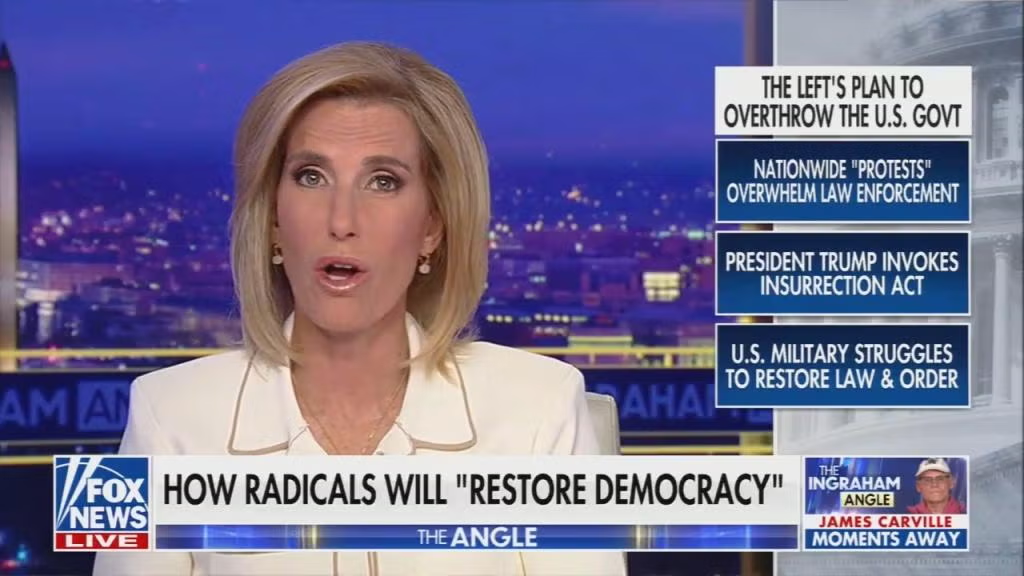
Laura Ingraham claims there is a leftist “plan” to “overthrow” the government. What in the world is she talking about?
Written by Matt Gertz
Published 10/22/26
Republicans are panicking and right-wing media are desperately churning out “fear porn” as polls continue to point to a devastating midterm environment for their party with less than two weeks remaining before election day. From presidential rallies to Fox News primetime, MAGA stalwarts are trying to bolster their party’s turnout by warning Republican voters that if they do not go to the polls, their freedom and very lives may be at stake.
That increasingly deranged environment is generating a level of demagoguery that at times becomes simply absurd.
Fox host Laura Ingraham, for example, announced on her show Wednesday that if Democrats win control of the U.S. House and Senate, a leftist cabal of activists, journalists, “top former staffers” in the Obama and Biden administrations, and even Democratic governors will carry out a plot to force President Donald Trump to invoke the Insurrection Act as a mechanism to “dissolve” the U.S. Constitution and “crush their enemies.”
The argument that the left is planning to destroy the federal government if and only if Democrats triumph in the midterms makes a lot of sense as an attempt to scare Republicans to the polls but none at all as a plot in its own right.
Questions abound: Why in the world is this plan only enacted after Democrats achieve actual congressional power for the first time in Trump's second term? If there is clear evidence of a sweeping plot including “top” Obama and Biden officials, why is the best example Ingraham can point to former Obama White House ethics lawyer Norm Eisen talking about protecting the Constitution with legal action? Why does the plan revolve around getting Trump to invoke the Insurrection Act — an outcome MAGA pundits like Ingraham herself have been lobbying for and Democrats have publicly opposed?
Lastly, why does Ingraham think this grand conspiracy is underway? We don’t really know — she cited no direct evidence for what on-screen Fox graphics described as “The Left’s Plan To Overthrow The U.S. Gov’t.”
But Ingraham’s claims align with a conspiracy theory that Jennica Pounds, a right-wing influencer who goes by the pseudonym DataRepublican and briefly worked for the Defense Department this year, floated over the weekend based on videos of activist meetings she obtained. Pounds’ claim of a leftist “operational plan” seems to be much less than advertised — but has nonetheless been trumpeted this week by prominent MAGA figures like Glenn Beck, Vince Coglianese, Jesse Kelly, and podcaster-turned-deputy-FBI-director-turned-podcaster Dan Bongino.
...
-=-=
The Billionaire Building The Democrats’ New Machine
lever 9 26
earlier this month, a new Democratic machine scored a major victory in Connecticut. First-time congressional candidate Luke Bronin won his Democratic primary by a landslide, ousting 14-term progressive incumbent Rep. John Larson (D-Conn.). Bronin’s win is part of a larger, national push — funded by a secretive hedge fund manager — to elect more establishment-aligned Democrats. Who is this man pouring his millions into the fight?
Today on Lever Time, David Sirota sits down with Lever reporters Katya Schwenk and Luke Goldstein to unmask the man behind the machine. They discuss Schwenk and Goldstein’s recent hit article exploring how one billionaire Democratic donor is attempting to handpick corporate-friendly candidates and crush their most progressive opponents in this year’s mid
You can check out more of Katya Schwenk and Luke Goldstein’s reporting here:
- How A Hedge Fund Billionaire Became The Democrats’ New Kingmaker
- The Democratic Primary Operative With A Wall Street Side Gig
- The New Democratic Machine – And The Billionaires Behind It
Want comprehensive 2026 midterm coverage? Check out The Lever’s new weekly newsletter, Midterm Madness, for election updates, analysis, and more.
This episode was produced by David Sirota and Natalie Bettendorf. The video and audio were edited and mixed by Ron S. Doyle. Our theme music is by Nick Byron Campbell. Marketing support, ad sales, and hosting from the Podglomerate.
TRANSCRIPT
[00:00:00] David Sirota: From The Lever's reader-supported newsroom, it's Lever Time. I'm David Sirota.
[00:00:03] WFSB Archive Clip: If we are gonna fix this mess that we're in, we need to build a Democratic Party that's bringing a whole new energy to this fight.
[00:00:10] David Sirota: Earlier this month, congressional candidate Luke Bronin won his Democratic primary in Connecticut by a landslide.
[00:00:16] WFSB Archive Clip: The former Hartford mayor denying incumbent John Larson a 15th term in Washington last night.
[00:00:22] David Sirota: Many media outlets have painted Bronin's victory as part of this year's insurgency of younger candidates defeating Democratic incumbents in primaries.
[00:00:30] WFSB Archive Clip: The primary was a test, whether voters want experience and seniority or a fresh face and new energy.
[00:00:37] David Sirota: Bronin is certainly a fresher face, decades younger than the 78-year-old incumbent Congressman John Larson.
But Bronin has few ideological commitments, offering up policy proposals with a populist sheen but that are hardly substantive. Larson, on the other hand, was the more progressive candidate in this race, a longtime champion of unions and Social Security. Behind the scenes, something else in this race was going on, and these two reporters have been peeling back the curtain.
[00:01:07] Katya Schwenk: I'm Katya Schwenk.
[00:01:08] Luke Goldstein: And I'm Luke Goldstein, uh, and we're reporters at The Lever.
[00:01:10] David Sirota: For months now, our reporters Katya and Luke have been investigating a new constellation of groups funded by big donors. These groups have built a secret political machine that aims to help corporate-aligned Democratic candidates crush more economically populist Democrats in key primaries across the country.
Today on Lever Time, we're taking a closer look at one of the biggest donors behind this whole battle, a billionaire who's put a dark money apparatus behind Bronin's Connecticut campaign. Who is Stephen Mandel? What exactly does he want? And how is he shaping the 2026 midterm election results? That's all coming up on today's episode of Lever Time.
Welcome back to Lever Time. I'm speaking today with The Lever's investigative reporters, Katya Schwenk and Luke Goldstein.
So a few months ago, the two of you did some digging and broke open this huge story about a constellation of groups aiming to help corporate-aligned Democratic candidates crush more economically populist Democrats in a bunch of primaries, and you exposed the big donors behind all of this.
So let's start by refreshing our memories a bit on all of that and who some of those big donors are.
Let's start with Luke.
[00:02:28] Luke Goldstein: Yeah. So for the piece that we did a couple months back, we were looking at two twin organizations that go by the name of The Bench and Majority Democrats. They funnel money between one another, share a lot of the same staff and donors. And they're these new players on the scene that made a huge splash, uh, in the Democratic primaries this year.
They've helped, um, boost, uh, Josh Turek to victory in his primary race for the Iowa Senate seat, James Talarico in Texas over Jasmine Crockett. And their handpicked candidate was Mallory McMorrow in the Michigan Senate race, who had to drop out actually before the primary date. They also backed Angie Craig, who lost to Peggy Flanagan in the Minnesota race.
And, you know, these, these new groups though have had a lot of success down ballot with congressional races, and they really offer two main kinda assets to candidates who are supported by them. They give them access to a really high-powered network of billionaire donors. Those include Tench Coxe, who's a, a venture capitalist, Michael Novogratz, who's a crypto AI investor, and another guy, Mark Heising.
But the big name that really sticks out is Stephen Mandel. Uh, and so, you know, what we really tried to do for our piece was kind of dig into who this, who this guy is, who's been the primary funder of this whole network, and try to dig into, you know, what the kinda ideological underpinnings may be of this project.
They tend to back more moderate candidates who are going up against progressives in Democratic primaries. The network has played a big role kinda putting their, their thumb on the scale in a handful of races, uh, launching them to victory.
[00:04:03] David Sirota: Okay, so then that raises the question, who exactly is Stephen Mandel? He's the biggest donor, or at least one of the biggest donors, prime mover and shaker behind this whole network. To figure out what he wants, ideologically speaking, from the candidates that he's backing, I think the— right, the first question is who exactly is he?
What can we know about his agenda?
[00:04:26] Katya Schwenk: Yeah. So, you know, Steve Mandel, he's not a household name. And so that, that really was our first question when we started looking into those groups and saw his name coming up again and again as by far the biggest bankroller of this sort of dark money apparatus across a few different PACs and nonprofits.
You know, who is this guy? And like, what, what does he want? What is he trying to accomplish? You know, Mandel is, has been a longtime Democratic donor, actually, is what we found. He is a hedge fund billionaire. His hedge fund, Lone Pine Capital, you know, made it really big in the '90s, and so he has quite a lot of money to spend, and he's been spending pretty prolifically for many years.
He even hosted, we found, you know, former President Joe Biden at his sort of Greenwich mansion in the lead-up to the 2024 presidential elections. But it's really been over the last, you know, year or so that Mandel has taken a more active role. He's bankrolling these organizations that aren't just pouring money.
It's not just like a dark money machine for, you know, the DNC, but he's really trying to pick, to play a role in these primaries and sort of handpick the candidates who might go on to, you know, win. So yeah, I mean, I think he's kept at the same time an extremely low profile. We dug back through his sort of history alongside his wife of charitable giving, as well as sort of a smaller and less well-known political apparatus that he's actually built up in his home state of Connecticut to try to figure out what are his motivations. Um, and we found that's just some pretty interesting results.
[00:05:58] David Sirota: So you've got this guy who's the proverbial man behind the curtain who's funding this infrastructure. And I will say the, the candidates that you mentioned, that this network has been supporting, I mean, they do seem to run a, some kind of ideological gamut depending on how you perceive them.
I mean, James Talarico is an example of somebody who's run very explicitly against billionaires and against money in politics, but who is also backed by this network and does kind of code as a more moderate Democrat in other ways. Josh Turek in Iowa is, is moderate coded, but has also sort of also tried to cast himself as a populist in certain respects.
I think the question is, what ideological commitments, if any, can we perceive the candidates backed by this network, uh, making, to somebody like Steve Mandel specifically or generally to a more corporate-friendly faction? I guess what I'm asking, Luke, is there a through line between the candidates that Steve Mandel is backing, and what they're proposing in terms of policy?
[00:07:11] Luke Goldstein: I think from the outset, to take these groups at their word, they have one commitment, and that's to find candidates who can win, more or less, right? They just care about fielding a set of Democrats who will go up against Republicans in a general election and, you know, help build Democrats a majority, right?
That's their kind of, you know, professed rhetoric, right? And I think what we tried to do in particular was take them at their word and also try to dig into what are the races where they've put the most resources, right? Where are they most heavily invested, and what does that field of candidates really, really look like?
And, you know, the Michigan race was really, for a while, their biggest investment, and I think Mallory McMorrow, who they were backing, had the prototypical bio of a candidate they were looking for. She was kind of in the middle between a more conservative Democrat and a more populist Democrat, and Abdul El-Sayed and Haley Stevens on the other hand.
And, you know, McMorrow adopted certain positions that were very much of the moment. There was a kind of progressive sheen to that campaign. If you dig beneath the surface, there were a couple key issues where I think the network backing her really kind of showed their cards, and one was on the question of data centers.
So McMorrow's position in that race was very much adopted from a policy group in DC that's also part of the Stephen Mandel network called Searchlight Institute, and they put out a whole bunch of proposals that were in opposition to a data center moratorium, which has been backed by kind of more progressive candidates.
They wanted to do something that was tech companies, you know, pay as they go, right? They get to set up their data centers with few restrictions. There's a tax on them specifically to upgrade the underlying infrastructure of utilities, right? So it's this kind of middle path, and that kind of rhetoric we've seen pop up across other races where The Bench and Majority Democrats, funded by Steve Mandel, have invested.
Luke Bronin in Connecticut is another one that we can talk about. But I think just to kind of step back here, right, and, you know, we can try to point to what the wizard behind the curtain here may want. You know, his hedge fund, Lone Pine Capital, almost a third of their portfolio right now is invested very specifically in what's called the picks and shovels of the data center infrastructure build-out.
His portfolio has actually shifted away from what are called the hyperscaler, the Mag Seven AI companies, the Googles, the Microsofts, the OpenAIs, and invested all the way into the suppliers and the physical infrastructure companies that do data centers. So largely this was TSMC, which builds chips, semiconductors, which are crucial for data centers, other energy companies that have struck really particular power agreements with data center developers.
This is really kind of his whole, you know, MO, and I think it's pretty noteworthy that the general political apparatus he's funded has more or less tried to kind of support on the candidate level certain kinds of politicians who will strike this kind of middle path on what to do about AI and data centers, which will of course be the big question for Democrats and whatever party comes into power after the November elections.
[00:10:21] David Sirota: We're gonna take a quick break. We'll be right back.
Welcome back to Lever Time.
I think there's like a chicken or the egg question here, to be honest. I think at one level we can look at somebody like Steve Mandel, who made his money as an investor, and so I think a logical question is, okay, if he's made his money as an investor, investing in this Democratic political infrastructure, is he looking for a return on investment?
I think another way i-is to ask the question, okay, i-in an alternate universe where these entities will never admit and don't admit that they're just an extension of s-some set of donors' attempt to invest and enrich themselves, where we take them at their word that they're making investments in what they perceive to be the kinds of Democratic candidates who can win.
Are they preferencing more moderate, quote unquote, more centrist, quote unquote, candidates as opposed to progressives because they genuinely believe that is the kind of positioning, that is the kind of Democrat who is best positioned to win in a general election? I'm not sure we can actually answer like what's in their mind, what's in their heart, but I just throw that out there for something that I'm thinking about.
Because
I think the question then, Katya, is knowing what we know about Mandel's investment, knowing what we know about Majority Democrats and the organization that they're funding, are they really only interested in so-called electability and therefore they're backing moderate candidates, or are there clues that this is a, like an investment strategy?
[00:12:01] Katya Schwenk: It's a really interesting question, and like you said, I don't know that there is a real straightforward answer. And I do think there is a way to think about Mandel and some of the groups that he's funding as sort of real ideologues, kind of separate from their material interests.
I think he really does. For instance, we wrote about his long-time, very devout support of charter schools, you know, and sort of a more, a controversial area in education that, of course, puts him at odds with teachers unions in many cases and more traditional supporters of public education.
But, you know, it does seem like this has been one of his central issues. And with respect to Majority Democrats, I mean, I, I think that they... You know, it's not only that they claim that they want to elect Democrats that can win. They— like, they do sort of have a strategy for that.
But that's a little bit outside of the bounds of just, you know, moderate or corporate wing of the party as we've sort of understood it up till now. Like, their sort of, their idea, their stated goal is to build, like, a new center, you know, a new wing of the Democratic Party modeled on the corporate wing of the party that existed in the 1990s that sort of revitalizes the establishment.
And I think that's where you see, I think that's how you understand why they're backing some candidates like Talarico, for example, who have like a, a little bit of a populist sheen or something that they, you know, they go after, that they're sort of tapping into the more progressive or populist wing of the Democratic Party and, you know, perhaps co-opting it a little bit.
But it is sort of part of this mission to, like, not just support moderate Democrats 'cause they think that they can win, but build this new corporate wing, kind of reinvent what that even means, and I think that's why we can see why their candidates, in some cases, have more, like, heterodox views.
But yeah, I mean, certainly, I think Mandel's interests and the interests of all the billionaires that are kind of donating alongside him are critical to understanding, you know, where these candidates stand on a variety of positions.
[00:13:56] David Sirota: Yeah. To me, there's a through line here, right? And I always like to look at history. There's a through line from first they were called the Atari Democrats, then they were called the DLC Democrats, the New Democrats, then they were called Third Way. Now I think they're called Majority Democrats and The Bench.
I mean, Luke, is that like a fair way to look at it or am I, or am I being unfair?
[00:14:20] Luke Goldstein: I think the way they present themselves outwardly is, is different, but that's kind of the point. You know, it's this kind of nebulous project that always seems to fit purely to what they think is most politically expedient. And one example of this in particular is that what we should mention along with just the dedication, I guess, to winning, is they've really leaned into this whole political moment, where there's a backlash against, you know, the gerontocracy, right?
This is another kind of big hobby horse for them, right? And we can dive into, you know, why they've been sort of selective, right, in certain races that they've picked out to make this kind of crusade against the gerontocracy a big issue. But Majority Democrats, one of the groups we're talking about here, put out a whole video that kind of was presenting and showcasing this new project that they're doing of trying to topple older incumbents.
And in the, in the video, the very first politician that pops up on the screen is Bernie Sanders, and then it's followed by a bunch of other older members. Elizabeth Warren is one of them. But I don't think you have to read into it too much to see what is trying to be demonstrated there, right?
It's that this fight against the gerontocracy isn't kind of left, or moderate, right? But they're very clearly picking out certain kinds of members to be the face of this gerontocracy. And that was the case in the race for Connecticut's first district between Luke Bronin, who is the Stephen Mandel handpicked candidate.
He was actually on Stephen Mandel's payroll for a number of years. He was a former Hartford mayor, just very kind of generic Democrat, had a bunch of dust-ups with the teachers unions in the state over charter school initiatives at the time, which we dug into. And then several years later, when he's kind of biding his time figuring out what to do next, Stephen Mandel puts him on the payroll for The Connecticut Project, which is one of the nonprofits he's set up in the state.
The Connecticut Project, totally identical in a lot of ways to these new national groups like The Bench that Steve Mandel has also helped set up. There's really a pretty one-to-one parallel there. And then Luke Bronin launches this race against John Larson, who's a 14-term congressional incumbent, is just turned seve— 78 years old.
He's definitely older, right, but has a lot of progressive bona fides. He's supported by union groups. He was supported by Working Families Party, known as, you know, a proponent for expanding Social Security. And I think it's very indicative that this political network felt emboldened to take on someone like Larson with a candidate like Luke Bronin, who was really in many ways running to Larson's right on key questions, you know, like data center, tech policy and AI.
You have progressive challengers against incumbents who are older as well, and they focus on the candidate's age as a way to talk about that incumbent's record on certain issues, if that's healthcare or Medicare for All and such, to show that that politician is older and out of touch on the issues.
Luke Bronin didn't have any of that. There was no policy critique at all of Larson other than the fact that he was, you know, old and, and should have really stepped a— stepped aside. And I think that is one small microcosm for kind of understanding the political operations of this whole network.
[00:17:22] David Sirota: So it's essentially using strategically, selectively the age argument as a way to almost smuggle in a, a different ideologically coded kind of Democrat, a more corporate-friendly Democrat. That seems to be what happened in Connecticut. What comes to mind also is the Massachusetts Senate race that's happening right now.
I mean, you have a, a similar situation where the more progressive candidate, uh, is the incumbent senator, Ed Markey. The younger candidate is the much more, uh, e-economically conservative, corporate-friendly candidate Seth Moulton, who is a, a, a congressperson. Is this network playing in that race? Do we know?
[00:18:02] Luke Goldstein: So not a lot of the core groups. However, Seth Moulton is being backed by another super PAC that's in this network called VoteVets, which we haven't talked about yet. They're ostensibly supporting Moulton because I believe he was in the Air Force, he had some military background.
However, this cycle, VoteVets has really moved in lockstep with this whole political network. They intervene in races alongside The Bench and Majority Democrats all the time. They spent $10 million to help Josh Turek coast to victory in the Iowa Senate primary race, and one of their largest donors this cycle is Stephen Mandel, who has not ever given to VoteVets in any other cycle other than this one.
And, uh, it seems pretty clear they share actually some of the same staff, that there's some coordination strategically in these races for VoteVets to be a major outside spender, whereas The Bench kinda operates more behind the scenes where we'll offer strategic and consulting kind of media advice for campaigns.
[00:18:57] David Sirota: And just to be clear, you broke a big story about VoteVets. Tell us a little bit about that.
[00:19:02] Luke Goldstein: Yeah, I think it fits sort of within this whole, um, uh, picture, 'cause one of the groups that we've been reporting more on since our, our last investigation is, is VoteVets and what role they're really playing in this whole network. So one of their top officials is simultaneously, at the same time that he's involved in this whole network spending, getting, intervening in Democratic primary races, he's been running this astroturf lobbying operation in Washington, D.C. on behalf, very explicitly on behalf of banks and credit card companies to try to kneecap reform efforts to pass legislation that would bring down what are called swipe fees. It's kind of like junk fees that merchants and consumers have to pay because they're reliant on these credit card companies and their payment networks in order to just do basic business.
It's a huge cash cow for banks and credit card companies, and they've enlisted, you know, the top official for a major Dem super PAC to do their bidding in D.C. at the same time.
[00:19:54] David Sirota: I mean, so this speaks to kind of the overlapping interests at play here, where there's a— You know, when people refer to the political class, I mean, I think this is what we're talking about, right? This political class is this blob of like donors, operatives who are working at overlapping organizations, different agendas, not necessarily super transparently.
And I, I glean from all of this that this is, this is an ideological project, being essentially smuggled into Democratic politics under the, uh, auspices of electability, and we just wanna win. Now, I think if that is the case, then I think after these elections, after the midterms, that what we're gonna see, whether by the way these candidates, The Bench's candidates, Majority Democrats candidates win or lose, this is like a trial run to my mind for what is likely to happen in the 2028 Democratic presidential primary.
That they're actually revving up this network and testing it out, kicking the tires, pressure testing it for deployment in the 2028 presidential election when there's gonna be a lot of candidates competing for a lot of different lanes, ideological lanes, branding lanes, moderate, centrist, progressive, et cetera, et cetera.
And obviously money lanes. Who, which donors are they gonna, are g— are they gonna get? Do you have a, a, a sort of a vision of what this might look like in the 2028 Democratic presidential primary?
Which I should remind everyone is gonna start like the day after the midterms.
[00:21:31] Katya Schwenk: Yeah, I mean, I think it's worth noting that, you know, Majority Democrats, the organization was sort of founded explicitly right aft— in the wake of Kamala Harris' loss in 2024. The founding document for the project was, you know, authored by the consultant Seth London, who's been a longtime advisor to big Democratic donors.
So I think we can very explicitly understand Majority Democrats, you know, Mandel's, an organization funded by Mandel that's part of this dark money apparatus, as being founded to, like, basically chart out a path to 2028 for the Democratic Party. So, you know, I think it's really, I think it's correct to sort of understand what's happening right now as, you know, just one step toward that, for this network.
And I think it's been useful for them 'cause they've really been able to build out their political capital and figure out how, you know, th-they can operate more smoothly. But yeah, I mean, I think they're going to be playing a big role in that primary.
Like, their goal is not to just, you know, give a lot of money to whoever the Democratic nominee is, it seems, as, which is what Mandel had historically done. But now he is sort of playing this really big role in who wins, like, the Democratic nomination. I think we can imagine that playing out similarly in 2028.
[00:22:46] David Sirota: We're gonna take one more quick break. Before we continue, I just want to tell you about The Lever's other award-winning podcast, Master Plan. Master Plan's new season, The Kingmakers, traces the decades-long effort to manufacture an all-powerful presidency, from Richard Nixon and Ronald Reagan to Dick Cheney and now Donald Trump.
The podcast shows how a fringe legal theory has been used to hijack the machinery of American government. If you want to understand the world we're living in today, follow Master Plan on Apple Podcasts, Spotify, or wherever you're listening right now. We'll be right back.
Welcome back to Lever Time.
I think the final question is about what these midterms mean for that project moving forward. You've got, a-as we've mentioned, you've got these billionaires who are trying to create this network that's essentially trying to infiltrate the Democratic Party.
They've got electoral organizations, Majority Democrats, The Bench. They've got think tanks like the, the so-called Searchlight Institute that's putting out policies, uh, that are designed to try to blunt the, uh, progressive uprising inside the Democratic Party. This is being, uh, engineered and orchestrated by, for instance, Lis Smith, the Democratic political consultant who ran Pete Buttigieg's, uh, 2020 presidential primary.
So this is all leading up to 2028. But I, I wonder what the results of the 2026 elections might mean for this project. So I think the, Luke, I'll throw to you on the final question about this is, if this network is not successful in 2026, and like for instance, their, one of their most high-profile candidates, Mallory McMorrow, had to end her campaign because it was really failure to launch.
There was a lot of hype behind it, and her campaign ended. If other candidates who this network is promoting as electable, if they are not successful in the 2026 midterms, progressive populist candidates are quite successful in this, in the midterms, does that potentially change how influential these groups are, even though they're gonna be funded, even though they're gonna be active?
Does that change the story they're gonna have to tell? Is it gonna change how influential they are in making their case in the 2028 election?
[00:25:09] Luke Goldstein: Well, dude, I hate to break it to you, but in my experience, there hasn't been a lot of precedent for just the pure merits or victories really determining which way the party goes because this network has the money, right? They have access to Steve Mandel and this whole host of billionaires, so I think a lot of people in Democratic leadership, people who are calling the shots, kind of have to listen to them one way or another.
But yes, it'll change how they message and how they try to control the narrative after the midterms. I think it should be said, there's been a lot of coverage already about all the kind of, you know, all the success that The Bench has already racked up in these primaries. There was a Politico piece that almost was doing a, a score count, you know, of, oh, The Bench has four victories out of five or whatever.
Along with Mallory McMorrow dropping out, which was a big loss for them, the Majority Democrats' handpicked candidate, Angie Craig, also lost in, in Minnesota to Peggy Flanagan, who is, despite being a lieutenant governor, was also more of the progressive pick in that race, was kind of stronger with her rhetoric on ICE than Angie Craig, who has been much more kind of accommodating to immigration enforcement. But yeah, I think that The Bench has a couple big tests ahead for them about whether the Democrats that they have fielded and brought to success through the primaries are actually gonna be able to stand the test against Republicans in the general election. And granted, and really, you know, these are difficult races in, you know, Texas and, and Iowa and such.
There's another congressional candidate, Cait Conley, that their whole network is really invested who's running against Mike Lawler for New York's 17th, which is in the suburb, in the suburbs outside New York. I think that the one other point I guess to make here, depending on what happens in November, is that what we've gathered is that The Bench is more directly involved in these midterm races.
Majority Democrats, the other arm of their apparatus, is the one that's really gearing up for 2028. One of their kind of lead spokespeople really at this point is Senator Elissa Slotkin in Michigan, who's much more explicitly part of the moderate faction among Democrats. They've been really kind of trotting her out doing these kind of splashy, well-publicized kind of town halls almost and conversations with voters, and it's been reported that Elissa Slotkin is likely a presidential hopeful in '28, or if not, she's still positioning herself to be like a behind-the-scenes operator in kind of vetting and selecting who the other candidates will be that will launch races.
I don't really know exactly what gives her the authority to do that, but I guess, you know, she did win a, a swing state that matters for Democrats despite being a one-term senator. So I think that m— you're gonna be hearing a lot about Majority Democrats on The Bench moving forward, even if it's more behind the scenes in terms of funneling money and orchestrating these kinds of kind of political stunts and town halls and such.
[00:27:54] David Sirota: Yeah, and I think the f— the flip side is also gonna be true. I mean, I think that if populist candidates who have defeated this network's candidates in primaries don't win their general elections, I'm guessing that Majority Democrats, The Bench, Searchlight Institute, this whole newfangled corporate faction in the Democratic Party, the DLC, the New Democrats by another name, they will argue that those losses of populist progressive candidates proves that in the 2028 election those candidates should not be nominated.
I'm thinking about Michigan, to go back to that. I think it's very clear in watching this network operate, watching the corporate Democratic faction operate, that that faction, if they were forced to answer, they would say, "Yeah, it would be great if Abdul El-Sayed loses in Michigan, even if that means Democrats don't win Congress, because that gives us a powerful story to tell that, 'Oh, we have to have more corporate-friendly moderates become our general election nominees.
Don't nominate people like Abdul El-Sayed. Don't nominate people like Peggy Flanagan. Don't nominate progressives because they can't win.'" And they would point to those losses in the 2026 election as a kind of cautionary tale, a tale that we've heard, frankly, for my entire lifetime, this faction telling that tale.
I mean, Katya, do you think th— that if El-Sayed loses, if Flanagan loses, if some of these other candidates who have defeated the corporate faction in these primaries lose, that this network is going to spring into action to make an argument, that proves that their argument, their more moderate argument, must win the day?
[00:29:38] Katya Schwenk: Yeah. I mean, I think you can see them, or at least the corporate media and establishment gearing up for that in the Michigan race. Like, there was a headline, I think it was The New York Times, right after the win that was like, "Is Abdul El-Sayed going to cost us Michigan?"
You know, and that is like immediately what the narrative has pivoted to, ginning up fear around that. And I think, yeah, of course, I think they'll take it and run with it. Because again, they want to make the point that McMorrow or their favorite candidate could have won in the general, even if she couldn't won in the primary, didn't win in the primary.
So yeah. And you know, and they've, they've made their opinions on sort of the, the left or the progressive wing of the party very clear. That is the reason when they explained their rationale for the existence of the network to begin with, or the Majority Democrats, you know, they pointed to the progressive groups, progressive nonprofits, like sort of progressive litmus tests as the reason that Kamala Harris lost in 2024, sort of exculpating the donor class as potentially a reason here.
So I, I think, you know, they are clearly averse to taking any kind of accountability for losses like that, and I think they'll definitely use losses of progressives or populists in the party to their own advantage.
[00:30:51] David Sirota: Yeah. I mean, I feel like this has been playing out honestly since McGovern. McGovern losing in 19, has been the cautionary tale against the progressive wing of the Democratic Party for, at this point, 50 years.
But this is the latest iteration o-of that, of the sort of corporate business-friendly wing of the party weaponizing the idea that the progressive wing of the party cannot win general elections. Uh, and I think that's, that is going to be the big debate in the early part of the 2028 Democratic presidential primary, and I think this is all just prelude to it.
And again, I think the reporting that, that you both have done about specifically Steve Mandel, the billionaire, one of the billionaires behind this network, suggests that argument is not the only thing operating on its face, just a concern for whether Democrats win. There are different forces underneath that, financial forces, uh, looking for a, a return on political investment in the form of potentially policy.
I mean, you mentioned data centers. There's deregulation. There's all sorts of different policies that billionaires, crypto policy. There's all sorts of different policies that billionaires are interested in, and I just feel like there's this top-line argument about who is electable that kind of obscures what is actually going on in terms of what the politics are actually about, which is why the reporting on a billionaire like Steve Mandel is so important.
So Luke, Katya, thank you so much for doing the reporting. Thanks for talking to us today.
[00:32:21] Katya Schwenk: Thanks, David.
[00:32:22] Luke Goldstein: Yeah, thanks.
[00:32:24] David Sirota: Thanks for listening to another episode of Lever Time. You can check out more of Katya and Luke's reporting linked in our show notes below. Lever Time is a production of The Lever. This episode was produced by Natalie Bettendorf. Our theme music is by Nick Byron Campbell.
Marketing support from The Podglomerate. Our director of podcast production is Ron Doyle. You can subscribe to Lever Time on Apple Podcasts, Spotify, iHeartRadio, or wherever you get your podcasts. And while you're at it, leave us a comment or a review. We really appreciate hearing from our listeners, and it truly helps spread the word about this show.
Remember, for ad-free episodes, exclusive bonus content, and access to The Lever's entire archive of investigative journalism, please consider becoming a premium subscriber right now. Head over to levernews.com to learn more about becoming a paid subscriber or click the link in this episode's show notes.
I'm David Sirota. We'll be back next week with another episode of Lever Time.
-=-=
-=-=
lever 5 26
...Then, in January, another organization staged a splashy launch: the Bench, advertising a supposed mission of “changing the Democratic Party from the inside.” The Bench promised to “help strong candidates launch with the tools they need to succeed — from communications and digital strategy to fundraising and staffing — so they can focus on what matters most: talking with voters and winning tough races.”
The Bench has endorsed a broad slate of candidates, including McMorrow in Michigan, James Talarico in Texas, Josh Turek in Iowa, Angie Craig in Minnesota, and Conley in New York.
Although they are separate entities on paper, with slightly different organizational structures, Majority Democrats and the Bench share a deeply interlinked fundraising apparatus and ground game.
In March, for example, Majority Democrats announced a nationwide “Built to Last Tour,” featuring several Bench-endorsed candidates.
While those operations hit the campaign trail, the Searchlight Institute, a new center-left D.C. think tank founded in part with London’s financial assistance, has served as the policy brain trust for both groups’ positions on various issues, seemingly shaping the platforms of their endorsed campaigns.
For instance, in March, McMorrow’s campaign in Michigan released its platform on data centers — a plan that mirrored a Searchlight Institute white paper recommending “data center developers pay their way,” a tech-friendly alternative to the moratoriums on data center development that some lawmakers are advancing.
...
---
an 2 26
According to New Republic sources, President Donald Trump's allies in the U.S. Department of Justice (DOJ) were determined to move ahead with a federal prosecution of six Democrats even though they couldn't specify exactly what laws were violated. And the allegations from reporter Greg Sargent's sources are so damning, a legal blogger argues, that DOJ attorneys who pursued the case should be disbarred.
In a late 2025 video, six Democrats — who included Sen. Mark Kelly (D-Arizona) and Sen. Elissa Slotkin (D-Michigan) — told members of the U.S. Armed Forces that they should disobey any orders from Trump if they are blatantly illegal. Trump and Defense Secretary Pete Hegseth were furious, with Trump attacking the Democrats as "traitors" and saying they deserved to be "arrested and put on trial."
But a federal grand jury, on February 10, decided against an indictment. And Sargent reported that according to attorney Preet Bharara — who was representing Slotkin — Trump's DOJ allies, including prosecutor Jeanine Pirro, were unable to tell him what specific statutes were violated. Regardless, the prosecutors were determined to move ahead with an indictment.
Responding to Sargent's reporting in a February 18 post on X, legal blogger Scary Lawyer Guy argued that such "misconduct' should result in the federal prosecutors losing their right to practice law.
Scary Lawyer Guy tweeted, "Textbook prosecutorial misconduct that should result in disbarment. Walking into a GJ and attempting to obtain an indictment against sitting members of Congress WITH NO IDENTIFIED CRIMINAL STATUTE BEING VIOLATED should also be a 'gate' level scandal but no one in the press cares."
Scary Lawyer Guy isn't the only one who is criticizing the Trump DOJ's conduct.
Kristy Parker, counsel for the group Protect Democracy and a former DOJ prosecutor told Sargent, "That is irregular. Typically, when someone is the target of a criminal investigation, it's unusual to dissemble with the target's lawyer about what the charges might be that close to an indictment. It's not how federal prosecutors are supposed to conduct themselves."
---
---
AN 2 26 MICHIGAN
Anthony Hudson, a Genesee County truck driver running for the Republican nomination for governor, has made a habit of threatening elected officials with hanging for “treason,” making such threats at least twice since the start of 2026.
On Jan. 4, in a video posted to Hudson’s social media, he says, “It’s time to get the rope” — while holding a large loop of rope around his arm — as a call to action to “Michiganians and patriots” against politicians who he alleges received kickbacks from former Venezuelan leader Nicolas Maduro, including Michigan’s U.S. Sens. Elissa Slotkin and Gary Peters, both Democrats.
“My hope is that every one of them will be prosecuted to the fullest extent of the law and may their names forever live in shame for their treason,” he says in the video.
Less than a month later, on Feb. 1, in a Mason City Council meeting, speaking in opposition to data center development, Hudson again threatened elected officials — this time local government officials — with hanging.
“You guys never listen, and that’s the problem. These people voted you into office so that you could be their voice in government,” he said. “When you go against that voice, you commit what we call treason. The punishment for treason is public hanging. So, I suggest you start listening.”
Hudson’s statements were strongly condemned by the state Democratic party, who also urged the Michigan Republican Party and the other Republican candidates for governor to similarly condemn the threats.
“Political violence is completely unacceptable, and this kind of dangerous, hateful extremism has no place in our state and country. Anthony Hudson must immediately retract these comments and issue an apology,” Michigan Democratic Party spokesperson Derrick Honeyman wrote in a statement.
The Michigan Republican Party did not respond to a request for a response.
But Hudson doubled down when asked to comment on his statements.
“Know the law and the consequences! I didn’t write the law, as governor I will enforce the law. Educating someone about the law and what the consequences are is not threatening anyone,” he wrote in an email to the Michigan Advance. “Don’t come at me for holding them accountable and saying the worst part out loud.”
Hudson’s comments are similar to those of President Donald Trump, who has accused six elected Democrats, including Slotkin, of committing treason after they recorded a video reminding military members that they did not have to follow illegal orders.
In reaction to the video, Trump called it “SEDITIOUS BEHAVIOR FROM TRAITORS” later saying it was “SEDITIOUS BEHAVIOR, punishable by DEATH!”
---
---
Senator Slotkin Delivers Speech on Trump's Authoritarian Playbook
no troops in str act 10 25
14,384 views Oct 29, 2025
I believe that Trump is ready to bring the full weight of the government against Americans he perceives as enemies. Why? Because he has one goal: making sure he and his ilk never have to give up power. Watch my speech on President Trump's authoritarian playbook.
---
an 7 25
A prominent U.S. Senator is warning the Republican Party that if it continues its promise to redistrict their states, eliminating some Democratic-held House seats, she will “go nuclear” and work to do the same. It is rare for a state to redistrict at any time except after the decennial census, but top Democrats have indicated they are prepared to take action in several states.
President Donald Trump recently directed Texas to redistrict, declaring he wanted five of the 13 seats in the Lone Star State currently held by Democrats to become Republican. That alone would make Speaker Mike Johnson’s job easier — he currently oversees the narrowest margin in the House in nearly a century.
“I don’t know if it’s unprecedented what they’re trying to do in Texas,” U.S. Senator Elissa Slotkin (D-MI) told Axios on Wednesday (video below). “They’re trying to pick their voters, right? They’re trying to redraw the lines in the middle of a decade so that they have more seats, right? It is very open and obvious.”
READ MORE: Tuberville: Dems Must ‘Lawyer Up’ for Plot to Make America ‘Communist’
Senator Slotkin went on to explain that in her home state of Michigan—a critical swing state—voters added a constitutional amendment against gerrymandering, in response to “how bad it is when politicians get to draw their own districts.”
She noted that when the citizens’ commission is in charge of redistricting her state, it makes it more competitive.
“But I will tell you this,” Slotkin warned, “if they’re gonna go nuclear in Texas, I’m gonna go nuclear in other places.”
“I’m not gonna, like, fight with one arm tied behind my back,” said Slotkin, a former CIA analyst and Department of Defense official. “I don’t want to do that, but if they’re proposing to rig the game, like, we’re gonna get in that game and fight.”
House Democratic Minority Leader Hakeem Jeffries has indicated he wants to reorganize the congressional maps in California, New York, New Jersey, Minnesota, and Washington state, to help Democrats pick up as many seats as possible—if the courts allow it.
READ MORE: Trump Accuses Obama of ‘Treason’ in Wild Rant as Epstein Questions Swirl
“We have a responsibility of making sure that we look at every single state of the union and do what we can to ensure that we maximize fairness in those jurisdictions,” Jeffries told CNN. “Some of the best and brightest lawyers in the country are looking at every single aspect of what’s possible in these states.”
Elections analyst Philip Germain responded to Slotkin’s remarks.
“Senator Slotkin continues to understand the moment we’re in and charts a course more Dems should follow,” he wrote. “Democrats cannot continue to ‘play nice’ at the expense of being forced into a competitive authoritarian system of government. We must fight now or get locked out of power.”
U.S. Senator Ruben Gallego (D-AZ) on Tuesday wrote:
“It’s time for Democrats to understand the existential threat. Republicans aren’t playing around and they will do this as long as it takes to keep power. It’s time we dilute VRA [Voting Rights Act] districts. There are plenty of Democratic districts that have 65-80% Dem performance.”
Watch the video below or at this link.
---
note effective sotu rebuttal
March 5, 2025, edition of Newsmax's Greg Kelly Reports
GREG KELLY (HOST): I am a little bit fearful of her, or at least her being around my kids. Sorry, but the LGBTQ agenda that she is pursuing is radical and weird and I think should be criminalized. So there's this Pride group somewhere. And, by the way, there are some totally decent Pride groups. There are. I think the Pride thing is all kinds of excess, but I don't know. Jamie Michelle, you know that woman — Gays Against Grooming, right? Fantastic people. This to me looks like grooming. She participated in this project. We're going to start with the leader of the little group reading sexualized content to children.
...
KELLY: Adults reaching out to children — unless they're your children, that's not a good idea. Without parental consent. They're talking about going around the parents and getting to children they believe or are hoping are LGBTQ. Or maybe they want to convince them to go LGBTQ. This strikes me as grooming, people. And Elissa Slotkin is part of it. Take a look.
...
KELLY: Yeah, but this is not about colors. Alright? This book is about to take a deep and dark and sexualized turn. And that's Elissa Slotkin right there. Not too long ago, participating in a video like this might get you thrown in jail. Now it gets you a number one speaking spot in the Democrat Party. Keep going.
...
KELLY: The family would be confused because the family would know, right? They're talking to kids and trying to get them to fall prey to this crazy, warped ideology. They have no business doing that. They don't even know the children they're reading to. It's dangerous. And a U.S. senator is involved. A couple more.
...
KELLY: If the inside is really as important as you say, why are you focused on children's sex organs and sexuality? This is crazy stuff. I'm tempted to call the cops, or at least the — I don't know, the sergeant at arms on this person. This should be a major scandal. Instead in the Democrat Party, this gives you a prime time speaking spot post-President Trump, right? This is up-and-comers. They have big plans for Elissa Slotkin. Well I think we have big plans in stopping this hideous agenda. And it's being stopped.
---
---
politico
the TV ads seem wildly different from each other.
In Ohio, a woman shares how GOP Senate candidate Bernie Moreno invested in her business making uniforms for female police officers. In Iowa, a spot highlights Rep. Zach Nunn’s military credentials and work to lower child care costs. And in Colorado, a Spanish-language ad touts first-term Democratic Rep. Yadira Caraveo’s support for more border patrol agents.
The ads have one major trait in common: They are all part of a massive effort from the cryptocurrency industry to elect its preferred House and Senate candidates across a dozen states this fall. But not a single one mentions crypto.
The nascent industry has quietly become the single biggest outside spender in congressional elections this cycle other than traditional party groups, spending more than environmental PACs, pro-Israel advocates or abortion-rights groups. About 1 in 12 independent expenditure dollars in House and Senate races this year have come from cryptocurrency-linked super PACs.
“The crypto industry is pretty amazing in that 10 years ago, it was the laughing stock of the tech world,” said Moreno, the GOP Senate candidate from Ohio who is challenging Sen. Sherrod Brown and has attracted the most cryptocurrency backing of any candidate. “And in reality, here you are 10 years later, and they’re going to be decisive in helping Republicans win the United States Senate.”
The industry’s ads are about trying to help their preferred candidates win elections — not making cryptocurrency a campaign issue. That reflects a reality acknowledged by several candidates: Cryptocurrency is hardly top-of-mind for most voters. The ads from the various industry-linked super PACs are instead universally positive spots about their candidates, often biographical or hitting on hot-button issues such as the border, the economy and access to IVF.
And cryptocurrency groups are quick to note that they are not innately partisan, instead backing candidates of both parties, including Democratic Senate candidates in Michigan and Arizona.
Many candidates backed by cryptocurrency are vulnerable members who serve on key committees and supported the industry’s legislative priorities this year. And in Ohio, they are looking to oust Brown, a past skeptic of the industry, even if they are not talking about him or cryptocurrency while they do it.
The spending surge has flowed through three distinct super PACs: Defend American Jobs, which has boosted Republican Senate candidates; Protect Progress, which has boosted Democratic Senate candidates; and Fairshake, which has backed House candidates on both sides of the aisle. Fairshake has also sent money to the other two groups while receiving more than $170 million this cycle from a variety of cryptocurrency-backed interests, including the firms Coinbase and Ripple Labs and the partners behind Andreessen Horowitz, the venture capital firm with substantial crypto investments.
The three super PACs have collectively spent $125 million on independent expenditures this cycle, accounting for 8 percent of all outside spending in congressional races, according to data from the Federal Election Commission. That includes more than $80 million spent on the general election.
In response to questions about the candidates backed by Fairshake and the content of the ads, a PAC spokesperson referred to an earlier statement expressing support for “leaders on both sides of the aisle and in both houses who are committed to getting things done and working with the industry to pass responsible regulation that drives innovation, creates jobs, and sustains America’s global leadership.”
Many of the crypto-backed candidates supported one of the industry’s key legislative priorities this year, a bill that would establish regulatory authority for different classes of digital assets that passed the House earlier this year but has not been taken up in the Senate.
But the biggest investment by far this cycle has been to oust Brown, the only race where they have spent against an incumbent. Brown, who chairs the Senate Banking Committee, emerged as a key skeptic of cryptocurrency and warned of the risks it could pose for consumers.
Defend American Jobs has spent more than $40 million on the race. The top two most-run ads in Ohio this year both come from the group, according to data from the ad tracking firm AdImpact. But neither mentions crypto — nor attacks Brown.
One highlights Moreno as a small business owner who raised a family in the state, another touts his support for energy independence and “stopping illegal immigrants from taking Ohio’s tax dollars.”
The cryptocurrency-linked super PACs also support Democrats — even using some of the same issues, like immigration. An ad from Protect Progress backing Rep. Ruben Gallego praised the Arizona Senate candidate for “standing up to his own party to fund 22,000 border patrol agents,” while a Michigan ad boosting Rep. Elissa Slotkin’s Senate candidacy features a clip of her saying “we need to invest in border security.”
In House races, the messaging is even more varied. Most of the nearly two dozen ads that have run in congressional races for the general election have some biographical component. Five ads defending incumbent Democrats tout their credentials on immigration and the border, while two spots backing vulnerable Republicans highlight their support for access to IVF.
It’s not unusual for an interest group to avoid talking about its own issues in advertising: Earlier this year, the pro-Israel super PAC United Democracy Project ran ads in Democratic primaries that focused on issues ranging from public safety to one candidate’s DUI arrest, though the group ran ads on antisemitism in one New York congressional race.
But cryptocurrency may simply not be front-of-mind for most voters. Estimates for the number of Americans who own cryptocurrency vary widely, in part depending on the specifics of how the question is asked. A Federal Reserve survey in 2023 pegged the share at 7 percent while a Federal Reserve Bank of Philadelphia survey this summer found 14.7 percent; cryptocurrency firms and advocates argue the number is even higher.
With cryptocurrency not a key issue in frontline House and Senate races, most candidates are reluctant to talk about the money. The majority of candidates getting backing from cryptocurrency PACs — and their opponents — declined to comment about the industry’s role in their elections.
A few candidates whose opponents were beneficiaries of crypto super PACs also spoke in favor of cryptocurrency. Former Rep. Mike Rogers, running against Slotkin in Michigan, said in a statement the industry is “important for our national security” while accusing outside groups of “trying to put Crypto in the hands of Democrats.” A spokesperson for Republican Senate candidate Kari Lake, facing Gallego in Arizona, said she was a “strong supporter” of crypto.
In Alaska, Nick Begich, the Republican challenging Mary Peltola, said he was surprised to see Fairshake backing the incumbent Democrat, citing his own pro-cryptocurrency stances. (Begich said he was an early adopter of Bitcoin.) For voters, though, questions about digital assets and crypto policy tend to be lower down the list.
“We’ll get an occasional question about cryptocurrency from the public,” Begich said. “But it is not in the top 10 issues that I hear.”
When the industry does message on crypto, those efforts are far smaller in scale than their work to help specific candidates.
Stand With Crypto, a 501(c)(4) nonprofit, has been conducting outreach aiming to encourage crypto users and supporters to vote this year. The organization also grades candidates based on statements and support for legislation related to cryptocurrency, but does not endorse. And its efforts are far smaller: The group said it has received $2.8 million in donations, about 1.5 percent of the money that has flown through Fairshake.
---
1219
‘Insulting’: Dem lawmaker in Trump-leaning district takes down Kevin McCarthy for blatantly lying about reasons for impeachment
Brad Reed / Raw StoryDecember 18, 2019
During an interview with CNN’s Jake Tapper, Slotkin slammed McCarthy for shamelessly misrepresenting House Democrats’ arguments for impeaching the president.
==