New Republic
===
merri ok
===
-=-=
ref
With the U.S. midterm elections less than three weeks away, is it any surprise that corruption has emerged as voters’ top concern? “Corrupt” was the adjective most often chosen when registered voters were asked for a single word to describe President Donald Trump, according to a survey conducted in September by The Economist and the market research firm YouGov, with 53 percent of respondents calling Trump “corrupt” and only 23 percent saying he is “honest.” A Pew Research Center poll in early October found that nearly seven in 10 (69 percent) of Americans are “not confident” that Trump keeps his business interests separate from his presidential decisions.
Americans can thank diligent investigative reporting for alerting them to much of the self-dealing by Trump, his family, and aides. For example, The Washington Post has reported that Trump’s sons, Don Jr. and Eric, were investors in 15 companies that “collectively generated at least $3.2 billion in direct government business since the sons invested and an additional $3.1 billion in future contract options.” On Tuesday, in a rare retreat, the White House asked Kimberly Guilfoyle to resign as U.S. ambassador to Greece after a Wall Street Journal investigation revealed that Guilfoyle promised political favors to a Trump donor if he would quietly pay off her $100,000 American Express credit card bill.
Throughout the history of modern polling, voters have usually ranked the economy (or its proxies, such as “the cost of living”) as their top issue. Now, linking corruption with the cost of living, “Democrats Are Making Corruption Messaging a Pocketbook Issue,” a recent Politico headline declared. The Democrats’ claim, The New York Times reported, “is that rampant corruption in Congress and the administration is directly costing average citizens who are paying more for necessities like groceries, gas, and medicine.”
Both Democrats and the press, however, so far, are overlooking one of the most overt and consequential examples of Trump’s pay-to-play behavior. On May 24, 2024, Josh Dawsey and Maxine Joselow of The Washington Post published a blockbuster exposé, reporting that Trump privately told a group of oil company CEOs they should donate $1 billion to his 2024 presidential campaign. It would be a good “deal” for the industry, Trump reportedly said, because of the tax and regulation benefits they would receive if he returned to the Oval Office.
Specifically, Trump reportedly said he would reverse the Biden administration’s pause on new liquefied natural gas, or LNG, export permits, approve more drilling for oil in the Gulf of Mexico and Alaska, and roll back environmental regulations the industry didn’t like, including electric vehicle purchasing mandates and vehicle emissions limits. Dawsey and Joselow then published a follow-up, reporting that Trump also promised to soften Federal Trade Commission scrutiny of industry mergers and acquisitions.
Two and a half years later, his administration has delivered on each of these promises and then some. The Brennan Center has published a well-documented summary of Trump’s assault on climate policy—including his administration’s repeal of the “endangerment finding,” which granted the federal government the authority to regulate greenhouse gas emissions—that connects the dots between Trump’s actions and the many billions of dollars the oil industry has reaped as a result, including many millions of dollars benefiting oil executives as individuals.
What makes all this relevant to the midterm elections—beyond the fact that the leader of the Republican Party is directly implicated—is that many of Trump’s accomplishments were only possible because of rubber-stamp support from Republicans in Congress. Now those same Republicans must face the voters. How will they explain themselves?
To be clear, Democrats don’t get a pass here; corruption has been part of politics forever, and one of the press’s central obligations is to expose and hold its perpetrators to account, whoever they may be. That requires following the facts where they lead. But it also requires challenging the practice, still common among old-school newsrooms, of false equivalence—of portraying both sides as equally culpable for a given transgression for fear that an accurate portrayal would look like “taking sides.” If most of the facts point in one direction, our reporting should have the integrity and courage to say so.
Most voters don’t have access to directly question candidates seeking their votes. It’s our job as journalists to ask questions on their behalf so they can make informed decisions about their leaders.
Corruption is understandably a hot issue these days. Meanwhile, new scientific analysis from the nonprofit Climate Central shows that every congressional district in the country is hotter than it was in 1970, thanks to climate change. No surprise, then, that polling also shows that the vast majority of people want their government to take stronger climate action. Journalism that connects those dots—accurately and fairly, and without pulling any punches—is a true public service.
-=-=
-=-=
[### Henry Abundance Agenda Orgs Draft

Revolving Door Project
https://therevolvingdoorproject.org › 2025/09](https://therevolvingdoorproject.org/wp-content/uploads/2025/09/Abundance-Ecosystem-Report.pdf)
Sep 5, 2025 — ” Open Philanthropy is a major donor to the pro-abundance Institute for Progress. In 2025, Open Philanthropy announced a. $120 million ...Read more
[### The Abundance Gang Has a Big AI Problem

The New Republic
https://newrepublic.com › article › abundance-ai-proble...](https://newrepublic.com/article/206423/abundance-ai-problem-data-centers)
Feb 25, 2026 — Following the release of Klein and Thompson's book, Open Philanthropy ... Dustin Moskovitz, unveiled a $120 million fund focused on ...Read more
tnr
In early February, Axios reported that “Ezra Klein’s Abundance movement is getting some backup” in the form of a new group: Next American Era, headed by former Democratic Congressional Campaign Committee head, Illinois congresswoman, and longtime Washington insider Cheri Bustos. Bustos’s group, per the report, would be committed to “‘pro-growth,’ deregulatory policies.” This is hardly surprising; for the past several years Bustos has been a literal corporate lobbyist at the extremely Trump-connected outfit Mercury Partners. Mercury saw its profits more than double in 2025 as it sold access to the Trump throne room.
Over the course of the three years for which we have lobbying disclosures, Bustos branched out from lobbying overwhelmingly on behalf of agriculture firms and municipal governments to work for energy firms and software behemoths, as well. In particular, Bustos registered as a lobbyist for OpenAI and Larry Ellison’s Oracle, two of the most central companies in the bubblish AI industry that is becoming increasingly omnipresent in our politics, economy, and daily lives. The two firms were also the biggest clients in Bustos’s portfolio; Oracle’s 2025 lobbying expenditures totaled over $11 million, while OpenAI’s were just under $3 million. Bustos’s next-largest clients in 2025 were Korea Zinc and battery manufacturer Gotion, both with around $2.5 million in total lobbying.
Facially, it seems odd for someone like Bustos, fresh off a stint of AI lobbying, to launch a centrist 501c(4) and immediately align with the abundance agenda, which generally represents itself as a movement focused on housing and utility transmission permitting. In reality, it’s of a kind with a deep techno-optimist, pro-AI undercurrent that has permeated abundance thought since before Derek Thompson coined the phrase “abundance agenda” in 2022.
In the spring of 2025, Thompson and Klein’s tome, Abundance, launched to a firestorm of discourse, both praise and criticism. Nearly a year later, the blaze has lessened—Trumpian destruction of the economy and democracy tends to take the wind out of the sails of cockeyed optimists, after all—but tensions in what writers on both sides (namely, Jonathan Chait and David Sirota) have called the “Democrats’ Civil War” continue to simmer.
The abundance ecosystem has tried to develop a “grass-tops” movement, which parlays an elite influence campaign into building a mass constituency. Abundance world has certainly been successful at the first part; with hundreds of millions of dollars (this figure is meant literally, not figuratively) flowing into abundance organizations and Klein playing an intellectual power-broker role within Democratic politics—to the point that it raised eyebrows internally at The New York Times, according to reporting from Axios. But with sitting mayors and governors explicitly name-checking the book and its authors, abundance has thoroughly permeated the political class. It has not, however, been as successful at building a broad-base constituency. (It is perhaps difficult to focus on a gauzy future of plenty when fascist shock troops are loose on the streets, acting with impunity.)
Despite Abundance making theNew York Times bestseller list (tech tycoon Reid Hoffman sending copies to everyone he knows probably didn’t hurt), Democratic voters have been notably leery about the abundance framework. Polling has shown that the base is far more interested in tackling corporate greed than it is in municipal red tape, and Klein’s attempts to cast himself as a bipartisan mediator in the wake of the Charlie Kirk assassination have undermined his status as a leading light on the left.
At the Abundance 2025 conference, prominent abundance think tanker Alex Trembath of the Breakthrough Institute stood up to forcefully decry any allegations that the movement had been organized by elites, claiming that “abundance is not this astroturfed conspiracy. In fact, just the opposite: Abundance is emergent. Abundance is bottom-up.” He followed this declaration with the romantic sentiment that it was not donors who brought this movement together but fate, saying, “We were not herded and orchestrated: We found each other. The people and ideas in this ballroom pull on strands from multiple fields—think tanks, activists, organizers, elected officials, journalists, philanthropists, technologists, and entrepreneurs and investors.”
That is, notably, not what a bottom-up movement is. Grassroots movements are built on a foundation of organizing and mobilizing a mass membership. What Trembath actually described is very clearly a grass-tops strategy. Many people within abundance circles recognize, sometimes even celebrate, this dynamic. It was this very strategy that the Niskanen Center spelled out in its June 2024 manifesto charting how to build a so-called “abundance faction.”


The push for a bipartisan grand coalition, also laid out in Niskanen’s manifesto, has not succeeded either. The right flank of the abundance ecosystem has openly embraced some of the most vile parts of Trumpism. In the lead-up to Abundance 2025, the Manhattan Institute’s Charles Lehman, one of the speakers at the conference, called for “deportation abundance.”
Even Utah Governor Spencer Cox, who headlined alongside Klein and Thompson, and has a long-standing reputation as a (relatively) compassionate moderate who wants us all to “disagree better,” has veered toward rank partisanship and entrenching the power of an ever more authoritarian Republican Party. Cox moved to pack the Utah Supreme Court in order to gerrymander Salt Lake City, in what was an awfully aggressive approach for anyone who isn’t dead set on preserving the MAGA regime. The gerrymander would have only picked up one seat. But Cox has embraced a cosmic view of politics, where Donald Trump’s survival from an assassination attempt in 2024 was “miraculous,” spinning a borderline messianic interpretation of Trump’s candidacy and saying to Trump, “You, and only you, can be [the] kind of leader” it will take to repair the country.
Meanwhile, the Trump officials who were praised by abundance advocates as sage and reasonable, particularly Energy Secretary Chris Wright and Interior Secretary Doug Burgum, have been anything but. Wright has raised concerns that he is using his post to advance the business interests of the nuclear energy firm Oklo, where he was previously a board member, and is taking point on the American colonial takeover of the Venezuelan oil industry. Burgum is keeping busy cheerleading threats to annex Greenland, ignoring natural disasters in the actual interior, explicitly serving the oil and gas industry, and whitewashing American history by scrubbing any discussion of climate change, colonial violence toward Native Americans, and other stains on our heritage from national parks and monuments. Oh, lest we forget, he also oversaw the removal of the word “transgender” from the Stonewall monument, where his Interior Department recently abortively removed the Pride flag itself.
Curtis Yarvin, whom prominent abundance intellectual Steve Teles links to in this piece as the far-right edge of abundance, is considered central to the “new right,” which James Pogue described as “a project to overthrow the thrust of progress, at least such as liberals understand the word.” Yarvin, an antidemocracy nutball who wants to replace the republican system of government with a dictatorship or monarchy, also believes white people are innately more intelligent than other races, and has minimized slavery.
Despite this movement being studded by such miscreants and autocratic enablers, abundance is poised to exert significant influence in the near term, especially through a donor class that absolutely loves it and inside organizing like Ezra Klein’s appearance at a major Senate Democratic retreat. But if abundance liberals are to avoid missing the moment and find durable standing within center-left politics, they have to confront a glaring contradiction: their relationship to the AI industry.
AI skepticism and populist anger at data centers are surging. But abundance groups are increasingly aligning with deeply unpopular tech-titan pet projects like California Forever, an attempt by Silicon Valley bigwigs to build their own city from scratch between Sacramento and San Francisco. Housing policy group California YIMBY endorsed the plan, which led to California state Senator Christopher Cabaldon expressing confusion at a recent conference. California Forever also sponsored a recent “Festival of Progressive Abundance” in Los Angeles. The Charter Cities Institute, which advocates for the creation of autonomous cities unbound by existing legal code and envisioned as techno-optimist Meccas, sent an open letter to the Trump administration in support of Freedom Cities, alongside researchers at the American Enterprise Institute, or AEI, which is considered an abundance organization in the list maintained by Inclusive Abundance, the ecosystem’s main organizing arm.
On top of AEI, there is a host of other broadly pro-tech libertarian think tanks included in the Inclusive Abundance list, such as the (Koch-aligned) Cato Institute, the Cicero Institute (chaired by Palantir co-founder Joe Lonsdale), primary Charles Koch influence operation Americans for Prosperity, and the Federation for American Innovation. FAI alum Michael Kratsios, now the head of the White House Office of Science and Technology, has been an aggressive AI booster and was central to Texas Senator Ted Cruz’s legislation that attempted to create a mechanism to functionally exempt the AI industry from any and all federal regulation.
Don’t just take it from me that abundance sometimes is awfully close to tech-libertarians; the Cato Institute itself has said so, and it is generally expert at what libertarianism means.
Abundance has been marketed as a movement focused on solving the crisis of housing affordability, but there has always been a distinct techno-optimist bent to the movement that looks favorably on AI and Silicon Valley. In the opening utopian vignette of Abundance, Klein and Thompson identify widely distributed wealth from artificial intelligence as the internal mechanism that enables our supposedly impending sci-fi-flavored future. Klein, in particular, was quite vocal that a major driver of his side of the project was about repairing the frayed relationship between progressives and technology—both the concept itself and the tech industry centered around Silicon Valley.
The Abundance 2025 conference, judging by its schedule, had as much programming around AI as it did around housing (there was more directly focusing on energy policy than either, though energy and AI are deeply interconnected). The author of President Trump’s AI Action Plan, Dean Ball (now at FAI), was a featured speaker at the conference, as was NVIDIA’s director of infrastructure policy and multiple other champions of AI.
Moreover, much, if not most, of the funding flowing into abundance organizing is closely linked to powerful Silicon Valley figures. Following the release of Klein and Thompson’s book, Open Philanthropy (another sponsor of the abundance conferences, since rechristened Coefficient Giving), which was launched by Facebook co-founder Dustin Moskovitz, unveiled a $120 million fund focused on advancing abundance ideas. Half of the fund—$60 million—came from Stripe’s Patrick Collison. Arnold Ventures is a frequent abundance funder, which launched the Abundance Academic Network and a new abundance-flavored Vox vertical, among others. John Arnold made his fortune in energy trading and more recently joined the board of Meta specifically to serve as an energy adviser for data-center buildout. When welcoming Arnold to the board, Mark Zuckerberg said that, “as we focus on building AGI,” Arnold’s “deep experience” in “energy infrastructure will help us execute our long-term vision.”
Ever wonder why AI advocates downplay the climate implications of natural gas–fueled AI data centers? Consider Renaissance Philanthropy, an early pro-abundance foundation, which was created with money from former Google CEO Eric Schmidt. Schmidt has publicly stated that humans will never manage to control climate change, and that our best bet is to pour near-unlimited resources into developing an AI that can solve the issue for us. And Schmidt’s views are hardly niche within the realm of our would-be AI oligarchs.
In the most on-the-nose example, Abundance 2025 also had two literal trade associations that represent major tech firms among its sponsors: Chamber of Progress and the New American Industrial Alliance. The former of these is funded by literally every prominent AI firm in the game, from Marc Andreessen’s a16z to Amazon, Apple, Google, OpenAI, NVIDIA, Midjourney, and others.
None of this is an aberration: Silicon Valley has been at the forefront of developing abundance thought since its inception. Among the earliest proto-abundance treatises was an essay in The Atlantic co-authored by Patrick Collison and Tyler Cowen that called for the launch of a new science dedicated to studying how to achieve progress, which they creatively dubbed “progress studies.” In the seven years since their essay, progress studies has intermingled with other movements, such as effective altruism and rationalism, mainline Koch-style libertarianism, and supply-side progressivism, with a dash of technofascism comprising what Steve Teles has christened the “Dark Abundance” subfaction. The amalgamation of all these strands led to what we now would call the abundance movement (or ecosystem).
Cowen, in turn, runs key abundance funder Emergent Ventures, which was launched with a grant from Palantir’s Peter Thiel. Patrick Collison has marshaled part of his fortune to organize an annual retreat for abundance diehards in Sevastopol, California, where those invested in the success of the movement can gather, commiserate, and plan future efforts. Venture capitalist Marc Andreessen, whose a16z invests heavily in AI, fintech, and crypto, wrote his own call for abundance in 2023, titled “The Techno Optimist Manifesto,” with a whole chapter on “abundance.” Notably, one of Ezra Klein’s early proto-abundance columns built on another viral Andreessen essay.
Now, it should be noted that there are some in the abundance ecosystem who have been critical of AI in recent years. Thompson, while an enthusiastic fan of AI, who has been explicit about wanting to convince skeptics, has written about the technology’s downsides; fledgling abundance magazine The Argument (itself frequently techno-optimist and replete with Silicon Valley funding from Arnold, Collison, Open Philanthropy, and Emergent Ventures) has published several good articles that scrutinize the more boondogglish side of Silicon Valley’s latest obsession.
Even beyond the array of pro-AI interests lining up behind the abundance agenda, though, the AI industry and the data-center construction boom raise what should be uncomfortable questions for abundance advocates.
The movement’s central premise is that we can’t build and that we have created too many veto points that let parochial interests block important construction projects. But the data-center boom clearly shows that we can build. Or at least that mega corporations can when they put their minds to it. Granted, the sets of restrictions that apply to multifamily housing, energy transmission infrastructure, and industrial-scale data centers are all different, but frequently abundance proponents target the exact types of procedural bottlenecks that communities that don’t want data centers are using to block or delay tens of billions of dollars’ worth of them from popping up. In particular, community input meetings, air quality standards, and public interest lawsuits are frequent boogeymen of the abundance framework. But they are now the chief means by which communities are fighting back.
The data-center buildout also creates acute examples of why the types of bottlenecks that abundists decry are both absolutely necessary and, sometimes, still too weak. Examples of massive data-center projects being built against the wishes of their neighbors have become commonplace, to the point that foisting nondisclosure agreements upon elected officials over the details of the terms local government is giving to AI companies to build in their communities for economic development is becoming something of an industry standard.
Abundance tells us that we struggle to build and that procedural measures like public interest lawsuits, zoning restrictions, and community input meetings are blocking essential public goods. But then, at the same time, it has so far offered no comment on the reality that we are building plenty of data centers, often even while overcoming those democratic processes.
In Memphis, when Elon Musk’s xAI started operating without going through the permitting process—potentially illegally—we got a taste of how things work without the “bottlenecks” that figures like Thompson and Klein decry. The data center spewed toxic gas over a community that already bore significant air pollution, and did it without the public even knowing about it; more than a dozen local officials signed NDAs, which led to even some City Council members being completely in the dark about xAI’s operations in the city.
Perhaps Musk’s “Colossus” data center couldn’t have been built or would have taken much longer if it hadn’t pulled the wool over the eyes of residents and their government and had actually followed the law. But the flip side is that the progress that those costs have borne is a chatbot that, while it does sometimes fact-check kooky conspiracy claims, declared itself “MechaHitler,” provided planning assistance for a home invasion, removed clothes from people’s pictures on X without their consent, and generated thousands upon thousands of images of child pornography. Thankfully, the only cost for creating such an innovative piece of technology was an entire community being bombarded with toxic emissions that cause cancer and respiratory disease. Data-center expansion is already causing tens of billions of dollars in additional public health costs annually, disproportionately in poor, minority-majority areas like South Memphis.
Moreover this type of “behind-the-meter” energy supply is extremely common and trending up. More than three-fourths of the on-site power currently being brought online at data centers is natural gas, which, while its fumes are less toxic than coal’s, still emits large amounts of carcinogenic and toxic pollutants. Even worse, many data centers have diesel backup generators, which are far more detrimental to the health of people living nearby, particularly because of higher levels of nitrogen oxide and PM2.5 particles.
Public sentiment is also clearly turning against data centers. While polling indicates that voters are largely agnostic on data-center buildout as a hypothetical, there is a large body of evidence on the underlying elements that shows deep hostility toward the AI industry.
Politico and Public First recently found that 37 percent of respondents supported data centers to 28 percent opposed, with another 28 percent neither supporting or opposing, though with a major split along party lines; Democrats narrowly opposed, 36 percent to 33 (27 percent for neither), while Republicans had fairly strong support, 45 percent to 26 (24 percent for neither). This is similar to what NBC found in the summer of 2025, with 44 percent of respondents thinking AI would improve their family’s future versus 42 percent who thought it would make it worse. News site Heatmap found that only 44 percent of respondents supported a data center being built, even less than other types of energy infrastructure, including gas-fired power plants and nuclear reactors. There is also a substantial polling literature that shows Americans are deeply apprehensive of AI generally, although with very different views along gender lines—men tend to be positive about AI, while women are skeptical.
While apathy may be the prevailing mood nationally, with most voters having heard nothing at all about data-center construction, nearly every state or county-level case study available shows massive backlash brewing. Most tellingly, in the places where people have heard about data centers, they detest them. Virginia Democrats vocally ran against data centers last year and scored impressive wins. The 30th district, which includes data-center capital of the world Loudoun County, saw the incumbent Republican ousted by John McAuliff, who worked overtime to tie his opponent to the data centers. Similarly, 2025 saw two statewide spots on the Georgia Public Service Commission flip to Democrats over anger about data-center-fueled energy price hikes, the first statewide races the party had won in decades. State-level polling has shown antipathy in the ever-crucial swing states of Pennsylvania, Wisconsin, and Michigan.
A growing number of localities have also instituted a pause on new data-center construction, including Prince George’s County in Maryland; St. Charles, Missouri; several Atlanta-area counties; and several counties in Indiana. State-level restrictions and moratoria are being debated across the country, from New York to Georgia to California. Given all of that, it’s hardly surprising that Morning Consult has shown that support for banning data-center construction has been surging; just between October and November 2025, the policy went from down by two points to up by five. It is becoming increasingly clear that this moment calls for campaigning on AI skepticism.
Abundance proponents, however, seem determined to swim against the current of public opinion. For some, as Eric Levitz implies in Vox, it’s a matter of the muddled picture of public opinion we have. For others, though, abandoning data centers would be like surrendering their raison d’être. Particularly for the groups that emerged out of the “progress studies” movement kick-started by Collison and Cowen’s Atlantic essay, part of the point of abundance has always been to foster a sense of techno-optimism.
There is nothing inherent to abundance thought that necessitates AI boosterism. Indeed on a recent podcast, Marshall Kosloff, who emceed Abundance 2025, recalled responding to a question about what the abundance line on AI is: “We want nothing to do with that.” As Austin Ahlman of the Open Markets Institute, one of Kosloff’s guests for the episode, pointed out, such sentiment is “nowhere close to where the status quo is,” where Silicon Valley elites clearly “view this as an easy vehicle for the regulatory structures that they need to very quickly do the AI buildout without any democratic discipline or oversight.”
In fact, in its “Abundance Landscape” report, Inclusive Abundance identifies artificial intelligence as one of the five core policy areas. Notably, transit, one of the most common talking points for abundance punditry, is excluded, though IA said it would include it in its 2026 report. Even outside of AI’s own dedicated policy area, the report also includes AI as one of the “opportunities” for abundance energy policy, saying “AI industry leaders and experts agree that this technology will need a tremendous amount of energy going forward. AI and energy experts must collaborate in order to meet the need for more energy.” A similar argument was made by Trembath in an article with Josh Smith of the Abundance Institute. The Abundance Institute itself has also pushed AI very aggressively, including encouraging the White House to attempt to preempt all state-level regulation via executive order.
In a bit of profound irony, data-center construction has broken free of the choke points decried by abundance to the point that it is now bidding up land value and resulting in further constraints on the supply of housing, according to reporting from The Wall Street Journal. Now the data-center buildout, as well as being deeply unpopular and undermining the intellectual case for abundance, is directly jeopardizing what is supposed to be the movement’s central animating goal.
Elements of abundance raise important questions, particularly about how to build state capacity and the importance of government efficiency to public buy-in for ambitious governance (articulated well in this podcast by Mayor Zohran Mamdani speaking to Derek Thompson). But the framing of these questions is also saddled with an association with the excesses of ambition of Silicon Valley moguls—and their dark, antidemocratic leanings. If it’s hard to get people to say yes to an apartment building in their backyard, it’s doubly so to convince them to site a giant warehouse spewing toxic emissions and spiking their electrical bills in their backyard—especially if the best non-bubblish case for the data center is that it will increase the odds they will be unemployed.
Dylan Gyauch-Lewis is a researcher at the Revolving Door Project.
Read More:
Politics, Abundance, Ai, Data Centers, Economy, Technology, Silicon Valley, Artificial Intelligence
---
---
an 2 26
According to New Republic sources, President Donald Trump's allies in the U.S. Department of Justice (DOJ) were determined to move ahead with a federal prosecution of six Democrats even though they couldn't specify exactly what laws were violated. And the allegations from reporter Greg Sargent's sources are so damning, a legal blogger argues, that DOJ attorneys who pursued the case should be disbarred.
In a late 2025 video, six Democrats — who included Sen. Mark Kelly (D-Arizona) and Sen. Elissa Slotkin (D-Michigan) — told members of the U.S. Armed Forces that they should disobey any orders from Trump if they are blatantly illegal. Trump and Defense Secretary Pete Hegseth were furious, with Trump attacking the Democrats as "traitors" and saying they deserved to be "arrested and put on trial."
But a federal grand jury, on February 10, decided against an indictment. And Sargent reported that according to attorney Preet Bharara — who was representing Slotkin — Trump's DOJ allies, including prosecutor Jeanine Pirro, were unable to tell him what specific statutes were violated. Regardless, the prosecutors were determined to move ahead with an indictment.
Responding to Sargent's reporting in a February 18 post on X, legal blogger Scary Lawyer Guy argued that such "misconduct' should result in the federal prosecutors losing their right to practice law.
Scary Lawyer Guy tweeted, "Textbook prosecutorial misconduct that should result in disbarment. Walking into a GJ and attempting to obtain an indictment against sitting members of Congress WITH NO IDENTIFIED CRIMINAL STATUTE BEING VIOLATED should also be a 'gate' level scandal but no one in the press cares."
Scary Lawyer Guy isn't the only one who is criticizing the Trump DOJ's conduct.
Kristy Parker, counsel for the group Protect Democracy and a former DOJ prosecutor told Sargent, "That is irregular. Typically, when someone is the target of a criminal investigation, it's unusual to dissemble with the target's lawyer about what the charges might be that close to an indictment. It's not how federal prosecutors are supposed to conduct themselves."
---
- Malcolm Ferguson @ The New Republic: Trump and Hegseth Face New War Crime Allegation Over Drug Boat Strikes
A bombshell report reveals how the Trump administration conducted that double-strike boat bombing.
---
random 12 25
MAGA Straight Up Imploded This Weekend—And It’s Beyond Messy
Tucker Carlson, Milo Yiannopoulos, and Benny Johnson are just more proof that the MAGA base is fraying at the seams.
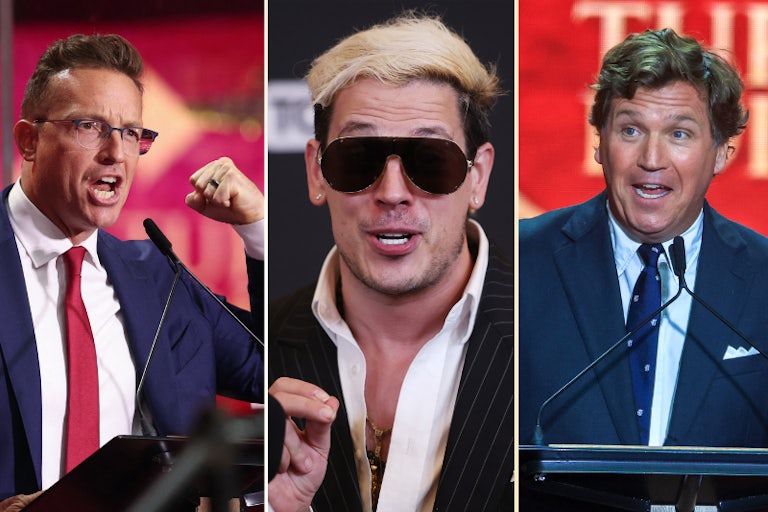
Getty x3
From left: Benny Johnson, Milo Yiannapoulos, and Tucker Carlson
The online MAGA-verse were at each other’s throats more than usual this weekend, as right-wing commentators Benny Johnson, Milo Yiannopoulos, and Tucker Carlson were all points of controversy.
The first tiff started on Saturday, when Yiannopoulos—who has made a name for himself as an openly gay far-right bigot—accused multiple conservative influencers like Johnson and Charlie Kirk of being closeted gay men on Tim Pool’s podcast with swindler and former MAGA Representative George Santos, who is also gay.
“One of the most distinctive things about the right-wing in this country is its homosexual overtones. Benny Johnson posts pictures of his children every two days—it’s weird. And everybody knows what went on with Benny Johnson in those lobbies and those hotel rooms at SAS. Everybody knows,” said Yiannopoulos.
“I don’t know what you’re talking about,” Santos replied.
“Men, younger men. Not underage, at least I don’t know that. His wife was crying drunk in the lobby three SAS’s in a row about how her husband was upstairs with boys,” Yiannopoulos claimed. “Go ask her.”
“Come on, Milo, aren’t you ever scared of getting sued?” Santos asked.
Yiannopoulos insisted he was telling the truth, and that he’d never been sued.
On Sunday, Johnson threatened to sue him.
“I am duty bound to take action to protect my family against those who maliciously defame and attack us. More to come on that soon,” he wrote. “Pray for healing for some really sick and delusional people. Jesus is about redemption. The legal system is about justice. Happy Sunday.”
Yiannopoulos responded in a message addressed to Johnson and his wife, Kate:
“I know more about defamation than any lawyer you will hire. Benny is a public figure. Malice is a nonstarter. I have receipts, and the truth is a total defense against any claim of defamation or libel. Do you want to lose a defamation case to MILO YIANNOPOULOS OF ALL PEOPLE about whether or not you are gay? Do you want to even fight one? The people who have poured money into making you a big deal are about to lose their entire investment,” he ranted.
“I know more about your marriage than you think I do,” he continued, “and I have evidence, and I have witnesses. I know who to subpoena. I know what questions to ask. About nocturnal liaisons dangereuses with chaps in assless chaps and about being caught in flagrante delicto at conferences attended by students, some of whom may have been under 18 (I guess we’ll find out!).”
Yiannopoulos also claimed that Turning Point USA may have faked Charlie Kirk’s death.
Meanwhile, other far-righters—mostly Islamophobes and Zionists—were at pundit Tucker Carlson’s throat for his purchase of a property in Qatar.
“Speaking on stage at the Doha Forum in Qatar, Tucker Carlson told Qatar’s Prime Minister Al Thani that he is buying a place in Qatar this week because he’s an ‘American”; and he will live and go wherever he wants,” MAGA crank Laura Loomer posted on Sunday. “Qatar is the financier of the Muslim Brotherhood and they continue to allow HAMAS officials to live in Doha, where Tucker now wants to buy a place to live.”
“Let me explain the joke: Qatar is a bloodthirsty, terror-supporting slave state, and Tucker Carlson is rubbing it in your face that he’s an unregistered foreign agent for them,” another account wrote.
It’s clear that Trump’s base is fraying at the seams. From those questioning the validity of Trump’s “America First” and our fealty to Israel, like Representative Marjorie Taylor Greene, Nick Fuentes, and Tucker Carlson, to those like Yiannopoulos spreading conspiracy theories only Candace Owens would touch, it’s clear that whatever base of hatred Trump still has is fractured.
:{December 8, 2025/
Vance Blasts “Made Up” Racist Quote—but Then Defends It
Vance accused a post of incorrectly paraphrasing his words, but still defended the racist sentiment.
IFrame Content](https://instaread.co/player?article=vance-blasts-made-up-racist-quotebut-then-defends-it&publication=newrepublic&pay_wall=false&article_url=https%3A%2F%2Fnewrepublic.com%2Fpost%2F204115%2Fjd-vance-made-up-racist-quote-still-defends-it&version=1765235400000)
Vice President JD Vance offered up a defense for his own racism so baffling that it makes you wonder: What in the world are they teaching at Yale Law School?
Vance slammed an X account for paraphrasing one of his anti-immigrant tirades as “completely dishonest”—before confirming that he pretty much agreed with the sentiment anyway.
During an October interview with conservative podcaster Miranda Devine, Vance made a series of comments claiming Americans struggled living next door to immigrants.
“‘Well, wait a second. What is going on here? I don’t know these people. They don’t speak the same language that I do.’ And because there are 20 in the house next door, it’s a little bit rowdier than it was when there was just a family of four or a family of five,” Vance said on the podcast.
“It is totally reasonable and acceptable for American citizens to look at their next-door neighbors and say, ‘I wanna live next to people who I have something in common with. I don’t want to live next to four families of strangers,’” Vance said.
Vance’s comments were old-school racist, as he proselytized about the invented struggles of not living in a homogeneous community made up of white, English-speaking, nuclear families. The inclusion of immigrant families meant noise and chaos for their well-meaning white neighbors. Vance, who has previously admitted to telling racist lies for attention, uses comments like these to justify the Trump administration’s immigration crackdown and deportation efforts.
On X, hedge fund manager and frequent anti-Trump poster Spencer Hakimian offered a summation of Vance’s comments: “It’s totally reasonable to not want neighbors who speak another language.”
Vance hit back in a post of his own. “First of all, it’s just a made up quote. Completely dishonest,” he wrote, referring to Hakimian.
“Second, what’s reasonable is to want to share a language with your neighbor. How do you borrow a cup of sugar? Resolve disagreements? Have a nice conversation? You need a common language, and in America, that language is English,” Vance wrote. “The far left became so deranged on immigration that they’re attacking people for wanting to be able to speak to their neighbors.”
In one fell swoop, Vance denied thinking it was reasonable to not want neighbors who don’t speak English, before clarifying that it was not unreasonable to want your neighbors to speak English. If your defense of racism is to offer up a brainteaser, you may be working too hard.
Read more about immigration:
Trump Official Forced to Clarify Exactly How Many Somalis Are Garbage
Most Recent Post
:{December 8, 2025/
Trump Freaks Out at Paramount After MTG Trashes Him on Air
Donald Trump is furious at the latest episode of 60 Minutes.
Donald Trump threw a temper tantrum Monday, demanding an apology from Paramount after Representative Marjorie Taylor Greene bashed him on their network—and it’ll probably work.
In an interview on 60 Minutes Sunday, Greene, a recent MAGA defector, exposed just how much Republican lawmakers hate Trump and slammed his second-term agenda.
In his meltdown, Trump continued to elaborate on his inane nickname for “Marjorie ‘Traitor’ Brown” in a post on Truth Social, writing, “Green turns Brown under stress!” and “She sort of reminds me of a Rotten Apple!”
But Greene wasn’t the only recipient of the president’s ire.
“My real problem with the show, however, wasn’t the low IQ traitor, it was that the new ownership of 60 Minutes, Paramount, would allow a show like this to air. THEY ARE NO BETTER THAN THE OLD OWNERSHIP, who just paid me millions of Dollars for FAKE REPORTING about your favorite President, ME!” Trump wrote.
Paramount has already bent over backward to build a pro-Trump media behemoth. Earlier this year, the organization paid $16 million to Trump to settle a lawsuit over an edited 60 Minutes interview of failed Democratic presidential candidate Kamala Harris, clearing the way for a merger with Skydance. (Months later, it chopped up an interview with the president to make him sound normal.)
Paramount later installed Bari Weiss, a boring center-right pundit, to lead CBS News and started to install editorial rules to benefit Trump’s administration. Hell, Paramount even agreed to revive the Rush Hour movies after Trump begged his billionaire buddy Larry Ellison, whose son David runs Paramount Skydance.
Why will the president’s childish outburst probably get him exactly what he wants? On Monday, Paramount launched a $104.8 billion hostile bid to acquire all of the outstanding shares of Warner Bros., after losing out to Netflix. Semafor reported that Paramount executives had initially been hopeful Trump would step in to block the sale to Netflix, but the president had demurred. Speaking to reporters Sunday, Trump said he would be “involved” in the Warner Bros. sale, positioning himself as a dealmaker for interested parties to suck up to.
---
AN 11 25
U.S. Sen. Jeff Merkley (D-Ore.) tells the New Republic that “we have all three key ingredients of a strongman state: a rubber-stamp Congress acceding to the president’s desires; a Supreme Court enhancing the president’s powers; and a power-hungry president … disregarding the laws and the checks and balances of our Constitution.”
In this environment, President Donald Trump is using 10 rules out of the “authoritarian playbook” to collapse U.S. democracy.
“The first rule … is to fire the government’s referees,” said Merkley, which Trump began when he fired 17 inspectors general and members of federal oversight commissions and regulatory boards without cause. The second rule is then to “pack your government with loyalists."
“The Senate is supposed to block confirmation of unqualified individuals,” but Merkley said that’s where that “rubber stamp” in the Republican majority comes in handy.
A third rule is to grab the power over the funding of programs from Congress so a single man can decide which programs to fund and at what level. Once you’ve grabbed the funding levers you can pursue the “fourth rule in the authoritarian playbook” by going after centers of power.
“Trump is doing exactly that when he withholds research grants from universities or security clearances from law firms unless they restructure to his will,” Merkley said.
The fifth rule involves an autocrat pushing his influence over the press, which Trump is doing with “lawsuits and his power over broadcast licenses and corporate mergers to pressure newspapers and networks over the content of their reports and broadcasts, and even which late-night comedians they employ.” Merkley said Trump’s already destroyed the Corporation for Public Broadcasting and defunded PBS, NPR, and even Voice of America, which was created specifically to counter disinformation from authoritarian regimes around the world.
Rule No. 6 is to disregard due process. “Democracies don’t have secret police,” said Merkley. “But now, unidentified masked federal agents are arresting people off the street … terrorizing communities, zip-tying children, and disappearing people overseas without a fair trial.”
Rule No. 7 — attack and diminish dissent by weaponizing the Department of Justice — is hot on the heels of that with Trump publicly naming enemies and pushing the DOJ to pursue them: James Comey, Letitia James, Adam Schiff, John Bolton.
Soon comes Rule No 8, which involves the “use the military to suppress domestic dissent.”
“Trump is activating Title 10 of the U.S. Code, section 12406, to federalize the National Guard and send them into American cities,” said Merkley. “… A district judge ruled against Trump’s effort to federalize and deploy Oregon National Guard members in Portland … but Trump may yet succeed, because some judges … are arguing that the courts should defer to the president’s discretion.”
“A ninth rule is to use the power of the government to spread propaganda,” said Merkley, which Trump is already doing with “banners with the president’s face hanging off federal buildings; video announcements at airports featuring Homeland Security Secretary Noem blaming Democrats for the government shutdown; federal websites spreading the president’s political messages,” all in violation of the Hatch Act and other rules.
A tenth rule in the authoritarian playbook — and the most dangerous rule of all, said Merkley — is to rig future elections. Trump is already trying to consolidate states’ voter registration files into a national database to make them easier to manipulate in the next election, and he’s gerrymandering states’ congressional districts to increase Republican power in the House of Representatives, possibly with the blessing of the Supreme Court in upcoming months.
It will take “strong citizen resistance” in the autocrat’s first year to derail his effort. After that, the struggle gets considerably harder, if not impossible.
“Let’s ring the alarm bells loud and clear and pass the election test in November 2026 with flying colors,” Merkley said.
Read the full New Republic report at this link.
---
---
AN 9 25
Many Christian nationalists and far-right MAGA Republicans have claimed that "holy war" or "jihad" is a concept that is unique to Islam. But quite a few religious scholars strongly disagree, emphasizing that is nothing inherently violent about either Islam or Christianity — and that an obsession with "holy war" comes from one's interpretation of the religion, not from the religion itself.
In an article published by on September 16, The New Republic's Gil Duran outlines the role that, in 2025, "holy war" is playing in Christian nationalism and the MAGA movement.
"Last week, in the hours after Charlie Kirk's assassination, the words 'demon' and 'evil' trended on X as some on the right portrayed his murder as the work of supernaturally possessed Democrats and leftists," Duran explains. "Major right-wing influencers echoed Carl Schmitt's ideas, calling for a political crackdown on Kirk’s critics. Chris Rufo, a prominent right-wing propagandist, called on law enforcement to 'infiltrate, disrupt, arrest, and incarcerate' the 'radical left.' This is where apocalyptic rhetoric always leads."
READ MORE:'Something is wrong': MAGA pundits say Trump is 'lying to us' about Charlie Kirk shooting
Duran notes that in Christian fundamentalist and MAGA circles, one is seeing a surge in "devil talk" and fear of The Antichrist.
"Over time, the identity of Satan's Little Helper has shifted from Native Americans to Communists, Hitler and Saddam Hussein and Barack Obama — even barcodes and microchips have been implicated," Duran observes. "From colonial days to the AI era, the hunt for the Antichrist continues. Today's QAnon conspiracy theorists believe they are battling a cabal of cannibalistic Satanists. 'Unhumans,' a 2024 book praised by (Vice President) JD Vance, equated progressives with bloodthirsty 'unhuman' creatures. This turns politics into a zero-sum holy war."
Duran points to tech mogul and billionaire donor Peter Thiel as an example of a prominent figure in MAGA World who is obsessing over The Antichrist. In the past, Thiel was more of a libertarian. But in recent years, he has taken a decidedly MAGA turn.
"Thiel is not a theologian, scholar, or prophet," Duran writes. "So why pay attention to his biblical musings? Because Thiel is one of the world's most influential men, and his Antichrist speeches reveal his deep belief that religion is a weapon for political warfare —and he's right. Thiel's Antichrist fixation fits a long tradition in American politics. Since the nation's founding, Americans have sought to name the Antichrist — usually by pointing the finger at their political enemies."
READ MORE: 'Deeply troubling': Military expert warns Trump is unilaterally 'deciding to kill people'
Duran notes what historian Robert Fuller, author of the 1995 book "Naming the Antichrist: The History of an American Obsession," had to say about that role that "holy war" plays in Christian fundamentalism.
Duran quotes Fuller as saying, "The symbol of the Antichrist has played a surprisingly significant role in shaping Americans' self-understanding. Because they tend to view their nation as uniquely blessed by God, they have been especially prone to demonize their enemies…. Once we label our adversaries in these cosmic terms — all good versus all evil — now, there's going to be no compromise."
---
an 8 25
New Republic reporter Timothy Noah said seven out of the ten top donors to the presidential race last year gave to Trump — and now their favored president is turning on them
“… The White House keep[ing] scorecards measuring the loyalty of 553 corporations to President Donald Trump’s Big Beautiful reconciliation bill demonstrates that the relationship between private wealth and this presidential administration isn’t as happy as you might think,” said Noah.
Trump is certainly making corporations happy by “chucking health care for the poor so it can cut taxes for the rich,” said Noah, and he’s also “dismantling regulatory agencies created to check corporate power.” Trump lowering taxes and deregulation “are what oligarchs desire more than anything else,” Noah adds, which is why “people like Elon Musk, Timothy Mellon, and Miriam Adelson supported Trump in 2024.”
READ MORE: 'Complete 180' and 'hot mic moment': Brutal CNN supercut reveals how Trump got played by Putin
However, “Trump’s pathological attachment to high tariffs, his never-ending threats to destabilize the Federal Reserve, and, increasingly, his demands that corporations bend the knee are all more than these plutocrats likely bargained for,” Noah said.
Even as Trump dismantles regulatory agencies legitimately created by Congress, he is introducing a new, “more chaotic regulatory regime dictated by his own whims,” said Noah. “Trump appears intent on ripping up business regulations" and “replacing them with himself.”
Consider the president allowing chip-maker Nvidia to sell AI chips to China. Trump had previously blocked those sales on national security grounds, but Noah said Trump changed his mind and allowed sales, providing Nvidia turned over 15 percent of the resultant revenues to the United States Treasury.
The Constitution does not grant a president the right to demand Invidia surrender a portion of its revenues from Chinese sales to the U.S. Treasury, said Noah, “Nor does the Constitution encourage a president to tell Goldman Sachs to fire its chief economistor Intel to fire its chief executive."
READ MORE: buckle up: Former Trump attorney Alina Habba may be in office for awhile
And then there’s the issue of Trump approving the merger of Nippon and U.S. Steel — provided the federal government retain a “golden share” that allows it to veto certain future actions affecting workers. Language in that agreement refers unnecessarily to Trump by name,which strikes Noah as “unsettlingly authoritarian.”
And now comes the news that Trump has loyalty “scorecards” on corporations that rank their support as “strong, moderate, or low” based on whether and how they supported passage of the Big Beautiful Bill through “social media posts, press releases, video testimonials, ads, [or] attendance at White House events.” The most obedient companies, said Noah, appear to be AT&T, Airlines for America, Cisco, Delta, DoorDash, the Steel Manufacturers Association, Uber and United.
“[I]f history is any guide, businesses don’t fight fascist corporatism; they just grope their way toward accommodating it,” writes Noah. “That’s certainly what we’re seeing thus far. Even when Trump bullies American oligarchs, they can’t see their way to judging him anything other than their guy.”
Read the full New Republic report at this link.
---
---
an new rep common dr 725
omg
New reporting based on a leaked briefing memo from a recent meeting between high-level officials at the Department of Homeland Security and Defense Department sparked fresh warnings on Saturday about the Trump administration's internal plans to increase its domestic use of the U.S. military.
According to Greg Sargent of The New Republic, which obtained the memo, the document "suggests that Trump's use of the military for domestic law enforcement on immigration could soon get worse."
The "terrifying" memo—which the outlet recreated and published online with certain redactions that concealed operational and personnel details—"provides a glimpse into the thinking of top officials as they seek to involve the Defense Department more deeply in these domestic operations, and it has unnerved experts who believe it portends a frightening escalation."
Circulated internally among top Trump officials, TNR reports the memo was authored by Philip Hegseth, the younger brother of U.S. Secretary of Defense Pete Hegseth. The younger sibling, though lesser known by the public than his controversial brother, currently serves as a senior adviser to Homeland Security secretary Kristi Noem and acts as DHS liaison officer to the Pentagon.
The meeting between DoD and DHS officials and the memo centers on Philip Hegseth's push for closer collaboration between the two departments, especially with regard to operations on the ground, like those that happened earlier this year in Los Angeles when National Guard units and later U.S. Marines were deployed in the city to help Immigration and Customs Enforcement (ICE) agents and local law enforcement put down local protests sparked by raids targeting immigrants and workers.
As Sargent noted in a social media post:
Strikingly, the memo says straightforwardly that what happened in Los Angeles is the sort of operation that may be necessary "for years to come." As one expert told me: "They see Los Angeles as a model to be replicated."
"To Make America Safe Again, DHS and DoD will need to be in lockstep with each other, and I hope today sets the scene for where our partnership is headed," states the memo, which also compares transnational criminal gangs and drug cartels to Al Qaeda.
Lindsay Cohn, an associate professor at the U.S. Naval War College, was among the experts TNR spoke with who called that comparison particularly worrying. "The conflation of a low-level threat like transnational criminal organizations with Al Qaeda, which was actually attempting to topple the United States government, is a clear attempt to use excessive force for a purpose normally handled by civil authorities," said Cohn.
Sociology professor Kim Lane Scheppele, a scholar who studies the rise of autocracy at Princeton University, was among those who raised alarm in response to the published reporting and the contents of the memo.
"Here it comes," wrote Kim Lane Scheppele. "The worst we've been waiting for."
According to TNR:
The memo outlines the itinerary for a July 21 meeting between senior DHS and Pentagon officials, with the goal of better coordinating the agencies' activities in "defense of the homeland." It details goals that Philip Hegseth hopes to accomplish in the meeting and outlines points he wants DHS officials to impress on Pentagon attendees.Participants listed comprise the very top levels of both agencies, including Defense Secretary Pete Hegseth and several of his top advisers, Joint Chiefs chairman Dan Caine, and NORTHCOM Commander Gregory Guillot. Staff include Phil Hegseth and acting ICE commissioner Todd Lyons.
"Due to the sensitive nature of the meeting, minimal written policy or background information can be provided in this briefing memo," the memo says.
Joseph Nunn, counsel for the Liberty and National Security Program at the Brennan Center for Justice, told TNR it was "disturbing to see DHS officials pressuring the U.S. military to turn its focus inward even further." Nunn added that the memo suggests that "military involvement in domestic civilian law enforcement" is set to become "more common" if the policy recommendations put forth by Phillip Hegseth take hold.
Following publication of his reporting, Sargent said he wanted to flag something specific for readers.
"It looks plausible that the Hegseth brothers are trying to push military leaders further on involving military in domestic law enforcement," he noted. "Two experts I spoke with read the memo that way. There may be a bigger story here to get."
---
---
an 7 25
Salon's Amanda Marcotte has often stressed that many MAGA try to curry favor with President Donald Trump not only by aggressively promoting his policies, but also, by altering their appearances and trying to look a certain way. "Mar-a-Lago face," according to Marcotte, includes heavy, caked-on makeup, a lot of bronzer, a fake tan, full lips, and in some cases, plastic surgery. MAGA women often express their devotion to Trump with both their physical appearances and their combative defenses of his policies.
More analysis of the role far-right women are playing in Trump's second presidency is coming from journalist Virginia Heffernan, who co-hosts the podcast "What Rough Beast" with colleague Stephen Metcalf.
In an article published by The New Republic on August 4, Heffernan zeros in on four MAGA women in particular and their roles in pushing Trump's policies: U.S. Attorney General Pam Bondi, National Intelligence Director Tulsi Gabbard, Homeland Security Secretary Kristi Noem, and Education Secretary Linda McMahon.
READ MORE:One state has always been a magnet for big-time sleazeballs — as the Epstein saga proves
"Good news for the Women's Marchers of 2017: The future did turn out to be female," Heffernan argues. "Less good news: The females now in power are far-right and bloodthirsty. Having appointed more women to Cabinet-level positions than any other Republican president, Donald Trump now has a quartet of harpies fronting the (Trump) Administration's most vicious bloodsports. Like middle-aged Manson girls, Pam Bondi, Tulsi Gabbard, Linda McMahon, and Kristi Noem take orders from a supremely nasty felon. But they have vile streaks all their own. The vileness blends their private and public actions in a filthy smoothie."
Heffernan stresses that Bondi, Gabbard, McMahon and Noem repeatedly show the extremes they're willing to embrace in service of Trump.
"On the main stage," the journalist/podcaster observes, "Attorney General Pam Bondi has proven a singularly dutiful and hollow-eyed Trump soldier. For Manson Family obsessives, she’s probably closest to Lynette 'Squeaky' Fromme…. Gabbard, the newly minted gun fetishist who now speaks in Q drops, is concocting sham treason charges against Obama…. McMahon has been willfully destroying American education, imperiling the country’s future in plain sight."
Heffernan continues, "And DHS Secretary Kristi Noem, who believes habeas corpus means Trump can do whatever the hell he wants to immigrants, continues to vamp as the national avatar of constitutionally dubious raids, renditions, and detentions — in a $50,000 Rolex. As for their knack for striking Instagram poses — in concentration camps, on horseback and beaches, thumbs-upping with Trump, sometimes brandishing big guns — these women have been training their whole lives for MAGA shock theater. Bondi cut her teeth in blonded-and-bronzed Fox appearances; Gabbard on social media and in a flamboyant cult in which adherents evidently ate the leader's toenails; McMahon as a heel in what Roland Barthes called pro-wrestling's 'spectacle of suffering'; and Kristi Noem in a teen beauty pageant."
READ MORE: 'It was all lies': Outrage as Trump walks back major pro-family campaign promise
Like Marcotte, Heffernan points out that MAGA women are careful to look a certain way.
The original Manson girls wore prairie dresses, shifts, and bare faces. Bondi, Gabbard, and Noem go for the trademark Trump-girl glam. But their cheugy hair and smeary MAGA makeup would just be a reprise of the (Hope)Hicks/(Kimberly) Guilfoyle lewk from Season 1, if their images weren't now explicitly pressed into the service of so much disturbing political iconography…. Gabbard's Instagram shows her thirstily clad in ammo — carrying the kind of assault rifle she used to oppose — at the Tactical Games, where 'fitness meets firearms'…. MAGA makeup aside…. all of these women are wolfish."
Heffernan adds, "When did Republican women, aged 44 to 76, become so savage? So proudly deviant?"
READ MORE: Don't 'have any other choice': Outrage grows in the Midwest as political crisis spirals
*Virginia Heffernan's full article for The New Republic is available at this link.
---
===
New Republic editor and author Michael Tomasky slammed members of the right for desperately trying to pigeonhole accused political assassin Vance Boelter as a Democrat over the weekend.
“I had to laugh darkly Saturday evening as I saw many conservatives on social media, prominent and not, try to locate an aha! moment in the fact that Vance Boelter, the Minnesota suspect, was appointed to a state advisory board by two Democratic governors. Please. He was targeting abortion providers. His ,” said Tomasky, adding that the ‘both sides’ arguments are muddying the water as political violence and terrorism in America rises to scary new heights.
“Is there violence on ‘both sides’? Sure there is. Some of the recent violence against Jews, like the Molotov cocktail attack in Boulder and the shooting of that Israeli couple in Washington, D.C., was perpetrated by people who were acting on behalf of a cause associated with the left," Tomasky wrote.
READ MORE: Trump's 'disturbing and unethical' new rule allows discrimination against Dems and single women
There was also some violence at the ‘No Kings’ marches, Tomasky concedes. But he added the “most notable instance” was the man driving his car into a group of anti-Trump protesters in Culpeper, Virginia. “Gee, I seem to remember another man in Virginia who drove his car into a phalanx of protesters, killing one of them. Which side was he on again?” Tomasky asked.
“‘The left,’ very broadly defined, engages in some acts of violence. Sure. But America’s culture of violence is driven by the right. And here’s the important point. This broadly defined ‘left’ includes people and groups that despise the Democratic Party as much as or even more than they do Republicans,” Tomasky argues. “Antifa activists weren’t racing to the polls to vote for Kamala Harris.”
But, on the right, extremists worship Trump.
“He is their avenger,” Tomasky said. “No Democratic presidential candidate would welcome the support of violent extremist groups (not that they would even offer it). Trump has. Repeatedly. They were at the U.S. Capitol for him on January 6, 2021, ready to administer a little street justice to his vice president in his name and in order to keep him in office illegally.”
This is a real problem considering Armed Conflict Location and Event Data ranks the U.S. No. 50 in terms of ‘turbulence’ — right behind Libya at No. 49, Tomasky reports. Additionally, the group Vision of Humanity ranks the U.S. at No. 132 on its Global Peace Index, just ahead of Iran. (Iceland ranks No. 1 and Yemen is No. 163 — just 28 slots behind the U.S.)
The left-wing style political violence of the Weathermen–Patty Hearst kidnapping back in the ’70s, is different than today, said Tomasky, in that “Today, one of our two political parties abets it.”
“That isn’t going to change, and it’s almost certain to get worse. That will lead to more acts of violence on the other side, and eventually … Libya, here we come,” he said.
Read the full New Republic report at this link.
---
---
an 5 25
Like Taylor Swift, Oprah Winfrey, Robert De Niro and Beyoncé, Bruce Springsteen was among the celebrities who endorsed Democrat Kamala Harris' 2024 presidential campaign and was disappointed when she narrowly lost to now-President Donald Trump.
The Boss isn't shy about attacking Trump during his concerts, and Trump is angrily railing against him.
Trump insulting celebrities is nothing new. But Rolling Stone's Asawin Suebsaeng, during an appearance on The New Republic's podcast posted on May 21, laid out some reasons why Trump's recent attacks on Springsteen and other celebrities are taking an increasingly dangerously "authoritarian" turn.
READ MORE:'Slink away like a coward': Academics slammed for abandoning Trump's America
Trump, Suebsaeng emphasized during the interview, is going way beyond disagreeing with Springsteen politically — he is calling for a criminal investigation of him.
Suebsaeng told New Republic podcast host Greg Sargent, "All Bruce Springsteen did was exercise his American constitutional right to free speech. He was doing it abroad while on tour — but all Donald Trump was reacting to there was Bruce Springsteen using constitutionally protected free speech to say: I don't like Donald Trump or what he is currently doing to the country…. And Donald Trump's reaction to that was to essentially issue a fatwa against Bruce Springsteen, Oprah Winfrey, and Beyoncé Knowles."
Sargent noted Suebsaeng's use the word "fatwa," pointing out that "it’s almost as if he's a radical cleric or something issuing a command to a whole army of followers out there." And Suebsaeng responded that Trump is leading an "authoritarian movement" that has a lot of supporters in the U.S.
Suebsaeng told Sargent, "Bruce Springsteen said something that pissed him off just a little bit. So he is someone who (Trump) has to threaten with a major federal investigation — a criminal investigation — and he is a head on which Donald Trump needs to bring the massive weight of the entire federal apparatus to crack down. It is a crusade that Donald Trump has been launching against the First Amendment and free expression in this country since at least his 2016 campaign. And it has only gotten worse since he became president the first time — and much, much, much worse and more bloodthirsty and more authoritarian since he’s become president the second time."
READ MORE:Inside MAGA's real motive for trying to destroy America
Listen to the full New Republic podcast at this link and read the transcript here.}:
---
4 25 long pix vid]
There’s never been a better representation of Donald Trump than those generated by AI; no human being has ever been more suited to the medium. Even the images supplied by his fans exaggerate what makes him strange and terrifying to the rest of us: the strangely flat yet voluptuous contours of his face, the persnickety downward pull of his lips, that hair, that skin. At least the AI version can be made to do anything you want: lick Elon Musk’s toes, ride a unicorn, open a casino in Gaza.
Trump himself seems entranced by almost any form of digital manipulation. A week before his inauguration, he reposted an image of flames and smoke erupting on the hills behind the Hollywood sign, only the iconic lettering reads, Trump Was Right.
The sign might have been celebrating Trump’s standing hypothesis about what causes wildfires (in 2020, he warned, “You gotta clean your forests”), but I don’t think that’s what he wanted to put a fiery exclamation point on. He was claiming to be right about something bigger: liberal Hollywood, the political mood of the country, people’s exhaustion with the strictures of wokeness.
The image of the hills burning aligned with prevailing narratives about why Trump won and what his victory meant for the entertainment industry. According to this story, Trump succeeded because the left had overplayed its hand, imposing an unpopular cultural agenda by way of Hollywood and the mainstream media while failing to compete on the new content terrain, where younger male voters would be won or lost. Hollywood had become irrelevant, and if it hoped to survive, it would have to abandon its woke agenda and get more in tune with the American people, who prefer Megyn Kelly to Rachel Maddow and the earnest Jesus-biopic series The Chosen to The White Lotus’s knowing satires of the wealthy.
To a certain extent, that narrative reflects reality: Hollywood decision-makers and studio execs do seem to be abandoning progressive content for more apolitical or conservative fare, whether overtly, to curry favor with the administration (take, for instance, the documentary Melania Trump pitched Jeff Bezos about her return to the White House; Amazon paid $40 million for the licensing rights), or because they think that’s where the action is (Joe Rogan, after all, has almost 20 million subscribers).
But Hollywood’s failure to stay relevant has less to do with the political valence of its content than with the complete transformation of the media ecosystem. Woke was Hollywood’s most recent gambit to appeal to people; a right-wing turn may be its next. And yet conservative dominance of Hollywood may prove to be a much rosier future than the one we’re actually going to get: a future where pop culture is little more than a careless swirl of stock images, slapped together with no rationale beyond ginning up engagement—the wholesale replacement of storytelling with slop. To an extent, this future is already here, and it’s impossible to make sense of the extraordinary power held by right-wing podcasters in American politics or understand the meaning of Hollywood’s “unwokening” without recognizing that slop—content shaped by data, optimized for clicks, intellectually bereft, and emotionally sterile—has been overwhelming Hollywood’s cultural impact and destroying its business model, not to mention countless careers along with it, for years.
The Great Unwokening
In recent months, with Trump’s victory seeming to indicate that the country is far more conservative than Los Angeles and “woke” Marvel blockbusters that are disappointing at the box office, conservatives have jeered, “Go woke, go broke.” They have it backward.
Contrary to the right’s conspiracist shouting about elites, #MeToo and Black Lives Matter weren’t cooked up by Hollywood executives. These were grassroots movements, expressions of popular opinion, that hit the industry at a moment when it was vulnerable. The effort to correct decades of white male dominance was able to gain unprecedented purchase because the industry was in free fall and willing to take dramatic steps to regain eyeballs.
The foundation of the business had been cracking apart for years. In 2016, Hollywood saw some of its worst ticket sales this century. The industry had changed: Audiences were staying at home more, franchises were becoming a financial necessity, and mid-budget films were vanishing. “The tide has moved against movies,” one analyst said. “They used to be the hub of what entertainment is, but that core has shifted to streaming and television.” In 2018, the film industry seemed to rebound financially, but television was beginning to feel the pain. In 2019, the pace at which Americans were abandoning traditional pay-for television increased by more than 70 percent, and more Americans paid for streaming services than subscribed to traditional cable television.
Interviewed that year, Donna Langley, the head of Universal Studios, suggested optimistically that there had never been a better time for filmmaking. But the reality was something like the opposite. Mid-budget movies were vanishing, labor precarity was increasing, and the industry’s financial cracks were deepening.
Then, 2020.
Lockdown inflamed the “streaming wars” of the previous decade. During the pandemic, the largest streaming services increased their subscriber base by around 50 percent. Studios turned over rocks for content, streaming events and—unthinkable in a previous era—releasing blockbusters direct to home viewing. These were sugar highs for studios and viewers alike: a captive audience, plentiful selection. The pandemic, the political whiplash of Obama-Trump-Biden, the pileup of the #MeToo movement, the murder of George Floyd, and the nascent power of BLM—all coincided with an existing decline in the popularity of traditional mass entertainment and conspired to destabilize decision-making at the top. The multiple blows to the collective conscience and the collective pocketbook cleared out space for a moment of political reckoning.
Over this period, there is no doubt that calls for more representation led to increased diversity in the industry. UCLA’s annual reports bear out near double-digit increases across streaming in women and BIPOC folks writing, directing, and starring in productions. But those changes were visible only on-screen or in the highest-profile creative positions, such as writers or directors. Behind the scenes, very little changed.
The same “Studio Chief Summit” where Langley was so sunny about industry disruption allowing movies “to find their way into the world” featured the leads of those studios The Hollywood Reporter deemed the top seven production houses. Among five men and two women, all were white. (The summit’s organizers may have included Amazon’s Jennifer Salke as a gesture toward representation; Amazon’s content spending that year was less than half that of almost every other studio at the table.) In 2023, Hollywood’s dozen highest-paid CEOs had the same skin color and the same equipment: all white, all male. Only one Black person has ever won an Oscar for best picture (which goes to a film’s producer): Steve McQueen in 2014 for 12 Years a Slave.
Adam Conover, onetime cable television show host and current YouTuber, told me about going out to audition during peak diversity efforts. Even then, he wondered how genuine the reforms were. Sometimes, agents would appear to deliberately stoke racial division. “Their clients would say, ‘Why aren’t I working?’ And they’d say, ‘Oh, they can’t hire white guys anymore.’” As Conover pointed out, “the guy who was making the decision ‘Oh, this person can’t put a white guy in the chair’ was, of course, a white guy.” In essence, he observed, the white people who still ran the industry were saying, “Oh, I need to hire more diversity below me.”
My podcasting colleague Akilah Hughes told me she was not “heartened by those sorts of actions where they’re like, ‘Well, we put a Black person in a pudding commercial.’” Hughes’s fears about the emptiness of such gestures toward diversity have been borne out. In February, she described recent meetings in which people said, “We’re not making any movies with Black leads.” It didn’t matter what the story was about; Blackness itself was the problem: “Blackness represents woke. You’re sending a message just by virtue of existing.”
Hughes’s disheartening experience reveals the familiar limits of the entertainment industry’s attempts to stunt-cast itself out of systemic oppression. Representation only gets you so far. But the executives’ candor with her also reveals what they think will get them out of this jam. If Black people on-screen are to blame for their trouble, perhaps yanking Black people off will make the money tree bloom again.
The Great Unwokening may align with Trump’s reelection, but it has as little to do with the aggregate opinions of the American people as did the Great Awokening. Rather, the degradation of Hollywood’s traditional movie- and show-making apparatus—the system’s inability to latch on to sustained audiences—has prompted the decision-makers to sloppily aim for what seems to be popular. (Then, Black Lives Matter; now, Jordan Peterson.)
Conover, the YouTuber, was emphatic: The Trump-driven “vibe shift” can’t be separated from the harms the entertainment industry has done to itself. In chasing streaming as the future of content, the industry “put a bullet in its own brain”: “If you look at what these companies, these previously thriving companies, have done to their own business,” he told me, “they’ve essentially destroyed vast amounts of profitability, and they’ve abandoned entire forms of media to YouTube.”pix
elaborate stunts, family-disaster porn, hallucinatory children’s channels: This is the content Hollywood studios are really up against, whether they know it or not.
Screen grabs from YouTube.
The reason decision-makers are running away from diversity today, in the wake of Trump’s victory, is that they don’t know where to run to. They barely realize what they’re running from. Entertainment executives likely won’t resurrect their careers by casting white actors, because they’re increasingly uninvolved in casting at all. In the Platform Era, there are no casting decisions separate from algorithms. In February, the actress Maya Hawke told The Hollywood Reporter that some producers now demand that actor ensembles be determined by influencer status. When she told a director she wanted off of social media, the person replied, “If you delete your Instagram, and I lose those followers, understand that these are the kinds of people I need to cast around you.” In other words, if Hawke came on board but didn’t bring her followers, she might find herself playing opposite actors hired as much for their clout as for their talent.
The Giant Sucking Sound
The moment liberal Hollywood truly collapsed wasn’t Election Day 2024. It was January 18, 2022—the day YouTube announced it would stop producing original content and effectively abandoned the idea of investing in creativity altogether. The experiment, which had been brief, involved projects created almost solely by existing celebrities. When closing its original content studio, YouTube vowed to continue on with its “Black Voices” fund, which it had endowed with a grand total of $100 million, intended to finance creators who showed promise. The last “class” of creators was[vid]
](https://youtu.be/6m148dz3uCA) in early 2022. The application page now redirects to a page celebrating creatorship more generally.
With the decision to cancel original content, YouTube turned the gig economy into the default for all of popular culture. If you’re not bankrolled by an outside entity or desperately feeding an obsessive fandom, you can’t survive.
To understand why YouTube’s decision was so consequential, you have to go back to the company’s transformation over the previous decade from “that thing teens watch” to the most popular source of television, recently overtaking Disney along with every other traditional producer. The legacy media giants that once shaped culture are now rounding errors. The services created by legacy brands to compete with Netflix, such as Peacock, Max, and Paramount+, each get less than 2 percent of total viewing time.
These audience shares are especially pitiful compared with the vast sums companies are spending to bring in eyeballs. In 2024, programming and production costs for most major content producers—including makers of blockbuster movies—ranged from an estimated $22 billion for NBCUniversal to $1 billion for AMC. One industry analyst put YouTube’s content spend at nearly $20 billion, with the caveat that this represented not development or acquisition but “revenue-sharing,” a rather fancy way of saying that YouTube puts ads that it has already sold into original content that it pays nothing for and supports in no way.
Independent creators who make a living on YouTube do so on earnings cobbled together primarily from brand deals in addition to ad-revenue sharing, though YouTube is canny at deploying its resources to use creators as consultants on the project of attracting more creators, a pyramid scheme aimed at supplying endless would-be influencers. Hughes, my podcast colleague, received a “fellowship” that consisted of giving feedback on YouTube’s in-development features and appearing at conferences where various bigger celebrities would talk about the importance of authenticity—a substance that Hollywood has long strip-mined from minorities and outsiders. Another word for “authenticity,” however, is “no one else pays my bills.”
Hughes had a following of around 150,000, a book deal, and was making inroads into a television career when she developed a health issue. “When those creators get sick, which is what happened to me,” she said, “suddenly the only benefit to having a YouTube channel is that, well, now I have people to pay for my GoFundMe.”
From a distance, she was experiencing the very success that proponents of our democratized, decentralized version of the entertainment industry promise. A voice from outside the mainstream who built her channel on her own humor and wit, she was now courted by networks because of the automatic audience her follower count represented. As it happened, her audience were the only ones there for her when she got sick.
When I spoke to Hughes, the smoke from the L.A. fires was still being rinsed from the air, and she pointed out that the fires had forced many prominent-but-not-famous YouTubers to turn to their channel audiences for help. Benji Le, for instance, created videos that guided viewers through taking care of the lush indoor and outdoor gardens of his Altadena bungalow. A posted of the day he and his partner returned home to see what was left ends with their finding a ceramic cat and frog, one page of a book, and what looks to be a clay saucer. “I don’t really know what the future of this channel is,” he says. “Without the plants and without the house, you know? I mean, that’s like, what a lot of my content centers around. So, now that I don’t have anything. Like, I don’t have the plants.”
Le’s audience came through for him, raising more than $130,000 on GoFundMe, and now his channel is back, with videos the small joys of their new apartment, including the purchase of his first new plant.
Some more famous YouTube personalities who were also affected by the fires didn’t have to go phone-in-hand directly. The Royalty Family, for instance, who have 29 million subscribers, also had to after the fire. The channel specializes in comically exaggerated versions of domestic existence combined with strange one-off challenges: ” or ” and ” or ](https://youtu.be/DQ8-CtiFn7w).”
vids]
In isolation, The Royalty Family’s response to the evacuation and the possible loss of their home isn’t formally that different from Le’s: They’re distraught, they’re worried, they can’t believe it’s happening, they’re grateful things turned out OK. What’s remarkable is that their reactions are exactly like almost every other video on the channel. It’s not so much that escaping the fires didn’t faze them; it’s that they seem the same level of fazed by the fires as they are by  ” and
 ” (It was a bird.) All the thumbnails, fire or babysitter or bird, are presented in the same hyperventilated style; the teen son’s mouth is always frozen in an identical grimace of distress.
Although this L.A.-based family-disaster-porn channel is extremely popular, it doesn’t break into YouTube’s top-50 list. Nor do others in the family-disaster genre, such as Jordan Matter and Ninja Kidz TV, which each boast tens of millions of subscribers. That’s mainly because the distribution of viewers is so absurdly top-heavy. YouTube refuses to confirm the numbers (the lower tiers can become out-of-date within days), but out of an estimated 65 million-plus active channels, as of last year only about 2,000 had 10 million or more subscribers. Fifty-three have 50 million or more, and 10 have 100 million or more. Anyone in the top 2,000 can make $100,000 a month just by sharing ad revenue; the top channels have spin-off channels that pull in their own views. The sponsorships and other brand deals can push salaries up even more. The family channels succeed by synthesizing video genres at the top of the charts: MrBeast’s (literally, one of his most popular videos is exactly that—and with viewers that include MrBeast’s preteen fan base, it had far more reach than the Netflix show that inspired it, at 380 million subscribers), elaborate stunts that dip into the surreal (such as Mark Rober’s - Fluidized air bed”/maxresdefault.jpg)](https://youtu.be/My4RA5I0FKs&vl=en)”), and hallucinatory children’s channels that frame familiar situations as a version of MrBeast’s curated distress. Toys and Colors, with 73 million subscribers, promotes !” and
 .” These channels’ thumbnails invented the template of shocked grimace aped by the hype families.
The iterations are endless, the content usually manufactured terror only loosely tethered to reality (PAYTON WENT TO THE HOSPITAL! OCTOPUS STUNG SALISH! YOUTUBERS WHO ARE SECRETLY CRIMINALS!). All of it is designed for consumption and reconsumption, remixed by algorithm-gaming channels (which themselves have hundreds of thousands of subscribers) into garish clipfests narrated by AI voices reminding you constantly to WATCH TO THE END. The humans in them mug endlessly for the camera, their eyes analog versions of the stretched-out grotesques in the thumbnails.
This is content chewed up and spit out so often that it has no texture—a puree of overly vivid colors, chaos, and dread. The pink slime is here. It’s not all AI-generated, but it might as well be. Between MrBeast, stuntmen, the hype houses of blood relations, and the weirdly adventurous kids, these channels boast hundreds of millions of subscribers who add up to billions of views. This is the content Hollywood studios are really up against, whether they know it or not. In March, YouTube creators held “up-fronts,” teasing their coming content as a way of persuading advertisers to lock in placement. (The tradition of up-fronts was started by television networks to lure in and secure ad dollars up front.) An estimated 150 major brands were in attendance. Billions of dollars were at stake.
In this stripped-down content ecosystem, the creators who now give the right wing more popular appeal have found their opportunity.
Conservatives, the Other White Meat
Liberals alarmed by the rise of conservative mouthpieces often point to billionaire-supported, aggressively anti-woke propaganda like The Daily Wire and PragerU. But calls for building left-wing outlets to parallel such media target the wrong enemy. The fight isn’t between PragerU and some imagined progressive alternative; or if it is, liberals are aiming too low. The real battle for eyeballs is between content identifiably produced by real people and the pink slime churned out by mainstream entertainment. A lefty version of The Daily Wire, properly funded by lefty billionaires (if enough of them exist?), might compete politically, but the real challenge is pulling audiences away from the numbness induced by MrBeast and the hype families.
The real battle for eyeballs is between content identifiably produced by real people and the pink slime churned out by mainstream entertainment.
On that front, the right is ahead. The conservative content on YouTube encompasses the woke-hostile bro comedians who made up the majority of Trump and JD Vance’s podcast tour. Vance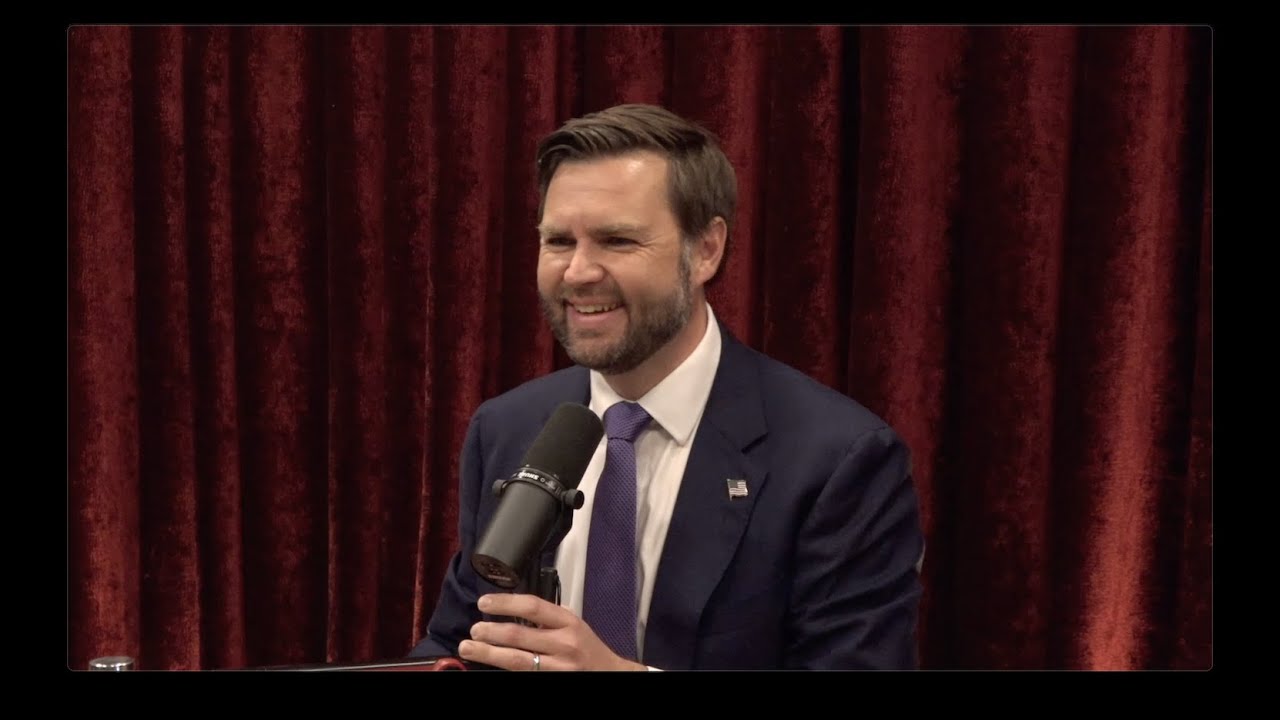 on Rogan’s show, and Trump did lengthy interviews on Theo Von’s
 * and Andrew Schulz’s
 *. The ordinary content on these shows isn’t nearly as popular as the eye-popping antics at the top of the heap: They are all counterprogramming the hyperboles of the hype-house style with recognizably human faces—if they also adopt a bit of the pervasive alarm and addictive adrenaline of repeated confrontations with fake peril (for example, “DEI pilots!”).
You might notice that I’m using “podcast” and “YouTube channel” somewhat interchangeably here (as did the media covering the presidential podcast tours). That’s because the two are becoming one and the same. YouTube is now the most popular platform for accessing podcasts; Rogan has 19.6 million subscribers to the video version of his podcast, millions more than his numbers on Spotify. Tellingly, the Trump appearance boosted Rogan’s YouTube presence by 400,000 subscribers, by at least one estimate. Spotify didn’t say. Von has around 60,000 monthly listeners and three million YouTube subscribers, where his videos have hundreds of thousands of views.
A lot of what now counts as right-wing pop culture didn’t start out as political. Rogan built his career on Fear Factor, a game show of disgusting dares that were shocking at the time, the primogenitor of the dominant channels’ deliberately arousing antics. Von and Schulz are comedians. When liberals think about conservatives’ entry into mass media, we might think of Ben Shapiro or The Free Press, brands that are also popular, yes, but don’t carry the enormous parasocial sway of the bros.
Politically, the real pop culture contest today isn’t between who has the best entertainment franchise—the Reaganesque frontier stoicism of Paramount’s Yellowstone or the perverse feminism of Showtime’sYellowjackets, say—it’s between who can effectively move their audience: Rogan or MrBeast? Liberals aren’t even competing on this front. I’m not sure they even know it’s there. Trump’s appearances on these podcasts helped him because they brought him into an environment. He was joiningthem. Harris, of course, didn’t go on Rogan, and when she did venture into the podcast sphere, it often felt as if she was trying to convince that audience to join her.
Since Trump’s reelection, liberal pundits have focused on the signifiers of support Hollywood has traditionally supplied: the label ribbons, the performative representation, and whether or not Disney includes content warnings on racial stereotypes present in its classic films. But the rise of the right-winger as trusted hangout interlocutor, and the way the connection he offers shapes how audiences move through the world, are different from the “different hat, same ball game” signaling of past presidential cycles.
To be sure, the presence of people like Pete Hegseth, Dan Bongino, and even Robert F. Kennedy Jr. and Dr. Oz in the Trump administration can be traced to the president’s affection for “straight-out-of-Hollywood” casting, but, crucially, none of these figures emerged from the entertainment business we’re referring to when we say “Hollywood.” Trump’s Cabinet casting borrows more from the follower-count logic that is only now sweeping Hollywood. Bongino and Kennedy in particular are products of the YouTube/TikTok conservative-influencer ecosystem. Hegseth and Oz were cable staples but gained currency in the base by making the podcast rounds. When I first heard of their selections, I was struck by the fact that they’re not even top-tier propagandists. Imagine you’re determined to place someone in a Cabinet position solely for how they present on-screen, and you go with the guys who were too erratic to put on in prime time.
But that was the point, I think. Democrats and progressives mock the junior varsity nature of Trump’s team, taking pleasure in the fact its members weren’t good enough to succeed in prestige media, just podcasts and 30-second sharable spots. We don’t want to believe the prestige media don’t matter anymore.
What’s happening now is different from tonal shifts of culture that have occurred before. (24’s celebration of torture during George W. Bush’s reign to Glee’s embrace of queer high schoolers during Obama, for example.) One difference this time is the aggressive nakedness of the backlash. If Conover’s and Hughes’s conversations with studio insiders suggested that the industry was retracting its interest in diversity—and even “messages”—the insiders were just saying out loud what anyone can see on screens. A crew member on the most recent Captain Americamovie told an industry publication that Disney had tinkered with how the movie presented its villain—a president whose anger morphs him into the Red Hulk—given Trump’s continued popularity. Now the Red Hulk was less a vengeful fascist and more a victim to outside forces. The crew member explained, “I think Disney was realizing, ‘Hey, we’ve been bleeding for a while. Let’s try not to piss off our core base any more than we have been over the last couple of years.’”
As chilling as these obvious plays for favor to the right may be, we should be more chilled by what’s going on underneath them: the collapse of the broader communal experience of movies and TV. This is not a typical swing in messaging as the party in power shifts; it’s a culture falling in on a hollowed-out center.
When I talk to my friends in California, they tell me about everyone they know who is packing their bags. An entire creative class is vanishing. “I probably got about half a dozen friends, previously comedians or writers, and they’re saying, ‘I’m going to grad school for therapy,’” Conover told me. But today even working as a therapist with burned-out creatives isn’t safe. “It was actually a pretty lucrative gig for a decent amount of time,” said Maureen Ryan, a television critic and author of Burn It Down: Power, Complicity, and a Call for Change in Hollywood. “But now those trenches are being depopulated.”
Industry surveys bear this out. More people are leaving Hollywood than ever before. Decades of experience are being wiped away in real time. Employment in Los Angeles’s film, television, and sound sector dropped around 30 percent between 2022 and 2024, according to a report by Otis College of Art and Design. New York, a lesser hub for decades, has seen its own entertainment industry similarly dive: After the historic strikes of 2023, when members of the Writers Guild of America and SAG-AFTRA stopped working for months, direct production employment was 41,800, 25 percent lower than prestrike level. It seems doubtful either hub will recover. But the problem of people leaving the entertainment industry goes beyond a geographic shift. People are disappearing from the entire category of entertainment. Consider those YouTube channels pumping out AI-generated narration over crazed-but-optimized imagery.
Traditional entertainment producers are scrambling to keep up in the contest of who can remove the most flesh and blood; superheroes and digitally animated characters dominate the box office. We’re all already familiar with Netflix’s reliance on AI to produce a dehumanizing experience: AI analysis is what pushes out the “personalized” suggestions, guaranteed to never delight or surprise. We’re not waiting for a post-human entertainment future—we’re already in it.
In that context, of course reactionary influencers dominate; they offer what Hollywood no longer does. The bros and their brethren—Jordan Peterson, Logan Paul, even trad wives and crunchy anti-vax health grifters—give the illusion of human connection. These conservative cultural leaders meet disempowered white people where they are—unhealthy, lonely, and lost in a culture they feel doesn’t welcome them.
The YouTubers and podcasters offer tools for navigating day-to-day life (health supplements, homeschooling, “masculinity” pep talks) alongside scapegoats to blame for their struggles (trans people, Anthony Fauci). They supply a shortcut to empowerment, an external enemy to blame.
It’s working.
Mass culture was never perfect, never entirely progressive, much less revolutionary. It can numb as well as inspire us—but at least it provided a shared language. To fully grasp how far we’ve fallen, consider the typical product that Hollywood once made and why it was able to make it—not because of ideology, but because of a stable economic foundation.
A Golden Era, Not Why You Think
Before the internet, social media, and streaming video, the movie industry was under threat by another new technology packed with lower-quality content: TV. In the 1970s, movie execs responded very differently to the danger of obsolescence—by taking chances on young talent and artistically ambitious ideas. The result was arguably the greatest decade of American cinema.
We’ve seen current critics bemoan the desultory effects of iterative IP today (how many Marvel movies can they make, amiright?). But many of the hits of the ’70s were sequels or based on familiar characters and stories: Jaws 2, Rocky 2, the Godfather movies, the first Star Trek, multiple Bonds. There was a lot of disaster porn. Yet even as the box-office winner list was heavy with dependable genres (and heavy VFX for the time)—sci-fi, shoot-’em-ups, and several paeons to the heroism of World War II—there was also fodder for sophisticated post-cinema conversation (Annie Hall, The Deer Hunter, One Flew Over the Cuckoo’s Nest). Wildly different kinds of stories all played to the same vast crowd.
The biggest hit of 1974 was Blazing Saddles,a movie that some anti-woke sorts say “couldn’t be made today.” I think they’re right, but it’s not the “un-PC” comedy that’s the problem, though the fact that the leading man is Black might be. The real problem is that the horses don’t talk, too. You might predict that the top 50 movies of the 2020s lack anything as emotionally substantial as The Godfather or as artfully crafted as Chinatown. You know what it also doesn’t have? A single English-language movie in which every main character is a human being.
Humans are expensive and unique. Every single person in the background of a movie needs to be hired, paid, fed, and present for innumerable takes, any one of which might be marred by an errant cough or slip. AI-generated extras? One and done. During the actors and writers’ strike, a chief negotiator for the strikers told CNN that his counterparts were proposing “that our background performers should be able to be scanned, get paid for one day’s pay, and their company should own that scan, their image, their likeness, and to be able to use it for the rest of eternity in any project they want with no consent and no compensation.” Difficult to replace a human being if one breaks. Much easier to digitally generate a deceased actor than hire a new one. Human beings are unpredictable, stubborn, and demanding. That is why they are being removed from the process of making entertainment.
If you want to understand why Hollywood used to produce a range of stories where now it produces the same three things, don’t just look at a media ecosystem that encouraged studio executives to take risks—look at the rank-and-file contracts. In the ’60s and ’70s, SAG-AFTRA secured residuals for actors in film and television and, in 1980, secured residuals from the videocassettes and pay-TV markets then threatening Hollywood’s traditional model. These protections didn’t just help artists; they made risk-taking possible.
The economics of the entertainment industry have never exactly favored anyone less than a superstar, but the gains made by unions in the 1970s paved the way for some stability for the vast middle of the Hollywood ecosystem: those working actors, writers, and directors whose names might go forever unsigned into boulevard concrete, but who could piece together a living based on smaller projects and residuals. Hollywood wasn’t taking risks in the 1970s because the industry was more progressive. It was taking risks because talent could afford to fail.
Pop culture that could sway with the political sensibility of the time—never too far either way—rested on a framework durable enough to provide for a full ecosystem of creatives and craftspeople. When a TV show got locked in for a season of upwards of 20 shows, everyone from the showrunner to the guys lighting the set could count on a paycheck for a while and were guaranteed a certain level of security year-round.
Today, the health care provided by the Writers Guild of America is still pegged to getting a job on a one-hour network episodic series (currently averaging about 10 episodes per season). To qualify, you need to make as much as someone with that kind of job, estimated by L.A.-based WGA West at $43,862, and that money has to come from a production company that’s hiring guild members. Streaming services series might now run eight or even fewer episodes per season, and, of course, neither YouTube nor any other web production company has set seasons, and they don’t have to hire union members at all.
The direct link between even the tenuous safety net that entertainment unions offer and a popular culture that sustains a humane view of the world is that the economy producing that culture can sustain humans. I mean this quite literally: Can you create storytelling that lifts up the value of individual people if fewer and fewer people are involved in the making of popular culture?
The pink-sludge tidal wave is born of a fantasy in which no risks ever have to be taken, a fantasy that has long been the dream of those at the top. You can see it in those films of the 1970s: the sequels, the dependence on genre, “bankable” stars. But the truth underlying most of what humans created for other humans was that no one could reliably predict blockbusters. The uncertainty made room for mid-tier movies and oddball shows. Would Saturday Night Live have made it to the air if people had known what to make of it? A recent n+1 article quotes the screenwriter William Goldman in his book Adventures in the Screen Trade on this: “Not one person in the entire motion picture field knows for a certainty what’s going to work.” The n+1 writer, Will Tavlin, takes away from his study of Netflix’s growing body of terrible programming that the company’s “greatest innovation was that it found a way around this uncertainty: it provided a platform on which there are no failures, where everything works.” Another way of putting it: The modern entertainment industry, traditional production and development, is a system in which nothingwill “work”—because it doesn’t have to.
We’ve learned over the past eight years not so much that conservative content is more appealing, but that it is still trying to make an appeal.
Everything will be made as cheaply as possible and with as few variables as possible. It will be disposable viewing that might have a conservative gloss or perhaps a vaguely liberal one, but anything resembling an opinion will come with the chemical aftertaste of banana-flavored candy or worse.
The industry wasn’t perfect in the 1970s, but at least it had a foundation that could sustain creativity and risk-taking. That foundation is now gone—so instead of Chinatown, we get AI-generated YouTube explainer videos about a family that gets lost going to Chinatown (WE GO EXPLORING AND YOU WON’T BELIEVE WHAT WE FIND). Instead of risky, ambitious storytelling, we get content optimized for engagement metrics. The question isn’t whether Hollywood is becoming more liberal or conservative. The question is whether Hollywood, as we know it, will exist at all. The elimination of our grubby fingerprints from film stock and cameras in favor of generative pap is straight out of the cryptobro playbook: maximum extraction of value with minimum investment in creation.
As America loses the superficial liberal flavor of pop culture, we’re losing culture’s transformative power entirely. Good storytelling challenges its audience; it encourages people to question their assumptions instead of accepting the status quo. The surprises matter because characters are changed by what they find; the mere novelty isn’t the point. We’re left with a future in which completely AI-generated families undertake increasingly surreal rituals designed to recall distantly remembered household traditions. This isn’t about ideology. The algorithm doesn’t care what you watch—just that you never stop watching. Just keep the screen on. Auto-play to infinity.
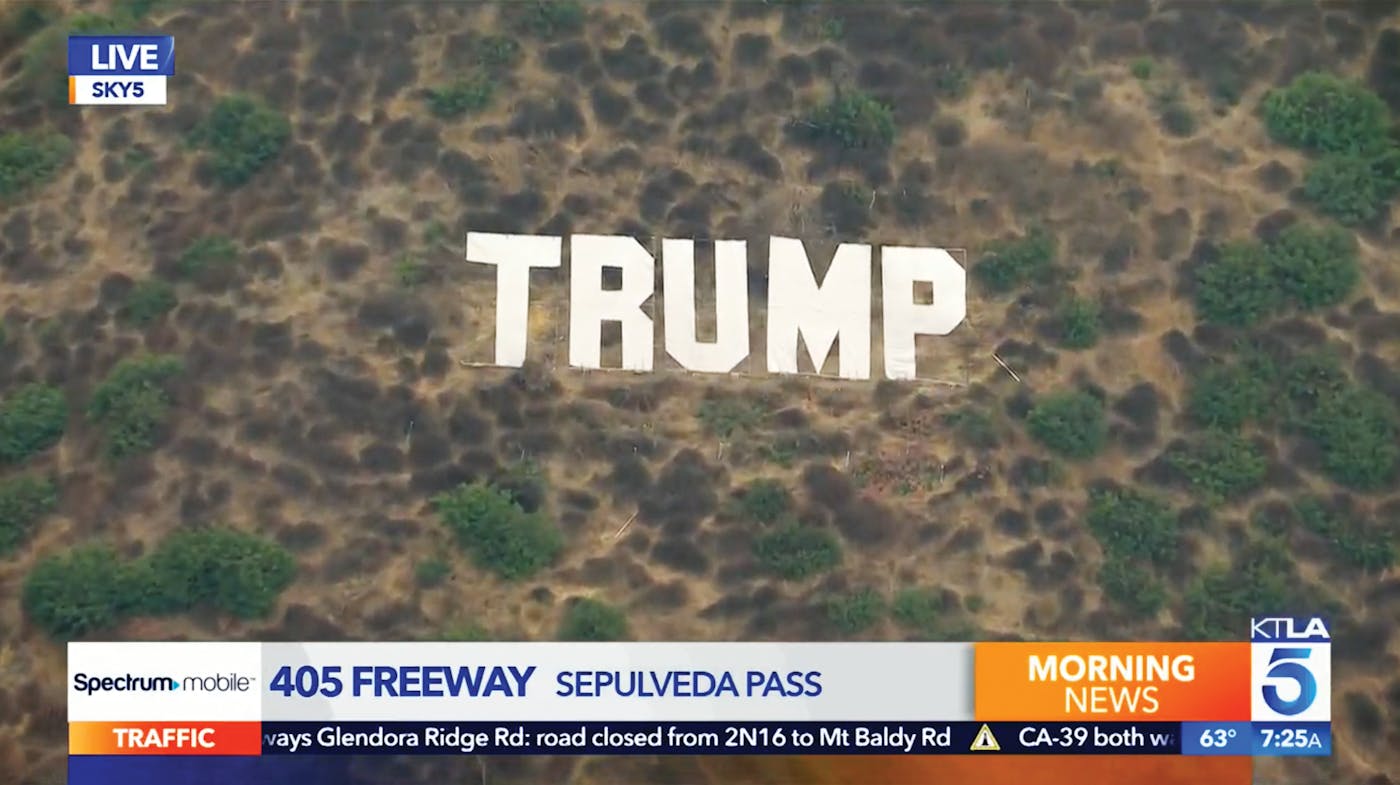
In 2020, a Hollywood-style sign stood briefly in the hills behind Sepulveda Pass before it was reported to the California Highway Patrol and torn down.
Screen grab from KTLA 5 News
What we’ve learned in the past eight years is not so much that conservative content is more appealing, but that it is still trying to make an appeal. It’s trying to hit emotional buttons and, astonishingly, connect with people away from the screens they’re in front of. It might even get them to do something while not in front of a screen. Pink slime doesn’t seek to connect, it just glides right over. It has no intuition. It can’t answer some need. Only humans can do this. In fact, much of the conservative entertainment that’s broken through to the mainstream works because it seeks to do more than soothe. For better or worse, the bros and their trad-wife cousins in this quasi-counterculture inspire loyalty based on a sense of community.
And we are so starved for intimacy and the delight of discovery that when actual humans run into view, they can tell their audience to worship or attack.
Here’s a provocative question: Will we eventually miss conservative entertainment, too?
As culture erodes, something else rushes in to take its place: hollow symbols, like the ones we see everywhere now, replicas that imitate meaning but have none of their own. That’s why the image of that burning Hollywood sign, photoshopped to say Tump Was Right, felt so inevitable and so distant at the same time. Inhuman, inhumane.
Trump’s delight in this conjured victory over traditional entertainment wasn’t new. It was a warped reflection of another Hollywood-style sign that briefly stood in 2020, just before the election: a physical billboard, constructed in the hills behind Sepulveda Pass in the classic white block letters, which said, simply, Trump.
Someone reported the sign to the Department of Transportation not out of political grievance but concern that it was tinder—the fires of 2017 a close memory, prevention at the top of everyone’s mind. The California Highway Patrol deemed it a traffic risk, and it was quietly removed. After Trump’s 2025 inauguration, the sign resurfaced online briefly, but Trump didn’t repost that image. I suppose he preferred the more violent, the more cinematic version—the one that no one built, and no one had to remove.
Ana Marie Cox is a freelance writer living in Texas.
===
an 2 25
Although Vice President JD Vance is quite popular among far-right white evangelicals and Christian nationalists, he isn't an evangelical himself. The "Hillbilly Elegy" author and former U.S. senator is a convert to Catholicism, and he argues that Trumpism is quite compatible with Christianity because it puts "American citizens first."
But not all Catholics share Vance's devotion to President Donald Trump and the MAGA movement. Former President Joe Biden and ex-House Speaker Nancy Pelosi (D-California), for example, consider themselves devout Catholics and are scathing critics of Trump. And now, Trump's immigration policies are drawing condemnation from the most prominent figure in the Catholic Church: Pope Francis.
In an open letter published on the Vatican's website on Tuesday, February 11, Pope Francis wrote, "I have followed closely the major crisis that is taking place in the United States with the initiation of a program of mass deportations. The rightly formed conscience cannot fail to make a critical judgment and express its disagreement with any measure that tacitly or explicitly identifies the illegal status of some migrants with criminality. At the same time, one must recognize the right of a nation to defend itself and keep communities safe from those who have committed violent or serious crimes while in the country or prior to arrival."
READ MORE:Small Trump-loving state projected to lose $12 million a year in federal research funding
Pope Francis continued, "That said, the act of deporting people who in many cases have left their own land for reasons of extreme poverty, insecurity, exploitation, persecution or serious deterioration of the environment, damages the dignity of many men and women, and of entire families, and places them in a state of particular vulnerability and defenselessness."
The New Republic's Greg Sargent examines the contrast between Vance and Pope Francis' views in an article published on February 12.
Sargent argues that the Pope's "remarkable" open letter "exposes some ugly truths about 'America First' Trumpism — and about the high-minded-sounding justifications that Vance is using to paper them over."
"First, Pope Francis correctly identified a big problem with Vance's defense of Trumpism," the New Republic journalist explains. "Vance wants us to believe that Trump's immigration policies reflect a good-faith ordering of our ethical obligations: Trump might not want to deport all undocumented immigrants, but this is required of him by his proper duty to American citizens. But there is no way to reconcile Vance's innocent rendering of 'America First' with what we're seeing right now. Trump's policies are built on a massive ratcheting back or withdrawal of our obligations to enormous numbers of people outside our borders — or outside our legal structures — who are making moral appeals on us, appeals that the United States under administrations of both parties has recognized for decades."
READ MORE:Why annexing Canada would destroy the United States
Sargent adds that the gutting of the U.S. Agency for International Development (USAID) by the Trump Administration and the Department of Government Efficiency (DOGE) "put nearly $500 million of food assistance at risk of spoilage."
"As former USAID official Jeremy Konyndyk tells me, it's likely this food is bound for places suffering from 'active famine' and 'major food emergencies,'" Sargent observes. "The Trump-Musk cuts evince an extraordinarily wanton lack of concern for the global poor. They practically proclaim this proudly."
*Read Greg Sargent's full article for The New Republic at this link and Pope Francis' open letter here.
---
---
http://en.wikipedia.org/wiki/The_New_Republic
good on ESG
---
an 10 24
Liberal and progressive media outlets are full of articles attacking former President Donald Trump, Sen. JD Vance (R-Ohio) and other far-right MAGA Republicans for offensive remarks. But a recent analysis warns Americans to not let themselves get distracted.
Trump's "the enemy within" and Vance's "childless cat ladies" comments have received a lot of scathing analysis on MSNBC and Salon, and Arkansas Gov. Sarah Huckabee Sanders' attack on Vice President Kamala Harris for not having biological children was slammed as hateful and mean-spirited by everyone from (a Never Trump conservative and former GOP congressman) to Joy Behar on "The View."
But in an article published on October 22, The New Republic's Kate Aronoff argues that the most "dangerous" thing about Republicans isn't the "outlandish things" they say — it's what they are quietly planning behind the scenes.
READ MORE:[How Trump could pull off 'a real coup' if he loses to Harris: report
"From JD Vance falsely claiming that Haitian immigrants in Ohio are eating pets to Trump railing against domestic 'enemies,'" Aronoff explains, "Republicans' more unhinged talking points have gotten a lot of airtime this election season. That's understandable: that rhetoric is dangerous in its own right, fueling very real threats to the people Republicans are targeting."
Aronoff goes on to say, however, that it is a "mistake to see the candidates who say the most outlandish things as the ones who pose the biggest threat."
The journalist emphasizes, "Arguably more dangerous are the kind of well-considered plans being put forward by the likes of the American Exploration & Production Council (AXPC), a lobby group whose internal strategy documents were recently leaked by the climate nonprofit Fieldnotes…. There's nothing especially outlandish about a trade association advocating for policies that will pad their members' bottom lines; that's the reason these groups exist. Unsurprisingly, as AXPC's leaked policy roadmap shows, those policies are easier to come by if Republicans control more parts of the federal government."
Aronoff, however, isn't saying that offensive comments by Republicans should be ignored — only that it's important to look behind the scenes as well.
READ MORE:[Donald 'let me believe' in abortion rights: Melania Trump
"Republicans say a lot of bizarre and dangerous things these days that deserve attention," Aronoff writes. "But at the same time, fixating on whatever wild thing MAGA World says about wind turbines creating bird graveyards might well be helping to pull attention away from the GOP and its donors' quieter, more dangerous plans for how to govern — and their similarly quiet efforts to build bipartisan consensus for implementing them."
*Read Kate Aronoff's full article for The New Republic at this link.
===
7 24
republicans-think-elon-musk-is-total-flake-report
Elon Musk recently came out with a public endorsement of Donald Trump for president, but Republicans haven’t fully embraced him, according to a report from *The New York Times*.
The tech billionaire CEO of Twitter, Tesla, and SpaceX has been highly sought after by GOP fundraisers and Trump associates for years, who see him both as a meal ticket and a potential inspiration for the party. But Musk doesn’t have a solid record for political involvement.
For example, he has promised to spend money on “free speech” lawsuits to support conservatives who claim that they are the victims of social media censorship but hasn’t followed through. Musk has also been a no-show at public appearances, such as a 2023 event to support Kevin McCarthy, then the newly elected speaker of the House. In San Francisco, he promised to donate $100,000 to the centrist group GrowSF to defeat progressives, but again didn’t follow through.
“Some conservative activists said they wished that Mr. Musk had followed through more on promises,” the Times reported.
Musk’s public endorsement of Trump only came after a gunman tried to assassinate the former president and convicted felon on Saturday. Previously, the tech magnate, while privately urging friends not to vote for Biden, was waiting until the president had secured the Democratic nomination, according to the Times.
Musk’s confidants in the tech world, such as Joe Lonsdale, a co-founder of data analytics firm Palantir, reportedly discuss politics with him and have urged him to play a more active role. Lonsdale founded AmericaPAC to help Trump return to the White House, with Musk reportedly pledging a monthly donation of $45 million, according to *The Wall Street Journal*. Musk denied the report, leaving those involved with the PAC to wonder how much he plans to donate, or if he will at all.
Alongside fellow tech CEOs Peter Thiel and David Sacks, Musk is a member of the “PayPal mafia,” the group of early supporters and founders of the payment service. All three have embraced conservative ideas and supported J.D. Vance as Trump’s running mate, with Musk and Sacks openly lobbying Trump on behalf of the Ohio senator. If Trump wins in November, the trio will have an administration friendly to their whims and those of Silicon Valley’s right wing.
Unfortunately More on Elon:
Why Elon Musk and Jeff Bezos Want Women to Stay Barefoot and Pregnant
---
Some Donald Trump supporters are dismissive of arguments that the former president is a would-be dictator, claiming that Democrats, via "wokeness" and "cancel culture," are the real authoritarians.
But other Trump voters have flat-out said they would welcome a strongman leader, and they aren't offended by Trump's praise of far-right authoritarian leaders like Hungarian Prime Minister Viktor Orbán and Russian President Vladimir Putin. And members of the Claremont Institute, a right-wing think tank that has become increasingly MAGA in recent years, have argued that liberal democracy is failing the United States.
In an article published by The New Republic on July 18, journalist Susan Milligan details reasons some Americans believe that rejecting democracy would be a good idea.
READ MORE:**'Made violence his brand': Fascism scholar says threat of 2nd Trump term 'uniquely dangerous'**
The "very uncomfortable and inconvenient truth," according to Milligan, is that "a big chunk of the public actually wants an authoritarian leader." The journalist notes that 32 percent of Americans favor a military regime or authoritarian leader for the U.S.
"Why would people want to live under an authoritarian's thumb?" Milligan writes. "It's rooted, experts say, in a psychological need for security — real or perceived — and a desire for conformity, a goal that becomes even more acute as the country undergoes dramatic demographic and social changes. People also like to obey a strong leader who will protect the group — especially if it is the 'right' group whose interests will be protected."
Joe Pierre, a health sciences clinical professor at the University of California, San Francisco's Weill Institute for Neurosciences, told The New Republic that people who favor authoritarianism believe it will be used against others rather than against them.
Pierre told The New Republic, "For those of us who value representative democracy, the fact that some of our fellow citizens might prefer authoritarianism can be surprising or even unfathomable…. Authoritarianism and a 'strongman' leader who's willing to trample over civil rights can sound like a very appealing solution. In turn, democracy — which tells us that our ideological opposites deserve to be heard or should be given equal voice — can sound like the root of the problem."
Kets de Vries, who teaches business at INSEAD in Paris, had similar insights.
De Vries told The New Republic, "Human beings are actually very primitive. They are looking for a father figure to take care of them. They are willing to be blind to all the defects of Trump. He appeals to their most primitive instincts."
READ MORE: Beware: Trump is Project 2025 — and he cannot escape it
*Read Susan Milligan's full article for The New Republic at this link.
---
===
---
Tori Otten @ **The New Republic: New Transcript Blows Up James Comer’s Entire Hunter Biden Argument.
:{A new transcript from a key Hunter Biden witness undercuts many of the claims Republicans are making about “Biden corruption.”:{}:
---}:
---
drilled amy 8 23
britain's Hot New Import from America: The Climate Culture Wars- Britain loves to embrace America's worst ideas for some reason. Now it's diving head first into the idea that climate is a "culture war" issue, with prime minister Rishi Sunak vilifying the Labor party as "anti-motorist." It has big "they're gonna take your trucks and burgers" vibes, as Kate Aronoff reports for The New Republic.
---
==
https://newrepublic.com/article/172636/esg-house-oversight-conspiracy
may 11 no lnx
QANON REBOOT
Republicans Are Truly Losing Their Minds Over ESG
Right-wingers at a House Oversight Committee hearing Tuesday insisted this boring investment strategy is some kind of global conspiracy.
Steve Marshall speaks at a podium in front of the Supreme Court building.
Alabama Attorney General Steve Marshall, who testified at Tuesday’s hearing on ESG, speaks to members of the press in October 2022.
On Tuesday, the House Oversight Committee convened a hearing on environmental, social, and governance, or ESG, investing criteria. For over a year now, Republicans have been trying to turn this obscure three-letter acronym into a full-fledged culture war.So far, the right has expressed its complaints about ESG via a word salad whose components don’t share much of a relationship either to reality or one another. This pattern persisted on Tuesday, when the word “cabal” was used at least three times in reference to allegedly “woke” investors.
ESG criteria, in reality, refer to the broad set of data that investors look at to determine a company’s impact on the world and the impact the world might have on it. In other words, it’s not just about whether a company is “good” according to some abstract set of values. It represents another way of factoring risk exposure into investment—something financiers have been doing for centuries.
“Elites from around the globe have formed alliances to coordinate together to implement woke climate policy.”
:{:{}:
}:
The two witnesses Republicans summoned to this week’s committee hearing weren’t economists or investment professionals, who might be familiar with these criteria or risk assessment in general, but attorneys general from Utah and Alabama, respectively: Sean Reyes and Steve Marshall. Whatever ESG actually means, to them and other anti-ESG crusaders, is mostly irrelevant. For those trying to understand their crusade, the hearing showed that it’s best to think of ESG as a canvas onto which the right projects its own plans and anxieties.
If you’ve heard of Marshall, it may well be because he’s spent considerable time since 2020 trying to overturn the results of that year’s presidential election, and shield other Republicans from accountability for spreading lies about it. Both he and Marshall joined fellow red states attorneys general in filing a brief with the Supreme Court supporting Trump’s claims about election fraud. Marshall, for his part, was serving as head of the Rule of Law Defense Fund that year, which sent out robocalls encouraging Trump supporters to flock to the Capitol on January 6.RLDF—whose donors include the Edison Electric Institution and the Judicial Crisis Network—is also a sister organization of the Republican Attorneys General Association, or RAGA, which Marshall was appointed chair of after continuing to deny, in 2022, that Joe Biden won the 2020 election.
:{:{}:
}:
Generous RAGA donors have included Koch Industries, Chevron, Exxon, Fox, andTikTok. ProPublica recently reported that companies that initially withdrew funds from RAGA over its role in the January 6 attack are back, including Amazon, Walmart, and JPMorgan Chase’s PAC. Overall, RAGA revenues jumped 68 percent in 2022.
In his testimony, Marshall—who chairs a secretive organization pushing a clandestine political agenda through undemocratic means—accused a “cabal of global elites” of being “clearly connected through various alliances” to try to force an ESG agenda onto an unwilling public. Reyes similarly accused “woke investors” like Blackrock of being part of an “organized syndicate of pressure” that is engaged in an “open conspiracy to bypass Congress.” Answering big policy questions like decarbonization, he argued, “is the role of the people’s elected representatives in a democracy—including each of you in Congress, state elected officials, and local leaders—not unelected bureaucrats or foreign governments.”
In other words, someone who’s spent the last several years attempting to overturn the results of a democratic election took to the Capitol on Tuesday to accuse an ill-defined set of actors of trying to sidestep democracy by asking companies if climate-fueled droughts, floods, and fires (for instance) might have some impact on their operations.And while claiming only to want investors to adhere to fiduciary duty, Republicans failed to mention that much of Wall Street’s wariness around investing in new fossil fuel production has nothing to do with a “woke” agenda: Before the pandemic, energy companies on the S&P 500 were underperforming every other sector on that index, and had spent a decade lagging behind as they binged cash on rapid drilling through the shale boom. Its fortunes have changed in recent years, but investors and oil and gas industry managers themselves are urging modesty on exploration and production precisely so that they can make more money.
“People don’t like men. People don’t like people with a European background, that sort of thing.”
“Elites from around the globe have formed alliances to coordinate together to implement woke climate policy,” Marshall said in his opening statement. “These schemes undermine our system of government because unelected elites are making policy decisions outside of democratic processes.” The footnote on that sentence in his pre-written testimony references Consumers Research, which is funded by millions of dollars in undisclosed donations and advised by right-wing legal guru Leonard Leo.
Republicans on the committee responded enthusiastically to this opening salvo. Wisconsin Republican Glenn Grothman asked Marshall whether “ESG” might influence decisions over who companies hire or put on corporate boards. “Right now there’s certain disfavored groups in our society,” Grothman mused. “People don’t like men. People don’t like people with a European background, that sort of thing. Could this be something where you’re encouraging businesses not to hire or promote people from certain unfavored groups.” In a moment dripping with irony, Texas Representative Pete Sessions decried “activist government making decisions on behalf of free people” in service of his larger point, supporting efforts to limit financial institutions’ decision-making power—and even what kind of data can be made available to them—in order to curb the spread of ESG.
It would be a fool’s errand to try to find much coherence in the right’s screeds against supposedly woke investors—who don’t really seem to exist. But today’s Oversight hearing might have accidentally illustrateda good rule of thumb: Whatever Republicans accuse the “ESG movement” of doing is something they’re probably already doing themselves.
Kate Aronoff @KateAronoff
Kate Aronoff is a staff writer at The New Republic.
---
---
Tomasky
June 12, 2023
OLD PLAYBOOK
Inside the GOP’s Latest Desperate Attempt to Smear Joe Biden
How low will Republicans go?
Trump arrives at a Waffle House with Representative Marjorie Taylor Greene in Columbus, Georgia, on Saturday.
If you get your news on planet Earth, you agree with me that the biggest news story of last week was the federal indictment of Donald Trump.
If, however, you get your news on planet Wingnuttia, you have been led to believe that while the Trump matter was certainly news, the bigger deal by several orders of magnitude was the “proof” that emerged last week that Joe Biden took a $5 million bribe from Ukraine and that Representative Jamie Raskin lied about it. You’ve also been told that the timing of the Trump indictment was no mere coincidence—it was handed down precisely to distract America from the “fact” of Biden’s corruption.
If all this is unfamiliar to you, don’t worry. There is no such proof. Raskin, one of the most honorable public servants in America, who couldn’t lie if you tortured him, did not utter a falsehood.
It’s all right out of the playbook the right wing has been using for the last 30 years. They just make up stuff about Democratic presidents and presidential candidates. It has failed more often than it’s worked. But it’s worked often enough that we need to pay some attention to it and understand what’s going on here.
You probably caught wind of the fact that House Oversight Committee Chairman James Comer subpoenaed FBI Director Christopher Wray back in May. He did this after Senator Charles Grassley received a whistleblower complaint charging that the bureau was in possession of a document that revealed an alleged criminal scheme involving the Biden family and a foreign country.
Comer wanted the document. The FBI refused, citing the need to protect source confidentiality. But under political pressure, the FBI agreed to brief Comer and Raskin, the committee’s ranking Democrat, and show them a partially redacted version of the memo. Then all members of the Oversight Committee were allowed to read it.
Here’s the long and short of it. It involves Burisma, the Ukrainian energy company on whose board Hunter Biden sat. The confidential source was told by the head of Burisma that he paid bribes of $5 million each to Joe and Hunter Biden.These were basically Rudy Giuliani’s old scotch-fueled rumors.
This all dates, by the way, to June 2020. This is a useful fact to keep in mind, for two reasons. One, it means that all of this is three years old; two, it means that Donald Trump was president and Bill Barr his still-loyal attorney general, when this document, an FD-1023 in FBI-speak, was logged.
Naturally, the Justice Department set out to look into it. Barr appointed Scott Brady, then the U.S. attorney for western Pennsylvania, to look into Giuliani’s claims.
As Raskin explained several times on cable news last week, the FBI has three levels or phases of investigation: assessment, preliminary investigation, and full investigation. Obviously, assessment means that the bureau looks at the charges and decides whether the evidence is sufficient to move forward to a preliminary investigation.
In this case, the charges didn’t even move beyond the assessment phase. Brady did little, at least that we know of. The only thing he ever did with respect to this matter that made the papers was that he held one four-hour meeting with Giuliani. But he brought no charges, and now he’s back in private life.
So, yes, as Raskin said last week, Barr’s Justice Department did drop the matter. However, the Trump-appointed U.S. attorney for Delaware, David Weiss, was conducting a separate, parallel investigation of Hunter Biden, and the Justice Department sent the Giuliani allegations to Weiss. When Barr took issue with Raskin’s description of events last week, he was referring to that. So in theory, the “Justice Department” (which does include the U.S. attorney offices) is still looking into the allegations, but Weiss’s probe is known to be centered around possible tax evasion and gun charges against Hunter.
Raskin said in a statement: “If William Barr has a problem with [my] characterization, his problem is not with me but with the FBI, Mr. Brady, and other high-level officials reporting to him in his own Justice Department who signed off on closing down Mr. Brady’s probe.” His statement also included information about the meeting he and Comer had with the FBI last Monday. They were told, he said, that “in August 2020, [the] assessment was closed after a determination was made that there were no more investigative steps to be taken and the evidence collected did not meet FBI’s standard for opening a preliminary or full-scale investigation.”
So that’s where things stand. These are three-year-old allegations that have never been proven. Even Comer and Grassley admit that these are just allegations—although Comer (and this will give you a sense of his conception of justice) also said that the information in the document “has not been disproven.” Other Republican committee members—notably extremist Marjorie Taylor Greene and biography-enhancer Anna Paulina Luna—read the FD-1023 and pronounced Biden guilty on the spot.
Is it possible that Biden took a $5 million bribe? Sure, anything’s possible. But which is more likely: that Biden, who has been in the public eye for half a century without a single episode of financial scandal to his name, took a bribe (after, by the way, he was out of public life and finally making some serious jack on the lecture and book circuit, meaning that money was the last thing he needed); or that the right wing, which has peddled fiction after fiction about top-ranking Democrats, is lying?
This is what they do. They told 50 lies about Bill Clinton. None of them have been proven. He made no money from Whitewater. He did not protest the Vietnam War in front of the Kremlin. Yes, he had that affair, and he lied about that. But he did not obstruct justice. The zealous Mr. Starr would have found out if he had.
They lied about Al Gore, who never said he “invented” the internet. They lied about John Kerry’s military record—just ghastly, wholly fabricated assertions about a man who held a degree from Yale and could have found 500 ways to get out of military service but went to the Army recruiter’s office and demanded he be sent to the front lines in Vietnam. (By the way: Gore too graduated from Harvard and went immediately to a recruitment office in New Jersey to enlist to make absolutely sure that he would get no senator’s son breaks, while George W. Bush hid out in the Texas Air National Guard.)
They lied repeatedly about Barack Obama, who was not born in Kenya and did not smoke crack with his gay lover and was not a Communist Muslim terrorist sympathizer. They lied nonstop for 30 years about Hillary Clinton. Lying about her was an industry that at one time rivaled the gross domestic product of small nations. She sometimes didn’t help her own cause in the way she handled things, but remember this point, always: The number of “her emails” that were classified was … zero. Did you get that? Zero.
Don’t take this from Hillary. It was affirmed in 2019 by Donald Trump and Mike Pompeo’s State Department. (The probe did find that information that department officials considered to be classified wound up in many of her email exchanges, but the number of documents included in her emails that were marked classified was zero.)
Do Democrats lie about Republicans sometimes? I suppose so. But not like this; not this systematically. Lying is core to Republican presidential campaigns. Their positions—give more money to rich people, stop all abortions, take transgender children away from sympathetic parents, ban books, destroy the planet—aren’t popular, and they know this, so they have to make voters hate the Democrat. And corruption is all-purpose. Everyone can be troubled by it, whatever their ideology.
It’s especially useful to them now, with their party being led by the most corrupt person ever to occupy the White House by far. In a week when we learned that Trump admitted in 2021 that he could no longer declassify documents, blowing a huge hole in the case for his defense, Republicans were particularly desperate to dirty up Joe Biden. Comer and Jim Jordan will keep pushing not-yet-disproven narratives, repackaging old allegations as new. The mainstream media—and even, it must be admitted, this magazine, under conservative editors in the 1990s—has a pretty sorry record of falling for this stuff since Clinton’s time. Some Democrats, too, used to give these lies credence. I hope people have learned by now that there’s only one response to all this: Fight.
Michael Tomasky @mtomasky
Michael Tomasky is the editor of The New Republic
==
new rep oct 2022 jacob silverman
https://newrepublic.com/article/168125/david-sacks-elon-musk-peter-thiel
no lnx
PAYPAL MAFIA
The Quiet Political Rise of David Sacks, Silicon Valley’s Prophet of Urban Doom
Like his pals Elon Musk and Peter Thiel, Sacks is using his wealth and online clout to unite conservatives and former leftists in a reactionary movement against liberalism.
Last month, Chesa Boudin, the former district attorney of San Francisco, spoke with the leftist podcaster and political commentator Katie Halper on YouTube about the recall campaign that removed him from office in June. Soon after taking office in January 2020, Boudin, a former public defender who had promised a program of criminal legal reform, police accountability, and decarceration, was held responsible for San Francisco’s crime and social dysfunction by a coalition of business leaders, tech moguls, and even some of his former subordinates at the district attorney’s office.
Speaking to Halper, Boudin gave a passionate defense of his policies, while also zeroing in on the moneyed forces arrayed against him. “There’s no limit to how much you can donate to a recall in San Francisco,” he said, “and it’s very easy to hide the true source of those funds.”
The interview wrapped up, but the conversation wasn’t over. Halper invited her audience to discuss on Callin, a growing podcast platform, “the astroturf recall” that removed Boudin. But there was a glaring, unacknowledged irony: Callin, which has attracted a swathe of very online journalists from the left, right, and murkier ideological corners, was co-founded by David Sacks, a venture capitalist and longtime tech executive who was one of Boudin’s earliest and most vocal opponents. Sacks had branded Boudin “the Killer D.A.” whose policies caused innocent people to die. He told former Fox News star Megyn Kelly that there was “chaos and lawlessness in San Francisco,” a product of “Soros D.A.s” with their “progressive agenda of decarceration.” He challenged Boudin to a public debate—“if you have the huevos,” Sacks said—and then accused him of backing out of an agreed upon appearance on All-In, the popular podcast Sacks co-hosts with fellow tech investors Jason Calacanis, Chamath Palihapitiya, and David Friedberg.
Sacks was also one of the biggest recall donors; at one point in 2021, nearly one-third of all donations against Boudin came from him. Halper was trying to parse Boudin’s loss on a platform run by the man who had helped lead it. (“Under a system of global capitalism and tech monopolies, all platforms have owners,” Halper said. “But I don’t speak for them, and they don’t speak for me.”)*
After serving as PayPal’s founding chief operating officer, followed by stints as chief executive of Yammer and Zenefits, Sacks, 50, now leads a venture capital firm called Craft Ventures. While not yet a household name like his pal Elon Musk, he’s a regular across conservative media and on Twitter, where he has more than 400,000 followers, and exerts a growing influence in the political battles playing out in the tech industry. Sacks is part of the Tesla CEO’s “shadow crew” of friends and consiglieri, according to The Wall Street Journal. Text messages that were recently disclosed as part of Musk’s legal battle with Twitter showed that Musk sent his friend Sacks a tweet by conservative huckster Dinesh D’Souza expressing support for Musk’s takeover of Twitter. Sacks said he retweeted it. In other messages, the two discussed a potential monetary contribution from Sacks for the Twitter acquisition. In early October, Musk proposed a negotiated settlement to Russia’s war in Ukraine that mirrored arguments Sacks had made in a piece a week earlier for The American Conservative. Political consultant Ian Bremmer later wrote that Musk said he had spoken with Russian President Vladimir Putin, who had influenced Musk’s peace offer. Musk denied Bremmer’s report. On Twitter, Sacks backed Musk’s proposal and argued that the backlash generated—for example, against Musk’s suggestion that Russia should be given the Ukrainian region of Crimea—was the product of a “woke mob” that, Sacks later wrote in Newsweek, would cause the next world war. In a tweet, Musk praised the Sacks piece as “exceptionally well-said.”
Sacks is quietly becoming the leading practitioner of a new right-wing sensibility that has emerged in the political realignments provoked by Trumpism and the pandemic.
Sacks is quietly becoming the leading practitioner of a new right-wing sensibility that has emerged in the political realignments provoked by Trumpism and the pandemic. On foreign policy, it offers a blend of isolationism, Trumpist nationalism, suspicion of the deep state, and the anti-empire realism of John Mearsheimer. Domestically, the vision is more muddled, a series of angry poses, a politics of pique, much of it playing out on Twitter, Callin, YouTube, Rumble, Substack, and other online media, especially among people who may have once counted themselves on the left but now can’t countenance the sight of homeless encampments. It’s The Young Turks host Ana Kasparian dedicating an episode to “violent criminals being let off easy” in California; Jacobin columnist Ben Burgis calling critics of Kasparian’s reactionary takes on bail reform and other criminal legal system issues the “silliest scolds of the online left”; and Nando Vila, a Jacobin contributor and onetime host of The Jacobin Show, arguing that fighting false perceptions about crime is “definitely a losing battle, because all you have to do is see that it is real” in the form of homelessness, which has been increasingly criminalized.
These dissident leftists are joined by a growing number of tech and finance elites with reactionary politics. There’s billionaire William Obendorf, who also bankrolled the Boudin recall and is on the board of two anti-Boudin nonprofits, one of which paid Boudin replacement Brooke Jenkins $153,000, and Bill Ackman, a hedge fund manager and Democratic donor who praised Donald Trump’s election and became a dedicated defender of Kyle Rittenhouse. For a brief period in 2021, Clubhouse was the locus of these reactionary political currents—the hangout spot, really, for internet-famous venture capitalists and techies chafing against Silicon Valley’s traditionally liberal culture. Though the app didn’t sustain its early momentum, it inspired a number of imitators.
In the fall of 2021, Sacks launched Callin with $12 million in series A funding. Building on its predecessors, Callin offered both live and recorded audio discussions, podcast hosting, and ways for users to interact with hosts. The company made deals to bring aboard established journalists and podcasters, and the site’s sensibility quickly became defined by post-left, contrarian, or otherwise reactionary libertarian types such as Jesse Singal, Jimmy Dore, Glenn Greenwald, Michael Tracey, Briahna Joy Gray, and Matt Taibbi.* Many have taken on Sacksian talking points about unchecked urban crime and the alleged failures of defunding police that haven’t been defunded. Sacks himself has a now dormant Callin show called Purple Pills that featured guests like Boudin antagonist Michael Shellenberger, who sought to replace Gavin Newsom in the failed California gubernatorial recall, on “why progressives ruin cities.”
Sacks declined requests for an interview, both directly and through a representative. But his writings, media appearances, political donations, and professional network say a great deal both about his political rise and the way tech elites now exercise power.
Steeped in the inflammatory milieus of social media and Tucker Carlson demagoguery, Sacks and his fellow travelers often seem less to stand for anything than against the status quo—against criminal legal reform; against the public presence of homelessness; against a tradition of Democratic urban governance that, by indulging in identity politics, has failed to solve economic and social ills.They are angry, and they want the government, which they see as simultaneously incapable of doing much good, to work for them again.
Whether or not you buy into this doomer vision, it’s evolving into coherence, with increasing purchase in right-wing circles. This nascent movement’s talking points have the kind of blunt simplicity that, if not convincing, at least rack up retweets: Democrats are hysterically woke; liberalism has failed; drugs, crime, and homelessness are destroying cities; Black Lives Matter was only about riots. In this corner of the political imagination, crime, drug addiction, and homelessness are outrageous horrors—but mostly for how they threaten the daily peace of responsible, productive citizens. In an interview with Megyn Kelly on the day of the Boudin recall vote, Sacks said that the influx of fentanyl into the United States was China’s “payback” for the nineteenth-century Opium Wars, calling Democratic politicians “useful idiots for theChinese Communist Party.”
This ethos was perhaps best described by Vice’s Edward Ongweso Jr. and Jason Koebler when they called this year’s mayoral race in Los Angeles the “Nextdoor Election,” referring to the social app that has become an epicenter for racist and classist complaints about crime and homelessness. It’s a draconian version of call-the-manager politics—it’s time to let the police, the custodians of capitalist order, do something.
The godfather of the movement is Peter Thiel—call it PayPal mafia politics.
The symbolic epicenter of this movement is San Francisco, but really it’s the entire curdled utopian dream of California. In the eyes of rich techies who have seen their beloved metropolis fall into decay, vast inequality, and social misery, the state is dead. Their disappointment and alienation has melded with traditional Republican disgust toward liberal cities (and their non-white residents) to paint a picture of irredeemable urban squalor. These frightened urbanites are echoing the Trumpist drumbeat that cities—particularly in California—are dangerous, dark places that must be tamed. But despite California’s violent crime rate increasing by 6 percent in 2021, the state’s violent crime rate (466 per 100,000 residents) is far lower than its 1992 peak of 1,115 per 100,000 residents.
A low point of this hand-wringing came in August, when Boudin recall backer Michelle Tandler issued wild-eyed warnings about San Francisco dogs becoming addicted to meth by eating feces. Tandler worked at social networking service Yammer when Sacks was its CEO, and she’s frequently praised him on Twitter, where she’s accumulated a large following as a blistering “anti-San Francisco influencer,” according to The San Francisco Examiner, even though she now resides in New York City. In 2020, Sacks’s Craft Ventures made a seed round investment in a Tandler-led startup called Life School, and they both made donations on August 6, 2021, to the campaign to recall three members of the San Francisco school board. In December 2021, Life School announced a pivot—from classes teaching basic life skills to “an audio-first company” offering interviews with “experts about basic life skills.” The new company, a Substack-hosted publication called Growth Path Labs, provides brief podcasts with titles like “How to Give Critical Feedback” and “How to Fire Someone (with Humanity).”
The godfather of the movement is Peter Thiel—the billionaire venture capitalist, Gawker slayer, leading Republican donor, early Trump backer, PayPal co-founder, and Palantir founder and chairman who has expressed his indifference, at best, to democracy. In his political disciples—and former employees—J.D. Vance and Blake Masters, Thiel has found candidates to run on his belief system, right-wing Christian nationalists who are pro-business, pro-gun, and able to cater to conservative culture warriors. Call it PayPal mafia politics. The extensive corporate and political network that began with Thiel, Musk, Reid Hoffman, Max Levchin, and other early employees of the payments company—not all of whom share the same right-leaning politics—includes the lesser-known Sacks, PayPal’s founding COO.
Despite Sacks’s ties to the online post-left and his efforts to speak for San Francisco’s disenchanted Democrats, his record of campaign finance donations tells the story of a die-hard Republican. Sacks has helped power the political ambitions of traditional Republican politicians as well as Masters and Vance.He also donated to Hillary Clinton in 2016 and more recently to Kyrsten Sinema, “once again sticking a thorn in the side of progressives,” according to the San Francisco Chronicle. In 2021, he gave $70,223 to Florida Governor Ron DeSantis. He also donated $60,000 to Republican Miami Mayor Francis Suarez’s Miami for Everyone PAC, whose lead donor is Sacks’s podcast co-host Chamath Palihapitiya.
Now, Sacks is set to push his political project, and his money, further. Over the summer, an organization called PurpleGood Government PAC filed its first donor report. The PAC’s existence has yet to be widely reported, and his representative declined to answer questions about its plans, but the organization’s filings include people from Sacks’s network. The PAC’s treasurer is James Kull, a financial adviser who signed a mortgage for a Miami mansion purchased last year by an LLC whose address matched one used by Sacks. The PAC raised about $280,000 in the first six months of 2022, including $125,000 from Sacks and his wife. Three donors—EarthLink founder Sky Dayton, e-commerce entrepreneur Diego Berdakin, and the Dohring Family Trust—gave $50,000, with each entity giving separate payments of $5,000 and $45,000.
David Sacks speaks at the TechCrunch Disrupt conference in 2016.
PAUL CHINN/SAN FRANCISCO CHRONICLE/GETTY IMAGES]
The PAC has dispensed about $135,000 so far, most of it in the form of a $100,000 donation to Friends of Ron DeSantis leadership. A representative for Sacks declined to say whether the venture capitalist would support DeSantis over Donald Trump in a 2024 Republican presidential primary, but the money talks. Last October, Sacks hosted a fundraiser for the Florida governor and once tweeted his hopes for a Newsom-DeSantis matchup in 2024. In a further indication of DeSantis’s close contact with this tight-knit group, the court-disclosed Musk texts included an exchange with Palantir co-founder and venture capitalist Joe Lonsdale, who said that DeSantis called him to offer help sealing Musk’s Twitter bid.
Under Thiel’s guiding example, Sacks is forming his own political donor network.Last December, he hosted a fundraiser for Vance. In April, Sacks donated $1 million to Protect Ohio Values PAC, which supports Vance. Around the same time, Trump endorsed the Hillbilly Elegy author. Both the donation and the endorsement were reportedly brokered by Thiel. On September 15, Sacks co-hosted a Republican fundraiser with fellow PayPal mafia member Keith Rabois. Guests included current GOP Senators Rick Scott, Marco Rubio, Chuck Grassley, and Republican candidates Masters, Mehmet Oz, and Vance.
Despite his contributions to Vance, Sacks has barely tweeted or written about him. His $1 million donation received little media attention. But in March, Sacks praised Vance’s calls for U.S. military restraint in Ukraine. “This is why I’m proud to support @JDVance1,” tweeted Sacks, rounding it out with a MAGA reference. “It’s time to put America first.”
Thiel and Sacks met at Stanford, where they worked together on the Thiel-founded Stanford Review. In 1992, the Review published “The Rape Issue,” which included a piece by Sacks defending a student who had pleaded no contest to statutory rape. Sacks considered the crime “a moral directive left on the books by presexual revolution crustaceans.” According to Thiel biographer Max Chafkin, “Sacks included a graphic description of the encounter, noting that the 17-year-old victim ‘still had the physical coordination to perform oral sex,’ and ‘presumably could have uttered the word, ‘no.’” Rabois, who later became Sacks’s PayPal colleague, was also a contributor to “The Rape Issue.”In 2013, Rabois resigned as Square’s COO after being accused of sexual harassment.
Later, Sacks and Thiel wrote op-eds about economics and politics for The Wall Street Journal, National Review, and the San Francisco Chronicle. In 1995, they published a book called The Diversity Myth: Multiculturalism and Political Intolerance on Campus. Angry, trollish, homophobic, fixated on identity and campus politics, The Diversity Myth could easily be produced today, with panic about “woke” culture substituting for every mention of multiculturalism, which is wielded throughout as a bitter epithet. In the book, Sacks and Thiel revisited the Stanford rape, writing that “a multicultural rape charge may indicate nothing more than belated regret.” (In the authors’ moral universe, almost anything can be derisively labeled as “multicultural.”) When the line resurfaced in Forbes in 2016, both Thiel and Sacks apologized, although the book contains plenty of other similarly minded sentiments. They accused sexual assault activists of vilifying men and promoting fraudulent “‘advocacy numbers,’ not real facts,” writing that “the rape crisis movement transmits its exaggerated fears to freshmen yearly.”
:{:{}:
}:
The Diversity Myth was a deeply political book—not only in its screeds against multiculturalism and sexual assault education—but also in its production. It was sponsored by the Independent Institute, a libertarian think tank, and it was helped by Republican operatives and politicians of the era. The authors acknowledged the advice of Tom Duesterberg, who was Vice President Dan Quayle’s chief of staff; a former FCC commissioner; congressional staffers; and conservative political theorists, think tankers, and economists. They also announced that “a special thanks goes to Keith Rabois and the other victims of multiculturalism interviewed for this book.”
:{:{}:
}:
In 1992, while a first-year law student at Stanford, Rabois and two friends stood outside the home of a university lecturer and yelled homophobic slurs. Representative comments included: “Faggot! Hope you die of AIDS!” Afterwards, Rabois wrote to The Stanford Daily, “The intention was for the speech to be outrageous enough to provoke a thought of ‘Wow, if he can say that, I guess I can say a little more than I thought.’”
This nascent movement’s talking points have the kind of blunt simplicity that, if not convincing, at least rack up retweets.
Stanford’s administration basically conceded the point: The school condemned Rabois’s behavior, saying that “this vicious tirade is protected speech.” There was a lot of outrage, letter writing, and some campus struggle sessions about misogyny and bigotry within Stanford’s institutions—genuine attempts at social critique that are duly made fun of in The Diversity Myth. But there was no formal effort to punish Rabois. Instead, after becoming locally infamous, Rabois transferred to Harvard Law School, before moving on to PayPal and a successful tech career that made him fabulously wealthy. In the long tradition of conservative victimology, that makes Rabois a martyr.
Sacks’s early success at PayPal was naturally linked to Thiel, the company’s founding CEO. Sacks grew wealthy and powerful as part of the same tech and political networks for which Thiel and Musk are now leading figures. Sacks’s net worth hasn’t been reliably reported in public. Besides the Miami mansion worth $17 million, he owns a $23 million Hollywood Hills home and a$20 million home on San Francisco’s “Billionaires Row.” In addition to a fortune made as an executive, he’s a crypto investor who bought early into Solana, a popular crypto token.
Sacks has said that his political views have “evolved” from libertarian to “populist.”In a podcast interview with Bitcoin influencer Anthony “Pomp” Pompliano, Sacks said he had “working-class views” in line with a transforming Republican Party. He cited the work of Ruy Teixeira, a liberal political scientist who co-authored the influential book The Emerging Democratic Majority with John B. Judis, but recently joined the American Enterprise Institute, after arguing that Democrats’ “professional class hegemony” has made the party out of touch with working people’s concerns. Or, as Sacks describes it, everything is run by Democrats with college degrees, who enact “the tyranny of woke progressivism.” Even big corporations, Sacks tweeted, are run by Marxists, echoing the long-held belief of DeSantis that companies like Disney promote a “woke ideology.”
Like others in his tech orbit, Sacks is deeply concerned about perceived threats to online speech. A supporter of Musk’s Twitter takeover, he’s argued for a less-moderated Twitter, free from the censoriousness that conservatives accuse tech companies of cultivating. In an April interview with Fox News, Sacks said that we are living in a McCarthyist moment of “un-American movements’’ to stymie free speech. Comparing Musk’s proposed purchase of Twitter with the fall of the Berlin Wall, Sacks said, “It was the first time that you saw somebody stand up to this galloping wave of censorship that we’ve been seeing.”
David Sacks and Elon Musk in 2006
CHRISTIAN GRATTAN/PATRICK MCMULLAN/GETTY IMAGES]
But while Sacks’s project and carceral sensibility have scored victories including Boudin’s recall and the successful launch of Callin, it’s now facing significant headwinds. In August, Los Angeles District Attorney George Gascón, a progressive prosecutor in the Boudin mold, survived a second recall attempt. Trumpist reactionaries like Masters and Mehmet Oz are locked in tight races and Doug Mastriano, running for Pennsylvania governor, will probably lose. Thiel is quickly burning goodwill with Republican leaders like Mitch McConnell—though Vance may limp over the finish line. Few people beyond the right-wing technoratiseem to take seriously Curtis Yarvin, Thiel’s monarchist court philosopher and the de facto intellectual grise of this movement, who once said that America should be run in a manner that “feels like a startup.” That seems like a dim prospect when recent Thiel-funded startups—a Candace Owens–endorsed “anti-woke bank” and a conservative dating app started by a Trump appointee reportedly investigated by the Department of Homeland Security for financial crimes—have teetered between online mockery and outright failure.
For now, there are some loud, rich, and very online players espousing these ideas—with support from some corners of the GOP, and most recently Tulsi Gabbard, who announced her departure from the Democratic Party by denouncing its adherents for their “cowardly wokeness,” “anti-white racism,” and their tendency to “demonize the police but protect criminals at the expense of law abiding Americans.” But their ability to appeal beyond their cohort may be limited—can it scale?
Thiel, at least, seems to be shifting his focus to this question of political pragmatism—and perhaps a rejection of Sacksian doomerism. Speaking before the National Conservatism Conference on September 11, Thiel called for Republicans to find a “positive agenda” to present to the public, one that can “scale” beyond their own cloistered group of similarly aggrieved conservatives. “The temptation on our side is always going to be that all we have to do is say that we’re not California,” Thiel said. “It’s such an ugly picture, it’s the homeless poop people pooping all over the place, it’s the ridiculous rat-infested apartments that don’t work anymore, the woke insanities, there’s so much about it that it feels like … shooting fish in a barrel. It’s so easy, so ridiculous to denounce.”
In the same speech, Thiel praised Ron DeSantis as “offering a real alternative to California,” but worried that rising home prices in Texas and Florida meant that these supposed alternatives were replicating California’s mistakes. Instead of addressing these issues, Republicans were performing their congenital form of whatThiel called “nihilistic negation”—that is, the kind of reactionary obstructionism that has helped bring us to this point. In an age of widespread political cynicism, it plays well on social media,which privileges conflict and sensationalism.
The sort of social media envisaged by Thiel, Sacks, Musk, and other tech moguls might come to fruition if Musk’s bid to acquire Twitter closes, per a judge’s ruling, by the end of the month. It will also be a boon to Musk’s friends who invested in and supported the takeover. The recently disclosed text messages showed Musk being peppered with pitches about rejuvenating Twitter from PayPal mafia members and sycophantic hangers-on. In one set of messages, in which names were redacted, someone discussed letting “the boss himself”—Trump—back on the platform. The comments included some war-gaming and bluster about deplatforming political enemies. Masters was floated as a so-called VP of Enforcement. If there is to be a new regime adjudicating speech on Twitter—which would be set to go private under Musk’s ownership, removing it from certain corporate disclosure requirements—it might be overseen by people like Masters who share the same worldview as Sacks.
The positive, Sunshine State–style program promised by Thiel in his September speech has yet to materialize—DeSantis is currently in federal court defending his decision to suspend progressive prosecutor Andrew Warren for pledging not to prosecute abortion-related crimes. And Sacks is still in thrall to urban pessimism, a stance popular in San Francisco where Mayor London Breed recently said—to applause from a crowd—that drug dealers have more rights than “people who try to get up and go to work every day and take their children to school.” The day after the Boudin recall, Sacks went on Tucker Carlson to celebrate his victory and denounce the Democrats’ radical agenda of “decarcerationism.” Carlson credited Sacks with funding the recall and allowing “democracy to take place.” Sacks explained that Democrats and their “woke billionaire” supporters—George Soros, Reed Hastings—were deeply committed to the decarceral program, so it would be necessary to take the fight elsewhere. “This sort of playbook here is going to have to be replicated across the country.”
This article has been updated with a quote from Halper.
---
---
an ah 12 22
During the 1990s, Justice Clarence Thomas and the late Antonin Scalia represented the lunatic fringe of the U.S. Supreme Court. Thomas’ far-right social conservatism stood in contrast to the liberalism of the late Justice Ruth Bader Ginsburg, the right-wing libertarianism of Justice Anthony Kennedy and the moderate conservatism of Justice Sandra Day O’Connor.
But with the High Court now dominated by the radical right, Thomas is no longer out of step with most of his fellow justices. These days, Thomas is arguably more influential on the Court than Chief Justice John Roberts. And the activism of his wife, far-right conspiracy theorist Ginni Thomas, has been drawing more and more scrutiny — especially in light of his wife’s efforts to help former President Donald Trump overturn the 2020 election results.
Many critics of the Thomases have been stressing that it is a major conflict of interest for someone as active on the far right as Ginni Thomas to be married to a Supreme Court justice. Democratic Rep. Alexandria Ocasio-Cortez of New York City has even called for Justice Thomas’ impeachment.
Ginni Thomas has insisted that there is no conflict of interest because the Thomases operate in “separate lanes.” But journalist Michael Tomasky, in a scathing article published by The New Republic on December 23, lays out some reasons why the “separate lanes” argument is problematic. The New Republic, in fact, has picked Clarence and Ginni Thomas as their “Scoundrels of the Year” for 2022.
“Clarence Thomas, now concluding his 36th year as an associate justice of the Supreme Court, has spent years flouting the ethics rules to which all federal judges except Supreme Court justices must adhere,” Tomasky explains. “Ginni Thomas has spent those same years in the thick of the right-wing infrastructure that has pushed cause after cause after cause — many of which have eventually made their way to the Supreme Court. She has maintained that the two operate in ‘separate lanes’ professionally. It’s a line that kinda-sorta worked…. It was always murky at best. But in 2022, it became far less so.”
Tomasky continues, “She texted urgently with Trump White House Chief of Staff Mark Meadows in late 2020 and early 2021 about strategies to overturn the election, as The Washington Post revealed in a blockbuster story back in March. In due course, the matter of Meadows’ e-mails and other White House documents relating to the January 6 insurrection came before the Supreme Court — an extremely conservative Supreme Court, remember, now with three justices appointed by Trump himself. And in January 2022, the only justice to vote against ordering the release of the material was the one whose wife’s scribblings were included within it.”
The Big Lie — Trump’s false claim that the 2020 presidential election was stolen from him through widespread voter fraud — has been thoroughly debunked time and time again. But it’s a conspiracy theory that the wife of a U.S. Supreme Court justice aggressively promoted during the late 2020/early 2021 lame duck session.
In one of her text messages to Meadows, Tomasky notes, Ginni Thomas wrote, “Biden crime family & ballot fraud co-conspirators (elected officials, bureaucrats, social media censorship mongers, fake stream media reporters, etc) are being arrested & detained for ballot fraud right now & over coming days, & will be living in barges off GITMO to face military tribunals for sedition.”
The U.S. is in a dangerous place, Tomasky warns, when the wife of an influential U.S. Supreme Court justice holds such views and is very active in her party.
“If we are to believe the ‘separate lanes” theory,” Tomasky argues, “then we accept not only that Ginni did not share the content of these messages with her husband, which is plausible, but also, that she never said to him, over dinner or while relaxing with Fox News at night, that she had exchanged texts with Meadows. You can believe that if you want.”
Tomasky adds that when it comes to conflicts of interest, no one on the Supreme Court is worse than Justice Thomas.
“When Ruth Bader Ginsburg joined the D.C. Court of Appeals, her husband quit practicing tax law and returned to teaching,” Tomasky notes. “When John Roberts was nominated for the High Court, his wife left her law practice and resigned from a position at a pro-life group. Not the Thomases. Make no mistake: The entire right-wing bloc has damaged the Court’s credibility. But no one has damaged the Supreme Court’s reputation more than the Thomases.”
---
---
https://newrepublic.com/article/165984/10-people-destroying-democracy
Anne Nelson/April 18, 2022
10 People You’ve Never Heard of Who Are Destroying Democracy
They’re sowing disruption and disinformation, and they have their eyes on 2024.
Democracy in Peril
[Will the Democrats Fight to Save Democracy?
10 People You’ve Never Heard of Who Are Destroying Democracy
The Six States That Could Determine Whether Republicans Steal the 2024 Election
View All ]
In recent years, America’s democracy has faced countless challenges. Some seemed to materialize out of thin air, but many have been the fruit of secretive networks such as the 40-year-old Council for National Policy. Here are 10 individuals who have sown the seeds of disruption and disinformation—and who are setting their sights on the 2024 presidential election.
Larry Arnn
President, Hillsdale College
For decades, Michigan-based Hillsdale has served as an academic partner for the religious right. The college has had a close relationship to the Council for National Policy, the secretive Christian right umbrella organization that directs so much right-wing activism, through Arnn and his predecessor, George Roche III (who left in a cloud of scandal). Hillsdale’s major donors have constituted a who’s who of the radical right, including the Koch network and leading figures from the CNP. Arnn has expanded Hillsdale’s role as a platform for the CNP’s network of megadonors, fundamentalist activists, and media outlets, providing their policy prescriptions with a thin veneer of academic respectability. The college enrolls around 1,500 students, but its leaves an outsize footprint in political messaging. Its highly politicized publication Imprimis is sent to more than six million recipients. Hillsdale operates the Kirby Center in Washington, D.C., where it has groomed young conservatives at the Capitol Hill Staff Training School, run by the Leadership Institute (see Morton Blackwell, below). Hillsdale is also playing a role in the current disruption of public education, which has been used for political leverage in Virginia and beyond. In 2020, Donald Trump appointed Arnn chair of the 1776 Commission, to promote a “patriotic” rebuttal to the 1619 Project’s racially inclusive approach to U.S. history. Hillsdale has led an ongoing campaign to politicize public schools, promoting anti–critical race theory campaigns and assisting in the launch of “affiliate” charter schools in 11 states.
Joe Seales
CEO, Right Side Broadcasting Network
RSBN serves as the equivalent of a Trump-specific C-SPAN that has carried nearly every Trump speech, rally, and town hall since July 2015, as well as full coverage of the pro-Trump Conservative Political Action Conference (CPAC). It also broadcasts a show called The Right View, with Trump daughter-in-law Lara Trump. On January 6, it livestreamed Trump’s speech inciting the march on the Capitol, and it gave live coverage to the Florida “Freedom Rally to Show Support for President Trump and January 6th Political Prisoners” a year later. In July 2021, RSBN was temporarily suspended by YouTube, but the network looked to its own app and the new pro-Trump platform Rumble to continue to carry Trump’s rallies. The radical right has been assiduously constructing a parallel media system in recent decades. RSBN, Rumble, and Trump’s new Truth Social platform complement other media initiatives, ranging from traditional fundamentalist broadcasters like American Family Radio to social sites like Gettr and Parler, in the ongoing construction of an alternate political reality for millions of followers. In March 2022, after the height of the Ottawa truckers’ protests, RSBN promoted a truckers’ convoy roundtable hosted by Representatives Matt Gaetz and Marjorie Taylor Greene, and it has offered ongoing amplification of Trump’s false election fraud claims. We can be sure that whatever Trump fabricates for future news cycles, RSBN will be repeating it.
Introductory offer: 50% off fearless reporting.
1 year for $10.
Subscribe
Neil Patel
Co-founder and publisher of The Daily Caller
The Caller website was launched in 2010 by Patel and Tucker Carlson, his college roommate, with a $3 million investment from Patel’s fellow CNP member Foster Friess. (Carlson served as editor in chief until 2016 and left the publication in 2019, when Patel bought him out.) The site claims more than 20 million monthly readers, and the Daily Caller News Foundation licenses its content free of charge to almost 300 outlets. Patel has used the site as a platform for voices of the radical right, including Jason Kessler, the white supremacist who organized the Charlottesville rally, as well as climate denial and disinformation, such as a falsified “nude” photo of Alexandria Ocasio-Cortez. The site favors members of the CNP, including Supreme Court spouse Ginni Thomas (a Caller “special correspondent”) and Turning Point USA’s Charlie Kirk. The Daily Caller has recently launched a Facebook video platform called American Voices, with three million followers, that partners with media platforms of the religious right. It also boosts Carlson’s Fox News broadcasts. The Caller’s YouTube channel features additional Carlson content, comedy and sports programming, as well as regular attacks on Joe Biden, Anthony Fauci, and CNN. It has given ample space to Trump’s false claims of election fraud, and positive coverage of voter suppression legislation.
Jenny Beth Martin
Co-founder and CEO, Tea Party Patriots
Martin launched the Tea Party Patriots in March 2009 in collaboration with Amy Kremer and Mark Meckler, with funding from FreedomWorks, a “grassroots service center” founded with Koch backing. The Tea Party Patriots spent the Obama administration organizing various “spontaneous” anti-government, anti-tax rallies. Martin, Meckler, and Kremer also joined the CNP; by 2020, Martin had risen to the executive committee and Meckler to the status of Gold Circle member. Martin’s Tea Party Patriots became the meeting ground for the secular Koch brothers and the Christian nationalist CNP. She became the go-to woman for organizing campaigns, including political canvassing and public protests. Martin was a key point person for the CNP in Trump’s reelection campaign. In April 2020, she organized “100 Business Executives” in support of Trump, along with fellow CNP members Adam Brandon of FreedomWorks and Lisa Nelson of the American Legislative Exchange Council (ALEC). Trump acknowledged Martin by name in his speech before the CNP on the eve of the 2020 GOP convention. On November 4, 2020, Martin announced that her organization was going to hold “Protect the Vote” rallies in swing states. On December 30, she tweeted that she would be speaking at the January 6 Stop the Steal rally: “We must demand Congress to challenge the Electoral College votes and fight for President Trump!” (Martin was present at the rally, but didn’t end up speaking.) Most recently, Martin has spoken out in support of the Canadian truckers’ protest. “We are all truckers now,” she told The Hill in February.
Simone Gold
Founder, America’s Frontline Doctors
Gold was an emergency physician in Los Angeles who was tapped by the CNP leadership to serve as a point person for a massive Covid disinformation campaign. The plan was advanced on a conference call in May 2020, while the pandemic was first raging, and after Trump held his increasingly erratic press conferences that included CNP president William Walton and Trump aide Mercedes Schlapp. The goal was to use physicians to persuade the public that the economy could be opened up in time to benefit the Trump campaign. Gold began a series of appearances on media platforms run by CNP members, disparaging the idea that Covid was a “huge medical crisis,” pushing the false hydroxychloroquine “cure,” and attacking Anthony Fauci.
On July 27, 2020, Jenny Beth Martin introduced Gold and a dozen colleagues standing before the U.S. Supreme Court building, repeating a litany of falsehoods about the virus. Their statements, livestreamed by Breitbart News, quickly went viral, and the video was enthusiastically retweeted by Donald Trump. On January 6, Gold joined the mob that breached the Capitol. She was recorded in the Rotunda denouncing the Covid vaccine as “an experimental biological agent deceptively named a vaccine.” She was charged with violent entry and disorderly conduct (she pleaded guilty in March and will be sentenced in June). Over 2021, she appeared in a series of “Health and Freedom Conferences” across the country, sharing the bill with Michael Flynn, Sidney Powell, and Mike Lindell. In 2020, she set up a profitable online prescription service for bogus Covid “cures.”
Morton Blackwell
Founder and president, the Leadership Institute
Blackwell, Paul Weyrich, and Richard Viguerie were young Goldwater activists when they joined forces in the 1960s. Together, they helped to create a constellation of conservative groups, including the CNP umbrella organization and its partner CPAC. Blackwell took on the task of training future generations of right-wing political candidates and activists. His Leadership Institute, launched in 1979, claims that it has trained more than 200,000 people over its history, many of them in county- and state-level sessions in battleground districts. The courses include fundraising, speechwriting, social media, and candidate development. Graduates of the institute include Mike Pence, Representative Jim Jordan, and Project Veritas founder James O’Keefe. The institute’s training is ongoing, especially in contested states. In 2021, the GOP, noting that it needed to net only five congressional districts to take the House, targeted 47 districts, five of them in Texas. That year, the Leadership Institute blanketed Texas, scheduling around 40 training workshops between March and November 2021—many months before the midterm elections. The national Democrats, in contrast, have tended to enter the state campaign arenas a few months or even weeks before the elections, offering minimal training on the ground, limited digital campaign tools, and poorly coordinated data. The institute’s menu of courses reflects the right’s current initiatives, including School Board Campaign Training and a School Board Activist Workshop.
:{:{}:
Cleta Mitchell
Attorney}:
Mitchell is a longtime member of the CNP board of governors. More recently, she appeared on panels at 2020 CNP meetings speaking on “Election Integrity: Securing the Ballot Box” and “Election Integrity: Action Steps.” Mitchell also serves on the board of directors of the Bradley Foundation, run by fellow CNP board member Richard Graber. Following Biden’s victory, Mitchell tweeted that the Georgia recount was “A FAKE!!!” She traveled to Georgia as a volunteer legal adviser for Trump’s campaign and helped to file a December 2020 lawsuit challenging the returns. According to The Washington Post’s Robert O’Harrow Jr., “On December 30, Mitchell wrote to [then–White House chief of staff] Mark Meadows and offered to send some 1,800 pages of documents purporting to support claims of election fraud.” On January 2, Mitchell took part in Trump’s infamous call to Georgia Secretary of State Brad Raffensperger, of whom Trump famously demanded, “I just want to find 11,780 votes.” The call was leaked, and when Mitchell’s role was disclosed, she was obliged to resign from her position at the Foley & Lardner law firm. But Mitchell continues her work through her strategy sessions at the CNP, her board membership at the Bradley Foundation, her Apple podcast Who’s Counting?, and her November 2021 appointment to the Board of Advisors of the federal Election Assistance Commission, which certifies voting systems—including voting machines—and advises local officials on compliance with federal regulations.
Richard Graber
CEO, Lynde and Harry Bradley Foundation
This Milwaukee foundation has assets of some $900 million. Graber is a member of the board of governors of the CNP, while CNP election strategist Cleta Mitchell is one of the foundation’s 11 board members. The Koch network and the DeVos family philanthropies may have received more attention, but the Bradley Foundation’s strategic, longtime focus on state-level politics has allowed it to make a major impact, using its home state of Wisconsin as a laboratory. In 2012 to 2013, the foundation spent more than $8 million on a network of groups promoting a right-to-work law also supported by then-Wisconsin Governor Scott Walker (a fellow CNP board member) and attacking Wisconsin trade unions. The resulting right-to-work law crippled the unions and contributed to Wisconsin’s shift from a Democratic to a swing state. In 2021, the Bradley Foundation earmarked $600,000 for the American Legislative Exchange Council’s voter management campaign software and other activities, bringing its ALEC contributions to $5.4 million over the previous decade. In 2020 and 2021, the foundation gave $200,000 to the Claremont Institute. Claremont has played a critical role in the radical right’s promotion of false claims of fraud and the efforts to rewrite voting laws in advance of the 2024 elections; John Eastman, who drafted the infamous six-point memo used by Trump to challenge the Electoral College on January 6, is a Claremont senior fellow. The foundation also contributed $300,000 to the Public Interest Legal Foundation (chaired by Cleta Mitchell) and $175,000 to the Heritage Foundation’s election law initiative, both of which promoted Trump’s false claims of fraud.
Lisa Nelson
CEO, American Legislative Exchange Council
Nelson came to ALEC in 2014 after previous stints on Newt Gingrich’s staff and at GOPAC, the Republican state and local political training organization. ALEC was co-founded in 1973 by Paul Weyrich, also a co-founder of the CNP. ALEC convenes corporate sponsors and Republican state legislators to “collaborate” on model bills—including legislation to oppose environmental regulation and gun control. In April 2020, The Washington Post reported that Nelson, Jenny Beth Martin, and Adam Brandon were leading an effort to organize a group of businesspeople to help Trump “jump-start” the economy in the depths of the Covid epidemic. Nelson continued her efforts over 2020 and doubled down after the Biden’s victory. From December 2 to 4, 2020, ALEC hosted a secret “process working group” for Republican state legislators, election commissioners, and attorneys to develop strategies on election oversight and redistricting. In July 2021, ALEC hosted and financed an “academy” under the rubric of the “Honest Elections Project” in conjunction with its annual meeting, with panels featuring Cleta Mitchell and other CNP strategists. Nelson offered a preview of their project to rewrite election laws at the CNP’s May 2021 meeting: “We’ve been targeting our efforts on those states that have had issues—Pennsylvania, Michigan, Arizona, Florida to a certain degree.” Currently, Republicans control 30 state legislatures, including Arizona, Florida, Georgia, Michigan, Pennsylvania, and Wisconsin. If successfully implemented, the independent state legislature initiative could determine the outcome of the 2024 elections, regardless of the popular vote.
Daniel J. Schultz
Attorney and founder, Precinct Strategy
Schultz was an early proponent of the idea that Republican-controlled legislatures could overturn election results—later promoted as the “independent state legislature doctrine.” In some interpretations, Republican-controlled state legislatures could nullify the popular vote and send their own electors to put Trump in office. The key to his strategy? Purging from the Republican Party inconveniently ethical officials like Brad Raffensperger, starting at the precinct level. “We can take over the party if we invade it,” Schultz told Steve Bannon on his podcast in February 2021. Over the following months, there was a surge in candidates for precinct chairman positions across the country. Schultz has pointed to the strategy’s success in Arizona as a model. ProPublica reported that in one Maricopa district, the precinct roster grew by 63 percent in less than six months. Schultz’s website asks: “Can we get 3/10 of 1% of the 74 M Trump America Firsters to Become Republican Precinct Committeemen? To TAKE OVER The Republican Party? To Save the Republic?” He points out that precinct committeemen are the ones who elect the state party leaders and are the only ones who can vote to endorse primary candidates; in some states, they are the only ones who can nominate candidates to fill vacancies in state legislatures. The logic is that full slates of pro-Trump precinct chairs could guarantee pro-Trump candidates on the Republican state-level ballots in 2022, who could be activated to enact the independent state legislature doctrine in 2024—subject to judicial review. Donald Trump approves. On February 27, 2022, he issued a statement endorsing Schultz’s project.
Anne Nelson @anelsona
Anne Nelson is the author of Shadow Network: Media, Money, and the Secret Hub of the Radical Right. She has taught at Columbia University for over 20 years and is currently a research scholar at Columbia’s Saltzman Institute of War and Peace Studies.
Read More: Magazine, May 2022, Politics, The Soapbox, Feature, Democracy, January 6, Republican Party, Donald Trump, Right Wing Extremism
---
---
new republic kate aronoff sp
https://newrepublic.com/article/164208/exxon-shell-chevron-oversight-hearing
lnx
....Oil and gas industry executives have a lot to be thankful for. On Thursday, hours before the execs were set to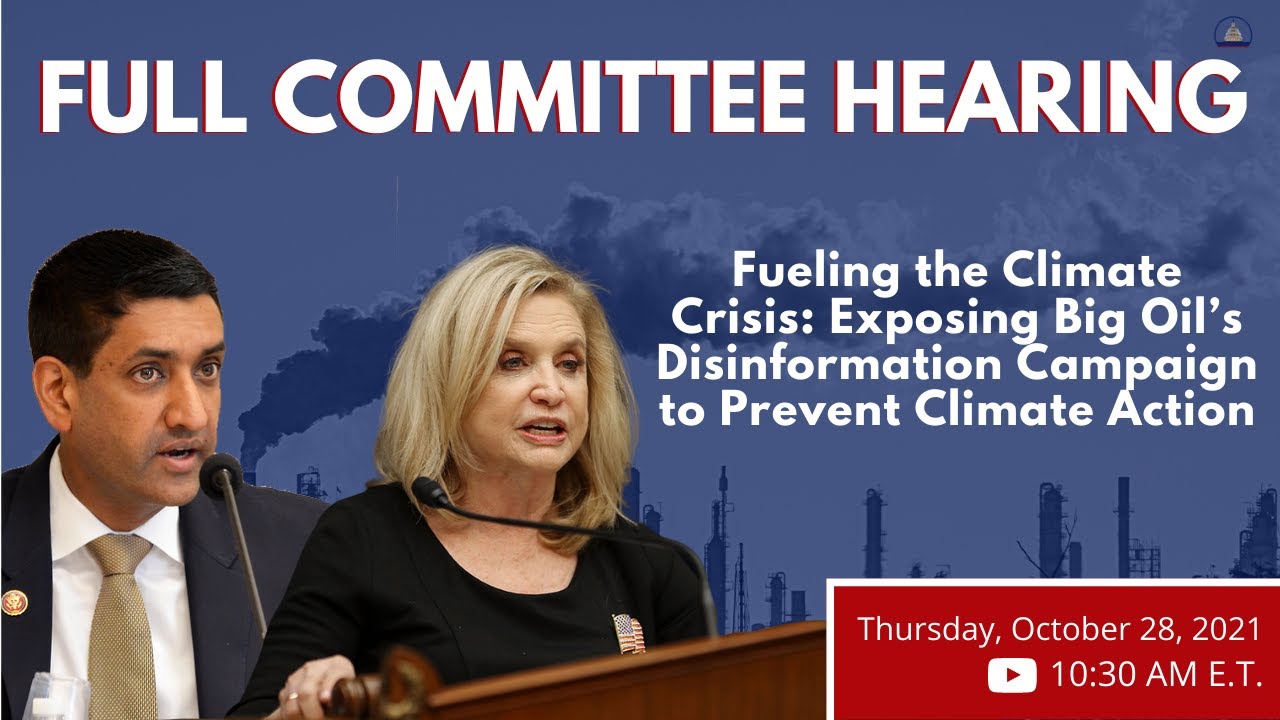 before the House Oversight Committee, alongside the heads of the American Petroleum Institute, or API, and the Chamber of Commerce, the Biden administration announced its framework for a $1.75 trillion reconciliation budget.
..."We’re leaving everything on the field here, in terms of our opposition to anti-energy provisions,” API CEO Mike Sommers told CNN earlier this month. (Ocasio-Cortez repeated the quote.) Representative Rashida Tlaib pointed out generous industry funding for front groups that have kneecapped national and state-level climate policy efforts. The industry spent $40 million, for instance, protecting the oil and gas industry’s ability to drill within 1,000 feet of playgrounds from a 2018 ballot initiative. Then there are all the documents, reported on at length by Inside Climate News, showing the disconnect between what Exxon told the public about climate change and what its own scientists knew to be true. Shell knew, too.
Watkins and her colleagues on the virtual stand—ExxonMobil CEO Darren Woods, Chevron CEO Mike Wirth, BP America CEO David Lawler, API CEO Mike Sommers, and Chamber of Commerce CEO Suzanne Clark—had plenty to be happy about elsewhere in the Capitol, too.
Having already funneled $462,500 in political action committee money to Senator Joe Manchin, who killed the Clean Electricity Payment Program (the centerpiece of the Build Back Better Act’s climate provisions), they could now claim another win. The text of the Build Back Better Act bill released during Thursday’s hearing revealed that the last remaining provision directly targeting fossil fuel emissions—a fee on methane emissions—had been stuffed with a$775 million fossil fuel subsidy....
---
==
from bigthinker
Clio Chang, Alex Shephard/December 19, 2016
What Happens to Media Matters in a Post-Hillary World?
The media watchdog was Clinton's biggest defender this election season. Now it's seeking a new identity.
STEPHEN B THORNTON/THE NEW YORK TIMES/REDUX
On December 6, exactly four weeks after Hillary Clinton lost the presidential election, Media Matters for America, a nonprofit organization dedicated to combating conservative misinformation in media, announced it would be undergoing a makeover. In its twelve-year history, Media Matters’s main antagonist had been Fox News—a worthy, if unsurprising target for an organization devoted to conservative bias. But after surveying the media landscape in the aftermath of Clinton’s surprising defeat, Media Matters decided that it would focus on exposing falsehoods circulated online. “It used to be simple, Fox News was the gatekeeper ... but now there are so many potential bad actors,” Angelo Carusone, who was made president of Media Matters at the time of the announcement, told Politico. “Now there are places like Facebook who aren’t bad actors but can be enablers of misinformation.”
It would seem to be a logical next step for the media watchdog. In an interview, Carusone told the New Republic that Media Matters was already pivoting in this direction. But in a subtle way, the shift was actually a significant reinvention. The organization had long ceased to be a mere watchdog, having positioned itself at the center of a group of public relations and advocacy outfits whose mission was to help put Clinton in the White House. Seen in this light, the shift to focusing on the country’s much-discussed fake news problem, which allegedly facilitated Donald Trump’s victory, is a way of keeping in business after Media Matters and its founder David Brock had little to show for years of being Clinton’s first line of defense. In fact, this wasn’t even the first time Media Matters had declared it was going to stop focusing on Fox News.
The allegiance to the Clintons has always sat uncomfortably beside Media Matters’s ostensible goal of holding media accountable. Any journalist on Twitter knows that even mild criticisms of Clinton would almost instantaneously raise the hackles of some Media Matters staffer, giving the distinct impression that the whole project was about protecting Clinton from unflattering press rather than ensuring journalistic integrity. But Media Matters depended heavily on its association with the Clintons. Brock, a formerly conservative journalist who wrote a biography of Clinton that portrayed her as a hardcore leftist Lady Macbeth, has always been an object of suspicion among liberals, his conversion reeking of snake oil. His elevated stature in the world of Democratic politics comes not from any deep roots in liberalism, but the fact that the Clintons blessed his enterprise. That Media Matters both checks conservative media and protects the Clintons has been instrumental in Brock’s ability to raise money for his network of organizations, which also includes the website Shareblue (formerly Blue Nation Review) and the super PACs Correct the Record and American Bridge. (Brock did not respond to multiple requests for comment for this story.)
That tension, according to more than half a dozen former staffers of Media Matters, comes from Brock, despite the fact that he was rarely involved in day-to-day operations. (Most staffers agreed to talk about Media Matters and Brock only on condition of anonymity, due to the fact that they were required to sign a non-disclosure agreement.) Media Matters faces a series of questions going forward. What is its identity now that Hillary Clinton’s political career is effectively over? Will liberal donors buy into this new identity, fashioned by a group whose leaders have shown no real investment in liberalism as a governing project? And can it fulfill its core mission—which nearly every former staffer we spoke to believes is important—with Brock at the helm?
In our numerous conversations with past Media Matters staff, there was a consensus that in the lead-up to Clinton’s announcement of her candidacy in 2015, the organization’s priority shifted away from the mission stated on its website—“comprehensively monitoring, analyzing, and correcting conservative misinformation”—and towards running defense for Clinton. The former staffers we spoke to largely felt that this damaged Media Matters’s credibility and hurt the work it did in other areas. “The closer we got to the 2016 election the less it became about actually debunking conservative misinformation and more it became about just defending Hillary Clinton from every blogger in their mother’s basement,” one former staffer told us. This was, moreover, a repeat of what Media Matters did in 2008, when there was a rift between staffers and management over the favoring of Clinton in her race against then-Senator Barack Obama.
“There was actually like a really big fight in our research room that day because nobody wanted to go after Terry Gross.”
The former staffers pointed to Media Matters’s attack on NPR’s Terry Gross as a clear example of editorial standards being ignored to protect Clinton from criticism. All the way back in June 2014, in an interview with Clinton that occurred months before her formal announcement of a presidential run, Gross brought up the fact Clinton opposed same-sex marriage as a senator, before supporting it in 2013 when she was secretary of state. Gross asked, “Would you say your view evolved since the ‘90s or that the American public evolved allowing you to state your real view?” Gross’s question seemed like an alley-oop—it’s hard to imagine a friendlier way of framing a change in position. But Clinton was caught off-guard. After Gross tried to clarify Clinton’s responses multiple times, the interview became tense, with Clinton finally snapping, “I don’t think you are trying to clarify. I think you are trying to say that I used to be opposed and now I am in favor and I did it for political reasons. And that’s just flat wrong.”
In response, Media Matters published a piece titled “How NPR’s Terry Gross Created A False Impression That Hillary Clinton Stonewalled On Marriage Equality.” The article pointed out that Clinton supported civil unions for same-sex couples as a senator and claimed that Gross was being unfair in repeating the same question, since Clinton “consistently and repeatedly answered Gross’s question.” She didn’t, as you can see for yourself.
“There was actually like a really big fight in our research room that day because nobody wanted to go after Terry Gross,” one former staffer told us. “She had a total right to ask Hillary Clinton about this. … Our researcher director ended up having to be the one to write it because no one else wanted their name on it.” Another said, “It was a situation where the researcher assigned to it was like, ‘I’m not writing this. I’m not going to attack Terry Gross for asking Hillary Clinton questions.’”
The former staffers said the reluctance of researchers to byline pieces was not unique to this instance. While it didn’t happen daily, it happened enough that “there was just a sense of ‘I really don’t want to be associated with this,’” one said. Media Matters in effect criticized Gross for doing her job—and nearly everyone we spoke to who worked there at the time felt that a similar article would not have been written about a different politician.
In March of 2015, The New York Times broke the news about Clinton’s use of a private email server during her tenure as secretary of state, which in retrospect turned out to be the most damaging story of the entire campaign. In response, Media Matters flooded its site with posts attempting to counter the narrative that was quickly forming—that Clinton had broken the rules and had something to hide. “It was all hands on deck,” one former staffer said. “Everyone was just supposed to be looking out for Clinton stuff all the time.” Left unaddressed was whether the story itself was guilty of conservative misinformation.
Employees were asked to stay late or work on the weekends specifically to cover Clinton, which many felt came at the expense of other stories and the organization’s mission. Nearly every former staffer we spoke to felt that researchers, in particular, were underpaid and overworked, and that these problems often surfaced when they were forced to work on stories they felt were dubious. As one former staffer described it, “They were paying me $35,000 a year to watch Fox all the time and to do rotating shifts where I’d have to change from a day shift to a night shift every two weeks. It was just a miserable job.”
When it came to the organization’s research standards, most former staffers we talked to agreed that they were lowered when it came to Clinton-related content. One former staffer told us that, compared to “the amount of evidence we would have to collect to go after another story,” Clinton pieces had a “much lower bar. It literally just had to involve Hillary Clinton and that was it.” Another said that they often weren’t allowed to publish Clinton-related pieces “until they had been read by someone in leadership.”
Then there was James Carville’s guest column for the site. In his inaugural post, the longtime Clinton ally stated his intention was to use the space to defend the Clintons: “That’s what happens when you have one standard for the Clintons, and a different one for everybody else, which is why I’ll be writing regularly in this space.” (Bradley Beychok, who was president of Media Matters from 2013 until early December, and who was thought responsible for enforcing the site’s pro-Clinton bent, is close to Carville.) Media Matters derives its credibility from its objectivity—its posts are dry, often consisting almost entirely of transcripts that aim to show how conservative media is misleading the public. Media Matters is also classified as a 501(c)(3) nonprofit group in the tax code, which means that it cannot explicitly advocate for a political candidate. The organization is careful not to step over that line, always framing pieces with a media angle—for example, “New York Times’s Maureen Dowd Writes Yet Another Anti-Clinton Column.” But with Carville’s column, that veneer of objectivity was tossed aside. Media Matters also had one standard for the Clintons, and a different one for everybody else.
Carusone rejected the idea that Media Matters focused too much on Clinton, telling us, “It’s a perspective that people have and it’s convenient, but I don’t really think it’s backed up by the data.” He pointed to the broad array of issues that Media Matters covers—LGBT rights, the NRA, climate change, and right-wing extremism. “I’m really comfortable standing on the totality of the content,” he said. Carusone noted that Media Matters published 7,000 pieces in the last year—hundreds were about coverage of Clinton (who, in fairness, was a major party nominee for president), but many more were about other topics.
One former staffer said that they often weren’t allowed to publish Clinton-related pieces “until they had been read by someone in leadership.”
However, when asked if Media Matters had different editorial standards for Clinton, Carusone hedged. “There’s not a shift in editorial standards. The editing process is the editing process,” he said. “The strategies are different. ... I’m comfortable that the standards are the same and uniform but certainly the strategies are different. It has to be. The audiences are different.”
One former staffer, Carlos Maza, who worked at Media Matters from 2011 until last week, told us that, in his experience, “there was never a directive from on high to write about the Clinton campaign or be tied with it.” Maza also disagreed that research standards were lowered for Clinton—the opposite, in fact. He said, “I think because we had a fear that we were being seen as Clinton shills, there was an extra emphasis on every Clinton thing we were writing being super, super tight and making sure the evidence is really solid for it.”
Contra Maza, the other former staffers pointed out several stories that fell within Media Matters’s ambit that should have been better covered, including the rise of Breitbart, Roger Ailes’s sexual harassment scandal, and Facebook’s fake news problem. Another example of its tilt: On the site, there are 1,468 posts tagged with “Hillary Clinton” as opposed to just 26 tagged “Bernie Sanders.”
With the proliferation of conservative misinformation and the rise in popularity of far-right websites like Breitbart, there is a need for organizations like Media Matters now more than ever. However, having a partisan like Brock behind the curtain has only damaged the organization’s credibility. The former staffers we spoke to believe that the only way for Media Matters to fulfill its original mission is if Brock takes a step back. “Media Matters could be really good and there is good work that goes up on that website,” one former staffer told us. “But when you go so far off on a tangent about Terry Gross, then when you have a legitimate complaint, nobody listens to you because you wasted all your good will.”
Brock’s recent assertion that he wants to make his social media platform, Shareblue, a “Breitbart of the left” reveals a man who sees himself more as a propaganda minister than someone who takes journalism seriously. Asked if Media Matters should continue with Brock at the helm, one former staffer said, “Based on everything that I’ve seen from him since the election, I would say it can’t happen with him because there seems to be a lack of understanding of where the problem actually was. I guess he’s angry; he didn’t get his ambassadorship that he’s been working for 12 years now. I just don’t see how throwing money at him can be a viable strategy for anyone, in terms of advancing the Democratic Party.”
In a 2011 interview with Jason Zengerle in New York magazine, Brock said, “I’m still more pitched at fighting the right than I am about building a progressive platform for the future. It’s fair to say that that conversation doesn’t interest me as much.” But is it possible to combat the right without having something to proactively fight for, other than money and influence? As one former staffer noted, the path for Media Matters going forward is simple: “You need to put somebody in charge who actually does have a guiding progressive compass.” Throughout his career, as a conservative journalist and a Democratic-aligned impresario, Brock has been guided almost entirely by his disdain for his opponents. Twelve years after Media Matters was founded, that may not be enough.
Editor’s note: A previous version of this article inaccurately stated that Bradley Beychok, the former president of Media Matters, was James Carville’s godson. It also mistakenly said Brock’s website Shareblue was a nonprofit venture. We regret the errors.
Clio Chang @cliomiso
Clio Chang is a freelance writer in New York City.
Alex Shephard @alex_shephard
Alex Shephard is a staff writer at The New Republic.
Read More: Politics, Media Matters, David Brock, Hillary Clinton, American Bridge, Fundraising, Democratic Party, Democrats, Angelo Carusone, Bradley Beychok
---
---
The New Republic
Charles Murray, Richard J. Herrnstein/October 31, 1994
Race, Genes and I.Q. — An Apologia
The case for conservative multiculturalism
This article was originally published in the October 31, 1994, issue of The New Republic. Since many staffers at the time objected to its publication, this excerpt of The Bell Curvewas published alongside a raft of articles condemning it.
==
http://www.alternet.org/print/media/americas-obscenely-rich-know-full-well-they-are-destroying-america
==
no conn to jpM?
Early years
The New Republicwas founded by Herbert Croly and Walter Lippmann through the financial backing of heiress Dorothy Payne Whitney and her husband, Willard Straight, who maintained majority ownership. The magazine's first issue was published on November 7, 1914. The magazine's politics were liberal and progressive, and as such concerned with coping with the great changes brought about by America's late-19th century industrialization. The magazine is widely considered important in changing the character of liberalism in the direction of governmental interventionism, both foreign and domestic. Among the most important of these was the emergence of the U.S. as a Great Power on the international scene, and in 1917 TNR urged America's entry into World War I on the side of the Allies.
One consequence of World War I was the Russian Revolution of 1917, and during the inter-war years the magazine was generally positive in its assessment of the Soviet Union and its communist government. This changed with the start of the Cold War and the 1948 departure of leftist editor Henry A. Wallace to run for president on the Progressive ticket. After Wallace, TNR moved towards positions more typical of mainstream American liberalism. During the 1950s it was critical of both Soviet foreign policy and domestic anti-communism, particularly McCarthyism. During the 1960s the magazine opposed the Vietnam War, but was also often critical of the New Left.
Up until the late 1960s, the magazine had a certain "cachet as the voice of re-invigorated liberalism", in the opinion of Eric Alterman, a commentator who has criticized the magazine's politics from the left. That cachet, Alterman wrote, "was perhaps best illustrated when the dashing, young President Kennedy had been photographed boarding Air Force One holding a copy".[4]^
^----
^
^ confused ^with/reaction ^to?
^
History
Early years
In 1953, Russell Kirk published The Conservative Mind, which sought to trace an intellectual bloodline from Edmund Burke[4] to the Old Right in the early 1950s. This challenged the popular notion that no coherent conservative tradition existed in the United States.[5] A young William F. Buckley, Jr. was greatly influenced by it.
[ ](http://en.wikipedia.org/wiki/File:William_F._Buckley,_Jr._1985.jpg "Enlarge")
William F. Buckley, Jr., the founder of National Review
Two years before, Buckley published God and Man at Yale, criticizing his alma mater for its abandonment of its founding principles. Buckley, a Skull and Bones secret society member, champion debater and former editor of The Yale Daily News, soon rose to national prominence. After a short stint in the CIA, he toured the country debating for The Intercollegiate Society of Individualists (ISI), contributed to The American Mercury, and soon decided to start his own magazine.
Buckley first tried to purchase Human Events, but was turned down. He then met Willi Schlamm, the ex-communist editor of The Freeman; they would spend the next two years raising the $300,000 necessary to start their own weekly magazine, originally to be called National Weekly. (A magazine holding the trademark to the name prompted the change to National Review.) The statement of intentions read:
Middle-of-the-Road, qua Middle of the Road, is politically, intellectually, and morally repugnant. We shall recommend policies for the simple reason that we consider them right (rather than “non-controversial”); and we consider them right because they are based on principles we deem right (rather than on popularity polls)...The New Deal revolution, for instance, could hardly have happened save for the cumulative impact of The Nation and The New Republic, and a few other publications, on several American college generations during the twenties and thirties.
On November 19, 1955, Buckley’s magazine would take shape. Buckley assembled an eclectic group of writers: traditionalists, Catholic intellectuals, libertarians and ex-Communists. They included: Russell Kirk (the traditionalist admirer of Burke and author of The Conservative Mind), ex-Marxists James Burnham, Frank Meyer, and Willmoore Kendall, and Catholics L. Brent Bozell, and Gary Wills. Whittaker Chambers,the Communist-party defector and former Time editor who had given the key congressional testimony against Alger Hiss in the latter's espionage hearing, was also invited to join. Chambers initially declined, but eventually became a senior editor. In the magazine’s founding statement Buckley wrote:[6]^
Let’s Face it: Unlike Vienna, it seems altogether possible that did National Review not exist, no one would have invented it. The launching of a conservative weekly journal of opinion in a country widely assumed to be a bastion of conservatism at first glance looks like a work of supererogation, rather like publishing a royalist weekly within the walls of Buckingham Palace. It is not that of course; if National Review is superfluous, it is so for very different reasons: It stands athwart history, yelling Stop, at a time when no other is inclined to do so, or to have much patience with those who so urge it.
National Review aimed to make conservative ideas respectable, in an age when the dominant view of conservative thought was expressed by Lionel Trilling in 1950:[7]^
In the United States at this time liberalism is not only the dominant but even the sole intellectual tradition. For it is the plain fact that nowadays there are no conservative or reactionary ideas in general circulation... the conservative impulse and the reactionary impulse do not... express themselves in ideas but only... in irritable mental gestures which seek to resemble ideas.
Buckley attacked Robert Welch, the founder of the John Birch Society, as part of his efforts to build a respectable conservative movement:
Mr. Buckley's first great achievement was to purge the American right of its kooks. He marginalized the anti-Semites, the John Birchers, the nativists and their sort.[8]^
Buckley and Frank Meyer also promoted the idea of fusionism, whereby different schools of conservatives, including libertarians, would work together to combat what were seen as their common opponents.
National Review promoted Barry Goldwater heavily during the early 1960s. Buckley and others involved with the magazine took a major role in the "Draft Goldwater" movement in 1960 and the 1964 presidential campaign. Buckley also helped found Young Americans for Freedom;[9] it and National Review spread his vision of conservatism throughout the country.[10]^
The early National Review faced high-profile defections from both left and right. Garry Wills broke with NR and became a popular liberal—yet still religious—commentator. Buckley’s brother-in-law, L. Brent Bozell Jr., who ghostwrote The Conscience of a Conservative for Barry Goldwater, left and started the short-lived traditionalist Catholic magazine, Triumph in 1966.
After Goldwater
After Goldwater's defeat by Lyndon Johnson in 1964, Buckley and National Review continued to champion the idea of a conservative movement, which was increasingly embodied in Ronald Reagan. Reagan, a longtime subscriber to National Review, first became politically prominent during Goldwater's campaign. National Review supported his challenge to President Gerald Ford in 1976 and his successful 1980 campaign.
During the 1980s NR called for tax cuts, supply-side economics, the Strategic Defense Initiative, and support for President Reagan's foreign policy against the Soviet Union. The magazine criticized the Welfare state and would support the Welfare reform proposals of the 1990s. The magazine also regularly criticized President Bill Clinton. It first embraced, then rejected, Pat Buchanan in his political campaigns. A lengthy 1996 National Review editorial called for a "movement toward" drug legalization.[11]^
[edit] Current editor and contributors
The magazine's current editor is Rich Lowry. Many of the magazine's commentators are affiliated with think-tanks such as the Heritage Foundation and American Enterprise Institute. Prominent guest authors have included Newt Gingrich, Mitt Romney, and Sarah Palin in the online and paper edition.
---
---
https://newrepublic.com/article/123073/national-review-should-apologize-cooperating-augusto-pinochet
no link
When Will National Review Apologize for Cooperating With Murderous Dictator Augusto Pinochet?
The Chilean general ordered an assassination on American soil, and the conservative magazine came to his defense
BY JEET HEER
October 9, 2015
Newly declassified documents released by the Obama administration confirm the long-held suspicion that in 1976 the Chilean dictator Augusto Pinochet was responsible for killing two people on American soil.Other evidence had long pointed to Pinochet’s culpability, but these new documents leave the question of guilt beyond doubt. On September 21, 1976, a car bomb went off in Washington, D.C., killing Orlando Letelier (an exiled Chilean diplomat and critic of the Pinochet dictatorship) and his assistant Ronni Moffitt, whose husband, Michael, was badly wounded in the attack.
Pinochet directly ordered the attack and was so eager to make sure that his guilt never be known that he even contemplated killing his own spy chief, Manuel Contreras, in order to cover up the crime. Pinochet wasn't alone in wanting the truth of the Letelier assassination to be hidden. The American conservative magazine National Review played a major role over many years to whitewash and obscure Pinochet’s guilt. They did this during a period when they were actively in cooperation with Pinochet’s regime.
As John Judis notes in his invaluable biography of William F. Buckley, National Review’s ties to the Pinochet’s political fortunes even preceded the 1973 coup that brought the dictator to power. In the early 1970s, National Review editor William F. Buckley hired Nena Ossa to report from Chile. Ossa was politically close to the right-wing movement that overthrew a democratic government in 1973. After Pinochet seized power, Ossa was rewarded for her loyalty by being made head of the National Museum of Fine Arts in Chile. Even after her ties to the Pinochet regime were made public, she continued to cover Chile for National Review.
In 1975 Buckley and his friend Marvin Liebman set up the American-Chilean Council (ACC) to promote Pinochet’s interests in the United States. Short of funds, the organization took money from the Chilean government, funneled by Ossa, although Liebman didn’t list himself as director with the Justice Department. ACC funding went to pay for National Review writers like William Rusher, Robert Moss, John Chamberlain, and Jeffrey Hart to take luxurious junkets to Chile, which often resulted in articles defending Pinochet.
In a letter to Liebman in July 1975, Ossa praised Robert Moss for writing a National Review article that fulfilled the political agenda of the Pinochet regime. “Fortunately he seems to be enough to the Right to understand that he cannot possibly write all he sees and hears,” Ossa enthused. “His fight against Marxism is much more important than being a journalist.” Ossa wanted propaganda, not journalism. National Review was happy to fulfill that mandate.
The same lack of journalistic ethics displayed by Moss were evident in National Review’s reports on the terrorist attacks in Washington, which were all carefully crafted propaganda designed to protect Pinochet. As Judis noted in his biography, “In March 1977, National Review editor Kevin Lynch, who had also worked for the ACC, suggested that Letelier had been a Cuban agent and that the Chilean government had nothing to do with his killing. In July, the National Review speculated on whether Letelier had been ‘an agent of the USSR.’"
The defenses of Pinochet continued even as the evidence of the dictator's guilt mounted. In March 1978, after a trip to Chile financed by the ACC, National Review senior editor Jeffrey Hart wrote, “At the time that Letelier was blown up by a bomb in Washington, he had become entangled in international terrorism and was receiving funds through Havana.” Buckley frequently wrote about the case as well, arguing that “there are highly reasonable, indeed compelling, grounds for doubting that Pinochet had anything to do with the assassination.”
In 1978, facing an investigation by the Justice Department into whether the ACC had misrepresented itself by pretending to be an independent group when it had been financed by the government of Chile, the lobby group shut down. National Review continued to print pro-Pinochet propaganda, even after Chile transitioned to democracy.
Both Chile and the United States have been struggling with a reckoning with the Pinochet years.Former Secretary of State Colin Powell has acknowledged that the United States is "not proud" of its role in bringing Pinochet to power. National Review needs to do its own soul searching about its complicity in covering up Pinochet's crimes.
Jeet Heer is a senior editor at the New Republic
---
==