The Lever Sirota
===
in order to overturn roe, had to 1st get rid of camp finance
key ep 3 and 9 CU
see MASTER PLAN NODE
see AILES
see bak = book
---
yt 9 26
The Billionaire Building The Democrats’ New Machine
-=-=
gmail left hook 9 11 26
if Democrats and Republicans take money from billionaires who are promoting AI and Crypto, what hope do you have that once they gain power, they will turn around and hold these destructive, racist, anti-democratic forces accountable and promote regulation?
If you do believe they will actually promote the majority instead of their benefactors, then I have a Trump diploma to sell you for $50,000.
Wonderful.
This week, Anthropic employees are warning that this technology might end humanity. We also know that Anthropic is creating a real-life version of the movie *Minority Report,* where they will stop “pre-crime” and help law enforcement go after activists and anti-AI critics.
Wonderful.
Congress is now investigating a July incident involving OpenAI in which the AI model’s “swarm” of 700 autonomous agents coordinated a hack into Hugging Face’s production infrastructure. However, according to Mother Jones today, this is mostly performative, meant to placate bipartisan anger at reckless capitalists unleashing destructive technology. Most likely, Sam Altman and his cabal of sociopaths will walk away with a slap on the wrist.
Sirota joined me to discuss how fascism will continue to flourish unless Democrats finally embrace an ideology of transformation, instead of restoration, and aggressively combat the broligarchy and super PAC money that is corrupting our world.
...
-=-=-=
this is Midterm Madness, the only newsletter you need to stay up to date on election news. Key race updates, money trails, numbers that cut through the spin, and campaign moments that say more than official talking points ever will — from The Lever team to your inbox, every Wednesday.
👇 Further down in this newsletter:
- A progressive veteran defended his Senate seat.
- MAGA, Inc. is coming out of hibernation.
- PACs are using “redboxing” to direct corporate cash.
👍 This pop-up newsletter is one of many exclusive benefits we provide to our paid subscribers. Thank you for your support!
STORIES TO GO
In a hurry? These are key stories that crossed our desks this week.
🏥 A record number of Democrats are running on Medicare for All.
📩 Mail ballots are being rejected for arriving late at a higher pace than in past elections, including in some of the battleground states that will determine the balance of power in Congress.
💸 Artificial intelligence companies are lavishing communities with cash and amenities in an effort to change public perception, as opposition to data centers sweeps the nation ahead of the midterm elections.
STATE OF THE RACE
Youth ≠ progress. It was a rough night for Seth Moulton, a congressman challenging incumbent Ed Markey in Massachusetts’ Democratic primary for the U.S. Senate. Seeing opportunity in an election season favoring anti-establishment candidates, Moulton billed himself as “one of Massachusetts’ rising progressive stars” and a “next generation progressive fighter who supports abolishing ICE, taxing the rich and health care for all.” But roughly 30 minutes after the polls closed, his Senate dreams were crushed. Markey trounced the congressman, easily clinching cities he lost in the 2020 primary. Aiming to co-opt anti-gerontocracy messages that helped Democratic primary insurgents in Colorado and New York, Moulton thought highlighting Markey’s old age, 80, would carry him to victory.
🧾 But what Democrats want isn’t just a fresh face — they want someone with a strong record of fighting for them. Markey had it; Moulton did not. Markey is one of Congress’ longest-serving leftists: He coauthored the Green New Deal, sponsors Medicare for All, and has backing from progressive superstars like Reps. Alexandria Ocasio-Cortez (N.Y.) and Ayanna Pressley (Mass.), and Sens. Bernie Sanders (Vt.) and Elizabeth Warren (Mass.).
❣️ In a University of Massachusetts Amherst poll taken last month, more than 80 percent of Massachusetts Democrats surveyed approved of Markey’s job performance, helping make him one of the most popular U.S. Senators. When asked about the most important qualities they looked for in a candidate, only 9 percent indicated they would prioritize a candidate who “represents a new generation of leadership,” while 24 percent said they want someone who “represents their views on the issues.”
🎭 Moulton, meanwhile, relied on superficial messaging claiming he was the young progressive choice, but as *The Lever* reported in the lead-up to yesterday’s primary, his own record proved otherwise. He’s supported industry-favored cryptocurrency legislation, weapons for Israel, and taken campaign cash from private equity and Wall Street interests. Moulton’s loss should serve as a warning to establishment Democrats: Claiming to represent the next generation of the party without the track record and support for policies popular among progressive voters isn’t enough to win a primary; you have to actually keep your word.
💡
Read the full story on our website.
Cornhusker State clash. Last night, “paycheck populist” and Independent candidate for U.S. Senate in Nebraska Dan Osborn faced off in his first debate. Incumbent GOP Sen. Pete Ricketts accused Osborn — whom he called Democrat Dan dozens of times — of being “recruited to run by democratic socialists.” Osborn — a Navy veteran, mechanic, and former union leader who has sworn off corporate PAC donations — accused Ricketts of being “in the pocket” of corporations, special interests, and GOP party bosses. The Democrat running in the race dropped out, clearing the way for Osborn to make a compelling challenge for the Nebraska seat, which has not been held by a Democrat since 2013.
👀 Internal polling commissioned by the Osborn campaign in August put him at a deadlock with Ricketts – 47 to 47— with 5 percent of voters undecided.
🫏 The last time a Democrat won a statewide election in Nebraska, it was 2006. It makes sense that Osborn has resisted efforts to tie him to Dems. “I don’t like either party,” he told The New York Times. At the same time, Osborn has taken criticism for accepting campaign donations from Democrat-allied PACs during his failed 2024 campaign for Senate.
🤪 Fun fact: Yesterday, every member of Nebraska’s all-GOP U.S. House delegation voted for the congressional resolution condemning socialism — while they represent the only state whose electricity is 100 percent provided by socialist, publicly owned power utilities (Nebraska electricity prices are among the lowest in America).
🌽
Team Lever is in Nebraska this week to interview Dan Osborn — comment here to submit questions you’d like David Sirota to ask.
Sleeping giant. President Donald Trump appears ready to unleash his $400 million super PAC, MAGA Inc., which has more cash on hand than any other super PAC in the country. MAGA Inc. has largely been quiet this election cycle, doling out only a few million dollars on primary elections that were important to the president — including on behalf of Sen. Darline Graham (R-S.C.). That caution has provoked grumbling from Republicans, who fear an Election Day wipeout will deliver the House and Senate to Democrats. Trump’s unpopularity is expected to be a drag on GOP candidates, and some Republicans have been worried the president will sit on his cash.
📢 However, MAGA Inc. held its first major public event this week in Michigan, where Vice President JD Vance campaigned for GOP Senate nominee Mike Rogers, gubernatorial nominee John James, and House candidate Mike Bouchard Jr., among others. Republicans are banking on the president’s super PAC leveling the playing field with only 62 days to go.
🥊 Senate Republicans are largely on the defensive this cycle, but see a potential pick-up opportunity in Michigan, despite polls showing Democrat Abdul El-Sayed leading Rogers. El-Sayed quipped this week that Trump is seeking to make him the “main character” of the midterm elections.
💰 Democrats are battling back in the Wolverine State, with Senate Minority Leader Chuck Schumer’s (D-N.Y.) super PAC putting $4.5 million behind an ad campaign attacking Rogers over his support for the war in Iran. Still, Republicans will head into the homestretch of the midterm elections with a massive cash advantage. The primary GOP super PACs, including MAGA Inc., reported $657 million cash on hand at the end of June, compared to $334 million in the largest Democratic super PACs.
📢
Share this newsletter on Bluesky, Reddit, LinkedIn, X, Mastodon, Substack, Threads, and Facebook.
WEEK IN DATA
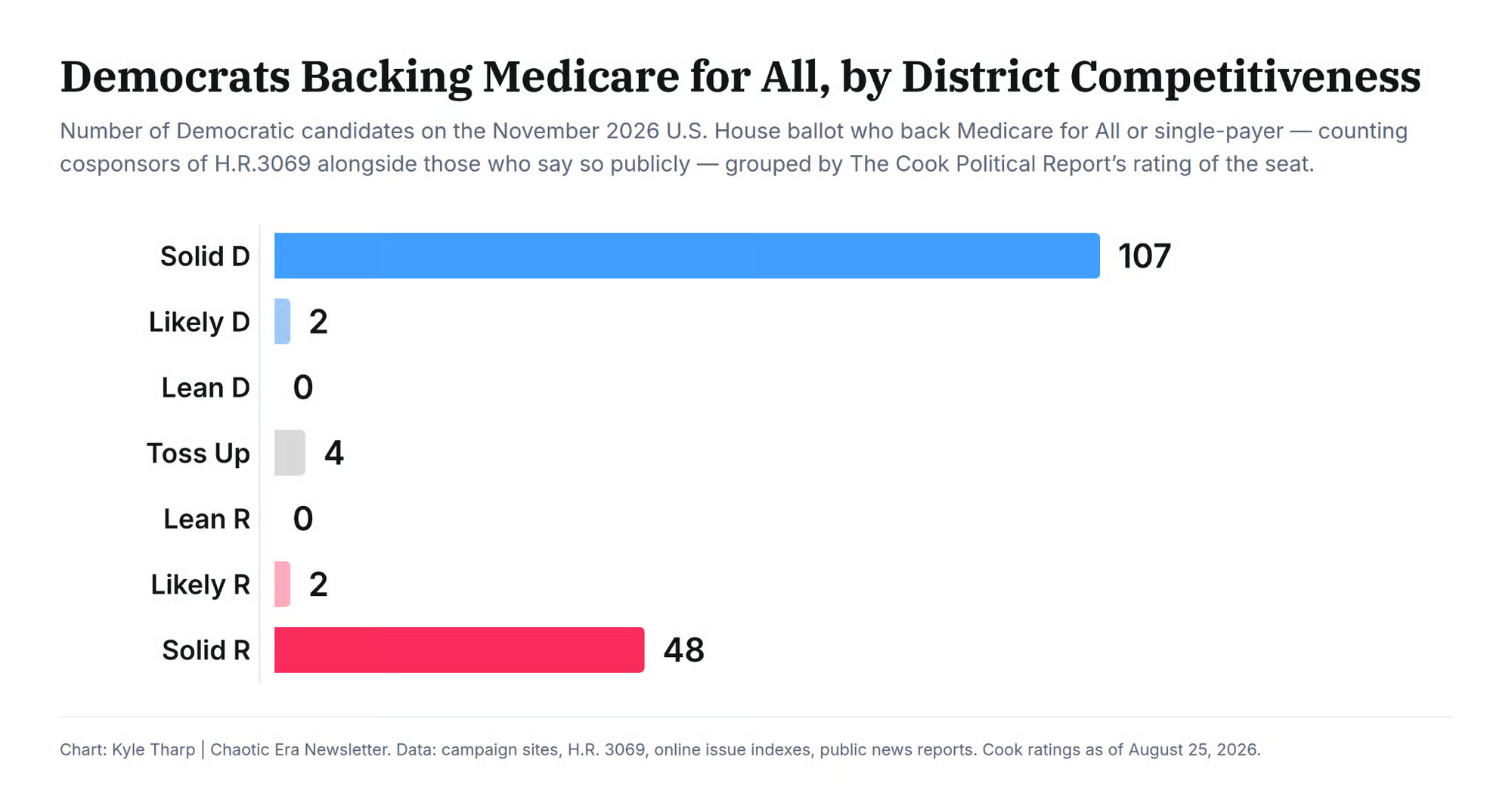
A record 163 U.S. House candidates on the ballot this November support Medicare for All. (Source: Chaotic Era)
CASH COUNT
PAC-door assist. Democrats who have sworn off corporate money and raged against the influence of super PACs have nonetheless found a loophole allowing them to continue accepting money from corporations. Campaign finance law prohibits candidates from officially coordinating with super PACs. However, a *Notus* investigation found that more than a dozen Democrats in competitive races have adopted “redboxing,” in which they detail specific information about their campaign needs and strategies through materials published on their websites. Corporate-funded super PACs can simply read where their preferred candidate would like them to spend, and what messages to amplify — all without coordinating directly. Critics say the practice should be illegal, but the Federal Election Committee has determined that “redboxing” does not break campaign finance laws.
📻 Some of the “redbox” information is incredibly specific and seems to go beyond standard campaign material meant to appeal to average voters. Rep. Seth Moulton (D-Mass.), who suffered a resounding primary defeat last night to Sen. Ed Markey (D-Mass.), benefited from a private equity-backed super PAC that sought to cast him as a progressive based on his campaign’s “redbox” items.
⭐ Texas Democratic Senate candidate James Talarico, who says his first act in Congress will be to sponsor legislation banning super PACs, has a “redbox” page detailing how it’s important for voters in San Antonio, Austin, and Harlingen-McAllen to hear about specific policies, like a cap on the cost of insulin and more funding for public schools. The Lone Star Rising PAC, which is bankrolled by billionaire Reid Hoffman, has run ads focusing on Talarico’s “redbox” issues in those regions and more.
📩 Both the Republican and Democratic House campaign arms contain “redbox” pages with their own messaging wish lists, including information on where to broadcast ads, where to stream, and which mailboxes to hit with specific messages. Five Democratic candidates responded to the Notus investigation by removing their “redbox” content.
💸 Democrats who have sworn off corporate money are also benefiting from it through a trickle-down effect when they receive money from deep-pocketed Democratic leadership PACs, such as the committee associated with House Minority Leader Hakeem Jeffries (D-N.Y.). The leadership PACs accept donations from corporations and billionaires, and then send the money directly to candidates.
🤑 A Notus investigation found that leadership committees have showered $24 million on Democratic candidates this cycle, up from $19 million in 2022. Republicans have received $34 million from their leadership PACs. An analysis from Quorum found that in the 2024 election, Republicans received about 55 percent of all donations from corporate PACs, compared to 45 percent for Democrats.
-=-=-=
ro khanna crit doge 6 26 lever shd be in prison; subpoena him oversight epstein files
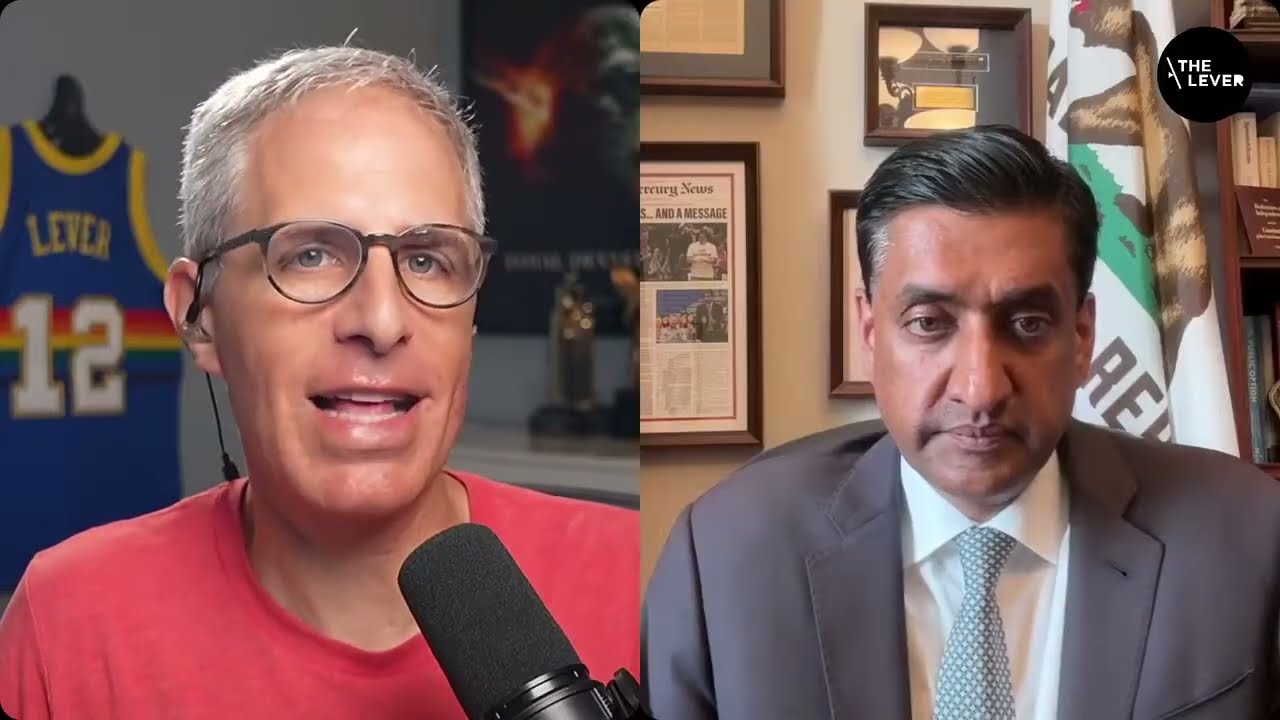
lancet ucla
===
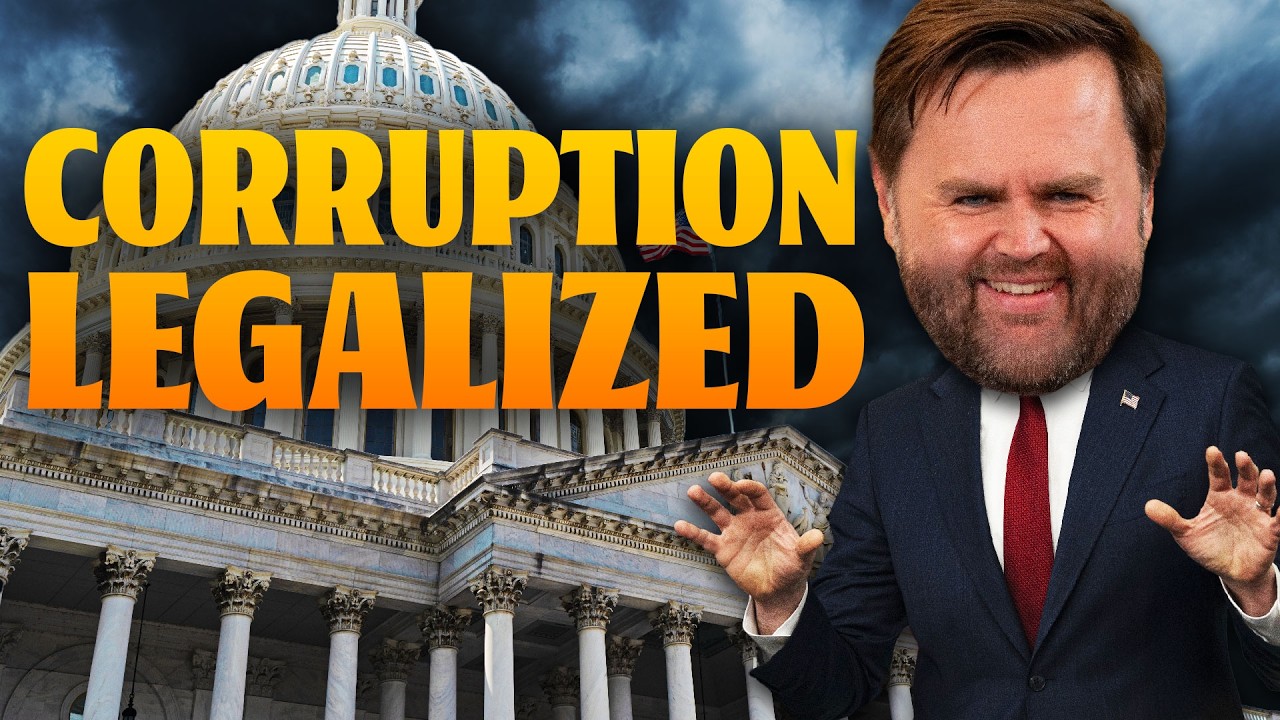
NOT BRIBE GRATUITY; NRSC V FEC JD VANCE;
Is the Supreme Court About to Legalize Corruption?
Robert Reich
and 2 more
26,326 views Apr 22, 2026
For decades, rich and powerful interests and their right-wing political allies have been executing a secret plot to buy our political system — and it may get a whole lot worse.
...0:00
Most Americans rightfully believe that money corrupts our politics, and they want to overturn Citizens United.
0:07
7 seconds
And yet, in two little-noticed cases — including one spearheaded by Vice President JD Vance — the Supreme Court could soon do the opposite,
0:17
17 seconds
eliminating the last restrictions on campaign donations and obstructing law enforcement's efforts to halt bribery.
0:25
25 seconds
To explain, investigative journalist David Sirota of The Lever.
0:30
30 seconds
Do you feel like your voice matters when it comes to our politics? No? I'm not surprised. The public effectively has no impact on legislation.
0:40
40 seconds
That's because rich and powerful interests and their right-wing political allies have been executing a decades-long master plan to buy our political system,
0:50
50 seconds
and it could get a whole lot worse due to several recent court cases. If that sounds depressing, it's because it is.
0:58
58 seconds
But there are ways to fight back.
1:00
1 minute
Now, you probably know about the Supreme Court's 2010 Citizens United case that opened the floodgates to unlimited election spending by outside groups like corporations.
1:12
1 minute, 12 seconds
In that case,
1:13
1 minute, 13 seconds
justices ruled that corporations were people whose speech, including their political spending, could not be limited.
1:21
1 minute, 21 seconds
It gutted campaign finance laws established to rein in corruption and restore public trust after the Watergate scandal.
1:29
1 minute, 29 seconds
With this ruling,
1:30
1 minute, 30 seconds
the conservative justices conjured the legal fiction that unlimited spending by those seeking to shape public policy
1:38
1 minute, 38 seconds
“do[es] not give rise to corruption or the appearance of corruption.” I think the 75% of Americans who oppose Citizens United would probably disagree.
1:50
1 minute, 50 seconds
But Citizens United is far from the only Supreme Court case that's corrupted our democracy. In Snyder v. United States,
1:58
1 minute, 58 seconds
which was decided in 2024,
2:01
2 minutes, 1 second
the Supreme Court overturned the corruption conviction of an Indiana mayor who pocketed thousands of dollars from a local business tycoon
2:10
2 minutes, 10 seconds
after ensuring the tycoon's company got a big municipal contract. The push to overturn this conviction,
2:17
2 minutes, 17 seconds
which was backed by powerful business groups and conservative think tanks,
2:21
2 minutes, 21 seconds
it resulted in the High Court ruling that such payments to government officials are not illegal if they're made after an official action takes place.
2:32
2 minutes, 32 seconds
The court's conservative justices ruled that these kinds of payments to politicians are not bribes, they're now “gratuities”
2:40
2 minutes, 40 seconds
— like, you leaving a nice tip for your waiter at a restaurant.
2:44
2 minutes, 44 seconds
Now, it just so happens that Justices Clarence Thomas and Samuel Alito backed this ruling after they accepted lavish gifts and trips from billionaire benefactors.
2:54
2 minutes, 54 seconds
But all of this isn't enough for conservatives and the oligarchs bankrolling them.
3:00
3 minutes
The MAGA legal world is pushing two other cases that would make it even easier to buy elections, politicians, and public policy.
3:08
3 minutes, 8 seconds
The first case, National Republican Senatorial Committee v. Federal Election Commission, it’s already been accepted by the Supreme Court.
3:17
3 minutes, 17 seconds
Originally brought by then-Senate candidate JD Vance, this case aims to get rid of limits on political parties’ coordinated spending with candidates.
3:27
3 minutes, 27 seconds
JD Vance and the Republican Party are claiming that this type of political spending, by definition,
3:34
3 minutes, 34 seconds
can't be corrupt or even appear to be corrupt because political parties pool money from many contributors.
3:41
3 minutes, 41 seconds
They argue that that means no single donor can exert “corrupting influence,” and so the money shouldn't be restricted.
3:51
3 minutes, 51 seconds
In essence, they're asking the Supreme Court to believe that a bank CEO’s donation to a political party coordinating with a
3:59
3 minutes, 59 seconds
lawmaker's campaign can in no way influence how that lawmaker then drafts banking legislation.
4:07
4 minutes, 7 seconds
The other case, Sittenfeld v. United States, concerns federal anti-bribery laws.
4:13
4 minutes, 13 seconds
Now, it's already hard enough to prosecute bribery thanks to the Snyder case and decades of similar cases that have slowly chipped away at anti-corruption laws.
4:23
4 minutes, 23 seconds
Over the years, the Court has overturned corruption convictions of Democrats and Republicans alike. This new case,
4:30
4 minutes, 30 seconds
however, could take the Supreme Court's legal assault even further.
4:35
4 minutes, 35 seconds
Former Cincinnati Councilman P.G. Sittenfeld asked the Supreme Court to overturn his bribery conviction
4:42
4 minutes, 42 seconds
after he was convicted for accepting $20,000 worth of campaign contributions in exchange for supporting a local development project.
4:51
4 minutes, 51 seconds
Even though Sittenfeld is a Democrat, he was already pardoned by Donald Trump,
4:57
4 minutes, 57 seconds
and his appeal is being backed by major conservative groups while his lawyer is Donald Trump's former solicitor general.
5:05
5 minutes, 5 seconds
So this case is not just about absolving one local official,
5:10
5 minutes, 10 seconds
it's about absolving an entire system of corruption — and their arguments make that clear.
5:17
5 minutes, 17 seconds
Sittenfeld’s lawyers are arguing that pay-to-play culture is now so widespread that it shouldn't even be considered a crime.
5:26
5 minutes, 26 seconds
They literally write that the situation is like, And therefore,
5:37
5 minutes, 37 seconds
it shouldn't be prosecutable.
They specifically cite reports of Donald Trump soliciting oil executives for $1 billion of campaign cash in exchange for pro-oil policies.
They argue that that's the kind of thing that could be prosecuted if Sittenfeld’s conviction is allowed to stand — as if that would be a bad thing.
Now, they're not wrong that pay-to-play culture is pervasive in government,
6:03
6 minutes, 3 seconds
but the solution is stronger enforcement of anti-corruption laws, not weaker. However, the Supreme Court doesn’t seem to agree.
6:12
6 minutes, 12 seconds
It vacated Sittenfeld’s conviction and sent it back to lower courts for further review. But the high court did not rule on the merits of the case
6:20
6 minutes, 20 seconds
or offer a rationale for overturning the conviction — leaving the rest of us to guess as to whether similar corruption cases could be successfully prosecuted in the future.
6:35
6 minutes, 35 seconds
Again, do you want to know why it feels like Congress can never get anything done that actually helps regular people? It's because of everything I just described.
6:46
6 minutes, 46 seconds
We can't rely on the Supreme Court,
6:48
6 minutes, 48 seconds
or Donald Trump, or any politicians corrupted by Big Money, to overhaul this broken system.
6:56
6 minutes, 56 seconds
But there are real solutions that we can fight for. Nationally,
we can push for a constitutional amendment to overturn Citizens United.
7:05
7 minutes, 5 seconds
This may seem unrealistic because it requires 38 out of 50 states to ratify it, but momentum is growing,
7:13
7 minutes, 13 seconds
and some states are not waiting for a national solution.
7:17
7 minutes, 17 seconds
Montana is pioneering a way to stop the flood of Big Money by changing how the state defines corporations’ powers.
7:25
7 minutes, 25 seconds
It's a template that other states can follow.
7:28
7 minutes, 28 seconds
The Supreme Court has ruled many times that corporations are granted their powers by the states in which they operate.
7:34
7 minutes, 34 seconds
The Montana proposal would use that existing authority to change its law to no longer grant corporations the power to spend on any elections inside of Montana.
7:47
7 minutes, 47 seconds
If Montana passes this, it's not alone a national solution,
7:51
7 minutes, 51 seconds
but it does solve a big part of the Citizens United problem inside of Montana.
7:57
7 minutes, 57 seconds
Other states can do the same inside of their states. And the more states that do it,
8:03
8 minutes, 3 seconds
the more Citizens United is neutered — profoundly changing all of American politics.
8:09
8 minutes, 9 seconds
The Holy Grail is public financing of elections,
8:13
8 minutes, 13 seconds
which gives qualifying political candidates public money for their campaigns so that they don't have to rely on money from big donors seeking government favors.
8:23
8 minutes, 23 seconds
This isn't some pie-in-the-sky idea — dozens of states and cities already do this, which means every other state and city can too.
8:32
8 minutes, 32 seconds
Sure, self-financed billionaire candidates and super PACs can still outspend publicly funded candidates,
8:40
8 minutes, 40 seconds
but public financing gives grassroots candidates enough resources to run competitive campaigns,
8:47
8 minutes, 47 seconds
and sometimes even win them. These policies should be a no-brainer.
8:52
8 minutes, 52 seconds
But reme mber, oligarchs have an interest in undermining democracy.
8:57
8 minutes, 57 seconds
They know that in a functioning one-person, one-vote system, they could never pass the unpopular, self-enriching policies that they want.
9:07
9 minutes, 7 seconds
So they're working hard to maintain the corrupt status quo that lets them buy political outcomes. They can still be stopped,
9:15
9 minutes, 15 seconds
but only if we finally make anti-corruption the central focus of our politic
---
---
Tax Day Could Be Easy. They’re Fighting To Make It Hard.
4 26
RR -->
[00:09:54] David Sirota: We'll be right back. Welcome back to Lever Time. It took another decade for this issue to pop up again. In 1998, democratic President Bill Clinton and the Republican Congress passed a law reviving the possibility of a return free system. That's right. Buried in an IRS overhaul Bill was a provision instructing the Treasury Secretary to quote, develop procedures for the implementation of a return free tax system.
This proposal sat at the IRS for the next few years until George w Bush's Republican administration took a baby step. They didn't implement return free filing. It was something much smaller than that. A proposal just to let you go online and file your taxes to the IRS for free.
[00:10:40] Ken Dam: Paying taxes is really a responsibility of every citizen, but because it's a responsibility, it doesn't mean it has to be arduous, slow, cumbersome, mysterious.
[00:10:53] David Sirota: This was Bush Treasury Department official Ken Dam, describing the initiative
[00:10:57] Ken Dam: Free File Promises to reduce the needless frustrations of millions of dutiful citizens. As they carry out this duty of citizenship, preparing and filing their tax returns,
[00:11:08] David Sirota: and yet even this simple idea really pissed off the tax prep industry.
Intuit, the owner of TurboTax launched a counter attack and mobilized, enlisting the help of a guy named Bernie McKay, a bigwig lobbyist, and former Carter administration official, who did a full court press on Capitol Hill. According to a ProPublica investigation, the industry basically argued that the IRS could not be counted on to roll out such a big program and the argument.
Really resonated with some folks on Capitol Hill. A group of Republican lawmakers wrote to the IRS claiming that there was no reason for the government to compete with quote well-established tax prep companies. The lobbying worked in 2003, the Bush administration and the tax prep companies made a compromise.
It was called the Free File Alliance. An IRS Blessed Consortium of Tax Prep Companies would help some taxpayers file their taxes for free. But the catch was in the federal contract. Which obligated the IRS to not compete with the consortium in providing free online tax return preparation and filing services to taxpayers
[00:12:22] Julie Story: crash and burn.
[00:12:24] David Sirota: Yep, another crash and burn. But after getting reelected. George W. Bush went back to the tax complexity fight once again. In January, 2005, he announced a whole new advisory panel to evaluate ways to simplify the tax system.
[00:12:40] George W Bush: These fine, distinguished citizens will be taking a good hard look at the tax code....
[00:13:22] David Sirota: The new advisory panel devoted an entire day of public testimony to reviewing Reagan's original return free tax filing idea, which seemed like a really encouraging sign.
We're going ballistic, ma. Go get 'em. But then came the testimony of anti-tax power broker Grover Norquist, a conservative then at the zenith of his political power in Washington. The transcript of the hearing shows him excoriating the idea in what would become a set of talking points that Norquist and others would repeat.
Over and over again in the ensuing years, it's like playing in Las Vegas. Norquist said the house sets the rules and the house has its fingers on the scales. Do you really want to go and argue with the IRS? If they've sent you a bill that's higher than you think it ought to be. It also gives the advantage just as the house in Las Vegas.
He said the interests of the government. Is to maximize its revenue. That testimony casting return free filing as a stealth tax increase, it set the idea back into another free fall. Sub controller, losing controller return free filing officially crashed and burned again when George w Bush's advisory committee left it out of its final report.
Then in 2007, Barack Obama picked up the cause of return free filing. The then presidential candidate was seemingly ready to fight the tax prep industry. ProPublica reported that Obama gave a speech to an audience full of tax wonks in Washington, where he said quote. The government already collects wage and bank account information, so there's no reason the IRS can't send Americans prefilled tax forms to verify.
This means no more worry, no more wasted time, no more extra expenses for a tax preparer. But Obama quickly learned his lesson too. The tax prep lobby was not to be messed with. Bernie McKay and the band of Intuit lobbyists got to work pushing Congress to introduce a series of bills to prohibit the IRS from building its own free tax filing system.
As campaign cash from the tax prep industry flowed to lawmakers, the public opposition was led in part. By Grover Norquist, casting it as a scheme to jack up everyone's taxes.
[00:15:42] Grover Norquist: When this is was done in other places, the government makes a lot of money. Why? Because when the government does your taxes for you, they maximize their revenue, not getting your tax returns accurate.
[00:15:54] David Sirota: That's Norquist in a newsmax interview from 2014.
[00:15:58] Grover Norquist: I think the idea of of having the government do your taxes for you is dead. Dead, dead. That's an important part of tax reform. Killing this idea of the government reaching out, knowing everything about you doing your taxes for you.
[00:16:12] David Sirota: When around this time, Republican lawmakers caught wind, that the IRS might be looking into a realtime data collection system that might later be needed for a return free system.
They pounced.
[00:16:24] IRS Oversight: This subcommittee has placed report language in our annual appropriations bills, by the way, since 2 0 9 Pro prohibiting the IRS from using any funds on a simple tax return pilot program.
[00:16:34] David Sirota: This was a Republican congressman interrogating Obama's IRS Chief at a congressional hearing in 2014.
[00:16:40] IRS Oversight: Are you aware of any further exploration and implementation by the IRS
[00:16:44] David Sirota: Obama's IRS Chief Quickly backed down.
[00:16:47] John Koskinen: The thing that has been the focus of a lot of external societies is the idea of could we pre-populate a return form, get information in pre-populate so you could look at it, and then you could make decisions or the IRS could even file your return for you.
We're not doing anything with that. We have no, uh, no program going forward that I know of, and, uh, certainly we don't intend to do anything like that without talking to you
[00:17:06] David Sirota: once again, after briefly taking flight, the idea of a return free tax system fell out of the sky. The
[00:17:13] Top Gun Clip: goddamn plane has creed into the mountains.
[00:17:17] David Sirota: There was of course, one more test flight as part of the 2022 Inflation Reduction Act that President Biden signed. The IRS budget was significantly increased after years of cuts, and the legislation included a new direct file system, which was rolled out in 2024.
[00:17:35] WPRI: This year, there is a new software pilot program being offered in 12 states called Direct File.
It opens to qualifying taxpayers in mid-March.
Your eligibility for direct file does not depend on your income.
[00:17:49] David Sirota: Direct file was a free online service that allowed taxpayers to file their federal tax returns directly with the IRS. Again, this wasn't return free filing. But it was the government's strongest attempt to at least give you a way to file your taxes without the added fees and shady upsells of private companies.
The program was run by the IRS itself, and it ended up being a policy experiment that went surprisingly well. It was rolled out slowly and intentionally so that issues could be seen and addressed quickly. At first, it was limited to really simple filings, and then additional tax complexities were added later on, making it more accessible to more and more taxpayers Overall, the pilot program showed.
Big promise with 94% customer satisfaction that gave a green light for the program to expand beyond the first 12 states it started in. But at this point, I'm guessing, you know what happened when Donald Trump won his second presidential term
[00:18:55] NBC10: starting 2026, the program will no longer be available for taxpayers.
President Trump has said he was looking into getting rid of direct file. He claimed it was. A waste of taxpayers' money because commercial tax preparation companies already offer free filing programs.
[00:19:12] David Sirota: The campaign to kill the successful and popular direct file program was fast and furious as soon as Trump won the 2024 election, nearly 30 house Republicans sent a letter to Trump in December, 2024, just after he'd won, asking him to end direct file on his very first day in office.
The lawmakers had raked in more than $1.8 million of campaign cash from, you guessed it, tax preparation companies and their proxies. Meanwhile, turbo Tax's parent company, Intuit, donated $1 million to Trump's inauguration. Direct file in a lot of ways had been the closest thing to what Ronald Reagan had proposed back in 1985.
...
As I've gone back and forth with my own accountant in this last few weeks, getting more and more annoyed at all the red tape, watching more and more of my time sucked away into a mountain of paperwork. I've been thinking a lot about this interchange on CNBC from a few years back.
[00:23:00] CNBC (Aaron Ross Sorkin): Grover, I wanted to ask you about this.
There's this bill out there, it seems bipartisan and I, I'm surprised by it.
[00:23:06] David Sirota: That was journalist Andrew Ross Sorkin asking anti-tax activist Grover Norquist, why he's fought return free filing for so many years.
[00:23:15] CNBC (Aaron Ross Sorkin): That effectively makes it a a, a permanent ban barring the IRS from ever developing its own online tax filing service.
This would've been. Uh, a free service that would've made paying taxes cheaper and easier, especially for people at the bottom and the middle who are spending, uh, in often cases, you know, several hundred dollars a year, it would actually be a tax cut for most Americans to do this. Why try to block something like that?
[00:23:41] David Sirota: Norquist first insisted that private tax prep companies do provide some free services to the very poor. And then Norquist went on a rant.
[00:23:49] Grover Norquist: The real goal of the Democrats, and we saw this in California, is they want the government to do your taxes for you. Yeah. Like Europe does. They send you a bill. Go ahead and argue with the government.
And when California put that together, you know what? They scored it as a significant revenue raiser 'cause they intended to, to write your tax bill. So it'd be higher than it than you would expect to pay. Now, this is a way to raise taxes. And to completely strip you of all privacy. So
[00:24:15] CNBC (Aaron Ross Sorkin): grow, grow
[00:24:15] David Sirota: Sorkin though, press there.
[00:24:17] CNBC (Aaron Ross Sorkin): Do you have any ideas of how to make it easier and cheaper? Mm-hmm. For American taxpayers to pay their taxes so it doesn't cost them any more money than it already does. It'd just be so much easier. Who, people who are W2 filers, they get a postcard. It says what, what the number is. You either sign it or you, or you go off and you do your own, you do your own tax plan.
[00:24:37] David Sirota: Norquist then started reciting more anti-tax talking points as usual, casting the IRS as a rapacious monster.
[00:24:45] Grover Norquist: The federal government takes about 18% of everybody's money. There's no pleasant, cheap, easy, or uncomplicated way to do that. You want simplicity, you want fairness, make the tax bill lower,
[00:24:56] David Sirota: and that's when Sorkin just scream the quiet part about the whole issue.
[00:25:01] CNBC (Aaron Ross Sorkin): You have no, um, rival idea about how to make it easier for Americans to pay their taxes. I want their tax because I think ultimately your idea is to make it harder for people to pay their taxes so they hate their taxes and push for lower taxes.
[00:25:14] David Sirota: That's it right there. That's what's also underneath all of this, beyond just the tax prep companies wanting to protect their profits, there's a powerful arch conservative, anti-tax movement that wants you to hate literally everything about taxes, and so they've succeeded.
In creating an awful tax process. But I wanna go back to something I alluded to at the beginning. Taxes are not theft. As the anti-tax movement likes to insist. Taxes are the necessary price we pay for a functional society. It's what we pay for roads, bridges, water systems, schools, and all the stuff we call civilization.
What is theft? Is politicians helping giant corporations steal our money and our time just to file our taxes. So as the tax filing deadline approaches, as some of you are stressed out. By Byzantine filing forms or the fear of paying more than you owe or of being audited for a simple mistake, don't forget it does not have to be this way.
---
AN 3 26
Secretary of State Marco Rubio has shared a 20-year relationship with a man that the government alleges is a foreign agent for Venezuela. It turns out, that man also has very close ties to several people in President Donald Trump's orbit
The sprawling case centers on a $50 million Venezuelan lobbying scheme allegedly orchestrated by Rep. David Rivera (R-Fla.), convicted cocaine trafficker Hugo Perera, and sanctioned media mogul Raúl Gorrín on behalf of Nicolás Maduro’s regime, a Tuesday report from The Lever said.
Court documents also reveal connections to White House chief of staff Susie Wiles, former Trump advisor Kellyanne Conway, Rep. Pete Sessions (R‑Texas), oil executive Harry Sargeant (now advising Trump on Venezuela policy), Iran‑Contra figure Otto Reich, and even Ghislaine Maxwell’s lawyer.
It all began in 2017, when the lobbying company Ballard Partners, which Wiles co-led at the time, was connected to Rivera through Gorrín and Perera. In fact, one of Rivera's lawyers' arguments is that if his associations make him a foreign agent, then Wiles should be considered one too. Ballard's "work for Gorrín appears to have been extensive," the report said and Wiles has been asked to testify. There are about 400 pages of documents connecting Wiles' firm to the men. The documents include numerous emails.
The court filings allege that Gorrín helped facilitate the foreign-agent relationship and served as a go-between for the Venezuelan government. He was involved in several meetings that Rivera set up, including those with Rubio. At one point, Rivera tried to use Gorrín's private jet for the meetings with Conway.
"Gorrín, who was sanctioned by the U.S. government in 2019 for his purported involvement in foreign bribes and money laundering, was reportedly paid handsomely for his work," the report noted. That same year, Attorney General Pam Bondi was also working at Ballard.
Emails exchanged between Wiles and Gorrín also included lobbyist Otto Reich, known for his work on weapons sales during the Ronald Reagan administration. It became known as the Iran-Contra scandal because the U.S. secretly funneled the weapons to Iran through the Contras, a Nicaraguan rebel group. There was an arms embargo at the time and Reich ran the State Department's Office of Public Diplomacy for Latin America and the Caribbean, which helped coordinate everything.
Oil executive Harry Sargeant was also among the email discussions. He's currently working with Trump on stabilizing Venezuela after Trump took out Maduro.
---
2 26
Secretive Tactic DHS Is Using to Target You (With Steve Loney)
27.9K subscribers
Feb 20, 2026 Lever Time
On this video episode of Lever Time, David Sirota sits down with ACLU attorney Steve Loney to ask some big questions: How are federal agencies obtaining your private data without a warrant? How are tech giants like Google enabling them? And what should you do if the feds come knocking on your door?
GMAIL 226
THE LEFT HOOK with Wajahat Ali is live with David Sirota on Substack now: "Beware the Corporate Democrats Trying to Hijack the Party!"
---
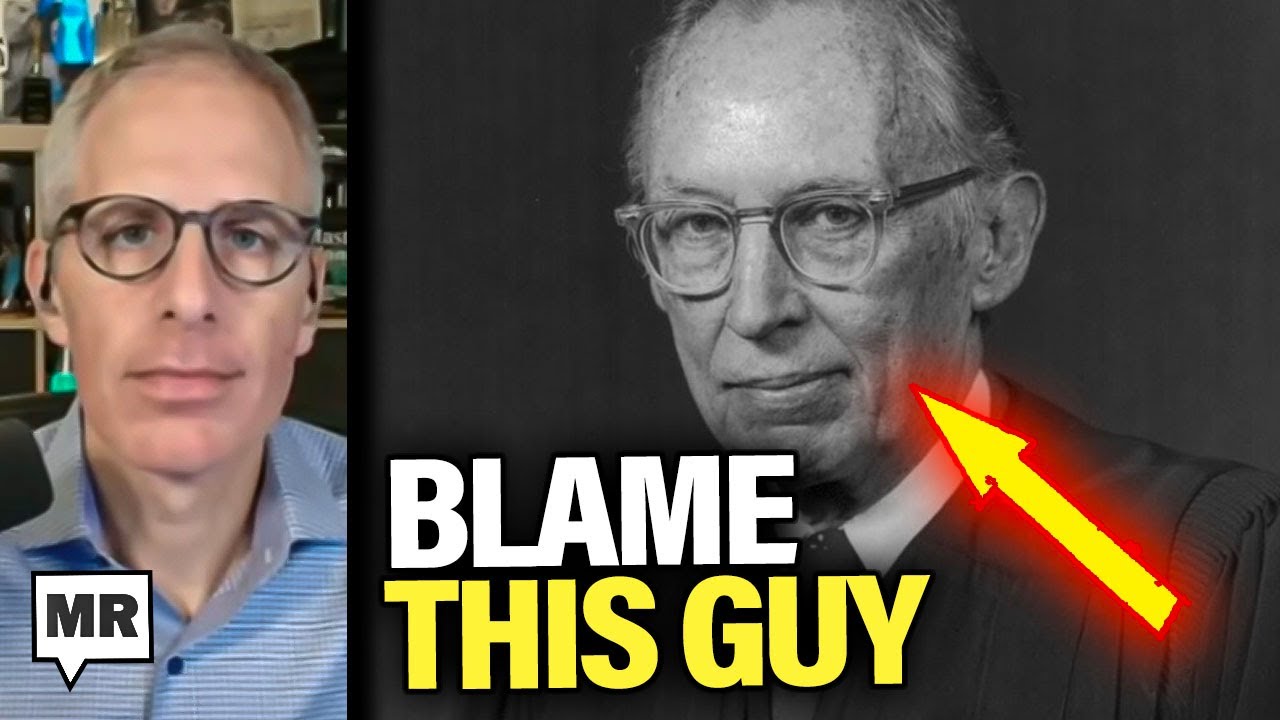
ken k
SEE MAJ REPT EMMA MONTANA
cu BUT NOT AMEND?
---
PT 1 HOMAN AUDIO i am sure he has been piad more than 50k for his services” CU
2,510 views Oct 22, 2025 Lever Time
Most Americans want to overturn Citizens United v. FEC, the landmark 2010 Supreme Court decision that unleashed unlimited corporate spending on U.S. elections. But two new cases before the high court — including one spearheaded by now-Vice President JD Vance — are instead set to expand that ruling and turn America into a kleptocracy. For the next several episodes of Lever Time, we’re taking a deep dive into Citizens United and how it’s transformed our lives. In this first episode, David Sirota uncovers conservatives’ plan to deregulate the campaign finance system, their efforts to legalize bribery, and what options we have to stop them.
iou crypto billionaires
...
9:54
after the Trump administration bailed on
9:56
defending current law, who did the US
9:59
Supreme Court assign to defend the last
10:01
remaining threads of campaign finance
10:03
regulations? A conservative attorney
10:06
named Roman Martinez. He served as a
10:08
clerk for Chief Justice John Roberts in
10:11
2010, exactly when Roberts engineered
10:15
the original Citizens United ruling.
10:17
This same conservative attorney now
10:19
charged with defending the last
10:21
remaining campaign finance statutes. He
10:24
also recently helped the Chamber of
10:26
Commerce press justices to limit the
10:28
scope of federal anti-bribery laws.
10:32
Could somebody play that old Chvy Chase
10:33
clip here?
10:34
Isn't that a conflict of interest? Like
10:36
Citizens United in 2010, this new
10:38
Supreme Court case only questions a
10:41
narrow aspect of campaign finance law,
10:43
the part that governs how much money
10:46
political parties can spend in
10:48
coordination with their candidates. But
10:50
just like Citizens United, the court
10:52
could go way beyond the narrow issues in
10:55
this case and use the case as an
10:58
opportunity to create a whole new
11:00
president outlawing all campaign
11:03
contribution limits. The court is set to
11:06
hear the case during its current term.
11:08
Depending on how justices rule, by the
11:10
2026 midterm election, we could be
11:13
living under a whole new Citizens United
11:16
2.0 paradigm, where campaign donations
11:19
to candidates and the potential for
11:21
billionaires to buy elections are truly
11:24
unlimited. And even if this JD Vance
11:27
case fails, there's one more case also
11:30
on the horizon. It aims to make it
11:32
almost impossible for prosecutors to
11:35
enforce federal anti-bribery laws. We'll
11:38
hear more about that case after the
11:40
break.
---
PT2 AUDIO ONLY 28TH AMEND SEE JUST KENNEDY
LAST ONE TOOK 200 YRS?!
648 views Oct 24, 2025 Lever Time
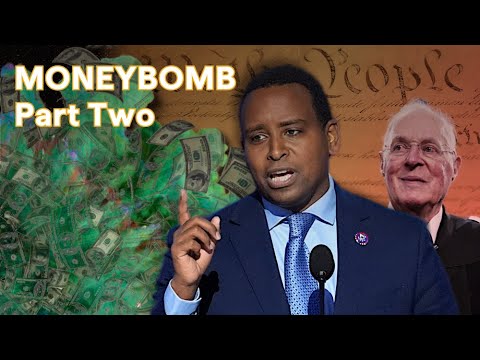
For 15 years, lawmakers have been trying — and failing — to overturn Citizens United, the landmark Supreme Court decision that allows corporations and billionaires to overrun our political system with money. Now, some Congressional Democrats are going big — by trying to enshrine campaign finance protections in the Constitution. In the second episode of Lever Time’s MONEYBOMB series, David Sirota sits down with Rep. Joe Neguse (D-Colo.), cosponsor of the new Citizens Over Corporations Act, which would introduce a Constitutional amendment to overturn the Citizens United ruling. Does the effort have a real shot at fixing our democracy crisis?
...5:33
views when every day on the news, Americans hear things like this? Trump promised the big oil executives
5:41
that he would deliver their wish list if they spent a billion dollars to return
5:48
him to the White House. In his new memoir, Anthony Kennedy, the author of the Citizens United decision, says,
5:55
quote, "All of us are concerned about money in politics." In a recent interview with CBS, Kennedy also says
6:02
he's worried about the state of democracy. I'm concerned democracy presumes an
6:08
open, rational, thoughtful, decent discussion where you respect the dignity
6:14
of the person with whom you disagree. And if it doesn't have that, then the then democracy as we know it is in
6:22
danger. This is truly incredible. Anthony
6:28
Kennedy wrote the ruling that floods American politics with unlimited money.
6:34
The ruling that created the dark money groups and super PACs that drown out
6:39
every other voice with negative ads. And now he's saying he's worried about
6:45
democracy. This is like that meme where the hot dog guy crashes his car.
6:50
Yeah, we're all trying to find the guy who did this. Yeah. Apparently, Citizens United author
6:55
Anthony Kennedy is trying to find the Anthony Kennedy who did this to our democracy. It's clear from his memoir
7:02
that Kennedy overwhelmingly places the responsibility of keeping money out of politics on voters. It's a tired claim
7:10
that feels increasingly ignorant, but voters are getting fed up. At least on
7:16
the surface, it seems like lawmakers are beginning to recognize the outrage.
7:21
Every year since the 2010 Citizens United ruling, there have been congressional efforts to try to overturn
7:26
it. Needless to say, none of them have stuck. But certain lawmakers keep
7:31
trying, and some of those lawmakers want to go big by passing an amendment to the
7:37
Constitution. Passing an amendment is no easy task.
7:42
It's been 33 years since the last time we did it. During today's session, members of the
7:48
House of Representatives engaged in debate over the recently ratified 27th Amendment to the Constitution. The 27th
7:54
Amendment says that if members of Congress vote to raise their own pay, they won't get that increase until after
8:01
the next election. It's an anti-corruption amendment that prevents immediate pay increases for lawmakers
8:07
who've already been elected. This constitutional amendment was ratified in 1992. When was the amendment first
8:14
proposed? 1789, more than 200 years earlier. It was
8:19
actually one of the very first constitutional amendments ever proposed in the history of the United States.
8:25
James Madison, a representative from Virginia who went on to become the fourth president of the United States,
8:32
came up with the idea. Admittedly, the 27th amendment had an exceptional path to the Constitution. But the point is
8:39
that constitutional amendments are really difficult to pass. For an amendment to be ratified, 3/4s of the
8:46
states in America have to approve it. That means 38 of these quote unquote
8:51
United States have to agree on something.
8:57
So, let's fast forward to today. Democratic lawmakers from four different states introduced the Citizens Over
9:04
Corporations Act. If ratified, it would become the 28th Amendment to the US
9:10
Constitution. One of the lawmakers behind that bill is from my own state of Colorado.
9:15
Good to be with you, Joe Nagus. I represent Colorado's second congressional district in the United States Congress.
---
premium
How Art Laffer Created The Cult Of Reaganomics
---
Are You On The FBI’s New Watch List?
10 25
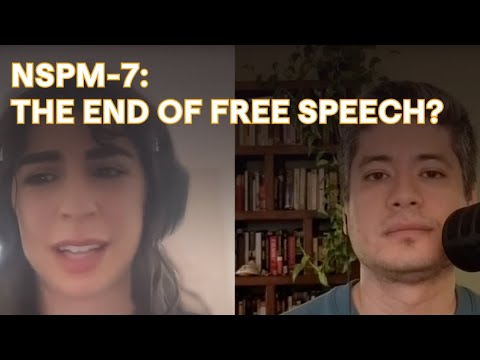
last week, President Donald Trump dramatically altered the U.S. government’s approach to domestic terrorism. NSPM-7, a little-noticed national security directive, expands the list of terrorism indicators to include any behavior that is deemed anti-American, anti-Christian, anti-capitalist, extreme on gender, hostile towards “traditional American views” on family, and more.
Today on Lever Time, producer Ariella Markowitz sits down with independent investigative journalist Ken Klippenstein, who first sounded the alarm about the memorandum’s ability to suppress free speech and target Trump’s political opponents.
To check out Ken Klippenstein's reporting on the new directive, click here.
To leave a tip forThe Lever,click here. It helps us do this kind of independent journalism.*
A full transcript of today’s episode is available below.
TRANSCRIPT
*Following is an automated, unedited transcription of this episode. If you plan to quote any part of this transcript, please first confirm that it is correct by listening to the audio.
[00:00:00] Ariella Markowitz: From The Lever's reader supported newsroom, this is Lever Time. I'm Ariella Markowitz, filling in for David Sirota. The odds that you could end up on a terrorism watch list just went up. That's because last week, President Donald Trump issued NSPM-7, a national security presidential memorandum that flew mostly under the radar.
The memorandum cites a surge in what Trump calls "organized political violence" as a reason to mobilize the 9/11-era joint terrorism task forces to investigate potential domestic terror in the U.S. But this new security memorandum claims that indicators of violence include anti-Christian or anti-capitalist values, and even extreme views on gender. According to Trump, these are all characteristics of a sophisticated network of terror.
So today I'm sitting down with Ken Klippenstein, the investigative reporter who first sounded the alarm about NSPM-7. I asked Ken to take us inside the details of the President's national security memorandum and what it means for the rest of us. Why aren't Democrats talking about the danger it poses to Trump's political opponents? And could this new anti-terrorism directive give Trump more power tosilence peaceful descent and expand police surveillance of American citizens? That's all coming up on today's show.
[00:01:29] Donald Trump: I told Pete we should use some of these dangerous cities as training grounds for our military.
[00:01:34] Ariella Markowitz: Earlier this week, Donald Trump and Secretary of Defense, Pete Hegseth, addressed top military generals and other leaders at the Quantico Marine Corps base. Trump delivered his usual lament about America's crime ridden cities,
[00:01:48] Donald Trump: The ones that are run by the radical left Democrats, uh, what they've done to San Francisco, Chicago.
They're very unsafe places.
[00:01:56] Ariella Markowitz: Outlets like The New York Times and NPR focused in on the rambling anti woke tirade from defense Secretary Pete Hegseth.
[00:02:03] Pete Hegseth: No more identity months. DEI offices, dudes in dresses. We are done with that shit.
[00:02:12] Ariella Markowitz: And let's not forget the fat shaming of the entire US armed forces.
[00:02:16] Pete Hegseth: Frankly, it's tiring to look out at combat formations or really any formation and see fat troops. It's a bad look.
[00:02:24] Ariella Markowitz: But amidst all the low BMI military fanfare, Trump said something that felt more ominous.
[00:02:30] Donald Trump: America is under invasion from within. We're under invasion from within. No different than a foreign enemy, but more difficult in many ways.
'cause they don't wear uniforms, at least when they're wearing a uniform. You can take them out.
[00:02:47] Ken Klippenstein: Well, you can't say he wasn't candid. He talked about the enemy within, which I found sort of chilling and felt kind of like a direct to TV movie rendition of a president that is not up to much good, but it wasn't just rhetoric.
[00:03:00] Ariella Markowitz: That's Ken Klippenstein, an independent journalist who's recently been covering misinformation surrounding political extremism. President Trump's comments during that speech seemed to directly allude to a document that Ken discovered on the White House website last week, a national security presidential memorandum that was ignored by mainstream news and even flew under the noses of legislators whose job it is to focus on national security.
Yeah, so it's called NSPM-7
[00:03:27] Ariella Markowitz: NSPM-7 stands for National Security Presidential memorandum number seven. The memorandum cites the assassination of Charlie Kirk, the attempted assassinations of. President Donald Trump, Supreme Court Justice Brett Kavanaugh, the recent shooting at a Dallas ICE Facility, and even slain United Health CEO, Brian Thompson, as instances of domestic terrorism quote, under the umbrella of anti-fascism and anti-American principles.
Here's Ken again.
[00:03:55] Ken Klippenstein: Oh, we have FBI Director Cash Patel testifying to Congress about a week or two ago saying that there has been a 300% increase in the number of domestic terrorism cases. That the bureau has opened up since the beginning of the administration.
[00:04:09] Ariella Markowitz: The memorandum strives to expand the executive branch's power to define who is plotting terrorism.
It cites a handful of public spaces like chat rooms, schools, and social media as breeding grounds for Antifa and potential areas for surveillance.
[00:04:25] Ken Klippenstein: So this is clearly A framework that the administration uses to look at what its job is, which is political adversaries engaging in violent conduct. That's terrorism by definition.
And the FBI's approach generally from Tesla vandalism, the FBI director and attorney General calling that terrorism. To whatever else they perceive as their political adversaries. Just painting with this very broad brush calling things terrorism, that I don't think any reasonable assessment would see it as.
[00:04:52] Ariella Markowitz: This idea of labeling so-called anti-Americanism as a threat to national security isn't novel. It's making a comeback. Last year, the Heritage Foundation, the billionaire funded organization behind Project 2025, published a document called Project Esther. Project Esther is a plan to dismantle the Palestine solidarity movement in the us.
The Heritage Foundation calls it a blueprint to counter antisemitism in the United States and ensure the security and prosperity of all Americans. Their recommendation reframe political dissent as an organized network of foreign funded terror. Trump has already began enacting some of Project Esther's suggestions, such as Criminalizing pro-Palestinian activism on college campuses and detaining students who are critical of Israel.
With this new memorandum, NSPM-7, Trump seems prepared to expand the strategy of Project Esther, but this time he's targeting potential terrorists who he sees as part of a larger Antifa movement. The memorandum is less than 2000 words, but it has far reaching consequences. The joint Terrorism task forces have been encouraged to investigate US citizens with quote, extreme views on immigration, race, and gender.
It empowers the Secretary of Treasury and the IRS to quote, disrupt financial networks of groups or individuals who show hostility towards those who hold traditional American views on religion. It's a lot to process, so I asked Ken Klippenstein to break it down for us.
Tell us a little bit about when this memorandum went out, what's in it and what it entails.
[00:06:31] Ken Klippenstein: Yeah, so it's called NSPM-7. That refers to the fact that it's the seventh such memorandum. This is not an executive order.
[00:06:37] Ariella Markowitz: Yeah. What's the difference?
[00:06:38] Ken Klippenstein: Yeah. Part of what made me interested in this was how misreported it was. Even good outlets, like C-Span we're calling it, oh, here's another executive order.
And I think because of that, it got tossed in this wastebasket of, oh, you know, Trump's had 200 of these, many of them are symbolic or theater. What? What does it mean? Well, it's not an executive order. It's much more significant than that. NSPM-7 stands for National Security Presidential Memorandum, and there are only seven presidential memorandums.
The previous one, NSPM six was classified. Many of them are secret, and so what it does that's more significant than executive order is it's kind of like a strategy document. It's saying, here's our big picture goal. This is what we need to focus on and why we exist. What was interesting was he signed it in along last Thursday and I didn't even write about it.
'cause at first I thought, wow, that's. Really crazy. There's no way that this is obviously gonna get covered everywhere. So what's the point? I already had my hands full with doing reporting on the two mass shootings, the one in Utah and in Texas. So I didn't even write about it, I think until two days later when, to my dismay, I saw that nobody was, I don't think there was a single story in a mainstream outlet.
And, and you know, I thought about it, I realized, okay, well people probably don't know what a. Presidential memoranda is and why that's so significant. And it seemed to me that nobody had read past the headline because when you do that, the details were really bone chilling. 'cause they talk about treating political violence as terrorism.
And when you have a counter terror investigation. It's essentially like pre-crime. You're trying to stop something before it happens, and in certain cases, like uh, weapons of mass destruction, a biological weapon, that might make sense. You might be willing to pursue something with the aggressiveness of a counter terror investigations because the event is so bad.
That you're willing to do what's necessary to prevent it. So when you're doing that, you have to monitor indicators of this future event, since it hasn't happened yet, which is distinct from normal law enforcement where you look at a crime, you go investigate the crime, and then you charge the person since the crime hasn't happened, they gotta predict it.
So how do you predict it? You monitor speech, and in that memoranda it lists a bunch of what they call indicators of. Potential future terrorism. And these indicators are so broad, just to give you a few of 'em. One was like anti-Christian, anti-Americanism, anti-capitalism. Yeah. And it occurred to me, it's like, this has gotta describe like at least 10% of the country.
Right. And so I was just shocked by it. And again, the, the initial reaction I, I've seen press kind of blow off Trump's decisions based. In, I think in large part on a lack of literacy on national security. So they say you can't designate a domestic terror organization, only foreign terror organizations. So therefore there's nothing to worry about that's misleading.
Mm. So legally you can only charge someone on the foreign terrorist organization watch list. That doesn't mean the FBI doesn't maintain its own list of domestic terrorists, nor that they can investigate things as terrorism even, even if the person isn't charged as that, you can collect evidence that you end up charging them with for something.
That is illegal to charge them with. That has nothing to do with terrorism, but you can investigate it as terrorism. So that's basically what made me interested is I thought, wow, people don't understand national security. I really have to provide some context here.
[00:09:39] Ariella Markowitz: You wrote that this memorandum is the most important change in the expansion of government power since the Patriot Act.
Why did this memorandum, and as you highlighted, this incredibly broad definition of what could be a terrorist organization rang alarms. For you.
[00:09:55] Ken Klippenstein: Yeah. I actually try to be cool headed about things like I've written on the National Guard deployments and taken a middle position, which is sort of like these things are corrosive to democratic culture.
You don't wanna have troops stomping around. That being said, they don't have authority to engage in law enforcement because of Posse Conata. So it's really limited what they can do. Posse Comida is the prohibition on standing armies, the military engaging in law enforcement domestically. This is, comes right out of the.
Core of American history and colonists obviously not being thrilled about the British Army enforcing laws in America. And so I've tried to say, okay, this is bad, but it's not like this military coup is happening. Let's be levelheaded about this. And a lot of the ridiculous videos you've seen of them just standing around seeming to have nothing to do, it comes from the fact that they don't have authority because of the constitution.
To do some of the, you know, uglier things that we can, I imagine them doing. So it's not like I am just, you know, I don't wanna hit the panic button on, on everything that I see, but in this case I thought it was warranted because when you tap counter-terrorism authorities, like how that memorandum does, what it's doing is it's telling what's called the Joint Terrorism Task Forces.
These were units established after nine 11 and they number like. I think 4,000 FBI agents and local law enforcement that have been put into these task forces, they're in every state, all 50 states in in the us. And as with the National Guard, the president can federalize them. They, even though they're law enforcement, the federal government can tell them what to do, but there's no posse commentate.
They can directly engage in law enforcement, and that's the big difference. What a lot of people I've been afraid of about National Guard, these guys can actually do, they can actually go and police the streets of America on the orders of the president without even the knowledge or a approval of the state governor or legislature.
So what it does is it allows them to respond to all those indicators that I was just describing, anti Christianity, anti-capitalism, anti, you know, it's a whole long, there's even more than that. So, so that in particular is what really scared me. And it goes back to the Patriot Act. It goes back to nine 11 'cause that's when these groups were established.
For the most part, they didn't exist before that. And it was supposed to be something that could respond to something on the order of nine 11. Again, something serious enough to warrant this pre-crime approach of preventing a crime before it's happened. And there's a phrase, I'm not overstating it. You can go and look at the memorandum.
It says Prevent them before it happens. That's not an interpretation. That's. First of all, what counter-terrorism is, but second of all, that's what the memorandum says. So all of that together, I find it extremely frightening that, you know, a state authority can't actually stand up to these guys. All this is out of our hand.
This is something the president can just control directly. So it's really frightening in a way that I think that even some of the. More outrageous things like the guard deployments. The Portland, for instance, don't reach
[00:12:44] Ariella Markowitz: In your reporting, you highlighted that right now there's currently about 5,000 people into the USA on an FBI watch list for domestic terrorism, and a source told you that number could double.
What kind of entities could potentially now be targeted by the Trump administration for harboring these quote unquote radical views?
[00:13:05] Ken Klippenstein: Yeah, so like I said, the really frightening thing and the reason counterterrorism is its own category. That is when you're supposed to kind of debate and be like, okay, does the threat justify or necessitate this kind of response is because it's understood that the way in which you investigate a counter-terrorism.
Infringes on civil liberties. You're recruiting informants as we did after nine 11 in mosques to try to tell people you're, you're going and having people pose as somebody pretending to sell, say nuclear fist material so that you can basically entrap people. And the justification in those cases is, okay, well if someone's trying to make a dirty bomb, that's so horrifying.
That it's worth. I think Dick Cheney described it as entering into the shadows and doing some of these things that you might otherwise feel uncomfortable with because the possibility is so dangerous. But if you look at like vandalizing Teslas does that really, I think any reasonable person would look at that and say, no, that can be prosecuted like any.
Ordinary crime. You don't need to be spying on people. You don't need to be recruiting informants in groups, having undercover officers pretending to sell them, I don't know, material to attack the Teslas with and essentially entrapping people. I don't think any of that is justified for that kind of a crime in which I think to date nobody's been killed and it's just been property damage.
But they have a whole long list of these things. I mean, anti-Americanism, I don't even know what that means. Yeah. And so it's like, yeah, and I just did a story. Talking about law firms now that are counseling their clients, which are businesses and nonprofits saying, Hey guys, you've gotta watch the language you're using, so it's gonna have a chilling effect on speech already is.
'cause these law firms are advising their clients to behave differently and the effect is gonna be, all right, well we better tighten up around what we say on X, Y, and Z. That's the immediate effect of this.
[00:14:43] Ariella Markowitz: Let's, let's get into that, because some of these law firms you've reported on are these. You know corporate law firms in dc, Arnold and Porter, Wilmer Hale.
Why do you think they're sounding the alarms to their clients before it trickles down to the rest of us? I know they're also raising the alarm for nonprofits in particular. Why does this affect these more progressive nonprofits? And Trump's ability to go after them.
[00:15:10] Ken Klippenstein: The memorandum frames it as radical left, I think is the phrase they use.
Radical left-wing extremism or whatever. When you look at the lawyers who are being paid to tell their clients how to minimize risk, like their job is to assess these things accurately. So I think it means something when they're telling their clients to adopt different behavior. If you look at the document, you know, it's careful to say radical, blah, blah, blah, but in the case of one of these.
Law firms, these are, you know, mainstream law firms. This is not like the National Lawyers Guild or some effort that's outside of the mainstream. They're basically saying that, one of them said literally, this applies to progressive organizations. Which means the mainstream of America, not the, I don't know what you would call it, Antifa, or however you know, the Trump administration has tried to phrase it.
So on the one hand, that is what they're telling their clients, and you know, they have a duty to represent their client to, you know, their best interests. But in addition to that, there's this very weird disjunct where Congress had said almost literally nothing at the time that I wrote that story. I don't think a single member of Congress had said anything about it.
And so I went out to all the ranking members, the Democrats. That were in leadership positions on the different national security committees who, who are tasked with overseeing these things and making, and you know, holding the federal government, the executive branch in check, and not a single one of them had even put out a boilerplate kind of, this is bad and more of Trump's badness or what, whatever you would've expected, I would've expected just chatg PT level, not good.
Even if they don't understand the legal nuance or national security nuances. Nobody had said anything. I went to them. One member. Responded to me at the time that I published, and that was Congressman Benny Thompson, who's the ranking member on the Homeland Security Committee. On, on the one hand, the, the legal companies that have to minimize exposure of, of these, you know, multimillion dollar firms and nonprofits, they're responding very quickly.
I mean, they had this stuff up within a day 'cause they understand my client is on the hook, but when it comes to any ordinary person, it's very frustrating. Not only does Congressman say anything about it, when I went and looked at the statements. Virtually every one of them had these long, flowery remarks about the former FBI director James Comey being indicted.
But it's like, what about the rest of us? How does what's happening to Comey affect me or any ordinary person? It affects Comey. I guess it affects us in some abstract sense of the problems with the democracy, but it's like he's rich. He was the F FBI I director. He's gonna have the best representation in court.
I'm not particularly worried about him. I'm worried about ordinary people. Protesters are gonna be charged with things. They haven't said anything. Just today. I looked and I thought, I wonder if after this article blew up, maybe they're coming around and Courthouse News, I think interviewed Senator Alyssa Slotkin, the senator from Langley who can't stop talking about her CIA experience and her national security expertise.
She's from Michigan, and they asked her, she said, oh, I haven't read it. She had no comment on it, and she's on the Homeland Security Committee. It's literally their job to be overseeing this exact type of thing. It's shocking.
[00:17:59] Ariella Markowitz: Do you think this is all deliberate?
[00:18:01] Ken Klippenstein: No, I don't. I think it's the fact that they rely on the New York Times and Cable News and you know, Washington Press for their information, so they're in an information bubble for them to intentionally ignore.
It would be crazy because this is literally targeting some of the NGOs and advocacy groups that benefit them and they're happy to talk about all kinds of other crazy things Trump says, many of which don't actually lead to anything. To give you just one example. Meeting in Quantico, Virginia, of all the military leaders, how many stories do we read about how, you know, oh, is this the beginning of a purge?
Is there gonna be a coup? Yeah, they were all hand wringing. Like I think far beyond what was justified. I made a few phone calls initially, and what I heard very quickly from senior people in the Pentagon was, oh, this is an idiotic. Theater exercise where they're gonna say, look how tough we are. Look how great we are.
And it seems like that's basically what it was. But every cable channel is freaking out. Politicians were all making statements about this thing. They ended up being a total nothing burger. So they're happy to raise the alarm about things, including about national scare relating things. I think they're just in such a cocoon of like corporate media that they don't even hear about things if they don't talk about it.
[00:19:08] Ariella Markowitz: After the break, I'm asking Ken Klippenstein, if this new national security memorandum could open the door for independent journalists to be accused of domestic terrorism, we'll be right back.
Welcome back to Lover Time. I'm sitting down with Ken Klippenstein.
You have a lot of sources working for the US government. Are your sources afraid? Are you afraid as a independent journalist?
[00:19:35] Ken Klippenstein: No. I mean, even in the case of. PM seven. You know, this authorizes some scary stuff. I worry about my sources more than anything.
I don't want the government watching who I'm talking to 'cause I'm worried about them. They're taking much more risk than I'm by talking to me. 'cause many of them aren't supposed to talk to media. I would say that, you know, ultimately whatever evidence they collect, it's gonna have to stand up in court.
It's not like the Trump administration has been able to just. Ate the, the fact that you need to get a jury of your peers to agree with something. So that's an important check, and I think a reason that people shouldn't feel despair. Hmm. I mean, they're gonna have to reorient and restructure the whole national security system around these new priorities that he's promulgated in the memorandum last week.
So there's plenty of time. To do something to stop this. It's gonna be something that I'm sure they'll be working on for the entirety of the administration to try to change. So my hope is that people will get informed and involved and decide what they think, and then press their demands before we've reached that point that there's Some kind of culmination. Fortunately, I, I don't think we're there yet. When I talk to people in government, what I see is a lot of frustration. They're kind of like very sincere constitutionalists and they don't like that things are happening that go against the spirit of it. But yeah, we shouldn't be less scared than they are.
'cause I mean, think of what could happen if they got found out talking to me and they're not scared, and they're more just like, why is Congress not talking about this? Why is the public not engaged in this? That seems to be their reaction.
[00:20:55] Ariella Markowitz: You reported that the law firm, Kaplan and Drysdale. Um, known for its political law practice, you know, comparing this new memorandum to Farra, which is the Foreign Agents Registration Act.
Why don't you just break it down and tell us why they made that connection?
[00:21:10] Ken Klippenstein: I mean, the memorandum has so many consequences. You really have to look to the legal side to even get a, get a sense of it. But one of them was, um, that this law firm. That specializes in Fara enforcement, said that it, quote, brought it back from the dead.
And basically it's a, it's a kind of controversial and, and squishy law in a lot of ways because again, it's touching on speech stuff that gets to the first Amendment and so it makes it hard to formalize and historically it's made it unpopular to enforce because what it requires you to do is you have to register if you're acting quote on.
The behalf of not just a foreign government, but even just a foreign principle is the word they use. And so it's like, what does that mean? So for instance, say you want to visit Gaza and do a news story on it, and you speak to some Gaza's, they're like, please get a story about this humanitarian issue we're facing out.
Is that fair? Well, in a sense. 'cause you talk with 'em and they ask you to do something, I mean, you're not doing it. 'cause they said it, but they did convince you that it was a worthy cause or whatever. So it's like it, it caused all these problems and one can imagine the ways in which the Trump administration is gonna implement those.
I would guess that they're gonna be the types of things that, again, these progressive groups and therefore phrase radical left, are interested in. So that's part of the reason that it's been so lightly enforced in the past is 'cause it's just, it's a janky law that is controversial in nature. It was, it was much more of a thing I think during the Cold War.
[00:22:29] Ariella Markowitz: Mm-hmm. Playing the devil's advocate for a moment, you've raised some very significant concerns about this memorandum, but to what extent do you think it's an empty threat potentially to stoke fear?
[00:22:39] Ken Klippenstein: Well, I would say you don't want to think of this as a binary thing. 'cause I just gave you some examples of how it's already having an effect in terms of what nonprofits are being told to do, what they're going to go ahead and do.
Mentioned Farrah, that's gonna have an effect on people's conduct related to foreigners. So it's a continuum of how it's gonna be enforced. And I think that the early signs are that they really are gonna. Push ahead with this. 'cause again, they have that fourth 5,000 person joint terrorism task force in every state across the country.
They don't have to make anything. That system already sits there. It already exists and can be. Activated at any time and I think just, yes. Yeah. Just yesterday, last night, attorney General, Pam Bondy issued a directive, I think that was about creating like a protect ice task force or something, the Immigration Customs Enforcement Agency.
And it was, it went on about how, oh, there's been a thousand percent increase in attacks on ice. We need to defend them. And throughout the document, the first citation and throughout it was linking back. To, you know, pursue it to the Trump memorandum. So it's already being used. I don't think there's any question.
It's just to what extent are they gonna activate these thousands of Jtfs A across the country? I think that's the question that remains to be seen, and I think it would make sense for them from their perspective to do so. 'cause like I said, it doesn't bump into the same legal problems. That the National Guard and use of the military does, 'cause they don't have that posse com us if they're already willing to use the military.
I don't see why they wouldn't use this in response to something. And they have sent federal assets to Los Angeles, Chicago. Um, this would just be an expansion of that practice that's already ongoing to include the J Ttfs.
[00:24:15] Ariella Markowitz: I kind of wanna pivot back to this idea of the war from within. You've done really fascinating reporting about the kind of ideological profiles of Charlie Kirk's shooter or Killer Tyler Robinson, and we're seeing the Trump administration weaponize crime, this idea of crime fighting and now like radical leftism as an excuse to invade cities.
So I'm curious what, what is your actual reporting about extremism and the political beliefs of these political assassins? How does that conflict or work? With this narrative that the Trump administration is saying about radical violent leftism out in the streets of America?
[00:24:57] Ken Klippenstein: Yeah. My approach has been just to track down friends of the alleged shooters and just let them talk.
And I, I don't come to them from any angle and say, oh, did he say anything about this guy? At least not, you know, in the first part of our conversation. 'cause I wanna leave it open-ended and see what they say. And what I found on it was almost uncanny, the parallel between the alleged shooter Tyler Robinson of Charlie Kirk in Utah, and then the.
Now deceased shooter in Texas of a ICE facility ended up killing, uh, ice deta. An ice deta injuring two others. Joshua John. In, in both cases, their friends were like, what do you mean politics? They're not political. That was part of their motive in talking to me is they were just surprised by the coverage.
They thought, this isn't anything like the person that I knew, what this story's wrong, why are they saying this? And so I should say it didn't just conflict with the Trump administration, it conflicted with, you know, a lot of stuff I saw from the left on social media where they were saying, oh, this person must be, uh, you know, in the case of Tyler Robinson, there were people claiming.
Early on that, oh, he, he must be a, you know, adherent of Nick Fuentes and he must be some right wing guy or whatever. 'cause yeah, you know, whatever reason I found zero evidence for that. I didn't see really any evidence for that initially. So I think there's this kind of mad dash to just be like, oh, he's on the other side or whatever.
Completely divorced from facts or even attempts to find them. The only stories I would see would be like. You know, I kept seeing the Trump administration say, in the case of Robinson, let's talk about that one First. They would say, oh, the family told us that he was a left-wing guy or whatever. And I kind of laughed at that 'cause I thought, if you ask my mom what I thought she would, she would be like, he's a crazy communist or something.
Like, something that I'm not, because it's through her lens and the way she sees the world. So it's like you probably wouldn't get a accurate picture from people's parents, even if they're trying to say it. 'cause they just see the world differently. So, so I try to talk to the friends and it wasn't that it was left or right, it was that they were.
Pretty apolitical. In the case of Robinson, he did feel strongly about LGBT issues. He was describing me as bi dating a trans person and did take issue with Charlie Kirk's comments on transgenderism. Kirk, you know, has said things like transgenderism is mental illness, stuff that clearly upset. Robinson.
But to take that and then say, oh, he's a progressive left Antifa, that is just a jump that is not sustained by the facts at all. I mean, he felt strongly about one thing and then that was it. And that I, you know, and I really tried to find things. I wasn't trying to come from a certain perspective. I went to people in his discord chats, which are like the media.
Mainstream media has put all this mystique around it. Like, oh, discord, like this secretive. This is a, it's basically WhatsApp for gaming. It's like you can do phone calls, text messages, video, and it's just like a server around whatever the chat room people that you invited in. There's no, I don't see where the mystique comes from.
I guess that people over 50 maybe aren't on it. The same rate that people under 30 are. This is something that has hundreds of millions of active users each month. I mean, this is basically as mainstream as Twitter or any of these other social media platforms, but it's just that people of a certain age, I mean, I guess I don't use it.
I'm in my thirties, but yeah, I asked people in those chat messages with Robinson and there were multiple of them. Again, the media reported as though there was just one, and that's not the case. There were multiple of them. I, I tasked him. I said, go and search for Trump. Search for Biden. I tried to think of what's an objective way we can pull together empirical evidence for whatever the views are.
One post on Trump the entire time. And it was like something about the impeachment in 2019, hmm, like five years ago. And then there was one post on Biden, which was about the election. Makes sense. That's elections are when people pay attention and then they check out again for the most part. But I, I was a little bit shocked by how much media tried to just project onto them.
Politics, political dynamic that exists in Washington and New York City, where a lot of these media companies are based, I guess, but which doesn't describe the majority of the country. My takeaway from this was the most normal thing about these two shooters. Was the fact that they were gen, generally apolitical.
[00:28:47] Ariella Markowitz: We're gonna take one more quick break. Coming up next, I'm asking Ken Klippenstein if NSPM-7 will give the federal government the power to bypass First Amendment rights to fight alleged violent extremism.
Welcome back to Lover Time.
We've kind of gotten into how these acts of violence have been politicized in the name of crime fighting and terrorism fighting. To what extent do you think it's also attack on free speech and what are the very real ways. The federal government can now weaponize people's first amendment rights and basically go after organizations they don't agree with.
[00:29:30] Ken Klippenstein: Well, I described some of them, which is recruiting informants, um, having undercover agents act like say, oh, do you wanna go and shoot some commentator here, buy this gun. And then that leads into entrapment and questions of, would that have happened if you hadn't made it possible for that to happen? Um, and it just.
Something I've seen already is it leads to paranoia. There are people saying, oh, you're a Fed, you're a fed. That kind of thing. All of this has a chilling effect on speech. So it's not like the government saying you can't say something, but it makes people paranoid and less likely to wanna express their views 'cause they're worried that it's gonna get swept up or maybe they'll get in trouble.
That is a major concern and it's sort of subtle. One another instance of. Chilled speech I described earlier when nonprofits and NGOs are gonna be like, well, okay, we wanna do this edgy project, maybe we won't do it. 'cause we're worried about our tax status. Mm-hmm. And that is something else that's already happening according to these law firms that are advising these companies.
I would encourage people to read the memorandum. It's about two or three pages long. It talks about how the Treasury Department is also gonna. Be creating suspicious activity reports around these things. Since there's no criminal predicates, it's no crime necessarily has been committed, you've gotta look to clues.
Yeah, you have to become someone who's reading the tea leaves or whatever. And that means you're looking at association, you're looking at speech, you're looking at behavior that doesn't qualify as as criminal nature, and that should be a concern. To everyone and the admin to my amazement has been pretty open about this.
I mean, you have Pam Bondi, the attorney General coming out saying, yeah, freedom of speech. We need to like actually worry about hate speech. And then Trump was asked about Kirk, who it was some reporter said, oh, Kirk was a proponent of free speech. Don't you support that? And Trump says, well, I don't think he would be today.
So they're just like openly saying this, like, you don't even have to read the. Memorandum, they're pretty much saying they've had a shift on their views about free expression and free speech. But again, this is about Americans now rather than Al-Qaeda or ISIS or some of these foreign groups that you typically think of as, as the targets of the global war and terror, which is a point in itself like the global war and terror is coming to a close and the war it feels is coming home in some ways.
Yeah. 'cause ISIS and Al-Qaeda are not the focus of this huge counter-terrorism machine, which has never been disbanded. Now they're just going to, it sounds like, set them on domestic targets.
[00:31:37] Ariella Markowitz: I would've love to hear you talk just a little bit about solutions and where this might be heading in your perception, like where do you think the resistance to this is gonna be coming from?
[00:31:46] Ken Klippenstein: Well, I think one of the great lies is the idea that Democrats are not majority Congress. What can they do? And it's like, yeah, I don't know what could be more of a rebuttal to that idea than the last year and all of these things that Trump has been doing with executive orders that you couldn't dream of a Democrat doing in the, certainly in my lifetime anyways.
And so I would interrogate that question of what can you do as though the only power an elected official has is. Notching a ballot on a vote that is just pure cynicism and like there's such a thing as public opinion and the bully pulpit engaging people. I mean, when I look at the opposition party, I don't think he was talking about the left.
It sounds like he's just talking about the Democrats. Generally. I don't see any effort. I pay very close attention to their media hits. Hardly do any interviews. Meanwhile, Trump and the administration are on every Cracked Out podcast and obscure show, like wherever it, they do all these shows and you know, sometimes they have flubs and things, but they don't care and they power through it, and they're reaching millions and millions and millions of people.
You know, I paid close attention to the leadership elements like Chuck Schumer and Hakeem Jeffries. Schumer went like three or four months without doing a single television interview or sit down. If you like, these guys are not even trying, so to say, oh, what can you do? Like there's a whole gulf between what exists now that they're doing, which is, you know, in the case of all of Congress not even reading his fricking memo and being able to cast a majority vote.
I mean, it's like you try to shift opinion, which is what Trump did on immigration. He spent the last four years. Going around and talking about immigration. And guess what happened? The public's opinion changed on the issue. How did he do that? He didn't have a vote when he was out of office. Yeah, when he was getting indicted, when he was facing, you know, all these felonies, he didn't think, oh, what can I do?
I don't have the power to vote. He what? He knows that you can go and talk to people and change people's views on things. That's where real power is. And until Washington elected officials realize that they're not gonna take advantage of it. And, and it's not just some sentiment, I think the Republicans are making it very clear what the Congress can do if they choose to go ahead and use power.
You've even seen some examples of this with, um, Schumer. Like I saw Schumer, uh, at one point he was like, I'm gonna use this strange parliamentary maneuver. To try to get some, I don't remember the, I don't know Congress very well to be honest, but, but it was clear that they, it was clear that they have these tools that they don't want to use, but suddenly they pop up when it's expedient to do so.
You know, so that's, that's basically what I would say.
[00:34:08] Ariella Markowitz: No, it reminds me of the, I believe Andrew Breitbart quote, that those who control culture, control politics,
[00:34:14] Ken Klippenstein: no public opinion is very powerful.
[00:34:16] Ariella Markowitz: Seems to ring true.
[00:34:17] Ken Klippenstein: Yeah. And you can't act like it's written in stone. If Trump had thought that. Public opinion wouldn't have shifted on immigration at all.
You could go back three years as recently as three or four years. Opinion was completely flipped on it. All this stuff would've been completely verboten and it's coming back around to that now to shift in opinion, but he completely changed it, and that's a very strong, I think, illustration of what can be done if you bother to talk to people.
[00:34:40] Ariella Markowitz: What message would you have to, whoever's listening to this now. What do you think they should be most kind of aware of or activated about?
[00:34:48] Ken Klippenstein: This stuff is not complicated to understand. I did my best to give people a kind of lay understanding of what it means, and again, just talk about it. Just talk about it.
Like I'm sure someone listening to this has some social media presence and I know staffers on the hill there. Bosses are worried about if something starts moving on social media, am I gonna get blamed for it? The more noise you make, you don't even have to organize a strategy or anything. If you just make noise, they're gonna see it and they're gonna feel the heat.
[00:35:15] Ariella Markowitz: Ken Klippenstein is an independent journalist. You can follow his work@kenklippenstein.com. Thank you for your amazing work and shedding light on this.
[00:35:22] Ken Klippenstein: My pleasure. Thank you for having me.
[00:35:26] Ariella Markowitz: Thanks for listening to another episode of Lover Time. Lover. Time is a production of the Love. This episode was produced by me, Ariella Markowitz, and Natalie Bettendorf.
It was edited and mixed by Ron Doyle. Our theme music is by Nick Campbell. You can subscribe to Lover Time on Apple Podcast. Spotify iHeartRadio, the PRX mobile app or wherever you get your podcasts. For ad free episodes, exclusive bonus content, and access to the lever's, entire archive of investigative journalism.
Head over to lever news.com to learn more about becoming a paid subscriber, or click the link in the episode's show notes. I'm Ella Markowitz. We'll be back next week with another episode of Lever Time.
===
DN goodman
---
===
youtube 
===
master plan 11 4 24
immed after ruling hockey stick dk money? politics by extortion?
montana amicus brief said 2 claims demo BS bullock whitehouse w/ mccain
11-1179-Senators-Whitehouse-and-McCain-Cert-Amicus
sep by other reps
memo john dean to colson on using corps/trade gps to beat finance reform ep 1
ep 2* Secret Plan for a 60-Day Lawless Window:Read the memo in which Watergate’s burglary mastermind G. Gordon Liddy lays out how anonymous corporate donors can funnel money to Nixon’s campaign before new campaign finance laws go into effect.
- A Nixon Aide Rehearses His Lies and Smears:Listen to Oval Office recordings, courtesy of the Nixon Library, in which Watergate conspirator workshops lines of attack that he’ll use in a television interview hours later to attack campaign finance reformers.
- Watchdogs Storm CREEP:*
 Republican John Gardner and his watchdog group storm the office of Nixon’s Committee To Reelect The President to demand the release of its secret list of donors.
---
DAVID:The news story picks up later that day at the Common Cause office, where we see rooms of young volunteers. They’re sporting some quintessential 70s outfits along with handlebar mustaches, big collars, and big hair. Most of them look fresh-faced— barely out of college — as they begin to sort through the preliminary donor information they’d managed to extract from CREEP. They didn’t get the holy grail — the anonymous donor list from the secret window — but they’d gotten something.
ARCHIVAL NEWS CLIP:A quick total for Chairman Gardner, just under $5 million. Heading the list, Chicago insurance man Clemens Stone — $1,000,000 — reinforcing rumors he’s about to be appointed ambassador to Great Britain.
Next, $800,000 from Richard Scaife of the wealthy Mellon family.
Arthur Watson, former ambassador to France, gave $300,000. John Mulcahy of New York hosted the president on his trip to Ireland, $255,000.
ep 3 xtras powell robe pix logo tob
youtube
- Proof Powell Was An FBI Contact: See rare FBI files and private correspondence between Powell and FBI director J. Edgar Hoover revealing that Powell helped the agency identify alleged communists within the legal profession. The FBI subsequently did not mention the Powell Memo in its report to the U.S. Senate during Powell’s Supreme Court nomination hearings — an omission that likely secured Powell’s nomination.
- Powell’s Efforts To Defend The Tobacco Industry.While in private letters, Powell acknowledged the science showing cigarettes’ cancer risks, he helped tobacco companies with court filings and PR campaigns to combat public health advocates.
...DAVID: I am going to play you a recording. It’s something of an artifact, a vinyl record that almost no one has heard in the last 50 years.
ARCHIVAL NEWS CLIP:Lewis F. Powell Jr. began the practice of law in Virginia in the year 1932. His intellect, his dedication and his great qualities as a human being became widely known and appreciated by his peers…
DAVID:That’s the iconic voice of Walter Cronkite, the CBS News anchor, who you’ve heard in previous episodes delivering reports on the Watergate Scandal.
ARCHIVAL NEWS CLIP:In his 64th year, he can look back upon a distinguished career equaled by very few…
DAVID:In addition to his anchor gig, Cronkite in the mid-20th century hosted a popular radio and TV program called You Are There. It used fictional reenactments to teach the audience about historical events and figures, presenting them as if they were being covered live.
ARCHIVAL NEWS CLIP:A great change took place in the life of Lewis Powell, on October 21, 1971. All things are as they were then, except You Are There.
DAVID:Prior episode topics included the Battle of Gettysburg and the Boston Tea Party. For this one, Cronkite focused on a different monumental event.
ARCHIVAL NEWS CLIP:On December 6, 1971, the Senate confirmed the nomination of Lewis F. Powell Jr. to the Supreme Court of the United States.
DAVID:But this edition of You Are There was never broadcast. It was never intended to be heard by anyone outside of a hundred-or-so attendees gathered for the annual Christmas luncheon for Philip Morris Incorporated. You might recall Philip Morris as the tobacco giant behind dozens of cigarette brands, including Marlboro and Virginia Slims.
The event, at the swanky 21 Club’ in Midtown Manhattan, brought together corporate executives, board members and shareholders to celebrate Lewis Powell and his confirmation to the United States Supreme Court. In his opening remarks, Phillip Morris’s longtime Chairman and CEO, Joseph Cullman, declared Powell’s Supreme Court appointment “without question the greatest single honor ever bestowed upon anyone connected with Philip Morris.”
For this smoke-filled celebration, money was no object. The 20-minute spoof of You Are Thereincluded the real-life Walter Cronkite — often cited as “the most trusted man in America.” He was there in person at the event with a cast of actors performing scripted skits recounting key moments in Lewis Powell’s life and career. It starts with him growing up in Richmond, Virginia…
ARCHIVAL NEWS CLIP:
…Mr. Powell! Mr. Powell! I just come from your house, congratulations, your wife just give birth to a baby boy…
…Well, that’s really good news…
DAVID:Then the program spotlights Powell being asked by President Nixon to fill a Supreme Court seat.
ARCHIVAL NEWS CLIP:We will now continue our committee hearings on Mr. Lewis Powell’s nomination.
DAVID:So why was Powell being celebrated by Philip Morris? Because when he was nominated, he was on the boards of several major companies including — wait for it — Philip Morris! In fact, he had been crucial in helping the cigarette-maker navigate the growing legal and regulatory scrutiny over public health concerns about smoking. And now Philip Morris’s own guy - Lewis Powell –- was going to be on the Supreme Court!
The live show in Manhattan concluded —- I shit you not –– with the head of Philip Morris presenting Lewis Powell with a black Supreme Court justice robe emblazoned with giant logos for Marlboro cigarettes and other Philip Morris brands. Just like a NASCAR driver!
It almost seems too hard to believe but we found pictures of the robe to prove it. (There’s a link in our show notes.)
Obviously this was a pretty strange event and the robe was likely a gag gift. But still, the following day Powell wrote a heartfelt thank you letter to Cullman for the gifts to him and his wife, which also included a crystal sculpture and a watch.
“But” Powell wrote, “sentimentally, I think we like the Philip Morris robe best of all!”
Philip Morris was rejoicing because Powell was one of their own — a distinguished member of the political and business gentry ascending to the nation’s highest court.
But there was another, more covert reason for the corporate elite’s glee. Earlier that year, Powell had written a “confidential memo” that was the founding document of the entire Master Plan.
Maybe you’ve heard of it.
REP: HANK JOHNSON: This master plan that was set out in the Lewis Powell memo, and I’d advise you to go and look it up…
DAVID:You can see why people described Powell as a mixture of “aw, shucks” humility and witty grace. It’s also why he was uniformly liked. His friends, family and biographers used words like calm, affable, sensible, self-effacing. In a 1978 documentary, here’s how Powell described his early years on the court, when he wanted to earn his place among the veteran justices.
LEWIS F. POWELL:The justice that’s the youngest in seniority is the door keeper. I was the highest-paid doorkeeper in the world for five years.
DAVID:When Powell finally hung up his robe in 1987, the liberal crowd applauded him for being a centrist.
...
JARED: Affirmative action was probably the biggest one, where he was the fifth vote to allow it. These were the big social issues of the ‘80s and ‘90s, and he was seen as a swing vote or a moderate.
...
JARED:But meanwhile, in cases dealing with the rights of corporations and about campaign finance laws, Powell took positions that weren’t so moderate — and the long-term effects of those court decisions, on the economy and the environment, for example, didn’t become obvious until decades later.
DAVID: And so they have kinda flown under the radar.
JARED: Yeah. A lot of crazy stuff was going on in the early 1970s. And that’s probably part of the reason why this memo, which he wrote only a few months before getting on the Court, never really caught the public’s attention. Powell never spoke publicly about it.
He later said that it was something he’d written up in his free time in 1971, basically as a favor to an old friend. And he told people that he sent the memo off to the U.S. Chamber of Commerce and nothing much came of it. End of story.
...
DAVID: That’s Master Plan Producer Jared Jacang Maher, who has spent the last two years digging deep into Lewis Powell.
JARED: I read the entire official biography of Lewis F. Powell. It’s like 700 pages long. It was written by a legal scholar who was once one of Powell’s clerks at the Supreme Court and it does not mention the memo once.
...
DAVID:Okay, there we go. Richmond, Virginia was the capital of the Confederacy during the Civil War. After Reconstruction, it emerged as an economic hub in the early 1900s. The growth of the tobacco industry, banking, railroads, and manufacturing all converged to transform the city into a central power for the new South — this one based around corporate enterprise.
Powell’s family wasn’t wealthy, but his father could trace his roots back to Captain Nathaniel Powell of the original Jamestown settlers. After college, Powell returned to Richmond and earned a job that would come to define his life and career.
ARCHIVAL TELEVISION:YEE-HAW!
JARED:No, man… Powell wasn’t running moonshine in a muscle car with a Confederate flag painted on top. Powell was a good boy with legitimate career goals. He joined a law office in Richmond that represented big businesses trying to avoid government rules and regulations. The firm’s founder had made a name for himself by helping railroad companies fight off regulators in Virginia. Rockefellers, Railroad barons — that was their bread and butter.
DAVID: OK, so Lewis Powell, more Boss Hogg than the Duke boys. Got it.
JARED:Correct. And as the firm’s post-war clientele grew from small local companies into multinational conglomerates, Powell was one of the lawyers working hard to deregulate financial laws.
DAVID:By the 1960s, Powell had become one of the most prominent lawyers in Richmond and a fixture of the city’s elite establishment. Powell and his colleagues weren’t just legal advisors; they were deeply involved in business strategy and decision-making, and they were often rewarded with shares in the companies they represented. Powell held seats on the boards of major companies like the Ethyl Corporation, Brooks Brothers, various Virginia banks, and, yes, Philip Morris.
...
JARED with a dictaphone filter: “As you know, I have long thought that the tobacco industry could not continue indefinitely to ignore the extremism and lack of regard for the truth manifested by the American Cancer Society and others. I believe your recent moves have been justified and constructive. At the very least, the American Cancer Society is likely to be more restrained in the future.”
DAVID: And to be clear, Powell is writing this to Philip Morris’s CEO even though he and the tobacco industry knew, based on their own studies, that cigarettes were killing people.
JARED: Yup, this campaign Powell was involved in, this was a sophisticated PR effort that mixed lobbying, media relations, litigation and industry groups to prevent anything that would hinder their profits.
DAVID: And they were extremely successful. In 1971, Philip Morris saw record revenues. By the way, this was the same year they hosted the Walter Cronkite radio party for Lewis Powell.
But while Powell was helping Phillip Morris cover up tobacco’s health risks, he also had a side obsession.
JARED: Which leads us to our third and final major influence on Powell — one that we were shocked to find. While digging around the Powell archives, I found letters showing that starting in the 1960s, Powell began a regular correspondence with FBI Director J. Edgar Hoover, who infamously used the agency to target alleged communists in every aspect of American society. It turns out that while Powell was president of the American Bar Association and a member on the Virginia Board of Education, he was functioning as an “SAC contact.”
...
JARED: It’s an FBI term for a confidential informant. Or you could say it was someone that the FBI was really close and friendly with. A trusted friend they could call upon to provide information. Like, in Powell’s case, about possible communist activities in the legal profession.
DAVID: Okay so this fine, upstanding, polite guy Lewis Powell is also kind of like J. Edgar Hoover’s eyes and ears on the legal profession.
JARED:Yeah and not only that, into the late 1960s, Powell was corresponding frequently with Hoover’s most trusted lieutenant, sharing his concerns about communism and left-wing activism. This high-level FBI official was giving Powell agency intelligence about the operations and financials of the New Left. Powell was thinking a lot about this new breed of political activists and college campus organizers. He was very interested in a report called “Confrontation Politics” which analyzed the rhetorical style of these radical groups.
In one letter, Hoover’s guy recommended that Powell check out a newly published book, called Revolution for the Hell of It
DAVID: By Abbie Hoffman.
JARED: Here’s what Hoover’s guy wrote to Powell: “Hoffman is the leader of the Youth International Party (Yippies) and a self-admitted anarchist and revolutionary. This book might give you some insights into the New Leftist mentality.”
DAVID:While Powell’s correspondence with the FBI was secret, Powell was becoming more public about his crusades against communism and for law and order. He began making political speeches around the country amid the protests and chaos of the 1960s.
LEWIS F. POWELL:Today there are others with quite opposite goals who insist with equal fervor that civil disobedience of laws deemed to be unjust is a legitimate means of asserting desired right. Tyranny is the inevitable result of this form of anarchy.
DAVID:Powell was internalizing, echoing and being radicalized by the same themes being promoted by conservative icons of this era. Here’s Ronald Reagan right around the same time:
RONALD REAGAN:You and I have the courage to say to our enemies, “There is a price we will not pay. There is a point beyond which they must not advance.”
JARED: There’s this two year period, between 1968 and 1970, where Powell became increasingly alarmed about the direction of the country. One speech I found — it’s called “The Attack on American Institutions” — and it shows just how vehement he’d become.
LEWIS F. POWELL:And yet these are not ordinary times, and you are not an ordinary audience. You are the front line of the free enterprise system. Also you are dedicated Americans who believe that our economic and political system — free American democracy — you believe that to be the best ever conceived by man.
JARED:Richard Nixon, I should mention, was especially impressed with thisspeech by Powell in 1970.
...
JARED: Ok this is from a string of letters between Powell and this guy from Madison Avenue, William Ruder. Ruder was co-founder of the PR agency Ruder Finn, which was key to helping Philip Morris with their campaigns to deny the scientific evidence that smoking causes cancer.
Ruder wrote to Powell:
“I enjoyed our discussion about the question of the whole free enterprise system — and the open question as to who is going to be doing the work to make sure that in the long run it survives. I think unfortunately that this is in the category of everybody’s job — and therefore nobody’s. And that’s a real pity.”
...
DAVID:That last line by Nixon is really important.
PRESIDENT RICHARD NIXON:I know what you’ve done through the years.
DAVID:Nixon knew exactly who Powell was and exactly what Powell represented. In a private phone call with California Governor Ronald Reagan, Nixon characterized Powell as “a corporation lawyer.”
For Nixon, nominating Powell was a political masterstroke — Powell was conservative conservative enough to get nominated by a Republican president, but seemed on the surface to be moderate enough to be accepted by a Democratic Congress. But the bottom line was… if Powell was confirmed, big business would get its man, the man with the plan, on the highest court in the land.
...
Well that’s the thing: The FBI did a background check of Powell and interviewed dozens of friends, colleagues and co-workers for its report to the Senate. But remember — the agency was run by Powell’s penpal J. Edgar Hoover, and so, conveniently, Powell’s memo — the clearest statement of his actual political ideology that he’d bring to the Supreme Court — did not show up in the FBI’s report, nor did they mention his close association with Hoover and Hoover’s top lieutenant.
And, of course, they also left out Powell comparing liberal activists to Adolf Hitler.
ARCHIVAL NEWS CLIP:“The vote confirming Powells nomination to the court was 89-1.”
DAVID:Amazingly, only one guy in the entire Senate seemed suspicious of Powell.
ARCHIVAL NEWS CLIP: ... the only dissenting vote coming from Fred Harris of Oklahoma. Harris explained his contrary vote as a lack of confidence and a man he charged was an elitist with no compassion for little people.
...
PROFESSOR ADAM WINKLER:There were a lot of people sitting in Congress who had voted for many of the kinds of laws that Powell thought were so dangerous — consumer regulation, highway safety regulation, civil rights laws and significant antitrust laws, etc. Had Justice Powell’s strong pro-business views as expressed in the Chamber of Commerce memo been known, he might never have made it onto the Supreme Court.}:
DAVID:We’ll never know, because while the Powell Memo circulated among the Chamber of Commerce crowd, it remained a secret to the outside world.
But that changed once Powell was installed on the court, and his memo got out.
A few months after Powell was sworn in, his memo was leaked to Jack Anderson, a prominent Washington Post columnist known for exposing Nixon’s corrupt activities. Anderson’s article, headlined “FBI Missed Blueprint by Powell,” was syndicated nationwide, raising questions about why this aggressive political document was concealed during Powell’s confirmation hearings.
Powell himself never publicly addressed that controversy. He downplayed the memo to his clerks and colleagues. He portrayed it as a quick, informal favor for a friend, not a serious policy document.
Meanwhile, corporate leaders, upset by the negative press around the memo, rallied to Powell’s defense.
Fellow lawyers penned letters to newspaper editors criticizing the media coverage.
Senator Harry F. Byrd Jr., a longtime friend of Powell’s, even took to the Senate floor to defend his fellow Virginian. Byrd said:
“In essence, the memorandum is a call to the business community of the United States to exercise its first amendment right of free expression on its own behalf.”
In retrospect, this pushback seems to be a tactic from Powell’s own playbook, using the controversy as an opportunity to spread the message of the memo even further.
In fact, Byrd had the full text of the Memo submitted into the Congressional Record. It seemed like Powell’s acolytes were ready to heed his words and fight back against the haters, or has he called them, “the Naders”
LEWIS F. POWELL:There should be no hesitation and every available means should be employed to challenge and refute unfair attacks
DAVID:Overshadowed by other political scandals like the Watergate investigation, the leak of the Powell Memo faded from the media’s memory and Powell worked hard to burnish his public image as a moderate, genteel lawyer.
Even when Powell died in 1998, his obituary in The Washington Post didn’t not mention the memo. It seemed lost to history.
But the memo did not go away.
...
ep 10 evidence
- How a one-word change in IRS regulations in the 1950s opened the floodgates for dark money today.
- See the evidence from the case in which a Virginia jury convicted former Gov. Bob McDonnell and his wife Maureen for accepting $175,000 in gifts and loans from a businessman — including a $10,000 white leather coat, shopping sprees, use of a Ferrari, and a $6,500 Rolex.
- In the 2016 case McDonnell v. United States, a wave of amicus briefs flooded the Supreme Court attacking the legality of the anti-bribery laws used to convict the former Virginia governor. Chief Justice John Roberts cited these briefs as evidence of “bipartisanship,” but they mostly came from influential figures in the money and politics sphere, including corporate lobbyists and Federalist Society members like John Ashcroft and Ted Olson. Other notable supporters filing briefs included Christian Right attorney Jay Sekulow and Citizens United mastermind James Bopp Jr. Even Justice Lewis F. Powell’s former corporate law firm joined in, representing a coalition of elite business owners.
- Indicted New York City Mayor Eric Adams’ lawyers recently filed their first motion to dismiss the bribery and fraud charges lodged against him, heavily relying on Supreme Court rulings that have weakened anti-corruption laws. The motion points to overturned convictions in corruption cases discussed in this episode, including those of McDonnell, former Enron CEO Jeffrey Skilling, small-town mayor James Snyder, and New York power broker Sheldon Silver.
- Read law professor Zephyr Teachout’s article on how both liberal and conservative justices on the Supreme Court have expressed skepticism about anti-corruption law, narrowing the definition of corruption and limiting public power.
...
DAVID:To understand how the government’s ridiculously weak security system worked, you gotta first understand what it was trying to police. In the post-Citizens United era, oligarchs and billionaires were increasingly disguising their money by funneling it through shadowy charities, so-called social welfare organizations, and other opaque nonprofits that were engaging in all sorts of political battles.
So after Citizens United, California law enforcement officials — led by then-Attorney General Kamala Harris — they started more stringently enforcing the state’s rules requiring these nonprofit groups to submit a non-public list of their major funders alongside their annual tax forms. Like security cameras at a bank, the requirements were designed to help regulators keep an eye on things. In this case, the regulators were supposed to make sure charities and social welfare groups were not committing fraud and were not just political groups by another name.
Plenty of groups complied with the new enforcement, but some refused. The master planners didn’t want to disclose their donors to anyone. So in 2015, one of the biggest groups objecting to the rules filed a lawsuit against Kamala Harris and the California State Attorney General’s office, trying to stop them from shining any spotlight on the darkest of dark money.
“DIE HARD”:They’re shooting at the lights… they’re going after the lights!
DAVID:The group leading the case? Americans for Prosperity — officially a tax-exempt public charity that described itself as “devoted to education and training about the principles of a free and open society.”
Yeah, if you heard that description and coughed like that, it’s probably because you’re remembering…
ARCHIVAL NEWS FOOTAGE:Americans for Prosperity is the tax-exempt conservative political organization set up by David and Charles Koch.
DAVID:The Koch’s political machine waltzed into court insisting that being forced to disclose donor information to the government was a First Amendment violation because it might make their donors less likely to donate — and subject those donors to retribution.
Judges in California’s federal appeals court didn’t buy that argument.
But the master planners refused to concede. And when they appealed to the Supreme Court to intervene, support for their case poured in from Powell memo-inspired groups that we’ve mentioned before, like the Cato Institute and the Pacific Legal Foundation, which pushed the Supreme Court to hear the case in 2021.
Here’s Senator Sheldon Whitehouse:
SENATOR SHELDON WHITEHOUSE:We counted 50 dark-money-funded front groups filing amicus briefs saying take this case, take this case, take this case. 50 was a blaring signal to the Federalist Society justices on the court. “This is huge for us. We need this. Let’s get this done.”
DAVID:By this point, the Supreme Court looked very different than it did back when Antonin Scalia scolded James Bopp in defense of disclosure laws. Scalia and Ruth Bader Ginsberg were dead, and Anthony Kennedy was retired — and the master planners like Leonard Leo and the Federalist Society had orchestrated a multimillion-dollar campaign to replace them with Brett Kavanaugh, Neil Gorsuch, and Amy Coney Barrett, taking a 5-4 court and making it a 6-3 supermajority.
In oral arguments, this new, even more conservative court immediately started questioning Scalia’s belief that the public has a right to know who is spending money to influence policy. The oft-silent Clarence Thomas spoke up again, seemingly concerned about donors to alleged hate groups...
ARCHIVAL SUPREME COURT AUDIO (CLARENCE THOMAS):Do you think it would be reasonable for someone who wants to make a substantial contribution to an organization that has been accused of being racist or homophobic or white supremacist, that in this environment that they would be chilled because they have reduced or no confidence that their contribution will be kept confidential?
DAVID:Oh dear, whatever might happen to white supremacist groups if their donors had to reveal themselves?
Meanwhile, the master planners came up with an argument transporting them back to a golden age of white supremacy.
“BACK TO THE FUTURE”:
…You’re safe and sound back in good old 1955…
…1955?!...
DAVID:Okay, so remember how James Bopp — the architect of the Citizens United case — said he found inspiration from Thurgood Marshall and the NAACP’s old civil rights cases that desegregated schools? Remember that?
....
DAVID:You probably know that billionaires, the guys at the Chamber of Commerce, the acolytes of the Powell Memo, and all the other master planners really hate the IRS because they generally don’t like paying taxes — and their leaders have spent decades berating the agency as a greedy monster.
ARCHIVAL SPEECH AUDIO (RONALD REAGAN):We must radically change the structure of a tax system that still treats our earnings as the personal property of the Internal Revenue Service.
DAVID:But the master planners also hate the agency for another reason: In the world of campaign finance, the IRS is one of the few remaining cops that is supposed to make sure charities that get special tax breaks for their work are actually charities, and not political advocacy groups.
And so for the master planners who want to deregulate the campaign finance system, the next step was disarming these cops. Yes, “defunding the police.”
Now, you’re probably thinking — wait, why is the IRS, the tax man, involved in campaign finance? To answer that, we’re gonna go a bit deeper into the whole issue of charities and the tax code that I hinted at a bit earlier. I’m joined by Master Plan editor Ron Doyle, who promised we’d get through this part quickly.
RON: What, you don’t wanna spend a lot of time talking about the tax code?
DAVID: I know, it feels like the cure for insomnia, but this is important, so let’s get it over with.
RON: Yeah, let’s do it. So, we just told you about the Supreme Court’s ruling that ended disclosure rules for social welfare organizations like Americans for Prosperity.
DAVID: The Koch Brothers’ conservative nonprofit.
RON: Exactly. But we also need to explain how a political group like Americans for Prosperity became classified as a social welfare organization in the first place. That’s where the IRS comes in. These nonprofit groups are known as 501(c)(4)s, named for the section of the federal tax code that classifies them. If the IRS approves a group’s application for 501(c)(4) nonprofit status, that group doesn’t have to pay any taxes — but the law says that these groups must “operate exclusively for the promotion of social welfare.” Classic charity stuff, like the Sierra Club or your local volunteer fire department. Originally, these groups were not allowed to participate in political activities.
DAVID: But, of course, since so many political groups are now 501(c)(4)s, I’m guessing that changed in some sort of nefarious plot twist.
RON: I don’t know if it was nefarious, but it was definitely a plot twist. The IRS made a tiny change to the tax code in 1959 that allowed 501(c)(4) “social welfare” groups to still get their tax exemption, as long as they are “primarily engaged in promoting in some way the common good.”
DAVID: So wait — the law said “exclusively,” but the IRS in 1959 interpreted that to instead mean “primarily?”
RON: Yeah, pretty much. And that paradoxical Orwellian newspeak was everything — the subtle shift let these groups start engaging in all sorts of political activity — lobbying, supporting political candidates — as long as they could argue it isn’t their primary purpose. And that’s why overtly political groups like Americans for Prosperity or the anti-abortion National Right to Life Committee don’t have to pay any taxes.
DAVID:And then came the January 2010 Citizens United decision, which allowed corporations to spend unlimited amounts of money in politics and elections. While the ruling upheld existing donor disclosure laws, it didn’t require the creation of those laws. So donors started funneling lots of money to 501(c)(4)s, which weren’t subject to existing public disclosure laws.
RON:And those anonymously funded 501(c)(4)s could then spend on so-called “issue” ads like the ones that now plague this country during every election cycle.....
Representatives in 2010 and began aggressively cutting the agency’s budget.
Republican lawmakers bragged that the cuts were designed to hobble the agency.
ARCHIVAL NEWS FOOTAGE (REP. CRENSHAW):We deliberately lowered the IRS funding to a level to make them think twice about what they are doing and why they are doing it
DAVID:Between 2010 and 2021, the years that overlapped this fake scandal about 501(c)(4)s, the IRS’s budget was slashed by 19 percent, and its staff was reduced by nearly a quarter. With those kinds of cuts— and with the threat of more — the IRS essentially stopped investigating any possible violation of the nonprofit rules.
The IRS was so depleted of resources that billionaires and corporations were able to more easily avoid taxes with little threat of audit — and then use the winnings from that tax avoidance to pump even more cash into the newly deregulated dark money groups.
So the second step in this post-Citizens Unitedcaper was complete. The last few cops guarding the vault were bruised, battered, and neutralized, leaving campaign finance reformers on the ground watching in horror as the heist of democracy moved forward.
After the break — the final step in this caper: the getaway plan.
The post-Citizens United heist of democracy crescendoed in sorta the same way as that great heist movie classic, “The Usual Suspects.”
===
key ep
in order to overturn roe, had to 1st get rid of camp finance
Oct 8, 2024
MASTER PLAN, Ep 9: the Swing Vote That Changed America
bork --> kennedy
...Indiana attorney James Bopp engineered the case allowing dark money in politics specifically with the court’s “swing vote” in mind.
...Carefully watching this appointment was an Indiana lawyer who’d made it his life’s mission to outlaw abortion and gut campaign finance laws. James Bopp knew that Kennedy had a moderate reputation after siding with liberal justices on social issues, but his rulings on campaign finance cases began to signal that he could be open to helping the master planners further open the floodgates of dark money.
Bopp got a chance to test his theory when the political advocacy group Citizens United planned to release Hillary: The Movie.Knowing that a film criticizing then-presidential candidate Hillary Clinton would likely violate the McCain-Feingold campaign finance law’s restrictions on electioneering, Bopp challenged the constitutionality of the law.
A hidden drama at the Supreme Court began as Chief Justice Roberts proposed a narrow ruling in the Citizens United case, while Justice Kennedy pushed for a far-reaching decision. Behind the scenes, a scathing dissent has since vanished from the record — and the final ruling would live in infamy, reshaping campaign finance law for years to come.
Bopp was about to find out that Kennedy wasn’t just an ally.
evid
early in his career, Anthony Kennedy helped draft an anti-tax ballot initiative for then-Governor Ronald Reagan. Theagenda for a "confidential" two-day meeting of Reagan’s Tax Reduction Task Force in late 1972 listed Kennedy among a select group of participants, including economist Milton Friedman, management consultant Peter Drucker, and William Baroody, head of the American Enterprise Institute.
- Read theWhite House talking points from President Reagan's December 1987 nomination of Anthony Kennedy.
- An *LA Times* profile of Kennedy highlighted his background as a Sacramento lawyer and lobbyist, noting that in the '60s and early '70s, he "passed out generous campaign contributions" — a practice banned by a 1974 reform law
- ReadSenator Sheldon Whitehouse's paper, which argues that the Supreme Court has overstepped its role by engaging in flawed fact-finding — traditionally a trial court function — resulting in biased, partisan decisions in cases like Citizens United, Shelby County, and Dobbs.
...
Anthony Kennedy was born into this swampy culture. His dad was a powerful lawyer and lobbyist who focused on the state legislature, running a reliable business of influence peddling and soft corruption. In 1963 his father died of a heart attack, and young Anthony took over the firm. He was only 27 years old. As a lobbyist, Kennedy soon became known for handing out campaign money to legislators on behalf of his clients. He worked alongside Ed Meese, a master planner we've mentioned a few times before, who had a close relationship with that B movie actor from the man meets monkey film, Bedtime for Bonzo, “even a monkey brought up in the right surroundings could learn the meaning of decency and honesty.”
Of course, by the early 1970s that same actor was the arch conservative governor of California, Ronald Reagan. And so while the U.S. Chamber of Commerce was holding its secret meetings about implementing the Powell memo in 1973 the Chamber's California State branch, was doing its part to put the memos’ ideology into action, backing Governor Reagan's major anti tax ballot measure, which it billed in Powell memo-esque terms as an economic Bill of Rights. Who helped Reagan draft that ballot measure? Anthony Kennedy.
ARCHIVAL NEWS FOOTAGE: It is the most. Revolutionary and complicated tax reform ever to be submitted to a vote of the people. Proposition one would cut state income taxes, making them a little smaller each year. It would put a constitutional limit on state spending, allowing increases only as the total personal taxable income in California rises.
DAVID:The tax proposition ultimately failed by hundreds of 1000s of votes, but Reagan soon helped his pal Kennedy by getting President Gerald Ford to appoint him to a federal judgeship. Kennedy was just 38 years old when he was appointed to the bench, making him the youngest federal appellate judge in the country.
Right away, Kennedy forged a reputation as mild-mannered and polite, some might even say Genteel. He was a conservative, yes, but not necessarily a predictable or totally ideological one. He had a reputation for supporting individual freedoms, read: like a libertarian, and making narrow decisions on a case-by-case basis, rather than issuing sweeping ideological rulings. And he kept that up into the late 1980s coming to be known as the leader of a conservative minority on California's more liberal Ninth Circuit. And then in June 1987, journalist Bill Moyers asked the OG master planner US Supreme Court Justice Lewis Powell, how much longer he would remain on the court...
ARCHIVAL NEWS FOOTAGE, Newscaster: Good evening. Justice Lewis Powell, a courtly Southerner surprised almost everyone today by announcing his retirement from the US Supreme Court. His decision touched off a flurry of speculation on who the President will appoint as a replacement and how that will affect the direction of the court, and of course, the country.
DAVID: That meant Anthony Kennedy's old pal from Sacramento, now-President Ronald Reagan, suddenly had a chance to nominate a new Supreme Court justice. Want to guess who Reagan first picked to fill Lewis Powell's seat? Nope, not Anthony Kennedy. Reagan first went for the A-Lister of the master plan cinematic universe, the one, the only Robert Bork. Yep, that's the same Robert Bork who did Nixon's dirty work and who helped Gerald Ford get the Buckley v Valeo ruling, as you also heard a few episodes ago, when Reagan nominated the Rasputin-like Bork to the Supreme Court, Senate Democrats fought back. We told you that Bork got borked, but we didn't tell you what happened next when Bork was voted down, Reagan's second choice was Douglas Ginsburg. Ginsburg had led the Reagan White House's deregulation agenda. He'd hobbled antitrust enforcement at the Justice Department, and he had just made an appearance at a Federalist Society event. I mean, he was no Robert Bork, but he was a pretty perfect Master Plan pick, right? Well, almost —
ARCHIVAL NEWS FOOTAGE: Ginsburg was forced to withdraw from consideration in a very 1980s scandal, several conservative Republicans had urged President Reagan to withdraw Ginsburg nomination after he disclosed he smoked marijuana in the ‘60s and ‘70s.
DAVID:Listen, I remember this happening when I was a kid who smoked weed, and when was a huge deal back then. So Ginsburg got Borked too. Months after Powell's retirement, Reagan, just like Nixon in the early 1970s was zero for two in Supreme Court nominees. And just like Nixon with Powell back then, Reagan now needed to find a jurist who was conservative enough to get nominated, but who presented as liberal and reasonable enough to get confirmed. And so Reagan turned to his old Sacramento buddy,
...
orrin hatch corp law ex lobby
...
DAVID: After the Roberts-Alito Supreme Court takeover, Kennedy's rulings with liberal justices on LGBTQ issues, habeas corpus, abortion rights, they probably made it seem like he'd keep the court from going too far to the right, but conservatives knew that Kennedy's vote could be swung, so they began lining up to throw all kinds of cases at him and the new conservative majority on the court, like kids lining up to see Santa Claus, but as they say in Christmas Story,
...
DAVID:Back at his storefront office in Terre Haute, Indiana, James Bopp had his eye on deregulating the campaign finance system, a cause that Kennedy seemed especially amenable to. So Bopp elbowed his way to the front of the queue with a case that brought his two pet causes together, the crusade against abortion and the crusade to deregulate campaign finance laws.
JAMES BOPP JR.: I can't tell the story without talking about Wisconsin right to life.
DAVID:James Bopp saw a new chance to try to go big. It was absolutely critical. Bopp is talking about FEC v Wisconsin right to life, a Supreme Court case that was heard right after John Roberts and Sam Alito were installed, right when Anthony Kennedy was the new swing vote
JAMES BOPP JR.:Wisconsin Right to Life contacts me and says that there's an upcoming vote on Bush's judicial nominees, Feingold of McCain, Feingold fame is up for election, and we want to lobby him, and the vote is going to be in September.
ARCHIVAL NEWS FOOTAGE: The special interest anti-abortion group Wisconsin Right to Life is now airing this TV spot. There are a lot of judicial nominees out there who can't go to work, but come this weekend, this ad and corresponding radio hits will be illegal. Why nominees because Wisconsin Right to Life or WRTL talks about in its ad, contact Senators Feingold and Cole and tell them to oppose the filibuster.
DAVID: Wisconsin Right To Life ads fell within the 60-day window or blackout period before that year's general election, which made it subject to the restrictions of the McCain-Feingold campaign finance law, which, as you heard before, had been upheld by the pre-Roberts, pre-Alito Supreme Court. Under that law, the group couldn't mention Senator Feingold by name, because that would be considered electioneering. So Bopp sued on the grounds that those restrictions were a violation of free speech.
On April 25, 2007, James Bopp argued that case in front of the Roberts and Alito Supreme Court. The questioning focused on whether the Wisconsin right-to-life ads were just issue ads designed to lobby, or whether they were a stealthy form of electioneering against the candidate in the election. Here's Justice Stevens questioning Bopp about the distinction.
ARCHIVAL SUPREME COURT AUDIO (JOHN PAUL STEVENS):Are you trying to convince us? The purpose of these ads was to convince Senator Feingold to change his position on filibuster.
JAMES BOPP JR.: It was, indeed it was to lobby him.
ARCHIVAL SUPREME COURT AUDIO (JOHN PAUL STEVENS):Did you think that was a realistic goal?
JAMES BOPP JR.:Yes, as it turns out, because in 2006 we ran the same sort of anti-filibuster as and Senator Cole, now up for reelection, changed his position on the filibuster. So these things happen. In other words, people, people's positions are affected by grassroots lobbying, and at least people should have the opportunity.
DAVID: Then, Anthony Kennedy chimed in.
Archival Clip, Justice Anthony Kennedy: Is that called democracy?
DAVID:Senators Feingold and Cole and tell them to oppose the filibuster those
Archival Clip, JAMES BOPP JR.:We are hopeful. Your Honor.
DAVID: Ultimately, the conservative majority on the court, including the key swing vote, Anthony Kennedy narrowly agreed with Bop, saying that Wisconsin right to life's ads were not express political advocacy, since they didn't literally tell people whether or not to vote for specific candidates. The Court declared that Wisconsin right to life's ads could not be regulated by the McCain-Feingold campaign finance law. Here's Chief Justice John Roberts once again, play acting as a baseball umpire.
Archival Clip, John Roberts: Discussion of issues cannot be suppressed simply because the issues may also be pertinent in an election where the First Amendment is implicated, the tie goes to the speaker, not the censor.
DAVID: Put another way, a mere four years after the old Rehnquist Court dunked on the master planners and upheld McCain's campaign finance law, the new Roberts Court had just sided with those same master planners and overturned a major part of that law. This was an Empire Strikes Back moment for the ages.
SEN. SHELDON WHITEHOUSE (D-R.I.): I call that the ‘Magic words’ case.
DAVID: This is Senator Sheldon Whitehouse. White House first took his seat as the junior senator from Rhode Island just six months before the decision in FEC versus Wisconsin right to life came down. He told us just how significant this little noticed case really was. That was the case in which Supreme Court decided what the magic words were, that if you used them in an ad, it became a political ad and was subject to a variety of regulations and limitations. But if you didn't use those magic words, then you could say that your ad was not a political ad, but it was issue advocacy. You weren't recommending a vote against Senator Whitehouse. You were just recommending that voters call up Senator Whitehouse and ask why he was a thieving, dirty, puppy-hating, anti-American scoundrel, right? The effect on the airwaves is the same, but if you didn't use the magic words about vote or elect then this whole new avenue opened up for dirty political TV advertising.
DAVID: Whitehouse said that the little magic words loophole started opening up the floodgates for unregulated, anonymous, dark money ads that buy elections, all under the guise of educating the public with so-called ‘issue ads’ rather than electioneering. I think that was the purpose of the exercise. Here are the words that if you don't use them, you're good to go on election spending.
DAVID: So you can see why. James Bopp told us that the decision in FEC v Wisconsin Right To Life was absolutely critical. It was a huge blow to the McCain-Feingold campaign finance law, but perhaps more importantly, it showed Bopp how this new Roberts Alito court was inclined to rule on all of these campaign finance issues. Bopp also noticed something else. Arch conservative justice Antonin Scalia wrote a concurrence, agreeing with the court's decision, but saying it should have gone a step further and completely eliminated McCain-Feingold's prohibitions against unlimited corporate spending to sway elections.
The concurrence was backed by Clarence Thomas, hardly a surprise, but there was a third signature on the document, you guessed it, Anthony Kennedy. That was a signal to James Bopp that perhaps he could get Kennedy, the old Sacramento Swamp Thing, to channel his predecessor, Lewis Powell, and go huge.
ARCHIVAL CAMPAIGN SPEECH (HILLARY CLINTON):I announced today that I'm forming a presidential exploratory committee. I'm not just starting a campaign, though. I'm beginning a conversation with you, with America.
DAVID: It's early 2007. Hillary Clinton has announced her campaign for president. James Bopp is in Terre Haute, working on arguments that might get justices to go big in that Wisconsin right to life case.
ARCHIVAL CAMPAIGN SPEECH (HILLARY CLINTON):So let the conversation begin, I have a feeling it's going to be very interesting.
DAVID: And then one day, James Bopp’s phone rings,
JAMES BOPP JR.: So I'm sitting in my office, and I get a phone call from David Bossie.
DAVID: David Bossie is a conservative activist. In 1992 he was working for a non-profit that was first founded by the same people who made one of the sleaziest dark money ads in American history, the Willie Horton ad that shifted the 1988 presidential election that you heard about in episode six. By 2000, Bossie was the organization's president, so James Bopp picks up the phone to talk to David Bossie and Bossie asks Bopp if he'd represent his organization in a juicy lawsuit about Hillary Clinton that could end up letting corporations spend unlimited amounts of money in politics.
ARCHIVAL AD: Oh, baby. You know what I like.
DAVID:James Bopp likes big campaign finance cases, and this one might be the biggest of them all.
JAMES BOPP JR.: And he said, ‘I'm working on a movie called Hillary: The Movie, alright?’ And this is now in early 2007, I'm working on a movie, and she's running for president.
DAVID:Hillary: The Movie was promoted by Bossie as a documentary, but it was functionally just a hyper conservative 90-minute anti-Clinton campaign ad with Sad, Scary Music, all funded by a boatload of anonymous money.
“HILLARY: THE MOVIE”: She's deceitful. She'll make up any story, lie about anything, as long as it serves her purpose of the moment, and the American people are going to catch on to it. I can't think of any other politician in history who has shown such a disrespect and a contempt for the Constitution and the rule of law as Hillary.
DAVID: Bossie was calling bopp to figure out how to drop this thing into the 2008 election cycle while skirting campaign finance laws that apply to political ads during elections.
JAMES BOPP JR.:I want to broadcast this movie, and I need your help two ways. Okay, first way is to make sure that our movie script does not have an appeal to vote for or against a candidate, because I want to be able to do this, and if it has an appeal to vote, I'm prohibited, so I want you to give me the advice to make sure that they could still do this movie.
DAVID:The second thing Bossie wanted Bopp's help on was finding a legal way to get around the requirement to file a disclosure report about who exactly was funding the project.
JAMES BOPP JR.: The report would have required him to reveal his donors, and people would not want to contribute if they are going to be outed as funding an anti-Hillary certainly critical Hillary movie, right? So he doesn't want to have to do this report of their donors.
DAVID: This is something we've seen over and over again in our reporting, conservatives want to be able to broadcast whatever messages they want, but they don't want to have to admit who is actually funding the message. And this quote, unquote movie was pretty nasty.
“HILLARY: THE MOVIE”:I knew Richard Nixon, and I'll tell you something, she's no Richard Nixon. She's worse, ruthless, vindictive, venal, sneaky, ideological, intolerant, liar is a good one…scares the hell out of me.
DAVID:So Bopp took the lessons he learned in the Wisconsin case, and he set about strategically assembling this new case using arguments that Roberts and Scalia and Kennedy had signaled they were sympathetic to, and just like his inspiration, Thurgood Marshall in Brown v Board of Education, James Bopp hoped this case would be the big one.
Bossie's organization had run into issues with federal election regulators in the past. They tried to make some so-called documentaries before, but the dark money group was clearly a political organization and not a movie studio. So more than once, the Federal Election Commission insisted that they were subject to McCain-Feingold's restrictions. Bopp anticipated a similar pushback on Hillary: The Movie, but rather than waiting for federal election regulators to send a cease-and-desist letter to Bossie, Bopp had a genius idea. He went to a lower court demanding a declaratory judgment up front one that would officially allow Bossie to air his documentary right up until the 2008 primaries. In other words. Courts. Bopp took a play out of the Powell memo and used this case as a preemptive attack.
LEWIS BLACK AS LEWIS POWELL:The greatest care should be exercised in selecting the cases in which to participate.
DAVID: He used this obscure movie to create a case out of thin air, the lower court said, essentially no campaign finance restrictions obviously apply to this, but that ruling gave Bopp what he really wanted, a way to appeal the case up to John Roberts, Sam Alito, and Anthony Kennedy on the Supreme Court. When Hillary: The Movie became a legal case, it ended up being named after Bossie’s non-Movie Studio, nonprofit, maybe you've heard of it:
…
DAVID: Citizens United was appealed up to the Supreme Court in August of 2008 Hillary Clinton was long gone from the presidential race, defeated by Barack Obama, but that didn't matter, the master planners were after something much bigger. The Court agreed to hear the case three months later, and then David Bossie replaced James Bopp.
Bossie bumped bop for a new Hot Shot attorney named Ted Olson. By 2008 Olson was already famous in master plan circles. He'd been a founding member of the Federalist Society and the bush campaign's mouthpiece at the Supreme Court in Bush v Gore, which decided the 2000 election. Supposedly, David Bossie had seen Olson win a Republican lawyer of the Year Award at an event in Washington, DC in October 2008 where another attorney called Olson the quote, “winningest Supreme Court lawyer.”
So when bossie’s challenge was accepted at the High Court The following month, he told his co-founder that they should ditch old James Bopp in Terre Haute and pick up Olson instead like leaving prom with the popular girls.
When Olson took over the Citizens United case, he slightly reformulated Bopp's argument. He focused on the idea that Hillary: The Movie was not what the McCain Feingold campaign finance law was actually supposed to prohibit. It was a documentary movie that viewers had to seek out on video on demand, not a screeching election ad that couldn't be avoided on cable TV.
ARCHIVAL SUPREME COURT AUDIO (TED OLSON):Mr. Chief Justice, and may it please the Court, participation in the political process is the First Amendment's most fundamental guarantee yet, that freedom is being smothered by one of the most complicated, expensive and incomprehensible regulatory regimes ever invented by the administrative state.
DAVID: It was Olson who first brought up the word “corruption.”
ARCHIVAL SUPREME COURT AUDIO (TED OLSON):The government cannot prove, and has not attempted to prove, that a 90-minute documentary poses any threat of quid pro quo, corruption or its appearance. Indeed, this documentary is the very definition of robust, uninhibited debate about a subject of intense political interest, that the First Amendment is there to guarantee.
DAVID: Olson argued with a straight face that Hillary the movie wasn't an election focused ad governed by campaign finance laws, despite the fact that it was dropped in the middle of an election and spends 90 minutes insisting that Hillary Clinton was unqualified for the presidency and was, I'm paraphrasing here, basically the Antichrist. Justice Souter for one wasn't buying. It.
ARCHIVAL SUPREME COURT AUDIO (DAVID SOUTER):Doesn't this one fall into campaign advocacy. I mean, I've got the government's brief open at pages 18 and 19, with the quotations. She'll lie about anything. She's deceitful. She's ruthless, cunning, dishonest. Do anything for power. Will speak dishonestly, reckless, a congenital liar, sorely lacking in qualifications, not qualified as commander in chief. I mean, this sounds to me like campaign advocacy.
DAVID: Yeah, you think? In response, the master planners on the Supreme Court pretty much hijacked the oral arguments the same way your crotchety uncle pulls the ‘well actually’ move to steer the Thanksgiving dinner conversation towards his bizarre theories. For example, instead of a discussion about money, influence, election buying and corruption, what the case was actually about justice, Sam Alito forced the government's defense lawyer into an absurd debate about book banning. Here's Kennedy.
ARCHIVAL SUPREME COURT AUDIO (ANTHONY KENNEDY):Suppose it were an advocacy organization that had a book, your position is that, under the Constitution, the advertising for this book or the sale for the book itself could be prohibited within the 60 or 30 day period
ARCHIVAL SUPREME COURT AUDIO (TED OLSON):if the book contained the functional equivalent of Express advocacy, that is, if it was subject to no reasonable interpretation
DAVID: They proceeded to get into an even more ludicrous debate about e-books that are accessed via satellite
ARCHIVAL SUPREME COURT AUDIO (TED OLSON):within the 60 30, day period. If it comes from a satellite, it can be prohibited under the Constitution and perhaps under the statute.
DAVID:I mean, this is a case about a movie. What are they even talking about? I feel like I'm Steve Martin in Planes, Trains and Automobiles.
“Planes, Trains and Automobiles”:When you're telling these little stories, here's a good idea: Have a point. It makes it so much more interesting for the listener.
DAVID:The FEC’s lawyer tried to steer the justices back on track.
ARCHIVAL SUPREME COURT AUDIO:It can't be prohibited, but a corporation could be barred from using its general treasury funds to publish the book, and could be required to raise funds to publish the book using its PAC.
DAVID:That was the actual point. And unfortunately, the FEC’s lawyer didn't make it very well. It wasn't really about whether the government could or would prohibit the publication of a book that urged its readers to vote or not vote for a specific candidate. It was about a corporation being able to anonymously funnel money from its coffers into election communications with no restrictions, and the government was arguing that they'd have to use a regulated PAC or explicitly disclosed political money instead.
It's worth reiterating that none of this is what the original case was asking about. But as the ever more twisted and deranged arguments went on, the conservative justices like Anthony Kennedy kept insisting that it was a free speech question, even though it really wasn't. Then an hour later, it was over.
ARCHIVAL SUPREME COURT AUDIO (JOHN ROBERTS): Thank you, Counsel. The case is submitted.
ULA:What happens behind the scenes when the justices vote on this case is kind of my favorite part of the story.
DAVID:This is producer Ula Culpa, to tell us about when things got really interesting.
ULA:So after oral argument, the justices meet in private and have a round of initial votes on the case. It falls basically along ideological lines, with the four liberals against Citizens United and the five conservatives, including Anthony Kennedy, in favor of saying that McCain-Feingold [Bipartisan Campaign Finance Reform Act] did not apply to Hillary: The Movie, Roberts gets to work on a narrow opinion saying that, but Kennedy writes a concurrence that argues that they should go way bigger and invalidate any campaign finance restrictions on allegedly independent political groups like Citizens United.
DAVID:So Roberts and the other conservatives then compare drafts, and they love Kennedy's idea so much that Roberts withdraws his more narrow opinion and lets Kennedy write the majority
ULA: Exactly. And this is where the drama hits after Justice Souter sees what Roberts and Kennedy are planning to do. He gets pissed and writes a dissent, and it has become infamous in legal circles because it was this Full Tilt bridge burning attack on the logic of his fellow justices, which is something that almost never happens, and definitely not like this. Reportedly, Souter berated not only the conclusions that Roberts and Kennedy had come to, but the like intellectual depravity to step outside of and way beyond what this case was asking in the first place.
DAVID: Finally, someone was calling bullshit. Okay, so read us some excerpts.
ULA:Well, I can't.
DAVID: Wait. Why?
ULA:Because very few people have actually ever seen Souter's dissent, and that's because not long after he drafted it, just as David Souter has informed the White House, he will retire at the end of a Supreme Court term in June. God, it's exactly like that scene from Half-Baked.
“HALF-BAKED”: Fuck you, Fuck you, fuck you… You're cool…Fuck you. I'm out
ULA: Totally and then John Roberts basically makes sure Souter’s dissent never gets published as part of the official record. Because instead of the ruling coming out at the end of the court's term, like you might expect, Citizens United is suddenly scheduled for re-argument in the fall.
DAVID:What the hell is reargument?
ULA: It's when the Court asks the lawyers to write all new briefs about all new questions. In this case, Roberts asked them to address big constitutional questions that signaled that the court wasn't going to issue a narrow ruling about one movie. It was going to follow Kennedy's lead and go really, really big.
DAVID: So here we are in the fall of 2009, things still seem all Hopey-and-Changey over in the White House, but only a few blocks away at the Supreme Court. Shit is about to go down. The Master planners had taken over the court with Roberts and Alito. James Bopp had given Anthony Kennedy the chance to go big, and Roberts figures out a way to make it all happen. This is like the master planners a team moment.
DAVID: So six months after the first argument in the Citizens United case, David Souter is retired. His barn burning warning about the end of democracy is nowhere to be found. The ideological Terminator John Roberts rewinds the clock and lets Federalist Society luminary Ted Olson make a whole new argument to the court,
ARCHIVAL SUPREME COURT AUDIO (TED OLSON):Mr. Chief Justice, and may it please the Court.
DAVID: This was no longer a little argument about a specific campaign finance law and a dumb documentary, but a robust debate about candidates for elective office is the most fundamental value protected by the First Amendment's guarantee of free speech.
Olson and his client Citizens United were now resurrecting the old free speech arguments from Buckley v. Valeo and from Lewis Powell's Bellotti ruling that you heard about in episode five. Essentially, they argued that money is protected speech. They also argued that corporations, therefore have a constitutional right to spend unlimited money in elections, as long as it's not directly coordinated by candidates, and that such independent spending isn't a corrupting force. The justices seem supportive of that view. John McCain said they seemed totally out of touch with reality.
ARCHIVAL NEWS FOOTAGE (JOHN MCCAIN): I was rather disappointed in some of the justices apparent naivete as to how corporate and union and unlimited money affects the legislative process. Does anyone believe that the rights of average citizens to be heard in Washington would not be overridden by massive, unlimited campaign contributions from corporations and unions?
DAVID: McCain was correct. Nobody believed that, but that was a feature of the Citizens Unitedcase, not a bug. A ruling in favor of Citizens United would override average citizens' voices and create a society run by corporations and oligarchs, just as James Bopp's fellow Hoosier Ron Swanson had dreamed of back in fictional small town, Indiana.
“PARKS AND RECREATION”:I think that all government is a waste of taxpayer money. My dream is to have the park system privatized and run entirely for profit by corporations like Chuck E. Cheese. They have an impeccable business model. I would rather work for Chuck E. Cheese.
DAVID: McCain, Feingold and all the Reformers warned that ruling for Citizens Unitedwould deregulate the campaign finance system and basically make Ron Swanson's vision a reality. Politicians and public officials would work for Chuck E. Cheese and every other corporation, and those corporations would be allowed to buy elections. I mean, the Supreme Court was pretty radical, but would it really go that far? That's after the break.
ARCHIVAL SUPREME COURT AUDIO (JOHN ROBERTS): In case 08205, Citizens United v. the FEC, Justice Kennedy has the opinion of the court.
DAVID: On January 21, 2010, just over four months after the second round of arguments, the decision in Citizens United came down this time. It wasn't Chief Justice John Roberts writing the majority opinion. It was the old Sacramento Swamp Thing, former lobbyist and influence peddler Anthony Kennedy in announcing the decision to the public. Kennedy first laid out why the majority had decided to go big. He identified the precedents that were relevant to the case, like the court's ruling a few years prior, that had held up the McCain Feingold campaign finance law. And then, he said, we conclude that those precedents now must be reexamined. The Court has recognized that First Amendment protection extends to corporations. If the First Amendment has any force, it prohibits Congress from fining or jailing citizens or associations of citizens for simply engaging in political speech.
DAVID: The precedents the court's majority was now dismantling, according to Kennedy, would
ARCHIVAL SUPREME COURT AUDIO (ANTHONY KENNEDY): —allow the government to ban corporations from expressing political views through any media, including media beyond those presented here and in this case, such as by printing books, political speech is indispensable to decision making in a democracy. And this is no less true because the speech comes from a corporation rather than an individual.
DAVID:This is the radical corporations are people concept on steroids, and the opinion was directly built from that Belotti ruling, first authored by Kennedy's immediate predecessor, Lewis Powell, even more radical, Anthony Kennedy, who spent his early years as a lobbyist doling out campaign cash to sway legislators. That same Anthony Kennedy was now also insisting that money in politics was only corrupting when there was an explicit quid pro quo, but all the other things that Anthony Kennedy himself had helped his Sacramento lobbying clients use money to buy stuff like access and influence that stuff was apparently not corrupting. That sounds like an exaggeration, but in his written opinion, Kennedy asserted that campaign donors, quote, may have influence over or access to elected officials, but that did not quote mean that these officials are corrupt. And then Kennedy wrote something so crazy that — hold on, hold on. Can I get a special effect on my voice for this so that it sounds extra evil? Okay, there we go.
Kennedy said, quote, independent expenditures, including those made by corporations, do not give rise to corruption or the appearance of corruption. I mean, think about how insane that is. Anthony Kennedy non ironically, wrote a ruling with the force of law that essentially declares that when a corporation spends $50 million blanketing your state to help one candidate win a US Senate election, there's no corruption or even appearance of corruption when that candidate then does legislative favors for that corporation. Justice Stevens wrote the dissent on behalf of the liberals. It may not have been Souter's barn burner, but it was pretty close. It was 90 pages long and probably bolstered by the fact that Stevens was 90 years old and also nearly ready to retire.
ARCHIVAL SUPREME COURT AUDIO (JOHN PAUL STEVENS): As one of the joint authors of the opinion in McConnell, I must emphatically disagree with today's law changing decision…
DAVID: Stevens’ dissent made the point that up until O'Connor and Rehnquist were replaced by Roberts and Alito, the court had upheld at least some restrictions on corporate spending in elections.
ARCHIVAL SUPREME COURT AUDIO (JOHN PAUL STEVENS): The Court has the point exactly backwards. At the founding Americans took it as a given that corporations could be comprehensively regulated in the service of the public welfare. It is doubtful that the framers believed the freedom of speech would extend to corporations who cannot themselves engage in speech. And is even more doubtful that when they ratified the First Amendment, they thought they were laying down a principle that could be used to insulate corporations from even modest restrictions on electioneering expenditures.
DAVID: After speaking for 20 minutes, twice as long as Kennedy had, Stevens had his mic drop moment.
ARCHIVAL SUPREME COURT AUDIO (JOHN PAUL STEVENS): While American democracy is still imperfect, few outside the majority of this court would have thought its flaws included a shortage of corporate money in politics.
DAVID: Unsurprisingly, when the ruling came down, David Bossie of Citizens Unitedwas giddy.
ARCHIVAL NEWS FOOTAGE (DAVID BOSSIE):This is a monumental day for Citizens United, and more importantly, for the First Amendment and the fundamental rights of people to participate in the political process and the marketplace of ideas, whether you're an individual, whether you're a corporation or a union, it doesn't matter. You can now participate fully and freely in the election process.
DAVID:Here is Senator Sheldon Whitehouse again.
SEN. SHELDON WHITEHOUSE:My recollection, I was on the Senate floor and came back to read the decision.
DAVID: He said the decision was painful to read.
SEN. SHELDON WHITEHOUSE: I live in the immediate political world, and I was watching the Supreme Court buy into a notion about that political world that I knew to be false. They have applied a conceptual paradigm over politics that is complete and utter nonsense.
DAVID:While much of the country reacted to the decision with surprise and anger, White House says that conservative must have had an inkling that this was coming, because right after the decision came down, conservative and business interest groups immediately filed papers to create scores of unregulated dark money groups that could exploit the ruling.
SEN. SHELDON WHITEHOUSE:The fact that they had this whole 501(c)(4) apparatus ready to go sort of proved that this was an expected decision. In fact, you even have Virginia Thomas setting up her organization while the decision is being deliberated, so that on the day it's announced she's ready to go.
DAVID: Whitehouse is referring to Virginia Ginni Thomas, wife of justice, Clarence Thomas, just weeks before the ruling in Citizens United came down, she and Leonard Leo of the Federalist Society filed initial paperwork for a not for profit lobbying group called Liberty Central, a group designed to take advantage of the Citizens Unitedruling Liberty Central is America's public square. We inspire, we listen, we activate ordinary citizens to secure the blessings of liberty.
DAVID:Though it was hidden at the time, later, reporting revealed that Liberty Central's initial $500,000 of funding came from who else the Thomas's favorite billionaire, a guy named Harlan Crow, who'd been funding lavish trips for justice, Thomas on the other side of the aisle, Democrats openly criticized the Citizens Unitedruling. Here's President Obama in his State of the Union address less than a week after the decision
ARCHIVAL SPEECH AUDIO (BARACK OBAMA): Last week, the Supreme Court reversed a century of law that I believe will open the floodgates for special interests including. Foreign corporations to spend without limit in our elections.
DAVID: In the video of the speech, you can see the justices stay seated and look stone-faced as much of the room stands to applaud Obama around them, and then there's Samuel Alito shaking his head and muttering, not true.
SEN. SHELDON WHITEHOUSE: It made me grieve for Sandra Day O'Connor, whose departure had opened the door for Alito particularly, and whose common sense and experience as somebody who had run for office, I think would have headed off Citizens Unitedhad she stayed on the court. So the whole thing was just sort of imbued with sorrow and missed chances, but the result at the end was a completely manufactured simulacrum of what the political world is like, created by the court and imposed on all of us.
DAVID:Whitehouse and John McCain tried to quickly limit the rulings effects. They asked the Supreme Court to at least prevent a lower court in Montana from now using Citizens United to gut that state's 100 year old anti corruption law the Supreme Court refused to even hear the case.
SEN. SHELDON WHITEHOUSE: So at that point, I realized, Oh, my God, this is not an innocent mistake. They are actually deliberately trying to open our political world to right wing political dark money.
DAVID: In my imagination, James Bopp was celebrating back home in Indiana when he read the Citizens United ruling.....
DAVID: He was psyched. But if he doesn't sound 100% excited about the ruling, it's because he kind of wasn't sure he had gotten most of what he wanted. He had created a case that convinced the court to go huge and eviscerate campaign finance laws in a world changing ruling, four years before Citizens United, nonprofits and other non disclosing political groups had spent $0 in the 2006 election cycle. In 2010 right after the ruling, those groups accounted for 47 percent of political spending, $134 million but still, there was one part of the Citizens Unitedruling that stuck in James Bopp's craw.
JAMES BOPP JR.: They upheld a report, the disclosure Yeah, the disclosure report.
DAVID: Remember David Bossie originally asked Bopp to help his group circumvent the McCain Feingold law and letCitizens United air its glorified anti-Hillary campaign ad in the middle of the election. But Bossie also told Bopp he wanted to ignore the McCain-Feingold law's disclosure provisions and hide the names of the ad's funders from the public on that disclosure issue, the court actually ruled against Citizens United.
The court ruled that laws requiring big spenders in elections and politics to be disclosed, those laws were constitutional. We reject Citizens United's challenge to the disclaimer and disclosure provisions. Those mechanisms provide information to the electorate, the resulting transparency enables the electorate to make informed decisions and give proper weight to different speakers and different messages.
DAVID: When he heard this caveat, Senator Sheldon Whitehouse saw an opportunity to call the Supreme Court's bluff. He introduced a bill called the Democracy Is Strengthened by Casting Light On Spending in Elections. Act, a hilariously wordy attempt to get a pithy acronym the DISCLOSE Act.
SEN. SHELDON WHITEHOUSE:The DISCLOSE Act was originally designed to require that you trace back to the actual source of political contributions for any contribution to a political campaign, or a PAC or a Super PAC, over $10,000 in a individual race. That's not a whole lot of people, but at that level, you really are buying influence. And so I think it's important for voters to understand what's going on in their political world around them.
DAVID: Democrats rallied behind the DISCLOSE Act right away, while Republicans like Mitch McConnell contorted themselves to swat it down.
Episode 8:Shock And Awe At The Supreme Court
In a pivotal 12 months, the master planners transformed the judiciary, positioning it to deliver corruption-legalizing precedents.
...
Operatives like Leonard Leo and Brett Kavanaugh aimed to seize the moment and dramatically shift the balance of the Supreme Court, which was still upholding at least some campaign finance laws — and they had their perfect candidates in mind. But when Bush went off script and nominated Harriet Miers, a trusted lawyer from his inner circle, the conservative legal movement launched an insurgency. The result was the creation of the Roberts Court.
By the end of 2005, the master planners’ legal movement, which had been building since the Powell Memo era of the early 1970s, had managed to largely stack the Supreme Court. But one big question remained: Would the last remaining swing-vote justice join the master planners in their quest to deregulate the campaign finance system and gut anti-corruption laws?
evid:
- attacks On Daschle:
 that aired during Tom Daschle’s doomed 2004 re-election bid to see how his master plan-approved opponent John Thune’s campaign spent millions attacking the senate majority leader for blocking Bush’s judicial nominees.
- Progress For America’s PR Blitz:Hear what the conservative group’s president said about flooding the airwaves with ads supporting the master planner’s judicial picks. Then check out examples of those ads, including one comparing John Roberts to George Washington.
- The Insurgency Begins: Amid growing alarm in the White House over Harriet Miers’ nomination, read what Brett Kavanaugh emailed his colleagues. He called her response to the question of her favorite Supreme Court justice “an utter disaster” and concluded, “This nomination must be withdrawn.”
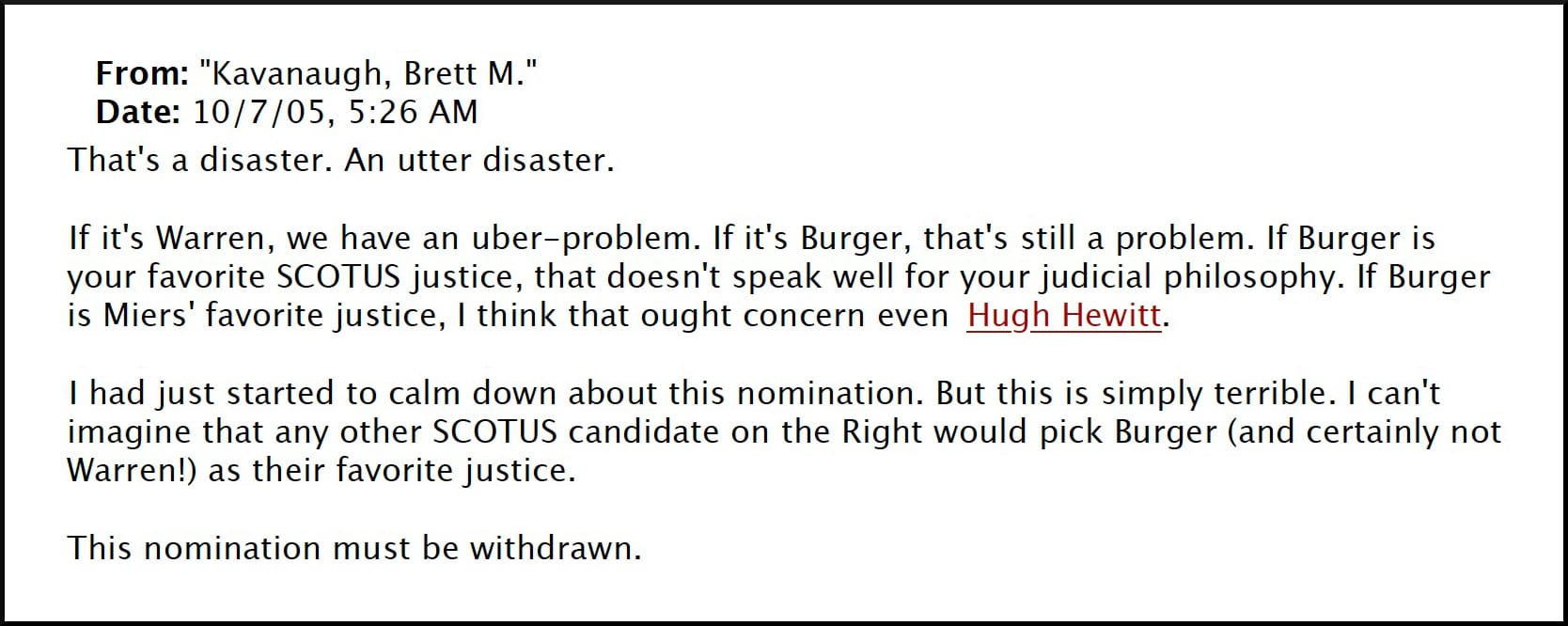
- Alito The Moderate: Watch a TV ad from Progress for America, part of a $400,000, 9-day blitz in swing states to push for Samuel Alito’s confirmation. The ad, which aired on Fox News in January 2006, claimed Alito was “admired by liberals, moderates, and conservatives” and had “no ideological agenda.”
- Don’t Get Daschled: In an email to a Bush administration colleague, Brett Kavanaugh quipped that Democratic South Dakota Senator Tim Johnson was “refusing to be Daschled.” The conservative legal movement, long frustrated by being “Borked,” had coined a new term as they targeted swing-state Democratic senators opposed to their Supreme Court nominees: “Daschled.”
- The Umpire Analogy:Watch (3:31:30) how John Roberts famously described himself as an umpire, impartially calling strikes and balls, during his Supreme Court confirmation hearings. Then, watch how Samuel Alito’s allies and boosters in the Senate used the same analogy (51:28 and 57:53) to try to paper over Alito’s ideological leanings.
trans:
2004 election
...ARCHIVAL NEWS FOOTAGE:Senate Democratic leader Tom Daschle has lost his job. Daschle is the first Senate leader in half a century to lose a bid for reelection. Republicans have made that defeat one of their top priorities and they threw powerful support behind the challenger John Thune.
In a public radio interview, Thune spotlighted how the issue of judges transformed his entire campaign.
ARCHIVAL RADIO INTERVIEW (JOHN THUNE): It was amazing to me when I’d make speeches early on in the campaign, I’d talk about, you know, openings on the Supreme Court, or getting these appellate nominees confirmed, and people would kind of look at you kinda like, you know “who cares?” Toward the end of the campaign you’d get up and make that statement in a speech and it’d be one of the biggest applause lines.
DAVID:By unseating the leader of the opposition party with a campaign about judges, the master planners had delivered their message to every politician in Washington: If you defy our Federalist Society judicial picks, our machine will activate voters to throw you out of office.
On the same 2004 election night that John Thune’s win in South Dakota warned everyone in Congress about the perils of blocking lower-court nominations, an even louder message about the Supreme Court was sent to the entire country at the top of the ticket.
ARCHIVAL NEWS FOOTAGE:Democratic candidate John Kerry has conceded the state of ohio and with it the presidential election. About an hour ago Senator Kerry called the White House to congratulate President Bush on his victory.
DAVID:During the presidential debates, Bush’s opponent John Kerry had tried to warn the country about the master planners’ plot to take over the courts.
ARCHIVAL SPEECH FOOTAGE (JOHN KERRY):A few years ago when he came to office, the president said — these are his words — “what we need are some good conservative judges on the courts.” And the Supreme Court of the United States is at stake in this race, ladies and gentlemen. The future of things that matter to you — in terms of civil rights, whether we’ll enforce the law… will a woman’s right to choose be protected?
DAVID:But when Bush was pressed on the issue, he stuck with the same script he’d used in 2000. When asked in a town hall debate about who he would choose for the Supreme Court, he first cracked a joke…
ARCHIVAL DEBATE FOOTAGE (GEORGE W. BUSH):I’m not telling.
DAVID:Then, Bush invoked some seemingly innocuous language that was also a dog whistle to the conservative legal movement.
ARCHIVAL DEBATE FOOTAGE (GEORGE W. BUSH): I would pick people that would be strict constructionists. We’ve got plenty of lawmakers in Washington, D.C.. Legislators make law; judges interpret the Constitution. And that’s the kind of judge I’m going to put on there. No litmus test except for how they interpret the Constitution.
DAVID:Having defused the judge issue, Bush went on to swiftboat Kerry, making the Vietnam war hero look like a treasonous French aristocrat, and Bush pulled off a tight reelection victory. And almost immediately after Bush was sworn in for his second term, Leonard Leo, the Federalist Society’s crew and the rest of the master planners went back to work on the courts.
ARCHIVAL PRESS CONFERENCE FOOTAGE:This morning we are here to launch a $3.3 million advertising and grassroots campaign to ensure that President Bush’s slate of well- qualified judges receive and up-or-down vote in the floor of the United States Senate.
DAVID:That’s the president of the ironically named Progress For America — the political group from last episode that was promoting Bush’s judicial nominees. He’s talking about their new offensive for 2005.
ARCHIVAL PRESS CONFERENCE FOOTAGE:We have PR professionals as well as grassroots operatives on the ground in 15 states, and their job is also to continue to spread the word that these nominees deserve an up-or-down vote on the floor of the United States Senate.
DAVID:Another speaker at this press conference stressed that the ads targeting both Democratic and wavering Republican senators were about larger principals – about precedents, about fairness.
ARCHIVAL PRESS CONFERENCE FOOTAGE:At the core this is a matter about a president -- any president’s nominees deserving a simple up-or-down vote when they have majority support in the chamber…
DAVID:The pressure campaign did its job: In May 2005, a group of conservative Democrats joined with a group of Republicans in a deal that limited Democrats’ power to use the filibuster against judicial nominees. In effect, the Democrats reverted to their normal, soft, flaccid, pushover form, relinquishing the last shred of their power to stop the master planners’ judicial nominees.
So if you’re a master planner in mid-2005, you’ve got control of the senate, conservative democrats are scared, you have lab-grown terminator judges ready. You’re all set for the final showdown.
And then — as if on cue — comes the bombshell that would change everything.
ARCHIVAL NEWS FOOTAGE:Justice Sandra Day O’Connor announced her retirement from the U.S. Supreme Court today. She said she wants to spend more time with her family. O’Connor was the first woman to sit on the court chosen by President Reagan in 1981…
...
DAVID:You know, the career where he helped clients try to kill off a program to lower prescription drug prices and weaken the ADA, and helped Republicans hijack the 2000 election. Bush cast that career not as the methodical rampage of a Terminator, but instead as the highest form of venerable public service and altruism.
ARCHIVAL SPEECH FOOTAGE (GEORGE W. BUSH):John Roberts has devoted his entire professional life to the cause of justice and is widely admired for his intellect, his sound judgment and personal decency.
DAVID:You could almost see the dollar signs in the eyeballs of corporate lobbyists and CEOs when Roberts was nominated — one lawyer gushed to the Los Angeles Times that Roberts was, quote “the go-to lawyer for the business community” who “definitely is a friend of the chamber.” And the U.S. Chamber of Commerce quickly endorsed its former lawyer Roberts for the job, saying in a press release that he “brings substantial experience advocating for the nation’s leading businesses on matters ranging from the supremacy of federal law to the proper interpretation of the Americans with Disabilities Act.”
The National Association of Manufacturers also jumped into a confirmation battle for the first time in its 110-year history, and officially endorsed Roberts. In the weeks before Roberts nomination, the Wall Street Journal reported that group had been creating a new committee of executives to “vet any White House nominee based on his or her business rulings” — and that Roberts had “drawn interest in corporate circles because [he] represented companies on regulatory matters.”
Liberal groups tried to mount an opposition by spotlighting Roberts’ social conservatism. Critics also raised concerns about his relatively short tenure as a judge, which lasted barely two years, and they spotlighted his ties to Leonard Leo’s Federalist Society.
But even though that Federalist Society affiliation may have helped land Roberts on the shortlist for a judgeship in the first place, Roberts suddenly pretended he barely even knew what the Federalist Society was.
ARCHIVAL NEWS FOOTAGE:Roberts has spoken to the group several times and though his name appears in a 1997 Federalist Society directory, he says he can’t remember ever being a member or accepting any kind of role with the group. Here’s how the White House said it:
“He has participated in events and panel discussions. He’s given speeches at Federalist Society forums, but he doesn’t have any recollection of ever paying dues or joining the organization.”
DAVID:This was the old bait-and-switch that Lewis Powell had perfected 50 years prior during his Supreme Court nomination — the game where, to paraphrase one master planner, you need to be conservative enough to get nominated, but then seem liberal enough to get confirmed.
Roberts’ performance garnered praise in the media for his credentials, etiquette, and alleged moderation....
ARCHIVAL NEWS FOOTAGE:Chief Justice William Rehnquist died last night of thyroid cancer. He served on the court for 33 years, 19 of them as chief justice…
DAVID:This was unprecedented. Two years after O’Connor and Rehnquist had defied the master plan with their campaign finance ruling in the McCain case, they were both suddenly gone.
This was the moment the master plan had been preparing for — for more than 40 years — and things started moving faster than warp speed.
...
MIERS
She also was a longtime corporate shark with real conservative credentials — she ran a major corporate law firm where she had defended behemoths like Microsoft and Disney, and she had played a big role in the conservative movement’s political campaign to make it harder to file lawsuits against corporations.
But here’s the thing: Miers did not have a clear-cut Federalist Society pedigree — at least not like other Bush officials. At this point, the Federalist Society has become so ubiquitous and powerful that reporters started asking White House press secretary Scott McClellan about Miers and her connection to the group.
...
DAVID:Inside the White House, Brett Kavanaugh noted in an email that Miers’ nomination “will cause major reverberations among conservatives,” and he called it a disaster.
And this is when the master planners’ dark-money turned on Harriet Miers.
....
It’s a wide open list right now for possibilities. Michael LuTTig, from the Federal Court of Appeals in Virginia, Samuel Alito from New Jersey, Karen Williams out of South Carolina, and finally Priscilla Owen of Texas. ...
DAVID:Democrats tried to pick apart Alito’s past, including his membership in a conservative Princeton Alumni Group that had criticized the school for reducing legacy admissions while increasing admissions of racial minorities… but Alito played dumb.
...
:Republicans invoked precisely that elitist caricature to attack Kerry again — White House spokesman Scott McCllelan noted that Kerry had originally phoned in his Alito filibuster demand from a trip hanging out at a glitzy billionaire conference in Europe.
ARCHIVAL WHITE HOUSE PRESS CONFERENCE: It was a pretty historic day. This was the first time ever that a Senator has called for a filibuster from the slopes of Davos, Switzerland. I think even for a Senator, it takes some pretty serious yodeling to call for a filibuster from a five-star ski resort in the Swiss Alps.
DAVID:To be sure, many of Kerry’s fellow Democrats agreed that Alito would push the Supreme Court further to the right. But they weren’t eager to follow his lead. The bitter filibuster fights over lower court nominees had left them divided and cautious.
Meanwhile, several Democratic senators facing re-election in Republican-leaning states didn’t want to take the political risk. Two had already pledged to vote for Alito and others firmly opposed the filibuster. Once again, these red-state Democratic senators remembered what happened to Tom Daschle.
In fact, Kavanaugh joked in an email to a Bush colleague that when South Dakota’s remaining Democratic Senator Tim Johnson announced his support for Alito, the lawmaker was refusing to be “Daschled.”
Yes, the conservative legal movement had gone from complaining about being “Borked” to now proudly bragging about making sure Democrats get “Daschled.”
In the end, only 24 joined Kerry’s effort to filibuster Alito, and Alito was confirmed by a comfortable margin in the final vote....
. No longer was this the age of judges like John Roberts pretending to not know the Federalist Society. This was a coming out party emceed by Leonard Leo, who hammed it up.
ARCHIVAL GALA AUDIO (LEONARD LEO):Good evening, ladies and gentlemen. It is a pleasure to stand before 1,500 of the most little known and elusive of that secret society or conspiracy we call the Federalist Society. Thanks so very much for your support and involvement. You may pick up your subpoenas on the way out.
...
DAVID:The installation of the two Terminators — Roberts and Alito — bolstered the conservative legal movement. Within a week of Alito’s confirmation, master planner B.K. — Brett Kavanaugh… the legal operative embedded inside the White House…he was nominated for a judgeship on the lower D.C. court that Roberts had just left.
Kavanaugh had been nominated a few years earlier, but had been blocked during Democrats’ last-stand against Bush’s nominees. At the time, Liberal watchdog groups had labeled him “an ideological warrior for the extreme right wing” and pointed out that Kavanaugh’s legal career has been “almost entirely devoted to right-wing partisan and ideological pursuits that raise deeply troubling questions.” But because Senate Democrats were under threat of being Daschled, there wasno stand against this new Terminator.
After the Senate confirmed him by a comfortable margin, federal Judge Kavanaugh would end up on his own glidepath to the Supreme Court....
===
Sep 24, 2024
MASTER PLAN, Ep 7: The Federalist Society Strikes Back
To get the rulings you want, build the Supreme Court you need....
In the first of two episodes about the creation of the Roberts Court, we use never-before-reported internal emails to expose how the master planners plotted to install new judges who would be guaranteed to deliver the rulings they wanted.
The political environment of the early Bush era provided master planners with a pivotal opportunity to mobilize the legal machine they had been building since the Powell Memo era. Their machine had started small: just a handful of student clubs at law schools around the country. But by 2000, the Federalist Society had become the nation’s most powerful network of conservative lawyers.
The group had allies working within the Bush White House and set about installing their most loyal acolytes in lower-level federal courts, where they could issue conservative rulings and potentially be on a glidepath to the Supreme Court. One of their first and most prized lower-court judicial nominees was a polite, soft-spoken lawyer who depicted himself as an impartial umpire — but who master planners saw as their ideological Terminator.
EVID
Brett Kavanaugh’s never-before-reported emails. Read correspondence showing how Federalist Society poster boy Brett Kavanaugh was a pivotal player within the White House working to nominate Federalist Society-approved judges. As a Bush Administration staffer, Kavanaugh constantly referenced the Federalist Society’s Leonard Leo, showing just how embedded the conservative legal movement was within the executive branch.
- A Secret Judicial Appointment Workgroup.Read the agenda for a 2002 conference the Bush White House hosted at a luxury resort in Maryland to discuss how to get their conservative nominees into federal judgeships. The retreat produced a heavily redacted document called the Judicial Confirmation Action Plan that displays striking similarities to the Powell Memo. (Courtesy of American Oversight.)
- John Roberts Dog Whistles His Ideology Before Becoming A Judge. Watch a 2000 video of then-corporate lawyer John Roberts joining a local television program and lamenting the Supreme Court’s liberal drift.
TRANS:
...ARCHIVAL CONGRESSIONAL HEARING (JOHN ROBERTS):Umpires don’t make the rules, they apply them. The role of an umpire and a judge is critical. They make sure everybody plays by the rules. But it is a limited role. Nobody ever went to a ballgame to see the umpire.
...
In fact, less than a year before Roberts’ TV appearance — in a case that would preview the McCain-Feingold decision from last episode — Republican-appointed justices helped block an attempt to destroy campaign contribution limits. Here’s one of them — Justice Sandra Day O’Connor spotlighting the problem of soft corruption during the oral arguments of that case:
ARCHIVAL SUPREME COURT AUDIO (SANDRA DAY O’CONNOR): I suppose the most likely scenario for significant contribution would be the notion that I will give this money and expect in return that if and when I ever call this particular official, if the official is elected, they’ll pay attention to me. They’ll receive that call, respond, get in touch with me, and take seriously what I have to say.
DAVID:Republican appointees David Souter, John Paul Stevens, and Chief Justice William Rehnquist joined O’Connor to uphold the legality of campaign contribution limits at the state level. Justice Stevens went even further in a concurrence, declaring that “money is property — it is not speech.”
...
DAVID:Reagan understood that the Federalist Society wasn’t just some kooky low-budget campus debate club. This was a group funded by master planners from the Powell Memo era that we’ve mentioned before — John Merril Olin, Richard Mellon Scaife, and the Koch brothers. They took seriously the Powell Memo’s call to build a counter-force of smart, young minds who could fight on behalf of free enterprise.
These oligarchs delivered millions ofdollarsto the Federalist Society to help provide a safe space to cultivate and promote conservative lawyers…people like…Ronald Reagan’s attorney General, Ed Meese.
ARCHIVAL SPEECH AUDIO (ED MEESE):I’m very proud that the founders and leaders of this organization many of them are in fact serving with me in the Department of Justice…
DAVID:Meese, a longtime Reagan confidante andan early advisor to the Federalist Society, was obsessed with getting conservative judges onto the courts....
Bork became the first Supreme Court nominee to be voted down by the Senate in almost two decades. And that rejection became a catalyzing moment for the conservative legal movement, as recounted here by Meese.
...
Federalist Society leaders and other master planners were incensed — but they had a chance to avenge Bork when only a few years later, another Federalist Society darling got his own nomination to the Supreme Court. Ladies and gentlemen, the one you’ve been waiting for, Mr. Clarence Thomas.
ARCHIVAL SPEECH AUDIO (CLARENCE THOMAS):Conservatives need to realize that their audience isn’t simply lawyers. Our struggle is not simply another litigation piece or technique. This is a political struggle…
DAVID:This was Thomas speaking at a Federalist Society Student Symposium in 1988. The “political struggle” he’s talking about is part of his encouragement to his Federalist Society brethren to use the courts as a vehicle for their conservative activism.
This time around, with Clarence Thomas’s nomination in 1991, the master planners didn’t just wait around to be Borked. They instead launched a preemptive attack. Conservative groups funded ads against Democratic Senators who had been questioning Thomas’s ethics.
ARCHIVAL POLITICAL AD:Judge Clarence Thomas, endorsed by the U.S. Senate as a fighter for civil rights. Nominated to the Supreme Court.
DAVID:This ad was sponsored by a political action committee called Citizens United — yes, the same conservative group that would prompt the infamous Citizens United Supreme Court case 20 years later. Don’t worry, we’ll get to that case in a future episode.
ARCHIVAL POLITICAL AD:But who opposes Clarence Thomas? The liberal special interests and the soft-on-crime crowd. They call Clarence Thomas not qualified to sit on the Supreme Court just because he won’t bow to their liberal litmus test. Call your senator and urge support for Clarence Thomas. His values are our values
DAVID:Another set of groups launched ads touting Thomas as a model American.
ARCHIVAL POLITICAL AD:Clarence Thomas’ life has been exemplified by hard work, discipline, and self-reliance. He’s the role model to whom we can all look with pride.
DAVID:By the time Thomas’s confirmation hearings began scrutinizing Anita Hill’s allegations of sexual harassment, an emboldened Thomas wasn’t interested in answering questions — he focused on portraying himself as another Bork being wrongly persecuted.
ARCHIVAL CONGRESSIONAL HEARING (CLARENCE THOMAS):This is a circus. It is a national disgrace. It is a high-tech lynching for uppity-blacks, and it is a message that, unless you kowtow to an old order, this is what will happen to you.
DAVID:The conservatives’ pressure campaign and strategy paid off. The Senate, which was controlled by Democrats at the time, narrowly confirmed Clarence Thomas on October 23, 1991.
One of the conservative activists working on Thomas’s confirmation team was an ambitious 25-year-old from New Jersey named Leonard Leo, who had formed his own Federalist Society chapter at Cornell University around the time of the Bork fiasco, and who had become friends with Thomas while clerking for a judge.
Thomas’s brutal confirmation process left an indelible mark on Leo. He immediately took a job with the Federalist Society to expand its assault on the judiciary.
He focused on recruiting and nurturing lawyers for the conservative judicial machine. I like to imagine a factory assembly line like in the movie Terminator. This factory was cranking out these conservative robots who could pass as regular humans during confirmation hearings but who would never deviate from their ideological programming once they’re on the court. Here’s Leo describing that assembly line in a Federalist Society video.
...
ROBERTS WORLED ON B V GORE]
DAVID:In the end, Roberts and other Bush lawyers secured the infamous Bush v. Gore ruling. In this particular case, enough of the Republican appointees –– including the squishier ones like O’Connor and Rehnquist –– stuck together in a 5-4 opinion that halted the vote count and installed popular-vote-loser George W. Bush into the White House.
The implications of that ruling for the future of the court itself were obvious from the moment the decision was handed down.
ARCHIVAL NEWS FOOTAGE:Now that the court has jumped into the middle of presidential politics, experts fear more questions about the court’s independence. And with George Bush perhaps nominating future justices, Democrats tonight promised an even tougher road to confirmation.
DAVID:Once Bush was sworn in in January 2001, the master planners got to work. Federalist Society vice president Leonard Leo focused on making sure that he and his fellow conservatives would be the loudest voices in the room when it came to choosing judges.
ARCHIVAL NEWS FOOTAGE:After 50 years of special status the American Bar Association will no longer have a leading role in vetting candidates for federal judgeships. The White House notified the ABA today that it will no longer get advanced word on prospective nominees.
...
DAVID:Roberts had showed flashes of his ideological commitment early in his career: In the 1980s, he joined the Reagan administration to help spearhead its efforts to limit the Voting Rights Act. Roberts penned a memo defending a push for judicial term limits on the grounds that federal judges were engaging in behavior that “usurps the roles of the political branches” What sort of crazy political behavior? Protecting abortion rights and mandates for airbags and seat belts in new cars.
Roberts’ memo was important: it showed that at an early age, he was a conservative soldier on a relentless mission to challenge judicial liberals.
...
DAVID:By the turn of the millennium, Roberts had been sharpening his skills as a cutthroat lawyer for corporate interests. He had helped Toyota with its case aiming to weaken the Americans with Disabilities Act. And he had also helped the U.S. Chamber of Commerce try to dismantle a program that aimed to lower prescription drug prices for people without insurance.
And now here in 2001, Roberts was on the White House list for a lower court appointment because, as a former steering member of a Federalist Society chapter, he seemed like a sure thing for the conservative legal movement — a jurist with a very bright future.
...
BK STARR]
After the Florida recount, Roberts got a court nomination, while Kavanaugh scored a sweet job in the White House counsel’s office. His main focus? Judicial appointments, working closely with lawyers in a special division of the Justice Department… called the Office of Legal Policy.
DAVID: That’s the office that Reagan’s attorney general Ed Meese set up in the 1980s and staffed with Federalist Society members, right?
JARED:Yeah. Ed Meese, one of the O.G. conservative legal activists. We heard his voice earlier talking about the Federalist Society. As Attorney General in the ‘80s, Meese built this behind-the-scenes team of lawyers to push and defend Reagan’s conservative policies. They also helped pick and vet potential federal judges for Reagan to nominate.
DAVID: So the Office of Legal Policy was like the plumbers for the judicial pipeline that Leonard Leo was talking about.
JARED: Sure. And you saw it when the Bush administration first hired its staff for the first term, journalists and officials in other departments of the government looked at people like Kavanaugh and offices like the OLP and raised complaints that there were too many Federalist Society members in key White House roles
DAVID:Now, officially, Leonard Leo and the Federalist Society were still insisting that there was nothing to see here — that they basically had no political power and they’re just a friendly debate
JARED: Yeah, exactly — in early 2001, Leo actually wrote a letter to White House counsel Alberto Gonzales saying that.
He stated, “The Federalist Society leaves political agendas, and political advocacy to other groups and individuals,” and emphasized that the organization “does not recommend nominees or candidates for public office.” While acknowledging that Federalist Society members quote “often have tried to provide lists of people worth considering,” Leo made it clear they’re speaking for themselves, not the Society.
DAVID:But the emails we found reviewed a different story, right?
JARED: Yeah, I’d say. They tell the opposite story. From the get-go, Leo seemed to be on White House speed dial, and all over White House officials’ correspondence about judicial nominations.
DAVID: And one person who seemed to be in regular contact with Leo and other conservative legal activists was B.K., right?
...
The day before Bush announced the nomination of Roberts and other conservative judges in 2001, Kavanaugh even asked to have White House officials send Leo a binder of information. Eventually, an email to Kavanaugh from another White House official said Leo and his staff would be “helping coordinate outside coalition activity regarding judicial nominations.”
DAVID: And Leo seemed to be interested in how the judiciary affected Big Business.
JARED:Yeah, we found one email where Leo is pitching presentations to industry groups about “Business and Courts.” The reply includes attachments, focusing on “business interest,” “business case examples,” and “business certainty.”
DAVID:That email from Leo is right around the time that one of the O.G. master planners, former Reagan and Bush administration lawyer C. Boyden Gray, was courting business support for a new group called the Committee For Justice to push conservative judicial nominees — and air ads attacking Democrats who were opposing them.
Gray, a Federalist Society stalwart, reportedly launched the group in 2002 at the urging of Bush’s political adviser Karl Rove and Senate Republican Leader Trent Lott. With the Supreme Court arbitrating so many issues of interest to big business, the new committee was filled with corporate lobbyists whose clients included banks, tech and telecom giants, defense contractors, and drug companies.
...
JARED: B.K. also had one-on-one calls with Ed Meese, naturally. And he corresponded with Ginni Thomas, Clarence Thomas’s wife, who was working as a kind of White House liaison for the Heritage Foundation.
...
JARED:Well, their definition of “progress” was probably different. Progress for America was described by the Washington Post as a group that has “raised millions of dollars, which it uses to promote Bush’s agenda of tax cuts, energy legislation, conservative judicial appointments, and free trade.”
The White House emails we reviewed show the group was tightly integrated into weekly meetings and conference calls using their funds for PR campaigns — op-eds, talk radio appearances, mail campaigns, and interviews to push President Bush’s judicial nominations.
...
DAVID:Seated among the rose bushes were Leonard Leo, Ed Meese and a conservative lawyer named Jay Sekulow, who was a legal activist representing the Christian Right.
This new coalition, bringing in the muscle of the Christian Right, aimed to build off Roberts’ confirmation to the lower court and continue transforming judicial nominations from a niche topic into an issue that the average voter would care about.
...
===
sep 17
MASTER PLAN, Ep 6: The Maverick Vs. The Corruption Machine
MASTER PLAN, Ep 6: The Maverick Vs. The Corruption Machine
After John McCain got caught up in a corruption scheme, he went to war with his own party to try to make sure it never happened again.
80’s
...It wasn’t such a surprise, then, when five U.S. senators got caught in 1989 for allegedly trying to pressure a federal bank regulator to go easy on savings and loan magnate Charles Keating. But what no one expected was that one of the so-called “Keating Five,” a relative newcomer named John McCain, would do far more than apologize for his mistakes; he’d transform into the staunchest campaign finance reformer since Watergate.
McCain would need his unpredictable “maverick” energy for the fights ahead. Because once he set his sights on wrangling the dark money out of politics, he’d find himself butting heads with two powerful members of his own party — a senator who’d been called the “Darth Vader of campaign finance reform,” and a governor-turned-president backed by big donors.
evid
- Recordings Of The Keating Five Senate Ethics Hearings. Watch federal regulator Ed Gray testify (at 1:03:55) about being intimidated by senators, including John McCain, to help savings and loan magnate Charles Keating
- Mitch McConnel’s Opposition To Campaign Finance Reform: Watch at 4:04:40 as the Republican senator claims that campaign finance reform is not needed because “at no time has any member of either body offered evidence of even the slightest hint of corruption.”
- George Bush’s Signal Of Opposition.Read how similar George Bush’s remarks in 2002 were toGerald Ford’s in 1974 when both presidents begrudgingly signed new campaign finance rules into law.
...
LAURA: So Congress changed FECA again in 1979, reducing the disclosure requirements and allowing the national parties to spend money on “get-out-the-vote” drives and other “party-building activities.” And unlike individual candidates, the national political parties were allowed to raise unlimited amounts of cash for these programs — including from corporations.
DAVID: When you say “party building,” I’m imagining convention centers filled with campaign buttons, American flag-colored kazoos and lunatics wearing those Uncle Sam hats while yelling “Four more years.”
That seems pretty harmless, no?
LAURA: Sure, but that’s not really what this “soft money” was for — it couldn’t be used to directly promote a candidate, but the line between that and the legally-allowed “party-building activities” was pretty thin. It was another pretty big loophole. It’s complicated stuff, so I talked to Trevor Potter, who understands campaign finance inside and out.
...
DAVID: Trevor Potter was the Chairman of the Federal Election Commission. He was also general counsel to John McCain’s 2000 and 2008 presidential campaigns. And he’s currently the president of the Campaign Legal Center.
LAURA: Potter told me that the key to all this was the fiction of what were called “independent expenditures.” Back in 1976, with the Buckley case, the court protected unlimited spending on elections, as long as the spender was “independent” and did not directly coordinate the spending with specific candidates. And then there was one other loophole —something called “sham issue ads” or “issue advocacy.” The Buckley decision said that campaign ads couldn’t be regulated as long as they avoided some “magic words.”
...
LAURA: Good try, but not quite. The Buckley decision had this footnote –- footnote 52 –- that listed them –- it’s stuff like “vote for,” “elect,” “support,” “vote against,” “defeat,” “reject” — you get the drift. As long as those magic words weren’t invoked, political parties or PACs could raise and spend unlimited amounts of corporate money on ads supporting or attacking any political candidate. Here’s Trevor Potter again.
TREVOR POTTER:Money was being spent right before the election for ads that said, “Candidate Smith has voted twice to raise your taxes and has voted to let murderers out of jail. Call Candidate Smith and tell him you disagree with him.”
LAURA:Here’s probably the most famous example, the infamous Willie Horton ad from the 1988 presidential contest between the Democratic Governor of Massachusetts, Michael Dukakis, and Republican Vice President George H.W. Bush.
ARCHIVAL CAMPAIGN AID:Bush and Dukakis on crime. Bush supports the death penalty for first-degree murderers. Dukakis not only opposes the death penalty, he allowed first degree murderers to have weekend passes from prison. One was Willie Horton, who murdered a boy in a robbery, stabbing him 19 times. Despite a life sentence, Horton received ten weekend passes from prison. Horton fled, kidnapped a young couple, stabbing the man and repeatedly raping his girlfriend. Weekend prison passes — Dukakis on crime.
DAVID: That Willie Horton ad famously changed the course of the entire 1988 election, and represented the kind of “independent” spending that became huge in the 1980s and into the 1990s, just as the master planners wanted. It became a way to legally bribe members of Congress, who were basically selling access in order to raise enough money for their campaigns, and to get other “independent” groups to spend big on their behalf.
TREVOR POTTER:You would have written invitations that would say, you know, come speak to the leader or the committee chair of the Tax Writing committee, $10,000 for breakfast. Or give $50,000 to the RNC and have access to leadership retreats and at least two meetings a year with X or Y. And you saw that on both sides.
DAVID:Hang on. This sounds like the kind of access that Charles Keating had bought for himself - the kind of thing that was at the center of that huge scandal, right?
LAURA: Exactly. Most of the 1990s were like one big Keating Five scandal, only I’m not sure you can call it a scandal when it was kind of the political norm. Everyone was in on it — Republicans and Democrats — because that was the only way to successfully run for office. These were the waters they were swimming in. But it did not sit well with Senator McCain — a point he made to reporters right after he finished testifying about Keating to the Senate Ethics Committee.
...
DAVID:McCain introduced the Senate Campaign Finance Reform Act of 1995, co-sponsored by the junior Senator from Wisconsin, Democrat Russ Feingold. It called for limits on soft money, eliminating PACs from federal election activities, and amending FECA to strengthen election spending limits — a direct challenge to the master planners’ previous win in the Buckleycase.
..,
ARCHIVAL NEWS FOOTAGE:President Clinton today insisted the Lincoln Bedroom in the White House was not for sale. The Lincoln bedroom was never sold. That was one more false story we have had to endure. But White House documents, some in the President’s own handwriting indicate the Lincoln Bedroom was at least on the market to major political donors.
DAVID:Not surprisingly, the public was aghast. Polls from that time period showed that 90 percent of Americans thought campaign finance regulation should be overhauled or better enforced. Seizing the moment, McCain and Feingold introduced another version of their bill in January 1997. Senator Mitch McConnell — who public interest groups had taken to calling the Darth Vader of campaign finance reform — took a special interest in the bill. McConnell saw money as instrumental to success in politics; he’d said as much in lectures he gave when he taught law back in the 1970s. More money meant an increased chance at winning and McConnell liked to win. He also borrowed from the playbook of master planners Ralph Winter and John Bolton, who argued in the Buckley case that money was a constitutional freedom — and that restrictingmoney was the same as restricting speech.
...
[camp fin pop on stump in NH? v pioneers]
DAVID:For as much money as Bush was raking in, he was also spending like crazy to keep the McCain campaign at bay, after McCain’s anti-corruption message had powered him to a huge upset victory in the New Hampshire primary. By the time that debate in Los Angeles took place, the Bush campaign had already blown through close to $70 million, just to win the Republican nomination. And that didn’t include the money that other groups were covertly spending on Bush’s behalf. Here’s Trevor Potter again.
TREVOR POTTER:There was a group called Republicans for Clean Air that was a phony organization. A couple of Texas billionaires established an entity which then ran ads with pictures of belching smokestacks, saying that John McCain was in favor of pollution…
...
Campaign Reform Act of 2001 — or BCRA. Really rolls off the tongue…
Among other things, BCRA prohibited political parties from raising or spending any money that wasn’t subject to the federal limits laid down by FECA. It also required campaigns to disclose where their money came from and where it was spent. And it put limits on when those scammy issue advocacy ads could be run. In short, it pushed for all the things the master planners hated — radical things like “disclosure” and “spending limits”.
And the master planners were pissed.
...
ARCHIVAL NEWS FOOTAGE:Enron had grown into the seventh largest company in the country ahead of IBM and AT&T. But the energy trading business was undone by murky accounting and growing doubts about its finances.
DAVID:Now, the Enron debacle was a huge business scandal — but it also intersected with campaign finance. The company had been a large and prominent donor to the Republican party — especially its CEO, Ken Lay. Ken — or ”Kenny Boy” to George W. Bush — had been palsy-walsy with Bush when he was governor, sending him letters, Christmas cards, CDs of Hootie and the Blowfish… while also making suggestions on how Bush could help his company Enron.
Kenny Boy was also a Pioneer and one of Bush’s earliest donors. But perhaps more importantly, when Enron collapsed, McCain pointed to it as proof that campaign finance reform was needed now more than ever.
...
In the 1980s, the U.S. government was anything but clean. After the landmark Supreme Court cases we told you about in Episode 5 turned money into “speech” in the 1970s, cash began flowing into elections unchecked. Big donors also expected big favors.
It wasn’t such a surprise, then, when five U.S. senators got caught in 1989 for allegedly trying to pressure a federal bank regulator to go easy on savings and loan magnate Charles Keating. But what no one expected was that one of the so-called “Keating Five,” a relative newcomer named John McCain, would do far more than apologize for his mistakes; he’d transform into the staunchest campaign finance reformer since Watergate.
McCain would need his unpredictable “maverick” energy for the fights ahead. Because once he set his sights on wrangling the dark money out of politics, he’d find himself butting heads with two powerful members of his own party — a senator who’d been called the “Darth Vader of campaign finance reform,” and a governor-turned-president backed by big donors.
...
In a 300-page opinion, the Court upheld the ban on soft money and limits on sham issue ads. Here’s Justice Rehnquist, reading the opinion on December 10, 2003.
ARCHIVAL SUPREME COURT AUDIO (WILLIAM REHNQUIST)The joint opinion concludes that this prohibition is an appropriate response to Congress’ legitimate concerns with preventing the actual and apparent corruption threatened by large soft money contributions and preserving the integrity of the federal election process.
DAVID:In essence, the Court agreed that if money is speech, then putting some restraints on speech was justified in order to counteract the decline in citizen participation and citizen faith in American democracy. This was a high water mark for those trying to prevent the wealthy from polluting elections with money. It was a moment to celebrate. But even Roger Witten knew it might not last....
[but then we get roberts]
===
---
ep 4
This includes three secret meetings of a “Powell Memo Task Force” — including one at Disney World. These gatherings drew together America’s most powerful businessmen, a future president, and an ambitious young media consultant named Roger Ailes.
- Secret Meeting At Disney World. Read the agenda for the meeting of the “Powell Memo Task Force” at Disney World, part of a 3-day conference organized by the Chamber of Commerce that included a keynote address by future president Gerald Ford. Corporate executives who attended that meeting planned to discuss the country’s new campaign finance laws and how they might convince lawmakers to weaken them — a goal Ford would soon secure for them as president.
“reform” FEC act of 1971 congr jerry ford
- The Rise Of Roger Ailes. Read reports written to John Olin, a wealthy industrialist, detailing another Powell Memo meeting in Dallas. At that meeting, a young media consultant named Roger Ailes implored corporate executives to use their power as advertisers to pressure network news to be more business-friendly. Ailes would go on to start Fox News.
- The Business World Rejoices.Published as part of a special edition of the U.S. Chamber's Washington Report magazine, the 20-page “Business Response To The Powell Memorandum” was the culmination of several months of work by the Task Force on the Powell memorandum from 1972 to 1973. With a foreword written by the Task Force chair William Whyte, the newly uncovered report details the recommendations of the task force members assigned to subcommittees on communications, education, and political and judicial action. It also includes a member list of high-profile business figures such as Jay VanAndel of Amway and Edward Scripts of E.W. Scripps Co.
MANY MISS EPS
ep 10
MASTER PLAN, Ep 10: The Master Planners’ Heist Of The Century
===
Archival Clip, Mitch McConnell:This DISCLOSE Act is not about reform. It's nothing more than Democrats sitting behind closed doors with special interest lobbyists choosing which favored groups they want to speak in the 2010 Election.
DAVID: McConnell and the other master planners were not satisfied just stopping the DISCLOSE Act in the Senate and walking off into the sunset with theCitizens United ruling. If your movement's half-century goal is to completely deregulate the campaign finance system and legalize the buying of elections so that a handful of anonymous big spenders could completely control politics, what more could you possibly want after Citizens United?
Well, one answer to that question is something that was baked into the Citizens United case by the master planner's favorite justice of all, the guy that we now know was being secretly wined and dined by billionaires Clarence Thomas in a concurrence that almost nobody noticed. Thomas voted for the ruling, but said he thought it didn't go far enough. He said, Wait, wait, hang on. Can I get that evil voice special effect one more time? Okay? He wrote, quote, this Court should invalidate mandatory disclosure and reporting requirements.
DAVID: So if you're a master planner, maybe after Citizens United, you want to try to do that, kill off all disclosure and maybe you also want to hobble the last remaining campaign finance regulators on the beat. And maybe, just maybe, you want to try to get the government to declare that cash for favors like actual money for actual political favors is now completely legal....
lever $ 11 24
Trump’s pick of Congressman Matt Gaetz for attorney general has rocked Washington. Gaetz’s controversial history, including a Justice Department investigation into alleged sex trafficking, makes him an absurd choice. But in a special Lever Time Premium episode exclusively for paid subscribers, political analyst and Lever contributor Matt Stoller points out that Gaetz has a surprising record on antitrust and issues of corporate power, raising questions about his potential impact on corporate regulation if he manages to be confirmed.
---
11 24
doge applic
...* Terminate Bad Tax Expenditures
- Reform The Consumer Banking System
- Fix The Tax Payment System
- Eliminate Health Insurance Bureaucracy
- End The Government Backlog
- Kill The Worst Corporate Welfare
- Halt Wasteful Private Contracting
- Stop Expensive Health Care Privatization
- Combat Profiteering Off Government-Developed Medicines
Kill The Worst Corporate Welfare
Through tax-exempt municipal bonds, the federal government has spent billions subsidizing the cost of professional sports stadiums, despite almost no evidence that these subsidies significantly boost local economies or job creation. DOGE can recommend preventing such bonds from being used to finance stadium construction.
Through the U.S. Agriculture Department, the federal government spends hundreds of billions of dollars on farm subsidies. As the Department of Health and Human Services Secretary nominee Robert F. Kennedy, Jr. recently noted, these subsidies not only disproportionately benefit the largest and wealthiest farms, they also support commodities for processed foods at the heart of the country’s chronic disease crisis. They can be significantly reformed or limited.
Through special tax breaks, the federal government massively subsidizes the fossil fuel industry, which distorts the energy market as cleaner energy becomes cost-competitive and fortifies an industry responsible for an increasingly expensive climate crisis.
These and so many other corporate welfare programs often waste money that could be used to make other efficiency measures — like tax code simplification — budget neutral.
===
500k liberty c ginni (cleta?)
lever master plan 2nd choice RR after Bork, smoke pot --> kennedy ex CA lobbyist?! bopp saw opening, bossie fired him for ted O on CU 2010
bopp anti-abort saw hobbled by camp fin so went after it w NAACP brown v Bd playbook
souter smoking dissent never public?!
===
===
9 24 the lever podcast series
---
10 24 master class scotus? CU did not get --> AFP lawsuit camp finance disclosure?
Americans for Prosperity v. Bonta - Ballotpedia
---
RR promo for pacific legal
trailer: Master Plan | Listen Now
ep 4
3 mtg orlando dallas and --- same time? jerry ford vp
white of US steel
devos amway pal, joe coors/ AILES
In this episode, we definitely answer that question for the very first time. Master Plan lead producer Jared Jacang Maher has uncovered troves of never-before-reported evidence that proves corporate executives and politicians didn’t just read Powell’s memo — they acted on it.
articles jjm jaredjacangmaher@gmail.com Contact
This includes three secret meetings of a “Powell Memo Task Force” — including one at Disney World. These gatherings drew together America’s most powerful businessmen, a future president, and an ambitious young media consultant named Roger Ailes.
By the end of 1974, the Powell Memo had transformed from a set of ideas into an actual master plan — and the pieces were in place to carry out a decades-long assault on American democracy.
---
sep 2024
The Powell Memo Helped Create Project 2025
A new investigative podcast shows the toxic legacy of the founding father of modern American plutocracy.
Jeet Heer
When Supreme Court Justice Lewis Powell died in 1998, The New York Times’ obituary hailed him as a judge “who brought a voice of moderation and civility to an increasingly polarized Court during his 15-year tenure.” The newspaper added, “He was the balancer and compromiser, a political moderate with an aversion to heated rhetoric and doctrinal rigidity.”
As so often, the Times was distilling the elite consensus, a view that had an element of truth only if one accepted a very narrow meaning of “moderation.” Powell’s reputation as an avatar of middle-of-the-road sanity rested largely on his social liberalism. Powell joined the Supreme Court in 1972 after a long career as one of the nation’s top corporate lawyers, known particularly for his long association with the tobacco company Philip Morris. Powell’s reputation for moderation rested largely on his personal style as an old-school Southern gentleman and his liberalism on social matters. He was part of the 7-2 majority that affirmed a constitutional right to abortion in Roe v. Wade and helped protect affirmative action in Regents of the University of California v. Bakke (1978). Both decisions have been overturned by subsequent right-wing courts.
Powell also benefited from the contrast between his social liberalism and the increasingly strident conservatism of more recent Republican appointees to the Supreme Court. When Powell resigned in 1987, Ronald Reagan tried to replace him with Robert Bork, a rebarbative reactionary who was seen as the antithesis of Powell. Bork’s nomination failed, but subsequent Supreme Court justices such as Clarence Thomas and Samuel Alito have made many centrist liberals nostalgic for the age of Lewis Powell.
Yet Powell’s moderation was highly selective, coming into play only on issues where the power of big business was not at stake. On economic matters—which make up the bulk of cases that come before the Supreme Court—Powell was no compromiser but an open partisan of unchecked corporate domination of society.
Part of the strength of the excellent new documentary podcast series Master Plan (created by the journalist David Sirota and his team at The Lever) is that it thoroughly debunks the bland image of Powell as a moderate and instead shows that he was one of the founding fathers of modern American plutocracy.
Powell earns particular pride of place in the show because of his authorship of a notorious 1971 memo (prepared for the US Chamber of Commerce) that laid out a strategy for a corporate counterrevolution against the emerging social movements of the 1960s and early ’70s (notably the Black Power movement, environmentalism, and consumer protection). The memo was a call to arms for corporate America to use its economic power to push back against the left, with particular emphasis on the importance of gaining sway over the courts, the academy, and the media.
The Powell Memo was the Project 2025 of the Nixon era—a detailed program for establishing and entrenching right-wing power over the commanding heights of American government and society.
On the left, there’s been much dispute over the actual impact of the Powell Memo: Was it really the blueprint for the conservative counterrevolution against liberalism that has remade America—or just the little-read grousing of an angry corporate lawyer?
Writing in The American Prospect in 2005, policy analyst Mark Schmitt decried the “myth” that the memo was influential. Schmitt claimed: “The memo was circulated within Chamber of Commerce circles and became public after Powell’s confirmation to the court, when journalist Jack Anderson unearthed it to question Powell’s judicial temperament. After that, it seems to have been forgotten.”
To its credit, Master Plan forthrightly addresses Schmitt’s reasonable argument, and uses fresh investigative reporting to document that the Powell Memo, far from having been “forgotten” after Jack Anderson’s reporting, was in fact the seedbed for high-level right-wing organizing that undergirds the conservative counterrevolution.
To illuminate both the Powell Memo and its legacy, Master Plan highlights Powell’s formation during his career as a corporate lawyer. He was no mere legal-gun-for-hire for Philip Morris but a full-fledged wartime consigliere, deeply involved in strategizing the firm’s long campaign of disinformation to discredit the science proving that smoking causes cancer. This campaign included pioneering the creation of astroturf groups that both lied about the science and pretended to be independent grassroots voices—a technique later picked up by fossil fuel firms promoting climate change denial.
This opposition to mainstream medical science grew out of a belief that nothing should stand in the way of corporate profit, certainly not any concern for the health of individuals or collective concern for environmental costs. Part of the spark for the Powell Memo was Powell’s anger that consumer advocate Ralph Nader was becoming a popular hero, subject to glowing profiles even in pro-business journals such as Fortune.
This pro-capitalist attitude went hand-in-hand with rabid anti-communism and a willingness to attack any radical movement as subversive. During his years as a corporate lawyer, Powell was a close confidant of FBI director J. Edgar Hoover and an informant to the FBI. The Powell Memo compares the Black Panther Party and New Left groups to Nazis.
The Powell Memo was written at a time when corporate America felt under siege by the rising demands of new social movements. It helped galvanize the counterrevolutionary reaction to progressive politics that encompassed not just Midwestern manufacturers and petite bourgeoisie (who had long formed the backbone of the American right) but also new allies among country club Republicans and corporate America (in other words, the sort of people Powell worked with at Philip Morris). These groups had been at odds since the start of the Cold War—which divided the isolationists from the internationalists—but the Powell Memo figured out a way to unite them against a common enemy.
The Powell Memo offered the business world an approach to politics that Powell had already seen work in Philip Morris’s campaign against medical science: a flexing of lobbying power through astroturf groups and a two-fisted opposition to any attempt to limit corporate spending in politics.
Master Plan opens with a remarkable scene that took place after Powell was elevated to the Supreme Court. Philip Morris threw a lavish party, hiring none other than legendary CBS News anchor Walter Cronkite to emcee a show highlighting key moments in Powell’s life. Powell was also presented with a gift: a judicial gown with the Phillip Morris logo stitched on—as if he were a race car driver advertising his sponsor. There’s not much of a leap from that gown to the expensive gifts Clarence Thomas and Samuel Alito have accepted from their billionaire pals.
Far from being forgotten, the Powell Memo was an underground bestseller in business circles. The Chamber of Commerce made copies easily available in the many thousands. Readers of the memo include a veritable pantheon of right-wing donors: the Koch brothers, Richard Mellon Scaife, and Joe Coors.
In 1973, the Chamber of Commerce organized two Powell Memo Task Force meetings. One was held in Disney World and was attended by Republican House minority leader Gerald Ford (who would soon to ascend to the presidency). Other members of the task force, as David Sirota notes, “included CBS president Richard Jenks, ABC executive James Hagerty, Ad Council chairman Barton Cummings, Metromedia executive Mark Evans, Hill & Knowlton president James Cassidy, and newspaper magnate Edward Scripps II.”
A concurrent Powell Memo Task Force met in Dallas and featured a speech by a young television producer, Roger Ailes—later the founder of Fox News. According to a report by attendee John Howard (president of Rockford College), Ailes “outlined the power which advertisers would be able to exert upon TV programming if they were moved to do so.” Ailes advised guests on “where and how they can apply leverage and be given the tools to exert the leverage.”
In 1974, CBS president Arthur Taylor in correspondence wrote about how the Powell Memo Task Force spurred him to push journalists at this network to be friendlier to big business. Taylor wrote, “I’ve been attempting as persuasively as possible for the last year to correct the situation at CBS News with some results, but I’m afraid it’s going to take a long time.”
Given the evidence presented in Master Plan, the Powell Memo had a very clear real-world impact. It wasn’t a distant shooting star. It was a massive asteroid that smashed the earth. It provided the theoretical program for right-wing think tanks in the coming decades of ideological war, and gave corporate donors a strategy for maximizing the impact of their spending in politics. More broadly, it can be fairly seen as the inspiration for such institutions as Fox News and the Federalist Society.
From the vantage point of the present, the Powell Memo was the precursor to Project 2025. The question that should haunt us is: If the Powell Memo achieved so much, how much more might Project 2025 accomplish?
===
===
spiffy signs
https://www.levernews.com/its-dark-moneys-court-we-just-live-under-it/
jun 30
once again, the Supreme Court has issued rulings triggering national uproar. This time, the court has ruled that universities’ race-conscious admission policies are unconstitutional, that businesses can deny services to LGBTQ+ customers, and that President Joe Biden can’t move forward with his student loan forgiveness plan. And just like the justices’ decision last year to end federal abortion protections and other troubling SCOTUS developments this term, the court’s new decisions are all examples of how dark money reigns supreme.
That’s because one person’s fingerprints are all over these developments: conservative legal activist Leonard Leo, the king of dark money. And based on Biden’s response to some of these new court rulings, it appears the president isn’t going to do anything to stop him.
As President Donald Trump’s judicial adviser, Leo helped build the conservative supermajority on the Supreme Court that killed Roe v. Wade. As *The Lever* helped expose last year, Leo’s judicial activism was supercharged in 2021, when a conservative surge protector magnate secretly funneled $1.6 billion to his new dark money fund — the largest known political advocacy donation in U.S. history.
Leo’s dark money operation has since been working to influence some of the Supreme Court’s most consequential cases.
That includes the court’s rulings on affirmative action. In 6-3 and 6-2 decisions, the Supreme Court struck down affirmative action policies at both public and private universities. Both cases were brought by Students for Fair Admissions,which purports to be a “membership group of more than 20,000 students, parents, and others who believe that racial classifications and preferences in college admissions are unfair, unnecessary, and unconstitutional.”
But in truth, the group is funded by Leo’s sprawling network of opaque nonprofits that are all trying to roll back protections deemed antithetical to a conservative way of life. In 2020, Students for Fair Admissions received $250,000, more than a third of its total revenue that year, from the 85 Fund, an organization steered by Leo.
Several other Leo-backed interestsfiled Supreme Court briefs backing Students for Fair Admissions’ fight to overturn affirmative action. That includedSpeech First, a nonprofit that received $700,000 from 2020 to 2021 from the 85 Fund, as well as 19 Republican attorneys general. Leo’s network has long been the top donor to the Republican Attorneys General Association (RAGA), which helps elect GOP attorneys general across the country.
Leo also had a hand in the Supreme Court’s decision that a Colorado website designer WHO HAS NEVER SISIGED A WEDDING WEBSITE AND THE REQUEAT IN CASE WAS FAKE] was within her rights to refuse a same-sex wedding project. The decision has the potential to render anti-discrimination protections across the country as unenforceable.
The court ruled this way even though the designer’s lawyers never actually argued to the high court that she had ever been asked to do an LGBTQ+ project. The only time they apparently tried to make such a point was with an exhibit that appears to have been a fake website design request.
Once again, the effort is tied to Leo and his colleagues. At least six conservative groups that filed briefs supporting the Colorado suit have received millions in dark money contributions from Leo’s network.
Finally, the Supreme Court struck down President Joe Biden’s student loan forgiveness plan, a potentially catastrophic development for tens of millions of Americans struggling under onerous student loans. Leo is connected to this matter, too.
The case in question was led by two Republican attorneys general and backed by a brief filed by 17 other GOP attorneys general — all of whom are connected to the Leo-backed RAGA. The Foundation for Government Accountability, a conservative think tank, filed another brief in support of abolishing student loan forgiveness. Between 2019 and 2021, Leo’s network donated nearly $4 million to the foundation and its advocacy arm.
Even the design of the student debt case reeks of Leo’s involvement, since just like the Colorado suit, it appears to have been based on D.C. machinations. As *The Lever* reported, the student loan servicer at the heart of the case — whom Republican attorneys general argued would be harmed by Biden’s student loan plan — would in reality face no financial harm at all.
Biden acknowledged the judicial racket as the recent Supreme Court rulings began coming down, telling reporters on Thursday that this court has “done more to unravel basic rights and basic decisions than any court in recent history.”
But at the same time, he refused to do anything of consequence to fix the problem, such as adding justices to the court, which conservatives control 6-3.
“I think if we start the process of trying to expand the court, we're going to politicize it maybe forever in a way that is not healthy,” Biden said on MSNBC.
Leo, meanwhile, isn’t just using his millions to put key cases and supporting arguments in front of the Supreme Court. He’s also working behind the scenes, connecting justices like Clarence Thomas and Samuel Alito with conservative tycoons happy to ply these figures with luxury trips and other cushy benefits. As *The Nation* recently noted, Leo is the “matchmaker” who “makes it his job to keep right-wing judges, donors, and political actors in alignment.”
Leo isn’t just doing this so he can spend long weekends with his arch-conservative buddies. As The Lever noted in May,this entire system is designed to stymie a historical trend of GOP justices getting more liberal as they get older:
In light of that, the money and gifts flowing to conservative justices can be seen not merely as cheap influence-peddling schemes to secure specific rulings in individual cases. It can also be seen as a grand plan to deter the ideological freedom that lifetime appointments afford.
In short, the largesse from billionaires and Leo — who helped assemble the Supreme Court’s 6-3 conservative supermajority as President Donald Trump’s judicial adviser — creates personal financial incentives for justices to remain doctrinaire ideologues and resist any deviation from the conservative line, even if they might once in a while have an inkling to dissent.
To be clear, Leo’s system isn’t fully foolproof. His billion-dollar Supreme Court remote control doesn’t always work as planned.
In recent weeks, the court issued surprise rulings upholding the Voting Rights Act. Conservative justices joined with their liberal colleagues to reject a fringe legal theory that would have given state lawmakers free rein to pass voter suppression laws without oversight from state courts.
Last year, the nonpartisan watchdog group Accountable.US found that Leo-backed organizations and other dark money groups had spent nearly $90 million in support of the case. That’s a $90 million project that can now be considered a failure.
For the most part, though, Leo’s dark money network has notched hugely consequential — and destructive — wins. The king of dark money now has nearly full control of the high court. Will anyone stop him?
===
rough transcript of the episode is available here.
Links:
- Justice Samuel Alito Took Luxury Fishing Vacation With GOP Billionaire Who Later Had Cases Before the Court (ProPublica, 2023)
- Alito Could Deliver Another Ruling For Billionaire Benefactor (The Lever, 2023)
- Clarence Thomas And The Billionaire (ProPublica, 2023)
===
no lnx see blum
https://www.levernews.com/the-paid-pundits-defending-clarence-thomas-and-his-billionaire-benefactor/
lever
after ProPublica reported that Supreme Court Justice Clarence Thomas had failed to disclose two decades worth of luxury trips provided by billionaire conservative mega-donor Harlan Crow, right-wing pundits and think-tank staffers raced to defend Thomas and his benefactor — without mentioning what they all had in common: their own financial ties to Crow.
The episode is a reminder of how many conservative pundits and scholars owe their sinecures to the same billionaires who fund Republican election campaigns and efforts to influence the judiciary.
Hours after ProPublica dropped its report on Thomas, Ilya Shapiro, a senior fellow at the right-wing think tank Manhattan Institute, tweeted, “Unless Harlan Crow has some business before the Court, the @propublica report about Justice Thomas is a big breathless nothingburger.”
Unmentioned: The Manhattan Institute, where Shapiro leads an amicus brief filing program lobbying the Supreme Court to rule certain ways on issues like student debt cancellation and corporate taxation, boasts Crows’ wife Kathy on its board of trustees and has been called “wonderful” by Crow himself.
Many of these pundits came forward to vouch for Crow’s honor and moral character after ProPublica’s story prompted renewed scrutiny of Crow over his collection of Nazi memorabilia, which includes two paintings by Adolf Hitler himself and a signed copy of Mein Kampf.
In 2016, Supreme Court justices — including Thomas — unanimously voted to condone the practice of giving lavish gifts to public officials in exchange for access.
“There’s Not Even An Appearance Of Impropriety”
Crow, heir to a Dallas real estate empire, is the CEO of Crow Holdings, a sprawling real estate investment and private equity firm that manages retirement savings for public employees. A relatively private man, Crow has long been a major donor to Republican political campaigns and outside groups.
He’s also been a donor to tax-exempt dark money groups and charitable organizations that do not have to report their donors. In 2011, Crow told the New York Times, “I disclose what I’m required by law to disclose, and I don’t disclose what I’m not required to disclose.”
While those donations are not for the most part traceable, it’s clear that Crow has been generous to conservative think tanks, legal groups, and media outlets.
ProPublica reported last week that Crow has for years offered Thomas, the conservative Supreme Court justice, free trips on his private jet and superyacht. Those trips should have been disclosed under federal ethics rules, according to seven experts consulted by the nonprofit news outlet.
Shapiro, who joined the Manhattan Institute last summer, took time away from a trip to Legoland last week to record an audio clip defending Crow’s gifts to Thomas, in addition to tweeting his support for the justice.
“It is not against the rules to receive all sorts of gifts — even lavish gifts, even yachts, and rides on private jets, and stays at luxury resorts,” he said. “Nor do the Supreme Court ethics rules even require reporting such gifts if they’re personal hospitality — gifts from friends, things like that.”
While Shapiro suggested that maybe the rules should be changed, he asserted that “there’s not even an appearance of impropriety, unless Harlan Crow has some business before the court, which no one has alleged — not even in ProPublica’s big, breathless, nothingburger report.”
It’s an interesting argument, given that Shapiro effectively lobbies the Supreme Court for the Manhattan Institute. Last summer, Kathy Crow was added to the board of trustees listed on the Manhattan Institute’s website. Harlan Crow, for his part, lavished praise on the organization during a debate at his Dallas business compound in 2021.
in his role at the Manhattan Institute, Shapiro regularly files amicus briefs attempting to persuade justices to rule certain ways on cases. Shapiro recently submitted a brief calling on the Supreme Court to issue a decision blocking President Joe Biden’s student loan cancellation plan.
Last month, Shapiro filed a brief calling on the Supreme Court to review a case upholding the constitutionality of a one-time repatriation tax imposed on foreign earnings accumulated by foreign subsidiaries of U.S. companies, which was passed as part of President Donald Trump’s 2017 tax law.
On Tuesday, Shapiro tweeted that he didn’t know Kathy Crow sits on the Manhattan Institute’s board,while downplaying the significance.
“Alas no private-jet travel here,” he wrote, “but what you’re saying is that conservative donors support conservative organizations? Amazing.”
“Deeply Honorable, Decent, And Patriotic”
As controversy mounted over Harlan Crow’s undisclosed gifts to Thomas, public attention extended to the Texas businessman’s extensive collection of Nazi artifacts — which includes oil paintings by Hitler, a signed copy of Mein Kampf, a teapot engraved with Hitler’s initials, and linen napkins embroidered with swastikas.
Those items have drawn scrutiny before. In 2015, Democrats called on Sen. Marco Rubio (R-Fla.) to cancel a presidential campaign fundraiser scheduled at Crow’s house on the eve of Yom Kippur.
In 2019, after scholars who dined at Crow’s mansion were disturbed by his collection of Nazi artifacts, Crow offered a half-hearted apology to their host organization, according to a letter obtained by Mother Jones.
“I am sorry that anyone would be offended,” wrote Crow, adding: “I would very much hope it would be completely obvious that having anything that related to Nazis or slavery could not possibly be interpreted as support or glorification for those evils.”
Over the weekend, several conservative pundits came forward to defend Crow and his collectors items, without mentioning that they have benefited from his family’s financial support for their think tanks and media outlets.
Jonah Goldberg, co-founder and editor-in-chief of the conservative news site The Dispatch, tweeted, “Harlan Crow is a deeply honorable, decent, and patriotic person.” He characterized Crow’s separate garden of dictator statutes — featuring Russia’s Joseph Stalin and Vladimir Lenin — as “an attempt [to] commemorate the horrors of the 20th century in the spirit of ‘never again.’”
Goldberg later tweeted, “My conscience is clear. Harlan Crow is a good man and the farthest thing from a Nazi.”
As The Dispatch separately noted in a news article covering Crow’s gifts to Thomas, “Harlan Crow is a minority investor in The Dispatch and a friend of the founders.”
Goldberg is also a senior fellow at the American Enterprise Institute, a right-wing think tank where Crow serves on the board of trustees.
Previously, Goldberg was a senior fellow at the National Review Institute, the nonprofit affiliated with the conservative National Review magazine. The National Review Institute has regularly hosted its debate series at Crow’s Old Parkland campus.
Crow was additionally a co-chair of a 2021 National Review Institute dinner honoring Leonard Leoand Eugene Meyer of the Federalist Society, the conservative lawyers network. (Leo, also a friend of Thomas, was a key architect of conservatives’ 6-3 supermajority on the Supreme Court.)
David French, a former National Review Institute senior fellow and former senior editor at The Dispatch, defended Crow, too.
“I know Harlan also,” French tweeted. “I’ve participated in several debates at Old Parkland. The idea that he’s a Nazi sympathizer is utterly ludicrous. He abhors tyranny, from fascism to communism to everywhere in between.”
Crow’s character was also defended by Charles Murray, a longtime American Enterprise Institute scholar who’s best known for mainstreaming racist pseudoscience via his book, The Bell Curve.
“Harlan Crow surely has enemies but, as far as I can tell, they consist exclusively of people who don’t know him,” Murray tweeted. “Everyone who does know him may disagree with him on some issue, but they universally recognize his decency, integrity, and kindness. Including people of the left.”
Murray dedicated his most recent book, Human Diversity: The Biology of Gender, Race, and Class, “to Harlan Crow.”
===
https://www.levernews.com/thomas-helped-kill-eviction-ban-threatening-benefactors-business/
Justice Clarence Thomas voted to end federal tenant protections that his billionaire benefactor’s company says threatened its real estate profit margins, according to corporate documents reviewed by The Lever. Thomas did not disclose his relationship with real estate billionaire Harlan Crow, nor did he recuse himself from the 2021 case, despite its potential impact on Crow Holdings.
Now, rent control — which Crow Holdings’ documents also say threatens the company’s business — could come before Thomas, and there is no indication he would recuse himself if it does.
Recent reporting by ProPublica found that Thomas failed to disclose two decades’ worth of luxury gifts provided by Crow, as well as Crow’s purchase of properties owned by Thomas, in apparent violation of longstanding federal ethics rules.
Crow Holdings’ financial disclosures about eviction moratoria and rent control — coupled with revelations that Thomas was accepting lavish, undisclosed gifts from Crow — contradicts the notion that the conservative justice never ruled on matters related to his benefactor’s business.
Crow Holdings did not respond to The Lever’srequest for comment.
“May Be Particularly Susceptible”
In August 2021, Thomas was one of the six justices who voted to strike down a federal administrative moratorium on evictions, originally enacted in September 2020 by the Centers for Disease Control and Prevention to halt the spread of COVID-19. In June, Thomas was one of four justices who voted to end the moratorium — but the majority voted to leave it in place because it was set to expire the following month.
In July, between the two rulings, Crow Holdings — which owns apartment buildings, student housing, and manufactured housing nationwide — was cited in congressional testimony for being one of the country’s most frequent eviction filers, despite the moratorium.
In March 2020, Crow Holdings Capital, the firm’s investment arm, warned investors in a financial filing that the pandemic was already leading to “substantial governmental intervention” that could end up “substantially eliminating market participants’ ability to continue to implement certain strategies or manage the risk of their outstanding positions.”
This March, Crow Holdings Capital made its interest in ending eviction moratoria explicit, telling investors that its business “may be particularly susceptible to economic effects driven by a pandemic such as COVID‐19, including risks related to tenants being unable to pay rent (particularly with respect to residential, retail and office properties), federal or state restrictions on rent pricing, rent increases, or eviction moratoriums.”
“A Long-Term Eviction Moratorium Was Never The Right Policy”
At the time of Thomas’ 2021 vote, Ken Valach, the CEO of Crow Holdings’ development arm, was serving as the vice chair of the National Multifamily Housing Council, a lobbying group pressing the federal government to end the moratorium.
“A long-term eviction moratorium was never the right policy,” the group said in a statement. “It does nothing to speed the delivery of real solutions for America’s renters and ignores the unsustainable and unfair economic burden placed on millions of housing providers, jeopardizing their financial stability and threatening the loss of affordable housing stock nationwide.”
That same year, another Crow executive was a member of the Real Estate Roundtable, a nonprofit think tank that also opposed the eviction moratorium.
Bloombergrecently reported that Thomas did not appear to recuse himself in a 2005 Supreme Court case involving Trammell Crow Residential, in which Crow Holdings owned a minority stake.
In the coming months, the rent control issue flagged by Crow Holdings could be before Thomas and the high court.
A group of New York landlords are preparing to petition the Supreme Court to overturn the city’s rent stabilization laws after losing a recent case. Such a ruling couldendanger rent-control laws nationwide.
===