Santa Clara v Southern Pac RR
===
uber1: https://webbrain.com/brainpage/brain/6950F840-FB80-FCB0-D505-8AB1FA685F08#-3851
merri ok
===
palo alto bk
California's Constitutional Response to the Railroad: The Commission of 1880–1882
Southern California Quarterly, Vol. 81, No. 4 (Winter 1999), pp. 423-448 (26 pages)
https://doi.org/10.2307/41171973•https://www.jstor.org/stable/41171973
...moreover, the large railway companies, unprecedented in size, were politically
and economically powerful.
Because they were a new combination of public highway and common car-
rier, state governments across the country struggled to deal with the prob-
lems of regulating the railroads. In 1879 California became the first state to
provide for a commission in its new constitution for railroad regulation, but
the commission was unsuccessful. It failed to develop a solution to rate dis-
crimination, the problem most vexing to localities, shippers, and passengers
across the country.8
Serving from 1880 to 1882, the first three commissioners, elected when
optimism about the new constitution and its commission was highest, were
accused of incompetence and indifference to their responsibilities; two were...[corrupt?]
===
pbs newshour
5 advocates and crusaders who helped define corporate rights
Arts Oct 29, 2019
“We the Corporations” by Adam Winkler is our October book club pick. Become a member of the Now Read This book club by joining our Facebook group, or by signing up to our newsletter. Learn more about the book club here.
Long before there were calls to break up Silicon Valley’s biggest companies such as Facebook and Google, or Sen. Elizabeth Warren, D-Mass., made trust-busting those companies central to her 2020 presidential campaign, long before the Supreme Court’s Citizens United decision in 2010 and Mitt Romney’s declaration that “corporations are people, my friend,” corporations had gained significant rights and powerful influence in the United States.
In “We the Corporations,” this month’s book club pick, UCLA law professor Adam Winkler chronicles the long history of the corporate rights movement. Winkler argues that in fact the fight for corporate personhood goes back to the very founding of the United States.
Below, he details five people who had particular impact in the corporate rights movement, from the man who declared that corporations should be protected against unreasonable searches and seizures, to another who argued they should have the same rights as former slaves. In his words:
Daniel Webster
Legendary senator, orator and lawyer, Daniel Webster argued more than 200 cases in the early Supreme Court and earned the nickname “Defender of the Constitution.” He could alternatively have been called the Defender of the Corporation. Many of his clients were businesses, and in one of his most important cases he won a ruling from the Supreme Court in 1819 declaring corporations to be private entities over which states had limited regulatory control.
Roscoe Conkling
Roscoe Conkling was the last person to decline a seat on the Supreme Court after having won confirmation; he was simply making too much money as a lawyer for the railroads. Representing the Southern Pacific Railroad, Conkling argued in an 1882 case that the 14th Amendment, adopted after the Civil War to protect racial minorities from discrimination, was also meant to protect corporations. Conkling had unusual credibility because he was one of the drafters of the 14th Amendment, but we now know that he misled the Supreme Court about the history of the provision.
Theodore Roosevelt
President Teddy Roosevelt’s famous effort to break up the trusts led to some of the earliest prosecutions of corporations for committing crimes. The corporations behind the trusts fought back, arguing that if corporations could be convicted of crimes then they should be afforded the many protections in the Constitution for criminal defendants. In a case involving Roosevelt’s investigation of the Tobacco Trust, the Supreme Court declared that corporations, like people, are protected against unreasonable searches and seizures.
Ralph Nader
In the 1970s, consumer crusader Ralph Nader and his public interest organization Public Citizen won a landmark case striking down limits on the advertisement of prescription drug prices. Although Nader’s goal was to help patients find the cheapest medicine, his victory would be the basis for a broad expansion of the rights of businesses to advertise under the First Amendment. Corporations would use that right to challenge graphic cigarette labels, disclosure requirements, and limits on tobacco ads – leading the recent head of Public Citizen to call for overturning the entire line of cases stemming from Nader’s victory.
Lewis Powell Jr.
Months before being nominated to the Supreme Court, Lewis Powell Jr. wrote an influential memorandum to the Chamber of Commerce outlining a program for business to fight back against the rising tide of consumer protection and environmental laws. Businesses, Powell argued, needed to become more politically active and use the courts to protect the free market. As a justice, Powell would transform his memorandum into constitutional law, leading the Court to declare for the first time that corporations had a First Amendment right to influence elections – 30 years before Citizens United brought the issue to the public’s attention.
---
Chapter 4 of “We the Corporations. WINKLER 'We the Corporations' by Adam Winkler | UCLA Law VIDEO INTERVIEW ACS ETC 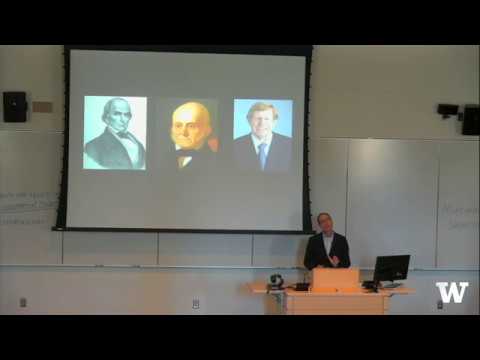
CSPAN: we-corporations
long before the controversial 2010 Supreme Court ruling Citizens United, which allowed corporations to spend money to influence elections, the court had already granted corporations many of the same rights as people.
One early and particularly surprising case was the Southern Pacific Railroad’s successful move to win equal protection and due process rights under the 14th Amendment — an amendment that was aimed at protecting former slaves.
Meanwhile, African Americans would not see real protections from that amendment for decades to come.
In “We the Corporations,” this month’s book club pick, UCLA law professor Adam Winkler explores the long fight for corporate rights. Below, Winkler annotates a page of the book that details just how the Southern Pacific Railroad leveraged a progressive reform to meet their own ends
..."the Fourteenth Amendment to the Constitution, adopted after the Civil War, is one of the brightest stars in the constellation of liberty. As everyone knew when it was ratified in 1868, the amendment’s guarantees of equal protection and due process were designed to secure the rights of the newly freed slaves and protect them from discrimination by the states. Nearly a decade and a half later, however, in December of 1882, the esteemed Roscoe Conkling told the justices the Fourteenth Amendment was also written to protect the rights of corporations like his client, the Southern Pacific Railroad Company.
Although no lawyer could approach Webster’s soaring rhetoric, Conkling was also known as a master orator and had the respect of the justices, as well as their ear. “No man ever came into our court who was listened to with more undivided attention than Roscoe Conkling,” said Chief Justice Morrison Waite, who presided over the Southern Pacific’s case. Justice Samuel Miller, whose previous opinions seemed to foreclose Conkling’s argument that the Fourteenth Amendment applied with equal force to corporations, nonetheless agreed that “for the discussion of the law and the facts of the case Mr. Conkling is the best lawyer who comes into our court.”
Conkling was the leader of the Republicans in Congress for nearly two decades immediately after the Civil War, when Republicans dominated Washington. A member of the House and then the Senate, Conkling was often rumored to be a presidential candidate. Although he never became his party’s presidential nominee,he was twice nominated to the Supreme Court. The second time was just months before he made his argument on behalf of the Southern Pacific. Even though the Senate voted to confirm him, Conkling declined, pleading poverty. Like Webster, Conkling, who spent his career in public service, needed the money—especially the kind a lawyer could make representing the Southern Pacific, one of the largest, most politically powerful corporations of the late nineteenth century.
Excerpted from pages 113-114 in Chapter 4 of “We the Corporations.
===
===
2x
https://www.theatlantic.com/business/archive/2018/03/corporations-people-adam-winkler/554852/
no lnx
BUSINESS
‘Corporations Are People’ Is Built on an Incredible 19th-Century Lie
How a farcical series of events in the 1880s produced an enduring and controversial legal precedent
By Adam Winkler
[An archival caricature of a railroad baron swallowing America’s train lines
A 1907 caricature of the railroad baron Edward H. Harriman swallowing America’s train lines. (Luther Bradley / Library of Congress / Corbis / Getty)]
MARCH 5, 2018
Somewhat counterintuitively, American corporations today enjoy many of the same rights as American citizens. Both, for instance, are entitled to the freedom of speech and the freedom of religion. How exactly did corporations come to be understood as “people” bestowed with the most fundamental constitutional rights?The answer can be found in a bizarre—even farcical—series of lawsuits more than 130 years ago involving a lawyer who lied to the Supreme Court, an ethically challenged justice, and one of the most powerful corporations of the day.
That corporation was the Southern Pacific Railroad, owned by the robber baron Leland Stanford. In 1881, after California lawmakers imposed a special tax on railroad property, Southern Pacific pushed back, making the bold argument that the law was an act of unconstitutional discrimination under theFourteenth Amendment.Adopted after the Civil War to protect the rights of freed slaves, that amendment guarantees every “person” the “equal protection of the laws.” Stanford’s railroad argued that it was a person too, reasoning that just as the Constitution prohibited discrimination on the basis of racial identity, so did it bar discrimination against Southern Pacific on the basis of its corporate identity.
The head lawyer representing Southern Pacific was a man named Roscoe Conkling. A leader of the Republican Party for more than a decade, Conkling had even been nominated to the Supreme Court twice. He begged off both times, the second time after the Senate had confirmed him. (He remains the last person to turn down a Supreme Court seat after winning confirmation).More than most lawyers, Conkling was seen by the justices as a peer.
It was a trust Conkling would betray. As he spoke before the Court on Southern Pacific’s behalf, Conkling recounted an astonishing tale. In the 1860s, when he was a young congressman, Conkling had served on the drafting committee that was responsible for writing the Fourteenth Amendment. Then the last member of the committee still living, Conkling told the justices that the drafters had changed the wording of the amendment, replacing “citizens” with “persons” in order to cover corporations too. Laws referring to “persons,” he said, have “by long and constant acceptance … been held to embrace artificial persons as well as natural persons.” Conkling buttressed his account with a surprising piece of evidence: a musty old journal he claimed was a previously unpublished record of the deliberations of the drafting committee.
Years later, historians would discover that Conkling’s journal was real but his story was a fraud. The journal was in fact a record of the congressional committee’s deliberations, but, upon close examination, it offered no evidence that the drafters intended to protect corporations. It showed, in fact, that the language of the equal-protection clause was never changed from “citizen” to “person.” So far as anyone can tell, the rights of corporations were not raised in the public debates over the ratification of the Fourteenth Amendment or in any of the states’ ratifying conventions. And prior to Conkling’s appearance on behalf of Southern Pacific, no member of the drafting committee had ever suggested that corporations were covered.
There’s reason to suspect that Conkling’s deception was uncovered back in his time too.The justices held onto the case for three years without ever issuing a decision, until Southern Pacific unexpectedly settled the case. Then, shortly after, another case from Southern Pacific reached the Supreme Court, raising the exact same legal question. The company had the same team of lawyers, with the exception of Conkling. Tellingly, Southern Pacific’s lawyers omitted any mention of Conkling’s drafting history or his journal. Had those lawyers believed Conkling, it would have been malpractice to leave out his story.
When the Court issued its decision on this second case, the justices expressly declined to decide if corporations were people. The dispute could be, and was, resolved on other grounds, prompting an angry rebuke from one justice, Stephen J. Field, who castigated his colleagues for failing to address “the important constitutional questions involved.” “At the present day, nearly all great enterprises are conducted by corporations,” he wrote, and they deserved to know if they had equal rights too.
Rumored to carry a gun with him at all times, the colorful Field was the only sitting justice ever arrested—and the charge was murder. He was innocent, but nonetheless guilty of serious ethical violations in the Southern Pacific cases, at least by modern standards:A confidant of Leland Stanford, Field had advised the company on which lawyers to hire for this very series of cases and thus should have recused himself from them. He refused to—and, worse, while the first case was pending, covertly shared internal memoranda of the justices with Southern Pacific’s legal team.
The rules of judicial ethics were not well developed in the Gilded Age, however, and the self-assured Field, who feared the forces of socialism, did not hesitate to weigh in. Taxing the property of railroads differently, he said, was like allowing deductions for property “owned by white men or by old men, and not deducted if owned by black men or young men.”
So, with Field on the Court, still more twists were yet to come. The Supreme Court’s opinions are officially published in volumes edited by an administrator called the reporter of decisions. By tradition, the reporter writes up a summary of the Court’s opinion and includes it at the beginning of the opinion.
The reporter in the 1880s was J. C. Bancroft Davis, whose wildly inaccurate summary of the Southern Pacific case said that the Court had ruled that “corporations are persons within … the Fourteenth Amendment.” Whether his summary was an error or something more nefarious—Davis had once been the president of the Newburgh and New York Railway company—will likely never be known.
Field nonetheless saw Davis’s erroneous summary as an opportunity. A few years later, in an opinion in an unrelated case, Field wrote that “corporations are persons within the meaning” of the Fourteenth Amendment. “It was so held in Santa Clara County v. Southern Pacific Railroad,” explained Field, who knew very well that the Court had done no such thing.
His gambit worked. In the following years, the case would be cited over and over by courts across the nation, including the Supreme Court, for deciding that corporations had rights under the Fourteenth Amendment.
Indeed, the faux precedent in the Southern Pacific case would go on to be used by a Supreme Court that in the early 20th century became famous for striking down numerous economic regulations, including federal child-labor laws, zoning laws, and wage-and-hour laws. Meanwhile, in cases like the notorious Plessy v. Ferguson (1896), those same justices refused to read the Constitution as protecting the rights of African Americans, the real intended beneficiaries of the Fourteenth Amendment. Between 1868, when the amendment was ratified, and 1912, the Supreme Court would rule on 28 cases involving the rights of African Americans and an astonishing 312 cases on the rights of corporations.
The day back in 1882 when the Supreme Court first heard Roscoe Conkling’s argument, the New-York Daily Tribune featured a story on the case with a headline that would turn out to be prophetic: “Civil Rights of Corporations.” Indeed, in a feat of deceitful legal alchemy, Southern Pacific and its wily legal team had, with the help of an audacious Supreme Court justice, set up the Fourteenth Amendment to be more of a bulwark for the rights of businesses than the rights of minorities.
Adam Winkler is a professor at the UCLA School of Law. He is the author ofWe the Corporations: How American Businesses Won Their Civil Rightsand Gunfight: The Battle Over the Right to Bear Arms in America.
===
The following is about 2 paragraphs from Justice Douglas's dissenting opinion. I bolded 2 sentences that are the strongest statements.
https://caselaw.findlaw.com/us-supreme-court/337/562.html
Wheeling Steel Corporation v. Glander*, 377 U.S. 562 (1949)
Mr. Justice DOUGLAS, with whom Mr. Justice BLACK concurs, dissenting.
It has been implicit in all of our decisions since 1886 that a corporation is a 'person' within the meaning of the Equal Protection Clause of the Fourteenth Amendment. Santa Clara Co. v. South. Pacific R. Co., 118 U.S. 394, 396 , so held. The Court was cryptic in its decision. It was so sure of its ground that it wrote no opinion on the point, Chief Justice Waite announcing from the bench:
'The court does not wish to hear arrgument on the question whether the provision in the Fourteenth Amendment to the Constitution, which forbids a State to deny to any person within its jurisdiction the equal protection of the laws, applies to these corporations. We are all of opinion that it does.'
There was no history, logic, or reason given to support that view. Nor was the result so obvious that exposition was unnecessary.
Since 1886 the Court has repeatedly struck down state legislation as applied to corporations on the ground that it violated the Equal Protection Clause. Every one of our decisions upholding legislation as applied to corporations over the objection that it violated the Equal Protection Clause has assumed that they are entitled to the constitutional protection. But in those cases it was not necessary to meet the issue since the state law was not found to contain the elements of discrimination which the Equal Protection Clause condemns. But now that the question is squarely presented I can only conclude that the Santa Clara case was wrong and should be overruled.
==
3 pp
https://money.howstuffworks.com/corporation-person2.htm
What's strange, Hartmann points out, is that the justices hadn't ruled that way at all. Even fishier, the court reporter was a former railroad president source: [Hartmann]. Ultimately, since it was a headnote (a commentary prefix to the court record) written by the reporter, it didn't constitute law. But it did set precedent. Two years later, this idea was upheld in another case: Pembina Consolidated Mining and Milling Co. v. Pennsylvania source: [Aljalian]....404 waybck
{In Santa Clara County v. Southern Pacific Railroad Co.,4 the Court declared that a corporation is protected by the same rights as natural persons for purposes of the Fourteenth Amendment Equal Protection Clause, thus eliminating any uncertainty and providing an anticlimactic end to the debate.42 Chief Justice Morrison R. Waite 3 stated: The court does not wish to hear argument on the question whether the provision in the Fourteenth Amendment to the Constitution, which forbids a State to deny to any person within its jurisdiction the equal protection of the laws, applies to... corporations. We are ... of [the] opinion that it does.4
Two years later, in Pembina Consolidated Silver Mining & Milling Co. v. Pennsylvania,45 the Court reaffirmed corporate personhood under both the Due Process and Equal Protection clauses of the Fourteenth Amendment.46 Did the members of the Court exercise legal reasoning, understanding the purpose and conforming to the spirit of the Fourteenth Amendment? Chief Justice Waite was the very justice who stated that to deny women the right to vote was not a violation of the Fourteenth Amendment,47 and authored opinions which limited the protection of newly-emancipated slaves.48
...4 See United States v. Cruikshank, 92 U.S. 542 (1875) (refusing to allow federal intervention into various state actions that allegedly breached Fourteenth Amendment protection); United States v. Reese, 92 U.S. 214 (1875) (upholding the dismissal of one of two indictments against Kentucky election inspectors for violating...the Fifteenth Amendment by not allowing an otherwise qualified citizen of African descent to vote); see also OXFORD, supra note 43, at 906. }
==
3 guys in Plessy V Ferguson, (field?):{
}:Roscoe Conkling: Senator, twice nominated SCOTUS, SPRR $10K (avg wage 500/yr) 14th Amendment
Chief Justice Waite (fmr RR attorney) CSS Alabama, Yale Skull and Bones. Pvt Pullman car
Assoc Justice SJ Field (pal of Stanford)
JC Bancroft Davis (fmr RR pres; Harvard, wife descendant of signer)
Delphin Delmas (SCU, Big Basin)
S.W. Sanderson, represented the railroad and had the "reputation of a pit bull" TH (ex judge for SPRR). Similar to Conklin, Sanderson claimed a "secret committee" in Congress intended 14th to apply to corporations (p 22).
Justices Douglas and Black denounce
===
http://www.iiipublishing.com/afd/santaclara.html**}::{
}::{
The Santa Clara Blues: Corporate Personhood versus Democracy}:by William Meyers
What Corporate Personhood Is:{
Corporate Personhood is a legal fiction. The choice of the word "person" arises from the way the 14th Amendment to the U.S. Constitution was worded and from earlier legal usage of the word person. A corporation is an artificial entity, created by the granting of a charter by a government that grants such charters. Corporation in this essay will be confined to businesses run for profit that have been granted corporate charters by the States of the United States. The Federal Government of the United States usually does not grant corporate charters to businesses (exceptions include the Post Office and Amtrak).}:
Corporations are artificial entities owned by stockholders, who may be humans or other corporations. They are required by law to have officers and a board of directors (in small corporations these may all be the same people). In effect the corporation is a collective of individuals with a special legal status and privileges not given to ordinary unincorporated businesses or groups of individuals.
Obviously a corporation is itself no more a person (though it is owned and staffed by persons) than a locomotive or a mob. So why, in the USA, is a corporation considered to be a person under law?
In the United States of America all natural persons (actual human beings) are recognized as having inalienable rights. These rights are recognized, among other places, in the Bill of Rights and the 14th Amendment.
Corporate personhood is the idea (legal fiction, currently with force of law) that corporations have inalienable rights (sometimes called constitutional rights) just like real, natural, human persons.
That this idea has the force of law both resulted from the power and wealth of the class of people who owned corporations, and resulted in their even greater power and wealth. Corporate constitutional rights effectively invert the relationship between the government and the corporations. Recognized as persons, corporations lose much of their status as subjects of the government. Although artificial creations of their owners and the governments, as legal persons they have a degree of immunity to government supervision. Endowed with the court-recognized right to influence both elections and the law-making process, corporations now dominate not just the U. S. economy, but the government itself.
The History of Corporate Personhood
Corporations were detested by the colonial rebels in 1776 when the Declaration of Independence severed the States from Great Britain. There had been only a few corporations in colonial America, but they had been very powerful. The Dutch West India Company:{ had founded New York.
Corporations had effectively governed Virginia, Maryland and the Carolinas. }:The political history of the colonies up until 1776 was largely one of conflict between citizens trying to establish rule by elected government and the corporations or King ruling through appointed governors.
The new nation or confederation of 13 sovereign states had few native business corporations. The corporations that survived the revolution were mainly non-profit institutions such as colleges [Dartmouth College v. Woodward, 17 U.S. 518 (1819)]. There was not a single bank in the United States until 1780. Most of that first bank's stock was owned by the confederate (what we would later call Federal) government, and the bank's charter was revoked in 1785. "The agrarian charges were numerous... the bank was a monstrosity, an artificial creature endowed with powers not possessed by human beings and incompatible with the principles of a democratic social order." [Hammond, Bray , Banks and Politics in America from the Revolution to the Civil War :{(Princeton: Princeton University Press, 1991), pp. 48-54]
By 1790 four banks had been granted corporate charters by states, but these banks were not originally purely private institutions. They served as financial institutions for the states that chartered them. [Ibid. 65-67]}:
The federal Constitution of 1788 did not mention corporations at all. But in the late 1700's and early 1800's corporations began to be chartered by the states. This was not without opposition. Thomas Jefferson said, "I hope we shall crush in its birth the aristocracy of our moneyed corporations which dare already to challenge our government in a trial of strength, and bid defiance to the laws of our country."
Like the banks, other early corporations were closely supervised by the state legislatures that granted their charters. When the Supreme Court of the United States in Dartmouth College v. Woodward in 1819, ruled that Dartmouth's charter granted in 1769 by King George III was a contract and could not be revoked by the New Hampshire legislature, a public outcry ensued. State courts and legislatures, supported by the people, declared that state governments had an absolute right to amend or repeal a corporate charter. [Richard L Grossman and Frank T. Adams, Taking Care of Business, Citizenship and the Charter of Incorporation (Cambridge: Charter, Ink., 1993), p. 11-12]
Until 1886 corporations were not considered persons. It was clear what they were: artificial creations of their owners and the state legislatures. They were regulated and taxed. They could sue and be sued. They were subject to all of the laws of the land as well as any restrictions placed in their charters. But from 1819 until 1886 the wealthiest business people sought to use the Federal government, particularly the courts, to get their corporations out from under the control of the states and their citizens.
:{During the 1800's the United States went through an enormous economic expansion, sometimes called the Industrial Revolution, but that term is misleading. The United States expanded geographically by grabbing native American Indian territories formerly claimed by France, Great Britain, and Mexico. The population exploded. Farm production exploded, and international trade exploded, with U.S. grain feeding both growing U.S. cities and Europe.
Manufacturing in the U.S.}:, protected by tariffs from British competition, also progressed rapidly. The favored form for large businesses became the corporation. And as these corporations came to dominate business life, they also began to dominate America's politicians, lawyers, courts and culture.
The Civil War accelerated the growth of manufacturing and the power of the men who owned the corporations. After the war corporations began a campaign to throw off the legal shackles that had held them in check. The systematic bribing of Congress was instituted by Mark Hanna, sugar trust magnate Henry Havemeyer, and Senator Nelson Aldrich and their associates. [Jonathan Shepard Fast and Luzviminda Bartolome Francisco,Conspiracy For Empire, Big Business, Corruption and the Politics of Imperialism in America, 1876-1907 (Quezon City, Foundation for Nationalist Studies, 1985), p. 92-97] Most Supreme Court judges who were appointed were former corporate lawyers.
In 1886 the supreme court justices were Samuel F. Miller, Stephen J. Field, Joseph P. Bradley, John M. Harlan, Stanley Matthews, William B. Woods, Samuel Blatchford, Horace Gray, and chief justice Morrison. R. Waite.:{ Never heard of a one of them? These men subjected African Americans to a century of Jim Crow discrimination; they made corporations into a vehicle for the wealthy elite to control the economy and the government; they vastly increased the power of the Supreme Court itself over elected government officials. How quaint they are forgotten names.
In all fairness, Justice Harlan dissented from the infamous Plessy v. Ferguson decision [163 U.S. 537 (1896)], which, as he said, effectively denied the protection of the 14th Amendment to the very group of people (former slaves and their descendants) for whom it was designed.}:
In 1868 the 14th Amendment to the United States Constitution had become law. Section 1 of that Amendment states:
SECTION 1. All persons born or naturalized in the United States, and subject to the jurisdiction thereof, are citizens of the United States and of the State wherein they reside. No State shall make or enforce any law which shall abridge the privileges or immunities of citizens of the United States; nor shall any State deprive any person of life, liberty, or property, without due process of law; nor deny to any person within its jurisdiction the equal protection of the laws.
:{"The one pervading purpose . . . [of the 14th Amendment] was the freedom of the slave race, the security and firm establishment of that freedom, and the protection of the newly-made freeman and citizen from the oppression of those who had formerly exercised unlimited dominion over him." That is exactly what Justice Samuel F. Miller said in 1873 in one of the first Supreme Court opinions to rule on the 14th Amendment. [83 U.S. 36, 81 (1873)]
But the wealthy, powerful men who owned corporations wanted more power for their corporations. Their lawyers came up with the idea that corporations, which might be said to be groups of persons (though one person might in turn belong to (own stock in) many corporations), should have the same constitutional rights as persons themselves. If they could get the courts to agree that corporations were persons, they could assert that the States, which had chartered the corporations, would then be constrained by the 14th Amendment from exercising power over the corporations.}:
Beginning in the 1870's corporate lawyers began asserting that corporations were persons with many of the rights of natural persons. It should be understood that the term "artificial person" was already in long use, with no mistake that corporations were claiming to have the rights of natural persons. "Artificial person" was used because there were certain resemblances, in law, between a natural person and corporations. Both could be parties in a lawsuit; both could be taxed; both could be constrained by law. In fact the corporations had been called artificial persons by courts in England as early as the 16th century because lawyers for the corporations had asserted they could not be convicted under the English laws of the time because the laws were worded "No person shall..."
The need to be freed from legislative and judicial constraints, combined with the use of the word "person" in the U.S. Constitution and the concept of the "artificial person," led to the argument that these "artificial persons" were "persons" with an inconsequential "artificial" adjective appended. If it could be made so, if the courts would accept that corporations were among the "persons" talked about by the U.S. Constitution, then the corporations would gain considerably more leverage against legal restraint.
These arguments were made by corporate lawyers at the State level, in court after court, and many judges, being former corporate attorneys and usually at least moderately wealthy themselves, were sympathetic to any argument that would strengthen corporations. There was a national campaign [BY?] to get the legal establishment to accept that corporations were persons. This cumulated in the Santa Clara decision of 1886, which has been used as the precedent for all rulings about corporate personhood since then.
Though it is not yet clear who hatched this plan or where the campaign began, the early cases mainly concerned railroads. In the late 1800's railroads were the most powerful corporations in the country. Most of the nation's farmers were dependent on them to haul their produce; even the manufacturing corporations were at their mercy when they needed coal, iron ore, finished iron, or any other materials transported:{.
That the lawyers for the railway corporations had planned a national campaign to make corporations full, unqualified legal persons is demonstrated by the Supreme Court making several decisions in which this was an issue in 1877. In four cases that reached the Supreme Court [94 U.S. 155, 94 U.S. 164, 94 U.S. 179, 94 U.S. 180 (1877)] it was argued by the railroads that they were protected by the 14th Amendment from states regulating the maximum rates they could charge.In each case the Court did not render an opinion as to whether corporations were persons covered by the 14th Amendment. Bypassing that issue, they said that the 14th Amendment was not meant to prevent states from regulating commerce.}:
Similarly, in 1877, in Munn v. Illinois [94 U.S. 113 (1876)], the Supreme Court decided that the 14th Amendment did not prevent the State of Illinois from regulating charges for use of a business's grain elevators, ignoring the question of whether Munn & Scott was a person. Later, in Northwestern Nat Life Ins. Co. v. Riggs [203 U.S. 243 (1906)], having accepted that corporations are people, the court still ruled that the 14th Amendment was not a bar to many state laws that effectively limited a corporations right to contract business as it pleases.
Calling silence a victory, from 1877 to 1886 corporate lawyers assumed that corporations were persons, and their opponents argued that they were not. In Santa Clara County v. Southern Pacific Railroad Company [118 U.S. 394 (1886)], at the lower court levels the question of whether corporations were persons had been argued, and these arguments were submitted in writing to the Court. However, before oral argument took place, Chief Justice Waite announced: "The court does not wish to hear argument on the question whether the provision in the Fourteenth Amendment to the Constitution, which forbids a State to deny to any person within its jurisdiction the equal protection of the laws, applies to these corporations. We are all of the opinion that it does."
It is not half as strange that the Supreme Court judges would render such an opinion, given their allegiance to the propertied class, as the way that they rendered it. These guys loved to write long-winded, complex opinions; look at any Supreme Court opinion of the time (or any time) and you'll see that.This question had never been covered in a Supreme Court decision; it had been avoided. Here was the perfect chance for any of nine Supreme Court judges to make his place in history. All declined. No one wanted to explain how an amendment about ex-slaves had converted artificial entities into the legal equivalent of natural persons.
This opinion without explanation, given before argument had even been heard, became the law of the United States of America. No state or federal legislature passed it or even discussed; no Amendment to the Constitution was deemed necessary; the citizens were simply informed that they had a mistaken view about corporations, if they were informed at all. Future Supreme Courts refused to even consider the question, preferring to build on it, though occasionally future justices would try to raise the question again.
Was the 14th Amendment about corporations? One of the 1886 judges, Samuel F. Miller, had not thought so in 1872, only 6 years after the Amendment had become law, when the court was "called upon for the first time to give construction to these articles." In the Slaughterhouse Cases [83 U.S. 36 (1872)], he stated (and I quote at length because it is important not only to the question of corporate personhood, but to the question of civil rights):
The most cursory glance at these articles discloses a unity of purpose, when taken in connection with the history of the times, which cannot fail to have an important bearing on any question of doubt concerning their true meaning. Nor can such doubts, when any reasonably exist, be safely and rationally solved without a reference to that history, for in it is found the occasion and the necessity for recurring again to the great source of power in this country, the people of the States, for additional guarantees of human rights, additional powers to the Federal government; additional restraints upon those of the States. Fortunately, that history is fresh within the memory of us all, and its leading features, as they bear upon the matter before us, free from doubt.
The institution of African slavery, as it existed in about half the States of the Union, and the contests pervading the public mind for many years between those who desired its curtailment and ultimate extinction and those who desired additional safeguards for its security and perpetuation, culminated in the effort, on the part of most of the States in which slavery existed, to separate from the Federal government and to resist its authority. This constituted the war of the rebellion, and whatever auxiliary causes may have contributed to bring about this war, undoubtedly the overshadowing and efficient cause was African slavery.
...
They [Negroes] were in some States forbidden to appear in the towns in any other character than menial servants. They were required to reside on and cultivate the soil without the right to purchase or own it. They were excluded from many occupations of gain, and were not permitted to give testimony in the courts in any case where a white man was a party. It was said that their lives were at the mercy of bad men, either because the laws for their protection were insufficient or were not enforced.
These circumstances, whatever of falsehood or misconception may have been mingled with their presentation, forced upon the statesmen who had conducted the Federal government in safety through the crisis of the rebellion, and who supposed that, by the thirteenth article of amendment, they had secured the result of their labors, the conviction that something more was necessary in the way of constitutional protection to the unfortunate race who had suffered so much. They accordingly passed through Congress the proposition for the fourteenth amendment, and they declined to treat as restored to their full participation in the government of the Union the States which had been in insurrection until they ratified that article by a formal vote of their legislative bodies.
. . .
We repeat, then, in the light of this recapitulation of events, almost too recent to be called history, but which are familiar to us all, and on the most casual examination of the language of these amendments, no one can fail to be impressed with the one pervading purpose found in them all, lying at the foundation of each, and without which none of them would have been even suggested; we mean the freedom of the slave race, the security and firm establishment of that freedom, and the protection of the newly made freeman and citizen from the oppressions of those who had formerly exercised unlimited dominion over him.
It has been argued that the men who wrote the 14th Amendment specifically meant for the word person to be a loophole which you could drive a giant corporation through. Apparently in one of the railroad cases an attorney who had been on the committee that drafted the amendment waived a paper before the court claiming that it documented such; but the paper was not entered as evidence, nor apparently was it shown to anyone, nor was it saved.
However, careful research has shown that, John A. Bingham the member of Congress who is known to have been chiefly responsible for the phraseology of Section One when it was drafted by the Joint Committee in 1866, had, during the previous decade and as early as 1856-1859, employed not one but all three of the same clauses and concepts he later used in Section One.
More important still, Bingham employed these guarantees specifically and in a context which suggested that free Negroes and mulattoes rather than corporations and business enterprise unquestionably were the persons' to which he then referred. [Graham, Howard Jay,}: Everyman's Constitution, State Historical Society of Wisconsin, 1968][See also Graham, Howard Jay, AThe Conspiracy Theory of the Fourteenth Amendment,@ The Yale Law Journal, Vol. 47: 341, 1938]
Before the Supreme Court determined that corporations were persons and hence had constitutional rights female citizens had decided that the Fourteenth Amendment should be interpreted to give them the right to vote. In Minor v. Happersett the Supreme Court ruled that "women" were not persons for the purposes of the Fourteenth Amendment.
:{The moral and legal depravity of the Supreme Court during this period (though of course they saw their job as securing the property of those of their class), and the absurdity of treating corporations as persons with natural and constitutionally recognized rights, is illustrated by the deterioration of the legal position of the former slaves and their descendants during this time.
A series of Supreme Court judgements [92 U.S. 214 (1875), 92 U.S. 542 (1875), 106 U.S. 629 (1882), 109 U.S. 3 (1883)] of cases where men classified as Negroes sought the protection of the 14th Amendment narrowed the scope of that protection. Finally, in the infamous Plessy v. Ferguson [163 U.S. 537 (1896)] decision, the Supreme Court ruled that a man who was 1 part slave by ancestry and 7/8 of white/free ancestry could be forced to sit in a “separate but equal" section of a passenger train. In effect this decision declared people with non-European ancestors to not be persons with constitutional rights. The decision would not be overruled by a future Supreme Court until Brown v. Board of Education in 1954.
Only justice John M. Harlan dissented in Plessy v. Ferguson. Of the justices who had ruled that corporations were people in Santa Clare v. Southern Pacific, three were still justices and rules that natural persons of the wrong skin color were not persons in Plessy v. Ferguson. These infamous three were Stephen J. Field, Samuel Blatchford, and Horace Gray.
Two Supreme Court judges, Hugo Black and William O. Douglas, later rendered opinions attacking the doctrine of corporate personhood. I supply here most of justice Black's opinion:
But it is contended that the due process clause of the Fourteenth Amendment prohibits California from determining what terms and conditions should be imposed upon this Connecticut corporation to promote the welfare of the people of California.
I do not believe the word 'person' in the Fourteenth Amendment includes corporations. 'The doctrine of stare decisis, however appropriate and even necessary at times, has only a limited application in the field of constitutional law.' This Court has many times changed its interpretations of the Constitution when the conclusion was reached that an improper construction had been adopted. Only recently the case of West Coast Hotel Company v. Parrish, 300 U.S. 379, 57 S.Ct. 578, 108 A.L.R. 1330, expressly overruled a previous interpretation of the Fourteenth Amendment which had long blocked state minimum wage legislation. When a statute is declared by this Court to be unconstitutional, the decision until reversed stands as a barrier against the adoption of similar legislation. A constitutional interpretation that is wrong should not stand. I believe this Court should now overrule previous decisions which interpreted the Fourteenth Amendment to include corporations.
Neither the history nor the language of the Fourteenth Amendment justifies the belief that corporations are included within its protection [303 U.S. 77, 86]. The historical purpose of the Fourteenth Amendment was clearly set forth when first considered by this Court in the Slaughter House Cases, 16 Wall. 36, decided April, 1873-less than five years after the proclamation of its adoption. Mr. Justice Miller, speaking for the Court, said:
'Among the first acts of legislation adopted by several of the States in the legislative bodies which claimed to be in their normal relations with the Federal government, were laws which imposed upon the colored race onerous disabilities and burdens, and curtailed their rights in the pursuit of life, liberty, and property to such an extent that their freedom was of little value, while they had lost the protection which they had received from their former owners from motives both of interest and humanity.
'These circumstances, whatever of falsehood or misconception may have been mingled with their presentation, forced ... the conviction that something more was necessary in the way of constitutional protection to the unfortunate race who had suffered so much. (Congressional leaders) accordingly passed through Congress the proposition for the fourteenth amendment, and ... declined to treat as restored to their full participation in the government of the Union the States which had been in insurrection, until they ratified that article by a formal vote of their legislative bodies.' 16 Wall. 36, at page 70.
Certainly, when the Fourteenth Amendment was submitted for approval, the people were not told that the states of the South were to be denied their normalrelationship with the Federal Government unless they ratified an amendment granting new and revolutionary rights to corporations. This Court, when the Slaughter House Cases were decided in 1873, had apparently discovered no such purpose. The records of the time can be searched in vain for evidence that this amendment was adopted for the benefit of corporations. It is true [303 U.S. 77, 87] that in 1882, twelve years after its adoption, and ten years after the Slaughter House Cases, supra, an argument was made in this Court that a journal of the joint Congressional Committee which framed the amendment, secret and undisclosed up to that date, indicated the committee's desire to protect corporations by the use of the word 'person.'
Four years later, in 1886, this Court in the case of Santa Clara County v. Southern Pacific Railroad, 118 U.S. 394, 6 S.Ct. 1132, decided for the first time that the word 'person' in the amendment did in some instances include corporations. A secret purpose on the part of the members of the committee, even if such be the fact, however, would not be sufficient to justify any such construction. The history of the amendment proves that the people were told that its purpose was to protect weak and helpless human beings and were not told that it was intended to remove corporations in any fashion from the control of state governments. The Fourteenth Amendment followed the freedom of a race from slavery. Justice Swayne said in the Slaughter Houses Cases, supra, that: 'By 'any person' was meant all persons within the jurisdiction of the State. No distinction is intimated on account of race or color.' Corporations have neither race nor color. He knew the amendment was intended to protect the life, liberty, and property of human beings.}:
The language of the amendment itself does not support the theory that it was passed for the benefit of corporations.
The first clause of section 1 of the amendment reads: 'All persons born or naturalized in the United States, and subject to the jurisdiction thereof, are citizens of the United States and of the State wherein they reside.' Certainly a corporation cannot be naturalized and 'persons' here is not broad enough to include 'corporations.'
The first clause of the second sentence of section 1 reads: 'No State shall make or enforce any law which shall abridge the privileges or immunities of citizens of the United States.' While efforts have been made to persuade this Court to allow corporations to claim the protection of his clause, these efforts have not been successful.
The next clause of the second sentence reads: 'Nor shall any State deprive any person of life, liberty, or property, without due process of law.' It has not been decided that this clause prohibits a state from depriving a corporation of 'life.' This Court has expressly held that 'the liberty guaranteed by the 14th Amendment against deprivation without due process of law is the liberty of natural, not artificial persons.' Thus, the words 'life' and 'liberty' do not apply to corporations, and of course they could not have been so intended to apply. However, the decisions of this Court which the majority follow hold that corporations are included in this clause in so far as the word 'property' is concerned. In other words, this clause is construed to mean as follows:
'Nor shall any State deprive any human being of life, liberty or property without due process of law; nor shall any State deprive any corporation of property without due process of law.'
The last clause of this second sentence of section 1 reads: 'Nor deny to any person within its jurisdiction the equal protection of the laws.' As used here, 'person' has been construed to include corporations. [303 U.S. 77, 89] Both Congress and the people were familiar with the meaning of the word 'corporation' at the time the Fourteenth Amendment was submitted and adopted. The judicial inclusion of the word 'corporation' in the Fourteenth Amendment has had a revolutionary effect on our form of government. The states did not adopt the amendment with knowledge of its sweeping meaning under its present construction. No section of the amendment gave notice to the people that, if adopted, it would subject every state law and municipal ordinance, affecting corporations, (and all administrative actions under them) to censorship of the United States courts. No word in all this amendment gave any hint that its adoption would deprive the states of their long-recognized power to regulate corporations.
The second section of the amendment informed the people that representatives would be apportioned among the several states 'according to their respective numbers, counting the whole number of persons in each State, excluding Indians not taxed.' No citizen could gather the impression here that while the word 'persons' in the second section applied to human beings, the word 'persons' in the first section in some instances applied to corporations. Section 3 of the amendment said that 'no person shall be a Senator or Representative in Congress,' (who 'engaged in insurrection'). There was no intimation here that the word 'person' in the first section in some instances included corporations.
This amendment sought to prevent discrimination by the states against classes or races. We are aware of this from words spoken in this Court within five years after its adoption, when the people and the courts were personally familiar with the historical background of the amendment. 'We doubt very much whether any action of a State not directed by way of discrimination against [303 U.S. 77, 90] the negroes as a class, or on account of their race, will ever be held to come within the purview of this provision.' Yet, of the cases in this Court in which the Fourteenth Amendment was applied during the first fifty years after its adoption, less than one-half of 1 per cent invoked it in protection of the negro race, and more than 50 per cent. asked that its benefits be extended to corporations.
If the people of this nation wish to deprive the states of their sovereign rights to determine what is a fair and just tax upon corporations doing a purely local business within their own state boundaries, there is a way provided by the Constitution to accomplish this purpose. That way does not lie along the course of judicial amendment to that fundamental charter. An amendment having that purpose could be submitted by Congress as provided by the Constitution. I do not believe that the Fourteenth Amendment had that purpose, nor that the people believed it had that purpose, nor that it should be construed as having that purpose.
B Hugo Black, dissenting, Connecticut General Life Insurance Company v. Johnson [303 U.S. 77, 1938]
Justice Black was not alone in his questioning of the legitimacy of corporate personhood. Justice Douglas, dissenting in Wheeling Steel Corp. v. Glander [337 U.S. 562 (1949)], gave an opinion similar to, but shorter than, the one quoted above, to which Justice Black concurred.
Why Corporate Constitutional Rights Are Anti-democratic
Is corporate personhood (including the whole range of corporate constitutional rights) a bad thing? If you are a wealthy corporate stockholder who doesn't care about the environment or the fate of less wealthy human beings, the answer is no. In fact corporate personhood is right up there with corporations= limited liability as one of the good things in life. For the rest of us corporate personhood is a very bad thing.
Corporate personhood changes the relationship between people and corporations and between corporations and the government, and even between government and the people.
The effects of this change in relationships range from loss of liberty and income for citizens to the destruction and poisoning of the earth and the corruption of the U.S. governments (including state and local governments). As outlined in the Declaration of Independence, the Articles of Confederation, the Constitution, the Federalist Papers, and the Anti-Federalist Papers, government derives its powers and responsibilities from the people. Corporations, chartered by governments, are subject to the people with the government acting as an intermediary.
Corporate personhood allows the wealthiest citizens to use corporations to control the government and use it as an intermediary to impose their will upon the people. It is this basic about-face from democracy that should most concern us. But because of our corrupted legal system, corporate media, and corrupted elected officials, social activists usually focus their efforts on the bad, even horrible, results of corporate control of government and society. Reformers run around trying to get bureaucrats to enforce the minimalist regulations that have been enacted into law, rather than finding a way to prevent the corporate lawyers and lobbyists from writing the laws.}:
Take, for instance, the Environmental Protection Agency (EPA) and its feeble attempts to clean up the most toxic sites in the United States. Almost all of these sites were created by large corporations. Regulation of corporations was traditionally left to State governments; the Federal government regulated only interstate commerce (though in the 20th century it increasingly used its power to regulate interstate commerce as a means to regulate all commerce). Why did the State governments not prevent the creation of toxic sites in the first place?
One might claim that there was simply, in the past, a lack of knowledge on everyone's part about the environment and the dangers of toxins. This theory does not stand up to analysis. Poisoning wells was a crime from the earliest of times. Government standards for food purity and safety go back to at least the Middle Ages. Sanitation laws came into common existence in the U.S. during the 19th:{ century.
But toxic sites were the result of toxic dumping by large industrial corporations. They dumped toxic byproducts into the air, into waterways, and onto the ground. They continue to do so today with environmental law written to give them permission to pollute up to specified levels, and even at higher levels if they are willing to pay small fines. In addition, they have used their political power to force taxpayers to pay to clean corporate toxic spills. In some cases they have escaped financial liability through the corporate bankruptcy laws, which limit the liability of stockholders. Billions of dollars that were paid out in dividends to stockholders cannot be reclaimed by the people in order to cover the costs of toxic cleanup at taxpayers' expense.}:
After corporations were given personhood and constitutional rights in 1886 state governments began to find that attempts to regulate corporations were thwarted both by Supreme Court decisions and the “race to the bottom." The immediate effect of the Santa Clara decision was the protection of corporations from some (but not all) state regulation; state regulations could be tested in federal courts to see if they violated the corporations constitutional rights. If a state successfully, and with federal court approval, prohibited an industry from dumping waste in streams and rivers (and actually enforced such a law) the industry would simply move to a state that had no such law or enforced it laxly.
In recent decades the Supreme Court has ruled that corporations have the Fourth Amendment constitutional right to freedom from random inspection [See v. City of Seattle, 387 U.S 541 (1967) and Marshall v. Barlow=s, Inc., 436 U.S. 307 (1978), among others]. Without random inspections it is virtually impossible to enforce meaningful anti-pollution, health, and safety laws.
What would it take to make corporations stop polluting and pay to clean up the messes they have created? They would have to be prohibited from lobbying, they would have to be prohibited from contributing to political campaigns, they would need to lose their limited liability status, they would need to have their charters limited and enforced, they would need to be subject to inspections without warrants, and they would have to have their ability to buy decisions in their favor in the courts ended. In order to remove any of this set of privileges we would need to make it legally clear that they do not have corporate personhood or the constitutional rights the courts pretend go with it.
Or consider subsidized corporate timber harvesting on government lands. One might see this as a case of simple, raw economic and political power. The timber companies wish to grab (privatize) the profits in a situation and pawn off (socialize) the costs by charging them to the taxpayers::{
. They do this by writing the laws governing the sale of timber. It is sold cheap, and the government does not take into account its own costs (administration, building roads, etc.) in setting prices. The net result is that taxpayers lose money, the timber industry makes profits, and the environment is managed in an unsound manner. Corporate personhood does not, in itself, cause laws to be written to subsidize the wealthy holders of timber company stock with the income taxes laid on the backs of ordinary wage earners. But it has created the situation is which corporations are free to lobby and corrupt the political process. To prevent them from lobbying and contributing to political campaigns we must revoke their corporate personhood and constitutional rights.}:
Look at the recent consolidation of the media, from bookstores to cable television empires. This is part of the process of putting Americans in chains. Corporations are able to stifle individual liberty by driving out small local businesses and replacing them with cloned outlets. What does that have to do with corporate personhood? Well, some people, realizing that in the long run local communities prosper with}: locally owned businesses, have tried to limit the corporate chain's right unlimited expansion.:{
In the case of Liggett v. Lee [288 U.S. 517 (1933)] the State of Florida had imposed a filing fee for licenses for stores that was progressive: a person opening one store would pay a $5.00 fee, whereas a large chain was required to pay $30.00 per store. J. C. Penny Company challenged the law and the Supreme Court of the U.S. ruled that this law violated the 14th Amendment's principle of equal protection. This was at a time when the Jim Crow system of discrimination against blacks was at its height; blacks were still not considered persons protected by the 14th Amendment, but corporations were. Judge Brandeis's dissent in the case is well worth reading for anyone interested in a critique of the growth of corporate power up to 1933.}:
If terrorists had tried to bomb independent bookstores out of existence in the 1990's, people would have been demanding police protection for our neighborhood bookstores. Instead the independents, which had survived fairly well against the earlier versions of bookstore chains, were bombed (economically) by Barnes & Noble and Borders. Now independent book publishers, who had long struggled to survive against the big corporate publishing empires, can have their books effectively censored by two “buyers", one working at each of the chains. Now the dream of owning a small bookstore and carrying the books that you love has been replaced by the nightmare of being a low-paid clerk in a chain bookstore. Corporate personhood offers little or no advantage to small, local stores and businesses: it is of advantage only to the national and international corporations.
The book industry is just one segment of the media industry that has consolidated at an accelerating pace at the end of the 20th Century. Laws could have been enacted insuring a multitude of voices on the radio and TV and in newspapers and magazines, but instead we are subjected to one voice: the voice of money. Endowed with corporate personhood, the media corporations have been able to lobby and influence politicians (with campaign contributions) to allow media empires to effectively extinguish meaningful freedom of the press in the United States.
Compare the position of most real persons in the U.S. at present. Most real persons are lucky if they can shake their congressperson's hand; few of us have the power to talk to any congressman on any committee that might help our personal interests. Most real persons were not consulted before Congress acted recently to toss out the New Deal era banking laws, allow the consolidation of the media industry, or change the rules for personal bankruptcy. But multinational corporations have unlimited access to Congress. They buy that access with campaign contributions (and often, lucrative jobs for ex-Congresspersons). The public is told what to think by a (almost always) unified media voice. The public is usually not even told when critical anti-democratic or economic changes are being considered by Congress.
Because of corporate personhood and corporate constitutional rights, the ordinary, natural person has become a second-class person in the eyes of the law. A person who has to work for wages as a corporate employee loses his Constitutional rights (such as free speech) when he steps onto corporate property, according to the courts. In any dispute he has with a corporate person he is confronted with the economic penalty of having to buy justice from lawyers and courts, which for the corporation is a tax-deductible expense. For an international corporation a million dollars in legal costs hardly affects the bottom line; for a real person, a thousand dollars in legal costs may mean missing a rent or mortgage payment. Even if ordinary people try to work together, as in a labor union, they are not afforded the same privileges as a corporate person.}:
Finally, look at the corporate contributions to politicians and their overall ability to influence political thought through the corporate media. Without ever giving a penny to a politician's campaign the corporate media would have enormous control of the political process through their ability to filter news and opinions. Dependent on other out-of-control corporations for their own advertising income, they have no reason to anger their real clients by impartially reporting the news. When you add to that the enormous amounts of money that corporations are able to use to affect the political process you have the makings of absolute control of government and society. There have been some efforts by states and the federal government to put some mild restrictions on corporate campaign spending
:. But in First National Bank of Boston v. Bellotti [435 U.S. 765 (1978)] the U.S. Supreme Court declared that corporate persons have the same free speech rights as natural persons, and could spend unlimited sums of money “speaking" in the form of ads and campaign contributions. The Massachusetts Supreme Court had unanimously upheld the validity of the campaign finance reform law in question.
Summing up, corporate personhood is bad because it is the basis of corporations being regarding by the Supreme Court with other rights such as equal protection under the law, free speech, the right to remain silent in criminal cases, and protection from searches. These rights in turn have been used by the corporations to corrupt our citizens, government and legal system, to treat workers and small businesses as economic prey, and to destroy the environment we all depend on to sustain life itself.
What would change if corporations lost personhood?
There are two broad areas that could change if we revoked corporate personhood. One is directly related to corporations not being persons for the purposes of the 1st, 4th, and 14th Amendments. The other is the critically important secondary effect of what can be achieved if we push corporations out of the political process, which can be achieved only if we remove their personhood. Knowing exactly what would or could change has to be based on what changes have been made, or prevented, since the establishment of corporate personhood as a legal principle in 1886.
Fortunately we do have a road map of sorts, a mirror image of this issue. In 1896 the U.S. Supreme Court, in Plessy v. Ferguson, effectively declared that Anegros" were not protected by the Fourteenth Amendment, were not in fact the persons it was meant to protect. In 1956 in Brown v. Board of Education, the Supreme Court ruled so that suddenly ANegroes" again became full legal persons. I hope I don't need to describe the plight of African-Americans and other people of color during the period from 1896 to 1956, nor will I recount the campaign necessary to get the court to change its mind in 1956.
Were African-Americans (and others classified as non-white) suddenly better off the day after the 1956 ruling? Potentially yes, but factually no. It took years of protests, court cases, legislative changes, changes in people's awareness and semantics, and even many people's murders at the hands of those who opposed change, before African-Americans began to be treated, legally, socially, and economically, as citizens and persons. The process is not yet complete.
When corporate personhood is terminated, whether it be by a Supreme Court decision, an Amendment to the U.S. Constitution, or by citizens and States recovering the power to govern themselves democratically, the next day it may seem like nothing really has changed. But the potential for change will be as great as it was for people of color after Brown v. Board of Education.
Just as in 1956 you could predict that, finally guaranteed the protection of the Federal Government under the Fourteenth Amendment, people of color might soon be able to shop with white people, have the vote, elect people of color to office, and make substantial economic gains, we can predict what can happen after the ending of corporate personhood. But these things will not happen unless there are years of protests, court cases, legislation, and changes in people's awareness. We can't predict the details, but since we know what has been obstructed in the past, we can see what freedoms the people might gain once we begin to end corporate dominance.
Corporate personhood is at the root of such Supreme Court rulings as First National Bank of Boston v. Bellotti [435 U.S. 765 (1978)], which equate corporate donations to political campaigns with free speech. They allow corporate money to govern the political process. These rulings can be reversed once the 1886 decision is reversed, since they are directly dependent upon it. Then we should be able to force corporations out of the political process.
We could do this through legislation or through the chartering process. Without personhood the corporations are not entitled to 1st Amendment rights; they will have only what privileges the people, through our government, gives them. We can and should prohibit them from making any kind of contribution to politicians, to lobbying groups, or to campaigns involving referenda. Any advertising that does not sell products, that is, any advertising not presenting factual information about the products or services a corporation offers, should be prohibited.}:
Later in this essay the secondary effects of removing corporations and their money from the political decision making (including regulatory) process will be examined. First other changes that are directly dependent upon revoking corporate personhood need examining.
Without the protection of the 14th Amendment, corporations could be purposefully discriminated against in legislation. It would even become possible to discriminate against particular types and sizes of corporations. The citizens would thereby gain much greater control over the economy, both nationally and at the local level. For instance, the Supreme Court in the past, based on corporate personhood, has held that States and localities cannot favor small or local businesses over corporate chain stores or out-of-state businesses, as in Liggett v. Lee [288 U.S. 517 (1933)]. Towns that want all business to be local, or even that want to keep out certain chains but allow others, will be able to have that control, if they wish. They could also finally have truly effective "bad boy" laws (which prohibit businesses with criminal records from operating in a community), as opposed to the current ineffective ones (because we'll be able to limit corporations appeals to the courts).
Without personhood the due process used for corporations could be different than the due process used for individuals or unincorporated businesses. As an illustration, corporations might only be allowed a single hearing when their actions effect an endangered species, rather than the current system where they can spend millions of dollars of their own money, and of taxpayer money, and of the non-profit environmental groups that oppose them, in an unending series of appeals and diversionary legal filings.
Another example would be that corporate charters, granted by the states, might channel certain types of corporate wrongdoing into special courts where justice is swift and stern, including the immediate closing of businesses that violate environmental, consumer safety, or labor laws.
Another important constitutional "right" given to corporations is protection under the 4th Amendment, which states, “The right of the people to be secure in their persons, houses, papers, and effects, against unreasonable searches and seizures, shall not be violated, and no warrants shall issue, but upon probable cause, supported by oath or affirmation, and particularly describing the place to be searched, and the persons to be seized*:{."
The key Supreme Court decision here was Hale v. Henkel [201 U.S. 43 (1906)], which established that corporations have protection under the 4th Amendment based in part on their status as persons. It was decided that a subpoena issued by a federal grand jury to the secretary of a corporation, MacAndrews & Forbes Company, amounted to such an unreasonable search and seizure. This ruling made it }:difficult to enforce the Sherman anti-monopoly act, which naturally required the papers of corporations in order to determine if there existed grounds for an indictment. Oddly the same ruling recognized it would be very hard to give the 5th Amendment right that "nor shall any person ... be compelled in any criminal case to be a witness against himself," because a corporation, not being a natural person, cannot testify at all. It can be represented in court by natural persons, who cannot take the 5th on the corporation's behalf, because you only have the right to not incriminate yourself; you have no immunity to testifying against other persons.
The importance of the 4th Amendment right of corporate persons is shown, among other places, in Marshall v. Barlow's, Inc. [436 U.S. 307 (1978)]. The Occupational Safety and Health Act of 1970 (OSHA), enacted to try to get employees safe working environments, allowed for surprise inspections of workplaces. These inspections were struck down by the Supreme Court, which declared that OSHA inspections required either the corporation's permission or a warrant.:{
Apparently the constitutional personhood rights of corporations trump the rights of real persons. Thousands of workers have died, been maimed, or poisoned since 1978, while on the job; many of these accidents were preventable, but the Supreme Court did not consider the liberty of the workers, only the liberty of corporations and their wealthy owners in making this murderous decision. No workplace that follows OSHA safety rules need fear a surprise inspection.}:
Revoking corporate personhood and 4th Amendment rights for corporations would allow the government to make reasonable inspections to insure worker safety, to insure that toxic substances are not being emitted, and to insure that corporations are operating as allowed by their charters and the law. Revoking personhood should not be feared by law-abiding, legitimate businesses and corporations who are obeying the law.
We now return to the possible secondary results of ending corporate personhood and getting corporations out of the political process.
With corporations out of the political process the whole nature of regulation would change for the better. Whether regarding the environment or food safety, we would not have to compromise with powerful corporate political machines. Do the people want to prohibit clear-cutting? Then the laws will prohibit clear-cutting, because no politician will be on a wood-products corporation's payroll. Do the people want zero emissions into streams and rivers? Then the law will prohibit any and all toxic emissions, because the politicians will rely on people for votes, not on polluting corporations for money to buy votes.
The main roadblock to single-payer, national health care has been the enormous amount of lobbying and campaign contributions from those corporations that profit from the current system. By prohibiting corporate-sponsored campaign contributions to politicians and corporate-sponsored propaganda on television, the national consensus in favor of national health care could no longer be thwarted.
Ending corporate personhood is no more a magic-bullet than was the Brown v. Ferguson ruling, or the passing of the Fourteenth Amendment itself. As long as there is a society there will be struggle over how resources, including political powers, are allocated. Ending corporate personhood and corporate constitutional rights would result, not in a level playing field, but in a field where We the People have the advantage again, where in any particular issue that is fought out in the public arena, the people are more likely to win than the owners of the corporations.
How We Can Revoke Corporate Personhood
Corporate personhood and corporate constitutional rights are a lie. How do we get the courts and government to realize that?
The simple solution would be to somehow bring a case involving only corporate personhood to the Supreme Court and ask them to rule on it. Hopefully they would take a strict-constructionist line and recognize that the Constitution does not mean corporations when it says persons. This method is unlikely for a variety of reasons, the foremost being that the current Supreme Court is a product of the corporate-dominated legal system and appointees are designated by corporate-dominated presidents and approved by a corporate-dominated Congress. In addition, many roadblocks have been built into the system to prevent such a case from even coming to the Supreme Court. We would need a law in some State or locality specifically denying corporations personhood, but attorneys and judges have so far taken the view that any such law would be outside the allowable bounds for local jurisdictions. They can (and certainly will) advise elected officials that they cannot even allow such a law to come up for a vote or referendum.
But neither did the railroad attorneys simply declare corporations persons and a few days later have the Supreme Court agree with them. Powerful as they were, it took them 15 years to get corporate personhood enshrined in the system.
We will need a sustained grassroots campaign to abolish corporate personhood. This campaign has barely begun. We can win with education and action. We must try to pass laws abolishing corporate personhood in every local government and in every state. We must argue before the courts so that they become familiar with our ideas. We must pass referenda and then protest when our referenda are struck down by the corrupt judiciary. We must demand that elected representatives take a stand against corporate personhood if they want the votes of environmentalists, workers, and small business owners. And we must argue our points in the law schools where future generations of lawyers and judges are being trained.
Supreme Courts do not work in a vacuum. When the public cries out for an issue to be tried the Supreme Court loses its prestige, perhaps even its ability to govern the country, if it refuses to hear the issue. Even if, in the first case, the Supreme Court ruled in favor of corporate personhood, if they at least gave an actual rational to their madness, we would be able to tear it apart. We could focus on each point of their argument and bring suits appropriate to overruling each point.
We could, and probably should, clarify our position by an Amendment to the Constitution that clarifies the legal status of corporations. Amending the Constitution is a very difficult process, but it is the ultimate expression of the people's authority.
The corporate media will not be on our side; we must communicate through our natural inter-connectivity as a grassroots campaign.
Other tactics are available besides education, legislation, and lawsuits. We can find corporations that will publicly and voluntarily renounce their corporate personhood. We can boycott corporations that lead the fight to retain corporate personhood. We can add civil disobedience and direct action to our campaign. If a State revokes corporate personhood, and the Supreme Court overturns them, we could refuse to participate in the federal government and simply govern ourselves through the State government until the Supreme Court sees the light.
The struggle to abolish slavery was long and difficult. Even as abolitionists seemed to have won, by passing the 13th and 14th Amendments, counterattacks were being prepared. Corporations were pronounced persons in 1886, and in 1896 black people were declared to be sub-persons. In the 20th century we have seen the emergence of wage-slavery on a massive scale. We must ask ourselves: Are corporations to be our masters? Or are we to be free? What price are we willing to pay for our freedom, and what price do we pay now for our ongoing subjugation?
The Abolition of corporate personhood is part of the abolition of slavery. It is deeply connected to our need to save the earth from environmental destruction. This is not an optional campaign. Hard as it might be to fight now, it is better to fight now than in 20 years when corporations are even more entrenched and the average person has sunk even deeper into our modern style of slavery.
Frequently Asked Questions
What would be the immediate effect of revoking corporate personhood?
The only immediate effect of revoking corporate personhood, either at the state level or by the Supreme Court, would be to cause the legal status of corporations to revert back to that of artificial entities. (We should refuse to use the old terminology of artificial persons.) They could still be represented in courts by attorneys and would be subject to the law and taxation.
However, a whole body of Supreme Court decisions would have to be re-examined. The ability of States, when granting or renewing corporate charters, to restrict harmful activities of corporations would be greatly enhanced. New legislation to protect the environment, workers, small businesses, and consumers could be enacted without worrying that it would be struck down by the Supreme Court.
How would small businesses be affected?
Small, incorporated businesses would become artificial entities under the law. Most small businesses have gained no meaningful advantage from corporate personhood. Small businesses do not have the kind of money it takes to corrupt the political process that large corporations have. Small businesses would be better situated to protect their interests since laws favoring local businesses over national and international corporations would become legal.
If corporations can't lobby, how can they get laws that are fair to them?
Revoking corporate personhood would not immediately prevent corporations from lobbying, but it would allow laws to be passed (and enforced) that would restrict corporate lobbying and campaign contributions. If a state legislature or Congress is considering legislation that affects a particular industry they would be able to hold hearings and interrogate corporate representatives. If a corporation feels its needs a change in the laws, not for its own profits but in order to insure competition or public safety, it could petition the legislature to hold such a hearing.
What about past harms done by corporate personhood?
That is an interesting question with no certain answer. The Constitution prohibits ex post facto laws (laws that punish for deeds committed before the law was written), and properly so. However, revoking corporate personhood does not create an ex post facto law. It may be possible to force corporations to rectify damage they did to the environment during the era of corporate personhood.
Would the media lose its freedom of the press and free speech?
The ruling that corporate ads on political and social issues is free speech could be overturned, but the corporate media would continue to have freedom of the press. New legislation would be needed to restrict corporations to ownership of a single radio or TV station, newspaper, or magazine and to insure that individual and non-corporate voices could be heard as well.
How will revoking corporate personhood affect non-profit corporations?
Non-profit corporations would continue to operate as the artificial entities that they are. However, it would be possible to restrict for-profit corporations from working for corporate interests.
Why don't unions have corporate personhood?
Unions don't have corporate personhood, even though they are also, legally, artificial entities, because unions have never fought to get it. Unions have largely avoided the court system, correctly seeing it as the home court of their enemies.
Why do you want to restrict the freedom of stockholders and people who work for corporations?
This is a trick question. Corporate lawyers and propagandists will try to get people who work for corporations to support corporate personhood by lying to them about the effects of revocation. In fact individuals, whether they work for corporations or not, will retain all of the freedoms recognized in the constitution. In addition, individuals will have their freedom enhanced by not having their liberty overpowered by the rule of corporations. Only the artificial entity of the corporation will be redefined to have restrictions on its liberty.
Wouldn't we lose the power to tax and regulate corporations?
In the art of lying it is hard to surpass corporate lawyers. They have managed to place in the minds of law students, in the texts of some law books, and in the public mind, the idea that corporate personhood is necessary to bring corporations under rule of law. This is such a big lie it is amazing that they can tell it with a straight face. Corporations were taxed when they were artificial entities, long before they were granted personhood. They were more subject to the rule of law, not less, before receiving personhood. Read up on the history; don't be fooled again.
November 13, 2000
This work has been placed in the public domain. It may be reproduced in whole or in part by anyone for any reason.
For more information on ending corporate dominance and corporate personhood visit the Redwood Coast Alliance For Democracy web site: http://www.iiipublishing.com/alliance.htm
:{Published by III Publishing
POB 1581
Gualala, CA 95445}:
In addition to reading the opinions of the justices in the Supreme Court cases discussed (which can be found on the Internet at :{www.findlaw.com}: or at most public, college and law libraries), for those who want a deeper legal understanding of the issue I highly recommend:
"Personalizing the Impersonal: Corporations and the Bill of Rights" by Carl J. Mayer, The Hastings Law Journal, March 1990
http://www.thomhartmann.com/unequal-protection/excerpt-theft
Excerpt from Unequal Protection : The Theft of Human Rights
The first thing to understand is the difference between the natural person and the fictitious person called a corporation. They differ in the purpose for which they are created, in the strength which they possess, and in the restraints under which they act.}:
Man is the handiwork of God and was placed upon earth to carry out a Divine purpose; the corporation is the handiwork of man and created to carry out a money-making policy.
There is comparatively little difference in the strength of men; a corporation may be one hundred, one thousand, or even one million times stronger than the average man. Man acts under the restraints of conscience, and is influenced also by a belief in a future life. A corporation has no soul and cares nothing about the hereafter. '
:{A corporation has no rights except those given it by law. It can exercise no power except that conferred upon it by the people through legislation, and the people should be as free to withhold as to give, public interest and not private advantage being the end in view.
}:*:{-- William Jennings Bryan
address to the Ohio 1912 Constitutional Convention}:*:{
Part of the American Revolution was about to be lost, a century after it had been fought.}:
At the time, probably only a very few of the people involved realized that what they were about to witness could be a counterrevolution that would change life in the United States and, ultimately, the world, over the course of the following century.
The Chief Legal Advisor for the Southern Pacific Railroad was again S. W. Sanderson, a former judge, huge, aristocratic bear of a man, over six feet tall, with neatly combed gray hair and an elegantly trimmed white goatee. For over two decades, Sanderson had become a rich man litigating for the nation's largest railroads: artist Thomas Hill included a portentous and dignified Sanderson in his famous painting The Last Spike about the 1869 meeting of the rail lines of the Union Pacific and Central Pacific Railroads at Promontory Summit, Utah.
The lead lawyer for Santa Clara County, California was Delphin M. Delmas, a Democrat who later went into politics and by 1904 was known as 'the silver-tongued Orator of the West' when he was elected a delegate to the Democratic National Convention from California. While Waite and Sanderson had spent their lives serving the richest men in America, Delmas had always worked on behalf of local California governments and, later, as a criminal defense attorney. For example, he passionately and single-handedly argued before the California legislature for a law to protect the remaining redwood forests.
Fiercely defensive about the 'rights of natural persons,' Delmas was a fastidious, unimposing man, known to wear 'a frock coat, gray-striped trousers, a wing collar and an Ascot tie,' whose 'voice thrummed with emotion' and was nationally known as 'the master dramatist of America's courtrooms..' He had a substantial nose and a broad forehead only slightly covered in its center with a wispy bit of thinning hair. In the courtroom he was a brilliant dramatist, as the nation would learn in 1908 when he successfully defended Harry K. Thaw for murder in what was the most sensational case of the first half of the century, later made into the 1955 movie The Girl in the Red Velvet Swing.
The case about to be decided in the Old Senate Chamber before Justice Waite's Supreme Court was about the way Santa Clara County had been taxing land and rights-of-way of the Southern Pacific Railroad. Claiming the taxation was improper, the railroad had refused for six years to pay taxes levied by Santa Clara County, and the case had ended up before the Supreme Court, with Delmas and Sanderson making the main arguments before the court.
Although the case on its face was a simple tax case, having nothing to do with due process or human rights or corporate personhood, the attorneys for the railroad nonetheless used much of their argument time to press the issue that the railroad was a 'person' and should be entitled to human rights under the Fourteenth Amendment.
:{The mystery of 1886 and Chief Justice Waite}:
:{
In the decade leading up to this May day in 1886, the railroads had lost every Supreme Court case that they had brought seeking Fourteenth Amendment rights. I've searched dozens of histories of the time, representing a wide variety of viewpoints and opinions, but only two have made a serious attempt to answer the question of what happened that fateful day - and their theories clash.}:
No laws were passed by Congress granting that corporations should be treated the same under the constitution as living, breathing human beings, and none have been passed since then.
It was not a concept drawn from older English law.
No court decisions, state or federal, held that corporations were 'persons' instead of 'artificial persons.'
The Supreme Court did not rule, in this case or any case, on the issue of corporate personhood.
In fact, to this day there has been no Supreme Court ruling that could explain why a corporation - with its ability to continue operating forever, a legal agreement that can't be put in jail and doesn't need fresh water to drink or clean air to breathe - should be granted the same Constitutional rights our Founders explicitly fought for, died for, and granted to the very mortal human beings who are citizens of the United States, to protect them against the perils of imprisonment and suppression they'd experienced under a despot king.
But something happened in 1886, even though nobody to this day knows exactly what or why.
That year Sanderson decided to again sue a government agency that was trying to regulate his railroad's activity. This time he went after Santa Clara County, California. His claim, in part, was that because a railroad was a 'person' under the constitution, local governments couldn't 'discriminate' against it by having different laws and taxes in different places. In 1885, the case came before the Supreme Court.
In arguments before the court in January, 1885, Sanderson asserted that 'corporate persons' should be treated the same as 'natural (or human) persons.'
He said, 'I believe that the clause [of the Fourteenth Amendment] in relation to equal protection means the same thing as the plain and simple yet sublime words found in our Declaration of Independence, 'all men are created equal.' Not equal in physical or mental power, not equal in fortune or social position, but equal before the law.'
Sanderson's fellow lawyer for the railroads, George F. Edmunds, added his opinion that the Fourteenth Amendment leveled the field between artificial persons (corporations) and natural persons (humans) by a 'broad and catholic provision for universal security, resting upon citizenship as it regarded political rights, and resting upon humanity as it regarded private rights.'
George F. Edmunds - Wikipedia SHERMAN ANTI-TRUST
But that wasn't actually what the case was about - that was just a minor point.
The railroad was being sued by the county for back taxes. The railroad claimed six different defenses. The specifics are not important, because the central concern is whether the court ruled on the Fourteenth Amendment issue. As will be shown below, the Supreme Court's decision clearly says it did not. But to put the railroad's complaint in perspective, consider this:
On property with a $30 million mortgage, the railroad was refusing to pay taxes of about $30,000. (That's like having a $10,000 car and refusing to pay a $10 tax on it ... and taking the case to the Supreme Court.)
One of the railroad's defenses was that when the state assessed the value of the railroad's property, it accidentally included the value of the fences along the right-of-way. The county, not the state, should have assessed the fences. So the railroad withheld all its taxes.
Yes, this is an exceedingly picayune distinction. All the tax was still due to Santa Clara County; the railroad didn't dispute that. But they said the wrong assessor assessed the fences - a tiny fraction of the whole amount - so they refused to pay any of the tax, and they fought it all the way to the U.S. Supreme Court.
:{And as it happens, the Supreme Court of the United States agreed:
...the entire assessment is a nullity, upon the ground that the state board of equalization included ... property [the fences] which it was without jurisdiction to assess for taxation...}:
The Court rejected the county's appeal, and that was the end of it. Except for one thing.
One of the railroad's six defenses involved the Fourteenth Amendment. As it happens, since the case was decided based on the fence issue, the railroad didn't need those extra defenses, and none of them was ever decided by the court. But one of them - related to the Fourteenth Amendment - still crept into the written record, even though the Court specifically did not rule on it.
Here's how the matter unfolded. First the railroad's defense.
:{The treatment that the railroad claimed was unfair
In the Fourteenth Amendment part of their defense, the railroad said:}:
That the provisions of the constitution and laws of California ... are in violation of the fourteenth amendment of the constitution, in so far as they require the assessment of their property at its full money value, without making deduction, as in the case of railroads [that are only] operated in one county, and of other corporations, and of natural persons, for the value of the mortgages ...(Emphasis added)
The italic portions say, in essence, 'The state is taxing us railroads on the whole value of our property, instead of deducting our mortgage the way people do. That's not fair. Nobody else gets taxed that way.'
The implication, of course, is that the state has no right to decide that corporations get different tax rates than humans. And the railroad was using the former slaves' Equal Protection clause (the Fourteenth Amendment) as its shield.
The legal difference between 'artificial' and 'natural persons'
:{
In the Supreme Court, cases are typically decided a year after arguments are presented, allowing the Justices time to research and prepare their written decisions. So it happened that on January 26th, 1885 (a year before the 1886 decision was handed down), Delphin M. Delmas, the attorney for Santa Clara County, made his case before the Supreme Court in exquisitely persuasive language:}:
The defendant claims [that the state's taxation policy]'violates that portion of the Fourteenth Amendment which provides that no state shall deny to any person within its jurisdiction the equal protection of the laws. ' In defending the provisions of our Constitution, permit me, in the first place, to reply to this attack made upon it, which, if tenable, would place the organic law of California in a position ridiculous to the extreme. ' If this be so, it is safe to say that there is hardly a State in this Union whose revenue system is not in danger of overthrow. '
The shield behind which [the Southern Pacific Railroad] attacks the Constitution and laws of California is the Fourteenth Amendment. It argues that the amendment guarantees to every person within the jurisdiction of the State the equal protection of the laws; that a corporation is a person; that, therefore, it must receive the same protection as that accorded to all other persons in like circumstances. '
To my mind, the fallacy, if I may be permitted so to term it, of the argument lies in the assumption that corporations are entitled to be governed by the laws that are applicable to natural persons. That, it is said, results from the fact that corporations are [artificial] persons, and that the last clause of the Fourteenth Amendment refers to all persons without distinction.
The defendant has been at pains to show that corporations are persons, and that being such they are entitled to the protection of the Fourteenth Amendment. ' The question is, Does that amendment place corporations on a footing of equality with individuals?
Blackstone says, 'Persons are divided by the law into either natural persons or artificial. Natural persons are such as the God of nature formed us; artificial are such as are created and devised by human laws for the purposes of society and government, which are called corporations or bodies politic.'
This definition suggests at once that it would seem unnecessary to dwell upon, that though a corporation is a person, it is not the same kind of person as a human being, and need not of necessity - nay, in the very nature of things, cannot - enjoy all the rights of such or be governed by the same laws. When the law says, 'Any person being of sound mind and of the age of discretion may make a will,' or 'any person having arrived at the age of majority may marry,' I presume the most ardent advocate of equality of protection would hardly contend that corporations must enjoy the right of testamentary disposition or of contracting matrimony.
The equality between persons spoken of in the Fourteenth Amendment obviously means equality between persons of the same nature or class, and not quality between persons whose very natures are absolutely dissimilar - equality between human beings, if the rights of natural persons are involved; equality between corporations of the same class, if the rights of artificial persons are involved. The whole history of the Fourteenth Amendment demonstrates beyond dispute that its whole scope and object was to establish equality between men - an attainable result - and not to establish equality between natural and artificial beings - an impossible result.
The evolution of the Fourteenth Amendment began with the first Civil Rights Bill, which provided that -
''All persons born in the United States'are hereby declared to be citizens of the United States and such citizens of every race and color'shall have the same right in every state and territory in the United States to make and enforce contracts, to sue, be parties, and give evidence, to inherit, purchase, lease, sue, hold, and enjoy real and personal property, and to the full and equal benefit of all laws and proceedings for the security of person and property as is enjoyed by WHITE citizens.'
That this law was intended to establish equality between men in their individual capacity, and had no reference to equality between men and corporations, is too plain for argument. The law took the rights of a white citizen as the standard of measurement, and simply commanded that the rights of all other citizens, whatever their race or color, should be equal to his. '
At this point, Delmas cut right to the heart of the issue. Sanderson had before made his claim of the 'secret committee' of Congress that helped write the fourteenth amendment and meant for it to equalize corporate persons and human persons. Delmas, if his performance before the Supreme Court was consistent with his later well-documented performances in criminal courtrooms, would have been trembling in righteous indignation as he said:
Could Congress have by any possibility meant to confer upon artificial persons the same rights in the respects enumerated as were enjoyed by white citizens? Could it, for instance, have meant that a corporation should have the same right to 'give evidence' as a white citizen? And as to contracts, may not the state, which creates corporations, impose certain limitations upon their right or power to make contracts? ' Under this leveling statute was it intended to abolish the right of a state to impose terms and limits upon its own creatures? '
It is certain that this law has never been so understood or interpreted by any State. And if it is now so to be interpreted, what, I ask, is to become of the vast mass of legislation in all the States by which taxes, licenses, and exactions are demanded from corporations where none whatever is demanded from white citizens? '
'As of the broad meaning and generous scope of the Fourteenth Amendment, I yield my fullest assent. Standing in this presence, I would not attempt to dwarf the proportions of that historic provision by seeking to restrict its beneficent operation to a particular class or race. No. The law is as broad as humanity itself.
Wherever man is found within the confines of this Union, whatever his race, religion, or color, be he Caucasian, African, or Mongolian, be he Christian, infidel, or idolater, be he white, black, or copper-colored, he may take shelter under this great law as under a shield against individual oppression in any form, individual injustice in any shape. It is a protection to all men because they are men, members of the same great family, children of the same omnipotent Creator.
In its comprehensive words I find written by the hand of a nation of sixty millions in the firmament of imperishable law the sentiment uttered more than a hundred years ago by the philosopher of Geneva, and re-echoed in this country by the authors of the Declaration of the Thirteen Colonies, proclaim to the world the equality of man.
And realizing the dream of the poet, the philosopher, and the philanthropist, it may be that this great statute is destined to usher in the dawn of that era when national antipathies and animosities shall be appeased, national boundaries and barriers obliterated, and, under a system of universal justice, man shall be allowed to claim from man, in all climes and in all countries, equal protection, equal security, and equal rights.
What, then, must a State of this Union do in order to bear its share in carrying out the behests of this great commandment, that all men shall be equal - shall receive the equal protection of the laws? The State must see to it that no man, no class, no order of men are granted privileges, immunities, distinctions that are denied upon the same terms to others; that no rank or superiority is accessible to one which is not upon equal conditions within the reach of all; that no badge of invidious discrimination or humiliating inferiority is affixed to any, the humblest member of the commonwealth.
The State must see to it that the avenues leading to happiness are left equally open to all; that whatever pursuit is lawful for one is lawful equally for all; that whatever hopes aspirations, ambitions are licit for the most exalted shall be equally licit for the most humble; that into whatever paths leading to profit, place, or honor one man may venture to tread, all may upon an equal footing venture.
To attain and accomplish all these ends in all the states is, I conceive, in some degree, the object of the Fourteenth Amendment. Its mission was to raise the humble, the down-trodden, and the oppressed to the level of the most exalted upon the broad plane of humanity - to make man the equal of man; but not to make the creature of the State - the bodiless, soulless, and mystic creature called a corporation - the equal of the creature of God. '
Therefore, I venture to repeat that the Fourteenth Amendment does not command equality between human beings and corporations; that the state need not subject corporations to the same laws which govern natural persons; that it may, without infringing the rule of equality, confer upon corporations rights, privileges, and immunities which are not enjoyed by natural persons; that it may, for the same reasons, impose burdens upon a corporation, in the shape of taxation or otherwise, which are not imposed upon natural persons'
I have now done. I am conscious of having occupied no inconsiderable portion of the time allotted by the court for the argument - not longer, I hope, however, than the importance of the questions at issue warrants. In saying this I am not unmindful of the propensity of counsel to magnify their causes. Self-complacency is ever ready to whisper exaggerated notions of the magnitude of our undertakings. Yet I cannot but think that the controversy now debated before your Honors is one of no ordinary importance. It is important to the people of California, not only on account of the very large amount [of tax money] at state, but more, for that it involves the validity of their laws and Constitution. It is important to the many States'menaced by the same attack. It is important to every State of this Union whose sovereign attribute of taxation is here challenged.
A year and five months passed, while the Supreme Court debated the issues in private. And then came the afternoon of May 10, 1886, the fateful moment for the fateful words of the Supreme Court, upon which hung much of the future of the United States and, later, much of the world.
Chief Justice Waite re-writes the Constitution (or does he?)
:{
According to the record left us, here's what seems to have happened.}:
For reasons that were never recorded, moments before the Supreme Court was to render its decision in the now infamous Santa Clara County v. Southern Pacific Railroad Company case, Chief Justice Waite turned his attention to Delmas and the other attorneys present.
As railroad attorney Sanderson and his two colleagues watched,Waite told Delmas and his two colleagues that: 'The court does not wish to hear argument on the question whether the provision in the Fourteenth Amendment to the Constitution, which forbids a state to deny to any person within its jurisdiction the equal protection of the laws, applies to these corporations. We are of the opinion that it does.'
He then turned to Justice Harlan who delivered the court's opinion in the case.
In the written record of the case, the court recorder noted: 'The defendant corporations are persons within the intent of the clause in section 1 of the Fourteenth Amendment to the Constitution of the United States,which forbids a State to deny to any person within its jurisdiction the equal protection of the laws.'
This written statement, that corporations were'persons' rather than 'artificial persons,'with an equal footing under the Bill of Rights as humans, was not a formal ruling of the court, but was reportedly a simple statement by its Chief Justice, recorded by the court recorder.
There was no Supreme Court decision to the effect that corporations are equal to natural persons and not artificial persons.
There were no opinions issued to that effect, and therefore no dissenting opinions on this immensely important constitutional issue.
There was no public debate of the issue among the justices, and no discussion in open court.
The written record, as excerpted above, simply assumed corporate personhood without any explanation why. The only explanation provided was the court recorder's reference to something he says Waite said, which essentially says, 'that's just our opinion' without providing legal argument.
In these two sentences (according to the conventional wisdom), Waite weakened the kind of democratic republic the original authors of the Constitution had envisioned, and set the stage for the future worldwide damage of our environmental, governmental, and cultural commons. The plutocracy that had arisen with the East India Company in 1600, and been fought back by America's Founders, had gained a tool that was to allow them, in the coming decades, to once again gain control of most of North America, and then the world. Ironically, of the 307 Fourteenth Amendment cases brought before the Supreme Court in the years between his proclamation and 1910, only 19 dealt with African Americans: 288 were suits brought by corporations seeking the rights of natural persons.
Supreme Court Justice Hugo Black pointed out, fifty years later, 'I do not believe the word 'person' in the Fourteenth Amendment includes corporations. ' Neither the history nor the language of the Fourteenth Amendment justifies the belief that corporations are included within its protection.'
Sixty years later, Supreme Court Justice William O. Douglas made the same point, writing that, 'There was no history, logic or reason given to support that view [that corporations are legally 'persons'].'
There was no change in legislation, and President Grover Cleveland had not issued a proclamation that corporations should be considered the same as natural persons. The U.S. Constitution does not even contain the word 'corporation,' and has never been amended to contain it, because the Founders wanted corporations to be regulated as close to home as possible, by the states, so they could be kept on a short leash - presumably so nothing like the East India Company would ever again arise to threaten the entrepreneurs of America.
But as a result of this case, for the past hundred-plus years corporate lawyers and politicians have claimed that Chief Justice Waite turned the law on its side and reinvented America's social hierarchy.
'But wait a minute,' many legal scholars have said over the years. Why would Waite say, before arguments about corporations being persons, that the court had already decided the issue - and then allow Delmas and Sanderson to argue the point anyway?
Or, alternately, why would he say such a thing after arguments were already made? By all accounts he was rational and a capable Justice, so it wouldn't make sense that he'd do that.
What really happened?
Several theories have been advanced. But first, let's look at what the Supreme Court decision actually said in the 1886 Santa Clara case.
What the Court actually said about personhood
:{
The Supreme Court generally tries to stay out of a fight. If a case can be thrown out, or decided on simpler grounds, there's no need to complicate things by issuing a new decision. And in this case, the Court's decision specifically mentioned this: (Emphasis added)}:
These questions [regarding the Constitutional amendment] belong to a class which this court should not decide unless their determination is essential to the disposal of the case …
It continued, saying that the question of 'unless it's essential to the case' depended on how strong the other defenses were:
Whether the present cases require a decision of them depends upon the soundness of another proposition, upon which the court ..., in view of its conclusions upon other issues, did not deem it necessary to pass.
In other words, because of other issues (who should assess the fences), the Court wasn't even going to consider whether to rule on the Fourteenth Amendment corporate personhood issue
.
:{The decision then identifies the fence issue, and concludes that there's nothing left to decide:
. . . If these positions are tenable, there will be no occasion to consider the grave questions of constitutional law upon which the case was determined ....As the judgment can be sustained upon this ground, it is not necessary to consider any other questions raised by the pleadings …}:
So what actually happened? Why have people said, for all these years, that in 1886 the Waite court in the Santa Clara case decided that corporations were persons under the Fourteenth Amendment?
It turns out that the court said no such thing, and it can't be found in the ruling.
It was in the headnotes!
:{
This apparent contradiction - lawyers and corporations and authors and courts saying for over a hundred years that the Supreme Court had decided corporations are person, when the opinion itself does not say that and in fact explicitly says it didn't rule on constitutional issues - sent me to the law library in the Vermont Supreme Court building. Librarian Paul Donovan found for me Volume 118 of United States Reports: Cases adjudged in The Supreme Court at October Term 1885 and October Term 1886 published in New York in 1886 by Banks & Brothers Publishers, andwritten by J. C. Bancroft Davis, the Supreme Court's Reporter.}:
What I found in the book, however, were two pages of text that are missing from the online and official version. They were not part of the decision. They weren't even written by the Supreme Court justices, but were a quick summary-of-the-case commentary by Court Reporter J. C. Bancroft Davis. He wrote commentaries like these for each case, 'adding value' to the published book, from which he earned a royalty.
And there it was, in the notes. The very first sentence of Davis's note reads: 'The defendant Corporations are persons within the intent of the clause in section 1 of the Fourteenth Amendment to the Constitution of the United States, which forbids a State to deny to any person within its jurisdiction the equal protection of the laws.
:{'
That sentence was followed by three paragraphs of small print that summarized the California tax issues of the case. In fact, the notes by Davis, further down, say, 'The main - and almost only - questions discussed by counsel in the elaborate arguments related to the constitutionality of the taxes. This court, in its opinion passed by these questions (italics added), and decided the cases on the questions whether under the constitution and laws of California, the fences on the line of the railroads should have been valued and assessed, if at all, by the local officers, or by the State Board of Equalization''}:
In other words, the first sentence of 'The defendant Corporations are persons'' has nothing to do with the case and wasn't the issue that the Supreme Court decided on
.
Two paragraphs later, Davis notes, perhaps in an attempt to explain why he'd started his notes with that emphatic statement, that: 'One of the points made and discussed at length in the brief of counsel for defendants in error was that 'Corporations are persons within the meaning of the Fourteenth Amendment to the Constitution of the United States.' Before argument Mr. Chief Justice Waite said: 'The court does not wish to hear argument on the question whether the provision in the Fourteenth Amendment to the Constitution, which forbids a State to deny to any person within its jurisdiction the equal protection of the laws, applies to these corporations. We are all of the opinion that it does.''
A half-page later, the notes ended and the actual decision, delivered by Justice Harlan, begins - which, as noted earlier, explicitly says that the Supreme Court is not, in this case, ruling on the constitutional question of corporate personhood under the Fourteenth Amendment or any other Amendment.
I paid my seventy cents for copies of the pages from the fragile and cracking 1886 book, and walked down the street to the office of attorney Jim Ritvo, a friend and wise counselor. I showed him what I'd found and said, 'What does this mean?'
He looked it over and said, 'It's just headnotes.'
'Headnotes? What are headnotes?'
He smiled and leaned back in his chair. 'Lawyers are trained to beware of headnotes because they're not written by judges or justices, but are usually put in by a commentator or by the book's publisher.'
'Are they legal? I mean, are they the law or anything like that?'
'Headnotes don't have the value of the formal decision,' Jim said. 'They're not law. They're just a comment, by somebody who doesn't have the power to make or determine or decide law.'
'In other words, these headnotes by court reporter J.C. Bancroft Davis, which say that Waite said corporations are persons, are meaningless?'
Jim nodded his head. 'Legally, yes. They're meaningless. They're not the decision or a part of the decision.'
'But they contradict what the decision itself says,' I said, probably sounding a bit hysterical.
'In that case,' Jim said, 'you've found one of those mistakes that so often creep into law books.'
'But other cases have been based on the headnotes' commentary in this case.'
'A mistake compounding a mistake,' Jim said. 'But ask a lawyer who knows this kind of law. It's not my area of specialty.'
So I called Deborah Markowitz, Vermont's Secretary of State and one very bright attorney, and described what I'd found. She pointed out that even if the decision had been wrongly cited down through the years, it's now 'part of our law, even if there was a mistake.'
I said that I understood that (it was dawning on me by then), and that I was hoping to have some remedies for that mistake in my book, but just out of curiosity, 'What is the legal status of headnotes?'
She said, 'Headnotes are not precedential,' confirming what Jim Ritvo had told me. They are not the precedent. They are not the law. They're just a comment, with no legal status.
So how did it come that Court Reporter J.C. Bancroft Davis wrote that corporations are persons in his headnotes? And why have a hundred years of American - and, now, worldwide - law been based on them?
Here are the main theories that have been advanced regarding what happened:
The Republican conspiracy theory that empowered FDR
:{
In the early 1930s, the stock market had collapsed and the world was beginning a long and dark slide into the Great Depression and eventually to World War II. Millions were out of work in the United States, and the questions on many people's mind were, 'Why did this happen? Who is responsible?'}:
The teetering towers of wealth created by American industrialists during the late 1800s and early 1900s were largely thought to have contributed to or caused the stock market crash and ensuing Depression. In less than a hundred years, corporations had gone from being an obscure legal fiction used to establish colleges and trading companies, to standing as the single most powerful force in American politics.
Many working people felt that corporations had seized control of the political agenda, capturing Senators, Congressmen, the Supreme Court, and even recent Presidents in the magnetic force of their great wealth. Proof of this takeover could be found in the Supreme Court decisions of the 1908-1914 era, when the Supreme Court, often citing corporate personhood, struck down minimum wage laws, workmen's compensation laws, utility regulation, and child labor laws - every kind of law that a people might institute to protect its citizenry from abuses.
Unions and union members were the victims of violence from private corporate armies and had been declared 'criminal conspiracies' by both business leaders and politicians. It seemed that corporations had staged a coup, seizing the lives of American workers - the majority of voters - as well as the elected officials who were supposed to represent them. And this was in direct contradiction of the spirit expressed by the founders of the country.
It was in this milieu that an American history book first published in 1927, but largely ignored, suddenly became a hot topic. In The Rise of American Civilization, Columbia history professor Charles Beard and woman's suffrage movement activist Mary Beard suggested that the rise of corporations on the American landscape was the result of a grand conspiracy that reached from the boardrooms of the nation's railroads all the way to the Supreme Court.
They fingered two Republicans: former Senator (and railroad lawyer) Roscoe Conkling;and former Congressman (and railroad lawyer) John A. Bingham. The theory, in short form, was thatConkling, when he was part of the Senate committee that wrote the Fourteenth Amendment back in 1868, had intentionally inserted the word 'person' instead of the correct legal phrase 'natural person' to describe who would get the protections of the Amendment. Bingham similarly worked in the House of Representatives to get the language passed.
Once that time bomb was put into place, Conkling and Bingham left elective office to join in litigating on behalf of the railroads, with the goal of exploding their carefully worded amendment in the face of the Supreme Court.
Thus 'Republican lawmakers,' the Beards said, conspired in advance to give full human constitutional rights to corporate legal fictions. 'By a few words skillfully chosen,' they wrote, 'every act of every state and local government which touched adversely the rights of [corporate] persons and property was made subject to review and liable to annulment by the Supreme Court at Washington.'
Oddly, this conspiracy theory was widely accepted because the supposed conspirators themselves had said, very publicly, 'We did it!'
Earlier, in an 1882 case pitting the railroads against San Mateo County, Conkling testified (as a paid witness for the railroads) that he'd slipped the 'person' language into the amendment to ensure that corporations would one day receive the same civil rights Congress was giving to freed slaves. Bingham made similar assertions when appropriate during his turns as a paid witness for the railroads. As a result of these assertions, through the late years of the 1800s both were the well-off darlings of the railroads, basking in the light of their successful appropriation of human rights for corporations.
When the Beards' book was widely read in the early 1930s, it gave names and faces to the villains who had turned control of America over to what were then called the 'Robber Barons' of industry.
Conkling, Bingham, and Justice Waite were all dead by the time of the Great Depression, and all judged guilty by the American public of pulling off the biggest con in the history of the new republic.
The firestorm of indignation that swept the country helped set the stage for Franklin D. Roosevelt's New Deal, using legislative means and packing the Supreme Court to turn back the corporate takeover - at least in part - and returning to average working citizens some of the rights and benefits they felt had been stolen from them in 1886.
It was widely accepted that Conkling and Bingham had pulled off this trick successfully, purposefully saying 'person' instead of 'natural person' or 'citizen' when they helped write the Fourteenth Amendment, and corporate personhood was a fait accompli. It was done, and couldn't be undone. The Supreme Court, confronted with the reality of the language of the Fourteenth Amendment, had been forced to recognize that corporations were persons under the US Constitution because of the precedent of the 1886 Santa Clara case.
Senator Henry Cabot Lodge apparently ratified the coup on January 8, 1915, when he unwittingly promulgated Conkling's myth in a speech to the Senate about the 1882 San Mateo case cited above.
'In the case ofSan Mateo County against Southern Pacific Railroad,' Lodge said, 'Mr. Conkling introduced in his arguments excerpts from the Journal [of the Senate committee writing the Fourteenth Amendment], then unprinted, to show that the fourteenth amendment did not apply solely to Negroes, but applied to persons, real and artificial of any kind. It was owing to this, undoubtedly, that the [Supreme] Court extended it to corporations.'
The journal Lodge referenced is the secret journal that never existed.[?]
Nonetheless, it was a done deal, conventional wisdom suggested, and the Supreme Court had been forced to acknowledge the reality of corporate personhood - or, some suggested, had gone along with it because Waite and the other justices were corrupt stooges of the railroads but wielded the majority vote. In either case, it had been the intent of at least some of the legislators (Conkling and Bingham) who drafted the Fourteenth Amendment that corporations should have the constitutional rights of natural persons.
Or maybe not?
The Republican conspiracy theory collapses
:{
In the 1960s, author, attorney, and legal historian Howard Jay Graham came across a previously unexamined treasure in the personal papers of Chief Justice Waite, which had been gathering dust among the J. C. Bancroft Davis Papers on file with the Library of Congress.}:
In Waite's private correspondences with Davis (his former Recorder of the Court's Decisions), Graham made a startling discovery: the entire thing had been a mistake.
What had vexed legal authorities for nearly eighty years was why Waite would say 'The Court does not wish to hear argument'' when the arguments were already finished. Further, why wasn't there any discussion of this explosive new doctrine of corporate personhood in the Court's ruling or in dissents? It was as if they said it, and then forgot they'd mentioned it. And complicating the situation further, if the Court had arrived at a huge Constitutional decision with sweeping implications, why did the decision say it was based on a technicality about fences?
It just didn't seem to add up.
Looking over Waite's personal papers, Graham found a note from J. C. Bancroft Davis, the Supreme Court's Reporter, to Waite. At one point in the arguments, Waite had apparently told Sanderson to get beyond his arguments that corporations are persons and get to the point of the Santa Clara County tax case. Court reporter Davis, apparently seeking to clarify that, wrote to Waite:
In opening the Court stated that it did not wish to hear argument on the question whether the Fourteenth Amendment applies to such corporations as are parties in these suits. All the Judges were of opinion that it does
.
Please let me know whether I correctly caught your words and oblige.
Waite wrote back:
I think your mem. in the California Railroad Tax cases expresses with sufficient accuracy what was said before the argument began. I leave it with you to determine whether anything need be said about it in the report inasmuch as we avoided meeting the constitutional question in the decision. (Emphasis added.)
Graham notes in an article first published in the Vanderbilt Law Review thatWaite explicitly pointed out to court reporter Davis that the constitutional question of corporate personhood was not included in their decision.
According to Graham, Waite was instead saying 'something to the effect of, 'The Court does not wish to hear further argument on whether the Fourteenth Amendment applies to these corporations. That point was elaborately covered in 1882 [in the San Mateo case], and has been re-covered in your briefs. We all presently are clear enough there. Our doubts run rather to the substance [of the case ... the fence issue]. Assume accordingly, as we do, that your clients are persons under the Equal Protection Clause. Take the cases on from there, clarifying the California statutes, the application thereof, and the merits.''
In my opinion, Waite was saying something to the effect of, 'Every judge and lawyer knows that corporations are personsof the artificial sort -corporations have historically been referred to as 'artificial persons,' and so to the extent that the Fourteenth Amendment covers them it does so on a corporation-to-corporation basis. But we didn't rule on the railroad's claim that corporations should have rights equal to human persons under the Fourteenth Amendment, so I leave it up to you if you're going to mention the debates or not.'
Another legal scholar and author, C. Peter Magrath, was going through Waite's papers at the same time as Graham for the biography he published in 1963 titled Morrison R. Waite: Triumph of Character. In his book, he notes the above exchange and then says, 'In other words, to the Reporter fell the decision which enshrined the declaration in the United States Reports. Had Davis left it out, Santa Clara County v. Southern Pac. R. Co. would have been lost to history among thousands of uninteresting tax cases.'
It was all, at the very best, a mistake by a court reporter. There never was a decision on corporate personhood.
'So here at last,' writes Graham, ''now for then,' is that long-delayed birth certificate, the reason this seemingly momentous step never was justified by formal opinion.' He adds, in a wry note for a legal scholar, 'Think, in this instance too, what the United States might have been spared had events taken a slightly different turn.'
:{Graham's conspiracy theory
}:In Everyman's Constitution, Howard Jay Graham suggests that if there was an error made on the part of the court Reporter J. C. Bancroft Davis - as the record seems to show was clear - it was probably the result of efforts by Supreme Court Justice Stephen J. Field.
Field was very much an outsider on the court, and despised by Waite. As Graham notes, 'Field had repeatedly embarrassed Waite and the Court by close association with the Southern Pacific proprietors and by zeal and bias in their behalf. He had thought nothing of pressuring Waite for assignment of opinions in various railroad cases, of placing his friends as counsel for the road in upcoming cases, of hinting at times he and they should take, even of passing on to such counsel in the undecided San Mateo case 'certain memoranda which had been handed me by two of the Judges.''
Field had presidential ambitions, and was relying on the railroads to back him. He'd publicly announced on several occasions that if he were elected President he'd enlarge the size of the Supreme Court to 22 so he could pack it with 'able and conservative men.'
:{Field also thought poorly of Waite, calling him upon his appointment 'His Accidency' and 'that experiment' of Ulysses Grant. Waite didn't have the social graces of Fields, who was often described as a 'popinjay,' and even though he'd been a lawyer for the railroads and others, the record appears to show that Waite did his best to be a truly impartial Chief Justice during his tenure, eventually literally working himself to death.
But Field was a grandstander, who served on the Ninth Circuit Court of Appeals of California at the same time he was a Justice of the Supreme Court of the United States. It was often his 'corporations are a person' decisions in California cases that led them to reappear before the U.S. Supreme Court - no accident on Field's part - including the San Mateo case in 1882 and the Santa Clara County case in 1886.}:
And when the justices did not decide (contrary to what Court Reporter Davis published months after the decision) that constitutional issues were involved in the Santa Clara County v. Southern Pacific Railroad case, Justice Field was incensed. In his concurring opinion to the Santa Clara case, even though he's agreeing with the finding that fence posts should have a different tax rate than railroad land, he's clearly upset that the issue of corporate personhood was not addressed or answered in the case. He wrote:
[The court had failed in] its duty to decide the important constitution questions involved, and particularly the one which was so fully considered in the Circuit Court [where Field was also the judge], and elaborately argued here, that in the assessment, upon which the taxes claimed were levied, an unlawful and unjust discrimination was made'and to that extent depriving it [the railroad 'person'] of the equal protection of the laws. At the present day nearly all great enterprises are conducted by corporations' [a] vast portion of the wealth 'is in their hands. It is, therefore, of the greatest interest to them whether their property is subject to the same rules of assessment and taxation as like property of natural persons'whether the State'may prescribe rules for the valuation of property for taxation which will vary according as it is held by individuals or by corporations. The question is of transcendent importance, and it will come here and continue to come until it is authoritatively decided in harmony with the great constitutional amendment (Fourteenth) which insures to every person, whatever his position or association, the equal protection of the laws; and that necessarily implies freedom from the imposition of unequal burdens under the same conditions.
In Everyman's Constitution, Graham documents scores of additional attempts by Supreme Court Justice Field to influence or even suborn the legal process to the benefit of his open patrons, the railroad corporations. Field's personal letters, revealed nearly a century after his death, show that his motivations, in addition to wealth and fame, were Presidential aspirations- he wrote about his hopes that in 1880 and 1884 the railroads would finance his rise to the Presidency, which may explain his zeal to please his potential financiers in 1882 in the San Mateo case and the 1886 Santa Clara case.
So, this conspiracy theory goes, after the case was decided - without reference to corporations being persons and without anybody on the court except Field agreeing with Sanderson's railroad arguments that they were persons under the Fourteenth Amendment - Justice Field took it upon himself to make sure the court's record was slightly revised: it wouldn't be published until J.C. Bancroft Davis submitted his manuscript of the Court's proceedings (titled 'United States Reports') to his publisher, Banks & Brothers in New York, in 1887, and not released until Waite's death in 1888 or later.
After all, Waite's comments to reporter Davis were a bit ambiguous - although he was explicit that no constitutional issue had been decided. Nonetheless, Recorder Davis, with his instruction from Waite that Davis, himself, should 'determine whether anything need be said'in the report,' may well have even welcomed the input of Field. And since Field, acting as the judge of the Ninth Circuit in California, had already and repeatedly ruled that corporations were persons under the Fourteenth Amendment, it doesn't take much imagination to guess what Field would have suggested Court Recorder Davis include in the transcript, perhaps even offering the language, curiously matching his own language in previous lower court cases.
Graham and McGrath, two of the preeminent scholars of the twentieth century (Graham on this issue, and McGrath also Waite's biographer), both agree that this is the most likely scenario. At the suggestion of Justice Field, almost certainly unknown to Waite, 'a few sentences' were inserted into Davis's final written record 'to clarify' the decision. It wasn't until a year or more later, when Waite was fatally ill, that the lawyers for the railroads safely announced they had seized control of vital rights in the United States Constitution.
The Hartmann theory
:{
Court recorders had a very different role in the 19th Century than court reporters do today.}:
It wasn't until 1913 that the Stenograph machine was invented to automate the work of court reporters. Prior to that time, notes were kept in a variety of shorthand forms, both institutionalized and informal. Thus, the memory of the reporter, and his (in the 19th century nearly all were men) understanding of the case before him, was essentially to a clear and informed record being made for posterity.
Being a recorder for the Supreme Court was also not simply a stenographic or recording position. It was a job of high status and high pay. Although the Chief Justice in 1886 earned $10,500 a year, and the Associate Justices earned $10,000 per year, the Recorder of the Court could expect an income over $12,000 per year, between his salary and his royalties from publishing the United States Reports. And the status of the job was substantial, as Magrath notes: 'In those days the reportership was a coveted position, attracting men of public stature who associated as equals with the justices''
Prior to his appointment to the Court, John Chandler Bancroft Davis was a politically active and ambitious man. A Harvard educated attorney, Davis held a number of public service and political appointment jobs ranging from Asst. Secretary of State for two Presidents to Minister of Germany to Court of Claims Judge.
This was no ordinary court reporter, in the sense of today's professionals who do their jobs with clarity and precision but completely uninvolved in the cases or with the parties involved. He was a political animal, well educated and traveled, and well connected to the levers of power in his world, which in the 1880s were principally the railroads.
In 1875, while Minister to Germany, Davis even took the time to visit Karl Marx, transcribing in their conversations one of what was considered one of the era's clearest commentaries about Marx. But Davis also left out part of what Marx said - Davis apparently viewed himself as both reporter and editor. In late 1878, a second reporter tracked down Marx and asked about Davis' omission. Here's an excerpt from that second article, as it appeared in the January 9, 1879 issue of The Chicago Tribune:
During my visit to Dr. Marx, I alluded to the platform given by J.C. Bancroft Davis in his official report of 1877 as the clearest and most concise exposition of socialism that I had seen. He said it was taken from the report of the socialist reunion at Gotha, Germany, in May, 1875. The translation was incorrect, he said, and he [Maarx] volunteered correction, which I append as he dictated...'
Marx then proceeds to give this second reporter an entire Twelfth Clause about state aid and credit for industrial societies, and suggests that Davis had cooperated with Marx in producing a skewed record in recognition of the times and place where the discussion was held.
I own twelve books written by Davis, which give an insight into the status and role he held as Recorder for the Court. In his Mr. Sumner, the Alabama Claims and Their Settlement, published by Douglas Taylor in New York in 1878, my frayed, disintegrating copy is filled with Davis's personal thoughts and insights on a testimony before Congress. The book, first published as an article in The New York Herald by Davis, says such things as, 'Like Mr. Sumner's speech in April 1869, this remarkable document would have shut the door to all settlement, had it been listened to. To a suggestion that we should negotiate for the settlement of our disputed boundary and of the fisheries, it proposed to answer that we would negotiate only on condition that Great Britain would first abandon the whole subject of the proposed negotiation. I well remember Mr. Fish's astonishment when he received this document.'
He summarizes with extensive commentary such as, 'I add to the foregoing narrative that Mr. Motley's friends were (perhaps not unnaturally) indignant at his removal, and joined him in attributing it to Mr. Sumner's course toward the St. Domingo Treaty'' He indirectly references his own time as Envoy to Germany when he writes, 'They apparently forgot that the more brilliant, the more distinguished, and the more attractive in social life an envoy is, the more dangerous he may be to his country when he breaks loose from his instructions and communicates socially to the world and officially...'
As you can see, Davis was fond of flowery writing, and thought well of himself.
And then I realized what I was reading. It related to the famous 1871 Geneva Arbitration Case, led by attorney Morrison Remick Waite, which won over $15 million for the US Government from England for their help of the Confederate army during the Civil War. Going to another book by Davis that I'd purchased while researching this book, published in 1903 and titled A Chapter in Diplomatic History, I discovered that Davis had been quite active in the Geneva Arbitration Case.
During the negotiations with England, he writes, 'I answered that I was very sorry at the position of things, but that the difficulty was not of our making; that I would carry his message to Lord Tenterden, but could hold out little hope that he would adopt the suggestion; and that, in my opinion, the Arbitrators should take up the indirect claims and pass upon them while this motion was pending.
'That evening I saw Lord Tenterden,' Davis continues, 'and told him what had taken place between me and Mr. Adams and the Brazilian arbitrator' About midnight he came to me to say that he had told Sir Roundell Palmer what had passed between him and me, and that Sir Roundell had made a minute of some points which would have to be borne in mind, should the Arbitrators do as suggested. He was not at liberty to communicate these points to me officially; but, if I chose to write them down from his dictation, he would state them. I wrote them down from his dictation, and, early the next morning, convened a meeting of the counsel and laid the whole matter before them.'
That Davis was playing more than just the role of a stenographer in this case was indisputable. And the case?
It was, again, the Alabama Claims or Geneva Settlement case, which had made Morrison Remick Waite's career. Checking the University of Virginia's law school, I found the following notes on the Geneva Arbitration case: 'The United States' case was argued by former Assistant Secretary of State Bancroft Davis, along with lawyers Caleb Cushing, William M. Evarts, and Morrison R. Waite, under the direction of Secretary of State Hamilton Fish and Secretary of Treasury George Boutwell' (italics added).
Waite and Davis had worked side-by-side on one of the most famous cases in American history (at the time), both in Geneva, Switzerland, and before the United States Congress. And all this a full 15 years before Davis was to put his pen to his understanding of the Santa Clara County v. Southern Pacific Railroad case when it came before the Supreme Court which Waite was now Chief Justice of and for which Davis was the head Recorder.
Searching for traces of Davis on the Internet, I found an autograph for sale - it was a letter by President Ulysses Grant, signed by Grant, and also signed by Grant's Acting Secretary of State - J. C. Bancroft Davis.
And looking through the records of the City of Newburgh, New York, where Davis once lived, the Orange County New York Directory of 1878-9 lists the following note about one of that city's distinguished citizens:
'The Newburgh and New York Railroad Company was organized December 14th, 1864, the road was completed September 1st, 1869. J.C. Bancroft Davis was elected President of the Board of Directors'[on] August 1st, 1868.'
Given his distinguished background, and his having worked with James Taylor and Jay Cooke of the railroads in late 1860s, it's hard to imagine that Davis would insert 'corporations are persons' into the record of a Supreme Court proceeding without understanding full well its importance and consequences, even if he was encouraged to do so by Justice Field.
So here is the fourth and final possibility: John Chandler Bancroft Davis undertook to rewrite that part of the United States Constitution himself, for reasons that to this day are still unknown, but probably not inconsistent with his own personal political worldview and affiliation with the railroads, and that he did it with the encouragement of Fields.
Waite was so ill that he missed the entire session of 1885 Court, was very weak and sick in 1886 and 1887, and died in March of 1888: in all probability he never knew what Davis had written in his name.
Regardless how it happened - whether it was a simple error by Davis, or Davis was bending to pressure from Fields, or if Davis simply took it upon himself to use the voice of the Supreme Court to modify the United States Constitution - the fact is that an amendment to the Constitution which had been written by and passed in Congress, voted on and ratified by the states, and signed into law by the president, was radically altered in 1886 from the intent of its post-Civil War authors.
And the hand on the pen that did it was that of J. C. Bancroft Davis.
===
Santa Clara County v. Southern Pacific Railroad Company, 118 US 394 (1886) was a matter brought before the United States Supreme Court which dealt with taxation of railroad properties. A headnote issued by the Court Reporter claimed to state the sense of the Court regarding the equal protection clause of the Fourteenth Amendment as it applies to corporations, without the Court having actually made a decision or issued a written opinion on that issue. This was the first time that the Supreme Court was reported to hold that the Fourteenth Amendment's equal protection clause granted constitutional protections to corporations as well as to natural persons, although numerous other cases, since Dartmouth College v. Woodward* in 1819, had recognized that corporations were entitled to some of the protections of the Constitution.
In the opinion, the Court consolidated three separate cases:
- Santa Clara County v. Southern Pacific Railroad Company
- California v. Central Pacific Railroad Company
- California v. Southern Pacific Railroad Company
Contents
Facts:
At the California Constitutional Convention of 1878–79, the state legislature drew up a new constitution that denied railroads "the right to deduct the amount of their debts [i.e., mortgages] from the taxable value of their property, a right which was given to individuals."[1] Southern Pacific Railroad Company refused to pay taxes under these new changes. The taxpaying railroads challenged this law, based on a conflicting federal statute of 1866 which gave them privileges inconsistent with state taxation (14 Stat. 292, §§ 1, 2, 3, 11, 18).
San Mateo County, along with neighboring counties, filed suit against the railroads to recoup the massive losses in tax revenue stemming from Southern Pacific's refusal to pay. After hearing arguments in San Mateo County v. Southern Pacific Railroad Company, the California Supreme Court sided with the county. Using the Jurisdiction and Removal Act of 1875, a law created so black litigants could bypass hostile southern state courts if they were denied justice, Southern Pacific was able to appeal all the way to the U.S. Supreme Court.[2]
Headnote:

Bancroft Davis, the Court Reporter and former president of Newburgh and New York Railway
The headnote, which is "not the work of the Court, but are simply the work of the Reporter, giving his understanding of the decision, prepared for the convenience of the profession",[3] was written by the court reporter, former president of the Newburgh and New York Railway Company J.C. Bancroft Davis. He said the following:
"One of the points made and discussed at length in the brief of counsel for defendants in error was that 'corporations are persons within the meaning of the Fourteenth Amendment to the Constitution of the United States.' Before argument, Mr. Chief Justice Waite said: The court does not wish to hear argument on the question whether the provision in the Fourteenth Amendment to the Constitution, which forbids a State to deny to any person within its jurisdiction the equal protection of the laws, applies to these corporations. We are all of the opinion that it does."[4]
In other words, the headnote claimed that all of the justices believed that corporations enjoyed rights under the Fourteenth Amendment, adopted in 1868. In fact, the headnote was only a reporting by the Court Reporter of the Chief Justice's personal interpretation of the Justices' opinions. The issue of applicability of "Equal Protection to any persons" to the railroads was not addressed in the decision of the Court in the case.
Before publication in United States Reports, Davis wrote a letter to Chief Justice Morrison Waite, dated May 26, 1886, to make sure his headnote was correct:
Dear Chief Justice,
I have a memorandum in the California Cases Santa Clara County v. Southern Pacific &c As follows. In opening the Court stated that it did not wish to hear argument on the question whether the Fourteenth Amendment applies to such corporations as are parties in these suits. All the Judges were of the opinion that it does.[5]
Waite replied:
I think your mem. in the California Railroad Tax cases expresses with sufficient accuracy what was said before the argument began. I leave it with you to determine whether anything need be said about it in the report inasmuch as we avoided meeting the constitutional question in the decision.[5]
C. Peter Magrath, who discovered the exchange while researching Morrison R. Waite: The Triumph of Character, writes "In other words, to the Reporter felt the decision which enshrined the declaration in the United States Reports...had Davis left it out, Santa Clara County v. Southern Pac. R. Co. would have been lost to history among thousands of uninteresting tax cases."[6] At the same time, the correspondence makes clear that the headnote does reflect the Court's thinking.
Author Jack Beatty wrote about the lingering questions as to how the reporter's note reflected a quotation that was absent from the opinion itself.
Why did the chief justice issue his dictum? Why did he leave it up to Davis to include it in the headnotes? After Waite told him that the Court 'avoided' the issue of corporate personhood, why did Davis include it? Why, indeed, did he begin his headnote with it? The opinion made plain that the Court did not decide the corporate personality issue and the subsidiary equal protection issue.[7]
Defense argument
While the decision of the Court did not rest on the Fourteenth Amendment, an argument on this ground had been delivered by the defense:
That the provisions of the Constitution and laws of California in respect to the assessment for taxation of the property of railway corporations operating railroads in more than one county, are in violation of the Fourteenth Amendment of the Constitution insofar as they require the assessment of their property at its full money value without making deduction, as in the case of railroads operated in one county and of other corporations and of natural persons, for the value of the mortgages covering the property assessed, thus imposing upon the defendant unequal burdens, and to that extent denying to it the equal protection of the laws.
Judgment
A unanimous decision, written by Justice Harlan, ruled on the matter of fences, holding that the state of California illegally included the fences running beside the tracks in its assessment of the total value of the railroad's property. As a result, the county could not collect taxes from Southern Pacific that it was not allowed to collect in the first place.[8] This meant that the more significant question of the Equal Protection Clause was never actually addressed.
“The special grounds of defense by each of the defendants were:1. That its road is a part of a continuous postal and military route, constructed and maintained under the authority of the United States by means in part obtained from the general government; that the company having, with the consent of the state, become subject to the requirements, conditions, and provisions of the acts of Congress, it thereby ceased to be merely a state corporation and became one of the agencies or instrumentalities employed by the general government to execute its constitutional powers, and that the franchise to operate a postal and military route, for the transportation of troops, munitions of war, public stores, and the mails, being derived from the United States, cannot without their consent be subjected to state taxation.2.
That the provisions of the Constitution and laws of California in respect to the assessment for taxation of the property of railway corporations operating railroads in more than one county, are in violation of the Fourteenth Amendment of the Constitution insofar as they require the assessment of their property at its full money value without making deduction, as in the case of railroads operated in one county and of other corporations and of natural persons, for the value of the mortgages covering the property assessed, thus imposing upon the defendant unequal burdens, and to that extent denying to it the equal protection of the laws.3. That what is known as § 3664 of the Political Code of California, under the authority of which, in part, the assessment was made, was not constitutionally enacted by the legislature, and had not the force of law.4. That no void assessment appears in fact to have been made by the state board.5. That no interest is recoverable in this action until after judgment.6. That the assessment upon which the action is based is void because it included property which the State Board of Equalization had no jurisdiction under any circumstances to assess, and that as such illegal part was so blended with the balance that it cannot be separated, the entire assessment must be treated as a nullity.
{nl}The record contains elaborate opinions stating the grounds upon which judgments were ordered for the defendants. Mr. Justice Field overruled the first of the special defenses above named, but sustained the second. The circuit judge in addition held that § 3664 of the Political Code had not been passed in the mode required by the state constitution, and consequently was no part of the law of California. These opinions are reported as the Santa Clara Railroad Tax Case, 18 F. 385.
{nl}The propositions embodied in the conclusions reached in the circuit court were discussed with marked ability by counsel who appeared in this Court for the respective parties. Their importance cannot well be over-estimated, for they not only involve a construction of the recent amendments to the national Constitution in their application to the constitution and the legislation of a state, but upon their determination, if it were necessary to consider them, would depend the system of taxation devised by that state for raising revenue from certain corporations for the support of her government.
These questions belong to a class which this Court should not decide unless their determination is essential to the disposal of the case in which they arise. Whether the present cases require a decision of them depends upon the soundness of another proposition upon which the court below, in view of its conclusions upon other issues, did not deem it necessary to pass. We allude to the claim of the defendant in each case that the entire assessment is a nullity upon the ground that the State Board of Equalization included therein property which it was without jurisdiction to assess for taxation.
{nl}The argument in behalf of the defendant is that the state board knowingly and designedly included in its assessment of "the franchise, roadway, roadbed, rails, and rolling stock" of each company, the value of the fences erected upon the line between its roadway and the land of coterminous proprietors; that the fences did not constitute a part of such roadway, and therefore could only be assessed for taxation by the proper officer of the several counties in which they were situated, and that an entire assessment which includes property not assessable by the state board against the party assessed, is void, and therefore insufficient to support an action, at least when -- and such is claimed to be the case here -- it does not appear with reasonable certainty from the face of the assessment or otherwise what part of the aggregate valuation represents the property so illegally included therein.
{nl}If these positions are tenable, there will be no occasion to consider the grave questions of constitutional law upon which the case was determined below, for in that event the judgment can be affirmed upon the ground that the assessment cannot properly be the basis of a judgment against the defendant.|”|
Significance
Thus the Supreme Court's actual decision never hinged on the equal protection claims. Nevertheless, the case has been allowed to have clear constitutional consequences, as it has been subsequently taken to affirm the protection of corporations under the Fourteenth Amendment. At the very least, this is a wrinkle in the normal understanding of the workings of the Court's tradition of stare decisis – the reliance on precedence. It is an instance in which a statement which is neither part of the ruling of the Court, nor part of the opinion of a majority or dissenting minority of the Court has been taken as precedent for subsequent decisions of the Court.
In his dissent in the 1938 case of Connecticut General Life Insurance Company v. Johnson, Justice Hugo Black wrote "in 1886, this Court in the case of Santa Clara County v. Southern Pacific Railroad, decided for the first time that the word 'person' in the amendment did in some instances include corporations. [...] The history of the amendment proves that the people were told that its purpose was to protect weak and helpless human beings and were not told that it was intended to remove corporations in any fashion from the control of state governments. [...] The language of the amendment itself does not support the theory that it was passed for the benefit of corporations."[9]
Justice William O. Douglas wrote in 1949, "the Santa Clara case becomes one of the most momentous of all our decisions. [...] Corporations were now armed with constitutional prerogatives."[10]
See also:{nl}{nl}Corporate personality||---||||Case of Sutton's Hospital (1612) 77 Eng Rep 960||||Bank of the United States v Deveaux, 9 US 61 (1809)||||Paul v Virginia, 75 US 168 (1869)||||United States v SE Underwriters Association, 322 US 533 (1944)||||Santa Clara County v South Pacific Rail Co, 118 US 394 (1886)||||Austin v Michigan Chamber of Commerce 494 US 652 (1990)||||Citizens United v FEC, 558 US 310 (2010)||||Burwell v Hobby Lobby Stores Inc, 573 US _ (2014)||
- Corporate personhood
- Juristic person
- Johnson v. Southern Pacific Co.: U.S. Supreme Court case involving Southern Pacific's unsuccessful challenge to a federal safety law
- Southern Pacific Company v. Arizona: U.S. Supreme Court case involving Southern Pacific's successful challenge to a state safety law
- List of United States Supreme Court cases, volume 118
- Citizens United v. Federal Election Commission
- McCutcheon v. FEC
Notes
- :{Jump up:(style="top:-99999px;clip:rect(1px 1px 1px 1px);overflow:hidden;position:absolute !important;padding:0px !important;border:0px !important;height:1px !important;width:1px !important;-webkit-user-select:none"):}:^ Swisher, Carl Brent (1969), "Motivation and Political Technique", The California Constitutional Convention 1878–1879, New York: Da Capo, p. 78.
- :{Jump up:(style="top:-99999px;clip:rect(1px 1px 1px 1px);overflow:hidden;position:absolute !important;padding:0px !important;border:0px !important;height:1px !important;width:1px !important;-webkit-user-select:none"):}:^ Williams, R. Hal (1973), The Democratic Party and California Politics, 1880–1896, Stanford: Stanford University Press, pp. 34–36.
- :{Jump up:(style="top:-99999px;clip:rect(1px 1px 1px 1px);overflow:hidden;position:absolute !important;padding:0px !important;border:0px !important;height:1px !important;width:1px !important;-webkit-user-select:none"):}:^ United States v. Detroit Timber & Lumber Company, 200U.S. 321, 322 (1906), (Syllabus).
- :{Jump up:(style="top:-99999px;clip:rect(1px 1px 1px 1px);overflow:hidden;position:absolute !important;padding:0px !important;border:0px !important;height:1px !important;width:1px !important;-webkit-user-select:none"):}:^ According to the official court Syllabus in the United States Reports, Santa Clara County v. Southern Pacific Railroad Company 118 U.S. 394, 396 (1886).
- ^ :{Jump up to::(style="top:-99999px;clip:rect(1px 1px 1px 1px);overflow:hidden;position:absolute !important;padding:0px !important;border:0px !important;height:1px !important;width:1px !important;-webkit-user-select:none"):}:^a b(http://en.wikipedia.org/wiki/Santa_Clara_County_v._Southern_Pacific_Railroad_Co.#cite_ref-Beatty_5-1) Beatty, Jack (2007), *Age of Betrayal: The Triumph of Money in America, 1865–1900*, New York: Alfred A. Knopf, p. 172, ISBN 978-1-4000-4028-5, OCLC 71812875.
- :{Jump up:(style="top:-99999px;clip:rect(1px 1px 1px 1px);overflow:hidden;position:absolute !important;padding:0px !important;border:0px !important;height:1px !important;width:1px !important;-webkit-user-select:none"):}:^ Magrath, C. Peter (1963), Morrison R. Waite: The Triumph of Character, New York: Macmillan, p. 117, OCLC 283678.
- :{Jump up:(style="top:-99999px;clip:rect(1px 1px 1px 1px);overflow:hidden;position:absolute !important;padding:0px !important;border:0px !important;height:1px !important;width:1px !important;-webkit-user-select:none"):}:^ Beatty 2007, p. 173.
- :{Jump up:(style="top:-99999px;clip:rect(1px 1px 1px 1px);overflow:hidden;position:absolute !important;padding:0px !important;border:0px !important;height:1px !important;width:1px !important;-webkit-user-select:none"):}:^ 118 US Reports 412-17.
- :{Jump up:(style="top:-99999px;clip:rect(1px 1px 1px 1px);overflow:hidden;position:absolute !important;padding:0px !important;border:0px !important;height:1px !important;width:1px !important;-webkit-user-select:none"):}:^ Connecticut General Life Insurance Company v. Johnson303 U.S. 77, 87 (1938), (Black, J. dissenting).
- :{Jump up:(style="top:-99999px;clip:rect(1px 1px 1px 1px);overflow:hidden;position:absolute !important;padding:0px !important;border:0px !important;height:1px !important;width:1px !important;-webkit-user-select:none"):}:^ Douglas, William O. (1949), "Stare Decisis", Columbia Law Review 49 (6): 735–758, doi:10.2307/1119147.
References
- Horwitz, Morton J. (1985), "Santa Clara Revisited: The Development of Corporate Theory", West Virginia Law Review 88: 173–224
External links
 | Wikisource has original text related to this article: |
- Text of Santa Clara County v. Southern Pacific Railroad, 118 U.S. 394 (1886) is available from: Findlaw Justia
- Library of resources on Corporate Personhood, including many addressing the Santa Clara decision (ReclaimDemocracy.org).
- Barry Yeoman, When Is a Corporation Like a Freed Slave?, Mother Jones
- "Unequal Protection: The Rise of Corporate Dominance and the Theft of Human Rights" by Thom Hartmann
- Railway litigation in 1886
- 1886 in United States case law
- Southern Pacific Railroad
- United States corporate case law
- United States equal protection case law
- United States Supreme Court cases
- Corporate personhood
- History of Santa Clara County, California
- United States Supreme Court cases of the Waite Court
==
Joseph Philo Bradley (March 14, 1813 – January 22, 1892) was an American jurist best known for his service on the United States Supreme Court, and on the Electoral Commission that decided the disputed 1876 presidential election.[3]
Contents
- 1 Early life
- 2 Appointment to the Supreme Court
- 3 Supreme Court jurisprudence
- 4 1876 Electoral Commission
- 5 Death
- 6 References
Early life
The son of Philo Bradley and Mercy Gardner Bradley, Bradley was born to humble beginnings in Berne, New York, and he was the oldest of 12 children.[4] He attended local schools and began teaching at the age of 16. In 1833, the Dutch Reformed Church of Berne advanced young Joseph Bradley $250 to study for the ministry at Rutgers University. While at Rutgers, he decided to study law instead, graduating in 1836. After graduation he was made Principal of the Millstone Academy.
Not long afterward, he was persuaded by his Rutgers classmate Frederick T. Frelinghuysen to join him in Newark and pursue legal studies at the Office of the Collector of the Port of Newark. He was admitted to the bar in 1839.
Bradley began in private practice in New Jersey, specializing in patent and railroad law, and he became very prominent in these fields and quite wealthy. Bradley remained dedicated to self-study throughout his life and collected an extensive library. He married Mary Hornblower in Newark in 1844. (His ancestors and descendants are posted on the Berne Historical Project website.)
Appointment to the Supreme Court
As a commercial litigator, Bradley argued many cases before various federal courts, earning him a national reputation. Thus, when Congress passed the Judiciary Act of 1869, creating a new seat on the U.S. Supreme Court, he was sufficiently well known by associates of President Grant to be recommended as a Supreme Court nominee. Bradley was nominated on February 7 and was confirmed by the Senate on March 21, taking his seat on the court as an Associate Justice that same day. On moving to Washington, Bradley purchased the home that had previously belonged to Stephen A. Douglas.
Bradley remained on the bench until 1891, when he became greatly weakened by disease (possibly tuberculosis). He took his seat on the bench in October of that year, but was forced to retire a few weeks later by failing health. He died a few months later.
Supreme Court jurisprudence
Bradley took a broad view of the national government's powers under the Commerce Clause but interpreted the Fourteenth Amendment somewhat narrowly, as did much of the rest of the court at the time. He authored the majority opinion in the Civil Rights Cases of 1883 but was among the four dissenters in the Slaughter-House Cases in 1873. His interpretation of the Fourteenth Amendment in both cases remained the basis for subsequent rulings through the modern era.
Bradley concurred with the court's decision in Bradwell v. Illinois, which held that the right to practice law was not constitutionally protected under the Privileges or Immunities Clause of the Fourteenth Amendment. Bradley disagreed with the majority opinion, apparently because it rested on the decision in the Slaughter-House Cases, but concurred in the judgement on grounds that the clause did not protect women in their choice of vocation. The concurrence is noted for Bradley's description of womanhood: "The harmony, not to say identity, of interest and views which belong, or should belong, to the family institution is repugnant to the idea of a woman adopting a distinct and independent career from that of her husband (...) The paramount destiny and mission of women are to fulfill the noble and benign offices of wife and mother. This is the law of the Creator."
It was due to Bradley's intervention that prisoners charged in the Colfax Massacre of 1873 were freed after he happened to attend their trial and ruled that the federal law they were charged under was unconstitutional. This resulted in the federal government's bringing the case on appeal to the Supreme Court as United States v. Cruikshank (1875). The court's ruling on this case meant that the federal government would not intervene on paramilitary and group attacks on individuals. It essentially opened the door to heightened paramilitary activity in the South that forced Republicans from office, suppressed black voting, and opened the way for white Democratic takeover of state legislatures, and resulting Jim Crow laws and passage of disfranchising constitutions.
Bradley dissented in Chicago, Milwaukee & St. Paul Railroad v. Minnesota, which though not racially motivated was another due process case arising from the Fourteenth Amendment. In his dissent, Bradley argued that the majority had in siding with the railroad created a situation where the reasonableness of an act of a state legislature was a judicial question, subjugating the legislature to the will of the judiciary. Bradley's opinion in this case is echoed in modern arguments regarding judicial activism.
Bradley also wrote the opinion in Hans v. Louisiana, holding that a state could not be sued in a federal court by one of its own citizens. This is perhaps ironic in light of his dissent in the railroad case, since the Hans doctrine is entirely based on judicial activism and, as Bradley admitted in his opinion, not supported by the text of the Constitution.
As an individual Supreme Court Justice, Bradley decided In re Guiteau, a petition for habeas corpus filed on behalf of Charles Guiteau, the assassin of President James A. Garfield. Guiteau's lawyers argued that he had been improperly tried in the District of Columbia because, although Guiteau shot Garfield in Washington, D.C., Garfield died at his home in New Jersey. Bradley denied the petition in a lengthy opinion and Guiteau was executed.
1876 Electoral Commission
Bradley is best remembered as being the 15th and final member of the Electoral Commission that decided the disputed 1876 presidential election between Republican Rutherford B. Hayes and Democrat Samuel J. Tilden.
A Republican since the early days of the party, Bradley was not an obvious first choice. The four justices charged with selecting the fifth and final justice (who, all realized, would be the deciding vote on the commission as all 14 other members were strictly partisan) initially chose justice David Davis for the job, but as Davis had just been elected to the United States Senate he was unable to join. The justices then settled on Bradley. The reasons for this are not entirely clear, though it is evident that Bradley was thought by his colleagues to be the most politically neutral; the court overall at that time had more Republicans than Democrats, however.
Bradley wrote a number of opinions while on the electoral commission, and like the other members sided with his own party. The final 8-7 vote, which split along partisan lines, effectively made Hayes president, and Bradley was characterized in the press as the "casting vote", or tiebreaker. Democrats, who had hoped that Bradley might side with their candidate, focused their anger on him rather than on his fellow Republicans on the panel. Press reports that criticized the decision singled out Bradley for vilification, and he received a number of death threats.
There have been detailed but unproven claims over the years that Bradley originally planned to come down on the side of Tilden, but was lobbied into changing his mind on the night before the final decision. These claims have been discussed at length in various studies of the electoral dispute. Bradley always denied that he had been improperly influenced by anyone.
Death
Bradley died in Washington, D.C., in 1892 and was interred at Mount Pleasant Cemetery in Newark, New Jersey.
Bradley's personal, legal, and court papers are archived at the New Jersey Historical Society in Newark and open for research.
References
- :{Jump up:(style="top:-99999px;clip:rect(1px 1px 1px 1px);overflow:hidden;position:absolute !important;padding:0px !important;border:0px !important;height:1px !important;width:1px !important;-webkit-user-select:none"):}:^ "Federal Judicial Center: Joseph P. Bradley". 2009-12-11. Retrieved 2009-12-11.
- :{Jump up:(style="top:-99999px;clip:rect(1px 1px 1px 1px);overflow:hidden;position:absolute !important;padding:0px !important;border:0px !important;height:1px !important;width:1px !important;-webkit-user-select:none"):}:^ "Religious Affiliation of the U.S. Supreme Court", Adherents.com, accessed June 6, 2014.
- :{Jump up:(style="top:-99999px;clip:rect(1px 1px 1px 1px);overflow:hidden;position:absolute !important;padding:0px !important;border:0px !important;height:1px !important;width:1px !important;-webkit-user-select:none"):}:^ Joseph P. Bradley at the Biographical Directory of Federal Judges, a public domain publication of the Federal Judicial Center
- :{Jump up:(style="top:-99999px;clip:rect(1px 1px 1px 1px);overflow:hidden;position:absolute !important;padding:0px !important;border:0px !important;height:1px !important;width:1px !important;-webkit-user-select:none"):}:^ Lane, Charles (2008). The Day Freedom Died: The Colfax Massacre, the Supreme Court, and the Betrayal of Reconstruction. New York, NY: Henry Holt. p. 189. ISBN 978-0805089226.
| Legal offices | Legal offices | Legal offices |
|---|---|---|
Preceded by None (New Seat) | Associate Justice of the United States Supreme Court March 21, 1870 – January 22, 1892 | Succeeded by |
|
{nl}{nl}Members of the Electoral Commission||---||
- United States Supreme Court justices
- New Jersey lawyers
- United States presidential election, 1876
- Burials at Mount Pleasant Cemetery, Newark
- 1813 births
- 1892 deaths
- Rutgers University alumni
- United States federal judges appointed by Ulysses S. Grant
- New Jersey Republicans
- People from Berne, New York
==
William Burnham Woods (August 3, 1824 – May 14, 1887) was a justice of the U.S. Supreme Court as well as an Ohio politician and soldier in the Civil War.[2]
Contents :
Early life and education
Woods was born on August 3, 1824, in Newark, Ohio. He was the older brother of Charles R. Woods, another future Civil War general. He attended college at both Western Reserve University (now Case Western Reserve University) in Hudson, Ohio, before transferring to Yale University, from which he graduated in 1845 with honors.[2]
After graduating he returned home to Newark, Ohio, and studied law by clerking for S. D. King, a prominent local lawyer and was admitted to thebar in 1847. Woods ended up partnering with his mentor, King, and entered into a legal practice together.
Political career
Ohio politics
Woods, a loyal Democrat, was elected mayor of Newark in 1856, and to the Ohio General Assembly in 1858, being named Speaker of the Houseshortly thereafter.
Military service
Although Woods opposed the Civil War, because he opposed slavery, he came to accept a Union victory as a necessity. Thus in 1862 he left the Ohio state house to join the Union Army.
He was appointed lieutenant colonel of the 76th Ohio Volunteer Infantry, which served in the Western Theater. He fought at the battles of Shiloh and Vicksburg, and was promoted to brigadier general. Woods commanded a brigade under William T. Sherman during the Atlanta Campaign and a division during Sherman's March to the Sea. During the Carolinas Campaign, he fought with distinction at the Battle of Bentonville. He was appointed a brevet major general in early 1865.
He left the Army in February 1866.
Postbellum career
:{
Judicial careerA}:t the end of the war, Woods stayed in the South, settling in Bentonville, Alabama, where he reopened his law practice and began farming cotton.
Federal court
President Ulysses S. Grant nominated him to serve as a circuit judge for the Fifth Circuit in 1869.
He then served on the Court of Appeals for the Fifth Circuit for 11 years until his nomination to the nation's highest court in 1880.
The Slaughter-House Cases, which "tested the issue of the reach and breadth of the 14th Amendment", were the most important cases he adjudicated on in the lower courts. He found that a state act that created a monopoly in the slaughterhouse business violated the Privileges and Immunities Clauseof the new 14th Amendment and therefore was void", but three years later a majority of the Supreme Court reversed his decision in the Slaughter-House Cases. At this point (relatively early in his career), Woods was willing to read the provisions of the 14th Amendment broadly.[2]
U.S. Supreme Court
President Rutherford B. Hayes named Woods to the U.S. Supreme Court on December 21, 1880. He "easily received Senate approval" by a vote of 39 to 8 and took the oath of office on January 5, 1881. Although he was the first person to be named to the Supreme Court from a Confederate state since 1853, but this anomaly was lessened because he was originally a northerner and, by that time, a Republican, so he was palatable to the U.S. Senate's Republican majority.[3]
Woods was not a major contributor to the Court and spent only six years on the bench. He remained on the Court until his death in 1887.
==
http://en.wikipedia.org/wiki/Horace_Gray
Horace Gray (March 24, 1828 – September 15, 1902) was an American jurist who ultimately served on the United States Supreme Court. He was active in public service and a great philanthropist to the City of Boston.
Contents
Early life
Gray was born in Boston, Massachusetts, to the prominent Boston Brahmin merchant family of William Gray. He enrolled at Harvard College at the age of 13, graduated four years later and traveled in Europe for a time before returning home following a series of business problems for his family. He studied law at Harvard, although he did not receive a degree. Gray entered the bar in 1851. Gray's home later became the site of theThird Church of Christ, Scientist (Washington, D.C.)
Horace Gray's half-brother, John Chipman Gray went on to become a lawyer and long-time professor at Harvard Law School.
Judicial career
In 1854, he was named Reporter of Decisions for the Massachusetts Supreme Judicial Court, a very prestigious appointment for so young a man and one which allowed him to edit numerous volumes of court records and provided for some independent legal writing, all of which earned him a very good reputation as a scholar and legal historian. This reputation made him a natural choice when a vacancy opened up on the Supreme Judicial Court in 1864. At age 36, Gray was youngest appointee in that court's history. He was elected a Fellow of the American Academy of Arts and Sciences in 1866.[2]
Gray maintained a good reputation on the state supreme court, and became the court's Chief Justice in 1873. While serving as chief justice, Gray hired Louis D. Brandeis as a clerk, becoming the first justice of that court to hire a clerk.[3]
Supreme Court
On 1881, President Chester A. Arthur nominated Gray to a vacancy on the Supreme Court of the United States; he was confirmed the following day, replacing Nathan Clifford. In 1889, Gray married Jane Matthews, who was the daughter of his former colleague on the court, Thomas Stanley Matthews. As he had been in Massachusetts, Gray was the first Justice of the U.S. Supreme Court to hire a law clerk. He used his own funds to pay the clerk's salary, as no government money was appropriated for this purpose at the time.
Gray was one of the few Supreme Court appointees in the latter half of the 1800s who had not previously been a politician, and he maintained the opinion that law and politics were entirely separate fields. His opinions, both concurring and dissenting, were generally very long and weighted with legal history.Gray served on the US Supreme Court for over 20 years, resigning in July, 1902, gravely ill. He was succeeded by a fellow Massachusetts native, Oliver Wendell Holmes, Jr., who, like Gray, previously served on the Massachusetts Supreme Judicial Court.
Gray is well known for his decision in Pollock v. Farmers' Loan & Trust Co. This case was heard twice, though only the second hearing resulted in a decision; the justices, feeling that the opinions written had not adequately explained their view of the situation (the case was about the constitutionality of a national income tax), wished to rehear the case. After the first hearing, Gray wrote that he sided with the defendant (Farmer's Loan & Trust), arguing that the tax was indeed constitutional. He was in the minority, however. After the second hearing, Gray changed his stance, joining with the majority in favor of the plaintiff. He chose not to write a dissenting or concurring opinion, in either hearing.
Probably the most famous of Justice Gray's opinions is Mut. Life Ins. Co. of N.Y. v. Hillmon (1892), which held that a declarant's out-of-court statement of his intention to do something or go somewhere in the future is admissible under the "state-of-mind" hearsay exception. "The letters in question were competent, not as narratives of facts communicated to [Walters] by others, nor yet as proof that he actually went away from Wichita, but as evidence that, shortly before the time when other evidence tended to show that he went away, he had the intention of going, and of going with Hillmon, which made it more probable both that he did go and that he went with Hillmon, than if there had been no proof of such intention." This holding gained wide acceptance and is now codfied in Rule 803(3) of the Federal Rules of Evidence, as well as the evidence law in most states.
Horace Gray was also the author of the 1898 case United States v. Wong Kim Ark, ruling that "a child born in the United States, of parents of Chinese descent, who, at the time of his birth, are subjects of the Emperor of China, but have a permanent domicil and residence in the United States, and are there carrying on business, and are not employed in any diplomatic or official capacity under the Emperor of China, becomes at the time of his birth a citizen of the United States." 169 U.S. 649;705.
Horace Gray sided with the majority in the infamous case Plessy v. Ferguson that upheld racial segregation.
==
Thomas Stanley Matthews (July 21, 1824 – March 22, 1889), known as Stanley Matthews, was an Associate Justice of the United States Supreme Court, serving from May 1881 to his death in 1889. Matthews was the Court's 46th justice. Before his appointment to the Court byPresident James A. Garfield, Matthews served as a senator from his home state of Ohio.
Contents
Career
Matthews was born in Cincinnati, Ohio and studied at Kenyon College.
He practiced law in Cincinnati before moving to Maury County, Tennessee, where he practiced from 1840 to 1845. After editing the Cincinnati Herald for two years from 1846 to 1848, Matthews was selected to serve as the clerk of the Ohio House of Representatives and as a county judge in Hamilton County. He was then elected to the Ohio State Senate, where he served in 1856 and 1857. He was then appointed as the U.S. Attorney for the Southern District of Ohio, serving from 1858 to 1861.
In 1861, Matthews resigned as United States Attorney to serve as a lieutenant colonel with the 23rd Ohio Infantry regiment of the Union Armyduring the American Civil War. His superior officer was Rutherford B. Hayes; William McKinley also served in the regiment.
Matthews ran for the United States House of Representatives in 1876, but was defeated. A year later, he won a special election to the Senate to fill a vacancy created by the resignation of John Sherman. He did not seek reelection.
Early in 1881, President Rutherford B. Hayes nominated Matthews for a position as an Associate Justice on the U.S. Supreme Court. Matthews was a controversial nominee, and as the nomination came near the end of Hayes's term, the Senate did not act on it. Upon succeeding Hayes, incoming President James A. Garfield renominated Matthews, and the Senate confirmed him by a vote of 24 to 23, the narrowest confirmation for a successful U.S. Supreme Court nominee in history. He served on the Court until his death in 1889.[2]
His funeral was attended by many people.[3] His remains are interred at Spring Grove Cemetery in Cincinnati, Ohio[4] Also interred there is John McLean, another Associate Justice.[5] [6]
A collection of Justice Matthews's correspondence and other papers are located at the Rutherford B. Hayes Presidential Center library in Fremont, Ohio and open for research. Additional papers and collections are at: Cincinnati Historical Society, Cincinnati, Ohio; Library of Congress, Manuscript and Prints & Photographs Divisions, Washington, D.C.; Ohio Historical Society,Columbus, Ohio; .Pierpont Morgan Library, New York City, New York; State Historical Society of Wisconsin, Archives Division, Madison, Wisconsin; and Mississippi State Department of Archives and History, Jackson, Mississippi.[7]
Important decisions
Among these was Yick Wo v. Hopkins. In 1880, the elected officials of city of San Francisco, California thought they had a clever way to deal with the Chinese in the city. They passed an ordinance that persons could not operate a laundry in a wooden building without a permit from the Board of Supervisors. The ordinance conferred upon the Board of Supervisors the discretion to grant or withhold the permits. At the time, about 95% of the city's 320 laundries were operated in wooden buildings. Approximately two-thirds of those laundries were owned by Chinese persons. Although most of the city's wooden building laundry owners applied for a permit, none were granted to any Chinese owner, while virtually all non-Chinese applicants were granted a permit. Yick Wo (益和, Pinyin: Yì Hé, Americanization: Lee Yick), who had lived in California and had operated a laundry in the same wooden building for many years and held a valid license to operate his laundry issued by the Board of Fire-Wardens, continued to operate his laundry and was convicted and fined $10.00 for violating the ordinance. He sued for a writ of habeas corpus after he was imprisoned in default for having refused to pay the fine.
The Court, in a unanimous opinion written by Justice Matthews, found that the administration of the statute in question was discriminatory and that there was therefore no need to even consider whether the ordinance itself was lawful. Even though the Chinese laundry owners were usually not American citizens, the court ruled they were still entitled to equal protection under the [Fourteenth Amendment](http://en.wikipedia.org/wiki/Fourteenth_Amendment_to_the_United_States_Constitution "Fourteenth Amendment to the United States Constitution"). Justice Matthews also noted that the court had previously ruled that it was acceptable to hold administrators of the law liable when they abused their authority. He denounced the law as a blatant attempt to exclude Chinese from the laundry trade in San Francisco, and the court struck down the law, ordering dismissal of all charges against other laundry owners who had been jailed.
yick-wo-and-the-san-francisco-laundry-litigation-of-the-late-1800s
==
On what he thought was inside information,Blatchford sold out his shares on the eve of Fort Sumter and the onset of the Civil War, preserving his personal fortune.[3]
On May 3, 1867, Blatchford received a recess appointment from President Andrew Johnson to a seat on the United States District Court for the Southern District of New York vacated by Samuel R. Betts.[4]Formally nominated on July 13, 1867, Blatchford was confirmed by the United States Senate three days later, receiving his commission the same day.[4] On February 15, 1878, President Rutherford B. Hayespromoted Blatchford to serve as Circuit Judge of the Second U.S. Judicial Circuit to fill the vacancy caused by the death of Alexander Smith Johnson.[4] Blatchford was confirmed by the Senate, and received his commission, on March 4, 1878.[4]
On March 22, 1882, Blatchford was nominated to the Supreme Court of the United States by President Chester A. Arthur, to a seat vacated by Ward Hunt,[4] after two other candidates, Senator George F. Edmunds and former Senator Roscoe Conkling, declined.He was confirmed by the United States Senate on March 22, 1882 and received his commission the same day.[4] Blatchford thus became the first person to serve at all three levels of the federal judiciary—as a District Judge, a Circuit Judge, and a Supreme Court Justice. When he became a Justice on March 13, 1882, it was estimated that his personal wealth exceeded $3 million, mostly held in real estate.[citation needed]
Blatchford was an expert in admiralty law and patent law, and authored Blatchford and Howland's Admiralty Cases, which was considered the most complete work of its kind. During his eleven-year tenure on the High Court he wrote 430 opinions and two dissents. His most noteworthy opinions,Chicago, Milwaukee & St. Paul Railway Co. v. Minnesota, and Budd v. People of New York, were roundly criticized for their apparently contradictory conclusions about due process under the Fourteenth Amendment of the U.S. Constitution.
==