Field, SJ
unequal prot thom:
Assoc Justice SJ Field (pal of Stanford, president of SPRR)
Plessy v Ferguson.
Desperately wanted to be president and needed the railroads to back him (tried to get them out of loan repayments); upset that SCC v SPRR did not establish corporate personhood.
Said as president he would pack the court to 22 with conservatives. Lincoln thought making him, a Democrat, judge would keep California happy (in the union, get their votes?).
Had liberal views when young, but seeing upheavals in Europe and violent labor, he became proto-Scalia, limiting government's ability to regulate, hobbling anti-trust law. One pro-Chinese ruling (that earned him popular disfavor), but otherwise not good on race (jury could exclude Blacks because it’s not the state?).
Tended to rule for big landowners and against small farmers and miners. Had a special coat sewn with large pockets so he could fire pistols. Intent on breaking years on bench record, and refused to retire even when he could not help with the workload and senile.
===
whole book online: RSS Circle Icon
https://truthout.org/articles/unequal-protection-the-deciding-moment/
Unequal Protection: The Deciding Moment?
By Thom Hartmann , BERRETT-KOEHLER PUBLISHERS Published April 8, 2011
...The Republican Conspiracy Theory That Empowered FDR
In the early 1930s, the stock market had collapsed and the world was beginning a long and dark slide into the Great Depression and eventually to World War II. Millions were out of work in the United States, and the questions on many people’s minds were Why did this happen? and Who is responsible?
The teetering towers of wealth created by American industrialists during the late 1800s and the early 1900s were largely thought to have contributed to or caused the stock market crash and the ensuing Depression. In less than one hundred years, corporations had gone from being a legal fiction used to establish colleges and trading companies to standing as the single most powerful force in American politics.
Many working people felt that corporations had seized control of the country’s political agenda, capturing senators, representatives, the Supreme Court, and even recent presidents in the magnetic force of their great wealth. Proof of this takeover could be found in the Supreme Court decisions in the years between 1908 and 1914, when the Court, oft en citing corporate personhood, struck down minimum-wage laws, workers’ compensation laws, utility regulation, and child labor laws—every kind of law that a people might institute to protect its citizenry from abuses.
Unions and union members were the victims of violence from private corporate armies and had been declared “criminal conspiracies” by both business leaders and politicians. It seemed that corporations had staged a coup, seizing the lives of American workers—the majority of voters—as well as the elected officials who were supposed to represent them. And this was in direct contradiction of the spirit expressed by the Founders of this country.
It was in this milieu that an American history book first published in 1927, but largely ignored, suddenly became a hot topic. In The Rise of American Civilization, Columbia University history professor Charles A. Beardand women’s suffragist Mary Beard suggested that the rise of corporations on the American landscape was the result of a grand conspiracy that reached from the boardrooms of the nation’s railroads all the way to the Supreme Court.10
They fingered two Republicans: former senator (and railroad lawyer) Roscoe Conkling and former congressman (and railroad lawyer) John A. Bingham. The theory, in short, was that Conkling, when he was part of the Senate committee that wrote the Fourteenth Amendment back in 1868, had intentionally inserted the word person instead of the correct legal phrase natural person to describe who would get the protections of the amendment. Bingham similarly worked in the House of Representatives to get the language passed.
Once that time bomb was put into place, Conkling and Bingham left elective office to join in litigating on behalf of the railroads, with the goal of exploding their carefully worded amendment in the face of the Supreme Court.
Thus “Republican lawmakers,” the Beards said, conspired in advance to give full human constitutional rights to corporate legal fictions. “By a few words skillfully chosen,” they wrote, “every act of every state and local government which touched adversely the rights of [corporate] persons and property was made subject to review and liable to annulment by the Supreme Court at Washington.”
This conspiracy theory was widely accepted because the supposed conspirators themselves had said, very publicly, “We did it!” Earlier, in an 1882 case pitting the railroads against San Mateo County, California, Conkling testified (as a paid witness for the railroads) that he had slipped the “person” language into the amendment to ensure that corporations would one day receive the same civil rights Congress was giving to freed slaves. Bingham made similar assertions when appropriate during his turns as a paid witness for the railroads. As a result of these assertions, through the late years of the 1800s both Congressman (and railroad lawyer) were the well-off darlings of the railroads, basking in the light of their successful appropriation of human rights for corporations.
When the Beards’ book was widely read in the early 1930s, it gave names and faces to the villains who had turned control of America over to what were then called the Robber Barons of industry. Conkling, Bingham, and Justice Waite were all dead by the time of the Great Depression, and all were judged guilty by the American public of pulling off the biggest con in the history of the republic.
The firestorm of indignation that swept the country helped set the stage for Franklin D. Roosevelt’s New Deal, using legislative means and packing the Supreme Court to turn back the corporate takeover—at least in part—and returning to average working citizens some of the rights and the benefits they felt had been stolen from them in 1886.
It was widely accepted that Conkling and Bingham had pulled off this trick successfully—purposefully using person instead of natural person or citizen when they helped write the Fourteenth Amendment—and corporate personhood was a fait accompli. It was done, and it couldn’t be undone. Confronted with the reality of the language of the Fourteenth Amendment, the Supreme Court had been forced to recognize that corporations were persons under the U.S. Constitution because of the precedent of the 1886 Santa Clara case.
Senator Henry Cabot Lodge apparently ratified the coup on January 8, 1915, when he unwittingly promulgated Conkling’s myth in a speech to the Senate about the 1882 San Mateo case:
In the case of San Mateo County against Southern Pacific Railroad, Mr. Conkling introduced in his arguments excerpts from the Journal [of the Senate committee writing the Fourteenth Amendment], then unprinted, to show that the Fourteenth Amendment did not apply solely to Negroes, but applied to persons, real and artificial of any kind. It was owing to this, undoubtedly, that the [Supreme] Court extended it to corporations.
The journal Lodge referenced is the secret journal that never existed. Nonetheless, it was a done deal, conventional wisdom suggested, and the Supreme Court had been forced to acknowledge the reality of corporate personhood —or, some suggested, had gone along with it because Waite and the other justices were corrupt stooges of the railroads but wielded the majority vote. In either case, it had been the intent of at least some of the legislators who drafted the Fourteenth Amendment (Conkling and Bingham) that corporations should have the constitutional rights of natural persons.
The Republican Conspiracy Theory Collapses
In the 1960s author, attorney, and legal historian Howard Jay Graham came across a previously unexamined treasure in the personal papers of Chief Justice Waite, which had been gathering dust at the Library of Congress.
In Waite’s private correspondence with J. C. Bancroft Davis (his former recorder of the Court’s decisions), Graham made a startling discovery: the entire thing had been a mistake.
What had vexed legal authorities for nearly eighty years was why Waite would say, “The Court does not wish to hear argument…” when the arguments were already finished. Further, why wasn’t there any discussion of this explosive new doctrine of corporate personhood in the Court’s ruling or in its dissents? It was as if they said it and then forgot they had said it. Complicating the situation further, if the Court had arrived at a huge constitutional decision with sweeping implications, why did the decision say it was based on a technicality about fences? It just didn’t seem to add up.
Looking over Justice Waite’s personal papers, Graham found a note from Davis to Waite. At one point in the arguments, Waite had apparently told railroad lawyer Sanderson to get beyond his arguments that corporations are persons and get to the point of the case. Court reporter Davis, apparently seeking to clarify that, wrote to Waite, “‘In opening, the Court stated that it did not wish to hear argument on the question whether the Fourteenth Amendment applies to such corporations as are parties in these suits. All the judges were of opinion that it does.’
“Please let me know whether I correctly caught your words and oblige.”
Waite wrote back, “I think your mem. in the California Rail Road Tax cases expresses with sufficient accuracy what was said before the argument began. I leave it with you to determine whether anything need be said about it in the reportinasmuch as we avoided meeting the constitutional question in the decision.” (Italics added.)
With thanks to Michael Kinder, who found this in the J. C. Bancroft Davis collection of personal papers in the National Archives in Washington, D.C., where they had been sitting, largely unnoticed, for almost a century, the actual letters are reproduced on the following pages.
[ltrs]
Graham notes in an article first published in the Vanderbilt Law Review that Waite explicitly pointed out to court reporter Davis that the constitutional question of corporate personhood was not included in their decision. According to Graham, Waite was instead saying,
something to the effect of, “The Court does not wish to hear further argument on whether the Fourteenth Amendment applies to these corporations. That point was elaborately covered in 1882 [in the San Mateo case], and has been re-covered in your briefs. We all presently are clear enough there. Our doubts run rather to the substance [of the case…the fence issue]. Assume accordingly, as we do, that your clients are persons under the Equal Protection Clause. Take the cases on from there, clarifying the California statutes, the application thereof, and the merits.”
In my opinion, Waite was saying something to the effect of, “Every judge and lawyer knows that corporations are persons of the artificial sort—corporations have historically been referred to as ‘artificial persons,’ and so to the extent that the Fourteenth Amendment covers them, it does so on a corporation- to-corporation basis. But we didn’t rule on the railroad’s claim that corporations should have rights equal to human persons under the Fourteenth Amendment, so I leave it up to you if you’re going to mention the debates or not.”
Another legal scholar and author, C. Peter Magrath, was going through Waite’s papers at the same time as Graham for the biography he published in 1963 titled Morrison R. Waite: Triumph of Character. In his book he notes the above exchange and then says, “In other words, to the Reporter fell the decision which enshrined the declaration in the United States Reports. Had Davis left it out, Santa Clara County v. Southern Pac. R. Co. would have been lost to history among thousands of uninteresting tax cases.”
It was all, at the very best, a mistake by a court reporter. There never was a decision on corporate personhood. “So here at last,” writes Graham, “‘now for then,’ is that long-delayed birth certificate, the reason this seemingly momentous step never was justified by formal opinion.” He adds, in a wry note for a legal scholar, “Think, in this instance too, what the United States might have been spared had events taken a slightly different turn.”
Graham’s Conspiracy Theory
In Everyman’s Constitution, Howard Jay Graham suggests that if there was an error made on the part of court reporter J. C. Bancroft Davis—as the record seems to show was clear—it was probably the result of efforts by Supreme Court Justice Stephen J. Field.11

(November 4, 1816–April 9, 1899)
Field was very much an outsider on the Court and was despised by Waite. As Graham notes,
Field had repeatedly embarrassed Waite and the Court by close association with the Southern Pacific proprietors and by zeal and bias in their behalf. He had thought nothing of pressuring Waite for assignment of opinions in various railroad cases, of placing his friends as counsel for the railroad in upcoming cases, of hinting at times [of actions that] he and they should take, even of passing on to such counsel in the undecided San Mateo case “certain memoranda which had been handed me by two of the Judges.
Field had presidential ambitions and was relying on the railroads to back him. He had publicly announced on several occasions that if he were elected, he would enlarge the size of the Supreme Court to twenty-two so that he could pack it with “able and conservative men.”
Field also thought poorly of Waite, calling him upon his appointment “His Accidency” and “that experiment” of Ulysses Grant.Waite didn’t have the social graces of Field, who was often described as a “popinjay.” And even though Waite had been a lawyer for the railroads, the record appears to show that he did his best to be a truly impartial chief justice during his tenure, eventually literally working himself to death from what was probably congestive heart failure in 1888.
But Field was a grandstander who served on the Ninth Circuit Court of Appeals of California at the same time he was a justice of the Supreme Court of the United States. It was often his “corporations are persons” decisions in California cases that led them to reappear before the U.S. Supreme Court—no accident on Field’s part—including the San Mateo case in 1882 and the Santa Clara case in 1886.
And when the justices decided (contrary to what court reporter Davis published months after the decision) that constitutional issues were not involved in Santa Clara County v. Southern Pacific Railroad, Justice Field was incensed.
In his concurring opinion to the Santa Clara case, even though he agreed with the finding that fenceposts should have a different tax rate than railroad land, he was clearly upset that the issue of corporate personhood was not addressed or answered in the case.
Field wrote:
[The court had failed in] its duty to decide the important constitution questions involved,and particularly the one which was so fully considered in the Circuit Court [where Field was also the judge], and elaborately argued here, that in the assessment, upon which the taxes claimed were levied, an unlawful and unjust discrimination was made…and to that extent depriving it [the railroad “person”] of the equal protection of the laws.
At the present day nearly all great enterprises are conducted by corporations… [a] vast portion of the wealth…is in their hands. It is, therefore, of the greatest interest to them whether their property is subject to the same rules of assessment and taxation as like property of natural persons…whether the State… may prescribe rules for the valuation of property for taxation which will vary according as it is held by individuals or by corporations.
The question is of transcendent importance, and it will come here and continue to come until it is authoritatively decided in harmony with the great constitutional amendment (Fourteenth) which insures to every person, whatever his position or association, the equal protection of the laws; and that necessarily implies freedom from the imposition of unequal burdens under the same conditions.
In Everyman’s Constitution Graham documents scores of additional attempts by Supreme Court Justice Field to influence or even suborn the legal process to the benefit of his open patrons, the railroad corporations. Field’s personal letters, revealed nearly a century after his death, show that his motivations, in addition to wealth and fame, were presidential aspirations; he wrote about his hopes that in 1880 and 1888 the railroads would finance his rise to the presidency, which may explain his zeal to please his potential financiers in the 1882 San Mateo case and the 1886 Santa Clara case.
So, this conspiracy theory goes, after the case was decided—without reference to corporations being persons and without anybody on the court except Field agreeing with Sanderson’s railroad arguments that they were persons under the Fourteenth Amendment—Justice Field took it upon himself to make sure the court’s record was slightly revised: it wouldn’t be published until J. C. Bancroft Davis submitted his manuscript of the Court’s proceedings (titled United States Reports) to his publisher, Banks & Brothers in New York, in 1887 and not released until Waite’s death in 1888 or later.
After all, Waite’s comments to reporter Davis were a bit ambiguous— although he was explicit that no constitutional issue had been decided. Nonetheless, court reporter Davis, with his instruction from Waite that Davis himself should “determine whether anything need be said…in the report,” may well have even welcomed the input of Field. And since Field, acting as the judge of the Ninth Circuit in California, had already and repeatedly ruled that corporations were persons under the Fourteenth Amendment, it doesn’t take much imagination to guess that Field would have suggested that Davis include it in the transcript, perhaps even offering the language, curiously matching his own language in previous lower-court cases.
Graham and Magrath, two of the preeminent scholars of the twentieth century (Graham on this issue, and Magrath as Waite’s biographer), both agree that this is the most likely scenario. At the suggestion of Justice Field, almost certainly unknown to Waite, “a few sentences” were inserted into Davis’s final written record “to clarify” the decision. It wasn’t until a year or more later, when Waite was fatally ill, that the lawyers for the railroads safely announced they had seized control of vital rights in the United States Constitution.
The Hartmann Theory
...[much bancroft davis]
Given his distinguished background and his having worked with railroad tycoons James Taylor and Jay Cooke in the late 1860s, it’s hard to imagine that Davis would insert “corporations are persons” into the record of a Supreme Court proceeding without understanding full well its importance and consequences, even if he was encouraged to do so by Justice Field.
So here is the fourth and final possibility: J. C. Bancroft Davis undertook to rewrite that part of the U.S. Constitution himself, for reasons that to this day are still unknown but probably not inconsistent with his personal political worldview and affiliation with the railroads and that he did it with the encouragement of Field.
Waite was so ill that he missed the entire 1885 session of the Court, was very weak and sick in 1886 and 1887, and died in March 1888. In all probability, he never knew what Davis had written in his name.
Whether it was a simple error by Davis, orDavis was bending to pressure from Field, or Davis simply took it upon himself to use the voice of the Supreme Court to modify the U.S. Constitution—the fact is that an amendment to the Constitution which had been written by and passed in Congress, voted on and ratified by the states, and signed into law by the president, was radically altered in 1886 from the intent of its post–Civil War authors.
And the hand on the pen that did it was that of court reporter J. C. Bancroft Davis, aided and in all probability even persuaded or bought off by the same railroad barons who, through the money and the power of their railroad corporations, owned Justice Stephen J. Field.
:{NOTES...
===
https://www.theatlantic.com/business/archive/2018/03/corporations-people-adam-winkler/554852/
no lnx
BUSINESS
‘Corporations Are People’ Is Built on an Incredible 19th-Century Lie
How a farcical series of events in the 1880s produced an enduring and controversial legal precedent
By Adam Winkler
[An archival caricature of a railroad baron swallowing America’s train lines
A 1907 caricature of the railroad baron Edward H. Harriman swallowing America’s train lines. (Luther Bradley / Library of Congress / Corbis / Getty)]
MARCH 5, 2018
Somewhat counterintuitively, American corporations today enjoy many of the same rights as American citizens. Both, for instance, are entitled to the freedom of speech and the freedom of religion. How exactly did corporations come to be understood as “people” bestowed with the most fundamental constitutional rights?The answer can be found in a bizarre—even farcical—series of lawsuits more than 130 years ago involving a lawyer who lied to the Supreme Court, an ethically challenged justice, and one of the most powerful corporations of the day.
That corporation was the Southern Pacific Railroad, owned by the robber baron Leland Stanford. In 1881, after California lawmakers imposed a special tax on railroad property, Southern Pacific pushed back, making the bold argument that the law was an act of unconstitutional discrimination under theFourteenth Amendment.Adopted after the Civil War to protect the rights of freed slaves, that amendment guarantees every “person” the “equal protection of the laws.” Stanford’s railroad argued that it was a person too, reasoning that just as the Constitution prohibited discrimination on the basis of racial identity, so did it bar discrimination against Southern Pacific on the basis of its corporate identity.
The head lawyer representing Southern Pacific was a man named Roscoe Conkling. A leader of the Republican Party for more than a decade, Conkling had even been nominated to the Supreme Court twice. He begged off both times, the second time after the Senate had confirmed him. (He remains the last person to turn down a Supreme Court seat after winning confirmation).More than most lawyers, Conkling was seen by the justices as a peer.
It was a trust Conkling would betray. As he spoke before the Court on Southern Pacific’s behalf, Conkling recounted an astonishing tale. In the 1860s, when he was a young congressman, Conkling had served on the drafting committee that was responsible for writing the Fourteenth Amendment. Then the last member of the committee still living, Conkling told the justices that the drafters had changed the wording of the amendment, replacing “citizens” with “persons” in order to cover corporations too. Laws referring to “persons,” he said, have “by long and constant acceptance … been held to embrace artificial persons as well as natural persons.” Conkling buttressed his account with a surprising piece of evidence: a musty old journal he claimed was a previously unpublished record of the deliberations of the drafting committee.
Years later, historians would discover that Conkling’s journal was real but his story was a fraud. The journal was in fact a record of the congressional committee’s deliberations, but, upon close examination, it offered no evidence that the drafters intended to protect corporations. It showed, in fact, that the language of the equal-protection clause was never changed from “citizen” to “person.” So far as anyone can tell, the rights of corporations were not raised in the public debates over the ratification of the Fourteenth Amendment or in any of the states’ ratifying conventions. And prior to Conkling’s appearance on behalf of Southern Pacific, no member of the drafting committee had ever suggested that corporations were covered.
There’s reason to suspect that Conkling’s deception was uncovered back in his time too.The justices held onto the case for three years without ever issuing a decision, until Southern Pacific unexpectedly settled the case. Then, shortly after, another case from Southern Pacific reached the Supreme Court, raising the exact same legal question. The company had the same team of lawyers, with the exception of Conkling. Tellingly, Southern Pacific’s lawyers omitted any mention of Conkling’s drafting history or his journal. Had those lawyers believed Conkling, it would have been malpractice to leave out his story.
When the Court issued its decision on this second case, the justices expressly declined to decide if corporations were people. The dispute could be, and was, resolved on other grounds, prompting an angry rebuke from one justice, Stephen J. Field, who castigated his colleagues for failing to address “the important constitutional questions involved.” “At the present day, nearly all great enterprises are conducted by corporations,” he wrote, and they deserved to know if they had equal rights too.
Rumored to carry a gun with him at all times, the colorful Field was the only sitting justice ever arrested—and the charge was murder. He was innocent, but nonetheless guilty of serious ethical violations in the Southern Pacific cases, at least by modern standards:A confidant of Leland Stanford, Field had advised the company on which lawyers to hire for this very series of cases and thus should have recused himself from them. He refused to—and, worse, while the first case was pending, covertly shared internal memoranda of the justices with Southern Pacific’s legal team.
The rules of judicial ethics were not well developed in the Gilded Age, however, and the self-assured Field, who feared the forces of socialism, did not hesitate to weigh in. Taxing the property of railroads differently, he said, was like allowing deductions for property “owned by white men or by old men, and not deducted if owned by black men or young men.”
So, with Field on the Court, still more twists were yet to come. The Supreme Court’s opinions are officially published in volumes edited by an administrator called the reporter of decisions. By tradition, the reporter writes up a summary of the Court’s opinion and includes it at the beginning of the opinion. The reporter in the 1880s was J. C. Bancroft Davis, whose wildly inaccurate summary of the Southern Pacific case said that the Court had ruled that “corporations are persons within … the Fourteenth Amendment.” Whether his summary was an error or something more nefarious—Davis had once been the president of the Newburgh and New York Railway company—will likely never be known.
Field nonetheless saw Davis’s erroneous summary as an opportunity. A few years later, in an opinion in an unrelated case, Field wrote that “corporations are persons within the meaning” of the Fourteenth Amendment. “It was so held in Santa Clara County v. Southern Pacific Railroad,” explained Field, who knew very well that the Court had done no such thing.
His gambit worked. In the following years, the case would be cited over and over by courts across the nation, including the Supreme Court, for deciding that corporations had rights under the Fourteenth Amendment.
Indeed, the faux precedent in the Southern Pacific case would go on to be used by a Supreme Court that in the early 20th century became famous for striking down numerous economic regulations, including federal child-labor laws, zoning laws, and wage-and-hour laws. Meanwhile, in cases like the notorious Plessy v. Ferguson (1896), those same justices refused to read the Constitution as protecting the rights of African Americans, the real intended beneficiaries of the Fourteenth Amendment. Between 1868, when the amendment was ratified, and 1912, the Supreme Court would rule on 28 cases involving the rights of African Americans and an astonishing 312 cases on the rights of corporations.
The day back in 1882 when the Supreme Court first heard Roscoe Conkling’s argument, the New-York Daily Tribune featured a story on the case with a headline that would turn out to be prophetic: “Civil Rights of Corporations.” Indeed, in a feat of deceitful legal alchemy, Southern Pacific and its wily legal team had, with the help of an audacious Supreme Court justice, set up the Fourteenth Amendment to be more of a bulwark for the rights of businesses than the rights of minorities.
Adam Winkler is a professor at the UCLA School of Law. He is the author ofWe the Corporations: How American Businesses Won Their Civil Rightsand Gunfight: The Battle Over the Right to Bear Arms in America.
===
===
https://en.wikipedia.org/wiki/Stephen_Johnson_Field
| Stephen Johnson Field | Stephen Johnson Field |
|---|---|
[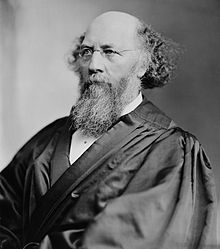 ](https://en.wikipedia.org/wiki/File:Stephen_Johnson_Field,_photo_half_length_seated,_1875.jpg) | [](https://en.wikipedia.org/wiki/File:Stephen_Johnson_Field,_photo_half_length_seated,_1875.jpg) |
| Associate Justice of the Supreme Court of the United States | Associate Justice of the Supreme Court of the United States |
In office March 10, 1863 – December 1, 1897 | In office March 10, 1863 – December 1, 1897 |
| Nominated by | Abraham Lincoln |
| Preceded by | Seat established |
| Succeeded by | Joseph McKenna |
| Chief Justice of the Supreme Court of California | Chief Justice of the Supreme Court of California |
In office September 20, 1859 – March 10, 1863 | In office September 20, 1859 – March 10, 1863 |
| Appointed by | John Weller |
| Preceded by | David Terry |
| Succeeded by | Warner Cope |
Member of the California State Assembly from the 14th district | Member of the California State Assembly from the 14th district |
In office 1851–1852 | In office 1851–1852 |
| Preceded by | Constituency established |
| Succeeded by | A. G. Caldwell |
| Personal details | Personal details |
| Born | November 4, 1816 Haddam, Connecticut, U.S. |
| Died | April 9, 1899 (aged 82) Washington, D.C., U.S. |
| Political party | Democratic |
| Spouse(s) | Sue Virginia Field |
| Education | Williams College (BA) |
Stephen Johnson Field (November 4, 1816 – April 9, 1899) was an American jurist. He was an Associate Justice of the United States Supreme Court from March 10, 1863, to December 1, 1897, the second longest tenure of any Justice. Prior to this appointment, he was the fifth Chief Justice of California.
- :{1:(style="display:table-cell;padding-left:0px;padding-right:0.5em"):}::{Early life and education}:
- :{2:(style="display:table-cell;padding-left:0px;padding-right:0.5em"):}::{Career in California politics and law}:
- :{3:(style="display:table-cell;padding-left:0px;padding-right:0.5em"):}::{U.S. Supreme Court justice}:
- :{4:(style="display:table-cell;padding-left:0px;padding-right:0.5em"):}::{See also}:
- :{5:(style="display:table-cell;padding-left:0px;padding-right:0.5em"):}::{Notes}:
- :{6:(style="display:table-cell;padding-left:0px;padding-right:0.5em"):}::{Further reading}:
- :{7:(style="display:table-cell;padding-left:0px;padding-right:0.5em"):}::{External links}:
Early life and education
Born in Haddam, Connecticut, he was the sixth of the nine children of David Dudley Field I, a Congregationalist minister, and his wife Submit Dickinson. His family produced three other children of major prominence in 19th Century America: David Dudley Field II the prominent attorney, Cyrus Field the millionaire investor and creator of the Atlantic Cable, and Rev. Henry Martyn Field a prominent clergyman and travel writer. He grew up in Stockbridge, Massachusetts, and went to Turkey at thirteen with his sister Emilia and her missionary husband, Rev. Josiah Brewer. He received a B.A. from Williams College, Williamstown, Massachusetts, in 1837. While attending Williams College he was one of the original Founders of Delta Upsilon Fraternity. After reading law in Albany with Harmanus Bleecker and New York City with his brother David Dudley II, Stephen and David practiced law together until 1848 when Stephen went west to California in the Gold Rush.[1]
Career in California politics and law
In California, Field's legal practice boomed and he was elected alcalde, a form of mayor and justice of the peace under the old Mexican rule of law, of Marysville (curiously, he was elected Alcalde just three days after his arrival in Marysville).[2] Because the Gold Rush city could not afford a jail, and it cost too much to transport prisoners to San Francisco, Field implemented[clarification needed] the whipping post, believing that without such a brutal implement many in the rough and tumble city would be hanged for minor crimes.
The voters sent him to the California State Assembly in 1850 to represent Yuba County, but he lost a race the next year for the State Senate. His successful legal practice led to his election to the California Supreme Court in 1857, serving six years.[3]
During his time on the Supreme Court of California, Field had a special coat made with pockets large enough to hold two pistols so that he could shoot at his various enemies through the pockets.[4] In 1858 he was challenged to a duel by a fellow Judge (William T. Barbour) but at the dueling ground, neither man fired his gun.[5]
In 1859 Field replaced the former chief justice of the California Supreme Court, David S. Terry because Judge Terry killed a United States Senator from California (David Colbreth Broderick) in a duel and left the state.[6] Oddly, Field and Terry's paths crossed again 30 years later when Field, acting in his capacity as a judge of the 9th Federal Circuit Court, ruled against Terry in a convoluted divorce case (and had him sent to jail for contempt of court as well). Seeking revenge, Terry attempted to kill Field in 1889 near Stockton, California but was instead shot dead by Justice Field's bodyguard, U.S. Marshal David B. Neagle (1847-1925). Ironically, legal issues arising from the killing of Mr. Terry came before the Supreme Court in the 1890 habeas corpus case of In re Neagle.[7] To no one's surprise, the Supreme Court ruled the Attorney General of the United States had authority to appoint U.S. Marshals as bodyguards to Supreme Court Justices and Marshal Neagle had acted within the scope of his authority in shooting former Judge Terry.
U.S. Supreme Court justice

:{On March 6, :(style="background-color:#ffffff;"):}::{1863, }:Abraham Lincoln appointed Field to the newly created tenth Supreme Court seat,[8] to achieve both regional balance (he was a Westerner) and political balance (he was a Democrat, albeit a Unionist one). The appointment would also give the Court someone familiar with real estate and mining issues. Field was confirmed by the United States Senate on March 10, 1863, and received his commission the same day.
According to journalist Brian Doherty, "Field was one of the pioneers of the concept (beloved by many libertarian legal thinkers) of substantive due process — the notion that the due process protected by the Fourteenth Amendment applied not merely to procedures but to the substance of laws as well."[9] Field's vocal advocacy of substantive due process was illustrated in his dissents to the Slaughterhouse Cases and Munn v. Illinois. In the Slaughter-House Cases, Justice Field's dissent focused on the Privileges or Immunities clause, not the Due Process clause (which was important in the dissent of Justice Bradley as well as the dissent of Justice Swayne). In both Munn v Illinois and Mugler v Kansas, Justice Field based his dissent on the protection of property interests by the Due Process clause.
One of Field's most notable opinions was his majority opinion in Pennoyer v. Neff, which set the standard on personal jurisdiction for the next 100 years. His views on due process were eventually adopted by the court's majority after he left the Supreme Court. In other cases he helped end the income tax (Pollock v. Farmers' Loan and Trust Company), limited antitrust law (United States v. E.C. Knight Company), and limited the power of the Interstate Commerce Commission.
He dissented in the landmark case Strauder v. West Virginia, where the majority opinion held that the exclusion of African-Americans from juries violated the Fourteenth Amendment's Equal Protection Clause. He also joined the case Plessy v. Ferguson that upheld racial segregation.
Early in his career, Field wrote opinions against California's laws discriminating against the Chinese immigrants to that state.[10] Serving as an individual jurist in district court, he notably struck down the so-called 'Pigtail Ordinance' in 1879, which was regarded as discriminating against Chinese, making him unpopular with the Californian public. However, as a member of the U.S. Supreme Court, he penned opinions infused with racist anti-Chinese-American rhetoric, most notably in his majority opinion in The Chinese Exclusion Case, Chae Chan Ping v. United States, 130 U.S. 581 (1889), and in his dissent in Chew Heongv. United States, 112 U.S. 536 (1884).
https://www.socialstudies.org/publications/socialeducation/november-december2007/chew-heong-v-united-states-chinese-exclusion-and-the-federal-courts
did hold that chinese kids born here excluded from law
Hang Chew's: The Times Square Bar On "The Newsroom"
Field insisted on breaking John Marshall's record of thirty-four years on the court, even though he was not able to handle the workload. His colleagues asked him to resign due to his being intermittently senile[11] but he refused, staying on until 1897. He lived only two years more, dying in Washington, D.C., and was buried there in the Rock Creek Cemetery.[12][13]
Justice Field's aspirations to become Chief Justice went unfulfilled, as he had made many enemies both political and personal.[14] He is the second longest serving Associate Justice. Field wrote 544 opinions, more than any other justice save for Justice Samuel Miller (by comparison, Chief Justice Marshall wrote 508 opinions in his 34 years on the court).[15]
Associate Justice David Josiah Brewer was Justice Field's nephew. Other notable relatives include Paul Stephen Field and legal scholar Anne Field.
In November 1885, Field served as an original trustee of Leland Stanford Junior University.[16]
See also:
- Corporate personhood
- Demographics of the Supreme Court of the United States
- List of Justices of the Supreme Court of the United States
- List of law clerks of the Supreme Court of the United States
- United States Supreme Court cases during the Chase Court
- United States Supreme Court cases during the Fuller Court
- United States Supreme Court cases during the Taney Court
- United States Supreme Court cases during the Waite Court
- List of Justices of the Supreme Court of California
Notes
===