CORP PERSON 3 LEGAL
7/20 broke format on 2 (bak is plain text) 404
no :{MERRI
===
see TAKINGS
see indiv amendments
see compelled speech 1st amend BS
see thom 3
SEE SCHIFF 2
see jeff clements 2011 book sum
pfas?
===
---
OMFG
buenosairesherald.com
Milei's proposal to allow 'non-human corporations' run by AI causes ...
Jun 5, 2026Politicians and tech experts expressed concern over the implications of President Javier Milei's proposal to allow "non-human corporations" run by artificial intelligence (AI) to operate in Argentina, with no regulations and low taxes. On Thursday, renowned British outlet Financial Times published an opinion article written by Milei — with the help of Deregulation Minister Federico ...
EL PAÍS English
June 5, 2026
Politicians and tech experts expressed concern over the implications of President Javier Milei’s proposal to allow “non-human corporations” run by artificial intelligence (AI) to operate in Argentina, with no regulations and low taxes.
On Thursday, renowned British outlet Financial Times published an opinion article written by Milei — with the help of Deregulation Minister Federico Sturzenegger — under the headline “Argentina invites AI to free itself.”
In it, he stated that AI must remain free of state regulation to prosper.
The libertarian leader said his government was looking to attract AI companies by proposing a change in legislation that would establish “a dedicated legal framework for the deployment of AI.”
The three pillars of this framework are “a commitment to keep AI unregulated”, “the creation of a new corporate category in Argentine law: the non-human corporation”, and a “low corporate tax rate”.
“We are open for business,” he wrote, stressing that this is “an invitation.”
Critics say this could open the doors to “programmed impunity” and that it may even turn Argentina into a “catastrophic experiment.”
AI revolution
The article compared the development of AI as a technology with the industrial revolution and the creation of limited liability companies, saying that an unregulated framework is required to unleash their full potential.
“As much as the industrial revolution freed us from the constraints of the human muscle, AI will free us from the constraints of the human brain, pushing productivity beyond our wildest dreams,” Milei said in the article.
Milei said he is committed to keep AI unregulated “so that it is free to be developed without the deadly hand of premature and poorly understood regulation.”
He also proposed the creation of “a new corporate category in Argentine law: the non-human corporation,” which would be operated by AI agents or robots. Human participation as shareholders would be possible, but not required.
“Where these systems exercise independent judgment in unpredictable environments, their actions entail real risks. Limited liability is not a luxury for such entities; it is a precondition for their existence,” the president said.
Those entities would benefit from a low corporate tax rate, and shareholders would be able to choose their form of corporate governance law, although final beneficiaries would have to be disclosed.
“Argentina has no interest in becoming a haven for illicit capital — but for all legitimate commercial activity our framework will offer unmatched terms,” he said.
Super RIGI
According to Milei, the proposals are part of a broader investment incentive regime known as RIGI, which the government submitted to Congress last week to attract businesses through tax breaks and other benefits.
However, the initiative — dubbed “Super RIGI” — does not mention the concept of “non-human corporations” or establish a deregulated framework for AI companies.
The proposal is primarily aimed at attracting companies interested in building large-scale AI data centers in Argentina, offering lower taxes, preferential foreign-exchange conditions and exemptions from export duties.
The incentives, however, are not limited to the AI sector.
“In the spirit of the Dutch merchants who made Amsterdam the financial capital of the 17th century, we intend to offer the most attractive legal and fiscal environment for the AI companies that will define the 21st century,” Milei wrote.
Sam Altman and Peter Thiel
In October, OpenAI — the company behind ChatGPT — and Argentine firm Sur Energy signed a letter of intent to develop a large-scale AI data center in Patagonia.
Patagonia, a sparsely populated region in southern Argentina known for its abundant natural resources and cool, dry climate, is widely seen as an attractive location for large data centers.
The project, known as Stargate Argentina, would be the first initiative of its kind in Latin America. The investment has been estimated at between US$20 billion and US$25 billion, although the project has yet to be formally launched.
OpenAI CEO Sam Altman said the initiative would help bring Milei’s vision of “how AI could drive Argentina’s growth and creativity” to life.
Milei has also announced a “social digital twin” program, which would use publicly available citizen data to create simulations intended to inform public policy decisions.
The concept bears similarities to services offered by Palantir, the data analytics company co-founded by tech investor Peter Thiel.
Thiel met with Milei in April and has spent the past months living in Argentina. The government has denied that Palantir — or any other private company — is involved in the digital twin initiative, which has yet to be launched.
Palantir has faced criticism from civil liberties groups over its work with U.S. government agencies, including contracts related to immigration enforcement and surveillance programs.
Thiel has also been linked to Próspera, a controversial semi-autonomous development project in Honduras designed to attract investment through a separate regulatory and governance framework.
Criticisms
Former lawmaker and Coalición Cívica leader Elisa “Lilita” Carrió said Milei’s article “confirms his full support for Peter Thiel, his philosophy, his beliefs and his economic power.”
According to Carrió, the proposal would turn Argentina into “a catastrophic experiment for human dignity” and move the country toward the “complete private totalitarianism” she believes Thiel advocates.
“Argentina has been chosen as the site of a social experiment with terrible consequences for human freedom,” Carrió said.
She argued that a lack of regulation for AI would mean “the dissolution of all moral and legal constraints, the end of the state, and the privatization of military and police power in the hands of private groups.”
Former Defense Minister Agustín Rossi said the Super RIGI initiative appeared to be “tailor-made for Javier Milei’s friends” and questioned why Economy Ministry officials had declined to clarify whether Palantir had lobbied in favor of the proposal.
Meanwhile, electronics engineer and AI specialist Ariel Garbarz argued in a post on X that the ideas of non-human corporations and the full deregulation of AI would create a system of “programmed impunity: human gains, social harm and responsibility shifted onto machines.”
“The ideological trick is to call the state’s decision to stop protecting its people ‘innovation,'” he warned.
Tech magnate Peter Thiel strengthens ties with Milei in Buenos Aires
Apr 23, 2026Tech magnate Peter Thiel strengthens ties with Milei in Buenos Aires The founder of Palantir, the data processing company, arrives in Argentina after his visit to Rome to talk about the Antichrist

La Derecha Diario
Peter Thiel moves to Argentina motivated by the reforms of Milei's ...
May 28, 2026The tech billionaire Peter Thiel will relocate to live in Argentina, enchanted by Argentina and the policies of the Government of Javier Milei, reflecting the growing international appeal of the libertarian direction.
---
-=-=
Corporate Constitutional Rights are Cancerous to Democracy
We must take these public health choices out of the hands of corporate executives and put corporations in their proper place: subservient to public welfare.
Kaitlin Sopoci-BelknapJudy Young
Jul 27, 2020 Common Dreams
Should constitutional rights be used to shield corporations from hiding their dangerous products from the public? A recent federal court decision says so.
Monsanto is the maker of Roundup which is used around the world as a weedkiller, a drying agent, and a desiccant to speed the harvest of corn, soybean, and wheat crops. Roundup’s active ingredient is glyphosate. In 2015, the International Agency for Research on Cancer (IARC) labeled the herbicide as “probably carcinogenic.” In 2017, the California Office of Environmental Health Hazard Assessment listed glyphosate as a cancer-causing chemical and California started listing Glyphosate in the list of chemicals known to cause cancer.
Dewayne Johnson v. Monsanto Company was the first Roundup cancer lawsuit to proceed to trial. The lawsuit alleged that exposure to Monsanto’s Roundup weed killer and its active ingredient, glyphosate, caused Dewayne Johnson, a groundskeeper, to develop non-Hodgkin lymphoma (NHL). The jury awarded Dewayne Johnson $289.2 million, making this a landmark Monsanto Roundup verdict.
The next two Roundup cancer lawsuits resulted in jury verdicts against Monsanto. The total damages awarded in these first three Roundup cancer lawsuits was $2.424 billion.
Since Monsanto introduced Roundup in the 1970s, Monsanto has denied claims that Roundup causes cancer. “But according to internal Monsanto emails now known throughout the world as The Monsanto Papers, Monsanto has known for several decades that Roundup (glyphosate) causes cancer. Rather than informing consumers about the glyphosate cancer risk, Monsanto buried the risks as sales of Roundup continued to skyrocket.”
Because of these Supreme Court invented Corporate Constitutional Rights, corporations enjoy more rights than people or their local governments to exercise police powers to protect the health, safety, and welfare of the people in their communities.
In 2015 the International Agency for Research on Cancer (IARC) found glyphosate to be “probably carcinogenic to humans.” It included a summary of a review of studies and a meta analysis that showed a significant increased risk of NHL for individuals exposed to Roundup.
Bayer purchased Monsanto in 2018. As a result of the first case in which Monsanto was found liable for the cancer caused by Roundup, tens of thousands of other lawsuits were filed against Monsanto. Bayer, now owner of Monsanto, has agreed to pay $10 billion for these legal claims that their product Roundup causes cancer.
“The Monsanto Papers tell an alarming story of ghostwriting, scientific manipulation, collusion with the Environmental Protection Agency (EPA), and previously undisclosed information about how the human body absorbs glyphosate. These documents, which Monsanto does not want you to see, provide a deeper understanding of the serious public health consequences surrounding Monsanto’s conduct in marketing Roundup.”
Based on California’s Prop 65, products that are found to cause cancer require businesses to “provide warnings to Californians about significant exposures to chemicals that cause cancer, birth defects, or other reproductive harm.”
Even in the face of Monsanto’s deceit and Bayer’s liability, U.S. federal appeals court Judge William Shubb wrote in National Association of Wheat Growers, et al. v. Becerra that mandating a cancer warning label on products which contain glyphosate, such as Roundup, would violate the corporation’s First Amendment rights by compelling them to echo a finding that the judge characterized as “not purely factual and uncontroversial.”
Judge Shubb wrote that California has other options to inform consumers that the state has determined that glyphosate is a carcinogen in ways that would not burden the free speech of corporations such as Bayer. The state could run advertising campaigns or post information on the internet. However, most consumers will never see a warning that is not on the label.
This story is strangely similar to the fossil fuel industry’s knowledge in the 1970s that burning fossil fuel was a major cause of climate change. Yet the fossil fuel industry covered up that information and published false information for decades and allowed the harm to continue unabated. Now, with the lawsuits against Monsanto in which plaintiffs were awarded jury verdicts totaling over $2 billion and the Monsanto Papers that show the same disturbing story of deceit and coverup, a federal court has ruled in favor of the corporations. The federal court ruling is based on the Supreme Court-invented Corporate Constitutional Rights (CCRs), the notion that corporations have constitutional rights such as First Amendment Free Speech rights. For the fossil fuel industry and climate change story, see “How Corporate Rule Fueled the Climate Crisis.”
926
...
Oil Corporations Invoke Numerous CCRs to Defend Against Their Climate Coverup and/or Resulting Damages
To date oil corporations have used one or more of the following CCRs as defenses in numerous lawsuits based on their climate cover up:
First Amendment, Fourth Amendment (overbroad subpoena), Fifth Amendment (takings clause), Fourteenth Amendment, Commerce Clause, Equal Protection Clause, and Contracts (“Impairments”) Clause. [4]
Oil Company Wins Lawsuit to Allow Fracking Based on CCRs Despite Ordinance Prohibiting It
SWEPI, LP v. Mora County, 81 F.Supp.3D 1075 (D.N.M. 2015)
SWEPI, Limited Partnership [5], entered into an oil-and-gas lease with the State of New Mexico in 2010. In 2013 the Mora County (New Mexico) Board of Commissioners adopted an Ordinance titled “Mora County Community Water Rights and Local Self-Government Ordinance” (Ordinance). In relevant part the Ordinance sought to protect the land, water, and rights of Mora County and its residents by prohibiting corporations from extracting water for use in the extraction of fossil fuels, depositing waste water, and maintaining infrastructure related to fossil fuel extraction. In other words, the Ordinance tried to ban hydraulic fracturing (“fracking”)
If corporations violated the Ordinance, it denied them the rights of persons afforded under the New Mexico and U.S. Constitutions. Further, the Ordinance refused to recognize the validity of a permit issued by any federal or state agency if it interfered with these rights. Preemption by state or federal law was recognized only if those laws expressly preempted County ordinances and charters, and provided greater protection for the health, safety, and welfare of Mora County’s people than County ordinances.
Violation of the Ordinance was a crime. SWEPI filed a complaint in 2014 seeking an injunction against the Ordinance. In 2015 the federal District Court ruled, in relevant part, that the Ordinance violated the Supremacy Clause and First Amendment rights of SWEPI, and invalidated the entire Ordinance.
The Court reasoned that, because the Supreme Court had established (actually, invented) the doctrine that corporations are persons under the Equal Protection Clause of the 14th Amendment they are entitled to its protections, including under the First and Fifth Amendments.
The Ordinance violated the Supremacy Clause because federal law supersedes a local ordinance and such an ordinance cannot nullify a constitutional right. The Ordinance violated the First Amendment because it was overbroad in that it absolutely prohibited all of SWEPI’s First Amendment rights. In a Pennsylvania case, the Court invalidated a similar ordinance but also found the arguments supporting it to be “frivolous” and ordered two attorneys for the environmental group representing the township to pay an energy limited liability company $52,000 in legal fees! [6]
Conclusion: This SWEPI case demonstrates three principles.
First, corporations have used their invented constitutional rights to continue the same activities that have caused global warming. Unless the Supreme Court has a change of heart (unlikely) or the People pass a constitutional
amendment eliminating CCRs, corporations will also attempt to evade liability for their decades-old climate cover up as evidenced by the cases cited in endnote 4.
Second, this case illustrates that CCRs allow unelected judges and justices to effectively override the authority of elected officials to carry out their duty to use the police power to protect the health, safety, and welfare of their residents. [7]
Third, local communities that lose control over their land can suffer very real harm. CCRs unjustly allow corporations to override the ability of local governments to care for the people of their communities.
Mora County’s Ordinance challenged the CCR doctrine, a legal fiction that threatened to contaminate the local community with highly toxic fracking wastewater. Some would say that the court made the correct decision because its ruling followed precedent. In response, all CCR cases rest upon a so-called foundation unsupported by history, legal authority, or logic. [8]
Further, as SWEPI illustrates, the CCR doctrine, by elevating the profit-making interests of corporations over the health and safety of natural persons, protects property at the expense of the actual human beings who created the corporations . This is inherently unjust and “in the face of injustice, all people have the right and moral duty to peacefully protest unjust laws.” [9] The solution to CCRs is Move to Amend’s We The People Amendment, HJR 48: https://www.movetoamend.org/amendment
Because of these Supreme Court invented Corporate Constitutional Rights, corporations enjoy more rights than people or their local governments to exercise police powers to protect the health, safety, and welfare of the people in their communities.
In expanding First Amendment free speech protection to corporate commercial speech, the federal courts have relied heavily on the notion that the public has a First Amendment right to hear what corporations have to say.
It turns out that what the public gets to hear is only what the corporations want us to hear which is whatever increases their profits or makes them look good. In this case, Monsanto did not want the public to hear that Roundup might cause cancer and used its so-called First Amendment constitutional right ‘not to speak’ to hide that information from the public to maintain its profits.
We must take these public health choices out of the hands of corporate executives and put corporations in their proper place: subservient to public welfare. The only way to do that is make clear that corporations do not have Constitutional rights and that these rights are meant for human beings, not artificial entities. The We the People Amendment to the Constitution, written by the Move to Amend coalition and introduced by Congresswoman Pramila Jayapal (WA) will do just that. House Joint Resolution 48 currently has 74 co-sponsors in the House of Representatives, and with rulings like National Association of Wheat Growers, et al. v. Becerra the long list of reasons for this critical amendment continues to grow. Join the movement to pass the We the People Amendment: https://www.movetoamend.org/motion.
4 REFS 3 404?
MTA HANDOUT RT NOT TO SPK
2020 8PP pt 3 fail xml
-=-=
---
EXXONKNEWs
...
Energy Transfer’s case, originally filed by the firm Kasowitz Benson Torres (long-time lawyers for Donald Trump), was taken over in 2023 by Gibson Dunn, a law firm with a record of “playing both sides” of the First Amendment on behalf of its corporate clients. }:Gibson Dunn lawyer Trey Cox represented Energy Transfer in its opposition to Greenpeace’s motion this week,:{:{ arguing that juror questionnaires are the appropriate method to ensure a fair trial — and that whether or not Morton County residents received or read the newspaper was irrelevant.}:
===
ggl 5 26
AI Overview
Corporate personhood is the legal doctrine treating corporations as "persons" with constitutional rights—such as free speech (1st Amendment) and protections against unreasonable searches (4th Amendment)—enabling them to sue, own property, and enter contracts. While this enables legal actions like toxic tort lawsuits, it also allows companies to challenge regulations, with critics arguing it creates an imbalance, particularly when chemical companies use these rights to avoid liability or environmental oversight. [1, 2, 3, 4, 5]
Corporate Personhood and Legal Rights
- Definition & Origin: The Supreme Court has long recognized corporations as "persons" under the law, separating their legal identity from shareholders. [1, 2]
- Constitutional Protections: Corporations enjoy many, but not all, rights of natural persons. Key rights include First Amendment commercial speech and fourth amendment protections against unreasonable searches. [1, 2, 3, 4]
- Limitations: Corporations are generally not granted rights involving personal dignity or conscience, such as the Fifth Amendment privilege against self-incrimination. [1, 2]
- Litigation Power: Corporate personhood provides the standing to sue and be sued in federal and state courts. [1]
Chemical Law and Legal Liability
- Toxic Torts: Victims of chemical exposure can sue for health issues, utilizing state/federal laws and regulations (e.g., OSHA, EPA). [1]
- Immunity & Regulation: "Audit privilege" laws in some states can protect companies from disclosing environmental violations. [1]
- Industry Influence: Critics point to cases where corporations, particularly in the chemical and pesticide sectors, use their legal standing to fight accountability, as seen in disputes over EPA regulations. [1, 2]
- Public Accountability: There is significant public opposition to giving chemical companies immunity from lawsuits, particularly regarding health hazards. [1]
Key Cases and Legal Trends
- Citizens United v. FEC (2010): Held that corporations have First Amendment free speech rights, allowing unlimited election spending.
- Marshall v. Barlow’s, Inc. (1978): Granted businesses protection from warrantless OSHA inspections, requiring inspectors to obtain a warrant.
- Dow Chemical Case: Supreme Court ruled that corporations do not have a reasonable expectation of privacy from EPA aerial photography of chemical plants.
- Ford v. Montana: Highlighted the trend in corporate liability lawsuits, which often involve complex debates about jurisdiction and corporate accountability. [1, 2, 3]
===
ref no date
Minnesota Statute Banning PFAS or “FOREVER CHEMICALS” Survives Constitutional Challenge in Federal Court
Minnesota manufacturers and other businesses should be aware of a first-of-its-kind law aimed at the sale or distribution in Minnesota of products containing perfluoroalkyl and polyfluoroalkyl substances, colloquially known as “PFAS.” This legislation, enacted in 2023 and codified at Minn. Stat. § 116.943, is known as “Amara’s Law.” It was named for Amara Strande, a Minnesotan who advocated for the bill while battling a rare liver cancer believed to be a result of PFAS pollution. Click here to learn more.
Minnesota’s PFAS law recently survived a preliminary legal challenge in the federal court system, so the chances are probably low that a court will block its implementation. As such, businesses should continue taking steps to ensure compliance.
Background
:{PFAS have been widely used by manufacturers across various industries, primarily for their anti-stick, hydrophobic, and temperature resistant qualities. They were utilized in the production of a range of everyday household items including coatings for clothing, carpets, and other products, along with various sealants, wax products and, most notably, non-stick cookware and bakeware. Originally developed in the 1930s, a well-known Minnesota corporation was the first to mass produce PFAS at its facility located in an eastern suburb of the Twin Cities. After decades of PFAS production and PFAS waste disposal, the Minnesota Department of Health (the “MDH”) identified PFAS contamination in drinking well water near the PFAS facility and PFAS disposal sites and soon tracked the contamination across the entire metro area.
The discovery prompted remedial efforts by the MDH to restore the environmental and public health dangers now known to be posed by PFAS chemicals that escape into the environment. These health dangers include adverse effects on the liver, metabolism and thyroid, along with reductions in fertility, developmental effects, and cancer. Indeed, Amara Strande’s liver cancer has been considered a result of the PFAS pollution that was especially potent in her hometown, an eastern Twin Cities suburb.}:
Though PFAS were predominantly manufactured in Minnesota for a significant period of time, traces of the chemicals have been detected in soil samples taken from remote locations on every continent. PFAS can transport long distances through the atmosphere as a gas or particulate material. As a result, they can now be detected in the blood of nearly every American. PFAS earned the moniker “forever chemicals” because they “bioaccumulate,” meaning they do not naturally break down in the environment or in the human body.
Amara’s Law
Amara’s Law prohibits the sale or distribution in Minnesota of specified products that contain intentionally added PFAS chemicals. PFAS consist of a broad group of chemicals including, as defined by Amara’s Law, “fluorinated organic chemicals containing at least one fully fluorinated carbon atom.” The statute takes effect over three phases, becoming fully effective on January 1, 2032. Retailers, distributors, and other companies that sell certain products in Minnesota are already subject to the prohibitions and requirements that took effect on January 1, 2025 as part of Phase I, however. It is therefore important for businesses to identify any products sold in Minnesota that contain PFAS to comply with Phase I requirements. Manufacturers in Minnesota and across the U.S. should also prepare to comply with the disclosure requirements of the second phase of Amara’s Law, which becomes effective on January 1, 2026. The requirements imposed by Amara’s law are complicated and are subject to future regulation by the Minnesota Pollution Control Agency (MPCA).
Amara’s Law will be implemented in three phases as follows: 1) the prohibition of specified products, effective January 1, 2025; 2) the introduction of information disclosure requirements, effective January 1, 2026; and 3) the prohibition of all remaining products that do not constitute a “currently unavoidable use,” effective January 1, 2032. Minn. Stat. § 116.943, subds. 5(a)–(b), 2, and 5(c). At all three phases, Amara’s Law applies only to “product[s] that [contain] intentionally added PFAS [that are] sold, offered for sale, or distributed in the state.” The MPCA is tasked with enforcing violations of Amara’s Law pursuant to Subdivision 7.
Phase I – Prohibition of Specified Products (Minn. Stat. § 116.943, subd. 5(a)–(b))*:
Subdivision 5(a) prohibits any person from “sell[ing], offer[ing] for sale, or distribut[ing] for sale in this state the following products if the products contain intentionally added PFAS:”
(1) carpets or rugs;
(2) cleaning products;
(3) cookware;
(4) cosmetics;
(5) dental floss;
(6) fabric treatments;
(7) juvenile products;
(8) menstruation products;
(9) textile furnishings;
(10) ski wax; or
(11) upholstered furniture.
In addition to the specifically enumerated categories, Amara’s Law grants the Commissioner of the Minnesota Pollution Control Agency (the “MPCA”) authority to enact rules identifying “additional products by category or use” that would also be subject to the restrictions of subdivision 5(a). Phase I went into effect January 1, 2025, so all manufacturers (or the first domestic importer if the product manufacturer does not have a presence in the U.S.), distributors, and retailers that “sell, offer for sale, or distribute for sale” any of the above products should have already identified whether such products contain intentionally added PFAS.
Phase II – Disclosure Requirements (Minn. Stat. § 116.943, subd. 2)*:
Beginning January 1, 2026, manufacturers will be required to disclose certain information identified in Subdivision 2 to the MPCA Commissioner for each product that contains intentionally added PFAS that is sold, offered for sale, or distributed in Minnesota (unless they receive a waiver or extension under Subdivision 3 of the statute). The Commissioner of the MPCA may require PFAS testing on any product being offered for sale in Minnesota under Subdivision 4 if she has “reason to believe” the product contains intentionally added PFAS. If a product is prohibited by subdivision 2 or 5, the manufacturer must provide notice that the product is prohibited by Amara’s Law to any person that sells or offers the product for sale in Minnesota. Alternatively, the Commissioner may provide notice to any such person. If the manufacturer fails to make the required disclosures, any person that receives notice that the product is prohibited may not sell, offer for sale, or distribute the product for sale in Minnesota.
Phase III – Prohibition of All Products Not Excepted (Minn. Stat. § 116.943, subd. 5(c)):
Finally, beginning January 1, 2032, no person may sell, offer for sale, or distribute for sale in Minnesota any product “that contains intentionally added PFAS” regardless of whether the product falls under one of the eleven categories of products subject to Phase I. The Commissioner of the MPCA is granted rulemaking authority to identify specific products that constitute a “currently unavoidable use,” defined by statute as products determined to be “essential for health, safety, or the functioning of society and for which alternatives are not readily available.” Such products determined to constitute a “currently unavoidable use,” along with certain federally regulated products, firefighting foam and food packaging, which are subject to other Minnesota statutes, used products containing intentionally added PFAS and, for some portions of Amara’s Law, certain medical products, constitute the only exceptions to Amara’s Law.
Federal Constitutional Challenge
In Cookware Sustainability Alliance v. Kessler,manufacturers of products containing intentionally added PFAS filed a lawsuit against the Commissioner of the MPCA, seeking to strike down Amara’s Law as unconstitutional. The lawsuit was brought in the Federal District of Minnesota by the Cookware Sustainability Alliance (the “CSA”), a non-profit trade organization whose members are leading manufacturers of non-stick cookware, a product that commonly contains intentionally added PFAS and is subject to Phase I prohibitions. See Minn. Stat. § 116.943, subd. 5(a)(3). The CSA challenged the constitutionality of Amara’s law on three grounds:
(1) that the Phase I and Phase III prohibitions violate the Commerce Clause of the U.S. Constitution by imposing restraints on trade that constitute overt discrimination against out of state manufacturers to the benefit of in-state manufacturers or, alternatively, that such restraints on trade imposes a burden on interstate commerce that is excessive relative to the local benefits accomplished by Amara’s Law;
(2) that the Phase II disclosure requirement compels speech in violation of the First Amendment to the U.S. Constitution; and
(3) that the Phase II disclosure requirement is preempted by federal trade secret protection laws and, therefore, violates the Supremacy Clause of the U.S. Constitution.
The CSA immediately moved for a preliminary injunction, asking the U.S. District Court for the District of Minnesota to enjoin the MPCA from enforcing Phase I of Amara’s law pending the litigation. Judge Tunheim denied the CSA’s motion, noting that the CSA’s arguments that Phase I of Amara’s Law violates the Commerce Clause are “highly unlikely” to prevail. See Cookware Sustainability All. v. Kessler, No. 25-41, 2025 U.S. Dist. LEXS 33248, at *10, *14 (D. Minn. Feb. 25, 2025).
Following Judge Tunheim’s ruling, the Commissioner moved to dismiss the CSA’s action in its entirety, arguing that “[n]one of the Alliance’s claims are legally viable.” The court has not yet ruled the CSA’s challenges against Phase II of Amara’s Law, and the case is proceeding.
The Future of PFAS in Minnesota
Time will tell whether the CSA’s constitutional challenges, or the arguments asserted by any future challengers, will result in Amara’s Law being blocked or amended. As it stands now, however, Phase I of Amara’s law is in full effect and any person or organization selling, offering for sale, or distributing for sale in Minnesota any products containing intentionally added PFAS that are included in any of the eleven categories of products listed above must comply with Subdivision 5 of Amara’s Law.
Manufacturers of any products being offered for sale in Minnesota will also need to comply with Subdivision 4 if the Commissioner directs them to provide testing results that identify whether the product contains PFAS. Likewise, manufacturers should be prepared to comply with the Phase II disclosure requirement upon its implementation on January 1, 2026. The MPCA has indicated its unwillingness to extend a grace period to early violations of Amara’s Law, considering the incremental timeline of the statute’s implementation.
Finally, manufacturers, distributors, or retailers selling or manufacturing products to be sold in Minnesota that contain intentionally added PFAS should be prepared to comply with Amara’s Law by January 1, 2032, unless they sell products exempted under Subdivision 8 or that are previously ruled a “currently unavoidable use” by the MPCA.
If you have questions about the implementation, restrictions and requirements, or enforcement and compliance pertaining to Amara’s Law, please contact V. John Ella, Zachary Hennen, or FMJ’s Manufacturing Team.
---
hmmn
PUBLISHED
January 6, 2023
AUTHOR
Purdue Global Law School
When people complain about “dark money” in politics, they often bring up the concept of “corporate personhood.” That is largely due to the Supreme Court’s landmark decision in Citizens United v. FEC (2010), which held that corporations and other associations are protected by the First Amendment and that election spending is speech. The Court explained that corporations are associations of individuals and thus entitled to free speech rights.
However, the concept of corporate personhood long predates Citizens United. Because corporations have a separate identity from their organizers and investors, they can own property, enter into contracts, sue and be sued, and exist in perpetuity. Allowing corporations to conduct business activities as a “legal person” encourages investment and helps drive economic growth.
What are the legal limits of corporate personhood? Ambiguity in the Constitution and some statutes has given rise to increasingly expansive court interpretation, often without consideration of the size and complexity of the modern corporation. Over time, the Supreme Court has extended many rights to corporations, leading some groups to argue that the concept should be abolished. However, the issue could be addressed with carefully crafted legislation.
Creature of Statute
Roman law established the concept of the corporation (derived from the Latin word “corpus” meaning “body”), which included municipalities, trade groups, and other entities that conducted business through representatives. Over time, the corporation evolved from an entity that existed by virtue of royal “concession” to the modern form that arises from statute. Corporate “enabling” laws that limit liability build upon the doctrine of corporate personhood to prevent creditors from suing a company’s shareholders.
Many statutes explicitly define “person” as including corporations. Furthermore, 1 U.S. Code § 1 states that “in determining the meaning of any Act of Congress, unless the context indicates otherwise … the words ‘person’ and ‘whoever’ include corporations, companies, associations, firms, partnerships, societies, and joint stock companies.”
Sometimes courts have interpreted this rule narrowly. In FCC v. AT&T (2011), the Court held that corporations do not have a “personal privacy” interest under the Freedom of Information Act. In Burwell v. Hobby Lobby Stores, Inc. (2014), however, the Court found that the Religious Freedom Restoration Act extends to corporations to protect the owners’ religious liberty.
Constitutional Questions
The Constitution does not mention corporations, but by the early 19th century the Court had determined that they are entitled to certain constitutional protections. In Dartmouth College v. Woodward (1819), the Court held that the Contracts Clause prohibited the state of New Hampshire from forcing Dartmouth to become a public institution. In Pembina Consolidated Silver Mining Co. v. Pennsylvania (1888), the Court found that corporations are protected by the Fourteenth Amendment, although later rulings clarified that this does not insulate them from state regulation. However, the Court has consistently held that the Fifth Amendment right against self-incrimination does not apply to corporations.
Perhaps most contentious have been questions of First Amendment protections, particularly as applied to political spending and electioneering. The first campaign finance law, the Tillman Act of 1907, prohibited corporations from making monetary contributions to political campaigns. It survived First Amendment challenges. That started to change with Buckley v. Valeo (1976), in which the Court struck down limits on campaign spending on the grounds that they contravene free speech principles.
Freedom of Speech
The Court first stated explicitly that free speech rights extend to corporations in First National Bank of Boston v. Bellotti (1978). Holding that a Massachusetts law prohibiting most corporate contributions to ballot initiatives was unconstitutional, the Court noted that freedom of speech not only protects self-expression but encourages public discourse.
But in Austin v. Michigan Chamber of Commerce (1990), the Court upheld the Michigan Campaign Finance Act, which prohibited corporations from making independent expenditures to support or oppose candidates. Justice Thurgood Marshall wrote that Michigan had a legitimate concern “that corporate political expenditures will undermine the integrity of the political process.”
The Bipartisan Campaign Reform Act of 2002, commonly known as McCain-Feingold, banned corporate funding of issue advocacy ads that name a federal candidate within 30 days of a primary or 60 days of an election. McConnell v. FEC (2003) substantially upheld McCain-Feingold. Citizens United overturned Austin and partly overruled McConnell on free speech grounds.
Should Corporate Personhood Be Abolished?
Citizens United has encouraged rampant growth of dark money campaign contributions through nonprofits that hide the sources of the donation. It also led to the creation of “super PACs” that spend millions on ads and other communications and aren’t subject to the same limitations as traditional political action committees.
According to the Brennan Center, super PACs spent nearly $3 billion on federal elections between 2010 to 2018, with 77.7% coming from the top 100 donors. Americans recognize that these donors have more influence than others and overwhelmingly support limits on campaign spending. Many groups have called for Citizens United to be overturned and corporate personhood to be eliminated.
An organization called Move to Amend has proposed an amendment to the Constitution stating that corporations are not entitled to constitutional rights and that campaign spending is not a form of speech. In 2011, voters passed referendums supporting the amendment in Boulder, Colorado; Missoula, Montana; and Madison and Dane County, Wisconsin. The Los Angeles City Council also officially endorsed it. In 2021, 50 Democratic members of Congress proposed the amendment in a House Joint Resolution.
The proposed amendment does not abolish corporate personhood, but eliminating constitutional protections would sharply curtail the utility of corporations. A better approach would be for Congress to pass corporate governance legislation that meets constitutional requirements and leaves the useful aspects of corporate personhood intact.
---
ref
https://www.exxonknews.org/p/exxon-uses-free-speech-argument-to
exxon uses free speech argument to fight climate laws
It’s not the first time the oil giant has tried to ward off accountability using the First Amendment.
Oct 29, 2025
ExxonMobil has sued California over a pair of state laws that force big companies to disclose financial climate risks to shareholders and the full greenhouse gas emissions resulting from their businesses — arguing that the measures violate the company’s free speech. It’s the latest example of Exxon, the biggest U.S. oil company, wielding the First Amendment as both a shield and sword in court.
The California Climate Accountability Package, which passed in 2023, would make companies doing business in California disclose emissions that result from the use of their products — also known as “Scope 3” emissions. That category makes up the vast majority of emissions from the oil and gas industry, but companies including Exxon have fought to avoid making them transparent.
Exxon’s new lawsuit argues that by requiring it to account for the entirety of its emissions, the laws would force it to “espouse California’s preferred framing for issues of immense public concern” and to “describe its emissions and climate-related risks in terms the company fundamentally disagrees with.” The lawsuit asks a U.S. District Court to stop California from enforcing the laws.
The case targets the country’s only existing disclosure laws for greenhouse gas emissions, even as the federal government ends emissions reporting and required climate disclosures at the federal level. But it’s also part of a years-long trend of corporations using First Amendment arguments in an attempt to shield themselves from scrutiny and regulation, experts say.
“This is part of a long history of companies including Exxon trying to use the First Amendment to block regulation that they dislike,” said Amanda Shanor, an associate professor of legal studies and business ethics at the Wharton School of the University of Pennsylvania, who has chronicled some of those high-stakes efforts. “That’s not really how the First Amendment works or is supposed to work.”
The fossil fuel industry, in particular, has leveraged First Amendment arguments to repel criticism over their role in the climate crisis. In recent years, oil companies have claimed that lawsuits across the country accusing them of misleading the public about climate change violate their free speech rights. From Oregon to Massachusetts, the District of Columbia to California, Exxon has brought motions to dismiss states’ and municipalities’ climate deception lawsuits under anti-SLAPP (Strategic Lawsuits Against Public Participation) statutes — laws that were developed to protect the free speech of press and civil society groups.
One of those motions, responding to lawsuits filed by the state of California and eight California municipalities, argues that oil companies “have long exercised their rights to participate in the public debate over which policies best balance the challenges posed by a changing climate and the world’s increasing need for energy,” and that “This lawsuit threatens Defendants’ continued participation in those debates.”
The law firm representing Exxon in that motion, O’Melveny and Myers, is the same as in the latest First Amendment lawsuit against California. The argument seeks to cast Exxon’s public statements on climate change as political speech, which concerns public policy and has stringent First Amendment protections, rather than commercial speech, which does not enjoy the same level of protections.
“We’ve seen this movie before,” said Robert Brulle, an environmental sociologist and professor at Brown University and director of research at the Climate Social Science Network, who has co-authored briefs in support of climate deception lawsuits. “Their fallback defense is freedom of speech — ‘nobody ever said we have to be truthful.’”
Mobil Oil, now part of ExxonMobil, helped pioneer the idea of corporations as citizen-like entities with free speech rights in an effort to revive their reputation back in the 1970s. Exxon and Mobil backed other corporations’ First Amendment lawsuits, arguing that companies should be free to express their views on “matters of public concern,” including climate change. In Supreme Court cases like First National Bank v. Bellotti and Citizens United v. FEC, the idea of corporate free speech was expanded to usher in nearly unlimited corporate money in politics.
Still, none of oil companies’ anti-SLAPP arguments has been validated by judges. Under existing First Amendment law, Shanor explained, Exxon’s lawsuit against California’s disclosure laws should be very unlikely to succeed, too.
“Exxon is grasping at straws,” said Maggie Coulter, a senior attorney for the Climate Law Institute at the Center for Biological Diversity. “Courts have already rejected companies’ weak arguments rebranding their greenwashing and misinformation as free speech.”
Exxon and other corporations could be hoping that the U.S. Supreme Court might eventually use such a case to alter the boundaries between political and commercial speech — or “change what the rules are in a way that will favor them,” Shanor said.
“You just keep throwing the same basic core argument up there, wave the flag of the First Amendment and say, ‘leave us alone.’ Kind of like holding up a cross to a vampire,” said Brulle. “Now they’re playing it out in California to try to build a record in the court.”
‘Disproportionate blame’ on Exxon
According to Exxon’s lawyers, California’s disclosure framework would place “disproportionate blame on large companies like ExxonMobil for being large.”
“ExxonMobil understands the very real risks associated with climate change and supports continued efforts to address those risks,” reads the complaint. Such frameworks “send the counterproductive message that large companies are uniquely responsible for climate change no matter how efficiently they satisfy societal demand for energy, goods, and services.”
Michael Gerrard, director of the Sabin Center for Climate Change Law at Columbia University, said that Exxon should “let the readers decide.”
“If Exxon doesn’t like California’s framing, it’s free to supplement it with its own framing and offer an explanation of why it thinks that one is better,” he said.
The company’s own framing hasn’t gone over well so far, at least with climate experts. Exxon is the top investor-owned carbon emitter in the world, according to the latest Carbon Majors database by researchers at the nonprofit think tank InfluenceMap, and one of the most profitable. But Exxon officials have often blamed the company’s emissions largely on the habits of consumers. In an interviewwith Fortune last year, ExxonMobil CEO Darren Woods said that “the people who are generating the emissions need to be aware of and pay the price … for generating those emissions,” and referred to Scope 3 emissions as “essentially the emissions of our customers.”
Just before that interview, Exxon sued its own shareholders in an effort to block a proposal for the oil giant to limit its Scope 3 emissions. The lawsuit was dismissed, but not before shareholders revoked their proposal.
“What Exxon is asking for in this case is to say that shareholders should have no right to question companies on climate-related issues,” Danielle Fugere, president & chief counsel of shareholder advocacy group As You Sow, told ExxonKnewsat the time.
Both that lawsuit and another last year brought by the U.S. Chamber of Commerce against the California Air Resources Board, which also alleged California’s climate disclosure laws violated the First Amendment, were argued by law firm Gibson Dunn — a favorite of fossil fuel companies. The industry has also used the firm to pursue massive legal damages from their opponents, including this year’s nearly $667 million verdict against Greenpeace for its role in the protests against Energy Transfer’s Dakota Access pipeline.
Earlier this year, after California Attorney General Rob Bonta and a group of nonprofits sued Exxon for a “decades-long campaign of deception” about the efficacy of plastic recycling, Exxon sued them back under defamation laws — a clear example of a SLAPP, legal experts said.
Though climate deception lawsuits face growing attacks from fossil fuel allies and the Trump administration in the United States, they have seen recent successes abroad — a Paris Court just ruled that French oil giant Total’s advertising about “net zero” and leading the energy transition was misleading consumers. And over the last week, two new lawsuits have been brought against major polluters in the UK and Germany by victims of climate disasters. “I think that the evidence is pretty solid that Exxon and Mobil and all sorts of other folks knew all about climate damages and lied about it, and it’s just going to get more solid the more information we get,” said Brulle.
California officials said they would fight to uphold the disclosure laws, which could soon show up in other states, too. “These laws are about transparency,” said Christine Lee, a spokesperson for the California Department of Justice, in a statement.“ExxonMobil might want to continue keeping the public in the dark, but we’re ready to litigate vigorously in court to ensure the public’s access to these important facts.”
---
---
September 17, 2025
NEWS: Sen. Schiff, Reps. Neguse, McGovern, and Lee Introduce Constitutional Amendment to Overturn Citizens United
On Constitution Day, lawmakers resume push to ensure Congress and states can set reasonable limitations on political spending and influence by corporations on U.S. elections
Washington, D.C. — Today, U.S. Senator Adam Schiff (D-Calif.) and U.S. Representatives Joe Neguse (D-Colo.-02), Jim McGovern (D-Mass.-02), and Summer Lee (D-Pa.-12) introduced the Citizens Over Corporations Amendment, a proposed amendment to the U.S. Constitution that would overturn Citizens United v. FECand limit corporate influence and spending in American politics.
“The Supreme Court’s decision in Citizens United opened the door for corporations to pour billions of dollars of dark money into elections. This anonymous and unrestricted spending cripples transparency in the political process and weakens our democracy. Our amendment will keep big money out of politics and restore power where it should belong — with the American people,” said Senator Schiff.
“The time to confront political corruption and clean up government is now,” said Congressman Neguse.“The Citizens Over Corporations Amendment works to renew people’s faith in our democracy by ensuring transparency through campaign finance reform and preventing unrestrained spending and dark money in elections.”
“Elon Musk poured millions into electing Donald Trump and then used the influence he bought to fire federal workers, dismantle USAID, and strip health care from millions,” said Congressman McGovern. “Citizens United gives billionaires like Musk even more power to rig the system for the well-off and well-connected. That’s not a democracy—it’s an auction. I’m proud to support the Citizens Over Corporations Amendment, which will overturn Citizens United, get big money out of politics, and put power back where it belongs—in the hands of the people.”
“Some say the beginning of the collapse of our democracy was when the Supreme Court ruled in favor of Citizens United, giving the green light to corporations and billionaires to pour hundreds of millions into our elections and drown out the voices of everyday people. At the root of why we cannot make progress on so many urgent policies is a system where money speaks louder than people. The Citizens Over Corporations Amendment is about changing that. It is about putting power back where it belongs, with the people, so we can build a government that works for all of us, not just the wealthy few and their corporate interests,”said Congresswoman Lee.
Senator Schiff has introduced his constitutional amendment in the U.S. House of Representatives to overturn Citizens Unitedsince 2013 and has been a strong proponent of fixing America’s broken campaign finance system since he was first elected in 2000, after a race that was at the time the most expensive in the history of the House of Representatives. The first bill he cosponsored in Congress was the bipartisan McCain-Feingold Act to regulate the financing of political campaigns, which was later passed and signed into law.
The proposed Constitutional amendment will:
- Make clear the Constitution does not restrict the ability of Congress or states to set reasonable, viewpoint-neutral limitations on the raising and spending of money by candidates and others to influence elections
- Distinguishes between natural persons, corporations, or other artificial entities, including by allowing Congress or the State to prohibit such entities from spending money to influence elections
- Allow public financing of campaigns when states choose to enact such laws, which can restrict the influence of corporate or private wealth = public fund election
- Take further steps to protect the freedom of the press in the case of future campaign finance-related legislation
Earlier today, Senator Schiff and lawmakers rallied for Constitution Day to underscore the need to protect our democracy and curb influence by special interests on American politics. At the rally, Schiff highlighted his proposed amendment reversing the 2010 Supreme Court ruling that ended restrictions on corporate campaign spending, eliminating decades of legal precedent.
The Senator’s full remarks at the rally can be viewed.Schiff’s remarks can be downloaded here.
The bill is co-sponsored by U.S. Senators Jeanne Shaheen (D-N.H), Angus King (I-Maine), Peter Welch (D-Vt.), Sheldon Whitehouse (D-R.I.), Andy Kim (D-N.J.), and Cory Booker (D-N.J.).
The bill is endorsed by Citizens for Responsibility and Ethics in Washington, Democracy Defenders Action, Public Citizen, End Citizens United, People for the American Way, Common Cause, and Free Speech For People.
“Since the Supreme Court’s decision in Citizens United v FEC 15 years ago, unlimited and untraceable money has flowed from the pockets of corporations and the ultra-wealthy into political campaigns”,said Stuart McPhail, Director of Campaign Finance Litigation, Citizens for Responsibility and Ethics in Washington (CREW). “In the 2024 federal election cycle alone, over $2.7 billion was funneled through super PACs to various political campaigns. This dark money corrodes our democracy by allowing corporations and billionaires to hide their identities while greatly influencing elections and policy. CREW is proud to endorse the constitutional amendment introduced by Senator Schiff and Representatives Neguse, McGovern, and Lee to overturn Citizens United and ensure that the voices of average citizens are not drowned out by moneyed interests.”
“Democracy Defenders Action wholeheartedly endorses Sen. Adam Schiff and Reps. Joe Neguse, Jim McGovern, and Summer Lee’s constitutional amendment to overturn Citizens United,” said Virginia Canter, Ethics and Anticorruption Chief Counsel and Director, Democracy Defenders Action. “This crucial step will ensure that all Americans, not just the super-rich and corporations, have an equal voice in our elections–and true representation in our democracy.”
“Citizens United has turned our democracy into a government that serves the ultra-wealthy. Political spending by billionaires has surged an astonishing 160-fold since the 2010 Supreme Court decision, and working families are paying the price like never before as self-enriching politicians bankroll tax breaks for their biggest donors. Senator Schiff’s amendment is a bold and commonsense step to reclaim government for the people. We applaud his leadership to challenge the billionaire class, fight corruption in Washington, and get Big Money out of politics,” said Tiffany Muller, President, End Citizens United.
“Citizens United destroyed our nation’s safeguards against the undue influence of money in politics. For 15 years now, dark money has flowed freely, allowing the rich and powerful even more influence over our elections. This amendment is essential to preventing that continuing assault on the integrity of our elections. People For the American Way is proud to support this amendment as we work toward building a democracy truly of, by, and for the people,” said Svante Myrick, President, People For the American Way.
“The vast majority of Americans want the real voices of real people to matter more than the money that corporations and the super-rich funnel into our political system. The devastating Citizens United decision 15 years ago dramatically altered the landscape of our politics—unleashing a flood of cash and deepening the outrage that regular people feel at the inequities baked into our democracy. We must overturn this decision. Senator Schiff, and Reps. Joe Neguse, Jim McGovern, and Summer Lee have remained focused and continue pushing for a constitutional amendment to do just that. Public Citizen strongly supports their efforts,” said Lisa Gilbert, Co-President, Public Citizen.
A fact sheet on the legislation can be foundhere.
Full text of the bill is availablehere.
---
// harm IRATE?
see mta highjacking: https://www.movetoamend.org/corporate-constitutional-rights?
===
MTA EMAIL 4 25
OpEdNews Op Eds 4/14/2025
Of Course Donald Trump Pardoned a Corporation
By Greg Coleridge
We at Move to Amend appreciate receiving emails and social media notices about the latest hideous corporate action or example of a corporation skirting public accountability. They simply add to our mounting evidence that corporations have too much political and economic power, and that the We the People Amendment is needed to unequivocally establish that the power and authority of people should be greater than the power of corporations.
More than usual communication was received recently when President Trump pardoned ButMEZ corporation, a cryptocurrency exchange that had pleaded guilty last year for violating the Bank Secrecy Act for doing business without establishing a legitimate anti-money laundering program. BitMEX wascriminally fined $100 million in connection with its guilty plea, which was in addition to $130 million in previously imposed civil penalties.
Trump issued full and unconditional pardons to four individuals connected to the company, but also to the BitMEX corporation. It was historic. Never had a President previously pardoned a corporation.
People who shared with us the news expressed shock, disgust, and anger. Our reaction was "Pardon us, but not surprising. Of course Trump would pardon a criminal corporation."
The POTUS pardon of the prosecuted corporation was predictable for two reasons.
First, it's consistent with his pro-corporate agenda. More than 100 investigations and actionsagainst corporations have been dropped, withdrawn or halted by the Trump administration in its first two months in office, according to Public Citizen. These include corporations connected to Trump allies or donors. Crypto corporations, which were mega MAGA political donors (actually more like political investors who are now cashing in) were among them. Helping cyptos also benefitsTrump and family members who are involved in various crypto schemes.
The second reason is more speculative, but very plausible given Trump's constant craving for attention and his tendency to avoid being outshone by rivals. Is it possible that, as head of the Executive Branch, Trump may simply be trying to lead the "corporate personhood" movement -- something the Judicial and Legislative Branches of the federal government launched or expanded?
If so, he faces stiff competition.
The Judicial Branch - namely the U.S. Supreme Court - reigns supreme in the idiocy of anointing corporate entities with constitutional rights. Nowhere in the U.S. Constitution is there language asserting or even implying that corporations are human "persons." Corporate constitutional rights were an invention of the Supreme Court, beginning in the 1880s, when it ruled that the Equal Protection and Due Process Clauses of the 14th Amendment - originally intended to secure rights for human beings, including formerly enslaved people - applied to government chartered or licenced companies.
This was followed by a series of Supreme Court decisions recognizing that corporations also possess Fourth Amendment search and seizure rights,Fifth Amendment takings rights and First Amendment right to speak and the right not to speak. The 2010 Citizens United v. FEC decision simply expanded corporate First Amendment free speech rights. In Burwell v. Hobby Lobby Stores, Inc., the Supreme Court in 2014 ruled 5-4 that closely held for-profit corporations with religious objections, could deny contraceptive coverage to their employees based on the Religious Freedom Restoration Act (RFRA)
That's an impressive display of corporate rights over people's rights and the rights of communities to protect the health, safety and welfare of their own residents.
The Legislative Branch - namely, Congress - has taken a different approach: protecting corporations by failing to take any substantive action to abolish corporate constitutional rights.
Intentional or not, some members of Congress appear to believe that ending "corporate personhood" requires nothing more than overturning Citizens United or supporting constitutional amendments that, if passed, would allow "Congress" may distinguish between natural persons and corporations or other artificial entities created by law" in the context of political spending. Yet even these modest efforts have failed to gain serious traction, let alone come close to passing. Former Senator Jon Tester introduced a Senate billin 2023 stating "The rights enumerated in this Constitution and other rights retained by the people shall be the rights of natural persons." It had zero Senate co-sponsors.
The We the People Amendment (HJR54) has been introduced in several previous Congressional sessions, targeting the abolition of all corporate constitutional rights and the doctrine that political contributions equals free speech. It attracted support from 90 House members in the last session of congress and is consistent with the grassroot support from 520,000 individuals, nearly 800 organizations endorsers and 715 municipal and 8 state resolutions or ballot initiatives .
Massive political campaign contributions from corporations and the super rich have played a role in preventing passage of this effort, although the 2024 election with historic sums of political contributions from billionaires and corporations is triggering greater public attention to urge Congress to take action.
The Executive Branch, however, has largely been left out of the corporate personhood fandom. The closest anyone has come was Mitt Romney, who, during his 2011 presidential campaign, famously declared, "Corporations are people, my friend." But Romney was only then a candidate. While political retribution against him, especially after his two votes to impeach, may be in motion, Trump might feel could at least surpass Romney's low bar of equating a corporation as a person. Taking action is more impactful than making a statement. After all, Romney was never the POTUS with the power of the prosecutorial pardon pen.
Some may claim that a simple Executive pardon of a corporate criminal is pretty lame compared to the incredible authority to expand "corporate personhood" by the Judicial Branch or the Legislative Branch to collectively take no serious action to amend the constitution to abolish all corporate constitutional rights despite expanded and blatantly obvious corporate harms to people, communities, the natural world, and our declining power of We the People to self rule. As the head of the Executive Branch, Trump doesn't have many "expand corporate personhood" cards to play - maybe fewer cards in number than he claimed Ukrainian President Volodymyr Zelenskyy has to negotiate peace with Russia.
Yet, full and unconditional Presidential pardons of corporate criminals as a means to uplift that "a corporation is a person" have a couple of built in advantages over the other two branches.
Each Executive pardon by Trump with a sharpie pen reinforces and deepens the "corporate personhood" narrative. Pardons are fast and potentially only limited by criminal acts of corporations. This compares to very slow moving Supreme Court cases brought by a corporation claiming constitutional rights.
Executive pardons are assertive. They're active and can be quite visible and public. This compares to the Legislative Branch simply playing defense by protecting corporate constitutional rights from the majority of the public who believe it's absurd that "corporations are people."
Executive pardons of corporations are historic. The Supreme Court has been inventing corporate constitutional rights for more than a century. Congress had been sitting on their hands taking no action for just as long. Trump's persistent criminal corporate pardons could propel him and the Executive Branch as the bigliest of all bigley advocates and in normalizing "corporate personhood." They also, if done for a price, represent one more way to profit from the presidency.
It's up to us to add POTUS corporate pardons - be they from Trump or anyone else - to Supreme Court decisions and Congressional inactions to our educating and organizing against the illegitimacy of corporate constitutional rights and the need to create foundational change affirming people's rights over corporate rights.
---
NO LNX
Thom Hartmann
October 06, 2025
“A house divided against itself cannot stand.” —Abraham Lincoln
“The greatest good we can do our country is to heal its party divisions and make them one people. To render us again one people, acting as one nation, should be the object of every man really a patriot.”—Thomas Jefferson
People are baffled. Why are Trump and his Republican lickspittles so intent on gutting our government, destroying our alliances and reputation around the world, and screwing working class people while transferring over $50 trillion to the morbidly rich?
Historian Kevin M. Kruse captured the zeitgeist brilliantly, reflecting widespread public bewilderment when he posted over on BlueSky:
“We’ve had ----ups in the White House before, but never a president who seemed so deliberately intent on being a ---up. It’s been said before, but if these people were actual agents of an enemy power seeking to divide, dismantle and destroy the USA they wouldn’t be doing anything different.”
So, let’s engage in a simple thought experiment. If you or I were hired by Vladimir Putin, an angry group of billionaires who want to end democracy, or a wealthy serial killer, and our orders were to tear our country apart and make us vulnerable to foreign takeover, what would we do? What steps would we take?
As I mentioned a few days ago, if we follow the Dictator’s Playbook there actually is a simple, 12-step formula to make that happen.
The first step would be to turn Americans from E Pluribus Unum (“Out of Many, One”) into hate-filled warring factions. Turn us against each other. Divide us by race, religion, gender, region, education, income, and whether we live in cities or rural areas.
In Immanuel Kant’s Perpetual Peace (1795), he described the first three strategies that “despotic moralists” use to rip apart the fabric of a society. They were Fac et excusa (“Act now, and make excuses later”), Si fecisti, nega (“If you commit a crime, deny it”), and Divide et impera (“Divide and conquer”). Jefferson perhaps inspired Kant when, in 1787, he wrote, “Divide et impera [is] the reprobated axiom of tyranny…”
When Hitler claimed that Jews, Gypsies, and queer people weren’t “real Germans,” he was invoking that principle. Joe McCarthy tried to divide us by political ideology. David Duke said we should be separated by skin color.
Its most recent invocation was just this week when Trump and Pete Hegseth told our nation’s generals that most Black, Hispanic, and female officers were only in their positions because of their gender or skin color. “Whiskey Pete” was blunt, claiming that Ronald Reagan’s invocation of America’s traditional belief that “our diversity is our strength” was an “insane fallacy.”
Next, we’d want to immiserate as many Americans as possible, creating a huge pool of mostly white men who are pissed off because they’d been left behind economically and feel locked out of the American Dream.
That strategy would include several steps:
Destroy unions that bind workers together with their employers and raise standards of living.
Gut programs that lift people out of poverty and into the middle class, including high-quality universal public education, low-cost college, and inexpensive access to healthcare.}:
Ship manufacturing overseas to low-wage nations while using incoherent, ever-changing whim-based tariffs to batter the domestic economy.}:
Build media operations that demonize “the other,” telling them Blacks, Hispanics, queer people and women are the cause of their troubles.}:
Ban books that embrace diversity and teachers who use them.}:
Spread hate and conspiracy theories via powerful social media and search engine algorithms that make them seem normal, coarsening the entire culture.}:
Throw people off programs offering healthcare, student debt repayment, and housing subsidies.}:
Third, we’d want to destroy people’s faith in straightforward news. Loudly proclaim that it all has a “leftwing bias” and can’t be trusted, that reporters are elite “enemies of the people,” and attack the media relentlessly.
Fourth, shatter people’s faith in reality itself. Challenge science and expertise. Flood the zone with conspiracy theories. Convince citizens to stop taking commonsense steps to protect themselves and their children including vaccinations, precautions against airborne diseases, or measures to slow climate change. Sow confusion until they no longer know who to believe, and then offer yourself as the only source of truth.
Fifth, deconstruct international alliances that go back centuries by alienating traditional friends and embracing openly hostile foes while tearing up norms of defense, trade, and commerce.
Sixth, fracture citizens’ faith in their elected officials and the government itself. Legalize the practice of morbidly rich people and giant corporations buying legislation and the loyalty of politicians with cash by claiming that “money is speech” and “corporations are persons.” Define opposition political parties as “radical,” “dangerous,” and “outside the mainstream.”
Seventh, turn the military and police forces of the nation against its own people, making them terrified of challenging armed, masked men in the streets, kicking in their doors at midnight. Start with vilified minorities like immigrants and, when they’re “under control,” turn those forces against anybody who dissents from the new single-party rule.
Eighth, demolish faith in the nation’s currency by seizing political control of the central bank while villainizing its leadership.
Ninth, run scams to accumulate as much wealth as possible in the hands of Dear Leader and his close cronies while refusing to raise the minimum wage so as to keep people in poverty.
Tenth, use the power of government to force institutions — corporations, universities, law firms — into complete submission and even explicit collaboration in the enshitification of the nation.
Eleventh, seize control of the legislative and judicial branches so your law-breaking, election-rigging, and bribe-taking is never held to account. Openly and brazenly break laws like the Hatch Act that forbids the use of any government agency or property for political or commercial purposes.
Force agencies to make illegal, partisan statements denigrating the opposition party and defy anybody who calls out that naked criminality. Sneer and laugh at those who demand that people committing crimes in office should be held accountable.
Twelfth, turn the nation’s premiere law enforcement agencies into tools for punishing political enemies while ignoring the crimes of friends of the regime, thus destroying faith in equality under the rule of law and terrorizing anybody who speaks out.
All of these 12 simple steps have been used by every despot in history, from the ancient Roman Empire through the kings of the Dark Ages to the fascists of early 20th century Europe to today’s strongmen including Orbán, Putin, Erdoğan, El-Sisi, Maduro, Netanyahu, and Modi.
Whether Trump has put America on this road at the insistence (or by the payment from) Putin, rightwing American billionaires, or just his own authoritarian impulses and with strategies he’s learned from Orbán and Putin, it doesn’t have to end with America resembling today’s Russia or Hungary.
The good news is that multiple countries have elected men to leadership who tried to run through this list and were stopped before they could finish the job. Instead of letting their leaders turn their nations into permanent autocracies, the people rose up and took the power back for themselves and their democracies.
They include Ukraine, the Philippines, Brazil, Poland, Zambia, Sri Lanka, Guatemala, Peru, South Korea, Romania, North Macedonia, Slovakia, Gambia, Malawi, Moldova, and South Africa.
History shows that any democracy can fall into tyranny if its citizens grow cynical, give up, or look away. The question — the only question that matters now — is whether enough of us will choose to stand up, to act, and to reclaim what generations before us fought and bled to pass along, like the citizens of those countries listed above have done in the recent past.
If they can do it, so can we.
---
YT
reich
---
thom how did corp --> ppl
https://www.youtube.com/watch?v=XUpRekmGm78
https://www.youtube.com/watch?v=NnqVdS3TyvI
Are Corporations People? ACS UC Berkeley School of Law Discussion on Corporate Personhood
American Constitution Society
473 views 6 years ago
53:45
The Mystical Body of Business: Why Corporations Have the Rights of Persons, - Dr. Eugene McCarraher
villanovauniversity
10K views 16 years ago
artl
https://aeon.co/essays/capitalism-is-modernitys-most-beguiling-dangerous-enchantment
cap as relig 2022?
2023 
Jul 21, 2023 A Conversation Between Eugene McCarraher and David Bentley Hart
13,396 views • Jul 21, 2023
I recently conducted a conversation with the spry and sprightly Eugene McCarraher, Associate Professor of Humanities at Villanova and author of The Enchantments of Mammon: How Capitalism Became the Religion of Modernity. We ranged widely but not erratically over a number of topics (enchantment and disenchantment, Mammon, "Thomism," capitalism, Christian socialism, Ruskin and Morris and Tawney, Marxism, transhumanism, Romanticism, universalism--inter alia), and on the whole a good time was had by all.
3:33
https://www.youtube.com/watch?v=aS1KFjQfrgI
"Are Corporations Really People?"
Senator Bernie Sanders
10K views 14 years ago
9:51
https://www.youtube.com/watch?v=mZ38Ox_qCqM
Corporations Are People Too - or Are They?
Knowledge at Wharton
7.2K views 11 years ago
https://www.youtube.com/watch?v=pxKMndrKWag
Are Corporations People? Citizens United ... And Beyond
Peninsula Peace and Justice Center
103 views 11 years ago
https://www.youtube.com/watch?v=GSzfRufKR3o
How Corporations Won Civil Rights. Adam Winkler Interview
TYT's The Conversation
5.4K views 6 years ago
https://www.youtube.com/watch?v=NmZbUUpgElE
Corporate Personhood - Ralph Nader Radio Hour Ep 461
Ralph Nader Radio Hour
4.3K views 2 years ago
https://www.youtube.com/watch?v=-XfFeZ7lK-U
Should McDonald's & Monsanto Have the Same Rights as People? A Debate on Corporate Personhood
Democracy Now!
4.8K views 10 years ago
UU
2015
How corporations became 'persons' | UU World Magazine
How corporations became 'persons'
The amazing true story of a legal fiction that undermines American democracy.
Tom Stites 3/17/2015 Editorial
“Corporations have been enthroned and an era of corruption in high places will follow, and the money power of the country will endeavor to prolong its reign by working upon the prejudices of the people until all wealth is aggregated in a few hands and the Republic is destroyed.”
Sound like a protester railing against the World Trade Organization? Think again. These are the words of a successful corporate lawyer who represented railroads before becoming president of the United States. They resonate for many people in this Era of Enron, when huge hot-stock corporations have cooked deals with the aid of their auditors and Wall Street bankers to enrich executives at the expense of their employees and shareholders, when corporate lobbyists and campaign donors so often have their way despite the interests of the voters, and when Federal Reserve figures show that the top 1 percent of U.S. households controls 38 percent of the nation’s wealth. But these words were [purportedly] written in an 1864 letter, by Abraham Lincoln.
Today, Lincoln’s prophetic letter turns up more than 1,100 times in an Internet search, largely in writing that provides evidence that concern about corporate power is spreading rapidly—even though the issue is far from popular in our corporate-owned news media. The number of books on the topic is growing in number and quality. And a new breed of activists is winning converts to the idea that while vast corporations have helped fuel unprecedented prosperity they have also overpowered “government of the people, by the people, and for the people,” to quote another memorable Lincoln phrase. Corporations’ power over the government is at the root of a wide array of issues of deep concern to Unitarian Universalists, including campaign finance reform, the growing gap between rich and poor, environmental degradation, globalization, and whether democracy itself has been reduced to a mere charade or a sideshow in a global bazaar.
The debate about corporate power so far has cast it as a political issue. Yet, like all that is crucial, it is a religious concern as well. Any force that can overpower democracy is a threat not only to our nation’s political system but also to the human spirit, to the right of conscience, and thus to human freedom.
Democracy expresses the collective consciences of citizens. However noble or flawed its message, this is how our nation’s moral voice is heard.
Corporations express the collective investment goals of shareholders. The legal stricture known as fiduciary responsibility confines all but closely held corporations to this singular goal. By shutting off other values to focus solely on pursuit of profit in inherently amoral economic competition, corporations are by their nature amoral as well. Despite image-enhancing claims of corporate citizenship, they have no consciences to express, only earnings per share. They differ from people not only in form and size but, most importantly, in their fundamental character: People—including corporate executives, employees, and shareholders—have inherent worth and dignity; corporations in and of themselves do not.
Thus, as big corporations’ power to influence our government grows in relation to the power of We the People as expressed through democracy, the power of the amoral grows in relation to the power of the moral.
Just how powerful have corporations become? Scale is a telling measure. The biggest ones are so big that in 2001 fifty-three of the world’s hundred largest economies were corporations and only forty-seven were nations. For example, the annual sales of Wal-Mart that year exceeded the gross domestic product of Sweden. And corporations are growing: Five years earlier, only fifty-one of the planet’s biggest economies were corporations; since then corporate expansion crowded two more nations out of the Top 100. To apply another measure, an analysis of corporate earnings reports and government statistics shows that the combined revenues of just the fifty largest American corporations exceed the budgets of all governments in the United States combined—the federal government, the fifty states, and the thousands of local governments—by more than half.
The new activists are digging deeper and deeper into the fascinating yet all-but-secret history of how corporations have come to be so vast and powerful. It’s not in the standard schoolbooks, but several recent books establish that our nation’s founding patriots had a deep distrust of corporations, and for good reason. People now tend to be amazed to learn that the British colonies were corporations chartered by the king and given the right to govern—such as the Virginia Corporation and the Massachusetts Bay Company—and that British law forced the colonists to trade under disadvantageous terms with the East India Company, the mother of all British crown corporations. So the American Revolution overthrew not only King George III’s sovereignty over the colonies but also the power of the first huge corporations, and people of the era understood this. The distrust of corporations ran so deep that Thomas Jefferson proposed, unsuccessfully, that freedom from monopolies be included in the Bill of Rights. He later wrote, “I hope that we shall crush in its birth the aristocracy of our moneyed corporations, which dare already to challenge our government to a trial of strength, and bid defiance to the laws of our country.”
“It’s amazing what we don’t learn in school,” writes the dedicated researcher Thom Hartmann, whose Unequal Protection: The Rise of Corporate Dominance and the Theft of Human Rights provides the deepest look yet into corporate history.
In the early days of the republic, most corporations were what we now call nonprofit organizations; the for-profit corporations were largely banks. Then as now, charters were issued by states, each under its own laws. But early charters specified the corporation’s purpose and expired at the end of a set term. If corporations overstepped their boundaries their charters could be—and not infrequently were—revoked. Corporations could not own shares in other corporations, so mergers and acquisitions and subsidiaries were unknown. They certainly could not curry political favor with campaign donations. This sweeping prohibition on political activity is from a Wisconsin statute that was in force well into the twentieth century:
No corporation doing business in this state shall pay or contribute, or offer consent or agree to pay or contribute, directly or indirectly, any money, property, free service of its officers or employees or thing of value to any political party, organization, committee or individual for any political purpose whatsoever, or for the purpose of influencing legislation of any kind, or to promote or defeat the candidacy of any person for nomination, appointment or election to any political office.
Corporations that violated this law faced charter revocation and “any officer, employee, agent or attorney or other representative of any corporation, acting for and in behalf of such corporation” would be subject to a fine and “imprisonment in the state prison for a period of not less than one nor more than five years.”
---
Lobbyists Pay for Victory Party
A party to celebrate confirmation of Nancy Victory as assistant commerce secretary was paid for by telecommunications lobbyists, including some who represented cellular telephone companies opposed to a restriction on how much of the wireless spectrum a company can control. Days later, Victory urged the Federal Communications Commission to revoke the restriction; the commission complied. Victory defended the party, saying that the lobbyists were her friends, that “these parties are very, very common,” and thus it was “ridiculous” to conclude that there was a link between the party and her recommendation. Before joining the Bush Administration, Victory practiced law at a corporate law firm in Washington where her husband remains a partner specializing in communications law. (The Associated Press, January 20, 2003)
Given this history, how did corporations get so big and powerful that parties like Nancy Victory’s are “very, very common”?
First, the Industrial Revolution created a new generation of businesses whose owners persuaded state legislators to grant them corporate charters under ever more favorable terms. And the Civil War enriched businesses that manufactured war materiel and the railroads that transported it, giving rise to Lincoln’s prophetic concern. But most fascinating and least known, and the main focus of today’s prodemocracy advocates, is a phenomenon that is an oxymoron except among lawyers: corporate personhood.
:{:{Corporations gained personhood through aggressive court maneuvers culminating in an 1886 Supreme Court case called Santa Clara County v. Southern Pacific. Until then, only We the People were protected by the Bill of Rights, and the governments the people elected could regulate corporations as they wished. But with personhood, corporations steadily gained ways to weaken government restraints on their behavior—and on their growth.}:
After steady progress over the decades, they made huge strides in the 1970s through Supreme Court rulings that awarded them Fourth Amendment safeguards against warrantless regulatory searches, Fifth Amendment double jeopardy protection, and the Sixth Amendment right to trial by jury. These blunted the impact of the Clean Air Act, the Occupational Safety and Health Administration Act, and the Consumer Product Safety Act, which were enacted to protect workers, consumers, and the environment.}:
They also won court battles that awarded them First Amendment guarantees of political speech, commercial speech, and the negative free speech right not to be associated with the speech of others. On the surface, when the big corporations and We the People have the same rights, they are equal, and the playing field is level. But disparities of scale tip the field toward the corporations at a steep pitch. If a nation-sized corporation with its huge treasury and squadrons of lawyers wants to exercise its free speech rights in a shouting match with a citizen who is exercising her or his free speech rights, can this be a fair fight?
The Supreme Court has ruled that corporate political speech includes the right to spend millions on lobbying in Washington and to contribute more millions to political campaigns, and corporations have no greater tools for making government their ally. As for commercial speech—advertising, largely—research by Wayne McIntosh and Cynthia Cates of the University of Maryland shows that commercial speech cases, once nonexistent, have become the Supreme Court’s “single most emphasized issue, composing nearly one-quarter of the speech docket over the last decade.”
“The end result,” says Ward Morehouse, cofounder with Richard Grossman of the pioneering group of prodemocracy thinkers known as POCLAD, short for the Program on Corporations, Law, and Democracy, “is that they exercise greater rights than actual persons, and this is an absurd situation.” Morehouse (see profile) says that in addition to the rights granted them by the Supreme Court, under the law corporations have limited liability, can live on indefinitely, and, while their employees may be tried in criminal courts, corporations themselves cannot.
Another way personhood amplifies corporate power is cruelly ironic in a way that underlines the amoral nature of the marketplace. The court argument that corporations used to gain personhood was that corporations constituted persons under the Fourteenth Amendment—the 1868 measure whose aim was to ensure full personhood to the freed slaves. If this sounds preposterous to you, you’re hardly alone; researchers have been scouring archives in an effort to make sense of it but so far have no conclusive explanation.
While corporate lawyers went about consolidating the power that their clients gained from personhood, Jim Crow laws inflicted many more decades of oppression on African Americans before the civil rights movement finally ended government-sanctioned segregation and ensured their voting rights. As “persons,” corporations not infrequently sue to claim that decisions by democratically elected governments violate their rights under laws meant to protect people of color from injustice. This gains them the status of an oppressed person, despite their wealth and power, and thus strengthens their position in court. (See “Fighting City Hall.”)
Although corporate use of the Fourteenth Amendment is little known, it is hardly a new phenomenon. Justice Hugo Black observed in 1938, “The history of the amendment proves that the people were told that its purpose was to protect weak and helpless human beings and were not told that it was intended to remove corporations in any fashion from the control of state governments.” He also wrote, “Of the cases in this court in which the Fourteenth Amendment was applied during its first fifty years after its adoption, less than one-half of one percent invoked it in protection of the Negro race, and more than fifty percent asked that its benefits be extended to corporations.”
In 1994, transnationals’ power was amplified again when the intensely lobbied Senate, with the urging of President Clinton, ratified the 30,000-page General Agreement on Tariffs and Trade. This treaty makes democratically enacted national, state, and local laws subordinate to World Trade Organization rulings handed down by unelected panels that meet in private with no due process; corporations as well as nations may initiate WTO proceedings, and there is no way to appeal the rulings. Particularly at risk are laws protecting the environment and working conditions. The WTO is devoted entirely to the same single purpose—return to shareholders—as the transnational corporations that are its constituents. It may do wonders to grease the skids of international trade but because it has the formal power to overrule the authority of We the People, it is the antithesis of democracy, here and everywhere on Earth.
---
US Delays Suit against Europe
Because of tender feelings in Europe over the United States advocacy of war in Iraq, the Bush administration has decided to hold off suing in the World Trade Organization to force European nations to lift their bans on genetically modified foods. European citizens are overwhelmingly opposed to such foods but experts agree that the United States could win a WTO ruling that would force European nations to allow them to be sold. Earlier, U.S. Trade Representative Robert B. Zoellick accused Europeans of Luddite attitudes about biotechnology patented by American corporations that would profit if Europeans started eating genetically modified food, and Agriculture Secretary Ann M. Veneman said, “Our patience is just running out.” (The New York Times, February 4, 2003)
Government of the corporations, by the corporations, and for the corporations now poses at least as great a threat to democracy as the robber barons’ trusts and monopolies posed in the Gilded Age a century ago. The government responded then with antitrust laws; most notably, John D. Rockefeller’s Standard Oil was ordered broken into thirty-three pieces. The Princeton economist and New York Times columnist Paul Krugman makes a powerful argument that wealth has again become so concentrated that the United States has entered a second Gilded Age. But the long history of antitrust regulation has been all but abandoned in recent decades; deregulation is still accelerating, and new biggest-ever mergers keep popping up on the front pages.
The world is more complicated now than it was in the Gilded Age, so how to meet the new challenge to democracy is more complicated as well. Solutions will have to minimize collateral damage to people and to the institutions that buttress democracy, starting with the First Amendment: All major news organizations are owned by corporations now, so curtailment of corporate speech would have to be crafted so as not to curtail freedom of the press. Likewise, care would have to be taken to protect freedom of expression by not-for-profit corporations such as the Unitarian Universalist Association.
Care would also have to be taken in democratizing the WTO so as not to hurt the global economy or to hurt workers in the developing world. And if American corporations’ personhood rights are eliminated or curtailed, would their competitiveness in the global marketplace be curtailed as well? What impact would that have on jobs in American communities? Would we have less money to spend? Would things cost more?
It is beyond the scope of this article to offer detailed suggestions, but, in broad terms, meeting the challenge will mean restoring a right relationship between the market economy that fuels American prosperity and the democracy that enshrines American freedoms. It will mean restraining the neoliberal worldview—that government is wasteful and an untrustworthy impediment to freedom, and that markets are the ideal way to sort out what’s best—and revivifying the worldview that the democratic nation-state is the way to establish moral boundaries to contain the injurious excesses of the amoral marketplace.
Perhaps if government is seen as untrustworthy it is because it has become untethered from the authority of the citizens and is for sale to the highest bidder. Perhaps what it needs is not to be further disempowered but rather to be reconnected to We the People.
At the personal level, as we face our duty as citizens and religious people our consciences are challenged by a fundamental question: Which is more important, our prosperity or our democracy?
In balancing prosperity and democracy, conscience is the fulcrum. Consider the Fifth Principle of Unitarian Universalism, which affirms and promotes “the right of conscience and use of the democratic process within our congregations and in society at large.” The right of conscience is the essence of freedom. Even more fundamentally, it is the essence of what it means to be human. No other creatures are known to have consciences; corporations certainly do not. To the extent that we are forced to act against our consciences, we are not free. In the spiritual realm, this means our humanity is diminished. In the political realm, it means we are less citizens and more like subjects.
People have complex concerns. We have families with children and grandchildren to raise, so we tend to worry over the health of our culture and what will become of our communities and the environment. We save and invest for the future. We go to church and worry over questions of conscience. In the words of the author Robert Wright, humans are the “moral animal.” In each person is a spark of the divine.
Corporations have but one concern: profits. They come to exist not through the miracle of life but through laws that people create through their governments. Corporations often take care to behave in ways that enhance their images in the marketplace—think of the Philip Morris ads extolling its charitable activities, with the aim at perfuming its reputation as a purveyor of tobacco. For image purposes, corporations may advertise themselves as “corporate citizens.” But they are not and cannot be citizens. Only people can be citizens.
In twenty-first-century America, when tens of millions of good people draw their paychecks from amoral corporations, the structure of our interwoven economy, laws, and culture makes it a challenge for us to find ways to be responsible citizens and thus add strength to our nation’s moral voice. Happily, many of us manage, including legions of responsible executives who don’t make headlines for corrupt dealings. And understanding of the challenge is spreading and deepening.
---
Secrets, Threats, and Lawsuits
The General Accounting Office, the bipartisan investigative arm of Congress, dropped its lawsuit aimed at gaining access to the list of corporate executives and lobbyists who met in secret with Vice President Cheney when he was planning the Bush administration’s energy policy. The White House insists the list must remain secret; GAO officials acknowledge that several Republican lawmakers threatened to cut the agency’s funding if it did not drop the suit. (The Hill, a newspaper that covers Congress, February 19, 2003)
The Supreme Court announced January 10, 2003, that it will hear arguments in a case that has all the elements of a contemporary morality play, corporate style. It’s about truth and lies, and about money. It has a David and a Goliath. Without corporate personhood, this case would not exist.
The case is called Kasky v. Nike, in which a San Francisco man named Marc Kasky, taking the role of David, accused the sneaker maker of lying in public relations efforts that put a positive spin on the conditions under which its shoes are made in Asian factories. The corporate Goliath responded by asserting that as a person protected by the First Amendment it is not obligated to speak the truth.
Supreme Court rulings over the decades have established distinctions among several kinds of speech under the First Amendment. The issue Kasky brings to the Supreme Court is where to draw the line between what has come to be defined as political speech and what has come to be defined as commercial speech, which under previous rulings receives less protection. The California Supreme Court’s ruling in Kasky, which is under appeal, would extend the boundary of corporate speech to include public relations as well as advertising.
Not surprisingly an array of corporations, hoping to preserve as much free speech power as possible, have rushed to file friend-of-the-court briefs in support of Nike. In these briefs is a clue to why you rarely read about issues of corporate power in the major news media: Among Nike’s court friends are the owners of most large American newspapers, magazines, and broadcasting outlets, and their brief is based on support of corporate personhood.
The American Civil Liberties Union, which has won justified respect for defending the rights of the oppressed and unpopular, also supports the First Amendment rights of corporations as persons in the seemingly noble belief that all speech is valuable. In its thinking, the ceaseless manipulative efforts of corporate lobbyists and campaign donors are protected political speech. So are corporate public relations efforts that distort or shatter the truth.
But prodemocracy activists hold an opposing view. They argue that for corporations, there is no distinction between commercial and political speech, that public relations efforts to polish a corporation’s image are just as much about improving profitability as ads aimed at selling its products. And the critics warn that if protecting corporate speech and personhood helps corporations continue to amass power until democracy is made irrelevant, free speech for citizens will then be only a hollow right, to be honored at the whim of the undemocratic authorities—along with all other human freedoms.
It is in the Supreme Court’s power to remove or curtail corporate rights, and Kasky v. Nike is its first opportunity to restrict corporate personhood in years. Some legal analysts see the case as a flawed vehicle for change and predict that the justices will overturn the California ruling; no one is predicting that the justices will take this occasion to rescind personhood. For the court to consider personhood, it will first have to become a substantial and enduring political issue on the scale of civil rights in the years leading up to the 1954 Brown v. Board of Education ruling that ended official school segregation. The Supreme Court quite simply does not take up legal questions of little interest, and given its large number of personhood precedents, this is a question it may never take up. Or it might take cases that lead to incremental whittling away at personhood rights. Fully reversing corporate personhood might very well require a constitutional amendment.
“If history is any indicator,” writes author Hartmann, whose resume includes a successful business career, “it won’t be a short or direct path. It may be in my children’s or their children’s lifetime that humans finally take back their governments and their planet from corporations.”
If personhood were reversed, what would happen?
“It’s like the proverbial onion, many layers,” says Morehouse, of POCLAD. “First and foremost, it would express itself in an enormous diminution of the role corporations play in politics.”
Morehouse says corporations would lose also the coercive tools personhood has handed them, such as access to the 1964 Civil Rights Act, and would be more susceptible to democratic control in such realms as advertising and public relations.
However much democracy might benefit, Hartmann writes, most corporations would be unaffected: “I would say the vast majority of corporations in America do not exploit personhood rights. The guy who runs the diner in town or the woman who owns an ad agency—they’re not trying to keep the government from inspecting their facility by claiming Fourth Amendment rights, or fighting local government regulatory attempts by claiming Fourteenth Amendment protections. Only the giant corporations that wield such tremendous power and give huge amounts to political campaigns would be affected. In fact, smaller corporations would likely benefit because the playing field would be leveled; they would rather no company be able to exploit constitutional rights for its benefit than only the rich ones.”
About transnationals, Morehouse warns, “Ending personhood wouldn’t mean the fight is over. Corporations would still be vast and eternal, and officials of corporations could still exercise their rights as natural persons.” And in the slow-moving halls of government, it could take many years for attitudes to change.
---
Erasing ‘Us Versus Them’
Before Mark Weinberger became an assistant secretary of the treasury for tax policy, he was a corporate tax lobbyist. “I want to change the ‘us versus them’ mentality,” he was quoted as saying, “the ‘us’ being government, the ‘them’ being business.” (The New Republic, December 30, 2002)
The most dramatic way that democracies come to an end is in a coup d’état. We have seen it happen too many times, usually in countries in the Southern Hemisphere. The military takes over and installs a dictator. Sometimes the dictator is a right-winger, sometimes the dictator is a left-winger. From the perspective of democracy it doesn’t matter: All democracy knows is that authority has been wrenched from the people.
There is little reason to worry that a coup will topple American democracy. The fear, to quote T.S. Eliot, is that American democracy might end “not with a bang but a whimper,” the collective whimper of We the People when we come to understand, too late, that we have simply let our authority slip away, without noticing, in what amounts to a self-inflicted coup.
There is no shortage of people who, having discovered the little-known history of corporations in the United States, conclude that this has already happened. But our democracy is not dead until We the People have given up. Personhood and the WTO treaty do magnify the power of corporations, but the people still have the power of the vote, and the votes of citizens can still overrule the wishes of money. It will take creativity, determination, and discipline, but it remains possible to inspire the people who have given up on democracy to abandon their apathy and vote to renew the strength of government of the people, by the people, and for the people.
---
---
legal comm docs
Corporate Constitutional Rights Resources - Move to Amend
10 24
Move to Amend’s Law & Research Committee has over the past several years published articles, fact sheets, comparison charts and a “White Paper” detailing how never-intended corporate constitutional rights have hijacked our democracy and caused widespread individual, community and environmental harms. Popularly and inaccurately referred to as “corporate personhood,” corporate constitutional rights are rights the Supreme Court invented for corporations under constitutional amendments originally intended solely for human beings.
The research has particularly focused on how corporate constitutional rights include more than the First Amendment free speech rights which have produced a tsunami of corporate political spending. They also include fictional corporate constitutional rights under the Fourth, Fifth and Fourteenth Amendments as well as non money as speech rights under the First Amendment and other parts of the constitution.
Below is a listing of our most recent publications addressing corporate constitutional rights – all of which have been used to educate, advocate and organize.
Introduction to Corporate Constitutional Rights
Researching Corporate Rule / Corporate Constitutional Rights - *an introduction to our work
THE CASE AGAINST CORPORATE CONSTITUTIONAL RIGHTS: How Corporate Constitutional Rights Harm You, Your Family, Your Community, Your Environment, and Your Democracy
Part III: How Corporate Rule Fueled the Climate Crisis
:{...To date oil corporations have used one or more of the following CCRs as defenses in numerous lawsuits based on their climate cover up: First Amendment, Fourth Amendment (overbroad subpoena), Fifth Amendment (takings clause), Fourteenth Amendment, Commerce Clause, Equal Protection Clause, and Contracts (“Impairments”) Clause.
[4] Oil Company Wins Lawsuit to Allow Fracking Based on CCRs Despite Ordinance Prohibiting It SWEPI, LP v. Mora County, 81 F.Supp.3D 1075 (D.N.M. 2015) SWEPI, Limited Partnership [5], entered into an oil-and-gas lease with the State of New Mexico in 2010. In 2013 the Mora County (New Mexico) Board of Commissioners adopted an Ordinance titled “Mora County Community Water Rights and Local Self-Government Ordinance” (Ordinance). In relevant part the Ordinance sought to protect the land, water, and rights of Mora County and its residents by prohibiting corporations from extracting water for use in the extraction of fossil fuels, depositing waste water, and maintaining infrastructure related to fossil fuel extraction. In other words, the Ordinance tried to ban hydraulic fracturing (“fracking”).}:
If corporations violated the Ordinance, it denied them the rights of persons afforded under the New Mexico and U.S. Constitutions. Further, the Ordinance refused to recognize the validity of a permit issued by any federal or state agency if it interfered with these rights. Preemption by state or federal law was recognized only if those laws expressly preempted County ordinances and charters, and provided greater protection for the health, safety, and welfare of Mora County’s people than County ordinances. Violation of the Ordinance was a crime. SWEPI filed a complaint in 2014 seeking an injunction against the Ordinance.
In 2015 the federal District Court ruled, in relevant part, that the Ordinance violated the Supremacy Clause and First Amendment rights of SWEPI, and invalidated the entire Ordinance. The Court reasoned that, because the Supreme Court had established (actually, invented) the doctrine that corporations are persons under the Equal Protection Clause of the 14th Amendment they are entitled to its protections, including under the First and Fifth Amendments.
:{The Ordinance violated the Supremacy Clause because federal law supersedes a local ordinance and such an ordinance cannot nullify a constitutional right. The Ordinance violated the First Amendment because it was overbroad in that it absolutely prohibited all of SWEPI’s First Amendment rights.
In a Pennsylvania case, the Court invalidated a similar ordinance but also found the arguments supporting it to be “frivolous” and ordered two attorneys for the environmental group representing the township to pay an energy limited liability company $52,000 in legal fees! [6]
Conclusion This SWEPI case demonstrates three principles. First, corporations have used their invented constitutional rights to continue the same activities that have caused global warming. Unless the Supreme Court has a change of heart (unlikely) or the People pass a constitutional...}:
...
Corporate "Hijack" series
[Corporate Hijacking of the 1st Amendment - [political “free speech”]](https://assets.nationbuilder.com/movetoamend/pages/752/attachments/original/1585063316/Corporate_Hijacking_of_the_1st_Amendment_-_political_speech_.pdf?1585063316)
[Corporate Hijacking of the 1st Amendment - [excluding political free speech]](https://assets.nationbuilder.com/movetoamend/pages/752/attachments/original/1591974224/Corporate_Hijacking_of_the_1st_Amendment_-_excluding_political_speech_.pdf?1591974224)
Corporate Hijacking of the 4th Amendment
Corporate Hijacking of the 5th Amendment
Corporate Hijacking of the 14th Amendment
Corporate Hijacking of the Contracts Clause
Corporate Hijacking of the Commerce Clause
===
y? mail 9 24
Mayor Adams’ pick for New York City’s top lawyer played a pivotal role in helping Chevron escape liability for a toxic legacy of pollution in Ecuador.
Emily Sanders|
Randy Mastro appeals to the New York City Council during his confirmation hearing.
At the start of what would turn out to be a grueling 11-hour confirmation hearing before the New York City Council last week, Mayor Eric Adams’ pick for the city’s next top lawyer introduced himself as a “happy warrior” and “lifelong Democrat” with a laundry list of progressive accomplishments. He did not, during that introduction, mention his work as a lawyer for Big Oil.
Randy Mastro pleaded his case to the council as he might before a jury. Voice filled with emotion, he recounted his story as the grandson of Italian immigrants who has dedicated his career to pursuing social justice as a legal advocate. He talked about fighting for LGBTQ+ and civil rights, protections for workers, consumers, and the environment, public safety, and battling organized crime — things he said he could do on behalf of all New Yorkers.
Mastro faced steep odds with that appeal. A longtime trial attorney who worked as deputy mayor for Rudy Giuliani, Mastro’s nomination for Corporation Counsel has been met with heavy skepticism from many of the City Council’s 51 members. In April, the Council’s Black, Asian and Latino Caucus stated that “Mastro is unfit to serve as the city’s chief lawyer” given his “professional track record representing dubious clients.”
Indeed, Mastro’s list of clients include former New Jersey Governor Chris Christie during the “Bridgegate” scandal, New Jersey in its effort to block congestion pricing initiatives in New York, landlords fighting a local ordinance requiring buildings to make energy efficiency upgrades, and oil giant Chevron, in its years-long pursuit to evade liability for oil spills and billions of gallons of cancer-causing wastewater pollution in the Ecuadorian Amazon.
During Mastro’s hearing on August 27, Council Member Jim Gennaro, who chairs the Council’s Committee on Environmental Protection, Resiliency & Waterfronts, used his first question to confront Mastro for his representation of Chevron in that case, and for listing it first on his resume among his most significant legal accomplishments.
“How can the environmental justice community and this council trust you to champion [environmental justice] issues and defend [environmental justice] legislation when you tout as your number one legal victory your triumph for Chevron in this case, in which Chevron perpetrated one of the worst episodes of environmental injustice on the planet, which is still going on today?” Gennaro asked.
“You got them a walk, and the Indigenous people are still suffering from Chevron’s environmental destruction,” he said. “That is, I believe, a dealbreaker.”
“He can’t have it both ways”
The case Gennaro referred to was Chevron’s racketeering case against Steven Donziger, the now-former human rights attorney who in 2011 won a $9.5 billion judgment against the oil giant on behalf of Indigenous people and small farmers in Ecuador. Mastro played a leading role in trying Chevron’s case, which accused Donziger of winning the Ecuadorian judgment through bribery and fraud. Chevron’s paid witness later recanted large parts of his testimony — but more than a decade after the judgment in Ecuador, none of the 30,000 plaintiffs have received a cent or seen a cleanup of the pollution still making them sick.
In an interview with ExxonKnews, Gennaro reaffirmed that Mastro’s choice to “shield Chevron” from accountability was “a dealbreaker in terms of him being a good fit.”
“What I was trying to get across to Mr. Mastro is that he can’t have it both ways,” Gennaro said. “He can’t be the protector of Chevron when they perpetrate one of the most egregious environmental injustices in recent memory, and stand on the side of environmental justice when it comes to policies in New York City.”
Council Member Sandy Nurse, who also serves on the Council’s Committee on Environmental Protection, echoed that sentiment. Mastro helped “a lucrative client get off the hook for poisoning poor Brown people in another country,” she told ExxonKnews. “This was a for-profit venture to work for people who are destroying the planet, who have no problem toxifying our ecosystems for money.”
“He has fought good cases and represented good organizations,” Nurse added. “But he didn’t have to take that case. If you are someone who is claiming to be a lawyer for social justice, you don’t get to pick and choose when you’re doing that.”
Protecting the justice system
In response to Gennaro’s questioning at the hearing, Mastro argued that “Steve Donziger committed litigation fraud” and “is the reason why that judgment [against Chevron] didn’t stand,” and “what we did [in that case] was to preserve and protect the integrity of the justice system.”
But the firm Mastro worked for as a leading litigation partner for 20 years, Gibson, Dunn & Crutcher, has been accused of gaming the justice system to help its corporate clients silence their opponents. Gibson Dunn developed what it called the “kill step” — reportedly enticing witnesses to claim plaintiffs committed fraud — when defending Dole against Nicaraguan banana workers exposed to a toxic pesticide. It leveraged that strategy again against Donziger, who wound up spending 45 days in prison and 993 days on house arrest, and lost his license to practice law. Now, the firm is representing pipeline company Energy Transfer in a defamation case against Greenpeace US for its work organizing against the Dakota Access pipeline.
Gibson Dunn has also pioneered a strategy to expand free speech protections for corporations, beginning with its historic win in Citizens United. Today, the firm is defending Chevron against climate deception cases filed by state and local governments across the country, which accuse the oil giant of misleading the public about the dangers its products would cause. Gibson Dunn argues those cases violate the company’s protected “political speech” under the First Amendment, and should be tossed out.
New York City filed its own climate deception lawsuit in 2021 against BP, ExxonMobil, Shell, and the American Petroleum Institute for “systematically and intentionally” misleading consumers “about the central role their products play in causing the climate crisis.”
Though Chevron isn’t named as a defendant, Exxon and BP have brought motions to dismiss the case under those same First Amendment arguments. (Mayor Adams has boasted publicly about meeting with the “hard-working New Yorkers powering our business sector” at Paul Weiss, the firm defending Exxon against the city.)
After reaching Gibson Dunn’s retirement age for top leadership positions, Mastro left Gibson Dunn for King & Spalding in 2022. During his hearing, he revealed that he’s in a dispute with the former firm over the terms of his departure.
Mastro’s bio at King & Spalding touts that “The New York Times has called him ‘the go-to lawyer for companies’ suing the government,” and references his victory in a “two-month RICO trial barring the enforcement of a $9 billion fraudulent Ecuadorian judgment against Chevron.”
“I do not want someone to represent the City of New York who has no problem representing clients who do not have the interest of our future at heart, who are not committed to the long term viability of us to be here in New York City, given the challenges we have right now around a number of environmental issues,” Nurse said.
What’s next
The job of top lawyer for the nation’s most populous city is no small one: the position would reign over an 800-person law department, bring or defend any legal action brought by the city, and enjoy an indefinite term.
Mastro was nominated by Adams after the May resignation of Sylvia Hinds-Radix, who reportedly resisted defending a former NYPD inspector and friend of the mayor who was accused of sexual assault. Mastro donated $2,100 to Adams last October.
To get the position, Mastro would need to be confirmed by a majority of the 51-member City Council in a vote that will take place before September 15. But after the hearing, numerous anonymous sources told Fox 5 that Mastro is unlikely to have the votes he needs.
If you ask Steven Donziger, a New York City resident and the man who spent years tethered to an ankle monitor thanks to Chevron, the attorney is “the last person New York City should be thinking about for their lawyer.”
“Randy Mastro is a key reason for an ongoing environmental catastrophe that continues to kill people,” Donziger said. “The fact that tens of thousands of Indigenous peoples and farmers are suffering is Randy Mastro’s true legacy.”
Thanks for reading ExxonKnews!
=
comm dr greg c 2024
let’s Wish Corporate Constitutional Rights a Very Unhappy Birthday
The actual “birth” of corporate constitutional rights, often referred to as “corporate personhood,” wasn’t Citizens United; it dates to May 10, 1886 in the Santa Clara v. Southern Pacific Railroad Company ruling.
May 10, 2024Common Dreams
The origins of the current political influence by weapons corporations to profit from perpetual wars, occupations, and arm sales; the fossil fuel industry to continue burning oil, gas, and coal in the face of irrefutable evidence that it’s overheating the planet; and insurance and pharmaceutical corporations to prevent the enactment of Medicare for All aren’t any law, regulation, or executive decision. Rather, they’re Supreme Court rulings that define corporate entities as legal “persons” with many of the same rights as human beings under the U.S. Constitution.
This reality didn’t begin with the *Citizens United v. FEC* 2010 decision, contrary to common belief. Citizens United simply expanded corporate First Amendment “free speech rights” to directly donate (or, more accurately, invest) in elections that originated with the *First National Bank of Boston v. Bellotti* case in 1978
The actual “birth” of corporate constitutional rights, often referred to as “corporate personhood,” dates to May 10, 1886 in the *Santa Clara v. Southern Pacific Railroad Company* ruling. The summary of the tax case, called the “headnotes”—not the actual decision—granted the railroad corporation with “equal protection rights” under the 14th Amendment.
All the good work by individuals and organizations to legalize protections of individuals, communities, and nature and hold corporate entities accountable for their harms will never be systemically achieved as long as we continue to constitutionalize corporate rights as equivalent to the rights of human persons.
The 14th Amendment granted citizenship to all persons born or naturalized in the U.S, including former enslaved human beings. Although it was not intended to apply to corporations, they hijacked the Amendment for their political and economic benefit. As former Supreme Court Justice Hugo Black declared, “Of the cases in this court in which the 14th Amendment was applied during the first 50 years after its adoption, less than one half of 1% invoked it in protection of the negro race, and more than 50% asked that its benefits be extended to corporations.”
Human persons are grossly unequal to corporations. Bankruptcy, tax, and criminal laws are more favorable to “corporate persons” than human beings. Corporations can write off certain legal expenses; real people can’t. Laws increasingly allow corporations to design arbitration rules that force employees and customers to settle disputes over unsafe products, consumer fraud, employment discrimination, nonpayment of wages, and other instances of corporate malfeasance. And unlike human persons with limited lifespans and physical mobility, corporations can live forever and legally and quickly move assets between physical locations to evade accountability.
The Santa Clara corporate perversion of the 14th Amendment profoundly shifted how corporations were defined. Until then, state legislatures granted individuals a corporate charter, or license, to conduct business. The charter established specific standards for a limited period, after which in many instances the business became public. The charter’s terms were privileges, not rights. If the business violated the charter’s terms, it was revoked by state legislatures or courts, which frequently occurred, and the company was dissolved. The same occurred following the shift from individually granted charters to the creation of state laws addressing entire categories of corporations, such as banks, railroads, and canals.
Santa Clararepresented a tectonic antidemocratic shift in the authority to define corporate entities—from the state legislative arena to federal courts, specifically the U.S. Supreme Court, which was beyond the direct reach of citizens and elected officials. It unleashed business corporations to massively plunder, profit, and protect themselves from democratic accountability, resulting in the declining protection of people, communities, and the ability to ensure a livable natural world.
Corporate First Amendment political “free speech” rights to invest money in elections, including the Citizens Uniteddecision, is the most recent constitutional descendant of the Santa Claraprecedent. There are many others.
√ First Amendment Right Not to Speak, Negative Speech Rights and Commercial Speech Rights
The Supreme Court overturned a California state law allowing a ratepayer advocacy group to enclose information in the utility corporations’ billing envelopes calling for regulations that would lower utility rates and a New York law that would save energy by banning the promotion of the use of electricity by a utility corporation.
A court also overturned a Vermont law mandating the disclosure of a dangerous synthetic growth hormone on dairy products.These court-invented rights have been used by corporate entities to defy the legitimate rights of people to know factual information; the authority of government to protect the health, safety, and welfare of residents; the provision of basic health needs of employees; and the ability to hold corporations publicly accountable.
VS TWITTER FILES BS?
√ Fourth Amendment Search and Seizure Rights
The Supreme Court overturned laws mandating routine surprise inspections of corporate property, claiming the “right of the people to be secure in their persons [and] houses... against unreasonable searches and seizures” applied to corporations. These judicial decisions treat corporate entities like human persons, even though the Fourth Amendment’s original language applies only to human beings, their homes, and personal effects. Governmental attempts to protect the public from the dangers stemming from commercial activities like food contamination, drug impurities, automobile defects, and environmental hazards are thwarted by removing surprise inspections, thus allowing businesses to hide, alter, or disguise dangerous conditions.
link: Marshall v. Barlow's, Inc. :: 436 U.S. 307 (1978) :: Justia US Supreme Court Center
Marshall v. Barlow's, Inc., 436 U.S. 307 (1978)
Argued:January 9, 1978
Decided:May 23, 1978
BOEING DOOR 737 MAX?
√ Fifth Amendment Takings Rights
The Supreme Court has struck down regulatory laws protecting homeowners and workers from corporations, claiming the laws are a “taking of property without just compensation.” This includes a Pennsylvania law regulating the mining of coal beneath homes to prevent their sinking and a California law allowing union organizers from having access to agricultural employees at worksites under certain conditions.
Public laws to protect residents, communities, and the natural world should supersede legally mandated compensation of lost present and future corporate profits. This is especially urgent as it becomes more evident that to tackle climate change, fossil fuels must be kept in the ground. This may simply not be possible as long as corporations can assert Fifth Amendment “takings rights.”
Corporate constitutional rights transcend Citizens United and corporate First Amendment political “free speech” rights. All the good work by individuals and organizations to legalize protections of individuals, communities, and nature and hold corporate entities accountable for their harms will never be systemically achieved as long as we continue to constitutionalize corporate rights as equivalent to the rights of human persons.
The We the People Amendment (HJR54) is the only current proposal that seeks the abolition of all corporate constitutional rights. More support is needed to add co-sponsors. The amendment, however, will never achieve sufficient power to make change until we decolonize our minds from believing that corporate rule and rights are inevitable and irreversible. A good place to start, especially on this day, is to internalize the statement: “Slavery is the legal fiction that a person is property. Corporate personhood is the legal fiction that a property is a person.”
It’s time we quickly end the life of constitutional corporate persons.
===
7 24 corp person tag
Corporate Personhood
yikes wow thom says corp person is fundamental clevAGE
Trump's Far-Right Army Is Threatening Bloodshed. Believe Them.
We must not only resist, but prevail. If we do not, it will be nearly impossible to reverse the course that America’s right-wing billionaires have set us on.
Thom Hartmann
Jul 05, 2024
KEEP READING
OPINION
PROJECT 2025
Trump's Far-Right Army Is Threatening Bloodshed. Believe Them.
We must not only resist, but prevail. If we do not, it will be nearly impossible to reverse the course that America’s right-wing billionaires have set us on.
Jul 05, 2024Common Dreams
Kevin Roberts, who heads the Heritage Foundation (largely responsible for Project 2025) just implicitly threatened Americans that if we don’t allow him and his hard-right movement to complete their transformation of America from a democratic republic into an authoritarian state, there will be blood in the streets.
“We’re in the process of taking this country back,” he told a TV audience, adding:
“The reason that they are apoplectic right now, the reason that so many anchors on MSNBC, for example, are losing their minds daily is because our side is winning. And so I come full circle on this response and just want to encourage you with some substance that we are in the process of the second American Revolution, which will remain bloodless if the left allows it to be.”
He’s not wrong. America has been changed as a result of a series of corrupt rulings by Republicans (exclusively; not one of these rulings has been joined by a Democratic appointee) which have changed America’s legal and political systems themselves.
As Roberts notes, this is really the largest issue we all face, and our mainstream media are totally failing to either recognize or clearly articulate how radically different our country is now, how far the Republicans on the Court have dragged us away from both our Founder’s vision and the norms and standards of a functioning, modern democratic republic.
These actions — corporate personhood, money as speech, ending the Chevron deference to regulatory agencies, and giving the president life-and-death powers that historically have only been held by kings, shahs, mullahs, dictators, and popes — have fundamentally altered the nature of our nation.
First, in a series of decisions — the first written by that notorious corporatist Lewis Powell (of “Powell Memo” fame) — Republicans on the Court have functionally legalized bribery of politicians and judges by both the morbidly rich and massive corporations.
This started with Powell’s 1978 Bellotti opinion, which opened the door (already cracked a bit) to the idea that corporations are not only “persons” under the Constitution, but, more radically, are entitled to the human rights the Framers wrote into the Bill of Rights (the first ten amendments).
Using that rationale, Powell asserted that corporations, like rich people (from the Buckley decision that preceded Belottiby two years), are entitled to the First Amendment right of free speech. But he took it a radical step farther, ruling that because corporations don’t have mouths they can use to speak with, their use of money to spend supporting politicians or carpet-bombing advertising for a candidate or issue is free speech that can’t be tightly regulated.
Citizens United, another all-Republican decision with Clarence Thomas the deciding vote (after taking millions in bribes), expanded that doctrine for both corporations and rich people, creating new “dark money” systems that wealthy donors and companies can use to hide their involvement in their efforts to get the political/legal/legislative outcomes they seek.
Last week the Republicans on the Court took even that a huge step farther, declaring that when companies or wealthy people give money to politicians in exchange for contracts, legislation, or other favors, as long as the cash is paid out after the deed is done it’s not a bribe but a simple “gratuity.”
So, first off, they’ve overthrown over 240 years of American law and legalized bribery.
Last week they also gutted the ability of federal regulatory agencies to protect average people, voters, employees, and even the environment from corporations that seek to exploit, pollute, or even engage in wage theft. This shifted power across the economic spectrum from a government elected by we the people to the CEOs and boards of directors of some of America’s most predatory and poisonous companies.
Finally, in the Trump immunity case, the Court ruled that presidents are immune from prosecution under criminal law, regardless of the crimes they commit, so long as they assert those crimes are done as part of their “official” responsibilities. And who decides what’s “official”? The six Republicans on the Supreme Court.
These actions — corporate personhood, money as speech, ending the Chevron deference to regulatory agencies, and giving the president life-and-death powers that historically have only been held by kings, shahs, mullahs, dictators, and popes — have fundamentally altered the nature of our nation.
It’s almost impossible to overstate the significance of this, or its consequences. We no longer live in America 1.0; this is a new America, one more closely resembling the old Confederacy, where wealthy families and giant companies make the rules, enforce the rules, and punish those who irritate or try to obstruct them.
In America 2.0, there is no right to vote; governors and secretaries of state can take away your vote without even telling you (although they still must go to court to take away your gun).
They can destroy any politician they choose by simply pouring enough cash into the campaign system (including dark, untraceable cash).
The president can now go much farther than Bush’s torturing and imprisoning innocent people in Gitmo without legal process: he can now shoot a person on Fifth Avenue in plain sight of the world and simply call it a necessary part of his job. Or impoverish or imprison you or me with the thinnest of legal “official” rationales.
We no longer live in America 1.0; this is a new America, one more closely resembling the old Confederacy, where wealthy families and giant companies make the rules, enforce the rules, and punish those who irritate or try to obstruct them.
America 2.0 is not a democracy; it’s an oligarchy, as I wrote about in The Hidden History of American Oligarchy. The South has finally — nearly — won the Civil War.
While it will be months or more likely years before all of these new powers the Republicans on the Court have given the president, rich people, and corporations begin to dawn on most Americans, they will, step-by-step transform this country into something more closely resembling Hungary or Russia than the democracies of Europe and Southeast Asia.
The only remedy at this late stage in this 50+ yearlong campaign to remake America is a massive revolt this fall at the ballot box, turning Congress — by huge majorities — over to Democrats while holding the White House.
If we fail at this, while there will be scattered pockets of resistance for years, it’ll be nearly impossible to reverse the course that America’s rightwing billionaires have set us on.
There has never been a more critical time in the history of our nation outside of the last time rich oligarchs tried to overthrow our democracy, the Civil War. Like then, the stakes are nothing less than the survival of a nation of, by, and for we the people.
---
===
note corp person
ymail 6 24
These bills aim to make polluters pay
Climate superfund legislation is gaining traction in state legislatures across the country. How do the bills fit into the broader movement to hold Big Oil accountable?
EXXONKNEWS
JUN 27
Emily Sanders is senior reporter at ExxonKnews.
As communities across the United States grapple with the rising costs to protect residents and infrastructure from the worsening impacts of climate change, some state legislators are targeting a potential new source of resilience funding: fossil fuel companies.
Sometimes called “polluter pays” bills or “climate superfund” bills, a new wave of state legislation aims to make oil companies bear a portion of the expenses necessary to adapt to climate impacts and recover from climate disasters fueled by those companies’ greenhouse gas emissions. The bills are quickly gaining momentum in statehouses: Vermont passed one into law in May, another in New York awaits Governor Kathy Hochul’s signature, and similar proposals are under consideration in California, Massachusetts, and Maryland.
Oil and gas companies have generated the majority of the world’s climate pollution, the bill sponsors argue, and therefore they should help pay for the damage that pollution is inflicting on communities. While each state’s legislation has unique features and different mechanisms to determine how much oil and gas companies would pay, they all draw inspiration from the federal Superfund program, first enacted in 1980 and administered by the Environmental Protection Agency, which makes polluters pay to clean up hazardous waste they’ve dumped into the environment.
State climate superfunds established by these bills would function similarly by making fossil fuel companies pay for a portion of the damages caused by their greenhouse gas emissions.
“States and municipalities are suffering enormous costs from the damage associated with climate change and the money they have to spend now to prepare for the consequences they're going to face in the future, at the same time as fossil fuel industry actors are posting record profits from creating these harms,” said Martin Lockman, climate law fellow at the Sabin Center for Climate Change Law and associate research scholar at Columbia Law School. While the superfund bills would not cover the full amount states will spend on climate adaptation, he said, communities “are looking for any tools that they have available to make sure that the people who are profiting from causing them harm pay for [that] harm.”
So how exactly do the bills work, how do they interact with the growing number of distinct state and local lawsuits seeking to hold Big Oil accountable for climate deception, and what challenges will they face? Here’s what you need to know.
How climate superfund bills work
All of the currently proposed climate superfund bills would assess a dollar figure that companies owe to the fund based on the amount of emissions attributed to the fossil fuels they sold over a set period of time: 2000 to 2018 in New York’s case, or 1995 to 2024 in Vermont’s for example. The costs of those emissions, or how they are proportioned among companies, are calculated using attribution science — a growing field also tapped for climate accountability lawsuits. Those calculations rely on companies’ self-reported data to the Securities and Exchange Commission (SEC).
“It's looking at something they already did, and saying ‘this had a negative effect and now you have to clean up the mess you made,’” said Maggie Coulter, senior attorney at the Center for Biological Diversity, a group that supports a climate superfund bill in California that was recently shelved by its author but could be reintroduced later in the year.
Some of the bills direct a state agency to conduct a cost assessment of the climate harms companies’ emissions caused during a set time frame. In Vermont’s case, the state’s Agency of Natural Resources will have until the start of 2027 to conduct that assessment and determine each company’s appropriate share of the costs.
Those costs could include some portion of the estimated $1 billion response and recovery costs incurred after major floods devastated Vermont last summer, or the price of fortifying roads, bridges, and floodplains to lessen the damage caused by rain storms intensified by climate change. The agency will also help determine which resiliency programs — programs that could help municipalities, businesses, and farms in Vermont adapt to climate impacts — will be covered.
The law “is a common sense manifestation of a very well-established principle of American environmental law, which is that the polluter pays,” said Christophe Courchesne, assistant professor of law and director of the Environmental Advocacy Clinic at Vermont Law School, which voiced its support for the bill before it passed. “It's not new, even as the application of this policy to climate damages is new, and is an extremely important concept that we certainly hope will be a model to other states.”
Other bills have already set a total cost that would be divided up by companies — like New York’s, which would require the oil majors to pay into a $75 billion fund that could be used for projects such as air conditioning schools or upgrading roads, bridges, subways, and stormwater drainage systems to account for more extreme weather. Still, that $75 billion is nowhere near the total costs New York faces for climate adaptation; in 2021, the city estimated it would cost $100 billion just to “recalibrat[e] our sewers for storms like Ida.”
Proponents of the bills say their popularity reflects growing public demand for polluters to pay; polling last year found that 70% of likely voters supported making fossil fuel companies pay for climate disasters including wildfires, droughts, and floods. “The science is more than clear on the outsized impact these companies have had on the climate crisis,” said Cassidy DiPaola, communication director for Fossil Free Media, one of the groups behind that poll. “It's time for them to pay their fair share, and this is one step in the right direction, but still not nearly enough.”
“Very complimentary, parallel tracks”
The bills come at the same time that dozens of state and local lawsuits to hold Big Oil accountable for climate fraud and damages are steadily advancing through the courts. So how do the two mechanisms interact?
The two tracks have some fundamental differences and aim to accomplish different things. Unlike the bills, the lawsuits center on disinformation, not pollution. They accuse the companies of engaging in deceptive behavior, citing evidence that the fossil fuel industry has misled the public for decades about the harms their products cause. Through the courts, the cases aim to stop companies from lying to consumers and hold them accountable through a range of remedies, including paying for the damage their deception has caused.
Lawsuits can also help address past disinformation by forcing defendants to set the record straight. A Minnesota lawsuit brought against Exxon, Koch Industries, and the American Petroleum Institute under the state’s consumer protection laws, for example, seeks to make the companies “disclose, disseminate, and publish all research previously conducted directly or indirectly… that relates to the issue of climate change,” and “fund a corrective public education campaign in Minnesota relating to the issue of climate change, administered and controlled by an independent third party.”
Similar remedies came out of lawsuits brought against the tobacco industry by U.S. states and territories for misleading consumers about the connection between smoking and cancer. Through the 1998 Master Settlement Agreement, major tobacco companies were made to fund the Truth Initiative, a public education campaign that has drastically reduced youth smoking rates.
Discovery, the process of obtaining evidence for trial, can also produce internal company documents that shed further light on the industry’s deception about its products for legislators and the public — and can help inform a response. Such documents were obtained through litigation against the tobacco and opioid industries and made publicly available.
The climate superfund legislation, on the other hand, “does nothing to prevent [companies] from continuing business as usual if they want to,” said Coulter. “It's just saying that the business that you conducted has caused damage and you need to pay for that.” That’s why the bills and lawsuits, she emphasized, are “very complimentary, parallel tracks,” which together can both make the fossil fuel industry pay for a share of its pollution and bring an end to continued deceptive acts.
A similar dual strategy was applied in California, where the California Childhood Lead Poisoning Prevention Act of 1991 taxed manufacturers of products containing lead to fund evaluations and medical services for children who were exposed. In 2019, 10 California cities and counties were still able to recover a court settlement from lead paint manufacturers after they sued the companies under public nuisance claims.
“This is how our democracy works,” California’s Attorney General Rob Bonta recently told Politico when asked about the relationship between California’s proposed superfund bill and the accountability lawsuit his office brought against Big Oil companies last year. “Different leaders elected to do their jobs think about the authority that they have, the jurisdiction that they own, and the action that they can take to solve a problem that affects their constituents.”
Legal battles ahead
The bills will likely implicate many of the same major oil companies facing climate deception lawsuits in state courts, including Exxon, Chevron, Shell, and BP. The industry’s lead trade association, the American Petroleum Institute, has already expressed its strong opposition to the bills, calling them “a punitive new fee” that “represents yet another step in a coordinated campaign to undermine America’s energy advantage and the economic and national security benefits it provides.”
Legal experts expect API and others to challenge the laws in court.
In March, API sent a letter to Vermont lawmakers claiming that the state's bill “retroactively imposes costs and liability on prior activities that were legal” and “violates equal protection and due process rights by holding companies responsible for the actions of society at large.”
But experts and advocates refute those claims. “This bill is premised on a well-established, reasonable approach to assigning liability for pollution harms,” said Courchesne, of Vermont Law. “These issues around due process and the retroactivity of liability have been litigated and those laws have been upheld.”
Big Oil’s public communications have sought to shift the blame for climate change to consumers for years, despite growing evidence that the companies intentionally mislead the public about the harms their fossil fuel products cause.
While the superfund bills don’t rely on that evidence of deception like the lawsuits do, there is still plenty of precedent for laws that hold producers liable for their pollution, Lockman explained. “If you buy a product, and the company that made that product was dumping toxic chemicals into a river and killing off species, is the consumer responsible for that?” he asked. “Generally, as a society and a legal system, we’ve decided that it’s OK to hold the most immediate actors responsible for the pollution they’re causing.”
Thanks for reading ExxonKnews!
---
===
OCT win Montana and HI
ymail 6 24 no lnx tbl
We’re excited to share the news that youth plaintiffs in Navahine v. Hawaiʻi Department of Transportation have secured a historic victory!
Thirteen years in the making, Navahine v. Hawaiʻi Department of Transportation is the first settlement in a constitutional climate case bringing systemic decarbonization of a state transportation system.
Yesterday, in a joint press conference with Hawaiʻi Governor Josh Green and Department of Transportation (HDOT) Director Edwin Sniffen, youth plaintiffs and their attorneys announced the groundbreaking settlement agreement, recognizing children’s constitutional rights to a life-sustaining climate and mobilizing the Hawaiʻi Department of Transportation (HDOT) to plan and implement transformative changes to fully decarbonize Hawaiʻi’s economy and transportation system by 2045!
Youth plaintiff Navahine with Governor Josh Green
Youth plaintiff Navahine speaks at press conference with Governor Josh Green.
My Voice. My Rights. Our Future. pix
This is Huge!
Navahine v. Hawaiʻi Department of Transportation is the world’s first, youth-led constitutional climate case addressing climate pollution from the transportation sector. Thirteen youth from across the Hawaiian Islands brought the case in June 2022, asserting their rights to a safe and healthy climate and asking the Hawaiʻi state government to join with them, taking necessary actions to meet the climate emergency and enable Hawaiʻi’s paradigm shift to a climate-safe, zero emissions transportation system. Many of the Navahine plaintiffs are Native Hawaiian youth who are already experiencing climate change harms like sea level rise, drought, floods, and fires, which have threatened their lives and their ability to perpetuate cultural practices.
In the settlement agreement, HDOT and defendants have agreed to take all actions necessary to achieve Zero Emissions no later than 2045 for ground transportation, sea, and interisland air transportation, including:
Establishing a Greenhouse Gas Reduction Plan within one year of the Agreement, laying the foundation and roadmap to fully decarbonize Hawaiʻi’s transportation system within the next 20 years, and offering a replicable model for transportation systems around the world.
Reforming the Department of Transportation’s budgeting and programming to prioritize the decarbonization of transportation.
Creating a new leadership unit that will be responsible for ensuring new policies are implemented, and benchmarks and targets are met in the time required to meet greenhouse gas emission reduction goals.
Providing youth with a seat at the table, requiring HDOT to keep Navahine plaintiffs informed, providing them with opportunities to provide feedback and input into shaping policies, and establishing a volunteer youth council to advise on HDOT’s commitments in the years to come.
The Court will continue to hold jurisdiction to ensure all terms of the agreement are met.
The Navahine Settlement Agreement is unparalleled in its nature, scope, and length in terms of an implementation plan to achieve greenhouse gas emission reductions, anywhere. The transportation sector is the largest source of emissions in the US, and the third largest globally. By reforming its transportation system, Hawai’i will be a model for governments across the country and around the world.
My Voice. My Rights. Our Future. pix
Navahine grows from more than a decade of work by 169 plaintiffs represented by Our Children’s Trust nationally, and globally to get the Court engaged in recognizing and protecting youth climate rights. Nine years ago, Juliana v. United States transformed the judicial landscape by recognizing, for the first time, that youth hold rights to a stable climate system that protects human life and liberty. Inspired by Juliana, the Hawai’i Supreme Court similarly recognized a constitutional right to a life-sustaining climate system under state law, setting the stage for yesterday’s win.
The case, built on 13 years of work by Our Children’s Trust, marks a pivotal moment in the fight for climate justice, made possible in collaboration with the community of Hawai’i, our local partners at Earthjustice, and with the backing of people like you. Our collective triumph validates the rights of youth in Hawai’i and paves the way for actionable solutions for current and future generations, inspiring a renewed commitment to protecting our planet.
===
EJ
settlement: 495-2024-6-20-joint-stipulation-and-order-re-settlement
CONTACTS
Marti Townsend, Earthjustice, 808-372-1314, mtownsend@earthjustice.org
Helen Britto, Our Children’s Trust, 925-588-1171, helen@ourchildrenstrust.org
Erika Engle, Press Secretary, Office of the Governor, State of Hawai‘i, 808-798-6081, erika.engle@hawaii.gov
Russell Pang, Public Information Officer, Hawaiʻi Department of Transportation, 808-265-5239, russell.wk.pang@hawaii.gov
The Progenitor of Inequalities – Corporate Personhood vs. Human Beings - Ralph Nader
Progenitor of Inequalities – Corporate Personhood vs. Human Beings
By Ralph Nader
February 3, 2023
The word “inequality” is everywhere in the media. It usually refers either to race, gender, rich vs. poor, or other differences between human beings. Absent from the public debate is the biggest perpetrator of “inequality” against human beings – the corporate entity itself.
Ever since 1886 when a U.S. Supreme Court reporter, in a headnote for the Court’s opinion, wrote that corporations possessed equal rights under the Constitution, judges and corporatist legislators have equipped corporations with an arsenal of inequitable rights. (The Constitution makes no mention whatsoever of “corporation” or “company”).
How is that possible with the 14th Amendment mandating equal protection under the law? Because this central provision for our alleged rule of law didn’t take into account the contrivances of corporate lawyers, corporate judges and corporate-indentured lawmakers.
Corporations that are created by state charters are deemed “artificial persons.” States like Delaware and Nevada have made a revenue business out of chartering corporations under permissive laws that concentrate power at the top of autocratic commercial hierarchies, leaving their shareholder-owners with very few options other than to sell. Since the early 1800s, states have chartered corporations giving their shareholders limited liability. The maximum they can lose is the amount of dollars invested in their company’s stocks or bonds. The modern history of corporate law is now aimed at maximizing the limited liability of the corporation itself.
The following twelve examples of inequality are shocking:
- The corporate entity protects owners and shareholders from business debts and other liabilities. Yet, individual business owners are not personally shielded from business related debts or liabilities.
- Bankruptcy laws favor corporations mightily over individuals. Bankrupt corporations can cancel their labor union contracts, are free from lawsuit liabilities against them, and can even get judges to grant retention bonuses for the culpable executives so they can provide parties with their alleged historical memory. Then under Chapter 11 bankruptcy, the company, having shed its liabilities, can reorganize and be back in business. If it is a giant bankrupt company like General Motors was in 2009, its recreation can get many billions of taxpayer dollars because it is considered “too big to fail.” Compare all these privileges with an individual going bankrupt no matter how wealthy he or she may have been. No contest.
- Under criminal laws, corporations have huge advantages. Unlike most individuals who commit serious crimes, corporations have lawyers who shield them with “no-prosecution” or “deferred prosecution” agreements instead of criminal penalties. Unlike individual criminals, corporations cannot be jailed, and are almost never executed (that is having their charter pulled and put out of business, unless they are small business crooks). Former U.S. Attorney General Eric Holder said the big banks may even be too big to be prosecuted. While the big corporations, having cost the lives of many people and sickened more, continue on their merry profiteering ways. In this category are the large drug, chemical, auto, oil, coal and hospital chains.
- Wrongfully injured people suing corporations under tort law find corporations can endlessly delay, with their insured or deductible legal expenses. Victims who are desperate for money to pay medical and other bills, cannot deduct their legal expenses and may not have insurance. Corporations can force low settlements because of their inequality of status and power.
- Unequal taxation is a Niagara of inequality. The top federal tax rate for individuals is 37% and only 21% for corporations, before a plethora of loopholes. Why should an individual businessperson or any individual have to pay 37% and face an economic disadvantage vis-a-vis a competitor that only pays 21%? The baseless response is that there is a rational classification for this unfairness – nonsense.
- Unlike individuals, corporations can create their own parents – (holding companies) for evasive purposes. They can also create hundreds of children (subsidiaries) to evade all kinds of law enforcement. The tax and non-regulatory haven of the Grand Cayman Islands has thousands of corporations “domiciled” there. One large building – Ugland House – “houses” 12,000 corporations. Real humans would be insufferably cramped if they attempted to quarter themselves with such inorganic efficiencies.
Until the decision last month by the Third Circuit of Appeals, saying no to profitable Johnson & Johnson’s corporate lawyers, corporations could create a subsidiary and put in it all the pending lawsuits by injured consumers, declare the subsidiary bankrupt and then leave the harmed plaintiffs with little recourse. This is called the “Texas two-step” a creation of corporate lawyers.
- Corporations’ one-sided contracts requiring you to sign or click on, turn you into contract peons. Freedom of contract is gone. Your status is reduced to obeying the harsh impositions by banks, auto dealers, insurance companies, credit card companies, utilities, etc. Try to escape and go to a competitor. No dice. They all have the same restrictions, with minor variations. These long, inscrutable fine-print handcuffs require you to waive your right to go to court for a trial by a jury of your peers.
- The antitrust laws, being little enforced over the years, have resulted in monopolies or shared monopolies, replete with manipulative powers that make a mockery out of an alleged free marketplace. How’s that for inequality – destroying the right to and benefits from a competitive market?
- Corporations are given monopoly licenses by the FCC to control 24/7 what we own – the public airwaves. The radio and TV corporations get this bonanza free of charge along with the power to decide who gets on and who doesn’t. No individual could either have such a status or in any way challenge these license renewals made virtually automatic by the corporatized U.S. Federal Communications Commission.
- Emanating from these inequalities, embedded in corporate-lobbied unequal laws, are the realities of raw economic, political and cultural power that intimidate and coerce mere human mortals. Corporations are able to survive and thrive after horrendous overcharges, crimes and casualties – the opioid and other drug companies, the vast toxic pollution of air, water and food, the crimes of Wall Street and the exploitation of workers’ health and economic well-being. Corporations continue, as they are not human, without feeling the sanctions of social shame, guilt or ostracism. Mere humans have no such inherent escapes.
- Other derivative political power allows corporations to strategically plan and control the lives of humans with algorithms and monopoly patents. They get away with direct marketing that exploits children and circumvents their parents’ authority, breaking long-held cultural barriers to mass gambling online, and continuing to discriminate against women and minorities, as workers and consumers.
- The biggest prize of all for the uses of corporate-dominant inequality over real people is the control of the Congress, state legislatures, country boards, city councils, and elections along with the selection of judges. Their assemblage of ever larger entrenched legal and illegal inequalities produces a multiplier effect, achieving deeper inequalities as corporate control over capital, labor, technology and choice of jurisdictions here and abroad intensifies their privileges and immunities.
All these drives for maximum power and control are maturing the corporate state – as Wall Street and Washington merge. President Franklin Delano Roosevelt, in a formal message to Congress in 1938, called the control of government by private power “fascism.” In 1933 Supreme Court Justice Louis Brandeis wrote an opinion warning about big corporations becoming a “Frankenstein monster” in our midst.
So, all you fighters against inequality between people leap into the Big Leagues and confront the biggest progenitors of inequalities of all – giant corporations. Grab hold of the roots if you wish to prevent the bitter fruits. End cruel exploitation provided by these double standards.
---
note ccr 1st amend bs
desmog 4 24
fossil fuel interest groups have mobilized quickly to oppose a new rule issued by the Biden administration designed to speed up America’s transition to hybrid and electric vehicles.
The rule, which the U.S. Environmental Protection Agency (EPA) finalized on March 20, limits emissions from tailpipes on new cars, starting in 2027.
Well before the EPA finalized the new standard, powerful corporate lobbies like the American Fuel & Petrochemical Manufacturers (AFPM) had already promised to spend at least a million dollars campaigning against the rule by falsely portraying it as a “ban” on new cars. The group’s
 warn viewers that their freedoms and choices “will soon be taking a back seat to big government.”
The EPA predicts that the change would result in around two-thirds of new vehicle sales being hybrid or electric by 2032 — up from around eight percent today.
Beyond stopping more than 7 billion tons of carbon pollution, the agency predicts that the rule could save drivers more than $60 billion in fuel and maintenance costs, according to an EPA fact sheet that accompanied the final rule. The pollution reduction benefits would particularly benefit Black and brown communities because they are disproportionately likely to suffer from air pollution.
“These strongest-ever pollution standards for cars solidify America’s leadership in building a clean transportation future and creating good-paying American jobs,” EPA administrator Michael S. Regan said in a statement.
Compared to the EPA’s initial proposal, the final rule was scaled back to give car manufacturers more time to comply, but the New York Times still described the new standard as “one of the most significant climate regulations in the nation’s history.”
The heads of AFPM and the American Petroleum Institute (API) — the leading trade group for the oil and gas industry — declared in a joint statement that the rule “will unequivocally eliminate most new gas cars and traditional hybrids from the U.S. market in less than a decade.”
In February, AFPM had already begun portraying the rule as a “car ban” and announced a “seven-figure issue campaign” featuring TV and digital ads, as well as billboards and text messages. Some of the efforts target electoral swing states, including Michigan, Wisconsin, and Pennsylvania. The group also launched a website that warns readers, in all caps, to “keep the government’s hands off our cars!”
Despite the industry’s attempt to misleadingly brand the new standard, “this is not a ban of internal combustion engines,” Margaret Wooldridge, a professor of mechanical engineering at the University of Michigan, said in a statement.
Last year, AFPM spent nearly $7 million lobbying the federal government — more than any year in its history — according to OpenSecrets.
The top two bills the group reported lobbying for are designed to prevent the EPA from finalizing or enforcing vehicle emissions standards. Both bills passed the House last year. (Chevron, API, Koch Industries, and Marathon Petroleum are among the other industry groups and companies that lobbied for these bills last year.)
In addition to lobbying Congress and running million-dollar public influence campaigns, corporate trade groups have increasingly used lawsuits and the threat of costly, time-consuming litigation to stop or delay climate-related regulations.
Earlier this month, for instance, the U.S. Securities and Exchange Commission (SEC) finalized a long-delayed rule that requires public companies to disclose some of their emissions and climate risks that could impact their businesses. While the published rule was substantially weaker than what the SEC originally proposed, the U.S. Chamber of Commerce was among a handful of conservative interest groups that immediately challenged the measure in court.
Another recent EPA rule targeting methane emissions also met with opposition from Republican officials and oil and gas interests, according to Politico.
And on March 6, barely a month after the EPA finalized a separate rule limiting soot pollution, API, the National Association of Manufacturers, and the Chamber were among eight trade groups that sued the agency in the D.C. Circuit court.
‘Prepared to challenge it in court’
In a blog post, AFPM claims that the EPA “does not have authority to overhaul the U.S. economy or transportation system or compel — directly or otherwise — the use of EVs to address vehicle emissions.”
Similar objections to the authority of federal agencies to issue regulations have found a receptive audience among the Supreme Court’s conservative majority.
If the EPA doesn’t undo the tailpipe emissions rule, “our organizations are certainly prepared to challenge it in court,” the AFPM and API CEOs said in the joint statement that followed the announcement.
In attacking the rule, corporate interest groups like AFPM are following a well-trod path of fighting new climate regulations on every playing field they can find.
During the Trump administration, AFPM helped lead a successful effort to weaken previous EPA fuel efficiency standards. The group helped marshal Republican governors to advocate for the rollback, while also supporting Energy4US, a front group that encouraged Americans to flood the EPA with public comments, as DeSmog previously reported.
“One of the big advantages that oil industry lobbyists like AFPM have is money, and AFPM certainly isn’t afraid to use it,” Jesse Coleman, a senior researcher at the investigative outlet Documented, told DeSmog in an email.
“Million dollar ad campaigns are an unfortunately common way for groups like AFPM to pressure legislators and regulators by raising the political temperature on an issue. Litigation slows things further, leading to years of delays in implementation.”
---
REF DESMOG
March 21 (Reuters) - A U.S. judicial panel on Thursday consolidated at least nine lawsuits challenging the U.S. Securities and Exchange Commission's new rules requiring public companies to report climate-related risks in a venue favored by Republican-led states and a business group.
The St. Louis-based 8th U.S. Circuit Court of Appeals was chosen randomly via a lottery and will consider the legal challenges to the landmark rule, which aims to standardize public company disclosures about greenhouse gas emissions, weather-related risks and how they are preparing for the transition to a low-carbon economy.
The court, which has 10 Republican-appointed active judges and one appointed by a Democratic president, was the venue where nine Republican-led states including Iowa, Montana and North Dakota and the business lobbying group American Free Enterprise Chamber of Commerce filed their challenge.
Representatives for the Republican-led states and industry challengers did not immediately respond to requests for comment. The SEC declined to comment.
First proposed in 2022, the rules are part of Democratic President Joe Biden’s efforts to leverage federal agency rulemaking to address climate change threats.
They were approved by the SEC on March 6, and the first lawsuit seeking to block them was filed later that day.
The consolidated lawsuits include challenges filed by at least 25 Republican-led states, energy industry companies and business groups, including the U.S. Chamber of Commerce, the nation's largest business lobby, seeking to overturn the rules.
They have argued, among other things, that the disclosure requirements amount to back-door environmental regulations that go beyond the SEC’s legal authority.
Challengers on the other side of the issue like the environmental organization the Sierra Club and Natural Resources Defense Council have meanwhile said the rules do not go far enough to protect investors, and arbitrarily stripped the final version of stronger reporting requirement rules.
Representatives for the environmental groups said they look forward to arguing before the court.
The conservative-dominated 5th Circuit, the court where Texas and energy companies filed their challenges, temporarily paused the rules from going into effect on Friday.
The SEC is expected to ask the 8th Circuit to revisit that ruling. It had told the 5th Circuit a pause was unnecessary, since the rules have extended compliance deadlines that do not require disclosures before March 2026.}:
The agency has also said the rules "fit comfortably within" its authority to require disclosure of information important to investors, and that they would provide "consistent, comparable and reliable information" about climate risks.
The nine lawsuits were filed in six appeals courts. The 8th Circuit had previously set a deadline for the challengers who sued in that court to file their opening brief in May.
--
REF
March 6 (Reuters) - Ten Republican-led states have sued to challenge new federal rules that require U.S.-listed companies to report climate-related risks, a spokesperson for the West Virginia Attorney General's Office said on Wednesday, hours after the U.S. Securities and Exchange Commission approved the rules.
The states, which also include Georgia, Alabama and Alaska, filed the petition at the Atlanta-based 11th U.S. Circuit Court of Appeals, according to the spokesperson. The rules aim to standardize climate-related company disclosures about greenhouse gas emissions, weather-related risks and how they are preparing for the transition to a low-carbon economy.
The Sierra Club environmental group, meanwhile, said it was considering suing the SEC because it believed the new rules did not go far enough.
The SEC, Wall Street’s top regulator, said the information would give investors reliable information about financial risks companies face related to climate change.
An SEC spokesperson said in a statement that the agency crafts rules that are consistent with its legal authority, and that it will "vigorously defend" the climate disclosure rules in court.
First proposed in 2022, the rules are part of Democratic President Joe Biden’s efforts to leverage federal agency rulemaking to address climate change threats. Similar disclosure requirements have been adopted in Europe and in California.
West Virginia Attorney General Patrick Morrisey on Wednesday said during a press conference that the Biden administration is trying to act as a "puppeteer" using public companies to drive forward its climate agenda.
Republican-led states had been signaling their intent to challenge the rules for years, arguing in public comments in 2022 that they amount to back-door environmental regulations that go beyond the SEC’s legal authority.
They claimed then the rules would require companies to create, gather and disclose a “crushing” amount of material that goes well beyond the finance-based disclosures that investors need.
Anticipating legal challenges, the Biden administration had dropped more ambitious elements of the rules requiring companies to disclose “Scope 3” emissions, indirect emissions by suppliers or customers.
For many businesses, Scope 3 emissions account for 70% of their carbon footprint, according to the consulting firm Deloitte.
The final SEC rules also allow larger companies to determine whether emissions from their own operations and the power they purchase constitute information investors need to make decisions.
Morrisey said that despite changes to the proposed rule, the finalized rule was still defective and unconstitutional.
The Sierra Club, one of the largest environmental advocacy groups in the U.S., said in a statement it was considering filing a lawsuit to challenge the SEC's decision to remove the more robust reporting requirements. The group said it would also defend the SEC's legal authority to issue and implement the rules.
In California state court, litigation has been already been filed by business groups including the U.S. Chamber of Commerce challenging that state’s climate disclosure laws, which include Scope 3 emissions disclosure requirements. That lawsuit filed in January said the state’s laws will impose “massive” costs on businesses and violate free speech protections in the U.S. Constitution by compelling the disclosures.
===}}}:
==
mta 12 23
...First Amendment corporate “rights” to invest in political elections has provided enormous influence in determining what candidates run, what issues are discussed, who wins, and after they win, what votes are cast. Fourth Amendment search and seizure “rights” protect corporations from surprise inspections to ensure worker and community protections. Fifth Amendment corporate takings “rights” is a massive deterrent against, for example, corporations from being forced to keep climate destroying fossil fuels from being drilled, mined, fracked and burned. And Fourteenth Amendment equal protection “rights” secures communities from giving preferential treatment to locally owned businesses over multinational or transnational businesses.
Trade, commerce, production and maximized profits are often cast as the ultimate tonics to national economic health, just as our commercial culture defines giving and receiving ever more things and stuff as what this holiday season is all about.
But they’re not. Dignity, respect, service, community, love, compassion, awe and so many more non-quantifiable feelings and attitudes toward oneself and others are the essence of this season.
Authentic and legitimate power is centered on creating and expanding for every person the ability to have a voice in conditions affecting their lives. There’s no single season where this should stand out.
We at Move to Amend work on it all year round.
===
yahoo mail mta 3 23
privacy
As we all know, Corporations are not mentioned anywhere in the U.S. Constitution, but thanks to the rulings of activist Supreme Court Justices, Corporations hijacked the Constitution and Rights that were intended only for individuals.Hale v Henkel is a prime example.
In this case, the SCOTUS established the power of a federal grand jury engaged in an investigation into corporate misconduct to require the corporation in question to surrender its records.
The Ruling:
"An order for the production of books and papers may constitute an unreasonable search and seizure within the Fourth Amendment. While a search ordinarily implies a quest by an officer of the law, and a seizure contemplates a forcible dispossession of the owner, still the substance of the offense is the compulsory production of private papers, whether under a search warrant or a subpoena duces tecum, against which the person, be [an] individual or corporation, is entitled to protection."
And thus, the corporate hijacking of the 4th Amendment, which was intended to protect the individual's right to privacy, including protection against unreasonable searches and seizures without a warrant began.
How does this affect you?
A subsequent ruling in Wilson v. United States (1911) built upon Hale v. Henkelby prohibiting corporate officers from invoking their own personal Fifth Amendment privilege against self-incrimination to justify a failure to turn over corporate documents.
This led to many circumstances in which corporations may exercise their right to "shut the door" on government inspectors who lack a search warrant. The resulting delay may be enough for a company to cover up signs of wrongdoing. Even if evidence is collected under a search warrant, there is no guarantee that it will hold up in court.
Such was the case when in 1997, the Environmental Protection Agency (EPA) received an anonymous tip from an employee of Riverdale Mills, a wire-mesh manufacturer that sits on the Blackstone River near Worcester, Mass. The employer claimed that the mill's wastewater treatment system was not working, and so the EPA agents got a search warrant to investigate and collected evidence which was later used by the government to indict Riverdale's owner on two counts of violating the Clean Water Act. But despite having a warrant and following the rules, the case fell apart after the judge handling the case threw out key evidence (water test results) because the EPA took samples on the mill property without informing the owner.
Like this, there are plenty of other similar examples where thanks to judicial decisions, commercial entities are granted privacy protections that thwart the governments' attempt to protect the public from a multitude of dangers by removing the advantage of surprise inspections allowing businesses to hide, alter or disguise dangerous conditions.
Not everyone was happy with granting corporation's 4th Amendment rights, though. In his dissent in Hale v Henkel, Justice Harlan stated: "...the power of the government, by its representatives, to look into the books, records and papers of a corporation of its own creation, to ascertain whether that corporation has obeyed or is defying the law, will be greatly curtailed, if not destroyed."
What can we do?...
===
corp harm doc long 2020 all edit
https://docs.google.com/document/d/1JoADLDc6p0BcnVxf6jWld7nHafn3LxXyFP3UQIKeRA8/edit?usp=sharing
===
===
3 23 yahoo greg c also https://www.**opednews**.com/articles/East-Palestine-Train-Derai-Democracy_Democracy-History_Real-Democracy_Train-Crash-230309-199.html
Norfolk Southern Corporation train derailment and subsequent hazardous chemical release in and beyond East Palestine, Ohio are the inevitable result of multiple anti-democratic realities.
Many are interconnected and are the same for the roughly 1000 train derailments per year.
Private ownership of railroads
Norfolk Southern Corporation’s record earnings in 2022 benefited its top managers, speculators and investors. Maximizing profits have been prioritized over necessary investments in technology upgrades and worker safety. The Railroad Workers United in response is calling for public ownership of railroads, as they once were in WWI.
Lack of worker power
Strikes are powerful tactics of workers to exert leverage against management on safety issues and fair treatment. Unions representing rail workers have been virtually unable to strike since passage of the Railway Labor Act in 1926, which gives the government, specifically the President and Congress, vast powers to force workers to accept alternative means of resolving disputes.
No community rights
Communities have little authority to control material coming into or even passing through their jurisdictions by trains or trucks if that material can be defined as “commerce,” based on the Constitution’s Commerce Clause. Ohio state and E. Palestine officials weren’t even notified the Norfolk Southern train that derailed was carrying vinyl chloride, ethylhexyl acrylate and other highly toxic chemicals.
Corporate campaign contributions
The Railroad industry has poured $85 million into federal candidate campaigns, political parties and outside spending groups since 2002. Norfolk Southern’s political investments have been $17 million since 1990.At the state level, the corporation invested $98,000 into Ohio political races since 2018, with Gov. Mike DeWine (who at first didn’t call for federal assistance following the E. Palestine disaster since he didn’t see a problem) being the largest recipient. At the very least, political campaign contributions buy access to public officials; at worst, buys favors.
Corporate lobbying
The railroad industry invested $24.6 million to employ 265 reported lobbyiststo influence the federal government in 2022 – Norfolk Southern’s portion was $1.8 million. Rail lobbyists and $6 million from the rail industry to GOP campaigns in 2017 effectively reversed requirements that rail cars carrying hazardous flammable materials have modern electronic braking systems. Lobbyists have sought for fewer workers on trains, trains to be longer and heavier, and reduced fines for penalties– as well as against installing modern electronic braking systems, paid sick leave for workers and having to define trains carrying hazardous chemicals like the Norfolk Southern that derailed in E. Palestine as “high hazard,” which would increase additional safety requirements, costs and public notification.
Supreme Court decisions
The High Court decided that corporate entities have the constitutional right to contribute to political campaigns. This has permitted corporations like Norfolk Southern to corrupt the political process favorable to their interests, such as the previously mentioned laws and regulations profitable to railroads, Supreme Court-granted corporate Fourth Amendment search and seizure rights prevent surprise inspections of corporate property like trains meant to protect workers and communities.
Ineffective and/or captured regulatory agencies
Public safety inspections are not only limited by constitutional rights, but by regulatory agency funding. The Federal Railroad Administration, the major railroad regulatory agency, has only 400 inspectors. This has forced the FHA to increasingly allow railroad corporations to inspect their own trains, tracks and signals. The EPA recently announced that its requiring Norfolk Southern to directly test for dioxins in East Palestine. Where’s the public accountability when, in effect, an entity guilty of crime gets to be the prosecutor, judge and jury?
Criminalization of protest
Forty-five states have considered 265 “anti-protest” bills, 39 of which have already passed in 20 states since 2017. Penalties of felonies serve as a deterrent to individuals to attend public events and send the message that those who protest must be extremists. This mindset is reflected in the reaction by federal and Ohio “law enforcement” agencies to therecent visit of whistleblower Erin Brockovich to E. Palestine. A report by the agencies "assesses that special interest extremist groups will continue to call for changes in governmental policy, which may lead to protests in/around East Palestine and/or at the Statehouse in Columbus.”
The East Palestine tragedy is sadly just a symptom of current political realities and calls for fundamental systemic change.
Enacting the We the People Amendment, HJR48 that would abolish all corporate constitutional rights and political money defined as free speech, is urgent. But fundamental self-governance goes beyond the amendment.
Independent people's movements led by individuals who’ve been historically treated unjustly is a prerequisite for how to get real democracy on track – for the very first time.
---
ref
ohio law enforcement issued a report late last month warning that events planned in East Palestine by the environmental activist Erin Brockovich could prompt a terrorist threat from violent extremists,according to an intelligence bulletin obtained by Yahoo News.
Dated Feb. 24 and distributed to law enforcement agencies by the Department of Homeland Security (DHS), the Ohio Statewide Terrorism Analysis & Crime Center Terrorism Analysis Unit Situational Awareness [STACC TAU] report obtained by Yahoo News "assesses that special interest extremist groups will continue to call for changes in governmental policy, which may lead to protests in/around East Palestine and/or at the Statehouse in Columbus.”
The report then singles out the reaction by Brockovich, a whistleblower who helped build a successful lawsuit against the California utility company Pacific Gas and Electric in a case involving contaminated groundwater, to the Feb. 3 train derailment and release of toxic chemicals in East Palestine.
"On 24 February, environmental activist Erin BrockovichUSPER [United States person] is scheduled to be in East Palestine to explain residents’ legal rights. Brokovich has urged the community to use common sense and ask questions. Brockovich is also placing blame solely on Norfolk Southern. The STACC TAU assess this event could potentially increase tensions within the community.”
The report assesses the risk posed by Brockovich and other activist groups that have planned events in East Palestine in the wake of the Norfolk Southern train derailment and the controlled burn of vinyl chloride, a carcinogenic ingredient used in the production of plastic products after the derailment.
“According to the FBI, special interest terrorism differs from traditional right-wing and left-wing terrorism in that extremist special interest groups seek to resolve specific issues, rather than effect widespread political change,” the report states. “Such extremists conduct acts of politically motivated violence to force segments of society, including the general public, to change attitudes about issues considered important to the extremists’ cause.”
Drone footage shows the freight train derailment in East Palestine, Ohio, on Feb. 6. (NTSB Gov/Handout via Reuters)]
Brockovich, who was played by the actress Julia Roberts in the 2000 film named after her, was in East Palestine on Thursday afternoon to host an event. She did not immediately respond to Yahoo News’ request for comment.
This situational awareness report is highly problematic, said former FBI agent Mike German, who worked on a recent Brennan Center report about issues with DHS fusion centers.
“Obviously, there is no reason to have included Erin Brockovich's name or a description of her advocacy in a law enforcement intelligence report, much less a ‘situational awareness’ report by a state fusion center's terrorism analysis unit,” German told Yahoo News. “Almost all of the activity described in this report is rightly protected by the First Amendment and poses no threat of harm, and therefore should be of no interest to terrorism intelligence units.”
Contacted by Yahoo News, the Ohio Department of Public Safety denied that it had issued a report identifying Brockovich as a possible terrorist threat.
“Erin Brokovich is listed as an ‘environmental activist’ and the brief mention of her falls under the heading of ‘various individuals or groups have responded to the train derailment,’” the Ohio Department of Public Safety’s Jay Carey told Yahoo News in an email. “The fact that she is an ‘environmental activist’ that has ‘responded to the train derailment’ is factual and has been well documented by media accounts. Any inference otherwise is incorrect.”
DHS posted the report on its intelligence sharing platform on Feb. 28, making it available to its more than 150,000 local, state and federal police and other partners nationwide.
“Fusion Centers are state and locally owned and operated centers that actively share, analyze, and operationalize threat-related information between federal, state, local, tribal, territorial, and private sector partners,” a DHS spokesperson said in an emailed statement to Yahoo News. “DHS supports Fusion Centers through the presence of DHS personnel and information sharing technology, but DHS does not run or operate Fusion Centers.”
The report also referred to the environmental group Earthjustice, which, it stated “called on Governor DeWineUSPER to declare a state of emergency," pointing to the "contaminated waterways" and subsequent deaths of thousands of fish.
[Environmental activist Erin Brockovich, right front, speaks to concerned residents as the host of a town hall meeting at East Palestine High School on Thursday. (Michael Swensen/Getty Images)
“Earthjustice works with communities across the country to protect people’s health,” Debbie Chizewer, managing attorney for Earthjustice’s Midwest Regional office, told Yahoo News.
“In East Palestine, Earthjustice is supporting partners that have been exposed to toxic chemicals as they call for much needed resources, monitoring, cleanup of the contamination, as well as protections to prevent disasters like the explosion of a chemical-carrying cargo train in the future.”
The report obtained by Yahoo News stated that East Palestine police and fire department officials reported having received threats but had determined they were not credible. It was not clear, however, why they were mentioned in the report.
“This report should not have described any noncriminal activity, particularly after it stated that the terrorism analysis unit is ‘unaware of any credible direct threats regarding the East Palestine train derailment,’” German said. “This flawed reporting only clogs our national intelligence networks with inappropriate materials that undermine effective counterterrorism and law enforcement analysis, by overwhelming intelligence analysts with unhelpful misinformation that dulls the response to genuine threat warnings.”
Former DHS Acting Undersecretary John Cohen agreed that the inclusion of Brockovich’s name was, as he put it, “a bit problematic,” and said that law enforcement needed to be more careful in describing what is and is not considered a threat.
“When reporting on online or other activity that may be protected speech, authorities need to be very clear how that speech relates to threat-related activities or other public safety issues,” Cohen told Yahoo News. “It’s fine to catalog what different people are saying, but from a law enforcement perspective, they need to be clear where there is a nexus with the need for an operational response.”
===
{{
november 27, 2014 (San Diego’s East County) –An energy corporation is suing Public Citizen, a nonprofit citizens’ watchdog group, claiming that radio ads run by the group caused the company to suffer “mental anguish and emotional distress.”
Murray Energy, a major coal mining corporation is now claiming that Citizens United — the U.S. Supreme Court ruling that has allowed unlimited election spending by billionaires and big business, may also give corporations privacy rights previously belonging only to people.
Robert Weissman, president of Public Citizen, calls the claim a “bizarre twist” in Murray Energy’s lawsuit. Public Citizen’s radio ads drew attention to the company’s efforts to block new rules that are intended to help protect workers including preventing black lung disease and air pollution.
In May, Murray sued The U.S. Department of Labor seeking to block the new worker safety rules for protecting coal miners and clean air protections. When Public Citizen aired hard-hitting radio ads (view text and hear audio here:{:{(link is external):(style="clip:rect(1px, 1px, 1px, 1px);overflow:hidden;height:1px;position:absolute;border:0px;padding:0px;width:1px"):}::(style="background-image:url("):}:) showing the plight of a miner stricken with black lung disease, Murray then sued Public Citizen as well.
After Public Citizen filed a motion seeking to dismiss the lawsuit, the company argued that the ads “invaded its privacy” and caused it “mental anguish and emotional distress.”
Remember, Murray Energy is a company,” Weissman states in a letter sent to supporters seeking donations to fund fighting back against Murray’s lawsuit. “But in this post-Citizens United, “corporations are people” world, companies claim to have human privacy that can be invaded and human feelings that can be hurt…As if invoking Citizens United to claim a right intended for living, breathing human beings isn’t radical enough, Murray Energy goes even further, suggesting that it is willing to make this lawsuit about the truth of climate science itself.”
He adds, “It could be the Scopes Monkey Trial all over again.”
A hearing in the case is scheduled for December 9.
oCTOBER 7, 2014
Public Citizen Fights Back Against Murray Energy Defamation Suit
Note: Public Citizen late Monday filed a motion to dismiss a defamation lawsuit brought against the organization in August by Murray Energy Corporation and its CEO Robert Murray. The company and CEO sued after Public Citizen ran a short radio advertisement criticizing the company for filing lawsuits to block regulations aimed at protecting public health and addressing climate change. In its motion to dismiss, Public Citizen explains that the lawsuit’s aim is to punish and silence critics. The statements of Public Citizen over which Murray Energy sued are either statements of fact or opinion, both of which are protected under the First Amendment.
Further, none of the statements in the ad is about Mr. Murray, so his defamation claim is baseless.The motion is available here (PDF). Public Citizen is represented pro bono in the case by Robert Balin, Alison Schary and Joanna Summerscales of the law firm Davis Wright Tremaine LLP, and Fred Gittes and Jeffrey Vardaro of The Gittes Law Group
[vid]
murray Energy is wrong on the law and wrong in the belief that it can silence consumer groups, reporters and other advocates for climate change solutions.
The groundless lawsuit by Murray Energy is a blatant attempt to silence opposing views – its fourth such lawsuit since July 2012.
The Public Citizen ad made accurate statements and statements of our opinion, based on publicly available sources. As the ad states, Murray Energy has sued to block a rule intended to save lives by limiting the amount of coal dust to which coal miners are exposed. And Murray Energy has sued to block a proposed rule to limit carbon emissions from power plants – a rule intended to reduce the impact of climate change on human health and to prevent premature deaths attributable to carbon emissions.
Murray Energy’s lawsuit against Public Citizen is a desperate act by a member of an industry engaged in a losing battle against the tide of history. For decades, Dirty Energy interests have engaged in a public relations campaign to block action on climate change. As a result, we stand on the brink of climate catastrophe – a cataclysm that threatens tens of millions of lives.
The days when those bullying tactics can succeed are over. The growing public insistence on climate solutions is not going away; neither, unfortunately, is the reality of worsening climate change.
As the rule proposed last spring by the U.S. Environmental Protection Agency evidences WHAT WAS IT? FATE?] , policy makers are, belatedly, starting to act. Murray Energy can’t stop that.
Nonetheless, humanity is now in a race against time to take sufficiently bold and comprehensive action to avert catastrophic climate change. If Murray Energy and other companies succeed in slowing action further, we may well fall over the precipice. The consequences would be too terrible to contemplate.
That’s why there is only one reasonable response to a lawsuit intended to scare critics into silence: Defeat the lawsuit in court and use the lawsuit to educate, motivate and activate the American public.
So, our message to Murray Energy: Your lawsuit is only going to help build support for the very solutions to climate change you are trying so hard to prevent.
Read the motion (PDF) to dismiss the lawsuit.
Read Public Citizen’s response to Robert Murray’s statements about the EPA rule.
Read background information about Murray Energy.
:{:{}:
}:
===
https://money.cnn.com/2017/06/22/media/john-oliver-coal-king-murray-lawsuit/index.html
:{:{}:
}:
:{:{}:
john Oliver -- and a giant squirrel -- made the king of coal seriously angry.
Robert Murray, the CEO of one of America's largest coal companies, filed a defamation lawsuit against Oliver on Wednesday. The lawsuit claims the HBO comedian executed a "meticulously planned" and "ruthless character assassination" designed to boost TV ratings and hurt his mining company.
The lawsuit named Oliver, the show's production company, his senior news producer Charles Wilson, HBO and Time Warner (TWX) (which owns CNN). The complaint alleges that Oliver's "Last Week Tonight" episode on Sunday "incited" viewers to "do harm to Mr. Murray and his companies." It also claims the miner's website was hacked as a result of the segment, and that Oliver's statements constitute "false light invasion of privacy" and intentional infliction of emotional distress.
During his June 18 show, Oliver lambasted President Trump over his promises to bring back thousands of coal mining jobs, a pledge the comedian says is a false promise to an industry that's been in a steep decline for decades.
The segment, which has been viewed 4.5 million times on , devoted several minutes to Murray, the CEO of Murray Energy, and a vocal champion of the coal industry. Oliver told the audience that Murray had warned him he would sue and bring the case all the way to the Supreme Court if he failed to "cease and desist" any effort to "defame, harass, or otherwise injure Mr. Murray or Murray Energy."
Oliver said on air that he would "proceed with caution," and then he launched into a monologue comparing the 77-year-old coal exec to a "geriatric Dr. Evil." The segment chronicled Murray's career in mining and his handling of a 2007 mine collapse in Utah that left six miners and three rescuers dead.
"An honest conversation about coal and its miners needs to be had," Oliver said, "and we should neither cease nor desist from having it."
But the complaint alleges that Oliver and the show "intentionally, falsely, and outrageously" suggested that Murray had no evidence to support statements that the mine collapse was caused by an earthquake. The lawsuit claims Oliver ignored studies supporting Murray and quoted others out of context.
Oliver later recounted a story -- that Murray has denied happened -- that the CEO told workers the idea for starting a mine company came to him from a squirrel.
At the end of the show, the HBO host trotted a man dressed in a giant squirrel costume onto stage to address Murray directly. "Bob, I just wanted to say if you plan on suing, I do not have a billion dollars, but I do have a check for three acorns and 18 cents," the squirrel said.
"It's made out to 'Eat sh*t Bob!," the squirrel said, while holding up a giant fake check with "kiss my ass!" scrawled in the memo field.
Oliver acknowledged during the show that Murray is "probably going to sue me." He added, "You know what? I stand by everything I said."
In a statement, HBO said: "We have confidence in the staff of Last Week Tonight and do not believe anything in the show this week violated Mr. Murray's or Murray Energy's rights."
Murray Energy's complaint referred to Oliver, who is British, as a "foreign national residing in New York." The company, in a separate statement, called Murray a "patriotic American."
The lawsuit also described Murray as seriously ill, saying he depends on an oxygen tank, needs a lung transplant and "does not expect to live to see the end of this case."
"Nothing has ever stressed him more than this vicious and untruthful attack," the complaint said, adding it has caused "significant emotional and physical distress."
Murray Energy said that after the Oliver show, its website was attacked three different times by hackers who attempted to crash it. On the third attempt, Murray Energy said it had to take down its website to implement new security measures.
Murray Energy also said it received "numerous harassing telephone calls," including from callers who simply said: "Eat Sh*t, Bob."
The coal magnate has spoken out publicly to criticize environmental restrictions on the coal industry and has described former President Barack Obama's agenda as "evil."
Murray also filed a libel suit against the New York Times earlier this year for statements it made about the Utah mine collapse. The Times said it has moved to dismiss the suit.
}:
:{:{}:
}:
===}}:
===
https://truthout.org/articles/unequal-protection-protecting-corporate-liars/
the first direct shot across the bow of the doctrine of a corporation’s “right to lie” by using its “personhood” to claim First Amendment “free speech” rights came in April 1998, when Mark Kasky, a California political activist, noticed that Nike was engaged in what he considered to be a deceptive greenwashing campaign. Kasky had long been a runner and wore Nike shoes, so he was particularly distressed when he saw Nike’s communications director, Lee Weinstein, publish a letter in the San Francisco Examiner in December 1997 that said, in part, “Consider that Nike established the sporting goods industry’s first code of conduct to ensure our workers know and can exercise their rights.”
This letter was just a small part, it turned out, of a national campaign by Nike to convince the American public that it was making sure that its contractors and subcontractors were treating their employees in Asia well. The year before, Steve Miller, Nike’s sports marketing director, pledged in a letter to athletic program directors and presidents of U.S. universities that Nike’s manufac turers complied with “government regulations regarding minimum wage and overtime as well as occupational health and safety, environmental regulations, workers’ insurance, and equal opportunity provisions.”3
What Nike wasn’t mentioning, but which was leaked to the press in 1997, was a 1996 audit of one of the company’s overseas factories (this one in Vietnam) by Ernst & Young. The audit, which Nike had commissioned but then tried to keep secret, documented how workers in the Vietnamese factory were exposed to cancer-causing solvents like acetone and toluene in ways that would have been flatly illegal in the United States and were not protected from deafening levels of noise; it also raised a series of questions on other workplace issues. As Mother Jones documented in a February 2001 article (“Greenwashing on Trial” by Josh Richman), “another Nike-funded study found evidence of physical and verbal abuse and sexual harassment at nine of its contract factories in Indonesia.”4
kasky was outraged that Nike held itself out as the model corporate citizen. He told filmmaker Lori Cheatle (for her movie This Land Is Your Land, which also features Naomi Klein, Thomas Frank, Jim Hightower, and me, along with seven others):“The Nike code of conduct stated that they maintained the highest standards of health, worker safety, and compensation, and they used that to market their products. So I felt very upset when I realized that a lot of the representations they were making might not be true.”
He and a lot of people in California were buying Nike products under false assumptions or misrepresentations, so he called an attorney and decided to take the company to court.
Kasky went to attorney Alan Caplan (of the “Joe Camel” cigarette lawsuit fame), and together they invoked a rather unique California law that allowed individuals to behave as if they were the state’s attorney general and sue companies for fraudulent or other illegal practices, producing what would ultimately become the Supreme Court case Kasky v. Nike.
[vid 404 The Daily Take: Why Fox News has the Right to Lie to Us]
in 1999 the case was dismissed by San Francisco Superior Court Judge David Garcia, who suggested that Nike’s right to lie—to “free speech”—was protected by the First Amendment of the U.S. Constitution. Kasky and Caplan appealed to the U.S. Court of Appeals, where, in March 2000, that court ruled against Kasky again, with Justice Douglas Swager arguing that Nike was only promoting its products, as any company would, could, and should be able to do in a world of corporate “persons” endowed with free-speech rights.
His comment specifically noted that Nike’s use of inaccurate letters to the editors in newspapers across America, letters telling untruths to university presidents, and other false statements to the press were “within the core area of expression protected by the First Amendment.”
Undeterred, Kasky carried his suit to the California Supreme Court, which ruled in May 2002 (by one vote, 4 to 3) that Nike had violated the California laws against unfair competition and false advertising. The Supreme Court justices didn’t, however, challenge the notion that First Amendment protections didn’t extend to commercial “speech” by corporations; instead they suggested that such rights should be limited to the commercial interests of the corporation and that the action of Nike in this case “bears only a tangential relation to commercial transactions.”
At that point Nike decided that, rather than pay the fine and change its business practices, it would take the case all the way to the U.S. Supreme Court, where a very curious thing happened.
The Supreme Court typically gets more than ten thousand requests every year to hear cases. It has a small army of clerks and lawyers (usually including clerks for the justices—Samuel Alito chooses not to have his clerks participate—known as the “cert pool”)who filter through them to find the ones that have reasonable merit and which the justices may be interested in hearing. The Court as a whole then considers the thousand or so that survive the culling process, further reducing the caseload for the year to a number typically around one hundred total cases (it takes the votes of four justices to grant certiorari, allowing the case to be argued before the Court).
After the Court has gone through all this work to whittle down its case-load, each case comes before the justices in two ways. First, both parties to the case file their own legal briefs or arguments in writing.Second, interested parties—“friends” of either side (by virtue of association or concern for the issue behind the case)—file Friend of the Court, or amicus curiae, briefs, adding their voices to the arguments. Then the justices hear oral arguments, which these days are limited to thirty minutes for each side, after which each justice and his or her staff retire to their offices to consider the arguments, more carefully look over the amicus briefs, and correspond with other justices about each case.
Eventually—typically over a period of a few months—a consensus emerges or a vote is taken, and on each case the Court decides who wins or loses. The justices then write agreements or dissents with or from the majority opinion, and when all is ready for the public they announce their decision.
Except in the Kasky case.
The Court did agree to hear the case, in the 2003 session. The justices heard the oral arguments on June 26. They accepted the amicus briefs—including filings from companies that included ABC, Inc.; the American Society of Newspaper Editors; the Associated Press; Forbes, Inc.; Fox Entertainment Group; Gannett Company; the Hearst Corporation; the McClatchy Company; the National Association of Broadcasters; the National Broadcasting Company (NBC); National Public Radio, Inc.; the New York Times Company; Newsweek, Inc.; PR Newswire; the Seattle Times Company; Time, Inc.; Tribune Company; U.S. News & World Report; and the Washington Post Company—all agreeing with Nike.
ExxonMobil, Bank of America, and Microsoft filed their own three-company brief on behalf of Nike, and similar separate filings came from the National Association of Manufacturers, Pfizer, and the U.S. Chamber of Commerce, among others.
Even the American Civil Liberties Union (ACLU) filed a brief defending Nike’s right to “free speech” as a “person” in America. The legal department of the AFL-CIO (American Federation of Labor and Congress of Industrial Organizations) filed a brief defending Nike’s “right to lie” (it is true that as persons we have a “right to lie” except in particular cases such as when under oath). Even the very liberal New York Times columnist Bob Herbert wrote an impassioned op-ed supporting Nike’s right to deceive the public. All three mistakenly believed that corporations had had First Amendment rights since 1886, and all three were strong advocates of the First Amendment. And the AFL-CIO, of course, was a corporation itself, albeit a unique nonprofit form of incorporation.
There was also a loud public debate on the issue. Citizen activist groups picketed the Supreme Court, decrying corporate personhood and the entire idea that constitutional protections like free speech should be granted to corporations instead of being the exclusive province of humans, while the New York Times, the Wall Street Journal, and the Washington Post (among others) ran shrill editorials warning of dire consequences for the future of capitalism and democracy if corporations weren’t finally and fully granted the constitutional right of free speech.
The Court then heard the oral arguments, in which Kasky’s lawyers, Alan Caplan and Philip Neumark, revisited the series of very specific lies that they asserted Nike had told the American public in their original lawsuit. They said that Nike:
In order to maintain and/or increase its sales, made misrepresentations by the use of false statements and/or material omissions of fact, including but not limited to the following:
(a) claims that workers who make NIKE products are protected from and not subjected to corporal punishment and/or sexual abuse;
(b) claims that NIKE products are made in accordance with applicable governmental laws and regulations governing wages and hours;
(c) claims that NIKE products are made in accordance with applicable laws and regulations governing health and safety conditions;
(d) claims that NIKE pays average line-workers double-the-minimum wage in Southeast Asia;
(e) claims that workers who produce NIKE products receive free meals and health care;
(f) claims that the GoodWorks International (Andrew Young) report proves that NIKE is doing a good job and “operating morally”; and
(g) claims that NIKE guarantees a “living wage” for all workers who make NIKE products.5
Nike, for its part, argued that when it hired former UN ambassador and Atlanta mayor Andrew Young to check them out, he found that everything was hunky dory: “Although some news organizations concluded that some allegations against Nike had merit, former United Nations Ambassador Andrew Young concluded in an independent review commissioned by Nike that the charges were largely false.”6
Further, Nike’s lawyers said that when the California Supreme Court concluded that it was okay for Marc Kasky to use the consumer protection laws to hold Nike accountable for what it said to the public, it was way too broad a use of the laws against fraud or deception in commerce. Nike’s lawyers wrote: “The California court’s conclusion that government may regulate all statements of fact by commercial entities that could influence consumers sweeps far too broadly…”
Nike’s lawyers also didn’t like the law in California that let an individual act as if he were the attorney general: “The private attorney general provisions of the UCL and FAL thus violate the First Amendment because they omit not only any requirement that the plaintiff have suffered harm, but also any other meaningful constraint on the ability of private plaintiffs to bring lawsuits…” which could impose a “crushing burden” on a multibillion-dollar corporation like Nike.
And, finally, calling implicitly on the doctrine that a corporation is a person protected by the Bill of Rights, Nike argued: “Even if petitioner’s [Nike’s] statements could be characterized as ‘commercial speech,’ the legal regime approved by the California Supreme Court violates the First Amendment.” In other words, “We’re a company, which is the same as a person, and so we have the First Amendment right to say whatever we want, just like anybody else. To say that we have to only say things that are accurate violates our First Amendment right of free speech.”
All of this was laid before the Court. There were multiple dimensions to the case, but at its heart was the issue of whether a corporate “person” had the same “right to lie,” guaranteed by the First Amendment to the U.S. Constitution, as you and me. If I can tell my wife that she looks great in a dress that I really think is ugly (but know she loves), Nike had the right to tell Americans that it was treating its workers well (even though it wasn’t and knew it).
But something caught in the Court’s throat.Chief Justice William Rehnquist, with six of his colleagues, decided that the Court had made a big mistake when it granted a writ of certiorari, the declaration that the case was legitimate and appropriate for the Court to hear.
Remember that it was Rehnquist who, in the earlier First National Bank of Boston v. Bellotti case (mentioned in chapter 1), had said that he disagreed with what he believed was the decision of the Supreme Court in 1886, that corporations were persons. And, interestingly, the attorneys who crafted the amicus brief on behalf of Marc Kasky took special pains to point out—with the hope that Rhenquist would read it and have a “EUREKA!” moment—that the Court had actually never created corporate personhood in 1886.
Quoting from the first edition of this very book, Kasky’s attorneys wrote directly to Rehnquist in their brief:
Indeed, the initial grant of “personhood” under the Fourteenth Amendment to corporations was, to a certain extent, a judicial mistake. Corporate person-hood is generally attributed to the Court’s decision in Santa Clara County v. Southern Pacific Railroad Co., 118 U.S. 394 (1886), although the Court in that case specifically declined to address the issue. In Santa Clara County, Santa Clara County sued the Southern Pacific Railroad Company for failure to pay taxes, and the railroad presented the Court with six defenses, including the argument that corporations were persons under the Equal Protection Clause of the Fourteenth Amendment. Because one of the other five defenses was successful, the Court had no occasion to decide the question of corporate personhood and specifically declined to do so:
If these [other] positions are tenable, there will be no occasion to consider the grave questions of constitutional law upon which the case was determined below; for, in that event, the judgment can be affirmed upon the ground that the assessment cannot properly be the basis of a judgment against the defendant.
As the judgment can be sustained upon this [other] ground, it is not necessary to consider any other questions raised by the pleadings and the facts found by the court.
Id. at 411, 416. Indeed, in a companion case, Justice Field in a concurring opinion lamented that the “tax cases from California” did not “decide the important constitutional questions involved.” County of San Bernardino v. Southern Pac. R. Co., 118 U.S. 417, 422 (1886) (Field, J., concurring).
Nevertheless, it appears that the court reporter, J.C. Bancroft Davis, included a headnote stating, “The defendant Corporations are persons within the intent of the clause in section 1 of the Fourteenth Amendment to the Constitution of the United States, which forbids a State to deny to any person within its jurisdiction the equal protection of the laws.” See Thom Hartmann, Unequal Protection: The Rise of Corporate Dominance and the Theft of Human Rights 107 (2002) (quoting J.C. Bancroft Davis, 118 United States Reports: Cases Adjudged in the Supreme Court at October Term 1885 and October Term 1886 394 (Banks & Brothers Publishers).7
In other places in the brief, its authors took special pains to point out how Santa Clara had been misinterpreted over the years. (One sentence, for example, begins, “Notwithstanding the mistaken ‘personification’ of corporations in Santa Clara, the Court’s subsequent rulings reveal that this Court has not consistently applied the implications…”)
Every step along the way helped telegraph to Rehnquist that his dislike of what he thought had been decided in 1886 in Santa Clara was a good gut instinct because he was right. Corporations aren’t persons, and the Court had not said they were in 1886!
Nobody knows what happened when this bombshell hit Rehnquist’s desk, as the Court is notoriously secretive. But something big happened because Rehnquist leapt into action—and that action was to decide not to decide the Kasky case. Inexplicably, astoundingly, and virtually without precedent, Rehnquist and most of his colleagues issued a very, very terse statement.
The single sentence the Court issued said only: “The writ of certiorari is dismissed as improvidently granted.”
In other words, “When we decided to listen to these arguments and look over this case, granting it legal certification before us, we screwed up. Therefore we’re tossing out the certification and going to pretend we never even heard this case or read its briefs.”
While this dismissal represented the thinking of the majority of the Court,Justices Sandra Day O’Connor and Stephen Breyer were incensed. Breyer wrote: “In my view…the questions presented directly concern the freedom of Americans to speak about public matters in public debate, no jurisdictional rule prevents us from deciding those questions now, and delay itself may inhibit the exercise of constitutionally protected rights of free speech without making the issue significantly easier to decide later on.”
But regardless of Breyer’s or O’Connor’s concern that the Court was kicking the can down the road, the case came to a halt, and Kasky and Nike settled out of court almost immediately when the California courts granted Kasky the legal right to access Nike’s internal files (known as a grant of discovery). The amount of money Nike paid Kasky’s lawyers to stop at that point and not pursue discovery, rather than legally riffle through Nike’s internal papers, was never disclosed, and Kasky, for his part, agreed with the decision to stop discovery when Nike made a seven-figure gift to an organization that worked to help sweatshop workers around the world.
The world was safe for corporate liars (although California’s citizens were still free to go after them in a limited fashion). Corporate personhood hadn’t been challenged. And the weird coalition of liberals (Bob Herbert and the ACLU) and conservatives (NBC, ABC, the Chamber of Commerce, and others) who worried that ending a corporation’s right to call on the First Amendment would be a disaster for America all breathed a sigh of relief.
Until 2010.
Notes:...
===
===
https://www.triplepundit.com/story/2015/back-basics-when-ben-jerrys-dropped-rbgh/58011
when two childhood friends, Ben Cohen and Jerry Greenfield, started Ben & Jerry's in 1978, they operated out of a renovated gas station in Burlington, Vermont. This small company with a big personality served up novelty products with witty names, such as Chubby Hubby, Cow Power and Holy Cannoli. Chubby Hubby was later renamed in 'Hubby Hubby,' to voice support for same-sex marriage.
This is just one of many examples of how Ben & Jerry's has created a rich brand personality by standing by its social and environmental values. The company embraces its three-part mission: to make fantastic ice cream, manage for sustainable financial growth and make the world a better place. This triple-bottom line approach to business allowed Ben & Jerry's to become what Brad Edmondson described as "one of the most iconic mission-driven companies in the world" in his book, "Ice Cream Social: The Struggle for the Soul of Ben & Jerry's." The company even occasionally put financial goals below its commitment to food safety.
The fight against rBGH
In 1989, Ben & Jerry's came out in opposition of recombinant bovine growth hormone (rBGH) or recombinant bovine somatotropin (rBST), developed by the agricultural biotech company Monsanto. This genetically engineered hormone is given to cows to increase milk production by up to 30 percent, but sadly it has numerous known negative effects on cows and humans alike.
Cows treated with rBGH show a significant increase in health problems, including a greater risk of lameness, udder infections (commonly treated with antibiotics) and serious animal reproductive problems. Some studies have also linked rBGH to concerning human health effects, including the development of certain tumors and prostate, breast, colorectal and other cancers.
Even though rBGH brought the price of milk down, Ben & Jerry's didn't want any of it.The ice cream men decided to continue to source milk from St. Albans Cooperative, a co-op with 450 family farmers. The ice creamery paid a premium to exclusively purchase milk from farms that took a pledge not to use rBGH. Ben & Jerry's showed its large personality when it took the bold step of not only sourcing milk without rBGH for its own products, but also publicly opposing its approval and use. The company made these decisions because it was the right thing to do, even if it raised the cost of production.
Stealing headlines with a social mission
But the socially-minded dessert makers wanted to have some fun along the way. The company decided to make a splash with its public opposition, too: "Ben & Jerry's launched their rBGH-free label on the same day that Monsanto made rBGH commercially available, and they basically hijacked the story," Brad Edmondson explained. "They gave reporters a quick and easy way to summarize the anti-rBGH discussion. They stuck to that and were very vocal about it, and the coverage was not what Monsanto hoped it would be."
Consumers bought into the branding so this decision did help to boost sales, despite the increased cost of production. But it wasn't all smooth sailing. The Attorney General of Illinois and several other states initially prohibited Ben & Jerry’s from mentioning rBGH on their product labels, which effectively meant the ice cream couldn’t be sold in those states. But Ben & Jerry’s fought back: they sued and won the right to sell products with the rBGH-free label everywhere. Ben & Jerry's sued the city of Chicago and the state of Illinois, later winning the right to label their products as rBGH-free.
"Ben & Jerry's used their reputation to take a political position that no one else could have taken as effectively," Edmondson said. "It was the use of brand equity to push social change, and it had only had been done a few times before and not on this scale. It was a huge wake-up call to people, and it helped get the socially responsible business movement into gear."
It is consistent with the Ben and Jerry's brand to be vocal and unstoppable when confronting issues the company is passionate about, which likely led to the demise of rBGH sales. By 2007, a mere 17 percent of U.S. cows were treated with rBGH, and the hormone was banned in many countries, including Canada, Japan, Australia and the European Union, showing Monsanto's product was a failure. According to Janice Neitzel, principal of Sustainable Solutions Group and a responsible animal protein consultant, consumer demand is fueling the sales of rBGH-free products.
“For close to a decade, U.S. consumers have said they don’t want growth hormones like rBGH in their milk, as evidenced by the tremendous sales growth of organic milk, which forbids the use of rBGH,” Neitzel said.
New parent company, same long-term sustainability values
Beyond rBGH, Ben & Jerry's food safety story has taken some interesting twists and turns. In 2000, the British-Dutch conglomerate Unilever bought Ben & Jerry's for $326 million, making it a a wholly-owned autonomous subsidiary. However Ben & Jerry's continues to trumpet social causes, even those that conflict with its parent company's position.
For example, Ben & Jerry's supportsVermont's efforts to label genetically modified organisms (GMOs), while its corporate parent does not. The negative PR threat of trying to silence outspoken Ben & Jerry's has allowed the company to maintain its corporate values, despite the difference of opinion.
Now Ben & Jerry's is producing flavors sourced with non-GMO ingredients, and encouraging consumer's right to know with a "labelizing it" campaign. Its sense of humor and values have not faded, and Ben & Jerry's continues to be the poster child for social responsibility, although some activists are skeptical given its corporate parent.
"Ben & Jerry's has recently completed a very extensive and arduous process that get GMOs out of all their ingredients, and there are something like 110 ingredients in their products," Edmondson said. "That was another enormous commitment of resources and time. The effect on the bottom line is debatable, but the effect on the brand is clear."
Ben & Jerry's has led the way as a brand with purpose, showing other companies that it's possible to do the right thing -- even if it isn't always the easiest financial call.
ref
jun 2014
https://www.triplepundit.com/story/2014/big-food-battles-vermont-over-gmo-labeling-law/42906
The recently launched, four-pronged suit against the state ofVermont’s genetically modified organism (GMO)-labeling lawcomes as no surprise. Last week, a group of the country’s largest grocery organizations filed suit against Vermont for its passage of a law (Act 120) requiring all manufacturers to label those products that contain GMO ingredients.
Big Food four stand up for GMO
NOTE TRADE GROUP BUFFER]:
The four “Big Food” companies -- the Grocery Manufacturers Association(GMA), the Snack FoodAssociation, the International Dairy Foods Association and the National Association of Manufacturers-- allege that Vermont’s newly minted law contravenes federal law and cites the First and Fourteenth Amendments, the right of free speech and the commerce clause. It also cites the due process clause of the Fifth Amendmentfor Act 120’s “vagueness” in its prohibition of the use of certain words, such as natural, and other descriptors that the Vermont law has deemed confusing to consumers.
The plaintiffs defend their suit based on four counts relating to labeling mandates, alleged marketing restrictions and violations of the commerce clause. They have argued that Act 120 imposes unreasonable requirements on food manufacturing companies, which would be required to amend the labels on thousands of products before the act goes into effect on July 1, 2016.
GMA: The consumer already has the tools
They also assert that the state has acted beyond its capacity and that provisions already exist at the federal level for the consumer to make informed decisions, called the Organic Food Production Act.
“The Act appears not to recognize that the USDA has established the very system that the Act suggests is missing. Under the USDA’s “certified organic” program, food that qualifies for the certified organic label cannot be produced using GE plants or GE derived ingredients,” says the suit. It also suggests thatvoluntary labelingthrough programs like the Non-GMO Project already provides a voluntary method for consumers to select foods that don’t contain GMOs.
The power of commerce
:{:{}:
It’s no surprise that the plaintiffs have hinged this suit on the powers of the federal commerce clause. It’s a popular tactic these days, as North Dakota demonstrated last May with its controversial suit against Minnesota’s New Energy Act. At the same time that Vermont’s GMO-labeling bill was moving through the state legislature last April, another issue was being fought out in Minnesota district court that would virtually upend the state’s efforts to regulate the purchase of “dirty” coal power. Stating that the New Energy Act regulated issues that were under the purview of the federal commerce clause, U.S. District Court Judge Susan Richards Nelson enjoined the state from enforcing parts of the law, effectively stalling some of the boldest efforts made to date to curb carbon emissions by power companies. In effect: Minnesota’s clean energy law conflicted with the Constitution.}:
In both situations, the power of the consumer to decide what is sold within his or her state has been placed at odds with federal agencies which many states say are failing to step up to the demands of their constituents – despite voters’ efforts to get federal laws enacted, first. In the case of GMA et al vs. Vermont, the plaintiffs allege that consumer desires and voting bloc expectations aren’t enough reason to provide manufacturing transparency.
Federal organic laws: A chicken-and-egg story
Interestingly, although the suit mentions the “certified organic” program, it fails to mention that federal organic laws were actually the outgrowth of enforced state regulations in California. This leads to a quandary not unlike the chicken-and-egg story: If states don’t have the right to regulate the foods imported and sold within their borders (except when there are proven safety issues at hand), then why has California been successful in regulating food production through laws enacted by the ballot box? And why did the federal government think it was such a great idea to pattern the majority of its regulations after California’s already-enforced laws?
The suit also doesn't mention the fact that a fair number of states have their own organic certification programs and regulations in force, which the USDA points out, "may also add more restrictive requirements due to specific environmental conditions or the necessity of production and handling practices in that State."
Where's Monsanto?
When this suit was announced, a number of advocacy groups jumped on board to alert consumers that “Monsanto had launched a suit against Vermont." Most publications do, in fact, point out that the suit is being launched by four associations, but few advocacy groups or publications have asked why Monsanto’s name is conspicuously absent from the lawsuit.
While advocacy organizations have worked hard over the past few years to link Monsanto to the GMA, the association has worked just as hard – particularly recently – to limit information about its membership, or whether Monsanto is in fact a voting member.
The list of plaintiffs on a court document such as this speaks volumes about the strength that a suit may have, but it also says a lot about just what those who fund its launch is expecting from the public, and what they may feel could be most vulnerable if consumers really don’t agree with their principles. The fact that the four associations are fighting the good fight for Monsanto’s interest but haven’t mentioned Monsanto’s membership unfortunately may not make it any easier for consumers to swallow the concept of GMO engineering.
And, as the suit has boldly pointed out, American consumers are quite adept at finding ways of moving away from products they don’t trust. With a rising number of countries rejecting or restricting GMO food manufacture and/or imports, clear labeling laws may turn out to be the easiest and least expensive compromise for all sides.
===
===
Emily Sanders
In 2018, Krystal Two Bulls received notice that she was being sued for criminal conspiracy.
Two Bulls, who is Oglala Lakota and North Cheyenne, has been organizing for environmental justice for much of her life. She was raised on the North Cheyenne Indian Reservation of Lame Deer, Montana, part of a community that had resisted coal developments for nearly 40 years. In 2016, she helped defeat Arch Coal’s plans to build a massive strip mining operation on the reservation’s border. The project would’ve been one of the largest coal mines in the United States.
Later that same year, Two Bulls received an urgent call for assistance from land and water protectors at Standing Rock, North Dakota, who were working to oppose the construction of the Dakota Access pipeline, which transports crude oil from North Dakota to Illinois.
When Two Bulls arrived, the conflict between protestors and local police was escalating. Her auntie, Dr. Sara Jumping Eagle, had recently been arrested after standing in the path of a bulldozer set to dig up human remains at an ancestral burial site. Two Bulls spent three-and-a-half months supporting and sustaining the camp — handling basic logistics like providing protestors with food, warm clothing, and other necessities — all in the face of violence by state police. She then helped to launch the No DAPL Solidarity Campaign, a global movement to back the Indigenous opposition to the pipeline.
It wasn’t until a year after camp was shut down that Two Bulls, who came to North Dakota on her own dime and left in debt, found out she was being sued for millions of dollars by the pipeline developer, Energy Transfer Partners. The charges were brought under the Racketeering Influenced Corrupt Practices (RICO) Act,a law originally designed to prosecute the mafia. The company claimed that through her “calls to action,” including a statement on Greenpeace’s website asking “all people from around the world to take action” and “come stand with us” against the Dakota Access pipeline, Two Bulls and others had conspired to interfere with Energy Transfer’s business operations and engaged in organized crime. The individuals and groups’ opposition, the company claimed, was defamatory and cost key investments in its pipeline.
In 2017, The Intercept reported on documents leaked from former personnel at an international security firm, TigerSwan, revealing that Energy Transfer had paid the firm to use military-style surveillance and infiltration tactics to gather information that could be deployed in a RICO lawsuit against the anti-pipeline activists.
Two Bulls is just one of many victims of the fossil fuel industry’s use of SLAPPs— strategic lawsuits against public participation — to silence and intimidate its critics. A report released last month by legal advocacy nonprofit EarthRights International identified 152 instances of legal and judicial harassment by fossil fuel corporations to suppress dissent in the United States over the past 10 years, including 93 SLAPP lawsuits.
Just this week, a California oil industry trade association paid nearly $650,000 in fees to the city of Los Angeles and several environmental advocacy groups the company had targeted in court for years following the city’s implementation of new environmental safety requirements for drilling applicants. After declaring bankruptcy, the California Independent Petroleum Association was allowed to pay only a fraction of a judgment initially awarded to the city and groups by a trial court that ruled the lawsuit was a SLAPP.
“With the strengthening of our movements, the revelation of how long the fossil fuel industry has been aware of how their practices impact and contribute to climate change, and the rise of legal cases against oil and gas corporations, these companies are becoming more desperate to silence the voices of their critics,” said Deepa Padmanabha, deputy general counsel at Greenpeace USA.
A wide range of concerned groups, from community organizers to members of Congress, are taking up the fight against SLAPPs. Last month, the House Oversight Subcommittee on Civil Rights and Civil Liberties held a hearing to expose the fossil fuel industry’s use of SLAPPs and its backing of bills to criminalize protest. The committee’s witnesses, including Padmanabha and others, explained that corporations were using these tactics to suppress activists’ ability to freely voice dissent.
The day after the hearing, Rep. Jamie Raskin (D-MD), the subcommittee chairman, introduced the SLAPP Protection Act of 2022 — the first federal legislation that would “establish a procedure to dismiss, punish, and deter strategic lawsuits against public participation.” Advocates say the bill could create a sorely needed protection for individuals and community groups who speak out against fossil fuel infrastructure, and an important safeguard for free speech at large.
According to EarthRights International, the proposed legislation would provide a federal mechanism for SLAPP suits to be quickly identified and dismissed while balancing the rights of plaintiffs and defendants. The bill would also force those bringing SLAPP suits to pay their opponents’ legal fees if the lawsuit is proven to have abusive intent.
Advocacy organizations are also tackling the issue. EarthRights is a member of the Protect the Protest coalition, an initiative created in response to the rise of SLAPP suits. “If a corporation can sue a nonprofit organization out of business for criticizing its activities, then that’s extremely dangerous,” Kirk Herbertson, senior policy advisor at EarthRights International, said.
About a year after Energy Transfer filed its lawsuit against Two Bulls and others, a district court judge in North Dakota dismissed the case, denying the RICO claims with prejudice — meaning the company could not refile those claims.
RICO claims, which can triple the amount of damages sought in a SLAPP suit, can be financially devastating — even for a larger, well-resourced organization like Greenpeace USA,which was named in the original suit. While Energy Transfer’s RICO claims against the organization have been dismissed, the pipeline company filed a second lawsuit in North Dakota state court, which is scheduled for trial in June 2023. In its current case, which also names Two Bulls as a defendant, Energy Transfer argues that Greenpeace USA conspired with others to defame, trespass, and interfere with business relationships, among many other charges.
Energy Transfer did not respond to a request for comment.
“Companies are becoming more desperate to silence the voices of their critics”– Deepa Padmanabha
Fighting these lawsuits not only takes vast amounts of money, but also time and energy. Padmanabha said that since mid-2016, her career has been almost entirely dedicated to advocating against corporate lawfare — corporations’ use of the legal system to attack opponents — preventing her from engaging more in the dire work needed to prevent climate catastrophe.
“The next decade is so critical in our fight against climate change. And if we didn’t have to deal with these lawsuits, we would really be putting every penny and every minute we have into fighting the existential threat of climate change,” Padmanabha said, adding that they are also intended to intimidate and deter individuals and lesser-resourced, smaller groups from speaking out.
Karen Savage was working in Massachusetts as a middle-school math teacher when she got hit with a SLAPP suit. In 2013, she and another environmental activist, Cherri Foytlin, wrote an unpaid article for the Huffington Post about a so-called independent study fromscientific consulting firm ChemRisk. The study had claimed that there was no connection between chemicals released during the BP Deepwater Horizon oil spill and the serious health problems reported by cleanup workers and coastal residents in its aftermath.
As their reporting revealed, ChemRisk — a company with a long history of working with polluters, including defendant PG&E in the infamous Erin Brockovich case — produced “science” on behalf of BP that the oil major could use to defend itself from liability in court.
After the article was published, the Huffington Post received an immediate request from the company to retract it, which they forwarded on to Cherri Foytlin. (In a note on her Facebook page, Foytlin told ChemRisk to “kiss my derriere.”)
Foytlin’s Facebook post, along with many other social media posts from the two writers, appeared in a defamation suit filed against them by ChemRisk in New York state. The company claimed their article contained falsehoods — though, according to Savage, ChemRisk couldn’t explain what those falsehoods were — and that as long as it was kept online, the article would “continue to do substantial harm to ChemRisk’s reputation.”
“Basically what they wanted to do was shut us up,” Savage told me. “It was an intimidation tactic.”
With pro-bono representation, Savage and Foytlin were able to get the suit dismissed in New York. Within two weeks, the company refiled in Massachusetts, where Savage lived. At one point, she said, the company’s lawyers even attempted to serve her in her classroom while she was teaching.
Cardno ChemRisk, the parent company of ChemRisk, did not respond to a request for comment.
The case was eventually dismissed under the state’s anti-SLAPP laws, and ChemRisk was forced to pay Savage and Foytlin’s attorney’s fees. Savage said she believes that ChemRisk never sued them in Louisiana, where Foytlin lived, because of the three states, Louisiana’s anti-SLAPP laws were the strongest, and the suit would’ve been dismissed faster and with greater consequences for the company.
That tactic of searching for the most favorable court, called forum shopping, is something Raskin’s anti-SLAPP statute would address by creating a standard applicable across the United States. At present, 32 states and the District of Columbia have anti-SLAPP laws, yet they have varying degrees of efficacy. And while the fate of a federal bill could depend on the outcome of midterm elections, most state anti-SLAPP laws have passed with bipartisan support.
Savage — who has since become a journalist and haswritten for DeSmog about being arrested by pipeline security while reporting — said she hopes Raskin’s bill would help put an end to this tactic. “If you know the truth, and you’ve got factual backup, and someone comes at you, you can’t back down on that,” Savage said. “The whole reason they’re coming at you is because they also know that you have the truth.”
While the fossil fuel industry works to stamp out the speech of environmental advocates on the one hand, it is now arguing that its climate denial is protected speech on the other. At the same time that Raskin held his hearing into the fossil fuel industry’s assault on the First Amendment, the House Natural Resources Oversight and Investigations Subcommittee held a separate hearing to examine how public relations firms market climate disinformation and delay action on behalf of Big Oil. In that hearing, chaired by Rep. Katie Porter (D-CA), Republicans and their witness argued that the committee was attacking the corporations’ right to free speech.
“Taken together, the two [hearings] are a perfect illustration of the industry’s First Amendment strategy: expand free speech for corporations, curb it for citizens,” Amy Westervelt recently wrote in The Intercept. The fossil fuel industry, she explained, has been developing the argument that its public statements on climate policy are protected speech since the late 1960s, all while working to expand the right of corporations to buy influence over politics behind the scenes.
In a paradoxical twist, fossil fuel companies are even attempting to wield existing anti-SLAPP laws to shield themselves from legal accountability. After a Massachusetts court ruled that Attorney General Maura Healey’s climate fraud lawsuit against Exxon could proceed in state court, the oil giant told the state’s supreme court that the case was actually a conspiracy to silence Exxon’s views on climate policy in violation of the state’s anti-SLAPP statute.But so far, the idea that Exxon’s fraud is protected free speech has not gone over well with judges.
“We have seen that the industry is trying to build up this argument around a conspiracy against them, and it’s coming up in things like anti-SLAPP motions in courts. But they have continued to fail in that effort so far,” Herbertson of EarthRights International said. Raskin’s newly proposed federal legislation, he said, is clearly and explicitly designed to be used by real peopleand organizations that have been victim to SLAPP suits,and will be harder for corporations to use in their own defense.
But if you ask Padmanabha of Greenpeace, the industry’s tactics are on thin ice. “There is this recognition and an increasing awareness that speech should not be bought,” she said. “And I think that the [Oversight Civil Rights and Civil Liberties] hearing and the bill that followed it are really just emblematic examples of how these attempts to control the narrative are crumbling.”
Emily Sanders writes ExxonKnews, a newsletter covering climate accountability and the oil and gas industry. She is editorial lead at the Center for Climate Integrity, and is based in New York City. This piece was co-published by DeSmog and ExxonKnews, a project of the Center for Climate Integrity.
===

CORPORATE PERSONHOOD RIGHTS
CORPORATE PERSONHOOD is the 5th in a series of 8 presentations on how we can better exercise our democracy as citizens of the United States. We are living in a time wherein corporations are writing our laws and electing our politicians. They have control over many state houses and much of Congress. As such, we, the people, are unable to protect ourselves or our communities from corporate harm. Thomas Linzey, Senior Councel for the Center for Democratic & Environmental Rights (CDER)presents a pathway forward and tells us what the problem is and how we can fix it. As we know, much of what is necessary is that we much break through the years of programming that has been telling us that there is nothing wrong with how things are set up. This series shows where our system is breaking down and where we can fix it. This series is created by Tree Media ( http://www.treemedia.com ) for N2K - Need to Know.
===
https://www.youtube.com/watch?v=53RYrvaq874
2008 villanova u
The Mystical Body of Business: Why Corporations Have the Rights of Persons, - Dr. Eugene McCarraher
Its not widely known or understood that, in American law, the business corporation has the status of a person. Wal-Mart, Microsoft, IBM, Exxon every incorporated firm is considered, from a legal standpoint, no differently from human beings with real flesh and blood. Its a very peculiar person, one that can own assets and yet also be owned and therefore sold by shareholders; one whose only legal responsibility is to make profits for its owners. (That's not just capitalist economics; its a statutory mandate.) Now of course this raises some interesting civil rights issues: if a corporation is a person, isn't owning and selling it a violation of the 13th Amendment? If employees are parts of the corporation, aren't they owned and sold in exactly the same way? Is the corporation a massive civil rights issue waiting to be identified and resolved?
:{:{}:
}:
This class will trace the history of how corporations became people; examine some of the consequences of this peculiar metaphysical and legal transformation; and suggest alternatives to the current legal and political structure of corporate business. While the activities of corporations are often considered almost solely from the standpoint of social justice, they should also be identified as issues involving the most basic questions about persons and their rights. This may be one instance in which taking away or considerably modifying rights would further the cause of social justice.
:{:{}:
}:
:{New Page 1 [www21.homepage.villanova.edu]:(style="margin:0px;padding:0px;border:0px;font-style:inherit;font-variant:inherit;font-weight:inherit;font-stretch:inherit;vertical-align:top;display:inline-block;max-width:100%;overflow:hidden;text-overflow:ellipsis;white-space:nowrap"):}:
Dr. Eugene McCarraher. Office: 475 SAC. Office Hours: MWF 11:30-12:30 or by appointment. Office Phone: 9-4796. E-mail: Eugene.mccarraher@villanova.edu . Course Description . Often considered the rhetorical property of the radical left, "imperialism" is slowly becoming part of the common currency of American political discourse.
:{:{}:
}:
the nation mag
:{:{}:
dISASTER CAPITALISMJUNE 8, 2011
The End of Capitalism and the Wellsprings of Radical Hope
Capitalism in any form compels us to be greedy, callous and petty. Instead of reinventing it, we should replace it.
EUGENE MCCARRAHER
:{Our own... - Villanova University Department of Humanities | Facebook:(style="margin:0px;padding:0px;border:0px;font-style:inherit;font-variant:inherit;font-weight:inherit;font-stretch:inherit;vertical-align:top;display:inline-block;max-width:100%;overflow:hidden;text-overflow:ellipsis;white-space:nowrap"):}:
Our own Dr. Eugene McCarraher was recently interviewed in The Nation Magazine @nationmag on his forthcoming book, The Enchantments of Mammon: How Capitalism Became the Religion of Modernity (coming...
}:
===
https://www.youtube.com/watch?v=cqBFXwdY8Ac
DN
The United States of ALEC: Bill Moyers on the Corporate-Legislative Body Writing Our Laws 2 of 2
===
https://www.desmog.com/2016/05/11/ted-wells-exxon-big-tobacco-nfl-concussions/
no lnx many, no docs
Exxon's Lawyer in Climate Science Probe Has History Helping Big Tobacco and NFL Defend Against Health Claims
By Steve Horn on May 11, 2016
Ted Wells, an attorney hired by ExxonMobil to represent the company against accusations it lied about the climate risks of burning fossil fuels, also represented the tobacco industry in the lawsuit brought by the U.S. Department of Justice in 1999 under the Racketeer Influenced and Corrupt Organizations (RICO) Act, DeSmog has found. Wells also defended the National Football League (NFL) in the infamous “Deflategate” matter as well as in litigation over the far more serious issue of concussions.
Wells has represented ExxonMobil since at least December 2015, following New York Attorney General Eric Schneiderman’s announcement that his office would probe Exxon’s role in funding climate change denial despite its long-held understanding and pioneering research into climate change.
Wells’ name also appears on an April 13 legal filing Exxon submitted in response to a subpoena issued by the Virgin Islands’ AG Office, a sign the “private empire” has retained him for the wider probe being carried out by a group pf Attorneys General.
Wells has made a career out of working on behalf of clients with legal claims often flying in the face of well-established science, with legal industry trade publication Inside Counsel referring to him as a top attorney-for-hire for crisis situations in an April 2007 article.
A DeSmog investigation has also found parallels in legal and public relations defense tactics deployed by Wells on behalf of those past clients and the tactics currently being utilized for his current big-ticket client, ExxonMobil.
Naomi Oreskes, a Harvard historian of science who has long studied the denial industry and wrote the indispensable book “Merchants of Doubt: How a Handful of Scientists Obscured the Truth on Issues from Tobacco Smoke to Global Warming,” sees Exxon’s hire of Wells as a positive and as a potential sign the company sees the writing on the wall.
“Call me an optimist, but I think this is good news,” she told DeSmog. “The tobacco industry was successfully prosecuted, and, perhaps with that history in mind, the NFL has recently agreed to a major settlement with its players. So perhaps Mr. Wells will guide Exxon towards a sensible path towards the future, rather than a misguided retreat into the past.”
Dan Zegart, a senior fellow at the Climate Investigations Center and author of the book “Civil Warriors: The Legal Siege on the Tobacco Industry,” told DeSmog: “Bringing in Ted Wells is a sign that ExxonMobil isn’t thinking settlement — they’re going to fight these attorney general actions tooth and nail. This is a guy who will throw up every possible defense for Exxon, like he did for tobacco. Every move in this playbook has been pressure-tested over decades.”
Exxon Representation
This is far from the first prominent lawsuit for which Wells has offered his billable services to Exxon, a company which funded climate denial to the tune of $31 million, by conservative estimates, between 1998 and 2014.
In the early 2000’s, Wells counseled ExxonMobil in a federal corruption case, with an ex-Mobil official named J. Bryan Williams pleading guilty to tax evasion and conspiracy as part of corruption that was at the time endemic in Kazakhstan.
Wells proclaimed Exxon’s innocence in the case outside of the courthouse after Williams’ guilty plea, distancing himself from Williams by stating that “Exxon Mobil had no knowledge of the over $7 million in secret payments that he received and hid in secret bank accounts.”
Wells, too, provided legal representation to Exxon in the lawsuit filed against it by citizens of Indonesia who alleged they had been tortured by private security guards on the company payroll.
That case, which reached the U.S. Court of Appeals, became somewhat moot when the U.S. Supreme Court ruled in the Kiobel v. Royal Dutch Petroleum case that the Alien Tort Statute does not offer non-U.S. citizen victims of human rights abuses committed abroad by U.S.-based corporations a path to legal justice in U.S. courts.
More recently, Wells represented Exxon in New Jersey in a lawsuit filed against the company by the State of New Jersey in 2004, which alleged the corporation’s responsibility for rampant statewide pollution. This culminated in an August 2015 $225 million settlement, far less than the $8.9 billion asked for by the plaintiffs.
NFL Science Denial
Yet for most of the U.S. population, Wells is best known for the “tough guy” role he has played in the “DeflateGate” case on behalf of the National Football League (NFL). It turns out that story, like Exxon and like the tobacco wars, has an anti-science spin too.
In that case, famed New England Patriots quarterback Tom Brady faces a four-game NFL suspension for allegedly deflating footballs in a 2015 playoff game against the Indianapolis Colts in order to gain a competitive edge. Wells has provided the NFL with legal representation for the ongoing saga.
But contrary to the NFL‘s crackdown on cheating narrative, the science points to the fact that Brady and the Patriots actually may not have cheated. It all centers around what is known as the “Wells Report” — an investigation by Ted Wells of the allegedly deflated footballs.
That report’s findings have come under question by numerous scientists, the NFL Players Association (NFLPA) and even the conservative think tank American Enterprise Institute.
The most ardent criticism of the study centers around the scientific report outsourced to a firm called Exponent Inc. that the Wells Report relies upon to make its case. The tobacco industry also used Exponent Inc. research to claim secondhand smoke does not cause cancer.
“The first thing you know is that when Exponent is brought in to help a company, that company is in big trouble,” Cindy Gage, owner of an environmental and agricultural consulting firm in California, told the Los Angeles Times in 2010.
While Wells represented the NFL for “DeflateGate,” he also provided his legal services for the much more scandalous — from a human health and public interest perspective — concussion lawsuit the NFL faced, brought against it by over 4,800 former players. That lawsuit ended with a $1 billion settlement, which some players have appealed, and some have pointed to as being rife with loopholes allowing the NFL to get out of trouble on-the-cheap.
A recent New York Times investigation pointed to myriad links between the tobacco industry and the NFL, including overlap in lobbyists and legal representation, though Wells’ name goes unmentioned in the article. Wells’ law firm, though, responded to the article in a letter published by Politico.
“Tossing around unsubstantiated allegations of links between an industry and Big Tobacco is reckless and dangerous. Like all broad-brush attacks, it undermines reasoned, fact-based debate,” reads the March 28 letter. “In short, there is nothing in the Times’s story that can fairly, credibly and objectively support the false and defamatory charge that the NFL had ties to the tobacco industry.”
Wells and Big Tobacco
Just over a decade ago, Wells went to bat for Philip Morris in the United States v. Philip Morris lawsuit filed against the company by the DOJ in a case ending with a prosecution, but with actual penalties tantamount to kid glove treatment. The treatment, which came from DOJ political appointees, motivated lead DOJ prosecutor for the case Sharon Eubanks to resign from her post.
In court documents reviewed by DeSmog, Wells’ tobacco arguments parallel, in many ways, those Wells made for Exxon in its April 13 response to the Virgin Islands’ subpoena. Much of that line of argumentation over a decade ago in the tobacco case centered around proving or disproving that Philip Morris would likely commit fraud in the future if left unprosecuted, a key tenet of a successful RICO prosecution.
Throughout the tobacco RICO case, in legal filings and in the courtroom, Wells emphasized how Philip Morris’ behavior had changed and how it had become more a socially responsible corporate entity. In the main, Wells said Philip Morris had done so by withdrawing from the industry-manufactured debate on smoking as it relates to health and addiction, as well as by deferring to the judgment of the public health community on smoking’s human health impacts.
As a document obtained from University of California-San Francisco’s (UCSF) Legacy Tobacco Documents Library details, Wells cross-examined Philip Morris’ “point person“ — General Counsel Denise Keane — about its public relations website. That site attempted to convey that the company no longer participated in the scientific denial of tobacco’s human health impacts.
“The company’s purpose was, number one, to make in a very public way its commitment to no longer being part of what I would call an old world, but to take a step that would codify really for all purposes going forward the fact that it was going to be aligned with the public health community, that it was going to communicate the message of the public health community,” Keane testified under oath at a January 19, 2005 hearing. “And when we talk about what’s on the website, you know, to me, the guiding principle is communicating the message of the public health community.”
But first and foremost, it appears the website existed for Philip Morris’s public relations purposes. A 2008 academic paper published in the journal Public Health Nursing by Ruth Malone and Elizabeth Smith, both professors at UCSF, concluded the website’s existence did not signify any sort of radical shift in company culture on public health.
That paper cites a June 1999 memorandum published in the UCSF tobacco archives, which describes the rationale behind the website.
Ted Wells ExxonMobil
“The objective of this is to increase the awareness of our social programs and to improve the public perception of our company in the US during these very challenging times resulting from the very negative environment for our tobacco business,” reads the memo. “Hence, we want to capitalize on this advertising campaign by inviting viewers to a Website, where they can learn more about these programs and Philip Morris in general.”
ExxonMobil currently appears to be positioning itself as having moved away from the “old world,” announcing it would be hiring a new climate change researcher in the midst of New York Attorney General Eric Schneiderman announcing his office had opened an investigation on Exxon.
Keane also declared, under cross-examination by Wells, that her company had, under the auspices of an October 2, 1997 Statement of Position, withdrawn from the debate it had manufactured on the human health impacts of tobacco use. As Wells put it in his opening statement for the federal trial, this served as proof Philip Morris had entered into a ”permanent irreversible” dawn of a ”new era.“
Philip Morris Hatch Statement
A similar notion of involvement in public policy “debate” before it had reached an overwhelming scientific consensus arose in Exxon’s response to the Virgin Islands’ subpoena signed off on by Wells on April 13, with the word “debate” used 11 times by the company’s legal team.
Free Speech Attack?
Like with the Philip Morris precursor, Wells and the Exxon legal team attempted to convey the company’s shift from student of climate change science, to funder of climate denial and attacks on science, and then the shift back again to being a responsible corporate citizen concerned about climate change impacts and policy solutions.
“ExxonMobil has publicly and repeatedly acknowledged risks related to climate change” in recent years, Wells and his legal team wrote in response to the Virgin Islands’ AG Office subpoena, citing three example of such acknowledgment in recent years. In so doing, Exxon also claimed the Virgin Islands’ AG Office had launched an attack on its free speech rights and its ability to take part in such debates in earlier years.
“The chilling effect of this inquiry, which discriminates based on viewpoint to target one side of an ongoing policy debate, strikes at protected speech at the core of the First Amendment,” wrote Wells and the Exxon legal team.
The Virgin Islands rebutted Wells and Exxon in an April 25 response.
“Your argument that this investigation targets protected speech mirrors arguments that were decisively rejected in the United States’s case against tobacco, which held tobacco companies financially responsible for and imposed sweeping injunctive relief to address a decades-long scheme by those defendants to misrepresent the scientific facts regarding smoking,” reads the letter signed by Virgin Islands Attorney General Claude Earl Walker. “If ExxonMobil knowingly deceived consumers and investors about climate change, it, too, is not above the law.”
Numerous conservative groups — some with ties to the climate change denial echo chamber such as Koch-funded groups like Competitive Enterprise Institute, Pacific Legal Foundation, and Heritage Foundation — have also called the Virgin Islands subpoena a First Amendment attack.
So too did the editorial boards of the Wall Street Journal and the National Review Magazine.The Free Speech in Science Project, a group whose funding stream has yet to be revealed, has also pushed a First Amendment argument.
“Doubt is Our Product”
The tobacco industry is now infamous for writing in a 1969 memo that “Doubt is our product since it is the best means of competing with the ‘body of fact’ that exists in the mind of the general public.” Yet, Exxon has even said in its own late 1970s studies that “there is no doubt” that pumping carbon dioxide into the atmosphere was harmful.
Related Reading: “There is no doubt”: Exxon Knew CO2 Pollution Was A Global Threat By Late 1970s
If doubt is the product, then Wells has produced a legal career representing and defending doubt — from the tobacco wars, through to the NFL‘s concussion crisis and now into today’s “ExxonKnew” saga.
Wells did not respond to multiple requests for comment for this article.
===
===
https://www.movetoamend.org/corporate_insurrection
Corporate constitutional rights, a result of the corporate hijacking of the First, Fourth,:{ }:Fifth and Fourteenth Amendments, are now persistent anti-democratic corporate battering rams to breach popular will for Medicare for all, a livable wage, affordable housing, mass transit, gun control, child nutrition, clean energy,privacy rights, basic regulations of business activitiesand scores of other public demands.
~ ESG //conflict minerals1st Amend free sp BS?
https://globalfreedomofexpression.columbia.edu/cases/national-assn-of-manufacturers-v-securities-and-exchange-commission/
Global Freedom of Expression is available on our Credits page.
CASE ANALYSIS
Case Summary and Outcome
The U.S. Securities and Exchange Commission (SEC) required companies to disclose on their websites and in reports to the SEC whether they used minerals from African regions in conflict (conflict disclosure). The U.S. Court of Appeals ruled that the label was compelled speech, which the government failed to show would reduce violence in the Democratic Republic of the Congo (DRC), and thus it violated the companies’ free speech rights. The current case reviewed the U.S. Court of Appeal’s earlier ruling on the disclosure in light of a decision that allowed the government to compel meat companies to put origin of production labels on their products. The court upheld its earlier ruling, stating that the meat label case did not apply since the conflict disclosure label did not deal with advertisement or point of sale issues.
---
Facts
The 2010 Dodd Frank Wall Street reform law included a provision requiring public companies to disclose on their websites and in reports to the SEC whether the products they produce include materials from war torn regions of Africa, specifically the DRC.
The National Association of Manufacturers (NAM) challenged the law arguing that the SEC adopted the costliest rule and rejected alternative regulation (administrative procedure). NAM also argue that the law’s requirement to place a “conflict free” label was compelled speech that violated the First Amendment.
In June 2013, the U.S. District Court for the District of Columbia ruled against NAM on both arguments. On April 14, 2014, the U.S. Court of Appeals upheld the district court’s ruling on the administrative procedure issue, but rejected its ruling on the compelled speech issue. On August 18, 2015, the U.S. Court of Appeals reheard the case on the First Amendment issue per the requests of the SEC and Amnesty International in light of this court’s intervening decision in the case of American Meat Institute v. U.S. Department of Agriculture,760 F.3d 18 (AMI) and its application of the Zauderer v. Office of Disciplinary Counsel of the Supreme Court of Ohio,471 U.S. 626 (Zauderer). The AMI case ruled that the federal government did not violate the First Amendment when it compelled companies to place country of origin labels on their meat.
---
Decision Overview
The decision overview is based on the most recent court decision on the First Amendment compelled speech issue.
The main issue in this case concerned the purpose of the conflict minerals label. Defining the purpose allows the court to pick what test to apply in judging the constitutionality of compelled speech. If the purpose of compelled speech related to voluntary commercial advertising then a more relaxed test listed in Zaudererand used in AMI, the meat labeling case, could be applied. The Zauderertwo part test required that (1) the government’s compelled speech advances a substantial interest, and (2) the compelled speech was reasonably related to the government’s substantial interest.
If the compelled speech was for commercial speech for other purposes, then the court would apply the test listed in the Central Hudson Gas & Electric Corp. v Public Service Commission, 447 U.S. 557. The Central Hudson test requires governments to show (1) substantial government interest (2) directly and materially advanced by the restriction (3) and that the restriction is narrowly tailored.
The court ruled that the conflict minerals disclosure did not deal with voluntary commercial advertising or points of sale since it required companies to disclose on their websites and reports to the SEC. Thus, the Zauderer test did not apply. The court reiterated that in its prior judgment on this case, it did not decide whether to apply the strict scrutiny test or the CentralHudsontest because the labeling requirement violated CentralHudson‘s requirement that the restriction be narrowly tailored as the government did not provide evidence that less restrictive means would fail the purpose of the regulation. Despite its early ruling that the label was unconstitutional, the court nonetheless went through the application of the AMIand Central Hudsontests since it felt that there was too much uncertainty in the legal reasoning of applying the tests.
First, the court determined that the substantial interest required by both the AMIandCentral Hudsonwas to ameliorate the humanitarian conflict in the DRC. The court identified the substantial interest from the SEC’s appellate briefs.
The court then evaluated the effectiveness of the measures to achieve the substantial interest. The court explained that the government offered little evidence in this regard and dismissed the government’s assertion that the regulation was based on a value judgment of common sense in a foreign affairs matter and that foreign relations judgments are not always made on concrete evidence. The court reiterated that this was speculation and conjecture, lacking quantifiable evidence, and although the label might have positive effects, the lack of evidence was not enough to compel speech under the First Amendment.
The court also reviewed the compelled disclosure in this case against the AMIholding that compelled disclosure must be purely factual and uncontroversial. The court explained that there was no clear definition as to what “purely factual and uncontroversial” meant, only that “uncontroversial” must have meant something different than purely factual. The court explained that something factual and uncontroversial presently may be different in the future, citing the example of new findings regarding the effect of eggs on cholesterol levels in people after new studies. The court also explained that a controversy was a dispute, especially a public one. However, the court failed to offer a specific definition or a test of the “factual and uncontroversial” legal standard.
Lastly, the court ruled that even if the government statutorily defined “conflict free”, it was not enough to withstand constitutional review ofcompelled speech. This is because ruling otherwise would allow the government to compel companies to use certain speech simply by defining it, which in turn would allow the government to skew public debate in certain directions by using certain definitions.
The court concluded that the labels “conflict free” or “not conflict free” were hardly factual and non-ideological because they conveyed a moral responsibility for the Congo war on companies that only indirectly finance armed groups. [more]
the topic of corporate personhood has generated disagreement and even dismay among a growing segment of the general public. Many people resist the notion that corporations can be considered persons for purposes of claiming constitutional rights. There is increasing concern about the expansion of corporate rights and corporate power in society. As discussed previously in Chapters 4 and 5, many people were outraged by the Supreme Court’s decisions in Citizens United and Hobby Lobby to uphold corporate political speech rights and corporate religious exercise rights. The outrage stems from the belief that the rulings go too far in treating corporate persons with the same deference that is owed to natural persons. To say that the corporation is capable of engaging in speech and exercising religious beliefs, and is entitled to protection when it does so, appears to equate corporate entities with human beings.
:{:{}:
}:
corp free speech: sum
:{:{}:
}:
the term “corporation” does not appear anywhere in the United States Constitution, yet the United States Supreme Court has held that corporations are entitled to claim an extensive array of constitutional rights. The justifications for these rights have developed from the many different conceptions of the corporation as a legal, moral, economic, social, and political actor. In particular, the constitutional dimension of the corporation’s personhood is an extension of its legal personhood. Therefore, the fundamental legal theories of the corporate person, i.e., the artificial person, aggregate, and real entity theories, have had a role in supporting the extension of constitutional rights to corporations. The moral and sociological dimensions of the corporate person have also been important. In determining the scope of corporate constitutional rights, the Supreme Court has considered the actual and normative roles and purposes of corporations in our pluralistic and democratic society. Considerations of corporate power, both economic and political, have contributed as well to the debate over which constitutional rights appropriately apply to corporations.
---
TypeChapter
Information
Publisher: Cambridge University Press
Print publication year: 2019
full text online
https://repository.law.uic.edu/cgi/viewcontent.cgi?article=2594&context=lawreview
Spring 2016
A Step Too Far: Recent Trends in Corporate Personhood and the Overexpansion of Corporate Rights,
vol 49 49 J. Marshall UCL. Rev. 889 (2016) article 8
James Wright
The Good, the Bad, and the Ugly of Corporate Personhood and Corporate Political Spending: Implications for Shareholders
:{Patricia L. Nemetz:(style="box-sizing:border-box;margin:0px;padding:0px"):}:
First published: 02 December 2016
https://doi.org/10.1111/basr.12103
abstract
In the Citizens United v. Federal Election Commission (2010) decision, the Supreme Court rendered an opinion verifying the legality ofunions and corporations to spend funds from their general treasuries to finance independent expenditures related to political and electioneering communications. Such speech and communications are constitutionally protected by the First Amendment, according to Justice Kennedy, who wrote the majority opinion (558 U.S. 22, 2010). The dissenting opinion questioned whether such rights should accrue to corporations, since corporations differ from constitutionally-protected “natural persons” (dissent, 558 U.S. 50 at 2, 2010; Johnson 2011). The decision ignited a firestorm of controversy, which renewed interest in the legal concept of corporate personhood.
This article reviews key findings in the Citizens United v. FEC case, then describes the historical, legal, and theoretical concepts of corporate personhood with the goal of unbundling the nuanced consequences of the majority and dissenting opinions of the Citizens United v. FEC case. The analysis then turns to a shareholder perspective, with particular emphasis on the implications for shareholders’ rights and responsibilities. It concludes with an exploration of options available to shareholders concerned about how to respond when a corporation uses its resources to communicate political opinions at odds with their own.
ggl why bad set q 10 22
feat snippet?!
people who are against corporate personhood claim that the legal concept ignores an important difference between businesses and people. The argument is that people are created by God and thus have God-given rights. Businesses are not, so opponents say they do not deserve the same status as a regular person.
Corporate Personhood: Everything You Need to Know
https://www.upcounsel.com › corporate-personhood
What Could Change if Corporate Personhood Were Abolished?
https://www.movetoamend.org › what-could-change-if-...
Corporate Personhood is bad for democracy, people, and the planet because it has allowed an artificial entity to legally relegate people to subhuman status. We ...
If Corporations Are People, They Should Act Like It - The Atlantic
https://www.theatlantic.com › archive › 2015/02 › if-co...
Feb 1, 2015 — Yet even here, there is reason to praise corporate personhood. Remember, the opposite of a constitutional right is a government power. If ...
Corporate Personhood v. Corporate Statehood
https://harvardlawreview.org › 2019/05 › corporate-per...
May 10, 2019 — Arguments rooted in corporate statehood emphasized the representative relationship between a corporation's “members” and its elected directors ...
Why Corporate Personhood is Bad for Business | The Pulse
https://pulse.ncpolicywatch.org › 2012/01/24 › why-co...
Jan 24, 2012 — The root problem is not profit or corporations per se, its size and influence. In America, big money buys big favors ? and, big favors tilt the ...
Corporations are People Too (And They Should Act Like It)
https://corpgov.law.harvard.edu › 2019/01/30 › corpor...
Jan 30, 2019 — Corporations deserve many—if not all—of the constitutional rights enjoyed by natural persons. They deserve those rights that are necessary for ...
What are the best reasons for and against corporate ... - Quora
https://www.quora.com › What-are-the-best-reasons-for-a...
It's illogical and impractical to prevent a group of people from doing what the members of that group can do. Corporate personhood doesn't mean corporations ...
9 answers · Top answer: The best reason I see for corporate personhood is it allows a collective group of individuals ...
Abolishing Corporate Personhood (Chapter 6)
https://www.cambridge.org › core › books › abolishing-c...
Corporate abolitionists reject the real entity theory of the corporate person, and they vehemently oppose language that anthropomorphizes corporations. They ...
The Good, the Bad, and the Ugly of Corporate Personhood ...
https://onlinelibrary.wiley.com › doi › full › basr
by PL Nemetz · 2016 — Corporations are liable for civil and criminal acts that are distinct from that of its owners, directors, officers, and employees, suggesting ...
A Step Too Far: Recent Trends in Corporate Personhood and ...
https://repository.law.uic.edu › cgi › viewcontent
by J Wright · 2016 — 1654, 1686 (2013) (explaining that the Court had difficulty after Buckley defining the nature of quid pro quo corruption and identifying what is wrong with ...
===
6 22 conf
https://www.peoplesparity.org/
:{:{Molly Coleman is a co-founder of :{People's Parity Project:(style="box-sizing:border-box"):}: and the organization’s first Executive Director. She is a graduate of Harvard Law School, where she served as Editor-in-Chief of the Harvard Civil Rights-Civil Liberties Law Review in addition to working for a number of legal organizations committed to advancing justice for the most marginalized. Prior to law school, Molly spent three years with City Year New York, working to close the opportunity gap for students in Harlem and the Bronx and to empower young people to become civically engaged leaders.}::{}:
Molly’s work with PPP is regularly featured in national outlets, including the New York Times, the Washington Post, New York Magazine, Business Insider, and elsewhere. Her writing has appeared in The American Prospect, Bloomberg Law, Teen Vogue, the Minnesota Reformer, among other outlets.
Molly is a graduate of the University of Wisconsin – Madison, and lives in Saint Paul, Minnesota.}:
People’s Parity Project is made up of law students and attorneys organizing nationwide to end how the legal profession—and the law itself—enables injustice.
We are committed to demystifying and dismantling the coercive legal tools that allow the powerful to get away with violating workers’ rights, ripping off consumers, and shielding corporations and the courts from accountability.
===
harm doc long 2020 all edit
https://docs.google.com/document/d/1JoADLDc6p0BcnVxf6jWld7nHafn3LxXyFP3UQIKeRA8/edit?usp=sharing
===
2018-03-29
EXXON MOBIL CORPORATION, Plaintiff, v. Eric Tradd SCHNEIDERMAN, Attorney General of New York, in his official capacity, and Maura Tracy Healey, Attorney General of Massachusetts, in her official capacity, Defendants.
https://casetext.com/case/exxon-mobil-corp-v-schneiderman
Ralph H. Duggins, Alix Dean Allison, Philip A. Vickers, Pro Hac Vice, Ralph Hereford Duggins, Cantey Hanger LLP, Fort Worth, TX, Daniel E. Bolia, Patrick Joseph Conlon, Pro Hac Vice, Exxon Mobil Corporation, Houston, TX, Daniel John Toal, Pro Hac Vice, Michele S. Hirshman, Pro Hac Vice, Theodore Von Wells, Jr., Pro Hac Vice, Paul Weiss, New York, NY, Justin Anderson, Pro Hac Vice,Paul, Weiss, Rifkind, Wharton & Garrison, LLP, Washington, DC, Nina Cortell, Pro Hac Vice, Haynes & Boone LLP, Dallas, TX, for Plaintiff.
Christophe Courchesne, Pro Hac Vice, Melissa Ann Hoffer, Richard Alan Johnston, Pro Hac Vice, I. Andrew Goldberg, Pro Hac Vice, Massachusetts Attorney General's Office,Richard A. Johnston, Pro Hac Vice, Wilmerhale, Boston, MA, Douglas A. Cawley, Richard Alan Kamprath, McKool Smith PC, Peter D. Marketos, Tyler J. Bexley, Reese Gordon Marketos LLP, Jeffrey Mark Tillotson, Lynn Tillotson Pinker & Cox, LLP,Dallas, TX, Peter Charles Mulcahy, Pro Hac Vice,Massachusetts Attorney General's Office, Worcester, MA, Leslie Byrne Dubeck, S. Jason Brown, Andrew Rhys Davies, Eric Del Pozo, Roderick Leopold Arz, New York State Office of the Attorney General, John Daniel Castiglione, Smith Valliere PLLC, New York,NY, for Defendants.
VALERIE CAPRONI, United States District Judge
===
...2. Exxon's Lawsuit
At this stage, the Court assumes as true the factual allegations in the Complaint and the SAC.
Exxon brought this lawsuit on June 15, 2016, two months after receiving the CID and eight months after receiving the Subpoena. The Complaint alleges that the CID and the Subpoena are part of a conspiracy to "silence and intimidate one side of the public policy debate on how to address climate change." Compl. at 1. The overt portion of this campaign is a coalition of state attorneys general, including Healey and Schneiderman, called the"AGs United for Clean Power" or "Green 20." Compl. ¶ 27. The AGs United for Clean Power held a conference andpress event with former Vice President Al Gore in New York on March 29, 2016, to announce a plan to take "progressive action to address climate change." Compl. ¶ 27.
Schneiderman spoke at the March 29, 2016, press event and said that the conference's purpose was to "com[e] up with creative ways to enforce laws being flouted by the fossil fuel industry and their allies...." Anderson Decl. Ex. A (Tr. of March 29, 2016, press conference) at 1.
He described climate change as the "most important issue facing all of us," and described the conference as a "collective of states working as creatively, collaboratively and aggressively as possible." Anderson Decl. Ex. A at 2. Schneiderman also linked the AGs United for Clean Power conference to inaction at the federal level to address climate change: "[W]e know that in Washington there are good people who want to do the right thing on climate change but everyone ... is under a relentless assault from well-funded, highly aggressive and morally vacant forces...." Anderson Decl. Ex. A at 4.
Schneiderman went on to explain that his office had recently reached a settlement with Peabody Energy, a coal company, which agreed to restate its financial disclosures to provide clarification regarding Peabody's internal modeling of the cost to its business of government regulation of emissions. Anderson Decl. Ex. A at 3. Schneiderman said that the NYAG was pursuing a similar theory against Exxon. Anderson Decl. Ex. A at 3. Seemingly anticipating this lawsuit, Schneiderman stated:
There have been those who have raised the question: aren't you interfering with people's First Amendment rights? The First Amendment, ladies and gentlemen, does not give you the right to commit fraud. And we are law enforcement officers, all of us do work, every attorney general does work on fraud cases.And we are pursuing this as we would any other fraud matter. You have to tell the truth. You can't make misrepresentations of the kinds we've seen here.
Anderson Decl. Ex. A at 3-4. The transcript of the March 29, 2016 conference is quoted extensively in the Complaint.
According to the SAC, Schneiderman has previously made public statements regarding the "importance of ‘challenging those who refuse to acknowledge that climate change is real.’ " SAC ¶ 28 (quoting Anderson SAC Decl. Ex. S5 at 7).
Healey also spoke at the March 29, 2016, press conference and said that "[c]limate change is and has been for many years a matter of extreme urgency.... Part of the problem has been one of public perception, and it appears, certainly, that certain companies, certain industries, may not have told the whole story, leading many to doubt whether climate change is real and to misunderstand and misapprehend the catastrophic nature of its impacts." Anderson Decl. Ex. A at 12; Compl. ¶ 32.
Referencing Schneiderman's earlier comments regarding Exxon's disclosures (quoted supra n. 6), Healey said "[t]hat's why I, too, have joined in investigating the practices of [Exxon].We can all see today the troubling disconnect between what Exxon knew, what industry folks knew, and what the company and industry chose to share with investors and with the American public." Anderson Decl. Ex. A at 12; Compl. ¶ 37.
In a wild stretch of logic, Exxon contends that the AGs' "overtly political tone," Compl. ¶ 38, and comments on public "confusion" relative to climate change show that their intent is to chill dissenting speech, Compl. ¶ 31; see also id. ¶ 31 ("To [Schneiderman], there was ‘no dispute but there is confusion and confusion sowed by those with an interest in profiting from the confusion and creating misperceptions in the eyes of the American public....’ ").And, Exxon alleges, the AGs' comments demonstrate that they have prejudged the outcome of their investigations, presuming Exxon's guilt from the get-go. Compl. ¶¶ 36-37.
The Attorneys General involved in the AGs United for Clean Power coalition have entered into a common interest agreement, which includes a confidentiality provision. Compl. ¶¶ 52-53. Exxon contends, ipse dixit , that the AGs' interest in confidentiality is evidence of the coalition's intent to chill protected speech. Compl. ¶ 53.
The Complaint alleges that the March 29, 2016, conference was the culmination of a behind-the-scenes push by climate change activists. Among the activists allegedly involved are Peter Frumhoff, Director of Science and Policy for the Union of Concerned Scientists, Compl. ¶ 42, who previously contributed to a report titled "Smoke, Mirrors, and Hot Air: how ExxonMobil Uses Big Tobacco's Tactics to Manufacture Uncertainty on Climate Science," Compl. ¶ 44. Also allegedly involved is Matthew Pawa, a self-described specialist in "climate change litigation." Compl. ¶ 45.
The Complaint describes the development by Pawa, Frumhoff, and the private Rockefeller Family Fundof a strategy to promote litigation against fossil fuel producers, including, in particular, Exxon. Compl. ¶¶ 46-49. Pawa and Frumhoff allegedly made presentations to the AGs United for Clean Power at the March 29, 2016, conference, Compl. ¶¶ 44-45, but when Pawa was asked for comment by a Wall Street Journal reporter, a member of the NYAG's office requested that he "not confirm" his attendance at the conference. Compl. ¶ 50.
The SAC adds detail to the Complaint's allegations regarding Pawa and Frumhoff and the Rockefeller Family Fund. According to the SAC, Pawa, Frumhoff, and others hatched a scheme to promote litigation against Exxon at a June 2012 conference in La Jolla, California.SAC ¶ 44.
These activists saw litigation as a means to uncover internal Exxon documents regarding climate change and to pressure fossil fuel companies like Exxon to change their stance on climate change. SAC ¶ 45.
In January 2016, at a conference at the offices of the Rockefeller Family Fund, the activists discussed the " ‘the main avenues for legal actions & related campaigns,’ including ‘AGs,’ ‘DOJ,’ and‘Torts,’" and which options "had the ‘best prospects’ for (i) ‘successful action,’ (ii) ‘getting discovery,’ and (iii) ‘creating scandal.’ " SAC ¶ 53 (quoting Anderson SAC Decl. Ex. S1 at 1-2).
Exxon connects this strategy to a few meetings attended by staff from various state attorneys general, SAC ¶¶ 39, 46, 48, and records of communications and information-sharing between the activists, the NYAG, and other state attorneys general, SAC ¶¶ 48, 56-58, 67-69.
For example, there was a conference atHarvard Law School in April 2016 entitled "Potential State Causes of Action Against Major Carbon Producers: Scientific, Legal and Historical Perspectives," which included an hour-long session on "state causes of action" such as "consumer protection claims" and "public nuisanceclaims." Anderson SAC Decl. Ex. S47 at 1-2.
The other two meetings at which Exxon alleges there was commingling of environmental activists and staff from the AGs occurred in June 2015 and on the day of the March 29, 2016, conference.
The Complaint also alleges the document requests themselves demonstrate that the investigations are politically motivated. Exxon contends that the AGs' legal theories are so flawed—in terms of a factual or jurisdictional basis—that the only rational explanation is that the AGs are motivated by animus towards Exxon, rather than by a good faith belief that Exxon may have violated state law. It argues, for example, that the statutes cited by the NYAG have six-year statutes of limitations at most, but the Subpoena requests documents dating to 1977. This is evidence, according to Exxon, of an intent to harass rather than to conduct a good faith investigation of potential violations of law. Compl. ¶¶ 62-63.
And, according to Exxon, with limited and irrelevant exceptions, it has not sold any products or securities in Massachusetts during the applicable limitations period. Compl. ¶ 70; see also Compl. ¶¶ 68, 71 (alleging the Subpoena and CID seek documents with no connection to Exxon's activities in New York and Massachusetts). Both the Subpoena and CID demand Exxon's communications with oil and gas interest groups, which, according to Exxon, demonstrates the AGs' political bias because communications with private parties have no relevance to Exxon's public disclosures. Compl. ¶¶ 66, 73.
Exxon believes that the NYAG's shift in theories—from whether Exxon made misleading disclosures regarding its knowledge of climate change to whether it appropriately disclosed the value of assets likely to be stranded or impaired because of climate change—is evidence of an investigation in search of a crime, further demonstrating the NYAG's improper purpose. Compl. ¶ 76.According to Exxon, the stranded assets theory is also inconsistent with SEC guidance regarding disclosure of proved reserves. Compl. ¶¶ 77-81.
Based on these allegations, Exxon alleges the NYAG and MAG are retaliating against Exxon for its speech relative to climate change and the "policy tradeoffs of certain climate initiatives." SAC ¶ 123; see also SAC ¶¶ 120-124 (elaborating on Exxon's current position regarding climate change).
Exxon asserts seven causes of action: for conspiracy to deprive Exxon of its constitutional rights pursuant to 42 U.S.C. § 1985, Compl. ¶¶ 105-08; for violations of Exxon's free speech rights pursuant to the First Amendment, and right to be free from unreasonable searches pursuant to the Fourth Amendment, Compl. ¶¶ 109-11, 112-14;for violations of Exxon's right to due process pursuant to the Fourteenth Amendment, Compl. ¶¶ 115-17;
for violations of the Dormant Commerce Clause, Compl. ¶¶ 118-21; preemption of Massachusetts and New York law to the extent they conflict with applicable SEC regulations, Compl. ¶¶ 122-26; and common law abuse of process, Compl. ¶¶ 127-28. As revised in the SAC, Exxon demands broad relief, including a declaratory judgment that the AGs' investigations violate Exxon's constitutional rights, SAC at 58, and an injunction "halting or appropriately limiting the investigations," SAC at 59.
....
===
===
mta email 3/22
Hale v. Henkel, probably one of the most cited cases (over 1,600 times), was decided by the United States Supreme Court on this day, in 1906.
...116 years later, Hale v Henkel keeps granting Corporations an ill-gotten right to privacy.
as we all know, Corporations are not mentioned anywhere in the U.S. Constitution, but thanks to the rulings of activist Supreme Court Justices, Corporations hijacked the Constitution and Rights that were intended only for individuals. Hale v Henkel is a prime example.
In this case, the SCOTUS established the power of a federal grand jury engaged in an investigation into corporate misconduct to require the corporation in question to surrender its records.
The Ruling:
"An order for the production of books and papers may constitute an unreasonable search and seizure within the Fourth Amendment. While a search ordinarily implies a quest by an officer of the law, and a seizure contemplates a forcible dispossession of the owner, still the substance of the offense is the compulsory production of private papers, whether under a search warrant or a subpoena duces tecum, against which the person, be [an] individual or corporation, is entitled to protection."
And thus, the Corporate hijacking of the 4th Amendment, which was intended to protect the individual's right to privacy, including protection against unreasonable searches and seizures without a warrant began.
[cartoon umbrella]
How does this affect you?
A subsequent ruling in Wilson v. United States (1911) built upon Hale v. Henkel by prohibiting corporate officers from invoking their own personal Fifth Amendment privilege against self-incrimination to justify a failure to turn over corporate documents.
This led to many circumstances in which corporations may exercise their right to "shut the door" on government inspectors who lack a search warrant. The resulting delay may be enough for a company to cover up signs of wrongdoing. Even if evidence is collected under a search warrant, there is no guarantee that it will hold up in court.
Such was the case when in 1997, the Environmental Protection Agency (EPA) received an anonymous tip from an employee of Riverdale Mills, a wire-mesh manufacturer that sits on the Blackstone River near Worcester, Mass. The employer claimed that the mill's wastewater treatment system was not working, and so the EPA agents got a search warrant to investigate and collected evidence which was later used by the government to indict Riverdale's owner on two counts of violating the Clean Water Act. But despite having a warrant and following the rules, the case fell apart after the judge handling the case threw out key evidence (water test results) because the EPA took samples on the mill property without informing the owner.
Like this, there are plenty of other similar examples where thanks to judicial decisions, commercial entities are granted privacy protections that thwart the governments' attempt to protect the public from a multitude of dangers by removing the advantage of surprise inspections allowing businesses to hide, alter or disguise dangerous conditions.
Not everyone was happy with granting corporations 4th Amendment rights, though. In his dissent in Hale v Henkel, Justice Harlan stated: "...the power of the government, by its representatives, to look into the books, records and papers of a corporation of its own creation, to ascertain whether that corporation has obeyed or is defying the law, will be greatly curtailed, if not destroyed.
lack of an authentic democracy is due not only to corporate campaign donations (or investments) or domination of the media. We’ll never have democracy so long as corporations possess any inalienable constitutional rights, including never-intended 4th Amendment search and seizure privacy rights. That's why Move to Amend educates and organizes to abolish ALL corporate constitutional rights and hijacks. Please support our work. Inalienable rights are for human beings, not artificial legal creations of government and the We The People Amendment will establish that once and for all!
End Corporate Rule. Legalize Democracy. Move to Amend!
===
usrtk?
Are you paid by UC Davis?
“No.”
What if there are corporate connections with the UC Davis Institute for Food and Agricultural Literacy and the UC Davis World Food Center. Let’s say Ruskin uncovers corporate money going to those entities.
“Corporations have a right to be involved,” Entine said. “We are talking about land grant universities, universities required by the state constitution to be involved with the organization that improves agriculture. UC Davis and Oklahoma State and Iowa and Nebraska and others would be violating state law if they were not involved in many ways, financially and others, with corporations. They are required to be involved. That’s all I’ll say about it. This is silly. This sounds like a juvenile witch hunt by someone who is obsessed with corporations. Corporations do good things and corporations do bad things. Gary Ruskin does good things and bad things.”
==
https://www.ecowatch.com/kyrsten-sinema-environment-climate-change-2619538159.html
thom h
when Bobby Kennedy went after organized crime in the early 1960s, one of the things he learned was that the Mafia had a series of rituals new members went through to declare their loyalty and promise they'd never turn away from their new benefactors. Once in, they'd be showered with money and protection, but they could never leave and even facedserious problems if they betrayed the syndicate.
Which brings us to the story of Kyrsten Sinema.
For a republican democracy to actually work, average citizens with a passion for making their country better must be able to run for public office without needing wealthy or powerful patrons; this is a concept thatdates back to Aristotle's rantson the topic. And Sinema was, in the beginning, just that sort of person. But I'm getting ahead of myself…
After the Nixon and Agnew bribery scandals were fully revealed with a series of congressional investigations leading to Nixon's resignation in 1974, Congress passed and President Jerry Ford signed into law a series of "good government" laws that provided for public funding of elections and strictly limited the role of big money in campaigns.
Just like the 1/6 attack on the Capitol produced a "select" committee to investigate the anti-democracy crimes of Donald Trump and his cronies, Congress authorized the Select Committee on Presidential Campaign Activities to look into Nixon's abuses and make recommendations.
The committee's 100-page report documented how Nixon had taken bribes (most notably $400,000 from ITT to squash an antitrust lawsuit); used "dark" money from wealthy friends and corporations to set up astroturf "citizens committees" (an early version of the Tea Party) to make it appear he had widespread support among the American public; and used off-the-books money to both support loyal Republican politicians whose help he needed as well as to pay for his "opposition research" surveillance which included the Watergate break-in of the DNC's headquarters.
In response to the report, Congress passed an exhaustive set of new laws and regulations, most significantly creating from scratch the Federal Elections Commission (FEC), outlawing secret donations to politicians while providing for public funding of federal elections to diminish the power of big money. (Jimmy Carter was the only presidential candidate to win using such public funding.)
Over the years since, conservatives on the Supreme Court have repeatedly gutted provisions of the 1974 amendments to the Federal Election Campaign Act (FECA), most famously in 2010 with their notorious Citizens United decision,
with that stroke, over the loud objections of the four "liberals" on the Court, corporations were absolutely deemed as "persons" with full constitutional rights, and billionaires or corporations pouring massive amounts of money into campaign coffers was changed from "bribery and political corruption" to an exercise of the constitutionally-protected "right of free speech."
Into this milieu stepped Kyrsten Sinema, running from a seat in the Arizona Senate for the US House of Representatives in 2012 as an "out" bisexual and political progressive. The campaign quickly turned ugly.
Following the Citizens United script, the Republican she confronted in that race (Vernon Parker) used corporate and billionaire money to carpet-bomb their district airwaves with ads calling her "a radical left-wing activist promoting hatred toward our country, our allies, and our families" and warning people that she "engaged in pagan rituals.
[vid]
the district was heavily Democratic (Obama handily won it that year) but the race was close enough that it took six full days for the AP to call it for Sinema. And that, apparently, was when she decided that if you can only barely beat them, you'd damn well better join them.
Sinema quickly joined other Democrats who'd followed the Citizens United path to the flashing neon lights of big money, joining the so-called "Problem Solvers" caucus that owes its existence in part to the Wall Street-funded front group "No Labels."
Quietly and without fanfare, she began voting with Republicans and the corporate- and billionaire-owned Democrats, supporting efforts to deregulate big banks, "reform" Social Security and Medicare, and make it harder to for government to protect regular investors or even buyers of used cars from being ripped off.
She voted with the Chamber 77 percent of the time in her first term; in return, political networks run by rightwing billionaires and the US Chamber of Commerce showered her with support. In her first re-election race, in 2014, she was one of only five democrats endorsed by the notoriously rightwing Chamber.
She'd proved herself as a "made woman," just like the old mafiosi documented by RFK in the 1960s, willing to do whatever it takes, compromise whatever principles she espoused, to get into and stay in the good graces of the large and well-funded rightwing syndicates unleashed by Citizens United.
So it should surprise precisely nobody that Sinema is parroting the Chamber's and the billionaire network's line that President Joe Biden's Build Back Better plan is too generous in helping and protecting average Americans and too punitive in taxing the morbidly rich. After all, once you're in, you leave at your own considerable peril, even when 70 percent of your state's voters want the bill to pass.
And this is a genuine crisis for America because if President Biden is frustrated in his attempt to pass his Build Back Better legislation (that is overwhelmingly supported by Americans across the political spectrum) — all because business groups, giant corporations and rightwing billionaires are asserting ownership over their two "made" senators — there's a very good chance that today's cynicism and political violence is just a preview of the rest of the decade.
But this isn't as much a story about Sinema as it is about today's larger political dysfunction for which she's become, along with Joe Manchin, a poster child.
Increasingly, because of the Supreme Court's betrayal of American values, it's become impossible for people like the younger Sinema to rise from social worker to the United States Senate without big money behind them. Our media is absolutely unwilling to call this what even Andrew Jackson would have labeled it: political corruption. But that's what it is and it's eating away at our republic like a metastasized cancer.
A guest on Brian Stelter's CNN program yesterday pointed out that there are today more autocracies in the world than democracies and, generally, democracies are on the decline. This corruption of everyday politics by the rich and powerful is how democracies begin the shift to autocracy or oligarchy, as I document in gruesome detail in The Hidden History of American Oligarchy: Reclaiming Our Democracy from the Ruling Class.
While the naked corruption of Sinema and Joe Manchin is a source of outrage for Democrats across America, what's far more important is that it reveals how deep the rot of money in American politics has gone, thanks entirely to a corrupted Supreme Court.
In Justice Stevens' dissent in Citizens United, he pointed out that corporations in their modern form didn't even exist when the Constitution was written in 1787 and got its first ten amendments in 1791, including the First which protects free speech.
"All general business corporation statues appear to date from well after 1800," Stevens pointed out to his conservative colleagues on the Court. "The Framers thus took it as a given that corporations could be comprehensively regulated in the service of the public welfare. Unlike our colleagues, they had little trouble distinguishing corporations from human beings, and when they constitutionalized the right to free speech in the First Amendment, it was the free speech of individual Americans they had in mind.
"The fact that corporations are different from human beings might seem to need no elaboration, except that the majority opinion almost completely elides it…. Unlike natural persons, corporations have 'limited liability' for their owners and managers, 'perpetual life,' separation of ownership and control, 'and favorable treatment of the accumulation of assets….' Unlike voters in U.S. elections, corporations may be foreign controlled."
Noting that corporations "inescapably structure the life of every citizen," Stevens continued: "It might be added that corporations have no consciences, no beliefs, no feelings, no thoughts, no desires. Corporations help structure and facilitate the activities of human beings, to be sure, and their 'personhood' often serves as a useful legal fiction. But they are not themselves members of 'We the People' by whom and for whom our Constitution was established."
Even worse than the short-term effect of a corporation's dominating an election or a ballot initiative, Stevens said (as if he had a time machine to look at us now),was the fact that corporations corrupting politics would, inevitably, cause average working Americans — the 95 percent who make less than $100,000 a year — to conclude that their "democracy" is now rigged.
The result, Stevens wrote, is that average people would simply stop participating in politics, stop being informed about politics, and stop voting…or become angry and cynical. Our democracy, he suggested, would be immeasurably damaged and ultimately vulnerable to corporate-supported demagogues and oligarchs. Our constitutional republic, ifCitizens United stands, could wither and could die.
"In addition to this immediate drowning out of noncorporate voices," Stevens wrote in 2010, "there may be deleterious effects that follow soon thereafter. Corporate 'domination' of electioneering can generate the impression that corporations dominate our democracy.
"When citizens turn on their televisions and radios before an election and hear only corporate electioneering, they may lose faith in their capacity, as citizens, to influence public policy.A Government captured by corporate interests, they may come to believe, will be neither responsive to their needs nor willing to give their views a fair hearing.
"The predictable result is cynicism and disenchantment: an increased perception that large spenders 'call the tune' and a reduced 'willingness of voters to take part in democratic governance.' To the extent that corporations are allowed to exert undue influence in electoral races, the speech of the eventual winners of those races may also be chilled." (Emphasis mine)
As if he were looking at Kyrsten Sinema facing a tough choice about her own political survival leading up to the 2014 election, Stevens added:
"Politicians who fear that a certain corporation can make or break their reelection chances may be cowed into silence about that corporation."
And, again looking into his time machine to today, the now-deceased Stevens pointed to the frustration of average Americans with Kyrsten Sinema and Joe Manchin.
"On a variety of levels, unregulated corporate electioneering might diminish the ability of citizens to 'hold officials accountable to the people,' and disserve the goal of a public debate that is 'uninhibited, robust, and wide-open.'"
Stevens and his fellow "liberals" on the Court were both prescient and right.
They warned in their dissent that foreign money would corrupt our elections and we saw that in a big way in 2016. There's apparently no way of knowing how much of today's political turmoil — from school board to election commission to hospital and airplane violence — is being orchestrated and amplified by foreign players on social media masquerading as Americans to weaken our country.
They warned that because of the Citizens United decision Americans would become cynical and reactionary; that's happening today. Armed militias are in our streets, people are regularly assaulted for their perceived politics, and rightwing media demagogues make millions (literally) promoting hate and fear.
And, they warned, it could doom our republic, something that's now within our sight.
This article was produced by Economy for All, a project of the Independent Media Institute.
===
ur ?
===
wow a blast from the past:
| #522 - Political Science, November 28, 1996 |
Science is a process that allows people to reach agreement about the nature of reality, no matter what culture they come from. If I describe how to make a thermometer and you follow the recipe, you and I will end up agreeing that, at sea level, water boils at 212 degrees Fahrenheit (100 degrees Celsius). Not all of reality is accessible to the scientific method but for those parts that are, science allows us to reach agreement. Thus the scientific method has enormous power for getting people together. We read about 30 scientific and medical journals on a regular basis. In recent years, a remarkable quantity of bad news for humans and the environment has appeared in these and other peer-reviewed journals. Because these results were gathered by the scientific method, they are pretty convincing. On the basis of this work, it seems safe to say that our civilization is pulling the rug out from under itself. Business as usual is relentlessly destroying the community of creatures and ecosystems upon which our survival depends. On the other hand, business as usual is enormously profitable for a small group of people, who fiercely defend what they are doing and who now sponsor an entire industry dedicated to denying that trouble lies ahead. According to the NEW YORK TIMES, the business community has developed a specific wish list for the new Congress: they want less environmental regulation, and they want to curb the rights of citizens to bring lawsuits against corporations for harms.[1] It seems apparent that the long-term strategy for achieving both goals is to diminish the power of science. The aim seems to be to bring science out of the laboratory and turn it into more of a street fight where the most powerful and ruthless adversary has the best chance of winning. By this means, it seems apparent, corporations intend to undercut the credibility (and therefore the power) of scientific findings. In these two arenas --the courts, and government regulations -- contradictory tactics are being pursued. In the courts, corporations (and the representatives they paid to install in Congress) are trying to limit scientific evidence by excluding views they claim are outside the mainstream. For example, the Republican Party's 1996 Platform contains a section called "Restoring Justice to the Courts," which proposes to "eliminate the use of 'junk science'... by requiring courts to verify that the science of those called as expert witnesses is reasonably acceptable within the scientific community..."[2] In other words, testimony by expert witnesses would be disallowed unless it represented the views of the scientific mainstream. Scientists with new research findings and new information about cause-and-effect would be effectively excluded from the courts until their work had been absorbed into the mainstream of science --a process that might take years or even decades. On the other hand, in the arena of environmental regulation, the same corporations (and their same representatives in Congress) are working hard to undermine the credibility of mainstream scientific views. In this arena, their goal is to boost the standing and credibility of the scientific fringe --the handful of dissidents who say that global warming is not harmful and may even be beneficial; that the ozone hole is natural or has perhaps been faked; and thatdioxin is not nearly as poisonous as most scientists say it is --and it may even be good for you. The thread that ties these contradictory views together is the goal of making science into something that confuses people and thus drives people apart, instead of something that helps people reach agreement about the nature of reality. The effort to make science more political has been gathering momentum since the election of 1994 when self-styled "conservatives" gained control of Congress. During 1995, the House Subcommittee on Energy and Environment held three public hearings, one devoted to depletion of the ozone layer, one to global warming, and one to the powerfully poisonous industrial byproduct, dioxin. According to a recent analysis of the hearing transcripts, a common theme emerged from the three hearings: (1) Research funded by the federal government is not sound science because scientists have an economic incentive to exaggerate the importance of their work ("to shill for the apocalypse," as one witness, Patrick Michaels,phrased it); (2) Consensus science derived from peer review is not sound science because it represents a conspiracy by the scientific establishment to suppress dissenting views; (3) Science which contains uncertainties in its conclusions is not sound science; (4) Science that is not strictly empirical (meaning based on observations and not based on theories or models derived from observations) is not sound science.[3] Clearly, if these definitions of "sound science" were accepted, most environmental science could not be considered sound, and nearly all studies linking human health to environmental degradation would be declared unsound. There is --and always will be --uncertainty in our understanding of complex domains, such as the environment and human health. Models are used in all complex scientific studies--purely "empirical" studies, without reference to theoretical constructs, are rare. Peer review is how scientists find errors; without it, science could not proceed. And much environmental science must be funded by public agencies because the private sector has no interest in funding it (and, indeed, often has a strong interest in seeing that it is NOT funded.). Theeffort to politicize science is proceeding outside the halls of Congress as well. Individual scientists, science writers, and scientific societies, are being intimidated by lawsuits and the threat of lawsuits. Examples: Last August, Bette Hileman, a veteran science writer for CHEMICAL & ENGINEERING NEWS (C&EN;), which is published by the American Chemical Society, wrote an opinion piece titled, "Global warming is target of disinformation campaign."[4] In it, Hileman described "a systematic campaign of disinformation" being conducted by a small group of scientists calling themselves the Global Climate Coalition (GCC) whose work is funded by coal, oil, utility, automobile, and chemical companies --the corporations whose profits might decline if Congress took global warming seriously. A prominent member of GCC is Patrick Michaels, a faculty member at the University of Virginia and a fellow of the libertarian Cato Institute in Washington, D.C. Michaels often publishes commentaries covering everything from global warming to the free market and tax policy in the Reverend Sun Myung Moon's newspaper, the WASHINGTON TIMES.[5]In recent months, Michaels has been attacking the work of Benjamin D. Santer of Lawrence Livermore National Laboratory in California. Santer wrote the final draft of Chapter 8 of the latest report from the IPCC (United Nations Intergovernmental Panel on Climate Change). Chapter 8 concluded that "the balance of scientific evidence suggests a discernible human influence on global climate" --a conclusion fully supported by the IPCC but one that the coal and oil industries cannot leave unchallenged. Hileman evaluates Michaels's attack on Santer's work, concluding, "... [E]ither Michaels does not understand Santer's work or he is deliberately distorting it." In the normal course of scientific debate, such criticisms are routine. But no longer. Now S. Fred Singer --a former colleague of Michaels and a frequent author in the Reverend Moon's WASHINGTON TIMES --has threatened a lawsuit against the American Chemical Society: "The American Chemical Society may well be courting one or more libel suits," Singer writes in the Moonie TIMES November 13, 1996, referring to Hileman's opinion piece.[6] Singer is himself one of the fringe scientists who appeared as a witness (as did Michaels) at the 1995 Congressional ozone hearing described above. During the hearing, Singer tried to establish his ozone credentials by claiming to have published several peer-reviewed papers in which he presented his current theories about why the continent-sized ozone hole over the South Pole isn't a problem. However, when Congressional staff checked his references, they found that Singer's only published work on ozone depletion during the past 20 years had beenone letter to the editor of SCIENCE magazine, and two articles in magazines that are not peer reviewed.[7] And of course his many articles in the Moonie WASHINGTON TIMES, where Singer is a regular blowhard columnist--the scientific equivalent of Rush Limbaugh. In fact, Limbaugh says he gets his information about the ozone depletion nonproblem from sources that have been traced back to Singer.[8] The assault on science doesn't stop with threats aimed at intimidating journalists. The LOS ANGELES TIMES reported (Nov. 22, pg. A3) that U.S. Ecology --a corporation trying to build a huge nuclear waste dump at Ward Valley in the California desert --has threatened to sue two scientists who were commissioned by the U.S. Department of the Interior to study the safety of the proposed dump.In a letter to the two scientists, U.S. Ecology wrote, "Should you continue your participation in Interior's ill-advised project, please do so based on the knowledge that U.S. Ecology intends to seek compensation from any persons or entities whose conduct wrongfully injures its interests in this manner." The two scientists --hydrogeologists Martin Mifflin and Scott W. Tyler --are employees of the Lawrence Livermore National Laboratory and are both members of the National Academy of Science's panel on Ward Valley. The U.S. Ecology tactic is working. The two scientists have said they must stop work on Ward Valley until the federal government agrees to pay their legal costs, if they are sued. A Department of Interior official called U.S. Ecology's tactic "disgusting" but said under law the government cannot indemnify contractors, so the Ward Valley safety analysis has been put on hold. The message is unmistakable: if science is standing in the way of corporate goals, then the methods of science will be discredited, modified or discarded, and individual science writers and scientists, and even scientific societies like the American Chemical Society, will be threatened and intimidated. It seems clear that the root cause of these problems is a corporate form run amuck. This legal form, which limits corporate owners' liability yet provides full Constitutional protections for corporate actions, is providing legal cover and nearly unbounded resources for continuing unprincipled attacks on our most important social institutions, including courts, elections, and the scientific method itself. Now would be an appropriate time to examine the corporate form, and modify it as necessary, to make corporations once again subordinate to the will, and the general welfare, of the American people. --Peter Montague (National Writers Union, UAW Local 1981/AFL-CIO) [1] Robert D. Hershey, Jr., "The Election Changes Little; Business Can Live With That," NEW YORK TIMES November 15, 1996, pg. D1. [2] Republican platform quoted in Representative George E. Brown, Jr., ENVIRONMENTAL SCIENCE UNDER SIEGE: FRINGE SCIENCE AND THE 104TH CONGRESS (Washington, D.C.: Office of Representative George E. Brown, Jr., October 23, 1996), pg. 7, note 16. Brown is the ranking Democrat on the House Committee on Science. [3] George E. Brown, Jr., report cited above in note 2, pg. 15; see also the rest of Brown's report, including the appendices. [4] Bette Hileman, "Global warming is target of disinformation campaign," C&EN; August 19, 1996, pg. 33. [5] Michaels writes regularly in the Reverend Moon's WASHINGTON TIMES; see, for example, March 30, 1994, pg. A14; October 18, 1993, pg. A16; March 17, 1993, pg. G3; February 5, 1993, pg. F1; and December 15, 1992, pg. F1. The WASHINGTON TIMES was founded, and has been subsidized to the tune of a billion dollars since its founding, by the Reverend Sun Myung Moon. See Daniel Junas, "The Washington Times: Who Pays the Bills for the Right's Daily Paper?" EXTRA! (March/April, 1995), pgs. 15-16. EXTRA! is published by Fairness and Accuracy in Reporting, 130 West 25th Street, NY, NY 10001; phone: (212) 633-6700. [6] S. Fred Singer, "Disinformation about global warming?" WASHINGTON TIMES November 13, 1996, pg. A15. [7] George E. Brown, Jr., report cited above in note 2, pg. 11, note 26, evaluates Singer's recent publications. [8] See Paul R. Ehrlich and Anne H. Ehrlich, BETRAYAL OF SCIENCE AND REASON (Washington, DC: Island Press, 1996), pg. 41. |
===
A Capitalist Joker: The Strange Origins, Disturbing Past and Uncertain Future of Corporate Personhood in American Law
A Capitalist Joker builds on the scholarly research discussed in CAC’s amicus curiae brief in the Supreme Court case Citizens United v. FEC. The narrative examines a key issue that the Court addressed in the case: whether corporations have the same rights as individuals, particularly when it comes to influencing electoral politics.
Summary
On March 10, 2010, CAC released the third narrative in its Text and History Narrative Series at a hearing of the Senate Judiciary Committee on the Supreme Court case Citizens United v. FEC. Entitled A Capitalist Joker: The Strange Origins, Disturbing Past and Uncertain Future of Corporate Personhood in American Law, the narrative builds on the scholarly research discussed in CAC’s amicus curiae brief in Citizens United v. FEC. The narrative examines a key issue that the Court addressed in the case: whether corporations have the same rights as individuals, particularly when it comes to influencing electoral politics.
As the Joker explains, the text of our Constitution never mentions corporations. The framers wrote and the American people ratified the original Constitution, the Bill of Rights, and the three Civil War amendments — the Thirteenth, Fourteenth, and Fifteenth — to secure the inalienable rights of “We the People” — living human beings. Governments create corporations and give them special privileges to fuel economic growth, but with these special privileges come greater government oversight. The new narrative traces the Supreme Court’s treatment of corporations from the Founding era Supreme Court under John Marshall, through the Lochner era, the New Deal, and up through the Roberts Court today. It shows that while corporations have long enjoyed some protections under certain constitutional provisions, they have only been granted equal constitutional rights once – in a series of opinions in the infamous Lochner era. Today, those opinions have been repudiated by liberals and conservatives alike and have been dismissed by the Supreme Court as a “relic of a bygone era.”
AUTHORS
David H. Gans
Doug Kendall (1964-2015)
DATE PUBLISHED
March 10, 2010
ISSUE
Corporate Accountability
SUBTOPICS
Corporate Personhood
https://www.theusconstitution.org/wp-content/uploads/2017/12/A_Capitalist_Joker.pdf
78 pp
===
===
pm badass
Corp Const Rights:
CCR: equal Protection & Due Process (14th Amend.)
No surprise inspections/searches (4th Amend.)
Compensation for gov’t takings (5th Amend.)
Political & commercial speech, “negative” speech (1st Amend.)
Jury trial in criminal case (6th Amend.)
Freedom from double jeopardy (5th Amend.)
Jury trial in civil case (7th Amend.)
Problems with CCRs:
1st Amendment:
Influence elections through political "contributions" (more like "investments")
Influence and discredit unionization efforts by organized labor in order to thwart workers from exercising their rights to free association and collective bargaining
Advertise for guns, tobacco and other dangerous products over the objections of communities
Avoid having to label genetically modified foods
Deny women’s freedom of choice and access to contraception and reproductive health services based on religious practices.(hobby lobby]
4th Amendment:
Prevent citizens, communities and regulatory agencies from stopping corporate pollution, health and labor violations, and other assaults on people or the commons
5th Amendment: (takings)
Sue local and state governments for compensation for future profits lost when regulations are established to protect homeowners, their communities, or their environment.
corps gain ppl lose 1
Examples—VERY incomplete list:
SCOTUS creates First Amendment right to make political campaign contributions. People lose because now corporate spending can disproportionately influence elections. First National Bank of Boston v. Bellotti (1978).
SCOTUS creates Fourth Amendment right to[protection from?] a search warrant for business premises. People lose surprise inspections by regulatory agencies to detect labor, environmental and safety violations. Marshall v. Barlow’s, Inc. 1978
SCOTUS eliminates virtually all restrictions on campaign spending by corporations. People lose because their small donations are overwhelmed by a flood of corporate money. Citizens United v. Federal Elections Commission (2010).
notes: Bellotti not for candidates, only issues, but thin end of wedge? Wrecked CA control on props, we just got mugged on soda tag. Koch network spent $400million in 2012 (fed?) election, pledged to double 2018 $800million. 2014 top .3% gave 2/3rds (over $200). Presidential elections since Citizen United decision have been over $6 billion, much of it dark outside (i.e., out of state) money, much of that used for a blitz of negative attack ads in the final weeks which massively misleads and drives down turnout.
Schlosser Fast Food Nation tells story of mom who watched helplessly as 7 year old son died in agony (no water). Brain liquefied by e-coli Shiga toxin from fast food burger;illegal for USDA to report/block (until Obama). “Chain Never Stops” on horrific meatpacking accidents: no first aid unless sign liability waiver.
Info/Speech: Frack doctor gag (not even first responders can be told if fluid has carcinogens b/c proprietary) vs sell our pharma info.
Eco-/econ- Terror: Not only does CU tell us we can have the speech we can afford, if we engage in a protest, we have to PAY for the economic damage someone claims. Duncan Tarr chained himself to pipeline construction equipment forced to pay more than his student debt; SHAC-7jailed for publicizing (not DOING) an illegal rescue of animals. Terror enhancement ups fines and jail time, often solitary confinement (torture).
EF! Tree spiking, Veggie Libel (Oprah), AETA, Tarr, Dakota Pipeline (DAPL) Tigerswan, Sophia Wilansky
Our Children’s Trust: vs Corp right to lie (defraud stockholders) RICO (3x whammy); SFBA cities sue
The lawsuit, Juliana v. United States, was filed in 2015 on behalf of 21 youths who are accusing the government of violating their constitutional rights by failing to address climate change and continuing to subsidize fossil fuels. Trump admin efforts to block have failed repeatedly.
Exxon’s own science since the 70’s supported human CO2 caused climate change, and they abandoned a large LNG project in Asia and raised their drilling platforms to deal with sea level rise. AG’s are looking at fraud and even RICO (as in tobacco corporations that also lied about own research); Exxon asserts 1st Amendment right to lie (not disclose).
Local control: MI/ Mt Shasta water, sewage (heavy metals, toxic pesticides, pathogens can be sprayed into the air).
After EPA failed to protect, Packer Township (PA) adopted its ordinance in 2008 to prohibit sludging on farmland 911 billion$ industry), knowing that the law might be challenged. Two teens had died of staph infections;
A key piece of the Packer ordinance is found in Section 8.12, which eliminates corporate constitutional "rights" and protections within the township. By taking this step, the township is, in effect, stripping away the waste haulers' court-conferred rights, including Fifth and 14th Amendment rights to due process and equal protection, as well as powers under the Commerce Clause of the U.S. Constitution.
ALEC backed “right-to- farm” bills passed in 16 states, prevents cities passing protections stronger than the state (see fracking). Small towns often cannot afford to hire expensive expert witnesses, and can be forced to pay legal fees (presumably including THEIR experts) if lose.
corp win ppl lose 2
Examples—VERY incomplete list:
Corporations gain when Federal Appellate Court ruled, based on 1st Amendment, they arenot required to display a poster displaying workers’ right to organize. People lose because workers are not informed of their rights. National Association of Manufacturers v. National Labor Relations Board (2013).
Corporations gain when a coal company sues a public interest group for criticizing it allegedly causing the corporation to suffer mental anguish and emotional distress. People lose because the public interest group must spend big dollars defending itself against bogus claim . Murray Energy v. Public Citizen (2014).
Other examples where the popular will has been frustrated by CCRs: hazardous waste transportation allowed in violation of state law, fracking bans overturned, & elimination of subsidies for coal companies prohibited.
notes:
Other specific examples:
Sewer sludge sprayed despite town ordinance, pathogens and heavy metal, killed healthy high school football star.
Corporations can sue for future loss of profits
No cigarette labels with pictures of damage
No GMO labeling
Draining public land aquifers for bottled water
---
The Constitution doesn’t give corporations constitutional rights
The 14th Amendment doesn’t give corporations constitutional rights
Corporations have all the privileges they need to conduct business per state statutory law
It is illogical to give corporations constitutional rights greater than the people they supposedly serve
SCOTUS granted corporations constitutional rights illegitimately and have never explained why they did so
CCRs have been used to frustrate the will of the people
CCRs must go!
notes: Corporations have personhood rights IN ADDITION TO other powers: economic, legal (forced into binding arbitration vs class action suit), political
What rights have people lost?
Privacy (of medical records)
===-
===
https://www.jdsupra.com/legalnews/supreme-court-decision-in-cedar-point-4375087/#:~:text=In%20Cedar%20Point%20Nursery%2C%20the,automatically%20counts%20as%20a%20taking.
Supreme Court Decision in Cedar Point Nursery v. Hassid May Provide Businesses New Opportunity to Challenge Regulations
On June 23, 2021, the Supreme Court decided *Cedar Point Nursery v. Hassid*, a case involving a California regulation that requires employers to allow union organizers to enter their property to solicit members. In a 6-3 ruling along ideological lines, the Court stood with property owners and held these unwanted intrusions constituted a “taking” under the Takings Clause of the Fifth Amendment. Chief Justice John Roberts explained in his majority opinion that allowing unions to freely come onto privately held land was a violation of property owners’ constitutional rights, even if unions “only” had fleeting access to the land. But this seemingly sweeping ruling declines to extend this logic to things like regulatory inspections overseen by state workers.This should serve as a powerful reminder that a conservative court is not a panacea to bureaucratic overreach, and regulatory reform must come through legislative and executive processes. This advisory breaks down the Court’s opinion and explores how the ruling might provide grounds for challenging other regulations.
Majority Opinion
The central issue in Cedar Point Nursery was the constitutionality of a California “access regulation” that requires farm owners to allow labor union organizers to access their property in order to “solicit support for unionization.” The regulation provides that union organizers can access an employer’s property for up to three hours a day and 120 days per year. The farmers claimed the regulation amounted to the government taking their property without compensation, which is a violation of the Fifth Amendment.
The Fifth Amendment prohibits property from being “taken for public use, without just compensation.” A typical example of a taking occurs when the government uses its power of eminent domain to seize someone’s land for the purpose of building an airport or widening a road. The Fifth Amendment requires the government to pay for that land. Government regulations can also count as takings. For example, in one famous case, the Supreme Court ruled that a New York regulation requiring a landlord to install TV cables on her apartment building was a taking, since the regulation caused a “permanent physical occupation” of her property.
In Cedar Point Nursery, the Supreme Court ruled that the California access regulation is a taking because it forces farmers to give union organizers physical access to their property. The Court explained that any regulation that physically “invades” a person’s property automatically counts as a taking. The Court also stressed that “the right to exclude is ‘universally held to be a fundamental element of the property right’” in land. Since the access regulation limits the farmers’ “right to exclude” and forces them to give union organizers physical access, it takes away enough of the farmers’ property rights to require compensation under the Fifth Amendment.
How Much Should The Government Pay?
One question that Cedar Point Nursery leaves open is what courts should do if they determine that a regulation is a taking. Since the Fifth Amendment requires the government to compensate an owner for a taking, courts usually direct the government to pay the value of the land the government took. When a taking is temporary, compensation usually equals the rental value of the property while it was taken. But in cases like Cedar Point Nursery, where the government limited the farmers’ property rights without taking their property altogether, proving the appropriate amount of compensation is difficult.Justice Amy Coney Barrett suggested that the compensation could total as little as $50 for a union site visit. But the majority did not address this issue, leaving it to lower courts to apply different approaches.
New Path To Challenging Regulations?
The Court’s holding that some temporary physical invasions are per se takings could make it easier for businesses to challenge other regulations that give the government or others access to private property. Indeed, one commentator called the Cedar Point Nursery ruling “acrushing blow to organized labor, which often relies on workplace access to safeguard workers’ rights.” In reality, the case is less about the right to bar unions from one’s property than about the taking of one’s property without the “just compensation” demanded by the Fifth Amendment. That right to compensation could be extended to other regulations.Examples include the Occupational and Safety Health Act (“OSHA”), which requires employers to give a government inspector and employee representative (often designated by a union) access to their premises.See29 C.F.R. § 1903.3 (2021). However, the Court’s ruling identified some important caveats that could complicate efforts to challenge OSHA and other regulations.
First, the Court said that a regulation will not rise to the level of a taking unless an owner’s property is accessed multiple times. Unlike the access regulation, where union organizers entered the farmers’ property year after year, one or two instances of property access will not suffice. Second, the Court clarified that the government may always access private property in exceptional circumstances, such as “in the event of public or private necessity.” Finally, the government may require an owner to allow access to his land in exchange for some benefit, like a building permit. The Court explained that as long as the government’s access to the property has a reasonable connection to the benefit offered, the access is not a taking. Indeed, Chief Justice Roberts seems to have no problem with this course of action. He wrote: “[T]he government may require property owners to cede a right of access as a condition of receiving certain benefits, without causing a taking . . . . [G]overnment health and safety inspection regimes will generally not constitute takings.” This comports with longstanding precedent upholding the government’s broad discretion to place reasonable restrictions on a business’s activity. Litigants who hope to use the Cedar Point Nurserydecision to challenge other regulations will need to explain why none of these three exceptions applies.
Businesses may have an opening to challenge certain regulations following the Cedar Point Nursery decision. Still, the exceptions in the Supreme Court’s ruling will likely limit its impact, as will the challenge of proving how much compensation the government owes.
Summer associate Micah Allred assisted in the preparation of this advisory.
===
===
https://www.nationalaffairs.com/publications/detail/are-corporations-people
no lnx
number 49 • fall 2021
Are Corporations People?
Carson Holloway
Fall 2015
During the Obama years, the American left has regularly and forcefully claimed that "corporations are not people." Progressives ranging from ordinary protestors all the way up to President Obama have insisted that, because corporations are not living, breathing human beings, corporate personhood — the idea that corporations have certain legal and constitutional rights — is a fiction. As they would have it, corporate personhood was foisted upon the country by the radical conservatives of the Roberts Court and Republican officeholders with only one thing in mind: helping big business.
But contrary to what we may hear from Elizabeth Warren and ThinkProgress, corporations are, as a matter of fact, people in the eyes of the law. They have been since the beginning of the American republic, making corporate personhood deeply rooted in our legal and constitutional tradition.
When conservatives point out, as Mitt Romney notably did in his presidential campaign, that corporations are and should be considered people for certain purposes, they're pointing out what the left seems to have forgotten. They're pointing out that, though corporations may not be natural persons — that is, discrete, individual human beings whose rights somehow originate in nature — corporations nevertheless are and should be entitled to certain legal and constitutional rights.
This is not to say that corporate rights operate in the same way as do the rights of natural persons. In many cases the law justifiably treats the rights of natural persons and artificial persons differently. It is to say, however, that respect for the rights of corporations, no less than respect for the rights of individuals, is advantageous for our social order and has been essential to America's development as a prosperous, free, and good society. Accordingly, America's perpetuation as such a society requires that we understand and defend corporate personhood and corporate rights against this criticism from the left.
the long tradition of corporate rights
The idea that corporations have legal rights, and therefore a kind of personhood, is not an invention of contemporary conservatives. Its roots stretch all the way back through the history of American law and deep into the English common-law tradition. That tradition was captured most comprehensively — and communicated to the American founders most forcefully — by William Blackstone's Commentaries on the Laws of England. The very table of contents of that work bears witness to the legal tradition of granting rights to corporate persons. Chapter 18, "Of Corporations," is placed in "Book the First: The Rights of Persons."
Corporations as legal forms, Blackstone explained, are "artificial persons," created by law "for the advantage of the public." The rights accorded to the corporate form, he thus suggested, were granted in order to encourage cooperation among individuals with a view to socially useful ends. Without the corporate form, an association of individuals could not make binding rules to govern its members or internal structure. Without certain rights, it could not hold property indefinitely as an association — the death of the association's members would mean the death of the association. Without granting corporations certain rights, individuals could not securely create an association that would have a life, an identity, and a mission that could continue from one generation to the next.
Blackstone's account importantly teaches us that legal recognition of corporations is not limited to the for-profit kind. The corporate form was developed, he noted, particularly for "the advancement of religion, of learning, and of commerce." Just as in Blackstone's day, when corporations would have included not only the British East India Company but also Oxford and Cambridge, today's concept of the corporation embraces not only for-profit enterprises like Apple and General Electric but also non-profit institutions like the Metropolitan Museum of Art and the New York Philharmonic. Indeed, the first corporation chartered in America was not a business but an institution of higher learning — what is now Harvard University.
There is, moreover, nothing outlandish in Blackstone's view that such institutions should have rights, or that the discussion of those rights belongs in the context of a larger account of the "rights of persons." A corporation is simply a legally recognized group of people cooperating with a view to some common end. Indeed, the very purpose of that legal recognition and the rights that accompany it is to provide a framework for a group of citizens to freely associate with one another in a stable, productive, and harmonious way.
The wisdom of this traditional English legal institution found its way to America through Blackstone's Commentaries, which was assiduously studied by lawyers of the founding generation and by many of the founders themselves. Understandably, the founders chose to preserve England's legal tradition in substantial form; for all the new things they created, the founders could not invent, by themselves, an entirely new system of legal principles.
It is therefore not surprising to find that Blackstone's understanding of corporations as legal persons were echoed by the great lawyers and jurists of the founding generation. In Alexander Hamilton's Opinion as to the Constitutionality of the Bank of the United States, for instance, we find the nation's first secretary of the treasury observing that to "erect a corporation, is to substitute a legal or artificial to a natural person." In other words, when government recognizes a corporation, it effectively creates a "legal or artificial person."
In his Lectures on Law, James Wilson offered an even more complete restatement of Blackstone's account. Within states, Wilson noted, "smaller societies may be formed by a part of its members." These smaller societies, he continued, are "deemed to be moral persons" whose "actions are cognizable by the superior power of the state, and are regulated by its laws." Ordinarily, at law, such societies are called "corporations," he added. A legal corporation, then, is "described to be a person in a political capacity created by the law." Wilson also followed Blackstone in acknowledging the kinds of purposes for which the corporate form had originally been developed. These "artificial persons," he observed, "have been formed to promote and to perpetuate the interests of commerce, of learning, and of religion."
Because of this long tradition of legal understanding, it is not unusual for the word "person," when found in legal texts, to apply to corporations. In this common parlance, it simply means that corporations have certain legal rights and responsibilities. Congress acknowledged this principle explicitly in the so-called Dictionary Act of 1871, which laid down rules for construing federal laws. Contained in Section 1 of Title I of the United States Code, this provision notes that, "unless the context indicates otherwise," the "words 'person' and 'whoever' include corporations, companies, associations, firms, partnerships, societies, and joint stock companies, as well as individuals."
The Constitution, moreover, is a legal text, written and ratified by men steeped in this legal tradition according to which corporations are artificial persons capable of holding certain rights under the law. Accordingly, the view that some constitutional rights attach to corporations as well as individuals is by no means a conservative manipulation of law, as the opponents of corporate personhood suggest.
To be sure, a given reference to "persons" and their rights in the Constitution may or may not be intended to refer to corporations. Frequently, as the language of the Dictionary Act indicates regarding the interpretation of statutes, it depends on the context. For example, the framers surely did not intend to refer to corporations when they provided that representation in the House of Representatives shall be determined with reference to "the whole Number of free Persons" in each state. The Census Bureau, then, quite properly does not count corporations when ascertaining each state's population. Similarly, when the Constitution holds that "no Person shall be a Representative who shall not have attained to the Age of twenty five Years," it is certainly not suggesting that a corporation could be elected to Congress.
And yet, one cannot easily dismiss the idea that some constitutional provisions do properly apply to corporations as well as individuals. But this is exactly what the left is now attempting with its flat, simple claim that "corporations are not people."
constitutional rights
Progressives are, as a matter of fact, wrong on the question of whether corporations are people under American law. But the evidence for this is not limited to the English legal tradition and the legal educations of the framers and their successors. If indeed corporations were not people, as progressives insist, strange and dangerous consequences would quickly follow.
For instance, the Fifth Amendment to the Constitution provides that "no person shall be...deprived of...property without due process of law; nor shall private property be taken for public use, without just compensation." If progressives are committed to their initial claim, they would have to say that the Fifth Amendment's protections don't and never did apply to corporations. This would mean that a corporation's property could be taken arbitrarily, with no compensation, for any reason and at any time. Surely the American founders, who were ardent advocates of the right to property, did not intend this passage to protect the property rights only of individuals and not of corporations.
If the founders did not believe government is required to guarantee the property rights of corporations, then they conceded that natural persons could make their property subject to arbitrary and uncompensated seizure by the government by placing it in a corporation. But as Hamilton observed in his Opinion as to the Constitutionality of the Bank of the United States, the very point of allowing incorporation is, in the first place, to permit "one or more natural persons" to "hold property" together as a single, legal person.
Setting aside the framers' intentions, committing ourselves to denying corporate personhood would mean stripping corporations of their property rights and making their property subject to arbitrary seizure without compensation. Private companies and businesses, which are nothing more than corporations, would have little choice but to close down. Non-profits, including traditionally left-of-center ones like the Sierra Club and the NAACP, would also be subject to property expropriation by the government....
==
EXXON ASSERTS 1ST 4TH 14TH
http://climatecasechart.com/climate-change-litigation/case/exxon-mobil-corp-v-healey/
Exxon Mobil Corp. v. Healey
Filing Date: 2016
Case Categories:
Principal Laws:
First Amendment, Fourth Amendment, Fourteenth Amendment, Commerce Clause, Supremacy Clause, State Law—Common Law
Description: Action by Exxon Mobil Corporation to bar enforcement of civil investigative demand issued by Massachusetts attorney general and subpoena issued by New York attorney general.
[LONG LIST OF DOCS, OTHER CASES]
no lnx
Exxon Mobil Corp. v. Healey
Filing Date: 2016
Case Categories:
Constitutional Claims Commerce Clause
Constitutional Claims First Amendment
State Law Claims Enforcement Cases
Constitutional Claims Fourteenth Amendment
Constitutional Claims Other Constitutional Claims
Principal Laws:
First Amendment, Fourth Amendment, Fourteenth Amendment, Commerce Clause, Supremacy Clause, State Law—Common Law
Description: Action by Exxon Mobil Corporation to bar enforcement of civil investigative demand issued by Massachusetts attorney general and subpoena issued by New York attorney general.
Exxon Mobil Corp. v. Healey
Docket number(s): 18-1170 Court/Admin Entity: 2d Cir.
CASE DOCUMENTS:
FILING DATE TYPE FILE ACTION TAKEN SUMMARY
01/24/2020 Letter Download Letter filed on behalf of Exxon Mobil Corporation to update court about recent developments in Massachusetts and New York litigation.
01/24/2020 Letter Download Letter filed by New York Attorney General in response to Exxon's letter of January 13, 2020.
01/16/2020 Letter Download Letter filed on behalf of Exxon Mobil Corporation in response to Massachusetts Attorney General's letter of December 18, 2019.
01/13/2020 Letter Download Letter filed on behalf of Exxon Mobil Corporation regarding recent decision in New York case.
12/18/2019 Letter Download Letter filed by Massachusetts Attorney General in response to Exxon's letter of November 15, 2019.
12/03/2019 Letter Download Letter filed by New York Attorney General in response to Exxon letter of November 15, 2019.
12/17/2018 Opposition Download Memorandum of law filed by plaintiff-appellant in opposition to New York attorney general's motion to dismiss appeal.
12/14/2018 Letter Download Letter submitted by Massachusetts attorney general concerning Exxon's notice of supplemental authority.
12/07/2018 Motion Download Motion to dismiss appeal as moot filed by New York attorney general.
11/30/2018 Letter Download Letter submitted by New York attorney general concerning Exxon's notice of supplemental authority.
11/20/2018 Letter Download Exxon submitted notice of supplemental authority. Exxon Told Second Circuit That District Court Decision in NRA Case Supported Exxon’s Viewpoint Discrimination Claims Against Attorneys General. On November 20, 2018, Exxon Mobil Corporation’s counsel in its appeal of the dismissal of its lawsuit challenging the climate change-related investigations of the New York and Massachusetts attorneys general submitted a letter to advise the Second Circuit Court of Appeals of a district court decision in the Northern District of New York that denied New York State officials’ motion to dismiss viewpoint discrimination claims by the National Rifle Association (NRA). Exxon argued that its allegations against the attorneys general should have been reviewed under the same standards as were applied to the NRA’s claims, and contended that the court in the NRA case had rejected many of the arguments made by the attorneys general and their amici, including that actual chilled speech was necessary for a First Amendment claim and that viewpoint discrimination cannot arise from statements that might qualify as “government speech.”
10/25/2018 Letter Download Letter submitted clarifying roles of States of Maine and Mississippi in amicus briefs.
10/19/2018 Reply Download Reply brief filed for plaintiff-appellant. Briefing Completed in Exxon’s Second Circuit Appeal of Dismissal of Lawsuit Against State Attorneys General. Briefing was completed in Exxon Mobil Corporation’s appeal to the Second Circuit Court of Appeals of the dismissal of Exxon’s lawsuit seeking to bar—largely on constitutional grounds—investigations by the New York and Massachusetts attorneys general of Exxon’s climate change-related disclosures. Exxon filed its reply brief on October 19, contending that its allegations established viewpoint discrimination in violation of the First Amendment and that it had also plausibly alleged other claims. Exxon contended its constitutional claims were ripe and that res judicata did not bar its claims against the Massachusetts attorney general because the company did not have a full and fair opportunity to litigate its First Amendment and other constitutional claims in state court.
10/12/2018 Amicus Brief Download Amicus brief filed in support of defendants-appellees by states and District of Columbia. Nineteen states and the District of Columbia argued in their brief that the First Amendment did not preclude states from conducting anti-fraud investigations and securities regulation. The amici states said they had an compelling interest in maintaining their investigative and consumer protection functions and contended that immunizing misleading and deceptive statements under an overbroad reading of the First Amendment would detrimentally affect consumers, investors, and financial markets.
10/12/2018 Amicus Brief Download Amicus brief filed by former Massachusetts attorneys general in support of appellees and urging affirmance. In their amicus brief, former Massachusetts attorneys general addressed how the Massachusetts consumer protection law operates and asserted that Exxon should not be permitted to collaterally attack an investigation in federal court that it had unsuccessfully challenged in state court.
10/12/2018 Amicus Brief Download Amicus brief filed by professors of law in support of appellees. Three amicus briefs were filed in support of the attorneys general. A group of law professors with expertise in First Amendment law asserted in their amicus brief that profit-seeking companies do not have First Amendment rights to issue false or misleading statements that deceive investors or consumers.
10/05/2018 Brief Download Brief filed for Massachusetts attorney general. The Massachusetts attorney general argued that Exxon failed to state plausible claims and also argued that Massachusetts state court decisions independently precluded Exxon’s claims.
10/05/2018 Brief Download Brief filed for New York attorney general. On October 5, 2018, both attorneys general filed their briefs urging the Second Circuit to affirm the dismissal of the case. The New York attorney general argued that Exxon’s lawsuit was not ripe because failure to comply with its investigative subpoena would not have automatic consequences. The New York attorney general further argued that, in any event, the district court had correctly concluded that Exxon failed to adequately plead a First Amendment claim or any other claim, including Fourth Amendment, due process, conspiracy, and dormant Commerce Clause claims. The attorney general also contended that the district court had properly found that amendment of Exxon’s complaint would be futile.
08/10/2018 Amicus Brief Download Motion filed for leave to file brief of amici curiae National Association of Manufacturers and Chamber of Commerce of the United States of America in support of plaintiff-appellant.
08/03/2018 Amicus Brief Download Amicus brief filed by states in support of appellant and urging reversal. NAM, U.S. Chamber of Commerce, and 12 States Weighed in to Support Exxon. Two motions were filed seeking leave to amicus briefs in support of Exxon. The National Association of Manufacturers (NAM) and U.S. Chamber of Commerce—which characterized their organizations as “two of the main representatives of the business community”—asserted that their proposed brief would be helpful “because this matter presents important and complex issues regarding the scope of a state’s power to subject private businesses to overbroad and burdensome legal investigations that chill First Amendment expression.” Twelve states, led by Texas, said they had “a direct and vital interest in the issues before the Court” because “state attorneys general possess an inherent duty to preserve their roles as evenhanded enforcers of the law.” The states argued that the New York and Massachusetts attorneys general were “embracing one side of a multi-faceted and robust policy debate, and simultaneously seeking to censor opposing viewpoints and that “[i]n doing so, they are violating ExxonMobil’s constitutional rights, abusing their power, and eroding public confidence in public officers.” The attorneys general’s briefs are due on October 5.
08/03/2018 Brief Download Brief and special appendix filed by Exxon Mobil Corporation. Exxon Argued for Reversal of District Court’s Dismissal of Lawsuit Against Attorneys General. On August 3, 2018, Exxon Mobil Corporation (Exxon) filed its opening brief asking the Second Circuit Court of Appeals to reverse the dismissal of Exxon’s lawsuit challenging the constitutionality of investigations by the New York and Massachusetts attorneys general of climate change-related disclosures. Exxon argued that the district court had failed to address its viewpoint discrimination claims, which Exxon described as the “centerpiece” of its complaint. Exxon also contended that the district court had erroneously imposed an evidentiary burden on Exxon rather than accepting what Exxon argued were plausible allegations while also improperly drawing inferences favoring the attorneys general. Exxon further argued that it had adequately pleaded its claims under the Fourth Amendment, Fourteenth Amendment, and Commerce Clause regardless of whether it had adequately pleaded that the attorneys general were motivated by an improper purpose. Exxon also sought to reverse the dismissal on res judicata grounds of its claims against the Massachusetts attorney general. Exxon argued that its constitutional claims were not raised or decided in Massachusetts state court proceedings and that it had not had a full and fair opportunity to raise the claims.
05/31/2018 Order Download Exxon's motion for removal of the case from the expedited appeals calendar granted. On May 31, 2018, a Second Circuit Court of Appeals motions panel granted Exxon Mobil Corporation’s (Exxon’s) motion to move Exxon’s appeal of the dismissal of its challenge to the Massachusetts and New York attorneys general climate change investigations from the expedited calendar to the regular calendar. Exxon’s opening brief is due on August 3.
05/25/2018 Opposition Download Memorandum of law filed in opposition to appellant's motion to remove appeal from expedited calendar. The New York attorney general said removing the appeal from the expedited calendar would “harm the public interest by prolonging the pendency of this meritless and disruptive lawsuit” and noted that failure to state a claim was the sole basis for dismissal of claims against the New York attorney general.
05/24/2018 Motion Download Memorandum of law filed in support of motion for removal of case from expedited appeals calendar. In a motion to remove its appeal from the expedited calendar, Exxon argued that the appeal did not meet the Second Circuit’s requirements for expedited treatment because it had been dismissed in part on res judicata grounds based on a Massachusetts state court decision declining to set aside the attorney general’s civil investigative demand. Exxon said the res judicata ruling was not for failure to state a claim and that the res judicata ruling’s complexity and novelty made it unsuitable for expedited review, as did the appeal’s raising of “novel issues with far-reaching consequences for the First Amendment’s protection against viewpoint discrimination.”
05/24/2018 Opposition Download Opposition filed by Massachusetts attorney general to Exxon's motion to remove case from expedited appeals calendar. Both attorneys general opposed removing the appeal from the expedited calendar. The Massachusetts attorney general argued that there was “nothing particularly complex or novel” about the district court’s opinion, that it was a “paradigmatic case” for inclusion on the expedited docket, and that expedited appeal would serve the public interest by preserving the attorney general’s ability to conduct her investigation without further delay.
Exxon Mobil Corp. v. Schneiderman
Docket number(s): 1:17-cv-02301 Court/Admin Entity: S.D.N.Y.
CASE DOCUMENTS:
FILING DATE TYPE FILE ACTION TAKEN SUMMARY
04/20/2018 Notice of Appeal Download Notice of appeal filed by Exxon. Exxon Filed Notice That It Would Appeal Dismissal of Lawsuit Against New York and Massachusetts Attorneys General. Exxon Mobil Corporation (Exxon) filed a notice of appeal on April 20, 2018, three weeks after the federal district court for the Southern District of New York dismissed the company’s lawsuit seeking to bar the New York and Massachusetts attorneys general from pursuing their investigations of Exxon’s climate change-related disclosures.
03/29/2018 Opinion and Order Download Motions to dismiss granted and motion to amend denied as futile. New York Federal Court Dismissed Exxon’s Lawsuit Claiming Attorney General Investigations Violated Its Constitutional Rights. The federal district court for the Southern District of New York dismissed Exxon Mobil Corporation’s action against the New York and Massachusetts attorneys general. Exxon alleged that the investigations of the attorneys general into Exxon’s climate change-related disclosures were part of a conspiracy to “silence and intimidate one side of the public policy debate on how to address climate change.” Exxon asserted that the attorneys general had violated its constitutional rights, and that the investigations were preempted, violated the dormant Commerce Clause, and constituted common law abuse of process. The court found that “Exxon’s allegations that the [attorneys general] are pursuing bad faith investigations in order to violate Exxon’s constitutional rights are implausible and therefore must be dismissed for failure to state a claim.” The court also found that Exxon had not plausibly alleged essential elements of a dormant Commerce Claim and that its preemption claim also failed. In addition, the court found that it had personal jurisdiction over the Massachusetts attorney general but that res judicata barred the claims against her, based on an ongoing proceeding in Massachusetts state court.
02/22/2018 Letter Download Letter submitted by Exxon in response to supplemental authority submitted by New York attorney general.
02/16/2018 Letter Download Letter submitted by New York attorney general regarding supplemental authority.
02/01/2018 Reply Download Reply filed by Exxon in further support of motion for leave to file a second amended complaint.
01/19/2018 Reply Download Reply memorandum of law filed in support of New York attorney general's motion to dismiss. The New York attorney general asserted that the proposed amendment of the complaint “does nothing to shore up Exxon’s deficient claims.” In particular, the New York attorney general said controlling Second Circuit precedent foreclosed a claim of politically motivated conspiracy and that, in any event, the “purportedly new information” offered by Exxon “would not make this claim plausible.”
01/19/2018 Reply Download Reply filed in further support of Attorney General Healey's renewed motion to dismiss. In reply papers in support of dismissal, the Massachusetts attorney general asserted that the amended complaint added no further facts regarding Attorney General Healey and would not cure the “fatal defects” of the claims against her.
01/12/2018 Complaint Download Proposed second amended complaint filed as exhibit to motion for leave to amend.
01/12/2018 Complaint Download Redlined second amended complaint filed as exhibit to motion for leave to amend.
01/12/2018 Motion Download Motion for leave to file a second amended complaint filed by Exxon. Exxon sought permission to amend its complaint to incorporate “additional documentary evidence” that had “come to light” since Exxon last amended its complaint in November 2016. The additional allegations included that organizers of a 2012 workshop had lobbied the attorneys general to pursue the investigations and that the New York attorney general had contacts with “billionaire activist Tom Steyer about campaign support in connection with his investigation of ExxonMobil.” Exxon’s proposed amended complaint also contained allegations regarding communications with the Rockefeller Family Fund and regarding the Fund’s financing of “so-called investigative journalism that the Attorneys General have used as a pretext,” and allegations of improper concealment of public records and regarding a shift in the New York attorney general’s “investigative theory.”
01/12/2018 Opposition Download Opposition filed by Exxon to motions to dismiss. In its opposition to the motions for dismissal for failure to state a claim, Exxon contended that its allegations established viewpoint discrimination and unlawful conspiracy to violate its rights. Exxon also asserted that it had preserved its right to bring a Fourth Amendment unreasonable search claim and had adequately pled such a claim. In addition, Exxon argued that its allegations stated a due process violation based on the “impermissible bias” of the attorneys general, that the allegations stated a claim under the dormant Commerce Clause based on the attempts by the attorneys general to regulate out-of-state speech, that the claim that SEC reporting requirements preempted investigation of Exxon’s reserves and asset impairments was timely, and that the Eleventh Amendment did not bar its state law claims.
12/21/2017 Brief Download Supplemental memorandum of law filed by Attorney General Healey in support of renewed motion to dismiss. The Massachusetts attorney general’s supplemental memorandum of law argued that none of Exxon’s claims were plausible or legally cognizable. The attorney general argued that Exxon’s “bald, baseless” allegations that the investigation was undertaken “out of personal animus and in bad faith” to chill political speech did not meet pleading standards and could not sustain claims of conspiracy or abuse of process, or of violations of the First, Fourth, and Fourteenth Amendments. The Massachusetts attorney general further argued that Exxon’s preemption, dormant Commerce Clause, and other state claims failed as a matter of law.
12/21/2017 Brief Download Memorandum of law filed by New York attorney general in further support of motion to dismiss. Parties Briefed Whether Exxon Stated Viable Claims Challenging Massachusetts and New York Climate Change Investigations. On December 21, 2017, the New York and Massachusetts attorneys general filed supplemental memoranda of law arguing that the federal district court for the Southern District of New York should dismiss Exxon Mobil Corporation’s (Exxon’s) lawsuit seeking to block their investigations of Exxon’s climate change-related disclosures for failure to state a claim. The attorneys general previously filed motions to dismiss based on the absence of a ripe injury or the Colorado River abstention doctrine. The Massachusetts attorney general also argued that a Massachusetts state court decision precluded Exxon’s claims and that the court lacked personal jurisdiction. At a hearing on November 30, 2017, the district court requested that the attorneys general update their briefing on dismissal pursuant to Rule 12(b)(6) (previously brief in Texas federal court) to reference Second Circuit law. In its supplemental filing, the New York attorney general argued that Exxon’s claim that the investigation was an attempt to “suppress Exxon’s corporate viewpoint on climate change, in violation of the First Amendment,” was not plausible. The New York attorney general also argued that Exxon’s claims that the attorney general’s subpoena called for an unreasonable search in violation of the Fourth Amendment and violated the dormant Commerce Clause were without merit. In addition, the attorney general contended that Exxon’s allegations of “political bias” did not support a procedural due process claim, that Exxon’s claim that a Securities and Exchange Commission rule preempted the investigation was premature, and that the court was without jurisdiction to hear state law claims.
08/03/2017 Letter Download Letter submitted by Exxon in response to Attorney General Healey's August 1, 2017 letter.
08/01/2017 Letter Download Letter filed by Massachusetts attorney general. In a letter to the court, the Massachusetts attorney general's office contended that the Massachusetts Supreme Judicial Court's taking Exxon's appeal of the trial court's order requiring it to comply with the civil investigative demand provided additional support for abstention by the federal court.
06/30/2017 Reply Download Reply filed by Massachusetts attorney general in support of motion to dismiss. Briefing Completed on Motions by Attorneys General to Dismiss Exxon Federal Lawsuit. Briefing was completed for the motions by the Massachusetts and New York attorneys general to dismiss Exxon Mobil Corporation’s (Exxon’s) action in New York federal court to block the states’ investigation of its climate change-related disclosures. Massachusetts Attorney General Maura Healey argued in her reply that a Massachusetts Superior Court order requiring Exxon to comply with her office’s Civil Investigative Demand precluded Exxon’s federal court action. Healey also argued that Exxon’s opportunities to present its case in state court made its federal claims unripe and that the federal court should abstain on Colorado River abstention grounds.
06/30/2017 Reply Download Reply filed by New York attorney general in support of motion to dismiss. In his reply in support of the motion to dismiss, New York Attorney General Eric Schneiderman asserted that Exxon’s federal claims were not ripe and that the Colorado River abstention doctrine compelled dismissal of “this duplicative and wasteful federal action.” Schneiderman said Exxon’s representations in New York state court that it had fully and voluntarily complied with the attorney general’s subpoena “fatally undermine[d]” any claim of ripe injury. Schneiderman also said “the only conceivable effect of prospective federal relief” would be to interfere with the attorney general’s inquiry into Exxon’s alleged withholding or spoliation of evidence.
06/23/2017 Amicus Brief Download Amicus brief filed by states in opposition to motions to dismiss.
06/16/2017 Opposition Download Opposition to motions to dismiss filed. Exxon Said Federal Court Should Not Dismiss Its Constitutional Claims Against Attorneys General. Exxon Mobil Corporation (Exxon) argued to the federal district court for the Southern District of New York that its lawsuit against the attorneys general of New York and Massachusetts to bar their investigations into Exxon’s climate change-related disclosures should not be dismissed. Exxon argued that its constitutional claims were ripe, and that the “exceptionally narrow” Colorado River abstention doctrine was not justified because there was no pending state court proceeding that could result in comprehensive disposition of the litigation. Exxon also said the “narrow” decision in a pending Massachusetts state court action did not preclude its federal claims and that Massachusetts Attorney General Healey was subject to the court’s jurisdiction. Exxon said dismissal would “set a precedent with nationwide consequences” by “granting state officials license to harass perceived political opponents unimpeded by review in federal courts.”
05/19/2017 Motion to Dismiss Download Motion to dismiss filed by New York attorney general. New York and Massachusetts Attorneys General Asked Federal Court to Dismiss Exxon Action. New York Attorney General Eric Schneiderman and Massachusetts Attorney General Maura Healey asked the federal district court for the Southern District of New York to dismiss Exxon Mobil Corporation’s (Exxon’s) action seeking to block their investigations into Exxon’s climate change-related disclosures. Schneiderman’s motion to dismiss relied on the absence of ripe claims and the Colorado River abstention doctrine. Schneiderman contended that there was no ripe injury because his office’s subpoena was not self-executing and Exxon had purported to have voluntarily complied with the subpoena. He also argued that the federal court should defer to the parallel state proceeding rather than allow Exxon to assert some objections to the investigation in federal court and others in state court.
05/19/2017 Motion to Dismiss Download Motion to dismiss filed by Massachusetts attorney general. In her motion to dismiss the action, Healey argued that a January 2017 decision in her favor by the Massachusetts Superior Court precluded Exxon from litigating its claims in federal court; that abstention was warranted under the Colorado River doctrine; and that Exxon’s claims were not ripe because Exxon had—and was pursuing—an avenue for relief in state court. Healey also said that the New York federal court did not have personal jurisdiction over her.
04/24/2017 Order Download Order issued continuing stay of discovery and setting schedule for motions to dismiss. New York Federal Court Declined to Reopen Jurisdictional Discovery in Exxon’s Action Against Attorneys General; Schedule Set for Renewed Motions to Dismiss. After the transfer of Exxon Mobil Corporation’s (Exxon’s) lawsuit seeking to block investigations by the New York and Massachusetts attorneys general from Texas federal court to the federal district court for the Southern District of New York, the New York court declined to reopen jurisdictional discovery into the attorneys general’s motivations for commencing the investigations. The court also ordered the dismissal without prejudice of the attorneys’ general pending motions to dismiss and set a schedule for renewal of the motions. Briefing on the motions was to be completed by June 30, 2017. The order authorized the attorneys general to seek dismissal on the grounds of personal jurisdiction, ripeness, abstention pursuant to the Colorado River doctrine (which may apply where there are concurrent federal and state lawsuits pending), and collateral estoppel and res judicata. The court did not authorize the defendants to seek dismissal based on Younger abstention—the abstention doctrine on which the attorneys general primarily had relied in their motions before the Texas federal court. (Younger abstention applies when ongoing state judicial proceedings implicate important state interests and provide adequate opportunity to raise constitutional challenges.) Expressing concern that the attorneys general had commenced their investigations in bad faith, the Texas federal court had ordered discovery into the motivations of the attorneys general to determine whether the “bad faith” exception to Younger abstention applied. The New York court’s order followed a status conference held on April 21, at which the judge reportedly stated that she had a “different view” of the case than the Texas judge.
04/20/2017 Amicus Brief Download Amicus brief filed by states in support of plaintiff's request to lift the stay of discover and in opposition to defendants' requests for dismissal. One day before a status conference, the attorneys general from Texas and 10 other states sought permission to file an amicus brief in support of Exxon. The 11 attorneys general said that the Massachusetts and New York investigations were “an attempt to establish and enforce a singular climate change viewpoint despite the fact that climate change is the subject of an ongoing international debate and far from settled” and that they would provide the court with a different perspective than the defendants “on the nature of the power being employed, the correct use of [civil investigative demands] and subpoenas, and where the boundaries of government power end and the protections of the First Amendment begin.” In their proposed brief, the 11 attorneys general argued that the Massachusetts and New York attorneys general were targeting critics and abusing their power, and argued that the politicized investigations would undermine public confidence. Echoing the concerns raised by the Texas federal district court, the 11 attorneys general argued that abstention under the Younger doctrine was not warranted because the defendants had commenced their investigations in bad faith.
04/20/2017 Amicus Motion Download Brief filed by states in support of opposed motion for leave to file brief as amici curiae in support of plaintiff.
04/12/2017 Letter Download Joint status letter submitted. Prior to a status conference on April 21, 2017, the parties submitted a joint letter at the direction of the court in which Exxon proposed that jurisdictional discovery continue and the attorneys general requested that their motions to dismiss be decided after rebriefing under Second Circuit law. The attorneys general asserted that developments in the ongoing state court proceedings made Younger abstention particularly appropriate.
03/30/2017 Order Download Order issued scheduling status conference and directing parties to submit a joint preconference letter.
Exxon Mobil Corp. v. Schneiderman
Docket number(s): 4:16-cv-00469 Court/Admin Entity: N.D. Tex.
CASE DOCUMENTS:
FILING DATE TYPE FILE ACTION TAKEN SUMMARY
03/29/2017 Order Download Order issued transferring action. Texas Federal Court Transferred Exxon Lawsuit Against Attorneys General to New York Federal Court, Expressed Concerns Regarding Prosecutors’ Motivations. The federal district court for the Northern District of Texas transferred Exxon Mobil Corporation’s (Exxon’s) lawsuit challenging climate change investigations by the New York and Massachusetts attorneys general to the Southern District of New York. The Texas federal court said that the Southern District of New York was the proper venue because a substantial part of the events or omissions giving rise to Exxon’s claims occurred in New York City at the AGs United for Clean Power press conference on March 29, 2016. The Texas federal court continued to express concerns about the motives of the attorneys general for commencing their investigations, citing evidence offered by Exxon that the attorneys general acted to further their own political goals in conjunction with the 2016 national election. The court also asked whether the reluctance of the attorneys general to disclose information shared at the March 2016 meeting and information shared after state attorneys general entered into a Climate Change Coalition Common Interest Agreement suggested the attorneys general were “trying to hide something from the public.” The court also noted Exxon’s assertions that the New York attorney general’s investigation had shifted in focus from focusing on historic climate change research to Exxon’s disclosures regarding oil and gas reserves and assets, which Exxon said indicated that the attorney general was “searching for a way to have leverage over Exxon in the public policy debate about climate change.” The court indicated that if the attorney general was “genuinely concerned about seeking protection for New York’s citizens for Exxon’s possible securities fraud regarding its oil and gas reserves and assets,” then he could seek protection for them in a securities class action, Ramirez v. Exxon Mobil Corp., currently pending before the court.
02/01/2017 Brief Download Brief submitted by Exxon in support of court's personal jurisdiction over defendants.
02/01/2017 Brief Download Brief submitted by Attorney General Healey in support of dismissal for lack of personal jurisdiction.
02/01/2017 Brief Download Memorandum of law submitted by New York attorney general in support of dismissal for lack of personal jurisdiction.
01/06/2017 Reply Download Reply memorandum filed by New York Attorney General in support of motion to dismiss.
01/03/2017 Reply Download Healey submitted reply in support of motion to dismiss first amended complaint.
12/19/2016 Opposition Download Exxon filed opposition to Healey motion to dismiss first amended complaint.
12/15/2016 Order Download Order issued staying discovery. Texas Federal Court Suspended Discovery in Exxon’s Action Against Attorneys General. On December 15, the federal district court for the Northern District of Texas stayed all discovery pending further order of the court in Exxon Mobil Corporation’s (Exxon’s) lawsuit seeking to bar ongoing climate change-related investigations by the attorneys general of Massachusetts and New York.
12/15/2016 Order Download Order issued extending deadline for submitting briefs on personal jurisdiction to February 1, 2017.
12/12/2016 Order Download Order issued requiring submission of briefs on whether the court had personal jurisdiction over the attorneys general by January 4, 2017.
12/12/2016 Order Download Order issued cancelling deposition of Attorney General Healey.
12/09/2016 Motion Download Memorandum of law filed by 350.org in support of motion to quash non-party subpoena issued by Exxon Mobil Corporation.
12/09/2016 Order Download Order issued denying Schneiderman motion to quash discovery and Healey motion for stay pending appellate review.
12/07/2016 Opposition Download Exxon submitted opposition to Schneiderman motion to quash discovery requests. In opposing the motion to quash, Exxon characterized its efforts as a “a set of narrowly tailored party discovery requests—including requests for production, requests for admission, interrogatories, and notices of deposition.”
12/07/2016 Opposition Download Exxon filed opposition to Healey motion for stay pending appellate review.
12/06/2016 Motion Download Healey filed motion for stay pending appellate review.
12/05/2016 Motion Download Schneiderman filed motion to quash discovery. The New York attorney general filed a motion to quash discovery, calling Exxon’s efforts to obtain internal information about New York’s ongoing state investigation “highly improper.”
12/05/2016 Motion to Dismiss Download Schneiderman filed motion to dismiss first amended complaint. The New York attorney general filed a motion to dismiss the action on the grounds that the court lacked personal and subject matter jurisdiction, that venue was improper, that action was not ripe, and that Exxon did not have a plausible claim for relief.
12/05/2016 Order Download Order issued denying Healey motions to reconsider jurisdictional discovery order and to vacate and reconsider November 17 order, stay discovery, and enter a protective order.
11/29/2016 Opposition Download Opposition filed by Exxon to Healey's motion to vacate order for her deposition, to stay discovery, and for protective order. Exxon opposed Healey’s motion to vacate the deposition and discovery orders, arguing that the motion was improper and that the court had acted within its discretion to order jurisdictional discovery and Healey’s deposition.
11/28/2016 Motion to Dismiss Download Motion to dismiss first amended complaint filed by Healey.
11/26/2016 Motion Download Motion filed by Healey to vacate order for her deposition, to stay discovery, and for protective order. On November 26, Healey filed a motion to vacate both the court’s deposition order and an earlier jurisdictional discovery order in which the court expressed concern that Healey had commenced the Massachusetts investigation in “bad faith,” based in part on Healey’s participation in a press conference with other state attorneys general and climate change advocates. Healey also asked the court to stay discovery until it had ruled on Healey’s motion to dismiss the amended complaint, which was filed on November 28, and to issue a protective order prohibiting Exxon from taking her deposition. Healey also said the court should defer all activity in the case while a Massachusetts Superior Court considered Exxon’s motion to set aside the civil investigative demand (CID). Healey argued that the court had abused its discretion by ordering discovery and issuing the deposition order where the court lacked personal jurisdiction, the action was unripe, and venue was improper. In addition, Healey argued that circumstances did not warrant deposition of a top executive department official or discovery in a collateral action challenging a lawful CID, and that the court’s concerns regarding Healey’s “bad faith” in commencing the Exxon climate change investigation would not justify discovery because the concerns would not trigger the bad faith exception to abstention under the Younger doctrine. Healey also argued that it was common for state attorneys general to coordinate and to make public statements regarding coordinated investigations.
11/23/2016 Letter Download Attorneys for 350.org submitted letter to Exxon attorneys objecting to subpoena. Outside of court, the organization 350.org sent a letter to Exxon’s attorneys objecting to a subpoena it had received seeking, among other things, communications between 350.org and state attorneys general and other climate activists.
11/17/2016 Order Download Order issued requiring Healey to respond to written discovery and to appear for deposition and advising Schneiderman to be available for deposition. Texas Federal Court Ordered Massachusetts Attorney General to Appear in Texas for Deposition. On November 17, 2016, the federal district court for the Northern District of Texas ordered Massachusetts Attorney General Maura Healey to appear for a deposition in Texas on December 13 in Exxon Mobil Corporation’s action against Healey and New York Attorney General Eric Schneiderman challenging the states’ climate change investigations. The court’s deposition order also advised that Schneiderman should be available for deposition in Texas on December 13 but said that it would wait to enter an order until after Schneiderman filed an answer to the first amended complaint.
11/10/2016 Complaint Download First amended complaint filed.
11/10/2016 Order Download Order issued granting Exxon's motion for leave to file first amended complaint. Over Massachusetts Attorney General Maura Healey’s objections, the federal district court for the Northern District of New York granted Exxon Mobil Corporation's motion for leave to add New York Attorney General Schneiderman as a defendant and to add new claims.
11/09/2016 Reply Download Reply filed by Exxon in support of motion for leave to file first amended complaint.
11/09/2016 Subpoena Download Subpoena issued by Exxon to Union of Concerned Scientists. Exxon issued a subpoena to Union of Concerned Scientists, seeking documents and other materials related to communications with state attorneys general, including materials related to the press conference involving the state attorneys general, and certain materials related to other events regarding climate change litigation against fossil fuel companies, to political fundraising, and to Exxon and other fossil fuel companies.
11/07/2016 Opposition Download Opposition filed by Healey to Exxon's motion for leave to file first amended complaint.
10/31/2016 Reply Download Reply filed by Healey in response to Exxon's opposition to her motion to reconsider jurisdictional discovery order.
10/25/2016 Motion to Intervene Download Motion to intervene filed. A Texas resident (who also filed a lawsuit under the Racketeer Influenced and Corrupt Organizations Act against a number of environmental organizations) sought to intervene in Exxon Mobil Corporation’s lawsuit against the Massachusetts attorney general. The plaintiff asserted in his motion to intervene that Exxon could not adequately represent his interests, citing the “pressure” exerted on Exxon by “climate alarmist politicians at home and abroad.”
10/21/2016 Opposition Download Opposition filed by Healey to Exxon Mobil Corp.'s motion to expedite. After Exxon Mobil Corporation (Exxon) filed a motion requesting that the federal district court for the Northern District of Texas expedite consideration of Exxon's motion for leave to amend its complaint to add the New York attorney general as a defendant and to add new claims, the Massachusetts attorney general asked the court to deny the request. The Massachusetts attorney general argued that the “actual but unstated reason” for the “rush” to add the New York attorney general was to avoid the jurisdiction of the New York Supreme Court, which was then considering the New York attorney general’s motion to compel Exxon and its accountant to respond to a subpoena.
10/20/2016 Motion Download Motion filed by Healey for reconsideration of jurisdictional discovery order. Attorney General Healey asked the court to reconsider its jurisdictional discovery order, arguing that the action should be dismissed based on a lack of personal jurisdiction. Healey also argued that venue was improper, and that “ample substantive evidence” was already in the record regarding the decision to issue the civil investigative demand.
10/19/2016 Motion Download Motion filed by Exxon Mobil Corp. to expedite briefing and consideration of motion for leave to amend.
10/17/2016 Motion Download Motion for leave to filed first amended complaint filed. Exxon Sought to Block New York Attorney General Investigation in Texas Federal Court. Exxon Mobil Corporation (Exxon) filed a motion for leave to add the Attorney General of New York as a defendant in the action in the federal district court for the Northern District of Texas in which Exxon seeks to bar enforcement of a civil investigative demand issued by Massachusetts Attorney General Maura Healey. Exxon indicated that the New York attorney general’s “sweeping subpoena” issued in November 2015 seeking 40 years of climate change-related documents was issued in furtherance of the illegal objective of depriving Exxon of its constitutional rights. (Exxon’s filings included the subpoena itself, which had not previously been publicly available.) Exxon said that it initially cooperated with the New York attorney general’s investigation believing it would be “fair and impartial” but that subsequent events—including a March 2016 press conference at which state attorneys general pledged to use their enforcement powers to address climate change and the disclosure of a common interest agreement between state attorneys general—had revealed the political and “pretextual nature” of the investigation. In addition to adding the New York attorney general as a defendant, Exxon also sought leave to add claims of federal preemption and for conspiracy to deprive Exxon of its constitutional rights. In support of the preemption claim, Exxon contended that the attempt by the Massachusetts and New York attorneys general to impose liability on Exxon for failing to take into account future climate change regulation was at odds with Securities and Exchange Commission rules and regulations for incorporating assumptions about future events.
10/13/2016 Order Download Jurisdictional discovery order issued. Texas Federal Court Ordered Jurisdictional Discovery in Exxon Case Against Massachusetts Attorney General, Citing Concern That State’s Investigation Was Undertaken in Bad Faith. The federal district court for the Northern District of Texas ordered the parties to conduct jurisdictional discovery to aid the court in determining whether it lacked subject matter jurisdiction over Exxon Mobil Corporation’s (ExxonMobil’s) action seeking to block the civil investigative demand (CID) issued by Massachusetts Attorney General Maura Healey. Healey issued the CID in connection with an investigation into unfair or deceptive acts or practices in trade or commerce with respect to fossil fuel products and securities. Healey argued in a motion to dismiss that Younger abstention—which is based on a “a strong federal policy against federal court interference with pending state judicial proceedings”—should apply because ExxonMobil was pursuing a parallel action in Massachusetts state court to challenge the CID. The Texas federal court said that ExxonMobil’s allegations raised concerns that Healey had issued the CID in bad faith, which would preclude Younger abstention. The court said that Healey’s actions and remarks leading up to issuance of the CID caused the court concern and presented the question of whether Healey “issued the CID with bias or prejudgment about what the investigation of Exxon would discover.” The court cited Healey’s participation in the AGs United for Clean Power Press Conference in March 2016 and her attendance at a pre-press conference closed-door meeting with a climate change activist and a lawyer with a “well-known global warming litigation practice.” The court also cited “anticipatory” remarks made by Healey about the ExxonMobil investigation.
09/22/2016 Amicus Brief Download Parties that interceded in the lawsuit on ExxonMobil’s behalf included 11 states that expressed concern regarding unconstitutional use of investigative powers by state attorneys general, and a Massachusetts doctor to whom the attorney general had submitted a CID in an unrelated Medicaid fraud investigation.
09/22/2016 Order Download Order issued appointing mediator and ordering parties to mediate. Texas Federal Court Ordered Mediation in ExxonMobil’s Suit Against Massachusetts Attorney General. In Exxon Mobil Corporation’s (ExxonMobil’s) action challenging a civil investigative demand (CID) issued by Massachusetts Attorney General Maura Healey, the federal district court for the Northern District of Texas appointed a mediator and ordered Exxon Mobil Corporation and Massachusetts Attorney General Maura Healey to mediate within 16 days of the court’s order (by October 8). ExxonMobil’s lawsuit alleged that the CID—which sought up to 40 years of ExxonMobil records related to climate change—violated constitutional and common law rights. The court’s mediation order followed a hearing at which the judge encouraged the parties to attempt to resolve their dispute out of court.
09/16/2016 Reply Download Reply filed in support of motion to dismiss. In the reply in support of her motion to dismiss ExxonMobil's action, Attorney General Healey stated that she was not conceding the sufficiency of ExxonMobil’s claims and argued that ExxonMobil had misapplied precedents regarding personal jurisdiction. The attorney general reiterated that the court should abstain because ExxonMobil could pursue—and was pursuing—relief in Massachusetts state court. The attorney general also reiterated that Texas was not the proper venue.
09/08/2016 Amicus Brief Download Amicus brief submitted by states in support of ExxonMobil.
09/08/2016 Amicus Motion Download Brief filed in support of states' motion for leave to participate as amici curiae in support of ExxonMobil.
09/08/2016 Opposition Download Opposition filed to motion to dismiss. ExxonMobil filed its opposition to the attorney general’s motion to dismiss the case, arguing that the court had personal jurisdiction over the attorney general and that abstention would not be appropriate. ExxonMobil also said that the constitutional claims were ripe for adjudication and that the venue was proper, and asserted that the attorney general had not contested the adequacy of the complaint’s allegations.
08/24/2016 Reply Download Reply filed in support of motion for preliminary injunction. In reply to the Massachusetts Attorney General's opposition to its motion for preliminary injunction, ExxonMobil reiterated its arguments that the attorney general's civil investigative demand violated the First, Fourth, and Fourteenth Amendments of the Constitution, as well as the dormant Commerce Clause, and argued that a violation of constitutional rights constituted irreparable harm and that the public had an interest in ensuring that law enforcement powers were executed constitutionally.
08/17/2016 Amicus Brief Download Memorandum of law filed by amici curiae parties in support of defendant. Eighteen states, the District of Columbia, and the Virgin Islands submitted an amicus curiae brief supporting the Massachusetts Attorney General. They argued that Exxon could not ask a federal court to impede a state attorney general’s investigation where a process for challenging the subpoena was available in state court.
08/08/2016 Motion to Dismiss Download Motion to dismiss filed. Massachusetts Attorney General Asked Texas Federal Court to Dismiss ExxonMobil Challenge to Civil Investigative Demand. Massachusetts Attorney General Maura Healey filed a motion to dismiss Exxon Mobil Corporation’s (ExxonMobil’s) lawsuit against her in a Texas federal court. Healey argued that the federal district court for the Northern District of Texas was not the proper forum for ExxonMobil’s action, which sought to bar enforcement of a civil investigative demand (CID) issued by Healey in connection with her office’s investigation into unfair or deceptive acts or practices in trade or commerce with respect to fossil fuel products and securities. Healey said the federal court did not have personal jurisdiction over her, that abstention was warranted, that the action was unripe, and that the venue was improper.
08/08/2016 Opposition Download Opposition to motion for preliminary injunction filed. Massachusetts Attorney General Healey also opposed ExxonMobil’s motion for a preliminary injunction, stating that ExxonMobil had not demonstrated that it would suffer irreparable harm or that it was substantially likely to prevail on its constitutional claims. Healey also argued that a preliminary injunction would undermine Massachusetts’ investigatory powers and harm the state’s consumers and investors and the public interest.
06/30/2016 Order Download Order issued granting joint motion.
06/22/2016 Motion Download Joint motion filed for enlargement of defendant's time to respond.
06/15/2016 Complaint Download Complaint filed. ExxonMobil Asked Texas Federal Court to Block Civil Investigative Demand from Massachusetts Attorney General. ExxonMobil filed a complaint in the federal district court for the Northern District of Texas against the Massachusetts Attorney General, asking the court to bar enforcement of a civil investigative demand (CID) issued to ExxonMobil in April 2016 and to declare that the CID violated ExxonMobil’s rights under federal and state law. ExxonMobil also moved for a preliminary injunction in the Texas federal court, and said that it would file a protective motion in Massachusetts state court to argue that the court lacked personal jurisdiction. ExxonMobil said it would lodge its objections to the CID in state court but would ask the Massachusetts court to stay its consideration of the objections because the Texas federal court should resolve the issue of the CID’s enforceability in the first instance. ExxonMobil’s complaint in the Texas federal court said that the CID indicated that ExxonMobil was the subject of an investigation under a Massachusetts statute concerning unfair or deceptive acts or practices in trade or commerce. ExxonMobil argued that it could not have violated the statute because it had not sold fossil fuel products, operated retail stores, or sold any form of equity to the general public in Massachusetts in the past five years. ExxonMobil alleged that the CID violated its rights under the First, Fourth, and Fourteenth Amendments and Dormant Commerce Clause of the U.S. Constitution and constituted an abuse of process under common law. At the end of June, the Texas federal court granted the parties’ joint motion to enlarge the time period for the Massachusetts Attorney General to respond to the complaint and motion for preliminary injunction “[i]n light of the complex nature of the case and the extensive documents filed by ExxonMobil.”
06/15/2016 Motion Download Motion for preliminary injunction filed.
04/19/2016 Subpoena Download Civil investigative demand issued.
In re Healey
Docket number(s): 16-11741 Court/Admin Entity: 5th Cir.
CASE DOCUMENTS:
FILING DATE TYPE FILE ACTION TAKEN SUMMARY
12/09/2016 Motion Download Emergency motion for stay pending mandamus filed.
12/09/2016 Petition Download Petition for writ of mandamus filed by Healey. On December 9, the Massachusetts attorney general asked the Fifth Circuit Court of Appeals for an emergency stay of discovery pending the Fifth Circuit’s disposition of the attorney general’s petition for a writ of mandamus challenging the district court’s jurisdictional discovery orders, in which the district court raised concerns regarding whether the attorney general commenced her investigation of Exxon in good faith. The Massachusetts attorney general filed the petition for writ of mandamus after the district court denied her motion for reconsideration of the jurisdictional discovery order and her request for stay of discovery and vacatur and reconsideration of the order requiring her to appear for the deposition.
12/09/2016 Response Download Response filed by Exxon to emergency motion for stay.
© 2021 · Sabin Center for Climate Change Law · U.S. Litigation Chart made in collaboration with Arnold & Porter Kaye Scholer LLP
These materials are intended to be a useful resource and may be considered attorney advertising in some jurisdictions. They are for informational purposes only and do not constitute legal advice. You should consult with counsel to determine applicable legal requirements in a specific fact situation.
This website uses cookies as well as similar tools and technologies to understand visitors' experiences. By continuing to use this website, you consent to Columbia University's usage of cookies and similar technologies, in accordance with the Columbia University Website Cookie Notice.OkColumbia University Website Cookie Notice
==
===
6-3 ruling along ideological lines, the US Supreme Court this week overturned a California regulation allowingunion organizers to enter workplaces to recruit agricultural workers...on the grounds it violates the employing company's Fifth Amendment’s “takings” clause without just compensation.
The ruling marks the latest blow in a devastating campaign to roll back hard-won victories for the US labor movement in favor of businesses.
===
huffo atlantic see node
https://www.huffpost.com/author/daniel-j-h-greenwood
https://law.hofstra.edu/directory/faculty/fulltime/greenwood/
721
Independence Day and the Imperial CEOhttps://www.movetoamend.org/independence_day_and_the_imperial_ceo In 2021, opposition to freedom comes not from a foreign king and his aristocratic courtiers but from our own domestic elites—the uber-rich of the New Gilded Era. On July 4, 1776, Americans rejected the divine right of kings, declaring self-evident truths: All men are created equal. Legitimate government is founded on consent of the governed. Government exists to support our pursuit of life, liberty and happiness—not to save our souls or pursue military glory. Now, those principles of limited government can tame imperial CEOs. In 2021, opposition to freedom comes not from a foreign king and his aristocratic courtiers but from our own domestic elites—the uber-rich of the New Gilded Era and the multi-national corporations that dominate our economy. The new "malefactors of great wealth" (as Teddy Roosevelt called their predecessors) seduce politicians and regulators with the promise of lucrative jobs, and terrorize them with threats of negative campaign ads. The result is crippling. Neither democracy nor markets can work if economic incumbents can transform their wealth into rules that guarantee them still more wealth. Since 1980, median and minimum wages have lagged far behind productivity growth, even as growth slowed disappointingly. Simultaneously, corporate executives pay themselves dynastic sums—the average CEO of a publicly-traded company now takes home millions of dollars annually, 274 times median employee pay. The CEO of Palantir was paid over $1 billion during the pandemic—not bad for government work (half of Palantir’s revenue). At this pay, imperial executives live in a different world. And it shows in the corporations they run. Instead of focusing on good jobs for Americans, useful products and services or the common welfare, our firms treat us as mere tools to their pursuit of profit—as if they were colonial occupiers and we their subjects. Seeking to extract as much as possible from employees and consumers alike, they campaign to keep wages low while dodging responsibility for pollution, safety or taxes. Lord Acton said that power corrupts and absolute power corrupts absolutely. Beyond corruption, unchecked power generates unchecked incompetence: leaders surrounded by sycophants or purchased loyalists mismanage our institutions. We should be able—like every other rich country—to provide medical care to those who need it, not just fatten the wallets of big pharma, insurers, and hospital executives. Self-rule depends on an informed populace, not disinformation from oil, tobacco, or finance companies protecting dangerous products, conspiracy mongering by clicks-for-profit algorithms, or politicians corrupted by the carrots and sticks of enormously wealthy institutions. We created corporations, like governments, to help in our pursuit of life, liberty and happiness. Yet they’ve escaped our control. In effect, we’ve let our creations rule us. But we need not remain enthralled to these modern idols. The first step towards a more decent society is to extend the lessons of the Enlightenment’s liberal revolutions. They abolished the divine right of kings and the notion that government officials owned their offices. Now we need to defeat pretenses that executives are the corporations they run or that corporate profit is sacrosanct. To start, we must clarify that the U.S. Constitution grants rights to people, not organizations. In Citizens United, the Supreme Court held—contrary to text and logic—that the Constitution requires allowing executives to use corporate money to influence elections. That is taxation without representation, not free speech. When we buy products or work for corporations, we entrust our money to corporate leaders for limited purposes—not to corrupt our politics or economy. The same is true of other rights the Court has invented for corporations: rights for firms generally disempower citizens. Corporate power is our power, not the CEO’s. No free people could allow its governmental officials to rule without popular elections, to make all decisions behind closed doors, to disregard countervailing popular sentiment, or to force subordinates to follow the officials’ religion. Corporations are created by ordinary statutes, not constitutions. Ordinary law should also direct, restrain, and reform them.If the Court won’t allow this, we should amend the Constitution, as suggested by groups like Move to Amend, to reclaim the power of Congress and state legislatures to set corporate rights and responsibilities. Or, states should demand businesses waive the Court’s invented rights as the price of corporate privilege. Then, we need to extend the rest of the democratic-republican revolution to our giant corporations. Twitter and Facebook are too important for their executives to have unchecked power to decide whom to allow or exclude on their platforms. CEOs should be servants, not masters; employees and customers should be citizens, not subjects; free debate, open meetings, and job security should be the rule, not the exception. Daniel JH Greenwood is professor of law at Hofstra University. In addition to his internationally recognized scholarship on corporations and democracy, he has co-authored several Supreme Court amicus briefs, including in Citizens United. |
===
RoN
United States
At the local level dozens of ordinances with rights of nature provisions have been passed as of 2019 throughout the United States, and in tribal lands located within the U.S. boundaries.[99][135][136] Most were passed in reaction to a specific threat to local well-being, such as threats posed by hydrofracking, groundwater extraction, gravel mining, and fossil fuel extraction. For example, Pittsburgh, Pennsylvania passed an anti-fracking law that included the following provision to buttress protections: "Natural communities and ecosystems... possess inalienable and fundamental rights to exist and flourish." The ordinance continues that "Residents... shall possess legal standing to enforce those rights."[137][138][40]
Santa Monica State Beach - in 2013 the city adopted a "Sustainability Rights Ordinance",[139] recognizing the "fundamental and inalienable rights"[139] of "natural communities and ecosystems"[139][21]
Residents in Santa Monica, California proactively sought to recognize nature's rights in local law after the U.S. Supreme Court's expansion of corporate rights in Citizens United v. FEC. In 2013 the Santa Monica City Council adopted a "Sustainability Rights Ordinance",[139] recognizing the "fundamental and inalienable rights"[139] of "natural communities and ecosystems"[139]in the city to "exist and flourish".[139] The ordinance emphasized that "[c]orporate entities... do not enjoy special privileges or powers under the law that subordinate the community's rights to their private interests".[139] It specifically defined "natural communities and ecosystems" to include "groundwater aquifers, atmospheric systems, marine waters, and native species".[139][21] Santa Monica updated its Sustainable City Plan in 2014 to reinforce its codified commitment to nature's rights. In 2018, the city council adopted a Sustainable Groundwater Management Ordinance that specifically referenced the inherent rights of the local aquifer to flourish.[21]
===
===
excerpt, see below:
https://www.climatedocket.com/2017/11/30/exxon-climate-fraud-case-schneiderman-healey/
Exxon’s First Amendment Claims in Climate Fraud Case Draw Judge’s Skepticism
NOVEMBER 30, 2017
:{:{:{:{}:
}:}:}:
FILED UNDER: EXXON CLIMATE INVESTIGATION, LIABILITY LITIGATION
By Karen Savage
Exxon’s quest to convince a federal judge that two state attorneys general are stifling their right to free speech is proving to be no easy task.
In a hearing Thursday in New York, U.S. District Court Judge Valerie Caproni said the oil giant’s rationale involved “wild leaps of logic” in claiming New York Attorney General Eric Schneiderman and Massachusetts Attorney General Maura Healey are infringing on the company’s First Amendment rights by pursuing climate fraud investigations.
The exchange took place during a nearly two-hour hearing on a motion filed by the attorneys general seeking to dismiss the case, which was first filed by Exxon in the U.S. District Court for the Northern District of Texas in June 2016, but has since :{been transferred:(style="box-sizing:border-box"):}: to New York.
The suit alleges that investigations by Healey and Schneiderman into possible climate change-related deception are an abuse of their political positions and are in violation of the oil giant’s First, Fourth and Fourteenth amendment rights....
===
https://www.alternet.org/2021/04/constitutional-convention/
Paul Krugman, liberal economist and long-time columnist for the New York Times, has argued that Republicans have long since ceased to view Democrats as the loyal opposition — and that they don't believe that Democrats even have "the right to govern." Journalist Travis Waldron, in an article published by HuffPost this week, examines the type of changes that far-right Republicans would make to the U.S. Constitution if a constitutional convention were to come about. And according to Waldron, "The project to overhaul the Constitution is much closer to fruition than most people realize."
"Since 2014, the Convention of States Project and other conservative groups, including the American Legislative Exchange Council (ALEC), have helped persuade lawmakers in 15 states to pass resolutions that call for a new constitutional convention," Waldron explains. "Led by a prominent right-wing activist ― former Tea Party Patriots founder Mark Meckler, who is also the current acting CEO of Parler, a social media platform popular on the right ― the Convention of States Project has spread the gospel of a convention to an increasingly radical audience.This year, lawmakers proposed 42 Convention of States resolutions in at least**24 new states**, according to the Center for Media and Democracy, which has long monitored the convention push."
Article V of the U.S. Constitution allows a constitutional convention to be called if two-thirds of the states called for one, which means that34 states would be needed.
Dave Super, a law professor at Georgetown University in Washington, D.C., believes that a constitutional convention is a strong possibility if Republicans perform well in the 2022 midterms.
Super told HuffPost, "I think if (Republicans) win the midterm elections, if they take the House and Senate, they will try to call an Article V convention immediately. It's not a foregone conclusion that the simple Republican majority would get there, but if they get big majorities, I think they'll try."
Some civil libertarians, Waldron warns, fear the type of changes far-right Republicans would make to the U.S. Constitution if a constitutional convention were held.
According to Waldron, "Opponents…. see a far more nefarious plot: a master class in astroturfing that could open the entire document up to a radical rewrite meant to serve the right-wing corporate interests that already dominate our politics, especially at the state level. The convention, they argue, could lead to the demolition of everything from the social safety net and environmental protections to civil rights laws. Or maybe even the Constitution itself."
Both liberals and right-wing libertarians who spoke to HuffPost are worried about what Republicans would do at a constitutional convention.
Jay Riestenberg of the liberal group Common Cause told HuffPost, "The 1st Amendment, the 14th Amendment, the 15th Amendment — any civil rights, any constitutional protection in the Constitution could be up for grabs in this constitutional convention." And Walter Olson, a senior fellow at the libertarian Cato Institute, told HuffPost, "We shouldn't want to go down that road, especially now that we've just had an experience of how dangerous and unpleasant it is to get close to a constitutional legitimacy crisis."
Although the Cato Instituteis quite conservative on economic issues, the libertarian think tank has been highly critical of the more authoritarian ideas pushed by some Republicans and social conservatives.
Waldron notes that because an "an Article V convention has never been called," the "legal limits haven't yet been meaningfully tested."
Some liberals like the idea of a constitutional convention, but Super fears that if one were held, it would be the far-right — not liberals or progressives — calling the shots.
Super told HuffPost, "My fears are basically that the oil and gas industry makes sure that we can ever have cap-and-trade or a carbon tax, and makes it very easy for a single friendly administration to give them irrevocable rights to public lands that the Takings Clause would prevent anyone from ever taking from them — so basically, crippling environmental enforcement."
FROM YOUR SITE ARTICLES
- Constitutional law expert makes the case for Trump to resign — but ... ›
- Mike Flynn joins chorus of right-wingers demanding new election ... ›
- 'Everybody shouldn't be voting.': Arizona Republicans wage war on ... ›
RELATED ARTICLES AROUND THE WEB
- The Constitutional Convention - Teaching American History ›
- Constitutional Convention | History & Compromises | Britannica ›
- Constitutional Convention (United States) - Wikipedia ›
==
===
https://insideclimatenews.org/news/07042021/climate-crisis-ecocide-vanuatu-the-fifth-crime/
...no lnx
Across the globe, climate change is disrupting the reliable seasonal rhythms that have sustained human life for millenia, while hurricanes, floods and other climate-driven disasters have forced more than 10 million people from their homes in the last six months. Fossil fuel pollution has killed 9 million people annually in recent years, according to a study in Environmental Research, more than tuberculosis, malaria and AIDS combined.
One in four mammals are threatened with extinction. For amphibians, it’s four in 10.
Damage to nature has become so extensive and widespread around the world that many environmentalists speak of ecocide to describe numerous environmentally devastated hot spots:
Chernobyl, the Ukrainian nuclear plant that exploded in 1986 and left the now-deserted area dangerously radioactive;
The tar sandsof northern Canada, where toxic waste pits and strip mines have replaced 400 square miles of boreal forest and boglands;
The Gulf of Mexico, site of the Deepwater Horizon disasterthat killed 11 people, spilled at least 168 million gallons of crude oil into the ocean over 87 days and killed countless marine mammals, sea turtles, fish and migratory birds;
The Amazon, where rapid deforestation encouraged by Brazilian President Jair Bolsonaro prompted Joe Biden, during his presidential campaign, to propose a $20 billion rescue plan and threaten the Brazilian leader with economic sanctions.
Ecocide Hotspots
The campaign to criminalize ecocide is now moving from the fringe of advocacy into global diplomacy, pushed by a growing recognition among advocates and many political leaders that climate change and environmental causes are tied inherently to human rights and social justice.
The effort remains a long shot and is at least years from fruition, international and environmental law experts say. Advocates will have to navigate political tensions over whether national governments or the international community have ultimate control over natural resources. And they’ll likely face opposition from countries with high carbon emissions and deep ties to industrial development.
The environmentalists must also figure out how criminal law would address climate change, which has been driven by practices like burning coal and gasoline that are not only legal, but central to the global economy.
The campaign for an ecocide crime, however, is about more than law. Jojo Mehta, who launched the Stop Ecocide campaign in 2017, describes it as a moral and practical issue as well.
“We use criminal law to draw moral lines,” Mehta said. “We say something’s not accepted, your murder is not acceptable. And so, simply putting mass damage and destruction of nature below that red line actually makes a huge difference, and it will make a difference to the people that are financing what is going on.”...
Scott W. Badenoch Jr., an American environmental lawyer who favors the criminalization of ecocide, used the term to describe the state, and fate, of the Earth.
“Ecocide is now endemic all over the planet,” he said. “The structures of ecology that have held up living organisms on Earth, since time immemorial, are collapsing everywhere.” He added, “Ecocide is now, frankly, the process that we are living in on Earth.”
The Fifth Crime
The concept of ecocide was born of tragedy. Over a period of 10 years, the United States government sprayed 19 million gallons of powerful herbicides, including Agent Orange, across the countryside in Vietnam, Cambodia and Laos to expose enemy sanctuaries during the Vietnam War.
The dioxin-laced chemicals defoliated verdant jungle and caused cancers, neurological disease and birth defects in people living nearby. While the number of victims is disputed, Vietnamese groups claim there are more than 3 million. In 1970, Yale biologist Arthur Galston invoked the destruction to call on the world to outlaw what he called “ecocide.”
More than 20 years later, the global community came together to form the International Criminal Court, which was formally established in 2002 under a treaty called the Rome Statute to prosecute genocide, crimes against humanity, crimes of aggression and war crimes when its member countries, which currently number 123, fail to do so themselves.
Early drafts of the Rome Statute included the crime of environmental destruction, but it was removed after opposition from the United States, United Kingdom and the Netherlands, relegated instead to a wartime offense that has never been enforced.
As a result, international criminal law includes few guardrails to prevent peacetime environmental destruction.
“There’s a big gap and something needs to fill it,” said Badenoch, a visiting attorney at the Environmental Law Institute. “We currently cannot hold big corporations or big governments accountable for ecocide. So, what do you do? We name and shame, that’s all we’ve got.”
Decades of oil extraction in Nigeria by subsidiaries of Royal Dutch Shell, for example, have contaminated the air, ground and water in parts of the country with benzene and other toxic pollutants, according to the United Nations Environment Program. Civil lawsuits have taken years to wind through European courts, and no laws were strong enough to prevent the damage from happening, though Shell’s Nigerian subsidiary was recently ordered by a Dutch court to compensate Nigerian farmers.
Curtis Smith, a Shell spokesman, pointed to a corporate report that says many of the spills have come as a result of sabotage and theft, and that the company has been working with stakeholders to clean up the pollution identified by the U.N. Environment Program....
===
===
BUSINESS
How Corporations Took Over the First Amendment
More and more, it's companies—not individuals—that are benefiting from free-speech rights.
JOE PINSKER [odd choice given beat /family?]
APRIL 1, 2015
When the D.C. Circuit Court of Appeals ruled that POM Wonderful was overstating pomegranate juice's health benefits in its advertisements, a press release from the FTC, which was challenging POM in court, called the decision “a victory for consumers.” The Wall Street Journal agreed, describing it as “a notable win.” In a sense, it was: The company was banned from trumpeting its juice as an elixir that could help prevent heart disease, prostate cancer, and erectile dysfunction if there wasn't sufficient research done to back up those claims.
But in another sense, the decision wasn’t a victory at all. Buried in the FTC’s press release was the reluctant acknowledgement that the Circuit Court denied the FTC the ability to require that POM base its advertising on at least two randomized, well-controlled clinical trials. (POM only relied on one.) It’s a loss for consumers if there are situations in which no disclaimer of “initial” or “preliminary” must accompany any product whose benefits were determined by a single study—a fairly flimsy standard, given how frequently published studies are withdrawn.
To arrive at this decision, the Court wasn’t relying on some obscure bit of corporate law; it was relying on the First Amendment. How problematic is it that a company selling at least $100 million worth of juice every year based on sketchy empiricism could defend its preposterous advertising claims in court on free-speech grounds, and still be humored?
-
That’s one question that John Coates, a professor at Harvard Law School and a former corporate lawyer, explores in a recent survey of what he calls “the corporate takeover of the First Amendment.” According to Coates, companies are now the beneficiaries of cases involving the First Amendment just as often as individuals, and the frequency of those cases has been rising since the mid-70s. This represents a troubling appropriation of the law: “Power is taken from ordinary individuals with identities and interests as voters, owners, and employees, and transferred to corporate bureaucrats pursuing narrowly framed goals with other people’s money,” Coates writes.
To determine the most-frequent beneficiaries of First Amendment, Coates analyzed the 423 Supreme Court cases between 1946 and 2014 that dealt with questions of speech. He noticed a turning point in the data in 1975, the year that the Court decided Virginia Pharmacy, a case that overruled the precedent that commercial speech deserved no First Amendment protection. (The case involved a drug store that wanted to advertise its prices, and was challenging a ban that would have prevented it from doing so.) Before Virginia Pharmacy, businesses were involved in an average of 1.5 free-speech cases per year, and they had a 20 percent win rate. After, they were involved in 2.2 cases per year, with a 55 percent win rate.
---
The Percentage of First Amendment Cases Involving Businesses, 1946-2001
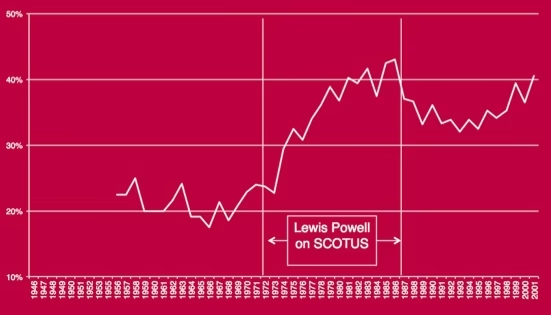 COATES
---
The large jump in the 1970s came shortly after Justice Lewis Powell joined the Supreme Court. Powell was well known as a proponent of corporate interests at a time when anticorporate sentiments began agglomerating—a confidential memo he wrote that went public the year before began serving indicates as much. “The time has come,” he wrote to the director of the Chamber of Commerce, “for the wisdom, ingenuity and resources of American business to be marshaled against those who would destroy it.” Suffice it to say Powell sided with the drug store in 1975, and many other businesses during his 15-year tenure.
(In order to make sure that the data wasn’t being warped by the fact that the Supreme Court is highly selective in the cases it takes on, Coates also examined data from appeals courts. He found that the number of cases citingCentral Hudson, a 1979 casethat formed an important basis for corporate speech, has increased each year since then. Coates's methodology is convincing, but the possibility does remain that what has increased in recent decades is not corporations' desire to appropriate the First Amendment, but regulators' likeliness to try to regulate, for instance, advertising language—in which case an escalated reliance on free-speech precedents could be read as a creative defense rather than a shrewd arrogation of power.)
Coates’s work is a reminder, in a decade when Citizens United is many Americans’ foremost association with corporate speech, not to forget what corporations have and haven’t been allowed to do since 1789.In 1819, Chief Justice John Marshall legally defined a corporation as “an artificial being, invisible, intangible, and existing only in the contemplation of law.” And in the hundreds of years since, corporate speech has been tightly regulated, as courts have restricted what companies can and cannot communicate in contracts, to employees, and to the public. In fact, some 150 years passed between the writing of the First Amendment and its first use to strike down a law in favor of an individual (a decision supporting corporate free speech came even later)—which is to say that corporations got along just fine without First Amendment rights before Justice Powell decided they were in need of help.
So if the Court says, as it did in its decisions in Citizens United and Hobby Lobby, that a company should be viewed as a collection of individuals, it seems to be overlooking centuries of precedents that suggest otherwise—that corporations’ speech is something to be controlled firmly. Given that, as Coates says, these pro-business First Amendment rulings encourage companies to “increasingly place bets not on new technologies and marketing strategies, but on legal and political ‘innovation,’” the courts’ stances are only that much more puzzling.
===
https://www.alternet.org/2020/12/corporate/
Americans are divided and polarized — but large majorities want to curb corporate influence in government
Sean McElwee Salon December 07, 2020
After the most turbulent election cycle in American history, Joe Biden defeated Donald Trump by a comfortable margin in both the Electoral College and popular vote. With political polarization at an all-time high, the question of how President-elect Biden plans
===
wow online gig economy co/corp:
https://www.upcounsel.com/corporate-personhood
corporate Personhood: Everything You Need to Know
Startup Law ResourcesIncorporate
Corporate personhood is for corporations to have some of the same rights as people, with the idea that a corporation has its own rights.9 min read
1. What is Corporate Personhood?
2. The Importance of Corporate Personhood
3. Arguments for Corporate Personhood
4. Arguments Against Corporate Personhood
5. The History of Corporate Personhood
7. Incorporate with Legal Help
What is Corporate Personhood?
Corporations have some of the same rights as people. This is known as corporate personhood. It is the idea that a corporation has its own rights. Corporate personhood has existed much longer than many people realize.
Corporate personhood is not just for large companies. As long as a business is incorporated, it can benefit from corporate personhood. Organizations that benefit from corporate personhood can include:
- Large businesses
- Small businesses
- Churches
- For-profit organizations
Because it bought land, the Catholic Church is one of the earliest examples of corporate personhood.
Many people are against the idea of corporate personhood. In their opinion, companies are not people and do not deserve the same rights as a regular person. However, this legal designation does not give a business the same rights as a natural person. Corporate personhood protects corporations from unfair treatment by the government. These protections are important for corporations to operate successfully.
People who are against corporate personhood claim that the legal concept ignores an important difference between businesses and people. The argument is that people are created by God and thus have God-given rights. Businesses are not, so opponents say they do not deserve the same status as a regular person.
Opponents also argue that unlimited corporate political spending gives corporations a stronger voice than regular people. It allows them to control elections, pressure candidates, and is a de-stabilizing influence on the country's political system.
Although corporations have certain rights, they are not considered full persons under the law.
The Importance of Corporate Personhood
Although its opponents may not realize it, corporate personhood is extremely important and serves as one of the main preventative measures against government overreach. Generally speaking, corporations are entitled to 1st, 4th, 5th, and 14th Amendment protections. While the main point of contention when it comes to personhood is the 1st Amendment rights granted by the Citizens United ruling, the more important protections are provided by the other amendments.
For example, the 14th Amendment provides equal protection under the law. This is important for corporations because it prevents state governments or other jurisdictions from passing legislation that unduly burdens a corporation while not affecting other citizens.
Equally as important to corporate personhood is the 4th Amendment, which grants protection from unreasonable searches and seizures. Without the protection of the 4th Amendment, corporations could be raided by the government and have their assets seized with no legal recourse. Fourth Amendment protections were extended to corporations in the Los Angeles v. Patel ruling, which involved police attempting to search a hotel guest registry.
Also, due to 5th Amendment protections granted to corporations, the government cannot strip them of earnings or profits thanks to the "taking" clause of this amendment. This right was granted to corporations in the ruling of Horne v. Department of Agriculture. In this case, the Department of Agriculture tried to force a small grape grower to set aside a percentage of crop yield to be redistributed by the government.
Prevention of unfair treatment by the government at any level is the most important reason for the existence of corporate personhood.
Arguments for Corporate Personhood
There are strong arguments in favor of personhood. Even if they are limited, corporations need some rights to exist. Without these rights, few businesses would succeed.
Some of the best arguments for personhood include:
- World Peace: This idea enables businesses in different countries to work together. When countries are tied together, arguments aren't as common. It also means that problems between countries are fixed much more quickly. Personhood leads to world peace.
- Competition: Personhood protects corporations from liability. This allows them to take risks and expand. Without this protection, it would be difficult for corporations to compete in the marketplace. Less competition hurts both consumers and corporations, which is why personhood is important.
- Global Stability: Personhood allows for multinational corporations. This means one company can operate in many different countries. The protections of personhood defend company owners from liability, which encourages them to expand internationally. Multinational corporations increase economic bonds between countries and leads to increased global stability.
- Legal Distinction: Personhood is a legal distinction. It is used for both corporations and people. This designation is a way to define bestow rights, outline legal entitities, and define liability. Because personhood is only used as a legal distinction, and not a value judgment, it does not put corporations on the same level as natural people.
- People Create Corporations: Regular people create and run corporations. Protecting corporations means protecting the people who created them. Personhood is important because it benefits the people who start and run businesses.
- It's in the Dictionary:The dictionary defines corporations as people in some cases.
- It's a Legal Definition:Personhood is a legal definition. It does not make businesses equal or more valuable than regular people. The only reason for personhood is to protect businesses. Personhood is not meant to harm people. Without personhood, a business could be unfairly harmed by laws or regulations.
- Personhood Protects People: A business is made up of its people. Personhood protects both a business and the people who work for it. If a business does something illegal, personhood makes sure the people who work for the business are not harmed. Personhood also makes it easier for a small business to compete with larger businesses. It evens the playing field for everyone involved in business.
- Taking Part in a Business: To work at a business, you have to give up some of your rights. However, giving up these rights often leads to big benefits in the future. If personhood did not exist, you would not be able to give up these rights and take part in a business. Personhood enables businesses and employees to work together to succeed. Personhood leads to opportunity.
Arguments Against Corporate Personhood
Many people disagree with personhood. They don't feel businesses should have the same rights as people. However, getting rid of personhood would be very difficult. It would also be harmful to businesses everywhere. People against personhood don't feel it's fair that a wealthy business has the same rights as its workers. They feel like personhood gives businesses more power than real people.
The best arguments against personhood are:
- Businesses Are Not Real:The main reason to not have personhood is that businesses do not exist in reality. A business mostly exists on paper. Giving a business the same rights as people doesn't make sense because they are not people in any real way.
- Lack of Morality:Those against corporate personhood argue that corporations cannot be people because they lack morality. Morality is key to the social compact, and without morality a corporation cannot fully join the social compact. Since a corporation does not have morality, and is only motivated by profit, it does not deserve the rights of a real person.
- Only People Deserve Rights: A business needs some rights to be able to succeed. However, it does not deserve the same rights as a real person. If a business is given personhood, it means it has more power than a real person. Many people believe this is unfair because a business cannot be harmed in the same way a person can. Rights belong to people, not businesses.
- Personhood is for Citizens: A business cannot be a citizen of a country. In fact, most businesses work in many countries. If a business can't be a citizen, then it does not deserve personhood. Rights are supposed to protect a citizen of a country. Citizens can vote. Businesses are not allowed to vote. This means they are not citizens and do not deserve rights.
- Businesses Are Not Alive: A big part of personhood is feelings. Businesses have no feelings because they are not people. A business can't live. It can't die. Businesses do not feel love, get married, or have children. If a business is not alive, then it is not a person and does not deserve personhood.
- Businesses Only Want to Make Money:Real people know the difference between right and wrong. They understand why it's wrong to hurt another person. Businesses are not people, so they don't know the difference between right and wrong. The only thing a business cares about is making money. This can end up hurting regular people. Not knowing right from wrong means that a business should not be given personhood.
The History of Corporate Personhood
Before the Constitution, the United States was governed by British Common Law (BCL). BCL defined corporations as "artificial persons." Artificial personhood allowed corporations to:
- Pay taxes
- Pay employees
- Sign contracts
- Sue and be sued
- Collect dues
Being an artificial person meant that corporations did not have legal rights. They only had privileges that could be taken at any time.
The history of corporate personhood starts with the Constitution. Important events that led to full corporate personhood include:
- 1791: The First Amendment is ratified.
- 1819: In Dartmouth v. Woodward, Chief Justice John Marshall states that corporations do not deserve Constitutional protections.
- 1870s–1890s: The Pendleton Act limits public spending on political campaigns. William McKinley decides to seek corporate donations in 1896 and 1900.
- 1886: In the Santa Clara v. Southern Pacific Railroad Co. decision, corporations are given limited 14th Amendment Rights.
- 1897: Corporations are given full 14th Amendment rights. They also receive some 5th Amendment protections.
- 1905: Lochner v. New York strikes down a law that attempted to limit worker hours. This ruling stood for 30 years.
- 1906: The Hale v. Henkel case gives 4th Amendment Rights to corporations. 5th Amendment rights are still limited.
- 1907: The Tillman Act prevents direct political donations from corporations. The Act includes labor unions in 1947.
- 1937: The Lochner decision is overturned, and many regulations are passed that limit corporate power in favor of worker's' rights.
Corporate personhood stalled over the next 30 years. The modern push for corporate rights started in 1971:
- 1971: The Federal Election Campaign Act (FECA) strengthens campaign finance laws.
- 1974: After the Watergate scandal, FECA is improved. It now includes limits on campaign spending and donations. The Federal Election Commission (FEC) is founded.
- 1976: Buckley v. Valeo decides that political advertising is free speech. Direct contributions are still illegal. Virgina Board of Pharmacy v. Virginia Citizens Consumer Council gives 1st Amendment rights to some commercial speech.
- 1978: Bellotti v. First National Bank of Boston removes a ban on for-profit corporations spending money for political referendums. Surprise OSHA inspections are ruled to violate the 4th Amendment.
- 1980s: The Central Gas & Electric Corp. v. Public Service Commission decision establishes the four-part corporate speech test. A portion of FECA is struck down. Corporate spending on nonprofit organizations is now unlimited.
- 1986: Pacific Gas & Electric Co. v. Public Utility Commission of California gives corporations the right to "negative speech."
- 1990: Austin v. Michigan Chamber of Commerce upholds a spending ban. Non-media companies still can't spend on political campaigns.
- 2002: The Bipartisan Campaign Finance Reform Act (BCRA) is signed. Also known as McCain-Feingold, the BCRA puts limits on "soft money."
- 2003: The Austin decision is upheld, and a challenge to the BCRA is rejected.
- 2007: Federal Election Commission v. Wisconsin Right to Life strikes down a portion of the BCRA's restrictions on political advertising. Ads that mention candidates without advocating for or against them in the period leading up to elections are now legal.
- 2008: Davis vs. Federal Election Commission further weakens the BCRA. Individual campaign contributions may now be higher. Citizens United is prevented from showing a political ad. It decides to sue the FEC.
- 2009-2010: The Supreme Court hears arguments in Citizens United v. Federal Election Commission. The Court rules in favor of Citizens United. Limits on corporate political spending are now unconstitutional. Speechnow.org v. Federal Election Commission allows unlimited contributions to independent expenditure PACs.
- 2011: Sorrell v. IMS Health, Inc. strikes down a ban on doctord' prescribing habits being used for marketing. Arizona Free Enterprise Club v. Bennett removes a state-level public financing system. The system is found to be unfair to non-participatory candidates.
Two recent cases are important to corporate personhood. In Sebelius v. Hobby Lobby Stores, corporations are given freedom of religion under the 1st Amendment. In McCutcheon v. Federal Election Commission, limits on individual aggregate contributions were struck down.
Frequently Asked Questions
- What would happen if corporate personhood was revoked?
Corporations would go back to being artificial persons if corporate personhood was revoked. Their rights would return to being privileges. There would be nothing to stop state governments from treating corporations unfairly. Competition would likely be reduced as well. Corporations would not be protected by the 1st, 4th, 5th, or 14th Amendment. A company's ability to compete might also be harmed.
- Would small businesses be affected by a repeal of corporate personhood?
Yes. Small businesses can also be corporations. If a business is incorporated, it has corporate personhood rights. Without these protections, small business would suffer a great deal of harm. It would be hard for them to compete with larger companies. They would also be greatly affected by laws against corporations.
- Could corporate personhood be limited instead of repealed?
Yes. As we have seen, there are good reasons for limited forms of corporate personhood. It could be restricted in meaningful ways. For example, you could still protect businesses from government overreach without allowing them to donate unlimited amounts of money for political reasons. However, both restricting and repealing corporate personhood would require amending the Constitution, which is extremely difficult.
- Do unions have corporate personhood?
No. Unions are still considered artificial persons. Unions never advocated for corporate personhood, so they were never granted this status. It's possible unions will gain corporate personhood in the future.
Incorporate with Legal Help
Corporate personhood is one of the most complex political and legal issues there is, and it's likely to get more complex as corporations are granted additional rights. As corporate rights are expanded, incorporating your business becomes an increasingly useful tool. If you're interested in incorporating your business and taking full advantage of corporate personhood, you can find a knowledgeable attorney by searching the UpCounsel marketplace.
Many of the attorneys you'll find on UpCounsel haveexperience in the corporate world and will fully understand the rights granted by corporate personhood and the requirements to incorporate your business. Learn more about UpCounsel's superior pricing. Be sure to register so you can post your legal need today.
jayapal
am promise 12/20
- 21 states, most recently Alaska, have formally called for ratifying an amendment to the U.S. Constitution.
- Over 75% of Americans from across the political spectrum agree that we must limit political spending in our elections.
---
2016
Torres-Spelliscy’s Corporate Citizen?An Argument for the Separation of Corporation and State, analyzes the trail of legal cases that led to the 2010 Supreme Court decision in :{*Citizens United*}:, as corporations won rights originally reserved for citizens. Not only are they winning the rights of real persons, but they are avoiding the responsibilities of citizenship… like paying taxes.
Before reading the book, I vaguely knew one of the first key decisions stemmed from the Fourteenth Amendment to the U.S. Constitution, which says,
[n]o state shall… deprive any person of life, liberty or property without due process of law, not deny to any person… the equal protection of the laws.
Known as the :{Equal Protection Clause:(style="margin:0px;padding:0px;border:0px;outline:0px;vertical-align:baseline;background:0px 0px;font-weight:700"):}:, the amendment was meant to secure the rights emancipated slaves. However, Roscoe Conkling argued, based on his role as a congressman in framing the Fourteenth Amendment, that Congress had vacillated between the words “citizen” and “person,” choosing person specifically to include corporations.
This important distinction didn’t appear in the actual opinion rendered in Santa Clara County v. Southern Pacific Rail Road, as I had always assumed, but instead in a head-note about an argument the Court did not wish to hear.
Conkling’s legal practice went so well he turned down two offers of a seat on the Supreme Court. :{*Santa Clara*:(style="margin:0px;padding:0px;border:0px;outline:0px;vertical-align:baseline;background:0px 0px;font-weight:700"):}: begat :{*Bellotti*}: in 1978, allowing corporations to spend unlimited corporate funds on ballot initiatives, which begat Citizens United in 2010 granting even more expansive rights to corporations.
On the flip-side, Torres-Spelliscy traces how the :{Comity Clause:(style="margin:0px;padding:0px;border:0px;outline:0px;vertical-align:baseline;background:0px 0px;font-weight:700"):}: has evolved to affirm that corporations are not citizens. That distinction may be the lever for a future Court revisiting and overturning Citizens United and Bellotti.
Torres-Spelliscy does an excellent job of tracing the impact of money on politics. Following huge political scandals there is often a push to drive money out through legal statutes, but between those events is a steady drip of corporate challenges through case law winning more and more rights for corporations until we now face a situation where the political has, for all practical purposes, become subordinate to the economic.
We have now reached the point where 158 families, along with the corporations they own or control, contributed $176 million to the first phase of the 2016 Campaign. Yes, reading the book will help you realize it is worse than you thought. [I got my own deep appreciation of corporate power when I found myself writing hundreds of environmental laws in California with the able assistance of corporate lobbyists. That’s when I started this blog.]
:{*Hobby Lobby*:(style="margin:0px;padding:0px;border:0px;outline:0px;vertical-align:baseline;background:0px 0px;font-weight:700"):}: turned religious rights on it head and appears as the current pinnacle of placing corporate rights above those of people but Torres-Spelliscy also delves into the evolution of reduced responsibilities, such as paying taxes.
“Taxes are what we pay for a civilized society,” as Justice Holmes wrote. Its no wonder some of us feel our country is slipping into barbarism. The book goes on to discuss how up to $240 billion a year is lost to tax coffers, as money is moved internationally.
Torres-Spelliscy: Recommendations
Thankfully, Torres-Spelliscy not only takes us down the path of incremental legal interpretations that have led to our current nightmare, she also discusses new forms of resistance. Boycotts, phone applications, consumer groups, benefit corporations, and more – all offer some promise.
Torres-Spelliscy makes a large number of recommendations. Here are just a few:
- Regulations: The IRS, the Federal Elections Commission, the Federal Communications Commission the SEC and others could address aspects of dark-money problem, including barring foreign corporations (which needs defined) from spending in U.S. elections.
- Shareholders: Demand corporate transparency about political spending.
- Consumers: Use phone apps to check on their political activities before patronizing corporations.
- Action by voters: Publicly funded election laws and/or severe restrictions on contributions could broaden who officials are accountable to.
What I found most helpful from Torres-Spelliscy was her insight concerning the need for the Supreme Court to look again the its own jurisprudence on the Comity Clause to “bring back a sense of proportion to corporate rights.” After reading the book, I’m convinced one liberal appointment to the Supreme Court could make all the difference with respect to Citizens United and Hobby Lobby. That won’t make real citizens the center American democracy but it would certainly be a start.
My Extra Two Cents
As far as I’m concerned, Torres-Spelliscy is spot on with the following sentence:
A key aspect of why empowering corporations in politics is so problematic is that corporations are not as internally democratic as the democratic political systems they inhabit.
Yes, changes in laws are necessary to incentivize corporations to create less severe negative externalities. However, I would argue internal corporate governance should not be a democratic-free zone.
If there is one weakness in the book, and no book can cover everything, it is too little emphasis on building more democratic governance from the inside of corporations with their own bylaws that cover issues such as majority vote requirements, annual elections for all directors, genuine proxy access, etc.
Democracy shouldn’t just be for government. Other institutions form and shape our citizens. Business has become by far the most powerful institution but the family, church, school, neighborhood, environmental groups and even :{bowling leagues:(style="margin:0px;padding:0px;border:0px;outline:0px;vertical-align:baseline;background:0px 0px;font-weight:700"):}: offer mediating structures between the individual and society. The more we make such structures democratic, the more we empower rule by actual common people.
About Ciara Torres-Spelliscy
Ciara Torres-Spelliscy is a Brennan Center Fellow and an Associate Professor of Law at Stetson University College of Law. She is the author of the book, Corporate Citizen? An Argument for the Separation of Corporation and State (Carolina Academic Press 2016) and of Safeguarding Markets from Pernicious Pay to Play: A Model Explaining Why the SEC Regulates Money in Politics. Prior to joining Stetson’s faculty, she was Counsel in the Democracy Program of the Brennan Center for Justice at NYU School of Law. She was an associate at Arnold & Porter LLP and a staffer for Senator Richard Durbin. Professor Torres-Spelliscy has testified before Congress, and has helped draft legislation and Supreme Court briefs. As well as publishing in the Montana Law Review, University of San Francisco Law Review and the NYU Journal of Legislation and Public Policy, and chapters in books, she has been published in the New York Times, New York Law Journal, Boston Review, Business Week, Forbes, The Atlantic, USA Today, The Hill, Huffington Post, Judicature, Salon, and CNN.com. :{More}:.
Follow Ciara Torres-Spelliscy on Twitter @ProfCiara
===
https://conservancy.umn.edu/bitstream/handle/11299/183130/3%20-%20Coates.pdf?sequence=1&isAllowed=y
CORPORATE SPEECH & THE FIRST
AMENDMENT: HISTORY, DATA, AND
IMPLICATIONS
John C. Coates IV∗
11/20 Brian will sum
===
John: The Case Against Corporate Constitutional Rights three-part series is at
https://www.movetoamend.org/corporate-constitutional-rights
Researching Corporate Rule / Corporate Constitutional Rights - An introduction to our work
THE CASE AGAINST CORPORATE CONSTITUTIONAL RIGHTS: How Corporate Constitutional Rights Harm You, Your Family, Your Community, Your Environment, and Your Democracy
:{:{}:
}:
THE CASE AGAINST CORPORATE CONSTITUTIONAL RIGHTS
How Corporate Constitutional Rights Harm You, Your Family, Your Community, Your Environment, and Your Democracy
Part III: How Corporate Rule Fueled the Climate Crisis
Corporate Constitutional Rights and Global Warming—Corporate Climate Coverup
This is Part 3 in a series by the Law and Research Committee of Move to Amend to demonstrate the harm caused by corporate constitutional rights (CCRs).
The prior parts may be accessed at https://www.movetoamend.org/corporate-constitutional-rights
The purpose of this paper is not to recount the lies and misrepresentations by oil corporations concerning climate change or to review the numerous cases filed against oil corporations for damages alleged and nefarious conduct related to their climate change coverup. Instead it illustrates how the oil corporations have used CCRs to defend against efforts to prevent climate-damaging activities. [1]
Global Warming and Climate Change have harmed and will continue to harm the planet and us
The science is clear: global warming is real, mostly caused by human activity, and is having a devastating impact on the climate, the environment and us which will only continue and worsen. We are at a tipping point. Absent immediate and sustained emergency action, our near future will see irreversible harm including rising and warming seas, destruction of coastal cities, massive storms, soil degradation, food shortages, heat waves, water shortages, system failures, and mass extinction of species. (See Appendix.) Some of these harms have already occurred. Without concerted remediation they will only increase, ultimately rendering our plant uninhabitable for many species, including humans.
A History of Corporate Deceit about Climate Change
Since the late 1970’s oil producing corporations and their industry trade group the American Petroleum Institute knew of the science of global warming and knew of its potential “catastrophic consequences.” Their response? Spending millions to confuse and misinform the public. [2] Oil corporations no longer dispute the validity of climate science. Nor do the court decisions, even when they dismiss cases against oil corporations for climate misinformation and/or damages. [3]
Oil Corporations Invoke Numerous CCRs to Defend Against Their Climate Coverup and/or Resulting Damages
To date oil corporations have used one or more of the following CCRs as defenses in numerous lawsuits based on their climate cover up:
First Amendment, Fourth Amendment (overbroad subpoena), Fifth Amendment (takings clause), Fourteenth Amendment, Commerce Clause, Equal Protection Clause, and Contracts (“Impairments”) Clause. [4]
Oil Company Wins Lawsuit to Allow Fracking Based on CCRs Despite Ordinance Prohibiting It:
SWEPI, LP v. Mora County, 81 F.Supp.3D 1075 (D.N.M. 2015) SWEPI, Limited Partnership [5], entered into an oil-and-gas lease with the State of New Mexico in 2010. In 2013 the Mora County (New Mexico) Board of Commissioners adopted an Ordinance titled “Mora County Community Water Rights and Local Self-Government Ordinance” (Ordinance).
In relevant part the Ordinance sought to protect the land, water, and rights of Mora County and its residents by prohibiting corporations from extracting water for use in the extraction of fossil fuels, depositing waste water, and maintaining infrastructure related to fossil fuel extraction. In other words, the Ordinance tried to ban hydraulic fracturing (“fracking”).
If corporations violated the Ordinance, it denied them the rights of persons afforded under the New Mexico and U.S. Constitutions. Further, the Ordinance refused to recognize the validity of a permit issued by any federal or state agency if it interfered with these rights. Preemption by state or federal law was recognized only if those laws expressly preempted County ordinances and charters, and provided greater protection for the health, safety, and welfare of Mora County’s people than County ordinances. Violation of the Ordinance was a crime. SWEPI filed a complaint in 2014 seeking an injunction against the Ordinance.
In 2015 the federal District Court ruled, in relevant part, that the Ordinance violated the Supremacy Clause and First Amendment rights of SWEPI, and invalidated the entire Ordinance.The Court reasoned that, because the Supreme Court had established (actually, invented) the doctrine that corporations are persons under the Equal Protection Clause of the 14th Amendment they are entitled to its protections, including under the First and Fifth Amendments.The Ordinance violated the Supremacy Clause because federal law supersedes a local ordinance and such an ordinance cannot nullify a constitutional right. The Ordinance violated the First Amendment because it was overbroad in that it absolutely prohibited all of SWEPI’s First Amendment rights.
In a Pennsylvania case, the Court invalidated a similar ordinance but also found the arguments supporting it to be “frivolous” and ordered two attorneys for the environmental group representing the township to pay an energy limited liability company $52,000 in legal fees! [6]
Conclusion
This SWEPI case demonstrates three principles. First, corporations have used their invented constitutional rights to continue the same activities that have caused global warming. Unless the Supreme Court has a change of heart (unlikely) or the People pass a constitutional 2 amendment eliminating CCRs, corporations will also attempt to evade liability for their decades-old climate cover up as evidenced by the cases cited in endnote 4.
Second, this case illustrates that CCRs allow unelected judges and justices to effectively override the authority of elected officials to carry out their duty to use the police power to protect the health, safety, and welfare of their residents. [7]
Third, local communities that lose control over their land can suffer very real harm. CCRs unjustly allow corporations to override the ability of local governments to care for the people of their communities. Mora County’s Ordinance challenged the CCR doctrine, a legal fiction that threatened to contaminate the local community with highly toxic fracking wastewater. Some would say that the court made the correct decision because its ruling followed precedent.
In response, all CCR cases rest upon a so-called foundation unsupported by history, legal authority, or logic. [8] Further, as SWEPI illustrates, the CCR doctrine, by elevating the profit-making interests of corporations over the health and safety of natural persons, protects property at the expense of the actual human beings who created the corporations . This is inherently unjust and “in the face of injustice, all people have the right and moral duty to peacefully protest unjust laws.” [9] The solution to CCRs is Move to Amend’s We The People Amendment, HJR 48: https://www.movetoamend.org/amendment
End Notes
[1] According to the 2017 Carbon Majors Report, p.8, “The distribution of emissions is concentrated: 25 corporate and state producing entities account for 51% of global industrial GHG emissions. All 100 producers account for 71% of global industrial emissions.” https://b8f65cb373b1b7b15feb-c70d8ead6ced550b4d987d7c03fcdd1d.ssl.cf3.rackcdn.com/cm s/reports/documents/000/002/327/original/Carbon-Majors-Report-2017.pdf?1499691240
2] Exhibit A to The County of San Mateo v. Chevron Corp., et al, Superior Court of the State of California, County of San Mateo, Case No. 17CIV03222;
“Exxon, The Road Not Taken,” nine articles between September and December, 2015, Inside Climate News (ICN) by Neela Banerjee, Lisa Song and David Hasemyer; “Fossil Fuels on Trial: Where the Major Climate Change Lawsuits Stand Today,” by David Hasemyer, ICN, updated 1/17/2020; https://www.huffpost.com/entry/philippines-commission-on-human-rights-fossil-fuelcompanie s-liable-climate-change_n_5df1698de4b01e0f29597ad8?ncid=tweetlnkushpmg00000067
[3] See, e.g., Judge Alsup's ruling in Oakand v. BP, et al, U.S. District Court (Northern CA), Case No. 3:17-CV-0612-WHA, at p.15: “In sum, this order accepts the science behind climate change. So do both sides.” https://www.eenews.net/assets/2018/06/26/document_cw_02.pdf 3
[4] http://climatecasechart.chom/us-climate-change-litigation/?cn-reloaded=1 404?
[5] For our purposes, a limited partnership is one in which the limited partner’s liability is limited to his/her investment, as in a corporation. According to the Ordinance, “corporations” included limited partnerships.
[6] https://stateimpact.npr.org/pennsylvania/2018/01/12/judge-fines-environmental-attorneys-52 000-for-frivolous-injection-well-suit/ ; https://www.documentcloud.org/documents/4349265-Sanctions-Decision-Grant.html
[7] The Supreme Court has defined the“police power” as being coextensive with inherent state sovereignty, Nebbia v. New York, 291 U.S. 502, 524 (1934). States often use the police power to legislate protections for public health, safety, and morality.) [8] In dissent, several notable Supreme Court Justices have forcefully argued against CCRs. “There was no history, logic, or reason given to support that view. Nor was the result so obvious that exposition was unnecessary." Wheeling Steel Corp. v. Glander, 337 U.S. 562 (1949)(J. Douglas, dissent. opin.). Justice Black made similar arguments to Justice Douglas in an earlier dissent: "I do not believe the word 'person' in the Fourteenth Amendment includes corporations.” Connecticut General Life Insurance Company v. Johnson, 303 U.S. 77 (1938). Justice (later Chief Justice) Rehnquist shared this view. First Nat’l Bank of Boston v. Bellotti, 435 U.S. 765 (1978) at pp. 822, 825-826,828.
[9] https://www.tennessean.com/story/opinion/2020/03/10/civil-disobedience-takes-place-wheninjustice-trumps-citizens-rights/5004070002/
Appendix on Global Warming and Climate Change Definitions: “The term climate change is sometimes used interchangeably with the term global warming. However, the terms do not refer entirely to the same thing. Global warming refers to the recent and ongoing rise in global average temperature near Earth's surface. It is caused mostly by increasing concentrations of greenhouse gases in the atmosphere. Global warming is causing climate patterns to change. However, global warming itself represents only one aspect of climate change. Climate change refers to any significant change in the measures of climate lasting for an extended period of time. In other words, climate change includes major changes in temperature, precipitation, or wind patterns, among others, that occur over several decades or longer. Climate change can occur at the global, continental, regional, and local levels. Climate change may refer to natural changes in climate, or changes caused by human activities.” https://19january2017snapshot.epa.gov/climate-change-science/overview-climate-change-scie nce_.html Evidence of Global Warming and Climate Change (from https://climate.nasa.gov/evidence/ ) 4 Global Temperature Rise The planet's average surface temperature has risen about 1.62 degrees Fahrenheit (0.9 degrees Celsius) since the late 19th century, a change driven largely by increased carbon dioxide and other human-made emissions into the atmosphere.4 Most of the warming occurred in the past 35 years, with the six warmest years on record taking place since 2014. Not only was 2016 the warmest year on record, but eight of the 12 months that make up the year — from January through September, with the exception of June — were the warmest on record for those respective months. Warming Oceans The oceans have absorbed much of this increased heat, with the top 700 meters (about 2,300 feet) of ocean showing warming of more than 0.4 degrees Fahrenheit since 1969. Shrinking Ice Sheets The Greenland and Antarctic ice sheets have decreased in mass.
Data from NASA's Gravity Recovery and Climate Experiment show Greenland lost an average of 286 billion tons of ice per year between 1993 and 2016, while Antarctica lost about 127 billion tons of ice per year during the same time period. The rate of Antarctica ice mass loss has tripled in the last decade. Glacial Retreat Glaciers are retreating almost everywhere around the world — including in the Alps, Himalayas, Andes, Rockies, Alaska and Africa. Decreased Snow Cover Satellite observations reveal that the amount of spring snow cover in the Northern Hemisphere has decreased over the past five decades and that the snow is melting earlier. Sea Level Rise Global sea level rose about 8 inches in the last century. The rate in the last two decades, however, is nearly double that of the last century and is accelerating slightly every year. Declining Arctic Sea Ice Both the extent and thickness of Arctic sea ice has declined rapidly over the last several decades.11 Extreme Events The number of record high temperature events in the United States has been increasing, while the number of record low temperature events has been decreasing, since 1950. The U.S. has also witnessed increasing numbers of intense rainfall events.
Ocean Acidification Since the beginning of the Industrial Revolution, the acidity of surface ocean waters has increased by about 30 percent. This increase is the result of humans emitting more carbon dioxide into the atmosphere and hence more being absorbed into the oceans. The amount of 5 carbon dioxide absorbed by the upper layer of the oceans is increasing by about 2 billion tons per year. The Role of Human Activity In its Fifth Assessment Report, the Intergovernmental Panel on Climate Change, a group of 1,300 independent scientific experts from countries all over the world under the auspices of the United Nations, concluded there's a more than 95 percent probability that human activities over the past 50 years have warmed our planet. The industrial activities that our modern civilization depends upon have raised atmospheric carbon dioxide levels from 280 parts per million to 412 parts per million in the last 150 years. The panel also concluded there's a better than 95 percent probability that human-produced greenhouse gases such as carbon dioxide, methane and nitrous oxide have caused much of the observed increase in Earth's temperatures over the past 50 years. The panel's full Summary for Policymakers report is online at https://www.ipcc.ch/site/assets/uploads/2018/02/ipcc_wg3_ar5_summary-for-policymake rs.pdf. Future Effects (from https://climate.nasa.gov/effects/ ) “Some of the long-term effects of global climate change in the United States are as follows, according to the Third and Fourth National Climate Assessment Reports: Change Will Continue Through This Century and Beyond Global climate is projected to continue to change over this century and beyond. The magnitude of climate change beyond the next few decades depends primarily on the amount of heat-trapping gases emitted globally, and how sensitive the Earth’s climate is to those emissions. Temperatures Will Continue to Rise Because human-induced warming is superimposed on a naturally varying climate, the temperature rise has not been, and will not be, uniform or smooth across the country or over time. Frost-free Season (and Growing Season) will Lengthen The length of the frost-free season (and the corresponding growing season) has been increasing nationally since the 1980s, with the largest increases occurring in the western United States, affecting ecosystems and agriculture. Across the United States, the growing season is projected to continue to lengthen. In a future in which heat-trapping gas emissions continue to grow, increases of a month or more in the lengths of the frost-free and growing seasons are projected across most of the U.S. by the end of the century, with slightly smaller increases in the northern Great Plains. The largest increases in the frost-free season (more than eight weeks) are projected for the western U.S., particularly in high elevation and coastal areas. The increases will be considerably smaller if heat-trapping gas emissions are reduced. Changes in Precipitation Patterns 6 Average U.S. precipitation has increased since 1900, but some areas have had increases greater than the national average, and some areas have had decreases. More winter and spring precipitation is projected for the northern United States, and less for the Southwest, over this century. Projections of future climate over the U.S. suggest that the recent trend towards increased heavy precipitation events will continue. This trend is projected to occur even in regions where total precipitation is expected to decrease, such as the Southwest. More Droughts and Heat Waves Droughts in the Southwest and heat waves (periods of abnormally hot weather lasting days to weeks) everywhere are projected to become more intense, and cold waves less intense everywhere. Summer temperatures are projected to continue rising, and a reduction of soil moisture, which exacerbates heat waves, is projected for much of the western and central U.S. in summer. By the end of this century, what have been once-in-20-year extreme heat days (one-day events) are projected to occur every two or three years over most of the nation. Hurricanes Will Become Stronger and More Intense The intensity, frequency and duration of North Atlantic hurricanes, as well as the frequency of the strongest (Category 4 and 5) hurricanes, have all increased since the early 1980s. The relative contributions of human and natural causes to these increases are still uncertain. Hurricane-associated storm intensity and rainfall rates are projected to increase as the climate continues to warm. Sea Level Will Rise 1-4 feet by 2100 Global sea level has risen by about 8 inches since reliable record keeping began in 1880. It is projected to rise another 1 to 4 feet by 2100. This is the result of added water from melting land ice and the expansion of seawater as it warms. In the next several decades, storm surges and high tides could combine with sea level rise and land subsidence to further increase flooding in many regions. Sea level rise will continue past 2100 because the oceans take a very long time to respond to warmer conditions at the Earth’s surface. Ocean waters will therefore continue to warm and sea level will continue to rise for many centuries at rates equal to or higher than those of the current century. Arctic Likely to Become Ice-Free The Arctic Ocean is expected to become essentially ice free in summer before mid-century. U.S. Regional Effects Below are some of the impacts that are currently visible throughout the U.S. and will continue to affect these regions, according to the Third and Fourth National Climate Assessment Reports, released by the U.S. Global Change Research Program: Northeast. Heat waves, heavy downpours and sea level rise pose growing challenges to many aspects of life in the Northeast. Infrastructure, agriculture, fisheries and ecosystems will be 7 increasingly compromised. Many states and cities are beginning to incorporate climate change into their planning. Northwest. Changes in the timing of streamflow reduce water supplies for competing demands. Sea level rise, erosion, inundation, risks to infrastructure and increasing ocean acidity pose major threats. Increasing wildfire, insect outbreaks and tree diseases are causing widespread tree die-off. Southeast. Sea level rise poses widespread and continuing threats to the region’s economy and environment. Extreme heat will affect health, energy, agriculture and more. Decreased water availability will have economic and environmental impacts. Midwest. Extreme heat, heavy downpours and flooding will affect infrastructure, health, agriculture, forestry, transportation, air and water quality, and more. Climate change will also exacerbate a range of risks to the Great Lakes. Southwest. Increased heat, drought and insect outbreaks, all linked to climate change, have increased wildfires. Declining water supplies, reduced agricultural yields, health impacts in cities due to heat, and flooding and erosion in coastal areas are additional concerns.” 7/15/20 8
Corporate "Hijack" series
[Corporate Hijacking of the 1st Amendment - [political “free speech”]](https://d3n8a8pro7vhmx.cloudfront.net/movetoamend/pages/752/attachments/original/1585063316/Corporate_Hijacking_of_the_1st_Amendment_-_political_speech_.pdf?1585063316)
[Corporate Hijacking of the 1st Amendment - [excluding political free speech]](https://d3n8a8pro7vhmx.cloudfront.net/movetoamend/pages/752/attachments/original/1591974224/Corporate_Hijacking_of_the_1st_Amendment_-_excluding_political_speech_.pdf?1591974224)
:{Corporate Hijacking of the 4th Amendment:(style="box-sizing:border-box"):}:
:{Corporate Hijacking of the 5th Amendment:(style="box-sizing:border-box"):}:
:{Corporate Hijacking of the 14th Amendment:(style="box-sizing:border-box"):}:
:{Corporate Hijacking of the Contracts Clause:(style="box-sizing:border-box"):}:
:{Corporate Hijacking of the Commerce Clause:(style="box-sizing:border-box"):}:
The We the People Amendment: The Constitutional Amendment to Counter Political Corruption and the Corporate Hijacking of the Constitution - "white paper" provided to elected officials and organizational leaders when asking for co-sponsorship or endorsement
Myths of Harmful Unintended Consequences of Abolishing Corporate Personhood
We the People Amendment comparison series
Corporate Rule Transcends Citizens United - report published to mark the 10th Anniversary of Citizens United Supreme Court decision -- containing many of the above pieces
VIDEO:
Corporate Constitutional Rights are Cancerous to Democracy (July 27, 2020 Common Dreams article by Judy Young and Kaitlin Sopoci-Belknap)
===
***
:{:{:{}:
ref jeff clements and coates
Why is the attorney general of Massachusetts, Maura Healey, being forced to justify to a Texas judge why and how she is doing her job?
In the latest instance of the corporate takeover of the First Amendment — and other constitutional rights —Exxon Mobil, the world’s largest oil and gas corporation, has invented a constitutional right to obstruct state investigations into allegations of fraud.
Investigations by the Massachusetts and New York attorneys general began late last year after the Los Angeles Times reported that Exxon scientists and executives have known for decades about the connection between fossil fuel consumption and the likelihood of catastrophic changes in the Earth’s atmosphere and climate.
The report alleged that as early as the 1980s, Exxon scientists were warning the company in internal communications that global climate change could "indeed be catastrophic (at least for a substantial fraction of the earth's population)." According to the journalists’ report, Exxon’s internal teams used that information for purposes of assessing the potential for profitable investment in new oil exploration and production. Yet these were the same climate models that Exxon “dismissed as unreliable and based on uncertain science” in statements to investors, consumers, and the general public.
A parallel with investigations of Big Tobacco
The attorneys general embarked on investigations on behalf of their citizens, asking whether Exxon was guilty of selling products and equity while concealing information about their risks.
The similarity of these allegations to the illegal conspiracy of the tobacco industry — a cover-up of internal corporate knowledge about deadly consequences of continued consumption of its products — did not escape notice. In January 2016, the Department of Justice asked the FBI to investigate whether Exxon should be prosecuted under the federal Racketeer Influenced and Corrupt Organizations Act, as the tobacco industry was. The investigations by the Massachusetts and New York attorneys general, focusing on whether Exxon had been forthright in its disclosures to investors, soon followed.
Given identified sources and specific studies cited in news reports, it is not surprising that chief law enforcement officers of federal and state governments would investigate. Indeed, it would be extremely troubling if they did not.
But rather than show that the allegations of investor and consumer fraud are baseless, Exxon Mobil is misusing the Constitution to continue to conceal what it knew about the connection between catastrophic climate change and continued fossil fuel use, and when.
It is not uncommon, of course, for companies to resist subpoenas from attorneys general on a variety of legal grounds. For example, Exxon could have filed a motion in Massachusetts asking a judge to set aside the subpoena on the grounds that it was overly broad, and arguing that the investigation exceeded the jurisdiction of the attorney general. (In fact, Exxon did just that, and lost.)
Until fairly recently, no US court would have entertained free speech claims by a corporation that wanted to strike down regulation
But Exxon has gone much further. It has filed a federal “civil rights” lawsuit in its home court of Texas against the New York and Massachusetts attorneys general. The multibillion-dollar global corporation claims that the state investigations violate a previously unrecognized corporate right under the Constitution both to “speak” and to “not speak” about climate change any way it wants, however deceptive that speech may be.
This is where the Supreme Court’s decision in Citizens United v. Federal Election Commission is taking the country. That 2010 ruling is infamous for opening the floodgates of big, dark money in our elections by deciding that any limits on supposedly “independent” political ads violate the speech rights of corporations, unions, and billionaires. What is less well-known about Citizens Unitedis how radically it empowers corporations to misuse the First Amendment in other ways — ways we now see playing out in the Exxon case, and elsewhere.
Citizens United was the capstone on a remarkable series of cases, dating only to the 1970s, that revolutionized the application of the First Amendment in the corporate context. Very few people realize just how quickly this constitutional revolution has occurred; very few people realize that American corporations thrived for the first two centuries of American history with virtually no First Amendment protections.
In the early 20th century, First Amendment cases involving firms tended to involve media companies, as when Louisiana Gov. Huey Long imposed special taxes on newspapers (a clear attempt to punish them). It was generally assumed that the “speech” of business corporations was no more free from court scrutiny than the language of their contracts or their SEC filings.
That finding was then broadened and expanded in National Bank of Boston v. Bellotti(1978), which held that corporations can contribute to ballot initiatives, and again in Central Hudson Gas & Electric Corp. v. Public Service Commission(1980), which asserted that a utility could run advertisements promoting the use of electricity.
Those two cases continue to be cited in almost all commercial speech cases — and they are cited more and more frequently. Citizens United affirmed those cases and extended them to campaign finance laws. After his appointment to the high court in 1971, however, Justice Lewis F. Powell Jr., a former business lawyer who ardently believed that corporate America was being undermined by the public’s support for reformers like Ralph Nader, helped reinvent the Court’s doctrine in this area. In Virginia State Pharmacy Board v. Virginia Citizens Consumer Council (1976), the Court said, on First Amendment grounds, that the state could not forbid pharmacists from advertising prescription drug price — a remarkable departure from precedent.[why wd they want to?]
Despite the “free speech” rhetoric, corporations are not simply seeking to offer opinions about public policy issues. They do that all the time, routinely spending millions to fund ads, research, policy papers, and lobbying activities.
Today corporations are claiming that their “rights” to speak clash with longstanding forms of regulation of business activity. Whenever they are required to disclose information to consumers, regulators, the public, or enforcement officials, they argue, their First Amendment rights are implicated. Whenever they seek or transmit information, they say, they are “speaking,” and the First Amendment gives them the right to do that without fear of consequences.
A growing number of constitutional challenges to reasonable regulations
In recent years, large corporations have been emboldened to argue that corporate speech rights entitle them to strike down state health care prescription information laws — those forbidding pharmaceutical companies from selling information about the prescribing patterns of individual doctors, for example. They have argued that speech rights forbid certain securities regulations — specifically, those requiring investigation and disclosure of whether a company sells “conflict minerals” from the Democratic Republic of Congo. They have said that the First Amendment gives them a right to decline to say on product labels that the meat they sell comes from foreign countries, or that food products contain genetically modified ingredients.
In a related egregious constitutional expansion, corporations have even attacked minimum wage laws as violating their rights under the 14th Amendment’s equal protection clause — when, as is typical, such laws treat firms differently based on size (or form of organization). The corporate misuse of the First Amendment and the Constitution more broadly, has gone viral. It now might be considered corporate legal malpractice not to take a swing at challenging, on constitutional grounds, any law that gets in the way of the largest corporate profits.
Investigations by public agents, including attorneys general, are a necessary component of law enforcement. Efforts by public agents to ascertain facts in such investigations should not create constitutional controversy, provided the agents respect due process and other constraints on how they perform these duties. If corporations can invoke “free speech” as a way to conceal relevant information about allegedly false statements — if they can effectively create immunity from investigation by playing a constitutional trump card — then we are on a slippery slope to the civic incapacity and relative weakness in both rule of law and economic growth that characterizes Russia and other regimes that collapse the distinction between economic and political power.
That’s why Exxon’s attack on the state investigations says so much about the damage to our constitutional framework wrought by the Supreme Court’s invention of these new corporate rights. In our federal system, attorneys general are the highest law enforcement officers in the state, generally elected directly by people, and charged with protecting the public interest and checking the abuse of corporate power. Yet in the post–Citizens United world, Exxon — with a virtually unlimited budget — can summon any officials with the temerity to do their job into physically distant courts. Trumped-up “civil rights” litigation of this kind has self-evident potential for the harassment and intimidation of would-be investigators.
Even the majority of justices in Citizens United did not argue that corporate speech rights protected fraudulent statements. Yet unless the Court revisits its First Amendment doctrines, Exxon’s attack on efforts by the states to investigate its conduct shows that such nuances may not matter. Whether Exxon wins or loses its “free speech” claims, it has already delivered its real message: Those who stand up for the public interest will face a high cost.
Jeff Clements is the president of :{American Promise}:, a national nonpartisan group of American citizen leaders working for the 28th Amendment to secure government of the people, not money. He previously was a partner in a Boston law firm and served as chief of the Public Protection Bureau in the Massachusetts Attorney General’s Office.
John Coates is the John F. Cogan Jr. professor of law and economics, as well as research director of the Center on the Legal Profession, at Harvard Law School.Before joining Harvard, he was a partner at Wachtell, Lipton, Rosen & Katz specializing in financial institutions and mergers and acquisitions.
===
}:}:
===
https://www.lawfareblog.com/assessing-impact-jesner-v-arab-bank
:{:{:{}:
}:}:
12/18
:{:{:{}:
}:}:
It has been half a year since the Supreme Court decided Jesner v. Arab Bank, which held that the Alien Tort Statute (ATS) did not permit federal courts to recognize causes of action against foreign corporations. When the Jesnerruling was announced, commentators disagreed about its impact. Some scholars declared that the court had functionally killed the ATS, while others emphasized that the holding was “technically” narrow. This post surveys Jesner’s impact six months after these predictions.
Jesner’s Holding and Reasoning
Jesneris the third major Supreme Court decision on the ATS. In 2004, the Supreme Court held in Sosa v. Alvarez-Machain that courts could recognize causes of action in ATS cases based on international norms sufficiently “specific, universal, and obligatory” if other prudential considerations were satisfied. Then, in 2013, the court in Kiobel v. Royal Dutch Petroleum Co*. applied the presumption of extraterritoriality to the ATS and concluded that courts had jurisdiction over only ATS claims that “touch and concern” the territory of the United States with “sufficient force.” And finally, in *Jesner,the court held that ATS causes of actions do not extend to foreign corporations. As Chinmayi Sharma noted for Lawfare, Jesner “produced an array of fractured opinions.” Justice Anthony Kennedy wrote for a five-justice majority on some issues in the case but secured only three votes for other issues.
Five justices, and thus the Supreme Court, agreed on two basic points. First, the court relied on decisions that refused to imply causes of action in the statutory context (Alexander v. Sandoval) and in the constitutional context (Ziglar v. Abbasi and Correctional Services Corp. v. Malesko) to conclude that it should not extend ATS causes of action to foreign corporate liability. The court noted that under these precedents, “there is an argument that a proper application of Sosa would preclude courts from ever recognizing any new causes of action under the ATS,” but it left this existential question for another day. Second, the court declined to recognize any ATS causes of action based on foreign corporate liability because of the risks of international diplomatic strife. While the ATS was intended to promote harmony in international relations, the court wrote, cases involving foreign corporations had instead sparked international tensions: In an amicus brief, the Jordanian government called the Jesner suit a “grave affront” to its sovereignty. The Supreme Court further noted that “courts are not well suited to make the required policy judgments that are implicated by corporate liability in cases like this one.”
Justice Kennedy, writing for a three-justice plurality, added three points. First, Kennedy reasoned that corporate liability did not qualify as a “specific, universal, and obligatory” norm under Sosa, given that there was “sufficient doubt” as to whether corporate liability was recognized under international law. Second, observing that Congress had decided against extending corporate liability under the analogous Torture Victim Protection Act, the plurality reasoned that doing so under the ATS would be an improper exercise of judicial power. Finally, the plurality furnished two practical reasons for denying corporate liability under the ATS: first, the availability of alternative remedies; and, second, the possible threat to U.S. companies that might result from a reciprocal extension of corporate liability by other jurisdictions.
How ATS Parties Have Used Jesner
The arguments made following Jesnerin Doe v. Cisco Systems provide a good introduction to the debates Jesnerhas generated in the lower courts. Doewas an ATS suit filed in 2011 against Cisco, a California-based internet technology provider, for allegedly aiding and abetting the Chinese government’s arbitrary detention and torture of dissidents. In response to Jesner,the U.S. Court of Appeals for the Ninth Circuit requested supplemental briefing to address the implications of the Supreme Court’s ruling. The plaintiffs argued that Jesner is limited to its holding regarding foreigncorporate liability and does not preclude domestic corporate liability against firms like Cisco. In particular, they argued that the foreign policy concerns raised in Jesner, such as the sovereignty concerns voiced by Jesner, do not apply in the imposition of domestic corporate liability.
Cisco, by contrast, argued that Jesner’s logic precludes domestic corporate liability. It argued that Jesner evinced a “general reluctance to extend judicially created private rights of action … even in the realm of domestic law” and thus should be interpreted to exclude domestic corporate liability as well. Cisco further argued that Jesner’s stated foreign policy concerns are inherent in all ATS litigation, including in cases involving domestic corporations and especially when domestic corporations are held liable for aiding and abetting foreign governments for conduct on foreign soil. In this regard, Cisco relied heavily on Justice Samuel Alito’s Jesnerconcurrence, which emphasized that the presence of foreign policy strife in a case demands dismissal in accord with the intent of the ATS framers.
Lower-Court Applications ofJesner
...
:{:{:{}:
}:}:
==
:{:{:{}:
}:}:
https://washingtonmonthly.com/2020/07/25/a-realistic-strategy-for-overturning-citizens-united-within-10-years/
:{:{:{}:
}:}:
:{:{}:
https://www.alternet.org/2020/07/a-realistic-strategy-for-overturning-citizens-united-within-10-years
A realistic strategy for overturning Citizens United within 10 years
Written by David Edward Burke / The Washington Monthly July 25, 2020
Most Americans share similar views about how to get big money of politics. Polling released in 2018 showed that 66 percent of Republicans, 70 percent of independents, and 85 percent of Democrats support a constitutional amendment. But since we haven’t amended the Constitution since 1992, the idea sounds like an impossibility to many. Of course, passing an amendment is inherently difficult—requiring support from two thirds of Congress and three quarters of states. Yet we are already closer to the goal than most people know.
In fact, an amendment has more momentum in Congress than many other widely discussed policy proposals. With a focused bipartisan campaign, activists could push one across the finish line in less than a decade.
Consider where things stand today. 47 sitting Senators have already expressed support for an amendment, compared to just 15 who have signed on to Medicare For All. More than 200 House members back it too, compared to only 21 who have signed on to the Free College For All Act. Additionally, 20 states have already expressed their support for an amendment through legislation or a ballot initiative, including “red states” like Montana and West Virginia. All told, that’s more than half that is needed. Plus, when those two states agree with California and Oregon, you know this is an issue than can transcend partisanship.
But ten years after the Supreme Court’s Citizens United v. FECdecision, which allowed corporations and unions to spend unlimited amounts of money to influence elections, we are still waiting. That’s primarily because the idea does not yet have the bipartisan support in Congress that it does among voters. And that’s due to the specific Republicans that have been in power since 2010. Both Senate Majority Leader Mitch McConnell and House Minority Leader Kevin McCarthy are huge beneficiaries of big money and, not coincidentally, staunch opponents of campaign finance reform. Another reason is that some amendment proposals to overturn Citizens Unitedhave been divisive and partisan.
Many politicians and activists have conflated campaign finance reform with abolishing all corporate constitutional rights, which misunderstands the problem and draws valuable energy away from the real battle. Stripping Fifth Amendment protections away from corporations would allow the government to seize property without just compensation, but would not bring us closer to campaign finance reform.
Similarly, by framing the fight to get big money out of politics as a battle between Democrats and Republicans, instead of one between the people and the powerful, some organizations have made the issue unduly polarizing.
Fortunately, there are ways to improve our chances of making history. By focusing on the core issue of campaign finance reform rather than the red herring of corporate constitutional rights, there’s a path toward ensuring that Citizens Uniteddoes not survive another ten years.
Though passing a constitutional amendment may sound like a drastic step, it is the most logical way to fix our broken campaign finance system. Big money got into politics because of Supreme Court decisions like Buckley v. Valeoand Citizens United,which struck down federally enacted campaign spending limits designed to reduce political corruption and ensure that ultra-wealthy individuals and artificial entities did not gain undue influence over elections. In both cases, a slim majority of justices failed to acknowledge that independent expenditures—outside spending from individuals and groups—jeopardize the integrity of our elections and government.
Now, the only way to overturn those grievous decisions is through a constitutional amendment. It would be folly to expect subsequent decisions to reverse course. At the same time, the problems caused by big money in politics are important enough that we cannot afford to wait for the court to change its mind. And the reforms we can use within the current system are simply not enough. Neither more disclosure requirements nor publicly financed elections can stop billionaires from spending unlimited amounts of money.
Plus, there is always the risk that without an amendment, the Supreme Court could strike down some public financing systems as unconstitutional. An amendment that gives Congress, state legislatures, and voters the power to enact limits on campaign spending is the best response to the Court’s dangerous precedents.
The good news: This is achievable. Campaign finance reform has widespread bipartisan support among voters—74 percent of voters in “very red” districts are in favor of an amendment, along with 76 percent in “very blue” districts.
Campaign finance reform has historically been a bipartisan issue. In 1990, William Rehnquist and Thurgood Marshall agreed that restrictions on political expenditures by corporations were both constitutional and desirable in Austin v. Michigan Chamber of Commerce. As recently as 2002, the Bipartisan Campaign Finance Reform Act (also known as McCain-Feingold) passed with support from 51 congressional Republicans. Today’s GOP may have even more reason to support reform than their predecessors because many have been targeted by outside spending. In the 2018 election cycle for instance, liberal undisclosed “dark money” groups outspent conservative ones $81 million to $43 million.
But that reality is lost on many voters. Citizens Unitedhas become too polarized. John Katko of New York is the only Republican member of Congress signed onto any campaign finance reform amendment proposal. Much of that is due to Mitch McConnell’s leadership within his party. But that doesn’t mean we shouldn’t also look at holes in the advocacy for an amendment.
Some groups and politicians, such as Representative Pramila Jayapal, have combined the effort for a campaign finance reform amendment with a separate goal of abolishing all corporate constitutional rights. But it is a mistake to conclude that corporate constitutional rights—or the concept of corporate personhood—were the basis for Citizens United, or that abolishing such rights would solve the problem. The problem is that the Court has given both corporations and individuals a right neither should have—the right to spend unlimited amounts of money to influence elections. The sensible solution, which dissenting justices have expressed, is to allow legislatures to enact limits on outside spending by individuals or artificial entities, because such spending poses a “mortal danger” to the political process.
Furthermore, as law professor Garrett Epps has written, “[T]he Court in Citizens Unitedexpressly said that it was not relying on the idea of personhood as the basis for its decision striking down the McCain–Feingold Act’s limits on money in electioneering. The Court relied on the nature of the speech itself, not the identity of the speaker…Thus if by a heroic effort we enacted a constitutional amendment stating that corporations are not people, a future conservative Court would have no trouble striking down limits on corporate political expenditures anyway.”
Nonetheless, Representative Pramila Jayapal has introduced an amendment proposal aimed at overturning Citizens Unitedthat would also abolish all the constitutional rights of corporations and unions.
That comes with two flaws.
First, such a provision could lead to unintended consequences, such as preventing nonprofits like Planned Parenthood from filing lawsuits, or allowing the government to conduct searches and seizures of businesses without a warrant. Even many liberal law professors like Epps and Kent Greenfield oppose the abolition of all corporate constitutional rights. Second, by pairing the far less popular idea of abolishing the rights of unions and corporations with the goal of campaign finance reform, Jayapal’s proposal deters potential allies who share the second goal, but not the first. Other proposals that are focused exclusively on campaign finance reform, like H.J. Res 2 or the Restore Democracy Amendment (which I wrote), offer a better chance of success.
Of course, passing a constitutional amendment is going to require bipartisan support. That means progressives need to adjust their approach accordingly. Too many organizations have pursued an incomplete strategy of trying to pass an amendment solely by electing Democrats. For example, one PAC founded by former Democratic Congressional Campaign Committee fundraisers called End Citizens United has raised more than $50 million by targeting left-leaning donors. But rather than attempting to build bipartisan support for an amendment, End Citizens United’s primary focus is on unseating Republicans. Similarly, groups like Public Citizen have done stellar work getting more than 200 Democrats to cosponsor H.J.Res 2, but that ratio has to change dramatically for an amendment to succeed. Simply put, we must make the same effort to work with Republicans who may support campaign finance reform that we do to unseat those who don’t.
That doesn’t mean we should expect an amendment to pass through this House or Senate. It won’t. We need to understand that this is a long-term project. But no matter how long it takes, bipartisan support is essential. The push for a campaign finance reform amendment among Congressional Republicans can follow a similar trajectory to the fight for same-sex marriage, by steadily gaining support over time. In 2009, only 21 percent of Republicans supported same-sex marriage, but in less than a decade, that more than doubled to 47 percent.
Passing an amendment to undo the damage caused by 40 years of bad Supreme Court decisions is one of the most important things we can do to improve government. If we can’t solve our underlying problems like big money in politics, we will never be able to tackle income inequality, prescription drug prices, or any other major problem that is exacerbated by our campaign finance system. In short, solving this problem is a prerequisite to solving our other problems.
Fortunately, we are closer to achieving the historic goal of passing a constitutional amendment to get big money out of politics than most people know. It can be done in ten or maybe even five years. But to cross the finish line, the focus should be on campaign finance reform rather than corporate personhood. We must work with Republicans and Democrats, and make the issue one of our top priorities. If we can do that, we can put Citizens United where it belongs—in the dustbin of history alongside Dred Scott v. Sanford and Bowers v. Hardwick.
---
https://washingtonmonthly.com/magazine/janfeb-**2015**/let-us-now-praise-corporate-persons/
no lnx
January/February 2015
Let Us Now Praise Corporate Persons
Citizens United was a bad decision; but the cry of “Corporations are not people!” isn’t helping fix the problem—in fact, it’s making it worse.
by Kent Greenfield
[Unpeopling America:: The response to Citizens United has been to destroy "corporate personhood." This could make the situation worse, not better. Getty Images]
The American left is notoriously fractious. But one belief that unites more than most is this: corporations are not people. “Corporations are people, my friend,” said Mitt Romney in 2012, and Democrats skewered his cluelessness. “I don’t care how many times you try to explain it,” Barack Obama said on the stump. “Corporations aren’t people. People are people.” During the 2014 midterms, Massachusetts Democratic Senator Elizabeth Warren barnstormed the country to rally the faithful. Her most dependable applause line? “Corporations are not people!”
The main target of the corporations-are-not-people crowd is the Supreme Court’s 2010 Citizens United ruling striking down limits on independent corporate spending in elections. After that case, groups sprang up to fight corporate personhood. Others rebranded themselves by newly taking aim at it. But they do not limit themselves to attacking the Court’s campaign finance jurisprudence. Most groups make a broader attack on corporations being able to assert any First Amendment speech rights at all; and some have called for disabusing all corporations or businesses of any constitutional right.
Common Cause, for example, uses Robert Reich to tout its support for “a constitutional amendment declaring that ‘Only People are People’ and that only people should have free speech rights protected by the Constitution.”
Public Citizen, the liberal litigation group founded by Ralph Nader, argues that “rights protected by the Constitution were intended for natural people.”
Free Speech for People, one of the groups most influential in the anti-personhood movement, is pushing a “People’s Rights Amendment.” A version has already been sponsored in the U.S. Senate by Jon Tester of Montana and in the House by Jim McGovern of Massachusetts. It would declare that “the rights protected by this Constitution” are “the rights of natural persons.”
A range of liberal groups have signed on to the anti-personhood project—MoveOn, Sierra Club and NAACP chapters, and steelworker and SEIU locals. By their count, sixteen states and nearly 600 localities have endorsed some kind of anti-personhood amendment. Even in a moment when the progressive left seems otherwise to be fighting rearguard actions, this movement has genuine energy.
These are my people. Many of the leaders of this movement are friends and respected colleagues. I contributed to Elizabeth Warren’s senatorial campaign and voted for Reich when he ran for governor of Massachusetts. Forty years ago, my coal miner grandfather sat me down and told me how a union had saved his life.
As a law professor, I have spent my career as an oddity—a progressive who teaches corporate law, almost always the most liberal person in any room of business law academics. A decade ago, I came up with a novel legal theory that shareholder activists recently put to good use suing the Hershey Company over the use of child labor in West African chocolate cultivation.
A corporate lickspittle I’m not.
But the attack on corporate personhood is a mistake. And it may, ironically, be playing into the hands of the financial and managerial elite.
What’s the best way to control corporate power? More corporate personhood, not less.
If you’re shopping for glue sticks or glitter and hearing Christian music over a loudspeaker, you’re probably in a Hobby Lobby store. An arts-and-crafts retailer, Hobby Lobby is a big company, with upwards of 20,000 employees and more than 600 stores. But it’s a “closely held” corporation—meaning its stock is not publicly traded. The stock is owned by members of one family, the Greens of Oklahoma City, who are devout Christians. As enacted, the Affordable Care Act contained a provision requiring the company to provide its employees with health insurance that includes all medically approved forms of contraceptive care. The Greens objected. They believe that four of those methods are “abortifacients,” and claimed that the coverage mandate violated their rights under the Religious Freedom Restoration Act.
When their suit made it to the Supreme Court in early 2014, a group of corporate law professors (of which I was one) filed a “friend of the court” brief arguing against the corporation.
:{:{}:
}:
The brief’s main argument? Corporate personhood.
Understand that “corporate personhood” simply expresses the idea that the corporation has a legal identity separate from its shareholders. That separateness, the brief pointed out, is inherent in what it means to be a corporation. A “first principle” of corporate law (as we explained) is that “for-profit corporations are entities that possess legal interests and a legal identity of their own—one separate and distinct from their shareholders.” The very purpose of the corporation as a legal form is to create an entity “distinct in its legal interests and existence from those who contribute capital to it.”
This separateness means that shareholders are not held liable for the debts of the corporation. That makes it possible for people who do not wish to oversee the day-to-day activities of companies in which they invest—and do not wish to risk every penny they own if the corporation goes bankrupt—to invest in corporate stock. In other words, this separateness is what makes capital markets possible. And capital markets are essential for the development of a vibrant national economy. Beyond that, corporations can exist long after the life of any individual that invests in, or works for, them. This means, as the legal scholar Lynn Stout has pointed out, that corporations provide a mechanism for society to make long-term, intergenerational investments that are not linked to government or a specific family.
It is not an overstatement to say that corporate separateness has been one of the legal innovations most important to the development of national wealth.
The professors argued that this separateness meant that the Greens should not be able to attach their own religious beliefs to the corporation. The reason the Greens had chosen to form a corporation was to be able to operate the business without running the risk of losing their personal assets if the corporation went belly up. They wanted separateness.
They should not then be able to stand in the shoes of the corporation for purposes of religion.
The Supreme Court disagreed. It held, 5-4, that the Greens could project their religious beliefs onto the corporation and refuse to provide their employees the required contraceptive-care benefits. Justice Samuel Alito’s opinion is evidence of the Court’s much-discussed pro-business tilt, to be sure. But it’s also evidence that the majority doesn’t understand the basics of corporate law. Its sin was not an embrace of corporate personhood but a rejection of it.
In fact, let us now praise corporate persons.
Consider the Deepwater Horizon oil spill disaster. For three months in 2010, Americans woke each morning to the news of another 50,000 barrels of crude spewing into the coastal waters of the Gulf of Mexico. We were justifiably outraged. In a legal system without corporate personhood, the channel for that outrage would be limited to lawsuits and criminal inquiries against individual human beings responsible—managers, workers, and contractors. That’s important, of course. In any legal jurisdiction worth its salt, the search for culpable individuals has to be part of the settling-up of any man-made disaster.
But it should not be all. No human being—except, perhaps, Bill Gates—would have enough money to compensate those harmed by a massive disaster like Deepwater Horizon. Because a corporate entity is also on the hook, there’s a chance for something approaching real compensation or real responsibility. Corporate personhood is thus not only a mechanism for the creation of wealth (by encouraging investment), it is also a mechanism for enforcing accountability (by providing a deep pocket to sue).
The movement against “corporate personhood” does not spend much time talking about these aspects of the concept. When the left cries that corporations are not people, what they mean is that corporations should not be able to claim the constitutional rights that human beings can. Yet even here, there is reason to praise corporate personhood. Remember, the opposite of a constitutional right is a government power. If corporations have no rights, then governmental power in connection with corporations is at its maximum. That power can be abused, and corporate personhood is a necessary bulwark.
In 1971, for example, the government sought to stop the New York Times, a for-profit, publicly traded media conglomerate, and the Washington Post, which had gone public as a corporation only a few weeks previously, from publishing the leaked Pentagon Papers. The Supreme Court correctly decided that the newspapers had a First Amendment right to publish. That was one of the most important free speech decisions of the twentieth century. At the time, no one seriously suggested that the correct answer to the constitutional question was that the Times and the Post, as corporations, had no standing to bring a constitutional claim at all. (And for those of you saying to yourselves, “Well, this isn’t a good example, since the newspapers are protected by the First Amendment’s press clause”: the Court has never given any greater substance to the press clause not already covered in the freedom of speech. And the current proposals to end corporate personhood do not claim to save media corporations any more than pharmaceutical or oil companies.)
In 1992, Planned Parenthood won a hard-fought battle to have the Supreme Court reaffirm Roe v. Wade. Planned Parenthood is a corporation; but no one seriously suggested it had no standing to object to limits on its ability to provide abortions. Today, Google and other media companies are fighting government demands to disgorge the contents of their servers. No one seriously suggests that the government’s power should be unchecked because the media companies, as corporations, have no Fourth Amendment rights to be free of unreasonable searches and seizures. Finally, if corporations were not able to claim the Fifth Amendment rights to be free of government takings, their assets and resources would always be at risk of expropriation. The risk of investing in corporations would skyrocket, undermining the reason we have them in the first place.
In fact, the argument that corporations should never have constitutional rights is embarrassingly flawed. I often think that those who make it are aware of that fact, and are using “corporations are not people” not as an analytic principle but as an organizing and fund-raising tool.
Please don’t misunderstand me. Of course corporations are not genuine human beings. They should not automatically receive all the constitutional rights that you and I can claim. Corporations cannot vote or serve on juries, for example; it does not make any sense to think of corporations asserting those rights, both because of the nature of the right and the nature of the corporate entity. Similarly, the Court has held that corporations cannot assert the Fifth Amendment right to be free of self-incrimination. The exclusion makes sense, since corporations could otherwise evade all kinds of disclosure obligations necessary to make markets work. Can you imagine General Motors having a constitutional right not to disclose safety defects in their cars?
When the time comes, the Court should draw the same line with regard to the freedom to exercise religion. The right is to protect the freedom of conscience, and only actual human beings have a conscience. (And only some of them at that.) There should be allowances for genuine associations of religious people, such as churches. But because of corporate separateness—that is, corporate personhood—it will be quite difficult for companies to show that they are genuine associations of religious people.
Should corporations be able to assert First Amendment free speech rights? The answer depends on the context; that context includes the fact that the corporation is a legal form, but is not completely dependent on it. Sometimes it makes little sense to protect the First Amendment rights of corporations. Securities laws, for example, routinely require corporations to disclose to the public their financial well-being. If you or I were required to reveal our personal finances, we could object to the requirement as coerced speech, a violation of the First Amendment. But corporations’ arguments along those lines would fail, and they should. In fact, in 2011, AT&T asked that information about its finances be excluded from Freedom of Information Act requests, because the statute has an exception for “personal privacy.” The Court unanimously rejected this claim—and Chief Justice John Roberts ridiculed it in his opinion. That exception, he wrote, “does not extend to corporations. We trust that AT&T will not take it personally.”
On the other hand, sometimes it’s important to protect the right of a corporation to speak, as in the Pentagon Papers case, not because the corporation owns free speech rights but because of the rights of human listeners to listen to what it has to say. This idea—that listeners have a right to hear the words of corporate speakers—is actually a liberal idea. In the 1970s, Ralph Nader’s group Public Citizen brought a First Amendment challenge to limits on commercial advertising. They argued that these laws violated the public’s right to know. Legal scholar Adam Winkler argues that Public Citizen’s advocacy led directly to Citizens United. In his majority opinion in that case, Justice Anthony Kennedy said that the public has a right to know corporations’ views. Public Citizen now decries corporate personhood; if truth be told, it’s their own fault.
When it comes to campaign finance, I agree with the personhood opponents that Citizens United wrongly expanded corporate rights to spend money on elections. I also agree that the Court’s mistake traces its origins to the 1976 case Buckley v. Valeo, where the Court struck down limits on individual (human) campaign expenditures as violations of free speech. But the problem in Citizens United was not the Court’s supposed holding that corporations are people, and the problem in Buckley was not a supposed ruling that “money is speech.” Both are mischaracterizations, and the critical yelps they attract are poorly targeted in any event. Corporations occasionally say things that matter to voters, even in elections. And while money is not itself speech it is sometimes essential to make speech audible above the din. Giving it, too, can be an expressive act. Imagine if Texas told its citizens they could not contribute to Planned Parenthood or had to pay dues to the National Rifle Association. It would be inane to argue that the First Amendment would not be implicated because money is not speech.
The left and corporate rights: Left, Washington Post editor Ben Bradlee and publisher Katharine Graham celebrate the paper’s victory in the Pentagon Papers case. The Post parent company had gone public only weeks before. Right, pro-choice demonstrators protect the entrance to a Planned Parenthood clinic. PP, a nonprofit corporation, litigates to protect its right to offer abortion and contraceptive services.
Nevertheless, there are myriad reasons why a commitment to free speech rights—even corporate free speech rights—should not bar reasonable limits on independent campaign expenditures from both corporations and the super rich. It is not hyperbole to say that without such limits, our democracy is at risk. The billions of dollars flooding the electoral process skew it toward the monied and well heeled, and pervert the nature of public service. The current Court is so enamored with a simplistic, libertarian theory of free speech doctrine that it is blind to those risks. A sane Court could easily construct exceptions to otherwise applicable doctrine to protect the sanctity and fairness of our elections. In fact, Canada’s supreme court has done that very thing.
But notice something. One can support campaign finance regulation and still acknowledge corporate personhood as well.
In fact, most of the money flooding into the electoral process isn’t coming from corporations. It’s coming from rich individuals like Sheldon Adelson and the Koch brothers. There is a lot of corporate money, to be sure. Chevron, the most politically active public corporation in 2012, spent $2.5 million in that year’s election cycle; the Chamber of Commerce, the largest corporate bundler, funneled over $35 million into various 2012 races. But both were dwarfed by the torrent of individual money. Adelson alone threw almost $93 million into various races during the same period, and the Koch brothers ran a network of shady groups that spent over $400 million.
The power of corporations is frequently misused, usually to the advantage of the financial and managerial elite. Employees, communities, consumers, the environment, and the public interest in general are elbowed aside in corporate decisionmaking, unless the corporation can make money by taking them into account. Corporations are managed aggressively to maximize shareholder return. As a result, the risks they run—whether of oil spills in the Gulf or of financial crises erupting from Wall Street—are often unrecognized until too late. The executives who run American corporations do not generally think of themselves as having obligations to the public. The social contract of American corporations is pretty thin.
But these defects of corporate power, fundamental as they are, are not problems of constitutional law or corporate personhood. They are problems of corporate law, and they could be fixed by corporate law.
American courts forged sweeping protections for corporations during the Gilded Age (see sidebar); the legal fortress was slowly breached during the Progressive and New Deal eras. But in many ways we are back where we started. The Supreme Court is applying twisted ideas of free speech and due process to wall corporations off from accountability. In corporate governance, after a mid-century pendulum swing toward more public-spiritedness, managers and investors are now once again fixated on maximizing shareholder value.
In the last few years, however, there’s been a pushback—even a small bandwagon—against the shareholder primacy norm. An article in the Harvard Business Review (that socialist rag!) declared in 2012, “There’s a growing body of evidence … that the companies that are most successful at maximizing shareholder value over time are those that aim toward goals other than maximizing shareholder value. Employees and customers often know more about and have more of a long-term commitment to a company than shareholders do.” New York Times columnist Joe Nocera wrote that “it feels as if we are at the dawn of a new movement—one aimed at overturning the hegemony of shareholder value.” An opinion piece in the Financial Times recently argued that “[c]ompanies need a bigger and better purpose than simply maximising shareholder value.” And speaking of socialist rags, a 2011 Forbes article called shareholder primacy “the dumbest idea in the world.”
The case against shareholder primacy was argued best by Steven Pearlstein last year in the Washington Post. Maximizing shareholder value, he wrote, is a “pernicious” ideology that “has no foundation in history or in law.” He continued, “What began in the 1970s and ’80s as a useful corrective to self-satisfied managerial mediocrity has become a corrupting, self-interested dogma peddled by finance professors, money managers and over-compensated corporate executives.” In fact, he argued, “much of what Americans perceive to be wrong with the economy these days—the slow growth and rising inequality; the recurring scandals; the wild swings from boom to bust; the inadequate investment in R&D, worker training and public goods—has its roots in this ideology.”
These skeptics are popularizing what a number of legal scholars and I have been saying for quite a while—that corporations should be seen as having robust social and public obligations that cannot be encapsulated in share prices. Now, executives have legal obligations to take account of shareholder interests. Progressive corporate scholars argue that these “fiduciary duties” should be extended to employees and other corporate stakeholders.
One way to make these obligations operational is to make the decisionmaking structure of the company itself more pluralistic. In a number of European countries, for example, companies have “codetermined” board structures that require representation of both shareholders and employees. Even with these management structures, corporations continue their focus on building wealth—that is the core purpose of the corporate form—but not for a narrow sliver of their investors only. And it works. Germany, where codetermination is strongest, is the economic powerhouse of Europe. A former CEO of the German company Siemens argued that codetermination is a “comparative advantage” for Germany; the senior managing director of the U.S. investment firm Blackstone Group had said that codetermination was one of the factors that allowed Germany to avoid the worst of the financial crisis.
Notice something. These reforms make corporations more like persons, not less. Human beings routinely balance a multitude of interests—I am, for example, a parent, a spouse, a teacher, a writer. Only the rare oddball—Donald Trump,
maybe?—behaves as if accumulating money is the paramount and unitary good. Humans have consciences; corporations do not. Left to themselves, they will behave as if profit is the only thing that matters. The best way to constrain corporations is to require them to sign on to a more robust social contract and to govern themselves more pluralistically—mechanisms designed to mimic the traits of human personhood within the corporate form.
If corporations had these traits of personhood, I would worry less about corporate involvement in the political arena. American corporations have become a vehicle for the voices and interests of a small managerial and financial elite—the notorious 1 percent. The cure for this is more democracy within businesses—more participation in corporate governance by workers, communities, shareholders, and consumers. If corporations were more democratic, their participation in the nation’s political debate would be of little concern.
But corporate personhood opponents are making these corporate governance reforms less likely. Personhood skeptics often characterize corporations as having a narrow social role; because of that narrow role, the argument goes, they owe it to shareholders to stay out of politics. The famous words of the conservative economist Milton Friedman, that the “one and only social responsibility of business” is to make “as much money as possible,” were long used as the mantra of corporate managers who wanted to be released from any social obligation. Now the opponents of Citizens United are endorsing a similarly narrow view of business as a way to explain why corporations should be exiled from the public square. To fight corporate personhood, they are bolstering shareholder primacy.
Take, for instance, Justice John Paul Stevens’s dissent in Citizens United itself. He argued, among other things, that corporate speech should be limited in order to protect shareholders’ investments. Shareholders are seen as owners, as “those who pay for an electioneering communication,” and are assumed to have “invested in the business corporation for purely economic reasons.” Stevens argued that corporate political speech did not merit protection because “the structure of a business corporation … draws a line between the corporation’s economic interests and the political preferences of the individuals associated with the corporation; the corporation must engage the electoral process with the aim to enhance the profitability of the company, no matter how persuasive the arguments for a broader … set of priorities.”
Even more revealing, Stevens cites as support a set of corporate governance principles adopted by the prestigious American Law Institute. The Principles were the product of compromise, both asking corporations to look after shareholder interests and allowing them to act with an eye toward “ethical” and “humanitarian” purposes. But Stevens quoted only the language embodying shareholder primacy: “A corporation … should have as its objective the conduct of business activities with a view to enhancing corporate profit and shareholder gain.”
Opponents of corporate personhood are following Stevens into the shareholder rights trap. Common Cause now has a “featured campaign” for “strengthening shareholder rights.” The Brennan Center for Justice is supporting a “shareholder protection act” and calls shareholders “the actual owners” of corporations. Professor Jamie Raskin of American University, one of the smartest and most energetic academic opponents of Citizens United, says that corporations should not be spending in elections because, “after all, it’s [shareholders’] money.” This is all shareholder primacy language brought to bear in fighting Citizens United.
Wall Street loves talk of shareholder rights. Sure, many of us are shareholders through our retirement accounts and the like. But widows and orphans are still the minority; most stock held in American businesses is owned by the very wealthy. (The richest 5 percent of Americans own more than two-thirds of all stock assets. The bottom 40 percent—125 million working-class people—essentially own nothing in terms of stock.) So when opponents of Citizens United focus on shareholder rights, they are singing Wall Street’s tune.
I wish this shareholder-protective rhetoric was just that, but it’s not. Corporate personhood opponents urge, as an intermediate measure short of a constitutional amendment, that corporations be required to seek shareholder approval before spending corporate money on political campaigns. I myself have been tempted by this position, mostly because such a rule would help ensure that executives do not spend corporate monies on issues and candidates opposing company interests. But that benefit is probably marginal, and comes at the risk of validating corporate involvement in the political process in furtherance of shareholder value and to the detriment of other stakeholders. Corporations could speak out in favor of Wall Street but not employees? That would be worse, not better.
The efforts of anti-personhood activists are not only in tension with stakeholder theory on the conceptual level. In the political arena, too, a tension exists because the energy for reform is a finite resource. I believe that, in this moment, there is an opening to question the very framework of how we view corporations and their social obligations. But we won’t get anywhere on that front if the progressive left wastes its energy fighting for a constitutional amendment that is unlikely to succeed and would do more harm than good if it did.
To cure the ills of Citizens United, we should stop fighting corporate personhood. Instead, let’s fight to make corporations more like people.
Kent Greenfield is professor of law and Dean's Research Scholar at Boston College Law School. He is the author of The Failure of Corporate Law: Fundamental Flaws and Progressive Possibilities and The Myth of Choice: Personal Responsibility in a World of Limits.
}:
==
===
:{:{:{}:
}:}:
:{:{:{}:
}:}:
danny
:{:{:{}:
}:}:
...Those early intelligences are probably not conscious. It may be that there’s one lurking inside Google or something. I can’t perceive that. Corporations are examples. Nation states are examples. Corporations are artificial bodies. That’s what the word means. They’re artificial entities that are constructed to serve us, but in fact what happens is that they don’t end up serving exactly the founders, or the shareholders, not the employees that they serve, or their customers. They have a life of their own. In fact, none of those entities that are the constituents have control over them. There’s a very fundamental reason why they don’t. It’s Ashby’s Law of Requisite Variety, which states that in order to control something, you have to have as many states as the thing you’re controlling. Therefore, these supercomplicated superintelligences, by definition, are not controllable by individuals.
:{:{:{:{}:
}:}:}:
Certainly, you might imagine that the head of Google gets to decide what Google does, especially since they’re the founder of Google, but when you talk to heads of state or things like that, they constantly express frustration that people imagine that they can solve this problem. Of course, shareholders try to influence and do influence corporations, but they have limited influence.
One of the interesting things about the emergence of them having goals of their own is the emergent goals often tend to successfully see those influences as sources of noise, or something like that. For example, before information technology, corporations couldn’t get very big because they just couldn’t hold together.
BROOKS: What about the East India Company?
AXELROD: Or China.
HILLIS: I would say that East India Company did not as effectively hold together as an entity and stay coordinated. They can be big, but I don’t think that they were as tightly coupled.
Information technology certainly made it much easier. I won’t quibble with you whether they were edge cases, but you could have skyscrapers full of people that did nothing but hold the corporation together by calling up other people in the corporation.
These things are hybrids of technology and people. As they transitioned to a point where more decisions were being made by the technology, one thing they could do was prevent the people from breaking the rules. It used to be that an individual employee could just decide not to apply the company policy because it didn’t make sense, or it wasn’t kind, or something like that. That’s getting harder and harder to do because more of the machines have the policy coded into it, and they literally can’t solve your problem even if they want to....
GOPNIK: If you think of the train and telegraph is the inflection point, the individual achievement of goals didn’t just get better but got exponentially better.
HILLIS: Again, I’m not seeing that as an inflection point. We’re going through a transition. We’re in the middle of a transition from going from one level of organization to another level of organization in that process. For instance, individual cells had to give up the ability to reproduce. They had to delegate it.
WILCZEK: That’s a lot.
HILLIS: We will lose some things in that process. We’ll gain some things in that process. But all I’m mostly arguing for is that we’re spending too much time worrying about the hypothetical; it’d be better to look at the actual.
FREEMAN DYSON: The most important thing that’s happening in this century is China getting rich. Everything else to me is secondary.
IAN MCEWAN: One aspect of humanizing let’s call them robots, AI, whatever you like, would be to tax them as humans. Especially when they replace workers in factories or accountants or white-collar jobs and all the pattern recognition professions. Then we would all have a stake.
AXELROD: That’s an example of where we may have passed the tipping point. The corporations are now politically powerful enough to keep their tax rates low and not only that, but the billionaires are powerful enough to keep their tax rates low. Inheritance tax, for example
MCEWAN: This is why we need to resist the point at which, perhaps in fifty years’ time, vast sections of the population are only going to be working ten or fifteen hours a week, and we might have to learn from aristocracies of how to use leisure: how to hunt and how to fish, how to play the harpsichord. In other words, it’s perfectly possible that anyone who speaks of retirement—and we were talking about this in a break—how busy you could be doing nothing. But somehow, we have to talk of distributing wealth and function here.
HILLIS: Bob’s point is this is a sense in which the rubber meets the road where taxing corporations, that window has passed. We’ve lost that. They now have more power than individuals do in influencing the political system. So, there’s an example of where the train has left the station. We’re now in a post-individual human world. We’re now in a world that is controlled by these emergent goals of the corporations. I don’t think there’s any turning back the clock on that. We are now in that world.
===
https://www.alternet.org/2020/07/gangster-capitalist-trump-is-running-a-mafia-state-and-things-are-about-to-get-worse-pulitzer-prize-winning-journalist/
:{:{:{}:
}:}:
Time is broken in Donald Trump’s America. Minutes feel like hours, hours feel like days. Weeks are months, and months are years. And there is an overwhelming sense of time warped by dread as the country careens towards a dangerous climax on Election Day — whatever the outcome. Disorientation is a feature of life in a failing democracy where fascism is ascendant.
In a widely read conversation here at Salon during the first few weeks of the national pandemic lockdown and the implosion of America’s economy, journalist and bestselling author Chris Hedges warned that, compared to what may lie ahead, “these were the good times.”
This was before the coronavirus pandemic continued its deadly march where today more than 136,000 people are dead. Hedges’ warnings were also made before we saw the full horror of Trump’s willful incompetence, cruelty and sabotage, or his willingness to sacrifice millions of Americans — including, potentially, children — for “the economy,” capitalism and, of course, his own re-election. Hedges also issued his warning about “the good times” before Trump’s threats of martial law and using military forces against the George Floyd protests and people’s uprising. It was also before Donald Trump declared war on Independence Day weekend against any and all Americans who dare to oppose him.
I reached out to Hedges again and asked him, “Are these still the good times?”
Yes, he said, they are.
In our latest conversation,Hedgesexplains why this perilous moment in America will be looked back upon fondly, compared to what the future holds. He sees little hope in Joe Biden and the Democratic Party, which he believes have no substantive solutions for the social inequality and other institutional problems that spawned Donald Trump and his white neofascist movement. Hedges is also concerned that America is spiraling down into the type of ethno-political violence he personally witnessed in Yugoslavia during that country’s civil war in the 1990s.
But Hedges also sees hope for saving the United States from imminent tyranny. Where? In the George Floyd protests and the possibility of revolutionary change.
You can also listen to my conversation with Chris Hedges on my podcast “The Truth Report” or through the player embedded below.
As is customary, this conversation has been edited for clarity and length.
Under Donald Trump’s reign, America is a country run by a crime family. Trump and his Republicans have no moral authority. They are removing any oversight by firing inspectors general within the federal government, which has allowed Trump and his allies to loot coronavirus relief funds for billions of dollars. Trump and his cronies rage about “law and order” and locking up people who were looting during the George Floyd uprising — when in reality the plutocrats are looting an entire country and have been doing so for decades.
It’s a mafia state. There’s no control. There’s no regulation. The system is full of legalized bribery. The electoral process is corrupt as well. The courts are stacked with right-wing ideologues. The press has been bought off and corporatized. Many of our constitutional rights as Americans have been revoked by judicial fiat, including the right to privacy.Corporate money floods political campaigns in the name of “free speech.”The United States is a failed democracy and a mafia state, the natural result of what happens when capitalism is deregulated.
Trump, Mitch McConnell, the other Republicans and their gangster capitalist allies are telling the public that $1,200 in coronavirus relief money is adequate. But the billionaires and millionaires are the ones who received the majority of the “relief” funds. America’s billionaires are now $500 billion richer because of the coronavirus disaster. The average American is closer to homelessness. Neoliberal capitalism amounts to socialism for the rich and “free markets” for everyone else.
Mitch McConnell and the other elites really have not figured out what is happening in this moment of great crisis and upheaval. What we are seeing now in America is about so much more than people just being sick of the police murdering innocent people. It is a generational and class revolt. Yes, COVID certainly exacerbated it. But all of the kindling was already there. Chronic underemployment, massive consumer and student debt, being priced out of the for-profit health care system and the expansion of militarized police and the prison system.
This movement is multiracial. It is led by people of color, but certainly, there are a lot of young white people out there too, and my sense is that they are no longer buying into being gaslit by the elites anymore.
The empire always strikes back. What will that look like?
We have to acknowledge that the empire is tottering towards its collapse. So what is empire? Empire is the expression of white supremacy beyond our borders. The whole nature of empire is to go into the Middle East — previously into Vietnam, Latin America, the Philippines and elsewhere — and steal natural resources and exploit cheap labor in the name of white supremacy. And of course, we have an American society built on chattel slavery and genocide against indigenous peoples. What empires traditionally do at the end is they engage in what historians call “micro-militarism”.
At the end, as they slip into an irrevocable decline, empires engage in military adventurism in a desperate bid to bring back lost power, lost wealth and lost glory. America has done this in the Middle East. The result is that America has been hollowed out from the inside.
At the end stage, the elites need the tools that the empire perfected on people of color abroad. That is why we see the drones and militarized police and heavy weapons such as armored personnel carriers being used here in America against the country’s own citizens.[DAPL]
White supremacy hurts white folks. There are so many examples of this, from the way that federal and state resources are spent putting Black and brown people in prison in disproportionate numbers to how white racism hurts the overall economy. The police in Buffalo intentionally knocking down that older white man, who lay there bleeding from the head while the police walked over him like he was human garbage, was such a profound metaphor for how racism hurts white people. With the George Floyd protests and people’s uprising, white folks are seeing, again, that what Black and brown folks have been saying about police thuggery is true. Now the police are brutalizing white people.
People of color always, throughout American history, suffer first. They are the first to suffer — and they suffer disproportionately. But de-industrialization has now hit the white working class. The tools of control are now being used against them. Overall, I don’t so much fault the white racists. They are what they are. I fault the white liberals who really did not pay attention to what was happening to primarily poor people of color in urban areas.
Everything that is now enraging white progressives is not new — it goes back decades. But it was never really covered by the mainstream American news media. The liberal elites busied themselves with the boutique activism of “diversity” and “tolerance,” “multiculturalism” and the like. Sure, that is well and good, but not when such approaches are divorced from economic justice.
When you look at these multiracial, intergenerational protests, what do you see?
There has been mass economic disenfranchisement. There is a leadership crisis too among the Democrats and the so-called liberals.
For example, look at what the Congressional Black Caucus is doing. They are repeating the same kind of tired clichés about police reform we have heard for years. Most people participating in the George Floyd protests know that such reforms are useless. Empty symbolism. The mayor of Washington, D.C., Muriel Bowser, paints “Black Lives Matter” in 35-foot-tall letters on a street near the White House. But at the same time, she’s pushing for a $45 million increase in the police budget and the construction of a $500 million new jail. I don’t think people are buying such a performance. I also don’t believe that people are buying Pelosi’s little kente-cloth, “take a knee in solidarity with Black Lives Matter” trick either.
In part, such actions have no credibility because younger white people no longer buy into the policies of the oligarchs which produced all of this extreme social inequality in the first place. People of color have long known this truth. Now younger white people are being forced into a new type of awareness and consciousness. That is a good thing.
I worry that the Democrats are setting themselves up for great failure and a crushing defeat with all this celebration of how Biden is leading Trump in these early polls. Polls are a snapshot in time. They are not predictive of the outcome on Election Day. Hillary Clinton and Mike Dukakis had double digit leads at various times, and they both lost to Republicans.
As embarrassing and awful as Trump is, he serves corporate power just like Joe Biden.The big corporate Democratic Party donors made it clear that if Bernie Sanders became the presidential nominee, they would support Trump. The donor class has created a system where they cannot fail. If it’s Trump or Biden, Goldman Sachs doesn’t lose, ExxonMobil doesn’t lose, Raytheon doesn’t lose, Citibank doesn’t lose. There is no way that they can lose. They have rigged the system so that their interests are always served.
Donald Trump tried to order the United States military to attack the American people several weeks ago because they dared to participate in massive protests against police brutality and social inequality. These protests continue and social movement scholars are now saying that the George Floyd protests may be the largest such mobilizations in American history. Trump tried to order martial law and the senior leaders of the United States military basically told him no. On one hand I am glad the military defied Trump. On the other hand, I am deeply concerned about such power in a democracy being normalized. Either way, America is not a healthy democracy.
The military does not want to be deployed in the streets. At present they are the most respected social and political institution in the country. The military gets even more money than they ask for from the Democrats and the Republicans. The military, quite correctly, saw that it would be disastrous for them to follow Trump’s commands to crack down and enact martial law.
As a practical matter, the military does not need to intervene against the George Floyd protesters and others who have taken to the streets because the American police are so highly militarized. In America there are SWAT teams who don’t look much different than Army Rangers knocking down doors in Afghanistan.
In many ways, the most potent anti-democratic force in the United States is the military. They are untouchable. The U.S. military cannot even be audited. Such power and influence are a classic symptom of the end of an empire. The Praetorian Guard can no longer be controlled by the supposed political leaders.
There have been incidents across the country in which white mobs attack Black Lives Matter protesters, anti-fascists and other Americans of conscience. These thugs are yelling Trump slogans, wearing his regalia and attacking with baseball bats and other weapons. The Trump street enforcers also have guns. Where do we go from here?
The more beleaguered Donald Trump becomes, the more he and the other racists and nativists will incite violence. America right now reminds me of Yugoslavia during the 1990s.
Donald Trump’s supporters are willing to kill and die for him. This is just the beginning of what is going to happen as Election Day approaches. You have been in war zones and countries torn apart by ethnic cleansing and genocide. What is the model for how a people turn on each other?
It begins with economic dysfunction, which is what happened in Yugoslavia. Yugoslavia went into de facto bankruptcy. The huge state factories closed, just like they did here in the United States. There was massive unemployment, the social bonds in the country were ruptured. There were bread lines. People lost everything, including a sense of identity. As a result, they retreated into these mythical narratives about themselves as Serbs, Croats and Muslims. In such a moment shared public discourse is impossible. These other identities and their myths have now superseded verifiable historical fact. That’s what happened in Yugoslavia, and that is very much part of what is happening in the United States.
Then there is the rise of demagogues who demonize a segment of the population and target them as the Other. Then the eliminationist rhetoric and violent rhetoric begins. After four years, people started shooting each other in Yugoslavia. The United States is approaching that point.
We spoke with each other several months ago during the first few weeks of the national coronavirus lockdown and economic collapse. You told me that as horrible as things were then, it was in fact “the good times.” Several months have gone by. Is the United States still experiencing “good times” as compared to what will happen in the future?
Yes, as compared to what is coming. The elites are not responding rationally to the coronavirus pandemic, the economic devastation and the myriad of other problems facing the United States right now. America’s ruling class is doing just what they did in 2008, which is to line their own pockets at the public’s expense and to cast the rest of the country — the working poor and the working class — aside as if they were human refuse. That is all very shortsighted, of course, because of the blowback. The ramifications are catastrophic. One would think that America’s elites would respond in a smarter way, if even for their own self-preservation. If elected president, Joe Biden certainly isn’t going to respond properly.
The George Floyd protests are more accurately described as a generational class revolt. I hope that the protesters and their allies win, because if we do not take power back from this American mafia state then there will be a very ugly type of tyranny in the country.
As Aristotle said, once you have oligarchic rule, there are only two choices. It is revolution or tyranny, and that’s it. I’m not naive enough to tell you the revolution is going to win, but I’m going to tell you that if it doesn’t win then there will be a very ugly corporate tyranny in the United States.
The American elites, the ruling class, has already rewritten all the laws. They already have the prison cells. They’ve already militarized the forces of internal security. They’ve already legitimized the revoking of basic rights like habeas corpus and due process. Americans are already the most watched, monitored, surveilled, photographed population in human history. The forces of tyranny are ready to go.
I’m more optimistic because I see the resistance in the streets, which wasn’t there a few weeks and months ago. That’s where hope lies. It lies in the streets. And I have got to acknowledge these people. They’re mostly young, incredibly courageous, they are out there braving economic misery, arrests, indiscriminate, brutal and often lethal police violence and COVID-19, and they’re fighting against injustice and the elites anyway. They’re all heroes in my book.
:{:{:{}:
}:}:
==
Send to john: The Constitutional Standing of Corporations - Penn Law ...scholarship.law.upenn.edu › cgi › view content PDF
because it violated the corporation's Fourth Amendment right to be free from warrantless ... Jess M. Krannich, The Corporate “Person”: A New Analytical Approach to a ... There is no one single approach to constitutional personhood of corpo-.
by BL Garrett - ?2014 - ?Cited by 90 - ?Related articles
==
wow, great
:{:{:{}:
}:}:
https://repository.jmls.edu/cgi/viewcontent.cgi?article=1044&context=lawreview
:{:{:{}:
}:}:
The John Marshall Law Review Volume 44 | Issue 3 Article 5 Spring 2011 A Capitalist Joker: The Strange Origins, Disturbing Past, and Uncertain Future of Corporate Personhood in American Law, 44 J. Marshall L. Rev. 643 (2011) David H. GansDouglas T. Kendall
:{:{:{}:
}:}:
[pm dl 720]
===
https://scholarship.law.upenn.edu/cgi/viewcontent.cgi?article=9460&context=penn_law_review
:{:{:{}:
}:}:
2014
70 pages
:{:{:{}:
}:}:
ARTICLE THE CONSTITUTIONAL STANDING OF CORPORATIONS
BRANDON L. GARRETT
:{:{:{}:
}:}:
INTRODUCTION
:{:{:{}:
}:}:
During the oral arguments in Citizens United v. Federal Election Commission, Justice Sonia Sotomayor commented that it would seem as if the Supreme Court had “imbued a creature of State law,” the corporation, “with human characteristics.”1 In Citizens United, the Court ruled that the First Amendment prohibited restrictions on political speech of corporations.2 Like no other prior decision, Citizens United elevated the importance of the question whether corporations and other types of organizations can assert constitutional rights. That was until the Court decided Burwell v. Hobby Lobby Stores, Inc., in which three for-profit closely held corporations challenged contraceptive coverage under the Affordable Care Act of 2010.3 In Hobby Lobby, at oral arguments, Justice Kennedy posited: “You say profit corporations just don’t have any standing to vindicate the religious rights of their shareholders and owners.”4 Yet in its decision, the Court did not address the standing requirements directly, stating that because corporations protect those “associated with a corporation in one way or another,” a for-profit firm can assert free exercise rights and can itself claim to have sincere “religious beliefs.”5...
:{:{:{}:
}:}:
The Constitutional Standing of Corporations - Penn Law ...scholarship.law.upenn.edu › cgi › view content PDF
because it violated the corporation's Fourth Amendment right to be free from warrantless ... Jess M. Krannich, The Corporate “Person”: A New Analytical Approach to a ... There is no one single approach to constitutional personhood of corpo-.
by BL Garrett - ?2014 - ?Cited by 90 - ?Related articles
:{:{:{}:
}:}:
:{:{:{}:
}:}:
==
:{:{:{}:
}:}:
:{:{:{}:
}:}:
1/13
:{:{:{}:
}:}:
Last week marked the three-year anniversary of Citizens United. Three years after the seismic decision, we’re still seeing new aftershocks. As reported recently by the New York Times, anonymous groups continue to flex their right to “speech” by moving from elections to cabinet appointments and both parties remain geared up for a state of near-permanent campaigning in order to keep the cash coming in.
This week, we mark the anniversary of the case that started us down the road to Citizens United, Santa Clara Co. v. Southern Pacific Railroad.The 1886 case itself concerned a fairly narrow issue around a tax on railroads in California, and the Supreme Court declined to rule on broader constitutional issues at the time. Yet, the case would plant one of the seeds in Supreme Court history that would grow into the modern concept of corporate personhood—all without the justices themselves ruling on the issue.
As Doug Kendall and David Gans explain in :{A Capitalist Joker: The Strange Origins, Disturbing Past and Uncertain Future of Corporate Personhood in American Law:(style="box-sizing:border-box"):}:…
For most of our nation’s history, Supreme Court doctrine comported with the Constitution’s text and history. In the words of Chief Justice Marshall in the famous Trustees of Dartmouth College v. Woodwardcase, corporations were “artificial being[s], invisible, intangible, and existing only in the contemplation of the law.” A corporation was a “creature of the law” that did not possess inalienable human rights, but rather “only those properties which the charter of creation confer on it….This was the settled understanding both before the Civil War, and after, when the Fourteenth Amendment was added to the Constitution, requiring states to respect the fundamental rights of all Americans.
This settled understanding was thrown into question in 1886 when the Court’s decision in Santa Clara v. Southern Pacific Railroad Co. appeared to announce that corporations were “persons” within the meaning of the Fourteenth Amendment. The Supreme Court’s actual opinion never reached the constitutional question in the case, but the court reporter – himself a former railroad man – took it upon himself to insert into his published notes Chief Justice Waite’s oral argument statement that the Fourteenth Amendment protects corporations. Through this highly irregular move, bereft of any reasoning or explanation, the idea that corporations were “persons” and had the same rights as individuals – for some purposes at least – was introduced into constitutional law.
Bancroft Davis, the court reporter of the Supreme Court at the time, had formerly served as president of Newburg and New York railway. He inserted the following piece of commentary on the day’s discussion into the head-notes of the case—normally a short, neutral summary of the ruling added for reference purposes:
“Before argument, MR. CHIEF JUSTICE WAITE said: The court does not wish to hear argument on the question whether the provision in the Fourteenth Amendment . . . which forbids a State to deny to any person within its jurisdiction the equal protection of the laws, applies to these corporations. We are all of the opinion it does.”
The irony could hardly have been better scripted. Yes: the case that empowered shadowy groups with corporate ties to inject their views inappropriately into the democratic process? It owes it all to one court reporter…with corporate ties…injecting his views inappropriately into the judicial process.
===
https://www.quinnipiaclawjournals.com/content/dam/qu/documents/sol/law-journals1/law-review/volume-34/consolidated-pdf/quinnipiac-law-review-volume-34-issue-1.pdf
:{:{:{}:
}:}:
NOTHING TO DO WITH PERSONHOOD: CORPORATE CONSTITUTIONAL RIGHTS AND THE PRINCIPLE OF CONFISCATION Paul Kens
:{:{:{}:
}:}:
===
:{:{:{}:
}:}:
K Savage
Exxon continues to cry foul, alleging that two state attorneys general are violating its First Amendment right to express its opinion on climate change.
In a brief filed last week in New York, attorneys for Exxon once again asserted that that investigations by Massachusetts Attorney General Maura Healey and New York Attorney Eric Schneiderman are part of a politically motivated conspiracy against the company and an attempt to silence the oil giant through intimidation.
The filing was the latest effort by Exxon to thwart investigations by the attorneys general into possible climate change-related deception by the company. It follows :{a filing by the AGs:(style="box-sizing:border-box"):}: in December urging a dismissal of Exxon’s suit against them, based on the company’s :{recent announcement:(style="box-sizing:border-box"):}: that it would begin considering climate risks on its business in disclosures to its stockholders. Healey and Schneiderman contend that announcement equates to an admission that Exxon has not been forthcoming about those risks as the AGs have alleged.
But Exxon continues to insist that the investigations are an abuse of Healey’s and Schneiderman’s political positions and are violations of the oil giant’s First, Fourth and Fourteenth amendment rights.
In November, New York U.S. District Court Judge Valerie Caproni ordered each side to submit written arguments in the case, which was first filed by Exxon in the U.S. District Court for the Northern District of Texas in June 2016, but has since :{been transferred:(style="box-sizing:border-box"):}: to New York.
In its most recent brief, attorneys for Exxon :{said:(style="box-sizing:border-box"):}: the attorneys general are targeting Exxon with “burdensome” and “harassing” investigations because of the company’s views on climate change. Attorneys also link Healey and Schneiderman to climate activists who Exxon says are seeking to “harass perceived political opponents” and “delegitimize” Exxon.
Attorneys for Healey call Exxon’s allegations absurd, particularly considering Exxon has taken the public stance of supporting the overwhelming scientific consensus on climate change.
“Exxon asserts that Attorney General Healey has joined in an illegal conspiracy to violate Exxon’s rights because she does not agree with Exxon’s views about climate change. Yet Exxon also states that it now endorses climate science, the existence of climate change, and efforts to combat it—consistent with Attorney Healey’s position,” Healey’s attorneys wrote in a recent brief.
Schneiderman’s attorneys said that for Exxon to prevail on a free speech allegation, it must plead and prove its right to free speech has been violated, something they contend Exxon has not done.
They point to Exxon’s own court filings, in which the company said it speaks publicly about the risks of climate change and shares its perspective on climate change on the company’s :{website:(style="box-sizing:border-box"):}:.
In a website posting last week, Exxon denounced a recent climate change-related lawsuit :{filed:(style="box-sizing:border-box"):}: against it by New York City and reiterated its climate change perspective. A :{video:(style="box-sizing:border-box"):}: shared on the company’s Twitter page carried a similar message.
“These public statements demonstrate that, far from being muzzled, Exxon :{regularly:(style="box-sizing:border-box"):}: engages in corporate :{advocacy:(style="box-sizing:border-box"):}: concerning climate change,” wrote attorneys for Schneiderman, adding that a state investigation is not a violation of Exxon’s constitutionally protected rights.
Schneiderman also said that fraudulent statements are not protected by the First Amendment.
Exxon fired back, alleging that not only are its statements protected but also the company has been harmed by having to endure the “burden and expense” of the investigations.
“Based on the record before this Court, there is no basis to classify ExxonMobil’s speech on climate change and climate policy as anything but fully protected by the First Amendment,” wrote attorneys for Exxon.
But attorneys for Healey said Exxon’s :{recent filing with the Securities and Exchange Commission:(style="box-sizing:border-box"):}: that promised climate risk disclosure raises further questions about the company’s truthfulness.
That decision came after 62 percent of Exxon shareholders :{voted:(style="box-sizing:border-box"):}: in favor of requiring the company to produce a report outlining financial risks to the company from global efforts to prevent temperatures from rising more than 2 degrees Celsius.
“This filing makes clear that, at a minimum, Exxon’s prior disclosures to investors, including Massachusetts investors, may not have adequately accounted for the effect of climate change on its business and assets,” attorneys for Healey wrote.
===
ref
https://www.climatedocket.com/2017/11/30/exxon-climate-fraud-case-schneiderman-healey/
Exxon’s First Amendment Claims in Climate Fraud Case Draw Judge’s Skepticism
NOVEMBER 30, 2017
:{:{:{:{}:
}:}:}:
FILED UNDER: EXXON CLIMATE INVESTIGATION, LIABILITY LITIGATION
By Karen Savage
Exxon’s quest to convince a federal judge that two state attorneys general are stifling their right to free speech is proving to be no easy task.
In a hearing Thursday in New York, U.S. District Court Judge Valerie Caproni said the oil giant’s rationale involved “wild leaps of logic” in claiming New York Attorney General Eric Schneiderman and Massachusetts Attorney General Maura Healey are infringing on the company’s First Amendment rights by pursuing climate fraud investigations.
The exchange took place during a nearly two-hour hearing on a motion filed by the attorneys general seeking to dismiss the case, which was first filed by Exxon in the U.S. District Court for the Northern District of Texas in June 2016, but has since :{been transferred:(style="box-sizing:border-box"):}: to New York.
The suit alleges that investigations by Healey and Schneiderman into possible climate change-related deception are an abuse of their political positions and are in violation of the oil giant’s First, Fourth and Fourteenth amendment rights.
Thursday’s hearing focused on abstention doctrine, in which a court can refuse to hear a case that parallels a case in another court—in this instance, whether the New York case was duplicating a similar case filed by Exxon in Massachusetts and whether it could result in conflicting rulings.
Exxon filed a separate case against Healy in Massachusetts in 2016, alleging that her investigation is politically motivated and violates its First Amendment rights.
In January, Massachusetts Superior Court Judge Heidi E. Brieger ruled in favor of Healey, rejecting Exxon’s allegation that Healey’s request was overbroad, arbitrary and burdensome. Brieger pointed out that “zealously” pursuing defendants does not make Healey’s actions improper.
Exxon appealed Brieger’s decision and the appeal is scheduled to be heard on Dec. 5 before the Massachusetts Supreme Judicial Court.
Exxon attorney Justin Anderson told Caproni that evidence suggests the investigations were motivated by activists, including those associated with the Rockefeller Family Fund.
Caproni scoffed at the suggestion, suggesting that Exxon should then sue the Rockefellers.
“Ironic,” said Caproni, who pointed out that it was Rockefellers who originally founded Standard Oil, a predecessor of Exxon.
“Disturbing,” said Anderson.
“Fascinating,” said Caproni.
“Could be both,” said Anderson, adding that he wondered what happened to make them jump on the climate change bandwagon.
“They care whether subsequent Rockefellers can breathe,” said Caproni.
Attorney Melissa Hoffer, representing Healey’s office, said the investigation is not politically motivated or driven by activists and told Caproni that the New York case should be dismissed because the case in Massachusetts is scheduled to be heard by the state’s highest court and is more advanced than the New York case.
Anderson argued that the New York case is necessary to rule on the company’s constitutional claims under the First, Fourth and Fourteenth Amendments that won’t be covered by the Massachusetts court.
Anderson told the judge that the two attorneys general were attempting to prevent Exxon from exercising its First Amendment right to free speech and said that Healey and Schneiderman were attempting to silence those who disagree with their opinions, specifically the causes, impacts, remedies and severity of climate change.
Caproni wasn’t convinced, telling Anderson that Healey and Schneiderman don’t care about Exxon’s opinion, they care about Exxon’s disclosure.
“You don’t have the right to lie in your SEC filings,” said Caproni, who added that while Exxon can’t be penalized for its opinion, it can be penalized for lying.
Caproni ordered the attorneys general to submit a brief on the motion to dismiss for failure to state a claim. She also wants each side to share with her the same evidence they provided the Texas judge. The case is expected to continue into next year.
===
https://www.paulweiss.com/professionals/partners-and-counsel/justin-anderson
:{:{:{}:
}:}:
off bs
:{:{:{}:
}:}:
A partner in the Litigation Department,Justin Anderson is a former federal prosecutor and experienced trial and appellate lawyer.He represents clients in a variety of litigation and regulatory matters, including antitrust, securities, and consumer class actions, white collar matters, internal investigations, regulatory enforcement proceedings, and complex business litigation.
EXPERIENCE
Some of Justin’s recent representations include:
- ExxonMobil in nationwide litigation, investigations, and other proceedings pertaining to climate-change research, disclosures, impacts, and advocacy. These matters involve state and federal regulators, as well as private plaintiffs, including a securities class action in federal court. Justin recently tried an enforcement action brought by the New York Attorney General in state court and obtained a complete defense verdict for the company. An earlier SEC investigation was closed with a recommendation that no action be taken. The defense of these cases raise important and complex questions under the First Amendment, personal jurisdiction doctrine, and other areas of law
- ...
- :{:{justin previously served as an Assistant U.S. Attorney in the U.S. Attorney’s Office for the Southern District of New York, where he was Deputy Chief of Appeals. During his six years as a federal prosecutor, he led the investigation and prosecution of a wide range of federal crimes, including financial fraud, public corruption, identity theft, cybercrime, and money laundering. Justin conducted 14 criminal trials, including multiple high-profile public corruption matters and complex white collar cases. For his work on one of those matters, he received the John Marshall Award for Trial of Litigation, the Justice Department’s highest award for trial litigators.}:
In addition to his successful trial work, Justin is also an accomplished appellate advocate. He recently argued appeals for ExxonMobil in the United States Court of Appeals for the Second Circuit and in the Supreme Judicial Court of Massachusetts. As a federal prosecutor, Justin argued 19 appeals in the Second Circuit and supervised briefing and oral argument in another 80 cases. Addressing questions of first impression, Justin has briefed and argued challenges to the Government’s power to compel the disclosure of emails stored abroad, the extraterritorial reach of securities fraud prosecutions, personal jurisdiction over nonresident corporations, and viewpoint discrimination in the exercise of state power.
In 2019, Justin was named one of the, “Litigators of the Week” by The American Lawyer for his work on behalf of ExxonMobil in a landmark $1.6 billion climate-change lawsuit brought by the N.Y. Attorney General’s office.
Justin was the Editor-in-Chief of the Yale Journal on Regulation. Before entering law school, he was a vice president at an international investment bank.
}:
- https://readsludge.com/2020/02/22/not-just-exxon-paul-weiss-is-addicted-to-defending-the-worst-corporations/
:{:{:{}:
}:}:
Not Just Exxon: Paul Weiss Defends Many Rogue Corporations
From Big Tobacco to opioid crisis profiteering, Paul, Weiss, Rifkind, Wharton & Garrison LLP has made millions from defending some of the most repugnant corporate villains of recent decades
PUBLISHED ON FEB 22, 2020
CLIMATE PRIMARY CATEGORY IN WHICH BLOG POST IS PUBLISHED
Gin Armstrong
@gin_armstrong
Gin Armstrong is a senior research analyst focused on regional and state power mapping.
Derek Seidman
@derekseidman80
This article was first published at Eyes on the Ties, a news site by LittleSis.org
There’s no doubt about it: Paul, Weiss, Rifkind, Wharton & Garrison LLP is one of the most prestigious law firms in the U.S. Its attorneys rake in millions representing some of the most powerful corporate actors in the world. Its leaders serve as donation bundlers for major presidential candidates and Yale, and, days later, at New York University. This week, University of Michigan law students joined the protests. Barely a month old, the campaign is set to spread to other campuses.
:{:{:{pix January 15, 2020 #DropExxon protest by Harvard Law students (Photo: Aaron Regunberg/[Facebook)}:
}: Paul Weiss has served as lead counsel for ExxonMobil for years, representing the Big Oil giant against a host of climate lawsuits. Most recently, the firm successfully defended Exxon against a $1.6 billion lawsuit, brought by the State of New York, alleging that the company mislead investors over the risks of climate change. It was only the second climate change lawsuit to ever reach trial in the U.S. }:
Overall, Paul Weiss has defended Exxon in at least a dozen climate liability cases brought about by states and municipalities. The firm’s legal tactics on Exxon’s behalf have been labeled everything from “blatantly obstructionist” to “disingenuous” by different state attorneys general.
Exxon is the biggest oil company in the U.S. It raked in $20.8 billion in profits in 2018. As the world faces a growing climate emergency, Exxon recently announced its intent to ramp up oil production by 80% in the world’s busiest oil field to 1 million barrels per day. This comes as a startling new report just revealed that the level of methane emissions released by fossil fuel companies is likely much worse than we previously thought.
In 2015, a wide-ranging series of investigations uncovered that, for decades, Exxon had conducted internal research on global warming and knew about the dire impact of its fossil fuel production in driving our growing climate crisis. All this was happening at the same time Exxon was funding climate denialism and working to crush attempts to regulate carbon emissions.
Now the public is aiming to hold Exxon accountable for this deception – and Paul Weiss is trying to defend Exxon from this.
Big firms like Paul Weiss face tight competition to recruit talent from top law schools. Organizers with #DropExxon see where they have leverage – Paul Weiss does not want to become the poster child for Big Law’s complicity with our climate crisis, a stigma stuck to its name among thousands of rising law students nationwide.
The campaign isn’t saying that corporations that destroy our planet should be denied lawyers – but rather, that young attorneys who care about justice have other options than to go work for these firms.
Moreover, when it comes to Paul Weiss, ExxonMobil is just one of the worst of its many questionable clients. From Big Tobacco to opioid crisis profiteering, Paul Weiss has made millions from defending some of the most repugnant corporate villains of recent decades:
- Vouching for opioid crisis profiteers. Paul Weiss partner David M. Bernick is a lead attorney for Richard Sackler, the billionaire former president and chairman of Purdue Pharma, and other members of the Sackler family. The Sacklers have faced billions in lawsuits over their role in creating the nation’s opioid crisis that has killed hundreds of thousands. Richard Sackler was a leader of the company as it pushed doctors to prescribe OxyContin, while he blamed victims for their own addiction. Bernick has been a go-to defender of the Sacklers, even appearing on *Good Morning America*to represent them. After it was revealed that Richard Sackler called opioid users “victimizers” responsible for their own fate, Bernick defended Sackler by saying he used insensitive language that didn’t “reflect what he actually did about the emerging problem of opioid abuse.”
- Defending Big Tobacco. Paul Weiss represented Philip Morris in *U.S. v. Philip Morris*, the case in which Philip Morris was finally held liable for systematically concealing the health risks of smoking and marketing tobacco to children for decades. Notably, Ted Wells, who defended Phillip Morris, used an argument in court that was similar to Paul Weiss’ defense of Exxon – that Philip Morris now acknowledges the science proving the dangerousness of cigarettes and tobacco. This is very similar to Paul Weiss and Exxon’s position in The People of the State of NY v. Exxon Mobil, that “there is a serious problem relating to climate change, and we acknowledge that that problem is real and must be addressed.”
- Defending Wall Street’s most egregious crooks. Several Paul Weiss partners, including Ted Wells, represented notorious hedge fund trader Steven Cohen and his firm SAC Capital – a firm that was once described as a “magnet for market cheaters” – in an insider trader case brought by the SEC. Cohen is a well-connected figure on Wall Street, major art collector, and minority owner of the New York Mets. SAC pled guilty to fraud and paid $1.8 billion in fines. While Cohen managed to evade criminal charges with the help of Paul Weiss, other high ranking SAC traders were convicted, including portfolio manager Mathew Martoma, who was sentenced to nine years in jail. As part of the settlement, Cohen was barred from managing outside money for two years. He’s since restructured SAC into Point72 Asset Management LP.
- Protecting the NFL against its concussed players. Paul Weiss represented the National Football League in lawsuits brought against it by over 4,800 former players when it was revealed that the league systematically concealed and downplayed the extent of the dangers they faced from concussions they suffered as football players. In her defense of the NFL, Paul Weiss attorney Beth Wilkinson said, “Let’s be clear. Let’s be clear. We strong— we strongly deny those allegations that we withheld any information or misled the players.” Ultimately the NFL ended up settling with players for $1 billion, half of what players were seeking, leading many to appeal.
- Big bank subprime lenders.A team of Paul Weiss lawyers helped Citigroup, a bank widely seen as a major actor in the housing foreclosure crisis, evade a lawsuit brought by investors who purchased collateralized debt obligations (CDOs) that were backed by subprime mortgages. The investors filing the lawsuit said that Citigroup misrepresented the CDOs, but Paul Weiss managed to cast doubt on whether Citigroup knew about the volatile structure of the CDOs they sold. Ultimately, however, Citigroup was forced to pay a fine of $7 billion for knowingly selling financial instruments tied to faulty mortgages.
- Private equity raider who associated with Jeffrey Epstein. Paul Weiss lawyers have advised Apollo Global Management, the world’s 9th biggest private equity firm, on mergers and acquisitions with various companies, including ADT Corporation and Shutterfly. As is common with private equity firms, Apollo has been instrumental in bankrupting several of its takeovers, including Noranda Aluminum, Caesars, and Claire’s, which resulted in hundreds of job losses. Apollo was also a major bondholder of Puerto Rico’s debt. Apollo’s founder Leon Black has come under scrutiny in recent months because of his close business relationship to convicted sex trafficker Jeffrey Epstein. While Black has tried to play down his ties to Epstein, Black admitted that Epstein advised him on various tax and philanthropic strategies and advised other Apollo partners under Black’s direction. Epstein served as a director of Black’s family foundation for years after he was convicted for soliciting prostitution from a minor in Florida, though Black claims this was due to a “paperwork error.”
The list could go on.
Paul Weiss does not have to defend rogue corporate actors – it chooses to do so. Law firms have taken moral stands in the past against toxic clients. For example, in 1985, Covington & Burling, the largest law firm in Washington, D.C., dropped South African Airways after the firm faced boycotts from law students from Harvard, Yale, NYU, and other schools, who opposed the firm’s complicity with South African apartheid. More recently, attorneys at Davis Polk were allowed to decline representing Big Tobacco clients if they had moral or ethical objections.
Law students have options that don’t involve representing climate crisis profiteers. As the nation’s top legal talent graduate into a world of intensifying climate emergency, the pressure is mounting on firms like Paul Weiss to make a break with Big Oil. Related:
Lawyers Defending ExxonMobil Are Big Biden Donors
ExxonMobil Is Still Bankrolling Climate Science Deniers
Joe Biden’s Campaign Co-Chair is a Big Oil and Gas Booster
==
ref 2
:{:{:{}:
}:}:
:{:{}:
Exxon: First Amendment Ruling on NRA Applies to Climate Probes
NOVEMBER 26, 2018
FILED UNDER: EXXON CLIMATE INVESTIGATION
By Karen Savage
ExxonMobil is using a recent court ruling involving the National Rifle Association to try to convince an appeals court to stop two states from investigating it for potential climate fraud.
The oil giant has been pursuing a case against the attorneys general of New York and Massachusetts since 2016, alleging that their investigations are an abuse of their political positions and violate the oil giant’s First, Fourth and Fourteenth amendment rights. That suit was dismissed earlier this year by U.S. District Court Judge Valerie Caproni, who called Exxon’s allegations “implausible.”
In its appeal to the Second Circuit Court of Appeals, however, Exxon is doubling down on its First Amendment claim.It uses a ruling handed down earlier this month by another U.S. District judge that said the NRA may pursue a First Amendment claim in its attempt to keep New York State officials from investigating potential insurance law violations by the NRA’s Carry Guard insurance program.
The decision, by U.S. District Judge Thomas J. McAvoy in National Rifle Association of America v. Cuomo, did not say the NRA’s rights have been violated, but that the organization provided enough facts to pursue a First Amendment claim.
Exxon aims to use that ruling in its appeal of Caproni’s decision. In a letter to the Second Circuit, Exxon attorney Justin Anderson said McAvoy’s ruling in the NRA case rejects many of the arguments the attorneys general made in convincing Caproni to dismiss Exxon’s First Amendment claims.
:{:{}:
}:
In his ruling, McAvoy wrote that “actual chilled speech is not necessary to make out a plausible First Amendment claim.”
Anderson said the court also “found viewpoint discrimination plausible without requiring a showing that the government lacked a reasonable basis to investigate.”
New York and Massachusetts, however, have another recent ruling by the Second Circuit to bolster their side. Earlier this year, then-New York AG Eric Schneiderman argued to Caproni that a ruling by the Second Circuit upholds his contention that Exxon cannot use a First Amendment claim to squelch the climate fraud probes by the two states.
That ruling dismissed a Citizens United suit against Schneiderman that, similar to Exxon’s suit, alleged Schneiderman’s office violated the organization’s First Amendment rights.
“The First Amendment does not prevent anti-fraud enforcement,” the judges wrote in that decision.
As a result of New York’s investigation, current New York Attorney General Barbara Underwood last month filed suit against Exxon under the state’s Martin Act, alleging that the company deceived and defrauded investors by not disclosing the financial risks it faces from climate change.
Federal Judge Dismisses Exxon Lawsuit Challenging State Climate Probes
March 29, 2018
First Amendment Cannot Shield Exxon from Climate Probe, New York AG Argues
March 5, 2018
New York AG Fights Exxon Allegations of Misconduct in Climate Probe
New York AG Fights Exxon Allegations of Misconduct in Climate Probe
February 28, 2019
FILED UNDER: EXXON CLIMATE INVESTIGATION
}:
==
:{:{:{}:
}:}:
WINKLER
:{:{}:
MARCH 2, 2018
}:
The most high-profile case the Supreme Court will decide this term involves a Colorado bakery that refused to sell a wedding cake to a same-sex couple. Masterpiece Cakeshop Ltd. is hardly the first for-profit corporation to claim a constitutional right to refuse to do business with unwanted customers. But in the era of Citizens United, with the Supreme Court increasingly sympathetic to claims of corporate “personhood,” the bakery has a much better chance of winning than it would have had in the past.
The long history of corporations claiming the same constitutional rights as “We the People” stretches back over two centuries. The court has sometimes resisted, but in fits and starts, business’s persistence has paid off. Today companies have almost the same rights as you and me, and they use those rights to challenge laws regulating business and the economy.
Ever-expanding liberty rights for corporations make it harder for our elected representatives to regulate business for the public good.
More than a century ago, the Supreme Court first considered whether corporations could pick and choose their customers. The corporation that ran Tanforan Racetrack, in San Bruno, later home of the legendary Seabiscuit, challenged a California law requiring places of public amusement to admit anyone with a valid ticket. The track, which had an exclusive deal to sell a particular racing form, wanted to keep out the publisher of a competing guide.
The Supreme Court in those days was in the midst of the notoriously business-friendly Lochner era — named after a case striking down a law that had capped the number of hours bakers could be made to work each week. The Lochner court overturned scores of laws curbing business, including federal child labor laws, minimum wage laws and zoning laws. Corporations flooded the courts with constitutional claims.
And yet, despite their clear pro-business leanings, the justices of the Lochner era had limits. They held that corporations had “property” rights but not “liberty” rights.
Businesses needed basic protections for their property and assets, the court said. If corporations had no property rights, the reasoning went, government could take a company’s factories or buildings to build a park without having to pay any compensation. But corporations did not have liberty rights — the rights associated with autonomy, conscience or political freedom.
Applying this principle, the Supreme Court refused to grant corporations the right against self-incrimination. Corporations, unlike people, were not subject to the coercion that right was designed to prevent. Nor did corporations have a constitutional right to spend money on elections. According to a lower court in 1916, the right to influence elections belonged to “natural and not artificial persons.”
The corporation in the Tanforan Racetrack case insisted that its 1st Amendment rights to associate with only those whom it wanted at the track “were as sacred as those of the citizen at his fireside.” Should the court require the company to admit the rival racing-form producer it would be like allowing “the newspaper reporter to force his way into a private reception and against the wish of the host.”
The Supreme Court wasn’t persuaded. California, the justices explained, had the clear authority to regulate businesses open to the public “for the well-being, comfort, and good order of the people.” Moreover, the corporation was claiming a liberty right protected by the Constitution only for “natural, not artificial persons.”
The Lochner court’s distinction between property rights and liberty rights couldn’t withstand the concerted efforts of corporations to challenge it. It was weakened by a number of decisions, particularly when news-media corporations won somewhat unique freedom of speech rights. An important turning point came in 1978: In a 5-4 decision, the court held that corporations had the same free speech right as individuals to spend money on ballot-measure campaigns.
The majority opinion was written by Justice Lewis Powell Jr., who only months before joining the court in 1971 had written an influential memorandum for the U.S. Chamber of Commerce outlining a strategy for the political mobilization of corporate America. A response to Ralph Nader and the growing consumer rights and environmental movements, the Powell Memorandum is often credited with inspiring businesses to become more vocal in public policy debates.
Corporations would use their widening liberty rights, especially freedom of speech, to overturn laws that required graphic tobacco warnings, disclosure of hormones in dairy products, and that restricted advertising practices.
Nonetheless, for another 30 years the distinction between natural and artificial persons continued to block corporate spending in candidate campaigns — until Citizens United vs. Federal Election Commission. Holding that corporations have the same free speech right as individuals to spend their money to influence candidate elections, the Supreme Court’s controversial 2010 decision was the logical result of Powell’s 1978 decision.
And now Masterpiece Cakeshop is seeking even broader 1st Amendment rights, permitting it to discriminate against same-sex couples. The claim is that a custom wedding cake is a form of expression deserving free speech protection: If the cakemaker doesn’t want to make a cake for two men who are getting married, he shouldn’t have to.
Ever-expanding liberty rights for corporations make it harder for our elected representatives to regulate business for the public good. If the court sides with Masterpiece Cakeshop, states like Colorado that believe that civic equality is only possible if businesses that serve the public are open to everyone will be hamstrung in their efforts. Florists, invitation printers, dressmakers, caterers and makeup artists could all claim the goods they provide are as deserving of protection as a wedding cake.
If today’s Supreme Court disagrees with the Lochner era justices about the Constitution’s stand on unwanted customers, same-sex couples will see their rights diminish in the marketplace. The rights of corporations, on the other hand, will be secure.
Adam Winkler is a professor of law at UCLA. His latest book is “We the Corporations: How American Businesses Won Their Civil Rights.”
===
oct 2014
:{:{:{}:
}:}:
http://environmentalintegrity.org/wp-content/uploads/FRACKINGS-TOXIC-LOOPHOLE.pdf
:{:{:{}:
}:}:
FRACKING’S TOXIC LOOPHOLE Thanks to the “Halliburton Loophole,” Hydraulic Fracturing Companies Are Injecting Chemicals More Toxic than Diesel
:{:{:{}:
}:}:
The U.S. Environmental Protection Agency requires drilling companies to obtain Safe Drinking Water Act permits before they are allowed to inject diesel products into the ground to hydrofracture (“frack”) for oil and gas. These permits act as safeguards for public health because they require drillers to take steps to reduce the risk that benzene and related pollutants found in diesel will contaminate groundwater.1 The compounds found in diesel, called BTEX for Benzene, Toluene, Ethylbenzene, and Xylene, are highly toxic and subject to federal health-based standards for drinking water to reduce the risk of cancer and other diseases.2
:{:{:{}:
}:}:
An August 2014 report by the Environmental Integrity Project, “Fracking Beyond the Law,” documented the illegal use of diesel in fracking and described how this practice poses a risk to drinking water supplies. This follow-up report describes an even greater potential public health threat from a loophole in the law.
:{:{:{}:
}:}:
Because of a gap in the Safe Drinking Water Act, companies are allowed to inject other petroleum products (beyond diesel) without a permit, and many of these non-diesel drilling fluids contain even higher concentrations of the same toxins found in diesel. This report is based on a review of drilling company disclosures made to an industry-sponsored database of chemicals used in hydraulic fracturing, called “FracFocus,” as well as industry Material Data Safety Sheets. Exactly how often companies use these other highly toxic petroleum products in fracking is unclear, in part because not all firms disclose to FracFocus, and some of those that do withhold chemical ingredients as “proprietary” information.
:{:{:{}:
}:}:
But the Environmental Integrity Project’s research suggests the use of fluids containing one or more BTEX toxins is fairly common. At least six fracking fluid additives on the market today contain more benzene (a carcinogen) than diesel fuel (see table C on page 4). And at least 21 fluids sold by Halliburton and other companies contain much higher concentrations of ethylbenzene (a probable carcinogen), xylene or toluene (which can cause neurological problems and other health effects) than diesel (see table F on page 6). Even the limited data available on FracFocus shows at least 153 wells in 11 states were fracked with fluids containing ethylbenzene between January 2011 and September 2014 (see attachment 1). In some cases, the amount of toxic (but non-diesel) fracking fluids being injected into the ground is large. For example, in September 2014, a Texas-based oil and gas company called BlackBrush O&G, LLC, reported injecting a mix of crude oil, butane, and other fluids containing up to 48,000 gallons of benzene into a well in Dimmit County, Texas...
===
:{:{:{}:
}:}:
==
:{:{:{}:
}:}:
:{:{:{}:
}:}:
Does “We the People” Include Corporations?
:{:{:{}:
}:}:
by Ciara Torres-Spelliscy
:{:{:{}:
}:}:
Introduction: Contesting Personhood
:{:{:{}:
}:}:
The plain meaning of words can get mangled in the hands of a clever lawyer. One word that is heavily contested in the American legal context is “person”—and by extension—who counts as a member of “we the people.” For instance, Chief Justice Roger B. Taney had a case before him in 1857 where a man was trying to claim his status as a free man because he had long lived in a free territory of the United States. In Chief Justice Taney’s hands, Mr. Scott was not a person at all. He was property to be bought, sold, and inherited, and the only rights Chief Justice Taney would protect were the property rights of his owner. In Dred Scott, the Supreme Court concluded that African Americans were not included in “we the people” in the preamble of the U.S. Constitution. The Court concluded that blacks “had no rights which the white man was bound to respect. . . .”
:{:{:{}:
}:}:
This racist conclusion of the Supreme Court fencing out African Americans from counting as “persons” was controversial in its day. In response to Dred Scott, ex-slave Frederick Douglass gave a speech before the American Anti-Slavery Society. He said of the U.S. Constitution’s preamble, the text says,
:{:{:{}:
}:}:
“We, the people”—not we, the white people—not we, the citizens, or the legal voters—not we, the privileged class, and excluding all other classes but we, the people; not we, the horses and cattle, but we the people—the men and women, the human inhabitants of the United States. . . .
:{:{:{}:
}:}:
Thus, Douglass reasoned “we the people” included African Americans as well.
:{:{:{}:
}:}:
Courts continue to this day to wrestle with the basic question of who or what counts as a person with protectable rights.Flash forward to 2010 when the Supreme Court ruled in Citizens United v. FEC that corporations have First Amendment political rights to buy ads in all American elections. If the logical flaw in Dred Scott was mistaking a person (Mr. Scott) for a piece of property, the blunder in Citizens United was mistaking a piece of property (a corporation) for a person. (For a longer analysis of the Scott decision, see Crooms-Robinson’s article that begins on page 2.)
:{:{:{}:
}:}:
Through Article V amendments to the Constitution, the American people decided that individuals who had long been excluded from being considered part of “we the people,” like African Americans and women, were, in fact, full members of the body politic. But now counter-majoritarian courts are taking the lead in shoehorning corporations into roles that previously only American citizens occupied.Corporations do not have coequal constitutional rights as living, breathing human citizens, but they are making claims on more rights that, until relatively recently, were only asserted by real people.
:{:{:{}:
}:}:
The Evolution of the Corporate Form
:{:{:{}:
}:}:
I wrote about the bizarre U.S. Supreme Court jurisprudence surrounding corporations in my book Corporate Citizen? An Argument for the Separation of Corporation and State. In a nutshell, in my book I argue that the Supreme Court is allowing for vastly expanded corporate rights, while at the same time the same Court is excusing corporations from a growing list of responsibilities. As I demonstrate in my book, corporate lawyers have a long history of arguing for expanded notions of corporate personhood in America. In fact, early American lawyers were only carrying on a tradition that started centuries ago across the sea in Europe. The idea of anthropomorphizing corporations through “corporate personhood” dates back to a medieval pope who was also a lawyer.The idea of corporate personhood spread across Europe, jumped to England, and landed in America along with the British colonists.
:{:{:{}:
}:}:
Corporations have evolved radically since America became a nation at the end of the eighteenth century. Justice Louis Brandeis, in his famous dissent in Liggett, 288 U.S. at 554–56, Louis K. Liggett Co. v. Lee (1933), explained the historical path of the expansion of corporations from single-purpose entities with limited terms of existence into the multipurpose, immortal behemoths we have today. As Justice Brandeis wrote:
:{:{:{}:
}:}:
Limitations upon the scope of a business corporation’s powers and activity were also long universal. At first, corporations could be formed under the general laws only for a limited number of purposes—usually those which required a relatively large fixed capital, like transportation, banking, and insurance, and mechanical, mining, and manufacturing enterprises. Permission to incorporate for “any lawful purpose” was not common until 1875; . . . All, or a majority, of the incorporators or directors, or both, were required to be residents of the incorporating state. The powers which the corporation might exercise in carrying out its purposes were sparingly conferred and strictly construed.
:{:{:{}:
}:}:
As Justice Brandeis noted, the purposes of corporations were once narrow and are now incredibly broad.
:{:{:{}:
}:}:
One of the big changes from the founding to today is that, at the founding, only a special legislative act could create a corporation. By contrast, now, under general incorporation statutes, incorporators can file a few administrative papers, pay a few fees, and be the proud owner of their very own corporation. And many take advantage of this ease and convenience.Approximately 2 million corporations are incorporated annually in the United States. Delaware has clearly won the race for corporate charters, as the majority of U.S. corporations are incorporated in Delaware,America’s second smallest state.
:{:{:{}:
}:}:
Additionally, at the founding, corporations were created for a limited purpose, like building a road from point A to point B. Now, while incorporators could limit the purpose of a corporation in its articles of incorporation, few do. Rather, the norm presently is for entrepreneurs to establish corporations for “any lawful purpose.”This allows modern firms to do multiple lines of business as well as assert the ability to act in non-business fora.
:{:{:{}:
}:}:
After Citizens United was decided in 2010, bumper stickers appeared stating: “I’ll believe a corporation is a person when Texas executes one.” What this clever catchphrase captures is the fact that corporations are not corporeal. Contemporary corporations, unlike their human counterparts, can exist in perpetuity, hence why they are sometimes referred to as being “immortal.” Cryogenics aside, although Walt Disney the man died, the Walt Disney Company shows no signs of going anywhere anytime soon.
:{:{:{}:
}:}:
This wasn’t always the case. Until 1875, corporate franchises were for a limited term of years. But eventually, as states competed in a race to the bottom [why, not many $? at end?] for corporate charters, they all eventually allowed corporations to continue in perpetuity. So now, anyone can incorporate a corporation, and those corporations do not have to be for a limited purpose, or for a limited time. This, of course, could be changed if state laws, like those in Delaware, were changed to require corporations only for limited terms.
:{:{:{}:
}:}:
Today, immortality is a feature of modern corporations, not a bug. But this may be why granting corporations the same rights as individuals doesn’t always make sense. As the Supreme Court once concluded, “[s]ometimes the grossest discrimination can lie in treating things that are different as though they were exactly alike[.]” Buckley v. Valeo, 424 U.S. 1, 97–98 (1976). And this seems particularly apt, when corporations and humans are being balanced on the scales of justice.
:{:{:{}:
}:}:
As corporations themselves grew, simultaneously the diffusion of stock ownership grew dramatically. At the founding, the owners of a corporation would typically be a small circle of people. As such, a small group of investors could easily keep an eye on how their investments were being managed. But with the modern publicly traded corporation, millions of people may own stock in a single firm.Shareholders are geographically dispersed, and because each one typically owns only a fraction of a percent of the firm, the incentive to keep a watchful eye over management is diminished.
:{:{:{:{}:
}:}:}:
In the 1930s, Professors Berle and Means worried that this separation of management from control would prove troublesome. And time has shown that Berle’s and Means’s instincts were correct. Whether the issue is executive compensation or other aspects of corporate governance, shareholders have collective action problems that inhibit the coordination of large numbers of investors, and they also have a rational disinterest in not monitoring corporate insiders on a regular basis. Corporate managers, thus, may act in undisciplined and self-serving ways at the expense of shareholders, like helping themselves to generous retirement packages or the use of perks like corporate jets.
:{:{:{}:
}:}:
This is known as an agency problem—corporate managers are the shareholders’ agents within the firm, and the managers have a fiduciary duty to act in the shareholders’ best interest, but because the shareholders are not continually monitoring the behavior of managers, the managers may produce suboptimal returns for investors because of self-serving behaviors like enjoying expensive perks on the company’s dime. The worries raised by the agency theory become more acute as firms become larger and the temptation for managers to tap corporate resources for personal reasons—like backing a favorite political cause at shareholder expense—grows.
:{:{:{}:
}:}:
At the same time that statutory powers of corporations expanded, the Supreme Court also decided which constitutional rights could attach to the corporate form. The Supreme Court’s approach to the rights for corporations can be divided into two distinct strains of case law. Interestingly, while the Court has concluded that corporations are “persons” within the meaning of the Equal Protection Clause of the Fourteenth Amendment, the Court has been quite reticent to concede that corporations are “citizens” for the purpose of the Privileges and Immunities Clause.
:{:{:{}:
}:}:
Corporate Personhood Expands
:{:{:{}:
}:}:
There is a widely held misconception that Citizens United was the first case to create corporate personhood. This claim lands quite wide of the mark. First, the phrase “corporate personhood” does not appear in the opinion at all. Second, Citizens United did not grant corporations personhood. Corporations already had it.
:{:{:{}:
}:}:
Throughout American legal history, corporations have been near the first in line to claim various constitutional rights. This was true when it came to corporations’ claiming rights protecting private property and rights protecting the right to contract. The Supreme Court considered the property rights of corporations in Terrett v. Taylor, 13 U.S. 43 (1815). In Terrett, the Episcopal Church (a corporation) asserted property rights over certain land. The Supreme Court stated that the property rights were not disturbed by the Revolutionary War. And as the Supreme Court stated: “[T]he dissolution of the regal government no more destroyed the right to possess or enjoy this property than it did the right of any other corporation or individual to his or its own property[.]”
:{:{:{}:
}:}:
The Supreme Court in very early cases decided that corporations were covered by the Contract Clause of the Constitution. Article I of the Constitution says, “[n]o State shall . . . pass any . . . Law impairing the Obligation of Contracts. . . .” This means that a state, like New Hampshire, could not pass a law that interfered with a pre-existing contract between two parties. In the Dartmouth College case in 1819, the college (a corporation) claimed protection under the Constitution’s Contract Clause. The Supreme Court agreed that it applied, ruling even the Revolutionary War had not changed contractual rights for educational corporations like the college. Despite recognizing differences between corporations and actual citizens in the case, the Supreme Court ultimately held that New Hampshire had violated the Contracts Clause when the state essentially tried to take over the private college.
:{:{:{}:
}:}:
Equal Protection and Corporations
:{:{:{}:
}:}:
The first big leap in corporate personhood from holding mere property and contract rights to possessing more expansive rights was a claim that the Equal Protection Clause applied to corporations. One of the strangest twists in American constitutional law was the moment that corporations gained personhood under the Equal Protection Clause of the Fourteenth Amendment. It occurred in a case called Santa Clara County, and what was odd was that the Supreme Court did not really even decide the matter in the actual opinion. It only appeared in a footnote to the case.
:{:{:{}:
}:}:
Corporations were very aggressive in asserting Fourteenth Amendment rights after the Civil War.We have the likes of former U.S. Senator Roscoe Conkling to thank for the extension of Equal Protection to corporations. Conkling helped draft the Fourteenth Amendment. He argued as an expert witness in 1882 in San Mateo County v. Southern Pacific Rail Road that the Fourteenth Amendment is not limited to natural persons. He produced a journal that seemed to show that the Joint Congressional Committee that drafted the Fourteenth Amendment vacillated between using “citizen” and “person” and the drafters chose “person” specifically to include corporations. According to historians, Conkling was simply lying. Nonetheless, the Supreme Court embraced Conkling’s reading of the Fourteenth Amendment, not in the San Mateo County case, but rather in a footnote four years later in 1886 in Santa Clara Countyv. Southern Pacific Rail Road.
:{:{:{}:
}:}:
In the 1970s, Santa Clara was used to justify granting corporations the First Amendment right to spend unlimited corporate funds on ballot initiatives in a case calledBellotti. InCitizens United in 2010, when the Supreme Court held that political speech is “indispensable to decision making in a democracy, and this is no less true because the speech comes from a corporation,” they cited Bellotti. Hence, there’s direct line between Santa Clara and Citizens United.
:{:{:{:{}:
}:}:}:
So, Citizens United was more of a culmination, and not the beginning, of the Supreme Court’s granting ever more expansive rights to corporate “persons.” But, of course, the Court continued to be petitioned by corporations that were emboldened by Citizens United. The troublesome conclusions of Citizens United recognizing political rights for corporations were extended in 2014 in Hobby Lobby, which recognized statutory religious rights for corporations too.
:{:{:{}:
}:}:
Not Citizens Under the Comity Clause
:{:{:{}:
}:}:
Article IV’s Privileges and Immunities Clause cases are one of the few areas of law where the Supreme Court hasrefused to extend the rights of humans to corporations.This clause of the Constitution reads: “[T]he Citizens of each State shall be entitled to all Privileges and Immunities of Citizens in the several States.” The point of the Privileges and Immunities Clause, also known as the Comity Clause, is to stop a given state from treating out-of-staters worse than it treats its own citizens.Alexander Hamilton, in Federalist No. 80, argued that the Comity Clause was “the basis of the union.” The Comity Clause helps safeguard the principle that Americans have the same rights no matter where they are within the United States.
:{:{:{}:
}:}:
In contradistinction to the Supreme Court’s approach under the Fourteenth Amendment of treating humans and corporations as functional equivalents, under the Comity Cause the Court has not extended corporations “citizenship.” The Supreme Court’s holding that corporations are not covered by the Comity Clause traces back to Bank of Augusta v. Earle, 38 U.S. 519, 587 (1839), where the Court concluded that “[t]he only rights [a corporation] can claim are the rights which are given to it in that character,and not the rights which belong to its members as citizens of a state.” (Also note that “corporations are neither persons nor partners, but artificial bodies politic, created by act of state, always ad hoc, and their franchises are granted for public good, of which they are the supposed instruments.”) This central holding has been reaffirmed repeatedly by the Supreme Court.
:{:{:{}:
}:}:
Courts have been willing to grant expansive rights to corporations, but they have not granted corporations and people identical rights. To this day, the Supreme Court has been of at least two minds when it comes to corporations—they are treated as “persons” who are covered by the Equal Protection Clause (and Contracts Clause among others), but they are excluded from the definition of “citizens” under the Comity Clause. One of the reasons why the anticorporate citizenship cases are so important is that they serve as a legal basis to challenge the direction of the probusiness Roberts Court.
:{:{:{}:
}:}:
What’s at Stake in Jesner v. Arab Bank
:{:{:{}:
}:}:
While the Supreme Court (outside of the Comity Clause exception) has given more corporate rights to corporations, especially in the areas of Equal Protection and the First Amendment, the Supreme Court has also puzzlingly excused corporations from certain human rights suits. This Supreme Court term, the Court may dig itself into an even bigger hole in its peculiar treatment of corporations. The case that affords this opportunity is Jesner v. Arab Bank. The plaintiffs in Jesner could not be more sympathetic. They are the victims of suicide bombings and the families of victims killed in terrorist attacks. Their case was scheduled to be heard by the justices on October 11, 2017. The issue in the case is one that has been rattling around the U.S. legal system for years, and it is now on a roundtrip back to the Supreme Court. This issue is simply:Can corporations be sued for their human rights violations abroad in U.S. federal courts under the Alien Tort Statute?
:{:{:{}:
}:}:
If the issue in Jesner sounds familiar, it should. This was one of the questions inNestle USA v. Doe in 2015. The Supreme Court denied cert. in the Nestle USA case in January 2016. It was also the issue in Kiobel v. Royal Dutch Petroleum in 2013 (Kiobel II). In Kiobel II, after two oral arguments, the Supreme Court punted on the core questions of corporate liability and instead decided that in “foreign cubed” cases (with a foreign plaintiff, a foreign defendant with underlying events occurring on foreign soil), that U.S. federal courts lack jurisdiction. This left open the issue of whether a corporation could be sued in a case that touched and concerned the United States. In Jesner, the Supreme Court gets another opportunity to clarify whether (and if) corporations can aid and abet human rights abuses outside the United States and get away scot-free.
:{:{:{}:
}:}:
In Jesner v. Arab Bank, the Arab Bank (a corporation) stands accused of, among other things, helping to finance terrorist attacks and incentivizing suicide bombings by paying funds to the families of so-called “martyrs” who carry out the bombings. In other words, the bank helped to pay the families of the perpetrators of the violence (not the families of their victims).
:{:{:{}:
}:}:
The way that the Arab Bank may get away with this alleged morally troubling behavior, even though it has a New York branch, is by reasserting the basic argument that was made in Nestle USA and Kiobel II: that the federal Alien Tort Statute was not intended to apply to corporations full stop. Given other cases in this area like Mohamad v. PLO, which held the word “individual” in the Torture Victim Protection Act means a natural person and does not impose any liability against organizations, the Arab Bank’s procorporate argument may well prevail.
:{:{:{}:
}:}:
There are multiple federal Circuit Courts which have shot down the argument that corporations are immune from suit under the Alien Tort Statute.The lone outlier is the Second Circuit, which decided in 2010 that corporations are excused from suit in Kiobel I. This is the case that was appealed to the Supreme Court and became Kiobel II. Jesner v. Arab Bank was litigated in the Second Circuit. One question in Jesner was what exactly did Kiobel II do to Kiobel I. So far in the litigation, Jesner concluded that Kiobel I and its conclusion that corporations can’t be sued in federal court using the Alien Tort Statute remained the controlling law of the Second Circuit.
:{:{:{}:
}:}:
So, what is the new Supreme Court likely to do in Jesner v. Arab Bank? No one can know for sure. If the Supreme Court cares to notice, most federal Circuit Courts have decided that liability for corporations under the Alien Tort Statute is appropriate, and the Second Circuit still stands alone in its aggressive reading of the law that corporations simply are not liable. It’s also possible that the justices could find the victims of suicide bombings more sympathetic than the widow in Kiobel II whose husband was executed in Nigeria after a widely decried show trial against African environmentalists who protested against Shell’s pollution of their land.
:{:{:{}:
}:}:
Conclusion
:{:{:{}:
}:}:
What we are likely to have at the conclusion of the Supreme Court term is corporations that are empowered to spend in American elections because of Bellotti and Citizens United; corporations that can make religious objections thanks to Hobby Lobby;and if Jesner turns out as badly as I predict, corporations will be able to aid and abet human rights violations abroad with impunity. It’s not a pretty picture. If corporations are going to be treated as legal persons, they should have personal accountability too, especially for human rights abuses.
:{:{:{}:
}:}:
Ciara Torres-Spelliscy is an associate professor of law and the Leroy Highbaugh Research Chair at Stetson University College of Law and a fellow at the Brennan Center for Justice at New York University School of Law. She is the author of Corporate Citizen? An Argument for the Separation of Corporation and State.
:{:{:{}:
}:}:
Over time, corporations have engaged in an aggressive campaign to dramatically enlarge their political and commercial speech and religious rights through strategic litigation and extensive lobbying. At the same time, many large firms have sought to limit their social responsibilities. For the most part, courts have willingly followed corporations down this path. But interestingly, corporations are meeting resistance from many quarters including from customers, investors, and lawmakers. Corporate Citizen? explores this resistance and offers reforms to support these new understandings of the corporation in contemporary society.
:{:{:{}:
}:}:
https://www.amazon.com/Corporate-Citizen-Argument-Separation-Corporation/dp/1632847264
:{:{:{}:
}:}:
==
:{:{:{}:
}:}:
https://www.acslaw.org/book/corporate-citizen-an-argument-for-the-separation-of-corporation-and-state/
:{:{:{}:
}:}:
am const soc
:{:{:{}:
}:}:
ACS > Analysis > ACS Books
JUNE 14, 2016
:{:{:{}:
}:}:
Corporate Citizen? An Argument for the Separation of Corporation and State
by Ciara Torres-Spelliscy, Associate Professor of Law at Stetson University College of Law; Brennan Center Fellow.
:{:{:{}:
}:}:
Corporations are strange bedfellows to have in a democracy. My new book, Corporate Citizen?, explores how, over the course of American history, corporations have aggressively sought to expand their constitutional rights. And, American courts, especially the U.S. Supreme Court, have often obliged - enabling the slow, yet steady, expansion of corporate rights since near the founding of the nation. But the current Roberts Supreme Court has taken this enabler role to new heights and earned the nickname the “Corporate Court” because of its solicitude towards corporate litigants.
:{:{:{}:
}:}:
My basic thesis in Corporate Citizen? is that corporations have gained more rights that previously, and appropriately, only applied to human beings, like religious and political speech rights. This could have been palatable if human style responsibilities were also being given to corporations. Instead corporations get to have their cake and eat it too.They are spared concomitant responsibilities, as they are given a First Amendment veto to shoot down reasonable regulations of their economic activity.
:{:{:{}:
}:}:
By contrast, when we conceptualize real (human) citizenship, typically there are a cluster of rights and responsibilities that are mixed together. We pay taxes, and we get a Congress to represent us. We serve on juries, and we get a fair trial. We sign up for the selective service (if we are men), and we get the protection of the military. If we are victims of a crime, we can seek justice. If we are guilty of committing a crime, we can expect to be held accountable under the rule of law.
:{:{:{}:
}:}:
But with corporations, which are at their essence just a pile of papers, U.S. courts have granted them more and more rights, and then simultaneously, absolved many firms from responsibilities. The book examines the lack of accountability in areas including environmental stewardship, paying taxes and respecting human rights.
:{:{:{}:
}:}:
Interestingly, these developments around expanded corporate power have not gone unnoticed and have been met with resistance from many sectors including from investors, customers and lawmakers. The final section of the book addresses these responses, and offers a potential path forward. Institutional investors, in particular, have been on the forefront of asking for corporations to be more transparent about using their new Citizens United rights to spend money in politics.
:{:{:{}:
}:}:
Meanwhile, customers are finding that when they want more information about corporate behavior – guess what – there’s an app for that. Smartphone applications can provide a wealth of information that customers can use while shopping to align their personal preferences in their hearts with what is in their shopping carts.
:{:{:{}:
}:}:
Lawmakers, on the other hand, have struggled to mitigate the role that corporations can play in our democracy since the Supreme Court has left them very little leeway to maneuver. The good news is that many states have improved their laws to bring more clarity to political spending including an innovative law in Maryland that requires disclosure of corporate political spending directly to investors. The bad news is legislatures are so hamstrung in what they are allowed to do, that retired Supreme Court Justice John Paul Stevens, among other jurists, have called for a constitutional amendment to put corporations back in economic sphere and stop them from encroaching so much in the political sphere.
:{:{:{}:
}:}:
Corporate Citizen? includes my interviews with many leading thinkers and actors in the field including the president of DemosHeather McGhee, the president of the Campaign Legal Center Trevor Potter, congressional candidate Professor Zephyr Teachout,co-founder of Ben & Jerry’sBen Cohen, the executive director of the Center for Media and Democracy Lisa Graves, executive director of the Sustainable Investments Institute Heidi Welsh, and the former head of Greenpeace Phil Radford. While the topic is law, the book is written in a conversational tone so that it is accessible to a wide audience.
:{:{:{}:
}:}:
In this election year, the topic of the appropriate bounds of corporate power continues to be raised by candidates and voters alike. History shows that size matters. We’ve gone from “too big to fail” to “too big to jail.” We cannot reach the point where there are firms that are “too big to regulate.” [ FACEBOOK GOOGLE] And gigantism matters a great deal if real (human) citizens are expected to compete with corporations for the attention of elected officials in policy making, or for the attention of their fellow citizens during elections. Protecting the ideal of one-person-one-vote requires mitigating the power of corporate money in politics.
:{:{:{}:
}:}:
The ultimate hope articulated by Corporate Citizen? is that we are not so far gone that we cannot restore real citizens back to their proper place at the center of American democracy. And the book serves as a reminder, there are still formidable forces to resist the slide towards too much power pooling in too few hands.
:{:{:{}:
}:}:
----
:{:{:{}:
}:}:
In 2020, Professor Torres-Spelliscy was elected to be a member of the AALS Section on Constitutional Law Executive Committee.
:{:{:{}:
}:}:
Professor Torres-Spelliscy is aBrennan Center Fellow, a member of the Scholars Strategy Network, a member of the Board of Directors of the Mertz Gilmore Foundation, a former member of the Board of Directors of the National Institute on Money in State Politics, which was awarded the 2015 MacArthur Award for Creative and Effective Institutions.
:{:{:{}:
}:}:
Phone: 727-562-7856 | Email: ctorress@law.stetson.edu | Office: CR-211 (Gulfport)
:{:{:{}:
}:}:
==
:{:{:{}:
}:}:
BOOKS
:{:{:{}:
}:}:
Ciara Torres-Spelliscy
:{:{:{}:
}:}:
Corporate Citizen?
:{:{:{}:
}:}:
not sjpl
:{:{:{}:
}:}:
----
:{:{:{}:
}:}:
The Divine Right of Capital
:{:{:{}:
}:}:
Dethroning the Corporate Aristocracy
:{:{:{}:
}:}:
by Kelly, Marjorie
:{:{:{}:
}:}:
Book - 2001
:{:{:{}:
}:}:
330.122 Kelly
:{:{:{}:
}:}:
sjpl
:{:{:{}:
}:}:
:{:{:{}:
}:}:
:{:{:{}:
}:}:
We the Corporations: How American Businesses Won Their Civil Rights
:{:{:{}:
}:}:
by Winkler, Adam
:{:{:{}:
}:}:
Book - 2018
:{:{:{}:
}:}:
346.7306 Winkler
:{:{:{}:
}:}:
===
:{:{}:
===
harv law rev of winkler bk we the corps
https://harvardlawreview.org/2019/05/corporate-personhood-v-corporate-statehood/
===
2010 stanford event
https://law.stanford.edu/press/do-corporations-have-constitutional-rights/
}:
:{:{:{}:
}:}:
==