conspiracy theory
SEE CON 2 3 4 5 SIX 2026 AND BAK
===
promoted primary 6/17 on fake news bots 2016 election
somewhat neglected cat until 2016
see also fake news
capt 1/17 and 3/20 Deltoid appears end
just tin foil hatters, or has affected presidential election, trump? soros bus?
the other related problem i have to be concerned with is guilt by association
see SCIENCE as in war on/suppression
also gop on conservative psychology
fuels rw blogosphere??
===
confrontational characters spouting conspiracy theories and promoting fringe ideas have been with us since the invention of American broadcasting. First on radio, then on television, the American audience has consistently proven eager to consume the rants of angry and bitter men.
Before Alex Jones and InfoWars, there was Glenn Beck.
A decade ago, Beck was hawking his conspiracy theories on HLN and Fox News. Beck eventually left HLN and lost the Fox News job, just as the inflammatory Morton Downey Jr. lost his lucrative syndicated broadcast decades earlier.

And before Morton Downey Jr., there wasJoe Pyne, the war hero who eventually ended up railing against “hippies, homosexuals and feminists” on the airwaves in the 1960s.
Before Pyne, there was Father Coughlin, “the radio priest.” Coughlin was eased off CBS in the 1930s when he refused to allow the network to vet his inflammatory commentary.
You get the idea. Alex Jones is not unique. Nor do I believe, as a historian of American media, that he will be the last of his kind.
Public airwaves in private hands
Earlier this week, Jones’ InfoWars content was banned by Apple, Facebook, YouTube, Spotify and other web content distributors. It apparently violated policies against hate speech and inciting violence.
Whether you agree or disagree with the decision to constrict the reach of Jones’ toxic InfoWars videos, the upholding of these speech policies by commercial corporations represents a thorny historical issue in existence since the inception of broadcasting in the U.S.
Traditionally, it’s not been state censorship that’s cleansed American public debate. Rather, since the advent of electronic communication, commercial corporations have often acted out of fear of reprisal - from both the government and the public.
The U.S. regulatory system for broadcasting began in 1912, when the Commerce Department assumed an administrative role that up until then had been haphazardly applied by different governmental agencies.
That system lasted until it was struck down by a U.S. federal court ruling in 1926, which resulted in Congress establishing the the Federal Radio Commission the next year and its successor, the Federal Communications Commission in 1934. Each regulatory entity generally ceded supervision of broadcast content to independent, commercial entities acting as licensees of the airwaves.
This means the U.S. government has entrusted, and continues to entrust, private corporations with structuring public debate and discussion. Regulators are empowered to act but rarely do because the expectation that independent outlets remain responsible and civic-minded is deeply ingrained in the American system.
The web is governed by different protocols than broadcast media. The web was invented to share information widely and open up new spaces for community interaction, exchange and engagement that the old mass media made difficult (if not impossible).
The web’s inventors saw their role in contrast to broadcast media: as facilitating rather than censoring. The regulatory system that specifically indemnifies and protects them from content posted under their banners is a recognition of this status.
So, despite this new, open, democratic and accessible ideal of the web – the opposite of corporate-owned traditional broadcast media – the fact that mass web access to the American public remains largely controlled by corporate gatekeepers such as Facebook and Google may seem surprising.
Yet history, in the guise of Alex Jones and InfoWars, seems to have cast these social media and search engine giants into a more traditional role.
Google and Facebook might not want to police the marketplace of ideas, but it appears that they have little choice at this point. The creation they spawned is now littered with crackpots and conspiracy theorists, and it’s been exploited by a foreign government to damage the American political system.
But strong believers in the unfettered exchange of ideas as embodied by the First Amendment can take comfort in knowing the moves to limit peddlers of hate and lies like InfoWars won’t actually change much. There will be another Alex Jones in existence eventually.
It’s the American way.
From self-invention to crazy
When Richard Hofstadter, the noted American historian, published “The Paranoid Style in American Politics,” he identified a timeless and universal problem inherent in American political discourse.
Freakish conspiracy beliefs have continually given rise to such movements as the Know Nothings in the 1850s and the John Birch Society in the 1950s. Long before Hofstadter, Alexis de Tocqueville noted that a particularly American insecurity sprung from the ideology of democratic equality.
In societies where everyone knows their place – say, in the caste system of India or the traditional aristocratic hierarchies of Europe – the lack of personal opportunity and social mobility often creates apathy and acquiescence.
But in the United States, where everyone is officially born equal, we are supposedly empowered to make of ourselves what we will.
Whether it’s unscientific anti-vaccination theories, anti-Semitic rantings, or baldfaced scientific racism, anybody can be an “expert” in America simply by proclaiming their expertise.
Though this expertise might be assisted by celebrity, it’s in no way beholden to education or class. That’s the American way.
Failure begets conspiracy thinking
The Alex Joneses, Glenn Becks and Father Coughlins in our media world represent fissures in our dominant ideology of success. When the American Dream isn’t working out well, scapegoats must be found.
And a large audience of disappointed people looking for excuses will always exist. Their civics textbooks and teachers taught them that hard work, diligence, obedience to authority and responsible living inevitably results in economic prosperity.
But it often doesn’t work out that way. They feel lied to, and InfoWars exists to confirm their suspicions.
Because there will always exist a rabble to be aroused, this is the space that rabble-rousers historically exploit.
They speak to – and claim to speak for – not simply the downtrodden and downwardly-mobile; they also speak to those feeling wronged and forgotten. They simultaneously soothe and stoke the anxieties and insecurities of Americans living in a world that’s increasingly complex and beyond comprehension. Author Julia Belluz interviewed Jones’ fans and wrote, “I learned that Jones’s listeners felt let down by government, medicine and the media.”
People turn to Alex Jones and Glenn Beck for the same reason they tuned in the earlier incarnations – to obtain answers that explain their experience.
That’s a rational choice that sadly often results in an irrational outcome. The conspiracy theorists are always very good at giving details, but they tend to be far less effective at imparting information and knowledge.
Alex Jones promotes InfoWars as educational, but its pedagogical function resembles nothing so much as Trump University, which was sued by New York state for “… making false promises to convince people to spend tens of thousands of dollars … for lessons they never got.” Trump settled that suit.
Whether Jones believes his theories or not – and there exists some question about this – InfoWars looks like little more than a classic American con job. Even Alex Jones’ attorneys have argued that “no reasonable person” could believe what he says.
That’s ultimately why Jones is just a symptom.
Conspiracies are interwoven into the fabric of our national culture, and, as Jesse Walker pointed out in “United States of Paranoia,” they are so cyclical and persistent as to be thematically detectable across centuries. As long as insecurity and anxiety can be exploited, there will be new versions of InfoWars to pollute our nation.
 How’s that for a conspiracy theory?
Michael J. Socolow, Associate Professor, Communication and Journalism, University of Maine
This article was originally published on The Conversation. Read the original article.
===
U CHIC AGAIN // AOC YT 5 26 IST OF POL
May 6, 2026
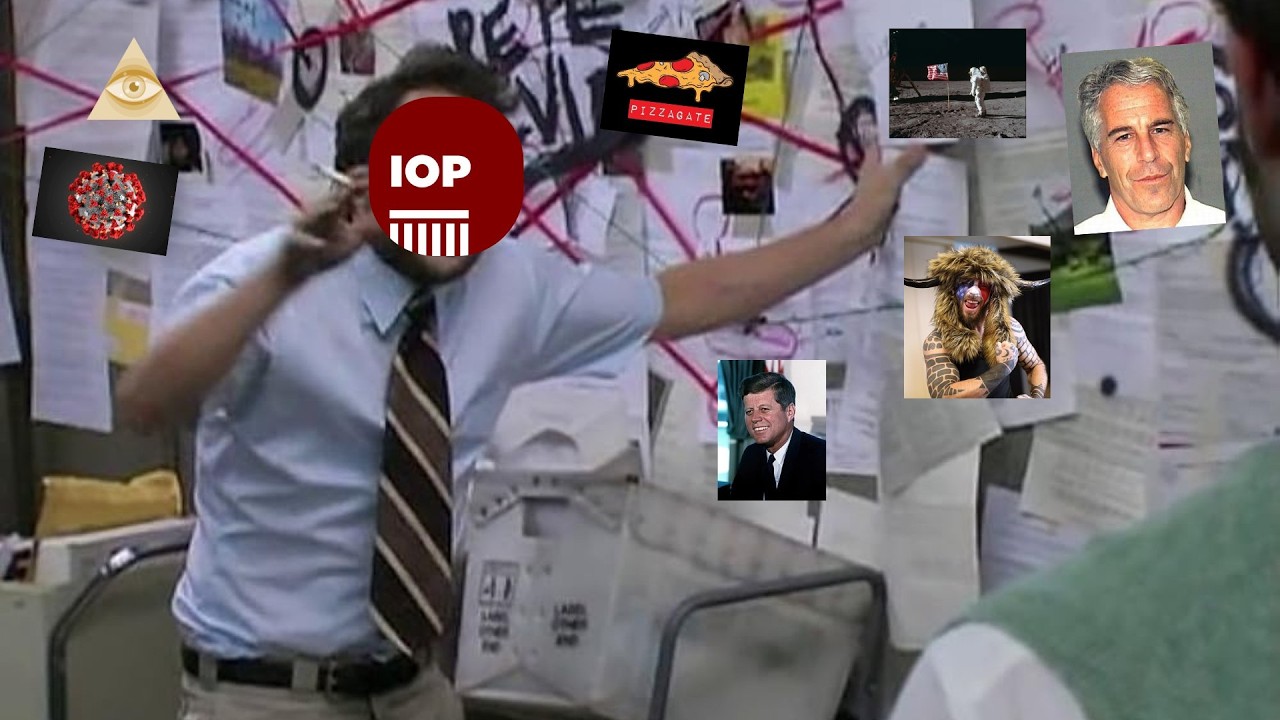
The Salem Witch Trials. MK Ultra. JFK was a***ssinated by government operatives. The moon landing was staged. 9/11 was an inside job. COVID was a plandemic. Trump won 2020. Jeffrey Epstein didn’t k*** himself. Birds aren’t real. PizzaGate. QAnon. Climate change. America has always had “conspiracy theories” – but how did they move from the margins of our democracy to the center of power? Where is the line between investigating corruption and buying into conspiracies – and who gets to draw it? Featuring Brace Belden, co-host of the TrueAnon podcast, Christopher Fee, Professor of English at Gettysburg College, and Elise Wang, assistant professor at Cal State Fullerton MEDIEVAL EARLY MOD BLOOD LIBEL SIMON OF TRENT OTRANTO and researcher of the long history of conspiracy theories. Moderated by Jamelle Bouie, columnist at the New York Times. Co-sponsored by International House.
http://www.rightwingwatch.org/post/carl-gallups-mass-shooting-are-a-demonic-attempt-to-weaken-america-through-gun-control-in-preparation-for-the-antichrist/
Carl Gallups: Mass Shooting Are A Demonic Attempt To Weaken America Through Gun Control In Preparation For The Antichrist
 By Kyle Mantyla | February 16, 2018 11:46 am
Carl Gallups, a right-wing pastor and conspiracy theorist who spoke:{ at Trump campaign rallies in 2016, appeared on TheDove TV’s “Focus Today” program } :{ to discuss the}::{ mass shooting at a Florida high school earlier this week, which he said was part of a demonic attack aimed at weakening America through gun control in preparation for the rise of the Antichrist.}:
“This has it’s origins in the spiritual realms,” he said. “There is a concerted demonic attempt to undermine the United States of America, to bring it down, to destroy the most precious among us. Why is that such a demonic attempt? Because we know the scriptures say that there will arise a generation that will see this Antichrist system, thisone-world order… The bottom line is we are headed that way.”
“The United States is the largest Christian nation the planet has ever seen,” Gallups continued. “It’s the number one military superpower, it’s the number one economic superpower and so there is a demonic attempt to destroy it, to bring it down, to break the culture into some kind of submission. One of those ways is to take away our ability to defend ourselves, so every time something like this happens, the leftists start screaming—you can almost hear it from the pits of hell—’Take away all the guns, take away all the guns.’ That’s not the solution and we all know it’s not and we know why, but we hear that, so this is very spiritual, it’s very deep, it’s very dark.”
==
==
https://www.alternet.org/right-wing/trump-appears-delusional-modern-day-gop-led-way
Trump’s tenuous relationship with the truth has always been somewhat of a mystery, and it has often been difficult to tell whether the president is truly delusional or simply the biggest con man on the planet.
Since he announced his presidential candidacy more than two years ago, Trump has peddled conspiracy theories and falsehoods to the public like a false prophet selling hope, displaying an almost pathological disregard for the truth. As a result, many critics have assumed that he is a liar who deliberately and knowingly deceives the public. Others have contemplated whether he truly believes some of the nonsense that come out of his mouth, thus challenging the notion that he is consciously lying.
Both of these scenarios are disturbing in their own way — and, of course, they are not mutually exclusive. Trump may be a true believer one day and a liar the next; a credulous crackpot in one tweet, and a con artist in another.
Last week, however, the New York Times and the Washington Post published separate articles that suggest the president actually believes in his own BS most of the time, and that he has come to live in his own warped version of reality (call it “Trumptopia”). The coinciding reports, published on the same day, both portray the president as an increasingly deranged man who decides what is true and what is false (i.e., “fake news”), regardless of the evidence. According to both articles, the president has even come to question certain things that he had previously acknowledged as true, including the "Access Hollywood" tape in which he is heard bragging to Billy Bush about sexually assaulting women. “We don’t think that was my voice,” Trump reportedly said to a Republican senator in January — a claim he has repeated in private since.
“Mr. Trump’s falsehoods about the ‘Access Hollywood’ tape are part of his lifelong habit of attempting to create and sell his own version of reality,” the New York Times reporters write. “Advisers say he continues to privately harbor a handful of conspiracy theories that have no grounding in fact.”
Some of these conspiracy theories, according to the Times, include the "birther" conspiracy about former President Barack Obama (which Trump has publicly disavowed) and the discredited theory that Trump lost the popular vote to Hillary Clinton last year because of widespread voter fraud. The president’s friends “did not bother denying that the president was creating an alternative version of events,” the Times reports. “One Republican lawmaker, who asked not to be identified, said that Mr. Trump’s false statements had become familiar to people over time.”
The Washington Post article is no less disturbing, and the reporters note that even “when presented with irrefutable evidence, Trump finds a way to question unflattering facts.” Whether it’s his defeat in the popular vote, Robert Mueller's probe into possible Russian campaign collusion or Obama’s birth certificate, Trump doesn’t let concrete facts get in the way of his alternative reality. Peter Wehner, a conservative writer who served in the three previous Republican administrations, told the Post that the president “creates his own reality and lives in his own reality and tries to bend reality around himself and his own deep narcissistic needs.” What makes this especially troubling is the fact that Trump is surrounded by enablers who have simply come to accept his delusional worldview as a kind of harmless idiosyncrasy.
These reports seem to confirm that Trump is often a true believer in the conspiracy theories and falsehoods that he spreads. This is not to say that the president isn’t a liar, which he almost certainly is, but that he has been a bullshit artist for so long that he has come to believe in much of his own bullshit. When one builds his entire career on fabrications and “truthful hyperbole” — a euphemism coined by Trump himself — it is not surprising that he eventually comes to believe the hype (especially when surrounded by sycophants who would gladly bend the knee and call him “Your Majesty” upon request).
It is slightly more surprising that a deluded conspiracy theorist like Trump could vanquish numerous Republican opponents and then win the general election without facing any repercussions for his repeated transgressions against the truth. But it shouldn’t be. The GOP was the party of “alternative facts” long before it became the party of Trump, and conspiracy theorists took over the conservative movement long before Trump launched his campaign. Trump’s meteoric rise wouldn’t have been possible without a longstanding tradition of bullshit and paranoia on the right.
Right-wingers have historically been more susceptible to conspiracy theories and paranoia than liberals and leftists. When the historian Richard Hofstadter wrote his seminal essay “The Paranoid Style in American Politics” in 1964, it was Trump’s antecedents in the John Birch Society who were espousing elaborate conspiracy theories about the communist takeover of the government. One explanation for this excessive paranoia is the fact that conservatives are driven more by fear than their liberal counterparts. This has been demonstrated by various peer-reviewed studies over the years, including those conducted by Yale psychology professor John Bargh, who found that inducing “feelings of complete physical safety” in conservatives made them more likely to express liberal viewpoints.
Even though some on the left have become increasingly paranoid and hysterical since last year’s election, right-wingers remain the leading purveyors of conspiratorial nonsense in the age of Trump. This is partly due to the president’s inability to get anything passed by Congress, coupled with the endless scandals that have plagued his administration. Failing to accomplish even a fraction of what he promised, the president and his defenders deny reality and blame their problems on evil conspirators, whether that means "deep state" agents, the “fake news” media or the globalist elite. In his essay on the paranoid style, Hofstadter observed that paranoids have hopelessly unrealistic goals and, because these goals are unattainable, “failure constantly heightens the paranoid’s sense of frustration.”
“Even partial success,” he writes, “leaves [the paranoid] with the same feeling of powerlessness with which he began, and this in turn only strengthens his awareness of the vast and terrifying quality of the enemy he opposes.”...
==
https://www.alternet.org/news-amp-politics/fox-news-viewers-melt-down-after-shep-smith-blows-latest-hillary-conspiracy-theory
uranium one
==
https://www.alternet.org/news-amp-politics/right-wing-media-are-already-spinning-vile-new-conspiracy-theory-about-texas
Michael Edison Hayden
Posted with permission from Newsweek
no link pix/doc
For anyone monitoring America’s far-right, it was only a matter of time before Devin Patrick Kelley, the man identified as the Sutherland Springs, Texas, shooter, became “antifa.”
Antifa, a leftist protest movement with no organizational hierarchy whatsoever, was blamed for the mass shooting in Las Vegas by Alex Jones’ conspiracy website Info Wars. They were responsible for allegedly plotting a civil war involving supersoldiers Saturday—one that utterly failed to manifest. And on Sunday, after a man murdered at least 26 people in a Texas church, the right’s conspiracy peddlers waited only a matter of hours to try to blame the violence on leftists.
Police did not immediately announce Kelley's motive in the mass shooting. But Mike Cernovich, a self-described “American nationalist,” posted about the motive shortly after news of it broke. “Mass shooting at The First Baptist Church in Sutherland Springs, which has a largely white denomination,” Cernovich wrote. “Antifa terrorist attack?”
Cernovich pushed the same idea further Sunday evening, citing only “photos.” “Photos of Texas shooter is consistent with profile of Antifa member,” Cernovich posted. “This is looking more and more like Antifa terror.”
Alex Jones, who devoted his entire Saturday to doing live coverage on his web-show Info Wars on a second American civil war that absolutely never happened, also pushed the idea that the shooter could somehow be an antifa activist.“Was this part of the Antifa revolution against Christians and conservatives or a Isis op? [ sic],” Jones tweeted Sunday afternoon to promote his show. “Live from the church.”
Jack Posobiec, a pro-Trump figure with a large following on social media, who has a reputation for creating and pushing fake news stories about leftists, posted a screen shot of something that looked like a direct message conversation on Twitter. The conversation was between a man named Dave Pollack and It’s Going Down (IGD), a self-described “digital community center for anarchist, anti-fascist, autonomous anti-capitalist and anti-colonial movements” frequently associated with “antifa” protests.
The Dave Pollack figure says in the screenshot: “Go after the heart of the far-right: conservative churches.” A spokesperson for Its Going Down, who asked not to be named, told Newsweek through a direct message that the screenshot was entirely fabricated, but noted that many people on social media have seized onto the picture and shared it anyway. On ZeroHedge, a libertarian blog, one of the commenters on a post about the mass shooting summed it up this way: “ He's Antifa, but you'll never see that confirmed because the FBI is a bunch of leftist commie sympathizing traitors,” a user named Gaius Frakkin’ wrote.
“Today we learned that Jack Posobiec was sharing a manufactured and fictitious conversation that was created to look like our account speaking with several others,” the spokesperson for IGD wrote to Newsweek. “The conversation implied that anarchists and antifa organizers are somehow supportive of church shootings. Nothing could be further from the truth, and our hearts go out to people across the U.S. who have lost, and continue lose loved ones in these horrific mass shootings.”
The spokesperson accused Posobiec and others of using the “pain and misery of working-class people” for profit.
“Posobiec wants to attack social movements to further his own reactionary political ends while growing his fame and career along the way,” the spokesperson wrote. “For the sake of not only the truth but people's lives, it's imperative that people recognize these phonies for what they are and denounce them.”
===
http://www.rightwingwatch.org/post/58-donald-trump-conspiracy-theories-and-counting-the-definitive-trump-conspiracy-guide/
58 Donald Trump Conspiracy Theories (And Counting!): The Definitive Trump Conspiracy Guide
 By Brian Tashman | May 27, 2016 1:35 pm
Presumptive Republican presidential nominee Donald Trump not only surrounds himself with conspiracy theorists, he has spent years pushing conspiracy theories himself, much to the delight of his supporters.
At times, Trump tries to remain evasive about whether he actually believes these conspiracy theories, insisting that he simply “heard” or “read” them somewhere or is just asking a question.
We found at least 58 instances of Trump promoting false conspiracy theories on everything from immigration to President Obama’s birthplace.
The number is certain to rise in the coming months.
Topics:
President Obama
1) Birtherism
...
===
http://www.alternet.org/environment/conspiracy-theorists-say-hurricane-harvey-weather-weapon-video
==
==
remember bast starts with premise that if agw is real, tool to destroy all
uh-oh ~ mod:
Of course most right-wing Republicans and Tea Party supporters don’t engage in acts of violence. But their political views often reflect the Paranoid Style described by Hofstadter in which they see their very way of life as under attack by liberal elites and in which their political opponents are not only wrong but illegitimate and must be destroyed. As Ed Kilgore writes,
“To put it bluntly, it has become common on the Right to treat conservative policy prescriptions as exempt from the normal procedures of democracy because they reflect the preferences of God, the Founding Fathers, or Real Americans. Indeed, the essence of the Tea Party Movement, which dominates the GOP from top to bottom, is the belief that by advancing such quotidian centrist policies as a managed-competition health care system or amarket-based cap-and-trade device,Democrats are not simply wrong, but are violating permanent and never-to-be-amended guarantees of low taxes, small government, and laissez-faire capitalism. That point of view helps explain the spluttering rage of people like Glenn Beck and his most devoted fans, who really do seem to believe their ‘fundamental liberties’ include the right to enrich themselves limitlessly and to be exempt from any collective responsibilities, and that mildly redistributive and exceptionally traditional practices like progressive taxation or unemployment insurance represent a totalitarianism that must resisted by any means necessary.”
The Paranoid Style in American politics tends to become most virulent during periods of rapid social change and economic crisis when significant portions of the population feel their way of life threatened and do not see any way in which conventional politics will protect them. That’s certainly true of the present post-Wall Street bust era. In coming years, we’re likely to see a new normal of low economic growth, high unemployment, lower incomes for much of the middle and working class, greater economic inequality, more political gridlock, and even greater control of the political system by corporations.
Under these circumstances, in the absence of a significant progressive populist movement to channel legitimate popular anger towards meaningful solutions to our nation’s problems as a viable alternative to the timid corporatism of the Obama administration and many Democratic office-holders, right-wing movements which reflect the Paranoid style in American politics are likely to grow and flourish in coming years.
==
===
Conspiracy theorist Alex Jones is calling for his upcoming interview with NBC’s Megyn Kelly not to air because he says Kelly misrepresented his views on the 2012 Sandy Hook Elementary School massacre.
A short promotional video released by Kelly on June 11 showed Jones attempting to obfuscate and spin his past statements about Sandy Hook, with the prominent conspiracy theorist and ally of President Donald Trump calling Sandy Hook “complex,” claiming he has advocated both for and against concluding that the shooting actually happened, and claiming he “looked at all the angles.”
Following the release of this promo, Jones wrote on Twitter, “I'm calling for @megynkelly to cancel the airing of our interview for misrepresenting my views on Sandy Hook.” Jones’ tweet included a link to a 40-minute video in which he about the interview. The interview is scheduled to air June 18.
While we don’t know how the Sandy Hook exchange will play out in the full interview, what can be proved is that Jones is a liar who -- since developing a high profile during the 2016 election -- has attempted to sanitize his definitive past claims that the shooting was a “hoax.”
In 2013, Jones called the shooting “staged” and said, “It’s got inside job written all over it.”
In March 2014, Jones said, “I’ve looked at it and undoubtedly there’s a cover-up, there’s actors, they’re manipulating, they’ve been caught lying, and they were pre-planning before it and rolled out with it.”
In December 2014, Jones said on his radio program, “The whole thing is a giant hoax.”
Jones continued: “The general public doesn’t know the school was actually closed the year before. They don’t know they’ve sealed it all, demolished the building. They don’t know that they had the kids going in circles in and out of the building as a photo-op. Blue screen, green screens, they got caught using.”
Making it clear he didn’t view the occurrence of the shooting as an open question, Jones explicitly said that the Obama administration was behind the shooting, noting, “It took me about a year with Sandy Hook to come to grips with the fact that the whole thing was fake.”
[vid]
Jones made similar comments the following January, saying the shooting was “a synthetic, completely fake with actors, in my view, manufactured. I couldn’t believe it at first. I knew they had actors there, clearly, but I thought they killed some real kids. And it just shows how bold they are that they clearly used actors.”
In July 2015, Jones said cast doubt on whether children were actually killed during the shooting, before citing prominent Sandy Hook hoaxer Wolfgang Halbig.
Jones began to spin his past Sandy Hook statements in earnest following the victory of Donald Trump as his past statements came under increased scrutiny because of his association with Trump and his claim that the new president would appear on his show in the near future.
Despite his recent contradictory claims about the shooting, Jones continues to make statements that fuelSandy Hook conspiracy theories.
Here are some headlines that advance Sandy Hook conspiracy theories that are still active on Jones’ website, Infowars.com:

[... egs
==
==
http://www.rightwingwatch.org/post/foxs-seth-rich-conspiracy-has-collapsed-but-right-wing-outlets-keep-pushing-it/
Earlier this week, a private investigatornamed Rod Wheeler—whose last big case was promoting ahoax about a national underground network of lesbian gangs—announced that he had evidence that the late Democratic National Committee staffer Seth Rich, who was murdered last year in Washington, D.C., was in contact with WikiLeaks and transferred them over 40,000 DNC emails. That year WikiLeaks released hacked emails from DNC employees.
Fox’s local Washington, D.C. affiliate ran the story with an interview with Wheeler, despite the fact that Rich’s family had asked him not to speak with the media and rejected his findings as not credible.
Wheeler said that he didn’t actually see any emails or even Rich’s computer, but simply heard about this bombshell evidence from an anonymous federal investigator.
Then Wheeler admitted that he never spoke to the investigator.
“I only got that [information] from the reporter at Fox News,” Wheeler said in an interview with CNN.
The FBI similarly rejected Wheeler’s claims, with one law enforcement official telling NBC News that Rich’s laptop “never contained any emails related to WikiLeaks.”
He eventually “backtracked” in an interview with Fox DC, stating that his previous statements were a “miscommunication.” (Rich’s family has called on Fox to retract the original story).
Even as the story collapsed, conspiracy theorists ran with it—especially Fox News, where hosts like Sean Hannity and Lou Dobbs trumpeted Wheeler’s work as proof that Russia was not behind the DNC hack and that the Democratic Party is complicit in murder.
As we’ve noted, Wheeler is both a vocal Trump supporter and a Fox News analyst and his “investigation” was paid for by a fellow Fox News pundit.
Days after Wheeler conceded that he had absolutely no evidence to back up his story, conservative outlets are still obsessed with it.
Last night, Hannity hosted Jay Sekulow of the American Center for Law and Justice, and the two pushed the baseless claim that Rich was murdered over his purported links with WikiLeaks. Hannity never found the time to mention that Wheeler, who was his guest on Tuesday, had retracted.
Alex Jones of InfoWars was similarly confident of the merits of Wheeler’s since-recanted account.
Jones, the far-right broadcaster notorious for pushing dozens of bizarre conspiracy theories, initially suggested that Wheeler “got in the laptop” that Rich was using.
Yesterday Jones radio host Doug Hagmann, who also falsely claimed that Wheeler had evidence that Rich was in touch with WikiLeaks.
Jones declared that “we have federal investigators and others saying they’ve seen the emails,” and Hagmann cited Wheeler’s hoax story as proof that Russia never hacked the DNC: “There was no hacking. It was merely a transfer of data from, in my professional opinion from what I’ve seen, the DNC staffer, Seth Rich, he took that information from the DNC and given it, via his connections, his contacts, to [Julian] Assange.”
“The FBI has and the D.C. police have the forensic evidence to tie WikiLeaks to Seth Rich,” Hagmann claimed.
At no point did either Jones or Hagmann mention that Wheeler retracted his remarks, but Hagmann did find the time to hail Wheeler as “a great investigator” and attack Wheeler’s critics as the “enemies of the truth.”
“Rod Wheeler did speak with a federal source who said, ‘I had eyes on the computer, I can verify as a matter of fact that this was connected to WikiLeaks,’” he said.
Actually, Wheeler told Newsweek that he did not speak with the investigator: “In a message to Newsweek on Tuesday, Wheeler said the Fox News report was misleading and that his information was secondhand from that ‘federal investigator.’ ‘I’ve never, ever seen Seth Rich’s computer, nor have I talked with the federal investigator,’ he wrote in a message.”
None of this, it seems, will make it on to InfoWars.
Tags: Alex JonesJay SekulowSean Hannity
==
http://www.rightwingwatch.org/post/donald-trump-keeps-pushing-alex-jones-conspiracy-theories/
no link img
Donald Trump Keeps Pushing Alex Jones’ Conspiracy Theories
brian-tashman-4By Brian Tashman | February 7, 2017 12:16 pm
Donald Trump Joins Insane Conspiracy Theorist Alex Jones, Who Calls Him The George Washington Of Today
Yesterday, President Trump told yet another blatant falsehood, alleging that the media has covered up several terrorist attacks, a bogus claim that became even more laughable when the White House released a list of widely-covered attacks in a humiliating attempt to substantiate Trump’s assertion.
Trump, it seems, got the conspiracy theory that the media won’t report on terrorist attacks from InfoWars, the far-right conspiracy theory outlet headed by Alex Jones.
As Aaron Blake of the Washington Post noted, InfoWars has posted several stories accusing the media of supposedly whitewashing, hiding and covering up terrorist attacks.
While running for president, Trump appeared on Jones’ program where he lavished praise on the bizarre conspiracy theorist, telling Jones: “Your reputation is amazing. I will not let you down. You will be very, very impressed, I hope. I think we’ll be speaking a lot.”
Jones is far from the only conspiracy theorist embraced by Trump, but he is among the most influential.
Here are just five additional instances where Trump, himself a pathological liar and unhinged conspiracy theorist, pushed Jones’ wild and baseless claims:
1) Thousands Of Muslims In New Jersey Celebrated On 9/11
In the campaign, Trump repeatedly claimed that he saw on television “thousands and thousands” of Muslims in New Jersey taking to the streets to celebrate the 9/11 attacks.
When no one could find any evidence or news reports, television or otherwise, backing up his claim, Trump’s campaign accused the media of covering it up.
Trump, as we reported, “cited a post on Jones’ InfoWars website and told Jones during an appearance on his program that his assertion was correct because people on Twitter told him so.”
2) Hillary Clinton Uses Drugs
Suggesting that Hillary Clinton had been “getting pumped up” with performance-enhancing drugs prior to the presidential debates, Trump advocated for drug tests for the candidates “because I don’t know what’s going on with her.”
The comment seemed to come out of nowhere, but the bizarre belief was repeated over and over by Jones and his frequent guest Roger Stone, a Trump confidant.
3) Massive Voter Fraud
Trump made waves when he claimed that he only lost the popular vote because 3 million non-citizens illegally voted for Clinton.
He still hasn’t revealed any data to back up his assertion, recently saying that people should “forget” about data because “a lot of people have come out and said that I am correct.”
The claim that 3 million non-citizens cast ballots in the election came from a conservative activist named Gregg Phillips, who has said that he won’t release any corroborating evidence, and amplified by Jones, who said it is an “uncontrovertible [sic] fact that 3 million illegals voted” in the election.
4) Justice Scalia May Have Been Murdered
Jones was also one of several right-wing commentators who thought that the late Justice Antonin Scalia was murdered.
“All of these conservatives that are fighting back that are real conservatives, they are all being found with pillows over their faces,” he said, while alleging that the murder was covered up.
Trump, naturally, had a similar take.
When radio host Michael Savage asked him if he thought that Scalia may have been murdered, Trump responded that he found his death to be “pretty unusual” because Scalia was found with “a pillow on his face.”
Scalia, for the record, was not found with a pillow on his face.
5) Cruz Involved With JFK Assassination
Trump’s obsession with the bogus claim that Rafael Cruz, the father of ex-rival and Texas Senator Ted Cruz, was involved in the assassination of John F. Kennedy was met with a mix of confusion and amusement.
This was not the case for Jones, who claims that Trump listens to his show.
For Jones, it was a point of pride: “Trump picks up our story, now they’ve got major, major, major freak-outs knowing that he’s pointing out that [Cruz’s] father may have been connected to the CIA and been involved with Lee Harvey Oswald.”
Naturally, Trump reportedly called Jones days after the election to thank him for his all of his help getting him elected president.
Tags: Alex Jones Donald Trump InfoWars
=
==
gurad uk .com/lifeandstyle/2016/apr/07/conspiracy-theory-paranoia-aliens-illuminati-beyonce-vaccines-cliven-bundy-jfk
no link
According to a Public Policy Polling survey, around 12 million people in the US believe that interstellar lizards in people suits rule our country. We imported that particular belief from across the pond, where professional conspiracy theorist David Icke has long maintained that the Queen of England is a blood-drinking, shape-shifting alien.
Conspiracy theories in general are not necessary bad, according to psychologists who study them. “If we were all completely trusting, it would not be good for survival,” explains Rob Brotherton, an academic psychologist and author of Suspicious Minds: Why We Believe Conspiracy Theories. “Sometimes people really don’t have our best interests in mind.”
But when people leap from thinking their boss is trying to undermine them to believing their boss might be a secret lizard person, they probably cross from what psychologists refer to as “prudent paranoia” into illogical territory.
And there are a lot of illogical ideas to pick from. Around 66 million Americans believe that aliens landed at Roswell, New Mexico; around 22 million people believe that the government faked the moon landing; and around 160 million believe that there is a conspiracy surrounding the assassination of former US president John F Kennedy.
David Icke is a well-known political commentator and proponent of the theory that human civilization descended from reptilians in the constellation Draco. Photograph:
While aliens and fake moon landings probably trigger eyerolls in many of us, defining what constitutes a conspiracy theory is difficult, Brotherton says. The government, for example, does sometimes conspire to do the unspeakable, such as the infamous 1930s Tuskegee study, initiated by the US government to examine untreated syphilis in African-American men. Researchers blocked research participants from receiving penicillin or exiting the experiment to get treatment. The study continued until a media report made it public. In this case, believing that the government was conspiring to keep people sick would have been completely accurate.
There are characteristics that help differentiate a conspiracy theory from prudent paranoia, Brotherton says. Conspiracy theories tend to depend on conspirators who are unduly evil, he explains, with genocide or world domination as a motive. Conspiracy theories also tend to assign an usually high level of competency to the conspirators, Brotherton adds, pointing out that when the government really does “shady stuff” it often isn’t able to keep it secret.
Chances are, we all know someone who believes some version of a conspiracy theory, which is why psychologists have been trying to understand what makes someone jump from logically questioning the world to looking for signs of lizard teeth in public figures. Research has shown that feelings of powerlessness and uncertainty are associated with a tendency to believe in conspiracies,says Karen Douglas, professor of social psychology at the University of Kent in the UK. Or as Joseph E Uscinski, associate professor of political science at the University of Miami and author of American Conspiracy Theories, puts it, “conspiracies are for losers”.
Conspiracies are for losers ... people who are out of power use them to strategically close ranks, to salve their wounds
“I don’t mean it in the pejorative sense, but people who are out of power use conspiracy theories to strategically alert their side to danger, to close ranks, to salve their wounds,” Uscinski explains. “Think any election, the morning after, half the country says the election was rigged and the other half is happy.”
Believing in a conspiracy theory is one strategy people use to regain a sense of control, even if the conspiracy theory is unrelated to what caused the lack of control in a person’s life, Brotherton says. Conspiracy theories are a way for someone to understand what is going on in the world and try to restore some sense of control in his or her life, he explains.
Studies also find a relationship between a certain type of open mindedness and a tendency to believe in conspiracy theories. People who believe in these also believe in New Age dogmas, urban legends and all sorts of slightly unorthodox ideas, Brotherton explains. Unsurprisingly, a tendency to be suspicious and not to trust people or institutions is also positively correlated with how likely someone is to believe in a conspiracy theory.
Anti-swine flu vaccination protest
The most widely appealing conspiracy theories are the ones that allow a person to insert their own villain of choice, Uscinski says. For example, conspiracy theories around the assassination of JFK are so popular in part because they allow believers to blame the coverup on whichever power they most fear: the US government and associated agencies like the CIA or the former Soviet Union and Cuba.
Most conspiracy theories come and go, Uscinski says, and it is hard to get more than 25% of the population to believe in a particular one. There is a natural ceiling to the number of people who will buy into any one particular conspiracy theory, says Uscinski, who points to those that emerged after the death of US supreme court Justice Antonin Scalia – which were a “flash in the pan” and quickly disappeared as people moved on to the “next thing”.
But once someone believes a conspiracy theory, dissuading him or her of it is an uphill battle. That’s because belief in a conspiracy is not based on facts and logic, Brotherton explains. Something as straightforward, for example, as pointing out the lack of evidence for a conspiracy theory would only reinforce the belief that the evidence for it was suppressed. Getting someone to let go of a favorite conspiracy theory is like convincing a Republican to become a Democrat and vice versa, Uscinski says.
“We like to believe we objectively scrutinize information and come to reasonable beliefs,” Brotherton says, but in reality we have “all kinds of biases built into our brains”.
He cites a study in which researchers recruited a group of people who believed in JFK assassination conspiracy theories and a group who doubted the theories. Both groups were given a packet of purposefully ambiguous information.
“If everyone was rational, the information would moderate their beliefs,” Brotherton explains, and those who were sure of a conspiracy would start to doubt it, while those who were sure there was no conspiracy would also question their stance. “The opposite happened: people picked and chose the information they wanted to believe and everyone became more sure of their initial beliefs.”
While most conspiracies tend to gain traction in a very small number of people, when someone acts on a conspiracy, it can become dangerous very quickly. Cliven Bundy’s followers have tended to believe in everything from the government secretly microchipping millennials to the United Nations running the Bureau of Land Management. People who believe that the mass shooting in Sandy Hook, Connecticut, was faked have harassed the families of children that were killed.
Douglas and her colleague Dan Jolley, have studied the social consequences to contemporary conspiracy theories. They have examined the impact of believing in government conspiracy theories, in climate change conspiracy theories and anti-vaccine conspiracy theories. The findings were troublesome, says
Douglas.
In one experiment, researchers took two groups of participants and gave one group an article about anti-vaccine conspiracy theories, such as the idea that pharmaceutical companies fake the safety and efficacy data for inoculations because the shots make so much money. The other group did not read the article. All the participants were then asked to think about being a parent of a three-year-old and asked if they would vaccinate the child against a fictional disease. The participants who had read the anti-vaccine conspiracy literature showed they were less likely to intend to have the child inoculated.
In the US, those findings are playing out in places like California, which saw an outbreak of measles in 2014 in areas where children were not routinely vaccinated. It’s understandable why people are drawn to anti-vaccine conspiracy theories, Brotherton says. When people are dealing with some of the most important choices in their lives, like how to raise their children, and something unsettling happens, “your brain will reach for explanations, for a sense of order”. A person under those circumstances is not likely to critically evaluate the evidence presented, and the internet “is full of people that are convinced that vaccines are bad”.
While, as Uscinski points out, there is a ceiling for the number of people who will buy into a particular conspiracy theory, the anti-vaccination movement is one example of how a small number of people can make a wild conspiracy theory go viral.
==
http://www.rightwingwatch.org/post/10-right-wing-predictions-about-obama-that-never-came-true/
5) Obama Will Create A Personal Brownshirt Army
Ret. Gen. Jerry Boykin, who now serves as the executive vice president of the Family Research Council, repeatedly predicted that Obama planned to “establish a constabulary force” through the Affordable Care Act that would “control the population in America” much in the same way that Adolf Hitler used the Brownshirts to consolidate power, basing his accusation on a debunked myth about the health care law.
Boykin wasn’t alone in predicting that Obama would create such an army.
Another former military official, Ret. Army Major General Jerry Curry, warned that the Obama administration might “arm illegal immigrants” to begin killing Americans, with a focus on assassinating members of the armed forces.
Then-Republican Rep. Paul Broun of Georgia similarly warned in 2008 that Obama’s proposed expansion of national service programs was “exactly what Hitler did in Nazi Germany” and “exactly what the Soviet Union did.” Rep. Louie Gohmert, R-Texas, claimed in 2013 that Obama’s “secret security force” was already in existence.
Lawrence C. Mackin, a conservative writer, warned that Obama was bent on creating a “private internal army” including “illegal aliens” and Middle Eastern terrorists, and William Gheen of Americans for Legal Immigration PAC said Obama would give immigrants “a badge and a gun” in order to target the “Christian, heterosexual male” population. Far-right activist Jim Garrow thought Obama would fake contact with aliens in order to justify the creation of his own army.
Convinced that President Obama was set to wage an anti-white race war, radio host Michael Savage said that Obama intended to arm and “deputize” members of the Crips and Bloods gangs and turn them into his “shock troops.” He also claimed that Black Lives Matter supporters would be “Obama’s shock troops” and “secret private army” much like “the Brownshirts that Hitler had.”
no links
==
10 Right-Wing Predictions About Obama That Never Came True
brian-tashman-4By Brian Tashman | January 18, 2017 2:34 pm
For eight years, right-wing activists have been making dire predictions about what President Obama would do during his time in office. Some have warned that the president will begin seizing guns and arresting critics any day now. More than a few worried that the president would invade Texas or organize his own private army for other nefarious purposes.
Technically, Obama still has a few more hours to fulfill the far-right’s many doomsday prophecies about his presidency, but it appears much more likely that these conservative activists simply lied in order to fuel baseless fears about Obama, who, despite their best efforts, is leaving office with a 60 percent approval rating.
While this is by no means a complete list, we’ve collected ten of the most absurd predictions that Obama’s critics have made about his time in office, which, as January 20 approaches, are looking less and less likely to come true.
1) Obama Will Create Death Panel
One of the most pernicious and persistent lies about Obama’s presidency has been that he used the Affordable Care Act to establish “death panels.”
Many critics of health care reform falsely claimed that the new law would enforce rationing that would discriminate against elderly people, people with prior health issues and people with disabilities. Some Republican politicians, including Minnesota Rep. Michele Bachmann, Iowa Sen. Chuck Grassley and former Alaska governor Sarah Palin, went a step further in suggesting that an actual government body would be formed to determine whether people lived or died. GOP leaders including former House speakers John Boehner and Newt Gingrich raised the prospect of state-sponsored euthanasia.
Fox News hosts naturally ran with the “death panels” hoax, and the claim’s originator, former New York Lt. Gov. Betsy McCaughey, eventually became a Fox News personality and later an adviser to Donald Trump.
Even years after the law’s passage, conservatives like Republican Rep. Michael Burgess of Texas and commentator Ben Shapiro kept insisting that the death panels were on their way, even when it became obvious they did not exist
At least one popular conservative website even pushed a fake news article claiming that the death panels had already begun executing elderly people.
2) Obama Will Kill His Critics
WorldNetDaily editor Joseph Farah, writing just days before the 2012 election, predicted that if “Barack Obama is re-elected Nov. 6 for a second term, he will declare a full-scale war on his domestic opposition.”
“There may not be another free and fair election in America,” Farah wrote. “I would expect due process to go the way of the horse and buggy. I think he will move to shut down and destroy all independent media. In fact, I think his biggest critics will be rounded up in the name of national security.”
Far-right radio host Michael Savage worried in 2015 that Obama would begin executing people, much like in the French Revolution.
Glenn Beck even believed that the riots in cities like Baltimore and Ferguson were simply part of a larger scheme to “set the whole country on fire” and would lead to a wave of killings of Obama critics, such as Beck himself.
3) Obama Will Spread Disease In Order To Imprison Americans
While describing the “looming crises to watch in 2015,” right-wing legal activist Larry Klayman, the founder of Judicial Watch, declared that “Obama’s mission is not only truly treasonous, but also truly evil.”
“He is more dangerous than the terrorists themselves, because he is destroying us from within,” Klayman said of the president. One way Obama may bring harm to Americans, Klayman said, would be by creating the possibility of “a massive epidemic” and “a real and imminent health crisis” by letting Ebola-infected people from West Africa—including “suicide terrorists” who had infected themselves with the virus—into the U.S.
Klayman was far from alone in sharing this fear: During the height of the Ebola epidemic in 2014, conservatives spread widespread panic about the possibility of Obama enabling an outbreak of the disease in the U.S.
Donald Trump, then teasing a presidential run, questioned Obama’s mental health, calling him a “psycho” for not stopping flights from Ebola-stricken countries, and warned that the president would end up bringing “the plague back to U.S.”
Steve Stockman, then a Republican congressman from Texas, wondered whether Obama really wanted to fight the spread of Ebola or if he really intended to “create a greater crisis to use it as a blunt force to say, well in order to solve this crisis we’re going to have to take control of the economy and individuals and so forth.”
Michael Savage, a conservative radio host, said Obama “wants to infect the nation with Ebola” and “might use Ebola as a pretext” to “gain even more power” and justify launching a “Kristallnacht” against conservatives. End Times preacher Rick Wiles similarly posited that the spread of Ebola was part of a “carefully crafted plan” to “round up patriots,” warning that Obama might “contaminate the VA hospitals with the Ebola virus” and send the people infected with the virus to “recovery and reeducation camps.”
One far-right columnist estimated that over 25 million people might die due to an Obama-inflicted health crisis. End Times broadcaster Steve Quayle, discussing the “global Ebola plague, warned that Obama’s reaction to the epidemic could “supersede” the damage done by murderous dictators like Joseph Stalin, Mao Zedong and Pol Pot.
Other far-right pundits warned that Obama might spread Ebola and then use the crisis as an excuse to cancel the 2016 election, implant “a tracker” into people, declare martial law, force people into concentration camps and put the dead in “FEMA coffins.”
Beyond Ebola, Janet Porter, the conservative activist who leads the Religious Right group Faith 2 Action, thought Obama could use swine flu fears to throw people into FEMA camps or create “a food shortage” that would be used to grow government and starve people to death.
4) Obama Will Start A Race War
Many conservative commentators believed that Obama was behind anti-police-brutality demonstrations that turned violent in cities like Baltimore and Ferguson.
Savage, the radio commentator, said the “racist” Obama administration was going to “try to stimulate insurrection in this country in order to declare martial law” since the “entire federal government is geared up to fight a war against white people.” The Department of Homeland Security, he said, was ready to “mow down” armed demonstrators during the Bundy ranch standoff in Nevada because they were predominately white.
Finding it “remarkable that Obama has not renamed the White House ‘the Black House,’” Larry Klayman wrote in WorldNetDaily that the “racist Obama and his henchmen like Eric Holder have succeeded in creating what in effect is a huge racial divide and race war in the nation, pitting black against white and vice versa” and turning white people into second class citizens.
Far-right commentator Stan Solomon even wondered if Obama would establish “a black force” to attack white people.
5) Obama Will Create A Personal Brownshirt Army
Ret. Gen. Jerry Boykin, who now serves as the executive vice president of the Family Research Council, repeatedly predicted that Obama planned to “establish a constabulary force” through the Affordable Care Act that would “control the population in America” much in the same way that Adolf Hitler used the Brownshirts to consolidate power, basing his accusation on a debunked myth about the health care law.
Boykin wasn’t alone in predicting that Obama would create such an army.
Another former military official, Ret. Army Major General Jerry Curry, warned that the Obama administration might “arm illegal immigrants” to begin killing Americans, with a focus on assassinating members of the armed forces.
Then-Republican Rep. Paul Broun of Georgia similarly warned in 2008 that Obama’s proposed expansion of national service programs was “exactly what Hitler did in Nazi Germany” and “exactly what the Soviet Union did.” Rep. Louie Gohmert, R-Texas, claimed in 2013 that Obama’s “secret security force” was already in existence.
Lawrence C. Mackin, a conservative writer, warned that Obama was bent on creating a “private internal army” including “illegal aliens” and Middle Eastern terrorists, and William Gheen of Americans for Legal Immigration PAC said Obama would give immigrants “a badge and a gun” in order to target the “Christian, heterosexual male” population. Far-right activist Jim Garrow thought Obama would fake contact with aliens in order to justify the creation of his own army.
Convinced that President Obama was set to wage an anti-white race war, radio host Michael Savage said that Obama intended to arm and “deputize” members of the Crips and Bloods gangs and turn them into his “shock troops.” He also claimed that Black Lives Matter supporters would be “Obama’s shock troops” and “secret private army” much like “the Brownshirts that Hitler had.”
6) Obama Will Seize Guns
Throughout Obama’s time in office, gun groups have made hay over patently false claims that the president was prepared to do away with the Second Amendment and ban guns.
Wayne LaPierre, the executive vice president of the National Rifle Association, predicted that Obama would “erase the Second Amendment from the Bill of Rights and exorcise it from the U.S. Constitution” if he won re-election, insisting that Obama went after gun owners “harder than he attacked ISIS.” Gun Owners of America executive director Larry Pratt similarly suggested that Obama was organizing a Big Government scheme to confiscate guns, and might even use his (nonexistent) private army to seize Americans’ guns.
Back in 2015, Trump said he heard that Obama was going to use an executive order to “take your guns away”:
You know, the president is thinking about signing an executive order where he wants to take your guns away. You hear this one? This is the new. Not gonna happen. That won’t happen. But that’s a tough one, I think that’s a tough one for him to do when you actually have the Second Amendment. That’s tough. Because there’s plenty of executive orders being signed, you know that. And we can’t let that go on. So it’ll all stop … It’ll stop very soon, I think, because people are tired of what’s going on, and they’re tired of what’s happening to our country.
When asked by CNN host Alisyn Camerota about his charge, Trump insisted that he never actually said that Obama wants to confiscate guns, just that he had “heard” from “somebody” that “that’s what he’s thinking about” doing. (He went on to falsely claim that Hillary Clinton “wants to take your guns away” and “abolish” the Second Amendment.)
Rafael Cruz, the father of Texas Republican Sen. Ted Cruz, repeatedly charged that Obama was getting ready to seize all guns in order to become a murderous dictator akin to Stalin.
The baseless conspiracy theory helped set the stage for Sandy Hook truthers, who claimed that the 2012 massacre of schoolchildren in Newtown, Connecticut, was an elaborate hoax to justify a gun confiscation scheme.
7) Obama Will Invade Texas
Several Republican politicians, including presidential hopefuls, couldn’t help themselves from seizing on the completely unbelievable conspiracy theory that the Obama administration was planning a federal takeover Texas under the pretext of a 2015 military exercise known as Jade Helm 15.
Knowing that a large number of conservatives believed in the conspiracy theory, these politicians sniffed an opportunity to throw some red meat at the expense of, you know, the truth. The governor of Texas even ordered the Texas State Guard to “monitor Operation Jade Helm 15” to make sure it didn’t infringe on Texans’ civil liberties.
While there wasn’t one standard Jade Helm 15 conspiracy theory, the gist was that Obama was planning to use the military exercise to enforce federal, possibly military, rule over Texas, likely because it is a bastion of conservatism.
As we’ve previously noted, many far-right activists saw Jade Helm 15 as “part of a secret effort to take over conservative states like Texas, impose martial law, confiscate people’s firearms, round up ‘patriotic men,’ force people into cattle cars and lock them up in Wal-Marts that have been converted into FEMA camps.”
Wiles, the religious radio broadcaster, referred to Jade Helm 15 as a “two-month-long Night of the Long Knives” and even warned about a potential government-initiated nuclear electromagnetic pulse attack on Texas. Televangelist Jim Bakker said that he might even go to jail (again) as a result of Jade Helm 15.
After the exercise began, one fake news site fabricated a story that it had resulted in civilian casualties.
Panic about Jade Helm had serious consequences: The FBI arrested a group of people planning to attack soldiers participating in the exercise, and some service members came under fire as the exercise began.
8) Obama Will Ban The Bible
Following the passage of the Shepard-Byrd Hate Crimes Prevention Act, which Obama signed in 2009, Republicans warned that the freedom of religion and speech for Christians would soon disappear due to government oppression. Subsequent advances in LGBT equality, especially the Supreme Court’s 2015 decision striking down state-level same-sex marriage bans, only made the persecution rhetoric more panicked.
Anti-LGBT activists predicted after the passage of the hate crimes act that the government would begin prosecuting and imprisoning Christians who criticized homosexuality. The Traditional Values Coalition claimed that “the new Hate Crimes Act that President Obama signed into law makes the Bible illegal ‘Hate Literature.’
Several Republican politicians even claimed that the law granted legal protections to pedophiles.
In 2013, Rick Scarborough, a conservative pastor who once threatened to file a lawsuit against homosexuality, claimed that the Obama administration was “hell-bent on silencing the Gospel of Jesus Christ,” warning that Christians may be “thrown into concentration camps” at some point in the future. Family Research Council President Tony Perkins warned just last year that Obama was using gay rights to “eliminate” Christianity and “punish speech—and belief.”
Far-right fake news sites have similarly predicted that Obama will outlaw Christmas and “criminalize Christianity.”
9) Obama Will Impose Sharia Law
Among the most popular and unsubstantiated conspiracy theories surrounding Obama was the enduring claim that he was just about to impose Sharia law on Americans, if he hadn’t already.
While discussing his book on Obama’s “progressive/Islamic takeover” in 2015, Savage claimed that Obama was bringing in 100,000 Muslims into America every month to help “the Islamism creeping into the country,” which he posited could eventually lead to the government deciding to “ban dogs.”
Sen. Ted Cruz even went so far as to falsely claim that the Obama administration put into place a “ban on anti-Muslim rhetoric.” Then-Rep. Michele Bachmann alleged in 2012 that Obama had enforced “Islamic speech codes here in the United States” as part of his supposed push for Sharia law.
In a WorldNetDaily column posted weeks before the 2008 election, Faith 2 Action’s Janet Porter delivered a “newscast of the future” in which she predicted, among other things, that Obama would personally meet with Osama bin Laden, begin broadcasting the Muslim call to prayer in the capital five times a day and have people face Mecca at a Presidential Prayer Breakfast keynoted by Louis Farrakhan.
Kamal Saleem, who claims to be a former terrorist and is now a conservative speaker, claimed in 2012 that Obama planned on “legalizing terrorism” and predicted that the Obama administration would begin shutting down churches and synagogues in 2013. He claimed that Obama had already set up an Islamic “shadow government” that was using an Obama family babysitter, Roe v. Wade and the military to impose Sharia law.:(style="font-family:Merriweather"):
Right-wing conspiracy theorist Avi Lipkin claimed in 2012 that Obama would receive trillions of dollars in aid from Saudi Arabia and, in return, would begin imposing Sharia law and settling “50 to 100 million” Muslim immigrants on “lands confiscated by Agenda 21.”
10) Obama Will Stay In Office
Conservative radio hosts from Rush Limbaugh to Alex Jones have suggested that Obama may try to remain in office when his second term is over, a conspiracy theory that gained attention throughout the far-right
The fear of an Obama third term gained such attention that Ben Carson, who later became a GOP presidential candidate and is now Trump’s nominee to be the secretary of housing, became worried about a canceled election and an Obama third-term plot.
Few, however, went as far as Rev. Austin Miles, who claimed in 2014 that there was a plan “for Obama to use Executive Order to declare himself, Dictator for Life in 2016,” or End Times preacher Rick Wiles, who said in 2013 that Obama would take a trip to Jerusalem on which he “enters the Temple and declares himself as God.”
Tags: Avi Lipkin Donald Trump Glenn Beck Greg Abbott Janet Porter (née Folger) Jerry Boykin Jim Bakker Joseph Farah Kamal Saleem Larry Klayman Larry Pratt Louie Gohmert Michael Savage Michele Bachmann Rafael Cruz Rick Scarborough Rick Wiles Sarah Palin Stan Solomon Steve Stockman Ted Cruz Tony Perkins Wayne LaPierre
==
==
http://www.alternet.org/news-amp-politics/conspiracy-theorys-big-comeback-deep-paranoia-runs-free-age-donald-trump
For several decades now, belief in conspiracy theories has been on the rise, as trust in institutions has declined. But Donald Trump’s candidacy supercharged that rise like nothing before it, and his impending presidency promises much more of the same. Conspiracy theory acts as a connecting bridge between the flood of false statements Trump constantly makes and the larger looming threat of a slide into authoritarian rule. Resisting conspiracism could be key to preserving and reinvigorating our democracy.
“Many authoritarian regimes throughout history are based on conspiracy theories — the prime example being the anti-Semitism of the Naziswhich was an essential part of their ideology,” said cognitive scientist Stephan Lewandowsky, who researches conspiracism and climate science denial. (Salon stories here and here.) “I do not believe that a democracy can function for long when its leaders are steeped in conspiratorial thought that is disconnected from reality.”
Conspiracy theory can have a pervasive effect at the individual level, too. “There is evidence that the mere exposure to such conspiracy theoriesrenders people more likely to incorporate those theories into their thinking, even if they do not accept those theories overtly,” Lewandowsky noted.
Of course, some conspiracies are chillingly real — Watergate, the Iran-Contra boondoggle of the Reagan years, the Tuskegee experiments, etc. — and others may be difficult to assess. So it’s helpful to focus more on the conspiracist mindset that persistently sees such conspiracies where they don’t exist, disregards all contrary evidence and ignores or severely distorts the broader historical context that helps make sense of what really happened. Such a focus reveals broader patterns, rather than getting dragged down into minutiae.
In a previous article, I described a set ofsix characteristics Lewandowsky investigated, which fall into three groups that help clarify the true nature of conspiracy-theory thinking. The first two establish a morally self-justifying framework — hidden conspirators are bad (“nefarious intention”), but conspiracy theorists are good (“persecution-victimization”) — which subverts the conspiracists’ purported interest in truth-seeking.
The second pair does this by managing unwanted information: First by ignoring or denying contradictory evidence (“nihilistic skepticism”) and then by building an elaborate fantasy edifice, incorporating random evidence (“nothing happens by accident”).
The last pair subverts truth-seeking by fending off sounder explanations, either by dogmatically insisting there’s a conspiracy even if no coherent account of it can be given (and, in the extreme, when conspiracists hold self-contradictory beliefs), or by insisting that evidence against the conspiracy is actually evidence in favor of it — proof of how badly the conspirators want to hide the truth (“self-sealing”).
Although conspiracy theories are believed all across the political spectrum, there is significant historical evidence that they appeal more strongly to conservatives, particularly in the United States. Conspiracy theory is especially strong among “paleoconservatives”like Pat Buchanan, the late Phyllis Schlafly, Paul Weyrich or Ron Paul, along with their predecessors in the John Birch Society. This makes sense from the perspective that “conspiracy theories are for losers,” a form of motivated reasoning used by those who feel excluded to question the legitimacy of those in power.
This observation was supported by the 2014 book “American Conspiracy Theories” which found that alleged conspirators in New York Times letters to the editor came predominantly from the left when a Republican was president, and from the right when a Democrat was. But paleoconservatives are losers on a much more sweeping and fundamental level: They are fighting against the whole thrust of American history since at least the Progressive Era, and oppose everything from affirmative action to Social Security, minimum wage laws, federal income tax, direct popular election of senators, and even, sometimes, women’s right to vote.
Last July, I wrote about Trump’s affinity for paleoconservatism, including the notion that “political correctness” is a vast conspiratorial enterprise (dubbed“cultural Marxism” by long-time Weyrich associate William Lind) that is meant to destroy conventional morality and religion, undermine existing cultural institutions, promote multiculturalism and demote the dominance of white European-American Christians — especially men.
While Trump hasn’t explicitly embraced this paranoid worldview — he’s more of a broad-brush, big-picture blowhard — it fits well with what he has said, and with the alt-right movement that has supported him so vigorously. It was further reflected in a cluster of three racist or ethnocentric conspiracy theories that were critical to Trump’s rise: His “birther” attack on Obama’s legitimacy as America’s first black president, his false allegations of a Mexican government scheme to send “rapists and murderers” to the U.S., and his multiple anti-Muslim conspiracy narratives, including the false claim that “thousands” of Muslims in New Jersey celebrated the destruction of the Twin Towers on 9/11.
Trump also drew on conspiracy theories to delegitimize all sorts of political obstacles he faced. He falsely claimed that Ted Cruz’s father had associated with Lee Harvey Oswald shortly before John F. Kennedy’s assassination, repeatedly suggested that protesters at his rallies were paid by his opponents, railed against the “dishonest media” (in terms suggestive of the Nazi-era insult Lügenpresse, or “lying press”), launched unfounded accusations of mass voter fraud and attacked sources of objective data — from economic statistics to climate science — as intentionally deceptive.
In all these respects, Trump has built on the works of others. But he has given individual conspiracy theories greater prominence than they’d ever enjoyed before, he’s woven different conspiratorial narratives together, creating a whole that is far more radically removed from reality than any of its parts taken separately, and he’s given them a specific partisan connotation as well. More than anything, he has constantly repeated the aforementioned core elements of conspiracy theorists’ moral framework — hidden, evil conspirators versus noble conspiracy theorists good — which hasincreasingly polluted our political discourse. This creates a cultural resonance supporting the wide range of fragmentary lies he tells, which can very often be understood as pieces plucked out of larger conspiratorial narratives.
I asked Lewandowsky about the spill-over effect between the different conspiracy theories Trump has promoted, and how they have eroded people’s grasp on reality. He answered on two different levels, first socially. “The terms ‘post-fact’ and ‘post-truth’ were virtually unknown a few years ago, but they both rose to prominence in the media in 2016,” he pointed out. But individual psychology matters as well. “There is evidence that most people who believe one conspiracy theory will also believe others,” he said. “One factor that explains that predisposition is whether people feel disenfranchised or resentful about society. People who are resentful and (frequently) distrustful are more likely to subscribe to conspiracy theories.”
This fits in well with the paleoconservative worldview Trump echoes, but it’s been a long time coming. “I think that what we are seeing now is the culmination of trends that have been at work for 10 to 20 years,” Lewandowsky said. “The clearest example of this are data from 2003 to 2005, which show that at the time people who obtained their news from Fox were systematically misinformed about many issues — most prominent among them the mythical Weapons of Mass Destruction in Iraq.”
But Democrats opposing Trump can fall prey to conspiracist beliefs as well — along with anyone in between. Political scientist Brendan Nyhan recently tweeted, “Liberals who talked a big game during Obama years are about to fall victim to a bunch of misperceptions & conspiracy theories too.”
Perhaps. But research by Joanne Miller and Kyle Saunders, who discussed it with Salon last March, suggests a more muted response. They found that more knowledgeable conservatives were more likely to believe conspiracy theories, but more trusting conservatives were less affected. They had expected liberals to be affected as well, but less than conservatives, who appeared to be the ideological losers at the time. Instead they found that liberals were virtually unaffected by conspiracy theory, suggesting that other factors may play a role.
Conservatives are known to be “more vigilant, very sensitive to threat, and therefore more likely to notice threat,” Miller told Salon at the time. “There’s a big leap from that to conservatives supporting protectionist policies, or being afraid of everybody who’s not like them. And we don’t have the evidence linking everything in that chain.” With roles reversed, and a Republican in the White House, we might be able to gain more insight.
But Trump is not your typical Republican. When I contacted Miller and Saunders more recently, they said they thought it would take six months or so before liberal-centric conspiracy theories were likely to emerge. “I would feel much stronger about these predictions if [John] Kasich or Cruz had become president,” Miller cautioned. “Trump is a different animal.” The way he campaigned on what might be termed a “cultural loser” identity could muddle the tendency for ideological losers to generate the larger share of conspiracy theories.
Looking back at the 2016 campaign, much that happened conformed with Miller and Saunders’ earlier findings. “On the ideology side and the trust side, we would have expected conspiracy theories to come more from the right, because they were still on the losing side of politics,” Miller said. The role of knowledge is less clear-cut, though it does appear that high-knowledge/low-trust conservatives played a larger role in spreading conspiracies and fake news stories, while lower-knowledge voters may have played an unexpected role in winning key states.
But even more surprising “was just the amount of it — the fake news that largely peddled in conspiracies,” Miller said. “The sheer amount of it is new, absolutely.” There are long-term trends involved, they pointed out, such as declining trust in institutions, erosion of the institutions themselves and the democratic norms they uphold, and the emergence of a coherent authoritarian worldview, as described by Marc Hetherington and Jonathan Weiler in “Authoritarianism and Polarization in American Politics.” But all these factors converged to produce a phenomenon larger than the sum of its parts.
Miller pointed to the way Trump capitalized on distrust of government, “out groups” (including Muslims, immigrants and minorities in general), Hillary Clinton herself and so on, weaving them all together.Saunders pointed to distrust on both sides combined with an environment where misinformation and conspiracy theories spread rapidly, with few people able to counter the conspiracy theories with facts. That combination “allowed an environment where Trump could exploit that — exploit the environment, exploit his own supporters, exploit the overall system as it currently stands,” he said.
Rather than blaming the public — especially “low-information voters” who turned to Trump — Saunders went on to discuss what he calls “elite cue-taking,” and “Trump’s ability to control the agenda with a single tweet that spread like wildfire.”The media would respond with “sometimes uncritical coverage, just, ‘Here’s this tweet. Isn’t it amazing what he’s saying?’ That in turn allows the conspiracy theory or the misinformation to continue to move and spread throughout the networks.”
Amid alleged Russian hacking and the interference of WikiLeaks and FBI director James Comey, Saunders said, “We had all kinds of outside actors who were easily exploited as potential conspiratorial actors. It wasn’t that they were ginned up out of nothing. It’s an information environment where the truth is very hard to parse from the misinformation. That is so easily exploitable, and I think Trump’s a master of it.” The larger problem, Saunders suggests, is that other political actors will follow his lead. “What is the check on them from doing so?” he asked. “That’s yet another deterioration of democratic norms, because you’ve had somebody successfully employ this strategy and gain power from it.”
Findings from a recent HuffPost/YouGov poll showed that Trump voters, but not Clinton voters, were far more likely (by 64 percent to 12 percent) to say that “Over the past few years, average Americans have gotten less than they deserve,” as opposed to saying that “blacks have gotten far less.”This reflects a profound sense of white grievance signifying that Trump voters think of themselves as losers, especially compared to African-Americans. The fact that this is wildly untrue only intensifies the likelihood of conspiracist ideas taking hold. The absence of rational explanations for what is essentially a subjective emotion provides a powerful incentive for inventing them.
As Miller told me last March, there experiments show that people experiencing loss of control are more likely to see images in random dots on a computer screen. “If you think of conspiracy theories as making connections between things that don’t really belong together,” she explained, “conspiracy theories are one of the things that we go to in order to try to explain something that is unexplainable, because we need to restore control.”
It’s a cognitive tendency to which all human beings are prone, which is why liberals must also be alert to the allure of conspiracy theory. Lewandowsky warns against falling into the same trap. “I would recommend a healthy dose of skepticism,” he said. “For example, after the election there was some chatter on social media about the possibility that Russia hacked U.S. voting machines. I thought that was quite far-fetched and I worried that this might entrench itself as a conspiracy theory among Trump opponents,” he said. “Fortunately, it now appears that this entrenchment did not occur.
“There would be nothing gained if Trump opponents created another conspiratorial parallel world in response to Trump,” Lewandowsky said. “I think we should do everything we can to restore the cultural authority of facts and reasoned evidence, and so I personally am shying away from anything that might take me into conspiratorial territory. There is enough known about Trump in broad daylight that opponents can focus on: His failure to release his tax returns or his medical records, his record as a serial sexual predator, and so on. There is no need to resort to anything that might resemble conspiratorial thought. That is best left to Trump and his ilk.”
Paul H. Rosenberg is senior editor at Random Lengths News, a biweekly serving the Los Angeles harbor area.
==
ref 1
http://www.salon.com/2014/04/19/why_climate_deniers_are_winning_the_twisted_psychology_that_overwhelms_scientific_consensus/
In the run-up to Earth Day this year, two major reports were released by the UN’s Intergovernmental Panel on Climate Change, the largest such body in the world. On March 31, Working Group II released its report, Climate Change 2014: Impacts, Adaptation, and Vulnerability, and on April 13, Working Group III released its report, Climate Change 2014: Mitigation of Climate Change.Both reports cited substantially more evidence of substantially more global warming and related impacts than past reports have, and they did so more lucidly than in past iterations.
As climate scientist and communicator Katharine Hayhoe told Salon, “This time around, to its credit, the IPCC has gotten a lot more serious about improving its ability to communicate the report’s message, through graphics and other ancillary products.” There was also a greater sophistication in how to conceptualize, measure and compare things, even where substantial uncertainties are involved. And there was a substantial list of more than 90 major impacts already recorded on every part of the planet.
Yet, one of the most disturbing stories to emerge around the reports was the New York Times report that language about the need for $100 billion in crisis funds to aid poor nations was removed from the Working Group III executive summary for policymakers during the final round of editing. The action neatly encapsulated the yawning gap between the growing danger of climate change — and growing maturity of climate scientists — on the one hand, and the utter lack of political will on the other.
But the growing sophistication of the scientific community is a cause for continued hope — if they can accelerate their learning curve, and follow the right path. They no longer mistakenly assume that the facts can “speak for themselves,” and they’ve gotten much better at developing ways to communicate lucidly about complex challenges and uncertainty. But the entrenched denialist, do-nothing opposition is still winning when it comes to writing the checks. If that’s to change, Australian psychologist Stephan Lewandowsky will almost certainty be part of the reason why.
Reframing Uncertainty
One reason global warming opponents still have the upper hand is basic confusion over the nature and significance of uncertainty. “There are numerous instances in which politicians and opinion makers stated that ‘there is still so much uncertainty, we shouldn’t invest money to solve the climate problem,’” Lewandowsky explained to Salon. Now he has just co-authored two related articles on scientific uncertainty and climate change — “Part I. Uncertainty and unabated emissions” and “Part II. Uncertainty and mitigation” — which show this thinking is completely backwards. “This is shown to be wrong by our analysis, because uncertainty can never be too great for action. On the contrary, uncertainty implies that the problem is more likely to be worse than expected in the absence of that uncertainty.”
It’s a simple fact that your typical scientist already knows intuitively: Uncertainty grows with risk, exposure and potential loss, especially with complex nonlinear systems, like the global climate system. In fact, it’s not even possible to calculate how much damage could come from worst-case climate scenarios, as Working Group III lead co-author Christopher Field pointed out at the . The relationship between greater uncertainty and risk is both obvious to those in the know and invisible to those who aren’t. So it’s never been properly talked about — or even rigorously analyzed — until now.
“Basically, we tried a new mathematical approach that is called ‘ordinal,'” Lewandowsky said. “An ordinal method allows us to address questions such as: ‘What would the consequences be if uncertainty is even greater than we think it is?’ That is, ordinal questions refer to the order of things, such as ‘greater than’ or ‘lesser than,’ but don’t address absolute questions such as ‘how much.’”
So it doesn’t tell you how much worse things will get — which would certainly be nice to know — but it does tell you that they will get worse the more uncertain things are. In short, it gets you oriented in the right direction — 180 degrees away from where so-called “common sense” would take you. It puts you on the right path, asking the right kinds of questions, taking the right kinds of first steps, and avoiding getting lost in the confusion, mistakenly thinking that uncertainty means less to worry about. It’s hard to imagine a more basic finding.
“Using that approach we showed that as uncertainty in the temperature increase expected with a doubling of CO2 from pre-industrial levels rises, so do the economic damages of increased climate change,” Lewandowsky continued. “Greater uncertainty also increases the likelihood of exceeding ‘safe’ temperature limits and the probability of failing to reach mitigation targets. Likewise, in the context of sea level rise, larger uncertainty requires greater precautionary action to manage flood risk.”
As for the impact on policy, Lewandowsky said, “We show that the adverse effects of uncertainty are ‘leveraged’ and hence amplified by more emissions. It follows that to reduce the adverse effects of uncertainty, we should curtail emissions. This is a pretty strong imperative, but our papers don’t prescribe an exact target for emissions. As I noted above, we cannot answer ‘how much’ questions, we can only say ‘less (pollution) is better.’”
Acceptance and Rejection of Science
But these two recent papers are only side of the story of what Lewandowsky has been up to. He’s also written a series of papers dealing with how people process information, either rejecting or accepting science. When I asked about the relationship, Lewandowsky replied,”The underlying ‘theme’ — if there is one — is how people respond to uncertainty or ambiguity. What the uncertainty papers analyze is how people shouldrespond to uncertainty if they were mathematically-optimal. What my rejection-and-acceptance work shows is how people actually respond to things they perceive to be uncertain. So the two streams of research are opposing sides of the coin — what reality actually means and how people interpret it.”
There’s also quite a bit more controversy surrounding this work — some of it intellectual, some anti-intellectual. In a 2012 paper, “The pivotal role of perceived scientific consensus in acceptance of science,” Lewandowsky and his co-authors reported on two studies. The first showed that acceptance of several scientific propositions — including the acceptance of HIV causing AIDS, smoking causing lung cancer, and human CO2 emissions causing global warming — were all manifestations of a common factor, which in turn is correlated with a factor reflecting perceived scientific consensus. In short, the more that people perceived scientific consensus, the more they accepted scientific findings.
The second study demonstrated a causal relationship, showing that acceptance of human-caused (anthropogenic) global warming (AGW) increases when the scientific consensus is highlighted. Subjects were divided into two groups, the “control” group subjects “greatly underestimated the AGW consensus” at 67 percent, while the second group, exposed to a graph and text highlighting the 97 percent consensus among climate scientists, still underestimated the consensus, but by much less — placing it at 88 percent. Not only did acceptance of global warming increase, the most dramatic finding was the neutralization of the effect of worldview, which otherwise had a significant impact. While there were significant differences due to worldview in the control group, the differences were “effectively nonexistent” for those exposed to consensus information, even though that information was only partially absorbed.
The impact of worldview can informally be seen in partisan trend polling data on global warming evidence perception from Pew (graph here), as well as snapshot data showing Tea Party Republicans as significant outliers, with views significantly different from other Republicans, whose views are surprisingly close to average. Academics take a more rigorous approach toward worldviews, though their specific methods may vary. In this case, worldview was measured via five items expressing attitudes about the free market.


Dan Kahan is a leading researcher who’s skeptical of the implications of this paper. He’s done extensive research into the resilience of perceptions, regardless of contrary information, and finds strong evidence of “identity-protective cognition” among people of all different worldviews. (He uses a two-dimensional model, as opposed to a more common one-dimensional left/right one.) Kahan was the subject of Ezra Klein’s first cover story at Vox.com, and I first wrote about his work in a three-part series at Open Left in January 2010. Not only has Kahan shown that people are resistent to information that challenges their identities and the worldviews that support them, he’s shown that more information tends to drive people apart in their views, rather than lead to convergence. People use more information to rationalize what they already believe, rather than to question and reformulate it. Kahan doesn’t doubt the results Lewandowski reported, he just thinks they won’t stand up in the real world, in part because they haven’t so far. (Kahan and Lewandowski debated each other on the Inquiring Minds podcast co-hosted by Salon contributor Chris Mooney — write-up and podcast here.)
“The reason ‘consensus’ has not appeared to work in society at large to date isn’t because it’s ineffective — it’s because there is a well-funded countermovement out there that takes every opportunity to mislead the public into thinking that there isn’t a consensus,” Lewandowsky told me, in response to this argument.
But Kahan stresses it as an inescapable fact. “The real world has counter-messaging in it That’s one reason the experimental studies aren’t externally valid, in my view,” he said. “Unless those counseling ‘broadcast 97 percent’ have a plan for stifling all the culturally grounded cues that real people will be exposed to that motivate them to discount the ’97 percent’ message — as they’ve been doing for 10 years — it is bad advice, in my view, to tell communicators that they can expect ’97 percent’ to work in the world as it does in the lab.”
This is clearly the challenge — how to take Lewandowsky’s results out of the lab. He doesn’t have a plan, per se, but he does have a sense of direction, and a track record, and a growing community of like-minded collaborators to work with. Kahan and Lewandowsky differ most on how to reach conservatives and libertarians, but there’s potentially more acheivable progress to be made within the ranks of the reality-based community itself. To get the full picture of what this means, we first need to develop two historical threads — the growing understanding of the scientific process and its interactions with the wider world, which involves a widening circle of other experts, and the growing understanding of what stands in its way, which will bring us back to another emerging aspect of Lewandowky’s work.
Establishing Consensus
To begin the first thread, we need to go back to 2004. That’s when science historian Naomi Oreskes first published an initial survey of global warming literature, “Beyond The Ivory Tower: The Scientific Consensus on Climate Change.” Climate scientists had long known that there was an overwhelming consensus on anthropogenic global warming, but Oreskes was the first to take a scientific approach to studying that consensus — just as Lewandowsky, more recently, has been the first to formalize what scientists informally knew about uncertainty.
Oreskes analyzed “928 abstracts, published in refereed scientific journals between 1993 and 2003, and listed in the ISI database with the keywords ‘climate change.’” She found that 75 percent of papers accepted the consensus view “either explicitly or implicitly,” while “25 percent dealt with methods or paleoclimate,” and took no position on AGW. “Remarkably, none of the papers disagreed with the consensus position,” she found. Later studies have found a small sliver of dissenting views, but the more the consensus has been studied, the sturdier it appears, while the dissenting literature is dogged with repeated problems.
For example, a 2010 paper, “Expert credibility in climate change,” recomfirmed the 97 percent consensus figure, and found that “the relative climate expertise and scientific prominence of the researchers unconvinced of ACC [or AGW] are substantially below that of the convinced researchers.” A 2013 paper, “Quantifying the consensus on anthropogenic global warming in the scientific literature,” examined “11,944 climate abstracts from 1991–2011” and found that “97.1 percent endorsed the consensus position,” while a parallel self-rating survey found that “97.2 percent endorsed the consensus.”
One of the co-authors of the 2013 study, Dana Nuccitelli, co-writes the Guardian’s “Climate Consensus — The 97%” blog. In an April 14 entry, he showed how far the study of climate science itself can take us in understanding the workings of anti-science as well. He detailed “4 ways contrarian papers get published: (1) Flawed paper gets into credible journal, (2) Flawed paper gets into off-topic journal, (3) Contrarian editor gets into journal, (4) Vanity journal created by contrarians.” But that wasn’t the primary topic of his column. His primary topic was the climate contrarian backlash against Lewandowsky’s work on the second thread mentioned above — the growing understanding of what stands in the way of science, which began with worldviews and branched out from there.
Conspiracist Ideation — Better than Science at Playing Its Own Game
Taking up that second thread, in 2013, Lewandowsky co-authored two papers probing more deeply into the role of what’s known as “motivated reasoning” as an obstacle to scientific knowledge. In “The Role of Conspiracist Ideation and Worldviews in Predicting Rejection of Science,” he approached the influence of worldviews and conspiratorial thinking (AKA “conspiracist ideation”) as related types of motivated reasoning which interfere with scientific truth-seeking. In this instance, worldviews included both liberals vs. conservatives and free market orientation. Conspiracist ideation can be found across the ideological spectrum — even in the center, much to the chagrin of some — but it functions in similar patterns to resist unwanted information, regardless of subject matter.
Lewandowsky and his co-authors took a closer look at conspiracism specifically in the other paper, “NASA Faked the Moon Landing — Therefore, (Climate) Science Is a Hoax: An Anatomy of the Motivated Rejection of Science.” The second paper touched a real nerve, producing a great deal of conspiracy theorizing about Lewandowsky himself, his co-authors and others. So, naturally, being a good scientist, Lewandowsky decided to study that as well. The result was a third paper, “Recursive Fury: Conspiracist ideation in the blogosphere in response to research on conspiracist ideation,” which was subsequently retracted by the publisher, following sharp attacks from climate contrarians — even though the publisher found nothing scientifically or ethically wrong with the paper. Britain’s notoriously lax libel law (changed just this year) was supposedly the reason. Following a further retreat by the publisher,three editors with the journal resigned. Nuccitelli provides a good account in his column (as does Lewandowsky himself, here), where he notes that this is just the latest example of a pattern that’s played out before, but we need to go back and unpack the insights into conspiracist ideation that lie at the core of this work.
In the paper on conspiracist ideation and worldviews, the authors wrote, “The prominence of conspiracist ideation in science rejection is not unexpected in light of its cognitive attributes.” For one thing, it provides an out for people who don’t like what the consensus says. “If you are faced with agreement among scientists, you have two choices,” Lewandowsky told me. “You either accept that they are on to something or… You think they all conspire to create a hoax for some nefarious reason. There aren’t too many other options, are there?”
“When you look at the history of science denial, there is plenty of evidence that a scientific consensus drives deniers into postulating such a conspiracy — from tobacco to AIDS to climate.”
A second reason conspiracist ideation crops up in resisting science is that it has greater explanatory reach than science, because it’s not constrained by “the criteria of consistency and coherence that characterize scientific reasoning.”
“In the case of climate, this is — humorously — known as the ‘Quantum theory of denial,’” Lewandowsky told me. “Deniers will claim in the same breath (or within a few minutes) that (a) temperatures cannot be measured reliably, (b) there is definitely no warming, (c) the warming isn’t caused by humans, and (d) we are doing ourselves a favor by warming the planet. The four propositions are incoherent because they cannot all be simultaneously true — and yet deniers will utter all those in close succession all the time.”
Finally, conspiracist ideation is also typically immune to falsification, “because contradictory evidence (e.g., climate scientists being exonerated of accusations) can be accommodated by broadening the scope of the conspiracy (exonerations are a whitewash), often with considerable creativity.”
“One good example for this is Jim Sensenbrenner, a Republican congressman who called the exonerations of climate scientists after ‘climategate’ a ‘whitewash,’” Lewandowsky said. “This happens all the time, and sometimes takes on rather baroque forms, e.g., when the United Nations is invoked.” Lewandowksy sometimes refers to this as the “self-sealing” property of conspiracist ideation. It can be absolutely maddening to try to argue against.
When I asked about other aspects of conspiracist ideation, I questioned whether it didn’t reflect a quest for meaning, at the expense of information, along the lines of the mythos/logos distinction drawn by Karen Armstrong in “The Battle For God.” Lewandowsky agreed.
“One of the aspects of conspiratorial thinking is — paradoxically — that it gives people a sense of control because it gives meaning to apparent randomness. It may be more comforting to some people to think that 9/11 was an “inside job” than accepting that it was a fairly random event triggered by a few fanatics.” Even more in line with Armstrong’s thinking, he added, “I also think that there is a lot of identity politics in this, e.g., if Republicans generally think that climate change is a hoax, then it becomes a ‘tribal totem’ for others to pick up on this.”
As a further refinement, I noted that conspiracist ideation thrives on creating specific malicious others as a particuarly powerful form of meaning-making. “Yes, absolutely,” Lewandowsky responded. “There is this tension between ‘victim’ and ‘hero’ within the conspiracist worldview that leads to those contradictory positions. On the one hand (the ‘hero’ frame) it is permissible to accuse scientists of fraud and harass them, but by the same token (‘victim’ frame) scientists must do nothing to cast aspersions on the accusers or to defend themselves. Arthur Koestler has referred to those people as ‘mimophants.’ It is crucial for the public to understand this.”
With these insights in mind, the experience of what happened with “Recursive Fury” becomes a tremendous learning opportunity — though, as Nuccitelli points out, it’s an opportunity that’s been repeatedly missed in the past.
Lessons to Learn
But there’s a pattern here on the positive side as well. In 2004, Oreskes reframed the informal experience of climate consensus as a subject for formal knowledge — and that has helped climate scientists gain a much better self-understanding of what they’re doing, through a succession of further studies. Likewise, just this past month, Lewandowsky’s uncertainty papers have taken the informal knowledge that uncertainty means more unknown risk, and reframed uncertainty as the subject for scientific study. It’s too soon to know what will happen as a result, but the potential is obvious if we can put an end to knee-jerk do-nothing arguments based on uncertainty.
Likewise, the dysfunctional impact of conspiracist ideation is just one example of how the scientific community itself has an underdeveloped immune system — as does the much broader “reality-based community,” which takes science seriously as a primary source of information. There would be great potential for any project that would take this informally recognized (by some) reality and make it the subject for rigorous scrutiny, just as Oreskes did in 2004 or as Lewandowksy did this year. That’s a tall order, but it’s possible that the two of them just might do something like that. They are currently working together on a paper on the effects of denial on the scientific community. It’s obviously way too soon to say what it will look like, much less what impact it will have. But we do know that bringing “peripheral,” informally known subject matter to light can be an incredibly powerful way of moving human understanding forward. And there’s no field of human understanding that needs that more than the science of saving our planet — and, not incidentally, ourselves.
Paul Rosenberg is a California-based writer/activist, senior editor for Random Lengths News, and a columnist for Al Jazeera English.
==
ref 2
The world is full of conspiracies, large and small. Little kids conspire to eat cookies behind their parents’ backs, while parents conspire to hide grownup truths from their children. On the other extreme, tobacco companies conspire to addict, and (unfortunately for the bottom line) inevitably kill, a vast ocean of customers. In between such extremes, the plots of countless stories involve conspiracies of one sort or another, simply because humans are social creatures who readily conspire (literally, “breath together”) to get things done that they might not be able to do alone.
With all this conspiring going on, it’s not surprising that some folks would notice — and many have. The writers of all those stories, for example. But some folks who notice have an annoying tendency to get things all wrong. What makes most stories interesting is precisely the fact that conspiracies are human creations, and we humans are fallible lot, we mess things up all the time. We can’t help it. It’s just our nature. As a result, conspiracies are usually rather messy and limited affairs, often undone by other conspiracies, or by their own internal tensions, like the scheming on a typical “Seinfeld” episode.
But some folks see conspiracies as anything but a reflection of our nature. They see conspiracies almost wholly as “other,” deeply sinister, and maddeningly perfect — or at least nearly so. Such folks are properly known as “conspiracy theorists.” They’re not wrong to believe there are conspiracies everywhere around them — as many of their critics mistakenly believe — but they are wrong about the nature of the vast majority of what’s really there, as well about how powerful and important conspiracies are, absent other forces working in tandem with them — such as the enormous economic and political clout possessed by tobacco companies.
The philosopher Brian L. Keeley wrote a brief but insightful article in 1999, “Of Conspiracy Theories,” from the perspective of epistemology (the philosophical study of knowledge). In it,he defines conspiracy theories as “a proposed explanation of some historical event (or events) in terms of the significant causal agency of a relatively small group of persons — the conspirators — acting in secret.” Although his analysis is insightful, this definition fails to capture the historical/social science sense of what’s commonly meant by the term, to wit: that it’s an explanation of human events via behavior that deeply violates ordinary norms, usually including serious criminal acts. Another paper by social psychologists provided a definition more in line with this:
Conspiracy theories are lay beliefs that attribute the ultimate cause of an event, or the concealment of an event from public knowledge, to a secret, unlawful, and malevolent plot by multiple actors working together.”
To clarify: One list of “33 Conspiracy Theories That Turned Out To Be True” (discussed below) included the Manhattan Project as an example. This fits with Keeley’s definition, but it’s strikingly at odds with how the term is generally used, and the reasons are simple: the actions involved did not, on their face, deeply violate ordinary norms, and were similar in secrecy to other wartime research efforts, such as the development of radar and codebreaking efforts which greatly accelerated the development of modern computers. Of course it’s true that the atomic bomb was a weapon like no other — and even some who worked on it were profoundly troubled thereafter — as well they should have been. However, it was developed in the course of a war like no other, with the prospect of a 1000-year Reich, not in an historical vacuum. Hence, the morality involved was clearly contested, with many potential deep ramifications, rather than being a clear-cut violation of ordinary norms.
Two further points. First, those involved in conspiracy theorizing invariably bring with them a moral overlay — they seek not only to understand some historical event, but to judge it, and those responsible, usually quite hastily. This is particularly evident in the example of the Manhattan Project. By simply assuming (or at least implying) that the actors were nefarious, the conspiracy theory account prejudges and dismisses precisely what ought to be a most serious matter for our moral reflection. They completely misdirect our moral attention. Second, in doing so, they themselves frequently violate norms — norms of civilized discourse, most visibly, but also, more subtly, norms of reason itself, which come into sharper relief precisely by studying how conspiracists violate them.
In short, the false image that conspiracy theorists have is a natural consequence of a set of cognitive characteristics that researchers and scholars like Keeley have identified which do not necessarily indicate false beliefs on a one-to-one basis, but that do impair the ability to think critically, consider alternatives, accept contradictory feedback, and otherwise gain a more rounded perspective — both in terms of facts as well as morality. In the worst case, such thinking inadvertently leads to rejecting the very possibility of any sort of systematized knowledge at all — a point that Keeley carefully considered.
A more recent paper, “Recursive Fury: Conspiracist ideation in the blogosphere in response to research on conspiracist ideation” (which I discussed here back in May) identified six such characteristics (or criteria) from the literature on conspiracist thought, which were then used to analyze blog comments attacking an earlier paper on the role of conspiracism in rejecting global warming science. (“Recursive Fury” was then recursively attacked by conspiracists, and shamefully retracted by the journal which published it, not for any methodological or ethical reasons, but because of legal liability issues — itself an example of how conspiracist thinking can cripple scientific inquiry.) The paper explained:
We derived six criteria from the existing literature to permit classification of hypotheses pertaining to LOG12 as potentially conspiracist (see Table 3). Our criteria were exclusively psychological and hence did not hinge on the validity of the various hypotheses. This approach follows philosophical precedents that have examined the epistemology of conspiratorial theorizing irrespective of its truth value (e.g., Keeley, 1999; Sunstein & Vermeule, 2009). The approach also avoids the need to discuss or rebut the substance of any of the hypotheses.
To illustrate the usefulness of this sort process perspective approach, we turn to each of those characteristics in turn, quoting an excerpt of the description (with formal citations removed), followed by some commentary. After that, we’ll return to that reflect on that list of conspiracy theories that turned out to be true, to reconsider just what it might mean, in light of this sort of process perspective.
The first conspiracist characteristic identified is “nefarious intention”:
First, the presumed intentions behind any conspiracy are invariably nefarious. Conspiracist ideation never involves groups of people whose intent is to do good, as for example when planning a surprise birthday party. Instead, conspiracist ideation relies on the presumed deceptive intentions of the people or institutions responsible for the “official” account that is being questioned.
One example cited is the book “Watermelons: The Green Movement’s True Colors,” about which the publishers say: “Green on the outside, red on the inside, the liberty-loathing, humanity-hating “watermelons” of the modern environmental movement do not want to save the world. They want to rule it.”
You can’t get much more nefarious than that … unless you want to get into the Satanic ritual (child) abuse moral panic of the 1980s and ’90s. As Wikipedia notes:
Scholarly interest in the topic slowly built, eventually resulting in the conclusion that the phenomenon was a moral panic, with little or no validity beyond paranoia.
Official investigations produced no evidence of widespread conspiracies or of the slaughter of thousands; only a small number of verified crimes have even remote similarities to tales of SRA.
That moral panic produced books like “Don’t Make Me Go Back, Mommy: A Child’s Book about Satanic Ritual Abuse.”It’s not hard to imagine how nefarious these imaginary conspirators were. Buzzfeed has some sample illustrations here.
But it’s not always so batshit crazy. As a journalist, I’ve had plenty of frustrating experience dealing with institutions putting out official stories, so I could easily sympathize with less extreme conspiracists in this regard. But, professionally, it’s a luxury I can’t afford. Most people repeat the official story in good faith; error is far more common than evil. Lack of institutional transparency and accountability is one of the most serious and widely-seen maladies of our time. But the conspiracist interpretation of why it occurs does far more to obscure matters than to bring them to light — even when it stops far short of wild stories about Satanic rituals.
The second conspiracist characteristic is “persecution-victimization”:
“A corollary of the first criterion is the pervasive self-perception and self-presentation among conspiracy theorists as the victims of organized persecution. The theorist typically considers herself, at least tacitly, to be the brave antagonist of the nefarious intentions of the conspiracy; that is, the victim is also a potential hero.”
This clearly applies in spades to the “victims” of Satanic ritual abuse. The article cites another example: “when isolated scientists who oppose the scientific consensus that HIV causes AIDS are presented as persecuted heroes and are likened to Galileo,” as described in the book “Denying AIDS: Conspiracy Theories, Pseudoscience and Human Tragedy.”AIDS patients who’ve rejected treatment also present themselves heroically … and can still be seen online in video testimonials after they die, as recounted in the Guardian by award-winning UK journalist Brian Deer. Moral: One can be a true victim and yet be absolutely clueless as to what you’re the victim of. You can become a victim of your own mistaken beliefs.
The third conspiracist characteristic is “nihilistic skepticism”:
“[D]uring its questioning of an official account, conspiracist ideation is characterized by “…an almost nihilistic degree of skepticism”; and the conspiracy theorist refuses to believe anything that does not fit into the conspiracy theory. Thus, nothing is at it seems, and all evidence points to hidden agendas or some other meaning that only the conspiracy theorist is aware of.”
Calling this “wacky,” as many are inclined to do, dramatically understates what a serious attack it is on the very possibility of ever knowing anything at all. “Trust no one,” may make a cool tagline for a TV show, but no one can actually live like that. We trust people all the time — to point us to right aisle in a store, to tell us where they want to meet for lunch, etc.
Yet, as Keeley noted in his 1999 paper, “These theories throw into doubt the various institutions that have been set up to generate reliable data and evidence. In doing so, they reveal just how large a role trust in both institutions and individuals plays in the justification of our beliefs. The problem is this: most of us — including those of us who are scientists and who work in scientific laboratories full of expensive equipment — have never carried out the experiments or made the empirical observations that support most contemporary scientific theories.” Hence, the vast majority of scientific knowledge depends on trusting others, not blindly, but through a carefully developed system of rigorous sifting and cross-checking.
As Keeley put it, “In modern science, this procedure involves the elaborate mechanisms of publication, peer review, professional reputation, university accreditation and so on. Thus, we are warranted in believing the claims of science because these claims are the result of a social mechanism of warranted belief production.” And this, ultimately, is the full scope of what the conspiracy theorist would ask us to abandon — as the withdrawal of “Recursive Fury” gave us a foretaste of. Without this social mechanism of science, we would know very little at all. Such are the fruits of nihilistic skepticism.
We can see a small hint of this outcome in the world as seen by “young earth” creationists — those who insist on a literal reading of the Bible (ignoring the contradictions between Genesis 1 and 2), and thus say the world was created 6,000 years ago. Of course this means that they reject evolution, but that’s only a small fraction of the science they nihilistically reject. They also reject tree rings, since, as of 2009, the University of Arizona’s bristlecone pine database established a timeline of 8,836 years — almost 50 percent older than the Young Earth creationists claim the earth to be. They also reject carbon dating — using elaborate arguments, the most noteworthy of which are debunked here by the National Center for Science Education. And there’s also the little problem that the “big bang” happened over 13 billion years ago. NASA’s also got an excellent Big Bang webpage, providing even more of the incredible knowledge of our cosmos that creationist conspiracists demand that we abandon, in deference to their purportedly “divine” nihilistic skepticism.
The fourth conspiracist characteristic is “nothing by accident”:“Fourth, to the conspiracy theorist, nothing happens by accident. Thus, small random events are woven into a conspiracy narrative and reinterpreted as indisputable evidence for the theory.”
A classic example of this sort of thinking is a list of coincidences supposedly linking the Kennedy and Lincoln assassinations, which first appeared shortly after Kennedy was shot. (My personal favorite is “Booth shot Lincoln in a theater and was caught in a warehouse. Oswald shot Kennedy from a warehouse and was caught in a theater.” It’s so bizarre, surely it must mean something!Where’s Agent Mulder when you really need him?)
This characteristic reflects something deeper about conspiracist thinking — it has less in common with science than immediately meets the eye. In “The Battle For God” (introduction here), Karen Armstrong talks about two contrasting modes of human understanding: logos, which is concerned with understanding how the world works, and mythos, which is concerned with meaning and purpose. The importance of mythos is obvious, Armstrong explains: “Unless we find some significance in our lives, we mortal men and women fall very easily into despair,” and supplying significance is what mythos is all about.
In contrast, logos has no problem with random, accidental occurrences. Our grasp of the world around us is always imperfect; there is always more going on than we can possibly know. So long as we know enough for the purposes at hand, we need not concern ourselves with pieces that don’t fit together, with randomness, noise, little bits of chaos. But for mythos,everything has meaning, even the absences, which is why they have to be reinterpreted to give them meaning, when it seems that they have none.
The fifth conspiracist characteristic is “must be wrong”:
[T]he underlying lack of trust and exaggerated suspicion contribute to a cognitive pattern whereby specific hypotheses may be abandoned when they become unsustainable, but those corrections do not impinge on the overall abstraction that
something must be wrong’ and theofficial’ account must be based on deception…. [I]t does not matter if any particular hypothesis is right or wrong or incoherent with earlier ones because “…the specifics of a conspiracy theory do not matter as much as the fact that it is a conspiracy theory at all”….[i]t may not even matter if hypotheses are mutually contradictory.
Clearly, the most extreme example is the embrace of mutually contradictory beliefs. You might think this is a joke, but it’s not. People actually do think that way, as shown by a 2011 paper, “Dead and Alive: Beliefs in Contradictory Conspiracy Theories.” As explained in its abstract:
The present research shows that even mutually incompatible conspiracy theories are positively correlated in endorsement. In Study 1 (n = 137), the more participants believed that Princess Diana faked her own death, the more they believed that she was murdered. In Study 2 (n = 102), the more participants believed that Osama Bin Laden was already dead when U.S. special forces raided his compound in Pakistan, the more they believed he is still alive.
Furthermore, the explanation for these seemingly bizarre beliefs was simple and straightforward:
Hierarchical regression models showed that mutually incompatible conspiracy theories are positively associated because both are associated with the view that the authorities are engaged in a cover-up (Study 2) [emphasis added]. The monological nature of conspiracy belief appears to be driven not by conspiracy theories directly supporting one another but by broader beliefs supporting conspiracy theories in general.The last sentence here makes a point worth keeping in mind: while conspiracists tend to focus obsessively on specific details, what really drives them is a transcendental belief, which by its very nature cannot be proven or disproven — it is purely a matter of faith, albeit a negative one: a belief that others are serving the Devil, as it were. This reinforces my point above — that it’s much more a matter of mythos than first meets the eye. More often than not, conspiracy theorists have a conspiratorial intent of their own.
The sixth conspiracist characteristic is “self-sealing”:Finally, contrary evidence is often interpreted as evidence for a conspiracy. This ideation relies on the notion that, the stronger the evidence against a conspiracy, the more the conspirators must want people to believe their version of events. This self-sealing reasoning necessarily widens the circle of presumed conspirators because the accumulation of contrary evidence merely identifies a growing number of people or institutions that are part of the conspiracy.
As an example, the paper points to the response following “ClimateGate,” the pseudo-scandal that resulted from the illegal hacking of personal emails by climate scientists, which were then selectively quoted to portray a conspiracy to hide or manipulate evidence. An unprecedented set of nine separate inquiries ensued [links here], all of them clearing the scientists of all substantive charges, whereupon the investigations were then attacked as being part of the wider conspiracy! See, for example, U.S. Representative Dana Rohrabacher’s speech in Congress on 8 December 2011, where he said:
We now know, the scientists, clamoring for subservient acceptance of their theory of man-made global warming, were themselves making a sham out of scientific methodology. Now we know.
I am speaking, of course, about Climate Gate…. The unauthorized release of those internal memos, exposed the shenanigans of the man-made global warming alarmists, and the crime being committed against science and the public. Even though hand-picked panels of their peers held a “kangaroo court” and loudly proclaimed that there had been no wrongdoing, public confidence was justifiably shaken.
These cognitive characteristics do a much better job of focusing our attention on what’s most important about conspiracy theories — not the truth or falsity of any particular claim, but the overall soundness of their approach. With this process-based perspective firmly in mind, we now turn to the aforementioned story “33 Conspiracy Theories That Turned Out To Be True.” While most of the items identified in this story really do exist, the same cannot be said about a distinct subset of the list involving the largest-scale conspiracies alleged, those having to do with national or global political dominance.
It’s not that elite corporate dominance doesn’t exist — there are a variety of different sound scholarly approaches showing that it does. Examples include sociologist William Domhoff’s work on class domination dating back to “Who Rules America?” first published in 1968; Martin Gilens’ 2013 book, “Affluence and Influence: Economic Inequality and Political Power in America” and his followup paper co-authored with Benjamin Page, “Testing Theories of American Politics:Elites, Interest Groups, and Average Citizens,” showing that elites wield significant political power, while ordinary citizens have almost none; Thomas Ferguson’s book, “Golden Rule: The Investment Theory of Party Competition and the Logic of Money-Driven Political Systems,” which explains how corporate donor blocks, not average voters, drive the political system; the 2011 paper, “The Network of Global Corporate Control” by Stefania Vitali and co-authors, identifying a core “super-entity” of 147 tightly knit companies that controlled 40 per cent of the total wealth in the network, and so on.
The literature is quite clear, elite corporate dominance is real. Yet, conspiracy theorists have managed to get things incredibly garbled, even though this core intuition is correct. The list of “33 Conspiracy Theories That Turned Out To Be True” includes a subset of seven which relate to elite corporate dominance:
- The New World Order
- Bohemian Grove
- The Round Table [not the Business Roundtable]
- The Illuminati
- The Trilateral Commission
- Big Brother or the Shadow Government
33.The Federal Reserve Bank
Of these seven, only three can actually be shown to exist — less than half — and their roles are severely distorted and misrepresented in the accounts provided. Remarkably, despite the story’s title, even the author himself doesn’t argue that all these conspiracies actually exist. The entry on the Round Table (not to be confused with the Business Round Table) reads more like an argument that no such organization exists, while devoting considerable attention to other supposedly-related organizations, most notably the Council on Foreign Relations. The Shadow Government is described in terms of several somewhat overlapping master texts, one of which, “Report from Iron Mountain,” is now widely recognized as the satire/hoax that it always was (but not by die-hard conspiracists!) The Illuminati have been disbanded since before the United States were formed, and the author reluctantly admits to its almost certain non-existence, but then seeks to prop it up by claiming that the Rothschilds were members, and that they control half the world’s wealth (a claim not supported by the Stefania network analysis cited above.) Bohemian Grove is certainly real, but it’s more of an annual event than an organization. The Trilateral Commission is real, but only one of many international organizations, while the actual Federal Reserve differs significantly from the description offered in this document. This leaves us, finally, with the New World Order, which is arguably the clearest example of what most of the list is not: a purely fictitious entity. Here is how the entry on it begins:
The New World Order: This popular conspiracy theory claims that a small group of international elites controls and manipulates governments, industry and media organisations worldwide. The primary tool they use to dominate nations is the system of central banking. They are said to have funded and in some cases caused most of the major wars of the last 200 years, primarily through carrying out false flag attacks to manipulate populations into supporting them, and have a grip on the world economy, deliberately causing inflation and depressions at will.
You’ll note that this entry doesn’t even pretend to claim that the New World Order is real. It then goes on to toss together a variety of other hobgoblins:
The people behind the New World Order are thought to be international bankers, in particular the owners of the private banks in the Federal Reserve System, Bank of England and other central banks, and members of the Council on Foreign Relations, Trilateral Commission and Bilderberg Group. Now, although this conspiracy theory was ridiculed for years, it turns out that the Bilderberg does meet and requests no media coverage. They receive no media coverage. The world’s elite meet every year and it goes largely unreported, for what?
The point is not that all these organizations are fanciful — they’re not. Those listed above, at least, are all quite real. It’s the light that they’re seen in which is so distorted, so misleading. For a realistic view of the Bilderbergers, for example, we can turn to journalist/author Jon Ronson, who actually talked to some of them, only to discover how low-key their actual influence was (more of a networking group than anything else). Particularly interesting is this quote, from Denis Healey, a founding member of Bilderberg: “To say we were striving for a one-world government is exaggerated, but not wholly unfair. Those of us in Bilderberg felt we couldn’t go on forever fighting one another for nothing and killing people and rendering millions homeless. So we felt that a single community throughout the world would be a good thing.”
This should hardly be surprising, particularly in the 1950s, when Bilderberg started, and the memories of World War II and all the conflicts which lead up to it were still quite fresh. Folks inclined in the direction of a global community, if not government, because of the pointless destructiveness of war. It’s not hard to follow the logic. But it clashes wildly with the conspiracists’ accusations. You see, they’re always going on about how the global elites cause wars and depressions: “The Rothschild dynasty owns roughly half of the world’s wealth and evidence suggests it has funded both sides of major wars, including the United States Civil War.”
I’m not arguing that elites don’t have far too much power in the world — they do. Nor am I saying that their policies are for the best, so we shouldn’t worry — anyone who believes that has been asleep for longer than Rip Van Winkle. But if we want to effectively counter the pernicious impacts of elite rule, we first need to acknowledge it’s not 100 percent evil. We need to have a much more coherent, more scientifically grounded understanding of what it is and how it works, as provided by the sorts of academic research that I cited above, for example. This includes a recognition that elite rule is pernicious primarily for structural reasons, rather than because of individual evil.
A further look at what’s said about the New World Order can bring a few last noteworthy points into focus. First, that the conspiracist viewpoint tends to be inherently reactionary, defending an implicitly simplistic “commonsense” conception of how things should be against what it sees as the pernicious and arbitrary meddling of elites. And second, that it explicitly turns a blind eye at best to malevolent influences within its own ranks. The second point can be illustrated by the matter-of-fact tone of the following passage, which, one should recall, is offered as a stand-in for the promised, but non-existent, actual evidence that “the New World Order” actually exists:
American writer Mary M. Davison, in her 1966 booklet The Profound Revolution, traced the alleged New World Order conspiracy to the creation of the U.S. Federal Reserve System in 1913 by international bankers, who she claimed later formed the Council on Foreign Relations in 1921 as the shadow government. At the time the booklet was published, “international bankers” would have been interpreted by many readers as a reference to a postulated “international Jewish banking conspiracy” masterminded by the Rothschilds and Rockefellers. American televangelist Pat Robertson with his 1991 best-selling book The New World Order became the most prominent Christian popularizer of conspiracy theories about recent American history as a theater in which Wall Street, the Federal Reserve System, Council on Foreign Relations, Bilderberg Group, and Trilateral Commission control the flow of events from behind the scenes, nudging us constantly and covertly in the direction of world government for the Antichrist.
Now, some folks would think that with no hard evidence, and folks like Pat Robertson and Mary Davidson leading the way, you just might want to rethink the road that you’re on.
But anyone who would think that is obviously in on the conspiracy, right?
Paul Rosenberg
===
==
mma
A Comprehensive Guide To The Right-Wing Media Conspiracy Theorists That Have Influenced Trump’s Campaign
Research ››› June 16, 2016 8:09 AM EDT ››› BOBBY LEWIS
Presumptive Republican nominee Donald Trump counts among his allies a stable of fringe right-wing conspiracy theorists who’ve made a name for themselves advancing conspiracy theories that include the myth that President Obama is a secret Kenyan Muslim, Lyndon Johnson assassinated John F. Kennedy, and the CIA is paying Beyonce to create mayhem. Trump’s conspiracy theorist allies also regularly wish violence upon political and media figures who they disagree with.
Warning: This post contains graphic language and sexual content.
Roger Stone
Alex Jones
Ed Klein
Michael Savage
Roger Stone
Roger Stone is a longtime friend, lobbyist, and ally of Donald Trump’s. Stone has called for the murder of public figures, used racially offensive and sexist language, and was recently caught plagiarizing an article. Stone has previously alleged that the Clintons murdered over 40 people, the Bush family attempted to assassinate President Reagan, and Sen. Ted Cruz's (R-TX) father is tied to Lee Harvey Oswald and the Kennedy assassination.
For more about Roger Stone, click here.
Roger Stone's Influence On The Trump Campaign
Roger Stone Is Trump’s Friend, Lobbyist, Consultant, And Ally. Stone is a friend of Trump’s and has spent “25 years as a lobbyist for Mr. Trump” and has “known him for almost 40 years.” Stone was formerly a paid adviser to the campaign, and in preparation “fed Trump strategy memos and political intelligence” from 2014 onward. Stone is still involved in strategic decision-making, and helped place his friend Paul Manafort in a major campaign position. He currently heads the pro-Trump super PAC Committee To Restore America’s Greatness, and talks with Trump on a “semi-regular basis.” [Media Matters, 7/20/15, 4/14/16, 4/20/16; StoneZone.com, 4/19/11; New York Magazine, 4/3/16; Salon, 4/28/16]
Stone Planned Pro-Trump Protests At The Republican National Convention. Stone, with fellow Trump supporter Alex Jones, planned “Stop The Steal” protests at the Republican National Convention. Stone said he would lead “four days of non-violent demonstrations, protests and lobbying delegates face to face” to prevent Trump from being “robbed” of the nomination. Stone planned to “disclose the hotels and the room numbers” of anti-Trump delegates, which some delegates alleged led to death threats from Trump supporters. The protests were canceled after Trump secured the nomination outright. [Media Matters, 4/5/16, 4/13/16, 5/3/16]
Roger Stone: Plaigarism, Conspiracies, Sexism, Racism, Transphobia
Stone Has Repeatedly Called For The Killing Of Public Figures. Stone tweeted that Hillary Clinton should be “executed” for murder, and also called for “Soviet Agent Bernie Sanders” to be “arrested for treason and shot.” Stone also wrote that former Sen. Rick Santorum (R-PA) would “never be President- I will order a mail-order rifle first,” and that if Fox News contributor Ed Rollins “isn’t dead he should be.” [Media Matters, 5/2/16, 5/4/16]
Stone Attacked Media Figures With Discriminatory Language. Stone used his Twitter account to attack media figures with racist, ableist, sexist, and transphobic rhetoric. Stone called CNN contributor Roland Martin a “stupid negro,” and told him to “eat somemore Popeyes” (sic), demanded Charles Krauthammer, who is paralyzed, to “stand the fuck up,” told former New York Times executive editor Jill Abramson “DIE BITCH,” and said Megyn Kelly had a “nice set of cans.” Stone also referred to Herman Cain as “mandingo,” and commented that voters “think Michele Bachmann is a tranny.” [Media Matters, 4/5/16, 4/22/16]
Stone Founded Anti-Hillary Group “C.U.N.T.” After Failing To Organize “B.I.T.C.H.” During the 2008 election, Stone founded the now-defunct anti-Hillary Clinton group Citizens United Not Timid which emphasized the acronym by bolding the first letter in each word. Stone previously attempted to name the group “B.I.T.C.H.,” but was unable to complete the acronym. [Media Matters, 2/20/08]
Stone Heavily Plagiarized A Daily Caller Piece. On April 25 Stone wrote an anti-Ted Cruz piece for The Daily Caller that contained at least five paragraphs copied without attribution from a conservative blog post dated November 11, 2015. Following a post by Media Matters, The Daily Caller removed Stone’s piece from its website without explanation. Stone responded by calling the plagiarism accusations a “MSM HIT JOB” in a Facebook post. [Media Matters, 4/26/16, 5/10/16; Facebook, 4/27/16]
Stone Warned That A Staged “International Incident” Could Be Used To “Cancel The Election.” Stone warned “the establishment is petrified” of Donald Trump and is “capable of anything, including martial law” to stop him while appearing on the April 27 edition of Genesis Communications Networks’ The Alex Jones Show. Stone added that the government could “stage an international incident” to cause everyone to “rally around the president,” which could be used “as a pretext to cancel the election.” [Media Matters, 4/27/16]
Stone Implicated Bushes, Clintons, President Lyndon Johnson In Murder Conspiracies. Stone has accused multiple politicians of murdering enemies for being “in the way.” Stone claimed “the Bush Crime Family” was behind the attempted assassination of President Reagan, and that the Clintons murdered John F. Kennedy, Jr. over a U.S. Senate seat, after previously claiming they were “not responsible” for his death. Stone also believes that President Lyndon Johnson was involved in the assassination of President Kennedy, and extensively promoted the tabloid rumor that Ted Cruz’s father was linked to Lee Harvey Oswald. [Media Matters, 3/1/16, 4/12/16, 4/20/16; CBS Philly, 1/28/16; Twitter.com, 5/23/15, 5/3/16; Mediaite, 5/4/16]
Alex Jones
Alex Jones is the proprietor of InfoWars.com, a fringe conspiracy website that promotes the idea that the government was behind the 9/11 attacks. Jones also believes the Brussels attacks were “the ultimate false flag,” Beyonce is funded by the CIA to create mayhem, and the government uses estrogen-mimicking chemicals in juice boxes to turn children gay. Jones also warned listeners of transgender people “vomiting and crapping all over the place” if protected by non-discrimination ordinances.
For more about Alex Jones, click here.
Alex Jones' Influence On The Trump Campaign
Jones Praised For Playing An “Important Role” Supporting Trump,
Used His Website To Help Campaign. Trump surrogate Roger Stone commended Jones for playing an “important role” in the Trump campaign. On his website, Infowars, Jones also took credit for “devastating the Trumpian opposition.” Jones has bragged about his private conversations with Trump, claiming the presumptive Republican nominee “listens to what we have to say,” and has claimed that Trump based his support for auditing the Federal Reserve on Jones’ beliefs. Trump has lavished praise on Jones’ “amazing” reputation, and the campaign previously partnered with Infowars to get out the vote. [Media Matters, 12/2/15, 2/10/16, 2/22/16, 3/22/16, 5/4/16, 5/4/16]
Media Have Noted Jones And Trump’s “Relationship”. Chris Hayes noted that Jones and Trump’s relationship “is not a one-way relationship” on the May 5 edition of MSNBC’s All In with Chris Hayes. Hayes highlighted a December 2015 interview between Trump and Jones in which Jones defended Trump’s claims that New Jersey Muslims celebrated 9/11. [MSNBC, All In with Chris Hayes, 5/5/16]
Alex Jones: Conspiracies, Transphobia, Homophobia, Violence Promotion
Jones Promoted Conspiracy Theories About The Brussels Attacks, 9/11, Aliens, Beyonce, Joan Rivers, And More. Alex Jones’ site Infowars formerly described him as “one of the very first founding fathers of the 9-11 truth movement.” Jones has also called the Brussels terror attacks “the ultimate false flag”, accused Beyonce of spreading “CIA propaganda”, and warned of “an alien force” “attacking humanity.” Jones also accused Obama of “basically running ISIS” and intentionally “letting Ebola in” America “to start a civil war.” Recently, Jones accused Michelle Obama of murdering Joan Rivers because Rivers exposed Michelle Obama as transgender. In the wake of a mass shooting at a gay nightclub in Orlando, FL, Jones hosted Roger Stone on his show to assert that “Hillary’s girlfriend” Huma Abedin is a “Saudi spy.” [Media Matters, 10/14/14, 12/3/15, 3/17/16, 3/22/16, 4/25/16, 6/14/16; InfoWars.com, 2/2/11 via Internet Archive; YouTube, 5/16/16]
Jones Wished Violence On Political Opponents. Alex Jones has a history of wishing violence on his political opponents and their supporters. On the night of Trump’s victory in the Indiana primary, Jones posted, then deleted, a YouTube video in which he called George Will a “piece of filth,” and told him to “look in the mirror, realize you’re a traitor, and do the right thing … blow what little is left of your brains out all over yourself.” Jones threatened to “slap” supporters of Sen. Bernie Sanders (I-VT) “upside your moron heads until you wake up.” Jones later told Sanders supporters they “need to have [their] jaws broken.” Jones subsequently claimed he was speaking “figuratively”, but added “I don’t apologize overall.” [Media Matters, 2/11/16, 4/5/16]
Jones Used Transphobic, Homophobic Language To Oppose LGBT Rights. Jones warned of the “globalist mafia” forcing the transgender community’s “fake rights” on Americans and claimed it would lead to “transvestite[s]” going into bathrooms “hopped out of their brain on drugs vomiting and crapping all over the place.” Jones also claimed to “have the government documents” proving federal authorities “encourage homosexuality with chemicals so that people don’t have children.” In response to the mass shooting at a gay nightclub in Orlando, FL, Jones blamed “the LGBT community in general for endangering America.” [Media Matters, 2/25/11, 5/1/13, 6/13/16]
Jones, Infowars Repeatedly Accused Marco Rubio Of Having A Secret “Gay Past.” Jones frequently used his radio show and website to allege that Sen. Marco Rubio (R-FL) was secretly homosexual. The Alex Jones Show featured a segment speculating that in the ‘90s Rubio engaged with gay prostitutes in a Miami park that was “a haven for drug dealers and gang members.” Infowars also ran reports claiming Rubio was “a very extroverted homosexual” in college, and that the Republican establishment is trying to “bury” his secret “gay past” of parties with “scantily-clad men ... covered in suds to camouflage homosexual acts.” On the March 1 edition of Jones’ show, Jones insinuated that Rubio was “obsessed with Donald Trump’s package.” [Infowars, 1/27/16, 3/1/16, 3/1/16; Right Wing Watch, 3/1/16]
Ed Klein
Ed Klein is a longtime friend of Donald Trump. Klein has fabricated multiple quotes and situations in his books regarding the Clintons and Obamas, including that Chelsea Clinton was conceived when Bill raped Hillary. Klein has also claimed that President Obama wished to make his second term a “Roman imperial presidency.”
For more on Ed Klein, click here, here, and here.
Ed Klein's Influence On The Trump Campaign
Klein Is Trump’s Friend, Associate, And “Understands Him Better Than Most People.” Klein is a longtime friend and associate of Donald Trump’s, and has “met with him on numerous occasions, talked to him on the phone countless times, traveled with him, and written two lengthy magazine cover stories about him.” Klein has claimed to ”understand [Trump] better than most people outside his immediate family,” and recently had lunch with Trump and two of his top campaign aides, including campaign manager Corey Lewandowski. Though it is not known what they discussed, Klein told a reporter he was “following Trump around for a couple of days to gather material for a new book.” [Media Matters, 5/2/16; Newsmax, 4/19/16]
Trump Tweeted An Endorsement Of Klein’s Book To Attack Hillary. Trump tweeted out an Amazon link to Klein’s book Unlikeable: The Problem with Hillary, saying “A great new book has been written about Crooked Hillary. Read it & you will never be able to vote for her.” [Twitter.com, 5/24/16]
Ed Klein: Fake Quotes, Birtherism, And Sexist Tropes
Klein Has A History Of Bogus Claims And False Allegations About The Clintons And Obamas. Klein concocted the bogus claim that Chelsea Clinton was conceived through rape in his 2005 book The Truth About Hillary, a claim he later walked back. Klein is also behind the unsourced claim that Bill Clinton told Hillary plotted to use Bill Clinton’s death as “an asset” for her campaign. And according to ThinkProgress, Klein “has a history of publishing demonstrably false allegations about Obama as fact.” One such conspiracy accused Obama of trying to sabotage the Clintons by having his administration leak Clinton’s State Department emails to “sabotage” Clinton’s presidential ambitions. [Media Matters, 6/29/14, 3/16/15]
Klein Attacked Hillary Clinton With Sexist Tropes. Klein’s history of Clinton allegations frequently include sexist attacks on Hillary Clinton. Klein has repeatedly commented that Clinton “doesn’t look in shape,” “doesn’t look well,” is “not looking good these days,” and is “looking very tired” and “overweight.” In Unlikeable, Klein supposedly reproduced a private conversation between the Obamas and Valerie Jarrett in which he claims Obama said Bill Clinton “should have made [Hillary] goddamn behave” and “follow the rules.” [Media Matters, 6/4/12, 6/23/14, 10/1/15]
Klein Compared Obama’s Re-Election To A “Roman Imperial Presidency,” Predicted The “New Normal” Under Obama Would Lead To America’s Fall “As Sure As The Fall Of Rome.” In an October 26, 2012, appearance on Phyllis Schlafly’s radio show Eagle Forum Live, Klein alleged that Obama’s re-election could lead to “kind of a Roman Imperial presidency” due to Obama’s use of executive orders. Klein again compared the administration to the Roman Empire in the epilogue of his 2015 book, Unlikeable, warning that the “new normal” in America leads to conservatives “rightly” fearing that “decadence will lead to the fall of the United States just as surely as it led to the fall of Rome." [Media Matters, 10/1/15; Right Wing Watch, 10/16/12]
Klein Suggested Obama Was Born In Kenya, Is Not Christian. Klein’s novel The Obama Identity (based on "real stuff") contains a passage repeating the debunked allegation that Obama’s stepgrandmother, Sarah Obama, confirmed the President was born in Kenya and dismissed concerns about Barack Obama’s eligibility “because Allah will make him president anyway.” Later in the book Klein claimed an imam who “tutored” Obama was part of a plot “to plant converted Muslims inside non-Muslim governments.” Two years later, in an interview with the Christian Post, Klein suggested Obama lied about his faith, saying “there is no question he wants the country to think of him as a devout Christian.” [Media Matters, 12/2/10, 6/23/14; Christian Post, 5/30/12]
Michael Savage
Michael Savage is a prominent conservative talk radio host, and a friend of Donald Trump’s. Savage has called himself “the architect of Trump’s messaging,” and uses his radio show to promote strange conspiracy theories, some of which Trump has supported while appearing on the show. Savage has an extensive history of incendiary rhetoric; he told a gay caller he “should get AIDS and die,” espoused the virtues of “the best of the white, Anglo-Saxon world,” and claimed “all terrorists happen to be Muslim.”
For more on Michael Savage, click here and here.
Michael Savage's Influence On The Trump Campaign
Trump Has Thanked Savage For Being “Amazing,” And “Really Nice” To Him. Savage is an influential talk radio host who has regularly hosted Trump on his program. In October, Savage stated he was “openly supporting Donald Trump,” who made him proud to be an American. Trump in return thanked Savage for being “really nice to me,” and in another appearance told Savage “I appreciate your support, you’ve been so amazing.” Savage has also taken credit for being “the architect of Trump’s messaging,” adding “there is no way to refute that,” drawing specific attention to Trump’s positions on “borders, language, and culture,” since he articulated similar beliefs in the past. [Media Matters, 10/9/15, 1/13/16, 2/24/16]
Michael Savage: Birtherism, Conspiracies, Racism, Islamophobia
Savage Repeatedly Questioned Faith, Birthplace Of “Barack Madrassas Obama.” Savage was one of the first right-wing media figures to openly and repeatedly question Obama’s birthplace and religion. In June 2007, Savage made the claim that Obama was “indoctrinated” by a “Muslim madrassa in Indonesia.” Though this falsehood was debunked multiple times, Savage continued to spread the lie, labeling the president “Barack Madrassas Obama,” in a veiled reference to the fact that Obama’s actual middle name, Hussein, is Arabic. Savage even accused the Obama campaign of styling their logo to resemble “a blue crescent over fallen red and white stripes,” showing the President’s desire to unite the country “under the banner of Islam.” Savage is also a birther who doubts that Obama was born in the United States, claiming his birth certificate “does not exist” and that Obama lied about visiting his dying grandmother in 2008, suggesting the real reason was to “fudge the birth certificate.” [Media Matters, 3/20/07, 6/26/07, 1/11/08, 10/14/08, 10/23/08; Right Wing Watch, 3/31/15]
Savage Promotes Bizarre Conspiracy Theories About Murder, Diseases. Savage has a history of believing conspiracy theories. In addition to maligning the president’s birthplace and religion, Savage has claimed Obama is guilty of treason because he wants “to infect the nation with Ebola” in order to “make things fair and equitable” in the world. Savage accused Black Lives Matter protesters of being “Obama’s shock troops” equating them to “the Brownshirts that Hitler had in Germany,” and Savage believes that liberals are driven “insane” from drinking seltzer water. On conservative conspiracy website WND, Savage warned Americans to not trust the government about flu shots noting “not everything you government tells you is true.”Recently, Savage hosted Donald Trump to promote the baseless conspiracy theory that Associate Justice Antonin Scalia was “murdered” with a pillow. Trump lent credence to the theory, telling Savage “they found a pillow on his face, which is a pretty unusual place.” [Media Matters, 7/17/08, 10/14/14, 12/23/14, 10/09/15; 2/16/16; WND.com, 1/14/13; Right Wing Watch, 9/16/15, 10/27/15]
Savage Pushed Racist And Islamophobic Rhetoric. Savage is known for his racist and Islamophobic rhetoric. In 2004 Savage called Arabs "non-humans" and "racist, fascist bigots"; asserted that Americans would like to "drop a nuclear weapon" on any Arab country; and that "these people" in the Middle East "need to be forcibly converted to Christianity" in order to "turn them into human beings." Four years later he falsely stated, “not all Muslims are terrorists, but all terrorists happen to be Muslim.” Savage attributed America’s greatness to it being “built upon … the best of the white, Anglo-Saxon world,” and warned “turbanned folks” that “if push comes to shove” they would “find out all over again just how vicious the white male can really be.” Prior to Obama’s election Savage had worried that the Obama would “stir up a race war in order to seize absolute power.” And earlier this year Savage reassured Trump that Hispanics would support his campaign because “the Hispanic culture is a macho culture. Men don’t like reporting to a woman.” [Media Matters, 5/14/04, 9/15/06, 10/14/08, 10/11/10, 1/13/16]
Savage Has A Long History Of Violent Rhetoric. In 2003, Savage’s short-lived MSNBC show was canceled after he called a gay caller a “sodomite” and told him to “get AIDS and die.” One year later, Savage “commend[ed]” prisoner abuse at Abu Ghraib prison in Iraq, saying “we need more of the humiliation tactics, not less,” and suggesting we put “dynamite … in their orifices.” Savage has repeatedly suggested the United States use nuclear weapons against the Middle East, has voiced desire to “hang every lawyer who went down to Guantanamo,” and warned his listeners that “only vigilance and resistance to this baby dictator, Barack Hussein Obama, can prevent the Khmer Rouge from appearing in this country.” [Media Matters, 5/3/04, 10/11/10; The Washington Post, 7/8/03]
http://mm4a.org/1Q7JqeL
copy link
Posted In
Elections
Network/Outlet
Genesis Communications Networks, Fox News Channel, The Daily Caller, Twitter, CBS, MSNBC, InfoWars, NewsMax.com, The Washington Post
Person
Donald Trump, Ed Klein, Alex Jones, Roger Stone, Michael Savage
Show/Publication
The Alex Jones Show, The Savage Nation, New York Magazine, Mediaite.com, Right Wing Watch, All In With Chris Hayes
Stories/Interests
2016 Elections
http://mediamatters.org/research/2016/06/16/comprehensive-guide-right-wing-media-conspiracy-theorists-have-influenced-trump-s-campaign/210847
==
http://www.alternet.org/media/how-misinformed-tweet-was-manufactured-major-right-wing-news
Buzzfeed News analysis found that the top 20 fake political news stories in circulation during the election got more clicks, views, shares and reactions on Facebook than the top 20 real news stories. The vast majority of those fake stories—all but three—were “overtly pro-Donald Trump or anti-Hillary Clinton,” meaning they pinged around the conservative webosphere, where they were accepted without question by millions and then passed to the next gullible consumer.
Paul Horner, among the most prolific and successful fake news writers, recently told the Washington Post that Trump voters and other “right-wing Republicans” were almost single-handedly responsible for the $10,000 he pulls in every month, because they “post everything, believe anything,” and continue to share fake news even when they find out it isn't true. That might explain why so many fake news stories seem specially tailored for the conservative news reader.
One of Horner’s most popular stories was a fabricated interview with a made-up person who said he’d been paid to protest Trump ahead of the election. During the campaign, multiple members of Trump’s team retweeted the story, even though many sources pointed out it wasn't true. The ludicrous idea that anti-Trump demonstrators are each paid thousands of dollars by billionaire George Soros—who plays a starring role in pretty much every right-wing conspiracy—has now become conservative gospel.
Eric Tucker, a marketer in Austin, Texas, was probably very familiar with this rumor when he recently sent an erroneous tweet that launched a viral right-wing story.The New York Times decided to examine how Tucker's tweet became a major topic of conservative discussion, following its online travels step by step. On the evening of November 9, just as protests against President-elect Trump were erupting all over the country, Tucker tweeted the photo and message below to his tiny group of 40followers.
[img]
According to the Times, Tucker heard about anti-Trump demonstrations in Austin hours after he saw the buses in the photo, and for reasons that aren’t entirely clear (except that if you look for boogeymen everywhere you will find them), assumed a connection between the two. The Times confirmed that Tucker’s photo actually features buses booked for employees of Tableau Software, which was having a conference in the city. (Tucker told the Times he did a search for nearby conferences but didn’t find anything.) Roughly four hours after the original tweet went out, it ended up :{on }::{Reddit}:. “BREAKING: They found the buses!” the header reads. “Dozens lined up just blocks away from the Austin protests.” The thread of comments that follow indicate subreddits full of Trump supporters who, riding high on an election victory, are ecstatic to have a new conspiracy they can hang on the left.
“Alex Jones is based in Austin,” one commenter declares. “Let him know, and his crew can check it out.”
That’s followed by a lot of wishing the worst on Soros, complaints about “cucks,” suggestions that James O’Keefe get involved, and a lot of assumptions rooted in racism and paranoia. “Busing in violent mobs? Please tell me how this isn't inciting treason,” one person demands. This inexplicably devolves into a conversation about Obamaphones.
By the morning of November 10, the story appeared on right-wing message board Free Republic, where a user linked back to the original tweet. Here’s the point at which things quickly build momentum, picking up the pace across right-wing echo chambers. According to the Times, that same day, “Facebook pages like Robertson Family Values, which is named for but not affiliated with the stars of ‘Duck Dynasty,’ and Donald Trump Commander in Chief 2020, linked to the Free Republic discussion.” A Times screengrab of a Free Republican Facebook post repeating the Reddit message shows 307,616 shares. The paper also cites 5,000 shares of each of the aforementioned blog posts.
By now, the story had trickled upward to local news outlets. When the Austin-based affiliate for Fox called Coach USA North America bus company to get more information, they were told by spokesperson Sean Hughes that the company wasn’t involved in any protests. Hughes even sent the station a statement clarifying that buses were in town "for a conference” and that “at no point were Coach USA buses involved in the Austin protests." The television station’s website, now empty of most of the content that appeared there, still features photos of the buses taken by Tucker, with a caption that poses this leading question: “Were tens of thousands of protesters across the U.S. paid to walk the streets, hold signs, and chant anti-Trump sayings?”
That evening, Gateway Pundit, a major conservative blog, posted a story with the headline, “Figures. Anti-Trump Protesters Were Bussed in to Austin #FakeProtests.” They used Tucker’s original pictures, and according to the Times, linked the nonexistent busloads of fake protesters to “Soros money.” Three hours later, President-elect Trump or someone on his team took to social media to tweet about the fake story to his 16 million followers.
“Just had a very open and successful presidential election,” the message reads. “Now professional protesters, incited by the media, are protesting. Very unfair!”
As of this writing, the tweet has more than 71,000 retweets and 240,000 likes.
img
On November 11, a spokesperson for Tableau, the tech company that rented the buses for its conference attendees, sent a statement to the Austin American-Statesman. The newspaper, in turn, published an article debunking Tucker’s original tweet and all of the stories that followed. Included was an interview with Eric Tucker, who praised Alex Jones and stated, “I think that it is necessary for us to risk sometimes being wrong to help develop moving the dialogue forward.”
Later in the day, according to the Times, Tucker sent a tweet that acknowledged the possibility his first suggestion may have been “flat wrong.” There was also a Snopes article declaring the rumor false. Instead of stopping the fake news dead in its tracks, the case essentially turned into proof that "a lie can travel halfway around the world while the truth is putting on its shoes," as the old saying goes. Also, the internet loves a lie that supports its political agenda. According to the Times, “Mr. Tucker’s initial tweet continued to generate thousands of shares on Facebook through Free Republic and pages like Right Wing News and Joe the Plumber.”
On the night of November 11, Tucker put up the tweet below, which shows his original message updated to carry a bright red “FALSE” across it. The corrected tweet, as of this writing, has a paltry 60 retweets and 66 likes. He told the Times that moving forward, "I can assure you I’m going to try my best to be balanced with the facts and be very clear about what is opinion and what is not." He also said that knowing what he knows now, he “might have still tweeted it but very differently. I think it goes without saying I would have tried to make a more objective statement.”
The same night, Tucker finally trashed the tweet that started it all. While that’s been scrubbed from social media, its impact isn’t going anywhere. Neither, coincidentally, is President-elect Donald Trump.
==
==
note mirror strategy of deniers calling beleif in AGW is faith/theology/ thus irrational eg Monckton
===
MSNBC's All In Highlights Trump’s Use Of Conspiracy Theorists To “Go Out And Say Anything”
Video ››› May 13, 2016 9:25 PM EDT ››› MEDIA MATTERS STAFF
The Daily Beast: Trump’s Anti-Clinton Playbook Was Written By His Discredited, Conspiracy Theorist Friends
Blog ››› May 13, 2016 11:47 AM EDT ››› MEDIA MATTERS STAF
The Daily Beast’s Olivia Nuzzi explained that presumptive Republican nominee Donald Trump’s campaign strategy against Hillary Clinton is based on “conspiracy scrapbook[s]” written by discredited, “fabulist” authors and Trump acquaintances like Roger Stone, Robert Morrow, and Ed Klein.
Donald Trump’s “obsession” with disgraced conspiracy theories has been well documented, with Nuzzi spotlighting Trump’s acquaintances with Roger Stone, Robert Morrow, and Ed Klein. Stone is a plagiarist known for regularly spouting violent, racist, and sexist rhetoric, including calling Hillary Clinton a “cunt” and advocating her execution. Together, Stone and Robert Morrow dedicated a book they wrote to a Holocaust denier who blames Jews for the 9/11 attacks. And Morrow has written bizarre sexual fantasies about Hillary and Chelsea Clinton, and has wished death on Hillary. Additionally, Ed Klein, with whom Trump recently dined, writes discredited “fan fiction” about the Clintons which has been slammed by journalists from across the political spectrum as “smut”, “sewage”, and “junk journalism.”
In her May 13 article, Nuzzi explained that the discredited authors have “intentionally or not … written the foundational texts” for Trump’s case against Clinton, adding that these conspiracy theories have helped Trump change the narrative of the GOP primary:
Political observers have generally fared poorly over the last year when making predictions about the election, but I’d bet my muumuu that Trump takes the insights he gleans from the curriculum produced by Stone, Morrow, and Klein to a cable chyron near you—and sometime before the July conventions. He’s already started. Last week, Trump criticized Clinton for being a “nasty, mean enabler” of her husband’s affairs—a page, literally, out of the doctrine.
[...]
Stone, 64, is the white-haired, body-building, fashion-obsessed, sex-club-visiting former aide to Richard Nixon with a portrait of Nixon’s face tattooed between his shoulderblades.
Stone was introduced to Trump in the 1970s by Roy Cohn, Senator Joe McCarthy’s legal counsel, who mentored Trump politically. Stone remained in Trump’s orbit over the decades, advising him informally, before joining his presidential campaign in 2015. He left in August amid staff infighting (he butted heads, in particular, with campaign manager Corey Lewandowski), but he returned to the inner circle when Trump hired Paul Manafort, who’d been his partner at Black, Manafort, Stone and Kelly, a lobbying firm in D.C. that they started in the early 1980s.
[...]
Morrow, 51, is a towering and disheveled presence who dresses like a math teacher who’s fallen on hard times.
He lives in Austin, Texas and serves, much to the ire of the Travis County GOP, as the chairman of the Travis County GOP. He survives on an inheritance, and when he’s not rating anime porn on a scale of 1 to 10 on Twitter, he devotes his every waking moment to uncovering and perpetuating information—most of it highly questionable, to put it politely—about public officials.
[...]
Unlike Stone and Morrow, Klein’s… eccentricities… aren’t apparent on the surface. He doesn’t have a Twitter account where he ranks anime “boobies” like Morrow and he’s never posed for a photoshoot dressed up as the Joker from Batman like Stone. Without reading any of his work, you might think Klein is your average veteran reporter. Just a nice 79-year-old guy with a friendly demeanor on the phone, probably somebody’s grandpa.
[...]
Unless Klein wired his sources and his sources were Bill and Hillary Clinton, none of this is likely to be even kind of true. It’s possible Klein is a fabulist, or it’s possible he has terrible sources. It’s also possible that he’s a looney toon and the multiple sources he’s interviewed upwards of 70 times each are all in his head.
Who’s to say? If I were Ed Klein I might say I know that last thing for a fact.
[...]
I’ve written extensively about the possibility that Trump is a conspiracy theorist, and I maintain that’s likely. But likely, too, is the possibility that Trump is merely savvy.
It was just as voters were taking to the polls in Indiana—which had been perceived, a few days before the primary, as a competitive state for Ted Cruz—that Trump went on Fox News to ask why nobody was paying attention to a National Enquirer story alleging Cruz’s dad had been with Lee Harvey Oswald just before the JFK assassination.
And just like that, the narrative in the media changed from, Can Cruz Win Indiana? to Donald Trump Connects Cruz’s Dad to JFK Assassination.
Who knows if Trump believed any of it, and who cares? It worked. Cruz dropped out of the race a few hours later, making Trump, effectively, the Republican nominee.
For the general, Trump has more than just one tabloid story to knockout his opponent. He’s got an entire library’s worth of poorly-written ammo.
And his three horsemen are more than willing to assist.
Donald Trump Lunches With Disgraced Writer Ed Klein, Author Of Clinton-Bashing “Fan Fiction”...
http://mediamatters.org/people/ed-klein
==
http://www.alternet.org/civil-liberties/how-cia-invented-and-promoted-conspiracy-theories-discredit-controversial-views
A year or two ago, I saw the much-touted science fiction film Interstellar, and although the plot wasn’t any good, one early scene was quite amusing. For various reasons, the American government of the future claimed that our Moon Landings of the late 1960s had been faked, a trick aimed at winning the Cold War by bankrupting Russia into fruitless space efforts of its own. This inversion of historical reality was accepted as true by nearly everyone, and those few people who claimed that Neil Armstrong had indeed set foot on the Moon were universally ridiculed as “crazy conspiracy theorists.” This seems a realistic portrayal of human nature to me.
Obviously, a large fraction of everything described by our government leaders or presented in the pages of our most respectable newspapers—from the 9/11 attacks to the most insignificant local case of petty urban corruption—could objectively be categorized as a “conspiracy theory” but such words are never applied. Instead, use of that highly loaded phrase is reserved for those theories, whether plausible or fanciful, that do not possess the endorsement stamp of establishmentarian approval.
Put another way, there are good “conspiracy theories” and bad “conspiracy theories,” with the former being the ones promoted by pundits on mainstream television shows and hence never described as such. I’ve sometimes joked with people that if ownership and control of our television stations and other major media outlets suddenly changed, the new information regime would require only a few weeks of concerted effort to totally invert all of our most famous “conspiracy theories” in the minds of the gullible American public. The notion that nineteen Arabs armed with box-cutters hijacked several jetliners, easily evaded our NORAD air defenses, and reduced several landmark buildings to rubble would soon be universally ridiculed as the most preposterous “conspiracy theory” ever to have gone straight from the comic books into the minds of the mentally ill, easily surpassing the absurd “lone gunman” theory of the JFK assassination.
Even without such changes in media control, huge shifts in American public beliefs have frequently occurred in the recent past, merely on the basis of implied association. In the initial weeks and months following the 2001 attacks, every American media organ was enlisted to denounce and vilify Osama Bin Laden, the purported Islamicist master-mind, as our greatest national enemy, with his bearded visage endlessly appearing on television and in print, soon becoming one of the most recognizable faces in the world. But as the Bush Administration and its key media allies prepared a war against Iraq, the images of the Burning Towers were instead regularly juxtaposed with mustachioed photos of dictator Saddam Hussein, Bin Laden’s arch-enemy. As a consequence, by the time we attacked Iraq in 2003, polls revealed that some **70% of the American public** believed that Saddam was personally involved in the destruction of our World Trade Center. By that date I don’t doubt that many millions of patriotic but low-information Americans would have angrily denounced and vilified as a “crazy conspiracy theorist” anyone with the temerity to suggest that Saddam hadnotbeen behind 9/11, despite almost no one in authority having ever explicitly made such a fallacious claim.
These factors of media manipulation were very much in my mind a couple of years ago when I stumbled across a short but fascinating book published by the University of Texas academic press. The author of Conspiracy Theory in Americawas Prof. Lance deHaven-Smith, a former president of the Florida Political Science Association. Based on an important FOIA disclosure, the book’s headline revelation was that the CIA was very likely responsible for the widespread introduction of “conspiracy theory” as a term of political abuse, having orchestrated that development as a deliberate means of influencing public opinion.
During the mid-1960s there had been increasing public skepticism about the Warren Commission findings that a lone gunman, Lee Harvey Oswald, had been solely responsible for President Kennedy’s assassination, and growing suspicions that top-ranking American leaders had also been involved. So as a means of damage control, the CIA distributed a secret memo to all its field offices requesting that they enlist their media assets in efforts to ridicule and attack such critics as irrational supporters of “conspiracy theories.” Soon afterward, there suddenly appeared statements in the media making those exact points, with some of the wording, arguments, and patterns of usage closely matching those CIA guidelines. The result was a huge spike in the pejorative use of the phrase, which spread throughout the American media, with the residual impact continueing right down to the present day. Thus, there is considerable evidence in support of this particular “conspiracy theory” explaining the widespread appearance of attacks on “conspiracy theories” in the public media.
But although the CIA appears to have effectively manipulated public opinion in order to transform the phrase “conspiracy theory” into a powerful weapon of ideological combat, the author also describes how the necessary philosophical ground had actually been prepared a couple of decades earlier. Around the time of the Second World War, an important shift in political theory caused a huge decline in the respectability of any “conspiratorial” explanation of historical events.
For decades prior to that conflict, **one of our most prominent scholars and public intellectuals** had been historian **Charles Beard**, whose influential writings had heavily focused on the harmful role of various elite conspiracies in shaping American policy for the benefit of the few at the expense of the many, with his examples ranging from the earliest history of the United States down to the nation’s entry into WWI. Obviously, researchers never claimed that all major historical events had hidden causes, but it was widely accepted that some of them did, and attempting to investigate those possibilities was deemed a perfectly acceptable academic enterprise.
However, Beard was a strong opponent of American entry into the Second World War, and he was marginalized in the years that followed, even prior to his death in 1948. Many younger public intellectuals of a similar bent also suffered the same fate, or were even purged from respectability and denied any access to the mainstream media. At the same time, the totally contrary perspectives of two European political philosophers, **Karl Popper** and **Leo Strauss**, gradually gained ascendancy in American intellectual circles, and their ideas became dominant in public life.
Popper, the more widely influential, presented broad, largely theoretical objections to the very possibility of important conspiracies ever existing, suggesting that these would be implausibly difficult to implement given the fallibility of human agents; what might appear a conspiracy actually amounted to individual actors pursuing their narrow aims. Even more importantly, he regarded “conspiratorial beliefs” as an extremely dangerous social malady, a major contributing factor to the rise of Nazism and other deadly totalitarian ideologies. His own background as an individual of Jewish ancestry who had fled Austria in 1937 surely contributed to the depth of his feelings on these philosophical matters.
Meanwhile, Strauss, a founding figure in modern neo-conservative thought, was equally harsh in his attacks upon conspiracy analysis, but for polar-opposite reasons. In his mind, elite conspiracies were absolutely necessary and beneficial, a crucial social defense against anarchy or totalitarianism, but their effectiveness obviously depended upon keeping them hidden from the prying eyes of the ignorant masses. His main problem with “conspiracy theories” was not that they were always false, but they might often be true, and therefore their spread was potentially disruptive to the smooth functioning of society. So as a matter of self-defense, elites needed to actively suppress or otherwise undercut the unauthorized investigation of suspected conspiracies.
Even for most educated Americans, theorists such as Beard, Popper, and Strauss are probably no more than vague names mentioned in textbooks, and that was certainly true in my own case. But while the influence of Beard seems to have largely disappeared in elite circles, the same is hardly true of his rivals. Popper probably ranks as one of the founders of modern liberal thought, with an individual as politically influential as left-liberal financier **George Soros claiming to be his intellectual disciple**. Meanwhile, the **neo-conservative thinkers** who have totally dominated the Republican Party and the Conservative Movement for the last couple of decades often proudly trace their ideas back to Strauss.
So, through a mixture of Popperian and Straussian thinking, the traditional American tendency to regard elite conspiracies as a real but harmful aspect of our society was gradually stigmatized as either paranoid or politically dangerous, laying the conditions for its exclusion from respectable discourse.
By 1964, this intellectual revolution had largely been completed, as indicated by the overwhelmingly positive reaction to the famous article by political scientist Richard Hofstadter critiquing **the so-called “paranoid style” in American politics**, which he denounced as the underlying cause of widespread popular belief in implausible conspiracy theories. To a considerable extent, he seemed to be attacking straw men, recounting and ridiculing the most outlandish conspiratorial beliefs, while seeming to ignore the ones that had been proven correct. For example, he described how some of the more hysterical anti-Communists claimed that tens of thousands of Red Chinese troops were hidden in Mexico, preparing an attack on San Diego, while he failed to even acknowledge that for years Communist spies had indeed served near the very top of the U.S. government. Not even the most conspiratorially minded individual suggests that all conspiracies are true, merely that some of them might be.
Most of these shifts in public sentiment occurred before I was born or when I was a very young child, and my own views were shaped by the rather conventional media narratives that I absorbed. Hence, for nearly my entire life, I always automatically dismissed all of the so-called “conspiracy theories” as ridiculous, never once even considering that any of them might possibly be true.
To the extent that I ever thought about the matter, my reasoning was simple and based on what seemed like good, solid common sense. Any conspiracy responsible for some important public event must surely have many separate “moving parts” to it, whether actors or actions taken, let us say numbering at least 100 or more. Now given the imperfect nature of all attempts at concealment, it would surely be impossible for all of these to be kept entirely hidden. So even if a conspiracy were initially 95% successful in remaining undetected, five major clues would still be left in plain sight for investigators to find. And once the buzzing cloud of journalists noticed these, such blatant evidence of conspiracy would certainly attract an additional swarm of energetic investigators, tracing those items back to their origins, with more pieces gradually being uncovered until the entire cover-up likely collapsed. Even if not all the crucial facts were ever determined, at least the simple conclusion that there had indeed been some sort of conspiracy would quickly become established.
However, there was a tacit assumption in my reasoning, one that I have since decided was entirely false. Obviously, many potential conspiracies either involve powerful governmental officials or situations in which their disclosure would represent a source of considerable embarrassment to such individuals. But I had always assumed that even if government failed in its investigatory role, the dedicated bloodhounds of the Fourth Estate would invariably come through, tirelessly seeking truth, ratings, and Pulitzers. However, once I gradually began realizing that the media was merely **“Our American Pravda”** and perhaps had been so for decades, I suddenly recognized the flaw in my logic. If those five—or ten or twenty or fifty—initial clues were simply ignored by the media, whether through laziness, incompetence, or much less venal sins, then there would be absolutely nothing to prevent successful conspiracies from taking place and remaining undetected, perhaps even the most blatant and careless ones.
In fact, I would extend this notion to a general principle. Substantial control of the media is almost always an absolute prerequisite for any successful conspiracy, the greater the degree of control the better. So when weighing the plausibility of any conspiracy, the first matter to investigate is who controls the local media and to what extent.
Let us consider a simple thought-experiment. For various reasons these days, the entire American media is extraordinarily hostile to Russia, certainly much more so than it ever was toward the Communist Soviet Union during the 1970s and 1980s. Hence I would argue that the likelihood of any large-scale Russian conspiracy taking place within the operative zone of those media organs is virtually nil. Indeed, we are constantly bombarded with stories of alleged Russian conspiracies that appear to be “false positives,” dire allegations seemingly having little factual basis or actually being totally ridiculous. Meanwhile, even the crudest sort of anti-Russian conspiracy might easily occur without receiving any serious mainstream media notice or investigation.
This argument may be more than purely hypothetical. A crucial turning point in America’s renewed Cold War against Russia was the passage of the 2012 Magnitsky Act by Congress, punitively targeting various supposedly corrupt Russian officials for their alleged involvement in the illegal persecution and death of an employee of Bill Browder, an American hedge-fund manager with large Russian holdings. However, there’s actually **quite a bit of evidence** that it was Browder himself who was actually the mastermind and beneficiary of the gigantic corruption scheme, while his employee was planning to testify against him and was therefore fearful of his life for that reason. Naturally, the American media has provided scarcely a single mention of these remarkable revelations regarding what might amount to a gigantic Magnitsky Hoaxof geopolitical significance.
To some extent the creation of the Internet and the vast proliferation of alternative media outlets, including **my own small webzine**, have somewhat altered this depressing picture. So it is hardly surprising that a very substantial fraction of the discussion dominating these Samizdat-like publications concerns exactly those subjects regularly condemned as “crazy conspiracy theories” by our mainstream media organs. Such unfiltered speculation must surely be a source of considerable irritation and worry to government officials who have long relied upon the complicity of their tame media organs to allow their serious misdeeds to pass unnoticed and unpunished. Indeed, several years ago **a senior Obama Administration official** argued that the free discussion of various “conspiracy theories” on the Internet was so potentially harmful that government agents should be recruited to “cognitively infiltrate” and disrupt them, essentially proposing a high-tech version of **the highly controversial Cointelpro** operations undertaken by J. Edgar Hoover’s FBI.
Until just a few years ago I’d scarcely even heard of Charles Beard, **once ranked among the towering figures of 20th century American intellectual life**. But the more I’ve discovered the number of serious crimes and disasters that have completely escaped substantial media scrutiny, the more I wonder what other matters may still remain hidden. So perhaps Beard was correct all along in recognizing the respectability of “conspiracy theories,” and we should return to his traditional American way of thinking, notwithstanding endless conspiratorial propaganda campaigns by the CIA and others to persuade us that we should dismiss such notions without any serious consideration.
==
agenda 21
Sun. June 23rd:
Depopulating An Entire Region of the Country
In the first three parts of this series, it was demonstrated that both the US government and the Chinese government are engaged in an Agenda 21 motivated plot to relocate rural and suburban residents to more densely populated urban centers to live in overcrowded conditions where a person’s every movement and every activity is monitored. The previously described policies are proving effective in moving populations into densely populated urban centers in accordance with Agenda 21 policy. However, the process is not as speedy as the globalists had hoped. The global elite needed a game-changing event in the United States. In order to speed things up, the elite bankers at Goldman Sachs masterminded the Gulf oil spill to this end.
The Gulf Oil Spill Is a Depopulation Event of Epic Proportions
In order to demonstrate the fact that the BP event was indeed a planned event and is part of a bigger scheme to depopulate the Gulf of its 40 million residents, it is necessary to present a review of the money trail in the Gulf which shows forethought, planning and motive as a precursor to more important reasons on why the Gulf had to be destroyed.
Read more...
==
Just as free market faith is a crude kind of systems analysis, so is conspiracy theory a crude version of social network analysis; the most debased version of the latter is of course McCarthy-esque red-baiting, guilt by association.
Anceint slander of Jews, later version TriLateral etc; find intesrting article on attributes: one being secet docs that ca never be found (and remember RR red-blue team: absence of evidence is proof.
Cf classic essay Paranoid Style of Am Pol.
Once used as term of derision, then julia roberts and Gibson pre-crackup redeemed? Now Jesse proudly uses, non-ironically as TV title (stealing Mel Gibson persona?), has episode on agw (biggest rating?)
Am Thinker calls oreskes (//chomsky)
===
http://www.salon.com/2011/04/30/conspiracy_theories_truther_birther/
==
http://www.collativelearning.com/conspiracy%20theories%20-%20chapter%201.html
===
Chip Bertlet in his book "Toxic To Democracy: Conspiracy Theories, Demonization, & Scapegoating"
http://www.pu
bliceye.org/conspire/toxic2democracy/
many resources: http://www.publiceye.org/conspire/index.html
“Tools of fear”
build structures of violence, says Berlet
BOSTON – Charged with the fatal shooting of abortion provider Dr. George Tiller in a church in Wichita, Kansas, last Sunday morning, Scott Philip Roeder is a regular consumer of conservative talk radio, television, and websites. But did Bill O’Reilly, Rush Limbaugh, Sean Hannity, Glenn Beck—or any other commentator whipping up an audience with overheated demonizing rhetoric—actually help pull the trigger?
It’s not that simple, explains Chip Berlet, senior analyst for the independent think tank Political Research Associates (PRA), in a new study entitled Toxic to Democracy: Conspiracy Theories, Demonization, and Scapegoating. “They are not legally culpable for the assassination of Dr. Tiller, says Berlet, “but they must share some portion of moral responsibility for creating a dangerous environment.”
According to Berlet:
Right-wing pundits demonize scapegoated groups and individuals in our society, implying that it is urgent to stop them from wrecking the nation. Some angry people in the audience already believe conspiracy theories in which the same scapegoats are portrayed as subversive, destructive, or evil. Add in aggressive apocalyptic ideas that suggest time is running out and quick action mandatory and you have a perfect storm of mobilized resentment threatening to rain bigotry and violence across the United States.
Demagogues and conspiracy theorists use the same four “tools of fear,” which Berlet identifies as 1) dualism; 2) scapegoating; 3) demonization; and 4) apocalyptic aggression. The basic dynamics remain the same no matter the ideological leanings of the demonizers or the identity of their targets. Meanwhile, our ability to resolve disputes through civic debate and compromise is hobbled. The study focuses on the history and dynamics of conspiracism, but argues that it is the combination of demagogic demonization and widespread conspiracy scapegoating that is so dangerous. In such circumstances, “angry allegations can quickly turn into aggression and violence targeting scapegoated groups,” writes Berlet.
Conspiracy theories are widespread among right-wing populists in the Patriot Movement, which spawned the armed citizens militias and the Freemen in the 1990s—networks from which Roeder seems to have emerged.
Tracing the roots of conspiracism throughout U.S. and European history, Toxic to Democracychallenges it as a form of political analysis. Modern conspiracism is rooted in bigotry, especially antisemitism and racism. Conspiracy theories encourage demonization and scapegoating of blameless persons and groups—distracting society and would-be agents of change away from the real causes of social and economic injustice. It’s practiced by demagogues on the Right and on the Left—and both inside and outside the corridors of power.
What Richard Hofstadter famously described as the “paranoid style” in American political rhetoric can quickly move far beyond the conscious intent of those who practice it. “People who believe conspiracist allegations sometimes act on those irrational beliefs, and this has concrete consequences in the real world.” writes Berlet. Thus the tools of fear pointed to Dr. Tiller, and what happened is now tragic history.
===
Chip Berlet, a PRA staffer Political Research Associates
617-666-5300 since 1982, specializes in investigating right-wing social movements, apocalyptic scapegoating and conspiracism, and authoritarianism. His articles on right-wing activity and government repression can be found in the Boston Globe, the New York Times, TheProgressive, The Nation, The Humanist, and the St. Louis Journalism Review. Berlet edited Eyes Right! Challenging the Right-Wing Backlash, and is coauthor, with Matthew N. Lyons, of *Right-Wing Populism in America: Too Close for Comfort* .
Toxic to Democracy is available in PDF format from PRA at http://www.publiceye.org/toxic2democracy/
===
https://wikispooks.com/wiki/Document:Conspiracies_and_Conspiracism
Author Jim Fetzer 28 June 2010
Originally published on the Online Journal web site [1]
Synopsis
A very effective rebuttal of the claims of Chip Bertlet in his book "Toxic To Democracy: Conspiracy Theories, Demonization, & Scapegoating" which uses the terms 'conspiracy theory' and 'Conspiracist' in their now de-rigeur pejorative establishment sense.
Document
MADISON, Wisc. -- A new study from Political Research Associates. entitled Toxic To Democracy: Conspiracy Theories, Demonization, & Scapegoating, by Chip Berlet now proclaims that conspiracy theories are “toxic to democracy” because they share some portion of moral responsibility for irresponsible acts, such as the shooting of the abortion provider, Dr. George Tiller, which some have associated with Rush Limbaugh and other pro-life zealots. By adopting a sweeping stance that does not discriminate between different cases on the basis of logic and evidence, Berlet discredits himself. Since conspiracies only require collaboration between two or more individuals in illegal acts, they are as American as apple pie.
Perhaps Berlet didn’t get the memo, but according to the government, the US was attacked on 9/11 by 19 Islamic fundamentalists who used box cutters to hijack four airplanes, outfox the most sophisticated air defense system in the world, and commit multiple atrocities under the control of a guy in a cave in Afghanistan. When I published a critique of the “official account,” which suggests the facts contradict it, I used the title, THE 9/11 CONSPIRACY, in the knowledge that either way a conspiracy was involved -- either one told by the government using THE 9/11 COMMISSION REPORT, or something far more sinister, which involved key members of the Bush administration with a little help from their friends. (See, e.g., “9/11 and the Neo-Con Agenda” [2]and the PowerPoint presentation, “Was 9/11 an ‘inside job’?,” which is archived at 911scholars.org. [3])
According to Berlet, belief in a conspiracy turns out to be the manifestation of a “belief system” that violates the principles of logic. Having taught logic, critical thinking, and scientific reasoning for 35 years, however, the violations of logic seem to be committed by the author. Berlet commits many fallacies in the course of his study, including some stunning, easily disprovable generalizations about reasoning:
“Conspiracism is neither a healthy expression of skepticism nor a valid form of criticism; rather it is a belief system that refuses to obey the rules of logic. These theories operate from a pre-existing premise of a conspiracy based upon careless collection of facts and flawed assumptions. What constitutes ‘proof’ for a conspiracist is often more accurately described as circumstance, rumor, and hearsay; and the allegations often use the tools of fear -- dualism, demonization, scapegoating, and aggressively apocalyptic stories -- which all too often are commandeered by demagogues.” (Toxic to Democracy)
No one would deny that a certain proportion of the American public may be vulnerable to “conspiracism” in this sense, which represents the modus operandi of Rush Limbaugh and other right-wing zealots, who find conspiracies to be a ubiquitous part of public life, from left-wing efforts to spend the country into oblivion to encouraging illegal immigrants to flow into the country unabated to questioning whether Barack Obama has the qualification for office of being “native born.” These are the kinds of “conspiracy theories” that are dime a dozen, which find gullible followers across the country by the bushel basket.
But so what? If conspiracy theories like these are supposed to be “toxic to democracy,” then democracy needs to be made of sterner stuff. Circumstance, rumor, and hearsay, after all, tend to be the starting point for more serious studies of specific events. The BP oil disaster in the Gulf of Mexico is a case in point. Who has not heard swirling rumors about Halliburton having cut corners, the BP practice of putting profits before safety, and the further catastrophes that await those who reside along the coast of the states that are most directly affected? Puzzlement over phenomena that do not readily fit into our background knowledge and preliminary understanding is the point of departure for scientific investigations that may better reveal the truth.
Suppose we were prohibited from speculation and rumor in relation to the events that have made the most difference to American history in recent time? The most important aspect of reasoning is comparisons between different theories to measure which best explains the data. Indeed, Jesse Ventura’s AMERICAN CONSPIRACES advances no less that 14 illustrations of the collaboration between two or more individuals to bring about illegal ends, from the assassination of Abraham Lincoln (where four co-conspirators were hanged from the same gallows at the very same time), to the big-money conspiracy to overthrow the government in 1934 on to Watergate, the Jonestown Massacre, the Iran-scam that gave the presidency to Ronald Reagan, drug-dealing by the CIA, and many more -- a list that can be readily expanded by the assassinations of JFK, RFK, MLK, and Malcolm X (see, for example, JFK and RFK: The Plots that Killed Them, The Patsies that Didn’t).
Berlet claims (what he calls) conspiracism “must be confronted as a flawed analytical model, rather than a legitimate mode of criticism of inequitable systems, structures, and institutions of power.” He claims it suffers from four debilitating features as “metaframes” of the model:
:{
}:
- dualism, according to which the world is -- presumably simplistically -- divided into the forces of good and the forces of evil;
- scapegoating, according to which an individual or group of people is wrongly stereotyped with negative characteristics;
- demonization, according to which an individual or a group is taken to be the personification of evil; and,
- apocalyptic aggression, which occurs when scapegoats are targeted as enemies of the “common good” and may be subjected to violence.
What is fascinating about these categories is how well they fit many of the government’s own campaigns to convince the American people to support an unpopular course of action. After 9/11, for example, the world was divided into the forces of good (the Americans) and those of evil (the Mulsims). Members of the Muslim community were said to be fanatical and violent, contrary to the principles of the Koran. Nineteen alleged hijackers and al Qaeda were scapegoated as responsible for those atrocities. And wars of aggression would be launched against Iraq and Afghanistan, which continue to this day.
Berlet tells us that "what conspiracy theorists lack is the desire or ability to follow the basic rules of logic and investigative research.” We can all remember being told Saddam Hussein was responsible for 9/11, but eventually even George W. Bush acknowledged that Saddam had nothing to do with 9/11. We were told that Iraq was in cahoots with al Qaeda, but investigations by the Senate and the Pentagon showed that that was not the case. And when Ed Haas of “The Muckraker Report” questioned Tex Tomb of the FBI about why 9/11 received no mention on a “wanted poster” for Osama bid Laden, he was told the reason was the FBI had “no hard evidence” connecting Osama bin Laden to the events of 9/11. But if Saddam was not responsible and if Osama was not responsible, then who was responsible for 9/11?
Indeed, according to THE 9/11 COMMISSION, 15 of the 19 alleged hijackers were from Saudi Arabia. The number from Iraq was zero. So why did we attack Iraq instead of Saudi Arabia? That looks like a stunning illustration of the failure to follow basic rules of logic or investigative research. As Ron Suskind, THE PRICE OF LOYALTY, reported, George W. Bush’s first secretary of the Treasury, Paul O’Neil, was astonished that war with Iraq was discussed at the first meeting of the cabinet, nearly nine months before the events of 9/11. Which means 9/11 was used as a fabricated rationale to support a predetermined conclusion, which appears to have been a policy that was adopted by Bush and Cheney before their formal inauguration.
While Berlet insists that “conspiracism” fails to follow the basic rules of logic and investigative journalism, he should have explained that rumor and conjecture represent the second stage of scientific modes of reasoning, where it is crucial to elaborate all possible alternative explanations to insure that the true hypothesis is not excluded from scratch. Thus, the first stages of puzzlement and of speculation are followed by those of adaptation (of hypothesis to evidence, using likelihood measures of evidential support) and of explanation (when the evidence has “settled down” and the best supported hypothesis is entitled to acceptance in the tentative and fallible fashion distinctive of science (see “Thinking about ‘Conspiracy Theories: 9/11 and JFK”).
The essence of Berlet’s book, however, is that he believes conspiracy theories come out of psychological needs of prejudiced people, which makes them INTERNAL FANTASIES. He is thereby throwing the crime baby out with the conspiracy bath water. Conspiracies really do happen in the EXTERNAL WORLD. They are not merely internal figments of the imagination. It is true that some people embrace conspiracy theories and reveal themselves by the inability to improve or adjust their views in light of new evidence or new hypotheses. If they are scapegoating, then the internal origin of their conspiracy need is manifest. However, conspiracy crimes are commonplace and external to us. When they are the subjects of objective investigations, those who study them are governed by logic and evidence, which are basic to rationality.
Ultimately, Berlet has defined a belief system called “conspiracism” that has only tenuous connections with conspiracies. While some gullible persons may satisfy its constraints, there are vastly more conspiracies than there are examples of conspiracism. Ask what Shakespeare would have had to write about if not for plots against the kings and queens of England. How many victims of conspiracies have died in the 20th century alone? In his brilliant study, “The Silence of the Historians,” for example, David W. Mantik, M.D., Ph.D., lists the names of more than two dozen prominent political figures -- from Franz Ferdinand and Czar Nicholas II to Salvadore Allende and Fidel Castro -- who were targeted for assassination by multiple conspirators on a single page of MURDER IN DEALEY PLAZA (page 402).
The ultimate failure of Berlet’s study is that it succumbs to the kind of simplistic thinking that he condemns. The world is divided into forces of good (the rational thinkers) and evil (the conspiracy theorists). The evil conspiracy theorists are stereotyped as trading in circumstance, rumor, and hearsay, while the rational thinkers follow the rules of logic and investigative journalism. Their careless collections of facts and flawed assumptions are often commandeered by demagogues. And of course they can be used to incite unjustified violence against innocent parties. But this presumes knowledge of which claims are true and which assumptions are flawed. Simplistic thinking of Berlet’s kind does not advance understanding. As Michael Moore said, when asked if he was into conspiracy theories, ”Only those that are true.” Each case must be evaluated on its merits using logic and evidence.
References
- ↑ Online Journal Web Site
- ↑ 911 and the Neocon Agenda
- ↑ Power point presentation:was 911 and inside job?
==

Published on Alternet (http://www.alternet.org)
Home > Meet the Elite Business and Think-Tank Community That's Doing Its Best to Control the World
---
Andrewgavinmarshall.com [1] / By Andrew Gavin Marshall [2]

Meet the Elite Business and Think-Tank Community That's Doing Its Best to Control the World
June 19, 2013 |
Read more at Occupy.com [3].
"The corporate-policy network is highly centralized, at both the level of individuals and that of organizations. Its inner circle is a tightly interwoven ensemble of politically active business leaders..." -- AcademicsWilliam K. Carroll and Jean Philippe Sapinski [4]
In an article [5] titled "The Global Corporate Elite" in the journal International Sociology, William K. Carroll and Jean Philippe Sapinski examined the relationship between the corporate elite and the emergence of a “transnational policy-planning network,” beginning with its formation in the decades following World War II and speeding up in the 1970s with the creation of “global policy groups” and think tanks such as the World Economic Forum, in 1971, and the Trilateral Commission, in 1973, among many others.
The function of such institutions was to help mobilize and integrate the corporate elite beyond national borders, constructing a politically “organized minority.” These policy-planning organizations came to exist as “venues for discussion, strategic planning, discourse production and consensus formation on specific issues,” as well as “places where responses to crises of legitimacy are crafted,” such as managing economic, political, or environmental crises where elite interests might be threatened. These groups also often acted as “advocates for specific projects of integration, often on a regional basis.” Perhaps most importantly, the organizations “provide bridges connecting business elites to political actors (heads of states, politicians, high-ranking public servants) and elites and organic intellectuals in other fields (international organizations, military, media, academia).”
One important industry association, according to researchers Carroll and Carson in the journal Global Networks (Vol. 3, No. 1, 2003), is the International Chamber of Commerce. Launched by investment bankers in 1919, immediately following WWI, the Paris-based Chamber groups roughly 7,000 member corporations together across 130 countries, adhering to largely conservative, “free market” ideology. The “primary function” of the ICC, write Carroll and Carson, “is to institutionalize an international business perspective by providing a forum where capitalists and related professionals... can assemble and forge a common international policy framework.”
Another policy group with outsized global influence is the Bilderberg group, founded between 1952 and 1954, which provided “a context for more comprehensive international capitalist coordination and planning.” Bringing together roughly 130 elites from Western Europe and North America at annual closed meetings, “Bilderberg conferences have furnished a confidential platform for corporate, political, intellectual, military and even trade-union elites from the North Atlantic heartland to reach mutual understanding.”
As Valerie Aubourg examined in an article for the journal Intelligence and National Security (Vol. 18, No. 2, 2003), the Bilderberg meetings were organized largely at the initiative of a handful of European elites, with heavy financial backing from select American institutions including the Rockefeller Foundation, the Ford Foundation and the CIA. The meetings incorporate leadership from the most prominent national think tanks, such as the Council on Foreign Relations, Brookings Institution, Carnegie Endowment and others from across the North Atlantic ‘community.’
Hugh Wilford, writing in the journal Diplomacy & Statecraft (Vol. 14, No. 3, 2003), identified major philanthropic foundations such as the Rockefeller, Ford, and Carnegie foundations as not only major sources of funding but also providers for much of the leadership of the Bilderberg meetings, which saw the participation of major industrial and financial firms in line with those foundations (David Rockefeller of Chase Manhattan is a good example). Bilderberg was a major force in helping to create the political, economic and strategic consensus behind constructing a common European market.
With the support of these major foundations and their leadership, the Bilderberg meetings became a powerful global tool of the elites, not only in creating the European Union but in designing the process of globalization itself. Will Hutton, a former Bilderberg member, once referred to the group as “the high priests of globalization,” and a former Bilderberg steering committee member, Denis Healey,once noted [6]: “To say we were striving for a one-world government is exaggerated, but not wholly unfair...we felt that a single community throughout the world would be a good thing.”
The large industrial foundations have played a truly profound – and largely overlooked – role in the shaping of modern society. The ‘Robber Baron’ industrial fortunes of the late 19th century – those of Morgan, Rockefeller, Carnegie, Harriman, Vanderbilt, etc. – sought to shape a new order in which they would maintain a dominant influence throughout society. They founded major American universities (often named after themselves) such as Vanderbilt, or the University of Chicago which was founded by John D. Rockefeller.
It was through their institutions that they sought to produce new elites to manage a new society, atop of which they sat. These universities became the harbingers of modern social sciences, seeking to "reform" society to fit the needs of those who dominated it; to engage in social engineering with the purpose of social control. It was in this context that the Carnegie Corporation, the Rockefeller Foundation, and later the Ford Foundation and others were founded: as engines of social engineering. One of their principal aims was to shape the development of the social sciences – and their exportation around the world to other industrial and imperial powers like Great Britain, and beyond. The social sciences were to facilitate the “scientific management” of society, and the foundations were the patrons of "social control [7]."
The Rockefeller, Carnegie and Ford foundations were instrumental in providing funding, organization and personnel for the development of major American and international think tanks such as the Council on Foreign Relations, which became essential to the emergence of a dominant and entrenched U.S. business class linking academia, political, strategic, corporate and financial elites. The Rockefeller and Ford foundations in particular constructed the field of modern political science and "Area Studies" with a view to educating a class of people [8] who would be prepared to help manage a global empire.
They were also prominent in developing the educational system for black Americans designed to keep them relegated to labor and “vocational” training. They helped found many prominent universities in Africa, Asia and Latin America to train indigenous elites with a "Western" education in the social sciences, to ensure continuity [9] between a domestic and international elite, between core and periphery, empire and protectorate.
Another major policy planning group is the Trilateral Commission, created out of the Bilderberg meetings as a separate transnational think tank and founded by Chase Manhattan CEO (and Chairman of the Council on Foreign Relations) David Rockefeller along with academic-turned-policymaker Zbigniew Brzezinski in 1973. The Trilateral Commission linked the elites from Western Europe, North America and Japan (hence “trilateral”), and it now also includes members from China, India and a range of other Pacific-East Asian countries.
Consisting of a membership of roughly 350 individuals from finance, corporations, media, think tanks, foundations, academia and political circles, the Trilateral Commission (TC) has been immensely influential as a forum facilitating the development and integration of a "transnational elite." The aim of the TC was “to foster closer cooperation [10] among these core industrialized areas of the world with shared leadership responsibilities in the wider international system.”
The most famous report issued by the Trilateral Commission in the mid-1970s suggested that due to the popular activism of the 1960s, there was a “crisis of democracy” that it defined as an “excess of democracy [11],” which needed to be reduced in order for “democracy to function effectively.” According to the Trilateral Commission, what was needed was increased “apathy and noninvolvement on the part of some individuals and groups” to counter the “crisis” being caused by “a highly educated, mobilized, and participant society.”
Moving elsewhere, the World Economic Forum, founded in 1971, convenes annually in Davos, Switzerland and was originally designed “to secure the patronage of the Commission of European Communities, as well as the encouragement of Europe’s industry associations” and “to discuss European strategy in an international marketplace.” The WEF has since expanded its membership and mandate, as Carroll and Carson noted, “organized around a highly elite core of transnational capitalists (the 'Foundation Membership') – which it currently limits to '1000 of the foremost global enterprises’.” The meetings include prominent individuals from the scientific community, academics, the media, NGOs and many other policy groups.
Another major policy planning group emerged in the mid-1990s with an increased focus on environmental issues, called the World Business Council for Sustainable Development (WBCSD), which “instantly became the pre-eminent business voice on the environment” with a 1997 membership of 123 top corporate executives, tasked with bringing the “voice” of big business to the process of international efforts to address environmental concerns (and thus, to secure their own interests).
Among other prominent think tanks and policy-planning boards helping to facilitate and integrate a transnational network of elites are many nation-based organizations, particularly in the United States, such as with the Council on Foreign Relations, the Brookings Institution and the Center for Strategic and International Studies (CSIS), among many others. The advisory boards to these organizations provide an important forum through which transnational elites may help to influence the policies of many separate nations, and most importantly, the world’s most powerful nation: the United States.
The Council on Foreign Relations, founded in 1921, refers to itself as “an independent, nonpartisan membership organization, think tank, and publisher,” with roughly 4,700 members. It is largely based in New York with affiliate offices in Washington D.C. and elsewhere. The CFR is, and has been, at the heart of the American foreign policy establishment, bringing together elites from academia, government, the media, intelligence, military, financial and corporate institutions.
The CFR worked in close cooperation with the U.S. government during World War II to design the post-War world over which America would reign supreme. The Council was active in establishing the “Grand Areas [12]” of the American Empire, and in maintaining extensive influence [13] over the foreign policy of the United States.
As Carroll and Carson noted, there is a prominent relationship between those individuals who sit on multiple corporate boards and those who sit on the boards of prominent national and transnational policy-planning groups, “suggesting a highly centralized corporate-policy network.”
Studying 622 corporate directors and 302 organizations (five of which were the major policy-planning groups: ICC, Bilderberg, Trilateral Commission, World Economic Forum and World Business Council for Sustainable Development), Carroll and Carson assessed this network of transnational elites with data leading up to 1996, and concluded: “The international network is primarily a configuration of national corporate networks, integrated for the most part through the affiliations of a few dozen individuals who either hold transnational corporate directorships or serve on two or more policy boards.”
Out of the sample of 622 individuals, they found roughly 105 individuals (94 “transnational corporate linkers” and 11 others “whose corporate affiliations are not transnational but who sit on multiple global policy boards”) making up “the most immediate structural contributions to transnational class formation.” At the “core” of this network were 17 corporate directors, primarily European and North American, largely linked by the transnational policy groups, with the Trilateral Commission as “the most centrally positioned.” This network, they noted, “is highly centralized in terms of the individuals and organizations that participate in it.”
In undertaking a follow-up study of data between 1996 and 2006, published in the journal International Sociology (Vol. 25, No. 4, 2010), Carroll and Sapinski expanded the number of policy-planning groups from five to 11, including the original five (ICC, Bilderberg, TC, WEF, and WBCSD), but adding to them the Council on Foreign Relations (through its International Advisory Board), the UN Global Compact (through its advisory board), the European Round Table of Industrialists (ERT), founded in 1983, the EU-Japan Business Round Table, the Transatlantic Business Dialogue, and the North American Competitiveness Council.
The results of their research found that among the corporate directors, “policy-board membership has shifted towards the transnationalists, who come to comprise a larger segment of the global corporate elite,” and that there was a growing group of elites “made up of individuals with one or more transnational policy-board affiliations.” As Carroll and Sapinski concluded:
"The corporate-policy network is highly centralized, at both the level of individuals and that of organizations. Its inner circle is a tightly interwoven ensemble of politically active business leaders; its organizational core includes the Trilateral Commission, the Bilderberg Conference, the European Round Table of Industrialists and the World Business Council for Sustainable Development, surrounded by other policy boards and by the directorates of leading industrial corporations and financial institutions based in capitalism’s core regions."
Organizations like the European Round Table of Industrialists (ERT) are not think tanks, but rather, industry organizations (exclusively representing the interests and individuals of major corporations), wielding significant influence over political and social elites. As Bastiaan van Apeldoorn wrote in the journal New Political Economy (Vol. 5, No. 2, 2000), the ERT “developed into an elite platform for an emergent European transnational capitalist class from which it can formulate a common strategy and – on the basis of that strategy – seek to shape European socioeconomic governance through its privileged access to the European institutions.”
In 1983, the ERT was formed as an organization of 17 major European industrialists (which has since expanded to several dozen members), with the proclaimed objective being “to revitalize European industry and make it competitive again, and to speed up the process of unification of the European common market.” Wisse Dekker, former Chairman of the ERT, once stated: “I would consider the Round Table to be more than a lobby group as it helps to shape policies. The Round Table’s relationship with Brussels [the EU] is one of strong co-operation. It is a dialogue which often begins at a very early stage in the development of policies and directives.”
The ERT was a central institution in the re-launching of European integration from the 1980s onward, and as former European Commissioner (and former ERT member) Peter Sutherland stated, “one can argue that the whole completion of the internal market project was initiated not by governments but by the Round Table, and by members of it... And I think it played a fairly consistent role subsequently in dialoguing with the Commission on practical steps to implement market liberalization.” Sutherland also explained that the ERT and its members “have to be at the highest levels of companies and virtually all of them have unimpeded access to government leaders because of the position of their companies... So, by definition, each member of the ERT has access at the highest level to government.”
Other notable industry associations include the Canadian Council of Chief Executives [14] (CCCE), formerly called the Business Council on National Issues (BCNI), a group comprised of Canada’s top 150 CEOs who were a major force for the promotion and implementation of the North American Free Trade Agreement (NAFTA). The CCCE remains one of the most influential “interest groups” in Canada.
In the United States there are prominent industry associations like the Business Council, the Business Roundtable, and the Financial Services Forum. The Business Council describes itself as “a voluntary association of business leaders whose members meet several times a year for the free exchange of ideas both among themselves and with thought leaders from many sectors.”
Likewise, the Business Roundtable [15] describes itself as “an association of chief executive officers of leading U.S. companies with more than $7.3 trillion in annual revenues,” which believes that “businesses should play an active and effective role in the formation of public policy.”
Finally, the Financial Services Forum [16] proclaims itself to be “a non-partisan financial and economic policy organization” which aims “to pursue policies that encourage savings and investment, promote an open and competitive global marketplace, and ensure the opportunity of people everywhere to participate fully and productively in the 21st-century global economy.”
See more stories tagged with:
africa [17],
america [18],
American Competitiveness Council [19],
asia [20],
Bilderberg Group [21],
Bilderberg [22],
brookings institution [23],
brussels [24],
Business Council on National Issues [25],
Business Council [26],
business [27],
ceo [28],
canada [29],
Canadian Council of Chief Executives [30],
Carnegie Corporation [31],
Carnegie Endowment [32],
carson [33],
Center for Strategic and International Studies [34],
Central Intelligence Agency [35],
chairman [36],
Chase Manhattan [37],
China [38],
commissioner [39],
Company Founded [40],
Council on Foreign Relations [41],
David Rockefeller [42],
davos [43],
Denis Healey [44],
europe [45],
European Round Table of Industrialists [46],
european union [47],
Ford Foundation [48],
ford [49],
globalization [50],
Hugh Wilford [51],
india [52],
Industrialists [53],
International Advisory Board [54],
International Chamber of Commerce [55],
International business [56],
Japan [57],
Jean Philippe Sapinski [58],
John D. Rockefeller [59],
latin america [60],
new york [61],
north america [62],
North American Free Trade Agreement [63],
North Atlantic [64],
paris [65],
Person Career [66],
Person Location [67],
Peter Sutherland [68],
Quotation [69],
Rockefeller Foundation [70],
Rockefeller family [71],
switzerland [72],
TC [73],
The Round Table [74],
Think t [75]
---
Source URL: http://www.alternet.org/occupy-wall-street/elite-business-and-think-tank-attempts-control-world
Links:
[1] http://andrewgavinmarshall.com
[2] http://www.alternet.org/authors/andrew-gavin-marshall
[3] http://www.occupy.com/
[4] http://iss.sagepub.com/content/25/4/501
[5] http://www.sagepub.com/dicken6/Sage%20articles/Chap%203/chap%203%20-%20Carroll.pdf
[6] http://andrewgavinmarshall.com/2011/07/15/bilderberg-2011-the-rockefeller-world-order-and-the-high-priests-of-globalization/
[7] http://andrewgavinmarshall.com/2012/04/08/the-purpose-of-education-social-uplift-or-social-control/
[8] http://andrewgavinmarshall.com/2011/10/18/an-education-for-empire-the-rockefeller-carnegie-and-ford-foundations-in-the-construction-of-knowledge/
[9] http://andrewgavinmarshall.com/2011/10/21/education-or-domination-the-rockefeller-carnegie-and-ford-foundations-developing-knowledge-for-the-developing-world/
[10] http://www.trilateral.org/go.cfm?do=Page.View&pid=5
[11] http://andrewgavinmarshall.com/2012/04/02/class-war-and-the-college-crisis-the-crisis-of-democracy-and-the-attack-on-education/
[12] http://andrewgavinmarshall.com/2011/12/13/the-council-on-foreign-relations-and-the-grand-area-of-the-american-empire/
[13] http://andrewgavinmarshall.com/2011/11/30/sneak-peak-at-my-book-the-rockefeller-world-council-on-foreign-relations-and-the-trilateral-commission/
[14] http://andrewgavinmarshall.com/2012/04/24/canadas-economic-collapse-and-social-crisis-class-war-and-the-college-crisis-part-5/
[15] http://businessroundtable.org/about-us/
[16] http://www.financialservicesforum.org/index.php/about-the-forum/forum-mission
[17] http://www.alternet.org/tags/africa-0
[18] http://www.alternet.org/tags/america
[19] http://www.alternet.org/tags/american-competitiveness-council
[20] http://www.alternet.org/tags/asia-0
[21] http://www.alternet.org/tags/bilderberg-group
[22] http://www.alternet.org/tags/bilderberg
[23] http://www.alternet.org/tags/brookings-institution-0
[24] http://www.alternet.org/tags/brussels-0
[25] http://www.alternet.org/tags/business-council-national-issues
[26] http://www.alternet.org/tags/business-council
[27] http://www.alternet.org/tags/business-0
[28] http://www.alternet.org/tags/ceo
[29] http://www.alternet.org/tags/canada-0
[30] http://www.alternet.org/tags/canadian-council-chief-executives
[31] http://www.alternet.org/tags/carnegie-corporation
[32] http://www.alternet.org/tags/carnegie-endowment-0
[33] http://www.alternet.org/tags/carson
[34] http://www.alternet.org/tags/center-strategic-and-international-studies
[35] http://www.alternet.org/tags/central-intelligence-agency
[36] http://www.alternet.org/tags/chairman-0
[37] http://www.alternet.org/tags/chase-manhattan
[38] http://www.alternet.org/tags/china-turkey-relations
[39] http://www.alternet.org/tags/commissioner
[40] http://www.alternet.org/tags/company-founded
[41] http://www.alternet.org/tags/council-foreign-relations
[42] http://www.alternet.org/tags/david-rockefeller
[43] http://www.alternet.org/tags/davos
[44] http://www.alternet.org/tags/denis-healey
[45] http://www.alternet.org/tags/europe-0
[46] http://www.alternet.org/tags/european-round-table-industrialists
[47] http://www.alternet.org/tags/european-union
[48] http://www.alternet.org/tags/ford-foundation
[49] http://www.alternet.org/tags/ford-0
[50] http://www.alternet.org/tags/globalization
[51] http://www.alternet.org/tags/hugh-wilford
[52] http://www.alternet.org/tags/india-0
[53] http://www.alternet.org/tags/industrialists
[54] http://www.alternet.org/tags/international-advisory-board
[55] http://www.alternet.org/tags/international-chamber-commerce
[56] http://www.alternet.org/tags/international-business
[57] http://www.alternet.org/tags/japan-korea-relations
[58] http://www.alternet.org/tags/jean-philippe-sapinski
[59] http://www.alternet.org/tags/john-d-rockefeller
[60] http://www.alternet.org/tags/latin-america
[61] http://www.alternet.org/tags/new-york
[62] http://www.alternet.org/tags/north-america
[63] http://www.alternet.org/tags/north-american-free-trade-agreement
[64] http://www.alternet.org/tags/north-atlantic
[65] http://www.alternet.org/tags/paris
[66] http://www.alternet.org/tags/person-career
[67] http://www.alternet.org/tags/person-location
[68] http://www.alternet.org/tags/peter-sutherland
[69] http://www.alternet.org/tags/quotation
[70] http://www.alternet.org/tags/rockefeller-foundation
[71] http://www.alternet.org/tags/rockefeller-family
[72] http://www.alternet.org/tags/switzerland-0
[73] http://www.alternet.org/tags/tc
[74] http://www.alternet.org/tags/round-table
[75] http://www.alternet.org/tags/think-t
[76] http://www.alternet.org/%2Bnew_src%2B
=
#5
The Global Corporate Elite and the
Transnational Policy-Planning
Network, 1996–2006
A Structural Analysis
William K. Carroll and Jean Philippe Sapinski
University of Victoria
abstract: This article presents a network analysis of elite interlocks among the
world’s 500 largest corporations and a purposive sample of transnational policy planning boards. The analysis compares the situation in 1996 with 2006 and
reveals a process of transnational capitalist class formation that is regionally
uneven. Network analysis points to a process of structural consolidation through which policy boards have become more integrative nodes, brokering elite relations between firms from different regions, especially Europe and North America.
As national corporate networks have thinned, the global corporate-policy network’s centre of gravity has shifted towards Europe, both at the level of individuals and organizations. Although this study finds a modest increase in participation
of corporate elites from the Global South, a North Atlantic ruling class remains at
the centre of the process of transnational capitalist class formation.
...
In a study of the elite network of five global policy groups and
350 corporations as of 1996, Carroll and Carson (2003) do provide an
analysis of interlocks between corporations and global policy groups.
They report that:
• The network is primarily carried by a few dozen cosmopolitan corporate directors, some of whom serve on multiple policy boards;
• The policy boards are heavily interlocked with each other and with large
corporations domiciled mainly in Europe and North America; and
• Corporate-policy board interlocks make a dramatic contribution to
global corporate-elite integration, pulling the corporate directorates
closer together and integrating the lifeworlds of leading directors....
he seven global policy groups differ in priorities and practices, and in
the policy and media networks they access. They thus bring a division of
labour to the task of global policy formation. The WEF, WBCSD, ICC and
TC are large and complex organizations that address not only their constituents
but transnational publics, via publications, press releases and
websites. Bilderberg Conferences, in contrast, are held in camera to
encourage frank discussion, and no public statement is issued at their
close. These five groups (including Bilderberg) have pursued wide agendas
for global neoliberal governance. The CFRIAB’s project is more
focused. It advises the Council on Foreign Relations about US foreign
policy issues; hence its global vision is US-centred and its voice carries
only within the CFR, a major American think tank with extensive ties both
to US corporate capital and to Washington’s policy elite (Dye, 1978;
Paretsky, 2004). Finally, the UNGC’s project is one of moral reform. A
‘public–private partnership’ between the UN and corporations, it promotes 10 ethical principles concerning human rights, labour standards,
environmentalism and anti-corruption. The least neoliberal of the seven,
the UNGC represents a tendency, since the mid-1990s, for global policy
groups to incorporate ‘civil society’ into their processes and visions
(Carroll and Carson, 2003; Soederberg, 2007).
The four transnational business councils are, with the exception of the
European Round Table of Industrialists (ERT), quite recent inventions (see
Table 1, part 2). These organizations transpose, onto a transnational field,
the highly successful model of national business councils, which in the
1970s and 1980s spearheaded neoliberal transformation in the AngloAmerican countries (Langille, 1987; Useem, 1984). Each is composed of a
few dozen CEOs or chairs of leading corporations domiciled in the given
zone. Two of the councils promote the economic integration of Europe
(ERT) and North America (the North American Competitiveness Council,
NACC), respectively. The other two promote the transregional integration
of the North Atlantic (the TransAtlantic Business Dialogue, TABD) and of
Europe and Japan (EU–Japan Business Round Table, EJBRT).4
As with
nationally based business councils, these boards are less involved in
reaching out to ‘civil society’ and more strategically focused on specific
state agencies and policies that directly affect the interests of corporations.
They pursue an agenda of ‘free trade’ that presses for deregulated markets and investor rights, but add to this a focal concern with transnational
policy harmonization as a means of reducing frictions to the circulation of
commodities and capital (Beder, 2006)....
Monckton, global warming, UFO's and time travelIt seems that British Aristocrat and self-appointed global warming expert, Christopher Monckton, has found a publication worthy of his theories. Tim Lambert, who runs the ever-great Deltoid blog, is reporting that Monckton's global warming junk science has been published inNexusmagazine, alongside an article about the “Shadow government'sUFO agenda” and one on the “Anglo-American-Zionist” 9/11 terrorist pl
===