Mormon LDS
target of wacko vets on patrol meyer
Utah senator alienates conservative Mormon Church leaders with 'bellicose' MAGA stunts
an 7 25
https://www.alternet.org/2021/10/qanon-extremists-have-been-making-inroads-with-mormons-report/
===
an 4 23
no lnx
'God knows the truth': AZ House GOP Rep. expelled by Republicans for ethics violations
Maya Boddie April 13, 2023
Arizona State House Republicans voted to expel Rep. Liz Harris (R) Wednesday for lying about welcoming a "conspiracy theorist" to the House to falsely testify against state lawmakers, CNN reports.
"The resolution calling for" Harris' expulsion, according to NPR, says she "engaged in disorderly behavior in violation of House Rule 1, thereby eroding the public trust in the legislative process."
NPR further notes the state GOP's "move to expel Harris, who's pushed baseless claims about the 2020 and 2022 elections, comes as members of the state's Republican Party have in recent years led Arizona to become a hive of election denialism."
READ MORE: 'He continued to peddle the lie': Ex-GOP AZ AG shredded for burying report debunking Donald Trump
"Arizona House Democrats issued a statement," according to CNN, "supporting the expulsion, saying that 'misinformation, lies and conspiracies are not harmless, and it's not just politics.' They noted that thelies presented in Breger’s televised testimony were picked up by partisan media and social media influencers."
NPR reports:
The vote came a day after the release of a House Ethics Committee report, which concluded that Harris knew, or was at least aware, that a woman she arranged to testify at the Capitol would claim, without evidence, that a host of elected officials and judges, includingDemocratic Gov. Katie Hobbs, took bribes from the Sinaloa drug cartel and committed other crimes, such as money laundering.
The woman, Gilbert, Ariz., insurance agent Jacqueline Breger, also claimed during the February hearing that the Church of Jesus Christ of Latter-day Saints "controls" the government and played a key role in money laundering schemes.
The Democrats added, "The integrity of our institution was damaged in that moment. That damage continues to accumulate, and for that there must be accountability.
CNN reports:
Forty-six Arizona representatives in the GOP-controlled House voted to remove her from her elected position, meeting a two-thirds threshold to expel lawmakers. Thirteen members opposed her expulsion.
READ MORE: 'Wholly false': Former GOP AZ attorney general never disclosed findings from his 2020 election probe
According to NPR, Breger did not offer "evidence to support the outlandish claims" — however, "a video of her testimony in front of election committees exploded on the internet in the days following the hearing,"prompting #CartelKatie to trend on Twitter.
GOP House Speaker Ben Toma, who NPR reports was "one of the lawmakers falsely accused of criminal activity," emphasized "that was problematic enough to merit the ethics investigation and expulsion.
He added, "Each member could make up their own mind on whether or not Rep. Harris did, in fact, not only perpetrate this to begin with, but then contradict herself numerous times during the ethics hearing process."
According to NPR, the report noted the GOPer "lied to the panel when she claimed she had no idea Breger would make such wild accusations.
Furthermore, The Washington Post reports Harris said prior to the House vote, "I didn't lie and God knows the truth. The truth will come out," and following the vote, the ousted lawmaker "quietly left the House floor after the roll call vote."
READ MORE: 'I am proud of the work our office did': Ex-GOP AZ AG defends election fraud probe he allegedly buried
CNN's full report is available at this link. NPR's report is here.
FROM YOUR SITE ARTICLES
'Duct tape people to a tree!' Arizona GOP goes further off the rails ›
How far-right MAGA conspiracy theorists are causing a 'near-civil war within the Arizona GOP': report ›
Arizona GOP 'voter fraud' witness implicates Trump-loving lawmaker in drug cartel bribe claims ›
RELATED ARTICLES AROUND THE WEB
Judge won't block Jan. 6 panel subpoena to Arizona GOP chair | AP ... ›
How the hard-right turn in the Arizona GOP is an anti-democracy ... ›
Arizona GOP censures Cindy McCain, Jeff Flake and Doug Ducey ... ›
===
==
https://www.alternet.org/2020/10/mike-lee-slams-conservative-mormon-owned-media-outlets-in-utah-for-not-being-right-wing-enough/
==
https://www.alternet.org/2020/09/trump-placing-re-election-hopes-on-religious-group-that-rejected-him-in-2016-report/
According to a report in Politico, Donald Trump’s re-election campaign is attempting to woo members of the Church of Latter-day Saints this campaign cycle after they roundly rejected him in 2016.
Faced with an Electoral College numbers game that currently does not favor him, the president needs to lockdown Utah and hang onto Arizona–two states with large Mormon populations.
As the report notes, in 2016 “Mormons rejected Donald Trump in numbers unheard of for a Republican nominee — viewing the thrice-married, immigrant-bashing Republican as an affront to their values.”
Faced with losing states in the battleground Midwest that helped propel him into the Oval Office, the president needs to stop the bleeding in Arizona which could go for Democratic presidential nominee Joe Biden in what might be a high-turnout election.
noting that Utah and Arizona contain over a half-million Latter-day Saints combined, Politico reports that “A 2010 Gallup survey found that “Mormons are both the most Republican and the most conservative of any of the major religious groups in the U.S. today.”
However, “Mormon support for the Republican ticket dropped from 80 percent in 2004 and 78 percent in 2012, to 61 percent in 2016,” the report notes.
“Trump dispatched Vice President Mike Pence to Mesa, Ariz. last month for the kickoff of ‘Latter-day Saints for Trump.’ The president’s campaign is planning more events in the coming weeks with prominent Mormons, including former Heisman Trophy winner Ty Detmer, Utah Sen. Mike Lee, and McDaniel,” the report states. “The campaign and Republican National Committee have scheduled trips to Arizona for out-of-state Mormons to canvass fellow church members for votes. On Saturday, Trump traveled to Nevada — a state that Democrats had been confident was in their column — and he will be in Arizona this week.”
According to Evan McMullin, a Mormon who ran a third-party campaign in 2016, he doesn’t see members of his church embracing Trump in 2020 any more than they did in 2016.
Explaining, “most people who voted third party in 2016 will be supporting Biden in this election,” McMullin added some Mormon voters who reflexively went with Republican Trump in 2016, have since “soured on him.”
The Politico report goes on to note, “Trump is trailing Biden by about 5 points in Arizona, according to polling averages, and LDS voters could be decisive if the race tightens. In 2018, Kyrsten Sinema won massive Maricopa County — which includes the historically Mormon suburb of Mesa — becoming the first Democrat to win an Arizona Senate seat since the 1980s.”
You can read more here.
Mormons and money: An unorthodox and messy history of church finances
The Church of Jesus Christ of Latter-day Saints has allegedly…
==
mexico suv attack, anti-drug family? patriarch killed?
==
Stephanie Mencimer / Washington Monthly
https://thinkprogress.org/the-bundy-familys-odd-mormon-connection-explained-a41f75ad7b60/
News broke over the weekend that a group of armed militiamen commandeered a federal building housed in Oregon’s Malheur National Wildlife Refuge, an action they said was meant to protest the conviction of two local ranchers found guilty of setting fire to federal land. Media outlets were quick to note the group’s leaders included Ammon Bundy, the son of Cliven Bundy, a Nevada rancher who staged a similar standoff with the U.S. government in 2014 when he refused to remove his cattle from federal land. The family, it seemed, was rapidly becoming heroes of a national — and increasingly militant — anti-government moment.
But while the Nevada standoff and the armed Oregon occupation is often framed by pundits and politicians as a dispute over the role of government, the Bundy family also appears to be influenced by something else: their Mormon faith.
Granted, it would be a mistake to call the Bundy’s armed campaign against the government a “Mormon movement,” as some of their supporters do not share their faith and the Mormon church has condemned the Oregon occupation. Also, thousands of Mormons, or members of the Church of Jesus Christ of Latter-day Saints (LDS), serve proudly in the U.S. military, not to mention the U.S. government.
But religion has undoubtedly played a key role in the lives and activism of the Bundys, as well as many of their passionate — and often armed — supporters. To fully understand those staring down government agents in Oregon, you first have to unpack their faith — and why their church rejects it.
The Bundy family claims a Mormon faith as inspiration for their cause…
As John Sepulvado pointed out over at OPD, Cliven Bundy repeatedly cited his Mormonism to justify his standoff with the United States government in 2014, insisting he has a right to graze cattle on federal land because his Mormon ancestors worked it long before the federal Bureau of Land Management was established.
“If the standoff with the Bundys was wrong, would the Lord have been with us?” Bundy said. “Could those people that stood (with me) without fear and went through that spiritual experience … have done that without the Lord being there? No, they couldn’t.”
Bundy even said that God inspired him to resist and “disarm” federal agents, arguing that failing to do so would result in civil war.
If the standoff with the Bundys was wrong, would the Lord have been with us?
“I have no idea what God wants done, but he did inspire me to have the sheriffs across the United States take away these weapons, disarm these bureaucracies, and he also gave me a little inspiration on what would happen if they didn’t do that,” Bundy said while speaking on the radio program KUER later that year. “It was indicated that ‘this is our chance, America, to straighten this problem up. If we don’t solve this problem this way, we will face these same guns in a civil war.’”
Bundy’s family reportedly:{ fasted and prayed for the “spirit of their forefathers to be with them” during the 2014 incident, and Bundy’s son, Ammon Bundy, articulated a similar vision to explain his involvement in the recent takeover in Oregon. In a } :{posted on January 1, }::{Ammon — whose name is the same as a famous figure from the Book of Mormon — explained that it was God who called him to leave his home and campaign on behalf of the Hammond family in Oregon.}:
“I clearly understood that the Lord was not pleased with what was happening to the Hammonds,” Ammon said in between various references to prayer. He also reflected on God guiding him through the process: “It was exactly like it was happening at the Bundy ranch, when we were guided and directed as to what we were supposed to do…[Our plan is] wisdom in the Lord…And I ask you now to come participate in this wonderful thing in Harney County that the Lord is about to accomplish.”
Other Mormons have responded to the Bundys’ call to action. Several militia members who participated in the Nevada standoff quoted Mormon scripture and waved Mormon flags, for instance, and members of the Oregon occupation are already making references to Mormon religious figures.
…But the Mormon church doesn’t agree.
The LDS Church was mostly silent during the 2014 standoff, when Cliven Bundy told reporters that he “never had a problem with the bishop” regarding the dispute. On Monday, however, officials released a statement strongly condemning the Oregon occupation.
“While the disagreement occurring in Oregon about the use of federal lands is not a Church matter, Church leaders strongly condemn the armed seizure of the facility and are deeply troubled by the reports that those who have seized the facility suggest that they are doing so based on scriptural principles,” the statement read. “This armed occupation can in no way be justified on a scriptural basis. We are privileged to live in a nation where conflicts with government or private groups can — and should — be settled using peaceful means, according to the laws of the land.”
Indeed, most members of the LDS church have a deep, abiding respect for the U.S. government — especially the Constitution, which the church sees as divinely inspired. In addition, the 12th article of faith for LDS members compels them to obey governmental authority, saying, “We believe in being subject to kings, presidents, rulers, and magistrates, in obeying, honoring, and sustaining the law.”
The Bundys may be influenced by a distinctly Mormon style of Libertarianism
Regardless of the church’s current position, the Bundys’ rejection of the federal government mirrors that of many non-Mormons within the political right, but it might also originate from their faith. According to Matthew Bowman, a historian and author of The Mormon People: The Making of an American Faith, the family’s political beliefs appear to reflect the theology of two prominent (and politically active) 20th-century Mormons:Ezra Taft Benson, former Secretary of Agriculture under president Dwight D. Eisenhower and the 13th president of the LDS Church, and Cleon Skousen, an influential Mormon political thinker and theologian. Bowman told ThinkProgress that both men forged a Libertarian approach to politics based on their religious beliefs.
“There is an important concept in Mormonism called free agency,” Bowman said. “Mormons don’t believe in original sin, so everyone is on this earth to choose how to live their lives, which [ to Benson and Skousen, was] with maximum possible individual liberty.”
The Bundys very closely link their Mormonism to conspiratorial Libertarianism.
“For Benson and Skousen, essentially we need to live in a Libertarian society for liberty to be effective,” he said, noting that Skousen is often lauded by conservative pundit and Mormon Glenn Beck, who called his book The 5,000 Year Leap “divinely inspired.”
The political concept is decidedly fringe within modern-day Mormonism, but Bowman acknowledged that “there remains a cadre of mormons who are very much followers of his idea.” He pointed to websites such as the “LDS Freedom Forum,” where Mormons vigorously debate right-wing Libertarian ideas on a number of message boards.
“A lot of people cheering for Bundy on that website right now,” he said, adding, “the Bundys very closely link their Mormonism to conspiratorial Libertarianism.”
Ammon Bundy appeared to envision this kind of Libertarian utopia when outlining his plan for the Oregon occupation. GHOST DANCE BUT WITH ASSAULT RIFLES]
“While we’re here, what we’re going to be doing is freeing these lands up, getting the ranchers back to ranching,getting the miners back to mining, getting the loggers back to logging, where they can do it under the protection of the people — and not be afraid of this tyranny that has been upon them,” Bundy said.
Bowman didn’t draw a direct connection between the family’s specific land-use ideas and Mormon theology, but noted that it was “a kind of radical localism” that “echoes of the Mormon settlement in the West.”
Militia members and Bundy supporters are pointing to Mormon scripture to justify their actions
AMMON BUNDY SPEAKS AT A RALLY ON THE ANNIVERSARY OF CLIVEN BUNDY’S STAND AGAINST THE FEDERAL GOVERNMENT. THE FLAG THAT WAVES BESIDE HIM IS THE “TITLE OF LIBERTY,” A MORMON FLAG. CREDIT: AP PHOTO/JOHN LOCHER
As other writers have already pointed out, one of the gun-toting militants holed up on the Malheur National Wildlife Refuge is refusing to identify himself as anything other than“Captain Moroni.” The cryptic name is a direct reference to Captain Moroni from the Book of Mormon, an important religious figure who is remembered for resisting a tyrannical government. According to scripture, Moroni rose to power when a group of dissenters tried to establish their leader Amalickiah as king over the captain’s people, the Nephites. Moroni became so outraged that he tore off his clothing, wrote a slogan on it, and fashioned it into a flag, using it to rally his army and drive out Amalickiah’s forces.
“And it came to pass that [Moroni] rent his coat; and he took a piece thereof, and wrote upon it — In memory of our God, our religion, and freedom, and our peace, our wives, and our children — and he fastened it upon the end of a pole,” the scripture reads.
Moroni killed any dissenters who did not flee, and his banner, now known as the “Title of Liberty,” was raised over every Nephite tower. Similarly, flags bearing Moroni’s slogan “In memory of our God, our religion, and freedom, and our peace, our wives, and our children” were waved by Bundy supporters and militia members at a rally last summer in Nevada, when the family organized an event to mark the anniversary of the rancher’s refusal to comply with federal laws.
“Captain Moroni is the prototypical Mormon defender for freedom of worship and freedom of liberty,” Bowman said.
Although the LDS church believes the U.S. Constitution is divinely inspired, there is a long history of armed, anti-government Mormon militias
Bundy supporters haven’t specifically mentioned Mormonism’s previous military entanglements, but the group’s history is still rife with examples of the faithful resisting rulers — specifically the United States government. This isn’t to say Mormons were ever apolitical: The religion’s founder, Joseph Smith, ran an unsuccessful campaign for president that ended abruptly when he was attacked and killed by a mob that disagreed with his political beliefs. Smith’s chief campaigner and successor, Brigham Young, ultimately lead most of the remaining Mormons to modern-day Utah, where he was appointed the first governor of what was then a U.S. territory.
It’s possible that higher-level authorities could get involved at some point, but that would be the exception instead of the rule.
But relations with the U.S. government and the religious settlers quickly deteriorated, resulting in the Utah War, sometimes called the “Mormon War.” Stretching from 1857–1858, the conflict began when the U.S. government sent an expedition of federal troops to the region, which the Mormon population — having endured oppression and violence before moving to Utah — saw as an attempt to annihilate their people. In response, the Mormons mustered an armed militia to harass the government soldiers, and while there were no formal battles, there were several skirmishes between the two forces. The conflict also set the stage for the infamous Mountain Meadows massacre, when Mormon-affiliated militiamen murdered 120 California-bound settlers over several days as they crossed through northern Utah.
Ultimately, though, the Bundy’s faith may just be the Mormon version of a mindset common throughout the American West — regardless of faith tradition.
“We can talk about the Bundys as Mormon, but their beliefs are very Western as well — it’s not a mistake that you see this happening in the West,” Bowman said. “There is a pervasive Libertarianism in the region.”
==
http://www.alternet.org/belief/what-link-between-oregon-militiamen-and-mormonism
On the afternoon of Tuesday the 26th of January, LaVoy Fincum, a rancher from Mohave County, Arizona, was shot and killed by law enforcement officers. It happened on Highway 395 in Oregon after he and other members of an armed right-wing group were subject to a police stop. They were on their way to try to spread their mission of resistance to the U.S. government to neighbouring counties.
On the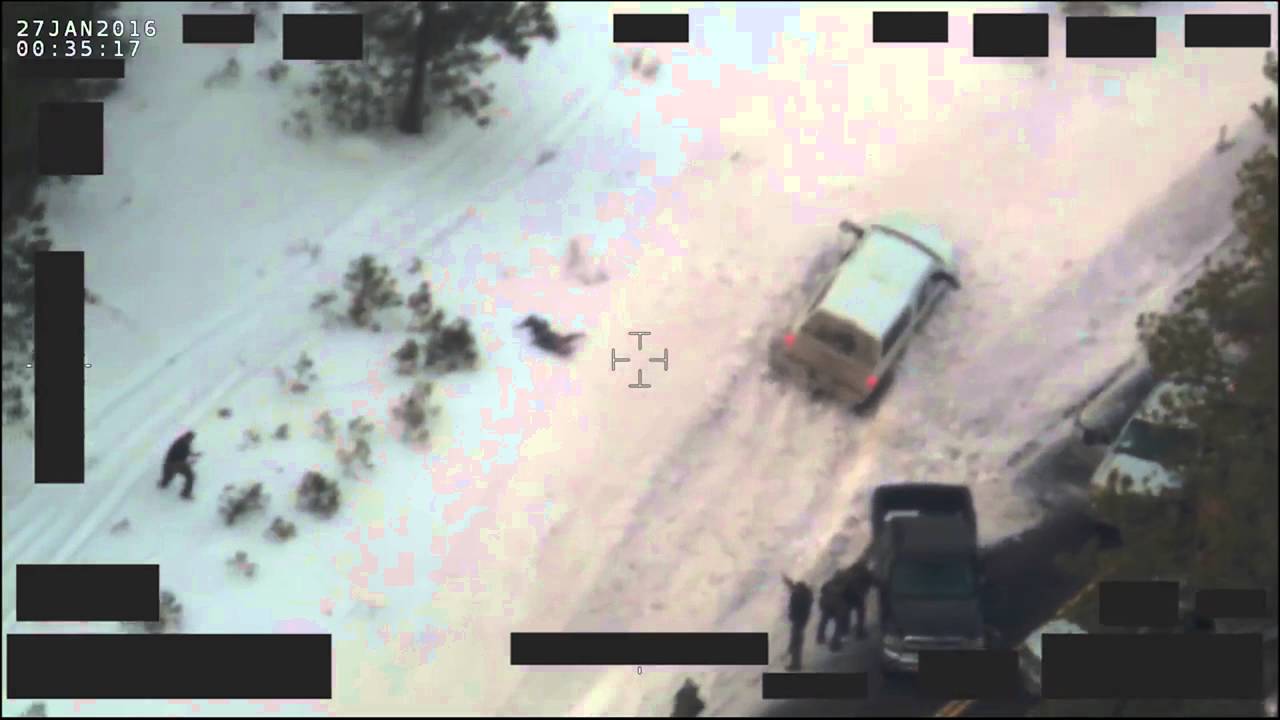 released late on Thursday by the FBI, we can see the action as captured by a drone overhead. In the final moments of his life, Finicum attempts to avoid police by driving a car — containing three other members of the group they called Citizens for Constitutional Freedom — into a roadside snow drift.
He emerges from the suddenly stationary vehicle with his hands outstretched, and appears to talk to the two state police officers trying to apprehend him with their guns drawn. Then he reaches for his pocket, where he has a loaded pistol, according to law enforcement. He is immediately shot by one of the officers, and falls to the ground.
We see a 55-year-old family man, who has had ample time to think, make a conscious choice to throw his life away.
In many ways, Finicum was the philosopher of the group. He acted as a spokesman, and pushed their stark constitutional originalism in media appearances and press conferences.
The conspiracy theorists in the broader patriot movement are already working on the ambiguities that the footage - any footage - makes available to the paranoid. But Finicum’s choice to die is in keeping with what he repeatedly told me and other journalists during the occupation of the Malheur National Wildlife Refuge.
Time and again, he said that liberty was more important than life. That despite missing his ranch and his family, he would rather die than go to prison.
What is capable of turning a grievance over grazing rights into a matter of life and death? When do political beliefs become something one is prepared to both kill and die for?
The first clue is in what Finicum shared with the Bundys at the Refuge, and with their father Cliven at home in Nevada. They were all members of the Church of Jesus Christ of Latter Day Saints, and all from a corner of the country with a habit of departing from the respectable path the church’s hierarchy has been charting for more than a century.
The second are the pocket Constitutions the group ostentatiously carried around from the first morning of their stay. One the surface those were simply underscoring the occupiers’ claims that in their alleged persecution of Dwight and Steven Hammond - local ranchers sent back to prison for arson on federal property - and their general management of public land, the federal government was acting unconstitutionally.
Courtney Campbell, a professor of religion at Oregon State University, says that in part, “Why these protestors are carrying around the constitution is that they do feel their constitutional rights to freedom of religion and association, to due process and the law have been violated by the government.”
But these are not any old constitutions. They are editions published by the National Center for Constitutional Studies, founded by W. Cleon Skousen, who like the Bundy family and Finicum, was a member of the Church of Jesus Christ of Latter Day Saints. If you order in bulk, you can get them for as little 35 cents apiece.
Skousen’s editions pair the text of the constitution - which many Mormons believe to be divinely inspired - with highly selective quotes from the founding fathers, with the intention of persuadine readers that the republic was a Christian enterprise from the outset, and was part of a divine promise.
Skousen - who died in 2006 at the age of 92 - was a popular, prolific writer who had stints in the FBI and as Salt Lake City police chief. He was also one of the most prominent and influential ultraconservative political activists in mid-century America, inspiring the John Birch Society’s febrile brand of anticommunist conspiracy thinking.
He insisted - at the height of the Cold War - that various government agencies were riddled with Communist infiltrators, and that this put America in existential danger. In books like The Naked Communist, first published in 1958, Skousen gave a lurid picture of the degree to which communists were embedded in public life, their tactics and what he saw as the godless nihilism of their world view. More conciliatory foreign policy, divorce law reform and campaigns against school prayer were just some of his examples of communists working toward the subversion of American life.
But Skousen was also a deeply involved Latter-Day Saint, serving for a time as a professor at Brigham Young University. Seth Payne, a former Mormon who began researching LDS conspiracy beliefs at Harvard Divinity School, explains that “when Skousen would talk to LDS audiences about these subjects he would bring in the religious element. He would describe these conspiracies as ‘secret combinations’. Secret combinations are not just criminal gangs or people looking for power. At the root of secret combinations is a Satanic influence.”
He was able to find support for these claims in the LDS church’s central text, the Book of Mormon.
When LDS founder and prophet Joseph Smith was assembling his prophetic book in the late 1820s - supposedly as a translation of golden plates left for the purpose by the angel Moroni - he incorporated elements of all the popular enthusiasms swirling around in upstate New York, where he was then living. His testament purported to tell the story of ancient inhabitants of the Americas who were descendents of the tribes of Israel, and who were visited by the risen Christ. But in a sense it was very much a book of its time.
It reflects Protestant revivalism, Israelism (the idea, popular in the 19th century that certain peoples, or groups were descended from the lost tribes of Israel), occultism and folk religion, and then-current anti-Masonic ideas.
Payne explains that while Smith did not specifically call out Masons, he used “secret combinations” as a familiar euphemism for Masonic activity. In the Book, “secret combinations” of satanic conspirators brought about the end of the Jeredites and the Nephites, two of the civilizations the book describes.
These were working in the interests of “Satan’s plan.” In Mormon theology, the conflict between this and God’s plan goes back to the beginning of time. While Lucifer wanted humans to be compelled to be obedient to God so they would be guaranteed a return to heaven, God wanted humans to be able to freely choose, so they would benefit from their time on earth.
In this way, Payne says, the Book of Mormon melds “classical Liberal thought with religious thought - the Protestant ethic and Protestant theology of the early 19th century - so tightly so that there really is no separation.” Liberal individual autonomy is a gift from God, and compelled behavior - even if it results in good deeds - is worthless for salvation, and even an artefact of the devil’s continuing effort to erode the power of human will.
Anti-Masonic enthusiasms are long-forgotten, but the idea of secret combinations carrying out Satan’s plan is very much alive. In a paper, Payne explains that “modern LDS conservatives tend to view any government action which compels behavior — even if that behavior is moral and productive — as being a version of Satan’s original plan to force God’s children to do good.”
That’s why many conservative Mormons, even those who would stop short at actions like those that the Bundys have taken, are bitterly opposed to welfare and other government programs that have a benevolent purpose.
In Skousen’s thought, this all mapped neatly onto his anticommunist zeal. He was faced, he thought, with “secret combinations” of communist infiltrators, and socialist schemes were not just politically disagreeable, but setbacks in “a cosmic battle going on where Satan is trying to infringe on individual liberty or state sovereignty.”
Except among conservative Mormons, Skousen’s influence faded long before the end of the cold war. Then Glenn Beck—another conspiratorially inclined, conservative Mormon—reintroduced it to a broader audience late last decade, managing to lift books like The 5000 Year Leap back onto the bestseller lists. Beck managed to recast Skousen’s thought to cast suspicion on the ambitions of President Obama, in particular, his plans to deliver universal health care.
Payne says, “Glenn Beck reintroduced Skousen’s ideas—his anticommunism and fears about sovereignty —to a broader community. That resonates with people who think that the president is a communist.”
Meanwhile, other Mormon conspiracists like Joel Skousen, nephew of Cleon, continue all the while to push the idea of secret combinations in the service of Satan’s plan, which was now identified less with communism than the institution of a single world government under the control of “globalists." In one sense, this bears similarities to the conspiracy ideas of essentially secular figures like Alex Jones. There's enough common ground for Joel Skousen—also an icon of the prepper movement—to have appeared several times on Jones’ radio program.
But the distinctive spiritual dimension of LDS-derived conspiracism raises the stakes for a segment of ulturaconservative Mormons. For some, like the Bundy group, such ideas are a stimulus to radical action.
Disaffection with federal government agencies is widespread throughout the western interior. Whether it is the festering issue of grazing rights, and perceptions that the BLM is antagonistic toward ranchers, or the feeling that conservation of native species like wolves or the spotted owl is taking precedence over ranchers’ interests, the emerging “sagebrush rebellion” takes in a lot of actors and sympathizers who are not Mormons.
But like the vast majority of conservative Mormons, very few ranchers have shown themselves willing to carry out armed occupations of federal buildings.
The resurgent militia and :{sovereign citizen :(style="background-color:#ffff66;"):}:movements have beliefs that overlap with the more religiously inclined conspiracists, They also fear world government and federal government tyranny, espouse an eccentric form of constitutional originalism, try to reassert local and state jurisdiction over federal land, and are prepared to use tactics of harrassment and intimidation, as they’ve shown in Harney County.
But even those who had been cooperating with the Bundys in organizing locals in opposition to the reimprisonment of Steven and Dwight Hammond were appalled in the early days of the occupation that the Bundy group had departed from a longer plan and involved the federal government. And in this circumstance, none have shown that they are willing to die.
In explaining Finicum’s actions, we need to take into account his particular form of radically ultraconservative Mormon belief. As Payne says, “for a believing Latter-Day Saint who takes these things seriously, they aren’t just looking at some political machinations for money and power, they’re looking at an eternal cosmic struggle that’s been going on since the beginning of time.”
The Bundys—and Finicum—see themselves as “soldiers in this resistance against not just political tyranny but also Satanic tyranny.”
This belief may be reflected even in the names they have been given and chosen. Ammon Bundy’s first name comes from an important personage in the book of Mormon—a warrior who spreads God’s word to unbelievers. The scriptural Ammon, Campbell says, “provides a model for the sort of person who stands up to oppression and unjust governments, resists and prevails.”
Campbell also points out that Finicum made veiled references to “the Title of Liberty,” a story from the Book of Mormon in which Captain Moroni of the Nephites “in the face of of a government that’s become tyrannical, individuals and their communities need to stand up for their liberty, their religion, and their land.” Another of the occupiers, Dylan Anderson, used Captain Moroni as his alias when talking to reporters.
Other references to Mormon lore came before the occupation, such as in a video where Bundy said that the constitution was “hanging by a thread," an allusion to the so-called White Horse Prophecy, in which Joseph Smith reportedly predicted that a time would come when Mormons would have to restore constitutional government.
Payne points out that there are serious dounts as to whether Joseph Smith ever said such a thing, and that it comes from secondhand accounts of his remarks by followers. The LDS church itself felt bound to say that the prophecy “has not been substantiated by historical research” after Mormon politicians like Orrin Hatch and Rex Rammel referred to it in the early years of the Obama administration. “It’s an urban legend, a folk myth.” Nevertheless, over the years “it has taken hold in the LDS community; even in mainstream LDS you’ll hear that phrase used.”
People like the Bundys and Finicum, “take that phrase and see themselves as elders of Israel who are going to save the Constitution.”
What is one man’s life in the face of such a cause, and such a danger?
The LDS church was quick to disown the occupation and the Bundys' actions. In 2012, sensing a growing wave of Skousenite Mormon activity, LDS Church Elder Apostle Dallin Oaks “the influence of right-wing groups who mistakenly apply prophecies about the last days to promote efforts to form paramilitary or other organizations… The leaders of the church have always taught that we should observe the law and we should not try to substitute our own organizations for the political and military authorities put in place by constitutional government and processes. We counsel against joining or supporting paramilitary organizations.”
No doubt this reflects the sincere disapproval of the vast majority of Mormons, even conservatives. And the Bundys represent a significant departure from the teachings of the church, according to Campbell. “They really emphasize that there needs to be obedience to the laws of the land. Even if there’s some kind of injustice that’s occurred, you don’t take over property, you don’t take over land.”
Actions like these also imperil the respectability Mormons have worked so hard to maintain from the beginning of the 20th century. In the 19th century, they came into open conflict with the federal government. First, in the 1850s, over their own territorial ambitions and a perception that the Utah Territory under Prophet Brigham Young was in insurrection. And later, in the 1890s, as they were forced to give up the practice of polygamy.
Payne explains that rebellions such as the Malheur occupation are embarrassing to the church hierarchy and many ordinary Mormons, since they “harken back to a period that most Mormons are embarrassed about from time to time—those days of conflict with the federal government and the American society as a whole.”
The Utah/Arizona/Nevada tri-state area, where the Bundys and Finicum are from, has been a reliable source of such embarrassments. Northern Arizona was the long-time locale for the polygamist holdouts of the Fundamentalist Church of Latter Day Saints under Warren Jeffs. Not far away in Nevada, the Bundy ranch standoff provided the immediate precursor for the occupation just ended.
People in such areas of the American West are culturally isolated, even from the moderating influences of contemporary Mormon practice.
“It’s certainly peculiar to areas in the western United States that are difficult to get to because they’re mountainous or arid,” Campbell says of these fundamentalist currents. “They’ve been historically bypassed by other people as they migrated to western Oregon or California. As a result there has been a tradition of anti-government anti-authoritarianism, where a person is accountable to God and not to civil authority.”
LaVoy Finicum clearly had a lot to lose: his ranch, his family, his life. But by melding his political beliefs with cosmic struggle, by embracing a tendentious reading of scripture and prophecy, by viewing those he disagreed with not just as political adversaries but as agents of the devil, Finicum turned a cause into a death wish.
rfk2 1/10/11
It was apparent from the outset that the topic's steroidal appeal was its dog whistle usefulness in highlighting the "otherness" of America's first African American president; there was no appetite among these conservative cohorts for applying the Article II Section 1 prohibition against the GOP's 2008 candidate, John McCain, a white man born in Panama.
Mr. Romney's initial choice to to stir life back into the issue raised consistency questions peculiar to the Romney clan. Mitt's father -- Governor George Romney of Michigan -- was driven to distraction by his own "birther" movement when he ran in the Republican presidential primaries of 1968. Supporters of his opponent, Richard Nixon, argued that George Romney's presidency would be unconstitutional because Romney had been born in Mexico where his grandfather and five wives had fled to evade America's polygamy laws.
On a more salient point with relevance to the current campaign, the 1787 Constitutional Convention included the Article II Section 1 prohibition due to the prevailing fear that a foreign power might otherwise gain undue influence over America's democracy. Ironically, the greatest threat of that outcome today comes from those Super PACs which Romney's allies and campaign staffers have pioneered in Iowa. Arguably, Super PACs now pose the most menacing platform for foreign and private interests to gain an alarming hold on the White House. Under the current Supreme Court holding in Citizens United v. FEC, there is nothing to stop foreign governments or foreign owned corporations from secretly donating hundreds of millions of dollars to Super PACs enabling them to pick favored candidates and destroy their opponents.