chao bak
619 capt
off bs only after CARES $?
The U.S. Department of Transportation's Federal Motor Carrier Safety Administration (FMCSA), on behalf of the Administration and under the leadership of Secretary Elaine L. Chao, is assisting in the distribution of one million protective masks to the nation's commercial truck drivers.
RS andy kroll
no lnx many
wASHINGTON —In a little-noticed ruling on Friday evening, the Trump administration rejected a petition by a coalition of labor unions that had asked the federal government to require passengers to wear masks on airplanes, trains, and other major forms of transportation.
The Department of Transportation told the Transportation Trades Department of theAFL-CIO labor federation that the agency would not proceed with a regulation to mandate that passengers wear masks on modes of major commercial transportation used by tens of millions of Americans. Right now in the U.S., a patchwork of airport authorities, cities, counties, and states are deciding whether to require people to wear masks on mass transit, in airports, and on planes. France, Spain, Switzerland, the United Kingdom, and other major countries have enacted national mask mandates for people using public transit.
[RELATED
The Omicron Olympics: Behind the Scenes of a Covid 'S--tshow' China Doesn't Want You to See
RS Recommends: Here's How to Find Covid Testing Kits on Amazon]
“It is unfathomable that in the midst of a global pandemic which has killed more than 209,000 Americans, and left millions more sick and potentially facing lifelong side effects — including the president of the United States — that the U.S. Department of Transportation would outright reject such a simple, science-backed, lifesaving measure,” Transportation Trades Department president Larry Willis said in a statement. “The DOT’s decision is heartbreaking, and in light of yesterday’s news, frankly, shocking.”
Deregulation is one of the hallmarks of the Trump administration, even amid the Covid-19 pandemic. Many of the biggest backers of Trump’s 2016 campaign were corporate executives who pushed then-candidate Trump to embrace a full-on deregulatory agenda. Since taking office, the Trump administration has sought to weaken or reverse hundreds of existing policies and regulations related to energy, the environment, labor rights, health care, manufacturing, transportation, and agriculture.
What makes the Transportation Department’s mask-mandate rejection so telling is that it happened only hours after the White House revealed that President Trump and First Lady Melania Trump had tested positive for Covid-19.Other White House and senior GOP officials who have tested positive in recent days include senior aide Hope Hicks, adviser Kellyanne Conway, reelection campaign manager Bill Stepien, Republican National Committee Chairwoman Ronna Romney McDaniel, and Senators Mike Lee (R-Utah), Thom Tillis (R-N.C.), and Ron Johnson (R-Wisc.).
In a July letter to Transportation Secretary Elaine Chao, Larry Willis, the president of the Transportation Trades Department, a coalition of 33 labor unions, said many of its workers — which include bus drivers, ferry operators, pilots, flight attendants, TSA employees, and more — were on the front lines of the Covid-19 pandemic. “Regrettably, these employees have not been spared the effects of the disease, and each TTD union involved in passenger transportation has reported infections and deaths among their frontline workers,” Willis wrote to Chao.
Willis wrote that the “patchwork of state or local mandates,” combined with “a deeply inadequate federal response,” had left those frontline transportation workers vulnerable to the virus in their workplaces. The transportation union coalition formally petitioned Chao, who is the wife of Senate Majority Leader Mitch McConnell, and the Transportation Department to create a legal requirement for passengers to wear masks. So far, the agency has voiced support for the Centers for Disease Control and Prevention’s guidance that passengers wear masks and has distributed more than 100 million masks, but has stopped short of mandating mask-wearing on a national scale.
:{
}:
Wearing a mask is one of the most effective ways to slow the spread of Covid-19.Dr. Robert Redfield, the director of the Centers for Disease Control and Prevention, testified last month that a mask was “the most important, powerful public health tool we have.” Redfield told Congress that a mask might be even more effective than a vaccine because no vaccine has a 100 percent effectiveness rate.
“I will continue to appeal [to] all Americans, all individuals in our country, to embrace these face coverings,” Redfield said. “I’ve said it: If we did it for six, eight, 10, 12 weeks, we’d bring this pandemic under control. We have clear scientific evidence. They work, and they are our best defense.”
President Trump was asked at an ABC News town hall last month why he had not called for a national mask mandate. He replied with a long-winded answer that blamed former Vice President Joe Biden, who does hold elected office right now, for not calling for a mask mandate. Trump added that “By the way, a lot of people don’t want to wear masks. There are a lot of peoplethat think the masks are not good.”
:{
}:
In its denial letter, the Transportation Department said it shared the transportation union’s concerns about the potential health impact of the pandemic on transportation workers, but said the need to avoid creating new regulations overrode those public-health concerns.
“The Department also embraces the notion that there should be no more regulations than necessary,” the agency’s general counsel, Steven Bradbury,writes. “We emphasize consideration of or regulatory solutions and have rigorous processes in place for optimal reassessment of existing regulations to ensure they remain cost justifiedand narrowly tailored to address an identified market failure.”
The letter continues, “At this time, the Departments view is that the measures discussed above, along with the ongoing efforts of key transportation stakeholders, are adequate to address the concerns identified in the petitionwithout the intention of a rule-making process.”
Read the Transportation Department’s rejection letter here.
trump Covid-19: Administration Rejects Mask Mandate for ...
In a July letter to Transportation Secretary Elaine Chao, Larry Willis, the president of the Transportation Trades Department, a coalition of 33 labor unions, said many of its workers — which ...
Chao cool on 'heavy-handed' pandemic regulations for ...
Jun 3, 2020transportation. Chao cool on 'heavy-handed' pandemic regulations for airlines. Chao told Playbook that Covid-19 protections are more "labor-management" issues than anything else.
Transportation Secretary Elaine Chao: 'Truckers Are Our ...
The real heroes in the age of COVID-19 are found on the nation's roads. ... shelter-in-place," Transportation Secretary Elaine Chao said this month. ... the U.S. Department of Transportation has ...
WASHINGTON—Fed up with Trump regime inaction to protect frontline transportation workers, their unions formally petitioned Trump Transportation Secretary Elaine Chao to order the nation's ...
:{PDF:(style="margin:-0.2em 0px 0px;padding:1px 0.35em 0px;border:0px;font-variant:inherit;font-weight:600;font-stretch:inherit;vertical-align:middle;border-radius:var(--default-border-radius);display:inline-block;position:relative;user-select:none;top:-1px;background-color:#d0d0d0;"):}: The Honorable Elaine L. Chao The Honorable Alex M. Azar II
Dear Secretary Chao and Secretary Azar: We once again urge the Department of Transportation (DOT), in coordination with the U.S. Department of Health and Human Services (HHS), to immediately issue strong, nationwide rules to protect the health and safety of the flying public, especially during the COVID-19 pandemic.
8 august 2021
The Kroger Company announcement August 2 that arch-reactionary Elaine Chao, wife of Republican Senate minority leader Mitch McConnell, had been elected to its board of directors has evoked widespread revulsion and anger.
Chao, Secretary of Transportation under Donald Trump, has a long record in the service of corporate interests, including eight full years as Secretary of Labor in the administration of George W. Bush, where she oversaw the further evisceration of workplace safety. She was the longest-serving Secretary of Labor since Frances Perkins, whose tenure spanned 1933 to 1945 under President Franklin D. Roosevelt.
The election of Chao is a crass example of the intertwining of US corporations and the very government “regulators” who are supposed to monitor them. In announcing the election of Chao, Kroger’s chairman and CEO Rodney McMullen could scarcely contain his enthusiasm.
....“We are pleased to welcome Elaine to Kroger,” he said. “She’s an experienced national and global leader who brings to Kroger’s board deep knowledge of corporate governance, strategic and workforce management, and public-private partnerships as well as extensive experience at the highest levels of US government.” He added ominously, “Kroger’s board is committed to creating value for all of our stakeholders, including our shareholders, customers, associates, and communities.”
In a nod to identity politics, McCullen even tried to suggest that the appointment of Chao, an Asian American woman, was somehow progressive by creating a “diverse” board of directors.
Chao is currently at the center of a scandal involving claims by the Transportation Department that she improperly used her office to aid family members, who run a New York-based shipping business with assets of over $1 billion.
Kroger’s announcement sparked immediate outrage, as thousands took to Twitter opposing the installation of Chao, accompanying their Tweets with the following hashtag, #BoycottKroger. Many noted the provocative nature of the appointment, following close on the heels of the tragic suicide of 19-year Kroger employee Evan Seyfried, whose family says he faced vicious harassment for wearing a face mask from Kroger manager Shannon Frazee.
Criticizing the silence and inaction of the United Food and Commercial Workers, one person wrote on Twitter:
“@UFCW I ask that you investigate why #ShannonFrazee is still employed by @kroger & why your Union Reps failed to stand by #EvanSeyfried who was bullied to death for wearing a mask on the job. #boycottkroger #justiceforevan @justiceforevan #UFCW”
Another tweeted: “Yes, it’s me. I temp changed pic to highlight family’s fight [referring to Evan Seyfried] to hold Kroger accountable for loved one’s death. This plus their attitude re masking/vaccinated?And Elaine Chao? Kroger doesn’t care! #BoycottKroger”
And another: “Elaine Chao, eh? Oh, that reminds me, there’s this smaller, locally-owned grocery I’ve been wondering about. I think I’ll check them out next time I need groceries. Who knows? Might like them better. #BoycottKroger”
While elements around the Democratic Party have attempted to capitalize on anger over Chao’s installation on Kroger’s board, the fact is she was confirmed as Trump’s transportation secretary with overwhelming bipartisan support in a 93-6 vote.
A look at Chao’s political history puts light on the intentions of McMullen and fellow board members.
Throughout her career she has held numerous high-ranking government positions and posts with Fortune 500 companies. This includes as president and CEO of the United Way of America; chair of the Federal Maritime Commission; deputy Maritime administrator; director of the Peace Corps; board of directors for Wells Fargo; high-level positions with Citicorp and Bank of America.
As Peace Corps director in the administration of the senior Bush, Chao signed an agreement with acting Russian Prime Minister Yegor Gaidar in 1992 that established a program in the Russian Federation to promote and facilitate the restoration of capitalism.
One month after Chao’s appointment as labor secretary in February 2001, President Bush and Congress repealed the Occupational Safety and Health Administration’s Ergonomics Standard. The following month on March 6, 2001 Chao issued a statement justifying the change, cynically claiming, “[I]f we really are going to protect workers, we must put more emphasis than ever before on prevention and compliance assistance—rather than just after-the-fact enforcement.”
In 2003, as more than 11 million workers in the US remained jobless, Chao placed emphasis on the blue-collar job sectors, saying that job-retraining programs could convert white collar workers, such as software developers, into plumbers and carpenters.
In 2005, as part of a crackdown on immigrants, the Bush administration granted the Department of Homeland Security $31 billion in an appropriations bill, wherein $7.5 billion was allocated to the Immigration and Customs Enforcement (ICE), $90 million to construct new prisons with a capacity of over 20,000 and spare resources to employ an additional 1,000 US-Mexico Border Patrol agents.
In an October 18, 2005 hearing, Chao lent her support to the escalating war against immigrants, saying undocumented immigrants that were already (without legal residence) in the US would need to pay a fee to enter the guest worker program—failing to clarify that it would not represent an amnesty for the undocumented—and obtain a temporary three-year visa. Furthermore, the undocumented, after the first visa application, would be eligible to renew for a second three-year visa, which would be their last but then subject to being forcibly removed from the country.
In addition to the extreme limitations placed on undocumented immigrants, those applying for the three-year visa would need the blessing of an American employer willing to sponsor them and attest that no US citizens would take any job offered by said American employer. “At a minimum, those who come forward will not be offered an automatic pass to citizenship and should be expected to pay a substantial fine or penalty to take part in the temporary program,” said Chao.
There is no record of Chao opposing Trump during his entire term notwithstanding the president’s repeated fascist threats. Later, in an attempt to slightly distance herself from Trump, she resigned her cabinet post on the Monday following the January 6 coup attempt by Trump as part of an effort by some top administration officials to feign concern over the actions of the would-be Führer.
One voice that has been markedly silent on Chao’s election to the Kroger board is the UFCW, which has been silent on the tragedy of Evan Seyfried. The union failed to act on complaints of harassment and even failed to send a representative to Seyfried’s memorial.
In the wake of Seyfried’s death Kroger has only now belatedly made changes to its mask policy, recently recommending customers wear masks as the Delta variant of COVID-19 spreads unchecked.
Thanks to services of the UFCW, which has helped suppress demands for the prioritization of worker safety during pandemic, Kroger sales surged 8.4 percent to $132.5 billion in 2020. The company reported a $2.6 billion profit for the year, up 5.4 percent.
While Kroger awarded McMullen a $22.4 million pay package, the average income for Kroger’s employee fell 8 percent to $24,617. Meanwhile, 3,000 grocery workers employed by Kroger in the state of Arkansas have worked a year without a new contract with the UFCW refusing to call for strike action.
Chao’s appoint underscores what German Marxist Clara Zetkin wrote in 1896 about the Elaine Chaos of her day: “… the liberation struggle of the proletarian woman cannot be similar to the struggle that the bourgeois woman wages against the male of her class. On the contrary, it must be a joint struggle with the male of her class against the entire class of capitalists.”
In the midst of the resurgence of the pandemic and escalating attacks on workers, the call by the World Socialist Web Site and the Socialist Equality Party for the building of independent rank-and-file committees is more urgent than ever. Workers must build their own democratic workplace organizations to defend the right to safe and healthy working conditions and decent compensation. The silence of the UFCW on the appointment of Chao is not accidental. It is a further demonstration of the complete identification of the union apparatus with corporate management.
Chao has been elected to the company's board of directors. "We are pleased to welcome Elaine to Kroger," said Rodney McMullen, Kroger's chairman and CEO. "She's an experienced national and global leader who brings to Kroger's board deep knowledge of corporate governance, strategic and workforce management, and public-private partnerships as ...
Why Customers Are Furious With Kroger And Boycotting Its ...
Donald Trump Picks Elaine Chao As Transportation Secretary On Wednesday, Kroger ( KR) named former U.S. Transportation Secretary Elaine Chao to its board of directors, sparking a flurry of backlash...
Liberals Demand Kroger Boycott After Elaine Chao Joins ...
Newsweek has contacted Kroger and Chao for comment. Related Articles. Mask Mandate Live Updates: Target, Kroger Among Businesses Revising Rules Amid COVID Spike; Kroger Shooter Gregory A. Bush ...
an 10 21
no lnx
Now that former President Donald Trump's reign is over, the members of his administration have been forced to take their careers in different directions. So, where are the members of the Trump administration now? According to The Intelligencer, many are doing an array of different things; some of which are synonymous with the questionable activities that long-haunted the Trump administration.
Here's where the top Trump White House officials are now:
1. Former Central Intelligence Agency (CIA) director and U.S. Secretary of State Mike Pompeo is still trying to distance himself from the kidnapping of Julian Assange. According to Pompeo, he had nothing to do with it.
Pompeo is adamantly denying any involvement in the plot to kidnap Assange. A report published by Yahoo! News back in September, suggested that Pompeo was livid when he learned Assange divulged U.S. national-security secrets. In fact, the report also claimed that he participated in discussions with members of the Trump administration on how to get retribution.
However, Pompeo is still suggesting the reports are not true. "There's pieces of it that are true," Pompeo said during an appearance on The Megyn Kelly Show. "We tried to protect American information from Julian Assange and WikiLeaks, absolutely, yes … We're not permitted by U.S. law to conduct assassinations. We never acted in a way that was inconsistent with that."
2. Former U.S. Treasury Secretary Steve Mnuchin has been milking his access to the Secret Service.
Thanks to Trump's order extending the use of the Secret Service to members of his administration, Mnuchin has used the professional perk to his benefit. The publication reports that in his first six months out of office, Mnuchin has racked up the highest Secret Service tab. The Washington Post detailed how Mnuchin managed to rack up more than $150,000 in Secret Service expenses.
The receipts showed that agents spent $114,000 over the six months to rent rooms at a W Hotel in Los Angeles, where Mnuchin has a home. They also followed Mnuchin on three trips to the Middle East, where Mnuchin is reportedly seeking to raise money from sovereign wealth funds for a new venture called Liberty Strategic Capital…
Mnuchin's travels with the Secret Service weren't all business, however. Over the six months, the records show three separate trips to Cabo San Lucas — the Mexican resort, where Mnuchin had also vacationed during Trump's presidency.
To guard Mnuchin during those three trips, the records show, the Secret Service paid $56,000 for hotel rooms and $2,000 to rent golf carts.
According to The Hollywood Reporter, Mnuchin is planning to use the $2.5 billion he has raised traveling so he can invest in technology and cybersecurity investments, along with "new forms of content." It remains unclear what Mnuchin specifically describes as "new forms of content" but "many big tech companies are pushing virtual- and augmented-reality hardware and content products and digital gaming."
3. Wilbur Ross is reportedly fantasizing about putting "Trump condos on the moon."
Back in February after the Trump administration transitioned out of the White House, Ross spoke with Bloomberg and shared his upcoming post-government plans; which involve "Trump condos on the moon."
On this particular afternoon, he's sitting in the living room of his 80-year-old home filled with Magrittes and Picassos, sipping a cappuccino, dressed in cashmere sweater, slacks and velvet slippers embroidered with octopuses.
Ironically, it's while ensconced in this paradise of earthly delights that Ross is gearing up to invest in space, among other possibilities. He sees opportunity in extraterrestrial tourism, manufacturing, research and habitation.
Habitation? When asked whether space would be a gold-plated real estate opportunity for Trump, Ross didn't disagree.
"Why not Trump condos on the moon?" he quipped back.
Ross' remarks came just months after the U.S. Commerce Department's inspector general released a scathing report about the former Trump official's behavior. According to The Washington Post, the IG's report "concluded that Ross had made many inaccurate statements to federal officials about his assets before taking office, though he did not willfully violate conflict-of-interest laws."
4. Ben Carson is launching a venture similar to Boy Scouts of America.
After departing Washington, D.C., Ben Carson —the former Housing and Urban Development Secretary— launched an organization called the American Cornerstone Institute.Carson's new think tank reportedly places an emphasis on discovering "commonsense solutions to some of our nation's biggest problems."
The American Cornerstone Institute
youtu.be
Carson has also created the Little Patriots program, which is described as a partisan organization for children. Speaking to The Washington Post, Carson explained the organization's initiative. "It will be something like the Boy Scouts," Carson told the publication. "But heavily exposed to the real history of America.
"You probably notice when ISIS goes into a place, they destroy the history, they destroy the monuments," Carson explained. "History is what gives you identity."
5. Elaine Chao contributed to calls for Kroger to be boycotted.
Chao —wife of Senate Minority Leader Mitch McConnell (R-Ky.) and former transportation secretary— worked for several of the country's top corporations prior to her role with the Trump administration. But Intelligencer reports that "she and other Trump Cabinet alums were having a hard time finding cushy landing spots after exiting the administration. 'The feedback was 'It's too soon,' said one of the headhunters involved in an unsuccessful effort to find companies willing to work with Chao."
:{
}:
Despite her struggles to re-enter the corporate world, Chao was appointed to Kroger's board of directors. But given her history of abusing her power and position with the government, social media users quickly expressed outrage and urged Kroger to drop the former Trump cabinet member from its board.
6. Alex Azar is reportedly conspiring against his former colleagues.
Former Health and Human Services Secretary Alex Azar is at odds with many of his former colleagues. In fact, several of them including —former FDA commissioner Stephen Hahn, former Centers for Disease Control and Prevention (CDC) director Robert Redfield, former Medicare chief Seema Verma, and former White House COVID coordinator Deborah Birx— have reportedly joined forces to prepare their statements regarding the Trump administration's handling of COVID-19.
According to Politico, they've done so out of caution and concern about Azar possibly using them as "scapegoats" to clear themselves.
"I know the way this goes — everyone has a different perspective," Hahn said in an interview. "I wanted to tell what it was that happened and why it happened and the perspective that we had."
In calls and text messages, members of the group have swapped notes, compared recollections, and sent updates on media requests and interview opportunities, four people with knowledge of the matter said …
And in a nod to their individual battles with Azar, some have jokingly referred to the group in private as "AAA," or Alex Azar Anonymous, according to a person in direct contact with multiple members.
From the looks of it, many Trump administration officials are still conducting shady business as they did while in office.
resistance to sci suppr
https://insideclimatenews.org/news/27122020/trump-climate-science-epa-wheeler-biden
see series: https://insideclimatenews.org/project/the-anti-scientists-2/
...
Christine Todd Whitman, the former New Jersey governor who served as President George W. Bush’s first EPA Administrator, had experience in clashing with the White House over climate change. But she said there was nothing like the Trump administration’s effort to manipulate how science was conducted. “There were certainly people who questioned science within the Bush administration,” she said. “But there wasn’t a war on science. This has been an outright war on the EPA, a physical effort to strangle the agency.”
‘They Basically Cooked the Books’
Jeff Alson, a senior engineer with EPA’s vehicles lab in Ann Arbor, Michigan, knew something was wrong soon after Trump took office, when the fuel economy group at the Department of Transportation stopped talking to his team.
The two agency teams had worked hand-in-hand on the nation’s first greenhouse gas standards for automobiles under Obama. “We had worked together every month, most of the time every week, and sometimes every day when we had deadlines coming up,” Alson recalled recently. “We knew the names of their spouses and how many kids they had and where they went on vacation.” Now, the fuel economy group wouldn’t return the phone calls of EPA’s engineers.
The Transportation Department analysts finally unveiled their work to Alson’s dumbstruck team at EPA via a video conference call in January 2018. The cost-benefit analysis they had previously worked on together was replaced with new numbers that shrunk the benefits of reducing carbon dioxide and other air pollutants, and added new costs, like increased car crashes, noise and congestion.Instead of the government’s previous conclusion that the clean car standards would bring $100 billion in net benefits to the economy, the new analysis concluded they would result in $200 billion in net costs.
Jeff Alson discusses energy efficiency advances with an auto industry representative at a 2014 technology showcase at EPA’s National Vehicle Fuel Economy Laboratory in Ann Arbor, Michigan. Credit: EPA]
Alson, 63, had worked on dozens of cost-benefit analyses, but he had never seen such a dramatic reversal.
“I concluded that they had been told what the answers had to be if they were going to roll back the standards. They had to show the public that they were way too expensive, which they did by basically cooking the books,” Alson said. “When I saw how dishonest the whole analysis was in those early stages, that’s when I decided I wanted to get out of there. I thought maybe I can do more good on the outside.”
Alson, like Costa, left the agency and joined the EPA alumni in the Environmental Protection Network. He began speaking out and with 40 other former EPA engineers, scientists, policy analysts, attorneys and managers, filed formal commentson the proposed fuel economy rollback. A prominent economist whose work the Trump administration had heavily cited in its proposal, Antonio Bento of the University of Southern California, published a peer-reviewed critiquein the journal Science, detailing everything that the Trump team had gotten wrong.
“Inconsistent with basic economic principles,” Bento and his co-authors concluded about the Trump analysis, the most striking flaw being an assumption that looser standards would result in 6 million fewer cars on roads in the United States.
The public critiques by engineering and economics experts put the Trump administration in a bind. With the threat of litigation against its rollback looming, it had no choice but to address the flaws in its cost-benefit analysis in the final version of the “Safe Affordable Fuel-Efficient (SAFE) Vehicles Rule” published on March 31 of this year. But those corrections forced the agencies to concede that the rollback could be expensive, imposing as much as $22 billion in additional fuel bills and other costs on the economy. And that unfavorable cost-benefit analysis left the Trump rollback vulnerable in the courts, where it has been challenged by multiple states and health and environmental groups.
“They wanted to take money from our pockets and give it to the oil companies, because that’s basically what you’re doing if you make people buy cars that are less fuel efficient,” said Alson, who said a driving force behind his speaking out was to defend the reputation of the EPA.
“We did everything we could to try to do the best standards that we could so the American public would benefit,” he said.
As he was retiring, Alson said, he encouraged the young engineers on staff to continue their work, despite the setbacks of the Trump administration.
“Don’t lose faith in EPA,” he said he told them. “Because if we’re going to save the planet, people have to still have faith that the U.S. Environmental Protection Agency can do the job.”
In the End, They Were Scientists First
....
==
Safety Can't Be a 'Pretext' for Regulating Unsafe Oil Trains, Says Trump Admin
https://www.desmogblog.com/2020/05/20/trump-phmsa-safety-washington-vapor-pressure-oil-trains
desmog
==
==
new
619 chao fast lane cult corrupt, crony cap'l
basically earmarks revival trms
https://www.alternet.org/2019/06/full-fledged-banana-republic-ethics-experts-sound-the-alarm-after-transportation-secretary-chao-secures-millions-for-projects-in-mcconnells-state/
==
==
https://www.alternet.org/2019/06/foiad-emails-raise-serious-ethics-concerns-over-elaine-chaos-canceled-trip-to-china-report
FOIA’d emails raise serious ethics concerns over Elaine Chao’s canceled trip to China: report
written by Alex Henderson June 3, 2019
Officials in the U.S. Department of Transportation (DOT) spent months planning for Secretary of Transportation Elaine Chao’s visit to China, but after all that planning and preparation, the trip was canceled. And the New York Times’ Eric Lipton is reporting that the State Department “raised ethics concerns” in response to some of Chao’s actions when the trip was being planned.
In a Twitter thread, Lipton notes that the ethics concerns came about because in China, Chao’s “family was in the shipping business.” Chao, who is married to Senate Majority Leader Mitch McConnell, “took a particular interest in picking out gifts for officials she would meet in China,” Lipton tweets.
THREAD: DOT officials sent hundreds of emails and spent months planning a trip to China for ELAINE CHAO. They even designed a logo for the luggage Elaine Chao took a particular interest in picking out gifts for officials she would meet in China pic.twitter.com/8krTkNvX4H
— Eric Lipton (@EricLiptonNYT) June 3, 2019
Lipton, in the thread, posts an August 27, 2017 e-mail from Chao in which she discusses possible gifts for Chinese officials. Chao, in the e-mail, writes, “When I was secretary of labor, I had a number of White House logo souvenirs like: candy bars, leather portfolios, etc. …. Can you find out how to get these White House gifts for us to bring as gifts to VIPs in China? Get a list, prices/items, etc. They will NOT be given out like water or candy…. but to special people.”
But then the State Department raised ethics concerns. Asking why Elaine Chao’s family was going to be a part of this trip. Her family was in the shipping business in China. Thus the ETHICS QUESTION. pic.twitter.com/rSgIJflwN2
— Eric Lipton (@EricLiptonNYT) June 3, 2019
The agency also put a chunk of work in to prepare special luggage tags for the folks going on this trip, or at least who planned to make the trip pic.twitter.com/vUkLNFW6jv
— Eric Lipton (@EricLiptonNYT) June 3, 2019
Lipton, in his thread, reports that theDOT “went to great lengths” to “hide any evidence from THE NYT that Chao’s staff was communicating with FOREMOST (the family shipping company that does business in China) while they worked to prepare for this trip. Everything is redacted. Well, almost everything.”
Lipton also explains that after ethics questions were raised by the State Department, the trip was canceled “within a matter of days.”
==
mcconn staffer mafia
https://nymag.com/intelligencer/2018/05/transportation-secretary-elaine-chao-gets-an-ethics-scandal.html
While other Trump Cabinet officials have been in the news constantly for all sorts of ethical violations, we’ve barely heard anything about Secretary of Transportation Elaine Chao. She drew attention most recently for two issues that involved no wrongdoing on her part: her revelation that the president personally asked House Speaker Paul Ryan to block funding for a New York infrastructure project, and being subjected to racist attacks from a Republican candidate in West Virginia who doesn’t care for her husband, Senate Majority Leader Mitch McConnell.
So is Chao the rare Trump official who’s doing her job and not abusing her office in any way? Apparently not. Politico reported on Sunday that since her nomination, she’s appeared in at least a dozen interviews with her father James Chao, the founder and chairman of the Foremost Group shipping company, which carries goods between Asia and the U.S. All of the interviews are with Chinese and Chinese-American media outlets, and the secretary is otherwise press shy; she’s never held a press conference for beat reporters and usually refuses to answer reporters’ questions after public events.
Federal employees are prohibited from using their office for their “own private gain, for the endorsement of any product, service or enterprise, or for the private gain of friends, relatives, or persons with whom the employee is affiliated in a nongovernmental capacity.” But Chao makes no apparent effort to show she’s promoting her family’s business only as a daughter, not as U.S. Transportation secretary, and in fact, it appears several of the videos were filmed in her government office. DOT flags are shown in several of the spots, like the New China Press interview below, and one video features the state flag of Kentucky, highlighting her tie to the majority leader.
[vid]
Government connections are an important part of doing business in China, and Politico notes that in many of the videos James Chao brags about his daughter’s government work and contacts. In one video he describes talking with Trump on Air Force One. “The president spent several minutes with me,” he said. “We were talking about business.”
He also describes how his daughter worked to build up the company when she was in college, though her involvement is not listed on her financial-disclosure form. Two of Chao’s sisters have high-level positions at the company, which expanded its capacity by more than 40 percent since Trump’s inauguration. While the secretary has no formal role in the company, her father has given her and McConnell at least $5 million in the past decade.
A spokesperson for Chao said her press appearances with her father are “motivational and not promotional in any form,” and suggested that she’s merely responding to the high demand for interviews with the first Asian-American woman to hold a U.S. Cabinet position (presumably there was more interest when Chao first earned that distinction as President George W. Bush’s Labor secretary).
“There is nothing inappropriate with a Cabinet member appearing with her father or other family members,” the spokesperson said. “The secretary’s appearances are intended to share an inspirational story about immigrants from a minority community who have become successful in our country.”
If Chao had to engage in some ethically questionable behavior, she picked a smart way to do it. President Trump might admonish members of his Cabinet for enjoying lavish trips and office furniture on the taxpayers’ dime (though Ben Carson, Scott Pruitt, and Ryan Zinke still have their jobs). However, it seems highly unlikely that Trump is going to punish anyone for publicly promoting their wealthy dad’s business.
TAGS:
==
OMFG
https://www.alternet.org/2019/02/meet-the-new-un-ambassador-nominee-a-billionaire-gop-donor-and-science-denier-who-gave-trump-millions/
prez **Donald Trump** promised he’d always hire the “best people” during his presidential campaign, but not only has that turned out to be false, he’s had more turnover than any president in modern history, if not ever.
The president is fond of playing “whack-a-mole” with his personnel problems, by shuffling the players around instead of actually looking for, as he put it, the “best people.”
For example, Mick Mulvaney joined the Trump administration after serving as a U.S Republican Congressman. He served as Trump’s Director of the Office of Management and Budget, then added to his resume the title of Acting Director of the Consumer Financial Protection Bureau. Mulvaney then became Trump’s Acting White House Chief of Staff, replacing embattled and disgraced John Kelly – while giving up his CFPB job but still retaining the role of Director of the Office of Management and Budget.
Fast forward to Friday evening.
President Trump has just announced his latest nominee to become Ambassador to the United Nations, after his earlier nominee, who would have replaced Nikki Haley, was forced to withdraw her nomination after illegally hiring as a nanny an immigrant unauthorized to work in the U.S.
“I am pleased to announce that Kelly Knight Craft, our current Ambassador to Canada, is being nominated to be United States Ambassador to the United Nations,” Trump announced via tweet. No formal White House announcement has been made yet. “Kelly has done an outstanding job representing our Nation and I have no doubt that, under her leadership, our Country will be represented at the highest level. Congratulations to Kelly and her entire family!”
Trump neglected to mention that Knight Craft is Trump’s current Ambassador to Canada, so he’s just shuffling the players around again.
Knight Craft is perhaps best known for her science-denying remarks, saying she believes in “both sides” of climate change. (There are not two sides.
[vid]
Meanwhile, the President also neglected to mention Knight Craft, along with her billionaire coal baron husband, donated millions of dollars to Trump’s presidential campaign.
Ambassador to the United Nations is not the same as Ambassador to Canada. There are few national security issues America’s Ambassador to Canada would be relied upon to keep Americans safe.
But the U.S. Ambassador to the United Nations holds a key national security role. They sit on the UN Security Council and represent the U.S. to the rest of the world.
There is no indication Knight Craft is qualified for the role.
Knight Craft does hail from Kentucky, where she has also been a major GOP donor, or, as one Canadian news publication described it, “Knight Craft is well known among Republicans, to whom she has donated piles of money.”
Senate Majority Leader Mitch McConnell, also of Kentucky, reportedly recommended her for the role of UN Ambassador.
McConnell is not the only member of his family greasing the wheels. This week Trump Transportation SecretaryElaine Chao, who happens to be married to the Senate Majority Leader, was embroiled in scandal.
Secretary Chao “has met at least 10 times with Kentucky business leaders or politicians after email requests made by her husband, Senate Majority Leader Mitch McConnell (R-KY),” The Daily Beast reports.
“A cache of more than 800 emails—obtained under the Freedom of Information Act by the watchdog group American Oversight—shows that some of thosemeetings led to McConnell’s associates being granted their wishes by the powerful Transportation Secretary—from infrastructure grants to highway project funding. In at least one example, the lobbyist had donated to McConnell’s re-election campaign.”
==
omg
https://www.alternet.org/2019/01/how-mitch-mcconnells-weak-kneed-cowardice-makes-him-the-perfect-target-for-perfect-for-agents-of-power-and-influence/
no linx, graf
On Saturday January 12, the government shutdown became the longest in American history, eclipsing the former record of 21 days. At the forefront of this burgeoning disaster is Mitch McConnell, a one-man blockade to re-opening the government.
I don’t refer to him by his formal title because it falls short of describing what he really is: he’s a tyrant, a malevolent dictator.
No bill comes to the floor without his say-so. Even if every one of the other 99 senators wanted to vote on a particular bill, McConnell can prevent it. The only meaning majority has for him is that he has power over it.
And he’s using this power to single-handedly keep the government shut down.
Some have posited that he’s carrying Trump’s water because he’s in Trump’s pocket. Some say he’s worried about his upcoming 2020 re-election so he’s pandering to Trump’s base. Some suggest he’s protecting the GOP because he’s a hardcore republican. The media line seems to be that he’s a “wily old fox.”
But none of these really take full account of McConnell’s need to succeed, driven by weak-kneed cowardice and inadequacy. Yet it is these personality traits which greased the wheels of his rise to senate tyrant because it is these personality traits which make him the perfect mark for agents of power and influence.
Homegrown Billionaires
First on the list is the most obvious: the American billionaire donor class. Chief among these would-be plutocrats are the Koch brothers, the Adelsons and the Mercers. It comes as no surprise then that all three have supported, and continue to support, McConnell. Last year theAdelsons topped the donor list with two $25 million contributions to McConnell’s Senate Leadership Fund.
Of course these billionaire donors support other republicans too in order to consolidate their influence on the upper house. That influence includes putting a man of their choosing in the position of republican senate leader.
Now consider for a moment what they want from this leader… subservient obedience, unquestioning compliance, covetous greed and a feeble conscience would have to top their list. Mitch McConnell fits the bill in every respect. So they buy him the senate leadership and buy themselves a senate leader.
Vodka and Vice
In 2015 an old player with new tricks entered the field of influence: Russia. In the donor category, Russia appears in a number of guises including a Soviet-born billionaire living in the U.S.
Len Blavatnik, who holds dual U.S.-U.K. citizenship, used to be a fairly run-of-the-mill campaign contributor, donating relatively modest amounts in a bipartisan fashion — [$53,400 in 2009-2010; $135,552 in 2011-12; $273,600 in 2013-14] and then the 2016 election cycle hit.
Beginning in 2015, Blavatnik lavished contributions on Republicans, with Senate Majority Leader Mitch McConnell alone on the receiving end of $3.5 million between 2015 and 2017.
This dramatic increase in contributions is attributed to Blavatnik acting as a go-between for illegal donations from Russian oligarchs. He has strong ties to some serious players in the oligarch section of the Russian mafiya state.
From Dallas News:
Viktor Vekselberg is one of the 10 richest men in Russia. He and long-time business partner Blavatnik hold a 20.5 percent stake in Rusal.
and
Oleg Deripaska is said to be one of Russian President Vladimir Putin’s favorite oligarchs, and he is founder and majority shareholder of Russia’s Rusal, the second-largest aluminum company in the world.
Further, nearly 4 percent of Deripaska’s stake in Rusal is owned by Putin’s state-controlled bank, VTB, which is currently under U.S. sanctions.
That McConnell’s senate fund received half of the moneys funneled through Blavatnik to the GOP indicates how important useful they consider him to be to them and — this is the crux — he’s only useful to them if he knows he is now irrevocably linked to them.
The NRA is also suspected of acting as a funnel for Russian funds after self-confessed Kremlin agent Maria Butinainfiltrated the organisation in 2015. Washington Post December 13, 2018:
One of Butina’s main targets was the NRA — a group she identified in a 2015 memo as an organization that “had influence over” the Republican Party, according to court filings. Her relationships with the group, she wrote, could be used as the groundwork for an unofficial channel of communication to the next presidential administration.
That “channel of communication” is transparent code for “conduit for Russian money” is supported by a massive influx of cash that immediately followed the NRA’s alliance with Butina and her boss, Aleksandr Torshin.
The NRA’s interactions with Butina and Torshin came as the group embarked on an unprecedented spending spree to help elect Donald Trump president.
NRA spending on the 2016 elections surged in every category, with its political action committee and political nonprofit arm together shelling out $54.4 million.
That was triple the amount the NRA spent in 2012 and $1.6 million of it found its way into McConnell’s Senate Leadership Fund.
When an FBI counterintelligence investigation laser-focused on Butina, the NRA’s spending in 2018 plummeted by 84% to less than $9 million. Obvious conclusion: the Russians were no longer funneling money through the NRA. Coincidentally, the RNC also suffered a shortage of funds in 2018.
The Chao Connection
Though third in this list because their influence is the least known and understood, the Chao family had by far the most significant effect on McConnell’s personal life and career. Thanks to second wife Elaine and her family, McConnell became a millionaire many times over and forged ties with contacts at the highest echelons of Chinese government and business.
Elaine Chao’s father is shipping magnate, James Chao.
The South China Morning Post takes up the story.
He ordered two ships to be built at the state-owned shipyard in Shanghai during Mr Jiang’s tenure as mayor. He started meeting Mr Jiang regularly, including three months after the Tiananmen Square crackdown in 1989, when most other American businessmen were avoiding the leadership. Later Mr Chao’s business ties to Beijing would deepen as he started chartering his ships to mainland giants, such as Cosco and Sinotrans.
As McConnell’s acquaintance with Elaine Chao developed into a serious relationship, contributions began to pour into his campaign from the Chao family and their business associates. Their wedding ensured that the spigot was never turned off.
Ms Chao and Mr McConnell married in February 1993, and in December the pair met Mr Jiang in Beijing, joined by Ms Chao’s father. Mr McConnell was the second Republican Senator to meet Mr Jiang since Tiananmen, a move which helped him build ties with senior mainland envoys in the US.
Through the Chao family, McConnell cultivated friends in very high places — Mr Jiang is none other thanJiang Zemin, Secretary of the Communist Party from 1989 to 2002 and President of the People’s Republic of China from 1993 to 2003.
There’s little if any doubt that this prompted Senate Majority Leader Bob Dole to appoint McConnell as chair of the Senate Appropriations subcommittee for foreign operations and export financing in 1994. Certainly members of the US-China Business Council were impressed, and their corporate donations flowed freely into McConnell’s campaign coffers.
The change in his fortunes attracts the billionaire donors and McConnell is catapulted to rising star status.
In Shanghai on May 22, 2014, Chinese and Russian firms establish a number of partnerships. Among them are these two:
the Russian State Development Bank and the Export Import Bank of China sign an agreement on a $500 million credit line to finance projects in Russia
the Kremlin-controlled VTB Bank and the Bank of China ratify a partnership in investment banking, trade finance and capital markets transactions, and inter-bank lending.
The following year, the Export Import Bank of China (now partnered with the Russian State Development Bank) extends a $37.5 million loan to the Chao family shipping company, Foremost, to finance the construction of two bulk carriers being built by the state-owned China Shipbuilding Industry Corporation (CSIC). Among those present for the signing of the deal are James Chao (Chairman of Foremost) with his daughters, Angela (Deputy Chairman) and Elaine.
Seven months later in May 2016, Elaine’s sister Angela Chao is elected to the Board of Directors at the Bank of China — now partnered with Russia’s VTB bank which has been operating under US sanctions since 2014.
So not only does McConnell have links to China via the Chao connection, both he and the Chao family interlink with the Russians.
Fast forward to 2018: McConnell retains his position as senate tyrant after the midterms; Elaine Chao is the Secretary of Transportation in Trump’s cabinet, and the Chao family maintains extensive contacts and business investments in China including a seat on the Board of the Bank of China which is partnered with the Russian VTB Bank that is part-owned by oligarch Oleg Deripaska who shares ownership in Rusal with Viktor Vekselberg whose business partner Len Blavatnik donated $3.5million to McConnell’s Senate Leadership Fund.
“Oh what a tangled web we weave when first we practise to deceive.”
~ Sir Walter Scott
On June 7 CNBC reports:
Revelations about Russia’s meddling in America’s 2016 presidential election have pushed Congress to turn up the heat on China, as it seeks to tamp down foreign influence on American institutions.
Rep. Christopher Smith, R-N.J., on Tuesday introduced a bill that would require an unclassified interagency report on Chinese political influence operations.
That must have jolted McConnell, especially when Marco Rubio declared that he would follow suit.
A search of the Library of Congress Roll Call database found that Chris Smith’s bill, HR6010, was introduced on June 5 whereupon it was referred for further action to the Committee on Foreign Affairs. It never surfaced again.
There’s no record of Marco Rubio introducing a similar bill in the senate. His effort was very effectively thwarted
It should now be clear that McConnell has far more to worry about than his upcoming re-election and whatever the hell Trump’s base are thinking. He has more strings attached to his person than an intricate marionette and those controlling the strings are not known for being even-tempered, understanding or forgiving.
It’s little wonder then that he’s blocked every bipartisan bill to protect the Special Counsel’s investigation. Even when the latest bill was strongly and vociferously supported by members of his own caucus, he refused to allow it to come to the floor for a vote. It’s hardly surprising when you realise how enmeshed he is in corruption. He must be terrified of being caught — so the last person he’d want to protect is Special Counsel Robert Mueller.
This also explains why he was so aggressively opposed to President Obama going public with warnings regarding Russia’s attack on American democracy in 2016. If prior to that meeting he was blissfully unaware that USIC was onto the Russians, the suddenness of that unwelcome knowledge, and the realisation of his own jeopardy, must have come as one helluva shock. He wasn’t protecting his party or the GOP presidential nominee when he refused his consent, he was desperate to protect himself.
And that brings us back to why McConnell is perpetuating this shutdown. Some of those pulling his strings may also be involved at some level with Trump’s perfidy. If protecting himself means sticking with Trump then McConnell’s heightened sense of self preservation is going to kick in hard.
But it’s likely to be more complicated than that. For all his posturing, McConnell’s inadequacy renders him weak and his weakness is exacerbated by fear. Running home to Kentucky rather than confronting the expanding disaster in DC is both a physical as well as symbolic attempt to hide from it all.
Weakness, especially a sense of inadequacy, breeds vindictiveness. If he can’t take his dislike and disdain for Trump out on the man himself then he’ll turn his attention to a more acceptable and accessible target: Democrats. Particularly House Democrats. Their vow to conduct real oversight must have really intensified his stress levels. But he has one weapon he can use against them, he can block everything in the senate that they pass in the House. It’s petty and vindictive but that’s how low he’s going.
Nor does he care about the hardships being faced by furloughed employees. The numbers of those affected are already staggering. While there’s no precise accounting of them all, the guesstimate has to take into account the 800,000 furloughed plus their families, plus those in private businesses which depend on working government agencies, plus their families. Already the number must be between 3 and 4 million. By the end of this week, more sections will shut down as their funding also runs out.
No end in sight.
Because the tyrant in charge of the senate isn’t just flawed, isn’t just inadequate to the enormity of the situation, he’s also corrupt. No honorable man would subject his fellow citizens to such privation and misery if he had the power to prevent it.
Addison Mitchell McConnell is without conscience, without benevolence and without honor.
==
https://www.ecowatch.com/dirty-scheme-americans-buy-more-gasoline-2623764478.html
12/18
The Dirty Scheme to Make Americans Buy More Gasoline
By Rhea Suh
It's not often that an industry chieftain brags to investors about picking the pockets of American families with help from the White House.
That's what happened, though, after Big Oil schemed with the Trump administration last summer to ensure higher gasoline consumption—to the tune of $16 billion a year—and more climate-disrupting carbon pollution from our cars, vans and pickup trucks.
An important investigative story by the New York Times lays bare this craven sellout of the public interest and details the hammerlock the oil industry has on domestic policy under President Trump. The article details how the Trump administration bowed to the major oil companies to try and gut commonsense rules that were already saving consumers billions of dollars a year at the pump and helping clean up our dirty tailpipe emissions.
In a cynical confession, Gary Heminger, chairman of Marathon Petroleum, boasted to analysts last week that weakening the clean car rules would boost gasoline sales by up to 16.8 million gallons a day.
At $2.65 a gallon, the national November average, that comes to $44.5 million a day, or more than $16 billion a year, money that American workers won't be able to spend on their families' needs because it will go, instead, to the oil industry. "However," Heminger warned investors, "you have another side who doesn't want to pivot away" from the fuel savings and pollution reductions the rules support. "So we have a lot of work to do to keep this momentum going."
That so-called "work" doesn't come cheap. In the national elections of 2016 and 2018, campaign contributions from the oil and gas industry totaled $176 million, with 87 cents of every dollar going to Trump's party.
It's paying off for the industry—at the country's expense.
In 2012, with the endorsement of the major automakers, the U.S. Environmental Protection Agency and the U.S. Department of Transportation teamed up on a pair of rules that cut tailpipe pollutionfrom our cars, vans, SUVs and pickup trucks. The rules had the industry on track to double gas mileage by 2025, cutting the nation's oil consumption by a staggering 2.4 million barrels per day by 2030.
It's one of the most important steps we've taken, as a country, to protect future generations from the growing dangers of climate change. That's because our cars and light trucks account for about 17 percent of U.S. emissions of carbon dioxide and other greenhouse gases contributing to the problem. Mile for mile, the 2012 rules cut the carbon footprint of driving in half.
The measures have supported a surge in manufacturing jobs, with nearly 300,000 Americans hard at work helping us to get more miles from a gallon of gas or moving us closer to the electric cars and hybrid vehicles of the future. Some 70,000 of those jobs are in Michigan alone, where more than 224 facilities are turning out materials or components to help make our cars run cleaner and more efficiently.
Last August, though, the Trump administration proposed gutting the rules, throwing national support for clean car progress into reverse. Automakers wanted flexibility in meeting the clean car standards. On balance, though, the rules complemented tens of billions of dollars in industry investment in a new generation of automobiles.
So it was something of a mystery as to why the administration turned away from standards that save our families billions of dollars a year at the pump, fight the central environmental challenge of our time, and help create scores of thousands of well-paying jobs. The Times article provides the answer: it's not the automakers but, rather, the oil companies that see the road ahead through the rearview mirror.
We're not going to stand by and watch Donald Trump put our future at risk to pump up oil profits. We're fighting this proposal. We'll make our case in court, if necessary, and we've joined other groups in calling on the EPA and the Transportation Department to come clean about how the administration sold out our environment and our pocketbooks in its fealty to fossil fuels.
As my NRDC colleague Luke Tonachel testified in a federal hearing on the proposed changes last September, "We Americans pay taxes so that the government will serve and protect us, not Big Oil."
Rhea Suh is the president of the Natural Resources Defense Council.
ref
no lnx nyt
The Oil Industry’s Covert Campaign to Rewrite American Car Emissions Rules
Marathon, the country’s largest oil refiner, has backed the Trump administration proposal to roll back car efficiency standards.CreditCreditErin Kirkland for The New York Times
Hiroko Tabuchi
By Hiroko Tabuchi
Dec. 13, 2018
Want climate news in your inbox? Sign up here for Climate Fwd:, our email newsletter.
When the Trump administration laid out a plan this year that would eventually allow cars to emit more pollution, automakers, the obvious winners from the proposal, balked. The changes, they said, went too far even for them.
But it turns out that there was a hidden beneficiary of the plan that was pushing for the changes all along: the nation’s oil industry.
In Congress, on Facebook and in statehouses nationwide, Marathon Petroleum, the country’s largest refiner, worked with powerful oil-industry groups and a conservative policy network financed by the billionaire industrialist Charles G. Koch to run a stealth campaign to roll back car emissions standards, a New York Times investigation has found.
The campaign’s main argument for significantly easing fuel efficiency standards — that the United States is so awash in oil it no longer needs to worry about energy conservation — clashed with decades of federal energy and environmental policy.
“With oil scarcity no longer a concern,” Americans should be given a “choice in vehicles that best fit their needs,” read a draft of a letter that Marathon helped to circulate to members of Congress over the summer. Official correspondence later sent to regulators by more than a dozen lawmakers included phrases or sentences from the industry talking points, and the Trump administration’s proposed rules incorporate similar logic.
The industry had reason to urge the rollback of higher fuel efficiency standards proposed by former President Barack Obama. A quarter of the world’s oil is used to power cars, and less-thirsty vehicles mean lower gasoline sales.
In recent months, Marathon Petroleum also teamed up with the American Legislative Exchange Council, a secretive policy group financed by corporations as well as the Koch network, to draft legislation for states supporting the industry’s position. Its proposed resolution, dated Sept. 18, describes current fuel-efficiency rules as “a relic of a disproven narrative of resource scarcity” and says “unelected bureaucrats” shouldn’t dictate the cars Americans drive.
A separate industry campaign on Facebook, covertly run by an oil-industry lobby representing Exxon Mobil, Chevron, Phillips 66 and other oil giants, urged people to write to regulators to support the rollback.
The Facebook ads linked to a website with a picture of a grinning Mr. Obama. It asked, “Would YOU buy a used car from this man?” The site appears to have been so effective that a quarter of the 12,000 public comments received by the Department of Transportation can be traced to the petition, according to a Times analysis.
Gary R. Heminger, Marathon’s chairman and chief executive, said in a statement that the company supported “sound fuel economy standards” and wanted to “help ensure they are achievable and based on existing technology.”
He added, “We appreciate the administration’s willingness to conduct a thorough review in order to ensure future standards are achievable and will actually benefit American consumers.”
Image
Marathon’s chief executive, Gary Heminger, third from right, at the New York Stock Exchange on Dec. 3 to note an acquisition that made the company the nation’s largest refiner.CreditRichard Drew/Associated Press
A spokesman forKoch Industries, the energy conglomerate led by Mr. Koch, said the company had “a long, consistent track record of opposing all forms of corporate welfare, including all subsidies, mandates and other handouts that rig the system.”
The oil industry’s campaign, the details of which have not been previously reported, illuminates why the rollbacks have gone further than the more modest changes automakers originally lobbied for.
The standards that the Trump administration seeks to weaken required automakers to roughly double the fuel economy of new cars, SUVs and pickup trucks by 2025. Instead, the Trump plan would freeze the standards at 2020 levels. Carmakers, for their part, had sought more flexibility in meeting the original 2025 standards, not a categorical rollback.
The Trump plan, if finalized, would increase greenhouse gas emissions in the United States by more than the amount many midsize countries put out in a year and reverse a major effort by the Obama administration to fight climate change.
The energy industry’s efforts also help explain the Trump administration’s confrontational stance toward California, which, under federal law, has a unique authority to write its own clean-air rules and to mandate more zero-emissions vehicles.
California has pledged to stick to the stricter standards, together with 13 other states that follow its lead. But President Trump’s plan challenges California’s rule-writing power, setting up a legal battle that threatens to split the American auto market in two.
That is a prospect automakers desperately want to avoid.
But for gasoline producers like Marathon, a shift toward more efficient vehicles poses a grave threat to the bottom line. In October, the company acquired a rival, Andeavor, making it the biggest refiner in the United States, with sales of 16 billion gallons of fuel a year.
Even while doubling down on gasoline, Marathon has projected an environmentally friendly public image. “We have invested billions of dollars to make our operations more energy efficient,” Marathon said in a recent report. The company’s Twitter account recently highlighted a gardening project and the creation of a duck pond at one of its refineries.
On a conference call with investors last week, Mr. Heminger, the Marathon chief executive, was already counting the extra barrels of fuel a Trump rollback would mean for the industry: 350,000 to 400,000 barrels of gasoline per day, he said.
“However, you have another side who doesn’t want to pivot away” from the stricter rules, Mr. Heminger said. “So we have a lot of work to do to keep this momentum going.”
Marathon’s Early Start
Marathon began its outreach to the Trump administration early, asking to meet with Scott Pruitt at the Environmental Protection Agency soon after he became its administrator in early 2017. Marathon had been a top donor to Mr. Pruitt in Oklahoma, a state where oil is so prominent that a well stands on the grounds of the capitol building.
“Our CEO, Gary Heminger, would be very glad for an opportunity to visit with the Administrator,” a Marathon lobbyist wrote in an email to Mr. Trump’s transition team on May 8, 2017. “I believe this would be a constructive dialogue.” The E.P.A. helps oversee fuel economy rules along with the Transportation Department.
Mr. Pruitt was scheduled to meet with the Marathon chief at least twice — once in June 2017 as part of a meeting with the board of a powerful fuel-industry group, American Fuel and Petrochemical Manufacturers, and again in September for a more private talk, according to emails and schedules released in a lawsuit filed by the Sierra Club.
A Marathon spokesman, Chuck Rice, said Mr. Heminger did not discuss auto-efficiency rollbacks with Mr. Pruitt. An E.P.A. official did not respond to a question about whether the auto rules were discussed.
Marathon then turned its focus to Congress, hiring the firm Ogilvy Government Relations to lobby legislators in Washington on fuel-economy standards, according to Ogilvy’s disclosure forms. The firm did not respond to a request for comment.
Over the summer, Marathon representatives also approached legislators about an industry talking-points letter, according to six people familiar with that effort. The file properties of a Microsoft Word version of one letter, provided by a Congressional delegation, show that it was last edited by a Marathon lobbyist, Michael J. Birsic, on June 11, 2018.
Mr. Rice of Marathon said the company did not write the letter, and the company declined to say who did. It did not offer an explanation for Mr. Birsic’s digital fingerprint on the document file.
Nineteen lawmakers from the delegations of Indiana, West Virginia and Pennsylvania sent letters to the Transportation Department that included exact phrases and reasoning from the industry letter. The lawmakers’ letters, sent in June and July, all make the point that oil scarcity is no longer a concern.
Image
A portion of a letter detailing pro-industry talking points that was later echoed in letters written by lawmakers to regulators, such as the example below.
Image
A letter sent by Pennsylvania’s congressional delegation to regulators used language similar to the industry talking-points note, excerpted above.
The Trump administration’s proposed rollback echoes the post-conservation theme. While energy conservation is significant, the proposal says, the downside of additional petroleum consumption would be dwarfed by the rollback’s benefits.
Representatives from the three state delegations either declined to comment or did not respond to requests.
Senator Tom Carper of Delaware, the top Democrat on the Senate Environment and Public Works Committee, criticized the industry’s campaign. “It appears as though oil interests are cynically trying to gin up support in Congress for the weakest possible standards to ensure that cars and SUVs have to rely on even more oil,” he said.
“If this attempt is successful, the outcome will be a blow to the auto industry, consumers, and our environment.”
The Facebook Campaign
The Facebook ads, featuring Mr. Trump waving alongside the message, “SUPPORT OUR PRESIDENT’S CAR FREEDOM AGENDA!,” appeared the week after the administration made public its fuel economy plan in August. At least 10 times during the two-month public comment period on the plan, the ads, which did not state their oil industry origins, asked people to write to the government to back weaker emissions standards.
Public comments matter in federal rule-making. The law requires that citizens’ views be taken into account before a rule is finalized.
“File an official comment to SUPPORT our President’s plan for safer, cheaper cars that WE get to choose,” read one ad, which ran for seven days in early October. The ad leads to a page that provides basic language to submit.
Image
Facebook ads by Energy4Us prompted more than 3,300 of the 12,000 public comments on the administration’s rollback proposal, a Times analysis showed.
Credit
More than 3,300 of the 12,000 public comments that D.O.T. has made public contain language identical to that petition, an analysis of the files showed.
The campaign was a product of the fuel and petrochemical manufacturers trade group, widely known as AFPM. However, neither the Facebook ads nor the site identified the industry group. Instead they name a group called Energy4US, which describes itself as “a coalition of consumers, businesses and workers” promoting affordable energy.
Energy4US has close ties to the industry group. According to internet domain records, Victor Adams, listed as an AFPM web manager, registered Energy4Us.org in 2015 using his work email address. Energy4US lists the group as a coalition member, along with about 50 other groups including energy interests, labor groups, a sheriff’s association and even a recreational fishing alliance.
The AFPM board includes representatives from Exxon, Chevron, Phillips 66, Marathon and Koch Industries. The companies all referred queries to the group.
Derrick Morgan, a senior vice president at AFPM, said the group “regularly works with policymakers, coalition groups and individuals to promote shared goals,” and also will “lead and join groups like Energy4US.”
The Department of Transportation said it was “generally aware” that there were groups urging the public to make comments through online campaigns, but said it does not regulate them.
Image
Transportation Secretary Elaine Chaoat the White House this year.]
Taking the Fight On the Road
House bill 1593 is just eight words long: “To repeal the corporate average fuel economy standards.” Koch Industries, a petroleum empire with interests as diverse as gasoline, pipelines, fertilizer and Stainmaster carpets, is the bill’s sole corporate backer.
The measure, which would eliminate fuel standards altogether, is not expected to go far. But it underscores the company’s stance on the matter. And Koch interests are fighting that battle not only in Washington but increasingly in statehouses and even local policy meetings nationwide.
Earlier Investigative Reporting
Taking the fight over climate change to local communities
How the Koch Brothers Are Killing Public Transit Projects Around the CountryJune 19, 2018
In Dearborn, Mich., at a September meeting on the Trump fuel-efficiency rollbacks, Annie Patnaude of Americans for Prosperity, a Koch-funded group, spoke in favor. “This is a step in the right direction to protect consumers and workers against government mandates that would limit choice,” she said.
In Iowa, Americans for Prosperity joined the fight over whether to make it easier for gas stations to install chargers for electric vehicles. In Illinois, it discouraged state officials from considering subsidies for electric vehicles.
And last month an Americans for Prosperity representative trekked to a public hearing in Colorado, where regulators were thinking about becoming the 13th state to follow California’s stricter standards. The representative, Shari Shiffer-Krieger, a field director for the group, argued that people in the rugged state wanted SUVs, not tighter emissions rules. “Coloradans deserve much better,” she said.
The oil industry lost that fight. Colorado allied itself with California.
But Americans for Prosperity said fights like these get to the heart of its free-market philosophy. “We believe in a level playing field so all Americans have the equal opportunity to succeed,” said Bill Riggs, a spokesman for the group, in a statement. The organization will keep fighting “mandates that unfairly pick winners and losers in any industry,” he said.
Drafting Pro-Oil State Legislation
On August 6, a Marathon lobbyist, Stephen D. Higley, emailed a Wisconsin state representative an explainer of American fuel economy law. The memo didn’t mince words.
“It’s a relic,” the memo said, particularly at a time when the United States was “poised to become the largest oil producer in the world.”
The Wisconsin representative, Mike Kuglitsch, participates in the American Legislative Exchange Council, a Koch-funded group that helps companies write model legislation for state lawmakers to use as a basis for their own laws.
Emails obtained by the Times show that Marathon has been working with members of the legislative exchange council
ALEC?] to build support for the Trump fuel-efficiency rollback in state legislatures and to denounce California’s power to write its own rules for cars. The emails were made public under Wisconsin’s open records law to Documented, a watchdog group that tracks corporate influence in public policy.
California’s special authority could effectively split the American auto market in two, since 13 other states — representing roughly 35 percent of nationwide car sales — have agreed to follow California’s stricter rules. That means automakers might find themselves making cars to two competing standards.
“Who should decide what cars and trucks consumers should buy, consumers themselves or unelected bureaucrats in Sacramento, California or Washington, D.C.?” the memo sent by Marathon said.
In a statement, BillMeierlingof the legislative exchange council said that mandating fuel economy was a rule that “many state legislators believe doesn’t make sense for working Americans.”
Just days after the emails between Marathon and the Wisconsin lawmaker, some 1,500 state legislators and other officials from across the country gathered in New Orleans to cheer on Elaine Chao, the Secretary of Transportation, at the legislative exchange council’s annual convention. Marathon sponsored the event.
The Transportation Department was determined to cut government regulations, said Ms. Chao, a former fellow at the Heritage Foundation, which has received Koch funding and has long opposed the fuel economy rules.
Mr. Trump’s proposed rollback, she said, “ranks as one of the most significant regulatory reforms that this administration is undertaking.” The room erupted in applause.
Hiroko Tabuchi is a climate reporter. She joined The Times in 2008, and was part of the team awarded the 2013 Pulitzer Prize for Explanatory Reporting. She previously wrote about Japanese economics, business and technology from Tokyo. @HirokoTabuchi • Facebook
A version of this article appears in print on , on Page A1 of the New York edition with the headline: Big Oil Angles, Quietly, to Ease Emissions Cuts
==
==
https://medium.com/lobby99/trump-sets-up-alec-administration-e6d00be457d2
Nearly half of President-elect Donald Trump’s cabinet picks, as well as Vice President-elect Mike Pence, have ties to an ultra-conservative group that writes laws to benefit its corporate paymasters.
The American Legislative Exchange Council (ALEC) writes “model legislation” used as the basis for often-controversial state laws, including voter ID and “school choice” bills. It also has written a host of measures favorable to corporations, including deregulation, anti-minimum-wage and right-to-work legislation. Its corporate funders include billionaire brothers Charles and David Koch, ExxonMobil, PhRMA, UPS, AT&T and Pfizer.
While the group focuses on state (and, recently, local) government, it has made inroads at the federal level as well. Some of its alumni in Congress have pushed a constitutional amendment to balance the federal budget, and one of them led efforts to “reform” the U.S. Postal Service.
Now, ALEC finds itself in the heart of the White House.
Seven of the 15 cabinet nominees and two of the five cabinet-level nominees so far have been members of ALEC or spoken at the group’s events. The cabinet-level post of chair of the Council of Economic Advisers remain to be filled.
“In view of the incoming presidential administration’s focus on rolling power back to the states and the sheer number of ALEC alumni in the new administration, ALEC is the organization best positioned to bring policy experts and business leaders together for open and substantive discussions,” ALEC CEO Lisa Nelson said in a statement.
The nominations could as easily have come from some of Trump’s Republican primary opponents, such as former ALEC members Scott Walker, Marco Rubio and John Kasich. Trump, though, was not at the top of ALEC’s wish list.
When Republican pollster Frank Luntz asked attendees at ALEC’s annual meeting in 2015 how many were supporting Trump, the crowd responded with — silence. One booth at the conference even included a Trump piñata.

This was, after all, the candidate who had vowed to “drain the swamp” of Washington lobbyists, many of whom are fixtures at ALEC events.
Trump proclaimed himself the only Republican candidate to refuse to cut Medicare, Medicaid and Social Security. ALEC has proposed privatizing Medicare, Medicaid and Social Security. He labeled the Trans-Pacific Partnership trade deal, which ALEC supports, a disaster. He lashed out at banks (notably Goldman Sachs) and multinational corporations on the campaign trail.
In reality, Trump’s administration will be packed with billionaires, former Goldman Sachs bankers and those tied to ALEC’s corporate and legislative wings.
Trump’s nominee for secretary of state, Rex Tillerson, has worked his entire career at ExxonMobil, becoming CEO in 2006. The company gave more than $1.7 million to ALEC from 1998 to 2014, and has a representative on the organization’s corporate board.
ALEC argues that “global climate change is inevitable,” opposes government mandates that “limit or dictate energy choices,” and encourages the expansion of access to North American fossil fuel reserves. The organization also opposes the Environmental Protection Agency’s Clean Power Plan.
Political advocacy group Common Cause released hundreds of documents this year illustrating how Exxon used ALEC to push the company’s legislative goals on issues including cap-and-trade, fracking, the Keystone XL Pipeline, and the Clean Power Plan.
Exxon continued to fund ALEC for eight years after it pledged to stop funding climate denial, according to the Guardian.
Oklahoma Attorney General Scott Pruitt, Trump’s pick for administrator of the EPA, is a former state senator and ALEC member. Pruitt has sued the EPA over the Clean Power Plan. In his LinkedIn profile, Pruitt claims to be “a leading advocate against the EPA’s activist agenda.”
Labor secretary nominee Andrew Puzder is a board member of the International Franchise Association, which advocates for laws and policies favorable to the industry. It also is an ALEC member.
The IFA has pushed to delay the employer mandate of the Affordable Care Act and repeal the provision requiring businesses to provide health insurance for employees working an average of 30 hours a week. The organization unsuccessfully sued Seattle in 2014 to try to block the city from treating franchises as large businesses under its new $15-an-hour minimum-wage law.
ALEC has called for the repeal of the Affordable Care Act and is opposed to minimum-wage increases.
ALEC has adopted a policy backed by the IFA, stating that franchising is a contractual business relationship, not an employment relationship. The policy is an effort to ensure that large franchise corporations such as McDonald’s and Puzder’s own Carl’s Jr. are not held liable for the labor practices of their franchisees.
Tom Price, the nominee for secretary of health and human services, is an ALEC alumnus. He has introduced legislation to repeal and replace the Affordable Care Act and supports privatizing Medicare, mirroring ALEC’s positions.
Price also is a member of the Association of American Physicians and Surgeons, a medical group whose statement of principles “declares that it is ‘evil’ and ‘immoral’ for physicians to participate in Medicare and Medicaid.”
The Wall Street Journal reported last month that Price had “traded more than $300,000 in shares of health-related companies over the past four years while sponsoring and advocating legislation that potentially could affect those companies’ stocks.”
Betsy DeVos, the education secretary nominee, is chair of the American Federation for Children, a dark-money group that supports school voucher programs and charter schools nationwide, funneling donations from undisclosed sources to candidates who support school privatization, mostly at the state level. AFC is an ALEC member, and has worked with the group to draft model legislation.
South Carolina Gov. Nikki Haley, Trump’s UN ambassador nominee, is a former ALEC member. She has pushed ALEC-sponsored legislation including school voucher programs, voter ID laws, and a bill allowing law enforcement to check the immigration status of any person who is arrested or stopped, modeled on an infamous Arizona law. She signed into law a measure to block a boycott movement against some Israeli companies. About a dozen other states have enacted similar laws — a policy backed by ALEC’s national chair.
Trump’s pick for energy secretary, former Texas Gov. Rick Perry, was a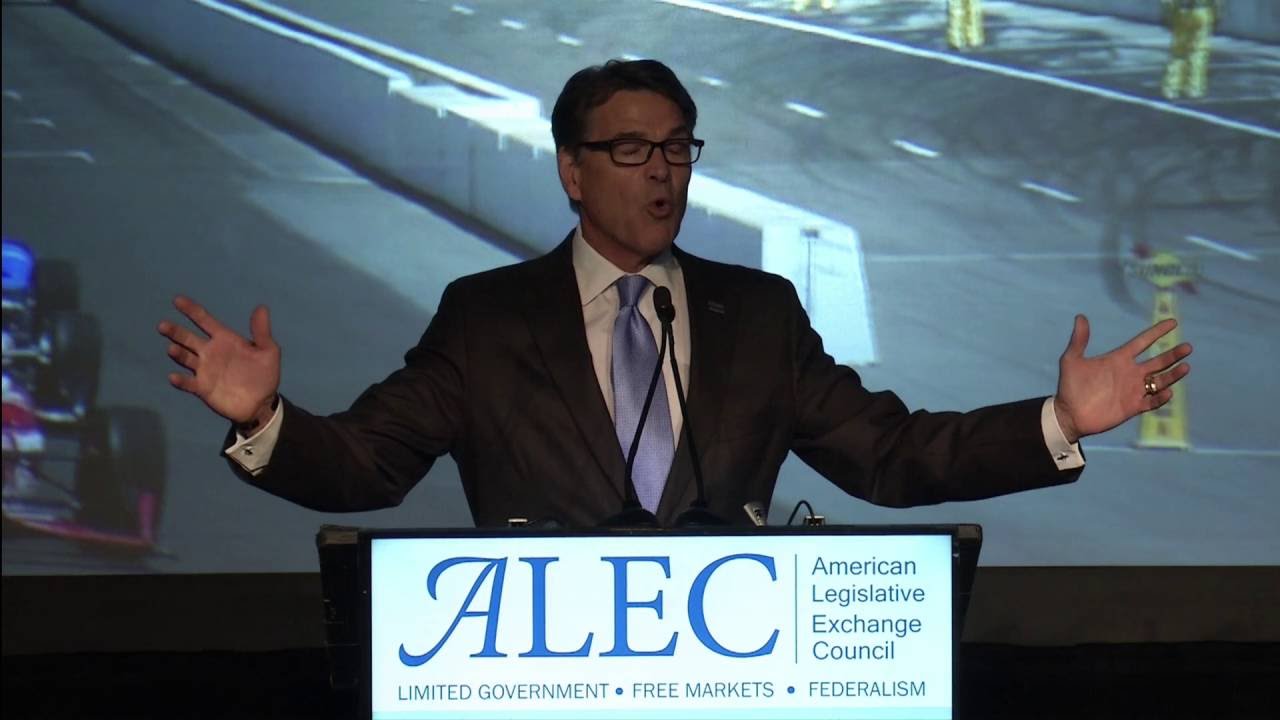 at ALEC’s annual conference in July. A 2011 analysis by ThinkProgress found that 10 of then-governor Perry’s initiatives “mirror ALEC model legislation or policy recommendations from ALEC’s state affiliate.”
Pence, who wrote the introduction to ALEC’s annual “Report Card on American Education” in 2014, also spoke at the group’s July conference. His education policies as governor of Indiana matched those of ALEC and DeVos, including funding for charter schools and vouchers. He appointed a former ALEC director to his cabinet, and once sent an email urging legislators to join the group.
“I was for ALEC before it was cool,”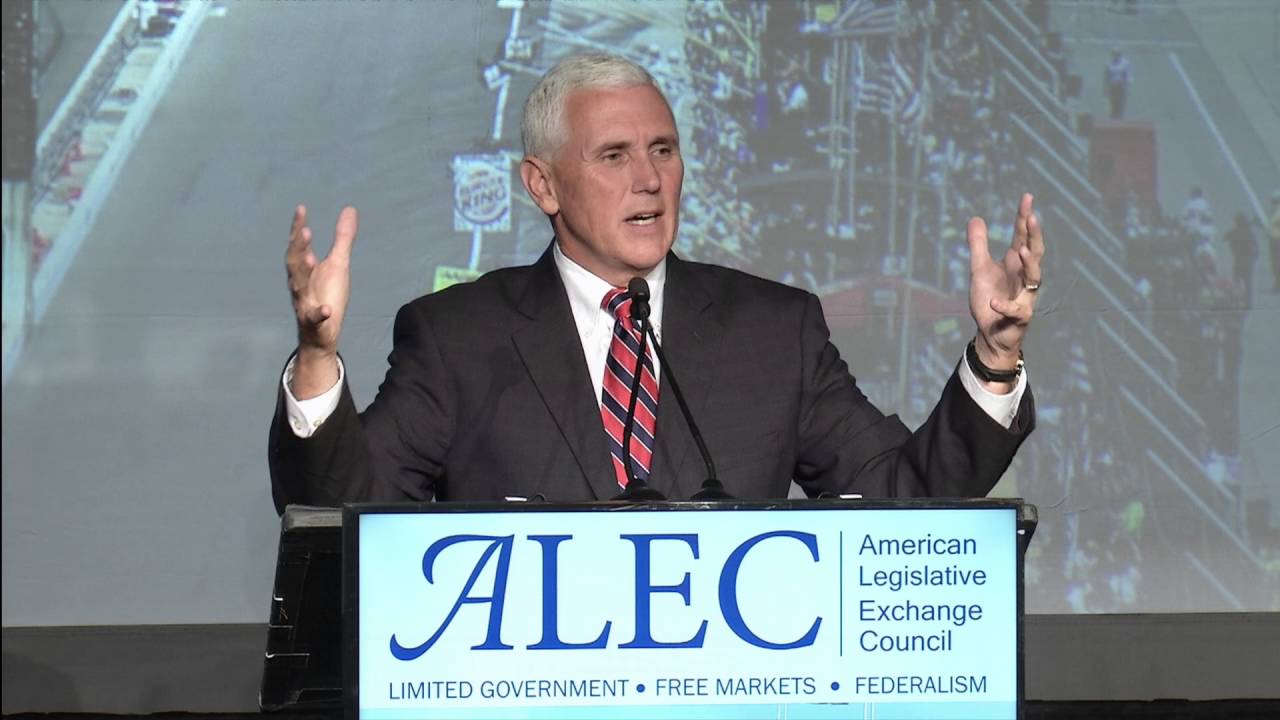 .
Transportation secretary nominee Elaine Chao spoke at the ALEC annual meeting back in 2002, when she was secretary of labor. Chao was a distinguished fellow with the Heritage Foundation, another group funded by organizations connected to the Koch brothers, before and after her time as labor secretary. Paul Weyrich, who co-founded the Heritage Foundation, also co-founded ALEC.
Ben Carson, nominated for secretary of housing and urban development, at an ALEC meeting last year, calling for deregulation, school choice, a balanced-budget amendment, and changing the mission of the EPA so it would work with businesses to exploit natural resources.
At least 12 others appointed to top positions in the administration also have connections to ALEC or the Koch brothers, and share many of ALEC’s goals.
Kellyanne Conway, who will serve as counselor to the president,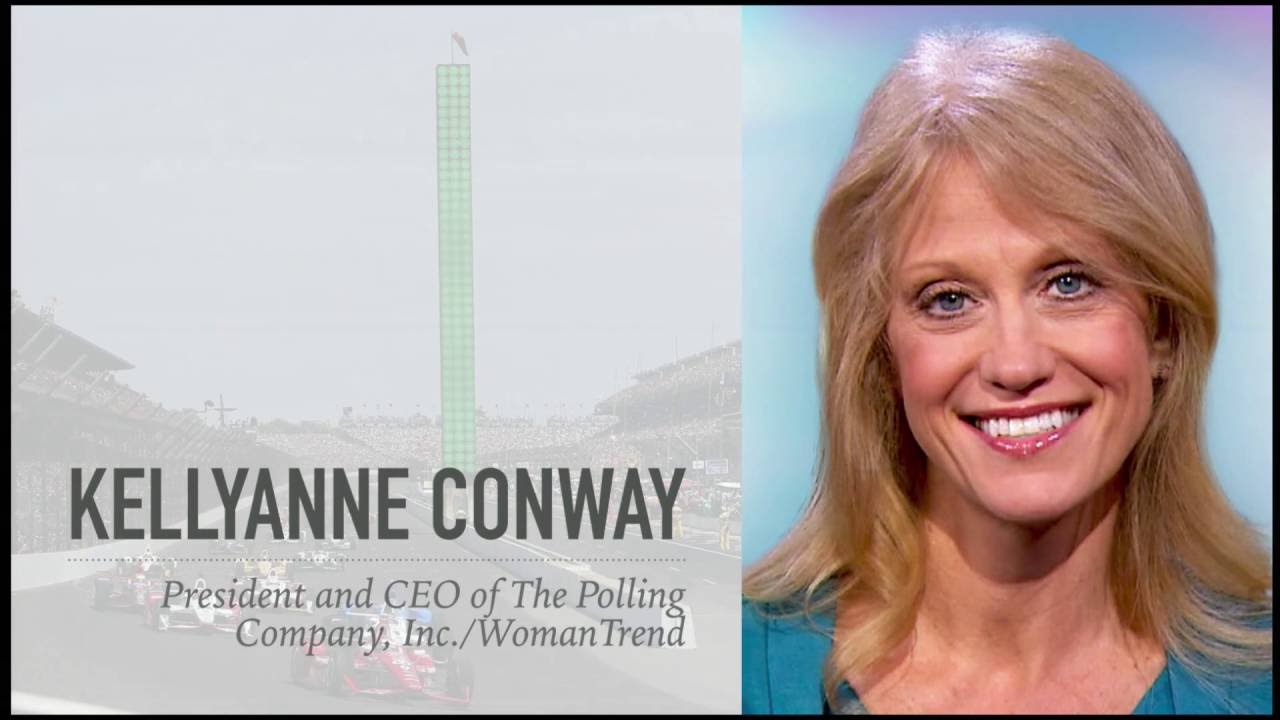 at the ALEC annual meeting in July. Conway, a former pollster and senior adviser for Pence, worked for a super PAC supporting Sen. Ted Cruz’s presidential campaign before switching to Trump. Cruz is a longtime ALEC supporter.
Rep. Mick Mulvaney, Trump’s nominee to be director of the Office of Management and Budget, served in the South Carolina Legislature from 2007 to 2011, when he was elected to the U.S. House of Representatives.
Koch Industries has donated $31,000 to Mulvaney’s campaigns. The Club for Growth, whose funders include the Koch network, has been his top donor, giving $85,580. Club for Growth was a sponsor of ALEC’s annual conferencethis year.

Mulvaney has called for a balanced-budget amendment. He has questioned climate science, referring to “baseless claims regarding global warming,” and wants to make it easier for companies to access domestic oil, natural gas and coal. He has called for eliminating the capital gains tax and lowering tax rates for businesses.
Marc Short, a longtime Pence adviser, has been tapped by Trump as director of legislative affairs for the White House. Short was the Koch brothers’ top political adviser as president of Freedom Partners, the Kochs’ political arm, from 2013 until he joined Rubio’s presidential campaign in February.
Trump’s White House Counsel, Donald McGahn II, was lawyer to scandal-plagued former House Majority Leader Tom DeLay, a Texas Republican who was convicted of money laundering to bypass state campaign finance laws barring corporate contributions during the 2002 election. The conviction later was overturned by the Texas Court of Appeals.
Following the 2002 election, Republicans took control of the Texas Legislature for the first time in modern history, allowing them to gerrymander congressional districts and send more Republicans to the U.S. House of Representatives.
DeLay is an ALEC alumnus.
Later, serving on the Federal Election Commission, McGahn refused to enforce campaign finance laws. In private practice, McGahn has represented Freedom Partners, testifying on behalf of the group at an FEC hearing last year.
Reince Priebus, Trump’s chief of staff, served as chairman of the Wisconsin Republican Party from 2007 to 2011, leading the party to success in the 2010 elections. Priebus’ longtime friend Scott Walker was elected governor, and Republicans took control of the state Assembly and Senate.
Walker, a former ALEC member, was heavily funded by the Koch brothers, ALEC corporate members and other conservative groups. He went on to propose a budget bill that eliminated public employee collective-bargaining rights except for wages, reflecting ALEC’s anti-union policies.
In all, the Republican-controlled Legislature introduced 32 bills in 2011–12that reflected ALEC model legislation, 19 of which became law.
Mike Pompeo, nominee for CIA director, is a member of the tea party movement who was elected to represent Kansas’ 4th Congressional District with the financial backing and endorsement of the Koch brothers.
Pompeo has argued that climate science “needs to continue to develop” and opposed the EPA’s greenhouse gas regulations and Clean Power Plan. A lifetime National Rifle Association member, he opposes gun-control legislation. The NRA is a member of ALEC, which has written model legislation opposing gun-control efforts.
Koch Industries is Pompeo’s top campaign donor, giving $375,000. Club for Growth has donated more than $64,000.
Attorney general nominee Jeff Sessions and interior secretary nominee Ryan Zinke also have received contributions from Koch Industries.
Sessions is skeptical of climate science, and voted to bar the EPA from regulating greenhouse gas emissions. He voted against the Affordable Care Act, and supported efforts to de-fund it.
Zinke, who has received more than $345,000 in campaign contributions from the oil and gas industry, has flip-flopped on climate science, supported the Keystone XL Pipeline, limited the president’s ability to protect public lands by declaring them national monuments, and weakened protections from endangered species. The League of Conservation Voters has given him a lifetime score of 3 percent. Zinke supports a balanced-budget amendment.
Former Georgia Gov. Sonny Perdue is Trump’s nominee for agriculture secretary. As governor, Perdue signed into law measures based on ALEC model legislation, including the nation’s second voter ID law and what ALEC co-founder Paul Weyrich described as “the most expansive school-choice program in the nation.”
ALEC praised Perdue for appointing special counsel to join other states in challenging the Affordable Care Act.
Billionaire Wilbur Ross, nominee for commerce secretary, is a friend of David Koch’s. Another billionaire, Todd Ricketts, is Trump’s pick for deputy commerce secretary. Ricketts, the co-owner of the Chicago Cubs, and his wife Sylvie Lègére have served on the National Council of the American Enterprise Institute, one of the oldest conservative think tanks.
AEI has received financial backing from charities related to the Koch brothers, ExxonMobil and the DeVos family. The Guardian newspaper listed AEI among the top recipients of donations from conservatives “to groups spreading disinformation about climate science.”
Two other Trump nominees, Puzder and Linda McMahon, have served on AEI’s National Council. Education secretary nominee DeVos serves on AEI’s board of trustees, along with former vice president Dick Cheney. Former U.S. ambassador to the United Nations John Bolton was an AEI senior fellow.
ALEC also has ideological soul mates in the Republican congressional leadership, which will control the legislative agenda for at least the next two years.
Senate Majority Leader Mitch McConnell has supported ALEC’s efforts to block the EPA’s Clean Power Plan, and has said he doesn’t know if climate change is a real problem.
He has taken numerous positions that match those of ALEC, including opposing the McCain-Feingold campaign finance reforms; voting against the Affordable Care Act and calling for its repeal; opposing increasing the minimum wage and extending unemployment benefits; introducing a balanced-budget amendment; opposing collective-bargaining rights for public employees; and supporting a national right-to-work law.
McConnell is married to Elaine Chao, Trump’s nominee for transportation secretary.
House Speaker Paul Ryan, a friend of fellow Wisconsinite Priebus, has long pushed a budget in lockstep with ALEC’s goals, including tax cuts for the rich and Medicare privatization.
Koch Industries is one of Ryan’s top five donors. Ryan at ALEC’s States and Nation Policy Summit in 2013. He is a devotee of far-right author Ayn Rand, requiring staffers to read her best-selling novel “Atlas Shrugged.”
Ryan, McConnell and other Republican leaders are pushing an agenda that has been pursued for years by ALEC, one that benefits corporations and the wealthy at the expense of the vast majority of Americans. Judging by Trump’s cabinet selections, he will do little to stand in their way.
==
At the Republican Study Committee meeting this past week, RSC Chairman Mark Walker told members the following story, according to a source in the room and another source briefed on the conversation.
Show less
On April 17, Walker put out a press release attacking McConnell for opposing the White House’s plan to reverse some of the spending from the latest government funding bill. The release said McConnell cared more about his “backroom deal with Democrats” than about fiscal conservatism.
Three days later, Walker had a fundraiser with Mike Pence in North Carolina. Pence and Secretary of Transportation Elaine Chao flew down to join him.
On the tarmac, Chao said to Walker: "Do you know who I am married to?" Walker replied that yes, of course he knew. Then Chao said: "He wanted you to know that he reads everything you put out."
Walker gulped and said, “Understood.” And that was that.
A Chao spokeswoman said: "We have nothing to add."
==
proto- furies?
https://www.alternet.org/news-amp-politics/leave-my-husband-alone-transportation-secretary-yells-protestors-confronting
...whe McConnell appears to ignore the protesters as he climbs into the car waiting for them, Chao began a shouting match with the group as she walked around the back of the vehicle.
"Why don't you leave my husband alone?" Chao replies. Asked again why he's separating families, Chao said. "He is not!"
"He's got the power to stop it!" one of the protesters shouts back.
"You leave my husband alone!" she demands again.
"How does he sleep at night?!" bellows another protester before Chao makes her way into the car.
...[big blak suv vid]
==
Koch Reps from Trump’s Transition Teams Tell Automakers to Burn More Gasoline
Meanwhile, three former members of Trump’s transition teams — all of whom work or worked with Koch-funded and Koch-founded organizations — sent a letter to the President on May 10 advising him to ignore the car companies and roll back the standards:
“As a continuation of that progress, we encourage you to stay the course on needed and essential reforms to the federal automobile mandate, more commonly known as the Corporate Average Fuel Economy (CAFE) program …
We understand that some in the automaker community have expressed concerns about your current plans to reform the program.
But it is worth noting that early in your presidency, these same automakers urged your administration to 'reconsider imposing such a far-reaching mandate on an entire industry.'”
The letter was signed by Tom Pyle of the Institute for Energy Research (IER), Myron Ebell of the Competitive Enterprise Institute, and Shirley Ybarra, a former fellow at the Reason Foundation. All three organizations have close Koch ties, and Pyle was himself a lobbyist for Koch Industries, the petrochemical empire privately owned by billionaire brothers Charles and David Koch.
This letter echoes some main themes of another letter recently sent by a different collection of Koch-affiliated spokespersons and groups, as reported last month in DeSmog. Both letters argue that the Trump administration should revoke California’s right, as expressed in the Clean Air Act and granted by a waiver from the EPA in 2009, to set its own greenhouse gas standards. Under the current regulatory regime, the waiver is redundant, as California agreed to the unified “One National Program” with the EPA and DOT.
However, if the Trump administration backs out of the deal, California’s waiver would allow it to preserve stronger standards than Pruitt’s EPA would demand.
Trump reportedly told Pruitt andDOT Secretary Elaine Chaoto pick up negotiations with California. But as of now, it’s anybody’s guess how the White House will respond to the automakers’ plea for stability and consistency.
==
https://www.propublica.org/article/don-blankenship-mitch-mcconnell-feud-the-senator-aided-the-mining-executive?utm_source=pardot&utm_medium=email&utm_campaign=dailynewsletter
Before the Blankenship-McConnell Feud, the Senator Aided the Mining Executive
Mitch McConnell helped Don Blankenship’s company avoid dire regulatory consequences for a disastrous spill in 2000.
by Alec MacGillis May 7, 1:02 p.m. EDT
Don Blankenship, left, and Mitch McConnell (Spencer Platt/Getty Images, Alex Wong/Getty Images)
As the race for the West Virginia Republican Senate nomination hurtles toward Tuesday’s primary, candidate Don Blankenship, the former coal executive sentenced to a year in federal prison in connection with a 2010 mine explosion that killed 29 men, has unleashed blistering invective against Senate Majority Leader Mitch McConnell and his wife, Transportation Secretary Elaine Chao.
He has taken to calling McConnell “Cocaine Mitch,” an allusion to drugs once found on a ship owned by the shipping company owned by Chao’s father, whom Blankenship calls a “wealthy China-person.” His ad hominem barrage, provoked by McConnell’s well-funded effort to deny Blankenship the nomination, culminated in an eye-popping TV ad in which Blankenship charged that McConnell has “created millions of jobs for China-people” and that McConnell’s “China family has given him tens of millions of dollars.” The ad pledged to “ditch Cocaine Mitch for the sake of the kids.”
What has gone overlooked amid this extraordinary clash, is that 18 years ago, both McConnell and Chao effectively sprang to the defense of Blankenship, sparing his company considerable cost and consequences for a disaster that unfolded in their home state of Kentucky in the middle of the night on Oct. 11, 2000. Here is how I described the episode in my 2014 biography of McConnell:
Three hundred million gallons of coal slurry, the viscous mix of mud, coal waste, and chemicals left as a by-product from purifying coal, broke through the inadequate buffer that separated the 68-acre holding pond of the Martin County Coal Corporation’s Big Branch Refuse Impoundmentfrom the surrounding mine. The dark sludge poured through two miles of mine tunnels — a miner had left the area just moments earlier — before oozing out of a mountainside opening into the hilly landscape of eastern Kentucky. It found its way into two tributaries of the Big Sandy River — first Coldwater Creek, and then, after the pressure forced a break in the other side of the impoundment, into Wolf Creek — filling them ever higher until it overran embankments, spreading toward the homes lining the creek bottoms of Inez, the 500-person town that Lyndon Baines Johnson visited in 1964 to promote his War on Poverty, and covering their yards with a vast moat of goop that rose to six feet deep in places. Inez resident Mickey McCoy threw golf-ball-size rocks into the blackened creeks and watched as they refused to sink in the noxious pudding. “It was a slow-moving black smothering,” he says. There was no immediate effort by the company to alert the townspeople sleeping in the spill’s path — Abraham Lincoln “Linc” Chapman didn’t know about the sludge until he encountered it while heading up Coldwater Creek before daybreak to hunt deer. “It was a lot of chaos,” he says. “If you never saw a slurry spill it’s hard to describe it. It was like a lava flow coming down from the creek bed.”
The spill, which was vastly larger in scale than the oil spill from the Exxon Valdez, left a 70-mile path of destruction running all the way to the Ohio River, killing 1.6 million fish and countless wildlife that got stuck in the muck or drank from it, sweeping away roads and bridges, and contaminating the water systems of more than 27,000 people.
:{Major consequences loomed for the owner of the Martin County Coal Company: mining giant Massey Energy, which was led by Blankenship. Among the agencies that kicked into gear were the Mine Safety and Health Administration, which had issued recommendations about strengthening the holding pond walls in 1994 following a smaller spill.
A team of investigators from MSHA was on its way to alleging eight separate violations against Massey that could have resulted in hundreds of thousands of dollars of fines and laid the legal basis for criminal charges of willful negligence.
Get ProPublica’s Top Stories by Email
But in the midst of their work, the presidency fell to George W. Bushfollowing the Florida recount and Supreme Court ruling in Bush v. Gore. “I don’t think I have ever felt better, including my own election victories, than the night of the Supreme Court decision,” McConnell said later.
The day of Bush’s inauguration, the head of the MSHA investigative team, Tony Oppegard, got a call from superiors alerting him that the Bush administration was declining to approve the six-month extension that had been arranged for him so he could finish the investigation. The person who replaced Oppegard, Tim Thompson, arrived in Kentucky and told Oppegard’s No. 2, Jack Spadaro, to scale back the investigation.}: The team had 30 people left to interview, but the new manager told them they had time for only six. “We were told, ‘Boys, you need to close out your investigation,’” Spadaro told me in an interview for the book. “We said, ‘No, we’re not done.’ He said, ‘You’re done.’”
MSHA, which is part of the Labor Department, was overseen by the secretary of labor: Chao, whom Bush nominated upon taking office. Chao, who had previously led the Peace Corps and United Way, turned to her husband’s associates to fill out her office. She hired as her chief of staff Steven Law, who had served six years as McConnell’s chief of staff (and went on to co-found the super PAC Crossroads GPS with Karl Rove.) She hired as her spokesman McConnell’s former spokesman. And the new director for MSHA, a former Utah coal operator named David Lauriski, hired as one of his top aides yet another former McConnell staffer, Andrew Rajec, who began attending many of the meetings of the Martin County investigators.
In my book, I described what happened next:
Thompson pushed to have the case against Massey reduced to just two violations with a fine of $55,000 each, rather than the eight that Spadaro and his fellow investigators believed were justified. One day in April 2002, Thompson got a call from MSHA headquarters outside Washington, D.C., after which, with the investigators watching, he crossed out a section of the draft report that called MSHA to account for its lax oversight.
That was enough for Spadaro. Seeing where things were heading, he tendered his resignation in a letter published in the local papers. ‘I do not believe that the accident investigation report, as it is being developed, will offer complete and objective analysis of the accident and its causes,” he wrote. As word of Spadaro’s protest spread, Elaine Chao dismissed it by telling a reporter, “It’s time to call off the MSHA food fight over the Martin County Coal Slurry investigation.”
Soon afterward, Spadaro became the target of an internal audit. When he was called to MSHA headquarters outside Washington, D.C., to be reprimanded, MSHA officials went into his office in West Virginia to confiscate his files and hard drive. They picked apart his family photos to search for incriminating evidence he might have tucked inside the frames. A few months later, he was fired. He challenged his termination and had it reduced to administrative leave, but when the agency then demoted him and ordered him to a post in Pittsburgh, he quit.
Meanwhile, the investigation sputtered to a close. In April 2002, MSHA cited Martin County Coal with just the two violations — and its case for those was so halfhearted that one was later dismissed by an administrative law judge and the other reduced to a mere $5,600 fine.
What was particularly striking about the light approach taken by Chao’s Labor Department was that it would have been easy for the Bush administration to use the disaster as a political weapon against its predecessors — to blame the disaster on the lax oversight by Bill Clinton’s MSHA. Taking a stronger stand on the spill would’ve been a way to stand up on behalf of the people of eastern Kentucky — her husband’s constituents.
But that also would’ve meant coming down hard on an industry that had, by 2000, swung firmly behind the Republican Party and McConnell in particular. Over McConnell’s career, his fifth-biggest source of campaign contributions was Peabody Energy, the largest coal company in the world. Between 1997 and 2000, when he led the National Republican Senatorial Committee, the coal industry gave $584,000 to the group, making it one of the group’s staunchest supporters.
And Massey? It hadn’t given the NRSC anything. That is, not until 2002, when the investigation was still pending. That year, it cut a $100,000 check to the group.
As Spadaro saw it, it was pretty plain what had happened: “It was Mitch McConnell who fired Jack Spadaro,” he told me. “I’ve been around a long time and I swear this was one of the most outrageous things I’ve ever seen. It was one of the most blatant circumventions of the law and it was all orchestrated by Mitch McConnell’s people.” (McConnell’s office did not respond to requests for comment, nor did Chao’s office or Blankenship’s campaign.)
Fast forward to 2018. Massey Energy no longer exists, having been subsumed by Alpha Natural Resources. West Virginia has become a stronghold of Trump country, not least because of his outspoken support for the coal industry — he won the state by a whopping 42 percentage points. Blankenship is seeking with his campaign to tap into the same iconoclastic fervor that drove Trump. But McConnell calculates that even in West Virginia, the party’s best odds for knocking off Democratic Sen. Joe Manchin in November do not lie with someone who not long ago was behind bars in connection with the deaths of 29 West Virginians — and whose primary residence is a $2.4 million villa with palm trees and an infinity pool near Las Vegas.
And guess what one of the top targets has been for the barrage of attack ads against Blankenship by the McConnell-allied group, Mountain Families PAC? One 30-second spot in frequent circulation says Massey Energy pumped “toxic coal slurry” into local drinking water. The narrator asks, “Isn’t there enough toxic sludge in Washington?”
==
==
predictably:
https://www.ecowatch.com/black-lung-epidemic-2538494787.html
New Black Lung Epidemic Emerging in Coal Country
In a study released this month by the National Institute for Occupational Safety and Health (NIOSH), federal researchers identified more than 400 cases of complicated black lung in three clinics in southwestern Virginia between 2013 and 2017—the largest cluster ever reported.
However, the actual number of cases is likely much, much higher as the government analysis relied on self-reporting. An ongoing investigation from NPR has counted nearly 2,000 cases diagnosed since 2010 across Appalachia.
NPR investigative reporter Howard Berkes, who has been closely following the epidemic explained to Pittsburgh's NPR news station:
"In the study that NIOSH just produced, they looked at three clinics in southwestern Virginia which serves coal miners from Virginia, Kentucky and West Virginia. And they identified and confirmed 416 cases of the disease in the previous few years. The study ended about a year ago. That's an astonishing number. NIOSH itself in its own accounting of that disease, found less than 100 cases in the same timeframe nationwide. And here in just three clinics in southwestern Virginia, there are four times as many cases. NPR has been surveying black lung clinics across Appalachia, and our count is up close to two thousand cases in the same timeframe that NIOSH had previously identified only 99. NIOSH itself now recognizes that this as the worst cluster of this disease ever documented. NIOSH has referred to it as one of the worst industrial workplace disasters in American history. It also marks what is a sharp increase in the disease from the 1990s, when researchers believed that it might actually become extinct."
Black lung disease, also known as coal workers' pneumoconiosis, comes from exposure to coal mine dust. Ever since the Federal Coal Mine Health and Safety Act of 1969, which was passed in response to the deaths of 78 miners in West Virginia and implemented stricter safety standards, cases had been declining and virtually eradicated by the 1990s....
https://insideclimatenews.org/news/07092017/coal-company-fights-black-lung-medical-benefits-appalachian-miner
WISE, Virginia—Retired coal miner Bethel Brock proudly shows the vegetable garden where he grows potatoes, onions, corn, butter beans and other greens for the dinner table. He's in that patch nearly every day hoeing, shoveling—and struggling just to breathe.
Brock, a soft-spoken 77-year-old, has black lung disease from decades working in the coal fields of Virginia.
When his chest constricts and he becomes so winded that he can no longer stand, he slowly folds his body like a collapsing accordion, feeling more dread than discomfort.
"I have to stop right where I am and sit in the dirt," he said. "It feels like I'm suffocating."
Brock was diagnosed in 1982 with the early stages of black lung, a progressive illness common in coal miners. It eventually robs the lungs of the ability to hold air. In 2003, he began battling the Westmoreland CoalCompany, its insurance carrier and their legion of lawyers and doctors for black lung benefits.
The company successfully fought him 10 times by maintaining he is not seriously stricken with the incapacitating disease despite nearly two dozen findings to the contrary by his doctors—and one by a doctor hired by the company, which it did not disclose to a ...
Earlier this year, it looked as though Brock would finally win when the examiner ruled him eligible for benefits. But several months later, she inexplicably reopened the case and reversed herself on a technicality: The latest X-ray documenting the progress of his disease hadn't been stamped with the date it was taken. Once again Brock had lost in a system, created by federal law, designed to be adversarial and seemingly tilted in favor of industry.
But when InsideClimate News began asking questions, there was yet another surprising development: A supervisor decided the latest decision was "in error" and notified Brock he would be getting benefits after all. A U.S. Department of Labor spokeswoman then asked if ICN would be changing the focus of this story about the black lung benefits system.
Jennifer Grafton, Westmoreland's chief administrative and legal officer, said she was bound by privacy issues and could not talk about Brock's case. Colleen Smalley, the district director who overruled the examiner, refused to answer questions and hung up on a reporter.

Brock's 14-year fight with Westmoreland is typical of the David-and-Goliath battles coal miners face when seeking black lung benefits, which are paid by the company and include a monthly stipend and medical care for pulmonary illnesses. While thousands of miners and their survivors can struggle for decades to get benefits, coal companies and their insurers use every legal defense allowed under the Black Lung Benefits Act to deny them.
The companies engage high-profile law firms that in turn employ a cadre of doctors, setting the stage for protracted battles of conflicting medical opinions. Miners, meanwhile, are often overmatched because few lawyers will take their cases. Attorneys are barred from charging plaintiffs fees, meaning they receive modest compensation, and only if they win.
Over the last decade, 52,537 miners have applied to the Labor Department for black lung benefits. The department determined that only 7,252, or about 14 percent, were eligible, according to its data. The industry then challenged 70 percent of those claims, often denying the presence of the disease. It prevailed more than half the time.
In other words, of more than 52,000 claims, fewer than one in 10 was granted a disability award, despite the legal presumption that a miner with 15 years or more of service in the mines with lung problems has black lung as a result of his work. While rules were changed in 2000 to help level the playing field for miners, advocates, lawyers and statistics show companies still winning.
"The industry's tactic seems to be to just keep appealing until the miner or miner's wife dies or gives up," said Shannon Bell, an associate professor of sociology at Virginia Tech who has studied the impacts of the coal industry on the people of Appalachia.
This is just one front in wide-ranging battles by fossil fuel companies of all types to protect their bottom lines and their central role in providing America's energy.
"The fossil fuel industry thinks about the world differently than we do," said Brian O'Neill, who led a courtroom fight against Exxon on behalf of Alaskans devastated by the Exxon Valdez oil spill. "It's about protecting the company and invoking a kind of immunity that the world depends on their product. They are nation states and they decide what is fair treatment."
==
quit bloomberg fdn on denial? standing behind trump when he blew chralottesville b/c they were trying to announce infrastructure (pvtiztion?)
==
James S. C. Chao - Wikipedia
https://en.wikipedia.org/wiki/James_S._C._Chao
1.
:{Jump to :(style="overflow-wrap:break-word"):}:**Foremost** Group - James Si-Cheng Chao is a Chinese-American merchant mariner, business ... In July 2014, it was reported that Chao's Foremost Shipping had 15 ships in its fleet, but construction was underway for an ...
Early life, education, and ... · Philanthropy · Recognitions · Personal life
Chao Family
https://www.chaofam.com/
1.
Family's Shipping Company Could Pose Problems for… — ProPublica
https://www.propublica.org/.../familys-shipping-company-could-pose-problems-for-tr...
1.
Mitch McConnell's Freighted Ties to a Shadowy Shipping Company ...
https://www.thenation.com/.../mitch-mcconnells-freighted-ties-shadowy-shipping-com...
1.
Trump transportation secretary's family caught in drugs trafficking ...
https://www.dailykos.com/.../-Trump-transportation-secretary-s-family-caught-in-dru...
1.
McConnell’s ties to the Chaos go back to the late 1980s, when James Chao began donating to the senator.In 1993, McConnell married James’s daughter, Elaine Chao, a Republican activist and former Reagan administration official who would later serve as secretary of labor in the George W. Bush cabinet. James Chao emigrated to the United States from Taiwan, and founded the Foremost Maritime Corporation upon settling in New York. The company has grown significantly over the years, from acting as maritime agent during the Vietnam War to controlling a fleet of approximately sixteen dry-bulk cargo ships in operation today.
...
**One of President Donald Trump’s newest appointees is a registered agent of Saudi Arabia earning hundreds of thousands of dollars to lobby on the kingdom’s behalf,** according to U.S. Department of Justice records reviewed by theCenter for Public Integrity.
Since January, the Saudi Arabian foreign ministry has paid longtime Republican lobbyist Richard Hohlt about $430,000 in exchange for “advice on legislative and public affairs strategies.”
Trump’s decision to appoint a registered foreign agent to the President’s Commission on White House Fellowships clashes with the president’s vow to clean up Washington and limit the influence of special interests.
Trump singled out lobbyists for foreign governments for special criticism, saying they shouldn’t be permitted to contribute to political campaigns. Hohlt is himself a Trump donor, though his contributions came before he registered to represent Saudi Arabia.
“I will issue a lifetime ban against senior executive branch officials lobbying on behalf of a FOREIGN GOVERNMENT! #DrainTheSwamp,” he tweeted in October.
Key advisory body
The commission is essentially a part-time advisory body responsible for making final recommendations to the president of candidates for the prestigious White House fellowships, which President Lyndon B. Johnson created in 1964.
The candidates are usually accomplished professionals with sterling resumes. Fellows are typically given jobs in the White House and federal agencies. Past White House fellows includeTransportation Secretary Elaine Chao, former Secretary of State Colin Powell, Rep. Joe Barton, R-Texas and CNN chief medical correspondent Sanjay Gupta.
Hohlt said he is one of 19 commissioners who met over a weekend this month to interview the fellowship candidates — the commission’s only formal duty annually.
Hohlt stresses he has never lobbied the Trump administration on behalf of Saudi Arabia, which has aggressively courted Trump since he became president in January.
“That is not my role,” Hohlt said.
What role, then, does he play?
According to Hohlt’s disclosures with the Department of Justice, he registered to lobby for Saudi Arabia’s foreign ministry in October and “provides them with advice on legislative and public affairs strategies.” He disclosed no direct contacts with government officials on the Saudis’ behalf as of April 30, the date covered by the latest Department of Justice report.
Hohlt said he was largely brought in to offer advice on overarching strategy and how the legislative process works.
He did directly contact some congressional offices in late May and June regarding an arms sale, he said, and those contacts will be disclosed in his next disclosure report, as required.
Hohlt added that he’s working for the Saudis without a formal contract. If the Saudis asked him to lobby for something the Trump administration opposed, “I’d say I’m not going to work on it,” Hohlt said.
For example, he said, the administration was in favor of the arms deal.
Trump strikes deals with Saudis
Trump’s first foreign trip as president came in May, when he visited Saudi Arabia.
While there, Trump touted the “tremendous” deals he said he struck with the Saudis, including an expanded arms agreement valued at $100 billion. During elaborate ceremonies, the Saudis heaped plaudits. Saudi Foreign Minister Adel al-Jubeir praised Trump and praised his “vision,” “strength” and “decisiveness.”
Hohlt said he disclosed his Saudi lobbying job to Trump officials during the vetting process before his appointment.
White House spokeswoman Kelly Love said she had “nothing to add” in response to questions from the Center for Public Integrity about Trump’s appointment of Hohlt, including whether the Trump administration was aware Hohlt worked as a lobbyist for Saudi Arabia’s foreign ministry.
Love referred the question of whether the administration was aware of Hohlt’s representation of the Saudis to the White House fellows office, which did not respond to a request for comment.
Upon taking office, Trump issued an executive order on ethics that included, among other things, a lifetime ban on executive branch appointees engaging in work that would require registration under the Foreign Agents Registration Act, among other restrictions on lobbyists.
The law, known as FARA, is the same law that mandates disclosure of Hohlt’s work for Saudi Arabia.
Trump’s executive order doesn’t apply to part-time appointees such as Hohlt. Nonetheless, some government ethics experts still say the appointment presents a jarring contrast with the president’s statements.
And despite Trump’s order, he has issued ethics waivers to lobbyists who have taken full-time positions with the administration, including, for example, Michael Catanzaro, a former energy company lobbyist who is now a special assistant to the president and adviser on energy policy. The waiver allows Catanzaro to participate in matters on which he lobbied.
Trump donor
Hohlt is a Trump donor. He contributed $2,700, to Trump’s campaign in August and $5,000 to Trump’s transition in September, the maximum amounts permitted. Those contributions came before he registered to represent Saudi Arabia’s foreign ministry in October.
Nonetheless, “Appointing someone who is registered under FARA as doing work for Saudi Arabia does seem odd at a time when he’s made a very big deal about not having people leave the government and then do work where they have to register under FARA,” said Larry Noble, the general counsel of the Campaign Legal Center, a nonpartisan campaign reform organization.
Kathleen Clark, a law professor at Washington University in Saint Louis, said, “There is truth to the slogan that personnel is policy. And so he’s appointing this lobbyist for Saudi Arabia to a commission that then recommends people for important positions.”
Hohlt also lobbies for numerous corporate clients. This year, he’s been registered to lobby on behalf of oil giant Chevron, the Motion Picture Association of America and a division of tobacco giant Altria, among others.
Asked about any potential conflict of interest, Hohlt pointed to the extremely part-time nature of his fellowship commission appointment.
“I guess I’m an old-fashioned lobbyist,” Hohlt said. “I know how to separate lobbying and not lobbying.”
==
=
http://www.smithsonianmag.com/science-nature/black-lung-disease-deadlier-than-ever-before-180963303/
...Michael “Flip” Wilson had a very different journey into coal than McCool. The first coal miner in his family, Wilson entered the mines when he was 18 years old. It was 1974, and he was seeking his fortune in what was then a booming industry in Kentucky.
Wilson spent 41 years toiling down dark, winding tunnels in search of coal seams—layers of valuable fuel sandwiched between rock. For most of that time he operated what’s known as the “continuous miner,” a machine that carves away the mine’s walls and breaks apart massive seams into bite-sized hunks. Unlike McCool, however, he rarely used a facemask.
The masks were burdensome, he says. Dust would collect over the filters, clogging them up and requiring frequent changes. “You just couldn’t breathe through them,” he says. So Wilson foraged ahead with the continuous miner, clouds of inky black dust billowing in its wake.
Three years ago, Wilson was diagnosed with black lung. Not using a facemask may certainly be one way that coal dust found its way into his lungs. But Wilson is also among a new generation of miners working without the safety net of mine unionization, which research suggests helps protect workers from unsafe conditions and company dishonesty.
Miners at non-union mines often don't report safety violations for fear of losing their jobs, Addington explains. Dust, in particular, has faded to the background. “Miners are more likely to put up with excessive dust because it doesn’t threaten them and the bigger stir that they cause the more likely they are to lose their job,” says Addington, who also files lawsuits against companies for unjust treatment of workers who speak up. “It’s much more difficult for miners to complain about excessive dust than other safety and heath issues at a coal mine.”
“I always did what the coal company wanted me to do, if it was right or if it was wrong,” Wilson recalls. “I should have known better, but at the time I needed the job.”
Armstrong Coal did not respond to repeated requests for comment.
Unions became popular among miners during the late 1800s, with today’s largest organization, the United Mine Workers of America (UMWA), founded in 1890. The UMWA has been instrumental in improving conditions for miners, from shorter work hours to safer working conditions. It was also a driving force in drawing attention to the issue of respiratory disease during the early 1900s, a time when “strenuous denial of the existence or extent” of black lung was still rampant, according to a 1991 article in the American Journal of Public Health.
Measuring the effects these unions have had on overall mine safety has been difficult, in part due to confounding factors like mine size and the fact that unionized mines tend to report more injuries than non-unionized ones. But a Stanford Law School study published in the journal Industrial and Labor Relations Review in 2013 found that unionization had resulted in a “substantial and significant decline” in both fatalities and traumatic injuries.
Today, however, mine unions have declined along with mining jobs. Union representation has fallen by over 50 percent in the last decades—from 14 percent in 1997 to just 6 percent in 2016. In Kentucky, where some of the highest rates of black lung are being reported, the last unionized mine shuttered its doors in 2015.
Experts reason that longer work days may also contribute to the current surge in black lung. Fewer breaks give workers less time to flush their lungs with clean air, says Cohen, which can rid their lungs of particulate that has not yet taken root. Wilson estimates that he worked an average of 70 to 80 hours per week while at Armstrong Coal. “A lot of the time I would come in on day shift,” he says. “I worked 10 [or] 11 hours that day, then I would go home and sleep three or four hours. And then I'll go back on third shift.”
There’s yet another reason for the rise. Many researchers believe the disease’s new intensity stems in part from the size of the coal seams being mined. These days, coal companies have plundered most of the thick seams of pure coal and now seek thinner and thinner veins. That means miners are taking out more rock along with the coal using heavy machinery. As a result, the clouds of black dust have grown increasingly muddled with silica, a much more potent lung irritant.
Coal mine dust isn’t just coal; it’s a mix of coal, silica and other elements like iron. Silica’s toxicity comes from a variety of chemical properties, including electrostatic charge—the same force that makes your hair stand on end when rubbed with a balloon—and what is known as “reactive oxygen species” (ROS). When these highly reactive particles make their way deep into the respiratory system, they can lance the lung cells, resulting in a flood of damaging enzymes that harm the tissue.
:{...
}:
==
==
see labor
http://www.studentpulse.com/articles/245/labor-relations-under-the-bush-administration
==
sinecure but major job now is fundraising/flak for hubby McConnnell and trash talk BO economy
complains of racist attacks?
==
http://news.muckety.com/2016/12/15/the-conservative-think-tanks-surrounding-the-trump-camp/48601
The Heritage Foundation, a major critic of Obama energy policy and a recipient of funding from both Charles Koch and the DeVos family, has four current and former ties to people nominated or screening nominations. Vice President-elect Mike Pence was keynote speaker at an annual Heritage gathering last week.
The Hoover Institution has three connections to top Trump people, as does the more middle-of-the-road Council on Foreign Relations.
Elaine Chao, Trump’s pick for Transportation secretary, has links to four think tanks. Wilbur Ross, the designee for Commerce, is a trustee of the Brookings Institution.
Betsy DeVos, Trump’s controversial choice for Education, has a board seat at the American Enterprise Institute, where fellow trustees include Dick Cheney and Peter Coors.
Trump’s choice for Secretary of State, Rex Tillerson, is on the board of the Center for Strategic and International Studies. The center’s board includes both big-name Democrats (William Daley, Leon Panetta, Zbigniew Brzezinski) and Republicans (William Cohen, Kenneth Langone, Henry Kissinger).
But as the interactive Muckety map above shows, most of the think tanks circling the president-to-be lean heavily toward the right.
http://news.muckety.com/2016/12/15/the-conservative-think-tanks-surrounding-the-trump-camp/48601
==
NAM BS
Former Labor Secretary Elaine Chao outlined the attacks against disclosure and the Department’s Office of Labor Management Standards in a Wall Street Journal op-ed last month, “Obama Tries to Stop Union Disclosure: No more sunshine on how worker dues are spent.”
---
Card Check: Departing Labor Secretary Makes the Case Clear
By Carter Wood | Economy, Labor Unions
Secretary of Labor Elaine Chao accurately represents the many accomplishments of the Department of Labor during her eight-year tenure in today’s Wall Street Journal, “Our Workers Deserve Secret Ballots.” Her persuasive arguments against the anti-democratic Employee Free Choice Act will be familiar to readers of this blog — seethese posts — so let’s just highlight the Department’s achievements on behalf of the worker and the employer.
Today we have record-low workplace injury, illness and fatality rates. The department set new records in the number of workers recovering back wages owed to them through effectively targeted enforcement and our compliance assistance program. To meet the needs of workers in our knowledge-based economy we launched new programs to bring employers, workers, unions and educators together for new training and new career opportunities. The department also secured record monetary recoveries for workers’ pension plans.
On the regulation side, we updated old, outmoded rules. These rules were written for jobs such as “key punch operator” that aren’t relevant any more. These rules stymied productivity and made compliance nearly impossible, while doing little to protect workers.
You might have also heard about our efforts to update union financial disclosure regulations for the first time in over 40 years. Our new disclosure rules have helped rank-and-file members better understand where their dues are being spent.
This is only a partial list. The bottom line is that we have worked to be pro-worker without strangling the workplaces that employ them. And we’ve done that because to ride out tough times and stay well positioned for future growth, it is vital that the Labor Department not push regulations that impede job growth.
Congratulations to Secretary Chao and the many good people at the Department of Labor. A job well done.
==
bs transparency ~ solis
https://nrtwc.org/obama-administration-no-transparency-required/
==
http://www.thirdworldtraveler.com/Labor/Labors_War_Home.html
Labor's War at Home
by Lee Sustar
Internationalist Socialist Review, April 2003
While the war drive against Iraq has focused the world on the Bush Doctrine abroad, there is a domestic equivalent-a dramatic escalation of the 25-year employers' offensive. With the White House leading the way, Corporate America aims to deal a series of decisive defeats to organized labor and to consolidate a balance of class forces that overwhelmingly favors employers. With union membership in the private sector down to just 8.5 percent (and 13.2 percent overall),' business sees an opportunity to achieve virtual de-unionization.
Many, if not most, unions face their greatest struggle in decades-not just to hold on to some gains, but to even survive. In February, the leaders of five of the largest unions, seeking to push a more aggressive strategy for organizing staged what Business Week called a "palace coup" on the AFL-CIO Executive Council to create a smaller executive committee to drive policy.
Moreover, there is deep unease in the ranks of organized labor about George W. Bush's agenda, reflected in the passage of antiwar resolutions in union after union and the formation of U.S. Labor Against the War. Even the AFL-CIO Executive Council has voiced opposition to a unilateral U.S. war on Iraq-a major departure from top union officials' lockstep support for U.S. foreign policy since the Second World War. The controversy over the war could presage a wider debate among union members about how to reverse labor's decline.
The urgency of such a debate can't be overstated. Even in union strongholds, labor is in retreat in the face of employer demands for givebacks in wages and benefits. Unions have already agreed to billions of dollars in concessions over the last two years in steel, aerospace, airlines and telecommunications. Where unions hesitate to accept cuts, such as at United Airlines, Bush's Air Transportation Stability Board and bankruptcy judges are imposing them anyway. Meanwhile, in the public sector unions which represent 37.5 percent of those workers, the fiscal crises of states and cities have prompted government demands for cuts in jobs, pay and working conditions in the public sector as well. In New York City, Mayor Michael Bloomberg threatened to impose 12,000 layoffs if municipal unions refused to accept $600 million in concessions. In Portland, Oregon, the public school teachers' union agreed to a 5 percent pay cut and to work 10 days for free. Even "good" contracts, such as the Teamsters' agreements with UPS and freight companies, mask concessions by allowing the companies to grind down the number of good jobs and working conditions over the course of five-year deals.
Government intervention is playing a central role in this offensive. Since taking office, George Bush has banned strikes in the airlines, invoked the anti-labor Taft-Hartley Act in the West Coast dock dispute; banned unions from key parts of the Department of Homeland Security; imposed new financial reporting requirements on unions and announced plans to privatize some 850,000 federal jobs, most of them unionized.
Bush's anti-union campaign is by far the most aggressive one from the White House since President Ronald Reagan fired nearly 11,000 striking air traffic controllers in the Professional Air Traffic Controllers Organization (PATCO) in 1981. Just to make sure union leaders got the point, the White House dispatched Secretary of Labor Elaine Chao to the annual AFL-CIO Executive Council meeting in Florida in February to add insult to the many injuries Bush has inflicted on labor. When asked by International Association of Machinists (IAM) President Thomas Buffenbarger about the new restrictive reporting requirements, she read out accounts of corruption involving IAM officials. AFL-CIO President John Sweeney called Chao "insulting at times," adding that, "In all my years, I've never seen a secretary of labor so antilabor."
Chao's attack was a rebuff to conservative union leaders such as Teamsters President James Hoffa, who has sought to build an alliance with Bush on issues ranging from oil drilling in the Alaska wildlife reserve to war on Iraq. Hoffa, along with Carpenters President Doug McCarron, who took his union out of the AFL-CIO in 2001, had attempted to consolidate a right-wing opposition to Sweeney. In late 2002, the Carpenters re-affiliated with the AFL-CIO's Building and Construction Trades Department (BCTD), a violation of the AFL-CIO constitution and a test of Sweeney's resolve. The building trades are also at odds with Sweeney over their handling of the $335 million insider trading scandal that enriched the top labor officials who direct the union-run insurance company ULLICO, which handles $6 billion in pension funds for the building trades." Former BCTD chief Robert Georgine, who is CEO of ULLICO, has refused to make public an outside review of the scandal, which prompted resignations from the ULLICO board by Sweeney and two other top AFL-CIO officials.
The formation of the new, smaller executive committee can be seen at least in part as a countermove against the right by more liberal-left union leaders. While this isn't a division remotely on the scale of that which led to the split of the old CIO from the AFL in the 1930s, the tensions are real enough. Certainly, the politics of individual leaders matter in this dispute-the palace coup was engineered by the liberal leaders of the Service Employees International Union (SEIU), the Hotel Employees and Restaurant Employees (HERE) and the Union of Needletrades, Industrial and Textile Employees (UNITE).'3 The key factor, however, is the pressure from the employers and the U.S. state on one side and an increasingly bitter and angry union rank and file on the other.
In fact, the major union contract battles of 2002 highlighted the increasing pressure on labor officials from their restive memberships. Although labor officials bowed to employers' demands in every major battle, bitterness in the rank and file over concessions has forced leaders of a number of unions to sharpen their rhetoric against the employers and at least partially mobilize the membership for action.
If union leaders have been able to get away with making concessionary agreements, it's because the rank and file does not yet have the confidence and organization necessary to take the initiative in the struggle. Nevertheless, the growing support for antiwar resolutions in union bodies, as well as labor participation in antiwar protests, reflects a politicization of sections of organized labor.
This article isn't intended to be comprehensive account of labor struggles over the last year-recent articles in the International Socialist Review provide such an overview. The aim, rather, is to briefly summarize trends and provide an analysis. It will conclude with a discussion of the kind of politics and organization necessary to reverse organized labor's long decline.
The employers' offensive intensifies
While the employers' offensive has continued for more than two decades, the economic boom of the 1990s gave unions greater leverage to resist and sometimes make serious gains. After the long strikes and lockouts at A.E. Staley, Caterpillar, Bridgestone-Firestone and the Detroit newspapers in the mid-1990s, the 1997 Teamsters strike at United Parcel Service demonstrated that workers can take on powerful corporations and win. Reform Teamster President Ron Carey was ousted by government intervention in the aftermath of the strike on trumped-up corruption charges for which he was eventually cleared. Nevertheless, the UPS strike finally broke the automatic assumption that a strike equals defeat that had overshadowed the labor movement since the destruction of PATCO.
The next three years after the Teamsters' win at UPS saw strike victories for the Communications Workers of America (CWA) at Verizon (twice) and US West, for technical workers at Boeing and janitors in Los Angles and Chicago. This must be put in perspective, however. While the number of strikes and lockouts involving more than 1,000 workers jumped from 17 in 1999 to 39 in 2000, it fell to 29 in 2001 and just 19 in 2002. The number of person-hours lost due to strikes was the lowest since records were first kept in 1947. (Final figures for 2002 were not available at the time of publication). Even in 1986, in the heyday of Reaganism, there were 69 such work stoppages. In 1974, at the height of the rank-and-file rebellion, there were 424 strikes and lockouts.
The onset of recession in 2001 gave employers greater leverage to press their demands in both the private and public sectors. The 12-day Minnesota public sector strike at the same time as a New Jersey teachers' strike at the time signaled an attack on public sector unions at the federal, state and local levels that is intensifying today. (Those strikes also showed that even under the ideological pressure of patriotism after September 11, workers were willing to fight). Despite the recession, union membership held steady at 16.4 million in 2001, but dropped to 16.1 million in 2002, according to the Bureau of Labor Statistics. Virtually the entire decline came in the private sector, where unions represent the smallest proportion of workers in nearly a century. For the three "heavy metal" unions, the losses in recent years are staggering. Over the last five years, the United Auto Workers have lost 95,000 members; the Machinists, 33,000; the Steelworkers, 121,000. The losses would be greater except for mergers and new organizing pursued outside the unions' traditional jurisdictions. For many unions, the membership figures are much worse: The 15 biggest of the 66 affiliated unions in the AFL-CIO represent 10 million of 13 million of the federation's membership.
With the economy still limping along in 2002, union job losses continued to mount, especially in manufacturing. According to the U.S. Department of Labor, hiring is at its lowest level in 20 years, and the economy has lost 2.2 million jobs since the recession began in 2001. Employers used the opportunity to bring back "concessions bargaining"-the term for unions' agreement to surrender wages and working conditions that began in the late 1970s and accelerated following the PATCO defeat.
Twenty years ago, union leaders from former AFL-CIO President Lane Kirkland on down tried to justify concessions on the grounds that the U.S. economy had to be more competitive with Japan in order to prosper. The escalation of the Cold War in those years provided additional ideological justification for "national sacrifice."
This time, union leaders have taken a different approach. While they have claimed that it was necessary to take concessions in order to "save" companies like bankrupt United Airlines and US Airways, in many cases they have tried to resist them, however half-heartedly. This is not due to stiffer backbones in the union leadership, but to the increased working class consciousness after 25 years of sacrifice and expectations raised in the 1990s boom. In the early 1980s, the employers could claim that free-market policies were the cure for the economic stagnation of the 1970s, and workers were prepared to accept it. Today, in the wake of Enron, WorldCom and the recession, workers are bitter and suspicious.
As a result, union leaders have had to articulate the pressure from below and talk tough. In New York City, for example, Randi Weingareen, president of the 130,000-member United Federation of Teachers, last year organized an authorization vote for an illegal strike. While it was a symbolic gesture, he was able to secure a better-but still concessionary- deal than originally offered. Similarly, Roger Toussaine, the reformer who now heads New York's subway union, Transport Workers Union Local 100, also mobilized for an illegal strike before accepting an improved-but again, concession
==
Chao is a political operative in her own right, and she’s committed to keeping her husband on top. She served as secretary of labor under President George W. Bush and is now an important surrogate for McConnell at events in Washington and Kentucky. This campaign season, she went so far as to meet with Republican lobbyists and others and urge them not to wait, but to give the maximum donation to her husband early — a bold ask for a congressional spouse. She also made individual phone calls to donors asking for money. And with Democratic opponent Alison Lundergan Grimes trying to paint McConnell as anti-woman, Chao appeared in an ad to counterattack.
( Also on POLITICO: The GOP's numbers problem)
==
pension: back to heritage
http://www.heritage.org/about/staff/c/elaine-chao
bs eg
Concentrate on Needs of Employers Commentary posted November 8, 2012 by Elaine Chao
Toward the end of the campaign, President Obama mentioned the need for a “secretary of business” to consolidate functions such as small… Read more
Elaine Chao on Unemployment and the Economy on Fox Business Network Video Recorded on July 13, 2012
Play Movie Elaine Chao on Unemployment and the Economy on Fox Business Network Elaine Chao discusses unemployment and the economy on Fox Business Network.… Read more
Winter of Recovery Not Likely with Current Policies, Inaction on Taxes Commentary posted July 11, 2012 by Elaine Chao
This December will mark the fifth anniversary of the official beginning of the recession, and the U.S. economy is exhibiting no positive… Read more
Government and Industry Must Invest Commentary posted July 9, 2012 by Elaine Chao
It may be hard to believe that in this dreadful economy there are a significant number of job openings going unfilled because… Read more
Elaine Chao on Labor Stats on Fox News Video Recorded on April 6, 2012
Play Movie Elaine Chao on Labor Stats on Fox News Elaine Chao comments on labor statistics on Fox News.… Read more
Elaine Chao on the Jobs Report on FBN Video Recorded on March 9, 2012
Play Movie Elaine Chao on the Jobs Report on FBN Elaine Chao discusses the recent jobs report on FBN's Lou Dobbs Tonight.… Read more
Elaine Chao on Jobs and Unions on FBN Video Recorded on January 6, 2012
Play Movie Elaine Chao on Jobs and Unions on FBN Elaine Chao discusses unions and jobs.… Read more
Obama's War on The Private Sector is No Way to Create Jobs Commentary posted October 17, 2011 by Elaine Chao
Employment flat-lined in August, leaving the nation’s jobless rate above 9 percent. The continuing economic stagnation is taking a toll on consumers.… Read more
Elaine Chao on Unemployment on FNC Video Recorded on September 5, 2011
Play Movie Elaine Chao on Unemployment on FNC Elaine Chao discusses unemployment.… Read more
Another Jobless Labor Day For America Commentary posted September 2, 2011 by Elaine Chao
This is the third consecutive Labor Day marked by widespread duress and dismay in the American workforce. The nation's… Read more
https://cei.org/blog/elaine-chao-union-transparency-more-important-beck-efca-terrible
==
http://www.studentpulse.com/articles/245/labor-relations-under-the-bush-administration
January 20, 2001, **George W. Bush** was sworn into office as America’s 43rd President. Bush stood out amongst his 42 predecessors as the country’s first President to hold a Masters Degree in Business Administration.1 This degree was granted by the Harvard Business School, an institution criticized by many in the Labor Movement as a place that has produced some of the uglier faces in modern business management.2 Bush was called the CEO President because his decision making process closely resembled that of a business leader.3 This style is marked by several advantages, including a persistent vision, decisiveness, and an unwavering certainty in his policy choices. The CEO President’s approach suffers from a tendency to act without adequate deliberation, an unwillingness to recognize the complexity of some policy issues, and an apparent inability to consider anything but a narrow range of choices.4 Bush saw himself as someone who could make tough decisions quickly. In his own words Bush said, “I listen to all the voices, but mine is the final decision … I’m the decider, I decide what’s best.”5 Unfortunately, this attitude leads to a narrow outlook on policy options. A limited view characterized much of the Bush administration, including the strategy taken with regard to labor relations. As is the case with most Republicans, it is assumed that Bush would take an approach heavily favoring management and business. Bush, who some called “the very model of an MBA President,” was determined to weaken the rights and benefits granted to working Americans through decisions that might be called unethical, and in some cases even illegal.6
Executive appointments are one of the most critical decisions any President can make in the field of labor relations. First among these is the appointment of the Secretary of Labor. In this case, Bush chose Elaine Chao. Chao served as Deputy Secretary of Transportation under President George H. W. Bush and is the wife of Republican Senator Mitch McConnell of Kentucky. After leaving government, she took up a position as a distinguished fellow with the Heritage Foundation, a conservative think-tank. Chao held the office of Secretary of Labor longer than any American sinceWorld War II, and is the only member of the Bush Administration to hold the same job for both terms.7 Unfortunately, this extended tenure did not translate to effective governing.
In 2004, Chao’s Department of Labor (DOL) had its biggest victory in successfully updating overtime regulations under the Fair Labor Standards Act, which had not been reformed in over 50 years. The four Presidents preceding Bush all attempted to overhaul overtime rules, but each failed because the issue is so politically contentious.8 While the Bush Administration’s reform of the Fair Labor Standards Act is highly controversial, the DOL should be commended for making strides toward fixing this out-of-date law. The Bush Administration’s reform of the Fair Labor Standards Act makes improvements that both businesses and labor advocacy groups asked for. Prior to the 2004 revision, any worker who earned a salary of $155 a week, or $8,060 a year, would be exempt from federal overtime laws.9 Labor organizations took issue with this rate, which they saw as heavily outdated. Fifty years ago, a weekly salary of $155 may have been high enough to deny overtime, but it is not today. The number of overtime eligibility lawsuits brought against employers and their employees exploded throughout the 1990s. Employees of companies such as Starbucks, Wal-Mart, and Taco Bell sued their employers for using the outdated exemption standards to withhold overtime pay. These lawsuits culminated in a series of multi-million dollar verdicts in favor of the employees, and the Bush Administration’s decision to increase the overtime minimum salary exemption to $455 a week, or $23,660 a year. The new regulations also make white-collar employees who earn more than $100,000 a year exempt automatically. This regulation does not affect many Americans, as most of those who earned over $100,000 a year are already exempt for other reasons.10
The most controversial aspect of the Bush Administration’s reform of the Fair Labor Standards Act is the change made to worker classification. Workers whose jobs are considered “administrative,” “professional,” or “executive” do not qualify for overtime.These categories did not change under the overhaul, but the method for determining who falls into each was altered drastically. Prior to 2004, an employee’s job title and a narrow checklist of certain job duties were the primary factors used in determining eligibility under the aforementioned criteria.11 Following the Bush Administration’s reform, eligibility is determined by a broad look at each employee’s day-to-day duties. As an example of how the law has changed: prior to 2004 the manager of a fast-food restaurant would be considered ineligible for overtime only if he or she had the power to hire and fire employees.Following the reform, ineligibility is extended to any fast-food manager who is has a say in key staffing choices, such as hiring, firing, and promoting. Even if the manager does not have authority to make these decisions, their ability to influence them falls within the range of “administrative” duties.12 Business leaders commend the new regulations, which they believe will decrease the number of lawsuits their companies face for withholding overtime. Labor unions, on the other hand, are vehemently opposed to these new regulations, which greatly increase the number of workers exempted from receiving overtime. Former presidential candidate John Edwards blasted the new regulations in 2004, asking “Why would anyone want to take overtime pay away from as many as 6 million Americans at a time when they need it most?”13
Upon accepting her position as Secretary of Labor, Elaine Chao made a public statement saying “If we really are going to protect workers, we must put more emphasis than ever before on prevention and compliance assistance — rather than just after-the-fact enforcement.”14Unfortunately Chao’s Department of Labor then went on to earn a reputation for ignoring its regulatory responsibilities. The Department of Labor is more prone to politicization than many other federal agencies, a fact that led to a sharp degradation of worker rights and workplace safety during the Bush Administration. Scott Lilly, a senior fellow at the Center for American Progress, wrote several critical reports on the Bush’s Department of Labor. Lilly called the DOL “a deeply troubled department,” wherein “you've got people embedded there who are philosophically hostile to the mission of the agency."15 Regardless of its cause, the DOL clearly fell short of its responsibilities under the leadership of Elaine Chao.
In the summer of2008, the Government Accountability Office released two reports which found that the Bush Administration’s DOL failed on several fronts. The reports show that the DOL had inadequately investigated reports from low-wage workers of employers who failed to pay the federal minimum wage, neglected to pay overtime, or refused to issue final paychecks.16 President Obama took time out of his presidential campaign to contact Elaine Chao and express his “serious concern” with the performance of the DOL after reading these reports.17 Even more concerning is the deterioration of the Occupational Safety and Health Administration (OSHA) during the Bush Administration.
The Occupational Safety and Health Administration is an agency under the Department of Labor. OSHA’s mission is to prevent workplace injury, illness, and fatality through effective regulation and enforcement of workplace safety standards. Despite Elaine Chao’s stated commitment to worker safety, OSHA’s budget fell each year that George W. Bush was in office, resulting in a cumulative loss of 5% to the agency’s overall budget, and an 8% decrease in its enforcement budget.18 This budget decrease made it very dangerous for working Americans under the Bush Administration. A report issued in 2007 by the DOL’s inspector general found that more than 14% of the country’s underground coal mines did not receive federally mandated inspections in 2006. In this same year, the number of mining fatalities in the United States more than doubled from the 2005 level.19 Without adequate funding, OSHA complained that it could not put enough inspectors in the field. Denial of this funding request quite plainly translated into unsafe conditions that led to the deaths of American working people. An audit conducted in 2009 found that over the previous six years, dozens of Americans died at firms that should have been subjected to much tighter enforcement.20
The 2009 audit aimed primarily to evaluate President Bush’s much-touted Enhanced Enforcement Program (EEP). The EEP aims to increase inspections and enforcement in workplaces that have shown willful and repeated violations, resulting in serious injury or death.21 On paper, EEP is a great idea; in practice, it is an irredeemable failure.The 2009 audit found that OSHA inspectors failed to collect required data, and conducted uneven investigations at different workplaces. It was discovered that multiple fatalities under a single employer often went unnoticed, because a company’s name was misspelled on OSHA records or because fatalities that occurred at different subsidiaries of the same negligent company were overlooked.22 In the EEP audit, OSHA’s assistant inspector general wrote that proper enforcement could have “deterred and abated workplace hazards at the worksites of 45 employers where 58 subsequent fatalities occurred."23 Repeat fatalities at irresponsible firms did not receive the inspections they should have. Companies that were investigated for repeat fatalities and came to settlements seeking to improve workplace safety, were often not held to their agreements, thereby allowing the same deadly practices to continue in their workplaces. One example occurred at two worksites managed by the Tennessee Valley Authority where two workers died under very similar circumstances. Had the first fatality been investigated, the second would likely have been prevented.24 The EEP audit concludes that only slightly more than half of the 282 fatalities that should have triggered increased enforcement under the EEP were properly logged and received the appropriate reaction. Celeste Monforton, a former OSHA policy analyst, condemned the Bush Administration’s EEP program, saying that the administration was “suggesting to the public that you've got an enhanced enforcement program going for five years, and it's not enhanced at all… It's not getting to the bad actors, and you're giving the public a false sense of effectiveness."25 It is despicable that American lives were lost due to the poor OSHA funding and the ineffective implementation of the EEP, and yet the Bush Administration still publicly claims success in its mission to improve workplace safety.26
Spending cuts made by Bush's Department of Labor cost workers their rights and their safety. However, there is one area in which the DOL became more rigorous in its enforcement: labor union oversight. New regulations put in place by Bush’s DOL required increase financial reporting from over 20,000 union locals.27 Supporters of this policy argue that more thorough reporting allows workers to see where their hard-earned dues are being spent, making unions more accountable to their membership. Critics of the policy argue that these regulations are being used to weaken and discredit labor unions.28 Regardless of the reason for this policy, it is irresponsible to make strict union financial reporting a top priority while underfunding safety enforcement. Prioritizing union scrutiny over workplace safety is reckless, and a clear example of the Bush Administration’s shortsighted willingness to politicize governing.
Politics were further injected into the Department of Labor’s operation through a privatization program spearheaded by Elaine Chao in 2004. With this program DOL employees began to compete for their jobs with private contractors.29 The Government Accountability Office released a report in November of 2008 on the effectiveness of the program. Of those surveyed for the report, 60% said they felt demoralized by the program, damaging their ability to work effectively. Even more concerning is that the DOL deliberately falsified its reports to Congress on the effectiveness of the privatization program.30 Reports to Congress contained numerous inaccuracies. When reporting program costs, several substantial expenses, such as planning, transition, and review programs were excluded from the reports.31 This allowed the DOL to grossly understate expenses associated with this program. Reports of savings are unreliable as well. Inaccurate numbers were used in some reports, and others used projections when actual numbers were available.32 This resulted in an over-reporting of the savings created by privatizing the jobs of DOL employees. Fortunately, very few employees were actually affected by this program. Of the 314 employees who were affected, 263 were moved to a position with the same title and pay, or were promoted. Only 16 employees were demoted, and 14 of these received the same professional grade or pay in their new position. However, some of the actions taken against employees are alleged to be racially motivated. All of the 22 employees who were laid off or demoted are African-American, and two thirds of the employees who received promotions are Caucasian.33 Senator Harkin and Representative Obey, both committee chairs with jurisdiction over labor policy, condemned the Bush Administration’s handling of the Department of Labor. They denounced the privatization program as a failure for its damage to worker morale, as well as the use of “grossly overstated savings.”34
In 2006 Karl Rove called for members of the Bush Administration to come to the aid of beleaguered congressional candidates before the mid-term election.35 Elaine Chao is one of several members of the administration who answered this call. Chao attended over 20 events for Republican candidates.36 These trips were financed by taxpayer dollars and served a purely partisan purpose. Following the election, a Congressional investigation found that Chao and other administration members had clearly violated the Hatch Act of 1939 by using public funds for political gains.37Unfortunately, no regulating or judicial body chose to take action against these violations.
Besides of the Department of Labor, the most important governing body in the field of labor policy and relations is the National Labor Relations Board (NLRB). The NLRB is an independent governing body established by executive order in 1939. The mission of this board is to conduct union authorization elections, investigate and remedy labor law violations, and enforce the National Labor Relations Act (NLRA). For the first years of its life, the NLRB was made up of three members, but that number has since been expanded to five.38 Many labor boards have specific rules mandating that their members be partisan appointments representing labor and management interests. However, because the NLRB is an adjudicatory body rather than a mediation or arbitration agency, no references are made in its laws to partisan appointments. Instead, it was accepted that the board would be made up of impartial public members, appointed from government service or academic careers. This tradition of non-partisan appointments continued until President Eisenhower began politicizing the board. Following Eisenhower’s precedent, the President makes appointments so that his own party holds a 3-2 majority on the board, as well as the chair. NLRB appointees are no longer impartial members, and are now often from management or union law careers.39 This politicization has been widely criticized as having damaged the fairness of decisions rendered by the NLRB. Instead of impartial members making fair decisions, we now see the NLRB disproportionately favoring unions when a Democrat is President, and favoring management when a Republican is President.
President Clinton’s NLRB was criticized for unfairly favoring union interests during his term in office. Clinton’s NLRB made several key decisions, such as allowing resident assistants and teaching assistants at universities to form a union, allowing temporary employees from personnel staffing firms to join the bargaining unit of a union where they are placed, and preserving employee’s rights to representation following a corporate merger or consolidation.40Upon their appointment, the members of Bush’s NLRB rejected precedent and overturned all of these decisions made by Clinton’s NLRB, as well as numerous others. While the NLRB made clearly partisan decisions prior the Bush Administration, these decisions were well supported as enforcing the provisions of the National Labor Relations Act. Bush’s NLRB made decisions that rejected precedent, were poorly justified, and often flew in the face of federal labor laws. In the U.S. Supreme Court case of Chevron U.S.A. v. Natural Resources Defense Council, Inc, the court decided that unless a statute speaks clearly to the contrary, the governing agency with jurisdiction over a particular field is given the final word on all policy decisions within its area of operation, “unless [it is] arbitrary, capricious or manifestly contrary to statute.”41 This means that the NLRB may make decisions on issues of labor law with very limited oversight.Chevron allowed Bush’s NLRB to make sweeping changes to labor policy, without the ability for any other governmental body to hold them accountable.
One controversial decision made by Bush’s NLRB concerned workers’ “Weingarten” rights. The name “Weingarten” comes from a previous NLRB decision, and refers to the right of an employee to request the presence of a coworker or union official at any investigatory interview that the employee reasonably believes might result in disciplinary action.42 The Weingarten representative is present at an interview in order to recall facts that an employee may have forgotten or not been aware of, and to suggest other employees who could have information concerning the case, in order to present a more well-rounded version of what happened in any labor dispute. At the time of Bush’s inauguration, non-union workers were able to request the presence of a coworker at such an interview. Bush’s NLRB decided to remove this right from all non-union workers, which is about 90% of the American workforce.43 In defense of this decision, the Bush NLRB argued that: coworkers, unlike union representatives, do not represent the interests of the entire workforce; that coworkers do not redress the imbalance of power between employers and employees; that coworkers do not possess the same knowledge base and skill set as a union representative; and that having a coworker present at an investigatory interview could limit the confidentiality of investigatory interviews.44
The arguments made by the Bush NLRB in defense of their Weingarten decision do not hold up to much scrutiny, as the National Labor Relations Act is quite clear on this issue. Section 7 of the NLRA states that all employees have the right to “engage in...concerted activities for the purpose of ... mutual aid or protection."45 The act does not limit this right to unionized employees, nor does it say that employees may only seek assistance from a representative with certain skills and motives. The confidentiality argument is weak as well, considering that the risk of a breach in secrecy is exactly the same with a union representative as with a coworker. However, due to the Chevron decision, no court or governing body is able to evaluate the decision made by this NLRB. This decision limits the Weingarten rights of union employees as well. As was the case with many of their decisions, the Bush NLRB shaped policy in a broad manner, which often did not concern the case at hand. Instead of simply deciding which workers would receive Weingarten rights, the Bush NLRB put more power in the hands of employers who are faced with an employee choosing to exercise his or her Weingarten rights. Following the decision, employers can end the interview at any time, and can choose to refuse any negotiation with the Weingarten representative. Employers can now refuse to discuss certain information, such as medical records, while a Weingarten representative is present. 46The two labor representatives on the NLRB issued a biting dissent to this decision. They charged that this decision violates Section 7 of the NLRA, by denying American working people the right to seek “mutual aid and protection,” by having a coworker assist them in a meeting that could mean a termination of their employment. The dissenting NLRA members stated, “it is our colleagues who are taking a step backwards… They have over- ruled a sound decision not because they must, and not because they should, but because they can.”47
Another contentious decision made by the National Labor Relations Board under the Bush Administration involves the practice of “salting.” Salting is a practice where unions will have their members seek employment with a non-union company in order to organize that company’s workers internally. The Supreme Court has upheld decisions that give union labor rights to “salts,” as they are employees of both the union and the employer whom they are “salting.” Past NLRB decisions have also prohibited employers from refusing to hire new employees based on union affiliations or sympathies as a way to avoid salting campaigns.48 These decisions have been widely rejected by employers who feel that the NLRB has favored union salting practices over the rights of businesses. One example of this is Griffon Electric, one of the largest non-union electrical contractors in the United States.
When Griffon Electric’s president learned that the International Brotherhood of Electrical Workers had planted several salts in his company, he led a vicious anti-union campaign and appealed to the NLRB for a decision allowing him to seek out and terminate the employment of the salts. Upon investigation, the NLRB found that Griffon Electric had committed numerous illegal labor practices and denied his request.49 Past incarnations of the NLRB have refined policy regarding salting. The Clinton NLRB in particular made a strong effort towards establishing guidelines for when salting practices were legal, and when employers are able to weed out the salts in their workplace.
Policy concerning salting campaigns took a drastic turn under the Bush Administration’s incarnation of the National Labor Relations Board. Bush’s NLRB decided in the case of Toering Electric Co. that the ultimate criteria to determine whether an employee could be terminated due to suspicion of salting is whether the Board could prove beyond the shadow of a doubt if an employee would have accepted a job with the employer. If this cannot be proven, the person in question is not considered an employee and therefore the employer is free to deny employment to any applicant, even if this denial is motivated solely by an employer’s anti-union stance.50 This decision is even more controversial than that concerning Weingarten rights, as it does not fall under the protection of theChevron decision. In considering the salting issue, Bush’s NLRB did not hear briefs from affected parties, nor did it allow oral argument. The Board also rejected precedent set in over 170 previous NLRB decisions regarding salting, and a Supreme Court decision that gave NLRA rights to salts. Neglecting to hold adequate deliberation is a clear sign that this decision was made “arbitrarily,” making it exempt from Chevron protections.51 In addition, this decision violates the “discrimination with regard to hire” provision found in Section 8(a)(3) of the National Labor Relations Act, by allowing employers to deny employment to an applicant based solely on union sympathy or affiliation is clearly discriminatory. The NLRB’s decision disregards any discriminatory intention of the employer in considering hiring violations, and instead puts all focus on the intentions of the employee.52 As in the case with the Weingarten decision, Bush’s NLRB is again in clear violation of the National Labor Relations Act. Unlike the previous decision, the salting case is not under protection by the Supreme Court’s Chevron decision. Unfortunately, this case was not investigated, but not for lack of outcry against the partisan and illegal actions of the Bush NLRB.
On December 15, 2007, every member of Congress received a letter signed by 57 prominent labor law professors.53 This letter protested the actions of the National Labor Relations Board under the Bush Administration. Its signatories stated that:
“Recent decisions by the National Labor Relations Board reflect an ominous new direction for American labor law. By overturning precedent and establishing new rules, often going beyond what the parties have briefed or requested, the Board has regularly denied or impaired the very statutory rights it is charged with protecting—the rights of employees to join and form unions and to engage in collective bargaining. The Board's persistent efforts to undermine NLRA protections also have dramatized the need for Congress to enact serious labor law reform after nearly half a century with no substantial legislative change.”54
The letter’s call for National Labor Relations Board reform did not go entirely unanswered. TheEmployee Free Choice Act (EFCA) is a piece of legislation that aims to reform the union authorization process, which members of the Labor Movement and the signatories of the December 15th letter agree is completely broken. EFCA is comprised of three pieces: increased penalties for employers who violate the law during union organizing campaigns, arbitration for the first union contract at a workplace, and majority authorization as a means to authorize union representation.55 All concerned members of the Bush Administration oppose EFCA. President Bush promised to veto the bill if it ever made it to his desk. Elaine Chao openly campaigned against the bill’s passage, and numerous members of her Department of Labor joined the fight against EFCA.56 Robert Battista, the Chairman of Bush’s National Labor Relations Board preceded his time on the NLRB by assisting Detroit newspapers with union-busting campaigns, and is currently employed at a law firm that specializes in advising companies how to keep unions out of their workplace.57 None of these officials are open to legislation that makes it easier for American workers to form a union. However, none of them are able to formulate arguments against EFCA that are not simple to disprove.
The Bush Administration and other critics of the Employee Free Choice Act point out that it “would dramatically increase the penalties for most unfair labor practices committed by employers, but not unions, during an organizing drive.”58 This is a criticism of the EFCA strengthening civil penalties against employers. Under the EFCA, substantial penalties will be put in place to deter employers from using illegal union-busting strategies during an organizing campaign or contract negotiation.59Critics in the Bush Administration point out that the EFCA increases penalties for lawbreaking businesses, but makes no change for penalties against unions.60 This criticism is absolutely true; the EFCA puts in place some very steep penalties against employers, but doesn’t mention any penalties for unions. However, it is very clear why this is necessary. Employer abuses have become commonplace because the current penalties are so low that many see them simply as a cost of doing business. It is almost always less expensive for a business to break the law during an organizing campaign, than it is to allow a union to form.
The second criticism of the EFCA concerns its contract negotiation provision. Under the EFCA, newly unionized workplaces are given 120 days to reach their first contract. Should the contract not be reached in 120, the case is sent to arbitration. Federal arbitrators will write up a contract that is legally binding to both the employer and the new union.61 Critics in the Bush Administration state that this provision robs both employers and employees of their right to determine a mutually agreeable contract.62 What these critics ignore is that current NLRB regulations already allow employees to be robbed of their ability to obtain a contract. Employers regularly delay the contract negotiation, and there are no significant penalties that can be used to force negotiation. As a result, 32% of the time employers are able to push back the signing of a contract for over a year after union authorization.63
The final EFCA provision, majority authorization, is undoubtedly it’s the most frequently challenged. Majority authorization, also known as card check, is a major revision to the current union authorization process. Currently, workers in a unionizing workplace must sign on publicly distributed cards whether they support the union. If 30% of workers support a union, the National Labor Relations Board conducts an official election at the workplace. Under majority authorization, if over 50% of the workers sign cards supporting the union, it will be immediately authorized without the need for a NLRB election.64 Opponents of the EFCA criticize majority authorization for being public, and eliminating the traditional election system. In 2007, Elaine Chao said, “a worker's right to a secret-ballot election is an intrinsic right in our democracy that should not be legislated away at the behest of special-interest groups."It is true that a private election is preferable to a public one, however, it is a fallacy to claim that the current election system is private or fair. Employers often hire “union-avoidance” consultants, such as Robert Battista, Bush’s NLRB chairman, to undermine the election.65 Workers are subjected to mandatory anti-union propaganda, while union organizers are denied access to the workers. One-on-one meetings are held with workers to determine their inclination, and those who support union authorization are often threatened or even fired. In fact, over 36% of workers who vote no on union authorization have stated that their decision is a direct consequence of supervisor coercion.66 This is particularly interesting because one of the most often used arguments against majority authorization is that it will result in union organizers intimidating workers into signing in favor of a union. Majority authorization is not a new policy, and so it is easy to disprove the idea that it will result in union coercion. Ontario, Canada used a majority authorization system for 50 years, and during that time not a single complaint was filed against union organizers for intimidation during the process.67 Majority authorization has also been in effect in Massachusetts for nearly three years now. Northeastern University professor Karl Klare authored the card check legislation, and in the three years it has been in effect, not a single complaint of union intimidation has been made. The Employee Free Choice Act is an example of union-friendly legislation that the Bush Administration rallied against for purely partisan reasons, and without effective counter-arguments. The EFCA is a very divisive piece of legislation, and it comes as no surprise that the Bush Administration opposed it.
Bush’s partisan opposition to labor-friendly legislation limits his judgment even on national security issues. In 2007 President Bush promised to veto the critical 9/11 Commission Security Bill. While Bush supported the security provisions of this bill and urged its passage, he refused to pass the bill because this it granted collective bargaining rights to baggage screeners in the Transportation Security Administration (TSA). Bush asserted that if given collective bargaining rights, these workers would not be flexible enough to meet security needs. Labor-friendly Democrats blasted the Bush Administration for sacrificing national security to prevent TSA employees from the ability to bargain collectively. Late Senator Ted Kennedy made a fiery statement in defense of the TSA workers, saying:
“What is it about the other side that they have against working men and women? How insulting to say that these men and women will not put the security of the United States first? At the time when we had 9/11, under the Defense Department, they moved hundreds and thousands of civilians all around this country. They were all under collective bargaining agreements. Not one grievance was filed, not a single one. These men and women understood their duty. They understood the threat.”68
Senator Kennedy pointed out that on 9/11 the baggage screeners had the right to collectively bargain. Despite this, they worked admirably to ensure the safety of American citizens. Rules and procedures were repeatedly changed in the days following 9/11, and not a single baggage screener voiced opposition. Kennedy also pointed out that the first people on the scene during 9/11 were firefighters and police officers, two groups that are organized into unions, and who both have the ability to collectively bargain.69 Ultimately, the TSA’s collective bargaining provision was removed from the 9/11 Commission Security Bill, so as not to risk the failure of this critical legislation. While the attempt to grant collective bargaining rights to TSA workers was ultimately a failure, it did succeed in highlighting the Bush Administration’s willingness to adopt illogical, counter-productive, and arguably dangerous positions in order to maintain their ideological opposition to organized labor.70
Labor Relations under the Bush Administration were marked by a strong showing of favoritism towards the interests of business, and illogical policy choices made to limit the power of the American Labor Movement. Bush’s labor appointees all created and enforced policy in a way that hurt workers’ rights and safety, while promoting the interests of management. Legislative positions taken by the Administration were firmly anti-labor, even when those decisions put critical legislation at risk. Through examination of policy choices made by the Bush Administration, it is clear that labor policy under the administration was illogical, counter-productive, and damaged the financial standing and safety of American working people.
==
wiki note 31?
...


OSHA Inspection Activity: Focused and Efficient
By proactively targeting the industries and employers that experience the greatest number of workplace injuries and illnesses, OSHA continues to maintain its high level of annual inspection activity. In FY2008, OSHA conducted 38,591 total inspections. This total represents 2.4% more inspections than OSHA's stated goal of 37,700. This year's significant enforcement actions included 121 inspections that each resulted in a total proposed monetary penalty of over $100,000. OSHA conducted 23,023 programmed inspections in FY2008, which was a significant 6.7% increase over the past five fiscal years. OSHA also conducted 15,565 unprogrammed inspections, including employee complaints, accidents, and referrals, thus demonstrating OSHA's firm commitment to be continually responsive to employee concerns related to workplace safety and health. By fostering good working relationships with state, local, and other federal authorities, OSHA experienced a 5.9% increase over the past five fiscal years in the number of inspections generated through referrals from other governmental agencies. Additionally, the number of fatality investigations decreased by 9.7% over the past five fiscal years.
| OSHA Inspection Statistics | FY2004 | FY2005 | FY2006 | FY2007 | FY 2008 | % Change 2004-2008 |
|---|---|---|---|---|---|---|
| Total Inspections | 39,167 | 38,714 | 38,579 | 39,324 | 38,591 | -1.5% |
| Total Programmed Inspections | 21,576 | 21,404 | 21,506 | 23,035 | 23,023 | 6.7% |
| Total Unprogrammed Inspections | 17,590 | 17,310 | 17,073 | 16,288 | 15,565 | -11.5% |
| Fatality Investigations | 1,060 | 1,114 | 1,081 | 1,043 | 957 | -9.7% |
| Complaints | 8,062 | 7,716 | 7,376 | 7,055 | 6,697 | -16.9% |
| Referrals | 4,585 | 4,787 | 5,019 | 5,007 | 4,855 | 5.9% |
| Other | 3,829 | 4,807 | 3,555 | 3,183 | 3,056 | -20.2% |
Hazards Identified: Total Violations Rise; Serious and Repeat Violations Increase
While total injury and illness rates continue to decline, OSHA continues to direct enforcement resources to those establishments with the highest incidence of serious hazards. In FY2008, 87,687 violations of OSHA's standards and regulations were found in the nation's workplaces, a 1.1% increase since FY2004. The number of serious, willful, and repeat violations issued increased significantly over the previous fiscal year, as well as over the past five fiscal years. The considerable increases in these types of violations demonstrate OSHA's commitment to identifying and to eliminating a greater number of serious hazards in the workplace, as well as identifying more employers who have intentionally and/or repeatedly violated OSHA standards.
| OSHA Violation Statistics | FY2004 | FY2005 | FY2006 | FY2007 | FY2008 | % Change 2004-2007 |
|---|---|---|---|---|---|---|
| Total Violations | 86,708 | 85,307 | 83,913 | 88,846 | 87,687 | 1.1% |
| Total Serious Violations | 61,666 | 61,018 | 61,337 | 67,176 | 67,052 | 8.7% |
| Total Willful Violations | 462 | 747 | 479 | 415 | 517 | 11.9% |
| Total Repeat Violations | 2,360 | 2,350 | 2,551 | 2,714 | 2,817 | 19.4% |
| Total Other-than-Serious | 21,705 | 20,819 | 19,246 | 18,331 | 17,131 | -21.1% |
Whistleblower Complaint Protection: Integral to OSHA's Mission
==
oops 2x see below
wiki
Elaine Lan Chao (Chinese: 趙 小 蘭;[1] born March 26, 1953[2]) is an American economist who served as the 24th U.S. Secretary of Labor under President George W. Bush from 2001 to 2009. Born in Taiwan to Chinese parents, she was the first Asian American woman in U.S. history to be appointed to a U.S. president's cabinet.[3]She is married to U.S. Senate Majority Leader Mitch McConnell.[4]
Contents
Early life and education
Elaine Chao was born in Taipei, Taiwan. The eldest of six daughters, Chao was born to Ruth Mulan Chu Chao (趙朱木蘭 Zhào Zhū Mùlán), a historian, and Dr. James S.C. Chao (趙錫成 Zhào Xīchéng), who began his career as a merchant mariner and later founded a successful shipping company in New York called Foremost Shipping.[5] Chao's parents had fled to Taiwan from mainland China after the Chinese Communists took over after the Chinese Civil War in 1949. When she was eight years old, in 1961, Chao came to the United States on a freight ship with her mother and two younger sisters. Her father had arrived in New York three years earlier after receiving a scholarship.[6]
Chao attended Tsai Hsing Elementary School in Taipei for kindergarten and first grade, and attended Syosset High School in Syosset, New York, in the United States.[7]She received a B.A. in Economics from Mount Holyoke College in 1975 and an MBA from Harvard Business School in 1979. At Mount Holyoke, she played field hockey and was a member of the horseback riding club; she also edited the yearbook, served as the student representative for the economics department, and worked as a Mount Holyoke recruiter.[8]
Chao has received 35 honorary doctorates,[9] most recently a Doctor of Humane Letters from Georgetown University.[10]
Career
Early career
Before entering politics, Chao was vice president for syndications at Bank of America Capital Markets Group in San Francisco, California, and an international banker at Citicorp in New York for four years.[11]
Chao was granted a White House Fellowship in 1983 during the Reagan administration. In October 2013, Chao told a game show audience that the fellowship was part of a special program with Citicorp. "They selected outstanding performers within the bank and gave them an opportunity to support them for a stint in the government", Chao said.[12]
In 1986, Chao became deputy administrator of the Maritime Administration in the U.S. Department of Transportation. From 1988 to 1989, she served as chairwoman of the Federal Maritime Commission.[13] In 1989, President George H. W. Bush nominated Chao to be Deputy Secretary of Transportation. From 1991 to 1992, Chao was Director of the Peace Corps.[13] She was the first Asian Pacific American to serve in any of these positions. She expanded the Peace Corps's presence in Eastern Europeand Central Asia by establishing the first Peace Corps programs in Latvia, Lithuania, Estonia, Poland, and other newly independent states of the former Soviet Union.[14]
United Way and Heritage Foundation
Following her service in the government, Chao worked for four years as President and CEO of United Way of America. She is credited with returning credibility and public trust in the organization after a financial mismanagement scandal involving former president William Aramony. From 1996 until her appointment as Secretary of Labor, Chao was a Distinguished Fellow with the Heritage Foundation, a conservative think tank in Washington, D.C. She was also a board member of the Independent Women's Forum.[15] She returned to the Heritage Foundation after leaving the government in January 2009.
U.S. Secretary of Labor
Chao was the only cabinet member in the George W. Bush administration to serve for the entirety of his eight years.[17] She was also the longest-serving Secretary of Labor since Frances Perkins, who served from 1933 to 1945, under President Franklin D. Roosevelt.[18]
Under her leadership, the U.S. Department of Labor undertook significant regulatory and legislative reforms in "protecting the health, safety, wages, and retirement security" of U.S. workers by "recovering record levels of back wages and monetary recoveries for pension plans, and obtaining record financial settlements for discrimination by federal contractors". She also restructured departmental programs and modernized regulations to boost the competitiveness of America's workforce.[19]
In 2002, a major west coast ports dispute costing the U.S. economy nearly $1 billion daily was resolved when the it successfully instituted the Taft-Hartley Act for the first time since 1971.[20] In 2003, for the first time in more than 40 years, the Department updated the labor union financial disclosure regulations under the Landrum-Griffin Act of 1959 to provide union members with more information on union finances. In 2004, the Department issued significant revisions of the white-collar overtime regulations under the Fair Labor Standards Act.[21]
In July and August 2003, Chao and her colleagues, Treasury Secretary John W. Snow and Commerce Secretary Donald Evans, took a bus across the country on their "Jobs and Growth Tour" aimed at promoting the benefits of the Bush administration's tax cuts.[22]
Criticism and praise
During Chao's first four years as Secretary of Labor, OSHA did not promulgate a single significant health standard.[23]
After analyzing 70,000 closed case files from 2005 to 2007, the Government Accountability Office reported that the Department's Wage and Hour Division (WHD) inadequately investigated complaints from low- and minimum-wage workers alleging that employers failed to pay the federal minimum wage, required overtime, and failed to issue a last paycheck.[24]
Chao's tenure as Labor Secretary saw two mine disasters for which she was criticized. Twelve miners were killed in the Sago Mine disaster on January 2, 2006, and three rescue workers died in the Crandall Canyon Mine disaster on August 6, 2007. Before the mines collapsed, Chao had cut more than a hundred coal mine safety inspections.[25] According to the Christian Science Monitor, "Nearly half of the 208 safety citations levied in 2005 against the Sago coal mine where 12 men died this week were 'serious and substantial.'"[26] On December 10, 2008, Chao announced that the Department of Labor's Mine Safety and Health Administration (MSHA) had, in the first year of the agency's 100 Percent Plan, achieved its goal of completing every mandated regular inspection for the year, a first in the agency's 31-year history.[27]
A 2008 report by the department's inspector general found that despite implementation of the Mine Improvement and New Emergency Response Act of 2006, mine safety regulators did not conduct federally required inspections at more than 14% of the country's 731 underground coal mines, and that the number of worker deaths in mining accidents more than doubled to 47.[28] A 2009 internal audit appraising an Occupational Safety and Health Administration (OSHA) initiative focusing on problematic workplaces revealed that employees had failed to gather needed data, conducted uneven inspections and enforcement, and failed to discern repeat fatalities because records misspelled the companies' names or failed to notice when two subsidiaries with the same owner were involved.[29] However, OSHA statistics for 2007 and 2008 revealed that overall workplace fatality rates and workplace injury and illness rates were "both at all-time lows".[30][31]
A 2008 Government Accountability Office report noted that the Labor Department gave Congress inaccurate numbers that understated the expense of contracting out its employees' work to private firms during Chao's tenure.[32][33]
A report by the U.S. House Committee on Oversight and Government Reform, under the Chairmanship of Henry A. Waxman (D–Calif.), alleged that Chao and other White House officials campaigned for Republican candidates at taxpayer expense.[34] The report described this as a violation of the Hatch Act of 1939, which restricts the use of public funds for partisan gain,[35] but no action was taken by any entity with responsibility for enforcing the Hatch Act.
Life after Bush administration
In 2009 Chao resumed her previous role as a Distinguished Fellow at the Heritage Foundation, and she contributes to Fox News and other media outlets.
She also serves as a director on a number of corporate and non-profit boards,[11][36] including the Institute of Politics at the Harvard Kennedy School of Government, Wells Fargo,[37] New York Presbyterian Hospital, News Corp.,[38] Dole Food Company,[39] and Protective Life Corporation.[40][41][42] In June 2011, she was awarded the Woodrow Wilson Award for Public Service.[43]
In January 2015 she resigned from the board of Bloomberg Philanthropies, which she had joined in 2012,[44] because of its plans to significantly increase support for the Sierra Club's "Beyond Coal" initiative.[45]
In 2011 and 2013, Chao attended Shanghai signing ceremonies for Capesize bulkers launched by the Foremost Group, her father's company, where she spoke publicly about U.S.–China relations.[46] At the 2013 ceremony, Chao stated, "The U.S.-China relations is among the most important bilateral relationships in the world. And as such, there is no other alternative but to have a harmonious and a cooperative relationship. As with any relationship, there are bound to be ups, downs, disagreements, but in the overall scheme of things, in the overall direction, for the benefit of the world, U.S. and China must get along, and must find a way to do so".[47]
In 2013, Chao recorded a motivational video to inspire Asian-American children.[48]
She also organizes the "orientation for the spouses of Republican senators" in Washington, D.C.[4]
Personal life
In 1993, Chao married Mitch McConnell, the senior U.S. Senator from Kentucky and the Senate Majority Leader. They were introduced by Stuart Bloch, an early friend of McConnell's, and his wife Julia Chang Bloch, a Chinese immigrant and a future U.S. ambassador who mentored Elaine Chao. Stuart Bloch described Chao as a "tiger wife", a reference to Amy Chua's 2011 book about her disciplinarian parenting style. Previously, she had dated C. Boyden Gray, the White House Counsel to President George H. W. Bush.[4]
The University of Louisville's Ekstrom Library opened the "McConnell-Chao Archives" in November 2009. It is a major component of the university's McConnell Center.[49][50]
Husband's campaigning
In the two years leading up to the 2014 U.S. Senate elections, she "headlined fifty of her own events and attended hundreds more with and on behalf of" her McConnell, and was seen as "a driving force of his reelection campaign" and eventual victory over Democratic candidate Alison Lundergan Grimes, who had portrayed McConnell as "anti-women".[51] After winning the election, McConnell said, "The biggest asset I have by far is the only Kentucky woman who served in a president's cabinet, my wife, Elaine Chao".[52]
Additionally, she can adds "a softer touch" to McConnell's style, for example, by speaking of him "in a feminine, wifely way", as a Jan Karzen, a longtime friend of McConnell's, put it.[4] For example, she has been described as "the campaign hugger".[51] She is also known for bipartisan socializing; for example, in 2014 she hosted a dinner with philanthropist Catherine B. Reynolds to welcome Penny Pritzker as Secretary of Commerce, where she spent the evening socializing with Valerie Jarrett, Obama's top advisor.[4]
The New York Times has described her as "an unapologetically ambitious operator with an expansive network, a short fuse, and a seemingly inexhaustible drive to get to the top and stay there". It reported that as labor secretary, she "had gold-colored coins minted with her name in bas-relief and employed a "Veep"-like staff member who carried around her bag".[4]
Family
Chao is the oldest of six sisters, the others being Jeannette, May, Christine, Grace, and Angela.[53][54] The New York Times reported that "several of her five younger sisters married Wall Street titans, including Bruce Wasserstein, the late owner of *New York* Magazine".
Her father, James S.C. Chao, is a shipping magnate who founded the Foremost Group. In April 2008, Chao's father gifted Chao and McConnell between $5 million and $25 million, which "boosted McConnell's personal worth from a minimum of $3 million in 2007 to more than $7 million"[55] and "helped the McConnells after their stock portfolio dipped in the wake of the financial crisis that year".[56]
In 2012 the family donated $40 million to Harvard Business School for scholarships for students of Chinese heritage and the Ruth Mulan Chu Chao Center, an executive education building named for Chao's late mother.[57][58] Her mother Ruth Mulan Chu Chao returned to school at age 51 to earn a master's degree in Asian literature and history from St. John's University.[53]
==
Elaine Chao, Secretary of Labor
A former director of five different companies, including Dole Food and Clorox, and an executive at Bank of America, Chao used to work for the Heritage Foundation where she helped the think tank denounce affirmative action. She was a Bush “Pioneer”in 2000, bundling over $100,000 Under Chao, the Labor Department reversed OSHA rules protecting workers from repetitive stress and tried to get Congress to eliminate overtime protection for millions of workers,
1972 buff ck coal slurry dam collapse lilled 120 ppl. 2000 Massey 300 m gallon, biggest disaster in East US; 60 posions, 100 mi of river ; of 650, 1/2 dangerous ; 122 study thwarted by admin: chao heritage,hubby got 100K from massey. chao appt coal exec to head MSHA (#2 amax mine, dep ast amax and peabody. sludge study boss fired on inaug day ; 8 crim cts -->2 weakest, one tossed by admin judge so 5600$ fine for billions in damage 123. 8 member team peress ti sign off, one w/ wife w cancer, Spadaro invstigator lured to DC for mtg, his office searched (frames pix of family) changed locks"Gestope'd me" 123 OSC invest whtleblower; demotred and reassigned
1972 buff ck coal slurry dam collapse lilled 120 ppl. 2000 Massey 300 m gallon,
biggest disaster in East US; 60 posions, 100 mi of river ; of 650, 1/2 dangerous ;
122 study thwarted by admin: chao heritage, hubby got 100K from massey. chao appt
coal exec to head MSHA(#2 amax mine, dep ast amax and peabody. sludge study boss
fired on inaug day ; 8 crim cts -->2 weakest, one tossed by admin jusge so 5600$
fine for billions in damage 123. 8 member team press to sign off, one w/ wife w
cancer, Spadaro invstigator lured to DC for mtg, his office searched (frames pix
of family) changed locks"Gestope'd me" 123 OSC invest whtleblower; demoted and
reassigned
....
http://www.huffingtonpost.com/2010/04/09/massey-ceo-blankenship-ha_n_531842.html
...
BLANKENSHIP: They're very difficult to comply with. There's so many of the laws that are, if you will, nonsensical from an engineering or a coal mining viewpoint. A lot of the politicians, they get emotional, as does the public, about the most recent accident, and it's easy to get laws on the books that are not truly helping the health or safety of coal miners. I think we need to be very pragmatic and very careful when we're passing laws of that nature to make sure that we create as much safety and as much health as can be created for each of the resources we expend.
Of course, another way of saying that the rules are "difficult to comply with" is to say: "On the other hand, we're just fine racking up multiple violations." The Washington Independent's Mike Lillis notes that Massey pretty much excelled in this arena:
The Upper Big Branch Mine, the site of the explosion that's killed at least 25 miners, was either fully or partly closed 61 times for safety reasons in 2009 and 2010, the Charleston Gazette's Ken Ward Jr. is reporting this afternoon, citing Labor Department documents prepared for Sen. Robert Byrd (D-W.Va.).
Officials from the department's Mine Safety and Health Administration issued 54 withdrawal orders to the Upper Big Branch Mine in 2009 and seven so far in 2010, according to the documents.
Fifty-four of those withdrawal orders "were issued when inspectors found Massey subsidiary Performance Coal exhibited an 'unwarrantable failure' to comply with federal health and safety standards," Ward writes.
There's a distinction to be made here. Issuing withdrawal orders is different than closing the mine altogether, which would require MSHA to get court approval first. In cases of closure, officials would have to prove that mine operators showed "a pattern of violations" -- a step that's been complicated by the skyrocketing number of appeals being filed by mining companies to protest citations. (After all, how do you prove a pattern based on violations that are in dispute?)
One also has to wryly laugh at Blankenship's criticism of "emotional" politicians overreacting to mining accidents. In fact, as far as his relationship with public officials is concerned, Blankenship has paid the cost to be the boss. Yesterday, Brad Johnson wrote up a detailed history of Massey's record of safety lowlights, and the following highlights put a spotlight on just how Blankenship's influence paid off:
Massey rewarded Republicans with massive donations after the company avoided paying billions in fines for a 2000 coal slurry disaster in Martin County, three times bigger than the Exxon Valdez."
[...]
Federal Mine Inspector Who Wanted To Shut Down Mine Told To "Back Off." Days before fire broke out in the Aracoma mine, a federal mine inspector tried to close down that section of the mine, but "was told by his superior to back off and let them run coal, that there was too much demand for coal." Massey failed to notify authorities of the fire until two hours after the disaster. *Pittsburgh Post-Gazette*, [4/23/06]"
[...]
Site Denied Superfund Status. Bush's Environmental Protection Agency "determined that the slurry spill was not a release of a hazardous substance" and thus ineligible for Superfund status. [KY EQC]
Sen. McConnell and Wife Stopped MSHA Investigation. U.S. Secretary of LaborElaine Chao, wife of Sen. Mitch McConnell (R-KY), oversaw the Mine Safety and Health Administration. Chao "put on the brakes" on the MSHA investigation into the spill by placing a McConnell staffer in charge.In 2002 a $5,600 fine was levied. That SeptemberMassey gave $100,000 to the National Republican Senatorial Committee, chaired by McConnell. *Lexington Herald-Leader*, [10/2/06, OpenSecrets]

Based upon the *Washington Post*'s reporting today, it seems that not every mining operation is having the same difficulty complying with safety regulations that Blankenship is:
But many mine experts said the Upper Big Branch's record is much worse than the records of comparable mines. Ellen Smith, owner and managing editor of Mine Safety and Health News, said that she compared its record of serious violations -- 48 in 2009 and 10 this year -- to three other mines, and that Upper Big Branch was by far the worst.
The well-regarded Deer Creek mine in Utah had one such violation in the past 15 years; the West Ridge mine in Utah, whose owner has complained about MSHA inspections, had six last year; and the Jim Walters Resources Number 7 mine in Alabama, with three times as many miners underground, had two such citations.
The Post similarly reports that it's not like Blankenship has been particularly burdened by regulators, despite its persistent tendency to rack up safety violations.
The agency has the power to seek federal court orders or injunctions against mines showing a pattern of violation and posing a hazard to the health and safety of miners. The agency has never used that authority, officials said.
That's the "nonsensical" part, right there.
40. Elaine Chao — The Labor Secretary made it through all eight years of the Bush administration, driving morale at the Labor Department so low that staffers threw a “good-riddance party” to cheer her departure. She leaves behind a “deeply troubled department” that “spent eight years attacking workers’ rights, strong workplace health and safety rules, and unions while they carried the water for Big Business.”
==
http://www.sourcewatch.org/index.php/Elaine_L._Chao
Hsiao Lan "Elaine" Chao, "the first Asian-American woman appointed to a President's cabinet in U.S. history," was confirmed on January 29, 2001, by the U.S. Senate as Secretary of Labor in the Bush Administration.
Chao served as Director of the Peace Corps (1991), "establishing Peace Corps programs in the Baltic nations of Latvia, Lithuania, Estonia and the newly independent states of the former Soviet Union." She was later President and Chief Executive Officer of United Way of America (1992-1996).[1]
"Secretary Chao's previous government career includes serving as the Deputy Secretary at the U.S. Department of Transportation (1989-1991), Chairman of the Federal Maritime Commission (1988-1989), and Deputy Maritime Administrator in the U.S. Department of Transportation." She previously "worked as Vice President of Syndications at BankAmerica Capital Markets Group and [as] a banker with Citicorp. She was selected as a White House Fellow in 1983."[2]
Secretary Chao is married to the Majority Whip of the United States Senate, Senator Mitch McConnell of Kentucky.[3]
Contents [hide] |
Affiliations
- The Heritage Foundation, Distinguished Fellow
- The Independent Women's Forum, National Advisory Board [4]
- Citizens' Initiative on Race and Ethnicity, Commission Member
- In 2001 she was a member of the Aspen Institute / Nonprofit Sector Strategy Group
- Director, American Action Forum [1]
Education
- Bachelors of Arts, Mount Holyoke College, 1975. Major in Economics.
- Master of Business Administration, Harvard University, 1979.
Other Related SourceWatch Resources
External links
- InboxRobot: Elaine Chao, Secretary of Labor. Daily Newsletter.
- Jim Burns, Bush Picks Elaine Chao for Labor Secretary, usconservatives, January 11, 2001.
http://en.wikipedia.org/wiki/Elaine_Chao
A 2008 report by the department's inspector general found that despite implementation of the Mine Improvement and New Emergency Response Act of 2006 (MINER Act), mine safety regulators did not conduct federally required inspections at more than 14 percent of the country's 731 underground coal mines during the previous year. The number of worker deaths in mining accidents more than doubled to 47.[8]^(http://en.wikipedia.org/wiki/Elaine_Chao#cite_note-7) A 2009 internal audit appraising an Occupational Safety and Health Administration initiative under the Bush administration to focus special attention on problem workplaces revealed that OSHA employees failed to gather needed data, conducted uneven inspections and enforcement, and sometimes failed to discern repeat fatalities because records misspelled the companies' names or failed to notice when two subsidiaries with the same owner were involved, resulting in preventable workplace fatalities
.[9]^(http://en.wikipedia.org/wiki/Elaine_Chao#cite_note-8)
Elaine Chao
From Wikipedia, the free encyclopedia
 | This **biographical article**needs additional citations for verification. Please help by adding reliable sources. Contentious material about living persons that is unsourced or poorly sourced must be removed immediately, especially if potentially libelous or harmful. (November 2008) |
Elaine L. Chao 趙小蘭 | Elaine L. Chao 趙小蘭 |
|---|---|
In office January 29, 2001 – January 20, 2009 | In office January 29, 2001 – January 20, 2009 |
| President | George W. Bush |
| Preceded by | Alexis Herman |
| Succeeded by | Hilda Solis |
In office 1991–1992 | In office 1991–1992 |
| President | George H. W. Bush |
| Preceded by | Paul Coverdell |
| Succeeded by | Carol Bellamy |
| Born | March 26, 1953 (age 57) |
| Political party | Republican |
| Spouse(s) | Mitch McConnell |
| Alma mater |
Elaine Lan Chao (traditional Chinese: 趙小蘭; simplified Chinese: 赵小兰; pinyin: Zhào Xiǎolán; Wade–Giles: Chao Hsiao-lan;[1]^(http://en.wikipedia.org/wiki/Elaine_Chao#cite_note-0) born March 26, 1953) served as the 24th United States Secretary of Labor in the Cabinet of President George W. Bush from 2001 to 2009. She was the first Asian Pacific American woman and first Chinese American to be appointed to a President's cabinet in American history.[2]^(http://en.wikipedia.org/wiki/Elaine_Chao#cite_note-1) Chao was the only cabinet member to serve under George W. Bush for his entire administration.[3]^(http://en.wikipedia.org/wiki/Elaine_Chao#cite_note-2) She is married to U.S. Sen. Mitch McConnell (R-Kentucky), the current U.S. Senate Minority Leader.[4]^(http://en.wikipedia.org/wiki/Elaine_Chao#cite_note-3)
Contents[hide] |
[edit] Childhood and education
The eldest of six daughters, Chao was born in Taipei, Taiwan, to Dr. James S.C. Chao (趙錫成博士 Zhào Xīchéng), a powerful and well-connected Shanghaineseentrepreneur, as well as Ruth Mulan Chu Chao (趙朱木蘭 Zhào Zhū Mùlán), a historian. She attended Tsai Hsing Elementary School in kindergarten and first grade. Her parents had fled to Taiwan from mainland China after the Chinese Communists took over as a result of the Chinese Civil War in 1949. After her father settled in the U.S. and established himself in the shipping business, Chao came to the U.S. at age eight. Chao's father started Foremost Shipping Corp in 1964 and capitalized on exponential growth in trade with China. She attended Syosset High School, an affluent public school in Long Island, New York.
Chao received her B.A. in economics from Mount Holyoke College in 1975 and her MBA from the Harvard Business School in 1979. Chao also studied at the Massachusetts Institute of Technology, Dartmouth College, and Columbia University.
[edit] Career
[edit] George H.W. Bush Administration
With a family background in the shipping business, in 1986 Chao became Deputy Administrator of the Maritime Administration in the US Department of Transportation. From 1988 to 1989, she served as Chairwoman of the Federal Maritime Commission.
In 1989, President George H. W. Bush nominated Chao to be Deputy Secretary of Transportation. From 1991 to 1992, Chao was Director of the Peace Corps. She was the first Asian Pacific American to serve in any of these positions. She expanded the Peace Corps's presence in Eastern Europe and Central Asia by establishing the first Peace Corps programs in Latvia, Lithuania, Estonia, Poland, and other newly independent states of the former Soviet Union.
[edit] United Way and Heritage Foundation
Following her service in the government, Chao worked for four years as President and Chief Executive Officer of United Way of America. She is credited with returning credibility and public trust back to the organization after an embarrassing financial mismanagement scandal involving former United Way of America president William Aramony. From 1996 until her appointment as Secretary of Labor, Chao was a Distinguished Fellow with the conservative Heritage Foundation, a Washington think tank. She returned to the Heritage Foundation after leaving the government in January 2009.
[edit] Labor Secretary
During Secretary Chao's tenure, the Department of Labor updated the white collar overtime regulations under the Fair Labor Standards Act. Complaints from the business community about overtime-related litigation spurred the Bush Administration to update the regulations.[5]^(http://en.wikipedia.org/wiki/Elaine_Chao#cite_note-4)
In 2003, the Department achieved the first major update ofunion financial disclosure regulations in more than 40 years, giving rank and file members enhanced information on how their dues are spent.[6]^(http://en.wikipedia.org/wiki/Elaine_Chao#cite_note-5)
After analyzing 70,000 closed case files from 2005 to 2007 the Government Accountability Office reported that the Department's Wage and Hour Divisioninadequately investigated complaints from low-wage and minimum wage workers alleging that employers failed to pay the federal minimum wage, required overtime, and failed to issue a last paycheck.[7]^(http://en.wikipedia.org/wiki/Elaine_Chao#cite_note-6)
A 2008 report by the department's inspector general found that despite implementation of theMine Improvement and New Emergency Response Act of 2006 (MINER Act), mine safety regulators did not conduct federally required inspections at more than 14 percent of the country's 731 underground coal mines during the previous year. The number of worker deaths in mining accidents more than doubled to 47.[8]^(http://en.wikipedia.org/wiki/Elaine_Chao#cite_note-7) A 2009 internal audit appraising an Occupational Safety and Health Administration initiative under the Bush administration to focus special attention on problem workplaces revealed that OSHA employees failed to gather needed data, conducted uneven inspections and enforcement, and sometimes failed to discern repeat fatalities because records misspelled the companies' names or failed to notice when two subsidiaries with the same owner were involved, resulting in preventable workplace fatalities.[9]^(http://en.wikipedia.org/wiki/Elaine_Chao#cite_note-8)
During Chao's tenure, Labor Department gave Congress inaccurate and unreliable numbers that understated the expense of contracting out its employees' work to private firms, according to a Government Accountability Office report issued on November 24, 2008.[10]^(http://en.wikipedia.org/wiki/Elaine_Chao#cite_note-WashP-9)[^(http://en.wikipedia.org/wiki/Elaine_Chao#cite_note-10)11]^(http://en.wikipedia.org/wiki/Elaine_Chao#cite_note-10)
A report by the United States House Committee on Oversight and Government Reform alleged thatChao and other White House officials campaigned for Republican candidates at taxpayer expense.[12]^(http://en.wikipedia.org/wiki/Elaine_Chao#cite_note-11) The report describes this as a violation of the Hatch Act of 1939, which restricts the use of public funds for partisan gain,[13]^(http://en.wikipedia.org/wiki/Elaine_Chao#cite_note-12) but no action was taken by any entity with responsibility for enforcing the Hatch Act.
The longest-serving Secretary of Labor since Frances Perkins, 1933–45, under President Franklin D. Roosevelt, Chao was the only original Cabinet member who remained in the Bush Administration in the same position to which she was appointed.[14]^(http://en.wikipedia.org/wiki/Elaine_Chao#cite_note-13)
[edit] Timeline
- 1983: White House Fellow, Office of Policy Development, the White House
- 1986: Deputy Administrator, Maritime Administration, US Department of Transportation
- 1988–89: Chairwoman, Federal Maritime Commission
- 1989: Deputy Secretary of Transportation
- 1991–92: Director, Peace Corps
- 1992–96: President and Chief Executive Officer, United Way of America
- 1996-2001: Distinguished Fellow, Heritage Foundation
- 2001–09: U.S. Secretary of Labor
- 2009–Present: Distinguished Fellow, Heritage Foundation
[edit] Family
In 1993, Chao married Senator Mitch McConnell of Kentucky, the Republican Leader of the United States Senate. She has three stepdaughters from her husband's previous marriage to Sherri Redmon: Eleanor (Elly), Claire, and Porter.
[edit] Notes and references
- **^** Hsiao-lan means "little orchid."
- **^** Press Briefing by Administration Officials on American Competitiveness Initiative (February 1, 2006), retrieved February 25, 2009
- **^** "Chao becomes fifth-longest-serving Secretary of Labor". Peace Corps Online. http://peacecorpsonline.org/messages/messages/2629/2199903.html. Retrieved 2007-12-21.
- **^** Elaine L. Chao's official website - Biography
- **^** Battle engaged over new OT rules | White House, labor groups argue whether regulations now in effect are boon or bane to workers
- **^** ""What is Elaine Chao's Legacy?"". Occupational Health & Safety. January 2009. http://www.ohsonline.com/Articles/2009/01/01/Elaine-Chao-Legacy.aspx. Retrieved 14 September 2009.
- **^** GAO Case Studies from Ongoing Work Show Examples in Which Wage and Hour Division Did Not Adequately Pursue Labor Violations
- **^** Labor Dept. Accused of Straying From Enforcement
- **^** Initiative On Worker Safety Gets Poor Marks: IG's Report Links Weak Enforcement To Job Fatalities
- **^** GAO: Labor Dept. Misled Congress
- **^** Better Cost Assessments and Departmentwide Performance Tracking Are Needed to Effectively Manage Competitive Sourcing Program
- **^** The Activities of the White House Office of Political Affairs
- **^** Report Details Bush Officials' Partisan Trips: House Panel Finds Federal Appointees Attended Many Events on Taxpayers' Dime, Washington Post
- **^** "US Department of Labor History". http://www.dol.gov/oasam/programs/history/dpt.htm. Retrieved 16 September 2009.
[edit] External links
Ann Imse and Laura Frank reporting in the Rocky Mountain News, after all, find a high level of outrage on Capitol Hill (on both sides of the isle) over attempts in the Labor Department to complicate the process sick nuclear facility employees get treatment by. The plans were to draw things out long enough that the workers simply died first, and it was all to be done in the name of being a good “fiscal conservative.”