TRUMP3 transition
---
:{2 25 THIS IS 33D NODE ,EARLY THUS INCLUDES TRANATION BEACH LANDING
MYRON FUCKING EBELL, BOSSIE BERNHARDT MEESE
TRUMP KIDS, BLACKBURN
trump 2 campaign, the donald earlier, trump 4 pres
see tag trmp
shortcut bkgd checks Homan bove, security clearance
bak has new stuff?
recover node
---
hartnett white w/ ebell?!
---
---
EPI LEGIT
David Stevenson, who led a national campaign against offshore wind power for the Delaware-based Caesar Rodney Institute, is now fighting land-based solar and wind farms and promoting fossil fuels and nuclear power with the Michigan-based Mackinac Center for Public Policy, a group funded by the donor network of petrochemical billionaires Charles and Chase Koch.
The Caesar Rodney Institute (CRI) and Mackinac Center are both affiliated with the State Policy Network (SPN), which serves as the central hub of a 50-state network of right-leaning think tanks. SPN has long sought to derail state clean energy and climate change policies, and is funded by right-wing and corporate donors that include fossil fuel interests.
“The free-market policy approach employed by affiliated state think tanks helps to identify policies that are focused on helping all people to flourish,” SPN states in the FAQ section of its website.
SPN’s approach to energy policy contradicts its claim to promote policies based on free market principles. In 2024, SPN identified preventing states from adopting wind and solar power as one of the network’s legislative priorities. SPN further encourages politicians to pick winners and losers in the electricity sector by favoring coal, natural gas, and nuclear power.
Last year, SPN credited years of work by CRI and SPN’s Offshore Wind Working Group with laying the groundwork for the Trump administration’s efforts to halt the nation’s offshore wind boom.
Stevenson has said he resigned from his position at CRI in October over a salary dispute, after spending 14 years as Director of CRI’s Center for Energy & Environmental Policy. Stevenson landed his new job as the Mackinac Center’s Director of Energy and Environmental Policy by December. He replaced Jason Hayes, who left the Mackinac Center for the Trump-aligned America First Policy Institute.
During his first few months in Michigan, Stevenson has supported the Mackinac Center’s efforts to derail Michigan’s Healthy Climate Plan and 100% by 2040 clean energy standard, and enable fossil fuels and nuclear power to supplant renewable energy sources like wind and solar power as the Great Lakes State’s primary power sources for the future.
At the Mackinac Center, Stevenson will have at his disposal the resources of an SPN group with significantly more funding than CRI and that, unlike CRI, has received hundreds of thousands of dollars in publicly reported funding annually from Koch-led groups in recent years.
CRI reported revenue of $463,000 for 2024 in its most recent annual report to the IRS. The Mackinac Center reported revenue of over $11 million for 2024, and its lobbying arm, Mackinac Center Action, reported nearly $1.5 million in revenue.
The Kochs’ Stand Together Trust and Stand Together Fellowship organizations reported contributing close to $1.7 million to the Mackinac Center for Public Policy between 2020 and 2024.* The Koch group Americans for Prosperity contributed $550,000 to Mackinac Center Action in 2023 and 2024.
Stevenson and the Mackinac Center use their opposition to wind and solar power as leverage to push for propping up uneconomic coal plants and increasing gas and nuclear power
“Two news outlets, including Bloomberg News, declared him [Stevenson] to be the man who killed offshore wind,” Jarrett Skorup, the Mackinac Center’s Vice President for Marketing and Communications, said in an article earlier this year announcing Stevenson’s hiring.
The Bloomberg story Skorup referenced was the first to report on a policy proposal prepared by Stevenson that showed how CRI’s anti-offshore wind campaign fit into a broader policy agenda that included using the promise of emerging small modular reactor technology (SMR) as leverage for delaying the planned closure of the coal-fired Indian River power plant in Delaware.
In early January of last year, Stevenson emailedcopies of a “SMR Nuclear proposal” he’d prepared for Delaware’s Governor Matt Meyer to Natalie Magdeburger, the mayor of Fenwick Island, along with a copy of a draft anti-offshore wind executive order intended for then president-elect Donald Trump. The Energy and Policy Institute obtained a copy of Stevenson’s email and the attachments through a records request to the Town of Fenwick Island.
[MANY DOCS]
Under Magdeburger’s leadership, the Town of Fenwick Island contributed $10,000 in taxpayer money to the CRI’s anti-offshore litigation fund, as requested by Stevenson.
“CRI is funded entirely from the voluntary contributions of individuals, foundations and corporations,” CRI says on the FAQ section of its website. “CRI neither solicits nor accepts government funding.”
State think tank affiliates of SPN must “not accept government funding,” according to SPN’s website.
The “SMR Nuclear proposal” Stevenson shared recommended that Meyer initiate a dialogue with Exelon and Delmarva Power about purchasing the Indian River coal-fired power plant in Delaware, which would close the following month. Stevenson’s proposal pointed to “headwinds” facing offshore wind, including from the incoming Trump administration, and recommended Exelon purchase the Indian River plant and eventually convert it to SMR.
“Since there is a long lead time to build SMR’s Exelon would need to operate with coal until the replacement becomes available,” Stevenson said in the proposal, which called for Exelon to sell the power from the plant to Delmarva Power, which is owned by Exelon.
Stevenson’s proposal said Delaware would also need to waive Indian Point’s compliance with the Regional Greenhouse Gas Initiative (RGGI) for the extended period when the plant would continue to burn coal. CRI has long opposed RGGI, the multi-state cap-and-trade program that’s helped reduce power sector greenhouse gas emissions in the Northeast and generated funding for energy efficiency and clean energy programs that have saved utility customers $2.7 billion as of 2023.
In 2017, Stevenson acknowledged that his consulting firm, Alternative Strategies Consulting, had worked for “utilities and large energy users” while under examination in a lawsuit where he challenged Delaware’s implementation of RGGI. Stevenson said at the time that he was required to keep the names of all of his clients confidential.
Republican state lawmakers in Delaware have since picked up on the idea of restarting the Indian River coal plant, and potentially converting it to SMR or gas. The plant’s owner, NRG, has said it closed the Indian River plant for economic reasons after two straight years of financial losses for the plant.
Earlier this year, Stevenson contributed to a report where the Mackinac Center laid out its 2026 energy policy recommendations for state lawmakers in Michigan, and called for replacing aging coal plants with nuclear, not wind and solar, power.
“… both the JH Campbell and Monroe coal-fired plants may be suitable locations for either large scale or small modular reactor units,” the Mackinac Center report said.
The report claimed that state lawmakers could save millions by delaying power plant closures, and linked to a December blog post by Stevenson defending the Trump administration’s controversial orders delaying the planned closure of the J.H. Campbell coal plant originally scheduled for May of last year. In the blog post, Stevenson pointed to a 2025 report where the Mackinac Center called for keeping the J.H. Campbell and Monroe plants running until 2040, long past their planned closure dates.
Consumers Energy, which owns the J.H. Campbell plant, has reported that the cost of complying with the Trump administration’s orders has reached $400 million. Consumers Energy is passing those costs on to electric utility customers throughout the 15-state Midcontinent Independent System Operator (MISO) regional power grid that includes Michigan. Consumers Energy had previously expected that replacing the J.H. Campbell plant with solar power and energy storage would save Michigan customers $600 million by 2040.
In March, Trump appointees at the U.S. Department of Energy and the Department of Justice cited Stevenson’s blog post in a legal brief defending the J.H. Campbell plant orders against a legal challenge by Michigan’s Attorney General Dana Nessel. Trump’s Secretary of Energy Chris Wright has issued multiple orders over the past year requiring Consumers Energy to delay closing the J.H. Campbell plant using emergency powers under Section 202(c) of the Federal Power Act.
“The Trump Administration is crying wolf over a non-existent energy emergency, while at the same time undermining every effort made to increase the efficiency, affordability, and reliability of domestic energy markets,” Nessel said last month, after Wright issued his fifth order targeting the plant for continued operation.
In his blog post, Stevenson argued that the J.H. Campbell plant should remain open at least until the Michigan Public Service Commission approves a new generation plan for Consumers Energy, and that state utility regulators should consider nuclear and natural gas as options for replacing Campbell.
The Mackinac Center wants to keep a DTE coal plant that buys petroleum coke from Koch Carbon running until 2040, rather than closing it by 2032
The Monroe coal plant is owned by DTE, which currently plans to close two of the plant’s four coal-burning units in 2028, and the remainder in 2032. DTE expects to save customers $1.4 billion by closing the plant.
Fuel receipt data compiled by the Energy Information Administration through Form 923 shows the Monroe plant buys petroleum coke from Koch Carbon, a subsidiary of Koch Industries, where Charles Koch is chairman and CEO and his son Chase is an executive vice president. Koch Carbon’s piling of petroleum coke in Detroit drew public scrutiny and protest in 2013, prompting the company to move the piles to Ohio. DTE was listed as one of the recipients of the pet coke stored at the Detroit location in Koch Carbon’s response to a request for information from the EPA’s Air Enforcement and Compliance Assurance Branch.
Stevenson and the Mackinac Center want to repeal Michigan’s landmark clean energy laws
In March, Stevenson delivered testimony in support of Michigan House Energy Committee Chair Pauline Wendzel’s “Project Lighthouse” legislation, House Bills 5710 and 5711, which would repeal Michigan’s landmark [2023 clean energy laws](https://www.michigan.gov/mpsc/commission/workgroups/2023-energy-legislation#::text=The%20laws%20also%20include%20three%20one-time%20proceedings:,Increases%20the%20cap%20from%201%25%20to%li%25).
The legislation approved by Republicans in the Michigan House would slow down the “build-out of the cheapest, fastest energy, limiting Michigan’s ability to leverage federal investments and pushing the state toward more expensive, long-term fossil fuel infrastructure” if it becomes law, according to the Michigan League of Conservation Voters (LCV).
It would also remove “basic planning and reporting requirements, allowing pollution to go unreported and increasing costs as energy demand grows,” Michigan LCV said.
In his testimony in support of the legislation, Stevenson again pointed to a 2025 report prepared for the Mackinac Center by the Center for the American Experiment, a Minnesota-based SPN affiliate, and Always on Energy Research, a SPN partner. The Lignite Energy Council, a coal industry group that’s opposed 100% clean energy legislation in neighboring Minnesota, paid the Center of the American Experiment $115,000 for electrical grid and reliability modeling in 2023.
The 2025 reportclaimed that powering Michigan with coal, gas, large-scale nuclear, and SMR would be cheaper than transitioning to a mix of wind, solar, nuclear, and energy storage. In addition to postponing the closures of the J.H. Campbell and Monroe plants until 2040, the report called for outfitting the state’s existing coal and gas plants with carbon capture and storage (CCS). The report also claimed relying on wind, solar, and energy storage “could lead to numerous blackouts throughout the year.”
“Our study might be contested,” Stevenson acknowledged in his testimony.
SMR projects in the U.S. and globally have run into cost overruns, according to the Institute for Energy Economics and Financial Analysis. Multiple high-profile utility projects aimed at demonstrating the commercial viability of CCS for coal plants have devolved into costly economic boondoggles mired in public scandal.
Always on Energy Research has churned out similar reports for other SPN groups, including two reports focused on New England’s power grid prepared for the Americans for Prosperity Foundation and SPN groups based in Connecticut, Maine, Massachusetts, New Hampshire, and Rhode Island. The Acadia Center, an environmental group working to halve carbon emissions in the Northeast by 2030, has published rebuttals of Always on Energy Research reports on New England.
“Misleading analysis grossly inflates the cost of clean energy, selectively ignores fuel savings, and proposes highly unrealistic alternative scenarios,” the Acadia Center said of Always on Energy Research’s methodology in its latest rebuttalin January.
Stevenson received funding from SPN to lead a nuclear waste discussion group with nuclear industry contacts
Isaac Orr of Always on Energy Research noted in a presentation to state lawmakers in North Dakota in September that Stevenson had joined Always on Energy Research as the group’s Director of Nuclear Development. The presentation included a slide that listed Stevenson’s nuclear industry contacts:
INDUSTRY CONTcts gfx always on
Orr’s presentation also said that Stevenson “currently chairs a discussion team to end the used nuclear fuel problem with key members of the nuclear industry, and states that may host recycling and storage through federal legislation.”
Stevenson said in an article last summer that he received a grant from SPN to form the discussion group, in which he described SPN affiliates’ work with supportive lawmakers to identify potential host-states for nuclear waste.
DonorsTrust contributed $50,000 to Always on Energy Research, $200,000 to CRI, nearly $2.9 million to the Mackinac Center, and over $9.8 million to the State Policy Network in 2024. DonorsTrust does not publicly disclose the names of its donors, but tax-exempt foundations that donate to Donor Trust are required to report those contributions publicly in their annual reports to the IRS.
Right-wing tech investor Peter Thiel’s foundation contributed $426,775 to DonorsTrust in 2024, and $1,276,111 in 2023. Thiel has backed major advanced nuclear and SMR start-ups like Oklo, Helion, and General Matters.
Stoking opposition to wind and solar farms
Last year, Stevenson sent President Trump’s political appointees to the U.S. Department of Interior a barrage of messages recommending actions the agencies could take to fulfill Trump’s campaign pledge to halt offshore wind development. EPI obtained copies of the communications through a FOIA request.
Stevenson served on Trump’s first Environmental Protection Agency transition team in 2016. The Mackinac Center has credited Stevenson’s earlier research as having “played a role” in killing the Clean Power Plan, the Obama-era EPA’s attempt to regulate greenhouse gas emissions from power plants nationally for the first time.
“Hi, I have been actively opposing offshore wind for both economic and environmental reasons since 2017, and formed a national coalition, the American Coalition for Ocean Protection, assisting a number of beach community groups organize and grow,” Stevenson said in one email sent to multiple Trump administration officials at DOI in mid-April of 2025.
Stevenson’s anti-offshore wind campaign began in Delaware with the launch of CRI’s Save Our Beach View campaign, which stoked local opposition to offshore wind projects planned off the coasts of Maryland and Delaware.
In 2021, Stevenson and CRI announced the launch of the American Coalition for Ocean Protection (ACOP) to raise money for anti-offshore wind litigation through the Ocean Environment Legal Defense Fund. Membership in ACOP included anti-offshore wind groups and SPN think tanks based along the East Coast, plus the Mackinac Center in Michigan.
The Mackinac Center has a history of opposing offshore wind power development in the Great Lakes region, but supports continued operation of Enbridge’s Line 5 oil and gas pipeline. Tribes, environmentalists, and the State of Michigan have fought for years to shut down Line 5, which runs below the Straits of Mackinac that connects Lake Michigan and Lake Huron, due the risk of a catastrophic spill.
CRI initially served as a fiscal sponsor for the anti-offshore wind group Protect Our Coast NJ.
CRI also offered to serve as a conduit to raise money for anti-offshore wind “Save the Horseshoe Crabs” ads in response to an email from Dianna Harris of Protect Our Coast Delmarva obtained from the Town of Fenwick Island.
“We are planning a zoom call next week with a wider group of about 50 people that have been paying close attention so we may raise some money then,” Stevenson said in one email to Harris.
In 2025, Stevenson and David Wojiick of the Committee for a Constructive Tomorrow served as the lead signers on a letter that called on Trump’s Secretary of the Interior Doug Burgum to revoke federal approvals for eleven offshore wind projects, including four that were already under construction. Cosigners included anti-offshore wind activists from the East and West Coasts, the Great Lakes region, and representatives of multiple SPN affiliate and partner groups.
Stevenson emailed the letter to Burgum to Trump appointees at DOI and BOEM. Laura Keehner Rigas, a White House Liaison to DOI, received a copy of the letter from Stevenson, and forwarded Stevenson’s email to four other political appointees.
“Thank you!” Deidre Kohlrus, a Senior Advisor to Burgum, responded to Rigas.
While operating out of Delaware, Stevenson signaled openness to solar and had solar panels on his roof. Upon arriving at the Mackinac Center, Stevenson quickly got to work attacking solar farms in Michigan.
“The future of electric generation is clearly nuclear, not solar, and state legislation needs to change in recognition of this reality,” Stevenson said in a January blog post for the Mackinac Center.
The Mackinac Center has for years served as a platform for promoting the views of anti-wind and anti-solar activists in Michigan, including Kevon Martis. In 2024, Martis was the public face of the Citizens for Local Choice ballot committee, which aimed to repeal a 2023 Michigan law that streamlined siting of wind and solar farms. Citizens for Local Choice failed to gather enough signatures to get the issue on the ballot, but received a $10,000 contribution from Tom Rastin, a retired gas industry executive who has bankrolled opposition to solar farms in neighboring Ohio.
“Solar projects often face resistance from local governments,” Stevenson wrote in his blog post in January.
“Recognizing local opposition, the Legislature gave the Michigan Public Service Commission authority to override local permit bans,” Stevenson said in the same blog. “Opponents to this law are attempting to repeal it through a ballot initiative.”
Citizens for Local Choice appears to be inactive, but Republican lawmakers in Michigan targeted the 2023 siting law this year as part of Project Lighthouse, as the Mackinac Center noted in another blog post.
Michigan ranked among the top 10 states for new solar additions during the first quarter of this year, according to the Solar Energy Industries Association.
Stand Together Trust reported contributions to the Mackinac Center for Public Policy that totaled $525,000 in 2022 and $400,000 in 2023, both for general operating support, and $421,400 for 2024 for “KAP” (the Koch Associate Program). Stand Together Fellowship contributed $350,000to the Mackinac Center for education in 2020.*}:
Top photo is a screenshot from a Michigan House video of David Stevenson’s testimony before the Energy Committee on April 14, 2026*
Always On Energy ResearchAmerican Coalition for Ocean ProtectionCharles KochChase Kochcitizens for local choiceCommittee for a Constructive TomorrowDavid StevensonDavid WojiickDeidre KohlrusDepartment of InteriorDonald TrumpDoug BurgumEnbridgekevon martisKoch CarbonLaura Keehner RigasLignite Energy CouncilOcean Environment Legal Defense FundProtect Our Coast DelmarvaProtect Our Coast New JerseyStand Together Trusttom rastin
---
https://ballotpedia.org/Donald_Trump_presidential_transition_team,_2016-2017
NO LNX
Donald Trump presidential transition team, 2016-2017
Trump's first term
Trump's second term
Executive branch
Presidential elections
Trump presidential transition logo.png
After Donald Trump was elected president on November 8, 2016, the work of filling almost 4,000 positions in the federal government got underway. To vet, interview, and recommend individuals for these roles, Trump turned to his transition team, a group of around 100 aides, policy experts, government affairs officials, and former government officials. The job of a presidential transition team is to recommend the right people to fill key appointments in the next presidential administration, including cabinet jobs and high-level White House staff.
This page tracks the individuals who helped assemble Trump's staff during his first term. Click here to read about Trump's second term transition.
Transition team staff
The following tables detail the key staff and advisors on Donald Trump's presidential transition team. These staff tables are divided based on transition team roles. The leftmost column indicates the individual staff member or advisor. The second column details that individual's role in the transition process. The third column indicates the individual's experience at the time of transition. The final column indicates the individual's notable experience. More detailed profiles of individuals can be found by clicking the links in the leftmost column.
Leadership
Transition team leadership
| Name | Transition team role | Notable experience | Source |
|---|---|---|---|
| Rick Dearborn | Executive director | Chief of staff to Sen. Jeff Sessions | Politico |
| Mike Pence | Chair | Vice president-elect | The New York Times |
| Michael Flynn | Vice chair | Retired U.S. Army general | The New York Times |
| Rudy Giuliani | Vice chair | Former mayor of NYC | The New York Times |
| Chris Christie | Vice chair | Governor of New Jersey | The New York Times |
| Jeff Sessions | Vice chair | U.S. Senator from Alabama | Fox News |
| Ben Carson | Vice chair | Former pediatric neurosurgeon | Politico |
| Marsha Blackburn | Vice chair | U.S. Representative from Tennessee | Politico |
| Mary Fallin | Vice chair | Gov. of Oklahoma | Politico |
| Cynthia Lummis | Vice chair | U.S. Representative from Wyoming | Politico |
| K.T. McFarland | Vice chair | Deputy National Security Advisor | Politico |
| Cathy McMorris Rodgers | Vice chair | U.S. Representative from Washington | Politico |
| Tim Scott | Vice chair | U.S. Senator from South Caorlina | Politico |
| Tom Reed | Vice chair | U.S. Representative from New York | Politico |
Executive committee
Transition team executive committee
| Name | Transition team role | Notable experience | Source |
|---|---|---|---|
| Lou Barletta | Executive committee member | U.S. Representative from Pennsylvania | Fox News |
| Pam Bondi | Executive committee member | Florida Attorney General | Fox News |
| Chris Collins | Executive committee member | U.S. Representative from New York | Fox News |
| Jared Kushner | Executive committee member | Trump son-in-law | Fox News |
| Tom Marino | Executive committee member | U.S. Representative from Pennsylvania | Fox News |
| Rebekah Mercer | Executive committee member | Trump donor | Fox News |
| Steven Mnuchin | Executive committee member | Former Goldman Sachs partner | Fox News |
| Devin Nunes | Executive committee member | Chairman of the House intelligence committee | Fox News |
| Anthony Scaramucci | Executive committee member | Founder of SkyBridge Capital | Fox News |
| Peter Thiel | Executive committee member | Venture capitalist | Fox News |
| Reince Priebus | Executive committee member | Republican National Committee Chairman | Fox News |
| Steve Bannon | Executive committee member | Trump campaign CEO | Fox News |
| Donald Trump Jr. | Executive committee member | Donald Trump's son | Fox News |
| Eric Trump | Executive committee member | Donald Trump's son | Fox News |
| Ivanka Trump | Executive committee member | Donald Trump's daughter | Fox News |
| Sean Duffy | Executive committee member | U.S. Representative from Wisconsin | Politico |
| Trey Gowdy | Executive committee member | U.S. Representative from South Carolina | Politico |
| Dennis Ross | Executive committee member | U.S. Representative from Florida | Politico |
| Darrell Scott | Executive committee member | Pastor in Cleveland, Ohio | Politico |
| Kiron Skinner | Executive committee member | Hoover Institution Research Fellow | Politico |
| Amata Coleman Radewagen | Executive committee member | American Samoa delegate to U.S. House | President-elect Donald Trump |
| Butch Anderson | Executive committee member | Dutchess County, New York, Sheriff | President-elect Donald Trump |
| Safra Catz | Executive committee member | CEO of Oracle | President-elect Donald Trump |
| Tom Dadey | Executive committee member | Chairman of Onondaga County (N.Y.) Republican Party | President-elect Donald Trump |
| Nick Langworthy | Executive committee member | Chairman of Erie County (N.Y.) Republican Party | President-elect Donald Trump |
| Omarosa Manigault | Executive committee member | Trump presidential campaign director of African American outreach | President-elect Donald Trump |
| Mike McCormack | Executive committee member | Chairman of Dutchess County (N.Y.) Republican Party | President-elect Donald Trump |
| Joe Mondello | Executive committee member | Chairman of Nassau County (N.Y.) Republican Party | President-elect Donald Trump |
| John Sweeney | Executive committee member | Former U.S. Representative from New York | President-elect Donald Trump |
Agency Action Team
The Agency Action Team consisted of advisors who work in specific policy areas to vet and advise on potential administration choices for staff and cabinet positions.
Agency Action Team
| Name | Policy area | Notable experience | Source |
|---|---|---|---|
| Ron Nicol | Director of agency action | Politico |
Defense
| Name | Policy area | Notable experience | Source |
|---|---|---|---|
| Keith Kellogg | Defense action team leader | Former Lt. Gen. U.S. Army | Politico |
| Mira Ricardel | Defense advisor | Consultant for Federal Budget IQ | Politico |
| Michael Meese | VA advisor | Politico |
National security
| Name | Policy area | Notable experience | Source |
|---|---|---|---|
| Mike Rogers | National security action team leader | Politico | |
| Jim Carafano | State advisor | Politico | |
| Cindy Hayden | Homeland security advisor | Director of Altria Client Services | Politico |
| Ron Burgess | Intelligence advisor | Politico | |
| Kevin O'Connor | Justice advisor | Politico |
Economic issues
| Name | Policy area | Notable experience | Source |
|---|---|---|---|
| Bill Walton | Economic issues action team leader | Politico | |
| David Malpass | Treasury advisor | Former Deputy Assistant Secretary of State | Politico |
| Ray Washburne | Commerce advisor | Trump Victory Committee vice chair | Politico |
| Dan DiMicco | U.S. Trade Representative advisor | Former CEO of steel company Nucor | Politico |
| Paul Atkins | Independent financial agencies advisor | CEO of advisory firm Patomak Global Partners | Politico |
| Christine Toretti | Small Business Administration advisor | Politico | |
| Jeff Eisenach | Federal Communications Commission advisor | Politico | |
| Michael Korbey | Social Security Administration advisor | Politico |
Domestic issues
| Name | Policy area | Notable experience | Source |
|---|---|---|---|
| Ken Blackwell | Domestic issues action team leader | Senior fellow at Family Research Council | Politico |
| Myron Ebell | Environmental Protection Agency advisor | Director of Center for Energy and Environment at the Competitive Enterprise Institute | Politico |
| Steve Hart | Labor advisor | Chairman of Williams and Jensen, a Washington, D.C., lobbying firm | Politico |
| Andrew Bremberg | Health and Human Services advisor | Policy advisor to Sen. Mitch McConnell | Politico |
| Shirley Ybarra | Department of Transportation advisor | Politico | |
| James F. Manning | Education advisor | Former Department of Education official | Politico |
| Williamson Evers | Education advisor | Education research fellow at the Hoover Institution | Politico |
| David Bernhardt | Interior advisor | Lobbyist with Brownstein Hyatt Farber Schreck | Politico |
Management and budget
| Name | Policy area | Notable experience | Source |
|---|---|---|---|
| Ed Meese | Management and budget issues action team leader | Former Attorney General | TalkingPointsMemo |
| Kay Cole James | Office of Emergency Management advisor | Former director of the Office of Personnel Management | Politico |
| Paul Winfree | Office of Management and Budget advisor | Director of the Thomas A. Roe Institute for Economic Policy Research at the Heritage Foundation | Politico |
| Linda Springer | Office of Management and Budget advisor | Former director of Office of Personnel Management | Politico |
Agency transformation and innovation
| Name | Policy area | Notable experience | Source |
|---|---|---|---|
| Beth Kaufman | Agency transformation and innovation team leader | Politico | |
| Jonathan Beck | Agency transformation and innovation team leader | Politico |
Agency Landing Teams
Landing teams were made up of advisors who met with existing government agency operatives to begin receiving briefings for transition.
Agency Landing Teams
Department of Defense
| Name | Notable experience | Source |
|---|---|---|
| Keith Kellogg | Former Lt. Gen. U.S. Army | President-Elect Donald Trump |
| Mira Ricardel | Consultant for Federal Budget IQ | President-Elect Donald Trump |
| Thomas Carter | Cubic Corporation | President-Elect Donald Trump |
| Michael Duffey | Republican Party of Wisconsin | President-Elect Donald Trump |
| William Hartzog | Burdeshaw Associates | President-Elect Donald Trump |
| Justin Johnson | Heritage Foundation | President-Elect Donald Trump |
| Earl Matthews | U.S. Army | President-Elect Donald Trump |
| Bert Mizusawa | Major General in U.S. Army Reserve | President-Elect Donald Trump |
| Sergio de la Pena | de la Pena Consulting | President-Elect Donald Trump |
| Greg Gardner | NETApp | President-Elect Donald Trump |
Department of State
| Name | Notable experience | Source |
|---|---|---|
| Erin Walsh | Goldman Sachs | President-Elect Donald Trump |
| Jackie Wolcott | U.S. Commission on International Religious Freedom | President-Elect Donald Trump |
| Ashley Bell | Republican National Committee | President-Elect Donald Trump |
| Charles Glazer | Fieldpoint Private | President-Elect Donald Trump |
| Christopher Burnham | Cambridge Global Capital | President-Elect Donald Trump |
| Stephen Groves | Heritage Foundation | President-Elect Donald Trump |
National Security Council
| Name | Notable experience | Source |
|---|---|---|
| Marshall Billingslea | Deloitte | President-Elect Donald Trump |
| Mark Scraba | 29K Leaders | President-Elect Donald Trump |
| Thomas Higgins | First Data | President-Elect Donald Trump |
| Sven Kramer | Former Department of Defense employee | President-Elect Donald Trump |
| Tera Dahl | Trump for America, Inc. | President-Elect Donald Trump |
| Kiron Skinner | Carnegie Mellon University | President-Elect Donald Trump |
Department of Health and Human Services
| Name | Notable experience | Source |
|---|---|---|
| Nina Owcharenko | Heritage Foundation | Politico |
| Eric Hargan | Former HHS chief operating officer | Politico |
| Scott Gottlieb | Former FDA deputy commissioner for medical and scientific affairs | Politico |
Department of Justice
| Name | Notable experience | Source |
|---|---|---|
| Brian Benczkowski | Kirkland & Ellis LLP | President-Elect Donald Trump |
| Zina Bash | Doctors’ Hospital at Renaissance | President-Elect Donald Trump |
| Greg Katsas | Jones Day | President-Elect Donald Trump |
| James Burnham | Jones Day | President-Elect Donald Trump |
| William Cleveland | City of Alexandria Public Schools | President-Elect Donald Trump |
| J. Patrick Rowan | McGuireWoods LLP | President-Elect Donald Trump |
| Jessie Liu | Morrison and Foerster LLP | President-Elect Donald Trump |
| Ronald Tenpas | Morgan, Lewis and Bockius LLP | President-Elect Donald Trump |
Department of Commerce
| Name | Notable experience | Source |
|---|---|---|
| Ray Washburne | Charter Holdings | President-Elect Donald Trump |
| David Bohigian | Pluribus Ventures | President-Elect Donald Trump |
| Joan Maginnis | Retired, U.S. Department of Commerce | President-Elect Donald Trump |
Social Security Administration
| Name | Notable experience | Source |
|---|---|---|
| Tom Leppert | Retired, Kaplan, Inc. | President-Elect Donald Trump |
Department of the Treasury
| Name | Notable experience | Source | ||
|---|---|---|---|---|
| William Walton | Rappahannock Ventures LLC | President-Elect Donald Trump | ||
| Curtis Dubay | Heritage Foundation | President-Elect Donald Trump | ||
| Judy Shelton | Self-employed economist | President-Elect Donald Trump | ||
| Mauricio Claver-Carone | Cuba Democracy Advocates | President-Elect Donald Trump |
Federal Communications Commission
| Name | Notable experience | Source |
|---|---|---|
| Jeff Eisenach | NERA Economic Consulting | President-Elect Donald Trump |
| Mark Jamison | University of Florida | President-Elect Donald Trump |
Small Business Administration
| Name | Notable experience | Source |
|---|---|---|
| Mary Ann Bradfield | Accelerated Development and Support Corporation | President-Elect Donald Trump |
U.S. Trade Representative
| Name | Notable experience | Source |
|---|---|---|
| Dan DiMicco | Retired, Nucor Corp. | President-Elect Donald Trump |
| Robert Lighthizer | Skadden, Arps, Slate, Meagher, and Flom LLP | President-Elect Donald Trump |
Policy Implementation Team
Policy Implementation Team
| Name | Transition team role | Notable experience | Source |
|---|---|---|---|
| Ado Machida | Policy implementation team leader | Former domestic policy aide for Vice President Dick Cheney | Politico |
| Andrew Bremberg | Executive legal action team leader | Policy advisor to Sen. Mitch McConnell | NPR |
| Carlos Diaz-Rosillo | Executive authority advisor | Harvard University lecturer | Politico |
| Danielle Cutrona | Immigration reform and building the wall advisor | Counsel to Sen. Jeff Sessions | Politico |
| Paula Stannard | Healthcare reform advisor | Former counsel at Department of Health and Human Services | Politico |
| Bert Mizusawa | Defense and national security advisor | Major General in U.S. Army Reserve | Politico |
| Jim Carter | Tax reform advisor | In-house lobbyist for Emerson | Politico |
| Bill Chatfield | VA reform advisor | Politico | |
| Rob Gordon | Regulatory reform advisor | Counsel for House Natural Resources Committee | Politico |
| Gerard Robinson | Education advisor | Education policy fellow at American Enterprise Institute | Politico |
| Martin Whitmer | Transportation and infrastructure advisor | Lobbyist at Whitmer and Worrall | Politico |
| Ken Klukowski | Protecting constitutional rights advisor | Senior counsel at First Liberty Institute | Politico |
Leadership staff
Leadership staff
| Name | Transition team role | Source |
|---|---|---|
| Nick Ayers | Senior advisor, Vice president-elect | Politico |
| Kellyanne Conway | Senior advisor | Politico |
| David Bossie | Deputy executive director | Politico |
| Aaron Chang | Advance lead | Politico |
| Steven Cheung | Director of rapid response | Politico |
| A.J. Delgado | Senior advisor | Politico |
| Jeff DeWit | Special advisor for operations | Politico |
| Jessica Ditto | Deputy communications director | Politico |
| George Gigicos | Director of advance | Politico |
| Michael Glassner | Special advisor for operations | Politico |
| Stephanie Grisham | Press director | Politico |
| Hope Hicks | National press secretary | Politico |
| Donald McGahn | General counsel | Politico |
| Jason Miller | Communications director | Politico |
| Stephen Miller | National policy director | Politico |
| Katrina Pierson | Senior advisor | Politico |
| Josh Pitcock | Senior advisor, Vice president-elect | Politico |
| Daniel Scavino | Director of social media | Politico |
| Marc Short | Senior advisor, Vice president-elect | Politico |
| Sean Spicer | Senior communications advisor | Politico |
| Katie Walsh | Senior advisor | Politico |
| Bryan Lanza | Deputy communications director | President-elect Donald Trump |
Other advisors and staff
Transition team advisors and staff
| Name | Transition team role | Notable experience | Source |
|---|---|---|---|
| William Hagerty | Director of presidential appointments | TalkingPointsMemo | |
| John Rader | Deputy director of presidential appointments | Former aide to Sen. Bob Corker | TalkingPointsMemo |
| Bill Palatucci | General counsel | Former aide to Gov. Chris Christie | TalkingPointsMemo |
| Rob Collins | Personnel | Lobbyist with S-3 Group | Politico |
| Sandra Luff | Defense and national security | Aide to Sen. Jeff Sessions | Politico |
| Rolf Lundberg | Trade reform | Senior vice president at U.S. Chamber of Commerce | Politico |
| Mike Ference | Energy independence | Lobbyist with S-3 Group | Politico |
| Brian Johnson | Financial services | Counsel for House Financial Services Committee | Politico |
| Townsend McNitt | Education | Former deputy chief of staff at Department of Education | Politico |
| Richard Bagger | Former aide to Gov. Chris Christie | TalkingPointsMemo | |
| Kris Kobach | Immigration advisor | Kansas Secretary of State | TalkingPointsMemo |
| Ed Feulner | Former president of the Heritage Foundation | TalkingPointsMemo | |
| Jamie Burke | White House liaison to Health and Human Services | Politico | |
| Alan Cobb | Trump campaign director of coalitions | Politico |
Resignations, demotions, and terminations
See also: Donald Trump presidential transition team resignations, demotions, and terminations, 2016-2017
Resignations
Mike Rogers, former House Intelligence Committee Chair: Rogers resigned from the transition team on November 15, 2016. He helped to guide the transition's work in national security issues.[1]
Michael Catanzaro, lobbyist at CGCN: Catanzaro resigned from the transition team on November 21, 2016, after the incoming administration required lobbyists to terminate all existing lobbying contracts.[2] Catanzaro had been an energy independence advisor.[3]
Michael Torrey, owner of Michael Torrey Associates: Torrey resigned from the transition team on November 21, 2016, after the incoming administration required lobbyists to terminate all existing lobbying contracts.[2] He had been an agriculture advisor.[4]
Michael McKenna, lobbyist with MWR Strategies: McKenna resigned from the transition team on November 21, 2016, after the incoming administration required lobbyists to terminate all existing lobbying contracts.[2] He had been an energy advisor.[4]
Demotions
Chris Christie: Christie was demoted from his position as chair on November 11, 2016, after Vice President Mike Pence took over control of the transition, according to The New York Times.[5]
Richard Bagger: Bagger, Christie's former chief of staff, had been leading the transition team prior to Trump's election in November 2016.[6]
Bill Palatucci: Palatucci was the general counsel for the transition team but saw his role reduced in November 2016 when Christie was demoted. Palatucci is a former law partner of Christie.[6]
Terminations
Matthew Freedman: Freedman had been advising the transition team on national security issues before being fired as part of what The New York Times called "a purge orchestrated by Jared Kushner, Mr. Trump's son-in-law and close adviser."[7]
Michael Flynn Jr.: Flynn Jr., the son of retired Army General Michael Flynn, was involved in early transition efforts. According to transition spokesman Jason Miller, "The younger Michael Flynn was helping his father with some administration and scheduling duties early on in the transition process and he is no longer involved with transition efforts."[8]
See also
Donald Trump
Donald Trump presidential transition team resignations, demotions, and terminations, 2016-2017
Donald Trump potential high-level administration appointments
Letters left by U.S. presidents to their successors
External links
Donald Trump presidential transition team website
Donald Trump presidential transition team on Twitter
Footnotes
Politico, "Rogers resigns from Trump’s transition team," November 15, 2016
Politico, "Economic landing teams announced," November 21, 2016
Politico, "More lobbyists on the transition," November 11, 2016
Politico, "Lobbyists abound on Trump transition," November 10, 2016
Politico, "Trump advisers steamroll Christie’s transition," November 15, 2016
The New York Times, "Firings and Discord Put Trump Transition Team in a State of Disarray," November 15, 2016
Politico, "Trump team: Flynn's son was, but is no longer, involved in transition team," December 6, 2016
Only the first few references on this page are shown above. Click to show more.
---
an 12 25
Tom Homan, a top White House advisor to Donald Trump on matters concerning border security and immigration, appears to have been skipped over for a typical background check while he was under an FBI investigation for bribery, according to an MS NOW report from Tuesday.
Earlier this year, a report found that Homan, who previously served as an acting director for ICE early in the first Trump administration, had been recorded in September 2024 accepting a restaurant to-go bag filled with $50,000 from undercover FBI agents posing as business executives. The understanding was that Homan was soliciting a bribe in exchange for helping them receive government contracts if Trump were reelected.
According to the new report from MS NOW, "a small group of career lawyers at the Justice Department" were compelled to get this information to Trump's transition team following the 2024 election, believing it could "head off potential embarrassment and a security clearance problem before Trump picked his future Cabinet and top appointees." Trump announced on Nov. 10, just a few days after his reelection, that he would be appointing Homan as his "border czar," an informal but highly placed advisory role in the White House.
"Justice officials felt sure Homan would not be able to obtain a security clearance based on the evidence gathered in the corruption probe, which they and FBI agents believed had shown Homan unsuitable for a trusted senior role in government service, according to the sources," MS NOW's report explained.
Despite this, Trump's resistance to submitting names to the FBI for background checks appears to have stalled these efforts. Trump did not agree to provide a list of potential appointees until Dec. 3, nearly a month after the election and much later than has typical for incoming administrations. This list was not complete, however, containing only "picks who required Senate confirmation and a few other members of agency landing teams," meaning it did not include Homan.
According to MS NOW, the "bombshell" revelation about Homan's bribery probe did not reach Emil Bove, a member of Trump's personal legal team who eventually served as acting deputy attorney general at the start of his second term, until "very late in Trump’s process of shaping the future administration," as the concerned DOJ staffers had to wait until he was formally appointed to a post transition team post. Despite this information, Homan was able to obtain a security clearance, and it's unclear if the probe had any impact at all.
"It remains unclear how Homan was eventually granted a security clearance, or whom Bove alerted after being briefed on the Homan probe," MS NOW's report explained.
---
extensive lists
Donald Trump potential high-level administration appointments, 2017 - Ballotpedia
In November 2016, Ken Klukowski, First Liberty's senior counsel and director of strategic affairs was appointed to head the issue area of "Protecting Americans' Constitutional Rights" in the Donald Trump presidential transition team.[50] Klukowski, later Senior Counsel to Assistant Attorney General Jeffrey Clark, was one of several Trump campaign officials subpoenaed in the Jan. 6 Select Committee investigation.[51]
Matthew J. Kacsmaryk, who served as Deputy General Counsel to First Liberty Institute, and Jeff Mateer, who previously served as general counsel, were nominated in 2017 by President Trump for District Court positions. Mateer subsequently withdrew after a May 2015 speech where he referred to transgender children as "Satan’s plan" became public.[52][53] The Senate confirmed Kacsmaryk on June 19, 2019.[54][55]
lcv aug 2022
Washington, D.C. – In response to Blake Masters winning the Republican Primary for U.S. Senate in Arizona, LCV Victory Fund issued the following statements:
“Blake Masters has tied himself to big oil and MAGA radicals who want to upend our democracy,” said LCVVF Regional Campaigns Director Eva Estrada. “He continues to question climate science and has repeatedly pushed the Big Lie that the election was stolen from Donald Trump. Thankfully Arizonans have a proven climate leader who has taken on big oil and fought time and again to protect our democracy. LCV Victory Fund has made this race a top priority and will fight like hell to keep Captain Mark Kelly in the Senate.”
“We feel the impacts of climate change everyday. Record breaking heat and worsening droughts are affecting millions across our state, especially those who can least afford it.” said Chispa Arizona State Co-Director Vianey Olivarria. “It is frightening to see Blake Masters, a known climate denier and white supremacists, as the GOP nominee. “He does not reflect our values. Climate and the future of our communities is top of mind for Arizonans, and we deserve leaders in Congress who will stand up for us. We know Arizonans will elect a reasonable leader to the Senate again – Senator Mark Kelly.”
Blake Masters has shown time and again he is a radical candidate, questioning science and threatening our democracy:
- :{He has repeatedly }
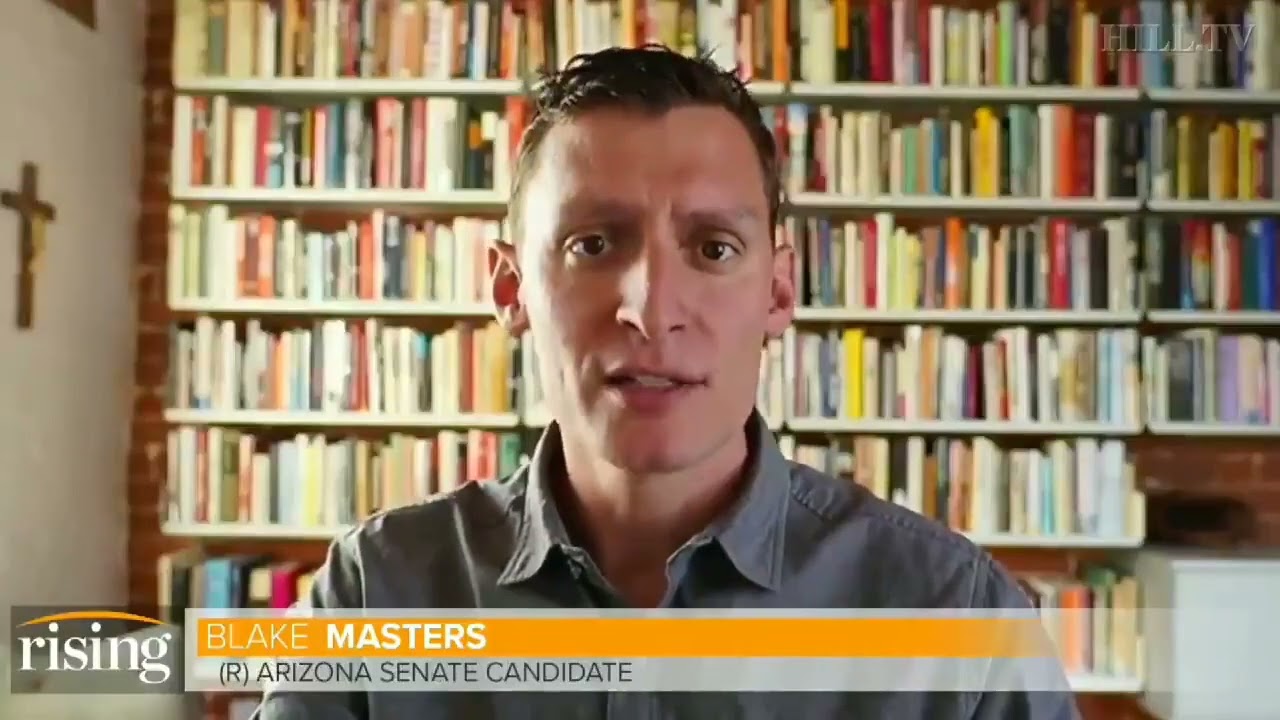 :{ in interviews, claiming, “we have to figure out if the earth is warming and why….”}:
- Blake Masters was Peter Thiel’s Deputy on the Trump transition team :{when they attempted:(style="box-sizing:border-box"):}: to appointWilliam Happer, a known climate change denier, to be Trump’s science adviser.
- He has :{continuously repeated the big lie:(style="box-sizing:border-box"):}:, pushing the false claim that President Trump won the 2020 election. Trump’s endorsement of Masters said ‘Blake knows that the ‘Crime of the Century’ took place, he will expose it and also, never let it happen again.’
- Super PAC funded by Masters’ old boss Peter Thiel:{ blasted his opponent for not believing that the election was stolen:(style="box-sizing:border-box"):}: from President Trump. ‘Mark Brnovich says President Trump is wrong on voter fraud. Really? Brnovich failed to convene a grand jury, certifying Biden as president. Now he’s nowhere to be found, making excuses … instead of standing with our president.”
nyer 2016 jane m
https://www.newyorker.com/magazine/2016/11/21/aftermath-sixteen-writers-on-trumps-america
...Many of Trump’s transition-team members are the corporate insiders he vowed to disempower. On Friday, Vice-President-elect Mike Pence, the new transition-team chair, announced that Marc Short, who until recently ran Freedom Partners, the Kochs’ political-donors group, would serve as a “senior adviser.” The influence of the Kochs and their allies is particularly clear in the areas of energy and the environment. The few remarks Trump made on these issues during the campaign reflected the fondest hopes of the oil, gas, and coal producers. He vowed to withdraw from the international climate treaty negotiated last year in Paris, remove regulations that curb carbon emissions, legalize oil drilling and mining on federal lands and in seas, approve the Keystone XL pipeline, and weaken the Environmental Protection Agency.
For policy and personnel advice regarding the Department of Energy, Trump is relying onMichael McKenna, the president of the lobbying firm MWR Strategies. McKenna’s clients include Koch Companies Public Sector, a division of Koch Industries. According to Politico, McKenna also has ties to the American Energy Alliance and its affiliate, the Institute for Energy Research. These nonprofit groups purport to be grassroots organizations, but they run ads advocating corporate-friendly energy policies, without disclosing their financial backers. In 2012, Freedom Partners gave $1.5 million to the American Energy Alliance.
Michael Catanzaro, a partner at the lobbying firm CGCN Group, is the head of Trump’s energy transition team, and has been mentioned as a possible energy czar. Among his clients are Koch Industries and Devon Energy Corporation, a gas-and-oil company that has made a fortune from vertical drilling and hydraulic fracturing. Another widely discussed candidate is Harold Hamm, the billionaire founder of the shale-oil company Continental Resources, who is a major contributor to the Kochs’ fund-raising network. Wenona Hauter, of Food and Water Watch, says that Hamm has “done all he can to subvert the existing rules and regulations.”
Myron Ebell, an outspoken climate-change skeptic, heads Trump’s transition team for the E.P.A. Ebell runs the energy-and-environmental program at the Competitive Enterprise Institute, an anti-regulatory Washington think tank that hides its sources of financial support but has been funded by fossil-fuel companies, including Exxon-Mobil and Koch Industries.
David Schnare, a self-described “free-market environmentalist” who has accused the E.P.A. of having “blood on its hands,” is a member of the E.P.A. working group. Schnare is the director of the Center for Energy and the Environment at the Thomas Jefferson Institute, part of a nationwide consortium of anti-government, pro-industry think tanks. He is also the general counsel at the Energy and Environment Legal Institute, which has received funding from coal companies. In 2011, Schnare started hounding the climate scientist Michael Mann, who had been a professor at the University of Virginia, by filing public-records requests demanding to see his unpublished research and his private e-mails. The legal wrangling tied up Mann’s work until 2014, when the Virginia Supreme Court ordered Schnare to desist. The Union of Concerned Scientists has described these actions against climate scientists as “harassment.
...
12/16
no lnx
https://www.greentechmedia.com/articles/read/trump-doe-transition-team-lobbyist-oil-gas-koch
POLICY
Trump Energy Team Swaps Out Its Transition Team Leader
And the new guy has some choice words for clean energy lobbyists.
JULIAN SPECTOR DECEMBER 01, 2016
Donald Trump won the presidency with a pledge to "drain the swamp," reducing the undue influence of elites and Beltway insiders on the functioning of the government.
To uphold this pledge, the incoming administration instituted a policy that bars registered lobbyists from participating in the teams that land in the federal departments to oversee the transition. That made things a little awkward for the lobbyists Trump had chosen months before to run the energy policy handoff.
"Although I have reluctantly decided that I cannot continue on the transition in an official capacity, I am excited about continuing to work to make America great again," said Mike McKenna, the Republican energy lobbyist who led the transition team for the Department of Energy, in a statement earlier this month.
Another lobbyist on Trump's energy policy team, Mike Catanzaro of CGCN Group, also stepped down. The departures turned the routine process of bureaucratic stewardship into a rather more suspenseful and unpredictable affair.
https://www.csldf.org/2016/12/09/trump-adds-lawyer-history-harassing-climate-scientists-transition-team/
many lnx
Trump Adds Lawyers with History of Harassing Climate Scientists to Transition Team
December 9, 2016 By Lauren Kurtz
“For years, David Schnare, with funding from polluting interests, has hounded me and other climate scientists, abusing open records laws in an effort to get ahold of personal emails that he might use to try to embarrass and smear us. His efforts were rejected by the lower court and then the Virginia Supreme Court, but not before many thousands of dollars were spent defending the University of Virginia and me from his frivolous lawsuits, and not before many hours I could have spent advising students, doing research, and advancing our understanding of Earth’s climate, were wasted dealing with his bad faith assaults. I find it appalling that he has been granted any role whatsoever in the transition of an agency that does so much important science.” – Dr. Michael Mann
We are deeply troubled by a large number of appointments by President-elect Trump that deny the science of climate change, and we are alarmed that he has expanded his team to include people who target individual scientists. Much attention has been focused on Scott Pruitt, President-elect Donald Trump’s disastrous pick for EPA Administrator, but other dangerous appointments have gone largely unnoticed: for one, David Schnare was named to the EPA transition team.
Schnare, a former EPA employee, has been a major proponent of using the legal system to harass and intimidate climate scientists. He and his colleagues have argued before courts that open records laws should permit fossil fuel-funded lawyers to sift through climate scientists’ private emails. Their goal is, purportedly, to use these emails “to convince the public to believe human-caused global warming is a scientific fraud.” In reality, they intend to scare scientists into silence.
Much of Schnare’s recent work was done as General Counsel for the coal-funded Energy & Environment Legal Institute (also known as E&E Legal and formerly known as the American Tradition Institute). Schnare and E&E Legal have gone after climate scientists in – at least – Alabama, Arizona, Delaware, Illinois, Texas, Virginia, and Washington, D.C.
Update: another coal-funded lawyer with a history of attacking climate scientists, E&E Legal senior fellow Christopher Horner, has also been added to Trump’s transition team. CSLDF could not be more dismayed.
CSLDF was founded partly in response to one of Schnare and Horner’s lawsuits, against climate scientist Dr. Michael Mann. The case was rejected by the Virginia Supreme Court, which found that their proposals would cause “harm to university-wide research efforts, damage to faculty recruitment and retention, undermining of faculty expectations of privacy and confidentiality, and impairment of free thought and expression.” (It is worth noting that when the lawsuit was initiated in 2011, Schnare was employed by the EPA – an arrangement that may have violated federal ethics laws.)
In that case and many others, E&E Legal’s claims have been shot down by courts – yet they nonetheless circumscribe scientists’ inquiry. Daunted by expensive and time-consuming legal cases, scientists may hesitate to explore climate change. Only a strong legal defense fund can mitigate such strategies.
In all of Schnare and Horner’s cases, the justifications for opening scientists’ private records are dubious; in some, they are offensive. As part of one ongoing suit to obtain climate scientists’ emails, Schnare argued that female scientists may take, in his words, a “mommy sabbatical” and then ignore their publicly-funded research in lieu of “sitting around folding clothes.” Given this risk, Schnare claimed, scientists’ “abandoned” emails regarding “preliminary unpublished work” should be released to the public. Were this scheme to come to fruition, it would expose these women scientists to sexist and anti-scientific fishing expeditions during maternity leave, and seriously hamstring their research efforts.
In 2012, Schnare filed a lawsuit challenging EPA-funded studies of human exposure to airborne particulates, claiming those studies were equivalent to the Nazi experiments on Jews during the Holocaust. The judge dismissed the suit at the first opportunity. Once again, Schnare proved only that he would use any pretense to suffocate scientific thought and advance fossil fuel interests.
Perhaps most perplexingly, Schnare once sued Dog News for defamation and emotional distress, over an article on the classification of Labrador retrievers that mentioned him, which was also dismissed and affirmed by the Fourth Circuit.
Schnare and Horner join a transition that not only rejects the scientific evidence for climate change, but has other members involved in legal bullying to go after climate scientists. Myron Ebell, in charge of the EPA transition team, comes from the Competitive Enterprise Institute, another major player in dragging climate scientists into court. (In addition to his role at E&E Legal, Christopher Horner is also a senior fellow at CEI.)
And Trump’s chief of staff, Steve Bannon, himself comes from Breitbart News – a so-called “alt-right” site that has approvingly covered many of the court cases harassing climate scientists. Meanwhile, for the NASA transition team, Trump has named Chris Shank, a staffer for the House Science committee chaired by Rep. Lamar Smith (R-TX); in recent years, the committee has held multiple hearings aiming to discredit climate science and subpoenaed climate scientists’ emails when their research shows that climate change is, in fact, happening.
Schnare and Horner, along with their colleagues at E&E Legal, the Competitive Enterprise Institute, and similar groups have spent years attempting to use the legal system to attack climate scientists. We can’t put into words how strongly we feel that those who have attacked individual scientists should not be involved in the management of federal agencies that employ some of this country’s best researchers.
CSLDF was created to protect scientists, their research, and their freedom of inquiry from pernicious attacks. In this new political environment, our work has become more important than ever.
==
==
pretty sure i have early guard uk
https://yyy.theguardian.com/us-news/2016/dec/12/donald-trump-environment-climate-change-skeptics
==
jeez ebell on energy w/ Soon they find themselves lavishing Trump with compliments. “When people ask us what Donald Trump is really like in person, the one word we have found best described him was ‘authentic,’” they write of a man who has been described by his own aides as a compulsive liar.
Kudlow, Moore, and Laffer are unusually fixated on tax cuts,but they are merely extreme examples of the entire Republican Establishment, which shared their broad priorities. “The consolidation of the party behind Trump was greatly facilitated by the attractiveness of the Trump tax plan,” they report.
Greed is the glue that holds their story together. A large segment of their narrative consists of Trump turning over control of his agenda to various plutocrats.They tell how they wrote a memo defining the administration’s energy strategy during the transition period, drawing on three sources: oilman Harold Hamm; the Institute for Energy Research (a “partner organization” of the American Energy Alliance, a fossil fuel lobby); and Jack Coleman, an oil and gas lobbyist. They do not report consulting on any information sources not controlled by the fossil fuel industry. They describe a coal executive advising Trump, “if you want to make America great again, put a muzzle on the regulators.” At another meeting, one energy executive suggests natural gas, coal, and nuclear power should each have 30 percent of the power grid, with renewables splitting the remaining 10 percent. “That sounds about right,” Trump replies, “except for the ten percent for renewable energy.”
==
http://blogs.edweek.org/edweek/campaign-k-12/2016/11/trump_education_transition_team.html
Get to Know Donald Trump's Education Transition Team
By Alyson Klein on November 21, 201610:57 AM
Donald-Trump-Flags-Blog.jpg
The folks on President-elect Donald Trump's education transition team will help set the policy course—and likely, even appoint key personnel—for the new administration. Their backgrounds could provide clues on the direction the Trump administration wants to go on K-12. Here's a look:
James Manning
Trump's transition team told reporters Monday that Manning will be a part of the "landing team" at the U.S. Department of Education; the transition team said his name would be sent to President Barack Obama's administration at noon on Monday.
Manning worked on higher education issues at the department under President George W. Bush. Read testimony Manning gave to the House foreign affairs committee in 2007 about postsecondary issues here. "America must remain the primary destination for international students. We must work together to make sure our nation's institutions of higher education continue to be open to students from around the globe," Manning said.
Williamson "Bill" Evers
Williamson-Evers-280.jpgEvers' name is probably familiar with long-time Education Week readers, in fact we profiled him back in 2007. He served as assistant secretary for planning, evaluation, and policy development under President George W. Bush.
He was a veteran of the so-called "math wars" in California. In helping to write standards and curriculum for the state, he championed a strong foundation of core content, particularly in the early grades. He's also no fan of the Common Core State Standards. In fact, he wrote a commentary opposing the standards for Education Week, which you can read here.
And as a school board member in Santa Clara County Calif., Evers supported a ballot resolution that would have made it easier to fire tenured teachers.
Evers also served as an education adviser to President Bush in Iraq, and sought to ensure that standardized testing could continue despite widespread violence after the U.S. invasion in 2003.
"Iraqi parents love standardized testing and were fervently concerned not to let either the war in March and April [2003], or the subsequent guerrilla skirmishes, interfere with the nationwide testing program," Evers wrote in a 2004 essay published in the Wall Street Journal.
And also relevant to current education debates, Evers is skeptical of "dashboards" that get at students' opportunity to learn. (More in this Education Week commentary he wrote with Ze'ev Wurman, another one-time Bush advisor.) He's a fan of holding schools accountable for a single data point. But that's exactly what some states, including California, want to avoid under the Every Student Succeeds Act.
Gerard Robinson
Robinson is the former state chief in Virginia and Florida, and was a member of the "education reform" group Chiefs for Change. CLARIFICATION: In Virginia, Robinson was secretary of education under GOP Gov. Bob McDonnell, a cabinet position—the state superintendent during Robinson's time in that post was Pat Wright.
He only served for a short time as state chief in the Florida, working for just one year and leaving in 2014. Right before he left, the state rushed to change the passing score on the state's writing test because so many students had performed poorly. That was partly because, before Robinson took office, the state legislature directed the department to come up with tougher standards. And Robinson sought to respond to the score drop, launching a townhall type tour reassure parents, and devoting a section of the state department's website to parent outreach. More in this story from the Andrew half.
Robinson also faced criticism for how he factored English-language learners into Florida's A-F school grades.
Townsend McNitt
Other transition staffers include Townsend McNitt, another Education Department official under Bush who served as deputy chief of staff there from 2005 to 2007. In that role, she helped implement the No Child Left Behind Act, according to this bio from the Center for Public Justice, a Christian think tank. Before working at the department, McNitt was the staff director of the Senate education committee. Since 2007, McNitt has been working as a "strategic consultant" according to this online resume.
One Republican and former Education Department official described McNitt as a strong behind-the-scenes player. She's "serious, capable, diligent, gets done stuff done," the official said.
==
==
new article by journalist Michael Lewis claims that Donald Trump in 2016 went on a furious tirade when he learned that his campaign was required by law to fund a presidential transition team.
Writing in the Guardian,yyy Lewis explains that former New Jersey Gov. Chris Christie explained to the future president in April 2016 that he would need to either pay to hire a transition team himself or would have to use campaign funds to pay for it.
Trump grudgingly agreed to let Christie set up a separate fund aimed solely at raising money for the transition.
By August 2016, the transition team had hired hundreds people — and Trump found out by reading a newspaper article that the transition fund had raised millions of dollars to pay them.
Upon reading this, reports Lewis, he summoned both Christie and former campaign chairman Steve Bannon into his office and blew up at both of them.
“You’re stealing my money!” Trump yelled at them. “You’re stealing my f*cking money! What the f*ck is this?”
They tried to explain to Trump that campaigns are required by law to fund transition teams to ensure a smooth transfer of power after the election.
“F*ck the law,” Trump seethed, according to Lewis. “I don’t give a f*ck about the law. I want my f*cking money.”
Read the whole report here.
no lnx few
Michael Lewis, author of Moneyball and The Big Short, reveals how Trump’s bungled presidential transition set the template for his time in the White House
Thu 27 Sep 2018 01.00 EDT Last modified on Thu 27 Sep 2018 09.44 EDT
Chris Christie noticed a piece in the New York Times – that’s how it all started. The New Jersey governor had dropped out of the presidential race in February 2016 and thrown what support he had behind Donald Trump. In late April, he saw the article. It described meetings between representatives of the remaining candidates still in the race – Trump, John Kasich, Ted Cruz, Hillary Clinton and Bernie Sanders – and the Obama White House.Anyone who still had any kind of shot at becoming president of the United States apparently needed to start preparing to run the federal government. The guy Trump sent to the meeting was, in Christie’s estimation, comically underqualified. Christie called up Trump’s campaign manager, Corey Lewandowski, to ask why this critical job had not been handed to someone who actually knew something about government. “We don’t have anyone,” said Lewandowski.
Christie volunteered himself for the job: head of the Donald Trump presidential transition team.“It’s the next best thing to being president,” he told friends. “You get to plan the presidency.” He went to see Trump about it. Trump said he didn’t want a presidential transition team. Why did anyone need to plan anything before he actually became president? It’s legally required, said Christie. Trump asked where the money was going to come from to pay for the transition team. Christie explained that Trump could either pay for it himself or take it out of campaign funds. Trump didn’t want to pay for it himself. He didn’t want to take it out of campaign funds, either, but he agreed, grudgingly, that Christie should go ahead and raise a separate fund to pay for his transition team. “But not too much!” he said.
And so Christie set out to prepare for the unlikely event that Donald Trump would one day be elected president of the United States. Not everyone in Trump’s campaign was happy to see him on the job. In June, Christie received a call from Trump adviser Paul Manafort. “The kid is paranoid about you,” Manafort said. The kid was Jared Kushner, Trump’s son-in-law. Back in 2005, when he was US attorney for New Jersey, Christie had prosecuted and jailed Kushner’s father, Charles, for tax fraud. Christie’s investigation revealed, in the bargain, that Charles Kushner had hired a prostitute to seduce his brother-in-law, whom he suspected of cooperating with Christie, videotaped the sexual encounter and sent the tape to his sister. The Kushners apparently took their grudges seriously, and Christie sensed that Jared still harboured one against him. On the other hand, Trump, whom Christie considered almost a friend, could not have cared less.
Christie viewed Kushner as one of those people who thinks that, because he is rich, he must also be smart. Still, he had a certain cunning about him. And Christie soon found himself reporting everything he did to prepare for a Trump administration to an “executive committee”. The committee consisted of Kushner, Ivanka Trump, Donald Trump Jr, Eric Trump, Manafort, Steve Mnuchin and Jeff Sessions. “I’m kind of like the church elder who double-counts the collection plate every Sunday for the pastor,” said Sessions, who appeared uncomfortable with the entire situation. The elder’s job became more complicated in July 2016, when Trump was formally named the Republican nominee. The transition team now moved into an office in downtown Washington DC, and went looking for people to occupy the top 500 jobs in the federal government. They needed to fill all the cabinet positions, of course, but also a whole bunch of others that no one in the Trump campaign even knew existed. It is not obvious how you find the next secretary of state, much less the next secretary of transportation – never mind who should sit on the board of trustees of the Barry Goldwater Scholarship and Excellence in Education Foundation.
By August, 130 people were showing up every day, and hundreds more working part-time, at Trump transition headquarters, on the corner of 17th Street and Pennsylvania Avenue. The transition team made lists of likely candidates for all 500 jobs, plus other lists of informed people to roll into the various federal agencies the day after the election, to be briefed on whatever the federal agencies were doing. They gathered the names for these lists by travelling the country and talking to people: Republicans who had served in government, Trump’s closest advisers, recent occupants of the jobs that needed filling. Then they set about investigating any candidates for glaring flaws and embarrassing secrets and conflicts of interest. At the end of each week, Christie handed over binders, with lists of names of people who might do the jobs well, to Kushner, Donald Jr and the others. “They probed everything,” says a senior Trump transition official. “‘Who is this person?’ ‘Where did this person come from?’ They only ever rejected one person: Manafort’s secretary.”[pix]
The first time Trump paid attention to any of this was when he read about it in the newspaper. The story revealed that Trump’s very own transition team had raised several million dollars to pay the staff. The moment he saw it, Trump called Steve Bannon, the chief executive of his campaign, from his office on the 26th floor of Trump Tower, and told him to come immediately to his residence, many floors above. Bannon stepped off the elevator to find Christie seated on a sofa, being hollered at. Trump was apoplectic, yelling: You’re stealing my money! You’re stealing my fucking money! What the fuck is this?
Seeing Bannon, Trump turned on him and screamed: Why are you letting him steal my fucking money? Bannon and Christie together set out to explain to Trump federal law. Months before the election, the law said, the nominees of the two major parties were expected to prepare to take control of the government. The government supplied them with office space in downtown DC, along with computers and rubbish bins and so on, but the campaigns paid their people. To which Trump replied: Fuck the law. I don’t give a fuck about the law. I want my fucking money. Bannon and Christie tried to explain that Trump couldn’t have both his money and a transition.
Shut it down, said Trump. Shut down the transition.
Here Christie and Bannon parted ways. Neither thought it was a good idea to shut down the transition, but each had his own misgivings.Christie thought that Trump had little chance of running the government without a formal transition. Bannon wasn’t so sure if Trump would ever get his mind around running the federal government; he just thought it would look bad if Trump didn’t at least seem to prepare. Seeing that Trump wasn’t listening to Christie, he said: “What do you think Morning Joe will say if you shut down your transition?” What Morning Joe would say – or at least what Bannon thought it would say – was that Trump was closing his presidential transition office because he didn’t think he had any chance of being president.
Trump stopped hollering. For the first time he seemed to have listened.
“That makes sense,” he said.
With that, Christie went back to preparing for a Trump administration. He tried to stay out of the news, but that proved difficult. From time to time, Trump would see something in the paper about Christie’s fundraising and become upset all over again.The money that people donated to his campaign Trump considered, effectively, his own. He thought the planning and forethought pointless. At one point he turned to Christie and said: “Chris, you and I are so smart that we can leave the victory party two hours early and do the transition ourselves.”
At that moment in American history, if you could somehow organise the entire population into a single line, all 350 million people, ordered not by height or weight or age but by each citizen’s interest in the federal government, and Donald Trump loitered somewhere near one end of it, Max Stier would occupy the other.
By the autumn of 2016, Stier might have been the American with the greatest understanding of how the US government worked. Oddly, for an American of his age and status, he had romanticised public service since he was a child. He had gone through Yale in the mid-80s and Stanford law school in the early 90s without ever being tempted by money or anything else. He thought the US government was the single most important and interesting institution in the history of the planet and could not imagine doing anything but working to improve it. A few years out of law school he had met a financier named Sam Heyman, who was as disturbed as Stier was by how uninterested talented young people were in government work. Stier persuaded Heyman to set aside $25m for him so that he might create an organisation to address the problem.
Stier soon realised that to attract talented young people to government service, he would need to turn the government into a place that talented young people wanted to work. He would need to fix the US government. Partnership for Public Service, as Stier called his organisation, was not nearly as dull as its name. It trained civil servants to be business managers; it brokered new relationships across the federal government; it surveyed the federal workforce to identify specific management failures and success; and it lobbied Congress to fix deep structural problems. It was Stier who had persuaded Congress to pass the laws that made it so annoyingly difficult for Trump to avoid preparing to be president.
Anyway, from the point of view of a smart, talented person trying to decide whether to work for the US government, the single most glaring defect was the absence of an upside. The jobs were not well-paid compared with their equivalents in the private sector. And the only time government employees were recognised was if they screwed up – in which case they often became the wrong kind of famous. In 2002, Stier created an annual black tie, Oscars-like awards ceremony to celebrate people who had done extraordinary things in government.
Every year the Sammies – as Stier called them, in honour of his original patron – attracted a few more celebrities and a bit more media attention. And every year, the list of achievements was mind-blowing. A guy in the energy department (Frazer Lockhart) organised the first successful cleanup of a nuclear weapons factory, in Rocky Flats, Colorado, and had brought it in 60 years early and $30bn under budget. A woman at the Federal Trade Commission (Eileen Harrington) had built the Do Not Call Registry, which spared the entire country from trillions of irritating sales pitches. A National Institutes of Health researcher (Steven Rosenberg) had pioneered immunotherapy, which had successfully treated previously incurable cancers. There were hundreds of fantastically important success stories in the US government. They just never got told.
Stier knew an astonishing number of them. He had detected a pattern: a surprising number of the people responsible for them were first-generation Americans who had come from places without well-functioning governments. People who had lived without government were more likely to find meaning in it. On the other hand, people who had never experienced a collapsed state were slow to appreciate a state that had not yet collapsed.
That was maybe Stier’s biggest challenge: explaining the value of this enterprise at the centre of a democratic society to people who either took it for granted or imagined it as a pernicious force in their lives over which they had no control. He would explain that the federal government provided services that the private sector could not or would not: medical care for veterans, air traffic control, national highways, food safety guidelines. He would explain that the federal government was an engine of opportunity: millions of American children, for instance, would have found it even harder than they did to make the most of their lives without the basic nutrition supplied by the federal government. When all else failed, he would explain the many places the US government stood between Americans and the things that might kill them. “The basic role of government is to keep us safe,” he would say.
The US government employed 2 million people, 70% of them one way or another in national security. It managed a portfolio of risks that no private person or corporation was able to manage. Some of the risks were easy to imagine: a financial crisis, a hurricane, a terrorist attack. Most were not: the risk, say, that some prescription drug proves to be both so addictive and so accessible that each year it kills more Americans than were killed in action by the peak of the Vietnam war. Many of the risks that fell into the government’s lap felt so remote as to be unreal: that a cyberattack left half the country without electricity, or that some airborne virus wiped out millions, or that economic inequality reached the point where it triggered a violent revolution. Maybe the least visible risks were of things not happening that, with better government, might have happened. A cure for cancer, for instance.
Enter the presidential transition. A bad transition took this entire portfolio of catastrophic risks – the biggest portfolio of such risks ever managed by a single institution in the history of the world – and made all the bad things more likely to happen and the good things less likely to happen. Even before Stier created an organisation to fix the federal government, the haphazard nature of presidential transitions drove him nuts. “We have a legacy government that hasn’t kept up with the world we live in, largely because of disruptions from bad transitions,” he said. “People don’t understand that a bungled transition becomes a bungled presidency.” The new people taking over the job of running the government were at best only partially informed, and often deeply suspicious, of whatever happened to be going on before they arrived. By the time they fully grasped the problems they were dealing with, it was time to go. “It’s Groundhog Day,” said Stier. “The new people come in and think that the previous administration and the civil service are lazy or stupid. Then they actually get to know the place they are managing. And when they leave they say: ‘This was a really hard job, and those are the best people I’ve ever worked with.’ This happens over and over and over.”
Most of the big problems inside the US government were of the practical management sort and had nothing to do with political ideology. A mundane but important example was how hard it was for any government agency to hire new people. Some agencies couldn’t hire anyone without 60 different people signing off on him. The George W Bush administration had begun to attack that particular mundane problem. The Obama administration, instead of running with the work done during the Bush years, had simply started all over again.
Jared Kushner on 11 January 2017. Photograph: Evan Vucci/AP
Stier’s Partnership for Public Service had helped to push through three separate laws related to the transition. In 2010, Congress gave free office space and other resources to the nominees of the two major political parties immediately after the summer conventions. “The reason campaigns didn’t prepare is that they thought it would cost them politically: no one wanted to be seen measuring the drapes,” said Stier. “The idea was to give the nominees of the major political parties cover to do what they should do.” In 2011-2012, to enable the president to put people in jobs more quickly, Congress reduced the number of presidential appointments that required Senate confirmation from about 1,400 to roughly 1,200 – still more than 1,000 too many, in Stier’s view, but a start. Finally, in 2015, Congress required the sitting president to prepare in various ways to hand the government over to his or her successor. The person who had already taken the test was now required by law to help the person who may not have studied for it.
As the 2016 presidential election approached, Stier was about as hopeful as he had ever been that the US government would be handed from one leader to another with minimum stupidity. His partnership had worked with both the Clinton and the Trump campaigns. “Their work was good,” said Stier. He was disappointed with Obama in some ways. Obama had been slow to engage with the federal workforce. He had appointed some poor managers to run some agencies. The fiasco of the rollout of HealthCare.gov was not an accident but a byproduct of bad management. But Obama’s preparations to hand over the government had been superb: the Obama administration had created what amounted to the best course ever on the inner workings of the most powerful institution on earth. What could go wrong?
Chris Christie was sitting on a sofa beside Trump when Pennsylvania was finally called. It was 1.35am, but that wasn’t the only reason the feeling in the room was odd. Mike Pence went to kiss his wife, Karen, and she turned away from him. “You got what you wanted, Mike,” she said. “Now leave me alone.” She wouldn’t so much as say hello to Trump. Trump himself just stared at the TV without saying anything, like a man with a pair of twos whose bluff has been called. His campaign hadn’t even bothered to prepare an acceptance speech. It was not hard to see why Trump hadn’t seen the point in preparing to take over the federal government: why study for a test you will never need to take? Why take the risk of discovering you might, at your very best, be a C student? This was the real part of becoming president of the US. And, Christie thought, it scared the crap out of the president-elect.
Not long after the people on TV announced that Trump had won Pennsylvania, Jared Kushner grabbed Christie anxiously and said: “We have to have a transition meeting tomorrow morning!” Even before that meeting, Christie had made sure that Trump knew the protocol for his discussions with foreign leaders. The transition team had prepared a document to let him know how these were meant to go. The first few calls were easy – the very first was always with the prime minister of Great Britain – but two dozen calls in you were talking to some kleptocrat and tiptoeing around sensitive security issues. Before any of the calls could be made, however, the president of Egypt called in to the switchboard at Trump Tower and somehow got the operator to put him straight through to Trump. “Trump was like ... I love the Bangles! You know that song Walk Like an Egyptian?” recalled one of his advisers on the scene.
That had been the first hint Christie had of trouble. He had asked Kushner what that was about, and Kushner had simply said, Trump ran a very unconventional campaign, and he’s not going to follow any of the protocols. The next hint that the transition might not go as planned came from Pence – now, incredibly, the vice-president-elect. Christie met with Pence the day after the election, to discuss the previous lists of people who had been vetted for jobs.The meeting began with a prayer, followed by Pence’s first, ominous question: “Why isn’t Puzder on the list for labour?” Andrew Puzder, the head of CKE Restaurants, the holding company for the fast-food chains Hardee’s and Carl’s Jr, wanted to be the secretary of labour. Christie explained that Puzder’s ex-wife had accused him of abuse (although she later retracted the allegation) and his fast-food restaurant employees had complained of mistreatment. Even if he was somehow the ideal candidate to become the next secretary of labour, he wouldn’t survive his Senate confirmation hearings. (Trump ignored the advice and nominated Puzder. In the controversy that followed, Puzder not only failed to be confirmed, but also stepped down from his job.)
After meeting with Pence, Christie was scheduled to brief the Trump children, Kushner and the other members of Trump’s inner circle. He was surprised to find, suddenly included in this group, retired army lieutenant general Michael Flynn. Flynn was a jobseeker the transition team had found reasons to be extremely wary of. Now he wanted to be named Trump’s national security adviser, which was maybe the most important job in the entire national security apparatus. The national security team inside the Trump transition – staffed with senior former military and intelligence officials – had thought that was an especially bad idea. Flynn’s name was not on the list. But here he was, in the meeting to decide who would do what in the Trump administration, and Ivanka was asking him which job he would like to have.
Before Christie could intercede, Bannon grabbed him and asked to see him privately. Christie followed Bannon to his office impatiently. Hey, this is going to have to be quick, said Christie.
It’s really quick, said Bannon. You’re out.
Why? asked Christie, stunned.
We’re making a change.
“Okay, what are we changing?
You.
Why?
It’s really not important.
The method of his execution was unsurprising: Trump always avoided firing people himself. The man who played Mr You’re Fired on TV avoided personal confrontation in real life. The surprise was that it was being done now, just when the work of the transition team was most critical.Only when Christie threatened to go down and tell reporters that Bannon had fired him did Bannon concede, “It was Jared.”
In the days after the election, the people in the building on 17th and Pennsylvania were meant to move to another building in downtown DC, a kind of White House-in-waiting. They soon discovered that the lists that they had created of people to staff the Trump administration were not the lists that mattered. There was now this other list, of people allowed into the new building, and most of their names weren’t on it. “People would show up to the new building and say: ‘Let me in,’ and the secret service would say: ‘Sorry, you’re not on the list,’” said a civil servant who worked in the new building.
It wasn’t just Christie who had been fired. It was the entire transition team – although no one ever told them so directly. As Nancy Cook reported in Politico, Bannon visited the transition headquarters a few days after he had given Christie the news, and made a show of tossing the work the people there had done for Trump into the bin. Trump was going to handle the transition more or less by himself. Not even Bannon thought this was a good idea. “I was fucking nervous as shit,” Bannon later told friends. “I go, ‘Holy fuck, this guy [Trump] doesn’t know anything. And he doesn’t give a shit.’”
They were about to take control of the portfolio of existential risks managed by the US government. Only they weren’t. On the morning after the election the hundreds of people who had prepared to brief the incoming Trump administration sat waiting. A day became a week and a week became a month … and no one showed up. The parking spots that had been set aside for Trump’s people remained empty, and the briefing books were never opened. You could walk into almost any department of the US government and hear people asking the same question: where were these people who were meant to be running the place?
Michael Lewis: The Big Short author on how Trump is gambling with nuclear disaster
Read more
The department of agriculture was an excellent case study. The place had an annual budget of $164bn and was charged with so many missions critical to the society that the people who worked there played a drinking game called Does the Department of Agriculture Do It? Someone would name a function of government, say, making sure that geese don’t gather at US airports, and fly into jet engines. Someone else would have to guess whether the agriculture department did it. (In this case, it did.) Guess wrong and you had to drink. Among other things, the department essentially maintained rural America, and also ensured that the American poor and the elderly did not starve. Much of its work was complicated and technical – and yet for the months between the election and the inauguration, Trump people never turned up to learn about it. Only on inauguration day did they flood into the building, but the people who showed up had no idea why they were there or what they were meant to do. Trump sent, among others, a long-haul truck driver, a telephone company clerk, a gas company meter reader, a country club cabana attendant, a Republican National Committee intern and the owner of a scented candle company. One of the CVs listed the new appointee’s only skill as “a pleasant demeanor”.
All these people had two things in common. They were Trump loyalists.And they knew nothing whatsoever about the job they suddenly found themselves in. A new American experiment was underway.
• Follow the Long Read
https://YYY.theguardian.com/news/2018/sep/27/this-guy-doesnt-know-anything-the-inside-story-of-trumps-shambolic-transition-team
==
https://www.opensecrets.org/news/2017/03/trumps-beachhead-hosts-dozens-of-former-lobbyists/
:{Health and Human Services Secretary Tom Price has been mired in questions about his investments in the healthcare industry. As it turns out, some of the people helping him get grounded at the department are also prompting questions about their ties with the industry.
}:
Lance Leggitt, a lobbyist at Baker Donelson since 2006, was named Price’s chief of staff earlier this month. In 2016 alone, he lobbied for 10 organizations — all related to health care. Alere Inc:{, for example, manufactures diagnostic tests and spent nearly $900,000 lobbying last year. Other clients included hospitals and a medical trade group.
}:
Leggitt deregistered as a lobbyist in January, because he was on his way to HHS even before being made chief of staff. In the early days of the administration, Leggitt was a member of President Trump’s “beachhead” force,a temporary cast of characters brought in to keep the government running and lay the groundwork for Trump’s agenda.With key jobs in the administration being filled at a slower-than-average pace, these individuals can have a big impact on their agencies.
In response to a Freedom of Information Act request filed by ProPublica, the names of 400 of the more than 520 members of beachhead teams were released by the Office of Personnel Management — including several dozen individuals who have been federally registered lobbyists, a review by OpenSecrets confirmed.
Their positions can last 90 to 120 days, depending on the level, with one contract extension permitted — although many expect to be later hired on to full-time positions. That’s what happened with Leggitt, for example, and with Jack Kalavritinos, who was brought in on a beachhead assignment to help run FDA; that agency’s commissioner wasn’t named by Trump for close to two months. Kalavritinos worked at HHS in the mid 2000’s but more recently spent eight years lobbying for Covidien Ltd, an Ireland-based pharmaceutical and health products company. This week, Kalavritinos was named associate commissioner for external affairs at FDA.
While past administrations have used some temporary personnel, they didn’t seem to do so at the same scale as Trump’s, said Max Stier, president and CEO of the Partnership for Public Service, which helps advise new administrations. Most pushed to have officials in place much more quickly.
“There wasn’t a notion of a group of people that were only there for a limited period of time, but more of an expectation that the secretary and team would get in and be using the career folks,” Stier said. “The beachhead team creates another step in the process.” (The term “beachhead” was first used by Mitt Romney’s 2012 campaign; he didn’t get the chance to implement the concept.)
It also creates “minders” of a sort who aren’t always appreciated by agency chiefs or civil service employees trying to do their work.According to the *Washington Post*, these temporary figures often act as eyes and ears for the White House, making sure the agencies are loyally hewing to the administration’s agenda.
Now, some of the beachheaders with lobbying backgrounds did that work many years ago and went on to other careers.But even for more recent practitioners, Trump’s executive order on ethics, unlike President Obama’s, allows lobbyists to join the administration, even in the agencies they previously lobbied, though they are not supposed to work on specific issues on which they lobbied in the last two years. There are also restrictions on the lobbying that administration employees can do after they leave the public payroll, but there are a number of loopholes in the rules. REV DR
It’s unclear if all the beachhead employees are bound by the Trump policy. Still, even if they are, there are a number of ways that former lobbyists can flourish in the administration. For instance, Trump could waive the executive order’s requirements for certain appointees, and now doesn’t even need to make those waivers public, like Obama did. (There is a section of the White House site that says “Ethics pledge waivers will be published as they become available,” but there weren’t any waivers posted when we published.)
The placement of all these lobbyists as de facto — or actual — high-level agency staffers “raises the appearance that you could be attempting to influence public policy in favor of your former client,” said Meredith McGehee, chief of policy, programs and strategy at Issue One. “This isn’t saying that lobbyists are bad or evil, it’s simply saying the reason that you should have rules governing lobbyists in government is because they have been paid by private interests to promote the interests of their employer.”
It makes a difference whether an individual lobbied last year of 10 years ago, McGehee said. Revolving door restrictions are written with time limits, because it’s understood your relationships with clients and freshness of information cool over time.
One former for-profit college lobbyist has already resigned from his beachhead position at the Department of Education, where he worked for about a month. Taylor Hansen lobbied for Career Education Colleges and Universities until July 2016, where he focused on trying to weaken the “gainful employment” rule that puts for-profit schools’ federal funding at risk if their graduates don’t earn enough to pay back their student loans.
*ProPublica* reported that soon after Hansen started working at Education, the agency began delaying deadlines for the gainful employment rule and is reviewing the implementation of the rule. Hansen told ProPublica he didn’t work on gainful employment while at the department.
OpenSecrets Blog contacted the federal agencies with former lobbyist beachhead members about their ethics policies. The Department of Homeland Security was the only one to get back to us, and its response was vague:
“Ethics training, consistent with U.S. Office of Government Ethics regulations, is provided to all political appointees,” said DHS spokesman David Lapan in an email. “DHS ethics attorneys conduct reviews for potential conflicts of interest and provide guidance to employees.”
Nine beachhead members were registered lobbyists as recently as last year; eight of them have filed forms with the Senate deregistering from that work. General Mills has not filed paperwork that shows Erika Baum ending her lobbying gig at the food company, although she is now an executive assistant to the Secretary of Transportation, according to ProPublica‘s data and lobbying records.
OpenSecrets Blog contacted all nine firms, and confirmed at least four beachheaders had formally resigned from their lobbying jobs, as opposed to taking temporary leaves of absence. Two firms said they could not divulge personnel information, and two did not reply by publication. (The ninth was General Mills.)
Among the former cohorts on K Street:
John Barsa, who is installed at DHS, has lobbied for the Aerospace Industries Association of America, a trade group for the aerospace and defense industry. He’s also represented MRIGlobal, a research organization that touts its security and defense program and runs facilities for the Department of Energy and the Department of Defense. He deregistered in 2013, though he stayed at his lobbying firm until 2015.
Pete Giambastiani, in his role as special assistant at the office of the secretary of defense, might visit one of those facilities. He, too, has a history of lobbying on behalf of defense interests. His past clients, through 2014, include the Defense Venture Group, Finmeccanica SpA and the Navy League of the US. Giambastiani also served in the Department of the Navy and the offices of Reps. Jeff Miller (R-Fla.) and, most recently, Tom Rooney (R-Fla.).
Mark Maddox‘s clients as a lobbyist included General Synfuels International, Calcasieu Refinery Co.and Cline Resource and Development. Now, fittingly, he’s a key beachhead figure at the Energy Department. He deregistered in 2015, though he continued working at The Livingston Group/Maddox Strategies.
Then there’s Geoff Burr, who is at the Department of Labor. Until 2015, he was the top lobbyist for the Associated Builders and Contractors, which is always fighting wage standards in federal contracts and is on the other side of labor unions when it comes to exposure to hazardous materials. He then went on to run the lobbying shop at Cablevision. Burr previously put in time at Labor, from 2006 to 2008.
Other departments have smatterings of staff who have lobbied on behalf of issues that are intensely political. Julie Kirchner, a Homeland Security adviser, represented the Federation for Amer Immigration Reform, a nonprofit that seeks to reduce immigration levels. (She deregistered in 2015.) At the Department of Agriculture, special assistant George Dunlop brings with him his experience lobbying for the Tobacco Quota Warehouse Alliance, which advocated in support of tobacco producers from 1999 to 2001.
So far, the links between lobbying and the beachhead team have been pretty direct: Health care lobbyists at HHS, defense lobbyists at Homeland Security, and so on. But what about the Department of Commerce, which is tasked with the broad goal of expanding economic growth? Earl Comstock, director of the Office of Policy and Strategic Planning at Commerce, has demonstrated the flexibility befitting the nation’s multifaceted economy. In his 18 years of lobbying until 2015, he represented firms from Swiss International Air Lines to the Alaska Eskimo Whaling Commission to the Teamsters Union. He can now apply that diverse experience as he makes his way back to government — he was a staffer on the Senate Commerce, Science, & Transportation Committee from 1988-1991.
In some cases, the revolving door made a complete 360 swivel:At least 14 of the beachheads have previously worked in the same agency where Trump has now placed them.
One of them is Marcus Peacock, now adviser for Office of Management & Budget, who worked in that office for eight years under GOP Presidents Ronald Reagan and George W. Bush (R). Peacock worked for Jellinek, Schwartz & Connolly as a program manager in the early 1990’s. Most recently he was the environment & energy consultant for dark-money nonprofit Right to Rise Policy Solutions, which supported Jeb Bush.
Here are the rest of the former lobbyists on Trump’s beachhead team:
- Patricia Adkins – Executive director at the Consumer Product Safety Commission. Lobbying client was the Home Safety Council until 2010, after which she worked at Safe Kids Worldwide. Has worked at CPSC since 2014 under Obama, and was temporarily hired to stay on under the Trump administration.
- Byron Anderson – Dept. of Labor. Lobbying clients included American General Corp and Transamerica Companies. Deregistered 2016.
- Deidre Bass – Dept. of Housing and Urban Development. Lobbying client was the Stark Area Transit Authority. Deregistered 2008.
- Scott Cameron – Dept. of Interior. Lobbying client was Chep USA. Deregistered in 2001, then worked at Interior and Grant Thornton LLP.
- Mauricio Claver-Carone – Dept. of Treasury. Lobbying client was the Cuba Democracy Public Advocacy Corp. Deregistered 2016.
- Martin Dannenfelser – Dept. of Energy. Lobbying client was the Family Research Council. Deregistered 2000, worked at the Energy Innovation Reform Project.
- Lynda Davis – Dept. of Veterans Affairs. Lobbying clinets included Florida State College at Jacksonville and Valencia Community College, as well as Lockheed Martin, Raydon Corp and BAE Systems. Most recently, was executive director of a group called the Military and Veteran Caregiver Network.
- Sheila Greenwood – Dept. of Housing and Urban Development. Lobbying clients included Prudential Financial and Wal-Mart. Deregistered 2014, continued working at Prudential Financial.
- Scott Hommel – Dept. of Interior. Lobbying clients included American Defense Systems, Avalex Technologies and the National Guard Association of the U.S. Deregistered 2010, served as now-Secretary Ryan Zinke’s chief of staff.
- Russell Laird – Dept. of Agriculture. Lobbying clients include the National Cooperative Services Corp. and the National Rural Utilities Cooperative Finance Corp. Deregistered 2016.
- Keagan Lenihan – Dept. of Health and Human Services. Lobbying client was McKesson Corp. Deregistered 2016.
- Marianne McInerney – Dept. of Transportation. Lobbying client was the American International Automobile Dealers Association, a lobbying group for foreign car dealers, where she was also president. Joined beachhead team from electric car maker Cenntro Automotive.
- Justin Mikolay – Office of the Secretary of Defense. Lobbying client was Palantir Technologies. Deregistered 2016.
- Wayne Palmer – Dept. of Labor. Lobbying clients included the Alliance for Healthcare Competitiveness and AstraZeneca Pharmaceuticals. Deregistered 2015, continued working at AstraZeneca Pharmaceuticals.
- Alex Pryor (or Campau) – Dept. of Health and Human Services. Lobbying clients included AmeriHealth Caritas, Blue Cross/Blue Shield and Fresenius Medical Care. Deregistered 2014, worked at the House Budget Committee and Senate Republican Policy Committee.
- Lora Ries – DHS. Lobbying clients included General Dynamics and Boeing. Deregistered 2010, worked with two technology companies that had contracts with DHS.
- Heidi Stirrup – Dept. of Health and Human Services. Lobbying clients included the National Association of Spine Specialists and Aurora Organic Dairy. Deregistered 2008, worked at Faithful Catholic Citizens, then the Department of Commerce followed by the House Ways and Means Subcommittee on Health.
- George Sugiyama – Environmental Protection Agency. Lobbying clients included the National Mining Association, Southern Co. and Solargenix Energy. Deregistered 2013, worked at the Senate Environment and Public Works Committee.
- Cathy Tripodi – Dept. of Energy. Lobbying clients were Abound Solar and the South Coast Air Quality Management District. Deregistered 2012, worked at the North Carolina Department of Transportation.
- Laura Clay Trueman – Dept. of Health and Human Services. Lobbying clients included Aetna, Coalition for Affordable Health. Deregistered 2007, worked at the UnitedHealth Group and then the Heritage Foundation.
- Brooks Tucker – Dept. of Veterans Affairs. Lobbying clients included Management Solutions and Air Comm Corp. Deregistered 2016.
- Stephen Vaughn – U.S. Trade Rep. Lobbying client was U.S. Steel. Deregistered 2015, worked at King & Spalding LLP.
- Chad Wolf – Dept. of Homeland Security. Lobbying clients included Harris Corp. and Boeing. Deregistered 2016.
- Mark Zelden – Dept. of Labor. Lobbying clients included Birmingham Water Works and the cities of Foley, Jackson and Mobile, Alabama. Deregistered 2014, worked at Adams and Reese.
Senior researcher Dan Auble contributed to this report.
RELATED TOPICS
==
booktv BO admin grateful for b43 handoff and put much energy into doing it even better, but trump ppl did not show for briefing or read memeos
In “The 5th Risk,” in the September issue of Vanity Fair, the incomparable Michael Lewis exposed the president’s takeover of the Department of Energy. Apparently, the commander in chief thought the department was all about oil when he appointed former Texas governor Rick Perry to run it. Perry, who had called for the abolition of the department during his failed 2012 presidential bid, will go down in history as one of the most comically—or perhaps tragically—inept governmental appointees in U.S. history. At least he had the honesty to admit that he had no idea what the department actually did when he called for its abolition—or would have called for its abolition had he only been able to remember its name on national television. What the department did, he soon learned, had little to do with oil and everything to do with guarding and maintaining the nation’s nuclear stockpile.
In his new article, “Made in the U.S.D.A.,” Lewis looks at the Department of Agriculture—another federal agency whose name belies its true function. No, it does not primarily pay farmers to grow or not grow crops. The vast majority of its budget—in 2016, $110 billion of its $164 billion—goes to feed impoverished Americans: mostly schoolchildren, pregnant women, veterans, and retirees. Lewis focuses on four of the government’s former employees, many of whom have been displaced by absurdly boneheaded Trump apparatchiks. (In the U.S.D.A., these include a country-club attendant and the owner of a scented-candle company.) What most of the former career public servants have in common is that, although they grew up in strained circumstances, their families survived and flourished because of various forms of federal aid. To show their gratitude, they have devoted their lives to helping the less privileged fight their way out of poverty. What comes across in Lewis’s account is their absolute decency.
==
http://corporatecabinet.org/
==
detailed list transition ppl:
http://www.steptoe.com/resources-detail-11703.html
==
tran team org chart:
https://www.eenews.net/assets/2016/11/14/document_gw_03.pdf
==
beach head lobby
https://www.opensecrets.org/news/2017/03/trumps-beachhead-hosts-dozens-of-former-lobbyists/
Health and Human Services Secretary Tom Price has been mired in questions about his investments in the healthcare industry. As it turns out, some of the people helping him get grounded at the department are also prompting questions about their ties with the industry.
Lance Leggitt, a lobbyist at Baker Donelson since 2006, was named Price’s chief of staff earlier this month. In 2016 alone, he lobbied for 10 organizations — all related to health care. Alere Inc, for example, manufactures diagnostic tests and spent nearly $900,000 lobbying last year. Other clients included hospitals and a medical trade group.
Leggitt deregistered as a lobbyist in January, because he was on his way to HHS even before being made chief of staff. In the early days of the administration, Leggitt was a member of President Trump’s “beachhead” force, a temporary cast of characters brought in to keep the government running and lay the groundwork for Trump’s agenda. With key jobs in the administration being filled at a slower-than-average pace, these individuals can have a big impact on their agencies.
In response to a Freedom of Information Act request filed by ProPublica, the names of 400 of the more than 520 members of beachhead teams were released by the Office of Personnel Management — including several dozen individuals who have been federally registered lobbyists, a review by OpenSecrets confirmed.
Their positions can last 90 to 120 days, depending on the level, with one contract extension permitted — although many expect to be later hired on to full-time positions. That’s what happened with Leggitt, for example, and with Jack Kalavritinos, who was brought in on a beachhead assignment to help run FDA; that agency’s commissioner wasn’t named by Trump for close to two months. Kalavritinos worked at HHS in the mid 2000’s but more recently spent eight years lobbying for Covidien Ltd, an Ireland-based pharmaceutical and health products company. This week, Kalavritinos was named associate commissioner for external affairs at FDA.
While past administrations have used some temporary personnel, they didn’t seem to do so at the same scale as Trump’s, said Max Stier, president and CEO of the Partnership for Public Service, which helps advise new administrations. Most pushed to have officials in place much more quickly.
“There wasn’t a notion of a group of people that were only there for a limited period of time, but more of an expectation that the secretary and team would get in and be using the career folks,” Stier said. “The beachhead team creates another step in the process.” (The term “beachhead” was first used by Mitt Romney’s 2012 campaign; he didn’t get the chance to implement the concept.)
It also creates “minders” of a sort who aren’t always appreciated by agency chiefs or civil service employees trying to do their work. According to the *Washington Post*, these temporary figures often act as eyes and ears for the White House, making sure the agencies are loyally hewing to the administration’s agenda.
Now, some of the beachheaders with lobbying backgrounds did that work many years ago and went on to other careers. But even for more recent practitioners, Trump’s executive order on ethics, unlike President Obama’s, allows lobbyists to join the administration, even in the agencies they previously lobbied, though they are not supposed to work on specific issues on which they lobbied in the last two years. There are also restrictions on the lobbying that administration employees can do after they leave the public payroll, but there are a number of loopholes in the rules.
It’s unclear if all the beachhead employees are bound by the Trump policy. Still, even if they are, there are a number of ways that former lobbyists can flourish in the administration. For instance, Trump could waive the executive order’s requirements for certain appointees, and now doesn’t even need to make those waivers public, like Obama did. (There is a section of the White House site that says “Ethics pledge waivers will be published as they become available,” but there weren’t any waivers posted when we published.)
The placement of all these lobbyists as de facto — or actual — high-level agency staffers “raises the appearance that you could be attempting to influence public policy in favor of your former client,” said Meredith McGehee, chief of policy, programs and strategy at Issue One. “This isn’t saying that lobbyists are bad or evil, it’s simply saying the reason that you should have rules governing lobbyists in government is because they have been paid by private interests to promote the interests of their employer.”
It makes a difference whether an individual lobbied last year of 10 years ago, McGehee said. Revolving door restrictions are written with time limits, because it’s understood your relationships with clients and freshness of information cool over time.
One former for-profit college lobbyist has already resigned from his beachhead position at the Department of Education, where he worked for about a month. Taylor Hansen lobbied for Career Education Colleges and Universities until July 2016, where he focused on trying to weaken the “gainful employment” rule that puts for-profit schools’ federal funding at risk if their graduates don’t earn enough to pay back their student loans.
*ProPublica* reported that soon after Hansen started working at Education, the agency began delaying deadlines for the gainful employment rule and is reviewing the implementation of the rule. Hansen told ProPublica he didn’t work on gainful employment while at the department.
OpenSecrets Blog contacted the federal agencies with former lobbyist beachhead members about their ethics policies. The Department of Homeland Security was the only one to get back to us, and its response was vague:
“Ethics training, consistent with U.S. Office of Government Ethics regulations, is provided to all political appointees,” said DHS spokesman David Lapan in an email. “DHS ethics attorneys conduct reviews for potential conflicts of interest and provide guidance to employees.”
Nine beachhead members were registered lobbyists as recently as last year; eight of them have filed forms with the Senate deregistering from that work. General Mills has not filed paperwork that shows Erika Baum ending her lobbying gig at the food company, although she is now an executive assistant to the Secretary of Transportation, according to ProPublica‘s data and lobbying records.
OpenSecrets Blog contacted all nine firms, and confirmed at least four beachheaders had formally resigned from their lobbying jobs, as opposed to taking temporary leaves of absence. Two firms said they could not divulge personnel information, and two did not reply by publication. (The ninth was General Mills.)
Among the former cohorts on K Street:
John Barsa, who is installed at DHS, has lobbied for the Aerospace Industries Association of America, a trade group for the aerospace and defense industry. He’s also represented MRIGlobal, a research organization that touts its security and defense program and runs facilities for the Department of Energy and the Department of Defense. He deregistered in 2013, though he stayed at his lobbying firm until 2015.
Pete Giambastiani, in his role as special assistant at the office of the secretary of defense, might visit one of those facilities. He, too, has a history of lobbying on behalf of defense interests. His past clients, through 2014, include the Defense Venture Group, Finmeccanica SpA and the Navy League of the US. Giambastiani also served in the Department of the Navy and the offices of Reps. Jeff Miller (R-Fla.) and, most recently, Tom Rooney (R-Fla.).
Mark Maddox‘s clients as a lobbyist included General Synfuels International, Calcasieu Refinery Co. and Cline Resource and Development. Now, fittingly, he’s a key beachhead figure at the Energy Department. He deregistered in 2015, though he continued working at The Livingston Group/Maddox Strategies.
Then there’s Geoff Burr, who is at the Department of Labor. Until 2015, he was the top lobbyist for the Associated Builders and Contractors, which is always fighting wage standards in federal contracts and is on the other side of labor unions when it comes to exposure to hazardous materials. He then went on to run the lobbying shop at Cablevision. Burr previously put in time at Labor, from 2006 to 2008.
Other departments have smatterings of staff who have lobbied on behalf of issues that are intensely political. Julie Kirchner, a Homeland Security adviser, represented the Federation for Amer Immigration Reform, a nonprofit that seeks to reduce immigration levels. (She deregistered in 2015.) At the Department of Agriculture, special assistant George Dunlop brings with him his experience lobbying for the Tobacco Quota Warehouse Alliance, which advocated in support of tobacco producers from 1999 to 2001.
So far, the links between lobbying and the beachhead team have been pretty direct: Health care lobbyists at HHS, defense lobbyists at Homeland Security, and so on. But what about the Department of Commerce, which is tasked with the broad goal of expanding economic growth? Earl Comstock, director of the Office of Policy and Strategic Planning at Commerce, has demonstrated the flexibility befitting the nation’s multifaceted economy. In his 18 years of lobbying until 2015, he represented firms from Swiss International Air Lines to the Alaska Eskimo Whaling Commission to the Teamsters Union. He can now apply that diverse experience as he makes his way back to government — he was a staffer on the Senate Commerce, Science, & Transportation Committee from 1988-1991.
In some cases, the revolving door made a complete 360 swivel: At least 14 of the beachheads have previously worked in the same agency where Trump has now placed them.
One of them is Marcus Peacock, now adviser for Office of Management & Budget, who worked in that office for eight years under GOP Presidents Ronald Reagan and George W. Bush (R). Peacock worked for Jellinek, Schwartz & Connolly as a program manager in the early 1990’s. Most recently he was the environment & energy consultant for dark-money nonprofit Right to Rise Policy Solutions, which supported Jeb Bush.
Here are the rest of the former lobbyists on Trump’s beachhead team:
- Patricia Adkins – Executive director at the Consumer Product Safety Commission. Lobbying client was the Home Safety Council until 2010, after which she worked at Safe Kids Worldwide. Has worked at CPSC since 2014 under Obama, and was temporarily hired to stay on under the Trump administration.
- Byron Anderson – Dept. of Labor. Lobbying clients included American General Corp and Transamerica Companies. Deregistered 2016.
- Deidre Bass – Dept. of Housing and Urban Development. Lobbying client was the Stark Area Transit Authority. Deregistered 2008.
- Scott Cameron – Dept. of Interior. Lobbying client was Chep USA. Deregistered in 2001, then worked at Interior and Grant Thornton LLP.
- Mauricio Claver-Carone – Dept. of Treasury. Lobbying client was the Cuba Democracy Public Advocacy Corp. Deregistered 2016.
- Martin Dannenfelser – Dept. of Energy. Lobbying client was the Family Research Council. Deregistered 2000, worked at the Energy Innovation Reform Project.
- Lynda Davis – Dept. of Veterans Affairs. Lobbying clinets included Florida State College at Jacksonville and Valencia Community College, as well as Lockheed Martin, Raydon Corp and BAE Systems. Most recently, was executive director of a group called the Military and Veteran Caregiver Network.
- Sheila Greenwood – Dept. of Housing and Urban Development. Lobbying clients included Prudential Financial and Wal-Mart. Deregistered 2014, continued working at Prudential Financial.
- Scott Hommel – Dept. of Interior. Lobbying clients included American Defense Systems, Avalex Technologies and the National Guard Association of the U.S. Deregistered 2010, served as now-Secretary Ryan Zinke’s chief of staff.
- Russell Laird – Dept. of Agriculture. Lobbying clients include the National Cooperative Services Corp. and the National Rural Utilities Cooperative Finance Corp. Deregistered 2016.
- Keagan Lenihan – Dept. of Health and Human Services. Lobbying client was McKesson Corp. Deregistered 2016.
- Marianne McInerney – Dept. of Transportation. Lobbying client was the American International Automobile Dealers Association, a lobbying group for foreign car dealers, where she was also president. Joined beachhead team from electric car maker Cenntro Automotive.
- Justin Mikolay – Office of the Secretary of Defense. Lobbying client was Palantir Technologies. Deregistered 2016.
- Wayne Palmer – Dept. of Labor. Lobbying clients included the Alliance for Healthcare Competitiveness and AstraZeneca Pharmaceuticals. Deregistered 2015, continued working at AstraZeneca Pharmaceuticals.
- Alex Pryor (or Campau) – Dept. of Health and Human Services. Lobbying clients included AmeriHealth Caritas, Blue Cross/Blue Shield and Fresenius Medical Care. Deregistered 2014, worked at the House Budget Committee and Senate Republican Policy Committee.
- Lora Ries – DHS. Lobbying clients included General Dynamics and Boeing. Deregistered 2010, worked with two technology companies that had contracts with DHS.
- Heidi Stirrup – Dept. of Health and Human Services. Lobbying clients included the National Association of Spine Specialists and Aurora Organic Dairy. Deregistered 2008, worked at Faithful Catholic Citizens, then the Department of Commerce followed by the House Ways and Means Subcommittee on Health.
- George Sugiyama – Environmental Protection Agency. Lobbying clients included the National Mining Association, Southern Co. and Solargenix Energy. Deregistered 2013, worked at the Senate Environment and Public Works Committee.
- Cathy Tripodi – Dept. of Energy. Lobbying clients were Abound Solar and the South Coast Air Quality Management District. Deregistered 2012, worked at the North Carolina Department of Transportation.
- Laura Clay Trueman – Dept. of Health and Human Services. Lobbying clients included Aetna, Coalition for Affordable Health. Deregistered 2007, worked at the UnitedHealth Group and then the Heritage Foundation.
- Brooks Tucker – Dept. of Veterans Affairs. Lobbying clients included Management Solutions and Air Comm Corp. Deregistered 2016.
- Stephen Vaughn – U.S. Trade Rep. Lobbying client was U.S. Steel. Deregistered 2015, worked at King & Spalding LLP.
- Chad Wolf – Dept. of Homeland Security. Lobbying clients included Harris Corp. and Boeing. Deregistered 2016.
- Mark Zelden – Dept. of Labor. Lobbying clients included Birmingham Water Works and the cities of Foley, Jackson and Mobile, Alabama. Deregistered 2014, worked at Adams and Reese.
==
wave of Donald Trump “landing teams” will be storming the beaches of the federal government in the coming days and weeks in preparation for the transition, as the president-elect’s vetting of potential Cabinet picks moves into full swing.
The Republican president-elect was holding another packed day of meetings with potential prospects Thursday at New York City’s Trump Tower, the de facto center of the political universe in the wake of last week’s upset election.
While Trump prepares to announce his selections, the transition team is assembling what aides describe as “landing teams” that will visit and interact with federal agencies during the transition period.
The first “wave” will be assigned to national security matters, dealing with the departments of State, Justice and Defense and the National Security Council. This is expected to be followed by subsequent teams dealing with economic issues (covering the Treasury and other departments), domestic policy (covering Veterans Affairs, Health and Human Services and other agencies) and independent agencies.
Together, officials said Thursday, the teams will help facilitate the transition with the outgoing Obama administration and establish the new Trump administration.
“We feel way ahead of schedule and never in a rush to do the wrong thing,” Trump’s senior adviser Kellyanne Conway said.
As the “landing teams” make contact, Trump is meeting and vetting potential candidates for his inner circle at a steady clip.
Former New York City Mayor Rudy Giuliani visited Trump Tower again Thursday morning.
South Carolina Gov. Nikki Haley also met with Trump Thursday. While Haley supported Trump’s 2016 GOP rival Marco Rubio, she is being considered for a Cabinet post, Fox News is told.
Haley campaigned against Trump during the GOP primaries, even speaking out against him during her GOP response to State of the Union address nearly a year ago, referring to him indirectly as "the siren call of the angriest voices.” After Rubio dropped out, she supported Texas Sen. Ted Cruz. It remains unclear which post she may be considered for; one Trump source suggested it was unlikely Haley would be picked for secretary of state as has been reported elsewhere.
Other figures to meet with Trump Thursday included: former Secretary of State Henry Kissinger, Rep. Jeb Hensarling and Florida Gov. Rick Scott.
He was also set to meet with Japanese Prime Minister Shinzo Abe, one of a series of meetings or phone calls with foreign leaders – as the Trump team pushes back on earlier reports that some foreign leaders were having trouble getting in touch with him since the election.
While Trump was meeting with world leaders and administration prospects, transition chairman and Vice President-elect Mike Pence was in Washington Thursday for meetings with congressional leaders. He met first with House Republicans and Speaker Paul Ryan, to be followed by meetings with top Democrats.
In another transition development, Republican National Committee chief strategist Sean Spicer announced on a conference call Wednesday that Trump appointees will be asked to sign a form barring them from being registered lobbyists within five years of leaving the government. This would also include a lifetime ban on representing a foreign government.
==
https://www.desmogblog.com/2017/01/19/senators-rick-perry-energy-secretary-hearing-inaugural-lunch
Compared to many other Senate confirmation hearings for potential Cabinet members, the hearing for U.S. Energy Secretary proved much faster and less rocky for nominee and former Texas Republican Governor Rick Perry.
Perry's hearing lasted about three and a half hours and included only two rounds of questioning. That was far shorter than either Oklahoma Attorney General Scott Pruitt's nearly six hour hearing for Environmental Protection Agency head, in which he faced four rounds of questions, or the eight and a half hour hearing for Secretary of State nominee and retired ExxonMobil CEO, Rex Tillerson. Before this hearing, Perry was on the record as an enthusiastic climate change denier who previously failed to come up with either the name or the functions of the agency he could soon run.
It seems unclear why Perry, a just-departed board member of Energy Transfer Partners — owner of the Dakota Access pipeline— skated through with far less turbulence than his peers. One potential explanation: some senators from the Committee on Energy and Natural Resources found themselves busy with another task, besides questioning Perry, today. That is, they were in a rush to get to the “Leadership Luncheon” put on by the Trump Inaugural Committee, the latter funded by major corporate sponsors, including Chevron, J.P.Morgan Chase, Bank of America, and others.
Leadership Luncheon
Held at the Trump International Hotel in Washington, D.C., located just blocks from the White House, the luncheon provided an opportunity for U.S. congressional leadership and Trump's Cabinet nominees to intermingle with big-money donors to his inaugural committee.
“Donors in the '$1,000,000+' category will receive four tickets to a 'leadership luncheon' billed as an 'exclusive inaugural event' for donors in that category and featuring 'select Cabinet appointees and House and Senate leadership to honor our most generous inaugural supporters,'” explained an investigative piece published by the Center for Public Integrity in November, pointing to a brochure it had obtained and authenticated.
==
ref
https://www.publicintegrity.org/2016/11/29/20486/donald-trump-offering-huge-perks-inauguration-donors
ref
https://www.nytimes.com/2017/01/15/us/politics/trump-inauguration-donations-corporations.html?_r=1
...en Donald J. Trump strides onto the inaugural ballroom floor this week amid the sprawling celebration of his swearing-in, he will have corporate America and many of its titans to thank for the rapturous greeting.
Chevron, the oil giant, has given $500,000 for the dayslong festivities. Boeing, which has been a target of Mr. Trump, pledged $1 million. And Sheldon and Miriam Adelson, giants of the gambling industry, are said to have donated more than that by themselves.
They are far from alone.
All told, the group planning the inaugural festivities says it has raised more than $100 million, which would be nearly double the record for an inauguration, with much of it coming in six- and seven-figure checks from America’s corporate suites.
In exchange, Mr. Trump’s most prolific donors will gain access to what amounts to a parallel inauguration week, carefully planned and largely out of public sight, during which they can mingle with members of the incoming administration over intimate meals and witness Mr. Trump’s ascension from the front rows.
Continue reading the main story
Continue reading the main story
No matter which party controls the White House, corporations and wealthy individuals open their checkbooks every four years, and administrations reward their donors with private events and other incentives.
But ethics experts say Mr. Trump’s donors are being given greater access and facing fewer limits on donations than those in other recent inaugurations, despite his vow to “drain the swamp” of special interests in Washington.
“This is nothing short of selling access to the president, the vice president and the cabinet,” said Craig Holman, a registered lobbyist for Public Citizen, a nonpartisan ethics group in Washington. “This is very unfettered, brazen selling of access. It certainly runs counter to any presidential candidate who was talking about draining the swamp.”
For those who have bankrolled the events, inauguration week will look quite a bit different from what it will to average Americans viewing it from home or the National Mall. The festivities will begin Tuesday evening with a black-tie “Chairman’s Global Dinner” for Mr. Trump’s cabinet picks, congressional leaders, foreign diplomats and a few top donors.
On Wednesday, events include a lunchtime reception hosted by Reince Priebus, the incoming White House chief of staff, and a dinner honoring Vice President-elect Mike Pence, according to a copy of the week’s schedule obtained by The New York Times.
Thursday will feature another “leadership luncheon,” a public concert at the Lincoln Memorial featuring artists like Toby Keith and 3 Doors Down, and a candlelight dinner with Mr. Trump and his family for about 1,500 in the great hall of Union Station.
Packages range from $25,000 to $1 million or more for both individuals and corporations, and as the figures rise, so do the number of invitations available and the level of proximity to the president-elect and his inner circle.
Throughout the week, private transportation will ferry donors between a handful of high-end hotels, where donors were given priority booking, and the events. During unscheduled time, donors will be able to take advantage of private tours of Smithsonian museums arranged for them by the inaugural committee.
Depending on the size of their gift, donors are also entitled to several V.I.P. tickets to an inaugural ball (there will be two, hosted on two floors of the convention center here), the inaugural parade and the swearing-in.
For the most important guests, including many of Mr. Trump’s cabinet picks, his new hotel blocks from the White House will serve as a de facto home base and after-hours social venue, according to a member of the committee.
Unlike campaigns, inaugural committees face few regulations limiting what they can raise and how they can do it. That has traditionally left it up to each administration to set its own restrictions.
George W. Bush did not place restrictions on who could donate, but he did cap gifts at $100,000 in 2001 and at $250,000 in 2005.
Mr. Trump’s team said it would not accept gifts from registered federal lobbyists or solicit corporate donations over $1 million. The committee did not cap contributions from individuals.
Barack Obama went further in 2009, banning all gifts from lobbyists and corporations, and capping individual gifts at $50,000, even as his fund-raising team amassed $53 million, then a record. He relaxed those restrictions in 2013, generally accepting corporate gifts up to $1 million and individual gifts up to $250,000.
While Mr. Obama and Mr. Bush also offered tiered incentive packages, Mr. Holman, of Public Citizen, said that the packages offered by Mr. Trump’s team appeared to promise greater access than those of the recent past.
The inaugural committee will not be required to disclose its donors until late April, 90 days after the inauguration.
The funds will cover all nonofficial inaugural programming, though the committee has not detailed exactly how much it plans to spend. A spokesman, Boris Epshteyn, has said any leftover money will be donated to charity.
Thomas Barrack Jr., the private equity investor leading the committee, said his group’s work was made considerably easier by a large untapped pool of donors who for one reason or another did not support Mr. Trump’s campaign.
The fund-raising haul also shows that corporate America is coming around to the reality that it will have to do business with Mr. Trump, who has shown himself more than willing to single out individual companies for criticism. His inauguration offers them a first chance to show their support.
“A lot of the people who were not on board early on are now getting on,” said Mel Sembler, a longtime Republican fund-raiser who has helped solicit donations.
Among the donors will be UPS and JPMorgan Chase, which declined to directly sponsor the Republican National Convention last summer, despite past support. (The bank donated instead to summer youth employment programs in the host cities for both conventions.) Bank of America and Deloitte, donors to Mr. Obama’s 2013 inauguration, will give again this year, too. And a spokesman for AT&T said the company had made both a monetary contribution and agreed to spend millions of dollars to bolster cellular service for the crowds.
Daniel I. Weiner, who studies campaign finance issues at the Brennan Center for Justice, said those gifts, while certainly not unusual, raised questions about Mr. Trump’s campaign promises.
“Virtually any industry of any significance in the United States has business with the government, and the chance to rub shoulders with the president and prominent officials is kind of priceless,” he said.
In a statement issued to The Times on the committee’s fund-raising work, Mr. Epshteyn said the group was “honored and humbled by the incredible outpouring of support” and focused on organizing “world-class” events honoring the nation’s history.
Several members of the committee rejected the criticism of its fund-raising.
“Look, a lot of people are just good American citizens, and they want to support the transfer of power,” said Ray Washburne, a Dallas investor and a member of the committee. “As far as buying influence, I don’t know what kind of influence that can buy.”
Mr. Sembler agreed, but said it was certainly “good public relations” for American companies to be backing the celebration.
“It’s important to have your name there if you are in that business,” he said. “It’s like supporting your community.”
==
hmn bs?
ticktock
http://www.trunews.com/article/trunews-trump-transition-press-update-01-12-17
...
We are 8 days out from the inauguration of Donald J. Trump.
White House Secretary Spokesman detailed what has been a busy two days for the President-elect. In addition to yesterday’s press conference at Trump Tower, which TRUNEWS correspondent Edward Szall was in attendance for, there were a plethora of meetings with CEO’s and former government officials.
Yesterday’s meetings:
- Michael Kramer, CEO of Ducera Partners
- Wermer Baumann, CEO of Bayer AG
- Arthur Schwartz, Axiom Auditors
- Hugh Grant, CEO of Monsanto
- Robert Fraley, CTO & EDP of Monsanto
Mr. Grant and Mr. Fraley shared their views on the future of the agriculture industry, information the President-elect may have requested in order to appoint the final cabinet position of Secretary of Agriculture.
- Peter Thiel, PayPal and Palantir founder, Trump transition team member
- Dr. Francis Collins, Director of NIH
- Congressmen Andy Harris (R-MD) 1st District
- Former Senator Joe Lieberman, (I/D-CT)
- Former Congressman Randy Neugebauer (R-TX)
- Sheldon Adelson,CEO of Las Vegas Sands Corporation, owner of Israel Hayom, and the Las Vegas Review- Journal.
Vice President-elect Mike Pence traveled to Washington, D.C. to conduct bipartisan individual meetings on Capitol Hill with Senator Tim Kaine (D-VA), Senator Lisa Mccloskey (R-AK), Senator Joe Manchin (D-WV), Senator Joe Donnelly (D-IN), Senator Susan Collins (R-ME), and Senator Chuck Grassley (R-IA).
After his meetings he met with transition team officials and stayed over night in Washington DC before heading to New York City early Wednesday for the Trump Tower press conference.
Today, the President-elect began the morning with his Presidential Daily Briefing rom intelligence community officials.
Today’s meetings:
- Executive Chairman of Alphabet, Inc. Eric Schmidt
- Portugal President Marcelo Rebelo de Sousa Portugal President, congratulated Trump on election victory, discussed importance of maintaining strong relations.
- Randall L. Stephenson, Chairmen and CEO of AT&T
- Former U.S. ambassador to Uruguay Martin J. Silverstein, senior counsel with Greenberg Traurig (same law firm as Giuliani), and a Trump transition team member
- Former U.S. ambassador to Tanzania Mark Green, President of the International Republican Institute (IRI)
Both Mr. Silverstein and Mr. Green are being considered for positions in the United States Agency for International Development (USAID).
- Balaji Srinivasan, CEO and Cofounder of 21, Board Partner at Andreessen Horowitz
- Jim O’Neill , Mithril Capital Management, former associate deputy at Department of Health and Human Services under President George W. Bush
Both Mr. Srinibasan and Mr. O’Neill are being considered for positions in the Food and Drug Administration (FDA).
This evening Donald Trump will receive his daily internal intelligence briefing from National Security Advisor Ret. Army General Michael Flynn. Marine Corps General Joseph Dunford, the current Chairman of the Joint Chiefs of Staff, will also be in attendance.
Marine Le Pen, President of the National Front Marine Le Pen, was sighted inside Trump Tower at the cafe meeting with George Lombardi, the co-founder of the group Citizens for Trump. When asked by the Trump press pool she declined to say whether she was there to see President-elect Donald Trump but the Trump team has said there would be "no meetings".
Marine Le Pen, who is the leading presidential candidate in France according to recent polls, has previously called Trump's election "an additional stone in the building of a new world".
- See more at: http://www.trunews.com/article/trunews-trump-transition-press-update-01-12-17#sthash.Fb8iNVye.dpuf
==
http://www.nytimes.com/interactive/2016/us/politics/donald-trump-administration.html?_r=0
Require Senate confirmation:
D.N.I.
Dan Coats
U.S. Trade Rep.
Robert Lighthizer
State
Rex W. Tillerson
Interior
Ryan Zinke
Energy
Rick Perry
Labor
Andrew F. Puzder
Small Business
Linda McMahon
E.P.A.
Scott Pruitt
Homeland Security
John F. Kelly
Defense
James N. Mattis
Treasury
Steven Mnuchin
Transportation
Elaine L. Chao
Health
Tom Price
Commerce
Wilbur Ross
Education
Betsy DeVos
U.N.
Nikki R. Haley
Housing
Ben Carson
C.I.A.
Mike Pompeo
Attorney General
Jeff Sessions
Do not require Senate confirmation:
Homeland Security Adviser
Thomas P. Bossert
Appointed
Counselor
Kellyanne Conway
Appointed
Trade Czar
Peter Navarro
Appointed
Regulatory Czar
Carl Icahn
Appointed
Press Secretary
Sean Spicer
Appointed
White House Counsel
Donald F. McGahn II
Appointed
Nat. Sec. Adviser
Michael T. Flynn
Appointed
Chief of Staff
Reince Priebus
Appointed
Chief Strategist
Stephen K. Bannon
Appointed
http://www.salon.com/2017/01/05/what-are-steve-mnuchin-and-jeff-sessions-hiding-trumps-cabinet-appointees-have-huge-gaps-in-their-records/
==
bondi
http://www.alternet.org/election-2016/least-50-trump-electors-were-illegitimately-seated-electoral-college-members
==
https://en.wikipedia.org/wiki/Cabinet_of_Donald_Trump
==
confirmation info:
http://www.cnn.com/2017/01/04/politics/when-are-the-cabinet-senate-confirmation-hearings/index.html
http://www.cnn.com/interactive/2016/11/politics/new-cabinet/#attorney_general
http://www.cbsnews.com/news/schumer-wants-more-disclosures-from-trump-cabinet-picks/
==
http://www.alternet.org/election-2016/meet-trumps-peculiar-collection-relgious-leaders-he-picked-speak-his-inauguration
==
kochs opposed, but dialed in via ryan, preibus? and pence (short)
http://www.ecowatch.com/koch-brothers-trump-team-2188567799.html
The Trump White House is going to be very, very Koch-y.
During the 2016 presidential campaign, billionaire industrialists and Republican mega-donors Charles and David Kochmade headlines by refusing to endorse a candidate. But ads in U.S. Senate races paid for by Koch-linked independent political groups hurt the image of Donald Trump's foe, Hillary Clinton, whom they criticized while associating Democratic Senate candidates with her. And the massive ground game of the Kochs' well-known political group, Americans for Prosperity, helped turn out thousands of Trump voters in battleground states.
From the time Trump picked his vice presidential running mate, Koch favorite Mike Pence, the brothers' influence on Trump World has grown ever stronger.
From transition team staffers to his cabinet, Trump has brought numerous Koch lieutenants and allies into his inner circle. His taunting of Marco Rubio for being a "puppet" of the Koch brothers is long gone. It's very likely that Trump is eager to work with Charles and David Koch, who represent exactly what Trump values most—wealth and power—which is also reflected in his potential Cabinet of billionaire executives. And though the Kochs may object to Trump's Islamophobia or other select viewpoints, theystand to add to their combined $88 billion through Trump's planned environmental deregulation, privatization, corporate tax cuts and other policies favoring the wealthy to be carried out by his U.S. Environmental Protection Agency (EPA) pick, who recently sued that agency; his secretary of state choice, the CEO of Exxon; his labor pick, a fast-food CEO who doesn't believe in the minimum wage; and others.
David Koch attended Trump's election night victory party. Then on Dec. 21, Trump had an informal chat with Koch at his Mar-a-Lago club in Palm Beach, Florida (where Koch is a member) about "preparations for his administration."
The Kochs' allies have been helping shape the Trump administration for some time. The liberal Center for American Progress's political arm found that one-third of Trump's transition team, which recommends Cabinet nominees, ambassadors and advisers to the president-elect, has ties to the Koch brothers. These transition team members include Trump mega-donors who are also part of the Koch political network, such as Rebekah Mercer, and employees of Koch-funded think tanks like the Heritage Foundation and the Institute for Energy Research.
Here's a look at some of the top Koch allies who'll be running the government very soon and what kinds of Koch-backed policies we can expect them to champion.
The Koch Brothers' Darling
The Kochs must have popped champagne when Trump announced that Mike Pence, the conservative governor of Indiana, would be his running mate. Pence is adored by the Kochs and their vast political donor network; Ken Vogel and Maggie Haberman described him in Politico as "among the best … messengers for this new Koch brand in a field of prospective [presidential] candidates who fit some portions of the brothers' political bent but not others." Pence has addressed a gathering of Americans for Prosperity, the Kochs' most well-known political group that spends millions on elections each cycle opposing liberal policies and helping elect conservative Republicans. This year he planned to speak at one of the Kochs' donor seminars, where the brothers meet with uber-wealthy allies and pool their hundreds of millions of dollars for joint political spending, but canceled two weeks beforehand.
David Koch gave Pence's two gubernatorial campaigns $300,000. Americans for Prosperity ran ads supporting Pence, and the Republican Governors Association, to which Koch and Koch Industries have donated a combined $10.8 million since 2003, spent $4.2 million in 2012 and 2016 backing Pence.
Pence, who may be an even more powerful vice president than Dick Cheney, will be in prime position to advocate for the issues about which the Kochs care most, including corporate tax cuts, which he instituted in Indiana, and opposition to bailouts and market regulation. According to Trump's son, Donald Trump Jr., Pence will be in charge of both domestic and foreign policy. And he'll preside over the U.S. Senate, over which Republicans have a narrow majority.
"Indiana is one big free market, [and] much like Koch Industries, Mike Pence … picks the right fights," saidKellyanne Conway, a Republican pollster whose company has worked for Pence and for Americans for Prosperity. Conway became Trump's campaign manager last August and was recently named a "counselor to the president" who will help "effectively message and execute the Administration's legislative priorities and actions." Conway is also a board member of the Koch-aligned and Koch-funded Independent Women's Forum, which, The Nation reports, has pushed the Koch agenda.
Several of Pence's former staffers have gone on to work in the Koch political network, including Marc Short, who went from being Pence's chief of staff when Pence was a congressman to president of Freedom Partners, the Koch political operation's "central bank," which gives out enormous amounts of money to right-wing political spending groups. Short returned to advising Pence this summer when the governor joined Trump's campaign and will soon take a job in the West Wing, likely heading legislative affairs, according to the Washington Post....
[alex kotch AN)
Grim Future for the Environment
Scott Pruitt, the Oklahoma attorney general who recently sued the U.S. Environmental Protection Agency over its plan to reduce greenhouse gas emissions, is, incredibly, Trump's pick to head that very agency. Pruitt has called the climate change debate "far from settled."
Texas oil and gas investor Doug Deason, who, along with his billionaire father, Darwin, is a Republican political mega-donor and key figure in the Koch political network, pushed for his friend Pruitt to head the EPA. (Doug and his wife Holly wrote a tribute to the Koch brothers last year, supported by Freedom Partners.)
It's hard to imagine anyone whose anti-environmental policies would benefit Koch Industries' profits more than Pruitt, who is bound to deregulate the environment and encourage fossil fuel production as much as possible, benefiting large fossil fuel corporations like Koch Industries, which operates oil refineries and gas pipelines, sells natural gas and owns tar sands land in Canada. As Oklahoma attorney general, he established a "federalism unit to combat unwarranted regulation and overreach by the federal government." As the Chicago Tribute reported, Pruitt defended Exxon against allegations that it knew about climate change for decades and misled the public; fought to restrict clean water protections; and submitted a letter to the EPA that was actually written by Devon Energy, whose corporate PAC donated to his attorney general campaigns.
Sure enough, Koch Industries PAC also contributed $10,000 to Pruitt's attorney general campaigns in 2010 and 2014. Other top contributors include Chesapeake Energy, Devon Energy and ExxonMobil. What's more, the independent Republican State Leadership Committee, to which Koch Industries has given nearly $1.3 million in the last decade, spent $150,000 supporting Pruitt in the 2010 race. In 2014, Freedom Partners even gave $175,000 the political nonprofit Pruitt directed.
Rick Perry is also in a curious position: He's nominated to lead the Department of Energy, a department that he said he wanted to eliminate during the 2012 presidential campaign (and couldn't name in his famous "whoops" moment at a debate). Perry may not have been a Koch favorite for president, but Koch Industries has directly given $111,000 to his campaigns over the years, and David Koch has contributed $75,000. But perhaps Perry's biggest fan is Darwin Deason, who gave $5 million last election cycle to a super PAC supporting Perry.
As governor of Texas, Perry allowed the expansion of wind energy, but he supported new coal plants and has close ties to the oil and gas industry. The Department of Energy has a big focus on nuclear energy but also regulates the oil and gas industry and leads the government's fossil fuel development.
The Center for Media and Democracy got a sneak peak at Trump's likely energy policy by obtaining a memo sent by the head of his energy transition team, a former lobbyist for Koch Industries named Thomas Pyle. Included in Pyle's account of Trump's energy plan is a withdrawal from the Paris climate agreement, increasing federal oil and gas leasing and green-lighting pipelines such as the Keystone XL and Dakota Access pipelines.
Intelligence
A Koch favorite has been tapped to lead the Central Intelligence Agency. Mike Pompeo, a U.S. representative from the Kochs' home state of Kansas, was involved with the brothers long before his days as a politician; his private aerospace company used seed money from Koch Venture Capital and Pompeo was president of a company that worked with Koch Industries' Brazilian distributor.
When he ran to represent the district that's home to the Koch Industries headquarters in 2010, Pompeo received more Koch-linked donations than any other candidate that cycle, and after winning, he hired a Koch Industries lawyer to be his chief of staff. In 2014, the Kochs funded his campaign again. The Koch Industries PAC is the single largest donor to Pompeo's campaigns, according to the National Institute on Money in State Politics.
Pompeo is a "vigorous supporter" of the NSA's surveillance program, wants whistleblower Edward Snowden executed and opposes the U.S.' deal with Iran. As CIA chief, it's unclear how the Kochs' influence will affect his decisions, but in the House he advocated for their causes, pushing the Americans for Prosperity-backed "No Climate Tax Pledge" and introducing a bill to quicken the natural gas pipeline approval process. If the Koch brothers want to weigh in, they'll have the ear of one of their closest political allies.
Education
Betsy DeVos, a billionaire and recent chair of the pro-"school choice" and politically active American Federation for Children, is Trump's pick to lead the Department of Education. Aside from donating $265,000 to sitting senators who will vote on her confirmation, her foundation has contributed millions to Americans for Prosperity and to other conservative political groups backed by the Kochs. DeVos has devoted her life to pushing for charter school expansion and private school vouchers, which use public funds to pay for kids to attend religious and other schools. There is no doubt that she will do all she can as secretary to divert traditional public school funding into under-regulated charters and private schools. Both Charles and David Koch have favored privatizing schools for decades, and many Koch-funded organizations team up on school-choice projects.
Corrupt Counsel to Defend Corrupt President
Donald McGahn, a lawyer who has worked for Freedom Partners and its affiliated super PAC, will be chief White House counsel. As a member of the Federal Election Commission from 2009 to 2013, he was known for hobbling the enforcement of campaign finance laws in favor of letting big money flood politics and transforming the commission into the ineffective, gridlocked body that it is today. McGahn, who defended Rep. Tom DeLay in a money laundering scandal and in a Russian pay-to-play scandal, will have to defend probably the most conflicts-of-interest-ridden president in history. In other words, McGahn is about the last person who will help Trump dissolve his conflicts of interest or critique a president set to make private profits all around the world while in office.
Trump's transition team has even reached outside of the team itself for additional advice from people deeply embedded in the Koch political operation. One of the Department of Veterans Affairs' harshest critics, Florida GOP Rep. Jeff Miller, may become head of that department. Trump is considering Miller for the job and members of a closely Koch-linked "social welfare" nonprofit are advising his transition team on the matter; one employee of the group is actually on the transition team. Concerned Veterans for America, which spends millions every year, often on ads criticizing Democrats or praising Republicans, wants to privatize veterans' health care and make firing workers easier. Trump hasn't yet named his selection for Veterans Affairs, but Pete Hegseth, president of Concerned Veterans for America, is also on the shortlist.
And it's not just the transition team that's looking for help from Koch minions—it's Trump himself. As Steve Horn reported in DeSmog, the only person Trump spoke to on the record about a big anti-regulatory act that's been on the Kochs' agenda for years was Phil Kerpen, former vice president of policy for Americans for Prosperity. The REINS Act just passed the House on Jan. 5.
Another Koch ally, Pennsylvania GOP Rep. Bill Shuster, is hoping to privatize air traffic control under a corporate president who, despite winning several states with the help of union voters, is no fan of unions. Shuster has already met with Trump and the Transportation nominee, Elaine Chao, and indicated that Trump is open to privatization. The congressman, who's received $30,000 from the Koch Industries PAC since 2012, fought a federal wind energy tax credit, in line with the Kochs' campaign targeting the program. In 2016, a Koch-funded outside political spending group, American Action Network, put $208,000 toward ads benefiting Shuster.
Shuster's 2016 campaign manager was Andy Post, who previously worked in media relations for the Charles Koch Institute and was grassroots coordinator for Americans for Prosperity during the 2012 election cycle. He's now communications coordinator with the Presidential Inaugural Committee.
This article merely scratches the surface of the Koch brothers' influence on the incoming administration. With one-third of Trump's transition team reportedly linked to the Kochs, more unfilled positions will go to Koch-linked individuals. From environmental regulation to veterans' health care, the Koch agenda will be well represented in the White House.
Reposted with permission from our media associate AlterNet.
==
Democratic senators plan to aggressively target eight of Donald Trump's Cabinet nominees in the coming weeks and are pushing to stretch their confirmation votes into March - an unprecedented break with Senate tradition.
Such delays would upend Republican hopes of quickly holding hearings and confirming most of Trump's top picks on Inauguration Day. But Democrats, hamstrung by their minority status, are determined to slow-walk Trump's picks unless they start disclosing reams of personal financial data they've withheld so far, according to senior aides. Incoming Senate Minority Leader Charles E. Schumer, D-N.Y., has told Senate Majority Leader Mitch McConnell, R-Ky., that Democrats will hone in especially on Rex Tillerson, Trump's choice for secretary of state; Sen. Jeff Sessions, R-Ala., Trump's choice for attorney general; Rep. Mick Mulvaney, R-S.C., tapped to lead the Office of Management and Budget; and Betsy DeVos, set to serve as education secretary.
There's also Rep. Tom Price, R-Ga., Trump's pick to lead the Department of Health and Human Services and oversee changes to Obamacare, who is set to be attacked by Democrats for his support for privatizing Medicare. Andrew Puzder, a restaurant executive set to serve as labor secretary, will face scrutiny for past comments on the minimum wage, among other policies. Steve Mnuchin, a former Goldman Sachs partner set to serve as treasury secretary, and Oklahoma Attorney General Scott Pruitt, Trump's pick to lead the EPA, will also be the focus of Democratic attacks, aides said....
==
no link
http://mediamatters.org/research/2016/10/12/media-guide-fossil-fuel-industry-players-setting-trump-s-energy-agenda/213618
The fossil fuel industry has unprecedented influence on GOP presidential nominee Donald Trump’s campaign. Here is what media should know about the fossil fuel lobbyists, executives, and front groups that would determine the country’s climate and energy policies in a Trump administration.
Mike Pence Larry Nichols
Myron Ebell David Bernhardt
Harold Hamm Mike Catanzaro
Stephen Moore Michael McKenna
Kevin Cramer Jeffrey Wood
Kathleen Hartnett-White Andrew Wheeler
Robert Murray Stephen Miller
Forrest Lucas Rebecca Rosen
Mike Pence
Trump announced in a tweet on July 15 that Republican Indiana Governor Mike Pence would be his Vice Presidential running mate.
The Fossil Fuel Connection
According to data compiled by the National Institute on Money in State Politics, between his 2012 campaign for governor of Indiana and since-abandoned 2016 reelection campaign, Pence received $338,677 from electric utilities, $256,250 from the mining industry, $79,075 from the oil & gas industry, and $79,750 from other energy interests. He also took $300,000 during those campaigns from oil industry billionaire David Koch. During his career as an Indiana member of the U.S. House of Representatives, Pence received $229,400 from the oil and gas industry, $62,000 from electric utilities, and $25,500 from the mining industry, according to data compiled by the Center for Responsive Politics. Additionally, The Journal Gazette of Fort Wayne, IN, reported that Pence was “standing with big political donors” by opposing the Environmental Protection Agency's (EPA) Clean Power Plan, including coal companies that funded his campaign and utility companies that contributed $1.7 million to the Indiana Economic Development Corp. Foundation, which “funds economic development travel for Pence.”
What Else You Need To Know
Pence has repeatedly denied the science of climate change. On the February 21, 2014, edition of MSNBC’s The Daily Rundown, host Chuck Todd asked Pence if he is “convinced that climate change is man-made.” Pence responded: “I don't know that that is a resolved issue in science today,” adding, “Just a few years ago, we were talking about global warming. We haven't seen a lot of warming lately. I remember back in the ‘70s we were talking about the coming ice age." Pence similarly stated on the May 5, 2009, edition of MSNBC’s Hardball that“I think the science is very mixed on the subject of global warming.” In a recent interview with CNN, Pence changed his tune somewhat, stating that “the activities that take place in this country and in countries around the world have some impact on the environment and some impact on climate.” But he did not fully accept the scientific consensus that human activities such as burning fossil fuels are the primary cause of global warming.
Further, Pence helped kill Indiana’s successful energy efficiency program, and he has repeatedly tried to block the Clean Power Plan, the EPA's landmark policy to address climate change. He has since indicated that he will comply with the Clean Power Plan if it is upheld by the Supreme Court, but Indiana remains one of the states challenging the plan's legality and has halted its work to prepare for the plan until a final verdict is reached. And during his 12 years in Congress,Pence received a 4 percent lifetime score on the League of Conservation Voters’ (LCV) National Environmental Scorecard. According to LCV, Pence did not cast a single “pro-environment vote” out of the 20 key votes he took related to air pollution, the 25 key votes he took related to clean energy, the 20 key votes he took related to climate change, or the 40 key votes he took related to drilling.
Myron Ebell
Myron Ebell is reportedly running the Trump campaign’s EPA transition team.
The Fossil Fuel Connection
Ebell is the director of the Center for Energy and Environment at the Competitive Enterprise Institute (CEI), which has received $1,690,000 in funding from ExxonMobil since Ebell joined CEI in 1999. During that time period, CEI also received approximately $5.2 million from DonorsTrustand $1.1 million from Donors Capital Fund -- two dark-money groups backed by the oil billionaire Koch brothers -- as well as $150,000 from the David H. Koch Charitable Foundation and $104,703 from the Charles G. Koch Charitable Foundation. The Washington Post recently reported that DonorsTrust “is staffed largely by people who have worked for Koch Industries or non-profit groups supported by the conservative Koch brothers” and “has given to other non-profit groups supported by the Kochs.” Ebell said in an August 5 interview on C-SPAN that he would “like to see a lot more funding” from big coal companies.
What Else You Need To Know
Ebell has claimed that the Clean Power Plan is “obviously illegal,” and on Federalist Radio, he said of the Paris climate agreement: “I don’t want to say it’s a disaster, but I think it is potentially a disaster for humankind and not necessarily any good for the planet.”
Ebell is also the chairman of the Cooler Heads Coalition, a collection of groups that “question global warming alarmism and oppose energy-rationing policies,” according to CEI. In 2006, CEI ran a television ad with a tagline about carbon pollution that stated, "They call it pollution. We call it life." According to Vanity Fair, Ebell said he was “delighted at the howls it provoked.” In March 2015, during a Conservative Political Action Committee (CPAC) panel on climate change, Ebell falsely claimed that NASA deceptively "switch[es] the data" to make its climate change models look accurate. And in September 2015, Ebell spoke at a panel at the Republican Attorney Generals’ Association (RAGA) summer meeting titled “Climate Change Debate — How Speech Is Being Stifled.” The Post reported that during the panel, Ebell “challeng[ed] the overwhelming consensus among scientists that climate change is real.”
In 2003, Ebell worked with the Bush administration to attack an EPA report stating that human activities cause climate change. The Guardian reported:
Central to the revelations of double dealing is the discovery of an email sent to Phil Cooney, chief of staff at the White House Council on Environmental Quality, by Myron Ebell, a director of the Competitive Enterprise Institute (CEI). The CEI is an ultra-conservative lobby group that has received more than $1 million in donations since 1998 from the oil giant Exxon, which sells Esso petrol in Britain.
The email, dated 3 June 2002, reveals how White House officials wanted the CEI's help to play down the impact of a report last summer by the government's Environmental Protection Agency (EPA), in which the US admitted for the first time that humans are contributing to global warming. 'Thanks for calling and asking for our help,' Ebell tells Cooney.
The email discusses possible tactics for playing down the report and getting rid of EPA officials, including its then head, Christine Whitman. 'It seems to me that the folks at the EPA are the obvious fall guys and we would only hope that the fall guy (or gal) should be as high up as possible,' Ebell wrote in the email. 'Perhaps tomorrow we will call for Whitman to be fired,' he added.
Harold Hamm
Trump is considering Harold Hamm as energy secretary, according to a Reuters report. Additionally, Trump adviser Stephen Moore told Politico’s Morning Energy that Hamm is the “most influential” person in shaping Trump’s energy policies.
The Fossil Fuel Connection
Hamm is the CEO of Continental Resources, one of the top independent oil producers in the U.S. and a pioneer in fracking. Hamm is reportedly worth $10 billion. If appointed, Hamm would be the “first U.S. energy secretary drawn directly from the oil and gas industry since the cabinet position was created in 1977," according to Reuters.
What Else You Need To Know
Hamm is a member of the Interstate Oil And Gas Compact Commission (IOGCC), a “quasi-governmental” organization created by Congress that, according to Donald Flexner, chief of the energy section of the Justice Department's Antitrust Division, essentially serves as an oil industry lobbying group and “has been quietly working for decades to restrict federal oversight of oil and gas,” as InsideClimate News (ICN) reported. The IOGCC claimed credit for a measure within the 2005 Energy Policy Act that exempted hydraulic fracturing -- or fracking -- from regulation under the Safe Drinking Water Act. That provision, known as the “Halliburton loophole,” has “helped enable the modern fracking boom that has created vast economic benefits, but also has been implicated in cases of drinking water contamination, air pollution and rising emissions of climate-changing methane,” ICN reported.
In 2014, a New York Times investigation documented that Oklahoma Attorney General Scott Pruitt and other Republican attorneys general were engaged in an “unprecedented, secretive alliance” with large fossil fuel companies to “push back against the Obama regulatory agenda," and that Hamm was one of Pruitt’s “closest partners.” Hamm served as chairman of Pruitt’s re-election campaign in 2013 and 2014, and in recent years, Pruitt has been fighting the EPA’s efforts to protect drinking water from industrial pollution and reduce methane emissions, among other environmental and health safeguards.
Hamm also exploited the June mass shooting at an Orlando nightclub to baselessly call for more drilling. During his July 20 speech supporting Trump at the 2016 Republican National Convention, Hamm stated: "Every time we can't drill a well in America, terrorism is being funded. Orlando brought this home once again. … Every onerous regulation puts American lives at risk. Developing America's own oil supply is a matter of national security.” But the CIA chief said he was not “able to uncover any link” between the Orlando shooter Omar Mateen and ISIS, and increased U.S. oil production has done nothing to weaken -- and may even have helped -- ISIS, as Fortune reporter Chris Matthews has explained.
Stephen Moore
In May, Politico reported that Trump tapped Stephen Moore to assist in remaking his tax plan. Moore is currently listed on Trump’s “economic advisory council.”
The Fossil Fuel Connection
In January 2014, Moore became the chief economist at the Heritage Foundation, a conservative think tank that received almost $800,000 from ExxonMobil and millions from the Koch Family Foundations. On September 28, Politico reported that Moore went on leave from the Heritage Foundation through the election, but he is currently listed on the website as a “Distinguished Visiting Fellow.”
In November, Moore completely distorted a NASA scientist’s study about East Antarctic ice to claim it was an “indication” that global warming is “actually not happening.” Moore has also claimed that opposing fracking “is like being against a cure for cancer” because it is “one of the great seismic technological breakthroughs” that is “giving us huge amounts of energy at very low prices.”
Kevin Cramer
On May 13, Trump announced that he had brought on Rep. Kevin Cramer (R-N.D.) as an energy adviser. Reuters reported that Cramer said he would write a detailed report for Trump on energy policy ideas, which would “emphasize the dangers of foreign ownership of U.S. energy assets, as well as what he characterized as burdensome taxes and over-regulation.”
The Fossil Fuel Connection
Over his congressional career, Cramer has received $596,600 from the oil and gas industry, more than twice as much as he’s taken from any other industry, according to the Center for Responsive Politics.
What Else You Need To Know
Cramer is a vocal climate science denier. As Slate has noted, Cramer has alleged, “We know the global climate is cooling,” and declared, “the idea that CO2 is somehow causing global warming is on its face fraudulent.”
The New York Times reported that Cramer listed the following rules that Trump “might do away with if he were president”: The Clean Power Plan, the Clean Water Rule, and limits on methane emissions. And E&E News reported that Cramer said he expects the Clean Water Act and the Clean Air Act to be among the statutes “rolled back in the first 100 days of a Trump administration, or over the two-year course of a Republican-held Congress.” Cramer has also said he would encourage Trump to “walk away from President Barack Obama’s agreement to sign the Paris climate accord,” Bloomberg reported.
Kathleen Hartnett-White
The Trump Connection
Trump announced in August that Kathleen Hartnett-White would join his economic advisory council, Politico reported. Stephen Moore told Politico in September that he has been “pushing” for White to be nominated as EPA administrator. Moore said, “She’s certainly qualified. She’s very pro-development. Some of the green groups would probably oppose her, but she did a great job in Texas.”
The Fossil Fuel Connection
Hartnett-White is a distinguished senior fellow-in-residence and director of the Armstrong Center for Energy & Environment at the Texas Public Policy Foundation (TPPF). TPPF is part of the State Policy Network, a network of conservative think tanks across the country largely funded by Koch-backed dark money groups DonorsTrust and Donors Capital Fund. TPPF has received over $3.7 million from Donors Capital Fund and DonorsTrust, as well as almost $900,000 from the Koch-backed Claude R. Lambe and Charles G. Koch foundations and $100,000 from ExxonMobil.
What Else You Need To Know
Skeptical Science has compiled Hartnett-White’s climate science denial:
Hartnett-White told POLITICO in an interview that rather than listen to the conclusions of the world’s foremost climate science experts as summarized in the IPCC reports, she favors a commission that would develop an “alternative scientific methodology” and would include the voices of the less than 3% of climate scientists who reject the consensus on human-caused global warming. She believes “the sun had a powerful role” in global warming. However, the sun has had an overall cooling effect on global temperatures over the past 60 years, as the IPCC reports have shown.
At TPPF, White is part of the “Fueling Freedom Project,” which works to “explain the forgotten moral case for fossil fuels” and “end the regulation of CO2 as a pollutant.” Hartnett-White touted the supposed “environmental benefits” of fossil fuels -- and carbon pollution -- in a 2015 column for conservative website Townhall.com:
No matter how many times, the President, EPA and the media rant about “dirty carbon pollution,” there is no pollution about carbon itself! As a dictionary will tell you, carbon is the chemical basis of all life. Our flesh, blood and bones are built of carbon. Carbon dioxide (CO2) is the gas of life on this planet, an essential nutrient for plant growth on which human life depends. How craftily our government has masked these fundamental realities and the environmental benefits of fossil fuels!
Additionally, Rolling Stone reported that a state auditor report found Hartnett-White consistently failed to hold polluters accountable for breaking the law when she chaired the Texas Commission on Environmental Quality:
Luke Metzger, director of the non-profit Environment Texas, has spent years going head-to-head with the Texas Environmental Quality Commission. As chair, Hartnett-White "embodied the philosophy at the agency, which was to put the interests of big polluters ahead of public health and the environment," Metzger tells Rolling Stone.
He cites a 2003 state auditor report finding that TEQC under Hartnett-White consistently failed to hold violators accountable for breaking its laws, applied fines that amounted to only about 40 percent of the profits the companies made breaking the law, and introduced policies that weakened its own regulations.
Robert Murray
The Trump Connection
Politico reported that Trump’s campaign has received “high-level energy policy advice” from Murray Energy CEO Robert Murray. Murray formally endorsed Trump in May and held a private fundraiser for Trump in June. SNL Financial reported that Trump asked Murray “about numerous facets of U.S. energy policy” during a private meeting in May, and Murray came away from the meeting convinced that Trump “would surround himself with the right people who could advise him.”
The Fossil Fuel Connection
Murray heads Murray Energy Corp., which is the largest privately owned coal mining company in America.
What Else You Need To Know
Murray Energy gave $250,000 to the Republican Attorneys General Association days before a group of attorneys general sued the EPA to block the Clean Power Plan. Based on a review of documents unearthed by the Center for Media and Democracy (CMD), along with tax filings and political campaign disclosures, Bloomberg reported on September 7:
Murray Energy Corp. made a $250,000 donation to the Republican Attorneys General Association [RAGA] last year and, in return, the coal mining company’s chief executive got a closed-door meeting with state prosecutors to discuss the Obama administration’s regulation of power plants.
Eleven days later, the attorneys general went to federal court to fight the rules that Murray Energy says could put the coal industry out of business.
[...]
The documents, obtained under state public records requests by a watchdog group, along with tax filings and political campaign disclosures reviewed by Bloomberg News, show how energy companies, Republican attorneys general and the association dedicated to re-electing them are aligned in a legal attack on President Barack Obama’s signature plan to combat carbon pollution from power plants.
Murray has also repeatedly fought against health and safety protections for coal miners. Murray Energy unsuccessfully sued the U.S. Labor Department over its rule to limit miners’ exposure to coal dust, which causes black lung disease. Black lung disease has reportedly killed over 76,000 miners since 1968, and in 2014, rates of the disease returned to dangerous levels “not seen in 40 years,” according to a study conducted by the National Institute for Occupational Safety and Health. Murray also tried to prevent workers from filing safety complaints with the federal government, and in November 2015, the Federal Mine Safety and Health Review Commission fined Murray Energy $150,000 for interfering with miners’ rights to file anonymous safety complaints.
Additionally, multiple reports have documented that Murray’s companies have recorded higher-than-average health and safety violations. Investigative Reporting Workshop, a project of the American University School of Communication, found that between 2000 and 2009, Murray Energy was fined $18,192,186 and received 7,747 "significant" violations.
Murray denied that his company bore any responsibility for a cave-in at Utah’s Crandall Canyon Mine in 2007, which killed six miners and three rescue workers. However, The New York Times reported that a congressional investigation found senior staff at the mine, which is owned and operated by Murray Energy, “hid information from federal mining officials that could have prevented the disaster.”
Forrest Lucas
The Trump Connection
Politico reported that Forrest Lucas is a “leading contender” for Interior secretary in a Trump administration, according to sources familiar with the Trump campaign’s deliberations.
The Fossil Fuel Connection
Lucas is the co-founder of Lucas Oil, which manufactures oil products for automobiles.
What Else You Need To Know
Politico reported that it would be “nearly unprecedented for [a] major oil executive to get the top job in the Interior Department.” Politico added that his nomination would be a “coup for the oil and gas industry, which has battled President Barack Obama’s Interior Department for years over everything from Endangered Species Act listings to access to federal lands for drilling.”
J. Larry Nichols
The Trump Connection
J. Larry Nichols is “among a small group of people who have Donald’s Trump ear on energy policy,” Stephen Moore told Politico.
The Fossil Fuel Connection
Nichols became chairman emeritus of Devon Energy, an independent oil and natural gas exploration and production company, which he co-founded, after stepping down as executive chairman earlier this year. He is also currently listed as “lead director” on the board of directors at Baker Hughes, which describes itself as an “oilfield service company” that “help[s] oil and gas operators make the most of their reservoirs” and seeks to “continue expanding the limits of oil, gas and alternative energy drilling, completion and production through innovation problem solving.” Nichols currently serves on the board of the National Association of Manufacturers, and is also a former chairman of both the American Petroleum Institute and the American Exploration & Production Council.
David Bernhardt
The Trump Connection
David Bernhardt, an Interior Department official in the George W. Bush administration, is leading the Trump campaign’s Interior Department transition team, sources told Politico.
The Fossil Fuel Connection
Bernhardt is the co-chair of the natural resources department at the law firm Brownstein Hyatt Farber Schreck, where he has recently represented: “An entity involved in energy development on Indian lands”; “A national trade association in Federal District Court interested in defending the U.S. government’s decision to proceed with an offshore lease sale under the Outer-Continental Shelf Lands Act”; and “An electric transmission facilities developer that crosses lands in federal jurisdiction”.
What Else You Need To Know
As Interior Solicitor in the Bush administration, Bernhardt authored a memo alleging that the cumulative effects of climate change "are of no relevance" under the Endangered Species Act, as McClatchy reported in 2008. Defenders of Wildlife Vice President Jamie Rappaport Clark criticized the memo, telling McClatchy that climate change is "one of the most obvious threats to species sustainability, and to say we're going to give it a pass, that's just clearly nonsensical."
Mike Catanzaro
The Trump Connection
Mike Catanzaro is the “head of Trump’s energy transition team,” Republican consultants told The Washington Post.
The Fossil Fuel Connection
Catanzaro is a partner at the lobbying firm CGCN, formerly Clark Geduldig Cranford & Nielson, which has a variety of fossil fuel industry clients. The Post reported that these clients include Halliburton, Devon Energy, Encana Oil & Gas, Hess Corp., Noble Energy, Talen Energy, the American Fuel and Petrochemical Manufacturers, and Koch Industries.
Catanzaro is also a senior fellow for the American Council on Capital Formation (ACCF), according to his LinkedIn profile. ACCF has received nearly $1.4 million in funding from ExxonMobil, $525,000 from the Koch-backed Claude R. Lambe Charitable Foundation, and $300,000 from the American Petroleum Institute.
What Else You Need To Know
Catanzaro has engaged in climate science denial. In a 2003 blog post, he criticized a statement from the Union of Concerned Scientists that “global warming is real and underway,” and claimed that there is “serious doubt on anthropogenic theories of global warming.” In another post, Catanzaro said that scientific research connecting global warming to extreme weather events is “highly questionable -- if not outright silly.”
Catanzaro has also lobbied against the Clean Power Plan, according to lobbying disclosure documents reviewed by DeSmogBlog, and he supports blocking the Obama administration from integrating climate change into its National Environmental Policy Act reviews.
Michael McKenna
The Trump Connection
Michael McKenna was recruited to run Trump’s Energy Department transition team, Politico reported.
The Fossil Fuel Connection
McKenna is the president of the lobbying firm MWR Strategies. Politico described McKenna as “a well-connected energy lobbyist with ties to the industry-backed American Energy Alliance and Institute for Energy Research,” adding that he has lobbied for coal giant Southern Company and Koch Companies Public Sector. The Washington Post noted that McKenna has also lobbied on behalf of energy companies GDF Suez and TECO Energy.
Jeffrey Wood
The Trump Connection
Politico reported that lobbyist Jeff Wood was recruited by the Trump campaign in early September “to advise the nominee on energy policy.”
The Fossil Fuel Connection
The Washington Post reported that Wood is a partner at lobbying firm Balch & Bingham, adding that he is a “registered lobbyist for the utility Alabama Power and its parent company, Southern.”
Andrew Wheeler
The Trump Connection
Politico reported that Andrew Wheeler is a Trump campaign energy adviser, and The Washington Post reported that Wheeler is “also involved in transition planning.”
The Fossil Fuel Connection
Wheeler is the co-leader of the energy and natural resources practice at the firm Faegre Baker Daniels, and the Post reported that his “leading lobbying client” there is coal giant Murray Energy. Wheeler’s lobbying firm profile also lists him as Vice President of the “Washington Coal Club.”
Rebecca Rosen
The Trump Connection
Rebecca Rosen is one of Trump’s energy advisers, according to The Washington Post.
The Fossil Fuel Connection
The Post reported that Rosen “has been the Washington representative of Devon Energy, a leading independent oil and gas drilling company” that “is very active in shale oil and shale gas prospects,” adding: “The EPA is drawing up regulations to ensure that shale drilling firms capture methane, which is a potent greenhouse gas.”
==
http://www.tvguide.com/news/donald-trump-presidential-campaign-timeline/
Though Donald Trump's presidential campaign has thus far been a series of unfortunate events, this isn't the real estate mogul's first time at the election rodeo. Since the late 1980s, Trump has threatened, with varying degrees of seriousness, to enter the race.
Here is a timeline of Trump's history in politics:
1987-1988: Trump considers a run for president, while simultaneously juggling large debts stemming from his purchase of the Taj Mahal casino.
2000: Trump enters the presidential race as a Reform Party candidate and receives more than 15,000 votes in the party's California primary
https://en.wikipedia.org/wiki/Donald_Trump_presidential_campaign,_2000 jesse ventura, post perot 1996
2003-2004: Trump begins hosting the reality show The Apprentice on NBC, which he also executive-produces. He again mulls a run for president, but ultimately decides not to join the race.
[birther: 2008: Obama first faces questions about his birthplace
With rumors percolating about whether Obama was born in the U.S. and thus eligible to serve as president — a movement that would be dubbed birtherism — his campaign released a certification of live birth to prove he was born in Hawaii in 1961.
Spring 2011: Trump joins the movement
Three years later, Trump began pushing the issue in television interviews as he was considering whether to run for president in 2012.]
March 2011: A Wall Street Journal/NBC News poll shows Trump leading all presidential contenders, including Mitt Romney.
April 2011: Amid more research polls indicating that he would be the preferred Republican presidential candidate among voters, Trump repeatedly calls for President Obama to release his long-form birth certificate, questioning whether Obama was actually born in the United States. (Obama eventually complies and releases the birth certificate.)
May 2011: Trump officially announces that he will not run for president.
February 2012: Trump endorses Republican candidate Mitt Romney for president.
2013: Trump forms a presidential exploratory committee and, despite a strong backing from Republican voters, announces that he has no interest in running for governor of New York in 2014.
February 2015: Trump decides not to renew his Apprentice contract, fueling speculation that he's mulling a run for president.
June 2015: Trump formally announces that he's running for president in a speech delivered from Trump Tower in New York City. Almost immediately, corporations and individuals that have partnerships with Trump - including Macy's, NBC and Univision - begin to sever ties with the mogul because of disparaging comments he made about Mexicans in the speech announcing his candidacy.
July 2015: Trump comes under fire after revealing Republican rival Lindsey Graham's phone number of live TV and criticizing John McCain for being a prisoner of war in Vietnam.
http://www.politico.com/blogs/donald-trump-administration/2016/11/lobbyists-leave-trump-transition-team-ethics-rule-231641
Lobbyists leave Trump transition team after new ethics rule
By ANDREW RESTUCCIA and ISAAC ARNSDORF
11/18/16 05:30 PM EST
At least three lobbyists have left President-elect Donald Trump's presidential transition operation after the team imposed a new ethics policy that would have required them to drop all their clients.
CGCN's Michael Catanzaro, who was responsible for energy independence; Michael Torrey, who was running the handoff at the Department of Agriculture; and Michael McKenna of MWR Strategies, who was focused on the Energy Department, are no longer part of the transition, POLITICO has learned.
Lobbyists who piled into the transition when it was being run by New Jersey Gov. Chris Christie were caught off-guard Wednesday by a new ethics policy requiring them to terminate their clients.
"Throughout my time assisting the transition effort, I have adhered closely to the code of ethical conduct and confidentiality agreement that was provided to me," Torrey said in a statement. "When asked recently to terminate lobbying registration for clients whom I serve in order to continue my role with the transition, I respectfully resigned from my role."
Torrey represents the American Beverage Association, Dean Foods and pizza franchise Little Caesars. Before founding Michael Torrey & Associates in 2005, he was Agriculture Secretary Ann Veneman’s deputy chief of staff, advised Kansas Sen. Bob Dole and worked at the Commodity Futures Trading Commission.
Catanzaro lobbies for the American Fuel and Petrochemical Manufacturers, a refining group, as well as Hess, Encana, Noble Energy and Devon Energy.
"Mike decided to step down from the Trump transition team and focus on his work at CGCN Group. He was honored to serve on the transition team, but he never harbored any hope or intention of joining the Trump administration," a person familiar with Catanzaro's thinking told POLITICO.
Mike McKenna, a Republican energy lobbyist, told POLITICO that he "couldn't in good conscience deregister. I understand why transition did what they did. I'm not angry or annoyed or outraged."
He said he was reluctant to step down, but added, “at the end of the day, I needed to make sure that my clients, my business and my family were taken care of. I anticipate helping out as much as they will let me.”
McKenna focused on the Energy Department, the Federal Energy Regulatory Commission and the Nuclear Regulatory Commission for the transition. A former lobbyist for Koch Cos. Public Sector, McKenna now lobbies for Engie (formerly GDF Suez), Southern Co. and Dow Chemical.
Joshua Pitcock, who was a lobbyist for the state of Indiana, filed a termination report this week to become an adviser to Vice President-elect Mike Pence, who is now in charge of the transition.
Other lobbyists who had been on the transition didn't answer questions about whether they would continue to serve, but there weren't any records indicating they had terminated their clients as of Friday.
ref
http://www.politico.com/story/2016/11/donald-trump-transition-gop-insiders-lobbyists-231224
...During an October speech in Wisconsin, Trump vowed to “make our government honest once again.”He pledged to ask Congress to ban executive branch officials from lobbying the government for five years after they return to the private sector and to issue a similar five-year ban on former lawmakers and their staffs. He also proposed a lifetime ban on senior executive branch officials lobbying for foreign governments. And he said he would “close all the loopholes that former government officials use by labeling themselves consultants and advisers when we all know they are lobbyists.”
But his transition team includes lobbyists who represent powerful corporate interests, according to an organization chart obtained by POLITICO and lobby disclosure filings:
Cindy Haydenof tobacco giant, Altria, is in charge of Trump’s Homeland Security team.
J. Steven Hart, chairman of Williams & Jensen, is in charge of the Labor team. His clients include Visa, the American Council of Life Insurers, Anthem, Cheniere Energy, Coca-Cola, General Electric, PhRMA and United Airlines.
Michael McKennaof MWR Strategies, who is working on the Energy Department team, lobbies for Engie (formerly GDF Suez), Southern Company and Dow Chemical.
David Bernhardt of Brownstein Hyatt Farber Schreck who leads the Interior Department team, lobbies for the Westlands Water District in central California and used to represent Freeport LNG and Rosemont Copper.
Michael Torrey, who has the Agriculture Department portfolio, has his own firm representing the American Beverage Association and the Crop Insurance and Reinsurance Bureau.
Mike Catanzaro of CGCN Group, lobbies for the American Fuel and Petrochemical Manufacturers, a refining group, as well as Hess, Encana, Noble Energy and Devon Energy. Catanzaro is working on energy independence, along with Mike Ference, a lobbyist at the firm S-3 Group, representing Halliburton, Koch Industries and Marathon Oil.
Rolf Lundberg, who’s tasked with trade reform, worked at the Chamber of Commerce until 2013 and spun off his own lobbying firm representing Choice Hotels and the International Franchise Association.
Jim Carter, who oversees tax reform, is an in-house lobbyist for manufacturing company Emerson.
Transportation and infrastructure is being led by Martin Whitmer, the founder partner of lobbying firm Whitmer & Worrall who represents the American Association of Railroads, the National Asphalt Pavement Association and the Utilities Technology Council.
It is not known whether Trump will allow former lobbyists to serve in his administration -- instead of simply limiting what they do after leaving government. Unlike Trump, Hillary Clinton’s transition team banned lobbyists altogether and made staff sign a code of ethics requiring transition officials to recuse themselves from working on any issue on which they have lobbied in the past year.
A person close to Trump’s transition told POLITICO that he has not heard any discussion about limiting the role of lobbyists in Trump’s administration.
“When you lock lobbyists out, you’re really handcuffing yourself,” the person said. “It looks good on paper and it sounds good … But you’re cheating yourself and really limiting the talent pool.”...
==
oil and gas industry is quickly amassing power in Trump’s Washington
By Juliet Eilperin, Steven Mufson and Philip Rucker December 14
wapo
After eight years of being banished and sometimes vilified by the Obama administration, the fossil fuel industry is enjoying a remarkable resurgence as its executives and lobbyists shape President-elect Donald Trump’s policy agenda and staff his administration.
The oil, gas and coal industries are amassing power throughout Washington — from Foggy Bottom, where ExxonMobil chief executive Rex Tillerson is Trump’s nominee to be secretary of state, to domestic regulatory agencies including the departments of Energy and Interior as well as the Environmental Protection Agency.
“It feels like the grizzly bear in ‘The Revenant’ has been suddenly pulled off our chest,” said Luke Popovich, a spokesman for the National Mining Association.
The energy sector is no stranger to political influence. The oil industry once claimed a president as its own: George H.W. Bush, who co-founded and ran Zapata Oil before becoming the nation’s 41st commander in chief.
But the industry’s breathtaking power grab during the first month of Trump’s transition is palpably different — and has alarmed environmentalists, who fear the new administration will undo what they see as a decade of progress in combating climate change.
What a Trump presidency means for climate change Embed Share Play Video2:19
Donald Trump will enter the White House with an environmental policy agenda opposed to that of the Obama administration and many other nations that have pledged support to the Paris climate agreement
. The Washington Post's Chris Mooney breaks down what a Donald Trump presidency will mean when it comes to climate change. (Daron Taylor/The Washington Post)
“I think there’s a level to which the puppeteers have become the actors, a change unprecedented in its breadth,” said Dan Becker, director of the Safe Climate Campaign, a nongovernmental organization that focuses on automobile fuel efficiency. “The ship of state is about to be turned into the Exxon Valdez.”
A slew of Obama administration policies on fossil fuels are expected to be reversed after Trump is sworn into office on Jan. 20. Eliminating these regulations — which limit carbon emissions on power plants and restrict oil, gas and coal extraction — would represent major gains for the industry.
At a rally Tuesday night in West Allis, Wis., Trump vowed to “eliminate all wasteful job-killing regulations. On energy, we will cancel the restrictions on the production of American energy, including shale, oil, natural gas and clean beautiful coal.”
Oil and gas favorites have been nominated to lead the Cabinet agencies that regulate the industry: former Texas governor Rick Perry as energy secretary, Oklahoma Attorney General Scott Pruitt as EPA administrator and Rep. Ryan Zinke (R-Mont.) as interior secretary.
Energy executives are advising Trump in more informal ways, including Harold Hamm, a billionaire who heads the major oil producer Continental Resources, and Carl Icahn, a billionaire investor who owns a pair of oil refineries. Both men are friends of Trump’s and helped him devise energy and economic policies during the campaign.
[From Icahn’s lips to Trump’s economic policy plan (at least the first version)]
Other industry officials and allies, who have been sidelined and stigmatized during the Obama years, are working on Trump’s transition team to shape the next administration’s agenda and look to enjoy ready access to the Republican White House.
Here’s a look at Trump’s administration so far
View Photos The men and women the president-elect has selected for his Cabinet and White House team.
On Capitol Hill, Democrats plan to use whatever power they have in the minority of both chambers to serve as an aggressive check on the executive branch’s power, especially on energy and environmental policies.
Incoming Senate Minority Leader Charles E. Schumer (D-N.Y.) said Trump “is rigging the Cabinet top to bottom with allies of the oil industry.”
“It’s pretty clear that the bottom line of oil companies is going to take precedence over clean air and water protections for American families,” Schumer said in an email. “We’re going to fight hard to make sure that the Senate is a bulwark against those who want to undo environmental protections next year.”
Trump transition officials did not respond to several requests for comment.
While Trump’s energy and environment picks have already come under sharp criticism from the left, Ben Bulis, president of the American Fly Fishing Trade Association, said he was hopeful Zinke would compromise when it comes to wildlife protection.
“He’s going to come with a balanced approach to it,” Bulis said. “As an industry, we’re not opposed to responsible oil and gas development.”
Registered lobbyists are banned from serving on Trump’s transition team, but some energy lobbyists are serving as informal liaisons between transition staffers and the industry.
For instance, Michael McKenna — a lobbyist who represents the utility giant Southern Co. — recently accompanied the head of Trump’s Energy Department transition team, Thomas Pyle, to an official meeting on the nation’s security grid with representatives from President Obama’s Energy Department and utility executives.
McKenna, who had to quit Trump’s transition team because he did not want to relinquish his lobbying work, said he made a brief appearance at Washington’s Mandarin Oriental hotel, where the Electricity Subsector Coordinating Council was meeting Nov. 29, to introduce Pyle to Southern’s chief executive, Thomas A. Fanning. After doing so, he left, he said.
Pyle is not a paid lobbyist, but he once was one for Koch Industries, the oil and gas company owned by Charles and David Koch, who have funded a wide array of libertarian groups and think tanks. Pyle also has worked for American Energy Alliance and its sister group, the Institute for Energy Research, both with strong ties to the oil industry.
[Scientists are frantically copying U.S. climate data, fearing it might vanish under Trump]
Paul Bledsoe, an energy consultant who served as a climate change adviser in the Clinton White House, said the permeation of “big oil” in the emerging Trump administration reflects the president-elect’s vision of geopolitics.
:{
}:
“Trump seems to view fossil fuels as at the center of U.S. economic power at home and abroad, providing cheap energy for the dream of increased domestic manufacturing and also lucrative export markets for U.S. oil, natural gas and coal,” Bledsoe said. “Overseas, he appears stuck in a ’70s-era world view of oil and gas power plays, where flows of energy are the key to global geopolitics — perhaps because Russia and other traditional foes are so dependent on oil and gas revenues.”
Trump’s posture represents a turnabout from the Obama years, when fossil fuel industries and the White House navigated tense relations.
While it is not clear whether these policies can revive the sagging U.S. industry, which faces significant global market pressures, it could boost domestic energy production broadly and translate into higher carbon emissions.
Jack Gerard, president of the American Petroleum Institute, said it was not just a matter of policy. It was, he said in his own energy-centric state of the union talk in January, because the Obama administration “continues to adhere to last century’s thinking that pits increased energy production against climate goals.” Obama, he said, had a “tendency to place ideology over experience.”
Yet the oil and gas industry fared reasonably well. Obama did not move to curtail shale oil and gas drilling and lifted the 40-year-old oil export ban. And industry executives have had ready entree. Tillerson, for example, met with half a dozen or more of the most senior White House officials early in the administration, and he continued to meet others later.
The energy industry has ambitious plans to overhaul energy and environmental policies almost immediately after Trump’s inauguration.
:{
}:
Pyle mapped out an agenda that he described as “a big change” in a Nov. 15 email to supporters, which was obtained by the Center for Media and Democracy. In it, Pyle predicted that the Trump administration would withdraw from or stop participating in the Paris climate accord, lease more federal lands for drilling, lift the moratorium on coal leases on federal lands, push a “reset” button on the Obama administration’s Clean Power Plan for reducing carbon dioxide emissions and give states greater say in managing federal lands.
:{
}:
Pyle’s note also said the new administration would stop using the “social cost of carbon,” a method the EPA uses in calculating the cost and benefits of climate change. It added that Trump’s government would relitigate the 2007 Supreme Court ruling that carbon dioxide was a pollutant under the Clean Air Act and that the EPA was obligated to regulate it as a result.
:{
}:
Michael Catanzaro, a lobbyist with CGCN Group who had recused himself from the Trump DOE transition team, recently spoke on behalf of the transition at a meeting in Washington of the Edison Electric Institute, the utility industry’s main trade group.
:{
}:
During that session, Catanzaro identified himself as a member of Trump’s “policy implementation team” and outlined some of the legal tools the new administration would use to undo Obama policies, according to multiple individuals who spoke on the condition of anonymity because the meeting was private. Catanzaro said the incoming administration has a “100-day plan” and “200-day plan” to roll back policies, including the Clean Power Plan and social cost of carbon.
Catanzaro could not be reached for comment Wednesday.
In the final months of Obama’s presidency, his administration has finalized several rules designed to bolster and protect his environmental legacy. They include an Interior Department restriction on the flaring of methane, a powerful greenhouse gas, during oil and gas operations on federal land. The department also issued a five-year leasing plan that bars drilling in the Chukchi and Beaufort seas off Alaska, as well as in waters off the southeast Atlantic coast.
And the Army Corps of Engineers recently denied Energy Transfer Partners — on whose board Perry sits — a crucial permit to complete the controversial Dakota Access pipeline on the Great Plains.
All of these measures could be overturned, either through the Congressional Review Act, which allows a congressional majority to vacate a regulation within 60 legislative days of it being issued, or through other means.
The industry may expect favorable treatment from the Trump administration and congressional Republicans after heavily supporting their campaigns.
Under Tillerson, ExxonMobil’s PAC gave $1.8 million this election cycle, according to the Center for Responsive Politics, with 91 percent of donations to federal candidates going to Republicans.
:{
}:
The three politicians Trump has appointed to relevant Cabinet positions have taken in large campaign contributions from the energy sector.
:{
}:
In Oklahoma, Pruitt received more than $318,000 from fossil fuel companies since 2002, and his 2013 reelection campaign was chaired by Hamm, federal campaign finance filings show.
:{
}:
:{
}:
Nearly half of the donations made over the past two years to Pruitt’s affiliated super PAC, Liberty 2.0, came from the energy sector.
:{
}:
The oil and gas industry gave more than $2.6 million to Perry’s two presidential campaigns, according to the Center for Responsive Politics, while Kelcy Warren, the chief executive of Energy Transfer Partners, donated $5 million to a pro-Perry super PAC in the 2016 race. After his White House run ended, Perry joined the company’s board.
:{
}:
In Montana, the oil and gas industry is Zinke’s largest-single industry contributor, giving him $345,136 for his campaigns, according to an analysis by the Center for Responsive Politics.
:{
}:
Zinke has been a vocal proponent of coal extraction, representing a region, the Powder River Basin, where much of the federal government’s coal is leased.
:{
}:
Popovich, the mining industry spokesman, said that given Zinke’s roots “he obviously understands the importance of natural resources like coal — too important to be ‘kept in the ground,’ as [the Obama] administration proposes to do.”
==
plum:
https://www.democracynow.org/2016/12/27/did_trump_team_offer_ambassadorships_in
==
http://www.alternet.org/election-2016/robert-reich-tyrant-trump-deploying-7-techniques-control-media
==
cabinet analysis:
Money and the military define the Cabinet of Donald Trump’s presidency. For a man who ran to help the “forgotten Americans,” there are few “forgotten” people in his team. Most of the Cabinet appointees have experiences far from the crises that wrack rural and industrial America. Amongst the billionaires are mostly people who inherited their money. They do not have the spark of entrepreneurism that is one of the core values of American society. The ex-military men are all generals, people who have long looked at war from the control room and not from the battlefield. Their sensibility is not that of the retired warrior who worries about war. These are men of great braggadocio; for them the battlefield is not a place of great pain but one of honour. For them, battle is worthy. For the billionaires, free-market capitalism is good. Neither the world of money nor the world of the military is prepared to address the actual grievances of the population or the transformation of America’s place in the world. This is a government of fables. It is appropriate that it is led by Trump, a man made more by the world of entertainment than by the world of governance. Glitz is the order of the day. Rhetoric will stand in for policy. Drama is guaranteed.
Civilian control over the military is a fundamental aspect of the United States government’s culture. When President Dwight Eisenhower—a former general—chose General George C. Marshall to be his Secretary of Defence in 1950, the U.S. Congress worried about undue military influence on policy. The National Security Act of 1947 had prohibited military officers from being in charge of the Defence Department. Eisenhower, a war hero, asked Congress for a waiver, which it provided. But in the waiver, Congress said that this was an exception and that it hoped never to have to provide such leeway again.
A decade later, in his farewell speech, Eisenhower bemoaned the increased power of the military and of military industry over the U.S. government. He called this the “military-industrial complex”, which was the “conjunction of an immense military establishment and a large arms industry.”
“The total influence—economic, political, even spiritual—is felt in every city, every State house, every office of the federal government,” the old military hero said plaintively. “The potential for the disastrous rise of misplaced power exists and will persist.” Matters are graver now. The military-industrial complex is larger and more firmly rooted in the economy, politics and the culture of the country. Patriotism is now defined largely as fealty to the military and is reflected in virtual worship of the national flag.
Generals
In this context, Trump has chosen three generals to be in his Cabinet, giving all the major departments in charge of security to men of the armed forces. General James “Mad Dog” Mattis of the Marines will take charge of the Defence Department, Army Lt General Michael Flynn will be Trump’s National Security Adviser and General John Kelly of the Marines will be at the helm of Homeland Security. It is likely that others will join them in the Cabinet, such as Admiral Michael Rogers for Director of National Intelligence and General David Petraeus at the State Department. It appears as if Trump is not assembling a Cabinet so much as a junta.
Senator Chris Murphy of the Foreign Relations Committee admits to being concerned about this number of military men in the Cabinet. They are men of merit, he concedes, but one of the lessons learned over the past 15 years is that “when we view problems in the world through a military lens, we make big mistakes”. If a hammer is the instrument held by the government, it will go in search of a nail. Other tools are needed to solve problems. These are not in hand. Hammers are everywhere. But even Murphy’s statement about their merit is questionable. Flynn and Mattis hold strong views against Islam, while Flynn is prone to the wildest conspiracy theories. This does not bode well for the man who is tasked with separating the wheat from the chaff that comes to the President’s desk. If Trump is unpredictable, so too is Flynn. Military men will surround Trump but not those of the most rational disposition.
Billionaires
Trump’s campaign rhetoric was plainly oppositional. It sparked a sense that this billionaire had heard the pain of the “forgotten American”. Trump suggested that he would use his business savvy to bring back work for Americans and to turn around a sagging U.S. economy. To help him, Trump has turned to the business class. Amongst his major picks are some of the richest people in the U.S. The total net worth of the first half of Trump’s Cabinet is over $14.5 billion—30 times more than the net worth of the men and women in George W. Bush’s Cabinet. In other words, half of Trump’s Cabinet is worth 30 times the entirety of Bush’s Cabinet. Plutocracy, not democracy, is the order of the day.
The men who will manage the U.S. economy are all from amongst the wealthiest families. The Commerce Department will be led by Wilbur Ross, the “king of bankruptcy” (worth $2.9 billion), and assisted by Todd Ricketts, heir to the discount brokerage fortune of his father (worth $5.3 billion). The Secretary of the Treasury, Steven Mnuchin (worth $46 million), worked at Goldman Sachs and then invested in two of Trump’s projects at his own boutique investment firm. Neera Tanden, president of the liberal think tank Centre for American Progress, said that these appointments were “a betrayal of his [Trump’s] message to working-class voters. Trump claimed he would fight the global elite billionaire class”, but instead he has filled his Cabinet with the wealthy.
Behind the scenes, in Trump’s transition team, are even more wealthy men and women. Leading the pack is Stephen Schwarzman of the private equity firm Blackstone. His net worth is $9.9 billion. Schwarzman leads a group that includes the CEOs of JP Morgan Chase, BlackRock, Disney, Walmart, IBM and General Motors. It is this group that has pushed for deregulation and for a tax regime that advantages corporations and the very rich. The stock market has had several record days in anticipation of greater corporate earnings during the upcoming Trump years.
Even in the human services section, Trump has chosen very wealthy people who have little understanding of or sympathy for the “forgotten Americans”. Betsy DeVos, heir to the Amway fortune (worth $5.1 billion), is to head the Education Department. She is against public education and wants more private initiative. This is not going to be favourable for the working class and the working poor. Ben Carson (worth $26 million), who ran for President, will head the Housing and Urban Development Department. He believes that social welfare programmes, including housing programmes for the poor, create dependency and should be curtailed. Neither Betsy DeVos nor Carson is in line with the mission of the departments that each will run. The “forgotten Americans” will not be at the top of their agenda. Their task will be cost-cutting.
Trump’s form of nationalism is incoherent. Hope for the “forgotten Americans” comes more in the unsustainable claims made by Trump. Promises of jobs, good infrastructure and decent public services are easy to make and hard to deliver upon. His team is averse to major public expenditure to produce the kind of society he said he would produce. They are keener on tax cuts and less regulation, the very policies that will sharpen the social divide in the U.S. Trump’s nationalism is not rooted in social and economic policy. If it were, Trump would be forced to reconsider the tax cuts to the wealthy and the deregulation of the economy. Greater stress on working people is hardly the medicine for social inequality. Trump’s nationalism emerges out of cultural claims about who is an American. It is the reason why there is so much hateful rhetoric against immigrants and Muslims, people who are said not to be Americans.
Stephen Bannon, Trump’s adviser, gave a speech to the Vatican in 2014 where he bemoaned the excesses of free-market capitalism and of crony capitalism. Profit and corruption, he said, should not define the economy. Other values need to be promoted, values of nation and religion. Bannon argued that the antidote to free-market and crony capitalism is “Judeo-Christian capitalism”. “People are looked at as commodities,” Bannon complained of the current order. He wants “Judeo-Christian” values to constrain the profit motive. The road to this kind of “Judeo-Christian” capitalism, Bannon said, was to be through the production of a “church militant”, which would be strengthened by a war against Islam. The leap from the problems of free-market and crony capitalism to a war against Islam is confounding. It is what anchors Bannon’s views. To bring the wealthy and the generals into the Cabinet goes along the grain of this kind of approach. Problems of the “forgotten Americans” will not be solved by compassionate social policy. They are to be solved by more social inequality and more wars.
This column originally appeared on Frontline(India.)
Vijay Prashad is professor of international studies at Trinity College in Hartford, Connecticut.
==
http://news.muckety.com/2016/12/15/the-conservative-think-tanks-surrounding-the-trump-camp/48601
With every new administration comes a shift in influence among the country’s major think tanks.
During President Obama’s watch, one of the organizations with the most clout was the liberal Center for American Progress. Had Hillary Clinton won the 2016 president race, CAP would certainly have enjoyed continued prominence, since its founder, John Podesta, was both a counselor to Obama and chairman of the Clinton campaign.
Donald Trump hasn’t much of history with or donations to major think tanks, but many of his cabinet nominees and transition team members do.
The Heritage Foundation, a major critic of Obama energy policy and a recipient of funding from both Charles Koch and the DeVos family, has four current and former ties to people nominated or screening nominations. Vice President-elect Mike Pence was keynote speaker at an annual Heritage gathering last week.
The Hoover Institution has three connections to top Trump people, as does the more middle-of-the-road Council on Foreign Relations.
Elaine Chao, Trump’s pick for Transportation secretary, has links to four think tanks. Wilbur Ross, the designee for Commerce, is a trustee of the Brookings Institution.
Betsy DeVos,Trump’s controversial choice for Education, has a board seat at the American Enterprise Institute, where fellow trustees include Dick Cheney and Peter Coors.
Trump’s choice for Secretary of State, Rex Tillerson, is on the board of the Center for Strategic and International Studies. The center’s board includes both big-name Democrats (William Daley, Leon Panetta, Zbigniew Brzezinski) and Republicans (William Cohen, Kenneth Langone, Henry Kissinger).
But as the interactive Muckety map above shows, most of the think tanks circling the president-to-be lean heavily toward the right.
Related news: Center for American Progress focuses on anti-Trump efforts - Politico
--
2016 Trump-Pence transition team
Center for Strategic and International Studies
Center for the Study of the Presidency
Competitive Enterprise Institute
Manhattan Institute for Policy Research
==
http://fivethirtyeight.com/features/trumps-cabinet-choices-have-given-a-lot-of-money-to-senators/
When the U.S. Senate decides next year whether to confirm Wilbur Ross as secretary of commerce, among the 100 senators voting on his nomination will be eight people whom Ross has supported with a combined $62,100 in campaign contributions since 1990.
When Andrew Puzder’s nomination to be secretary of labor goes before the Senate, it will be decided in part by 17 politicians whose campaigns he has supported with more than $150,000.
And when senators vote on Betsy DeVos, Donald Trump’s choice for secretary of education, the chamber will include 20 members whom she has supported over the years with contributions totaling $167,300.
An analysis of campaign-finance records by the Center for Responsive Politics, a research organization that tracks money in politics, found that of the 13 Cabinet picks Trump has made so far,1(http://fivethirtyeight.com/features/trumps-cabinet-choices-have-given-a-lot-of-money-to-senators/#fn-1) seven have given a total of more than $455,000 since 1990 to support people who will serve in the next Senate, either directly to their campaigns or to outside groups backing them. The analysis comprises contributions since 1990 to people who will be in the Senate when it votes on the confirmations, including contributions toward earlier campaigns for federal offices such as for U.S. House.2(http://fivethirtyeight.com/features/trumps-cabinet-choices-have-given-a-lot-of-money-to-senators/#fn-2)
| DEPARTMENT | NOMINEE | TOTAL GIVEN |
|---|---|---|
| Education | Betsy DeVos | $167,300 |
| Labor | Andrew Puzder | 151,659 |
| Commerce | Wilbur Ross | 62,100 |
| Transportation | Elaine Chao | 42,300 |
| State | Rex Tillerson | 26,200 |
| Treasury | Steve Mnuchin | 5,500 |
| Health and Human Services | Tom Price | 200 |
Trump nominees’ contributions to senators who will vote on them
Includes contributions since 1990 to campaign committees, leadership PACs and outside groups
SOURCE: CENTER FOR RESPONSIVE POLITICS
Some Trump picks for Cabinet-level positions — which are not officially part of the Cabinet but require Senate confirmation — have also given large sums to the politicans who will decide on their nominations. Linda McMahon, Trump’s pick to lead the Small Business Administration, for example, has contributed more than $650,000 to members of the incoming Senate since 1990.
Trump’s choices are certainly not the first to have contributed to people who later voted on their confirmations. Eric Holder, President Obama’s first attorney general, gave a total of $8,000 to the politicans who would eventually vote on his confirmation, according to Federal Election Commission records. Jeh Johnson, whom the Senate confirmed as secretary of homeland security in 2013, had given $13,000 to senators who voted on his nomination. But many of Trump’s Cabinet picks are wealthier and have less government experience than previous nominees, which means that several have long histories of political giving.
==
http://www.alternet.org/election-2016/trump-maintaining-his-own-scary-private-police-force-alarming-security-experts
http://www.politico.com/story/2016/12/donald-trump-security-force-232797
===
factcheck environ
http://www.alternet.org/print/environment/climate-change-coal-mining-donald-trumps-reality-pure-science-fiction
UCS negin, e
Donald Trump has been twisting the facts in ways beyond what even George Orwell could have envisioned. When PolitiFact, the Pulitzer Prize-winning truth squad sponsored by the Tampa Bay Times, analyzed [3] more than 300 assertions by Trump since he announced his presidential bid, it found that roughly 70 percent were mostly or completely false while another 15 percent were half-truths. Only 15 percent of his comments were deemed mostly or completely true. Little wonder CNN political commentator and Trump apologist Scottie Nell Hughes recently declared [4] on NPR’s Diane Rehm Show that if enough people believe a lie, it’s true — at least for them. “There’s no such thing ... anymore as facts,” she said.
As someone who works for a science advocacy organization, I take issue with Hughes’ contention we’re living in a post-fact world, especially when it comes to science and its implications. Trump has espoused a number of scientifically unfounded positions with serious consequences for public health and the environment, including the thoroughly debunked claim that childhood vaccines cause autism. But let’s start by examining some of his most flagrant lies about climate change, fossil fuels and renewable energy, as well as his policy prescriptions based on those lies.
Trump’s Mind Opens and Shuts on Climate Change
By now, everyone who’s been paying attention knows that Trump once tweeted [5] climate change is a “hoax” created by the Chinese. When asked about it on Fox & Friends in January, however, Trump insisted he was joking, and he told theNew York Times in his first on-the-record media interview [6] after the election that he has “an open mind" about it and thinks “there is some connectivity” between human activity and climate change.
Trump’s “open mind” comment was widely reported. What wasn’t widely reported is he also told the Times there is widespread disagreement among scientists about whether climate change is actually occurring.
There isn’t.
“It’s one issue that’s interesting because there are few things where there’s more division than climate change,” Trump said. “...You know, you can make lots of cases for different views... It’s a very complex subject. I’m not sure anybody is ever going to really know.”
Just yesterday, during an appearance on Fox News Sunday, Trump repeated his assertion that “nobody really knows” if climate change is real. “I’m still open-minded,” he told [7] host Chris Wallace. “Nobody really knows. Look, I’m somebody that gets it, and nobody really knows.”
But Trump doesn’t get it. Climate scientists have known about global warming for decades, and the overwhelming majority [8] of them agree that human activity — primarily the burning of fossil fuels — is driving up world temperatures.
Trump’s ‘Clean Coal’ Fantasy
During the second “town hall” presidential [9] in early October, an audience member asked Trump and Hillary Clinton how they would meet the country’s energy needs while “remaining environmentally friendly and minimizing job loss for fossil power plant workers.” It was the closest the two came to fielding a question during the debates related to climate change.
Trump’s answer was a pure fabrication. After taking a swipe at the Obama administration for putting energy “under siege,” he declared: “We need much more than wind and solar... There is a thing called clean coal. Coal will last for a thousand years in this country.”
In fact, “clean coal” technology, which is supposed to capture and store carbon dioxide emissions from coal-fired power plants, doesn’t currently exist. It has never been demonstrated to work economically on a commercial scale, and no operating U.S. coal power plants use it. And a number of high-profile “clean coal” pilot projects, dogged by cost overruns and scheduling delays, have failed [10].
The claim that the United States has a thousand-year supply of coal is also a Trumparian exaggeration. According to a 2007 National Research Council report [11], there is likely enough coal at current production levels to last somewhere between 100 and 250 years.
During his presidential campaign, Trump repeatedly vowed to revive the coal industry. “Let me tell you,” he proclaimed [12] last March, “the miners in West Virginia and Pennsylvania, which was so great to me last week and Ohio and all over, they’re going to start to work again, believe me.”
Market realities, however, stand in the way of that ever happening. The demand for coal is bound to continue to wane due to the proliferation of cheap natural gas, increased competition from renewables, and energy efficiency programs. As recently as 2008, coal generated [13] about 50 percent of U.S. electricity. Now its share is just 30 percent. Employment in the coal industry, meanwhile, has dropped [13] steadily since it peaked at more than 250,000 in 1980, largely due to automation [14]. It now hovers around 50,000. You could fit them all into Yankee Stadium.
Contradicting the claim he has an “open mind” about climate change, Trump has promised to withdraw the Clean Power Plan, the new federal power plant carbon emissions rule. Doing so might stop some coal job losses, but electric utilities have already begun switching to natural gas and renewables. Last year they shuttered [13] 94 coal-fired power plants and this year at least 40 more will likely be closed by the end of this month.
At the same time Trump has promised to bring back coal jobs, he also has pledged to promote natural gas. More than a few energy experts have pointed out that those are incompatible objectives.
Resuscitating the coal industry also conflicts with Trump’s professed goal of protecting the environment. “Clean air is vitally important,” he told the Times staff a few weeks ago. “Clean water, crystal clean water is vitally important.”
If Trump really believes that, why would he want to revive coal? Besides the fact that coal-fired power plants account [15] for roughly a quarter of total U.S. carbon emissions, they also are a leading industrial source [16] of such “traditional” toxic pollutants as mercury, sulfur dioxide and nitrogen oxide, which have been linked to a host of diseases, as well as premature death. All told, coal’s estimated “life-cycle” cost in the United States — including its impact on miners, public health, the environment and the climate — is $345 billion annually, according to a 2011 Harvard Medical School study [17].
Trump Blows Hot Air About Wind
Trump lost his battle [18] against a wind farm off the coast of his Scottish golf course, but he’s continuing his crusade here at home. During his marathon interview [6] with the Times, Trump said “the wind is a very deceiving thing” and then proceeded to make a number of deceptive statements of his own.
“First of all,” Trump said, “we don’t make the windmills in the United States. They’re made in Germany and Japan.”
Wrong. Currently more than 21,000 American workers are making turbines and parts at more than 500 factories across the country, according to [19] the American Wind Energy Association. Another 67,000 work in the industry installing and maintaining wind farms. Although two European firms, Vestas Wind Systems and Siemens, employ thousands of workers in a half-dozen states, the nation’s top turbine manufacturer is an American company — good old General Electric. The U.S. solar industry, meanwhile, boasts more than 200,000 workers, according to [20] the Solar Foundation. All told, the wind and solar industries now provide more than 288,000 jobs, nearly six times more than the coal industry.
Trump’s next complaint? “The windmills,” he claimed, “are devastating to the bird population, okay.”
No, not okay.
Birds have much bigger problems than wind turbines. Besides habitat degradation and destruction, the top human-built environmental threat to our feathered friends are buildings. As many as 970 million birds crash into them annually, according to a June 2013 study [21] in the Wilson Journal of Ornithology. Other studies, according to the U.S. Fish and Wildlife Service, estimate that every year as many as 175 million birds die by flying into power lines, which electrocute tens of thousands to hundreds of thousands more; 72 million are poisoned by misapplied pesticides; some 6.8 million perish by hitting cell and radio towers; and as many as 1 million birds die in oil and gas industry fluid waste pits [22].
Conversely, a September 2014 study [23] in the journal Plos One estimates that wind turbines kill from 214,000 to 368,000 birds annually. In other words, real estate is the main culprit, and the oil and gas industry kills three to five times more birds than wind turbines.
Trump’s contrived case against wind power has prompted him to call for ending its federal subsidies. “I’ve been saying the same thing for years about you know, the wind industry,” he told the Times. “I wouldn’t want to subsidize it.”
Yes, the wind industry gets a federal subsidy. Called the production tax credit [24] (PTC), it has been instrumental in leveling the playing field between wind and fossil fuels and invaluable for financing new projects, helping make wind one of the fastest growing electricity sources in the country. Since the mid-1990s, Congress has typically granted the wind industry the PTC on a short-term basis and then wavered over renewing it. Last year, the government gave [25] the industry $2.2 billion in tax breaks, but the PTC will begin to decline next year and phase out in 2020.
By contrast, the oil and gas industry has been feeding at the federal trough for nearly a century. On average, the industry has received $4.86 billion in permanent tax breaks and subsidies in today’s dollars every year since 1918, according to a 2011 study [26] by DBL Investors, a venture capital firm. Wind and other renewable energy technologies, meanwhile, averaged only $370 million a year in subsidies between 1994 and 2009. The 2009 stimulus package did provide $21 billion for renewables, but that support barely began to balance the scales that have tilted toward nuclear power for more than 50 years, oil and gas for 98 years, and coal for more than two centuries.
How Much Damage Can Trump Do?
Not only will it be next to impossible for Trump to magically bring back coal jobs, there are also trends in both the private and public sector that he and his entourage will have a difficult time stopping.
Just after the election, more than 350 U.S companies and investment firms, including DuPont, Intel, Mars, Nike and Starbucks, sent a letter [27] urging Trump, President Obama and Congress to honor the Paris climate agreement, which has been endorsed by 194 countries. “Failure to build a low-carbon economy puts American prosperity at risk,” the companies said in a joint letter. “But the right action now will create jobs and boost U.S. competitiveness.”
More recently, executives from the oil, electric utility, transportation, technology and retail industries tol [28] theWall Street Journal that their companies are still committed to cutting carbon emissions, regardless of the election results. They cited a number of reasons, including the availability of cheaper natural gas and wind power, as well as pressure from investors, activists and state regulators. “Part of our plan to invest in renewables is to diversify our generation portfolio,” an American Electric Power Co. spokesperson explained. “All of those investments don’t change with a change in administration. It’s a long-term strategy.”
State governments are also stepping up efforts to address climate change. The Massachusetts Legislature, for example, passed an energy bill in July ensuring that nearly 40 percent of the state’s electricity will come from renewables by 2030. Not to be outdone, a day later the New York Public Service Commission approved Gov. Andrew Cuomo’s plan to obtain 50 percent of the state’s electricity from renewables by 2030. And in August, the California Legislature passed a bill requiring the state to reduce its carbon emissions to 40 percent below 1990 levels by 2030.
As Trump would say, this is a big league deal. Nearly 20 percent of the U.S. population — 65 million people — live in those three states, and their combined gross domestic product of $4.25 trillion last year would rank them fourth among the world’s nations, just after Japan. No doubt their ambitious climate goals will spur major investments in renewable energy and other clean technologies, create new job opportunities, and dramatically cut carbon emissions.
At the federal level, meanwhile, the process the Environmental Protection Agency follows to establish new regulations or kill existing ones will make it difficult to dismantle the Obama administration’s climate legacy. And if any Trumparians try to make an end run around standard procedures, science, environmental and public health groups most certainly will take them to court.
The scientific community has already announced it is watching closely. At the end of November, more than 2,300 scientists — including 22 Nobel Prize winners — signed an open letter [29] calling on the incoming Trump administration and Congress to respect “scientific integrity and independence.” The letter, organized by the Union of Concerned Scientists, ended with an explicit warning. “We will continue to champion efforts that strengthen the role of science in policymaking,” it concluded, “and stand ready to hold accountable any who might seek to undermine it.”
==
http://mediamatters.org/research/2016/12/08/right-wing-media-s-government-takeover-donald-trump/214760
Donald Trump: President
Trump Had Weekly Segments On Fox & Friends And Squawk Box For Years. Before he ran for president, Donald Trump had weekly segments on Fox News’ morning show Fox & Friends for years, where he repeatedly pushed birther claims against President Obama, and a weekly segment with CNBC’s Squawk Box in 2012. *Media Matters*, [9/12/16]
Mike Pence: Vice President
Pence Was A Self-Described “Rush Limbaugh On Decaf” Conservative Radio Host. Before he became governor of Indiana and then Trump’s running mate, Mike Pence served in the House of Representatives for six terms and worked as a conservative talk radio host. In a 2014 speech to “a gathering of the Radio Advertising Bureau and the National Association of Broadcasters,” Pence reportedly said, “I hosted a talk radio show in the early days of that format. I liked to say, ‘I’m a conservative, but I’m not [in] a bad mood about it.’ I was kind of like Rush Limbaugh on decaf.” *Media Matters*, [7/14/16]
Stephen Bannon: White House Chief Counselor And Senior Strategist
Bannon Ran Breitbart.com -- A “Platform For The ‘Alt-Right’” -- And Hosted A Satellite Radio Show. Stephen Bannon, who was the Trump campaign CEO and was named as Trump’s White House chief counselor and senior strategist, ran the right-wing news site Breitbart.com, which he called “the platform of the ‘alt-right,’” referring to the fringe movement that pushes white nationalism. Bannon also hosted the SiriusXM radio show Breitbart News Daily. *Media Matters*, [11/13/16, 8/25/16; The Washington Post, 11/15/16]
Ben Carson: Secretary Of Housing And Urban Development
Carson Was A Right-Wing Media Star Before Becoming A Fox Contributor And Washington Times Columnist. Ben Carson, whom Trump has named to run the Department of Housing and Urban Development, was praised by conservative media for talking up conservative policies at the 2013 National Prayer Breakfast with President Obama. That July, he became a columnist for the conservative Washington Times, and that October, he was hired by Fox News as a contributor. *Media Matters*, [12/5/16, 6/4/15]
Michael Flynn: National Security Adviser
Flynn Was A Regular Fox Guest, And Presidential Candidates Sought His Advice Because Of His TV Appearances. Retired Lt. Gen. Michael Flynn frequently appeared as a guest on Fox, where he pushed anti-Islamic views. Politico reported that his frequent Fox appearances resulted in several Republican presidential candidates reaching out to him for advice throughout the presidential campaign. Trump named Flynn as his pick for national security adviser on November 18. *Media Matters*, [11/18/16]
K.T. McFarland: Deputy National Security Adviser
McFarland Worked As A Fox Analyst For Years. K.T. McFarland, whom Trump named as his deputy national security adviser, was a national security analyst for Fox, where she repeatedly pushed for war with Iran. *Media Matters*, [11/26/16;Deadline Hollywood,11/25/16]
Elaine Chao: Transportation Secretary
Chao Worked As A Fox Contributor After Serving In The Bush Administration. Elaine Chao, Trump’s pick to run the Department of Transportation, was a Fox contributor after serving as President George W. Bush’s secretary of labor. FoxNews.com, [11/29/16]
Andy Puzder: Labor Secretary
Puzder Uses Op-Eds And TV Appearances To Attack Progress For Workers. Fast food CEO Andy Puzder, Trump’s pick for secretary of labor, writes op-eds and makes TV appearances to criticize wage increases and regulations that increase salaries. He has made appearances on Fox News and has written op-eds for The Wall Street Journal, The Hill, and Forbes. *Media Matters*, [11/17/16, 5/19/16, 6/24/15]
John Bolton: Potential Secretary Of State Or Deputy Secretary Of State
Bolton Has Been A Fox Contributor For Years. John Bolton, who was reportedly under consideration to be Trump’s secretary of state and is now reportedly being considered for deputy secretary of state, is a longtime Fox contributor who also repeatedly pushed for war with Iran and considered using his TV platform to run for president himself in early 2015. On December 11 and 12, Bolton aided Trump’s efforts to undermine a CIA assessment that Russia intervened in the 2016 election on Trump’s behalf by repeatedly suggesting the hacking of the Democratic National Committee could be a “false flag operation.” *Media Matters*, [:{11/16/16:(style="box-sizing:border-box"):}:, :{1/23/15:(style="box-sizing:border-box"):}:, 12/12/16; NBC News, 12/11/16]
Rudy Giuliani: Potential Secretary Of State
Giuliani Is A Frequent Fox Guest Who Served As A Trump Surrogate. Former New York City Mayor Rudy Giuliani, who has also been considered for the secretary of state position under Trump, served as a media surrogate for Trump during the presidential election and has been a frequent Fox guest for years, where he often made anti-Muslim statements. On December 9, Giuliani reportedly removed himself from consideration for Trump’s secretary of state. *The New York Times*, [:{11/24/16:(style="box-sizing:border-box"):}:; Media Matters, :{5/11/16:(style="box-sizing:border-box"):}:, :{6/14/16:(style="box-sizing:border-box"):}:; USA Today, 12/9/16]
Laura Ingraham: Potential Press Secretary
Ingraham Has Been An ABC And Fox Contributor, Founded A Right-Wing News Site, And Hosts A Radio Show. Laura Ingraham has been reportedly under consideration by Trump to serve as his press secretary since November 12. Ingraham is a longtime Fox contributor and talk radio host who has repeatedly singled out Hispanic media outlets and journalists for criticism and ridicule. She was also an ABC News contributor and founded the right-wing news site LifeZette in 2015. *Media Matters*, [11/13/16, 4/13/14; Politico, 4/1/15]
Monica Crowley: Deputy National Security Adviser
Crowley Was A Longtime Fox Contributor And Washington Times Columnist. Monica Crowley, who was reportedly being considered for press secretary by Trump, was named his deputy national security adviser for strategic communications on December 15. Crowley was previously a Fox contributor who frequently pushed conspiracy theories on air. She also works as a Washington Times columnist. *Media Matters*, [:{11/28/16:(style="box-sizing:border-box"):}:; The Hill, :{11/25/16:(style="box-sizing:border-box"):}:]
Eric Bolling: Potential Commerce Department Hire
Bolling Is A Fox Host. Eric Bolling, who has reportedly been in discussion with the Trump team for a position in the Department of Commerce, currently works as one of the co-hosts of Fox’s The Five. He previously had his own show on Fox Business, and he has frequently pushed racism, anti-Muslim views, and conspiracy theories on Fox and Fox Business. *Media Matters*, [11/21/16]
David Clarke: Potential Secretary Of Homeland Security
Clarke Publishes A Radio Podcast And Is A Favorite Fox Guest. Milwaukee County Sheriff David Clarke, whom Trump considered to run the Department of Homeland Security before selecting retired Gen. John Kelly, hosts a podcast for Glenn Beck’s TheBlaze Radio Network, called The People’s Sheriff, and is a regular Fox News guest who often attacks Black Lives Matter and other protest movements. *Media Matters*, [11/16/16, TheBlaze, 6/2/15]
Allen West: Potential Pick For A Defense Or National Security Position
West Runs His Own News Site, Online Radio Show, And Is A Fox Contributor. Allen West, a retired lieutenant colonel who performed illegal acts during an interrogation of an Iraqi prisoner and later became a one-term tea party congressman from Florida, told Fox host Brian Kilmeade on Kilmeade’s radio show that he went to Trump Tower on December 12 “and had a really good interview.” He didn’t specify what administration position he was interviewed for, but said that “it is definitely something that relates to defense or national security.” In 2013, West launched an online radio show and was hired as a Fox contributor, and runs his own news site AllenBWest.com, whose editor-in-chief apologized on December 10 for a meme posted to West’s Facebook page that promoted genocide against Muslims. *Media Matters*, [12/12/16; Fox News Radio, 12/12/16; Politico, 1/16/13, 5/17/13; The Daily Beast, 12/12/16; PolitiFact Florida, 10/16/12]
David Martosko: Potential Press Secretary
Martosko Was Conservative Daily Caller’s Executive Editor Before Working For Daily Mail. Politico reported on December 13 that the Daily Mail’s U.S. political editor, David Martosko, has interviewed for a Trump administration position and that his name had been mentioned as a possible pick for press secretary. Before joining the Daily Mail in 2013, Martosko worked as the executive editor for the conservative news site The Daily Caller starting in 2011. During his stint at The Daily Caller, Martosko refused to correct an embarrassing false report about an EPA court brief, then doubled down on the erroneous story with a misleading editor’s note. While working at the Daily Mail, Martosko fell for and reported a false smear by discredited conservative activist James O’Keefe, and pushed the baseless smear that Surgeon General Vivek Murthy is anti-gun. Martosko also serves on the media advisory board of the American Media Institute, which plants stories in major publications and is largely funded by a right-wing dark money group. *Politico*, [12/13/16; Media Matters, 9/29/11, 10/20/11, 6/18/13, 3/12/14, 10/19/16]
Kimberly Guilfoyle: Potential Press Secretary
Guilfoyle Co-Hosts Fox’s The Five. Kimberly Guilfoyle, who has reportedly had multiple meetings with President-elect Donald Trump’s transition team about possibly serving as his press secretary, currently works as a co-host for Fox’s 5 p.m. show The Five, and like Trump, has expressedadmiration for Putin-- even once calling for him to be president "for 48 hours." *Media Matters*, [12/15/16]
This item will continue to be updated.
==
==
Trump's flirtation with Bolton sends shivers through Senate
Republicans and Democrats have pledged to battle Trump if he names the least diplomatic diplomat to a top State Department post.
http://www.politico.com/story/2016/12/john-bolton-state-trump-232573
==
Scroll through Donald Trump’s campaign promises or listen to his speeches and you could easily conclude that his**energy policy** consists of little more than a wish list drawn up by the major fossil fuel companies: lift environmental restrictions on oil and natural gas extraction, build the Keystone XL and Dakota Access pipelines, open more federal lands to drilling, withdraw from the Paris climate agreement, kill Obama’s Clean Power Plan, revive the coal mining industry, and so on and so forth ad infinitum. In fact, many of his proposals have simply been lifted straight from the talking points of top energy industry officials and their lavishly financed allies in Congress.
If, however, you take a closer look at this morass of pro-carbon proposals, an obvious, if as yet unnoted, contradiction quickly becomes apparent. Were all Trump’s policies to be enacted -- and the appointment of the climate-change denier and industry-friendly attorney general of Oklahoma, Scott Pruitt, to head the Environmental Protection Agency (EPA) suggests the attempt will be made -- not all segments of the energy industry will flourish. Instead, many fossil fuel companies will be annihilated, thanks to the rock-bottom fuel prices produced by a colossal oversupply of oil, coal, and natural gas.
Indeed, stop thinking of Trump’s energy policy as primarily aimed at helping the fossil fuel companies (although some will surely benefit). Think of it instead as a nostalgic compulsion aimed at restoring a long-vanished America in which coal plants, steel mills, and gas-guzzling automobiles were the designated indicators of progress, while concern over pollution -- let alone climate change -- was yet to be an issue.
If you want confirmation that such a devastating version of nostalgia makes up the heart and soul of Trump’s energy agenda, don’t focus on his specific proposals or any particular combination of them. Look instead at his choice of ExxonMobil CEO Rex Tillerson as his secretary of state and former Governor Rick Perry from oil-soaked Texas as his secretary of energy, not to mention the carbon-embracing fervor that ran through his campaign statements and positions. According to his election campaign website, his top priority will be to “unleash America’s $50 trillion in untapped shale, oil, and natural gas reserves, plus hundreds of years in clean coal reserves.” In doing so, it affirmed, Trump would “open onshore and offshore leasing on federal lands, eliminate [the] moratorium on coal leasing, and open shale energy deposits.” In the process, any rule or regulation that stands in the way of exploiting these reserves will be obliterated.
If all of Trump’s proposals are enacted, U.S. greenhouse gas (GHG) emissions will soar, wiping out the declines of recent years and significantly increasing the pace of global warming. Given that other major GHG emitters, especially India and China, will feel less obliged to abide by their Paris commitments if the U.S. heads down that path, it’s almost certain that atmosphericwarming will soar beyond the 2 degree Celsius rise over pre-industrial levels that scientists consider the maximum the planet can absorb without suffering catastrophic repercussions. And if, as promised, Trump also repeals a whole raft of environmental regulations and essentially dismantles the Environmental Protection Agency, much of the progress made over recent years in improving our air and water quality will simply be wiped away, and the skies over our cities and suburbs will once again turn gray with smog and toxic pollutants of all sorts.
Eliminating All Constraints on Carbon Extraction
To fully appreciate the dark, essentially delusional nature of Trump’s energy nostalgia, let’s start by reviewing his proposals. Aside from assorted tweets and one-liners, two speeches before energy groups represent the most elaborate expression of his views: the first was given on May 26th at the Williston Basin Petroleum Conference in Bismarck, North Dakota, to groups largely focused on extracting oil from shale through hydraulic fracturing (“fracking”) in the Bakken shale oil formation; the second on September 22nd addressed the Marcellus Shale Coalition in Pittsburgh, a group of Pennsylvania gas frackers.
At both events, Trump’s comments were designed to curry favor with this segment of the industry by promising the repeal of any regulations that stood in the way of accelerated drilling. But that was just a start for the then-candidate. He went on to lay out an “America-first energy plan” designed to eliminate virtually every impediment to the exploitation of oil, gas, and coal anywhere in the country or in its surrounding waters, ensuring America’s abiding status as the world’s leading producer of fossil fuels.
Much of this, Trump promised in Bismarck, would be set in motion in the first 100 days of his presidency. Among other steps, he pledged to:
* Cancel America's commitment to the Paris Climate Agreement and stop all payments of U.S. tax dollars to U.N. global warming programs
* Lift any existing moratoriums on energy production in federal areas
* Ask TransCanada to renew its permit application to build the Keystone Pipeline
* Revoke policies that impose unwarranted restrictions on new drilling technologies
* Save the coal industry
The specifics of how all this might happen were not provided either by the candidate or, later, by his transition team. Nevertheless, the main thrust of his approach couldn’t be clearer: abolish all regulations and presidential directives that stand in the way of unrestrained fossil fuel extraction, including commitments made by President Obama in December 2015 under the Paris Climate Agreement. These would include, in particular, the EPA’s Clean Power Plan, with its promise to substantially reduce greenhouse gas emissions from coal-fired plants, along with mandated improvements in automotive fuel efficiency standards, requiring major manufacturers to achieve an average of 54.5 miles per gallon in all new cars by 2025. As these constitute the heart of America’s “intended nationally determined contributions” to the 2015 accord, they will undoubtedly be early targets for a Trump presidency and will represent a functional withdrawal from the Paris Agreement, even if an actual withdrawal isn’t instantly possible.
Just how quickly Trump will move on such promises, and with what degree of success, cannot be foreseen. However, because so many of the measures adopted by the Obama administration to address climate change were enacted as presidential directives or rules promulgated by the EPA -- a strategy adopted to circumvent opposition from climate skeptics in the Republican-controlled House and Senate -- Trump will be in a position to impose a number of his own priorities simply by issuing new executive orders nullifying Obama’s. Some of his goals will, however, be far harder to achieve. In particular, it will prove difficult indeed to “save” the coal industry if America’s electrical utilities retain their preference for cheap natural gas.
Ignoring Market Realities
This last point speaks to a major contradiction in the Trump energy plan. Seeking to boost the extraction of every carbon-based energy source inevitably spells doom for segments of the industry incapable of competing in the low-price environment of a supply-dominated Trumpian energy marketplace.
Take the competition between coal and natural gas in powering America’s electrical plants. As a result of the widespread deployment of fracking technology in the nation’s prolific shale fields, the U.S. gas output has skyrocketed in recent years, jumping from 18.1 trillion cubic feet in 2005 to 27.1 trillion in 2015. With so much additional gas on the market, prices have naturally declined -- a boon for the electrical utility companies, which have converted many of their plants from coal to gas-combustion in order to benefit from the low prices. More than anything else, this is responsible for the decline of coal use, with total consumption dropping by 10% in 2015 alone.
In his speech to the Marcellus Coalition, Trump promised to facilitate the expanded output of both fuels.In particular, he pledged to eliminate federal regulations that, he claimed, “remain a major restriction to shale production.” (Presumably, this was a reference to Obama administration measures aimed at reducing the excessive leakage of methane, a major greenhouse gas, from fracking operations on federal lands.) At the same time, he vowed to “end the war on coal and the war on miners.”
As Trump imagines the situation, that “war on coal” is a White House-orchestrated drive to suppress its production and consumption through excessive regulation, especially the Clean Power Plan. But while that plan, if ever fully put into operation, would result in the accelerated decommissioning of existing coal plants, the real war against coal is being conducted by the very frackers Trump seeks to unleash. By encouraging the unrestrained production of natural gas, he will ensure continued low gas prices and so a depressed market for coal.
A similar contradiction lies at the heart of Trump’s approach to oil: rather than seeking to bolster core segments of the industry, he favors a supersaturated market approach that will end up hurting many domestic producers. Right now, in fact, the single biggest impediment to oil company growth and profitability is the low price environment brought on by a global glut of crude -- itself largely a consequence of the explosion of shale oil production in the United States. With more petroleum entering the market all the time and insufficient world demand to soak it up, prices have remained at depressed levels for more than two years, severely affecting fracking operations as well. Many U.S. frackers, including some in the Bakken formation, have found themselves forced to suspend operations or declare bankruptcy because each new barrel of fracked oil costs more to produce than it can be sold for.
Trump’s approach to this predicament -- pump out as much oil as possible here and in Canada -- is potentially disastrous, even in energy industry terms. He has, for instance, threatened to open up yet more federal lands, onshore and off, for yet more oil drilling, including presumably areas previously protected on environmental grounds like the Arctic National Wildlife Refuge and the seabeds off the Atlantic and Pacific coasts. In addition, the construction of pipelines like the embattled one in North Dakota and other infrastructure needed to bring these added resources to market will clearly be approved and facilitated.
In theory, this drown-us-in-oil approach should help achieve a much-trumpeted energy “independence” for the United States, but under the circumstances, it will surely prove a calamity of the first order. And such a fantasy version of a future energy market will only grow yet more tumultuous thanks to Trump’s urge to help ensure the survival of that particularly carbon-dirty form of oil production, Canada’s tar sands industry.
Not surprisingly, that industry, too, is under enormous pressure from low oil prices, as tar sands are far more costly to produce than conventional oil. At the moment, adequate pipeline capacity is also lacking for the delivery of their thick, carbon-heavy crude to refineries on the American Gulf Coast where they can be processed into gasoline and other commercial products. So here’s yet one more Trumpian irony to come: by favoring construction of the Keystone XL pipeline, Trump would throw yet another monkey wrench into his own planning. Sending such a life preserver to the Canadian industry -- allowing it to better compete with American crude -- would be another strike against his own “America-first energy plan.”
Seeking the Underlying Rationale
In other words, Trump’s plan will undoubtedly prove to be an enigma wrapped in a conundrum inside a roiling set of contradictions. Although it appears to offer boom times for every segment of the fossil fuel industry, only carbon as a whole will benefit, while many individual companies and sectors of the market will suffer. What could possibly be the motivation for such a bizarre and planet-enflaming outcome?
To some degree, no doubt, it comes, at least in part, from the president-elect’s deep and abiding nostalgia for the fast-growing (and largely regulation-free) America of the 1950s. When Trump was growing up, the United States was on an extraordinary expansionist drive and its output of basic goods, including oil, coal, and steel, was swelling by the day. The country’s major industries were heavily unionized; the suburbs were booming; apartment buildings were going up all over the borough of Queens in New York City where Trump got his start; cars were rolling off the assembly lines in what was then anything but the “Rust Belt”; and refineries and coal plants were pouring out the massive amounts of energy needed to make it all happen.
Having grown up in the Bronx, just across Long Island Sound from Trump’s home borough, I can still remember the New York of that era: giant smokestacks belching out thick smoke on every horizon and highways jammed with cars adding to the miasma, but also to that sense of explosive growth. Builders and automobile manufacturers didn’t have to seriously worry about regulations back then, and certainly not about environmental ones, which made life -- for them -- so much simpler.
It’s that carbon-drenched era to which Trump dreams of returning, even if it’s already clear enough that the only conceivable kind of dream that can ever come from his set of policies will be a nightmare of the first order, with temperatures exceeding all records, coastal cities regularly under water, our forests in flame and our farmlands turned to dust.
And don’t forget one other factor: Trump’s vindictiveness -- in this case, not just toward his Democratic opponent in the recent election campaign but toward those who voted against him. The Donald is well aware that most Americans who care about climate change and are in favor of a rapid transformation to a green energy America did not vote for him, including prominent figures in Hollywood and Silicon Valley who contributed lavishly to Hillary Clinton’s coffers on the promise that the country would be transformed into a “clean energy superpower.”
Given his well-known penchant for attacking anyone who frustrates his ambitions or speaks negatively of him, and his urge to punish greens by, among other things, obliterating every measure adopted by President Obama to speed the utilization of renewable energy, expect him to rip the EPA apart and do his best to shred any obstacles to fossil fuel exploitation. If that means hastening the incineration of the planet, so be it. He either doesn’t care (since at 70 he won’t live to see it happen), truly doesn’t believe in the science, or doesn’t think it will hurt his company’s business interests over the next few decades.
One other factor has to be added into this witch’s brew: magical thinking. Like so many leaders of recent times, he seems to equate mastery over oil in particular, and fossil fuels in general, with mastery over the world. In this, he shares a common outlook with President Vladimir Putin of Russia, who wrote his Ph.D. dissertation on harnessing Russia’s oil and gas reserves in order to restore the country’s global power, and with ExxonMobil CEO Rex Tillerson, said to be Trump’s top choice for Secretary of State and a long-term business partner of the Putin regime. For these and other politicians and tycoons -- and, of course, we’re talking almost exclusively about men here -- the possession of giant oil reserves is thought to bestow a kind of manly vigor. Think of it as the national equivalent of Viagra.
Back in 2002, Robert Ebel of the Center for Strategic and International Studies put the matter succinctly: “Oil fuels more than automobiles and airplanes. Oil fuels military power, national treasuries, and international politics... [It is] a determinant of well being, national security, and international power for those who possess [it] and the converse for those who do not.”
Trump seems to have fully absorbed this line of thinking. “American energy dominance will be declared a strategic economic and foreign policy goal of the United States,” he declared at the Williston forum in May. “We will become, and stay, totally independent of any need to import energy from the OPEC cartel or any nations hostile to our interests.” He seems firmly convinced that the accelerated extraction of oil and other carbon-based fuels will “make America great again.”
This is delusional, but as president he will undoubtedly be able to make enough of his energy program happen to achieve both short term and long term energy mayhem. He won’t actually be able to reverse the global shift to renewable energy now under way or leverage increased American fossil fuel production to achieve significant foreign policy advantages. What his efforts are, however, likely to ensure is the surrender of American technological leadership in green energy to countries like China and Germany, already racing ahead in the development of renewable systems. And in the process, he will also guarantee that all of us are going to experience yet more extreme climate events. He will never recreate the dreamy America of his memory or return us to the steamy economic cauldron of the post-World War II period, but he may succeed in restoring the smoggy skies and poisoned rivers that so characterized that era and, as an added bonus, bring planetary climate disaster in his wake. His slogan should be: Make America Smoggy Again.
==
http://www.alternet.org/election-2016/trumps-energy-policy-will-darken-future-disastrous-pollution-and-dirty-air
==
https://www.washingtonpost.com/news/energy-environment/wp/2016/12/13/trump-taps-montana-congressman-ryan-zinke-as-interior-secretary/
Trump taps Montana congressman Ryan Zinke as interior secretary
By Juliet Eilperin December 13 at 6:12 PM
Trump’s Transition: Who is Ryan Zinke? Embed Share Play Video1:44
President-elect Donald Trump has chosen Rep. Ryan Zinke (R-Mont.) to head the Department of the Interior. Here’s what you need to know about him. (Bastien Inzaurralde, Danielle Kunitz, Sarah Parnass/The Washington Post)
President-elect Trump has tapped GOP Rep. Ryan Zinke, who has represented Montana’s at-large congressional seat for one term, to serve as secretary of the Department of the Interior, according to an individual with first-hand knowledge of the decision.
Zinke, who studied geology as an undergraduate at the University of Oregon and served as a Navy SEAL from 1986 to 2008 before entering politics, campaigned for his House seat on a platform of achieving North American energy independence. He sits on the House Natural Resources Committee as well as the Armed Services Committee.
A lifelong hunter and fisherman, the 55-year-old Zinke has defended public access to federal lands even though he frequently votes against environmentalists on issues ranging from coal extraction to oil and gas drilling. This summer, he quit his post as a member of the GOP platform-writing committee after the group included language that would have transferred federal land ownership to the states.
[Trump taps former Texas Gov. Rick Perry to head Energy Department he once vowed to abolish]
“What I saw was a platform that was more divisive than uniting,” Zinke said at the time. “At this point, I think it’s better to show leadership.”
Trump also opposes such land transfers, but the provision made it into the official Republican platform.
Zinke recently criticized an Interior Department rule aimed at curbing inadvertent releases of methane from oil and gas operations on federal land as “duplicative and unnecessary.”
“Clean air and clean water are absolute top priorities when we talk about responsible energy development, however the final rule issued by the Obama administration does nothing to further protect our resources,” he said in a statement. “This rule is a stark reminder that we need to invest in infrastructure projects like the Keystone pipeline, so we don’t need to flare excess gas.”
[Environmentalists and scientists brace for a future clash with Trump]
During his time in Congress, Zinke has established a 3 percent voting score with the League of Conservation Voters. But he has broken ranks with the panel’s GOP majority on occasion, opposing a measure by Rep. Don Young (R-Alaska) that would have allowed each state to buy up to 2 million in U.S. Forest Service land to boost timber production. He has also pushed for full funding of the Land and Water Conservation Fund, a high priority for outdoors groups.
Land Tawney, president and CEO of the Montana-based Backcountry Hunters and Anglers, described Zinke on Tuesday as “a straight shooter” who has established credibility with outdoors enthusiasts in the state. During a recent meeting with him at a distillery in Whitefish, the congressman’s hometown, Zinke walked into the place in flip-flops.
“You wouldn’t know he’s a congressman,” Tawney said. “He really prides himself on being a Theodore Roosevelt Republican, and he lives that a little bit more than other people.”
[Scientists are frantically copying U.S. climate data, fearing it might vanish under Trump]
Outdoors activities such as mountain biking and skiing are a major economic driver in Whitefish as well as in Montana overall, where roughly 200,000 residents have big-game hunting licenses and 300,000 have fishing licenses. Zinke, who has been endorsed by the Outdoor Industry Association, has embraced that sector of the state’s economy.
“Hunting and fishing isn’t something we do in Montana, it’s a way of life,” said Tawney, a fifth-generation Montanan.
Theodore Roosevelt Conservation Partnership President Whit Fosburgh, whose hunters and anglers group has worked with Zinke, said in an interview that it would be “very supportive of Ryan Zinke” as a Cabinet nominee.
“He’s shown courage and commitment to public lands and conservation and [is] someone we think would be an excellent secretary of Interior,” Fosburgh said.
[Trump transition team for Energy Department seeks names of employees involved in climate meetings]
Here’s a look at Trump’s administration so far
View Photos The men and women the president-elect has selected for his Cabinet and White House team.
Still, many environmental groups are unlikely to embrace Zinke, who opposes safeguards the Obama administration has provided for temporary wetlands and intermittent streams, as well as its temporary moratorium on coal leasing on federal land. While he supported subsidizing renewable energy programs and climate change legislation before being elected to the House, during a 2014 debate he said of climate change, “It’s not a hoax, but it’s not proven science either.”
“Zinke embodies the worst kind of magical thinking in Congress: that government welfare handouts can save dying coal companies and crumbling oil and gas giants,” Greenpeace climate campaign specialist Diana Best said Tuesday. “The fact is, coal demand is shrinking globally, and people across America want a Department of the Interior that will protect our precious public lands in perpetuity. That means keeping them off-limits to fossil fuel production and recognizing that the world is moving forward.”
While some Democrats are likely to oppose Zinke’s nomination, the pick does provide the party with one bit of good news: It removes a possible challenger to Sen. Jon Tester, the Montana Democrat who likely will face a tough reelection bid in 2018.
While Rep. Cathy McMorris Rodgers (R-Wash.) was a leading contender for the Interior post in recent days, Zinke hit it off with Trump’s oldest son, Don Jr., an avid hunter, and met personally with the president-elect on Monday in New York City.
In a Facebook post Tuesday evening, McMorris Rodgers wrote, “It was an honor to be invited to spend time with the President-elect, and I’m energized more than ever to continue leading in Congress as we think big, reimagine this government and put people back at the center of it.”
==
--
In recent weeks, President-elect Donald Trump has nominated a growing list of Cabinet members who have questioned the overwhelming scientific consensus around global warming. His transition team at the Department of Energy has asked agency officials for names of employees and contractors who have participated in international climate talks and worked on the scientific basis for Obama administration-era regulations of carbon emissions. One Trump adviser suggested that NASA no longer should conduct climate research and instead should focus on space exploration.
==
http://www.forbes.com/sites/antoinegara/2016/12/02/trump-taps-steve-schwarzman-jamie-dimon-and-mary-barra-for-advice-on-job-creation-growth/#4ab5830b2174
no links
DEC 2, 2016 @ 11:25 AM 11,342 VIEWS The Little Black Book of Billionaire Secrets
Trump Taps Steve Schwarzman, Jamie Dimon And Mary Barra For Advice On Job Creation, Growth
Antoine Gara , FORBES STAFF
President-elect Donald J. Trump will be bringing the CEOs of America's biggest corporations, banks and investment firms to the White House to regularly hear out their perspectives on how to create jobs and improve growth for the U.S. economy.
Trump has created what he calls the'President's Strategic and Policy Forum,' which will consist of 16 business leaders ranging from JPMorgan CEO Jamie Dimon, to GM's Mary Barra and Disney's Bob Iger and it will be chaired by Stephen Schwarzman, the billionaire co-founder of private equity giant Blackstone Group.
The business forum is intended to give the president-elect regular perspectives from major players in the private sector as he works to set a pro-business agenda focused on lowering taxes, stimulating growth and reducing red tape. It will first meet in early February and then hold gatherings on a "frequent" basis thereafter.
Read More: How Jared Kushner Won Donald Trump The White House
“This forum brings together CEOs and business leaders who know what it takes to create jobs and drive economic growth,” said Trump. “My administration is committed to drawing on private sector expertise and cutting the government red tape that is holding back our businesses from hiring, innovating, and expanding right here in America," he added.
Recommended by Forbes
MOST POPULAR Photos: The Richest Person In Every State
The concept of bringing business leaders into Washington to strategize with the president isn't exactly novel. During President Obama's first term he created an Economic Recovery Advisory Board, which was followed in 2011 by the President's Council On Jobs And Competitiveness, chaired by General Electric GE +0.97% CEO Jeffrey Immelt.
Other big name members of the president-elect's forum includeLarry Fink, CEO of BlackRock BLK -0.78%, Doug McMillon, the recently appointed CEO of Wal-MartStores WMT -0.65%, Ginni Rometty, CEO of IBM IBM +0.29%, and Toby Cosgrove, CEO of the Cleveland Clinic . The forum also includes plugged-in business people like Boston Consulting Group's Rich Lesser, EY's Mark Weinberger, IHS IHS +% Markit's Daniel Yergin, Adebayo Ogunlesi, chairman of Global Infrastructure Partners and Paul Atkins of Patomak Global Partners.Jack Welch, the former CEO of General Electric and Jim McNerney, the former CEO of Boeing BA+0.68% will also be in Trump's forum, as will former Fed governor Kevin Warsh.
"Members of the Forum will be charged with providing their individual views to the President – informed by their unique vantage points in the private sector – on how government policy impacts economic growth, job creation, and productivity," the Trump transition team said.
Notably absent from Trump's initial list of forum members are Silicon Valley billionaires such as Facebook's FB +0.37% Mark Zuckerberg,Salesforce's Marc Benioff, Amazon's Jeff Bezos and Microsoft CEO Satya Nadella. Wall Street is well represented with chieftains in banking, private equity and asset management, however, there are no hedge fund managers included.
The move by Trump comes at a time when the president-elect is closing out cabinet picks and seeking to kickstart his business focused agenda.
Earlier this week, Trump named former Goldman Sachs partner Steven Mnuchin as his Treasury Secretary and billionaire Wilbur Ross as his Commerce Secretary. The Trump transition team will reportedly meet with Gary Cohn, the president of Goldman Sachs, this weekend about an administration position.
Rex Tillerson, the CEO of Exxon Mobil, is reportedly being considered for Secretary of State, in addition to Bain Capital founder Mitt Romney and General David Petraeus, chairman of the KKR Global Institute.
Read More: Forbes' Cover Story On Blackstone's Stephen Schwarzman
==
Trump is likely to nominate fast food executive Andrew Puzder as Labor Secretary. Puzder is the chief executive of CKE Restaurants, which includes the burger chains Hardee’s and Carl’s Jr. among its brands.
==
desmog
One of President-elect Donald Trump's most pressing current tasks is selecting who will serve in his new administration, especially his transition team and cabinet, though there are over 4,000 political appointees to hire for federal jobs in all.
Much of the mainstream media attention so far has centered around Trump's choices of Republican National Committee head Reince Priebus as White House chief of staff and former Breitbart News CEO Steve Bannon as chief strategist and senior counselor. Congressional Democrats have called for Bannon to be banned from the White House, citing his personal bigotry and the bigotry often on display on Breitbart.com. Meanwhile, Bannon's hire was praised by the American Nazi Party and KKK.
Yet, perhaps just as troubling is the army of climate change deniers and fossil fuel industry lobbyists helping to pick or court a spot on Trump's future climate and energy team.
Trump is a climate change denier and so is Priebus, who recently told Fox News that climate denial will be the “default position” of the Trump administration.
During the campaign cycle, DeSmog highlighted several of these people, including Kathleen Hartnett White, Mike Catanzaro, Myron Ebell and Harold Hamm, as well as post-campaign for former head of Trump's Department of Energy transition team, Mike McKenna and his replacement Thomas Pyle.
Some of those names, such as Catanzaro and McKenna, have dropped out of the mix as a result of Trump's so-called “Drain the Swamp” ethics reform initiative to reduce lobbyists' influence in D.C.
For starters, the “Drain the Swamp” plan calls for lobbyists on the Trump transition team to deregister as lobbyists, something Catanzaro and McKenna — both lobbyists for Koch Industries — have chosen not to do.
Yet everyone else who remains on Trump's likely climate and energy list, or is helping pick those positions, has ties to corporate lobbying, corporate leadership, or corporate-funded think tanks. This is despite the fact Trump ran on an explicit campaign promise to “drain the swamp” of lobbyist influence and corporate dominance of politics in Washington, D.C.
So, who are these people under the most serious consideration to control the fate of environment and energy agencies in the Trump administration? And who is helping select those who will now work inside of the “swamp”? What jobs could they potentially fill or are they helping to fill? What are their backgrounds?
Here's a primer on ten of them.
1) Myron Ebell. Donald Trump has chosen outspoken climate change denier Myron Ebell of the Koch Industries-funded Competitive Enterprise Institute (CEI) to oversee his U.S. Environmental Protection Agency (EPA) transition team. Ebell, who is not a scientist, chairs the Cooler Heads Coalition, a group of organizations which “question global warming alarmism and oppose energy rationing policies.”
He has encouraged the Senate to vote to pull the U.S. out of its international climate commitments including the Paris Agreement. Ebell has celebrated his poor track record and low credibility ratings, as seen in a biography submitted before his testimony in Congress that noted he and three of his CEI colleagues were featured in “A Field Guide to Climate Criminals” distributed by Greenpeace at the UN climate meeting in Montreal in December 2005.
2) Jeff Holmstead. An attorney for the film Bracewell, Holmstead has served as a key anti-regulatory advocate on behalf of coal and utility industry clients and is in the running to head the EPA. Perhaps in anticipation of landing a job in the Trump administration, Holmstead has deregistered as a lobbyist, per the “drain the swamp” rules.
Before deregistering as a lobbyist, Holmstead's clients included the likes of Ameren, Arch Coal, DTE Energy, Duke Energy, Energy Future Holdings, and Southern Company. Holmstead began his political career as the associate counsel to former President George H.W. Bush. After passing through the government-industry revolving door during the Bill Clinton White House years, Holmstead served as Assistant Administrator of the EPA's Office of Air and Radiation under President George W. Bush.
At that point, “he played a key role in the George W. Bush administration's efforts to roll back clean air and climate change protections,” according to PolluterWatch. Read the Jeffrey Holmstead PolluterWatch profile for a comprehensive look at his career.
3) Thomas Pyle. Pyle, President of the Koch-funded Institute for Energy Research (IER) and its advocacy arm, the American Energy Alliance (AEA), was picked by President-elect Trump to lead the transition team for the Department of Energy upon the departure of McKenna. He is also linked to the new Koch-funded front group, Fueling US Forward, which DeSmog has reported on KochVsClean.com.
Before joining IER and AEA, Pyle founded and ran Pyle Consulting, Inc., a lobbying and public relations firm. As a lobbyist, Tom Pyle lobbied on behalf of the American Fuel & Petrochemical Manufacturers precursor, the National Petrochemical and Refiners Association, and for Koch Industries.
4) Kathleen Hartnett White. White is the director of the Armstrong Center for Energy & the Environment at the Texas Public Policy Foundation (TPPF), a group funded by ExxonMobil, the Koch network, and the R.J. Reynolds Tobacco Company. A registered lobbyist in Texas, she directs the TPPF's “Fueling Freedom” project, which seeks to “explain the forgotten moral case for fossil fuels” while “building a multi-state coalition to push back against the EPA’s unconstitutional efforts to take over the electric power sector by regulating CO2 via the Clean Power Plan.” The project further seeks to “end the regulation of CO2 as a pollutant.”
White recently published a book titled Fueling Freedom: Exposing the Mad War on Energy and has referred to the EPA as the “imperial EPA.” She is under consideration as either the head of the EPA or the White House Council on Environmental Quality (CEQ). Before working at TPPF, White worked as chairman and commissioner of the Texas Commission on Environmental Quality. Prior to 2001, she served as then-Governor George W. Bush's appointee to the Texas Water Development Board. Texas environmentalists assert White would be a “disaster” as EPA chief.
5) Harold Hamm. A hydraulic fracturing (“fracking”) oil baron, as well as founder and CEO of Continental Resources, Hamm is a leading candidate for U.S. Secretary of Energy. Politico dubbed Hamm as Trump's “energy whisperer.” Hamm was formerly a big pusher of TransCanada's Keystone XL pipeline, creating a lobbying coalition which sought to have a Bakken Shale oil “on-ramp” portion added to the northern leg of the controversial pipeline.
As DeSmog first reported, Continental Resources has a stake in the transport of oil through the Dakota Access pipeline, currently the target of months-long demonstrations led by Native Americans in North Dakota. A member of Trump's Presidential Inaugural Committee, Hamm (RNC) in Cleveland, Ohio, and also served as energy adviser for Mitt Romney's 2012 Republican presidential campaign.
Reuters reported Trump presidential campaign energy adviser U.S. Rep. Kevin Cramer (R-ND) as saying Hamm “has the right of first refusal”for the Energy Secretary spot. It appears Hamm has bowed out of the running, though, telling CNBC he already had a full-time job running Continental Resources and suggesting Cramer is the right guy for the job.
6) Heidi Heitkamp. A Democratic U.S. Senator from North Dakota, Heitkamp will meet with Pence and Trump to discuss the Energy Secretary and Interior Secretary openings in a meeting requested by Trump. Heitkamp is an outspoken supporter of fracking and the , as well as a cautious supporter of the Dakota Access pipeline, both of which Trump has come out in support of. She is also a major coal supporter.
Politico described her as someone who “takes [the] Palin approach on energy.”
“I think ‘Drill, Baby Drill’ is the way we need to do it,” Heitkamp has said. “This is an area where I have vehemently disagreed with the [Obama] administration. They’ve walked away from coal. They’re hostile to oil.” She has dismissed concerns about fracking as “junk science.” Throughout her Senate career, Heitkamp has received $257,379 in campaign contributions from the oil and gas industry and $121,900 from the electricity utility industries.
7) Joe Manchin.A Democratic U.S. Senator from West Virginia, Manchin is best known as an outspoken supporter of the coal industry and he is under consideration as a potential Energy Secretary. He “is being considered to show the coal people how serious Trump is about coal,” a source told Politico. Throughout his Senate career, Manchin has received $685,698 from the coal mining industry, $444,450 from the electric utilities industry and another $284,150 from the oil and gas industry.
Having bashed President Barack Obama for waging a purported “war on coal,” Manchinsaid in a 2013 press release, “It is only common sense to use all our domestic resources, and that includes our coal.”
8) Mary Fallin. The Republican governor of Oklahoma and a vice chair on Trump's transition team, Fallin resides in a governor's mansion sharing a land plot with the shadow lobbying group, Interstate Oil and Gas Compact Commission (IOGCC), which she has twice headed up. The Oklahoma State Capitol has an oil derrick on the front lawn and its dome was funded by oil companies such as ConocoPhillips.
Fallin, who met with Trump at Trump Tower in New York City for a job interview, is considered a top prospect to head the U.S. Department of Interior. An avid supporter of fracking and opponent of localities having any say over the process, Fallin formerly denied a connection between fracking waste injection wells and earthquakes which have enveloped the Sooner State. Also a at the 2016 RNC in Cleveland, Fallin introduced an “Oilfield Prayer Day” resolution in 2016 and was a major recipient of oil and gas industry campaign contributions both as Oklahoma gubernatorial candidate and U.S. House of Representatives candidate.
9) Forrest Lucas.The founder and CEO of petroleum products company Lucas Oil and namesake of the Indianapolis Colts' Lucas Oil Stadium, Lucas has also been floated as a potential Secretary of the Interior. Lucas Oil has a manufacturing facility in Corydon, Indiana, in the home state of Vice President-elect (and Indiana Governor) Mike Pence.
10) Rex Tillerson/Lee Raymond. Joe Scarborough — host of the MSNBC show “Morning Joe” — has reported that sources have told him the Trump transition team is mulling hiring either the CEO or former CEO of ExxonMobil to serve as U.S.Secretary of State. Tillerson currently serves as CEO of Exxon, while Raymond served as his predecessor. Exxon is the largest oil and gas company on the planet, and has said it does not consider itself an American company and has no particular loyalty to the country in which it was founded and in which it is headquartered, as revealed in investigative journalist Steve Coll's 2012 book, Private Empire: ExxonMobil and American Power.
Exxon is currently under a multi-state Attorneys General investigation for potential securities fraud and defrauding the public on climate change by funding a climate denial network, though its in-house scientists had done some of the first groundbreaking research on climate change.
Trump has come under fire for his posture toward and remarks about Russia and its president, Vladimir Putin, while some Democratic U.S. Senators have written a letter saying they have “additional information concerning the Russian government and the U.S. election that should be declassified and released to the public.” As it turns out, Exxon maintains close business ties with Russian state-owned company Rosneft, as reported on DeSmog at the start of the Crimea crisis in Ukraine.
If nominated to a Cabinet position, both chambers of the U.S. Congress must vote to confirm the nominee. A source told the Washington Examiner that Trump will announce his EPA and DOE leadership picks next week.
==
Secretary of Health and Human Services
https://www.opensecrets.org/news/2016/11/__interior/
While names were announced for a slew of appointments to President-elect Donald Trump’s administration last week, there are still some significant posts left — like running the Interior Department, which is in charge of wildlife and natural resources.
Oil execs and other pro-development types seem to be the leading contenders here, meaning it’s likely that the department will be taking a drastic shift away from its focus of the last few years on conservation and renewable energy.
Robert E. Grady: The former George H.W. Bush speechwriter and policy advisor who ran the Office of Management and Budget’s unit on natural resources, energy and science, Grady is best known in the environmental world for his key role in negotiating amendments to push through the Clean Air Act of 1990. Though the administration championed the law for reining in acid rain and toxic pollutants, environmental groups argued that some of the administration’s provisions blunted its effect.
Currently a partner at private equity fund Gryphon Investors, Grady has donated a relatively modest $218,667 to federal politicians, including $5,400 to Sen. Kelly Ayotte (R-N.H.), $1,500 each to House Speaker Paul Ryan (R-Wis.) and his leadership PAC and $1,000 to Trump this year. In 2012, he donated $7,500 to GOP presidential candidate Mitt Romney and $35,000 his joint fundraising committee.
Grady is also a longtime aide to New Jersey Gov. Chris Christie and a former chairman of the New Jersey Investment Council, overseeing the $81 billion public pension fund.
Grady’s name has also surfaced to run the Energy Department or the Environmental Protection Agency.
Forrest Lucas: The sponsor of a number of racing events who also won naming rights to the Indianapolis Colts’ home stadium, the founder and president of Lucas Oil is a familiar face in his home state Indiana. His appointment would be widely hailed by the oil and gas industry, which has battled conservationists in the Obama administration.
Employees of Lucas Oil Products (including Lucas himself) have donated a total of $965,486 since 2002 to federal candidates and committees; this year’s biggest beneficiary was GOP Indiana Rep. Marlin Stutzman, who had an unfruitful senatorial campaign.
The Indiana oilman has also taken on a big role protecting farmers, ranchers and outdoor enthusiasts from threats posed by “animal rights groups” and “anti-farming extremists,” such as the Humane Society of the United States.
His 501(c)(4) nonprofit group Protect the Harvest is a driving force of the anti-animal rights effort, spending nearly $1.9 million since 2010. The social welfare group has laid out $246,297 for federal political ads in the past two election cycles, including $53,500 supporting Sen. Roy Blunt (R-Mo.) this year.
The National Cattlemen’s Beef Association, Missouri Pork PAC, Missouri Cattlemen Association and Missouri Pork Producers are among the top donors to the nonprofit, and Lucas himself has given it $298,000.
Lucas and his wife Charlotte Lucas, who co-founded Lucas Oil, have donated a total of $752,272 over the years, including $197,054 this cycle. Trump’s joint fundraising committee, Trump Victory Fund, got $25,000 of that.
Two years ago, Lucas took out a full-page ad in the Indianapolis Starapologizing for a Facebook post by his wife that read, “I’m sick and tired of minorities running our country! As far as I’m concerned, I don’t think that atheists (minority), muslims (minority)n or any other minority group has the right to tell the majority of the people in the United States what they can and cannot do here.”
In the apology, Lucas said his wife’s comments were “harsh and insensitive,” although he said she did not intend to offend anyone.
Harold G. Hamm:The Continental Resources chief executive who just became the 54th richest person in the world with personal net worth of $15.4 billion, Hamm was a key energy policy advisor to Romney four years ago and has played a similar role for Team Trump this year.
He was the mastermind in shaping Trump’s campaign pledge to revive the Keystone XL oil pipeline project with TransCanada — rejected by Obama last year — with the condition that North Dakota oil get a bigger share of space in the pipeline. Hamm’s Continental Resources is a major player in the North Dakota oil scene.
Also being considered for the Energy Department spot, the man Trump calls the “king of energy,” holds the view that the U.S. has abundant oil “abundance” viewon the oil reserve issue, and has criticized Obama’s focus on domestic renewable energy as indirect support for Islamic terrorism by making the United States rely on Middle Eastern oil.
The fracking mogul and his wife Sue Ann Hamm have donated nearly $1.9 million to federal candidates and committees over the years, including $5,000 to Romney’s campaign and $985,000 to pro-Romney super PAC Restore our Futurein 2012.
This year, he donated $5,400 to Ryan, $2,600 to Senate Majority Leader Mitch McConnell (R-Ky.) and $1,000 to Sen. Marco Rubio (R-Fla.), as well as $5,400 to Trump.
Meanwhile, tensions have fired up in North Dakota as demonstrators clash with the police over the contested Dakota Access Pipeline, which is expected to carry oil obtained from fracking by Hamm’s Continental Resources.
Trump himself was deeply involved in the pipeline, having invested between $500,000 and $1 million in Energy Transfer Partners, the key player in the project, Trump’s financial disclosure report from May 2015 showed. And CEO Kelcy Warren has returned the favor by donating $3,000 to the Trump campaign this year and an additional $100,000 to his joint fundraising committee. Trump dropped most of his investment in the company this summer, leaving only $50,000.
Sarah Palin: The former Alaska governor might be a long shot for Interior, but the presence of her name on the list is attracting mega-attention nationwide.
Putting aside all other controversies revolving around her, we can safely assume which direction the Interior Department would head under Palin: “Drill, baby, drill.” (Wolves, among other animals, might not be thrilled with the appointment, either.)
The energy and natural resources sector, led by the oil industry, was Palin’s main financial supporter at the beginning of her state political career in 2002.
In the [2006](http://followthemoney.org/show-me?f-fc=2,3&c-t-eid=9587962#[{1|gro=d-ccg) gubernatorial election, though government employees and individuals from the finance sector topped her donors list, the energy and natural resources sector lead by commercial fishing and oil and gas industries played a key role in her victory.
Palin pushed through oil and natural gas development plans during her time in office, including controversial drilling in the Arctic National Wildlife Refuge; she also signed legislation to grant a pipeline contract to TransCanada. The construction project was cancelled in 2014 after research showed it was inefficient.
After the unsuccessful presidential campaign with GOP candidate John McCain in 2008, Palin resigned from the office and started SarahPAC. The political action committee has spent a total of $14.8 million over the last four election cycles. This year, the PAC spent about $2.1 million, just $72,500 of which went to federal candidates, including $5,000 to Trump. Nearly $900,000 was spent by the PAC on fundraising.
Ray Washburne: CNBC reported last week that Washburne, a Dallas investor who is currently leading the Trump transition team on commerce, could be next in charge of the country’s federal land and natural resources.
Washburn was vice chairman of the 2016 Trump Victory Fund and a former Republican National Committee chair.
Individuals from his company Charter Holdings, involved in real estate, restaurants, private equity and energy investments, have donated a total of $517,000 to Republican candidates over last three election cycles. This includes Washburne’s $2,700 to New Jersey Gov. Chris Christie and another $5,400 to Texas Rep. Pete Sessions this cycle.
Overall, the Texas investor and his wife Heather Washburne contributed a total of $579,811 to Republican candidates and the Republican party.
Robert B. Gillam: The Alaska investor is the latest addition to the rumored interior secretary list according to the Alaska Dispatch Publishing.
Having graduated from the Wharton School at the University of Pennsylvania with Trump in 1968, Gillam said in a statement, “I recognized that suddenly it was possible for me to serve in a role that has otherwise been one of career politicians.”
Unlike his rivals for the slot, Gillam’s federal political contributions over the years have been bipartisan. The millionaire financier made his single biggest donation in 2010, when he donated $50,000 to Alaskans Standing Together, a super PAC that spent $1.8 million to secure Republican Sen. Lisa Murkowski‘s seat in Alaska. He has given $28,250 to national Republican party committees and $23,550 to GOP candidates — but has also donated $37,000 to the Democratic Party of Alaska and $14,300 to Democratic candidates.
During the 2016 cycle, he sent $5,000 to GOP Alaska Sen. Dan Sullivan‘s leadership PAC, True North PAC. Backed by the air transport and railroads industries as well as the Koch brothers, Sullivan’s PAC gave $105,000 to Republican candidates including Ayotte, Blunt and Murkowski.
Categories: Campaign finance Environment Oil & gas Personal Finances Presidential Presidential Election
Tags: b1, Forrest Lucas, Harold G. Hamm, Interior Department, interior secretary, Lucas Oil, natural resources, oil and gas industry, Ray Washburne, Robert E. Grady, Sarah Palin, transition, Trump cabinet
==
omfg
Donald Trump is considering ExxonMobil chief Rex Tillerson to be secretary of State, according to MSNBC host Joe Scarborough.
Scarborough tweeted that while Trump thought his meeting with potential nominee Mitt Romney was “great,” he’s also started considering Tillerson.
The Trump transition team did not respond to a request for comment. An Exxon spokesman also declined to comment on Scarborough’s report.
Texas native Tillerson has led the United States’s largest oil company since 2006 and has worked there for more than four decades.
Trump reportedly is also considering Romney, the GOP's 2012 presidential nominee, as well as former New York City Mayor Rudy Giuliani, retired Gen. David Petraeus and Sen. Bob Corker (R-Tenn.) for the top diplomatic post.
Romney's inclusion on the shortlist has sparked controversy with many from Trump's inner circle. Many close to Trump, including top aide Kellyanne Conway, have publicly blasted Romney, who was a sharp critic of Trump during the presidential campaign. Trump met with Romney on Tuesday night.
Tillerson's selection would put a spotlight on Exxon, a major corporation with a wide reach and operations in dozens of countries.
The company has numerous partnerships with Rosneft, Russia’s state-owned oil company, and has lost more than $1 billion due to the sanctions the United States imposed on Russia, according to RT, a Russian state-owned news service.
Tillerson, who made $27.3 million last year, could clash with Trump on some high-profile issues.
For example, Tillerson believes in man-made climate change, which Trump has dismissed as a hoax.
Exxon supports the Paris climate agreement and wants the United States to impose a tax on carbon dioxide emissions, both policies that Trump strenuously opposes.
The company has also been in a high-profile fight in the last year with environmentalists and some Democratic state attorneys general over its past position on climate change.
Greens say Exxon knew decades ago that fossil fuels cause climate change but tried to sow doubt publicly about it in order to fight policies that could hurt its finances.
http://thehill.com/policy/energy-environment/308363-scarborough-trump-considering-exxon-ceo-for-secretary-of-state
http://www.alternet.org/right-wing/koch-brothers-donald-trump
...his past January, Texas Gov. Greg Abbott, the multimillionaire protege of the Koch brother's Plutocratic Kingdom and American Legislative Exchange Council darling, revealed to a startled nation that he has penned not one but NINE new amendments to the Constitution of the USA. Forget the Bill of Rights, Abbott is proposing a Bill of Sale, effectively transferring the title of our national government from The People to The Plutocrats. The upshot of his "tweaks" would be outlawing government actions that restrain corporate abuse of workers and consumers, while also preventing future Congresses from meeting crucial public needs such as health care, voter rights, and restoration of our national infrastructure.
One could call Abbott and his Founding Father pretentious and ludicrous—which both are—but he's not the force behind this diabolical, ideological tampering with our Constitution and our people's ideals of fairness and justice. ALEC, at the direction of the Kochs and their corporate cohorts, wrote this Bill of Sale.
Convening an explosive convention, permitted under Article V of the Constitution, is a longtime dream of those elites seeking an American Kochistan, and ALEC is spearheading a hodgepodge of right-wing groups that—believe it or not—are alarmingly close to succeeding. An ALEC/Koch affiliate with the cumbersome acronym of BBATF (Balanced Budget Amendment Task Force) came out of the Tea Party maelstrom in 2010 and is now aggressively pushing governors and state legislatures to endorse such an Article V convention. At the convention, they would attempt to rewrite our nation's fundamental governing document by adding a balanced budget amendment, along with Abbott's other eight. Together these changes would enthrone the "moneyed corporations" that Jefferson and other founders abhorred as destroyers of America's democratic possibilities.
Absurd? Of course. Even the late Phyllis Schlafly, who was the head of the right-wing Eagle Forum, called this push "a prescription for political chaos," adding, "Alas, I don't see any George Washingtons, James Madisons, Ben Franklins, or Alexander Hamiltons around who could do as good a job as the Founding Fathers, and I'm worried about the men who think they can."
Well, ALEC and the Kochs sure do think they can. But their diabolical schemes don't stop with Gov. Abbott and changing our Constitution, they want to take over our country's entire political system. Having already spent hundreds of millions of dollars to get their policy pushing puppets like Abbott into office, the Koch's want to bend the will of the people as well. They recently started a new program that they call Grassroots Leadership Academy that gives how-to lessons in everything from mounting successful protest actions to recruiting middle-of-the-road voters.
Using Saul Alinsky's "Rules for Radicals," they are training thousands of people to become organizers and political activists. This so-called "grassroots" outfit has been set up by the gabillionaire Koch boys to train cadres of right-wing corporatists to spread their ideological laissez-fairydust across the land. The academy is run through Americans for Prosperity, Charlie's and Davie's political wing, which put up $3 million to get it going. About 10,000 people have gone through some of the training sessions in three dozen states. The brothers' grandiose scheme is to take over the Republican Party and use it as their tool to rebuild America itself into a Kochlandia, ruled by the superrich.
The academy's curriculum is loaded with such corporate nonsense as a course titled "The Moral Case for Fossil Fuels." Attendees are indoctrinated with two overarching lessons: (1) freewheeling corporate power—unrestrained by labor, environmental or other public protections—GOOD; (2) Social Security, unemployment benefits, and other social programs—BAAAAAAD!
Koch Kollege for right-wing social engineers is peddling a status quo agenda of corporate elitism and trickle-down ideology, which the vast majority of Americans have openly rebelled against. It's like trying to sell chicken salad made out of chicken manure.
==
http://www.politico.com/story/2016/11/trump-koch-brothers-231863
no links
Charles Koch once likened the contest between Donald Trump and Hillary Clinton to being asked to choose cancer or a heart attack.
Now, Koch’s allies are helping to launch Trump’s administration, giving Charles and his brother David potential inroads with a president whose campaign they refused to support.
The president-elect, in filling out his transition team and administration, has drawn heavily from the vast network of donors and advocacy groups built by the billionaire industrialist brothers, who have sought to reshape American politics in their libertarian image.
From White House Counsel Don McGahn and transition team advisers Tom Pyle, Darin Selnick and Alan Cobb to PresidentialInaugural Committee member Diane Hendricksand transition-team executive committee members Rebekah Mercer and Anthony Scaramucci, Trump has surrounded himself with people tied to the Kochs.
“In creating the Koch network, I don’t think that we ever envisioned that we would besupplying staffers to this semi-free market, semi-populist president,” said Frayda Levin, a donor to the network who chairs the board of its main voter mobilization group, Americans for Prosperity. “But we’re happy that he’s picking people who have that free market background, particularly because on many issues, he is a blank slate, so anybody with expertise is in an amazing position to shape his agenda.”
Trump's baseless assertions of voter fraud called 'stunning'
By ANDREW RESTUCCIA
And many more Koch-linked operatives are expected to join Trump’s nascent administration in the coming weeks, according to Trump transition-team sources. Names being considered include Koch Industries lobbyist Brian Henneberry and former company spokesman Matt Lloyd, as well as Daniel Garza, who runs a Koch-backed nonprofit called the LIBRE Initiative that courts Latinos, not to mention a handful of veterans of the Koch network’s advocacy groups who worked on the Trump campaign — from top Pence adviser Marc Short and former Trump campaign manager Corey Lewandowski to ex-campaign aides Stuart Jolly, Eli Miller, Scott Hagerstrom, Charles Munoz and Matt Ciepielowski.
Perhaps more surprisingly, despite some predictions of imminent policy clashes, there’s already informal communication between the Trump team and the Koch network, and both camps are signaling a willingness to work together on issues of mutual interest. David Koch even attended Trump’s election night victory party.
How long the comity lasts between Trump and the powerful Koch brothers could go far in determining whether Trump is able to take full advantage of the complete Republican control of Washington ushered in by his stunning victory over his Democratic rival, Hillary Clinton.
Things weren’t so agreeable during the campaign, when the Koch operation blocked Trump from directly accessing its data or its candidate forums, while the brothers condemned the first-time candidate for his combative tone, his calls for a Muslim immigration ban and his opposition to the sorts of trade policies that facilitate the brothers’ vision of unfettered global capitalism. At one point, Charles Koch compared the choice between Trump and Clinton to choosing between “cancer or heart attack,” and the Koch network did not spend any money directly boosting Trump or attacking Clinton.
Trump in turn boasted that the Kochs could not influence him because he didn’t “want their money or anything else from them.” And he blasted his rivals for the GOP nomination as puppets of the Kochs. A possible truce after Trump clinched the nomination broke down quickly, with the two sides clashing over who rejected a proposed meeting.
The Koch network, which some believed was discouraging its operatives from working with Trump’s campaign, is now seen by insiders as welcoming the chance to have allies on the inside of Trump’s administration.
At the same time, though, the network already is signaling that it intends to oppose aspects of Trump’s agenda that run counter to the brothers’ brand of small government, low-regulation conservatism, possibly including the incoming president’s $1 trillion infrastructure spending plan and his pledge to renegotiate trade deals.
Trump’s press office didn’t respond to requests for comment.
James Davis, a spokesman for Freedom Partners Chamber of Commerce, the central group in the Koch network, said, “We’ll try to find areas to work together to advance a free and open society and reverse the counterproductive policies that have created a two-tiered society.” He added: “We wish the new administration well.”
Setting aside the personal and policy conflicts, Trump’s willingness to draw from the Kochs’ operation makes sense in several ways.
PRESIDENTIAL TRANSITION
Trump douses White House hopes of Cruz, Rubio and others
By BURGESS EVERETT
Charles and David Koch over the past decade mobilized some of the biggest donors on the right to finance what amounts to a privatized political party — a network of donors and advocacy groups that became a leading employer of conservative operatives and policy professionals independent of the official GOP during a period when Republicans were mostly out of power in Washington.
The 1,200-employee network, which claims it will have spent about $750 million in the run-up to the 2016 election, would have been a logical pool from which any incoming Republican administration might have drawn as it endeavored to fill thousands of jobs.
But there’s an added appeal for Trump.
During the campaign, Trump railed against a Washington GOP establishment — embodied by the family of his vanquished primary foe Jeb Bush — from which the Kochs for years had worked to demonstrate their independence. And, after he won, President-elect Trump announced a sweeping lobbying ban that could be more of a deterrent for many conservative policy professionals than for Koch network staffers, who can work for years within the brothers’ network of think tanks and advocacy groups without directly lobbying federal or state officials.
“If you’re not going to pull from the Chamber of Commerce, Bush wing of the party, you don’t have that many places to go, so it makes sense to look to Koch world,” said a GOP operative who advised Trump team’s during the campaign and the transition. “Trump is looking for new blood that wasn’t part of the traditional establishment, and his presidency is already totally rewriting the Republican hierarchy. There were all these people who were locked out who are now getting their chance.”
Some former Koch staffers told POLITICO that the allure of joining Trump’s team was compounded by what they saw as the network’s retreat from the 2016 presidential race and its increased emphasis on advocating libertarian-infused policies such as decreasing incarceration and government subsidies.
“It’s less a result of Trump recruiting from the network as it is a result of the network retreating from the political field, leaving people looking for places they could go to have an impact,” said a former network staffer who worked on the Trump campaign.
In fact, many of the Koch veterans who played major roles in the Trump campaign had left the Koch network weeks or even months before joining forces with Trump, including Short, Lewandowski, Ciepielowski, Cobb, Jolly, Miller and Munoz — none of whom responded to requests for comment for this story.
Most notably, Short resigned his role as president of Freedom Partners Chamber of Commerce in late February to join Marco Rubio’s rival presidential campaign, motivated partly by the network’s decision to sit out the presidential race.
Short landed in Trump’s orbit when the Republican nominee tapped as his running mate Indiana Gov. Mike Pence.A longtime ally of the Koch network, Pence had previously employed both Short and Lloyd, who later went to work for Koch Industries, the privately owned multinational oil and industrial conglomerate that is the source of the brothers’ fortunes, which are estimated at $43 billion each. Short is now helping Pence run the transition effort and is expected to fill a senior role in the vice president’s office, as is Lloyd, who is working as a deputy chief of staff in Pence’s gubernatorial office in Indiana and could not be reached for comment.
Other ex-Koch operatives, including Lewandowski, left the network on less-than-great terms, and jumped at the chance to join up early with Trump as he launched a campaign that few establishment operatives or donors took seriously.
Lewandowskihad worked for years at Americans for Prosperity, where he drew complaints from co-workers and directed an underperforming voter registration initiative. Still, he brought with him from AFP undeniable organizing experience. Under his leadership, the Trump campaign brought on a number of former AFP operatives, including Ciepielowski, Cobb, Jolly, Miller and Munoz — all of whom are up for posts in Trump’s administration or at the Republican National Committee, according to sources in Trump’s operation.
Cobb is currently working for the transition team, which also is getting advice from Selnick and Pyle.
Selnick is a senior adviser and consultant to Concerned Veterans for America, a nonprofit group funded by the Koch network that has pushed to allow veterans to access private health care — a goal that Trump embraced on the campaign trail.
“The Trump transition team’s collaboration with experts like Darin is a positive sign that the president-elect is prioritizing real VA reform,” said Dan Caldwell, a Concerned Veterans spokesman, referring to the Department of Veterans Affairs. “We are optimistic that President-elect Trump will now turn these ideas into tangible reforms, and we will support him in that effort.”
Pyle, who is leading the Trump transition team’s Energy Department landing team, is the president of a fossil fuel advocacy group called the American Energy Institute, which has received significant Koch network funding. But the group gradually has been cut out of the network, which may have given it leeway to officially endorse Trump over the summer, even as the Koch network was sitting out the race. Pyle declined to comment.
Additionally, some of the deepest pockets helping Trump have either contributed significant sums to the Koch network or attended its twice-a-year donor gatherings. They include transition team executive committee members Mercer, a hedge fund heiress, and Scaramucci, a Wall Street impresario; as well as self-made roofing billionaire Hendricks, a member of Trump’s Presidential Inaugural Committee. Family members of Betsy DeVos, whom Trump nominated last week as his secretary of education, have also been contributors to the network.
McGahn, who last week was named White House counsel, represented Freedom Partners and its affiliated super PAC — work he continued for a time even after signing on with the Trump campaign. He didn’t respond to a request for comment.
Garza, whose LIBRE Initiative is in good standing in the Koch network, told POLITICO that he is engaged in “some initial talks” about a possible role with the Trump team. But he suggested that, even if he joined the team, it wouldn’t mean that the Trump administration would get a free pass from his group. “We’ll encourage and advocate for freedom-oriented, pro-growth policy proposals and call out bad policy prescriptions regardless of party or personality.”
The first potential battle between the Kochs and the Trump administration — the one repeatedly mentioned by operatives in and out of the network — is Trump’s centerpiece infrastructure plan, which constitutes the sort of Big Government domestic spending for which the Kochs have long attacked Democratic and Republican politicians alike.
“It will be interesting to see whether AFP actually holds the line on something,” said one top Republican operative. “There really could be a Trump-Koch spat in Year One.”
Others are interpreting the Koch-Trump détente as evidence that the true allegiance of many Koch staffers was always to the Republican Party, despite the network’s attempts to cast its efforts as independent from the official GOP.
“Starting in 2006 when Republicans lost control of Congress and even more so in 2008, when we lost the White House, a lot of people just needed a paycheck to keep up with their mortgage, and the Koch network kept them afloat,” said one former network official. “That’s not the way Charles Koch saw it, but the people who were accepting the checks saw it that way. And now, there’s an opportunity for them to get off the Koch dole and get back in power.”
Then there’s the question of whether Trump will even want to collaborate.
Several operatives around the Koch network said there’s concern that the Trump administration will have no incentive to work with the network....
===
http://www.globalpossibilities.org/is-the-epas-landmark-endangerment-finding-now-itself-imperiled/
2009 endangerment?
Donald Trump has called climate change a “hoax” and said he plans to unburden American industries from Obama-era requirements to limit emissions of carbon dioxide and the other greenhouse gases causing the planet to warm.
In the crosshairs of his agenda — according to written statements the Trump campaign made shortly before the Nov. 8 election — is a 2009 determination by the U.S. Environmental Protection Agency that greenhouse gases are dangerous to human health and security, a ruling that serves as the foundation for the EPA’s efforts to curb climate-damaging emissions and that affects its governing of everything from automobile exhaust to power plants to refrigerators.
But overturning that rule — known as the “endangerment finding” — might prove difficult, if not impossible, to accomplish with anything like the simple administrative stroke of the pen, according to legal experts.
“Attempting to overturn the endangerment finding would be like running toward a machine gun,” said Michael Gerrard, director of the Sabin Center for Climate Change Law at Columbia University. “Scientific support was very strong when it was issued in 2009; it has become much stronger since then.”
The rule represented the direct evolution of a 2007 decision by the U.S. Supreme Court, one that determined that the EPA not only had the authority to regulate climate gases as pollutants under the federal Clean Air Act, but was obligated to do so. The court directed the EPA to examine the scientific evidence and determine if greenhouse gases posed a threat to the public.
The EPA did that — examining everything from the potential for more damaging hurricanes, to death rates due to ozone and heat exposure, to deadly exposure to pathogens — and concluded in unambiguous terms that there was “compelling” reason to believe the gases threaten the health of Americans, and that the threat would get worse.
The agency’s conclusion rested on thousands of pages of peer-reviewed research, from the Intergovernmental Panel on Climate Change, from the U.S. Global Climate Research Program, and from the National Research Council. The agency wrote its rules and subjected them to public criticism. The public submitted voluminous comments, all of which were reviewed by the EPA before it issued a final rule.
The original rule-writing process alone took 14 months, (or 10 years if you count the arguments leading up to the 2007 Supreme Court fight). After its completion, The American Chemistry Council and other groups petitioned the U.S. Court of Appeals in the District of Columbia to review the validity of the finding. In 2012, that court upheld the EPA’s endangerment rule, finding that the agency’s interpretation of its authority and of its obligation to regulate carbon dioxide “is unambiguously correct.”
In order to effectively eliminate the rule now, one former EPA attorney told ProPublica, the Trump administration would likely have to reargue the original decision, including the merits of the scientific evidence, and then build on it.
Per the Supreme Court’s 2007 decision, the new administration would have to use existing evidence to prove no risk is posed by climate gases. Then it would have to explain how new information that has emerged since 2009 — a period including the hottest years on record, some of the biggest storms and driest droughts, and destabilizing mass human migration — demonstrate how the EPA erred in its 2009 conclusion.
It’s a steep hill to climb, and, as Gerrard points out, would inevitably lead to a fresh wave of lawsuits both against the EPA and against polluters directly in courts across the country.
In the meantime, the EPA remains obligated to enforce the climate-related rules on record.
There is, however, another option, but not one the Trump administration can execute alone: Congress could render the Supreme Court’s 2007 decision moot by passing new legislation amending the Clean Air Act itself — changing the landmark 1970 environmental law so as to explicitly exclude its oversight of carbon dioxide, methane and the pollutants known to be driving climate change.
Such a step would inevitably invite filibuster resistance not only among Democrats, but among Republicans concerned about climate risks, said Gerrard.
David Goldston, director of public affairs at the Natural Resources Defense Council, said Trump and other Republicans may try and chip away at environmental enforcement or regulations that are based on the finding, but not likely the finding itself.
“There’s a reason why, despite all the ideological gnashing of teeth for 20 years at least, that Republicans haven’t actually been able to touch the Clean Air Act successfully,” Goldston said. “It passed by a wide bipartisan margin, and it turns out, it’s almost like an article of faith with the public.”
==
==
...
For decades, the Kochs had pursued their goals by sinking tens of millions of dollars into wonky research and advocacy groups. It was only during George W. Bush’s presidency that the brothers and their allies began to question whether the power of their ideas alone could carry the day. A movement that started with 15 rich conservatives gathering in Chicago and a single main group — Americans for Prosperity — by 2008 became a congregation of roughly 100 major donors backing a handful of think tanks, grass-roots advocacy networks and political organizations.
In 2012, the newly created Freedom Partners — the umbrella group for the Kochs’ political operation — raised and spent roughly $250 million. Headed by Marc Short, a former top staffer in the House and Senate, Freedom Partners dispenses funds and expertise to myriad affiliate groups in the network. This year, it began wading into political and policy fights on its own — spinning off a super PAC that spent at least $24 million boosting Republican Senate candidates.
Heading into 2016, the Koch network — under the auspices of Freedom Partners — has in many ways surpassed the reach and resources of the RNC. And, unlike the party, it isn’t bound by rules requiring it to maintain neutrality in primaries. Though the network has yet to engage in primaries, that could be the next logical step in its progression from apolitical think tank consortium to aggressive privatized political machine.
With good data, we can target them with the right message at the right moment.
The Kochs and their donors and operatives have been sought out by most of the leading 2016 GOP prospects – from Sens. Ted Cruz of Texas and Rand Paul of Kentucky to Govs. Chris Christie of New Jersey and Rick Perry of Texas. Their allies are acutely aware of the potential for the Koch groups and their donors to sway the primaries — even if they don’t formally back a candidate.
A key adviser to one of the top GOP presidential prospects said: “If I could have Karl Rove or Marc Short to run a presidential campaign today, I’d take Marc Short. He understands all the technical tools available to a modern campaign and how to apply them to the nominating process. He also has a deep understanding of the political dynamics of the GOP base vote.”
Short’s connection to another potential GOP presidential candidate, Indiana Gov. Mike Pence, is among the biggest reasons that the Kochs are considering whether going all-in on a presidential campaign would be a good investment. Short was chief of staff to the House Republican Conference when then-Rep. Pence was the chairman, and Short remains a close adviser to Pence.
Veterans of GOP presidential campaigns say that while the Kochs could not, by themselves, provide the credibility necessary to create a candidate for president, their weapons could make a decisive difference for someone who was already running a viable campaign for the nomination — someone like Pence, whose record could make him a bridge between the GOP’s evangelical and establishment wings.
A candidate favored by the Kochs and their allies could potentially benefit from the full range activities of groups in the Koch network. The biggest presence is AFP, which spent $130 million in the midterms, with 550 paid staff, including 50 in Florida alone.
The LIBRE Initiative, a network-backed group aimed at Hispanics, has 40 staff at its Arlington, Virginia, headquarters and 40 field staff(25 of them part-time) in seven states. Generation Opportunity, the Kochs’ outreach arm for 18- to 34-year-olds, has 30 full-time, paid grass-roots staffers running boots-on-the-ground activism in 10 states. Concerned Veterans for America, another Koch-backed group based in Arlington, has 60 paid staff in 14 states.
Pete Hegseth, an infantry captain in the Army National Guard who is the group’s CEO, says veterans are “reflexively conservative, and they know how to organize.”
“With good data, we can target them with the right message at the right moment,” Hegseth said. “They could be much more powerful than they are. There’s no reason veterans can’t be the unions of the right.”
..
http://www.politico.com/story/2014/12/koch-brothers-rnc-113359
==
==
http://www.ecowatch.com/climate-change-denier-trump-2089375262.html
==
aha: reviving the dead, ppl who had to quit in disgrace: christie, lewandoski...
==
==
http://www.globalpossibilities.org/trump-to-scrap-nasa-climate-research-in-crackdown-on-politicized-science/
TRUMP TO SCRAP NASA CLIMATE RESEARCH IN CRACKDOWN ON ‘POLITICIZED SCIENCE’
Nov 23, 2016 by Casey Coates Danson
Nasa’s Earth science division is set to be stripped of funding as the president-elect seeks to shift focus away from home in favor of deep space exploration
A Nasa Earth photo shows the Bruckner and Heim glaciers where they flow into the Johan Petersen fjord in southeastern Greenland.
A Nasa Earth photo shows the Bruckner and Heim glaciers where they flow into the Johan Petersen fjord in southeastern Greenland. Photograph: Jeremy
Donald Trump is poised to eliminate all climate change research conducted by Nasa as part of a crackdown on “politicized science”, his senior adviser on issues relating to the space agency has said.
Nasa’s Earth science division is set to be stripped of funding in favor of exploration of deep space, with the president-elect having set a goal during the campaign to explore the entire solar system by the end of the century.
2016 locked into being hottest year on record, Nasa says
This would mean the elimination of Nasa’s world-renowned research into temperature, ice, clouds and other climate phenomena. Nasa’s network of satellites provide a wealth of information on climate change, with the Earth science division’s budget set to grow to $2bn next year. By comparison, space exploration has been scaled back somewhat, with a proposed budget of $2.8bn in 2017.
Bob Walker, a senior Trump campaign adviser, said there was no need for Nasa to do what he has previously described as “politically correct environmental monitoring”.
“We see Nasa in an exploration role, in deep space research,” Walker told the Guardian. “Earth-centric science is better placed at other agencies where it is their prime mission.
“My guess is that it would be difficult to stop all ongoing Nasa programs but future programs should definitely be placed with other agencies. I believe that climate research is necessary but it has been heavily politicized, which has undermined a lot of the work that researchers have been doing. Mr Trump’s decisions will be based upon solid science, not politicized science.”
A senior Trump adviser said there is no need for Nasa to do what he has called ‘politically correct environmental monitoring’.
A senior Trump adviser said there is no need for Nasa to do what he has called ‘politically correct environmental monitoring’. Photograph: Massimo Rumi / Barcroft Images
Trump has previously said that climate change is a “hoax” perpetrated by the Chinese, although on Tuesday he said there is “some connectivity” between human actions and the climate. There is overwhelming and long-established evidence that burning fossil fuels and deforestation causes the release of heat-trapping gases, therefore causing the warming experienced in recent decades.
‘No one’s an exception’: toll of climate change, from US to the Marshall Islands – video
Walker, however, claimed that doubt over the role of human activity in climate change “is a view shared by half the climatologists in the world. We need good science to tell us what the reality is and science could do that if politicians didn’t interfere with it.”
It could put us back into the ‘dark ages’ … Space research is a luxury, Earth observations are essential
Kevin Trenberth, National Center for Atmospheric Research
It’s understood that federal government scientists have been unnerved by Trump’s dismissal of climate science and are concerned that their work will be sidelined as part of a new pro-fossil fuels and deregulation agenda. Climate scientists at other organizations expressed dismay at the potential gutting of Earth-based research.
Kevin Trenberth, senior scientist at the National Center for Atmospheric Research, said as Nasa provides the scientific community with new instruments and techniques, the elimination of Earth sciences would be “a major setback if not devastating”.
“It could put us back into the ‘dark ages’ of almost the pre-satellite era,” he said. “It would be extremely short sighted.
“We live on planet Earth and there is much to discover, and it is essential to track and monitor many things from space. Information on planet Earth and its atmosphere and oceans is essential for our way of life. Space research is a luxury, Earth observations are essential.”
Paris climate deal: Trump says he now has an ‘open mind’ about accord
Michael Mann, a climate scientist at Penn State University, said Nasa has a “critical and unique role” in observing Earth and climate change.
“Without the support of Nasa, not only the US but the entire world would be taking a hard hit when it comes to understanding the behavior of our climate and the threats posed by human-caused climate change,” he said.
“It would be a blatantly political move, and would indicate the president-elect’s willingness to pander to the very same lobbyists and corporate interest groups he derided throughout the campaign.”
Nasa has appointed two officials, Tom Cremins and Jolene Meidinger, to lead the transition to the new Trump administration. However, the president-elect’s team has yet to formally review the space agency.
“The Nasa community is committed to doing whatever we can to assist in making the executive branch transition a smooth one,” a Nasa spokesman said. “The agency remains focused on the future, a future that will improve our understanding of our changing home planet from Nasa’s unique platforms in space.”
==
self promot bs?
OMG
Famous for repeatedly claiming climate change is a “hoax”, Inhofe is a senator and chair of the Senate Committee on Environment and Public Works.
He was part of the US advisory council of Atlantic Bridge, and though he has publicly ruled out getting a post in Trump’s administration, he told his local paper:
“I got a phone call on the 5th of October and it was Trump. … I am now in a position where I am giving him some advice on national defense”.
==
CATO
...
Pessimistic Interpretation: Why Trump Will Probably be That Bad
Trump is a national populist with a zero-sum worldview. His long opposition to trade with Japan and now China and Mexico shows that he doesn’t understand how voluntary exchanges are mutually beneficial. Opinions on trade and immigration are tightly correlated. His 2013 statements on immigration reform could mean that he thought the Senate’s 2013 bill would destroy the Republican Party.
Trump’s immigration position paper is detailed, specific, and terrible. It supports drastic cuts in legal immigration and refugees as well as harsh new enforcement measures like a border wall, mandatory E-Verify, and a greatly expanded deportation force. Many think this plan was inspired by Ann Coulter’s recent book on the subject and some of his statementssupport that theory. In return, Coulter called Trump’s immigration position paper, “the greatest political document since the Magna Carta.”
When Trump looked like he was wavering from his immigration position in the final week of August 2016, Coulter mocked him. In her recent book In Trump We Trust, she wrote, “There’s nothing Trump can do that won’t be forgiven … Except change his immigration policies.” Trump’s response was a blistering speech in Phoenix on August 31, 2016, where he doubled-down on his immigration stance and even read out portions of his position paper. Coulter gave the speech her seal of approval, declaring it “better than Lincoln’s Gettysburg address.”
Virtually every time Trump looked like he was wavering in his opposition to legal immigration or stepped up enforcement, he quickly reversed course. When he has spoken off the cuff about immigration, it has almost always been negative and supportive of deportations, cutting legal immigration, and linking immigrants to crime. If speaking off the cuff reveals Trump’s real opinions then they are largely consistent with his policy positions.
Trump’s presumptive picks for positions in his administration are opposed to immigration reform, support more enforcement, and generally favor cutting legal immigration. Steve Bannon, the former executive chairman of the nativist Breitbart News and chief executive office of Trump’s 2016 campaign, looks to be on the shortlist for Chief of Staff. Breitbart’s immigration position is well known.
Trump’s picks for his immigration transition team are uniformly supportive of increased immigration enforcement and, as far as I can tell, large cuts in legal immigration. Kris Kobach is the first member of the transition team. He is the Kansas secretary of state and architect of many of the immigration enforcement laws around the country in the last decade. Just yesterday he said, “the wall is going to get built.” The second member of the transition team is Danielle Cutrona, the chief counsel in Senator Jeff Sessions (R-AL) judiciary committee.
The connection with Senator Sessions is important and it runs throughout Trump’s other appointments– the Senator himself could even be appointed to an important position. He is the most outspoken Republican Senator who opposes immigration reform, supports enforcement-first policies, and favors slashing legal immigration. Trump is reportedly also considering Stephen Miller, former communications aide to Senator Sessions, for one of many potential positions. Rick Dearborn, Sessions’ chief of staff, is also being considered for leading the office of legislative affairs.
There are also a few leaked lists circulating around DC that say Trump is supposedly considering Cindy Hayden as head of the Department of Homeland Security. There isn’t much information available on Ms. Hayden except that she was Sessions’ former chief counsel on the Senate Judiciary Committee.
Sessions’ praise for Ms. Hayden is deep and effusive. Upon her departure from the Senate in 2008, he said, “Cindy was just fabulous, and I depended on her. Day after day, her work and the respect she engendered throughout the country played a big role in the final result, in which the [immigration reform] bill was pulled down without passage in that form.” Senator Sessions himself wasn’t alone in his praise. He quoted his former chief counsel William Smith and executive director of the Americans for Limited Government Research Foundation at the time, “The only group I know that will truly celebrate her departure will be illegal aliens.” Brian Darling, then director of Senate Relations for the Heritage Foundation, was quoted as saying, “Without Cindy and ‘Team Sessions’’ tireless efforts to educate the American public on the contents of the secretly drafted amnesty bill, the bill may have become law.” Joe Matal, then-counsel for Senator Kyl was also quoted by Sessions as sayingthat, “If you look closely at the corpse of last year’s immigration bill, you will find a series of small squares holes in its back. Those holes were produced by Cindy’s heels, stomping that bill to death.”
Trump has frequently cited the Center for Immigration Studies, a think-tank that producesnear-uniformly shoddy research and supports cutting legal immigration. It’s safe to assume that Trump facts, specific enforcement ideas, and message on immigration during his administration will be more influenced by them than any other group outside of the government. Ending or severely curtailing refugee resettlement will be an early move.
None of Trump’s actions since his election, from his statements to the people on his immigration transition team to those he’s considering for important positions, indicate that he is changing his position on immigration. Trump looks like he partially wavered occasionally on the campaign when it came to high-skilled immigrants and some form of amnesty. His instincts over the last several years show that his instincts aren’t uniformly nativist. However, those few bits of optimism are overwhelmed by his other statements and actions to the contrary.
==
Trump transition packed with Washington insiders, lobbyists
By MICHAEL BIESECKER, JEFF HORWITZ AND VIVIAN SALAMA , ASSOCIATED PRESS
November 12, 2016 - 1:30 AM
WASHINGTON — Donald Trump elicited wild cheers on the campaign trail by pledging to "drain the swamp" in Washington, but the president-elect's transition team is populated largely with creatures of the capital, including former federal bureaucrats, think-tank academics, corporate lawyers and special-interest lobbyists.
An internal organizational chart for the Trump transition team lists more than 30 names, some well-known within the GOP establishment. They are tasked with helping to select and vet Trump's Cabinet, as well as map out the key policy initiatives the new administration will pursue.
Their areas of experience and policy expertise on the chart hint at future efforts to restrict abortion, strip away consumer protections, boost defense spending and dismantle environmental regulations. Key members of Trump's team are also advocates for sweeping privatization of government programs, including Social Security.
"Personnel is policy," said Republican operative Ron Kaufman, who also served in George W. Bush's White House.
The team will not necessarily carry over into the Trump administration — though members of past transition teams often have. Instead, they are in charge of putting together hiring recommendations, working with outgoing appointees and laying the groundwork for administration's opening months.
"For people who voted for him thinking that he'd shake things up, I don't think they thought he was going to privatize everything," said Dean Baker, a progressive economist and founder of the Center for Economic and Policy Research. "He runs this populist, anti-Wall Street campaign, and he turns to Wall Street and lobbying guys."
The behind-the-scenes transition operation is being run byRon Nichol, a senior partner at The Boston Group, a management consulting firm where 2012 Republican presidential nominee Mitt Romney launched his business career. A former nuclear submarine officer, Nichol oversees five teams targeted at "Agency Transformation and Innovation."
Overseeing the transition for domestic issues is Ken Blackwell, the former Ohio secretary of state, state treasurer and Cincinnati mayor. He is a senior fellow at the Family Research Council, which opposes same-sex marriage and abortion rights.
Veteran agribusiness lobbyist Michael Torrey is tasked with transforming the Agriculture Department.Energy industry lobbyist Mike McKenna, who represents electricity and chemical companies, is leading the Energy Department transition team.
For the Interior Department there is David Bernhardt, a top lawyer at the agency under President George W. Bush who represents mining companies seeking to use resources on federal lands and Indian reservations.Lobbyist Steven Hart, who focuses on tax and employee benefits, is leading the transition team for the Labor Department.
Cindy Hayden, a former congressional staffer who is now the top lobbyist for Altria, the parent company of cigarette-maker Philip Morris, is overseeing the transition for the Homeland Security Department. Jeff Eisenach, a consultant and former lobbyist who has called for deregulation of the telecommunications industry, is overseeing the transition for the Federal Communications Commission.
The man put in charge of staffing for the Social Security Administration, Michael Korbey, is a former lobbyist who led President George W. Bush's effort to privatize America's retirement system. Trump campaigned on keeping Social Security within the federal government.
One of Trump's campaign pledges was to spending up to $1 trillion over 10 years on infrastructure projects. But his selection to oversee the transition for the Transportation Department, Shirley Ybarra, has been a champion of "public-private partnerships" to build toll roads and bridges. A former Virginia state transportation secretary, Ybarra now works as a policy analyst with the libertarian-leaning Reason Foundation, which has received support from conservative billionaires David and Charles Koch.
Trump has also pledged to renegotiate the Paris climate treaty signed in December, saying efforts to restrict the carbon emissions are harming American industries such as coal mining. Trump's pick to oversee the transition for the Environmental Protection Agency is Myron Ebell from the conservative Competitive Enterprise Institute, which has voiced the false view that man-made global warming is a hoax. Ebell has called for dismantling environmental protections and assigning international carbon-cutting agreements to the "dustbin of history."
Trump has pledged to transform a national economy he said was hobbled by bad trade deals and rigged against American workers by Wall Street and the big banks. His list of advisers indicates an interest in rolling back many of the reforms made in the wake of the 2008 recession and appears to signal an interest in deregulating the financial sector.
David Malpass, who is overseeing the Treasury Department transition, was Bear Stearns' chief economist in the years before the firm's 2008 collapse. A few months before the recession began, Malpass wrote a Wall Street Journal op-ed titled "Don't Panic About the Credit Market."
"Housing and debt markets are not that big a part of the U.S. economy, or of job creation," Malpass said in August 2007, predicting continued economic growth. He has complained about the Consumer Financial Protection Bureau, the brainchild of progressive Sen. Elizabeth Warren, D-Mass.
Dan DiMicco, who is overseeing the transition of the U.S. trade representative's office, fits in well with Trump's avowed hard line on tariffs. The former chief executive of steel company NUCOR and a board member at Duke Energy, he's likely to steer the U.S. toward far more aggressive trade policy. In his 2015 book, DiMicco declared that the United States is already in a trade war with China — and that it's losing.
Former Rep. Mike Rogers, R-Mich., is taking the lead on crafting Trump's national security team. The former chairman of the House intelligence committee, Rogers serves on boards for consulting firms IronNet Cybersecurity and Next Century Corp.
At the Justice Department, Kevin O'Connor, a former U.S. attorney for Connecticut, is overseeing the transition. He briefly served as chief of staff to Attorney General Alberto Gonzales, a George W. Bush appointee who resigned from the Justice Department in 2007 amid a scandal over the firing of U.S. attorneys.He was also a partner at the law firm of close Trump adviser Rudy Giuliani.
Jim Carafano is the Heritage Foundation's vice president for Foreign and Defense Policy Studies and is leading the transition at the State Department. A 25-year Army veteran, Carafano has been advising Trump on terrorism and border security. In a recent radio interview, Carafano said he told Trump that the next administration must pay more attention to transnational criminal cartels, toughen border security and fight al-Qaida globally.
Trump has tapped retired Lt. Gen. Keith Kellogg, who is close to Trump military adviser Michael Flynn, to oversee the transition for the Defense Department. Kellogg was chief operating officer for Coalition Provisional Authority in Iraq, which governed the country after the fall of Saddam Hussein in 2003.
Working with Kellogg is Mira Ricardel, a former acting assistant defense secretary during the George W. Bush administration who more recently served as vice president of business development for Boeing Strategic Missile & Defense Systems, a major military contractor.
==
bs
... Some are quite conservative, some are libertarian-leaning, and a few could probably by fairly characterized as part of the swamp Trump promised to drain. In includes insiders, outsiders, experts, a major fundraiser, and even a few lobbyists.
Now, understand that this is the transition team, not the cabinet or agency appointments. Part of the job of the transition team is to ease the way for those appointments and make personnel and policy recommendations, but not always fill those positions themselves.
It’s worth remembering that a large number of the Never Trumpers came from the foreign policy ranks. Some have extended Never Trump to mean that they wouldn’t work in a Trump administration. That seems to me to be a recklessly irresponsible position to take. Trump is certainly inexperienced in foreign policy. If he is truly as wrong-headed and unsuited for the position as they think – and I’m among those who said he was unfit for the job – he’s still going to be President for four years. By their own reasoning they’d be doing a great service to the country by serving in his administration, and helping to save us from the worst national security consequences of his governance.
Contrast that with Arthur Brooks at the American Enterprise Institute. Out of 17 candidates, Trump had to be Brooks’s 18th choice. But at least three of the names here have ties to AEI. Brooks didn’t burn bridges, didn’t put his organization at risk over an electoral decision, and now is in a position to influence policy for the better.
Nevertheless, this gives them considerable leverage in setting the tone, approach, and priorities for the new administration. On the whole, I see not much to be scared of, a little to be wary of, and a lot to be hopeful about.
You know, there’s a glimmer of hope that this just might work out.
- Ron Nicol – Director of Agency Action
- Defense – Keith Kellogg
- Kellogg was one of the first military men sent into Iraq after the invasion, and he eventually went to work for CACI, a large defense contractor, as head of their R&D divison. Make no mistake – his job wasn’t to head reasearch, it was to help get contracts.
- Defense – Mira Ricardel
- Mira Ricardel is an interesting choice for Defense. She was at Boeing for about 10 years, and recently wrote a piece for The Hill about the need for a comprehensive missile defense strategy.
- VA – Ret. General Michael Meese
- National Security – Mike Rogers
- Defense – Keith Kellogg
A lot of us were surprised and disappointed when Mike Rogers left the House for a career in media. He’s the former head of the House Intelligence Committee, and a very welcome addition to Trump’s team.
- State – Jim Carafano
Carafano is a national security guy, less than a diplomacy guy, and may be a bit of a round peg in a square hole here. One of his major concerns has been the national security implications of our porous southern border.
- DHS – Cindy Hayden
- Intel – Ron Burgess
Former DDNI and head of DIA, so some serious experience chops here.
- NSC – Matthew Freedman
Reported association with Manafort is of some concern
- Justice – Kevin O’Connor
- Economics – Bill Walton, David Malpass
Walton also has a free market-oriented, generally pro-freedom site here.
- Treasury – David Malpass
David Malpass (like Ebell, educated at Colorado College), has prior experience at Treasury under Reagan and GHW Bush, and is on the record opposing easy money as a substitute for pro-growth policies.
- Commerce – Ray Washburne
Dallas developer, Trump Finance Committee Chair, former RNC & Chris Christie finance chairman
- USTR – Dan DiMicco
Hostile to TPP, and has written extensively about the need to start actually making things again
- Indep. Agencies – Paul Atkins
Former SEC Commissioner, with . Also a scholar at AEI
- SBA – Christine Toretti
Oil industry exec from Pennsylvania, someone who embodies everything feminists say they like, except for the whole motherhood-and-Republican thing. Longstanding ties to the Pennsylvania party.
- FCC – Jeff Eisenach
Jeffrey Eisenach is at AEI, and his expertise seems like an excellent fit for FCC
- SSA – Michael Korbey
- Domestic – Ken Blackwell
“Since his days mixing it up inside the home-state GOP, Blackwell has taken on an increasingly visible national role. He serves on the boards of the National Rifle Association and conservative Club for Growth.” I remember when Blackwell ran for Governor of Ohio. Liked him then, like him now.
- DOE/NRC – Mike McKenna
Also an energy lobbyist.
- EPA – Myron Ebell
Ebell is at CEI, and famously hostile to Climate Change orthodoxy, and was the source for Trump’s comment that climate change was an scam developed to hobble us economically. For the record, I think he’s probably right.
- Labor – Steve Hart
Major, high-powered lobbyist; I don’t know much else about him
- HHS – Andrew Bremberg
“McConnell! McConnell!” I hear you cry, but he also worked on Scott Walker’s campaign for a while. He had hoped to help Romney repeal Obamacare
- DOT – Shirley Ybarra
Ybarra has been involved in transportation issues for years, and has found a home writing for Reason
- Education – Williamson Evers / J. Manning
Evers is with Hoover, a strong proponent of choice and innovation and opponent of Common Core
- Interior – David Bernhardt
Based out here in Colorado, a lobbyist and attorney representing clients on land-use issues. Let’s see if he’s willing to recommend people who want to devolve some public land back to the states.
- Agriculture – Michael Torrey
Lobbyist specializing in Agriculture
- Mgmt/Budget – Ed Meese (yes, that Ed Meese) / Kay Coles James
- OMB – P. Winfree / L. Springer
- Mgmt/Budget – Ed Meese (yes, that Ed Meese) / Kay Coles James
Winfree is with the Heritage Foundation, as a budgetary expert
- OPM – Kay Coles James
Associated with AEI and has worked with OMB before
- Agency Tranform & Innovation – Beth Kaufman / Jonathan Beck
http://www.desmogblog.com/2016/11/11/stafftheswamp-anti-establishment-trump-choosing-establishment-staff
By now, we all know that despite his supposedly populist sentiment, Trump is being advised by some of DC’s longest-serving insiders, including 20-year House Rep. Newt Gingrich and disgraced Fox News Chairman and CEO Roger Ailes. And Politico has a couple great looks about all the DC power brokers and other elites jockeying for positions in Trumplandia. RNC chair Preibus is considered to be a prime candidate for Chief of Staff, while former Goldman Sachs executive Steven Mnuchin is being considered for Treasury Secretary. Because Hillary giving speeches to Goldman Sachs executives is damning, but giving one the Treasury Department is populist.
Now PoliticoPRO has an organizational chart for Trump’s transition, and by looking at all the lobbyists and beltway insiders, one would be forgiven for assuming his last campaign catchphrase was #StaffTheSwamp. Apparently Trump’s plan to #DrainTheSwamp entails pulling all the swamp things out of the water, and into the White House.

Homeland Security transition is being led by tobacco giant Altria’s Cindy Hayden. Leading labor is Steve Hart, chairman of Williams & Jensen, who represents small businesses like Coca-Cola, General Electric, HSBC, and VISA. The agricultural sector is being managed by Michael Torrey, who represents lil’ ol’ American Beverage Association.
But what about our core issues of environment and energy? For the Energy Department, Trump’s taking advice from Michael McKenna, who works for MWR Strategies, which represents the chemical giant Dow, the Kochs, and coal giant Southern Company. It’s been reported for months now that fracking magnate Harold Hamm is in the lead for Secretary of Energy.
For Interior, if Trump doesn’t give the position to Trump Jr. (because what did we overthrow British rule for, if not nepotism?) then it may go to Forrest Lucas, co-founder of Lucas Oil.
And for the EPA transition, Trump has tapped none other than **Myron Ebell**. He not only works for CEI, which is funded by Exxon, the Kochs, big tobacco and other industries, but also directed the Cooler Heads Coalition, which was more or less a front group for Koch front groups.
Ebell’s got quite a history of meddling at the highest level. Back in the George W. Bush administration, he was contacted to help suppress climate research coming from the government, and suggested then-EPA head Christine Todd Whitman be fired for allowing the EPA to commit the mortal sin of releasing a report about the reality and dangers of climate change. Now he gets to present to Trump candidates to choose from, which should cut down on the need for Ebell to have them fired in the future. (Assuming he doesn’t take the job himself, which is rumored that he might.)
Seems like Trump’s commitment to being anti-establishment is as serious as his commitment to his wives.