CAVE APPEASE BEND
5 25 TENTATIVE initially big law and univ.
merri ok
I AM ADDING BAYER GLYPHO FIRMS 2 26
WHO STOOD UP IN WHAT FIELDS AND WHAT WAS EFFECT? ALLIES?
apple appeas fail 2 26?
GALLUP POLL
---
katie phang yt 2 23 36
---
-=-=
AN 9 26 TDB
Joanna Coles explained, the book explores the "Great Capitulation" across American society in 2025, as numerous powerful individuals and entities caved to Trump's new demands, falling in line and lining his pockets all at once. Weisberg explained that he sought to drill down past "the flacks and flunkies" around the president, finding eight of the worst cowards, including Sen. Mitch McConnell, Chief Justice John Roberts, former Fox host Megyn Kelly, lawyer Brad Karp, Blackstone CEO Stephen Schwarzman, former President George W. Bush, and Dartmouth president Sian Beilock.
-=-=
AN 7 26
The Justice Department has subpoenaed 14 major law firms for records about their communications tied to President Donald Trump’s executive orders.
The State reported Monday that the Trump administration is escalating its fight with major law firms by using Justice Department subpoenas to demand records. The move is part of an ongoing lawsuit from the American Bar Association, which alleges the administration has been trying to punish law firms for their past legal work, diversity efforts and political relationships.
Trump issued an executive order in early 2025 targeting more than five law firms with connections to investigations into Trump. Three of those firms sued civilly, alleging it was retribution. Some of Trump's biggest legal foes worked for the firms, so Trump targeted them, specifically naming the lawyers in the orders.
The broader suit comes from the American Bar Association, which alleges the administration used its authority to restrict things like access to federal buildings and security clearances and, in some cases, could hurt its clients’ government work.
Four of those firms that challenged the order in court have been successful, but some big firms agreed to hand over millions in free legal work. The ABA lawsuit wants a judge to declare the entire policy moot and prevent it from moving forward. The firms that were willing to settle with Trump could be put in an awkward position as a result.
Among the many concerns the ABA cites, it said firms may stop taking certain clients or cases because they fear retaliation.
One of the details in the subpoenas deals with longtime Trump advisor Boris Epshteyn, who doesn't work for the White House, but has reportedly been seen with the rest of the White House staff. Epshteyn appears to have been a go-between in dealmaking with the law firms that settled, reported the *New York Times*. The DOJ is demanding records of communications between the firms and Epshteyn and the ABA is now saying that they too want to see them.
Those communications could show the way that the bargains were made, what the White House wanted, and whether the arrangements were part of a broader pressure campaign. The Justice Department is trying to keep those communications under wraps, which suggests they’re central to the dispute. But since Epshteyn isn't a government employee, it will be difficult to invoke executive privilege or any of the other protections that a president can use.
Ultimately, the law firms want to find out what the pressure campaign looked like behind the scenes and whether it used power to intimidate or manipulate the law firms.
an 3 26
President Donald Trump’s attempt to strip several progressive law firms and individual lawyers of security clearances and federal contracts is over.
The Wall Street Journal is reporting that the Trump administration is abandoning its defense of the president’s executive orders issued last year. Those actions sanctioned several law firms and individuals for their associations with Trump rivals and causes that he didn’t favor.
Subsequent trial court rulings in four instances struck down the Trump executive actions. On Monday, the Justice Department told the WSJ that it will drop its appeals of the trial court rulings.
Trump’s executive orders would have prevented firms and individual lawyers from entering federal buildings, eliminated federal contracts with the firms and their clients and removed any security clearances. Now, that threat is ended.
Law firms Jenner & Block, WilmerHale, Perkins Coie and Susman Godfrey were among those affected. But the impact of Trump’s actions sent a broader chill. Several other large law firms cut deals with the president, providing more than $1 billion in pro bono work on causes Trump favored.
Trump cited the sanctioned parties for their connections to his political rivals. He also noted their diversity initiatives and pro bono work for immigrants, transgender rights and voting protections in his executive orders.
The affected firms and individuals called the actions unconstitutional retaliation and an abuse of executive power. In one trial court decision, Judge Richard Leon, appointed by Republican President George W. Bush, said blocking the sanctions would preserve an “independent bar willing to tackle unpopular cases, however daunting.”
The Trump administration countered in its appeals and defenses that a president has leeway to act when it comes to firms that work with the federal government.
MSNBC journalist Sam Stein saidthe decision by DOJ to end its defense would be particularly “humiliating” for firms that preemptively settled.
---
an lnx fail 3 26
Law firms that caved to Trump 'humiliated' by administration's latest move
---
Tracing Bayer’s ties to power in Trump’s Washington
From lobby firms to top officials, a look at how Bayer built access and secured favors
Stacy Malkan | February 24, 2026
The White House invokes the Defense Production Act to guarantee supplies of elemental phosphorus and glyphosate-based herbicides. Regulators reapprove dicamba, a Bayer herbicide twice blocked by federal courts, and clear the way for new pesticides containing toxic, persistent PFAS “forever” chemicals.
And the U.S. Justice Department urges the U.S. Supreme Court to erase billions of dollars of Bayer’s liability for its glyphosate-based Roundup weed killer – placing the weight of the executive branch on the side of a foreign company against thousands of Americans who say Bayer’s products caused their cancers.
Over the past year, the administration under President Donald J. Trump has delivered a string of victories to Bayer, the German agrichemical and pharmaceutical giant that merged with Monsanto in 2018 to become the world’s leading manufacturer of genetically modified seeds and pesticides.
Pesticide industry influence in Washington is not new. The Biden administration also delivered wins to Bayer, including defending pesticide deregulatory measures. But Bayer’s big wins with the Trump administration come as the company seeks sweeping legal protections from cancer lawsuits – at a time when a growing body of scientific research links glyphosate to cancer and other chronic diseases, and cancer rates are rising among young people across the U.S. Corn Belt.
These favors to Bayer clash with Trump’s promise to “Make America Healthy Again,” which many supporters understood as a pledge to confront industries linked to chronic disease. They show how a foreign corporation can procure influence at the highest levels of the U.S. government and shape policies that impact health.
Our review of Bayer’s access in Washington found 16 key administration officials with ties to Bayer’s lobbying or legal network. Bayer and its lobbyists have access to people in power at the White House, U.S. Department of Agriculture, the Environmental Protection Agency and even those in high level positions closest to Trump.
Bayer also has a formidable lobbying force in Washington, with 45 people registered to lobby for Bayer under the Lobbying Disclosure Act, and at least 13 outside lobby firms – seven of which are now among the highest-paid firms in D.C. More than 30 senior officials at lobby firms retained by Bayer have direct ties to Trump, having worked in one or both of his administrations or political campaigns.
Taken together, these relationships describe a network of aligned actors positioned across the American institutions that write the rules for pesticides, enforce those rules, and defend them in court. The implications extend beyond one company or product line: Decisions shaped by Bayer’s access to the Trump administration are affecting pesticide regulation, how chemicals are assessed, our nation’s farm policy, and the ability of Americans to seek justice in court.
Bayer’s reach into to Trump’s inner circle
The most potent Bayer connections to the Trump administration involve a group of Florida lobbyists and former lobbyists who hold power in Trump’s Washington: Chief of Staff Susie Wiles, U.S. Attorney General Pam Bondi, and Brian Ballard, who employed both Bondi and Wiles as lobbyists for years before they joined the Trump administration.
Wiles, one of Trump’s most powerful advisors in Washington, worked for Ballard Partners as a lobbyist and then partner for a decade until 2022. From 2016 to 2022, she also worked as a senior advisor to Trump’s presidential campaigns.
Ballard raised more than $50 million for Trump’s 2024 campaign, and served on the 2024 inaugural and transition finance committees; he is widely seen as one of the most influential people in D.C. in who does not hold an official government title.
Ballard’s firm Ballard Partners became the highest-earning lobbying firm in D.C. in 2025, setting a record for the most lucrative year for any lobbying firm in U.S. history. The firm registered to lobby for Bayer in December 2024. The firm also now lobbies for the American Chemistry Council, a trade group that includes Bayer among its corporate members.
Both Ballard and his partner, Daniel McFaul, who served on Trump’s 2016-2017 presidential transition team, are registered to lobby for both Bayer and the American Chemistry Council. The two organizations have paid Ballard Partners a combined half million dollars since Trump was elected the second time, according to federal lobby disclosures.
One of the ACC’s priorities this year is revising the Toxics Substances Control Act, the nation’s main toxic chemicals law. A new Republican bill seeks to narrow the scientific evidence regulators can use to assess health risks and would give chemical companies a larger role in assessing how their products are evaluated.
As Attorney General, Bondi leads the Justice Department and wields broad power over federal legal strategy and the government’s positions in court. Like Wiles, Bondi moved back and forth between her lobbyist job at Ballard Partners and roles supporting Trump. Bondi joined Ballard Partners in January 2019 to launch and chair the firm’s corporate regulatory compliance practice. She left later that year to assist with Trump’s legal defense for his first impeachment inquiry, then rejoined Ballard Partners for five years from 2020 to 2025 before taking the top job in the Justice Department.
For more Ballard Partners executives with ties to Trump see our Bayer Lobby Tracker.
Another Bayer tie to Wiles is the lobbying and public relations firm Mercury Public Affairs.Trump’s chief of staff was co-chair of Mercury from 2022 to November 2024, immediately prior to joining the White House. The firm registered to lobby for Bayer in August 2025. While at Mercury, Wiles also served as co-chair of Trump’s presidential campaign in 2023 and 2024, according to financial disclosures.
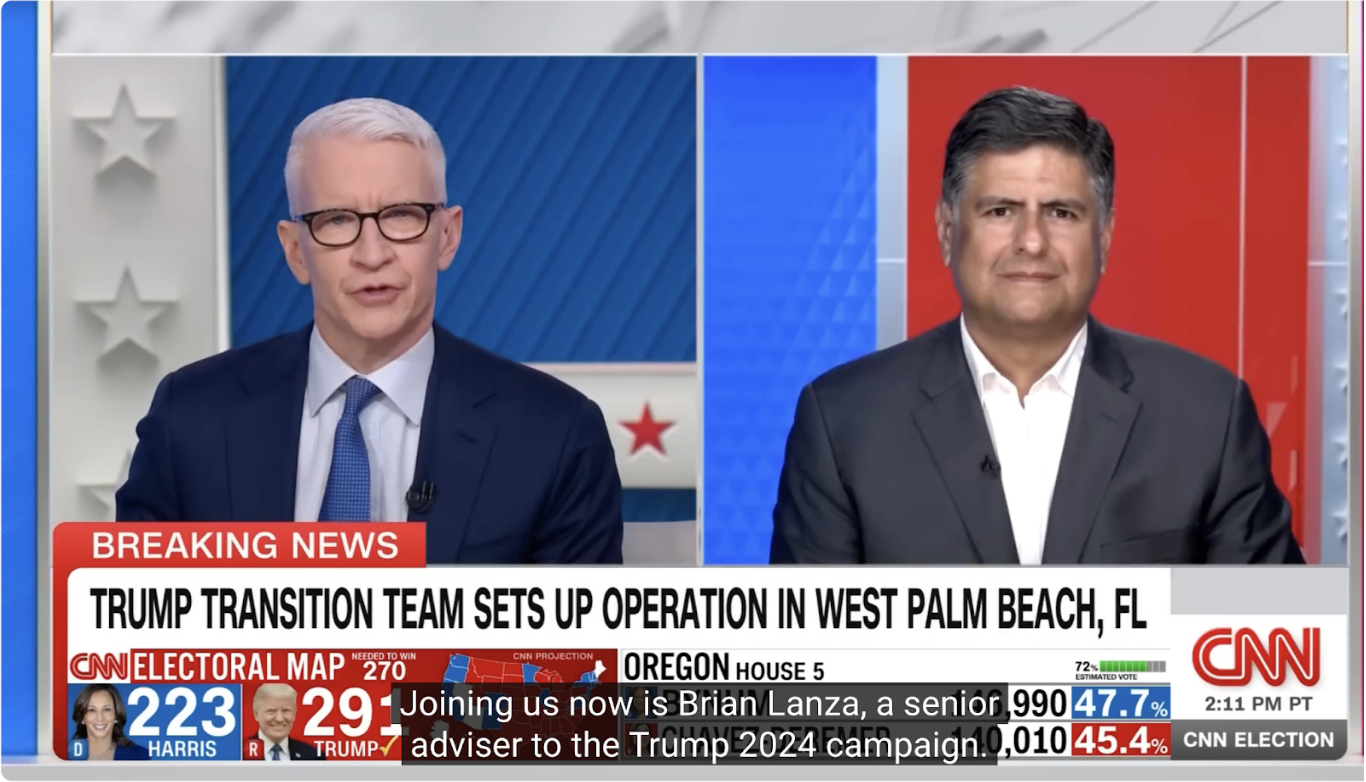
Registered lobbyists for Bayer at Mercury Public Affairs include Bryan Lanza, who was deputy communications director for Trump’s 2016 campaign and communications director for Trump’s first presidential transition team. Lanza joined Mercury in 2017 and has been a frequent guest on cable news shows as a surrogate and for Trump.
More Bayer ties to the White House
Another key White House aide with ties to Bayer’s legal network is Ryan Baasch, Trump’s deputy assistant to the President for economic policy. In this role, Baasch helps convert Trump’s economic agenda into coordinated federal policy. From 2016-2021, Baasch was an associate at Latham & Watkins, a law firm that represented Bayer on Roundup settlement issues and represented Monsanto in a case involving dicamba. The firm also represented Monsanto and CropLife America in a glyphosate warning case.
Another aide close to Trump in 2025, Trent Morse, was a senior associate at Ballard Partners from 2020 to 2022, then moved to Mercury Public Affairs as a senior vice president. As deputy assistant to the President and deputy director of presidential personnel for eight months, Morse was part of the team responsible for recruiting, vetting and recommending candidates for political appointments throughout the executive branch. He left the White House in August for a lobbying job.
USDA officials’ ties to Bayer
The U.S. Department of Agriculture oversees farm policy, crop systems, and biotechnology approvals, shaping the subsidies, research, and planting decisions that drive demand for Bayer’s seeds and chemicals. The agency has long faced criticism over its servility to the chemical industry, and the Trump administration is no exception. Current USDA officials with ties to Bayer and its chemical industry allies include:
- Stephen Vaden, deputy secretary of agriculture, is a former associate at Jones Day(2014–2017), a firm that represented Bayer on its acquisition of Monsanto, and Squire Patton Boggs (2011-2014), which represented Bayer and Monsanto in cases involving glyphosate and PCBs.
- Richard Fordyce,undersecretary for farm production and conservation, is the former agriculture business growth director for the public relations and marketing firm Osborn Barr Paramore (2021-2025), which was Bayer’s PR agency for years. A former director of the United Soybean Board, Fordyce was administrator of the Farm Service Agency in Trump’s first term.
- Scott Hutchins,undersecretary for research, education, economics & chief scientist, spent over 30 years at Dow AgroSciences (now Corteva), most recently as global R&D director. He served in this same USDA role in the first Trump administration.
- Pat Swanson,administrator of the Risk Management Agency, was a director for the lobby groups American Soybean Association and the Iowa Soybean Association, where she advocated for Bayer’s pesticides.
- Bill Beam,administrator of the Farm Service Agency, served for nine years on the United Soybean Board, which collaborates with Bayer on research initiatives. Beam previously served as the deputy administrator for farm programs at the FSA (2018–2021).
- Peter Laudeman, senior policy advisor for trade and foreign agricultural affairs, is a former political affairs manager of Corteva Agriscience (formerly DowDuPont) from 2020-2022, and legislative assistant for the National Corn Growers Association from 2018-2020.
Bayer’s pursuit of federal preemption
Bayer’s case before the Supreme Court has high stakes for public health protections and the legal right of individuals to hold companies accountable in court.
Federal preemption – the idea that federal law can override state law in some circumstances – has long been a priority for chemical and food companies that want a single, often weaker, national standard for regulation and liability, while consumer and health groups argue that states must retain the right to set higher health and safety standards.
The issue is central to Bayer’s case before the Supreme Court: the company argues that because the EPA approved glyphosate, cancer claims tied to Roundup should be barred under state failure-to-warn laws. The federal government’s position on whether pesticide approvals preempt state laws has shifted across administrations, underscoring how much the outcome depends on who holds power, and who influences it.
In May 2025, two appellate attorneys with deep experience at the U.S. Department of Justice, Jennifer Scheller Neumann and Amelia Yowell, joined Holland & Hart LLP,a firm that provides legal and lobbying services. A month earlier, the firm had registered to lobby for Bayer.
Neumann spent 20 years at the DOJ’s Environment and Natural Resources Division, most recently as chief of the appellate section overseeing all appellate litigation involving federal environmental laws. She was a signatory on the DOJ’s 2019 amicus brief in the Ninth Circuit Court of Appeals supporting Monsanto (now Bayer). The brief argues that EPA’s approval of glyphosate preempts state failure-to-warm laws.
The Biden administration reversed that position in 2022, urging the Supreme Court to reject Bayer’s case on the premise that federal pesticide law should not preempt state failure-to-warn laws.The Trump Justice Department reversed it again in 2025 – arguing the Biden-era position was wrong and that juries shouldn’t second-guess EPA science.
Oral arguments before the Supreme Court are scheduled for April 27. A win for Bayer could turn EPA pesticide approvals into a nationwide liability shield, elevating the agency’s slow and often industry-dominated chemical assessment process into a final word on pesticide safety, at a time when peer-reviewed research continues to emerge linking pesticide exposure to cancer, neurological harm, and other chronic illnesses.
As Nathan Donley of the Center for Biological Diversity warned, such a precedent would mean that “the only thing that matters legally in determining a pesticide’s safety is what EPA claims to be true, even if those claims completely ignore the best available science.”
Slashing capacity at EPA
Bayer allies also pervade the U.S. agency charged with protecting health and the environment – in positions where they influence what chemicals and pesticides are approved and how these products are regulated. Chemical industry lobbyists now occupy the top four jobs at the EPA’s Office of Chemical Safety and Pollution Prevention (OCSPP), the division in charge of regulating chemicals and pesticides. EPA officials loosened ethics standards to allow it.
Douglas Troutman, assistant administrator at OCSPP, is the former co-CEO and chief lobbyist for the American Cleaning Institute (ACI), which represents major chemical manufacturers. Troutman worked at the lobby group for 17 years before joining the Trump administration.
Nancy Beck, principal deputy assistant administrator at OCSPP, was a senior director at the American Chemistry Council – a lobby group representing Bayer, Dow Chemical, DuPont and other chemical manufacturers – from 2012 to 2017. In Trump’s first EPA, she held advisory roles within the White House at NEC and OMB. Between Trump administrations she worked at Hunton Andrews Kurth, a law firm that offers, among other services, glyphosate litigation defense to companies facing lawsuits from cancer claims.
Lynn Ann Dekleva OCSPP’s deputy assistant administrator for new chemicals, also held this role during the first Trump administration. In between, she was a senior director at the lobby group American Chemistry Council.She is a 30-year veteran of DuPont chemical company, where she workedas a program manager and engineer.
Kyle Kunkler, OCSPP deputy assistant administrator for pesticides, is a former pesticide industry lobbyist. He was director of government affairs, with a focus on biotech and pesticides, for the American Soybean Association from 2020-2025, and prior to that spent three years managing government affairs on food and agriculture for the Biotechnology Innovation Organization lobby group. CropLife America, the main lobby group for the pesticide industry, gave him a “Rising Star” award in 2020.
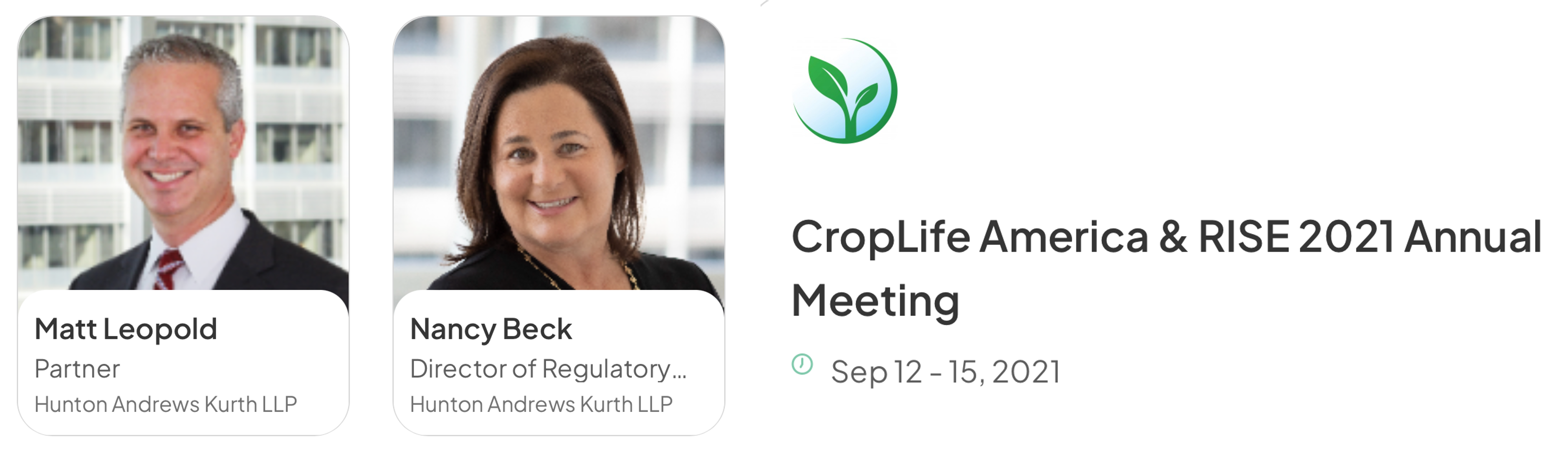 *Bayer was a gold sponsor at CropLife America 2021 where Beck was a featured speaker alongside her colleague Matt Leopold, who was EPA’s top lawyer during the first Trump administration. Hunter Andrews Kurth is a leading firm for pesticide litigation.
---
More EPA officials with ties to Bayer include:
Steven Cook, deputy assistant administrator for the Office of Land and Emergency Management, oversees Superfund sites. Bayer is associated with several Superfund sites due to its pesticide and chemical manufacturing. Cook spent over 20 years as the in-house corporate counsel for LyondellBasell, one of the world’s largest plastics and chemical companies. LyondellBasell has a 50/50 joint venture with Bayer (a propylene oxide and styrene monomer plant). LyondellBasell CEO Peter Vanacker is board chair of the American Chemistry Council.
Aaron Szabo,assistant administrator for air and radiation (appointed in July 2025) was a partner and lobbyist at CGCN Group (2018–2023), which has been registered to lobby for the American Chemistry Council during the past decade. From 2023 to 2024, he was a senior director and attorney at Faegre Drinker Biddle & Reath, where he represented chemical interests, including the ACC, before returning to the EPA in January 2025.
Alex Dominguez,deputy assistant administrator for mobile sources, was a registered lobbyist with Massie Partners, where he represented the National Corn Growers Association, a group whose members are consumers of Bayer’s seeds and pesticides. He worked in that role from 2023 to January 2025.
More Trump officials tied to Bayer
As assistant secretary of legislation at the U.S. Department of Health and Human Services, Gary Andresis a primary liaison between HHS and Congress. He was previously the senior executive vice president of public affairs at the Biotechnology Innovation Organization, the main trade group for biotech companies including Bayer. At BIO, Andres directed the lobbying strategy for the entire biotech sector, which included defending the regulatory framework for GMOs and associated agrichemicals. He previously worked at lobbying firm Dutko Worldwide which has represented Bayer.
Secretary of Transportation Sean Duffy also has ties to a Bayer lobby firm; he was senior counsel and advisory board member of BGR Group from 2019 to 2023 and was a registered lobbyist for the firm in 2020, though there is no record of him lobbying for Bayer.
13 lobby firms working for Bayer in Washington
Bayer’s direct lobbying spending is significant, but its political influence expands considerably when viewed alongside allied trade and commodity groups that together form a well-financed and coordinated lobbying network. In 2025, Bayer retained at least 13 lobby firms and at least 49 registered lobbyists registered to lobby for the company (including Bayer’s six in-house lobbyists) as of the fourth quarter, federal disclosures show.
Bayer spent at least $9.19 million on federal lobbying last year. While it is not among the highest-spending single corporations lobbying in D.C., the agribusiness sector ranked ninth with $219.9 million in lobbying expenditures in 2025 – the highest year on record for the sector. We include the sector total because Bayer’s influence is amplified by an integrated industrial agribusiness system that acts in concert – from pesticide-dependent commodity crops to factory farms and ultra-processed food production – to shape policy in its favor.
Within the sector, groups directly lobbying for favorable pesticide policies include trade groups representing pesticide manufacturers – the American Chemistry CouncilandCropLife America – and commodity groups such as the National Corn Growers Association and American Soybean Association that rely on Bayer’s products.
These four groups spent a combined $22 million on federal lobbying in 2025, with 12 more outside lobby firms and 79 more registered lobbyists in the fourth quarter.
Bayer’s lobbying activity last year was its highest in recent years, but lower than the company’s peak in 2016, 2017 and 2018, just before the Bayer/Monsanto merger and following the 2015 WHO cancer agency finding that glyphosate is a probable human carcinogen.
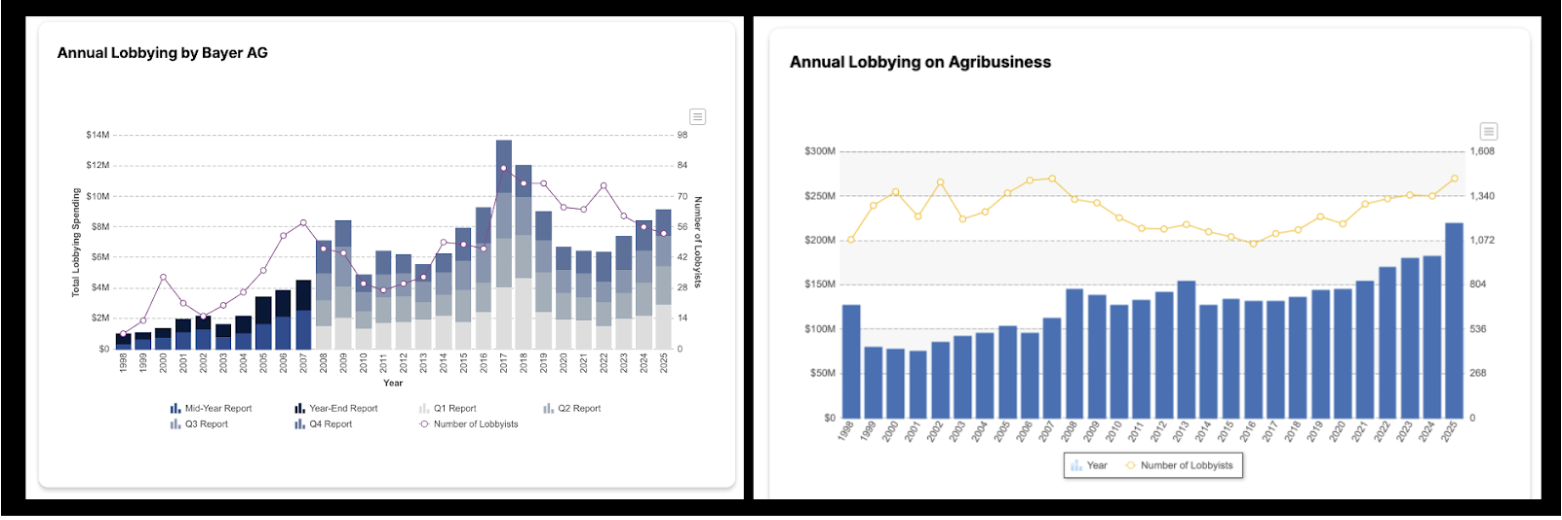 *Source: OpenSecrets
These numbers don’t reflect the whole picture of Bayer’s lobbying activities. The Lobbying Disclosure Act requires registration only after certain spending and activity thresholds are met, so public filings do not capture all of the paid influence work taking place in Washington.
They don’t reflect state-level activity, either. Pesticide related PAC spending surged in late 2024 as companies sought to limit damage awards in courts across the nation. In Iowa alone, Bayer spent a record amount last year trying to pass a state immunity bill critics called the Cancer Gag Act.
Read more about Bayer’s lobby force in our Bayer Lobby Tracker.
More lobbyists tied to Trump
Political scientists have long documented how lobbying shapes public policy by securing access to decision-makers, and helping corporations turn their priorities into laws and regulations. These dynamics help explain how companies like Bayer can translate access in Washington into concrete policy wins.
More than 30 people in leadership positions at lobby firms retained by Bayer have direct ties to Trump’s current or former administrations or presidential campaigns, our analysis shows. Many of these lobbyists are not personally registered to lobby for Bayer, but may be assisting in ways that do not trigger lobby registration, for example, advising the firm’s Bayer lobbyists.
As noted earlier, Ballard Partners – the firm that employed both Susie Wiles and Pam Bondi, and is run by one of Trump’s biggest political fundraisers – is a fundamental connection for Bayer o Trump’s orbit. In addition to Brian Ballard and Daniel McFaul, the two lobbyists at the firm who are registered to lobby for both Bayer and the American Chemistry Council, other partners at Ballard have connections to Trump:
Hunter Morgen, a D.C.-based partner in the firm, served over three years in senior positions during the first Trump administration – as special assistant to the President and senior advisor for policy and strategy in the White House working on trade and immigration issues with Peter Navarro and Stephen Miller. Prior to his White House role, Morgen was policy advisor for the State Department in the Office of Policy and Planning. He previously worked on Trump’s 2016 presidential campaign and transition team. In 2020, Trump appointed Morgen to the Presidential Council on Improving Federal Civil Architecture. Morgen – along with Brian Ballard, Daniel McFaul, Syl Lukas (a senior partner at Ballard) and Susie Wiles – were included among a list of donors invited to an October 2025 gala for Trump’s new $250 million East Wing ballroom.

Mike Rubino, another D.C. partner at Ballard, was among the first hires on Trump’s 2016 presidential campaign where he was a senior advisor directing operations in ten states and winning nine of them, according to his bio. He joined the first Trump administration as a senior official at HHS before leaving for the private sector where he worked alongside Corey Lewandowski, who is currently a key figure at the Department of Homeland Security.
Ballard D.C. Partner William Russell was the aide responsible for Trump’s daily travel and logistics for nearly four years of the first administration. Russell also worked on Trump’s 2016 and 2024 campaigns.
Brian Hughes, a partner at Mercury Public Affairs– the other lobby firm that previously employed Susie Wiles – was NASA chief of staff from May to December 2025. He joined Mercury in January 2026. Brian Hughes was Trump’s Florida campaign manager in 2024 and communications director for Trump’s transition team. Danielle Alvarez, another partner at Mercury, held communications and advisory roles in Trump’s 2020 and 2024 campaigns.
Other Bayer lobby firm ties to Trump’s White House include:
Amy Swonger, a principal at Invariant– a firm registered to lobby for Bayer – worked in the Executive Office of the President for most of Trump’s first term, as assistant to the president and as director and deputy director of legislative affairs.
Jordan Bonfitto,a director at Invariant, was a policy advisor at the National Economic Council in Trump’s first White House, focused on the agricultural and biotech portfolios. From February to October 2025, Bonfitto was the chief of staff for marketing and regulatory programs at the USDA under Secretary Brooke Rollins. He joined Invariant in November.
Other notable Bayer lobby firm ties to Trump:
Holland & Hart, a lobby firm Bayer retained in April 2025, employs former EPA Administrator Andrew Wheeler, who held the top job at EPA for part of Trump’s first term. Wheeler is a partner at the firm and head of federal affairs. Troy Lyons, a registered lobbyist for Bayer and senior director of federal affairs at Holland & Hart, held senior roles in Trump’s first EPA working under both Wheeler and Trump’s first EPA Administrator Scott Pruitt.
At BGR Government Affairs, several senior lobbyists have ties to Trump. Managing Director David Urban was a senior advisor on Trump’s 2016, 2020, and 2024 campaigns; Practice Head and Principal William Crozer left the firm during Trump’s first term to serve as special assistant to the president and deputy director of the White House Office of Intergovernmental Affairs; and PrincipalJoseph Lai was aspecial assistant to the President for legislative affairs (2017-2019), where he led the outreach and vote-counting efforts to confirm Justices Gorsuch and Kavanaugh, as well as other major appointees.
Akin Gump Strauss Hauer & Feld, longtime lobbyists for Bayer and Monsanto, also has notable advisors and partners with ties to Trump. Geoff Verhoff, senior advisor at the firm, served on the Trump-Pence victory finance leadership committee 2017-2021 and was the vice chair of the RNC Finance Committee in those years. Partner Kelly Ann Shaw, was deputy assistant to the President for international economic affairs and the U.S. lead negotiator (Sherpa) for the G7, G20, and APEC in 2018 and 2019. Senior Advisor Anna Abramdeputy commissioner for policy, legislation and international affairs at the FDA from 2017 to 2021.
For more ties between Bayer’s lobby firms, the Trump administration and other routes of influence see our lobby tracker:
This analysis of Bayer-Trump connections reflects only what is visible in public records. Additional financial, political, or personal ties – including undisclosed funding streams, if they exist – may remain hidden. This story is a work in progress. We will update it. You can help by sending us what you may know about ties between Bayer and the Trump administration, including the federal agencies. Contact Stacy Malkan via Signal or email stacy@usrtk.org.
Updates made February 26:
- Added another USDA official (Peter Laudeman) with ties to Bayer.
- Added total number of lobbyists and lobby firms retained by four trade and commodity groups that work closely with Bayer: American Chemistry Council, CropLife America, National Corn Growers Association and American Soybean Association.
Categories: Monsanto/Bayer, Pesticides Tags: Primary Article
===
---}:
AN 2 26
Note to the decision-makers at the Gallup Organization,which for nearly 90 years has tracked presidential approval ratings: Capitulation never works.
I learned this the hard way as a teen playing basketball on D.C. playgrounds. I regretted my fecklessness.
Gallup last week admitted it would no longer survey Americans’ sentiments on how the commander in chief was faring, though I couldn’t find news of that major switchon the company’s website.
The organization’s latest presidential barometer,in December, placed Donald Trump’s approval rating at an abysmal 36%. The worst was34%, another honorific Trump earned as he was leaving office at the end of his first term. It was right after the Jan. 6, 2021, siege on the U.S. Capitol.
Yes, other companies conduct surveys nowadays about the presidency. Gallup, though, held a unique place in the industry.
A Gallup spokesman told The New York Times the company was shifting strategy. He also used other corporate-speak that, frankly, doesn’t justify Gallup’s cowardice.
As The Times noted, the polling firm’s decades of data gave “historical context to what amounts to a monthly snapshot of Americans’ views.” The independent barometer has been valuable.
It’s curious the company didn’t make the change under then-President Joe Biden, but is doing so now under a thin-skinned president.
Trump and his administration havetargeted journalists with criminal indictments,filed lawsuits against media outlets and often lied about theactions of violent federal immigration agents – even whenvideo footage andwitness statements proved the contrary.
My questions to Gallup’s media folks, including what role Trump’s attacks on journalists played in the polling decision, weren’t returned by my deadline.
Gallup’s groveling reminds me of when I relinquished my chance to play a playground basketball game – even though I’d earned it – to a guy bigger, stronger, and a little older than me. “I’m taking your spot,” he declared, with a hint of menace.
The shame was I didn’t fight for it, even if I would’ve gotten bloodied. I couldn’t return to that court because no one would respect me. As I got older, I stood up for myself more, no matter whether it made me uncomfortable.
That a private company like Gallup would cave so dramatically to this administration is reprehensible. Why is it acting beholden to officials who disrespect law, precedent and common decency?
The capitulation is a stain on Gallup’s reputation and legacy, and it leaves Americans with less information on how we all feel our top government executive is faring.
---
---}:
an 2 26
Corporations that pandered to Donald Trump after his reelection could soon pay the price for it, with one bipartisan consulting firm warning clients of a "tsunami of congressional oversight" in the likely event the Republicans lose the midterms, and it will be "much worse than they expect."
The memo, reported on by Axios, was written by Matthew Miller and Tucker Eskew, who the outlet credited as "veterans of high-profile campaigns." They warned that a major shift is almost certainly headed for Washington D.C., and that companies need to start preparing themselves for Democratic leadership in the House.
"A tsunami of Congressional oversight is headed straight for corporate America," Miller and Eskew wrote. "Barring a dramaticand improbable reversal of both current and historic political trends, Democrats will retake control of the House of Representatives (and possibly the Senate) in November’s elections, ushering in two years of divided government. With prospects for passing major legislation during that period hovering between slim and none, oversight will become the leading substantive and political weaponfor newly ascendant Democrats."
Since Trump's return to the White House, the pillars of corporate America — including tech titans like Amazon, Apple, Meta and Google — have faced widespread accusations of currying favor with his administration. Companies big and small followed Trump's command at the start of his second term to do away with "diversity, equity and inclusion" programs. The aforementioned major companies also donated significant amounts of money to Trump's inauguration and his controversial White House ballroom.
Miller and Eskew further suggested that, in many ways, the incoming Democratic leadership could be similar to past periods when the party held majorities in Congress. However, they also warned that shifting priorities and key changes within the party mean that companies are more likely than ever to face scrutiny.
"The first change stems from a widespread belief among Democrats that major corporations have drawn too close to the administration for comfort," the memo continued. "For example, they have attacked crypto companies for allegedly funneling money to the president and his family, called antitrust review 'pay-to-play corruption,' and questioned the relationship between the White House and oil companies. For Democrats on the Hill, aggressive oversight of private companies is no longer just an end to itself, but a means for exposing alleged abuses by the Trump administration."
Miller and Eskew also predicted that Democrats are preparing for the White House to stonewall any and all attempts at oversight investigations. This will, in turn, cause them to turn their attention to corporations, using oversight of them as "a means for exposing alleged abuses by the Trump administration."
"It's going to be so much worse than they expect," Miller said in a statement to Axios.
ref mkting
...the first change stems from a widespread belief among Democrats that major corporations havedrawn too close to the administration for comfort. For example, they have attacked crypto companiesfor allegedly funneling money to the president and his family, called antitrust review “pay-to-playcorruption,” and questioned the relationship between the White House and oil companies. ForDemocrats on the Hill, aggressive oversight of private companies is no longer just an end to itself,but a means for exposing alleged abuses by the Trump administration...
---
---
AN 7 25
In its clash with Columbia University, the Trump administration is touting a historic $221 million settlement as a major triumph for conservative ideology—even though it had originally framed the case as a response to antisemitism on college campuses. On Thursday, Education Secretary Linda McMahon hailed the outcome as a “monumental victory for conservatives” while condemning “far-left-leaning professors.”
“Under the terms of the deal to resolve several federal probes into allegations that it had violated anti-discrimination laws,” CNN reported, “Columbia did not admit to wrongdoing but agreed to pay the government a $200 million settlement over three years and an additional $21 million to settle US Equal Employment Opportunity Commission investigations.”
Secretary McMahon, CNN added, “heralded the outcome as a ‘seismic shift in our nation’s fight to hold institutions that accept American taxpayer dollars accountable for antisemitic discrimination and harassment,'” and called it “a roadmap for elite universities that wish to regain the confidence of the American public by renewing their commitment to truth-seeking, merit, and civil debate.”
READ MORE: Tuberville: Dems Must ‘Lawyer Up’ for Plot to Make America ‘Communist’
Thursday morning on Fox News Business, Secretary McMahon offered a different explanation.
“I think that this is a monumental victory for conservatives who’ve wanted to do things in these elite campuses for a long time, because we had such far-left-leaning, you know, professors, and we had 27% of the students that are coming in, you know, are from outside of the United States,” McMahon told host Maria Bartiromo. She noted that the 27% was a statistic from Harvard.
“I’m really pleased with this victory,” McMahon continued. “It wouldn’t have happened if Donald Trump were not president, then I’m really pleased to execute his vision for this, that our campuses are now, what they should be. They are places for debate, they are places for education.”
“They’re not places for left-leaning riots and antisemitism, and I’m really pleased with this result.”
Amy Spitalnick, CEO of the Jewish Council for Public Affairs, wrote in response to McMahon’s remarks: “This is about advancing an extreme agenda.”
READ MORE: GOP Congressman: ‘Round Everybody Up and Deport Them All’
“This administration,” Spitalnick said, “continues to exploit real concerns about antisemitism to undermine our core democratic norms & institutions. This is not about keeping Jews safe — if it were, they wouldn’t have gutted OCR [Office for Civil Rights] & other key protections.”
Constitutional law professor and political scientist Anthony Michael Kreis warned, “Columbia has now allowed itself to be regulated by a deal. A complete capitulation to the state, yielding their academic freedom to select their students, appoint their faculty, and adopt their curriculum. The Fellows of Magdalen College had more courage against James II in 1687.”
Jordan Acker, who serves on the University of Michigan’s Board of Regents noted:
“Three things can be true here: -Campus faculty, especially in the humanities, needs reform -Antisemitism is a problem on campus -Trump simply cares about destroying higher ed. One and two are fixable. The third is a dire threat to the American way of life and must be fought.”
Watch the video below or at this link.
---
---
an 6 25
Federal judges — appointed by both Republican and Democratic presidents — have delivered major setbacks to the legal push behind President Donald Trump’s efforts to penalize certain law firms, The Hill reportedSunday.
In recent rulings, three judges invalidated executive actions designed to restrict government work for prominent firms including Perkins Coie, WilmerHale, and Jenner & Block.
"The early wins underscore the legal system’s ability to withstand the Trump administration’s pressure test, and have led some in the legal community to take shots at other elite firms that struck deals with Trump to avoid punishments," the report noted.
READ MORE:Outrage grows over a single paragraph buried deep in Republicans' 'Big Beautiful Bill'
Harold Hongju Koh, a Yale Law School professor, told The Hill: “This is a moment for courage, not capitulation."
“The firms that showed courage are being vindicated, and the ones who have capitulated have another chance to show courage,” he added.
Several major law firms have become targets of Trump’s backlash, largely due to their ties to figures and investigations he considers hostile.
Perkins Coie has been in Trump’s crosshairs for years, primarily because of its legal support for Hillary Clinton’s 2016 campaign and its connection to the opposition research that produced the widely discredited Steele dossier.
READ MORE:Signs the tide is turning on Trump
WilmerHale drew scrutiny from Trump for employing Robert Mueller both before and after he led the investigation into Russian interference in the 2016 election.
Similarly, Jenner & Block came under fire for its past association with Andrew Weissmann, a former prosecutor involved in Mueller’s team and a frequent Trump critic.
In a sharply worded decision issued Tuesday, U.S. District Judge Richard Leon — appointed by President George W. Bush — ruled in favor of WilmerHale, denouncing Trump’s actions as an attack on the foundational principles of the American legal system.
Leon argued that targeting major law firms with executive orders undermines the independence of both the judiciary and the legal profession, which he described as essential pillars of the nation’s justice system.
Meanwhile, in a piece publishedlast week, Democracy Docket, a platform supporting voting rights, highlighted analysis by Stanford political science professor Adam Bonica which indicates that federal district courts have ruled against the Trump administration in 96% of cases in May.
"Bonica’s findings suggest that judges from both political leanings are consistently ruling against Trump, with 72% of Republican-appointed judges and 80% of Democratic-appointed judges issuing unfavorable decisions.Trump’s cross-ideological loss rate is likely due to several factors," the article said.
READ MORE:'Almost cartoonish': Expert says 'Trumpy style' of MAGA women about 'signaling allegiance'
---
---
AN 5 25
The Big Law firms that capitulated to President Donald Trump’s unconstitutional demands thought they were buying peace with his administration, preserving their client relationships, and protecting their bottom lines.
Recent developments illustrate the growing magnitude of their mistake.
Fighters Are Winning
On May 2, U.S. District Court Judge Beryl Howell became the first court to issue a final ruling that Trump’s executive orders targeting Big Law firms violated the First, Fifth, and Sixth Amendments to the U.S. Constitution. In a 102-page opinion, the court shredded Trump’s edict with a straightforward analysis that other courts are likely to follow:
“In a cringe-worthy twist on the theatrical phrase ‘Let’s kill allthe lawyers,’ [Trump’s Executive Order] takes the approach of “Let’s kill the lawyers I don’t like,” sending the clear message: lawyers must stick to the party line, or else.
“Using the powers of the federal government to target lawyers for their representation of clients and avowed progressive employment policies in an overt attempt to suppress and punish certain viewpoints, however, is contrary to the Constitution,…. Simply put, government officials ‘cannot . . . use the power of the State to punish or suppress disfavored expression.’
“That, however, is exactly what is happening here.”
For those keeping score, Trump’s Justice Department has now lost every courtroom fight on the subject. Jenner & Block, WilmerHale, and Susman Godfrey obtained immediate temporary relief from his executive orders, as did Perkins Coie, which has now won a permanent injunction from Judge Howell.
Meanwhile, how are the firms that caved to Trump doing?
The Other Shoe Drops: #1
After providing Trump with a war chest totaling almost $1 billion in free legal services, the settling firms are now learning how he plans to use it. Previously, Trump had mused about using Big Law attorneys on coal leasing and tariff deals, but on April 28 things got real.
Trump issued an executive order titled, “STRENGTHENING AND UNLEASHING AMERICA’S LAW ENFORCEMENT TO PURSUE CRIMINALS AND PROTECT INNOCENT CITIZENS.”
The order emphasized the need to “protect and defend law enforcement officers wrongly accused and abused by State or local officials.” It directed Attorney General Pam Bondi to provide the legal resources necessary to defend those officers, including “private-sector pro bono assistance.”[emphasis supplied]
Stated simply, police officers accused of brutality and other misconduct will get Big Law attorneys to defend them – free of charge.
Meanwhile, traditional pro bonocauses, including defending immigrants’ rights, are suffering from the deterrent effect of Trump’s attack. Fearing his wrath, they are declining work that challenges his policies.
Settling firms were already getting blowback from their partners and associates as many have left their firms. Trump’s newly-added page to their pro bonocatalog won’t help recruiting or retention. And as with all things Trump, there’s no limiting principle. Appeasement never produces finality.
The Other Shoe Drops: #2
The firms’ stated reason for capitulating to Trump was concern that clients would leave any firm that was not in Trump’s good graces. That premise is not aging well either.
On April 11, Simpson, Thacher & Bartlett agreed to provide $125 million in pro bonowork “and other free legal services” to Trump-designated causes.
On April 22, the firm informed the Delaware Chancery Court that it would no longer be representing Microsoft in a case related to its 2023 acquisition of Activision. The same day, Jenner & Block replaced Simpson Thacher as Microsoft’s counsel.
Losing a client to another firm is not uncommon, and none of the players has commented on Microsoft’s switch. But capitulation to Trump has not been a panacea for preserving client relationships. A firm that challenges an unconstitutional order threatening its existence is a firm that many clients want fighting for them.
The Other Shoe Drops: #3
On April 24, 16 House members sent letters to nine firms that settled with Trump. Asking about their motivations and urging them to disavow the deals, lawmakers suggested that the agreements may violate federal and state criminal and civil laws while creating “potentially irresolvable violations of applicable Rules of Professional Conduct.” Previously, Sen. Richard Blumenthal (D-Conn.) and Rep. Jamie Raskin (D-Md.) sent requests for information from several firms and White House counsel on April 6 and April 18.
The Other Show Drops: #4
Firms assumed that capitulation would occupy a single news cycle and then disappear. But their public relations nightmares aren’t going away. Apart from the widespread and ongoing condemnation of the legal community, the story continues to have legs as a fateful moment for the rule of law in the United States.
The May 4 edition of CBS’s 60 Minutes ran a damning segment on Big Law firms that settled with Trump. None was willing to appear and defend itself or its deal. The legal term for such continuing cowardice is res ipsa loquitur– the thing speaks for itself. In this case, the firms didn’t speak at all.
On May 9, an article that later appeared in the New York TimesSunday print edition ran with this headline and subhead:
*Can Elite Lawyers Be Persuaded to ‘Wake Up and Stand Up’?
When the law firm Paul Weiss cut a deal with the Trump administration, a new kind of activist emerged.
Some of the settling firms, including Kirkland & Ellis and at least one other, have an escape hatch: Their “handshake deals” with Trump are not in writing. They can do what Trump does when he no longer likes his own prior agreement: Walk away.
In fact, even firms with a written agreement can walk away too. Whatever their form, the deals are probably not enforceable. But that was never Trump’s main objective. It was always about intimidation and deterrence. When firms bent the knee to him, he won and scored an invaluable public relations victory.
And his accompanying billion-dollar windfall didn’t hurt.
NOW READ:The single stupidest statement about Trump ever made
---
---