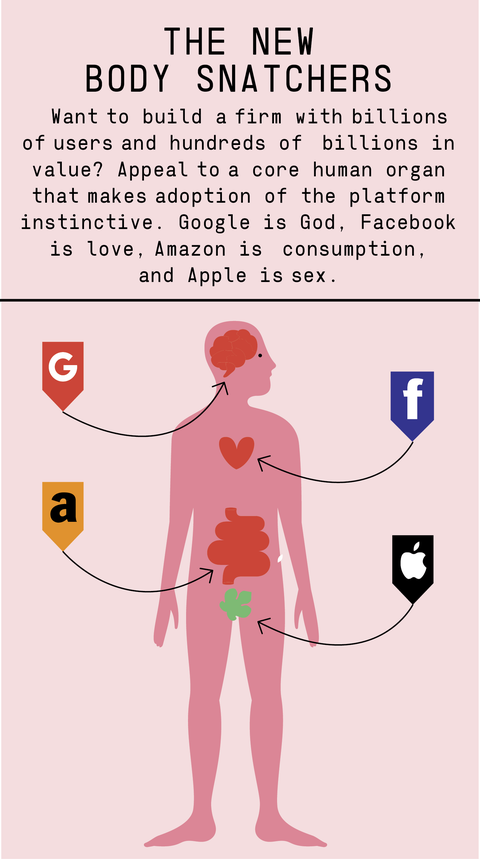
silicon vly 2 bak
===
see main
see tag silvly
oops see sil valley 2 bak
merri ok
see tax dodge silic six
SEE PLUTO 4 InAUGURAL
see BRIN CALIF RENEWAL AND -----
see libertarian
crypto-fascist musk follows theel and flees to texas 1220
BEZOS CRONY CAPL BLUE ORIGIN DEAL W TRUMP --> BROLIARCHY
SEE CONTRACTORS CORP BAD ACTORS ~ UNION
see bitcoin crypto SACKS
see edgelord tech bros MUSK GOTV LIE DISINFO THIEL FUNDER JDV
see VC
see soc media bias // big tech
Trump has worked to accelerate America’s development of AI rather than regulate it, and the result is not just an epidemic of deepfakes and hallucinations being passed off as legitimate research. A new report reveals that some of the nation’s best-educated workers, who once were secure, are taking it on the chin.
“About one third of the total personal wealth in the United States is held by the top 1 percent of households, while the bottom half of Americans holds less than 3 percent, according to Federal Reserve data,” wrote The Washington Post's Elizabeth Dwoskin and Shira Ovide wrote on Sunday. This data includes former economic winners who are now finding themselves on the wrong side of layoffs and hiring freezes — tech workers.
“The sense of precariousness among America’s professional elite could be a preview of what’s ahead for the rest of the country as AI spreads,” the Post wrote. “Silicon Valley techies are ‘are guinea pigs for what tech dudes want to do to everyone,’ said Anil Dash, a technology entrepreneur.”
They added, “At tech companies, leaders obsessed with winning the AI race have tasked their workforces of coders, lawyers and HR professionals with becoming the front line of that transformation. They’re being measured by how quickly they can automate their own jobs while watching their colleagues get pushed out in successive waves of layoffs.”
The report continued, “Layoffs.fyi, which tracks announced job cuts, counts more than 800,000 tech workers laid off since 2022, including large staff reductions in recent months at Meta, Microsoft, Oracle and Amazon.” According to the Silicon Valley market research consultancy founder Oliver Raskin, whose company is called Signalcraft Insights, “there’s this whole tranche of people who’ve been quite used to being among the most upwardly mobile in society who are all of a sudden saying, ‘Now I’m the guy on the street.’”
In the mid-to-late 20th century, autoworkers were the group most likely to fall into the category of “entered a specialized field on the premise that it was well paying and stable, only to have the rug pulled out from under them.” Now that dubious distinction belongs to tech workers such as coders and engineers, whose positions are being outsourced to AI because the technology’s speed and without regard to notable dips in quality.
“There’s just a lot of uncertainty, a lot of fear, a lot of people feeling like, if they get let go from this job, they might not find another one,” Anneke Buffone, a psychology PhD who Meta hired to help employees’ well-being and safety but ultimately left in December, told the Post.
“She described getting pushback from managers when she tried to explain that a particular AI tool was a waste of time,” the Post reported. “The system had so many errors that she needed to redo its work.”
It continued, “But her bosses ‘were like, ‘No, keep using it more. It’ll just get better,’’ she said. ‘There’s a feeling among management that when you voice that AI has all these problems, they don’t want to hear it.” AI, she said, makes “everything go so much faster. It creates this illusion that you can get all this stuff done. Much of the time you’re just babysitting the AIs.’”
---
no lnx
bloomberg) -- Silicon Valley billionaires have been seething over the threat of more taxes and regulations at home. Now, a proposed nine-figure fund aims to give wealthy Californians an unprecedented tool to reshape the state’s politics in their favor.
The fund is being pitched to some of the state’s richest residents as an endowment that would operate in California for decades to come, according to people with knowledge of the matter. Organizers are seeking $100 million this year, with hopes of reaching at least $500 million and up to $1 billion in the coming years, said one of the people, who asked not to be named because the conversations are private.
If successful, the fund could give Silicon Valley’s elite a long-term political machine meant to rival the powerful constellation of labor unions, progressive groups and other entrenched interests in Sacramento.
Neil Mehta, the founder of Greenoaks Capital, is helping promote the idea across Silicon Valley, the people said. Other prominent supporters include billionaire Joe Lonsdale, the conservative co-founder of Palantir Technologies Inc., and Garry Tan, chief executive officer of the influential startup accelerator Y Combinator. Ripple chairman Chris Larsen, who’s worth $13 billion according to the Bloomberg Billionaires Index, said he also has been approached but hasn’t decided whether to contribute to the effort.
“A lot of people are supporting their effort from both political sides,” Lonsdale, a Bay Area native who’s now based in Austin, said in an email. “We all want to see a more level political playing field, where common-sense, moderate policy can win, with a focus on making California more affordable and pro-growth.”
The project, named California Renewal, would create an endowment-type fund to act across election cycles indefinitely, financing political contributions through its own investment returns. By turning to capital gains instead of individual donations to bankroll political campaigns, the endowment could also reduce the amount of donor information disclosed publicly, one of the people familiar with the matter said.
“We’re in early conversations with people who deeply care about the future of the state of California,” said Maria Davidson, the founder of construction startup Kojo and leader of the effort. “Myself and a lot of friends have all been very concerned about the direction in which California is headed.”
Davidson, a former chief of staff to Lonsdale, declined to comment on any specifics of the effort. Mehta also declined to comment.
The proposal reflects a rising frustration among segments of the tech elite, who say the state’s politics have drifted too far left, hurting the economy. The endowment model is meant to counter what wealthy donors see as a disadvantage in California politics: Labor unions maintain a constant presence in Sacramento, fueled by money from membership dues, while business leaders tend to mobilize only around certain legislation or ballot fights.
Y Combinator’s Tan, one of California’s most vocal advocates for tech’s involvement in politics, said he is “definitely” putting money in the endowment, though he won’t be a major donor.
“I think it’s great,” said Tan. “We need to think about politics more like we think about investing.”
Deeper Involvement
California Renewal could end up backing a more fiscally conservative vision for the Golden State and cut regulations, which supporters say will spur housing and lower energy prices.
It remains unclear how much — if any — money has been raised so far and there’s no guarantee that the fund will ever get off the ground, with the project bound to face heavy opposition from unions and other sectors. Davidson also declined to say if the group is playing a role in the 2026 election cycle, adding she is focused on “building this for the long term.”
A newcomer to California’s political scene, Davidson was born in Moscow and raised in Israel before moving to the UK at the age of 13. She told Forbes that she first came to San Francisco after a trip from Burning Man and went on to found her startup. She’s working on the project alongside Mattieu Gamache-Asselin, who created Alto Pharmacy in 2015 and declined to comment.
The idea has gained traction after a health care union proposed a one-time 5% wealth tax on California billionaires. The initiative sparked a series of well-funded efforts among tech leaders to reassert themselves in the state’s politics, where a Democratic supermajority holds the legislature and the governor’s office.
Larsen has since created his own PAC to elect moderate lawmakers, and Google co-founder Sergey Brin is leading a coalition of billionaires that are pushing ballot measures meant to undercut the wealth tax. Tech leaders are funding candidates in the race to succeed Governor Gavin Newsom, with Brin donating to both Fox News contributor Steve Hilton, a Republican, and San Jose Mayor Matt Mahan, a centrist Democrat. They are also bankrolling a primary challenger to progressive Congressman Ro Khanna.
Davidson points to San Francisco as a model for the greater political involvement. In recent years, wealthy elites backed by a groundswell of frustration with high rates of vehicle break-ins, homelessness and drug use in the city helped finance successful recall campaigns against a progressive district attorney and several school board members. That helped shift local political leadership toward more moderate candidates on public safety and business issues.
California’s labor unions and progressives, who have a strong base of support in the state, are already mobilizing to oppose billionaires’ efforts to increase their influence.
Lorena Gonzalez, president of the California Labor Federation, an umbrella group representing more than two million workers, said her group could push for new taxes on capital gains targeting the endowment structure, as well as disclosure rules that would impact the group.
“You may be able to buy one election or one congressman or one governor even,” said Gonzalez. “You’re not going to buy California.”
With assistance from John Gittelsohn.}:
(Updates with Sergey Brin’s donations for California governor’s race on 16th paragraph.)
---
---
an 2 26
Corporations that pandered to Donald Trump after his reelection could soon pay the price for it, with one bipartisan consulting firm warning clients of a "tsunami of congressional oversight" in the likely event the Republicans lose the midterms, and it will be "much worse than they expect."
The memo, reported on by Axios, was written by Matthew Miller and Tucker Eskew, who the outlet credited as "veterans of high-profile campaigns." They warned that a major shift is almost certainly headed for Washington D.C., and that companies need to start preparing themselves for Democratic leadership in the House.
"A tsunami of Congressional oversight is headed straight for corporate America," Miller and Eskew wrote. "Barring a dramaticand improbable reversal of both current and historic political trends, Democrats will retake control of the House of Representatives (and possibly the Senate) in November’s elections, ushering in two years of divided government. With prospects for passing major legislation during that period hovering between slim and none, oversight will become the leading substantive and political weaponfor newly ascendant Democrats."
Since Trump's return to the White House, the pillars of corporate America — including tech titans like Amazon, Apple, Meta and Google — have faced widespread accusations of currying favor with his administration. Companies big and small followed Trump's command at the start of his second term to do away with "diversity, equity and inclusion" programs. The aforementioned major companies also donated significant amounts of money to Trump's inauguration and his controversial White House ballroom.
Miller and Eskew further suggested that, in many ways, the incoming Democratic leadership could be similar to past periods when the party held majorities in Congress. However, they also warned that shifting priorities and key changes within the party mean that companies are more likely than ever to face scrutiny.
"The first change stems from a widespread belief among Democrats that major corporations have drawn too close to the administration for comfort," the memo continued. "For example, they have attacked crypto companies for allegedly funneling money to the president and his family, called antitrust review 'pay-to-play corruption,' and questioned the relationship between the White House and oil companies. For Democrats on the Hill, aggressive oversight of private companies is no longer just an end to itself, but a means for exposing alleged abuses by the Trump administration."
Miller and Eskew also predicted that Democrats are preparing for the White House to stonewall any and all attempts at oversight investigations. This will, in turn, cause them to turn their attention to corporations, using oversight of them as "a means for exposing alleged abuses by the Trump administration."
"It's going to be so much worse than they expect," Miller said in a statement to Axios.
ref mkting
...the first change stems from a widespread belief among Democrats that major corporations havedrawn too close to the administration for comfort. For example, they have attacked crypto companiesfor allegedly funneling money to the president and his family, called antitrust review “pay-to-playcorruption,” and questioned the relationship between the White House and oil companies. ForDemocrats on the Hill, aggressive oversight of private companies is no longer just an end to itself,but a means for exposing alleged abuses by the Trump administration...
---
---}:
PCO // jdv musk on alt rt free speech bs eu
A federal judge on Thursday blocked the Trump administration from deporting a British man who was recently placed on a visa ban after U.S. officials accused him and four other Europeans of online censorship.
Center for Countering Digital Hate CEO Imran Ahmed filed a complaint Thursday against Secretary of State Marco Rubioand Attorney General Pam Bondito prevent “the imminent prospect of unconstitutional arrest,” the lawsuit reads.
“The government’s actions are the latest in a string of escalating and unjustifiable assaults on the First Amendment and other rights, one that cannot stand basic legal scrutiny,” it continues. “Simply put, immigration enforcement—here, immigration detention and threatened deportation — may not be used as a tool to punish noncitizen speakers who express views disfavored by the current administration.”
The suit adds that Ahmed is a lawful permanent resident with a wife and son who are U.S. citizens.
The complaint cites other recent cases where foreign nationals on student visas, including Mahmoud Khalil and Rümeysa Öztürk, were stripped of their documentation and faced with deportation as “part of a larger pattern of attempted repression of constitutionally protected speech.”
“The government has no power to punish Mr. Ahmed for his research, protected speech, and advocacy, and Defendants cannot evade those constitutional limitations by simply claiming that Mr. Ahmed’s presence or activities have ‘potentially serious adverse foreign policy consequences for the United States,'” the suit reads.
The administration placed the visa ban on Ahmed, along with French former European Union Commissioner Thierry Breton, Global Disinformation Index CEO Clare Melford and HateAid leaders Anna-Lena von Hodenberg and Josephine Ballon, on Tuesday.
By signing up, I agree to the Terms of Use, have reviewed the Privacy Policy, and to receive personalized offers and communications via email, on-site notifications, and targeted advertising using my email address from The Hill, Nexstar Media Inc., and its affiliates
Breton backed the EU’s Digital Services Act, which compelled online platforms to tackle hate speech and misinformation and remove it from their pages. U.S. officials claim the law unfairly targets American tech companies and citizens, Reuters reported.
On Tuesday, Rubio accused the five of leading “organized efforts to coerce American platforms to punish American viewpoints they oppose.”
“Today, @StateDept will take steps to bar leading figures of the global censorship-industrial complex from entering the United States,” Rubio posted on social media. “We stand ready and willing to expand this list if others do not reverse course.”
Undersecretary of State Sarah Rogers shared Rubio’s message and warned that “if you spend your career fomenting censorship of American speech, you’re unwelcome on American soil.”
Breton criticized his visa ban, asking in an X post if “[former. Sen. Joe] McCarthy’s witch hunt” was back.
---
---
AN 12 25
During the United States' 2024 presidential race, Donald Trump aggressively reached out to Silicon Valley and the tech sector. SpaceX/Tesla/X.com leader Elon Musk was a major donor to his campaign, and venture capitalist David Sacks is playing a prominent role in President Trump's artificial intelligence (AI) push.
But according to New York Times reporters Cecilia Kang, Tripp Mickle, Ryan Mac, David Yaffe-Bellany and Theodore Schleifer, Trump's bond alliance with Sacks and others in Silicon Valley is fueling some heated debates within the MAGA movement.
In an article published by the Times on November 30, they explain, "Since January, Mr. Sacks, 53, has occupied one of the most advantageous moonlighting roles in the federal government, influencing policy for Silicon Valley in Washington while simultaneously working in Silicon Valley as an investor. Among his actions as the White House's artificial intelligence and crypto czar: Mr. Sacks has offered astonishing White House access to his tech industry compatriots and pushed to eliminate government obstacles facing AI companies…. Mr. Sacks has recommended AI policies that have sometimes run counter to national security recommendations, alarming some of his White House colleagues and raising questions about his priorities."
The Times journalists add, "Mr. Sacks has positioned himself to personally benefit. He has 708 tech investments, including at least 449 stakes in companies with ties to artificial intelligence that could be aided directly or indirectly by his policies, according to a New York Times analysis of his financial disclosures."
But Sacks is not universally loved within the MAGA movement, and one of his outspoken MAGA critics is Steve Bannon — host of the "War Room" vodcast and former White House chief strategist in the first Trump Administration.
Bannon, the Times reporters note, is a "critic of Silicon Valley billionaires" and the Trump Administration's alliance with Sacks.
Bannon, an outspoken Musk detractor, told the Times, "The tech bros are out of control. They are leading the White House down the road to perdition with this ascendant technocratic oligarchy."
*Read the full New York Times article at this link (subscription required).
---
this is after election dem blowout and epstein files vote?
biz insider
White House Dinner for the Saudi Crown Prince Includes 50 US Execs - Business Insider
no lnx pix
The guest list for White House dinner for the Saudi Crown Prince included nearly 50 executives
By Lloyd Lee, Shubhangi Goel, and Thibault Spirlet
President Donald Trump and Saudi Crown Prince
The White House hosted the Saudi royal family for dinner on Tuesday. BRENDAN SMIALOWSKI/AFP via Getty Images
:{Nov 20, 2025,
President Donald Trump hosted a White House dinner for the Crown Prince of Saudi Arabia on Tuesday.
The dinner was attended by nearly 50 American CEOs and executives from different industries.
The guest list included Tesla CEO Elon Musk, Apple CEO Tim Cook, and Salesforce CEO Marc Benioff.
Business leaders, including Elon Musk and AMD CEO Lisa Su, joined a dinner with President Donald Trump and Saudi Crown Prince Mohammed bin Salman at the White House on Tuesday.
The guest list, shared by the White House, included members of the Saudi government and royal family, as well as almost 50 US business executives. Soccer player Cristiano Ronaldo also attended.
The dinner was the Tesla CEO's first public visit to the White House since his bitter feud with Trump this summer, following Musk's departure from his role as leader of the White House DOGE Office.
Salesforce CEO Marc Benioff, Paramount Skydance CEO David Ellison, and Robinhood CEO Vlad Tenev were on the guest list, but it is unclear if they attended the event.
Here is a list of US executives who attended the high-profile dinner.
Tesla CEO Elon Musk
Elon Musk attended the White House dinner.
Elon Musk attended the White House dinner. Brendan Smialowski/AFP via Getty Images
Elon Musk made a rare public appearance at the White House since his falling-out with Trump earlier this year, after stepping down as the informal head of the White House DOGE Office.
The world's richest man and head of Tesla, SpaceX, and X, Musk exerts significant influence in technology, energy, and artificial intelligence — industries central to both the US and Saudi economic ambitions.
Nvidia CEO Jensen Huang
Jensen Huang in a suit
Jensen Huang appeared in one of David Sacks' photos of the evening. Yui Mok - Pool/Getty Images
Nvidia chief Jensen Huang attended the White House dinner as one of the most influential figures in artificial intelligence and chipmaking.
Nvidia's CEO's presence underscored the pivotal role of advanced computing in US-Saudi economic relations and the global competition to dominate AI technology.
Apple CEO Tim Cook
Apple CEO Tim Cook
The Apple CEO was among the business leaders seen at the White House dinner. Frazer Harrison/Getty Images
Apple chief Tim Cook joined the White House dinner as one of the most powerful figures in global business, representing a tech giant that shapes everything from consumer tech to privacy standards.
His appearance highlighted Apple's pivotal role in US innovation — and its importance to any conversation about the future of tech and trade.
AMD CEO Lisa Su
AMD CEO Lisa Su
The AMD CEO also joined the dinner. Brendan Smialowski / AFP
AMD's Lisa Su was among the high-profile executives at the White House dinner, bringing the perspective of one of the world's top chipmakers.
As the leader driving fierce competition in semiconductors — a sector vital to both AI development and global supply chains — Su's inclusion signaled the critical importance of her industry to US strategy.
Late on Wednesday evening, Su shared photos from the dinner, including one of her sitting with Ronaldo.
Pershing Square CEO Bill Ackman
Bill Ackman
The hedge fund manager was part of the White House dinner on Tuesday. Patrick T. Fallon / AFP via Getty Images
Billionaire investor Bill Ackman attended the White House dinner as one of Wall Street's most outspoken figures.
Known for his bold market bets and influence in finance and policy circles, Ackman's presence reflected the growing alignment between political power and the capital shaping global markets.
President of OpenAI Greg Brockman
OpenAI's president, Greg Brockman
OpenAI's President, Greg Brockman, was also in attendance at the dinner. Errich Petersen/Getty Images for SXSW
OpenAI president Greg Brockman joined the White House dinner as a key architect behind the modern AI revolution.
His invitation underscored the growing importance of artificial intelligence in diplomacy and economic strategy, with OpenAI's technology now at the center of global debates about innovation and regulation.
General partner of Craft Ventures, David Sacks
David Sacks at a panel
David Sacks posted a selfie from the dinner on X on Tuesday and said, "Great night! Jeff Swensen/Getty Images
Venture capitalist and White House AI and crypto czar David Sacks was among the attendees at the dinner, reflecting his growing influence at the intersection of tech, politics, and finance.
As both an early investor in major startups and the chair of the President's Council of Advisors on Science and Technology, Sacks embodies the blend of innovation and policymaking that defined the evening's guest list.
In December, Trump appointed Sacks as White House's AI and crypto czar, guiding the government on policy and regulation around the digital asset industry.
Coinbase CEO Brian Armstrong
Coinbase CEO Brian Armstrong
The Coinbase CEO attended the dinner. Matt Winkelmeyer/Getty Images for Vanity Fair
Coinbase's chief, Brian Armstrong, attended the White House dinner as the leading voice in America's cryptocurrency industry.
His presence showed the increasing importance of digital assets in global finance and the White House's commitment to engaging with fintech leaders who are shaping the future of money.
---
---
SJMN AN 11 25
As recently as the 1980s, California was still a red state — from Bakersfield to San Diego to Simi Valley to Glendale. Orange County south of Los Angeles was a bastion of conservatism, and the state's famously conservative GOP governors included Ronald Reagan, George Deukmejian and Pete Wilson.
These days, California is a Democratic stronghold. Yet it still has pockets of conservatism, including Silicon Valley tech bros who have allied themselves with President Donald Trump. And according to Mercury News reporter Ethan Baron, that bond is showing no signs of weakening.
Baron, in an article published on November 2, reports, "Silicon Valley technology companies' cozy relationship with President Donald Trump appears to be deepening and bearing fruit, as firms and their leaders show fealty with gifts, policies, and public statements of support, and CEOs show their ability to influence the president on matters of politics and business. In recent weeks, the White House has confirmed that Google, Meta, Apple, and HP donated to the construction of Trump's new White House ballroom, with Santa Clara chip giant Nvidia's CEO, Jensen Huang, later saying he was 'delighted to be part of it'…. Google and YouTube parent Alphabet, in late September, agreed to pay $22 million toward the ballroom, in a settlement over a lawsuit by Trump over his suspension from YouTube after the January 6 insurrection."
Baron adds, "In similar cases, Meta agreed to pay $22 million toward Trump's presidential library, and X agreed to pay a settlement of about $10 million."
Jan English-Lueck, a San Jose State University anthropology professor known for studying the tech industry, told the Mercury News that Silicon Valley tech bros "need to protect the assets of their companies from the very real threats that they could face."
Nolan Higdon, a lecturer at Cal State East Bay lecturer, told the Mercury News, "When they need something, they give him things…. Trump has shown that unless you force him to stop or defeat him, he won’t stop. That begs the question with these tech execs: How much is he going to ask of them and how much are they going to give?"
*Read Ethan Baron's full Mercury News article at this link (subscription required).
---
452,390 views Oct 28, 2025
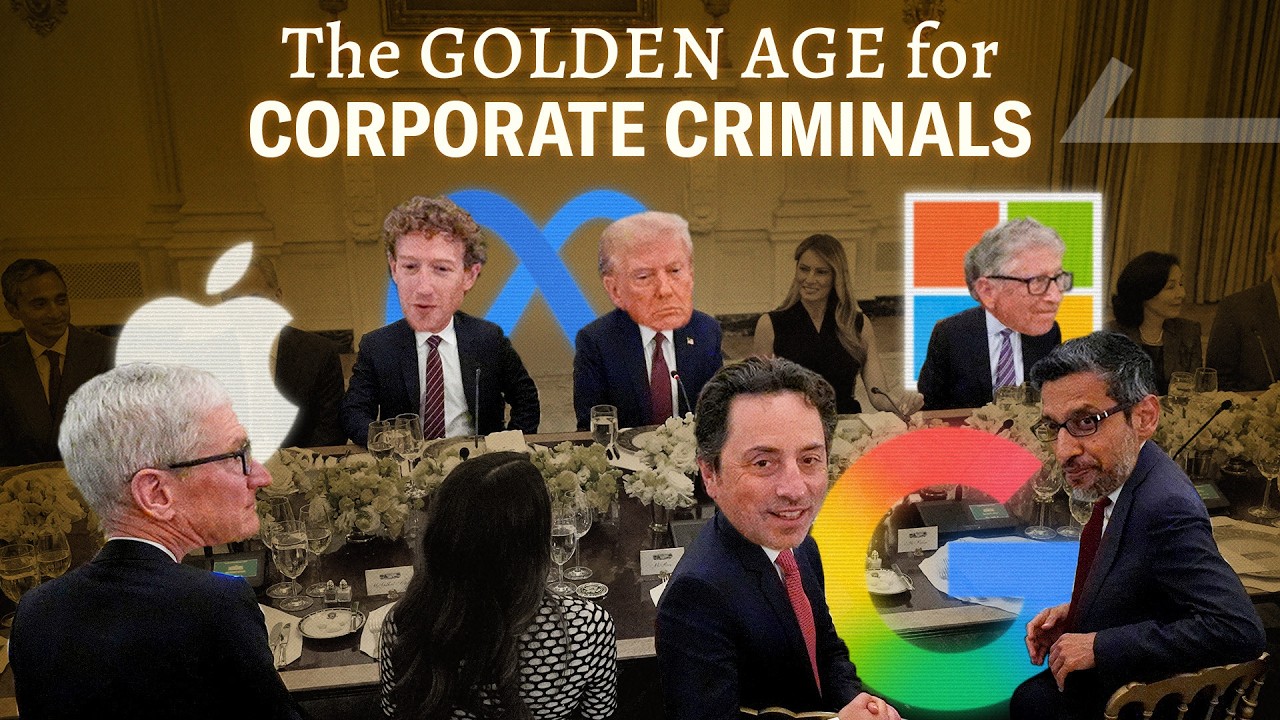
doj anti trust cfpb 1on 3 cases dropped, stock price way up, apple tariffs
...Trump had just announced huge tariffs on all kinds of goods coming from
4:25
foreign countries, tariffs that would raise Apple's cost of doing business by billions.
4:30
Weeks later, after Tim Cook met with Trump, the White House
4:33
announced tariff exemptions for smartphones, computers and chips.
4:37
You know, the things that Apple makes.
4:39
So a $1 million donation for Apple and billions in savings.
4:43
I guess that's what economists would call a return on investment.
4:46
To me it just looks like a bribe with extra steps.
4:49
Microsoft, you guessed it, also got in on the action
4:53
with a $750,000 donation.
4:56
And like Google, they got the FTC off their back–
4:58
a major antitrust case against them dropped for a huge merger they did in 2023 with Activision.
5:04
Amazon reached a big settlement with the FTC for essentially tricking consumers
5:09
into signing up for Amazon Prime,
5:11
a case the FTC could easily have won.
5:14
So why would they suddenly settle?
5:17
Are you starting to see a pattern yet?
....
Trump used to say that Big Tech is a horrible thing for our country. Now, he’s cozy with Mark Zuckerberg, Tim Cook, and Silicon Valley. What changed? We analyzed all the donors to Trump’s inauguration and uncovered a massive corruption and influence-buying scheme. ----- More Perfect Union is an Emmy-winning, nonprofit newsroom whose mission is to build power for working people. Here’s what that means: We report on the real struggles and challenges of the working class from a working-class perspective. We attempt to connect those problems to potential solutions. We report on the abuses and wrongdoing of corporate power. And we seek to hold accountable the ultra-rich who have too much power over America’s political and economic systems.
---
no lnx
Disgraced techbro launches app to 'hasten the coming of Christ's return'
Intel chief executive officer Pat Gelsinger on May 6, 2014 (Image: Shutterstock)
Carl GibsonOctober 28, 2025
The former CEO of Intel is now rolling out an artificial intelligence-powered app aimed at churches and faith communities — and is being particularly open about what's motivating him.
The Guardian reported Tuesday that Pat Gelsinger — who led Intel between 2021 and 2024 before he was forced out after being sued by shareholders — is heavily promoting his evangelical philosophy as the head of tech company Gloo. In March of this year, Gelsinger took the helm of Gloo, which is a combination AI chatbot and workspace platform for churches. Gloo boasts that it serves more than 140,000 "faith, ministry and nonprofit leaders."
Gelsinger, who is a born-again Christian, said he was passionate about combining AI with his Christian values, and said Gloo was his opportunity to develop a large language model (LLM) infused with fundamentalist Christian theology.
"My life mission has been [to] work on a piece of technology that would improve the quality of life of every human on the planet and hasten the coming of Christ’s return," Gelsinger said.
Gizmodo's A.J. Dellinger wrote Tuesday that Gelsinger's quote about the second coming of Christ is particularly alarming, as it "would spell the end of the humanity, which would not be great for every human on the planet."
"Luckily, Gelsinger’s attempts to expedite the second coming via selling churches on a chatbot subscription or whatever are probably no more likely to be a conduit to the End Times than those TikTokers predicting the Rapture," Dellinger quipped.
The former Intel CEO's forced retirement in 2024 came despite the semiconductor industry experiencing a boom in previous years. Intel's performance in the industry was lackluster in comparison to competitors like Nvidia and AMD. Just before Gelsinger was driven out of his role, Intel had laid off roughly 15,000 people, making up about 15 percent of its workforce.
Click here to read the Guardian's full report.
an 10 25
---
NERD REICH?
What Is Silicon Valley's 'Nerd Reich,' and Is It Taking Over the US Government? | KQED
Sixty percent of surveyed American adults said they had an unfavorable view of Elon Musk — the billionaire Tesla CEO, who has been intimately involved with the federal government for months through his leadership of the unofficial Department of Government Efficiency.
Since the inauguration of President Donald Trump, Musk’s DOGE has slashed large swaths of federal jobs and cut funding to programs as varied as the U.S. Agency for International Development to energy-saving initiatives for low-income families. And this March poll of 1,000 people by the Marquette Law School is just one indicator that some Americans are tired of wealthy tech figures being involved in the nation’s politics.
“We’re learning a big lesson here, which is that we can have democracy or we can have billionaires, but we can’t have both,” San Francisco journalist Gil Duran said.
KQED Forum’s Mina Kim spoke to Duran, who formerly worked for California politicians like Jerry Brown and Kamala Harris, about the “Silicon Valley tech billionaire politics” that are the focus of hisnewsletter, The Nerd Reich — and what he thinks tech elites might want next.
*This interview has been edited for brevity and clarity.
Before DOGE, there was RAGE
Gil Duran: Curtis Yarvin is a San Francisco software programmer who, in the early 2000s, started blogging under the name “Mencius Moldbug.” And in his blog posts — very internet troll stuff — he laid out these ideas for replacing democracy with tech-controlled dictatorships.
He specifically focused on San Francisco, which he said in his corporate tech dictatorship would be renamed “Frisk Corp.” In Frisk Corp, you would have to swipe in with RFIDchips and be under total surveillance, and give up all of your freedom in exchange for security.
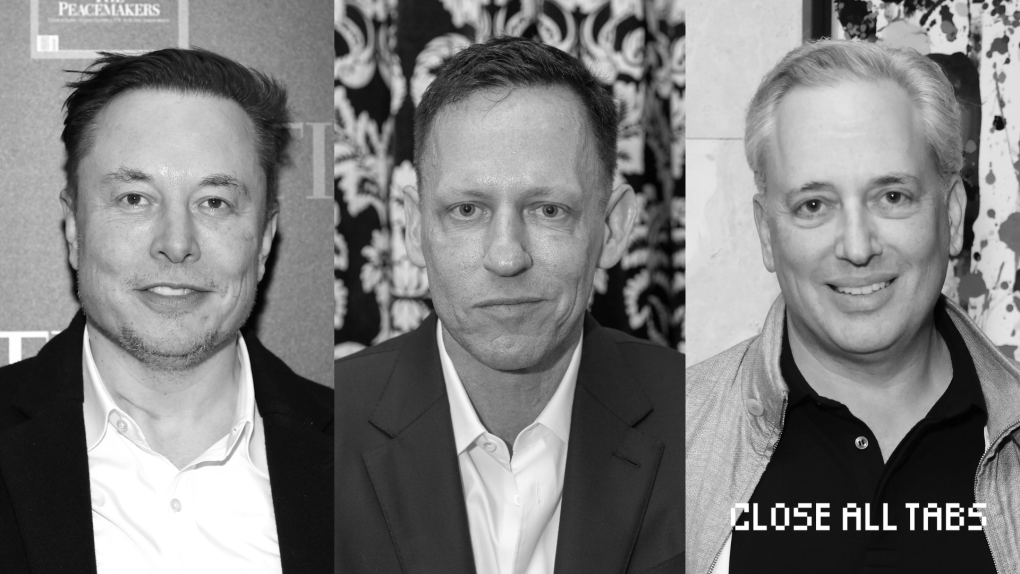
The Broligarchy Pt 1: Chronicles of the PayPal Mafia
The important thing to understand about Curtis Yarvin is that he became a favorite thinker of Peter Thiel, the PayPal Mafia billionairewho founded Palantir and got even richer off of government surveillance. Some people call him Peter Thiel’s house philosopher.
In 2012, [Yarvin] gave a speech in which he said that the government needed to be reformed with something he called RAGE — Retire All Government Employees. And that entailed taking over the federal government, purging the bureaucracy of anybody who’s a Democrat or who believes in democracy, and replacing all federal employees with people who would answer to a CEO-dictator-type of person. Very much mirroring what Elon Musk is doing with DOGE at this current time.
If it weren’t for these billionaires, [Yarvin would] be just an anonymous internet troll. The whole reason this has gone national is because of JD Vance. [And] to understand JD Vance, you have to understand that he is largely a creation of Peter Thiel. At every step of JD’s career, Peter Thiel has been there, funding him.
 Mike Pence looks on as Donald Trump shakes the hand of Peter Thiel during a meeting with technology executives during the first Trump Administration. (Drew Angerer/Getty Images)
Predicting the ‘cognitive elite’
Yarvin is largely deriving his ideas from other places.
To really understand this, you have to go back to a 1997 book called The Sovereign Individual, which basically was one of these dark, apocalyptic-style books, and it predicted that in the 21st century, the information age would undermine the existing economy and existing nation-states. Thatthe Information Agewould kill lots of jobs and result in a lot of violence and chaos, and also lead to the rise of a so-called “cognitive elite”: people who are able to become wealthy off of technology and don’t need traditional jobs to survive.
It would be their mission to escape from existing countries using something called cyber currency — basically crypto, which would allow them to evade taxation and evade government authority, and create their own nations that they would rule over in this post-democracy order brought about by the information age.
These ideas sound crazy when you first hear them. They sounded very unhinged to me, and I didn’t pay attention to them at first.
However, you have to understand that these are very wealthy men with very strange and scary ideas. And they seriously believe in them.
[
The GOP vs. the ‘broligarchs’?
I think Trump has, for the most, part right now, been bought off. Trump’s in it for the money — and these guys have plenty of it.
He may not have the ideology, but as long as Elon and these guys are going to spend billions of dollars and create all of these business opportunities for his family, I think he’s all in.
There is a problem, though, because this is becoming very unpopular very quickly. The polls are diving. Elon Musk is becoming one of the most despised men in the country. He’s threatening Social Security. He’s firing veterans. You’ve got Republicans showing up to town halls to yell at their absentee representatives in early 2025.
This is a political disaster in many ways, so I think there will be some political tension between the Republican establishment and these “tech-broligarchs” — because they’re breaking all the rules of politics and don’t really seem to care about the future. And in politics, you’ve really got to care about the next election and the election after. That’s the name of the game.
Silicon Valley’s ‘right wing strain’
I compare it to: this tech authoritarianism is the parasite and MAGA is the host.
[Tech leaders] saw an opportunity, right? It’s a very opportunistic play — and an opportunity to go as far as they can with a candidate who has been able to openly violate the law, and not pay any political consequence for it.
How J.D. Vance Went from Never Trumper to MAGA Warrior
This is not an ideology where the world is a better place for the majority of people. It’s a place where the world is a place for tech billionaires. You don’t make the world a better place by getting rid of Social Security, which is crucial to the survival of millions of Americans.
Malcolm Harris’s [book]*Palo Alto* talks about the right-wing strain through Silicon Valley. There was this idea during the nineties and part of the eighties and 2000s that tech was kind of fun: was going to make our life cool, all these nice products, connecting us, allowing us to buy stuff online.
And for a long time, it seemed nonthreatening. Remember, Google had the “Don’t be evil” slogan and they were kind of paddling around in their Crocs, building playgrounds for their employees and bespoke lunches and free kombucha on tap. There was the harmless vibe that seemed to be from Silicon Valley.
But I think there has always been a certain anti-government lean to a lot of the Silicon Valley movement — this idea that “we’re going to create structures outside of government.” The idea of getting out of authoritarian society, evading bad governments in the future: there were times when these ideas seemed like something people on the left could be into.
However, what’s happened is: these guys became super rich. And as they’ve become super super superrich, they’ve gone far, far, far to the right — and they’re pulling others now with them.
‘Freedom cities’ and governance by tech
All the way back in 2013, [Balaji Srinivasan, chief technology officer of cryptocurrency exchange Coinbase] gave a speech at Y Combinatorin which he basically called for Silicon Valley to secede from the United States and to go start their own country and take all of their wealth and all of the brain power.
He continue[d] to develop these ideas over the next decade, and in 2022, released a book called The Network State — how to start a new country. This book lays out all the reasons why American democracy is an outdated system and why it needs to be replaced by new tech forms of governance. And there are two ways to do that: one is to leave the country by a territory and create your own sovereign state or city. You can do that within a country or by leaving a country. And the other way is to take over existing governments and convert them into tech-controlled governments.
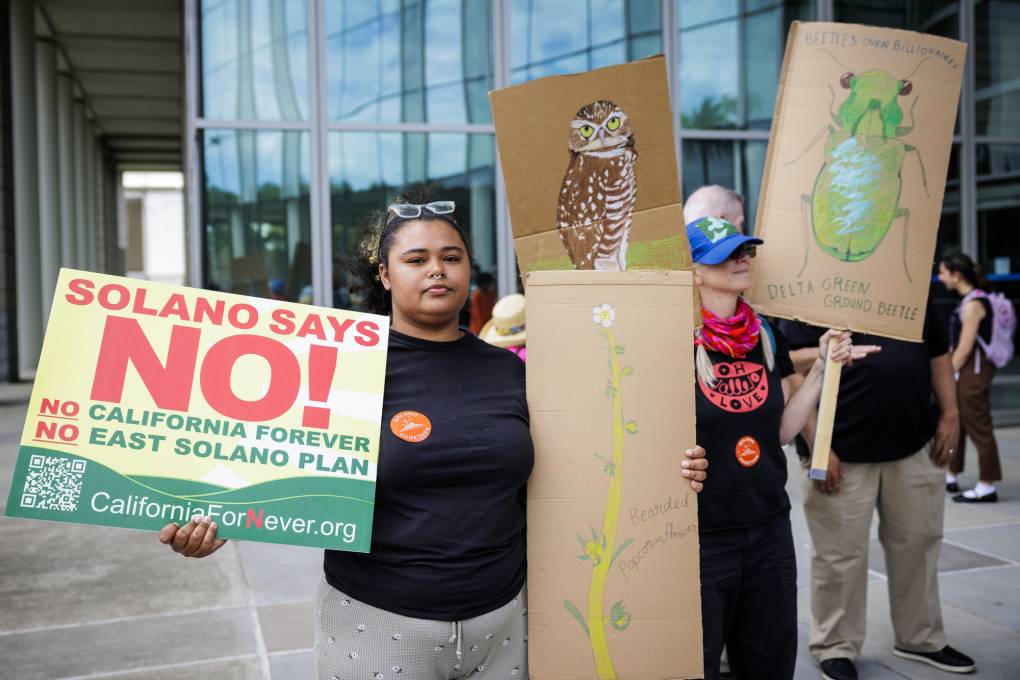
This Tech-Backed Company Tried to Disrupt California’s Housing Crisis. It Couldn’t
My interest in this ideology started with SF politics — this effort by tech bros to take over City Hall, but also by the California Forever Project.
It wasn’t until I read a book by a historian named Quinn Slobodian called, Crack Up Capitalism: Market Radicals and the Dream of a World Without Democracy, that I understood the idea there … for wealthy people to find a way to exit society and create their own sort of utopian countries that they control.
In 2024, Trump had a plan for something he calls the so-called “freedom cities,” which are these 10 new charter cities that would be built on federal land all around the United States. The newspapers have mentioned that Trump plans to “build freedom cities,” but no one has explained what that means: where the idea comes from or why we need them.
I think the “freedom cities” are really anti-freedom cities — a very Orwellian name for what would essentially be a corporate-controlled city.
 A billboard for California Forever sits on top of an apartment building along I-80 in Vallejo on April 2, 2024. (Beth LaBerge/KQED)
How does this all end?
A lot of people stayed home [and didn’t vote in the 2024 election.] And I think this is going to wake [Americans] up to the fact that you can’t stay home. We have to realize that there is a group of people who are avidly working against the public good and against the welfare and well-being of the majority.
I don’t think these [tech] guys have fully thought this out. I don’t think they realize — having been in politics myself — what it’s gonna feel like when you see that the majority of people are against you. I do think this ends with tens of millions of Americans taking to the streets on a regular basis to stand against what is an increasingly authoritarian regime in Washington. And I think that it also ends with a bunch of billionaires getting on planes to Moscow at midnight.
I think it’s important to understand it, to learn about it, and to tell others about it … Word of mouth is very important. People listen to their peers, to their friends, to their family members. That’s where a lot of people get their main political knowledge from.
---
an 4 25
Analysts accuse big U.S. tech firms of paying almost $278 billion less corporate income tax in the past decade compared with the statutory rate for U.S. companies making the same profits.
The Guardian reveals Amazon, Meta, Alphabet, Netflix, Apple and Microsoft —the “Silicon Six”— generated a combined $11 trillion in revenue and $2.5 trillion in profits over the last decade. But they paid an average of just 18.8% in combined national and federal corporation taxes, compared with an average 29.7% in the U.S., according to the Fair Tax Foundation (FTF).
“Our analysis would indicate that tax avoidance continues to be hardwired into corporate structures,” Fair Tax Foundation Chief Executive Paul Monaghan told The Guardian. “The Silicon Six’s corporate income tax contributions are, in percentage terms, way below what sectors such as banking and energy are paying in many parts of the world.”
READ MORE:'Don't you see what's happening?' Experts call Trump's latest move 'full blown fascism'
Analysis at FTF also discovered the companies had inflated their stated tax payments by $82 billion over the same period by including contingencies for tax they did not expect to pay. Monaghan added that these companies have "enormous political influence as well as economic power," in that they all spend hundreds of millions of dollars on lobbying government officials on key tax-writing committees to have more say in how the tax system works.
The Guardian reports that Netflix had the lowest rate of tax actually paid compared to profit at 14.7%, while Microsoft paid 20.4%. Amazon, meanwhile, had the worst tax conduct based on factors such as the total amount of tax paid, much if it through “obvious profit shifting” such as booking a sizeable portion of its U.K. income in low-tax Luxembourg. But Amazon’s corporate tax rate was still 19.6% ahead of Netflix and Meta (15.4%) and Apple (18.4%).
The report comes as leaders of many of these same tech companies’ influence genuflect to President Donald Trump. Amazon’s Jeff Bezos, Apple’s Tim Cook and Meta’s Mark Zuckerberg all attended Donald Trump’s second inauguration.
Read the full Guardian story at this link.
GUK
REF
The movement for corporate city states cannot believe its good luck. For years, it has been pushing the extreme notion that wealthy, tax-averse people should up and start their own high-tech fiefdoms, whether new countries on artificial islands in international waters (“seasteading”) or pro-business “freedom cities” such as Próspera, a glorified gated community combined with a wild west med spa on a Honduran island.
Yet despite backing from the heavy-hitter venture capitalists Peter Thiel and Marc Andreessen, their extreme libertarian dreams kept bogging down: it turns out most self-respecting rich people don’t actually want to live on floating oil rigs, even if it means lower taxes, and while Próspera might be nice for a holiday and some body “upgrades”, its extra-national status is currently beingchallenged in court.
Now, all of a sudden, this once-fringe network of corporate secessionists finds itself knocking on open doors at the dead center of global power.
The first sign that fortunes were shifting came in 2023, when a campaigning Donald Trump, seemingly out of nowhere, promised to hold a contest that would lead to the creation of 10 “freedom cities” on federal lands. The trial balloon barely registered at the time, lost in the daily deluge of outrageous claims. Since the new administration took office, however, would-be country starters have been on a lobbying blitz, determined to turn Trump’s pledge into reality.
“The energy in DC is absolutely electric,” Trey Goff, the chief of staff of Próspera, recently enthused after a trip to Capitol Hill. Legislation paving the way for a bevy of corporate city-states should be complete by the end of the year, he claims.
Inspired by the political philosopher Albert Hirschman, figures including Goff, Thiel and the investor and writer Balaji Srinivasan have been championing what they call “exit” – the principle that those with means have the right to walk away from the obligations of citizenship, especially taxes and burdensome regulation. Retooling and rebranding the old ambitions and privileges of empires, they dream of splintering governments and carving up the world into hyper-capitalist, democracy-free havens under the sole control of the supremely wealthy, protected by private mercenaries, serviced by AI robots and financed by cryptocurrencies.
Peter Thiel in Tokyo in 2019. Photograph: Kiyoshi Ota/Bloomberg via Getty Images
One might assume that it is contradictory for Trump, elected on a flag-waving “America first” platform, to lend credence to this vision of sovereign territories ruled over by billionaire god-kings. And much has been made of the colorful flame wars between the Maga mouth-piece Steve Bannon, a proud nationalist and populist, and the Trump-allied billionaires he has attacked as “technofeudalists” who “don’t give a flying fuck about the human being” – let alone the nation state. And conflicts inside Trump’s awkward, jerry-rigged coalition certainly exist, most recently reaching a boiling point over tariffs. Still, the underlying visions might not be as incompatible as they first appear.
The startup country contingent is clearly foreseeing a future marked by shocks, scarcity and collapse. Their high-tech private domains are essentially fortressed escape pods, designed for the select few to take advantage of every possible luxury and opportunity for human optimization, giving them and their children an edge in an increasingly barbarous future. To put it bluntly, the most powerful people in the world are preparing for the end of the world, an end they themselves are frenetically accelerating.
That is not so far away from the more mass-market vision of fortressed nations that has gripped the hard right globally, from Italy to Israel, Australia to the United States: in a time of ceaseless peril, openly supremacist movements in these countries are positioning their relatively wealthy states as armed bunkers. These bunkers are brutal in their determination to expel and imprison unwanted humans (even if that requires indefinite confinement in extra-national penal colonies from Manus Island to Guantánamo Bay) and equally ruthless in their willingness to violently claim the land and resources (water, energy, critical minerals) they deem necessary to weather the coming shocks.
Though it builds on enduring rightwing tendencies ... we simply have not faced such a powerful apocalyptic strain in government before
Interestingly, at a time when previously secular Silicon Valley elites are suddenly finding Jesus, it is noteworthy that both of these visions – the priority-pass corporate state and the mass-market bunker nation – share a great deal in common with the Christian fundamentalist interpretation of the biblical Rapture, when the faithful will supposedly be lifted up to a golden city in heaven, while the damned are left to endure an apocalyptic final battle down here on earth.
If we are to meet our critical moment in history, we need to reckon with the reality that we are not up against adversaries we have seen before. We are up against end times fascism.
Reflecting on his childhood under Mussolini, the novelist and philosopher Umberto Eco observed in a celebrated essay that fascism typically has an “Armageddon complex” – a fixation on vanquishing enemies in a grand final battle. But European fascism of the 1930s and 1940s also had a horizon: a vision for a future golden age after the bloodbath that, for its in-group, would be peaceful, pastoral and purified. Not today.
Alive to our era of genuine existential danger – from climate breakdown to nuclear war to sky-rocketing inequality and unregulated AI – but financially and ideologically committed to deepening those threats, contemporary far-right movements lack any credible vision for a hopeful future. The average voter is offered only remixes of a bygone past, alongside the sadistic pleasures of dominance over an ever-expanding assemblage of dehumanized others.
And so we have the Trump administration’s dedication to releasing its steady stream of real and AI-generated propaganda designed solely for these pornographic purposes. Footage of shackled immigrants being loaded on to deportation flights, set to the sounds of clanking chains and locking cuffs, which the official White House X account labeled “ASMR”, a reference to audio designed to calm the nervous system. Or the same account sharing news of the detention of Mahmoud Khalil, a US permanent resident who was active in Columbia University’s pro-Palestinian encampment, with the gloating words: “SHALOM, MAHMOUD.” Or any number of homeland security secretary Kristi Noem’s sadism-chic photo ops (atop a horse at the US-Mexican border, in front of a crowded prison cell in El Salvador, slinging a machine gun while arresting immigrants in Arizona …).
Kristi Noem speaks during a tour of an El Salvador prison in March. Photograph: Alex Brandon/AP
The governing ideology of the far right in our age of escalating disasters has become a monstrous, supremacist survivalism.
It is terrifying in its wickedness, yes. But it also opens up powerful possibilities for resistance. To bet against the future on this scale – to bank on your bunker – is to betray, on the most basic level, our duties to one another, to the children we love, and to every other life form with whom we share a planetary home. This is a belief system that is genocidal at its core and treasonous to the wonder and beauty of this world. We are convinced that the more people understand the extent to which the right has succumbed to the Armageddon complex, the more they will be willing to fight back, realizing that absolutely everything is now on the line.
Our opponents know full well that we are entering an age of emergency, but have responded by embracing lethal yet self-serving delusions. Having bought into various apartheid fantasies of bunkered safety, they are choosing to let the Earth burn. Our task is to build a wide and deep movement, as spiritual as it is political, strong enough to stop these unhinged traitors. A movement rooted in a steadfast commitment to one another, across our many differences and divides, and to this miraculous, singular planet.
Not so long ago, it was primarily religious fundamentalists who greeted signs of apocalypse with gleeful excitement about the long-awaited Rapture. Trump has handed critical posts to people who subscribe to that fiery orthodoxy, including several Christian Zionists who see Israel’s use of annihilatory violence to expand its territorial footprint not as illegal atrocities but as felicitous evidence that the Holy Land is getting closer to the conditions under which the Messiah will return, and the faithful will get their celestial kingdom.
Mike Huckabee, Trump’s newly confirmed ambassador to Israel, has strong ties to Christian Zionism, as does Pete Hegseth, his secretary of defense. Noem and Russell Vought, the Project 2025 architect who now leads the office of budget and management, are both staunch advocates for Christian nationalism. Even Thiel, who is gay and notorious for his party lifestyle, has been heard musing about the arrival of the antichrist of late (spoiler: he thinks it’s Greta Thunberg, more on that soon).
But you don’t need to be a biblical literalist, or even religious, to be an end times fascist. Today, plenty of powerful secular people have embraced a vision of the future that follows a nearly identical script, one in which the world as we know it collapses under its weight and a chosen few survive and thrive in various kinds of arks, bunkers and gated “freedom cities”. In a 2019 paper titled Left Behind: Future Fetishists, Prepping and the Abandonment of Earth, the communication scholars Sarah T Roberts and Mél Hogan described the longing for a secular Rapture: “In the accelerationist imaginary, the future is not about harm reduction, limits or restoration; rather it is a politics driving toward an endgame.”
Mike Huckabee touring Jewish settlements in East Jerusalem in 2008. Photograph: David Silverman/Getty Images
Elon Musk, who dramatically grew his fortune alongside Thiel at PayPal, embodies this implosive ethos. This is a person who looks up at the wonders of the night sky and apparently sees only opportunities to fill that inky unknown with his own space junk. Though he burnished his reputation warning about the dangers of the climate crisis and AI, he and his so-called “department of government efficiency” (Doge) henchmen now spend their days escalating those same risks (and many others) by slashing not only environmental regulations but entire regulatory agencies, with the apparent end goal of replacing federal workers with chatbots.
Who needs a functioning nation state when outer space – now reportedly Musk’s singular obsession – beckons? For Musk, Mars has become a secular ark, which he claims is key to the survival of human civilization, perhaps via uploaded consciousnesses to an artificial general intelligence. Kim Stanley Robinson, the author of the sci-fi Mars Trilogy that appears to have partially inspired Musk, is blunt about the dangers of the billionaire’s fantasies about colonizing Mars. It is, he says, “just a moral hazard that creates the illusion we can wreck Earth and still be okay. It’s totally not true.”
Much like religious end-timers who long to escape the corporeal realm, Musk’s drive for humanity to become “multiplanetary” is made possible by his inability to appreciate the multispecies splendor of our only home. Evidently uninterested in the vast bounty that surrounds him, or in ensuring Earth can continue buzzing with diversity, he instead deploys his vast fortune to bring about a future that would see a handful of people and robots eke out survival on two barren orbs (a radically depleted Earth and a terraformed Mars). Indeed, in a strange twist on the Old Testament tale, Musk and his fellow tech billionaires, having arrogated god-like powers to themselves, aren’t content to just build the arks. They appear to be doing their best to cause the flood. Today’s rightwing leaders and their rich allies are not just taking advantage of catastrophes, shock-doctrine and disaster-capitalism style, but simultaneously provoking and planning for them.
What of the Maga base, though? Not all are sufficiently faithful to earnestly believe in the Rapture, and most certainly don’t have the cash to buy a spot in a “freedom city” let alone on a rocket ship. Fear not. End times fascism offers the promise of many more affordable arks and bunkers, these ones well within reach for lower-level foot soldiers.
Listen to Steve Bannon’s daily podcast – which bills itself as Maga’s premier media outlet – and you will be barraged with a singular message: the world is going to hell, the infidels are breaching the barricades, and a final battle is coming. Be prepared. The prepper message becomes particularly pronounced when Bannon switches to hawking his advertisers’ products. Buy Birch Gold, Bannon tells his audience, because the over-leveraged US economy is going to crash and you can’t trust the banks. Stock up on ready-to-eat meals from My Patriot Supply. Sharpen your target practice using a laser-guided at-home system. The last thing you would want to do is depend on the government during a disaster, he reminds listeners (left unsaid: especially now that the Doge boys are selling off the government for parts).
End times fascism is a darkly festive fatalism – a final refuge for those who find it easier to celebrate destruction than imagine living without supremacy
Bannon doesn’t only urge his audience to make their own bunkers, of course. He also advances a vision of the United States as a bunker in its own right, one in which Ice agents stalk the streets, workplaces and campuses, disappearing those deemed enemies of US policy and interests. The bunkered nation lies at the heart of the Maga agenda, and of end times fascism. Inside its logic, the first job is to harden national borders and expunge all enemies, foreign and domestic. This ugly work is now well under way, with the Trump administration, enabled by the supreme court, having invoked the Alien Enemies Act to deport hundreds of Venezuelan immigrants to Cecot, the now infamous mega-prison in El Salvador. The facility, which shaves prisoners heads and packs up to 100 people into a single cell, stacked with bare bunks, operates under the civil liberties-destroying “state of exception” first declared over three years ago by the country’s crypto-loving, Christian Zionist prime minister, Nayib Bukele.
Bukele has offered to provide the same fee-for-service system for US citizens the administration would like to drop into a judicial black hole. “I love that,” Trump said recently, when asked about the proposal. No wonder: Cecot is the sick if logical corollary of the “freedom city” fantasy – a zone where everything is for sale and due process does not apply. We should expect much more of this sadism. In a chillingly candid statement, the acting Ice director, Todd Lyons, told the 2025 Border Security Expo that he wanted to see a more “business”-oriented approach to these deportations, “like [Amazon] Prime, but with human beings”.
If policing the boundaries of the bunkered nation is end times fascism’s job one, equally important is job two: for the US government to lay claim to whatever resources its protected citizens might need to get through the tough times ahead. Maybe it’s Panama’s canal. Or Greenland’s fast-melting shipping routes. Or Ukraine’s critical minerals. Or Canada’s fresh water. We should think of this less as old-school imperialism than super-sized prepping, at the level of the national state. Gone are the old colonial fig leaves of spreading democracy or God’s word – when Trump covetously scans the globe, he is stockpiling for civilizational collapse.
This bunker mentality also helps explain JD Vance’s controversial forays into Catholic theology. The vice-president, who owes his political career in no small part to the largess of the premier prepper Thiel, explained to Fox News that, according to the medieval Christian concept of ordo amoris (translated both as “order of love” and “order of charity”), love is not owed to those outside the bunker: “You love your family, and then you love your neighbor, and then you love your community, and then you love your fellow citizens in your own country. And then after that, you can focus and prioritize the rest of the world.” (Or not, as the Trump administration’s foreign policy would indicate.) In other words, we owe nothing to anyone outside our bunker.
Though it builds on enduring rightwing tendencies – justifying hateful exclusions is hardly new under the ethno-nationalist sun – we simply have not faced such a powerful apocalyptic strain in government before. The “end of history” swagger of the post-cold war era is rapidly being supplanted by a conviction we are in the actual end of times. Doge may wrap itself in the banner of economic “efficiency”, and Musk’s underlings may evoke memories of the young, US-trained “Chicago Boys” who designed the economic shock therapy for Augusto Pinochet’s dictatorial regime, but this is not simply the old marriage of neoliberalism and neoconservatism. It’s a new, money-worshiping millenarian mashup that says we need to smash the bureaucracy and replace humans with chatbots in order to cut “waste, fraud and abuse” – and, also, because the bureaucracy is where the Trump-resisting demons hide. This is where the tech bros merge with the TheoBros, a real group of hyper-patriarchal Christian supremacists with ties to Hegseth and others in the Trump administration.
Steve Bannon advances a vision of the United States as a bunker in its own right. Photograph: Chip Somodevilla/Getty Images
As fascism always does, today’s Armageddon complex crosses class lines, bonding billionaires to the Maga base. Thanks to decades of deepening economic stresses, alongside ceaseless and skillful messaging pitting workers against one another, a great many people understandably feel unable to protect themselves from the disintegration that surrounds them (no matter how many months of ready-to-eat meals they buy). But there are emotional compensations on offer: you can cheer the end of affirmative action and DEI, glorify mass deportation, enjoy the denial of gender-affirming care to trans people, villainize educators and health workers who think they know better than you, and applaud the demise of economic and environmental regulations as a way to own the libs. End times fascism is a darkly festive fatalism – a final refuge for those who find it easier to celebrate destruction than imagine living without supremacy.
It’s also a self-reinforcing downward spiral: Trump’s furious attacks on every structure designed to protect the public from diseases, dangerous foods and disasters – even to tell the public when disasters are headed their way – strengthen the case for prepperism at both the high and low ends, all while creating myriad new opportunities for privatization and profiteering by the oligarchs powering this rapid-fire unmaking of the social and regulatory state.
At the dawn of Trump’s first term, the New Yorker investigated a phenomenon that it described as “doomsday prep for the super-rich”. Back then, it was already clear that in Silicon Valley and on Wall Street, the more serious high-end survivalists were hedging against climate disruption and social collapse by buying space in custom-built underground bunkers and building escape homes on high ground in places like Hawaii (where Mark Zuckerberg has downplayed his 5,000 sq ft underground pad as a “little shelter”) and New Zealand (where Thiel purchased nearly 500 acres but found his plan to build a luxury survivalist compound rejected by local authorities in 2022 for being an eyesore).
This millenarianism is bound up with a suite of other Silicon Valley intellectual fads, all premised on an end-times-inflected belief that our planet is headed towards a cataclysm and it’s time to make some hard choices about which parts of humanity can be saved. Transhumanism is one such ideology, encompassing everything from minor human-machine “enhancements” to the quest to upload human intelligence into a still illusory artificial general intelligence. There is also effective altruism and longtermism, both of which skip over redistributive approaches to helping those in need in the here and now in favor of a cost-benefit approach to doing the most good in the long term.
Though they can appear benign at first glance, these ideas are shot through with dangerous racial, ableist and gender biases about which parts of humanity are worth enhancing and saving – and which could be sacrificed for the supposed good of the whole. They also share a marked lack of interest in urgently addressing the underlying drivers of collapse – a responsible and rational goal that a growing cohort of figures now actively shun. Instead of effective altruism the Mar-a-Lago regular Andreessen and others have embraced “effective accelerationism”, or the “deliberate propulsion of technological development” without guardrails.
Meanwhile, even darker philosophies are finding a wider audience, like the neoreactionary pro-monarchy rants of the coder Curtis Yarvin (another one of Thiel’s intellectual touchstones), or the “pro-natalism” movement’s obsession with dramatically increasing the number of “western” babies (a Musk fixation), as well as the exit guru Srinivasan’s vision of a “tech zionist” San Francisco where corporate loyalists and police join forces to politically cleanse the city of liberals to make way for their networked apartheid state.
Marc Andreessen and Balaji Srinivasan speak during a panel discussion about bitcoin in San Francisco in 2014. Photograph: Paul Chinn/San Francisco Chronicle via Getty Images
As the AI scholars Timnit Gebru and Émile P Torres have written, though the methods may be new, this “bundle” of ideological fads “are direct descendants of first-wave eugenics”, which also saw a small subset of humanity making decisions about which parts of the whole were worth continuing and which needed to be phased out, cleared out, or terminated. Until recently, few paid attention. Much like Próspera, where members can already experiment with human-machine mergers such as having their Tesla keys into their hands, these intellectual fads seemed to be the marginal hobby horses of a few Bay Area dilettantes with money and caution to burn. No longer.
Three recent material developments have accelerated end times fascism’s apocalyptic appeal. The first is the climate crisis. While some high-profile figures might still publicly deny or minimize the threat, global elites, whose ocean-front properties and datacenters are intensely vulnerable to rising temperatures and sea levels, are well-versed in the ramifying perils of an ever-heating world. The second is Covid-19: epidemiological models had long predicted the possibility of a pandemic devastating our globally networked world; the actual arrival of one was taken by many powerful people as a sign that we have officially arrived at what US military analysts forecasted as “the Age of Consequences”. No more predictions, it’s going down. The third factor is the rapid advancement and adoption of AI, a set of technologies that have long been associated with sci-fi terrors about machines turning on their makers with ruthless efficiency – fears expressed most forcefully by the same people who are developing these technologies. All of these existential crises are layered on top of escalating tensions between nuclear-armed powers.
None of this should be written off as paranoia. Many of us feel the imminence of breakdown so acutely that we cope by entertaining ourselves with various versions of life in a post-apocalyptic bunker, streaming Apple’s Silo or Hulu’s Paradise. As the UK analyst and editor Richard Seymour reminds us in his recent book, Disaster Nationalism: “The apocalypse is no mere fantasy. We are living in it, after all, from deadly viruses to soil erosion, from economic crisis to geopolitical chaos.”
The forces we are up against have made peace with mass death. They are treasonous to this world and its human and non-human inhabitants
Trump 2.0’s economic project is a Frankenstein’s monster of the industries driving all of these threats – fossil fuels, weapons and resource-ravenous cryptocurrency and AI. Everyone involved in these sectors knows that there is no way to build the artificial mirror world that AI promises to construct without sacrificing this world – these technologies consume too much energy, too many critical minerals, and too much water for the two to coexist in any kind of equilibrium. This month, the former Google executive Eric Schmidt admitted as much, Congress that AI’s “profound” energy needs are projected to triple in the next few years, with much of it coming from fossil fuels, because nuclear can’t come online fast enough. This planet-incinerating level of consumption is necessary, he explained, to enable an intelligence “higher” than humanity, a digital god rising from the ashes of our relinquished world.
And they are worried – just not about the actual threats they are unleashing. What keeps the leaders of these entangled industries up at night is the prospect of a civilizational wake-up call – of serious, internationally coordinated government efforts to rein in their rogue sectors before it’s too late. From the perspective of their ever-expanding bottom lines, the apocalypse is not collapse; it’s regulation.
The fact that their profits are predicated on planetary devastation helps explain why do-gooder discourse among the powerful is giving way to open expressions of disdain for the idea that we owe each other anything by right of our shared humanity. Silicon Valley is done with altruism, effective or otherwise. Meta’s Mark Zuckerberg pines for a culture that celebrates “aggression”. Alex Karp, Thiel’s business partner at the surveillance firm Palantir Technologies, the “losing” “self-flagellation” of those who question American superiority and the benefits of autonomous weapons systems (and, by association, the lucrative military contracts that have made Karp’s vast fortune). Musk informs Joe Rogan that empathy is “the fundamental weakness of western civilization” and he vents, after failing to purchase a supreme court election in Wisconsin: “It increasingly appears that humanity is a biological bootloader for digital superintelligence.” Meaning we humans are nothing but grist for Grok, the AI service he owns. (He did tell us he was “dark Maga” – and he’s not the only one.)
In arid and climate-stressed Spain, one of the groups calling for a moratorium on new datacenters calls itself Tu Nube Seca Mi Río – Spanish for “your cloud is drying my river”. The name is fitting, and not just for Spain.
An unspeakably dismal choice is being made before our eyes and without our consent: machines over humans, inanimate over animate, profits over all else. With stunning speed, the big tech megalomaniacs have quietly rolled back their net-zero pledges and lined up by Trump’s side, hellbent on sacrificing this world’s real and precious resources and creativity at the altar of a vampiric, virtual realm. This is the last great heist, and they are getting ready to ride out the storms they themselves are summoning – and they will try to defame and destroy anyone who gets in their way.
Consider Vance’s recent European sojourn, where the vice-president harangued world leaders for “handwringing about safety” in relation to job-destroying AI while demanding Nazi and fascist speech go uncurtailed online. At one point he made a telling aside, expecting a laugh that never came: “If American democracy can survive 10 years of Greta Thunberg’s scolding, you guys can survive a few months of Elon Musk.”
JD Vance speaks at the Munich Security Conference in February. Photograph: dts News Agency Germany/REX/Shutterstock
His comment echoed those made by his equally humorless patron Thiel. In recent interviews focused on the theological underpinnings of his far-right politics, the Christian billionaire has repeatedly compared the indefatigable young climate activist to the antichrist – a figure he warns was prophesied to come bearing a misleading message of “peace and safety”. “If Greta gets everyone on the planet to ride a bicycle, maybe that’s a way to solve climate change, but it has sort of this quality of going from the frying pan into the fire,” Thiel intoned.
Why Thunberg, why now? In part, it’s clearly the apocalyptic fear of regulation eating into their super-profits: accordingto Thiel, the science-based climate action Thunberg and others demand could only be enforced by a “totalitarian state”, which he claims is more dire a threat than climate breakdown (most distressingly, the taxes under such conditions would be “quite high”). There may also be something else about Thunberg that frightens them: her steadfast commitment to this planet and the many life forms who call it home – not to simulations of this world generated by AI, or to a hierarchy of those deserving of life and those who are not, nor to any of the various extra-planetary escape fantasies the end times fascists are selling.
She is committed to staying, while the end times fascists have, at least in their imaginings, already left this realm, ensconced in their opulent shelters or transcended to the digital ether, or to Mars.
Shortly after Trump’s re-election, one of us had the opportunity to Anohni, one of the few musicians who have attempted to make art that wraps its arms around the death drive that has gripped our world. Asked about what connects the willingness of powerful people to let the planet burn and the drive to deny bodily autonomy to women and to trans people like her, she responded by drawing on her Irish Catholic upbringing: it’s “a very long-held myth that we are enacting and embodying. This is the culmination of their Rapture. This is their escape from the voluptuous cycle of creation. This is their escape from Mother.”
How do we break this apocalyptic fever? First, we help each other face the depth of the depravity that has gripped the hard right in all of our countries. To move forward with focus, we must first understand this simple fact: we are up against an ideology that has given up not only on the premise and promise of liberal democracy but on the livability of our shared world – on its beauty, on its people, on our children, on other species. The forces we are up against have made peace with mass death. They are treasonous to this world and its human and non-human inhabitants.
Second, we counter their apocalyptic narratives with a far better story about how to survive the hard times ahead without leaving anyone behind. A story capable of draining end times fascism of its gothic power and galvanizing a movement ready to put it all on the line for our collective survival. A story not of end times, but of better times; not of separation and supremacy, but of interdependence and belonging; not of escaping, but staying put and staying faithful to the troubled earthly reality in which we are enmeshed and bound.
This basic sentiment, of course, is not new. It is central to Indigenous cosmologies, and it lies at the heart of animism. Go back far enough and every culture and faith has its own tradition of respecting the sanctity of here, and not searching for Zion in an elusive ever-distant promised land. In eastern Europe, before the fascist and Stalinist annihilations, the Jewish socialist Labor Bund organized around the yiddish concept of Doikayt, or “hereness”. Molly Crabapple, who has written a forthcoming book about this neglected history, defines Doikayt as the right to “fight for freedom and safety in the places where they lived, in defiance of everyone who wanted them dead” – and rather than be forced to flee to safety in Palestine or the United States. Perhaps what is needed is a modern-day universalization of that concept: a commitment to the right to the “hereness” of this particular ailing planet, to these frail bodies, to the right to live in dignity wherever on the planet we are, even when the inevitable shocks forces us to move. “Hereness” can be portable, free of nationalism, rooted in solidarity, respectful of indigenous rights and unbounded by borders.
Anti-Trump protesters march against the administration in New York in January. Photograph: Julius Constantine Motal/The Guardian
That future would require its own apocalypse, its own world-ending and revelation, though of a very different sort. Because as the scholar of policing Robyn Maynard has observed: “In order to make earthly planetary survival possible, some versions of this world need to end.”
We have reached a choice point, not about whether we are facing apocalypse but what form it will take. The activist sisters Adrienne Maree and Autumn Brown touched on this recently on their aptly named podcast, How to Survive the End of the World. In this moment, when end times fascism is waging war on every front, new alliances are essential. But instead of asking: “Do we all share the same worldview?” Adrienne urges us to ask: “Is your heart beating and do you plan to live? Then come this way and we will figure out the rest on the other side.”
To have a hope of combating the end times fascists, with their ever-constricting and asphyxiating concentric circles of “ordered love”, we will need to build an unruly open-hearted movement of the Earth-loving faithful: faithful to this planet, its people, its creatures and to the possibility of a livable future for us all. Faithful to here. Or, to quote Anohni again, this time referring to the goddess in which she now places her faith: “Have you stopped to consider that this might have been her best idea?”
---
AN 2 25
mta 2 25 email
The actions of the Department of Government Efficiency (DOGE), headed up by billionaire Elon Musk, has been among the most controversial of any following its creations by executive order. Exposing and resisting several major actions of DOGE are important. These include the multiple conflicts of interest between Musk and DOGE’s agency targets; efforts to gut agencies (e.g, USAID, the Consumer Financial Protection Bureau, Education Department and EPA), and cutting federal spending of DEI programs, National Institute of Health biomedical research and federal workers. On the horizon are eliminating scores of so-called “inefficient” federal regulations that hinder corporations.
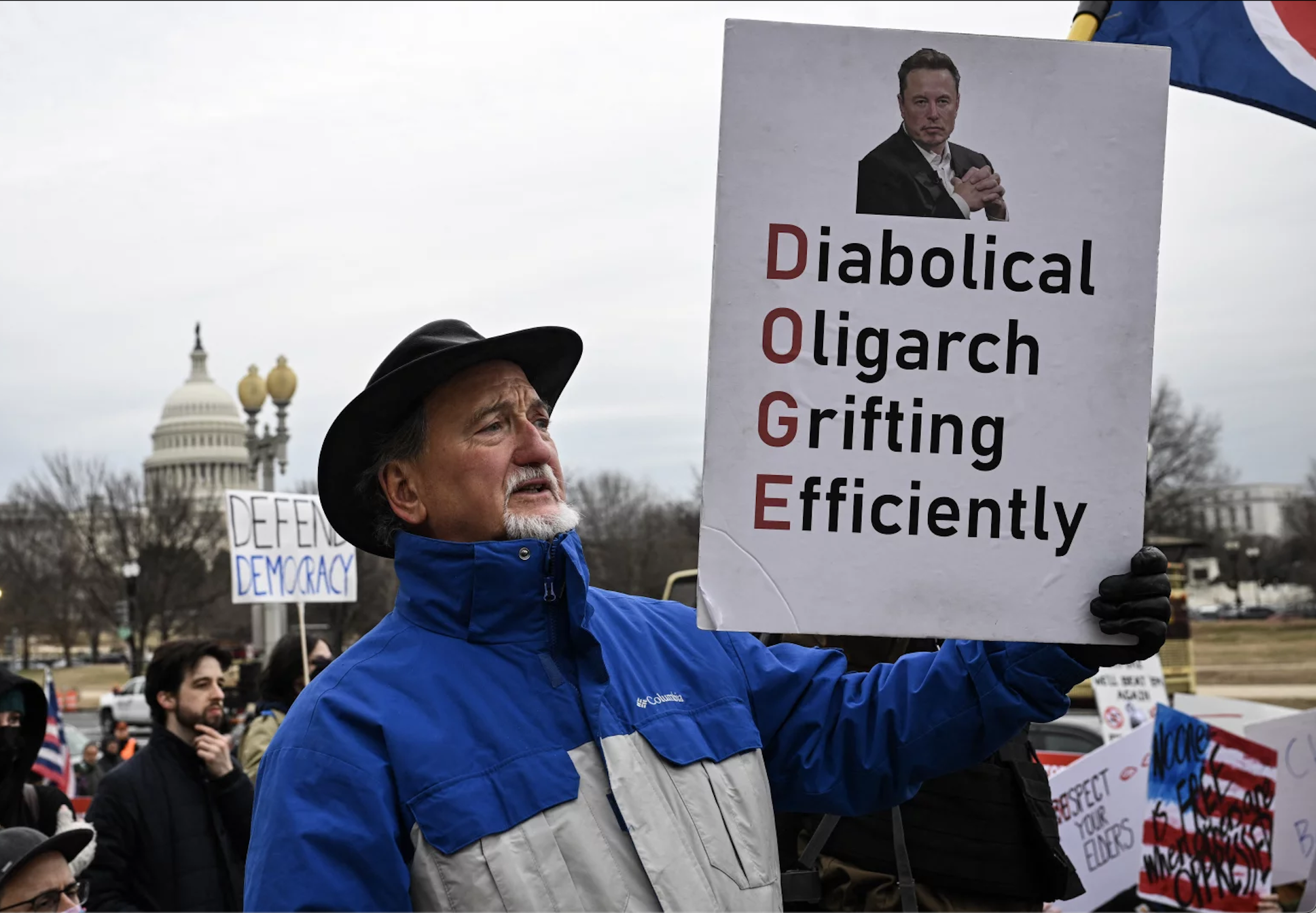
People protest against President Trump and Elon Musk's Department of Government Efficiency (DOGE) near the U.S. Capitol in Washington, D.C., on Feb. 5, 2025. Drew Angerer/AFP
At the root of DOGE’s mission, however, is to not simply reduce government size or even loot public spending (i.e. Musk has received billions in federal subsidies for Tesla, as well as tens of billions more in government contracts and programs). The ultimate goal of Musk/DOGE and reactionary right technocrats accomplices is the replacement of “democratic” government with a corporate state.
Access to the Treasury Department’s system that pays the nation’s bills is not only a concern about personal information and the potential to cut payments to people and entities. Of greater concern is what Mike Brock lays out in excruciating detail in The Plot Against America.
“Inside the newly created Department of Government Efficiency (DOGE), teams of young tech operatives are systematically dismantling democratic institutions and replacing them with proprietary artificial intelligence systems. Civil servants who raise legal objections are being removed. Government databases are being migrated to private servers. Decision-making power is being transferred from elected officials and career bureaucrats to algorithms controlled by a small network of Silicon Valley elites…
“DOGE is not about efficiency. It is about erasure. Democracy is being deleted in slow motion, replaced by proprietary technology and AI models. It is a coup, executed not with guns, but with backend migrations and database wipes.”
Brock goes on to explain the 16-year backstory, beginning with the 2008 financial crisis that led to not only massive financial hardship, but a significant loss of faith in financial and governmental institutions. Techno-libertarian ideologues began shifting their analysis that the ultimate problem was government regulation rather than democracy itself was unstable and inefficient. The solution was a technologically “rational” system, based on artificial intelligence, with governance privatized/corporatized. He explains the roles played by the Tea Party, Zero Hedge, InfoWars/Alex Jones, Steve Bannon and Silicon Valley in creating an anti-democratic alternative culture.
Techno-libertarian ideology gave way to “neoreactionary” ideology, which included the concept of “exiting” or opting out entirely of existing political structures.
“The pipeline from techno-libertarianism to neoreaction often follows a predictable path: It begins with a libertarian critique of government inefficiency and overreach. This evolves into a broader skepticism of all democratic institutions, seen as slow and irrational compared to the speed and logic of technology. Eventually, this leads to the conclusion that democracy itself is an outdated system, incompatible with rapid technological progress. The final step is embracing the idea that democracy should be replaced entirely with more ‘efficient’ forms of governance, often modeled on corporate structures or technological systems…
“This is precisely where libertarianism morphs into neoreaction. Instead of advocating for a constitutional republic with minimal government, this new strain of thought pushes for a private, post-democratic order, where those with the most resources and technological control dictate the rules. In this vision, power doesn’t rest with the people – it belongs to the most competent ‘executives’ running society like a CEO would run a company…
The rise of cryptocurrencies assumed a critical role in this evolution. Musk has been a huge influencer of cryptos, including Dogecoin. Trump’s executive order creating DOGE was a nod to Musk’s support of the meme coin.
Brock explains the connection of cryptocurrencies to this attempted anti-democratic techno-takeover: “What started as a tool for financial freedom became…the foundation for entirely new forms of governance outside traditional state structures. This transformation – from seeing crypto as a means of individual empowerment within existing systems to viewing it as a way to build entirely new political entities – mirrors the broader shift from techno-libertarianism to neo-reaction in Silicon Valley.”
People like Silicon Valley billionaire and J.D. Vance financial backer Peter Thiel “began to see cryptocurrency not just as a new financial instrument, but as a tool for fundamentally restructuring society…
“When Musk gains control of Treasury payment systems, or Trump declares he won't enforce laws he dislikes, they're implementing ideas incubated in the crypto world. The notion that code can replace democratic institutions, that technical competence should override democratic negotiation, and that private power should supersede public authority – these ideas moved from crypto theory to political practice…
“First, remove career officials who might resist on legal or constitutional grounds. Then, install private technical infrastructure that makes oversight impossible. The goal isn’t just to change who runs government agencies – it’s to fundamentally transform how power operates, shifting it from democratic institutions to technical systems controlled by a small elite…
“[T]hese thinkers argued that democracy was inefficient. Then, they created technological tools – cryptocurrency, blockchain governance, and AI-driven decision-making – to bypass democratic institutions entirely. Now, they’re no longer experimenting. They are seizing control of government infrastructure itself, reprogramming it in real-time to function according to their vision.
“This is why focusing solely on the technical aspects of what's happening inside agencies misses the deeper transformation underway. Every unauthorized server, every AI model, every removed civil servant represents another step in converting democratic governance into…a system where society is run like a corporation, with clear ownership and control rather than democratic deliberation. The infrastructure being built isn't meant to serve democratic ends – it's meant to make democracy itself obsolete…
“What’s happening inside the Department of Government Efficiency is the final phase of this plan. The old democratic institutions, weakened by years of deliberate destabilization, are being replaced in real-time by proprietary AI systems controlled not by elected officials, but by the same network of Silicon Valley operatives who engineered the crisis in the first place.”
===
mta 2 25 email
The actions of the Department of Government Efficiency (DOGE), headed up by billionaire Elon Musk, has been among the most controversial of any following its creations by executive order. Exposing and resisting several major actions of DOGE are important. These include the multiple conflicts of interest between Musk and DOGE’s agency targets; efforts to gut agencies (e.g, USAID, the Consumer Financial Protection Bureau, Education Department and EPA), and cutting federal spending of DEI programs, National Institute of Health biomedical research and federal workers. On the horizon are eliminating scores of so-called “inefficient” federal regulations that hinder corporations.
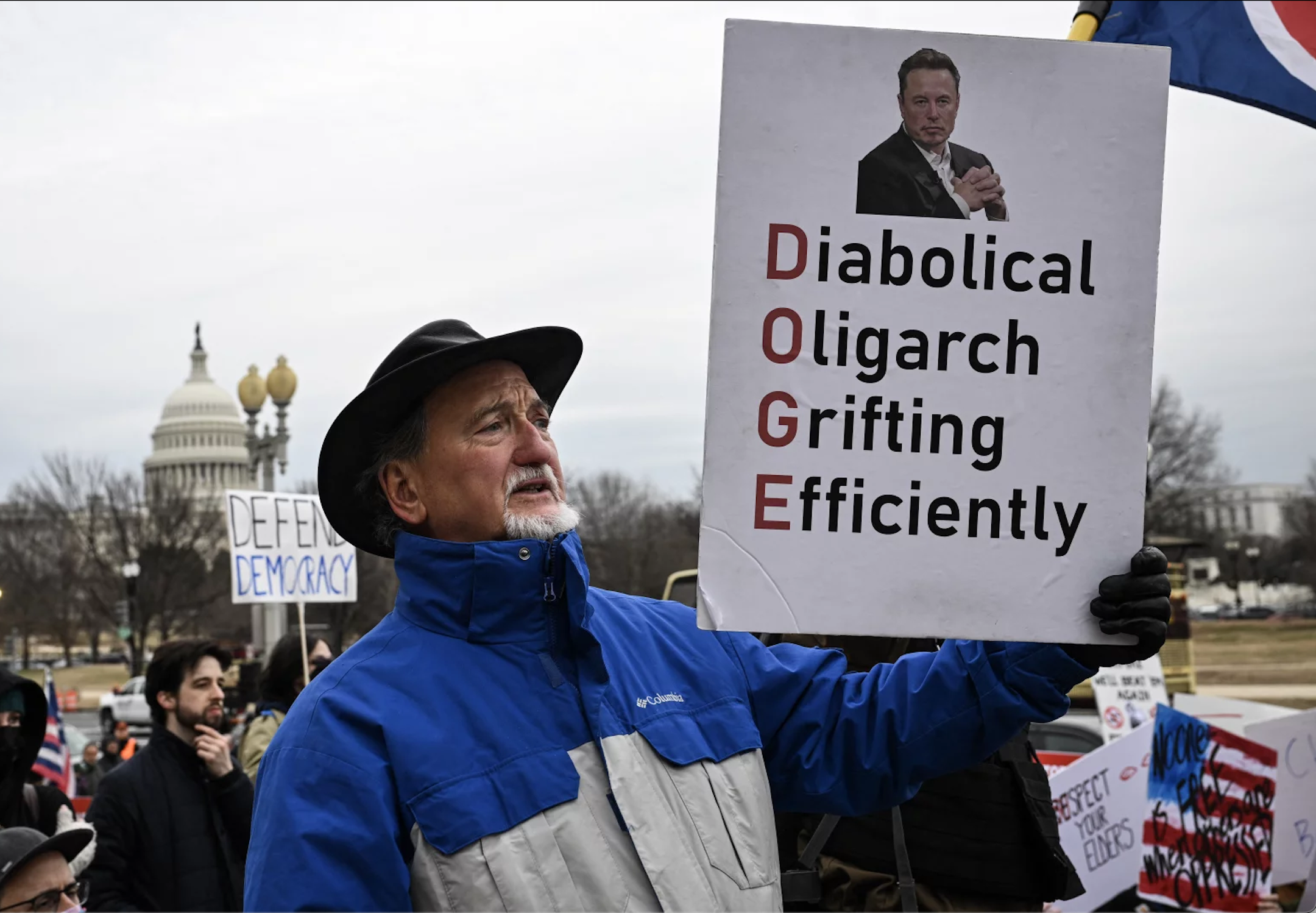
People protest against President Trump and Elon Musk's Department of Government Efficiency (DOGE) near the U.S. Capitol in Washington, D.C., on Feb. 5, 2025. Drew Angerer/AFP
At the root of DOGE’s mission, however, is to not simply reduce government size or even loot public spending (i.e. Musk has received billions in federal subsidies for Tesla, as well as tens of billions more in government contracts and programs). The ultimate goal of Musk/DOGE and reactionary right technocrats accomplices is the replacement of “democratic” government with a corporate state.
Access to the Treasury Department’s system that pays the nation’s bills is not only a concern about personal information and the potential to cut payments to people and entities. Of greater concern is what Mike Brock lays out in excruciating detail in The Plot Against America.
“Inside the newly created Department of Government Efficiency (DOGE), teams of young tech operatives are systematically dismantling democratic institutions and replacing them with proprietary artificial intelligence systems. Civil servants who raise legal objections are being removed. Government databases are being migrated to private servers. Decision-making power is being transferred from elected officials and career bureaucrats to algorithms controlled by a small network of Silicon Valley elites…
“DOGE is not about efficiency. It is about erasure. Democracy is being deleted in slow motion, replaced by proprietary technology and AI models. It is a coup, executed not with guns, but with backend migrations and database wipes.”
Brock goes on to explain the 16-year backstory, beginning with the 2008 financial crisis that led to not only massive financial hardship, but a significant loss of faith in financial and governmental institutions. Techno-libertarian ideologues began shifting their analysis that the ultimate problem was government regulation rather than democracy itself was unstable and inefficient. The solution was a technologically “rational” system, based on artificial intelligence, with governance privatized/corporatized. He explains the roles played by the Tea Party, Zero Hedge, InfoWars/Alex Jones, Steve Bannon and Silicon Valley in creating an anti-democratic alternative culture.
Techno-libertarian ideology gave way to “neoreactionary” ideology, which included the concept of “exiting” or opting out entirely of existing political structures.
“The pipeline from techno-libertarianism to neoreaction often follows a predictable path: It begins with a libertarian critique of government inefficiency and overreach. This evolves into a broader skepticism of all democratic institutions, seen as slow and irrational compared to the speed and logic of technology. Eventually, this leads to the conclusion that democracy itself is an outdated system, incompatible with rapid technological progress. The final step is embracing the idea that democracy should be replaced entirely with more ‘efficient’ forms of governance, often modeled on corporate structures or technological systems…
“This is precisely where libertarianism morphs into neoreaction. Instead of advocating for a constitutional republic with minimal government, this new strain of thought pushes for a private, post-democratic order, where those with the most resources and technological control dictate the rules. In this vision, power doesn’t rest with the people – it belongs to the most competent ‘executives’ running society like a CEO would run a company…
The rise of cryptocurrencies assumed a critical role in this evolution. Musk has been a huge influencer of cryptos, including Dogecoin. Trump’s executive order creating DOGE was a nod to Musk’s support of the meme coin.
Brock explains the connection of cryptocurrencies to this attempted anti-democratic techno-takeover: “What started as a tool for financial freedom became…the foundation for entirely new forms of governance outside traditional state structures. This transformation – from seeing crypto as a means of individual empowerment within existing systems to viewing it as a way to build entirely new political entities – mirrors the broader shift from techno-libertarianism to neo-reaction in Silicon Valley.”
People like Silicon Valley billionaire and J.D. Vance financial backer Peter Thiel “began to see cryptocurrency not just as a new financial instrument, but as a tool for fundamentally restructuring society…
“When Musk gains control of Treasury payment systems, or Trump declares he won't enforce laws he dislikes, they're implementing ideas incubated in the crypto world. The notion that code can replace democratic institutions, that technical competence should override democratic negotiation, and that private power should supersede public authority – these ideas moved from crypto theory to political practice…
“First, remove career officials who might resist on legal or constitutional grounds. Then, install private technical infrastructure that makes oversight impossible. The goal isn’t just to change who runs government agencies – it’s to fundamentally transform how power operates, shifting it from democratic institutions to technical systems controlled by a small elite…
“[T]hese thinkers argued that democracy was inefficient. Then, they created technological tools – cryptocurrency, blockchain governance, and AI-driven decision-making – to bypass democratic institutions entirely. Now, they’re no longer experimenting. They are seizing control of government infrastructure itself, reprogramming it in real-time to function according to their vision.
“This is why focusing solely on the technical aspects of what's happening inside agencies misses the deeper transformation underway. Every unauthorized server, every AI model, every removed civil servant represents another step in converting democratic governance into…a system where society is run like a corporation, with clear ownership and control rather than democratic deliberation. The infrastructure being built isn't meant to serve democratic ends – it's meant to make democracy itself obsolete…
“What’s happening inside the Department of Government Efficiency is the final phase of this plan. The old democratic institutions, weakened by years of deliberate destabilization, are being replaced in real-time by proprietary AI systems controlled not by elected officials, but by the same network of Silicon Valley operatives who engineered the crisis in the first place.”
===
an 1 25
In his farewell address, outgoing US President Joe Biden warned “an oligarchy is taking shape in America of extreme wealth, power and influence that literally threatens our entire democracy”.
The comment suggests that, under Donald Trump’s second term as president, it will be billionaires rather than the people who shape public policy.
There is certainly some evidence Biden’s ominous caution should be taken seriously. The world’s richest man and the owner of X, Elon Musk, has been a vocal supporter of the Republican candidate. Other billionaire tech moguls to visit Trump at his Mar-a-Lago mansion after his 2024 election victory include Meta’s Mark Zuckerberg, Amazon’s Jeff Bezos, Apple’s Tim Cook and Google chief executive Sundar Pichai.
There is nothing unusual about business leaders wanting the ear of an incoming president. What has concerned Biden and others is that so many of Trump’s influential backers also own media platforms and have the ability to sway public opinion.
Should these new tech titans be thought of as oligarchs?
What is an oligarchy?
Like many of the academic and scientific categories we still use today, oligarchy was originally defined by the Greek philosopher Aristotle.
In The Politics, he argued people are “political animals”, social by nature, and instinctively want to live in a community. He studied different governments of the ancient world and concluded there were six essential types.
A state could be ruled by a single leader, a small group of elites, or through mass participation of the people. If the leadership acted in the common advantage (koinê sumpheron), he termed these constitutions to be monarchy, aristocracy or polity, respectively.
If the constitutions became corrupt and the leadership acted only to advance their own self-interest, he labelled them tyranny, oligarchy and democracy.
[
So for Aristotle, an oligarchy is a corrupt form of government. It is when power is in the hands of a small group of elites who advance their own interests rather than the common good.
In Aristotelian terms, democracy is also a corrupt form of government in which the majority uses its power to abuse minorities. While the term democracy has been rehabilitated and is usually seen as a positive, the word oligarchy has retained its negative connotations.
When the United States was created, the founding fathers looked back to Aristotle, Polybius, Cicero and other ancient thinkers to try and create the best kind of constitution.
Following the Aristotelian tradition, they tried to design a mixed constitution where neither the one, the few nor the many could dominate the others. The president has great power. But their power is kept in check by Congress and the judiciary, which is in turn kept in check by the media and, ultimately, the people through regular elections.
Modern oligarchies
In modern politics, the term oligarch is most often used in a Russian context. After the collapse of the Soviet Union in 1991, opportunistic tycoons made enormous fortunes from buying up state assets such as energy companies and financial institutions, which also brought them significant political influence as a result.
Since Vladimir Putin became president in 2000, however, Russia has become increasingly authoritarian. While there is still an oligarchic class, their power has been reined in. They must not challenge Putin’s power or vision for the state.
Although China is ostensibly a communist state, the Gini index (the measure of social inequality) has blown out in recent years as a small group of elites become increasingly wealthy.
Despite the state’s official commitment to socialist principles, political scientist Ming Xia has argued China is now transitioning into a modern oligarchy.
What about the United States and Australia?
Despite Biden’s warning of a potential oligarchy, political scientists Martin Gilens and Benjamin Page argued back in 2014 the US already was one.
The US has the essential features of a liberal democracy (fair and regular elections, freedom of speech, and an independent press). But Gilens and Page worried large businesses and a small group of affluent citizens had a disproportionate influence on policy.
In Australia also, it could be argued an oligarchy is either emerging or has already taken hold.
Australia has a similar-sized economy to Russia and a growing list of billionaires who appear to have significant influence over government policy.
The power of the Murdoch family and their media empire is well-documented. We have also seen increased political activity from other billionaires including Gina Rinehart, Andrew Forrest and Clive Palmer – who went as far as to start his own political party.
There is no question billionaires in the US and Australia have enormous power and influence. But that in itself does not make an oligarchy.
In Aristotelian terms, the defining feature of an oligarchy is the ruling elite blatantly use their status for their own personal gain rather than the public good.
This is a moral judgement, and one that is increasingly hard to make when so many of the ultra-wealthy own traditional news media and social media platforms that can shape public opinion.
Nevertheless, any shift towards oligarchy should be a cause of alarm to all who value the long democratic tradition in both the US and Australia.
Whether it is a symptom of Trumpism, as Biden suggests, or part of a longer trend, strengthening our democratic institutions and curtailing the disinformation and misinformation that are all too prevalent on social media, is part of the solution.
Benjamin T. Jones, Senior Lecturer in History, CQUniversity Australia
This article is republished from The Conversation under a Creative Commons license. Read the original article.
===
---
YiKES OMG SEE FAscism see pluto
an 10 24
Former Washington Post editor-at-large, Robert Kagan, revealed to The Daily Beast on Saturday that the newspaper's owner — Amazon's Jeff Bezos — and 2024 GOP nominee Donald Trump, allegedly agreed on a plan to "kill" thePost's endorsement of 2024 Democratic nominee, Kamala Harris, the news outlet reports.
The Beast notes:
Bezos knows first hand the consequences of criticizing the former president. The Post’s 2016 endorsement of Hillary Clinton is widely thought to have led to him losing out on a $10 billion cloud computing defense contract awarded by the Trump administration.
Following his Friday resignation from thePost,Kagan told the Beast "that Trump’s meeting with executives of Bezos’ Blue Origin space company the same day that the Amazonfounder killed a plan to support Harris was proof of the backroom deal."
READ MORE:['Bit of a panic': Trump adviser’s attack on bombshell WaPo report fact-checked by expert
The ex-Post editor said, "Trump waited to make sure that Bezos did what he said he was going to do, and then met with the Blue Origin people. Which tells us that there was an actual deal made, meaning that Bezos communicated, or through his people, communicated directly with Trump, and they set up this quid pro quo.”
Per the report, Kagan warned that this kind of "alleged collusion between" the billionaire tech founder and Trump "is just the beginning," and emphasized there will be "a lot of self censorship [in the media] and a lot of changing course just to be sure that they’re not going to be punished," if the MAGA leader wins the White House.
"This is what we have to look forward to," Kagan told the Post. "All Trump has to do is threaten the corporate chiefs who run these organizations with real financial loss, and they will bend the knee."
politico 1 25
Trump on Tuesday granted a pardon to Ross William Ulbricht, the imprisoned creator of a dark web marketplace for drugs and other illicit products whose case had become a cause célèbre for libertarians and crypto enthusiasts.
Trump explicitly tied his decision to free Ulbricht, who is serving a life sentence, to the support his campaign drew from people who viewed the Silk Road founder as a pioneer and victim of government persecution.
“I just called the mother of Ross William Ulbricht to let her know that in honor of her and the Libertarian Movement, which supported me so strongly, it was my pleasure to have just signed a full and unconditional pardon of her son,” the president wrote on Truth Social.
He also compared Ulbricht’s treatment by authorities to the investigations that have dogged him in recent years.
“The scum that worked to convict him were some of the same lunatics who were involved in the modern day weaponization of government against me,” he said.
In 2015, Ulbricht, who called himself the Dread Pirate Roberts, was sentenced in Manhattan federal court to life in prison for owning and operating Silk Road, the dark web marketplace for buying and selling drugs and other illegal goods. It gained a following among crypto enthusiasts and libertarians in part for being an early user of Bitcoin and challenging governmental authority.
Silk Road had thousands of listings for over 200 million dollars worth of narcotics, which were sold and distributed across more than 10 different countries.
Trump previously said he would commute Ulbricht’s sentence “on Day One” at the Libertarian National Convention in 2024. It came a day after he granted clemency to nearly 1,600 people charged or convicted for storming the Capitol on Jan. 6, 2021.
===
an 12 24
coinbase's plan to go public last April highlights a troubling trend among tech companies: Its founding team will maintain voting control, making it mostly immune to the wishes of outside investors.
The best-known U.S. cryptocurrency exchange is doing this by creating two classes of shares. One class will be available to the public. The other is reserved for the founders, insiders and early investors, and will wield 20 times the voting power of regular shares. That will ensure that after all is said and done, the insiders will control 53.5% of the votes.
Coinbase will join dozens of other publicly traded tech companies – many with household names such as Google, Facebook, Doordash, Airbnb and Slack – that have issued two types of shares in an effort to retain control for founders and insiders. The reason this is becoming increasingly popular has a lot to do with Ayn Rand, one of Silicon Valley's favorite authors, and the “myth of the founder" her writings have helped inspire.
Engaged investors and governance experts like me generally loathe dual-class shares because they undermine executive accountability by making it harder to rein in a wayward CEO. I first stumbled upon this method executives use to limit the influence of pesky outsiders while working on my doctoral dissertation on hostile takeovers in the late 1980s.
But the risks of this trend are greater than simply entrenching bad management. Today, given the role tech companies play in virtually every corner of American life, it poses a threat to democracy as well.
All in the family
Dual-class voting structures have been around for decades.
When Ford Motor Co. went public in 1956, its founding family used the arrangement to maintain 40% of the voting rights. Newspaper companies like The New York Times and The Washington Post often use the arrangement to protect their journalistic independence from Wall Street's insatiable demands for profitability.
In a typical dual-class structure, the company will sell one class of shares to the public, usually called class A shares, while founders, executives and others retain class B shares with enough voting power to maintain majority voting control. This allows the class B shareholders to determine the outcome of matters that come up for a shareholder vote, such as who is on the company's board.
Advocates see a dual-class structure as a way to fend off short-term thinking. In principle, this insulation from investor pressure can allow the company to take a long-term perspective and make tough strategic changes even at the expense of short-term share price declines. Family-controlled businesses often view it as a way to preserve their legacy, which is why Ford remains a family company after more than a century.
It also makes a company effectively immune from hostile takeovers and the whims of activist investors.
Checks and balances
But this insulation comes at a cost for investors, who lose a crucial check on management.
Indeed, dual-class shares essentially short-circuit almost all the other means that limit executive power. The board of directors, elected by shareholder vote, is the ultimate authority within the corporation that oversees management. Voting for directors and proposals on the annual ballot are the main methods shareholders have to ensure management accountability, other than simply selling their shares.
Recent research shows that the value and stock returns of dual-class companies are lower than other businesses, and they're more likely to overpay their CEO and waste money on expensive acquisitions.
Companies with dual-class shares rarely made up more than 10% of public listings in a given year until the 2000s, when tech startups began using them more frequently, according to data collected by University of Florida business professor Jay Ritter. The dam began to break after Facebook went public in 2012 with a dual-class stock structure that kept founder Mark Zuckerberg firmly in control – he alone controls almost 60% of the company.
In 2020, over 40% of tech companies that went public did so with two or more classes of shares with unequal voting rights.
This has alarmed governance experts, some investors and legal scholars.
Ayn Rand and the myth of the superhuman founder
If the dual-class structure is bad for investors, then why are so many tech companies able to convince them to buy their shares when they go public?
I attribute it to Silicon Valley's mythology of the founder –- what I would dub an “Ayn Rand theory of corporate governance" that credits founders with superhuman vision and competence that merit deference from lesser mortals. Rand's novels, most notably “Atlas Shrugged," portray an America in which titans of business hold up the world by creating innovation and value but are beset by moochers and looters who want to take or regulate what they have created.
Perhaps unsurprisingly, Rand has a strong following among tech founders, whose creative genius may be “threatened" by any form of outside regulation. Elon Musk, Coinbase founder Brian Armstrong and even the late Steve Jobs all have recommended “Atlas Shrugged."
Her work is also celebrated by the venture capitalists who typically finance tech startups – many of whom were founders themselves.
The basic idea is simple: Only the founder has the vision, charisma and smarts to steer the company forward.
It begins with a powerful founding story. Michael Dell and Zuckerberg created their multibillion-dollar companies in their dorm rooms. Founding partner pairs Steve Jobs and Steve Wozniak and Bill Hewlett and David Packard built their first computer companies in the garage – Apple and Hewlett-Packard, respectively. Often the stories are true, but sometimes, as in Apple's case, less so.
And from there, founders face a gantlet of rigorous testing: recruiting collaborators, gathering customers and, perhaps most importantly, attracting multiple rounds of funding from venture capitalists. Each round serves to further validate the founder's leadership competence.
The Founders Fund, a venture capital firm that has backed dozens of tech companies, including Airbnb, Palantir and Lyft, is one of the biggest proselytizers for this myth, as it makes clear in its “manifesto."
“The entrepreneurs who make it have a near-messianic attitude and believe their company is essential to making the world a better place," it asserts. True to its stated belief, the fund says it has “never removed a single founder," which is why it has been a big supporter of dual-class share structures.
Another venture capitalist who seems to favor giving founders extra power is Netscape founder Marc Andreessen. His venture capital firm Andreessen Horowitz is Coinbase's biggest investor. And most of the companies in its portfolio that have gone public also used a dual-class share structure, according to my own review of their securities filings.
Bad for companies, bad for democracy
Giving founders voting control disrupts the checks and balances needed to keep business accountable and can lead to big problems.
WeWork founder Adam Neumann, for example, demanded “unambiguous authority to fire or overrule any director or employee." As his behavior became increasingly erratic, the company hemorrhaged cash in the lead-up to its ultimately canceled initial public offering.
Investors forced out Uber's Travis Kalanick in 2017, but not before he's said to have created a workplace culture that allegedly allowed sexual harassment and discrimination to fester. When Uber finally went public in 2019, it shed its dual-class structure.
There is some evidence that founder-CEOs are less gifted at management than other kinds of leaders, and their companies' performance can suffer as a consequence.
But investors who buy shares in these companies know the risks going in. There's much more at stake than their money.
What happens when powerful, unconstrained founders control the most powerful companies in the world?
The tech sector is increasingly laying claim to central command posts of the U.S. economy. Americans' access to news and information, financial services, social networks and even groceries is mediated by a handful of companies controlled by a handful of people.
Recall that in the wake of the Jan. 6 Capitol insurrection, the CEOs of Facebook and Twitter were able to eject former President Donald Trump from his favorite means of communication – virtually silencing him overnight. And Apple, Google and Amazon cut off Parler, the right-wing social media platform used by some of the insurrectionists to plan their actions. Not all of these companies have dual-class shares, but this illustrates just how much power tech companies have over America's political discourse.
One does not have to disagree with their decision to see that a form of political power is becoming increasingly concentrated in the hands of companies with limited outside oversight.
Jerry Davis, Fellow at the Center for Advanced Study in the Behavioral Sciences at Stanford and Professor of Management and Sociology, University of Michigan
This article is republished from The Conversation under a Creative Commons license. Read the original article.
pro pub 7 24
...“There’s a perceived gap of ‘We aren’t getting the support from big-name, big-dollar donors that we deserve and want and need.’”
That’s where Ziklag comes in.
Speaking late last year to an invitation-only gathering of Ziklaggers, as members are known, Charlie Kirk, who leads the pro-Trump Turning Point USA organization, named left-leaning philanthropists who were, in his view, funding the destruction of the nation: MacKenzie Scott, ex-wife of Amazon founder Jeff Bezos; billionaire investor and liberal philanthropist George Soros; and the two founders of Google, Larry Page and Sergey Brin.
“Why are secular people giving more generously than Christians?” Kirk asked, according to a recording of his remarks. “It would be a tragedy,” he added, “if people who hate life, hate our country, hate beauty and hate God wanted it more than us.”
“Ziklag is the place,” Kirk told the donors. “Ziklag is the counter.”
...
---
ny CNN 7 24
The Bay Area has long been, and remains, a hippie-dippie bastion of Democrats who voted overwhelmingly for Hillary Clinton in 2016 and Joe Biden in 2020. But there’s a small, powerful sect of Silicon Valley billionaires who are carving a path for the maybe-Trumpers and the MAGA-curious in the tech world.
Elon Musk explicitly endorsed Trump over the weekend and, according to The Wall Street Journal, inked a nine-figure donation promise to a new pro-Trump political action committee called America PAC. David Sacks, the billionaire tech investor, co-hosted a fundraiser last month at his San Francisco home and spoke at the Republican National Convention on Monday. Other contributors to America PAC include the Winklevoss twins, Doug Leone of Sequoia Capital and Palantir co-founder Joe Lonsdale, according to Federal Election Commission filings.
In the last election cycle, the few Trump backers who existed in the Valley largely kept their support under the radar. Their numbers are still small, but they’re no longer hiding, and their wallets are open.
So, what’s gotten into these guys?
For one, there might not be as many Trump supporters in the tech world as you might think.
“A mythology has been marketed by partisans suggesting a non-existent surge of tech titans abandoning the Democratic party support in a rush to support the Trump/Vance campaign. The truth is that most leading tech figures do not support Trump/Vance and those prominent ones who do, were there years ago as well,” Jeffrey Sonnenfeld, dean for leadership studies at the Yale School of Management, told CNN.
And for the ones you might have heard of, most likely, it’s not a sudden fervor for the far right’s Christian extremism or a predilection for red baseball caps. Instead, they’re looking out for the bottom line.
The two biggest pain points for people in tech have been the Biden administration’s record on antitrust enforcement and its attitude toward crypto, Adam Kovacevich, CEO of Chamber of Progress, a center-left tech policy group, told me.
“I don’t think it has as much to do with Trump per se,” he said. “I think they would have probably stayed with Biden if they felt more care and attention was being paid to the innovation economy.”
In other words: It’s not that the billionaires love Trump, it’s that they really don’t like Lina Khan, President Joe Biden’s top antitrust crusader; or Gary Gensler, the Wall Street cop who’s made no secret of his hostility toward digital assets.
Lina Khan, the FTC chair, has led an aggressive antitrust campaign, specifically targeting Big Tech.
Kevin Dietsch/Getty Images
In recent years, Khan has spearheaded lawsuits against Amazon, Microsoft and Meta. In an interview with CNN last year, Khan described those efforts as part of a broader campaign to bring more of the government’s resources to bear on the daily economic problems of ordinary Americans.
But government regulation, however well intentioned, rarely sits well with the people who are getting rich off the status quo.
Two of the most famous venture capitalists in the Valley, Marc Andreessen and Ben Horowitz, have committed to donating to America PAC, according to several news outlets.
The pair haven’t exactly been hiding their frustration with the Biden administration, either.
“The American government is now far more hostile to new startups than it used to be,” they wrote in a recent blog post, which cited regulatory agencies using “brute force investigations, prosecutions, intimidation, and threats to hobble new industries.” They also lamented the Biden administration’s proposed tax on unrealized capital gains, which they said would “absolutely kill” startups and the venture capital industry.
One person familiar with their plans told the Financial Times that their pivot to Trump was because “there is so much at stake on the crypto side” and the growth of artificial intelligence. “It doesn’t mean support for (Trump’s) views on immigration,” the person told the paper.
Historically, Trump hasn’t shown a lot of love for tech bros, whose social media companies he long accused of having anti-conservative bias, especially after several of them suspended his accounts in response to the January 6, 2021, attack on the Capitol. But the recent influx of tech money — facilitated in part by his 39-year-old venture-capitalist VP pick — appears to have softened some of Trump’s Luddite-ish views.
As recently as 2021, he called bitcoin a “scam against the dollar.” Lately, though, he’s positioning himself as the crypto-friendly candidate. While his campaign hasn’t laid out specific policy proposals around digital assets, it began accepting crypto donations this spring, and Trump is scheduled to speak at a national bitcoin conference next week.
The Biden administration, meanwhile, is working to mend ties with industry leaders who say they’ve been stymied by the SEC and Gensler, generally agreed to be the crypto community’s Voldemort.
To be sure, plenty of Big Tech dollars are still flowing to Biden and down-ballot Democrats from tech-world donors, including LinkedIn founder Reid Hoffman and Google co-founder Eric Schmidt. But Trump’s gains from Silicon Valley have come just as some major Democratic donors have hit pause amid conversations about replacing the president on the ballot.
And, as Kovacevich notes, just because there are a few big names turning toward Trump, “they’re not speaking for everybody.”
“In fact, most of the big company CEOs aren’t terribly involved in partisan politics,” Kovacevich says. “They’re going to have to work with whoever wins the election.”
April 26, 2024
- Travis Gettys @ Raw Story: ‘I hated that dog’: Kristi Noem recalls gunning down family’s ‘worthless’ pup
South Dakota Gov. Kristi Noem, a frontrunner to be named as Donald Trump’s running mate, admitted to killing her family dog for misbehavior.
- Christian Right Observer Weekly: Volume 13
CROW’s 7 stories on the Christian Right that you need read this week.
- David Gilbert @ Wired: No, a Shadowy Figure Is Not Buying Tents for Columbia Student Protesters
Conspiracies about outside forces funding and orchestrating the university protests at Columbia and NYU have taken hold online, primarily on X.
- Media Matters: On Steve Bannon’s show, Mike Davis threatens to “rain hell on these Biden Democrats” and warns them to “lawyer up”
Davis calls Trump criminal trial “lawfare” and threatens “the most severe legal, political and financial consequences come January 20, 2025.”
- Joe Jervis: Judge Upholds $360,000 Judgment Against Kim Davis
A federal judge denied an appeal by former Rowan County clerk Kim Davis. Davis made national headlines when she refused to issue marriage licenses to same-sex couples while acting as Rowan County clerk in 2015.
- Gil Duran @ The New Republic: The Tech Baron Seeking to “Ethnically Cleanse” San Francisco
> To fully grasp the current situation in San Francisco, where venture capitalists are trying to take control of City Hall, you must listen to Balaji Srinivasan. Before you do, steel yourself for what’s to come: A normal person could easily mistake his rambling train wrecks of thought for a crackpot’s ravings, but influential Silicon Valley billionaires regard him as a genius.
===
local-communities-not-on-board-with-tech-billionaires-planned-utopia
hmn /aha no longer any meaningful distinction between sil vly CA and rest of corp america?
following USK libtard lead? he gives them cover to bail of disinfo de-platform? many layoffs (why, aside from musk bad deal)? SV bank fail?
bad actors, all give up?
ggl owns youtube
6 23
Media Matters Vice President Julie Millican released the following statement after Axios reported that YouTube has reversed its election integrity policy and will no longer prohibit “content that says fraud, errors or glitches occurred in the 2020 presidential election and other U.S. elections.”
YouTube’s announcement today that they will resume allowing bad actors to lie about the 2020 presidential election result comes as no surprise. YouTube was one of the last major social media platforms to keep in place a policy attempting to curb 2020 election misinformation. Now, it’s decided to take the easy way out by giving people like Donald Trump and his enablers free rein to continue to lie without consequence about the 2020 elections.
YouTube and the other platforms that preceded it in weakening their election misinformation policies, like Facebook, have made it clear that one attempted insurrection wasn’t enough. They’re setting the stage for an encore.
YouTube initiated its election integrity policy in December of 2020, beginning to prohibit claims of widespread fraud in that election. The platform did not employ similar policies prohibiting such claims for the 2022 midterms.
---
OMG did this BS soc media bias campaign win? after musk bought twit, horrible deal/error so he had to dump employees, and safety is most $? and he is least amenable --> edgelord; gave cover for all to sell out:
musk gets credit?
mma 6 23
youTube’s decision to permit content promoting election conspiracy theories and misinformation is being heralded by right-wing media and figures as a win for “free speech.”
The platform confirmed to Axios on June 2 that it would allow users to upload content claiming that “fraud, errors or glitches occurred in the 2020 presidential election and other U.S. elections.” The decision reverses a December 2020 election integrity policy, which the company reportedly felt could have the effect of “curtailing political speech without meaningfully reducing the risk of violence or other real-world harm."
On Friday, Media Matters’ Julie Millican released a statement condemning the decision: “YouTube and the other platforms that preceded it in weakening their election misinformation policies, like Facebook, have made it clear that one attempted insurrection wasn’t enough. They’re setting the stage for an encore.”
In March, YouTube reinstated former President Donald Trump’s account– which was suspended following the January 6 attack on the Capitol – despite his continued attempts to push the election misinformation that resulted in real-world violence. The decision to allow election conspiracy theories to circulate on the platform recklessly ignores social media as a major factor in the deadly insurrection.
Some right-wing media outlets and figures are celebrating the policy change, claiming that it’s a win for conservatives, who falsely claim that social media platforms are censoring them. Others have also linked the decision to Elon Musk rolling back content moderation policies on Twitter,with some saying Musk paved the way for YouTube’s decision.
Right-wing outlets and figures celebrated that election conspiracy theories will be allowed on the platform again
- Reacting to the news, “Stop the Steal” organizer Ali Alexanderdeclared on Telegram that “Stop the Steal prevails.”
- Right Side Broadcasting reporter Liz Willistweeted: “HUGE - YouTube reverses ‘election misinformation policy,’ allows people to discuss the fraudulent 2020 election.”
- Former Epoch Times columnist-turned-QAnon influencerBrian Catescelebrated the news on Telegram, saying, “First they mock and ridicule you. Then they angrily call you a bigot and a liar. Then they ban you. Then they admit you were right and THEN YOU WIN.”
- Notorious election deniers and founders of True the Vote Catherine Engelbrecht and Gregg Phillipstweeted about the news, saying of YouTube: “Just figured out they committed billions of federal crimes? …nope just figured out they lost 1/2 of Americas eyeballs and the money that comes with them.”
- Following the policy reversal, the QAnon account Badlands Mediasuggested the account would post election misinformation on YouTube, saying, “Let's see if YouTube is actually going to backtrack on censorship. If you're on there, be sure to subscribe to Badlands Media! We'll be putting it to the test.”
- Gateway Pundit writer and Badlands Media host Brian Lupo, who is known online as “CannCon” and was allegedly banned from YouTube in June 2021 for posting election misinformation, celebrated YouTube’s policy reversal. Lupo declared on Twitter, “YouTube back in play!!!!”
Right-wing media figures and outlets praised Musk for “moving the needle” and implied his actions influenced YouTube’s decision
- On Twitter, right-wing influencer ALXcredited Musk for YouTube’s decision, saying, “Last week, YouTube reversed their policy on talking about election fraud just as Twitter has been focusing on long form content. … Twitter is moving the needle and forcing other platforms to swing toward Free Speech.”
- Cheering on YouTube’s move, Judicial Watch President Tom Fitton tweeted that the decision was a sign “of the impact of @ElonMusk's free speech reforms.”
- On Twitter, former Fox Business host Trish Regan asked if YouTube made the decision because the platform is “worried about Twitter competition.”
- The right-wing outlet Epoch Times:{e}:mphasized Musk in coverage of YouTube’s policy reversal and parroted Musk’s framing that he is a free speech “‘absolutist’ … who took over Twitter last year with a pledge to remove political bias from the platform and make it more balanced.”
===
===
google and apple cave on navalny voting app
with apple pulled navalny voting app russia vlad cave/fail hid behind TOS?
maps makes crimea part of russia 1119
===
===
https://cleantechnica.com/2019/10/23/google-spends-millions-on-climate-denial/
===
https://www.alternet.org/2022/12/elon-musk-right-destroy-twitter/
an 12 22
You break it, you own it. That’s what I was told as a child. But for today’s billionaires, it seems like the opposite is true.
“You own it, you can break it” — at least if you’re rich enough.
Just look at Elon Musk.
He paid a fortune for Twitter and is now busily destroying it — firing half its employees and driving out even more, causing chaos on the platform, making advertisers flee, and threatening bankruptcy.
Or consider Sam Bankman-Fried,who became a billionaire after founding the popular cryptocurrency exchange FTX— until he drove the company into bankruptcy.
Seems FTX was a Ponzi scheme that got out of hand. At least $1 billion in customer funds is reportedly missing.
These billionaires are presumed to be free from responsibility because they own what they’ve had a hand in destroying. So under the rules of capitalism, they have a right to do whatever they want with their money. Right?
Wrong. Millions have come to rely on Twitter as a vital source of information and connection. Investors put their money — and trust — in FTX. These people aren’t mere collateral damage. They’re bearing a big part of the cost.
“You own it, you can break it” is a careless norm for a complex society.
Do we really think that the super-wealthy should be allowed to control so much wealth and wield so much influence?
Absolutely not. We need stronger laws protecting the rest of us from the recklessness of these so-called “disruptors.” [vid]
===
===
https://theintercept.com/2022/10/01/roe-amazon-google-facebook-independent-womens-forum/
WHEN THE Supreme Court overturned Roe v. Wade, the country’s top internet companies quickly responded with commitments to help employees in states that moved to ban abortion. In an implicit signal of support for abortion rights, the companies said they would help those employees seek abortions in states where the procedure remains legal.
In the years leading up to the seismic reproductive rights decision, however, the tech giants sponsored a controversial group that’s worked tirelessly to put the Supreme Court under conservative control, setting the stage for Roe’s reversal.
The Independent Women’s Forum traces its origins back to the 1991 fight to confirm the Supreme Court nomination of Clarence Thomas. Since then, the group has expanded into promoting a litany of perennial right-wing causes like climate denial, immigration alarmism, and deregulation, but a conservative-dominated Supreme Court remained a focus.
public relations plays a key role in its operation. With savvy self-branding as a pro-woman organization, the group fought for the appointment of conservative justices to the Supreme Court. The IWF couched support for Brett Kavanaugh as good feminism and any opposition to Amy Coney Barrett as sexism — despite well-founded concerns that their ascensions to the court would spell the end of Roe. The IWF wields a skillful mix of media placement, op-eds, television punditry, and other contributions to the conservative content ecosystem.
The group also takes advantage of quieter influence peddling as well. In 2020, IWF chief and Vicks VapoRub heiress Heather Higgins boasted to a closed audience of Virginia conservatives about how instrumental the group was in rallying congressional support for Kavanaugh’s nomination. Higgins told the group that the IWF circulated a confidential strategy memo on the Hill. “Most important,” Higgins said, “Susan Collins told me that without that memo, she would not see how to support him,” referring to the Republican senator from Maine.

Related
The Dark Money-Funded Women’s Group Rallying Behind Amy Coney Barrett
Independent Women’s Forum and its sister organization, Independent Women’s Voice, draw on donations from right-wing financial mainstays like the Koch brothers, but in recent years the groups have enjoyed financial support from Facebook’s parent company, Meta; Google; and Amazon. In 2017, Google sponsored an IWF gala at the “gold” donor level, according to brochures provided to The Intercept by True North Research, a progressive watchdog group. Other brochures show that Meta (which at the time still using the name Facebook) sponsored IWF galas in 2018, alongside Google, and 2019. Honorees at IWF events have included notable anti-abortion figures like Rep. Lynne Cheney, R-Wy.; top Trump administration official Kellyanne Conway; and Vice President Mike Pence.
Corporate disclosures from Amazon show that the company donated undisclosed sums to the IWF in 2018, 2019, and 2020.
Amazon, Google, Meta, and the IWF did not respond to a request for comment.
True North founder Lisa Graves characterized the IWF’s efforts as an attempt to launder conservative ideology. “They act as a distaff,” she said in an interview, “in essence providing a woman’s face for the right wing’s critique or attack on progressives and its advance of this extreme and regressive, repressive agenda.”
DESPITE THE PUBLIC perception of Silicon Valley’s alignment with progressive values and liberal causes, tech companies, particularly those fearing state regulation, have long funneled money to right-wing groups like the IWF. At the same time, the IWF routinely pushes policy positions that are highly favorable to its corporate donors.
The IWF has consistently espoused tech industry-friendly positions on labor, antitrust, and other issues, without disclosing its donors’ interests. Take, for example, an April IWF blog post that warned that antitrust enforcement against Big Tech would prove disastrous. “Tech innovation has been nothing short of miraculous over the past few decades,” wrote Patrice Onwuka,director of IWF’s Center for Economic Opportunity and its go-to defender of powerful tech firms.
Few issues in tech have galvanized the IWF and Onwuka like the bipartisan American Innovation and Choice Online Act, which would block tech companies from leveraging their enormous reach to favor their own services over competitors. In a December 2021 piece titled “Amazon Prime may not be around to save the day next Christmas,” Onwuka claimed, “Senator Amy Klobuchar and others are on a path to end services like Prime’s fast and free shipping and other services that we depend upon.” Onwuka then linked to a blog post by the Amazon-funded Chamber of Progress that claimed, dubiously, that the law would “ban Amazon Prime.”
In June, Onwuka wrote a jeremiad against congressional antitrust efforts:“The conveniences that make life and work easier and faster and save consumers money may disappear.” Later that day, Onwuka appeared on Fox Business, again protesting antitrust enforcement against the tech industry. “I’m more worried about the impact on small business owners and on women and families that rely on some of the benefits that some of these big four tech companies provide,” she said.
While shielding Big Tech from antitrust scrutiny has proven a priority for the IWF, the group also stands up directly for its benefactors. In 2019, Onwuka wrote an entire post dedicated sticking up for Meta CEO Mark Zuckerberg after Politico reported that he had attended dinners with notable conservative commentators and lawmakers. “Zuckerberg is a private citizen who can eat dinner with whomever he wants,” Onwuka wrote. “His dinner has a clear business purpose and that’s part of doing business.”
“Institutionally they have no position on abortion, that’s their stated position. But organizationally, they have backed the most aggressive anti-choice slate of judges we’ve ever seen.”
The cordial treatment of industry giants is of course a linchpin of conservatism, and the IWF would almost certainly be warning that antitrust will bring us back to the Bronze Age even without Google sponsoring its gala dinners. But fueling the right-wing punditry mill is a large, ever-expanding facet of Big Tech’s political strategy.
While there’s no evidence that Zuckerberg or Google CEO Sundar Pichai have any personal opposition to abortion access, their companies no doubt benefit from their support of a broad, thriving conservative discourse ecosystem in which any government regulation is anathema. For tech company leadership, the reality that this ecosystem pushes not just Facebook-friendly laissez-faire economics, but also climate denial and abortion bans is considered a perhaps unfortunate but worthwhile byproduct.
Silicon Valley’s patronage of right-wing think tanks and campaigns is an arrangement in which there is ample plausible deniability to go around. When The Guardian reported in 2019 that Google was donating to some of the nation’s most notorious climate-denial organizations, a company spokesperson retorted, “We’re hardly alone among companies that contribute to organizations while strongly disagreeing with them on climate policy.”
The multitude of topics on which the IWF engages, and its careful avoidance of publicly opposing abortion access have helped it avoid a reputation as an anti-abortion group. “Institutionally they have no position on abortion, that’s their stated position,” explained Graves, of True North. “But organizationally, they have backed the most aggressive anti-choice slate of judges we’ve ever seen.”
===
===
an 10 22
It turns out that many of today’s billionaires are selfish, lonely men fantasizing about how they will survive the end times they have played a part in creating.
In mid-September, for just a few days, Indian industrialist Gautam Adani entered the ranks of the top three richest people on earth as per Bloomberg’s Billionaires Index. It was the first time an Indian, or, for that matter, an Asian, had enjoyed such a distinction. South Asians in my circle of family and friends felt excited at the prospect that a man who looked like us had entered such rarefied ranks.
This article was produced by Economy for All, a project of the Independent Media Institute.
Adani was deemed the second richest person, even richer than Amazon founder Jeff Bezos! A Times of India profile fawningly quoted him relaying his thought process in the early days of his rags-to-riches story. “‘Dreams were infinite but finances finite,’ he says with engaging frankness,” according to the profile. There was no mention of the serious accusations he faces of corruption and diverting money into offshore tax havens, or of the entire website, AdaniWatch, devoted to investigating his dirty deeds.
Adani made his money, in part, by investing in digital services, leading one economist to say, “Wherever there is a futuristic business in India, I think… [Adani] has a stronghold.”
The moment of pride that Indians felt in such an achievement by one of their own was short-lived. Quickly Adani slipped from second richest to third richest, and, as of this writing, is in the number four slot on a list dominated by people who have made money from the digital technology revolution.
In fact, ranking multibillionaires is a meaningless exercise that obscures the absurdity of their wealth. This year alone, a number of tech billionaires on Bloomberg’s list lost hundreds of billions of dollars as the gains they made during the early years of the pandemic were wiped out because of a volatile stock market. But, as Whizy Kim of Vox points out, whether or not they’re losing money or giving it away—as Bezos’ ex-wife MacKenzie Scott has been doing—their wealth remains insanely high, and most are worth more today than before the COVID-19 pandemic.
What are they doing with all this wealth?
It turns out that many are quietly plotting their own survival against our demise. Douglas Rushkoff, podcaster, founder of the Laboratory for Digital Humanism, and fellow at the Institute for the Future, has written a book about this bizarre phenomenon, Survival of the Richest: Escape Fantasies of the Tech Billionaires.
In an interview, Rushkoff explains that billionaires worry about the end of humanity just like the rest of us. They fear catastrophic climate change or the next pandemic. And, they know their money will likely be of little value when civilizations decline. “How do I maintain control over my Navy Seal security guards once my money is worthless?” is a question that Rushkoff says many of the world’s wealthiest people want to know the answer to.
He knows they ask such questions because he was invited to give private lectures by those who think his expertise in digital technology gives him unique insight into the future. But Rushkoff was quietly studying them instead and has few flattering things to say about these wielders of economic power.
“How is it that the wealthiest and most powerful people I’d ever been in the same room with see themselves as utterly powerless to affect the future?” he asks. It seems as though “the best they can do is prepare for the inevitable calamity and then just, you know, hang on for dear life.”
Rushkoff explores this tech billionaire “mindset” that he says has resulted in a generation of people who are “almost comedic monsters, who really mean to leave us all behind.” Adani is a perfect example of this, having invested in the very fossil fuels that are destroying our planet. He has large holdings in Australia’s coal mining industry and has sparked a massive grassroots movement intent on stopping him.
The admiration that some Indians feel for Adani’s ascension on Bloomberg’s list of billionaires is based on an assumption of cleverness. Surely, he must be one of the smartest people in the world in order to be one of the richest? Elon Musk, the world’s wealthiest man by far (with twice as much wealth as Bezos), has enjoyed such a reputation for years.
Those who are invested in the idea of merit-based capitalism can justify the unimaginable wealth of the world’s richest people only by assuming they are intelligent enough to deserve it.
This is a façade. Rather than smarts, the wealthiest people on the planet appear to be rather small-minded idiot savants who share a common disdain for the rest of us.
After being around tech billionaires in private, Rushkoff concludes that they are invested in “this notion that they really can, like puppeteers, kind of control society from one level above,” and that this approach is “different than the era of Alexander the Great, or Caesar.” If the question that vexes them most of all is how, in a disastrous future, will they control the guards they hire to protect their hoardings, then our economic system is a farce.
“Even if we call them genius technologists, most of them were plucked from college when they were freshmen,” says Rushkoff. “They came up with some idea in their dorm room before they’d taken history, or economics, or ethics, or philosophy” classes, and so they lack the wisdom needed to oversee their own perverse amounts of wealth.
Having spent time with many tech billionaires, Rushkoff worries that “their education about the future comes from zombie movies and science fiction shows.”
Billionaires are not simply drawing their wealth from a vacuum. According to data from the World Economic Forum, “the world’s richest have captured a disproportionate share of global wealth over recent decades.” This means that, if you were rich to begin with a decade or two ago, you are likely to have seen your wealth multiply by a greater amount than middle-class or lower-income people.
Not only are tech billionaires undeserving of their wealth, but they also are fleecing the rest of us—and fantasizing about hoarding that wealth in the worst-case scenarios while the rest of humanity struggles to survive.
The danger is that if society valorizes such (mostly) men, we are in danger of internalizing their childish, selfish mindset and giving up on solving the climate crisis or building resiliency on a mass scale.
Instead of relating to them, we ought to feel sorry for a group of people so cut off from humanity that their vision of the future is a very lonely one.
“Let’s look at these tech-bro billionaire lunatics. Let’s laugh at what they’re doing… so they look small rather than big,” says Rushkoff. He thinks it is critical to adopt the perspective that “the disaster they’re so afraid of looks entirely manageable by more reasonable people who are willing just to help each other out.”
sonali
===
===
good analysis: atomization of ppl
sil vly libtards:
the Global Lab: Inequality, Technology, and the Experimental Movement
By Adam Fejerskov
https://books.google.com/books?id=v591EAAAQBAJ&pg=PA78
Global Lab maps out the political, institutional, and ethical coordinates of a new experimental movement operating across the Global South. It tells the story of how a group of organizations, foundations, and corporations are increasingly using developing countries, local communities, and refugee camps as live laboratories to experiment with untested technologies, biometric humanitarian solutions, new drugs, and radical methodologies for social change. The book asks where and how this movement works, laying bare the human, ethical, philosophical, and political consequences of its practices.
The Global Lab takes the reader through Silicon Valley, Africa, and Asia to understand the tangible and transformative implications of experimentation, following a set of main protagonists, from the Bill and Melinda Gates Foundation to experimental economists known as the randomistas, to humanitarian organizations and pharmaceutical companies. Deeply entrenched in contemporary experimental practice, these actors form a movement inspired bycore logics emanating out of Silicon Valley about the need for fast-paced radical change and societal disruption, technological innovation as progress, and the privatization and commercialization of the human mind and body. Ultimately, the book examines the inequality of experimentation that is found in the erection of imaginary walls between us and them, and the imagined universal and often unquestioned value of scientific and technological progress in the name of development.
---
===
https://kpfa.org/episode/against-the-grain-june-15-2022/
They are among the biggest companies in the world: Google, Apple, Microsoft, Facebook, and Amazon have an outsized impact on the global economy and on our daily lives. Rob Larson examines the companies that have become synonymous with the glories and ills of contemporary capitalism. He makes the case for online socialism.
Resources:
Rob Larson, Bit Tyrants: The Political Economy of Silicon Valley Haymarket Books, 2020
odd top 5 corps/monop in same sector, we rely utterly (even more than rr robber baron?
covid gave huge boost
gov't r&d vs entre god BS (origin myth)
===
db
...“This is a totally made-up controversy. It’s manufactured. There’s no there there,” said Reed, who joined The Intercept from The Nation in late 2015 with Greenwald’s blessing. “There’s no kernel of truth to Glenn’s crusade. That is what I think is fundamentally different from the old Glenn, who would often kind of overstate the case, and fall into hyperbole, but there was usually a kernel of truth. And I would say this time, he lost the kernel—or he doesn’t care about having that kernel. He’s become a practitioner of manufactured controversy in the service of the hard right in this country.”
Former New York Times journalist and “Riot Squad” author Robert Mackey—whom Greenwald had personally recruited to The Intercept on the strength of his Times work live-blogging major news events, making documentaries, and analyzing social media—practices his journalism while “sitting on his fat white ass on the couch,” Greenwald told Dore.
“That was his ‘reporting’”—here, Greenwald gestured scare quotes—"that was so innovative and that led The Intercept to hire him,” he added sarcastically. (Needless to say, Greenwald didn’t mention his key role in eagerly lobbying Mackey to leave the Times in 2016.)
In another curious omission on The Jimmy Dore Show, Greenwald went after one of his favorite targets, Times tech reporter (and former Daily Beast staffer) Taylor Lorenz, for her “unhealthy fixation” on billionaire Silicon Valley venture capitalist Marc Andreessen—but failed to mention that Andreessen is a major investor, to the tune of $15 million, in Substack, and is leading a new fundraising round of $65 million for Greenwald’s latest journalistic platform.
Hours later on the same day of his Dore guest-shot, Greenwald donned a suit and tie in Rio de Janeiro to trash Mackey some more on The Ingraham Angle and accuse The Intercept of deliberately inciting antifa members to physically assault TownHall.com videographer Julio Rosas and his Daily Caller counterpart, Jorge Ventura, “by dragging their faces into the light.” Never mind that the two young men, who clearly revel in the attention, had just appeared on Ingraham’s show before millions of Fox News viewers.
“I don’t pretend that my life is some avatar of working class values,” Greenwald elaborated in an email to The Daily Beast. “I do, though, think that’s true of Julio and Jorge. And that’s why I find it so repellent to watch a bunch of coddled, highly paid editors and journalists using a billionaire’s money from their $3 million/year office on the 18th floor of a Park Avenue tower to target actual working class journalists doing dangerous reporting about a violent group (Antifa) with which the Intercept ideologically identifies.”
He’s tapped into the rage machine. He understands that there’s no engagement like rage engagement.
— Roger Hodge, The Intercept editor
Greenwald’s most astonishing verbal assault, however, was aimed at computer security engineer Micah Lee, director of information security for the Intercept’s parent company, First Look Media, and author of the Gab story. Lee had been essential to Greenwald’s two greatest journalistic triumphs.
===
but what have they done since, in terms of political donor and ~ disinfo?
https://www.citizen.org/article/big-tech-bankrolls-the-sedition-caucus/
no lnx grfx
Big Tech Bankrolls the Sedition Caucus
Since 2016, Big Tech PACs and Employees Have Given Nearly $2 Million to Lawmakers Who Voted to Challenge the Presidential Election
By Jane Chung and Mike Tanglis
Download PDF
Big Tech companies rushed to distance themselves from this month’s attempted coup by “deplatforming” then-President Donald Trump and accounts and services, such as Parler, associated with the insurrection. Also in response to the insurrection, all of the Big Tech companies with corporate PACs (Amazon, Facebook, Google, and Microsoft) have announced a halt in their direct campaign contributions to Members of Congress. While Amazon committed to freezing spending on the Republican election objectors, the three other corporations have announced blanket bans: Facebook has paused PAC spending for at least this quarter, while Google and Microsoft announced indefinite pauses while they review their policies.
Political action committees and employees of Big Tech companies have contributed nearly $2 million to the 147 members of Congress who voted to challenge the electoral college results.
Additionally, CEOs of the five Big Tech companies (Amazon, Apple, Facebook, Google, and Microsoft) made both public and private statements addressing the insurrection. Apple’s CEO, Tim Cook, tweeted, “Today marks a sad and shameful chapter in our nation’s history. Those responsible for this insurrection should be held to account.” Mark Zuckerberg reportedly sent an email to Facebook employees, writing, “The peaceful transition of power is critical to the functioning of democracy, and we need our political leaders to lead by example and put the nation first.” Also in an internal staff email, Google CEO Sundar Pichai wrote, “The lawlessness and violence occurring on Capitol Hill today is the antithesis of democracy and we strongly condemn it.” Microsoft CEO Satya Nadella failed to provide original commentary, instead retweeting a statement from the Business Roundtable, an association of American CEOs.
Three of the companies have bankrolled an average of 73, or about 50%, of these Members of Congress. Meanwhile, Amazon funded 89 of the 147, or 61%, of the disenfranchisers.
Yet for all their new-found eagerness to denounce the seditionists, Big Tech companies have in fact poured millions into their campaign coffers in recent years.
Public Citizen analyzed contribution data from the Center for Responsive Politics and found that political action committees and employees of Big Tech companies have contributed nearly $2 million since the 2016 election cycle to the 147 members of Congress who voted this month to challenge the electoral college slates of at least one state. Amazon and Google were the most generous givers, contributing $565,000 and $595,000 to the election objectors, respectively.
Table I: Contributions by Big Tech Political Action Committees and employees to Members of Congress who voted to challenge the Electoral College vote, by corporation
bot 6 not shown]
CORPORATION FROM PAC FROM EMPLOYEES TOTAL
Amazon $461,000 $103,536 $564,536
Apple N/A $77,292 $77,292
Facebook $136,000 $67,241 $203,241
Google $502,000 $92,721 $594,721
Microsoft $381,568 $123,786 $505,354
Grand Total $1,480,568 $464,576 $1,945,144
Showing 1 to 6 of 6 entries PreviousNext
In addition, our analysis reveals that three of the companies have bankrolled an average of 73, or about 50% of these Members of Congress. Amazon tops the list, having supported 89 of the 147, 61%, of the disenfranchisers.
Table II: Total contributions and number of representatives funded by Big Tech Political Action Committees and employees to Members of Congress who voted to challenge the Electoral College vote, by corporation
Show
10
entries
Search:
COMPANY TOTAL CONTRIBUTIONS TO REPRESENTATIVES NUMBER OF REPRESENTATIVES FUNDED
Facebook 136000 24
Google 502000 61
Microsoft 381568 69
Amazon 461000 89
Showing 1 to 4 of 4 entries Previous Next [buttons do not work?]
Key leaders of the “sedition caucus” that led the GOP charge to challenge election results are flush with cash from Big Tech. Senator Ted Cruz received funds from three out of the four corporate PACs[1]. Representative Andy Biggs, who reportedly helped organize the rally that occurred moments before insurrectionists stormed the Capitol, has received support from all four Big Tech corporations’ PACs.
Big Tech’s pause in political spending is a nice start, but it’s not nearly enough. It’s time for Big Tech to shut down, once and for all, its political spending – to shut down its PACs permanently, to commit not to fund super PACs or Dark Money groups, and to disclose money it gives to trade associations that also fund these candidates.
[1] Apple is not included in this list because it does not have a PAC.
===
===
offshore banks double irish with a dutch sandwich?
===
an 1020
justice Department and 11 states sue Google in antitrust case: 'Long overdue' (also FB?)
===
mma1120
| In an effort to “work the refs”, right-wing media and conservative politicians have long claimed that social media and tech companies are biased against them and censor their content, despite copious data proving otherwise.This week, we released a nine-month studywhich found that right-leaning Facebook pages outperformed left-leaning pages or performed similarly to them.Right-leaning pages consistently earned more average weekly interactions than left-leaning pages, while both types of pages earned similar engagement rates -- a measure of performance that accounts for interactions as well as numbers of page likes and posts. |
| [graf] |
In an NBC News op-ed, Media Matters president Angelo Carusone examined the role of Facebook's right-wing executive Joel Kaplan : "While conservatives claim censorship is rampant on the platform, the hard truth is that Facebook has an active Republican operative — vice president of public policy Joel Kaplan — at the center of these stories who repeatedly sided with right-wing misinformation peddlers. It was Kaplan who set up the 2016 meeting between Zuckerberg and prominent right-wing media personalities like Tucker Carlson and Laura Ingrahamin order to assuage their concerns about anti-conservative bias in Facebook’s trending topics. ... Kaplan continues to shape Facebook’s policies into advocacy tools for right-wing chicanery and partisan interests. Kaplan made an effort to “protect” Breitbart's account from being downsized in the news feed despite its distribution of harmful misinformation. Kaplan reportedly defended keeping up a network of fake news pages because removing them would “disproportionately affect conservatives.” Kaplan also reportedly defended basing Facebook’s algorithm on “super-sharers” — who are mostly extremely partisan — instead of regular Facebook users. And Kaplan shut down efforts to address polarization and extremism on the platform. In his spare time, Kaplan remains a Republican operative; most infamously, he helped shepherd through Brett Kavanaugh’s Supreme Court nomination through the Senate." Finally: A blockbuster new Washington Post story details Facebook's "kid-glove treatment" of right-wing lies on the platform.Amazingly, Facebook's public policy team even "floated a proposal ensuring that a new system to escalate harmful posts do so evenly along ideological lines, the person said, so that 50 percent of the escalated material would be conservative and 50 percent would be liberal, even if the material was not equivalent in potential risk." The article details how repeat right-wing offenders of Facebook's misinformation policy are let off the hook. |
===
https://www.alternet.org/2020/10/trumpcare-doesnt-exist-but-that-doesnt-stop-nevertheless-facebook-and-google-cash-in-on-misleading-ads-for-garbage-health-insurance-h1/
===
===
cory d boing recs:
Wendy Liu grew up deeply enmeshed in technology, writing code for free/open source projects and devouring books by tech luminaries extolling the virtues of running tech startups; after turning down a job offer from Google, Liu helped found an ad-tech company and moved from Montreal to New York City to take her startup to an incubator. As she worked herself into exhaustion to build her product, she had a conversion experience, realizing that she was devoting her life to using tech to extract wealth and agency from others, rather than empowering them. This kicked off a journey that Liu documents in her new book, Abolish Silicon Valley: How to Liberate Technology from Capitalism, a memoir manifesto that's not just charming -- it's inspiring.
==
cmd 720
Facebook is “aiding and abetting the spread of climate misinformation,” said Robert Brulle, an environmental sociologist at Drexel University. “They have become the vehicle for climate misinformation, and thus should be held partially responsible for a lack of action on climate change.”
Brulle was reacting to Facebook’s recent decision, made at the request of climate science deniers, to create a giant loophole in its fact-checking program. Last year, Facebook partnered with an organization, Science Feedback, that would bring in teams of Ph.D. climate scientists to evaluate the accuracy of viral content. It was an important expansion of the company’s third-party fact-checking program.
But now Facebook has reportedly decided to allow its staffers to overrule the climate scientists and make any climate disinformation ineligible for fact-checking by deeming it “opinion.”
The organization that requested the change, the CO2 Coalition, is celebrating, E&E news reported on Monday. The group, which has close ties to the fossil fuel industry, says its views on climate change are increasingly ignored by the mainstream media. Now it plans to use Facebook to aggressively push climate misinformation on the public—without having to worry about fact checks from climate scientists.
How it all started
A column published in the Washington Examiner in August 2019 claimed that “climate models” were a “failure” that predicted exponentially more warming of the earth than has occurred. The piece, co-authored by notorious climate science denier Pat Michaels, was quickly shared more than 2,000 times on Facebook.
There was just one issue: It wasn’t true.
This is exactly the kind of mess that Facebook’s network of independent fact-checkers is supposed to solve. In May 2019, Facebook partnered with Science Feedback, a site dedicated to explaining “why information is or is not consistent with the science.” Science Feedback’s process is extremely rigorous. Each piece has multiple reviewers, and each reviewer “holds a Ph.D. and has recently published articles in top-tier peer-reviewed science journals.”
Five scientists reviewed the Washington Examiner article for Science Feedback. The scientists identified a number of problems with the piece: “false factual assertions, cherry-picking datasets that support their point, failing to account for uncertainties in those datasets, and failing to assess the performance of climate models in an objective and rigorous manner.” The article was rated “false” by Science Feedback and logged in Facebook’s system.
That should have been the end of the story. The Washington Examiner article should have had a warning overlaid each time it was shared on Facebook, and its distribution on Facebook should have been dramatically reduced.
But that’s not what happened.
Instead, an organization affiliated with Michaels, the CO2 Coalition, wrote Zuckerberg and complained about Science Feedback’s rating. Among other things, the coalition claims that Science Feedback’s analysis amounted to “simple differences of opinion.” The coalition asked Zuckerberg to “remove Facebook’s censorship, labeling, and restrictions on this article.”
Amazingly, it worked. In September, Facebook removed the false rating, overruling the judgment of Science Feedback. According to the Wall Street Journal, Facebook found that the misinformation about climate models was an “opinion” and, therefore, not eligible for fact-checking.
Now, the CO2 Coalition has announced its intention to exploit this loophole to spread climate misinformation on Facebook.
How Facebook’s fact-checking program is supposed to work
The rules for Facebook’s fact-checking program are clear. Facebook does not conduct the fact-checks itself. Instead, it has outsourced the process to third parties that are certified by Poynter’s International Fact-Checking Network.
If a publisher has a dispute about a rating it receives on Facebook, it should “reach out directly to the third-party fact-checking organizations.” The rating can only be removed by the organization that issued the fact check — either because the fact checker is convinced by the publisher’s dispute or the publisher corrected the false information. There is no mechanism to appeal a fact-check directly to Facebook.
According to Facebook’s rules, all “public, newsworthy Facebook and Instagram posts, including ads, with articles, photos, or videos,” are eligible for fact-checking. The only type of content that is listed as exempt is original content posted by politicians or political candidates.
The Wall Street Journal reported that, after receiving the complaint from the CO2 coalition, Facebook planned to create a new rule exempting “opinion pieces” from fact-checking. But Facebook did not “respond to requests for comment” on the new rule. No such rule has been publicly acknowledged by Facebook in the months that followed.
In response to a request for comment, Facebook did little to clarify the situation, reiterating the company’s official fact-checking policies but not addressing its decision to overrule Science Feedback. “The focus of Facebook’s third-party fact-checking program is combating viral misinformation,” Facebook spokesperson Andy Stone said. “There’s an appeals process in place for publishers to appeal directly to fact-checkers to dispute ratings.”
How climate science deniers plan to exploit Facebook’s loophole
Creating an unwritten exemption for “opinion” content, which is enforced by Facebook and not its fact-checking partners, creates a giant loophole for misinformation. The CO2 coalition told E&E News that they plan to exploit it.
After the quiet decision by Facebook, the coalition says it and other groups that attack consensus climate science can share content that climate scientists have labeled as misleading because Facebook will consider it “opinion” and therefore immune to fact-checking.
The CO2 Coalition is increasingly focused on using Facebook to reach more people with its message that climate change fears are overblown and that burning more fossil fuels would help humanity, Executive Director Caleb Rossiter told E&E News this week. He sees the battle over its climate-related posts as part of a larger proxy war over how to reach an audience outside of conservative media.
Rossiter said Facebook was increasingly important because “the mainstream media” is no longer willing to amplify the group’s opinions. But the reason the “mainstream media” is not willing to amplify the group’s opinions is because they’re not opinions at all. They’re falsehoods.
Climate facts are not climate opinions
Andrew Dessler is one of the five climate scientists who originally fact-checked the CO2 Coalition’s op-ed by Pat Michaels. It was “complete bullshit,” he said. “We gave it a bad review, which it 100 percent deserved.”
The article claimed computer models used by climate scientists to predict warming have proved overblown, and thus shouldn’t be trusted. To prove it, Michaels compared “actual temperatures since 1979 with what the 32 families of climate models used in the latest U.N. report on climate science predicted they would be.”
The comparison was flawed. Michaels compared the earth’s present temperature with past climate models that predicted more carbon pollution than actually occurred. If we had polluted as much as the models predicted, the world would have warmed as much as the models predicted.
We know this because actual climate scientists have published research assessing the accuracy of climate models. That research, which went through the rigorous peer-review process, says computer climate models have been largely accurate for the last 40 years. Michaels’ analysis, on the other hand, didn’t go through any peer-review process, nor is Michaels climate scientist himself. What Michaels did was amateur Google sleuthing. What the scientists did was science.
Dessler thinks Michaels should be able to state his opinions about climate change without getting fact-checked. “Things like, ‘we should [implement] a carbon tax,’ or ‘subsidize nuclear energy, or even ‘we shouldn’t do anything about climate change,'” he said. “Those aren’t facts; they’re policy choices.”
But statements about the physical condition of the planet; the effect of carbon on the atmosphere; the historical accuracy of climate models—those are scientific in nature. “Those are not opinions,” Dessler said. “They’re either true or false.”
“The earth is warming. Climate models have done a good job,” he added. “That should be covered by fact-checking.”
The dire consequences of not fact-checking climate denial
The CO2 Coalition told E&E News that it is getting assistance from a “‘conservative’ Facebook employee.” Facebook says that claim is not true, but did not specify who at Facebook reversed Science Feedback’s ruling.
American political conservatives have a long, well-documented history of perpetuating climate disinformation in order to delay climate action. Disinformation—that is, the intentional spread of misinformation—has been a key strategy of the fossil fuel industry and its political allies for decades. The less people understand about climate science, the strategy goes, the less likely they will be to support aggressive climate policies, which threaten the fossil fuel industry’s immense profitability.
The CO2 Coalition’s use of Facebook’s op-ed loophole “fits right back into that strategy of trying to promulgate misinformation to the public in order to keep alive the lack of public concern over climate change, to stop meaningful action to address it,” Brulle said. And by having the loophole, Brulle said, “Facebook is becoming part of the problem, not part of the solution, to climate change.”
Naomi Oreskes, an acclaimed Harvard University professor who co-wrote “Merchants of Doubt,” agreed that Facebook’s op-ed loophole is “potentially very damaging.”
“We know that many people, particularly young people, are getting their information heavily, or even primarily, from social media,” she said. “For social media to propagate disinformation, without any attempt at screening, is for them to become, in effect, part of the disinformation machine
==
===
Microsoft, Amazon, and PayPal Executives All Have Seats on the Boards of Police Foundations
New research shows tech companies’ police involvement goes way beyond their products
:{:{}:
}:
karlis
The times are a-changing in Silicon Valley. Once a reliable bastion of libertarianism from the CEOs at the top to the workers at the bottom, new schisms are forming between the workers and the owners — from white-collar software engineers unionizing at Kickstarter to Googlers and Amazon workers publicly denouncing their executives.
This article firstappeared in Salon.
Yet as employees have begun to wake up to the many ways in which their employers exploited them in exchange for nap pods and free snacks, the titans of industry themselves appear to be showing their true colors. The pandemic prompted mass layoffs and swift changes in policy for many tech titans; yet coupled with the anti-police racism protests, we are starting to see the far-right soul of Silicon Valley’s leaders — belying the stereotype of technology as synonymous with progressivism.
Jeff Bezos, CEO of Amazon, profited tremendously off the pandemic, seeing his wealth rise $30 billion. Yet his empire still saw fit to stop paying a $2 an hour hazard pay bonus to its warehouse workers — a high-risk job. Putting them at risk has resulted in a lawsuit from warehouse workers, claiming the company put their families at risk.
amazon continues to try and position itself as a progressive company, unlike other big corporations. Recently, Amazon tried to show solidarity with the Black Lives Matter movement by _{tweeting}_ “the inequitable and brutal treatment of Black people in our country must stop. Together we stand in solidarity with the Black community — our employees, customers, and partners — in the fight against systemic racism and injustice.”
There was a tinge of irony to the statement, given the company’s history of enabled authoritarian surveillance. To that end, the American Civil Liberties Union quickly replied: “Cool tweet. Will you commit to stop selling _{face recognition surveillance}_ technology that supercharges police abuse?”
Bezos isn’t the only CEO who treats his workers with utter disregard for safety or health. Tesla Inc. In mid-May,CEO Elon Musk announced on Twitter that he was defying Alameda County shelter-in-place order and restarting production at the Alameda County Tesla factory, which employs more than 10,000 people. On his Twitter account, Musk said he will be “on the [assembly] line with everyone else,” and stated that he was willing to be arrested for the noble “cause” of restarting production. Musk filed a lawsuit against Alameda County for injunctive relief and threatened to take his factory to another state, then took a jab at the Alameda County’s interim health officer, Dr. Erica Pan, whom Musk called “ignorant.”
Previously, Musk expressed repeated disdain for the virus or the potential for a pandemic (i.e. “the coronavirus panic is dumb“) mirroring much of the American right, who value economic activity over lives and pivoted their politics to that effect, in defiance of scientific evidence and models.
The Trumpian head-in-sand attitude coming from Musk is unsurprising. As I’ve written before, Musk and Trump have much in common: they’re both entitled, wealthy businessmen who profit off the backs of a vast underclass — which is why Musk played the victim card when his factory couldn’t operate during shelter-in-place.
Mark Zuckerberg, CEO of Facebook, has shown bitter resistance in the face of evidence that his platform has become a fount of disinformation around both the coronavirus and the ongoing Black Lives Matter protests. In _{an interview}_ with Fox News last week, Zuckerberg said that he doesn’t believe social media platforms should become the “arbiter of truth”.
“We have a different policy than Twitter on this,” Zuckerberg said in comments that first aired Wednesday. “I believe strongly that Facebook shouldn’t be the arbiter of truth of everything that people say online. I think in general private companies, or especially these platform companies, shouldn’t be in the position of doing that.”
The comments mirror his attitude in 2017, when he commented on Facebook’s role in fomenting political disinformation amid the 2016 election. “Personally I think the idea that fake news on Facebook, which is a very small amount of content, influenced the election in any way — I think that is a pretty crazy idea,” Zuckerberg said then. “Voters make decisions based on their lived experience.”
Zuckerberg’s attitude towards the role of social media in serving as an arbiter of truth differs from his peers at Snapchat and, recently, Twitter, which made an about-face in its policies around Trump’s sophistic tweets. Twitter CEO Jack Dorsey fired back at Zuckerberg: “We’ll continue to point out incorrect or disputed information about elections globally. And we will admit to and own any mistakes we make. This does not make us an ‘arbiter of truth.’ Our intention is to connect the dots of conflicting statements and show the information in dispute so people can judge for themselves. More transparency from us is critical so folks can clearly see the why behind our actions.”
Zuckerberg’s inaction with regard to censoring or labeling Trump’s misinformation has led up to unprecedented internal actions this week, l_{ike employees staging a virtual walkout.}_ Facebook employees are notorious for their fealty to their CEO; internal leaks or dissent were rare, until recently.
They say the bad times bring out the best in people. In that case, it’s certainly worth examining why Silicon Valley’s overlords appear to be a notable exception.
==
==
https://www.alternet.org/2020/03/incompetence-biology-professor-expertly-debunks-right-wing-silicon-valley-guys-bogus-article-claiming-coronavirus-spread-is-being-exaggerated/
no lnx
‘Incompetence’: Biology professor expertly debunks right-wing Silicon Valley guy’s bogus article claiming coronavirus spread is being exaggerated
Image via Shutterstock.
Written by Alex Henderson March 23, 2020
On March 21, Medium.com published an article by Silicon Valley resident Aaron Ginn claiming that the mainstream media’s reporting on the coronavirus pandemic is wildly exaggerated and that COVID-19 isn’t spreading to the degree that the media are reporting. Medium has since removed Ginn’s article, which was republished on Zero Hedge — and which biology professor Carl T. Bergstrom vigorously debunks in an in-depth Twitter thread.
“This thread could be far longer than it is,” Bergstrom writes, “but I’m doing my best to only discuss the most glaring flaws.”
In his article, Ginn wrote that “hysteria” was driving the discussion over coronavirus and went on to use so-called “data” to make his argument. But Bergstrom, in his thread, explains why Ginn’s arguments are both misleading and dangerous.
Ginn claimed that “COVID-19 is spreading, but probably not accelerating.” According to Bergstrom, “The author discusses the apparent decline in daily growth rate irrespective of control measures. He begins with some truism about small numbers being easy to move; this is irrelevant in the face of the exponential growth that he stresses.”
- I hate to invest precious time on taking apart the atrocious @aginnt article pictured below, but it is getting too much traction here and even in traditional media.
This thread could be far longer than it is, but I’m doing my best to only discuss the most glaring flaws. pic.twitter.com/EFA7ATQRbX
— Carl T. Bergstrom (@CT_Bergstrom) March 22, 2020
Bergstrom goes on to write that Ginn “fails to see that this drop in apparent growth rates is heavily driven by left censoring and shifts in testing strategy. Testing started at different times in different countries, was influenced by case density, and early-on, tests individuals in all stages of disease.”
Ginn wrote, “Cases globally are increasing — it is a virus, after all — but beware of believing metrics designed to intentionally scare like ‘cases doubling.’ These are typically small numbers over small numbers and sliced on a per-country basis.”
Bergstrom, in response, tweets, “That the virus can cross national boundaries does nothing to negate the importance of spatial structure and within-country analysis.”
Bergstrom adds, “I hate to ascribe to malice what can be adequately explained by incompetence, but using this lie to sweep away the disaggregated data is such utter nonsense that I wonder how a Silicon Valley guy could make this claim by mistake.”
6. The author discusses the apparent decline in daily growth rate irrespective of control measures. He begins with some truism about small numbers being easy to move; this is irrelevant in the face of the exponential growth that he stresses in literally the previous sentence. pic.twitter.com/ZTGRlzEsZr
— Carl T. Bergstrom (@CT_Bergstrom) March 22, 2020
9. Disaggregating data is essential to provide context, especially for transmission processes. That the virus can cross national boundaries does nothing to negate the importance of spatial structure and within-country analysis. Aggregating data obscures critical patterns. pic.twitter.com/UsD5a37kxK
— Carl T. Bergstrom (@CT_Bergstrom) March 22, 2020
Ginn used the “bell curve” to make his argument that “hysteria” is driving the conversation on coronavirus. But Bergstrom asserts, “This is unsubstantiated bullshit. If the bell-curve were a ‘law of nature,’ it shouldn’t necessarily apply to the vast range of human responses that people take to stop epidemics. Yet this assertion is supported with data from places where interventions slowed things down.”
Ginn writes that “93% of people who (think) they are positive aren’t.” And Bergstrom responds, “This is just misleading. Being tested is not the same as thinking you are positive. Did your doctor ever order a rapid flu test or strep culture or a chest x-ray for pneumonia? When you did, did you think YOU were positive? Same deal with COVID19, esp in places like S. Korea.”
14. This is unsubstantiated bullshit. IF the bell-curve were a “law of nature”, it shouldn’t necessarily apply to the vast range of human responses that people take to stop epidemics. Yet this assertion is supported with data from places where interventions slowed things down. pic.twitter.com/ASrkdKzj6p
— Carl T. Bergstrom (@CT_Bergstrom) March 22, 2020
==
320
https://www.fastcompany.com/90470701/how-silicon-valley-put-a-friendly-face-on-payday-lending
===
hmmn
https://www.fastcompany.com/90474525/why-people-are-so-easily-fooled-by-conspiracy-theories-they-read-online
see theconv
===
https://www.alternet.org/2020/03/the-coronavirus-pandemic-is-magnifying-class-war-in-the-bay-area/
no lnx
The coronavirus pandemic is magnifying class war in the Bay Area
Written by Nicole Karlis / Salon March 17, 2020
Silicon Valley’s white collar workforce is often mocked for how out-of-touch they are compared to the rest of the region. Still, the classist obliviousness of the tech gentry has been out in full force in these pandemic days. To wit: Bay Area Rapid Transit (BART), the regional rapid transit system for the San Francisco Bay Area, has been providing frequent Twitter updates about their service status. In the replies to one of those updates, a Twitter user sarcastically replied, “great timing. Most of us have been WFH [working from home]. [Wave emoji] Hope you meet some riders.” Their tweet was deleted, but BART preserved a screenshot.
The regional transit agency responded: “There are many who don’t have the option to [work from home]. They have a voice and we will be there to listen and answer their questions.”
The tone-deaf tweet epitomized an ongoing class divide in the Bay Area, one that has created a rift between the privileged white collar employees whose companies can easily provide for working from home, and those who must be physically attendant at their jobs. Last week, multiple tech companies, including Google, Salesforce, Twitter and Lyft, mandated that their employees work from home during the pandemic. But as BART’s Twitter team notes, not everyone in the Bay Area has that option, especially those who work service jobs that have now been affected by the cancellations of large gatherings.
As Salon has previously reported, the gulf between white collar and blue collar work is made more pronounced by the different ways that workers are treated during some sort of crisis. During the wildfires, those who had labor jobs, like farmers or construction workers, had to inhale smoky air while tech workers stayed inside and worked from home. With the novel coronavirus, people who don’t rely on a computer to work — often those people are low-wage and paid hourly — are both at a higher risk of getting the virus because they can’t self-isolate without giving up a paycheck, and also more susceptible to its economic fallout.
“Unlike tech gig-workers like programmers and other creative freelancers, gig workers in ride-hailing, food delivery/courier, housekeeping and other low-paid occupations cannot perform their work remotely,” Maria Figueroa, Director of Labor and Policy Research at The Worker Institute at Cornell’s ILR School, told Salon in an emailed statement. “They are frontline service providers and as such their work disappears as soon as demand for their services goes away. Also, because they are frontline service providers they are more vulnerable to getting infected with a virus; as the majority of these workers are classified as independent contractors, they will not have paid sick leave or health care coverage.”
One cohort suffering are those who work at events at the Chase Center, like ushers, janitors and food concession workers. On March 11, the NBA announced that the season would be suspended until further notice; the Warriors, who play at the Chase Center, had seven games left at the stadium. Since large gatherings are also cancelled, many concerts have been at the Chase Center, which were also a source of income for many of these workers....
==
https://www.c-span.org/video/?468348-1/uncanny-valley
Uncanny Valley
Technology reporter Anna Wiener recalls her experiences working for tech start-ups in San Francisco.
==
https://www.alternet.org/2020/01/silicon-valley-is-primed-for-a-worker-uprising/
no lnx
Silicon Valley is primed for a worker uprising
Written by Nicole Karlis / Salon January 6, 2020
Only ten years ago, the public perception of Silicon Valley was far more optimistic. Time magazine named Facebook CEO Mark Zuckerberg their person of the year in 2010, after Aaron Sorkin’s film “The Social Network” became a blockbuster hit. In part due to the popularity of the iPhone 4, 2010 was also the beginning of the mobile app boom. App developers were becoming overnight millionaires. And Uber was then known as “UberCab,” a small San Francisco startup trying to get its rideshare app to stand out from the noise. Startups were still considered a desirable place to work, and the general public was enamored by quirky tech office perks like ball pits and office kegs.
Oh, how the mighty have fallen. Unless Zuckerberg repents and becomes a Luddite, it is unlikely he will ever be perceived as anything more than a robotic boy-CEO. Sorkin, who was once captivated by Zuckerberg’s story enough to make a movie out of it, has described Facebook’s policy on allowing politicians to lie on its platform as “assaulting the truth.” Uber is now a multi-billion company whose rise has been tainted by sexism scandals, sexual assaults, and obscene exploitation of their workers. Working at a startup is no longer as novel as it used to be. Rather, workers at Silicon Valley companies, big and small, white collar and blue collar, have started to feel less coddled and more exploited, an energy they have channeled into an uprising — and one that has only just begun.
“Major tech companies lost their positive sheen and tech workers found their voice” in the 2010s, Ken Jacobs, the chair UC Berkeley Center for Labor Research and Education Institute, told Salon in an email. “Tech workers discovered that their companies were engaged in business activities that conflicted with their expressed values.”
As my colleague Keith A. Spencer and I wrote in 2019, that shift in Silicon Valley really gained steam at the end of the decade. The industry, once a bastion of corporate-friendly libertarianism, has seen its politics change as tech workers become cognizant of the often subtle ways that their employers take advantage of them. Meanwhile, many tech companies took contracts from the defense industry and oil and gas, industries that most in the Valley see as irredeemable. In the case of Google parent company Alphabet, Jacobs notes that the company belied its motto, “do no evil,” by “working on robotic military systems, assisting censorship in China and ignoring sexual harassment by executives — all of which became the focus of worker protests.”
In 2018, after the New York Times published a report claiming that Google paid out $90 million to one of its executives after he faced sexual assault allegations, workers organized a massive walkout. An estimated 20,000 Google employees walked off the job in protest in November 2018. Meanwhile, in San Francisco, tech workers helped organize for Proposition C which would raise the gross receipts tax by an average of 0.5 percent for businesses that earn more than $50 million a year. As a result, nearly $300 million would go toward homelessness initiatives. Many supporters of the proposition worked at companies whose top executives opposed the measure, signaling tensions between the average worker and the C-suite. At the time, one tech worker told Salon she was supporting the proposition despite working at a company that was advocating against it. “I’m being well compensated now, but how long will that last?” she said. “I have a sense I’m closer to homelessness than a jackpot liquidation.”
Jacobs added that wealth accumulated by a small number of investors and owners of tech companies contrasts sharply with growing homelessness in places like the Bay Area. Even well-heeled tech workers felt distanced from being part of such wealth, in part thanks to the high cost of living in the Bay Area.
“We also saw growing solidarity across the tech companies’ workforce,” Jacobs said of the labor pains of the 2010s. “Highly paid engineers supported the successful efforts by contracted cafeteria workers, janitors and bus drivers to organize into unions and push the tech companies to agree to higher wages.”
The popularity of social media platform Facebook has declined in part due to its role in serving as unwitting propagandist in grave political and economic matters. To wit: Facebook ennobling far-right groups promoting violence; being complicit in spreading conspiracy theories about the Sandy Hook massacre, which resulted in some parents of Sandy Hook victims receiving death threats; the platform’s role in foreign manipulation of the 2016 U.S. election; and Myanmar military personnel who used the social network to incite genocide, to name a few. Many Facebook workers have felt ethically compromised by their company’s wrongdoing, leading some to execute exit strategies.
“Social media went from democratizing information to become a major channel for disinformation from autocratic regimes, and the ‘sharing economy’ turned out to be a strategy to avoid labor rights and evade taxes,” Jacobs told Salon.
This is all to say the next decade is primed for a vast uprising among tech workers, nearly all of whom are not unionized and ripe for organizing. Many historic unionization efforts were just getting started at the end of the 2010s. In September 2019, a group of 73 contract tech workers for Google in Pittsburgh voted to join the United Steelworkers. That marked one of the few cases of white collar tech employees organizing and winning the right to bargain collectively. Employees at Kickstarter, a crowdfunding platform, signed union cards but are still working toward reognition, an effort that has not been free of tension or retaliation from the company. Instacart workers ended the year with a series of actions and a strike to demand higher wages. California will be the first state to classify gig workers as full-time employees. And despite threats from Amazon, a coalition of their workers are speaking out publicly about the company’s role in climate change. Meanwhile, the regulation of Big Tech is a major talking point for presidential candidates.
At the dawn of the 2020s, the foundation has been laid.
==
http://www.risingupwithsonali.com/2019/11/18/new-book-offers-vision-for-a-democratic-and-just-internet/
RAMESH SRINIVASAN – The advent of the internet came with visions of a democratic future where things like free speech, democracy, equality, and prosperity would be unleashed from the forces that held them back.
But today’s economy, increasingly dominated by digital technology, has given rise to the so-called “gig economy” of poorly paid and insecure jobs, disinformation and fake news distorting our elections, and racism and hate spreading.
Writing in a new book about how we can indeed take back the internet and steer it to live up to its proclaimed ideals is Ramesh Srinivasan.
Ramesh Srinivasan will be speaking on Thursday November 21 at 7:30 pm at Skylight Books in Los Angeles.
Ramesh Srinivasan is Professor of Information Studies and Design Media Arts at UCLA. His earlier books are ‘Whose Global Village: Rethinking How Technology Shapes Our World and After the Internet’.His new book is called ‘Beyond the Valley: How Innovators around the World are Overcoming Inequality and Creating the Technologies of Tomorrow‘.
==
https://theintercept.com/2019/11/06/shutterstock-china-censorship-tech/
===
http://www.risingupwithsonali.com/2019/11/25/civilized-to-death-the-price-of-progress/
===
https://www.alternet.org/2019/10/heres-how-techno-utopianism-decayed-into-alt-right-madness/
no lnx
Here’s how techno-utopianism decayed into alt-right madness
Written by Amanda Marcotte / Salon October 9, 2019
New Yorker writer Andrew Marantz put his sanity on the line in order to take a deep dive into two parallel worlds: the reactionary universe of the alt-right, and the technological triumphalist paradigm of Silicon Valley. The latter is responsible for selling us a utopian vision of the internet that would (supposedly) bind humanity, yet which instead has stoked political division and created, indirectly, the alt-right. In “Antisocial: Online Extremists, Techno-Utopians, and the Hijacking of the American Conversation,” Marantz offers readers an explanation as to how social networks created by idealist techies were co-opted by a rat’s nest of bigots, trolls, and fascists, who exploited the supposed “neutrality” of platforms to spread hate.
Marantz spoke to Salon about his new book and how the internet is changing democracy. This interview has been lightly edited for length and clarity.
This is a book about how the advent of social media really opened up the social and political discourse in this country to the people that Hillary Clinton aptly deemed a “basket full of deplorables.”
I think the deplorable part was more apt than the basket part. But, yeah.
How much do you think tech matters in the rise of not just the alt-right, but Donald Trump?
Tech matters hugely for the rise of Trumpism and for nationalist populism around the world. That’s not to say that it’s the only source of energy for those movements, and it’s also not to say that there aren’t huge benefits to opening up discourse in all kinds of ways.
I don’t want to paint a monochromatic picture or say that tech has only led to deleterious outcomes or antisocial outcomes, but I think for too long there was this tacit assumption among tech bros, and also just among the general public, that on the whole the internet would make the world more open and connected and set us all free and make it more fair and tolerant and generally be pro-social. And I think we’ve seen pretty definitively that that hasn’t entirely been the case.
What I like about your book is you really do talk about some of the historical antecedents to the rise of social media. This is something that I’ve been boring my friends with, pointing out, you know, it’s not like the printing press didn’t lead to violence, too.
Exactly, right. In fact, it led to many of the same kinds of violence, antisemitism, bigotry, and misinformation. None of this is new. It’s just that we’ve kind of forgotten those lessons of history.
As you said, the tech industry was very idealistic, promoting the idea that social media would connect people, would help spread good ideas. The Arab Spring was a big marketing event for social media, even as it was a real thing in the real world. Why do you think there was an unwillingness to look at the possibility that it would also give rise to hate speech, violence, bigotry, things like that?
Part of it is just that it’s uncomfortable and unpleasant to think about bigotry and hate speech. So people would rather not do it.
I’ve faced that even while reporting this book. I like to think that the book is engaging and even darkly funny. But I’ve had people indicate that they are scared to read it, because they would just rather not think about this stuff.
I think that the only way out is through, which is why I used James Baldwin as an epigraph. Nothing can be changed until it’s faced.
I happen to think this stuff isn’t as depressing as people worry it’ll be, but that’s a separate topic. But yeah, it’s not fun to think about.
Also, we tend to get stuck on this dichotomy of optimism versus pessimism, and I think that’s just the wrong way of thinking about these things. A more useful frame than either optimism or pessimism is what I refer to as contingency.
Tell me more about that.
I borrowed that concept from the philosopher Richard Rorty, who wrote one of my favorite books called “Contingency, Irony, and Solidarity.” And contingency, boiling it down a lot, just means we don’t know what’s going to happen. We can’t have a teleological view of the future. We can’t assume that things are pre-ordained to happen in a certain way. We have to look at the facts as they are and make an informed judgment about whether we’re going to inevitably have a more perfect union and inevitably make progress.
Often we just assume that those things will just happen inevitably. A more contingent view of history would suggest that they don’t happen automatically, and they don’t happen at all if you don’t work for them to happen.
In this book, you often explore your own emotions about institutions versus the “disruption” of the tech industry, and express some longing I think for some of the gatekeeping power that old institutions had before the time of social media. Having gone through the entire process of writing and publishing and now marketing this book, where do you fall on that scale right now?
I see it as a trade-off. By no means do I want to pretend that the whole gatekeeper model was perfect or even very good. It was flawed in all kinds of ways. It was run by upper middle-class white men who didn’t have a very nuanced view of the country for the most part. There were all kinds of problems with corporate control. Nothing about our past should be construed as a golden age.
It’s just that when you tear down all those structures, and don’t even try to even pretend to think about what’s going to replace them, or you replace them with something worse, then the problems don’t get better. They get worse.
Before even there was a term, the alt-right, feminists and social justice activists were observing that social media was allowing uglier forms of bigotry to flourish. A lot of the blame was kind of put on the white maleness of the tech industry, that there was a blindness of the people running it. How much do you give credence to that?
I definitely give credence to it. I think the basic critique that you can’t really readily empathize with people if you don’t have representation of all people within your company, I think is an apt critique.
But I don’t think that it would solve everything if the tech companies had diversity and inclusion statistics that accurately reflected the country. I think that would help, but I think the problems are deeper and more systemic than that.
The discourse around this particular problem has often been one of ignorance, right? There’s a sense that a lot of the white male leaders of the tech industry have progressive values.
Some of them.
On the other hand, you ran into Peter Thiel, at the DeploraBall. Do you think that’s an element of the problem right now? That we just have bad actors in tech leadership?
Well, my critique of Peter Thiel in the book was not based on his support for Trump, although I find his support for Trump extremely regrettable. My critique of him was based on the fact that I tried to engage him in a dialogue about the fundamental problems at Facebook, which arguably could not have become as successful as it is without his early investment. And instead of answering my critiques, he just left and didn’t respond to me at all. And didn’t respond to followup questions during the fact checking process.
So my critique of him is really more substantive. I mean there are lots of Trump supporters in the country, Peter Thiel being one of them. I can debate with them or decry their views, but really my issues with Thiel are that he got rich off of Facebook. I’m just curious whether he knew that there would be all these negative impacts on our society, in addition to the positive ones. And if he did know, why he didn’t do more to stop it?
Shifting over to the systematic issue, in this book you analyzed the concept of virality, which you frame in a Darwinian sense. Could you explain that more for some of the readers of Salon?
...
==
==
https://www.alternet.org/2019/09/why-trumps-fundraising-event-in-silicon-valley-has-to-remain-secret/
no lnx
Why Trump’s fundraising event in Silicon Valley has to remain secret
Written by Martin Longman / Washington Monthly September 18, 2019
They call it Silicon Valley for a reason. Computer chips are usually made by printing and etching really small circuitboards on thin slices of silicon called wafers. It involves a lot of math and chemistry and understanding of weird things like plasma. I know this because I used to review the recipes for making specialized computer chips, and help oversee their production. If you can’t create and correctly follow a hundreds-long step process, you’ll screw up the whole lot of wafers and wind up creating expensive and completely useless garbage. Silicon Valley is full of people who can create these kinds of recipes and also people who can make a batch of computer chips without screwing them up. It’s filled with people who work on the software side of computers, too. And now, it’s a very wealthy place filled with innovators and venture capitalists who understand the importance and potential of science.
So, this reporting from the Wall Street Journal shouldn’t come as any surprise:
Three years ago, an uproar among company employees forced the chief executive of Intel Corp. at the time to cancel an event for candidate Donald Trump at his Atherton, Calif., home hours after the plan became public. On Tuesday, the president is set to return to the Bay Area for the first time since his election—and no one will say who is hosting him.
Campaign aides and advisers cited security and privacy concerns and noted violence that arose from protests during Mr. Trump’s previous trips to the area as they declined through Monday evening to disclose the host of the fundraiser the president will attend.
Donors invited to the event—whose tickets cost up to $100,000 per couple—weren’t told in advance where the fundraiser is or who is hosting it. Instead, they were told to arrive at a parking place in Palo Alto, from which they will be transported to the event, people familiar with the matter said.
The Bay Area is known as a base for the far left in this country, but Silicon Valley isn’t in that mold. It’s not that Trump’s policies violate every principle espoused during the Summer of Love that is causing him problems in Atherton, California. It’s his attitude toward reality. It’s his complete disregard for facts, evidence, and the scientific method. People in the Bay Area would protest almost any Republican president because of their attitudes on cultural issues—and most likely their foreign policies, too. But Trump arouses an additional kind of contempt because he’s the most anti-scientific president in history. This characteristic costs him more heavily in Silicon Valley than in other big business centers around the country.
Silicon Valley stands in contrast with other prominent donor industries such as Wall Street and real estate, where many executives—including hedge-fund billionaire Paul Singer, real-estate investor Stephen Rosenberg and TD Ameritrade ’s founder Joe Ricketts—have warmed to Mr. Trump after initially opposing him. In Silicon Valley, the president has made few inroads—and has in fact lost some supporters.
The most conservative trait in Silicon Valley is an affinity for libertarianism, which tends to go along with a permissive attitude to immigration and support for free trade. So, Trump really strikes out in the region. He’s close to the worst fit you could create in a lab. But beyond his natural lack of appeal there, he’s also such a pariah that anyone supporting him is only willing to do so with a figurative bag over their head.
This doesn’t mean that Silicon Valley is filled with a bunch of liberals. A different kind of Republican would do quite well there and be able to have a fundraiser without going to great lengths to keep its location a secret. The problem for the GOP is that Trump is driving that kind of Republican into extinction.
==
NEW
819
===
newest version/ incarnation of myth of libral press is social media bias:
https://www.alternet.org/2019/08/trump-preps-order-forcing-social-media-sites-to-give-conservatives-special-rights-as-sons-attack-twitter/
no lnx twt
Trump preps order forcing social media sites to give conservatives special rights as sons attack Twitter
Written by David Badash / The New Civil Rights Movement August 8, 2019
One Trump Son Starts Following Alt-Right Social Media Site Popular With Extremists
Eric Trump and Donald Trump Jr. are attacking the social media site their father says helped put him in the White House, as President Donald Trump appears to be following through on a promise to go after social media platforms like Twitter and Facebook. That promise is based on false and debunked claims that “Big Tech,” from Google to social media sites, are biased against conservatives.
Politico reports the Trump White House is circulating several different drafts of what would become an executive order that would somehow regulate free speech on social media platforms, which are publicly-traded private companies. Trump last month promised conservatives he would explore “all regulatory and legislative solutions” to try to control social media companies and other Silicon Valley “Big Tech” corporations, like Google.
“If the internet is going to be presented as this egalitarian platform and most of Twitter is liberal cesspools of venom, then at least the president wants some fairness in the system,” a White House official told Politico.
What the White House and President Donald Trump are ignoring is conservative extremists are the ones more often engaging in politically motivated and white supremacist domestic terror attacks, like the one in El Paso this weekend that left 22 people dead. Just recently FBI Director Christopher Wray told a U.S. Senate committee that the “majority of the domestic terrorism cases we’ve investigated are motivated by some version of what you might call white supremacist violence.”
Any claims of anti-conservative bias also are not taking into account the offensive behavior by some conservatives, including violating the social media platforms’ terms of service, which apparently lead to them being suspended or removed from those sites.
As for Twitter being a “liberal cesspool,” as the White House called it, the fact is the President has an extremely low approval rating.
Meanwhile, both Trump sons in what appears to be thinly-veiled support for their father’s impending executive order, blasted Twitter this week, while Eric Trump started following the alt-right and far right social media platform Gab. Gab is known to be more friendly to extremists, the alt-right, anti-Semitism, neo-Nazis, white nationalists, and white supremacists, as NBC News’ Ben Collins noted Thursday morning:
Ben Collins
Great. https://twitter.com/trumpsalert/status/1159454232082206720 …
Trump Alert
@TrumpsAlert
EricTrump appears to be following @getongab. (This bot cannot tell if it was a new follow or the result of the account being reactivated.)
Ben Collins
?
@oneunderscore__
A reminder that Gab is where the Tree of Life Synagogue shooter posted mountains of anti-Semitic screeds, convinced the “migrant caravan” was an “invasion” plotted by a Jewish cabal, before writing “Screw the optics, I’m going in.”https://twitter.com/trumpsalert/status/1159454232082206720?s=21 …
Trump Alert
@TrumpsAlert
EricTrump appears to be following @getongab. (This bot cannot tell if it was a new follow or the result of the account being reactivated.)
Eric Trump does not appear to have joined Gab, at least not under his name, although there are several parody accounts that appear when searching the site. He did, however take to Twitter to call the popular social media site “an absolute mess.”
Days earlier Eric shared an article from Breitbart, which is known as a home to the alt-right, titled “Former Google Engineer: Google Will Try to Prevent Trump from Being Re-elected.”
This is just one of several tweets Donald Trump Jr. has posted or retweeted in recent days:
Donald Trump Jr.
?
@DonaldJTrumpJr
Yea, no bias at all from big tech and the social media masters. Truly sick. https://twitter.com/chuckrossdc/status/1159220292906078209 …
Chuck Ross
?
@ChuckRossDC
NEW: Twitter says it locked @Team_Mitch's account for violating its "violent threats policy" by posting a video of protesters calling for violence against McConnell.
McConnell campaign manager notes that Twitter allowed "Massacre Mitch" to trend. https://dailycaller.com/2019/08/07/twitter-suspends-mitch-mcconnell-account-protest-video/ …
===
==
capt 818
==
https://www.alternet.org/2019/04/handmaidens-to-authoritarianism-watch-this-heroic-guardian-report-call-out-the-gods-of-silicon-valley-for-destroying-democracy/
no lnx guk https://twitter.com/carolecadwalla
Guardian and Observer reporter Carole Cadwalladr captivated the crowd yesterday at the TED talks. Speaking directly to the ‘Gods Of Silicon Valley’, she accused them of being responsible for the destruction of democracy.
https://www.ted.com/talks/carole_cadwalladr_facebook_s_role_in_brexit_and_the_threat_to_democracy
“My question to you is, is this what you want? Is this how you want history to remember you? As the handmaidens to authoritarianism?”
Watch as @carolecadwalla calls out the “gods of Silicon Valley” for being on the wrong side of history: https://t.co/SrTKzCbPSV #TED2019 pic.twitter.com/ETaXSdgWUq
— TED Talks (@TEDTalks) April 16, 2019
Cadwalladr is the journalist responsible for the amazing Cambridge Analytica whistleblower exposé: ‘I made Steve Bannon’s psychological warfare tool’: meet the data war whistleblower. What she learned in her year long research into Cambridge Analytica, Facebook and the ‘dark forces’ undermining our democratic system of government will leave you breathless.
Our democracy is broken, our laws don’t work anymore, and it’s not me saying this, it’s our parliament published a report saying this. This technology that you have invented has been amazing. But now, it’s a crime scene. And you have the evidence. And it is not enough to say that you will do better in the future. Because to have any hope of stopping this from happening again, we have to know the truth.
…
And what you don’t seem to understand is that this is bigger than you. And it’s bigger than any of us. And it is not about left or right or “Leave” or “Remain” or Trump or not. It’s about whether it’s actually possible to have a free and fair election ever again. Because as it stands, I don’t think it is.
…
And so my question to you is, is this what you want? Is this how you want history to remember you: as the handmaidens to authoritarianism that is on the rise all across the world? Because you set out to connect people. And you are refusing to acknowledge that the same technology is now driving us apart.
…
And my question to everybody else is, is this what we want: to let them get away with it, and to sit back and play with our phones, as this darkness falls?
Watch her entire extraordinary fifteen minute presentation here: Facebook’s role in Brexit and the treat to democracy
==
https://www.alternet.org/2019/04/how-congress-got-dumb-on-tech-and-how-it-can-get-smart/
==
an 419
Silicon Valley libertarianism was all the rage — but now tech industry socialists are on the rise
Keith A. Spencer, Nicole Karlis / Salon
===
https://www.alternet.org/2019/03/surveillance-capitalism-is-the-newest-threat-to-democracy/
The rule of Big Brother has begun, and we are all enabling this new authoritative regime, critics charge.
We are empowering “surveillance capitalists” by revealing our every thought, word, and deed through our networked devices — our cars, cell phones, laptops, notepads, sensors, andvoice-activated speakers (which do as much listening as speaking) such as Google’s Alexa and Amazon’s Echo.
This story originally appeared at WhoWhatWhy.org]
So say certain politicians including Canadian Member of ParliamentCharlie Angus and academics such as Harvard Business School professorShoshana Zuboff. They foresee a new type of business model,referred to as surveillance capitalism. They claim it is currently practiced by tech giants Amazon, Google, and Facebook, and that it is threatening the social compact that underlies democratic capitalism.
But their concerns go far beyond data privacy and identity theft.
Mass Manipulation
In this brave new world, where theInternet of Everything enables the capture of vast amounts of behavioral data, a new breed of competitors has realized that the intelligence they can capture on their customers may be more valuable than the products and services they offer.
When combined with other sources of information, these troves of data can be manipulated by AI and machine learning platforms, creating descriptions of who we are, and predictions of what we will buy, what we will do, and whom we will vote for.
Of course, using psychological profiling to predict and manipulate behaviors is not new — think of Cambridge Analytica and the spread of fake news.
What alarms Angus, Zuboff, and others is the growing scale and sophistication of this type of control. The most successful players are a small number of corporate giants, such as Google, Amazon, and Facebook.
These “surveillance capitalists” run massive amounts of behavioral data through complex mathematical models. Using multiple sources of data on each individual, algorithms create detailed personality profiles that can reliably predict specific responses, such as voting patterns, based on given stimuli, such as targeted ads and fake news items.
The success of these enormously profitable companies is inspiring other firms to adopt this new business model.
New Social and Economic Order
In her new book, The Age of Surveillance Capitalism: The Fight for a Human Future at the New Frontier of Power, Zuboff defines surveillance capitalism as “a new economic order that claims human experience as a free source of raw material” to be mined and exploited to expand power and control.
As Angus frames it: “The problem is the unprecedented economic control of every form of social discourse and communication.”
In the classic“Invisible Hand” theory of free-market capitalism, individuals’ pursuit of their own self-interest ends up producing tangible benefits for the society as a whole. In surveillance capitalism, cold, calculated manipulation replaces the aggregated choices of a large number of freely acting individuals.
As a result, Zuboff argues, this new, aberrant form of capitalism portends a society in which capitalism no longer nurtures “inclusive economic or political institutions.”
===
==
also NEW
==
Amazon, Google, and Microsoft are quietly helping Big Oil destroy the climate
So much for Google's slogan, "Don't be evil."
JOE ROMM
FEB 28, 2019, 11:59 AM
https://thinkprogress.org/amazon-google-microsoft-oil-climate-b8b1dd15f115/
A protest from Microsoft to use clean energy in cloud computing at Tel Aviv, April 22, 2012 . CREDIT: JACK GUEZ/AFP/GettyImages.
A PROTEST FROM MICROSOFT TO USE CLEAN ENERGY IN CLOUD COMPUTING AT TEL AVIV, APRIL 22, 2012 . CREDIT: JACK GUEZ/AFP/GETTYIMAGES.
ExxonMobil and Microsoft announced last week that they are partnering in the “largest-ever oil and gas” deal to use cloud computing, which the corporations say will boost production up to 50,000 barrels of oil per day by 2025.
Microsoft likes to tout how it’s running its operations on 100 percent renewable energy and embracing the Paris climate agreement. The company’s founder, Bill Gates, also portrays himself as a champion of climate action.
But the tech giant is working overtime to close deals with the world’s biggest oil companies to help them boost fossil fuel production using the latest information technology, such as cloud computing, which enables companies to capture, store, and analyze vast amounts of data in real time.
And Microsoft isn’t alone. Many of the most well-known tech giants we think of as green and sustainable — including Amazon and Google — are helping the dirtiest polluters increase production of climate-destroying fossil fuels, as Gizmodo’s Brian Merchant has pointed out.
Lawmakers declare war on the biggest civil rights
problem you’ve probably never heard of
So while these tech giants tout their public support for the Paris climate agreement, they are working to undermine its central achievement — that the world’s nations unanimously agreed to leave most of the world’s fossil fuels in the ground. Preserving a livable climate requires heroic efforts to slash fossil fuel use, not cynical efforts to produce even more.
In Historic Paris Climate Deal, World Unanimously Agrees To Not Burn Most Fossil Fuels]
“These actions by these so-called responsible actors on climate illustrate the futility in relying on corporations to act to address climate change,” environmental sociologist Robert Brulle told ThinkProgress in an email. “Profitability, not any concern about the planet and its future, drives their actions.”
For instance, Google launched a new oil, gas, and energy division in 2018 “to court the oil and gas industry,” the Wall Street Journal reported last summer. It’s headed by Darryl Willis, who worked at BP for nearly three decades. And it has already made deals with oil giants like Anadarko Petroleum and France’s Total, and oilfield services companies like Schlumberger and Baker Hughes.
In September, Google announced a major deal with a Houston energy investment bank. The goal of this partnership is to “cut costs in the wake of the oil bust and remain competitive as electric vehicles and renewable power sources gain market share,” according to The Houston Chronicle.
In short, Google is helping dirty energy compete with clean energy.
“Google’s motto was once ‘Don’t Be Evil,'” leading climatologist Michael Mann told ThinkProgress in an email. “It appears they’ve dropped the ‘Don’t.’ It is time for them to cease and desist in serving as enablers of climate destruction.”
U.S. Companies Publicly Support Climate Action, Privately Fund Deniers
Ironically, when Google was criticized last month by Reps. Alexandria Ocasio-Cortez (D-NY) and Chellie Pingree (D-ME) for supporting a conference promoting climate science denial, a Google spokesperson replied, “Google has long been a leader in sustainability. Since 2007, we have operated as a carbon neutral company and in 2017, we reached 100 percent renewable energy for our global operations.”
Google clearly has a different definition of “leader in sustainability” and “carbon neutral company” if it includes helping Big Oil produce more climate-destroying, carbon-intensive fossil fuels.
Finally, Amazon Web Services, the largest provider of cloud computing in the world, has its own “Oil & Gas” division. Amazon promises it can help Big Oil “unleash innovation to optimize production and profitability.” It already does work with GE’s oil business and oil giants like Royal Dutch Shell and BP.
Those hoping the tech giants would help lead the world into a carbon-free future based on their climate-friendly press releases and renewable energy purchases, will need to look elsewhere for true climate action leadership.
As Brulle put it, these companies care about profits more than the planet — they will never be the answer to our climate crisis. “To have real action on climate change requires strong government action to break our reliance on fossil fuels,” he said.
===
Netflix charges more per month for you to use its service than it paid in income taxes all last year
"Netflix posted its largest-ever U.S. profit in 2018—$845 million—on which it didn't pay a dime in federal or state income taxes," writes ITEP senior fellow Matthew Gardner. In fact, the streaming giant received a $22 million return.
==
===
geo priviliedge
https://www.alternet.org/2019/01/its-easy-for-liberals-to-feel-contempt-for-red-states-but-they-should-remember-this-basic-fact/
...Like a lot of people in my generation, I have issues with the use of the word “privilege” in some of these contexts—among other things, it implies that a freedom as basic as not getting harassed by police is a kind of special perk rather than a fundamental right. But the basic point is correct, and essential: many of us, especially we white men, go about our daily lives blissfully unaware of the benefits we enjoy—McIntosh calls them “unearned advantages”—from not being the victims of oppression.
In fact, I’d like to extend McIntosh’s concept to another form of unearned advantage: the economic opportunities enjoyed by residents of a handful of the nation’s largest and wealthiest coastal metropolitan areas. Cities like San Francisco, New York, and Washington, D.C., and their suburbs, have raced ahead of most of the rest of the country in recent decades. But the well-educated liberals who most benefit from all this economic growth—the same people who are most likely to be woke to privilege in other contexts—don’t seem to recognize that a substantial portion of the gains are unearned, ill-gotten, and coming at someone else’s expense.
Put simply, these big liberal metro areas aren’t thriving simply because they’re liberal, or educated, or “innovative”; they’re doing so in large part thanks to federal policies that allow them to suck up more than their fair share of the nation’s wealth. Since 1980, the gap between the per capita income in the wealthiest 10 percent of metro areas and the poorest 10 percent has grown by 21 percent. The contrast with rural America is even starker. As recently as twenty years ago, sparsely populated counties were doing fine; in fact, during the first four years of the 1990s boom, their rates of business start-ups and employment growth exceeded those of the big cities. But their economies collapsed during the 2008 recession and have not recovered, even as the largest metro areas have flourished.
These growing geographic disparities ought to alarm everyone—especially those who claim to care about inequality. But instead of concern, what you too often hear from coastal liberals is smug satisfaction that they are the forward-thinking economic drivers of the national economy and that they disproportionately pay the nation’s taxes. Writing in the New Republic in 2017, contributing editor Kevin Baker took this triumphalism a step further by proposing, tongue only partially in cheek, that wealthy blue states (or, as he dubbed them, “the United States of We Pay Our Own Damn Way”) should virtually secede from the union.
...
==
==
https:/yyy.theguardian.com/news/2018/may/03/why-silicon-valley-cant-fix-itself-tech-humanism
The long read
Why Silicon Valley can’t fix itself
Tech insiders have finally started admitting their mistakes – but the solutions they are offering could just help the big players get even more powerful. By Ben Tarnoff and Moira Weigel
Thu 3 May 2018 01.00 EDT Last modified on Fri 1 Jun 2018 07.00 EDT
Big Tech is sorry. After decades of rarely apologising for anything, Silicon Valley suddenly seems to be apologising for everything. They are sorry about the trolls. They are sorry about the bots. They are sorry about the fake news and the Russians, and the cartoons that are terrifying your kids on YouTube. But they are especially sorry about our brains.
Sean Parker, the former president of Facebook – who was played by Justin Timberlake in The Social Network – has publicly lamented the “unintended consequences” of the platform he helped create: “God only knows what it’s doing to our children’s brains.” Justin Rosenstein, an engineer who helped build Facebook’s “like” button and Gchat, regrets having contributed to technology that he now considers psychologically damaging, too. “Everyone is distracted,” Rosenstein says. “All of the time.”
Ever since the internet became widely used by the public in the 1990s, users have heard warnings that it is bad for us. In the early years, many commentators described cyberspace as a parallel universe that could swallow enthusiasts whole. The media fretted about kids talking to strangers and finding porn. A prominent 1998 study from Carnegie Mellon University claimed that spending time online made you lonely, depressed and antisocial.
Why Silicon Valley can’t fix itself – podcast
In the mid-2000s, as the internet moved on to mobile devices, physical and virtual life began to merge. Bullish pundits celebrated the “cognitive surplus” unlocked by crowdsourcing and the tech-savvy campaigns of Barack Obama, the “internet president”. But, alongside these optimistic voices, darker warnings persisted. Nicholas Carr’s The Shallows (2010) argued that search engines were making people stupid, while Eli Pariser’s The Filter Bubble (2011) claimed algorithms made us insular by showing us only what we wanted to see. In Alone, Together (2011) and Reclaiming Conversation (2015), Sherry Turkle warned that constant connectivity was making meaningful interaction impossible.
Still, inside the industry, techno-utopianism prevailed. Silicon Valley seemed to assume that the tools they were building were always forces for good – and that anyone who questioned them was a crank or a luddite. In the face of an anti-tech backlash that has surged since the 2016 election, however, this faith appears to be faltering. Prominent people in the industry are beginning to acknowledge that their products may have harmful effects.
Internet anxiety isn’t new. But never before have so many notable figures within the industry seemed so anxious about the world they have made. Parker, Rosenstein and the other insiders now talking about the harms of smartphones and social media belong to an informal yet influential current of tech critics emerging within Silicon Valley. You could call them the “tech humanists”. Amid rising public concern about the power of the industry, they argue that the primary problem with its products is that they threaten our health and our humanity.
It is clear that these products are designed to be maximally addictive, in order to harvest as much of our attention as they can. Tech humanists say this business model is both unhealthy and inhumane – that it damages our psychological well-being and conditions us to behave in ways that diminish our humanity. The main solution that they propose is better design. By redesigning technology to be less addictive and less manipulative, they believe we can make it healthier – we can realign technology with our humanity and build products that don’t “hijack” our minds.
Lose yourself in a great story: Sign up for the long read email
Read more
The hub of the new tech humanism is the Center for Humane Technology in San Francisco. Founded earlier this year, the nonprofit has assembled an impressive roster of advisers, including investor Roger McNamee, Lyft president John Zimmer, and Rosenstein. But its most prominent spokesman is executive director Tristan Harris, a former “design ethicist” at Google who has been hailed by the Atlantic magazine as “the closest thing Silicon Valley has to a conscience”. Harris has spent years trying to persuade the industry of the dangers of tech addiction. In February, Pierre Omidyar, the billionaire founder of eBay, launched a related initiative: the Tech and Society Solutions Lab, which aims to “maximise the tech industry’s contributions to a healthy society”.
As suspicion of Silicon Valley grows, the tech humanists are making a bid to become tech’s loyal opposition. They are using their insider credentials to promote a particular diagnosis of where tech went wrong and of how to get it back on track. For this, they have been getting a lot of attention. As the backlash against tech has grown, so too has the appeal of techies repenting for their sins. The Center for Humane Technology has been profiled – and praised by – the New York Times, the Atlantic, Wired and others.
But tech humanism’s influence cannot be measured solely by the positive media coverage it has received. The real reason tech humanism matters is because some of the most powerful people in the industry are starting to speak its idiom. Snap CEO Evan Spiegel has warned about social media’s role in encouraging “mindless scrambles for friends or unworthy distractions”, and Twitter boss Jack Dorsey recently claimed he wants to improve the platform’s “conversational health”.
Tristan Harris, a former Google employer who founded the Center for Humane Technology in San Francisco.
Facebook Twitter Pinterest Tristan Harris, founder of the Center for Humane Technology. Photograph: Robert Gumpert for the Guardian
Even Mark Zuckerberg, famous for encouraging his engineers to “move fast and break things”, seems to be taking a tech humanist turn. In January, he announced that Facebook had a new priority: maximising “time well spent” on the platform, rather than total time spent. By “time well spent”, Zuckerberg means time spent interacting with “friends” rather than businesses, brands or media sources. He said the News Feed algorithm was already prioritising these “more meaningful” activities.
Zuckerberg’s choice of words is significant: Time Well Spent is the name of the advocacy group that Harris led before co-founding the Center for Humane Technology. In April, Zuckerberg brought the phrase to Capitol Hill. When a photographer snapped a picture of the notes Zuckerberg used while testifying before the Senate, they included a discussion of Facebook’s new emphasis on “time well spent”, under the heading “wellbeing”.
This new concern for “wellbeing” may strike some observers as a welcome development. After years of ignoring their critics, industry leaders are finally acknowledging that problems exist. Tech humanists deserve credit for drawing attention to one of those problems – the manipulative design decisions made by Silicon Valley.
But these decisions are only symptoms of a larger issue: the fact that the digital infrastructures that increasingly shape our personal, social and civic lives are owned and controlled by a few billionaires. Because it ignores the question of power, the tech-humanist diagnosis is incomplete – and could even help the industry evade meaningful reform. Taken up by leaders such as Zuckerberg, tech humanism is likely to result in only superficial changes. These changes may soothe some of the popular anger directed towards the tech industry, but they will not address the origin of that anger. If anything, they will make Silicon Valley even more powerful.
The Center for Humane Technology argues that technology must be “aligned” with humanity – and that the best way to accomplish this is through better design. Their website features a section entitled The Way Forward. A familiar evolutionary image shows the silhouettes of several simians, rising from their crouches to become a man, who then turns back to contemplate his history.
“In the future, we will look back at today as a turning point towards humane design,” the header reads. To the litany of problems caused by “technology that extracts attention and erodes society”, the text asserts that “humane design is the solution”. Drawing on the rhetoric of the “design thinking” philosophy that has long suffused Silicon Valley, the website explains that humane design “starts by understanding our most vulnerable human instincts so we can design compassionately”.
There is a good reason why the language of tech humanism is penetrating the upper echelons of the tech industry so easily: this language is not foreign to Silicon Valley. On the contrary, “humanising” technology has long been its central ambition and the source of its power. It was precisely by developing a “humanised” form of computing that entrepreneurs such as Steve Jobs brought computing into millions of users’ everyday lives. Their success turned the Bay Area tech industry into a global powerhouse – and produced the digitised world that today’s tech humanists now lament.
The story begins in the 1960s, when Silicon Valley was still a handful of electronics firms clustered among fruit orchards. Computers came in the form of mainframes then. These machines were big, expensive and difficult to use. Only corporations, universities and government agencies could afford them, and they were reserved for specialised tasks, such as calculating missile trajectories or credit scores.
Computing was industrial, in other words, not personal, and Silicon Valley remained dependent on a small number of big institutional clients. The practical danger that this dependency posed became clear in the early 1960s, when the US Department of Defense, by far the single biggest buyer of digital components, began cutting back on its purchases. But the fall in military procurement wasn’t the only mid-century crisis around computing.
Computers also had an image problem. The inaccessibility of mainframes made them easy to demonise. In these whirring hulks of digital machinery, many observers saw something inhuman, even evil. To antiwar activists, computers were weapons of the war machine that was killing thousands in Vietnam. To highbrow commentators such as the social critic Lewis Mumford, computers were instruments of a creeping technocracy that threatened to extinguish personal freedom.
But during the course of the 1960s and 70s, a series of experiments in northern California helped solve both problems. These experiments yielded breakthrough innovations like the graphical user interface, the mouse and the microprocessor. Computers became smaller, more usable and more interactive, reducing Silicon Valley’s reliance on a few large customers while giving digital technology a friendlier face.
Apple founder Steve Jobs ‘got the notion of tools for human use’.
Facebook Twitter Pinterest Apple founder Steve Jobs ‘got the notion of tools for human use’. Photograph: Ted Thai/Polaris / eyevine
The pioneers who led this transformation believed they were making computing more human. They drew deeply from the counterculture of the period, and its fixation on developing “human” modes of living. They wanted their machines to be “extensions of man”, in the words of Marshall McLuhan, and to unlock “human potential” rather than repress it. At the centre of this ecosystem of hobbyists, hackers, hippies and professional engineers was Stewart Brand, famed entrepreneur of the counterculture and founder of the Whole Earth Catalog. In a famous 1972 article for Rolling Stone, Brand called for a new model of computing that “served human interest, not machine”.
Brand’s disciples answered this call by developing the technical innovations that transformed computers into the form we recognise today. They also promoted a new way of thinking about computers – not as impersonal slabs of machinery, but as tools for unleashing “human potential”.
No single figure contributed more to this transformation of computing than Steve Jobs, who was a fan of Brand and a reader of the Whole Earth Catalog. Jobs fulfilled Brand’s vision on a global scale, launching the mass personal computing era with the Macintosh in the mid-80s, and the mass smartphone era with the iPhone two decades later. Brand later acknowledged that Jobs embodied the Whole Earth Catalog ethos. “He got the notion of tools for human use,” Brand told Jobs’ biographer, Walter Isaacson.
Building those “tools for human use” turned out to be great for business. The impulse to humanise computing enabled Silicon Valley to enter every crevice of our lives. From phones to tablets to laptops, we are surrounded by devices that have fulfilled the demands of the counterculture for digital connectivity, interactivity and self-expression. Your iPhone responds to the slightest touch; you can look at photos of anyone you have ever known, and broadcast anything you want to all of them, at any moment.
In short, the effort to humanise computing produced the very situation that the tech humanists now consider dehumanising: a wilderness of screens where digital devices chase every last instant of our attention. To guide us out of that wilderness, tech humanists say we need more humanising. They believe we can use better design to make technology serve human nature rather than exploit and corrupt it. But this idea is drawn from the same tradition that created the world that tech humanists believe is distracting and damaging us.
Tech humanists say they want to align humanity and technology. But this project is based on a deep misunderstanding of the relationship between humanity and technology: namely, the fantasy that these two entities could ever exist in separation.
...
==
https://www.alternet.org/news-amp-politics/zuckerberg-must-resign-outrage-surges-after-report-reveals-facebook-let-corporate
zuck must resign
Just hours after civil rights groups called on Facebook's top executives to step down from the company's board for allowing "viral propaganda" and "bigoted campaigns" to spread on the platform, demands for CEO Mark Zuckerberg to resign intensified after a bombshell *New York Times*reportlate Tuesday detailed a "special arrangement" the social media behemoth had with tech corporations that gave them access to users' data and private messages without consent.
"An incredibly damning indictment of Facebook, every single paragraph," Trevor Timm, executive director of the Freedom of the Press Foundation, wroteof the Times report, which is the latest in a long line of recent revelations about Facebook's intrusive—and possibly illegal—data practices.
Citing hundreds of pages of internal company records and interviews with dozens of former employees, the Times reported that "Facebook allowed Microsoft's Bing search engine to see the names of virtually all Facebook users' friends without consent" and "gave Netflix and Spotify the ability to read Facebook users' private messages."
Additionally, the Times found, Facebook "permitted Amazon to obtain users' names and contact information through their friends, and it let Yahoo view streams of friends' posts as recently as this summer, despite public statements that it had stopped that type of sharing years earlier."
"Facebook is a public trust that has broken our trust," wrote author and NBCpolitical analyst Anand Giridharadas in response to the Times report. "Mark Zuckerberg must resign now."
The New Republic's Jeet Heer added, "Facebook is evil, folks."
It’s worse than you thought.
Facebook gave:
-Microsoft names of users’ friends without consent
-Netflix and Spotify got to read users’ private messages
-Amazon got user contact info via friends.
Big story from @gabrieldance @laforgia_@nickconfessorehttps://t.co/GLF60DYaEf
— Edmund Lee (@edmundlee) December 19, 2018
This seems like the most explosive revelation here. People use Facebook messenger for all kinds of things they probably shouldn't, but the reality is that this likely exposed tons of people's super sensitive information. Info that could get people arrested, deported, stalked, etc https://t.co/wYxdW4Opbu
— Evan Greer (@evan_greer) December 19, 2018
In addition to being invasive, former Federal Trade Commission (FTC) officials to the Times that Facebook's data-sharing "partnerships" with other corporate giants may also violate federal law.
"This is just giving third parties permission to harvest data without you being informed of it or giving consent to it," said David Vladeck, former head of the FTC's consumer protection bureau. "I don't understand how this unconsented-to data harvesting can at all be justified under the consent decree."
Roger McNamee, an early investor in Facebook, wholeheartedly agreed, declaring, "I don't believe it is legitimate to enter into data-sharing partnerships where there is not prior informed consent from the user."
"No one should trust Facebook until they change their business model," McNamee concluded.
==
==
A two-page document that Definers distributed about Freedom From Facebook noted that “at least four of the groups in the coalition receive funding or are aligned with George Soros, who has publicly criticized Facebook.” The four groups named in the document do appear to have received funding from Mr. Soros’s Open Society Foundations.
A second, 12-page document sought to link Freedom From Facebook to Mr. Soros and to David Brock, a Democratic operative who is widely portrayed in conservative circles as a master of political dirty tricks. While pushing the connection to Mr. Soros, the document highlighted that protesters from Freedom From Facebook held up signs with images reminiscent of old, anti-Semitic propaganda.
Definers said in a statement that the document was “entirely factual and based on public records.”
Eddie Vale, a Freedom From Facebook spokesman, said the coalition’s primary funder was the computer scientist David Magerman but he declined to disclose other funders. Mr. Vale said the coalition did not receive money from corporations. Open Society Foundations said it did not fund the coalition.
Laura Silber, a spokeswoman for Open Society Foundations, said the philanthropy’s president spoke with Ms. Sandberg on Thursday and requested that Facebook commission an independent review of the company’s relationship with Definers, with results made public within three months.
:{:{}:
}:
The recent work by Definers was not the first time Facebook has tried to smear its rivals. In 2011, Facebook hired the public-relations firm Burson-Marsteller to urge reporters to investigate Google for invading people’s privacy. The move backfired when reporters revealed the plan.
==
AN
Amazon may have been expecting lots of public attention when it announced where it would establish its new headquarters – but like many technology companies recently, it probably didn’t anticipate how negative the response would be. In Amazon’s chosen territories of New York and Virginia, local politicians balked at taxpayer-funded enticements promised to the company. Journalists across the political spectrum panned the deals – and social media filled up with the voices of New Yorkers and Virginians pledging resistance.
:{:{}:
}:
Similarly, revelations that Facebook exploited anti-Semitic conspiracy theories to undermine its critics’ legitimacy indicate that instead of changing, Facebook would rather go on the offensive. Even as Amazon and Apple saw their stock-market values briefly top US$1 trillion, technology executives were dragged before Congress, struggled to coherently take a stance on hate speech, got caught covering up sexual misconduct and saw their own employees protesting business deals.
In some circles this is being seen as a loss of public trust in the technology firms that promised to remake the world – socially, environmentally and politically – or at least as frustration with the way these companies have changed the world.But the technology companies need to do much more than regain the public’s trust; they need to prove that they deserved it in the first place – which, when placed in the context of the history of technology criticism and skepticism, they didn’t.
Looking away from the problems
Big technology companies used to frame their projects in vaguely utopian, positive-sounding lingo that obscures politics and public policy, transcending partisanship and – conveniently – avoiding scrutiny. Google used to remind its workers “Don’t be evil.” Facebook worked to “make the world more open and connected.” Who could object to those ideals?
Scholars warned about the dangers of platforms like these, long before many of their founders were even born. In 1970, social critic and historian of technology Lewis Mumfordpredicted that the goal of what he termed “computerdom” would be “to furnish and process an endless quantity of data, in order to expand the role and ensure the domination of the power system.” That same year a seminal essay by feminist thinker Jo Freeman warned about the inherent power imbalances that remained in systems that appeared to make everyone equal.
Similarly, in 1976, the computer scientist Joseph Weizenbaum predicted that in the decades ahead people would find themselves in a state of distress as they became increasingly reliant on opaque technical systems. Countless similar warnings have been issued ever since, including important recent scholarship such as information scholar Safiya Noble’s exploration of how Google searches replicate racial and gender biases and media scholar Siva Vaidhyanthan’s declaration that “the problem with Facebook is Facebook.”
The technology companies are powerful and wealthy, but their days of avoiding scrutiny may be ending. The American public seems to be starting to suspect that the technology giants were unprepared, and perhaps unwilling, to assume responsibility for the tools they unleashed upon the world.
In the aftermath of the 2016 U.S. presidential election, concern remains high that Russian and other foreign governments are using any available social media platform to sow discord and discontent in societies around the globe.
Facebook has still not solved the problems in data privacy and transparency that caused the Cambridge Analytica scandal. Twitter is the preferred megaphone for President Donald Trump and home to disturbing quantities of violent hate speech. The future of Amazon’s corporate offices is shaping up to be a multi-sided brawl among elected officials and the people they supposedly represent.
Is it ignorance or naivete?
Viewing the present situation with the history of critiques of technology in mind, it’s hard not to conclude that the technology companies deserve the crises they are facing. These companies ask people to entrust them with their emails, personal data, online search histories and financial information, to the point that many of these companies proudly tout that they know individuals better than they know themselves. They promote their latest systems, including “smart speakers” and “smart cameras,” seeking to ensure that users’ every waking moment – and sleeping moments too – can be monitored, feeding more data into their money-making algorithms.
Yet seemingly inevitably these companies go on to demonstrate how unworthy of trust they actually are, leaking data, sharing personal information and failing to prevent hacking, as they slowly fill the world with a disturbing techno-paranoia worthy of an episode of “Black Mirror.”
Selected ‘Black Mirror’ highlights.
Technology firms’ responses to each new revelation fit a standard pattern: After a scandal emerges, the company involved expresses alarm that anything went wrong, promises to investigate, and pledges to do better in the future. Some time – days, weeks or even months – later, the company reveals that the scandal was a direct result of how the system was designed, and trots out a dismayed executive to express outrage at the destructive uses bad people found for their system, without admitting that the problem is the system itself.
Zuckerberg himself told the U.S. Senate in April 2018 that the Cambridge Analytica scandal had taught him “we have a responsibility to not just give people tools, but to make sure that those tools are used for good.” That’s a pretty fundamental lesson to have missed out on while creating a multi-billion-dollar company.
Rebuilding from what’s left
Using any technology – from a knife to a computer – carries risks, but as technological systems increase in size and complexity the scale of these risks tends to increase as well. A technology is only useful if people can use it safely, in ways where the benefits outweigh the dangers, and if they can feel confident that they understand, and accept, the potential risks. A couple of years ago, Facebook, Twitter and Google may have appeared to most people as benign communication methods that brought more to society than they took away. But with every new scandal, and bungled response, more and more people are seeing that these companies pose serious dangers to society.
As tempting as it may be to point to the “off” button, there’s not an easy solution. Technology giants have made themselves part of the fabric of daily life for hundreds of millions of people. Suggesting that people just quit is simple, but fails to recognize how reliant many people have become on these platforms – and how trapped they may feel in an increasingly intolerable situation.
As a result, people buy books about how bad Amazon is – by ordering them on Amazon. They conduct Google searches for articles about how much information Google knows about each individual user. They tweet about how much they hate Twitter and post on Facebook articles about Facebook’s latest scandal.
The technology companies may find themselves ruling over an increasingly aggravated user base, as their platforms spread the discontent farther and wider than possible in the past. Or they might choose to change themselves dramatically, breaking themselves up, turning some controls over to the democratic decisions of their users and taking responsibility for the harm their platforms and products have done to the world. So far, though, it seems the industry hasn’t gone beyond offering half-baked apologies while continuing to go about business as usual. Hopefully that will change. But if the past is any guide, it probably won’t.
Zachary Loeb, Ph.D. Student in History and Sociology of Science, University of Pennsylvania
This article is republished from The Conversation under a Creative Commons license. Read the original article.
==
==
NEW
https://www.alternet.org/silicon-valley-rich-get-richer-while-wages-stagnate-rest
Silicon Valley is considered an economic powerhouse, lauded as a model of economic growth the world over. Yet the wealth disparity between low, mid and high-level tech workers is far greater than it was two decades ago; worse, the economic impact of the tech industry in the Bay Area has been making the rich richer and the poor poorer, according to a new study published on Monday.
The report, entitled “Still Walking the Lifelong Tightrope: Technology, Insecurity and The Future of Work,” analyzes how wealth and economic gains by big tech companies are being distributed in Silicon Valley. The report is a follow-up to a similar one conducted in the late 1990s called “Walking the Lifelong Tightrope: Negotiating Work in the New Economy,” which was conducted by the same author, Dr. Chris Benner, in the midst of discussions at the time around tech being the "new economy."
Benner, professor and director of the Everett Program for Technology and Social Change at UC Santa Cruz and lead author of the study, told Salon he was surprised by the latest study’s findings this time around, and is sounding the alarm that Silicon Valley's economy could create wealth inequality across the world if replicated. "We were surprised by the results,” Benner told Salon. “We expected to see growing inequality, but I didn’t expect to see the level in declining wages across income distribution and the extent in which returns to labor have declined.”
The decline found by Benner and his colleagues is significant. Specifically, the study found that over the past 20 years, economic input in Silicon Valley increased by 74 percent, but inflation-adjusted wages fell for 90 percent of jobs. Nine in 10 Silicon Valley-jobs pay lower wages than they did in the late 1990s. A brief of the report stated: “In fact, if labor’s share of GDP had been the same in 2016 as in 2001, the average Silicon Valley worker would have received an additional $8,480 in pay and benefits that year alone.”
“Owners of high-tech firms and investors are making tremendous gains over last 20 years,” Benner told Salon.
As a result, this disparity is causing a trend of growing low-wage jobs in Silicon Valley — and tech workers over the age of 50 could be the most vulnerable to this trend. As the report states:
Net job growth in the last 20 years has been disproportionately in low-wage jobs, with the proportion of workers in low wage jobs increasing by 25%, while the proportion of workers in middle and upper wage jobs declined [...] Challenges for older workers in the industry have accelerated in the region. In the mid-1990s, the highest paid workers in high tech had an average age of 51; today, that average age has crept down to 48. High-tech workers older than 48, on average, earn less than younger workers.
The authors of the report don’t place blame on the technology industry though. Instead, they conclude the disparity and disconcerting wage trend is a result of the lack of public policy.
“The recommendations we laid out 20 years ago still make sense as public policy, but calling for national change in labor market institutions and policies is no longer sufficient,” the report notes. “Especially in the current political climate, we need to also be exploring local, regional and state level solutions to these problems. Such innovations, in addition to supporting workers in Silicon Valley and California, can serve as a model for national policies in the future. “
Benner said policies such as increasing minimum wage, creating affordable housing, and lowering the cost of living are essential to closing the wealth gap — especially since it is the tech industry's contract workers who suffer most from the high cost of living. This category includes janitors, cafeteria workers, and security guards.
Derecka Mehrens, executive director of Working Partnerships USA — which collaborated in the research for the report — said in a statement Silicon Valley’s trend could be problematic, especially since other cities are trying to replicate it.
“Cities across the country are falling head over heels to emulate Silicon Valley’s boom, but the reality is that tech's business models mean 9 in 10 workers here don’t share in the benefits – only the costs in sky-high housing prices and gridlocked traffic,” Mehrens said. “It’s clear those business models need to change so that the workers and communities who make the tech industry’s success possible see a fair return on their work.
==
2) WICKED PROBLEMS: an impoverished educational system would be worrisome enough in terms of the job loss/ dislocation problem above, but in some ways the econpmy is the least of our worries. We now fae wicked problems such as climate change
A wicked problem is a problem that is difficult or impossible to solve because of incomplete, contradictory, and changing requirements that are often difficult to recognize. The use of the term "wicked" here has come to denote resistance to resolution, rather than evil.[1] Moreover, because of complex interdependencies, the effort to solve one aspect of a wicked problem may reveal or create other problems.
The greatest challange the species has faced is climte change, which is "wicked" for a number of reasons, but mostly because counter-intuitive because tany familar acts we carry on all the time will have a huge effect in the seemingly distant future; a problem can also be wicked if those who can solbve the problem are incentivized not to [it's hard to convice a man of something when his liviliheed depends on him not undertanding [poor brown ppl will be hurt 1st and worst, though they had least role in creating the problem abnd the lest power to cope with it]
Upton Sinclair: It is difficult to get a man to understand something, when his salary depends upon his not understanding it.
We've understood the basic phyiscs of Greenhouse effect for ___years, and been certain it's having real effects we are causeing for 30 [well-funded propgnda effort], it's the knock-on cascade effects.. Prevented from getting an education or building a business, a young man sets himself on fire in Tunisa, which leads to a popular and peaceful overthow of the governemnt; the Arab Spring sprads to Syria, where a long drought has driven rural people into the capital;
Between 2006 and 2009, around 1.3 million inhabitants of eastern Syria were affected by agricultural failures. An estimated 800 000 people lost their livelihoods and basic food supports (Solh 2010). During this period, yields of wheat and barley dropped 47% and 67%, respectively" by 2011 as many as 3 million affected, wuth half moving to cities.; in the civil war, water pipleines were targeted abnd battles fought over dams (water and elecgtricity).
Another 1.5 million refugeees from Iraqi war: dicatator Saddan had managed to prevent sectarian problems, but when senier military officers were deproved of status and income when fired b/c Baathists (virually reuired for any professuonal position) they cteated ISIS. [ironically pretence to invade was that Saddam was in cahoots with Al-Qaeda, when in actually Bin ladin and he despised each other; [even more ironically, we created Bin Laden by giving shoulder-fired surface to air Stinger missles to the Islamic Mujahideen fighters to defeat the deadly Soviet attack helicopters (we wanted them to have their own Viet Nam quamire, but did nopt want to risk WWIII, nor use of blood and treasure to face directly]. [[Al-Qaeda took its name—meaning “database" in Arabic—from the voluminous CIA database of Jihadists]] After our ally Bin Ladin attacked us on 911 (high tech box-cutters, no locks on cabin door] leverage: lacking fighter-bomber jets, just use our; the FBI knew Arab students were taking flight traini9ng, with no interest in how to land, but that info was siloed, no one "connected the dots."
{{Prior to the American invasion, there was no Al-Qaeda in Saddam Hussein's Iraq. Bush destroyed Saddam's secularist government and his viceroy, Paul Bremer, in a monumental act of mismanagement, effectively created the Sunni Army, now named ISIS. Bremer elevated the Shiites to power and banned Saddam's ruling Ba'ath Party laying off some 700,000, mostly Sunni, government and party officials from ministers to school teachers. He then disbanded the 380,000 man army, which was 80 percent Sunni.
Bremer's actions stripped a million of Iraq's Sunnis of rank, property, wealth and power; leaving a desperate underclass of angry, educated, capable, trained and heavily armed Sunnis with little left to lose. General Petraeus' decision to import dirty war tactics, including torture and death squads, from the CIA's El Salvador conflict in order to shock and awe the Sunni resistance, instead ignited a shockingly bloody spiral of sectarian violence that devolved quickly into escalating atrocities topped finally by the Sunni Army signature head cutting. The Sunni insurgency named itself Al-Qaeda Iraq (AQI).
Beginning in 2011, our allies funded the invasion by AQI fighters into Syria. In June 2014 having entered Syria, AQI changed its name to ISIS. According to the New Yorker, “ISIS is run by a council of former Iraqi Generals ... many are members of Saddam Hussein's secular Ba'ath Party, who converted to radical Islam in American prisons." The $500 million in U.S. military aid that Obama did send to Syria almost certainly ended up benefiting these militant Jihadists. On Sept. 16, 2015, incredulous senators from the Armed Services Committee listened to U.S. General Lloyd Austin, Commander of the U.S. Central Command, explain that the Pentagon had spent $500 million to train and arm “moderate" insurgents in Syria and had only “four or five reliable moderate fighters" to show instead of the promised 5,000. The remainder apparently deserted or defected to ISIS.
Tim Clemente told me that the incomprehensible difference between the Iraq and Syria conflicts are the millions of military aged men who are fleeing the battlefield for Europe rather than staying to fight for their communities.}}:
After the fall of Saddam, sectarian violence increased [Shia majority] (Al-Quada in Iraq, a self-declared franchise began using the plentiful ordinance we had sold Saddam to make IED's; So we pulled troops from Afganistan (where there had been actual A-Qaueda training camps) to fight a bigger and costlier war in Iraq. (which attracted Jihadis from all ove the region). When AQ in Iraq invided Sysria, renamed itslef ISIS.
1953? overthrew Mossadeq because he (threatened to ?) nationalize oil (as a bargaining tactic?)
CIA (Kermit R) tried twice for coup in Iraq, failed and alienated the reguion. B/c Iraqi presient slight tilt to USSR, successful coup brought Baathist (sunni small minority) to power, including young Saddam;
[// to Central Am kids unaccompanied at the border, and more recently with baby jails; we exported gangs to Central Am, and the Death Squads we tyrained and supported in 80's were allowed to sell drugs in US, morphed into traffics and melded with gangs?] Blowback, dumb about systems.
promoted to primary 6/16
have not been big in trad philanthropy so far? but are political donors, increasing clout in energy and education
There's an odd libertarian streak in SV, maybe as it is an industry born of adolesent boys and sci fi fans? Also maybe denial/hubris as they know their industry was born out of government largess (DoD bought 1st integrated circuits, not sure abour early PC)
later corporatist tendencies also hide behind libertarian veneer
===
===
http://www.rightwingwatch.org/post/a-year-after-charlottesville-melee-silicon-valley-still-profits-off-extremism
A year ago, Americans watched on in horror as the extremism and hate of the so-called “alt-right”, which had long been festering online, materialized in a very real and terrifying form on the streets of Charlottesville.
In response to the violence, which :{left }::{counter-demonstrator Heather Heyer dead}: and dozens of others injured, tech companies belatedly woke up to the fact that they were effectively providing safe spaces for far-right hate. These companies made promises to the public that they would take action, and soon cracked down on some of the far-right’s most prominent figures and organizations.
Far-right figures were booted off Twitter, domain-hosting companies shut downneo-Nazi forums like Stormfront, and Richard B. Spencer, one of the most immediately recognizable figures in the latest rebirth of the racist white identitarian movement that branded itself an alternative to the likes of the Ku Klux Klan and neo-Confederate groups, has been repeatedly kicked from fundraising platforms.
But one year later, many of the most well-documented hate groups and conveners of extremism online are still operating on the backs of some of the largest tech industry giants. The tech companies are aware of this problem, but they seem to have chosen indifference.
One of the most flagrant offenders is Stripe,an online payment processing company that works with some of the biggest names in tech, including Amazon, Facebook, Microsoft and Salesforce. But such while major content providers Apple, Spotify, Facebook, and YouTube have taken half-measures to give the appearance that they’re cracking down on hate, payment processing systems, and especially Stripe, haven’t even done that much, continuing to allow its purveyors to collect profits via their services.
What makes the inaction of the payment processing companies so infuriating is that they are still readily working with such groups and websites — even those who can’t be bothered to hide their racism and anti-Semitism behind layers of “irony” and “humor,” as do many :{in }::{the ranks of the 2.0 form of white identitarianism}: — despite repeated promises that they would do just that.
Stripe, for instance, is servicing payments for the League of the South, Occidental Quarterly, and Counter–Currents Publishing. The League of the South:{is an openly white supremacist, neo-Confederate group}: that advocates Secession and the creation of a southern theocracy. Its leaders say that immigration “will eventually weaken and destroy our civilization.” (Intriguingly, a whole section of the group’s website is devoted to “Russian Outreach.”)
Counter–Currents Publishing and Occidental Quarterly, meanwhile, have been part of the “intellectual vanguard” of the far-right for decades, flogging books such as “Truth, Justice, & a Nice White Country.” One of the most important figures in this white nationalist “intellectual” sphere is Jared Taylor, who:{sits on the board for Occidental Quarterly}:. Taylor has been a prominent figure on the:{white supremacist scene for more than 25 years}:, and frequently appears:{at far-right conferences}:, including those convened by Spencer.
Former Counter–Currents contributor :{Jason Jorjani}: was:{filmed}: last September by the:{anti-racism group Hope not Hate}: saying that the far-right’s plans will end “with concentration camps and expulsions and war — at the cost of a few hundred million people.”[pix]
The site Gab.ai, a “free speech” social media platform that quickly became a haven for white supremacists banned from more conventional sites like Twitter, also runs its premium account payments through Stripe. Members of Gab Pro can use Stripe processing to profit via the website by offering subscriptions to paywalled content. As indicated by the blue checkmarks next to their handles on the site, Gab Pro members include neo-Nazis:{Andrew Anglin}: of The Daily Stormer, failed Senate candidate:{Patrick Little}: and “Crying Nazi”:{Christopher Cantwell}:, just to name a few. Last week, Gab was forced to remove two posts from Little that contained violent anti-Semitic threats.
As a payment processor, there are two ways for Stripe to facilitate financial transactions between its clients and the banking system: via plug-ins and payment gateways. In the case of payment gateways, Stripe is an active part of allowing the money to move from the client to the banks. For example, when a person decides to donate to League of the South, Stripe will take his credit card information and check it against the banking system. If the information matches, Stripe allows the user’s donation to pass through its “gateway” and into the banking system.
Plug-ins are a bit more complicated. They can be described as a tool that Stripe gives away so that a website can better control its own financing. When Stripe gives away the plugin, however, someone has to sign over bank account details to the website owner or administrator. That, plus the information on the site, gives Stripe a record of who it is working with and on what site the plug-in will appear. [2 pix]
To its credit, Stripe has already removed its service from some sites popular with extremists, including BitChute, FreeStartr, and GoMakerSupport. But the problem appears to be systemic, and when we asked the company about its servicing for other extreme hate groups, we didn’t receive an answer.
In Stripe’s user agreement, under “Prohibited Businesses,” it says it will not service “any business or organization that a. engages in, encourages, promotes or celebrates unlawful violence or physical harm to persons or property, or engages in, encourages, promotes or celebrates unlawful violence toward any group based on race, religion, disability, gender, sexual orientation, national origin, or any other immutable characteristic.”
A tech employee familiar with financial processing, who asked us to keep their identity anonymous for fear they may lose their job for speaking with us, told us that Stripe “almost certainly” knows it provides its services to extremists.
“A company like Stripe is going to have employees dedicated to monitoring their brand,” the tech worker told us. “They’re not dumb. They read Twitter. They read the news. If a racist website is breaking their terms of service, it’ll get flagged eventually. The system works slowly … but it’s up to major tech companies like Stripe to enforce their own terms of service.”
Sources close to Stripe say that company has had major internal discussions over how best to handle sites like League of the South, a debate echoed on a wider scale throughout Silicon Valley — seen most recently with the drawn-out drama of Alex Jones getting deplatformed.
On one hand, the sources noted, Stripe is aware that it can no longer advocate complete neutrality. But the company also can’t arbitrarily decide who it refuses to work with, especially considering that on the other side of the coin, Stripe would like to work with some websites — such as websites that publish erotic art and operate in the marijuana business — but can’t because of its current terms and conditions. The sources added that, in their opinions, Stripe had done a good job of booting the organizers of the original Unite the Right from their system, and making sure that they didn’t sneak back in.
As a Business to Business (B2B) company, Stripe prefers to operate quietly, and is more responsive to its more immediately image conscious financial partners. This is where banking regulations come in.
A crucial part of Stripe’s terms and conditions isits Financial Service Terms section, which notes that Stripe partners with Wells Fargo for access to the financial system. Under the 2001 Patriot Act, Wells Fargo signed on to a Know Your Customer regulation, which requires banks and the payment processors they work with to collect information on their users to prevent money laundering and terrorist financing.
But according to Dennis Lormel, a former head of financial crimes at the FBI, although banks may be obligated to note who they do business with, it is still up to them to decide on an individual basis if the reputational risk of kicking groups or individuals off their platforms is worth it. Because groups like League of the South operate in a legal gray area — endorsing violence but not explicitly spreading it — banks often determine that kicking them off is not worth their time. This is particularly true, Lormel said, as these type of groups have been known to readily sue banks.
...II've been axed from Patreon, without explanation, warning or notice -- no doubt as part of the ongoing efforts of the Left to deny all platforms to those who reject its agenda. To those who supported me there, thank you, and I'm sorry we couldn't follow through on plans. ...Other financial processing companies have declared anti-hate policies on their transaction systems, including Patreon, which unrolled:{policies}: that forbid those who engage in hate speech, doxing, illegal activities, and bullying and harassment from using its crowdfunding site to enrich themselves. As a result, some far-right extremists, such as Faith Goldy, have been:{denied access}: to their platforms.
However, Patreon continues to:{allow extremist}: James Allsup, an advocate of white identitarianism, to continue to use Patreon to enrich himself. Allsup this year joined the white extremist group, Identity Evropa, according to the Southern Poverty Law Center, and in 2017 marched with extremist groups at the Unite the Right convergence in Charlottesville. He also spoke that year at a rally in Washington, D.C., convened by Spencer.
Read: [Richard Spencer Is Begging For Money To Fight Lawsuit Against Him]
For his own part, Richard Spencer told us he’s been unable to reach a human contact at Stripe to talk about the status of his account. He called it “ridiculous” that he has been, as he believes, “singled out as a bad actor” to serve as a public martyr for display to signal that companies like Stripe are combating hate on their platforms.
Spencer says he was cut off from the platform shortly after the Unite the Right converging of far-right groups in Charlottesville on August 12, 2017. The night before the streets of Charlottesville turned deadly, Spencer led a torchlit march to the campus of University of Virginia, steering a column of far-right activists who chanted, “Jews will not replace us.” Some of the marchers attacked a small band of UVA students who mounted a counter-protest.
Spencer told us that he had used Stripe for about five years prior to the ban imposed on him and the National Policy Institute, the innocuously named far-right extremist organization he helms. He said he used the platform to process hundreds of thousands of dollars worth of financial tractions — which he said he conservatively estimates to total at least a $250,000, but speculated it could have been as much a $1 million — for conference registrations, donations and book sales, all without a hitch.
“There are groups that seem quite similar to my operation, and indeed places I’ve written for in my career, that are apparently able to use these payment systems,” Spencer told us, saying he felt it was “unfair” he was “singled out.” He later added, “I have become the poster boy for this,” and compared himself to conspiracy theorist Alex Jones, who has been given the boot from many online services. It should be noted that those extremists who still have access to big-tech payment systems could be viewed as Spencer’s competitors.
Kicking white nationalists like Spencer from platforms can have serious implications for their ability to recruit and organize. Spencer said that his operation has experienced large setbacks since he lost access to simple payment processing online.
“I, in a way, have not recovered from the deplatforming since Charlottesville, and everything it entails,” Spencer said. “The payment processing — that is more devastating than the social media. I mean, I would give up my Twitter account if we could maintain something like payment processing that is made so easy through Stripe.”
Spencer told us he had “made some headway in cracking the nut” of payment processing for his group, but when we asked for more details he laughed and said, “I’m not going to tell you.”
***
This article was co-authored by Luke Barnes, a reporter at the progressive online news site, ThinkProgress. His work focuses on Big Tech, far-right extremism and organized crime.
==
===
***
authoritarian playbook anti-social media; modi, duterte
https://www.democracynow.org/2018/8/1/a_threat_to_global_democracy_how
“Black Elevation.” “Mindful Being.” “Resisters.” “Aztlan Warriors.” Those are the names of some of the accounts removed from Facebook and Instagram Tuesday after Facebook uncovered a plot to covertly influence the midterm elections. The tech giant said 32 fake accounts and Facebook pages were involved in “coordinated inauthentic behavior.”
:{:{}:
}:
This announcement comes just days after the company suffered the biggest loss in stock market history: about $119 billion in a single day. This is just the latest in a string of controversies surrounding Facebook’s unprecedented influence on democracy in the United States and around the world, from its pivotal role in an explosion of hate speech inciting violence against Rohingya Muslims in Burma to its use by leaders such as Philippines President Rodrigo Duterte in suppressing dissent. Facebook has 2.2 billion users worldwide, and that number is growing. We speak with Siva Vaidhyanathan, author of “Antisocial Media: How Facebook Disconnects Us and Undermines Democracy.” He is a professor of media studies and director of the Center for Media and Citizenship at the University of Virginia.
---
===
==
nyu biz schoolThe Four
https://kpfa.org/episode/the-ralph-nader-radio-hour-july-2-2018/ alexa agent AI
https://www.esquire.com/news-politics/a15895746/bust-big-tech-silicon-valley/
I've benefited enormously from big tech. Prophet, the consulting firm I cofounded in 1992, helped companies navigate a new landscape being reshaped by Google. Red Envelope, the upscale e-commerce company I cofounded in 1997, never would have made it out of the crib if Amazon hadn’t ignited the market’s interest in e-commerce. More recently, L2, which I founded in 2010, was born from the mobile and social waves as companies needed a way to benchmark their performance on new platforms.
Over the past decade,Amazon, Apple, Facebook, and Google—or, as I call them, “the Four”—have aggregated more economic value and influence than nearly any other commercial entity in history. Together, they have a market capitalization of $2.8 trillion (the GDP of France), a staggering 24 percent share of the S&P 500 Top 50, close to the value of every stock traded on the Nasdaq in 2001.The benefits of big tech have accrued for me on another level as well. In my investment portfolio, the appreciation of Amazon and Apple stock restored economic security to my household after being run over in the Great Recession. Finally, Amazon is now the largest recruiter of students from the brand-strategy and digital-marketing courses I teach at NYU Stern School of Business. These firms have been great partners, clients, investments, and recruiters. And the sum of two decades of experience with, and study of, these companies leads me to a singular conclusion: It’s time to break up big tech.
How big are they? Consider that Amazon, with a market cap of $591 billion, is worth more to the stock market than Walmart, Costco, T. J. Maxx, Target, Ross, Best Buy, Ulta, Kohl’s, Nordstrom, Macy’s, Bed Bath & Beyond, Saks/Lord & Taylor, Dillard’s, JCPenney, and Sears combined.
[graph only foe few]
...
Meanwhile, Facebook and Google (now known as Alphabet) are together worth $1.3 trillion. You could merge the world’s top five advertising agencies (WPP, Omnicom, Publicis, IPG, and Dentsu) with five major media companies (Disney, Time Warner, 21st Century Fox, CBS, and Viacom) and still need to add five major communications companies (AT&T, Verizon, Comcast, Charter, and Dish) to get only 90 percent of what Google and Facebook are worth together.
And what of Apple? With a market cap of nearly $900 billion, Apple is the most valuable public company. Even more remarkable is that the company registers profit margins of 32 percent, closer to luxury brands Hermès (35 percent) and Ferrari (29 percent) than peers in electronics. In 2016, Apple brought in $46 billion in profits, a haul larger than that of any other American company, including JPMorgan Chase, Johnson & Johnson, and Wells Fargo. What’s more, Apple’s profits were greater than the revenues of either Coca- Cola or Facebook. This quarter, it will clock nearly twice the profits that Amazon has produced in its history.
The Four’s wealth and influence are staggering. How did we get here?
As I wrote in my book, The Four, the only way to build a company with the dominance and mass influence of Google, Amazon, Facebook, and Apple is to appeal to a core human organ that makes adoption of the platform instinctive.
GOOGLE: MIND-ALTERING
Our brains are sophisticated enough to ask very complex questions but not sophisticated enough to answer them. Since Homo sapiensemerged from caves, we’ve relied on prayer to address that gap: We lift our gaze to the heavens, send up a question, and wait for a response from a more intelligent being. “Will my kid be all right?” “Who might attack us?”
.
As Western nations become wealthier, organized religion plays a smaller role in our lives. But the void between questions and answers remains, creating an opportunity. As more and more people become alienated from traditional religion, we look to Google as our immediate, all-knowing oracle of answers from trivial to profound. Google is our modern-day god. Google appeals to the brain, offering knowledge to everyone, regardless of background or education level. If you have a smartphone or an Internet connection, your prayers will always be answered: “Will my kid be all right?” “Symptoms and treatment of croup. . .” “Who might attack us?” “Nations with active nuclear-weapons programs . . .”
Think back on every fear, every hope, every desire you’ve confessed to Google’s search box and then ask yourself: Is there any entity you’ve trusted more with your secrets? Does anybody know you better than Google?
FACEBOOK: THE HEART OF THE MATTER
Facebook appeals to the heart. Feeling loved is the key to well-being. Studies of kids in Romanian orphanages who had stunted physical and mental development found that the delay was due not to poor nutrition, as suspected, but to lack of human affection. Yet one of the traits of our species is that we need to love nearly as much as we need to be loved. Susan Pinker, a developmental psychologist, studied the Italian island of Sardinia, where centenarians are six times as common as they are on mainland Italy and ten times as common as in North America. Pinker discovered that among genetic and lifestyle factors, the Sardinians’ emphasis on close personal relationships and face-to-face interactions is the key to their superlongevity. Other studies have also found that the deciding factor in longevity isn’t genetics but lifestyle, especially the strength of our social bonds.
Facebook gives its 2.1 billion monthly active users tools to fuel our need to love others. It’s satisfying to rediscover someone we went to high school with. It’s good to know we can keep in touch with friends who move away. It takes minutes, with a “like” on a baby pic or a brief comment on a friend’s heartfelt post, to reinforce friendships and family relationships that are important to us.
AMAZON: ALWAYS CONSUMING
What sight is to the eyes and sound is to the ears, the feeling of more, of insatiety, is to the gut. We crave more stuff psychologically just as the stomach craves more sugar, more carbs, after an indulgent meal. Originally this instinct operated in the service of self-preservation: Having too little meant starvation and certain death, whereas too much was rare, a bloat or a hangover. But open your closets or your cupboards right now, and you’ll probably find you have ten to a hundred times as much as you need. Rationally, we know this makes no sense, but society and our higher brain haven’t caught up to the instinct of always feeling like we need more.
Amazon is the large intestine of the consumptive self. It stores nutrients and distributes them to the cardiovascular system of the 64 percent of American households who are Prime members. It has adopted the best strategy in the history of business—“more for less”—and deployed it more effectively and efficiently than any other firm in history.
APPLE: SET TO VIBRATE
The second-most-powerful instinct after survival is procreation. As sexual creatures, we want to signal how elegant, smart, and creative we are. We want to signal power. Sex is irrational, luxury is irrational, and Apple learned very early on that it could appeal to our need to be desirable—and in turn increase its profit margins—by placing print ads in Vogue, having supermodels at product launches, and building physical stores as glass temples to the brand.
A Dell computer may be powerful and fast, but it doesn’t indicate membership in the innovation class as a MacBook Air does. Likewise, the iPhone is something more than a phone, or even a smartphone. Consumers aren’t paying $1,000 for an iPhone X because they’re passionate about facial recognition. They’re signaling they make a good living, appreciate the arts, and have disposable income. It’s a sign to others: If you mate with me, your kids are more likely to survive than if you mate with someone carrying an Android phone. After all, iPhone users on average earn 40 percent more than Android users. Mating with someone who is on the iOS platform is a shorter path to a better life. The brain, the heart, the large intestine, and the groin: By appealing to these four organs, the Four have entrenched their services, products, and operating systems deeply into our psyches. They’ve made us more discerning, more demanding consumers. And what’s good for the consumer is good for society, right?
...
==
https://www.alternet.org/heres-real-reason-tech-billionaires-are-prepping-doomsday
==
https://www.alternet.org/economy/dont-let-check-giants-take-over-universal-basic-income
===
The Tech Industry's Gender-Discrimination Problem | The New Yorker
https://www.newyorker.com/.../11/.../the-tech-industrys-gender-discrimination-proble...
1.
Ellen Pao Discusses Sex Discrimination, Silicon Valley's Culture In ...
https://www.npr.org/.../alltechconsidered/.../silicon-valley-s-ellen-pao-tackles-sex-discri...
Sep 19, 2017 - It was the lawsuit that rocked Silicon Valley. In 2012, tech investor Ellen Pao sued her employer, the venture capital firm Kleiner Perkins Caufield and Byers, for gender bias. She accused her bosses of not promoting her because she was a woman — and then retaliating against her when she complained.
Ellen Pao: This Is How Sexism Works in Silicon Valley - The Cut
https://www.thecut.com/2017/08/ellen-pao-silicon-valley-sexism-reset-excerpt.html
1.
Lurid Lawsuit's Quiet End Leaves Silicon Valley Start-Up Barely Dented
https://www.nytimes.com/.../technology/lurid-lawsuits-quiet-end-leaves-silicon-valley-sta...
Sep 15, 2017 - For all the outcry over how women are treated in the tech industry, the resolution of a sexual harassment case against Upload, a virtual reality start-up, shows that little has changed.
Why Is Silicon Valley So Awful to Women? - The Atlantic
https://www.theatlantic.com/magazine/archive/...is-silicon-valley...women/517788/
2.
https://www.alternet.org/news-amp-politics/peter-thiel-announces-departure-silicon-valley-pathetic-fashion
Billionaire investor Peter Thiel is giving up on Silicon Valley and moving his firm to Los Angeles, and according to the Wall Street Journal, his reasons are politically motivated.
Thiel has told friends he’s frustrated with the Bay Area’s reluctance to accept his conservative beliefs. Per the Journal:
Mr. Thiel has grown more disaffected by what he sees as the intolerant, left-leaning politics of the San Francisco Bay Area, and increasingly pessimistic about the prospects for tech businesses amid greater risk of regulation, they said.
“Silicon Valley is a one-party state,” Thiel said in January, at Stanford University. “That’s when you get in trouble politically in our society, when you’re all in one side.”
He’s also considering giving up his spot on Facebook’s board of directors, where he’s drawn public criticism from his co-directors for his views.
Thiel was a prominent donor to Trump's presidential campaign and served on the Trump administration’s transition team as an adviser. The president has told Thiel that the two will be "friends for life."
...
==
https://www.c-span.org/video/?438504-1/troublemakers
https://www.amazon.com/Troublemakers-Silicon-Valleys-Coming-Age/dp/1451651503
review:
https://www.mercurynews.com/2017/11/06/troublemakers-helped-build-silicon-valleys-tech-industry-now-what/
---
https://www.c-span.org/video/?437703-1/the-alls
NOVEMBER 30, 2017
The Know-It-Alls Noam Cohen detailed the growth of Silicon Valley and the impact it had on politics and public policy.
==
==
#metoo:
tech bro's?
https://www.nbcnews.com/tech/tech-news/metoo-sexual-harassment-rallying-cry-hits-silicon-valley-n813271
==
xxxtheguardian.com/technology/2017/oct/22/facebook-google-twitter-congress-hearing-trump-russia-election
NO LINK
showdown is looming in Washington between Congress and the powerful social media companies that have helped define the current unsettled age in western democracies.
The immediate issue before the Senate and the House intelligence committees, which have summoned representatives from Facebook, Twitter and Google to appear on 1 November, is to determine the extent the companies were used in a multi-pronged Russian operation to influence the 2016 presidential election.
All three companies have admitted that Russian entities bought ads on their sites in an effort to skew the vote. In Facebook’s case, ads pushing divisive messages were bought by fake American accounts and focused on swing states. On Twitter, vast armies of automated user accounts – “bots” – and fake users helped promote fake news stories, damaging to Hillary Clinton and favourable to Donald Trump. Russian-funded accounts spread bogus stories across the Google search engine and its subsidiary YouTube.
The wider question hovering over the committee hearings on 1 November is whether these organisations, which once seemed to encapsulate the spirit of free speech and communication in the 21st century, have become Trojan horses used by foreign autocracies and domestic extremists to subvert democracies from the inside, exploiting openness, blurring fact and fiction and fuelling civil conflict.
'Our pain for their gain': the American activists manipulated by Russian trolls
Read more
“What should alarm the American people is the brazen exploitation and distortion of popular opinion by a hostile foreign power amounting really to an attack on our democracy,” Richard Blumenthal, Democratic senator for Connecticut, told the Guardian.
“This attempt to disrupt our elections by surreptitiously targeting voters in certain places with certain backgrounds and views is a clear threat to our democratic process, so Americans should be as alarmed about it as they would by an act of war.”
What should alarm the American people is the brazen exploitation and distortion of popular opinion by a foreign power
Senator Richard Blumenthal
Facebook, Twitter and Google will send their general counsels to testify before the congressional panels. They will face unprecedented questions about how the companies plan to police themselves.
With those hearings looming, Trump sought on Saturday to downplay the importance of Russian ads and fake news during the election. “Keep hearing about “tiny” amount of money spent on Facebook ads,” the president tweeted. “What about the billions of dollars of Fake News on CNN, ABC, NBC & CBS?”
“Crooked Hillary Clinton spent hundreds of millions of dollars more on Presidential Election than I did,” the president wrote in another tweet. “Facebook was on her side, not mine!”
Nonetheless, momentum is building in Congress to start regulating and patrolling the open plains of social media. On Thursday, a bipartisan bid was launched in the Senate to exercise some control over online political advertising. “The Honest Ads Act”, sponsored by Democrats Amy Klobuchar and Mark Warner and Republican John McCain, is aimed at preventing foreign influence on elections by subjecting political ads sold online to the same rules and transparency that applies to TV and radio.
“Unfortunately, US laws requiring transparency in political campaigns have not kept pace with rapid advances in technology, allowing our adversaries to take advantage of these loopholes to deceive millions of American voters with impunity,” McCain said on the bill’s launch.
Donald Trump in the Oval Office. ‘The Honest Ads Act’ is aimed at preventing foreign influence on elections by subjecting online political ads to the same transparency that applies to TV and radio.
Social media companies have fought off such attempts at regulation for years, but a tech company employee who requested anonymity to speak about candidly about internal industry discussions suggested Silicon Valley might now be open to narrowly tailored regulation on political ads.
“In 2011, when political advertising on social media were more of a fledgling industry, companies were more concerned that a disclaimer would be problematic and hurt the industry,” the employee said. “The social and political ad space is so established now that it’s hard to see campaigns pulling out of the market based on that.”
However, it is not clear how much support the bill will attract from the Republican leadership, which has resisted efforts to restrict anything it sees as related to campaign finance.
‘Totally divisive material’
The climate in which the legislation is debated will be determined to a great extent by the outcome of the 1 November hearings. Social media executives are going to be asked what they knew about Russian subversion of their platforms and when they knew it.
How Russia used social media to divide Americans
There will be also be sharp questioning over whether the precise targeting of divisive ads and fake news in areas that proved critical to Trump’s victory showed any evidence of collusion.
CNN has reported that Russian-purchased ads were targeted in sophisticated ways on key demographic groups in Wisconsin and Michigan. In central Pennsylvania, another state won narrowly by Trump, there is evidence of outside tampering designed to depress the Clinton vote.
John Mattes, a former Senate investigator who helped run the online campaign in San Diego for Bernie Sanders, Clinton’s challenger for the Democratic nomination, has found Sanders supporters sites riddled with eastern Europeans posting fake news under false names.
More recently he has come across the same phenomenon in a Facebook supporters group in central Pennsylvania. One troll, calling himself Stephen Woods, shared a series of fake news stories targeting Clinton, Muslim refugees and African Americans.
I don’t want anyone to use our tools to undermine democracy. That’s not what we stand for
Mark Zuckerberg, Facebook
Woods’s profile claimed he was from Los Angeles, but his details were thin and he had not bothered to delete posts before February 2015 that were all in Macedonian. Mattes suspects, as do US intelligence agencies, that many Macedonian trolls, who were responsible for a substantial amount of the fake news circulated during the election, are funded by and fed material from Moscow.
“Obviously he was not doing this for economic reasons,” Mattes said. “This was totally divisive material intended to depress turnout for Hillary among Sanders supporters in a critical swing area.”
As the evidence of social media manipulation has grown, Facebook has mounted a campaign to address its vulnerabilities and repair the damage to its reputation.
“I don’t want anyone to use our tools to undermine democracy. That’s not what we stand for,” chief executive Mark Zuckerberg wrote in a 21 September post, on returning from parental leave.
He listed nine remedial actions the company was going to take, including measures that would disclose who paid for a political ad and allow their Facebook page to be visited to see what ads they were posting to other audiences.
Sheryl Sandberg at the US Capitol. She has said of the thousands of political ads paid for by a Russian entity: ‘We’re going to be fully transparent.”
Facebook has handed to the special counsel and congressional investigators looking into the Kremlin’s interference the content of 3,000 political ads paid for by a shadowy Russian entity called the Internet Research Agency (IRA). The company’s chief operating officer, Sheryl Sandberg, said Facebook owed the nation “not just an apology but determination” to defeat attempts to subvert US democracy.
In an interview with the Axios media site, Sandberg did not address whether Russian trolls were targeting the same users as the Trump campaign, which would point towards collusion. But she did promise: “When the ads get released we will also be releasing the targeting for those ads. We’re going to be fully transparent.”
'Our minds can be hijacked': the tech insiders who fear a smartphone dystopia
Read more
However, she was vague on the question of when Facebook’s management became aware of large-scale Russian manipulation, saying only: “We started to hear the rumours around the election itself of a different kind of attack.”
Facebook will be asked to be more specific regarding questions about when red flags were raised inside the company and when an internal examination was launched. It will also be asked for a better sense of the true scale of its Russian infiltration, of which the IRA ads may only the tip of the iceberg.
Facebook has said it has taken down 470 accounts linked to the IRA but Senator Warner has pointed out that it took down 50,000 accounts in France.
“It just still seems scale-wise, I think there’s more to do,” he said.
‘The perfect disinformation platform’
Twitter has taken a less forthcoming approach, not revealing numbers regarding the proportion of suspected bots among its users. Some analysts believe fake activity could account for more than half Twitter’s traffic
Buzzfeed reported that the company took 11 months to take down a Russian troll account impersonating the Tennessee Republican party which had more than 130,000 followers, despite the complaints of the real GOP in the state.
Furthermore, in the course of the election Twitter changed its privacy policy in a way that has made it harder to investigate the Russian influence campaign, according to Thomas Rid, a strategic studies professor and cybersecurity expert at Johns Hopkins University in Washington. Before the change in policy, tweets deleted by users would remain in archives maintained by the handful of data companies who subscribe to full “firehose” access to the complete Twitter feed.
The fact that we are in a democracy and we don’t know the answers to these questions is unacceptable
Thomas Rid, cybersecurity expert
After the policy change, which some evidence suggests was made in September 2016, tweets deleted by their authors also have to be deleted in the archives, making it impossible to carry out a forensic analysis of campaigns to promote certain links, stories and hashtags by anyone seeking to cover their tracks.
Rid, who has been analysing the Twitter privacy policy change, said this “made it easier to destroy a lot of forensic evidence that would have been useful for an investigation”.
“The fact that we are in a democracy and we don’t know the answers to these questions is unacceptable,” he said. “Were the KGB to hire a contractor to build the perfect disinformation platform, they could not have done a better job than Twitter.”
Senator Warner has called Twitter’s response ‘inadequate on every level’.
In a statement on 28 September, Twitter said it was implementing policies aimed at weeding out bots and had found a total of 201 accounts that appeared to be linked to the Russian propaganda campaign. The company is reported by the Daily Beast to have handed over details of tweets promoted by the Kremlin’s English-language TV network, RT.
That was a tiny figure compared with the scale of intrusion suggested by outside researchers. Warner called Twitter’s response on the issue “inadequate on every level”.
Google said last month it had found no evidence of a Russian propaganda campaign. But the Washington Post reported on 9 October that an internal investigation had in fact found Russian operatives spread disinformation across Google’s many products, which include YouTube, as well as advertising associated with Google search and Gmail.
Franklin Foer: 'Big tech has been rattled. The conversation has changed'
Read more
The congressional hearings will represent an opening skirmish in a struggle over the limits of internet freedom. The Silicon Valley giants will be protecting a worldview as well as their profit margin.
“There is a Californian libertarian mentalitythat assumes everyone is good at heart and that if you create an open platform, great things happen,” said one investigator looking into Russian manipulation of social media platforms. “But there are bad people out there who want to do bad things.
“The question about all this freedom is – what is a cost worth paying?”
===
STEM WOMEN
Life in Code
Software engineer Ellen Ullman describes changes in technology through the lens of her professional experiences.
https://www.c-span.org/video/?434485-2/life-code
===
https://www.propublica.org/article/machine-bias-risk-assessments-in-criminal-sentencing
==
https://www.propublica.org/article/leading-tech-companies-help-extremist-sites-monetize-hate
Because of its “extreme hostility toward Muslims,” the websiteJihadwatch.org is considered an active hate group by the Southern Poverty Law Center and the Anti-Defamation League. The views of the site’s director, Robert Spencer, on Islam led the British Home Office to ban him from entering the country in 2013.
But its designation as a hate site hasn’t stopped tech companies — including PayPal, Amazon and Newsmax — from maintaining partnerships with Jihad Watch that help to sustain it financially. PayPal facilitates donations to the site. Newsmax — the online news network run by President Donald Trump’s close friend Chris Ruddy — pays Jihad Watch in return for users clicking on its headlines. Until recently, Amazon allowed Jihad Watch to participate in a program that promised a cut of any book sales that the site generated. All three companies have policies that say they don’t do business with hate groups.
Jihad Watch is one of many sites that monetize their extremist views through relationships with technology companies. ProPublica surveyed the most visited websites of groups designated as extremist by either the SPLC or the Anti-Defamation League. We found that more than half of them — 39 out of 69 — made money from ads, donations or other revenue streams facilitated by technology companies. At least 10 tech companies played a role directly or indirectly in supporting these sites.
Traditionally, tech companies have justified such relationships by contending that it’s not their role to censor the Internet or to discourage legitimate political expression. Also, their management wasn’t necessarily aware that they were doing business with hate sites because tech services tend to be automated and based on algorithms tied to demographics.
In the wake of last week’s violent protest by alt-right groups in Charlottesville, more tech companies have disavowed relationships with extremist groups. During just the last week, six of the sites on our list were shut down. Even the web services company Cloudflare, which had long defended its laissez-faire approach to political expression, finally ended its relationship with the neo-Nazi site The Daily Stormer last week.
“I can’t recall a time where the tech industry was so in step in their response to hate on their platforms,” said Oren Segal, director of the ADL’s Center on Extremism. “Stopping financial support to hate sites seems like a win-win for everyone.”
But ProPublica’s findings indicate that some tech companies with anti-hate policies may have failed to establish the monitoring processes needed to weed out hate sites. PayPal, the payment processor, has a policy against working with sites that use its service for “the promotion of hate, violence, [or] racial intolerance.” Yet it was by far the top tech provider to the hate sites with donation links on 23 sites, or about one-third of those surveyed by ProPublica. In response to ProPublica’s inquiries, PayPal spokesman Justin Higgs said in a statement that the company “strives to conscientiously assess activity and review accounts reported to us.”
After Charlottesville, PayPal stopped accepting payments or donations for several high-profile white nationalist groups that participated in the march. It posted a statement that it would remain “vigilant on hate, violence & intolerance.” It addresses each case individually, and “strives to navigate the balance between freedom of expression” and the “limiting and closing” of hate sites, it said.
After being contacted by ProPublica, Newsmax said it was unaware that the three sites that it had relationships with were considered hateful. “We will review the content of these sites and make any necessary changes after that review,” said Andy Brown, chief operating officer of Newsmax.
Amazon spokeswoman Angie Newman said the company had previously removed Jihad Watch and three other sites identified by ProPublica from its program sharing revenue for book sales, which is called Amazon Associates. When ProPublica pointed out that the sites still carried working links to the program, she said that it was their responsibility to remove the code. “They are no longer paid as an Associate regardless of what links are on their site once we remove them from the Associates Program,” she said.
Where to set the boundaries between hate speech and legitimate advocacy for perspectives on the edge of the political spectrum, and who should set them, are complex and difficult questions. Like other media outlets, we relied in part on the Southern Poverty Law Center’s public list of “Active Hate Groups 2016.” This list is controversial in some circles, with critics questioning whether the SPLC is too quick to brand organizations on the right as hate groups.
Still, the center does provide detailed explanations for many of its designations. For instance, the SPLC documents its decision to include the Family Research Council by citing the evangelical lobbying group’s promotion of discredited science and unsubstantiated attacks on gay and lesbian people. We also consulted a list from ADL, which is not public and that was provided to us for research purposes. See our methodology here.
How We Investigated Technology Companies Supporting Hate Sites
We wrote software to find the external domains contacted by popular websites that have been identified as extremist by either the Southern Poverty Law Center or the Anti-Defamation League. Read the methodology.
The sites that we identified from the ADL and SPLC lists vehemently denied that they are hate sites.
“It is not hateful, racist or extremist to oppose jihad terror,” said Spencer, the director of Jihad Watch. He added that the true extremism was displayed by groups that seek to censor the Internet and that by asking questions about the tech platforms on his site, we were “aiding and abetting a quintessentially fascist enterprise.”
Spencer made these comments in response to questions emailed by ProPublica reporter Lauren Kirchner. Afterwards, Spencer posted an item on Jihad Watch alleging that “leftist ‘journalist’” Kirchner had threatened the site. He also posted Kirchner’s photo and email, as well as his correspondence with her. After being contacted by ProPublica, another anti-Islam activist, Pamela Geller, also posted an attack on Kirchner, calling her a “senior reporting troll.” Like Spencer, Geller was banned by the British Home Office; her eponymous site is on the SPLC and ADL lists.
Donations — and the ability to accept them online through PayPal and similar companies — are a lifeline for sites like Jihad Watch. In 2015, the nonprofit website disclosed that three quarters of its roughly $100,000 in revenues came from donations, according to publicly available tax records.
In recent weeks, PayPal has been working to shut down donations to extremist sites. This week, it pulled the plug on VDARE.com, an anti-immigration website designated as “white nationalist” by the SPLC and as a hate site by the ADL. VDARE, which denies being white nationalist, immediately switched to its backup system, Stripe.
Stripe, a private company recently described by Bloomberg Businessweek as a $9 billion startup, is unusual in not having a policy against working with hate sites. It does, however, prohibit financial transactions that support drugs, pornography and “psychic services.” Stripe provided donation links for 10 sites, second only to PayPal on our list. Stripe did not respond to a request for comment.
VDARE editor Peter Brimelow declared on his site that the PayPal shutdown was likely part of a purge by the “authoritarian Communist Left to punish anyone who disagrees with their anti-American violence against patriotic people.” He urged his readers to donate through other channels such as Bitcoins. “We need your help desperately,” he wrote. “We must have the resources to defend ourselves and our people.”
A message from VDARE editor Peter Brimelow announcing PayPal shut down donations to the site
In 2015, VDARE received nearly all of its revenue — $267,038 out of total $293,663 — from donations, according to publicly available tax return forms that the Internal Revenue Service requires nonprofits to disclose.
Brimelow did not respond to our questions, instead characterizing ProPublica as the “Totalitarian Left.”
Some sites also supplement their donations with revenue from online advertising. For instance, SonsofLibertyMedia.com, which is on the SPLC list, generated about 10 percent of its revenue — $37,828 — from advertising in 2015, according to its tax documents.
The site, which describes itself as promoting a “Judeo-Christian ethic,” and recently posted an article declaring that a black activist protesting Confederate statues needed “a serious beat down,” does not appear to attract advertisers directly.
Instead, Sons of Liberty benefits from a type of ad-piggybacking arrangement that is becoming more common in the tech industry. The website runs sponsored news articles from a company called Taboola, which shares ad revenues with it. Known for being at the forefront of “click-bait,” Taboola places links on websites to articles about celebrities and popular culture.
Taboola’s policy prohibits working with sites that have “politically religious agendas” or use hate speech. “We strive to ensure the safety of our network but from time to time, unfortunately, mistakes can happen,” said a Taboola spokeswoman. “We will ask our Content Policy group to review this site again and take action if needed.”
Sons of Liberty founder Bradlee Dean said that he forwarded our questions to his attorney. The lawyer did not respond.
Hate sites can initiate relationships with tech companies with little scrutiny.
Any website can fill out an online form asking to join, for instance, Amazon’s network, and often can get approved instantly. Once a website has joined a tech network, it can quickly start earning money through advertising, donations, or content farms such as Taboola that share ad revenues with websites that distribute their articles.
Some companies, such as Newsmax, say that joining their ad network requires explicit prior approval.
But, according to a former Newsmax employee, the only criterion for this approval was whether traffic to the site reached a minimum threshold. There was no content review. Salespeople were told to be aggressive in signing up publishing partners.
“We’d put our news feed on anybody’s page, anyone who was willing to listen,” he said, “it’s about email addresses, it's about marketing, they don’t care about ultra conservative or left wing.”
Dylan Roof frequented a website described by the SPLC as “white nationalist.” He said in a manifesto posted online that finding the website was a turning point in his life. He went on to murder nine African-American churchgoers in Charleston, South Carolina, in 2015. That year, USA Today found Newsmax ads on the site.
They no longer appear there.
===
THE LEAKED DRAFT of a presidential memorandum Donald Trump is expected to sign within days suspends a 2010 rule that discouraged American companies from funding conflict and human rights abuses in the Democratic Republic of Congo through their purchase of “conflict minerals.”
The memo, distributed inside the administration on Friday afternoon and obtained by The Intercept,directs the Securities and Exchange Commission to temporarily waive the requirements of the Conflict Mineral Rule, a provision of the Dodd Frank Act, for two years — which the rule explicitly allows the president to do for national security purposes. The memorandum also directs the State Department and Treasury Department to find an alternative plan to “address such problems in the DRC and adjoining countries.”
The idea behind the rule, which had bipartisan support, was to drain militias of revenue by forcing firms to conduct reviews of their supply chain to determine if contractors used minerals sourced from the militias.
The impending decision comes as Trump held a meeting Wednesday with Brian Krzanich, the chief executive of Intel, one of the leading firms impacted by conflict mineral regulations. At the White House today, Krzanich appeared with the president to announce a new manufacturing plant in Arizona.
Human rights advocates — who had celebrated the conflicts rule as a major step forward — were appalled.“Any executive action suspending the U.S. conflict minerals rule would be a gift to predatory armed groups seeking to profit from Congo’s minerals as well as a gift to companies wanting to do business with the criminal and the corrupt,” said Carly Oboth, the policy adviser at Global Witness, in a statement responding to a Reuters article that first reported the move.
“It is an abuse of power that the Trump administration is claiming that the law should be suspended through a national security exemption intended for emergency purposes. Suspending this provision could actually undermine U.S. national security.”
Advanced computer chips, including technology used in cell phones and semiconductors, contain minerals often sourced from war-torn countries in central Africa. Firms such as Intel, Apple, HP, and IBMuse advanced chips that contain tantalum,gold, tin, and tungsten — elements that can be mined at low prices in the the DRC, where mines are often controlled by militias fueling a decades-long civil war.
American tech companies, such as Intel, lobbied directly on the rule when it was proposed. But since passage, tech firms have largely used third party business groups to stymie the rule. Trade groups representing major U.S. tech firms and other manufacturers, including the U.S. Chamber of Commerce and the Business Roundtable, attempted to block the rule through a federal lawsuit. In 2014, a federal court struck down a part of the rule that forced firms to reveal DRC conflict minerals on their corporate websites.
Intel is also one of the firms that has touted its effort to comply with the law, publishing a report that notes the company has conducted 40 on-site reviews of smelters in the eastern DRC.
Reuters also reported that acting SEC chief Michael Piwowar has taken steps to also weaken enforcement, asking staff to “reconsider how companies should comply.”
Read the draft memo here:
https://theintercept.com/2017/02/08/leaked-memo-trump-conflict-minerals/
==
==
Yesterday, a number of Silicon Valley executives gathered at Trump's "tech summit" at Trump Tower in New York. The group included Musk, Jeff Bezos of Amazon, Timothy D. Cook of Apple, Sheryl Sandberg of Facebook, Larry Page and Eric Schmidt of Alphabet, Google's parent company, Satya Nadella of Microsoft and more.
http://www.ecowatch.com/musk-trump-climate-change-2148721964.html
==
http://www.alternet.org/economy/low-income-families-evicted-silicon-valley-apartments-so-building-can-rebrand-facebook
==
And then there are school districts. In the past two years, wealthy neighborhoods in several states have launched campaigns to break away from school districts that include poor communities. This has taken place in Louisiana, Georgia, Alabama, Texas, California and Tennessee, and some of the efforts have been successful.
Elsewhere, many affluent Americans prefer to live in exclusive neighborhoods. It's common for wealthy residents of Southern California and Silicon Valley to live in gated communities, which often employ private security rather than relying on public police officers. And the security may be for a good reason. In the non-gated Lindenwood neighborhood, near Silicon Valley, average home prices exceed $7 million. Vandals recently spray-painted black graffiti on the 1 percent's walls, garages and white picket fences.
In the last decade, several cities in Georgia have broken off from the state and become largely autonomous, with many locals citing a poorly run state government. The first city to do so was the affluent Sandy Springs, where almost all public services have since been privatized. Without needing to provide to poverty-stricken surrounding communities, Sandy Springs, where the average family income is $169,815, can now reportedly keep taxes lower and stay out of debt.
The tech world is particularly keen on leaving government behind to create its own utopia. Investor Peter Thiel has raised over $25,000 to build the world's first **floating tech island**, free from government constraints. Google CEO Larry Page wants to "set aside a part of the world" for regulation-free tech experiments. And Balaji Srinivasan, the co-founder of genetics company Counsyl, calls "Silicon Valley's Ultimate Exit" from civil society inevitable, and advocates for a techno-utopian island in the ocean. Meanwhile, the "campuses" of Google, Facebook, Apple and other Silicon Valley tech giants are essentially autonomous urban centers where an employee can see a dentist and take private buses to and from work.
==
http://www.wired.com/2015/10/salman-khan-academy-lab-school-reinventing-classrooms/
...For decades now, technologists have been attempting to reinvent the school system. But at least so far, most of these efforts have run afoul of the rigid bureaucracies, parental anxieties, and political minefields that define much of the US education debate. InBloom, a system for collecting and tracking student data, shuttered in the face of parental protests; Mark Zuckerberg’s $100 million investment in Newark’s public school system evaporated without leaving much of a trace; and the Los Angeles Unified School District’s ambitious plan to give every student an iPad broke down amid finger-pointing. In a country where even textbook purchases, to say nothing of tougher math standards, can spark national screamfests, the idea that the US would sanely and thoughtfully reengineer its approach to education seems naive at best. Then again, it’s hard to fault parents and educators for their conservatism. Innovation is an inherently risky endeavor. The tech industry fetishizes failure—the millions of eggs that must be broken on the way to making a unicorn omelet. That may be fine for business models or user interfaces, but not so great when those eggs are your kids.
...
So now, instead of massive top-down attempts to cram innovation into the public school system, some tech-minded parents and entrepreneurs are building their own alternatives. Home schooling has become a trend in the tech community; it’s “off the charts” at Google, Khan says. When it came time to educate his own children, Elon Musk hired a local teacher and built a 20-person school without grades or age-based cohorts. Zuckerberg and the VC firm Andreessen Horowitz participated in a $100 million funding round for AltSchool, a software-driven private school franchise founded by a Google alum. Facebook has partnered with a network of charter schools to build pedagogical software, one of a wave of new California schools using technology to make classroom education more flexible and individualized. “The Bay Area is the destination for educators who want to see early signs of what these new school models could look like,” says Brian Greenberg, CEO of the Silicon Schools Fund, a nonprofit that has backed the Lab School and other new schools.
===
Amazon, Apple, Google and Microsoft filed an :{amicus brief:(style="box-sizing:border-box;margin:0px;padding:0px"):}: in support of the U.S. Environmental Protection Agency’s (EPA) Clean Power Plan, showing the importance of the plan to major electricity consumers and the growing political advocacy by major technology companies for renewable energy.
===
ucsc
http://news.ucsc.edu/2016/03/contract-worker-study.html
This largely invisible workforce is the focus of a new report by Chris Benner, UC Santa Cruz professor of environmental studies and sociology, and Kyle Neering, a UCSC economics graduate student. *Silicon Valley Technology Industries Contract Workforce Assessment* explores inequalities that prevail in the population that serves the tech elite.
The study was done in collaboration with Working Partnerships USA, a Silicon Valley community organization that seeks to bring together public policy and the power of grassroots organizing to promote a just economy in the region.
According to the report’s findings, many service roles in Silicon Valley are typically contracted out, a practice that Benner and Neering argue contributes to the area’s growing income disparity....
=
==
http://www.alternet.org/economy/robert-reich-how-silicon-valley-giants-are-destroying-us-capitalism
==
http://www.alternet.org/print/economy/how-huge-companies-apple-are-actually-parasites-americas-tech-industry
no innovation
==
http://www.theguardian.com/sustainable-business/2014/aug/01/obama-food-resilience-climate-change-data-microsoft-amazon-monsanto
===
Some of the nation's wealthiest individuals increased their donations to charities last year, led by Facebook CEO Mark Zuckerberg's gift of nearly $1 billion in company stock to the Silicon Valley Community Foundation.
Zuckerberg and his wife, pediatrician Priscilla Chan, ranked first among the nation's biggest donors in 2013, according to a report Monday by The Chronicle of Philanthropy, which tracks charitable giving trends.
Five other tech industry figures, including Google's Sergey Brin and Oracle's Larry Ellison, made the Chronicle's list of the 50 biggest individual donors to charity last year. All told, the 50 donors gave $7.7 billion, or 4 percent more than in 2012.
After subtracting bequests from individuals who died, the Chronicle counted $6.2 billion in giving by living donors -- more than twice the amount given by living donors in 2012. Those donations are considered a better indication of current trends in charitable giving, since bequests after death are often planned years in advance.
A resurgent stock market and broader recovery helped fuel that increase, according to Chronicle editor Stacy Palmer. And while the nation's biggest donors have traditionally made their money in finance or real estate, Palmer said it's significant that six of the top 50 came from the tech world.
"I expect we'll see more of that in coming years," she said, adding that Zuckerberg is setting an example by giving while still young.
Zuckerberg and his wife, both 29, led the way in 2013 by transferring 18 million shares of Facebook stock, worth about $990 million, to a charitable fund administered by the Silicon Valley Community Foundation. The Mountain View-based foundation, which operates similar funds for a number of wealthy individuals, typically allocates the money according to the donor's instructions or helps find recipients working on issues that are important to the donor.
It was the second such gift from Zuckerberg and Chan. They also transferred 18 million Facebook shares to the foundation in 2012. At the time, that first gift was valued at $500 million, but its value has almost doubled as Facebook's share price has soared over the last year.
Foundation officials, citing donor privacy, have declined to say exactly how the money will be used, although Zuckerberg and Chan have said they want to focus on education and health. In a recent donation, the foundation channeled $5 million from the couple to the Ravenswood Family Health Center, which serves low-income families in East Palo Alto and neighboring cities.
==
http://www.alternet.org/news-amp-politics/1-wants-ban-sleeping-cars-because-it-hurts-their-quality-life
palo alto
==
http://www.loe.org/shows/segments.html?programID=14-P13-00015&segmentID=3
If the Internet were a country, it would be the sixth largest consumer of electricity in the world. Now Greenpeace has released a new report detailing which tech companies are using renewable energy to power their servers.
==
Google bus protests gentrification
===
Draper told HuffPost that he initially dreamed up the proposal because California is so large that it has become "ungovernable." He said that his plan would help poor parts of the state because their unique needs would be better heard by smaller, local governments. He has until mid-July to collect the 807,615 signatures needed to get his proposal on the state's 2014 ballot. He hasn't started gathering signatures yet.
Perhaps nowhere in the U.S. is income inequality as extreme as in California. One in four of its citizens live in poverty. Yet the state has the highest number of ultra-rich people in the country. The state deeply needs the tax revenue from the wealthy to support those who are less well-off. Under Draper's plan, this critical tax revenue redistribution would be lost.
Splitting up the state would "widen the chasms in education, incarceration and wealth that are already greater than they were 25 years ago," said Larry Gerston, professor of political science at San Jose State University.
Draper isn't alone in wanting to segregate rich and poor. Airlines are increasingly offering their wealthy clients more physical distance from the masses in coach. United and Delta now have private airport suites for first-class travelers, and will drive high-end passengers from one gate to another in luxury cars.
And then there are school districts. In the past two years, wealthy neighborhoods in several states have launched campaigns to break away from school districts that include poor communities. This has taken place in Louisiana, Georgia, Alabama, Texas, California and Tennessee, and some of the efforts have been successful.
Elsewhere, many affluent Americans prefer to live in exclusive neighborhoods. It's common for wealthy residents of Southern Californiaand Silicon Valley to live in gated communities, which often employ private security rather than relying on public police officers. And the security may be for a good reason. In the non-gated Lindenwood neighborhood, near Silicon Valley, average home prices exceed $7 million. Vandals recently spray-painted black graffiti on the 1 percent's walls, garages and white picket fences.
In the last decade, several cities in Georgia have broken off from the state and become largely autonomous, with many locals citing a poorly run state government. The first city to do so was the affluent Sandy Springs, where almost all public services have since been privatized. Without needing to provide to poverty-stricken surrounding communities, Sandy Springs, where the average family income is $169,815, can now reportedly keep taxes lower and stay out of debt.
The tech world is particularly keen on leaving government behind to create its own utopia. Investor Peter Thiel has raised over $25,000 to build the **world's first floating tech island**, free from government constraints. Google CEO Larry Page wants to "**set aside a part of the world**" for regulation-free tech experiments. And Balaji Srinivasan, the co-founder of genetics company Counsyl, calls "**Silicon Valley's Ultimate Exit**" from civil society inevitable, and advocates for a techno-utopian island in the ocean. Meanwhile, the "campuses" of Google, Facebook, Apple and other Silicon Valley tech giants are essentially **autonomous urban centers** where an employee can see a dentist and take private buses to and from work.
While Draper's plan is more democratic than building an island free of the world's problems, critics say it reflects the same mentality of "figure it out yourself" instead of "we're in this together." "It’s a way for some folks to get rid of the riffraff," Gerston said. "Let's do some surgery and cut out this part and that part so that now we only have this nice part that we like."
==
2also /16/14 forum bigtime rev door from NSA winsoeless cubilbe in maryland basement to whole bnch of sec startups; unholy bastard child of SVVC $ and security state resources
==
5+) Silicon Valley billionaires Steve Jobs, Eric Schmidt and otherspushing low wages for people who work for them.
Speaking of Silicon Valley billionaires…did you think billionaires were in favor of “free markets” and such? Well, it turns out not so much. In one (more) example of billionaires rigging the free market for their own gain, a lawsuit alleges that the top executives of Apple, Google, Intel, LucasFilm, Pixar, Adobe and others conspired to set up a scheme to drive down the pay of executives, engineers and others. The class-action lawsuit was filed on behalf of more than 100,000 employees and claims that around $9 billion was stolen from these employees in the 2000s. eBay and Intuit are involved in a similar suit. See Pando’s The Techtopus: How Silicon Valley’s most celebrated CEOs conspired to drive down 100,000 tech engineers’ wages [31].
http://pando.com/2014/01/23/the-techtopus-how-silicon-valleys-most-celebrated-ceos-conspired-to-drive-down-100000-tech-engineers-wages/
==
Silicon Valley is different, they say. One of the most economically creative and dynamic pockets of the United States, it is where entrepreneurs rule. Perhaps it is no surprise then that the men who hold sway in the Valley are now looking to transform not only the global economy but the way that public companies are run, locking out both public shareholders and directors.
That the call for shareholder rights is a refrain seldom heard in the Internet sector is not new. Since Google went public in 2004 in a way that maintained control for its founders, the leaders of Silicon Valley have been chary about shareholder voting rights.
In the latest wave of Internet initial public offerings, shareholder voting rights have become even more diminished. Facebook, Zynga,LinkedIn and Groupon all gave control of the company to the founding shareholders over public shareholders. Mark Zuckerbergof Facebook appears to have even negotiated arrangements that give him — or really, his heirs — control over some shares after his death. Google is planning to issue a class of nonvoting shares that will further disenfranchise shareholders, partly justifying its actions in its annual founders’ letter as maintaining a governance structure that “is now somewhat standard among newer technology companies.”
To be fair to these companies, shareholders who invest in them do so with full knowledge that such a lack of control was disclosed.
But shareholders may accept these arrangements because they assume that a board will act independently. Directors are meant to act as a check on executives or at least add their expertise and advice to big decisions.
In the Valley, however, the idea of the visionary chief executive dominates, and there may be little room for input from directors.
This sentiment was voiced recently by Reed Hastings, the chief ofNetflix and a director for Facebook and Microsoft. Speaking at the Stanford Directors’ College, a yearly retreat where public company directors learn the art of being a director, he reportedly cast skepticism on the traditional board model.
According to Kevin M. LaCroix of the D&O Diary, “Hastings said several times that for the board of a large publicly traded company ‘the fundamental job is to replace and compensate the C.E.O.’ Where the company has the resources to hire outside consultants as needed, it is not the board’s role to offer counsel or advice.”
After resistance from the audience during questioning, Mr. LaCroix reported, Mr. Hastings backpedaled, stating that his remarks applied only to “the largest public companies” or “special situations” where a board was required to act. (Mr. Hastings did not respond to requests made through Netflix for a comment.)
Such a sentiment is at odds with what corporate governance advocates and others suggest for boards. Today, boards are expected to be actively involved in supervising executives and participating in major decisions affecting the company. This represents a revolution from the 1970s, when the chief executive ruled, directors were often cronies of the chief and boards were extremely deferential.
Mr. Hastings’s attitude can be found elsewhere among Silicon Valley’s new elite. When Mr. Zuckerberg negotiated to acquire Instagram for $1 billion, he reportedly told his board only about 24 hours before the deal was approved, appearing to present it as a fait accompli.
Even if these boards did feel free to challenge these founders, they are tight and interlocking. Two of the directors of Netflix sit on the board of LinkedIn. Reid Hoffman, the chairman and co-founder of LinkedIn, sits on the board of Zynga, which has a director who is a partner of Kleiner Perkins Caufield & Byers and sits on the boards of Klout and Amazon.com. Mr. Hastings is joined on the board of Facebook by Marc Andreessen, one of the biggest deal makers in Silicon Valley who sits on the board of eBay. And so on.
These directors all work in the same environment, often invest in one another’s companies and have little incentive to challenge the chief executive because it will affect their own ability to serve as directors or participate in the next big thing in Silicon Valley.
===
On August 6 the City Council of the City of Palo Alto, California passed an ordinance which makes it a crime to sleep in your car. This represents yet another attempt to criminalize poverty and homelessness in this country. If you are found sleeping in your car (which you own) you will be fined up to $1000 (which you probably do not have because you are homeless) or sentenced to jail (in a state with an overcrowding of prisons so bad that the US Supreme Court has ordered it to release inmates).
My mother was homeless and lived in her car for quite some time. Before she was able to obtain a vehicle she was on the streets. She was robbed in broad daylight while trying to get some sleep on the beach, she came to me with blisters as big as rocks on her arms from sun exposure, and she could not get good enough sleep to enable her to even attempt to try and get out of her situation. If people cannot sleep in her cars, where can they sleep? They will get tickets for sleeping on the concrete or in parks as well. Where can they go??
===
http://www.inc.com/bruce-gibney/silicon-valleys-libertarian-problem.html
Silicon Valley is having a libertarian moment. When I say “libertarian,” I’m referring to the purist strain most prominently embodied by Rep. Ron Paul and family, embraced by an increasing number of entrepreneurs and VCs.
But there’s something uneasy about Silicon Valley’s libertarianism, because the purist theory behind it doesn’t quite square with the facts. The theory is that Silicon Valley doesn’t need the government. The Pauls, in fact, recently wrote up a manifesto arguing “[t]he true technology revolutionaries have little need for big government and never have.”
The facts suggest otherwise. The government has funded a wide variety of research critical to the technology industry and, more recently, supported a flourishing Internet sector with a very important piece of legislation requiring “net neutrality.” However, with the major exceptions of the foregoing, the government also has been problematic in its attempt to control Silicon Valley’s new technologies and freedoms. Libertarianism may offer the single best ideological response--but only with important concessions to the role of government.
The Problems With SV Libertarianism
Let’s stipulate that the government is an imperfect partner. SOPA, export controls, a medieval immigration policy, an IP system designed by Kafka, and incoherent tax policies provide plenty of libertarian ammunition.
But the Valley’s history complicates matters. Among other things, the government helped fund the first global radio network, the aerospace trade, non-trivial segments of the semiconductor industry, the Internet, GPS, and half of the technology**Doug Englebart and SRI**developed for the personal computer. So things like Rep. Paul’s **:{statement}:** that Apple’s success is independent of government subsidies and regulations are flatly wrong. Every time you use Maps on the iPhone or retrieve information from the Internet, a libertarian kitten dies.
There are two standard libertarian responses. The first is that private industry would have achieved all of this anyway. With the possible exception of semiconductors, it’s difficult to imagine any private company with the patience and means to develop these technologies from scratch.
The second libertarian response works better: All of those technologies were funded by the military, which libertarians generally accept as a valid instantiation of government. (Silicon Valley’s military history, by the way, is one fact that doesn’t sit well with a large swath of the Valley’s left.) Fair enough--we might as well have gotten something out of the military-industrial complex, although it’s questionable how essential hard-core libertarians would consider DARPA.
But this response doesn’t quite address all the other “soft” government programs, including the federal and state relationships with the academy, which helped bring about any number of other Valley industries like biotechnology. (Non-military funding for the liberal academy, as long as we’re taking aim across the political spectrum, is what makes Silicon Valley’s history uncomfortable for large swaths of the right.)
A fundamental question is whether we need to have this debate at all--many people argue that the government’s prowess in technology investment has slipped so badly since the 1960s that there’s nothing to fight about. But when it comes to emerging technologies it’s always difficult to assess the present from the perspective of the present itself. NASA, for example, has played an important role in supporting new private space companies. Genetics, robotics, and AI have all benefitted from heavy government spending, supporting major new industries. Green power generation is probably the one area where the government seems demonstrably off course, although that may be because the government operates best when it’s agnostic on the outcome of science and engineering projects, rather than picking a result and hoping the laws of physics oblige.
The Net Neutrality Dilemma
Perhaps the most problematic issue for libertarians is net neutrality, which requires carriers to treat data without discrimination. Should not the carriers be free to use their property as they wish? But the general conclusion from Silicon Valley is that net neutrality has ensured there is space for many start-ups, not just start-ups that have connections to the carriers or ventures spun out of some carrier’s research division. Vint Cerf--who invented the protocol that established the architecture of the Internet back in the early 70s--put it bluntly to Congress: “Allowing broadband carriers to control what people see and do online would fundamentally undermine the principles that have made the Internet such a success.”
The conundrum is that the same government which did Silicon Valley the favor of net neutrality is busy undermining its good work by conjuring up unworkable privacy and piracy legislation, attempting to track people using cell phone GPS data, pestering Google and phone companies with millions of requests for personal data, making nannyish intrusions into pornography free expression, and so on, none of which a libertarian can get behind. The Bill of Rights contains the first and fourth amendments because the natural tendency of government is to regulate information and invade privacy in the name of the common interest, as defined by the state. The explosion of information technology companies whose very existence makes the exertion of government control more difficult represents probably the greatest misalignment between Silicon Valley and the state. Microchips and routers are a lot less political than social networks and search engines.
One of the difficulties with libertarianism is that it’s so pure ideologically that compromising at the edges is aesthetically distasteful. (An aside: One of my partners, Peter Thiel, is perhaps the most famous libertarian in the Valley and a major Paul donor. I think he’s also one of the most pragmatic--he is willing to work within the system, and has a good way of pushing the debate toward greater personal freedom. Also, Thiel is involved with Seasteading, which would just start the system from scratch and is logically coherent.)
But libertarianism is a theory, and Silicon Valley is an empirical society. If the data do not fit the theory, the theory must be tweaked to fit the data. The Valley has many reasons to embrace libertarianism. In some form, it is probably the set of theories that sits easiest with a technological/information society. But start-up entrepreneurs and investors have an obligation to be honest about how technology and government interact and to help candidates form a more nuanced view of that very complicated relationship. Aside from the fact that its policies sit uneasily with the data, pure libertarianism is not going to run the country any time soon. A softer version might. And that would be a very good day for Silicon Valley.
**Bruce Gibney** is a partner at Founders Fund, with a focus on growth-stage investing.
===
In 1978, the year that I graduated from high school, in Palo Alto, the name Silicon Valley was not in use beyond a small group of tech cognoscenti. Apple Computer had incorporated the previous year, releasing the first popular personal computer, the Apple II. The major technology companies made electronics hardware, and on the way to school I rode my bike through the Stanford Industrial Park, past the offices of Hewlett-Packard, Varian, and Xerox PARC. The neighborhoods of the Santa Clara Valley were dotted with cheap, modern, one-story houses—called Eichlers, after the builder Joseph Eichler—with glass walls, open floor plans, and flat-roofed carports. (Steve Jobs grew up in an imitation Eichler, called a Likeler.) The average house in Palo Alto cost about a hundred and twenty-five thousand dollars. Along the main downtown street, University Avenue—the future address of PayPal, Facebook, and Google—were sports shops, discount variety stores, and several art-house cinemas, together with the shuttered, X-rated Paris Theatre. Across El Camino Real, the Stanford Shopping Center was anchored by Macy’s and Woolworth’s, with one boutique store—a Victoria’s Secret had opened in 1977—and a parking lot full of Datsuns and Chevy Novas. High-end dining was virtually unknown in Palo Alto, as was the adjective “high-end.” The public schools in the area were excellent and almost universally attended; the few kids I knew who went to private school had somehow messed up. The Valley was thoroughly middle class, egalitarian, pleasant, and a little boring.
Thirty-five years later, the average house in Palo Alto sells for more than two million dollars. The Stanford Shopping Center’s parking lot is a sea of Lexuses and Audis, and their owners are shopping at Burberry and Louis Vuitton. There are fifty or so billionaires and tens of thousands of millionaires in Silicon Valley; last year’s Facebook public stock offering alone created half a dozen more of the former and more than a thousand of the latter. There are also record numbers of poor people, and the past two years have seen a twenty-per-cent rise in homelessness, largely because of the soaring cost of housing. After decades in which the country has become less and less equal, Silicon Valley is one of the most unequal places in America.
Private-school attendance has surged, while public schools in poor communities—such as East Palo Alto, which is mostly cut off from the city by Highway 101—have fallen into disrepair and lack basic supplies. In wealthy districts, the public schools have essentially been privatized; they insulate themselves from shortfalls in state funding with money raised by foundations they have set up for themselves. In 1983, parents at Woodside Elementary School, which is surrounded by some of the Valley’s wealthiest tech families, started a foundation in order to offset budget cuts resulting from the enactment of Proposition 13, in 1978, which drastically limited California property taxes. The Woodside School Foundation now brings in about two million dollars a year for a school with fewer than five hundred children, and every spring it hosts a gala with a live auction. I attended it two years ago, when the theme was RockStar, and one of Google’s first employees sat at my table after performing in a pickup band called Parental Indiscretion. School benefactors, dressed up as Tina Turner or Jimmy Page, and consuming Jump’n Jack Flash hanger steaks, bid thirteen thousand dollars for Pimp My Hog! (“Ride through town in your very own customized 1996 Harley Davidson XLH1200C Sportster”) and twenty thousand for a tour of the Japanese gardens on the estate of Larry Ellison, the founder of Oracle and the country’s highest-paid chief executive. The climax arrived when a Mad Men Supper Club dinner for sixteen guests—which promised to transport couples back to a time when local residents lived in two-thousand-square-foot houses—sold for forty-three thousand dollars.
The technology industry’s newest wealth is swallowing up the San Francisco Peninsula. If Silicon Valley remains the center of engineering breakthroughs, San Francisco has become a magnet for hundreds of software start-ups, many of them in the South of Market area, where Twitter has its headquarters. (Half the start-ups seem to have been founded by Facebook alumni.) A lot of younger employees of Silicon Valley companies live in the city and commute to work in white, Wi-Fi-equipped company buses, which collect passengers at fifteen or so stops around San Francisco. The buses—whose schedules are withheld from the public—have become a vivid emblem of the tech boom’s stratifying effect in the Bay Area. Rebecca Solnit, who has lived in San Francisco for thirty years, recently wrote in The London Review of Books, “Sometimes the Google Bus just seems like one face of Janus-headed capitalism; it contains the people too valuable even to use public transport or drive themselves. Right by the Google bus stop on Cesar Chavez Street immigrant men from Latin America stand waiting for employers in the building trade to scoop them up, or to be arrested and deported by the government.” Some of the city’s hottest restaurants are popping up in the neighborhoods with shuttle stops. Rents there are rising even faster than elsewhere in San Francisco, and in some cases they have doubled in the past year.
The buses carry their wired cargo south to the “campuses” of Google, Facebook, Apple, and other companies, which are designed to be fully functioning communities, not just places for working. Google’s grounds, in Mountain View—a working-class town when I was growing up—are modelled on the casual, Frisbee-throwing feel of Stanford University, the incubator of Silicon Valley, where the company’s founders met, in grad school. A polychrome Google bike can be picked up anywhere on campus, and left anywhere, so that another employee can use it. Electric cars, kept at a charging station, allow employees to run errands. Facebook’s buildings, in Menlo Park, between 101 and the salt marshes along the Bay, surround a simulated town square whose concrete surface is decorated with the word “HACK,” in letters so large that they can be seen from the air. At Facebook, employees can eat sushi or burritos, lift weights, get a haircut, have their clothes dry-cleaned, and see a dentist, all without leaving work. Apple, meanwhile, plans to spend nearly five billion dollars to build a giant, impenetrable ringed headquarters in the middle of a park that is technically part of Cupertino. These inward-looking places keep tech workers from having even accidental contact with the surrounding community. The design critic Alexandra Lange, in her recent e-book, “The Dot-Com City: Silicon Valley Urbanism,” writes, “The more Silicon Valley tech companies embrace an urban model, the harder it becomes for them to explain why they need to remain aloof. People who don’t have badges aren’t just a security risk.”
The industry’s splendid isolation inspires cognitive dissonance, for it’s an article of faith in Silicon Valley that the technology industry represents something more utopian, and democratic, than mere special-interest groups. The information revolution (the phrase itself conveys a sense of business exceptionalism) emerged from the Bay Area counterculture of the sixties and seventies, influenced by the hobbyists who formed the Homebrew Computer Club and by idealistic engineers like Douglas Engelbart, who helped develop the concept of hypertext and argued that digital networks could boost our “collective I.Q.” From the days of Apple’s inception, the personal computer was seen as a tool for personal liberation; with the arrival of social media on the Internet, digital technology announced itself as a force for global betterment. The phrase “change the world” is tossed around Silicon Valley conversations and business plans as freely as talk of “early-stage investing” and “beta tests.”
When financiers say that they’re doing God’s work by providing cheap credit, and oilmen claim to be patriots who are making the country energy-independent, no one takes them too seriously—it’s a given that their motivation is profit. But when technology entrepreneurs describe their lofty goals there’s no smirk or wink. “Many see their social responsibility fulfilled by their businesses, not by social or political action,” one young entrepreneur said of his colleagues. “It’s remarkably convenient that they can achieve all their goals just by doing their start-up.” He added, “They actually think that Facebook is going to be the panacea for many of the world’s problems. It isn’t cynicism—it’s arrogance and ignorance.”
A few years ago, when Barack Obama visited one Silicon Valley campus, an employee of the company told a colleague that he wasn’t going to take time from his work to go hear the President’s remarks, explaining, “I’m making more of a difference than anybody in government could possibly make.” In 2006, Google started its philanthropic arm, Google.org, but other tech giants did not follow its lead. At places like Facebook, it was felt that making the world a more open and connected place could do far more good than working on any charitable cause. Two of the key words in industry jargon are “impactful” and “scalable”—rapid growth and human progress are seen as virtually indistinguishable. One of the mottoes posted on the walls at Facebook is “Move fast and break things.” Government is considered slow, staffed by mediocrities, ridden with obsolete rules and inefficiencies.
Reid Hoffman, the co-founder of the professional network LinkedIn and an investor in dozens of Silicon Valley firms, told me, “In investing, you want to have milestones that go between three and twelve months, to know you’re making progress. The government purchasing process is a year plus!” Joshua Cohen, a Stanford political philosopher who also edits Boston Review, described a conversation he had with John Hennessy, the president of Stanford, who has extensive financial and professional ties to Silicon Valley. “He was talking about the incompetent people who are in government,” Cohen recalled. “I said, ‘If you think they’re so incompetent, why don’t you include in a speech you’re making some urging of Stanford students to go into government?’ He thought this was a ridiculous idea.”
In a 2008 interview, Mark Zuckerberg recounted how young Lebanese Muslims who might have been tempted by extremism broadened their views after going on Facebook and friending people “who have gone to Europe.” He suggested that the social network could help solve the problem of terrorism. “It’s not out of a deep hatred of anyone,” Zuckerberg offered. “It comes from a lack of connectedness, a lack of communication, a lack of empathy, and a lack of understanding.” Successive U.S. Administrations had failed to resolve the Israeli-Palestinian conflict; perhaps the answer was to get as many people as possible on Facebook.
The conflicting pressures of Silicon Valley—its work ethic, status consciousness, idealism, and greed—were summed up in an ad for the University of San Francisco that I spotted on a public bus shelter south of Market Street: “Become wildly successful without becoming a jerk no one likes. Change the world from here.”
The technology industry, by sequestering itself from the community it inhabits, has transformed the Bay Area without being changed by it—in a sense, without getting its hands dirty. Throughout most of Silicon Valley’s history, its executives have displayed a libertarian instinct to stay as far from politics and government as possible. Reid Hoffman described the attitude this way: “Look what I can do as an individual myself—everyone else should be able to do that, too. I can make a multibillion-dollar company with a little bit of investment. Why can’t the whole world do that?” But the imperative to change the world has recently led some Silicon Valley leaders to imagine that the values and concepts behind their success can be uploaded to the public sphere.
When Zuckerberg created Facebook, in 2004, he was a sophomore at Harvard. Most of his roommates joined the effort, but Joe Green did not. Zuckerberg and Green, who were members of Harvard’s Jewish fraternity, had collaborated on Facemash, a site where Harvard students could rate the hotness of their classmates. This brought them both before the university’s disciplinary board, and Green’s father, a U.C.L.A. math professor, was not pleased. In any case, Green didn’t really consider himself a tech person—he was a political guy. At Santa Monica High School, he had won the student seat on the local school board and organized a living-wage campaign. At Harvard, he studied under Marshall Ganz, the theorist of community activism, and for his senior thesis he interviewed working-class men in Louisville about their ideas of economic opportunity and the American Dream. (In general, they believed that people were fundamentally equal and that income distribution should reflect that.) In the summer of 2003, between his sophomore and junior years, Green volunteered for John Kerry’s Presidential campaign in New Hampshire, where he realized that the job of a political organizer would be much easier if everyone were on Friendster—an early, and doomed, social network that he had joined. He returned to Harvard, and urged Zuckerberg to use his programming talent to build a political social network. But Zuckerberg was more interested in starting a business. He had an idea for a college social network.
“No more Zuckerberg projects,” Green’s father warned him. And so Green chose not to drop out and move to Silicon Valley with Zuckerberg and the other roommates. That summer, while Facebook was being created, he went to work as a Kerry field organizer in Arizona and Nevada. For years afterward, Zuckerberg teased him: instead of getting billions of dollars, he’d lost two states for Kerry.
In another era, Green might have gone on to an internship at The Nation or a job on Capitol Hill. Instead, he headed West after graduating and, with no programming skills, started two technology companies. In 2007, he and Sean Parker, the Silicon Valley entrepreneur, launched Causes, a Facebook application that helps grass-roots organizations and nonprofits raise money. Last year, Green created* NationBuilder, a software platform that provides digital tools for political campaigns and community organizers. Green was better at starting things than at running them, and he was eventually removed from the leadership of both companies, the second one this past February. (Green says that his departures were voluntary.) All the while, he continued to try to interest his ex-roommate in politics, but for a long time Zuckerberg was interested only in his own company.
“People in tech, when they talk about why they started their company, they tend to talk about changing the world,” Green said. “I think it’s actually genuine. On the other hand, people are just completely disconnected from politics. Partly because the operating principles of politics and the operating principles of tech are completely different.” Whereas politics is transactional and opaque, based on hierarchies and handshakes, Green argued, technology is empirical and often transparent, driven by data.
In 2010, just ahead of the première of the film “The Social Network,” which portrayed the origins of Facebook in an unflattering light, Zuckerberg announced that he would pledge up to a hundred million dollars to the Newark public-school system—his first visible foray into philanthropy. The money was intended to encourage certain reforms in the education bureaucracy, including merit pay for teachers. Green pointed out that Zuckerberg was spending a lot of money just to change the rules in one mid-sized urban school district. He could spend that money in politics and potentially be more effective.
I recently met with Marc Andreessen, a general partner in one of Silicon Valley’s most powerful venture-capital firms, Andreessen Horowitz. His office, in an idyllic ghetto of similar companies on Sand Hill Road, in Menlo Park, was clearly inspired by the décor of “Mad Men”: paintings by Robert Rauschenberg and other American artists of the sixties, a sideboard displaying bottles of expensive whiskey. On his desk sat the record-player that adorned the office of Pete Campbell in the show’s first three seasons. Andreessen is a big, bullet-headed man from Wisconsin, with a blunt, fast-talking manner. He supported Obama in 2008 but switched to Mitt Romney last year, because, he told me, Romney was a superb chief executive.
Andreessen described to me the stages of the industry’s attitude toward political engagement. The first, prevailing in the seventies and eighties, was “Just leave us alone. Let us do our thing.” T. J. Rodgers, the founder of Cypress Semiconductor, said that anyone who got involved in politics was making a big mistake, warning, “If you talk to these people, they’ll just get in your ass.” The Valley’s libertarianism—which ignores the federal government’s crucial role in providing research money—is less doctrinal than instinctive. Andreessen said, “It’s very possible for somebody to show up here—a twenty-four-year-old engineer who’s completely state of the art in building companies and products—and have had absolutely no exposure at all to politics, social issues, history. When the government shows up, it’s bad news. They go, ‘Oh, my God, government is evil, I didn’t understand how bad it was. We must fight it.’ ”
Andreessen himself once fit this type. In 1993, when he was just twenty-one, he helped develop Mosaic, the first popular Web browser. After the company he co-founded, Netscape, launched its Navigator browser, the government insisted that its encryption—which was so strong that U.S. intelligence couldn’t break it—be weakened for foreign sales, so that terrorists and other criminals couldn’t use Netscape’s cryptography. This demand required the company to create a different product for export. Ben Horowitz, Andreessen’s partner, who ran Netscape’s product division, said, “It’s hard to describe what a fucking royal pain in the ass this was. We were totally flabbergasted.” Later, after other technology leaders were given classified briefings on how terrorists operated, he and Andreessen realized that the Feds had a point. “Maybe they didn’t totally understand all the implications of everything,” Horowitz said. “But we didn’t understand their job, either.” Eventually, industry arguments prevailed and the government, which didn’t want foreign competitors to gain an advantage over U.S. businesses, withdrew its request.
Horowitz—who is the son of David Horowitz, the radical turned conservative polemicist—attributed Silicon Valley’s strain of libertarianism to the mentality of engineers. “Libertarianism is, theoretically, a relatively elegant solution,” he said. “People here have a great affinity for that kind of thing—they want elegance. Most people here are relatively apolitical and not that knowledgeable about how these large complicated systems of societies work. Libertarianism has got a lot of the false positives that Communism had, in that it’s a very simple solution that solves everything.” The intellectual model is not the dour Ayn Rand but Bay Area philosophers and gurus who imagine that limitless progress can be achieved through technology. Stewart Brand, now seventy-four, popularized the term “personal computer” and made “hacker” the tech equivalent of freedom fighter. His Whole Earth Catalog—a compendium of hippie products, generated by users, that is now considered an analog precursor of the Web—can still be found on desks at Facebook.
In the past fifteen years or so, Andreessen explained, Silicon Valley’s hands-off attitude has changed, as the industry has grown larger and its activities keep colliding with regulations. Technology leaders began to realize that Washington could sometimes be useful to them. “A small number of very high-end Valley people have got involved in politics, but in a way that a lot of us think is relentlessly self-interested,” Andreessen said. The issues that first animated these technology executives were stock options, subsidies, and tax breaks. “They started giving the Valley a bad name in Washington—that the Valley was just another special-interest group.”
In early 2011, Zuckerberg, Steve Jobs, and other Silicon Valley moguls attended a dinner with President Obama in Woodside, at the home of John Doerr, a venture capitalist with ties to the Democratic Party. Instead of having a wide-ranging discussion, the tech leaders focussed narrowly on pet issues. John Chambers, of Cisco, kept pushing for a tax holiday on overseas profits that are reinvested in the United States. According to Walter Isaacson’s biography of Jobs, while Chambers was lobbying Obama, over cod and lentil salad, Zuckerberg turned to Valerie Jarrett, the President’s adviser, and whispered, “We should be talking about what’s important to the country. Why is he just talking about what’s good for him?” When it was Jobs’s turn, he asked for more H-1B visas for foreign students who earn engineering degrees in the U.S.—a longtime Silicon Valley desire. Obama told him that the issue could be addressed only in the context of broader immigration reforms, such as allowing children who had arrived here illegally with their parents to gain legal status.
Zuckerberg came away from the gathering impressed with Obama but sorely disappointed in his own industry. The most dynamic sector of the American economy had no larger agenda.
Zuckerberg spoke about his concerns with Green, who said that the country’s biggest challenge was to equip more Americans to benefit from the Information Age. With so many jobs lost to automation, and more wealth concentrated in fewer hands, that prospect was slipping farther away. Silicon Valley was racing into the future, but the kinds of people Green had interviewed in Louisville were becoming increasingly marginal. Fixing this dynamic would require the expertise, the time, and the money of technology leaders. “How do we move America into the knowledge economy?” Green asked me. “And how do we create a voice for the knowledge community that is about the future and not selfish? If we organize this community, it could be one of the most powerful voices in politics.” He dropped the idea of selflessness. “I think our selfish interest actually aligns with the broader interest of creating jobs and growing the economy.”
Earlier this year, Zuckerberg began teaching a class on entrepreneurship, one afternoon a week, to middle-school students in a poor community near Facebook’s headquarters. He decided to ask his students about their college plans. One young man said that he might not be able to attend college, because he and his parents had illegally entered the country, from Mexico, when he was a baby. The story stuck with Zuckerberg. After the Republican losses in the 2012 elections, comprehensive immigration reform—including more H-1B visas—suddenly seemed possible in Washington. It also looked like the most promising issue for technology leaders to organize around—a case of self-interest aligning with the broader interest.
Zuckerberg and Green began talking to Silicon Valley leaders about starting a political-advocacy group: Andreessen; Horowitz; Reid Hoffman; Marissa Mayer, of Yahoo; Eric Schmidt, of Google; and at least three dozen others. The interest was strong, as if they had all been waiting for something like this. Though Andreessen and Horowitz didn’t join the project, Andreessen thought it represented “the maturation of the industry” and a greater level of engagement in politics—“deeper, longer-term, with, frankly, more money.”
Hoffman, who believes that immigration reform would right a wrong and also create new jobs at every level, from software engineers to dry cleaners, told Zuckerberg, “The normal Silicon Valley thing is to focus on high-end visas and say, ‘The rest of it’s not my problem.’ ”
“Yes,” Zuckerberg said. “But there’s this huge moral component. We might as well go after all of it.”
“O.K., good,” Hoffman said. “I’m in.”
Earlier this year, Green wrote up a fifteen-page plan—subsequently leaked to Politico—which had more to do with tapping Silicon Valley’s potential as a political force than with the issue of immigration. One section of the text listed several reasons that “people in tech” could be organized into “one of the most powerful political forces,” including, “Our voice carries a lot of weight because we are broadly popular with Americans.” This spring, the founders held a dinner, and pledged money from their personal fortunes; reportedly, the collective goal was fifty million dollars. A staff was hired in San Francisco, and political consultants from both parties were engaged in Washington. One afternoon last month, Green sat on the sunny rooftop terrace of a friend’s town house in Pacific Heights, just south of the Presidio, with views of the Golden Gate Bridge and the Marin hills. He was barefoot, in jeans and a red T-shirt, with his left leg propped on a decorative rock bowl and immobilized in a brace. (He had broken it skiing.) A young assistant named Manny brought water and walnuts. Green’s frizzy hair fluttered in the wind blowing off the ocean as he worked his phone and his MacBook Air, which was decorated with a sticker that said, “The Dream Is Now.” An op-ed by Zuckerberg was going to run in the Washington Post the next morning, announcing the formation of a new group in Silicon Valley, called FWD.us. “I’m the president of the organization,” Green said. “There will be an actual office.” He was returning to his first passion, political organizing. His wide, stubbly face broke into a smile: he had spent ten years trying to convince Zuckerberg that politics matters, and he had finally done it.
Gavin Newsom was the mayor of San Francisco from 2004 to 2011. He became nationally known when, in 2004, he legalized gay marriage in the city, despite a statewide ban. He currently suffers the indignities of being California’s lieutenant governor, but he is talked about as a successor to Governor Jerry Brown, if not a Presidential candidate. He’s tall, with perfect teeth, almost provokingly handsome, and also self-mocking (“I’d go after a guy like me—gelled hair”), with a jock’s stride and habit of calling other men “bro.” We met in a cavernous private club, near the Embarcadero waterfront, which is known as Founders Den, and provides a “home base” for select start-ups and “experienced entrepreneurs who are between projects.” Newsom rents a desk there—it’s his San Francisco office, and he wants to be considered part of the tech cohort. He stopped by the desks of hackers, who looked up from their laptops to greet the ex-mayor.
Earlier this year, Newsom, an obsessive reader of business books, published “Citizenville: How to Take the Town Square Digital and Reinvent Government,” featuring blurbs from Bill Clinton, Cory Booker, Michael Bloomberg, Stewart Brand, Arianna Huffington, and the founders of Yelp, Craigslist, and SalesForce; most of them were interviewed for the book. “In the private sector and in our personal lives, absolutely everything has changed over the last decade,” Newsom writes. “In government very little has. . . . Technology has rendered our current system of government irrelevant, so now government must turn to technology to fix itself.” This is the book’s breezily apocalyptic theme. As mayor, Newsom became friends with Sergey Brin and Larry Page, the founders of Google; instituted smart parking meters; and used cloud computing to collect data on the needs of the city’s large homeless population. Project Homeless Connect, as the effort was named, greatly improved San Francisco’s ability to provide the homeless with services—if people complained of tooth pain, say, volunteers could tell them where to get free dental care. It’s considered one of Newsom’s successes, and has been replicated in hundreds of other cities. But people I spoke with also said that Newsom’s use of technology in government sometimes seemed like a flashy distraction. In 2008, instead of delivering his State of the City address before a live audience, Newsom uploaded a seven-and-a-half-hour speech to YouTube; after being ridiculed, he abandoned the practice.
Since then, Newsom has become even more of a believer in tech as the answer to what ails government. “Citizenville” represents thinking by analogy, and it’s useful primarily as a guide to concepts and slogans about government in the age of the Internet that are currently circulating in the vapor of conferences, political speeches, and TED Talks. (“Gov 2.0” is the term coined by the tech publicist Tim O’Reilly; he also coined the earlier term “Web 2.0.”) Technology has flattened hierarchies. Data empowers people. Government is not a vending machine, with bureaucrats dispensing services, but a platform—like Facebook, Twitter, and the iPhone—where citizens can build their own apps and interact with one another and come up with their own solutions.
“We have to meet the people where they are,” Newsom argues. “And where they are right now is playing games and spending time on social-networking sites.” Online games that draw people into collective competitions, like FarmVille—the inspiration for the book’s title—can be models for civic improvements, by enlisting both government officials and citizens in contests to find solutions for urban problems like potholes, and handing out prizes to the winners. Why not use “gamification” to improve service at the Bronx and Brooklyn D.M.V.s, by pitting them against each other in a competition? Crowdsourcing, à la Kickstarter, points the way to funding public projects by raising money from interested citizens. Newsom writes, “What if you could create competition among city services . . . through a kind of government Yelp? Then we’d be on to something.”
“Citizenville,” which seems to be unread, if not unknown, where its heroes live and work, has won praise from no less than Newt Gingrich. This shouldn’t be surprising, since its terms point toward an arrangement in which many of the tasks of government are outsourced to citizens empowered with smartphones. When Newsom acknowledged that San Francisco was becoming unaffordable to many residents—“Can’t have a vibrant democracy without a vibrant middle class”—I asked how “Citizenville” addressed this problem.
“I don’t know that it does,” Newsom said. “I’d like to have an answer to that. I didn’t take that on squarely. I was looking at competence in government.”
Technology can be an answer to incompetence and inefficiency. But it has little to say about larger issues of justice and fairness, unless you think that political problems are bugs that can be fixed by engineering rather than fundamental conflicts of interest and value. Evgeny Morozov, in his new book “To Save Everything, Click Here,” calls this belief “solutionism.” Morozov, who is twenty-nine and grew up in a mining town in Belarus, is the fiercest critic of technological optimism in America, tirelessly dismantling the language of its followers. “They want to be ‘open,’ they want to be ‘disruptive,’ they want to ‘innovate,’ ” Morozov told me. “The open agenda is, in many ways, the opposite of equality and justice. They think anything that helps you to bypass institutions is, by default, empowering or liberating. You might not be able to pay for health care or your insurance, but if you have an app on your phone that alerts you to the fact that you need to exercise more, or you aren’t eating healthily enough, they think they are solving the problem.”
Steven Johnson, the author of many books about technology, recently published “Future Perfect: The Case for Progress in a Networked Age.” Johnson argues that traditional institutions and ideologies are giving way to a new philosophy, called “peer progressivism,” in which collective problems are solved incrementally, through the decentralized activity of countless interconnected equals—a process that mirrors the dynamics of the Internet. In politics, peer progressivism could mean the rise of “citizen journalists” tweeting and posting on social media, or an innovation that Johnson calls “liquid democracy,” which would allow you to transfer your vote to a friend who is more knowledgeable about, say, the school board. In this thin book, Johnson takes progress as a given, without seriously considering counter-arguments about stagnation and decline. It would be foolish to argue that America’s mainstream media and political system are functioning as they should, but it’s worth wondering if “peer networks” really have the answers. An essay in the journal New Media & Society, by Daniel Kreiss, of Yale; Megan Finn, of Berkeley; and Fred Turner, of Stanford, points out that a system of “peer production” could be less egalitarian than the scorned old bureaucracies, in which “a person could achieve the proper credentials and thus social power whether they came from wealth or poverty, an educated family or an ignorant one.” In other words, “peer networks” could restore primacy to “class-based and purely social forms of capital,” returning us to a society in which what really matters is whom you know, not what you could accomplish.
A favorite word in tech circles is “frictionless.” It captures the pleasures of an app so beautifully designed that using it is intuitive, and it evokes a fantasy in which all inefficiencies, annoyances, and grievances have been smoothed out of existence—that is, an apolitical world. Dave Morin, who worked at Apple and Facebook, is the founder of a company called Path—a social network limited to one’s fifty closest friends. In his office, which has a panoramic view of south San Francisco, he said that one of his company’s goals is to make technology increasingly seamless with real life. He described San Francisco as a place where people already live in the future. They can hang out with their friends even when they’re alone. They inhabit a “sharing economy”: they can book a weeklong stay in a cool apartment through Airbnb, which has disrupted the hotel industry, or hire a luxury car anywhere in the city through the mobile app Uber, which has disrupted the taxi industry. “San Francisco is a place where we can go downstairs and get in an Uber and go to dinner at a place that I got a restaurant reservation for halfway there,” Morin said. “And, if not, we could go to my place, and on the way there I could order takeout food from my favorite restaurant on Postmates, and a bike messenger will go and pick it up for me. We’ll watch it happen on the phone. These things are crazy ideas.”
It suddenly occurred to me that the hottest tech start-ups are solving all the problems of being twenty years old, with cash on hand, because that’s who thinks them up.
In the real San Francisco, as elsewhere, Morin added, things don’t always work very well: “There are all kinds of infrastructure problems that are, like, really, guys? This is San Francisco. The fact that some of the buses still run on diesel is crazy, or that the bus stop doesn’t talk to your iPhone.” Newsom, in his book, describes an innovation in which hackers created an iPad app that allowed municipal transport workers to keep track of the status of trains and buses without standing on the street with clipboards and watching them go by. “What I’d like to see is ‘Hackers 10,000, City 0,’ ” Newsom writes. “This is the perfect example of how the government can do best by simply getting out of the way.” (Unfortunately, as Newsom notes, San Francisco’s “budget crunch means the city hasn’t yet bought the iPads needed to fully implement the app.”) If innovation put the public-transportation system in San Francisco out of business, Newsom said, “I’m not inherently offended by that notion.” Page and Brin, of Google, have led him to think that the company’s emerging fleet of driverless cars might make long-term spending on high-speed rail in California irrelevant.
Near the Caltrain station south of Market Street, a twenty-nine-year-old entrepreneur named Logan Green is trying to realize something like this vision. Green grew up in Southern California and attended the University of California at Santa Barbara, where he decided to get by without a car, so that the inconvenience would force him to find creative solutions to transit and environmental problems. He joined the county transportation board, and found that the bus routes made no sense but couldn’t be fixed, because of budget shortfalls and pressure from constituents.
“I learned that it’s an incredibly broken and unscalable system,” Green said. “I came out thinking, God, government’s really not the right place to experiment with anything new. Government’s really not the right place to look to solve these problems and to create innovative solutions and scalable solutions in transportation. This really belongs more in the private sector, where you’re not burdened with all these impossible restrictions.”
Last year, Green co-founded Lyft, a “rideshare” company with services in San Francisco and other cities. Its motto is “Your friend with a car.” Through a mobile app, customers can call a car driven by an ordinary citizen who has been approved by Lyft, and who is available to give rides while going about his regular business. The cars have a telltale fuzzy pink mustache fastened to the front grille. “You get in the front seat, and the driver gives you a fist bump,” Green explained. “It’s a peer-to-peer relationship, not a service relationship.” The customer pays a suggested donation, twenty per cent of which goes to Green’s company. So far, Lyft has registered several hundred drivers, and Green hopes that a crowdsourced transportation system like Lyft will ultimately replace the existing public one, perhaps with a fleet of Google’s driverless cars. That, however, would mean no fist bump.
San Francisco is becoming a city without a middle class. Pockets of intense poverty, in districts like the Fillmore and the Tenderloin, are increasingly isolated within the general rise of exorbitantly priced housing. The black population has dwindled from more than ten per cent of the electorate, in 1970, to less than four per cent today—that’s not enough people to fill the forty thousand seats at A.T.&T. Park, where the Giants play. The number of Latinos is increasing much more slowly than elsewhere in California. Rent control and other features of the city’s traditional liberalism still hold in check a mass exodus of all San Franciscans who don’t work in tech, but it’s common to hear stories of working families pushed south, into Bayview or Daly City, or across the bridge, into the East Bay.
Christina Olague, a former member of the city’s Board of Supervisors, took me on a tour of several blocks in the Mission District, where she works at a nonprofit that prepares low-income people for whatever jobs might be available. The Mission, once a Latino neighborhood, has become extremely popular with technology workers. We met at a café, on Valencia Street, called Four Barrel Coffee, which offers single-origin, hand-roasted craft coffee. Olague, who is in her fifties, is the daughter of Mexican farmworkers, and was once active in a local group called the Mission Anti-Displacement Coalition. “This is the kind of place I used to protest,” she told me, looking around at the young Apple users. “And now here I am, hanging out, waiting for half an hour to get a cup of coffee.” She was having trouble connecting with the newcomers. “People seem more self-absorbed, maybe more individualistic in a way, less empathetic,” she went on. “They’re really addicted to their iPads or phones. They communicate more, but there’s less communication with the people they’re actually around.” Her larger complaint, though, was about the techies’ indifference to the pain that their industry’s triumph is inflicting on many people who have been a part of the fabric of San Francisco for decades. “Everyone’s kind of wary, I think. A lot of people in the tech industry, sadly, feel judged—because they are.”
Out on Valencia Street, Olague took me past an eyeglass boutique that had replaced a bookstore and, in the twin bays of a vanished auto-body shop, two artisanal establishments: one made pastries, the other chocolate. On the wall of the pastry shop, there were quotes that appealed to the customers’ idea of their jobs as inspirational callings, including one from Saint-Exupéry: “If you want to build a ship don’t gather people together to collect wood and don’t assign them tasks and work but rather teach them to long for the endless immensity of the sea.” In all the new restaurants, the menus highlighted locally sourced food. “But where are the local people?” Olague said. A few unmarked doors led up to S.R.O. hotels, protected by the city’s affordable-housing ordinances, where immigrant families squeezed into one room. But no one on the sidewalk was speaking Spanish.
In the past few years, San Francisco’s political leaders have grown close to the technology companies. Corey Cook, a political scientist at the University of San Francisco, who focusses on local politics, said, “The dominant narrative of the city is ‘What’s good for the tech industry is good for San Francisco.’ ” Historically, he said, what was good for General Motors wasn’t always good for the country: there was conflict between business and labor, which was resolved by insuring that factories offered middle-class jobs. He added, “Now there’s no conflict, but there are no middle-class jobs.”
In 2011, Twitter, whose San Francisco headquarters employs a thousand people but draws tourists from around the world—the company turns them away—threatened to move out of the city. Liberal candidates in the mayoral election lined up to offer the company tax breaks, and called existing taxes “job killers.” Cook said, sardonically, “It’s Twitter! Twitter has to be in San Francisco.” There was far less concern at City Hall when, in 2006, the 49ers announced their intention to move to Santa Clara.
Newsom’s successor, Ed Lee, was elected with the support of a technology investor named Ron Conway, who organized several hundred companies into an interest group called sf.citi. Conway told me, “We got Lee elected mayor, and he did two things for the tech community: he stopped the private companies’ stock-option tax, and he kept Twitter in San Francisco.” Conway also spent money to help a challenger take Olague’s seat on the Board of Supervisors. (Olague was considered an obstacle to development projects.) Once in office, Mayor Lee intervened in regulatory matters in ways that benefitted two companies in which Conway is a major investor. Conway is involved in Zuckerberg’s immigration-reform group, and after the Newtown massacre he enlisted members of sf.citi in a campaign against gun violence. But the main purpose of sf.citi is to persuade the city government to make policies that benefit the technology industry. When I asked Conway if sf.citi’s interests might ever diverge from the general public’s, he couldn’t think how they might. The handshake between the industry and City Hall is so strong that people in San Francisco insisted on going off the record before saying that Lee has made himself look like Conway’s man.
Cook predicted that if, with the tech industry’s money and competence, schools improved and buses ran on time then San Franciscans would put up with the soaring cost of living. He added, “But if that doesn’t happen, and it’s just seen as an agglomeration of wealth, then it won’t be win-win-win, and there could be a backlash.”
One question for technology boosters—maybe the crucial one—is why, during the decades of the personal computer and the Internet, the American economy has grown so slowly, average wages have stagnated, the middle class has been hollowed out, and inequality has surged. Why has a revolution that is supposed to be as historically important as the industrial revolution coincided with a period of broader economic decline? I posed the question in one form or another to everyone I talked to in the Bay Area. The answers became a measure of how people in the technology industry think about the world beyond it.
Few of them had given the topic much consideration. One young techie wondered if it was really true; another said that the problem was a shortage of trained software engineers; a third noted that the focus of the tech industry was shifting from engineering to design, and suggested that this would open up new job opportunities. Sam Lessin, who leads Facebook’s “identity product group,” which is in charge of the social network’s Timeline feature, posited that traditional measures of wealth might not be applicable in the era of social media. He said, “I think as communication technology gets less expensive, and people can entertain each other and interact with each other and do things for each other much more efficiently, what’s actually going to happen is that the percentage of the economy that’s in cash is going to decline. Some people will choose to build social capital rather than financial capital. Given the opportunity to spend an extra hour or an extra dollar, they will choose to spend time with friends. It might be that the G.D.P., in the broader sense, is actually growing quite quickly—it’s just that we’re not measuring it properly.”
We were talking in a Facebook conference room. Posters on nearby walls bore the messages “Keep Shipping” and “What Would You Do If You Weren’t Afraid?” Lessin, wearing a green T-shirt and jeans, with a baseball cap that had “/lessin” on the front, spoke very quickly while drawing a graph—first on a napkin, then on a whiteboard—that plotted the vectors of technology, social capital, and cash, with tech rising fastest, social not far behind, and cash starting to lag. Lessin was a classmate of Zuckerberg’s at Harvard. His late father was a prominent investment banker, and Lessin grew up in a New Jersey suburb where he understood the adult world through the filter of “Seinfeld.” This led him to formulate the Kramer Principle: nearly all the annoyances that gave the show its jokes—the time wasted trying to track down a friend, the inefficiencies that lead to ridiculous misunderstandings—had been “kind of erased.” He said, “Most of those problems are now gone because of smartphones, G.P.S., traffic maps, texting, messaging. That’s a huge deal. That’s moving the ball forward—making people more efficient with their time and able to effectively live longer lives therefore, you know, and making them happier.” Lessin found it impossible to believe that people’s lives had not improved since the days of “Seinfeld,” because of technology.
Not everyone in Silicon Valley is so sanguine. Joshua Cohen, the Stanford political philosopher, founded Stanford’s Program on Global Justice, where he has done research on how the supply chains of corporate products can be improved in the areas of fair compensation, working conditions, and the right of workers to organize. Since 2011, Cohen has also been a half-time professor at Apple University, down the street from Apple’s headquarters, which offers courses to its executives on company culture and related topics. According to “Inside Apple,” by Adam Lashinsky, one course focussed on “the fallen grocery store chain A&P as an example of what happened to a company that once dominated its field.” The classrooms—sleek and white, like the company’s devices, with huge black screens at the front—bear names that span the social sciences and the literature of hipness: “Margaret Mead,” “Tocqueville,” “Kerouac,” “Pirsig.”
In his office, Cohen freely criticized the tech industry for its casual optimism in assuming that its products can change the world. He said, “There is this complete horseshit attitude, this ridiculous attitude out here, that if it’s new and different it must be really good, and there must be some new way of solving problems that avoids the old limitations, the roadblocks. And with a soupçon of ‘We’re smarter than everybody else.’ It’s total nonsense.”
But, when it came to Apple, he insisted that anything he said about the company had to be off the record, including the titles and the content of the courses he teaches. When I asked how he viewed the relation between the information revolution and inequality, he hesitated. He started to answer, then hesitated again: “Um. I don’t have any deep thoughts about it. I wish I did.” This seemed surprising, since Cohen, an expert on democracy and justice, co-edited a book called “The New Inequality,” in the late nineties, before it was a hot topic, and has devoted many pages of Boston Review to the subject. I had imagined that his perch at Apple University would give him the perfect vantage point to think about just this problem. Later, I wondered if the question had put Cohen on the defensive. It was Steve Jobs, after all, who told President Obama that Apple’s manufacturing jobs would not be coming back from China. Apple’s position on issues like inequality was expressed last year by an executive who said, “We don’t have an obligation to solve America’s problems. Our only obligation is making the best product possible.”
One obstacle in Silicon Valley to thinking about conditions in the rest of the country is the tech world’s belief in itself as a meritocracy. “Not an aspirational meritocracy but an actual one,” Mitch Kapor, who founded the software company Lotus, in the early eighties, told me. In this view, he explained, “it’s the best and the brightest who have succeeded here.” Kapor and his wife, Freada, now run a foundation, in Oakland, that seeks to make the benefits of technology more equally available. Kapor said that asking questions about the lack of racial and gender diversity in tech companies leaves people in Silicon Valley intensely uncomfortable. For example, only eight per cent of venture-backed tech start-ups are owned by women, and, in a region where Hispanics make up nearly a quarter of the working-age population, they constitute less than five per cent of employees in large tech companies; the representation of both Hispanics and blacks is actually declining. People in Silicon Valley may be the only Americans who don’t like to advertise the fact if they come from humble backgrounds. According to Kapor, they would then have to admit that someone helped them along the way, which goes against the Valley’s self-image.
The young start-up entrepreneur insisted that a person’s race, gender, or class “just doesn’t matter here. It’s not a positive or a negative. What’s cool here is having a lot of money—everybody knows you have a lot of money, but you don’t show it off. Money is the metric by which people view and judge success, but, unlike in Hollywood or New York, you have to be very careful about how you spend that money.” The way to convey status in Silicon Valley is by wearing jeans, driving a Tesla, and casually mentioning that you were hired at Facebook in 2005 and invested in Twitter in 2008. But, as the wealth reaches spectacular levels, these self-conscious restraints are breaking down amid displays of hedge-fund-level decadence. Last June, David Sacks, a former PayPal executive who founded Yammer, a social network for businesses, threw himself a fortieth-birthday party, in a Los Angeles château, that was rumored to have cost $1.4 million; the theme was “Let Him Eat Cake,” with attendees dressed in Louis XVI costumes, and entertainment by Snoop Dogg. (Sacks, forgetting what kind of world he and his friends have created, ordered his several hundred guests not to share any of this on social media. The first picture from the party was tweeted by Snoop.) Soon after his birthday bash, Sacks sold Yammer to Microsoft, then bought a twenty-million-dollar fixer-upper in Pacific Heights. When I interviewed him, two years ago, Sacks said, “Part of believing in capitalism is you don’t have to feel guilty about wanting to make money.” Not to be outdone, Sean Parker is reportedly spending at least nine million dollars for his upcoming wedding, in Big Sur.
The ideal of a frictionless world, in which technology is a force for progress as well as a source of wealth, leaves out the fact that politics inevitably means clashing interests, with winners and losers. Silicon Valley tends to ignore even its own version of conflict: beneath its much popularized stories of aspiration and success is a netherworld of ruthless struggle that punishes more people than it rewards. “This is one of the things nobody talks about in the Valley,” Andreessen told me. Trying to get a start-up off the ground is “absolutely terrifying. Everything is against you.” Many young people wilt under the pressure. As a venture capitalist, he hears pitches from three thousand people a year and funds just twenty of them. “Our day job is saying no to entrepreneurs and crushing their dreams,” he said. Meanwhile, “every entrepreneur has to pretend in every interaction that everything is going great. Every party you go to, every recruiter, every press interview—‘Oh, everything’s fantastic!’—and, inside, your soul is just being chewed apart, right? It’s sort of like everybody’s fake happy all the time.”
One day, I dropped by the offices of a start-up company called Delphi, just down the road from Google, in Mountain View. Delphi makes software that allows cities to put large amounts of financial data online for public use. Two of its founders are Nate Levine, who is twenty-two, and Zac Bookman, who is thirty-three. They had just ordered pizza for lunch, and they seemed to be all but sleeping at the company. In a spare room, there was an austere metal bunk bed.
Levine, still working toward a degree in electrical engineering at Stanford, mentioned that he had graduated from Gunn High School, in Palo Alto; I also graduated from there, in 1978. Since then, the percentage of black and Latino students has dwindled, the Asian population has grown, and income levels have risen, as Palo Alto has become one of the country’s most expensive communities. According to Levine, families move across the ocean to send their children to Gunn, where the competition to get into a good college is so intense that students struggle to inflate their grade-point averages above 4.0 while piling on as many extracurriculars as possible.
“It became a very stressful environment,” Levine said. “I don’t know if you knew about the suicides.”
Over a period of several months in 2009, the year Levine graduated, five Gunn students jumped in front of a commuter train at the same Palo Alto crossing. One girl died a few days before graduating, Levine told me, having got into her first-choice college. A number of other attempts were stopped by a guard who was posted at the spot. Levine described the culture of a school and a community in which great expectations are placed on people at a young age: “I felt it. When you’re fourteen or thirteen, you realize that you’re expected to go to a good school. And then the Silicon Valley pressure, you feel this at Stanford, too. You get in as a freshman, and you’re expected to start a fifty-million-dollar company. And I know a lot of people who are, I would argue, in not great mental states.”
Young people drawn to Silicon Valley can be more insular than those in other industries—they tend to come from educated families and top universities, and achieve success at a very early age. “They’re ignorant, because many of them don’t feel the need to educate themselves outside their little world, and they’re not rewarded for doing so,” the young start-up entrepreneur said. “If you’re an engineer in Silicon Valley, you have no incentive to read The Economist. It’s not brought up at parties, your friends aren’t going to talk about it, your employers don’t care.” He found that college friends who came out to the Valley to seek their fortune subsequently lost interest in the wider world. “People with whom I used to talk about politics or policy or the arts, they’re just not as into it anymore. They don’t read the Wall Street Journal or the New York Times. They read TechCrunch and VentureBeat, and maybe they happen to see something from the Times on somebody’s Facebook news feed.” He went on, “The divide among people in my generation is not as much between traditional liberals and libertarians. It’s a divide between people who are inward-facing and outward-facing.”
The more successful and wealthy entrepreneurs become, the more they can afford to face outward. Reid Hoffman, of LinkedIn, who published a book last year called “The Start-Up of You,” is regarded as one of the Valley’s leading public voices, although, until recently, his political engagement had been limited to campaign contributions. Hoffman described Silicon Valley’s intellectual culture as underdeveloped. Part of the problem, he said, is the competitiveness, which requires an unyielding focus on one’s company, and “part of it is because of that libertarian strain—we’re just all out building stuff, and everything else is kind of extraneous.” Hoffman says that when he was a Stanford undergraduate, in the late eighties, his only concern was “how do I strengthen public intellectual culture in the U.S.: who are we as individuals and a society, and who should we be?” But he decided that the academic life would have too small a platform, and he became an Internet billionaire instead. When LinkedIn was in its early stages, a decade ago, Hoffman went a few years without reading a single book. Now in his mid-forties, he wants to make Silicon Valley a more reflective place, and increase its influence around the country and the world. He has started a monthly salon, flying in authors of new books on public affairs to talk with small groups of tech people, over dinner at a top-rated French restaurant in Palo Alto.
“One of the things that we’re getting is, like, ‘I’m really glad I read that book, and I haven’t read a book in a year,’ ” Hoffman said. His next guest is scheduled to be Steven Johnson, the author of “Future Perfect.”
Mark Zuckerberg, in his op-ed announcing FWD.us, wrote, “In a knowledge economy, the most important resources are the talented people we educate and attract to our country. A knowledge economy can scale further, create better jobs, and provide a higher quality of living for everyone in our nation.” Zuckerberg described himself as the great-grandson of immigrants, and the beneficiary of national policies that have created equal opportunity and upward mobility across generations.
“Everyone in FWD.us hopes it will go beyond immigration, over time,” Reid Hoffman said. Other possible issues include education reform and spending on scientific research. “But, as with an entrepreneurial start-up, if we can’t demonstrate that we can do something good about this problem, then what use are we to the other ones?”
Like industries that preceded it, Silicon Valley is not a philosophy, a revolution, or a cause. It’s a group of powerful corporations and wealthy individuals with their own well-guarded interests. Sometimes those interests can be aligned with the public’s, sometimes not. Though tech companies promote an open and connected world, they are extremely secretive, preventing outsiders from learning the most basic facts about their internal workings. Marc Andreessen predicted that conflicts over issues like privacy, intellectual property, and monopolies will bring a period of increased tension between the Valley and other sectors of society, along with new government intervention. Brian Goldsmith, who has known Green since college, and who now runs an online investment start-up called PubVest, said, “If this new generation of smart, wealthy, successful tech leaders want to make a difference in terms of policy, it’s the right idea to leave their cool headquarters and gorgeous campuses and actually engage. They have a lot to bring to the table, and they may also learn the limits of their power and influence. I think it’s healthy that they’ve decided to branch out and actually get involved in the political process the way that other industries and corporations do.”
FWD.us has got off to a rough start—rougher than Facebook did. Rather than bringing fresh ideas to the project of organizing Americans and their elected leaders behind immigration reform, the group has hired veteran Washington operatives from both parties, who, following their standard practice, are spending Silicon Valley money on harsh and cynical political ads. The campaign attempts to bolster politicians who support immigration reform even though they represent states where the idea is unpopular. One ad, intended to cover Senator Lindsey Graham’s right flank, in South Carolina, attacks Obama’s health-care law; another, on behalf of Mark Begich, the Alaska senator, endorses oil drilling and a natural-gas pipeline there.
This first high-profile foray into hardball national politics has upset a number of people in Silicon Valley. The venture capitalist Vinod Khosla tweeted, “Will FWD.us prostitute climate destruction and other values to get a few engineers hired & get immigration reform?” Some early members of the group—David Sacks, of Yammer; Elon Musk, of Tesla Motors—have withdrawn. Amid the uproar, Zuckerberg and Green have been silent.
The South Carolina ad began airing in late April. It was made by a FWD.us shell organization called Americans for a Conservative Direction. Crude graphics are combined with footage of Graham attacking Obama. “ ‘Change you can believe in,’ after this health-care-bill debacle, has now become an empty slogan,” he says. “And it’s really been replaced by seedy Chicago politics, when you think about it.” The ad doesn’t embody the spirit of “innovation” or of “disruption.” But if Silicon Valley’s idea of itself as a force for irresistible progress is running up against the unlovely reality of current American politics, that isn’t necessarily a bad thing. It might mean that the industry is growing up. ?
*Correction: NationBuilder was founded in 2009 by Jim Gilliam; Joe Green joined in 2012 with the title of president and co-founder.
Read more: http://www.newyorker.com/reporting/2013/05/27/130527fa_fact_packer?printable=true¤tPage=all#ixzz2bnFEtJ2U
*Correction: NationBuilder was founded in 2009 by Jim Gilliam; Joe Green joined in 2012 with the title of president and co-founder.
===
alternet:
Friedman's column in this weekend's New York Times is, characteristically, a Panglossian panegyric to online technology as the salve for all economic problems. In it he paints the picture of a global dystopia where decent jobs are scarce, educational advancement is unattainable, and people must sacrifice their homes, their possessions, and their personal lives to serve and amuse complete strangers.
He can hardly wait.
Mi casa es su casa ...
The framing device for Friedman's vision is the tale of two twenty-somethings who, like so many Friedman protagonists, built an Internet company. Friedman's column is called "The Sharing Economy [3]," and it celebrates the creators of an online platform called "Airbnb" which lets people rent out their homes to strangers. Online marketplaces like Airbnb are very interesting economic phenomena. They can be useful and even transformative. But they can also be dangerous, unsafe, and overhyped.
Enter Thomas Friedman.
Digital libertarians like Jeff Bezos of Amazon see these digital marketplaces as the electronic realization of a free market fantasy. They promote platforms like Bezos' "Mechanical Turk" system of online job sharing, unconcerned about their ability to accelerate the destruction of decent wages and secure jobs. (They're also blissfully unaware of the embarrassing contradiction between their own libertarianism and the fortunes they've earned from government-created technologies like the Internet.)
Friedman seems to share a Bezos-like vision of unregulated marketplaces for every aspect of human activity. He waxes ecstatic about Airbnb, which he sees as both a practical solution and a broader model for a future economy. Friedman thinks that renting out your private space, your personal time, and your possessions will soon become the only way to make ends meet - that is, unless you possess extraordinary skills, which could land you a mediocre job at best.
===
The Washington Post's Juliet Eilperin reports something I never would have thought in a million years. Google is supporting one of the worst climate-denier organizations in the world: the so-called Competitive Enterprise Institute (CEI).
Is this the same Google that touts how "green" it is, how much it is lowering its carbon footprint? The same Google that formed a "Climate Savers Computing Initiative" in 2007 and has won awards from the EPA and Greenpeace, which are proudly displayed on their "Google Green" website?
Is this the same Google whose products I absolutely love and use constantly throughout the day, inspiring within me a fierce brand loyalty?
My beloved Google, say it ain't so!
Ms. Eilperin notes that while CEI does not disclose donors to the organization's regular budget, they do for sponsors of their annual dinner:
The lineup of sponsors both confirms certain stereotypes about the right-leaning think tank and challenges others. The energy sector donated $110,000 to the event, the same amount given by conservative foundations (three of which are associated with the billionaires Charles and David Koch). But the biggest single donor is Google, which gave $50,000, and Facebook kicked in $25,000.
Let me make sure you caught this: "the biggest single donor is Google ..."
(And Facebook is a donor, too! A fight for another day.)
Here's what the CEI's website says about its Google-charged bash:
The annual CEI Dinner and Reception brings together an audience of policy professionals, distinguished scholars, congressional staff, and CEI supporters to celebrate another year of CEI's effective advocacy for freedom. It is often cited as one of the most enjoyable DC events of the year. We hope you can join us.
Yuk.
Some years back I was with CEI's founder Fred Smith at a private conference. A likeable guy personally. But CEI's behavior is anything but likeable. Here's but one small example.
I recently attended a debate on a carbon tax in Washington, D.C. between political conservatives in front of an audience of political conservatives. My friend Bob Inglis, a proud Republican and former Congressman from South Carolina, was on a team arguing in favor of a revenue-neutral carbon tax swap in lieu of EPA regulations, allowing the marketplace to determine how best to overcome climate change. Several years ago Bob lost his primary in part because of his courageous stand on climate change.
So what did CEI do? They actually made up buttons with "70/29" on them -- or by how much Bob lost his primary -- and put them on the seats in the auditorium. If this is how they treat their "friends," you can imagine what they do to their adversaries. (You'll be happy to know that even though CEI tried to pack the house, and even though the audience was primarily political conservatives, their side still lost the debate, according to a vote by the audience itself. I found this to be a real sign of hope!)
CEI's webpage about the dinner trumpets in a big gaudy graphic that it was "SOLD OUT."
Or is that a reference to my beloved Google?
Hmmm... What else don't we know here? Has Google given more money to climate-denier CEI? What about to other climate-denier groups? We've found smoke, but is there fire?
To restore its good name, Google should:
come clean about any other donations it has made to CEI or any other climate-denier groups;
pledge to never fund climate deniers again;
inspired by Zaccheus' example (Luke 19:8), donate 4 times as much as it has given to climate deniers to Bob Inglis' Energy & Enterprise Initiative.
Then I can go back to searching on Google and using my Google Mail with a clean conscience.
The Rev. Jim Ball is author of Global Warming and the Risen LORD.
lteNet / By Lynn Stuart Parramore [1]
Bombshell: Plutocrats Brazenly Collude to Hurt State Economies and Screw Working People
July 29, 2013 |
These days, many Americans walk around feeling like no matter how hard they work, how much they manage to save or how carefully they plan for the future, the game is rigged against them. They suspect that behind closed doors, CEOs and Wall Street honchos are eagerly scheming to rip them off.
Their worst fears of corruption and collusion just came true in Illinois, where corporate titans were caught red-handed in the act of Rigging the Game.
Let’s step inside a recent gathering of the corporate-backed Union League Club of Chicago, where former Illinois Attorney General Ty Fahner, who now leads a band of plutocrats known as the “Civic Committee of the Commercial Club of Chicago,” recently launched into an hour-long diatribe on the evils of state pensions.
Fahner, a top GOP fundraiser, can’t abide the notion that teachers, firefighters, nurses and other public workers in the state of Illinois can still expect a decent retirement. Not a luxurious retirement, mind you — the average pension is $32,000 a year, and most state employees will not receive Social Security. But even a modest retirement for hard-working people is too much for today’s fatcats.
Fahner is part of a virulent strain of public raiders and economic crackpots who have become dominant in the Republican Party (and increasingly among the Democrats, too) who are hell-bent on destroying unions and attacking public employees. Ultimately they wish to privatize everything and reduce their tax responsibilities down to nothing.
That’s why Fahner has declared war on pensions and is promoting a pension crisis in order to justify it.He has called for cost of living cuts, raising the retirement age, capping pension earnings and shifting the cost of the pension obligation of teachers to local school districts,many of which are too poor ever to pay.He styles himself as a savior who wants only to protect the public from debt, when in reality he is a brutal plutocrat who will stop at nothing to line his pockets at public expense and reduce his and his friends' taxes.
Illinois has real problems. However, Fahner desperately hopes the public will not catch on to the fact that states are having difficulty paying out pensions because of the lack of revenue caused by a Wall Street-driven financial crisis and the deep recession it set off, regressive taxes, and the myriad bond scams financiers have already inflicted on states, cities, towns, and municipalities which have triggered funding crises for pensions and other programs. (See "How Wall Street Fraudsters Plunder Public Finances, And 5 Ways to Fight Back [2].")
Fahner has tried a number of dirty tricks to attack pensions in his career. But his most recent admission is absolutely breathtaking in its brazenness: He boasted of working to scam the Illinois bond rating.
During Fahner’s talk to the Union League Club, an unidentified person in the audience suggested that pressuring credit agencies to rig the state bond ratings in order to attack pensions might be a jolly good idea. Fahner gleefully replied that he had already thought about that — and his group has tried it.
Audience member: “Maybe sometimes you gotta be irresponsible to be responsible. If a political solution really doesn’t produce a favorable outcome, maybe you really need a market solution. And a market solution, I don’t mean bankruptcy, I mean actually talking down the state rating even further so the state’s bonds essentially become below investment grade. And it drives up the borrowing cost to the state and all of us to a significant level enough that you really feel the public pressure…”
Fahner: “The Civic Committee, not me, but me and some of the people that make up the Civic Committee… did meet with and call – in one case in person – and a couple of calls to Moody’s and Fitch and Standard & Poors, and say, How in the hell can you guys do this?"
Fahner went on to take credit for downgrades to Illinois credit ratings, saying, "If you watch what happened in the last few years, it's been steadily down.”
Check out the video at minutes 46:30 to 49:43 for the full remarks on the ratings scam: “Fahner: Civic Committee helped jaw down state’s bond rating [3].”
As the audience member correctly adduced, pushing down the bond rating is a great way to screw workers, the state and taxpayers. Pension funds buy bonds, often from the state, to stay financially healthy. In order for the pension fund to buy the bond, it must have a passing grade. If the grade is lowered, say from A to B, the price of the bond goes down, and the pension fund will suffer a loss. If the bond rating is dropped below a minimum standard, then the pension fund must sell the bond, and take a much bigger loss.
Lowering the bond rating also has the effect of artificially inflating the interest rates that bond holders must pay on future bonds, making them more expensive to buy and reducing the state’s ability to borrow. The basic idea is to manufacture a crisis by financially starving pension funds. Fahner & Co. know this will put political pressure on Illinoisans to take away worker pension benefits.
In a nutshell, here’s what the video reveals:
Corporate honchos — some of whom may have a vested financial interest in Illinois bonds — feel perfectly comfortable calling and exerting pressure on ratings agencies.
Ratings agencies are political entities whose supposedly impartial research can be influenced and perhaps even bought.
CEOs think nothing of willingly and knowingly screwing the bond rating and economic standing of their home state in order to enact their anti-worker philosophy and fatten their own bank accounts.
Proclaiming you are “fixing” state fiscal problems is a great cover for potential insider self-dealing in the bond market.
Committing economic treason against fellow citizens and taxpayers is simply a matter of course for today’s American plutocrats.
The We Are One Illinois union coalition has released a statement[4] condemning Fahner and calling for an investigation into the matter:
"Ty Fahner and unnamed members of his corporate-backed committee have shown their true colors. Fahner bragged openly about joining members of the business-backed group, behind closed doors, in lobbying credit rating agencies to lower Illinois' bond ratings in an irresponsible and unethical attempt to put the state in an even more difficult position. They show total contempt for the taxpaying public, total disregard for the difficult fiscal challenges the state faces, and total hypocrisy over their alleged care for the working families of Illinois.”
In addition, a serious conflict of interest may exist if either these unnamed CEOs or the big corporations they control profited in any way from lobbying to make Illinois pay more interest on its bonds—bonds which they or their corporations may hold.”
All right. What the hell can be done about this shameless hustle?
The state attorney general should immediately open an investigation into whether any members of Fahner’s group sold bonds before the downgrades, based on their conversations. That is plainly insider trading. Everyone who held bonds at the time of the downgrades also took a loss. Attorneys general and treasurers in other states whose portfolios took a hit should also consider suing, given that political pressure seems to have played a role in causing their losses. Ditto for private holders and other unions—anyone who had the bonds at the time of the downgrade.
It’s time for the trustees of the pension funds to stand up for those whose interests they are charged with protecting, and not shrug off one more crime against the public interest that reduces pensions for working people.