Rick Hasen UCI law
often msnbc?
corp person?
plutocrats united book 2016
===
-=-=
-=-=
“What Ginni Thomas and Leonard Leo wrought: How a justice’s wife and a key activist started a movement”
September 10, 2023, 2:42 pmcampaign finance, chicanery, Supreme Court
Very deep dive by Politico’s Heidi Pryzybyla:
At the time, the Citizens United ruling was widely expected, as the court had already signaled its intentions. When it came, it upended nearly 100 years of campaign spending restrictions.
The conservative legal movement seized the moment with greater success than any other group, and the consequences have shaped American jurisprudence and politics in dramatic ways.
From those early discussions among Leo, Thomas and Crow would spring a billion-dollar force that has helped remake the judiciary and overturn longstanding legal precedents on abortion, affirmative action and many other issues. It funded legal scholars to devise theories to challenge liberal precedents, helped to elect state attorneys general willing to apply those theories and launched lavish campaigns for conservative judicial nominees who would cite those theories in their rulings from the bench.
The movement’s triumphs are now visible but its engine remains hidden: A billion-dollar network of groups, most of which are registered as tax-exempt charities or social welfare organizations. Taking advantage of gaps in disclosure laws, they shield the identities of most of their donors and some of the recipients of the funds. Among those who’ve been paid by the groups are leading thinkers and individuals with close personal ties to Leo — including a whopping $7 million to a group run by a close friend and his wife. They also include a for-profit business for which Leo himself is chairman and which received tens of millions of dollars from his nonprofit network.
Leo’s role as the central figure in this movement has long been known, culminating in his acquisition last year of what many believe to be the largest political donation in history. Few are aware of the extent to which the movement’s baby steps were taken in concert with Ginni Thomas.
Two months before the Citizens United decision, but after the justices had signaled their intentions by requesting new arguments, attorney Cleta Mitchell — later to play a role in Donald Trump’s false claims about the 2020 elections — filed papers for Ginni Thomas to create a nonprofit group of a type that ultimately benefited from the decision. Leo was one of two directors listed on a separate application to conduct business in the state of Virginia. Thomas was president. She signed it on New Year’s Eve of 2009, and Crow provided much of the initial cash. A key Leo aide, Sarah Field, would come aboard to help Thomas manage the group, which they called Liberty Central.
After Liberty Central went public, it provoked an outcry over a Supreme Court justice’s wife promoting causes like overturning Obamacare that were before her husband’s court. Leo and Thomas changed gears. His network reactivated a dormant group, the Judicial Education Project, which would go on to become a major supplier of amicus briefs before the nation’s highest court. She created a for-profit consulting business using a similar name — Liberty Consulting — that enabled her to perform consulting work for conservative activist groups.
The Judicial Education Project supplied some of her business: Documents indicate Leo ordered at least one recipient of his groups’ funds, Kellyanne Conway, to make payments to Ginni Thomas for unspecified work, according to a Washington Post story earlier this year.
Now, Liberty Consulting is a focus of interest from congressional committees probing the Supreme Court’s ethics disclosures. Senate Democrats have demanded that Leo and Crow provide a list of “gifts, payments, or other items of value” they’ve given Thomas and her husband.…
-=-=
-=-=
PLUTOCRATS UNITED: CAMPAIGN MONEY, THE SUPREME COURT, AND THE DISTORTION OF AMERICAN ELECTIONS
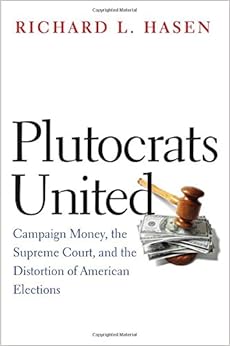 Vol. 27 No. 2 (February 2017) pp. 39-41
PLUTOCRATS UNITED: CAMPAIGN MONEY, THE SUPREME COURT, AND THE DISTORTION OF AMERICAN ELECTIONS, by Richard L. Hasen. New Haven and London: Yale University Press, 2016. 256pp. Cloth $32.50. ISBN: 9780300212457. Paper $22.00. ISBN: 9780300223545.
Reviewed by Alex Keena, Department of Political Science, University of Richmond. Email: akeena@richmond.edu.
What are the dangers of money in American elections? How has the Supreme Court balanced the threat of political corruption with free speech? Can campaign finance law adequately promote the values of political equality and anti-corruption without infringing upon political speech? Richard L. Hasen explores these topics and others in his timely analysis of campaign financing in a post-CITIZENS UNITED world.
Hasen’s analysis is at once nuanced and accessible, and he provides a coherent and forceful argument for dramatic reform of federal campaign finance law based on a joint system of publicly-funded campaign vouchers along with maximum contribution limits. The result is a system that promotes, rather than represses, political speech by expanding access to campaign giving, and prevents the appearance of political corruption by imposing reasonable limits on individual contributions.
While Hasen’s argument is provocative and compelling, the strength of PLUTOCRATS UNITED is undoubtedly his analysis and assessment of the legal debate that has evolved on the topic of campaign finance law both within the courts and among reformers since the 1970s. As Hasen asserts, this debate has centered on the conflict between political corruption and free speech and has largely ignored the effects of campaign spending on political equality and fairness.
Hasen traces this debate to the Supreme Court’s hostility toward political equality as a legitimate end for restricting political speech through campaign expenditure limits. Because the Court has appeared more sympathetic to campaign finance restrictions that serve the interest of promoting “anti-corruption” (at least until recently), the debate among reformers has centered on mitigating the supposed corrupting influence of money in elections.
But as Hasen persuasively argues, in avoiding the defense of political equality as a legitimate rationale for campaign restrictions and by doubling down on the goal of preventing corruption (or the appearance thereof), supporters of campaign finance reform have overlooked the most troubling consequences of unrestricted political spending: its unequal effects on political access and influence.
To this end, Hasen challenges the core assumption, which is often repeated by reformers and politicians on the left, that money corrupts politicians and “buys” elections. In Chapter 2, he presents a systematic and comprehensive review of the scholarship on the actual effects of campaign money and finds that there is little evidence to support such claims. For one, lots of money is poured into elections in support of both Democrats and Republicans. As a tactic for winning elections, spending big does not appear very effective.
Second, there is little evidence that politicians switch their votes in exchange for contributions. After all, the limits on contributions to candidates from individuals and committees are such that few politicians would risk their career or their electoral security in exchange for a single donation of a few thousand dollars.
But what money does buy is political access, and this is precisely why the “anti-corruption” defense is both misguided and insufficient as a justification for campaign finance regulation. As congressional campaigns have become increasingly expensive to run, members of Congress must devote more of their time soliciting donations and asking for money, and as a consequence, more of their attention toward [*40] donors. In this regard, the campaign finance status quo exasperates the unequal access and attention that donors receive above everyone else.
Although this set of arrangements does not fit the classic mold of “corruption,” it suggests equally troubling consequences for democracy. In essence, the ability to donate money to a campaign determines one’s ability to access political representation, and because money is critical to running a campaign, it biases the candidate selection process toward the candidates who serve the interests of the wealthy and affluent.
Ultimately, this view of the harmful effects of unfettered election spending on democracy suggests that a different approach to campaign finance regulation is needed—one that serves both the goal of preventing corruption of politicians (or the appearance of corruption) and the goal of political equality. Hasen’s solution is a two-pronged approach.
First, he outlines a robust public financing system aimed at creating a “level playing field” for accessing and influencing candidates by making political giving accessible to the entire electorate rather than exclusively the most affluent. In a nutshell, Hasen’s proposed public voucher system would provide every citizen with a $100 voucher to spend freely on elections in order to promote political speech among those underrepresented in the donor class.
Although $100 may not sound like much compared to the very large contributions of the most affluent donors, collectively, the influence of newly-empowered “small” donors would provide new opportunities for candidates advocating popular policies without having to cater to affluent donors during the “invisible” primary. And as Hasen convincingly argues, because such a system would amount to a “leveling up” rather than a “leveling down” of political speech (it would not prevent affluent donors from spending their own money if they chose to do so), it would be difficult to attack as an infringement of political speech by opponents.
After all, who can reasonably argue that increasing the political speech of others in society represents an unconstitutional infringement of their own speech? In this regard, the public voucher system does not advance equality by restricting speech, but by increasing it. It addresses the inequality problem by pitting speech against speech, and thus (in theory) is less objectionable to conservative opponents.
The second component of Hasen’s solution is to impose ceilings on individual contributions to candidates and PACs and aggregate contributions to all candidates during an election season. Although Hasen’s proposal of $25,000 maximum contribution per candidate will likely please no one—critics on the left will argue that it represents an unjustifiable expansion of the current $2700 maximum, while critics on the right are likely to object to any limits on individual contributions—he makes a convincing case that such limits are sufficient enough to prevent corruption, or the appearance of corruption, without imposing impermissible restrictions on political speech. After all, a gift of $25,000 is a drop in the bucket by today’s standards, and as it stands, very few donors actually reach the current $2700 per candidate limit so it’s not clear that raising the maximum would dramatically alter the status quo.
Although Hasen’s proposal is compelling and he makes a powerful case for embracing the “equality” approach to campaign finance reform, the political feasibility of his plan is questionable. For a Republican-led Congress, campaign finance reform is a non-starter, but even if such legislation were to pass (perhaps at the state level), it is unclear the current Supreme Court would uphold such a law, given the hostility of the Roberts Court toward any form of campaign finance regulation.
Hasen also leaves many questions unsettled, such as the effects of increased small donor activity on candidate selection. Although he rightfully dismisses the dubious claim that small donors polarize candidates, the precise effects of small donor support on legislative behavior remain largely unexplored empirically.
Another important question is whether the influx of cash would substantively alter how the mass media disseminates information about candidates. As the 2016 presidential election illustrated, television news has an incentive to cover the most sensational and provocative candidates. [*41] For Bernie Sanders, an unprecedented level of grassroots support did not translate to media coverage, which perhaps doomed his campaign.
But such questions are best left for future scholars to untangle. The significance of PLUTOCRATS UNITED is not in the political blueprint it provides to reformers, but in the bold set of ideas it advances. Hasen’s analysis will almost certainly transform the campaign finance debate for years to come and shift the focus toward the effects of money in elections on a bedrock principle of American democracy, political equality.
The book is recommended for anyone with an interest in campaign finance and is ideal assigned reading for undergraduate and graduate courses on election law, political representation, and inequality.
CASE REFERENCES
CITIZENS UNITED V. FEDERAL ELECTION COMMISSION 558 U.S. 310 (2010).
===
---
“As of Today, the FEC Can’t Enforce Campaign Finance Laws — and That’s Only One of Its Problems”
:{:{[May 1, 2025,}:
federal election commissionRick Hasen}:
Dan Weinerfor the Brennan Center:
Starting today, the bipartisan Federal Election Commission won’t be able to do its job. That’s because the independent agency, which oversees money in campaigns for federal office, will no longer have the minimum four required members to do most business.
The loss of quorum is due to the resignation of a Republican appointee, coupled with President Trump’s unprecedented move in February to fire a Democratic appointee. Such a shortfall has only happened three other times in the FEC’s 50-year history, including twice during Trump’s first term.
Ordinarily, the big question would be how fast the president and Congress will move to restore a full complement of commissioners so the agency can function. That is still important. But in light of the firing and the president’s other steps to exert control over the FEC and other independent agencies, there is now a much bigger issue: Will the FEC be able to continue as an independent watchdog at all? Because even worse than a dormant FEC is one that could be weaponized against the president’s opponents….
---
an 8 24
Elections lawyer and Democracy Docker publisher Marc Elias has been warning that if Donald Trump loses the 2024 presidential election, his MAGA allies in key swing states have a plan to fight the election results — including some MAGA Republicans who now sit on the Georgia Board of Elections. Caputo, however, isn't the only legal expert who is sounding the alarm.
In an article published by The Atlantic on August 21, New York University law professor Bob Bauer — who served as White House counsel to former President Barack Obama — warns that Trump's allies are hoping to use the U.S. Supreme Court in their efforts to subvert traditional election rules.
"Only months before November’s elections, the Republican National Committee has launched a new legal attack on the rules that govern federal elections," Bauer explains. "Supported by 24 states, the RNC is seeking, on an emergency basis, a Supreme Court ruling that the United States Congress lacks the constitutional authority to regulate presidential elections — congressional elections, yes, but not elections held to select presidents. The petitioners' immediate goal is to allow the state of Arizona to impose a 'proof of citizenship' requirement as a condition of a person’s right to vote for president."
READ MORE: 'Easier to cheat': Georgia GOP leaders urged to sue officials plotting interference
Bauer notes that he has been advising Democratic organizers on this lawsuit and letting them know what is at stake...
"If (Republicans) are to succeed, the Court will have to suddenly, with mere weeks left before people start voting, abandon or explain away a decision it rendered in 2013 — that Congress has the power to establish rules for voter registration in presidential elections," according to Bauer. "But even if the suit fails, it risks achieving some success in sowing doubt about the integrity of elections, highlighting claims of illegal voting by immigrants, and laying a foundation for post-election allegations of fraud and related legal challenges."
Bauer points out that the lawsuit challenges the National Voter Registration Act of 1993.
"The 'voting wars,' as the legal scholar RRichard L. Hasen has termed the legal battles over elections, appear certain to rage on," Bauer writes. "They have intensified under the pressures of election denialism and the grievances of a former president over an election he will not concede he lost. Now, the Supreme Court will have to decide, whatever course this conflict takes in the years ahead, whether it will entertain novel and potentially destabilizing legal claims as election administrators complete their preparations for the fall, and the voting begins."
READ MORE:['Now is the time to resign': Lawyer sends warning to GOP election officials with plans to refuse results
*Bob Bauer's full article for The Atlantic is available at this link (subscription required).
===
===
an 9 22
In Moore v. Harper, a case that the U.S. Supreme Court has agreed to hear, North Carolina Republicans are challenging a ruling by the North Carolina Supreme Court — which struck down, as a violation of the state’s constitution, a gerrymandered congressional map that GOP lawmakers in the state favored. But Moore v. Harper is about much more than partisan gerrymandering in North Carolina. It also involves a far-right legal theory known as the “independent state legislature doctrine,” and a group representing the chief justices of every state supreme court in the U.S. is coming out against the theory.
The independent state legislature theory, in its most extreme form, argues that only state legislatures have the power to determine how elections are administered at the state level — not governors, not judges, not state supreme courts, not state attorneys general. According to the doctrine, only a state’s legislative branch has the authority to govern elections in that state — and the state’s executive and judicial branches should have no say in the process.
The U.S. Supreme Court, in the past, has rejected the independent state legislature theory as crackpot nonsense. But given the High Court’s radical-right turn, some legal experts fear that it will rule, in Moore v. Harper, that the theory has merit. And the implications of such a ruling could be enormous.
READ MORE: **How GOP-controlled state legislatures could pull off a coup in 2024: journalist**
Proponents of the independent state legislature theory believe that state lawmakers should be able to simply throw out any election results that they don’t like regardless of what a state’s governor, attorney general or state supreme court thinks. So, if the High Court rules that the state legislature theory is legitimate and a Democratic presidential nominee wins in Pennsylvania, Wisconsin and Arizona in 2024, for example, Republican lawmakers in those states could, according to some legal experts who oppose the theory, give the electoral votes to the GOP nominee — regardless of what the states’ executive or judicial branches think.
On August 1, law professor and election law expert **Rick Hasen** tweeted, “I do believe that a muscular reading of the independent state legislature theory would provide a fig leaf for state legislators to try to reverse presidential election results and overturn the will of the people in a presidential election…. The independent state legislature doctrine is complicated, and the argument is that a state legislature could *claim* the doctrine lets it overturn the will of the people. Kevin McCarthy could agree and the courts might not intervene to stop it during electoral college count.”
The Charlotte News & Observer’s Will Doran, in an article published on September 7, reports, “A group representing the chief justices of every state Supreme Court in the country has come out in opposition to a legal theory North Carolina lawmakers are pushing in a nationally watched case before the U.S. Supreme Court. The case will have massive implications for the 2024 elections, and the future of American elections if the state’s Republican legislators win their argument. Specifically, the lawmakers want the court to embrace a controversial legal argument known as the ‘independent state legislature theory’ that the late conservative Justice Antonin Scalia suggested in the Bush v. Gore case in 2000, but which has never received a majority of support on the nation’s highest court.”
Doran notes that the independent state legislature theory “states that the legislative branch has sole authority to manage elections — at least those at the federal level — and that therefore, state courts should not be allowed to rule a legislature’s election-related actions unconstitutional.”
According to Doran, “The brief from the state supreme court justices opposes that idea, citing the 1803 case of Marbury v. Madison that established the concept of judicial review as part of the American system of checks and balances…. The case now before the Supreme Court stems from when Republican lawmakers drew new political maps for North Carolina, following the 2020 Census, but had those overturned as unconstitutional by the NC Supreme Court. It was the latest in a series of high-profile lawsuits the GOP-led legislature has lost in recent years over their efforts on topics such as redistricting, voter ID, early voting and the political makeup of the state elections board.”
In its brief, the group of state supreme court justices stresses, “Judicial review — review of a legislature’s act for its compliance with other laws and the constitution — preceded the Founding and is embedded in the U.S. Constitution and numerous state constitutions of the Founding era.”
READ MORE:**The Supreme Court case that could solidify its 'retrograde and anti-democracy ideology'**
Richard L. Hasen is an American legal scholar and law professor at the UCLA Law School. He is an expert in legislation, election law and campaign finance.[1]
- :{1:(style="display:table-cell;padding-left:0px;padding-right:0.5em"):}::{Early life and education:(style="display:table-cell"):}:
- :{2:(style="display:table-cell;padding-left:0px;padding-right:0.5em"):}::{Career:(style="display:table-cell"):}:
- :{3:(style="display:table-cell;padding-left:0px;padding-right:0.5em"):}::{Books:(style="display:table-cell"):}:
- :{4:(style="display:table-cell;padding-left:0px;padding-right:0.5em"):}::{References:(style="display:table-cell"):}:
- :{5:(style="display:table-cell;padding-left:0px;padding-right:0.5em"):}::{External links:(style="display:table-cell"):}:
Early life and education[
Hasen received his Bachelor of Arts with highest honors from the University of California, Berkeley in 1986.[1] His Bachelor's degree is in Middle Eastern studies.[1] He received his Master of Arts with distinction in political science in 1988 and Doctor of Philosophy in political science in 1992, both from the University of California, Los Angeles.[1] He received his Juris Doctor from UCLA School of Law in 1991, and was elected to the Order of the Coif.[1]
Career[
Hasen was a law clerk to Judge David R. Thompson of the United States Court of Appeals for the Ninth Circuit from 1991 to 1992 before joining the law firm of Horvitz & Levy LLP, in Encino, California.[1]
He taught at the Chicago-Kent College of Law from 1994 to 1997.[2] In 1998 he took a position at Loyola Law School, Los Angeles; in 2005, he was named by Loyola as the William H. Hannon Distinguished Professor of Law. He left Loyola to become a professor at the University of California, Irvine School of Law in July 2011.[1]
Hasen was one of the founding co-editors of the quarterly Election Law Journal, a peer reviewed publication on election law.[1] He also runs ElectionLawBlog, a blog focusing on election law, campaign finance, voting rights, initiatives, redistricting, and other legal issues.[3][4][5][6]
In 2009,[1] Hasen was elected to the American Law Institute.[7] In 2013, the National Law Journal included Hasen on its list of the "100 most influential lawyers in America."[8]
In 2022, Hasen became a professor at the UCLA Law School.[9][10]
Books[
- Hasen, Richard L. (August 14, 2012). The Voting Wars: From Florida 2000 to the Next Election Meltdown. Yale University Press. ISBN 978-0-300-18421-1. JSTOR j.ctt32bft8. OCLC 808341874.
- Hasen, Richard L. (January 12, 2016). Plutocrats United: Campaign Money, the Supreme Court, and the Distortion of American Elections. Yale University Press. ISBN 978-0-300-21674-5. OCLC 936378410.[11]
- Hasen, Richard L. (March 20, 2018). The Justice of Contradictions: Antonin Scalia and the Politics of Disruption. Yale University Press. ISBN 978-0-300-22864-9. OCLC 1002129887.[12]
- Hasen, Richard L. (February 4, 2020). Election Meltdown: Dirty Tricks, Distrust, and the Threat to American Democracy. Yale University Press. doi:10.2307/j.ctvw1d4ww. ISBN 978-0-300-24819-7. JSTOR j.ctvw1d4ww. OCLC 1111981022.
- Hasen, Richard L. (March 8, 2022). Cheap Speech: How Disinformation Poisons Our Politics―and How to Cure It. Yale University Press. ISBN 978-0-300-25937-7.
References[
- ^ :{Jump up to::(style="user-select:none;top:-99999px;clip:rect(1px, 1px, 1px, 1px);overflow:hidden;position:absolute !important;padding:0px !important;border:0px !important;height:1px !important;width:1px !important"):}:^a b(https://en.wikipedia.org/wiki/Richard_L.Hasen#cite_ref-OfficialBio_1-1) c(https://en.wikipedia.org/wiki/Richard_L.Hasen#cite_ref-OfficialBio_1-2) d(https://en.wikipedia.org/wiki/Richard_L.Hasen#cite_ref-OfficialBio_1-3) e(https://en.wikipedia.org/wiki/Richard_L.Hasen#cite_ref-OfficialBio_1-4) f(https://en.wikipedia.org/wiki/Richard_L.Hasen#cite_ref-OfficialBio_1-5) g(https://en.wikipedia.org/wiki/Richard_L.Hasen#cite_ref-OfficialBio_1-6) h(https://en.wikipedia.org/wiki/Richard_L.Hasen#cite_ref-OfficialBio_1-7) i(https://en.wikipedia.org/wiki/Richard_L.Hasen#cite_ref-OfficialBio_1-8) "Richard L. Hasen". University of California, Irvine. Archived from the original on November 19, 2020. Retrieved November 19, 2020.
- ^ "Richard Hasen". Georgetown University Law Center. Archived from the original on August 26, 2020. Retrieved November 19, 2020.
- ^ Maxwell, William Earl; Crain, Ernest; Santos, Adolfo (2013). *Texas Politics Today, 2013–2014 Edition*. Cengage Learning. p. 81. ISBN 978-1-285-54610-0. Archived from the original on November 19, 2020. Retrieved November 19, 2020.
- ^ Barr, Andy. "Deadlock: Rise of the Endless Election". NBC Connecticut. Archived from the original on November 19, 2020. Retrieved November 19, 2020.
- ^ Barr, Andy. "Deadlock: Rise of the endless election". Politico. Archived from the original on September 14, 2019. Retrieved November 19, 2020.
- ^ Barr, Andy. "Birther debate alive across U.S." Politico. Archived from the original on November 19, 2020. Retrieved November 19, 2020.
- ^ "Professor Richard L. Hasen". American Law Institute. Archived from the original on November 19, 2020. Retrieved November 19, 2020.
- ^ "The 100 Most Influential Lawyers in America". The American Lawyer. March 25, 2013. Archived from the original on November 19, 2020. Retrieved November 19, 2020.
- ^ "Richard L. Hasen". The Regents of the University of California.
- ^ "Hasen Moving to UCLA Law".
- ^ Reviews of Plutocrats United:
- Ridout, Travis N. (December 2016). Perspectives on Politics. 14 (4): 1223–1224. doi:10.1017/S1537592716003674. ISSN 1537-5927. S2CID 151935419.
- Pevnick, Ryan (June 1, 2016). "An Egalitarian Approach to Campaign Finance Reform". The New Rambler. Archived from the original on August 23, 2018. Retrieved November 19, 2020.
- ^ Russello, Gerald J. (2019). The Review of Politics. 81 (1): 136–141. doi:10.1017/S0034670518000803. ISSN 0034-6705.
External links:{:(style="margin-right:0.25em"):}:[edit:{]}:

Wikimedia Commons has media related to Rick L. Hasen.
- Profile at University of California, Irvine
- Richard L. Hasen publications indexed by Google Scholar

- Richard L. Hasen on Twitter
- Appearances on C-SPAN
- Election Law Blog
hide | hide |
|---|---|
| General | |
| National libraries | |
| Scientific databases |
- 21st-century American lawyers
- American legal scholars
- Election law
- Illinois Institute of Technology faculty
- Living people
- Loyola Marymount University faculty
- University of California, Berkeley alumni
- University of California, Irvine faculty
- University of California, Los Angeles alumni
"
Citizens United, Corporate Personhood, and Corporate Power: The Tension between Constitutional Law and Corporate Law”
September 7, 2012, 7:26 amcampaign financeRICK HASEN
Susanna Kim Ripken has postedthis drafton SSRN. Here is the abstract:
In Citizens United v. Federal Election Commission, the Supreme Court invalidated strict federal campaign finance laws and upheld the First Amendment right of corporations to use general treasury funds to support or oppose candidates in political elections. Shortly after the case was decided, a grassroots popular movement began calling for an amendment to the Constitution to establish that money is not speech and that human beings, not corporations, are the only “persons” entitled to constitutional rights. The concept of corporate personhood entered the national debate, causing many average Americans to question the legitimacy of corporations’ legal personhood status. Federal and state lawmakers have introduced several bills proposing a constitutional amendment to abolish corporate personhood, and hundreds of cities nationwide have passed municipal resolutions supporting such an amendment.
Progressive groups that oppose corporate influence in politics disagree on whether the push for a constitutional amendment is a good idea. This article identifies several problems with the amendment strategy and suggests that the focus on personhood is misplaced.Legal history shows that the personhood label has long been arbitrarily applied in constitutional law cases, and, as a practical matter, personhood is largely indeterminate and sometimes irrelevant. More significantly, corporate personhood and power do not find their origin exclusively in constitutional law, but in long-standing corporate law doctrines and deeply entrenched norms. An attempt to curb corporate power in the political realm through a constitutional amendment does not address the systemic features of corporate law that allow corporate entities to amass great economic and political power. To ignore the tensions that corporate law raises in this regard is to miss the deeper source of corporate ascendance in the modern world.
Eugene Volokh, [September 9, 2009 at 7:01pm] Trackbacks Rick Hasen (Election Law Blog) on the Citizens United Corporate Free Speech Rights Case: His live-blogging of the audio release is here, and his predictions are here:
Rick is one of the top election law scholars in the country, and is generally a supporter of restrictions on corporate speech about candidates, so he isn't just hearing what he hopes to hear. Rick also reports that "Justice Sotomayor asked the questions I would have asked" -- high praise from any law professor! -- "and seems likely to be a very strong replacement for Justice Souter on campaign finance issue." |
:{Richard L. Hasen - Wikipedia:(style="margin:0px;padding:0px;border:0px;font-style:inherit;font-variant:inherit;font-weight:inherit;font-stretch:inherit;vertical-align:top;display:inline-block;max-width:100%;overflow:hidden;text-overflow:ellipsis;white-space:nowrap"):}:
Hasen was a law clerk to Judge David R. Thompson of the United States Court of Appeals for the Ninth Circuit from 1991 to 1992 before joining the law firm of Horvitz & Levy LLP, in Encino, California. [1] He taught at the Chicago-Kent College of Law from 1994 to 1997. [2]
:{UCI Law Chancellor's Professor of Law Richard L. Hasen Named CNN ...:(style="margin:0px;padding:0px;border:0px;font-style:inherit;font-variant:inherit;font-weight:inherit;font-stretch:inherit;vertical-align:top;display:inline-block;max-width:100%;overflow:hidden;text-overflow:ellipsis;white-space:nowrap"):}:
08-31-2020 IRVINE, Calif. (August 31, 2020) — Richard L. Hasen ( Rick Hasen ), Chancellor's Professor of Law and Political Science at the University of California, Irvine School of Law (UCI Law), has been named an Election Law Analyst by Cable News Network (CNN).
:{Richard L. Hasen - Practising Law Institute - PLI:(style="margin:0px;padding:0px;border:0px;font-style:inherit;font-variant:inherit;font-weight:inherit;font-stretch:inherit;vertical-align:top;display:inline-block;max-width:100%;overflow:hidden;text-overflow:ellipsis;white-space:nowrap"):}:
Professor Richard L. Hasen is Chancellor's Professor of Law and Political Science at the University of California, Irvine. Hasen is a nationally recognized expert in election law and campaign finance regulation, and is co-author of a leading casebook on election law.

:{Rick Hasen - Legal Talk Network:(style="margin:0px;padding:0px;border:0px;font-style:inherit;font-variant:inherit;font-weight:inherit;font-stretch:inherit;vertical-align:top;display:inline-block;max-width:100%;overflow:hidden;text-overflow:ellipsis;white-space:nowrap"):}:
Sep 15, 2020Professor Richard L. Hasen is Chancellor's Professor of Law and Political Science at the University of California, Irvine. Hasen is a nationally recognized expert in election law and campaign finance regulation, and is co-author of a leading casebook on election law.
:{Chancellor's Professor of law Richard Hasen named CNN election law ...:(style="margin:0px;padding:0px;border:0px;font-style:inherit;font-variant:inherit;font-weight:inherit;font-stretch:inherit;vertical-align:top;display:inline-block;max-width:100%;overflow:hidden;text-overflow:ellipsis;white-space:nowrap"):}:
In 2013, UCI's Richard Hasen was named one of the 100 most influential lawyers in America by the National Law Journal. Irvine, Calif., Aug. 31, 2020 — Richard Hasen, Chancellor's Professor of law and political science at the UCI School of Law, has been named an election law analyst by the Cable News Network.
:{UCI Law Chancellor's Professor of Law and Political Science Rick Hasen ...:(style="margin:0px;padding:0px;border:0px;font-style:inherit;font-variant:inherit;font-weight:inherit;font-stretch:inherit;vertical-align:top;display:inline-block;max-width:100%;overflow:hidden;text-overflow:ellipsis;white-space:nowrap"):}:
Mar 8, 2021Richard L. Hasen's (), Chancellor's Professor of Law and Political Science at the University of California, Irvine School of Law (UCI Law) casebook, "Modern American Remedies: Cases and Materials, Fifth Edition" was quoted by the Supreme Court of the United States in Uzuegbunam v.Preczewski.. The casebook co-authored by Prof. Hasen and Douglas Laycock, was cited by the Supreme Court ...
:{Rick Hasen (@rickhasen) / Twitter:(style="margin:0px;padding:0px;border:0px;font-style:inherit;font-variant:inherit;font-weight:inherit;font-stretch:inherit;vertical-align:top;display:inline-block;max-width:100%;overflow:hidden;text-overflow:ellipsis;white-space:nowrap"):}:
- 100. Rick Hasen. @rickhasen. ·. New congressional maps dilute Black power, critics say. apnews.com. New congressional maps dilute Black power, critics say. BATON ROUGE, La. (AP) — When Press Robinson registered to vote in South Carolina in 1963, he was handed a copy of the U.S. Constitution and told to read it aloud and interpret it.
:{Rick Hasen: How Disinformation Poisons Our Politics - Commonwealth Club:(style="margin:0px;padding:0px;border:0px;font-style:inherit;font-variant:inherit;font-weight:inherit;font-stretch:inherit;vertical-align:top;display:inline-block;max-width:100%;overflow:hidden;text-overflow:ellipsis;white-space:nowrap"):}:
Mar 29, 2022In his new book Cheap Speech: How Disinformation Poisons Our Politics—and How to Cure It, Hasen provides a practical road map for controlling disinformation, embracing free speech, saving American elections, and protecting democracy. He provides insight into the current debates over free speech, censorship and Big Tech's responsibilities.
:{Rick Hasen University of CA-Irvine:(style="margin:0px;padding:0px;border:0px;font-style:inherit;font-variant:inherit;font-weight:inherit;font-stretch:inherit;vertical-align:top;display:inline-block;max-width:100%;overflow:hidden;text-overflow:ellipsis;white-space:nowrap"):}:
30 NOV (NAS JACKSONVILLE) - A US Navy veteran accused of HIV-related criminal charges has reached a pretrial agreement that will free him within weeks. Accused of failing to disclose his alleged "HIV-positive status," military prosecutors charged the Aviation Electrician's Mate (RS) with multiple counts of aggravated sexual assault "likely to produce death or grievous bodily harm."
:{Rick Hasen | KCRW:(style="margin:0px;padding:0px;border:0px;font-style:inherit;font-variant:inherit;font-weight:inherit;font-stretch:inherit;vertical-align:top;display:inline-block;max-width:100%;overflow:hidden;text-overflow:ellipsis;white-space:nowrap"):}:
professor of law and political science at UC Irvine; co-director of the Fair Elections and Free Speech Center Guest Rick Hasen is Chancellor's Professor of Law and Political Science at the University of California, Irvine, where he also writes the Election Law blog.
:{New academic center aims to 'strengthen' democracy in U.S.:(style="margin:0px;padding:0px;border:0px;font-style:inherit;font-variant:inherit;font-weight:inherit;font-stretch:inherit;vertical-align:top;display:inline-block;max-width:100%;overflow:hidden;text-overflow:ellipsis;white-space:nowrap"):}:
Jul 20, 2021UC-Irvine law professors Rick Hasen, a well-known expert in elections law, and David Kaye, a former UN appointee focused on freedom of opinion and speech across the globe, are co-directing the new ...
:{Rick Hasen | Hexi:(style="margin:0px;padding:0px;border:0px;font-style:inherit;font-variant:inherit;font-weight:inherit;font-stretch:inherit;vertical-align:top;display:inline-block;max-width:100%;overflow:hidden;text-overflow:ellipsis;white-space:nowrap"):}:
Rick Hasen, a California-Irvine professor often called the nation's leading election law expert, called the districts "the most brazen and egregious" gerrymandering yet seen in the United States. Nine more women say judge subjected them to inappropriate behavior, including four who say he touched or kissed them ...
:{Rick Hasen on Election Law and 'One Person, One Vote':(style="margin:0px;padding:0px;border:0px;font-style:inherit;font-variant:inherit;font-weight:inherit;font-stretch:inherit;vertical-align:top;display:inline-block;max-width:100%;overflow:hidden;text-overflow:ellipsis;white-space:nowrap"):}:
Rick Hasen on Election Law and 'One Person, One Vote' Item Preview podcast_uci-law-talks_rick-hasen-on-election-law_1000352841910_itemimage.png . remove-circle Share or Embed This Item. Share to Twitter. Share to Facebook.