CAMPAIGN FINANCE 3
ETB 5 25
merri ok
SEE MAINE SUPERPAK
SEE MONTANA PLAN
SEE LESSIG
SEE CRYPTO AI FAIR SHAKE
SEE SCOTUS 7 2/6 KAVANAUGH
see CITIZENS UNITED CASE ~
---
-=-=
10 26 camp fin act hist, stats, ~ CU
Oct 14, 2026
Hasan sits down with Michael Beckel, Issue One’s Money in Politics Reform Director, to talk about how American elections have been corrupted by wealthy interests, how fundraising dominates the schedules of members of Congress, and the rising influence of AIPAC. Learn more about Issue One’s mission at issueone.org/darkmoney and Montana’s ballot measure at MontanaPlan.org.
Have Billionaires Bought The Midterms? with Issue One's Michael Beckel
-=-==
---
NEW REPORT 7 26: https://www.citizen.org/article/corporate-supremacist-super-pacs-500-million-midterm-crypto-ai-sports-betting/
CLAYPOOL
Key Findings
- Cryptocurrency, artificial intelligence, Big Tech and online betting corporations have collectively spent $294 million to influence federal elections in the 2026 midterm cycle, reflecting a strategic move to spend directly on political action committees to influence federal elections.
- These corporate super PAC political contributions make up 57% of the $517 million that corporations have reported spending on the 2026 midterms so far.
- The 2026 total so far amounts to nearly one third of the $1.58 billion that corporations have spent since the 2010 U.S. Supreme Court ruling in Citizens United v. FEC to allow direct corporate spending in federal elections.
- The half-billion in midterm spending by corporations breaks the previous record of $461 million in disclosed federal corporate spending set during the 2024 cycle.
- The primary beneficiaries of the $60 million in spending by Big Tech and AI corporations are the sector-focused Leading the Future ($50.1 million) and MAGA Inc. ($6 million)
- The primary beneficiary of the $45.6 million in spending by online betting corporations is the sector-focused Win for America PAC ($43 million).
- Crypto corporations, which pioneered this strategy in the 2024 presidential election cycle, remain the dominant corporate political spenders, as over one third (37%) of the corporate money contributed during this year’s elections came from crypto businesses ($189 million so far).
- The biggest beneficiaries of crypto’s corporate spending are the sector-focused Fairshake ($82.6 million) and MAGA Inc. ($56.2 million), the Trump-backing super PAC.
Note: Findings are based on Public Citizen analysis of 2010-2024 data obtained from OpenSecrets and 2026 U.S. Federal Election Commission data documenting contributions of $5,000 or more by for-profit corporations to super PACs and hybrid PACs. Not all corporate spending is reported to the Federal Election Commission. This total likely undercounts the true total sum of corporate election spending, which Dark Money groups enable corporations to conceal.
Introduction
In the 2026 midterm elections, corporate money is poised to play a bigger role than ever before in influencing how Americans vote. The cryptocurrency sector’s political playbook from 2024 – prioritizing corporate priorities over parties or candidates and using their financial power to discipline sitting lawmakers and candidates – is spawning copycat corporate campaigns by other sectors.
Months before Election Day, corporations have already collectively spent $517 million to influence federal elections – a 12% increase over the $461 million that corporations spent over the entire 2024 election cycle and nearly triple the $184.1 million spent by corporations during the previous midterm election in 2022.
Nearly one third of the total $1.58 billion in corporate spending on federal elections since the U.S. Supreme Court allowed such spending in 2010 has been made during the current election cycle (see Chart 1).
Chart 1: Corporate Political Spending in Federal Elections Since Citizens United
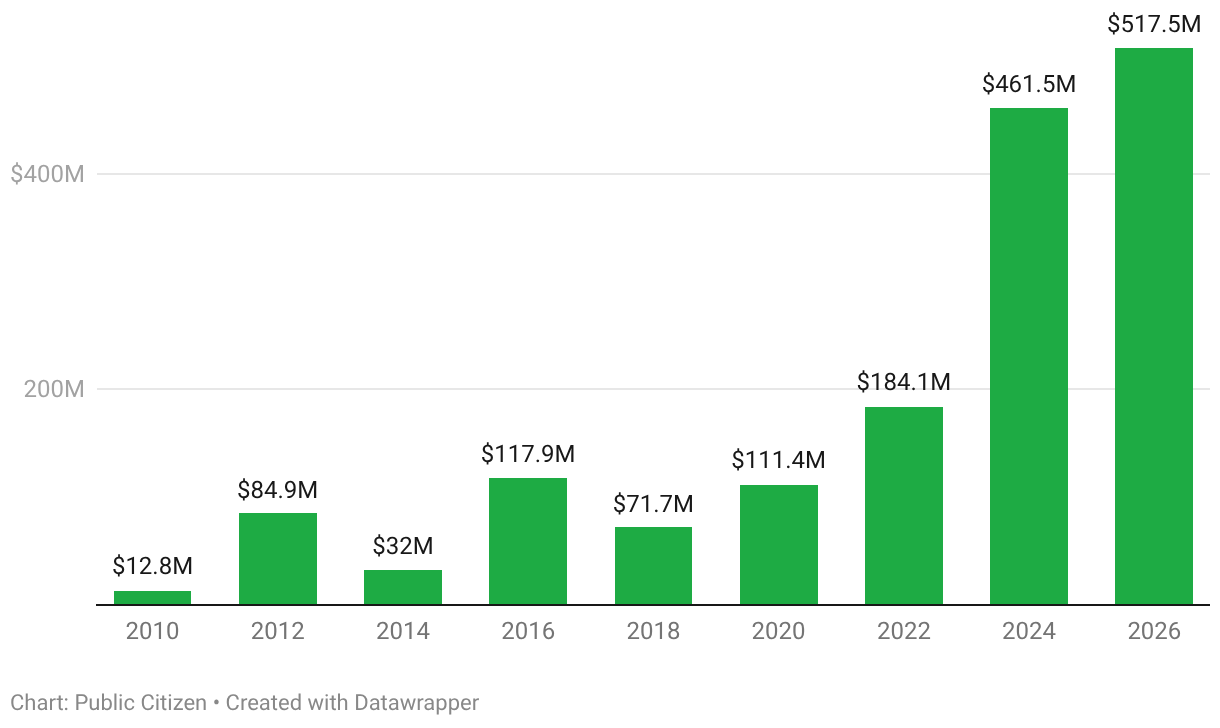
Source: Public Citizen analysis of OpenSecrets.org and FEC data
These record-breaking totals do not include state-level corporate election spending that is not reported to the FEC, or dark money nonprofit organizations. Meta Platforms, for example, is spending an additional $65 million toward non-federal super PACs to push back against state lawmakers who support AI regulations. Anthropic made a $20 million pledge that does not yet appear in FEC disclosures to back a group supporting lawmakers who favor regulating AI.
The failure of Congress to pass meaningful political disclosure legislation means corporate-backed dark money groups organized as 501(c)4 non-profit organizations conceal their funders from the public, as do 501(c)6 business groups such as the U.S. Chamber of Commerce, whose corporate members include Meta, Microsoft, and IBM.
This means the full amount of direct corporate influence spending in the 2026 elections is unknown, and certainly higher than the amounts reported and made publicly available in required FEC disclosures.
Corporate Supremacist Super PACs
Cryptocurrency corporations drove the surge in 2024 corporate election spending, ultimately putting more than $170 million toward intervening in congressional races across the country and accounting for more than a third of the total sum of corporate money spent during that cycle.
Most of the 2026 surge also is attributable to the crypto sector, along with other sectors following crypto’s 2024 playbook of channeling millions into super PACs. These super PACs prioritize the interests of their business backers over either major political party or any candidate. Following the crypto playbook, they are set up to engage in both Democratic and Republican primaries and to support or attack candidates of either major party in the general election. This relatively new crop of corporate supremacist super PACs makes their prioritization of corporate self-interest explicit:
- Josh Vlasto, a leader of the crypto-prioritizing Fairshake super PAC – and a former chief of staff for New York Gov. Andrew Cuomo and top staffer for Sen. Chuck Schumer (D-N.Y.) – said in 2025 “We are building an aggressive, targeted strategy for next year to ensure that pro-crypto voices are heard in key races across the country.”
- Similarly, a statement on the website for the AI-prioritizing Leading the Future PAC – which Vlasto co-leads with Zac Moffatt, a former digital director for Mitt Romney’s presidential campaign – states the political entity’s intention is “identifying, maintaining, and growing pro-AI candidates in order to support an AI innovation policy agenda at the state and federal level.”
- Similarly, an unnamed Win for America spokesperson told Axios the super PAC’s corporate backers “seek candidates who will thoughtfully approach regulation and ensure legal sports betting can continue to support communities through billions in tax revenue and jobs across America.”
Together, the crypto, AI, Big Tech, and online betting corporations have spent $294 million – 57% of the total 2026 midterm spending by corporations so far. Most of their spending (60%) has backed these corporate supremacist super PACs (see Table 1).
...
MARCH 2021 BIG TECH
https://www.citizen.org/article/big-tech-lobbying-update/
7 26 Corporate PACs Splurge; Virginia’s Data Center Revolt w/ Robert Weissman, Brennan Gilmore | MR Live
PRES CAP Neera Tanden - Wikipedia
35:46
35 minutes, 46 seconds
We are back and we are joined now by Robert Weissman, co-president of Public Citizen, uh here to discuss their
35:53
35 minutes, 53 seconds
new report entitled Corporate Supremacist Super PACs Drive $500 million midterm spending surge. Robert,
36:03
36 minutes, 3 seconds
thanks so much for coming on the show today. Hey, it's great to be with you.
36:07
36 minutes, 7 seconds
Uh uh same here. Uh before we get into public citizens findings, I just wanted to briefly talk to you and ask you about
36:14
36 minutes, 14 seconds
last week's Supreme Court decision on campaign finance law. It was a 6 to3 decision just weakening our campaign
36:21
36 minutes, 21 seconds
finance laws even more. We already know that Citizens United essentially led to the explosion of super PACs, opened up
36:29
36 minutes, 29 seconds
the floodgates uh of independent expenditures, so-called independent expenditures. What does this case mean?
36:36
36 minutes, 36 seconds
Which ruled that uh political parties can now um coordinate with uh CA
candidates are lifting some of these limits on their coordination with candidates.
36:50
36 minutes, 50 seconds
Yeah. Well, the the main thing that's still left, the remnants that remain of campaign finance law, focuses primarily
on the limit of on direct contributions to political candidates. And right now it's about $3,500 per candidate per cycle. So you can do it once in the primary, once in the general election.
37:09
37 minutes, 9 seconds
And with everything else going on and campaign finance, that's the one remaining good thing.
37:17
37 minutes, 17 seconds
It's not as consequential as it should be because so much else is happening, outside spending, super PACs, etc. But still, it matters. And because there's
37:26
37 minutes, 26 seconds
this core limit on what a person can contribute to a candidate, there has been also a prohibition on direct
37:35
37 minutes, 35 seconds
coordination between political parties and candidates because the parties can accept a lot more money up to about $250,000
37:42
37 minutes, 42 seconds
from each donor twice over primary and general election.
37:47
37 minutes, 47 seconds
So the idea was, well, you can't have coordination because if you're trying to have a limit on how much a person can make contribute to a candidate, if they
37:55
37 minutes, 55 seconds
can just contribute 10 or 100 times that to a party and then just have it effectively spent in
38:02
38 minutes, 2 seconds
coordination with on behalf of the candidate, you destroy the the actual effective limit on direct contributions
38:09
38 minutes, 9 seconds
to candidates. And that had been widely understood. It was considered a core anti-corruption measure even with the very narrow definition the Supreme Court
38:18
38 minutes, 18 seconds
tolerates for defining corruption. It was viewed as anti-ircumvention. Like you should be able to circumvent the limit on contributions to candidates.
38:27
38 minutes, 27 seconds
And the 6-3 majority overturned that.
38:29
38 minutes, 29 seconds
It's a direct overturning of a decision that's only 25 years old. Brett Kavanaaugh wrote the decision. He basically said, "Yeah, that's old
38:36
38 minutes, 36 seconds
history. the logic. We've destroyed every prong of logic that was in that 25 year old decision. So, there's no reason to adhere to president and we're
38:45
38 minutes, 45 seconds
throwing that decision out. Um, and it's all sort of dressed up in the fetishization of the first amendment,
38:53
38 minutes, 53 seconds
right? We have to give people the right to spend as much money as they want because the founding fathers commanded that. That's kind of the core illogic of
39:01
39 minutes, 1 second
the Supreme Court juristp prudence when it comes to campaign finance. And practically it means that we've now
39:07
39 minutes, 7 seconds
really diminished the meaning of the only significant remaining restraint in campaign finance law because big dollar
39:15
39 minutes, 15 seconds
donors can make the $3,500 contribution and simultaneously make a $250,000 contribution to the Democratic party or
39:23
39 minutes, 23 seconds
the Republican party or whatever with the clear understanding that it's going to be spent on behalf of the candidate
39:29
39 minutes, 29 seconds
that they face. It's incredible how much this relies on uh Supreme Court
39:36
39 minutes, 36 seconds
decisions from the 1970s both Buckley valo and then I think Botti also stands out to me in my mind right where you
39:43
39 minutes, 43 seconds
merge this notion of money equals speech which was the Buckley valo decision disastrous as it gets with a uh belie a
39:52
39 minutes, 52 seconds
a a judicial uh adherence to the idea that corporations can act as people in the political eosystem system. Those two
40:02
40 minutes, 2 seconds
decisions married together to increase corruption in our politics. But Citizens United exploded it by essentially saying
40:09
40 minutes, 9 seconds
that any curbing of outside spending on this race as long as it doesn't include
40:17
40 minutes, 17 seconds
quidd proquo corruption would be a violation of their these corporations
40:25
40 minutes, 25 seconds
incredible uh right to free speech. as uh human beings under the law. It makes
40:33
40 minutes, 33 seconds
absolutely no sense. But yet they'll throw out precedent that's even more recent like a 25-year-old case in order to justify upholding this you know these
40:43
40 minutes, 43 seconds
1970s era case this 1970s era case law that has led to I would say the destruction of our democracy. Um because
40:51
40 minutes, 51 seconds
as this piece in in in uh in public citizen this this study looks uh or analyzes
41:00
41 minutes
onethird do we have this chart guys figure one uh let's pull this up here because it's astonishing
41:08
41 minutes, 8 seconds
uh we h we have it uh here we can show it on screen. So the this first chart figure one there it is this is your
41:16
41 minutes, 16 seconds
analysis here. So 2010 you can see 12.8 8 million was spent. That was the year that Citizens United was decided in
41:24
41 minutes, 24 seconds
corporate political spending. In 2026, which we are around a little over halfway through at this point, or at
41:31
41 minutes, 31 seconds
least this cycle, $517.5 million, that's onethird of the total $
41:39
41 minutes, 39 seconds
1.58 billion spent in corporate spending on federal elections since that case was decided, Citizens United, in just 2026.
41:49
41 minutes, 49 seconds
Robert, your reaction to public citizens findings here.
41:53
41 minutes, 53 seconds
Yeah. So, you're describing it all exactly right. So, 2010 was the decision Citizens United handed out by the
42:01
42 minutes, 1 second
Supreme Court. As just as you said, it's that case said that corporations could spend whatever they wanted to influence elections
42:09
42 minutes, 9 seconds
short of direct contributions to candidates. And [snorts] then in subsequent decisions, they said, well, if it's true for corporations, the principle is true for everybody. And the
42:17
42 minutes, 17 seconds
main original effect of Citizens United was to lead to this gigantic surge in spending for outside spending groups,
42:25
42 minutes, 25 seconds
dark money groups, and especially super PACs funded primarily by the super rich.
42:31
42 minutes, 31 seconds
So the top 100 donors are responsible for about 70% of all funding for super PACs. And that's held true every year since Citizens United. It's totally banana Republic stuff. Just 100 people.
corporations if they work took advantage primarily by moving money into dark money organizations that didn't disclose
where their funding came from. So we didn't know about corporate spending.
42:56
42 minutes, 56 seconds
They would give it to like for example the US Chamber of Commerce and the Chamber of Commerce spent money in elections but they didn't identify who their funders were even if it was Exxon and Philip Morris or whoever.
What's happened in the last couple election cycles and now is exploding is that this inhibition that corporations had in sort of outwardly spending is
falling away. And of course corporations have you know more money than even the richest people more money than God and
they can if they choose and the cultural restraints because the legal restraints are gone. If the cultural restraints fall on corporate spending it's going to
go to an entire new level. So why the trend has gone up is who broke the mold in the last election cycle was the cryptocurrency industry which is not an
[clears throat] important industry whatsoever but they decided their future depended on getting laws passed to legitimize the otherwise illegal
behavior that they were undertaking. So for them it was worth it and they made a big bet about spending $150 million say in the last election cycle and they had
some significant success and that success translated immediately into legislative action. So, not only
Republicans working for crypto, Democrats who were standing against crypto as a scam and who wanted it properly regulated, about half of them
now are very open to supporting what crypto wants because they fear the effect of opposing them. Other
industries looked at that experience, which was stunning, and said, you know what, us too. So what we're seeing now
is huge spending from the cryptocurrency industry, huge spending from the AI and big tech companies who obviously are the biggest companies on the planet and can
spend infinity if they choose. Big spending from the online prediction market, online betting companies and prediction markets. Um and then some
other sort of random companies that are giving funds to Donald Trump because they're ideologically aligned. Um and as
44:50
44 minutes, 50 seconds
you say, a that decision was 2010. We're 16 years later, but a third of all corporate spending since that decision was handed down has happened in just
this election cycle. And this election cycle is really just getting underway.
....
BLASTO GILLEBRAND NY DSCC
...
48:04
48 minutes, 4 seconds
some crazy uh names that are outlined in your piece. I mean in just in terms of like super PAC contributors, you
48:12
48 minutes, 12 seconds
mentioned some of them, but of Andre Horowitz is uh super involved. You mentioned Open AI. Um you have
48:20
48 minutes, 20 seconds
DraftKings and FanDuel that they're trying to make sure that you know this uh gambling economy that's totally
48:27
48 minutes, 27 seconds
unsustainable is cemented in all 50 states across the country. the prediction markets that you say. Um, but
48:34
48 minutes, 34 seconds
one name that was fascinating to me was I saw John Blasto uh named who used to
48:41
48 minutes, 41 seconds
be the chief of staff for Andrew Cuomo and is now a top staffer for the leader of the Democrats in the Senate, Chuck
48:47
48 minutes, 47 seconds
Schumer, who said last year that they are building a strategy to ensure that quote pro- crypto voices are heard in
48:55
48 minutes, 55 seconds
key races all across the country. So this is the top of the Democratic party endorsing corrupting cryptocurrency money in primaries.
49:06
49 minutes, 6 seconds
Yeah. Well, if you want to be fair to them, it's someone who was in the Democratic party. I was I'm sorry.
49:11
49 minutes, 11 seconds
The revolving door and is now working on behalf of crypto and the AI companies.
49:15
49 minutes, 15 seconds
You do the same thing now for the AI companies.
49:18
49 minutes, 18 seconds
Um but it's just it's not a coincidence to me. I'm sorry I misspoke a little bit. It's not a coincidence. Then you don't have to be fair to them.
49:27
49 minutes, 27 seconds
Exactly right. It's a total revolving door corrupting system. And that is the rem most remarkable thing that's
49:34
49 minutes, 34 seconds
happened particularly with crypto. We're seeing it now in real time with these prediction markets.
49:40
49 minutes, 40 seconds
They changed the dynamic in Washington in ways that I have never seen. O almost overnight by the massive spending they
49:49
49 minutes, 49 seconds
did in the last election cycle. They took credit, maybe a little more credit than deserved, but not totally
49:57
49 minutes, 57 seconds
undeserved. They took credit for defeating Senator Sherid Brown in Ohio, who was a great senator in a tough race.
50:04
50 minutes, 4 seconds
They spent a ton against him and he lost. And everyone in Washington saw that and Democrats started quaking and
50:13
50 minutes, 13 seconds
said, "It's not worth it to us to fight these guys because we might lose our jobs." So, you're seeing reversals of
50:20
50 minutes, 20 seconds
positions throughout the Democratic party um on crypto and then it's made worse by people and there's money advantages for individuals. Yeah, I can
50:29
50 minutes, 29 seconds
leave Chuck Schumer's uh office and go work for this big industry. Um make a lot of money for myself personally. I've
50:38
50 minutes, 38 seconds
got all kind of connects back into the party. And that's how the Trump system works.
50:44
50 minutes, 44 seconds
Yeah. And you know, Kirsten Gillibrand, I would say, also in the Democratic primary is one of the biggest uh boosters of cryptocurrency. And it's not
50:53
50 minutes, 53 seconds
a coincidence to me that these are two senators based in New York. And you have these financial firms that are heavily invested in crypto, too, and have uh
51:00
51 minutes
been for years. So, it's and both, by the way, I mean, Jill Brand's the head of the DSC. Like, these are power players in Democratic senatorial campaigns.
51:10
51 minutes, 10 seconds
Yeah. I mean, the crypto thing, you know, I don't know how much viewers, listeners know or engage in crypto. It's a scam, right? It's just a scam. And we've been on top of that, Robert.
51:21
51 minutes, 21 seconds
And it would [laughter] be it would be fine if and it wouldn't be fine. It would be a horror if it was just a consumer scam and the people who invest
51:29
51 minutes, 29 seconds
in it lose money, which they're going to do at some point in time or already have actually. Bitcoin goes up and goes back
51:36
51 minutes, 36 seconds
down and it's got no inherent worth because the industry is being so politically effective and exactly as
51:45
51 minutes, 45 seconds
you're alluding to it has now started to seep into the actual financial system with big banks saying there's a ton of money to be made on this so why don't we
51:52
51 minutes, 52 seconds
come why don't we become part of the whole system and so what should be this little ridiculous niche snake oil ripoff
52:01
52 minutes, 1 second
industry is now becoming part of the overall finan financial structure and it's creating real financial risks,
52:08
52 minutes, 8 seconds
foreseeable financial risks um in the future that you know could be a part of a trigger of a future financial crisis.
52:16
52 minutes, 16 seconds
And if that were to come to pass, you will be able to look back in time and say it's exactly because of this political spending that that thing happened in the future.
52:26
52 minutes, 26 seconds
Yeah, well said. Um uh just before we wrap here, um so uh dark money is not included in this
52:36
52 minutes, 36 seconds
report and um a big storyline in this primary cycle is Apac money with these cu popup super PACs flooding primary
52:45
52 minutes, 45 seconds
races. Can you distinguish those tactics from the corporate pack spending that you analyze here in this report?
52:54
52 minutes, 54 seconds
Yeah, I mean it's I'm happy to do that and you know this is if people's attitude is these are the
53:02
53 minutes, 2 seconds
interesting subcategories but basically the whole system is corrupt. That's correct. Don't worry, you got the story right. That said, um so we're talking
53:11
53 minutes, 11 seconds
about disclosed spending where we can identify which company or which person made a contribution to the super PACs.
53:18
53 minutes, 18 seconds
you know, it's published every 90 days or whatever. Um, it's also possible to make donations to entities, not
53:25
53 minutes, 25 seconds
nonprofit organizations that don't disclose their funding. Those are dark money organizations.
53:31
53 minutes, 31 seconds
And then it's possible for money to slash around between those things. So, a dark you can run money into a dark money organization and the dark money
53:38
53 minutes, 38 seconds
organization can make a contribution to a super PAC that does disclose its funders, but all you know is that it got fun that it got a contribution from a
53:46
53 minutes, 46 seconds
dark money organization. you don't know who the original donor was. So, that's part of what's going on. The other thing that's going on with APAC and absolutely
53:55
53 minutes, 55 seconds
with crypto and other industries is either they're using different kinds of front groups or they're not, but they're
54:03
54 minutes, 3 seconds
not advertising on their issue. So, this is true for APAC and it's very true for crypto. When crypto is running an ad on
54:10
54 minutes, 10 seconds
behalf of a of a candidate or attacking a candidate, it doesn't say, "Hey, here's their position. This is the most pro- crypto candidate there is. You
54:19
54 minutes, 19 seconds
should vote for them. They don't disclose or talk about crypto at all.
54:24
54 minutes, 24 seconds
They talk about what their position is on drug pricing or where they are on good wages for America and stuff like that. Um because they don't think any
54:32
54 minutes, 32 seconds
they can't win their issue. They just have money. So they run on issue.
54:35
54 minutes, 35 seconds
They're spending their money on things they can. And Apac is doing the exact same thing. They're not campaigning on candidates support for Israel or against
54:44
54 minutes, 44 seconds
Israel. They're that's why they're spending the money, but their ads are running whether it's whatever name of the entity that's running the ad. The
---
:{NOTE JDV SCOTUS ON STUDENT DEBT AND CAMP FINANCE
SCOTUS 6 26 PREZ CAN FIRE INDEP AGY EG SLAUGHTER, THIS CAN CORRUPT OR PARALYZE AGENCY BY NO QUORUM}:
OFFICIAL Leadership and structure - FEC.gov
4 VANCANCIES, NO NOMS OR TIMELINE 7 26
(AP) — The Supreme Court on Tuesday erased limits on how much political parties can spend in coordination with candidates for Congress and president, striking down a federal election law that is more than 50 years old.
Prodded by a Republican-led lawsuit that includes Vice President JD Vance, the court’s six conservative justices were again in the majority of the latest decision that upended congressionally enacted limits on raising and spending money to influence elections. The court’s 2010 Citizens United decision opened the door to unlimited independent spending in federal elections.
The limits on party spending stem from a desire to prevent large donors from skirting caps on individual contributions to a candidate by directing unlimited sums to the party, with the understanding that the money will be spent on behalf of the candidate.
The Supreme Court had previously upheld the limits, in 2001.
But Justice Brett Kavanaugh, writing for the court, said that decision was wrong and should be overruled. “In short, constitutional text, history and precedent establish that the political-party coordinated-expenditure limits violate the First Amendment,” Kavanaugh wrote.
Justice Elena Kagan’s dissent for the three liberal justices said the court “ushers in untold harm” by enabling parties to funnel large contributions to individual candidates, far in excess of what donors can give those candidates directly.
National parties now will be able to make direct contributions to candidates’ campaigns,
The decision is likely to give Republicans at least a short-term boost because they maintain a sizable cash advantage over Democrats.
The Republican National Committee and its Senate and House campaign fundraising arms have dwarfed Democrats’ in the months before congressional elections where the GOP is defending narrow majorities in both houses.
At the end of May, the RNC reported having more than $125 million to spend, its highest-ever cash on hand total, according to its most recent Federal Election Commission filing in May. Meanwhile, the National Republican Senatorial Committee had more than $48 million on hand in its most recent report and the National Republican Congressional Committee had more than $81 million.
In the same period, the Democratic National Committee had $14.4 million on hand, while the Democratic Senatorial Campaign Committee had roughly $37 million and the Democratic Congressional Campaign Committee, roughly $73 million.
The Republican committees for House and Senate candidates filed the lawsuit in Ohio in 2022, joined by Vance, then a senator from Ohio, and then-Rep. Steve Chabot.
After President Donald Trump took office for his second term, the Federal Election Commission dropped its defense of the law and joined with Republicans in urging that it be overturned.
Democrats had called on the court to uphold the law, even though there is wide agreement that the spending limits have hurt political parties in an era of unlimited spending by other organizations.
Last year, the coordinated party spending for Senate races ranged from $127,200 in several states with small populations to nearly $4 million in California, the most populous state. For House races, the limits were $127,200 in states with only one representative and $63,600 everywhere else.
Entrenched divisions between liberal and conservative justices over campaign finance restrictions were on display when the court heard arguments in December.
“Every time we interfere with the congressional design, we make matters worse,” said Justice Sonia Sotomayor, a dissenter in Citizens United and the court’s other campaign money cases.
By contrast, Justice Samuel Alito, a member of the Citizens United majority, described the decision as “much maligned, I think unfairly maligned.” The effect of the decision was to ”level the playing field,” Alito said, by expanding the right to spend freely that had previously belonged only to media companies.
Associated Press writer Thomas Beaumont contributed to this report.
---
//
supreme-court-strikes-down-limits-political-party-spending-candidates
Press Release
Supreme Court Strikes Down Limits on Political Party Spending for Candidates
The Court finds that spending limits violate First Amendment, overriding Congress.
Contact: Sophia Lee, Media Contact, leesophia@nyu.edu, 646-925-8734
June 30, 2026
Today the Supreme Court ruled in National Republican Senatorial Committee v. Federal Election Commission that limits on the amount of money political parties can spend on candidates violate the First Amendment.
Michael Waldman, president and CEO at the Brennan Center for Justice at NYU Law, had the following reaction.
“Today’s campaign finance ruling is part of the Roberts Court’s 16-year drive to destroy anti-corruption laws. From Citizens United forward,these justices have ushered in an era of massive money in politics. If you don’t like the way the political system is working, blame the Supreme Court.
“Here, the Court again overrode the law passed by Congress, going against the wishes of the vast majority of the American public who want reasonable campaign finance limits. The questions at the heart of this case were for Congress to answer, not nine unelected justices.
“The Court’s campaign finance vendetta has given wealthy donors outsized influence, resulting in a fusion of private wealth and political power unseen since the Gilded Age. Public trust in our institutions is plummeting. Congress must act to curb corruption arising from the flood of money in elections and restore Americans’ faith in government. Ambitious reform is long overdue.”
Brennan Center resources
- Friend-of-the-Court Brief:“National Republican Senatorial Committee v. Federal Election Commission,” October 6, 2025
- Nine Solutions for Political Corruption, by Eric Petry, Daniel Weiner, and Joanna Zdanys, January 20, 2026
- “Poll: Voters Want Solutions for Government Corruption,” by Alex Brunet and Marina Pino, June 2, 2026
---
---
---
duck 3 26
Search Assist
The case "Dinner Table Action v. Schneider" involves a challenge to a 2024 Maine law that imposed a $5,000 cap on contributions to super PACs, which was permanently enjoined by a U.S. District Court in 2025. The case is now on appeal to the First Circuit, with amicus briefs filed by organizations like the Brennan Center and Campaign Legal Center arguing for the constitutionality of the law to prevent corruption.
 Brennan Center for Justice
campaignlegal.org
Overview of Dinner Table Action v. Schneider
Dinner Table Action v. Schneider is a significant legal case concerning campaign finance in Maine. It challenges a 2024 law that limits contributions to political action committees (PACs) making independent expenditures, commonly known as super PACs.
Key Details of the Case
- Background: In November 2024, Maine voters approved a ballot initiative with nearly 75% support. This law imposes a $5,000 cap on contributions to super PACs and mandates disclosure of these contributions.
- Legal Challenge: Two PACs, Dinner Table Action and For Our Future, filed a lawsuit against Maine officials, arguing that the contribution limits violate the First and Fourteenth Amendments. They claim that federal court precedents, particularly the Citizens United ruling, support their position that such limits are unconstitutional.
Court Rulings
- Initial Ruling: In July 2025, a U.S. magistrate judge ruled that the Maine law was unconstitutional, citing the precedent set by Citizens United and similar cases. This ruling led to a permanent injunction against enforcing the law.
- Appeal: The case is currently under appeal in the U.S. Court of Appeals for the First Circuit. Various organizations, including the Brennan Center and Campaign Legal Center, have filed amicus briefs supporting both sides of the argument.
Implications
The outcome of this case could significantly impact campaign finance laws in Maine and potentially influence similar laws across the United States. It raises important questions about the balance between regulating political contributions and protecting free speech rights.
 Brennan Center for Justice
campaignlegal.org
---
Oct 28, 2025
New polling commissioned by Issue One and conducted this month by YouGov reveals that overwhelming majorities of Americans — and Montanans — broadly believe that large-scale political spending by corporations, dark money groups, and wealthy donors undermines democracy, creates the appearance of corruption, and reduces trust in government.
The results show that voters across the political spectrum, both nationally and in Montana specifically, reject key assumptions made by the U.S. Supreme Court in its controversial 2010 decision Citizens United v. Federal Election Commission, which unleashed a deluge of big money in elections.
Montanans were polled because a new proposed 2026 ballot measure would eliminate corporate and dark money spending in elections by amending state law governing corporate charters.
Overall, Issue One’s new poll found that nearly 8 in 10 Americans (79%) agreed that large independent expenditures (the technical name for political ads that are not coordinated with a candidate) by wealthy donors and corporations in elections give rise to corruption or the appearance of corruption. This included 84% of Democrats, 74% of Republicans, and 79% of independents.
Relatedly, more than 3 in 4 Americans (76%) — including 84% of Democrats, 68% of Republicans, and 77% of independents — agreed that “the appearance of wealthy donors or corporations gaining influence over or access to elected officials causes me to lose faith in this democracy.”
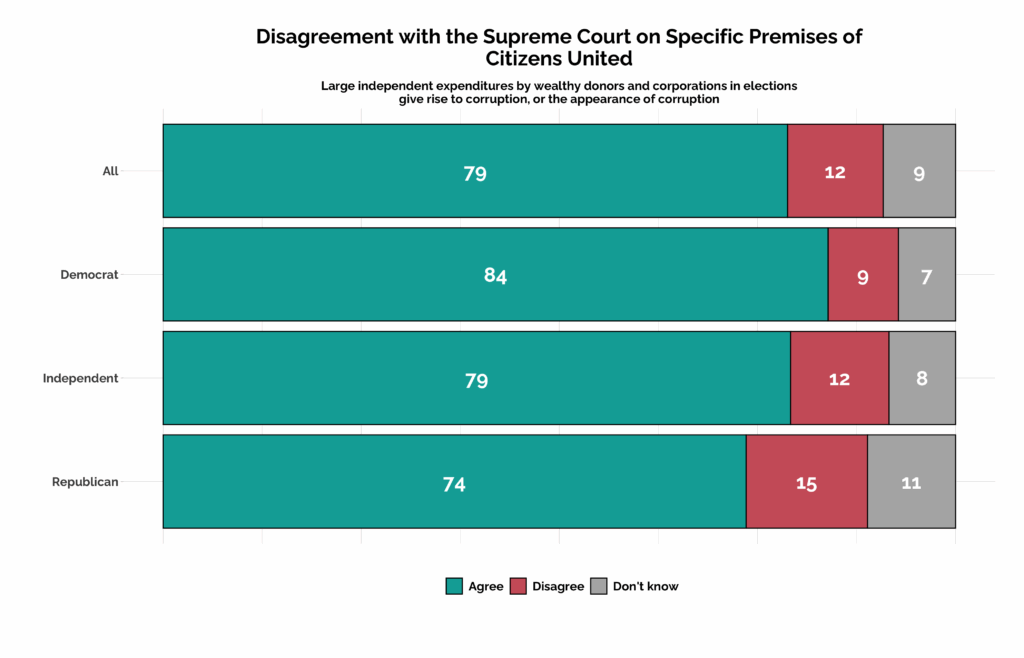 Source: YouGov national survey, Oct. 7-15, 2025
In response to these findings, Issue One Senior Research DirectorMichael Beckel, who oversaw the polling project, said: “Policymakers on both sides of the aisle should be tuning into the fact that overwhelming majorities of Americans across the political spectrum are alarmed by the huge sums being spent in elections by corporations, dark money groups, and wealthy donors.”
Beckel continued: “These findings fly in the face of two of the key assumptions that the U.S. Supreme Court made 15 years ago in Citizens United, namely that independent expenditures do not give rise to corruption or the appearance of corruption, and secondly, that the appearance of influence or access would not cause the electorate to lose faith in democracy. These perceptions of corruption are corrosive to the foundation of our democracy. Our political system cannot function if the public assumes the government is for sale to the highest bidder.”
Added Issue One Policy LeadLiana Keesing: “Montanans are sending a clear message that echoes around the country: Our democracy should be owned by voters, not bought by the wealthy few. These new findings show that people in every corner of the state — and across party lines — want a government that works for all of us, not just those with the deepest pockets. The proposed ballot measure is a bold, practical step toward restoring trust in our political system by ensuring that elections reflect the voices of citizens, not corporate interests. If Montana succeeds, it won’t just reform its own laws; Montanans can pave a path for states across the nation that want to reclaim democracy for the people.”
In Montana, Issue One’s new poll found that nearly 3 in 4 Montanans (74%) — including 84% of Democrats, 69% of Republicans, and 64% of independents — would vote in favor of this proposed ballot measure to eliminate corporate and dark money spending in elections by amending state law governing corporate charters, compared to only 11% opposed.
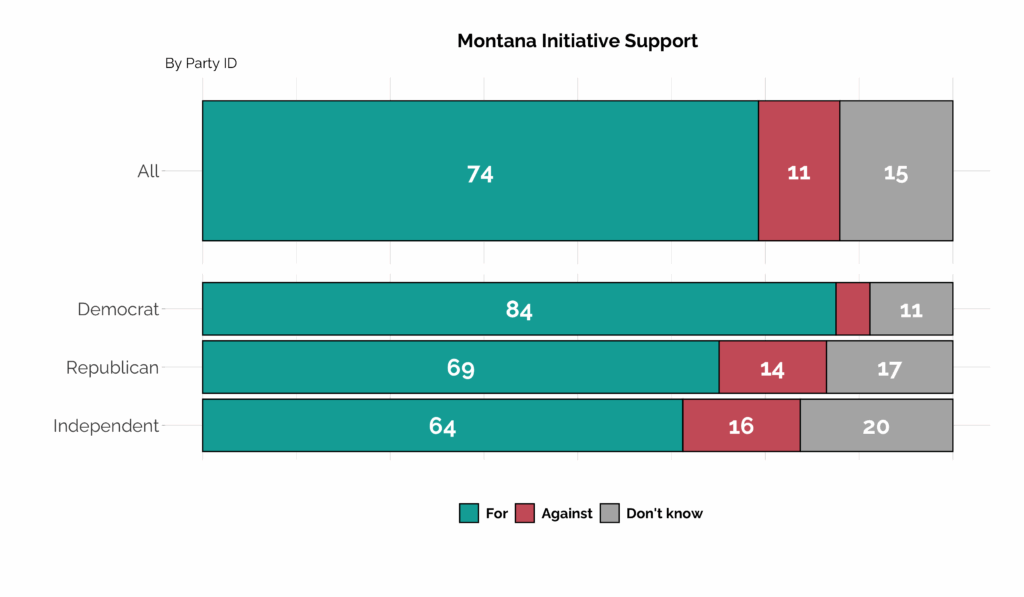 Source: YouGov survey of Montana voters, Oct. 7-20, 2025
Nationally, Issue One’s poll tested a comparable proposal — asking voters how they would respond if a similar measure were considered in their own state. Support was nearly as strong, with 72% of Americans said they would support such a reform, compared to only 12% opposed, after respondents were exposed to messaging from both supporters and opponents. That included support from 81% of Democrats, 64% of Republicans, and 60% of independents.
These high levels of support persisted even when voters were reminded that proposed reforms to curb corporate and dark money spending in elections could apply to their own preferred groups, or raise free speech concerns.
Other key findings from these two polls included:
- 77% of Americans — including 84% of Democrats, 70% of Republicans, and 78% of independents — agreed that anti-corruption rules strengthen our democracy and constitutional rights by ensuring everyone has equal political representation, regardless of money.
- 75% of Americans — including 84% of Democrats, 65% of Republicans, and 73% of independents — said unlimited spending in elections makes our democracy weaker because it gives wealthy special interests too much influence over elected officials. Only 13% of Americans said unlimited spending by people and organizations makes our democracy stronger by protecting the constitutional right to free speech.
- 73% of Americans — including 81% of Democrats, 67% of Republicans, and 71% of independents — agreed that “if a wealthy donor or corporation gains influence over or access to an elected official, I consider that official to be corrupt.”
- 69% of Americans — including 76% of Democrats, 61% of Republicans, and 64% of independents — believe that technology and social media companies have too much influence in politics.
- 63% of Americans — including 73% of Democrats, 53% of Republicans, and 61% of independents — disagreed with the Supreme Court’s Citizens United decision that corporations and labor unions have a First Amendment right to spend unlimited money to influence elections.
- 72% of Montanans — including about 70% of both Democrats and Republicans — continued to support the ballot initiative passed by roughly 75% of voters in 2012 that established a state policy that corporations are not entitled to constitutional rights, such as First Amendment free speech rights, because they are not human beings.
Read the toplines, crosstabs, and interested parties’ memo prepared by YouGov for Issue One’s national poll.
Read the toplines, crosstabs, and interested parties’ memo prepared by YouGov for Issue One’s Montana poll.
===
---
COC MAINE SUPERPAK
KAREN FRINK WOLF MAGISTR JUDGE JUL 15 2025
Opinion-Dinner-Table-Action-v.-Schneider-D.-Me
---
mta email 1 26
january 16, 2026
WATCH: On Senate Floor, Kelly Leads Colleagues in Marking 16 Years Since Citizens United Ruling, Highlighting Impact of Big Money in Politics on Working Families
*“The loudest voices in Washington became billionaires, not every day Americans.”
In case you missed it, Arizona Senator Mark Kelly led a series of floor speeches with his colleagues marking the 16th ^anniversary of the Supreme Court’s Citizens United v. FEC decision, which opened the floodgates for big, dark money in our politics.
In their remarks, Kelly and his colleagues connected the rise of dark money and super PAC spending to real-world consequences for Americans, highlighting how unlimited corporate and billionaire spending has warped priorities in Washington and driven up costs for working families, underscoring the need to restore accountability and transparency so that our democracy answers to voters—not special interests.
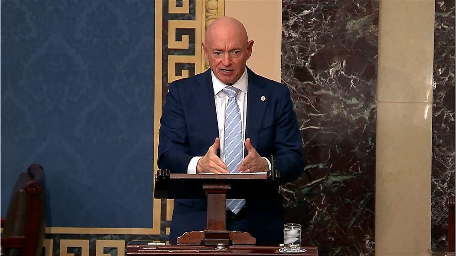
*Sen. Kelly speaks on Senate floor.
Watch Kelly’s full speech here. See key excepts from Kelly and his colleagues below:
*Sen. Kelly: “In 2010, the Supreme Court handed down a decision that put a ‘for sale’ sign on our democracy. The Citizens United ruling opened the door for corporations and billionaires to spend unlimited amounts of money to influence our elections, often without the public ever knowing who’s behind it. The Court decided that spending money in elections is the same as political speech, and that corporations should have the same political rights as individual Americans. The result was predictable – and it wasn’t limited to a courtroom. It changed how this place works. The loudest voices in Washington became billionaires, not every day Americans.
*Sen. Sheldon Whitehouse (D-RI): “I was here before the Citizens United decision. When robust meaningful bipartisan climate legislation was constant here in the Senate. I can think of four major bipartisan bills here in the Senate. And I remember my friend, John McCain, carrying the Republican banner into the presidential election with a respectable climate platform. Well, right after Citizens United, all of that stopped. The barrage of fossil fuel dark money into our politics killed bipartisanship on climate change instantly. It is still a problem today.”
*Sen. Jeff Merkley (D-OR): “The growth in dark money has been stunning because there’s so much money among the oligarchs and billionaires, they want to spend it to create laws that favor the oligarchs and billionaires and they are spending at an extraordinary rate. Six years ago, it was about $300 million, but according to the Brennan Center […] dark money hit a record high of $1.9 billion in the 2024 races. That’s a six-fold increase in six years. That’s the rich and powerful buying their government. It is an absolute travesty. No one in our founding community of our nation who wrote the Declaration of Independence, who wrote the Constitution, wanted to design a system where the mega rich ran the place as a cabal of elites. But that’s what we have and that’s what we have to change.”
*Sen. Amy Klobuchar (D-MN): “In the 2024 elections, secret money groups spent $1.9 billion – nearly double the amount spent just one cycle before. This undermines our democracy and shakes the public’s trust because unlimited, anonymous spending in our elections doesn’t encourage free speech – it drowns out the voices of American people who are seeking to participate. We must fight for a more transparent democracy where every voter’s voice is heard.”
*Sen. Andy Kim (D-NJ): “We live in the time of the greatest distrust in modern history. It doesn’t have to be this way. We can have a politics that restores and grows trust, instead of actively degrading it. This year is the 250th anniversary of the independence of our nation. This is our moment to free Americans from the influence of big money and give them their voice back in their democracy.”
*Sen. Cory Booker (D-NJ): “Since the Citizens United decision, I have watched how this body has seen clearly corrupt forces beginning to overrun the commonsense and the will of the people and policy, more and more be bent to the whim and the will of the wealthiest of the wealthy in our country, in the world, as well as corporations, many of them multinational corporations. We are in crisis. Our nation is in crisis. […] Trust is vital for a democracy to thrive. And there has been nothing more powerful in undermining that trust in the years I’ve been in the Senate that I’ve seen than the destructive force of money in our politics.”
*Sen. Dick Durbin (D-IL): “Under the current system that’s described by my colleagues on the floor, there is so much entrenched money that they virtually control the agenda and scare the living hell out of average individuals who don’t have a fortune to spend. And that’s the reality of what we face.”
*Sen. Chris Murphy (D-CT): “Individuals today make up to 16% of total spending in elections. 16%. 84% of all the spending in elections today are not done by citizens. 84% of spending are corporations and organizations. Much of that money is anonymous. You have no idea where that comes from. Let me tell you what the impact of that. The impact is corruption. Let’s just call it what it is.”
*Sen. Alex Padilla (D-CA): “Citizens United didn’t just change campaign finance law — it fundamentally altered our democracy. It was the moment where the voices of everyday Americans began to be drowned out by a small and powerful few, armed with unlimited money and unprecedented access. As Trump completely sidelines the Federal Election Commission — our country’s top campaign finance watchdog — we are entering a midterm election season with unlimited money allowed in our elections and a President who has regularly used the powers of the office to benefit his billionaire donors. I will continue to push my colleagues to enact legislation to overturn Citizens United so that our elections reflect the will of the people instead of corporations and the highest bidder.”
---
---}:
AN 1 26
An extensive new study from a team of Ivy League economists has uncovered just how much the Supreme Court has shifted towards favoring the wealthier side in any given case, with a New York Times report concludingreport concluding that you can "follow the money" to determine how it will in any given case.
The new study, dubbed "Ruling for the Rich," was published on Monday and hailed from the team of Yale's Fiona Scott Morton, Columbia's Andrea Prat and Columbia's Jacob Spitz. Adam Liptak, the leading Supreme Court correspondent for the Times, dug into its findings, noting that "the wealthy have the wind at their backs before the justices," and questioning whether or not they are living up to their oath to "do equal right to the poor and to the rich."
Per Liptak's analysis, the study found that Republican appointees, who have held a 6-3 majority on the Supreme Court since 2020 and an overall majority for much longer, are "far more likely than Democratic ones to side with the wealthy," and adding "that the Supreme Court has become deeply polarized in cases pitting the rich against the poor." This is now in sharp contrast to the court of the mid-20th Century, "when appointees of the two parties were statistically indistinguishable" in terms of favoring wealthier parties.
Specifically, the study found that Republican-appointed justices sided with wealthier parties in cases around 70 percent of the time. By comparison, in 1953, conservative justices sided with them only 45 percent of the time.
Speaking with Liptak about the findings, Adam Cohen, author of the book "Supreme Inequality," noted that the study essentially reiterated ideas about the court's conduct that "some of us have been observing for a long time."
“But it is great to see,” Cohen added. “Respected academics crunching the numbers and producing the data to show that this is exactly what has been going on.”
These findings come as leaders in both political parties are ramping up plans to radically alter their campaign finance plans ahead of an upcoming decision, in which the court is widely expected to lift the limits on how much party committees and campaigns are allowed to coordinate with each other. This, experts argue, would hand even more power to the wealthiest donors and further erode the power of small-dollar donors.
---
-===
CONTEXT LEAHY JUD COMM
IX. Minority Views of Senators Grassley, Hatch, Sessions, Graham,
Cornyn, Lee, Cruz, and Flake....................................33
VERY LONG CItES abrams
PROPOSING AN AMENDMENT TO THE CONSTITUTION OF THE UNITED STATES
RELATING TO CONTRIBUTIONS AND EXPENDITURES INTENDED TO AFFECT ELECTION
July 30, 2014.--Ordered to be printed
Mr. Leahy, from the Committee on the Judiciary,
submitted the following
R E P O R T
together with
MINORITY VIEWS
[To accompany S.J. Res. 19]
[Including cost estimate of the Congressional Budget Office]
The Committee on the Judiciary, to which was referred the
joint resolution (S.J. Res. 19), proposing an amendment to the
Constitution of the United States relating to contributions and
expenditures intended to affect elections, having considered
the same, reports favorably thereon, with an amendment, and
recommends that the joint resolution, as amended, do pass.
---
---
“As of Today, the FEC Can’t Enforce Campaign Finance Laws — and That’s Only One of Its Problems”
:{:{[May 1, 2025,}:
federal election commissionRick Hasen}:
Dan Weinerfor the Brennan Center:
Starting today, the bipartisan Federal Election Commission won’t be able to do its job. That’s because the independent agency, which oversees money in campaigns for federal office, will no longer have the minimum four required members to do most business.
The loss of quorum is due to the resignation of a Republican appointee, coupled with President Trump’s unprecedented move in February to fire a Democratic appointee. Such a shortfall has only happened three other times in the FEC’s 50-year history, including twice during Trump’s first term.
Ordinarily, the big question would be how fast the president and Congress will move to restore a full complement of commissioners so the agency can function. That is still important. But in light of the firing and the president’s other steps to exert control over the FEC and other independent agencies, there is now a much bigger issue: Will the FEC be able to continue as an independent watchdog at all? Because even worse than a dormant FEC is one that could be weaponized against the president’s opponents….
---
By Craig Holman, Ph.D.
BEFORE THEFEDERAL ELECTION COMMISSION
Craig Holman, Ph.D.
Public Citizen
215 Pennsylvania Avenue, SE
Washington, D.C. 20003
Complainant,
v.
Elon Musk
Chris Gober, Treasurer
America PAC
P.O. Box 341027
Austin, TX 78734
COMPLAINT
- America PAC is an independent expenditure-only committee (“super PAC”) registered with the Federal Election Commission. America PAC was originally founded and largely financed by Elon Musk, CEO of Space X and co-founder of Tesla, on May 22, 2024 (amended on July 29, 2024). FEC Committee ID: C00879510. Chris Gober serves as the committee’s Custodian of Records and Treasurer.
- On October 19, 2024, Elon Musk pledged to award $1 million every day until Election Day on November 5 to randomly selected registered voters who sign a petition to “support the constitution” launched by America PAC in seven “swing” states. According to the America PAC web site, the $1 million reward is exclusively open to “registered voters” in Pennsylvania, Nevada, Arizona, Michigan, Wisconsin, Georgia and North Carolina. Before signing the petition, persons signing the non-legally binding petition must become registered voters.
- The deadline to sign the petition expired on October 21, which is the day that voter registration in Pennsylvania closed.
- The purpose of the $1 million reward for signing the petition appears to be to motivate voter registration and voting at the polls by those sympathetic with the candidacy of Donald Trump in the key swing states for the 2024 presidential election.
- Payments intended to encourage voter registration and voting are expressly illegal under 52 U.S.C. §10307(c), which reads in part:
- 10307. Prohibited acts
(c) False information in registering or voting; penalties*
Whoever knowingly or willfully gives false information as to his name, address or period of residence in the voting district for the purpose of establishing his eligibility to register or vote, or conspires with another individual for the purpose of encouraging his false registration to vote or illegal voting, or pays or offers to pay or accepts payment either for registration to vote or for voting shall be fined not more than $10,000 or imprisoned not more than five years, or both: Provided, however, That this provision shall be applicable only to general, special, or primary elections held solely or in part for the purpose of selecting or electing any candidate for the office of President, Vice President, presidential elector, Member of the United States Senate, Member of the United States House of Representatives, Delegate from the District of Columbia, Guam, or the Virgin Islands, or Resident Commissioner of the Commonwealth of Puerto Rico.*
- If the Federal Election Commission “upon receiving a complaint … has reason to believe that a person has committed, or is about to commit, a violation of (the Federal Election Campaign Act) … The Commission shall make an investigation of such alleged violation….” 52 U.S.C. §30109(a)(2).
BACKGROUND
- Federal election laws expressly prohibit any payment to any person to register, vote or withhold their vote (52 U.S.C. §10307(c)). This prohibition also applies to payments to encourage any person to register to vote.
- Billionaire Elon Musk has devised a scheme in concert with America PAC to launch a non-binding petition reaffirming the conservative agenda of Donald Trump’s campaign, which certainly is legal. Musk has also employed signature-gatherers at $47 for each signature solicited for the petition, which is also legally in bounds.
- Elon Musk appears to have crossed the legal line when he upped the ante and pledged to award $1 million a day to a randomly selected petition signer who is a registered voter. The America PAC web site (attached as Appendix A) explicitly states that only registered voters who sign the petition are eligible for the financial reward. The offer expired on the date that voter registration ended in Pennsylvania.
- America PAC announced on October 22 that it is expanding the reward payment to any of the seven battleground states, not just Pennsylvania. So far, two petition signers have received the $1 million reward each, John Dreher and Kristine Fishell.
- Pennsylvania Gov. Josh Shapiro called Musk’s plan to give money to registered voters in his state “deeply concerning” and “it’s something that law enforcement could take a look at.”
- On October 22, several former Republican officials sent a letter to the Department of Justice requesting an investigation into the matter under a separate election law, 18 U.S.C. §597.
CONCLUSION
- 52 U.S.C. §10307(c) expressly prohibits payments to encourage or discourage voting.
- The Elon Musk and America PAC $1 million reward program, targeting seven swing states and explicitly designed to reward only registered voters in those states, appears to constitute payment to encourage voter registration and to influence votes.
- Consequently, there is reason to believe that Elon Musk and America PAC have violated the Federal Campaign Finance Act that prohibits payments for voter registration or for voting. We request that the Federal Election Commission investigate whether this reward program violates federal law and how best to address the advertising campaign by America PAC.
---
fec musk bribery
Former GOP officials question Musk $1 million payouts to pro-Trump voters
o troye
Others who signed the letter included Donald Ayer, deputy attorney general under President George H.W. Bush; Trevor Potter, former chairman of the Federal Election Commission; and Christine Todd Whitman, former governor of New Jersey.
---
---