Standard Oil
---
“charter-mongering” states but also to pressures generated by national ... Ohio's 1851 law* was passed in an era when corporation law was intended in part to rein ...
---===
===
Research Guides: This Month in Business History: Standard Oil Established
john D. Rockefeller formed the Standard Oil Company on January 10, 1870 with his business partners and brother. The success of this business empire made Rockefeller one of the world’s first billionaires and a celebrated philanthropist. He garnered both admirers and critics during his lifetime and after his death. Wall Street idolized his money-making abilities, muckrake journalists exposed his unethical business practices, and his charitable causes created a legacy of generosity.
John Davison Rockefeller was born on July 8, 1839 to William Avery Rockefeller and Eliza Davison in Richford, New York. His family later moved near Cleveland, Ohio, where he attended Cleveland’s Central High School before dropping out and starting his first job as an assistant bookkeeper, earning 50 cents per day. With the money he saved from his first job and a loan from his entrepreneurial, snake-oil salesman father, he opened his first business — a commodities brokerage — in 1859. Around the same time in nearby Titusville, Pennsylvania, Edwin Drake and the Seneca Oil Company completed the first drilled oil well. A discovery of large underground oil reservoirs, made accessible with new drilling technology, created a boom of oil companies in Pennsylvania and Ohio.
In 1870, Rockefeller joined in the oil business, along with his brother William, Samuel Andrews, Henry M. Flagler, and Stephen V. Harkness. Their business, the Standard Oil Company of Ohio, focused on oil refining, which had less variable costs than oil exploration and drilling. Rockefeller’s contemporaries often commented on his fixation with cost-saving and waste-reduction, but in order to be the best, he also invested in research and development. Standard Oil brought as much labor in-house as they could and focused on finding markets for refinery by-products. After knowingly buying fields in Ohio containing sour oil, Rockefeller relied on his research and development team to create a way to remove the oil impurities, which they eventually did, allowing him to cash in on oil no one else wanted.
Rockefeller’s lack of opulence was also evident in his home life. He had married Laura Celestia “Cettie” Spelman in 1864, and together they raised their children, Bessie, Alice (who died as an infant), Alta, Edith and John Jr., in a devoutly Baptist household. Although they lived comfortably at their mansion on Euclid Avenue External and their Forest Hill summer home, they avoided extravagant possessions.
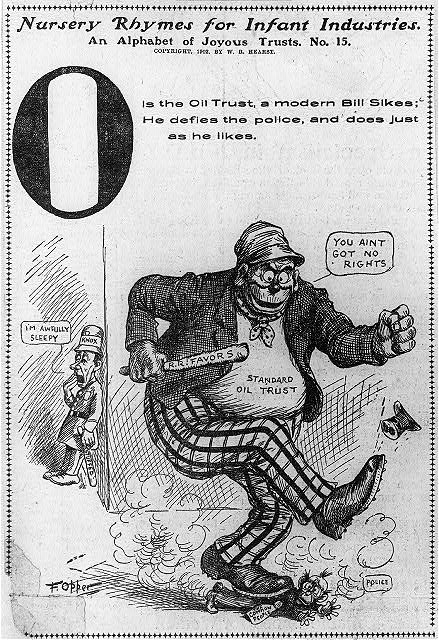 *[Anti-trust cartoons]: Nursery Rhymes for Infant Industries, No. 15: 'O' is the Oil Trust, a modern Bill Sikes; he defies the police, and does just as he likes. c1901. Library of Congress Prints and Photographs Division. lil guy sign says common ---?
While free-market capitalism led to the creation of numerous oil companies, it also, to Rockefeller, created unpredictable chaos in the industry, with oil refiners undercutting each other on prices, creating wide fluctuations. In order to remove this “marketplace inefficiency,” Rockefeller began acquiring competing oil refineries. Within the first three months of 1872, he had bought out, shut down or bankrupted 22 of his 26 Cleveland competitors.
Unsympathetic to goodwill pricing, he offered a “fair market price” for refineries that were losing money with outdated equipment. However, as muckrake journalists later pointed out, the refineries were losing money because of Standard Oil’s monopoly. Its very size meant that Standard Oil, unlike other refineries, could negotiate a railroad discount by promising 60 carloads of oil daily, which appealed to railroad owners wanting to maintain a high and steady volume. These train rebates helped Standard Oil keep transportation costs low; other refineries could not compete. Oil and railroad tycoons proposed a deal to fix transportation costs, called the Southern Improvement Company, but public outcry quickly stopped further negotiations.
In 1882, Standard Oil Trust created a network of Standard Oil companies throughout the country, led by a board of trustees, where Rockefeller owned over one third of the certificates. By the late 1880s, Standard Oil controlled 90% of American refineries. This control of the market, along with the Southern Improvement Company scandal, caught the attention of politicians, who started passing anti-trust laws and prohibiting train rebates. Rockefeller had a strict no-talking-to-the-press rule, which did nothing to combat the widely popular, scathing critique of Standard Oil External by journalist Ida Tarbell. Rockefeller eventually retired from daily operations in 1895, at the age of 56, but stayed in a figurehead role as president.
In 1911, the Supreme Court found Standard Oil in violation of the Sherman Antitrust Act. As a result, Standard Oil was split into 34 independent companies, although over time these corporate descendants regrew into large integrated oil companies that still dominate the market, such as ExxonMobil.
The Supreme Court case also hadn’t slowed Rockefeller’s wealth: newspaper headlines from 1916 announced he was the world’s first billionaire. According to *Forbes*External, Rockefeller’s total assets in 1937 equaled 1.5% of America’s total economic output for that same year, making him one of the wealthiest people in the world to this day (in comparison, Bill Gates’ wealth in 2018 would be 0.45% of 2018 GDP).
He was often approached about donating his money to various causes. His publicist Ivy Lee, hired after the anti-trust case, “cultivated the notion of a benign old man giving away dimes and preoccupied with charity,” according to one biographer. Rockefeller and his family established the Rockefeller Foundation External in 1913, which supported public health causes through a large endowment. He also used his money to establish the University of Chicago and the Rockefeller Institute for Medical Research. His goal as a young adult was to make $100,000 and live to be 100 years old. While he surpassed his financial goal, John D. Rockefeller died on May 23, 1937, at the age of 98.
===
---
John lived in an age when owners of industries operated without much interference from government. Even the income tax did not exist. Rockefeller built an oil monopoly by ruthlessly eliminating most of his competitors. This made him the richest man in the world. But he spent his retirement years giving away most of his money. The unlikely match between "Devil Bill" and Eliza Rockefeller produced a son who would paradoxically become the most hated and admired man in America.
The Standard Oil Monopoly
Shortly before the Civil War, Rockefeller and a partner established a shipping company in Cleveland, Ohio. The company made much money during the war. In 1863, he and his partner invested in another business that refined crude oil from Pennsylvania into kerosene for illuminating lamps.
By 1870, Rockefeller and new partners were operating two oil refineries in Cleveland, then the major oil refining center of the country. The partners incorporated (under a charter issued by the state of Ohio) and called their business the Standard Oil Company.
To give Standard Oil an edge over its competitors, Rockefeller secretly arranged for discounted shipping rates from railroads. The railroads carried crude oil to Standard's refineries in Cleveland and kerosene to the big city markets. Many argued that as "common carriers" railroads should not discriminate in their shipping charges. But small businesses and farmers were often forced to pay higher rates than big shippers like Standard Oil.
The oil industry in the late 1800s often experienced sudden booms and busts, which led to wildly fluctuating prices and price wars among the refiners. More than anything else, Rockefeller wanted to control the unpredictable oil market to make his profits more dependable.
In 1871, Rockefeller helped form a secret alliance of railroads and refiners. They planned to control freight rates and oil prices by cooperating with one another. The deal collapsed when the railroads backed out. But before this happened, Rockefeller used the threat of this deal to intimidate more than 20 Cleveland refiners to sell out to Standard Oil at bargain prices. When the so-called "Cleveland Massacre" ended in March 1872, Standard controlled 25 percent of the U.S. oil industry.
Rockefeller saw Standard Oil's takeover of the Cleveland refiners as inevitable. He said it illustrated "the battle of the new idea of cooperation against competition." In his mind, large industrial combinations, more commonly known as monopolies, would replace individualism and competition in business.
Rockefeller planned to buy out as many other oil refineries as he could. To do this, he often used hardball tactics. In 1874, Standard started acquiring new oil pipeline networks. This enabled the company to cut off the flow of crude oil to refineries Rockefeller wanted to buy. When a rival company attempted to build a competing pipeline across Pennsylvania, Standard Oil bought up land along the way to block it. Rockefeller also resorted to outright bribery of Pennsylvania legislators. In the end, Rockefeller made a deal with the other company, which gave Standard Oil ownership of nearly all the oil pipelines in the nation.
By 1880, Standard Oil owned or controlled 90 percent of the U.S. oil refining business, making it the first great industrial monopoly in the world. But in achieving this position, Standard violated its Ohio charter, which prohibited the company from doing business outside the state. Rockefeller and his associates decided to move Standard Oil from Cleveland to New York City and to form a new type of business organization called a "trust."
Under the new arrangement (done in secret), nine men, including Rockefeller, held "in trust" stock in Standard Oil of Ohio and 40 other companies that it wholly or partly owned. The trustees directed the management of the entire enterprise and distributed dividends (profits) to all stockholders.
When the Standard Oil Trust was formed in 1882, it produced most of the world's lamp kerosene, owned 4,000 miles of pipelines, and employed 100,000 workers. Rockefeller often paid above-average wages to his employees, but he strongly opposed any attempt by them to join labor unions. Rockefeller himself owned one-third of Standard Oil's stock, worth about $20 million.
During the 1880s, Standard Oil divided the United States into 11 districts for selling kerosene and other oil products. To stimulate demand, the company sold or even gave away cheap lamps and stoves. It also created phony companies that appeared to compete with Standard Oil, their real owner. When independent companies tried to compete, Standard Oil quickly cut prices--sometimes below cost--to drive them out of business. Then Standard raised prices to recoup its losses.
Much of the trust's effort went into killing off competition. But Standard Oil while Rockefeller was in command also usually provided good quality products at fairly reasonable prices. Rockefeller often declared that the whole purpose of Standard Oil was to supply "the poor man's light."
The Antitrust Movement
By 1900, the Standard Oil Trust had expanded from its original base in the East to new oil regions further west. At the same time, a wave of anti-monopoly sentiment swept the United States. Farmer organizations, labor unions, muckraking journalists, and many politicians attacked such combinations as the sugar and tobacco trusts. But they especially targeted the "mother trust," Standard Oil.
By this time, nearly 30 states and the federal government had passed antitrust laws that attacked monopoly abuses. These laws usually rested on a set of legal and economic assumptions:
- The common law, inherited from England, condemned the restraint of trade.
- Monopolies tended to restrain trade by keeping prices high, suppressing product improvements, and making excessive profits.
- Competition among many independent firms was necessary to assure fair prices, high-quality products, and reasonable profits.
Starting with Ohio in 1887, 10 states and the Oklahoma Territory filed 33 separate lawsuits against companies affiliated with the Standard Oil Trust. In most cases, Standard lost in court. But Standard's directors reorganized the trust shifted operations from state to state, and otherwise evaded court rulings to maintain their monopoly.
Since state lawsuits against Standard Oil were going nowhere, muckraking journalists pressed for federal action against the trust.
Starting in November 1902, Ida Tarbell wrote a series of 19 carefully researched articles in McClure's Magazine. She detailed how John D. Rockefeller ruthlessly forced his competitors to "sell or perish." She correctly identified railroad discounts, specifically outlawed by the Interstate Commerce Act of 1887, as key to creating Rockefeller's Standard Oil monopoly.
Called "Miss Tarbarrel" and "this poison woman" by Rockefeller, Tarbell helped push the federal government to investigate the Standard Oil Trust. While publicly attacking Standard Oil and other trusts, President Theodore Roosevelt did not favor breaking them up. He preferred only to stop their anti-competitive abuses.
On November 18, 1906, the U.S. attorney general under Roosevelt sued Standard Oil of New Jersey and its affiliated companies making up the trust. The suit was filed under the Sherman Antitrust Act of 1890. Under this federal law, "Every contract, or combination, in restraint of trade or commerce among the several States, or with foreign nations, is hereby declared to be illegal."
Standard Oil v. United States
The Standard Oil trial took place in 1908 before a Missouri federal court. More than 400 witnesses testified. The government produced evidence that the Standard Oil Trust had secured illegal railroad discounts, blocked competitors from using oil pipelines, spied on other companies, and bribed elected officials. Moreover, the government showed that from 1895-1906 Standard's kerosene prices increased 46 percent, giving enormous profits to the monopoly.
Although Rockefeller was technically president of Standard Oil, he had retired from active management in 1895. But he remained the single largest stockholder. Rockefeller testified that Standard Oil achieved its position because its combination of cooperating companies was more efficient and produced a better product than its rivals. When cross-examined on how Standard Oil grew so dominant, the 71-year-old Rockefeller frequently stated that he could not remember.
Attorneys for Standard Oil contended that the large combination of companies making up the trust had developed naturally and actually saved the industry from destructive price wars. They also argued that since Standard Oil was a manufacturing business, it was exempt from the Sherman Act, which only addressed interstate commerce.
Both the trial judge and a unanimous federal appeals court agreed that Standard Oil was a monopoly violating the Sherman Antitrust Act. They also supported the government's recommendation that the trust should be dissolved into independent competing companies. Standard Oil then appealed to the U.S. Supreme Court.
On May 15, 1911, the Supreme Court unanimously upheld the federal appeals court and ruled that the Standard Oil Trust was a monopoly that illegally restrained trade. All but one justice, however, went on to hold that only monopolies that restrained trade in "unreasonable" ways were illegal. Although it found that Standard Oil did, in fact, act unreasonably, the Supreme Court's use of the "rule of reason" made it more difficult for government to prosecute other monopolies. [Standard Oil of New Jersey v. United States]
The Supreme Court justices concluded that to restore competition in the oil industry, the Standard Oil Trust would have to be broken into independent companies. But the government permitted Standard Oil stockholders to each receive fractional shares in all 34 companies that were formed. This meant that each of these companies had exactly the same stockholder owners. These companies were then supposed to compete with one another. In reality, the companies had little real incentive to do this and acted together in setting prices for a decade or more.
Following new petroleum discoveries in the United States and abroad, independent oil companies finally brought real competition to the industry. But the former Standard Oil companies, with modern names like Exxon, Mobil, Amoco, Chevron, ARCO, Conoco, and Sohio, continued to exercise significant influence on oil pricing.
When the Supreme Court broke up the Standard Oil Trust in 1911, electric lights were rapidly replacing kerosene lamps. But the gasoline-driven automobile was just beginning to appear. Gasoline, up to that time a useless byproduct of oil refining, made the companies formed from the trust wealthier than they had ever been. Rockefeller, owning a 25 percent share in each of the new companies, was worth $900 million in 1913 ($13 billion in today's dollars). This made him the richest man in the world.
In retirement, Rockefeller made a science of philanthropy. He and his son gave away most of the Rockefeller millions, mainly to medical research, public health, and educational institutions. Even so, he bitterly objected to the federal income tax when it began in 1913.
Economist Robert Heilbroner once described John D. Rockefeller as "an agent for better and worse in the immense industrial transformation of America." Outliving most of his business associates and critics, John D. Rockefeller died in 1937, a few weeks short of his 98th birthday.
For Discussion and Writing
- Explain why John D. Rockefeller was "an agent for better and worse" in American history.
- Do you agree with the Supreme Court's decision in 1911 that the Standard Oil Trust had violated the Sherman Antitrust Act? Why or why not?
- In 1911, the Supreme Court ruled that only monopolies "unreasonably" restraining trade were illegal. Today, do you think that all monopolies should be illegal? Why or why not?
For Further Reading
John D. Rockefeller: A Photographic History
John D. Rockefeller and the Standard Oil Company
Chernow, Ron. Titan, The Life of John D. Rockefeller, Sr. New York: Vintage Books, 1998. First Chapter
---
---
Standard Oil
Main article: Standard Oil

John D. Rockefeller ca. 1875
...By the end of the American Civil War, Cleveland was one of the five main refining centers in the U.S. (besides Pittsburgh, Philadelphia, New York, and the region in northwestern Pennsylvania where most of the oil originated). In June 1870, Rockefeller formed Standard Oil of Ohio, which rapidly became the most profitable refiner in Ohio. Standard Oil grew to become one of the largest shippers of oil and kerosene in the country. The railroads were fighting fiercely for traffic and, in an attempt to create a cartel to control freight rates, formed the South Improvement Company, in collusion with Standard and other oil men outside the main oil centers.[28]}:
The cartel received preferential treatment as a high-volume shipper, which included not just steep rebates of up to 50% for their product, but also rebates for the shipment of competing products.[28] Part of this scheme was the announcement of sharply increased freight charges. This touched off a firestorm of protest from independent oil well owners, including boycotts and vandalism, which eventually led to the discovery of Standard Oil's part in the deal. A major New York refiner, Charles Pratt and Company, headed by Charles Pratt and Henry H. Rogers, led the opposition to this plan, and railroads soon backed off. Pennsylvania revoked the cartel’s charter and equal rates were restored for the time being.[29]}:
:{:{Undeterred, though vilified for the first time by the press, Rockefeller continued with his self-reinforcing cycle of buying competing refiners, improving the efficiency of his operations, pressing for discounts on oil shipments, undercutting his competition, making secret deals, raising investment pools, and buying rivals out. In less than four months in 1872, in what was later known as the "Cleveland Conquest" or "Cleveland Massacre", Standard Oil had absorbed 22 of its 26 Cleveland competitors.[30]}:
Eventually, even his former antagonists, Pratt and Rogers, saw the futility of continuing to compete against Standard Oil: in 1874, they made a secret agreement with their old nemesis to be acquired. Pratt and Rogers became Rockefeller's partners. Rogers, in particular, became one of Rockefeller's key men in the formation of the Standard Oil Trust. Pratt's son, Charles Millard Pratt became Secretary of Standard Oil. For many of his competitors, Rockefeller had merely to show them his books so they could see what they were up against, then make them a decent offer. If they refused his offer, he told them he would run them into bankruptcy, then cheaply buy up their assets at auction.
He saw himself as the industry’s savior, "an angel of mercy", absorbing the weak and making the industry as a whole stronger, more efficient, and more competitive.[31] Standard was growing horizontally and vertically. It added its own pipelines, tank cars, and home delivery network. It kept oil prices low to stave off competitors, made its products affordable to the average household, and to increase market penetration, sometimes sold below cost if necessary. It developed over 300 oil-based products from tar to paint to Vaseline to chewing gum. By the end of the 1870s, Standard was refining over 90% of the oil in the U.S.[32] Rockefeller had already become a millionaire.[33]}:

Standard Oil Trust Certificate 1896
In 1877, Standard clashed with the Pennsylvania Railroad, its chief hauler. Rockefeller had envisioned the use of pipelines as an alternative transport system for oil and began a campaign to build and acquire them.[34] The railroad, seeing Standard’s incursion into the transportation and pipeline fields, struck back and formed a subsidiary to buy and build oil refineries and pipelines.[35] Standard countered and held back its shipments, and with the help of other railroads, started a price war that dramatically reduced freight payments and caused labor unrest as well. Rockefeller eventually prevailed and the railroad sold all its oil interests to Standard. But in the aftermath of that battle, in 1879 the Commonwealth of Pennsylvania indicted Rockefeller on charges of monopolizing the oil trade, starting an avalanche of similar court proceedings in other states and making a national issue of Standard Oil’s business practices.[36]
Monopoly
:{:{Standard Oil gradually gained almost complete control of oil refining and marketing in the United States through horizontal integration. In the kerosene industry, Standard Oil ruthlessly replaced the old distribution system with its own vertical system. It supplied kerosene by tank cars that brought the fuel to local markets and tank wagons then delivered to retail customers, thus bypassing the existing network of wholesale jobbers}:.[37]
Despite improving the quality and availability of kerosene products while greatly reducing their cost to the public (the price of kerosene dropped by nearly 80% over the life of the company), Standard Oil's business practices created intense controversy. Standard’s most potent weapons against competition were underselling, differential pricing, and secret transportation rebates.[38] The firm was attacked by journalists and politicians throughout its existence, in part for these monopolistic methods, giving momentum to the anti-trust movement.
By 1880, according to the New York World, Standard Oil was "the most cruel, impudent, pitiless, and grasping monopoly that ever fastened upon a country."[39] To the critics Rockefeller blandly replied, "In a business so large as ours…some things are likely to be done which we cannot approve. We correct them as soon as they come to our knowledge.”[39]}:
:{:{At that time, many legislatures had made it difficult to incorporate in one state and operate in another. As a result, Rockefeller and his associates owned separate corporations across dozens of states, making their management of the whole enterprise rather unwieldy. In 1882, Rockefeller's lawyers created an innovative form of corporation to centralize their holdings, giving birth to the Standard Oil Trust}:.[40]
The "trust" was a corporation of corporations, and the entity's size and wealth drew much attention. Nine trustees, including Rockefeller, ran the 41 companies in the trust.[40] The public and the press were immediately suspicious of this new legal entity, but other businesses seized upon the idea and emulated it, further inflaming public sentiment. Standard Oil had gained an aura of invincibility, always prevailing against competitors, critics, and political enemies. It had become the richest, biggest, most feared business in the world, seemingly immune to the boom and bust of the business cycle, consistently racking up profits year after year.[[41]](
http://en.wikipedia.org/wiki/John_Davison_Rockefeller#cite_note-Chernow.2C_1998_p._249-40)}:
:{:{Its vast American empire included 20,000 domestic wells, 4,000 miles of pipeline, 5,000 tank cars, and over 100,000 employees.[[41]](http://en.wikipedia.org/wiki/John_Davison_Rockefeller#cite_note-Chernow.2C_1998_p._249-40)}:
Its share of world oil refining topped out above 90% but slowly dropped to about 80% for the rest of the century.[42] Ironically, in spite of the formation of the trust and its perceived immunity from all competition, by the 1880s Standard Oil had passed its peak of power over the world oil market. Rockefeller finally gave up his dream of controlling all the world’s oil refining, he admitted later, “We realized that public sentiment would be against us if we actually refined all the oil.”[42] In reality, foreign competition and new finds abroad eroded his dominance. In the early 1880s, Rockefeller created one of his most important innovations.
Rather than try to influence the price of crude oil directly, Standard Oil had been exercising indirect control by altering oil storage charges to suit market conditions. Rockefeller then decided to order the issuance of certificates against oil stored in its pipelines. These certificates became traded by speculators, thus creating the first oil-futures market which effectively set spot market prices from then on. The National Petroleum Exchange opened in Manhattan in late 1882 to facilitate the oil futures trading.[43]}:
Even though 85% of world crude production was still coming from Pennsylvania wells in the 1880s, overseas drilling in Russia and Asia began to reach the world market.[44] Robert Nobel had established his own refining enterprise in the abundant and cheaper Russian oil fields, including the region’s first pipeline and the world’s first oil tanker. The Paris Rothschilds jumped into the fray providing financing.[45] Additional fields were discovered in Burma and Java. Even more critical, the invention of the light bulb gradually began to erode the dominance of kerosene for illumination. But Standard Oil adapted, developing its own European presence, expanding into natural gas production in the U.S. then into gasoline for automobiles, which until then had been considered a waste product.[46]
:{Standard Oil moved its headquarters to New York City at 26 Broadway and Rockefeller became a central figure in the city’s business community. He bought a personal residence in 1884 on 54th street near the mansions of other magnates such as William Vanderbilt.
Despite personal threats and constant pleas for charity, Rockefeller took the new elevated train to his downtown office daily.[47] In 1877, Congress created the Interstate Commerce Commission which was tasked with enforcing equal rates for all railroad freight, but by then Standard was depending more on pipeline transport.
More threatening to Standard’s power was the Sherman Antitrust Act of 1890, originally used to control unions, but later central to the breakup of the Standard Oil trust.[48] Ohio was especially vigorous in applying its state anti-trust laws, and finally forced a separation of Standard Oil of Ohio from the rest of the company in 1892, the first step in the dissolution of the trust.[48]}:
In the 1890s, Rockefeller expanded into iron ore and ore transportation, forcing a collision with steel magnate Andrew Carnegie, and their competition became a major subject of the newspapers and the cartoonists.[49] Rockefeller also went on a massive buying spree acquiring land for crude oil production in Ohio, Indiana, and West Virginia, as the original Pennsylvania oil fields began to play out.[50] Amidst the frenetic expansion, Rockefeller began to think of retirement. The daily management of the trust was turned over to John D. Archbold and Rockefeller bought a new estate, Pocantico Hills, north of New York City, turning more time to leisure activities including the new sports of bicycling and golf.[51]
Upon his ascent to the presidency, Theodore Roosevelt initiated dozens of suits under the Sherman Antitrust Act and coaxed reforms out of Congress. In 1901, U.S. Steel, now controlled by J. Pierpont Morgan, having bought Andrew Carnegie’s steel assets, offered to buy Standard’s iron interests as well. A deal brokered by Henry Clay Frick exchanged Standard’s iron interests for U.S. Steel stock and gave Rockefeller and his son membership on the company’s board of directors. In full retirement at age 63, Rockefeller earned over $58 million in investments in 1902.[52]
One of the most effective attacks on Rockefeller and his firm was the 1904 publication of The History of the Standard Oil Company, by Ida Tarbell, a leading muckraker. She documented the company’s espionage, price wars, heavy-handed marketing tactics, and courtroom evasions.[53] Although her work prompted a huge backlash against the company, Tarbell claims to have been surprised at its magnitude. “I never had an animus against their size and wealth, never objected to their corporate form. I was willing that they should combine and grow as big and wealthy as they could, but only by legitimate means. But they had never played fair, and that ruined their greatness for me.” (Tarbell's father had been driven out of the oil business during the South Improvement Company affair.)
Rockefeller responded by calling her “Miss Tarbarrel” in private but held back in public saying only, “not a word about that misguided woman.”[53] Instead Rockefeller began a publicity campaign to put his company and himself in a better light. Though he had long maintained a policy of active silence with the press, he decided to make himself more accessible and responded with conciliatory comments such as, “capital and labor are both wild forces which require intelligent legislation to hold them in restriction.”[54] He wrote and published his memoirs beginning in 1908.

Rockefeller as an industrial emperor, 1901 cartoon from Puck magazine
Critics found his writing to be sanitized and disingenuous and thought that statements such as “the underlying, essential element of success in business is to follow the established laws of high-class dealing” seemed to be at odds with his true business methods.[54]
Rockefeller and his son continued to consolidate their oil interests as best as they could until New Jersey, in 1909, changed its incorporation laws to effectively allow a re-creation of the trust in the form of a single holding company. Rockefeller retained his nominal title as president until 1911 and he kept his stock. At last in 1911, the Supreme Court of the United States found Standard Oil Company of New Jersey in violation of the Sherman Antitrust Act. By then the trust still had a 70% market share of the refined oil market but only 14% of the U.S. crude oil supply.[55]
The court ruled that the trust originated in illegal monopoly practices and ordered it to be broken up into 34 new companies. These included, among many others, Continental Oil, which became Conoco, now part of ConocoPhillips; Standard of Indiana, which became Amoco, now part of BP; Standard of California, which became Chevron; Standard of New Jersey, which became Esso (and later, Exxon), now part of ExxonMobil; Standard of New York, which became Mobil, now part of ExxonMobil; and Standard of Ohio, which became Sohio, now part of BP. Pennzoil and Chevron have remained independent.[56]}:
Rockefeller, who had rarely sold shares, held over 25% of Standard’s stock at the time of the breakup.[57] He, as well as all stockholders, received proportionate shares in each of the 34 companies. In the aftermath, Rockefeller’s control over the oil industry was somewhat reduced but over the next ten years, the breakup also proved immensely profitable for him. The companies’ combined net worth rose fivefold and Rockefeller’s personal wealth jumped to $900,000,000.[55]
Philanthropy
From his very first paycheck, Rockefeller tithed ten percent of his earnings to his church. As his wealth grew, so did his giving, primarily to educational and public health causes, but also for basic science and the arts. He was advised primarily by Frederick T. Gates after 1891, and, after 1897, also by his son.
Rockefeller believed in the Efficiency Movement, arguing that
"To help an inefficient, ill-located, unnecessary school is a waste...it is highly probable that enough money has been squandered on unwise educational projects to have built up a national system of higher education adequate to our needs, if the money had been properly directed to that end."
He and his advisers invented the conditional grant that required the recipient to "root the institution in the affections of as many people as possible who, as contributors, become personally concerned, and thereafter may be counted on to give to the institution their watchful interest and cooperation."[58]
In 1884, he provided major funding for a college in Atlanta for African-American women that became Spelman College (named for Rockefeller's in-laws who were ardent abolitionists before the Civil War). The oldest existing building on Spelman's campus, Rockefeller Hall, is named after him. Rockefeller also gave considerable donations to Denison University and other Baptist colleges.
Rockefeller gave $80 million to the University of Chicago under William Rainey Harper, turning a small Baptist college into a world-class institution by 1900. His General Education Board, founded in 1902, was established to promote education at all levels everywhere in the country. It was especially active in supporting black schools in the South. Its most dramatic impact came by funding the recommendations of the Flexner Report of 1910, which had been funded by the Carnegie Foundation for the Advancement of Teaching; it revolutionized the study of medicine in the United States. Rockefeller also provided financial support to Yale, Harvard, Columbia, Brown, Bryn Mawr, Wellesley and Vassar.

Rockefeller and his son John D. Rockefeller, Jr. in 1915.
:{Despite his personal preference for homeopathy, Rockefeller, on Gates's advice, became one of the first great benefactors of medical science. In 1901, he founded the Rockefeller Institute for Medical Research in New York. It changed its name to Rockefeller University in 1965, after expanding its mission to include graduate education. It claims a connection to 23 Nobel laureates. He founded the Rockefeller Sanitary Commission in 1909, an organization that eventually eradicated the hookworm disease that had long plagued the American South.
The Rockefeller Foundation was created in 1913 to continue and expand the scope of the work of the Sanitary Commission, which was closed in 1915. He gave nearly $250 million to the foundation, which focused on public health, medical training, and the arts. It endowed Johns Hopkins School of Hygiene and Public Health, the first of its kind. It built the Peking Union Medical College into a great institution, helped in World War I war relief, and it employed William Lyon Mackenzie King of Canada to study industrial relations. Rockefeller's fourth main philanthropy, the Laura Spelman Rockefeller Memorial Foundation, created in 1918, supported work in the social studies; it was later absorbed into the Rockefeller Foundation. However, all told, Rockefeller gave away about $550 million.}:
Oddly enough, Rockefeller became well known in his later life for the practice of giving dimes to adults and nickels to children wherever he went. He even gave dimes as a playful gesture to men like tire mogul Harvey Firestone.[59]
[ ](http://en.wikipedia.org/wiki/File:John_D._Rockefeller_1917_painting.jpg)
[ ](http://en.wikipedia.org/wiki/File:John_D._Rockefeller_1917_painting.jpg "Enlarge")
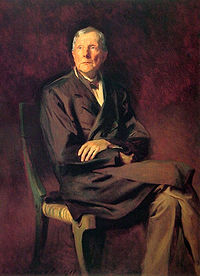
John D. Rockefeller's painting by John Singer Sargent in 1917
As a youth, Rockefeller allegedly said that his two great ambitions were to make $100,000 and to live 100 years. Rockefeller died of arteriosclerosis on May 23, 1937, two months shy of his 98th birthday,[60][61][62] at the Casements, his home in Ormond Beach, Florida. He was buried in Lake View Cemetery in Cleveland.
---
http://en.wikipedia.org/wiki/Standard_Oil
One of the original "muckrakers" was Ida M. Tarbell, an American author and journalist. Her father was an oil producer whose business had failed due to Rockefeller's business dealings. After extensive interviews with a sympathetic senior executive of Standard Oil, Henry H. Rogers, Tarbell's investigations of Standard Oil fueled growing public attacks on Standard Oil and on monopolies in general. Her work was published in 19 parts in McClure's magazine from November 1902 to October 1904, then in 1904 as the book The History of the Standard Oil Company.