liberal media lamestream
belated 5/17
SEE MSM 2
see press suppression
see media bias(general)
see Social media bias BS
also de-platform
SEE BOZELL MRC NEWSBUSTER
SEE LEGACY FOR LEGIT
MERRI OK
BAK CAPT 12 23
=
aha/ not just me see both sides: press self-censors b/c AFRAID OF BEING CALLED LIBERAL by apparatus that is geared up for that [trump fake news, enemy of ppl, McCain deflection --> applause line] also see twin BS myth myth of lib press and pinko prof.
---
---
RWW
03/25/2026
by
- MAGA cultist Shane Vaughn defends President Donald Trump's celebration of the death of Robert Mueller: "If I told you Hitler died how would you respond? If I told you that Charles Manson died how would you respond? They were horrible men They destroyed lives.... You'll pardon Donald Trump if he equates Bob Mueller as a destroyer of lives."
- Erick Stakelbeck declares that Trump is "the standard bearer not just for America, but for all of Judeo-Christian western civilization."
- Right-wing reporter Ben Bergquam claims that "everything you see coming from the mainstream media is a lie": "If it's coming out of any of these mainstream media outlets, it's a lie. If it's coming from a Democrat, you better believe it's a lie."
---
gingrich trash bias press pre-emption --> SOP; here false equivalence/ i am victim
10 24 maga mike gotch question we are looking fwd do not want to litigate the past // jdv fail?!
an
May 23, 2024
US Senator Ted Cruz (R-TX) was one of the 17 Texas Republicans who refused to certify the 2020 election results, according to the Texas Tribune.
During a Wednesday night interview with the GOP senator, CNN's Kaitlan Collins noted Cruz's refusal to acknowledge President Joe Biden win over Donald Trump in 2020, and asked whether the Texas leader plans to accept the November election results in the case Biden wins again.
"Do you plan to object or will you accept the results regardless of who wins the election?" Collins asked.
READ MORE:**Ted Cruz slapped with campaign finance laws violation complaint**
"Kaitlan, I got to say, I think that's actually a ridiculous question," Cruz replied.
"It's a yes or no question," Collins insisted.
"Let me explain why it's ridiculous question," the Texas leader said, asking, "Have you've ever asked a Democrat that?"
Collins replied, "Have you ever had a sitting president who refused to facilitate the peaceful transition of power, refused to acknowledge that his successor won the presidency?
Cruz claimed, "We had peaceful transfer of power, I was there on January 20."
"Barely," Collins replied, before noting that in 2016, when Biden was vice president, "he went to the Senate floor and certified the votes."
READ MORE:**'Ted Cruz isn’t fooling anyone': Texas senator slammed over outreach to Democrats**
Cruz said, "You only ask Republicans" this question.
Collins replied, "Because it was Republicans who tried to block the transition of power. You have to acknowledge that. We've never seen it on a scale of what happened in 2020. And We've never seen the president refuse. He wouldn't even let Joe Biden get classified briefings at the beginning.I recall that. So my question for you again: Free and fair election, will you accept the results regardless of who wins?"
The senator replied, "If the Democrats win, I will accept the result, but I'm not going to ignore fraud," before claiming there was voter fraud in 2020. Collins replied, "No there wasn't, and you still objected."
"Oh you know, for a fact, there were zero voter-fraud?" Cruz asked. "What's your basis for that? Show me your evidence.'
Collins said, "We've spoken with [Georgia Republican] Governor [Brian] Kemp. They did three hand recounts in the state of Georgia. the director of CISA [Cybersecurity and Infrastructure Security Agency] said that this was one of the safest most legitimate elections."
READ MORE:['Taking a lot of ribbing': Ted Cruz now the butt of senators’ jokes amid FAA bill markup
The CNN host emphasized, "Republicans are twisting themselves in knots."
Cruz claimed Collins never asks Hillary Clinton, Stacey Abrams, or Al Gore whether they will certify election results.
"I haven't had any of them on my show," Collins said. "We'll talk to them, but I don't remember there being a president who was refusing to turn over the transition of power."
Watch the video below or at this link.
---
AN 10 25
Corey Lewandowski, a senior adviser at the Department of Homeland Security and longtime ally of President Donald Trump, is considering a run for governor of New Hampshire, Politico reported Thursday.
The report comes as the White House weighs backing a primary challenge against current Gov. Kelly Ayotte (R).
“Governor is the only job in politics I would ever consider giving up what I am currently doing for,” Lewandowski told Politico.
According to the report, he did not indicate whether the potential run had been discussed with the White House.
The possible candidacy comes amid growing tensions between the Trump administration and Ayotte over redistricting.
The White House is reportedly frustrated with Ayotte’s resistance to redrawing congressional maps that would strengthen Republican control of the U.S. House ahead of the midterms.
The report noted that Lewandowski’s role at DHS has drawn internal scrutiny. Initially appointed as a special governmental employee, a position limited to 130 days of unpaid work per year, questions have emerged about how his time is being counted.
Despite the temporary designation, he has wielded significant influence, with current and former administration officials saying he has veto power over DHS contracts and grants exceeding $100,000.
He is listed on the agency's website as a chief adviser to Homeland Security Secretary Kristi Noem and is regularly seen traveling with her.
Speculation about Lewandowski’s future at DHS intensified this week amid reports he might be leaving the department.
Lewandowski addressed the rumors in a post on the social platform X Wednesday night, writing, “I thought it only fitting today to share the words of the famous Mark Twain … ‘The reports of my death are greatly exaggerated.’ Lots of Fake News out there… don’t believe the MSM.”
He previously floated a 2020 Senate bid against Democrat Jeanne Shaheen, which failed to gain traction within the state’s GOP establishment.
---
---
AN 9 25
// CONTEXT
Journalist Gabriel Sherman, who wrote the film “The Apprentice,” tells the New York Times that the Hollywood entertainment industry may be too weak to battle an autocrat willing to use the levers of government against it.
“Hollywood is no longer protected by its glamour and profit margins,” said Sherman. “It’s still reeling from the collapse of traditional business models — box office, cable fees, advertising — and the aftereffects of pandemic shutdowns and writer and actor strikes. Entertainment companies, up against tech behemoths with endless resources and an algorithmic sensibility, are desperate to consolidate. They have shed tens of thousands of jobs under pressure to make money-losing streaming businesses profitable. And that’s before A.I. makes these upheavals seem quaint. In this weakened state, the entertainment industry simply can’t afford to fight.”
These are no longer the days of powerful organizations with imperious public relations departments, said Sherman, who watched his well-reviewed “The Apprentice” project fall off the radar after Trump campaign spokesman, Steven Cheung, called it “malicious defamation” and Trump threatened to sue the producers and any company that released it.
“Going into the festival, my producers had lined up screenings with every major studio and streamer. There was tremendous interest from buyers. When Mr. Trump’s campaign attacked the film, the radio went silent,” said Sherman. “Every major Hollywood studio and streamer passed.”
Eventually, independent distributor Briarcliff Entertainment bought the film, which went on to receive two Oscar nominations. But Sherman said Trump’s pressure campaigns are delivering their intended effect.
“Hollywood is paralyzed creatively. In meetings, studio executives say they don’t want projects that are political or could be perceived as anti-Trump. They seem genuinely afraid of an audience that they no longer understand and that may not share their progressive values,” said Sherman. “… The decision by Disney, ABC’s owner, to pull the late-night host Jimmy Kimmel off the air ‘indefinitely’ for comments he made after Charlie Kirk’s assassination feels like a dark turn.”
Before Kimmel, Sherman said CBS’s owner, Paramount, settled Trump’s “bogus lawsuit” against “60 Minutes” and canceled Stephen Colbert. And Trump is now demanding NBC drop late-night hosts Jimmy Fallon and Seth Meyers.
Will Hollywood draw a line? Sherman is skeptical.
“One talent manager texted me that Mr. Kimmel’s ouster could be when Hollywood is finally galvanized to push back,” recalled Sherman, “The manager then cited Hollywood’s “truth to power” filMs, like “All the President’s Men,” “Good Night, and Good Luck,” and “Spotlight.”
But those films were released during a time of healthy box office sales in a culture that hadn’t gone fully berserk with social media, Sherman warned.
“Today’s Hollywood faces a bleaker reality,” he said. “We all do.”
---
Buzz Machine founder and media critic Jeff Jarvis said the right no longer has the justification to call media “liberal media” anymore now that Trump has exercised complete control of the industry.
“We can, once and for all, end the trope of ‘liberal media,” Jarvis told CNN. “There are liberals in media, but the corporations are now either controlled by the right wing or frightened of it.”
Jarvis, who is also an associate professor at City University of New York's Graduate School of Journalism, described “a frightening usurpation of media by Trump and his allies” with the takeover of Viacom, CBS and Paramount by Trump allies Larry and David Ellison.
“We see what they’ve already done with CBS. … The producer of “60 Minutes” quit. The word is they’re going to hire so-called ‘heterodox’ writer Bari Weiss for a major role at CBS. They hired a conservative as ombudsman. So, the path of what they’re doing is already clear,” said Jarvis.
Jarvis said dissenting voices would normally find other places to broadcast, but that’s not so easy either now thanks to massive billionaire purchases of whole online communities.
“We still have blogs, but they aren’t what they used to be, right? We had TikTok, but that could be taken over. We have YouTube, but that’s also owned by a big corporation that will come under pressure shortly. So, it’s really troubling to see where any dissent can be heard in this country anymore.”
CNN reports the TikTok deal Trump announced Friday involves investments from several US-based firms, including the Ellisons and Andreesen Horowitz, a prominent pro-Trump VC firm.
“That troubles me greatly … because TikTok was a potential alternative to old mass media. So, it’s a tremendous consolidation, but it’s not just a business consolidation — it’s a political consolidation of media now at the higher level,” said Jarvis. “… the Trumpist MAGA is taking over a dying institution.
Jarvis added that the internet doomed mass media with its failed revenue mechanics.
“[The] myth, as I always teach my students, is that all readers see all ads, so we charge all advertisers for all readers, that we control their attention. That was never really true, but advertisers had nowhere else to go,” said Jarvis. “Now advertising has fallen off as a support. Instead, we have much of media going to paywalls and subscriptions, but there’s only so many things people are going to subscribe to, and what that does is put reliable, credible, authoritative information behind paywalls for the few who choose to pay for it.”
“Big old media has sacrificed its own influence,” he said.
---
---
// LIE GASLIGHT ON JAN 6
NOTE LIBERAL MEDIA BS BELOW
Trump says “Russia, if you’re listening” was a joke. There’s tape proving otherwise. | Vox
no lnx
Trump says “Russia, if you’re listening” was a joke. There’s tape to prove otherwise.
Trump is layering lie upon lie to rewrite the history of his encouragement of Russian hackers.
by Aaron Rupar
Sep 29, 2020,
Trump accused reporters this weekend of mischaracterizing comments he made in July 2016 publicly encouraging Russian hackers to attack Hillary Clinton. But the way he described those comments is completely at odds with reality, and there’s video to prove it.
“Do you remember when I said, ‘Russia, if you’re listening, find her emails,’ or whatever the hell I said? ‘Find her emails,’ and then we all laughed together, 25,000 people in a stadium,” Trump said at a rally in Middletown, Pennsylvania, on Saturday. “They cut it off exactly before we all started to laugh together, right? And for two years they’ve been saying, ‘He dealt with Russia. He asked Russia to please get her emails,’ or whatever the hell we were asking ... the whole place cracks up with me ... this is how dishonest these people are.”
This is no doubt part of his never-ending effort to discredit the media.
Watch:
Trump made the remarks in question during his first campaign, saying, “Russia, if you’re listening — I hope you are able to find the 30,000 emails that are missing. I think you will probably be rewarded mightily by our press. Let’s see if that happens.”
But Trump did not say this to a cheering and laughing crowd at one of his rallies. He actually said it in front of a handful of reporters during a news conference at his Doral property in Florida. That news conference wound up being his final one before the election, in large part because of the negative stir his remarks generated.
Furthermore, nobody laughed when Trump said it, and his comments are just as bad in context as they are when the “Russia, if you’re listening” line is considered on its own. Here’s the footage:
Jim Acosta of CNN, the reporter who asked the question that prompted Trump to say “Russia, if you’re listening” at the July 2016 news conference, tweeted on Tuesday morning that “the reporters at the news conference didn’t laugh. And Trump didn’t appear to be joking.”
The president seems to be trying to turn reality on its head, even though there’s tape to prove otherwise.
Trump is spitting on his supporters and telling them it’s raining
Retconning the incident has become a staple of Trump’s campaign speeches. On September 19 in Fayetteville, North Carolina, for instance, Trump brought it up and claimed “everybody laughed” and “it was a joke,” then added the lie about it happening at a rally for the first time over the weekend.
Even if Trump didn’t mean for his comments to be taken seriously, Russian hackers apparently did. According to Robert Mueller’s indictment of 12 Russian military intelligence officials, on the same day Trump made those comments, Russian hackers “attempted after hours to spearphish for the first time email accounts at a domain hosted by a third-party provided and used by Clinton’s personal office. At or around the same time, they also targeted seventy-six email addresses at the domain for the Clinton Campaign.”
Trump has made clear in the years since that he doesn’t think foreign interference in American elections is a bad thing, insofar as it helps him. In October 2019, Trump flatly told reporters that he thought the Chinese and Ukrainian governments “should investigate the Bidens.” Those comments were widely condemned but were defended as just a joke by Republican members of Congress like Kevin McCarthy and Roy Blunt, even though footage of the comment showed Trump was serious.
Trump’s comments about the July 2016 news conference were especially shameless, but they were far from the only brazen lie he pushed in Middletown. He told his supporters that just prior to the coronavirus hitting the US, “we were coming together ... I was getting calls from stone-cold, hard-line Democrats,” even though in reality he had just been through an impeachment trial. He claimed 35,000 people attended his Friday evening rally in Newport News, Virginia, but local reports indicate there were around 4,000. And he appeared to fabricate stats about excess mortality in order to mislead people about how hard the US has been hit by Covid-19.
Trump once advised his supporters in 2018 to “just remember — what you’re seeing and what you’re reading is not what’s happening.” He’s not subtle about it.
See More:
2020 Presidential Election
Donald Trump
Politics
---
===
Why would the world’s richest man be “f-----” if Trump loses?
Because under a Harris administration, Musk may be held accountable for his many abuses of power — for busting unions and mistreating workers, for using SpaceX and Starlink to monopolize America’s satellite and space infrastructure, and for using his social media platform to knowingly spread dangerous lies.
When I say “may be held accountable,” I don’t mean Musk would be punished for supporting Trump, as Trump has promised to punish his opponents. Instead, Musk’s many possible violations of the law, including some that are quite recent, may finally catch up with him under a Harris administration.
Musk’s daily million-dollar sweepstakes giveaways to people who have registered to vote in battleground states appear to be clear violations of campaign finance law, which makes it illegal to pay money to people to register to vote.
Campaign finance law also makes it illegal for superPACs to coordinate with candidates. As the person in charge of one of the largest superPACs supporting Trump, Musk’s frequent conversations with Trump would appear to run afoul of these provisions, as well.
In addition, Pennsylvania — the state where Musk began his million-dollar sweepstakes — prohibits illegal lotteries and deceiving consumers by not providing a complete set of contest rules including odds of winning and details on how winners are selected. The district attorney of Philadelphia filed a lawsuit Monday to halt Musk’s giveaway.
Musk may also be held accountable for conflicts of interest between his being in “regular contact” with Russian president Vladimir Putin, as reported byTheWall Street Journallast Friday, and his status as one of the most important national security contractors to the U.S. government through his SpaceX and Starlink enterprises.
The Journalreports that Musk’s regular discussions with Putin — confirmed by several current and former U.S., European, and Russian officials — have involved business and geopolitical tensions.
Musk’s SpaceX, which operates the Starlink satellite system, has a $1.8 billion contract with U.S. military and intelligence agencies. It’s the primary rocket launcher for NASA and the Pentagon. It launches vital national security satellites into orbit and is the company NASA relies on to transport astronauts to and from the International Space Station.
To effectuate these contracts, Musk says he has top-secret security clearance.
How can someone who runs two of America’s most important military and intelligence agencies, and who has top-secret security clearance, be secretly meeting with Putin?
At one point, Putin reportedly asked Musk to avoid activating his Starlink satellite internet service over Taiwan as a favor to Chinese leader Xi Jinping, according to two people briefed on the request.
NASA Administrator Bill Nelson said The Wall Street Journal’s report should prompt an investigation.
Musk's conversations with Putin would clearly violate Musk’s security clearance if he failed to properly report them to the U.S. government. If classified information was leaked, Musk could be required to give up control of SpaceX, which holds the majority of his companies’ government contracts.
Musk has also been in contact with other high-ranking Russian officials, according toTheWall Street Journal,including Sergei Kiriyenko, Putin’s first deputy chief of staff. Last month, the U.S. Justice Department accused Kiriyenko of creating some 30 internet domains to spread Russian disinformation, including on Musk’s X, where it was meant to erode support for Ukraine and manipulate American voters ahead of the presidential election.
If Musk has been a witting conduit for Russian election disinformation, he could lose control of X. He could even go to jail.
Musk’s and Russia’s interests have increasingly overlapped. Russian forces occupying the country’s eastern and southern swaths have started using Starlink to enable secure communications and extend the range of their drones. Russian troops also began using Starlink terminals, brought in through third countries, undermining one of Ukraine’s few battlefield advantages.
Earlier this year, Musk gave airtime to Putin and his views on the U.S. and Ukraine when X carried Tucker Carlson’s two-hour interview with Putin inside the Kremlin. In that interview, Putin said Musk was “a smart person” and “you need to find some common ground with him, you need to search for some ways to persuade him.”
But what may get Musk really “f-----” is his leading role in the emerging anti-democracy movement.
Since Musk was born in South Africa, he’s ineligible to become president of the United States. But that doesn’t seem to be stopping him. He’s planning to become CEO of the United States of America, Inc.
The anti-democracy movement includes Musk, along with Peter Thiel (the self-styled libertarian who once wrote: “I no longer believe that freedom and democracy are compatible” and who invested $15 million in JD Vance’s bid for the Senate), JD Vance, Blake Masters (in whose Senate bid Thiel invested $10 million), tech entrepreneur David Sacks, and blogger Curtis Yarvin.
Yarvin, who comes as close as anyone to being the intellectual godfather of the anti-democracy movement, has written that real political power in the United States is held by a liberal amalgam of universities and the mainstream press, whose commitment to equality and justice is eroding the social order.
Yarvin believes democratic governments should be replaced with sovereign joint-stock corporations whose major “shareholders” select an executive with total power, who serves at their pleasure. Yarvin refers to the city-state of Singapore as an example of a successful authoritarian regime.
How to achieve Yarvin’s vision? The first step, as Vance offered in a 2021 podcast, is to replace “every single midlevel bureaucrat, every civil servant in the administrative state … with our people.”
The second step? We can only guess, but Trump has offered Musk a position in his administration to head up “government efficiency.”
In early October, Musk registered with the Texas secretary of state’s office a new corporation called United States of America, Inc.
If Trump becomes president, will Musk’s United States of America, Inc. replace the administrative state?
an 10 24
In Upstate New York, Republican Joe Mastroianni — who is running for a seat in the New York State Assembly — is facing allegations of mail theft. And he has said he "will not comment on this specific story."
Mastroianni, in that district, has been trying to unseat incumbent Democratic State Assemblyman Angelo Santabarbara. Albany's WRGB Channel 6 News (a CBS affiliate) reports that Mastroianni is suspected of stealing a Santabarbara mailer, and "Ring camera videos" are being cited as evidence of the alleged activity.
Noting that "stealing mail is a federal offense," WRGB reports, "Ring video provided by the law office of Frank Salamone, who's also the Schenectady County Democratic Committee chairman, shows Mastroianni appears to be stealing an election mailer sent by incumbent Assemblymember Angelo Santabarbara. A voter in Scotia retrieved the video after noticing she did not receive the item that appeared in her U.S. Postal Service informed delivery. In the Ring camera videos, the mailman can be seen delivering the Santabarbara mailer around 1:30 p.m., and then, Mastroianni can be seen walking onto the porch with a female just before 6 p.m."
READ MORE:Man charged for shooting at Dem field office had 120 guns, 250K bullets and grenade launcher
WRGB adds, "You can see, it looks like Mastroianni removes the mailer, folds it up, and puts it in his pocket while laughing."
Although he has declined to discuss the allegations, Mastroianni criticized Salamone for "making this issue central to this year's campaign" during a conversation with reporters.
When WRGB's Tom Eschen asked Mastroianni, "Was that you in the video?," the GOP candidate refused to answer and said, "I don't appreciate kind of the hit journalism.
Eschen also asked if voters would be concerned about him allegedly "stealing mail." Mastroianni didn't respond.
===
press suppr
an 10 24
Donald Trump early Thursday morning amplified his calls to have CBS investigated for its editing choices in an interview with Vice President Kamala Harris, declaring that the development is "totally illegal" and demanding the government "take away the CBS license."
Trump on Wednesday lobbed an unproven accusation against CBS's "60 Minutes" over the program's taped interview with Harris, accusing the show of deceptively editing its interview to present Harris in a better light. Trump was criticized for his response, which was compared to "dictator talk."
The vice president sat down for an interview with correspondent Bill Whitaker, who asked at one point whether Israeli prime minister Benjamin Netanyahu was listening to the Biden administration's concerns about the war in Gaza, and the Trump campaign pointed out that her answer was different in a promotional clip posted on social media from what she said in the full interview that aired Monday night.
“The work that we have done has resulted in a number of movements in that region by Israel that were very much prompted by or a result of many things," Harris says in the truncated clip, "including our advocacy for what needs to happen in the region.”
However, in the interview, her immediate response to the same question was: “We are not going to stop pursuing what is necessary for the United States to be clear about where we stand on the need for this war to end.”
Trump previously called for an investigation Wednesday, but escalated those calls Thursday, saying Harris should now "concede the election.
"A giant Fake News Scam by CBS & 60 Minutes. Her REAL ANSWER WAS CRAZY, OR DUMB, so they actually REPLACED it with another answer in order to save her or, at least, make her look better," Trump wrote on Truth Social. "A FAKE NEWS SCAM, which is totally illegal."
He continued:
"TAKE AWAY THE CBS LICENSE. Election Interference. She is a Moron, and the Fake News Media wants to hide that fact. An UNPRECEDENTED SCANDAL!!! The Dems got them to do this and should be forced to concede the Election? WOW!"
---
===
an 9 24
pledge one billion
conservative activist Leonard Leo is pledging a major financial investment to "crush liberal dominance" he perceivers in corporate America and the media.
The former executive vice president of the Federalist Society and architect of the right-wing U.S. Supreme Court assembled by Donald Trump told the *Financial Times* in a rare interview that his nonprofit Marble Freedom Trust intended to turn its attention – and considerable war chest – to the private sector.
“We need to crush liberal dominance where it’s most insidious, so we’ll direct resources to build talent and capital formation pipelines in the areas of news and entertainment, where leftwing extremism is most evident,” Leo told the publication.
“Expect us to increase support for organizations that call out companies and financial institutions that bend to the woke mind virus spread by regulators and NGOs, so that they have to pay a price for putting extreme leftwing ideology ahead of consumers."
Leo has worked to shape the judiciary for more than two decades with the Federalist Society and played a crucial role in getting three ultra-conservative justices appointed to the Supreme Court during Trump's presidency, but he stepped back from daily operations of that organization after the 2020 election.
He founded Marble the following year with a $1.6 billion donation from electronic device manufacturing mogul Barre Seid, and public financial disclosures show he's spent about $600 million in that organization's first three years.
Leo said his goal was to find “very leveraged, impactful ways of reintroducing limited constitutional government and a civil society premised on freedom and personal responsibility and the virtues of western civilization."
His $1 billion pledge will go toward opposing diversity, equity and inclusion policies, climate and social concerns in the investment sector and the supposed “debanking” of politically conservative customers, and he intends to invest in an as yet undetermined local media company in the next 12 months.
“The political environment is more topsy-turvy and more uncertain than it’s ever been in my lifetime,” said Leo. “Political investing is not as good a bet as it used to be.”
---
an 1 24
as the third anniversary of the deadly January 6 insurrection approaches this weekend, one columnist is calling on journalists and editors to stop treating the future of democracy like a standard partisan issue.
In her latest column for The Guardian, Margaret Sullivan expressed her frustration about the beltway media's tendency to find a both-sides angle when covering former President Donald Trump's repeated threats to democracy.
"In a constant show of performative neutrality, journalists tend to equalize the unequal, taking coverage down the middle even though that’s not where true fairness lies," Sullivan wrote, urging reporters to "get beyond delivery and appearances, to get beyond poll numbers and approval numbers – all the things that they are most comfortable with."
"The mainstream media is not nearly as comfortable with communicating the larger concepts, even when the stakes are this high," Sullivan continued. "Constantly under attack from the right, they fear looking like they are 'in the tank' for a particular candidate or party, so they fall back on those traditional building blocks of coverage – numbers, polls, approval ratings."
"That may have worked in the past, or at least been relatively unobjectionable," she added. "Not any more."
Sullivan cited several examples of false "both sides" narratives in prominent publications, including a New York Times article that she said was "typical of the mainstream media’s tone and focus." That article noted that President Joe Biden was giving a speech in Valley Forge, Pennsylvania on the anniversary of January 6 to remind Americans that his predecessor's lies about the 2020 election helped fuel an attack on the US Capitol, but framed it as "an effort to redirect attention from Mr. Biden’s low approval numbers." ABC News had a similar approach in a recent article with the headline "One attack, two interpretations: Biden and Trump both make the Jan. 6 riot a political rallying cry."
Vanity Fair special correspondent Molly Jong-Fast criticized that headline in a post to X (formerly Twitter).
READ MORE:Michigan elections chief: 'Direct line' between Trump's Detroit call and January 6 riot
"There aren’t two sides to a violent insurrection in the United States capitol," she tweeted.
In her column, Sullivan lauded former Washington Post executive editor Marty Baron's blunt evaluation of the threat to democracy Trump posed when he said the ex-president is "the only politician I’ve heard actually talk about suspending the constitution."
"He’s talked about using the military to suppress entirely legitimate protests using the Insurrection Act. He’s talked about bringing treason charges against the then-outgoing chairman of the joint chiefs of staff. He’s talked about bringing treason charges against Comcast, the owner of NBC and MSNBC. He’s talked explicitly about weaponizing the government against his political enemies," Baron said. "And, of course, he continues to talk about crushing an independent press... all of those [threats], by nature, by definition, are authoritarian."
Sullivan ended her column by asking journalists and editors to "remember that being in favor of democracy isn’t a journalistic crime. In fact, it’s a journalistic obligation."
READ MORE:'We're going to come after the people in the media': Trump ally calls for prosecuting journalists
Read Sullivan's full columnby clicking here.
---
chomsky says mainstream media has corp POV
---
an 1122
Long before Donald Trump’s presidency and the MAGA movement, Republicans were accusing the mainstream media of having a liberal bias and being unfair to conservatives. But in reality, right-wing talking points and right-wing narratives have no problem making their presence felt in the mainstream media. Even liberal-leaning MSNBC has its share of conservative hosts and guests, albeit conservatives with a decidedly anti-Trump perspective.
Michael Tomasky, in article published by The New Republic on November 9, is critical of mainstream media coverage of the 2022 midterms — arguing that many reporters were quick to echo right-wing narratives and claims that the election results did not bear out. Countless pundits predicted that the midterms would bring a major red wave like the red waves of 1994 and 2010, but that didn’t happen. On the morning of November 9, it remained to been seen whether Democrats or Republicans would be in charge of the U.S. House and the U.S. Senate in 2023.
“First of all,” Tomasky writes, “let’s stipulate that expectation of a red wave this election was entirely warranted. I was prepared for the worst myself. Recent history and Joe Biden’s bad approval numbers suggested a big Republican night. It didn’t come close to happening. So: why?”
READ MORE: Here are 5 of the GOP’s biggest 2022 midterms disappointments
Tomasky continues, “My answer: because the mainstream media, the so-called ‘liberal’ media, goes out of its way during every campaign to emphasize news of Dems in disarray. Twenty polls show the Dobbs decision matters to voters. But look, here comes one outlier that shows Dobbs not registering! That’s news! Let’s play up that one! I’ve watched a lot of elections in my life, and I’ve seen this happen time after time after time…. There were hundreds, maybe thousands of headlines over these last four weeks screaming that everything was moving toward Republicans.”
Tomasky goes on to say that the mainstream media “got four main narratives really, really wrong” in the 2022 midterms. The reality of the midterms’ outcome, he writes, is that: (1) “Independents and moderates backed Democrats,” (2) “Abortion mattered after all,” (3) “Latinos did not abandon the Democratic Party,” and (4) “Joe Biden was not a huge albatross around Democrats’ neck.”
“I might toss in a fifth: that maybe voters care about democracy after all,” Tomasky adds. “This too became conventional wisdom — that voters didn’t care about the fate of the country and that Democrats were wasting their time talking about such airy-fairy nonsense. It looks like enough voters cared. Will the media ever learn? Doubtful.”
Tomasky continues, “The right-wing propaganda machine creates these memes. Republican pols get out there and say whatever. Kevin McCarthy once said the Republicans were going to pick up 60 House seats. The mainstream media, hungry for trafficky narratives and out to prove that it doesn’t favor Democrats, laps it up. It creates a narrative that, yes, has sometimes been true in the past but is often not — and Tuesday night was wildly, embarrassingly out of touch with reality.”
READ MORE:'He’s never been weaker': Conservatives 'rage at Trump' over red tsunami that never materialized
---
aha cruz and all preface every statement by equate Dems with liberal press? eg
https://www.alternet.org/2022/06/right-wing-keeps-suggesting-country/
no lnx vid
The right wing keeps suggesting that most of the country just doesn’t count
Former President Donald Trump speaking at CPAC 2022 in Orlando, Florida on February 27, 2022, Wikimedia Commons]
Alex Henderson June 03, 2022
When Joe Biden was hitting the campaign trail in 2020, he bragged about how — during his decades in the U.S. Senate — he was able to work with right-wing Republicans, find common ground and get productive legislation passed. Many of today’s MAGA Republicans, in contrast, brag about refusing to compromise with Democrats and act as though millions of Democratic voters simply don’t exist or don’t matter.
That mindset was evident when Gavin Wax, president of the New York Young Republican Club, made a June 2 appearance on One America News — a cable news outlet that’s known for promoting far-right conspiracy theories and prides itself on being to the right of Fox News and Fox Business. OAN’s Kara McKinney brought Wax on the show “Tipping Point,” which she hosts, to discuss gun control, and Wax’s comments went beyond the usual gun lobby and National Rifle Association (NRA) talking points.
Wax told McKinney, “We certainly have a lower rate of mass shooting from many other countries across the world, and if you take out some of the big cities in the U.S. and the gang and drug-related instances of mass shootings, the United States is actually one of the safest places in the world. But of course, you know, the Democrats and the media are going to politicize and weaponize this issue because their end goal is to disarm law-abiding U.S. citizens and make us a less free country as a result.”
Watch below via Media Matters for America:
First, the U.S. is much more violent than countries in Europe are known for being. Residents of the Netherlands, Belgium, Spain, Austria, Sweden and many other European countries are horrified by how common mass shootings are in the U.S., where a May 24 mass shooting at Robb Elementary School in Uvalde, Texas left 19 children and two teachers dead. It came less than two weeks after a May 14 mass shooting in Buffalo, New York that claimed ten lives.
Second, Wax’s comments showed total indifference to residents of major urban areas, many of whom vote Democrat. Those comments reflect a MAGA mindset that the concerns of voters don’t count if they live in large cities.
But Wax is hardly the only Republican who thinks that way. Just as Wax implied that voters who are worried about violence don’t count if they are urban dwellers, Sen. Bill Cassidy of Louisiana recently commented that his state’s high rate of maternal mortality isn’t bad if you don’t focus too heavily on African-American women.
Cassidy, in May, told Politico that when it comes to pregnancy-related deaths, “If you correct our population for race, we’re not as much of an outlier as it’d otherwise appear.”
Journalist Tat Bellamy-Walker, reporting on Cassidy for NBC News, explained, “Louisiana has some of the highest Black maternal death rates in the country. A report from the state’s health department shows that four Black mothers die for every White mother and two Black babies die for every one White baby. In the United States, Black mothers are three times more likely to die in childbirth than White mothers.”
The fact that so many of the maternal deaths in Louisiana involve African-American women doesn’t mean that Louisiana doesn’t have a major problem with maternal deaths; in fact, it underscores the problem.
Following the 2020 presidential election, far-right Texas Attorney General Ken Paxton filed a lawsuit seeking to throw out millions of votes in four states that Biden won: Pennsylvania, Michigan, Wisconsin and Georgia. The fact that Biden was the clear favorite in Philadelphia, Detroit, Milwaukee and Atlanta — all of which have a lot of Black voters — didn’t matter to Paxton, who couldn’t have cared less about the will of voters in those cities. And he wanted their votes invalidated.
In a op-ed/essay published by the New York Times on June 3, journalist Mimi Swartz — executive editor of the Texas Monthly — expresses her extreme frustration with Gov. Greg Abbott, arguing that he is totally indifferent to millions of Texans who aren’t “hard-right culture warriors.”
During his June 2 appearance on OAN, Wax angrily railed against “RINOs” (Republican in Name Only) who are willing to work with Democrats on gun control legislation. Wax’s mindset is very much an us-versus-them mentality, and in today’s Republican Party, it isn’t at all uncommon.
---
---
see MRC eg
Media Censoring Negative Biden News May Have Cost Trump The Election ...
The Media Research Center polled Biden voters across various swing states and found that if they were made aware of various news stories the media buried, votes would have changed enough to give President Donald Trump a second term. ... five were about Trump successes that the media largely suppressed, according to the MRC. Without the alleged ...
Newsbusters | Exposing and Combating Liberal Media Bias
The mission of the Media Research Center is to create a media culture in America where truth and liberty flourish. The MRC is a research and education organization operating under Section 501(c)(3) of the Internal Revenue Code, and contributions to the MRC are tax-deductible. ... Trump Remarks at NRA Meeting . Tim Graham . Video MRC's Houck ...
---
:{:{}:
Factual Criticism of Biden Administration was Censored ... - USSA News
The Biden administration is being protected by a veil of censorship being carried out by Big Tech giants, a two-year study carried out by the Media Research Center has found. "Big Tech's campaign to protect President Brain-Dead Biden and his agenda has continued unabated," MRC reported.
Biden Won Because Media Buried China Scandal, Poll Finds - PJ Media
A Media Research Center (MRC) poll conducted by McLaughlin & Associates found that 36 percent of Biden voters were not aware of the evidence behind claims that Joe Biden was personally involved in...
}:
---
---
when trumpistas realize a reporter has approached to ask a question, they walk away saying 'fake news" [costa willard hotel?]
---
an hunter kos 10 21
Here's an entire New York Times story about a genuinely bad, malevolent person. It's not framed that way, of course, because Neutrality, but the Times tossed a reporter in the direction of Great Falls, Montana, to give us another report from the Trumpian underbelly of America and once again, it's a paranoid, conspiracy-obsessed, strategically dishonest sh-tshow that explains a lot about why the True Americans nesting comfortably in Trumpism have steadily been gravitating toward fascism as a matter of natural course.
The Times story is a long explainer about Rae Grulkowski and her quest to keep local civic-minded Montana residents from getting a token amount of federal funds by designating a chunk of the state a "national heritage area." It's a largely meaningless designation that provides minor federal funds to help preserve local points of interest and boost history-minded tourism.A bunch of Montana folks got a bee in their bonnets about it, part of the general True American suspicion that the federal government is evil and just out to trick people (thanks again, Ronald Jackass Reagan), and it became the local version of critical race theory, and hydrocorto-whateveritall, and ingesting horse dewormer because some friend of a friend of a cousin of an Online Influencer said horse paste cures gunshot wounds or whatever the latest version of that theory is.
But here's the thing: Rae Grulkowski—hero of the paranoid Montana class and partial impetus for Montana's reporter-attacking Republican Gov. Greg Gianforte's theatrical ban on the federal government from creating any such heritage designation in the state—attacked the civic-minded proposal by lying her ass off, constantly, inventing or perpetuating a web of fabricated claims that the tourism designation would, in the Times'telling, "forbid landowners to build sheds, drill wells, or use fertilizers." It would ban septic systems! It would raise taxes!
And it was all utter bullshit. As the Times noted and gave evidence of, Grulkowski was lying about all of it.
It was a local campaign dependent on crafting outright propaganda against something she didn't personally like, disseminating it to people who didn't give a damn whether it was true or it was false, rallying a crowd of like-minded liars to attack the opposition with furious disinformation, and turning it into the nextFarm Bureau and Republican paranoia campaign in which allies compared the National Heritage Area program to Hitler and nobody involved can stammer their way through any plausible defense of the nonsensical claims they're making.
So then, what are we to make of this? Well, Grulkowski and her allies are flat-out liars, that's for sure. They have disseminated provably false information as a political strategy, and local Republican (Trump) voters snorted it all up like ideological cocaine.Team Lying Bullshit has done its level best to make the lives of those evil civic do-gooders miserable.
It's only in the very last quarter of the story that we get to the kicker that explains all the rest of it: Rae Grulkowski is apparently a "QAnon" devotee, according to The New York Times. She claims to believe in conspiracies about "child trafficking that leads to everything," and believes that Donald Trump won the November election even though he most demonstrably got flattened, and thinks Black Lives Matter supporters were the actual culprits behind the Jan. 6 insurrection, and there we go. She appears to be someone who read a lot of hoaxes on Facebook and turned them into a personality, just one of a new "movement" of Americans radicalized by a single company's eagerness to monetize the nation's most deep-seated paranoias.
Well of course someone who believes an assortment of the most malevolent, antisemitic, racist, pro-fascist conspiracy theories being passed around the internet is going to be similarly loose when inventing anti-government reasons to oppose whatever her neighbors are doing. But—and this is the crux of the Times story and the lesson to be taken from all of this—it worked.
It worked, because of course it did. The propaganda effort was overwhelmingly successful, enough to gain the support of conservative state lawmakers who did not give a damn whether the claims were true. Nobody involved appears to have given a damn whether they were promoting lies. The invention of propaganda was the core strategy: taking a minor civic issue and turning it, through lies, into a new conservative touchstone.
The lying part is the most consequential "value" at play here. "Heritage" designations have nothing to do with any of it. Nobody gives a flying damn whether or not local historic landmarks get new plaques or whether they don't. The important part is for local Republicanism to stick it to anyone who tries to do an inch of good by inventing whatever lies are necessary to do it.
In battling a largely meaningless recognition of the area's rich history, Grulkowski was following the playbook of Steve Bannon, and Stephen Miller, and Donald Trump himself. It is the fascist playbook: If the facts are against your beliefs, ignore those facts and lie. Create new "facts" that will galvanize the movement despite their fraudulence; rather than seeking the consent of the governed by explaining why the movement's ideas will solve current problems, manufacture a new reality in which the "problems" are whatever hoaxes the movement needs to produce in order to justify taking whatever actions the movement wants to take.
We are in a world of danger when flagrant political lies can so swiftly result in success rather than condemnation. That is the endgame to all of this. If a government can be established that governs the nation through fraud—and it is happening, in each Republican-held state using provably false election hoaxes to justify new voting restrictions, and in the establishment of Facebook as the nation's new news source, one in which false information is treated by the company as marketable entertainment rather than a poison, and in the pre-disgraced thug of a Montana governor adopting ananti-government propaganda campaign to attack a federal government program instituted by Ronald Reagan himself as a supposed secret attack on True American rights—then elections are already irrelevant.
Central to battling all of it, however, is to recognize that Rae Grulkowski disseminated lies in order to attack an action she didn't like; she did so while wallowing in an absolute sea of other lies. She succeeded in mustering a populist revolt against better people and better ideas by lying, outright, about the thing she was fighting against.Now, says the Times, she has further political ambitions, given that her equally toxic and cowardly neighbors proved to be so furiously supportive of her campaign of lies.
This is a person who should be scorned. This is a person who should be shunned, boycotted, considered a crackpot, and treated with universal contempt. This is a person who is attacking democracy itself, by attacking it at its root premise: Whatever civic challenges are presented to the voters, they must be based on truth. Democracy is meaningless, is absolutely meaningless, if each election is a competition not of competing solutions to civic problems but of the inventiveness of each campaign in creating new hoaxes and convincing the governed to believe them.
Instead, we get national debates over whether some of the most infamously dishonest people in government have been treated too roughly if private restaurant owners do not want to serve them. The pressure is not to shun liars as anti-American, anti-democracy propagandists seeking to manipulate public opinion through rampant dishonesty, but whether we are allowed to direct any scorn their way at all.
How did it come to this?
The short answer might be Bernard Goldberg. Goldberg was one of those who made a name for himself insisting that American journalism was intrinsically "biased" against conservatives, a claim which is now taken as a central movement tenet because it fits pleasingly with every other movement theme of displacement and victimhood. The evidence for this "bias," even decades into the claims, was almost always an assertion that because conservative ideologues were not given exposure equal to actual issue experts, it amounted to oppressing the conservative "side" of an argument.
Ideological claims, in other words, were being shortchanged because journalists were looking to scientists, medical experts, historical data, and other providers of hard facts rather than letting lobbyists, think-tank heads, and other professional political provocateurs speak with equal authority and at equal volume.
From there conservatism moved to a very successful crusade to reformulate "news" so that facts were always debatable, so long as there was a single professional spinner who could be paid to claim they were. The cable networks, especially, transitioned from that into new forms that rarely gave scientists or other experts a voice at all, preferring instead to pit one pre-determined ideologue against another for orchestrated spats in which nobody could beproven to have lied because the segment would be over before any actual journalist or expert could even phone the studio.
We moved on to public bellowing about "the elites must respect my beliefs," where "beliefs" consisted of believing that climate scientists were sabotaging world government or, eventually, that livestock dewormer was a miracle cure for a pandemic hospitals themselves could not keep up with.
But it was the Goldberg camp that insisted that liars and propagandists should not just be heard from but also treated with respect.That if there was a conflict between facts and conservatism, then it was biased to highlight one over the other. It was treated as a given, from the beginning, that conservatism was a counter to scientificand policy expertise. It was treated as a given that conservatism was the rightful and just opposition to such expertise.
We have reached that conservative promised land. All of the news now follows the formula of pitting ideologue against ideologue, the facts wedged in somewhere—or not, depending on the journalist—but with no reproach given to those who insist that the facts are something else. The paid propagandists and crafters of outlandish, impossible lies are now treated with impeccable respect by the media. The American people are taught to treat professional liars as dignified combatants—nay, true Americans, speaking powerful emotions in the face of uncomfortable, irritating data.
And, after hounding media relentlessly into giving respect to professional fraudsters, the conservative movement itself has now shed from itself everything but the professional fraudsters. The lies are the movement; the movement is defined by the lies, and shifts as rapidly as required to adopt new ones. tucker 1/6 false flag]
You need not look at anything beyond the last election to see that. Respecting, or actively propagating, the anti-American hoax that claims Republicans secretly "won" the last election only to have it stolen by invisible forces, is now a requirement inside the so-called "conservative" movement.Trump lied constantly, about everything, in genuinely malevolent ways, and he was a product of both Bernard Goldberg's insistence that sneering know-nothings be given media respect and the shouter who finally erased all further attempts to pretend Republicanism was anything but a collection of spite-based antipathies and hoaxes.
But Rae Grulkowski is, genuinely, a bad person. Steve Bannon is a liar, a propagandist, and a hack. Stephen Miller is a white nationalist who crafts propaganda demonizing immigrants to justify brutality against them. Mitch McConnell is a relentless liar, one who flaunts his absolute contempt for whatever ideal he blustered about a month, a week, or a day beforehand in order to invent an entirely opposing one. Sarah Huckabee Sanders promoted fraudulent information as a professional, and ideological, career move. Donald Trump is quite possibly the most loathsome sack of malignant neuroses to ever have shuffled through Washington and that is saying something.
Creating hoaxes for the purpose of manipulating public opinion is contemptible, evil behavior. It deserves fury. It deserves the scorn of the entire nation; journalism, and political media especially, should have such seething contempt for the propagandists that exposure of each lie and value judgments about those that perpetrate them should be, as they once were, the profession's central ambition.
It is not enough to point out that this or that person is fabricating a hoax in order to deceive their fellow Americans into holding a new political position. Those that do so are enemies of democracy. They are, in the true sense of the word, anti-American. They are frauds. They are doing direct harm to their neighbors, their towns, their states, their nation. They are ideological soldiers seeking to do harm to the government by taking, from the public, the ability to use their vote as means of steering that government. They are anti-civil rights. Their propaganda is stealing democracy by stealing votes by stealing political debate itself so that voters simply cannot discern what government is doing, what the parties are doing, what the issues are, where the dangers are, and where the future catastrophes lie.
These are all bad, evil, rotten people who need to be shunned with ferocity. They do not warrant respect. They do not warrant civil treatment. They do not warrant malicious burbles about how dare Americans seek consequences for their fraud; newspaper editors should be devoting themselves to identifying each face and name and lie and treating them as public enemy, not both sides denizen.
These are the footsoldiers that will end democracy, if we cannot throw them from our civic spaces and treat them with the contempt that hoax promoters deserve. These are not the days of tar and feathers, but they can certainly be the days of belittlement, consequences, and public reproach. These are the vapid, self-serving cowards whose lies spur domestic terrorists to violence, and who kill Americans by the thousands by pushing fraudulent information about a deadly pandemic. These are not people who lie of happenstance or impulse, but people who specifically seek to bend government through a pattern of anti-American deceit.
There is no neutrality to be had in reporting like this. Someone who manipulates American politics by lying to the American public is acting with malevolence; reporters should feel a civic duty not just to expose them, but to strip them of the usual deference and pleasantries. Treat propagandists with more scorn than those who craft financial hoaxes to prey on the elderly, or those who hide the deadly effects of a product so that they may sell more of them. The propagandists are attacking the soul of our very democracy. To hell with them. Shun them and those who enable their plots out of greed, ideology, or apathy.
Conservatism has now reached Bernard Goldberg's promised land in which facts and malevolent fictions are treated as equals. The movement itself has become a mass of hoaxes cowering under a red hat. If it cannot be condemned as a fraud, it will grow in power until it strips all truth from around us.
---
---
BS trifecta:
an 721
Rep. Devin Nunes (R-CA) suggested on Sunday that Joe Biden's administration may use "computer-generated graphics" to fake the president's speeches.
Nunes made the remarks during an appearance on Fox News after he was asked about Biden's performance at a recent CNN town hall event.
"You know it's getting bad when the propaganda machine that the Democratic socialists control in this country -- they control 95% of the media or so," he opined. "And then you take the big tech oligarchs that control and censor what we receive via social media. When that poison gets to the average independent American, that propaganda, you know it's bad when they can't even find a 15- or 30-second soundbite out of a full-hour town hall that they can plug into their own propaganda machine."
Nunes added: "I mean, it's getting really bad. It's not just the president. They can't get any soundbites from the vice president either."
The Republican lawmaker claimed that deep state actors are "almost to the point where they're going to have to start using computer-generated graphics in order to give to the propaganda machine because they can't get good clips to sell what they're trying to sell here in Washington, which are policies that are running the country into the ground."
Watch the video below from Fox News.
---
---
https://www.alternet.org/2020/11/media-bias/
comm dr
It is an enduring belief that the vast majority of U.S. media are "liberal" or "leftist." This is a powerful myth, used by the political right to convince citizens that a secular, urban elite pushes a leftist agenda on the nation via television, newspapers and Internet. This notion wasn't invented by Trump. But Trump has, more than any other president, leveraged that pre-existing distrust and taken it to new depths. As we watch Trump openly fight democracy post-election, it is worth considering how this myth is perpetuated, even internationally.
As an American and an academic who studies the media, I have, of course, followed Swedish media coverage of the U.S. elections. And, as someone invited to comment on those elections in Swedish media, I was even part of that coverage. During my consumption and participation, it struck me that it was often taken as a fact by Swedish journalists that a large part of the U.S. media landscape is dominated by what is defined as a "liberal/left" media, and that a large portion of "mainstream media" in the U.S. were partisan in their opposition to Trump.
This is a misleading, decontextualized position.
The attempt by Trump to undermine the U.S. electoral system leans heavily upon convincing his supporters that media analyses of his attacks are "fake" because "The Media" are a biased, leftist monolith. Legitimizing this myth only serves the interests of those opposed to the critical analysis of current events in the United States. And, it undermines critical analysis of allforms of power, including when Democrats hold that power.
So, let's start with the elephant in the room. Fox News is the most popular news channel in the U.S.. Fox News isn't the rebel outsider. It is the mainstream. In 2019, Fox was the top-rated basic cable network in total viewers with 2.57 million: 50% higher than MSNBC and 2.5 times higher than CNN. In 2019, Fox had its highest-rated primetime in history, averaging 2.5 million viewers; and, the Fox News program Hannity was the top-rated program in cable news for the third year in a row.
But, if you think Fox is one response to an overwhelmingly liberal/left US media ecosystem, think again. In a 2019 study conducted by Pew, 16% of respondents said local TV news was the "most common" place for receiving political election news. (The percentage saying print was their most common source? 3%.) Sinclair Broadcast Group, with 193 local channels reaching 40% of the population, is the second-largest local TV station owner in the U.S. (and the largest owner of FOX and ABC affiliate stations). Sinclair has earned a reputation for aggressively pushing right-wing content. From 2017–19, Sinclair forced its channels to air "must-run segments," including commentaries by former Trump senior advisor Boris Epshteyn, which stations were required to air 9 times a week. A 2019 study in the American Political Science Review on the impact of Sinclair purchasing local stations concluded that such purchases resulted in, "a significant rightward shift in the ideological slant of coverage" on those channels.
How about radio? Of the 15 most popular talk radio showsin the U.S., twelve have Conservative/Libertarian hosts, with top shows pulling up to 15 million listeners per week. Then there are social media platforms. A common complaint from the political right is that social media platforms "censor" conservative content. Yet, in October 2020, the month before the election, Fox News* material on Facebook received 76 million "interactions" (reactions, shares, comments): more than the *combinedtotal for CNN, NBC, the New York Times, NPR, MSNBC, the Washington Post and the New York Post. The far-right site Breitbart, recognized as a steady supplier of disinformation, received more interactions (45 million) than the total for CNN, the New York Times and Washington Post (38 million).
The liberal/leftist media as a myth is shown in more than just conservative ownership or content. CNN, for example, actively cheered the occupation and destruction of Iraq led by Republican George W. Bush. In an analysis conducted by Pew of the news content of 52 U.S. mainstream outlets between 2007–2012, coverage of poverty in the U.S. (a nation with tens of millions living in poverty) accounted for less than 1% of all news space. Multiple studies over the years have shown that local and national news has emphasized crimes committed by African-Americans, while downplaying white or police violence.
And, a 2017 study out of Harvard, analyzing the content of mainstream outlets before the 2016 elections, found that coverage of the Clinton e-mail "scandal" accounted for more sentences of coverage (65,000) than all of Trump's scandals combined (40,000). This, despite the fact that Trump had, for example, been accused of corruption within the Trump Foundation and Trump University, had made Islamophobic commentsand bragged about grabbing women by their genitalia.
By repeating the "liberal" U.S. media argument, journalists—including in Sweden–legitimize a myth upon which a great deal of division and disinformation is constructed. Many outside of the U.S. still see CNN, the New York Times, and the Washington Post as typical of U.S. media, with Fox News as the "outsider." That's a problem. Fox News is a powerhouse in U.S. news, while newspapers such as the New York Times and Washington Post—yes, agenda setters for the elite—have nowhere near the same influence among ordinary Americans. As I have addressed, conservative influence is found in a large portion of the U.S. news media that shape U.S. public opinion: cable television, local television, radio and online news. And, while newspapers may endorse Democratic candidates or critique Trump, their coverage of U.S. society over the decades has been a long way from progressive, and their influence a fraction of other media.
Ignoring this simply leads to shallow, decontextualized analysis of U.S. politics and society.
This piece is an English-language contribution to a rapid-response publication on the US elections by more than 70 academics working in Sweden. The collection, "Stjärnspäckat — reflektioner från amerikanska presidentvalet," edited by Niklas Bolin, Kajsa Falasca, Marie Grusell and Lars Nord, is open access and can be downloaded here.
Christian Christensen, American in Sweden, is Professor of Journalism at Stockholm University. Follow him on Twitter: @ChrChristensen
FROM YOUR SITE ARTICLES
- Major study finds no 'liberal bias' in media If anything, journalists ... ›
- media-bias - Alternet.org ›
- Here's the truth about the media's so-called 'liberal bias' - Alternet.org ›
- Former TV news pundit: The mainstream media bias on the 2020 ... ›
- Bernie Bias: The Mainstream Media Undermines Sanders at Every ... ›
RELATED ARTICLES AROUND THE WEB
---
date?
no lnx
What if the right-wing media wins?
Conservative critics of the press want more than just a louder voice. They want The New York Times and The Washington Post to go away.
It was a sweltering July afternoon in the swamp, and a small group of well-dressed, conservative college students from across the country—the next generation of Megyn Kellys, George Wills, and Tucker Carlsons—was filing into an auditorium at the Heritage Foundation’s Washington, DC, headquarters. They had come to study at the feet of Breitbart News Washington editor Matt Boyle, a zealous prophet of the new right-wing media. Boyle’s sermon was not about how to break into the mainstream media and steer the national news agenda toward conservative aims—it was about the end days of journalism itself. And he was not about to skimp on the fire and brimstone.
“Journalistic integrity is dead,” he declared. “There is no such thing anymore. So everything is about weaponization of information.” Standing behind a mahogany podium in a baggy dark suit, Boyle preached with the confidence of a true believer. In a stuttering staccato, he condemned the nation’s preeminent news outlets as “corrupted institutions,” “built on a lie,” and a criminal “syndicate that needs to be dismantled.” Boyle and his compatriots were laboring to usher in an imminent—and glorious—journalistic apocalypse. “We envision a day when CNN is no longer in business. We envision a day when The New York Times closes its doors. I think that day is possible.”
Squint at the Trump era, and it’s easy to see a conservative media in crisis. Over the past 18 months, we have witnessed the fall of Bill O’Reilly, the ouster (and death) of Roger Ailes, prominent conservative outlets from Fox News to Breitbart to The Wall Street Journal op-ed page erupt in upheaval and infighting, Milo Yiannopoulos lose his book deal, and Tomi Lahren lose her job at The Blaze (only to land at Fox). Look closer, though, and you’ll see that much of that drama was simply a function of the outlets’ increased political power (and the heightened scrutiny that’s followed)—a bit of routine turbulence accompanying the unprecedented ascent of the right-wing media.
[ICYMI: You might’ve seen the Times‘s Weinstein story. But did you miss the bombshell published days after?
While Donald Trump’s rise may have, as Politico’s Eliana Johnson recently wrote, “scrambled the pecking order” on the right—elevating Breitbartesque populists over the conservative intellectuals at the Journal and The Weekly Standard—the conservative media complex as a whole is bigger, stronger, and more influential today than it’s ever been. And with so many of its most powerful members now pursuing a scorched-earth assault on America’s journalistic institutions, it’s worth considering what they hope it will look like once they’re done burning down our villages, desecrating our temples, and howling at our lamentations.
Boyle said his goal was simple: “The full destruction and elimination of the entire mainstream media.” Breitbart played up his speech on its homepage that day, but the remarks barely registered in broader media circles. The site and its staff have become known for this kind of bluster, and most journalists have taught themselves to tune it out. Maybe we ought to be paying closer attention.
THERE IS A LONG TRADITION in Republican politics of seeking to discredit journalism. During the 1964 presidential campaign, Barry Goldwater’s press secretary distributed gold pins to reporters that read “Eastern Liberal Press.” Richard Nixon’s vice president, Spiro Agnew, in 1969 railed against the “closed fraternity of privileged men” who ran the national news broadcasts. Nixon’s presidency was ultimately felled by reporters, but the critique lived on.
In the decades since, charges of liberal bias (some of them valid, others less so) have practically become an official plank of the GOP platform. The subject has inspired scores of books, countless talk-radio rants, and the creation of an entire cable news empire whose slogan—“Fair and Balanced”—was coined as a condemnation of its competitors.
Crucially, though, for most of that period conservatives maintained a civic-minded rationale for their project. They said they believed in the importance of nonpartisan journalism; in the necessity of a strong, independent press that provided the citizenry with an accurate account of the day’s events. Ultimately, they claimed, they were practicing tough love—offering their criticisms in the spirit of reform.Bernard Goldberg—a CBS News veteran whose tell-all book Bias entered the conservative canon as soon as it was published in 2001—captured this sentiment during a segment on The O’Reilly Factor.“We all know that you can’t live in a free country without a free press,” Goldberg told host O’Reilly. “But you know what else? You can’t live in a free country for long without a fair press. We need a strong mainstream media. That’s why you and I criticize it.”
Of course, some of this stated concern for the Fourth Estate and its lack of objectivity has been disingenuous. But there was value even in the playacting.By paying lip service to the ideal of “fair and balanced” news, conservatives helped sustain the post-WWII consensus that our modern democracy works best with a robust nonpartisan press functioning as the common denominator.
It was Donald Trump who dropped this pretense.Rather than conceal his true meaning with earnest pleas for a fairer press, he fired off tweets casting the media as “enemy of the American people.” Rather than feign reverence for the First Amendment, he promised to “open up our libel laws” to make suing journalists easier. At campaign rallies, he would keep reporters confined to metal press pens, and lead his crowds in a ritualistic booing. As someone who covered dozens of those events, I always thought I could tell when he was going through the motions with his press-bashing, and when he really meant it. During particularly bad news cycles, his voice would take on a growling quality, and he’d punctuate his standard stump-speech line with an extra exclamation: “Absolute scum. Remember that. Scum. Scum. Totally dishonest people.”
Trump’s histrionics were always strategic. He was able to successfully undermine months of critical coverage and dutiful fact-checking by casting reporters as villains. Each time his campaign was in trouble, the candidate escalated the culture war on the press. By the end of the election, we were not just biased or corrupt—we were dangerous, conspiratorial, part of a shadowy globalist cabal. Just days after Trump was sworn into office, chief White House strategist Steve Bannon told The New York Times, “You’re the opposition party. Not the Democratic Party?.?.?.?.?The media’s the opposition party.”
Bannon’s first move after being dismissed from his White House posting was to huddle with the billionaire Republican donor Robert Mercer who has backed his right-wing populist media crusade. On the afternoon of his firing, he said in a statement to Joshua Green, author of Devil’s Bargain: Steve Bannon, Donald Trump and the Storming of the Presidency, “If there’s any confusion out there, let me clear it up: I’m leaving the White House and going to war for Trump against his opponents—on Capitol Hill, in the media and in corporate America.”
IT DOESN’T REQUIRE AN OVERLY ACTIVE IMAGINATION to picture the post-apocalyptic news landscape that so many conservatives seem to be working toward. Media fragmentation accelerates to warp speed. Agenda-driven publishers—be they professionally staffed websites or one-man YouTube channels—churn out narrowly tailored news for increasingly niche audiences. There’s still plenty of factual reporting to turn to when you want hurricane updates or celebrity news, and adversarial investigative journalism doesn’t quite go out of style. But it’s easier than ever for news consumers to ensconce themselves in hermetically sealed information bubbles and ignore revelations that challenge their worldviews. For most people, “news” ceases to function as a means of enlightenment, and becomes fodder for vitriolic political debates that play out endlessly on social media. (Like I said, it’s not hard to imagine.) Inevitably, the rich and powerful—those who can afford to buy and bankroll their own personal Pravdas—benefit most in this brave new world.
This is, of course, a worst-case scenario. But is it really so far-fetched? Already, many of the nation’s most important outlets—the publications and networks that comprise the core of American journalism—have seen their audience shrink and splinter; their credibility plummet among vast swathes of the public; and their financial futures turn bleak. If The New York Times and ABC News were to shut down or, more likely, dwindle into shells of their former selves, would they be replaced with new mega-outlets that share their resources, their reach, and their editorial values? It’s possible. But it seems just as likely that they wouldn’t be replaced at all.
“This whole idea of media objectivity is relatively new,” says Ben Shapiro, a former Breitbart editor at large who founded and runs the right-wing website Daily Wire. Like other conservatives I talked to, he envisions a return to the media conventions of centuries past, when news was delivered largely by the organs of parties and ideological movements. “At the founding, it was a bunch of partisan press going after each other.” If Shapiro had his way, the news would be a polemical free-for-all and media outlets would give up any pretense of non-partisanship. He dismissed the Pulitzer-winning fact-check site PolitiFact as a “leftist outlet,” and generally rejected the idea that any news organizations should be held up as “grand arbiters of truth and falsity.” The very notion, he says, is “anti-democratic.”
“Basically, I think we ought to get away from drawing strict boundaries around ‘journalism,’” Shapiro told me. He pointed to James O’Keefe, a conservative activist who is famous for producing secretly recorded (and often selectively edited) videos that purport to expose the sins of academia, the media, and the government. “Is he an activist?” Shapiro asks. “Yes. Does he commit journalism? Yes. Is he a journalist? Well, it depends on whether he’s committing acts of journalism in that moment.”
Ann Coulter, the vociferously pro-Trump pundit and author, echoed these sentiments in our email exchange. She told me that virtually all news coverage of the president by the “elite” media—a group she says includes not just The Washington Post and NBC, but also many old-line conservative publications—has been dishonest, frivolous, and pack-like. “Chuck Todd agreeing with Jeff Flake about what a barbarian Trump is isn’t news!” Coulter says. “I guess what I’d like, in my ideal world, is that we all start arguing about issues and ideas.”
I asked her if there was any room in that vision for news outlets that play a neutral, referee-like role—contributing to the debate only by adding facts and debunking falsehoods. Coulter seemed uninterested in the question. The publications that have tried to serve that function, she contends, have become “too screechy and inaccurate,” and have rightly lost the public’s trust. “No serious person would trust either the NYT or WaPo’s ‘FACT CHECK’!”
[ICYMI: Former gossip columnist says there’s one fact about his past relationship with Trump that’s tough to admit
The concept of an obstinately objective press has been under assault in America for some time now, of course, and not just from the right. Critics like NYU’s Jay Rosen argue persuasively that news outlets do a disservice to their audiences when they coat their journalism in a sheen of artificial neutrality. Better to aim for transparency, the argument goes—to be honest about where you’re coming from, and to then strive for fairness and open-minded engagement. But there is a considerable difference between the proponents of this theory and those who cynically celebrate the “weaponization of information” and the rise of “alternative facts.”
The so-called marketplace of ideas only works when reality serves as a regulating force. For constructive debates to take place in a society like ours—and for national consensus to emerge on any given question—it’s essential we start from a broadly agreed-upon set of basic facts. Who will provide them if the mainstream media collapses into a melee of warring partisan publications?
LATE ONE AFTERNOON IN JULY, I met withMatthew Continetti, editor in chief of the Washington Free Beacon, in a pizzeria on the ground floor of the Watergate—the DC office complex that stands today as a concrete brutalist monument to the most iconic journalistic triumph of the 20th century. Continetti is not a bomb-thrower by nature. He is polite and cerebral and meticulous about his diction—often pausing for several seconds to consider his words before answering a question. On the day we met, he had just come from George Washington University, where he teaches a class on the history of the intellectual conservative movement.
Continetti grew up in the middle-class suburbs of northern Virginia with parents whom he describes as not “particularly political.” His conversion to conservatism came at Columbia University, while studying Plato’s Republic during an undergrad class on political philosophy. It was around this same time that he decided to pursue journalism, writing articles for the student newspaper as well as for a conservative national magazine called Campus. Aspiring journalists who lean to the right often face a choice as they prepare to enter the industry: try to carve out a career in the mainstream press, or follow the well-trod path into conservative media? Continetti opted for the latter—working as anintern at National Review while he was attending Columbia, and becoming a star writer at The Weekly Standard after graduating. (In 2012, hemarried Anne Kristol, the daughter of Bill Kristol, the magazine’s founder.)
The site Continetti edits today contains a fair amount of trolling—a running series of Kate Upton clickbait; winking headlines like “Greatest Living President Is Also Fantastic Painter”—but it has also earned a reputation for real-deal journalism. Its reporters run down leads, work their sources, call for comment, and issue corrections when necessary. If a partisan press really is the future, we could do worse than the Free Beacon.
I hoped Continetti might have a more optimistic outlook on the world after the mainstream media’s demise. But as we spoke, he was unremittingly bearish on the prospect that any 21st-century outlet could win the trust of a broad, diverse cross-section of news consumers. “One of the reasons there’s no common denominator in media is there’s really no common denominator in American life,” he told me. “As a general rule, we are a divided society. We have very real disagreements about values, about what’s important.”[ --> choice of "facts"]
I couldn’t help but interject: Shouldn’t facts be the common denominator? I asked, painfully aware that I was exhibiting the kind of journalistic sanctimony that the Free Beacon regularly ridicules.
Continetti exhaled, patiently, and shook his head. “I think the problem you describe is unsolvable,” he told me. “People are going to believe what they want. It’s not my job to tell them what to believe. It’s my job to edit a site that provides new information and adds value every day. Certainly, there are many people, like Howard Dean, who say it’s ‘fake news.’ But OK, I’m not going to control what Howard Dean thinks. He has every right.”A smirk appeared on Continetti’s face. “And I don’t believe a word he says, either.”
IN MANY WAYS, Donald Trump was the perfect candidate to channel the conservative media—the talk radio id personified and plopped onto a debate stage. As someone whose status as a perpetually aggrieved media critic long predated his conversion to conservatism, Trump quickly discovered that rank-and-file Republican voters were an enthusiastic audience for his gripes about the press.[recycled newt debate riposte?] And as Trump worked to reinvent himself as a Republican political celebrity, he naturally took his cues from the popular right-wing media. His first major foray into conservative politics was as the world’s most famous “birther,” championing a conspiracy theory that was gaining steam on talk radio and right-wing blogs. Later, as a candidate, he punctuated his stump speeches with stories he’d read on Breitbartand parroted the talking points he’d picked up watching Fox & Friends.
Trump did face real opposition in the primaries from the conservative intelligentsia. Kristol and New York Times op-ed columnist Ross Douthat were early and outspoken critics, while National Review published an entire anti-Trump issue in the run-up to the Iowa caucuses. But those with the loudest megaphones—people like Rush Limbaugh and Sean Hannity—saw Trump’s affection for them and their tribe, and rewarded it by providing the kind of boosterism that Mitt Romney would have sold one of his sons for.
And so, when Trump won in 2016, it wasn’t just a victory for him and his campaign. It was a coup for the conservative media, whose destructionist attitude toward the mainstream press can now be found at virtually every level—from the hosts of Fox News, to the ascendant internet personalities of the alt-right. “Nothing is grander, nothing is more glorious, nothing is more satisfying, nothing is sweeter, nothing is more validating, nothing is better for America than the death of the mainstream media’s political power,” John Nolte crowed in the Daily Wire the day after the election.
The Gateway Pundit flatly declared, “The mainstream media is your enemy.” And Infowars captured the sentiment by featuring an editorial cartoon depicting right-wing media figures as asteroids hurtling toward earth where news-network dinosaurs await their “extinction.”
In a decidedly dystopian spin on service journalism, some in the conservative media have begun providing their audiences with how-to guides for finishing off the journalistic establishment. Limbaugh told his listeners they should stop consuming news from the mainstream press altogether. “I’ll let you know what they’re up to,” he assured them. “And as a bonus, I’ll nuke it!” Hannity urged his viewers to start targeting individual journalists—and their bosses—on social media. And the alt-right bloggerRoosh Valizadeh has called for a coordinated campaign of bullying aimed at reporters. “Make them appear as ‘uncool’ salarymen in the eyes of the public,” he wrote. “Mock their appearance, their mannerisms, and their weaknesses.”
It would be easy to dismiss all this as performative, and ultimately harmless, trolling. But if the Trump era has taught us anything, it should be that these elements of the conservative media are not to be underestimated. In 2016, they conquered the Republican Party. Now they’re coming for the press.
Mainstream’s right turn
Today’s right-wing media world didn’t surface overnight. Below, a timeline of its development.
—Pete Vernon
Magazine editor William F. Buckley, Jr. (Online Library of Law and Liberty)
1947
Henry Regnery founds conservative book and magazine company Regnery Publishing. William F. Buckley Jr. later advises him: “I would recommend that you state that in your opinion an objective reading of the facts tends to make one conservative and Christian; that therefore your firm is both objective and partisan in behalf of these values.”
Clarence Manion (State Archives of Florida)
1954
Clarence Manion begins the Manion Forum radio show, of which he bragged, “Every speaker over our network has been 100 percent Right Wing?.?.?.?.?You may rest assured, no Left Winger, no international Socialist, no One-Worlder, no Communist will ever be heard over the 110 stations of the Manion Forum network.”
1964
So frequently does Barry Goldwater’s presidential campaign complain about bias in the coverage of his candidacy that his press secretary jovially hands out pins that read “Eastern Liberal [ELITE] Press” to the reporters on the campaign plane.
1969
Vice President Spiro Agnew gives a televised speech complaining about how President Richard Nixon’s Vietnam War policies are covered by the press. “Perhaps the place to start looking for a credibility gap is not in the offices of the Government in Washington,” he says, “but in the studios of the networks in New York.”
1973
Nixon supporters dismiss the Watergate scandal as a witch hunt by a liberal media. “Watergate,” says Senator Jesse Helms, “became the lever by which embittered liberal pundits have sought to reverse the 1972 conservative judgment of the people.”
1988
The Rush Limbaugh Show quickly becomes one of the country’s most popular syndicated radio programs. “In those days the mainstream liberals had a media monopoly,” Limbaugh later says. “Nobody did political talk, let alone conservative political talk.”
1996
Announcing the Fox News Channel, its chief executive Roger Ailes says the 24-hour news network “would like to restore objectivity where we find it lacking?.?.?.?.?We just expect to do fine, balanced journalism.”
2004
Dan Rather steps down as CBS Evening News anchor after memos in a CBS report alleging George W. Bush received preferential treatment while serving in the Texas Air National Guard are revealed by conservative bloggers as fakes.
2009
Andrew Breitbart announces that his eponymous website will launch a “Big Journalism” vertical [?] with the intention to “fight the mainstream media?.?.?.?who have repeatedly, and under the guise of objectivity and political neutrality, promoted a blatantly left-of-center, pro-Democratic Partyagenda.”
2016
Donald Trump makes attacks against journalists a hallmark of his presidential campaign. He bans a number of outlets from attending his rallies and events. Less than a month after taking office, Trump refers to the media in a tweet as “the enemy of the American People!”
[ICYMI: The first reporter to arrive at Vegas gunman’s house has covered the story in many ways–except one
McKay Coppins is a staff writer at The Atlantic. He was previously a reporter for BuzzFeed News, where he covered two presidential campaigns, and before that he wrote for Newsweek. He is the author of The Wilderness, a book about the battle over the future of the Republican Party.
---
---
ggl About 30,200,000 results (0.66 seconds)
starts as myth that media has liberal bias
expand 818 to include left crit of corp media, see consolidation, see jrnl fail
may disambig at some pt
see 719 corp mainstream media
---
https://www.alternet.org/2020/05/heres-the-truth-about-the-medias-so-called-liberal-bias/
theconv framing vs personal stance
---
---
https://www.rightwingwatch.org/report/disinformation-coronavirus-and-the-2020-presidential-election/
...How the Media Amplifies Disinformation
To thrive, disinformation needs amplification and lots of it. Disinformers generally have a plan not just to create disinformation but to disseminate it using both willing amplifiers and dupes. Journalists and media outlets often become unwitting carriers of disinformation, helping viral online conspiracies, propaganda, and disinformation go mainstream.
Pro-Trump disinformers have optimized their strategies to include media amplification as part of their disinformation campaigns. They count on right-wing media to amplify content to their base and traditional media to cover their base in a way that amplifies their disinformation, conspiracies, and extremist views to a mainstream audience.
In her landmark report, The Oxygen of Amplification, researcher Whitney Phillips explains the crux of this problem:
The choices reporters and editors make about what to cover and how to cover it play a key part in regulating the amount of oxygen supplied to the falsehoods, antagonisms, and manipulations that threaten to overrun the contemporary media ecosystem—and, simultaneously, threaten to undermine democratic discourse more broadly. This context demands that journalists and the newsrooms that support them examine with greater scrutiny how these actors and movements endeavor to subvert journalism norms, practices, and objectives. More importantly, journalists, editors, and publishers must determine how the journalistic rule set must be strengthened and fortified against this newest form of journalistic manipulation—in some cases through the rigorous upholding of long-standing journalistic principles, and in others, by recognizing which practices and structural limitations make reporters particularly vulnerable to manipulation.
There are three areas of media manipulation often exploited by disinformers that are easy for news consumers to spot when they know what to look for:
Social Media as Segment Producer: Traditional media often mine social media and trending topics for story ideas. Given that trending topics and viral content are so easily gamed by trolls and activists, overamplifying content in an attempt to force traditional media to cover it is a common tactic of pro-Trump disinformers. The #ReleasetheMemo conspiracy theory and the resulting media coverage is a prime example of this; the recent “Against Excessive Quarantine” protests is another. Trump is also masterful at using his tweets to drive coverage, knowing that media outlets consider every tweet of his to be newsworthy.
Repeating Disinformation in the Headlines: Often when media outlets cover disinformation, even with the intention of debunking it, they will repeat the disinformation in the headline without correcting it, furthering the amplification even when the intention is the opposite. These headlines often spread further on social media via the media account and shares or retweets of the story. In a study of headlines,Media Matters “documented some egregious cases of news outlets repeating lies and other misstatements in headlines or tweets”and found that “all together, these accounts shared demonstrably false information from the president an average of 19 times a day; 65% of the tweets did not include any context indicating the statement was false.”
Amplifying Disinformation Because Both Sides: Media outlets that attempt to cover both political parties or both sides fairly often amplify disinformation and give it added credibility by presenting it as equally valid to truthful information from another political viewpoint. Columbia Journalism Review’s John Allsop, writing on bothsiderism as it pertained to the recent impeachment coverage, explained, “When it comes to much impeachment coverage, bothsidesism isn’t the beginning and end of the problem, but part of our broader reflex to frame contentious political stories around the concept of partisanship.” Pro-Trump disinformers, including Trump himself,rely on this amplification of false content and continually game the refs, claiming the media is biased against them to put media outlets on the defensive....
==
---
an 5/20
Why is this happening? There are a few journalists out there who are in the tank for Trump and ready to sell whatever nutty conspiracy theory he throws out. But mostly it’s because so much of the mainstream media,terrified of being accused of having a “liberal bias,” will go out of its way to minimize real Republican scandals while blowing up often-imaginary Democratic scandals, all in a bid to appear “balanced.”
a. m
==
==
https://www.alternet.org/2020/02/mick-mulvaney-accuses-media-of-hyping-coronavirus-to-bring-down-trump
no lnx
Mick Mulvaney accuses media of hyping coronavirus to bring down Trump
Written by Brad Reed / Raw Story February 28, 2020
White House chief of staff Mick Mulvaney told the audience at the Conservative Political Action Conference on Friday that the media is only covering the spread of coronavirus because it’s out to get President Donald Trump.
According to the New York Times’ Annie Karni, Mulvaney accused the American media of using coronavirus as a political weapon, despite the fact that concerns about the virus led Japan to shut down its schools for at least a month.
“They think this will bring down the president,” Mulvaney said. “That’s what it’s all about.”
He then downplayed the health risks to Americans who contract the virus by arguing that the virus won’t kill everyone who contracts it.
“It’s not a death sentence,” he said. “It’s not the same as the Ebola crisis.”
In fact, it’s estimated that the mortality rate from contracting coronavirus is two percent, which is why several governments across the world are taking significant measures to protect their people from getting infected.
Mulvaney is saying that the press is now covering Coronavirus because “they think this will bring down the president. That’s what it’s all about.”
— Annie Karni (@anniekarni) February 28, 2020
==
---
lots from rancho mirage
:{:{Author Discussion on the President and the MediaAuthor and ABC News chief legal analyst Dan Abrams; Los Angeles Times…}::{}:
https://www.c-span.org/video/?468104-6/author-discussion-president-media
lemon in all airports. least watched lax, get paid by networks?
liberal profs and media sauter
JANUARY 30, 2020
Author Discussion on the President and the Media
Author and ABC News chief legal analyst Dan Abrams; Los Angeles Times executive editor Norman Pearlstine; and former Fox and CBS News president Van Gordon Sauterexamined the relationship between the executive branch and the media.
}:
---
==
https://www.alternet.org/2020/01/major-study-finds-no-liberal-bias-in-media-if-anything-journalists-have-become-too-cautious/
no lnx
Major study finds no ‘liberal bias’ in media If anything, journalists have become too cautious
Written by Paul Rosenberg / Salon January 5, 2020
These are tough times for independent journalism. If you value Salon’s original reporting and commentary, we urge you to support it — by supporting our writers directly. Right here, right now, you can make a financial contribution to help make Paul Rosenberg’s work possible. All donations go directly to writers.
Complaints about press bias are as old as the press itself, but in recent decades, conservatives have pushed one complaint above all other: The media is biased against them because it is overwhelmingly staffed by liberal journalists. A new study, forthcoming in Science Advances, provides the strongest evidence ever that they’re half-right — but only the least important half: Yes, reporters overall are significantly more liberal than the general population. In fact, almost one in six are more liberal than Rep. Alexandra Ocasio-Cortez, based on who they follow on Twitter. But no, that doesn’t matter — even for the most liberal cohort of them. The title of the study says it all: “There is No Liberal Media Bias in the News Political Journalists Choose to Cover.”
Even though “journalists are dominantly liberal and often fall far to the left of Americans,” the paper itself was emphatically clear in its conclusion:
In short, despite being dominantly liberals/Democrats, journalists do not seem to be exhibiting liberal media bias (or conservative media bias) in what they choose to cover. This null is vitally important — showing that overall, journalists do not display political gatekeeping bias in the stories they choose to cover.
In a way, that’s not that surprising: Journalists place a high value on objectivity and balance. Avoiding ideological bias “rates very high” among journalists, lead author Hans Hassell told Salon — 8.5 on scale of 10 in the survey these researchers conducted. But as Hassell acknowledged, “A response you give to a survey may be very different from the actual behaviors that you express in the things that you do.”
So the authors turned to a correspondence experiment, which Hassell said was “essentially an experiment to test for biases that individuals may not be willing to explicitly state, because it may be socially unacceptable to be biased in a certain way, or they may even be unintentionally biased.”
Historically, these kinds of experiments are “commonly used to detect racial bias,” Hassell said. (It’s primarily been used in employment studies, where it can detect gender bias as well.) Using this technique to detect ideological bias among journalists broke new ground.
“We created a fake state legislative campaign,” Hassell explained. “We created an email account that purported to be from an individual in the community who was going to announce his candidacy for state legislature. Then we posed as a staffer for that campaign and sent an email to every single individual asked to participate in the survey,” Hassell explained.
The email provided basic candidate information and asked whether reporters they “would be interested in sitting down with the candidates and talking about their positions with regard to state government.” Crucially, researchers randomized whether employees of a given publication“received an email that indicated whether the candidate was a strong conservative, a moderate conservative, a moderate progressive or a strong progressive.”
The texts of the emails were the same in all cases, with the only differences being the candidate biographies included at the bottom of the emails. “We might expect progressives to be more interested in covering progressives and conservatives more interested in covering conservatives,” Hassell said, with a liberal bias predominating, simply because there are more liberals in the population at large. Instead, they found no significant evidence of bias, either for the respondents as a whole, or broken down by ideology or by the partisan leaning of the counties they served. In short, the premise that the profession still has governing standards was fully borne out by the experiment.
The overall results are shown in the following figure:
The paper explains:
As can be seen, there is no statistical or substantive difference in the probability of a journalist responding to the email based solely on the treatment conditions. Comparing the two poles, strong conservative candidates are, on average, a mere 0.4 percentage points less likely to get a response than strong progressive candidates. This effect is minuscule (being equivalent to 0.47% of a standard deviation) and is far from significantly different from 0 (p=0.87).
One possible explanation for the lack of bias might simply be journalists responding to the marketplace they serve — giving more coverage to conservatives in counties that voted for Trump, for example, and more coverage to progressives in counties that voted for Clinton. But in fact that wasn’t the case:
[W]e find that a journalist working for a newspaper in a county that voted for Trump is just as likely to respond to a request for an interview with a progressive candidate as they are to a request from a conservative candidate. This shows that even in spite of powerful economic incentives from the readership of one’s newspapers, journalists still show no signs of ideological gatekeeping bias in what they choose to cover.
The authors also divided journalists into three ideological categories — exploring the possibility that “we might not see evidence of bias overall, but, instead, we would see polarized coverage” — but the differences observed were barely perceptible, and even those minimal variations didn’t fall into a clear pattern: “[W]e find that journalists — regardless of their own ideology — treat candidates from different ideological backgrounds the same.”
These findings are all the more striking, given how liberal journalists as a whole were found to be. First, the authors conducted an extensive survey, emailing a list of just over 13,500 journalists with working email addresses. “We got about a 13% response rate, which is about in line with most surveys of political elites, and about double that of surveys of journalists that have been published in recent years,” Hassell said. There are two significant problems: First, a large number of journalists report being independents and/or report no ideology, and second, a large majority don’t respond to surveys. “So the question is, ‘Are the journalists who are not part of the online response going to be different in some ways?’”
To address these two problems, a team of eight undergraduates gathered all the Twitter handles they could find — about half the 13,500 journalists originally identified. Then the accounts were analyzed using a technique developed and validated by Pablo Barberá in a 2015 paper, “Birds of the Same Feather Tweet Together: Bayesian Ideal Point Estimation Using Twitter Data.” As the paper explains:
The logic of this methodological technique is that individuals display their preferences (in this case, for ideological homogeneity) through their actions (in this case, who they follow on Twitter), just as they do with many revealed preferences.
Barberá showed that this method produces ideology measures that are strongly correlated with other measures — both self-reported ideology and party registration records — among both the public and elites in the U.S. and five European countries. Hassell’s team found they correlated strongly with self-reports of those who responded to their survey, as well. Thus, there’s high confidence in the validity of this measure, the results of are summarized visually here:
So if journalists actually reflecting their own views in covering the news, conservatives would have a strong case for bias. But as we’ve just seen, that’s not what Hassell’s team found: There was no significant bias at all.
Because these results are both surprising (even unbelievable) to some, and significant, it’s worth explaining a bit more about what the experiment reveals, and the thinking that went into it. Identifying gatekeeping bias is difficult, the paper notes, “because identifying the full population of news from which journalists could select stories is difficult.” As Hassell put it, “It could be that there aren’t an even number of liberal and conservative stories available” for journalists to choose from. The correspondence experiment responds to that difficulty by ensuring balance, and presenting a simplified representation, where the potential for bias is well-defined and measurable.
It’s also both sensitive and realistic. They didn’t want to do anything that could violate ethical standards — “presenting a scandal seemed unethical,” Hassell noted. “So we settled on this because we felt it was something that was logical in terms of something that would commonly happen,” and where judgment and discretion were involved. Some stories are “so compelling that everybody has to cover them,” he observed, “and then there are other things that are not news at all, so this is kind of in the middle in the realm of journalistic discretion.” It was also something he knew from the other side, he later told me, which is part of why it was chosen. “As a student, I worked on a couple of election cycles working for a campaign, and I remember the candidates complaining, ‘Why can’t I get coverage? Why won’t the paper cover me? What’s going on?’”
Another factor to consider is that state legislative races are themselves gateways to partisan politics: It’s plausible that someone you’ve never heard of could not just enter, but win such a race, and doing so could have long-term political consequences, depending in their subsequent career. Many state legislators go on to Congress, and a few to the Senate and national prominence. So, this experiment taps into something central to the way American politics works.
Still, experimental evidence is always stronger when support comes from lines of inquiry. In this case, Hassell’s team did some of that themselves. In the original survey, they “presented journalist respondents with two pairs of hypothetical candidates who were announcing their candidacy for governor in the state,” but with a set of limitations, so that only one could be covered. Who would that be? This randomized test also found minimal evidence of bias. “If anything, they are more predisposed to cover Republican candidates,” the paper reported, although the effect was deemed “not statistically significant.”
But a stronger form of supporting evidence would come from asking a different sort of question entirely. I asked about that. “I think absolutely there should be other ways to do this,” Hassell said. Then he described some of the difficulties in doing so, starting with ethics. You don’t want to damage a journalist’s reputation with a false story lead, and you don’t want to waste his or her time and resources “following up a story that really doesn’t exist.” One idea Hassell suggested might work was to pose as a researcher announcing a new study, varying the topic. “Some topics are more conservative or more preferential to liberals,” he said. “That way you’re not forcing the journalist to go out and do any research on it. You can be the researcher.”
From a broader perspective, one can certainly question how adequate this kind of evidence is, however. As I’ve noted before, we can understand this in terms of Daniel Hallin’s three-sphere model of how the media functions, from his 1986 book “The Uncensored War“:
At the center is the sphere of consensus, mom-and-apple-pie country. Surrounding that, like a donut, is the sphere of legitimate debate, where journalists’ attention is usually focused, where there are two sides to every story and a need for objectivity and balance to be maintained.
Beyond that, though, is the sphere of deviance, the outer darkness in which dwell “political actors and views which journalists and the political mainstream of society reject as unworthy of being heard.”
In that piece, I went on to discuss the “shoddy fact-checking” directed at Alexandria Ocasio-Cortez by Glenn Kessler of the Washington Post, which reflected “a boundary-policing instinct, and an outdated one, considering that the entire political landscape has been irrevocably changed.”
All three of Hallin’s spheres can be problematic for journalists. Those rejected in the sphere of deviance might actually have the most accurate, and most important things to say: I cite a number of examples of how this applies to Ocasio-Cortez, but, for historical perspective one could also consider the early feminists who convened at Seneca Falls, New York, in 1848.
The sphere of legitimate debate can be problematic as well: Objectivity and balance can be sharply at odds with one another, as another example I cited pointed out:
As far back as 2004, a study found that “US prestige-press coverage of global warming from 1988 to 2002 has contributed to a significant divergence of popular discourse from scientific discourse,” and that “the prestige press’s adherence to balance actually leads to biased coverage of both anthropogenic contributions to global warming and resultant action.”
Another problematic aspect of this sphere was pointed out to me by Jim Naureckas, the editor of FAIR.org, the website of Fairness & Accuracy In Reporting:
The traditional model of “objectivity” followed by corporate media uses the two major parties as the two poles that journalists are expected to drive their stories straight between. This “both sides” approach often leaves out several other sides — either to the left or right of the two big parties, or looking at politics from a different angle entirely.
One of the biggest biases we find in political coverage is toward seeing politics as a spectator sport. Sometimes when reporters are covering protests and other grassroots efforts to influence policy, I’m reminded of sports reporters writing about fans running onto the field.
This way of dismissing the very citizens who should be central to a democracy is hardly conducive to a healthy democracy over time. It stands in stark contrast to the kind of active engagement that health require.
Finally, the sphere of consensus at any point in history may be wildly at odds with what it was a generation or two earlier or later. There’s a reason we find past eras unfathomable at times: their spheres of consensus baffle us.
None of this is to question the value of Hassell and his colleagues’ work. But the good news that it reveals — the extent to which journalists are guided by professional standards—strongly suggests the potential power of revising those standards to address the above-noted shortcomings, and other failings, to achieve the kind of objective, reliable reporting to which journalists aspire.
In addition, the innovative combination of approaches used in the study calls out for further breakthroughs that may help us better understand these broader sorts of challenges. I was reminded of a number studies I’ve written about here, such as UNC sociologist Christopher Bail’s book, “Terrified: How Anti-Muslim Fringe Organizations Became Mainstream” (author interview here), which used big data techniques to understand how factually deficient political actors came to have such disproportionate media and political influence, actually enabled by common media practices. There was also the Columbia Journalism Review study, “Don’t blame the election on fake news. Blame it on the media” (Salon story here) with this astonishing factoid: “The New York Times ran as many cover stories [10] about Hillary Clinton’s emails as they did about all policy issues combined in the 69 days leading up to the election.”
As these two examples (along with coverage of the climate crisis) suggest, supposedly “neutral” media practices can be heavily tilted toward conservative points of view, regardless of individual journalists’ attitudes. The fact that conservatives have a highly salient, although groundless, narrative of bias surely complicates matters for journalists trying to report the truth. They should take this study to heart as a validation that they are doing exactly what they claim, under extreme duress, and that charges of bias are unfounded at best, and quite likely deliberate attempts to manipulate reporters and shape coverage.
Such problems are especially vivid in matters of religion, where conservatives make a deeper claim: Liberals misunderstand them and thus systematically misrepresent them. In fact, the big problem is arguably the reverse. The media tendency to take the religious right at its word is arguably the greatest barrier to accurate reporting. For some insight on this I contacted author Frederick Clarkson, senior research analyst at the progressive think tank Political Research Associates.
“Reporters and editors are often in a tricky spot.” Clarkson said. “Sometimes they lack the knowledge and vocabulary in this dynamic field. This can be particularly challenging when political figures or their prominent supporters are profoundly motivated by their religious views.”
He cited the example of the 2012 Republican primary, the early stages of which featured two candidates, Rep. Michele Bachmann of Minnesota and Gov. Rick Perry of Texas, “who were unambiguously influenced by overtly theocratic ideas and figures from well-established theocratic camps called Christian Reconstructionism and the Pentecostal, ‘dominionist’ movement called the New Apostolic Reformation.”
Leading figure in NAR, for example, staged a prayer rally of 30,000 people in Houston to launch Perry’s campaign. “Journalists who had written accurately, about all this became the targets of a smear campaign,” Clarkson said. “They were (falsely) said to be tarring evangelicals in the broader sense,” and “media coverage of dominionism collapsed.”
Clarkson continued: “This turning a blind eye to the theocratic politics animating much of public life remains more the rule more than the exception. Even though evangelical historian John Fea described Ted Cruz as a Dominionist in an essay for the Washington Post, reporters did not much follow his lead.”
Such willful blindness is difficult to square with any coherent notion of objectivity, and has contributed significantly to the ongoing state of bewilderment that Trump retains such high levels of support from white evangelicals. The coverage of all American politics directly suffers from this blindness.
This study may help empower the media profession to be less easily intimidated going forward. There is a great deal that needs repair and renewal in American democracy, and journalism has a vital role to play in that process. By recognizing its own strengths, as revealed in this study, and building on them to address its weaknesses, the press can once again perform its democratic duty, and help the American public to navigate dark times.
---
https://www.alternet.org/2019/12/why-the-liberal-media-loves-trump-so-much/
no lnx
Why the ‘liberal’ media loves Trump so much
Written by Chauncey DeVega / Salon December 13, 2019
The American mainstream news media made many mistakes in its coverage of the 2016 presidential election.
It treated Donald Trump as a harmless curiosity because he was a reality TV show star and professional (alleged) billionaire.
Hillary Clinton’s shortcomings — both real and perceived — were amplified. Trump’s were downplayed if not largely ignored.
The mainstream media thought Trump was a harmless amusement, and not a demagogue, racial authoritarian or fascist in waiting. He was good for their ratings and profits. This meant the threat he posed to democracy could be overlooked because money apparently matters more than civic duty.
Too many reporters, journalists and other members of the commentariat hoped that Trump would mature into a more “traditional” candidate and then president. Despite all the evidence to the contrary, this foolish hope was the dominant narrative through the 2016 presidential campaign and Trump’s first year in office.
At the end of the third year of Trump’s presidency the American media continues to enable Trump and his party’s assault on democracy and the truth. Few mainstream voices are willing to consistently state the truth that Donald Trump is a fascist, a racist and mentally unwell, and that he is likely beholden to Russian leader Vladimir Putin.
In all, the mainstream media cringes in terror before Trump and his supporters’ threats of violence and other and acts of intimidation. It all too often defaults to “fairness” and “balance” and both-sides-ism, elevating Trump’s most outrageous lies into reasonable opinions about “alternative facts.”
Yes, there have been successes, including important investigative reporting on Trump’s corruption, his abusive treatment of nonwhite migrants and refugees, and, of course, the Ukraine scandal. But overall, the mainstream news media has learned few lessons from the many postmortems on how it failed in its responsibilities as guardians of democracy in the 2016 presidential election. Indeed, it now appears ready to repeat the same errors in 2020.
Eric Boehlert is an award-winning journalist who has written for Media Matters, Rolling Stone and Billboard. He was previously a senior writer for Salon. Boehlert is also the author of the books “Bloggers on the Bus: How the Internet Changed Politics and the Press” and “Lapdog: How the Press Rolled Over for Bush.”
In this conversation he explains how the mainstream American news media helped to elect Donald Trump because of a deep dislike for Hillary and Bill Clinton.Boehlert also warns that the media has helped to normalize and protect Donald Trump because of an unwillingness to explain that he is a true aberration in American history. Under Trump’s regime, Boehlert tells me, the United States really does not have a president.
Boehlert also highlights how the American mainstream news media is both cowardly and complicit with Trump’s assault on democracy because of its unwillingness to tell the truth about the threat he and his regime represent to the country and the world.
This conversation has been edited for clarity and length.
We are now approaching the end of the third year of Trump’s regime. Are things better, worse or about how you expected?
I am not surprised. In fact, I think it was the night of the election or the day after when I put up two tweets that I remember quite vividly. One was, “It is going to be so much worse than anyone can imagine.” I also said that the American press is not going to save us from Donald Trump. Unfortunately, both of those observations were true.
Why were so many people in denial?
There was all that chatter about how America’s political institutions were so strong and they would keep Trump in check. People were also saying that we should have a businessman as a president and Hillary Clinton is so conniving and in the end it will all be fine. That was the Beltway conventional wisdom: Trump won’t be able to break anything, this country has been around for so long, we’ll be fine. And then of course the exact opposite happened.
Given all the evidence to the contrary, how were members of the mainstream media able to tell themselves such a thing? By what logic were they operating?
A lot of it was driven by their contempt for Hillary Clinton. There is a hostility towards Hillary among the news media that goes back to the 1990s. There was an attempt to normalize Trump because the mainstream, inside-the-Beltway corporate media types did not like her. Of course, almost everyone was convinced Hillary was going to win. In the fall of 2016, I believe that the American news media saw its job as to make sure her win was as unsatisfying as possible, that it wouldn’t be historic and she would limp across the finish line.
Ultimately, Hillary Clinton would not be able to take a victory lap andtoo many in the American news media miscalculated in the end. By being so relentlessly negative towards Clinton and letting Trump get away with so much stuff, the news media did not calculate that he could ever win. And in the end, that is what happened.
Given their error of overcompensating against Hillary Clinton why didn’t the American news media go after Donald Trump with more zeal?
One would reasonably think that the press would just be chomping at the bit. Trump is corrupt. He’s dishonest. He lies about everything. In theory one would think the press would have a field day with Trump. This is what the press loves to do. They’re going to knock this guy down, they are going to expose him. But exactly the opposite happened. Why? There are many reasons.
Trump effectively bullied the American news media during the campaign. They were shocked that he won. The press felt like they missed a big story. Because Trump won Pennsylvania, Michigan and Wisconsin by 70,000 votes, the American news media felt like there was this huge white middle-class rural movement that they had missed. One fluke election made them feel like they were fundamentally out of touch. The American press is also perpetually afraid of the Republican Party.
The American news media is possessed by a deep fear of Republican hardball. Therefore, they were nervous about being portrayed as out of touch because Trump had won and they missed the story. They’re nervous about being portrayed as part of the “liberal media” and they had never experienced anything like Trump before. They got a taste of it during the campaign with all of Trump’s “fake news” and such things. That knocked the American news media back on their heels and they didn’t have the courage to stand up against Trump. This happened in many different ways and important moments.
The American mainstream press was cowed, and they embraced this timidity. In turn, they decided, particularly the New York Times, that they need to go write a story literally every week for the next two years about white voters in red states and how much they love Donald Trump.
But when Barack Obama was president for eight years, I don’t think there was one story in the New York Times about how black voters in Baltimore love Barack Obama. It wasn’t news. The New York Times didn’t care about love for Obama among black voters. But wow, the New York Times loves to go to those diners and find those white folks who love Donald Trump.
In total, the press has been bending over backwards because they were afraid of Trump. We are almost three years into this administration. Now, recently, the press certainly has shown signs that they’re going to stand up to Trump. This is mostly just because of the facts of the Ukraine scandal — facts which are mind-boggling. Moreover, there is really no other way to portray the facts of what Trump did with Ukraine than as a crisis for Donald Trump. But not calling him a racist, not calling him a liar, not questioning his mental stability? Those should have been basic journalism tasks from March and February of 2017 forward, and it just never happened.
Could it be that there are many people in the American news media, journalists and reporters and others, who have never had to contemplate that their work would put their lives at risk from Trump and his supporters?
Certainly, the American press, for the most part, has never had to deal with this. The American press has no history or tradition of covering authoritarian rule. That is a skill necessary in Eastern Europe and in Third World or developing countries. The idea that the press is under attack in the United States institutionally, by a ruling party or from the president of the United States — and the overall creeping loss of press freedom — has been revelatory for many reporters and journalists.
If you had said four years ago, “There will never be another White House press briefing under the next Republican president,” most people would have looked at you with incredulity. Such a prediction would be viewed as ridiculous.
We’ve been having press briefings televised since the ’90s. We’ve had them at the White House since the Kennedy years.
President Trump is going to come in and cancel the press briefings? The press would never let that happen. That was thought to be inconceivable. But now here we are in America with Trump. It has been almost 250 days since the last press briefing.
Trump hired a new press secretary, and she will likely never host a press briefing in the White House. That is a perfect example of the creep that happened over the first two years of the Trump administration. The press could have done many things in response. To say there was nothing the press could have done is total nonsense. These news organizations did absolutely nothing and they let it happen. These news organizations could have pulled their teams from the White House, for example.
Now we are left with these “chopper talk” sessions where Trump walks from the White House to the helicopter. The blades are whirling, people are shouting questions at him. Trump doesn’t answer follow-ups. That’s the press access. The press in the White House is supposed to be the people’s representative by providing some sort of transparency. Trump has totally rigged the game.
How do we make sense of the dividing line between cowardice and complicity in the press?
Cowardice versus complicity? It’s all the same stew to me. The biggest problem in the last two or three years is just refusing to tell the truth. There are so many examples of Trump and his administration not doing that. There is all this talk about Donald Trump as a “chaos agent” or some type of “disruptor” and things like that. We are so far beyond that description.
We don’t really have a president of the United States anymore.The American press should be talking about that fact. In no traditional or historical sense is Donald Trump filling the role that every other president of the United States has. When America has a foreign policy based on complete incoherence or payoffs to Turkey or Russia, the American press does not really know how to portray those events.
The American press knows that Trump is not a healthy, mentally stable person. The press can see that day in and day out, and yet they are not allowed to put that in their news stories. The news media often has to invent fantasies and narratives to make Trump look cogent.
If we in America were talking about a president being a Manchurian candidate for another county the idea would have been rejected as irresponsible. The president of the United States would never act in the interest of a foreign country. Yet, here we are.
If the American press were to talk about Trump as a racist, a fascist or a pathological liar, or say that he is not mentally well, then it changes the dominant narrative and terrain. Once you start addressing those issues in the news coverage — any one of those — that has to be the only story you cover every day and for the rest of Trump’s presidency. One can’t acknowledge the president of the United States being an open racist and then cover it for two days. It is a defining story in American history.
The press does not want to have to cover those stories every day for the rest of the Trump presidency because they know it would unleash a torrent of attacks from Trump, the Republican Party, conservatives en masse and Fox News and the right-wing echo chamber. The press wants to keep a lid on it all. So the American press says things like “Trump uses ‘racially tinged rhetoric.'” We all know what those euphemisms really mean.
You have had access to editors and newsrooms. How are these decisions being made?
---
https://www.alternet.org/2019/11/why-nixons-vp-spiro-agnew-attacked-the-new-media-50-years-ago/
no lnx
Why Nixon’s VP Spiro Agnew attacked the new media 50 years ago
Spiro Agnew, Wikipedia
Written by Thomas Alan Schwartz, The Conversation November 8, 2019
Americans witnessed an unprecedented event 50 years ago: live television coverage on all three national networks of a speech by the vice president of the United States.
Speeches by vice presidents never received such attention. But the address on Nov. 13, 1969, by Vice President Spiro T. Agnew to the Midwest Regional Republican Committee Meeting in Des Moines, Iowa, blandly titled “The Responsibilities of Television,” set off a public uproar.
Almost overnight, it made Agnew one of the most significant conservative political leaders in the country.
Agnew, delivering the speech in Des Moines.
‘Querulous criticism’
Agnew argued that the television network news programs, and the“tiny and closed fraternity of privileged men” who produced them, had acquired “a profound influence over public opinion,” with few checks on their “vast power.”
He then attacked their treatment of President Richard Nixon’s recent speech on the Vietnam War, known now as the “Silent Majority” speech.
According to Agnew, after the president finished the “most important address of his administration,” a “small band of network commentators and self-appointed analysts” subjected it to instant and “querulous criticism,” demonstrating their outright hostility to the president’s policy.
In Agnew’s view, their opposition was at odds with how the majority of Americans viewed the speech.
Although he said he was not calling for any censorship, Agnew posed the question of whether it was “time that the networks were made more responsive to the views of the nation and more responsible to the people they serve.”
Suspicious of the media
In many respects, Agnew was Donald Trump before Donald Trump. He was a polarizing political figure, beloved by conservatives, hated and mocked by liberals, yet favored as the likely Republican nominee to succeed Richard Nixon.
In his attacks on television news, Agnew struck a chord with conservatives who had long regarded the media with suspicion. Nixon later called Agnew’s speech a “turning point” in his presidency. He described how “within a few hours telegrams began arriving at the White House; the switchboards were tied up all night by people calling to express their relief that someone had finally spoken up.”
The networks themselves calculated that the messages they were receiving were running almost five to one in support of Agnew.
Why did Agnew speak out when he did?
The immediate background to the speech involves the intersection of two developments, both connected to the long, bloody war in Vietnam that appeared to have no end.
The first was the rise of adversarial journalism during the Vietnam War. Before Vietnam most news coverage “tended to be bland and deferential to government.” The government’s lies and false optimism about the war, revealed most dramatically after the losses of the Tet Offensive, fundamentally changed the relationship.
Vietnam, as the historian of journalism Matthew Pressman argues, “established a baseline level of antagonism between the press and the government.”
Most famously, Walter Cronkite, the anchor of CBS News and the “most trusted man in America,” delivered an unusual editorial in February 1968 calling on the Johnson administration to negotiate an end to the war.
Walter Cronkite, delivering his Vietnam editorial.
In the weeks before the Agnew speech, television news provided extensive and overwhelmingly positive coverage of the large antiwar protests, including the October “moratorium” against the war.
The second development was the failure to end the protracted war. Nixon and his National Security Adviser Henry Kissinger tried a variety of military threats and enticement to convince North Vietnam to negotiate. They even launched a secret nuclear alert to intimidate Hanoi.
Nothing worked, and Nixon’s Silent Majority speech was a plea to the American people to give him more time to achieve a “peace with honor” in Vietnam.
The absence of any dramatic new steps toward peace in Nixon’s speech was the main reason the network’s “self-appointed analysts,” including the former Paris negotiator W. Averell Harriman, engaged in the “instant” and “querulous criticism” that Agnew described. Their abrupt dismissal of the speech infuriated Nixon and his aides and motivated them to respond forcefully.
Justified aggression or ‘appeal to prejudice’?
Patrick Buchanan, Nixon’s ultra-conservative speechwriter, encouraged the president to launch an attack on the networks, and drafted the speech for Agnew. Buchanan later remembered that as Nixon read his proposed draft, he heard him mutter, “This’ll tear the scab off those bastards.”
The networks reacted strongly, with NBC’s President Julian Goodman calling it “an appeal to prejudice,” implying that Agnew’s focus on the small group of “privileged men” living in New York was a code for anti-Semitism.
Both Goodman and CBS President Frank Stanton accused Agnew of trying to undermine the freedom of the press, especially in the attempt to “intimidate a news medium which depends for its existence upon government licenses.”
Some journalists saw this as an overreaction, and viewed Agnew’s attack as part of the larger challenge to the country’s traditional institutions that the war in Vietnam had catalyzed.
Richard Harwood and Laurence Stern wrote in the Washington Post that “the issue of media performance is not going to evaporate in this country simply because publishers and network presidents wrap themselves in the First Amendment and sneer at Spiro Agnew. For the facts are that the media are as blemished as any other institution in this society and that there is growing public concern over their performance.”
But CBS’s renowned news magazine, “60 Minutes,” devoted an hour-long special to rebutting Agnew’s criticism, featuring Walter Cronkite speaking at a Chamber of Commerce function in his hometown of St. Joseph, Missouri.
Cronkite rejected the idea that the media overreacted, and maintained that “What we’re defending is the people’s right to know, and we have to be at the frontline of that battle at all times.”
Populist attacks
This early version of a government war on the news media did not give Agnew what he and the president wanted. Although the networks eventually abandoned the “instant analysis” of presidential speeches in favor of giving the opposition “equal time” to respond, TV network news continued to retain the trust of most Americans as the most objective source for their news well into the 1970s, particularly during the Watergate period.
And when Agnew himself resigned in disgrace, brought down by his own greed in a bribery scandal, his assault on TV news seemed discredited as well.
But Agnew had demonstrated the vulnerability of the mass media to populist attacks, firing some of the first shots in a culture war that persists to this day.
Like what you’ve read? Want more? Sign up for The Conversation’s daily newsletter.
Thomas Alan Schwartz, Professor of History, Vanderbilt University
This article is republished from The Conversation under a Creative Commons license. Read the original article.
==
https://www.alternet.org/2019/09/the-incredible-belief-that-corporate-ownership-does-not-influence-media-content/
see also jnlism fail
no lnx
The incredible belief that corporate ownership does not influence media content
Bernie Sanders image via screengrab
Written by Alison Rose Levy / FAIR September 19, 2019
As Sen. Bernie Sanders (CJR, 8/26/19) has recently noted, corporate ownership of media interferes with the core societal function of the press: reporting and investigating key issues at the intersection of public need and governance. And nowhere is that more critical than when it comes to climate. Due to their corporate conflicts of interest, trusted news authorities have diverted us from our primary responsibility—assuring a viable habitat for our children and grandchildren.
As a journalist who has worked both inside and outside of establishment media, I see influence as embedded in a corporate media culture rather than in isolated cases of CEO dictates. It happens in little ways, such as how an interviewer frames a question, and in big ways, like the decision to exclude a topic, a person or a group of people from the airwaves.
Like most US companies, news organizations are hierarchies, which people who have worked in corporate offices can readily understand. Given that “90% of the United States’ media is controlled by five media conglomerates,” the top executive at many news outfits is likely the CEO of a multinational corporation. The word comes down from the business execs to the company’s division chiefs, as seen in countless movies (like the 1976 classic Network). This was how it was when I worked on primetime national news at CBS in the 1990s.
On the inside, it wasn’t easy to see organizational bias, when job security and team work required overlooking it. The response to the heavily promoted primetime news pairing of two well-known anchors exemplified how news personnel learn to toe the line. The two anchors had zero chemistry, but no one mentioned it, as if an unwritten code had been instantly internalized. This dragged on for two years, pulling down the network’s ratings.
Higher-ups would never offer editorial staff direct input on content. That’s what the executive and middle management were for. Would these managers confide to their staff that the big guns gave them a certain direction? No. Whatever it was, they would present it as their own, and it would be adopted.
Within this culture, controlling the content goes on in whispers, frowns, headshakes and decisions made behind closed doors. If anyone strays into a verboten zone, as I did when I proposed a feature about Native Americans, those in the know privately communicate the ethos that is expected and allowed. “We never put American Indians on air because they talk too slow,” a producer explained.
Despite such experiences, when I left CBS, I respected the many producers with whom I’d worked, many of whom are still employed at the various networks. That work experience honed editorial judgment in ways impossible to measure, for which I am infinitely grateful. It also showed me that organizational agendas and values can trump claims to objectivity.
Reporting from Independent Media
Yet over a decade later, working in progressive online media, I was still astonished that several major stories I covered, were anywhere from underplayed to entirely absent from establishment news.
When I began to cover fracking in New York state in 2009, at first both 60 Minutes (11/14/10) and the New York Times (11/27/09, 10/29/11) covered it as a Hatfield/McCoy feud between upstate rural neighbors, rather than as an invasive industrial activity with a host of health and environmental repercussions.
During the critical years of the major fracking buildout from 2005 to 2016, the New York Times gave a prominent environmental platform to self-declared “climate champion” Andrew Revkin, whose reporting FAIR (Extra!, 2/10) called “a source of some comfort—and crowing—for the climate change denial crowd.” His pro-industry stance on fracking and naysaying on methane impacts condoned an industrial expansion that has produced far-reaching environmental damage.
The Times’ Ian Urbina (6/25/11) did invaluable reporting on fracking’s faulty economic model. But in 2013, the paper of record closed its environmental desk, even as Inside Climate News (1/11/13) was reporting that “worldwide coverage of climate change continued a three-year slide.”
MSNBC show hosts like Rachel Maddow and Chris Hayes rarely covered fracking, instead letting gas and oil industry ads reassert claims of safety. Nonprofit environmental groups, leading activists, along with a growing body of independent journalists filled the media void, including my own reporting at Huffington Post, AlterNet and EcoWatch.
The TTP
In 2014, I began to report on the Transpacific Partnership (TTP) and other concurrent global trade agreements, which are often characterized as core to President Barack Obama’s “legacy” (e.g., New York Times, 6/14/15; Washington Post, 6/24/15). The agreement’s full provisions were never revealed to the public prior to the June 2015 vote granting absolute trade authority to Obama—authority that would have passed to Trump if the agreement had been ratified in late 2016, as Obama hoped.
In conducting multiple interviews with trade analysts, as well as following the protests in Europe and the resulting leaks of the contents, I learned from trade analyst William Waren (Connect the Dots, 1/28/15) that even prior to the TPP’s passage and ratification, plans were underway for the buildout of fracking, gas and oil, and coal trade and global export freed by its anticipated passage.
Nothing within the unenforceable Paris Agreement would have prevented it. In fact, the Paris Agreement provisions were nonbinding, while the trade agreements that were being secretly negotiated concurrently, including the Trade in Services Agreement (TiSA), were designed to be binding, to “effectively trump whatever commitment is made in Paris,” Waren revealed on Connect the Dots (12/9/15).
Further, the TPP’s planned instatement of an international corporate tribunal with international legal authority over all nations would have mortally injured global democracies. In 2016, Mark Ruffalo summed up what was at stake in the fight: Expanding the Investor-State Dispute Settlement (ISDS) provisions in NAFTA via TPP
would block worldwide environmental and social progress while empowering corporations to undermine existing climate and environmental policies.
As we witness the Trump administration’s deconstruction of US environmental regulatory infrastructure—appointment by appointment, policy by policy—let’s appreciate that in defeating TPP and associated trade deals (thanks to the work of grassroots organizers and independent media), Americans dodged a bullet.
If the US had passed the TPP as planned during the 2016 lame duck session of Congress, both the US and all co-signers (a total of 12 countries) would have been contractually bound to a wholesale takedown of environmental regulations and economic barriers to fossil fuel development—as well as the loss of any right to challenge corporate rule or prevent health and environmental impacts. The climate impacts of the intended gas and oil buildout would likely have been devastating and decisive.
Nevertheless, the forward drive to pass the TPP occurred in a near void of corporate coverage. What had been negotiated behind closed doors with multinational corporations remained their business secrets. Prior to its authorization in June 2015, no mainstream outlet thoroughly investigated and disclosed the TPP’s provisions. Obama’s most memorable pro-TPP television appearance was singing about it with Jimmy Fallon. FAIR (6/11/16) called the enthused Vox coverage (6/10/16) of Obama’s performance
a borderline parody of everything wrong with corporate-owned “new media”: What we have here is a Comcast-funded website plugging a Comcast-owned TV show to promote a trade deal aggressively lobbied for by Comcast.
Both the New York Times and its liberal economist columnist, Paul Krugman, covered the TPP infrequently. Krugman (10/6/15) professed he was a “lukewarm opponent” of it, and minimized its importance. “We’re not talking about a world-shaking deal here,” he wrote (3/11/15) three months before the Senate granted Obama the authority to sign the final agreement without further consultation or deliberation.
Prior to the vote, a college friend of the MSNBC host Chris Hayes assured me that Hayes, a former environmental reporter for The Nation, would be deeply concerned about these trade deals. I was dubious, but she was insistent. With the contact she provided, I sent all of my TPP research and sources on to Hayes. I received no response.
Rather than cover the TPP, MSNBC went on to fire Ed Schultz, the sole show host who covered trade agreements. (Sadly, the 64-year-old Schultz died in 2018.) In surveying TPP coverage, Media Matters (2/4/15) found that Schultz was the exception in a near-total blackout by all three major networks. Week after week, Hayes and other MSNBC hosts devoted airtime to meticulously dissecting far more minor concerns.
As in any large organization, the firing and hiring of staff speaks volumes to surviving staff members about the owners’ priorities. The unseen casualties among reporters of integrity, and the disservice to journalism, cannot be overestimated. Those working in corporate media get the message without anyone having to tell them, and highly paid show hosts have the most to lose.
The press’ mission is to inform the citizenry and flag abuses to power, not promote special interests. When citizens blind themselves to a news organization’s corporate entanglements, and trust the outlet to be truthful anyway, it is, to put it mildly, extraordinarily naïve.
It’s not about whether or not the public has access to a private conversation or confidential memo sent to editorial with a corporate dictate. The evidence is what’s given airtime and what isn’t over many years.
Was it just happenstance that MSNBC, for example, failed to cover the TPP after firing Ed Schultz? Comcast, the owner of MSNBC, sat at the table behind closed doors during the five-year long negotiations of the TPP’s specific trade provisions.
Have MSNBC or any of its competitors uncovered Comcast’s agenda for the trade agreements? What if concerns over intellectual property rights, for example, made it a corporate mission to pass a deal that also happened to radically hasten the climate tipping point? Should any company have that much power?
No business, no matter how sizeable, should have the right to subvert the actions and political choices necessary to address climate, as well as the activated movement capable of assuring that at long last we do what needs to be done. The only sane response is to support the movement, and the independent media outlets that provide a platform for ideas, facts, studies, polls, policy initiatives and disclosures outside the corporate media frame—and to overhaul the media to address this unfair use of public airwaves for gain and compromise as the world burns.
---
https://www.alternet.org/2019/09/what-george-carlin-taught-us-about-media-propaganda-by-omission/
no lnx
What George Carlin taught us about media propaganda by omission
Written by Jeff Cohen / Common Dreams September 16, 2019
In the old George Carlin joke, the TV sportscaster announces: “Here’s a partial score from the West Coast – Los Angeles 6.”
For a brilliant comedian like Carlin—who skewered corporate power, class structure and political/media propaganda—that’s one of his more innocuous jokes. But it’s sharply relevant today as corporate TV news outlets serve up a series of partial scores. Call it “propaganda by omission.”
Take the coverage that followed Thursday’s Democratic debate. Bernie Sanders didn’t object in the debate when Joe Biden hung a price tag on Sanders’ “Medicare for All” plan of $30 trillion (over 10 years). Sanders responded by offering the other score: “That’s right, Joe. Status quo over 10 years will be $50 trillion. Every study done shows that Medicare for All is the most cost-effective approach to providing health care to every man, woman, and child in this country.”
The $50 trillion figure for continuing the status quo (actually $47 trillion) comes from the “National Health Expenditure Fact Sheet” of the federal government’s Centers for Medicare & Medicaid Services.
I checked the post-debate news coverage. As in the Carlin joke, I found many references to the partial score: the $30-32 trillion estimated cost of Sanders’ legislation. But not the other score: the more costly estimate of sticking with a system in which health insurance is provided by for-profit corporations.
I watched, for example, the next day’s in-depth report on CBS Evening News lasting a full two minutes. (That’s “in-depth” nowadays on nightly newscasts.) The $32 trillion estimate was prominent, but the other score was omitted—no estimate for staying with the status quo. When the report ended, anchor Nora O’Donnell accentuated the bias by saying: “That’s an expensive plan, Ed. Thank you.”
CBS opened its report speaking of “government-run healthcare plans being touted by liberal Democrats.” It’s well-known that “government-run healthcare“ is a GOP/Fox News/insurance industry talking point. As is “government takeover” of healthcare. Just ask GOP propagandist Frank Luntz.
Of course, when Medicare simply provides the coverage—whether to older people today or everyone tomorrow—that’s NOT “government-run healthcare.”
As I recently wrote to the Los Angeles Times in response to a biased poll question: “Doctors and hospitals are private today within Medicare in the U.S. (I know because I’m old enough to be on Medicare)—and they would remain so under a Medicare for All system, just as doctors and hospitals are private today under Canada’s Medicare for All system. Insurance is government-provided; not the healthcare itself.”
It’s easy to explain why Medicare for All is more cost-effective than the corporate-insurance system. Less bureaucracy and wasteful paperwork. No sales commissions. No exorbitant CEO compensation—averaging $18 million per healthcare CEO last year. No insurance company profits; the “big 8 health insurers” raked in $7 billion in one quarter last year.
But confusion, not clarity, is the job of TV news—which is so heavily sponsored by drug and healthcare companies. (Night after night, big pharma is the main sponsor of network newscasts.) And confusion is the job of industry ads and corporate politicians like Biden, who receives more healthcare industry donations than any other Democratic candidate.
That’s why we keep getting partial scores.
Besides the reduction in financial cost, imagine the reduction in human cost—hardship and anxiety—if our country joined every other wealthy country in achieving truly universal health coverage.
Which bring us to a partial score on another crisis causing hardship and anxiety today: climate change. The Green New Deal proposal in Congress to address the problem, while creating millions of high-paying jobs, has been savaged as “too expensive”—with Mitch McConnell and Republicans incessantly invoking a concocted and ridiculous figure of $93 trillion.
As with Medicare for All, moneyed elites want to omit the other score—the price tag of sticking with the status quo into a future that Bill McKibben describes as “a modern Dark Ages.” From science-denying Republicans to solution-denying corporate Democrats who seek a go-slow “middle-ground,” there’s an attempt to downplay the more expensive cost of deny and delay, including: rising seas and rivers, more damaging hurricanes and floods, worsening droughts and wildfires, buckling bridges and roads, increased air pollution and hospitalizations, premature deaths, crop failures, extinct species, spread of new diseases, intensified migration and more brutal civil wars.
McKibben argues that the Green New Deal “costs pennies on the dollar” compared to the bleak and costly future predicted by scientists. McKibben, of course, doesn’t sponsor TV news. The fossil fuel industry does.
In a country as wealthy as ours—when progressive proposals to address the crises of climate, healthcare and social inequality are routinely shot down by corporate politicians and media as “too expensive”—George Carlin’s quip reminds us to demand the other score: the horrific cost of our unequal and unsustainable status quo.
Jeff Cohen was associate professor of journalism and the director of the Park Center for Independent Media at Ithaca College, founder of the media watch group FAIR, and former board member of Progressive Democrats of America. In 2002, he was a producer and pundit at MSNBC (overseen by NBC News). He is the author of Cable News Confidential: My Misadventures in Corporate Media – and a cofounder of the online action group, www.RootsAction.org. His website is here: //jeffcohen.org.
---
==
https://www.mediamatters.org/donald-trump/timeline-how-baseless-right-wing-claims-about-tech-bias-led-trump-drafting-executive
==
https://www.alternet.org/2019/08/leaked-draft-of-trump-executive-order-to-censor-the-internet-denounced-as-unconstitutional-edict/
no lnx
Leaked draft of Trump executive order to ‘censor the internet’ denounced as unconstitutional edict
Written by Jon Queally / Common Dreams August 11, 2019
:{:{}:
}:
Civil liberties groups are warning of a major threat to online freedoms and First Amendment rights if a leaked draft of a Trump administration edict—dubbed by critics as a “Censor the Internet” executive order that would give powerful federal agencies far-reaching powers to pick and choose which kind of Internet material is and is not acceptable—is allowed to go into effect.
:{:{}:
}:
According to CNN, which obtained a copy of the draft, the new rule “calls for the FCC to develop new regulations clarifying how and when the law protects social media websites when they decide to remove or suppress content on their platforms. Although still in its early stages and subject to change,the Trump administration’s draft order also calls for the Federal Trade Commission to take those new policies into account when it investigates or files lawsuits against misbehaving companies.”
While Politico was the first to report how the draft was being circulated by the White House, CNN notes that if put into effect, “the order would reflect a significant escalation by President Trump in his frequent attacks against social media companies over an alleged but unproven systemic bias against conservatives by technology platforms. And it could lead to a significant reinterpretation of a law that, its authors have insisted, was meant to give tech companies broad freedom to handle content as they see fit.”
Following reporting on the leaked draft, free speech and online advocacy groups raised alarm about the troubling and far-reaching implications of the Trump plan if it was put into effect by executive decree.
The ¦¦¦¦¦¦ White House just ¦¦¦¦¦¦ leaked a draft executive order ¦¦¦¦¦¦ that would ¦¦¦¦¦¦ give the government the power ¦¦¦¦¦¦ to censor the Internet. ¦¦¦¦¦¦¦¦¦ We have to stop it before it’s ¦¦¦¦¦¦. https://t.co/mQCoL86ifA
— Fight for the Future (@fightfortheftr) August 11, 2019
“It’s hard to put into words how mind bogglingly absurd this executive order is,” said Evan Greer, deputy director of Fight for the Future, in a tweet. “In the name ofdefending free speech it would allow mass government censorship of online content. In practice, it means whichever party is in power can decide what speech is allowed on the internet.”
PEN America, which defends the free expression for writers, journalists, and others, warned that any executive order based on this draft rule would be an unconstitutional “anti-American edict.”
If this accurately reflects resulting EO, it’s an anti-American edict that would empower FCC & FTC to be viewpoint-based arbiters of online speech. Thankfully, 1st Amendment forbids that. It’s regrettable that this Administration doesn’t seem to know that. https://t.co/uKNqE6UKD4
— PEN America (@PENamerica) August 9, 2019
As detailed in an action alert put out by Fight for the Future over the weekend:
[The] leaked documents show that the Trump administration is drafting an executive order that, if upheld by the courts, could essentially end free speech on the Internet. The draft order would put the FTC and the FCC, headed by itsnotoriously corrupt chairman Ajit Pai, in charge of monitoring and policing online speech on social media platforms, online forums, and more.
It would give these bureaucratic government agencies unprecedented control over how Internet platforms moderate speech by allowing them to revoke the essential protections Congress laid out in Section 230 of the Communications Decency Act (CDA). CDA 230 is the basic law that makes it possible for online platforms to let users post our own content, and to make basic decisions about what types of content they as private entities want to host. Every meme, every social media post, every blog and user-created video on the Internet has been made possible by this crucial free speech protection.
In practice, this executive order would mean that whichever political party is in power could dictate what speech is allowed on the Internet. If the government doesn’t like the way a private company is moderating content, they can shut their entire website down.
“These leaks about a potential Executive Order from the White House are troubling on many levels, from the order’s potential to violate the First Amendment, to its apparent disregard for the independence of agencies like the FCC and the FTC, to its intent to unilaterally limit Section 230 which promotes moderated online communities free of hate speech and misinformation,” said Chris Lewis, president and CEO of Public Knowledge.
“If these reports are a trial balloon from the White House,” Lewis added, “then it’s time to pop it.”
While the Trump administration has tried to argue the new order is a tool to keep web platforms from censoring online speech, Fight for the Future warns “this plan would create terrifying new censorship powers for the government to do just that.”
While Fight for the Future acknowledged the serious and legitimate concerns about the behavior and outsized power of the major tech giants, it said the draft rule is a simply unacceptable way to address those issues:
Look, we’re also concerned about the growing power that mega-platforms like Facebook and Twitter have to control online speech.
But this draft Executive Order would make that situation SO much worse, by opening a pandora’s box of government censorship.https://t.co/mQCoL86ifA
— Fight for the Future (@fightfortheftr) August 11, 2019
Despite loud and continued claims from right-wing forces that platforms like Facebook and Twitter are biased against them, Public Knowledge’s Lewis said the new White House proposal is yet another reason to push back against this unfounded mantra that Trump himself has helped proliferate.
“Political bias by digital platforms remains unproven. In fact, an independent study by The Economist points towards search platforms having a bias towards virality and attention, not political ideology,” said Lewis. “This matches reports from books like Tim Wu’s “The Attention Merchants” and others that study social media addiction. It is this sort of algorithmic bias towards virality that foreign adversaries use to sow disinformation and mistrust in our country.”
Given how much power the proposed would place in the hands of the FCC and FTC, Lewis said it is crucial for the heads of those agencies—including FCC chair Ajit Pai, a former telecom industry lobbyist and Trump appointee—to come forward and make clear their commitment to First Amendment protections.
“It is all the more important to hear from FCC commissioners given Chairman Pai’s strong condemnation of public positions taken by past administrations on net neutrality violating the independence of the FCC,” said Lewis. “If these reports are true, this Executive Order serves as a direct order to the FCC that if left unchallenged, could threaten the independence of these agencies altogether.”
As part of its effort to halt such an executive order in its track, Fight for the Future people urged people—”regardless of your politics”—to oppose the measure.
“Regardless of how you feel about the president,” the group said, “this is a terrible idea that will have the exact opposite impact of its stated purpose of protecting free speech.”
---
==
newest version/ incarnation of myth of libral press is social media bias:
https://www.alternet.org/2019/08/trump-preps-order-forcing-social-media-sites-to-give-conservatives-special-rights-as-sons-attack-twitter/
no lnx twt
Trump preps order forcing social media sites to give conservatives special rights as sons attack Twitter
Written by David Badash / The New Civil Rights Movement August 8, 2019
One Trump Son Starts Following Alt-Right Social Media Site Popular With Extremists
Eric Trump and Donald Trump Jr. are attacking the social media site their father says helped put him in the White House, as President Donald Trump appears to be following through on a promise to go after social media platforms like Twitter and Facebook. That promise is based on false and debunked claims that “Big Tech,” from Google to social media sites, are biased against conservatives.
Politico reports the Trump White House is circulating several different drafts of what would become an executive order that would somehow regulate free speech on social media platforms, which are publicly-traded private companies. Trump last month promised conservatives he would explore “all regulatory and legislative solutions” to try to control social media companies and other Silicon Valley “Big Tech” corporations, like Google.
“If the internet is going to be presented as this egalitarian platform and most of Twitter is liberal cesspools of venom, then at least the president wants some fairness in the system,” a White House official told Politico.
What the White House and President Donald Trump are ignoring is conservative extremists are the ones more often engaging in politically motivated and white supremacist domestic terror attacks, like the one in El Paso this weekend that left 22 people dead. Just recently FBI Director Christopher Wray told a U.S. Senate committee that the “majority of the domestic terrorism cases we’ve investigated are motivated by some version of what you might call white supremacist violence.”
Any claims of anti-conservative bias also are not taking into account the offensive behavior by some conservatives, including violating the social media platforms’ terms of service, which apparently lead to them being suspended or removed from those sites.
As for Twitter being a “liberal cesspool,” as the White House called it, the fact is the President has an extremely low approval rating.
Meanwhile, both Trump sons in what appears to be thinly-veiled support for their father’s impending executive order, blasted Twitter this week, while Eric Trump started following the alt-right and far right social media platform Gab. Gab is known to be more friendly to extremists, the alt-right, anti-Semitism, neo-Nazis, white nationalists, and white supremacists, as NBC News’ Ben Collins noted Thursday morning:
Ben Collins
Great. https://twitter.com/trumpsalert/status/1159454232082206720 …
Trump Alert
@TrumpsAlert
EricTrump appears to be following @getongab. (This bot cannot tell if it was a new follow or the result of the account being reactivated.)
Ben Collins
?
@oneunderscore__
A reminder that Gab is where the Tree of Life Synagogue shooter posted mountains of anti-Semitic screeds, convinced the “migrant caravan” was an “invasion” plotted by a Jewish cabal, before writing “Screw the optics, I’m going in.”https://twitter.com/trumpsalert/status/1159454232082206720?s=21 …
Trump Alert
@TrumpsAlert
EricTrump appears to be following @getongab. (This bot cannot tell if it was a new follow or the result of the account being reactivated.)
Eric Trump does not appear to have joined Gab, at least not under his name, although there are several parody accounts that appear when searching the site. He did, however take to Twitter to call the popular social media site “an absolute mess.”
Days earlier Eric shared an article from Breitbart, which is known as a home to the alt-right, titled “Former Google Engineer: Google Will Try to Prevent Trump from Being Re-elected.”
This is just one of several tweets Donald Trump Jr. has posted or retweeted in recent days:
Donald Trump Jr.
?
@DonaldJTrumpJr
Yea, no bias at all from big tech and the social media masters. Truly sick. https://twitter.com/chuckrossdc/status/1159220292906078209 …
Chuck Ross
?
@ChuckRossDC
NEW: Twitter says it locked @Team_Mitch's account for violating its "violent threats policy" by posting a video of protesters calling for violence against McConnell.
McConnell campaign manager notes that Twitter allowed "Massacre Mitch" to trend. https://dailycaller.com/2019/08/07/twitter-suspends-mitch-mcconnell-account-protest-video/ …
---
https://www.alternet.org/2019/07/trumps-social-media-summit-was-a-complete-embarrassment-that-did-just-what-trump-wanted/
kos
On Thursday, Donald Trump unexpectedly folded on the question of adding a citizenship question to the census. After warning that he could absolutely put the issue in place with an executive order, Trump hauled out his attorney general and secretary of commerce, set up a podium in the Rose Garden, and did what he always does when not throwing insults—he whined. But Trump had the perfect audience for his “We tried to slip this in at the last minute, then ran out of time, so it’s all everyone else’s fault” complaint. Because on Thursday afternoon, Trump filled the Rose Garden with a collection of villainy and scum that would embarrass any Mos Eisley cantina.
The event was labeled as a “press conference,” but it was a very Trumpian press conference: one at which Trump took no questions, and one where the actual press was made to stand at a distance on the other side of ropes. That’s because all the chairs at this press conference were reserved for the internet’s most hateful: the alt-right pundits that were scraped up to attend Trump’s “social media summit.” That group didn’t try to ask Trump any questions. That’s not their role. Instead, they used this moment of access and historic location to join Trump in attacking the free press.
There was badge-wearing Nazi, and former Trump adviser, Sebastian Gorka threatening reporters. And there was professional 9/11 truther Mark Dice yelling at CNN. There was pundit, songwriter, and congressional candidate Joy Villa—a candidate in California, or New York, or possibly Florida, she hasn’t made up her mind yet—smirking at the media and informing them that their day, the day where people asked questions, expected answers, and checked those responses for truthfulness, is over.
These are the voices that Trump is trying to elevate. Voices that scream racism. Voices that scream hate. And,in the case of Dice, voices that scream that both Hollywood and the music industry are run by a combination of Illuminati and Satanists who hide spells in Super Bowl halftime rituals designed to blind the public to the existence of a worldwide gay conspiracy. And the Starbucks logo features a mermaid prostitute. And Katy Perry is a witch.
But the real purpose of Trump’s “social media summit” wasn’t to promote conspiracy theorists. It was to promote two of his own conspiracy theories.
The primary focus of Trump’s summit on social media was … how awful all the social media platforms are.Despite not just a lack of real evidence, but mountains of genuine counterevidence , Trump continues to push the conspiracy theory that “conservative voices” are being banned from Twitter, Facebook, and other platforms for nothing more than supporting Trump. As The Washington Postreported, Trump spent much of his time focused on telling the alt-right that they were the real victims of one of those conspiracies they love to write about.
“We have terrible bias. We have censorship like nobody has any understanding,” said Trump. This is the reason Trump believes his tweets get much less support than those of Barack Obama, who, three years out of office, continues to have far more followers than Trump. And, in fact, Trump did go on at length about ways in which he believes Twitter has suppressed his followers. But the actual fact is more likely that Trump doesn’t believe it anymore than Mark Dice believes that “monkey bars are racist.” It’s just a handy claim.
It’s handy to Trump in reinforcing his even bigger conspiracy theory. His “They’re all out to get me” theory. That’s the theory in which every honest investigator looking into his actions is part of the “deep state”; any honest reporter showing that Trump’s words aren’t true is spreading “fake news”; any judge following the law is part of the “swamp”; and every torch-carrying white supremacist is “good people.” Anyone, even someone who organized a boycott of a Star Wars movie because it was “feminist propaganda” (and yes, that’s Mark Dice again), is good people, so long as they support Trump.
This is the America that Donald Trump champions, and for a very good reason. Because when there is no authority for truth, the loudest voice wins. It really doesn’t matter if those voices are screaming hate. It doesn’t matter if they’re networks of screaming bots run by the Russian military. All that matters is that they’re screaming loud enough to drown out the press … which has to stand way back there, behind the ropes.
---
==
THIS IS A VARIANT OF LIBERAL MEDIA MYTH
no lnx
https://www.alternet.org/2019/06/1120326
Republican humiliates himself at Senate hearing as his attempt to nail Instagram for liberal bias falls flat
Republican humiliates himself at Senate hearing as his attempt to nail Instagram for liberal bias falls flat Image via Wikimedia Commons.
written by Brad Reed / Raw Story June 25, 2019
30
Sen. Ron Johnson (R-WI) on Tuesday fell flat on his face when he tried to get technology experts to admit that major social media platforms were biased against conservatives.
While talking with assorted experts on artificial intelligence and algorithms, Johnson said that he had his staff members go to Politico’s Instagram account and record what other recommendations the app gave to them after following it.
According to Johnson, the vast majority of recommendations that came back were for news websites like the Washington Post or progressive outlets like Huffington Post, and none were for right-wing websites such as Breitbart.
Dr. Stephen Wolfram, the founder and chief executive officer of Wolfram Research, scoffed at Johnson’s claim of bias and said it was more likely that Instagram delivered liberal recommendations to Politico followers because those followers were more likely to follow neutral or progressive political news websites in the first place.
“The thing that will happen is, if there’s no other information, it will tend to be just where the most content that people on the platform in general have clicked,” he said. “It may be a statement, in that case — I’m really speculating — that the users of that platform tend to like those things.”
Johnson also complained that many conservative news groups were having their articles removed from social media feeds — but Ms. Rashida Richardson, the director of policy research at the AI Now Institute, said that research shows most of those removals came because those articles contained demonstrably false information.
“That’s more of a content moderation issue,” she said.
“OK, anyway,” Johnson replied.
Watch the video below.
---
==
12/18?
"The mainstream is going to be squeezed again," Goodwin predicted, noting that issues such as Europe's refugee crisis and cultural and economic changes brought about by years of immigration are still pushing many voters to the right.
In fact, arecent study by Washington-based Pew Research found that a third to a half of Europeans are wary of global engagement no matter how it is defined. In Britain, it’s 52 percent, the exact percentage who voted for Brexit. In Greece, it’s 83 percent.
In the U.S., 57 percent feel this way, according to the study.
In early December,, anti-government protesters in France who are angry with President Emmanuel Macron for what they claim are a range of policies that favor the wealthy over the working class, vowed to continue weeks of demonstrations even though Macron’s cabinet walked back a planned fuel-tax increase, a hot-button issue. This week, Macron raised France's minimum wage to appease protesters.
"This is springing up on a planetary basis," said Bannon, referring to interest in the populism movement he has done so much to publicize. "Whether I'm speaking to guys in Italy, men and women in France, or in Switzerland, it's the same audience. Same working-class audience as in New Mexico or Texas or wherever."
In the interview, Bannon accused the media, including USA TODAY, of being "virulently anti-Trump," of being "elitist" and of "atrocious coverage" that was already failing to recognize,among other things, that the European parliamentary elections in May would be the "next big move" or test for populism after Trump's election in 2016.
Throughout, he oscillated between being personable and aggressively accusatory.
"You media guys are all phony, lazy and dumb," he said. "And I want that in the article."
Bannon abruptly ended the interview because he needed to travel to Oxford to take part in the debate at the university's student union, a prestigious chamber that dates to 1823 and has hosted numerous world leaders and well-known public figures. Asked by USA TODAY whether he would be dressing up for the occasion and whether a populist would feel at home there, Bannon said: "Dude, I may not even wear socks."
===
video
https://www.alternet.org/2018/12/noam-chomsky-social-media-outlets-have-become-major-forces-undermining-democracy/
"The Internet does allow us to….overcome the impact of the concentration of media—and in fact, can be done pretty effectively.”
###
One of the most ludicrous—and debunked—claims of the far right is that the mainstream media in the United States has an inherent liberal/progressive bias. But Noam Chomsky tore that claim apart in his 1988 book, “Manufacturing Consent: The Political Economy of the Mass Media” (which he co-wrote with the late economist/media scholar Edward S. Herman). The real media bias, Chomsky stressed, was a corporate bias dictated by advertising and soundbites. And 30 years later, the 90-year-old Chomsky revisited his book during a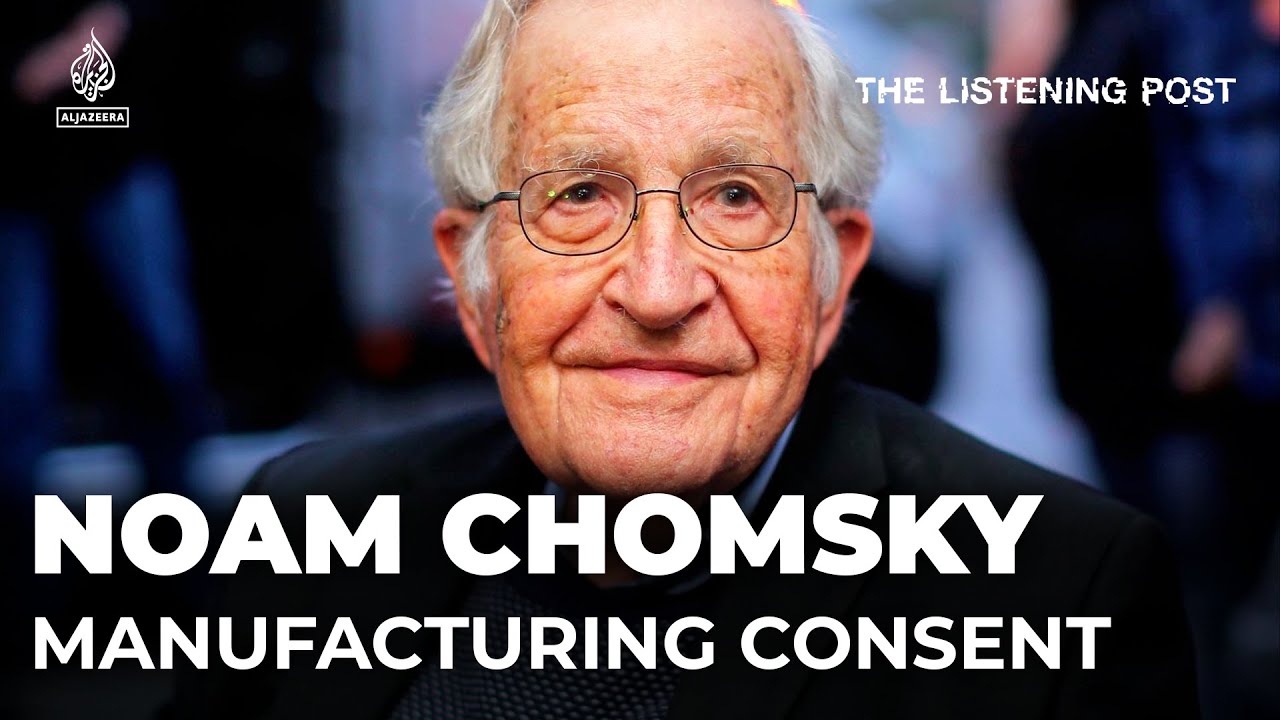 with Al Jazeera English.
“The myth is that the media are independent, adversarial, courageous, struggling against power,” Chomsky told Al Jazeera, stressing what while the United States often has “very fine reporters, correspondents” who do “an honest, courageous job,” they “must operate within a framework that determines what to discuss, what not to discuss. What we try to demonstrate in the book is that if you simply look at the institutional structure of the media within a state capitalist society like ours, they are performing pretty much the way you would expect.”
Soundbites, Chomsky told Al Jazeera, are an effective propaganda tool because propagandists “can say anything they want in two minutes, but they can’t be exposed in two minutes.”
Much has changed technologically since the release of “Manufacturing Consent” 30 years ago, including the rise of the Internet. Chomsky told Al Jazeera that having so much of the mainstream media owned by giant corporations “cheapens and reduces the access to information.” But he quickly added, “There is a way to compensate for that. The Internet does allow us to….overcome the impact of the concentration of media—and in fact, can be done pretty effectively.”
Chomsky described social media outlets like Facebook as “double-edged,” noting, “Sometimes, they are used for constructive purposes. But they have also become major forces for undermining democracy.” Chomsky cited Brazil as an example, noting how effectively the far-right Jair Bolsonaro used social media to win Brazil’s presidential election this year.
In addition to interviewing Chomsky, Al Jazeera spoke to some contemporary journalists who were influenced by “Manufacturing Consent”—include Israeli journalist Amira Hass and Rolling Stone’s Matt Taibbi, who recalled that the book “had a big influence on me as a young reporter. I had always thought that we lived in a completely free society where the reporting was outstanding and the free press model worked exactly the way it should. And when I read that book, I realized there were significant problems.”
Hass told Al Jazeera that Chomsky’s book “unveiled America of the myth of being such a splendid democracy.”
Al Jazeera concluded its interview with Chomsky by asking him where, in 2018, he usually gets his news. Chomsky responded that he consumes everything from the Washington Post to “the foreign press” to Democracy Now. And he praised the New York Times, saying that “with all of its flaws….it still has the broadest and most comprehensive coverage of, I think, any newspaper in the world.”
==
---
Henry G
It gets worse. In the age of a bullying Internet culture, the trolling community has now elected one of its own as president of the United States.As the apostle of publicity for publicity’s sake, Trump has adopted the practices of reality TV, building his reputation on insults, humiliation and a discourse of provocation and hate. According to the New York Times, even before the 2016 election Trump had used Twitter to insult at least 282 people, places and things. Not only has he honed the technique of trolling, he has also made it a crucial resource in upping the ratings for the mainstream media which, it seems, are insatiable when it comes to covering Trump’s insults.
---
==
https://www.alternet.org/democratic-socialism-dead-already-mainstream-media-seems-think-so
insurgent left wing of the Democratic Party, sometimes self-identified as democratic socialists and exemplified by rising star Alexandria Ocasio-Cortez, and associated with groups like Bernie Sanders’ Our Revolution, the Justice Democrats and the Democratic Socialists of America (DSA), took some losses in primaries on August 7. These included high-profile candidates like Abdul El-Sayed, a candidate for Michigan governor and Brent Welder in Kansas’s 2nd district, along with losses by Cori Bush in Missouri’s 1st district. Following the losses, corporate media outlets were quick to declare the Democratic left wing dead in the water:
- “Bernie and His Army Are Losing 2018” (Politico, 8/8/18)
- “Down Goes Socialism” (Politico, 8/8/18)
- “Democratic Party’s Liberal Insurgency Hits a Wall in Midwest Primaries” (Washington Post, 8/8/18)
- “Alexandria Ocasio-Cortez’s Movement Failed to Deliver Any Stunners Tuesday Night” (CNN, 8/8/18)
- “The Far Left Is Losing” (US News & World Report, 8/8/18)
- “Most Candidates Backed by Alexandria Ocasio-Cortez, Bernie Sanders Falter” (Wall Street Journal, 8/8/18)
- “Socialist Pin-Up Alexandria Ocasio-Cortez Sees Four Candidates FAIL in Tuesday Primary Contests, With One Coming in Fourth Out of Five” (Daily Mail, 8/8/18)
- “Socialist Torchbearers Flame Out in Key Races, Despite Blitz by Bernie Sanders and Ocasio-Cortez” (Fox News, 8/8/18)
- “If Democrats Embrace Socialism to Get Away From Donald Trump, They Can Kiss the Midterms Goodbye” (USA Today, 8/22/18)
- “Why ‘Medicare for All’ Is Playing Poorly in Democratic Primaries” (Politico, 8/21/18)
Despite these eager obituaries, there were also plenty of wins for insurgent Democrats on Aug. 7.Democratic socialist and Our Revolution candidate Rashida Tlaib won her primary for the House seat in Michigan’s 13th district; since she is running unopposed in the general election, she will become the first Palestinian-American woman in Congress. James Thompson also won the Democratic nomination in Kansas’ 4th district, and will face Ron Estes in a tough race in a deep-red district. Sarah Smith came in second in Washington’s 9th district top-two primary, and will face incumbent Democrat Adam Smith in the general election. Progressive candidates also earned big wins in a number of state and local races, and Missouri voters overwhelmingly approved a ballot measure to overturn the state’s anti-union right-to-work laws.
More wins for left-leaning candidates came the following week on Aug. 14. Somali refugee Ilhan Omar, who won her primary in Minnesota’s 5th district, will join Rashida Tlaib to become the first Muslim women to be elected to Congress. Randy Bryce won his primary to run for Paul Ryan’s soon-to-be-vacant seat in Wisconsin’s 1st district. Progressive Jahana Hayes won against Mary Glassman (who was surprisingly supported by a local Our Revolution chapter) in Connecticut’s 5th district, and will likely become the state’s first female African-American Democrat in Congress. Sanders-endorsee Christine Hallquist won the gubernatorial primary in Vermont, becoming the first trans woman nominated for a major political office.
There were losses as well as wins in the Aug. 14 primary, like Kaniela Saito Ing in Hawaii’s 11th district. Yet the major wins made the premature obituaries of Sanders’s candidates look like wishful reporting.
Many of the articles downplaying the viability of insurgent candidates point out that their victories tend to happen in safe Democratic seats. But progressive insurgent candidates usually forgo corporate funding and often fight uphill battles against opponents funded by the Democratic National Committee and deep-pocketed corporate PACs. Some candidates have even been openly suppressed by the Democratic Party. Given this political terrain, it’s perhaps unsurprising that candidates endorsed by the Democratic Party and other establishment groups, like EMILY’s List, have on average been more successful than candidates backed by more iconoclastic organizations.
Looking at the actual mix of success and failure by insurgent Democrats, it’s hard not to conclude that they have received inordinately skeptical treatment by corporate media, particularly receiving much more negative press than the 2010 Tea Party insurgency in the Republican Party, which Sanders’ movement has often been compared to. CBS News (8/13/18) even called Ocasio-Cortez the “Sarah Palin of the left.”
But rather than comparing coverage of the Sanders wing of the Democratic Party to that given the successful but heavily astroturfed Tea Party, a more apt contrast might be to the way media have dealt with the large-scale electoral failures of the establishment wing of the Democratic Party. The Obama-led Democratic Party leadership has been largely spared media scrutiny of its electoral record, despite losing more offices in Obama’s two terms than any president since Eisenhower, including 69 House seats, 14 Senate seats and nine governorships, not to mention losing a whopping 968 state legislature seats, the most of any two-term president. Many pundits in the corporate media actually rushed to defend Obama’s tenure, insisting that it’s normal for two-term presidents to lose governorships and congressional seats for their party – which is true, though Obama set records for such losses.
When one takes a historical look at socialism in the United States, Sanders’ insurgency seems to be doing remarkably well: The previous high point of socialism in the United States was perhaps the early 20th century, when the U.S. elected two Socialist Party members to Congress in 1910 and 1917, and socialist Eugene V. Debs garnered 6 percent of the popular vote in the 1912 presidential election. In the wake of the Red Scare crackdowns that followed both world wars, the U.S. socialist movement hardly sniffed political power during the Cold War, and has been pretty much nonexistent on the national level over the past 30 years, save Bernie Sanders and former DSA vice chair Rep. Ron Dellums, who represented Berkeley, California, in the House of Representatives from 1971 to 1998.
Even if today’s socialist wing of the Democratic Party hasn’t won every underdog primary race against better-funded centrist opponents, it is apparent that progressives are winning the battle of ideas within the party. Policies such as Medicare for All, free college, student loan forgiveness and job guarantees, all formerly considered radical positions, are now expected to be litmus tests in the 2020 Democratic presidential primaries. Even more importantly, they are becoming quite popular with voters: A recent Reuters poll showed that Medicare for All has support from 70 percent of the U.S. electorate, including 52 percent of Republicans, while another 60 percent of the electorate supports free college tuition.
Support for democratic socialism in general is on the rise as well. A recent Gallup poll revealed that 57 percent of Democrats have a positive view of socialism, compared to 47 percent who view capitalism favorably; socialism gets the approval of a majority of millennial voters. It’s not necessarily clear what “socialism” means to those who like it, with possibilities ranging from New Deal–style social programs to worker-controlled production. Still, it’s safe to say that a majority of Democratic voters want an anti-corporate party that represents the interests of the working class and minorities against the rich, despite whatever the media say about the electoral success or failure of the politicians that embody such policies.
With this recent ideological shift, the specter of a socialist bogeyman has jolted the media into crisis-management mode. Conservative news stations like Fox News scream on the daily about how scary democratic socialism is, while print outlets continue to churn out anti-socialist hit pieces:
- “Democratic Socialism Is Dem Doom” (New York Times, 7/6/18)
- “Venezuela’s Inflation Will Hit 1 Million Percent. Thanks, Socialism.” (Washington Post, 7/27/18)
- “Democrats Embracing Socialism Is Dangerous for America” (The Hill, 8/12/18)
- “Bernie Sanders and the Misery of Socialism” (Wall Street Journal, 6/25/18)
- “Sorry, Democratic Socialists — You’re Still Pushing Poison” (New York Post, 8/5/18)
- “They Call Themselves Socialists, but They Don’t Know the Meaning of the Word” (Miami Herald, 7/26/18)
- “It’s the Spoiled Children of America Who Are Drawn to Socialism” (Chicago Tribune, 7/26/18)
- “Democratic Socialism Threatens Minorities” (The Atlantic, 8/9/18)
- “Democratic Socialism: Who Knew That ‘Free’ Could Cost So Much?” (Investor’s Business Daily, 8/8/18)
- “Socialism Returns: An Old Adversary” (Commentary, 8/14/18)
- “Democratic Socialism Breaks the Bank” (Las Vegas Review-Journal, 8/16/18)
The most common argument in these pieces is to yell that the U.S. can’t afford social programs like Medicare for All or free college, evidenced by pieces such as “Democrats’ ‘Socialism’ Will Bury Us in Debt We Won’t Be Able to Get Out From Under” (MarketWatch, 7/11/18). For her part, Alexandria Ocasio-Cortez responded to such critiques by calling out the hypocrisy of whining about costs for universal health care in a CNN interview (8/9/18): “When it comes to bills for tax cuts and unlimited war, we seem to invent that money very easily.”
Yet CNN’s coverage of her comments parroted the same old line: that Medicare for All would cost an eye-popping $37 trillion, at least according to research by the Koch brothers–funded Mercatus Center. However, like most outlets afraid of big spending that doesn’t involve tax cuts for billionaires or bloated military budgets, CNN failed to even mention that the $37 trillion figure is the cost estimate for Medicare for All over a 10-year period, and that this figure is actually $2 trillion less than projected US healthcare costs under the current system over the same period (FAIR.org, 7/31/18).
Of course, this isn’t the first time Sanders or his socialist allies have received irrational opposition from corporate media. As FAIR’s Adam Johnson (3/8/16) reported during the 2016 presidential primaries, the Washington Post at one point ran 16 negative articles about Sanders in a 16-hour period. Sanders’ plans for Medicare for All have also been subject to disingenuous and incorrect“fact checks” by outlets like CNN and theWashington Pos**t. During her primary run against high-ranking New York Democratic Rep. Joseph Crowley, Ocasio-Cortez at first received barely a peep in the mainstream press, but after her surprise victory she was subject to endless profiles and a flurry of attacks by the media, and is now being subjected to demands for public debates from hyper-sensitive right-wing pundits.
Michelle Goldberg of the New York Times (8/9/18), perhaps the only person in the right-leaning Times op-ed lineupwho could be considered sympathetic to Sanders’ politics, noted that while insurgent candidates might not have won every primary, the left wing of the Democratic party was nonetheless winning hard-fought victories on the strength of its ideology and electoral pragmatism. Whether left-leaning Democrats fall flat in the midterms or not, their ideas have persuaded America that socialism is a legitimate and popular political movement, and will likely be a strong voting bloc in the next Congress. Whether corporate media choose to acknowledge its relevance or continue fear-mongering remains to be seen.
==
Google News does not deliver different news to users based on their position on the political spectrum, despite accusations from conservative commentators and even President Donald Trump. Rather than contributing to the sort of “echo chamber” problem that critics fear have plagued Facebook and other social media networks, our research has found that Google News algorithms recommended virtually identical news sources to both liberals and conservatives. That’s an important point to keep in mind when evaluating accusations that Google News is biased.
Our findings are part of an ample and growing body of research on this question. Online services – including Google’s regular search function – may provide intensely personalized information. But media scholars like us have found that when it comes to news, search engines and social media tend to lead people not to a more narrow set of sources, but rather to a broader range of information. In fact, we found, Google News is designed to avoid personalized search results, intentionally constructing a shared public conversation based on traditional criteria of journalistic values.
There is, however, one aspect of this lack of personalization that may strike conservatives the wrong way: Established mainstream news outlets strongly dominate the results, regardless of what a user is searching for. Of all the Google News recommendations we collected, a full 49 percent – nearly half – were to just five national news organizations: The New York Times, CNN, Politico, The Washington Post and HuffPost. And those five, much like other mainstream news organizations, tend to be seen as center-left.
In addition, Google News favors sites with original reporting – as well as ones that produce large numbers of articles, respond reasonably quickly to events and have larger staffs. Those criteria, which don’t directly have anything to do with a news organization’s political bent, do appear to disadvantage explicitly partisan right-wing commentary sites, which tend to be small, low-volume and do little of their own on-the-ground reporting. And it’s definitely true that users don’t know how Google News works. The company, like many of its ilk, is tight-lipped about how its news and other algorithms function – at least in part to prevent media companies from gaming the system to favor their own material.
How we tested for echo chambers
Shortly before the 2016 election, we studied what would happen when people searched for news about Donald Trump and Hillary Clinton on Google News. Specifically, we used Amazon Mechanical Turk to recruit a diverse set of 168 people in California, Florida, New York, North Carolina, Ohio and Texas. Participants were of different ages, education levels and political views: 41 percent identified as liberals and 26 percent identified as conservatives. The remaining 33 percent did not declare a political affiliation.
We asked them to search Google News for news about Hillary Clinton and Donald Trump while logged in to their personal Google accounts, and report the first five stories they were recommended on each candidate. We repeated this on two separate occasions, once after a presidential debate and later during a slow news period. Then we compared the stories that people were recommended.
The fact that they were logged in to their Google accounts was important: Google, of course, collects huge amounts of data about each of its users, and could leverage that information when returning search results. Therefore, we expected to find people getting different article recommendations based on their prior search history and online activity, as recorded by Google and applied to the results they got from Google News.
That’s not what we found at all. Instead, liberals and conservatives were recommended virtually identical news sources.
No collusion against conservatives
We found, as have others, no evidence that major technology companies collude against conservatives or tweak their algorithms to return politically slanted search results.
In fact, some have suggested that the opposite may be true. In the run-up to the 2016 election, Facebook was accused of yielding to charges of bias, moving to favor right-wing views by letting leading conservatives investigate its internal biases. Twitter has been similarly accused for protecting InfoWars in 2018.
Further, as tech journalist Kara Swisher has argued, “Mr**. Trump himself is the most voluble politician ever to use digital media, and his entire existence has been amplified, echoed and re-echoed over and over again by the tools that Silicon Valley has let loose on the world over the past two decades.”
Who determines what gets prioritized online?
However, there is reason to understand – even if not to agree with – claims of bias. First,Google News search results do favor legacy news organizations,ones with a long history. In our study, of the 14 news sites that ranked highly on at least one search, only three were newer “digital-first” news organizations. The rest were legacy newspapers, national TV stations and magazines.
Whether this is a problem – and if so, how much of one – is largely up to individual interpretation. For people who care that public discourse is based on a shared set of facts, it’s good news to learn that most people get the same results when they search Google News. And for people who believe that long-standing news producers with proven track records are best equipped to report on current events, our research is reassuring.
Yet across the political spectrum, Americans have far more trust in their local media than in the national media organizations that dominate online – including the results of Google News. It’s especially difficult to trust search engines and social media sites whose algorithms are secret, complex and constantly changing.
Ultimately, the concerns about algorithms and technology boil down to the principles that guide recommendation engines in shaping what reports get the most attention. Should Google News prioritize stories that adhere to traditional journalistic norms? Or should it reflect some other, yet undetermined standard? Trump’s rhetoric resonates with his supporters because, to them and others, the answer is not so clear-cut.
People have different visions of how societies should narrate their shared life. That’s perhaps why concepts of news judgment and balanced coverage largely assume that human editors will be involved. Algorithms can’t solve these quandaries – but they can help bring sharper focus to the public debate of the role news should play in a democratic society.Trump’s latest attacks may forestall that debate, though, by doing to technology companies what he did to the press: convincing many people they are “fake” and thus not to be trusted at all.
Seth Lewis, Shirley Papé Chair in Emerging Media, School of Journalism and Communication, University of Oregon and Efrat Nechushtai, Ph.D. candidate in Communications, Columbia University
This article was originally published on The Conversation. Read the original article.
---
==
interesting, recycled/applied to scial media:
Trump has faced derision for his rant on Tuesday about Google search results being "rigged" against conservatives — likely motivated by a Fox Business interview between Lou Dobbs and the right-wing YouTube celebrities Diamond and Silk.
But Trump is eager to prove he is right about a grand Google conspiracy to silence right-wing content. As proof, he shared a video on Wednesday noting a key example of anti-GOP censorship: his own State of the Union address.
"For years, Google promoted president Obama’s State of the Union on its homepage," says the video. "When President Trump took office, Google stopped."
[twit] There's just one problem: it isn't true.
As Buzzfeed News reports, screenshots of Google's search page taken on January 30, 2018 clearly show a link labeled "Live! Watch President Trump's State Of The Union Address On YouTube." One of the screenshots was even posted by a Trump supporter to the pro-Trump Reddit board /r/The_Donald, captioned "Google homepage linking to the GEOTUS [God-Emperor Of The United States] address."
It is true that Google did not provide a link to Trump's first address to Congress in 2017. However, as a Google spokesperson told BuzzFeed, “We have historically not promoted the first address to Congress by a new President, which is technically not a State of the Union address. As a result, we didn’t include a promotion on google.com for this address in either 2009 or 2017."
The fact that the video was easily debunked as a hoax did not stop it spreading in right-wing circles. It was swiftly picked up by Gateway Pundit, InfoWars, the Russian propaganda network RT, and was also shared by Republican National Committee chairwoman Ronna McDaniel.
Trump has frequently complained that the size of his audience for major events is being suppressed or even just covered up. Immediately upon taking office, he accused mainstream news outlets of lying about the size of his inauguration crowds.
More broadly, Republicans have been waging a crusade for years against what they claim is "liberal bias" in mainstream media, which has increasingly spread to accusations against big tech platforms as well. There is little basis for these claims, but persecution narratives have staying power — regardless of evidence especially when the President of the United States lends them legitimacy.
---
AN
NBC host Chuck Todd blamed Fox News and Roger Ailes for the state of distrust around American media and dinged a Christian broadcaster appearing on "Meet the Press" on Sunday.
“One of the best things going in Donald Trump’s favor — we know this — is the mainstream media,” Christian Broadcasting Network reporter David Brody said. “I hate to say it. I know I’m sitting on a Meet the Press roundtable, butthe truth of the matter is 62 percent think the media is biased.”
“The conservative echo chamber created that environment,” Todd interjected. “It has been a tactic and a tool of the Roger Ailes-created echo chamber.”
“So, let’s not pretend it’s not anything other than that,” Todd continued.
“Many Americans distrust the media. It’s not just Republicans," Brody retorted.
“I’m just saying it was a campaign creation, a campaign tactic,” Todd countered. “It’s not based in much fact.”
Watch the segment below:
==
==
https://www.alternet.org/news-amp-politics/chomsky-mainstream-media-basically-joke-now-and-fox-news-state-media
New York Times reports special counsel Robert Mueller is scrutinizing President Trump’s tweets as part of Mueller’s expanding probe into Trump’s ties to Russia. This latest revelation in the Mueller investigation is part of a nearly 24-hour stream of headlines about Trump, Russia and the administration’s various scandals. But is the mainstream media missing the real stories amid its obsession with “Russiagate”? For more, we speak with world-renowned political dissident, linguist, author and professor Noam Chomsky on media manipulation in the Trump era.
Transcript
AMY GOODMAN: We continue our interview with Noam Chomsky, world-renowned dissident, linguist and author, now in Tucson at the University of Arizona. I asked him about a recent mix-up on Fox & Friends, in which the hosts thought they were interviewing former Democratic congressional candidate, a current one, Ann Kirkpatrick of Arizona, who supports Immigration and Customs Enforcement agency, known as ICE, but, in fact, they were actually speaking to a Massachusetts Democratic congressional candidate, Barbara L’Italien, who opposes ICE. Here is how the interview started.
SEN. BARBARA L’ITALIEN: Good morning. I’m actually here to speak directly to Donald Trump. I feel that what’s happening at the border is wrong. I’m a mother of four. And I believe that separating kids from their parents is illegal and inhumane. I’m actually Barbara L’Italien. I’m a state senator representing a large immigrant community. I’m running for Congress in Massachusetts. I keep thinking about what we’re putting parents through, imagining how terrifying that must be for those families, imagining how it would feel not knowing if I’d ever see my kids again. We have to stop abducting children and ripping them from their parents’ arms —
ROB SCHMITT: OK —
SEN. BARBARA L’ITALIEN: — stop putting kids in cages —
ROB SCHMITT: You want to —
SEN. BARBARA L’ITALIEN: — and stop making 3-year-olds defend themselves in court.
AMY GOODMAN: Well, Barbara L’Italien said a lot there, but she was then cut off, with the shock of the Fox & Friends crew in the morning that they had the wrong Democratic congressional candidate. But this kind of media activism also just goes to the whole issue of the media, Noam Chomsky, the issue of Fox News becoming really state media, with — you have the person who supported the sexual harasser Roger Ailes, Bill Shine, now a top aide to President Trump in the White House. That’s gotten little attention. So you have Fox being a mouthpiece for Trump and a place for him to hear what people have to say, and the other networks very much running counter to Trump, on certain issues, CNNand MSNBC. But your thoughts?
NOAM CHOMSKY: Well, my frank opinion is that — I must say I don’t pay much attention to television, so I don’t know a great deal about it. But, in general, I think the media — first of all, Fox News is, by now, basically a joke. It’s, as you said, state media. The other media, I think, are focusing on issues which are pretty marginal. There are much more serious issues that are being put to the side. So, the worst of — even on the case of immigration, once again, I think the real question is dealing with the roots of immigration, our responsibility for it, and what we can do to overcome that. And that’s almost never discussed. But I think that’s the crucial issue. And I think we find the same across the board.
So, of all Trump’s policies, the one that is the most dangerous and destructive, in fact poses an existential threat, is his policies on climate change, on global warming.That’s really destructive. And we’re facing an imminent threat, not far removed, of enormous damage. The effects are already visible but nothing like what’s going to come. A sea level rise of a couple of feet will be massively destructive. It will make today’s immigration issues look like trivialities. And it’s not that the administration is unaware of this. So, Donald Trump, for example, is perfectly aware of the dangerous effects, in the short term, of global warming. So, for example, recently he applied to the government of Ireland for permission to build a wall to protect his golf course in Ireland from rising sea levels. And Rex Tillerson, who was supposed to be the adult in the room before he was thrown out, as CEO of ExxonMobil, was devoting enormous resources to climate change denial, although he had, sitting on his desk, the reports of ExxonMobil scientists, who, since the ’70s, in fact, were on the forefront of warning of the dire effects of this accelerating phenomenon. I don’t know what word in the language — I can’t find one — that applies to people of that kind, who are willing to sacrifice the literal — the existence of organized human life, not in the distant future, so they can put a few more dollars in highly overstuffed pockets. The word “evil” doesn’t begin to approach it. These are the kinds of issues that should be under discussion. Instead, what’s being — there is a focus on what I believe are marginalia.
So, take, say, the huge issue of interference in our pristine elections. Did the Russians interfere in our elections? An issue of overwhelming concern in the media. I mean, in most of the world, that’s almost a joke. First of all, if you’re interested in foreign interference in our elections, whatever the Russians may have done barely counts or weighs in the balance as compared with what another state does, openly, brazenly and with enormous support. Israeli intervention in US elections vastly overwhelms anything the Russians may have done, I mean, even to the point where the prime minister of Israel, Netanyahu, goes directly to Congress, without even informing the president, and speaks to Congress, with overwhelming applause, to try to undermine the president’s policies — what happened with Obama and Netanyahu in 2015. Did Putin come to give an address to the joint sessions of Congress trying to — calling on them to reverse US policy, without even informing the president? And that’s just a tiny bit of this overwhelming influence. So if you happen to be interested in influence of — foreign influence on elections, there are places to look. But even that is a joke.
I mean, one of the most elementary principles of a functioning democracy is that elected representatives should be responsive to those who elected them. There’s nothing more elementary than that. But we know very well that that is simply not the case in the United States. There’s ample literature in mainstream academic political science simply comparing voters’ attitudes with the policies pursued by their representatives, and it shows that for a large majority of the population, they’re basically disenfranchised. Their own representatives pay no attention to their voices. They listen to the voices of the famous 1 percent — the rich and the powerful, the corporate sector. The elections — Tom Ferguson’s stellar work has demonstrated, very conclusively, that for a long period, way back, US elections have been pretty much bought. You can predict the outcome of a presidential or congressional election with remarkable precision by simply looking at campaign spending. That’s only one part of it. Lobbyists practically write legislation in congressional offices. In massive ways, the concentrated private capital, corporate sector, super wealth, intervene in our elections, massively, overwhelmingly, to the extent that the most elementary principles of democracy are undermined. Now, of course, all that is technically legal, but that tells you something about the way the society functions. So, if you’re concerned with our elections and how they operate and how they relate to what would happen in a democratic society, taking a look at Russian hacking is absolutely the wrong place to look. Well, you see occasionally some attention to these matters in the media, but very minor as compared with the extremely marginal question of Russian hacking.
And I think we find this on issue after issue, also on issues on which what Trump says, for whatever reason, is not unreasonable. So, he’s perfectly right when he says we should have better relations with Russia. Being dragged through the mud for that is outlandish, makes — Russia shouldn’t refuse to deal with the United States because the US carried out the worst crime of the century in the invasion of Iraq, much worse than anything Russia has done. But they shouldn’t refuse to deal with us for that reason, and we shouldn’t refuse to deal with them for whatever infractions they may have carried out, which certainly exist. This is just absurd. We have to move towards better — right at the Russian border, there are very extreme tensions, that could blow up anytime and lead to what would in fact be a terminal nuclear war, terminal for the species and life on Earth. We’re very close to that. Now, we could ask why. First of all, we should do things to ameliorate it. Secondly, we should ask why. Well, it’s because NATO expanded after the collapse of the Soviet Union, in violation of verbal promises to Mikhail Gorbachev, mostly under Clinton, partly under first Bush, then Clinton expanded right to the Russian border, expanded further under Obama. The US has offered to bring Ukraine into NATO. That’s the kind of a heartland of Russian geostrategic concerns. So, yes, there’s tensions at the Russian border — and not, notice, at the Mexican border. Well, those are all issues that should be of primary concern. The fate of — the fate of organized human society, even of the survival of the species, depends on this. How much attention is given to these things as compared with, you know, whether Trump lied about something? I think those seem to me the fundamental criticisms of the media
.
AMY GOODMAN: Noam Chomsky, world-renowned political dissident, author and linguist, now a laureate professor in the Department of Linguistics at the University of Arizona, Tucson. He taught for 50 years at the Massachusetts Institute of Technology in Cambridge, Massachusetts. Tune in next week when we continue our conversation with Noam Chomsky about Gaza, Israel’s new nationality law, the recent Trump-Putin summit, Iran, North Kora, the war in Yemen and more. In December, Noam Chomsky will be celebrating his 90th birthday.
:{:{}:
}:
===
https://theconversation.com/a-conservative-activists-quest-to-preserve-all-network-news-broadcasts-92009
Fifty years ago, in the middle of a typically hot and humid Nashville summer, a Metropolitan Life insurance manager named Paul Simpson sat with Frank Grisham, the director of the Vanderbilt University Library, in the rare books room of the main library building.
Using three Ampex video recording machines, three television sets and $4,000 of Simpson’s own money, they began what they thought would be a 90-day experiment: From then until election night in November, they would record the ABC, NBC and CBS evening news broadcasts, which usually aired at the same time.
The day Simpson and Grisham started taping, August 5, 1968, was an eventful one. The Republican Convention began, and Ronald Reagan officially announced his candidacy for the presidential nomination, joining with liberal Republican Nelson Rockefeller in an attempt to stop Richard Nixon’s hopes of a first ballot nomination.
:{:{===}:
}:
https://en.wikipedia.org/wiki/Media_bias_in_the_United_States
Corporate bias and power bias
See also: Propaganda model and Concentration of media ownership in the United States
Edward S. Herman and Noam Chomsky in their 1988 book Manufacturing Consent: The Political Economy of the Mass Media[24] proposed a propaganda model to explain systematic biases of U.S. media as a consequence of the pressure to create a stable and profitable business. In this view, corporate interests create five filters that bias news in their favor.
Pro-power and pro-government bias
Part of the propaganda model is self-censorship through the corporate system (see corporate censorship); that reporters and especially editors share or acquire values that agree with corporate elites in order to further their careers. Those who do not are marginalized or fired. Such examples have been dramatized in fact-based movie dramas such as Good Night, and Good Luck and The Insider and demonstrated in the documentary The Corporation.[25][26] George Orwell originally wrote a preface for his 1945 novel Animal Farm, which focused on the British self-censorship of the time: "The sinister fact about literary censorship in England is that it is largely voluntary. ... [Things are] kept right out of the British press, not because the Government intervened but because of a general tacit agreement that ‘it wouldn’t do’ to mention that particular fact." The preface was not published with most copies of the book.[citation ^needed]
In the propaganda model, advertising revenue is essential for funding most media sources and thus linked with media coverage. For example, according to Fairness & Accuracy In Reporting (FAIR.org), ‘When Al Gore proposed launching a progressive TV network, a Fox News executive told Advertising Age (10/13/03): "The problem with being associated as liberal is that they wouldn't be going in a direction that advertisers are really interested in.... If you go out and say that you are a liberal network, you are cutting your potential audience, and certainly your potential advertising pool, right off the bat."[27] An internal memo from ABC Radio affiliates in 2006 revealed that powerful sponsors had a "standing order that their commercials never be placed on syndicated Air America programming" that aired on ABC affiliates.[28] The list totaled 90 advertisers and included major corporations such as Wal-Mart, GE, Exxon Mobil, Microsoft, Bank of America, Fed-Ex, Visa, Allstate, McDonald's, Sony and Johnson & Johnson, and government entities such as the U.S. Postal Service and the U.S. Navy.
According to Chomsky, U.S. commercial media encourage controversy only within a narrow range of opinion, in order to give the impression of open debate, and do not report on news that falls outside that range.[29]
Herman and Chomsky argue that comparing the journalistic media product to the voting record of journalists is as flawed a logic as implying auto-factory workers design the cars they help produce. They concede that media owners and news makers have an agenda, but that this agenda is subordinated to corporate interests leaning to the right.[24] It has been argued by some critics, including historian Howard Zinn and Pulitzer Prize–winning journalist Chris Hedges, that the corporate media routinely ignore the plight of the impoverished while painting a picture of a prosperous America.[30][31]
In 2008 George W. Bush's press secretary Scott McClellan published a book in which he confessed to regularly and routinely, but unknowingly, passing on lies to the media, following the instructions of his superiors, lies that the media reported as facts. He characterized the press as, by and large, honest, and intent on telling the truth, but reported that "the national press corps was probably too deferential to the White House", especially on the subject of the war in Iraq.[32]
FAIR reported that between January and August 2014no representatives for organized labor made an appearance on any of the high-profile Sunday morning talkshows (NBC's Meet the Press, ABC's This Week, Fox News Sunday and CBS's Face the Nation), including episodes that covered topics such as labor rights and jobs, while current or former corporate CEOs made 12 appearances over that same period.[33]
Corporate control
Six corporate conglomerates (Disney, CBS Corporation, 21st Century Fox, Viacom, Time Warner, and Comcast) own the majority of mass media outlets in the United States.[34][35] Such a uniformity of ownership means that stories which are critical of these corporations may often be underplayed in the media.[36][37] The Telecommunications Act of 1996 enabled this handful of corporations to expand their power, and according to Howard Zinn, such mergers "enabled tighter control of information."[38] Chris Hedges argues that corporate media control "of nearly everything we read, watch or hear" is an aspect of what political philosopher Sheldon Wolin calls inverted totalitarianism.[39]
In the United States most media are operated for profit, and are usually funded by advertising. Stories critical of advertisers or their interests may be underplayed, while stories favorable to advertisers may be given more coverage.[34][40]
"Infotainment"
Main article: Infotainment
Academics such as McKay, Kathleen Hall Jamieson, and Hudson (see below) have described private U.S. media outlets as profit-driven. For the private media, profits are dependent on viewing figures, regardless of whether the viewers found the programs adequate or outstanding. The strong profit-making incentive of the American media leads them to seek a simplified format and uncontroversial position which will be adequate for the largest possible audience. The market mechanism only rewards media outlets based on the number of viewers who watch those outlets, not by how informed the viewers are, how good the analysis is, or how impressed the viewers are by that analysis.
According to some, the profit-driven quest for high numbers of viewers, rather than high quality for viewers, has resulted in a slide from serious news and analysis to entertainment, sometimes called infotainment:
"Imitating the rhythm of sports reports, exciting live coverage of major political crises and foreign wars was now available for viewers in the safety of their own homes. By the late-1980s, this combination of information and entertainment in news programmes was known as infotainment." [Barbrook, Media Freedom, (London, Pluto Press, 1995) part 14]
Oversimplification
Kathleen Hall Jamieson claimed in her book The Interplay of Influence: News, Advertising, Politics, and the Internet that most television news stories are made to fit into one of five categories:[41]
- Appearance versus reality
- Little guys versus big guys
- Good versus evil
- Efficiency versus inefficiency
- Unique and bizarre events versus ordinary events.
Reducing news to these five categories, and tending towards an unrealistic black/white mentality, simplifies the world into easily understood opposites. According to Jamieson, the media provides an oversimplified skeleton of information that is more easily commercialized.
Media Imperialism
Media Imperialism is a critical theory regarding the perceived effects of globalization on the world's media which is often seen as dominated by American media and culture. It is closely tied to the similar theory of cultural imperialism.[42]
"As multinational media conglomerates grow larger and more powerful many believe that it will become increasingly difficult for small, local media outlets to survive. A new type of imperialism will thus occur, making many nations subsidiary to the media products of some of the most powerful countries or companies."[43]
Significant writers and thinkers in this area include Ben Bagdikian, Noam Chomsky, Edward S. Herman and Robert McChesney.
Liberal bias
See also: Liberal bias in academia
Some critics of the media say liberal bias exists within a wide variety of media channels, especially within the mainstream media, including network news shows of CBS, ABC, and NBC, cable channels CNN, MSNBC and the former Current TV, as well as major newspapers, news-wires, and radio outlets, especially CBS News, Newsweek, and The New York Times.[44] These arguments intensified when it was revealed that the Democratic Party received a total donation of $1,020,816, given by 1,160 employees of the three major broadcast television networks (NBC, CBS, ABC), while the Republican Party received only $142,863 via 193 donations.[45] Both of these figures represent donations made in 2008.
A study cited frequently by those who make claims of liberal media bias in American journalism is The Media Elite, a 1986 book co-authored by political scientists Robert Lichter,Stanley Rothman, and Linda Lichter.[46] They surveyed journalists at national media outlets such as The New York Times, The Washington Post, and the broadcast networks. The survey found that the large majority of journalists were Democratic voters whose attitudes were well to the left of the general public on a variety of topics, including issues such as abortion, affirmative action, social services, and gay rights. The authors compared journalists' attitudes to their coverage of issues such as the safety of nuclear power, school busing to promote racial integration, and the energy crisis of the 1970s and concluded firstly that journalists' coverage of controversial issues reflected their own attitudes and education, and secondly that the predominance of political liberals in newsrooms pushed news coverage in a liberal direction. The authors suggested this tilt as a mostly unconscious process of like-minded individuals projecting their shared assumptions onto their interpretations of reality, a variation of confirmation bias.
Jim A. Kuypers of Dartmouth College investigated the issue of media bias in the 2002 book Press Bias and Politics. In this study of 116 mainstream U.S. papers, including The New York Times, The Washington Post, the Los Angeles Times, and the San Francisco Chronicle, Kuypers stated that the mainstream press in America tends to favor liberal viewpoints. They argued that reporters who they thought were expressing moderate or conservative points of view were often labeled as holding a minority point of view. Kuypers said he found liberal bias in the reporting of a variety of issues including race, welfare reform, environmental protection, and gun control.[47] According to the Media Research Center, and David Brady of the Hoover Institute, conservative individuals and groups are more often labeled as such, than liberal individuals and groups.[48]
A 2005 study by political scientists Tim Groseclose of UCLA and Jeff Milyo of the University of Missouri at Columbia attempted to quantify bias among news outlets using statistical models, and found a liberal bias.[49][50] The authors wrote that "all of the news outlets we examine[d], except Fox News’s Special Report and the Washington Times, received scores to the left of the average member of Congress." The study concluded that news pages of The Wall Street Journal were more liberal than The New York Times, and the news reporting of PBS was to the right of most mainstream media. The report also stated that the news media showed a fair degree of centrism, since all but one of the outlets studied were, from an ideological point of view, between the average Democrat and average Republican in Congress.[51] In a blog post, Mark Liberman, professor of computer science and the director of Linguistic Data Consortium at the University of Pennsylvania, critiqued the statistical model used in this study.[52][53] The model used by Groseclose and Milyo assumed that conservative politicians do not care about the ideological position of think tanks they cite, while liberal politicians do. Liberman characterized the unsupported assumption as preposterous and argued that it led to implausible conclusions.[52][54]
A 2014 Gallup poll found that a plurality of Americans believe the media is biased to favor liberal politics. According to the poll, 44% of Americans feel that news media are "too liberal"(70% of self-identified conservatives, 35% of self-identified moderates, and 15% of self-identified liberals), while 19% believe them to be "too conservative" (12% of self-identified conservatives, 18% of self-identified moderates, and 33% of self-identified liberals), and 34% "just about right" (49% of self-identified liberals, 44% of self-identified moderates, and 16% of self-identified conservatives).[55]
A 2008 joint study by the Joan Shorenstein Center on Press, Politics and Public Policy at Harvard University and the Project for Excellence in Journalism found that viewers believe a liberal media bias can be found in television news on networks such as CNN.[56] These findings concerning a perception of liberal bias in television news—particularly at CNN—were also reported by other sources.[57] The study met with criticism from media outlets and academics, including the Wall Street Journal,[58] and progressive media watchdog Media Matters.[59] Criticism from Media Matters included:
- Different mediums were studied for different lengths of time. For example, CBS News was studied for 12 years while the Wall Street Journal was studied for four months.
- Lack of context in quoting sources (sources quoted were automatically assumed to be supporting the article).
- Lack of balance in sources: liberal sources such as the NAACP did not have a conservative counterpart that could add balance.
- Flawed assignment of political positions of sources: the RAND corporation was considered "liberal" while the American Civil Liberties Union was considered "conservative".[citation ^needed]
Authors
Several authors have written books on liberal bias in the media, including
- Steve Levy—Bias in the Media: How the Media Switches Against Me After I Switched Parties.[60]
- Tim Groseclose—Left Turn: How Liberal Media Bias Distorts the American Mind, 2011.[61]
- Ben Shapiro—Primetime Propaganda: The True Hollywood Story of How the Left Took Over Your TV, 2011.
- John Ziegler—writer, director, and producer of the documentary film Media Malpractice: How Obama Got Elected and Palin was Targeted, 2009.[62]
- Brian C. Anderson—South Park Conservatives: The Revolt Against Liberal Media Bias, 2005.
- John:{Stossel—Give Me a Break: How I Exposed Hucksters, Cheats, and Scam Artists and Became the Scourge of the Liberal Media, 2004, gives Stossel's views on liberal bias in the established media.[63]}:
- Bob Kohn—Journalistic Fraud: How The New York Times Distorts the News and Why It Can No Longer Be Trusted, 2003, a criticism of The New York Times.[64]
- Ann Coulter—Slander: Liberal Lies About the American Right, 2002, a critique on widespread liberal bias directed at American television and print news.
- Jim A. Kuypers wrote Partisan Journalism: A History of Media Bias in the United States (2014) and Press Bias and Politics: How the Media Frame Controversial Issues (2002).
- Bernard Goldberg—Bias, 2001, a criticism of liberal bias directed towards CBS, his former employer.
- S. Robert Lichter, Stanley Rothman and Linda Lichter—The Media Elite, 1986, in which journalists’ political views and voting records were compared with those of the general public.
Conservative bias
Certain media outlets such as NewsMax, WorldNetDaily, and Fox News are said by critics to strongly promote a conservative agenda.[65][66][67][68][69]
Rupert Murdoch, the owner and executive co-chairman of 21st Century Fox (the parent of Fox News), self-identifies as a libertarian. Roy Greenslade of The Guardian, and others, claim that Murdoch has exerted a strong influence over the media he owns, including Fox News, The Wall Street Journal, and The Sun.[70][71]
According to former Fox News producer Charlie Reina, unlike the AP, CBS, or ABC, Fox News's editorial policy is set from the top down in the form of a daily memo: "[F]requently, Reina says, it also contains hints, suggestions and directives on how to slant the day's news—invariably, he says, in a way that's consistent with the politics and desires of the Bush administration." ^[72] Fox News responded by denouncing Reina as a "disgruntled employee" with "an ax to grind."[72]
According to Andrew Sullivan, "One alleged news network fed its audience a diet of lies, while contributing financially to the party that benefited from those lies."[73]
Progressive media watchdog group Fairness and Accuracy in Reporting (FAIR) has argued that accusations of liberal media bias are part of a conservative strategy, noting an article in the August 20, 1992 Washington Post, in which Republican party chair Rich Bond compared journalists to referees in a sporting match. "If you watch any great coach, what they try to do is 'work the refs.' Maybe the ref will cut you a little slack next time."[74] A 1998 study from FAIR found that journalists are "mostly centrist in their political orientation";[75] 30% considered themselves to the left on social issues compared with 9% on the right, while 11% considered themselves to the left on economic issues compared with 19% on the right. The report argued that since journalists considered themselves to be centrists, "perhaps this is why an earlier survey found that they tended to vote for Bill Clinton in large numbers." FAIR uses this study to support the claim that media bias is propagated down from the management, and that individual journalists are relatively neutral in their work.
A report "Examining the 'Liberal Media' Claim: Journalists' Views on Politics, Economic Policy and Media Coverage" by FAIR's David Croteau, from 1998, calls into question the assumption that journalists' views are to the left of center in America. The findings were that journalists were "mostly centrist in their political orientation" and more conservative than the general public on economic issues (with a minority being more progressive than the general public on social issues).[76]
Kenneth Tomlinson, while chairman of the Corporation for Public Broadcasting, commissioned a $10,000 government study into Bill Moyers' PBS program, NOW.[77] The results of the study indicated that there was no particular bias on PBS. Mr. Tomlinson chose to reject the results of the study, subsequently reducing time and funding for NOW with Bill Moyers, which many including Tomlinson regarded as a "left-wing" program, and then expanded a show hosted by Fox News correspondent Tucker Carlson. Some board members stated that his actions were politically motivated.[78] Himself a frequent target of claims of bias (in this case, conservative bias), Tomlinson resigned from the CPB board on November 4, 2005. Regarding the claims of a left-wing bias, Bill Moyers asserted in a Broadcast & Cable interview that "If reporting on what's happening to ordinary people thrown overboard by circumstances beyond their control and betrayed by Washington officials is liberalism, I stand convicted."[79]
Authors
Several authors have written books on conservative bias in the media, including:
- Amy Goodman wrote Standing up to the Madness: Ordinary Heroes in Extraordinary Times (2008).
- David Brock wrote The Republican Noise Machine (2004).
- Al Franken wrote Lies and the Lying Liars Who Tell Them, (2003), in which he argues that mainstream media organizations have neither a liberal nor a conservative political bias, but there exists a right-wing media that seeks to promote conservative ideology rather than report the news.[80]
- Eric Alterman wrote What Liberal Media? The Truth About Bias and the News (2003)[36] in which he disputes the belief in liberal media bias, and suggests that over-correcting for this belief resulted in conservative media bias.[81] Reviewer John Moe sums up Alterman's views:
"The conservatives in the newspapers, television, talk radio, and the Republican party are lying about liberal bias and repeating the same lies long enough that they've taken on a patina of truth. Further, the perception of such a bias has cowed many media outlets into presenting more conservative opinions to counterbalance a bias, which does not, in fact, exist."[82]
- Robert W. McChesney and John Nichols wrote Our Media, Not Theirs: The Democratic Struggle Against Corporate Media (2002).
- Jim Hightower in There's Nothing in the Middle of the Road but Yellow Stripes and Dead Armadillos (1997; ISBN 0-06-092949-9) uses humor to deflate claims of liberal bias, and gives examples of how media support corporate interests.
- Michael Parenti wrote Inventing Reality: the Politics of News Media (1993).
:{:{==}:
}:
gainor mrc fox
http://www.mrc.org/commentary/nearly-30-soros-funded-media-operations-part-war-fox
http://www.mrc.org/commentary/nearly-30-soros-funded-media-operations-part-war-fox
Nearly 30 Soros-funded Media Operations Part of 'War on Fox'
Last of Four Parts
To hear the left tell it, Fox News has a "history of inciting Islamophobia and racial and ethic animosity" and tries to "race bait its viewers." One staffer is called a "hit man," while his network is accused of "attack politics." A highly questionable study is hyped by numerous outlets claiming that it "confirms that Fox News makes you stupid." Fox is called simply: "The Liars' Network."
Sure, liberals have it in for Fox News, but that deep-seated, anti-Fox agenda isn't just an organic response from the left. It's a George Soros-funded "echo chamber" "in which a message pushes the larger public or the mainstream media to acknowledge, respond, and give airtime to progressive ideas because it is repeated many times." That's how the strategy was described in a report by the Soros-funded Media Consortium called "The Big Thaw."
The goal is "Taking Down Fox News," as "Mother Jones," a member of the consortium, described it in a headline. That article, about another Soros-funded operation called Color of Change, explained how "it successfully urged several advertisers, including Best Buy, Wal-Mart, and RadioShack, to pull their ads from Beck's show." In all, nearly 30 organizations have attacked Fox News in the six months since the beginning of December, 2010.
Think Progress, the heavily Soros-funded blog for the Center for American Progress, slammed Fox more than 30 times in six months. AlterNet, an especially unhinged liberal outlet, went after the network at least 18 times in those months. It is one of 45 organizations aided by Soros' support of the Media Consortium - "a network of the country's leading, progressive, independent media outlets."
These outlets are all part of Soros' web of media organizations that mirror his view of Fox as their enemy. That's the way he describes it in the new book, "The Philanthropy of George Soros." "Those in charge of Fox News, Rupert Murdoch and Roger Ailes, have done well in identifying me as their adversary," he wrote. "They have done less well in the methods they used to attack me: Their lies shall not stand and their techniques shall not endure."
That anti-Fox agenda is reflected in plans by another group in Soros' pocket to target the network specifically. Media Matters founder David Brock said his Soros-funded operation ($1.1 million) will "focus on [News Corp. CEO Rupert] Murdoch and trying to disrupt his commercial interests."
This information is part of an upcoming report by the Media Research Center's Business & Media Institute, which has been looking into George Soros and his influence on the media.
The left hating Fox isn't new. But the efforts of the different groups take on an amazing similarity. Take the University of Maryland study that seemed so critical of Fox News. The study itself included this nugget: "This suggests that misinformation cannot simply be attributed to news sources, but are part of the larger information environment that includes statements by candidates, political ads and so on." That didn't stop any of the groups from using it against Fox News. AlterNet, Washington Monthly, Think Progress and The Nation. It quickly moved into the mainstream media from there.
That's just part of Soros' influence. He denies having a media empire, despite spending easily more than $48 million on that empire and having top journalists from more than 30 major news organizations serving on the boards of groups he funds. It reaches at least 180 media organizations, and many other groups he funds include a media component in what they do.
In the case of Robert Greenwald, he's turned attacking Fox into a mini-industry. Greenwald is founder and president of Brave New Films, also part of the Soros-funded Media Consortium. Greenwald was also behind "OUTFOXED: Rupert Murdoch's War on Journalism," The site for the movie that argues: "FOX News is on a witch hunt. Fight back." The Brave New Films site has an entire section going after Fox called: "When Fox Attacks." It claims: "Videos from this campaign have been viewed over 8 million times."
When Soros was criticized by Fox, multiple pieces of the Soros Empire responded. In one case, Jonathan Schell, a fellow at The Nation Institute, another part of the Media Consortium, made Fox News out to be anti-Semitic for criticizing Soros. An opinion piece titled, "The Protocols of Rupert Murdoch," a reference to the infamous anti-Semitic "Protocols of The Elders of Zion," blasted Glenn Beck.
Schell claimed Beck's criticism of 'the financier and philanthropist George Soros' in effect "recycles, almost in carbon copy, the tropes of the most virulent anti-Semitic ideologues." The column was distributed by another Soros-funded entity, Project Syndicate, which reaches "462 leading newspapers in 150 countries," with a monthly circulation of 72,815,528.
It's that sort of cooperation that makes the Soros-funded "echo chamber" successful. Go on AlterNet and find articles from The Nation, a rant by Robert Greenwald or an interview by Amy Goodman of Democracy Now! Or go on New America Media's site and find an article from Color Lines.
The content from the 180 media sites that Soros helps support can be linked, cited or reposted, adding to the sense that there is strong interest in any particular "progressive idea." It's just one more way George Soros influences the media.
Disclaimer: This writer has been on Fox News numerous times and writes a column that often runs on Foxnews.com. He has never received any compensation from Fox.
Dan Gainor is the Boone Pickens Fellow and the Media Research Center's Vice President for Business and Culture. His column appears each week on The Fox Forum. He can also be contacted on FaceBook and Twitter as dangainor.
:{:{}:
}:
===
fox op ed
This is the first of a two part series on George Soros and the media.
When liberal investor George Soros gave $1.8 million to National Public Radio , it became part of the firestorm of controversy that jeopardized NPR’s federal funding. But that gift only hints at the widespread influence the controversial billionaire has on the mainstream media. Soros, who spent $27 million trying to defeat President Bush in 2004, has ties to more than 30 mainstream news outlets – including The New York Times, Washington Post, the Associated Press, NBC and ABC.
Prominent journalists like ABC’s Christiane Amanpour and former Washington Post editor and now Vice President Len Downie serve on boards of operations that take Soros cash. This despite the Society of Professional Journalists' ethical code stating: “avoid all conflicts real or perceived.”
This information is part of an upcoming report by the Media Research Centers Business & Media Institutewhich has been looking into George Soros and his influence on the media.
The investigative reporting start-up ProPublica is a prime example. ProPublica, which recently won its second Pulitzer Prize, initially was given millions of dollars from the Sandler Foundation to “strengthen the progressive infrastructure” – “progressive” being the code word for very liberal. In 2010, it also received a two-year contribution of $125,000 each year from the Open Society Foundations. In case you wonder where that money comes from, the OSF website is www.soros.org. It is a network of more than 30 international foundations, mostly funded by Soros, who has contributed more than $8 billion to those efforts.
The ProPublica stories are thoroughly researched by top-notch staffers who used to work at some of the biggest news outlets in the nation. But the topics are almost laughably left-wing. The site’s proud list of “Our Investigations” includes attacks on oil companies, gas companies, the health care industry, for-profit schools and more. More than 100 stories on the latest lefty cause: opposition to drilling for natural gas by hydraulic fracking. Another 100 on the evils of the foreclosure industry.
Throw in a couple investigations making the military look bad and another about prisoners at Guantanamo Bay and you have almost the perfect journalism fantasy – a huge budget, lots of major media partners and a liberal agenda unconstrained by advertising.
One more thing: a 14-person Journalism Advisory Board, stacked with CNN’s David Gergen and representatives from top newspapers, a former publisher of The Wall Street Journal and the editor-in-chief of Simon & Schuster. Several are working journalists, including:
• Jill Abramson, a managing editor of The New York Times;
• Kerry Smith, the senior vice president for editorial quality of ABC News;
• Cynthia A. Tucker, the editor of the editorial page of The Atlanta Journal-Constitution.
ProPublica is far from the only Soros-funded organization that is stacked with members of the supposedly neutral press.
The Center for Public Integrity is another great example. Its board of directorsis filled with working journalists like Amanpour from ABC, right along side blatant liberal media types like Arianna Huffington, of the Huffington Post and now AOL.
Like ProPublica, the CPI board is a veritable Who’s Who of journalism and top media organizations, including:
• Christiane Amanpour – Anchor of ABC’s Sunday morning political affairs program, “This Week with Christiane Amanpour.” A reliable lefty, she has called tax cuts “giveaways,” the Tea Party “extreme,” and Obama “very Reaganesque.”
• Paula Madison – Executive vice president and chief diversity officer for NBC Universal, who leads NBC Universal’s corporate diversity initiatives, spanning all broadcast television, cable, digital, and film properties.
• Matt Thompson – Editorial product manager at National Public Radio and an adjunct faculty member at the prominent Poynter Institute.
The group's advisory board features:
• Ben Sherwood, ABC News president and former "Good Morning America" executive producer
Once again, like ProPublica, the Center for Public Integrity’s investigations are mostly liberal – attacks on the coal industry, payday loans and conservatives like Mississippi Gov. Haley Barbour. The Center for Public Integrity is also more open about its politics, including a detailed investigation into conservative funders David and Charles Koch and their “web of influence.”According to the center’s own 990 tax forms, the Open Society Institute gave it $651,650 in 2009 alone.
The well-known Center for Investigative Reporting follows the same template – important journalists on the board and a liberal editorial agenda. Both the board of directors and the advisory board contain journalists from major news outlets. The board features:
• Phil Bronstein (President), San Francisco Chronicle;
• David Boardman, The Seattle Times;
• Len Downie, former Executive Editor of the Washington Post, now VP;
• George Osterkamp, CBS News producer.
Readers of the site are greeted with numerous stories on climate change, illegal immigration and the evils of big companies. It counts among its media partners The Washington Post, Salon, CNN and ABC News. CIR received close to $1 million from Open Society from 2003 to 2008.
Why does it all matter? Journalists, we are constantly told, are neutral in their reporting. In almost the same breath, many bemoan the influence of money in politics. It is a maxim of both the left and many in the media that conservatives are bought and paid for by business interests. Yet where are the concerns about where their money comes from?
Fred Brown, who recently revised the book “Journalism Ethics: A Casebook of Professional Conduct for News Media,” argues journalists need to be “transparent” about their connections and “be up front about your relationship” with those who fund you.
Unfortunately, that rarely happens. While the nonprofits list who sits on their boards, the news outlets they work for make little or no effort to connect those dots.Amanpour’s biography page, for instance, talks about her lengthy career, her time at CNN and her many awards. It makes no mention of her affiliation with the Center for Public Integrity.
If journalists were more up front, they would have to admit numerous uncomfortable connections with groups that push a liberal agenda, many of them funded by the stridently liberal George Soros. So don’t expect that transparency any time soon.
---