TARP/ Subprime Mortg / CDS
==
see Great recession
NO MERRI
glass-stegall
dodd-frank
synthetic derivatives pioneered by enron?
1219 bak capt
see covid bailout bill
---
THEY’RE BAAAAACK?!
an 4 26
The Financial Times reported Friday morning that the big banks that Wall Street is betting on are failing in private credit markets. It's something that New Republic writer Logan McMillen is sounding the alarm about because it is the same thing that happened in the 2007 and 2008 global economic collapse.
This week, the Federal Reserve likely freaked out economic experts when it demanded the largest banks "detail their exposure to the opaque, multitrillion-dollar private credit market," said McMillen. "Then, almost simultaneously, word broke that some of those same banks are imminently launching a credit default swap index with S&P Global, targeting that same market."
McMillen cautioned that the U.S.'s macroeconomic program is quickly falling apart under the stress of President Donald Trump's war against Iran, the closure of the Strait of Hormuz and the rise in inflation.
It comes as the "U.S. Treasury is now desperately trying to finance a $1.9 trillion deficit without a large pool of captive foreign buyers. Trump "failed to prepare" for the crisis. A former Trump strategist told CNN last month that the president thought Iran would be just as easy as Venezuela was.
Nate Swanson, a former Trump staffer and current senior fellow and director of the Iran Strategy Project at The Atlantic Council, assumes that Trump thought the whole operation would be easy and he'd be successful
Trump was coming off a "win" from his June strikes and from capturing Venezuelan leader Nicolás Maduro. In the past, Trump was able to kill Iranian military officer Qasem Soleimani "with virtually no repercussions," said Swanson.
Trump has done nothing to prepare for the closure of the Strait of Hormuz, and worse, he's done nothing to protect the U.S. economy from the ensuing disaster after the bombing began.
"China is dumping U.S. Treasuries at a rate not seen since the Global Financial Crisis, while stalwart buyers like Japan are seeing their bond yield rates creep up to their highest levels in 27 years," said McMillen, explaining it isn't healthy for the macroeconomy.
What happens this weekend might mark a shift that will be felt for at least a year or more "in the form of a liquidity crisis."
"The Fed’s request that major banks detail their exposure to the private credit market should terrify risk assessors. When macroeconomists picked through the rubble of 2008, many landed on the conclusion that there had been a catastrophic mispricing of risk," McMillen said.
Credit rating agencies continued to claim that toxic subprime mortgages were somehow AAA-rated. Regulators in 2008 at the very least knew where the underlying assests were, McMillen explained. That isn't happening with the $2 trillion private credit market. It's a black box hidden in "regulatory shadows to facilitate high-risk corporate loans that traditional banks were forced to abandon after the passage of Dodd-Frank."
A major indicator of danger comes from a March Politicoreport revealing that investors are pulling their money after a "string of blow-ups." At the same time, the world of artificial intelligence has posed a risk to some software companies. So, investors are growing so worried that they're pulling their money out to such an extreme that they hit withdrawal limits.
Those limits on withdrawals "from many of these private funds tell us there’s a bank run taking place behind the velvet ropes, in the VIP section," cautioned McMillen.
So, Wall Street is offering a product for another possible crash. In 2008, " played a significant role in the collapse of the housing market. Now they're being introduced into the $2 trillion market at a time when there is a "liquidity crisis." It's also happening as the Federal Reserve admits it doesn't understand what's going on and has asked banks to detail their exposure to the private credit market. McMillen described it as a kind of "mirror maze of transactions for regulators to navigate."
For about 12 to 18 months in 2007, a small handful of mortgage defaults proved capable of triggering a cascade of multibillion-dollar payouts across the globe." These were after the ABX index (Asset-Backed Securities Index) was created. It was a kind of "synthetic collateralized debt obligation market" that ultimately reached $5 trillion in value. It was just one kind of "credit-default swaps.) Investors were then able to make bets on those investments"without ever owning the underlying asset."
It ultimately led to "a small handful of mortgage defaults ... triggering a cascade of multibillion-dollar payouts across the globe," said McMillen.
Now, the same thing might happen again, only with the private credit market that handles $2 trillion in corporate debt.
"Wall Street is once again seeding flammable barrels of fictitious capital in the financial sector, virtually guaranteeing that if the underlying loans bomb, the blast radius will be much larger than the asset class itself," wrote McMillen.
In 2008, "there was still an 'adult' in the room," he explained. Now, the U.S. is a mess fiscally, and when it comes to foreign relationships, the president isn't winning a lot of friends. Back then, McMillen said that the U.S. had a "clean-enough balance sheet" to navigate the losses and keep things moving.
"Today, U.S. government debt is equal to 122 percent–124 percent of annual gross domestic product," he cautioned. "In the past, this was manageable because the petrodollar paradigm forced the rest of the world to buy U.S. Treasuries. But with the Carter Doctrine scuppered, the Strait of Hormuz closed, and the State Department weaponizing the SWIFT system through sanctions, those once-captive buyers are finally beginning to abandon the U.S. dollar."
It means the U.S. "will be backed into a corner with only a few viable exits." It means the banks would have to be bailed out for the second time in 20 years to prevent a global collapse. The American dollar and credit outlook would be the casualty while everyday people are forced into an "austerity crisis."
"When the domestic economy faced the last crisis of this magnitude, in the late 1970s, Fed Chairman Paul Volcker hiked interest rates, intentionally triggering a recession that broke the back of organized labor. The “Volcker shock” served as the founding act of the bipartisan neoliberal consensus, establishing a macroeconomic and foreign policy paradigm where the U.S. offshored its industrial base and policed maritime shipping lanes in exchange for cheap imports," explained McMillen.
In March, AlterNet wrote about one of Trump's big plans: opening these risky investment markets to anyone who wants to participate using their retirement funds. Now there is a fear that doing so could push markets teetering on the brink over the cliff.
"The Labor Department is planning to roll out a long-awaited proposal that would offer workers invested in retirement products like 401(k)s access to the so-called private markets — a class of highly coveted but risky investments that have historically been walled off from the masses," Politico explained last month.
---
https://kpfa.org/episode/letters-and-politics-june-15-2020/
https://www.risingupwithsonali.com/2019/07/17/swindlers-all-a-brief-history-of-government-business-frauds-from-alexander-hamilton-to-aig/
MICHAEL POWELSON – Presidents throughout American history have enabled corporate excess even at the expense of public welfare. And yet they promise to uphold the Constitution and the rights of all Americans. Making the case that our economic and political system are inherently geared toward corruption, my next guest has written a history book about it.
Dr. Michael Powelson, teaches at LA Valley College and Cal State University Channel Islands. His new book is Swindlers All, a Brief History of Government Business Frauds from Alexander Hamilton to AIG.
could have bought GM for 3 bill$, instead gave 149b, cost us 11b never get back, Geitner; GS and AIG will never pay back
Emergency Economic Stabilization Act of 2008, often called the "bank bailout of 2008", was proposed by Treasury Secretary Henry Paulson, passed by the 110th United States Congress, and signed into law by President George W. Bush. The act became law as part of Public Law 110-343 on October 3, 2008, in the midst of the financial crisis of 2007–2008. The law created the $700 billion Troubled Asset Relief Program (TARP) to purchase toxic assets from banks. The funds for purchase of distressed assets were mostly redirected to inject capital into banks and other financial institutions while the Treasury continued to examine the usefulness of targeted asset purchases.[1][2]
A financial crisis had developed throughout 2007 and 2008 partly due to a subprime mortgage crisis, causing the failure or near-failure of major financial institutions like Lehman Brothers and American International Group. Seeking to prevent the collapse of the financial system, Secretary of the Treasury Paulson called for the U.S. government to purchase several hundred billion dollars in distressed assets from financial institutions. Paulson's proposal was initially rejected by Congress, but the ongoing financial crisis and the lobbying of President Bush ultimately convinced Congress to enact Paulson's proposal as part of Public Law 110-343.
Early estimates for the total cost of the bailout to the government were as much as $700 billion, however TARP recovered funds totalling $441.7 billion from $426.4 billion invested, earning a $15.3 billion profit or an annualized rate of return of 0.6% and perhaps a loss when adjusted for inflation.[3]
https://www.alternet.org/2020/05/whistleblower-wall-street-has-engaged-in-widespread-manipulation-of-mortgage-funds
no lnx
Pro Publica May 16, 2020
33
Among the toxic contributors to the financial crisis of 2008, few caused as much havoc as mortgages with dodgy numbers and inflated values. Huge quantities of them were assembled into securities that crashed and burned, damaging homeowners and investors alike. Afterward, reforms were promised. Never again, regulators vowed, would real estate financiers be able to fudge numbers and threaten the entire economy.
Twelve years later, there’s evidence something similar is happening again.
Some of the world’s biggest banks — including Wells Fargo and Deutsche Bank — as well as other lenders have engaged in a systematic fraud that allowed them to award borrowers bigger loans than were supported by their true financials, according to a previously unreported whistleblower complaint submitted to the Securities and Exchange Commission last year.
Whereas the fraud during the last crisis was in residential mortgages, the complaint claims this time it’s happening in commercial properties like office buildings, apartment complexes and retail centers. The complaint focuses on the loans that are gathered into pools whose worth can exceed $1 billion and turned into bonds sold to investors, known as CMBS (for commercial mortgage-backed securities).
AD REMOVED FOR SUBSCRIBED USER
Lenders and securities issuers have regularly altered financial data for commercial properties “without justification,” the complaint asserts, in ways that make the properties appear more valuable, and borrowers more creditworthy, than they actually are. As a result, it alleges, borrowers have qualified for commercial loans they normally would not have, with the investors who bought securities birthed from those loans none the wiser.
ProPublica closely examined six loans that were part of CMBS in recent years to see if their data resembles the pattern described by the whistleblower. What we found matched the allegations: The historical profits reported for some buildings were listed as much as 30% higher than the profits previously reported for the same buildings and same years when the property was part of an earlier CMBS. As a rough analogy, imagine a homeowner having stated in a mortgage application that his 2017 income was $100,000 only to claim during a later refinancing that his 2017 income was $130,000 — without acknowledging or explaining the change.
It’s “highly questionable” to alter past profits with no apparent explanation, said John Coffee, a professor at Columbia Law School and an expert in securities regulation. “I don’t understand why you can do that.”
In theory, CMBS are supposed to undergo a rigorous multistage vetting process. A property owner seeking a loan on, say, an office building would have its finances scrutinized by a bank or other lender. After that loan is made, it would be subjected to another round of due diligence, this time by an investment bank that assembles 60 to 120 loans to form a CMBS. Somewhere along the line, according to John Flynn, a veteran of the CMBS industry who filed the whistleblower complaint, numbers are being adjusted — inevitably to make properties, and therefore the entire CMBS, look more financially robust.
The complaint suggests widespread efforts to make adjustments. Some expenses were erased from the ledger, for example, when a new loan was issued. Most changes were small; but a minor increase in profits can lead to approval for a significantly higher mortgage.
The result: Many properties may have borrowed more than they could afford to pay back — even before the pandemic rocked their businesses — making a CMBS crash both more likely and more damaging. “It’s a higher cliff from which they are falling,” Flynn said. “So the loss severity is going to be greater and the probability of default is going to be greater.”
With the economy being pounded and trillions of dollars already committed to bailouts, potential overvaluations in commercial real estate loom much larger than they would have even a few months ago. Data from early April showed a sharp spike in missed payments to bondholders for CMBS that hold loans from hotels and retail stores, according to Trepp, a data provider whose specialties include CMBS. The default rate is expected to climb as large swaths of the nation remain locked down.
After lobbying by commercial real estate organizations and advocacy by real estate investor and Trump ally Tom Barrack — who warned of a looming commercial mortgage crash — the Federal Reserve pledged in early April to prop up CMBS by loaning money to investors and letting them use their CMBS as collateral. The goal is to stabilize the market at a time when investors may be tempted to dump their securities, and also to support banks in issuing new bonds. (Barrack’s company, Colony Capital, has since defaulted on $3.2 billion in debt backed by hotel and health care properties, according to the Financial Times.)
The Fed didn’t specify how much it’s willing to spend to support the CMBS, and it is allowing only those with the highest credit ratings to be used as collateral. But if some ratings are based on misleading data, as the complaint alleges, taxpayers could be on the hook for a riskier-than-anticipated portfolio of loans.
The SEC, which has not taken public action on the whistleblower complaint, declined to comment....
ome lenders interviewed for this article maintain they’re permitted to alter properties’ historical profits under some circumstances. Others in the industry offered a different view. Adam DeSanctis, a spokesperson for the Mortgage Bankers Association, which has helped set guidelines for financial reporting in CMBS, said he reached out to members of the group’s commercial real estate team and none had heard of a practice of inflating profits. “We aren’t aware of this occurring and really don’t have anything to add,” he said.
The notion that profit figures for some buildings are pumped up is surprising, said Kevin Riordan, a finance professor at Montclair State University. It raises questions about whether the proper disclosures are being made.
Investors don’t comb through financial statements, added Riordan, who used to manage the CMBS portfolio for retirement fund giant TIAA-CREF. Instead, he said, they rely on summaries from investment banks and the credit ratings agencies that analyze the securities. To make wise decisions, investors’ information “out of the gate has to be pretty close to being right,” he said. “Otherwise you’re dealing with garbage. Garbage in, garbage out.”
The whistleblower complaint has its origins in the kinds of obsessions that keep wonkish investors up at night. Flynn wondered what was going to happen when some of the most ill-conceived commercial loans — those made in the lax, freewheeling days before the financial crisis of 2008 — matured a decade later. He imagined an impending disaster of mass defaults. But as 2015, then 2017, passed, the defaults didn’t come. It didn’t make sense to him.
Flynn, 55, has deep experience in commercial real estate, banking and CMBS. After growing up on a dairy farm in Minnesota, the youngest of 14 children, and graduating from college — the first in his family to do so, he said — Flynn moved to Tokyo to work, first in real estate, then in finance. Jobs with banks and ratings agencies took him to Belgium, Chicago and Australia. These days, he advises owners whose loans are sold into CMBS and helps them resolve disputes and restructure or modify problem loans.
He began poring over the fine print in CMBS filings and noticed curious anomalies. For example, many properties changed their names, and even their addresses, from one CMBS to another. That made it harder to recognize a specific property and compare its financial details in two filings. As Flynn read more and more, he began to wonder whether the alterations were attempts to obscure discrepancies: These same properties were typically reporting higher net operating incomes in the new CMBS than they did for the same year in a previous CMBS.
Flynn ultimately collected and analyzed data for huge numbers of commercial mortgages. He began to see patterns and what he calls a massive problem: Flynn has amassed “materials identifying about $150 billion in inflated CMBS issued between 2013 and today,” according to the complaint.
The higher reported profits helped the properties qualify for loans they might not have otherwise obtained, he surmised. They also paved the way for bigger fees for banks. “Inflating historical cash flows creates a misperception of lower current and historical cash flow volatility, enables higher underwritten [net operating income/net cash flow], and higher collateral values,” the complaint states, “and thereby enables higher debt.”
Flynn eventually found a lawyer and, in February 2019, he filed the whistleblower complaint. The complaint accuses 14 major lenders — including three of the country’s biggest CMBS issuers, Deutsche Bank, Wells Fargo and Ladder Capital — and seven servicers of inflating historical cash flows, failing to report misrepresentations, changing names and addresses of properties and “deceptively and inaccurately” describing mortgage-loan representations. It doesn’t identify which companies allegedly manipulated each specific number. (Spokespeople for Deutsche Bank and Wells Fargo declined to comment on the record. The complaint does not mention Barrack or his company. )
The SEC has the power to fine companies and their executives if fraud is established. If the SEC recovers more than $1 million based on Flynn’s claim, he could be entitled to a portion of it.
When Flynn filed the complaint, the skies looked clear for the commercial mortgage market. Indeed, last year was a boom year for CMBS, with private lenders in the U.S. issuing roughly $96.7 billion in commercial mortgage-backed securities — a 27% increase over 2018, which made it the most successful year since the last financial crisis, according to Trepp. Overall, investors hold CMBS worth $592 billion.
Flynn’s assertions raise questions about the efficacy of post-crisis reforms that Congress and the SEC instituted that sought to place new restrictions on banks and other lenders, increase transparency and protect consumers and investors. The regulations that were retooled included the one that governs CMBS, known as Regulation AB. The goal was to make disclosures clearer and more complete for investors, so they would be less reliant on ratings agencies, which were widely criticized during the financial crisis for lax practices.
Still, the opinion of the credit-ratings agencies remains crucial today, a point reinforced by the Fed’s decision to hinge its bailout decisions on those ratings. That’s a problem, in the view of Neil Barofsky, who served as the U.S. Treasury’s inspector general for the Troubled Assets Relief Program from 2008 to 2011. “Practically nothing” was done to reform the ratings agencies, Barofsky said, which could lead to the sorts of problems that emerged in the bailout a decade ago. If things truly turn bad for the commercial real estate industry or if fraud is discovered, he added, the Fed could end up taking possession of properties that default.
CMBS can be something of a last resort for borrowers whose projects are unlikely to qualify for a loan with a desirable interest rate from a bank or other lender (because they are too big, too risky or some other reason), according to experts. Underwriting practices — the due diligence lenders do before extending a loan — for CMBS have gained a reputation for being less strict than for loans that banks keep on their balance sheets. Government watchdogs found serious deficiencies in the underwriting for securitized commercial mortgages during the financial crisis, just as they did in the subprime residential market.
The due diligence process broke down, Flynn maintains, in precisely the mortgages he was worried about: the 10-year loans obtained before the financial crisis. What Flynn discovered, he said, was that rather than lowering the values for properties that had taken on bigger loans than they could pay off, their owners instead obtained new loans. “Someone should have taken the losses,” he said. “Instead, they papered over it, inflated the cash flow and sold it on.”
For commercial borrowers, small bumps in a property’s profits can qualify the borrower for millions more in loans. Shaving expenses by about a third to boost profit, for instance, can sometimes allow a borrower to increase a loan’s size by a third as well — even if the expenses run only in the thousands, and the loan runs in the millions.
Some executives for lenders acknowledged to ProPublica that they made changes to borrowers’ past financials — scrubbing expenses from prior years they deemed irrelevant for the new loan — but maintained that it is appropriate to do so. Accounting firms review financial data before the loans are assembled into CMBS, they added.
The financial data that ProPublica examined — a sample of six loans among the thousands Flynn identified as having inflated net operating income — revealed potential weaknesses not readily apparent to the average investor. For those six loans, the profits for a given year were listed as 9% to 30% higher in new securities than in the old. After they were issued, half of those loans ended up on watch lists for problem debt, meaning the properties were considered at heightened risk for default.
In each of the six loans, the profit inflation seemed to be explained by decreases in the costs reported. Expenses reported for a particular year in one CMBS simply vanished in disclosures for the same year in a new CMBS.
Such a pattern appeared in a $36.7 million loan by Ladder Capital in 2015 to a team that purchased the Doubletree San Diego, a half-century-old hotel that struggled for years to bring in enough income to satisfy loan servicers, even under a previous, smaller loan.
The hotel’s new loan saddled it with far greater debt, increasing its main loan by 60% — even though the property had landed on a watchlist in 2010 because of declining revenue. Analysts at Moody’s pegged the hotel’s new loan as exceeding the value of the property by 40.5% (meaning a loan-to-value ratio of 140.5%).
Filings for the new loan claimed much higher profits than what the old loan had cited for the same years: The hotel’s net operating income for two years magically jumped from what had previously been reported: 21% and 16% larger for 2013 and 2014, respectively.
Such figures are supposed to be pulled from a property’s “most recent operating statement,” according to the regulation governing CMBS disclosures.
But, in response to questions from ProPublica, lender Ladder Capital said it altered the expense numbers it provided in the Doubletree’s historical financials. Ladder said it wiped lease payments —$700,608 and $592,823 in those two years — from the historical financials, because the new owner would not make lease payments in the future. (The previous owner had leased the building from an affiliated company.)
Ladder, a publicly traded commercial real estate investment trust that reports more than $6 billion in assets, said in a statement, “These differences are due to items that were considered by Ladder Capital during the due diligence process and reported appropriately in all relevant disclosures.”
Yet when ProPublica asked Ladder to share its disclosures about the changes, the firm pointed to a section of the pool’s prospectus that didn’t mention lease payments, or explain or acknowledge the change in income.
The Doubletree did not fare well under its new debt package. Revenues and occupancy declined after 2015 and by 2017, the hotel’s loan was back on the watch list. The hotel missed franchise fee payments. Ladder foreclosed in December 2019, after problems with an additional $5.8 million loan the lender had extended the property.
The Doubletree loan was not the only loan in its CMBS pool, issued by Deutsche Bank in 2015, with apparently inflated profits. Flynn said he was able to track down previous loan information for loans representing nearly 40% of the pool, and all had inflated income figures at some point in their historical financial data.
There was also a noticeable profit increase in two loans Ladder issued for a strip mall in suburban Pennsylvania. The mall’s past results improved when they appeared in a new CMBS. Its 2016 net operating income, previously listed as $1,101,207 in one CMBS, now appeared as $1,352,353 in another, data from Trepp shows — an increase of 23%. The prospectus for the latter does not explain or acknowledge the change in income. The mall owner received a $14 million loan.
Less than a year after it was placed into a CMBS, the loan ran into trouble. It landed on a watchlist after one of its major tenants, a department store, declared bankruptcy.
Ladder said it excluded $203,787 in expenses from the new loan because they stemmed from one-time costs for environmental remediation of pollution by a dry cleaner and a roof repair. Ladder did not explain why the previous lender did not exclude the expense also.
The pattern can be seen in loans made by other lenders, too. In a CMBS issued by Wells Fargo, a 1950s-era trailer park at the base of a steep bluff along the coast in Los Angeles reported sharply higher profits — for the same years — than it previously had.
The Pacific Palisades Bowl Park received a $12.9 million loan from the bank in 2016. The park reported expenses that were about a third lower in its new loan disclosures when compared with earlier ones. As a result, the $1.2 million in net operating income for 2014 rose 28% above what had been reported for the same year under the old loan. A similar jump occurred in 2013. (Edward Biggs, the owner of the park, said he gave Wells Fargo the park’s financials when refinancing its loan and wasn’t aware of discrepancies in what was reported to investors. “I don’t know anything about that,” he said.)
Flynn said he found that for the $575 million Wells Fargo CMBS that contained the Palisades debt, about half of the loan pool appeared to have reported inflated profits at some point, when comparing the same years in different securities.
Another of the loans ProPublica examined with apparently inflated profits was for a building in downtown Philadelphia. When the owner refinanced through Wells Fargo, the property’s 2015 profit appeared 23% higher than it had in reports under the old loan. Wells bundled the debt into a mortgage-backed security in 2016.
The building, One Penn Center, is a historic Art Deco office high-rise with ornate black marble and gold-plated fixtures, and a transit station underneath. One of the primary tenants, leasing 45,000 square feet for one of its regional headquarters, happens to be the SEC. The agency declined to comment.
Filed under:
https://www.alternet.org/2020/02/big-banks-ticking-time-bomb-could-cause-the-next-recession/
no lnx
Big banks’ ticking time bomb could cause the next recession
Written by Maureen Nevin Duffy / DC Report February 12, 2020
The art of hiding multi-trillions of dollars of debt has found an eager accomplice, the businessman who once proudly proclaimed, “I love debt”: Donald J. Trump.
The King of Debt is now in control of an obscure federal watchdog agency intended to prevent derivatives—complicate financial instruments that billionaire businessman Warren Buffett once described as “Weapons of Mass Destruction”—from causing the Great Recession of 2008. Intended is the keyword. The agency, the Commodity Futures Trading Commission (CFTC), was hog-tied by big money interests long before the first whiff of bank failure could drift from Wall Street’s canyons.
This December, Trump’s hand-picked CFTC members marked a decade of financial recovery by voting 3-2 in favor of leaving a giant hole in the regulatory framework known as Dodd-Frank. The vote leaves the Big Four—Too Big to Fail—U.S. banks free to slip the riskiest of their debt-deferring derivative trades through that defensive wall at will. And, this sleight of hand pushes an unsuspecting public onto the firing line of another possible multi-trillion-dollar U.S. taxpayer bailout.
As in the 2008 meltdown, the weapon of choice for manipulating and moving piles of bank-owned debt around the world is a type of derivative called a “swap.” A swap can be as simple as a contract between two parties or a contingency laden nightmare, such as a “naked” credit default swap (CDS) for trading unfunded payment obligations, some of which are used as “insurance” guarantees. That guarantee is what banks can continue now to switch on and off at will.
The Usual Suspects
Instead of home mortgages, this time consumer debt holds our fate. Outstanding balances keep ballooning for car and tuition loans and credit cards—greatly enlarged by exotic trading on the debt itself. During 2016, banks opened 110 million new credit card accounts about 50% more than in 2010. Citigroup, JPMorgan Chase, Bank of America and Wells Fargo reported a combined loss of $12.5 billion from credit card loans in 2017. In June that same year, the Federal Reserve valued outstanding credit card loans at $1.02 trillion. Yet banks continue to shower subprime borrowers with fresh lines of credit.
Despite the efforts of a severely hobbled CFTC, the swaps markets continue to grow and without the depth of transparency promised. Consider that the four big U.S. bank holding company swaps dealers: Citibank, JPMorgan Chase, Goldman Sachs and Bank of America handle close to 90% of U.S. swaps trades, representing a combined notional value of $300 trillion, while consumers stagger under debt and defaults mount higher than pre-2008. The big picture reveals “a financial infrastructure that mimics the failed financial engineering created in the mortgage markets leading up to the 2008 financial crash,” says Professor Michael Greenberger, former deputy to the Clinton-era CFTC Chair Brooksley Born.
‘Dark Swaps’
Greenberger, a former director of the Division of Trading and Markets, and current law school professor at the University of Maryland Carey School of Law, contends that “dealers have engineered a way to evade Dodd-Frank, by helping banks transfer trillions of dollars in liability in risky unfunded trading, by turning the regulations off at will.” The world’s debt burden is being “financialized,” he says, as were mortgages in 2007. The tool this time is “dark swaps”‘ sold by the banks’ foreign subsidiaries, into increasingly complex instruments. These are the very exposures from which the CFTC and Dodd-Frank were charged with protecting us.
“The CFTC is totally controlled by Trump,” Greenberger tells DCReport.org. Until another administration takes office the only recourse may be a state by state solution. Greenberger means the state attorneys general, “since the president can’t fire them,” he says. Short of that, since a chain of attempts to plug the loophole have been tried, undermined or overturned, Greenberger’s last hope is the new administration, whose CFTC board could vote to close the loophole and spare the world another multi-trillion meltdown the U.S. taxpayer will suffer to pay.
https://www.alternet.org/2019/12/by-any-means-of-fraud-necessary-wall-street-apologists-continue-to-blame-the-poor-and-people-of-color-for-the-great-recession/
no lnx
‘By any means of fraud necessary’: Wall Street apologists continue to blame the poor and people of color for the Great Recession
Written by Alex Henderson December 17, 2019
Eleven years have passed since the economic meltdown of September 2008, which accelerated the Great Recession and marked the worst economic downturn since the 1929 crash and the Great Depression of the 1930s. This month, theFederal Reserve Bank of Philadelphia released a working paper titled “Owner-Occupied Fraud and Mortgage Fraud” — and as journalists Malaika Jabali and Ryan Grim see it, the paper effectively tries to let Wall Street off the hook for the 2008 downturn and falsely blames lower income borrowers.
“The new study zeroes in on what its authors call ‘fraudulent investors’: people who got mortgages for investment homes in which they never intended to live, despite claiming that they would,” Jabali and Grim note. And such victim-blaming, they argue, is “similar to faulting hoodwinked students for taking out massive loans from fraudulent for-profit colleges.”
Jabali and Grim observe that blaming the poor and people of color for the Great Recession is nothing new. In a 2009 report, former Texas Rep. Jeb Hensarling” (a Republican) insisted that homeowners facing foreclosures “simply made bad choices” and “overestimated their readiness for homeownership.”
Hensarling’s report, according to Jabali and Grim, reflected a belief that “law enforcement and regulatory response should focus on the borrowers, not the lenders on Wall Street or their brokers.” And that type of thinking, they assert, is alive and well in the new working paper by the Federal Reserve Bank of Philadelphia.
“The working paper, which comes with a disclosure saying it doesn’t represent the opinion of the Philadelphia Fed, complements other research indicating that the ‘subprime mortgage crisis’ is a myth,” Jabali and Grim explain. “But it doesn’t go all the way to citing the role of Wall Street, which is convenient for politicians and regulators uninterested in policing those banks.”
Jabali and Grim, however, make a distinction between overtly racially motivated Republican analysis of the economic downturn and the “more sophisticated academic response” in the financial world.
“While the conservative response to the crisis was to blame black and brown homeowners, the more sophisticated academic response extends the blame more broadly to other borrowers,” Jabali and Grim observe. “The new paper, authored by Ronel Elul, Aaron Payne and Sebastian Tilson, studied the pervasiveness of what it called owner-occupancy fraud — that is, borrowers who applied for home purchase loans as owner-occupants despite no evidence of them subsequently occupying the home.”
Jabali and Grim conclude their Intercept article by stressing that attacking recipients of subprime loans while letting Wall Street and large banks off the hook is quite disingenuous and misleading.
“While recognizing that these subprime borrowers were not the crisis’ primary drivers, recent studies like those published by Philadelphia’s Fed nevertheless blame borrowers and not the actors who created the conditions and set the terms for such transactions,” Jabali and Grim write. “Wall Street banks — whose insatiable demand for loan products it could slice up, securitize, slap a AAA rating on, and sell to pension funds — had created an industry of brokers ready to produce that supply by any means of fraud necessary.”
==
REDUX 1119
1119
invert yield curve; homewreckers book 8 mil foreclosures; big % llc shell corps; // CDO; R wolff says banks can't deal with hit 1/2 of Gt Recession ,get loans to cover loans; mnuchin etc wilbur recalled gov't baillout after S&L; mnu sez put 1.x billion but pain nothing for indybank and then got subsidies to foreclose?! // get car for free, put some bucks in then pocket total profit 11/8/19
==
==
new
steve mnu piad 0 for indy bank, and gov't guar lose no money, sold to buddy in same blg (bunch of pluto-crats ) soros, paulsen, wilbur
extensive interview: https://kpfa.org/episode/letters-and-politics-october-23-2019/
https://kpfa.org/episode/upfront-october-21-2019/
aaron glantz homewreckers
see summers mult fails:
larry summers funder, women can' make it in college brookely born et al kicked his ass FIRE funder?
Meanwhile, gender- and ethnicity-speech battles continue. Horowitz says a particularly troubling example involved Harvard University President Lawrence Summers. In January Summers became the target of outrage when he suggested that “intrinsic differences” between men and women may account for the low representation of women at top levels of science.Women's groups and some faculty members loudly called for his resignation, and Summers ended up issuing repeated apologies.
==
==
But the Enron loophole was small potatoes compared to the devastation thatunregulated swapswould unleash. Credit default swapsare essentially insurance policies covering the losses on securities in the event of a default. Financial institutions buy them to protect themselves if an investment they hold goes south. It's like bookies trading bets, with banks and hedge funds gambling on whether an investment (say, a pile of subprime mortgages bundled into a security) will succeed or fail. Because of the swap-related provisions of Gramm's bill—which were supported by Fed chairman Alan Greenspan and Treasury secretary Larry Summers—a $62 trillion market (nearly four times the size of the entire US stock market) remained utterly unregulated, meaning no one made sure the banks and hedge funds had the assets to cover the losses they guaranteed.
In essence, Wall Street's biggest players (which, thanks to Gramm's earlier banking deregulation efforts, now incorporated everything from your checking account to your pension fund) ran a secret casino. "Tens of trillions of dollars of transactions were done in the dark," says University of San Diego law professor Frank Partnoy, an expert on financial markets and derivatives. "No one had a picture of where the risks were flowing." Betting on the risk of any given transaction became more important—and more lucrative—than the transactions themselves, Partnoy notes: "So there was more betting on the riskiest subprime mortgages than there were actual mortgages." Banks and hedge funds, notes Michael Greenberger, who directed the cftc's division of trading and markets in the late 1990s, "were betting the subprimes would pay off and they would not need the capital to support their bets."
These unregulated swaps have been at "the heart of the subprime meltdown," says Greenberger. "I happen to think Gramm did not know what he was doing. I don't think a member in Congress had read the 262-page bill or had thought of the cataclysm it would cause." In 1998, Greenberger's division at the cftc proposed applying regulations to the burgeoning derivatives market. But, he says, "all hell broke loose. The lobbyists for major commercial banks and investment banks and hedge funds went wild. They all wanted to be trading without the government looking over their shoulder."
http://www.prwatch.org/node/12232
Failing Up to the Fed, A Reporters' Guide to the Paper Trail Surrounding Larry Summers
by Mary Bottari — September 3, 2013 - 7:35am
- Topics: Banking
- Projects: Real Economy Project
The Washington Post's Ezra Klein reports that Larry Summers is the "overwhelming favorite" of the Obama team for the job as Federal Reserve chairman. To convince the American public that one of the chief architects of the 2008 financial crisis should be the chief regulator of the U.S. financial system, supporters of Summers have their work cut out for them.
Cue the rewrite.
The New York Times reports that some of Mr. Summers's supporters "argue that better oversight of derivatives would not have prevented or significantly diminished" the 2008 financial crisis. One former Treasury official told the *Times* that Summers secretly wanted derivatives regulated, but couldn't win the support of Greenspan or Senate Republicans so dropped the idea.
For journalists who are being told what a brilliant man and insightful regulator Larry Summers was behind the scenes, here are a few items from his public record you might want to review.
The final report of the National Commission on the Causes of the Financial and Economic Crisis in the United States puts over-the-counter (OTC) derivatives "at the center of the storm," and specifically cites the Commodities Futures Modernization Act as a major contributing factor. "The enactment of legislation in 2000 to ban the regulation by both the federal and state governments of over-the-counter derivatives was a key turning point in the march towards the financial crisis." Read the report here.
In the spring of 1998, Deputy Treasury Secretary Larry Summers called Brooksley Born, the head of the Commodity Futures Trading Commission (CFTC), and yelled: "I have 13 bankers in my office who tell me you're going to cause the worst financial crisis since the end of World War II" if she moved forward with plans to bring transparency and reporting requirements to the OTC market. OTC derivatives were already causing huge loses around the globe. In 1994 Orange County California lost $1.5 billion speculating on OTC derivatives. Watch the Frontline investigation "The Warning" here.
Summers attacked Born publicly, testifying in Congress in July 1998: "As you know, Mr. Chairman, the CFTC's recent concept release has been a matter of serious concern, not merely to Treasury but to all those with an interest in the OTC derivatives market. In our view, the Release has cast the shadow of regulatory uncertaintyover anotherwise thriving market-- raising risks for the stability and competitivenessof American derivative trading. We believe it is quite important that the doubts be eliminated." "The parties to these kinds of contracts are largely sophisticated financial institutions that would appear to be eminently capable of protecting themselves from fraud and counterparty insolvencies." Read Summers testimony here.
One of Summers primary arguments was that any new regulation could invalidate the burgeoning swaps market, yet Born made it clear in her release and in her testimony that new rules would be prospective. Previously the CFTC had generated prospective rules. "The release does not in any way alter the current status of any instrument or transaction under the Commodity Exchange Act. Any proposed regulatory modifications resulting from the concept release would be subject to rulemaking procedures, including public comment, and any changes that imposed new regulatory obligations or restrictions would be applied prospectively only." Read the concept release here.
Even though the 1998 Long-Term Capital Management derivatives disaster shook regulators anddemonstrated that derivatives deals could pose systemic risk to theentire economy,bank regulators and Congress ignored Born who cited "an immediate and pressing need to address possible regulatory protections in the OTC derivatives market."Instead they placed a six month moratorium on any CFTC regulation and Born resigned in early 1999.Read Born's speech on LTCM here.
Summers became Treasury Secretary in July 1999, receiving a congratulatory letter fromKen Lay, the President of Enron Corporation,addressed "Dear Larry." In his response to "Ken" on May 25, 1999, Summers included a handwrittenPS: "I'll keep my eye on power deregulation and energy-market infrastructure issues." Read the letters here.
Summers helped negotiate the World Trade Organization's Financial Services agreement that opened global markets to derivatives and other financial products and made it harder for signatory nations to regulate banking in the public interest. In the WTO agreement, which was negotiated behind closed doors, the United States effectively pledged to get rid of the 1933 Glass-Steagall law, which was seen as a barrier to market entry by many foreign banks that were structured differently. In 1997,Tim Geither urged Larry Summers to personally call the heads of America's top five banks to seal the deal. See the Geithner memo to Summers here and attached below.
Summers pushed for the repeal of the Glass-Steagall, which was created after the Great Depression to wall off traditional commercial banking activity from the Wall Street casino. The repeal allowed commercial banks to merge with investment banks, securities firms and insurance companies, creating "too big to fail" behemoths and unleashing an era of reckless speculation. On November 5, 1999 Summers hailed the passage of the repeal: "Today Congress voted to update the rules that have governed financial services since the Great Depression and replace them with a system for the 21st Century. This historic legislation will better enable American companies to compete in the new economy." Read the statement here.
On November 9, 1999, Summers and other regulators issued a report that would serve as the Congressional blueprint for the Commodities Futures Modernization Act drafted the following year. The "President's Working Group on Financial Markets" concluded that "under many circumstances, the trading of financial derivatives by eligible swap participants should be excluded from the CEA [Commodities Exchange Act]. To do otherwise would perpetuate legal uncertainty or impose unnecessary regulatory burdens and constraints upon the development of these markets in the United States." Read the Working Group Report here.
Summers personally reassured Ken Lay on November 22, 1999 that Enron's derivatives trades would not be regulated, directing him to pages 34-35 in the Working Group report that reads "in light of their small market share and the apparent effectiveness of private counterparty discipline in constraining the risk-taking of such derivatives dealers, the Working Group is not recommending legislative action with respect to such derivatives dealers at this time." Read the letter here.
Summers wrote to Congress on December 15, 2000 to "strongly support" the Commodities Futures Modernization Act. The bill that went even further than the legal changes called for in the President's Working Group Report, exempting derivatives from regulation by any federal bank regulator not just the CFTC. Summers also allowed the "Enron Loophole" to be included in bill (over the objections of the CFTC), which exempted energy trading on electronic commodity markets from regulation and helped Enron to gouge billions of dollars from West Coast consumers. Read the letter in the Congressional Record here.
As energy prices skyrocketed in California, Summers opposed Governor Gray Davis' plan to intervene with price controls, claiming: "This is classic supply and demand. The only way to fix this is ultimately by allowing retail prices to go wherever they have to go." Enron filed for bankruptcy in 2001, putting 20,000 employees out of work and Ken Lay was convicted of 10 counts of securities fraud, wire fraud and other offenses. Read Kurt Eichenwald's 2005 book on the collapse of Enron, "Conspiracy of Fools."
Summers departed the Treasury in 2001 and went off to be the President of Harvard, where he ignored repeated warnings by expert staff and lost Harvard some $2 billion of its endowment funds, including $1 billion on toxic interest rate swaps. Read about it in the Boston Globe and Bloomberg News.
Back at the White House in 2009 as head of the National Economic Council, Summers was a chief architect of the generous bank bailout, the weak stimulus and the limited structural reforms in Dodd-Frank. Summers opposed numerous efforts to strengthen the bill, most tellingly, the President's effort to include the "Volcker Rule." Volcker's aim was to put an end some of the riskiest practices by curtailing proprietary trading at U.S. banks and limiting their investments in private equity firms and hedge funds, but the rule was slow walked and weakened by Summers. Read Richard Wolffe's book "Revival:The Struggle for Survival Inside the Obama White House."
Summers was overheard in November of 2008 chastising Arthur Levitt (former head of the SEC under Clinton) for saying that Brooksley Born was right "I read somewhere you were saying that maybe Brooksley Born was right. ... But you know she was really wrong." Levitt confirmed the account, available here.
In the years that followed the 2008 meltdown, Clinton, Greenspan, Levitt even Rubin admitted they made mistakes or expressed some regret for these actions. Summers abided by his own advice to Geithner, as Geithner prepped for his confirmation session as Treasury Secretary, "don't anyone admit we did anything wrong." Read Ron Suskind's "Confidence Men."
In 2012, Summers was grilled by a British reporter and defended his record on derivatives, saying "at the time Bill Clinton was president, there essentially were no credit default swaps. So the issue that became a serious problem really wasn't an issue that was on the horizon... If you want to assign responsibility, If you take amarket that essentially didn't exist in the 1990s, that grew for eight years from 2001 to 2008, and then brought on a major collapse, if you were looking to hold people responsible, you would look to... officials of the Bush Administration."Credit default swaps were invented by JP Morgan Chase to offset the risk of the Exxon Valdez disaster in 1994 and plenty of people were worried about them, including presidential adviser Joseph Stiglitz. Watch the Summers interview.
In the shadows, between 2000-2008, the OTC derivatives market grew from $95.2 trillion to $672.6 trillion, notational value. When the dark market deals started to go sour, the impact was felt around the world. The man who was featured on the cover of Time Magazine as part of the "Committee to Save the World" with Robert Rubin and Alan Greenspan in 1999,instead helped bring it to its knees.
==
==
they're baaack
https://www.alternet.org/2019/03/the-global-economy-is-a-time-bomb-waiting-to-explode/
In the aftermath of the greatest financial calamity since the Great Depression, then–chief of staff for the Obama administration Rahm Emanuel made the call for aggressive action to prevent a recurrence of the meltdown of 2008.
Although the U.S. government’s system of checks and balances typically produces incremental reform, Emanuel suggested that during times of financial upheaval, the traditional levers of powers are often scrambled, thereby creating unique conditions whereby legislators could be pushed in the direction of more radical reform. That’s why he  } that we should never let a crisis go to waste. Ironically, that might be the only pearl of wisdom we ever got from the soon-to-be ex-mayor of Chicago, one of those figures who otherwise embodied the worst Wall Street-centric instincts of the Democratic Party. But give Rahm props for this one useful insight.
But we did let the crisis of 2008 go to waste. Rather than reconstructing a new foundation out of the wreckage, we simply restored the status quo ante, and left the world’s elite financial engineers with a relatively free hand to create a wide range of new destructive financial instruments.
To cite some examples, consider the case of the UK, where England’s local councils have taken on significant risk via structural financial products known as “LOBO loans” (lender option borrower option). Financial blogger Rob Carver explains how they work:
“[Let’s] say I offer to lend you £40 and charge you 3% interest for 5 years. Some other guy comes along and offers you the same deal; but the twist is he will have the option to ask for his money back whenever he likes.
“You wouldn’t borrow money from him because it’s clearly a worse deal. …
“Suppose he sticks to his guns but as a concession he will lend you the money at only 2.9% interest. Would you take that? What about 2.5%? 2%?”
What Carver is describing here is the so-called “teaser”: a seductively low starting interest rate that is sufficiently attractive to induce the buyer to take on the LOBO in the first place. It’s designed to entice someone away from fixed interest rate borrowing (which at least has the virtue of being constant and therefore more readily predictable). The seductive quality of the teaser is that one’s borrowing costs might appear “cheaper” than the higher initial fixed-rate costs offered by the Public Works Loan Board (PWLB), a wing of the government. But the troubles become more apparent with the passage of time.
What happens if and when rates unexpectedly move up? In general, as Carver notes, having to suddenly repay your loan when interest rates have risen to 4 percent is the worst possible time for you. It’s akin to taking away the umbrella the minute it starts to pour. Worse, the authority is likely locked into a contract that typically has a lifespan of 40-70 years. (And who can forecast with any degree of certainty the trend of interest rates over that sort of time span? It makes the whole notion of buying an instrument on that premise to be speculative in the extreme.) Banks have the option of raising rates at their discretion, and although the councils are able to opt out of their contract, they will pay huge penalties if they seek to renegotiate or exercise that option to opt out.
So there’s a huge negotiating imbalance built into the contract, and the likely upshot is that the local council ends up paying more in interest charges over the course of the loan. How much more? According to an activist group, #NoLOBOs (created to help housing authorities combat the impact of these instruments), “a substantial number of housing councils are facing 7-9 % interest rates, which is more than twice the current rate of lending at the PWLB.” And in many instances, the municipalities have been burdened with these higher borrowing costs at a time when additional funding from the national government has been cut back, so they are confronted with a double whammy on both sides of the balance sheet.
What was initially sold as a means to manage risk, then, ultimately metamorphoses into a recipe for financial fragility, especially when it occurs at the municipal level with institutions that don’t have the capacity to create new currency (as a federal authority can do). The “teaser” becomes a poison pill. This means a local authority (or level of government that is a user, rather than issuer, of currency) can go bust.
To give some sense of the magnitude of the market, the Independent notes:
“There is around £18bn worth of private sector loans on councils’ books, according to figures from the Department for Communities and Local Government. … [A]round £15bn of these are Lobos.
“Annual sales to local authorities regularly topped £1bn in the run-up to the financial crisis and peaked at £1.5bn in 2007, before crashing to £600m a year later and then dwindling to nothing in 2012.”
Their revival since 2012 has resulted in hundreds of millions of pounds being skimmed from struggling town hall budgets, which were hit by the double whammy of these toxic instruments, along with austerity-imposed cutbacks from the national government. One particularly egregious example was the cash-strapped town of Newham, which had £398m of exposure to LOBOs back in 2014. Faced as well with cutbacks from the national Tory government, the local council was forced to remove financial support from a homeless hostel, “leading to the eviction of a group of single mothers to save £41,000,” reported British publication Private Eye.
Needless to say, banks and brokers have profited handsomely from the whole exercise, pocketing hundreds of millions of pounds in profits.
Here’s another disaster waiting to happen: Globally, financial markets today are seeing a rebirth of “collateralized loan obligations” (CLOs), instruments broadly similar to the “collateralized debt obligations” (CDOs), which helped to blow up the financial system in 2008. CDOs were asset-backed instruments, a “blended” security comprised of risky mortgage-backed bonds and much of the rest from theoretically safer tranches. The theory underlying them was that the lower the investment quality, the higher the compensating yield, but in reality most turned out to be toxic junk. What distinguishes CLOs from their CDO “cousin” is that instead of repackaging mortgages, subprime and otherwise, CLOs repackage corporate loans, and consumer credit, such as car loans.
Unfortunately, in yet another instance of lessons unlearned from 2008, the collateralized loan obligations, like the CDOs, have virtually non-existent investor protection, “with over 70 percent lacking any covenants that would allow monitoring of financial condition and early intervention to manage problem borrowers. This exacerbates the risk of higher losses,” argues Satyajit Das, a former banker who first identified the risks to financial stability posed by these kinds of instruments back in 2008. In fact, Das elaborates, “relative to mortgages, [CLOs] typically are made up of fewer and larger loans, which increases concentration risk. Leveraged loans are highly sensitive to economic conditions and defaults may be correlated, with many loans experiencing problems simultaneously.” Which intuitively makes total sense: during a slowdown, virtually all economic activity slows down, whether that be housing, car sales, or consumer borrowing. Diversification of risk is therefore more apparent than real.
In an environment of prevailing low interest rates (and, hence, lower yields from conventional instruments), debt investors have been told (again) that they can enhance their portfolio returns, through these higher-yielding CLOs, while mitigating risk simply by diversifying. In theory, the risk is dispersed, but in practice, as Das has pointed out, if you’re simply diversifying different kinds of financial excrement, the end result is more likely to be insolvency for the whole instrument. A common theme is that in spite of the disastrous performance of these instruments during the market crash, many of the underlying loans today still lack standard provisions to protect lenders, such as reporting and requirements to maintain certain income and asset levels. Consequently, more toxic junk is being passed around the system like a hot potato. Last one holding the potato loses.
Given the scale of issuance, all major financial institutions are likely to be left holding these bags. CLOs, notes Das, have been growing at a rate of around $100bn a year for the past decade, and total levels outstanding now approach the size that existed in the CDO market by the time of the 2008 crisis. As the cycle has matured, the quality of the assets of the loans has diminished, and the borrowers have become increasingly leveraged.
This follows a classic pattern of a typical borrowing cycle, as credit structures move from relatively stable “hedge financing” (where the underlying units can meet payment commitments out of income flow) to “Ponzi” finance (borrowing simply to pay interest on the interest), a process originally outlined by the economist Hyman Minsky. Based on the relatively benign conditions of the recent past, both borrowers and lenders are lulled into a false sense of security and increase their respective risk profiles accordingly. Minsky was by no means the only economist whose work has become associated with manias, panic and crash. He built his analysis on the shoulders of analysts of the Great Depression, such as Irving Fisher, John Maynard Keynes, and John Kenneth Galbraith. But what distinguishes Minsky’s scholarship is that he focused it on the “upward” source of the financial instability, as opposed to its disastrous denouement. In relation to today’s CLO market, the parallel is that the decade-long period of stability in the aftermath of 2008 (in reality, faux stability achieved through the injection of trillions of dollars in public sector bailouts) has again given the users a stream of data providing the illusion that leverage is safe.
Rather than respond to each financial meltdown by seeking to curb the activities that led to the crisis in the first place, the sheer ongoing dominance of our financial sector has ensured that policy has merely worked to bail out the big players, and do everything to keep the rigged casino of the economy in their favor. Thus, financial institutions continue to concoct increasingly esoteric and opaque financial instruments that they market to less financially sophisticated counterparties.
Let’s roll back the tape to a few financial crises ago, from the early 1990s. At that time, Bob Citron, the Orange County treasurer, bankrupted his county via leveraged investments he made in structured notes (i.e., customized notes designed to fit the investment wishes and opinions of particular institutional buyers). If you tailor an exotic instrument to fit your investment outlook, you’d better know what you’re doing and appreciate the downside risks. Customization entails a level of financial expertise that Citron later conceded he did not fully possess. He was a sitting duck in a sea of sharks (to mix metaphors). Citron made a bet on the direction of interest rates (he bet they would stay low, which was wrong). As a result of his miscalculation, by 1994 Orange County’s investment portfolio began hemorrhaging hundreds of millions of dollars, ultimately going broke. Without conceding any liability, ultimately Merrill Lynch paid out $400m in penalties to settle the case.
That was an early warning signal, which unfortunately remained unheeded, as it was followed in quick succession by the Asian financial crisis in 1997, the bankruptcy of Long-Term Capital Management and the concomitant Russian debt default in 1998, the dot.com bust, and finally the complete seizure of the global financial system by 2008. Each time, a common foolhardy notion was the idea that higher levels of reward could be achieved without any corresponding increase in risk. All of this occurred against a backdrop of deregulation, minimal transparency and inadequate market supervision.
If you thought the near-breakdown of the global economy in 2008 was enough to make global policymakers and regulators rethink their persistent accommodation of financial innovation and deregulation, think again. Regulators have continued to accommodate this complexity, rather than minimizing it. Complex financial systems beget yet more complex (and ultimately ineffective) regulation. It is better to simplify the system in order to improve the quality of the regulation and the ease of oversight (which the complexity is designed to avoid).
Unfortunately, that’s not what our policymakers have done. Instead of redesigning the system, the monetary authorities have simply inserted themselves in the chain of intermediation that included an ever-evolving variety of books of business without actually considering whether there were too many weak links in the credit chain in the first place. Rather than shorten or redesign the economy’s credit structures, and curb the risks accordingly, central banks instead have simply acted as the ultimate guarantors in a supply chain from money-like instruments to longer-term and riskier credit. Absent any kind of sanction for undertaking more systemically dangerous activities, our policymakers have therefore made the same mistakes that were made in the early 2000s: they are establishing perverse ongoing incentives that increase risk, punishing the timid (prudent?) with low returns. It’s a classic illustration of Gresham’s Law, whereby bad money drives out good.
So here we go again. No less a figure than Claudio Borio, the chief economist of the Bank for International Settlements central, who warned of the dangers of a synchronized housing bubble well before the 2008 crisis, is again sounding the alarm about a recurrence. The crash gave us a chance to downsize finance and restrict its ability to wreak comparable havoc on the economy going forward. Instead, we let the crisis go to waste, which almost certainly means a nasty sequel to 2008 facing us in the near future.
This article was produced by Economy for All, a project of the Independent Media Institute.
https://www.alternet.org/wrong-lesson-we-learned-enron-led-directly-2008-crash
benke HNN
Recently Jeffrey Skilling, the former CEO the infamous Texas energy company Enron, was quietly released from prison and placed into a halfway house. To some, the news might offer a satisfying conclusion to the Enron story. The details of the company’s 2001 collapse, involving a massive accounting fraud, were so outlandish that Skilling’s prison term seemed as if justice had been served. After all, many Enron employees lost their retirements when the company went under. The problems with Enron, though, are bigger than the few people who went to jail as a result. The company’s collapse was ultimately enabled by a number of business trends that developed during the late twentieth century and which are still with us today. Indeed, Enron was a warning sign about the dangers of the very financial derivatives that threatened the entire global economy ten years ago.
Skilling’s time at Enron reveals how the influence of Wall Street transformed U.S. business at the end of the twentieth century. In the late 1990s, Enron was celebrated in the business press for pioneering a new style of business. This success was largely attributed to Skilling, who had first come into contact with Enron when he was a consultant for McKinsey. As part of his work for the Texas energy company Skilling created a new business model for the natural gas pipeline company through the creative application of financial derivatives. At the time, the gas industry was in desperate need of a new approach to business. In the mid-1980s, natural gas deregulation ushered in sweeping changes for the industry. While in the past there had been strict rules that determined both the price of gas and how companies could operate, after deregulation, any company could contract with a pipeline to transport natural gas and, significantly, gas prices were no longer set by regulators. For gas pipeline companies such as Enron, this meant finding entirely new ways to operate. Skilling helped solve this problem by drawing inspiration from the innovations taking place on Wall Street. By offering a range of different derivatives deals, Enron’s customers were able to secure gas supplies at fixed and predictable prices. This, of course, was welcome news to industrial buyers of natural gas.
Skilling’s early work for Enron was enormously successful. Now at Enron fulltime and convinced that this business model could be applied to a range of different industries, Skilling pushed the company into areas beyond natural gas. Offering a comparison to the art world, Skilling told interviewers for a business school case study that Enron’s “paint” and “brush stroke” were now being applied to a larger “canvas.” Indeed, that Enron had just introduced financial derivatives related to changes in the weather reveals just how big that “canvas” was that Skilling had in mind. The influence of Wall Street could also be felt inside the company. Skilling changed job titles inside the company to match those found inside large investment banks. As a glowing Fortune magazine feature noted, the new job titles implied that each employee was “part of a portfolio” which would allow Enron’s leadership to tinker with employee assignments just as bankers did with stocks and bonds. With Enron, the financialization of the American economy seemed to have reached its pinnacle.
Ironically, Skilling’s early success with adopting banking practices also contained the seeds of Enron’s eventual ruin. Despite his belief that his business strategy could be applied to many different industries, Enron had trouble repeating its early success with derivatives. However, through the combination of complicated derivatives deals (often with strange names like “Nighthawk” and “Osprey”) and “mark-to-market” accounting – a method that was typically used for banking - Enron was able to hide losses on many of these new businesses. When the company did finally unravel at the end of 2001, there was widespread public outrage.
Enron’s bankruptcy, then the largest in American history, meant a swift reversal of Skilling’s public image. No longer seen as a business visionary, Enron’s CEO now seemed to be nothing more than a con man. On Capitol Hill, an impulse towards reform followed Enron’s failure. Sarbanes-Oxley, the major piece of legislation that emerged from the Enron scandal, focused more on accounting transparency than systemic change. Michael Oxley, the late congressman who coauthored the law, worried that the Enron scandal sent the message that “somehow the game is rigged against the average investor” and that the government needed to act in order to “restore confidence in the markets.” When President Bush signed Sarbanes-Oxley into law, Washington largely declared the affair over. Prison sentences for many, including Skilling, were handed down over the next several years. This spectacle of handcuffed executives, as some have ruefully noted, was missing after the 2008 crash.
However, neither congressional action nor criminal prosecution slowed the financialization of the American economy. On the contrary, the lack of any widespread economic disruption after Enron’s failure provided some with a false sense of comfort. While doing business with the doomed company, New York investment banks had taken out credit default swaps in case the company collapsed. To at least some policymakers, it seemed as though these new derivatives had worked. In particular, Alan Greenspan argued that Enron’s collapse was proof that “the combination of deregulation and innovation in the financial sector” had created a more fundamentally sound and secure economy. There was no need, in his estimation, to regulate credit default swaps because banks had been free to develop flexible strategies for managing risk.
Greenspan’s conclusion is one of the more tragic ironies of Enron’s history. Indeed, the next scandal brought about by financial derivatives would have much bigger consequences. That a post-Enron crisis caused by financial derivatives threatened the entire global economy should be a stern warning that have we did not learn the broader lessons of the Houston company’s collapse. Stopping the next crisis will require more than punishing bad actors. Rather, what we need now is a sustained conversation about the power and influence finance has over much of the economy.
==
https://www.alternet.org/news-amp-politics/trump-economy-path-another-financial-crisis-and-its-likely-be-even-worse-time
Path for Another Financial Crisis — And It's Likely to Be Even Worse This Time
Ten years after Lehman Brothers’ collapse, the Wall Street casino is running amok.
By Lynn Parramore / Institute for New Economic Thinking
In summer’s end, the U.S. economy looks to be sizzling. Unemployment is low. Growth is higher than expected. Consumer confidence is soaring and Wall Street just set a record bull run.
“We are crushing it,” Trump’s economic advisor Larry Kudlow recently boasted.
The euphoria feels a bit like… just before the crash of 2007-8. Does that worry you? It should.
Hold onto your 401(k)s, because the Wall Street casino that nearly tanked the global economy ten years ago is up and running amok again.
But what about the much-touted safeguards in place today? It’s true that in 2010, the Dodd–Frank Wall Street Reform and Consumer Protection Act was passed to ensure that taxpayers would never again be on the hook to bailout of big financial institutions.
Alas, according to Michael Greenberger, a law professor at the University of Maryland and one the key voices to raise alarms a decade ago, you can’t trust that promise. In new research for the Institute for New Economic Thinking, hewarns that bankers are wriggling right out of Dodd-Frank’s rules.
If something goes wrong it could be even worse than last time. So we need to clearly see the game that’s being played.
A Boom That Went Bust
First, let’s recap what happened last time to knock millions out of their jobs and homes and send peoples’ savings down the tube.
The late nineties real estate boom made people think, wow! Housing prices are going to keep going up. Let’s get a mortgage! Banks got excited and created investment vehicles to sell loans bundled together as Collateralized Debt Obligations (CDOs), which promised higher returns to investors. Credit ratings agencies gave the CDOs high ratings and investors snapped them up.
CDOs became so hot that banks wanted to make more of them, so they started giving mortgage loans to just about anybody, even if they were broke. More than a few became famous as “Ninja” loans — no income, no job (see Thomas Herndon’s recent discussion of that fraud-fueled nightmare).
Banks said no problem: housing prices will keep rising, so people can just refinance their homes to pay off the loans. They sold these dodgy bundled mortgages to investors, and the credit ratings agencies cheered them, too, because banks paid them.
A few people said, wait; maybe the value of these CDOs will collapse if people default on the underlying mortgages. They wanted to insure the CDOs in case that happened—even though they had made none of the underlying loans! Banks and other financial institutions at first thought these people were stupid, but they were happy to sell them insurance for a hefty fee, using a financial product called a “naked” credit default swap.
The naked credit default swap is a problem. Picking out sets of mortgages that you have no financial relationship to and betting that they won’t be paid off is like seeing a sick neighbor who you think is going to die and taking out insurance on their life. For centuries insurance law said no, you can’t insure risk that is not your own.
If you take out insurance on mortgages you don’t own, you sure as heck don’t want the debtor getting out of debt, through bankruptcy for example, do you? No way: then you don’t get your insurance pay out. Incentives get very shady.
But the banks and big financial institutions, including insurance companies like AIG, sold the naked credit default swaps anyway, saying they weren’t really insurance. Which was nonsense.
By federal statute, transactions on all this stuff were unregulated and undisclosed, so nobody had a clue how much they were worth and who had them. Investors kept on betting trillions that people would fail to pay off their mortgages even though they didn’t own them. Some of these actual home mortgages were bet on as many as nine times!
Then everything spun out of control. Too many houses got built that people couldn’t afford and prices started coming down. Folks started to default, so CDO values collapsed, too, and banks like Goldman Sachs bought “insurance” on the very products they sold to investors. That’s kind of like selling cars and betting they will blow up as you drive home.
Greenberger points out that if we had just had regular defaults on mortgages, without all the crazy side bets, we would have had economic problems, sure, but nothing like a Great Recession.
Instead, banks ended up with heaps of bad loans they couldn’t sell. Everybody who had taken out “insurance” on CDOs demanded their money, but nobody could pay.
The rest is history. Lehman Brothers imploded. The Federal Reserve bailed out AIG so that it could pay off at full value the naked credit default swaps of big banks. Taxpayers shelled out trillions—first a $7 billion bailout package, then trillions more in the form of a special Federal Reserve magic called quantitative easing, to keep the banks afloat. The guys who ran the firms that made this disaster got gold-plated bonuses and retirement packages.
History Repeating Itself?
So here we are in 2018. Jerome Powell, the Chairman of the Federal Reserve, says the economy is wonderful and we won’t have too-big-to-fail banks anymore. Everybody can relax and trust the financial system.
Now, Dodd-Frank did do some good things. The riskiest stuff—like naked credit default swaps—was supposed to be overseen, principally by the Commodity Futures Trading Commission (CFTC), and the markets were meant to become more transparent. When you trade credit default swaps, somebody — a clearing facility — has to be between you and the other party to the swap to guarantee that the underlying obligation is paid off. Exchanges were created to make these transactions transparent.
Both clearing facilities and exchanges would hit the alarm bell if a company like AIG started to lose a lot of money on swaps. The government would also be told who is making all the bets. If a firm didn’t have the money to cover the bets, then the clearing facility would close out the transaction before losses started to pile up.
So we’re all good, right? Wrong, says Greenberger.
The banks may have turned away from the business of insuring bundles of mortgages, but now they’re bundling and betting other kinds of debt, like credit card debt, student loans, auto loans, corporate loans — you name it. It’s the same casino games: they make asset-backed securities which turn into CDOs, then come the “naked” credit default swaps, and so on. Once again, people who are not making the loans are betting that those loans won’t be paid off.
And guess what? While everybody was relaxing, the banks figured out a way to do their swaps deals outside of the jurisdiction of Dodd-Frank. They snuck the risky business overseas where the U.S. regulators can’t watch them.
One thing they didn’t move overseas: the risk to you.
The shady scheme went down like this: In 2013, the CFTC put out guidelines about how Dodd-Frank would apply to swaps executed outside the U.S. The CFTC said that “guaranteed” foreign subsidiaries to U.S. bank holding companies that traded swaps were subject to Dodd-Frank regulation. Since the standard swaps agreement for over two decades included a guarantee that the U.S. bank would back the deal if things went south for a foreign subsidiary, there was no reason to worry if risky swaps were traded by that subsidiary. Everybody understood if you were the counterparty to one of these deals, you counted on the bank to stand behind the foreign subsidiary.
So far, so good. Except for the matter of a tiny footnote.
Deep in the fine print of hundreds of footnotes in the CFTC guidelines, the major swaps dealer trade association found a little item saying that in a contract, you could, if you really wanted to, choose not to guarantee deals made in a foreign subsidiary. If you did not guarantee them, then Dodd-Frank would not apply.
The swaps dealers association pounced. They said to their members, like Bank of America and Citigroup: Let’s do it! Just put a note in the contract that you won’t stand behind the subsidiary if it fails. We’ll move as many swaps as we want to our newly “deguaranteed” foreign offices so we can forget all about Dodd-Frank. Under cover of darkness, without notifying the CFTC, they got rolling. The banks got so cocky that some swaps dealers just started doing their deals in New York and then, after they were done, “assigning” them to foreign subsidiaries. Presto! No more pesky regulation.
Some customers wanting to buy swaps complained that this was too risky. But then they said to themselves, wait: if the foreign subsidiary fails and Goldman or JP Morgan won’t cover the loss, does it really matter? After all, we know from 2008 that big banks get big bailouts from U.S. taxpayers if they fail. (Ed Kane, a finance professor at Boston College, has warned about this implicit guarantee, which actually inflates bank stocks and supports prices of their bonds). So the customers shrugged and kept on betting with these foreign subsidiaries.
Greenberger explains that the CFTC caught up to the shenanigans in 2016 and made proposals to stop them. The four biggest banks, JP Morgan Chase, Goldman Sachs, Citigroup, and Bank of America, which do 90% of all the swaps deals in the U.S., argued that it’s really not a problem because if the trades get assigned to London or Frankfurt, for example, the European Union (EU) has lots of regulations to make sure everything is safe and sound.
To this, Greenberger says, “Who are they kidding? Just look at the EU. Deutsche Bank is hanging on by its fingernails. Many Italian banks are failing. Turkey is in terrible trouble. The financial markets in those countries are teetering, and we’re going to rely on them to regulate this stuff?”
There’s another catch: U.S. regulators can’t get information on these “foreign” deals, so nobody knows the full extent of the trading. But you can think in terms of many trillions of dollars. Basically, we’re right back to a non-transparent market with boatloads of money sloshing around everywhere. Just like last time.
The CFTC regulators told the banks that their “deguarantee” argument was baloney and vowed to stipulate that Dodd-Frank applied to these deals. Then Trump got elected.
“Deregulation” is one of Trump’s favorites words, so closing this loophole now is about as likely as a bank CEO going to jail. Not happening.
Consider this: Right now, American students are amassing huge piles of debt. If students stop paying off their loans, there will be a lot of defaults. Actually, it’s already starting to happen. On Wall Street, people have been betting on these defaults and buying naked credit default swaps to guarantee that they will be paid if the students can’t pay.
By the way, wonder why it’s so hard to get out of student debt once you’ve got it? Because the Wall Street casino guys with the naked credit default swaps want their insurance money, that’s why.
Casino games are also rolling with credit card debt. Same thing with auto loans. Corporate-debt, too. We’re talking trillions of dollars in defaults. Sound familiar?
If this continues, what happens to the credit defaults swaps that have been assigned to an office in Frankfurt? Who pays if the foreign subsidiary goes under? Not the citizens of Germany, says Greenberger. You can be sure of that.
This hasn’t happened yet, but there was a red flag back in 2012. The London Whale scandal, which reared its ugly head when a trader at a London subsidiary of JP Morgan lost $6 billion in a swaps deal, came after Dodd-Frank passed, but before it went into effect (and before the loophole was discovered). The bank had enough in cash reserves to take that enormous hit, but most banks would not. JP Morgan CEO Jamie Dimon called it a “tempest in a teapot.” Others were not convinced: Forbesmagazine put out an article about it called, “How Jamie Dimon and JPMorgan Chase Endanger the Public Safety.”
(By the way, JP Morgan and other big banks, along with bank-friendly regulators, have been arguing that they should be able to keep less money on reserve).
Greenberger notes that the London Whale was the result of trading by just one guy. If you had ten of these, the banks probably wouldn’t be able to pay off their obligations and the counterparties wouldn’t be able to pay off theirs, either.
It’s 2007 all over again.
Greenberger says that if big financial firms fail because they can’t pay each other off, it’s not going to be a recession, but more like the Great Depression. A worldwide economic meltdown with everybody trying to get their money out of the banks and institutions failing everywhere you turn. The only way to stop it would be to bail the banks out.
But American taxpayers hate that idea. Greenberger doesn’t believe they’d go for it. Even if the Federal Reserve stepped in to do some behind-the-scenes magic like quantitative easing instead of an upfront bailout that Congress would have to approve, he thinks that the public would still mobilize to fight it.
“Besides that,” he notes, “I think we can subjectively say that Trump’s federal regulators are not as skilled as those who handled the last crisis. So it’s going to be total havoc.”
Political Chaos on the Horizon
It would be hard to exaggerate just what a political crisis this would be. The Tea Party, you’ll recall, emerged as a response to anger at the bank bailouts. Bitterness over the injustice of what happened in 2008 may well be a key reason why Trump is president.
“Everybody else went through trauma, except the big banks,” Greenberger observes. “Dick Fuld of Lehman has got houses all over the world, sitting pretty. The head of Merrill Lynch got a golden multi-million dollar parachute. The rest of us were losing jobs or flipping hamburgers at McDonald’s. If something goes wrong again and there’s wind that these four big banks are somehow going to be rescued in spite of their recklessness, there will be political hell to pay for that.”
Remember, another systematic bank failure leaves two ugly possibilities: a bailout or a depression, with perhaps a third of the country out of work.
Faced with this choice, the public might be even more enraged than last time. Trust would break down completely. If you sit down and start thinking about that, you begin to get very, very worried.
A Way Out?
There’s one avenue of relief, says Greenberger. Not an easy one, but a possibility.
State attorneys general have a statutory right to bring actions in federal district court on behalf of their citizens to enforce Dodd-Frank. Because the banks are clearly evading the law, he says it’s an open and shut case: “The law says that if these transactions could imperil the US economy, Dodd-Frank applies wherever they take place.”
The trouble is finding attorneys general with the will to fight. Greenberger says that unfortunately, many of them, while otherwise first rate, just don’t understand the swaps market. “They tremble and panic over the idea that they might have to bring a lawsuit concerning swaps,” he says.
The Democratic Party, he reminds us, is pretty much split between those who are sympathetic to the banks (and enjoy taking political contributions from them) and those who want to fight this stuff out. It’s far from certain that the second group will be heeded.
Trump assures Americans that there’s only smooth sailing ahead. Everybody will be employed and banks will no longer be dangerous. The economy is “the greatest ever,” he claims.
...
==
==
also koch
https://thinkprogress.org/how-koch-became-an-oil-speculation-powerhouse-706d135e412f/
jun 2011
In April, ThinkProgress caused a:{ } :{ }::{when we}::{ }:uncovered a series:{ }::{of Koch Industries corporate documents revealing the company’s role as an oil speculator. Like many oil companies, Koch uses legitimate hedging products to create price stability. However, the documents reveal that Koch is also participating in the unregulated derivatives markets as a financial player, buying and selling speculative products that are increasingly contributing to the skyrocketing price of oil. Excessive energy speculation today is at its highest levels ever, and even Goldman Sachs}::{ }:now admits:{ }::{that at least $27 of the price of crude oil is a result from reckless speculation rather than market fundamentals of supply and demand. Many experts interviewed by ThinkProgress argue that the figure is far higher, andout of control speculation has doubled the current price of crude oil.}:
Reached for information about its trading division, Koch Industries — America’s second largest private company — declined our request for comment
Writing on his political blog, an attorney working for Koch’s law firm angrily replied to our initial investigation by claiming that Koch is solely a bonafide hedger, meaning that it only participates in speculative markets to reduce risk for the oil the company refines (he also bizarrely argued that speculation has no relation to the price of oil). The spin obscures reality: much of Koch’s oil trading business is actually akin to a hedge fund, buying and selling financial products based on oil with little interest in the actual delivery of the product. In fact, Koch pioneered the risky speculation industry that dominates the world’s oil markets today, first by inventing oil derivatives back in the ’80s, then by working to kill off regulations. ThinkProgress has delved into the history of Koch’s oil speculation business and the following timeline spells out Koch’s leading role:
— October 6, 1986: First oil derivative is introduced to Wall Street by traders at Koch. Koch Industries executive Lawrence Kitchen devised the “first ever oil-indexed price swap between Koch Industries and Chase Manhattan Bank.”At the time, such derivatives had been limited to currency markets, and the shift of creating a synthetic financial instrument based on the value of crude oil was revolutionary.For an agreed-upon period, an oil swap is a contract where one party makes payments based on a fixed oil price, and the other party makes payments back based on the changing spot price of oil. In July of 2009, EnergyRisk magazine, a publication for commodity traders, posted a piece exploring the very first oil derivatives and Koch’s role in developing them.
— 1990–1992: Koch, along with several oil companies and Wall Street speculators, form a coalition lobbying group to deregulate oil speculation. A coalition called “The Energy Group” is organized to press the Commodity Futures Trading Commission (CFTC) to allow oil derivatives to be traded off the NYMEX or any other regulated exchange. Participants in the coalition include Koch, Enron,Phibro (a powerful commodity speculator firm recently sold from Citigroup to Occidental Petroleum), J. Aron & Co (a commodity trading division of Goldman Sachs), BP, and other companies.
— January 21, 1993. Wendy Gramm makes first major move to deregulate oil speculation. “On the final day of the [George H.W.] Bush administration, January 21, 1993, [CFTC chairwoman] Wendy Gramm … approved the rule exempting key energy futures contracts from government regulation and returned a great chunk of the energy market to the grand old days of unregulated futures trading,” writes author Antonia Juhasz in the book Tyranny of Oil. The move mirrored the demands made by Koch’s lobbying coalition, The Energy Group. Gramm, the wife of then-Sen. Phil Gramm (R-TX), leaves the Commodity Futues Trading Commission and a month later joins the board of directors of Enron.
— 1997: Koch continues to shift from oil refining and pipelines to financial products. As Koch continues its embrace of selling exotic financial products, the company pioneers the first “weather derivatives,” essentially insurance policies sold to utility companies that bet on future temperature and weather patterns. Although Enron and Koch were the first to develop such financial products, hedge funds and investment banks like Goldman Sachs later expand the weather derivative business globally.
— December 12, 2000: Sen. Phil Gramm (R-TX), after being lobbied by Koch and Enron, creates the infamous “Enron Loophole” vastly deregulating the oil speculation market. On the night of December 12, 2000, Gramm attaches a 262-page amendment to the Commodities Futures Modernization Act, which is then attached to an omnibus spending bill that is signed into law by President Clinton before leaving office. The Gramm amendment, which receivedabsolutely no public scrutiny or committee hearings, radically expands and codifies the energy deregulation agenda began by Gramm’s wife during the first Bush administration.The Gramm amendment allows so-called “over-the-counter” energy derivatives not only to be traded outside of regulated exchanges, but for private unregulated exchanges to deal in these sorts of financial products. Thus, massive “dark” oil speculation markets are born, including Enron’s platform for trading energy futures, and the Intercontinental Exchange (ICE) — an online speculation exchange founded by BP, Shell, Goldman Sachs, Morgan Stanley, and other firms. Private e-mails reported by the New York Times reveal that members of The Energy Group, led by lobbyists at Enron but including at least two lobbyists from Koch and several more from Goldman Sachs and Sempra Trading, wrote Gramm’s amendment and pressured him to slip it into the bill.
— 2008: Rampant oil speculation spikes prices to unprecedented levels. As academics from the Peterson Institute, the James Baker Institute at Rice University, and others conclude, non-commercial speculators begin to dominate the market, forcing up prices. Although the evidence was abundant that speculators caused the massive price spikes during the summer of 2008, regulators were toothless to act. A bipartisan majority in the House overwhelmingly passed legislation to award powers to the CFTC to oversee rampant oil speculation, but Republican in the Senate — acting with help from Koch lobbyists — killed the bill, called the Energy Markets Emergency Act.
— 2009: Koch presentation to ICE boasts that Koch is on the level of transnational big banks and can now be considered one of the world’s top five oil speculators. The presentation, and our analysis, can be found here. Of course, Koch is not the only large corporation engaged in this practice. Large investors, like pension funds, hedge funds, investment banks, and others flocked to the commodities market after the financial crisis of 2008 and the collapse of mortgage-backed securities.
— 2010: Koch’s Tea Party front groups and lobbyists fight financial reforms designed to reign in the unregulated energy market. While Americans for Prosperity, as well as other Koch fronts, decry the Wall Street reform bill debated in Congress, Koch lobbied to water-down provisions of the bill related to derivatives. The sweeping Dodd-Frank reform bill contained broad new powers for the CFTC to crack down on excessive oil speculation, while also requiring that derivative are eventually traded on a regulated and open exchange.
— 2011: As oil speculation again hits record highs, leading to record high oil prices, Koch’s allies in Congress fight to undermine new reforms and allow unchecked speculation to spiral out of control. As ThinkProgress has reported, oil speculation is currently at a record level, which experts, and even many Republicans now agree, is causing pain at the pump. After a furious lobbying campaign, the CFTC postpones Dodd-Frank mandated regulations on excessive oil speculation, known as position limits. As the CFTC grapples with how to implement these new rules, newly elected Republicans, many with Koch-backing, proposesteep cuts to the CFTC to undercut any rules on oil speculation.
Charles Koch, the CEO of Koch Industries who is worth a reported $22 billion, likes to call his business an example of something he describes as the “Science of Liberty.” In reality, his company’s deregulation crusade has contributed to rolling blackouts, consolidation and monopolies in financial markets, and economy-wrecking oil price spikes. In comments to the CFTC, the reform-minded nonprofit Better Markets noted that, “the history of these markets is a history of anti-competitive, self-interested, predatory conduct that serves the interest of the exclusive few at the expense of the many and the system as a whole.”...
After working furiously to unleash oil speculators like Koch and Enron, the Gramm family was rewarded with plum jobs, including spots on corporate boards and placements at speculator-funded think tanks. Wendy Gramm still holds a position at the Koch-funded Mercatus Center at George Mason University, although she hasn’t authored a paper in years. While the Gramm family has faded somewhat from the public eye, their actions have radically changed the global economy. Since the Koch-Gramm-Enron deregulation bonanza, non-commercial oil speculators have flooded the market and increased the price volatility of oil in leaps and bounds, hurting consumers and businesses across the globe while making a small set of oil barons and financial giants very rich.
A McClatchy investigation found: “Prior to the 1990s, speculators made up about 30 percent of the futures market. In the latest reporting period, the ratio on May 3 stood at 68 percent speculators to 32 percent users of oil.” The following chart illustrates the dramatic changes in the oil speculation market following the Koch-prescribed deregulation campaign, and how non-commercial speculators have pushed the price of oil higher and higher:
Michael Greenberger, a former top staffer the CFTC, explained to me that a common misperception is that oil companies are only bonafide hedgers, meaning they only participate in the futures market to lock-in prices for delivery of their product. With the exception of ExxonMobil, which has explicitly stated that it does not engage in speculation, all the major oil companies (Shell, BP, Occidental, etc) operate like Wall Street investment banks and use their privileged position in the oil market to make speculative bets on the price of oil. And as the unregulated oil market has grown, investment banks like JP Morgan and Morgan Stanley have become more like oil companies, buying tankers, pipelines, oil containers, and other physical assets to give them an edge while betting on oil. The Koch contango strategy detailed by ThinkProgress is not limited to Koch Industries either — Shell for instance is known for buying up cheap oil, storing it in tankers, and betting on future prices as they reserve the oil from the market.
Tyson Slocum, an expert on oil speculation at Public Citizen, has called Koch one of the worst actors when it comes to oil speculation. Koch, Slocum explained in an interview with ThinkProgress, is unique because of its status as a political powerhouse as well as a speculator with operations all over the world.
==
==
nomi prins 12/17 AN
https://www.alternet.org/economy/next-financial-crisis-will-be-worse-last-one
...On the flip side of that euphoria however, is the fact that the median wage rose just 2.4 percent and has remained effectively stagnant relative to inflation. And although the unemployment rate fell to a 17-year low of 4.1 percent, the labor force participation rate dropped to 62.7 percent, its lowest level in nearly four decades—particularly difficult for new entrants to the workforce, such as students graduating under a $1.3 trillion pile of unrepayable or very challenging student loan debt. (Not to worry though: Goldman Sachs is on that, promoting a way to profit from this debt by stuffing it into other assets and selling those off to investors, a la shades of the subprime mortgage crisis.)
Those of us living in the actual world without billionaire family pedigrees possess a healthy dose of skepticism over the “Make America Great Again” sect that believes Trump has transformed America “hugely,” for record-setting markets don’t imply economic stability, nor do 40 percent corporate tax cuts translate into 40 percent wage growth. We can march forward into 2018 carrying that knowledge with us.
But first, a recap. For the U.S. financial system, 2017 was marked by five main themes: The GOP’s “You All Just Got a Lot Richer” Corporate Tax Reduction Plan; Big Banks Still Bad; The Fed’s Minor Policy Shift; Debt; and Deregulators Appointed to Positions of Regulatory Authority.
Banks Are Still Big and Bad
The Big Six banks have paid billions of dollars in settlements for a variety of frauds committed before and since the 2007-2008 financial crisis, but that didn’t keep them from tallying up new fines in 2017. The nation’s largest bank, JPMorgan Chase, agreed to pay $53 million in fines for scamming African-American and Latino mortgage borrowers with disproportionately higher rates than for white borrowers. The Consumer Financial Protection Bureau fined Citigroup $28.8 million for not disclosing foreclosure-avoiding actions. Bank of America got fined $45 million for its foul treatment of a California couple trying to save their home.
But the Big Six bank that received the most attention in 2017, as it did in 2016, was Wells Fargo. The number of people affected by its fake-account creation scandal grew from 2 million reported in 2016 to about 3.5 million. That increase resulted in Wells Fargo expanding its associated class-action settlement to $142 million.
Wells Fargo was mired in smaller scandals, too. For instance, it charged 800,000 customers for auto insurance they didn’t need, raised mortgage rates for certain customers without properly disclosing it was going to, and made a bunch of unauthorized adjustments to people’s mortgages.
No Glass-Steagall Reinstatement, More Deregulation
The idea ofreinstating the Glass-Steagall Actof 1933 featured in both the Democratic and the Republican National Committees’ platforms during the campaign season. But Trump’s treasury secretary, Steven Mnuchin, made it clear multiple times there would be no such push from the administration, arguing against doing so before senators including Elizabeth Warren and Bernie Sanders.
To emphasize his disdain for regulation and oversight, Mnuchin also pushed the Financial Stability Oversight Council, over which he presides, to vote 6 to 3 to rescind American International Group’s designation as posing a potential threat to the U.S. financial system. Thus, AIG will no longer be paying penance for its role at the epicenter of the last financial crisis by filing regular risk reports anymore. Federal Reserve Chair Janet Yellen also supported the move.
...
==
The Blackstone Group LP, the world’s largest private equity firm, became the largest owner of rental homes in the U.S. , acquiring 41,000 homes in the past two years. In October, Blackstone offered the first-ever “rental-home-backed” security on Wall Street. The bond is backed by just a fraction — 3,207 — of the rental properties owned by Blackstone. Monthly rent checks from the properties will be used to service the $479.1 million security.
Toxic Asset Purchases
$18.4B (3.1%)
40.6% of totalBanks and other Financial Institutions
$245.2B31.1%Fannie and Freddie
$187.5B13.2%Auto Companies
$79.7B11.2%AIG
$67.8B
Other
$5.1B (0.8%)
INFLOWS: $406 billion Money returned and paid to Treasury as interest, dividends, fees or to repurchase their stock warrants.
Refunde...
==
http://gawker.com/ted-cruzs-economic-adviser-guy-who-was-a-direct-cause-1766810897
epublicans, you will be happy to know that the guy who is the sober alternative to Donald Trump is being advised on economic policy by the guy who helped lay the groundwork for most recent total collapse of the global economy.
Ted Cruz this week decided that one of his senior economic advisers will be former Texas Senator Phil Gramm—90s kids remember Phil Gramm! Looks like an old mouse and hates Bill Clinton? Yep, that’s the guy. He also has a long track record of opposing government regulation of Wall Street: “The distinguishing feature of Gramm’s career in public service is hostility to regulationin almost every form.”
Cruz is aligning himself here with a man whose actions were one of the direct causes of the 2008 financial crisis. Gramm played a key role in repealing the Glass-Steagall Act, thereby allowing huge banks to start gambling with everyone’s money, which threw the global financial system into chaos when the bets went bad in 2008. Thank you for that Phil! As if that’s not enough, Gramm also ensured that the government did not regulate derivatives, the wildly abused financial instruments that made the crisis so, so much worse. Thank you for that also, Phil! Barry Ritholtz explains:
The damage caused by rolling back Glass-Steagall pales compared with what resulted from the Commodity Futures Modernization Act of 2000. Gramm was a co-sponsor of the legislation, which exempted many derivatives and swaps from regulation. Not only was the law problematic, but it veered into potential conflict-of-interest territory.
At the time the legislation was under consideration, Gramm’s wife, Wendy, was on the board of Enron, which as we now know was one of the greatest accounting fiascos in history... At Wendy Gramm’s urging, then-Senator Gramm inserted what became known as the Enron loophole into the Commodity Futures Modernization Act. This allowed Enron to avoid most regulation in its energy-trading business. Enron, coincidentally, was a major campaign contributor to the senator.
So, Ted Cruz has selected as an economic adviser a man who was a direct cause of the global financial crisis and helped to blow up Enron, as well as being thoroughly corrupt.
TARP316 capt
The Blackstone Group LP, the world’s largest private equity firm, became the largest owner of rental homes in the U.S. , acquiring 41,000 homes in the past two years. In October, Blackstone offered the first-ever “rental-home-backed” security on Wall Street. The bond is backed by just a fraction — 3,207 — of the rental properties owned by Blackstone. Monthly rent checks from the properties will be used to service the $479.1 million security.
==
bailout list fannie
http://projects.propublica.org/bailout/list
The biggest aggregate bailout recipient is Bank of America, whose gross borrowing (excluding repayments) is just under $3.5 trillion (including the amounts for its Merrill Lynch and Countrywide Financial acquisitions). Three other banks are in the trillion-dollar club: Citigroup ($2.6 trillion), Morgan Stanley ($2.1 trillion) and JPMorgan Chase ($1.3 trillion, including Bear Stearns and Washington Mutual). A dozen U.S. and foreign banks account for 78 percent of total face value of loans, loan guarantees and bailout assistance...
A small number of companies have obtained large subsidies at all levels of government. Eleven parent companies among the 50 largest recipients of federal grants and allocated tax credits are also among the top 50 recipients of state and local subsidies. Six of the 50 largest recipients of federal loans, loan guarantees and bailout assistance are also on that state/local list. Five companies appear on both federal lists and the state/local list: Boeing, Ford Motor, General Electric, General Motors and JPMorgan Chase. • Foreign direct investment accounts for a substantial portion of subsidies. Ten of the 50 parent companies receiving the most in federal grants and allocated tax credits are foreign-based; most of their subsidies were linked to their energy facilities in the United States. • The Federal Reserve aided a large number of foreign companies in its efforts to stabilize banks that had acquired toxic securities originating mainly in the United States. Thanks largely to those programs, 27 of the 50 biggest recipients of federal loans, loan guarantees and bailout assistance were foreign banks and other financial companies, including Barclays with $943 billion, Royal Bank of Scotland with $652 billion and Credit Suisse with $532 billion. In all cases these amounts involve rollover loans and exclude repayments. • A significant share of companies that sell goods and services to the U.S. government also get subsidized by it. Of the 100 largest for-profit federal contractors in FY2014 (excluding joint ventures), 49 have received federal grants or allocated tax credits and 30 have received loans, loan guarantees or bailout assistance. Two dozen have received both forms of assistance. The federal contractor with the most grants and allocated tax credits is General Electric, with $836 million, mostly from the Energy and Defense Departments; the one with the most loans and loan guarantees is Boeing, with $64 billion in assistance from the Export-Import Bank.
There is also a link to the current debate over so-called tax “inversions.” Federal subsidies have gone to several companies that have reincorporated abroad to avoid U.S. taxes. For example, power equipment producer Eaton (reincorporated in Ireland but actually based in Ohio) has received $32 million in grants and allocated tax credits as well as $7 million in loans and loan guarantees from the Export-Import Bank and other agencies. Oilfield services company Ensco (reincorporated in Britain but really based in Texas) has received $1 billion in support from the Export-Import Bank. • Finally, some highly subsidized banks have been involved in cases of misconduct. In the years since receiving their bailouts, several at the top of the recipient list for loans, loan guarantees and bailout assistance have paid hundreds of millions, or billions of dollars to U.S. and European regulators to settle allegations such as investor deception, interest rate manipulation, foreign exchange market manipulation, facilitation of tax evasion by clients, and sanctions violations.
http://www.goodjobsfirst.org/sites/default/files/docs/pdf/UncleSamsFavoriteCorporations.pdf
==
big gop lie:
http://www.ritholtz.com/blog/2011/11/examining-the-big-lie-how-the-facts-of-the-economic-crisis-stack-up/
It’s fair to say that our discussion about the big lie [1] touched a nerve.
The big lie of the financial crisis, of course, is that troubling technique used to try to change the narrative history and shift blame from the bad ideas and terrible policies that created it.
Based on the scores of comments, people are clearly interested in understanding the causes of the economic disaster.
I want to move beyond what I call “the squishy narrative” — an imprecise, sloppy way to think about the world — toward a more rigorous form of analysis. Unlike other disciplines, economics looks at actual consequences in terms of real dollars. So let’s follow the money and see what the data reveal about the causes of the collapse.
Rather than attend a college-level seminar on the complex philosophy of causation, we’ll keep it simple. To assess how blameworthy any factor is regarding the cause of a subsequent event, consider whether that element was 1) proximate 2) statistically valid 3) necessary and sufficient.
Consider the causes cited by those who’ve taken up the big lie. Take for example New York Mayor Michael Bloomberg’s statement that it was Congress that forced banks to make ill-advised loans to people who could not afford them and defaulted in large numbers. He and others claim that caused the crisis. Others have suggested these were to blame: the home mortgage interest deduction, the Community Reinvestment Act of 1977, the 1994 Housing and Urban Development memo, Fannie Mae and Freddie Mac, Rep. Barney Frank (D-Mass.) and homeownership targets set by both the Clinton and Bush administrations.
When an economy booms or busts, money gets misspent, assets rise in prices, fortunes are made. Out of all that comes a set of easy-to-discern facts.
Here are key things we know based on data. Together, they present a series of tough hurdles for the big lie proponents.
•The boom and bust was global. Proponents of the Big Lie ignore the worldwide nature of the housing boom and bust.
>
 [2]
The housing boom and bust was global —Source: McKinsey Quarterly [3]
>
A McKinsey Global Institute [3] report noted “from 2000 through 2007, a remarkable run-up in global home prices occurred.” It is highly unlikely that a simultaneous boom and bust everywhere else in the world was caused by one set of factors (ultra-low rates, securitized AAA-rated subprime, derivatives) but had a different set of causes in the United States. Indeed, this might be the biggest obstacle to pushing the false narrative. How did U.S. regulations against redlining in inner cities also cause a boom in Spain, Ireland and Australia? How can we explain the boom occurring in countries that do not have a tax deduction for mortgage interest or government-sponsored enterprises? And why, after nearly a century of mortgage interest deduction in the United States, did it suddenly cause a crisis?
These questions show why proximity and statistical validity are so important. Let’s get more specific.The Community Reinvestment Act of 1977 is a favorite boogeyman for some, despite the numbers that so easily disprove it as a cause.It is a statistical invalid argument, as the data show.
For example, if the CRA was to blame, the housing boom would have been in CRA regions; it would have made places such as Harlem and South Philly and Compton and inner Washington the primary locales of the run up and collapse. Further, the default rates in these areas should have been worse than other regions.
>
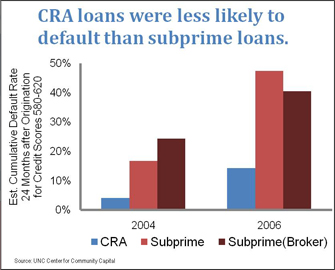 [4]
CRA were less likely to default than Subprime Mortgages —Source: University of North Carolina at Chapel Hill [5]
>
What occurred was the exact opposite: The suburbs boomed and busted and went into foreclosure in much greater numbers than inner cities. The tiny suburbs and exurbs of South Florida and California and Las Vegas and Arizona were the big boomtowns, not the low-income regions. The redlined areas the CRA address missed much of the boom; places that busted had nothing to do with the CRA.
>
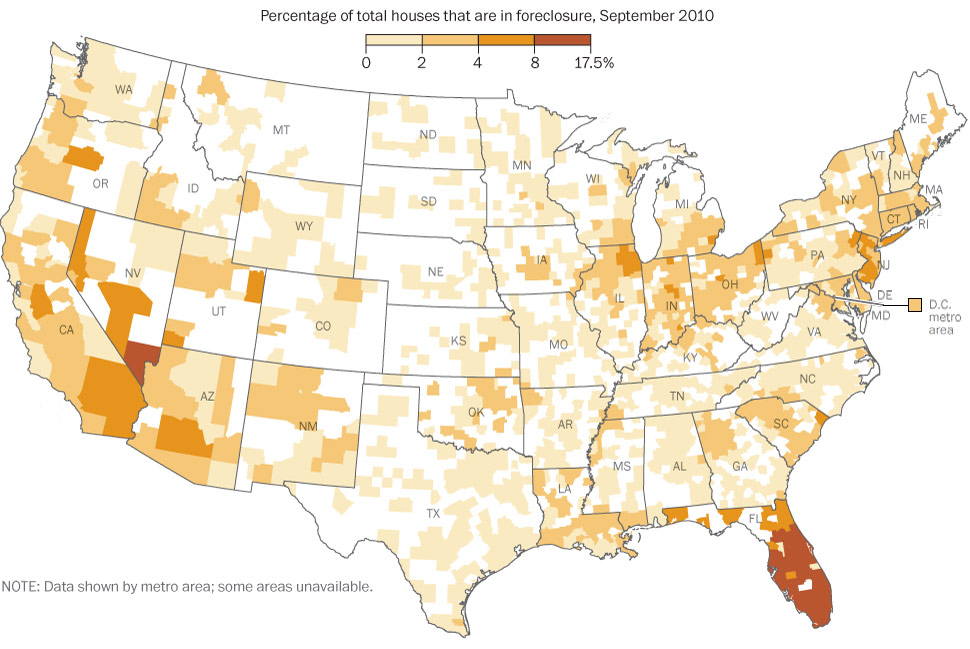 [6]
Suburbs and Exurbs were where the boom & bust occurred — and not the CRA regions — Source: Washington Post [7]
>
The market share of financial institutions that were subject to the CRA has steadily declined since the legislation was passed in 1977. As noted by Abromowitz & Min, CRA-regulated institutions, primarily banks and thrifts, accounted for only 28 percent of all mortgages originated in 2006.
•Nonbank mortgage underwriting exploded from 2001 to 2007, along with the private label securitization market, which eclipsed Fannie and Freddie during the boom.
Check the mortgage origination data: The vast majority of subprime mortgages — the loans at the heart of the global crisis — were underwritten by unregulated private firms. These were lenders who sold the bulk of their mortgages to Wall Street, not to Fannie or Freddie. Indeed, these firms had no deposits, so they were not under the jurisdiction of the Federal Deposit Insurance Corp or the Office of Thrift Supervision. The relative market share of Fannie Mae and Freddie Mac dropped from a high of 57 percent of all new mortgage originations in 2003, down to 37 percent as the bubble was developing in 2005-06.
>
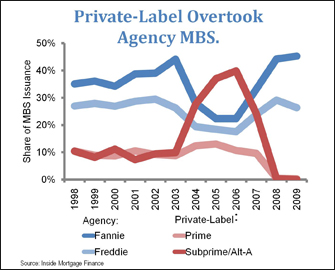 [8]
Nonbank mortgage underwriting exploded from 2001 to 2007, along with the private label securitization market, which eclipsed Fannie and Freddie during the boom– Source: University of North Carolina at Chapel Hill [9]
>
•Private lenders not subject to congressional regulations collapsed lending standards. Taking up that extra share were nonbanks selling mortgages elsewhere, not to the GSEs. Conforming mortgages had rules that were less profitable than the newfangled loans. Private securitizers — competitors of Fannie and Freddie — grew from 10 percent of the market in 2002 to nearly 40 percent in 2006. As a percentage of all mortgage-backed securities, private securitization grew from 23 percent in 2003 to 56 percent in 2006
>
Subprime Lenders were (Primarily) Private
[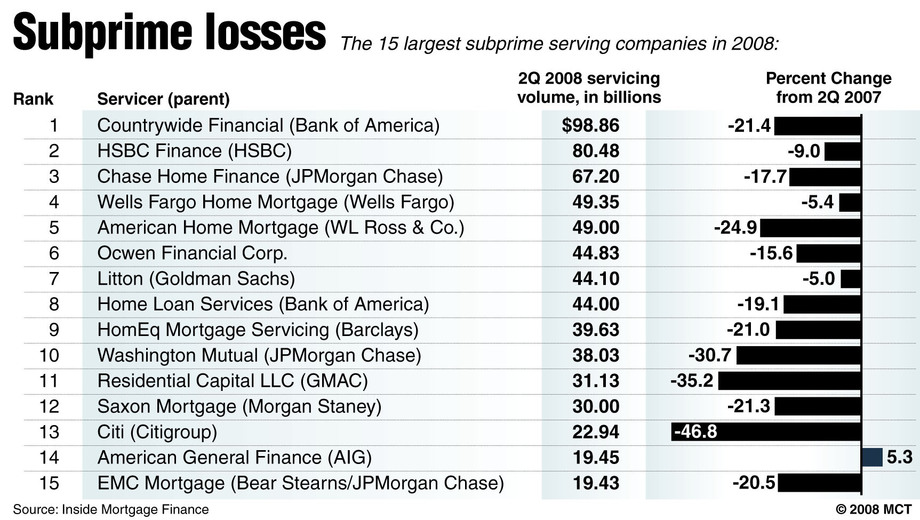 ](http://www.ritholtz.com/blog/wp-content/uploads/2011/11/647-20081013-ECONOMY-subprime.large_.prod_affiliate.91.jpg) [10]
Only one of the top 25 subprime lenders in 2006 was directly subject to the housing laws overseen by either Fannie Mae, Freddie Mac or the Community Reinvestment Act —Source: McClatchy [11]
>
These firms had business models that could be called “Lend-in-order-to-sell-to-Wall-Street-securitizers.” They offered all manner of nontraditional mortgages — the 2/28 adjustable rate mortgages, piggy-back loans, negative amortization loans. These defaulted in huge numbers, far more than the regulated mortgage writers did.
Consider a study by McClatchy [11]: It found that more than 84 percent of the subprime mortgages in 2006 were issued by private lending. These private firms made nearly 83 percent of the subprime loans to low- and moderate-income borrowers that year. And McClatchy found that out of the top 25 subprime lenders in 2006, only one was subject to the usual mortgage laws and regulations.
A 2008 analysis [12] found that the nonbank underwriters made more than 12 million subprime mortgages with a value of nearly $2 trillion. The lenders who made these were exempt from federal regulations.
>
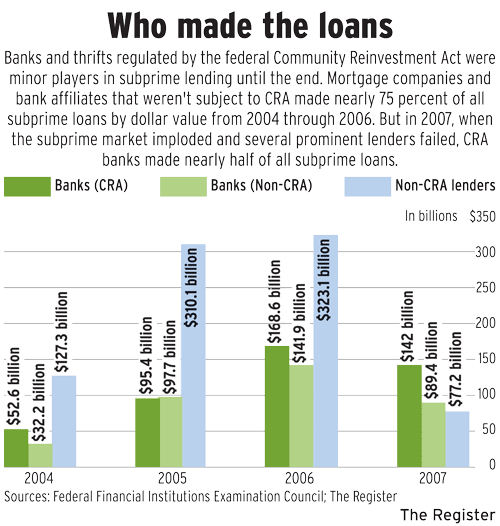 [13]
Lenders made 12 million subprime mortgages with a value of nearly $2 trillion. Mortgage Companies and Thrifts NOT affiliated with CRA made 75% of Subprime Loans from 2004-07,Source: Orange County Register [14]
>
A study by the Federal Reserve[15]shows that more than 84 percent of the subprime mortgages in 2006 were issued by private lending institutions. The study found that the government-sponsored enterprises were concerned with the loss of market share to these private lenders — Fannie and Freddie were chasing profits, not trying to meet low-income lending goals.
>
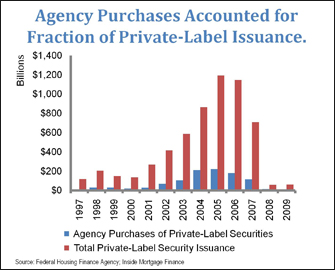 [16]
Fannie and Freddie risky loan purchases was dwarfed by Private Label SecuritizationSource: University of North Carolina at Chapel Hill [5]
>
Beyond the overwhelming data that private lenders made the bulk of the subprime loans to low-income borrowers, we still have the proximate cause issue. If we cannot blame housing policies from the 1930s or mortgage tax deductibility from even before that, then what else can we blame? Mass consumerism? Incessant advertising? The post-World War II suburban automobile culture? MTV’s “Cribs”? Just how attenuated must a factor be before fair-minded people are willing to eliminate it as a prime cause?
I recognize all of the above as merely background noise, the wallpaper of our culture. To blame the housing collapse that began in 2006, a recession dated to December 2007 and a market collapse in 2008-09 on policies of the early 20th century is to blame everything — and nothing.
~
Ritholtz is chief executive of FusionIQ, a quantitative research firm. He is the author of “Bailout Nation” [17] and runs a finance blog, the Big Picture [18].
Article printed from The Big Picture: http://www.ritholtz.com/blog
URL to article: http://www.ritholtz.com/blog/2011/11/examining-the-big-lie-how-the-facts-of-the-economic-crisis-stack-up/
URLs in this post:
[1] big lie: http://www.washingtonpost.com/business/what-caused-the-financial-crisis-the-big-lie-goes-viral/2011/10/31/gIQAXlSOqM_story.html?tid=pm_business_pop
[2] Image: http://www.ritholtz.com/blog/wp-content/uploads/2011/11/Sept09_CF1.jpg
[3] McKinsey Quarterly: http://www.mckinseyquarterly.com/newsletters/chartfocus/2009_10.htm
[4] Image: http://www.ritholtz.com/blog/wp-content/uploads/2011/11/defaultChart.jpg
[5] University of North Carolina at Chapel Hill: http://www.ccc.unc.edu/cra.php
[6] Image: http://www.ritholtz.com/blog/wp-content/uploads/2011/11/Natl-map-of-foreclosures.jpg
[7] Washington Post: http://www.washingtonpost.com/wp-dyn/content/graphic/2010/10/18/GR2010101806640.html
[8] Image: http://www.ritholtz.com/blog/wp-content/uploads/2011/11/fannieFreddie2.jpg
[9] University of North Carolina at Chapel Hill: http://www.ccc.unc.edu/FannieFreddie.php
[10] Image: http://www.ritholtz.com/blog/wp-content/uploads/2011/11/647-20081013-ECONOMY-subprime.large_.prod_affiliate.91.jpg
[11] McClatchy: http://www.mcclatchydc.com/2008/10/12/53802/private-sector-loans-not-fannie.html
[12] A 2008 analysis: http://www.ocregister.com/articles/loans-20542-subprime-banks.html
[13] Image: http://www.ritholtz.com/blog/wp-content/uploads/2009/06/cra-chartg1109.gif
[14] Orange County Register: http://www.ritholtz.com/blog../2009/06/most-subprime-lenders-werent-covered-by-cra/
[15] A study by the Federal Reserve : http://www.federalreserve.gov/pubs/feds/2011/201136/index.html
[16] Image: http://www.ritholtz.com/blog/wp-content/uploads/2011/11/fannieFreddie4.jpg
[17] “Bailout Nation”: http://www.amazon.com/gp/product/0470596325?ie=UTF8&tag=washingtonpost-20&linkCode=xm2&camp=1789&creativeASIN=0470596325
[18] the Big Picture: http://www.ritholtz.com/blog../
The financial crisis of 2008 was terrible for homeowners saddled with heavy mortgage payments, especially the millions of low-income, first-time buyers who were tempted to buy in with deceptive loans during the height of the housing bubble. About 4 million foreclosures have been completed since the financial crisis of 2008, according to CoreLogic, a data provider to the real estate industry. Since 2006, when subprime loans first began to default in large numbers, there have been 9.4 million foreclosures initiated, according to the Federal Reserve Bank of New York (US Fed). To a select group of hedge fund and investment bankers the financial crisis that pivoted on these foreclosures was the opportunity of a lifetime. They made billions from the crash by wagering against the stability of the US housing market.
Now some of the same elite investors are tacking backward and betting on a recovery of the housing market. It's a strange recovery though, propelled not so much by families seeking their own piece of the American dream, but instead by the US Fed's monetary policies. Low-interest rates fostered by the Fed are causing big-money investors to purchase foreclosed single-family homes in blocks of hundreds, even thousands. Expected gains in home prices are also leading hedge funds and investment bank traders to gamble on housing derivatives.
Like the so-called jobless recovery, characterized by rising business earnings in the midst of high unemployment, the nascent housing recovery is not propelled by a rise in homeownership rates, employment and incomes. Instead, foreclosure rates remain high, as does do unemployment figures, and there's a big backlog of bank-owned properties that has yet to hit the market. Meanwhile, many former home owners have been relegated to the status of renters. If home prices are truly embarked on a sustained rise, the big gains in any new equity created will likely accrue to a smaller number of owners, many of them corporate investor-landlords, and to a few elite financial speculators positioned to make complex derivatives bets on housing bonds. That's how it's playing out so far.
2007's "Big Short"
To understand the current dynamics in the housing market, it helps to go back in time just before the crash. The collapse of the US housing market was the catalyst of the global financial crisis of 2008, and the root source of the last five years of economic stagnation. It was skyrocketing real estate prices that facilitated the inflation of the largest debt bubble in history, allowing Americans to take out unsustainable consumer loans so long as the equity in their homes grew. The bubble burst because real wages continued to decline, total consumer debts continued to grow, and many of Wall Street's derivative innovations turned out to be cynical products designed merely to package up unsustainable obligations and offload them onto some other sucker's books. The rest is history. Millions were foreclosed on, and the economy hemorrhaged jobs.

A few prescient investors saw it coming and wagered that the US housing market would collapse. They made billions on that bet, literally sucking money from the accounts their counterparties - banks and insurance companies who believed that a decline in home prices across all US regions was impossible.
The mechanics of the bet were conceptually simple, if technically complex: Bearish speculators identified mortgage bonds they thought were toxic, comprised of thousands of individual home loans that were sure to default if interest rates rose or if the unprecedented rise in home prices even just slowed a little. These few contrarian investors then purchased credit default swap (CDS) contracts, synthetic derivative products created to insure an investor against the possibility of defaulting mortgage bonds.
CDSs had two sides, the buyer and seller, and involved a zero sum wager. If homeowners continued to make payments on subprime mortgages, then the buyer of CDS insurance merely paid out a small premium each year. However, if the market stumbled and mortgages within the bonds that comprised larger mortgage-backed securities began to default in large numbers, then the seller of the CDS would owe huge sums of money to the buyer.
Author Michael Lewis called this the "Big Short" in his book of the same title because it involved a monumental short-selling strategy. Derivatives made short-selling a strategic possibility with the new multi-trillion-dollar global market of US mortgage credit. Investors had no need to actually own subprime mortgaged bonds, or to borrow these assets, as is traditionally required in the short-selling strategies of the pre-derivatives revolution. Instead, an investor could “synthetically gain exposure" to subprime risk, as they say in Wall Street parlance, simply by entering into a free-standing swap contract with a willing counterparty.
Another popular means of shorting housing was to make directional bets on the price of subprime mortgage-backed securities through the ABX.HE Index. "ABX" stands for asset-backed security, and "HE" stands for home equity, denoting to an investor that the index tracks the value of credit default swaps tied to subprime mortgage bond securities. The biggest investment banks involved in creating subprime mortgage-backed securities like collateralized mortgage obligations (CMOs) and collateralized debt obligations (CDOs) created the ABX.HE Index in 2006, just in time for short-sellers to game it to their advantage.
A managing director at Goldman Sachs, one of the firms instrumental in launching the ABX.HE Index, explained that it was designed to provide investors with "a simple and efficient way to gain or hedge exposure to home equity asset-backed securities." This was the official story the banks told regulators and their customers. The Index, they claimed, was to be used to prudently insure actual investments in mortgage-backed securities.
Like other derivatives, however, the ABX.HE would actually become a tool for highly leveraged speculation by hedge funds, many of which had no real holdings of the housing assets from which the indices' value and cash flows derived. One could simply enter into a trade requiring the exchange of cash flows that changed depending on the value of referenced securities, in this case, the value of credit default swaps tied to subprime debt that was only financially viable if home prices continued to rise and create homeowner equity.
After news began to spread within Wall Street's upper echelons that subprime mortgage bonds were beginning to turn sour, more and more traders sought ways to bet against the entire market. Goldman Sachs quickly used the ABX.HE to establish short positions for the bank's proprietary funds, and for several favored clients.
According to Richard Stanton and Nancy Wallace, scholars at the UC Berkeley Haas Business School who have studied pricing and trade patterns of credit derivatives, "trading in the ABX.HE index CDS delivered two of the largest pay-outs in the history of financial markets: The Paulson & Co. series of funds secured $12 billion in profits from a single trade in 2007; and Goldman Sachs generated nearly $6 billion in profits (erasing $1.5 to $2.0 billion of losses on their $10 billion subprime holdings) in 2007."

Goldman Sachs' and Paulson & Co.'s earnings became the source of an investigation by the SEC. The bank created subprime mortgage-backed securities and sold them to several German banks, but then, along with the Paulson & Co. hedge fund, bet against these very same securities. The SEC fined Goldman Sachs $550 million (a mere fraction of the profits). Paulson & Co. paid no such fine and admitted no wrongdoing.
Other beneficiaries of the foreclosure crisis included Kyle Bass, the Dallas hedge fund manager who also shorted subprime mortgage-backed assets using credit default swaps. Bass's Hayman Capital reportedly reapedhalf a billion dollars.
Greg Lippman, a trader with Deutsche Bank in 2006, pestered dozens of hedge funds and other wealthy investors in a sales blitz to convince clients on his similarly designed bet to short US home prices. According to Michael Lewis, who interviewed dozens of people who put on the "big short" trade, Lippmann had distilled his strategy into a data-rich presentation titled "Shorting Home Equity Mezzanine Tranches."
All of the derivative tools used by speculators to short the market before the financial crisis still exist. Few regulatory changes were made to reign in this kind of high-stakes gambling using the synthetic exposure of derivatives, indices and short-selling techniques.
Fed Creates Opportunities to "Go Long"
Like the jobless recovery in corporate profits that began in 2010, the housing market's current recovery is characterized by rebounds in securities prices that do not necessarily reflect any widely shared economic improvements for most Americans. Instead, the recovery seems to be propelled by federal monetary policy.
The US Federal Reserve's purchase of billions of mortgage-backed securities is most responsible for the nascent housing recovery, say many analysts. The Fed has committed to buying upwards of $40 billion a month into 2015 (totaling anywhere from $480 to $960 billion) in mortgage-backed securities. The effect of the Fed's purchases is to drive up the price of mortgage bonds, which inversely reduces the yields on the bonds, and eases credit, theoretically making home loans cheaper and inducing more prospective home buyers to dive into the market. That's the logic the Fed's board is ostensibly using at least.
Home prices have decidedly responded. The Case-Shiller Index, which tracks changes in home values in major cities, showed definite increases in year-over-year values from 2011 to 2012. CoreLogic's Home Price Index showed a similar rise, with home values up more than 6 percent in October 2012, compared with the prior year.
Skepticism abounds, however. "The reality is that quantitative easing (QE) has made it cheaper for the government to borrow, has artificially propped up the housing market (making it take longer to recover) and has dramatically manipulated the distribution of capital in financial markets," said Anthony Randazzo, director of economic research at the Reason Foundation. "And the economy has not been in recovery." Randazzo said the Fed's mortgage-backed securities purchases are mostly benefitting the top 10 percent of Americans who own the bonds and stocks that are rising in price as a result of the Fed's purchases.
Even economists within the Federal Reserve are noting that while the government's mortgage securities purchases are lifting home prices, they are not necessarily helping the average American buy a house. Michael Bauer of the Federal Reserve Bank of San Francisco noted in a May 2012 report, "The link between rates on mortgage-backed securities and actual mortgage rates has weakened in the wake of the financial crisis." In other words, the Fed's ability to stimulate lending and get houses into the hands of individual home buyers isn't working as planned, but still home prices are rising.
Foreclosure to Rental Mills
There are buyers ready and able to take advantage of the Fed's macro-economic influence on home prices: large investors seeking to buy up what they've identified as a "new asset class," single-family residential homes in select suburban housing markets.
Some of these companies have already amassed portfolios of thousands of foreclosed and short-sale homes at historically low prices and are busy converting them into rentals. The eventual increase in the value of these homes is an added enticement. Projected yields are high enough to justify purchases of single-family homes as an asset that will inflate greatly in value. If prices continue to increase, private equity buyers could hold the properties for a few years and then make an "exit," as they say in the industry, and book a big profit.
Some companies like WayPoint of Oakland, California, already own portfoliosof thousands of homes purchased at dramatically low prices, most of them obtained after heavily indebted owners were forced to abandon them. WayPoint's holdings are concentrated in the San Francisco Bay Area, Los Angeles, Phoenix, Chicago and Atlanta, according to the company's web site. Menlo Park private equity firm GI Partners has committed over $1 billion to fund Waypoint's expansion.
Others have copied WayPoint's foreclosure-to-rental model and are buying up tens of thousands of distressed properties across the US to convert vast stocks of residential homes into rental housing. The Blackstone Group private equity fund has already spent $1 billion to buy up over 6,500 single family homes in multiple markets, assembling these into what the firm is calling its "single-family rental home platform." In a public relations video Blackstone created for its real estate management company, Invitation Homes, the firm's head of global real estate, Jon Gray, says, "I think at its heart we're making a bet on America with this investment strategy. We're betting that housing prices are going to begin to recover."
McKinley Capital, another Oakland private equity real estate investor, is buying foreclosed single family homes at prices discounted up to 80 percent of their 2006 high in California's hard-hit Central Valley. "McKinley plans to resell the houses in about five years for double what it paid and is targeting 20 percent annualized returns for its investors, which include wealthy individuals," according to a report in the Wall Street Journal on the foreclosure-to-rental business.
Another foreclosure-to-rental mill, Silver Bay Realty Trust, described its business strategy in a December 2012 prospectus issued to investors: "As the housing market recovers and the cost of residential real estate increases, so should the underlying value of our assets. We believe that rental rates will also increase in such a recovery due to the strong correlation between home prices and rents. This trend also leads us to believe that the single-family residential asset class will serve as a natural hedge to inflation. As a result, we believe we are well positioned for the current economic environment and for a housing market recovery."
Silver Bay owns more than 2,450 houses and plans to invest a quarter-billion dollars to obtain another 3,100 homes in Arizona, California, Florida, Georgia, Nevada, North Carolina and Texas, according to the company's SEC filings.
Mike Orr, director of the Center for Real Estate Theory and Practice at Arizona State University's Carey School of Business, reported investors are buying up as much as a third of the homes selling in the greater Phoenix market today. "I know of a normal home that recently received 95 written offers, 51 from investors and 44 from owner occupiers," said Orr. "You can take away the 51 investors, and you still have 44 owner occupiers trying to buy one home. However, investors are buying with cash, so they usually win these competitive situations, leaving owner occupier buyers frustrated." Orr believes that the presence of investors is causing prices to rise in Phoenix because of their buying power.
Atlanta Realtor Bruce Ailion also believes investors are not just responding to the Fed's stimulus, but that the presence of large investors is further increasing home prices. "In my market, private equity and hedge funds are driving up prices," Ailion recently told reporters with CBS News.
The end result is that many housing markets have already consolidated around fewer landlord-owners and an increased number of renters whose economic situations still prevent them from buying a home.
Derivatives Bets on the Recovery
Some of these same speculators who shorted subprime housing debt in 2006 and 2007 have already tacked a complete opposite bet, expecting home prices to rise due to the Fed's mortgage bond purchases. Investors like former Goldman Sachs trader Josh Birnbaum, who now runs the Tilden Park hedge fund, are telling clients to put their money behind subprime mortgage bonds, many of which are rising in value. According to a recent Bloomberg News report, Birnbaum's firm is posting a 30 percentgain in 2012, mostly from bets favoring price increases in subprime mortgage bonds that lost upwards of 80 percent of their value during the financial crisis.
Birnbaum was one of the architects of Goldman Sachs' big short bet against subprime housing in 2006 through the ABX.HE Index. According to William Cohan, author of Money and Power: How Goldman Sachs Came to Rule the World, Birnbaum quit the investment bank after a $10 million bonus check left him feeling shorted for putting on the firm's big short bet. Birnbaum's hedge fund is reportedly using the same index this time around to gain the opposite kind of exposure to housing debt.
Joining Birnbaum's hedge fund in this strategy is John Paulson's firm, Paulson & Co., which posted the biggest gains of all thanks to the housing meltdown five years ago. Paulson's fund reportedly began buying housing mortgage securities back in 2008 and 2009, just after they'd collapsed in price.
In a letter to his investors earlier this year, Kyle Bass of Hayman Capital wrote that, with respect to subprime housing debt, "the stars are aligned for a continued recovery of this asset class today." Bass told reporters recently that more than half of Hayman Capital's funds are currently invested in subprime mortgage bets.
Greg Lippmann, the architect of Deutsche Bank's $1.5 billion big short bet, is now running a hedge fund that is going long on US subprime debt. Libremax Capital, which is said to manage about half a billion dollars, mostly sourced from wealthy investors, is said to be investing in subprime mortgage bonds of early 2005 "vintages," which have already purged many of the delinquent debts from their rolls. "We believe securitized [home mortgage] products are fundamentally cheap to broader markets," Lippman told reporters last year when asked about his fund's strategy.
The biggest hedge fund winner in 2012 is the New York-based Metacapital. Its “Mortgage Opportunities Fund” has squeezed a 520 percent profit on the year by betting on housing price increases owing to the Fed’s purchase of Fannie Mae and Freddie Mac mortgage bonds.
A Home Owner-less Housing Recovery?
According to data from the Federal Reserve Bank of St. Louis, homeownership rates have plummeted by 3 percent nationally since 2004, falling to a low not seen since the mid-1990s. The backlog of delinquent mortgage loans and in-process foreclosures means that millions more will lose their homes and become renters, couch-surfers or homeless in the next few years.

While the foreclosure rate may be dropping nationally, it remains extremely high compared to historical averages. Approximately 186,000 homes, or one in every 706 units of housing, were foreclosed on in October, 2012. There have been about 5 million bankrepossessions of housing between 2006 and 2012, according to RealtyTrac.
According to economists with the Federal Reserve Bank of San Francisco, only 10 percent of homeowners who lose their houses because of default on mortgage payments will regain access to mortgage markets in the next 10 years. This means that there are now millions of Americans who will be closed out of the housing market during not only this peculiar recovery phase, characterized by a rise in prices and private equity buyers acquiring much of the inventory, but also down the road, long after houses have regained much of their value.
http://truth-out.org/news/item/13883-why-the-housing-recovery-is-inequitable
DARWIN BOND GRAHAM
Darwin Bond Graham is a sociologist and journalist who writes about political economy. He lives and works in the San Francisco Bay Area and blogs at http://darwinbondgraham.wordpress.com.
==
mojo:
Wall Street's foreclosure crisis [5], which began in late 2007 and forced more than 10 million people [6] from their homes, has created a paradoxical problem. Millions of evicted Americans need a safe place to live, even as millions of vacant, bank-owned houses are blighting neighborhoods and spurring a rise in crime [7]. Lucky for us, Wall Street has devised a solution: It's going to rent these foreclosed houses back to us. In the process, it's devised a new form of securitization that could cause this whole plan to blow up—again.
Since the buying frenzy began, no company has picked up more houses than theBlackstone Group, the largest private equity firm in the world. Using a subsidiary company, Invitation Homes, Blackstone has grabbed houses at foreclosure auctions, through local brokers, and in bulk purchases directly from banks the same way a regular person might stock up on toilet paper from Costco.
http://www.sourcewatch.org/index.php?title=Troubled_Asset_Relief_Program
death spiral : banks do not pay prop taxes; city can pay up to 20K$ to maintain empty house.
we act as if inevitable, the mkt
'Massive Fraud' at Center of Trial Against BofA Over US Mortgages
By Nate Raymond, Reuters
25 September 13
Bank of America Corp's Countrywide unit placed profits over quality in a "massive fraud" selling shoddy mortgages to Fannie Mae and Freddie Mac, a U.S. government lawyer said on Tuesday.
 he claim came at the start of the first case by the government to go to trial against a major bank over defective mortgage practices leading up to the 2008 financial crisis.
Pierre Armand, a lawyer in the civil division of the U.S. Attorney's Office in Manhattan, said Countrywide made $165 million selling loans that it promised were investment quality to Fannie and Freddie.
"What documents and witnesses will show is that the promise of quality was largely a joke," Armand said.
But Brendan Sullivan, a lawyer for Bank of America, said Countrywide had sought to ensure the loans it made were good and that no fraud occurred.
"No fraud," he said. "Two words. That's the heart and soul and body of the defense. No fraud. And that's what the evidence will show."
Filed in October, the lawsuit blames the bank for losses suffered by Fannie Mae and Freddie Mac on thousands of prime mortgages that later defaulted. Fannie and Freddie, government-sponsored enterprises that underwrite mortgages, were taken over by the government in 2008.
The Justice Department says the loans were pushed out through a Countrywide program called the "High Speed Swim Lane" - also called "HSSL" or "Hustle" - that began in 2007 amid rising mortgage delinquency and default rates and as Fannie and Freddie were tightening underwriting guidelines.
The program was overseen by Rebecca Mairone, a former chief operating officer of Countrywide's Full Spectrum Lending division, who is a co-defendant in the lawsuit and today works at :{JPMorgan Chase & Co.:(style="background-color:#fff200"):}:
The lawsuit is brought under the Financial Institutions Reform, Recovery, and Enforcement Act. The law, passed in the wake of the 1980s savings-and-loan scandals, covers fraud affecting federally insured financial institutions.
The Justice Department estimates Fannie and Freddie has a gross loss of $848.2 million on the Countrywide HSSL loans, though their net loss on loans it says were materially defective was $131.2 million.
==
FORECLOSURE
| Law to Clean Up 'Nuisances' Costs Innocent People Their Homes |
http://www.tomdispatch.com/post/175731/tomgram%3A_laura_gottesdiener%2C_the_backyard_shock_doctrine/foreclosure 10 mil ppl DN
http://www.democracynow.org/2013/8/6/a_dream_foreclosed_as_obama_touts
http://www.democracynow.org/2013/8/6/california_city_threatens_to_use_eminent
===
http://www.propublica.org/ion/bailout
top 5 fannie, freddie, aig, GM, b of a
Tracker: http://www.propublica.org/ion/bailout
http://projects.propublica.org/bailout/
The State of the Bailout
OUTFLOWS: $604 billionThis includes money that has actually been spent, invested, or loaned.
Our frequently updated database tracks every dollar and every bailout recipient. See our scorecard of Treasury spending. (Here's a rundown of the bailout info our site offers.)
Salon [1] / By David Dayen [2]
Bank of America Whistle-blower Bombshell: “We Were Told to Lie” to Rip Off Borrowers
June 18, 2013 |
Bank of America’smortgage servicing unit systematically lied to homeowners, fraudulently denied loan modifications, and paid their staff bonuses for deliberately pushing people into foreclosure: Yes, these allegations were suspected by any homeowner who ever had to deal with the bank to try to get a loan modification – but now they come from six former employees and one contractor, whose sworn statements [3] were added last week to a civil lawsuit filed in federal court in Massachusetts.
“Bank of America’s practice is to string homeowners along with no apparent intention of providing the permanent loan modifications it promises,” said Erika Brown, one of the former employees. The damning evidence would spur a series of criminal investigations of BofA executives, if we still had a rule of law in this country for Wall Street banks.
The government’s Home Affordable Modification Program (HAMP), which gave banks cash incentives to modify loans under certain standards, was supposed to streamline the process and help up to 4 million struggling homeowners (to date, active permanent modifications number about 870,000 [4]). In reality, Bank of America used it as a tool, say these former employees, to squeeze as much money as possible out of struggling borrowers before eventually foreclosing on them. Borrowers were supposed to make three trial payments before the loan modification became permanent; in actuality, many borrowers would make payments for a year or more, only to find themselves rejected for a permanent modification, and then owing the difference between the trial modification and their original payment. Former Treasury Secretary Timothy Geithner famously described HAMP as a means to “foam the runway [5]” for the banks, spreading out foreclosures so banks could more readily absorb them.
These Bank of America employees offer the first glimpse into how they pulled it off. Employees, many of whom allege they were given no basic training on how to even use HAMP, were instructed to tell borrowers that documents were incomplete or missing when they were not, or that the file was “under review” when it hadn’t been accessed in months. Former loan-level representative Simone Gordon says flat-out in her affidavit that “we were told to lie to customers” about the receipt of documents and trial payments. She added that the bank would hold financial documents borrowers submitted for review for at least 30 days. “Once thirty days passed, Bank of America would consider many of these documents to be ‘stale’ and the homeowner would have to re-apply for a modification,” Gordon writes. Theresa Terrelonge, another ex-employee, said that the company would consistently tell homeowners to resubmit information, restarting the clock on the HAMP process.
Worse than this, Bank of America would simply throw out documents on a consistent basis. Former case management supervisor William Wilson alleged that, during bimonthly sessions called the “blitz,” case managers and underwriters would simply deny any file with financial documents that were more than 60 days old. “During a blitz, a single team would decline between 600 and 1,500 modification files at a time,” Wilson wrote. “I personally reviewed hundreds of files in which the computer systems showed that the homeowner had fulfilled a Trial Period Plan and was entitled to a permanent loan modification, but was nevertheless declined for a permanent modification during a blitz.” Employees were then instructed to make up a reason for the denial to submit to the Treasury Department, which monitored the program. Others say that bank employees falsified records in the computer system and removed documents from homeowner files to make it look like the borrower did not qualify for a permanent modification.
Senior managers provided carrots and sticks for employees to lie to customers and push them into foreclosure. Simone Gordon described meetings where managers created quotas for lower-level employees, and a bonus system for reaching those quotas. Employees “who placed ten or more accounts into foreclosure in a given month received a $500 bonus,” Gordon wrote. “Bank of America also gave employees gift cards to retail stores like Target or Bed Bath and Beyond as rewards for placing accounts into foreclosure.” Employees were closely monitored, and those who didn’t meet quotas, or who dared to give borrowers accurate information, were fired, as was anyone who “questioned the ethics … of declining loan modifications for false and fraudulent reasons,” according to William Wilson.
Bank of America characterized [6] the affidavits as “rife with factual inaccuracies.” But they match complaints from borrowers having to resubmit documents multiple times, and getting denied for permanent modifications despite making all trial payments. And these statements come from all over the country from ex-employees without a relationship to one another. It did not result from one “rogue” bank branch.
Simply put, Bank of America didn’t want to hire enough staff to handle the crush of loan modification requests, and used these delaying tactics as a shortcut. They also pushed people into foreclosure to collect additional fees from them. And after rejecting borrowers for HAMP modifications, they would offer an in-house modification with a higher interest rate. This was all about profit maximization. “We were regularly drilled that it was our job to maximize fees for the Bank by fostering and extending delay of the HAMP modification process by any means we could,” wrote Simone Gordon in her affidavit.
Benzinga [1] / By William K. Black [2]
Why Did the Fed Refuse to Heed Warnings About Fraudulent Mortgage Lenders?
July 15, 2013 |
Real regulators are vital to a nation. They can stop crises in their tracks — or they can let a them explode on an unsuspecting public. The Federal Reserve was warned by many different people, including appraisers, prosecutors, and industry players that the mortgage industry was rife with fraud. Why didn't they listen?
The Appraisers’ Warning of the Lenders’ Fraud Epidemic
A very large number of appraisers have tried to combat home lenders and their agents who were deliberately extorting them to inflate appraisals. When cheaters prosper, the markets drive honest firms and professionals out of business, something economists call "Gresham's dynamic." Honest appraisers tried to block this dynamic:
“From 2000 to 2007, [appraisers] ultimately delivered to Washington officials a petition; signed by 11,000 appraisers…it charged that lenders were pressuring appraisers to place artificially high prices on properties. According to the petition, lenders were ‘blacklisting honest appraisers’ and instead assigning business only to appraisers who would hit the desired price targets” (FCIC 2011: 18).
There is a “recipe” by which fraudulent mortgage lenders (purchasers) optimize their reported (albeit fictional income); promptly making their controlling officers wealthy through modern executive compensation. That recipe requires the massive origination (purchase) of bad loans, and inflating appraisals makes bad loans appear to be good loans and helps hyper-inflate bubbles.
The device lenders typically used to ensure the endemic inflation of appraised values was to blacklist honest appraisers. The fraudulent lenders took what had once been a very good practice, refusing to use appraisers who inflated appraisals or were simply incompetent, and perverted it into an instrument of extortion and fraud by blacklisting appraisers who refused to aid their fraud schemes by inflating appraisals.
We worked closely with appraisers and their professional bodies interested in preventing fraud when we regulated the S&L industry. The Bank Board’s appraisal standard (R-41c) was considered the platinum standard for professional home appraisals. The appraisers determined to stamp out appraisal fraud were the only professionals that supported our effort to crack down on the roughly 300 S&L control frauds. The “Big 8” audit firms, the legal profession, and economists were impassioned opponents of our efforts to reregulate the industry and to hold the senior officers running the control frauds accountable.
The FBI’s Warnings of the Fraud Epidemic and the Financial Crisis it Would Create
In September 2004, Chris Swecker, the FBI official charged with responsibility for mortgage fraud, began warning publicly that an “epidemic” of mortgage fraud was developing. Swecker predicted that it would cause a financial “crisis” if it were not contained.
Representatives of the Borrowers Warned the Fed about Endemic Mortgage Fraud
I will make this topic the subject of an entire article. My conclusion from reading the transcripts of several hearings on mortgage abuses that Congress mandated the Fed to conduct is that representatives of nonprime borrowers overwhelmingly opposed the loans, typically explaining that they were frequently fraudulent and predatory. ACORN was one of these groups warning the fed about nonprime loans.
State Prosecutors Warned the Fed about Endemic Mortgage Fraud
“Over the last several years, the subprime market has created a race to the bottom in which unethical actors have been handsomely rewarded for their misdeeds and ethical actors have lost market share…. The market incentives rewarded irresponsible lending and made it more difficult for responsible lenders to compete”
“[Many originators invent] non-existent occupations or income sources, or simply inflat[e] income totals to support loan applications. Importantly, our investigations have found that most stated income fraud occurs at the suggestion and direction of the loan originator, not the consumer” Miller, T. J., Iowa Attorney General (August 14, 2007).
Other state and local prosecutors issued warnings in earlier Fed hearings, but the Iowa witnesses provided some of the most compelling analysis.
Steven Krystofiak, President of the Mortgage Brokers Association for Responsible Lending
Krystofiak’s testimony [3] put the Fed on notice that stated income loans were the major problem and that the lenders and brokers often put the lies in the liar’s loans:
“Currently we see stated income and stated asset loans as the largest problem in the real estate industry.
1. Stated income loans are associated with fraud, and started to become popular in 2002.
A stated income loan is a loan where the income that is put on a home loan application is not verified at all by the banks. The banks simply take your word for it. Home buyers might be unaware of the fraudulent income that is being stated on the loan application because the loan officer, or bank representative have the power to falsify the income on the application.
Stated income loans became popular in 2002, and have since become mainstream. According to one survey it was discovered that 37% of all loans sold in the United States are originated without income being proven. In areas where homes are the least affordable (i.e. California, and Florida) that number grows to over 50%.”
Krystofiak explained that the fraudulent CEOs used financial incentives to enlist their fraud allies.
3. Fraud is encouraged by the banks
A large problem as to why these loans have become so prevalent is because the first line of defense against stated income loan fraud are individuals who are commission based; the loan originator, the bank representative, and in many cases the managers for the bank reps have a large portion of their income derived from bonuses based on loan production. Bank employees, i.e. underwriters and bank processors, return applications back to mortgage brokers with instructions to send back an application with a higher stated income. The mortgage industry has become comfortable with stating incomes higher on loan applications.
Online underwriting systems that are used by Fannie Mae and some banks are being exploited by bank representatives and loan officers wanting to obtain a loan with stated income underwriting standards but with fully documented interest rates. The systems allow mortgage brokers to “play” with different incomes more than 15 times until they get the results they want.
4. Stated income loans help no one. Stated income loans cost consumers hundreds of dollars a year because of higher interest rates.
Krystofiak then closed all the loops by explicitly warning the Fed that appraisal fraud was common, that lenders caused the fraudulent appraisals, that the appraiser profession had warned the federal regulators of these facts, and the FBI, after warning of endemic fraud, had gone missing in action.
11. Appraised values are often inflated. Underwriters are basing their decision on inflated home values, inflated incomes and inflated assets.
Loan officers have a lot of pressure to find a “liberal” appraiser so the home can be bought. This pressure to find a “liberal” appraiser is often coming from both the home buyer and the real estate agent. This pressure is then applied to the appraisers who are often forced into coming up with a predetermined value for a homes in order for the “deal to go through.” Don Kelly from the Appraisal Institute stated in a letter to federal regulators, “For years- and more so recently- our members have reported the loss of appraiser independence, when they are directed to provide predetermined opinions of value to help facilitate transactions. Failure to adhere to such requests from loan officers, mortgage brokers, and others has resulted in honest and ethical appraisers being placed on exclusionary or “do-not-use” list.”
12. Rules are not enough, they must be enforced.
The FBI has acknowledged that mortgage fraud is a problem that is a growing epidemic. Reports of suspicious activity has rose from 3,088 in 1999 to 21,994 in 2005. After 9/11 the FBI has made mortgage fraud a low priority. Within the FBI mortgage fraud is in a section for white collar crime that is ranked number seven, (1 through 6 is related to terrorist) and within that mortgage fraud is a smaller subsection which is only priority number four.”
The Industry’s Anti-Fraud Entity’s (MARI’s) Warnings in Early 2006
MARI was the mortgage lending industry’s anti-fraud group during the recent crisis. In early 2006, it issued a report to the Mortgage Bankers Association (MBA) that the MBA sent to each of its members. MARI’s report issued five key warnings about “stated income” loans.
Stated income and reduced documentation loans . . . are open invitations to fraudsters. It appears that many members of the industry have little historical appreciation for the havoc created by low-doc/no-doc products that were the rage in the early 1990s. Those loans produced hundreds of millions of dollars in losses for their users.
One of MARI’s customers recently reviewed a sample of 100 stated income loans upon which they had IRS Forms 4506. When the stated incomes were compared to the IRS figures, the resulting differences were dramatic. Ninety percent of the stated incomes were exaggerated by 5% or more. More disturbingly, almost 60% of the stated amounts were exaggerated by more than 50%. These results suggest that the stated income loan deserves the nickname used by many in the industry, the ‘liar’s loan.’
Federal regulators of insured financial institutions have expressed safety and soundness concerns over these loans.”
The “customer” MARI was referring to in that passage was Steven Krystofiak’s association. Note that MARI reminds the industry that stated income loans “were the rage in the early 1990s” and caused “hundreds of millions of dollars in losses.” I explain the significance of this point in the next section.
It is also important that MARI makes no claim that lenders make liar’s loans because “the government” makes them do it. To the contrary, “federal regulators … have expressed safety and soundness concerns over these loans.” This means that both “barrels” of the mortgage fraud assault on our Nation by loan originators serve as “natural experiments” that allow us to determine why the CEOs caused the lenders to make endemically fraudulent liar’s loans and extort the appraisers to commit appraisal fraud. The CEOs did it because it was a “sure thing” guaranteed to make them promptly wealthy.
What any Competent Regulator Would have Known
There are many vital inferences any competent private or public actor knowledgeable about mortgage lending, the secondary market, and collateralized debt obligations (CDOs) should have made on the basis of the appraisers’ petition. The most critical points arose from the appraisers’ warning that there was widespread inflation of appraisals extorted by home mortgage lenders. This allowed experts to realize that (1) no honest lender would inflate appraisals, (2) they would only engage in widespread inflation of appraisals in aid of knowingly making widespread bad loans which means they were engaged in widespread mortgage origination fraud (largely through “liar’s” loans), (3) this means that the problem is a twin-barrel fraud assault (liar’s loans plus appraisal fraud) by loan originators, (4) this should have led immediately to massive rejections of the bad loans by the secondary market; an action that would quickly bankrupt the fraudulent lenders, (5) because that did not happen we knew that the widespread fraudulent loans were propagating through the CDOs, which would hyper-inflate the financial bubble and cause catastrophic losses that would pose a systemic risk.
People generally recognized as experts in power in the private and public sectors recognized none of these things. Indeed, they purport to recognize none of these things even now (though that convenient claim of ignorance is so preposterous that it could be swallowed only with a full mine shaft worth of salt).
In reading Krystofiak’s testimony again in researching this article I realized that I was giving Greenspan and Bernanke too much credit by concluding that they were unaware of the implications of the twin fraud epidemics. Krystofiak connected the dots for the Fed in his testimony. Greenspan and Bernanke ignored an expert mortgage broker, an ethical insider determined like the most ethical appraisers to clean the rot from his profession, who explained how the frauds worked, the fact that they were often initiated by the lenders and their agents, and the fact that mortgage fraud would harm everyone except the controlling officers driving the frauds. Greenspan and Bernanke did have to do any heavy intellectual lifting by making logical inferences about a subject, fraud, that he had spent entire careers ignoring. All they had to do was to listen to Krystofiak; who did all the hard work for the Fed.
The appraisers’ warnings were amazingly early – they had reached the stage of creating a formal petition by 2000. Their warning came before the Enron-era epidemic of accounting control fraud!
There are books and articles celebrating the purported genius of John Paulson and Jamie Dimon based on their purported brilliance in figuring out in late 2006 that the housing market was going to tank. These books and articles make it clear that these vaunted experts missed entirely the many warnings about the twin mortgage fraud epidemics that began with the appraisers in 2000 and continued over many years from multiple sources. Paulson and Dimon were years over six years behind the appraisers and 15 years behind the savings and loan (S&L) regulators.
The Lenders’ CEOs’ “Revealed Fraud Preferences”
The finance industry responded to all of these warnings by massively increasing the fraud.
“Despite the well documented performance struggles of 2006 vintage loans, originators continued to use products with the same characteristics in 2007” (Iowa AG).
Krystofiak’s explained to the Fed in his testimony that liar’s loans grew massively – well after the appraisers’ warnings and the FBI’s warnings. The lenders’ CEOs’ revealed their preferences in response to these fraud warnings and their preference was overwhelmingly for ever greater fraud.
Many Private and Public Sector Actors Could Have Prevented the Crisis
There was ample time and means to prevent any financial crisis from arising from the incipient epidemic of fraudulent lending. A large number of actors, the regulators, prosecutors, credit rating agencies, secondary market purchasers, inside and outside auditors – and, of course, the CEOs of the lenders making the fraudulent loans – could have stopped the appraisal fraud epidemic in its tracks. It is obvious why the CEOs of the fraudulent lenders did not stop the endemic appraisal fraud that was designed to cover up the endemic mortgage origination fraud. The spread of the mortgage fraud epidemics throughout the secondary market participants and CDOs is a testament to the power of the CEOs who lead accounting control frauds to suborn myriad private sector firms and professionals to aid their frauds.
The fact that no federal banking regulatory agency responded to the appraisers’ warning with effective action (or even a warning about the fraud epidemic) reveals how severe the damage is when three Presidents in a row (Clinton, Bush, and Obama) appoint anti-regulatory leaders for the agencies. Appointing anti-regulators is, of course, a self-fulfilling prophecy of failure. That is what the industry intends when it influences presidents to appoint anti-regulatory leaders. This particular regulatory failure to take the epidemics of fraudulent liar’s loans and appraisals is one of the most inexcusable in history.
We Know That Real Regulators Would Have Prevented the Crisis (Again)
It is not a hypothetical to say that real regulators would have reacted promptly, long before the crisis, to end the twin control fraud epidemics. We did so a decade before the appraisers first began their petition. We did so against exactly the same twin barrel fraud assault – led by the same CEO and the same lender. Only the name of the firm and the identity of its potential federal regulator had changed. We acted in 1990-1991 to halt this incipient epidemic of accounting control fraud because we were the regional regulators (OTS West Region) with jurisdiction over Orange County, California – the traditional birthplace of U.S. financial frauds.
We acted to end liar’s loans because we listened to our examiners who explained why no honest home lender would make liar’s loans and commit appraisal fraud. The alert reader will know that our struggle against the Orange County frauds in 1990-1991 constituted a “second front” in the war that the S&L control frauds were waging against our Nation. We were exceptionally busy during that period. We were driving the anti-regulator who controlled our agency, OTS Director Danny Wall, to resign in disgrace through our testimony in a series of explosive congressional hearings. Wall had removed our jurisdiction over Lincoln Savings under political coercion from the five U.S. Senators who became known as the “Keating Five” because we refused to rescind our recommendation that the government take over Lincoln Savings. If we failed to demonstrate that Wall had disgraced his office we would have been fired. We also had to end Darrel Dochow’s tenure as OTS’ head of supervision. Dochow had led the effort to cave in to Keating’s political intimidation. I considered him the worst professional banking regulator in the Nation. When Wall resigned in disgrace his successor removed Dochow as head of supervision.
We were closing scores of failed S&Ls in our region, many of them exceptionally large. We were making thousands of criminal referrals, bringing scores of civil suits, and hundreds of enforcement actions. We were testifying before the Senate Ethics investigation of the Keating Five and the House ethics investigation of Speaker Wright. We were adopting new rules in conformance with the 1989 and 1991 legislative acts. I was defending a $400 million civil suit brought by Charles Keating against me in my individual capacity. We were training FBI agents and Assistant U.S. Attorneys. A material number of our top examiners were “detailed” to work for the FBI to serve as internal experts on their highest priority investigations. (This allowed them access to confidential Rule 6 (e) grand jury materials.) Many of us spent material time testifying in criminal cases as percipient and expert witnesses.
In our era, the industry did not yet call stated income loans “liar’s” loans. Our examiners had to figure out that the loans were endemically fraudulent.
The schwerpunktof the Orange County control fraud’s “liar’s loan” assault on the public was Long Beach Savings, led by Roland Arnall. Arnall caused Long Beach to be the pioneer in making liar’s loans. Arnall also caused it to be a leader in appraisal fraud and a pioneer in predatory mortgage lending targeting blacks and Latinos.
We drove stated income loans out the S&L industry in 1990-1991. Because of our supervisory crackdown on stated income loans, Arnall voluntarily gave up federal deposit insurance and converted to a mortgage bank for the sole purpose of escaping our regulatory jurisdiction. He changed Long Beach’s name to Ameriquest. A husband/wife team that we had “removed and prohibited” from the federally insured financial industry started a mortgage bank that became one of Arnall’s material competitors. Michael W. Hudson’s 2010 book The Monster provides a superb history of Ameriquest. In addition to our supervisory actions that led Arnall to flee our jurisdiction we made the referrals to the Department of Justice about Long Beach’s predatory lending that included discrimination against black and Latino borrowers. Those referrals eventually led to DOJ sanctions against Ameriquest. Once Arnall was able to convert Long Beach into a mortgage bank, however, we lost all ability to protect the public from Arnall and Ameriquest.
The FTC and the state attorneys general, however, continued to have jurisdiction over aspects of Ameriquest’s mortgage lending. Their investigations prompted the third and fourth major sanctions against Ameriquest.
The Fed, the OCC, and the OTS Have No Excuse for Not Heeding the Warnings
The Fed had the unique authority under the Home Ownership and Equity Protection Act of 1994 (HOEPA) to stop all “liar’s” loans by any lender regardless of whether the lender had federal deposit insurance. The Fed held the hearings at which Krystofiak testified because Congress mandated that it did so because of continuing concerns in Congress about predatory lending.
The Fed was never dealing with a crisis from 2000-2007. It was “busy” notdealing with the crisis. The Fed had far greater staff than we, the OTS West Region, had. The Fed finally used HOEPA to ban liar’s loans in mid-2008. Even then, it acted in response to Congressional demands that they do so. Worse, Bernanke delayed the effective date of the rule by 15 months – because one would not want to inconvenience a fraudulent lender.
The Fed had the immense advantage of our experience with liar’s loans, the testimony of Krystofiak and dozens of other witnesses, the fact that the industry now called the loans “liar’s loans,” and the warnings from the appraisers, the FBI, MARI, and the state attorneys general. The frauds were massively greater in their era because they failed to act.
The OCC and the OTS failed when Ameriquest’s fraudulent lending operations were sold. Citicorp and Washington Mutual’s (WaMu) holding company eagerly acquired Ameriquest’s operations and pumped out tens of thousands of additional fraudulent loans. The OCC and the OTS had all the advantages not simply of our general crackdown on liar’s loans but our two actions against Long Beach Savings and the subsequent actions of the FTC and the state attorney’s general. It was insane to allow Citicorp and WaMu to acquire Ameriquest’s fraudulent and predatory lending arms. OTS gets the prize for worst of the worst because it promoted Dochow repeatedly and put him in charge of the West Region where he again failed to regulate. OTS compounded the insanity of allowing WaMu’s holding company to acquire Ameriquest’s mortgage operations (called “Long Beach Mortgage) by permitting the holding company to transfer Long Beach Mortgage to WaMu, the federally insured S&L. That transfer put the FDIC fund and the Treasury at risk of loss. Long Beach Mortgage had fraudulently sold so many fraudulent and predatory liar’s loans, often with fraudulent appraisals, that its potential liability was enormous. .
It is only in retrospect that we can see how valuable real regulators are to a nation. They can stop crises in their tracks. As MARI warned in 2006, the early 2000 move to make liar’s loans cost the lending industry “hundreds of millions of dollars.” The appointment of the anti-regulatory leaders in the current crisis allowed over a $10 trillion loss – roughly 4000 times larger. We cannot afford the price of creating a self-fulfilling prophecy of regulatory failure by continuing to appoint dogmatically anti-regulatory leaders and judges.
See more stories tagged with:
AG [4],
Acquisition [5],
Ameriquest Mortgage [6],
ameriquest [7],
Appraisal Institute [8],
Armed Attack [9],
Assistant U.S. Attorneys [10],
Bank Board [11],
bank employees [12],
bush [13],
business [14],
california [15],
charles keating [16],
Chris Swecker [17],
Citicorp [18],
clinton [19],
congress [20],
Consumer fraud [21],
Danny Wall [22],
Darrel Dochow [23],
Debt Financing [24],
department of justice [25],
dimon [26],
director [27],
Don Kelly [28],
Economic history [29],
economics [30],
enron [31],
fdic [32],
fannie mae [33],
Federal Bureau of Investigation [34],
federal trade commission [35],
finance [36],
florida [37],
greenspan [38],
Home buyers [39],
indictment [40],
internal revenue service [41],
Iowa Attorney General [42],
iowa [43],
john paulson [44],
Lincoln Savings [45],
long beach [46],
Michael W. Hudson [47],
Mortgage Bankers Association [48],
Mortgage Brokers Association for Responsible LendingKrystofiak [49],
Mortgage broker [50],
mortgage fraud [51],
Mortgage industry of the United States [52],
mortgage [53],
occ [54],
ots [55],
orange county [56],
Person Career [57],
predatory lending [58],
president [59],
Quotation [60],
Roland Arnall [61],
speaker [62],
Stated income loan [63],
Steven Krystofiak [64],
US Federal Reserve [65],
USD [66],
United States housing bubble [67],
united states [68],
wamu [69],
Wash [70]
Source URL: http://www.alternet.org/economy/fedearl-reserve-and-mortgage-crisis
Links:
[1] http://www.benzinga.com/
[2] http://www.alternet.org/authors/william-k-black
[3] http://www.mbarl.org/letter.php
[4] http://www.alternet.org/tags/ag
[5] http://www.alternet.org/tags/acquisition
[6] http://www.alternet.org/tags/ameriquest-mortgage
[7] http://www.alternet.org/tags/ameriquest
[8] http://www.alternet.org/tags/appraisal-institute
[9] http://www.alternet.org/tags/armed-attack
[10] http://www.alternet.org/tags/assistant-us-attorneys
[11] http://www.alternet.org/tags/bank-board
[12] http://www.alternet.org/tags/bank-employees
[13] http://www.alternet.org/tags/bush-1
[14] http://www.alternet.org/tags/business-0
[15] http://www.alternet.org/tags/california
[16] http://www.alternet.org/tags/charles-keating
[17] http://www.alternet.org/tags/chris-swecker
[18] http://www.alternet.org/tags/citicorp
[19] http://www.alternet.org/tags/clinton-0
[20] http://www.alternet.org/tags/congress-0
[21] http://www.alternet.org/tags/consumer-fraud
[22] http://www.alternet.org/tags/danny-wall
[23] http://www.alternet.org/tags/darrel-dochow
[24] http://www.alternet.org/tags/debt-financing
[25] http://www.alternet.org/tags/department-justice
[26] http://www.alternet.org/tags/dimon
[27] http://www.alternet.org/tags/director
[28] http://www.alternet.org/tags/don-kelly
[29] http://www.alternet.org/tags/economic-history
[30] http://www.alternet.org/tags/economics-0
[31] http://www.alternet.org/tags/enron
[32] http://www.alternet.org/tags/fdic-0
[33] http://www.alternet.org/tags/fannie-mae-0
[34] http://www.alternet.org/tags/federal-bureau-investigation
[35] http://www.alternet.org/tags/federal-trade-commission
[36] http://www.alternet.org/tags/finance-0
[37] http://www.alternet.org/tags/florida-0
[38] http://www.alternet.org/tags/greenspan
[39] http://www.alternet.org/tags/home-buyers
[40] http://www.alternet.org/tags/indictment
[41] http://www.alternet.org/tags/internal-revenue-service
[42] http://www.alternet.org/tags/iowa-attorney-general
[43] http://www.alternet.org/tags/iowa-0
[44] http://www.alternet.org/tags/john-paulson-0
[45] http://www.alternet.org/tags/lincoln-savings
[46] http://www.alternet.org/tags/long-beach
[47] http://www.alternet.org/tags/michael-w-hudson
[48] http://www.alternet.org/tags/mortgage-bankers-association
[49] http://www.alternet.org/tags/mortgage-brokers-association-responsible-lendingkrystofiak
[50] http://www.alternet.org/tags/mortgage-broker
[51] http://www.alternet.org/tags/mortgage-fraud-0
[52] http://www.alternet.org/tags/mortgage-industry-united-states
[53] http://www.alternet.org/tags/mortgage
[54] http://www.alternet.org/tags/occ-0
[55] http://www.alternet.org/tags/ots-0
[56] http://www.alternet.org/tags/orange-county-0
[57] http://www.alternet.org/tags/person-career
[58] http://www.alternet.org/tags/predatory-lending
[59] http://www.alternet.org/tags/president-0
[60] http://www.alternet.org/tags/quotation
[61] http://www.alternet.org/tags/roland-arnall
[62] http://www.alternet.org/tags/speaker
[63] http://www.alternet.org/tags/stated-income-loan
[64] http://www.alternet.org/tags/steven-krystofiak
[65] http://www.alternet.org/tags/us-federal-reserve
[66] http://www.alternet.org/tags/usd
[67] http://www.alternet.org/tags/united-states-housing-bubble
[68] http://www.alternet.org/tags/united-states
[69] http://www.alternet.org/tags/wamu-0
[70] http://www.alternet.org/tags/wash
[71] http://www.alternet.org/%2Bnew_src%2B