Caplin & Drysdale
---
Trump’s NSPM-7 Labels Common Beliefs As Terrorism “Indicators”
New directive targets “anti-Christian,” “anti-American,” and “anti-capitalism” opinions
Sep 27, 2025
[](https://substackcdn.com/image/fetch/$s_!fMp7!,f_auto,q_auto:good,fl_progressive:steep/https%3A%2F%2Fsubstack-post-media.s3.amazonaws.com%2Fpublic%2Fimages%2F91129dba-8e6b-4ca7-a4ac-83d34e6abfee_1200x800.webp)Trump displays NSPM-7 at the Oval Office on Thursday
With the mainstream media distracted by the made-for-TV drama of James Comey’s indictment, Trump has signed a little-noticed national security directive identifying “anti-Christian” and “anti-American” views as indicators of radical left violence. Called National Security Presidential Memorandum 7, it’s being referred to as “NSPM-7” by administration insiders.
“This is the first time in American history that there is an all-of-government effort to dismantle left wing terrorism,” Trump’s homeland security advisor Stephen Miller said, referring to the issuance.
To the extent that the major media noticed the directive at all, they (even C-SPAN!) incorrectly labeled it an “executive order,” like this week’s designation of “Antifa” as a domestic terrorist organization.
[](https://substackcdn.com/image/fetch/$s_!mkJ5!,f_auto,q_auto:good,fl_progressive:steep/https%3A%2F%2Fsubstack-post-media.s3.amazonaws.com%2Fpublic%2Fimages%2Ff3af4d84-03ee-40bb-a36f-62363ef39cd4_1220x988.png)Come on, C-SPAN
It’s hard to overstate how much different NSPM-7 is from the over 200 executive orders Trump has frantically signed since coming back into office.
An executive order publicly lays out the course of day-to-day federal government operations; whereas a national security directive is a sweeping policy decree for the defense, foreign policy, intelligence, and law enforcement apparatus. National security directives are often secret, but in this case the Trump administration chose to publish NSPM-7 — only the seventh since he’s come into office.)
Previous national security directives have been controversial, even politically earthshaking. In 1980, for example, President Jimmy Carter signed the Top Secret Presidential Directive 59 (“PD-59”) directing new nuclear warfighting policies that persisted until the end of the Cold War. When revealed, PD-59 caused a public furor.
[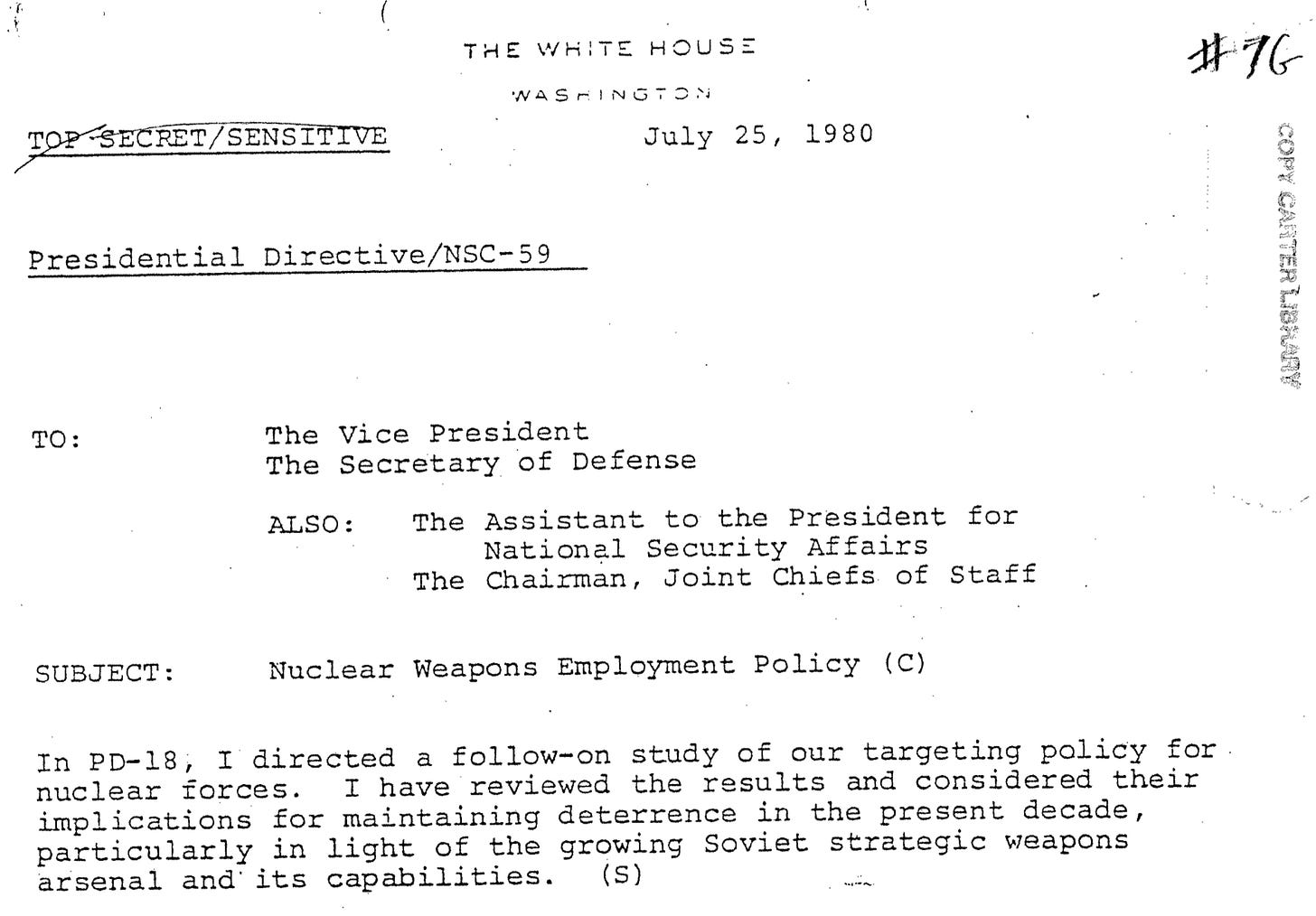 ](https://substackcdn.com/image/fetch/$s_!THR3!,f_auto,q_auto:good,fl_progressive:steep/https%3A%2F%2Fsubstack-post-media.s3.amazonaws.com%2Fpublic%2Fimages%2F239e355c-5037-47ed-bfcb-31c582f4e1f0_1872x1304.png)Declassified copy of PD-59 | Carter Library}:
Similarly, President George W. Bush signed a series of classified national security directives after 9/11, the most famous of which authorized NSA’s unlawful domestic intercepts, a directive that wasn’t publicly revealed until four years later.
In NSPM-7, “Countering Domestic Terrorism and Organized Political Violence,” President Trump directs the Justice Department, the FBI, and other national security agencies and departments to fight his version of political violence in America, retooling a network of Joint Terrorism Task Forces to focus on “leftist” political violence in America. This vast counterterrorism army, made up of federal, state, and local agents would, as Trump aide Stephen Miller said, form “the central hub of that effort.”
NSPM-7 directs a new national strategy to “disrupt” any individual or groups “that foment political violence,” including “before they result in violent political acts.”
In other words, they’re targeting pre-crime, to reference Minority Report.
The Trump administration isn’t only targeting organizations or groups but even individuals and “entities” whom NSPM-7 says can be identified by any of the following “indicia” (indicators) of violence:
- anti-Americanism,
- anti-capitalism,
- anti-Christianity,
- support for the overthrow of the United States Government,
- extremism on migration,
- extremism on race,
- extremism on gender
- hostility towards those who hold traditional American views on family,
- hostility towards those who hold traditional American views on religion, and
- hostility towards those who hold traditional American views on morality.
“The United States requires a national strategy to investigate and disrupt networks, entities, and organizations that foment political violence so that law enforcement can intervene in criminal conspiracies before they result in violent political acts,” the directive states (emphasis mine).
A “pre-crime” endeavor, preventing attacks before they happen, is core to the post-9/11 concept of counterterrorism itself. No longer satisfied to investigate acts of terrorism after the fact to bring terrorists to justice, the Bush administration adopted preemption. Overseas, that led to aerial assassination by drones and “special operations” kill missions. Domestically, it led to a counter-terrorism campaign whose hallmark was excessive and illegal government surveillance and the use of undercover agents and “confidential human sources” to trap (and entrap) would-be terrorists.
Now, with Donald Trump’s directive retooling the counter-terror apparatus to go after Americans at home, this means monitoring political activity, or speech, as an investigative method to discover “radicalism.” (Contrary to other national security documents all during the post-Watergate era, NSPM-7 doesn’t even mention the First Amendment or the fundamental right of Americans to organize and protest.)
The focus on speech is evident throughout NSPM-7. The directive says that political violence is the result of “organized campaigns” that often begin (with the left) dehumanizing targets in “anonymous chat foras, in-person meetings, social media, and even educational institutions.”
To give a sense of how broad this formulation is, Trump’s earlier designation of Antifa as a domestic terrorist group was accompanied by a White House fact sheet singling out people who “celebrated” Luigi Mangione, the alleged killer of UnitedHealthcare CEO Brian Thompson last December. As I wrote at the time, this describes a lot of Americans!
Trump’s new national security memorandum also alludes to Mangione but adds to it even larger categories of potential targets.
NSPM-7 is fundamentally a law enforcement directive, and it dispenses with the complications of using the active duty military or the National Guard in pursuit of political violence. It directs the Department of Justice to focus the FBI’s approximately 200 Joint Terrorism Task Forces (JTTFs) to the new mission. The FBI network of task forces comprises over 4,000 members—including FBI personnel and task force officers (or TFOs) from more than 500 state and local agencies and 50 federal agencies, including special agents, police officers, intelligence analysts and surveillance technicians. First established in New York City in 1980 to systematize FBI and NYPD cooperation, today there are task forces around the country, including at least one in each of the FBI’s 55 field offices.
For the Trump White House, the beauty of using an already existing network is that it bypasses Congressional oversight and scrutiny and even obscures federal activity to governors and legislatures at the state level. States, cities, and local police have already signed Memoranda of Agreements with the feds to fight terrorism and officers are already assigned as task force officers.
NSPM-7 says the JTTFs “shall investigate” potential federal crimes relating to “acts of recruiting or radicalizing persons” for the purpose of “political violence, terrorism, or conspiracy against rights; and the violent deprivation of any citizen’s rights.” It authorizes the JTTFs to investigate individuals, organizations, and funders “responsible for, sponsor, or otherwise aid and abet the principal actors engaging in the criminal conduct.”
“The Attorney General shall issue specific guidance that ensures domestic terrorism priorities include politically motivated terrorist acts such as organized doxing campaigns, swatting, rioting, looting, trespass, assault, destruction of property, threats of violence, and civil disorder,” NSPM-7 says. Civil disorder?
I don’t want to sound hyperbolic but the plain truth is that NSPM-7 is a declaration of war on anyone who does not support the Trump administration and its agenda. Yes, it repeats the word “violent” over and over to purport only to go after citizens who are moved to take up arms, but it also directs monitoring and intelligence collection to map and target the new “evildoers,” to borrow a Bush label he took from the Bible just days after 9/11.
The partisan focus couldn’t be more obvious.
“The real problem is this: since Charlie [Kirk] was murdered — a friend of mine, assassinated — nothing’s changed on their side,” White House counter-terrorism czar Sebastian Gorka told Newsmax after NSPM-7 was signed. “Not one leader —not one left wing thought leader, member of Congress, Senator — nobody has said we distance ourselves from the violent rhetoric.”
“The left refuses to rid themselves of the justification for violence,” Gorka continued, “and as such, President Trump is taking measures to protect us from the violent rhetoric that becomes snipers and bullets.”
---
Washington’s biggest law firms are issuing memoranda on the implications of NSPM-7, Trump’s new national security directive, yet virtually no one in Congress has bothered to say a thing. What little the mainstream media have said about NSPM-7 has so far been wrong, often downplaying it.
The mainstream media is hopeless in the face of the complexity and secrecy of the national security state. Please help us in our effort to reveal and explain what’s going on by becoming a paid subscriber
Sources tell me that NSPM-7 will likely cause the FBI’s domestic terrorism watchlist, currently at about 5,000 U.S. citizens, to double in the coming months.
Last Thursday, President Donald Trump issued National Security Presidential Memorandum-7 (NSPM-7), titled “Countering Domestic Terrorism
and Organized Political Violence.” It creates a national strategy to investigate, prosecute, and dismantle organized political violence and domestic terrorism, identifying indicators of a potential domestic terrorist as the expression of “anti-Christian” or “anti-capitalism” or “anti-American” views. NSPM-7 directs the federal government to disrupt groups “before” they result in violent political acts. In other words, pre-crime.
Law firms like Arnold & Porter, WilmerHale, Caplin & Drysdale, Akin Gump, and Elias Law Group swiftly responded to NSPM-7 by issuing guidances explaining the implications for non-profits and other organizations that are among their clientele.
To date though, almost no members of Congress have commented on NSPM-7. I reached out to the following congressional leaders for a statement, but received nothing:
- Sen. Chuck Schumer (Minority Leader)
- Sen. Mark Warner (Senate Intelligence, ranking member)
- Sen. Gary Peters (Senate Homeland, ranking member)
- Rep. Hakeem Jeffries (Minority Leader)
- Rep. Jim Himes (House Intelligence, ranking member)
- Rep. Jamie Raskin (House Judiciary, ranking member)
Rep. Bennie Thompson, ranking member of the Homeland Affairs Committee, responded with the following statement:
*“Just like with Trump’s reckless — and incorrect — antifa designation, his domestic terrorism memorandum serves no purpose other than an excuse for the Trump administration to stifle dissent, investigate anyone - or any group - they don’t like, punish their enemies, and potentially label any American they want as a terrorist.”
But the national security directive is far more consequential, as I recently explained, in that it directs the countrywide network of Joint Terrorism Task Forces to characterize, surveil, and conduct actions to thwart organizations and individuals espousing the domestic terrorism indicators described above (“anti-Christian,” “anti-capitalism” and “anti-American” rhetoric).
Legal heavyweights from Akin Gump to WilmerHale warn that NSPM-7 is not mere rhetorical theater — it presents real danger for tax exempt organizations.
(The directive says that the Secretary of the Treasury should make available ‘all resources’ “to identify and disrupt financial networks that fund domestic terrorism and political violence”; and that the Secretary “shall provide guidance for financial institutions to file Suspicious Activity Reports and investigate indicia [indicators] of illicit funding streams to ensure such activity is rooted out at the source and referred for law enforcement action…”)
Arnold & Porter, a heavyweight in Washington’s legal and policy circles, says “the stakes are high,” cautioning that NSPM-7 signals Justice Department plans to target tax-exempt organizations and their funders for criminal investigations based on actions historically protected by the First Amendment.
“The Presidential Memorandum makes clear that DOJ intends to target tax-exempt organizations and their funders for investigation and potential criminal prosecution,” the legal minds at the law firm say.
“Even the ‘indirect’ financing of ‘political violence’” could provoke liability, they warn.
Their analysis further notes that the memo doesn’t just threaten fringe actors: it stretches to organizations seen as supporting “progressive causes,” suggesting the scope could well include mainstream nonprofit advocacy. This runs contrary to the Trump administration’s framing of the crackdown as merely focused on extremist or radical elements, the law firm concludes
WilmerHale, a DC legal powerhouse, offers a similar reading. Their guidance warns that NSPM-7 may cause the federal government to pursue IRS investigations of nonprofit groups, assess terrorism designations, block nonprofit assets, and even target individual officers and employees.
“Employees and officers … are possible subjects of Justice Department and other investigations,” the law firm’s alert states.
Caplin & Drysdale, known for its political law practice, flagged the revival of the Foreign Agents Registration Act (FARA) as especially significant, saying that with NSPM-7, Trump had brought FARA “back from the dead.” They call NSPM-7 a signal that the firm’s clients must no longer treat FARA enforcement as a low priority. (FARA requires registration and disclosure of individuals who act at the behest of foreign entities — at the intersection of political speech and foreign influence.) They also emphasize that NSPM-7’s focus is heavier on nonprofits and civil society than on for-profits.
Akin Gump, a leading international law firm with more than 900 lawyers, offers a brief summary of the practical effects of NSPM-7:
*“Directs the National Joint Terrorism Task Force to investigate, prosecute, and dismantle networks, organizations, and funding streams behind domestic terrorism and organized political violence. Orders federal law enforcement and financial regulators to prioritize identifying, disrupting, and prosecuting those involved, including funders, tax-exempt entities, and foreign-linked actors, and allows the Attorney General to recommend formal designation of domestic terrorism organizations.”
Elias Law Group,which describes itself as “the nation’s go-to law firm to fight back against voter suppression and election subversion,” warns that under NSPM-7, the government may interrogate individuals about “financial sponsorship” of protests or political activity. NSPM-7, the firm goes on to warn, “sends a troubling signal” that organizations opposing the administration may face investigations, punitive measures, or revocations of tax status.
“At a minimum, such politically motivated investigations would bog down targeted organizations with legal costs and compliance headaches all while detracting from their missions,” Elias concludes.
At root, NSPM-7 is not just about thwarting violent actors — it’s about chilling free speech and association. The directive empowers federal task forces to pursue not only organizations deemed in “support” of violence, but also funders, officers, employees, and indirect financial supporters, which means donors. Under the framework, even speech or advocacy currently considered protected could be swept into criminal exposure.
Maybe, someday, eventually, Congress will take notice of the most important change in the expansion of government power since the PATRIOT Act.
---