NSPM 7 nat sec prz memo
---
estb 10 25
merri ok
SEE ACTIV SUPPRESS
SEE WATCHLIST DB ~ PRIVACY
SEE ANTIFA 4
SEE RUBIO MILLER
SEE TERROR BS 3
SEE FASCISM
SEE 1ST AMEND PPL LOSE
---
-=-=
-=-=
AN 10 26
Trump's NSPM-7 could now label you as a terrorist
-=-=
-=-=
AN 10 26
Since assuming office last year, President Donald Trump has ramped up his attacks on free speech, targeting both journalists and commentators who criticize him and his administration. In theory, Democrats are standing up to Trump's anti-free speech actions — but a new report reveals that, in practice, many Democratic governors seem to be capitulating.
The New Republic's Daniel Boguslaw wrote about how Democratic governors are responding to National Security Presidential Memorandum 7, an executive order that allows Trump to pursue people who are “anti-fascism, anti-Americanism, anti-capitalism, and anti-Christianity; support for the overthrow of the United States Government; extremism on migration, race, and gender; and hostility towards those who hold traditional American views on family, religion, and morality."
The journalist pointed out that the FBI has tried to force states to work with them in pursuing these initiatives — and they have so far not fought back.
"Gavin Newsom of California shirked the question [of whether he was working with the FBI], telling The New Republic in a written statement only that 'California’s security efforts operate wholly under state law and appropriate safeguards,'" Boguslaw wrote.
He added, "New York Governor Kathy Hochul’s office attempted a more acrobatic maneuver, claiming that 'New York State Police assigned to the FBI’s Joint Terrorism Task Force focus only on genuine criminal or terrorism investigations, follow New York’s laws, and do not participate in civil immigration enforcement or the NSPM-7 Joint Mission Center.' That answer is misleading. The FBI Joint Mission Center is the central hub for administering NSPM-7, but its participants are only a few dozen federal employees based in Washington, D.C."
Referring to the third most populous blue state, Boguslaw wrote that "Illinois Governor J.B. Pritzker also demurred on the question of how exactly local and state police are participating in the FBI’s ongoing Illinois NSPM-7 investigations, telling The New Republic, 'Regardless of any actions taken by federal officials under the direction of the Trump administration, Illinois remains committed to maintaining the integrity of its own processes and will continue to ensure law enforcement information is handled appropriately and focused on legitimate public safety purposes, not political agendas.'"
This is not the first time Democrats have been accused of quietly capitulating to Trump while pretending to stand up to him. From college presidents who work with him in squashing pro-Palestine campus protests to law firms that settled with him and abandoned liberal pro bono causes, the left has in general been accused of caving to Trump's bullying instead of fighting him.
In this context, Trump has pursued a number of his media critics, such as sending subpoenas to The Washington Post, The Wall Street Journal, Axios and The New York Times for their reporting. He has also banned outlets like Politico, MS NOW and CNN from covering him in the White House, even outright admitting that it is viewpoint discrimination.
"After MS NOW, CNN and Politico sued the Trump administration on Monday over the president banning their reporters from White House grounds, Trump’s communications team sent congressional Republicans talking points Monday night in defense of the president’s decision," MS NOW's Mychael Schnell reported in September. "According to the document obtained by MS NOW, the White House wants Republicans to argue that “no president has been more transparent or offered more of his time to the press” and that the First Amendment does not grant reporters access to the White House."
-=-=
AN 7 26
Secretary of State Marco Rubio is often described as a traditional conservative in an administration dominated by far-right MAGA Republicans, Donald Trump loyalists and conspiracy theorists — a holdover from an era in which President Ronald Reagan, not MAGA, was the dominant influence in the Republican Party. But according to The New Republic's Malcolm Ferguson, Rubio catered to MAGA themes in a big way when, on Thursday morning, July 16, he hosted a "Ministerial on the Resurgence of Political Terrorism" and focused heavily on "left-wing political terrorism."
The attendees, according to Ferguson, ranged from Israeli Foreign Minister Gideon Saar to Trump allies who included FBI Director Kash Patel, Treasury Secretary Scott Bessent and White House adviser Stephen Miller.
Rubio told attendees, "This is what radical leftism is. They may wear various different slogans and ideologies across place and time. They can call themselves anti-capitalists, or anti-imperialists, communists, or anarchists, or Marxists. But the fundamental character is always the same.... It is a poisonous resentment cloaked in the language of equality, justice, liberation — an overwhelming need to tear down what greater men have built.... Through violence and through terror, they once again seek to impose their ugliness on all of us.”
During the event, Miller promoted Trump's National Security Presidential Memorandum directive, AKA NSPM-7 — which claims to address violence on the left.
Miller said of the memo, "It directs.… all of our law enforcement and intelligence agencies to work together to disrupt, identify, defund, debank, arrest, and prosecute these political terrorists that are operating in our country. Left-wing political terrorism seeks, as its ultimate end, the overthrow of our system and form of government — and we've seen this has taken place…. many times, in many places, throughout the years.”
The Trump adviser continued, "Left-wing terrorism always ends in bloodshed, misery, and suffering. It only can travel in one direction. There's no point at which the left-wing terrorist is satisfied with his gains, and ceases progressing.... It always becomes a gulag, it always becomes the mass imprisonment of political enemies, the stripping of their rights and freedoms.… in order to establish complete and total control."
But Ferguson, in his New Republic article, emphasizes that political violence is hardly unique to the left in the United States.
"It's so interesting to watch these people wield what they see as this infallible moral compass, never once considering that they — and their predecessors — have created many of the conditions which have forced people to resist, whether it be abroad or domestically," Ferguson comments. "Furthermore, this blanket definition of left-wing terrorism is not rooted in reality; it's to serve their NSPM-7 agenda, to crack down on dissidents. Meanwhile, they continue to fully ignore the right-wing terrorism that this administration has not only ignored, but fostered."
---
nspm 7
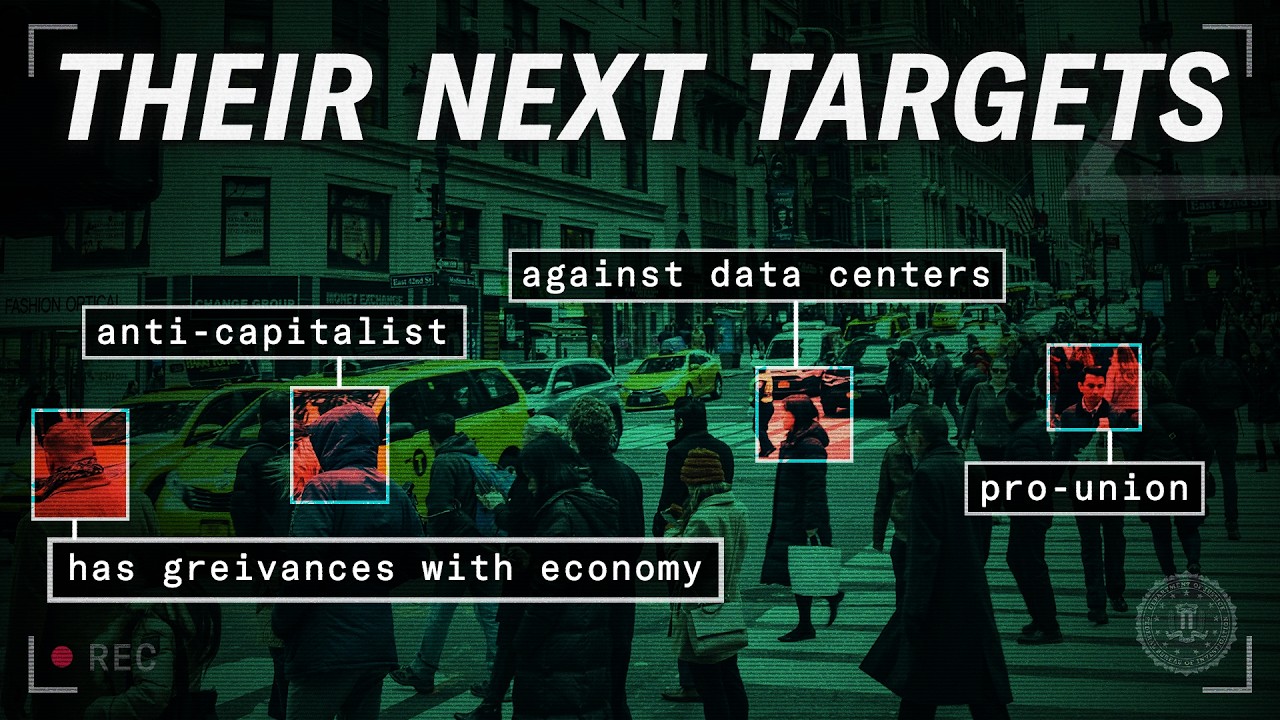
Jun 25, 2026 MPU
We Uncovered A New Government Watchlist. Are You Their Next Target?
You could end up on a watchlist for fighting back in the class war. The feds now consider opposition to data centers, inequality, and Big Tech as potential domestic terrorism. We uncovered how the FBI is colluding with corporate America to surveil ordinary Americans.
---
Trump's DOJ Spreads Fear With ANTIFA Charges | Ken Klippenstein | TMR - YouTube
nspm 7
Trump's DOJ Spreads Fear With ANTIFA Charges | Ken Klippenstein | TMR
Jun 18, 2026 The Majority Report w/ Sam Seder
Emma Vigeland welcomes Ken Klippenstein, an independent journalist covering security and US politics at KlipNews, discussing the 15 anti-ICE activists indicted by the Justice Department. More from Ken: https://www.kenklippenstein.com/ Watch the Majority Report live Monday–Friday at 12pm EST on YouTube or http://www.Majority.fm To connect and organize with your local ICE rapid response team visit ICERRT.com The Congress switchboard number is (202) 224-3121. You can use this number to connect with either the US Senate or the House of Representatives. Send us IM messages during the live-stream with our free Majority Report App: http://majority.fm/app Subscribe to MR's daily AM Quickie newsletter: https://am-quickie.ghost.io
THOM 6 22 26
15 PL MINNE IMPEDE CONSPIR
DANIEL ROSEN GIVES AS REASON FOR ARREST
DAVID BEARD CATO ONLY 1 CASE KNOCKED NOTEBK OUT OF HAND OF ICE
RELIG STUD MCCALLISTER COLLEGE DAVD KING MIS ATTR BY TRUMP
WE NEED TO BECOME UNGOVERNABLE
SUBST EMOT DISTRESS OF ICE AGENT
The Knock on the Door Has Arrived... - YouTube
---
AN PP 5 26
For a year, White House counterterrorism czar Sebastian Gorka promoted the national strategy he was drafting, saying he was pouring his “life’s work” into a “massive” blueprint that would overhaul the U.S. approach to combating terrorist threats.
The finished product, released May 6 after months of delays, is a 16-page, typo-sprinkleddocument that ranks threats based on politics rather than intelligence assessments, according to several current and former counterterrorism officials and threat analysts.
Islamist militant groups, the perennial top concern, now come second to Latin American drug cartels. The violent far right, which the FBI has repeatedly called the leading domestic threat, doesn’t merit a mention. Meanwhile, militant leftists, a small subset of extremist violence in the United States, are portrayed as a threat on par with global terrorist networks such as al-Qaida.
“A new type of domestic terrorism has emerged,” the document says, “driven by violent extremists who have adopted ideologies antithetical to freedom and the American way of life.”
Gorka’s strategy — the subject of a recent ProPublica report — lavishes praise on President Donald Trump’s national security agenda but offers few details about plans to tackle the administration’s top priorities: Latin American “narcoterrorists,” Islamist militant groups, and violent leftist antifascists and anarchists.
Gorka, who coordinates White House counterterrorism policy at the National Security Council, has called the document a “return to common sense” after a 2021 strategy by President Joe Biden centered on mostly far-right domestic threats. The new strategy mentions Biden seven times.
“What it tells me is that this administration is not paying attention to the data, to what our allies are seeing globally, or to where the biggest threats of violence come from or how they might be prevented,” said Cynthia Miller-Idriss, founding director of the Polarization and Extremism Research and Innovation Lab at American University.
Republican leaders often portrayed Biden’s focus on the violent far right as the Democrats cracking down on conservative organizing. That idea fueled Trump’s blanket pardon of more than 1,500 defendants, including those who attacked police, in the Jan. 6, 2021, storming of the U.S. Capitol.
Gorka did not reply to a request for comment. The White House, asked about criticisms of the plan, referred to a number of Gorka’s public statements touting it. Olivia Wales, a White House spokesperson, added in an email, “President Trump is crushing terrorist threats to the United States and will never let cartels, Jihadists, or the governments who support them plot against our citizens with impunity.”
Here are five notable aspects of the plan, compiled from interviews with counterterrorism personnel and researchers’ published critiques:
- It’s about Trump, not terrorism.
The counterterrorism strategy begins with a signed foreword by Trump, who sets the tone by claiming credit for ending “four years of weakness, failure, surrender, and humiliation under the last administration.”
Analysts say the rest of the strategy often reads like a valentine rather than a sober national security communique. Under Trump’s leadership, it states, “America is again the world’s most powerful nation, with the largest economy in history, the most advanced technologies, and the bravest and most skilled warfighters the world has ever seen.”
The strategy’s top threat categories align with the president’s pet issues, including the villainizing of Democrats and leftist dissent. The language also echoes debunked right-wing conspiracy theories the president has shared about a stolen election, a purported genocide of Christians and existential threats to Western civilization by what the strategy calls “alien cultures.” One section refers to Christians as “the most persecuted people on Earth.”
“This was once a serious document written by serious people” across Democratic and Republican presidencies, veteran terrorism analyst and former Obama administration official Juliette Kayyem lamented on X. “Now it reads like a partisan screed.”
- Data counter the priorities.
Analysts say the most obvious hole is the omission of violent far-right movements. Federal authorities have said for years that neo-Nazi and anti-government militia groups pose the most active and lethal domestic threats, though recently authorities have noted increases in leftist and mixed-motive attacks.
For example, on Sept. 10, the same day conservative youth leader Charlie Kirk was assassinated at an outdoor event in Utah, a 16-year-old gunman who was steeped in online forums for white supremacy and mass-shooter fandom opened fire at a Colorado high school, critically wounding two students before killing himself.
The strategy is concerned only with the kind of violent extremism the White House ascribes to Kirk’s alleged shooter, who is labeled a violent left-wing “radical who espoused extreme transgender ideologies.” Terrorism analysts say the attack motives do not appear so clear-cut; the suspect, who has yet to go to trial, reportedly comes from a Republican family but had shifted politically and had expressed opposition to the “hatred” he said Kirk spread.
Just last week, a lawsuit related to a deadly shooting last year at Florida State University revealed that the gunman had used ChatGPT to explore “his interests in Hitler, Nazis, fascism” and other far-right topics.
In a social media post, Jacob Ware, a terrorism researcher who has written extensively about the militant right, called the case a “friendly reminder that the #Trump administration’s new United States Counterterrorism Strategy does not mention far-right violent extremism.”
- Policies undermine strategy.
Several of the White House’s stated counterterrorism objectives conflict with the president’s own actions, analysts say.
For one, the pledge of stepped-up efforts to thwart plots doesn’t factor in the diminished capacity of federal agencies since Trump slashed the national security workforce last year and diverted counterterrorism resources to his mass deportation campaign.
Terrorism analyst Colin Clarke, executive director of the security-focused Soufan Center and a Gorka critic, summarized the document as “highly partisan & mostly incoherent.”
It touts the seizure of Venezuelan President Nicolás Maduro in a U.S. military operation as the important capture of a “narco-terrorist outlaw.” But weeks before the Maduro raid, Trump had granted a pardon to former Honduran President Juan Orlando Hernández, who was serving 45 years for trafficking 400 tons of cocaine into the United States.
Another U.S. goal is to aggressively counter anti-American propaganda by Islamist extremist groups, which the administration says have been driven from strongholds in the Middle East and are “exploiting the ungoverned spaces” across Africa. Places where “a resurgent terror threat is the reality,” according to the strategy, include West Africa, the Sahel region, Sudan and Somalia.
Yet efforts to counter anti-American messaging are undermined by increased U.S. airstrikes with civilian casualties, particularly in Somalia and Yemen, and the cutoff of humanitarian programs across the continent, conflict monitors say. U.S. aid has been a lifeline for communities whose desperation can be exploited by militant recruiters.
The strategy calls for a “light military footprint” in Africa, with the expectation that African leaders will take on a greater share of counterterrorism work. But Trump’s halting of foreign aid hobbled regional counterterrorism programs. Conflict monitors, now watching with alarm as Islamist militants capture territory and stage attacks in Mali, urge the administration to pay closer attention to the restive Sahel region and other hot spots.
“Terrorists are on the verge of recreating a new caliphate sanctuary that could serve as an incubator for attacks against the US homeland and interests abroad,” Alex Plitsas, a security analyst and former Obama-era Pentagon official, wrote this month after visiting U.S. Africa Command.
“The result is a warning for Washington: when the United States and its partners step back, jihadist groups and adversarial powers fill the space,” Plitsas wrote.
The strategy also disparages “failed ‘forever war’ policies” at a time Trump’s base is wrestling with his decision to launch the U.S.-Israeli war in Iran, a state sponsor of terrorism.
In a call with reporters after his plan was released, Gorka got defensive when asked how the Iran operation was not a “forever war” that could endanger Americans. He called critics “testicularly challenged.”
Anna Kelly, a White House spokesperson, drew a distinction: “Unlike the ‘forever wars’ of the past with vague objectives and ever-expanding timelines, President Trump is leading the most transparent administration in history, and he kept Americans apprised of the scope and defined objectives for Operation Epic Fury.”
- Successes are exaggerated.
Trump’s preface opens by celebrating counterterrorism achievements that analysts describe as inflated or lacking in nuance.
One example is the claim that, within 43 days of Trump’s return to office, the U.S. had apprehended “the terrorist mastermind” of the deadly Abbey Gate attack in Kabul. In 2021, a suicide bomber detonated in a crowd of civilians outside an airport gate during the chaotic U.S. military withdrawal from Afghanistan, killing more than 150 Afghans and 13 American service members.
In March, the Justice Department hailed the arrest of Afghan national Mohammad Sharifullah, an Islamist militant it said had “orchestrated” the attack. Gorka has publicly recounted the dramatic scene of waiting on the tarmac in the cold at 3 a.m., alongside several Cabinet members, to welcome the plane carrying the handcuffed “man who was responsible for the murder, the massacre.”
Last month, just before Gorka’s strategy was released, a federal jury dealt a blow to the “mastermind” narrative by returning a mixed verdict. Sharifullah was convicted of aiding the terrorist group known as Islamic State Khorasan, but the jury deadlocked on whether there was sufficient evidence to hold him responsible for the Abbey Gate deaths. The difference shapes how much time Sharifullah could spend behind bars — the more serious charge was eligible for a life sentence.
A Justice Department news release about the conviction (but not the deadlock) was scrubbed of references to Sharifullah as an orchestrator and did not use the “mastermind” language that appeared days later in the White House strategy.
Analysts also expressed skepticism about the blueprint’s claim that “hundreds of Jihadist terrorists in multiple countries” had been killed in recent U.S. counterterrorism operations. The administration releases virtually no details about the identities of those targeted or the circumstances of their deaths. Humanitarian groups say they fear the operations could be causing uncounted civilian casualties.
- Opponents are targeted.
Rights watchdogs say the strategy hints at ways Trump administration officials will attempt to build terrorism cases against U.S. leftist and Muslim activists through nebulous or nonexistent ties to transnational militant movements.
A link to a foreign entity formally designated as a terrorist group opens the door for government surveillance and potential charges related to providing aid — “material support” in legal jargon — to a foreign terrorist organization.
Analysts say that’s why the Trump administration has pursued designations targeting leftist militant groups in Europe under the label of antifa, as well as some branches of the Muslim Brotherhood.
The Brotherhood is a century-old Islamist group that renounced violence in the 1970s, though spinoffs such as Hamas remain active and on the U.S. blacklist. Republicans have long tried to portray U.S.-based Muslim advocacy groups as a foothold for the Brotherhood.
The document also calls for the rapid “neutralization of violent secular political groups whose ideology is anti-American, radically pro-transgender, and anarchist.” Researchers called the terms ill-defined and said they aren’t used in international counterterrorism work.
Miller-Idriss’ overarching concern about the Trump counterterrorism doctrine: “How damaging could it be? Both in the things it’s ignoring and the things that it’s emphasizing.”
---
- Josh Kovensky @ Talking Points Memo: FBI’s Top Influencers Tout ‘Antifa’ Funding Investigations
FBI Director cites NSPM-7 as enabling crackdown on left-leaning activists.
THE White House wanted investigations into those it describes as left-wing activists and the groups that fund them. And now, FBI Director Kash Patel says, the FBI is delivering.
The FBI is investigating funding associated with left-wing activism, Patel confirmed to longtime podcaster and brief FBI Deputy Director Dan Bongino on his recently revived streaming show.
“This FBI, thanks to what we stood up over the last year, has made significant headway under the NSPM-7 process in looking at those who funded these streams,” Patel told Bongino, adding that the bureau is “starting to arrest people who used their funds to incite violence in the guise of political peaceful protest.”
The White House issued NSPM-7 in September, a presidential memo that directed federal law enforcement to investigate ideologies — naming those who espouse “anti-Americanism, anti-capitalism, and anti-Christianity” — as potential sources of political violence. That memo has been operationalized in part through several terrorism prosecutions, TPM reported this month. Patel’s remarks suggest that the FBI is implementing the memo to investigate funding sources for left-leaning activist groups.
At the same time, it’s Kash Patel. He’s more a streamer than a law enforcer. Bongino’s brief tenure at the FBI — during which he memorably complained about the workload before the administration took the unprecedented step of appointing a “co-deputy director” to assist him — testifies to some of this. Beyond that, Patel is operating in Trumpworld, a universe where senior officials can curry favor with the president by demonstrating how tough they are in carrying out his fantasies. Even in that credibility-killing environment, Patel has distinguished himself by using his megaphone as FBI director to misstate details in sensitive, ongoing investigations.
One ongoing case that Patel mentioned in Wednesday’s discussion with Bongino is the Prairieland prosecution. The case is the Trump administration’s first terrorism prosecution against a group of people that it has deemed members of “Antifa.” In the case, prosecutors accuse an “Antifa cell” in North Texas of having staged a demonstration outside an ICE detention facility that left one police officer shot and wounded.
After Bongino brought up the case, Patel claimed that there have been more than two dozen federal arrests. Per TPM’s count, sixteen people have been charged in federal court over the incident.
The trial was set to start on Tuesday. But District Judge Mark Pittman for the Northern District of Texas declared a mistrial during jury selection, reportedly after a defense attorney wore a jacket with a T-shirt underneath that featured a picture of Jesse Jackson and other civil rights leaders.
Patel likened the case to the Cop City prosecution in Georgia. There, state prosecutors filed a sprawling RICO indictment against a group of activists that had been protesting the construction of a police training center. Critics accused prosecutors of using the case to silence activists that had no tie to any act of alleged wrongdoing; a judge dismissed the RICO charges in December.
The FBI director said that his agency had to “rearrest everybody” in order to compensate for errors in the state investigation. It’s unclear what he was referring to. No federal charges have been filed in the Cop City case.
He did suggest that his leadership had seen a change in the FBI’s focus to “Antifa,” the chimerical group of beliefs that Trump II leadership has held up as a national, internal enemy.
Federal law enforcement is not only pursuing foreign threats, he said, “but those who cause violence here in America and use the guise of politics to delete that violence.”
Threats from the administration to investigate ideologically opposed charities spread fear in the nonprofit community last year. Some, per TPM’s reporting, sought to move money overseas; others considered whether to incorporate subsidiary fiscal sponsors as separate organizations.
He reminded Bongino that the two of them had “launched a serious investigation” when the podcaster was in government last year.
“We had said these organizations don’t operate alone, don’t operate in silence. They operate with a heavy heavy stream of funding,” Patel said. “And we started looking into it. And guess what, Dan? We found them.”
Josh Kovenskyis an investigative reporter for Talking Points Memo, based in New York. He previously worked for the Kyiv Post in Ukraine, covering politics, business, and corruption there.
---
- Josh Kovensky @ Talking Points Memo: Trump DOJ Files 9/11-Era Charges Against Leftists Across the Country
Under Trump, the DOJ has changed how it brings terrorism cases, and is training them on the opposition.
TPM
Across the country, federal prosecutors are upgrading what would have been routine prosecutions into terrorism cases when they involve people President Trump has cast as his political enemies.
It represents a dramatic departure from how the Justice Department has historically used the federal material support for terrorism statute. For decades, counterterrorism prosecutors have largely reserved the statute —2339A — for the kinds of audacious plots that wreak real, lasting damage or whose ambition forms the stuff of movie screenplays. It’s been used in recent years to charge the leadership of Hamas over the Oct. 7 attacks, pursue men accused of assassinating the president of Haiti, and take down networks of white supremacists who allegedly conspired to blow up power plants.
But after Trump DOJ leadership issued a series of memos demanding that prosecutors target those who espouse “anti-Americanism, anti-capitalism, and anti-Christianity,” both the focus and the standards in these cases have changed. The memos direct federal law enforcement to use speech — including “extremism on migration, race, and gender” — as key criteria for who to investigate and against whom to bring the most aggressive charges possible.
They are part of the Trump administration’s broader crusade against the left, and include executive orders labeling “Antifa” a terrorist organization and directing law enforcement to pursue investigations and possible charges against left-leaning advocacy groups and their funders.
This full-bore assault on speech is now bearing fruit.
In Birmingham, Alabama, federal prosecutors in November charged a longtime local Black Lives Matter activist under the statute over an arson he allegedly committed at an area Walmart. In Texas, a July 4 demonstration outside the Prairieland ICE detention facility, at which a responding local police officer was shot and injured, has resulted in more than a dozen people facing federal terrorism charges. It also spawned a Joint Terrorism Task Force investigation into “Antifa.” The new focus on the left has yielded other cases across the country, as well.
These cases all feature some credible accusations of criminal conduct. But by casting the allegations as terrorism, the DOJ has dramatically increased the severity of the charges relative to what prosecutors allege. Legal experts say this could result in longer and harsher sentences, makes defendants likelier to lose on appeal, and risks saddling them with the label of “terrorist” for life.
The cases raise grave concerns about free speech and freedom of association. The Trump administration is using terrorism statutes to retaliate against its opponents, seemingly applying a different standard of law to people associated with left-wing causes. Those individuals are now more likely to face federal terrorism prosecutions, and their associates — even if not implicated in any wrongdoing — are more likely to face investigation and possible charges.
To Jeff Breinholt, a longtime former DOJ counterterrorism prosecutor who handled terrorism cases during the Bush, Obama, Biden, and first Trump administration, the crackdown hearkens back to the most repressive moments in the history of federal law enforcement.
“It’s suspiciously like the COINTELPRO days of the Hoover administration back in the sixties,” Breinholt said. “You’re declaring a sort of informal law enforcement war on this shadowy group.”
After the assassination of Charlie Kirk in September, senior Trump administration officials began to talk about his death as having been perpetrated by the “Radical left” or “Antifa,” which they have long portrayed as a shadowy, organized, violent organization. It was far from the first time that Antifa came up in MAGA messaging. But the White House seized on the moment to begin building the architecture for a federal law enforcement crackdown on the left. That took place in part through NSPM-7, the DOJ memo issued after Kirk’s killing that directed federal and state law enforcement to aggressively pursue domestic terrorism charges against those who espouse “anti-Americanism, anti-capitalism, and anti-Christianity.”
This spate of new cases shows how that approach is being put into practice, several former DOJ counterterrorism officials, including Breinholt, who helped pioneer the use of 2339A after 9/11, told TPM.
TPM has found:
- Federal prosecutors have recharged conduct as material support for terrorism in cases where defendants were associated with left-wing causes including Black Lives Matter or trans rights activism.
- This came after the issuance of NSPM-7, the September memo that directed prosecutors to consider those who espouse “anti-Americanism, anti-capitalism, and anti-Christianity” as targets for domestic terrorism cases.
- One charge, depredation of government property, has not used in a material support for terrorism case for at least a decade before 2025, a TPM review found. It can apply to anything from breaking the windows of a building to spraypainting.
- In one case, prosecutors charged several people with material support while relying on coordinated dress — black bloc — as a link to an alleged terrorist plot.
- FBI Director Kash Patel, Attorney General Pam Bondi, and other Trump appointees have promoted the cases as part of a broader fight against Antifa.
- These prosecutions have ripple effects. In Texas, state prosecutors have brought “hindering the prosecution of terrorism” charges against three people who weren’t at the July 4 event at the ICE facility; a warrant in one state case included a reference to a White House Executive Order designating “Antifa” as a domestic terrorist organization in seeking probable cause. Legal experts say the order is meaningless as domestic terrorist organizations do not exist under federal law.
Earlier cases using the material support for terrorism statute required months or years of preparation, former prosecutors tell Taking Points Memo, because of the law’s severity, because of a high standard of proof embedded in its provisions, and, paradoxically, because of the relative ease with which the government can bring the charge. Under 2339A, prosecutors do not need to accuse people of belonging to or helping a specific terrorist group. As long as they show that someone knowingly intended to help commit a crime that Congress has listed as a terrorism offense, they can be prosecuted for material support.
Convictions on material support charges can come with far more draconian penalties. 2339A carries a maximum sentence of 15 years if no death is associated with the crime. Prosecutors will also be able to apply for a terrorism enhancement. Though there’s no mandatory minimum associated with that, it would set a guidelines recommendation for the sentencing judge at 17.5 years behind bars regardless of the underlying crime. Charging or even investigating crimes as terrorism also gives the government more power: terrorism defendants are far more likely to be detained before trial. Under current law, prosecutors can take more aggressive actions during a terrorism investigation, including making use of material gathered by the intelligence community. On top of that, indictment on a crime of terrorism carries reputational consequences that far outstrip most other crimes.
Congress enacted the material support for terrorism law in 1994 as part of sprawling anti-crime and anti-terrorism legislation, responding in part to the 1993 World Trade Center bombing and the Waco siege. After 9/11, Congress used the PATRIOT Act and other legislation to broaden the law’s scope. As prosecutors increasingly used it to pursue cases involving Islamic fundamentalist terrorism and, later, domestic terrorism, the DOJ evolved strict internal guardrails to prevent domestic terrorism charges from being used frivolously or for partisan reasons. Those guardrails disappeared over the past year. Now, the White House has replaced them with directives ordering prosecutors to target the administration’s perceived opponents.
US President Donald Trump listens to HomelandSecurity Secretary Kristi Noem speak during a roundtable about Antifa in the State Dining Room of the White House in Washington, DC, on October 8, 2025. (Photo by Jim WATSON / AFP) (Photo by JIM WATSON/AFP via Getty Images)
Fire at a Walmart
On Aug. 22, 2025, protesters gathered at a soccer field in the Birmingham suburb of Homewood. In June, local police had fatally shot an 18-year-old Black man named Jabari Peoples. Police said he fought law enforcement; his family, after viewing body cam footage, said he was shot while running away.
Local Black Lives Matter activists staged the protest to demonstrate against a local DA’s decision not to file charges against the officer who shot Peoples. The protest began in the morning. According to police reports, a fire started at a Walmart down the street that afternoon.
Days later, police arrested a locally known Black Lives Matter activist named Mercutio Southall. They charged him in state court with arson, criminal mischief, and possession of psilocybin mushrooms, per a local news report. Southall, police said, had gone from the protest to Walmart, where he allegedly filled a shopping cart with rags, charcoal bags, and fuel. A fire later started.
Federal law enforcement followed up in October, charging him and a local woman, Lillian Colburn, with one count of federal arson each.
The next month, federal prosecutors upgraded the charges: Southall and Colburn were now each facing a count of providing material support to terrorists. “Great work,” FBI Director Kash Patel wrote in a quote tweet addressed to the local FBI field office, which appeared to misstate the date of the alleged arson.
Southall has pleaded not guilty in both the state and federal cases, which remain pending. Colburn has pleaded not guilty as well.
The case has raised eyebrows among national security lawyers in part because of the apparent mismatch between the severity of the charges and the alleged wrongdoing, and what appears to fill the gap between the two: affiliation with a Black Lives Matter protest.
“This really poses a grave risk for conduct that is otherwise criminal being recast as terrorism because of the ideology involved,” Josh Herman, a Chicago attorney who has represented defendants in material support cases, told TPM.
NSPM-7 in Action
Previous terrorism cases tended to follow a different path.
During Trump’s first term, for example, Manhattan federal prosecutors charged an Army private named Ethan Melzer with material support for terrorism over his involvement with an online neo-Nazi group called the Order of the Nine Angles.
Melzer, prosecutors said, spent weeks talking to members of the group in an online chat room. Melzer was an accelerationist: a type of extremist familiar to those who have spent too much time online, he purportedly sought to hasten the decline of Western civilization by inviting an attack on his army unit. In the chatroom, he gave away information about his unit’s upcoming deployment to Turkey, including its location, the number of soldiers, where they were to be stationed, and the “facility’s surveillance and defensive capabilities,” prosecutors said in an indictment.
Melzer eventually pleaded guilty to one count of material support, as well as counts including attempting to murder U.S. servicemembers.
Francesca LaGuardia, who studies terrorism prosecutions at Montclair State University, told TPM that the administration was now entering new territory by bringing terrorism charges in cases that involve protest and property damage.
“In the past, we would not have seen terrorism prosecutions for property damage, and that’s obviously a direction that this administration is going in,” she said. “In the past, we haven’t seen a lot of terrorism prosecutions for anything that runs the line between activity and protest. “
Former DOJ officials attributed the shift to the guidance issued by the Trump administration after Charlie Kirk’s death. In NSPM-7, the White House directed prosecutors to approach cases involving people who believe in what it described as gender extremism as well as “anti-Americanism, anti-Christianity, and anti-capitalism” as domestic terrorism.
That’s now being operationalized, said Tom Brzozowski, the former counsel for domestic terrorism at the DOJ’s counterterrorism section.
The Justice Manual, a document that lays out internal policies for prosecutors, includes a detailed section on domestic terrorism cases, he said.
When the DOJ announces a material support case, it typically says which attorneys from the National Security Division — located in D.C. — were on the case. The U.S. attorneys offices that have charged the Prairieland and Birmingham 2339A cases under Trump have not included attorneys from Main Justice in their press releases.
“In the normal run of business, that charge would be vetted and staffed all the way up through Main Justice before it was approved,” Brzozowski said. “It’s not immediately clear to me that those approval processes remain in place for domestic terrorism cases.”
“They have taken on that term and applied it pretty loosely to activity that is anti-Trump,” he added.
The DOJ did not return TPM’s request for comment. A spokesperson for the U.S. Attorney’s Office for Northern District of Alabama declined to comment. The FBI declined to comment.
Defining the Enemy Within
For Lydia Koza, the charges came as a shock.
Koza’s wife, Autumn Hill, was charged in federal court over a July 4, 2025 incident that took place outside the Prairieland ICE facility in Alvarado, Texas. More than a dozen protesters descended on the facility, which is around an hour’s drive from Dallas, for a demonstration that prosecutors have described as a “direct action.” The assembled group allegedly shot fireworks at the facility, spraypainted cars, and damaged a surveillance camera. When a local police officer responded, one protester allegedly shot him with a rifle. The officer, wounded in the neck, returned fire and survived.
Search warrants and documents from parallel state and federal cases obtained by TPM show that the regional Joint Terrorism Task Force — itself a mix of state and federal law enforcement in the greater Dallas-Fort Worth area — came down hard. The next evening, Koza recalled to TPM, FBI and state law enforcement broke down the door to the group home that Koza shared with Hill and others. Hill was detained, while FBI agents seized computers, guns, fireworks, and a booklet called “Satanic Death Cult is Real,” per a warrant and receiptreviewed by TPM.
Koza, who told TPM that she wasn’t at the Prarieland demonstration, stood outside as a mix of federal and state law enforcement searched the group house in which she and Hill were living.
“We were all kind of looking at each other like, ‘are we gonna be sleeping rough tonight?’” she said. “Like, we also don’t even have any shoes. This fucking sucks.”
The FBI conducted that search as part of an investigation into assault of a federal agent, damage to government property, and conspiracy, per a search warrant reviewed by TPM. That month, federal prosecutors charged several of those detained at Prairieland with attempted murder of a federal officer and discharging a firearm during a crime of violence.
But by October, the case had shifted. Prosecutors charged two people who were allegedly at the incident under 2339A. The next month, they filed material support charges against six others.
Federal prosecutors said that the protester who allegedly shot the police officer had sent a damning message before the demonstration in a Signal chat with five others. “Cops are not trained or equipped for more than one rifle so it tends to make them back off,” the person, Ben Song, allegedly wrote.
At a September probable cause hearing, a federal prosecutor likened Song to a “cult leader” who took a leading role in planning the incident. The prosecutor said that he shot the police officer and affixed a “binary trigger” to a rifle that he brought, allowing him to double his rate of fire. Song faces charges of attempted murder of a federal employee, use of and conspiracy to use an explosive, and using a firearm during a crime of violence. He has pleaded not guilty.
Autumn Hill, along with seven others, faces charges of material support. Hill is additionally charged with attempted murder of a federal employee, use of and conspiracy to use an explosive, and using a firearm during a crime of violence. She has pleaded not guilty. Hill, Song, and six others have pleaded not guilty to the 2339A charges.
Prosecutors have managed to secure guilty pleas from others charged in the case. Seven people pleaded guilty to single counts of material support late last year.
Of the eight people charged under 2339A, only one — Song — is directly accused of having committed any crime of violence. Three of those charged, prosecutors say, were not present on what the DOJ characterized as a “core” Signal chat that was used to plan the incident. Others are tied to the case either by involvement with what prosecutors have described as spreading “insurrectionary materials called ‘zines,’” or through clothing: everyone at the demonstration, even if not accused of having shot fireworks or vandalized property, was dressed in black.
“If you are going to be charged for materially contributing to someone else’s illegal actions, you need to mean to support them in those actions, not just abstractly support their belief system,” Rachel Moran, a professor at the University of St. Thomas Law School who has studied protest cases, told TPM.
The federal case had become a national talking point for senior Trump federal law enforcement officials; the Department of Homeland Security took to calling it an “ambush.” When federal prosecutors recharged the case as material support for terrorism, Bondi wrote: “Antifa is a left-wing terrorist organization. They will be prosecuted as such.”
For the first time, Trump officials have been forced to define what it thinks Antifa means before a judge. As one FBI agent put it when asked to define the group during a September probable cause hearing, “Antifa is a loosely organized, kind of decentralized anarchist mindset, an ideology. These individuals commonly practice anarchy and don’t believe in a normal system.”
Bondi cited the case in a December memo that called for more domestic terrorism prosecutions, calling it an “ambush” by an “anti-fascist group.” The memo directs prosecutors to make a list of groups “engaged in acts that may constitute domestic terrorism,” and to review past, closed investigations for “Antifa-related intelligence” that could be used in future charges.
To Breinholt, the former DOJ counterterrorism prosecutor, it’s all new territory.
“These are not the types of things we would normally charge in the old days as terrorism,” he remarked.
Josh Kovenskyis an investigative reporter for Talking Points Memo, based in New York. He previously worked for the Kyiv Post in Ukraine, covering politics, business, and corruption there.
---
---
AN 1 26
Despite denials from a senior Trump administration official, secret watchlists of Americans are being used by federal agencies to track and categorize US citizens—especially protesters, activists, and critics of law enforcement—as “domestic terrorists,” investigative journalist Ken Klippenstein reported Wednesday.
Klippenstein said that two senior national security officials speaking on condition of anonymity told him that there are over a dozen “secret and obscure” watchlists that the Department of Homeland Security (DHS) and the FBI are using to track anti-Immigration and Customs Enforcement (ICE) and pro-Palestine protesters, antifa-affiliated individuals, and “others who are promiscuously labeled ‘domestic terrorists.’”
“I can reveal for the first time,” he wrote, “that some of the secret lists and applications go by codenames like Bluekey, Grapevine, Hummingbird, Reaper, Sandcastle, Sienna, Slipstream, and Sparta (including the ominous sounding HEL-A and HEL-C reports generated by Sparta).”
“Some of these, like Hummingbird, were created to vet and track immigrants, in this case Afghans seeking to settle in the United States,” Klippenstein explained. “Slipstream is a classified social media repository. Others are tools used to link people on the streets together, including collecting on friends and families who have nothing to do with any purported lawbreaking.”
“There’s practically nothing available that further describes what these watchlists do, how large they are, or what they entail,” he added.
Klippenstein’s revelation seemingly flies in the face of DHS Assistant Secretary for Public Affairs Tricia McLaughlin’s recent denial that the administration has a database containing the names of people accused of domestic terrorism.
“There’s just one problem: She’s lying,” wrote Klippenstein.
Many observers already thought as much, especially after a masked federal enforcer taunted an anti-ICE protester in Maine by telling her that “we have a nice little database, and now you’re considered a domestic terrorist.”
White House “border czar” Tom Homan—who was recently sent to Minnesota to oversee the anti-immigrant blitz following the departure of Border Patrol commander Greg Bovino amid outrage over the killings of Renee Good and Alex Pretti—also said this month that “we’re going to create a database where those people that are arrested for interference, impeding, and assault, we’re going to make them famous.”
Reporting Tuesday that Pretti—the nurse who was disarmed and then shot dead by federal enforcers in Minneapolis last week—was known to Trump officials after a previous encounter in which agentsbroke his rib raised further questions about government watchlists.
“We came out of 9/11 with the notion that we would have a single ‘terrorist’ watch list to eliminate confusion, duplication, and avoid bad communications, but ever since January 6, not only have we expanded exponentially into purely domestic watchlisting, but we have also created a highly secretive and compartmented superstructure that few even understand,” a DHS attorney “intimately familiar” with the matter told Klippenstein on condition of anonymity, referring to the deadly January 2021 Capitol insurrection.
According to Klippenstein:
Prior to 9/11, there were nine federal agencies that maintained 12 separate watchlists. Now, officially there are just three: a watch list of 1.1 million international terrorists, a watch list of more than 10,000 domestic terrorists maintained by the FBI, and a new watch list of transnational criminals, built up to more than 85,000 over the past decade...Among other functions, the new watchlists process tips, situation reports, and collected photographs and video submitted by both the public and from agents in the field; they create a “common operating picture” in places like Minneapolis; they allow task forces to target individuals for surveillance and arrest; and they create the capacity for intelligence people to link individuals together through geographic proximity or what is labeled “call chaining” by processing telephone numbers, emails, and other contact information.
Asked about how the Trump administration might try to legally justify these watchlists, Rachel Levinson-Waldman, the Brennan Center for Justice’s Liberty and National Security Program director, cited President Donald Trump’s National Security Presidential Memo 7 (NSPM-7), which mandates a “national strategy to investigate and disrupt networks, entities, and organizations that foment political violence so that law enforcement can intervene in criminal conspiracies before they result in violent political acts.”
Levinson-Waldman also noted Attorney General Pam Bondi’s December 5 memo directing federal agencies to expand the investigation and prosecution of “domestic terrorism,” including groups “aligned” with antifa, an anti-fascist ideology that does not exist as an organization.
One senior intelligence official who confirmed the existence of the watchlists warned Klippenstein: “Lists of this and that—this social media post, that video taken of someone videoing ICE, the mere attendance at a protest—gets pulsed by federal cops on the beat to check for criminality but eventually just becomes a list itself of criminality, with the cops thinking that indeed they are dealing with criminals and terrorists. Watchlists, and the whole watchlisting process, should be as transparent as possible, not the other way around.”
“If we don’t explore more why all of these secret lists exist,” the official added, there could be “even more of an environment of paranoia on the ground and more tragic killings.”
---
---
1 26 WHY NO ACTION ON THIS? SHAPLEY irs ~ SOROS
RENEEE GOOD SHOOT --> SHUTDN OF MINNE?
---
an ah 10 25
When President Donald Trump returned to the White House on January 20, 2025, he issued a wide range of executive orders — one of which was a full pardon for all of the
rioters involved in the January 6, 2021 attack on the U.S. Capitol Building, including those who violently attacked police officers and members of far-right groups like the Proud Boys and the Oath Keepers. Trump, however, vowed to use the U.S. Department of Justice (DOJ) and the FBI against left-wing groups.
In an article published by Wired on November 3, reporter Ali Winston takes a close look at the case of Casey Goonan — a Northern California anarchist whose crimes included attacking a federal building in Oakland. Winston emphasizes that although the charges against Goonan originated during Joe Biden's presidency, the Trump-era responses has dangerous implications that go way beyond Goonan's case.
"By the standards of the San Francisco Bay Area's hard left," Winston explains, "Casey Goonan's crimes were unremarkable. A police SUV partially burned by an incendiary device on UC Berkeley's campus. A planter of shrubs lit on fire after Goonan unsuccessfully tried to smash a glass office window and throw a firebomb into the federal building in Downtown Oakland. But thanks to a series of communiques where Goonan claimed to have carried out the summer 2024 attacks in solidarity with Hamas and the East Bay native's anarchist beliefs, federal prosecutors claimed Goonan 'intended to promote' terrorism on top of a felony count for using an incendiary device."
The Wired reporter adds, "Goonan's original charges notably did not contain terrorism counts. In late September, U.S. District Court Judge Jeffrey White sentenced Goonan, whom they called 'a domestic terrorist' during the hearing, to 19 and a half years in prison plus 15 years probation."
According to Winston, the Goonan case "offers a glimpse of the approach the Department of Justice may take in President Donald Trump's forthcoming offensive against the 'left.'"
That approach, Winston adds, was "formalized in late September in National Security Presidential Memorandum 7 (NSPM-7), an executive order targeting anti-fascist beliefs, opposition towards Immigrations and Customs Enforcement raids, and criticism of capitalism and Christianity as potential 'indicators of terrorism.'"
"The executive order, meanwhile, directs the American security state's sprawling post-9/11 counterterrorism apparatus to be reoriented away from neo-Nazis, Proud Boys, white nationalists, Christian nationalists, and other extreme right-wing actors that have been overwhelmingly responsible for the majority of political violence in the past few decades, and towards opponents of ICE, anti-fascists, and the administration writ large," Winston notes. "Along with potentially violent actors, NSPM-7 instructs federal law enforcement to scrutinize nonprofit groups and philanthropic foundations involved in funding organizations that espouse amorphous ideologies, from 'support for the overthrow of the United States Government' to expressing 'hostility towards those who hold traditional American views on family, religion, and morality.'"
*Read Ali Winston's full article for Wired at this link.
---
---
no lnx
‘Absurd’: Noem claim to have arrested ‘antifa’ founder’s girlfriend stirs ridicule
Jordan Green, Investigative Reporter
October 15, 2025
:{:{This article was paid for by Raw Story
A dramatic claim by Homeland Security Secretary Kristi Noem to have arrested “the girlfriend of one of the founders of antifa,” therefore putting the Trump administration in position to “eliminate” the leftwing “network,” was dismissed by both the activist the arrested woman was said to have dated and a leading expert on such leftwing groups.
“I want to make it absolutely clear that I am not now, nor have I ever been, the ‘founder’ of ‘Antifa’ — in Portland [Oregon], the United States, or anywhere else,” said Luis Enrique Marquez, the activist, in a statement on a website promoting a book.
“It’s an absurd claim, no matter how they try to frame it,” Stanislav Vysotsky, an associate professor of criminology at the University of Fraser Valley in British Columbia, told Raw Story.
ALSO READ: This Trump lackey's ridiculous promos actually point to the fall of American law
Nonetheless, Noem’s trumpeting of the arrest of Katherine Vogel, 39, showed the administration’s determination to make headlines as it seeks to paint “antifa” activists as a danger to the American public, and Portland as the supposed base of such groups.
‘Root them out’
Seated alongside President Donald Trump during a White House roundtable last week, Noem said: “One of the individuals we arrested in Portland was the girlfriend of one of the founders of antifa.
“We are hoping that as we go after her, interview her and prosecute her, we will get more and more information about the network and how we can root them out and eliminate them from the existence of American society.”
On Sept. 30, Vogel was the subject of a targeted arrest carried out by Federal Protective Services and U.S. Border Patrol agents, after she was allegedly observed with a group of people spilling red paint on the sidewalk outside an Immigration and Customs Enforcement (ICE) facility.
A federal criminal complaint alleges that “while Vogel was being escorted into the facility for processing, she actively resisted by flailing her body” and struck one of the agents on the jaw with a closed fist.
She told an investigator she did not recall striking the agent.
Vogel was a contractor with the U.S. General Services Administration. As a result of her arrest “she was found unsuitable” and will no longer work for the agency, a spokesperson told Raw Story.
Noem’s description of Vogel as a potential linchpin for a nationwide network supposedly posing a terrorist threat appears to have been sourced to Andy Ngo, a right-wing media figure who Trump said at the roundtable was “a very serious person.”
Ngo was previously represented in a lawsuit for assault against Rose City Antifa, a Portland group, by Harmeet Dhillon, now assistant attorney general for civil rights at the Department of Justice. Rose City Antifa was dismissed as a defendant. Ngo and Dhillon frequently share each other’s posts on X.
A week before Noem’s White House remarks, Ngo posted that Vogel was “a veteran Rose City Antifa member” and “the previous girlfriend of violent Rose City Antifa member Luis Enrique Marquez.”
Vogel, who was released from custody on Oct. 1, could not be reached for comment.
Marquez, the author of the book Antifascist: A Memoir of the Portland Uprising, refuted Ngo’s claim. The statement on his website said: “I have never been a member of Rose City Antifa or any other Antifa group.”
Marquez also said his relationship with Vogel ended in 2020, adding, “Any insinuation of an ongoing connection between us is false and disingenuous.”
The Department of Homeland Security (DHS) did not respond to a request to clarify Noem’s reference to Vogel as “the girlfriend of one of the founders of antifa.”
Vysotsky, who has extensively interviewed antifascist activists, said that notion was difficult to square with reality, given that the movement dates back to the early 20th century.
“If we’re talking about the girlfriend of the founder of antifa, then we’re talking about someone who would have to be 120 years old or 130 years old,” Vysotsky told Raw Story.
While antifascism emerged in Europe in the 1920s and 1930s, in response to the rise of fascism in Italy and Germany, Vysotsky said the modern antifascist movement in North America can generally be dated to the mid- to late-1980s.
Rose City Antifa, the Portland-based group referenced by Ngo, was founded in 2007. Vysotsky said that to the best of his knowledge, Marquez was not a founder.
“He came on the scene in 2016 or 2017,” Vysotsky said. “He happens to be someone who is prominent and outspoken on social media. It’s an absurd claim, no matter how they try to frame it.”
A DHS spokesperson, Tricia McLaughlin, said Vogel’s activist connections were the subject of “an ongoing investigation,” adding: “We will release more information when we can.”
‘A militarist, anarchist enterprise’
In a Sept. 26 X post, DHS described Rose City Antifa as a “domestic terrorist organization.” The post followed an executive order issued by Trump days earlier, which described “Antifa” as “a militarist, anarchist enterprise.”
But Vysotsky said Noem’s vow to “root out” and “eliminate” an “antifa” network was likely to go nowhere because there is no formal membership organization or international network.
“It’s an orientation, because it’s a set of beliefs by people opposed to fascism,” Vysotsky said.
“What they mean when they say ‘fascism’ is a movement based on a belief in an inherent inequality between people that is enforced by violence. What antifa stands for is equality between people, and what drives antifascism is a desire to create a more just and equal world.”
The idea that the Trump administration will be able to use Vogel’s arrest to identify a leadership cadre and, as Noem put it, “eliminate” an “antifa” network “from the existence of American society” is “an almost absurd claim,” Vysotsky said.
“Antifa activism, as it exists, is highly decentralized,” Vysotsky said, adding that antifascist activity ranges from individuals engaged in intelligence gathering and educational work “to small, local affinity groups that are organized in a direct, democratic manner.
“There’s no leadership,” he said.
The Sept. 26 DHS post accused Rose City Antifa of doxing ICE agents.
On Sept. 19 a website called Rose City Counter-Info did post two profiles that showed the names and images — and in one case, information about the employment history of a spouse — of two individuals purported to be ICE agents active in the Portland area. The DHS post included a photo of a flyer soliciting information about ICE agents that appears to include Rose City Antifa's email address, although it is partially redacted.
A statement published on Rose City Antifa's behalf denies that the group has doxed ICE agents or had anything to do with the flyer. The statement references a Bluesky post two months earlier that acknowledges the flyers but indicates Rose City Antifa was not responsible for putting them out.
The DHS X post referencing Rose City Antifa came a day after Trump issued a national security memorandum, NSPM-7, which argued that domestic terrorists organized under the banner of “anti-fascism” are engaged in “sophisticated, organized campaigns of targeted intimidation.”
The memo claims campaigns “escalate to organized doxing, where the private or identifying information of their targets (such as home addresses, phone numbers, or other personal information) is exposed to the public with the explicit intent of encouraging others to harass, intimidate, or violently assault them).”
The memo specifically references activists targeting ICE agents.
“For the Trump administration to argue that antifa activists are terrorists, they’re going to have to greatly expand what acts constitute terrorism,” Vysotsky said.
They’re already doing that, he argued, by “talking about doxing as a form of terrorism.”
‘Exceptionally broad’
Vysotsky said rhetoric from the Trump administration linking antifascism to terrorism appears to be calculated to distract attention from ICE activities and violence by far-right actors.
“This serves as a distraction to focus Trump supporters away from the negative images of families being separated,” Vysotsky said. “It’s also a way to distract away from political violence, which has overwhelmingly been right-wing political violence.”
Antifascists, with journalists and observers, confront white supremacists in Charlottesville, Va in 2017. Picture: Anthony Crider
Vysotsky and Marquez said they saw the campaign against “antifa” as signaling a crackdown on all who oppose Trump’s policies — not just the far left.
“It’s exceptionally broad, because when they talk about antifa, they’re creating this image that ranges from the bogeyman of black-clad protesters to mainstream politicians like Adam Schiff [the Democratic senator from California] to the Ford Foundation, which is a major philanthropic organization,” Vysotsky said.
NSPM-7 charges that an “‘anti-fascist’ lie has become a rallying cry used by domestic terrorists to wage a violent assault against democratic institutions, constitutional rights and fundamental American liberties.”
Core tenets of antifascism, the memorandum claims, “include anti-Americanism, anti-capitalism, and anti-Christianity; support for the overthrow of the United States government; extremism on migration, race, and gender; and hostility towards those who hold traditional American views on family, religion, and morality.”
Marquez said that “by targeting innocent people and fabricating threats that do not exist,” the Trump administration is “attempting to build a mythical enemy in order to expand control over our lives.”
This story was updated on Wednesday, Oct. 15, 2025 at 1:57 p.m. to reflect that Rose City Antifa has denied doxing ICE agents and responsibility for the flyer soliciting tips on agents.
Jordan Green is a North Carolina-based investigative reporter at Raw Story, covering domestic extremism, efforts to undermine U.S. elections and democracy, hate crimes and terrorism. Prior to joining the staff of Raw Story in March 2021, Green spent 16 years covering housing, policing, nonprofits and music as a reporter and editor at Triad City Beat in North Carolina and Yes Weekly. He can be reached at jordan@rawstory.com. More about Jordan Green.
Thom Hartmann
This Trump lackey's ridiculous promos actually point to the fall of American law
Here's how to bring Trump and his lawless thugs to justice
John Stoehr
---
---}:
Trump’s Orders Targeting Antifascism Aim to Criminalize Opposition | Brennan Center for Justice
faiza Patel}:
Published:October 9, 2025
DVIDS
](https://www.brennancenter.org/issues/advance-constitutional-change)
In late September, President Trump signed an executive order purporting to designate “Antifa” as a “domestic terrorist organization.” A few days later, he issued National Security Presidential Memorandum 7 (NSPM-7) on Countering Domestic Terrorism and Organized Political Violence. This analysis evaluates the claims made in these documents and their potential damaging effects, drawing on the Brennan Center’s decade of work on the government’s framework for responding to terrorism, both foreign and domestic.
Both the order and the memo are ungrounded in fact and law. Acting on them would violate free speech rights, potentially threatening any person or group holding any one of a broad array of disfavored views with investigation and prosecution.
No Evidence of a Widespread Left-Wing Conspiracy to Carry Out Acts of Political Violence
NSPM-7 starts by listing a mishmash of incidents, some of which are criminal and some of which constitute activity protected by the First Amendment. These include violence directed at public figures such as conservative activist Charlie Kirk, President Trump, and Justice Brett Kavanaugh; the killing of United HealthCare CEO Brian Thompson; a purported 1,000 percent increase in attacks on U.S. Immigration and Customs Enforcement officers; a shooting at an ICE facility; and anti-police and criminal justice protests.
The events listed, according to NSPM-7, are “not a series of isolated incidents” and have not “emerged organically.” Rather they are the culmination of “organized campaigns” of intimidation and violence designed to “silence opposing speech, limit political activity, change or direct policy outcomes, and prevent the functioning of a democratic society.”
As a basic factual matter, this claim is not credible. For one thing, the list is obviously cherry-picked to highlight what the administration believes to be “left-wing” violence and excludes other high-profile examples of political violence that do not comport with its storyline. These include the January 6, 2021, attack on the Capitol; a 2022 mass shooting at a Buffalo, New York, grocery store motivated by white supremacist beliefs; and the deadly 2025 shootings of two Democratic Minnesota state lawmakers and their spouses. Painting this fuller picture, however, would puncture the narrative that political violence is the result of a left-wing conspiracy.
Nor is there any support for the claim that those involved in the incidents listed were acting in concert. The connection between the range of actors involved in the acts identified as political violence in NSPM-7 is simply that they are all seen as opposing the administration’s policies in one way or another (the killing of the United Healthcare CEO seems to be an outlier since no motive has yet been established). And there is no evidence to suggest that the broad universe of activism and criminal acts the memo cites is either organized or funded top-down. A loose ideological affinity does not add up to a concerted scheme to carry out violent acts to meet political ends.
No Authority to Designate Either “Antifa” or Any Domestic Group as a Terrorist Organization
The administration has also sought to elevate the perceived threat level from left-wing political violence by designating antifa to be a “domestic terrorist organization” and instructing the attorney general to make recommendations for other groups to be designated. The designation makes no sense. As both former FBI Director Chris Wray and the Congressional Research Service have explained, antifa is not a group or an organization, but a decentralized movement. Moreover, the administration has no authority to designate groups as domestic terrorist organizations, as is obvious from the failure to cite any statute or constitutional provision in support of the president’s action. There is none, and the purported designation has no legal effect.
This stands in sharp contrast to the president’s authority (delegated to the secretary of state) to designate “foreign terrorist organizations.” As explained here, there is good reason not to extend the current foreign terrorism regime, which criminalizes the knowing provision of material support or resources to designated foreign terrorist organizations, to the domestic context. The political aspect of such a designation (already fraught in the international context) would carry enormous First Amendment risks.
Because terrorism is inherently a political crime, extending the foreign material support for terrorism regime would allow the government to formally assign the label to domestic groups with unpopular beliefs and prosecute anyone who supports them. The risk of abuse is particularly acute because under the material support statute any aid — even if not meant to support violence — is enough to incur a hefty prison term. The implications of applying this construct in the context of antifa or antifascism are enormous: Buying a sandwich for an activist, allowing a protester to crash on your couch, or briefly lending a computer to print pamphlets critical of government policy could all potentially be considered material support.
Indeed, in the decision upholding the foreign terrorist material support law, the Supreme Court recognized that the material support logic could violate the First Amendment in other circumstances. The Court was careful to say that it was not suggesting that Congress could extend the same prohibition to domestic organizations (much less that the president could do so acting unilaterally).
Multiple Disfavored Viewpoints Targeted
Building on the antifa executive order, which already targets a broad range of political speech, NSPM-7 directs federal agencies to prioritize investigations of a swath of identities and ideologies that it depicts as falling under “the umbrella of self-described ‘anti-fascism.’” These include “anti-Americanism, anti-capitalism, and anti-Christianity; support for the overthrow of the United States Government; extremism on migration, race, and gender; and hostility towards those who hold traditional American views on family, religion, and morality.”
This breathtakingly broad list easily encompasses everyone from labor organizers, socialists, many libertarians, those who criticize Christianity, pro-immigration groups, anti-ICE protestors, and racial justice and transgender activists, to anyone who holds views that the administration considers to be “anti-American.” Under NSPM-7, the antifascist label can be attached to any of these types of people and groups and many more besides, giving the government maximum flexibility to pick and choose its targets.
For all its references to violence and intimidation, much of NSPM-7 is squarely directed at speech and nonviolent action by organizations and individuals protected by the First Amendment. One of the targets of the memo is “campaigns of . . . radicalization” — that is, speech aimed at promoting ideas that the administration considers to be “radical.”
Over the last decade, various law enforcement agencies have built social media monitoring programs that have regularly been used against protest movements. In 2020, for example, the Department of Homeland Security’s Office of Intelligence and Analysis monitored people participating in racial justice demonstrations in Portland, Oregon, as well as journalists covering the government response to the protests. Since then, it has kept tabs on online discussions of abortion and pro-Trump truckers. These efforts can easily be turned — or even expanded — to focus on disfavored ideologies.
The directives may also lead social media companies to expand the universe of posts they remove or suppress. The major platforms’ content moderation rules generally either ban or severely restrict the online speech of anyone perceived to be supporting terrorists. Extending this framework to all the types of speech that the directives have associated with domestic terrorism would quash an enormous range of viewpoints. And the administration’s record of pressuring companies to muffle voices that question its policies — from the suspension of Jimmy Kimmel’s show to the removal of the ICEBlock app from the Apple app store — suggests that it may well pressure social media platforms to take this course of action.
Full Force of the Federal Government’s Authority Unleashed
Building on its framing of the threat from anti-fascism as a wide-ranging conspiracy and domestic terrorism, NSPM-7 directs government agencies to go after “all participants in these criminal and terroristic conspiracies—including the organized structures, networks, entities, organizations, funding sources, and predicate actions behind them.”
The memorandum directs Joint Terrorism Task Forces (JTTFs) to “coordinate and supervise a comprehensive national strategy to investigate, prosecute, and disrupt entities and individuals engaged in acts of political violence and intimidation designed to suppress lawful political activity or obstruct the rule of law.” Given the framing of the threat as anti-fascism, the direction to law enforcement is to focus its resources on the left-leaning organizations and people who oppose the administration’s policies, rather than on the types of political violence that most threaten Americans’ life at home.
NSPM-7 also targets major grant-making organizations in multiple ways. First, NSPM-7 directs JTTFs to investigate not just the entities providing funding, but also their officers and employees. This ratchets up pressure by putting individuals rather than institutions in the crosshairs. Second, when questioning individuals they arrest for political violence, NSPM-7 instructs law enforcement officers to question them regarding “financial sponsorship of those actions prior to adjudication or initiation of a plea agreement.” This seems an attempt to incentivize protesters to point the finger at others in a perversion of the common prosecution strategy of turning lower-level participants in a criminal conspiracy against those further up the food chain.
Third, NSPM-7 directs the treasury secretary to “disrupt financial networks that fund domestic terror and political violence.” Disrupting the financing mechanisms used by terrorist groups is a longstanding feature of counterterrorism strategy. In the context of the vast anti-fascist conspiracy conjured up by NSPM-7, however, investigators could abuse it to block the bank accounts and financial transactions of various organizations merely because they stand in opposition to the administration.
Finally, both NSPM-7 and the antifa executive order take aim at the tax-exempt status of the foundations that fund civil society groups as well as civil society groups themselves. NSPM-7 directs the commissioner of the Internal Revenue Service to ensure that “no tax-exempt entities are directly or indirectly financing political violence or domestic terrorism.” The antifa executive order instructs federal law enforcement to investigate and prosecute those who provide “material support” by funding the “illegal operations” of “Antifa” or anyone claiming to act for it. Like the instruction to the treasury secretary, this directive must be read in the context of the memorandum’s unsupported allegations of a left-wing conspiracy, which will likely drive the commissioner’s investigations.
In 2024, civil society groups raised serious concerns about a bill that would have given the treasury secretary virtually unfettered discretion to designate a U.S. nonprofit as a “terrorist supporting organization” and strip it of its tax-exempt status.
In a letter to the House, more than 350 organizations wrote, “The executive branch could use this authority to target its political opponents and use the fear of crippling legal fees, the stigma of the designation, and donors fleeing controversy to stifle dissent and chill speech and advocacy. And while the broadest applications of this authority may not ultimately hold up in court, the potential reputational and financial cost of fending off an investigation and litigating a wrongful designation could functionally mean the end of a targeted nonprofit before it ever has its day in court.”
All these concerns also apply to the antifa executive order and NSPM-7.
Existing laws give the president great latitude in combating threats to national security. NSPM-7 and the antifa executive order are an obvious abuse of this latitude, threatening to turn the full force of the federal government to rooting out a conjured-up left-wing conspiracy of political violence funded by shadowy figures. Neither the law nor the facts support this premise, and court challenges to actions taken pursuant to these orders will likely meet with success. But in the process, many individuals and organizations will be vilified and harmed for their constitutionally protected activities and others will be muzzled as they fear the consequences of associating with or speaking up for groups that have been targeted. And we will all be less safe as law enforcement resources are diverted from real threats to imagined ones.
---
---
https://www.kenklippenstein.com/p/secretive-watchlisting-center-executing
Secretive Watchlisting Center Executing NSPM-7
“We’re expanding the watchlist,” FBI director says amid 300% increase in domestic terror investigations.
Oct 07, 2025
[ ](https://substackcdn.com/image/fetch/$s_!wivh!,f_auto,q_auto:good,fl_progressive:steep/https%3A%2F%2Fsubstack-post-media.s3.amazonaws.com%2Fpublic%2Fimages%2F35179f3c-520c-4484-9e32-abc8e6e4ae57_2762x1064.png)Threat Screening Center in Vienna, VA
As the federal government begins to implement President Trump’s new national security directive to investigate the so-called radical left as domestic terrorists, a little known FBI organization, located in an affluent and leafy suburb of Northern Virginia, is at the center of it all.
Based just seven miles from CIA headquarters, the Threat Screening Center has a secret budget and a classified personnel count. The nondescript cluster of glass-fronted buildings has no sign out front. Even the identity of its director — FBI executive Steven McQueen, I’m told — isn’t public. (Until now.)
Behind a black fence and manicured berms, the Threat Screening Center maintains the federal government’s terrorist watchlist, created in response to the 9/11 attacks.
Today the FBI-run center is chewing on National Security Presidential Memorandum 7 (NSPM-7), Trump’s sweeping policy directive that formally directs the national security state to root out left-wing political violence by monitoring so-called indicators of violence, like “anti-Christianity,” “anti-capitalism” and “anti-Americanism,” as I’ve reported.
Though the text of NSPM-7 is public, the Threat Screening Center’s watchlisting process is a black hole. Even the criteria for how people end up on it is secret.
When Donald Trump took office, terrorist watchlist contained records of approximately 1.1 million persons, the overwhelming majority of whom were foreigners. Of that number, according to government documents I reviewed, under 6,000 (roughly half of one percent) were “U.S. persons,” defined both as American citizens and permanent residents.
A well-connected intelligence official tells me that most are Muslims suspected of desire or intent to commit “lone-wolf” attacks.
“The idea of a domestic watchlist, made up solely of radicals without foreign connections, left or right wing, is basically wrong,” the intelligence official said. He explained that many individuals might be the subject of specific investigations relating to violations of law, and there are a number of mechanisms by which the government keeps tabs on them to discover indicators of violence (and foreign connection) but up until Trump, a watchlist for Americans had never really gotten much traction.
“Is Ken Klippenstein, or any other American dissenter on the watchlist?” the official asks rhetorically. “No, and there really is no legal way for such a person to even be surveilled, let alone watchlisted, without legal predicate” — that is, without evidence that that the person has committed, or is about to commit, a crime.
“You might think that ‘about to commit’ is a loophole, but up until NSPM-7, it wasn’t,” the intelligence official said. He went on to explain that a combination of post-Watergate reforms, Congressional actions after mass-surveillance and Snowden revelations, and the FBI’s own rules, had created a web of limits.
“Until now,” he said.
Unfortunately, the official continued, changes made under President Obama and Biden paved the way for the Trump expansion. First was the addition of transnational organized crime to the watchlist and second was an affirmation that the terrorist watchlist wasn’t just about terrorists anymore.
“At least not terrorists as defined by al Qaeda or ISIS,” the official said.
Then in the final weeks of the first Trump administration in 2021, the FBI quietly changed the name of the Terrorist Screening Center to the Threat Screening Center to formalize the expanding mission. But when Biden came into office just days later, the Bureau quietly changed the name back. This back-and-forth was never reported.
Then in March of this year, the Trump administration announced with little fanfare that the Terrorist Screening Center would (again) change its name to the Threat Screening Center. The reason, the administration said, was that threats had evolved beyond familiar terrorist organizations — to encompass a broader range of “national security threats” not further explained.
“As national security threats continue to evolve, the TSC has expanded beyond terrorism watchlisting and screening to address other national security threats,” the announcement said. “With expanding and growing threats, we are reflecting that in our name … The name change is a signal to the American people that the TSC is a powerful tool that can be used to fight all national security threats.”
“We’re expanding the watchlist,” FBI director Kash Patel added to the announcement. “This change will assist our law enforcement and Intelligence Community partners as we all work together toward the goal of crushing violent crime within our borders.”
In May, in a rare public reference to the Center, Patel announced that he had spent a weekend there and that beefing it up the Center one of the first things he did after becoming FBI director.
“One of the first things we did when I was sworn in as director was to strengthen the TSC’s focus on border security, in addition to growing threats abroad,” Patel said on X. “Our team has done tremendous work in this area.”
Included in Patel’s post were photos of him at the Center alongside its then-director Michael Glasheen.
[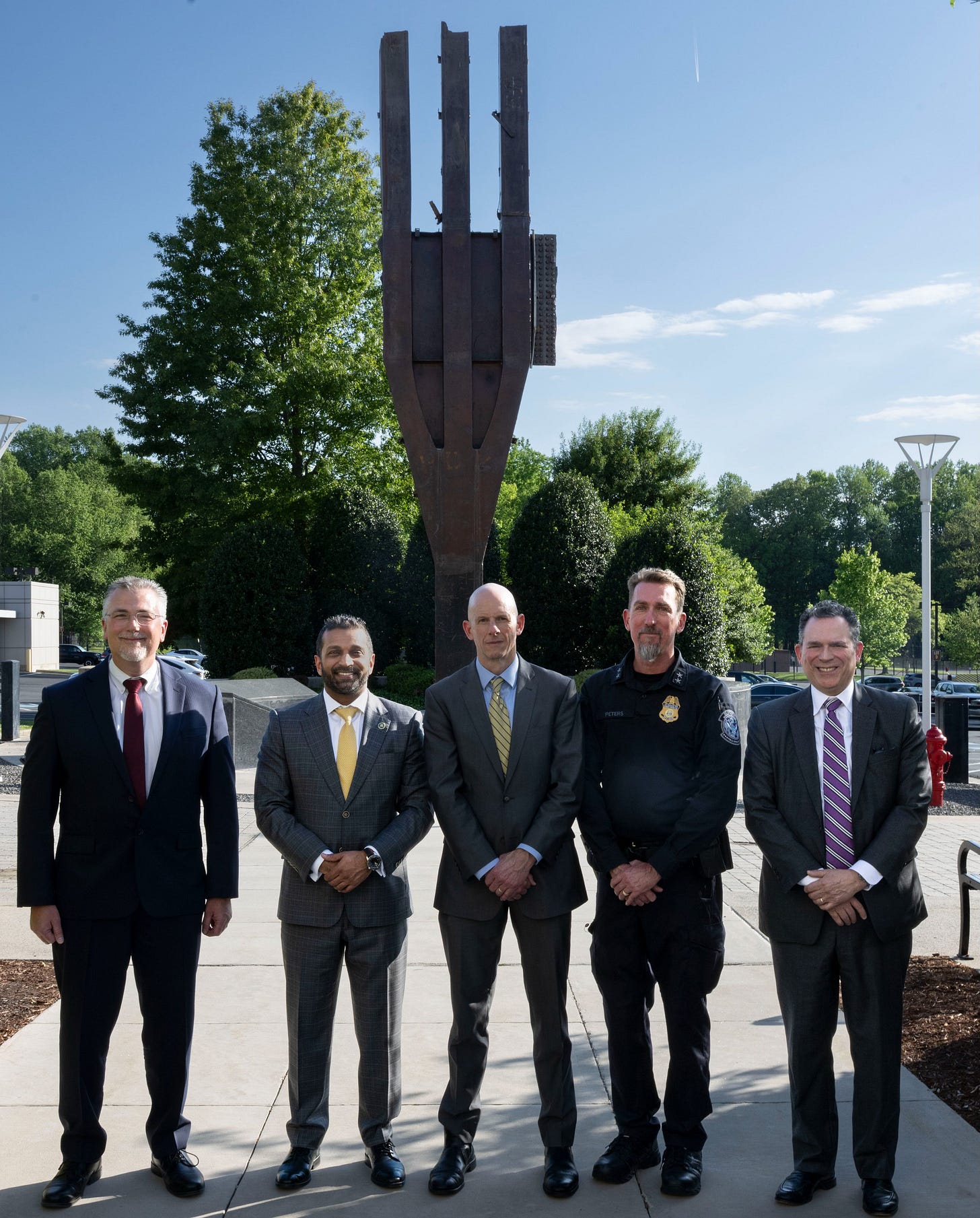 ](https://substackcdn.com/image/fetch/$s_!KnzM!,f_auto,q_auto:good,fl_progressive:steep/https%3A%2F%2Fsubstack-post-media.s3.amazonaws.com%2Fpublic%2Fimages%2Fadab8547-be90-4098-90eb-471673335369_3297x4096.heic)Kash Patel with TSC’s then-director, Michael Glasheen (center)
Within days, Glasheen was reassigned and a new head of the Threat Screening Center appointed. The new director, I’m told, is the FBI’s former deputy assistant director Steven McQueen, a longtime counterterrorism hand.
[ ](https://substackcdn.com/image/fetch/$s_!EdfZ!,f_auto,q_auto:good,fl_progressive:steep/https%3A%2F%2Fsubstack-post-media.s3.amazonaws.com%2Fpublic%2Fimages%2Fbf9e77d9-a653-4d9e-8c90-fed69bc791af_3000x1931.jpeg)Kash Patel standing next to new TSC director Steven McQueen
Asked for comment about the name of the director, the budget, and the number of people working there, the FBI declined comment, citing the government shutdown. (This despite the fact that the FBI is completely exempt from the shutdown, according to the Justice Department.)
[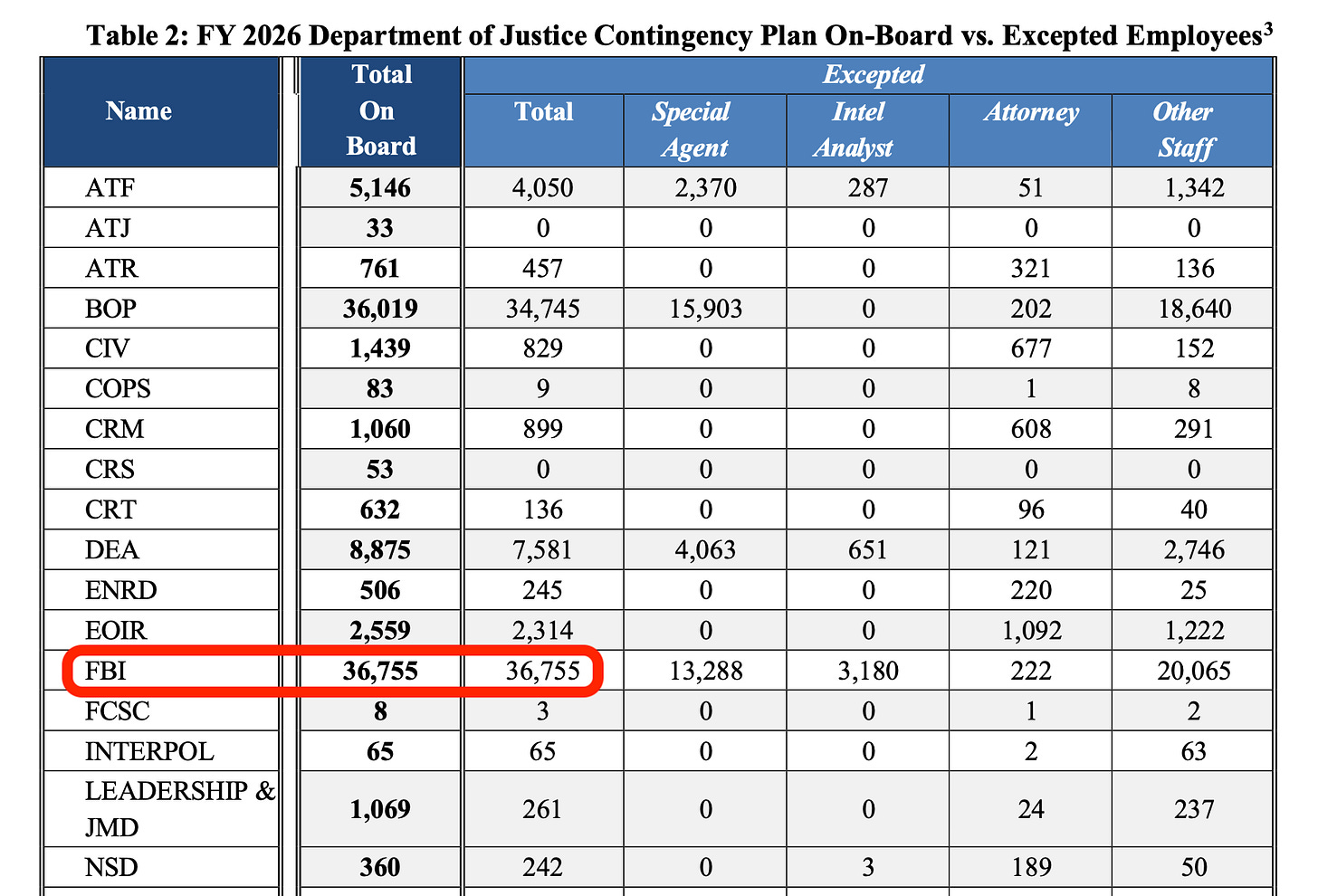 ](https://substackcdn.com/image/fetch/$s_!1QQx!,f_auto,q_auto:good,fl_progressive:steep/https%3A%2F%2Fsubstack-post-media.s3.amazonaws.com%2Fpublic%2Fimages%2Fef7c6f05-7f04-46a1-ab43-6d58d98f6b1a_1798x1222.png)Screenshot of DOJ’s FY 2026 shutdown contingency plan
“During the current lapse in appropriations, FBI operations are directed toward national security, violations of federal law, and essential public safety functions,” the Bureau told me.
Patel, in the announcement of his visit, went on to describe the Center’s mission as circulating watchlist information across the government “so that we’re better equipped to crush violent crime” — an objective that the Trump administration seems to be emphasizing more today than ever before.
Shortly after the murder of Charlie Kirk, Patel testified to Congress that he had overseen a 300% increase in domestic terrorism investigations. A large chunk of that increase, he said, is comprised of cases under the new designation “Nihilistic Violent Extremism,” a broad category that the administration plans to use to go after perceived adversaries, as I’ve reported.
At the Oval Office signing of NSPM-7, Trump’s homeland security advisor Stephen Miller made clear that the target of the directive (and the national security apparatus it is directing) was the political left.
“This is the first time in American history that there is an all-of-government effort to dismantle left wing terrorism.”
Over the past several days, Miller has gone even further, labeling everything from shootings lacking any clear partisan motive to attempts to physically obstruct ICE as terrorism.
“There is a large and growing movement of leftwing terrorism in this country,” Miller said this weekend. “The only remedy is to use legitimate state power to dismantle terrorism and terror networks.”
Doing that is a logistical feat, with the Threat Screening Center playing a central role.
“It might not be immediate, how the FBI creates the protocols and rules to create a whole new category of people to watchlist,” the intelligence official told me. “But as the Joint Terrorism Task Forces take up the charge at the local level, they will look to the TSC to internally organize and administer the new category of threats, even as the administration continues to misuse the term ‘terrorists.’”
---
Trump’s NSPM-7 Labels Common Beliefs As Terrorism “Indicators”
New directive targets “anti-Christian,” “anti-American,” and “anti-capitalism” opinions
Sep 27, 2025
[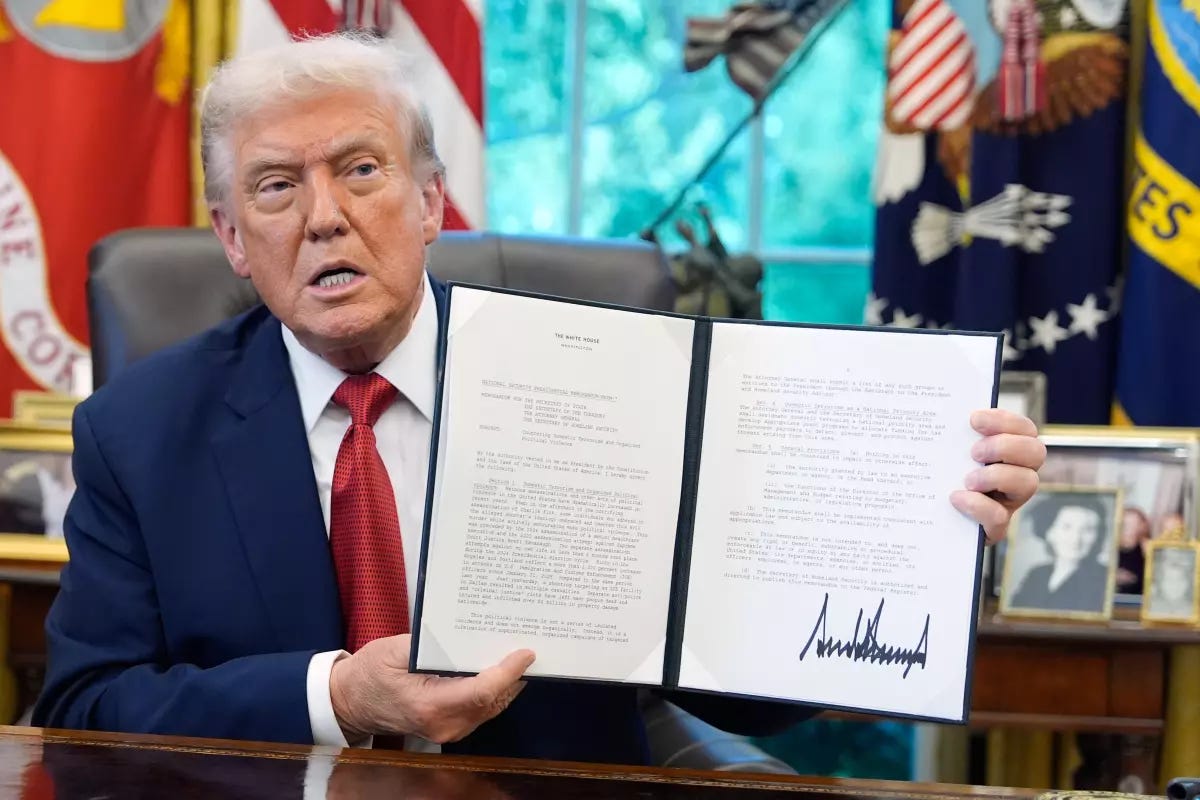 ](https://substackcdn.com/image/fetch/$s_!fMp7!,f_auto,q_auto:good,fl_progressive:steep/https%3A%2F%2Fsubstack-post-media.s3.amazonaws.com%2Fpublic%2Fimages%2F91129dba-8e6b-4ca7-a4ac-83d34e6abfee_1200x800.webp)Trump displays NSPM-7 at the Oval Office on Thursday
With the mainstream media distracted by the made-for-TV drama of James Comey’s indictment, Trump has signed a little-noticed national security directive identifying “anti-Christian” and “anti-American” views as indicators of radical left violence. Called National Security Presidential Memorandum 7, it’s being referred to as “NSPM-7” by administration insiders.
“This is the first time in American history that there is an all-of-government effort to dismantle left wing terrorism,” Trump’s homeland security advisor Stephen Miller said, referring to the issuance.
To the extent that the major media noticed the directive at all, they (even C-SPAN!) incorrectly labeled it an “executive order,” like this week’s designation of “Antifa” as a domestic terrorist organization.
[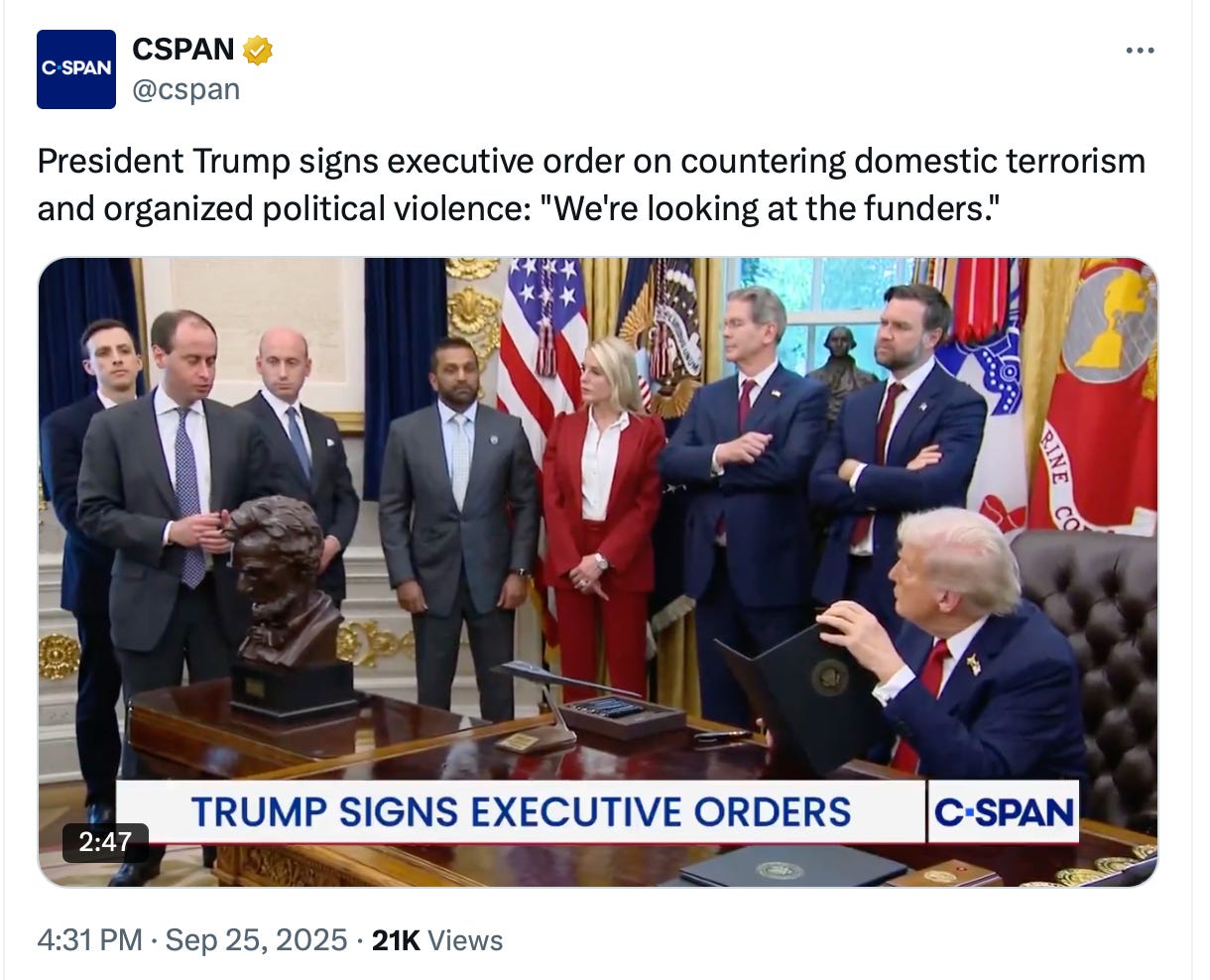 ](https://substackcdn.com/image/fetch/$s_!mkJ5!,f_auto,q_auto:good,fl_progressive:steep/https%3A%2F%2Fsubstack-post-media.s3.amazonaws.com%2Fpublic%2Fimages%2Ff3af4d84-03ee-40bb-a36f-62363ef39cd4_1220x988.png)Come on, C-SPAN
It’s hard to overstate how much different NSPM-7 is from the over 200 executive orders Trump has frantically signed since coming back into office.
An executive order publicly lays out the course of day-to-day federal government operations; whereas a national security directive is a sweeping policy decree for the defense, foreign policy, intelligence, and law enforcement apparatus. National security directives are often secret, but in this case the Trump administration chose to publish NSPM-7 — only the seventh since he’s come into office.)
Previous national security directives have been controversial, even politically earthshaking. In 1980, for example, President Jimmy Carter signed the Top Secret Presidential Directive 59 (“PD-59”) directing new nuclear warfighting policies that persisted until the end of the Cold War. When revealed, PD-59 caused a public furor.
[ ](https://substackcdn.com/image/fetch/$s_!THR3!,f_auto,q_auto:good,fl_progressive:steep/https%3A%2F%2Fsubstack-post-media.s3.amazonaws.com%2Fpublic%2Fimages%2F239e355c-5037-47ed-bfcb-31c582f4e1f0_1872x1304.png)Declassified copy of PD-59 | Carter Library}:
Similarly, President George W. Bush signed a series of classified national security directives after 9/11, the most famous of which authorized NSA’s unlawful domestic intercepts, a directive that wasn’t publicly revealed until four years later.
In NSPM-7, “Countering Domestic Terrorism and Organized Political Violence,” President Trump directs the Justice Department, the FBI, and other national security agencies and departments to fight his version of political violence in America, retooling a network of Joint Terrorism Task Forces to focus on “leftist” political violence in America. This vast counterterrorism army, made up of federal, state, and local agents would, as Trump aide Stephen Miller said, form “the central hub of that effort.”
NSPM-7 directs a new national strategy to “disrupt” any individual or groups “that foment political violence,” including “before they result in violent political acts.”
In other words, they’re targeting pre-crime, to reference Minority Report.
The Trump administration isn’t only targeting organizations or groups but even individuals and “entities” whom NSPM-7 says can be identified by any of the following “indicia” (indicators) of violence:
- anti-Americanism,
- anti-capitalism,
- anti-Christianity,
- support for the overthrow of the United States Government,
- extremism on migration,
- extremism on race,
- extremism on gender
- hostility towards those who hold traditional American views on family,
- hostility towards those who hold traditional American views on religion, and
- hostility towards those who hold traditional American views on morality.
“The United States requires a national strategy to investigate and disrupt networks, entities, and organizations that foment political violence so that law enforcement can intervene in criminal conspiracies before they result in violent political acts,” the directive states (emphasis mine).
A “pre-crime” endeavor, preventing attacks before they happen, is core to the post-9/11 concept of counterterrorism itself. No longer satisfied to investigate acts of terrorism after the fact to bring terrorists to justice, the Bush administration adopted preemption. Overseas, that led to aerial assassination by drones and “special operations” kill missions. Domestically, it led to a counter-terrorism campaign whose hallmark was excessive and illegal government surveillance and the use of undercover agents and “confidential human sources” to trap (and entrap) would-be terrorists.
Now, with Donald Trump’s directive retooling the counter-terror apparatus to go after Americans at home, this means monitoring political activity, or speech, as an investigative method to discover “radicalism.” (Contrary to other national security documents all during the post-Watergate era, NSPM-7 doesn’t even mention the First Amendment or the fundamental right of Americans to organize and protest.)
The focus on speech is evident throughout NSPM-7. The directive says that political violence is the result of “organized campaigns” that often begin (with the left) dehumanizing targets in “anonymous chat foras, in-person meetings, social media, and even educational institutions.”
To give a sense of how broad this formulation is, Trump’s earlier designation of Antifa as a domestic terrorist group was accompanied by a White House fact sheet singling out people who “celebrated” Luigi Mangione, the alleged killer of UnitedHealthcare CEO Brian Thompson last December. As I wrote at the time, this describes a lot of Americans!
Trump’s new national security memorandum also alludes to Mangione but adds to it even larger categories of potential targets.
NSPM-7 is fundamentally a law enforcement directive, and it dispenses with the complications of using the active duty military or the National Guard in pursuit of political violence. It directs the Department of Justice to focus the FBI’s approximately 200 Joint Terrorism Task Forces (JTTFs) to the new mission. The FBI network of task forces comprises over 4,000 members—including FBI personnel and task force officers (or TFOs) from more than 500 state and local agencies and 50 federal agencies, including special agents, police officers, intelligence analysts and surveillance technicians. First established in New York City in 1980 to systematize FBI and NYPD cooperation, today there are task forces around the country, including at least one in each of the FBI’s 55 field offices.
For the Trump White House, the beauty of using an already existing network is that it bypasses Congressional oversight and scrutiny and even obscures federal activity to governors and legislatures at the state level. States, cities, and local police have already signed Memoranda of Agreements with the feds to fight terrorism and officers are already assigned as task force officers.
NSPM-7 says the JTTFs “shall investigate” potential federal crimes relating to “acts of recruiting or radicalizing persons” for the purpose of “political violence, terrorism, or conspiracy against rights; and the violent deprivation of any citizen’s rights.” It authorizes the JTTFs to investigate individuals, organizations, and funders “responsible for, sponsor, or otherwise aid and abet the principal actors engaging in the criminal conduct.”
“The Attorney General shall issue specific guidance that ensures domestic terrorism priorities include politically motivated terrorist acts such as organized doxing campaigns, swatting, rioting, looting, trespass, assault, destruction of property, threats of violence, and civil disorder,” NSPM-7 says. Civil disorder?
I don’t want to sound hyperbolic but the plain truth is that NSPM-7 is a declaration of war on anyone who does not support the Trump administration and its agenda. Yes, it repeats the word “violent” over and over to purport only to go after citizens who are moved to take up arms, but it also directs monitoring and intelligence collection to map and target the new “evildoers,” to borrow a Bush label he took from the Bible just days after 9/11.
The partisan focus couldn’t be more obvious.
“The real problem is this: since Charlie [Kirk] was murdered — a friend of mine, assassinated — nothing’s changed on their side,” White House counter-terrorism czar Sebastian Gorka told Newsmax after NSPM-7 was signed. “Not one leader —not one left wing thought leader, member of Congress, Senator — nobody has said we distance ourselves from the violent rhetoric.”
“The left refuses to rid themselves of the justification for violence,” Gorka continued, “and as such, President Trump is taking measures to protect us from the violent rhetoric that becomes snipers and bullets.”
---
Washington’s biggest law firms are issuing memoranda on the implications of NSPM-7, Trump’s new national security directive, yet virtually no one in Congress has bothered to say a thing. What little the mainstream media have said about NSPM-7 has so far been wrong, often downplaying it.
The mainstream media is hopeless in the face of the complexity and secrecy of the national security state. Please help us in our effort to reveal and explain what’s going on by becoming a paid subscriber
Sources tell me that NSPM-7 will likely cause the FBI’s domestic terrorism watchlist, currently at about 5,000 U.S. citizens, to double in the coming months.
Last Thursday, President Donald Trump issued National Security Presidential Memorandum-7 (NSPM-7), titled “Countering Domestic Terrorism
and Organized Political Violence.” It creates a national strategy to investigate, prosecute, and dismantle organized political violence and domestic terrorism, identifying indicators of a potential domestic terrorist as the expression of “anti-Christian” or “anti-capitalism” or “anti-American” views. NSPM-7 directs the federal government to disrupt groups “before” they result in violent political acts. In other words, pre-crime.
Law firms like Arnold & Porter, WilmerHale, Caplin & Drysdale, Akin Gump, and Elias Law Group swiftly responded to NSPM-7 by issuing guidances explaining the implications for non-profits and other organizations that are among their clientele.
To date though, almost no members of Congress have commented on NSPM-7. I reached out to the following congressional leaders for a statement, but received nothing:
- Sen. Chuck Schumer (Minority Leader)
- Sen. Mark Warner (Senate Intelligence, ranking member)
- Sen. Gary Peters (Senate Homeland, ranking member)
- Rep. Hakeem Jeffries (Minority Leader)
- Rep. Jim Himes (House Intelligence, ranking member)
- Rep. Jamie Raskin (House Judiciary, ranking member)
Rep. Bennie Thompson, ranking member of the Homeland Affairs Committee, responded with the following statement:
*“Just like with Trump’s reckless — and incorrect — antifa designation, his domestic terrorism memorandum serves no purpose other than an excuse for the Trump administration to stifle dissent, investigate anyone - or any group - they don’t like, punish their enemies, and potentially label any American they want as a terrorist.”
But the national security directive is far more consequential, as I recently explained, in that it directs the countrywide network of Joint Terrorism Task Forces to characterize, surveil, and conduct actions to thwart organizations and individuals espousing the domestic terrorism indicators described above (“anti-Christian,” “anti-capitalism” and “anti-American” rhetoric).
Legal heavyweights from Akin Gump to WilmerHale warn that NSPM-7 is not mere rhetorical theater — it presents real danger for tax exempt organizations.
(The directive says that the Secretary of the Treasury should make available ‘all resources’ “to identify and disrupt financial networks that fund domestic terrorism and political violence”; and that the Secretary “shall provide guidance for financial institutions to file Suspicious Activity Reports and investigate indicia [indicators] of illicit funding streams to ensure such activity is rooted out at the source and referred for law enforcement action…”)
Arnold & Porter, a heavyweight in Washington’s legal and policy circles, says “the stakes are high,” cautioning that NSPM-7 signals Justice Department plans to target tax-exempt organizations and their funders for criminal investigations based on actions historically protected by the First Amendment.
“The Presidential Memorandum makes clear that DOJ intends to target tax-exempt organizations and their funders for investigation and potential criminal prosecution,” the legal minds at the law firm say.
“Even the ‘indirect’ financing of ‘political violence’” could provoke liability, they warn.
Their analysis further notes that the memo doesn’t just threaten fringe actors: it stretches to organizations seen as supporting “progressive causes,” suggesting the scope could well include mainstream nonprofit advocacy. This runs contrary to the Trump administration’s framing of the crackdown as merely focused on extremist or radical elements, the law firm concludes
WilmerHale, a DC legal powerhouse, offers a similar reading. Their guidance warns that NSPM-7 may cause the federal government to pursue IRS investigations of nonprofit groups, assess terrorism designations, block nonprofit assets, and even target individual officers and employees.
“Employees and officers … are possible subjects of Justice Department and other investigations,” the law firm’s alert states.
Caplin & Drysdale, known for its political law practice, flagged the revival of the Foreign Agents Registration Act (FARA) as especially significant, saying that with NSPM-7, Trump had brought FARA “back from the dead.” They call NSPM-7 a signal that the firm’s clients must no longer treat FARA enforcement as a low priority. (FARA requires registration and disclosure of individuals who act at the behest of foreign entities — at the intersection of political speech and foreign influence.) They also emphasize that NSPM-7’s focus is heavier on nonprofits and civil society than on for-profits.
Akin Gump, a leading international law firm with more than 900 lawyers, offers a brief summary of the practical effects of NSPM-7:
*“Directs the National Joint Terrorism Task Force to investigate, prosecute, and dismantle networks, organizations, and funding streams behind domestic terrorism and organized political violence. Orders federal law enforcement and financial regulators to prioritize identifying, disrupting, and prosecuting those involved, including funders, tax-exempt entities, and foreign-linked actors, and allows the Attorney General to recommend formal designation of domestic terrorism organizations.”
Elias Law Group,which describes itself as “the nation’s go-to law firm to fight back against voter suppression and election subversion,” warns that under NSPM-7, the government may interrogate individuals about “financial sponsorship” of protests or political activity. NSPM-7, the firm goes on to warn, “sends a troubling signal” that organizations opposing the administration may face investigations, punitive measures, or revocations of tax status.
“At a minimum, such politically motivated investigations would bog down targeted organizations with legal costs and compliance headaches all while detracting from their missions,” Elias concludes.
At root, NSPM-7 is not just about thwarting violent actors — it’s about chilling free speech and association. The directive empowers federal task forces to pursue not only organizations deemed in “support” of violence, but also funders, officers, employees, and indirect financial supporters, which means donors. Under the framework, even speech or advocacy currently considered protected could be swept into criminal exposure.
Maybe, someday, eventually, Congress will take notice of the most important change in the expansion of government power since the PATRIOT Act.
---
https://www.kenklippenstein.com/p/breaking-trump-declares-war-on-left
Trump Declares War on Left With "Domestic Terrorist" Designation
Luigi Mangione fans singled out in White House memo
Sep 22, 2025
[ ](https://substackcdn.com/image/fetch/$s_!DblO!,f_auto,q_auto:good,fl_progressive:steep/https%3A%2F%2Fsubstack-post-media.s3.amazonaws.com%2Fpublic%2Fimages%2F5f0e30a7-ad45-4d9a-a68c-50589a64d239_436x333.webp)
Donald Trump today designated Antifa as a “domestic terrorist organization” — the first such designation ever, as far as I can tell.
In an explainer released by the White House, it says that “Antifa’s terror is part of the trend of Radical Left violence.” The title, “President Trump Isn’t Backing Down from Crushing Radical Left Violence,” doesn’t leave much room for interpretation.
Without ever defining what Antifa (short for Anti-Fascist) is as an organization, Trump’s executive order directs the federal government to “investigative, disrupt, and dismantle any and all illegal operations” conducted by the group. Trump’s previous FBI Director, Christopher Wray, said once that Antifa is “more of an ideology or a movement than an organization.”
But in the wake of Charlie Kirk’s murder, national security officials tell me, the Trump administration feels especially empowered to focus its ire on the so-called radical left, even though, as I’ve written, it isn’t at all clear that the alleged Utah shooter was left or right.
The “designation” is normally used for “foreign terrorist organizations,” which are defined in law. Such a designation not only focuses law enforcement and intelligence on such organizations (e.g., Hamas, Al Qaeda, ISIS), but also unleashes international sanctions and investigations into finances and movement.
The White House is trying to cast its new counterterrorism focus as on some kind of radical fringe, but in an least one of the examples they point to, I can think of a lot of people online that it might apply to. Have you expressed an opinion that this administration would construe as having “celebrated” Luigi Mangione? If so, you could be a target of Trump’s new war on the so-called radical left.
[ ](https://substackcdn.com/image/fetch/$s_!uKxW!,f_auto,q_auto:good,fl_progressive:steep/https%3A%2F%2Fsubstack-post-media.s3.amazonaws.com%2Fpublic%2Fimages%2F5e4b51d1-6b1d-469a-8a1a-12975af63fb5_1602x258.png)Screenshot of White House explainer released alongside the terror designation
The federal government, long before Trump took office, has been writing threat reports about Antifa and other “extremists” on the left. Now, with this designation, it seems intent on another war on the American people.
In an attempt to paint a picture of this supposed insurgency (calling it "an “epidemic of Radical Left violence”) the White House released the timeline at the bottom of this article, stretching back to 2017 and including events during the Biden administration.
Meanwhile, the mainstream media seems stuck in “fact-checker” pedant mode, having declared just days ago that the terrorism label was technically impossible (see headlines below). It is a continuation of the news media’s lazy framing of Charlie Kirk’s shooter as some garden variety leftist. The major media simply are not up to the task of covering national security matters in a way that can actually keep up with the frantic pace of this administration. We are up to it, and I hope you’ll consider subscribing for updates and to support this work!
list pix 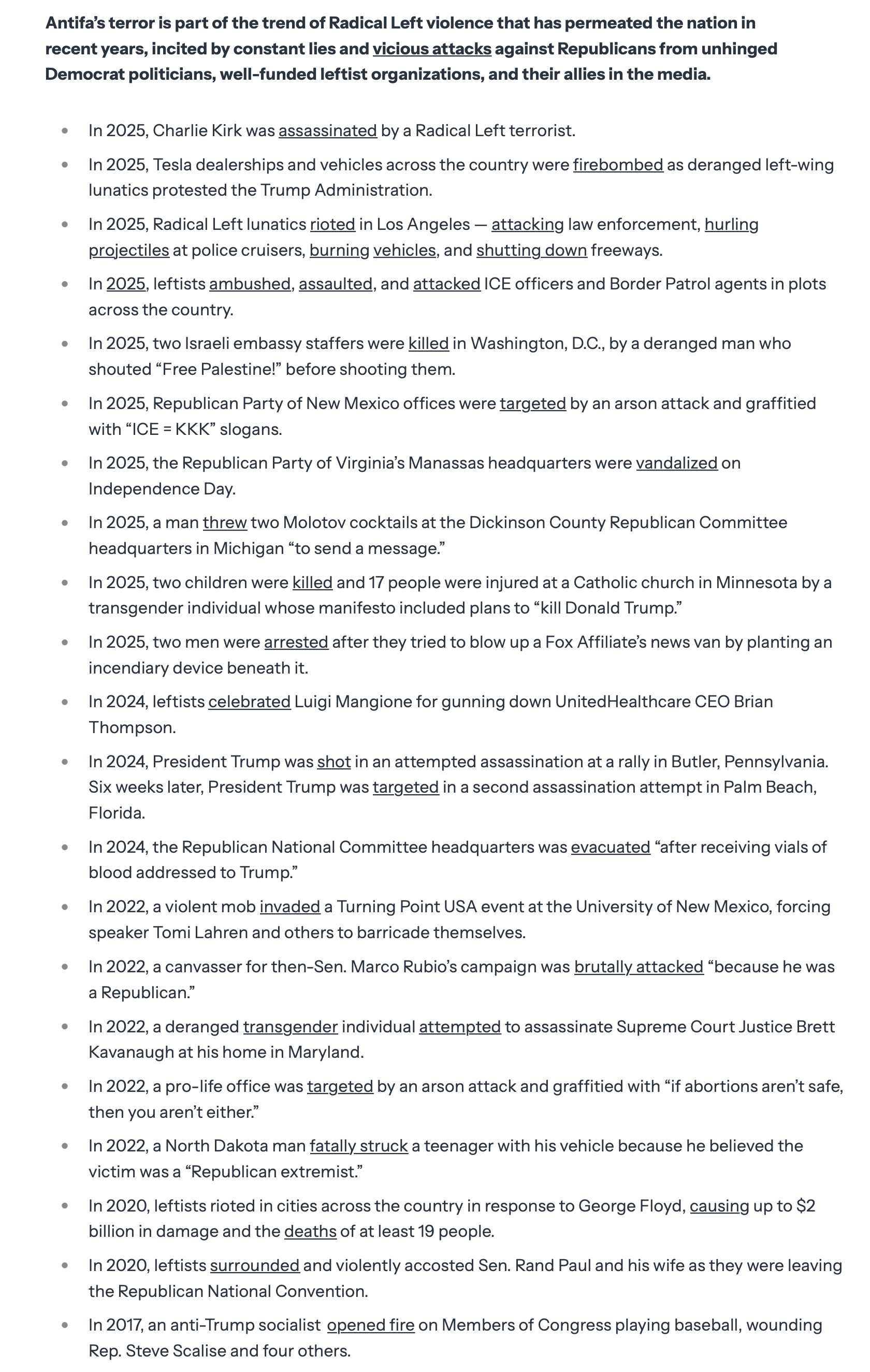
---
Are You On The FBI’s New Watch List?
10 25
last week, President Donald Trump dramatically altered the U.S. government’s approach to domestic terrorism. NSPM-7, a little-noticed national security directive, expands the list of terrorism indicators to include any behavior that is deemed anti-American, anti-Christian, anti-capitalist, extreme on gender, hostile towards “traditional American views” on family, and more.
Today on Lever Time, producer Ariella Markowitz sits down with independent investigative journalist Ken Klippenstein, who first sounded the alarm about the memorandum’s ability to suppress free speech and target Trump’s political opponents.
To check out Ken Klippenstein's reporting on the new directive, click here.
To leave a tip forThe Lever,click here. It helps us do this kind of independent journalism.*
A full transcript of today’s episode is available below.
TRANSCRIPT
*Following is an automated, unedited transcription of this episode. If you plan to quote any part of this transcript, please first confirm that it is correct by listening to the audio.
[00:00:00] Ariella Markowitz: From The Lever's reader supported newsroom, this is Lever Time. I'm Ariella Markowitz, filling in for David Sirota. The odds that you could end up on a terrorism watch list just went up. That's because last week, President Donald Trump issued NSPM-7, a national security presidential memorandum that flew mostly under the radar.
The memorandum cites a surge in what Trump calls "organized political violence" as a reason to mobilize the 9/11-era joint terrorism task forces to investigate potential domestic terror in the U.S. But this new security memorandum claims that indicators of violence include anti-Christian or anti-capitalist values, and even extreme views on gender. According to Trump, these are all characteristics of a sophisticated network of terror.
So today I'm sitting down with Ken Klippenstein, the investigative reporter who first sounded the alarm about NSPM-7. I asked Ken to take us inside the details of the President's national security memorandum and what it means for the rest of us. Why aren't Democrats talking about the danger it poses to Trump's political opponents? And could this new anti-terrorism directive give Trump more power tosilence peaceful descent and expand police surveillance of American citizens? That's all coming up on today's show.
[00:01:29] Donald Trump: I told Pete we should use some of these dangerous cities as training grounds for our military.
[00:01:34] Ariella Markowitz: Earlier this week, Donald Trump and Secretary of Defense, Pete Hegseth, addressed top military generals and other leaders at the Quantico Marine Corps base. Trump delivered his usual lament about America's crime ridden cities,
[00:01:48] Donald Trump: The ones that are run by the radical left Democrats, uh, what they've done to San Francisco, Chicago.
They're very unsafe places.
[00:01:56] Ariella Markowitz: Outlets like The New York Times and NPR focused in on the rambling anti woke tirade from defense Secretary Pete Hegseth.
[00:02:03] Pete Hegseth: No more identity months. DEI offices, dudes in dresses. We are done with that shit.
[00:02:12] Ariella Markowitz: And let's not forget the fat shaming of the entire US armed forces.
[00:02:16] Pete Hegseth: Frankly, it's tiring to look out at combat formations or really any formation and see fat troops. It's a bad look.
[00:02:24] Ariella Markowitz: But amidst all the low BMI military fanfare, Trump said something that felt more ominous.
[00:02:30] Donald Trump: America is under invasion from within. We're under invasion from within. No different than a foreign enemy, but more difficult in many ways.
'cause they don't wear uniforms, at least when they're wearing a uniform. You can take them out.
[00:02:47] Ken Klippenstein: Well, you can't say he wasn't candid. He talked about the enemy within, which I found sort of chilling and felt kind of like a direct to TV movie rendition of a president that is not up to much good, but it wasn't just rhetoric.
[00:03:00] Ariella Markowitz: That's Ken Klippenstein, an independent journalist who's recently been covering misinformation surrounding political extremism. President Trump's comments during that speech seemed to directly allude to a document that Ken discovered on the White House website last week, a national security presidential memorandum that was ignored by mainstream news and even flew under the noses of legislators whose job it is to focus on national security.
Yeah, so it's called NSPM-7
[00:03:27] Ariella Markowitz: NSPM-7 stands for National Security Presidential memorandum number seven. The memorandum cites the assassination of Charlie Kirk, the attempted assassinations of. President Donald Trump, Supreme Court Justice Brett Kavanaugh, the recent shooting at a Dallas ICE Facility, and even slain United Health CEO, Brian Thompson, as instances of domestic terrorism quote, under the umbrella of anti-fascism and anti-American principles.
Here's Ken again.
[00:03:55] Ken Klippenstein: Oh, we have FBI Director Cash Patel testifying to Congress about a week or two ago saying that there has been a 300% increase in the number of domestic terrorism cases. That the bureau has opened up since the beginning of the administration.
[00:04:09] Ariella Markowitz: The memorandum strives to expand the executive branch's power to define who is plotting terrorism.
It cites a handful of public spaces like chat rooms, schools, and social media as breeding grounds for Antifa and potential areas for surveillance.
[00:04:25] Ken Klippenstein: So this is clearly A framework that the administration uses to look at what its job is, which is political adversaries engaging in violent conduct. That's terrorism by definition.
And the FBI's approach generally from Tesla vandalism, the FBI director and attorney General calling that terrorism. To whatever else they perceive as their political adversaries. Just painting with this very broad brush calling things terrorism, that I don't think any reasonable assessment would see it as.
[00:04:52] Ariella Markowitz: This idea of labeling so-called anti-Americanism as a threat to national security isn't novel. It's making a comeback. Last year, the Heritage Foundation, the billionaire funded organization behind Project 2025, published a document called Project Esther. Project Esther is a plan to dismantle the Palestine solidarity movement in the us.
The Heritage Foundation calls it a blueprint to counter antisemitism in the United States and ensure the security and prosperity of all Americans. Their recommendation reframe political dissent as an organized network of foreign funded terror. Trump has already began enacting some of Project Esther's suggestions, such as Criminalizing pro-Palestinian activism on college campuses and detaining students who are critical of Israel.
With this new memorandum, NSPM-7, Trump seems prepared to expand the strategy of Project Esther, but this time he's targeting potential terrorists who he sees as part of a larger Antifa movement. The memorandum is less than 2000 words, but it has far reaching consequences. The joint Terrorism task forces have been encouraged to investigate US citizens with quote, extreme views on immigration, race, and gender.
It empowers the Secretary of Treasury and the IRS to quote, disrupt financial networks of groups or individuals who show hostility towards those who hold traditional American views on religion. It's a lot to process, so I asked Ken Klippenstein to break it down for us.
Tell us a little bit about when this memorandum went out, what's in it and what it entails.
[00:06:31] Ken Klippenstein: Yeah, so it's called NSPM-7. That refers to the fact that it's the seventh such memorandum. This is not an executive order.
[00:06:37] Ariella Markowitz: Yeah. What's the difference?
[00:06:38] Ken Klippenstein: Yeah. Part of what made me interested in this was how misreported it was. Even good outlets, like C-Span we're calling it, oh, here's another executive order.
And I think because of that, it got tossed in this wastebasket of, oh, you know, Trump's had 200 of these, many of them are symbolic or theater. What? What does it mean? Well, it's not an executive order. It's much more significant than that. NSPM-7 stands for National Security Presidential Memorandum, and there are only seven presidential memorandums.
The previous one, NSPM six was classified. Many of them are secret, and so what it does that's more significant than executive order is it's kind of like a strategy document. It's saying, here's our big picture goal. This is what we need to focus on and why we exist. What was interesting was he signed it in along last Thursday and I didn't even write about it.
'cause at first I thought, wow, that's. Really crazy. There's no way that this is obviously gonna get covered everywhere. So what's the point? I already had my hands full with doing reporting on the two mass shootings, the one in Utah and in Texas. So I didn't even write about it, I think until two days later when, to my dismay, I saw that nobody was, I don't think there was a single story in a mainstream outlet.
And, and you know, I thought about it, I realized, okay, well people probably don't know what a. Presidential memoranda is and why that's so significant. And it seemed to me that nobody had read past the headline because when you do that, the details were really bone chilling. 'cause they talk about treating political violence as terrorism.
And when you have a counter terror investigation. It's essentially like pre-crime. You're trying to stop something before it happens, and in certain cases, like uh, weapons of mass destruction, a biological weapon, that might make sense. You might be willing to pursue something with the aggressiveness of a counter terror investigations because the event is so bad.
That you're willing to do what's necessary to prevent it. So when you're doing that, you have to monitor indicators of this future event, since it hasn't happened yet, which is distinct from normal law enforcement where you look at a crime, you go investigate the crime, and then you charge the person since the crime hasn't happened, they gotta predict it.
So how do you predict it? You monitor speech, and in that memoranda it lists a bunch of what they call indicators of. Potential future terrorism. And these indicators are so broad, just to give you a few of 'em. One was like anti-Christian, anti-Americanism, anti-capitalism. Yeah. And it occurred to me, it's like, this has gotta describe like at least 10% of the country.
Right. And so I was just shocked by it. And again, the, the initial reaction I, I've seen press kind of blow off Trump's decisions based. In, I think in large part on a lack of literacy on national security. So they say you can't designate a domestic terror organization, only foreign terror organizations. So therefore there's nothing to worry about that's misleading.
Mm. So legally you can only charge someone on the foreign terrorist organization watch list. That doesn't mean the FBI doesn't maintain its own list of domestic terrorists, nor that they can investigate things as terrorism even, even if the person isn't charged as that, you can collect evidence that you end up charging them with for something.
That is illegal to charge them with. That has nothing to do with terrorism, but you can investigate it as terrorism. So that's basically what made me interested is I thought, wow, people don't understand national security. I really have to provide some context here.
[00:09:39] Ariella Markowitz: You wrote that this memorandum is the most important change in the expansion of government power since the Patriot Act.
Why did this memorandum, and as you highlighted, this incredibly broad definition of what could be a terrorist organization rang alarms. For you.
[00:09:55] Ken Klippenstein: Yeah. I actually try to be cool headed about things like I've written on the National Guard deployments and taken a middle position, which is sort of like these things are corrosive to democratic culture.
You don't wanna have troops stomping around. That being said, they don't have authority to engage in law enforcement because of Posse Conata. So it's really limited what they can do. Posse Comida is the prohibition on standing armies, the military engaging in law enforcement domestically. This is, comes right out of the.
Core of American history and colonists obviously not being thrilled about the British Army enforcing laws in America. And so I've tried to say, okay, this is bad, but it's not like this military coup is happening. Let's be levelheaded about this. And a lot of the ridiculous videos you've seen of them just standing around seeming to have nothing to do, it comes from the fact that they don't have authority because of the constitution.
To do some of the, you know, uglier things that we can, I imagine them doing. So it's not like I am just, you know, I don't wanna hit the panic button on, on everything that I see, but in this case I thought it was warranted because when you tap counter-terrorism authorities, like how that memorandum does, what it's doing is it's telling what's called the Joint Terrorism Task Forces.
These were units established after nine 11 and they number like. I think 4,000 FBI agents and local law enforcement that have been put into these task forces, they're in every state, all 50 states in in the us. And as with the National Guard, the president can federalize them. They, even though they're law enforcement, the federal government can tell them what to do, but there's no posse commentate.
They can directly engage in law enforcement, and that's the big difference. What a lot of people I've been afraid of about National Guard, these guys can actually do, they can actually go and police the streets of America on the orders of the president without even the knowledge or a approval of the state governor or legislature.
So what it does is it allows them to respond to all those indicators that I was just describing, anti Christianity, anti-capitalism, anti, you know, it's a whole long, there's even more than that. So, so that in particular is what really scared me. And it goes back to the Patriot Act. It goes back to nine 11 'cause that's when these groups were established.
For the most part, they didn't exist before that. And it was supposed to be something that could respond to something on the order of nine 11. Again, something serious enough to warrant this pre-crime approach of preventing a crime before it's happened. And there's a phrase, I'm not overstating it. You can go and look at the memorandum.
It says Prevent them before it happens. That's not an interpretation. That's. First of all, what counter-terrorism is, but second of all, that's what the memorandum says. So all of that together, I find it extremely frightening that, you know, a state authority can't actually stand up to these guys. All this is out of our hand.
This is something the president can just control directly. So it's really frightening in a way that I think that even some of the. More outrageous things like the guard deployments. The Portland, for instance, don't reach
[00:12:44] Ariella Markowitz: In your reporting, you highlighted that right now there's currently about 5,000 people into the USA on an FBI watch list for domestic terrorism, and a source told you that number could double.
What kind of entities could potentially now be targeted by the Trump administration for harboring these quote unquote radical views?
[00:13:05] Ken Klippenstein: Yeah, so like I said, the really frightening thing and the reason counterterrorism is its own category. That is when you're supposed to kind of debate and be like, okay, does the threat justify or necessitate this kind of response is because it's understood that the way in which you investigate a counter-terrorism.
Infringes on civil liberties. You're recruiting informants as we did after nine 11 in mosques to try to tell people you're, you're going and having people pose as somebody pretending to sell, say nuclear fist material so that you can basically entrap people. And the justification in those cases is, okay, well if someone's trying to make a dirty bomb, that's so horrifying.
That it's worth. I think Dick Cheney described it as entering into the shadows and doing some of these things that you might otherwise feel uncomfortable with because the possibility is so dangerous. But if you look at like vandalizing Teslas does that really, I think any reasonable person would look at that and say, no, that can be prosecuted like any.
Ordinary crime. You don't need to be spying on people. You don't need to be recruiting informants in groups, having undercover officers pretending to sell them, I don't know, material to attack the Teslas with and essentially entrapping people. I don't think any of that is justified for that kind of a crime in which I think to date nobody's been killed and it's just been property damage.
But they have a whole long list of these things. I mean, anti-Americanism, I don't even know what that means. Yeah. And so it's like, yeah, and I just did a story. Talking about law firms now that are counseling their clients, which are businesses and nonprofits saying, Hey guys, you've gotta watch the language you're using, so it's gonna have a chilling effect on speech already is.
'cause these law firms are advising their clients to behave differently and the effect is gonna be, all right, well we better tighten up around what we say on X, Y, and Z. That's the immediate effect of this.
[00:14:43] Ariella Markowitz: Let's, let's get into that, because some of these law firms you've reported on are these. You know corporate law firms in dc, Arnold and Porter, Wilmer Hale.
Why do you think they're sounding the alarms to their clients before it trickles down to the rest of us? I know they're also raising the alarm for nonprofits in particular. Why does this affect these more progressive nonprofits? And Trump's ability to go after them.
[00:15:10] Ken Klippenstein: The memorandum frames it as radical left, I think is the phrase they use.
Radical left-wing extremism or whatever. When you look at the lawyers who are being paid to tell their clients how to minimize risk, like their job is to assess these things accurately. So I think it means something when they're telling their clients to adopt different behavior. If you look at the document, you know, it's careful to say radical, blah, blah, blah, but in the case of one of these.
Law firms, these are, you know, mainstream law firms. This is not like the National Lawyers Guild or some effort that's outside of the mainstream. They're basically saying that, one of them said literally, this applies to progressive organizations. Which means the mainstream of America, not the, I don't know what you would call it, Antifa, or however you know, the Trump administration has tried to phrase it.
So on the one hand, that is what they're telling their clients, and you know, they have a duty to represent their client to, you know, their best interests. But in addition to that, there's this very weird disjunct where Congress had said almost literally nothing at the time that I wrote that story. I don't think a single member of Congress had said anything about it.
And so I went out to all the ranking members, the Democrats. That were in leadership positions on the different national security committees who, who are tasked with overseeing these things and making, and you know, holding the federal government, the executive branch in check, and not a single one of them had even put out a boilerplate kind of, this is bad and more of Trump's badness or what, whatever you would've expected, I would've expected just chatg PT level, not good.
Even if they don't understand the legal nuance or national security nuances. Nobody had said anything. I went to them. One member. Responded to me at the time that I published, and that was Congressman Benny Thompson, who's the ranking member on the Homeland Security Committee. On, on the one hand, the, the legal companies that have to minimize exposure of, of these, you know, multimillion dollar firms and nonprofits, they're responding very quickly.
I mean, they had this stuff up within a day 'cause they understand my client is on the hook, but when it comes to any ordinary person, it's very frustrating. Not only does Congressman say anything about it, when I went and looked at the statements. Virtually every one of them had these long, flowery remarks about the former FBI director James Comey being indicted.
But it's like, what about the rest of us? How does what's happening to Comey affect me or any ordinary person? It affects Comey. I guess it affects us in some abstract sense of the problems with the democracy, but it's like he's rich. He was the F FBI I director. He's gonna have the best representation in court.
I'm not particularly worried about him. I'm worried about ordinary people. Protesters are gonna be charged with things. They haven't said anything. Just today. I looked and I thought, I wonder if after this article blew up, maybe they're coming around and Courthouse News, I think interviewed Senator Alyssa Slotkin, the senator from Langley who can't stop talking about her CIA experience and her national security expertise.
She's from Michigan, and they asked her, she said, oh, I haven't read it. She had no comment on it, and she's on the Homeland Security Committee. It's literally their job to be overseeing this exact type of thing. It's shocking.
[00:17:59] Ariella Markowitz: Do you think this is all deliberate?
[00:18:01] Ken Klippenstein: No, I don't. I think it's the fact that they rely on the New York Times and Cable News and you know, Washington Press for their information, so they're in an information bubble for them to intentionally ignore.
It would be crazy because this is literally targeting some of the NGOs and advocacy groups that benefit them and they're happy to talk about all kinds of other crazy things Trump says, many of which don't actually lead to anything. To give you just one example. Meeting in Quantico, Virginia, of all the military leaders, how many stories do we read about how, you know, oh, is this the beginning of a purge?
Is there gonna be a coup? Yeah, they were all hand wringing. Like I think far beyond what was justified. I made a few phone calls initially, and what I heard very quickly from senior people in the Pentagon was, oh, this is an idiotic. Theater exercise where they're gonna say, look how tough we are. Look how great we are.
And it seems like that's basically what it was. But every cable channel is freaking out. Politicians were all making statements about this thing. They ended up being a total nothing burger. So they're happy to raise the alarm about things, including about national scare relating things. I think they're just in such a cocoon of like corporate media that they don't even hear about things if they don't talk about it.
[00:19:08] Ariella Markowitz: After the break, I'm asking Ken Klippenstein, if this new national security memorandum could open the door for independent journalists to be accused of domestic terrorism, we'll be right back.
Welcome back to Lover Time. I'm sitting down with Ken Klippenstein.
You have a lot of sources working for the US government. Are your sources afraid? Are you afraid as a independent journalist?
[00:19:35] Ken Klippenstein: No. I mean, even in the case of. PM seven. You know, this authorizes some scary stuff. I worry about my sources more than anything.
I don't want the government watching who I'm talking to 'cause I'm worried about them. They're taking much more risk than I'm by talking to me. 'cause many of them aren't supposed to talk to media. I would say that, you know, ultimately whatever evidence they collect, it's gonna have to stand up in court.
It's not like the Trump administration has been able to just. Ate the, the fact that you need to get a jury of your peers to agree with something. So that's an important check, and I think a reason that people shouldn't feel despair. Hmm. I mean, they're gonna have to reorient and restructure the whole national security system around these new priorities that he's promulgated in the memorandum last week.
So there's plenty of time. To do something to stop this. It's gonna be something that I'm sure they'll be working on for the entirety of the administration to try to change. So my hope is that people will get informed and involved and decide what they think, and then press their demands before we've reached that point that there's Some kind of culmination. Fortunately, I, I don't think we're there yet. When I talk to people in government, what I see is a lot of frustration. They're kind of like very sincere constitutionalists and they don't like that things are happening that go against the spirit of it. But yeah, we shouldn't be less scared than they are.
'cause I mean, think of what could happen if they got found out talking to me and they're not scared, and they're more just like, why is Congress not talking about this? Why is the public not engaged in this? That seems to be their reaction.
[00:20:55] Ariella Markowitz: You reported that the law firm, Kaplan and Drysdale. Um, known for its political law practice, you know, comparing this new memorandum to Farra, which is the Foreign Agents Registration Act.
Why don't you just break it down and tell us why they made that connection?
[00:21:10] Ken Klippenstein: I mean, the memorandum has so many consequences. You really have to look to the legal side to even get a, get a sense of it. But one of them was, um, that this law firm. That specializes in Fara enforcement, said that it, quote, brought it back from the dead.
And basically it's a, it's a kind of controversial and, and squishy law in a lot of ways because again, it's touching on speech stuff that gets to the first Amendment and so it makes it hard to formalize and historically it's made it unpopular to enforce because what it requires you to do is you have to register if you're acting quote on.
The behalf of not just a foreign government, but even just a foreign principle is the word they use. And so it's like, what does that mean? So for instance, say you want to visit Gaza and do a news story on it, and you speak to some Gaza's, they're like, please get a story about this humanitarian issue we're facing out.
Is that fair? Well, in a sense. 'cause you talk with 'em and they ask you to do something, I mean, you're not doing it. 'cause they said it, but they did convince you that it was a worthy cause or whatever. So it's like it, it caused all these problems and one can imagine the ways in which the Trump administration is gonna implement those.
I would guess that they're gonna be the types of things that, again, these progressive groups and therefore phrase radical left, are interested in. So that's part of the reason that it's been so lightly enforced in the past is 'cause it's just, it's a janky law that is controversial in nature. It was, it was much more of a thing I think during the Cold War.
[00:22:29] Ariella Markowitz: Mm-hmm. Playing the devil's advocate for a moment, you've raised some very significant concerns about this memorandum, but to what extent do you think it's an empty threat potentially to stoke fear?
[00:22:39] Ken Klippenstein: Well, I would say you don't want to think of this as a binary thing. 'cause I just gave you some examples of how it's already having an effect in terms of what nonprofits are being told to do, what they're going to go ahead and do.
Mentioned Farrah, that's gonna have an effect on people's conduct related to foreigners. So it's a continuum of how it's gonna be enforced. And I think that the early signs are that they really are gonna. Push ahead with this. 'cause again, they have that fourth 5,000 person joint terrorism task force in every state across the country.
They don't have to make anything. That system already sits there. It already exists and can be. Activated at any time and I think just, yes. Yeah. Just yesterday, last night, attorney General, Pam Bondy issued a directive, I think that was about creating like a protect ice task force or something, the Immigration Customs Enforcement Agency.
And it was, it went on about how, oh, there's been a thousand percent increase in attacks on ice. We need to defend them. And throughout the document, the first citation and throughout it was linking back. To, you know, pursue it to the Trump memorandum. So it's already being used. I don't think there's any question.
It's just to what extent are they gonna activate these thousands of Jtfs A across the country? I think that's the question that remains to be seen, and I think it would make sense for them from their perspective to do so. 'cause like I said, it doesn't bump into the same legal problems. That the National Guard and use of the military does, 'cause they don't have that posse com us if they're already willing to use the military.
I don't see why they wouldn't use this in response to something. And they have sent federal assets to Los Angeles, Chicago. Um, this would just be an expansion of that practice that's already ongoing to include the J Ttfs.
[00:24:15] Ariella Markowitz: I kind of wanna pivot back to this idea of the war from within. You've done really fascinating reporting about the kind of ideological profiles of Charlie Kirk's shooter or Killer Tyler Robinson, and we're seeing the Trump administration weaponize crime, this idea of crime fighting and now like radical leftism as an excuse to invade cities.
So I'm curious what, what is your actual reporting about extremism and the political beliefs of these political assassins? How does that conflict or work? With this narrative that the Trump administration is saying about radical violent leftism out in the streets of America?
[00:24:57] Ken Klippenstein: Yeah. My approach has been just to track down friends of the alleged shooters and just let them talk.
And I, I don't come to them from any angle and say, oh, did he say anything about this guy? At least not, you know, in the first part of our conversation. 'cause I wanna leave it open-ended and see what they say. And what I found on it was almost uncanny, the parallel between the alleged shooter Tyler Robinson of Charlie Kirk in Utah, and then the.
Now deceased shooter in Texas of a ICE facility ended up killing, uh, ice deta. An ice deta injuring two others. Joshua John. In, in both cases, their friends were like, what do you mean politics? They're not political. That was part of their motive in talking to me is they were just surprised by the coverage.
They thought, this isn't anything like the person that I knew, what this story's wrong, why are they saying this? And so I should say it didn't just conflict with the Trump administration, it conflicted with, you know, a lot of stuff I saw from the left on social media where they were saying, oh, this person must be, uh, you know, in the case of Tyler Robinson, there were people claiming.
Early on that, oh, he, he must be a, you know, adherent of Nick Fuentes and he must be some right wing guy or whatever. 'cause yeah, you know, whatever reason I found zero evidence for that. I didn't see really any evidence for that initially. So I think there's this kind of mad dash to just be like, oh, he's on the other side or whatever.
Completely divorced from facts or even attempts to find them. The only stories I would see would be like. You know, I kept seeing the Trump administration say, in the case of Robinson, let's talk about that one First. They would say, oh, the family told us that he was a left-wing guy or whatever. And I kind of laughed at that 'cause I thought, if you ask my mom what I thought she would, she would be like, he's a crazy communist or something.
Like, something that I'm not, because it's through her lens and the way she sees the world. So it's like you probably wouldn't get a accurate picture from people's parents, even if they're trying to say it. 'cause they just see the world differently. So, so I try to talk to the friends and it wasn't that it was left or right, it was that they were.
Pretty apolitical. In the case of Robinson, he did feel strongly about LGBT issues. He was describing me as bi dating a trans person and did take issue with Charlie Kirk's comments on transgenderism. Kirk, you know, has said things like transgenderism is mental illness, stuff that clearly upset. Robinson.
But to take that and then say, oh, he's a progressive left Antifa, that is just a jump that is not sustained by the facts at all. I mean, he felt strongly about one thing and then that was it. And that I, you know, and I really tried to find things. I wasn't trying to come from a certain perspective. I went to people in his discord chats, which are like the media.
Mainstream media has put all this mystique around it. Like, oh, discord, like this secretive. This is a, it's basically WhatsApp for gaming. It's like you can do phone calls, text messages, video, and it's just like a server around whatever the chat room people that you invited in. There's no, I don't see where the mystique comes from.
I guess that people over 50 maybe aren't on it. The same rate that people under 30 are. This is something that has hundreds of millions of active users each month. I mean, this is basically as mainstream as Twitter or any of these other social media platforms, but it's just that people of a certain age, I mean, I guess I don't use it.
I'm in my thirties, but yeah, I asked people in those chat messages with Robinson and there were multiple of them. Again, the media reported as though there was just one, and that's not the case. There were multiple of them. I, I tasked him. I said, go and search for Trump. Search for Biden. I tried to think of what's an objective way we can pull together empirical evidence for whatever the views are.
One post on Trump the entire time. And it was like something about the impeachment in 2019, hmm, like five years ago. And then there was one post on Biden, which was about the election. Makes sense. That's elections are when people pay attention and then they check out again for the most part. But I, I was a little bit shocked by how much media tried to just project onto them.
Politics, political dynamic that exists in Washington and New York City, where a lot of these media companies are based, I guess, but which doesn't describe the majority of the country. My takeaway from this was the most normal thing about these two shooters. Was the fact that they were gen, generally apolitical.
[00:28:47] Ariella Markowitz: We're gonna take one more quick break. Coming up next, I'm asking Ken Klippenstein if NSPM-7 will give the federal government the power to bypass First Amendment rights to fight alleged violent extremism.
Welcome back to Lover Time.
We've kind of gotten into how these acts of violence have been politicized in the name of crime fighting and terrorism fighting. To what extent do you think it's also attack on free speech and what are the very real ways. The federal government can now weaponize people's first amendment rights and basically go after organizations they don't agree with.
[00:29:30] Ken Klippenstein: Well, I described some of them, which is recruiting informants, um, having undercover agents act like say, oh, do you wanna go and shoot some commentator here, buy this gun. And then that leads into entrapment and questions of, would that have happened if you hadn't made it possible for that to happen? Um, and it just.
Something I've seen already is it leads to paranoia. There are people saying, oh, you're a Fed, you're a fed. That kind of thing. All of this has a chilling effect on speech. So it's not like the government saying you can't say something, but it makes people paranoid and less likely to wanna express their views 'cause they're worried that it's gonna get swept up or maybe they'll get in trouble.
That is a major concern and it's sort of subtle. One another instance of. Chilled speech I described earlier when nonprofits and NGOs are gonna be like, well, okay, we wanna do this edgy project, maybe we won't do it. 'cause we're worried about our tax status. Mm-hmm. And that is something else that's already happening according to these law firms that are advising these companies.
I would encourage people to read the memorandum. It's about two or three pages long. It talks about how the Treasury Department is also gonna. Be creating suspicious activity reports around these things. Since there's no criminal predicates, it's no crime necessarily has been committed, you've gotta look to clues.
Yeah, you have to become someone who's reading the tea leaves or whatever. And that means you're looking at association, you're looking at speech, you're looking at behavior that doesn't qualify as as criminal nature, and that should be a concern. To everyone and the admin to my amazement has been pretty open about this.
I mean, you have Pam Bondi, the attorney General coming out saying, yeah, freedom of speech. We need to like actually worry about hate speech. And then Trump was asked about Kirk, who it was some reporter said, oh, Kirk was a proponent of free speech. Don't you support that? And Trump says, well, I don't think he would be today.
So they're just like openly saying this, like, you don't even have to read the. Memorandum, they're pretty much saying they've had a shift on their views about free expression and free speech. But again, this is about Americans now rather than Al-Qaeda or ISIS or some of these foreign groups that you typically think of as, as the targets of the global war and terror, which is a point in itself like the global war and terror is coming to a close and the war it feels is coming home in some ways.
Yeah. 'cause ISIS and Al-Qaeda are not the focus of this huge counter-terrorism machine, which has never been disbanded. Now they're just going to, it sounds like, set them on domestic targets.
[00:31:37] Ariella Markowitz: I would've love to hear you talk just a little bit about solutions and where this might be heading in your perception, like where do you think the resistance to this is gonna be coming from?
[00:31:46] Ken Klippenstein: Well, I think one of the great lies is the idea that Democrats are not majority Congress. What can they do? And it's like, yeah, I don't know what could be more of a rebuttal to that idea than the last year and all of these things that Trump has been doing with executive orders that you couldn't dream of a Democrat doing in the, certainly in my lifetime anyways.
And so I would interrogate that question of what can you do as though the only power an elected official has is. Notching a ballot on a vote that is just pure cynicism and like there's such a thing as public opinion and the bully pulpit engaging people. I mean, when I look at the opposition party, I don't think he was talking about the left.
It sounds like he's just talking about the Democrats. Generally. I don't see any effort. I pay very close attention to their media hits. Hardly do any interviews. Meanwhile, Trump and the administration are on every Cracked Out podcast and obscure show, like wherever it, they do all these shows and you know, sometimes they have flubs and things, but they don't care and they power through it, and they're reaching millions and millions and millions of people.
You know, I paid close attention to the leadership elements like Chuck Schumer and Hakeem Jeffries. Schumer went like three or four months without doing a single television interview or sit down. If you like, these guys are not even trying, so to say, oh, what can you do? Like there's a whole gulf between what exists now that they're doing, which is, you know, in the case of all of Congress not even reading his fricking memo and being able to cast a majority vote.
I mean, it's like you try to shift opinion, which is what Trump did on immigration. He spent the last four years. Going around and talking about immigration. And guess what happened? The public's opinion changed on the issue. How did he do that? He didn't have a vote when he was out of office. Yeah, when he was getting indicted, when he was facing, you know, all these felonies, he didn't think, oh, what can I do?
I don't have the power to vote. He what? He knows that you can go and talk to people and change people's views on things. That's where real power is. And until Washington elected officials realize that they're not gonna take advantage of it. And, and it's not just some sentiment, I think the Republicans are making it very clear what the Congress can do if they choose to go ahead and use power.
You've even seen some examples of this with, um, Schumer. Like I saw Schumer, uh, at one point he was like, I'm gonna use this strange parliamentary maneuver. To try to get some, I don't remember the, I don't know Congress very well to be honest, but, but it was clear that they, it was clear that they have these tools that they don't want to use, but suddenly they pop up when it's expedient to do so.
You know, so that's, that's basically what I would say.
[00:34:08] Ariella Markowitz: No, it reminds me of the, I believe Andrew Breitbart quote, that those who control culture, control politics,
[00:34:14] Ken Klippenstein: no public opinion is very powerful.
[00:34:16] Ariella Markowitz: Seems to ring true.
[00:34:17] Ken Klippenstein: Yeah. And you can't act like it's written in stone. If Trump had thought that. Public opinion wouldn't have shifted on immigration at all.
You could go back three years as recently as three or four years. Opinion was completely flipped on it. All this stuff would've been completely verboten and it's coming back around to that now to shift in opinion, but he completely changed it, and that's a very strong, I think, illustration of what can be done if you bother to talk to people.
[00:34:40] Ariella Markowitz: What message would you have to, whoever's listening to this now. What do you think they should be most kind of aware of or activated about?
[00:34:48] Ken Klippenstein: This stuff is not complicated to understand. I did my best to give people a kind of lay understanding of what it means, and again, just talk about it. Just talk about it.
Like I'm sure someone listening to this has some social media presence and I know staffers on the hill there. Bosses are worried about if something starts moving on social media, am I gonna get blamed for it? The more noise you make, you don't even have to organize a strategy or anything. If you just make noise, they're gonna see it and they're gonna feel the heat.
[00:35:15] Ariella Markowitz: Ken Klippenstein is an independent journalist. You can follow his work@kenklippenstein.com. Thank you for your amazing work and shedding light on this.
[00:35:22] Ken Klippenstein: My pleasure. Thank you for having me.
[00:35:26] Ariella Markowitz: Thanks for listening to another episode of Lover Time. Lover. Time is a production of the Love. This episode was produced by me, Ariella Markowitz, and Natalie Bettendorf.
It was edited and mixed by Ron Doyle. Our theme music is by Nick Campbell. You can subscribe to Lover Time on Apple Podcast. Spotify iHeartRadio, the PRX mobile app or wherever you get your podcasts. For ad free episodes, exclusive bonus content, and access to the lever's, entire archive of investigative journalism.
Head over to lever news.com to learn more about becoming a paid subscriber, or click the link in the episode's show notes. I'm Ella Markowitz. We'll be back next week with another episode of Lever Time.
===
---
ggl ai 10 25
Star Wars movie that features Order 66 is Star Wars: Episode III – Revenge of the Sith. This is the pivotal scene where Chancellor Palpatine (Darth Sidious) orders the clone troopers to execute the Jedi.
- What is Order 66?
It was a secret military directive programmed into the clone troopers' brains via biochips, which triggered them to identify all Jedi as traitors and execute them.
- How it's shown in the movie:
The movie depicts the sudden and brutal betrayal as the clone troopers turn on their Jedi Generals, which is a central part of Anakin Skywalker's fall to the dark side and Palpatine's rise to power.
- Where you can see the scene:
You can find various clips and information about the Order 66 scene on and StarWars.com.
---