Oversight and Investigations Comm Hse
see hse oversight subpoena
see fossil fuel ceo
see main node of 10 comms w/ impeachment functions?
---
an 2 26
Corporations that pandered to Donald Trump after his reelection could soon pay the price for it, with one bipartisan consulting firm warning clients of a "tsunami of congressional oversight" in the likely event the Republicans lose the midterms, and it will be "much worse than they expect."
The memo, reported on by Axios, was written by Matthew Miller and Tucker Eskew, who the outlet credited as "veterans of high-profile campaigns." They warned that a major shift is almost certainly headed for Washington D.C., and that companies need to start preparing themselves for Democratic leadership in the House.
"A tsunami of Congressional oversight is headed straight for corporate America," Miller and Eskew wrote. "Barring a dramaticand improbable reversal of both current and historic political trends, Democrats will retake control of the House of Representatives (and possibly the Senate) in November’s elections, ushering in two years of divided government. With prospects for passing major legislation during that period hovering between slim and none, oversight will become the leading substantive and political weaponfor newly ascendant Democrats."
Since Trump's return to the White House, the pillars of corporate America — including tech titans like Amazon, Apple, Meta and Google — have faced widespread accusations of currying favor with his administration. Companies big and small followed Trump's command at the start of his second term to do away with "diversity, equity and inclusion" programs. The aforementioned major companies also donated significant amounts of money to Trump's inauguration and his controversial White House ballroom.
Miller and Eskew further suggested that, in many ways, the incoming Democratic leadership could be similar to past periods when the party held majorities in Congress. However, they also warned that shifting priorities and key changes within the party mean that companies are more likely than ever to face scrutiny.
"The first change stems from a widespread belief among Democrats that major corporations have drawn too close to the administration for comfort," the memo continued. "For example, they have attacked crypto companies for allegedly funneling money to the president and his family, called antitrust review 'pay-to-play corruption,' and questioned the relationship between the White House and oil companies. For Democrats on the Hill, aggressive oversight of private companies is no longer just an end to itself, but a means for exposing alleged abuses by the Trump administration."
Miller and Eskew also predicted that Democrats are preparing for the White House to stonewall any and all attempts at oversight investigations. This will, in turn, cause them to turn their attention to corporations, using oversight of them as "a means for exposing alleged abuses by the Trump administration."
"It's going to be so much worse than they expect," Miller said in a statement to Axios.
ref mkting
robt garcia ~ lg corps
...the first change stems from a widespread belief among Democrats that major corporations havedrawn too close to the administration for comfort. For example, they have attacked crypto companiesfor allegedly funneling money to the president and his family, called antitrust review “pay-to-playcorruption,” and questioned the relationship between the White House and oil companies. ForDemocrats on the Hill, aggressive oversight of private companies is no longer just an end to itself,but a means for exposing alleged abuses by the Trump administration...
---
---
an 11 24
Rep. Marjorie Taylor Greene (R-GA) predicted that former Rep. Matt Gaetz (R-FL) would prosecute vaccine-related "crimes against humanity" if he becomes President-elect Donald Trump's next attorney general.
During a House Oversight Committee hearing on pandemic preparedness on Thursday, Greene accused the federal government of using "the American people's hard-earned tax dollars to create viruses that can be unleashed on the world like COVID-19 was."
"Dr. [Anthony] Fauci lied to the American people, abusing his power and position and role, a very powerful role paid for by the American tax people," she said. "He lied, and many, many people died."
"Now vaccines have been mandated on the population in order to work, go to school, and live as functioning citizens in the United States," she continued. "I can tell you when you talk about vaccine hesitancy, as one sitting before you that never took the COVID vaccine, nor will I take it, thank God. I'm so glad I didn't take it."
Greene falsely suggested other vaccines were linked to "the rise of autism, learning disabilities, neurological problems, and so much more that children are suffering from today."
ALSO READ:The one belief that predicted Trump voters with scary accuracy
"Preparing for the next pandemic is actually recognizing that the last pandemic resulted in crimes against humanity," the lawmaker opined.
"People that perpetuated and continue to perpetuate these crimes need to be prosecuted, and that needs to be starting in the next administration, and I'm pretty sure our next attorney general will do that, and I look forward to seeing that happen," she added.
---
https://www.desmog.com/2022/10/07/slapp-lawsuits-exxon-chemrisk-dapl-climate-change-raskin/
Emily Sanders
In 2018, Krystal Two Bulls received notice that she was being sued for criminal conspiracy.
Two Bulls, who is Oglala Lakota and North Cheyenne, has been organizing for environmental justice for much of her life. She was raised on the North Cheyenne Indian Reservation of Lame Deer, Montana, part of a community that had resisted coal developments for nearly 40 years. In 2016, she helped defeat Arch Coal’s plans to build a massive strip mining operation on the reservation’s border. The project would’ve been one of the largest coal mines in the United States.
Later that same year, Two Bulls received an urgent call for assistance from land and water protectors at Standing Rock, North Dakota, who were working to oppose the construction of the Dakota Access pipeline, which transports crude oil from North Dakota to Illinois.
When Two Bulls arrived, the conflict between protestors and local police was escalating. Her auntie, Dr. Sara Jumping Eagle, had recently been arrested after standing in the path of a bulldozer set to dig up human remains at an ancestral burial site. Two Bulls spent three-and-a-half months supporting and sustaining the camp — handling basic logistics like providing protestors with food, warm clothing, and other necessities — all in the face of violence by state police. She then helped to launch the No DAPL Solidarity Campaign, a global movement to back the Indigenous opposition to the pipeline.
It wasn’t until a year after camp was shut down that Two Bulls, who came to North Dakota on her own dime and left in debt, found out she was being sued for millions of dollars by the pipeline developer, Energy Transfer Partners. The charges were brought under the Racketeering Influenced Corrupt Practices (RICO) Act,a law originally designed to prosecute the mafia. The company claimed that through her “calls to action,” including a statement on Greenpeace’s website asking “all people from around the world to take action” and “come stand with us” against the Dakota Access pipeline, Two Bulls and others had conspired to interfere with Energy Transfer’s business operations and engaged in organized crime. The individuals and groups’ opposition, the company claimed, was defamatory and cost key investments in its pipeline.
In 2017, The Intercept reported on documents leaked from former personnel at an international security firm, TigerSwan, revealing that Energy Transfer had paid the firm to use military-style surveillance and infiltration tactics to gather information that could be deployed in a RICO lawsuit against the anti-pipeline activists.
Two Bulls is just one of many victims of the fossil fuel industry’s use of SLAPPs— strategic lawsuits against public participation — to silence and intimidate its critics. A report released last month by legal advocacy nonprofit EarthRights International identified 152 instances of legal and judicial harassment by fossil fuel corporations to suppress dissent in the United States over the past 10 years, including 93 SLAPP lawsuits.
Just this week, a California oil industry trade association paid nearly $650,000 in fees to the city of Los Angeles and several environmental advocacy groups the company had targeted in court for years following the city’s implementation of new environmental safety requirements for drilling applicants. After declaring bankruptcy, the California Independent Petroleum Association was allowed to pay only a fraction of a judgment initially awarded to the city and groups by a trial court that ruled the lawsuit was a SLAPP.
“With the strengthening of our movements, the revelation of how long the fossil fuel industry has been aware of how their practices impact and contribute to climate change, and the rise of legal cases against oil and gas corporations, these companies are becoming more desperate to silence the voices of their critics,” said Deepa Padmanabha, deputy general counsel at Greenpeace USA.
A wide range of concerned groups, from community organizers to members of Congress, are taking up the fight against SLAPPs. Last month, the House Oversight Subcommittee on Civil Rights and Civil Liberties held a hearing to expose the fossil fuel industry’s use of SLAPPs and its backing of bills to criminalize protest. The committee’s witnesses, including Padmanabha and others, explained that corporations were using these tactics to suppress activists’ ability to freely voice dissent.
The day after the hearing, Rep. Jamie Raskin (D-MD), the subcommittee chairman, introduced the SLAPP Protection Act of 2022 — the first federal legislation that would “establish a procedure to dismiss, punish, and deter strategic lawsuits against public participation.” Advocates say the bill could create a sorely needed protection for individuals and community groups who speak out against fossil fuel infrastructure, and an important safeguard for free speech at large.
According to EarthRights International, the proposed legislation would provide a federal mechanism for SLAPP suits to be quickly identified and dismissed while balancing the rights of plaintiffs and defendants. The bill would also force those bringing SLAPP suits to pay their opponents’ legal fees if the lawsuit is proven to have abusive intent.
Advocacy organizations are also tackling the issue. EarthRights is a member of the Protect the Protest coalition, an initiative created in response to the rise of SLAPP suits. “If a corporation can sue a nonprofit organization out of business for criticizing its activities, then that’s extremely dangerous,” Kirk Herbertson, senior policy advisor at EarthRights International, said.
About a year after Energy Transfer filed its lawsuit against Two Bulls and others, a district court judge in North Dakota dismissed the case, denying the RICO claims with prejudice — meaning the company could not refile those claims.
RICO claims, which can triple the amount of damages sought in a SLAPP suit, can be financially devastating — even for a larger, well-resourced organization like Greenpeace USA,which was named in the original suit. While Energy Transfer’s RICO claims against the organization have been dismissed, the pipeline company filed a second lawsuit in North Dakota state court, which is scheduled for trial in June 2023. In its current case, which also names Two Bulls as a defendant, Energy Transfer argues that Greenpeace USA conspired with others to defame, trespass, and interfere with business relationships, among many other charges.
Energy Transfer did not respond to a request for comment.
“Companies are becoming more desperate to silence the voices of their critics”– Deepa Padmanabha
Fighting these lawsuits not only takes vast amounts of money, but also time and energy. Padmanabha said that since mid-2016, her career has been almost entirely dedicated to advocating against corporate lawfare — corporations’ use of the legal system to attack opponents — preventing her from engaging more in the dire work needed to prevent climate catastrophe.
“The next decade is so critical in our fight against climate change. And if we didn’t have to deal with these lawsuits, we would really be putting every penny and every minute we have into fighting the existential threat of climate change,” Padmanabha said, adding that they are also intended to intimidate and deter individuals and lesser-resourced, smaller groups from speaking out.
Karen Savage was working in Massachusetts as a middle-school math teacher when she got hit with a SLAPP suit. In 2013, she and another environmental activist, Cherri Foytlin, wrote an unpaid article for the Huffington Post about a so-called independent study fromscientific consulting firm ChemRisk. The study had claimed that there was no connection between chemicals released during the BP Deepwater Horizon oil spill and the serious health problems reported by cleanup workers and coastal residents in its aftermath.
As their reporting revealed, ChemRisk — a company with a long history of working with polluters, including defendant PG&E in the infamous Erin Brockovich case — produced “science” on behalf of BP that the oil major could use to defend itself from liability in court.
After the article was published, the Huffington Post received an immediate request from the company to retract it, which they forwarded on to Cherri Foytlin. (In a note on her Facebook page, Foytlin told ChemRisk to “kiss my derriere.”)
Foytlin’s Facebook post, along with many other social media posts from the two writers, appeared in a defamation suit filed against them by ChemRisk in New York state. The company claimed their article contained falsehoods — though, according to Savage, ChemRisk couldn’t explain what those falsehoods were — and that as long as it was kept online, the article would “continue to do substantial harm to ChemRisk’s reputation.”
“Basically what they wanted to do was shut us up,” Savage told me. “It was an intimidation tactic.”
With pro-bono representation, Savage and Foytlin were able to get the suit dismissed in New York. Within two weeks, the company refiled in Massachusetts, where Savage lived. At one point, she said, the company’s lawyers even attempted to serve her in her classroom while she was teaching.
Cardno ChemRisk, the parent company of ChemRisk, did not respond to a request for comment.
The case was eventually dismissed under the state’s anti-SLAPP laws, and ChemRisk was forced to pay Savage and Foytlin’s attorney’s fees. Savage said she believes that ChemRisk never sued them in Louisiana, where Foytlin lived, because of the three states, Louisiana’s anti-SLAPP laws were the strongest, and the suit would’ve been dismissed faster and with greater consequences for the company.
That tactic of searching for the most favorable court, called forum shopping, is something Raskin’s anti-SLAPP statute would address by creating a standard applicable across the United States. At present, 32 states and the District of Columbia have anti-SLAPP laws, yet they have varying degrees of efficacy. And while the fate of a federal bill could depend on the outcome of midterm elections, most state anti-SLAPP laws have passed with bipartisan support.
Savage — who has since become a journalist and haswritten for DeSmog about being arrested by pipeline security while reporting — said she hopes Raskin’s bill would help put an end to this tactic. “If you know the truth, and you’ve got factual backup, and someone comes at you, you can’t back down on that,” Savage said. “The whole reason they’re coming at you is because they also know that you have the truth.”
While the fossil fuel industry works to stamp out the speech of environmental advocates on the one hand, it is now arguing that its climate denial is protected speech on the other. At the same time that Raskin held his hearing into the fossil fuel industry’s assault on the First Amendment, the House Natural Resources Oversight and Investigations Subcommittee held a separate hearing to examine how public relations firms market climate disinformation and delay action on behalf of Big Oil. In that hearing, chaired by Rep. Katie Porter (D-CA), Republicans and their witness argued that the committee was attacking the corporations’ right to free speech.
“Taken together, the two [hearings] are a perfect illustration of the industry’s First Amendment strategy: expand free speech for corporations, curb it for citizens,” Amy Westervelt recently wrote in The Intercept. The fossil fuel industry, she explained, has been developing the argument that its public statements on climate policy are protected speech since the late 1960s, all while working to expand the right of corporations to buy influence over politics behind the scenes.
In a paradoxical twist, fossil fuel companies are even attempting to wield existing anti-SLAPP laws to shield themselves from legal accountability. After a Massachusetts court ruled that Attorney General Maura Healey’s climate fraud lawsuit against Exxon could proceed in state court, the oil giant told the state’s supreme court that the case was actually a conspiracy to silence Exxon’s views on climate policy in violation of the state’s anti-SLAPP statute.But so far, the idea that Exxon’s fraud is protected free speech has not gone over well with judges.
“We have seen that the industry is trying to build up this argument around a conspiracy against them, and it’s coming up in things like anti-SLAPP motions in courts. But they have continued to fail in that effort so far,” Herbertson of EarthRights International said. Raskin’s newly proposed federal legislation, he said, is clearly and explicitly designed to be used by real peopleand organizations that have been victim to SLAPP suits,and will be harder for corporations to use in their own defense.
But if you ask Padmanabha of Greenpeace, the industry’s tactics are on thin ice. “There is this recognition and an increasing awareness that speech should not be bought,” she said. “And I think that the [Oversight Civil Rights and Civil Liberties] hearing and the bill that followed it are really just emblematic examples of how these attempts to control the narrative are crumbling.”
Emily Sanders writes ExxonKnews, a newsletter covering climate accountability and the oil and gas industry. She is editorial lead at the Center for Climate Integrity, and is based in New York City. This piece was co-published by DeSmog and ExxonKnews, a project of the Center for Climate Integrity.
https://oversight.house.gov/legislation/hearings/examining-the-practices-and-profits-of-gun-manufacturers
Wednesday, July 27, 2022, at 10:00 a.m. ET, Rep. Carolyn B. Maloney, the Chairwoman of the Committee on Oversight and Reform, will hold a hybrid :{:{:{hearing:(style="box-sizing:border-box;outline-style:none !important"):}::(style="box-sizing:border-box;outline-style:none !important"):}::(style="box-sizing:border-box;outline-style:none !important"):}: to examine the role of the firearms industry in America’s gun violence epidemic.
“With more than 300 mass shootings in the United States so far this year, and gun violence now the leading cause of death of children in America, it is clear that we are in a public health epidemic,” said Chairwoman Maloney. “Our hearing will examine the role of gun manufacturers in flooding our communities with weapons of war and fueling America’s gun violence crisis. It is long past time for the gun industry to be held accountable for the carnage they enable and profit from.”
On May 26, 2022, following the mass shootings in Uvalde, Texas, and Buffalo, New York, the Committee sent letters to :{:{:{Daniel Defense, LLC:(style="box-sizing:border-box;outline-style:none !important"):}::(style="box-sizing:border-box;outline-style:none !important"):}::(style="box-sizing:border-box;outline-style:none !important"):}:, :{:{:{Smith & Wesson Brands, Inc.:(style="box-sizing:border-box;outline-style:none !important"):}::(style="box-sizing:border-box;outline-style:none !important"):}::(style="box-sizing:border-box;outline-style:none !important"):}:, :{:{:{Sturm, Ruger & Company, Inc.:(style="box-sizing:border-box;outline-style:none !important"):}::(style="box-sizing:border-box;outline-style:none !important"):}::(style="box-sizing:border-box;outline-style:none !important"):}:, and other manufacturers seeking information on their sale and marketing of AR-15-style semiautomatic rifles and similar firearms, including revenue and profit information, internal data on deaths or injuries caused by firearms they manufacture, and marketing and promotional materials.
On June 8, 2022, the Committee held a historic :{:{:{hearing:(style="box-sizing:border-box;outline-style:none !important"):}::(style="box-sizing:border-box;outline-style:none !important"):}::(style="box-sizing:border-box;outline-style:none !important"):}: with survivors and impacted family members from the mass shootings in Uvalde, Texas and Buffalo, New York.
On July 7, 2022, following the Fourth of July shooting in Highland Park, Illinois, Chairwoman Maloney sent letters to the CEOs of gun manufacturers :{:{:{Daniel Defense, LLC:(style="box-sizing:border-box;outline-style:none !important"):}::(style="box-sizing:border-box;outline-style:none !important"):}::(style="box-sizing:border-box;outline-style:none !important"):}:, :{:{:{Smith & Wesson Brands, Inc.:(style="box-sizing:border-box;outline-style:none !important"):}::(style="box-sizing:border-box;outline-style:none !important"):}::(style="box-sizing:border-box;outline-style:none !important"):}:, and :{:{:{Sturm, Ruger & Company, Inc.:(style="box-sizing:border-box;outline-style:none !important"):}::(style="box-sizing:border-box;outline-style:none !important"):}::(style="box-sizing:border-box;outline-style:none !important"):}:, requesting their appearance at a Committee hearing on the urgent issue of gun violence.
This hearing will examine the responsibility that the firearm industry bears in contributing to the gun violence epidemic in the United States and the steps Congress can take to hold manufacturers accountable.
WITNESSES
President and Chief Executive Officer
Sturm, Ruger & Company, Inc.
Chief Executive Officer
Daniel Defense, LLC
Mark P. Smith (Invited)
President and Chief Executive Officer
Smith & Wesson Brands, Inc.
Senior Advisor
Giffords Law Center
Senior Counsel and Director of Racial Justice
Brady: United Against Gun Violence
National Director of Women’s Outreach
Gun Owners of America
DOCUMENTS
Issues:
117th Congress
top ggl result? = twt?
https://reason.com/2022/07/27/with-deception-and-misdirection-house-democrats-vainly-try-to-make-the-case-for-banning-assault-weapons/
the House of Representatives is expected to vote this week on H.R. 1808, which would ban the production and sale of "assault weapons."That category includes semi-automatic rifles with features such as pistol grips, folding or adjustable stocks, barrel shrouds, and threaded barrels. The bill also would ban a long list of models by name. Setting the stage for the vote on H.R. 1808, the House Committee on Oversight and Reform today:{ }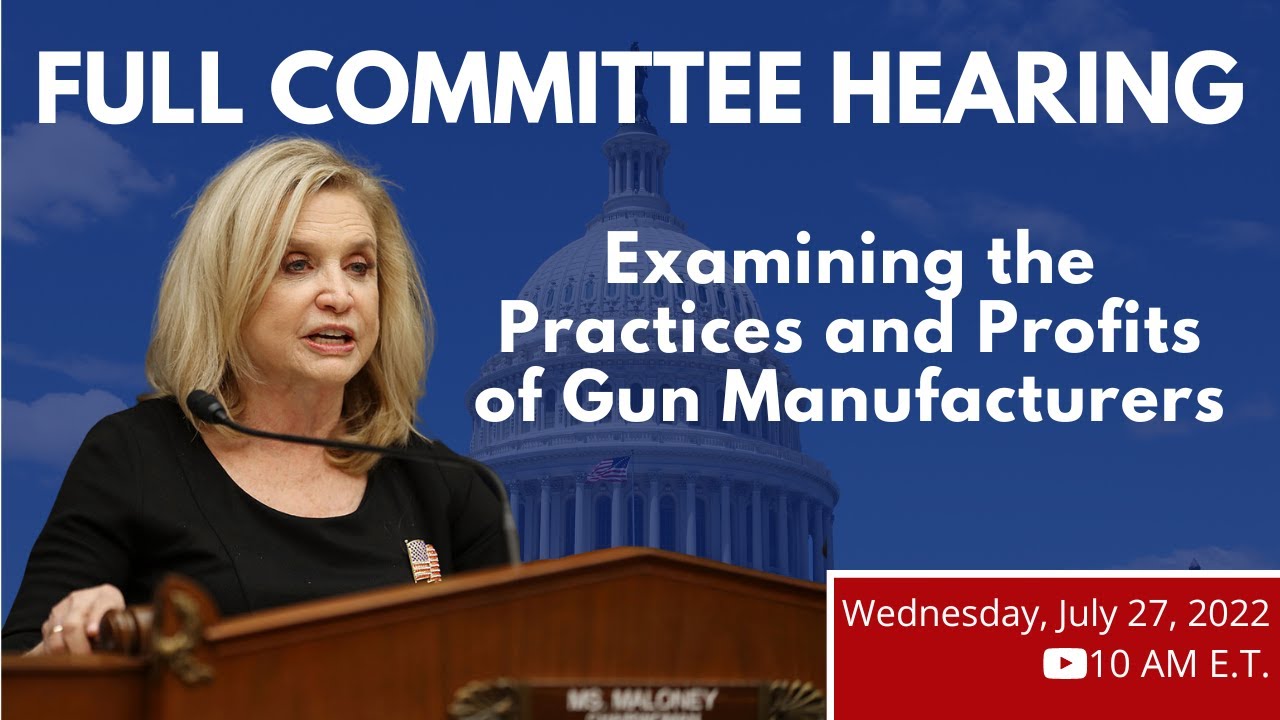 :{ }::{manufacturers of the targeted rifles, emphasizing that they make money by selling the guns that Democrats want to ban, a fact the bill's supporters view as self-evidently scandalous.}:
:{
}:
The Democrats on the committee offered little evidence to support that perspective. In particular, they failed to show that "assault weapons" are especially likely to be used for criminal purposes, as opposed to lawful purposes such as self-defense or sport, or that prohibiting the features listed in the proposed ban can reasonably be expected to have a meaningful impact on gun violence.
in a press release she issued today, committee Chairwoman Carolyn Maloney (D–N.Y.) repeatedly asserts that "AR-15-style assault rifles" are "the weapons of choice for murderers responsible for America's deadly mass shootings." She reiterated that claim at the hearing, calling such rifles "the weapon of choice in most mass murders."
That is clearly not true. According to a recent National Institute of Justice report on public mass shootings from 1966 through 2019, 77 percent of the perpetrators used handguns. About a quarter of the perpetrators used weapons that would be covered by legislation like H.R. 1808.
Mass shootings represent a tiny share of all gun homicides—somewhere between 0.2 percent and 2.6 percent of the total in 2020, depending on how mass shootings are defined. Contrary to Maloney's claim, handguns account for the vast majority of firearms used in mass shootings, and they account for an even larger share of weapons used in all gun homicides: more than 90 percent in cases where the type of firearm was specified, according to the FBI's 2019 data. Rifles of any sort, only a subset of which would qualify as "assault weapons," were used in less than 3 percent of those cases.
Prior to the federal "assault weapon" ban that expired in 2004, according to a widely cited study published that year, guns covered by such laws "were used in only a small fraction of gun crimes"—"about 2% according to most studies and no more than 8%." Most of those were pistols rather than rifles.
It is clear from these data that the rifles Maloney wants to ban, contrary to the impression she is trying to create, are rarely used to commit crimes. Given the popularity of such firearms, it follows that they are overwhelmingly used for lawful purposes.
"AR-15 rifles are among the most popular firearms in the nation, and they are owned by millions of Americans," the Firearms Policy Coalition notes in a lawsuit challenging New York's "assault weapon" ban. "A recent survey of gun owners indicates that about 24.6 million Americans have owned up to 44 million AR-15 or similar rifles….And according to industry sources, more than one out of every five firearms sold in recent years were rifles of the type banned by New York."
Maloney unwittingly underlines this point by complaining about rising sales of such rifles. "Gun manufacturers collected more than $1 billion from the sale of AR-15-style semiautomatic weapons in the last decade," she says, "and sales are increasing as gun deaths and mass shootings rise."
The New York Times likewise implies a causal connection between sales of these firearms and recent increases in gun homicides. "The leading manufacturers of assault rifles used to perpetrate the deadliest mass shootings in the United States have collected more than $1 billion in revenue over the past decade as gun violence across the country has surged," it says.
But for much of that decade, the homicide rate in the United States was flat or falling. It rose slightly in 2019, then jumped by 29 percent in 2020. Even on its face, that trend does not support the theory that Maloney and the Times are pushing.
Furthermore, that theory cannot possibly be true unless "assault weapons" played a major role in 2020 homicides. But according to a Pew Research Center analysis of FBI data, the share of homicides involving any sort of rifle in 2020 was similar to the percentage in 2019.
The Times seems unfazed by those numbers. Its reference to "gun violence across the country" includes a link to a March 23 story about the "surge in U.S. shootings." Although the story is illustrated by a photo of a man buying a rifle at a gun store, the article says nothing about "assault weapons." It opens with descriptions of three shootings but does not specify the firearms that were used.
Maloney today demanded that rifle manufacturers "apologize to the victims" of crimes committed with their products. "When someone pulls the trigger, you refuse to accept responsibility," she complained. The continued sale of "assault weapons," she said, is "the very definition of putting profits over people." Given the data on firearms used in homicides, including mass shootings, the same dubious logic would apply with much greater force to handgun manufacturers.
Yet the Supreme Court has said that the right to own handguns, which it described as "the quintessential self-defense weapon," is guaranteed by the Second Amendment, notwithstanding the prominent role that such firearms play in homicides. More generally, it said the Second Amendment covers bearable arms "in common use" for "lawful purposes," a description that plainly applies to the rifles that Maloney wants to ban, which play a much smaller role in violent crime.
Antonia Okafor, national director of women's outreach at Gun Owners of America (GOA), illustrated those lawful purposes by explaining why AR-15-style rifles are useful for self-defense. "The AR-15 allows women to have a larger firearm without having to absorb the recoil as much as one does with a smaller handheld firearm," she told the committee. "The AR-15 makes it easier for those who have a physical disadvantage [relative] to the attacker to have the upper hand. Having a rifle allows me the advantage of being able to shoot the attacker from much farther away than a standard handgun."
Okafor added that she is "the proud owner" of a Daniel Defense rifle, which is "by far lighter than any other rifle I own." She said it is "easier for me to hold" and does "an incredible job of absorbing the impact after each trigger pull." Those characteristics are appealing to elderly gun owners as well as women, she said, citing a GOA member who "use[d] an AR-15 to effectively stop a mass shooter" at his church in Sutherland Springs, Texas, five years ago.
Okafor also mentioned a 2019 incident in which "a woman in her ninth month of pregnancy" used "her family's AR-15" to "stop two armed attackers in her home." And she cited "a black Army veteran" who used an AR-15 to protect his family by "fend[ing] off two intruders from his home."
Such examples may not prove that AR-15-style rifles are superior to the alternatives for self-defense.But Maloney and likeminded politicians suggest they are good for nothing but mass murder, which is obviously not true. Maloney et al. want to limit gun buyers' choices based on that false premise.
As Rep. Andrew Clyde (R–Ga.) noted during the hearing, the distinctions drawn by H.R. 1808 make little sense if the aim is to reduce mass-shooting deaths. Under that bill, for example, a semi-automatic rifle that accepts detachable magazines would be illegal if it had a threaded barrel, a barrel shroud, or a folding stock. Yet removing those features would not make the rifle less deadly: It would still fire the same ammunition at the same rate with the same muzzle velocity.
President Joe Biden, who brags about supporting the expired 1994 "assault weapon" ban, nevertheless concedes that it left lots of equally lethal firearms on the market. He wants to "stop gun manufacturers from circumventing the law by making minor modifications to their products—modifications that leave them just as deadly." But those gun manufacturers were not "circumventing the law"; they were complying with the law, which required changes that, by Biden's own admission, left firearms "just as deadly." H.R. 1881 does not solve that problem, which is inherent in the arbitrary definition of "assault weapons."
ref vid
https://www.c-span.org/video/?c5025456/user-clip-072722-goa-antonia-okafor
...KEEP MANUFACTURERS USING IT TO SELL CANS ALL OF THE TIME. THE GUN INDUSTRY'S ROLE IN FUELING THE EPIDEMIC CANNOT BE UNDERSTATED. THAT CANNOT STAND AND I LOOK FORWARD TO YOUR QUESTIONS. THANK YOU. >> THANK YOU SO MUCH, YOU ARE NOW RECOGNIZED FOR YOUR TESTIMONY. >> THANK YOU, CHAIRWOMAN MALONEY, RANKING MEMBER CALMER, AND MEMBERS OF THE HOUSE OVERSIGHT COMMITTEE. THANK YOU FOR INVITING ME TO TESTIFY TODAY AND FOR GIVING ME THE OPPORTUNITY TO DEFEND THE RIGHTS OF MILLIONS OF AMERICAN GUN OWNERS TO OWN AND MAINTAIN AR-15S FOR SELF-DEFENSE. MY NAME IS ANTONIA WOO OKAFOR AND I AM A NATIONAL SPOKESPERSON. I'M A RANGE SAFETY OFFICER WHO SPECIALIZES WITH WORKING WITH WOMEN WITH TRAUMATIC BACKGROUNDS. I AM WHAT YOU WOULD CALL AN ACCIDENTAL ACTIVIST.
MY PARENTS WERE IMMIGRANTS FROM NIGERIA AND I GREW UP PRIMARILY WITH AN ANTI GUN, ANTI SECOND AMENDMENT MINDSET UNTIL MY ARRIVAL IN COLLEGE IN 2009, WHICH WAS GREATLY GRAVE AT THE EPIDEMIC OF SEXUAL ASSAULT OCCURRING AT UNIVERSITIES CROSS THE U.S..
AS A SEXUAL ASSAULT SURVIVOR MYSELF, I HAVE SINCE BECOME A PASSIONATE ADVOCATE OF EMPOWERING WOMEN, AND IN MY YEARS AS A RANGE SAFETY OFFICER AND FIREARMS INSTRUCTOR, I FOUND THAT MY FEMALE STUDENTS TEND TO GIVE THE AR-15 THE BEST REVIEW OVERALL. .
THIS YEAR, GUN OWNERS OF AMERICA PUT ON THREE EVENTS FOR WOMEN THAT LET NEW FEMALE SHOOTERS TRIAL AND ARRAY OF FIREARMS. HAND GUNS, RIFLES, SHOTGUNS. OUT OF ALL OF THE FIREARMS, IT WAS ALWAYS THE AR-15 THAT THEY RAVED ABOUT, MANY OF THEM SURPRISED, GIVEN THE ANTI AR-15 RHETORIC PUSHED BY ORGANIZATIONS SPENDING MILLIONS OF DOLLARS TRYING TO DETER THEM FROM OWNING ONE, THE AR-15 ALLOWS WOMEN TO HAVE A LARGER FIREARM WITHOUT HAVING TO ABSORB THE RECOIL, AS MUCH AS ONE DOES WITH A SMALLER HOW IT HANDLED FIREARM, THE AR 15 MAKES IT EASIER FOR THOSE WHO HAVE A PHYSICAL DISADVANTAGE THE ATTACKER, TO HAVE AN UPPER HAND.HAVING A RIFLE ALLOWS ME THE ABILITY TO SHOOT FOR MUCH FURTHER AWAY THAN THE STANDARD HANDGUN. THE NUMBER ONE REASON THAT WOMEN BUY FIREARMS IS FOR SELF-DEFENSE.
I AM A PROUD OWNER OF A DANIEL DEFENSE RIFLE, IT IS MY GO-TO RIFLE, IT IS BY FAR LighTER THAN ANY OTHER RIFLE I OWN. IT MAKES IT EASIER FOR ME TO HOLD AND IT STILL DOES AN INCREDIBLE JOB OF ABSORBING THE IMPACT AFTER EACH TRIGGER PuLL. WOMEN HAD BEEN KNOWN TO USE RIFLES IN deFENCE FOR MANY INSTANCES BUT THE PEOPLE WHO HAVE USE THESE RIFLES USE RANGE FROM OLDER MEN TWO YOUNG WOMEN, IT GEO A SPOKES PERSON AND SENIOR LIVING USE AN AR-15 TO EFFECTIVELY STOP A MASS SHOOTER AT THE CHURCH IN HIS TOWN A FEW YEARS AGO. NOVEMBER 2019 IT WOMAN IN HER NINTH MONTH OF PREGNANCY IS HER FAMILY'S AR-15 TO STOP TWO ARMED ATTACKERS IN HER HOME.
AFTER THEY SEVERELY WOUNDED HER HUSBAND AND ATTEMPTED TO GRAB HER 11-YEAR-OLD DAUGHTER, THE WIFE GRABBED THE AR-15 AND DROVE THE ATTACKERS AWAY, ONE OF THEM WAS FOUND DEAD FROM THE ROUNDS SHE PUT IN HIM BEFORE THEY FLED FROM THE SCENE.
MORE RECENTLY, AND ATLANTA, A BLACK ARMY VETERAN PROTECTED HIS HOME AND FAMILY INSIDE, USING AN AR-15 TO FEND OFF TWO INTRUDERS FROM HIS HOME. HIS WIFE WAS HIDING INSIDE OF THE HOME, THE MAN USED HIS RIFLE IN DEFENSE OF HIS FAMILY, HOME, AND PROPERTY.
BANNING THESE FIREARMS WILL ONLY MAKE IT DIFFICULT FOR WOMEN LIKE ME TO PROTECT OUR FAMILIES, GARDEN BANS NEVER STOPPED BAD GUYS FROM GETTING FIREARMS.
AS MY WRITTEN TESTIMONY SHOWS, THE ORIGINAL BAN IN 1994 DID NOTHING TO REDUCE THE CRIME. CONSIDER ALL OF THE RECENT SHOOTINGS IN BUFFALO AND UVALDE, WHERE AIDED AND ABETTED BY GUN RESTRICTIONS THE BUFFALO SHOOTER INDICATED HIS VICTIMS WILL BE LIMITED IN THEIR ABILITY TO HOLD FIREARMS BY THE TOUGH FIREARMS RESTRICTIONS. 90% OF MY SHOOTINGS OCCUR AND GUN FREE ZONES.
A PRE-EXISTING SECOND AMENDMENT, THE RIGHT IS SELF PRESERVATION, THE SECOND AMENDMENTS PRIMARY FOCUS IS NOT ABOUT HUNTING,THIS SECOND AMENDMENT WAS PUT INTO THE CONSTITUTION AS PROTECTION OF THE PEOPLE AGAINST A OPPRESSIVE GOVERNMENT.
HISTORY HAS SHOWN, COUNTLESS TIME, THAT ANY GROUP WITHOUT THE MEANS OF KEEPING AND BEARING ARMS HAS REMAINED THE OPPRESSED PEOPLE GROUP. OUR HISTORY AMERICA HAS SHOWN OPPRESSION CORRELATED WITH GUN CONTROL.
EVEN AFTER BLACK PEOPLE FOUGHT ALONGSIDE THEIR WHITE COUNTERPARTS, THEY CAME HOME FROM INSTITUTIONS THAT TOOK AWAY FIREARMS FROM BLACK COMMUNITIES. COMMUNITIES THAT RELIED ON FIREARMS TO DETER ATTACKS FROM THE CLUE CLERKS CLAN.
MARTIN LUTHER KING JUNIOR APPLIED TwO TIMES FOR A CONCEALED CARRY UNIT, BOTH TIMES THEY REFUSED TO GIVE HIM ONE. IN CONCLUSION, BECAUSE OF THE MANY BENEFITS OF THE AR-15 FOR WOMEN AND THOSE WITH PHYSICAL DISADVANTAGES, INCLUDING THE FACT THAT OUR CONSTITUTION IS CLEAR, THAT NO GOVERNMENT BODY HAS THE POWER TO DETERMINE WHICH FIREARM I CHOOSE TO KEEP IN MY POSSESSION
https://www.breitbart.com/politics/2022/07/27/fact-check-gun-owners-america-spokeswoman-claims-94-percent-mass-shootings-occur-gun-free-zones/
fACT CHECK: Gun Owners of America Spokeswoman Claims ’94 Percent of Mass Shootings Occur in Gun-Free Zones’
689
gun-free-school-zoneWWJ/AP
AWR HAWKINS27 Jul 2022429
3:17
CLAIM: During Wednesday’s congressional testimony before the House Committee on Oversight and Reform, Gun Owners of America’s (GOA) Antonia Okafor said, “94 percent of mass shootings occur in gun-free zones.”
VERDICT: True, when “gun-free zones” are defined as “places where where general citizens couldn’t carry guns.”
Okafor’s testimony is part of the Committee on Oversight and Reform hearing “examining the practices and profits of gun manufacturers.”
The hearing centered on AR-15 rifles, which Okafor said she was proud to defend. She listed numerous instances in which law-abiding citizens have used AR-15s for self-defense, then noted that mass public attacks with ARs largely occur in gun-free zones.
Okafor intimated that the attackers enjoy the gun-free zones because they know they will not face armed retaliation.
She said, “It’s not surprising that 94 percent of mass shootings occur in gun-free zones.”
[lnx]
https://crimeresearch.org/2018/06/more-misleading-information-from-bloombergs-everytown-for-gun-safety-on-guns-analysis-of-recent-mass-shootings/ lott BS
In a 2014 study, updated in 2018 then again on July 6, 2019, the Crime Prevention Research Center (CPRC) showed that 94 percent of mass public shootings between 1950 and the date(s) of the study occurred in gun-free zones.
Mass shootings which occurred in gun-free zones during the study’s time frame include the Virginia Tech University attack, which killed 32 (April 16, 2007); the Fort Hood attack, which killed 13 (November 5, 2009); the Aurora movie theater attack, which killed 12 (July 20, 2012); the Sandy Hook Elementary School attack, which killed 26 (December 12, 2014); the D.C. Navy Yard attack, which killed 13 (September 16, 2013); the Chattanooga military base attack, which killed 5 (July 16, 2015); the Umpqua Community College attack, which killed 9 (October 1, 2015); the San Bernardino attack, which killed 14 (December 2, 2015); the Orlando Pulse attack, which killed 49 (June 12, 2016); the Parkland high school attack, which killed 17 (February 14, 2018); and the Santa Fe High School attack, which killed 10 (May 18, 2018).
AWR Hawkins is an award-winning Second Amendment columnist for Breitbart News and the writer/curator of Down Range with AWR Hawkins, a weekly newsletter focused on all things Second Amendment, also for Breitbart News. He is the political analyst for Armed American Radio and a Turning Point USA Ambassador. Follow him on Instagram: @awr_hawkins. Reach him at awrhawkins@breitbart.com. You can sign up to get Down Range at breitbart.com/downrange.
2nd Amendment Politics Antonia Okafor AR-15 Gun Free Zones Gun Owners of America
an 7 22
https://www.alternet.org/2022/07/ar-15-manufacturer-mass-shootings/
AR-15 manufacturer: Mass shootings are 'evil,' but what about the welfare of guns?
David Edwards and Raw Story July 27, 2022
The CEO of an AR-15 manufacturing company testified on Wednesday that mass shootings are "pure evil" -- but he said that it was the future of assault-style rifles that really "concerned" him.
In his opening remarks to the House Oversight Committee, Daniel Defense CEO Marty Daniel began by acknowledging that mass shootings like the one at a school in Uvalde, Texas were "evil acts."
"I am concerned, however, that the stated implied purpose of this hearing is to vilify, blame and try to ban over 24 million sporting rifles already in circulation that are lawfully possessed and commonly used by millions of Americans to protect their homes and loved ones," the CEO said, "to safely sport shoot with family and friends and to put food on the table as licensed hunters."
He added: "I believe in God and my faith guides me and my family. Fundamentally, I also believe there is good and evil in our lives and what we saw in Uvalde, Buffalo and Highland Park was pure evil."
Daniel asserted that the assault-style rifles sold today are "substantially the same as those [firearms] manufactured over 100 years ago."
"I believe that our nation's response needs not to focus on the type of gun but the type of persons who would commit mass shootings," he said.
Watch the video below or at this link.
more
8 Preposterous NRA Defenses of the AR-15 - Alternet.org ›
Like using a 'bazooka to hunt squirrels': John Thune ridiculed for ... ›
This is the type of damage an AR-15 can inflict — and why we need ... ›
RELATED ARTICLES AROUND THE WEB
Gunmaker Daniel Defense's Super Bowl stunt sheds lights on AR-15 ... ›
America's rifle: Why so many people love the AR-15 ›
What to know about the AR-15, the gun used in the Uvalde shooting ... ›
alexander et al suppress covid #, kids
https://www.alternet.org/2021/02/trump-administration
veema s on task force? pix]
Former President Donald Trump's administration is under fire for hindering the government's pandemic response and rolling back Centers for Disease Control and Prevention (CDC) coronavirus mitigation guidelines in an effort to protect his interests.
According to CNBC News, the latest reports stem from documentation compiled during the House Oversight investigationlaunched back in September 2020. Based on the documents, the Trump administration is said to have intentionally suppressed COVID-19 testing by rolling back the CDC guidelines.
To justify the scaling back of COVID testing, former Department of Health and Human Services (HHS) scientific advisor Paul Alexander argued there was little significance in testing asymptomatic individuals, according to emails obtained by the House Select Subcommittee on the Coronavirus Crisis.
"Testing asymptomatic people to seek asymptomatic cases is not the point of testing, for in the end, all this accomplishes is we end up quarantining asymptomatic, low-risk people and preventing the workforce from working," Alexander wrote shortly after HHS officials received an update about the CDC's guidelines. "In this light, it would be unreasonable based on the prevailing data to have widespread testing of schools and colleges/universities. This will not allow them to optimally re-open."
According to the Daily Beast, another report — which would have highlighted elevated death totals in young people — was an area of concern for Alexander. Although the report was true, Alexander emailed White House COVID Task Force Senior Adviser Scott Atlas warning that it was "very duplicitous to damage the administration."
Alexander said, "The timing of this is meant to interfere with school re-opening and we need to get something out fast to preempt this in the next day or so and I can work with you on it."
According to the documentation, Alexander also attempted to convince Atlas to "craft an op-ed .. disputing the reporting for on face value, it is meant to mislead."
After deep scrutiny about the rollback of guidelines, the CDC quietly backpedaled on the changes, replacing the previous guidance with recommendations suggesting that anyone who "has been in close contact with an infected person needs a Covid-19 test."
In December, email correspondence to HHS public-affairs adviser Michael Caputo also highlighted Alexander's attemptto advocate for the former president to consider a "herd immunity" strategy" for the United States in handling the coronavirus.
"There is no other way, we need to establish herd, and it only comes about allowing the non-high-risk groups expose themselves to the virus. PERIOD," Alexander's letter read. "Infants, kids, teens, young people, young adults, middle-aged with no conditions, etc. have zero to little risk…. so we use them to develop herd… we want them infected…."
The latest report comes less than one week after veteran election consultant Tony Fabrizio and Republican pollster John McLaughlin both released assessments of the 2020 election and what led to Trump's loss. Despite the former president's claims of voter fraud, both analyses suggest Trump's failed leadership amid the pandemic contributed significantly to his electoral defeat.
FROM YOUR SITE ARTICLES
- Trump administration is leaving states scrambling in the fight against ... ›
- DOJ lawyers admit the Trump administration is openly defying a ... ›
- Government official confirms stunning report about Trump ... ›
RELATED ARTICLES AROUND THE WEB
- House panel renews probe into Trump administration's interference ... ›
- Trump Administration Partners with CVS and Walgreens to Provide ... ›
- Trump administration influenced CDC guidance to suppress Covid ... ›
519 big fights on impeachment
House Oversight and Reform Committee
committee’s ranking Republican member Rep. Jim Jordan of Ohio. ~ aoc, elijah c, katie porter
https://www.alternet.org/2020/09/7-bombshell-allegations-in-a-damning-new-trump-administration-whistleblower-report/
a new whistleblower complaint from U.S. Department of Homeland Security employee Brian Murphy released Wednesday provided a slew of provocative and disturbing allegations of criminal behavior and abuse of authority within the Trump administration.
The document was released by the House Intelligence Committee, and it actually summarizes numerous previous complaints that Murphy, the principal deputy under secretary for the department’s Office of Intelligence and Analysis, has previously filed with the inspector general. The complaint alleged that he has since faced professional retaliation from his superiors because of his previous allegations, despite the fact that he is protected from such actions by federal law.
While the retaliation is condemnable on its own, most striking are the series of allegations the complaint described. It paints a picture of a department completely warped by the president’s distorted priorities and determined to cater to his whims and prejudices, regardless of the facts — sometimes putting the country in danger.
Here are seven key details:
1. Murphy said he was illegally directed to manipulate intelligence assessments to support aggressive border policies.
On or about October 29, 2018, Mr. Glawe informed Mr. Murphy that instructions from Mr. Taylor and Ms. Marquadt had been issued for Mr. Murphy to ensure the intelligence assessments he produced for Secretary Nielsen’s review supported the policy argument that large numbers of KSTs were entering the United States through the southwest border. Mr. Murphy declined to censor or manipulate the intelligence information, viewing it as an improper administration of an intelligence program, and stated to Mr. Glawe that doing what was being requested would constitute a felony.
2. The complaint makes a compelling case that former DHS Secretary Kirtjen Nielsen repeatedly and deliberately lied to Congress to exaggerate the threat at the border.
Murphy said that the secretary purposely tried to blur the distinction between “Known or Suspected Terrorists” (KSTs) and other categories of migrants, thereby misleadingly suggesting the border posed a greater threat of terrorism than it actually does. Even after he explained these distinctions to Nielsen, Murphy said, she consistently misled Congress about the matter:
Prior to Secretary Nielsen’s testimony before the House Judiciary Committee on December 20, 2018, Mr. Murphy attended a preparation session that went over the information within the proposed testimony. During that session, Mr. Murphy sought to clarify for Secretary Nielsen the distinction between a KST and a Special Interest Alien (“SIA”). An SIA is a term of art created by U.S. Customs and Border Protection meant to describe a category of migrants who come from countries where there is a significant terrorism threat but regarding whom there is no individualized basis for suspecting the person is themselves a terrorist. An SIA does not constitute a KST.
Notwithstanding the clarification provided by Mr. Murphy, he has a good faith belief that the testimony Secretary Nielsen subsequently provided on December 20, 2018, regarding KSTs constituted a knowing and deliberate submission of false material information. This assessment formed the basis of the anonymous OIG complaint Mr. Murphy submitted on November 2, 2018. On January 9, 2019, without consulting with Messrs. Glawe or Murphy, DHS issued a document – apparently crafted by Messrs. Wolf and Taylor, and Ms. Marquadt – entitled “Myth/Fact: Known and Suspected Terrorists/Special Interest Aliens”. The document contained erroneous information regarding the number of KSTs and SIAs encountered along the southwest border.
On March 5, 2019, Mr. Murphy participated in another preparation session with Secretary Nielsen, this time in advance of her testimony before the House Committee on Homeland Security. Messrs. Wolf and Taylor were also present. During the session, Mr. Murphy provided Secretary Nielsen with documentation reflecting that the number of documented KSTs crossing the southwest border only consisted of no more than three individuals, not 3,755 individuals as she had previously attested to in her testimony on December 20, 2018. 3 Mr. Wolf and Mr. Taylor responded by saying Secretary Nielsen should claim the details were classified, state any KST crossing was one too many and deflect away from addressing the significant discrepancy in the data. Mr. Murphy advised Secretary Nielsen that he did not believe that was appropriate, and noted that the few “known” KSTs who were apprehended were derivative contacts, in so much as they merely had a name or phone number of a person who was known to be in contact with a terrorist. At that point, Mr. Murphy was removed from the meeting by Mr. Wolf. He then informed Messrs. Glawe and Hanna what transpired that evening.
It is Mr. Murphy’s good faith belief that the testimony Secretary Nielsen delivered on March 6, 2019, regarding KSTs again constituted a knowing and deliberate submission of false material information. Mr. Murphy outlined that assessment in his anonymous May 13, 2019, OIG complaint.
3. Acting Deputy Secretary of Homeland Security Ken Cuccinelli illegally tried to distort intelligence reports he viewed as too favorable to asylum seekers, claiming they were concocted by the “Deep State,” the complaint said.
In December 2019, Mr. Murphy attended a meeting with Messrs. Cuccinelli and Glawe to discuss intelligence reports regarding conditions in Guatemala, Honduras, and El Salvador. The intelligence reports were designed to help asylum officers render better determinations regarding their legal standards. Mr. Murphy’s team at DHS I&A completed the intelligence reports and he presented them to Mr. Cuccinelli in the meeting. Mr. Murphy defended the work in the reports, but Mr. Cuccinelli stated he wanted changes to the information outlining high levels of corruption, violence, and poor economic conditions in the three respective countries. Mr. Cuccinelli expressed frustration with the intelligence reports, and he accused unknown “deep state intelligence analysts” of compiling the intelligence information to undermine President Donald J. Trump’s (“President Trump”) policy objectives with respect to asylum. Notwithstanding Mr. Murphy’s response that the intelligence reports’ assessments were consistent with past assessments made for several years, Mr. Cuccinelli ordered Messrs. Murphy and Glawe to identify the names of the “deep state” individuals who compiled the intelligence reports and to either fire or reassign them immediately.
After the meeting, Mr. Murphy informed Mr. Glawe that Mr. Cuccinelli’s instructions were illegal, as well as constituted an abuse of authority and improper administration of an intelligence program.
4. Under Secretary David Glawe was reportedly almost fired by Trump after he testified about the threat posed by Russian election interference.
In approximately September 2018, Mr. Glawe testified in front of the House Committee on Homeland Security. Mr. Murphy was not present during the testimony. Immediately following that hearing, Mr. Glawe informed Mr. Murphy that he had been “challenged” by Republican members of the Committee regarding Mr. Glawe’s confirmation of Russian interference in the 2016 elections. Mr. Glawe was subsequently summoned to the White House a few days after his testimony. Mr. Glawe informed Mr. Murphy that Secretary Nielsen had warned him that President Trump had demanded Mr. Glawe be fired. However, Secretary Nielsen and White House Chief of Staff, John Kelly, had convinced President Trump to “give Glawe another chance”. After that meeting at the White House, Mr. Glawe informed Mr. Murphy that while he (Mr. Glawe) would continue to support him on most matters he (Mr. Murphy) was on his own when it came to election interference assessments.
5. Acting DHS Secretary Chad Wolf told Murphy to stop reporting on Russian interference and to focus on China and Iran, which Murphy believed “would put the country in substantial and specific danger,” the complaint said.
In mid-May 2020, Mr. Wolf instructed Mr. Murphy to cease providing intelligence assessments on the threat of Russian interference in the United States, and instead start reporting on interference activities by China and Iran. Mr. Wolf stated that these instructions specifically originated from White House National Security Advisor Robert O’Brien. Mr. Murphy informed Mr. Wolf he would not comply with these instructions, as doing so would put the country in substantial and specific danger.
6. Officials were concerned that discussing the threats posed by white supremacists and Russian intelligence operations would reflect badly on Trump, and they preferred that Murphy’s team work on “violent ‘left-wing’ groups” like “antifa.”
These changes would clearly better match Trump’s preferred rhetoric, though not reality.
In March 2020, Mr. Murphy’s team at DHS I&A completed a Homeland [Threat] Assessment (“HTA”). Completion of the HTA was a requirement set forth by Acting Secretary Kevin McCleenan prior to his departure from DHS. Mr. Murphy was intimately involved in the editing and crafting of the HTA. Following its completion, the HTA was distributed by Mr. Glawe to Messrs. Wolf, Cuccinelli, and Gountanis. Shortly after the distribution, Mr. Glawe was informed that further distribution of the HTA was prohibited due to concerns raised by Messrs. Wolf and Cuccinelli regarding how the HTA would reflect upon President Trump. Two sections were specifically labeled as concerns: White Supremacy and Russian influence in the United States. Mr. Murphy stated to Mr. Glawe that this constituted an abuse of authority by Messrs. Wolf and Cuccinelli, and Mr. Glawe concurred with that assessment.
In May 2020, Mr. Glawe retired, and Mr. Murphy assumed the role of Acting Under Secretary. In May 2020 and June 2020, Mr. Murphy had several meetings with Mr. Cuccinelli regarding the status of the HTA. Mr. Cuccinelli stated that Mr. Murphy needed to specifically modify the section on White Supremacy in a manner that made the threat appear less severe, as well as include information on the prominence of violent “left-wing” groups. Mr. Murphy declined to make the requested modifications, and informed Mr. Cuccinelli that it would constitute censorship of analysis and the improper administration of an intelligence program.
…
During multiple meetings between the end of May 2020 and July 31, 2020, Mr. Murphy made protected disclosures to Messrs. Wolf and Cuccinelli regarding abuse of authority and improper administration of an intelligence program with respect to intelligence information on ANTIFA and “anarchist” groups operating throughout the United States. On each occasion, Mr. Murphy was instructed by Mr. Wolf and/or Mr. Cuccinelli to modify intelligence assessments to ensure they matched up with the public comments by President Trump on the subject of ANTIFA and “anarchist” groups. Mr. Murphy declined to modify any of the intelligence assessments based upon political rhetoric, and advised both officials he would only report accurate intelligence information as collected by DHS I&A.
7. Classified material
Much of what is concerning about the complaint is what it doesn’t mention. At several points, the complaint makes clear it can’t repeat the substance of allegations regarding DHS officials because the material involved is classified. This is particularly concerning because other parts of the complaint indicate that officials abused the classification system to cover up embarrassing or inconvenient facts.
Additional point: One interesting point to note is that Murphy tried to push back on some reporting that was critical of DHS because it supposedly implied falsely that DHS was collecting intelligence information on journalists and reporters.
Murphy claims this didn’t happen. Putting aside the particulars, this detail in the report may be seen as bolstering Murphy’s credibility. Defenders of the administration will likely argue he’s a disgruntled employee trying to hurt Trump and DHS, but it’s notable that he seems to be willing to defend the department when he thinks the facts have been unfairly reported. This suggests Murphy is someone who cares about getting to the truth, rather someone who is trying to hurt the president and the administration no matter the cost:
To be unequivocally clear, the press reporting was significantly flawed and, in many instances, contained completely erroneous assertions. For example, DHS I&A never knowingly or deliberately collected information on journalists, at least as far as Mr. Murphy is aware or ever authorized. There were, to be sure, efforts to track publicly available media reporting that included information that had been leaked from the U.S. Government, including publicly-accessible posts by journalists on social media, but DHS I&A did not seek authorization to and was not engaging in surveillance of journalists’ private data.
==
1119 ===
no lnx
House committee sues AG Barr in wake of judge’s ruling that declared ‘presidents are not kings’
Written by David Badash / The New Civil Rights Movement November 26, 2019
The House Oversight Committee wasted no time in filing a lawsuit against Attorney General Bill Barr and Commerce Secretary Wilbur Ross, suing both Trump appointees for failure to respond to subpoenas demanding documents.
Declaring “President Trump and his aides are not above the law,” Oversight Chairwoman Carolyn Maloney on Tuesday announced, “I am filing this enforcement action today because the Trump Administration’s brazen obstruction of Congress must not stand.”
Politico reports Maloney is seeking documents related to the 2020 Census, and the Trump administration’s attempts to add a citizenship question to the constitutionally-mandate survey.
That question was the brainchild of a Republican strategist, now deceased, who wrote it would depress participation in the Census by minorities, effectively granting Republicans greater representation in the House and other areas – including where $675 billion in federal funds are spent.
One federal judge declared if the citizenship question made it onto the census, “hundreds of thousands — if not millions — of people will go uncounted.”
The Trump administration has ignored many subpoenas from House Democrats. On Monday a federal judge ruled former White House Counsel Don McGahn could not ignore a subpoena and must testify before Congress.
“Stated simply, the primary takeaway from the past 250 years of recorded American history is that Presidents are not kings,” Judge Ketanji Brown Jackson wrote in her 118-page ruling Monday.
==
==
AN
...
Horrified by the very real possibility that Democrats will retake control of the House of Representatives in November, Republican lawmakers are reportedly circulating a private spreadsheet that has been dubbed the "hell list," which consists of investigations the GOP fears Democrats will launch if they are successful in the upcoming midterms.
According to Axios, which obtained a copy of the spreadsheet, the document "catalogs more than 100 formal requests from House Democrats this Congress, spanning nearly every committee."
"The spreadsheet includes requests for administration officials to be grilled by committee staff, requests for hearings to obtain sworn testimony, efforts to seize communications about controversial policies and personnel decisions, and subpoena threats," Axios reported on Sunday. "These demands would turn the Trump White House into a 24/7 legal defense operation."
While the GOP's control of the House has allowed them to shut down the minority party's investigative requests—which have touched a wide range of topics, from President Donald Trump's tax returns to the federal government's wholly inadequate response to Hurricane Maria—the prospect of Democrats winning back the House has "churned Republican stomachs," as it would give Democrats the subpoena power they currently lack.
Here are just some of the items on the GOP's spreadsheet, as reported by Axios:
- President Trump's tax returns
- Trump family businesses — and whether they comply with the Constitution's emoluments clause, including the Chinese trademark grant to the Trump Organization
- Trump's dealings with Russia, including the president's preparation for his meeting with Vladimir Putin
- The payment to Stephanie Clifford — a.k.a. Stormy Daniels
- James Comey's firing
- Trump's firing of U.S. attorneys
- Trump's proposed transgender ban for the military
- Treasury Secretary Steven Mnuchin's business dealings
- White House staff's personal email use
- Cabinet secretary travel, office expenses, and other misused perks
- Discussion of classified information at Mar-a-Lago
- Jared Kushner's ethics law compliance
- Dismissal of members of the EPA board of scientific counselors
- The travel ban
- Family separation policy
- Hurricane response in Puerto Rico
- Election security and hacking attempts
- White House security clearances
"Lawyers close to the White House tell me the Trump administration is nowhere near prepared for the investigatory onslaught that awaits them, and they consider it among the greatest threats to his presidency," Axios's Jonathan Swan noted on Sunday.
Reacting to reports of the GOP's secret spreadsheet on Sunday, Simon Maloy of Media Matters noted that Republicans have essentially "documented all the work they should be doing but aren't, and sent the list around to make sure everyone gets busy figuring out ways to prevent other people from doing it."
Huffington Post reporter Matt Fuller added sarcastically that the list "really highlights how seriously Republicans have taken their executive oversight responsibilities."
According to a report by the Huffington Post's Paul Blumenthal last week, Democrats on the House Oversight Committee "have asked the Republican majority to issue subpoenas related to the administration’s conduct 52 times during the first 20 months of Donald Trump's presidency. Republicans turned down each of those 52 requests. If Democrats held the committee gavel, the subpoenas would be approved."
In a statement on Friday, Rep. Elijah Cummings (D-Md.)—the ranking Democrat on the House Oversight Committee—vowed to move forward with these investigations into the Trump administration's corruption if his party takes back the House
==
==
House Oversight Committee Chairman Trey Gowdy (R-SC) on Wednesday sent a request to Housing and Urban Development Secretary Ben Carson for information related to his purchase of a $31,000 dining set for his office.
Gowdy’s request, which featured three categories of documents related to Carson’s expensive taxpayer-funded redesign, was issued “to help the [Oversight] Committee determine whether HUD adhered to the applicable spending limitations while redecorating your office.”
In addition to the revelation of the dining set, which was purchased last December while HUD cut their homeless assistance budget, The Guardian reported that Carson intends to spend an additional $165,000 on a “lounge set” for his office.
https://www.alternet.org/news-amp-politics/even-republican-congressman-trey-gowdy-openly-questioning-ben-carsons-lavish
==
...
Political Operatives Replace Scientists
Smith's first subpoena came only after a contentious debate and party-line vote in the committee. But his powers were greatly expanded in 2015, when the House leadership allowed him unilateral subpoena power. Smith said it was necessary because, under Obama, "federal agencies often stonewalled the committee's constitutional obligations to conduct oversight." He would issue 25 subpoenas over the next two years, against scientists, regulators, environmental groups and even state attorneys general.
Smith also hired seven staffers from the aggressive House Oversight and Government Reform Committee, which had provided fodder for Republican attacks on the Obama administration with its probes on Benghazi, IRS treatment of conservative groups, solar manufacturer Solyndra's bankruptcy and other issues. "In 2015, it became increasingly apparent that the Obama administration was advancing a one-sided, unconstitutional agenda," Smith told InsideClimate News. "We needed to bring in staff who had strong backgrounds in conducting oversight of government agencies and getting them to answer questions."
...
In one instance, Smith acted with a like-minded Republican committee chairman, Jason Chaffetz of House Oversight, to demand internal documents on one of the Obama administration's most contentious regulations, intended to protect thousands of waterways and marshlands. After Chaffetz obtained memos showing an interagency dispute over the rule, he released them. EPA's foes, including the oil industry, which would not normally have had access to the records, sought to introduce them in a court challenge to the new clean water regulation. "Once documents have been disclosed and widely disseminated, an agency has waived any deliberative process or other privilege that may have applied," argued North Dakota's attorney general, the lead litigant.
In letters to Smith, EPA repeatedly raised its concern about the risk of releasing documents in cases involving the Clean Water Act, the regional haze pollution standards, a decision over a controversial copper mine decision in Alaska, and others.
Rep. Lamar Smith, speaking here with John Holdren, director of the White House Office of Science and Technology Policy under President Barack Obama, strongly opposed the Obama administration's efforts to reduce power plant emissions.
foto
Smith's most dramatic rush to the legal defense of the fossil fuel industry was his unprecedented move last year to issue subpoenas to two state attorneys general and several nongovernmental advocacy groups over the states' climate change fraud investigation of Exxon. He accused the attorneys general of colluding with environmentalists, violating Exxon's free speech rights and chilling private sector science funding.
114th 2016 GOP
Dems
- Elijah Cummings, Maryland, Ranking Member
- Carolyn Maloney, New York
- Eleanor Holmes Norton, District of Columbia
- William Lacy Clay, Jr., Missouri
- Stephen Lynch, Massachusetts
- Jim Cooper, Tennessee
- Gerry Connolly, Virginia
- Matt Cartwright, Pennsylvania
- Tammy Duckworth, Illinois
- Robin Kelly, Illinois
- Brenda Lawrence, Michigan
- Ted Lieu, California
- Bonnie Watson Coleman, New Jersey
- Stacey Plaskett, U.S. Virgin Islands
- Mark DeSaulnier, California
- Brendan Boyle, Pennsylvania
- Peter Welch, Vermont
- Michelle Lujan Grisham, New Mexico
==
Doniger:
Cross-posted from the Natural Resources Defense Council.
There's lots going on in the center ring of the Congressional Carbon Circus today. Both the House and Senate are expected to vote this afternoon on bills to block the Environmental Protection Agency from doing its job under the Clean Air Act to safeguard Americans from the dangerous carbon pollution that drives global warming. And Republicans keep trying to force EPA-blocking "riders" onto funding legislation that must pass this week to avoid shutting down the government.
To their credit, the Obama administration and congressional Democrats appear to be standing firm. Yesterday, the administration promised to veto [PDF] the EPA-blocking bill that will hit the House floor today, and the president spoke out against the budget riders: "What we can't be doing is using last year's budget process to have arguments about abortion; to have arguments about the Environmental Protection Agency." Editor's note: Obama did not quite "promise" to veto the bill, as [David Roberts explains.]
While the Republicans appeal to their base, polls show that the president and the Democrats are on surer political ground. In both national [PDF] and district-by-district polls, Americans strongly back EPA authority to protect their health from carbon pollution, by margins of well over 60 percent. (Additional polling information can be found at the end of my testimony.)
As this high drama plays out in the center ring, I'll be testifying in one of the circus's smaller side rings, at a hearing on "Assessing the Impact of EPA's Greenhouse Gas Regulations on Small Business." This is another in a series of when-did-you-stop-beating-your-wife hearings on the costs (but never the benefits) of government regulations, before subcommittees of House Oversight and Investigations Committee chaired by Rep. Darrell Issa (R-Calif.).
The script calls for the majority's witnesses to expound on how the EPA's carbon safeguards are killing the job generators of our economy. I will offer the token dissenting view. Here are highlights of what I'll say (my full statement is posted here and you can watch live here):
Mr. Chairman, the other witnesses you have heard are pursuing a false story-line that demonizes the Environmental Protection Agency and the modest steps it is taking to begin reducing dangerous carbon pollution. Contrary to that false story-line, EPA is doing just what Congress told the agency to do when it wrote the Clean Air Act. Congress gave EPA the duty to keep abreast of developing science, and to act when science shows that pollution endangers our health and welfare.
The EPA endangerment finding is backed by solid scientific authority. America's own most authoritative scientific body, the National Academy of Sciences (NAS), concluded in 2010:
"Some scientific conclusions or theories have been so thoroughly examined and tested, and supported by so many independent observations and results, that their likelihood of subsequently being found to be wrong is vanishingly small. Such conclusions and theories are then regarded as settled facts. This is the case for the conclusions that the Earth system is warming and that much of this warming is very likely due to human activities."
H.R. 910, the extreme bill that the House of Representatives is on the verge of adopting, would take the unprecedented step of repealing an expert agency's formal scientific finding of a threat to health and welfare. Congress has never done this before, and you should not start now. Politicians do not prosper long when they put themselves in the position of denying modern science. Repealing EPA's scientific determination that carbon pollution causes dangerous climate change would be like repealing the Surgeon General's finding that tobacco smoke causes cancer. H.R. 910 will harm the health and the pocketbook of millions of Americans. It is both bad policy and deeply unpopular.
The Clean Air Act's critics get the economics of environmental safeguards completely backwards. Rather than hurting economic growth, four decades of data show that the Clean Air Act helps our economy grow while it protects the health of millions of Americans. Over the past 40 years, the American economy has tripled in size while we've cut some forms of pollution by more than 60 percent. That's because the Clean Air Act does not demand the impossible -- it requires only pollution controls that are achievable and affordable. That's just as true when setting carbon pollution standards as it has been for other kinds of pollution.
EPA is taking great care to protect American families and American small businesses that are the focus of this hearing. In fact, EPA has set carbon pollution standards for new cars, SUVs, and over-the-road trucks that will save billions of dollars for American families and small businesses by cutting their gasoline and diesel fuel bills. And EPA has gone to great lengths to exempt the millions of American small businesses from any obligationsas it begins to address carbon pollution from only the very largest industrial sources, such power plants and oil refineries.
Thanks to EPA's landmark clean car standards, small businesses will save big-time at the gas pump. Under the Clean Car Agreement brokered by the Obama administration, EPA, acting together with the Department of Transportation (DOT) and California, has set combined carbon pollution and fuel economy standards that will lower gasoline bills for American small businesses and families by billions of dollars. The first round of standards, for 2012-2016 model cars, SUVs, vans, and pick-ups, will save small business owners as much as $3,000 over the life the vehicle. EPA's clean car standards for 2017-2025 will save small businesses even more -- as much as another $7,400 per car. I should note that these calculations were based on gasoline costs starting at $2.61/gallon! At today's and tomorrow's higher gas prices, the savings will be even greater.
EPA is also working with DOT and California on the first-ever carbon pollution and fuel economy standards for over-the-road trucks. Those standards, proposed last year, will save the owner of a heavy-duty truck up to $74,000over the truck's useful life. The money saved on diesel fuel will stay in the pockets of truck and fleet owners and will enable them to pass on savings to every American in lower costs for food and other goods.
Lobbyists for some of America's biggest polluters are falsely claiming that the Clean Air Act's carbon requirements will fall on millions of apartment buildings, office buildings, farms, and even churches. The truth is otherwise: EPA has exempted all small sources of carbon pollution from permit requirements for new and expanded sources. Instead, directly in line with congressional intent, EPA has focused those permit requirements on only the largest new and expanded sources of carbon pollution, such as power plants, oil refineries, and other big polluters.
When a company wants to build or expand a big plant that will operate for decades, it is only common sense to take reasonable steps to reduce how much dangerous pollution it will put into the air. So for decades, the Clean Air Act has required that someone -- either the state's environmental agency or the EPA as a last resort -- review what the new or expanded plant can reasonably do to reduce its pollution, and put achievable and affordable emission limits into a construction permit. But this review of available and affordable pollution control measures applies only to the largest sources of carbon pollution, like new power plants, oil refinery expansions, or other large projects. This is the same review that has been undertaken for decades for similar sources of other pollutants.
EPA has been sued by dozens of trade associations, companies, and right-leaning advocacy groups representing the country's biggest polluters. But when put to the test of provingtheir claims, they failed. The courts have found no merit in their claims of harm. This is no surprise, because the court challengers -- like the lobbyists who come up to the Hill -- are seeking not relief for the small fries, but special favors for the biggest polluters -- power plants, oil refineries, and the like. These pollution giants cannot complain to the courts about EPA's exempting smaller sources. Their attempt to hide behind the skirts of small businesses should fare no better here on the Hill.
Congressmen, you deny the science at your peril. Likewise, you buy into phony story-lines about burdens on small business at your peril. As I mentioned, large majorities of the American people support the Clean Air Act and want EPA to do its job to control air pollution. They specifically want EPA to do its job to safeguard us from carbonpollution. I've appended this polling data to my testimony as food for thought, and I welcome your questions.
I’m the policy director of the Natural Resources Defense Council’s (NRDC) Climate Center, and our chief global warming lawyer. I rejoined NRDC in March 2001 after serving for eight years in the Clinton administration, where I was director of climate change policy at the U.S. Environmental Protection Agency and, before that, counsel to the head of the EPA’s clean air program. I also served for a year at the Council on Environmental Quality. This is my second stint at NRDC — I first started here in 1978 and worked on clean air issues for the next 14 years, helping to win the Montreal Protocol to stop depletion of the ozone layer and the Clean Air Act amendments of 1990. Now we’re working to pass legislation to cap and cut the pollution that causes global warming, and to reach a new treaty for global emission cuts.
aka oversight and gov't reform?
http://oversight.house.gov/
http://oversight.house.gov/subcommittee/subcommittee-on-energy-policy-health-care-and-entitlements/ Lankford
speier, duckworth
E&E cite: ltr references firing but no specitics (mirror AG?]
With respect to the Environmental Protection Agency Office of Inspector General
(EPA OIG), the Chemical Safety and Hazard Investigation Board (CSB) refused to
provide requested documents relating to an EPA OIG investigation, arguing that
attorney-client privilege defeated the statutorily mandated Inspector General access.
While valid privilege claims might in certain circumstances appropriately limit the EPA
OIG’s subsequent and further release of documents, a claim of privilege provides no
basis to withhold documents from the EPA OIG in the first instance. Unable to obtain
access to these CSB documents, the EPA OIG ultimately filed a “Seven Day Letter”
under Section 5(d) of the IG Act in September 2013, noting and objecting to the
interference and seeking Congressional assistance. On June 18, 2014, the House
Oversight and Government Reform Committee held a hearing that addressed the EPA
Seven Day Letter along with related issues.
http://www.grassley.senate.gov/sites/default/files/issues/upload/IG%20Access%20Letter%20to%20Congress%2008-05-2014.pdf
==
http://en.wikipedia.org/wiki/United_States_House_Committee_on_Oversight_and_Government_Reform
The Committee on Oversight and Government Reform is a United States House of Representatives committee that has existed in varying forms since 1816.
The Committee on Oversight and Government Reform is the main investigative committee in the U.S. House of Representatives. After Republicans gained control of the House in 1995, the committee was reorganized to include just seven subcommittees. This reorganization consolidated the jurisdiction previously covered by 3 full committees and 14 subcommittees, and resulted in a 50 percent cut in staff.[1] In 2007, Henry Waxman, (D-CA) the chairman of the committee proposed an additional reorganization which combined the duties of the seven previous subcommittees into five. This reorganization was adopted by the full committee January 18, 2007.[2]
As of the 112th Congress, the Chairman of the House Oversight and Government Reform Committee is Rep. Darrell Issa of California and the Ranking Member is Maryland Congressman Elijah Cummings.
The Committee's government-wide oversight jurisdiction and expanded legislative authority make it one of the most influential and powerful committees in the House. The Committee serves as Congress' chief investigative and oversight committee, and is granted broad jurisdiction. The chairman of the committee is the only committee chairman in the House with the authority to issue subpoenas without a committee vote.[3]However, in recent history, it has become practice to refrain from unilateral subpoenas.[4]
Contents
- 1 Establishment and alumni of the Committee
- 2 Recent events, 1997–2009
- 3 Hearings and Investigations
- [3.1 Religion Freedom and Healthcare, February 16, 2012](http://en.wikipedia.org/wiki/United_States_House_Committee_on_Oversight_and_Government_Reform#Religion_Freedom_and_Healthcare.2C_February_16.2C_2012) - [3.2 Aaron Swartz prosecution](http://en.wikipedia.org/wiki/United_States_House_Committee_on_Oversight_and_Government_Reform#Aaron_Swartz_prosecution)- [4.1 113th Congress](http://en.wikipedia.org/wiki/United_States_House_Committee_on_Oversight_and_Government_Reform#113th_Congress) - [4.2 112th Congress](http://en.wikipedia.org/wiki/United_States_House_Committee_on_Oversight_and_Government_Reform#112th_Congress)
...
Subcommittee Chair Ranking Member Federal Workforce, U.S. Postal Service and the Census Blake Farenthold (R-TX) Stephen Lynch (D-MA) Government Operations John Mica (R-FL) Gerry Connolly (D-VA) :{Energy Policy,:(style="background-color:#fff200"):}: Health Care and Entitlements James Lankford (R-OK) Jackie Speier (D-CA) National Security Jason Chaffetz (R-UT) John F. Tierney (D-MA) Economic Growth, Job Creation and Regulatory Affairs Jim Jordan (R-OH) Matt Cartwright (D-PA) This Committee was very active during President Bill Clinton's term; it issued 1,052 subpoenas to probe alleged misconduct by the Clinton Administration and the Democratic Party between 1997 and 2002, at a cost of more than $35 million. Under this period, subpoenas could only be issued by the Committee chair, a rule change during the Clinton administration to facilitate investigations without delays caused by objections from minority members. By contrast, in the period between 1998 and 2007, chairman Thomas M. Davis and the Republican majority had permitted three subpoenas to the Bush administration, including one to the Defense Department over Hurricane Katrina documents.[5] The Boston Globe reported that an "examination of committees' own reports found that the House Government Reform Committee held just 37 hearings described as "oversight" or investigative in nature during the last Congress, down from 135 such hearings held by its predecessor, the House Government Operations Committee, in 1993–94, the last year the Democrats controlled the chamber."[6]
There was high interest in the priorities of the then newly installed Chairman Henry Waxman (D-CA) who told reporters after the November elections that "The most difficult thing will be to pick and choose" what to investigate.[7] Congressional leaders also renamed the Committee and five of its subcommittees to emphasize its new commitment to oversight responsibilities, and added a subcommittee on transparency.[8]
Between 2000 and 2006, various scandals were in the news that generated one or no subpoenas for testimony or documents. These events include the September 11, 2001 attacks, a leak of classified or secret information naming Central Intelligence Agency agent Valerie Plame, abuses and war crimes traced to the CIA in Abu Ghraib prison, evidence that charges that Iraq possessed weapons of mass destruction were knowingly false, illegal campaign contributions by lobbyists including Jack Abramoff, billions of dollars in preventable damage and thousands of deaths due to an incompetent response by the Federal Emergency Management Agency (FEMA) and its contractors during Hurricane Katrina in the U.S. Gulf Coast, and the suppression of accepted scientific data such as that of the :{National Aeronautics and Space Administration:(style="background-color:#fff200"):}:supporting the theory of :{global warming:(style="background-color:#fff200"):}: by :{Philip Cooney:(style="background-color:#fff200"):}:. After revelations in the Downing Street memo, a document containing incriminating information on the buildup to the Iraq War, Democrats in the minority were refused even a hearing chamber and were forced to meet in the basement of the U.S. Capitol Building on the matter.[9]
Since the November 2006 elections, The Washington Post published a series of investigative articles on the poor Congressional oversight of government contracts.[10][11][12][13]....
...
Aaron Swartz prosecution[edit]
Main article: Aaron Swartz
Issa, who chairs the House Oversight Committee, announced that he is investigating the Justice Department’s actions in prosecuting Swartz’s case.[25] In a statement to the Huffington Post, Issa praised Swartz’s work toward “open government and free access to the people.” Issa’s investigation has garnered some bipartisan support.[26]
On January 28, House Committee on Oversight and Government Reform chairman Issa and ranking member Elijah Cummings published a letter to Attorney General Holder, questioning whether prosecutors intentionally added felony counts to increase the amount of time Swartz faced in prison.[27] Indeed, the former 4 felony counts on July 14, 2011, jumped to 13 counts on Sept. 12, 2012.[28] Their letter read, in part:
It appears that prosecutors increased the felony counts by providing specific dates for each action, turning each marked date into its own felony charge, and significantly increasing Mr. Swartz’s maximum criminal exposure to up to 50 years imprisonment and $1 million in fines.[28]
Boston's WBUR has reported that US Attorney in charge for the Swartz prosecution, Carmen Ortiz, is expected to testify before the committee's upcoming probe into the handling of the Aaron Swartz case.[29]
And according to the Center on Responsive Politics, the Koch network has sunk at least $200,000 into the Oversight Committee. More than 87% has gone to committee Republicans, including more than $100,000 in support of Republicans currently on the committee. The list includes Chairman Issa and five subcommittee chairs (starred):
Rep. Darrell E. Issa (CA-49) – $12,500
Rep. John L. Mica (FL-07) – $7,500
Rep. Patrick T. McHenry* (NC-10) – $2,500
Rep. Jason Chaffetz* (UT-03) – $2,500
Rep. Connie Mack (FL-14) – $15,000
- Darrell Issa, California, Chairman
- John Mica, Florida
- Mike Turner, Ohio
- Jimmy Duncan of Tennessee
- Patrick McHenry, North Carolina
- Jim Jordan, Ohio
- Jason Chaffetz, Utah
- Tim Walberg, Michigan
- James Lankford, Oklahoma
- Justin Amash, Michigan
- Paul Gosar, Arizona
- Pat Meehan, Pennsylvania
- Scott DesJarlais, Tennessee
- Trey Gowdy, South Carolina
- Blake Farenthold, Texas
New Republicans for the 113th:
- Doc Hastings, Washington
- Cynthia Lummis, Wyoming
- Rob Woodall, Georgia
- Thomas Massie, Kentucky
- Doug Collins, Georgia
- Mark Meadows, North Carolina
- Kerry Bentivolio, Michigan
- Ron DeSantis, Florida
dems
- Elijah Cummings, Maryland, Ranking Member
- Carolyn Maloney, New York
- Eleanor Holmes Norton, District of Columbia
- John F. Tierney, Massachusetts
- William Lacy Clay, Jr., Missouri
- Stephen Lynch, Massachusetts
- Jim Cooper, Tennessee
- Gerry Connolly, Virginia
- Jackie Speier, California
New Democrats for the 113th:
- Matt Cartwright, Pennsylvania
- Tammy Duckworth, Illinois
- Danny K. Davis, Illinois
- Peter Welch, Vermont
- Tony Cardenas, California
- Steven Horsford, Nevada
- Michelle Lujan Grisham, New Mexico
- Robin Kelly, Illinois
By Brooke Williams and Matt Pearce
WASHINGTON -- First as ranking minority member and now as chairman of one of the most powerful committees in Congress, San Diego Republican Darrell Issa has built a team that includes staff members with close connections to industries that could benefit from his investigations.
Issa took control of the House Committee on Oversight and Government Reform last month, and asked companies, nonprofits and industry associations for guidance on federal regulations. The committee, which includes 23 Republicans and 17 Democrats, has broad powers to investigate government and industry, and to issue subpoenas.
Issa's staff already has released findings sympathetic to industries bent on softening or eliminating certain government regulations. A preliminary report this month, for example, focused largely on Environmental Protection Agency standards and relied heavily on input from industry associations. Other standards the committee is targeting include new regulations on workplace safety and the financial services industry.
And some on Issa's staff know this territory from the inside.
Several have ties to billionaire brothers David and Charles Koch, who have made much of their fortune in oil and chemical businesses and have established a reputation as staunch small-government conservatives. Their influence through campaign contributions, lobbying and nonprofit groups--such as Americans for Prosperity, an activist organization with connections to the Tea Party movement--has become more pronounced since the shift in power in the House last November.
A Republican staff counsel for the oversight committee is the son of a lobbyist pushing for regulatory changes on behalf of big corporations. At least four other staffers once lobbied Congress for companies and industry associations. Another counsel worked for the Alliance of Automobile Manufacturers, which Issa recently asked for input on government regulations.
Gary Bass, a regulatory expert who has monitored government transparency and spending for nearly three decades as founder of the nonprofit, OMB Watch, said it's business-as-usual to see Congressional committees staffed with people close to entities they monitor -- no matter which political party is in charge.
But Bass said that Issa has gone a step further by actively soliciting input from the business community, making the connection of his staff to those same business all the more troubling.
"What you're going to see are regulations that are tilted in favor of those interests," he said.
Frederick Hill, spokesman for Issa and the oversight committee, declined to answer questions about the staff's connections to lobbyists, business interests, the Koch companies, foundation or nonprofits.
"I only have a short comment for you on this subject," Hill wrote in an e-mail. "The Committee makes all hiring decisions based on the ability of individuals to help the committee do its job."
Issa declined to be interviewed for this article, as did representatives of Koch Industries, the conglomerate that the Koch brothers control.
Dave Levinthal, spokesman for the Center for Responsive Politics, a nonpartisan nonprofit that analyzes campaign finance and lobbying data, said that Issa's oversight committee needs to operate openly and to publicly disclose any potential conflicts.
"If there is even a whiff of conflict of interest, it's important for them to be transparent and upfront about any interests that the committee or its staffers might have," he said.
****
In mid-January, the Watchdog Institute, an independent nonprofit reporting center based at San Diego State University, obtained a list from majority spokesman Hill of 62 Republican committee employees in order to examine their work experience in light of Issa's ambitious investigative agenda.
The Institute also sought a list of Democratic staffers and contacted minority spokeswoman Jenny Rosenberg 11 times to obtain it. She only released the name of Staff Director David Rapallo.
The Committee on House Administration, which oversees the day-to-day operations of the House, released a list on Feb. 22 of all committee staff as of January, including more than 50 with the minority.
The Institute applied the same research standards to majority and minority staff members. Because the Democrats, however, haven't outlined an agenda akin to Issa's - aside from Friday's announcement to examine possible fraud in the mortgage industry - there wasn't a similar benchmark for the Institute to use to assess the backgrounds and corporate connections of the minority's staff.
Many among the minority are longtime Hill staffers. Some worked for government agencies, nonprofits or law firms. Others are former lobbyists with connections to labor, energy and the petroleum and chemical industries.
On the Republican side, more than three-quarters of the staffers have been hired since Issa took over as ranking member of the committee at the beginning of 2009. In most cases, the Institute did not identify connections to companies or industries with a stake in oversight investigations.
Among those that do have connections, some have ties to the Kochs.
One person completed aKoch Associate Program with the Charles G. Koch Charitable Foundation and coordinated a regulatory studies program at the Mercatus Center. The center, a think tank heavily funded by Koch and co-founded by Richard Fink, the executive vice president of Koch Industries, has a long history of advocating against government regulations.
Another staffer, Daniel Epstein, was at the Koch foundation and worked "together with Koch Industries Inc.'s assistant general counsel" before joining the committee as Republican counsel, according to a statement attributed to him in *The Hill* ((/)), a trade publication that covers Congress. Epstein did not respond to interview requests.
At least three more oversight staffers also have ties to the Mercatus Center, which counts two Koch Industries executives on its board of directors, including Charles Koch, the chairman and chief executive of Koch Industries.
Catherine Behan, spokeswoman for Mercatus, defended its independence, saying that its research is not guided or influenced by any outside business interests.
"We don't do directed research," she said. "No one comes to us and says 'we want to do a study on X.'"
In the past three years, Koch companies reported spending about $40.5 million lobbying on behalf of energy and manufacturing interests. The companies lobbied significantly on Environmental Protection Agency regulations--which oversight committee staffers scrutinized in a recent report and were the focus of many industry responses to Issa's solicitations for guidance on regulations.
Koch Industries does not appear among the more than 150 letters Issa sent to businesses soliciting their input about onerous government regulations. But Koch Industries has lobbied against some of the same laws that many businesses said they objected to when they responded to Issa's solicitation.
A lobbyist named Barney Skladany Jr. -- whose son, Jonathan Skladany, is Republican counsel on Issa's oversight team -- also lobbied Congress on environmental regulations that industries identified as onerous in their responses to Issa's request. Among Skladany Jr.'s clients: Dow Chemical, Mortgage Insurance Companies of America and Volkswagen. Jonathan Skladany declined to comment, and his father did not respond to an interview request.
***
Because of the oversight staff's connections to Koch Industries, the Watchdog Institute also examined Koch's campaign contributions to members of the oversight committee. Koch Industries has given more than $130,000 to sitting committee members since 2000, mostly to Republicans.
Current Republican committee members received at least $72,750 from Koch Industries in the last election. Most are freshman, who received at least $42,750.
Koch Industries began contributing to Issa's campaigns in 2008 and has given him at least $12,500.
Levinthal, of the Center for Responsive Politics, said the Koch brothers "have a portfolio filled with ways to influence the government."
"The committee at the end of the day may be more reflective of the interests that the company and its executives espouse," he said.
The oversight committee has made headlines consistently since Issa took charge, holding several hearings and issuing its first subpoena almost two weeks ago. (2-16-11) It also released responses from industries on its website.
In a Feb. 9 report, oversight staff explained that the committee is "uniquely positioned" to examine "barriers that stand in the way of job growth and economic recovery," saying the point is to "get Americans back to work."
The report recommended "additional scrutiny" of certain regulations, including EPA standards. The industry associations that provided the staff with input included at least two that count Koch companies as members.
Last year, as ranking minority member of the oversight committee, Issa was one of many committee members to cosponsor legislation -- lobbied on by Koch Industries -- opposing a decision from the EPA that would greatly expand the agency's authority to regulate air pollution.
Other interests also intersect on the oversight committee.
For example, an oversight committee counsel, Kristina Moore worked in the same office as Shane Karr, an auto alliance executive whom oversight staff interviewed for its report.
Moore did not respond to an interview request. A spokesman for the auto alliance said Karr declined to be interviewed.
***
In February 2009, after Issa became the ranking Republican, he approved a trip to a Mercatus-funded retreat for his committee staff director, Larry Brady.
On his disclosure form, Brady, who did not respond to an interview request, cited the purpose of the trip: "Provide in-depth briefings on issues of relevance to oversight investigations."
That same month, the oversight committee brought on two alumni of the Mercatus Center as staffers -- including Moore, who returned to the committee after a brief stint at the Alliance of Automobile Manufacturers. The committee later hired at least two more Mercatus alumni.
Based at George Mason University in Virginia, Mercatus' activities overlap with the commercial and ideological interests of Charles Koch.
Mercatus received at least $7.6 million from the Charles G. Koch Charitable Foundation between 2006 and 2008, according to the most recent tax filings available online. The foundation did not return phone calls.
Mercatus' research policy states that "Mercatus financial supporters have absolutely no influence or control" over its work, and Behan said the Koch executives on the board have no influence either.
Still, Issa asked the Mercatus Center for regulatory advice in his recent solicitation blitz. In response, Mercatus outlined ways government regulations can hurt the economy.
Between Feb. 9 and Feb. 17, four Mercatus scholars testified at oversight committee and subcommittee hearings, including Veronique de Rugy, who was scheduled to speak at an exclusive Koch Industries conference in Aspen in June.
Koch Industries hosted another exclusive conference last month in Palm Springs--a semi annual event to discuss "strategies for combating the multitude of public policies that threaten to destroy America as we know it."
Two Mercatus scholars, as well as FOX News' Glenn Beck and the Wall Street Journal's Stephen Moore, were on the agenda of speakers at the Aspen conference.
Tyler Grimm, a new oversight committee staffer, contributed to Beck's book "Arguing With Idiots," and was a research assistant for Moore, an economic columnist.
Grimm did not respond to interview requests. Beck's spokesman said he was not available for an interview.
Moore said Grimm was "a good economist" and a good fit for the oversight committee's staff. Moore also said he thought highly of Mercatus' work.
"I think they've got some of the best economists in the country and that they're fair and balanced," he said.
And according to the Center on Responsive Politics, the Koch network has sunk at least $200,000 into the Oversight Committee. More than 87% has gone to committee Republicans, including more than $100,000 in support of Republicans currently on the committee. The list includes Chairman Issa and five subcommittee chairs (starred):
Rep. Darrell E. Issa (CA-49) – $12,500
Rep. John L. Mica (FL-07) – $7,500
Rep. Patrick T. McHenry* (NC-10) – $2,500
Rep. Jason Chaffetz* (UT-03) – $2,500
Rep. Connie Mack (FL-14) – $15,000
Rep. Tim Walberg (MI-7) – $20,000
Rep. James Lankford* (OK-5) – $10,000
Rep. Ann Marie Buerkle (NY-25) – $250
Rep. Pat Meehan (PA-7) – $7,500
Rep. Trey Gowdy* (SC-4) – $7,500
Rep. Frank Guinta (NH-1) – $5,000
Rep. Dennis Ross* (FL-12) – $10,000
Rep. Mike Kelly (PA-3) – $2,500
Doniger:
Cross-posted from the Natural Resources Defense Council.
There's lots going on in the center ring of the Congressional Carbon Circus today. Both the House and Senate are expected to vote this afternoon on bills to block the Environmental Protection Agency from doing its job under the Clean Air Act to safeguard Americans from the dangerous carbon pollution that drives global warming. And Republicans keep trying to force EPA-blocking "riders" onto funding legislation that must pass this week to avoid shutting down the government.
To their credit, the Obama administration and congressional Democrats appear to be standing firm. Yesterday, the administration promised to veto [PDF] the EPA-blocking bill that will hit the House floor today, and the president spoke out against the budget riders: "What we can't be doing is using last year's budget process to have arguments about abortion; to have arguments about the Environmental Protection Agency." Editor's note: Obama did not quite "promise" to veto the bill, as [David Roberts explains.]
While the Republicans appeal to their base, polls show that the president and the Democrats are on surer political ground. In both national [PDF] and district-by-district polls, Americans strongly back EPA authority to protect their health from carbon pollution, by margins of well over 60 percent. (Additional polling information can be found at the end of my testimony.)
As this high drama plays out in the center ring, I'll be testifying in one of the circus's smaller side rings, at a hearing on "Assessing the Impact of EPA's Greenhouse Gas Regulations on Small Business." This is another in a series of when-did-you-stop-beating-your-wife hearings on the costs (but never the benefits) of government regulations, before subcommittees of House Oversight and Investigations Committee chaired by Rep. Darrell Issa (R-Calif.).
The script calls for the majority's witnesses to expound on how the EPA's carbon safeguards are killing the job generators of our economy. I will offer the token dissenting view. Here are highlights of what I'll say (my full statement is posted here and you can watch live here):
Mr. Chairman, the other witnesses you have heard are pursuing a false story-line that demonizes the Environmental Protection Agency and the modest steps it is taking to begin reducing dangerous carbon pollution. Contrary to that false story-line, EPA is doing just what Congress told the agency to do when it wrote the Clean Air Act. Congress gave EPA the duty to keep abreast of developing science, and to act when science shows that pollution endangers our health and welfare.
The EPA endangerment finding is backed by solid scientific authority. America's own most authoritative scientific body, the National Academy of Sciences (NAS), concluded in 2010:
"Some scientific conclusions or theories have been so thoroughly examined and tested, and supported by so many independent observations and results, that their likelihood of subsequently being found to be wrong is vanishingly small. Such conclusions and theories are then regarded as settled facts. This is the case for the conclusions that the Earth system is warming and that much of this warming is very likely due to human activities."
H.R. 910, the extreme bill that the House of Representatives is on the verge of adopting, would take the unprecedented step of repealing an expert agency's formal scientific finding of a threat to health and welfare. Congress has never done this before, and you should not start now. Politicians do not prosper long when they put themselves in the position of denying modern science. Repealing EPA's scientific determination that carbon pollution causes dangerous climate change would be like repealing the Surgeon General's finding that tobacco smoke causes cancer. H.R. 910 will harm the health and the pocketbook of millions of Americans. It is both bad policy and deeply unpopular.
The Clean Air Act's critics get the economics of environmental safeguards completely backwards. Rather than hurting economic growth, four decades of data show that the Clean Air Act helps our economy grow while it protects the health of millions of Americans. Over the past 40 years, the American economy has tripled in size while we've cut some forms of pollution by more than 60 percent. That's because the Clean Air Act does not demand the impossible -- it requires only pollution controls that are achievable and affordable. That's just as true when setting carbon pollution standards as it has been for other kinds of pollution.
EPA is taking great care to protect American families and American small businesses that are the focus of this hearing. In fact, EPA has set carbon pollution standards for new cars, SUVs, and over-the-road trucks that will save billions of dollars for American families and small businesses by cutting their gasoline and diesel fuel bills. And EPA has gone to great lengths to exempt the millions of American small businesses from any obligationsas it begins to address carbon pollution from only the very largest industrial sources, such power plants and oil refineries.
Thanks to EPA's landmark clean car standards, small businesses will save big-time at the gas pump. Under the Clean Car Agreement brokered by the Obama administration, EPA, acting together with the Department of Transportation (DOT) and California, has set combined carbon pollution and fuel economy standards that will lower gasoline bills for American small businesses and families by billions of dollars. The first round of standards, for 2012-2016 model cars, SUVs, vans, and pick-ups, will save small business owners as much as $3,000 over the life the vehicle. EPA's clean car standards for 2017-2025 will save small businesses even more -- as much as another $7,400 per car. I should note that these calculations were based on gasoline costs starting at $2.61/gallon! At today's and tomorrow's higher gas prices, the savings will be even greater.
EPA is also working with DOT and California on the first-ever carbon pollution and fuel economy standards for over-the-road trucks. Those standards, proposed last year, will save the owner of a heavy-duty truck up to $74,000over the truck's useful life. The money saved on diesel fuel will stay in the pockets of truck and fleet owners and will enable them to pass on savings to every American in lower costs for food and other goods.
Lobbyists for some of America's biggest polluters are falsely claiming that the Clean Air Act's carbon requirements will fall on millions of apartment buildings, office buildings, farms, and even churches. The truth is otherwise: EPA has exempted all small sources of carbon pollution from permit requirements for new and expanded sources. Instead, directly in line with congressional intent, EPA has focused those permit requirements on only the largest new and expanded sources of carbon pollution, such as power plants, oil refineries, and other big polluters.
When a company wants to build or expand a big plant that will operate for decades, it is only common sense to take reasonable steps to reduce how much dangerous pollution it will put into the air. So for decades, the Clean Air Act has required that someone -- either the state's environmental agency or the EPA as a last resort -- review what the new or expanded plant can reasonably do to reduce its pollution, and put achievable and affordable emission limits into a construction permit. But this review of available and affordable pollution control measures applies only to the largest sources of carbon pollution, like new power plants, oil refinery expansions, or other large projects. This is the same review that has been undertaken for decades for similar sources of other pollutants.
EPA has been sued by dozens of trade associations, companies, and right-leaning advocacy groups representing the country's biggest polluters. But when put to the test of provingtheir claims, they failed. The courts have found no merit in their claims of harm. This is no surprise, because the court challengers -- like the lobbyists who come up to the Hill -- are seeking not relief for the small fries, but special favors for the biggest polluters -- power plants, oil refineries, and the like. These pollution giants cannot complain to the courts about EPA's exempting smaller sources. Their attempt to hide behind the skirts of small businesses should fare no better here on the Hill.
Congressmen, you deny the science at your peril. Likewise, you buy into phony story-lines about burdens on small business at your peril. As I mentioned, large majorities of the American people support the Clean Air Act and want EPA to do its job to control air pollution. They specifically want EPA to do its job to safeguard us from carbonpollution. I've appended this polling data to my testimony as food for thought, and I welcome your questions.
I’m the policy director of the Natural Resources Defense Council’s (NRDC) Climate Center, and our chief global warming lawyer. I rejoined NRDC in March 2001 after serving for eight years in the Clinton administration, where I was director of climate change policy at the U.S. Environmental Protection Agency and, before that, counsel to the head of the EPA’s clean air program. I also served for a year at the Council on Environmental Quality. This is my second stint at NRDC — I first started here in 1978 and worked on clean air issues for the next 14 years, helping to win the Montreal Protocol to stop depletion of the ozone layer and the Clean Air Act amendments of 1990. Now we’re working to pass legislation to cap and cut the pollution that causes global warming, and to reach a new treaty for global emission cuts.