Checks & Balance
1219, this node mostly a space to think about systemic aspect of const; it's our DNA/ operating system
merri ok
see MODERATION
SEE FASCISM RETALIATION
corp person CU 2010 shifted power to oligarchs/corps, but did that help disable c&B?
see new 1219 on gerry:
see doge budget musk vivek mtg
SEE IMPERIAL PReZ /UNITARY trump immunity
see auth fascism
SEE FED OVERREACH BS BAD FAITH
XO EXEC ORDER
LEO? severino see scotus 7 24 trump immunity = king
---
an 4 25
Over the years, conservative journalist David Brooks hasn't been shy about criticizing liberal and progressive ideas — including those he regards as "cultural Marxism." But Brooks is also an outspoken critic of President Donald Trump and the MAGA movement, which he believes has been terrible for conservatism.
In an article published by The Atlantic on April 7, Brooks describes two competing trends on the right: conservatives focused on ideas, and "reactionaries" whose top priority is offending the left. And he laments that thanks to Trumpism, the latter is prevailing on the right.
"The pathetic thing is that I didn’t see this coming even though I’ve been living around these people my whole adult life," Brooks explains. "I joined the conservative movement in the 1980s, when I worked in turn at National Review, The Washington Times, and The Wall Street Journal editorial page. There were two kinds of people in our movement back then: the conservatives and the reactionaries. We conservatives earnestly read Milton Friedman, James Burnham, Whittaker Chambers, and Edmund Burke. The reactionaries just wanted to shock the left."
READ MORE:'Really scary': Experts sound alarm on new GOP threat to military and other mail-in voters
Brooks continues, "We conservatives oriented our lives around writing for intellectual magazines; the reactionaries were attracted to TV and radio. We were on the political right but had many liberal friends; they had contempt for anyone not on the anti-establishment right. They were not pro-conservative — they were anti-left. I have come to appreciate that this is an important difference."
"Faux populists" in the MAGA movement, Brooks argues, "lust for worldly power" — even if they "ostentatiously identify as Christians."
"Trumpian nihilism has eviscerated conservatism," Brooks laments. "The people in this administration are not conservatives. They are the opposite of conservatives. Conservatives once believed in steady but incremental reform; Elon Musk believes in rash and instantaneous disruption. Conservatives once believed that moral norms restrain and civilize us, habituating us to virtue; Trumpism trashes moral norms in every direction, riding forward on a tide of adultery, abuse, cruelty, immaturity, grift, and corruption."
Brooks adds, "Conservatives once believed in constitutional government and the Madisonian separation of powers; Trump bulldozes checks and balances, declaiming on social media, 'He who saves his Country does not violate any Law.'"
READ MORE:'Efficiency at its finest': Critics slam Trump for firing 'backbone' of wildfire fighting
According to Brooks, the writing of author George Orwell is "a useful guide to what we’re witnessing" during Trump's second term.
Brooks writes, "(Orwell) understood that it is possible for people to seek power without having any vision of the good…. If there is an underlying philosophy driving Trump, it is this: Morality is for suckers. The strong do what they want and the weak suffer what they must. This is the logic of bullies everywhere."
---
---
2 25 all but gave up on checks and balance advise and consent max 3 mcconn murkowski and --- collins rolled on bondi?
// doge coup
an 2 25
Elon Musk, the richest man in the world, has been making unprecedented moves to slash federal spending with the blessing of President Donald Trump. As the head of the Department of Government Efficiency (which is not yet an official federal agency authorized by Congress), Musk is exploring major cuts to the Department of Education and plans to shut down USAID — the agency responsible for foreign aid. His team has also been granted access to the Treasury Department’s payments system. But unlike much of the country, some Senate Republicans couldn’t be bothered, NOTUS reported on Tuesday.
One major source of distress among experts is that Musk is rejecting appropriations laws passed by Congress -- in other words, taking authority over funding. Sen. Thom Tillis (R-N.C.) said these actions are indeed unconstitutional, but he is not concerned, saying: “Nobody should bellyache about that."
“That runs afoul of the Constitution in the strictest sense,” Tillis said. But “it’s not uncommon for presidents to flex a little bit on where they can spend and where they can stop spending.”
READ MORE:These 'relatively traditional' Trump Cabinet picks are actually 'spineless cowards': analysis
Other Republicans are glad that Musk is looking at cutting costs.
“He’s doing exactly what he should be doing,” Sen. Rick Scott (R-Fla.) said Monday. “He’s going through every agency and looking at how to make sure the money’s spent right.” And while Article I, Section 8 of the U.S. Constitution gives that job to Congress, Scott argued: “It doesn’t look like Congress is doing their job."
“The actions that have been taken with USAID are long overdue,” Sen. Bill Hagerty (R-Tenn.) said. “The agency is out of control.”
Unlike Tillis, Sen. John Kennedy (R-La.) said Musk has not violated the Constitution.
“Mr. Musk is acting under the authority of the president of the United States,” he said. “It’s perfectly legal, perfectly constitutional. And the issue, anyway, is not process. The issue is substance. Did they find wasteful spending, or not?”
READ MORE:'Unchecked power': Trump himself ordered firings of prosecutors working criminal cases against him
Still, some Republicans are concerned. Sen. Susan Collins (R-Maine), the top Republican on the Appropriations Committee, said she was “very concerned about Mr. Musk or any of his assistants going into federal agencies and demanding personal information on employees.” She said that his actions have not met “the requirements of the law.” BUT THEN VOTED FOR PAM BONDI?
Sen. Mike Rounds (R-S.D.) joined Republicans in defending Musk. “He’s working with the president, and they’re making recommendations in some cases on agencies,” he told NOTUS. “But the whole program here is that we’re spending way more money than what we’re bringing in.”
He added: “The president has the authority to operate the executive branch of government. So.”
READ MORE:'Call somebody who cares': GOP senator slammed over response to 'friends who are upset' FOGHORN
Click here to read NOTUS' report in full.
---
===
an 1 25
'Nothing is off the table': Trump may claim emergency to pass major policy without Congress
===
an 12 24
President-elect Donald Trump has been drawing vehement criticism from both Democrats and Never Trump conservatives over the more extreme picks for his incoming administration, including former Rep. Tulsi Gabbard (Trump's choice for national intelligence director), anti-vaxxer Robert F. Kennedy Jr. (Trump's pick to head the U.S. Department of Health and Human Services) and Fox News star Pete Hegseth (the Christian nationalist Trump is proposing for defense secretary).
Now, Trump is drawing even more criticism for choosing far-right conspiracy theorist Kash Patel to replace Christopher Wray as FBI director.
But the New York Times' Peter Baker, in an article published on December 2, stresses that Trump has responded to this criticism of nominees with angry "defiance."
READ MORE:**Why Kash Patel is Trump's 'scariest hire yet': report**
"His first selection for attorney general collapsed in spectacular fashion," Baker explains. "His choice for defense secretary is awash in scandal. His picks for intelligence, health and other posts are being panned. But if anyone thought that President-elect Donald J. Trump might be chastened, he has quickly demonstrated otherwise. Even with so many appointees already under fire, Mr. Trump has doubled down on defiance as he assembles his next administration."
Baker adds, "Rather than turning to more credentialed and respected choices with easier paths to Senate confirmation, Mr. Trump, in rapid-fire fashion, keeps naming more ideological warriors, conspiracy theorists and now even family members to senior government positions."
The Times reporter notes that Trump's "persistence in advancing unconventional appointments underscores" his desire to "surround himself this time with loyalists he can trust to carry out his agenda, including 'retribution' against his perceived enemies."
Attorney Gregg Nunziata, who formerly served as nominations counsel for Republicans on the Senate Judiciary Committee, believes that Trump is going out of his way to provoke GOP senators.
READ MORE:**'Quickly rot from within': Expert reveals 3 traits the US shares with declining empires**
Nunziata told the Times, "By insisting on highly provocative nominees, short on traditional qualifications but long on personal loyalty and zest for confrontation, he seems to be deliberately testing the Senate's capacity and willingness to play its constitutional role as a check on the president."
Former Deputy National Security Adviser Charles M. Kupperman considers Patel an especially frustrating pick.
Kupperman told the Times, "Kash is totally unqualified for this position. He is the dictionary definition of a sycophant. Appointing Kash as FBI director is Trump's ultimate statement that his second term will be driven by retribution. And it is a gross insult to citizens."
*Read Peter Baker's full New York Times article at this link (subscription required).
---
---
an 11 24
Democrats on the House Budget Committee said Friday that the plan Elon Musk and Vivek Ramaswamy outlined to eliminate spending already appropriated by the U.S. Congress would run afoul of a federal law enacted in response to former President Richard Nixon's impoundment of funds for programs he opposed.
In a Wall Street Journalop-ed published earlier this week, Musk and Ramaswamy specifically mentioned the 1974 Congressional Budget and Impoundment Control Act (ICA) only to wave it away, arguing it would not hinder their effort to enact sweeping spending cuts as part of the "government efficiency" commission President-elect Donald Trump appointed them to lead.
But House Budget Committee Democrats said Friday that the Nixon-era law and subsequent Supreme Court rulings make clear that "the power of the purse rests solely with Congress."
"Fifty years after the ICA became law, Congress once again confronts a threat attempting to push past the long-recognized boundaries of executive budgetary power," the lawmakers wrote in a fact sheet. "During his first administration, President Trump illegally impounded crucial security assistance funding for Ukraine in an effort to benefit his reelection campaign. Now, Donald Trump and his far-right extremist allies are pushing dangerous legal theories to dismantle that system."
"They want to give the president unchecked power to slash funding for programs like food assistance, public education, healthcare, and federal law enforcement—all without congressional approval," the Democrats continued. "American families would be forced to pay more for basic necessities, investment in infrastructure and jobs would decline, and our communities would become less safe. Instead of working within the democratic process, Trump and his allies want to sidestep Congress entirely. But the Constitution is clear: only Congress, elected by the people, controls how taxpayer dollars are spent."
"House Democrats are ready to fight back against any illegal attempt to gut the programs that keep American families safe and help them make ends meet."
The fact sheet was released days after Musk and Ramaswamy, both billionaires, offered for the first time a detailed explanation of their plan to pursue large-scale cuts to federal regulations and spending, as well as mass firings of federal employees, in their role as co-heads of the Department of Government Efficiency (DOGE).
The pair noted that Trump "has previously suggested" the ICA is unconstitutional and expressed the view that "the current Supreme Court would likely side with him on this question." The former president appointed half of the court's right-wing supermajority.
"But even without relying on that view, DOGE will help end federal overspending by taking aim at the $500 billion-plus in annual federal expenditures that are unauthorized by Congress or being used in ways that Congress never intended, from $535 million a year to the Corporation for Public Broadcasting and $1.5 billion for grants to international organizations to nearly $300 million to progressive groups like Planned Parenthood."
Other programs that would be vulnerable if Musk, Ramaswamy, Trump, and Rep. Marjorie Taylor Greene (R-Ga.)—who's set to lead a new related House subcommittee—get their way are veterans' healthcare, Head Start, housing assistance, and childcare aid, according toThe Washington Post.
Rep. Brendan Boyle (D-Pa.), the top Democrat on the House Budget Committee, said in a statement Friday that "the legal theories being pushed by Elon Musk and Vivek Ramaswamy are as idiotic as they are dangerous."
"Unilaterally slashing funds that have been lawfully appropriated by the people's elected representatives in Congress would be a devastating power grab that undermines our economy and puts families and communities at risk," said Boyle. "House Democrats are ready to fight back against any illegal attempt to gut the programs that keep American families safe and help them make ends meet."
---
---
mma
MAGA allies in the media make the case for Trump to ignore the Senate confirmation process
Written by Gideon Taaffe
Published 11/19/24
President-elect Donald Trump has called for Senate Republicans to let him make recess appointments for top positions in his upcoming administration, and his allies in right-wing media are making the case for his plan.
Trump named several picks for prominent cabinet positions that have drawn scrutiny for their inexperience and controversial statements, raising concerns that he is focused primarily on filling his administration with loyalists. He also signaled his intention to push through his picks without scrutiny by calling on Republican senators to let him make recess appointments.
His allies in right-wing media are now arguing that recess appointments would be justified and calling on senators to bend to his will and forgo their standard confirmation process.
Trump has demanded support to use recess appointments for top members of his cabinet, and he plans to fill multiple posts with right-wing media loyalists
- :{:{Trump posted on Truth Social on November 10 that “any Republican Senator seeking the coveted LEADERSHIP position in the United States Senate must agree to Recess Appointments.”As The Associated Press pointed out, Trump’s plan represents “a significant shift in power away from the Senate.” Though past presidents have confirmed appointments while Congress is in recess, it’s rare to use this process for high-level cabinet positions. The move would require Republican senators to pass a motion of adjournment with a simple majority vote. NBC News, [11/10/24; The Associated Press, 11/14/24]}:
}:
- Trump’s nominees include multiple right-wing media personalities who are loyal to him but have little to no relevant experience and have peddled conspiracy theories and extreme views.He has named multiple current and former Fox employees to top posts, including Pete Hegseth, Sean Duffy, Tom Homan, Tulsi Gabbard, Mike Huckabee, and Michael Waltz, along with frequent Fox guests including Robert F. Kennedy Jr. Media Matters, [11/13/24, 11/14/24, 11/15/24, 8/27/24; WNYC, On the Media, 11/15/24; Politico, 11/13/24; NPR, 11/16/24; CNN, 11/19/24]
- ## Trump’s MAGA allies in right-wing media are championing Trump’s plan to force his nominees through without Senate confirmation
- Center for Renewing America fellows Jeff Clark and Anthony Licata published a piece on the legality of Trump’s recess plan, saying he would be justified to pursue it.They wrote: “Given the extensive delays experienced during his first administration in getting the Senate to approve his nominees expeditiously, President-elect Donald Trump recently proposed the use of recess appointments, if necessary, to briskly stand up his new administration early next year. The question is whether the law and our history confirms the President’s belief that he should be allowed to assemble his Cabinet quickly via recess appointments? The answer is ‘yes.’” Center for Renewing America, [11/17/24]
- During an appearance on former Trump adviser Steve Bannon’sWar Roompodcast, Clark advocated for Trump to use the recess power.Clark claimed that “there are many of us who think that he [Trump] should” use the recess power in order to “set right the boundaries between the branches of the government.” Real America’s Voice, *War Room*, [11/18/24]
- Article III project founder Mike Davis responded to a question about recess appointments by saying, “Every option should be on the table.” Real America’s Voice, *War Room*, [11/18/24]
- Bannon told his audience members to call their senators and demand a 15-day recess for Trump to appoint his cabinet.Bannon told his audience that “we need you, when you call,” to tell your senator “the president needs 15 days recess — recess days in the first hundred.” Real America’s Voice, *War Room*, [11/11/24]
- Former Trump administration official Ric Grenell told Newsmax’s Greg Kelly that Senate Republicans should “at the very minimum, give him [Trump] a recess appointment and let the reform start.” Newsmax, *Greg Kelly Reports*, [11/15/24]
- :{Right-wing commentator :{Mike Crispi wrote: “Recess appointments solves all. It’s time to WIN!” Twitter/X:(style="background-color:#ffff00ff"):}:, [11/17/24]}:
- Far-right podcaster and Trump ally Laura Loomer attacked Senate Majority Leader-elect John Thune (R-SD) for saying the Senate might struggle to get the votes to recess.She wrote: “The joke is on everyone who fell for the unity nonsense this election season. Senate Republicans are about to screw President Trump.” Twitter/X, [11/15/24]
- Fox News host Laura Ingraham said: “I certainly hope that as they carry out their advise-and-consent role, Republican senators remember that Donald Trump is the reason they even have a majority.” Fox News, *The Ingraham Angle*, [11/14/24]
===
---
an 11 24
A senior Trump official has issued a threat to Senate Republicans: support and confirm the Cabinet and administration nominees Donald Trump is choosing or face a primary challenge funded by the world’s richest person, Elon Musk, according to a new report from ABC News.
Jonathan Karl, ABC’s Chief Washington Correspondent reports, “the Trump team will play hardball with Republicans who waiver [sic] on any of the president-elect’s nominees.”
“There’s votes coming,” the Trump advisor said, according to Karl. “And if you are on the wrong side of the vote, you’re buying yourself a primary. That is all. And there’s a guy named Elon Musk who is going to finance it.”
READ MORE: Byron Donalds ‘Not Surprised’ at Snub from Trump’s Nearly-All White Administration
“The president gets to decide his cabinet. No one else. That’s just the way it is,” that advisor added, Karl reports.
The U.S. Constitution requires the Senate to provide its “advice and consent” on a large number of presidential nominees, which is not a rubber stamp. It reads in part: the President “shall have Power, by and with the Advice and Consent of the Senate…”
Democratic strategist Matt McDermott responded to Karl’s reporting, observing: “This has never, in the history of American democracy, been ‘just the way it is.'”
Media critic Susan Bordson urged the press “to provide audiences meaningful context.”
READ MORE: ‘I’m Not Here to Fight’: First Trans Member of Congress Responds to Johnson’s Bathroom Ban
“No journalists covering executive public governance should be skittish about contextualizing these actions, she writes, calling the threats “a TRAIT of authoritarian-style governance.”
Journalist James Surowiecki warned, “Having one super-rich guy exercise massive influence over American politics is a very bad thing. I know Americans don’t really care about the nuts and bolts of democracy, but this is a true corruption of democracy.”
Jesse Lee, a former Biden White House National Economic Council senior adviser declared, “Oligarchy is here.”
ABC’s Selina Wang invoked Matt Gaetz’s name in her report, but Karl stated the threat applied to “any of the president-elect’s nominees.”
Minutes ago, Gaetz withdrew his name from consideration for Attorney General.
Watch ABC News’ report from Thursday below or at this link.
---
===
an 11 24
Donald Trump reportedly got a potentially devastating message from Senate GOP leader Mitch McConnell, and political observers are speaking up.
Trump already announced he would be relying on recess appointments to get some of his cabinet nominees pushed through, but McConnellsaid on Sunday that such a thing wouldn't happen, according to a news report.
Trump's controversial nominees include former GOP lawmaker Matt Gaetz, who has been investigated for drug use and allegedly having sex with a minor.
ALSO READ:Why Trump voters should be held accountable for their choice
After McConnell reportedly said, "There will be no recess appointments," social media was overtaken by talk of the upcoming standoff.
Former federal prosecutor Harry Litman said, "Lines are drawn."
"It would be sad as well as disgraceful if the Senate caved on this," he added. "And the stakes go beyond the political, and even the constitutional. It’s an inordinate and unnecessary national security risk."
HuffPost reporter Yashar Ali said, "McConnell will not be Senate Republican Leader soon, but he may be saying this based on conversations with his colleagues."
"The idea that the U.S. Senate will give up its authority on this matter with the flip of a switch is foolish," Ali said. "They’re not going to stop using pro-forma."
Economic advisor Patrick Chovanec said, "McConnell understands this would be the end of the Senate as we know it. Whether he's in any position to stand up against the MAGAs is the real question."
Correspondent Molly Jong-Fast simply said, "Let us pray."
Legal analyst Allison Gill, better known as Mueller, She Wrote, said, "But McConnell won't be the leader. Here's hoping, though."
===
==
rww
11/15/2024
by
- MAGA cultist pastor Shane Vaughn celebrates a potential plan by Donald Trump to forcibly shut down the Senate in order to install his radical Cabinet appointments: "This is what he meant when he said he would be a dictator on day one."
- Tony Perkins and Andrew McCarthy are
 to this plan.
- Lance Wallnau was at Mar-A-Lago last night, as was Joshua Feuerstein.
- Nazi-loving antisemite Jon Miller says that "Dietrich Bonhoeffer was a fake christian and a libtard."
- Finally, Eric Metaxas thinks that Trump should "have a rotating roster of Press Secretaries" so that he and others can fill in from time to time.
scotus coup
carl gibson jun 2024
The Supreme Court of the United States (SCOTUS) has grown far too powerful, and could permanently alter the government established by the framers if current trends continue, according to a conservative legal expert.
On Saturday, Norman Ornstein — who is an emeritus scholar at the Koch-funded American Enterprise Institute — offered a frank and stunning condemnation of SCOTUS in a post to X (formerly Twitter). After a wave of controversial rulings in the final week of its 2023-2024 term, Ornstein opined that the Supreme Court is rapidly transforming into courts seen in authoritarian governments seen in other parts of the world.
"I wonder how long it will take before Americans wake up to the brutal reality that the US Supreme Court has staged a coup, brazenly seizing power from the other two branches in a way that is utterly contrary to the framers vision of the role of a court and a judiciary," he tweeted. "And it is crystal clear that if [former President] Donald Trump wins, the Supreme Court will be much closer to the Russian or Hungarian courts than the one in our constitution."
READ MORE:**'Loss of trust': Growing chorus of federal judges speak out against 'out of step' SCOTUS**
Ornstein's tweet comes on the heels of a busy week for SCOTUS, with justices siding with a January 6 insurrectionist in his challenge of a criminal charge against him — potentially impacting charges filed against hundreds of other participants in the deadly attack on the U.S. Capitol. The Court also notably overturned 40 years of precedent after officially disposing of a long-respected legal process known as the Chevron Doctrine.
Under that doctrine — which was first established in the 1984 Chevron v. Natural Resources Defense Council case — courts deferred to experts within federal agencies to interpret how federal laws impact the industries those agencies are tasked with regulating. In summing up January’s oral arguments, SCOTUSBlog noted that Justice Ketanji Brown Jackson pointed out that if the Court overturned the Chevron Doctrine, it would mean policy decisions wouldn’t rest with experts working for federal agencies, but with the Court itself. After Friday's ruling overturning that precedent, the federal judiciary now has additional powers to set policy within all federal agencies.
Judges taking the place of experts in deciding how to interpret regulations could prove problematic, as Trump-appointed Justice Neil Gorsuch recently demonstrated in his opinion in a separate decision. Forbes reported that in the *Ohio v. Environmental Protection Agency* case, Gorsuch mistakenly referred to the pollutant nitrogen oxide as "nitrous oxide," which is the laughing gas used by oral hygienists.
Perhaps the most highly anticipated decision of this term is *Trump v. United States*, in which the former president is arguing that he has absolute broad criminal immunity for all official acts carried out as president. His D.C. election interference trial has been on hold while SCOTUS considered his argument, which was already rejected by the U.S. District Court for the District of Columbia and by a D.C. Circuit Court of Appeals panel. Despite flags seen flying outside two of conservative Justice Samuel Alito's homes that were carried by insurrectionists, the justice refused calls to recuse, and Chief Justice John Roberts declined to meet with two members of the Senate Judiciary Committee to discuss the incidents.
READ MORE:**Flag outside Alito's vacation home 'literally carried by insurrectionists': J6 investigator**
Ornstein isn't alone in his view of the Roberts Court becoming an increasingly partisan institution. Earlier this week, Newsweek reported that multiple federal judges appointed by both Democratic and Republican presidents are casting doubt on the Court's ability to rule on cases in an objective manner.
David S. Tatel, who was appointed by former President Bill Clinton to the D.C. Circuit, wrote in his memoir that his "low regard" for SCOTUS prompted him to retire from the bench.
"My views, I think, are widely shared throughout the judicial system," Tatel said. "Obviously, there are people who don't agree with them, but there are, I can assure you, a large number of judges who will not find anything I've said in this book surprising."
READ MORE:**'Political and traitorous decision': Experts outraged by SCOTUS taking Trump immunity case**
===
“Disdains democracy': Chief justice’s role in Trump immunity sparks outrage from legal experts](https://www.alternet.org/scotus-trump/) an 7 24
===
---
an 7 24
While the beltway media spent the last week haranguing President Joe Biden over his lackluster performance in the CNN presidential debate, former President Donald Trump largely got a pass despite several days of shenanigans that Rolling Stone described as a "week from hell."
In a Friday article, Rolling Stone reporters Tom Dickinson and Asawin Suebsaeng summed up how the former president exhibited increasingly unhinged behavior while the press scrutinized Biden's debate mistakes. On his Truth Social platform, Trump posted a meme of him and his wife, Melania, with the text "Where We Go One We Go All" – the slogan of the far-right cult QAnon. The graphic also featured the letter Q, in another nod to the conspiracy theorist movement that Trump is secretly battling a cabal of wealthy elite pedophiles and will one day bring them to justice (also known as "the storm").
This is merely the latest instance of the former president flirting with the movement that researchers have described as "a danger." A 2021 study by the National Consortium for the Study of Terrorism And Responses to Terrorism (START) found that QAnon adherents are prone to committing "acts of interpersonal violence, often targeting those around them, including their own children." Rep. Marjorie Taylor Greene (R-Georgia) was a devout QAnon believer before she was elected to Congress, though she has since tried to distance herself from the movement.
READ MORE:Trump hopes you won't notice 'close partnership' with Project 2025: former Labor Secretary
That same year, Sen. Martin Heinrich (D-New Mexico) released a report by the FBI and the Department of Homeland Security. That report found that, following Trump's defeat in the 2020 election, QAnon believers "likely will begin to believe they can no longer ‘trust the plan’ referenced in QAnon posts and that they have an obligation to change from serving as ‘digital soldiers’ towards engaging in real world violence."
Trump was also caught this week in a hot-mic moment in which he unleashed a profane tirade against both Biden and Vice President Kamala Harris while he was golfing. The ex-president wrongly stated that he had already forced Biden out of the race and that Harris would be his general election opponent.
"She’s so bad. She’s so pathetic. She’s just so f—ing bad," Trump was heard saying.
Dickinson and Suebsaeng also characterized Trump as having a "God complex" this week, in which he praised his debate performance as "the greatest single debate performance in the long and storied history of Presidential Debates." Opining that he was "feeling himself," the two journalists noted that Trump felt his 2024 bid for the White House was "guided by divine providence."
READ MORE:Revealed: Trump's hot-mic Biden conversation while sitting in golf court leaked online
As Rolling Stone reported, Trump reposted a Truth Social user's post of a photo of Trump with the text: "GOD HAS CHOSEN HIM TO LEAD THIS FIGHT FOR FREEDOM. GOD WINS!"
Also this week, Trump called for former Rep. Liz Cheney (R-Wyoming) to be prosecuted for "treason" via a "televised military tribunal." Former Republican National Committee senior official Doug Heye told the outlet that Trump is benefiting from a media double standard in which Biden's every slip-up is meticulously torn apart, while Trump's increasingly erratic behavior is given a ho-hum treatment.
"[H]is language, for years, has been so over-the-top that even with his record as president, he still gets graded on a massive curve by so many voters,” Heye says. “It’s already factored in, in a way that it could never be for almost any other candidate for the presidency. Trump saying something crazy is the oldest news there is at this point. It doesn’t mean it’s not crazy, and it doesn’t mean it’s not damaging. But this [dynamic] benefits him greatly.”
Click here to read Rolling Stone's report in its entirety (subscription required).
READ MORE:Trump: 'I know nothing' about Project 2025 despite numerous ex-officials' involvement
---
---
no lnx $
https://www.nytimes.com/2023/07/17/us/politics/trump-plans-2025.html
Donald J. Trump intends to bring independent regulatory agencies under direct presidential control.
Trump and Allies Forge Plans to Increase Presidential Power in 2025
The former president and his backers aim to strengthen the power of the White House and limit the independence of federal agencies.
Jonathan SwanCharlie Savage Maggie Haberman
By Jonathan Swan, Charlie Savage and Maggie Haberman
Published July 17, 2023
Updated July 18, 2023
Donald J. Trump and his allies are planning a sweeping expansion of presidential power over the machinery of government if voters return him to the White House in 2025, reshaping the structure of the executive branch to concentrate far greater authority directly in his hands.
Their plans to centralize more power in the Oval Office stretch far beyond the former president’s recent remarks that he would order a criminal investigation into his political rival, President Biden, signaling his intent to end the post-Watergate norm of Justice Department independence from White House political control.
Mr. Trump and his associates have a broader goal: to alter the balance of power by increasing the president’s authority over every part of the federal government that now operates, by either law or tradition, with any measure of independence from political interference by the White House, according to a review of his campaign policy proposals and interviews with people close to him.
:{:{}:
}:
Mr. Trump intends to bring independent agencies — like the Federal Communications Commission, which makes and enforces rules for television and internet companies, and the Federal Trade Commission, which enforces various antitrust and other consumer protection rules against businesses — under direct presidential control.
He wants to revive the practice of “impounding” funds, refusing to spend money Congress has appropriated for programs a president doesn’t like — a tactic that lawmakers banned under President Richard Nixon.
He intends to strip employment protections from tens of thousands of career civil servants, making it easier to replace them if they are deemed obstacles to his agenda. And he plans to scour the intelligence agencies, the State Department and the defense bureaucracies to remove officials he has vilified as “the sick political class that hates our country.”
“The president’s plan should be to fundamentally reorient the federal government in a way that hasn’t been done since F.D.R.’s New Deal,” said John McEntee, a former White House personnel chief who began Mr. Trump’s systematic attempt to sweep out officials deemed to be disloyal in 2020 and who is now involved in mapping out the new approach.
“Our current executive branch,” Mr. McEntee added, “was conceived of by liberals for the purpose of promulgating liberal policies. There is no way to make the existing structure function in a conservative manner. It’s not enough to get the personnel right. What’s necessary is a complete system overhaul.”
Mr. Trump and his advisers are making no secret of their intentions — proclaiming them in rallies and on his campaign website, describing them in white papers and openly discussing them.
“What we’re trying to do is identify the pockets of independence and seize them,” said Russell T. Vought, who ran the Office of Management and Budget in the Trump White House and now runs a policy organization, the Center for Renewing America.
The strategy in talking openly about such “paradigm-shifting ideas” before the election, Mr. Vought said, is to “plant a flag” — both to shift the debate and to later be able to claim a mandate. He said he was delighted to see few of Mr. Trump’s Republican primary rivals defend the norm of Justice Department independence after the former president openly attacked it.
A Divided Congress
[Under Scrutiny: A licensing agreement between Ford Motor and a major Chinese battery maker is facing questions by Republican lawmakers, who say the deal could make Ford reliant on a company with links to forced labor.
Air Travel: The House overwhelmingly passed bipartisan legislation to reauthorize the Federal Aviation Administration for the next half-decade, moving at a time of growing dysfunction and disruption in the system to make a number of changes that affect passengers.
Supreme Court Ethics Bill: The Senate Judiciary Committee approved legislation that would impose strict new ethics rules on the Supreme Court, moving over Republican objections to address revelations about justices receiving financial benefits from wealthy benefactors.
U.C. Berkeley: A House select committee is requesting more information about a partnership between the university and several Chinese entities that it said could help China gain access to cutting-edge research.]
Steven Cheung, a spokesman for Mr. Trump’s campaign, said in a statement that the former president has “laid out a bold and transparent agenda for his second term, something no other candidate has done.” He added, “Voters will know exactly how President Trump will supercharge the economy, bring down inflation, secure the border, protect communities and eradicate the deep state that works against Americans once and for all.”
The two driving forces of this effort to reshape the executive branch are Mr. Trump’s own campaign policy shop and a well-funded network of conservative groups, many of which are populated by former senior Trump administration officials who would most likely play key roles in any second term.
Mr. Vought and Mr. McEntee are involved in Project 2025, a $22 million presidential transition operation that is preparing policies, personnel lists and transition plans to recommend to any Republican who may win the 2024 election. The transition project, the scale of which is unprecedented in conservative politics, is led by the Heritage Foundation, a think tank that has shaped the personnel and policies of Republican administrations since the Reagan presidency.
That work at Heritage dovetails with plans on the Trump campaign website to expand presidential power that were drafted primarily by two of Mr. Trump’s advisers, Vincent Haley and Ross Worthington, with input from other advisers, including Stephen Miller, the architect of the former president’s hard-line immigration agenda.
Some elements of the plans had been floated when Mr. Trump was in office but were impeded by internal concerns that they would be unworkable and could lead to setbacks. And for some veterans of Mr. Trump’s turbulent White House who came to question his fitness for leadership, the prospect of removing guardrails and centralizing even greater power over government directly in his hands sounded like a recipe for mayhem.
“It would be chaotic,” said John F. Kelly, Mr. Trump’s second White House chief of staff. “It just simply would be chaotic, because he’d continually be trying to exceed his authority but the sycophants would go along with it. It would be a nonstop gunfight with the Congress and the courts.”
The agenda being pursued has deep roots in the decades-long effort by conservative legal thinkers to undercut what has become known as the administrative state — agencies that enact regulations aimed at keeping the air and water clean and food, drugs and consumer products safe, but that cut into business profits.
Its legal underpinning is a maximalist version of the so-called unitary executive theory.
The legal theory rejects the idea that the government is composed of three separate branches with overlapping powers to check and balance each other. Instead, the theory’s adherents argue that Article 2 of the Constitution gives the president complete control of the executive branch, so Congress cannot empower agency heads to make decisions or restrict the president’s ability to fire them. Reagan administration lawyers developed the theory as they sought to advance a deregulatory agenda.
“The notion of independent federal agencies or federal employees who don’t answer to the president violates the very foundation of our democratic republic,” said Kevin D. Roberts, the president of the Heritage Foundation, adding that the contributors to Project 2025 are committed to “dismantling this rogue administrative state.”
Personal power has always been a driving force for Mr. Trump. He often gestures toward it in a more simplistic manner, such as in 2019, when he declared to a cheering crowd, “I have an Article 2, where I have the right todo whatever I wantas president.”
Mr. Trump made the remark in reference to his claimed ability to directly fire Robert S. Mueller III, the special counsel in the Russia inquiry, which primed his hostility toward law enforcement and intelligence agencies. He also tried to get a subordinate to have Mr. Mueller ousted, but was defied.
Early in Mr. Trump’s presidency, his chief strategist, Stephen K. Bannon, promised a “deconstruction of the administrative state.”But Mr. Trump installed people in other key roles who ended up telling him that more radical ideas were unworkable or illegal. In the final year of his presidency, he told aides he was fed up with being constrained by subordinates.
Now, Mr. Trump is laying out a far more expansive vision of power in any second term. And, in contrast with his disorganized transition after his surprise 2016 victory, he now benefits from a well-funded policymaking infrastructure, led by former officials who did not break with him after his attempts to overturn the 2020 election and the Jan. 6, 2021, attack on the Capitol.
One idea the people around Mr. Trump have developed centers on bringing independent agencies under his thumb.
Congress created these specialized technocratic agencies inside the executive branch and delegated to them some of its power to make rules for society. But it did so on the condition that it was not simply handing off that power to presidents to wield like kings — putting commissioners atop them whom presidents appoint but generally cannot fire before their terms end, while using its control of their budgets to keep them partly accountable to lawmakers as well. (Agency actions are also subject to court review.)
:{:{}:
}:
Presidents of both parties have chafed at the agencies’ independence. President Franklin D. Roosevelt, whose New Deal created many of them, endorsed a proposal in 1937 to fold them all into cabinet departments under his control, but Congress did not enact it.
Later presidents sought to impose greater control over nonindependent agencies Congress created, like the Environmental Protection Agency, which is run by an administrator whom a president can remove at will. For example, President Ronald Reagan issued executive orders requiring nonindependent agencies to submit proposed regulations to the White House for review. But overall, presidents have largely left the independent agencies alone.
Mr. Trump’s allies are preparing to change that, drafting an executive order requiring independent agencies to submit actions to the White House for review.Mr. Trump endorsed the idea on his campaign website, vowing to bring them “under presidential authority.”
Such an order was drafted in Mr. Trump’s first term — and blessed by the Justice Department — but never issued amid internal concerns. Some of the concerns were over how to carry out reviews for agencies that are headed by multiple commissioners and subject to administrative procedures and open-meetings laws, as well as over how the market would react if the order chipped away at the Federal Reserve’s independence, people familiar with the matter said.
The former president views the civil service as a den of “deep staters” who were trying to thwart him at every turn in the White House.Credit...John Tully for The New York Times
The Federal Reserve was ultimately exempted in the draft executive order, but Mr. Trump did not sign it before his presidency ended. If Mr. Trump and his allies get another shot at power, the independence of the Federal Reserve — an institution Mr. Trump publicly railed at as president — could be up for debate. Notably, the Trump campaign website’s discussion of bringing independent agencies under presidential control is silent on whether that includes the Fed.
Asked whether presidents should be able to order interest rates lowered before elections, even if experts think that would hurt the long-term health of the economy, Mr. Vought said that would have to be worked out with Congress. But “at the bare minimum,” he said, the Federal Reserve’s regulatory functions should be subject to White House review.
“It’s very hard to square the Fed’s independence with the Constitution,” Mr. Vought said.
Other former Trump administration officials involved in the planning said there would also probably be a legal challenge to the limits on a president’s power to fire heads of independent agencies. Mr. Trump could remove an agency head, teeing up the question for the Supreme Court.
The Supreme Court in 1935 and 1988 upheld the power of Congress to shield some executive branch officials from being fired without cause. But after justices appointed by Republicans since Reagan took control, it has started to erode those precedents.
Peter L. Strauss, professor emeritus of law at Columbia University and a critic of the strong version of the unitary executive theory, argued that it is constitutional and desirable for Congress, in creating and empowering an agency to perform some task, to also include some checks on the president’s control over officials “because we don’t want autocracy” and to prevent abuses.
“The regrettable fact is that the judiciary at the moment seems inclined to recognize that the president does have this kind of authority,” he said. “They are clawing away agency independence in ways that I find quite unfortunate and disrespectful of congressional choice.”
Mr. Trump has also vowed to impound funds, or refuse to spend money appropriated by Congress. After Nixon used the practice to aggressively block agency spending he was opposed to, on water pollution control, housing construction and other issues, Congress banned the tactic.
On his campaign website, Mr. Trump declared that presidents have a constitutional right to impound funds and said he would restore the practice — though he acknowledged it could result in a legal battle.
Mr. Trump and his allies also want to transform the civil service — government employees who are supposed to be nonpartisan professionals and experts with protections against being fired for political reasons.
The former president views the civil service as a den of “deep staters” who were trying to thwart him at every turn, including by raising legal or pragmatic objections to his immigration policies, among many other examples. Toward the end of his term, his aides drafted an executive order, “CreatingSchedule F in the Excepted Service,” that removed employment protections from career officials whose jobs were deemed linked to policymaking.
:{:{}:
}:
Mr. Trump signed the order, which became known as Schedule F, near the end of his presidency, but President Biden rescinded it. Mr. Trump has vowed to immediately reinstitute it in a second term.
Critics say he could use it for a partisan purge. But James Sherk, a former Trump administration official who came up with the idea and now works at the America First Policy Institute — a think tank stocked heavily with former Trump officials — argued it would only be used against poor performers and people who actively impeded the elected president’s agenda.
“Schedule F expressly forbids hiring or firing based on political loyalty,” Mr. Sherk said. “Schedule F employees would keep their jobs if they served effectively and impartially.”
Mr. Trump himself has characterized his intentions rather differently — promising on his campaign website to “find and remove the radicals who have infiltrated the federal Department of Education” and listing a litany of targets at a rally last month.
“We will demolish the deep state,” Mr. Trump said at the rally in Michigan. “We will expel the warmongers from our government. We will drive outthe globalists. We will cast out the communists, Marxists and fascists. And we will throw off thesick political class that hates our country.”
[Jonathan Swan is a political reporter who focuses on campaigns and Congress. As a reporter for Axios, he won an Emmy Award for his 2020 interview of then-President Donald J. Trump, and the White House Correspondents’ Association’s Aldo Beckman Award for “overall excellence in White House coverage” in 2022. More about Jonathan Swan
Charlie Savage is a Washington-based national security and legal policy correspondent. A recipient of the Pulitzer Prize, he previously worked at The Boston Globe and The Miami Herald. His most recent book is “Power Wars: The Relentless Rise of Presidential Authority and Secrecy.” More about Charlie Savage
Maggie Haberman is a senior political correspondent and the author of “Confidence Man: The Making of Donald Trump and the Breaking of America.” She was part of a team that won a Pulitzer Prize in 2018 for reporting on President Trump’s advisers and their connections to Russia. More about Maggie Haberman
A version of this article appears in print on July 17, 2023, Section A, Page 1 of the New York edition with the headline: Trump and Allies Seeking Vast Increase of His Power. Order Reprints | Today’s Paper | Subscribe
---
---
https://www.alternet.org/chevron-doctrine/
no lnx twt
'Judicial power grabs': US Supreme Court puts Chevron doctrine 'squarely in the crosshairs'
Brett Wilkins and Common DreamsMay 01, 2023
The U.S. Supreme Court said Monday it will hear a challenge to a nearly 40-year administrative law precedent under which judges defer to federal agencies' interpretation of ambiguous statutes—a case that legal experts warn could result in judicial power grabs and the gutting of environmental and other regulations.
The Supreme Court said it will take up Loper Bright Enterprises v. Raimondo—a case in which fishing companies are seeking to strike down the Chevron doctrine, named after the landmark 1984 Chevron USA v. Natural Resources Defense Council ruling that conservatives have long sought to overturn. The case is one of the most cited precedents in administrative law.
The Chevron doctrine involves a two-step process in which a court first determines whether Congress expressed its intent in legislation, and if so, whether or not that intent is ambiguous.
James Goodwin, a senior policy analyst at the Center for Progressive Reform, toldPolitico that Loper v. Raimondo has "the potential of being one of the most destabilizing decisions that this court has issued."
President Joe Biden's "environmental and energy agencies were already facing a heavily tilted playing field in the federal judiciary," Goodwin added. "I think eliminating Chevron... would make the prospects of surviving judicial review all the more daunting."
At issue in Loper v. Raimondo is whether the federal government can force herring fishers to fund a National Marine Fisheries Service program used to monitor their work. Two fishing companies argue that while the Magnuson-Stevens Act requires owners of fishing vessels to accommodate federal monitors onboard, the proprietors are not required "to pay the salaries of government-mandated monitors who take up valuable space on their vessels and oversee their operations."
The Biden administration's argument in favor of the Chevron doctrine leans heavily upon precedent.
"Federal courts have invoked Chevron in thousands of reported decisions, and Congress has repeatedly legislated against its backdrop," a brief filed by U.S. Solicitor General Elizabeth Prelogar and other officials in support of the doctrine notes. The brief adds that the Chevron doctrine "promotes political accountability, national uniformity, and predictability, and it respects the expertise agencies can bring to bear in administering complex statutory schemes."
In 2020, Justice Clarence Thomas wrote in Howard v. United States that "Chevron is in serious tension with the Constitution," while Justice Neil Gorsuch opined last year in Buffington v. McDonough that the doctrine "deserves a tombstone no one can miss."
"Overruling the Chevron doctrine, and undermining agencies and regulatory authority more broadly, has long been a hobbyhorse of Neil Gorsuch and other conservatives," legal journalist Christian Farias tweeted. "In a sense, the outcome of this case is foreordained. It's part of a continuing agenda."
Liberal Justice Kentanji Brown Jackson has recused herselffrom Loper v. Raimondo, explaining that she sat on the circuit court that initially heard the case.
"I still want to know how Ketanji Brown Jackson feels about all of this," Farias wrote. "Her insights are valuable: She was the vice chair of the U.S. Sentencing Commission, an agency that is given Chevron-like deference in some contexts. Making her sit this one out won't help."
RELATED ARTICLES AROUND THE WEB
Judicial deference and the future of regulation ›
Supreme Court to consider overruling Chevron doctrine | The Hill ›
Kavanaugh And The “Chevron Doctrine” - Legal Aggregate ... ›
---
==
fascism? legis ~ courts
3 23
https://www.alternet.org/brian-kemp-republicans/
FL desantis , GA legis law to remove DA's ?! spkr? sponsor fake elector scheme??!
---
---
WEAPONIZE OMB, UNITARY?
mma 7 22
https://www.mediamatters.org/january-6-insurrection/center-renewing-america-preparing-next-republican-administration-govern
over the last several years, the United States has seen a dramatic rise in Christian nationalism, a loosely defined ideology that fuses patriarchy, xenophobia, and pretextual economic populism with an overtly biblical foundation and a deep distrust of democracy. This phenomenon has manifested in many ways, but one of the organizations driving the trend is a far-right think tank called the Center for Renewing America.
Several former Trump administration officials are associated with the group, including its president, Russ Vought, who served as director of the Office of Management and Budget under Trump. Vought led the administration’s efforts to demonize critical race theory, including removing anti-racism training from federal agencies. He is a regular guest on Steve Bannon’s podcast War Room: Pandemic and on Fox News. His organization is one of several far-right groups under the umbrella of the Conservative Partnership Institute, whose top officials include former Trump chief of staff Mark Meadows and right-wing legal activist Cleta Mitchell.Both Meadows and Mitchell were intimately involved in Trump’s attempted insurrection, as were at least 18 other people associated with CPI, including CRA senior fellow Kash Patel, former Trump Pentagon official.
Perhaps the most significant of Trump’s top coup allies is CRA senior fellow Jeffrey Clark,a former environmental lawyer at the Department of Justice who was hired by the think tank in June. About three weeks later, Clark was targeted in a raid by federal law enforcement. Little is publicly known about the investigation into Clark, but it may revolve around his proposal “to send a letter to state officials in Georgia falsely stating that the department had evidence that could lead Georgia to rescind its certification of Mr. Biden’s victory in that key swing state,” according to The New York Times.
CRA works on an array of disparate, seemingly unrelated issues. In addition to CRA-linked individuals’ considerable efforts to justify the January 6 insurrection, the organization has sown doubt about future “election integrity.” Vought has remained at the heart of the anti-critical race theory push even after he left OMB. He is virulently anti-trans, calling trans identity a “contagion” in a 2021 podcast, and CRA has supported anti-trans legislation and opposed laws that would ban discrimination based on sexual and gender identity. Senior fellow and immigration restrictionistKen Cuccinelli and Vought successfully lobbied counties in Texas to declare that they were under “invasion” by migrants. CRA is also an active participant in the conservative legal community, as exemplified by its senior fellowMark Paoletta,who prepared Justices Neil Gorsuch, Brett Kavanaugh, and Clarence Thomas for their confirmation hearings. Following the overturning of Roe v. Wade, Vought celebrated Paoletta’s central role in the court’s rightward shift.
What unites these issues is what Vought refers to as a “biblical worldview,” a concept that has long been prevalent on the religious right and refers to an all-encompassing ideology derived from a conservative interpretation of the Bible. Although Vought eschews the aesthetics of some of the street-fighting Christian fascists who terrorized Pride events in June, he overtly believes the United States should be a Christian nation. CRA’s mission is to “renew a consensus of America as a nation under God.” Vought is signatory to a national conservative statement affirming that “the Bible should be read as the first among the sources of a shared Western civilization in schools and universities.” Most revealingly, in 2021 Vought wrote an opinion piece for Newsweek with the headline: “Is There Anything Actually Wrong With 'Christian Nationalism?'
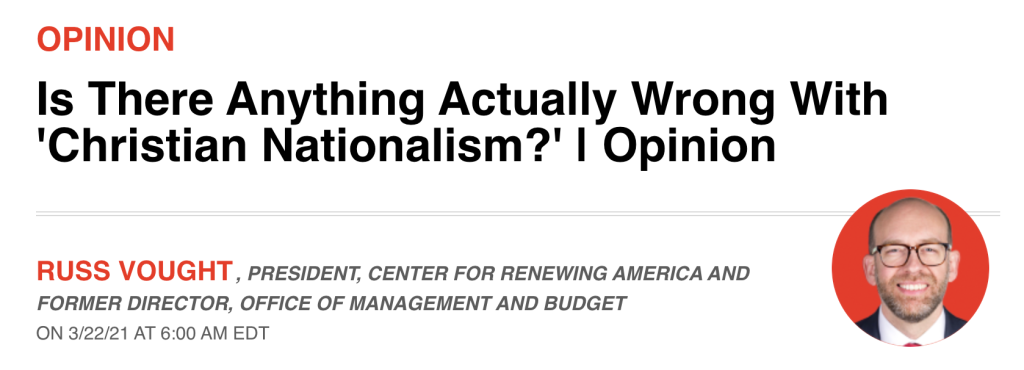
Vought argues that, no, there’s nothing wrong with Christian nationalism, so long as it’s defined in a circumscribed, non-threatening way.
“Once stripped of its superimposed liberal scar tissue, ‘Christian nationalism’ is actually a rather benign and useful description for those who believe in both preserving our country's Judeo-Christian heritage and making public policy decisions that are best for this country,” Vought writes.
This is a fig leaf. Christian nationalism as it actually operates — sometimes taking the modifier “white” at the beginning — endorses the racist “great replacement theory,” which posits that global elites are fueling non-white immigration to the United States to “replace” white people. The conspiracy theory holds that this upending of power relations will be done through demographic changes, and at the ballot box — which helps to explain CRA’s obsession with “secure borders” and “election integrity.”
For Vought, CRA’s issues of focus are not discrete policy battles. As he made clear recently on a right-wing podcast, he believes the country is in a Manichean war between the forces of good and evil. The battleground is so-called cultural issues, which, properly understood, are liberation movements to end racist and patriarchal oppression, but for Vought they must be opposed at every step of the way.
“These are the issues that if we don’t fight on we lose our civilization,” Vought said. “Critical race theory has to be front and center. Transgender contagion in our schools, impacting our daughters across the country, needs to be a front and center issue."
moment of truth pod]
vought wants to create an “army” of activists ready and waiting to serve in government who can be trusted to carry out a Christian nationalist agenda. And as former director of OMB, Vought has a unique insight into how to implement a whole-of-government approach to enacting a presidential directive, which is what he did with Trump’s initiative against so-called “critical race theory.”
“When the president says, ‘I want to not fund critical race theory through the federal government,’ that’s involving all of the agencies, and we have to then make sure that the president’s agenda is executed,” Vought said in the same interview [aud]
more broadly, Vought lamented that not enough religious right activists “operate on the basis of worldview.” As a result, less dogmatic “elite Christians” have adopted ideologies that “lack clarity at best” and are “damaging at worst.” Vought wants hardliners in the church and in the public sphere. In the context of running the government, that means replacing career staff with “ideologically committed individuals up and down the agencies.”
That idea aligns with the upcoming plans from the Manhattan Institute’s Christopher Rufo, who, along with Vought and CRA, spearheaded the broader backlash against critical race theory. As Rufo said in a recent interview:
As we approach 2024, I will be publishing a policy paper on “eliminating left-wing ideologies in the federal government,” using the power of the presidency to fundamentally reshape the bureaucracy with a six-part program targeting budget, content, personnel, grantmaking, and oversight. The idea is to centralize ideological control over the federal agencies in the White House andcreate a team at the Office of Management and Budget to enforce it. We could easily wipe out a significant portion of the infrastructure for the left-wing ideologies within the federal bureaucracy and within the network of federal grantees and contractors, which would shift American politics in the right direction.
These plans are not theoretical. CRA is one of many hard-right organizations involved in the Heritage Foundation’s 2025 Presidential Transition Project, a coalition of zealots determined to avoid some of the shortcomings and incompetencies of the Trump administration. (Vought is a former vice president of the organization’s grassroot and advocacy arm, Heritage Action for America.)
Vought has made no secret of what he would do if given the opportunity to serve as a Cabinet-level appointee in a Republican administration. He would attempt to eliminate or drastically curtail the Environmental Protection Agency, the Centers for Disease Control and Prevention, the National Institutes of Health, and others.
“We got to get after these agencies we talked about before, the administrative state, bigmoney, EPA, CDC, [and] NIH that's weaponized against the American people and we need to put them on the chopping block before we get to some other things down the road,” Vought said on Steve Bannon’s War Room.
A subsequent Supreme Court decision that drastically limited the EPA’s ability to regulate carbon emissions would likely serve as a template for Vought to dismantle broad swaths of the executive branch’s regulatory authority.
Vought’s antagonism toward the regulatory state extends to aspects of federal law enforcement, but only when those agencies are investigating conservatives for attempting to overturn the results of the 2020 election. Right-wing podcaster Charlie Kirk asked Vought about the Department of Justice’s supposed persecution of conservatives, including his colleague Jeffrey Clark, and how he thought it should be addressed. The long-term plan is to structurally change it,” Vought said. “We've got to deconstruct the state that is weaponized against the American people.”
Like other organizations that have sprung up to harness Trumpism in the last several years, CRA’s broad influence remains limited. But its success in promoting the backlash against critical race theory shows it shouldn’t be underestimated, even though that topic may not have had the electoral influence Vought and others have claimed. What’s undeniable is that Vought and his fellow travelers have sweeping ambitions and the zeal of a true believer. They are telling us exactly what they are going to do if they return to power at the federal level, and it is a chilling vision of theocracy and repression.
vid Citation From the June 27, 2022, edition of Real America's Voice's The Charlie Kirk Show
---
---
https://www.alternet.org/2020/09/experts-who-warned-trumpism-could-destroy-us-democracy-in-2018-are-even-more-worried-now-we-werent-alarmist-enough/
alex h
When Steven Levitsky and Daniel Ziblatt’s book, “How Democracies Die,” was released in January 2018, critics of the Harvard University political science professors described them as alarmists. The book had a dire warning: the United States’ liberal democracy was in danger because of Trumpism. But two years later, Levitsky and Ziblatt have not backed down from that message — in fact, they are now saying that they should have been more worried in 2018.
Levitsky told HuffPost, “Joe Scarborough ridiculed it on TV, saying, ‘These guys are alarmists.’ It turns out we weren’t alarmist enough.”
Scarborough, the Never Trump conservative who hosts MSNBC’s “Morning Joe,” is no fan of President Donald Trump — who he bashes consistently. But when “How Democracies Die” came out, Scarborough argued that the United States’ democracy was robust enough to withstand Trump’s train wreck of a presidency. Scarborough, in a March 15, 2018 op-ed for the Washington Post, argued that American democracy was much stronger than Trump’s chaotic administration.
Journalist Travis Waldron, in HuffPost, notes that Levitsky and Ziblatt aren’t the only “political scholars” or “political leaders” who are “warning that 2020 is a referendum not just on Trump, but on the nation’s democratic experiment as a whole.” But Levitsky fears that too many Americans aren’t as worried as they need to be.
"People are getting killed over politics,” Levitsky told HuffPost. “There’s questions about whether the election will be free. Law enforcement bodies are being manipulated to protect allies of the president and go after rivals of the president. Things are happening on various fronts, and we’re not putting it all together and realizing that our democracy is on the line.”
Liberal democracies don’t necessarily come to power because of an armed coup d’etat or golpe de estado: in some cases, authoritarians are voted into office and gradually undermine a country’s checks and balances. Turkish President Recep Tayyip Erdogan is an obvious example. And Waldron cites Brazilian President Jair Bolsonaro as an example of a far-right authoritarian who was elected in a liberal democracy, warning that democracy in the U.S. is also in danger.
“Republicans in Congress have done whatever they can to protect Trump,” Waldron explains. “They blocked his removal from office after House Democrats impeached him and have kept administration officials from facing consequences for shirking their oversight duties.Without those checks, Trump has proceeded to do whatever he wants: fire inspectors general, attack the judiciary, violate laws and profit off his own office.”
Levitsky told HuffPost, “U.S. democracy has proven weaker and more vulnerable than I thought.”
Amy Erica Smith, a political science professor at Iowa State University, warns that some countries pretend to be democratic and have elections but are actually authoritarian states — or as she calls them, “hybrid regimes.”
“The number one defining feature of a hybrid regime is that the incumbent is using ― and I’ll say ‘his’ because almost always ‘his’ ― all of the benefits that come from office to get himself reelected in an unfair way,” Smith told HuffPost.
Waldron points to Russian President Vladimir Putin and Hungarian President Viktor Orbán as examples of authoritarians who pretend to hold fair elections and argues that Trump is trying to do the same type of thing in the U.S. “through his efforts to undermine the U.S. Postal Service and discredit the election as fraudulent before it even takes place — an admittedly odd tactic for a leader already in power…. Trump’s attacks on democracy are in effect thefinal shattering of the idea of American exceptionalism.”
---
---
https://lawandcrime.com/judiciary/senate-dems-investigating-former-federalist-society-leaders-influence-over-trump-admins-judicial-nominees/
Senate Judiciary Committee Democrats are seeking information on the role former Federalist Society leader Leonard Leo played in in choosing the jurists President Donald Trump has nominated to lifetime appointments as federal judges. In letters sent to Attorney General William Barr and White House counsel Pat Cipollone on Wednesday, the senators said they were specifically looking into the potential conflicts of interest presented by Leo’s advising the president on judicial selections while leading a group that is anonymously funded, “likely from entities that have interests before the federal courts.”
“Mr. Leo’s prominent role in the Trump Administration’s judicial selection and nominations process while maintaining a financial interest in advocacy efforts related to this process has raised questions regarding his potential status as a federal employee and compliance with accompanying laws and regulations,” the letter to Barr stated.
The senators emphasized that by advising the Trump administration on its selection of federal judges, Leo’s conduct raised significant questions as to whether he was performing the duties of a federal government employee without proper authority, thereby violating federal ethics law.
“By outward appearances, Mr. Leo may have engaged in the performance of a federal function that must be conducted by government employees authorized to act on behalf of the United States by leading the Administration’s efforts to identify and select judicial nominees, and press for their confirmation,” they wrote. “As a federal employee, Mr. Leo would have been responsible for complying with federal records retention and financial disclosure requirements, as well as the criminal financial conflict of interest statute.”
Led by Sen. Sheldon Whitehouse (D-RI), the Democratic senators who signed the letters were attempting to shed light on the process that has allowed the Trump White House and GOP-led Senate to confirm an unprecedented number of judges (nearly 200) in just over three years.
The senators assert that knowing the specifics of Leo’s involvement in the selection process is vital to ensuring the process remains untainted.
“Mr. Leo’s personal financial interest in advocacy efforts related to the judicial selection and nominations process raises serious concerns regarding potential conflicts of interest and the independence of the federal judiciary, given Mr. Leo’s leadership role in the Trump Administration’s work on the issue,” they wrote, before listing a number of questions relating to Leo’s role in the selection process.
As previously reported by Law&Crime, Leo stepped away from the Federalist Society earlier this year to helm a massive effort aimed at securing Trump’s re-election by highlighting the 45th president’s record on appointing conservative judges.
See below for the full letter sent to AG Barr:
---
==
https://www.alternet.org/2019/12/destruction-of-checks-and-balances-white-house-lawyers-argued-trump-could-override-congress-to-freeze-ukraine-aid/
no lnx
‘Destruction of checks and balances’: White House lawyers argued Trump could override Congress to freeze Ukraine aid
Written by Jake Johnson / Common Dreams December 30, 2019
In an attempt to retroactively justify President Donald Trump’s decision to place a hold on nearly $400 million in congressionally-appropriated aid to Ukraine, top lawyers in the White House budget office—in concert with the Justice Department—reportedly developed an argument that Trump could simply override Congress and flout relevant laws by simply asserting his authority as commander-in-chief.
The New York Times reported Sunday that in the late summer, lawyers at the Office of Management and Budget—then run by Acting Chief of Staff Mick Mulvaney—argued the president “could ignore the requirements of the Impoundment Control Act and continue to hold the aid byasserting constitutional commander-in-chief powers that give him authority over diplomacy.”
Legal experts and Democrats in Congress have argued that Trump’s decision to place a hold on aid to Ukraine—a move at the center of the whistleblower complaint that ultimately led to his impeachment—constituted a violation of the Impoundment Control Act.
As the Washington Post reported last month,one OMB legal official resigned over Trump’s decisionto withhold the aid after raising concerns that the president’s move ran afoul of the 1974 law.
Critics reacted with alarm to the proposed justification for freezing the Ukraine aid, which was not disclosed publicly.
“Every Republican lawmaker must be asked if they support this destruction of checks and balances,” tweeted MSNBC legal analyst Joyce Vance.
Sam Berger
@SamBerger_DC
Replying to @SamBerger_DC
(2) On Sept 10, a WH official preemptively tried to shift the blame in a lengthy email to DoD suggesting the WH was not responsible if the $ couldn't be spent in time. DoD's response: "You can’t be serious."
The WH was trying to cover its tracks b/c the hold was illegal.
Sam Berger
@SamBerger_DC
(3) The WH was preparing to argue that "Trump’s role as commander in chief would simply allow him to override Congress." That's unconstitutional.
If they had a real legal justification, they wouldn't resort to such absurd claims.
The Times reporting on the OMB lawyers’ efforts was part of a broader story detailing the series of events that unfolded between Trump’s order to withhold aid to Ukraine this summer and his decision in September to release the funds.
“What emerges is the story of how Mr. Trump’s demands sent shock waves through the White House and the Pentagon, created deep rifts within the senior ranks of his administration, left key aides like Mr. Mulvaney under intensifying scrutiny—and ended only after Mr. Trump learned of a damning whistleblower report and came under pressure from influential Republican lawmakers,” the Times reported.
Commentators said the detailed story paints a picture of a president bent on deploying the vast powers of government for his own personal and political gain with complete disregard for the law and, in some cases, the advice of administration officials.
“Everything in here—how Trump was personally involved in blocking the Ukraine money, despite the insistence of senior administration officials, and how the aid was only released after they learned of the whistleblower complaint—is incredibly damning,” said HuffPost reporter Matt Fuller.
Rep. Don Beyer (D-Va.) tweeted late Sunday that the report “illustrates again that the only Ukraine corruption cases Trump ever raised involved his political opponents.”
“The people Trump directed to carry out his scheme hid it from the public and refused to testify to Congress,” said Beyer. “This was a clear and terrible abuse of power.”
---