Push-polling quiz msg
belated dirty tricks tag
atwater turnipseed
push poll is telephone morphs online to quiz messaging (see also online survey)
June 2018
The American Energy Alliancereleased the results of a pollasking voter’s opinions on electric vehicles (EVs) and fuel efficiency standards. DeSmog,after reviewingthe actual poll questions, reported the poll was an example of a “push poll,” defined by the American Association for Public Opinion Research as “a form of negative campaigning that is disguised as a political poll.” [67], [68], [69],[70]
“Voters want to make their own decisions about what kind of cars and trucks to buy. And they definitely don’t want to pay for the toys of the rich,” the American Energy Alliance said was the takeaway from the results. [71]
The poll was conducted by :{MWR:(style="box-sizing:border-box"):}: Strategies, a lobbying firm whose clients have included Koch Industries and the American Fuel :{&:(style="box-sizing:border-box"):}: Petrochemical Manufacturers. The questions implant the idea that consumers are being pushed to buy certain vehicles and that taxpayers are being forced to pay for the federal programs that support EV sales. [69]
For example, one question states that every purchaser of an electric vehicle is paid “75 hundred dollars” by the “taxpayer,” which misrepresents the mechanics of the non-refundable electric vehicle tax credit. The tax credit simply lowers the buyer’s tax rate in the year of purchase — functionally the same way that a home mortgage interest deduction or child tax credit works. [69]
Another question claims that the average income of an electric car buyer is $150,000, and then asks whether the respondent thinks it’s “fair” that the buyer should “be paid 75 hundred dollars.” As of 2016, 54 percent of EV purchasers have a household income above $100,000, not $150,000. Also not noted, nearly 80 percent of EVs are leased rather than purchased, and only 38 percent of leases have a household income above $100,000. [69]
Below is a sample of one split sample question, where the interviewer uses to different wordings to ask the same question: [69]
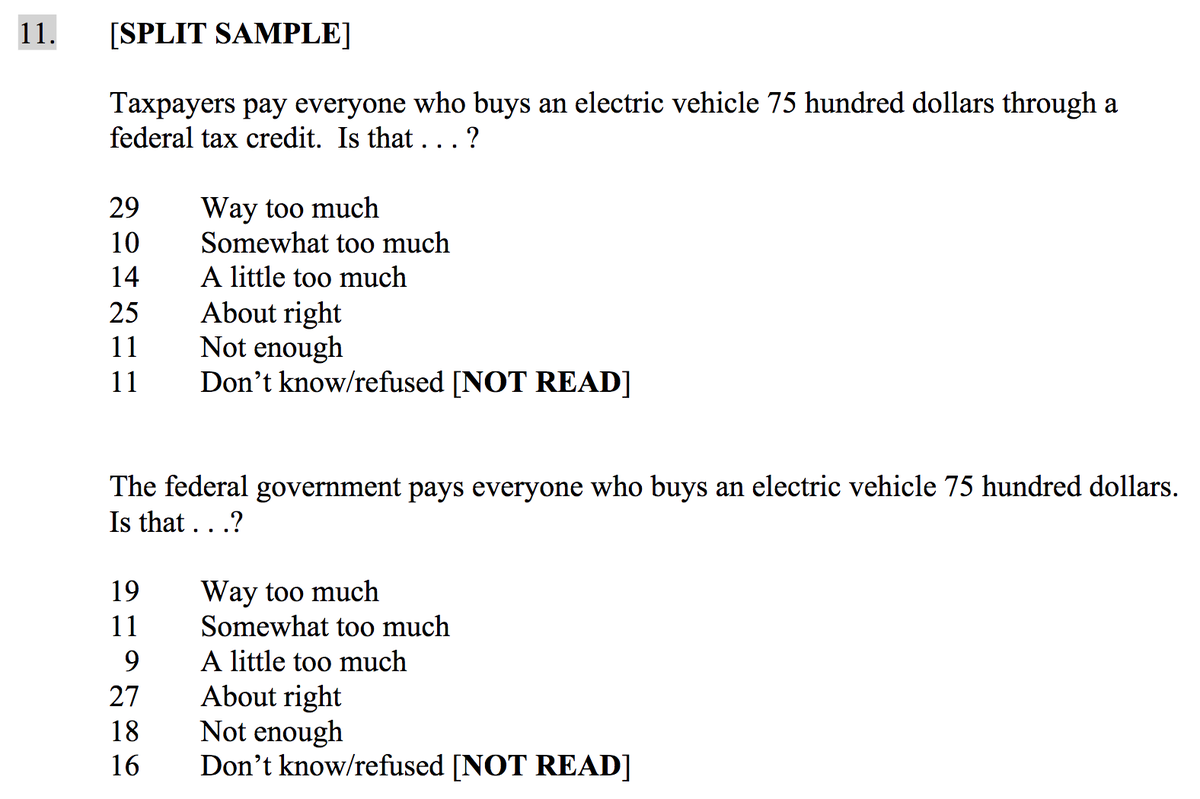
The first question, set up to make respondents feel a direct personal sacrifice, 29 percent answered that this was “way too much” and 25 percent said it was “about right.” The second question, framed without the direct emotional connection, the percentage of respondents that said it was “about right” rose slightly to 27 percent, and those who said it was “way too much” dropped to 19 percent. Both wordings were misleading, considering a tax credit is not a payment from the government and not all buyers of EVs get the full value of the tax credit. [69]
===
iwf primary 220 on 2016 win
see new prez tammy bruce
220 aha confluence of old school old money with rw wacko laura ingra and horowitz, also jok?
==
https://www.alternet.org/2020/03/dark-money-posing-as-independent-womens-groups-might-have-played-a-pivotal-role-in-trumps-2016-win-study
no lnx
Dark money posing as ‘independent’ women’s groups might have played a ‘pivotal role’ in Trump’s 2016 win: study
Written by Alex Henderson March 2, 2020
When a political group describes itself as “independent,” it’s important to ask if that group really is “independent” or if, in fact, it has partisan leanings. The Independent Women’s Voice (IWV) and the Independent Women’s Forum (IWF), which are sister organizations, both portray themselves as groups of free-thinking nonpartisan women. But David Armiak of the Center for Media and Democracy (CMD), in an article republished by Truthout on February 28, reports that according to Truth North Research (TNR), both organizations may have played a “pivotal role” in President Donald Trump’s victory in Wisconsin in 2016 as well as former Wisconsin Gov. Scott Walker’s victory in the 2012 recall election.
Armiak explains, “IWV boasts that Trump would have received an estimated 215,840 fewer votes in Wisconsin if it had not executed itsquiz messaging campaigntargeting 1.54 million voters. However, much of that messaging was conducted by IWV’s affiliated 501(c)(3) partner, IWF, which is prohibited by federal law from participating or intervening in elections.”
Lisa Graves, executive director of TNR, asserts that IWV and IWF aren’t as “independent” as they claim to be. Graves told CMD, CRONON] “People in Wisconsin and elsewhere need to know about this right-wing group that uses its ‘independent’ brand name to pretend to be independentin order to sway women voters who are independent. I don’t think it would be prudent to underestimate the resolve or impact of the Independent Women’s Voice on elections.”
According to Graves, it is “troubling” that IWV is “funded largely by dark money sources.” Graves notes that Heather Higgins, CEO of IWV and IWF, is a “touted strategist for the right wing and called the election for Trump when others were dismissing him, in part based on her assessment of independent and conservative women. I fully expect her groups to spend substantial sums deploying her quiz strategy in target states in 2020.”
The TNR report was authored by Graves and researcher Evan Vorpahl.
Armiak notes that IWV and IWF have received millions of dollars from right-wing groups, including DonorsTrust and Donors Capital Fund.And even though IWV and IWF claim to be “women’s organizations,” Graves’ research found that 89% of IWF’s funders are men.
The Center for Responsive Politics has noted that IWV President Tammy Bruce, in 2018, was “vociferous” in her defense of Justice Brett Kavanagh. After Kavanaugh was accused of attempted rape by Palo Alto University psychology professor Christine Blasey Ford, Bruce appeared on Fox News and asserted that he was “effectively being used as a stand-in for all perpetrators.”
==
https://www.alternet.org/news-amp-politics/republican-pac-publishes-security-application-former-cia-agent-running-democrat
Abigail Spanberger is the Democratic candidate in Virginia’s 7th district, and a former officer in the CIA. The Congressional Leadership Fund is a Republican Super PAC associated with Paul Ryan, which plans to hand out over $100 million to GOP candidates for the election this fall. But money isn’t the only thing that the PAC is handing out. They’ve also produced the application Spanberger submitted in seeking security clearance with the CIA, making her personal information public. How the PAC obtained this form is an open, and important, question.
According to the New York Times, theRepublican Congressional Leadership Fund has both published the form, with some personal information redacted, and made it available to reporters. Security applications, by their nature, provide highly detailed background information. They may require that the person involved produce information on actions that could potentially be embarrassing, even if not illegal.
As an example, since obtaining Spanberger’s form, a polling company connected with the Republican PAC has conducted push polls asking voters if they would be less likely to support the Democratic candidate “if she knew that the candidate had taught at a school funded by the Saudi royal family that had ‘numerous students arrested for terrorism.’” The Republican PAC has also put out a “news release” on this topic.
Spanberger is currently running strongly against Republican Representative Dave Brat in what the GOP had regarded as a “safe” district. With a broad range of endorsements and support, this represents another district that Republicans are finding a challenge in 2018 after a series of walk-over elections. So it’s understandable that Republicans are desperate to find an edge.
The problems is: Where did they find it? The Congressional Leadership Fund claims that the form was obtained through a FOIA request to the Post Office,where Spanberger worked briefly while waiting for clearance from the CIA. But the version of the document, and the fact that the copy given to reporters seems to be unredacted, does not square with the version that should be produced through a FOIA request. In fact, the unredacted form cannot be released under the Privacy Act.
The Democratic candidate has sent a cease-and-desist letter to the executive director of the Congressional Leadership Fund, demanding that the PAC destroy all copies of the form and “agree to not use the information in any fashion.” And the real question boils down to: Is someone within the Trump White House handing out classified information to be used against Democratic candidates?
The Richmond Times-Dispatch shows how Republicans are attempting to use even the controversy about how they obtained this document to harm Spanberger. A spokeswoman for the Congressional Leadership Fund replied to questions that “It should surprise no one that Ms. Spanberger would want to hide from voters that she worked at a school that produced some of the world’s most dangerous terrorists.”
Spanberger was a substitute teacher at a prep school for wealthy students, filling in for a teacher on maternity leave, between the time she finished her Masters degree and before she took her Post Office job. No student she taught has been connected to terrorism in any way. She also waited tables. Republicans have not yet produced a news release claiming that she served a plate of eggs to Osama bin Laden … but there’s still time.
Daily Kos Elections rated the VA-7 race as “Leans Republican” on Aug 22. The Cook Report has moved the race to “Toss up.”
https://www.ecowatch.com/electric-cars-public-opinion-polls-2641161506.html
Dana Drugmand
Fossil fuel interests appear intent on swaying public opinion about the electric vehicle tax credit, based on recent polling on the policy. A deeper look at these efforts reveals oil and gas funding behind the groups conducting the polls and blatant bias in the polling methodology, according to experts.
Survey results commissioned and publicized by the American Energy Alliance (AEA) seem on their surface to indicate that a majority of respondents are not thrilled about subsidizing EVs purchased by other consumers, particularly wealthy Americans. However, according to polling experts who reviewed the survey for DeSmog, the questions were designed to solicit a certain response and produce results to serve a predetermined narrative that supports the oil industry's interests. According to polling expert Ed Maibach, director of the Center for Climate Change Communication at George Mason University, the surveys relied on "highly biased questions designed to elicit highly misleading answers."
Who Is Behind the 'Highly-Biased' Anti-Electric Vehicle Poll?
The organization that commissioned the surveys, AEA, is funded by oil interests including the Koch network and the American Fuel and Petrochemical Manufacturers (AFPM), the nation's leading trade group of oil refiners. The group is touting these findings from recent polls in Maine, Michigan and South Dakota, saying the results are consistent with those from surveys they commissioned in nine other states.
"This is further evidence that efforts to compel taxpayers, ratepayers, workers, and consumers to pay for the choices of others, and the preferences of government bureaucrats, are doomed and will lead directly to voter resistance," said Thomas Pyle, president of AEA. "The citizens of Maine, Michigan, and South Dakota see an expansion of the electric vehicle tax credit exactly for what it is: a giveaway to rich Californians and large,already prosperous corporations."
Pyle's statement, and the survey questions themselves, are loaded with misleading information. The tax credit's stated purpose is to lower the cost of electric vehicles, which is critically important for low-to-moderate income Americans. Automakers don't claim the credit, consumers do, including those who opt to lease an electric vehicle. But Pyle appears to disregard these points in an attempt to drum up opposition to the policy.
Pyle's approach makes sense within the context of his and his organization's backgrounds and former lobbying clients, as well as those of the firm conducting the surveys.
The American Energy Alliance is a 501(c)(4) organization — meaning it is not required to disclose its donors — and is the advocacy arm of the Institute for Energy Research. IER supports "free-market energy and environmental policy" and was formed in 1989 from a predecessor organization founded by petrochemical billionaire Charles Koch. Donors to IER include oil and gas interests such as the Charles G. Koch Charitable Foundation and Charles Koch Institute as well as ExxonMobil and the American Petroleum Institute. The AFPM oil refiners trade group is also a major donor, having given three times as much to the American Energy Alliance compared to any other organization, according to the most recently available tax records. AEA, is a former lobbyist for Koch Industries, the largest privately owned energy company in the U.S. Pyle has also lobbied for the Big Oil trade association formerly called the National Petrochemical & Refiners Association, which is now AFPM. Both Koch Industries and the members of AFPM like Exxon make billions in profits from fueling internal-combustion engine vehicles, so policies supporting vehicles not fueled by their products, like the EV tax credit, threaten their bottom lines.
MWR Strategies, the firm conducting the surveys on the EV tax credit, is a research, communications and lobbying company whose clients include electric utility and energy companies with clear fossil fuel interests. For example, TECO Energy — owner of natural gas businesses in Florida and New Mexico — paid MWR $80,000 just this year. Among other energy and utility corporations paying MWR are ENGIE, Public Service Enterprise Group/PSEG Power, and Southern Company. Notably, Koch Industries has paid hundreds of thousands of dollars to the firm from 2008 to 2016, OpenSecrets data reveals. Other petroleum corporations and trade associations like El Paso Corp. and AFPM's predecessor National Petrochemical & Refiners Association have previously retained MWR.
Michael McKenna, president of MWR Strategies, is an energy lobbyist who led Trump's Energy Department transition team, and, as E&E reported, is "well-known in Republican energy circles" and was recently tapped to serve in the White House as an advisor to the president. McKenna previously worked at several other research and communications firms including Luntz Research Companies, founded by notorious climate denier Frank Luntz (who only recently announced he was wrong and has shifted his views).
The MWR Strategies website does not have information about current work, rather the "current" section is a list of links to polling on climate and energy topics dating back to 2008 and earlier. These "polls" are structured in much the same way as the polls about EV tax credits, with questions focused on the (debunked) premise that addressing climate change is too expensive and even asking about the "certainty" of climate science (exploiting scientific uncertainty has been a key strategy of the fossil fuel industry's well-documented disinformation campaign).
MWR's polling strategy appears to be posing misleading questions, some with inaccurate information, in order to garner a particular response. For example, in the firm's March 2008 poll on global warming, one question asked which is more important, addressing global warming or reducing reliance on foreign energy sources — which is a false choice given that renewable energy sources like solar and wind would do both. In another survey from 2006 on energy, the statement "liquefied natural gas cannot explode like gasoline" was posed to respondents. This is also misleading because while the liquid itself won't explode, blasts can occur at LNG sites and associated vapors are combustible.
How MWR's EV Tax Credit Survey Misleads Respondents and Deceives the Public
In the recent surveys MWR conducted on the EV tax credit, one of the statements that respondents could agree or disagree with was, "It is not right for GM to ask taxpayers for a tax credit." General Motors is lobbying to extend and expand the electric car tax credit, but the automaker would not actually claim the credit — consumers would.
Another question claims that "the average buyer of an electric car makes more than 150 thousand dollars per year," a claim that is demonstrably false. When pressed by DeSmog for a citation or clarification, McKenna responded through a media relations contact, pointing to the often-debunked Manhattan Institute report by Jonathan Lesser called "Short Circuit: The High Cost of Electric Vehicle Subsidies."
That report actually cites a 2013 UC-Davis study that examined "the characteristics of 1,200 households who actually purchased a new plug-in vehicle in California during 2011-2012," finding that "46 percent of electric car drivers in California alone had incomes above $150,000." This study, now six years old, does not translate to the statement regarding an "average buyer" that was presented in the survey. In effect, the survey question was premised on a falsified statistic from an outdated data set that only included California.
[grf]
Excerpt of misleading questions from the MWR poll about consumer attitudes toward the electric car tax credit.
Polling and communication experts told DeSmog that these EV tax credit surveys should not be considered legitimate measures of public opinion. Many of the questions are actually statements that respondents can agree or disagree with. But according to polling expert Joshua Dyck, associate professor of political science at UMass Lowell and director of the Center for Public Opinion, "Agree/disagree items are not a legitimate way to determine public opinion on policy issues."
"There is a well known response bias for respondents in surveys to agree to prompts in questions structured as agree/disagree items," he said. "This is known to survey researchers by the term 'response acquiescence.' In order to get at how respondents actually feel, you should allow respondents to pick from balanced options. I wouldn't put much stock in the agree/disagree items in this survey."
Ed Maibach, director of the Center for Climate Change Communication at George Mason University, also said these surveys were designed to be misleading.
"Unbiased survey questions intended to elicit people's opinions about or support for a proposition (such as a proposed public policy) can be done in one of two ways. The proposition can be stated in neutral, factual terms with or without the leading arguments both for and against the proposition," he explained. "The questions on AEA surveys did not state the facts about the propositions, but instead made negative claims about the consequences of the propositions. Therefore, people were responding to the negative statements made about the proposition, not the proposition itself."
Ed Maibach, a climate change communication researcher at George Mason University.
This response to negative statements gives the misleading appearance that there is little public support for the EV tax credit. "Elected officials who are concerned about voter opinion should probably think twice before expanding favorable tax treatment for electric vehicles. Voters in each of the 12 States we examined are very skeptical of them," MWR's McKenna said in a statement about the poll.
But as Maibach explained, this is probably not true. "The poll done for AEA was not intended to determine how people actually feel about public policies in support of EVs, rather it was done to give the impression that people do not support use of public resources to support EVs," he said.
Maibach's Center for Climate Change Communication, along with Climate Nexus and the Yale Program on Climate Change Communication, did a poll in July of 820 registered voters in Michigan on their attitudes towards various climate policies. According to the results, "Michigan voters favor expanding the tax credit for those who purchase EVs — close to two-thirds (66 percent) agree the federal tax credit for EVs should extend beyond each manufacturer's first 200,000 vehicles."
Pyle, AEA's president and former Koch lobbyist, told E&E News he stands by his surveys finding little support for the tax credit, adding that he is "not concerned about what the greens think about our work."
But Maibach pushed back against this statement. "The problem with his poll is not that 'the greens' don't like the findings," he said. "The problem is that his findings are bogus, because they asked highly biased questions designed to elicit highly misleading answers."
==
==
nbcc accce hired
paragon insights
oct 2014
A new “poll,” with some state-by-state results, is part of a larger, polluter-coordinated, national disinformation campaign to keep our air dirty, our health in jeopardy and our country paralyzed in the face of real and growing threats from climate change. It won’t work. Why?

Simply put, a strong majority of Americans consistently say they are worried about climate change and they want action, and now.
We probably shouldn’t expect anything more honest from polluters and their allies. This poll is just another of their tactics to try to undermine the Environmental Protection Agency’sClean Power Planthat will set the first-ever limits on carbon pollution from America’s biggest source, power plants.worried about climate change and they want action, and now.
Conducted by Paragon Insights, the poll presents a paragon of misinformation, drummed up by asking intentionally leading questions designed to get negative responses.
This flawed ‘poll’ flies in the face of every other poll that shows strong public support for limiting dangerous carbon pollution and protecting public health. It’s nothing more than a brazenly biased -poll intended to achieve a predetermined outcome, paid for by wealthy polluters.
How is the poll biased? The survey takers read a list of the most common polluter claims – including that carbon limits could lead to energy rationing, blackouts, job losses and higher electric bills – just before asking respondents whether they support the standards or not.
Now THAT’s how you cook a poll! But even with that massive bias, the pollsters could only show 3% more people opposed to carbon limits than support them. But the poll’s margin of error is 2.7% - meaning that the polluters’ own pollster admits that they might only have .3 % more people saying they don’t support the standards than those who do.
All of their common claims are untrue, by the way, according to analysis from the EPA and research conducted for NRDC.
Furthermore, when the backers released the poll they declined to release information that most credible polling firms release with their polls, such as the demographic breakdown of respondents, with age, sex, income.
So, if you ask biased questions to a mystery group of “likely voters” you get highly suspect results, and that’s what we have here.
Let’s look at just how far off base the Paragon poll—paid for by the Partnership for a Better Energy Future, a front group for the U.S. Chamber of Commerce, the National Association of Manufacturers—really is.
A Quinnipiac University poll, June 24-30, 2014 sample, 1,446 of registered voters found:
- 58 percent of voters support federal government limitations on greenhouse gas emissions from power plants.
- 30 percent of voters do not support federal government limitations on greenhouse gas emissions from power plants.
:{A NBC News:(style="background-color:#ffffff;"):}:**/Wall Street Journal**:{ poll:(style="background-color:#ffffff;"):}:, June 11-15, 2014, sample of 1,000 American adults found:
- 67 percent of Americans support the carbon regulations proposed by President Obama and the Environmental Protection Agency.
- 31 percent of Americans believe immediate action should be taken to combat climate change
- 57 percent approve of a proposal that would cut greenhouse gas emissions from companies, even if it leads to higher energy bills.
Bloomberg News Poll, June 6-9, 2014, sample, 1,005 adults, found:
- 62 percent of Americans say they would pay more for energy if it meant reducing air pollution from carbon emissions.
- 33 percent said they were unwilling to pay more for energy if it meant reducing air pollution from carbon emissions.
A Washington Post-ABC Poll, May 29-June 1, 2014, sample of 1,002 adults, found:
- 70 percent, support regulating carbon from power plants
- 63 percent of Americans said the federal government should power greenhouse gases even if it meant their energy expenses would rise.
The Paragon state polling is in direct contradiction with findings from the Washington Post-ABC poll, which included interviewing adults in states where coal represents the majority of electricity consumed: West Virginia, Kentucky, Wyoming, Indiana, Missouri, North Dakota, Utah, Ohio, Wisconsin, Nebraska, Kansas, New Mexico, Maryland, Michigan, Colorado, Iowa, Tennessee, Arkansas and Montana. The sample size for respondents in these states is 280, carrying a margin of error of seven percentage points.
The poll found that 69 percent of Americans in these states say the government should place limits on greenhouse gas emissions.
And no amount of phony polling can deny that’s the message Americans are pushing right now as the EPA moves to tackle the biggest environmental threat of our time.
http://switchboard.nrdc.org/blogs/paltman/polluters_push_a_paragon_of_mi.html
==