mckenna MWR strat
SEE AEA PYLE CALLER DENIAL
lots of tags
push polls belated dirty tricks tag
TRUMP TRANS
push poll is telephone morphs online to quiz messaging (see also online survey)
Resignations
Mike Rogers, former House Intelligence Committee Chair: Rogers resigned from the transition team on November 15, 2016. He helped to guide the transition's work in national security issues.[1]
Michael Catanzaro, lobbyist at CGCN: Catanzaro resigned from the transition team on November 21, 2016, after the incoming administration required lobbyists to terminate all existing lobbying contracts.[2] Catanzaro had been an energy independence advisor.[3]
Michael Torrey, owner of Michael Torrey Associates: Torrey resigned from the transition team on November 21, 2016, after the incoming administration required lobbyists to terminate all existing lobbying contracts.[2] He had been an agriculture advisor.[4]
Michael McKenna, lobbyist with MWR Strategies: McKenna resigned from the transition team on November 21, 2016, after the incoming administration required lobbyists to terminate all existing lobbying contracts.[2] He had been an energy advisor.[4]
LNX
Republican Utah Sen. John Curtis is reportedly planning to co-lead a delegation to the annual U.N. climate change conference, which some critics told the Daily Caller News Foundation clashes with President Donald Trump’s energy agenda.
Curtis told E&E News Friday that he and Democratic Delaware Sen. Chris Coons will lead a delegation to Brazil together for this year’s COP30 and that three other unnamed Republicans are also interested in joining the troop. The U.N. climate change conference is set to host several youth-led climate forums and discuss the Paris Agreement that Trump directed the U.S. to abandon through a day-one executive order.
“RINOs like Sen. Curtis are trying to snatch defeat from the jaws of MAGA victory by going to the annual UN climate confab in Brazil,” Steve Milloy, Senior Fellow at the Energy & Environment Legal Institute told the DCNF. “There, they will conspire with China and Europe in trying to subvert President Trump’s agenda of defeating the climate hoax, terminating the Green New Scam and making America energy dominant.” (RELATED: John Curtis Has History Of Raking In Thousands From Green Energy Donors)
U.S. Senator-elect John Curtis (R-UT) arrives for the Senate Republican leadership elections at the U.S. Capitol on November 13, 2024 in Washington, DC. (Photo by Kevin Dietsch via Getty Images)
A spokesperson for Curtis’ office told the DCNF that “plans are not finalized yet for the Senator’s travel,” though E&E News reported Friday that Curtis said “we have an agenda that is really coming together nicely. We’re super happy with it.”
The Trump administration has not announced that it will send a delegation to the November conference and Trump recently called climate change policy the “greatest con job ever perpetrated on the world” in front of the United Nations General Assembly in September. Trump has moved to ax federal support for green energy sources like wind and solar that the Biden administration favored while bolstering conventional resources like coal.
“Leave it to ‘Mitt Romney’ style Republicans like Sen. Curtis to try to snatch defeat from the jaws of victory. … The UN climate agenda and the UN’s COP30 meetings should be disbanded, not given credibility by GOP senators,” Marc Morano, author and Climate Depot executive editor, told the DCNF. “This is a pathetic throwback to the pre-Trump Republicanism of George H. Bush, George W. Bush, John McCain, and Mitt Romney. … The UN climate agenda has quite literally overseen the outsourcing of the West’s once dominant industries to China, India, and the developing world. The U.S., Canada, and Europe have boasted about emission accounting tricks, while China builds two new coal plants a week and benefits from the West’s attempts at a ‘green transition.’ The U.S. does not need ‘a seat at the table’ at the UN climate summit, we need to knock the table over.”
Curtis has historically split with many Republicans over climate change policy and has notably advocated against a wholesale repeal of Biden-era green energy tax credits that Trump railed against. Earlier this year, Curtis told Secretary of State Marco Rubio that it is “really important” to have a “Republican voice at that table,” in reference to COP30.
The Senator pointed to nuclear specifically as an energy resource Republicans could elevate at COP30.
Critics like Milloy, Morano and President of the Heartland Institute James Taylor told the DCNF that COP30 should not be endorsed by Republican participation as it runs counter to Trump’s energy policies and suggests that the left-leaning climate talking points the president has fought hold legitimacy.
“Republicans who attend COP30 for any reason other than to mock it are hypocrites and grandstanders,” Taylor told the DCNF. “How much carbon dioxide are they going to spew into the atmosphere merely so they can have a ‘photo op’ at a portion of the Amazon rainforest that was destroyed in order to create a venue for this vacation conference of UN bureaucrats?”
Notably, developers razed portions of the Amazon rainforest to construct a road for COP30, and a 2024 study released right before COP29 showed that emissions rise sharply during major conferences due to private jet travel.
Coons’ office did not respond to the DCNF’s multiple requests for comment.
---
REF
John Curtis Has History Of Raking In Thousands From Green Energy Donors | The Daily Caller
Mary Lou MastersContributor
January 14, 2024
- Utah GOP Rep. John Curtis, who splits with many on the right on the issue of climate change, has received thousands in campaign donations from green energy donors, according to Federal Election Commission filings.
- Curtis recently jumped in the race for outgoing Sen. Mitt Romney’s seat in 2024 after initially opting against such a bid, adding to the crowded Republican primary field.
- “The Republican primary voters [sic] will have a choice to pick somebody as their nominee who is either more like Sen. [Mike] Lee, who I would argue is a true conservative, or more like Sen. [Mitt] Romney, who has never really been much of a conservative especially on these issues,” Tom Pyle, president of the American Energy Alliance, told the Daily Caller News Foundation.
Republican Rep. John Curtis of Utah, who recently jumped into the race for outgoing Sen. Mitt Romney’s seat, has raked in thousands of dollars in donations for his congressional bids from the green energy industry, according to campaign finance records.
Curtis launched a campaign for Senate on Jan. 2 after previously ruling it out shortly after Romney announced he would not seek another term in the upper chamber, adding to the primary already chock-full of prominent Republicans. The congressman, who has split from many on the right about climate change, brought in thousands from green energy organizations and companies’ affiliated political action committees (PACs) during his four House bids, Federal Election Commission (FEC) filings show.
“Congressman Curtis is one of the leaders of a small but vocal minority in the Republican Party that thinks that the Republicans need to capitulate on the issue of climate change for fear of losing younger voters, and the survey data simply just doesn’t bear that out,” Tom Pyle, president of the American Energy Alliance, told the Daily Caller News Foundation.
Curtis is the chair of the Conservative Climate Caucus, which states its goal is to reduce emissions while not limiting consumer choices. The caucus aims to inform members of “climate policies and legislation consistent with conservative values.”
The congressman believes that curbing climate change will bolster the economy rather than hinder it through promoting energy innovation in the private sector, like carbon capture, according to Politico.
The Bipartisan Climate Action’s political arm has given $13,500 in donations to the congressman’s campaign from 2021 to 2023, FEC data shows. The group is focused on reelecting members who push “significant, enduring, and bipartisan legislation to reduce greenhouse gas emissions.” (RELATED: Rep Considering Bid To Replace Romney Has Long History Of Timely Stock Trading While In Office)
Between 2020 and 2022, the Environmental Defense Action Fund’s affiliated PAC donated $5,500 to Curtis’ congressional campaign, according to FEC filings. The nonprofit’s political arm, which is committed to “electing climate champions,” encourages the Biden administration to promote electric vehicles and reduce emissions.
Sunnova Energy’s corporate PAC contributed $1,000 to Curtis’s efforts in May 2023, along with another $1,000 donation in late September, just after he announced he was considering running for Senate, according to FEC filings. The company allegedly took advantage of elderly customers who were near-death by convincing them to sign expensive multi-decade rooftop solar contracts, according to The Washington Free Beacon.
“A lot of those companies are looking for a way to try to create a sense of bipartisanship in the sort of climate agenda. And when you have a member in the Republican Party that makes overtures about climate change, naturally, they will gravitate towards him,” Pyle said.
The campaign also brought in donations from the Solar Energy Industries Association’s affiliated PAC to the tune of $12,500 between 2022 and 2023, FEC records show. The trade association hopes that solar will “achieve 30% of U.S. electricity generation by 2030.”
Aligned PACs for SunPower and SunRun, two solar energy companies, have both given $2,500 to the congressman’s campaign in 2022 and 2023, respectively, according to FEC data.
Other affiliated PACs for green energy companies like NextEra Energy, Sempra Energy and Noble Energy have also donated thousands to Curtis’ campaign, to the tune of a combined $11,500 since 2018, according to FEC filings.
I just left the Lt Governor’s office where I filed to run for U.S. Senate! 🇺🇸 I’ll keep working hard to get things done for Utah & make our state an even better place. Together, we can ensure America has a bright future. Join me by donating/volunteering at https://t.co/U6Yw5H2k4H pic.twitter.com/1x9rSQndqx
— John Curtis (@CurtisUT) January 3, 2024
Curtis has been critical of the Biden administration’s costly green energy efforts, including the president’s signature climate law, the Inflation Reduction Act, according to Politico. The congressman hosts the “Conservative Climate Summit” on college campuses to engage with younger voters on the issue, and has travelled abroad to the last three U.N. climate summits.
“Being a marginal Republican, he will be a very popular candidate with Republican front groups, like [Citizens for Responsible Energy Solutions] and Clear Path. He will also be popular with formerly Republican-leaning operations like the [American Petroleum Institute] and the Chamber,” Mike McKenna, GOP strategist and former Trump administration energy adviser, told the DCNF. “He may be one of the few people in Utah who would not be an upgrade from Sen. [Mitt] Romney.”
Curtis, former mayor of Provo, Utah, used to be a Democrat and served as his county party chair in the early 2000s, according to Deseret News.
Brent Orrin Hatch, son of the late Sen. Orrin Hatch who was succeeded by Romney, jumped into the race on the same day as Curtis. State House Speaker Brad Wilson launched a Senate bid in late September, and Riverton Mayor Trent Staggs has been running for Romney’s seat since May.
The Cook Political Report characterizes Romney’s seat as in the “Solid R” category. The GOP primary will be held on June 25.
A Guidant Polling and Strategy survey released in mid-December found Curtis with 40% support among the crowded Republican primary field, followed by Wilson at 11% and Staggs at 6%. The remaining 43% of likely primary voters were not yet sure of their choice.
“Voters of Utah will have a choice,” Pyle said. “The Republican primary voters [sic] will have a choice to pick somebody as their nominee who is either more like Sen. [Mike] Lee, who I would argue is a true conservative, or more like Sen. [Mitt] Romney, who has never really been much of a conservative especially on these issues.”
Curtis’ campaign did not respond to the DCNF’s request for comment.
All content created by the Daily Caller News Foundation, an independent and nonpartisan newswire service, is available without charge to any legitimate news publisher that can provide a large audience. All republished articles must include our logo, our reporter’s byline and their DCNF affiliation. For any questions about our guidelines or partnering with us, please contact licensing@dailycallernewsfoundation.org.
Tags : elections 2024 john curtis mitt romney senate utah
---
GGL 10 25
[### Mike McKenna

DeSmog
https://www.desmog.com › Database Entries](https://www.desmog.com/mike-mckenna/)
Michael (Mike) McKenna is a former energy lobbyist and communications specialist currently serving as a deputy assistant to the President of the United States.
[### Trump energy adviser Mike McKenna exits

E&E News by POLITICO
https://www.eenews.net › Articles](https://www.eenews.net/articles/trump-energy-adviser-mike-mckenna-exits/)
Mar 25, 2020 — White House energy adviser Mike McKenna exited his job yesterday, according to a statement last night. McKenna, who worked in legislative ...
[### Michael McKenna (Washington, D.C.)

Ballotpedia
https://ballotpedia.org › Michael_McKenna_(Washingto...](https://ballotpedia.org/Michael_McKenna_%28Washington,_D.C.%29)
Michael McKenna is the president and a lobbyist with the firm MWR Strategies in Washington, D.C. McKenna was a member of Donald Trump's presidential transition ...
[### Trump energy adviser Mike McKenna exits POLITICO Pro
https://subscriber.politicopro.com › article › eenews](https://subscriber.politicopro.com/article/eenews/1062697221)
Mar 25, 2020 — White House energy adviser Mike McKenna exited his job yesterday, according to a statement last night.
[### Energy lobbyist Mike McKenna to take White House job

E&E News by POLITICO
https://www.eenews.net › Articles](https://www.eenews.net/articles/energy-lobbyist-mike-mckenna-to-take-white-house-job/)
Oct 25, 2019 — In 2016, McKenna briefly served on President Trump's Energy Department transition team before Tom Pyle, president of the American Energy ...
[### Trump transition fills out energy team

Politico
https://www.politico.com › story › 2016/09 › trump-en...](https://www.politico.com/story/2016/09/trump-energy-team-mike-mckenna-myron-ebell-228672)
Sep 26, 2016 — Donald Trump's presidential transition operation has recruited GOP energy lobbyist Mike McKenna and vocal climate skeptic Myron Ebell to run teams.
[### Drain the Swamp? Mike McKenna, Head of Trump Energy ...

DeSmog
https://www.desmog.com › 2016/11/16 › drain-the-swa...](https://www.desmog.com/2016/11/16/drain-the-swamp-trump-mike-mckenna/)
Nov 16, 2016 — Mike McKenna, named to head the US Department of Energy transition team for President-Elect Donald Trump, began his lobbying career in the aftermath of an ...
[### Michael McKenna

The Heritage Foundation
https://www.heritage.org › staff › michael-mckenna](https://www.heritage.org/staff/michael-mckenna)
Michael McKenna is a Visiting Fellow in the Executive Vice President's Office at The Heritage Foundation. He also serves as President of MWR Strategies.
[### Renewables Under Trump | Norton Rose Fulbright

Project Finance NewsWire
https://www.projectfinance.law › september › renewabl...](https://www.projectfinance.law/publications/2024/september/renewables-under-trump/)
Sep 10, 2024 — Four Republican insiders and a senior Washington energy ... SLUDER: Mike McKenna, what would a policy around energy independence look like?
[### White House hires energy lobbyist McKenna POLITICO Pro
http://subscriber.politicopro.com › article › 2019/10 › w...](http://subscriber.politicopro.com/article/2019/10/white-house-hires-energy-lobbyist-mckenna-3973379)
Oct 24, 2019 — McKenna is a Republican lobbyist who has represented electric power companies and briefly led President Donald Trump's Energy Department ...
June 2018
The American Energy Alliancereleased the results of a pollasking voter’s opinions on electric vehicles (EVs) and fuel efficiency standards. DeSmog,after reviewingthe actual poll questions, reported the poll was an example of a “push poll,” defined by the American Association for Public Opinion Research as “a form of negative campaigning that is disguised as a political poll.” [67], [68], [69],[70]
“Voters want to make their own decisions about what kind of cars and trucks to buy. And they definitely don’t want to pay for the toys of the rich,” the American Energy Alliance said was the takeaway from the results. [71]
The poll was conducted by :{MWR:(style="box-sizing:border-box"):}: Strategies, a lobbying firm whose clients have included Koch Industries and the American Fuel :{&:(style="box-sizing:border-box"):}: Petrochemical Manufacturers. The questions implant the idea that consumers are being pushed to buy certain vehicles and that taxpayers are being forced to pay for the federal programs that support EV sales. [69]
For example, one question states that every purchaser of an electric vehicle is paid “75 hundred dollars” by the “taxpayer,” which misrepresents the mechanics of the non-refundable electric vehicle tax credit. The tax credit simply lowers the buyer’s tax rate in the year of purchase — functionally the same way that a home mortgage interest deduction or child tax credit works. [69]
Another question claims that the average income of an electric car buyer is $150,000, and then asks whether the respondent thinks it’s “fair” that the buyer should “be paid 75 hundred dollars.” As of 2016, 54 percent of EV purchasers have a household income above $100,000, not $150,000. Also not noted, nearly 80 percent of EVs are leased rather than purchased, and only 38 percent of leases have a household income above $100,000. [69]
Below is a sample of one split sample question, where the interviewer uses to different wordings to ask the same question: [69]
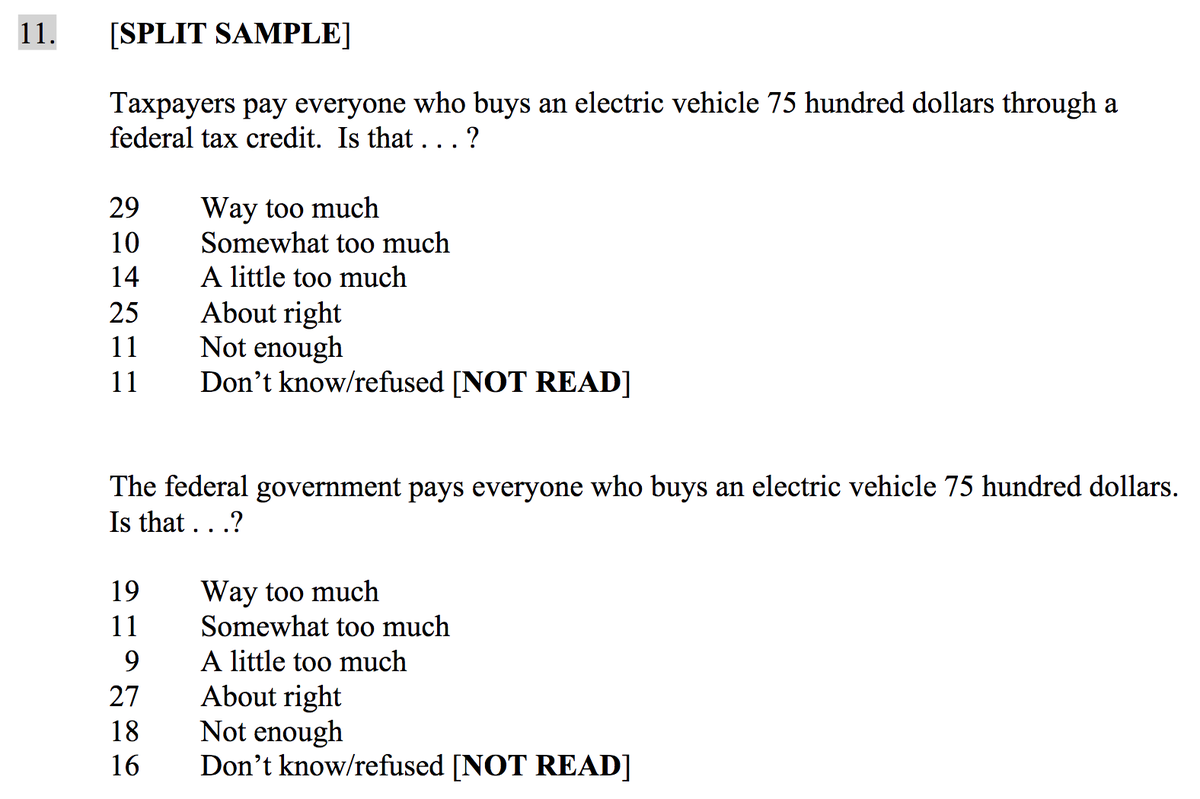
The first question, set up to make respondents feel a direct personal sacrifice, 29 percent answered that this was “way too much” and 25 percent said it was “about right.” The second question, framed without the direct emotional connection, the percentage of respondents that said it was “about right” rose slightly to 27 percent, and those who said it was “way too much” dropped to 19 percent. Both wordings were misleading, considering a tax credit is not a payment from the government and not all buyers of EVs get the full value of the tax credit. [69]
===
https://www.ecowatch.com/electric-cars-public-opinion-polls-2641161506.html
Dana Drugmand
Fossil fuel interests appear intent on swaying public opinion about the electric vehicle tax credit, based on recent polling on the policy. A deeper look at these efforts reveals oil and gas funding behind the groups conducting the polls and blatant bias in the polling methodology, according to experts.
Survey results commissioned and publicized by the American Energy Alliance (AEA) seem on their surface to indicate that a majority of respondents are not thrilled about subsidizing EVs purchased by other consumers, particularly wealthy Americans. However, according to polling experts who reviewed the survey for DeSmog, the questions were designed to solicit a certain response and produce results to serve a predetermined narrative that supports the oil industry's interests. According to polling expert Ed Maibach, director of the Center for Climate Change Communication at George Mason University, the surveys relied on "highly biased questions designed to elicit highly misleading answers."
Who Is Behind the 'Highly-Biased' Anti-Electric Vehicle Poll?
The organization that commissioned the surveys, AEA, is funded by oil interests including the Koch network and the American Fuel and Petrochemical Manufacturers (AFPM), the nation's leading trade group of oil refiners. The group is touting these findings from recent polls in Maine, Michigan and South Dakota, saying the results are consistent with those from surveys they commissioned in nine other states.
"This is further evidence that efforts to compel taxpayers, ratepayers, workers, and consumers to pay for the choices of others, and the preferences of government bureaucrats, are doomed and will lead directly to voter resistance," said Thomas Pyle, president of AEA. "The citizens of Maine, Michigan, and South Dakota see an expansion of the electric vehicle tax credit exactly for what it is: a giveaway to rich Californians and large,already prosperous corporations."
Pyle's statement, and the survey questions themselves, are loaded with misleading information. The tax credit's stated purpose is to lower the cost of electric vehicles, which is critically important for low-to-moderate income Americans. Automakers don't claim the credit, consumers do, including those who opt to lease an electric vehicle. But Pyle appears to disregard these points in an attempt to drum up opposition to the policy.
Pyle's approach makes sense within the context of his and his organization's backgrounds and former lobbying clients, as well as those of the firm conducting the surveys.
The American Energy Alliance is a 501(c)(4) organization — meaning it is not required to disclose its donors — and is the advocacy arm of the Institute for Energy Research. IER supports "free-market energy and environmental policy" and was formed in 1989 from a predecessor organization founded by petrochemical billionaire Charles Koch. Donors to IER include oil and gas interests such as the Charles G. Koch Charitable Foundation and Charles Koch Institute as well as ExxonMobil and the American Petroleum Institute. The AFPM oil refiners trade group is also a major donor, having given three times as much to the American Energy Alliance compared to any other organization, according to the most recently available tax records. AEA, is a former lobbyist for Koch Industries, the largest privately owned energy company in the U.S. Pyle has also lobbied for the Big Oil trade association formerly called the National Petrochemical & Refiners Association, which is now AFPM. Both Koch Industries and the members of AFPM like Exxon make billions in profits from fueling internal-combustion engine vehicles, so policies supporting vehicles not fueled by their products, like the EV tax credit, threaten their bottom lines.
MWR Strategies, the firm conducting the surveys on the EV tax credit, is a research, communications and lobbying company whose clients include electric utility and energy companies with clear fossil fuel interests. For example, TECO Energy — owner of natural gas businesses in Florida and New Mexico — paid MWR $80,000 just this year. Among other energy and utility corporations paying MWR are ENGIE, Public Service Enterprise Group/PSEG Power, and Southern Company. Notably, Koch Industries has paid hundreds of thousands of dollars to the firm from 2008 to 2016, OpenSecrets data reveals. Other petroleum corporations and trade associations like El Paso Corp. and AFPM's predecessor National Petrochemical & Refiners Association have previously retained MWR.
Michael McKenna, president of MWR Strategies, is an energy lobbyist who led Trump's Energy Department transition team, and, as E&E reported, is "well-known in Republican energy circles" and was recently tapped to serve in the White House as an advisor to the president. McKenna previously worked at several other research and communications firms includingLuntzResearch Companies, founded by notorious climate denier Frank Luntz (who only recently announced he was wrong and has shifted his views).
The MWR Strategies website does not have information about current work, rather the "current" section is a list of links to polling on climate and energy topics dating back to 2008 and earlier. These "polls" are structured in much the same way as the polls about EV tax credits, with questions focused on the (debunked) premise that addressing climate change is too expensive and even asking about the "certainty" of climate science (exploiting scientific uncertainty has been a key strategy of the fossil fuel industry's well-documented disinformation campaign).
MWR's polling strategy appears to be posing misleading questions, some with inaccurate information, in order to garner a particular response. For example, in the firm's March 2008 poll on global warming, one question asked which is more important, addressing global warming or reducing reliance on foreign energy sources — which is a false choice given that renewable energy sources like solar and wind would do both. In another survey from 2006 on energy, the statement "liquefied natural gas cannot explode like gasoline" was posed to respondents. This is also misleading because while the liquid itself won't explode, blasts can occur at LNG sites and associated vapors are combustible.
How MWR's EV Tax Credit Survey Misleads Respondents and Deceives the Public
In the recent surveys MWR conducted on the EV tax credit, one of the statements that respondents could agree or disagree with was, "It is not right for GM to ask taxpayers for a tax credit." General Motors is lobbying to extend and expand the electric car tax credit, but the automaker would not actually claim the credit — consumers would.
Another question claims that "the average buyer of an electric car makes more than 150 thousand dollars per year," a claim that is demonstrably false. When pressed by DeSmog for a citation or clarification, McKenna responded through a media relations contact, pointing to the often-debunked Manhattan Institute report by Jonathan Lesser called "Short Circuit: The High Cost of Electric Vehicle Subsidies."
That report actually cites a 2013 UC-Davis study that examined "the characteristics of 1,200 households who actually purchased a new plug-in vehicle in California during 2011-2012," finding that "46 percent of electric car drivers in California alone had incomes above $150,000." This study, now six years old, does not translate to the statement regarding an "average buyer" that was presented in the survey. In effect, the survey question was premised on a falsified statistic from an outdated data set that only included California.
[grf]
Excerpt of misleading questions from the MWR poll about consumer attitudes toward the electric car tax credit.
Polling and communication experts told DeSmog that these EV tax credit surveys should not be considered legitimate measures of public opinion. Many of the questions are actually statements that respondents can agree or disagree with. But according to polling expert Joshua Dyck, associate professor of political science at UMass Lowell and director of the Center for Public Opinion, "Agree/disagree items are not a legitimate way to determine public opinion on policy issues."
"There is a well known response bias for respondents in surveys to agree to prompts in questions structured as agree/disagree items," he said. "This is known to survey researchers by the term 'response acquiescence.' In order to get at how respondents actually feel, you should allow respondents to pick from balanced options. I wouldn't put much stock in the agree/disagree items in this survey."
Ed Maibach, director of the Center for Climate Change Communication at George Mason University, also said these surveys were designed to be misleading.
"Unbiased survey questions intended to elicit people's opinions about or support for a proposition (such as a proposed public policy) can be done in one of two ways. The proposition can be stated in neutral, factual terms with or without the leading arguments both for and against the proposition," he explained. "The questions on AEA surveys did not state the facts about the propositions, but instead made negative claims about the consequences of the propositions. Therefore, people were responding to the negative statements made about the proposition, not the proposition itself."
Ed Maibach, a climate change communication researcher at George Mason University.
This response to negative statements gives the misleading appearance that there is little public support for the EV tax credit. "Elected officials who are concerned about voter opinion should probably think twice before expanding favorable tax treatment for electric vehicles. Voters in each of the 12 States we examined are very skeptical of them," MWR's McKenna said in a statement about the poll.
But as Maibach explained, this is probably not true. "The poll done for AEA was not intended to determine how people actually feel about public policies in support of EVs, rather it was done to give the impression that people do not support use of public resources to support EVs," he said.
Maibach's Center for Climate Change Communication, along with Climate Nexus and the Yale Program on Climate Change Communication, did a poll in July of 820 registered voters in Michigan on their attitudes towards various climate policies. According to the results, "Michigan voters favor expanding the tax credit for those who purchase EVs — close to two-thirds (66 percent) agree the federal tax credit for EVs should extend beyond each manufacturer's first 200,000 vehicles."
Pyle, AEA's president and former Koch lobbyist, told E&E News he stands by his surveys finding little support for the tax credit, adding that he is "not concerned about what the greens think about our work."
But Maibach pushed back against this statement. "The problem with his poll is not that 'the greens' don't like the findings," he said. "The problem is that his findings are bogus, because they asked highly biased questions designed to elicit highly misleading answers."
==
Mike McKenna, named to head the U.S. Department of Energy transition team for President-Elect Donald Trump, began his lobbying career in the aftermath of an ethics scandal in Virginia.
Before resigning from the administration of Virginia's then-Governor George Allen in 1997, McKenna was implicated in the authorship and distribution of what the Associated Press called a “dirty tricks” memo written in response to a report published by the Joint Legislative Audit and Review Commission (JLARC), which had critiqued the Department of Environmental Quality for which McKenna had then served as policy director and spokesman.
McKenna now works as a lobbyist for a firm he founded named MWR Strategies.
According to federal lobbying disclosure forms, McKenna currently lobbies for companies such as Southern Company, Koch Industries, GDF Suez and Dow Chemical. Past clients have included corporations such as utility giant American Electric Power, pipeline company El Paso and the National Petrochemical Refiners Association.
The Trump transition team's hiring of McKenna comes just weeks after Trump announced his “drain the swamp” campaign promise. “Drain the Swamp” centered around getting rid of the enormous influence of lobbyists in Washington, D.C. and was a popular talking point on the campaign trail for Trump.

Image Credit: Donald J. Trump Presidential Campaign Website
Mike McKenna's Dirty Tricks
The McKenna “dirty tricks” memo called for the use of government resources to discredit the conclusions made in the JLARCreport “such as threatening a libel suit or a congressional inquiry,” according to The Washington Post. JLARC's report had critiqued DEQ for not being harsh enough on regulating industrial pollution and water quality regulations.
“The memo, dated Dec. 20 and written by Michael McKenna, the department's director of external affairs, also suggests that the agency file a Freedom of Information Act request for any correspondence between the legislative panel and the media,” reported The Post. “McKenna said the request should be filed 'under our names, so they know we're the ones coming after them.'”
McKenna's boss at the time of the memo's authorship was Becky Norton Dunlop, who in 1998 began working at the Heritage Foundation where she still works currently as a Senior Fellow. McKenna's father, James T. McKenna, served as an attorney for Heritage during its formative years in the 1970s.
In the aftermath of the incident, McKenna left and became a lobbyist for the firm Baise & Miller. Upon discovering this, Governor Allen ordered his DEQ staff to have no discussion with McKenna.
McKenna “potentially could be acting in a position adverse to his former employer – the taxpayers of Virginia. Given this potential problem, any direct communication would be professionally irresponsible on the part of both parties,” wrote Allen in a letter to DEQ staff, according to The Washington Post.
Watchdog environmental groups also took McKenna to task for utilizing the revolving door for private career gain.
“He has been hired because of his particular knowledge and expertise at the DEQ, and he is now using it for his personal gain,” said Deanna Sampson, executive director of the Virginia Conservation Network at the time. “It may be legal, but it doesn't seem right that he would take the training and experience paid for by taxpayers and then use it arguing against their interest.”
Polling Dirty Tricks
It was under the cloud of this “dirty tricks” scandal that McKenna began his lobbying career. But it wasn't the end of that game for McKenna.
According to the Energy and Policy Institute, MWR Strategies — which also does polling on top of lobbying — distributed and disseminated the results of a misleading poll which purported to show the public was against the clean energy tax credit provision found within the Obama Administration's Clean Power Plan. The poll featured unethical leading questions and prompts, such as:
-“The rule will have no effect on what countries like China and India do with respect to global warming.”
-“Under the rule, EPA would be able to tell the States what sources of electricity – coalfired, natural gas-fired, nuclear, or other – they could use.”
-“The tax credit that companies get for generating electricity from wind means that sometimes wind power is used instead of less expensive energy sources like natural gas and coal. When that happens, ratepayers pay more for electricity. In general, do you think that is a good thing or a bad thing?”
Despite obvious bias loaded into each question and prompting, McKenna previously told The Hill he doesn't “doesn’t poll for his lobbying clients” because “there is a potential conflict of interest that could impair the polling data.” Yet that particular poll was disseminated by American Energy Alliance, a front group funded by one of his lobbying clients, Koch Industries.
Drain the Swamp?
Asked about a transition team consisting of a heavy dose of lobbyists on “60 Minutes” after promising to “drain the swamp,” Trump claimed he still supports ethics reforms, but said “everybody's a lobbyist down there” in Washington, D.C. In other words, it's impossible not to hire lobbyists with corporate ties.
“Everything, everything down there– there are no people– there are all people that work – that’s the problem with the system, the system. Right now, we’re going to clean it up,” Trump told “60 Minutes.”
“We’re doing a lot of things to clean up the system. But everybody that works for government, they then leave government and they become a lobbyist, essentially. I mean, the whole place is one big lobbyist. I’m saying that they know the system right now, but we’re going to phase that out. You have to phase it out.”
Will a seasoned corporate lobbyist, such as McKenna, help the proclaimed Trump phase out? In a word: unlikely.
“Candidate Trump ran against the establishment. President-Elect Trump has handed over the keys to his administration to the establishment, inviting in corporate lobbyists, corporate lawyers, corporate think tank members and corporate executives to run his transition team,” Robert Weissman, president of Public Citizen, said in a press release introducing a report the group published comparing Trump's campaign rhetoric with his Transition Team deeds.
“If things continue on course, we will witness one the most corrupt administrations in American history. The transition team is guided by no apparent ethics code, and no apparent acknowledgement of even the most modest conflict-of-interest standards.”
TAGS:
===
start of CPP attack?
In the early months of 2014, a group of about 30 corporate lawyers, coal lobbyists and Republican political strategists began meeting regularly in the headquarters of the U.S. Chamber of Commerce, often, according to some of the participants, in a conference room overlooking the White House. Their task was to start devising a legal strategy for dismantling the climate change regulations they feared were coming from President Obama.
The group — headed in part by Roger R. Martella Jr.,a top environmental official in the George W. Bush administration, and Peter Glaser, a prominent Washington lobbyist — was getting an early start.
By the time Mr. Obama announced the regulations at the White House on Monday, the small group that had begun its work at the Chamber of Commerce had expanded into a vast network of lawyers and lobbyists ranging from state capitols to Capitol Hill, aided by Republican governors and congressional leaders. And their plan was to challenge Mr. Obama at every opportunity and take the fight against what, if enacted, would be one of his signature accomplishments to the Supreme Court.
Within minutes of the announcement, West Virginia’s attorney general, Patrick Morrisey, stepped before a bank of cameras for a news conference at the Greenbrier resort in his home state. Flanked by Mike Duncan, the president of the American Coalition for Clean Coal Electricity, one of the nation’s top coal lobbying groups, and Greg Zoeller, the attorney general of Indiana, Mr. Morrisey announced that a group of at least 15 Republican state attorneys general were preparing to jointly file a legal challenge to Mr. Obama’s proposal.
“The final rule announced Monday blatantly disregards the rule of law and will severely harm West Virginia and the U.S. economy,” Mr. Morrisey said. “This rule represents the most far-reaching energy regulation in this nation’s history, drawn up by radical bureaucrats and based on an obscure, rarely used provision of the Clean Air Act.”
“Our coalition, in short order, will comprise of many states, consumers, mine workers, coal operators, utilities and businesses who are united in opposition to this radical and illegal policy,” he added.
While Mr. Obama had not even put forth a draft proposal of his plans when the group started its work, the president had made plain in several speeches that he intended to act forcefully on climate change — and that he would flex the muscle of his executive authority to do so. “If Congress won’t act soon to protect future generations, I will,” he said in his 2013 State of the Union address. The lawyers and lobbyists wanted to be ready to fire back hard and fast when he did.
:{
}:
RELATED COVERAGE
Opinion Editorial
President Obama’s Tough, Achievable Climate Plan AUG. 3, 2015
:{
}:
Opinion Joe Nocera
Obama’s Flexible Fix to Climate Change AUG. 4, 2015
Opinion Op-Ed Contributors
A Climate Plan Businesses Can Like AUG. 3, 2015
:{
}:
Opinion Op-Ed Contributor
Obama Takes a Crucial Step on Climate Change AUG.
In devising its strategy, the group worked closely with the office of Senator Mitch McConnell of Kentucky, the majority leader whose coal-producing home state also stands to suffer under the regulation. While Mr. McConnell opposes the climate change regulations, his advisers knew that he had little chance of enacting legislation to block them in Congress. Instead, Mr. McConnell has taken the unusual step of reaching out directly to governors and attorneys general, urging them to refuse to submit compliance plans for the regulations, and encouraging a state-by-state rejection of the rules.
Mr. Morrisey, whose coal-producing home state is also struggling with the nation’s highest unemployment rate, was chosen as the public face of the suit. But key strategists joining the original planning were Gov. Greg Abbott of Texas, a former attorney general there, and Scott Pruitt, the attorney general of Oklahoma. Both already had experience suing the Obama administration over major Clean Air Act regulations.
An important ally in the effort was the American Legislative Exchange Council, or ALEC, a conservative advocacy group that pushes policy through state legislatures. Typically, the council’s committees of corporate members will craft a model bill designed to push through policies it supports, such as rolling back environmental regulations.
At a July meeting in San Diego, ALEC’s energy committee — which includes Mr. Duncan, the coal lobbyist who also worked closely with Mr. McConnell on his tactics — enacted a model bill designed to directly support state attorneys general who legally challenge the climate change plan. According to a person present at that July meeting, the bill would allow states to create funds, which could be funded by corporate donations, to support legal challenges to the climate change rules.
While it is not unusual for major corporations to sue the federal government over environmental regulations, people involved in the effort to craft a legal strategy against the climate change rules said the time, labor and coordination of the effort were unusual. That effort reflects the sweeping scope of climate change regulations, which, unless struck down in the Supreme Court, could transform huge sectors of the economy, potentially crippling the coal industry and other industrial sectors whose economic well-being relies on coal.
The Obama administration contends that despite the massive scale of the challenges trained against it, the climate change plan is legally sound. “The final rule is built on a rock-solid legal foundation,” said Thomas Reynolds, a spokesman for the agency.
“E.P.A. is using its clear authority under the Clean Air Act to set emission standards for air pollutants,” he said. “The rule is wholly consistent with the law, and we are confident it will withstand any and all legal challenges.”
:{
}:
But Michael McKenna, a Republican energy lobbyist who has worked closely with the group, says that the attorneys general will not back down. “This rule was more aggressive than any of us could have imagined,” he said. “There is no lack of state attorneys general who would like to put a bullet in this thing.” The rules, a final, stricter version of a plan that the Environmental Protection Agency announced in 2012 and 2014, assigns each state a target for reducing its carbon pollution from power plants. States will be allowed to create their own plans to meet the requirements and will have to submit initial versions of their plans by 2016 and final versions by 2018.
:{
}:
The most aggressive of the regulations requires that by 2030, the nation’s existing power plants must cut emissions by 32 percent from 2005 levels, which is an increase from the 30 percent target proposed in the draft regulation.
:{
}:
The president on Monday called the new rules a public health imperative and “the single most important step America has ever taken in the fight against global climate change.” He also sought to wrap the policy in the legitimacy of transcendental values, noting that Pope Francis issued an encyclical in June, calling action on the issue a “moral obligation.”
:{
}:
Even as Mr. Obama acknowledged the steep resistance from coal-producing states and industry critics, he said it was up to the United States to adopt tough standards so that other countries like China would feel compelled to take similar steps.
:{
}:
But Mr. McConnell made it clear he would do everything in his power to combat the rules, which he said the president had crafted because he was “tired of having to work with the Congress the people elected.”
:{
}:
“That’s why the administration is now trying to impose these deeply regressive regulations — regulations that may be illegal, that won’t meaningfully impact the global environment, and that are likely to harm middle- and lower-class Americans most — by executive fiat,” Mr. McConnell said. “It represents a triumph of blind ideology over sound policy and honest compassion,” he added.
==
mma
UPDATE (2/10/12): National Journalaccurately identified Michael McKenna as a "Republican energy lobbyist" in a January 26 article. Politico, on the other hand, has quoted McKenna without noting that he is a lobbyist in at least two articles since this post was published.
One of these is not like the others:
- "...said Michael McKenna, a Republican strategist and energy lobbyist" [*Washington Times*]
- "... said Michael McKenna, a Republican strategist and energy lobbyist" *[New York Times*]
- "...said Michael McKenna, a GOP strategist and energy lobbyist" [E&E Daily]
- "...said GOP political strategist Mike McKenna, who is an expert on energy and is close with congressional leadership" [*National Journal*]
National Journal reporters have quoted Michael McKenna 21 times in the past year, more than any other news outlet in the Nexis database. In each case, McKenna provided comments on the politics surrounding energy and environment issues, including EPA regulations, climate change, clean energy, and gasoline prices. Not once did National Journal note that McKenna is a lobbyist who represents oil and utility companies. Instead, he was identified as a "Republican strategist who focuses on energy issues," or a "GOP energy strategist."
McKenna is the President of MWR Strategies, which aims "to help our clients advance their agendas in the public policy and media arenas." According to data from the Center for Responsive Politics, MWR Strategies has worked for major fossil fuel interests including American Electric Power, Southern Co and Koch Industries, for several years.

National Journal is not alone in omitting this information about McKenna. Politico reporters quoted the "GOP energy strategist" in 14 energy and environment stories over the past year without mentioning his lobbying firm or its clients
==