USAG Jessie Liu
see other node
PROSECUTED ROGER
flynn sidney powell fail?
replaced geoffrey berman?! did dirty work to even things out ~ craig and still got fired?!
Ginni involved? WH says no, but what else wd they say? her nom pulled b/c they did not want congress to question her about stone and flynn sentence fuckery?
-=-=
AN 11 26
David Aaronberg, the Florida state attorney targeted and fired by Gov. Ron DeSantis, flagged the new appointment of a "special master" to investigate lawyers for President Donald Trump to see if they lied to the judge, intentionally misled her or flat-out ignored court orders.
Judge Ana Reyes has been incensed after the Trump administration was caught cutting down hundreds of trees on the recreational island in the middle of the Potomac River in Washington D.C. to make way for his new PGA-style golf course.
"The judge got upset at Trump because the judge here thought that Trump was playing her. Judge Reyes thought that the Trump lawyers were ignoring her orders because they were not supposed to tear down all those hundreds of trees without notice. And they gave notice like 10 minutes before 5 p.m. on a holiday weekend," explained Aaronberg.
The golfers and organizations involved in the lawsuit argued that the government was already moving forward with its renovations despite the need of an environmental review as federal law requires, Aaronberg explained. Case in point: the government's decision to cut down 430 trees in less than 24 hours, only informing Reyes just before the close of business.
So, the judge brought in Jessie Liu, a U.S. attorney who Trump himself nominated to run the federal prosecutor's office in Washington. In fact, she was nominated by Trump three times for a post, but each time was declared not sufficiently "MAGA."
"So his lawyers are saying, no, no, don't believe Trump. This plan to... tear down the trees is not part of the new renovations for the golf course," he said. "It's part of a previous plan that had been approved."
The problem is that Trump's social media posts are making things very difficult for Trump's lawyers to argue in court. For one, Secretary Doug Burgum and Tom Fazio, the designer of the course, said that the work would last about 15 months and that they planned to close the existing course on Nov. 15. Trump posted on Truth Social that the work would begin immediately on Oct. 26.
So, Reyes called in Trump officials to testify under oath about when the closure would begin, and none of them could or would answer. Finally, they made it clear that construction would begin on Nov. 15 after all.
Jude Reyes slapped a temporary restraining order on the case as they sorted through things.
"So, this is why the judge has her head splitting. It's like, when did the president give the instruction? Who received it? What did the government's lawyers tell the court after that?" Aaronberg paraphrased the days of hearings.
That's where Jessie Liu comes in: to investigate the ethical conduct of the Justice Department lawyers.
"The ethics rule to understand here is the duty of candor to the court. Lawyers get to argue their client's side hard. I mean, really, they have a duty to work for their clients," Aaronberg said. "But they also have to be truthful with the judge. And as they learn, they've made a material misstatement. They need to correct. And that's why the date the lawyer learned something can matter as much the date the lawyer first spoke."
Liu could decide that the judge must refer those who violated orders or say they were honest mistakes.
"But, I mean, do you think it's an innocent explanation here?" Aaronberg asked. "I mean, the federal government went to court to defend a golf course project. And now its lawyers may have to account for what they told a judge when they said it and what they had in front of them at the time. And the person the judge wants reading those receipts is someone Trump once picked to represent the United States."
What makes it ironic is that after Trump nominated Liu three times, their relationship unraveled. It turns out Trump was furious over how her office handled the prosecution of Trump pal Roger Stone.
"By picking Liu, Reyes chose someone with unimpeachable conservative and federal credentials who was vetted and appointed by Trump himself. So that's what's so great about this appointment," said Aaronberg, noting that Trump allies can't call her a liberal activist.
-=-=
https://www.nytimes.com/2020/02/24/us/politics/trump-purge-ginni-thomas.html
nyt no lnx
Among Those Pressing Trump to Weed Out Disloyalty: Clarence Thomas’s Wife
A group led by Ginni Thomas has targeted officials in the administration, and lobbied for its own preferred choices. As the president’s distrust in those serving him has grown, so has its sway.
Ginni Thomas, the wife of Justice Clarence Thomas, has targeted officials at the National Security Council, the former head of the White House personnel office and other top White House aides for replacement.
By Maggie Haberman
Published Feb. 24, 2020
Updated May 3, 2021
For the past 18 months, Ginni Thomas, the wife of Justice Clarence Thomas, and other conservatives have plied the White House with memos and suggestions about which people to fire — and who should replace them.
President Trump has generally treated Ms. Thomas’s suggestions coolly, passing them off to advisers, according to people familiar with Ms. Thomas’s efforts. But since the end of the Senate impeachment trial, the president has become more distrustful of the people filling the ranks of government and has been giving those recommendations a closer look.
The memos from Ms. Thomas were first reported by Axios.
Among Ms. Thomas’s top targets have been officials at the National Security Council, the former head of the White House personnel office, Sean Doocey, and other top White House aides. Another target was Jessie K. Liu, who recently left her job as the U.S. attorney for the District of Columbia for a job in the Treasury Department that was later withdrawn by the White House.
Ms. Thomas, a politically active conservative who for nearly seven years has led a group called Groundswell, also successfully lobbied for a role for Kenneth T. Cuccinelli II, the former attorney general of Virginia who is now the acting deputy secretary of homeland security.
Another conservative, Becky Norton Dunlop, an official at the Heritage Foundation, has also repeatedly passed names of possible appointments to personnel officials, administration officials said.
Mr. Trump recently shook up the personnel office, replacing Mr. Doocey with John McEntee, who was fired from his previous job at the White House, with a mandate to look for “bad” people, according to multiple administration officials.
Some administration aides have long been suspicious that people like Ms. Thomas and Ms. Dunlop are less interested in pro-Trump purity than in appointments for their own networks of friends. White House officials have privately questioned Ms. Thomas’s lobbying on personnel, and have saidMr. Trump — who is facing several decisions before the Supreme Court personally and in terms of administration policy — has made clear he is conscious of whom she is married to.
Still, in the last year, as Mr. Trump has grown more mistrustful of his government, the sway held by Ms. Thomas and her group has increased. Administration officials have routinely sent aides to attend weekly Groundswell meetings held at the offices of Judicial Watch, another conservative group led by a vocal defender of the president, Tom Fitton.
Image
Jessie K. Liu, who recently left her job as the U.S. attorney for the District of Columbia for a job in the Treasury Department that was later withdrawn by the White House, was a target of Ms. Thomas’s.
Mr. Trump was also given a memo about Ms. Liu that officials attributed to a Senate Judiciary Committee staff member named Barbara Ledeen, [// HR McMaster JOK] another member of Groundswell, though it was drafted with input from other conservatives. The memo mentioned the failure to prosecute Andrew G. McCabe, a former F.B.I. official whom Mr. Trump has repeatedly attacked, as a strike against Ms. Liu, as well as her signing the sentencing memo of Michael T. Flynn, a friend of Ms. Ledeen’s.
Ms. Ledeen and Ms. Thomas did not respond to requests for comment.
Ms. Ledeen also raised concerns with the staff of Senator Mike Lee,a Utah Republican, about Ms. Liu when she was nominated for the No. 3 job at the Justice Department in March 2019, according to three people familiar with the discussion. After Mr. Lee and others objected to Ms. Liu’s appointment, the White House withdrew her nomination.
Ms. Liu became a flash point again when she was nominated to the Treasury Department post. Someone provided Mr. Trump with a fresh copy of the memo attributed to Ms. Ledeen, according to a person familiar with the events.
And another memo Ms. Thomas passed along accused Mr. Doocey of obstruction related to State Department jobs, and claimed that he had surreptitiously switched one appointee for another for a foreign aid agency. That particular claim was demonstrably false, according to three people familiar with the memo.
The New York Times reported in January 2019 that Mr. Trump met that month with Ms. Thomas and a half-dozen of her members at what was at times a contentious meeting in the Roosevelt Roomof the White House. At that meeting, Ms. Thomas insisted that White House personnel were blocking appointments of supporters of the president, and handed him a list of suggested appointees.
Since the meeting, Ms. Thomas and her group have been pressing Mr. Trump to replace job holders they did not consider reliably conservative and have complained to White House staff that they were not getting enough attention from the personnel office.
Privately, officials in that office told associates that Ms. Thomas’s suggested hires could never survive proper vetting, including possibilities such as David A. Clarke, the former sheriff of Milwaukee County for a homeland security role, or theFox News guest Dan Bongino [GROUNDSWELL]for a counterterrorism post.
Despite her own history of supporting Senator Ted Cruz of Texas for the Republican presidential nomination and of trying to stop Mr. Trump at the 2016 Republican National Convention, Ms. Thomas has presented herself to the White House as a barometer of who is sufficiently conservative and supportive of the Trump agenda, according to current and former administration officials.
Mr. Trump has alternately listened to and been dismissive of Ms. Thomas’s entreaties, according to people familiar with his thinking. But the White House has frequently sent administration officials to meet with members of Groundswell.
A person close to Ms. Thomas said she did not intend for Groundswell to be her alter ego, and that she merely saw herself as a launching point for conservative input at the White House.
One concern among White House officials has been that outsiders like Ms. Thomas and her allies do not understand how the personnel office functions.
In its previous iteration under Mr. Doocey, the office tried to serve as a buffer, getting input and at times pushback about possible hires from the White House Counsel’s Office, the Office of Political Affairs and cabinet secretaries. Mr. Doocey, who had told associates that his goal was to always try to shield the president from problematic appointments, reported directly to the chief of staff.
Mr. Trump would sometimes tell conservative activists such as Ms. Thomas that he could not fulfill their wishes because his aides were stopping him. He has said such things even when he agreed that certain recommendations did not make sense, essentially faulting aides for his own choices to avoid confrontation,according to people familiar with the discussions.
Mr. McEntee will report directly to Mr. Trump, giving Mr. McEntee more leeway but also denying the president that buffer when it comes to dealing with people who try to lobby him on personnel matters.
But it is unclear how much ideological purity Mr. Trump can achieve in his appointments, given how few Republicans supported his candidacy from its inception, the rivalries within his administration, and the stream of aides, consultants, advisers or friends who at some point have whispered in his ear that someone was trying to undermine him.
===
wm barr redemption tour? on back of Jan 8 hearings? hypocrite, throws Liu under the bus?
https://www.emptywheel.net/tag/jessie-liu/?print=print
jul 25
“THE BUCK STOPS AT THE TOP:” IN JANUARY, BILL BARR’S DOJ DECIDED THE CORRECT DECISION WAS TO SEND MIKE FLYNN TO PRISON
I’d like to make one more point about Billy Barr’s rant last night. Over and over again, Barr suggested that line prosecutors have been making hyper-aggressive decisions that the Department of Justice cannot answer for and that his involvement simply amounts to ensuring that the decisions DOJ makes are ones he’s willing to take responsibility for.
Indeed, aside from the importance of not fully decoupling law enforcement from the constraining and moderating forces of politics, devolving all authority down to the most junior officials does not even make sense as a matter of basic management. Name one successful organization where the lowest level employees’ decisions are deemed sacrosanct. There aren’t any. Letting the most junior members set the agenda might be a good philosophy for a Montessori preschool, but it’s no way to run a federal agency. Good leaders at the Justice Department—as at any organization—need to trust and support their subordinates. But that does not mean blindly deferring to whatever those subordinates want to do.
This is what Presidents, the Congress, and the public expect. When something goes wrong at the Department of Justice, the buck stops at the top. 28 U.S.C. § 509 could not be plainer: “All functions of other officers of the Department of Justice and all functions of agencies and employees of the Department of Justice are vested in the Attorney General.”
And because I am ultimately accountable for every decision the Department makes, I have an obligation to ensure we make the correct ones. The Attorney General, the Assistant Attorneys General, and the U.S. Attorneys are not figureheads selected for their good looks and profound eloquence.
They are supervisors. Their job is to supervise. Anything less is an abdication.
To the extent Barr is talking about the Mueller investigation, every single prosecutorial decision was reviewed by Acting Attorney General Rod Rosenstein. For those decisions, then, Barr’s not actually talking about decisions made by line prosecutors. He’s talking about decisions overseen by someone vested, like him, with all the authority of DOJ.
For precisely the reason Barr lays out — that DOJ must be able to answer for things DOJ does — it’s highly unusual for DOJ to flip-flop on prosecutorial decisions that past Attorneys General have approved.
But with one action in the Mike Flynn prosecution — possibly one he thought of when he invoked probation sentences in one of his last paragraphs — Barr’s interventions into the cases of Donald Trump’s flunkies is far worse than that.
In short, it is important for prosecutors at the Department of Justice to understand that their mission — above all others — is to do justice. That means following the letter of the law, and the spirit of fairness. Sometimes that will mean investing months or years in an investigation and then concluding it without criminal charges. Other times it will mean aggressively prosecuting a person through trial and then recommending a lenient sentence, perhaps even one with no incarceration.
In moving to dismiss Flynn’s prosecution, Barr was overriding a decision he himself had approved of. In January, DOJ called for prison time for Flynn, citing the materiality of his lies and his abuse of trust.
The defendant’s offense is serious, his characteristics and history present aggravating circumstances, and a sentence reflecting those factors is necessary to deter future criminal conduct. Similarly situated defendants have received terms of imprisonment.
Public office is a public trust. The defendant made multiple, material and false statements and omissions, to several DOJ entities, while serving as the President’s National Security Advisor and a senior member of the Presidential Transition Team. As the government represented to the Court at the initial sentencing hearing, the defendant’s offense was serious. See Gov’t Sent’g Mem. at 2; 12/18/2018 Hearing Tr. at 32 (the Court explaining that “[t]his crime is very serious”).
The integrity of our criminal justice depends on witnesses telling the truth. That is precisely why providing false statements to the government is a crime. As the Supreme Court has noted:
In this constitutional process of securing a witness’ testimony, perjury simply has no place whatsoever. Perjured testimony is an obvious and flagrant affront to the basic concepts of judicial proceedings. Effective restraints against this type of egregious offense are therefore imperative. The power of subpoena, broad as it is, and the power of contempt for refusing to answer, drastic as that is — and even the solemnity of the oath — cannot insure truthful answers. Hence, Congress has made the giving of false answers a criminal act punishable by severe penalties; in no other way can criminal conduct be flushed into the open where the law can deal with it.
United States v. Mandujano, 425 U.S. 564, 576 (1975); see also Nix v. Whiteside, 457 U.S. 157, 185 (1986) (“[t]his Court long ago noted: ‘All perjured relevant testimony is at war with justice, since it may produce a judgment not resting on truth.’”) (quoting In re Michael, 326 U.S. 224, 227 (1945)). All persons carry that solemn obligation to tell the truth, especially to the FBI.
The defendant’s repeated failure to fulfill his obligation to tell the truth merits a sentence within the applicable Guidelines range. As the Court has already found, his false statements to the FBI were material, regardless of the FBI’s knowledge of the substance of any of his conversations with the Russian Ambassador. See Mem. Opinion at 51-52. The topic of sanctions went to the heart of the FBI’s counterintelligence investigation. Any effort to undermine those sanctions could have been evidence of links or coordination between the Trump Campaign and Russia. For similar reasons, the defendant’s false statements in his FARA filings were serious. His false statements and omissions deprived the public and the Trump Administration of the opportunity to learn about the Government of Turkey’s covert efforts to influence policy and opinion, including its efforts to remove a person legally residing in the United States.
The defendant’s conduct was more than just a series of lies; it was an abuse of trust.During the defendant’s pattern of criminal conduct, he was the National Security Advisor to the President of the United States, the former Director of the Defense Intelligence Agency, and a retired U.S. Army Lieutenant General. He held a security clearance with access to the government’s most sensitive information. The only reason the Russian Ambassador contacted the defendant about the sanctions is because the defendant was the incoming National Security Advisor, and thus would soon wield influence and control over the United States’ foreign policy. That is the same reason the defendant’s fledgling company was paid over $500,000 to work on issues for Turkey. The defendant monetized his power and influence over our government, and lied to mask it.When the FBI and DOJ needed information that only the defendant could provide, because of that power and influence, he denied them that information. And so an official tasked with protecting our national security, instead compromised it.
This was no decision made by rogue line prosecutors, Brandon Van Grack and Jocelyn Ballantine. In December, Jessie Liu signed a request for an extension so that the “multiple individuals and entities” that had to approve the new sentencing recommendation could do so.
There are multiple individuals and entities who must review and approve the government’s submission, including any changes from the government’s prior sentencing memorandum and its specific sentencing recommendations.
And then again in January, Jessie Liu got an extension so the “multiple individuals and entities” who had to review the sentencing memo could do so.
As the government represented in its initial motion, there are multiple individuals and entities who must review and approve the government’s submission, including any changes from the government’s prior sentencing memorandum and its specific sentencing recommendations. The government has worked assiduously over the holidays to complete this task, but we find that we require an additional 24 hours to do so.
Bill Barr says he is responsible for making the correct decision, and his DOJ reviewed the decision to imprison Mike Flynn at length. Taking him at his word, that means Bill Barr believed, in January, knowing all the details that were “new” to Timothy Shea when he wrote his motion to dismiss, but not new to Michael Horowitz and John Durham, who had already reviewed them, that the correct decision was to send Mike Flynn to prison.
It’s bad enough that Barr has repeatedly refused to stand by decisions made by others imbued with the authority of the entire DOJ under 28 U.S.C. § 509.
But Bill Barr won’t even stand by his past decisions.
https://lawandcrime.com/high-profile/trump-pulls-treasury-nomination-for-prosecutor-who-oversaw-roger-stone-case-two-days-before-senate-hearing/
no lnx twt
Trump Pulls Treasury Nomination for Prosecutor Who Oversaw Roger Stone Case Two Days Before Senate Hearing
JERRY LAMBE Feb 11th, 2020
The onslaught at the Department of Justice continued Tuesday evening, as President Donald Trump is reportedly withdrawing the nomination of former United States Attorney Jessie Liu to serve as the undersecretary for terrorism and financial crimes at the Treasury Department.
According to Axios, Liu’s nomination has been pulled two days before she was scheduled to testify on Thursday morning before the Senate Banking, Housing, and Urban Affairs Committee. This is notable because Liu led the U.S. Attorney’s Office in D.C. and oversaw the criminal prosecution of longtime Trump advisor Roger Stone.
The Stone case turned into a flashpoint for serious controversy after the DOJ undercut the original sentencing recommendation of prosecutors formerly under Liu’s watch.Those prosecutors recommended seven to nine years in prison for Stone, but Trump promptly inserted himself into the case and the DOJ ultimately declined to back its own prosecutors. In response to the DOJ’s audacious intrusion into the politically-charged case, all four prosecutors involved in prosecuting Stone withdrew from the case within a matter of hours on Tuesday afternoon.
Liu stepped down from leading the nation’s largest U.S. Attorney’s Office in D.C. in December after the president announced that she would be nominated for a Treasury role requiring the confirmation of the Senate.
Attorney General William Barr promptly installed Timothy Shea as U.S. Attorney in Washington, D.C. to replace Liu. Shea was Barr’s former counsel at the DOJ, and this evening it was Shea’s name that appeared on a new sentencing memo for Stone suggesting “far less” time behind bars.Prosecutors reduced the prison recommendation to a range of three to four years. Assistant U.S. Attorney John Crabb Jr.’s name was on the new memo as well. Shea will also be overseeing the controversial Michael Flynn case.
Liu was reportedly under the impression that she would be staying in her position as U.S. attorney at least through Thursday’s hearing (if not her confirmation). Then she was informed that Barr had already selected Shea to replace her.
Legal and political experts were more than a little suspicious that Liu’s nomination was withdrawn just a couple days before she was scheduled to provide sworn testimony to the Senate–when she absolutely would have been asked about today’s events and/or her old job.
Former Obama Administration Senior Counsel to the Deputy Attorney General Eric Columbus said the nomination was “clearly” pulled so the Senate wouldn’t have the opportunity to ask her questions while she was under oath.
Chris Lu, the former Deputy Secretary of Labor under President Barack Obama, said Liu’s withdrawal made an already crazy day even crazier.
“This is getting even crazier,” he wrote. “Now the U.S. attorney who oversaw the Stone prosecution seems to be getting punished. And this is happening after she gave up her job to a Barr associate.”
Washington Post legal reporter Spencer Hsu called the move “remarkable.”
Others wondered if this went much deeper than Stone.
Former U.S. Attorney Preet Bharara, famously fired by Trump and commenting on the day’s events more broadly, said DOJ leadership doesn’t seem to care about its independence.
cnn
...Liu stepped down from her job before she was confirmed to the Treasury position, an unusual move. That office is now run by Tim Shea, a close adviser to Attorney General Bill Barr.
According to a separate source familiar with the situation, despite multiple warnings from people around her that there was a campaign actively working against her, Liu was blindsided when her second potential nomination in a year fell apart.
The White House dismissed concerns from a group of conservative lawyers about her nomination[really?] , but remained hung up over her role overseeing the politically charged cases in the US Attorney's Office. It was the Stone sentencing recommendation that moved Trump to pull the nomination.
Treasury Secretary Steven Mnuchin told lawmakers Wednesday he was informed about the Liu decision two days ago.
"I believe it was two days ago," he said when asked by Sen. Sherrod Brown, an Ohio Democrat, during a Senate Finance Committee hearing on the President's budget.
Brown asked Mnuchin why she was withdrawn a few days before she was expected to show up for her confirmation hearing and referred to the nixed nomination as part of the President's "retribution tour."
"Nominations are at the President's direction," said Mnuchin, who declined to provide further comment.
CNN's Kristen Holmes and Donna Borak contributed to this report.
wonkette
l:{et's talk about Senate Judiciary Committee staffer Barbara Ledeen and her
unrelenting assault on the rule of law in this country.}:Axios reported yesterday that Ledeen is part of Ginni Thomas's coven:{:{:{trying}:
to turn the federal government into a year-round CPAC convention.It
also claims the conservative activist personally authored a hit-piece on
former US Attorney for DC urging the president to fire her for failing
to launch un-predicated, political prosecutions of Trump's enemies.And }:
Ledeen did it all from her perch as a congressional staffer, paid by
American taxpayers, and given access to classified US intel materials.
Neat, huh?}:
When Barbara Ledeen, an ardent anti-feminism activist, met Michael Ledeen, a warmongering neo-con from way back when that term actually meant something, it was love at first sight. Probably. The couple are longtime allies of former NSA Michael Flynn, and the two men actually wrote a book together in 2016 on the "war" with "radical Islam." As confirmed in the Mueller Report,
Barbara Ledeen and Flynn wandered into the Dark Web in 2016 to see if
they could get their hands on Hillary Clinton's emails, a field trip
underwritten by mercenary merchant Erik Prince. Yep, her Twitter TL is just exactly as batshit as you think it is.
Ledeen was furious when Flynn was indicted, and got caught sending unsolicited emails to Flynn's prior, competent legal team attempting to coordinate his defense with Nunes's Hannity appearances.
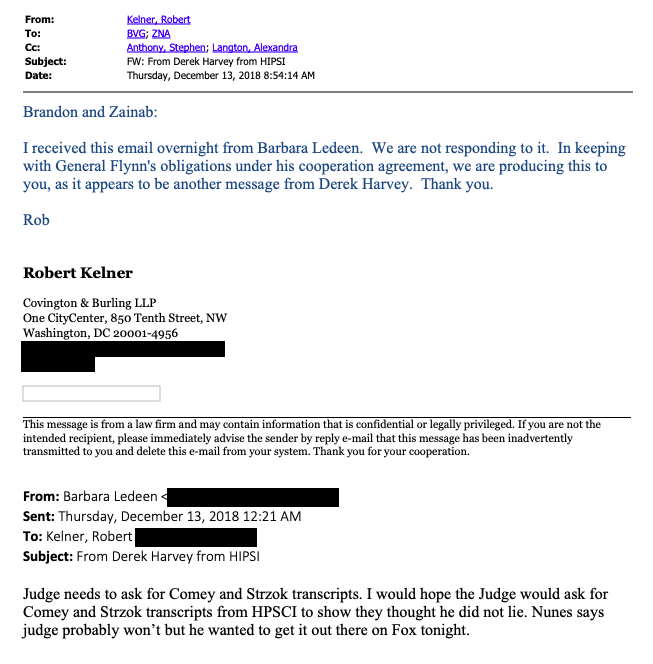
:{Suffice it to say Barbara Ledeen was not happy with
then-US Attorney Jessie Liu for allowing the Flynn prosecution to
proceed after Mueller closed up shop. But two weeks ago, when rumors }:
began to surface that she'd authored a memo for the White House
advocating for Liu's dismissal, Ledeen denied it outright, telling theWashington Post,
"I'm a Senate staffer. I can't lobby either the Senate or the White
House. I'm kind of amazed my name came up in this. Somebody likes to
throw around my name."
LOL!
:{It's wildly inappropriate for a Senate staffer to undermine a federal criminal prosecution, and that hardly stopped her. Axios confirms
that Ledeen did indeed write the hit memo that appears to have finally
gotten Liu fired from the US Attorney's Office and her nomination to a
position at the Treasury Department yanked. Among Liu's unforgivable
transgressions:}:
- Not acting on criminal referrals of some of Justice Brett Kavanaugh's accusers.
- Signing "the sentencing filing asking for jail time" for Gen. Michael Flynn (a friend of Ledeen's).
- Holding a leadership role in a women's lawyers networking group that Ledeen criticized as "pro-choice and anti-Alito."
- Not indicting former deputy director of the FBI Andrew McCabe.
- Dismissing charges against "violent inauguration protesters who plotted to disrupt the inauguration."
:{That's
right, Liu, a career government attorney, lost her job because some
wack-ass Judiciary staffer is still pissed about the Kavanaugh hearings
(and the Clarence Thomas hearings, frankly) and can't understand why the
DOJ didn't indict Christine Blasey Ford.}:
If
Ledeen is a lawyer, it doesn't appear on her LinkedIn page.
Nonetheless, she's absolutely convinced that it was not only legal, but
mandatory, that the government do LOCK HER UPS to Andy McCabe and protesters exercising their First Amendment rights on the streets of DC.
That's why Ledeen deserves her own post here today. Because she appears to have engineered the dismissal of a government lawyer who simply refused to break the law and indict Trump's political enemies without evidence. Indeed, Liu tried mightily to get an indictment of McCabe, and it's pretty clear the grand jury refused to do it. And that **never happens**. The case was weak shit from the jump, Liu dragged it out for two years to mollify the president's bloodlust (and shield documents from discovery and FOIA in McCabe's wrongful termination suit), and then it fell apart because there was nothing there.
As for the inauguration protests, the DC US Attorney's Office only dropped the remaining 129 cases after the first two trials resulted in zero convictions for the ten defendants. It's not clear what Ledeen thinks Liu should have done, short of fabricating evidence against the protesters. And yet, the White House found her logic sufficiently convincing that they fired Liu.
:{It is inexpressible how
dangerous this is. Because, say what you will about Jeff Sessions, but
he knew you weren't supposed to use the Justice Department to settle
political scores. Even Matthew "Meatball" Whitaker, the interim Attorney
General, refused to interfere in
the Mueller investigation or to try to screw with individual
prosecutions. But now Bill Barr's parked his haunches atop the DOJ, and
all bets are off.No reputable attorney general would have ever allowed a}:
Senate staffer to put out a hit on a US Attorney for following the law
before. But post-impeachment, the guardrails are off.
Malicious,
politically motivated prosecutions violate both the law and legal
ethics. But every US Attorney in the country is now on notice that they
fail to indict the president's enemies at their own peril.
SO GET YOUR ASS TO THE POLLS WHILE WE STILL HAVE A DEMOCRACY TO DEFEND.
wiki 7 22
jessie Kong Liu (born January 2, 1973) is an American attorney who was the United States Attorney for the District of Columbia.[1] She previously worked as deputy general counsel at the U.S. Treasury and served at the Justice Department.[2] In 2020, she joined the law firm Skadden, Arps, Slate, Meagher & Flom as a partner.[3]
Contents
Education and legal career
Liu was born in Kingsville, Texas, of a Taiwanese immigrant family.[4][5] She received her Bachelor of Arts, summa cum laude, from Harvard University in 1995, with a major in literature, and completed her J.D. at Yale Law School in 1998.[4] She clerked for Carolyn Dineen King of the United States Court of Appeals for the Fifth Circuit from 1998 to 1999.[2]
Liu worked as an associate at Jenner & Block from 1999 to 2002, as a partner at the same firm from 2009 to 2016, and as a partner at Morrison & Foerster from 2016 to 2017.[6]
Liu served as Assistant United States Attorney in the District of Columbia from 2002 to 2006.[4] She worked at the United States Department of Justice during the administration of President George W. Bush from 2006 to 2009. Her roles included deputy chief of staff in the National Security Division, counsel to the Deputy Attorney General, and Deputy Assistant Attorney General in the Civil Rights Division.[7]
Liu worked for the transition team of President-elect Donald Trump, and in 2017 became deputy general counsel at the United States Department of the Treasury.[7] In June 2017, President Trump nominated Liu to become the next United States Attorney for the District of Columbia, the country's largest U.S. Attorney's office, with more than three hundred prosecutors.[7] Liu was confirmed by the Senate by voice vote in September 2017.[1][8]
While serving as the U.S. Attorney for the District of Columbia, Liu received criticism from residents and local lawmakers for her record of not prosecuting hate crimes.[9] An investigation by The Washington Post found that under her leadership, hate crime prosecutions and convictions in D.C. were at their lowest point in at least a decade.
After much public pressure, her office made more prosecutions for hate
crimes in 2019 than it did in all of 2018 and 2017 combined.[10]
In March 2019, President Donald Trump said he would nominate Liu to become United States Associate Attorney General, but she withdrew her name from consideration later that month because the Republican-controlled Senate Judiciary Committee objected to her nomination.[11][12][13]
On December 10, 2019, President Trump announced his intent to nominate Liu as Under Secretary for Terrorism and Financial Crimes at the Department of the Treasury.[14] The nomination was submitted to the U.S. Senate on January 6, 2020.[15] Some Republicans doubted her conservative credentials and loyalty to Trump.[16]
:{As a US attorney, Liu had overseen some ancillary cases referred by the Mueller investigation including the prosecution of longtime Trump associate Roger Stone, as well as a politically charged case involving former FBI deputy director Andrew McCabe,
a frequent target of Trump's ire. In January 2020 she determined there was insufficient evidence to indict McCabe. She was then transferred to the Treasury Department to await her confirmation, as Barr replaced her with his close advisor Timothy Shea.[17][18] }:
On February 11, 2020, Trump withdrew her nomination, two days before her confirmation hearing was scheduled to begin.[19]
CNN reported that Liu's nomination was withdrawn because she was
perceived to be insufficiently involved in the Stone and McCabe cases.[20] :{Liu resigned from the government on February 12, 2020.[21]
Days later it was reported that before Liu's nomination was withdrawn,
Trump was presented with a lengthy memo describing a variety of ways Liu
was perceived to be disloyal, primarily by not prosecuting individuals
Trump disliked.[22]}:
Awards and honors
Liu has received numerous awards. She was named a White Collar Trailblazer by the National Law Journal
in 2015, was named among the Best Lawyers Under 40 by the National
Asian Pacific American Bar Association in 2011, received a Rising Star
Award from the Asian Pacific American Bar Association of Washington, D.C., in 2011, and received a Service Award from the National Association of Women Lawyers in 2005.[4]
Personal life
She is married to Michael Abramowicz, a lawyer who also attended Yale Law School.[23]
See also
References
...
Federal prosecutors in the District of Columbia have embraced politically fraught cases under the United States attorney, Jessie K. Liu, an ambitious prosecutor who has angled for bigger jobs in the Trump administration.
She aggressively pushed for the prosecution of Mr. McCabe on suspicion of lying to investigators about sensitive law enforcement information provided to a reporter. Mr. McCabe was accused of misleading investigators conducting an administrative review, not a criminal inquiry; typically, such cases are not referred for prosecution.
The relatively straightforward case against Mr. McCabe has dragged on for more than 20 months. Prosecutors have refused to tell Mr. McCabe’s lawyers whether they intend to bring charges.Ms. Liu’s office also chargedGregory B. Craig, a onetime White House counsel in the Obama administration, after prosecutors in New York passed on the case. Mr. Craig was charged with lying to the F.B.I. about his work for the Ukrainian government, but a jury last year quickly acquitted him, handing Ms. Liu an embarrassing defeat.
Mr. Trump nominated Ms. Liu last month to be the Treasury Department’s under secretary for terrorism and financial crimes.He had previously tapped her to be the No. 3 spot in the Justice Department, but she withdrew from consideration after Senator Mike Lee, Republican of Utah, raised concerns about her conservative credentials.
==
https://www.axios.com/**2020/02/**23/trump-memos-deep-state-white-house
axios
the Trump White House and its allies, over the past 18 months, assembled detailed lists of disloyal government officials to oust — and trusted pro-Trump people to replace them — according to more than a dozen sources familiar with the effort who spoke to Axios.
Driving the news:By the time President Trump instructed his 29-year-old former body man and new head of presidential personnel torid his government of anti-Trump officials, he'd gathered reams of material to support his suspicions.
- While Trump's distrust has only intensified since his impeachment and acquittal, he has long been on the hunt for "bad people" inside the White House and U.S. government, and fresh "pro-Trump" options. Outside advisers have been happy to oblige.
In reporting this story,I have been briefed on, or reviewed, memos and lists the president received since 2018 suggesting whom he should hire and fire. Most of these details have never been published.
- A well-connected network of conservative activists with close ties to Trump and top administration officials is quietly helping develop these "Never Trump"/pro-Trump lists, and some sent memos to Trump to shape his views, per sources with direct knowledge.
- Members of this network include Ginni Thomas, the wife of Supreme Court Justice Clarence Thomas, and Republican Senate staffer Barbara Ledeen.
The big picture:Since Trump's Senate acquittal, aides say the president has crossed a psychological line regarding what he calls the "Deep State." He feels his government — from Justice to State to Defense to Homeland Security — is filled with "snakes." He wants them fired and replaced ASAP.
- "I think it's a very positive development," said Rich Higgins, who served on Trump's National Security Council in 2017. H.R. McMaster removed Higgins after he wrote a memo speculating that Trump's presidency faced threats from Marxists, the "Deep State," so-called globalists, bankers, Islamists, and establishment Republicans. (This was long before the full scope of the FBI's Russia investigation was known to Trump and his aides.)
- Higgins told me on Sunday he stands by everything he wrote in his memo, but "I would probably remove 'bankers' if I had to do it over and I would play up the intel community role — which I neglected."
Let's get to the memos.
1. The Jessie Liu memo:Shortly before withdrawing the nomination of the former D.C. U.S. attorney for a top Treasury role, the president reviewed a memo on Liu's alleged misdeeds, according to a source with direct knowledge.
- Ledeen wrote the memo, and its findings left a striking impression on Trump, per sources with direct knowledge. Ledeen declined to comment.
- A source with direct knowledge of the memo's contents said itcontained 14 sections building a case for why Liu was unfit for the job for which Treasury Secretary Steven Mnuchin selected her, including:
- Not acting on criminal referrals of some of Justice Brett Kavanaugh's accusers.
- Signing "the sentencing filing asking for jail time" for Gen. Michael Flynn (a friend of Ledeen's).
- Holding a leadership role in a women's lawyers networking group that Ledeen criticized as "pro-choice and anti-Alito."
- Not indicting former deputy director of the FBI Andrew McCabe.
- Dismissing charges against "violent inauguration protesters who plotted to disrupt the inauguration."
- Neither Liu nor the White House responded to requests for comment.
Between the lines:The Liu memo is not the first such memo to reach the president's desk — and there's a common thread in Groundswell, a conservative activist network that's headed by Thomas and whose members include Ledeen.
- Sources leaked me details of two other memos from people associated with the Groundswell network that also caused a stir inside the White House over the past year.
Thomas has spent a significant amount of time and energy urging Trump administration officials to change the personnel inside his government. This came to a head early last year.
- Members of Groundswell, whose members earlier led the successful campaign to remove McMaster as national security adviser, meet on Wednesdays in the D.C. offices of Judicial Watch, a conservative legal group that has led the fight against the Mueller probe.
- Judicial Watch's president is Tom Fitton. He's a regular on Fox News, and Trump regularly retweets his commentary on the "Deep State."
- Conservative activists who attend Groundswell meetings funneled names to Thomas, and she compiled those recommendations and passed them along to the president, according to a source close to her.
- She handed a memo of names directly to the president in early 2019. (The New York Times reported on her group's meeting with Trump at the time.)
- The Groundswell memo:The presidential personnel office reviewed Thomas' memo and determined that some names she passed along for jobs were not appropriate candidates. Trump may revisit some given his current mood.
Potential hires she offered to Trump, per sources with direct knowledge:
:{- :{Sheriff David Clarke for a senior Homeland Security role.}:
- Fox News regular and former Secret Service agent Dan Bongino for a Homeland Security or counterterrorism adviser role.
- Devin Nunes aide Derek Harvey for the National Security Council (where he served before McMaster pushed him out).
- Radio talk show host Chris Plante for press secretary.
- Federalist contributor Ben Weingarten for the National Security Council.
What we're hearing:These memos created tension inside the White House, as people close to the president constantly told him his own staff, especially those running personnel, were undermining him — and White House staff countered they were being smeared.
- The State Department memo:In one extraordinary incident last year, President Trump passed along another action memo to histhen-head of presidential personnel, Sean Doocey (since pushed to State and replaced with former body man John McEntee).People familiar with the January 2019 memo say it came from conservatives associated with Groundswell. Though nobody I’ve spoken to has claimed credit for it.
- According to sources briefed on the incident, the memo was, in large part, an attack against Doocey. The memo accused him and a colleague in the State Department of obstructionism and named several State Department officials who needed to be fired.
- This list named former deputy secretary John Sullivan, deputy undersecretary for management Bill Todd, and undersecretary for political affairs David Hale, who later testified in the impeachment hearings. (Todd and Hale are career foreign service officers, serving in positions typically reserved for career officials.) Sullivan is now the U.S. Ambassador to Russia.
- The memo ended with an allegation that Doocey had sneakily changed the name of an appointment Trump had already agreed on, swapping out Mira Ricardel for Sean Cairncross to run the Millennium Challenge Corporation.
- Sources briefed on the matter say this particular charge was false on its face because Cairncross was nominated in January 2018, months before Ricardel was briefly discussed as an alternative, per sources with direct knowledge.
The bottom line: As the New York Times' Peter Baker wrote on Saturday, "in some of the most critical corners of the Trump administration, officials show up for work now never entirely sure who will be there by the end of the evening — themselves included."
- Groundswell is an influential driver of that uncertainty. Its members have been working toward this moment for three years. They have lists. They have memos. And they have the president's ear.}:
https://www.thedailybeast.com/inside-ginni-thomas-insane-hiring-memos-for-former-president-donald-trump
no lnx Inside Ginni Thomas’ ‘Insane’ Hiring Memos for Trump
‘WRECKED’
Ginni Thomas’ suggested hires included known bigots and at least one suspected foreign spy, sources say.
Asawin Suebsaeng
Senior Political Reporter
Adam Rawnsley
Former Senior Researcher
Updated Apr. 02, 2022
Years before she became one of then-President Donald Trump’s most prominent coup supporters, Ginni Thomas was already notorious in his West Wing for, among other things, ruining staffers’ afternoons by working Trump into fits of vengeful rage.
“We all knew that within minutes after Ginni left her meeting with the president, he would start yelling about firing people for being disloyal,” said a former senior Trump administration official. “When Ginni Thomas showed up, you knew your day was wrecked.”
Ever since she became a welcome guest at Trump’s residences, Thomas—an influential and longtime conservative activist, and wife of Supreme Court Justice Clarence Thomas—had perfected a proven formula of enthralling and manipulating the president’s emotions and mood. On multiple occasions throughout the Trump era, Thomas would show up in the White House, sometimes for a private meeting or a luncheon with the president. She often came armed with written memos of who she and her allies believed Trump should hire for plum jobs—and who she thought Trump should promptly purge—that she distributed to Trump and other high-ranking government officials.
The fire lists were particularly problematic, as they were frequently based on pure conjecture, rumor, or score-settling, where even steadfastly MAGA aides were targeted for being part of the “Deep State” or some other supposedly anti-Trump coalition, according to people who saw them during the Trump administration.The hire lists were so often filled with infamous bigots and conspiracy theorists, woefully under-qualified names, and obvious close friends of Thomas that several senior Trump aides would laugh at them—that is, until Trump would force his staff to put certain names through the official vetting process, three sources familiar with the matter said.
“These fucking lists were so insane and unworkable.”
— one former Trump White House official
During the Trump years, these memos would astonish various administration officials, including those working in the White House Presidential Personnel Office (PPO). Some of these officials noticed that as the Trump term went on, the Thomas lists would increasingly feature a disproportionate share of names more suited to an OAN guest line-up than any functional government. (To be fair, well before Ginni Thomas became a recurring visitor, Trump would routinely hire people because they had entertained or excited him, via Fox and other cable-news appearances.)
Officials in the PPO regularly annotated the margins of Thomas’ hire lists, usually including a single line for each rejected name, explaining why the prospective hires did not work out. Some failed background checks, or suffered from security-clearance hold-ups. Other annotations noted that a specific individual was offered a job in the Trump administration, but turned it down for whatever reason.
Sometimes, the reasons for the White House’s preemptive rejection, despite Thomas and Trump’s best efforts, were more outlandish. According to a person who reviewed one of the Thomas lists, one annotation for a MAGA job candidate noted that that individual had made too many extreme or offensive jokes on social media that were still visible.
Another of these annotations claimed that one recommendation for a Trump administration position was, in fact, a suspected foreign-intelligence asset, or spy.
Thomas did not respond to requests for comment on this story.
Over the years, some of the specific names that Thomas had compiled and pushed to Trump and his West Wing have trickled out into the press. Among them were Fox News personality Dan Bongino, and the Trump-adulating Sheriff David Clarke.
And according to two sources with knowledge of the matter, Thomas had, unsuccessfully, advised the then-president to hire Frank Gaffney.
Gaffney, a former Pentagon official in the Reagan administration, has spent the past two decades embracing some of the more absurd conspiracy theories circulating in the far right. He has accused conservative anti-tax crusader Grover Norquist of being a secret agent for the Muslim Brotherhoodand believes that American adversaries are working on secret electrical device-frying “electromagnetic pulse” weapons to zap America back to the pre-industrial age.
“These fucking lists were so insane and unworkable,” said one former Trump White House official who had to personally deal with the Thomas-supplied memos and Trump’s fascination with them. “A lot of them were dripping with paranoia and read like they were written by a disturbed person.”
After Thomas departed, he would soon summon a variety of government personnel—West Wing brass, national security aides, lawyers, and other underlings, depending on proximity or the occasion—to inform them he’d just spoken to “Ginni.”
Trump would then identify an official— or, sometimes, he would rattle off a string of names—who he said needed to be sacked “immediately,” according to people familiar with the matter.
When they could get away with it, several of these Trump administration hands would slow-walk these Thomas-inspired firing directives, and wait until Trump invariably forgot about it, cooled off, and moved on to other fixations and gripes. Others would scramble to try to calm Trump down themselves, advising their boss to reconsider, telling him that a firing or a larger purge in the middle of the Trump term would make him look bad or attract negative media attention.
Thomas’ interactions with the Trump administration have taken on a new significance since the January 6th House Select Committee released text messages showing her urging Trump Chief of Staff Mark Meadows to help overturn the 2020 election. Members of the committee are now seeking to interview Thomas, whose efforts to overturn the 2020 election included attendance at a “Stop the Steal” rally on the National Mall the day of the insurrection.
“Trump loved talking to Ginni so much because he loved hearing about who was a Never Trumper, or allegedly one. He loved people who would flatter him, [as Ginni would do],”said Stephanie Grisham, once a top White House aide to Trump who has since had a very public falling-out with the ex-president.“But also, his obsession with loyalty aside, he just loved to gossip—all the time. That’s something else he got out of his series of meetings at the White House with Ginni Thomas.”
In the text messages released by the committee last month, Thomas defended Sidney Powell, the “Kraken” lawyerwhose election conspiracy theories were so outlandish they earned her a billion-dollar defamation lawsuit, the scorn of rank and file Republican officials, and sanctions from a Michigan court. At the time, a number of Trump aides were trying to distance the president from Powell because of her increasingly outlandish comments about bogus election fraud. Thomas, however, urged Meadows not to yield to mainstream Republicans,according to The New York Times.
In her texts with Trump’s consigliere, Thomas also showed a fondness for Steve Pieczenik, a far-right pundit and onetime Tom Clancy co-author whose conspiracy theories and bogus claims were so far-fetched even InfoWars briefly booted him from appearing on the network. Before he began pushing the fake stories about watermarked fraud-catching ballots that earned Thomas’ endorsement, Pieczenik had pushed QAnon conspiracy theories, claimed to have arrested Pope Francis, and spun bogus stories about prominent mass shootings being false flags.
During the Obama administration, Thomas and Gaffney participated in a conservative messaging effort known as “Groundswell.” The group, an informal network of conservative journalists, pundits, and political operatives, routinely met at the offices of the right-wing activist group Judicial Watch to coordinate talking points opposing the Obama administration’s agenda and plot the ouster of allegedly moderate Republicans like Karl Rove from the broader conservative movement.
The revelation of Thomas’ texts with Meadows prompted the January 6th Committee to seek an interview with her, according to CNN, but that effort falls far short of the more legally compelling option of a subpoena.
In the meantime, Congressional Democrats are divided over how to handle Thomas’ cameo in the Jan. 6 scandal. Some, like Oregon Sen. Ron Wyden, have called for Thomas to recuse himself from Jan. 6-related cases while others like Rep. Alexandria Ocasio-Cortez have called for him to step down or be impeached.
But the lack of a Democratic supermajority in the Senate means neither of the Thomases are likely to have to give up their jobs just yet.
https://www.emptywheel.net/2020/05/13/the-legal-posture-of-the-flynn-case-emmet-sullivan-has-up-to-six-pending-decisions-not-one/
t
HE LEGAL POSTURE OF THE FLYNN CASE: EMMET SULLIVAN HAS UP TO SIX PENDING DECISIONS, NOT ONE:{:(style="box-sizing:border-box;margin:0px;padding:0px;border:0px rgb(212, 212, 212);font-style:inherit;font-variant:inherit;font-weight:inherit;font-stretch:inherit;vertical-align:baseline"):}:
May 13, 2020/in 2016 Presidential Election, emptywheel, Mueller Probe/by emptywheel
Partly as a public service (the vast majority of people who are commenting on DOJ’s actions seem to be unfamiliar with the docket) and partly to set up a post I will do attempting to explain why Billy Barr did something as aggressive as he did last week, I wanted to lay out where all the moving pieces in Mike Flynn’s case stand.
FLYNN BLOWS UP A PROBATION SENTENCING WITH MIXED CLAIMS ABOUT HIS PROSECUTION
Prosecutors first started moving towards sentencing Flynn in June 2018;it’s clear the investigation was still ongoing but theyaskedto have Flynn’s presentencing report filed so they could move quickly after that. We now know that this was days after Flynntestified to the grand juryin the Turkish influence peddling case. There were reports Flynn was anxious to be sentenced so he could start earning a living again and in this time period, he registered to start influence peddling again, before his lawyers got him to claim that was just a mistake. On September 17, 2018, prosecutorssaidthey were ready to move towards sentencing and asked for a date starting in November, after the midterms. The hearing ultimately got scheduled for December 18, 2018, after Jeff Sessions had been fired and Trump hadannouncedhe would nominate Bill Barr to be Attorney General (he didn’t actually send the nomination to the Senate until January 3, 2019, for reasons that likely have to do with Matt Whitaker’s Vacancy Reform Act status).
At that point, prosecutors recommended a sentence within guidelines and a downward departure, which is consistent with probation. Had Flynn left well enough alone, he would have gotten a year of probation and he’d be free and clear of the justice system by now.
He didn’t leave well enough alone. He got cute, claiming to accept guilt but at the same time floating the first of his complaints about being perjury trapped by mean old FBI agents. In response, not only did Judge Emmet Sullivan release the documents that revealed Flynn lies were worse than known, but he put Flynn under oath,both to reallocute his guilty plea, but also to swear that he didn’t think the circumstances of his interview made him any less guilty. After Sullivan made it clear that if he sentenced Flynn that day, he’d give him prison time, Flynn decided to wait until he was done cooperating after testifying at his partner Bijan Kian’s trial.
On February 14, 2019, the day Billy Barr was confirmed, Flynn sent a tweet suggesting “the eagle had landed” to Matt Gaetz, whose assaults on the Mueller investigation he had previously cheered in 2018.
After Barr was confirmed, Mueller quickly moved to write up his report, which was completed on March 22 and released on April 19, 2019. Mueller did not close his office, however, until May 29, when he gave a hasty press conference even as the final outstanding piece of evidence — Roger Stone aide, Andrew Miller’s testimony — came in.
When Mueller testified before Congress two months later on July 24, the most newsworthy thing he said was that FBI was still investigating the counterintelligence impact of Mike Flynn’s lies.
[Congressman Raja] KRISHNAMOORTHI: For example, you successfully charged former National Security Advisor Michael Flynn of lying to federal agents about this conversations with Russian officials, correct?
MUELLER: Correct.
KRISHNAMOORTHI: Since it was outside the purview of your investigation your report did not address how Flynn’s false statements could pose a national security risk because the Russians knew the falsity of those statements, right?
MUELLER: I cannot get in to that, mainly because there are many elements of the FBI that are looking at different aspects of that issue.
KRISHNAMOORTHI: Currently?
MUELLER: Currently.
FLYNN REPLACES COVINGTON FOR POWELL AND BLOWS UP THE BIJAN KIAN TRIAL
Exactly a week later, Flynn replaced his competent attorney, Rob Kelner, with Fox News firebreather, Sidney Powell, who moved immediately to collaborate with Bill Barr to undermine his prosecution.
In late June, Flynn started reneging on the testimony he provided in the Kian trial. As a result, the government tried to change their plan for the prosecution, attempting to admit Flynn’s prior testimony as a co-conspriator of unregistered foreign agents (who were charged under 18 USC 951, not just as lobbyists).Flynnintervened to fight that(not least, because it would completely doom any effort to avoid prison),blamingKelner for making him submit a false FARA declaration even while submitting evidence actually showing that Flynn misled Kelner during the filing process. The move predictably helped Kian, as those events were key in Judge Anthony Trenga’s decision to throw out his conviction (which is currently being appealed, but which I expect DOJ to try to blow up in a further attempt to protect Flynn), but italso started a series of claimsfrom Flynn that directly conflicted with his past sworn statements.
Sullivan, noting what was happening over in EDVA, asked the sides to weigh in, which is how Flynn’s team first started making claims in Sullivan’s court that the government, not Flynn, had reneged, all while submitting evidence showing the contrary.
Which is to say, even before Powell took a single action in the Flynn case, Flynn had created further exposure for himself.
AS PART OF A BRADY MOTION, FLYNN MOVES TO DISMISS THE PROSECUTION
The first legal step Sidney Powell took was to submit a motion to compel Brady material. The first filing, on August 30, made no specific request (though did demand more classified information on behalf of Flynn, who of course had confessed to secretly working for a foreign government during the campaign). Powell also asked for more time. Days after submitting that, however, Powell and her colleagues demanded security clearances. On September 11, a more detailed motion was unsealed. That motion included a long list of demands, many based on wild conspiracy theories; the list largely tracked the one Powell had sent to Barr three months earlier, though she generally moderated her language and added a number of requests pertaining to the Turkish investigation that weren’t included in her Barr letter.
Many of these items are among those the government relied on in its motion to dismiss last week, proving the documents were in no way “new.”
Almost two weeks later, Flynn cleaned up some problems in the original request.
On October 1, prosecutors provided a timeline showing they had already produced everything they believed Flynn was entitled to. The same day, they responded to the Brady motion with a detailed response to each of Flynn’s demands, as well as two exhibits showing that this was part of a larger effort to undermine the Mueller investigation(whichI addressed here).
On October 15, Flynn demanded evidence from Joseph Mifsud’s phone — which further established Sidney Powell didn’t care about whether her demands related to her client, but also that she had an open channel of communication with Bill Barr about his Durham investigation.
In Powell’s reply to the government, she included a new demand: that Judge Sullivan dismiss the case for misconduct based on precisely the claims made by DOJ last week.
As new counsel has made clear from her first appearance, Mr. Flynn will ask this Court to dismiss the entire prosecution based on the outrageous and un-American conduct of law enforcement officials and the subsequent failure of the prosecution to disclose this evidence— which it had in its possession all along—either in a timely fashion or at all.
[snip]
The FBI had no factual or legal basis for a criminal investigation, nor did they have a valid basis for a counter-intelligence investigation against an American citizen, and they all knew it. 11 Exs. 5, 6. The evidence the defense requests will eviscerate any factual basis for the plea and reveal conduct so outrageous—if there is not enough already—to mandate dismissal of this prosecution for egregious government misconduct.
[snip]
In its relentless pursuit of Mr. Flynn, the government became the architect of an injustice so egregious it is “repugnant to the American criminal system.” Russell, 411 U.S. at 428 (citations omitted). For these reasons and those in our original Motion and Brief in Support, this Court should compel the government to produce the evidence the defense requests in its full, unredacted form. Given the clear and convincing evidence herein, this Court should issue an order to show cause why the prosecutors should not be held in contempt; and should dismiss the entire prosecution for outrageous government misconduct.
The government noted Powell’s new arguments and got permission to submit a surreply, in which they pointed out that Flynn was already in possession of the information he was using to argue for dismissal when he pled guilty the second time.
Although the defendant now complains about the pace of that discovery, before December 18, 2018, the defendant was in possession of all of the information on which he now bases his argument that the case should be dismissed due to government misconduct. See Reply at 1-2, 16, 26; Notice of Discovery Correspondence, United States v. Flynn, 17-cr-232 (D.D.C. Oct. 1, 2019) (Doc. 123). Thereafter, on December 18, 2018, the defendant and his counsel affirmed for this Court that they had no concerns that potential Brady material or other relevant material had not been provided to the defendant. See Hearing Transcript at 8-10, United States v. Flynn, No. 17-cr-232 (D.D.C. Dec. 18, 2018) (“12/18/2018 Hearing Tr.”). The defendant further affirmed, under oath, that he wished to proceed to sentencing because he was guilty of making false statements to the FBI. See id. at 16.
[snip]
Nor did law enforcement officials engage in “outrageous” conduct during the criminal investigation and prosecution of the defendant. On January 24, 2017, when the defendant lied in his interview, the FBI was engaged in a legitimate and significant investigation into whether individuals associated with the campaign of then-candidate Donald J. Trump were coordinating with the Russian government in its activities to interfere with the 2016 presidential election. The defendant was not “ambushed” at the interview, and the interviewing agents certainly did not engage in “outrageous” conduct that undermines the fact that he lied. Reply at 1, 7. The documents produced by the government in discovery show that the FBI asked the defendant for permission to conduct the interview, informed the defendant that the questions would concern his “contacts with the Russian Ambassador to the United States,” interviewed the defendant in his own office, and afforded him multiple opportunities to correct his false statements by revisiting key questions. See, e.g., Memorandum of Andrew McCabe dated January 24, 2017 (Doc. 56-1) (“McCabe Memo”); Strzok 302.
[snip]
For all of the above reasons, it is no surprise that with the same set of facts, the defendant and his prior counsel previously represented to this Court that the circumstances of the interview had no impact on his guilt, or guilty plea. On December 18, 2018, when the Court asked the defendant if he wished to “challenge the circumstances on which you were interviewed by the FBI,” he responded, under oath, “No, Your Honor.” 12/18/2018 Hearing Tr. at 8.10 The Court then asked the defendant if he understood that “by maintaining your guilty plea and continuing with sentencing, you will give up your right forever to challenge the circumstances under which you were interviewed,” to which the defendant answered, “Yes, Your Honor.” Id. And when the Court queried whether the defendant wanted an opportunity to withdraw his plea because one of the interviewing agents had been investigated for misconduct, the defendant stated “I do not, Your Honor.” Id. at 9. His counsel likewise represented to the Court that their client was not “entrapped by the FBI,” and that they did not contend “any misconduct by a member of the FBI raises any degree of doubt that Mr. Flynn intentionally lied to the FBI.” Id. at 11-12.
In a sur-surreply, Powell tried to back off having demanded that Sullivan dismiss the case, saying that her past arguments and the government’s response aren’t her real motion to dismiss.
In conclusion, yes, the government engaged in conduct so shocking to the conscience and so inimical to our system of justice that it requires the dismissal of the charges for outrageous government conduct. See United States v. Russell, 411 U.S. 423, 428 (1973). However, as fully briefed in our Motion to Compel and Reply, at this time, Mr. Flynn only requests an order compelling the government to produce the additional Brady evidence he has requested—in full and unredacted form—and an order to show cause why the government should not be held in contempt. At the appropriate time, Mr. Flynn will file a separate motion asking that the Court dismiss the prosecution for egregious government misconduct and in the interest of justice. Mr. Flynn is entitled to discovery of the materials he has requested in these motions and briefs that will help him support such a motion.
In Emmet Sullivan’s meticulous 92-page order issued in December denying Flynn’s Brady request, however, he addressed the request for dismissal, specifically distinguishing this case from that of Ted Stevens.
Mr. Flynn’s requested relief is dismissal of this case. See Def.’s Reply, ECF No. 133 at 36; see also Def.’s Sur-Surreply, ECF No. 135 at 17. He seeks dismissal of the charges against him and the entire prosecution for government misconduct. E.g., Def.’s Reply, ECF No. 133 at 7, 23 n.15, 36; Def.’s SurSurreply, ECF No. 135 at 17. The government disagrees. See Gov’t’s Surreply, ECF No. 132 at 12-15. This case is not United States v. Theodore F. Stevens, Criminal Action No. 08–231(EGS), the case that Mr. Flynn relies on throughout his briefing. In that case, the Court granted the government’s motion to dismiss, and the government admitted that it had committed Brady violations and made misrepresentations to the Court. In re Special Proceedings, 825 F. Supp. 2d 203, 204 (D.D.C. 2011) (Sullivan, J.). Even if Mr. Flynn established a Brady violation in this case, dismissal would be unwarranted because “[t]he remedy for a Brady violation is retrial, not dismissal.” United States v. Borda, 941 F. Supp. 2d 16, 19 n.1 (D.D.C. 2013) (citing Pettiford, 627 F.3d at 1228). “[D]ismissal is appropriate only as a last resort, where no other remedy would cure prejudice against a defendant.” Pasha, 797 F.3d at 1139. [my emphasis]
As the government noted when they responded to Flynn’s request for dismissal, he already had all the evidence on which he premised that demand when he pled guilty a second time in December 2018.
IN A SENTENCING MEMO, THE GOVERNMENT ACCOUNTS FOR FLYNN’S FAILED COOPERATION AND REFUSAL TO ADMIT GUILT
In the wake of Sullivan’s order, the parties moved towards sentencing in January. The government got two continuances before submitting their revised motion,one in Decemberandanother in January, to get all required approvals for their sentencing memo.That means prosecutors on the case went to great lengths to approve their recommendation for prison time.
The factors enunciated in Section 3553(a) all favor the imposition of a sentence within the Guidelines range. The defendant’s offense is serious, his characteristics and history present aggravating circumstances, and a sentence reflecting those factors is necessary to deter future criminal conduct. Similarly situated defendants have received terms of imprisonment.
I’ll return to that memo, but the key point is that Judge Sullivan specifically gave Bill Barr’s DOJ time to ensure that the chain of command approved their supplemental sentencing memo.
Before Flynn responded to that revised recommendation, they asked for a continuance to allow them to withdraw Flynn’s guilty plea, specifically citing prosecutors’ recommendation for prison time.
Because Flynn submitted hissupplemental sentencing memoafter beginning the process to withdraw his guilty plea,they were stuck arguing in it boththat Flynn should get credit for admitting guilty but also arguing that he was not guilty.
Thegovernment reply, submitted as Barr started the process toreplace Jessie Liu, is the one that alerted everyone to the shenanigans that Barr was up to. Whereas the initial supplemental motion — which had been delayed twice to get approval — recommended prison time, this one reverted back to supporting probation, the position the government had adopted before Flynn had reneged on both his cooperation and his guilty.
FLYNN BLAMES HIS GUILTY PLEAS ON HIS COVINGTON LAWYERS
As noted, Flynn cited the recommendation for prison time in asking to withdraw his guilty plea(s). Flynn based his request to withdraw his guilty plea on a claim that his very competent Covington lawyers were both conflicted and incompetent. He then submitted what was originally called a supplement — which made no new arguments — which they subsequently corrected to note,
1 This is not Mr. Flynn’s “Supplemental Motion to Withdraw for Alternative Additional Reasons” currently due to be filed on January 22, 2020, for which we have requested two additional days to complete and file.
In response to a second request for more time on its filings, Judge Sullivan issued an order that reflects where he’ll likely go now: he raised the prospect of an evidentiary hearing to determine whether there is good cause to set aside his guilty plea.
Mr. Flynn’s supplemental motion and the government’s response shall address the following: (1) the standard in this Circuit for a defendant seeking to withdraw a guilty plea before sentencing; and (2) the need for an evidentiary hearing where the parties would present all testimony and evidence concerning the issue of whether Mr. Flynn can show that there is good cause to set aside his guilty pleas, see United States v. Cray, 47 F.3d 1203, 1206 (D.C. Cir. 1995), including testimony from Mr. Flynn and other witnesses under oath, subject to cross-examination, to show any “fair and just reason” for this Court to grant his motion to withdraw, Fed. R. Crim. P. 11(d).
From that moment forward, it became clear that Sullivan would put Flynn back under oath.
On February 9, prosecutors made things still worse, by asking Sullivan to waive Covington’s attorney-client privilege with respect to Flynn so they could assist prosecutors in rebutting his claims that they were incompetent. From that point forward, it became clear that not only Flynn, but his very credible former lawyers, would be testifying about the prosecution.
On January 29, just two days before Bill Barr would replace Jessie Liuwith his flunky and around the same time he ordered Jeffrey Jensen to review the Flynn prosecution, Flynn submitted what he billed as his realsupplemental motion to withdraw, doubling down on the claim that his former lawyers were responsible for his guilty pleas, he wasn’t.
As I noted at the time, the motions in conjunction created new risks for Flynn: in particular, his motion to withdraw included a sworn declaration that conflicted with three past sworn statements from him:
- December 1, 2017: Mike Flynn pled guilty before Judge Rudolph Contreras to lying in a January 24, 2017 FBI interview. In his plea allocution, Flynn admitted:
- He lied about several conversations with Sergey Kislyak about sanctions
- He lied about several conversations with Kislyak about an attempt to undermine an Obama effort at the UN
- He lied about whether his company knew that it was working for the government of Turkey and about whether senior officials from Turkey were overseeing that contract
- He was satisfied with the services his attorneys had provided
- No other threats or promises were made to him except what was in the plea agreement
- December 18, 2018: Mike Flynn reallocuted his guilty plea before Judge Emmet Sullivan to lying in a January 24, 2017 FBI interview. In his plea allocution, Flynn admitted:
- He lied about several conversations with Sergey Kislyak about sanctions
- He lied about several conversations with Kislyak about an attempt to undermine an Obama effort at the UN
- He lied about whether his company knew that it was working for the government of Turkey and about whether senior officials from Turkey were overseeing that contract
- He was satisfied with the services his attorneys had provided
- He did not want a Curcio counsel appointed to give him a second opinion on pleading guilty
- He did not want to challenge the circumstances of his January 24, 2017 interview and understood by pleading guilty he was giving up his right to do so permanently
- He did not want to withdraw his plea having learned that Peter Strzok and others were investigated for misconduct
- During his interview with the FBI, he was aware that lying to the FBI was a federal crime
- June 26, 2018: Mike Flynn testified to an EDVA grand jury, among other things, that “from the beginning,” his 2016 consulting project “was always on behalf of elements within the Turkish government,” he and Bijan Kian would “always talk about Gulen as sort of a sharp point” in relations between Turkey and the US as part of the project (though there was some discussion about business climate), and he and his partner “didn’t have any conversations about” a November 8, 2016 op-ed published under his name until “Bijan [] sent me a draft of it a couple of days prior, maybe about a week prior.” The statements conflict with a FARA filing submitted under Flynn’s name.
- January 29, 2020: Mike Flynn declared, under oath that, “in truth, I never lied.” Flynn claims he forgot about the substance of his conversations with the Russian Ambassador, rather than lied about them.
To make things worse, as often happens with exhibits Sidney Powell introduces, the actual record undermined claims Flynn made.For example, Flynn included a document that showed Covington gave him more warnings about conflict than he admitted to in his declaration, thereby making it clear his sworn declaration didn’t match the record accompanying it.
FLYNN REPEATS HIS CLAIM HE WAS RAILROADED
That same day Flynn submitted his most substantive motion to withdraw his guilty plea, January 29, he also submitted a motion to dismiss his prosecution. It was basically a repeat of the request made months earlier as part of the Brady request, pointing to irregularities in the Carter Page FISA application as the primary justification to make the motion anew.
On February 12, prosecutors responded to that motion pointing out there was nothing new here.Flynn’s response was repetitive and included a misleading timeline full of claims that contradict claims they’ve made elsewhere. The motion ignored that Flynn waived these complaints when he pled guilty the second time.
The government repeatedly claims that Mr. Flynn waived his right to constitutional protections when he pled guilty. ECF No. 169 at n.3. But, Mr. Flynn’s plea cannot stand, and the government cannot use it as both a shield for its misconduct and a sword to sentence Mr. Flynn. His plea was infected with constitutional error which rendered it neither knowing nor voluntary and in violation of Mr. Flynn’s Sixth Amendment rights. See ECF No. 162-2. As Mr. Flynn argued in his Motion to Withdraw Plea, ECF No. 151, even if it were a validly contracted plea, the government breached the contract the moment Mr. Van Grack filed the government’s supplemental sentencing memo which withdrew its motion for downward departure and its recommendation of probation. See ECF No. 150 at 3 (“In addition to asking the Court to credit the defendant with providing substantial assistance, the government recommended that the defendant receive credit for accepting responsibility. . . . [T]he government now withdraws both requests.”).
AS PROSECUTORS PREPARE THEIR COVINGTON ARGUMENT, BILL BARR PREPARED HIS “NEW” INFORMATION
As noted, on February 9, prosecutors took steps to be able to prove that Covington, in fact, gave Flynn exceptionally good advice. They asked for a series of delays while they did that. According to the schedule set by Judge Sullivan, prosecutors would have proposed a briefing schedule to lay all that out last Friday, possibly in a motion including some of the details from the 600 pages of evidence obtained from Covington that (the record already shows) would substantiate that Flynn gave them incorrect information for his FARA filing and repeatedly brushed off warnings about conflict.
During the delay, Covington did find 6,000 new records on top of the 600,000 documents they had already provided. Given the Bates numbers of documents filed last week, there’s no reason to believe those exhibits were included in these newly discovered documents.
As that was happening, prosecutor Jocelyn Ballantine handed over, drip-by-drip, the documents that Jeffrey Jensen “analyzed.”
Beginning in January 2020, at the direction of Attorney General William P. Barr, the United States Attorney for the Eastern District of Missouri (“USA EDMO”) has been conducting a review of the Michael T. Flynn investigation. The review by USA EDMO has involved the analysis of reports related to the investigation along with communications and notes by Federal Bureau of Investigation (“FBI”) personnel associated with the investigation.
The enclosed documents were obtained and analyzed by USA EDMO in March and April 2020 and are provided to you as a result of this ongoing review; additional documents may be forthcoming. These materials are covered by the Protective Order entered by the Court on February 21, 2018.
None of this discovery correspondence said the documents were new to prosecutors, only that Jensen had reviewed them. They were, nevertheless, the documents that Timothy Shea claimed were “new” as his basis for flip-flopping on DOJ’s position on the case.
EMMET SULLIVAN HAS SIX DECISIONS TO MAKE, NOT JUST ONE
Many, perhaps most, people who’ve commented in the last week have noted that Emmet Sullivan has the prerogative whether to accept DOJ’s motion or not. It’s true he has that authority. But he actually has up to six different decisions pending, as follows:
- Whether to accept or reject DOJ’s motion to dismiss
- If Sullivan accepts DOJ’s motion to dismiss, whether he does so with or without prejudice
- Whether to accept or reject Flynn’s motion to withdraw his pending withdraw of guilty plea, motion to dismiss, and waiver of privilege for Covington (to which DOJ has consented)
- Whether to hold an evidentiary hearing or ask for briefing on Flynn’s motion to withdraw
- Whether to accept or reject Flynn’s motion to dismiss his prosecution
- Whether and if so how to sentence Flynn based on fully briefed sentencing memoranda
Sullivan would not get to most of these without, first, deciding what to do about DOJ’s motion to dismiss. And if he rejected DOJ’s motion to dismiss, he would obviously reject Flynn’s motion to dismiss, just like he already rejected that argument. Though if Sullivan does reject DOJ’s motion to dismiss, sentencing is fully briefed and he could move immediately to sentencing.
Moreover, Flynn’s multiple conflicting sworn statements are before this court whether or not Sullivan rejects DOJ’s motion to dismiss. And he could reach that decision — or at least order briefing on the Covington evidence Flynn clearly wants to keep hidden — without (or before) weighing in on DOJ’s motion to dismiss.
Which is likely one of the reasons Sullivan is taking his time before he issues the next scheduling order.
Update: I should have putthis quoteon behalf ofChris Wray in several posts before this one. But basically, the FBI has already put it into the public record that the stuff DOJ claimed was “new” last week had already been reviewed by DOJ IG and John Durham’s inquiry.
With regard to certain documents in the Michael Flynn matter from the 2016-2017 time period that are now the subject of reporting by the press, the FBI previously produced those materials to the Inspector General and U.S. Attorney Durham,” the FBI said.
Tags:Bill Barr, Emmet Sullivan, Jeffrey Jensen, Jocelyn Ballantine, Mike Flynn, Rob Kelner, Sidney Powell, Timothy Shea
===
https://en.wikipedia.org › wiki › Jessie_Liu
Jessie Liu - Wikipedia
Jessie Kong Liu(born January 2, 1973) is an American attorney who was the United States Attorneyfor the District of Columbia.[1] She previously worked as deputy general counsel at the U.S. Treasuryand served at the Justice Department.[2] In 2020, she joined the law firm Skadden, Arps, Slate, Meagher & Flomas a partner. [3] Contents
https://www.justice.gov › usao-dc › pr › jessie-k-liu-takes-office-united-states-attorney
Jessie K. Liu Takes Office as United States Attorney
WASHINGTON - Jessie K. Liu has taken office as United States Attorney for the District of Columbia. She succeeds Channing D. Phillips, who had been serving in the position since Oct. 19, 2015. President Trump nominated Ms. Liu on June 12, 2017 to serve as U.S. Attorney, and the Senate confirmed the nomination on Sept. 14, 2017.
https://www.justice.gov › usao-dc › pr › statement-us-attorney-jessie-k-liu-dc-council-hearing-regarding-hate-crimes-district
Statement by U.S. Attorney Jessie K. Liu on D.C. Council Hearing ...
WASHINGTON - Jessie K. Liu, U.S. Attorney for the District of Columbia, issued the following statement regarding today's hearing before the Council of the District of Columbia, Committee on the Judiciary & Public Safety, entitled "Hate Crimes in the District of Columbia and the Failure to Prosecute by the Office of the United States Attorney."
https://www.nbcnews.com › politics › donald-trump › former-us-attorney-who-oversaw-roger-stone-case-resigns-n1136411
Jessie Liu, ex-U.S. attorney who oversaw Roger Stone case, resigns from ...
Jessie Liu, ex-U.S. attorney who oversaw Roger Stone case, resigns from Trump administration President Trump yanked Liu's nomination for a top spot at the Treasury Department earlier this week....
https://www.skadden.com › professionals › l › liu-jessie
Jessie K. Liu - Skadden, Arps, Slate, Meagher & Flom
From 2017-20, Ms. Liu served as the Senate-confirmed U.S. attorney for the District of Columbia, leading the nation's largest U.S. attorney's office. In this role, she oversaw matters of national and international significance involving corruption, fraud and national security.
ww.nytimes.com › politics › leak-investigation-james-comey
Justice Dept. Investigating Years-Old Leaks and Appears ...
https://www.nytimes.com/
2 days ago - James B. Comey, the former F.B.I. director, has been a frequent target ... leak of classified information about a Russian intelligence document, ...