Khalilzad, Z
Khalilzad
u chic boys
mult all fails?
===
===
an 12 24
Rep. Gerry Connolly (D-VA) reminded lawmakers that President-elect Donald Trump's first administration had negotiated with the Taliban for a withdrawal from Afghanistan at a hearing where Republicans attacked President Joe Biden over the decision to pull U.S. forces out of the country.
During Tuesday's House Foreign Affairs Committee hearing, Connolly displayed a photo of former Secretary of State Mike Pompeo with a Taliban negotiator.
"I'd like to put a picture up, which seems to suggest, Mr. Secretary, that the Republican narrative is correct about you," the Virginia Democrat told Secretary of State Antony Blinken. "Isn't that you with the Taliban negotiator, Mr. Secretary?"
"I'm not aware of having spent any time with a Taliban negotiator," Blinken replied.
"Oh, I'm sorry, that's Secretary Pompeo," Connolly said. "Was he your predecessor in the Biden administration as Secretary of State?"
"No, he was my predecessor in the previous administration, the Trump administration," Blinken explained.
Connolly pointed out that Trump had appointed Zalmay Khalilzad to negotiate directly with the Taliban in 2018.
"And he, of course, testified before this committee, and I can remember an exchange with him in which I expressed deep concern about the direction of the U.S. posture and the ramifications with allied Afghans who had worked for us or worked with us, and women," the lawmaker recalled. "And he kind of brushed them off at the time."
Khalilzad went on to forge an agreement with the Taliban in Doha that led to the U.S. withdrawal.
"All U.S. troops were to be out by May 31st," Blinken acknowledged. "In the meantime, 5,000 prisoners were released — Taliban prisoners."
"Among those 5,000 were terrorists, fighters, and people who returned to the battlefield against the Afghan government, which allegedly we were supporting at the time," Connolly remarked.
ALSO READ:Agenda 47: Alarm sounded about Trump’s dystopian plans for his second term
"It's kind of hard to follow and it seems to me that we, by agreeing to that in the Trump years with Secretary Pompeo, your predecessor, and Ambassador Khalilzad, we actually set in motion an untenable but probably irrevocable kind of folding of events," he added.
"We cut a deal to get out and cut our losses at the expense of the Afghan government, the Afghan military, and ultimately the Afghan people, and that was all set in motion before you took the oath of office or President Biden took the oath of office."
Watch the video below from C-SPAN or click the link.
---
see also DN 3/9/20 fighting threatens peace deal w/ taliban
'afghanistan Papers’ reveal how presidents and generals misled the American public on war’s progress
Amy Goodman, Democracy Now March 9, 2020 foia
Washington Post reporter Craig Whitlock has just won a George Polk Award for Military Reporting for his in-depth investigation called “The Afghanistan Papers: A Secret History of the War.”
https://www.alternet.org/2020/03/afghanistan-papers-reveal-how-presidents-and-generals-misled-the-american-public-on-wars-progress/
==
==
http://www.aljazeera.com/archive/2003/08/2008410151856461833.html
ARCHIVE10 AUGUST 2003
The war on Iraq: justifications and motives
The Bush administration has justified its war against Iraq on three grounds: Saddam Hussein's alleged possession of weapons of mass destruction, his links to so-called terrorists, and liberating Iraqis from oppression and tyranny.
Najib Ghadban |
Dr Najib Ghadban is professor of politics at Arkansas University in the United States. He specialises in Middle Eastern and Arab Gulf studies.
Advocates of war in the US administration claimed that Iraq had continued to develop WMDs, and with Saddam Hussein capable of making them available to organisations such as al-Qaida, it put the US at imminent risk.
However, a closer analysis of US behaviour, as well as the thinking of the pro-war camp inside the Bush administration, reveals that the justifications were convenient excuses for mobilising US public opinion.
The war on Iraq was planned over several years, promoted by an influential group of neo-conservatives, made possible by the terrorist attacks of 11 September 2001, and marketed by the right-wing pundits and media.
From containment to change
The idea of removing Saddam Hussein dates back to the second Gulf War in 1991. One of its prime advocates was Paul Wolfowitz who argued for regime change by supporting the Iraqi opposition.
Nonetheless, the dominant view within the first Bush Administration was that Saddam would be toppled within six months after suffering a humiliating defeat.
When that didn’t happen, Bush senior decided that the best course of action was to contain Saddam, and allow him to be strong enough to maintain order domestically, and weak enough not to threaten his neighbours.
Economic sanctions and the disarmament of Iraq became the twin pillars of the new policy which would be inherited by the Clinton Administration under the new heading of "Dual Containment".
Both the first Bush and Clinton administrations relied on the UN to carry out the task of disarming Iraq. The UN mandate required that sanctions would not be lifted until Iraq was fully disarmed.
Frustrated by the lack of cooperation on the part of Saddam Hussein, the US resorted to force several times to compel him to change his behavior.
In spite of Iraq’s lack of cooperation, two points deserve mentioning.
Firstly, Saddam Hussein's government was given every reason not to cooperate, particularly after the US made it clear that sanctions would not be lifted as long as Saddam remained in power.
Second, even with the lack of full Iraqi compliance, the UN achieved remarkable results.
According to Scott Ritter, the former head of the United Nations weapons inspections in Iraq from 1991 until 1998, UNSCOM accounted for and dismantled 94 percent of Iraq's WMDs.
Before the UN pulled its inspectors from Iraq, which preceded Operation Desert Fox in December 1998, a group of conservative officials and intellectuals associated with the New American Century wrote a letter to President Clinton suggesting that the policy of containing Iraq was failing and proposed a new strategy based on confrontation.
'what these unelected officials have in common is their strong association with energy and defence industries and their fervent support of Israel'.
According to that suggestion, the US strategy should entail “removing Saddam Hussein and his regime from power.”
Among the signatories to this letter were Elliott Abrams, Richard L. Armitage, Francis Fukuyama, Zalmay Khalilzad, Richard Perle, Donald Rumsfeld, Paul Wolfowitz, and R. James Woolsey.
Nucleus of neocons
Almost all of the signatories were given senior posts in the new Bush Administration or were appointed to the newly established Defence Policy Board.
In addition to the influential Vice President Dick Cheney, this group constituted the nucleus of the neo-conservatives, known inside the Beltway as the neocons.
Beside their advocacy of regime change in Iraq, what these unelected officials have in common is their strong association with energy and defence industries and their fervent support of Israel.
When George Bush assumed office in early 2000, Saddam Hussein was little more than a nuisance for the new administration.
This is mainly because he was still in power and he had succeeded in breaking the unity of the international campaign to isolate him through sanctions.
Then came the attacks of 11 September 2001. While no connection has ever been uncovered between Bin Ladin and the regime of Saddam Hussein, the neocons seized the opportunity to make the hypothetical scenario of a potential connection between Saddam Hussein and Bin Laden.
Such a scenario was based on two erroneous assumptions: One is that Iraq had massive quantities of chemical and biological weapons, and the other that Saddam would be willing to supply such weapons to al-Qaida in the fight against a common enemy.
After the events of 11 September 2001 the change of focus onto Iraq was a natural progression for the neocons.
No sooner had they gone to war on Afghanistan than they shifted their focus from Bin Ladin and Afghanistan onto Iraq as the next phase in their so-called war on terror.
To justify targeting Iraq and to dress up their motives in the language of terrorism prevention, the Bush Administration devised the principle of "pre-emptive strike".
According to the National Security Strategy published in September 2002, the US should strike against hostile states and terrorist groups, acting “against such emerging threats before they are fully formed.”
Selling the war
The next step was to market the war on Iraq. The Bush administration needed a message and a messenger. The message was framed as following: Saddam continues to develop a vast arsenal of weapons of mass destruction, he used chemical weapons against his own people, Iraq has something to do with 9/11, and Saddam has ties to al-Qaida.
9/11 gave the neocons the excuse
they needed to turn on Iraq
The neocons found in the right-wing media and in pundits such as Fox News and Rush Limbaugh, eager allies willing to publicise and magnify the Iraqi threat. Furthermore, the mainstream media, such as CNN, failed to critically examine the rationale for going to war.
The climate of fear in the aftermath of 9/11 and the apathy and/or lack of knowledge about the Middle East among most Americans, constituted the context for the steady support for the war on Iraq inside the US.
The military campaign to invade Iraq lost some momentum when President Bush acceded to Collin Powell and Tony Blair’s request to seek UN support against Iraq.
The neocons went along with the proposal counting on Saddam’s intransigence and stupidity, to provide the necessary justification for the US to pursue the military option.
However, Iraq’s acceptance of UN Resolution 1441 and the opposition to the war worldwide complicated the administration’s war plan.
By the time the military preparations were complete, and with each passing day failing to yield weapons of mass destruction, the hawks in the US administration were ready to go it alone.
'the neocons' real objectives have less to do with Iraq’s possession of weapons of mass destruction and more with their vision of a new Middle East devoid of figures like Saddam Hussein.'
The reason why the Bush administration was adamant not to give the UN inspectors more time and resources was because of the risks associated with either not finding illegal weapons or disarming Iraq peacefully.
In both cases the UN would have no choice but to call for a lifting of economic sanctions imposed on Iraq after the 1991 Gulf War.
Such a scenario would have prevented the neocons from achieving their real objectives. These have less to do with Iraq’s possession of weapons of mass destruction and more with the neocons’ vision of a new Middle East devoid of figures like Saddam Hussein.
From the vantage point of the neocons, taking out Saddam and occupying Iraq would achieve several aims.
Firstly, in the aftermath of 9/11, many hawks in the US government wanted to send a strong message to the enemies of the US that the administration was willing to destroy any threat before it materialised.
Secondly, an American military presence in Iraq would allow the US to thwart the emergence of any potential alliance between two members of the axis of evil, Iran and Iraq, and Syria.
Thirdly, it would allow the US to withdraw its forces from Saudi Arabia in order to defuse the rising opposition to the US military presence in that country.
Fourthly, a combination of US direct control of Iraqi oil and a long-term military presence in Iraq, in addition to the US bases in the surrounding countries, would enable the US to have more control over world oil supplies and policies.
Finally, the neocons believed that toppling Saddam and dismantling his military capability would close off once and for all the ability of any Arab country to challenge the Israeli military and its strategic supremacy.
Furthermore, Iraq would be added to the growing list of Arab countries to make peace and normalise relations with the Jewish state.
There was no doubt about the military outcome of any confrontation between the US and the demoralised and outdated Iraqi army. However, the neocons’ assumption that Iraqis would welcome the “liberating army” with flowers turned out to be a major blunder.
There is growing evidence that intelligence information was manipulated to support a political decision already taken.
Furthermore, the over-reliance on Iraqi opposition sources might explain some of the difficulties currently facing the US occupying forces in Iraq.
Together, with an arrogance of power demonstrated by the wars on Afghanistan and Iraq the policies amount to a recipe for disaster for the Iraqi people, and the future of US relations with the Arab and Muslim world.
http://en.wikipedia.org/wiki/Zalmay_Khalilzad
Zalmay Mamozy Khalilzad (Nastaliq: زلمی خلیلزاد - Zalmay Khalīlzād) (born: 22 March 1951) is an American counselor at the Center for Strategic and International Studies (CSIS) and president of Khalilzad Associates, an international business consulting firm based in Washington, DC. He was the United States Ambassador to the United Nations under President George W. Bush. He has been involved with U.S. policy makers at the White House, State Department and Pentagon since the mid-1980s, and was the highest-ranking Muslim American in the Administration of U.S. President George W. Bush.[2]^(http://en.wikipedia.org/wiki/Zalmay_Khalilzad#cite_note-ihouse-1) Khalilzad's previous assignments in the Administration include U.S. Ambassador to Afghanistan and U.S. Ambassador to Iraq.
Contents |
[edit] Early history and personal life
Zalmay Khalilzad was born in the city of Mazari Sharif in northern Afghanistan. Khalilzad's father (Khalilullah Khalilzad) was a government official under the monarchy of Mohammed Zahir Shah.[3]^(http://en.wikipedia.org/wiki/Zalmay_Khalilzad#cite_note-Livergood-2) He is an ethnic Pashtun[4]^(http://en.wikipedia.org/wiki/Zalmay_Khalilzad#cite_note-3)[^(http://en.wikipedia.org/wiki/Zalmay_Khalilzad#cite_note-4)5]^(http://en.wikipedia.org/wiki/Zalmay_Khalilzad#cite_note-4) from his father's side and his mother tongue is Dari (Persian).[6]^(http://en.wikipedia.org/wiki/Zalmay_Khalilzad#cite_note-5) He also speaks English, Arabic and Pashto.
Khalilzad began his education at the public Ghazi Lycée school in Kabul. He first visited the United States as a Ceres, California high school exchange student with AFS Intercultural Programs. Later, he attained his bachelor's and master's degrees from the American University of Beirut in Lebanon. Khalilzad received his Ph.D at the University of Chicago, where he studied closely with strategic thinker Albert Wohlstetter, a prominent nuclear deterrence thinker and strategist, who provided Zalmay with contacts in the government and with RAND.[2]^(http://en.wikipedia.org/wiki/Zalmay_Khalilzad#cite_note-ihouse-1)
Khalilzad is married to Cheryl Benard. They have two children, Alexander and Maximilian.
[edit] Career history
Presently Khalilzad serves as the President of Khalilzad Associates, LLC a "international advisory firm that serves clients at the nexus of commerce and public policies, helping global businesses navigate the most promising and challenging international markets." [7]^(http://en.wikipedia.org/wiki/Zalmay_Khalilzad#cite_note-6) Khalilzad Associates counts among its clients international and US companies which are primarily interested in doing business in Iraq and Afghanistan. According to Khalilzad, these include companies in the sectors of energy, construction, education and infrastructure.[8]^(http://en.wikipedia.org/wiki/Zalmay_Khalilzad#cite_note-7)
Khalilzad also currently serves as a Counselor at the Center for Strategic International Studies (CSIS) and sits on the Boards of the National Endowment for Democracy (NED), America Abroad Media (AAM), the RAND Corporation's Middle East Studies Center, the American University of Iraq in Suleymania (AUIS), and the American University of Afghanistan (AUAF).[9]^(http://en.wikipedia.org/wiki/Zalmay_Khalilzad#cite_note-8)
From 1979 to 1989, Khalilzad worked as an Assistant Professor of Political Science at Columbia University's School of International and Public Affairs. During that time he worked closely with Zbigniew Brzezinski, the Carter Administration's architect of the policy supporting the mujahideen resistance to the Soviet Union's invasion of Afghanistan.[2]^(http://en.wikipedia.org/wiki/Zalmay_Khalilzad#cite_note-ihouse-1) (See also: Operation Cyclone.)
In 1984 Khalilzad accepted a one-year Council on Foreign Relations fellowship to join the State Department, where he worked for Paul Wolfowitz, Assistant Secretary of State for East Asian and Pacific Affairs.
From 1985 to 1989, Khalilzad served in President Ronald Reagan's Administration as a senior State Department official advising on the Soviet war in Afghanistan and the Iran–Iraq War. During this time he was a member of the policy planning staff and the State Department's Special Advisor on Afghanistan to Undersecretary of State Michael H. Armacost. In this role he developed and guided the international program to promote the merits of a Mujahideen-led Afghanistan to oust the Soviet occupation. From 1990-1992, Khalilzad served under President George H. W. Bush in the Defense Department as Deputy Undersecretary for Policy Planning.
Between 1993 and 2000, Khalilzad was the Director of the Strategy, Doctrine, and Force Structure at the RAND Corporation. During this time, he helped found RAND's Center for Middle Eastern Studies as well as "Strategic Appraisal," a periodic RAND publication. He also authored several influential monographs, including "The United States and a Rising China" and "From Containment to Global Leadership? America and the World After the Cold War." While at RAND, Khalilzad also had a brief stint consulting for Cambridge Energy Research Associates, which at the time was conducting a risk analysis for Unocal, now part of Chevron, for a proposed 1,400 km (890 mile), $2-billion, 622 m³/s (22,000 ft³/s) Trans-Afghanistan gas pipeline project which would have extended from Turkmenistan to Afghanistan and further proceeding to Pakistan. As one of the original members of Project for the New American Century, Khalilzad was a signatory of the letter to President Bill Clinton sent on January 26, 1998, which called for him to accept the aim of "removing Saddam Hussein and his regime from power" using "a full complement of diplomatic, political and military efforts."[10]^(http://en.wikipedia.org/wiki/Zalmay_Khalilzad#cite_note-9)
[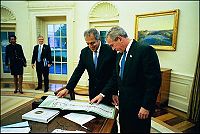 ](http://en.wikipedia.org/wiki/File:Zalmay_Khalilzad_with_George_W._Bush_in_2004.jpg)
[ ](http://en.wikipedia.org/wiki/File:Zalmay_Khalilzad_with_George_W._Bush_in_2004.jpg "Enlarge")
Khalilzad presenting President George W. Bush a ballot from the first democratic election in Afghanistan on 18 October 2004.
In 2001, President George W. Bush asked Khalilzad to head the Bush-Cheney transition team for the Department of Defense and Khalilzad briefly served as Counselor to Secretary of Defense Donald Rumsfeld. In May 2001, National Security Advisor Condoleezza Rice announced Khalilzad's appointment as Special Assistant to the President and Senior Director for Southwest Asia, Near East, and North African Affairs at the National Security Council. In December 2002 the President appointed Khalilzad to the position of Ambassador at Large for Free Iraqis with the task of coordinating "preparations for a post-Saddam Hussein Iraq."[11]^(http://en.wikipedia.org/wiki/Zalmay_Khalilzad#cite_note-10)
After the terrorist attacks of 9/11, President Bush came to rely on Khalilzad's Afghanistan expertise. Khalilzad was involved in the early stages of planning to overthrow the Taliban and on December 31, 2001 was selected as Bush's Special Presidential Envoy for Afghanistan. He served in that position until November 2003, when he was appointed to serve as U.S. Ambassador to Afghanistan.
...
ours later, Mr. Bielesz released a statement stressing that no charges had been brought against the couple, in the United States, Austria or anywhere else.
In May 2013, the Justice Department “sent a routine request to the Austrian authorities for records for certain bank accounts in Vienna in the name of Ms. Benard,” the statement said. The request “did not seek the seizure of assets belonging to Ms. Benard or Ambassador Khalilzad,” the statement said, nor did it “contain evidence of money laundering or other offenses.” It remained unclear why the state prosecutor nonetheless “ignored the plain language of the D.O.J. and froze Ms. Benard’s accounts,” the statement said.
The couple are now focused on unfreezing the assets and are upset by the “gross invasion of privacy” caused by the careless release of information, the statement said. It was signed by Mr. Bielesz and Robert B. Buehler, a New York lawyer with the firm Hogan Lovells.
Mr. Khalilzad runs Khalilzad Associates, which operates as part of Gryphon Partners, a Washington enterprise describing itself as an advisory firm focused on frontier markets.
Born in Afghanistan in 1951, Mr. Khalilzad studied at the American University in Beirut, where he met Ms. Benard, and later earned a doctorate from the University of Chicago. He first worked for the State Department in the 1980s, serving under President Ronald Reagan and President George Bush.
After the Sept. 11, 2001, terrorist attacks, Mr. Khalilzad became a trusted adviser to President George W. Bush on Afghanistan and was formally appointed ambassador to Kabul in 2003, serving in that post until 2005. He then became ambassador to Iraq, where he stayed until 2007, when he won congressional approval as the American envoy to the United Nations. After Barack Obama won the 2008 presidential election, Mr. Khalilzad entered private business.
Zalmay Khalilzad, George W. Bush's ambassador to his native ...
www.slate.com/.../zalmay_khalizad_george_w_bush_s_ambassador_to_his_native_af...
1.
Zalmay Khalilzad Is Suspected of Tax Evasion and Money Laundering ...
https://www.nytimes.com/2014/09/.../zalmay-khalilzad-tax-evasion-investigation.html?...
Sep 8, 2014 - Former Ambassador Zalmay Khalilzad, center, in 2008. Viennese officials confirmed that accounts owned by his wife, Cheryl Benard, a dual ...
Our Team - Gryphon Partners | Gryphon Partners
gryphon-partners.com/?page_id=40
2.